
A English
Productivity Questions in English
Class 12 Biology · Ecosystem · Productivity
110+
Questions
English
Language
100%
With Solutions
Showing 50 of 110 questions in English
51
Medium
Justify the following statement in terms of ecosystem dynamics: "Nature tends to increase the gross primary productivity, while man tends to increase the net primary productivity".
Solution
(N/A) In ecosystem dynamics, energy flows from one trophic level to another. Approximately $50 \%$ of incident sunlight on Earth is Photosynthetically Active Radiation $(PAR)$. Plants capture only $2$ to $10 \%$ of this $PAR$ to produce Gross Primary Productivity $(GPP)$.
$GPP$ is the total rate of production of organic matter during photosynthesis. A significant portion of this energy (often up to $90 \%$) is consumed by plants themselves for respiration $(R)$ and other metabolic processes.
Net Primary Productivity $(NPP)$ is the biomass available for consumption by heterotrophs (herbivores and decomposers). It is calculated as $NPP = GPP - R$.
Nature tends to maximize $GPP$ by maintaining complex, stable ecosystems with high biodiversity and biomass, which supports a wide range of life forms. Conversely, human activities (such as agriculture) focus on maximizing $NPP$ by selecting specific crops and minimizing energy loss through respiration, thereby ensuring a higher yield of biomass for human consumption.
$GPP$ is the total rate of production of organic matter during photosynthesis. A significant portion of this energy (often up to $90 \%$) is consumed by plants themselves for respiration $(R)$ and other metabolic processes.
Net Primary Productivity $(NPP)$ is the biomass available for consumption by heterotrophs (herbivores and decomposers). It is calculated as $NPP = GPP - R$.
Nature tends to maximize $GPP$ by maintaining complex, stable ecosystems with high biodiversity and biomass, which supports a wide range of life forms. Conversely, human activities (such as agriculture) focus on maximizing $NPP$ by selecting specific crops and minimizing energy loss through respiration, thereby ensuring a higher yield of biomass for human consumption.
0 likes
View Solution52
Medium
Which of the following ecosystems will be more productive in terms of primary productivity? Justify your answer: $A$ young forest,a natural old forest,a shallow polluted lake,an alpine meadow.
Solution
(A) Primary productivity is defined as the rate at which radiant energy is captured by producers and converted into chemical energy in the form of biomass. It is typically measured in terms of weight $(g \cdot m^{-2} \cdot yr^{-1})$ or energy $(kcal \cdot m^{-2} \cdot yr^{-1})$.
Among the given options,a young forest is the most productive.
Justification:
$1$. $A$ young forest consists of rapidly growing trees that are in a phase of high metabolic activity and biomass accumulation.
$2$. $A$ natural old forest has reached a climax stage where the rate of photosynthesis is nearly balanced by the rate of respiration,leading to lower net primary productivity compared to a young,actively growing forest.
$3$. $A$ shallow polluted lake has limited primary producers due to toxicity and eutrophication,which inhibits healthy growth.
$4$. An alpine meadow has a short growing season and harsh environmental conditions,which limits its primary productivity.
Among the given options,a young forest is the most productive.
Justification:
$1$. $A$ young forest consists of rapidly growing trees that are in a phase of high metabolic activity and biomass accumulation.
$2$. $A$ natural old forest has reached a climax stage where the rate of photosynthesis is nearly balanced by the rate of respiration,leading to lower net primary productivity compared to a young,actively growing forest.
$3$. $A$ shallow polluted lake has limited primary producers due to toxicity and eutrophication,which inhibits healthy growth.
$4$. An alpine meadow has a short growing season and harsh environmental conditions,which limits its primary productivity.
0 likes
View Solution53
Medium
Distinguish between:
$(a)$ Litter and detritus
$(b)$ Primary and secondary productivity
$(a)$ Litter and detritus
$(b)$ Primary and secondary productivity
Solution
(N/A) Litter and detritus
$(b)$ Primary and secondary productivity
| Litter | Detritus |
|---|---|
| $1$. Litter contains all kinds of wastes generated above the ground,often including human-made materials. | $1$. Detritus is specifically composed of the remains of dead plants (fallen leaves,bark,flowers) and animals (fecal matter,carcasses). |
| $2$. Litter can contain both biodegradable and non-biodegradable matter (like plastic or glass). | $2$. Detritus consists only of organic,biodegradable matter that can be broken down by decomposers. |
$(b)$ Primary and secondary productivity
| Primary Productivity | Secondary Productivity |
|---|---|
| $1$. It is the amount of organic matter (biomass) produced by producers (green plants) per unit area over a period of time through photosynthesis. | $1$. It is the rate of formation of new organic matter by consumers (herbivores and carnivores) over a period of time. |
0 likes
View Solution54
MediumMCQ
In relation to Gross primary productivity and Net primary productivity of an ecosystem,which one of the following statements is correct?
A
There is no relationship between Gross primary productivity and Net primary productivity.
B
Gross primary productivity is always less than net primary productivity.
C
Gross primary productivity is always more than net primary productivity.
D
Gross primary productivity and Net primary productivity are one and same.
Solution
(C) Gross primary productivity $(GPP)$ is the total amount of organic matter produced by producers through photosynthesis in an ecosystem per unit area over a time period.
Net primary productivity $(NPP)$ is the amount of biomass available for consumption by heterotrophs after accounting for the energy lost by producers during respiration $(R)$.
The relationship is defined by the equation: $NPP = GPP - R$.
Since respiration $(R)$ is always a positive value,$GPP$ must always be greater than $NPP$.
Net primary productivity $(NPP)$ is the amount of biomass available for consumption by heterotrophs after accounting for the energy lost by producers during respiration $(R)$.
The relationship is defined by the equation: $NPP = GPP - R$.
Since respiration $(R)$ is always a positive value,$GPP$ must always be greater than $NPP$.
0 likes
View Solution55
MediumMCQ
Regarding the Gross Primary Productivity $(GPP)$ and Net Primary Productivity $(NPP)$ of an ecosystem,which of the following statements is correct?
A
Gross Primary Productivity is always less than Net Primary Productivity.
B
Gross Primary Productivity is always greater than Net Primary Productivity.
C
Gross Primary Productivity and Net Primary Productivity are the same.
D
There is no relationship between Gross Primary Productivity and Net Primary Productivity.
Solution
(B) Gross Primary Productivity $(GPP)$ is the total amount of organic matter produced by producers through photosynthesis in an ecosystem per unit area over a time period.
Some of this produced energy is consumed by the producers themselves for their own respiration $(R)$.
Net Primary Productivity $(NPP)$ is the remaining biomass available for consumption by heterotrophs.
The relationship is defined by the equation: $NPP = GPP - R$.
Since $R$ is always a positive value,$GPP$ must always be greater than $NPP$ $(GPP > NPP)$.
Some of this produced energy is consumed by the producers themselves for their own respiration $(R)$.
Net Primary Productivity $(NPP)$ is the remaining biomass available for consumption by heterotrophs.
The relationship is defined by the equation: $NPP = GPP - R$.
Since $R$ is always a positive value,$GPP$ must always be greater than $NPP$ $(GPP > NPP)$.
0 likes
View Solution56
MediumMCQ
Primary productivity is defined as:
A
The production at the primary consumer level.
B
It is expressed in terms of weight or energy as $kcal\,m^{-2}\,yr^{-1}$.
C
The biomass produced by every part of the plant.
D
The amount of biomass produced per unit area over a time period by producers.
Solution
(D) Primary productivity is defined as the amount of biomass or organic matter produced per unit area over a time period by plants during photosynthesis.
It is expressed in terms of weight $(g\,m^{-2}\,yr^{-1})$ or energy $(kcal\,m^{-2}\,yr^{-1})$.
Therefore, option $D$ is the correct definition as it describes the rate of biomass production by producers.
It is expressed in terms of weight $(g\,m^{-2}\,yr^{-1})$ or energy $(kcal\,m^{-2}\,yr^{-1})$.
Therefore, option $D$ is the correct definition as it describes the rate of biomass production by producers.
0 likes
View Solution57
MediumMCQ
What is $NPP$?
A
$GPP - R$ (Respiration losses)
B
$NPP + R$ (Respiration losses)
C
Total amount of energy produced by plants
D
All of the above
Solution
(A) $NPP$ stands for Net Primary Productivity.
It is defined as the amount of biomass or organic matter produced by producers per unit area per unit time,which is available for consumption by heterotrophs.
The relationship between Gross Primary Productivity $(GPP)$,Net Primary Productivity $(NPP)$,and Respiration losses $(R)$ is given by the formula: $NPP = GPP - R$.
Therefore,$NPP$ is the $GPP$ minus the energy used by plants for their own respiration $(R)$.
It is defined as the amount of biomass or organic matter produced by producers per unit area per unit time,which is available for consumption by heterotrophs.
The relationship between Gross Primary Productivity $(GPP)$,Net Primary Productivity $(NPP)$,and Respiration losses $(R)$ is given by the formula: $NPP = GPP - R$.
Therefore,$NPP$ is the $GPP$ minus the energy used by plants for their own respiration $(R)$.
0 likes
View Solution58
MediumMCQ
At which of the following levels can Net Primary Productivity $(NPP)$ be obtained?
A
Producers
B
Primary consumers
C
Secondary consumers
D
All of the above
Solution
(A) Net Primary Productivity $(NPP)$ is defined as the amount of biomass or organic matter produced by producers per unit area per unit time,after accounting for the energy lost during respiration $(R)$.
Mathematically,$NPP = GPP - R$,where $GPP$ is Gross Primary Productivity.
Since $NPP$ specifically refers to the energy stored by plants (producers) that is available for consumption by heterotrophs,it is a characteristic attribute of the producer level in an ecosystem.
Therefore,the correct option is $A$.
Mathematically,$NPP = GPP - R$,where $GPP$ is Gross Primary Productivity.
Since $NPP$ specifically refers to the energy stored by plants (producers) that is available for consumption by heterotrophs,it is a characteristic attribute of the producer level in an ecosystem.
Therefore,the correct option is $A$.
0 likes
View Solution59
MediumMCQ
In which form can the productivity of ecosystems be compared?
A
$g/m^2/yr$
B
$kcal/m^2/yr$
C
$GPP-R$
D
Both $A$ and $B$
Solution
(D) Productivity is defined as the rate of biomass production per unit area over a time period.
It is expressed in terms of mass $(g/m^2/yr)$ or energy $(kcal/m^2/yr)$.
Therefore,both units are standard ways to compare the productivity of different ecosystems.
It is expressed in terms of mass $(g/m^2/yr)$ or energy $(kcal/m^2/yr)$.
Therefore,both units are standard ways to compare the productivity of different ecosystems.
0 likes
View Solution60
MediumMCQ
Gross Primary Productivity $(GPP)$ is defined as:
A
Total production by algae
B
The amount of biomass produced by the producers in an ecosystem
C
The amount of energy available at the consumer level
D
All of the above
Solution
(B) Gross Primary Productivity $(GPP)$ of an ecosystem is the rate of production of organic matter during photosynthesis by producers.
Producers,such as plants and algae,capture solar energy and convert it into chemical energy in the form of biomass.
Therefore,$GPP$ represents the total amount of biomass or organic matter synthesized by the producers in an ecosystem per unit area over a specific time period.
Option $B$ is the correct definition.
Producers,such as plants and algae,capture solar energy and convert it into chemical energy in the form of biomass.
Therefore,$GPP$ represents the total amount of biomass or organic matter synthesized by the producers in an ecosystem per unit area over a specific time period.
Option $B$ is the correct definition.
0 likes
View Solution61
MediumMCQ
Net Primary Productivity $(NPP)$ is defined as .....
A
The amount of energy left after the respiration of producers
B
The amount of energy available for consumption by herbivores
C
$NPP$
D
All of the above
Solution
(D) Net Primary Productivity $(NPP)$ is the amount of biomass or energy produced by producers per unit area per unit time that remains after accounting for the energy lost during respiration $(R)$.
Mathematically,it is expressed as: $NPP = GPP - R$,where $GPP$ is Gross Primary Productivity.
Since $NPP$ represents the energy stored in the biomass of producers,it is the actual amount of energy available for the next trophic level (herbivores) to consume.
Therefore,all the given statements correctly describe $NPP$.
Mathematically,it is expressed as: $NPP = GPP - R$,where $GPP$ is Gross Primary Productivity.
Since $NPP$ represents the energy stored in the biomass of producers,it is the actual amount of energy available for the next trophic level (herbivores) to consume.
Therefore,all the given statements correctly describe $NPP$.
0 likes
View Solution62
MediumMCQ
The amount of energy available at the secondary consumer level is referred to as which type of production?
A
Primary productivity
B
Secondary productivity
C
Net primary productivity
D
Gross primary productivity
Solution
(B) In an ecosystem,primary productivity is defined as the rate at which biomass or organic matter is produced per unit area by producers (plants) during photosynthesis.
Secondary productivity is defined as the rate of formation of new organic matter by consumers (heterotrophs).
Since secondary consumers are heterotrophs that consume organic matter to build their own biomass,the energy available at this level is a result of secondary productivity.
Therefore,the correct option is $B$.
Secondary productivity is defined as the rate of formation of new organic matter by consumers (heterotrophs).
Since secondary consumers are heterotrophs that consume organic matter to build their own biomass,the energy available at this level is a result of secondary productivity.
Therefore,the correct option is $B$.
0 likes
View Solution63
MediumMCQ
Which of the following represents the amount of energy available to a grasshopper in a food chain?
A
Gross Primary Productivity
B
Net Primary Productivity
C
Secondary Productivity
D
None of these
Solution
(C) In an ecosystem,the rate of synthesis of organic matter by producers is called Primary Productivity.
Gross Primary Productivity $(GPP)$ is the total amount of energy fixed by producers through photosynthesis.
Net Primary Productivity $(NPP)$ is the energy remaining after the respiratory losses of producers $(NPP = GPP - R)$.
Secondary Productivity is the rate of formation of new organic matter by consumers (like a grasshopper).
Since a grasshopper is a primary consumer,the energy available to it for its growth and biomass accumulation is termed as Secondary Productivity.
Gross Primary Productivity $(GPP)$ is the total amount of energy fixed by producers through photosynthesis.
Net Primary Productivity $(NPP)$ is the energy remaining after the respiratory losses of producers $(NPP = GPP - R)$.
Secondary Productivity is the rate of formation of new organic matter by consumers (like a grasshopper).
Since a grasshopper is a primary consumer,the energy available to it for its growth and biomass accumulation is termed as Secondary Productivity.
0 likes
View Solution64
EasyMCQ
The net primary productivity of the oceans is ............ .
A
$170$ billion tonnes
B
$55$ million tonnes
C
$55$ billion tonnes
D
$170$ million tonnes
Solution
(C) The total net primary productivity of the entire biosphere is approximately $170$ billion tonnes (dry weight) of organic matter per year.
Out of this,the productivity of the oceans is only $55$ billion tonnes.
Despite occupying about $70\%$ of the Earth's surface,the productivity of oceans is relatively low compared to terrestrial ecosystems due to light limitation and nutrient availability in deeper waters.
Therefore,the correct option is $C$.
Out of this,the productivity of the oceans is only $55$ billion tonnes.
Despite occupying about $70\%$ of the Earth's surface,the productivity of oceans is relatively low compared to terrestrial ecosystems due to light limitation and nutrient availability in deeper waters.
Therefore,the correct option is $C$.
0 likes
View Solution65
MediumMCQ
Gross Primary Productivity $(GPP)$ can be represented by which of the following?
A
$NPP = GPP - R$
B
$GPP = NPP + R$
C
$R = GPP - NPP$
D
Both $B$ and $C$
Solution
(D) Gross Primary Productivity $(GPP)$ is the total rate of production of organic matter during photosynthesis by producers in an ecosystem.
Producers also lose some of this energy through respiration $(R)$.
The remaining energy,which is available for consumption by heterotrophs,is called Net Primary Productivity $(NPP)$.
The relationship is given by the equation: $NPP = GPP - R$.
By rearranging this formula,we get: $GPP = NPP + R$.
Also,by rearranging for $R$,we get: $R = GPP - NPP$.
Therefore,both equations $GPP = NPP + R$ and $R = GPP - NPP$ are correct representations derived from the fundamental equation of productivity.
Producers also lose some of this energy through respiration $(R)$.
The remaining energy,which is available for consumption by heterotrophs,is called Net Primary Productivity $(NPP)$.
The relationship is given by the equation: $NPP = GPP - R$.
By rearranging this formula,we get: $GPP = NPP + R$.
Also,by rearranging for $R$,we get: $R = GPP - NPP$.
Therefore,both equations $GPP = NPP + R$ and $R = GPP - NPP$ are correct representations derived from the fundamental equation of productivity.
0 likes
View Solution66
MediumMCQ
Secondary productivity is defined as ...
A
The rate of formation of new organic matter by consumers.
B
The rate of formation of new organic matter by producers.
C
The rate of formation of inorganic matter by consumers.
D
Both $A$ and $C$.
Solution
(A) Primary productivity is the rate at which radiant energy is captured and stored as chemical energy by producers (plants) in the form of organic substances.
Secondary productivity is defined as the rate of formation of new organic matter by consumers.
Consumers derive their energy by consuming producers or other consumers,and they convert this ingested energy into their own biomass.
Therefore,the correct option is $A$.
Secondary productivity is defined as the rate of formation of new organic matter by consumers.
Consumers derive their energy by consuming producers or other consumers,and they convert this ingested energy into their own biomass.
Therefore,the correct option is $A$.
0 likes
View Solution67
MediumMCQ
Net Primary Productivity $(NPP)$ is defined as:
A
The total amount of organic matter produced by producers.
B
The amount of organic matter remaining after respiration by producers.
C
The amount of organic matter produced by primary consumers.
D
The quantity of nutrients present in the soil.
Solution
(B) Net Primary Productivity $(NPP)$ is the rate of storage of organic matter in plant tissues in excess of the respiratory utilization by plants during the measurement period.
Mathematically,it is expressed as: $NPP = GPP - R$,where $GPP$ is Gross Primary Productivity and $R$ is the energy lost through respiration by the producers.
Therefore,it represents the biomass available for consumption by heterotrophs (herbivores and decomposers).
Mathematically,it is expressed as: $NPP = GPP - R$,where $GPP$ is Gross Primary Productivity and $R$ is the energy lost through respiration by the producers.
Therefore,it represents the biomass available for consumption by heterotrophs (herbivores and decomposers).
0 likes
View Solution68
MediumMCQ
Identify the ecosystem with the lowest productivity.
A
Pond
B
River
C
Island
D
Cropland
Solution
(B) Productivity in an ecosystem refers to the rate of biomass production per unit area over a time period.
Among the given options,a river is a lotic (flowing water) ecosystem where the primary productivity is generally very low due to factors like turbidity,constant water flow,and limited light penetration for phytoplankton.
In contrast,ponds (lentic ecosystems),islands (terrestrial),and croplands (highly managed terrestrial) typically exhibit higher primary productivity compared to a river ecosystem.
Among the given options,a river is a lotic (flowing water) ecosystem where the primary productivity is generally very low due to factors like turbidity,constant water flow,and limited light penetration for phytoplankton.
In contrast,ponds (lentic ecosystems),islands (terrestrial),and croplands (highly managed terrestrial) typically exhibit higher primary productivity compared to a river ecosystem.
0 likes
View Solution69
MediumMCQ
The rate at which energy is stored at the level of primary consumers is known as:
A
Gross primary productivity
B
Net productivity
C
Secondary productivity
D
Net primary productivity
Solution
(C) $1$. Primary productivity is defined as the amount of biomass or organic matter produced per unit area over a time period by plants during photosynthesis.
$2$. Gross primary productivity $(GPP)$ is the total rate of photosynthesis.
$3$. Net primary productivity $(NPP)$ is the $GPP$ minus respiration losses $(R)$ by plants $(NPP = GPP - R)$.
$4$. Secondary productivity is defined as the rate of formation of new organic matter by consumers (heterotrophs).
$5$. Since primary consumers are heterotrophs that consume the biomass produced by primary producers to build their own body mass,the energy stored at their level is termed as secondary productivity.
$2$. Gross primary productivity $(GPP)$ is the total rate of photosynthesis.
$3$. Net primary productivity $(NPP)$ is the $GPP$ minus respiration losses $(R)$ by plants $(NPP = GPP - R)$.
$4$. Secondary productivity is defined as the rate of formation of new organic matter by consumers (heterotrophs).
$5$. Since primary consumers are heterotrophs that consume the biomass produced by primary producers to build their own body mass,the energy stored at their level is termed as secondary productivity.
0 likes
View Solution70
MediumMCQ
The energy or biomass remaining after heterotrophic respiration is called ..........?
A
Primary productivity
B
Secondary productivity
C
Net productivity
D
Gross primary productivity
Solution
(B) In an ecosystem,the rate of formation of new organic matter by consumers is called secondary productivity. Consumers (heterotrophs) obtain energy by consuming plants or other animals. After accounting for the energy lost during their own respiration,the remaining biomass or energy stored by consumers is referred to as secondary productivity.
0 likes
View Solution71
MediumMCQ
Match the following columns correctly.
| Column-$I$ | Column-$II$ |
| $(a)$ Gross Primary Productivity | $(1)$ $NPP$ |
| $(b)$ Net Primary Productivity | $(2)$ $SP$ |
| $(c)$ Secondary Productivity | $(3)$ $GPP$ |
A
$a-2, b-3, c-1$
B
$a-1, b-2, c-3$
C
$a-3, b-1, c-2$
D
$a-3, b-2, c-1$
Solution
(C) The correct matches are as follows:
$(a)$ Gross Primary Productivity $(GPP)$ is the total rate of production of organic matter during photosynthesis.
$(b)$ Net Primary Productivity $(NPP)$ is the available biomass for the consumption to heterotrophs, calculated as $NPP = GPP - R$ (where $R$ is respiration loss).
$(c)$ Secondary Productivity $(SP)$ is the rate of formation of new organic matter by consumers.
Therefore, the correct matching is $a-3, b-1, c-2$.
$(a)$ Gross Primary Productivity $(GPP)$ is the total rate of production of organic matter during photosynthesis.
$(b)$ Net Primary Productivity $(NPP)$ is the available biomass for the consumption to heterotrophs, calculated as $NPP = GPP - R$ (where $R$ is respiration loss).
$(c)$ Secondary Productivity $(SP)$ is the rate of formation of new organic matter by consumers.
Therefore, the correct matching is $a-3, b-1, c-2$.
0 likes
View Solution72
MediumMCQ
Secondary productivity is defined as:
A
The rate of formation of new organic matter by consumers
B
Greater than primary productivity
C
$5 \%$ less than primary productivity
D
Equal to the gross primary productivity
Solution
(A) Secondary productivity is defined as the rate of formation of new organic matter by consumers.
Primary productivity is associated with producers (plants),whereas secondary productivity is associated with consumers (heterotrophs) who consume the organic matter produced by plants to synthesize their own biomass.
Primary productivity is associated with producers (plants),whereas secondary productivity is associated with consumers (heterotrophs) who consume the organic matter produced by plants to synthesize their own biomass.
0 likes
View Solution73
MediumMCQ
$A$ is required for higher primary productivity. $B$ have the lowest primary productivity as the soil is deficient in moisture.
Choose the correct option for $A$ and $B$.
Choose the correct option for $A$ and $B$.
A
$A-$Rain; $B-$Desert
B
$A-$Heat; $B-$Forest
C
$A-$Rain; $B-$Forest
D
$A-$Forest; $B-$Desert
Solution
(A) Primary productivity is the rate at which biomass or organic matter is produced per unit area over a time period by plants during photosynthesis.
It is primarily dependent on the availability of sunlight,water,temperature,and nutrients.
Rain (water) is a critical factor required for higher primary productivity because it supports plant growth and metabolic activities.
Deserts have the lowest primary productivity because the soil is extremely deficient in moisture,which limits the growth of primary producers (plants).
It is primarily dependent on the availability of sunlight,water,temperature,and nutrients.
Rain (water) is a critical factor required for higher primary productivity because it supports plant growth and metabolic activities.
Deserts have the lowest primary productivity because the soil is extremely deficient in moisture,which limits the growth of primary producers (plants).
0 likes
View Solution74
MediumMCQ
In plant succession,when the climax community is reached,the net productivity
A
Continues to increase
B
Becomes zero
C
Becomes reduced
D
Becomes stable
Solution
(D) In ecological succession,the climax community represents the final,stable stage of the ecosystem.
As the community reaches maturity,the rate of community respiration increases,and the biomass becomes high.
Because the community is in a state of equilibrium with the environment,the gross primary productivity is largely balanced by the total respiration of the community.
Therefore,the net primary productivity ($NPP$ = $GPP$ - $R$) tends to become stable or very low compared to the earlier seral stages,as the ecosystem reaches a steady state.
As the community reaches maturity,the rate of community respiration increases,and the biomass becomes high.
Because the community is in a state of equilibrium with the environment,the gross primary productivity is largely balanced by the total respiration of the community.
Therefore,the net primary productivity ($NPP$ = $GPP$ - $R$) tends to become stable or very low compared to the earlier seral stages,as the ecosystem reaches a steady state.
0 likes
View Solution75
MediumMCQ
Which ecosystem has the highest gross primary productivity?
A
Rainforests
B
Tundra
C
Mangroves
D
Grasslands
Solution
(A) Primary productivity is the rate at which biomass or organic matter is produced per unit area over a time period by plants during photosynthesis.
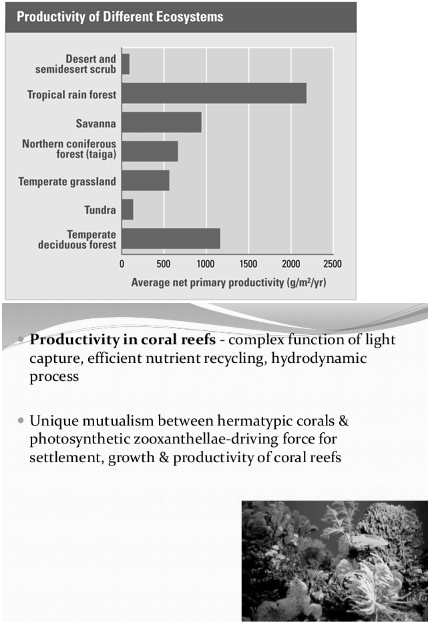
Among terrestrial ecosystems,tropical rainforests exhibit the highest primary productivity due to favorable conditions such as high temperature,abundant rainfall,and year-round sunlight,which support high biodiversity and rapid plant growth.
While coral reefs are highly productive aquatic ecosystems,among the given options,rainforests represent the ecosystem with the highest productivity.
Among terrestrial ecosystems,tropical rainforests exhibit the highest primary productivity due to favorable conditions such as high temperature,abundant rainfall,and year-round sunlight,which support high biodiversity and rapid plant growth.
While coral reefs are highly productive aquatic ecosystems,among the given options,rainforests represent the ecosystem with the highest productivity.
0 likes
View Solution76
MediumMCQ
Total energy fixed by an ecosystem is called
A
Primary production
B
Gross production
C
Net production
D
Secondary production
Solution
(B) The total amount of organic matter or energy fixed by producers in an ecosystem through the process of photosynthesis per unit area over a unit time is known as Gross Primary Productivity $(GPP)$ or Gross production. Therefore,the total energy fixed by an ecosystem is called Gross production.
0 likes
View Solution77
MediumMCQ
Net primary productivity is utilised by
A
Autotrophs
B
Heterotrophs
C
Decomposers
D
All of the above
Solution
(B) The correct answer is Heterotrophs.
Net primary productivity $(NPP)$ is the amount of organic matter stored by producers in a unit area or volume over a unit of time.
It is calculated as $NPP = GPP - R$,where $GPP$ is Gross Primary Productivity and $R$ represents respiration losses.
This stored biomass serves as the source of energy and nutrients for heterotrophs,which include consumers and decomposers.
Net primary productivity $(NPP)$ is the amount of organic matter stored by producers in a unit area or volume over a unit of time.
It is calculated as $NPP = GPP - R$,where $GPP$ is Gross Primary Productivity and $R$ represents respiration losses.
This stored biomass serves as the source of energy and nutrients for heterotrophs,which include consumers and decomposers.
0 likes
View Solution78
MediumMCQ
Energy storage at the consumer level is called:
A
Gross primary productivity
B
Secondary productivity
C
Net primary productivity
D
Net productivity
Solution
(B) Productivity is defined as the rate of biomass production per unit area over a time period by plants during photosynthesis.
$1$. Gross primary productivity $(GPP)$ is the rate of production of organic matter during photosynthesis by producers.
$2$. Net primary productivity $(NPP)$ is the $GPP$ minus respiration losses $(R)$ by plants.
$3$. Secondary productivity is defined as the rate of formation of new organic matter by consumers.
Therefore,energy storage at the consumer level is known as secondary productivity.
$1$. Gross primary productivity $(GPP)$ is the rate of production of organic matter during photosynthesis by producers.
$2$. Net primary productivity $(NPP)$ is the $GPP$ minus respiration losses $(R)$ by plants.
$3$. Secondary productivity is defined as the rate of formation of new organic matter by consumers.
Therefore,energy storage at the consumer level is known as secondary productivity.
0 likes
View Solution79
MediumMCQ
Greater primary productivity depends upon
A
Rain (humidity)
B
Availability of nutrients
C
Both $(a)$ and $(b)$
D
None of these
Solution
(C) Primary productivity is the rate at which biomass or organic matter is produced per unit area over a time period by plants during photosynthesis.
It is primarily controlled by environmental factors such as solar radiation,temperature,moisture (rain/humidity),and the availability of nutrients in the soil.
High humidity and adequate rainfall support lush vegetation,which increases productivity.
Similarly,the availability of essential nutrients in the soil is crucial for plant growth and metabolic processes,directly influencing primary productivity.
Therefore,both rain (humidity) and the availability of nutrients are essential for greater primary productivity.
It is primarily controlled by environmental factors such as solar radiation,temperature,moisture (rain/humidity),and the availability of nutrients in the soil.
High humidity and adequate rainfall support lush vegetation,which increases productivity.
Similarly,the availability of essential nutrients in the soil is crucial for plant growth and metabolic processes,directly influencing primary productivity.
Therefore,both rain (humidity) and the availability of nutrients are essential for greater primary productivity.
0 likes
View Solution80
MediumMCQ
The amount of organic matter stored by green plants in a unit time and area is called
A
Productivity
B
Net primary productivity
C
Gross primary productivity
D
Primary productivity
Solution
(D) Primary productivity is defined as the amount of biomass or organic matter produced per unit area over a time period by plants during photosynthesis.
Specifically,the amount of organic matter stored by green plants in a unit time and area is referred to as Primary productivity.
It is expressed in terms of weight $(g^{-2} yr^{-1})$ or energy $(kcal m^{-2} yr^{-1})$.
Gross Primary Productivity $(GPP)$ is the total rate of production of organic matter during photosynthesis,while Net Primary Productivity $(NPP)$ is the $GPP$ minus respiration losses $(R)$,i.e.,$NPP = GPP - R$.
Specifically,the amount of organic matter stored by green plants in a unit time and area is referred to as Primary productivity.
It is expressed in terms of weight $(g^{-2} yr^{-1})$ or energy $(kcal m^{-2} yr^{-1})$.
Gross Primary Productivity $(GPP)$ is the total rate of production of organic matter during photosynthesis,while Net Primary Productivity $(NPP)$ is the $GPP$ minus respiration losses $(R)$,i.e.,$NPP = GPP - R$.
0 likes
View Solution81
MediumMCQ
State whether the following statements are True or False:
$I.$ The total organic matter synthesized by the producers in the process of photosynthesis per unit time and area is known as gross primary productivity.
$II.$ Net primary productivity is the weight of the organic matter stored by the producers in a unit area/volume per unit time.
$I.$ The total organic matter synthesized by the producers in the process of photosynthesis per unit time and area is known as gross primary productivity.
$II.$ Net primary productivity is the weight of the organic matter stored by the producers in a unit area/volume per unit time.
A
$I$ is true while $II$ is false.
B
$II$ is true while $I$ is false.
C
$I$ and $II$ are true.
D
$I$ and $II$ are false.
Solution
(C) Gross primary productivity $(GPP)$ is defined as the rate of production of organic matter during photosynthesis by producers in an ecosystem per unit area per unit time.
Net primary productivity $(NPP)$ is the weight of the organic matter stored by the producers in a unit area or volume per unit time,which is available for consumption by heterotrophs.
The relationship is given by the equation: $NPP = GPP - R$,where $R$ represents the respiration losses by plants.
Since both statements $I$ and $II$ accurately describe these ecological concepts,both are true.
Net primary productivity $(NPP)$ is the weight of the organic matter stored by the producers in a unit area or volume per unit time,which is available for consumption by heterotrophs.
The relationship is given by the equation: $NPP = GPP - R$,where $R$ represents the respiration losses by plants.
Since both statements $I$ and $II$ accurately describe these ecological concepts,both are true.
0 likes
View Solution82
MediumMCQ
Rate of production of organic matter by producers per unit time and area is
A
$GPP$
B
$NPP$
C
$NPP - R$
D
More than one option is correct
Solution
(A) The rate of production of organic matter by producers during photosynthesis per unit time and area is known as Gross Primary Productivity $(GPP)$.
$NPP$ (Net Primary Productivity) is the amount of biomass remaining after the producers have used some of the organic matter for their own respiration $(R)$.
Therefore,the relationship is defined as $NPP = GPP - R$.
$NPP$ (Net Primary Productivity) is the amount of biomass remaining after the producers have used some of the organic matter for their own respiration $(R)$.
Therefore,the relationship is defined as $NPP = GPP - R$.
0 likes
View Solution83
MediumMCQ
The magnitude of primary productivity is affected by:
A
Temperature,Availability of nutrients
B
Solar radiations available,Availability of nutrients
C
Photosynthetic capacity of producers
D
All of these
Solution
(D) Primary productivity is the rate at which biomass or organic matter is produced per unit area over a time period by plants during photosynthesis.
It is influenced by a variety of environmental factors,including:
$1$. Solar radiation: Light is the primary energy source for photosynthesis.
$2$. Availability of nutrients: Essential for the synthesis of organic compounds.
$3$. Temperature: Affects the enzymatic activity involved in photosynthesis.
$4$. Photosynthetic capacity of producers: The inherent efficiency of the plant species to convert light energy into chemical energy.
Therefore,all the given factors affect the magnitude of primary productivity.
It is influenced by a variety of environmental factors,including:
$1$. Solar radiation: Light is the primary energy source for photosynthesis.
$2$. Availability of nutrients: Essential for the synthesis of organic compounds.
$3$. Temperature: Affects the enzymatic activity involved in photosynthesis.
$4$. Photosynthetic capacity of producers: The inherent efficiency of the plant species to convert light energy into chemical energy.
Therefore,all the given factors affect the magnitude of primary productivity.
0 likes
View Solution84
MediumMCQ
Productivity contributed by oceans is . . . . . . but area covered is comparatively . . . . . . .
A
$High, less$
B
$Low, more$
C
$10\%, 71\%$
D
$50\%, 71\%$
Solution
(B) The total productivity of the biosphere is limited by the low productivity of the oceans. Although oceans cover about $71\%$ of the Earth's surface,their contribution to the total primary productivity is very low because of the limited availability of nutrients and light in deeper waters. Therefore,the productivity contributed by oceans is $Low$ but the area covered is comparatively $more$.
0 likes
View Solution85
MediumMCQ
Which of the following ecosystems has the highest productivity?
A
Tropical deciduous forest
B
Temperate coniferous forest
C
Tropical rain forest
D
Desert shrub
Solution
(C) The tropical rain forest ecosystem exhibits the highest primary productivity among terrestrial ecosystems. This is due to the favorable climatic conditions,including high temperature and abundant rainfall throughout the year,which support rapid plant growth and high biomass accumulation.
0 likes
View Solution86
MediumMCQ
For net primary productivity,the energy captured is:
A
$1 - 5\;\%$ of incident radiation
B
$2 - 5\;\%$ of $PAR$
C
$0.8 - 4\;\%$ of incident radiation
D
$2 - 10\;\%$ of $PAR$
Solution
(C) Plants capture only a small fraction of the incident solar radiation for photosynthesis.
Out of the total incident solar radiation,less than $50\;\%$ is Photosynthetically Active Radiation $(PAR)$.
Plants capture only $2 - 10\;\%$ of the $PAR$ for Gross Primary Productivity $(GPP)$.
However,for Net Primary Productivity $(NPP)$,the energy captured is approximately $0.8 - 4\;\%$ of the total incident solar radiation.
Out of the total incident solar radiation,less than $50\;\%$ is Photosynthetically Active Radiation $(PAR)$.
Plants capture only $2 - 10\;\%$ of the $PAR$ for Gross Primary Productivity $(GPP)$.
However,for Net Primary Productivity $(NPP)$,the energy captured is approximately $0.8 - 4\;\%$ of the total incident solar radiation.
0 likes
View Solution87
EasyMCQ
Which of the following is the least productive ecosystem?
A
Grassland
B
Savannah
C
Forest
D
Tundra
Solution
(D) The productivity of an ecosystem refers to the rate at which biomass is produced per unit area over a period of time.
$Tundra$ is considered the least productive ecosystem because it experiences extremely low temperatures, a very short growing season, and limited nutrient availability, which severely restrict plant growth and primary productivity.
$Tundra$ is considered the least productive ecosystem because it experiences extremely low temperatures, a very short growing season, and limited nutrient availability, which severely restrict plant growth and primary productivity.
0 likes
View Solution88
MediumMCQ
$A$: In secondary productivity,no new organic matter is formed.
$R$: It is only the utilisation of part of food manufactured by primary producers in the building of consumer biomass.
$R$: It is only the utilisation of part of food manufactured by primary producers in the building of consumer biomass.
A
Assertion and Reason both are correct and Reason is the correct explanation of Assertion.
B
Assertion and Reason both are correct but Reason is not the correct explanation of Assertion.
C
Assertion is correct,but Reason is incorrect.
D
Both Assertion and Reason are incorrect.
Solution
(C) Secondary productivity is defined as the rate of formation of new organic matter by consumers.
However,the assertion states that 'no new organic matter is formed',which is scientifically incorrect because consumers do synthesize their own biomass (tissues) using the energy derived from primary producers.
The reason states that it is the utilisation of food manufactured by primary producers to build consumer biomass,which is a correct description of the process.
Since the assertion is false and the reason is true,the correct option is $C$.
However,the assertion states that 'no new organic matter is formed',which is scientifically incorrect because consumers do synthesize their own biomass (tissues) using the energy derived from primary producers.
The reason states that it is the utilisation of food manufactured by primary producers to build consumer biomass,which is a correct description of the process.
Since the assertion is false and the reason is true,the correct option is $C$.
0 likes
View Solution89
MediumMCQ
In the equation $GPP - R = NPP$,what does $R$ represent?
A
Radiant energy
B
Respiration losses
C
Environmental factors
D
Retardation factors
Solution
(B) In the study of ecosystem productivity,$GPP$ stands for Gross Primary Productivity,which is the total rate of production of organic matter during photosynthesis.
$NPP$ stands for Net Primary Productivity,which is the amount of biomass available for consumption by heterotrophs.
$R$ represents the respiration losses,which is the energy used by plants for their own metabolic activities.
The relationship is defined as $NPP = GPP - R$.
$NPP$ stands for Net Primary Productivity,which is the amount of biomass available for consumption by heterotrophs.
$R$ represents the respiration losses,which is the energy used by plants for their own metabolic activities.
The relationship is defined as $NPP = GPP - R$.
0 likes
View Solution90
MediumMCQ
This productivity is expressed in terms of weight $(gm^{-2})$ or energy $(kcal,m^{-2})$.
A
Primary productivity
B
Productivity
C
Net primary productivity
D
Secondary productivity
Solution
(B) Productivity is defined as the rate of biomass production per unit area over a time period.
It is expressed in terms of weight $(gm^{-2}yr^{-1})$ or energy $(kcal,m^{-2}yr^{-1})$.
Since the question refers to the general measurement of productivity in these units, the correct answer is Productivity.
It is expressed in terms of weight $(gm^{-2}yr^{-1})$ or energy $(kcal,m^{-2}yr^{-1})$.
Since the question refers to the general measurement of productivity in these units, the correct answer is Productivity.
0 likes
View Solution91
MediumMCQ
Net Primary Productivity $(NPP) = ..............$
A
$NPP$ is the biomass available for consumption by heterotrophs.
B
Gross Primary Productivity $(GPP)$ minus respiration losses $(R)$ is $NPP$.
C
The rate of production of organic matter during photosynthesis.
D
$A$ and $B$
Solution
(D) Net Primary Productivity $(NPP)$ is defined as the amount of biomass or organic matter produced by producers per unit area per unit time,which is available for consumption by heterotrophs (herbivores and decomposers).
Mathematically,it is calculated by subtracting the energy used by plants for respiration $(R)$ from the Gross Primary Productivity $(GPP)$.
The formula is: $NPP = GPP - R$.
Therefore,both statements $A$ and $B$ correctly describe $NPP$.
Mathematically,it is calculated by subtracting the energy used by plants for respiration $(R)$ from the Gross Primary Productivity $(GPP)$.
The formula is: $NPP = GPP - R$.
Therefore,both statements $A$ and $B$ correctly describe $NPP$.
0 likes
View Solution92
MediumMCQ
The rate of formation of new organic matter by consumers is defined as:
A
Net Primary Productivity
B
Secondary Productivity
C
Gross Primary Productivity
D
Primary Productivity
Solution
(B) $1$. Productivity is defined as the rate of biomass production per unit area over a time period.
$2$. Primary productivity refers to the amount of biomass or organic matter produced per unit area over a time period by plants during photosynthesis.
$3$. Secondary productivity is defined as the rate of formation of new organic matter by consumers (heterotrophs).
$4$. Therefore,the rate at which consumers build up new organic matter is known as Secondary Productivity.
$2$. Primary productivity refers to the amount of biomass or organic matter produced per unit area over a time period by plants during photosynthesis.
$3$. Secondary productivity is defined as the rate of formation of new organic matter by consumers (heterotrophs).
$4$. Therefore,the rate at which consumers build up new organic matter is known as Secondary Productivity.
0 likes
View Solution93
MediumMCQ
The annual net primary productivity of the whole biosphere is approximately $...........$ (dry weight) of organic matter.
A
$170$ million tonnes
B
$170$ billion tonnes
C
$70$ million tonnes
D
$70$ billion tonnes
Solution
(B) The annual net primary productivity of the whole biosphere is approximately $170$ billion tonnes (dry weight) of organic matter. This value represents the total amount of biomass produced by all producers (plants,algae,and phytoplankton) on Earth in a year after accounting for respiratory losses.
0 likes
View Solution94
MediumMCQ
Approximately $.............$ of the Earth's surface is covered by oceans,yet the productivity of the oceans is only $...............$.
A
$70 \%, 55$ billion tons
B
$55 \%, 70$ billion tons
C
$70 \%, 170$ billion tons
D
$80 \%, 70$ billion tons
Solution
(A) The Earth's surface is covered by approximately $70 \%$ water,primarily in the form of oceans. Despite this vast area,the net primary productivity of the oceans is relatively low compared to terrestrial ecosystems. The total net primary productivity of the entire biosphere is approximately $170$ billion tons (dry weight) of organic matter. Out of this,the productivity of the oceans is only $55$ billion tons. Therefore,the correct statement is that $70 \%$ of the Earth's surface is covered by oceans,and their productivity is $55$ billion tons.
0 likes
View Solution95
MediumMCQ
Which of the following ecosystems has the highest primary productivity?
A
Temperate forest
B
Grassland
C
Desert
D
Tropical rainforest
Solution
(D) Primary productivity is defined as the rate at which biomass is produced per unit area over a time period by plants during photosynthesis.
Tropical rainforests have the highest primary productivity among the given options because they receive abundant sunlight and rainfall throughout the year,which are optimal conditions for plant growth and high rates of photosynthesis.
In contrast,deserts have very low productivity due to water scarcity,and temperate forests and grasslands have lower productivity compared to tropical rainforests due to seasonal limitations.
Tropical rainforests have the highest primary productivity among the given options because they receive abundant sunlight and rainfall throughout the year,which are optimal conditions for plant growth and high rates of photosynthesis.
In contrast,deserts have very low productivity due to water scarcity,and temperate forests and grasslands have lower productivity compared to tropical rainforests due to seasonal limitations.
0 likes
View Solution96
MediumMCQ
The amount of biomass or organic matter produced per unit area over a time period by plants during photosynthesis is called:
A
Secondary production
B
Primary production
C
Gross primary production
D
Net primary production
Solution
(B) Primary production is defined as the amount of biomass or organic matter produced per unit area over a time period by plants during photosynthesis.
It is expressed in terms of weight $(g/m^2)$ or energy $(kcal/m^2)$.
It is expressed in terms of weight $(g/m^2)$ or energy $(kcal/m^2)$.
0 likes
View Solution97
MediumMCQ
In the equation $GPP - R = NPP$ (where $GPP$ is Gross Primary Productivity and $NPP$ is Net Primary Productivity),$R$ represents:
A
Reproductive allocation
B
Photosynthetically active radiation
C
Respiratory quotient
D
Respiratory loss
Solution
(D) considerable amount of $GPP$ is utilized by plants for respiration. Gross primary productivity minus respiration losses $(R)$ is the net primary productivity $(NPP)$.
Therefore,$R$ represents Respiratory loss.
Therefore,$R$ represents Respiratory loss.
0 likes
View Solution98
DifficultMCQ
Given below are two statements:
Statement $I$: The primary source of energy in an ecosystem is solar energy.
Statement $II$: The rate of production of organic matter during photosynthesis in an ecosystem is called net primary productivity $\text{(NPP)}$.
In the light of the above statements,choose the most appropriate answer from the options given below:
Statement $I$: The primary source of energy in an ecosystem is solar energy.
Statement $II$: The rate of production of organic matter during photosynthesis in an ecosystem is called net primary productivity $\text{(NPP)}$.
In the light of the above statements,choose the most appropriate answer from the options given below:
A
Both statement $I$ and statement $II$ are correct.
B
Both statement $I$ and statement $II$ are incorrect.
C
Statement $I$ is correct but statement $II$ is incorrect.
D
Statement $I$ is incorrect but statement $II$ is correct.
Solution
(C) Statement $I$ is correct because solar energy is the ultimate source of energy for all ecosystems on Earth.
Statement $II$ is incorrect because the rate of production of organic matter during photosynthesis is called Gross Primary Productivity $\text{(GPP)}$,not Net Primary Productivity $\text{(NPP)}$. $\text{NPP}$ is defined as $\text{GPP}$ minus respiration losses $\text{(R)}$,i.e.,$\text{NPP} = \text{GPP} - \text{R}$.
Statement $II$ is incorrect because the rate of production of organic matter during photosynthesis is called Gross Primary Productivity $\text{(GPP)}$,not Net Primary Productivity $\text{(NPP)}$. $\text{NPP}$ is defined as $\text{GPP}$ minus respiration losses $\text{(R)}$,i.e.,$\text{NPP} = \text{GPP} - \text{R}$.
0 likes
View Solution99
DifficultMCQ
Which of the following is the unit of productivity of an ecosystem?
A
$gm^{-2}$
B
$KCal m^{-2}$
C
$KCal m^{-3}$
D
$(KCal m^{-2}) yr^{-1}$
Solution
(D) Productivity is defined as the rate of biomass production or energy accumulation per unit area over a specific period of time.
Since it is a rate,it must include a time component.
Biomass productivity is typically measured in units like $g m^{-2} yr^{-1}$,and energy productivity is measured in units like $KCal m^{-2} yr^{-1}$.
Among the given options,$(KCal m^{-2}) yr^{-1}$ represents the rate of energy accumulation per unit area per unit time,which is the correct unit for ecosystem productivity.
Since it is a rate,it must include a time component.
Biomass productivity is typically measured in units like $g m^{-2} yr^{-1}$,and energy productivity is measured in units like $KCal m^{-2} yr^{-1}$.
Among the given options,$(KCal m^{-2}) yr^{-1}$ represents the rate of energy accumulation per unit area per unit time,which is the correct unit for ecosystem productivity.
0 likes
View Solution100
MediumMCQ
The unit of productivity is $.........$
A
$gm^{-2} yr^{-1}$
B
$gm^2 yr^{-1}$
C
$Kcal m^{-2} yr^{-1}$
D
$Kcal gm^{-3} yr^{-1}$
Solution
(A) Productivity is defined as the rate of biomass production per unit area over a time period.
It is expressed in terms of mass $(gm^{-2} yr^{-1})$ or energy $(Kcal m^{-2} yr^{-1})$.
Among the given options,$gm^{-2} yr^{-1}$ represents the unit of primary productivity in terms of biomass.
It is expressed in terms of mass $(gm^{-2} yr^{-1})$ or energy $(Kcal m^{-2} yr^{-1})$.
Among the given options,$gm^{-2} yr^{-1}$ represents the unit of primary productivity in terms of biomass.
0 likes
View SolutionEcosystem — Productivity · Frequently Asked Questions
1Are these Ecosystem questions useful for JEE and NEET?
Yes. All questions in this section are mapped to JEE Main and NEET exam patterns. Previous year questions from JEE Main, NEET, GUJCET and state-level exams are included with full solutions.
2Can I switch to Hindi or Gujarati for these questions?
Yes. Use the language tabs in the hero section or the sidebar to view the same questions and solutions in English, Hindi or Gujarati.
3How do I generate a question paper from this subtopic?
Use the Vedclass Exam Paper Generator — select the chapter and subtopic, set difficulty, and generate Sets A, B, C, D automatically. First 3 chapters of every subject are free.
Vedclass Products
For Students
Vedclass Test Series
Mock tests in real JEE/NEET style with performance analysis. 5-day free trial.
Start Free TrialFor Teachers
Exam Paper Generator
Generate Set A/B/C/D papers from this chapter in 2 minutes. 3 chapters free.
Try FreeFor Institutes
Online Exam Module
Live online exams with unlimited students, 360° analytics & white-label branding.
See DemoFor Teachers & Institutes
Generate a Ecosystem Exam Paper in 2 Minutes
Select subtopic & difficulty — Sets A, B, C, D auto-generated with No Repeat logic.
First 3 chapters of every subject are free — no payment required.