
A English
Ecological Pyramids Questions in English
Class 12 Biology · Ecosystem · Ecological Pyramids
130+
Questions
English
Language
100%
With Solutions
Showing 30 of 130 questions in English
101
MediumMCQ
Which of the following food chains shows a spindle-shaped pyramid of numbers?
A
Grass $\rightarrow$ Insects $\rightarrow$ Frog
B
Phytoplankton $\rightarrow$ Zooplankton $\rightarrow$ Small fish
C
Tree $\rightarrow$ Birds $\rightarrow$ Hawks
D
Tree $\rightarrow$ Birds $\rightarrow$ Insects $\rightarrow$ Bacteria
Solution
(C) pyramid of numbers represents the number of individuals at each trophic level in an ecosystem.
In a forest ecosystem,a single large tree (producer) supports many birds (primary consumers),which in turn support fewer hawks (secondary consumers).
This results in a narrow base (one tree),a wide middle (many birds),and a narrow top (few hawks),creating a spindle-shaped pyramid.
Therefore,the correct food chain is: Tree $\rightarrow$ Birds $\rightarrow$ Hawks.
In a forest ecosystem,a single large tree (producer) supports many birds (primary consumers),which in turn support fewer hawks (secondary consumers).
This results in a narrow base (one tree),a wide middle (many birds),and a narrow top (few hawks),creating a spindle-shaped pyramid.
Therefore,the correct food chain is: Tree $\rightarrow$ Birds $\rightarrow$ Hawks.
0 likes
View Solution102
MediumMCQ
Which of the following ecological pyramids is most representative of functional characteristics of an ecosystem?
A
Pyramid of number
B
Pyramid of biomass
C
Pyramid of energy
D
All are equally representative
Solution
(C) The pyramid of energy is the most representative of the functional characteristics of an ecosystem because it always remains upright and reflects the actual rate of energy flow through different trophic levels. Unlike the pyramids of number or biomass,which can be inverted in certain ecosystems,the pyramid of energy provides a clear picture of the energy transfer efficiency and the functional productivity of the ecosystem.
0 likes
View Solution103
MediumMCQ
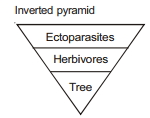
If a producer is a large tree that supports a number of herbivorous animals which are further attacked by ectoparasites,the pyramid of number shall be:
A
Inverted
B
Upright
C
Irregular
D
Spindle shaped
Solution
(A) In this ecosystem,the producer is a single large tree,which represents the base of the pyramid.
This tree supports many herbivorous animals (like birds or insects),which are more in number than the tree.
These herbivores are further attacked by a much larger number of ectoparasites (like lice or mites).
Since the number of individuals increases as we move from the producer level to the consumer levels,the pyramid of number becomes inverted.
This tree supports many herbivorous animals (like birds or insects),which are more in number than the tree.
These herbivores are further attacked by a much larger number of ectoparasites (like lice or mites).
Since the number of individuals increases as we move from the producer level to the consumer levels,the pyramid of number becomes inverted.
0 likes
View Solution104
MediumMCQ
What does the given ecological pyramid represent?

A
Inverted pyramid of number in pond
B
Role of decomposers
C
Inverted pyramid of biomass in pond
D
Pyramid of biomass in a forest ecosystem
Solution
(C) The given pyramid shows Primary Producers $(PP)$ with a biomass of $4 \ kg \ m^{-2}$ and Primary Consumers $(PC)$ with a biomass of $21 \ kg \ m^{-2}$.
Since the biomass of the consumer level is greater than that of the producer level,the pyramid is inverted.
This is a characteristic feature of an inverted pyramid of biomass in an aquatic (pond) ecosystem.
Since the biomass of the consumer level is greater than that of the producer level,the pyramid is inverted.
This is a characteristic feature of an inverted pyramid of biomass in an aquatic (pond) ecosystem.
0 likes
View Solution105
MediumMCQ
The pyramid of numbers in a cropland ecosystem is:
A
Upright
B
Inverted
C
Rhomboidal
D
Spindle shaped
Solution
(A) In a cropland ecosystem,the producers (crops) are present in very large numbers.
The primary consumers (herbivores like insects) are fewer in number compared to the producers.
The secondary consumers (birds or predatory insects) are even fewer in number.
Therefore,the pyramid of numbers in a cropland ecosystem is upright,as the number of individuals decreases from the producer level to the top consumer level.
The primary consumers (herbivores like insects) are fewer in number compared to the producers.
The secondary consumers (birds or predatory insects) are even fewer in number.
Therefore,the pyramid of numbers in a cropland ecosystem is upright,as the number of individuals decreases from the producer level to the top consumer level.
0 likes
View Solution106
MediumMCQ
$A$: Ecological pyramids cannot explain all the vital functions of any ecosystem.
$R$: Pyramids actually do not explain the role of organisms working at more than one trophic level.
$R$: Pyramids actually do not explain the role of organisms working at more than one trophic level.
A
Assertion and Reason both are correct and Reason is the correct explanation of Assertion.
B
Assertion and Reason both are correct but Reason is not the correct explanation of Assertion.
C
Assertion is correct,but Reason is incorrect.
D
Both Assertion and Reason are incorrect.
Solution
(A) Ecological pyramids are based on the assumption of a simple food chain,whereas in nature,a complex food web exists.
Because of this,pyramids fail to account for organisms that occupy more than one trophic level simultaneously (e.g.,omnivores).
Therefore,they cannot represent all the vital functions or the complete energy flow of an ecosystem.
Both the Assertion and the Reason are correct,and the Reason provides a valid explanation for the limitation mentioned in the Assertion.
Because of this,pyramids fail to account for organisms that occupy more than one trophic level simultaneously (e.g.,omnivores).
Therefore,they cannot represent all the vital functions or the complete energy flow of an ecosystem.
Both the Assertion and the Reason are correct,and the Reason provides a valid explanation for the limitation mentioned in the Assertion.
0 likes
View Solution107
MediumMCQ
$A$: Ecological pyramid of biomass is generally inverted in the sea.
$R$: Biomass of fishes far exceeds that of phytoplanktons.
$R$: Biomass of fishes far exceeds that of phytoplanktons.
A
Assertion and Reason both are correct and Reason is the correct explanation of Assertion.
B
Assertion and Reason both are correct but Reason is not the correct explanation of Assertion.
C
Assertion is correct,but Reason is incorrect.
D
Both Assertion and Reason are incorrect.
Solution
(A) In an aquatic ecosystem,the pyramid of biomass is typically inverted.
This is because the producers (phytoplanktons) have a very short life span and a high turnover rate,meaning their standing crop biomass at any given time is small.
Conversely,the consumers (zooplanktons,small fishes,and large fishes) have longer life spans and accumulate more biomass.
Therefore,the biomass of fishes (consumers) far exceeds that of phytoplanktons (producers) at any given moment,making the pyramid inverted.
Both the Assertion and the Reason are correct,and the Reason explains why the pyramid is inverted.
This is because the producers (phytoplanktons) have a very short life span and a high turnover rate,meaning their standing crop biomass at any given time is small.
Conversely,the consumers (zooplanktons,small fishes,and large fishes) have longer life spans and accumulate more biomass.
Therefore,the biomass of fishes (consumers) far exceeds that of phytoplanktons (producers) at any given moment,making the pyramid inverted.
Both the Assertion and the Reason are correct,and the Reason explains why the pyramid is inverted.
0 likes
View Solution108
MediumMCQ
$A$: Pyramid of biomass is always upright for tree ecosystem.
$R$: Total biomass of a tree in a specific area is more than that of herbivores.
$R$: Total biomass of a tree in a specific area is more than that of herbivores.
A
Assertion and Reason both are correct and Reason is the correct explanation of Assertion.
B
Assertion and Reason both are correct but Reason is not the correct explanation of Assertion.
C
Assertion is correct,but Reason is incorrect.
D
Both Assertion and Reason are incorrect.
Solution
(D) In a tree ecosystem,a single tree (producer) has a much larger biomass than the herbivores (birds,insects) that feed on it.
Therefore,the pyramid of biomass for a tree ecosystem is inverted,not upright.
Since the assertion states that the pyramid is always upright for a tree ecosystem,the assertion is incorrect.
The reason provided is also incorrect because the biomass of a single tree is indeed greater than that of the herbivores,but this leads to an inverted pyramid,not an upright one.
Therefore,the pyramid of biomass for a tree ecosystem is inverted,not upright.
Since the assertion states that the pyramid is always upright for a tree ecosystem,the assertion is incorrect.
The reason provided is also incorrect because the biomass of a single tree is indeed greater than that of the herbivores,but this leads to an inverted pyramid,not an upright one.
0 likes
View Solution109
MediumMCQ
Which of the following statements is not correct?
A
The pyramid of biomass in the sea is generally inverted.
B
The pyramid of biomass in the sea is generally upright.
C
The pyramid of energy is always upright.
D
The pyramid of numbers in a grassland ecosystem is upright.
Solution
(B) In a marine ecosystem,the total biomass of primary producers (phytoplankton) is much lower than that of consumers (zooplankton and fish) because they have a short lifespan and are consumed rapidly. Therefore,the pyramid of biomass in the sea is generally inverted. The statement in option $B$ that 'the pyramid of biomass in the sea is generally upright' is incorrect. The pyramid of energy is always upright because energy is lost at each trophic level during the flow of energy. In a grassland ecosystem,the pyramid of numbers is upright because the number of producers is significantly higher than the number of consumers.
0 likes
View Solution110
MediumMCQ
In a pyramid of biomass, $P$ is at the highest trophic level, $Q$ is at the second trophic level, and $R$ is at the lowest trophic level. Identify $P, Q,$ and $R$.
A
Herbs and Shrubs, Trees
B
Trees, Herbs and Shrubs
C
Trees, Shrubs, Herbs and Grasses
D
Shrubs, Herbs and Grasses, Trees
Solution
(A) In an upright pyramid of biomass (e.g., in a forest ecosystem), the trophic levels are organized based on the biomass of organisms.
$R$ (Lowest trophic level): Producers, which are Trees (highest biomass).
$Q$ (Second trophic level): Primary consumers, which are Shrubs.
$P$ (Highest trophic level): Secondary/Tertiary consumers, which are Herbs and Grasses (lowest biomass).
Thus, the correct sequence is $P = \text{Herbs and Grasses}, Q = \text{Shrubs}, R = \text{Trees}$.
$R$ (Lowest trophic level): Producers, which are Trees (highest biomass).
$Q$ (Second trophic level): Primary consumers, which are Shrubs.
$P$ (Highest trophic level): Secondary/Tertiary consumers, which are Herbs and Grasses (lowest biomass).
Thus, the correct sequence is $P = \text{Herbs and Grasses}, Q = \text{Shrubs}, R = \text{Trees}$.
0 likes
View Solution111
MediumMCQ
Which of the following is not considered an ecological pyramid?
A
Pyramid of numbers
B
Pyramid of biomass
C
Pyramid of community
D
Pyramid of energy
Solution
(C) Ecological pyramids are graphical representations of the relationship between different trophic levels in an ecosystem.
There are three main types of ecological pyramids:
$1$. Pyramid of numbers: Represents the number of individuals at each trophic level.
$2$. Pyramid of biomass: Represents the total dry weight of organisms at each trophic level.
$3$. Pyramid of energy: Represents the total amount of energy at each trophic level.
'Pyramid of community' is not a standard type of ecological pyramid.
There are three main types of ecological pyramids:
$1$. Pyramid of numbers: Represents the number of individuals at each trophic level.
$2$. Pyramid of biomass: Represents the total dry weight of organisms at each trophic level.
$3$. Pyramid of energy: Represents the total amount of energy at each trophic level.
'Pyramid of community' is not a standard type of ecological pyramid.
0 likes
View Solution112
MediumMCQ
What is the shape of the pyramid of biomass in an aquatic ecosystem?
A
Upright
B
Inverted
C
Upright or inverted
D
None of these
Solution
(B) In an aquatic ecosystem,the pyramid of biomass is typically inverted.
This is because the biomass of producers (phytoplankton) is much lower than the biomass of the consumers (zooplankton and small fish) that feed on them.
Since the producers have a very short life cycle and high turnover rate,their standing crop at any given time is small compared to the higher trophic levels.
This is because the biomass of producers (phytoplankton) is much lower than the biomass of the consumers (zooplankton and small fish) that feed on them.
Since the producers have a very short life cycle and high turnover rate,their standing crop at any given time is small compared to the higher trophic levels.
0 likes
View Solution113
MediumMCQ
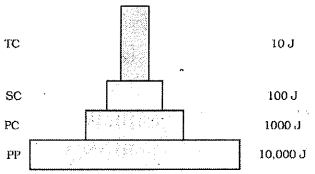
Identify the type of pyramid shown below.
A
Pyramid of energy
B
Pyramid of numbers
C
Pyramid of biomass
D
None of the above
Solution
(A) The given pyramid represents the flow of energy across different trophic levels in an ecosystem.
It shows values in Joules $(J)$, which is a unit of energy.
The energy pyramid is always upright because energy is lost as heat at each successive trophic level, following the $10\%$ law of energy transfer.
Therefore, the pyramid shown is a pyramid of energy.
It shows values in Joules $(J)$, which is a unit of energy.
The energy pyramid is always upright because energy is lost as heat at each successive trophic level, following the $10\%$ law of energy transfer.
Therefore, the pyramid shown is a pyramid of energy.
0 likes
View Solution114
MediumMCQ
Select the correct option$(s)$ regarding ecological pyramids.
A
Energy pyramids are always upright.
B
Biomass pyramids in a sea ecosystem are inverted.
C
Biomass pyramids in a forest ecosystem are upright.
D
All of the above.
Solution
(D) $1$. The pyramid of energy is always upright because energy flow is unidirectional and some energy is always lost as heat at each trophic level according to the $10\%$ law.
$2$. In a sea ecosystem, the biomass of phytoplankton (producers) is much smaller than that of zooplankton and small fish (consumers), leading to an inverted pyramid of biomass.
$3$. In a forest ecosystem, the biomass of trees (producers) is significantly higher than that of herbivores and carnivores, resulting in an upright pyramid of biomass.
$4$. Therefore, all the given statements are correct.
$2$. In a sea ecosystem, the biomass of phytoplankton (producers) is much smaller than that of zooplankton and small fish (consumers), leading to an inverted pyramid of biomass.
$3$. In a forest ecosystem, the biomass of trees (producers) is significantly higher than that of herbivores and carnivores, resulting in an upright pyramid of biomass.
$4$. Therefore, all the given statements are correct.
0 likes
View Solution115
MediumMCQ
Inverted pyramid of number and inverted pyramid of biomass are respectively seen in.
A
Grassland and tree ecosystem
B
Sea and tree ecosystem
C
Tree and lake ecosystem
D
Sea and grassland ecosystem
Solution
(B) $1$. An inverted pyramid of numbers is observed in a tree ecosystem,where a single large tree (producer) supports many herbivorous birds and even more parasitic insects.
$2$. An inverted pyramid of biomass is observed in a sea (aquatic) ecosystem,where the biomass of phytoplankton (producers) is much smaller than the biomass of zooplankton and small fish (consumers) that feed on them,because the producers have a very high turnover rate.
$2$. An inverted pyramid of biomass is observed in a sea (aquatic) ecosystem,where the biomass of phytoplankton (producers) is much smaller than the biomass of zooplankton and small fish (consumers) that feed on them,because the producers have a very high turnover rate.
0 likes
View Solution116
MediumMCQ
Assertion: Pyramid of energy is always upright.
Reason: Energy at a lower trophic level is always more than at a higher level.
Reason: Energy at a lower trophic level is always more than at a higher level.
A
Both Assertion and Reason are true but Reason is $NOT$ the correct explanation of Assertion.
B
Assertion is true but Reason is false.
C
Assertion is false but Reason is true.
D
Both Assertion and Reason are true and Reason is the correct explanation of Assertion.
Solution
(D) The pyramid of energy represents the amount of energy at each trophic level in an ecosystem.
According to the $10\%$ law of energy transfer, only $10\%$ of the energy is transferred from one trophic level to the next, while the rest is lost as heat during respiration and metabolic activities.
Because energy is lost at each successive trophic level, the amount of energy available at a lower trophic level is always greater than the energy available at a higher trophic level.
This ensures that the pyramid of energy is always upright, as it can never be inverted.
Therefore, both the Assertion and the Reason are true, and the Reason is the correct explanation of the Assertion.
According to the $10\%$ law of energy transfer, only $10\%$ of the energy is transferred from one trophic level to the next, while the rest is lost as heat during respiration and metabolic activities.
Because energy is lost at each successive trophic level, the amount of energy available at a lower trophic level is always greater than the energy available at a higher trophic level.
This ensures that the pyramid of energy is always upright, as it can never be inverted.
Therefore, both the Assertion and the Reason are true, and the Reason is the correct explanation of the Assertion.
0 likes
View Solution117
EasyMCQ
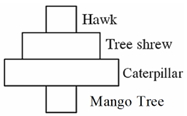
The diagram shows a pyramid of numbers in a food chain. What type of organism is a caterpillar?
A
Primary producer
B
Primary consumer
C
Quaternary consumer
D
Secondary consumer
Solution
(B) In the given food chain, the $Mango Tree$ acts as the primary producer because it produces food through photosynthesis.
The caterpillar feeds directly on the leaves of the $Mango Tree$.
Organisms that feed directly on producers are known as primary consumers.
Therefore, the caterpillar is a primary consumer.
The caterpillar feeds directly on the leaves of the $Mango Tree$.
Organisms that feed directly on producers are known as primary consumers.
Therefore, the caterpillar is a primary consumer.
0 likes
View Solution118
DifficultMCQ
What type of ecological pyramid would be obtained with the following data?
Secondary consumer: $120 \ g$
Primary consumer: $60 \ g$
Primary producer: $10 \ g$
Secondary consumer: $120 \ g$
Primary consumer: $60 \ g$
Primary producer: $10 \ g$
A
Inverted pyramid of biomass
B
Inverted pyramid of energy
C
Inverted pyramid of number
D
Upright pyramid of biomass
Solution
(A) The ecological pyramid is constructed based on the biomass of organisms at different trophic levels.
Given data:
Secondary consumer: $120 \ g$
Primary consumer: $60 \ g$
Primary producer: $10 \ g$
In this case,the biomass increases as we move from the primary producer to the secondary consumer $(10 \ g < 60 \ g < 120 \ g)$.
Since the biomass at the base (producer) is the lowest and it increases towards the higher trophic levels,the pyramid is inverted.
Therefore,this represents an inverted pyramid of biomass.
Given data:
Secondary consumer: $120 \ g$
Primary consumer: $60 \ g$
Primary producer: $10 \ g$
In this case,the biomass increases as we move from the primary producer to the secondary consumer $(10 \ g < 60 \ g < 120 \ g)$.
Since the biomass at the base (producer) is the lowest and it increases towards the higher trophic levels,the pyramid is inverted.
Therefore,this represents an inverted pyramid of biomass.
0 likes
View Solution119
EasyMCQ
Given below are two statements.
Statement $I$ - Smaller the food chain, more is the available energy at each trophic level.
Statement $II$ - Pyramid of energy can also be sometimes inverted.
In the light of the above statements, select the correct option given below:
Statement $I$ - Smaller the food chain, more is the available energy at each trophic level.
Statement $II$ - Pyramid of energy can also be sometimes inverted.
In the light of the above statements, select the correct option given below:
A
Both statement $I$ and statement $II$ are correct.
B
Both statement $I$ and statement $II$ are incorrect.
C
Statement $I$ is correct but statement $II$ is incorrect.
D
Statement $I$ is incorrect but statement $II$ is correct.
Solution
$(C)$ Statement $I$ is correct: In a shorter food chain, there are fewer energy transfers, which results in less energy loss due to respiration and metabolic activities, thus leaving more energy available at higher trophic levels.
Statement $II$ is incorrect: The pyramid of energy is always upright because energy flow in an ecosystem is unidirectional and follows the $10\%$ law, where energy is lost as heat at each successive trophic level. It can never be inverted.
Statement $II$ is incorrect: The pyramid of energy is always upright because energy flow in an ecosystem is unidirectional and follows the $10\%$ law, where energy is lost as heat at each successive trophic level. It can never be inverted.
0 likes
View Solution120
EasyMCQ
Following criteria are used for construction of ecological pyramids $EXCEPT$ . . . . . . .
A
dry weight
B
live weight
C
number of individual
D
rate of energy flow
Solution
(B) Ecological pyramids are graphical representations of the relationship between different trophic levels in an ecosystem.
They are typically constructed based on three main parameters:
$1$. Number of individuals (Pyramid of Numbers).
$2$. Biomass (Pyramid of Biomass).
$3$. Energy flow (Pyramid of Energy).
Biomass is measured in terms of dry weight to ensure consistency and avoid fluctuations due to water content.
Live weight is not used as a standard criterion because it includes water content,which varies significantly and does not represent the actual organic matter available to the next trophic level.
Therefore,live weight is the correct answer.
They are typically constructed based on three main parameters:
$1$. Number of individuals (Pyramid of Numbers).
$2$. Biomass (Pyramid of Biomass).
$3$. Energy flow (Pyramid of Energy).
Biomass is measured in terms of dry weight to ensure consistency and avoid fluctuations due to water content.
Live weight is not used as a standard criterion because it includes water content,which varies significantly and does not represent the actual organic matter available to the next trophic level.
Therefore,live weight is the correct answer.
0 likes
View Solution121
EasyMCQ
The pyramid of biomass in . . . . . . is generally inverted.
A
Grassland
B
Dense forest
C
Sea
D
Grassland and Dense forest both
Solution
(C) In an aquatic ecosystem,such as the $Sea$,the pyramid of biomass is generally inverted. This is because the biomass of phytoplankton (producers) is much lower than the biomass of zooplankton and small fish (primary consumers) and large fish (secondary consumers) that feed on them. The rapid turnover rate of phytoplankton allows a small standing crop to support a larger biomass of consumers.
0 likes
View Solution122
EasyMCQ
If you were to count the number of insects feeding on a big tree,what kind of pyramid would you get?
A
Upright
B
Inverted
C
Oblique
D
Upright down
Solution
(B) The pyramid of numbers represents the number of individuals at each trophic level. In the case of a single large tree,the number of producers is $1$. This single tree supports a large number of herbivorous insects,which in turn support a smaller number of secondary consumers (birds or parasites). Since the number of individuals increases from the producer level to the primary consumer level,the pyramid becomes inverted.
0 likes
View Solution123
EasyMCQ
Choose the correct option for the given statements:
($T$ = True,$F$ = False)
$(A)$ Pyramid of energy is always upright.
$(B)$ Pyramid of number in a sea is generally inverted.
$(C)$ Pyramid of biomass in a sea is generally inverted.
$(D)$ In most ecosystems,the pyramid of number and energy are always inverted.
($T$ = True,$F$ = False)
$(A)$ Pyramid of energy is always upright.
$(B)$ Pyramid of number in a sea is generally inverted.
$(C)$ Pyramid of biomass in a sea is generally inverted.
$(D)$ In most ecosystems,the pyramid of number and energy are always inverted.
A
$FTFT$
B
$TFTT$
C
$FFTF$
D
$TFTF$
Solution
(D) The pyramid of energy is always upright because energy flow is unidirectional and some energy is lost as heat at each trophic level. This statement is $True$ $(T)$.
$(B)$ The pyramid of number in a sea is generally upright (e.g.,many small phytoplankton support fewer zooplankton,which support even fewer small fish). This statement is $False$ $(F)$.
$(C)$ The pyramid of biomass in a sea is generally inverted because the biomass of phytoplankton (producers) is smaller than the biomass of zooplankton and fish (consumers) at any given time. This statement is $True$ $(T)$.
$(D)$ In most ecosystems,the pyramid of energy is always upright,and the pyramid of number is often upright. This statement is $False$ $(F)$.
Therefore,the sequence is $T, F, T, F$.
$(B)$ The pyramid of number in a sea is generally upright (e.g.,many small phytoplankton support fewer zooplankton,which support even fewer small fish). This statement is $False$ $(F)$.
$(C)$ The pyramid of biomass in a sea is generally inverted because the biomass of phytoplankton (producers) is smaller than the biomass of zooplankton and fish (consumers) at any given time. This statement is $True$ $(T)$.
$(D)$ In most ecosystems,the pyramid of energy is always upright,and the pyramid of number is often upright. This statement is $False$ $(F)$.
Therefore,the sequence is $T, F, T, F$.
0 likes
View Solution124
EasyMCQ
In which ecological pyramid does a small standing crop of phytoplankton support a large standing crop of zooplankton?
A
Straight pyramid of number
B
Inverted pyramid of biomass
C
Straight pyramid of energy
D
Straight pyramid of biomass
Solution
(B) In an aquatic ecosystem,the pyramid of biomass is often inverted. This is because the standing crop of phytoplankton (producers) is small at any given time due to their rapid turnover rate,while they support a much larger standing crop of zooplankton (primary consumers) that feed on them. Therefore,the biomass of producers is less than the biomass of consumers,resulting in an inverted pyramid.
0 likes
View Solution125
EasyMCQ
In which ecosystem is the pyramid of biomass inverted?
A
Forest ecosystem
B
Terrestrial ecosystem
C
Marine ecosystem
D
Desert ecosystem
Solution
(C) In a $Marine$ ecosystem,the pyramid of biomass is inverted. This is because the biomass of phytoplankton (producers) is much lower than that of the zooplankton and small fish (primary consumers) and large fish (secondary consumers) that feed on them. The rapid turnover rate of phytoplankton allows a small standing crop to support a larger biomass of consumers.
0 likes
View Solution126
EasyMCQ
In a marine ecosystem,the biomass pyramid is . . . . . . .
A
Upright
B
Inverted
C
Linear
D
Cyclic
Solution
(B) In a marine ecosystem,the biomass pyramid is inverted. This is because the biomass of producers (phytoplankton) is significantly lower than the biomass of the consumers (zooplankton and small fish) that feed on them. Since the producers have a very high turnover rate,they support a larger biomass of consumers at any given time,resulting in an inverted shape.
0 likes
View Solution127
EasyMCQ
Statement $(A)$: The pyramid of energy is always upright.
Reason $(R)$: Some energy is always lost as heat at each step.
Reason $(R)$: Some energy is always lost as heat at each step.
A
$A$ is wrong and $R$ is right.
B
$A$ and $R$ both are true but $R$ is not the correct explanation of $A$.
C
$A$ is right and $R$ is wrong.
D
$A$ and $R$ both are true, $R$ is the correct explanation of statement-$A$.
Solution
(D) The pyramid of energy represents the flow of energy through different trophic levels in an ecosystem.
According to the $10\%$ law of energy transfer, only $10\%$ of the energy is transferred from one trophic level to the next, while the remaining energy is lost as heat during metabolic processes.
Since energy is lost at each successive trophic level, the amount of energy available at higher trophic levels is always less than at lower levels.
Therefore, the pyramid of energy is always upright.
Both statement $A$ and reason $R$ are true, and $R$ provides the correct scientific explanation for why the pyramid of energy is always upright.
According to the $10\%$ law of energy transfer, only $10\%$ of the energy is transferred from one trophic level to the next, while the remaining energy is lost as heat during metabolic processes.
Since energy is lost at each successive trophic level, the amount of energy available at higher trophic levels is always less than at lower levels.
Therefore, the pyramid of energy is always upright.
Both statement $A$ and reason $R$ are true, and $R$ provides the correct scientific explanation for why the pyramid of energy is always upright.
0 likes
View Solution128
EasyMCQ
Identify the incorrect statement from the following.
A
Pyramid of biomass in sea is generally inverted as the biomass of fish far exceeds that of phytoplanktons.
B
Pyramid of energy is mostly upright, but sometimes it may be inverted.
C
Food chains are generally short with few trophic levels as only $10\%$ of the energy is transferred to each trophic level from the lower trophic level.
D
Pyramids of number and biomass may be either upright or inverted.
Solution
(B) The incorrect statement is $B$.
$1$. The pyramid of energy is always upright because energy flow in an ecosystem is unidirectional and follows the $10\%$ law, where energy is lost as heat at each successive trophic level.
$2$. It is impossible for a pyramid of energy to be inverted because energy cannot be created at higher trophic levels.
$3$. The pyramid of biomass in the sea is inverted because the standing crop of phytoplankton (producers) is smaller than that of the zooplankton and fish (consumers) at any given time.
$4$. Pyramids of number and biomass can be upright or inverted depending on the ecosystem structure.
$1$. The pyramid of energy is always upright because energy flow in an ecosystem is unidirectional and follows the $10\%$ law, where energy is lost as heat at each successive trophic level.
$2$. It is impossible for a pyramid of energy to be inverted because energy cannot be created at higher trophic levels.
$3$. The pyramid of biomass in the sea is inverted because the standing crop of phytoplankton (producers) is smaller than that of the zooplankton and fish (consumers) at any given time.
$4$. Pyramids of number and biomass can be upright or inverted depending on the ecosystem structure.
0 likes
View Solution129
EasyMCQ
The pyramid of energy is always upright for any ecosystem. This situation indicates the fact that . . . . . .
A
Carnivores have a better energy conversion efficiency than herbivores.
B
Producers have the lowest energy conversion efficiency.
C
Herbivores have a better energy conversion efficiency than carnivores.
D
Energy conversion efficiency is the same in all trophic levels.
Solution
(C) The pyramid of energy is always upright because energy flow in an ecosystem follows the $10\%$ law,where only $10\%$ of the energy is transferred to the next trophic level.
For the pyramid to remain upright,the energy available at each successive trophic level must decrease.
This implies that the efficiency of energy conversion and utilization is higher in herbivores compared to carnivores,allowing them to sustain their populations despite the loss of energy at each step.
For the pyramid to remain upright,the energy available at each successive trophic level must decrease.
This implies that the efficiency of energy conversion and utilization is higher in herbivores compared to carnivores,allowing them to sustain their populations despite the loss of energy at each step.
0 likes
View Solution130
MediumMCQ
Ecological pyramids represent the relationship between the organisms at different trophic levels and they are generally inverted for :
A
Pyramid of number in grassland
B
Pyramid of energy in pond ecosystem
C
Pyramid of biomass in grassland
D
Pyramid of biomass in sea
Solution
(D) The pyramid of biomass in a sea ecosystem is generally inverted.
This occurs because the standing crop biomass of phytoplankton (producers) is much smaller than the biomass of zooplankton and small fish (primary consumers) and larger fish (secondary/top consumers) at any given time.
This happens because producers have a very high turnover rate,meaning they reproduce and are consumed very rapidly,resulting in a smaller standing biomass compared to the higher trophic levels.
This occurs because the standing crop biomass of phytoplankton (producers) is much smaller than the biomass of zooplankton and small fish (primary consumers) and larger fish (secondary/top consumers) at any given time.
This happens because producers have a very high turnover rate,meaning they reproduce and are consumed very rapidly,resulting in a smaller standing biomass compared to the higher trophic levels.
0 likes
View SolutionEcosystem — Ecological Pyramids · Frequently Asked Questions
1Are these Ecosystem questions useful for JEE and NEET?
Yes. All questions in this section are mapped to JEE Main and NEET exam patterns. Previous year questions from JEE Main, NEET, GUJCET and state-level exams are included with full solutions.
2Can I switch to Hindi or Gujarati for these questions?
Yes. Use the language tabs in the hero section or the sidebar to view the same questions and solutions in English, Hindi or Gujarati.
3How do I generate a question paper from this subtopic?
Use the Vedclass Exam Paper Generator — select the chapter and subtopic, set difficulty, and generate Sets A, B, C, D automatically. First 3 chapters of every subject are free.
Vedclass Products
For Students
Vedclass Test Series
Mock tests in real JEE/NEET style with performance analysis. 5-day free trial.
Start Free TrialFor Teachers
Exam Paper Generator
Generate Set A/B/C/D papers from this chapter in 2 minutes. 3 chapters free.
Try FreeFor Institutes
Online Exam Module
Live online exams with unlimited students, 360° analytics & white-label branding.
See DemoFor Teachers & Institutes
Generate a Ecosystem Exam Paper in 2 Minutes
Select subtopic & difficulty — Sets A, B, C, D auto-generated with No Repeat logic.
First 3 chapters of every subject are free — no payment required.