
A English
Ecological Pyramids Questions in English
Class 12 Biology · Ecosystem · Ecological Pyramids
130+
Questions
English
Language
100%
With Solutions
Showing 49 of 130 questions in English
51
MediumMCQ
In which of the following is the pyramid of biomass $NOT$ upright?
A
Pond
B
Forest
C
Lake
D
Grassland
Solution
(A) The pyramid of biomass is generally upright in most ecosystems, meaning the biomass of producers is greater than that of primary consumers, and so on.
However, in an aquatic ecosystem like a $Pond$ or a $Lake$, the pyramid of biomass is $inverted$.
This is because the biomass of phytoplankton (producers) is much smaller than that of the zooplankton and small fish (primary consumers) that feed on them, as the producers have a very short life span and high turnover rate.
However, in an aquatic ecosystem like a $Pond$ or a $Lake$, the pyramid of biomass is $inverted$.
This is because the biomass of phytoplankton (producers) is much smaller than that of the zooplankton and small fish (primary consumers) that feed on them, as the producers have a very short life span and high turnover rate.
0 likes
View Solution52
MediumMCQ
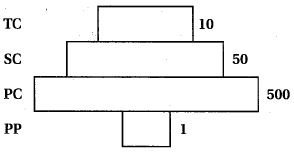
The given figure represents a pyramid of numbers. Which of the following is a possible scenario for the organisms at different levels?
A
Insects at the $PC$ level and small insectivorous birds at the $SC$ level.
B
Phytoplankton at the $PP$ level in the sea and whales at the top $TC$ level.
C
$A$ peepal tree at the $PP$ level and sheep at the $SC$ level.
D
Rats at the $PC$ level and cats at the $SC$ level.
Solution
(C) The given pyramid shows a small number of producers $(PP = 1)$ supporting a large number of primary consumers $(PC = 500)$,which then support a smaller number of secondary consumers $(SC = 50)$ and tertiary consumers $(TC = 10)$. This is an inverted pyramid of numbers,which is characteristic of a tree ecosystem where a single large tree $(PP)$ supports many insects $(PC)$,which in turn support fewer birds $(SC)$ and even fewer parasites or predators $(TC)$.
0 likes
View Solution53
DifficultMCQ
What type of ecological pyramid would be obtained with the following data?
Secondary consumer: $120\,g$
Primary consumer: $60\,g$
Primary producer: $10\,g$
Secondary consumer: $120\,g$
Primary consumer: $60\,g$
Primary producer: $10\,g$
A
Upright pyramid of biomass
B
Inverted pyramid of biomass
C
Upright pyramid of numbers
D
Pyramid of energy
Solution
(B) The given data represents the biomass at different trophic levels:
Primary producer: $10\,g$
Primary consumer: $60\,g$
Secondary consumer: $120\,g$
In this case,the biomass increases as we move from the producer level to the consumer levels.
An ecological pyramid where the biomass increases at higher trophic levels is known as an inverted pyramid.
Therefore,this data represents an inverted pyramid of biomass,which is commonly observed in aquatic ecosystems.
Primary producer: $10\,g$
Primary consumer: $60\,g$
Secondary consumer: $120\,g$
In this case,the biomass increases as we move from the producer level to the consumer levels.
An ecological pyramid where the biomass increases at higher trophic levels is known as an inverted pyramid.
Therefore,this data represents an inverted pyramid of biomass,which is commonly observed in aquatic ecosystems.
0 likes
View Solution54
EasyMCQ
Which of the following ecological pyramids is generally inverted?
A
Pyramid of numbers in grassland
B
Pyramid of energy
C
Pyramid of biomass in a forest
D
Pyramid of biomass in a sea
Solution
(D) An ecological pyramid is a graphical representation of the relationship between different trophic levels in an ecosystem.
$1$. The pyramid of energy is always upright because energy flow is unidirectional and decreases at each successive trophic level.
$2$. The pyramid of numbers in a grassland is typically upright.
$3$. The pyramid of biomass in a forest is generally upright.
$4$. The pyramid of biomass in a sea is generally inverted because the biomass of phytoplankton (producers) is much lower than that of the zooplankton and small fish (consumers) that feed on them at any given time.
$1$. The pyramid of energy is always upright because energy flow is unidirectional and decreases at each successive trophic level.
$2$. The pyramid of numbers in a grassland is typically upright.
$3$. The pyramid of biomass in a forest is generally upright.
$4$. The pyramid of biomass in a sea is generally inverted because the biomass of phytoplankton (producers) is much lower than that of the zooplankton and small fish (consumers) that feed on them at any given time.
0 likes
View Solution55
MediumMCQ
Assertion: Pyramid of energy may be upright or inverted.
Reason: Only $20\%$ of energy goes to the next trophic level.
Reason: Only $20\%$ of energy goes to the next trophic level.
A
If both Assertion and Reason are correct and the Reason is a correct explanation of the Assertion.
B
If both Assertion and Reason are correct but Reason is not a correct explanation of the Assertion.
C
If the Assertion is correct but Reason is incorrect.
D
If both the Assertion and Reason are incorrect.
Solution
(D) The pyramid of energy is always upright because energy flow in an ecosystem is unidirectional and follows the $10\%$ law.
According to the $10\%$ law proposed by Lindemann,only $10\%$ of the energy available at one trophic level is transferred to the next trophic level.
Since energy is lost as heat at each step,it is impossible for the pyramid of energy to be inverted.
Therefore,both the Assertion (which claims it can be inverted) and the Reason (which claims $20\%$ transfer) are incorrect.
According to the $10\%$ law proposed by Lindemann,only $10\%$ of the energy available at one trophic level is transferred to the next trophic level.
Since energy is lost as heat at each step,it is impossible for the pyramid of energy to be inverted.
Therefore,both the Assertion (which claims it can be inverted) and the Reason (which claims $20\%$ transfer) are incorrect.
0 likes
View Solution56
MediumMCQ
Assertion : In a food chain, members of successive higher levels are fewer in number.
Reason : Number of organisms at any trophic level depends upon the availability of organisms which serve as food at the lower level.
Reason : Number of organisms at any trophic level depends upon the availability of organisms which serve as food at the lower level.
A
If both Assertion and Reason is a correct explanation of the Assertion, then both Assertion and Reason are correct.
B
If both Assertion and Reason are correct but Reason is not a correct explanation of the Assertion.
C
If the Assertion is correct but Reason is incorrect.
D
If both the Assertion and Reason are incorrect.
Solution
(A) In a food chain, energy is transferred from one trophic level to the next. According to the $10\%$ law of energy transfer, only about $10\%$ of the energy available at one trophic level is transferred to the next higher level.
Due to this significant loss of energy, the amount of biomass and the number of organisms that can be supported decreases as we move to higher trophic levels.
Therefore, the Assertion is correct because higher trophic levels have fewer organisms.
The Reason is also correct because the population size at any trophic level is limited by the energy and food supply provided by the lower trophic level.
Since the limitation of food/energy at lower levels directly causes the reduction in the number of individuals at higher levels, the Reason is the correct explanation of the Assertion.
Due to this significant loss of energy, the amount of biomass and the number of organisms that can be supported decreases as we move to higher trophic levels.
Therefore, the Assertion is correct because higher trophic levels have fewer organisms.
The Reason is also correct because the population size at any trophic level is limited by the energy and food supply provided by the lower trophic level.
Since the limitation of food/energy at lower levels directly causes the reduction in the number of individuals at higher levels, the Reason is the correct explanation of the Assertion.
0 likes
View Solution57
Easy
Define ecological pyramids and describe with examples,pyramids of number and biomass.
Solution
(N/A) An ecological pyramid is a graphical representation of various ecological parameters such as the number of individuals present at each trophic level,the amount of energy,or the biomass present at each trophic level. Ecological pyramids represent producers at the base,while the apex represents the top-level consumers present in the ecosystem. There are three types of pyramids:
$1$. Pyramid of numbers
$2$. Pyramid of energy
$3$. Pyramid of biomass
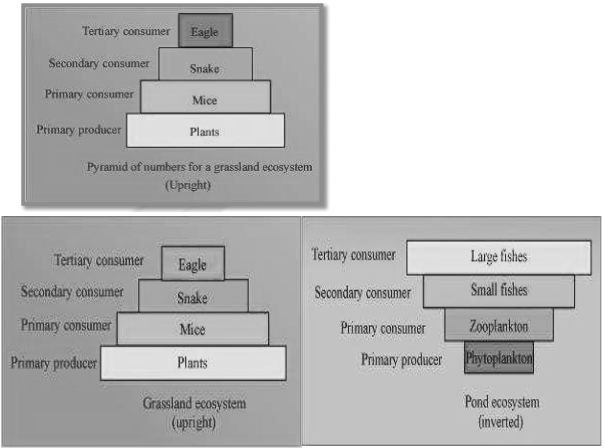
Pyramid of numbers: It is a graphical representation of the number of individuals present at each trophic level in a food chain of an ecosystem. The pyramid of numbers can be upright or inverted depending on the number of producers. For example,in a grassland ecosystem,the pyramid of numbers is upright. In this type of food chain,the number of producers (plants) is followed by the number of herbivores (mice),which in turn is followed by the number of secondary consumers (snakes) and tertiary carnivores (eagles). Hence,the number of individuals at the producer level will be the maximum,while the number of individuals present at the top carnivore level will be the least. On the other hand,in a tree ecosystem,the pyramid of numbers is inverted (or spindle-shaped) because a single tree (producer) provides food to several fruit-eating birds,which in turn support several insect species.
Pyramid of biomass: $A$ pyramid of biomass is a graphical representation of the total amount of living matter (biomass) present at each trophic level of an ecosystem. It can be upright or inverted. It is upright in grasslands and forest ecosystems as the amount of biomass present at the producer level is higher than at the top carnivore level. The pyramid of biomass is inverted in a pond ecosystem as the biomass of fishes far exceeds the biomass of zooplankton (upon which they feed).
$1$. Pyramid of numbers
$2$. Pyramid of energy
$3$. Pyramid of biomass
Pyramid of numbers: It is a graphical representation of the number of individuals present at each trophic level in a food chain of an ecosystem. The pyramid of numbers can be upright or inverted depending on the number of producers. For example,in a grassland ecosystem,the pyramid of numbers is upright. In this type of food chain,the number of producers (plants) is followed by the number of herbivores (mice),which in turn is followed by the number of secondary consumers (snakes) and tertiary carnivores (eagles). Hence,the number of individuals at the producer level will be the maximum,while the number of individuals present at the top carnivore level will be the least. On the other hand,in a tree ecosystem,the pyramid of numbers is inverted (or spindle-shaped) because a single tree (producer) provides food to several fruit-eating birds,which in turn support several insect species.
Pyramid of biomass: $A$ pyramid of biomass is a graphical representation of the total amount of living matter (biomass) present at each trophic level of an ecosystem. It can be upright or inverted. It is upright in grasslands and forest ecosystems as the amount of biomass present at the producer level is higher than at the top carnivore level. The pyramid of biomass is inverted in a pond ecosystem as the biomass of fishes far exceeds the biomass of zooplankton (upon which they feed).
0 likes
View Solution58
Medium
Explain various types of ecological pyramids.
Solution
(N/A) The ecological pyramid is a graphical representation of the relationship between organisms at different trophic levels in an ecosystem.
The base of the pyramid represents the producers or the first trophic level,while the apex represents the tertiary or top-level consumers.
The three main types of ecological pyramids are:
$(a)$ Pyramid of Number: This represents the number of individual organisms at each trophic level. It can be upright,inverted,or spindle-shaped.
$(b)$ Pyramid of Biomass: This represents the total dry weight of living matter at each trophic level. It is generally upright in terrestrial ecosystems but can be inverted in aquatic ecosystems.
$(c)$ Pyramid of Energy: This represents the total amount of energy present at each trophic level. It is always upright because energy is lost as heat at each transfer,following the $10\%$ law of energy flow.
Important considerations include:
$1.$ Calculations must include all organisms at a specific trophic level to be accurate.
$2.$ $A$ single organism may occupy more than one trophic level simultaneously.
$3.$ Trophic levels represent functional roles rather than specific species.
The base of the pyramid represents the producers or the first trophic level,while the apex represents the tertiary or top-level consumers.
The three main types of ecological pyramids are:
$(a)$ Pyramid of Number: This represents the number of individual organisms at each trophic level. It can be upright,inverted,or spindle-shaped.
$(b)$ Pyramid of Biomass: This represents the total dry weight of living matter at each trophic level. It is generally upright in terrestrial ecosystems but can be inverted in aquatic ecosystems.
$(c)$ Pyramid of Energy: This represents the total amount of energy present at each trophic level. It is always upright because energy is lost as heat at each transfer,following the $10\%$ law of energy flow.
Important considerations include:
$1.$ Calculations must include all organisms at a specific trophic level to be accurate.
$2.$ $A$ single organism may occupy more than one trophic level simultaneously.
$3.$ Trophic levels represent functional roles rather than specific species.
0 likes
View Solution59
Easy
Give differences: Upright Pyramid and Inverted Pyramid.
Solution
(N/A)
| Upright Pyramid | Inverted Pyramid |
| $(1)$ In this type of pyramid,the number of organisms and biomass is highest at the producer level and decreases at subsequent trophic levels. | $(1)$ In this type of pyramid,the number of organisms and biomass is lowest at the producer level and increases at subsequent trophic levels. |
| $(2)$ The base of the pyramid consists of a large number of producers. | $(2)$ The base of the pyramid consists of a small number of producers. |
| $(3)$ Energy pyramids are always upright. | $(3)$ Pyramids of number and biomass can be inverted in certain ecosystems. |
0 likes
View Solution60
EasyMCQ
Give scientific reasons: Energy pyramids are never inverted.
A
Energy is lost as heat at each trophic level.
B
Energy increases at higher trophic levels.
C
Energy is constant across all trophic levels.
D
Energy is not transferred between trophic levels.
Solution
(A) Energy pyramids are always upright and can never be inverted.
This is because, according to the $10\%$ law of energy transfer, when energy flows from one trophic level to the next, a significant portion of energy is lost as heat at each step.
Consequently, the amount of energy available at higher trophic levels is always less than that at lower trophic levels.
Therefore, the base of the pyramid (producers) is always broader than the apex (top consumers), resulting in an upright structure.
This is because, according to the $10\%$ law of energy transfer, when energy flows from one trophic level to the next, a significant portion of energy is lost as heat at each step.
Consequently, the amount of energy available at higher trophic levels is always less than that at lower trophic levels.
Therefore, the base of the pyramid (producers) is always broader than the apex (top consumers), resulting in an upright structure.
0 likes
View Solution61
EasyMCQ
What does the base tier of the ecological pyramid represent?
A
Primary consumers
B
Producers
C
Secondary consumers
D
Decomposers
Solution
(B) The base tier of an ecological pyramid represents the producers.
In all three types of ecological pyramids—$(i)$ Pyramid of Number,$(ii)$ Pyramid of Biomass,and $(iii)$ Pyramid of Energy—the producers always occupy the base level as they form the foundation of the food chain by converting solar energy into chemical energy.
In all three types of ecological pyramids—$(i)$ Pyramid of Number,$(ii)$ Pyramid of Biomass,and $(iii)$ Pyramid of Energy—the producers always occupy the base level as they form the foundation of the food chain by converting solar energy into chemical energy.
0 likes
View Solution62
Easy
What are the shortcomings of ecological pyramids in the study of ecosystem?
Solution
(N/A) Ecological pyramids have several limitations in the study of ecosystems:
$1$. They assume a simple food chain,which rarely exists in nature. Most ecosystems have complex food webs.
$2$. They do not account for the same species belonging to two or more trophic levels simultaneously.
$3$. They do not provide a place for saprophytes,decomposers,and parasites,even though they play a crucial role in the ecosystem.
$4$. $A$ given species may occupy more than one trophic level in the same ecosystem at the same time,which is not represented in a standard pyramid.
$1$. They assume a simple food chain,which rarely exists in nature. Most ecosystems have complex food webs.
$2$. They do not account for the same species belonging to two or more trophic levels simultaneously.
$3$. They do not provide a place for saprophytes,decomposers,and parasites,even though they play a crucial role in the ecosystem.
$4$. $A$ given species may occupy more than one trophic level in the same ecosystem at the same time,which is not represented in a standard pyramid.
0 likes
View Solution63
Medium
What are the three types of ecological pyramids? What information is conveyed by each pyramid with regard to structure, function, and energy in the ecosystem?
Solution
(N/A) The three types of ecological pyramids are:
$1$. Pyramid of Number: It represents the number of individual organisms at each trophic level in an ecosystem.
$2$. Pyramid of Biomass: It represents the total dry weight (biomass) of living organisms at each trophic level.
$3$. Pyramid of Energy: It represents the total amount of energy available at each trophic level.
Information conveyed:
- Pyramid of Number: Provides information about the population size of producers and consumers. It can be upright or inverted (e.g., in a tree ecosystem).
- Pyramid of Biomass: Provides information about the standing crop or total organic matter. It is generally upright in terrestrial ecosystems but can be inverted in aquatic ecosystems (e.g., phytoplankton biomass is less than zooplankton biomass).
- Pyramid of Energy: It is always upright because energy flow is unidirectional and follows the $10\%$ law of Lindeman, where energy is lost as heat at each transfer. It provides information about the functional efficiency of the ecosystem.
$1$. Pyramid of Number: It represents the number of individual organisms at each trophic level in an ecosystem.
$2$. Pyramid of Biomass: It represents the total dry weight (biomass) of living organisms at each trophic level.
$3$. Pyramid of Energy: It represents the total amount of energy available at each trophic level.
Information conveyed:
- Pyramid of Number: Provides information about the population size of producers and consumers. It can be upright or inverted (e.g., in a tree ecosystem).
- Pyramid of Biomass: Provides information about the standing crop or total organic matter. It is generally upright in terrestrial ecosystems but can be inverted in aquatic ecosystems (e.g., phytoplankton biomass is less than zooplankton biomass).
- Pyramid of Energy: It is always upright because energy flow is unidirectional and follows the $10\%$ law of Lindeman, where energy is lost as heat at each transfer. It provides information about the functional efficiency of the ecosystem.
0 likes
View Solution64
Easy
Write a short note on pyramid of numbers and pyramid of biomass.
Solution
(N/A) $1$. Pyramid of Numbers: It represents the number of individual organisms at each trophic level in an ecosystem. It can be upright (e.g.,grassland ecosystem),inverted (e.g.,tree ecosystem where one tree supports many birds),or spindle-shaped.
$2$. Pyramid of Biomass: It represents the total dry weight of living organic matter (biomass) at each trophic level. It is generally upright in terrestrial ecosystems but can be inverted in aquatic ecosystems (e.g.,phytoplankton biomass is less than zooplankton biomass at a given time).
$2$. Pyramid of Biomass: It represents the total dry weight of living organic matter (biomass) at each trophic level. It is generally upright in terrestrial ecosystems but can be inverted in aquatic ecosystems (e.g.,phytoplankton biomass is less than zooplankton biomass at a given time).
0 likes
View Solution65
MediumMCQ
In an ecological pyramid,what does the base represent?
A
Producers
B
Consumers
C
Primary trophic level
D
Both $A$ and $C$
Solution
(D) In an ecological pyramid,the base represents the producers or the first trophic level.
Producers (such as plants,algae,and cyanobacteria) form the foundation of the food chain by converting solar energy into chemical energy.
Since producers occupy the first trophic level,both options $A$ and $C$ are correct.
Therefore,the correct answer is $D$.
Producers (such as plants,algae,and cyanobacteria) form the foundation of the food chain by converting solar energy into chemical energy.
Since producers occupy the first trophic level,both options $A$ and $C$ are correct.
Therefore,the correct answer is $D$.
0 likes
View Solution66
MediumMCQ
In a typical pyramid of numbers,if the top carnivores are represented as tertiary consumers at the final trophic level,how many total trophic levels are formed?
A
$3$
B
$2$
C
$4$
D
$5$
Solution
(C) In an ecosystem,trophic levels are organized as follows:
$1$. The first trophic level $(T_1)$ consists of producers (plants).
$2$. The second trophic level $(T_2)$ consists of primary consumers (herbivores).
$3$. The third trophic level $(T_3)$ consists of secondary consumers (primary carnivores).
$4$. The fourth trophic level $(T_4)$ consists of tertiary consumers (top carnivores).
Since the question specifies that the top carnivores are tertiary consumers at the final trophic level,there are a total of $4$ trophic levels $(T_1, T_2, T_3, T_4)$.
$1$. The first trophic level $(T_1)$ consists of producers (plants).
$2$. The second trophic level $(T_2)$ consists of primary consumers (herbivores).
$3$. The third trophic level $(T_3)$ consists of secondary consumers (primary carnivores).
$4$. The fourth trophic level $(T_4)$ consists of tertiary consumers (top carnivores).
Since the question specifies that the top carnivores are tertiary consumers at the final trophic level,there are a total of $4$ trophic levels $(T_1, T_2, T_3, T_4)$.
0 likes
View Solution67
MediumMCQ
In a typical grassland ecosystem,what is the number of individual organisms supporting the top carnivores?
A
$3$
B
$354,000$
C
$708,000$
D
$5,842,000$
Solution
(D) In a typical grassland ecosystem,the pyramid of numbers is upright.
According to the data provided by Odum for a grassland ecosystem,the number of producers is $5,842,000$,the number of primary consumers is $708,000$,the number of secondary consumers is $354,000$,and the number of top carnivores is $3$.
Therefore,the top carnivores are supported by $354,000$ secondary consumers,$708,000$ primary consumers,and $5,842,000$ producers.
According to the data provided by Odum for a grassland ecosystem,the number of producers is $5,842,000$,the number of primary consumers is $708,000$,the number of secondary consumers is $354,000$,and the number of top carnivores is $3$.
Therefore,the top carnivores are supported by $354,000$ secondary consumers,$708,000$ primary consumers,and $5,842,000$ producers.
0 likes
View Solution68
MediumMCQ
Which type of ecological pyramid is always upright when representing the functional aspects of an ecosystem?
A
Pyramid of biomass
B
Pyramid of numbers
C
Pyramid of energy
D
All of the above
Solution
(C) The pyramid of energy represents the flow of energy through different trophic levels in an ecosystem.
According to the $10\%$ law of energy transfer, only $10\%$ of the energy is transferred from one trophic level to the next, while the rest is lost as heat.
Because energy is lost at each step, the amount of energy available at higher trophic levels is always less than at lower levels.
Therefore, the pyramid of energy is always upright and can never be inverted.
According to the $10\%$ law of energy transfer, only $10\%$ of the energy is transferred from one trophic level to the next, while the rest is lost as heat.
Because energy is lost at each step, the amount of energy available at higher trophic levels is always less than at lower levels.
Therefore, the pyramid of energy is always upright and can never be inverted.
0 likes
View Solution69
MediumMCQ
In which of the following types of ecosystems can an inverted pyramid of biomass be found?
A
Forest ecosystem
B
Pond ecosystem
C
Marine ecosystem
D
Both $B$ and $C$
Solution
(D) In an ecosystem,the pyramid of biomass represents the total dry weight of organisms at each trophic level.
In most terrestrial ecosystems,the pyramid of biomass is upright.
However,in aquatic ecosystems,such as a pond or marine ecosystem,the pyramid of biomass is often inverted.
This is because the biomass of phytoplankton (producers) is much smaller than the biomass of the zooplankton and small fish (consumers) that feed on them,due to the rapid turnover rate of phytoplankton.
Therefore,both pond and marine ecosystems exhibit an inverted pyramid of biomass.
Thus,the correct option is $D$.
In most terrestrial ecosystems,the pyramid of biomass is upright.
However,in aquatic ecosystems,such as a pond or marine ecosystem,the pyramid of biomass is often inverted.
This is because the biomass of phytoplankton (producers) is much smaller than the biomass of the zooplankton and small fish (consumers) that feed on them,due to the rapid turnover rate of phytoplankton.
Therefore,both pond and marine ecosystems exhibit an inverted pyramid of biomass.
Thus,the correct option is $D$.
0 likes
View Solution70
MediumMCQ
What type of pyramid of biomass is found in the sea?
A
Upright
B
Inverted
C
Both
D
None of these
Solution
(B) In an aquatic ecosystem,specifically in the sea,the pyramid of biomass is generally inverted.
This occurs because the biomass of phytoplankton (producers) is much smaller than the biomass of zooplankton and small fish (primary consumers) and large fish (secondary/tertiary consumers) that feed on them.
Since the producers have a very short life span and high turnover rate,their standing crop at any given time is low compared to the consumers.
This occurs because the biomass of phytoplankton (producers) is much smaller than the biomass of zooplankton and small fish (primary consumers) and large fish (secondary/tertiary consumers) that feed on them.
Since the producers have a very short life span and high turnover rate,their standing crop at any given time is low compared to the consumers.
0 likes
View Solution71
MediumMCQ
In which trophic level of the pyramid are decomposers included?
A
Primary trophic level
B
Secondary trophic level
C
Tertiary trophic level
D
None of these
Solution
(D) Decomposers are organisms that break down dead organic matter.
In the study of ecological pyramids,decomposers are not given a specific place in any of the trophic levels $(T_1, T_2, T_3, T_4)$.
Ecological pyramids are primarily designed to represent the flow of energy or biomass between producers and consumers.
Since decomposers operate at all trophic levels by breaking down dead remains,they are excluded from the standard pyramid structure.
In the study of ecological pyramids,decomposers are not given a specific place in any of the trophic levels $(T_1, T_2, T_3, T_4)$.
Ecological pyramids are primarily designed to represent the flow of energy or biomass between producers and consumers.
Since decomposers operate at all trophic levels by breaking down dead remains,they are excluded from the standard pyramid structure.
0 likes
View Solution72
MediumMCQ
Which of the following types of pyramids represents the energy flow or functional capacity of an ecosystem?
A
Pyramid of biomass
B
Pyramid of numbers
C
Pyramid of energy
D
Both $B$ and $C$
Solution
(C) The pyramid of energy is always upright because energy flow in an ecosystem follows the $10\%$ law,where only $10\%$ of the energy is transferred from one trophic level to the next. This pyramid represents the functional capacity or the rate of energy flow through the ecosystem. Unlike pyramids of biomass or numbers,which can sometimes be inverted,the pyramid of energy is a true representation of the ecosystem's functional status.
0 likes
View Solution73
MediumMCQ
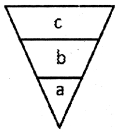
Identify the correct labels for $a, b,$ and $c$ in the given inverted pyramid.
A
$a = \text{Herbivores}, b = \text{Parasites}, c = \text{Lion}$
B
$a = \text{Lion}, b = \text{Herbivores}, c = \text{Producers}$
C
$a = \text{Producers}, b = \text{Carnivores}, c = \text{Herbivores}$
D
$a = \text{Tree}, b = \text{Birds}, c = \text{Insects}$
Solution
(B) The given figure represents an inverted pyramid of biomass or numbers.
In an inverted pyramid,the base (top level) represents the highest trophic level or the largest population,while the apex (bottom level) represents the lowest trophic level or the smallest population.
Option $B$ correctly identifies the hierarchy for an inverted pyramid of numbers (e.g.,a single tree supporting many birds,which in turn support many parasites/insects).
Specifically,$a$ (the apex) represents the producer (e.g.,a single tree),$b$ represents the primary consumers (e.g.,birds),and $c$ represents the secondary consumers or parasites.
In an inverted pyramid,the base (top level) represents the highest trophic level or the largest population,while the apex (bottom level) represents the lowest trophic level or the smallest population.
Option $B$ correctly identifies the hierarchy for an inverted pyramid of numbers (e.g.,a single tree supporting many birds,which in turn support many parasites/insects).
Specifically,$a$ (the apex) represents the producer (e.g.,a single tree),$b$ represents the primary consumers (e.g.,birds),and $c$ represents the secondary consumers or parasites.
0 likes
View Solution74
MediumMCQ
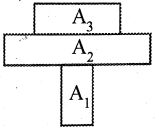
Identify the given pyramid based on biomass.
A
Pyramid of marine ecosystem
B
Pyramid of pond ecosystem
C
Pyramid of river ecosystem
D
Pyramid of terrestrial ecosystem
Solution
(A) The provided image shows an inverted pyramid of biomass.
In a marine ecosystem,the biomass of producers (phytoplankton) is much smaller than the biomass of consumers (zooplankton and small fish) at any given time.
This results in an inverted pyramid of biomass,where the base $(A_1)$ is smaller than the middle level $(A_2)$.
Therefore,the correct option is the pyramid of a marine ecosystem.
In a marine ecosystem,the biomass of producers (phytoplankton) is much smaller than the biomass of consumers (zooplankton and small fish) at any given time.
This results in an inverted pyramid of biomass,where the base $(A_1)$ is smaller than the middle level $(A_2)$.
Therefore,the correct option is the pyramid of a marine ecosystem.
0 likes
View Solution75
MediumMCQ
In an ecosystem,what do the pyramid of numbers,pyramid of biomass,and pyramid of energy represent respectively?
A
Standing crop,productivity,standing state
B
Standing state,productivity,standing crop
C
Standing state,standing crop,productivity
D
Productivity,standing state,standing crop
Solution
(C) $1$. The pyramid of numbers represents the standing state,which is the total number of individuals at each trophic level.
$2$. The pyramid of biomass represents the standing crop,which is the total dry weight of living organisms at each trophic level.
$3$. The pyramid of energy represents the productivity,which is the rate of energy flow or biomass production at each trophic level.
Therefore,the correct sequence is standing state,standing crop,and productivity.
$2$. The pyramid of biomass represents the standing crop,which is the total dry weight of living organisms at each trophic level.
$3$. The pyramid of energy represents the productivity,which is the rate of energy flow or biomass production at each trophic level.
Therefore,the correct sequence is standing state,standing crop,and productivity.
0 likes
View Solution76
MediumMCQ
What type of ecosystem is represented by the given ecological pyramid?
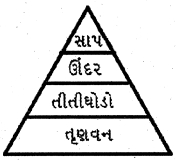
A
Terrestrial ecosystem
B
Aquatic ecosystem
C
Grassland ecosystem
D
Biomass ecosystem
Solution
(C) The given pyramid shows the number of individuals at each trophic level: Producers (Grass) -> Primary Consumers (Grasshopper) -> Secondary Consumers (Rat) -> Tertiary Consumers (Snake).
This is an upright pyramid of numbers.
In a grassland ecosystem,the number of producers is very high,and the number of individuals decreases as we move to higher trophic levels.
Therefore,it represents a typical grassland ecosystem.
This is an upright pyramid of numbers.
In a grassland ecosystem,the number of producers is very high,and the number of individuals decreases as we move to higher trophic levels.
Therefore,it represents a typical grassland ecosystem.
0 likes
View Solution77
MediumMCQ
Which of the following characteristics cannot be included in an ecological pyramid?
A
Food web
B
Saprophytes
C
Herbivores
D
Both $A$ and $B$
Solution
(D) An ecological pyramid is a graphical representation of the relationship between different organisms at different trophic levels in an ecosystem.
$1$. Ecological pyramids only represent the trophic structure of an ecosystem,starting from producers at the base to top carnivores at the apex.
$2$. Saprophytes (decomposers) are not given a place in ecological pyramids because they operate at all trophic levels and do not fit into a simple linear trophic hierarchy.
$3$. Food webs are complex networks of interconnected food chains and cannot be represented by a simple pyramid structure.
$4$. Therefore,both food webs and saprophytes are excluded from standard ecological pyramids.
$1$. Ecological pyramids only represent the trophic structure of an ecosystem,starting from producers at the base to top carnivores at the apex.
$2$. Saprophytes (decomposers) are not given a place in ecological pyramids because they operate at all trophic levels and do not fit into a simple linear trophic hierarchy.
$3$. Food webs are complex networks of interconnected food chains and cannot be represented by a simple pyramid structure.
$4$. Therefore,both food webs and saprophytes are excluded from standard ecological pyramids.
0 likes
View Solution78
MediumMCQ
What type of pyramid is represented by the given figure?
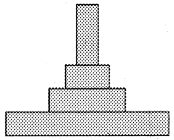
A
Pyramid of biomass showing an increase in biomass at higher trophic levels.
B
Pyramid of biomass showing a sharp decrease in biomass at higher trophic levels.
C
Upright pyramid.
D
Inverted pyramid of numbers.
Solution
(B) The given figure represents an upright pyramid of biomass. In most terrestrial ecosystems,the biomass of producers is significantly higher than that of primary consumers,which in turn is higher than that of secondary and tertiary consumers. This results in a broad base that tapers towards the top,indicating a sharp decrease in biomass at higher trophic levels.
0 likes
View Solution79
MediumMCQ
What does the given inverted pyramid represent?
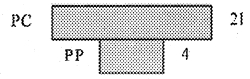
A
Pyramid of biomass
B
Pyramid of energy
C
Terrestrial pyramid
D
Pyramid of numbers
Solution
(D) The given pyramid shows Primary Producers $(PP)$ with a value of $4$ and Primary Consumers $(PC)$ with a value of $21$.
Since the number of consumers is greater than the number of producers,this represents an inverted pyramid of numbers.
Such a pyramid is typically observed in a tree ecosystem where a single large tree (producer) supports many birds and insects (consumers).
Therefore,the correct option is $D$.
Since the number of consumers is greater than the number of producers,this represents an inverted pyramid of numbers.
Such a pyramid is typically observed in a tree ecosystem where a single large tree (producer) supports many birds and insects (consumers).
Therefore,the correct option is $D$.
0 likes
View Solution80
MediumMCQ
The given figure represents a pyramid of energy. What can be inferred from it?
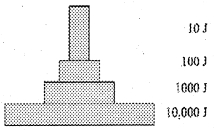
A
$10 \%$ of energy is lost during energy transfer.
B
The main source of energy in an ecosystem is the sun.
C
Only $10 \%$ of the energy is transferred to the next higher trophic level during energy flow.
D
All of the above.
Solution
(C) The pyramid of energy is always upright because energy is lost as heat at each trophic level. According to Lindeman's $10 \%$ law,only $10 \%$ of the energy available at one trophic level is transferred to the next higher trophic level.
$1$. Option $A$ is incorrect because $90 \%$ of energy is lost,not $10 \%$.
$2$. Option $B$ is a general fact about ecosystems but is not directly inferred from the specific values in this pyramid.
$3$. Option $C$ correctly describes the $10 \%$ law of energy transfer shown in the pyramid $(10,000 \ J \rightarrow 1,000 \ J \rightarrow 100 \ J \rightarrow 10 \ J)$.
Therefore,the most accurate inference based on the provided data is that only $10 \%$ of energy is transferred to the next trophic level.
$1$. Option $A$ is incorrect because $90 \%$ of energy is lost,not $10 \%$.
$2$. Option $B$ is a general fact about ecosystems but is not directly inferred from the specific values in this pyramid.
$3$. Option $C$ correctly describes the $10 \%$ law of energy transfer shown in the pyramid $(10,000 \ J \rightarrow 1,000 \ J \rightarrow 100 \ J \rightarrow 10 \ J)$.
Therefore,the most accurate inference based on the provided data is that only $10 \%$ of energy is transferred to the next trophic level.
0 likes
View Solution81
MediumMCQ
Which of the following statements is true?
A
In the historic cloning experiment of Dr. Wilmut,the transplanted nucleus was taken from an udder cell.
B
Mammalian characters appeared first in dinosaurs.
C
Heart of mammals is incapable of being in vitro.
D
Pyramid of biomass is upright in pond ecosystem.
Solution
(A) The correct statement is that in the historic cloning experiment of $Dr. Wilmut$ (creating $Dolly$ the sheep),the transplanted nucleus was indeed taken from an udder cell (mammary gland cell) of an adult $Finn$ $Dorset$ ewe.
- Option $B$ is incorrect because mammalian characters evolved from synapsid reptiles,not dinosaurs.
- Option $C$ is incorrect because mammalian heart tissue can be studied $in$ $vitro$ under controlled laboratory conditions.
- Option $D$ is incorrect because the pyramid of biomass in a pond ecosystem is typically inverted,as the biomass of phytoplankton (producers) is much smaller than that of the zooplankton and small fish (consumers) that feed on them.
- Option $B$ is incorrect because mammalian characters evolved from synapsid reptiles,not dinosaurs.
- Option $C$ is incorrect because mammalian heart tissue can be studied $in$ $vitro$ under controlled laboratory conditions.
- Option $D$ is incorrect because the pyramid of biomass in a pond ecosystem is typically inverted,as the biomass of phytoplankton (producers) is much smaller than that of the zooplankton and small fish (consumers) that feed on them.
0 likes
View Solution82
MediumMCQ
The pyramid of number of a parasitic food chain in a tree ecosystem is
A
Always inverted
B
Always upright
C
Mixture of inverted and upright
D
Sometimes inverted and sometimes upright
Solution
(A) The pyramid of numbers represents the relationship between the number of producers and consumers at successive trophic levels.
In a parasitic food chain within a tree ecosystem,a single tree (producer) supports many birds (primary consumers),which in turn support a much larger number of parasites (secondary consumers).
Since the number of individuals increases as we move from the producer level to the consumer levels,the pyramid of numbers is always inverted.
In a parasitic food chain within a tree ecosystem,a single tree (producer) supports many birds (primary consumers),which in turn support a much larger number of parasites (secondary consumers).
Since the number of individuals increases as we move from the producer level to the consumer levels,the pyramid of numbers is always inverted.
0 likes
View Solution83
MediumMCQ
Which of the following pyramids is always upright and can never be inverted?
A
Pyramid of biomass
B
Pyramid of number
C
Pyramid of energy
D
Both $(a)$ and $(c)$
Solution
(C) The pyramid of energy represents the amount of energy trapped per unit area and time at different trophic levels of a food chain.
According to the $10\%$ law of energy transfer, energy is lost as heat at each successive trophic level.
Therefore, the energy available at the producer level is always greater than that at the consumer levels.
As a result, the pyramid of energy is always upright and can never be inverted.
According to the $10\%$ law of energy transfer, energy is lost as heat at each successive trophic level.
Therefore, the energy available at the producer level is always greater than that at the consumer levels.
As a result, the pyramid of energy is always upright and can never be inverted.
0 likes
View Solution84
MediumMCQ
In an ecological pyramid,the base always represents the $...A...$ and the apex represents $...B...$. Here,$A$ and $B$ represent:
A
$A-$producers; $B-$top level consumers
B
$A-$top level consumers; $B-$producers
C
$A-$producers; $B-$secondary consumers
D
$A-$producers; $B-$primary consumers
Solution
(A) In an ecological pyramid,the trophic structure is represented such that the base is always occupied by the producers (autotrophs),which form the first trophic level.
The apex of the pyramid represents the top-level consumers (tertiary or quaternary consumers),which occupy the highest trophic level.
Therefore,$A$ represents producers and $B$ represents top-level consumers.
The apex of the pyramid represents the top-level consumers (tertiary or quaternary consumers),which occupy the highest trophic level.
Therefore,$A$ represents producers and $B$ represents top-level consumers.
0 likes
View Solution85
MediumMCQ
To show how many organisms are present at each level of a food chain,ecologists use a model called
A
An energy flow pyramid
B
Pyramid of numbers
C
Pyramid of energy
D
Food chain/food web pyramid
Solution
(B) pyramid of numbers is a graphical representation that shows the number of individual organisms at each trophic level in an ecosystem. It helps ecologists visualize the population size at each level of a food chain.
0 likes
View Solution86
MediumMCQ
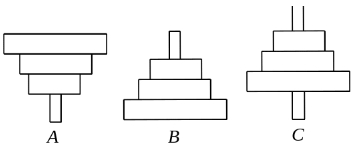
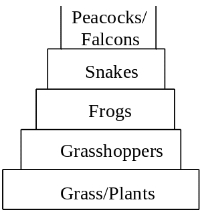
Which of the following representations shows the pyramid of numbers in a grassland ecosystem?
A
$A$
B
$B$
C
$C$
D
$None\; of\; these$
Solution
(B) In a grassland ecosystem,the pyramid of numbers is upright.
This is because a large number of grass plants or herbs support a smaller number of grasshoppers,which in turn support a still smaller number of frogs,followed by an even smaller number of snakes,and finally,very few top predators like peacocks or falcons.
This gradual decrease in the number of individuals at each successive trophic level results in an upright pyramid,which corresponds to representation $B$.
This is because a large number of grass plants or herbs support a smaller number of grasshoppers,which in turn support a still smaller number of frogs,followed by an even smaller number of snakes,and finally,very few top predators like peacocks or falcons.
This gradual decrease in the number of individuals at each successive trophic level results in an upright pyramid,which corresponds to representation $B$.
0 likes
View Solution87
MediumMCQ
The relation between producers and consumers in an ecosystem can be graphically represented in the form of a pyramid called
A
Ecological pyramid
B
Trophic level
C
Pi chart
D
Pyramid of biomass
Solution
(A) There is a relationship between the numbers,biomass,and energy content of producers and consumers of different orders in any ecosystem.
These relationships,when represented in a diagrammatic way,are called ecological pyramids.
Ecological pyramids are of the following types:
$(i)$ Pyramid of number
$(ii)$ Pyramid of biomass
$(iii)$ Pyramid of energy
The concept of the ecological pyramid was proposed by Charles Elton $(1927)$,so they are also known as Eltonian pyramids.
These relationships,when represented in a diagrammatic way,are called ecological pyramids.
Ecological pyramids are of the following types:
$(i)$ Pyramid of number
$(ii)$ Pyramid of biomass
$(iii)$ Pyramid of energy
The concept of the ecological pyramid was proposed by Charles Elton $(1927)$,so they are also known as Eltonian pyramids.
0 likes
View Solution88
MediumMCQ
An inverted pyramid of $...A...$ may occasionally be observed in $...B...$ communities.
A
$A-$energy; $B-$grassland
B
$A-$energy; $B-$forest
C
$A-$biomass; $B-$marine
D
$A-$biomass; $B-$grassland
Solution
(C) In an ecosystem,the pyramid of biomass represents the amount of living matter at each trophic level.
In most terrestrial ecosystems,the pyramid of biomass is upright.
However,in marine ecosystems,the pyramid of biomass is often inverted because the biomass of phytoplankton (producers) is much smaller than that of zooplankton and small fish (consumers) that feed on them.
Therefore,an inverted pyramid of biomass is observed in marine communities.
In most terrestrial ecosystems,the pyramid of biomass is upright.
However,in marine ecosystems,the pyramid of biomass is often inverted because the biomass of phytoplankton (producers) is much smaller than that of zooplankton and small fish (consumers) that feed on them.
Therefore,an inverted pyramid of biomass is observed in marine communities.
0 likes
View Solution89
MediumMCQ
Which is an example of a true pyramid in an ecosystem?
A
Pyramid of biomass
B
Pyramid of number
C
Pyramid of energy
D
None of the above
Solution
$(C)$ The pyramid of energy is the graphic representation of the amount of energy trapped per unit time and area in different trophic levels of a food chain, from producers to top carnivores.
It is considered a 'true' pyramid because it is always upright, as energy is lost as heat at each successive trophic level according to the $10\%$ law of energy transfer.
It is considered a 'true' pyramid because it is always upright, as energy is lost as heat at each successive trophic level according to the $10\%$ law of energy transfer.
0 likes
View Solution90
MediumMCQ
$A$ pyramid of number in a grassland ecosystem shows:
A
There are always a large number of producers at the bottom and fewer top consumers.
B
There are always a large number of top consumers and fewer producers.
C
There are an equal number of producers and consumers.
D
There are more top consumers than primary consumers.
Solution
(A) In a grassland ecosystem,the pyramid of numbers is upright.
This means that the number of producers (grasses) is significantly higher at the base compared to the number of primary,secondary,and tertiary consumers at higher trophic levels.
As we move up the trophic levels,the number of individuals decreases,resulting in a large number of producers at the bottom and fewer top consumers.
This means that the number of producers (grasses) is significantly higher at the base compared to the number of primary,secondary,and tertiary consumers at higher trophic levels.
As we move up the trophic levels,the number of individuals decreases,resulting in a large number of producers at the bottom and fewer top consumers.
0 likes
View Solution91
MediumMCQ
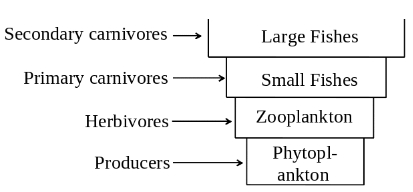
Which kind of pyramid is represented by the given diagram?
A
Pyramid of number in tree ecosystem
B
Pyramid of biomass in tree ecosystem
C
Pyramid of biomass in aquatic ecosystem
D
Pyramid of energy in tree ecosystem
Solution
(C) The given diagram shows an inverted pyramid where the biomass increases at successive trophic levels.
In an aquatic (pond) ecosystem,the producers (phytoplankton) are microscopic and have a very short lifespan,resulting in a small standing crop biomass.
As we move up the trophic levels to zooplankton,small fishes,and large fishes,the biomass increases because the consumers are larger and longer-lived.
This results in an inverted pyramid of biomass,which is characteristic of aquatic ecosystems.
In an aquatic (pond) ecosystem,the producers (phytoplankton) are microscopic and have a very short lifespan,resulting in a small standing crop biomass.
As we move up the trophic levels to zooplankton,small fishes,and large fishes,the biomass increases because the consumers are larger and longer-lived.
This results in an inverted pyramid of biomass,which is characteristic of aquatic ecosystems.
0 likes
View Solution92
MediumMCQ
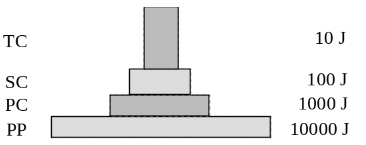
Given below is the diagram of an ecological pyramid. This type represents:
A
Pyramid of number in a grassland
B
Pyramid of biomass in a lake
C
Pyramid of biomass in a land
D
Pyramid of energy
Solution
(D) The provided diagram shows energy values $(10000 \ J, 1000 \ J, 100 \ J, 10 \ J)$ at different trophic levels $(PP, PC, SC, TC)$.
This indicates a steady decrease in energy as we move from producers to higher trophic levels.
The pyramid of energy is always upright because energy is always lost as heat at each trophic level according to the $10\%$ law of energy transfer.
It represents the total amount of energy utilized by organisms at different trophic levels in a unit area over a period of time.
This indicates a steady decrease in energy as we move from producers to higher trophic levels.
The pyramid of energy is always upright because energy is always lost as heat at each trophic level according to the $10\%$ law of energy transfer.
It represents the total amount of energy utilized by organisms at different trophic levels in a unit area over a period of time.
0 likes
View Solution93
MediumMCQ
Which of the following pyramid of numbers in ecology is not upright?
A
Pond ecosystem
B
Desert ecosystem
C
Tree ecosystem
D
Forest ecosystem
Solution
(C) In a tree ecosystem,the pyramid of numbers is inverted (spindle-shaped or inverted) because a single large tree supports a large number of herbivores (birds,insects,etc.).
In contrast,pond,desert,and forest ecosystems typically exhibit upright pyramids of numbers because the number of producers is significantly higher than the number of consumers at higher trophic levels.
In contrast,pond,desert,and forest ecosystems typically exhibit upright pyramids of numbers because the number of producers is significantly higher than the number of consumers at higher trophic levels.
0 likes
View Solution94
MediumMCQ
Given below is one of the types of ecological pyramids. This type represents:
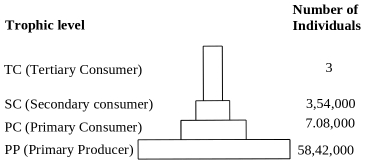
A
Pyramid of number in a grassland ecosystem
B
Pyramid of energy in forest ecosystem
C
Pyramid of biomass in sea ecosystem
D
Pyramid of biomass in terrestrial ecosystem
Solution
(A) The provided image shows a pyramid of numbers where the number of individuals decreases from the primary producers to the tertiary consumers.
This is a characteristic upright pyramid of numbers found in a grassland ecosystem.
In a grassland,the number of producers (grasses) is very high,which supports a large number of primary consumers (herbivores),followed by a smaller number of secondary and tertiary consumers.
Therefore,the correct option is $A$.
This is a characteristic upright pyramid of numbers found in a grassland ecosystem.
In a grassland,the number of producers (grasses) is very high,which supports a large number of primary consumers (herbivores),followed by a smaller number of secondary and tertiary consumers.
Therefore,the correct option is $A$.
0 likes
View Solution95
MediumMCQ
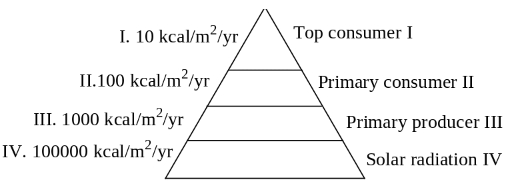
What is the rate of secondary production in the energy pyramid given below?
A
Uncertain
B
$100 \; kcal / m^{2} / yr$
C
$10 \; kcal / m^{2} / yr$
D
$110 \; kcal / m^{2} / yr$
Solution
(B) Secondary production is defined as the rate of formation of new organic matter by consumers.
In an ecosystem,energy flows from producers to consumers. According to the $10 \%$ law of energy transfer,only $10 \%$ of the energy available at one trophic level is transferred to the next trophic level.
In the given pyramid:
$1$. Solar radiation $(IV)$ = $100,000 \; kcal / m^{2} / yr$.
$2$. Primary producers $(III)$ utilize $1 \%$ of solar radiation = $1,000 \; kcal / m^{2} / yr$.
$3$. Primary consumers $(II)$ receive $10 \%$ of the energy from primary producers = $100 \; kcal / m^{2} / yr$.
Since primary consumers are the first level of consumers,the energy stored by them represents secondary production.
Therefore,the rate of secondary production is $100 \; kcal / m^{2} / yr$.
In an ecosystem,energy flows from producers to consumers. According to the $10 \%$ law of energy transfer,only $10 \%$ of the energy available at one trophic level is transferred to the next trophic level.
In the given pyramid:
$1$. Solar radiation $(IV)$ = $100,000 \; kcal / m^{2} / yr$.
$2$. Primary producers $(III)$ utilize $1 \%$ of solar radiation = $1,000 \; kcal / m^{2} / yr$.
$3$. Primary consumers $(II)$ receive $10 \%$ of the energy from primary producers = $100 \; kcal / m^{2} / yr$.
Since primary consumers are the first level of consumers,the energy stored by them represents secondary production.
Therefore,the rate of secondary production is $100 \; kcal / m^{2} / yr$.
0 likes
View Solution96
MediumMCQ
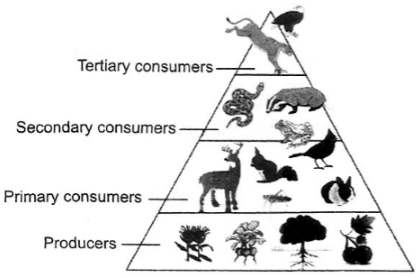
The given figure best represents:
A
Pyramid of number in parasitic food chain
B
Pyramid of biomass in forest ecosystem
C
Pyramid of number in grassland ecosystem
D
Pyramid of number in forest ecosystem
Solution
(B) The given figure shows an upright pyramid where the number of producers is the highest,followed by primary consumers,secondary consumers,and tertiary consumers.
In a forest ecosystem,the number of producers (trees) is relatively low compared to the number of herbivores (primary consumers) and carnivores (secondary/tertiary consumers) that depend on them. Therefore,the pyramid of numbers in a forest is spindle-shaped.
However,the pyramid of biomass in a forest ecosystem is upright because the total biomass of producers (trees) is significantly higher than the biomass of primary,secondary,and tertiary consumers.
Thus,the figure represents an upright pyramid,which is characteristic of the pyramid of biomass in a forest ecosystem.
In a forest ecosystem,the number of producers (trees) is relatively low compared to the number of herbivores (primary consumers) and carnivores (secondary/tertiary consumers) that depend on them. Therefore,the pyramid of numbers in a forest is spindle-shaped.
However,the pyramid of biomass in a forest ecosystem is upright because the total biomass of producers (trees) is significantly higher than the biomass of primary,secondary,and tertiary consumers.
Thus,the figure represents an upright pyramid,which is characteristic of the pyramid of biomass in a forest ecosystem.
0 likes
View Solution97
MediumMCQ
Consider the following statements about ecological pyramids:
$I.$ Charles Elton developed the concept of ecological pyramid.
$II.$ After his name,these pyramids are also called as Eltonian pyramids.
$III.$ It is a graphical representation or pyramid-shaped diagram which depicts the number of organisms,biomass,and energy at each trophic level.
Which of the statements given above are correct?
$I.$ Charles Elton developed the concept of ecological pyramid.
$II.$ After his name,these pyramids are also called as Eltonian pyramids.
$III.$ It is a graphical representation or pyramid-shaped diagram which depicts the number of organisms,biomass,and energy at each trophic level.
Which of the statements given above are correct?
A
$I$ and $II$
B
$I$ and $III$
C
$II$ and $III$
D
$I, II$ and $III$
Solution
(D) An ecological pyramid is a graphical representation of the relationship between producers and consumers at different trophic levels in an ecosystem.
Statement $I$ is correct: The concept of ecological pyramids was first developed by Charles Elton in $1927$.
Statement $II$ is correct: Due to his contribution,these pyramids are frequently referred to as Eltonian pyramids.
Statement $III$ is correct: These pyramids represent the number of organisms,biomass,or energy content at each successive trophic level in a food chain.
Therefore,all three statements are correct.
Statement $I$ is correct: The concept of ecological pyramids was first developed by Charles Elton in $1927$.
Statement $II$ is correct: Due to his contribution,these pyramids are frequently referred to as Eltonian pyramids.
Statement $III$ is correct: These pyramids represent the number of organisms,biomass,or energy content at each successive trophic level in a food chain.
Therefore,all three statements are correct.
0 likes
View Solution98
MediumMCQ
The most common shape of the pyramid of number is
A
Inverted
B
Urned
C
Spindle
D
Upright
Solution
(D) The pyramid of number represents the number of individuals at each trophic level. In most ecosystems,such as grasslands or forests,the number of producers is significantly higher than the number of primary consumers,and the number of primary consumers is higher than that of secondary consumers. This results in a pyramid that is broad at the base and narrow at the top,which is known as an upright pyramid.
0 likes
View Solution99
MediumMCQ
Which of the following organisms were not given any place in ecological pyramids?
A
Working at several trophic levels
B
Decomposers
C
Parasites
D
More than one option is correct
Solution
(D) Ecological pyramids are graphical representations of the relationship between different trophic levels in an ecosystem. They typically include producers,primary consumers,secondary consumers,and tertiary consumers. However,they do not account for decomposers (saprotrophs) or parasites,as these organisms often operate across multiple trophic levels and do not fit into a simple linear hierarchy. Therefore,both decomposers and parasites are excluded from ecological pyramids.
0 likes
View SolutionEcosystem — Ecological Pyramids · Frequently Asked Questions
1Are these Ecosystem questions useful for JEE and NEET?
Yes. All questions in this section are mapped to JEE Main and NEET exam patterns. Previous year questions from JEE Main, NEET, GUJCET and state-level exams are included with full solutions.
2Can I switch to Hindi or Gujarati for these questions?
Yes. Use the language tabs in the hero section or the sidebar to view the same questions and solutions in English, Hindi or Gujarati.
3How do I generate a question paper from this subtopic?
Use the Vedclass Exam Paper Generator — select the chapter and subtopic, set difficulty, and generate Sets A, B, C, D automatically. First 3 chapters of every subject are free.
Vedclass Products
For Students
Vedclass Test Series
Mock tests in real JEE/NEET style with performance analysis. 5-day free trial.
Start Free TrialFor Teachers
Exam Paper Generator
Generate Set A/B/C/D papers from this chapter in 2 minutes. 3 chapters free.
Try FreeFor Institutes
Online Exam Module
Live online exams with unlimited students, 360° analytics & white-label branding.
See DemoFor Teachers & Institutes
Generate a Ecosystem Exam Paper in 2 Minutes
Select subtopic & difficulty — Sets A, B, C, D auto-generated with No Repeat logic.
First 3 chapters of every subject are free — no payment required.