
A English
Ecological Pyramids Questions in English
Class 12 Biology · Ecosystem · Ecological Pyramids
130+
Questions
English
Language
100%
With Solutions
Showing 48 of 130 questions in English
1
MediumMCQ
In an ecosystem, there are more prey than predators. This relationship is called
A
Food webs
B
Predator-prey relationship
C
Pyramid of number
D
Succession
Solution
(C) In an ecosystem, the number of individuals at each trophic level can be represented graphically, which is known as the $Pyramid \text{ of } \text{number}$.
In most terrestrial ecosystems, the number of producers is higher than the number of primary consumers, and the number of prey is generally higher than the number of predators.
This graphical representation of the number of organisms at different trophic levels is called the $Pyramid \text{ of } \text{number}$.
In most terrestrial ecosystems, the number of producers is higher than the number of primary consumers, and the number of prey is generally higher than the number of predators.
This graphical representation of the number of organisms at different trophic levels is called the $Pyramid \text{ of } \text{number}$.
0 likes
View Solution2
MediumMCQ
The pyramid of numbers becomes partly inverted and partly erect for which of the following?
A
Aquatic ecosystem
B
Terrestrial ecosystem
C
Tree ecosystem
D
All the above
Solution
(C) In a tree ecosystem,the pyramid of numbers is spindle-shaped (partly inverted and partly erect).
$1$. The base represents a single large tree (producer),which is small in number.
$2$. The next trophic level consists of many herbivorous birds or insects feeding on the tree,which are larger in number.
$3$. The top trophic level consists of a few predatory birds or parasites,which are smaller in number again.
Thus,the pyramid is narrow at the base,broad in the middle,and narrow at the top,making it partly inverted and partly erect.
$1$. The base represents a single large tree (producer),which is small in number.
$2$. The next trophic level consists of many herbivorous birds or insects feeding on the tree,which are larger in number.
$3$. The top trophic level consists of a few predatory birds or parasites,which are smaller in number again.
Thus,the pyramid is narrow at the base,broad in the middle,and narrow at the top,making it partly inverted and partly erect.
0 likes
View Solution3
MediumMCQ
The pyramid of biomass and the pyramid of number represent:
A
The rate of energy flow
B
The rate of food production
C
Standing crop
D
Relationship among organisms
Solution
(C) The pyramid of biomass and the pyramid of number represent the standing crop at each trophic level.
Standing crop refers to the total amount of living organic matter (biomass) or the total number of individuals present in a unit area at a given time.
Unlike the pyramid of energy,which shows the rate of energy flow,these pyramids represent a static snapshot of the ecosystem at a specific moment.
Standing crop refers to the total amount of living organic matter (biomass) or the total number of individuals present in a unit area at a given time.
Unlike the pyramid of energy,which shows the rate of energy flow,these pyramids represent a static snapshot of the ecosystem at a specific moment.
0 likes
View Solution4
MediumMCQ
The pyramid of energy is the best representation of an ecosystem because it indicates
A
Relation of all plants and animals
B
Total energy present in an ecosystem
C
The rate of food flow through the food chain
D
None of these
Solution
(C) The pyramid of energy is considered the best representation of an ecosystem because it is always upright and reflects the functional role of organisms in the ecosystem.
It provides a graphical representation of the amount of energy trapped per unit time and area at different trophic levels.
Essentially,it indicates the rate of energy flow or the rate of food flow through the food chain,which is a dynamic process rather than a static snapshot of biomass or numbers.
It provides a graphical representation of the amount of energy trapped per unit time and area at different trophic levels.
Essentially,it indicates the rate of energy flow or the rate of food flow through the food chain,which is a dynamic process rather than a static snapshot of biomass or numbers.
0 likes
View Solution5
MediumMCQ
Under what condition does the upright pyramid of biomass become inverted?
A
Grassland ecosystem
B
Terrestrial ecosystem
C
Pond ecosystem
D
Tree ecosystem
Solution
(C) In a pond ecosystem,the pyramid of biomass is inverted.
This occurs because the biomass of producers (phytoplankton) is significantly lower than that of the consumers (zooplankton and small fish) that feed on them.
Since the biomass of the producers is smaller than the biomass of the subsequent trophic levels,the pyramid appears inverted.
This occurs because the biomass of producers (phytoplankton) is significantly lower than that of the consumers (zooplankton and small fish) that feed on them.
Since the biomass of the producers is smaller than the biomass of the subsequent trophic levels,the pyramid appears inverted.
0 likes
View Solution6
MediumMCQ
The number of primary producers within a specified area would be maximum in
A
Pond ecosystem
B
Grassland
C
Desert
D
Forest ecosystem
Solution
(A) In a pond ecosystem,the primary producers are mainly phytoplankton (microscopic algae). Because of their microscopic size,a very large number of these organisms can exist within a small unit area. In contrast,in ecosystems like forests or grasslands,the primary producers (trees or grasses) are much larger in size,meaning fewer individuals can occupy the same unit area. Therefore,the number of primary producers per unit area is maximum in a pond ecosystem.
0 likes
View Solution7
MediumMCQ
The pyramid of number in a grassland ecosystem is
A
Always erect
B
Always inverted
C
Either erect or inverted
D
Irregular
Solution
(A) In a grassland ecosystem,the producers (grasses) are present in very large numbers.
As we move to higher trophic levels (primary consumers like insects,secondary consumers like birds,and tertiary consumers like hawks),the number of individuals at each successive level decreases.
Therefore,the pyramid of number in a grassland ecosystem is always upright or erect.
As we move to higher trophic levels (primary consumers like insects,secondary consumers like birds,and tertiary consumers like hawks),the number of individuals at each successive level decreases.
Therefore,the pyramid of number in a grassland ecosystem is always upright or erect.
0 likes
View Solution8
MediumMCQ
The pyramid that cannot be inverted in a stable ecosystem is the pyramid of
A
Number
B
Energy
C
Biomass
D
All the above
Solution
(B) The correct answer is $B$.
In any ecosystem,the pyramid of energy is always upright and can never be inverted.
This is because,according to the $10\%$ law of energy transfer,only $10\%$ of the energy is transferred from one trophic level to the next,while the rest is lost as heat.
Since energy decreases at each successive trophic level,the base of the pyramid is always wider than the apex,ensuring it remains upright.
In any ecosystem,the pyramid of energy is always upright and can never be inverted.
This is because,according to the $10\%$ law of energy transfer,only $10\%$ of the energy is transferred from one trophic level to the next,while the rest is lost as heat.
Since energy decreases at each successive trophic level,the base of the pyramid is always wider than the apex,ensuring it remains upright.
0 likes
View Solution9
MediumMCQ
In a tree ecosystem,the pyramid of number is
A
Upright
B
Inverted
C
Spindle-shaped
D
None of the above
Solution
(C) In a tree ecosystem,the pyramid of number is spindle-shaped.
This is because a single large tree (producer) supports many herbivorous birds (primary consumers),which in turn support a smaller number of predatory birds (secondary consumers).
Thus,the number of individuals is low at the base (producers),high in the middle (primary consumers),and low at the top (top consumers),resulting in a spindle-shaped pyramid.
This is because a single large tree (producer) supports many herbivorous birds (primary consumers),which in turn support a smaller number of predatory birds (secondary consumers).
Thus,the number of individuals is low at the base (producers),high in the middle (primary consumers),and low at the top (top consumers),resulting in a spindle-shaped pyramid.
0 likes
View Solution10
MediumMCQ
What is maximum in a pond-ecosystem?
A
Primary consumers
B
Secondary consumers
C
Producers
D
Decomposers
Solution
(C) In a pond ecosystem,the producers (phytoplankton,algae,and aquatic plants) form the base of the food chain.
According to the pyramid of numbers in an aquatic ecosystem,the number of producers is the highest compared to primary,secondary,and tertiary consumers.
Therefore,the biomass and number of producers are maximum in a pond ecosystem.
According to the pyramid of numbers in an aquatic ecosystem,the number of producers is the highest compared to primary,secondary,and tertiary consumers.
Therefore,the biomass and number of producers are maximum in a pond ecosystem.
0 likes
View Solution11
MediumMCQ
The pyramid of number is based on
A
Unit per area
B
Food per individual
C
Individuals in trophic level
D
None of these
Solution
(C) The pyramid of number represents the number of individuals at each trophic level in an ecosystem.
It depicts the relationship between the number of producers,primary consumers,secondary consumers,and tertiary consumers.
Therefore,the correct basis for this pyramid is the count of individuals at each trophic level.
It depicts the relationship between the number of producers,primary consumers,secondary consumers,and tertiary consumers.
Therefore,the correct basis for this pyramid is the count of individuals at each trophic level.
0 likes
View Solution12
MediumMCQ
In a lake ecosystem,the pyramid of biomass is:
A
Upright
B
Inverted
C
Anything is possible
D
None of the above
Solution
(B) In a pond or lake ecosystem,the pyramid of biomass is of the inverted type.
This is because the biomass of producers (phytoplankton) is very low at any given time compared to the biomass of the consumers (zooplankton and small fish) and the top consumers (large fish),which increases as we move up the trophic levels.
This is because the biomass of producers (phytoplankton) is very low at any given time compared to the biomass of the consumers (zooplankton and small fish) and the top consumers (large fish),which increases as we move up the trophic levels.
0 likes
View Solution13
MediumMCQ
In a forest ecosystem,the pyramid of numbers is:
A
Upright
B
Inverted
C
Any of the two
D
None of the above
Solution
(A) In a forest ecosystem,the pyramid of numbers is upright (erect).
This is because the number of producers (trees) is the highest,while the number of top consumers (carnivores) is the lowest.
As we move from the producer level to the consumer level,the number of individuals decreases,resulting in an upright pyramid.
This is because the number of producers (trees) is the highest,while the number of top consumers (carnivores) is the lowest.
As we move from the producer level to the consumer level,the number of individuals decreases,resulting in an upright pyramid.
0 likes
View Solution14
MediumMCQ
The pyramid of energy in a forest ecosystem is
A
Always upright
B
Always inverted
C
Both upright and inverted
D
None of the above
Solution
(A) The pyramid of energy is always upright in all types of ecosystems.
This is because,according to the $10\%$ law of energy transfer,energy is lost as heat at each successive trophic level.
Therefore,the amount of energy available decreases as we move from producers to higher trophic levels.
This is because,according to the $10\%$ law of energy transfer,energy is lost as heat at each successive trophic level.
Therefore,the amount of energy available decreases as we move from producers to higher trophic levels.
0 likes
View Solution15
MediumMCQ
Ecological pyramids are of
A
Two types
B
Three types
C
Four types
D
Five types
Solution
(B) Ecological pyramids are of $3$ types:
$1$. Pyramid of number: Represents the number of individuals at each trophic level.
$2$. Pyramid of biomass: Represents the total dry weight of organisms at each trophic level.
$3$. Pyramid of energy: Represents the total amount of energy at each trophic level,which is always upright.
$1$. Pyramid of number: Represents the number of individuals at each trophic level.
$2$. Pyramid of biomass: Represents the total dry weight of organisms at each trophic level.
$3$. Pyramid of energy: Represents the total amount of energy at each trophic level,which is always upright.
0 likes
View Solution16
MediumMCQ
The relationship in an ecosystem can be depicted in
A
Pyramid of energy
B
Pyramid of biomass
C
Pyramid of numbers
D
All of these
Solution
(D) Ecological pyramids are graphical representations of the relationship between different trophic levels in an ecosystem.
These relationships can be represented by the pyramid of energy,the pyramid of biomass,and the pyramid of numbers.
Therefore,all of these options correctly depict the relationships in an ecosystem.
These relationships can be represented by the pyramid of energy,the pyramid of biomass,and the pyramid of numbers.
Therefore,all of these options correctly depict the relationships in an ecosystem.
0 likes
View Solution17
EasyMCQ
The biomass pyramid of a forest is:
A
Inverted
B
Upright
C
Infinite
D
Finite
Solution
(B) In a forest ecosystem,the biomass of producers (trees) is significantly greater than the biomass of primary consumers (herbivores) and top consumers (carnivores). Therefore,the pyramid of biomass is upright.
0 likes
View Solution18
MediumMCQ
The tip of an ecological pyramid is occupied by
A
Herbivores
B
Carnivores
C
Producers
D
Decomposers
Solution
(B) In an ecological pyramid,the base is occupied by producers (autotrophs),followed by primary consumers (herbivores),secondary consumers,and finally,the top carnivores occupy the tip or apex of the pyramid. Therefore,the tip of the ecological pyramid is occupied by carnivores.
0 likes
View Solution19
MediumMCQ
The pyramid of energy is always:
A
Upright
B
Inverted
C
Oblique
D
None of these
Solution
(A) The pyramid of energy represents the flow of energy through different trophic levels in an ecosystem.
According to the $10\%$ law of energy transfer, only $10\%$ of the energy is transferred from one trophic level to the next, while the rest is lost as heat.
Because energy is lost at each step, the amount of energy available at higher trophic levels is always less than at lower levels.
Therefore, the pyramid of energy is always upright and can never be inverted.
According to the $10\%$ law of energy transfer, only $10\%$ of the energy is transferred from one trophic level to the next, while the rest is lost as heat.
Because energy is lost at each step, the amount of energy available at higher trophic levels is always less than at lower levels.
Therefore, the pyramid of energy is always upright and can never be inverted.
0 likes
View Solution20
MediumMCQ
In a food chain, the total amount of living material is depicted by
A
Pyramid of energy
B
Pyramid of numbers
C
Pyramid of biomass
D
All of these
Solution
(C) The total amount of living material present in an ecosystem at a given time is referred to as biomass.
In a food chain, the graphical representation of the biomass at different trophic levels is known as the $Pyramid \text{ of } biomass$.
Therefore, the correct option is $C$.
In a food chain, the graphical representation of the biomass at different trophic levels is known as the $Pyramid \text{ of } biomass$.
Therefore, the correct option is $C$.
0 likes
View Solution21
MediumMCQ
When the number of organisms at successive levels are plotted,they assume the shape of a pyramid. This is called the pyramid of
A
Energy
B
Number
C
Biomass
D
Both $(a)$ and $(c)$
Solution
(B) The correct answer is $(b)$.
In an ecological pyramid,when the number of individual organisms at each successive trophic level is plotted,it forms the pyramid of number.
This pyramid can be upright,inverted,or spindle-shaped depending on the ecosystem.
In an ecological pyramid,when the number of individual organisms at each successive trophic level is plotted,it forms the pyramid of number.
This pyramid can be upright,inverted,or spindle-shaped depending on the ecosystem.
0 likes
View Solution22
MediumMCQ
When a peacock eats snakes,which eat insects that thrive on green plants,the peacock is:
A
$A$ primary consumer
B
$A$ primary decomposer
C
$A$ final decomposer
D
The apex of the food pyramid
Solution
(D) In the given food chain: Green plants $\rightarrow$ Insects $\rightarrow$ Snakes $\rightarrow$ Peacock.
$1$. Green plants are producers.
$2$. Insects are primary consumers.
$3$. Snakes are secondary consumers.
$4$. The peacock acts as the top or tertiary consumer.
Therefore,the peacock occupies the apex position of the food pyramid.
$1$. Green plants are producers.
$2$. Insects are primary consumers.
$3$. Snakes are secondary consumers.
$4$. The peacock acts as the top or tertiary consumer.
Therefore,the peacock occupies the apex position of the food pyramid.
0 likes
View Solution23
MediumMCQ
Inverted pyramid is found in
A
Biomass pyramid of aquatic system
B
Energy pyramid of grassland
C
Biomass pyramid of grassland
D
Pyramid of number of aquatic system
Solution
(A) In an aquatic ecosystem,the biomass of producers (phytoplankton,algae,etc.) is very low because they have a short lifespan and high turnover rate.
As we move up the trophic levels to primary consumers (zooplankton,small insects) and secondary consumers (small fishes),the biomass increases.
The biomass of top carnivores (large fishes) is the highest.
Therefore,the pyramid of biomass in an aquatic ecosystem is inverted.
As we move up the trophic levels to primary consumers (zooplankton,small insects) and secondary consumers (small fishes),the biomass increases.
The biomass of top carnivores (large fishes) is the highest.
Therefore,the pyramid of biomass in an aquatic ecosystem is inverted.
0 likes
View Solution24
EasyMCQ
In a food chain,the total amount of living material is depicted by
A
Pyramid of biomass
B
Pyramid of energy
C
Pyramid of number
D
Trophic levels
Solution
(A) The pyramid of biomass represents the total amount of living material or organic matter present at each trophic level in an ecosystem at a particular time.
Biomass is defined as the mass of living organisms (dry weight or fresh weight) per unit area.
Therefore,the pyramid of biomass is the correct graphical representation for the total amount of living material.
Biomass is defined as the mass of living organisms (dry weight or fresh weight) per unit area.
Therefore,the pyramid of biomass is the correct graphical representation for the total amount of living material.
0 likes
View Solution25
MediumMCQ
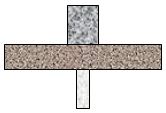
Given below is one of the types of ecological pyramids. This type represents:
A
Pyramid of numbers in a grassland
B
Pyramid of biomass in a fallow land
C
Pyramid of biomass in a lake
D
Energy pyramid in a spring
Solution
(C) The provided image shows an inverted pyramid of biomass. In an aquatic ecosystem like a lake,the biomass of phytoplankton (producers) is much smaller than the biomass of zooplankton and small fish (primary consumers),and even smaller than the biomass of large fish (secondary consumers). Therefore,the pyramid of biomass in a lake is typically inverted.
0 likes
View Solution26
MediumMCQ
An inverted pyramid of biomass can be observed in which of the following ecosystems?
A
Rain forest
B
Desert
C
Ocean
D
Tundra
Solution
(C) In most terrestrial ecosystems,the pyramid of biomass is upright because the biomass of producers is higher than that of consumers. However,in aquatic ecosystems like the ocean,the pyramid of biomass is often inverted. This is because the producers (phytoplankton) have a very short life span and a rapid turnover rate,meaning their standing crop biomass at any given time is much lower than that of the primary consumers (zooplankton) and higher trophic levels.
0 likes
View Solution27
MediumMCQ
Which of the following statements is incorrect regarding the pyramid of energy, while three are correct?
A
It has a broad base.
B
It represents the energy content of organisms at different trophic levels.
C
It is inverted in shape.
D
It is upright in shape.
Solution
(C) The pyramid of energy is always upright because energy flow in an ecosystem follows the $10\%$ law of Lindeman, where energy is lost as heat at each successive trophic level.
Since energy is always transferred from producers to consumers and decreases at each level, the pyramid of energy can never be inverted.
Therefore, the statement '$It$ $is$ $inverted$ $in$ $shape$' is incorrect.
Since energy is always transferred from producers to consumers and decreases at each level, the pyramid of energy can never be inverted.
Therefore, the statement '$It$ $is$ $inverted$ $in$ $shape$' is incorrect.
0 likes
View Solution28
MediumMCQ
Which of the following is not used for the construction of an ecological pyramid?
A
Rate of energy flow
B
Fresh weight
C
Dry weight
D
Number of individuals
Solution
(B) Ecological pyramids are graphical representations of the relationship between different trophic levels in an ecosystem.
They are typically constructed based on three parameters:
$1$. Number of individuals at each trophic level (Pyramid of Number).
$2$. Biomass at each trophic level (Pyramid of Biomass).
$3$. Energy content or rate of energy flow at each trophic level (Pyramid of Energy).
Biomass is measured in terms of 'dry weight' because fresh weight includes water content,which varies significantly and does not accurately represent the organic matter available for transfer to the next trophic level.
Therefore,'fresh weight' is not used for the construction of ecological pyramids.
They are typically constructed based on three parameters:
$1$. Number of individuals at each trophic level (Pyramid of Number).
$2$. Biomass at each trophic level (Pyramid of Biomass).
$3$. Energy content or rate of energy flow at each trophic level (Pyramid of Energy).
Biomass is measured in terms of 'dry weight' because fresh weight includes water content,which varies significantly and does not accurately represent the organic matter available for transfer to the next trophic level.
Therefore,'fresh weight' is not used for the construction of ecological pyramids.
0 likes
View Solution29
MediumMCQ
The pyramid of energy is always ..........
A
Always upright
B
Always inverted
C
Mostly upright
D
Mostly inverted
Solution
(A) The pyramid of energy represents the amount of energy at each trophic level in an ecosystem.
According to the $10\%$ law of energy transfer, only $10\%$ of the energy is transferred from one trophic level to the next, while the rest is lost as heat.
Because energy is lost at each step, the energy content decreases as we move from producers to higher trophic levels.
Therefore, the pyramid of energy is always upright and can never be inverted.
According to the $10\%$ law of energy transfer, only $10\%$ of the energy is transferred from one trophic level to the next, while the rest is lost as heat.
Because energy is lost at each step, the energy content decreases as we move from producers to higher trophic levels.
Therefore, the pyramid of energy is always upright and can never be inverted.
0 likes
View Solution30
MediumMCQ
Which ecosystem has the maximum number of producers per unit area?
A
Pond
B
Grassland
C
Forest
D
Tundra
Solution
(A) In a pond ecosystem,the producers are primarily phytoplankton (microscopic algae). These organisms are extremely small and can exist in very high densities per unit area compared to the larger plants found in grasslands or forests. Therefore,a pond ecosystem exhibits the maximum number of producers per unit area.
0 likes
View Solution31
MediumMCQ
In a grassland ecosystem,the pyramid of numbers is .....
A
Upright
B
Inverted
C
Irregular
D
Linear
Solution
(A) In a grassland ecosystem,the pyramid of numbers is always upright.
This is because the number of producers (grasses) is very high,followed by a smaller number of primary consumers (herbivores like insects,mice),and an even smaller number of secondary and tertiary consumers (carnivores like snakes,hawks).
As we move from the producer level to the top consumer level,the number of individuals decreases,resulting in an upright pyramid.
This is because the number of producers (grasses) is very high,followed by a smaller number of primary consumers (herbivores like insects,mice),and an even smaller number of secondary and tertiary consumers (carnivores like snakes,hawks).
As we move from the producer level to the top consumer level,the number of individuals decreases,resulting in an upright pyramid.
0 likes
View Solution32
MediumMCQ
In a pond ecosystem,the pyramid of numbers is:
A
Upright
B
Inverted
C
Either upright or inverted
D
First upright then inverted
Solution
(A) In a pond ecosystem,the pyramid of numbers is upright.
$1$. At the base,there are numerous producers (phytoplankton).
$2$. These are followed by a smaller number of primary consumers (zooplankton).
$3$. The number of secondary consumers (small fish) is even smaller.
$4$. Finally,the number of tertiary consumers (large fish) is the smallest.
Since the number of organisms decreases as we move from the producer level to the top consumer level,the pyramid is upright.
$1$. At the base,there are numerous producers (phytoplankton).
$2$. These are followed by a smaller number of primary consumers (zooplankton).
$3$. The number of secondary consumers (small fish) is even smaller.
$4$. Finally,the number of tertiary consumers (large fish) is the smallest.
Since the number of organisms decreases as we move from the producer level to the top consumer level,the pyramid is upright.
0 likes
View Solution33
MediumMCQ
Which ecosystem has the maximum biomass?
A
Grassland ecosystem
B
Pond ecosystem
C
Lake ecosystem
D
Forest ecosystem
Solution
(D) The correct answer is $D$. In a forest ecosystem,the biomass is primarily contributed by large trees,which have significant woody tissue and long lifespans. This results in a much higher standing crop of biomass compared to grassland,pond,or lake ecosystems,where the primary producers are smaller plants or phytoplankton with much faster turnover rates.
0 likes
View Solution34
MediumMCQ
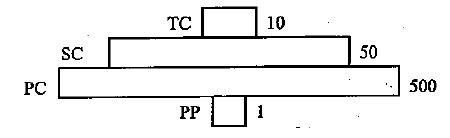
Given below is an imaginary pyramid of numbers. What could be one of the possibilities about certain organisms at some of the different levels?
A
Level $PC$ is "insects" and level $SC$ is "small insectivorous birds".
B
Level $PP$ is "phytoplanktons" in sea and "whale" on top level $TC$.
C
Level one $PP$ is "pipal trees" and the level $SC$ is "sheep".
D
Level $PC$ is "rats" and level $SC$ is "cats".
Solution
(A) The given pyramid of numbers shows a single producer $(PP = 1)$ supporting a large number of primary consumers $(PC = 500)$, which in turn support secondary consumers $(SC = 50)$ and tertiary consumers $(TC = 10)$.
This is a spindle-shaped or inverted-type pyramid, which is characteristic of a tree ecosystem where a single large tree $(PP)$ supports many insects $(PC)$, which are then eaten by a smaller number of birds $(SC)$, and finally by a few top predators $(TC)$.
Option $(A)$ correctly identifies this relationship: $PP$ (tree) $\rightarrow$ $PC$ (insects) $\rightarrow$ $SC$ (insectivorous birds) $\rightarrow$ $TC$ (top predators).
This is a spindle-shaped or inverted-type pyramid, which is characteristic of a tree ecosystem where a single large tree $(PP)$ supports many insects $(PC)$, which are then eaten by a smaller number of birds $(SC)$, and finally by a few top predators $(TC)$.
Option $(A)$ correctly identifies this relationship: $PP$ (tree) $\rightarrow$ $PC$ (insects) $\rightarrow$ $SC$ (insectivorous birds) $\rightarrow$ $TC$ (top predators).
0 likes
View Solution35
MediumMCQ
The upright pyramid of number is absent in
A
pond
B
forest
C
lake
D
grassland
Solution
(B) In a forest ecosystem,the pyramid of number is inverted or spindle-shaped rather than upright. This is because a single large tree (producer) can support a large number of herbivorous birds or insects (primary consumers),which in turn support a smaller number of predatory birds (secondary consumers). Since the base representing the producers is narrower than the level representing the primary consumers,the pyramid is not upright.
0 likes
View Solution36
MediumMCQ
Which one of the following statements for the pyramid of energy is incorrect?
A
Its base is broad.
B
It shows energy content of different trophic level organisms.
C
It is inverted in shape.
D
It is upright in shape.
Solution
(C) : The pyramid of energy is always upright and can never be inverted. This is because when energy flows from one trophic level to the next, a significant amount of energy is lost as heat at each step, according to the $10\%$ law of energy transfer.
0 likes
View Solution37
MediumMCQ
Which of the following representations shows the pyramid of numbers in a forest ecosystem?
A
$D$
B
$A$
C
$B$
D
$C$
Solution
(C) The correct representation for a forest ecosystem is an upright pyramid of numbers.
In a forest ecosystem,the number of producers (large trees) is relatively small,but they support a large number of herbivores (birds,insects),which in turn support a smaller number of carnivores (secondary and tertiary consumers).
Therefore,the pyramid is upright,where the base (producers) is narrower than the middle tier (herbivores),but the overall structure remains upright as the number of individuals decreases at higher trophic levels.
Note: If the question refers to a single tree as a producer,the pyramid of numbers would be inverted,but for a typical forest ecosystem,it is considered upright.
In a forest ecosystem,the number of producers (large trees) is relatively small,but they support a large number of herbivores (birds,insects),which in turn support a smaller number of carnivores (secondary and tertiary consumers).
Therefore,the pyramid is upright,where the base (producers) is narrower than the middle tier (herbivores),but the overall structure remains upright as the number of individuals decreases at higher trophic levels.
Note: If the question refers to a single tree as a producer,the pyramid of numbers would be inverted,but for a typical forest ecosystem,it is considered upright.
0 likes
View Solution38
MediumMCQ
Which one of the following is not used for construction of ecological pyramids?
A
Fresh weight
B
Dry weight
C
Number of individuals
D
Rate of energy flow
Solution
(A) : Ecological pyramids represent the trophic structure and trophic function of an ecosystem.
In an ecological pyramid,the first trophic level forms the base and successive trophic levels form the tiers that make up the apex.
Ecological pyramids are generally of three types: pyramid of number,pyramid of biomass,and pyramid of energy.
Pyramid of biomass is based on the dry weight of the organisms in a food chain present at any given time in an ecosystem.
Fresh weight is not used because it includes water content,which varies significantly and does not accurately represent the organic matter or energy content.
Therefore,fresh weight is not used for the construction of ecological pyramids.
In an ecological pyramid,the first trophic level forms the base and successive trophic levels form the tiers that make up the apex.
Ecological pyramids are generally of three types: pyramid of number,pyramid of biomass,and pyramid of energy.
Pyramid of biomass is based on the dry weight of the organisms in a food chain present at any given time in an ecosystem.
Fresh weight is not used because it includes water content,which varies significantly and does not accurately represent the organic matter or energy content.
Therefore,fresh weight is not used for the construction of ecological pyramids.
0 likes
View Solution39
MediumMCQ
The pyramid of biomass in the sea is generally inverted because...
A
Biomass of secondary consumers is less than primary producers
B
Biomass of primary producers is more than secondary consumers
C
Biomass of fourth trophic level is less than first and third trophic level
D
The biomass of secondary consumers is more than that of primary producers
Solution
(D) In an aquatic ecosystem,specifically the sea,the pyramid of biomass is typically inverted.
This occurs because the primary producers (phytoplankton) have a very short life span and rapid turnover rate.
Consequently,their standing crop biomass at any given point in time is very small compared to the biomass of the consumers (zooplankton and small fish) that feed on them.
Therefore,the biomass of secondary consumers is often greater than that of the primary producers,leading to an inverted pyramid shape.
This occurs because the primary producers (phytoplankton) have a very short life span and rapid turnover rate.
Consequently,their standing crop biomass at any given point in time is very small compared to the biomass of the consumers (zooplankton and small fish) that feed on them.
Therefore,the biomass of secondary consumers is often greater than that of the primary producers,leading to an inverted pyramid shape.
0 likes
View Solution40
MediumMCQ
Which of the following is $NOT$ a limitation of an ecological pyramid?
A
It does accommodate a food web.
B
It does not take into account the same species belonging to two or more trophic levels.
C
Saprophytes are not given any place in the ecological pyramid.
D
It assumes a simple food chain,which almost never exists in nature.
Solution
(A) The limitations of ecological pyramids include:
$1$. They assume a simple food chain,which rarely exists in nature.
$2$. They do not accommodate a food web.
$3$. They do not account for the same species belonging to two or more trophic levels.
$4$. Saprophytes are not given any place in ecological pyramids,even though they play a vital role in the ecosystem.
Therefore,the statement 'It does accommodate a food web' is $NOT$ a limitation,as ecological pyramids fail to represent the complex interactions of a food web.
$1$. They assume a simple food chain,which rarely exists in nature.
$2$. They do not accommodate a food web.
$3$. They do not account for the same species belonging to two or more trophic levels.
$4$. Saprophytes are not given any place in ecological pyramids,even though they play a vital role in the ecosystem.
Therefore,the statement 'It does accommodate a food web' is $NOT$ a limitation,as ecological pyramids fail to represent the complex interactions of a food web.
0 likes
View Solution41
DifficultMCQ
Choose the correct pair of Trophic level - Dry weight $(kg\ m^{-2})$ based on the pyramid of biomass in a grassland ecosystem.
A
$TC - 1.5$
B
$PC - 37$
C
$PP - 809$
D
$SC - 11$
Solution
(B) In a grassland ecosystem,the pyramid of biomass is upright.
According to the standard data for a grassland ecosystem:
$1$. Primary Producers $(PP)$ have the highest dry weight,which is $809 \ kg\ m^{-2}$.
$2$. Primary Consumers $(PC)$ have a dry weight of $37 \ kg\ m^{-2}$.
$3$. Secondary Consumers $(SC)$ have a dry weight of $11 \ kg\ m^{-2}$.
$4$. Tertiary Consumers $(TC)$ have the lowest dry weight,which is $1.5 \ kg\ m^{-2}$.
Comparing these values with the options,the pair $PC - 37$ is correct.
According to the standard data for a grassland ecosystem:
$1$. Primary Producers $(PP)$ have the highest dry weight,which is $809 \ kg\ m^{-2}$.
$2$. Primary Consumers $(PC)$ have a dry weight of $37 \ kg\ m^{-2}$.
$3$. Secondary Consumers $(SC)$ have a dry weight of $11 \ kg\ m^{-2}$.
$4$. Tertiary Consumers $(TC)$ have the lowest dry weight,which is $1.5 \ kg\ m^{-2}$.
Comparing these values with the options,the pair $PC - 37$ is correct.
0 likes
View Solution42
MediumMCQ
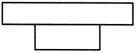
The following pyramid indicates:
A
More phytoplanktons and less zooplanktons
B
Similar phytoplanktons and zooplanktons
C
Less zooplanktons and more phytoplanktons
D
Less phytoplanktons and more zooplanktons
Solution
(D) The provided image shows an inverted pyramid. In an aquatic ecosystem,the pyramid of biomass is typically inverted. This is because the standing crop of phytoplankton (producers) is smaller at any given point in time compared to the zooplankton (primary consumers) that feed on them,due to the rapid turnover rate of phytoplankton. Therefore,the base (representing producers) is smaller than the next trophic level (representing primary consumers),resulting in an inverted shape.
0 likes
View Solution43
MediumMCQ
In a pond ecosystem,the pyramid of numbers is ............ .
A
Irregular
B
Inverted
C
Upright
D
Spindle-shaped
Solution
(C) In a pond ecosystem,the pyramid of numbers is upright.
$1$. At the base,there are a large number of producers (phytoplankton).
$2$. These are followed by a smaller number of primary consumers (zooplankton).
$3$. Then,there are even fewer secondary consumers (small fish).
$4$. Finally,there are very few tertiary consumers (large fish) at the top.
Thus,the number of organisms decreases as we move to higher trophic levels,resulting in an upright pyramid.
$1$. At the base,there are a large number of producers (phytoplankton).
$2$. These are followed by a smaller number of primary consumers (zooplankton).
$3$. Then,there are even fewer secondary consumers (small fish).
$4$. Finally,there are very few tertiary consumers (large fish) at the top.
Thus,the number of organisms decreases as we move to higher trophic levels,resulting in an upright pyramid.
0 likes
View Solution44
MediumMCQ
The pyramid of numbers deals with the number of what?
A
Species in an area
B
Individuals in a community
C
Individuals at a trophic level
D
Subspecies in a community
Solution
(C) The pyramid of numbers is a graphical representation that shows the relationship between the number of producers,herbivores,and carnivores at successive trophic levels in an ecosystem.
It specifically counts the number of individual organisms present at each trophic level.
Therefore,the pyramid of numbers deals with the number of individuals at a trophic level.
It specifically counts the number of individual organisms present at each trophic level.
Therefore,the pyramid of numbers deals with the number of individuals at a trophic level.
0 likes
View Solution45
MediumMCQ
In a stable ecosystem, the pyramid of which of the following cannot be inverted?
A
Biomass
B
Numbers
C
Energy
D
All of the above
Solution
(C) The pyramid of energy is always upright in any ecosystem.
This is because, according to the $10\%$ law of energy transfer, energy is lost as heat at each trophic level as it moves from producers to consumers.
Consequently, the amount of energy available at higher trophic levels is always less than that at lower trophic levels.
Unlike the pyramid of biomass or the pyramid of numbers, which can be inverted in certain ecosystems (e.g., aquatic ecosystems for biomass or tree ecosystems for numbers), the pyramid of energy can never be inverted.
This is because, according to the $10\%$ law of energy transfer, energy is lost as heat at each trophic level as it moves from producers to consumers.
Consequently, the amount of energy available at higher trophic levels is always less than that at lower trophic levels.
Unlike the pyramid of biomass or the pyramid of numbers, which can be inverted in certain ecosystems (e.g., aquatic ecosystems for biomass or tree ecosystems for numbers), the pyramid of energy can never be inverted.
0 likes
View Solution46
MediumMCQ
In a food chain of Grass $\rightarrow$ Deer $\rightarrow$ Tiger,the biomass of grass is $1$ tonne. What will be the biomass of the tiger (in $,kg$)?
A
$100$
B
$10$
C
$200$
D
$1$
Solution
(B) According to the $10\%$ law of energy transfer in an ecosystem,only about $10\%$ of the energy (or biomass) is transferred from one trophic level to the next.
$1$. Grass (Producer): $1$ tonne = $1000\,kg$.
$2$. Deer (Primary Consumer): $10\%$ of $1000\,kg = 100\,kg$.
$3$. Tiger (Secondary Consumer): $10\%$ of $100\,kg = 10\,kg$.
Therefore,the biomass of the tiger will be $10\,kg$.
$1$. Grass (Producer): $1$ tonne = $1000\,kg$.
$2$. Deer (Primary Consumer): $10\%$ of $1000\,kg = 100\,kg$.
$3$. Tiger (Secondary Consumer): $10\%$ of $100\,kg = 10\,kg$.
Therefore,the biomass of the tiger will be $10\,kg$.
0 likes
View Solution47
MediumMCQ
Which of the following is not taken into account in the construction of an ecological pyramid?
A
Number of individual organisms
B
Rate of energy flow
C
Fresh weight
D
Dry weight
Solution
(C) Ecological pyramids are graphical representations of the relationship between different trophic levels in an ecosystem.
They are typically constructed based on three parameters:
$1$. Number of individuals at each trophic level.
$2$. Biomass (usually measured as dry weight to avoid fluctuations due to water content).
$3$. Energy content or rate of energy flow.
Fresh weight is not used because the water content in organisms varies significantly,which would lead to inaccurate representations of the biomass at different trophic levels. Therefore,fresh weight is not taken into account.
They are typically constructed based on three parameters:
$1$. Number of individuals at each trophic level.
$2$. Biomass (usually measured as dry weight to avoid fluctuations due to water content).
$3$. Energy content or rate of energy flow.
Fresh weight is not used because the water content in organisms varies significantly,which would lead to inaccurate representations of the biomass at different trophic levels. Therefore,fresh weight is not taken into account.
0 likes
View Solution48
MediumMCQ
Which of the following statements is always true for an energy pyramid?
A
It has a broad base.
B
It represents the energy level at a single trophic level.
C
It is always upright.
D
It is always inverted.
Solution
$(C)$ An energy pyramid represents the amount of energy at each trophic level in an ecosystem. According to the $10\%$ law of energy transfer, energy decreases as it moves from one trophic level to the next. Therefore, the energy available at the producer level is always greater than that at the primary consumer level, and so on. Because energy is lost as heat at each transfer, the pyramid of energy is always upright and can never be inverted.
0 likes
View SolutionEcosystem — Ecological Pyramids · Frequently Asked Questions
1Are these Ecosystem questions useful for JEE and NEET?
Yes. All questions in this section are mapped to JEE Main and NEET exam patterns. Previous year questions from JEE Main, NEET, GUJCET and state-level exams are included with full solutions.
2Can I switch to Hindi or Gujarati for these questions?
Yes. Use the language tabs in the hero section or the sidebar to view the same questions and solutions in English, Hindi or Gujarati.
3How do I generate a question paper from this subtopic?
Use the Vedclass Exam Paper Generator — select the chapter and subtopic, set difficulty, and generate Sets A, B, C, D automatically. First 3 chapters of every subject are free.
Vedclass Products
For Students
Vedclass Test Series
Mock tests in real JEE/NEET style with performance analysis. 5-day free trial.
Start Free TrialFor Teachers
Exam Paper Generator
Generate Set A/B/C/D papers from this chapter in 2 minutes. 3 chapters free.
Try FreeFor Institutes
Online Exam Module
Live online exams with unlimited students, 360° analytics & white-label branding.
See DemoFor Teachers & Institutes
Generate a Ecosystem Exam Paper in 2 Minutes
Select subtopic & difficulty — Sets A, B, C, D auto-generated with No Repeat logic.
First 3 chapters of every subject are free — no payment required.