
A English
Relative Motion in One Dimension Questions in English
Class 11 Physics · Motion in Straight Line · Relative Motion in One Dimension
62+
Questions
English
Language
100%
With Solutions
Showing 11 of 62 questions in English
51
MediumMCQ
Two bodies start moving from the same point along a straight line with velocities $v_1 = 6 \, m/s$ and $v_2 = 10 \, m/s$,simultaneously. After what time will their separation become $40 \, m$?
A
$6$
B
$8$
C
$12$
D
$10$
Solution
(D) Given velocities are $v_1 = 6 \, m/s$ and $v_2 = 10 \, m/s$.
Since both bodies move in the same direction from the same point,their relative velocity is $v_{rel} = v_2 - v_1 = 10 - 6 = 4 \, m/s$.
The separation between them at any time $t$ is given by $s = v_{rel} \times t$.
We are given the separation $s = 40 \, m$.
Substituting the values: $40 = 4 \times t$.
Therefore,$t = \frac{40}{4} = 10 \, s$.
Since both bodies move in the same direction from the same point,their relative velocity is $v_{rel} = v_2 - v_1 = 10 - 6 = 4 \, m/s$.
The separation between them at any time $t$ is given by $s = v_{rel} \times t$.
We are given the separation $s = 40 \, m$.
Substituting the values: $40 = 4 \times t$.
Therefore,$t = \frac{40}{4} = 10 \, s$.
0 likes
View Solution52
EasyMCQ
$A$ train is running at a constant speed of $90 \,km/h$ on a straight track. $A$ person standing on the top of a bogie moves in the direction of motion of the train such that he covers $1 \,m$ on the train each second. The speed of the person with respect to the ground is .........
A
$25 \,m/s$
B
$91 \,km/h$
C
$26 \,km/h$
D
$26 \,m/s$
Solution
(D) The speed of the train with respect to the ground is $V_T = 90 \,km/h$.
Converting this to $m/s$: $V_T = 90 \times \frac{5}{18} = 25 \,m/s$.
The speed of the person with respect to the train is $V_{P/T} = 1 \,m/s$ in the direction of the train's motion.
The speed of the person with respect to the ground $(V_P)$ is given by the relative velocity formula: $V_P = V_{P/T} + V_T$.
Substituting the values: $V_P = 1 \,m/s + 25 \,m/s = 26 \,m/s$.
Therefore,the speed of the person with respect to the ground is $26 \,m/s$.
Converting this to $m/s$: $V_T = 90 \times \frac{5}{18} = 25 \,m/s$.
The speed of the person with respect to the train is $V_{P/T} = 1 \,m/s$ in the direction of the train's motion.
The speed of the person with respect to the ground $(V_P)$ is given by the relative velocity formula: $V_P = V_{P/T} + V_T$.
Substituting the values: $V_P = 1 \,m/s + 25 \,m/s = 26 \,m/s$.
Therefore,the speed of the person with respect to the ground is $26 \,m/s$.
0 likes
View Solution53
DifficultMCQ
$A$ man is at a distance of $6\,m$ from a bus. The bus begins to move with a constant acceleration of $3\,m s^{-2}$. In order to catch the bus,the minimum speed with which the man should run towards the bus is $.........m s^{-1}$.
A
$2$
B
$4$
C
$6$
D
$8$
Solution
(C) Let the man run with a constant speed $v$. Let $t$ be the time taken to catch the bus.
The distance covered by the bus in time $t$ is $s_b = \frac{1}{2} a t^2 = \frac{1}{2} \times 3 \times t^2 = 1.5 t^2$.
The total distance the man must cover to reach the bus is $s_m = 6 + s_b = 6 + 1.5 t^2$.
Since the man runs with constant speed $v$,the distance he covers is $s_m = v t$.
Equating the two expressions for $s_m$: $v t = 6 + 1.5 t^2$,which rearranges to $1.5 t^2 - v t + 6 = 0$.
For the man to catch the bus,the time $t$ must be a real value. This requires the discriminant of the quadratic equation to be greater than or equal to zero $(D \ge 0)$.
$D = (-v)^2 - 4(1.5)(6) \ge 0$
$v^2 - 36 \ge 0$
$v^2 \ge 36 \implies v \ge 6\,m s^{-1}$.
Thus,the minimum speed required is $6\,m s^{-1}$.
The distance covered by the bus in time $t$ is $s_b = \frac{1}{2} a t^2 = \frac{1}{2} \times 3 \times t^2 = 1.5 t^2$.
The total distance the man must cover to reach the bus is $s_m = 6 + s_b = 6 + 1.5 t^2$.
Since the man runs with constant speed $v$,the distance he covers is $s_m = v t$.
Equating the two expressions for $s_m$: $v t = 6 + 1.5 t^2$,which rearranges to $1.5 t^2 - v t + 6 = 0$.
For the man to catch the bus,the time $t$ must be a real value. This requires the discriminant of the quadratic equation to be greater than or equal to zero $(D \ge 0)$.
$D = (-v)^2 - 4(1.5)(6) \ge 0$
$v^2 - 36 \ge 0$
$v^2 \ge 36 \implies v \ge 6\,m s^{-1}$.
Thus,the minimum speed required is $6\,m s^{-1}$.
0 likes
View Solution54
MediumMCQ
$A$ ball is dropped from the top of a building $100\,m$ high. At the same instant,another ball is thrown upwards with a velocity of $40\,m/s$ from the bottom of the building. The two balls will meet after $..........\,s$.
A
$3$
B
$2$
C
$2.5$
D
$5$
Solution
(C) Let the two balls meet after time $t$ seconds.
For the ball dropped from the top (downward motion):
The distance covered is $s_1 = \frac{1}{2} g t^2$.
For the ball thrown upwards from the bottom:
The distance covered is $s_2 = u t - \frac{1}{2} g t^2$,where $u = 40\,m/s$.
Since the total height of the building is $100\,m$,the sum of the distances covered by both balls must equal the height of the building:
$s_1 + s_2 = 100$
Substituting the expressions:
$\frac{1}{2} g t^2 + (40 t - \frac{1}{2} g t^2) = 100$
$40 t = 100$
$t = \frac{100}{40} = 2.5\,s$.
Thus,the balls will meet after $2.5\,s$.
For the ball dropped from the top (downward motion):
The distance covered is $s_1 = \frac{1}{2} g t^2$.
For the ball thrown upwards from the bottom:
The distance covered is $s_2 = u t - \frac{1}{2} g t^2$,where $u = 40\,m/s$.
Since the total height of the building is $100\,m$,the sum of the distances covered by both balls must equal the height of the building:
$s_1 + s_2 = 100$
Substituting the expressions:
$\frac{1}{2} g t^2 + (40 t - \frac{1}{2} g t^2) = 100$
$40 t = 100$
$t = \frac{100}{40} = 2.5\,s$.
Thus,the balls will meet after $2.5\,s$.
0 likes
View Solution55
DifficultMCQ
Train $A$ is moving along two parallel rail tracks towards north with speed $72 \ km/h$ and train $B$ is moving towards south with speed $108 \ km/h$. The velocity of train $B$ with respect to $A$ and the velocity of the ground with respect to $B$ are (in $ms^{-1}$):
A
$-50$ and $30$
B
$-30$ and $50$
C
$-50$ and $-30$
D
$50$ and $-30$
Solution
(A) First,convert the speeds from $km/h$ to $m/s$ by multiplying by $\frac{5}{18}$.
$V_A = 72 \times \frac{5}{18} = 20 \ m/s$ (towards North,taken as positive).
$V_B = 108 \times \frac{5}{18} = 30 \ m/s$ (towards South,taken as negative,so $V_B = -30 \ m/s$).
Velocity of train $B$ with respect to $A$ is $V_{BA} = V_B - V_A = -30 - 20 = -50 \ m/s$.
Velocity of ground with respect to $B$ is $V_{GB} = V_G - V_B = 0 - (-30) = 30 \ m/s$.
Thus,the velocities are $-50 \ m/s$ and $30 \ m/s$.
$V_A = 72 \times \frac{5}{18} = 20 \ m/s$ (towards North,taken as positive).
$V_B = 108 \times \frac{5}{18} = 30 \ m/s$ (towards South,taken as negative,so $V_B = -30 \ m/s$).
Velocity of train $B$ with respect to $A$ is $V_{BA} = V_B - V_A = -30 - 20 = -50 \ m/s$.
Velocity of ground with respect to $B$ is $V_{GB} = V_G - V_B = 0 - (-30) = 30 \ m/s$.
Thus,the velocities are $-50 \ m/s$ and $30 \ m/s$.
0 likes
View Solution56
DifficultMCQ
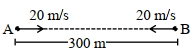
Two cars are travelling towards each other at a speed of $20 \,m \,s^{-1}$ each. When the cars are $300 \,m$ apart, both the drivers apply brakes and the cars retard at the rate of $2 \,m \,s^{-2}$. The distance between them when they come to rest is: (in $\,m$)
A
$200$
B
$50$
C
$100$
D
$25$
Solution
(C) Let the two cars be $A$ and $B$. The initial velocity of car $A$ is $u_A = 20 \,m \,s^{-1}$ and car $B$ is $u_B = -20 \,m \,s^{-1}$.
The relative initial velocity of car $B$ with respect to car $A$ is $u_{BA} = u_B - u_A = -20 - 20 = -40 \,m \,s^{-1}$.
The magnitude of relative initial velocity is $|u_{BA}| = 40 \,m \,s^{-1}$.
Both cars retard at $a = 2 \,m \,s^{-2}$. Let $a_A = -2 \,m \,s^{-2}$ and $a_B = 2 \,m \,s^{-2}$.
The relative acceleration of car $B$ with respect to car $A$ is $a_{BA} = a_B - a_A = 2 - (-2) = 4 \,m \,s^{-2}$.
Using the equation of motion $v^2 = u^2 + 2as$ for relative motion, where final relative velocity $v_{BA} = 0$:
$0^2 = (-40)^2 + 2(-4)S$
$0 = 1600 - 8S$
$8S = 1600 \implies S = 200 \,m$.
This is the relative distance covered by the cars before coming to rest.
The initial distance between the cars was $300 \,m$.
Therefore, the remaining distance between them when they come to rest is $300 \,m - 200 \,m = 100 \,m$.
The relative initial velocity of car $B$ with respect to car $A$ is $u_{BA} = u_B - u_A = -20 - 20 = -40 \,m \,s^{-1}$.
The magnitude of relative initial velocity is $|u_{BA}| = 40 \,m \,s^{-1}$.
Both cars retard at $a = 2 \,m \,s^{-2}$. Let $a_A = -2 \,m \,s^{-2}$ and $a_B = 2 \,m \,s^{-2}$.
The relative acceleration of car $B$ with respect to car $A$ is $a_{BA} = a_B - a_A = 2 - (-2) = 4 \,m \,s^{-2}$.
Using the equation of motion $v^2 = u^2 + 2as$ for relative motion, where final relative velocity $v_{BA} = 0$:
$0^2 = (-40)^2 + 2(-4)S$
$0 = 1600 - 8S$
$8S = 1600 \implies S = 200 \,m$.
This is the relative distance covered by the cars before coming to rest.
The initial distance between the cars was $300 \,m$.
Therefore, the remaining distance between them when they come to rest is $300 \,m - 200 \,m = 100 \,m$.
0 likes
View Solution57
DifficultMCQ
Two cars $A$ and $B$ are travelling in the same direction with velocities $V_A$ and $V_B$ $(V_A > V_B)$. When the car $A$ is at a distance $S$ behind the car $B$,the driver of the car $A$ applies the brakes producing a uniform retardation $a$. There will be no collision when:
A
$S < \frac{(V_A - V_B)^2}{2a}$
B
$S = \frac{(V_A - V_B)^2}{2a}$
C
$S \geqslant \frac{(V_A - V_B)^2}{2a}$
D
$S \leqslant \frac{(V_A - V_B)^2}{2a}$
Solution
(C) To avoid a collision,the relative velocity of car $A$ with respect to car $B$ must become zero before or at the moment the distance between them becomes zero.
Let $u_r$ be the initial relative velocity: $u_r = V_A - V_B$.
Let $a_r$ be the relative acceleration: $a_r = -a - 0 = -a$.
Using the kinematic equation $v^2 = u^2 + 2as$,where $v$ is the final relative velocity $(0)$,$u$ is the initial relative velocity $(V_A - V_B)$,and $s$ is the relative displacement $S'$ required to stop:
$0^2 = (V_A - V_B)^2 + 2(-a)S'$.
Solving for $S'$,we get $S' = \frac{(V_A - V_B)^2}{2a}$.
For no collision to occur,the initial distance $S$ must be greater than or equal to the stopping distance $S'$.
Therefore,$S \geqslant \frac{(V_A - V_B)^2}{2a}$.
Let $u_r$ be the initial relative velocity: $u_r = V_A - V_B$.
Let $a_r$ be the relative acceleration: $a_r = -a - 0 = -a$.
Using the kinematic equation $v^2 = u^2 + 2as$,where $v$ is the final relative velocity $(0)$,$u$ is the initial relative velocity $(V_A - V_B)$,and $s$ is the relative displacement $S'$ required to stop:
$0^2 = (V_A - V_B)^2 + 2(-a)S'$.
Solving for $S'$,we get $S' = \frac{(V_A - V_B)^2}{2a}$.
For no collision to occur,the initial distance $S$ must be greater than or equal to the stopping distance $S'$.
Therefore,$S \geqslant \frac{(V_A - V_B)^2}{2a}$.
0 likes
View Solution58
EasyMCQ
At a metro station, a girl walks up a stationary escalator in $20 \,s$. If she remains stationary on the escalator, then the escalator takes her up in $30 \,s$. The time taken by her to walk up on the moving escalator will be (in $\,s$)
A
$25$
B
$60$
C
$12$
D
$10$
Solution
(C) Let $h$ be the height of the escalator.
Speed of the girl walking on the stationary escalator is $v_{g} = \frac{h}{20}$.
Speed of the moving escalator is $v_{e} = \frac{h}{30}$.
When the girl walks on the moving escalator, her effective speed is the sum of her walking speed and the escalator's speed: $v_{total} = v_{g} + v_{e}$.
$v_{total} = \frac{h}{20} + \frac{h}{30} = h \left( \frac{3+2}{60} \right) = \frac{5h}{60} = \frac{h}{12}$.
The time taken to cover the distance $h$ is $t = \frac{h}{v_{total}} = \frac{h}{h/12} = 12 \,s$.
Speed of the girl walking on the stationary escalator is $v_{g} = \frac{h}{20}$.
Speed of the moving escalator is $v_{e} = \frac{h}{30}$.
When the girl walks on the moving escalator, her effective speed is the sum of her walking speed and the escalator's speed: $v_{total} = v_{g} + v_{e}$.
$v_{total} = \frac{h}{20} + \frac{h}{30} = h \left( \frac{3+2}{60} \right) = \frac{5h}{60} = \frac{h}{12}$.
The time taken to cover the distance $h$ is $t = \frac{h}{v_{total}} = \frac{h}{h/12} = 12 \,s$.
0 likes
View Solution59
EasyMCQ
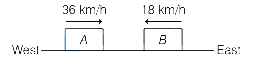
Two buses $A$ and $B$ are moving in opposite directions. If the first bus $A$ moves towards the east with a speed of $36 \ km/h$ and bus $B$ moves towards the west with a speed of $18 \ km/h$,then the bus $B$ appears to bus $A$ as:
A
moving with a speed of $5 \ m/s$ from east to west
B
moving with a speed of $15 \ m/s$ from west to east
C
moving with a speed of $15 \ m/s$ from east to west
D
moving with a speed of $10 \ m/s$ from east to west
Solution
(C) The given situation is as shown in the figure.
Velocity of bus $A$,$v_A = 36 \ km/h = 36 \times \frac{5}{18} = 10 \ m/s$ (towards east).
Velocity of bus $B$,$v_B = 18 \ km/h = 18 \times \frac{5}{18} = 5 \ m/s$ (towards west).
Let the direction towards the east be positive. Then,$v_A = +10 \ m/s$ and $v_B = -5 \ m/s$.
The relative velocity of bus $B$ with respect to bus $A$ is given by:
$v_{BA} = v_B - v_A = (-5) - (10) = -15 \ m/s$.
The negative sign indicates that the bus $B$ appears to move towards the west relative to bus $A$.
Therefore,bus $B$ appears to bus $A$ as moving with a speed of $15 \ m/s$ from east to west.
Velocity of bus $A$,$v_A = 36 \ km/h = 36 \times \frac{5}{18} = 10 \ m/s$ (towards east).
Velocity of bus $B$,$v_B = 18 \ km/h = 18 \times \frac{5}{18} = 5 \ m/s$ (towards west).
Let the direction towards the east be positive. Then,$v_A = +10 \ m/s$ and $v_B = -5 \ m/s$.
The relative velocity of bus $B$ with respect to bus $A$ is given by:
$v_{BA} = v_B - v_A = (-5) - (10) = -15 \ m/s$.
The negative sign indicates that the bus $B$ appears to move towards the west relative to bus $A$.
Therefore,bus $B$ appears to bus $A$ as moving with a speed of $15 \ m/s$ from east to west.
0 likes
View Solution60
EasyMCQ
$A$ car travelling at $15 \,m/s$ overtakes another car travelling at $10 \,m/s$. Assuming each car is $4 \,m$ long, what is the time taken during the overtake (in $\,s$)?
A
$1.6$
B
$0.8$
C
$0.6$
D
$0.4$
Solution
(A) The motion of two cars $A$ and $B$ is shown in the figure.
Relative velocity of car $A$ with respect to car $B$ is:
$v_{AB} = v_A - v_B = 15 \,m/s - 10 \,m/s = 5 \,m/s$
To completely overtake car $B$, car $A$ must cover a total distance equal to the sum of the lengths of both cars:
$s = 4 \,m + 4 \,m = 8 \,m$
The time taken to complete the overtake is given by:
$t = \frac{s}{v_{AB}} = \frac{8 \,m}{5 \,m/s} = 1.6 \,s$
Relative velocity of car $A$ with respect to car $B$ is:
$v_{AB} = v_A - v_B = 15 \,m/s - 10 \,m/s = 5 \,m/s$
To completely overtake car $B$, car $A$ must cover a total distance equal to the sum of the lengths of both cars:
$s = 4 \,m + 4 \,m = 8 \,m$
The time taken to complete the overtake is given by:
$t = \frac{s}{v_{AB}} = \frac{8 \,m}{5 \,m/s} = 1.6 \,s$

0 likes
View Solution61
DifficultMCQ
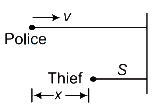
$A$ police party is moving in a jeep at a constant speed $v$. They see a thief at a distance $x$ on a motorcycle which is at rest. The moment the police see the thief,the thief starts moving with a constant acceleration $a$. Which of the following relations is true if the police are able to catch the thief?
A
$v^2 < a x$
B
$v^2 < 2 a x$
C
$v^2 \geq 2 a x$
D
$v^2 = a x$
Solution
(C) Let the police party catch the thief after time $t$.
Distance traveled by the police party in time $t$ is $d_p = v t$.
Distance traveled by the thief in time $t$ starting from rest with acceleration $a$ is $d_t = x + \frac{1}{2} a t^2$.
For the police to catch the thief,the distance traveled by the police must be greater than or equal to the distance traveled by the thief:
$v t \geq x + \frac{1}{2} a t^2$
Rearranging the terms,we get a quadratic inequality in $t$:
$\frac{1}{2} a t^2 - v t + x \leq 0$
For a real solution for $t$ to exist,the discriminant of the corresponding quadratic equation $\frac{1}{2} a t^2 - v t + x = 0$ must be greater than or equal to zero.
The discriminant $D = b^2 - 4ac$ is given by:
$D = (-v)^2 - 4(\frac{1}{2} a)(x) \geq 0$
$v^2 - 2 a x \geq 0$
$v^2 \geq 2 a x$
Distance traveled by the police party in time $t$ is $d_p = v t$.
Distance traveled by the thief in time $t$ starting from rest with acceleration $a$ is $d_t = x + \frac{1}{2} a t^2$.
For the police to catch the thief,the distance traveled by the police must be greater than or equal to the distance traveled by the thief:
$v t \geq x + \frac{1}{2} a t^2$
Rearranging the terms,we get a quadratic inequality in $t$:
$\frac{1}{2} a t^2 - v t + x \leq 0$
For a real solution for $t$ to exist,the discriminant of the corresponding quadratic equation $\frac{1}{2} a t^2 - v t + x = 0$ must be greater than or equal to zero.
The discriminant $D = b^2 - 4ac$ is given by:
$D = (-v)^2 - 4(\frac{1}{2} a)(x) \geq 0$
$v^2 - 2 a x \geq 0$
$v^2 \geq 2 a x$
0 likes
View SolutionMotion in Straight Line — Relative Motion in One Dimension · Frequently Asked Questions
1Are these Motion in Straight Line questions useful for JEE and NEET?
Yes. All questions in this section are mapped to JEE Main and NEET exam patterns. Previous year questions from JEE Main, NEET, GUJCET and state-level exams are included with full solutions.
2Can I switch to Hindi or Gujarati for these questions?
Yes. Use the language tabs in the hero section or the sidebar to view the same questions and solutions in English, Hindi or Gujarati.
3How do I generate a question paper from this subtopic?
Use the Vedclass Exam Paper Generator — select the chapter and subtopic, set difficulty, and generate Sets A, B, C, D automatically. First 3 chapters of every subject are free.
Vedclass Products
For Students
Vedclass Test Series
Mock tests in real JEE/NEET style with performance analysis. 5-day free trial.
Start Free TrialFor Teachers
Exam Paper Generator
Generate Set A/B/C/D papers from this chapter in 2 minutes. 3 chapters free.
Try FreeFor Institutes
Online Exam Module
Live online exams with unlimited students, 360° analytics & white-label branding.
See DemoFor Teachers & Institutes
Generate a Motion in Straight Line Exam Paper in 2 Minutes
Select subtopic & difficulty — Sets A, B, C, D auto-generated with No Repeat logic.
First 3 chapters of every subject are free — no payment required.