
A English
Gravitational Intensity Questions in English
Class 11 Physics · Gravitation · Gravitational Intensity
64+
Questions
English
Language
100%
With Solutions
Showing 14 of 64 questions in English
51
MediumMCQ
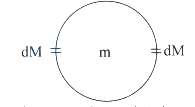
$A$ thin rod of length $L$ is bent in the form of a circle. Its mass is $M$. What force will act on a mass $m$ placed at the centre of this circle? $(G = \text{universal gravitational constant})$
A
zero
B
$\frac{GMm}{4 \pi^2 L^2}$
C
$\frac{4 \pi^2 GMm}{L^2}$
D
$\frac{2 GMm}{L^2}$
Solution
(A) Consider the circular ring formed by the rod of length $L$ and mass $M$. Let the radius of this circle be $r$. The circumference is $2 \pi r = L$, so $r = \frac{L}{2 \pi}$.
Consider two diametrically opposite small mass segments $dM_1$ and $dM_2$ on the ring.
The gravitational force exerted by segment $dM_1$ on mass $m$ at the centre is $F_1 = \frac{G m dM_1}{r^2}$ directed towards $dM_1$.
The gravitational force exerted by the diametrically opposite segment $dM_2$ on mass $m$ at the centre is $F_2 = \frac{G m dM_2}{r^2}$ directed towards $dM_2$.
Since the segments are diametrically opposite, the forces $F_1$ and $F_2$ are equal in magnitude and opposite in direction $(F_1 = -F_2)$.
Therefore, the net force due to these two segments is $F_1 + F_2 = 0$.
By symmetry, every mass segment on the ring has a corresponding diametrically opposite segment that exerts an equal and opposite gravitational force on the mass $m$ at the centre.
Summing these forces over the entire ring, the net gravitational force acting on the mass $m$ at the centre is zero.
Consider two diametrically opposite small mass segments $dM_1$ and $dM_2$ on the ring.
The gravitational force exerted by segment $dM_1$ on mass $m$ at the centre is $F_1 = \frac{G m dM_1}{r^2}$ directed towards $dM_1$.
The gravitational force exerted by the diametrically opposite segment $dM_2$ on mass $m$ at the centre is $F_2 = \frac{G m dM_2}{r^2}$ directed towards $dM_2$.
Since the segments are diametrically opposite, the forces $F_1$ and $F_2$ are equal in magnitude and opposite in direction $(F_1 = -F_2)$.
Therefore, the net force due to these two segments is $F_1 + F_2 = 0$.
By symmetry, every mass segment on the ring has a corresponding diametrically opposite segment that exerts an equal and opposite gravitational force on the mass $m$ at the centre.
Summing these forces over the entire ring, the net gravitational force acting on the mass $m$ at the centre is zero.
0 likes
View Solution52
MediumMCQ
$A$ uniform solid sphere of mass $m$ and radius $r$ is surrounded by a uniform thin spherical shell of radius $2r$ and mass $m$. Then the gravitational field:
A
at a distance of $1.5r$ from the centre is $\frac{4}{9} \frac{Gm}{r^2}$
B
at a distance of $2.5r$ from the centre is $\frac{8}{25} \frac{Gm}{r^2}$
C
at a distance of $1.5r$ from the centre is zero.
D
between the sphere and spherical shell is uniform.
Solution
(B) The gravitational field $E$ at a distance $x$ from the centre of a system consisting of a solid sphere (mass $m$,radius $r$) and a concentric shell (mass $m$,radius $2r$) is given by the superposition of the fields of the two objects.
For $r < x < 2r$,the field due to the shell is $0$ (inside the shell),and the field due to the solid sphere is $\frac{Gm}{x^2}$. Thus,$E = \frac{Gm}{x^2}$.
For $x = 1.5r = \frac{3}{2}r$,$E = \frac{Gm}{(1.5r)^2} = \frac{Gm}{2.25r^2} = \frac{4}{9} \frac{Gm}{r^2}$.
For $x > 2r$,both act as point masses at the centre. $E = \frac{G(m+m)}{x^2} = \frac{2Gm}{x^2}$.
For $x = 2.5r = \frac{5}{2}r$,$E = \frac{2Gm}{(2.5r)^2} = \frac{2Gm}{6.25r^2} = \frac{2Gm}{(25/4)r^2} = \frac{8}{25} \frac{Gm}{r^2}$.
Thus,option $B$ is correct.
For $r < x < 2r$,the field due to the shell is $0$ (inside the shell),and the field due to the solid sphere is $\frac{Gm}{x^2}$. Thus,$E = \frac{Gm}{x^2}$.
For $x = 1.5r = \frac{3}{2}r$,$E = \frac{Gm}{(1.5r)^2} = \frac{Gm}{2.25r^2} = \frac{4}{9} \frac{Gm}{r^2}$.
For $x > 2r$,both act as point masses at the centre. $E = \frac{G(m+m)}{x^2} = \frac{2Gm}{x^2}$.
For $x = 2.5r = \frac{5}{2}r$,$E = \frac{2Gm}{(2.5r)^2} = \frac{2Gm}{6.25r^2} = \frac{2Gm}{(25/4)r^2} = \frac{8}{25} \frac{Gm}{r^2}$.
Thus,option $B$ is correct.
0 likes
View Solution53
MediumMCQ
$A$ uniform sphere has radius $R$ and mass $M$. The magnitude of the gravitational field at distances $r_1$ and $r_2$ from the centre of the sphere are $E_1$ and $E_2$ respectively. The ratio $E_1: E_2$ is ($r_1 > R$ and $r_2 < R$).
A
$\frac{r_2}{r_1^2}$
B
$\frac{r_1^2}{r_2}$
C
$\frac{R^3}{r_1^2 r_2}$
D
$\frac{r_1^2}{R^3}$
Solution
(C) For a uniform sphere of mass $M$ and radius $R$:
$1$. At a distance $r_1 > R$ (outside the sphere),the gravitational field is given by $E_1 = \frac{GM}{r_1^2}$.
$2$. At a distance $r_2 < R$ (inside the sphere),the gravitational field is given by $E_2 = \frac{GMr_2}{R^3}$.
$3$. The ratio $E_1 : E_2$ is calculated as:
$\frac{E_1}{E_2} = \frac{GM/r_1^2}{GMr_2/R^3} = \frac{GM}{r_1^2} \times \frac{R^3}{GMr_2} = \frac{R^3}{r_1^2 r_2}$.
$1$. At a distance $r_1 > R$ (outside the sphere),the gravitational field is given by $E_1 = \frac{GM}{r_1^2}$.
$2$. At a distance $r_2 < R$ (inside the sphere),the gravitational field is given by $E_2 = \frac{GMr_2}{R^3}$.
$3$. The ratio $E_1 : E_2$ is calculated as:
$\frac{E_1}{E_2} = \frac{GM/r_1^2}{GMr_2/R^3} = \frac{GM}{r_1^2} \times \frac{R^3}{GMr_2} = \frac{R^3}{r_1^2 r_2}$.
0 likes
View Solution54
MediumMCQ
The magnitude of the gravitational field at distances $r_1$ and $r_2$ from the center of a uniform sphere of radius $R$ and mass $M$ are $F_1$ and $F_2$ respectively. The ratio $(F_1 / F_2)$ will be (if $r_1 > R$ and $r_2 < R$):
A
$\frac{R^2}{r_1 r_2}$
B
$\frac{R^3}{r_1 r_2^2}$
C
$\frac{R^3}{r_1^2 r_2}$
D
$\frac{R^4}{r_1^2 r_2^2}$
Solution
(C) For a point outside the sphere $(r > R)$,the gravitational field is given by $F = \frac{G M}{r^2}$.
Thus,for $r_1 > R$,$F_1 = \frac{G M}{r_1^2}$.
For a point inside the sphere $(r < R)$,the gravitational field is given by $F = \frac{G M r}{R^3}$.
Thus,for $r_2 < R$,$F_2 = \frac{G M r_2}{R^3}$.
Taking the ratio of $F_1$ to $F_2$:
$\frac{F_1}{F_2} = \frac{G M}{r_1^2} \times \frac{R^3}{G M r_2} = \frac{R^3}{r_1^2 r_2}$.
Thus,for $r_1 > R$,$F_1 = \frac{G M}{r_1^2}$.
For a point inside the sphere $(r < R)$,the gravitational field is given by $F = \frac{G M r}{R^3}$.
Thus,for $r_2 < R$,$F_2 = \frac{G M r_2}{R^3}$.
Taking the ratio of $F_1$ to $F_2$:
$\frac{F_1}{F_2} = \frac{G M}{r_1^2} \times \frac{R^3}{G M r_2} = \frac{R^3}{r_1^2 r_2}$.
0 likes
View Solution55
EasyMCQ
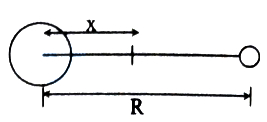
The mass of the Earth is $81$ times the mass of the Moon and the distance between their centres is $R$. The distance from the centre of the Earth where the gravitational force will be zero is
A
$\frac{9 R}{10}$
B
$\frac{R}{2}$
C
$\frac{R}{81}$
D
$\frac{R}{4}$
Solution
(A) Let $M_E$ be the mass of the Earth and $M_M$ be the mass of the Moon. Given $M_E = 81 M_M$.
Let $x$ be the distance from the centre of the Earth where the net gravitational force on a test mass $m$ is zero.
At this point,the gravitational pull from the Earth must be equal in magnitude to the gravitational pull from the Moon.
$\frac{G M_E}{x^2} = \frac{G M_M}{(R - x)^2}$
Substituting $M_E = 81 M_M$:
$\frac{G (81 M_M)}{x^2} = \frac{G M_M}{(R - x)^2}$
$\frac{81}{x^2} = \frac{1}{(R - x)^2}$
Taking the square root on both sides:
$\frac{9}{x} = \frac{1}{R - x}$
$9(R - x) = x$
$9R - 9x = x$
$9R = 10x$
$x = \frac{9}{10} R$
Let $x$ be the distance from the centre of the Earth where the net gravitational force on a test mass $m$ is zero.
At this point,the gravitational pull from the Earth must be equal in magnitude to the gravitational pull from the Moon.
$\frac{G M_E}{x^2} = \frac{G M_M}{(R - x)^2}$
Substituting $M_E = 81 M_M$:
$\frac{G (81 M_M)}{x^2} = \frac{G M_M}{(R - x)^2}$
$\frac{81}{x^2} = \frac{1}{(R - x)^2}$
Taking the square root on both sides:
$\frac{9}{x} = \frac{1}{R - x}$
$9(R - x) = x$
$9R - 9x = x$
$9R = 10x$
$x = \frac{9}{10} R$
0 likes
View Solution56
MediumMCQ
Infinite number of masses each of $3 \ kg$ are placed along a straight line at the distances of $1 \ m, 2 \ m, 4 \ m, 8 \ m, \ldots$ from a point $O$ on the same line. If $G$ is the universal gravitational constant,then the magnitude of gravitational field intensity at $O$ is (in $G$)
A
$1.0$
B
$2.0$
C
$3.0$
D
$4.0$
Solution
(D) The gravitational field intensity $I$ due to a point mass $m$ at a distance $r$ is given by $I = \frac{Gm}{r^2}$.
Since there are infinite masses,the total gravitational field intensity at point $O$ is the sum of the intensities due to each mass:
$I_{total} = \sum \frac{Gm_i}{r_i^2} = G \sum \frac{3}{r_i^2} = 3G \left( \frac{1}{1^2} + \frac{1}{2^2} + \frac{1}{4^2} + \frac{1}{8^2} + \dots \right)$.
This is a geometric series with the first term $a = 1$ and common ratio $r = \frac{1}{4}$.
The sum of an infinite geometric series is $S = \frac{a}{1 - r}$.
Substituting the values,$S = \frac{1}{1 - 1/4} = \frac{1}{3/4} = \frac{4}{3}$.
Therefore,$I_{total} = 3G \times \frac{4}{3} = 4G$.
Since there are infinite masses,the total gravitational field intensity at point $O$ is the sum of the intensities due to each mass:
$I_{total} = \sum \frac{Gm_i}{r_i^2} = G \sum \frac{3}{r_i^2} = 3G \left( \frac{1}{1^2} + \frac{1}{2^2} + \frac{1}{4^2} + \frac{1}{8^2} + \dots \right)$.
This is a geometric series with the first term $a = 1$ and common ratio $r = \frac{1}{4}$.
The sum of an infinite geometric series is $S = \frac{a}{1 - r}$.
Substituting the values,$S = \frac{1}{1 - 1/4} = \frac{1}{3/4} = \frac{4}{3}$.
Therefore,$I_{total} = 3G \times \frac{4}{3} = 4G$.
0 likes
View Solution57
DifficultMCQ
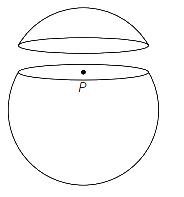
$A$ spherical shell is cut into two pieces along a plane as shown in the figure. $P$ is a point on the plane of the cut. The gravitational field at $P$ due to the upper part is $I_1$ and that due to the lower part is $I_2$. What is the relation between them?
A
$I_1 > I_2$
B
$I_2 > I_1$
C
$I_1 = I_2$
D
No definite relation
Solution
(C) The gravitational field inside a uniform spherical shell is zero at every point.
Let $I_1$ be the gravitational field at point $P$ due to the upper part of the shell and $I_2$ be the gravitational field at point $P$ due to the lower part of the shell.
The total gravitational field at point $P$ due to the entire shell is the vector sum of the fields due to its parts: $\vec{I}_{total} = \vec{I}_1 + \vec{I}_2 = 0$.
Since the point $P$ lies on the plane of the cut,the field vectors $\vec{I}_1$ and $\vec{I}_2$ must be equal in magnitude and opposite in direction to satisfy the condition $\vec{I}_1 + \vec{I}_2 = 0$.
Therefore,the magnitudes of the gravitational fields are equal: $I_1 = I_2$.
Let $I_1$ be the gravitational field at point $P$ due to the upper part of the shell and $I_2$ be the gravitational field at point $P$ due to the lower part of the shell.
The total gravitational field at point $P$ due to the entire shell is the vector sum of the fields due to its parts: $\vec{I}_{total} = \vec{I}_1 + \vec{I}_2 = 0$.
Since the point $P$ lies on the plane of the cut,the field vectors $\vec{I}_1$ and $\vec{I}_2$ must be equal in magnitude and opposite in direction to satisfy the condition $\vec{I}_1 + \vec{I}_2 = 0$.
Therefore,the magnitudes of the gravitational fields are equal: $I_1 = I_2$.
0 likes
View Solution58
DifficultMCQ
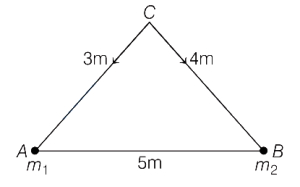
Two masses $90 \ kg$ and $160 \ kg$ are separated by a distance of $5 \ m$. The magnitude of the intensity of the gravitational field at a point which is at a distance $3 \ m$ from the $90 \ kg$ mass and $4 \ m$ from the $160 \ kg$ mass is (Universal gravitational constant,$G=6.67 \times 10^{-11} \ N \ m^2 \ kg^{-2}$)
A
$94.3 \times 10^{-10} \ N \ kg^{-1}$
B
$9.43 \times 10^{-10} \ N \ kg^{-1}$
C
$9.43 \times 10^{-12} \ N \ kg^{-1}$
D
$94.3 \times 10^{-12} \ N \ kg^{-1}$
Solution
(B) Let the two masses be $m_1 = 90 \ kg$ at point $A$ and $m_2 = 160 \ kg$ at point $B$. The point $C$ is at a distance $r_1 = 3 \ m$ from $A$ and $r_2 = 4 \ m$ from $B$. The distance between $A$ and $B$ is $5 \ m$.
Since $3^2 + 4^2 = 5^2$,the triangle $ABC$ is a right-angled triangle with the right angle at $C$.
The gravitational field intensity at $C$ due to mass $m_1$ is $E_A = \frac{G m_1}{r_1^2} = \frac{G \times 90}{3^2} = 10G$.
The gravitational field intensity at $C$ due to mass $m_2$ is $E_B = \frac{G m_2}{r_2^2} = \frac{G \times 160}{4^2} = 10G$.
Since the angle between $E_A$ and $E_B$ is $90^\circ$,the resultant intensity $E$ is given by:
$E = \sqrt{E_A^2 + E_B^2} = \sqrt{(10G)^2 + (10G)^2} = 10G\sqrt{2}$.
Substituting $G = 6.67 \times 10^{-11} \ N \ m^2 \ kg^{-2}$:
$E = 10 \times 6.67 \times 10^{-11} \times 1.414 \approx 9.43 \times 10^{-10} \ N \ kg^{-1}$.
Since $3^2 + 4^2 = 5^2$,the triangle $ABC$ is a right-angled triangle with the right angle at $C$.
The gravitational field intensity at $C$ due to mass $m_1$ is $E_A = \frac{G m_1}{r_1^2} = \frac{G \times 90}{3^2} = 10G$.
The gravitational field intensity at $C$ due to mass $m_2$ is $E_B = \frac{G m_2}{r_2^2} = \frac{G \times 160}{4^2} = 10G$.
Since the angle between $E_A$ and $E_B$ is $90^\circ$,the resultant intensity $E$ is given by:
$E = \sqrt{E_A^2 + E_B^2} = \sqrt{(10G)^2 + (10G)^2} = 10G\sqrt{2}$.
Substituting $G = 6.67 \times 10^{-11} \ N \ m^2 \ kg^{-2}$:
$E = 10 \times 6.67 \times 10^{-11} \times 1.414 \approx 9.43 \times 10^{-10} \ N \ kg^{-1}$.
0 likes
View Solution59
EasyMCQ
The gravitational field in a region is given by $I = (5 \hat{i} + 12 \hat{j}) \text{ N kg}^{-1}$. The change in the gravitational potential energy of an object of mass $3 \text{ kg}$ when it is taken from the origin to a point $(8 \text{ m}, -2 \text{ m})$ is (in $\text{ J}$)
A
$1$
B
$16$
C
$48$
D
$3$
Solution
(C) Given, gravitational field intensity, $I = (5 \hat{i} + 12 \hat{j}) \text{ N kg}^{-1}$.
Mass of the object, $m = 3 \text{ kg}$.
The change in gravitational potential energy $\Delta U$ is given by the negative of the work done by the gravitational field, or $\Delta U = -W = -m \int \vec{I} \cdot d\vec{r}$.
However, in many contexts, the magnitude of the change in potential energy is calculated as $\Delta U = m \int_{A}^{B} \vec{I} \cdot d\vec{r}$ considering the work done against the field.
Using the formula $\Delta U = m \int_{(0,0)}^{(8,-2)} \vec{I} \cdot d\vec{r}$:
$\Delta U = 3 \int_{(0,0)}^{(8,-2)} (5 \hat{i} + 12 \hat{j}) \cdot (dx \hat{i} + dy \hat{j})$
$\Delta U = 3 [5x + 12y]_{(0,0)}^{(8,-2)}$
$\Delta U = 3 [5(8) + 12(-2)] - 3 [5(0) + 12(0)]$
$\Delta U = 3 [40 - 24] = 3 [16] = 48 \text{ J}$.
Mass of the object, $m = 3 \text{ kg}$.
The change in gravitational potential energy $\Delta U$ is given by the negative of the work done by the gravitational field, or $\Delta U = -W = -m \int \vec{I} \cdot d\vec{r}$.
However, in many contexts, the magnitude of the change in potential energy is calculated as $\Delta U = m \int_{A}^{B} \vec{I} \cdot d\vec{r}$ considering the work done against the field.
Using the formula $\Delta U = m \int_{(0,0)}^{(8,-2)} \vec{I} \cdot d\vec{r}$:
$\Delta U = 3 \int_{(0,0)}^{(8,-2)} (5 \hat{i} + 12 \hat{j}) \cdot (dx \hat{i} + dy \hat{j})$
$\Delta U = 3 [5x + 12y]_{(0,0)}^{(8,-2)}$
$\Delta U = 3 [5(8) + 12(-2)] - 3 [5(0) + 12(0)]$
$\Delta U = 3 [40 - 24] = 3 [16] = 48 \text{ J}$.
0 likes
View Solution60
EasyMCQ
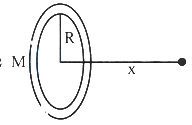
$A$ ring has a mass $M$ and radius $R$. The distance of the point on its geometric axis from its centre at which the gravitational field is strongest is
A
$\frac {R}{2}$
B
$\frac {R}{4}$
C
$\frac {R}{\sqrt 3}$
D
$\frac {R}{\sqrt 2}$
Solution
(D) The gravitational field $E$ at a distance $x$ from the centre of a ring of mass $M$ and radius $R$ along its axis is given by:
$E = \frac{GMx}{(R^2 + x^2)^{3/2}}$
To find the point where the gravitational field is strongest,we differentiate $E$ with respect to $x$ and set it to zero:
$\frac{dE}{dx} = 0$
Using the quotient rule:
$\frac{d}{dx} \left[ \frac{GMx}{(R^2 + x^2)^{3/2}} \right] = GM \left[ \frac{(R^2 + x^2)^{3/2}(1) - x \cdot \frac{3}{2}(R^2 + x^2)^{1/2}(2x)}{(R^2 + x^2)^3} \right] = 0$
This simplifies to:
$(R^2 + x^2)^{3/2} - 3x^2(R^2 + x^2)^{1/2} = 0$
$(R^2 + x^2)^{1/2} [R^2 + x^2 - 3x^2] = 0$
$R^2 - 2x^2 = 0$
$2x^2 = R^2$
$x = \frac{R}{\sqrt{2}}$
Thus,the gravitational field is strongest at a distance of $\frac{R}{\sqrt{2}}$ from the centre.
$E = \frac{GMx}{(R^2 + x^2)^{3/2}}$
To find the point where the gravitational field is strongest,we differentiate $E$ with respect to $x$ and set it to zero:
$\frac{dE}{dx} = 0$
Using the quotient rule:
$\frac{d}{dx} \left[ \frac{GMx}{(R^2 + x^2)^{3/2}} \right] = GM \left[ \frac{(R^2 + x^2)^{3/2}(1) - x \cdot \frac{3}{2}(R^2 + x^2)^{1/2}(2x)}{(R^2 + x^2)^3} \right] = 0$
This simplifies to:
$(R^2 + x^2)^{3/2} - 3x^2(R^2 + x^2)^{1/2} = 0$
$(R^2 + x^2)^{1/2} [R^2 + x^2 - 3x^2] = 0$
$R^2 - 2x^2 = 0$
$2x^2 = R^2$
$x = \frac{R}{\sqrt{2}}$
Thus,the gravitational field is strongest at a distance of $\frac{R}{\sqrt{2}}$ from the centre.
0 likes
View Solution61
DifficultMCQ
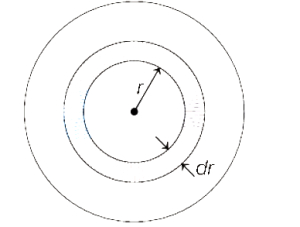
The density of a solid sphere of radius $R$ is $\rho(r) = 20 \frac{r^2}{R^2}$,where $r$ is the distance from its centre. If the gravitational field due to this sphere at a distance $4R$ from its centre is $E$ and $G$ is the gravitational constant,then the ratio of $\frac{E}{GR}$ is
A
$\frac{\pi}{5}$
B
$3\pi$
C
$\frac{3\pi}{2}$
D
$\pi$
Solution
(D) The volume of a spherical shell of thickness $dr$ and radius $r$ is $dV = 4\pi r^2 dr$.
The mass of this shell is $dM = \rho dV = \left( 20 \frac{r^2}{R^2} \right) \cdot 4\pi r^2 dr = \frac{80\pi r^4}{R^2} dr$.
The total mass $M$ of the solid sphere is obtained by integrating from $0$ to $R$:
$M = \int_0^R dM = \int_0^R \frac{80\pi r^4}{R^2} dr = \frac{80\pi}{R^2} \left[ \frac{r^5}{5} \right]_0^R = \frac{80\pi R^5}{5R^2} = 16\pi R^3$.
For a point outside the sphere at a distance $r = 4R$,the sphere acts as a point mass $M$ at its centre. The gravitational field $E$ is given by:
$E = \frac{GM}{r^2} = \frac{G(16\pi R^3)}{(4R)^2} = \frac{16\pi G R^3}{16R^2} = \pi GR$.
Therefore,the ratio $\frac{E}{GR} = \pi$.
The mass of this shell is $dM = \rho dV = \left( 20 \frac{r^2}{R^2} \right) \cdot 4\pi r^2 dr = \frac{80\pi r^4}{R^2} dr$.
The total mass $M$ of the solid sphere is obtained by integrating from $0$ to $R$:
$M = \int_0^R dM = \int_0^R \frac{80\pi r^4}{R^2} dr = \frac{80\pi}{R^2} \left[ \frac{r^5}{5} \right]_0^R = \frac{80\pi R^5}{5R^2} = 16\pi R^3$.
For a point outside the sphere at a distance $r = 4R$,the sphere acts as a point mass $M$ at its centre. The gravitational field $E$ is given by:
$E = \frac{GM}{r^2} = \frac{G(16\pi R^3)}{(4R)^2} = \frac{16\pi G R^3}{16R^2} = \pi GR$.
Therefore,the ratio $\frac{E}{GR} = \pi$.
0 likes
View Solution62
DifficultMCQ
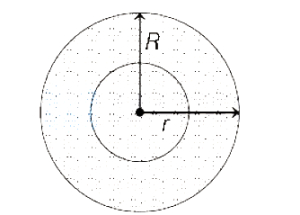
The mass density inside a solid sphere of radius $R$ varies as $\rho(r)=\rho_0\left(\frac{r}{R}\right)^\beta$,where $\rho_0$ and $\beta$ are constants and $r$ is the distance from the centre. Let $E_1$ and $E_2$ be gravitational fields due to the sphere at distances $\frac{R}{2}$ and $2R$ from the centre of the sphere,respectively. If $\frac{E_2}{E_1}=4$,the value of $\beta$ is
A
$2$
B
$2.5$
C
$3$
D
$4$
Solution
(C) The mass $M(r)$ enclosed in a sphere of radius $r$ is given by:
$M(r) = \int_0^r \rho(r') \cdot 4\pi r'^2 dr' = \int_0^r \rho_0 \left(\frac{r'}{R}\right)^\beta \cdot 4\pi r'^2 dr' = \frac{4\pi \rho_0}{R^\beta} \int_0^r r'^{\beta+2} dr' = \frac{4\pi \rho_0}{R^\beta} \cdot \frac{r^{\beta+3}}{\beta+3}$.
For $r = \frac{R}{2}$,the mass enclosed is $M_1 = \frac{4\pi \rho_0}{R^\beta} \cdot \frac{(R/2)^{\beta+3}}{\beta+3} = \frac{4\pi \rho_0 R^3}{\beta+3} \cdot \frac{1}{2^{\beta+3}}$.
The gravitational field at $r = \frac{R}{2}$ is $E_1 = \frac{G M_1}{(R/2)^2} = \frac{G}{(R/2)^2} \cdot \frac{4\pi \rho_0 R^3}{(\beta+3) 2^{\beta+3}} = \frac{16 G \pi \rho_0 R}{(\beta+3) 2^{\beta+3}}$.
For $r = 2R$,the total mass of the sphere is $M_2 = \frac{4\pi \rho_0}{R^\beta} \cdot \frac{R^{\beta+3}}{\beta+3} = \frac{4\pi \rho_0 R^3}{\beta+3}$.
The gravitational field at $r = 2R$ is $E_2 = \frac{G M_2}{(2R)^2} = \frac{G}{4R^2} \cdot \frac{4\pi \rho_0 R^3}{\beta+3} = \frac{G \pi \rho_0 R}{\beta+3}$.
Given $\frac{E_2}{E_1} = 4$:
$\frac{\frac{G \pi \rho_0 R}{\beta+3}}{\frac{16 G \pi \rho_0 R}{(\beta+3) 2^{\beta+3}}} = 4 \Rightarrow \frac{2^{\beta+3}}{16} = 4 \Rightarrow 2^{\beta+3} = 64 = 2^6$.
Therefore,$\beta + 3 = 6$,which gives $\beta = 3$.
$M(r) = \int_0^r \rho(r') \cdot 4\pi r'^2 dr' = \int_0^r \rho_0 \left(\frac{r'}{R}\right)^\beta \cdot 4\pi r'^2 dr' = \frac{4\pi \rho_0}{R^\beta} \int_0^r r'^{\beta+2} dr' = \frac{4\pi \rho_0}{R^\beta} \cdot \frac{r^{\beta+3}}{\beta+3}$.
For $r = \frac{R}{2}$,the mass enclosed is $M_1 = \frac{4\pi \rho_0}{R^\beta} \cdot \frac{(R/2)^{\beta+3}}{\beta+3} = \frac{4\pi \rho_0 R^3}{\beta+3} \cdot \frac{1}{2^{\beta+3}}$.
The gravitational field at $r = \frac{R}{2}$ is $E_1 = \frac{G M_1}{(R/2)^2} = \frac{G}{(R/2)^2} \cdot \frac{4\pi \rho_0 R^3}{(\beta+3) 2^{\beta+3}} = \frac{16 G \pi \rho_0 R}{(\beta+3) 2^{\beta+3}}$.
For $r = 2R$,the total mass of the sphere is $M_2 = \frac{4\pi \rho_0}{R^\beta} \cdot \frac{R^{\beta+3}}{\beta+3} = \frac{4\pi \rho_0 R^3}{\beta+3}$.
The gravitational field at $r = 2R$ is $E_2 = \frac{G M_2}{(2R)^2} = \frac{G}{4R^2} \cdot \frac{4\pi \rho_0 R^3}{\beta+3} = \frac{G \pi \rho_0 R}{\beta+3}$.
Given $\frac{E_2}{E_1} = 4$:
$\frac{\frac{G \pi \rho_0 R}{\beta+3}}{\frac{16 G \pi \rho_0 R}{(\beta+3) 2^{\beta+3}}} = 4 \Rightarrow \frac{2^{\beta+3}}{16} = 4 \Rightarrow 2^{\beta+3} = 64 = 2^6$.
Therefore,$\beta + 3 = 6$,which gives $\beta = 3$.
0 likes
View Solution63
EasyMCQ
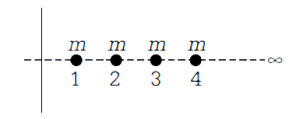
An infinite number of spheres,each of mass $m$,are placed on the $X$-axis at distances $1, 2, 4, 8, 16, \dots$ meters from the origin. The magnitude of the gravitational field at the origin is
A
$\frac{2}{3} Gm$
B
$\frac{4}{3} Gm$
C
$Gm$
D
$6 Gm$
Solution
(B) The gravitational field $E$ at the origin due to a point mass $m$ at distance $r$ is given by $E = \frac{Gm}{r^2}$.
Since the masses are placed at distances $r = 1, 2, 4, 8, 16, \dots$,the total gravitational field at the origin is the sum of the fields due to each mass:
$E = \frac{Gm}{1^2} + \frac{Gm}{2^2} + \frac{Gm}{4^2} + \frac{Gm}{8^2} + \dots$
$E = Gm \left( 1 + \frac{1}{4} + \frac{1}{16} + \frac{1}{64} + \dots \right)$
The term in the bracket is an infinite geometric progression with the first term $a = 1$ and common ratio $r = \frac{1}{4}$.
The sum of an infinite geometric series is $S = \frac{a}{1 - r}$.
$S = \frac{1}{1 - 1/4} = \frac{1}{3/4} = \frac{4}{3}$.
Therefore,the total gravitational field is $E = Gm \left( \frac{4}{3} \right) = \frac{4}{3} Gm$.
Since the masses are placed at distances $r = 1, 2, 4, 8, 16, \dots$,the total gravitational field at the origin is the sum of the fields due to each mass:
$E = \frac{Gm}{1^2} + \frac{Gm}{2^2} + \frac{Gm}{4^2} + \frac{Gm}{8^2} + \dots$
$E = Gm \left( 1 + \frac{1}{4} + \frac{1}{16} + \frac{1}{64} + \dots \right)$
The term in the bracket is an infinite geometric progression with the first term $a = 1$ and common ratio $r = \frac{1}{4}$.
The sum of an infinite geometric series is $S = \frac{a}{1 - r}$.
$S = \frac{1}{1 - 1/4} = \frac{1}{3/4} = \frac{4}{3}$.
Therefore,the total gravitational field is $E = Gm \left( \frac{4}{3} \right) = \frac{4}{3} Gm$.
0 likes
View Solution64
MediumMCQ
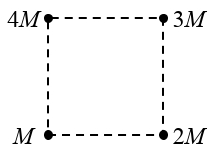
The net gravitational force at the centre of a square is found to be $F_{1}$ when four particles having masses $M, 2M, 3M,$ and $4M$ are placed at the four corners of the square as shown in the figure. It is $F_{2}$ when the positions of $3M$ and $4M$ are interchanged. The ratio $\frac{F_{1}}{F_{2}}$ is $\frac{\alpha}{\sqrt{5}}$. The value of $\alpha$ is . . . . . . .
A
$2$
B
$3$
C
$1$
D
$2\sqrt{5}$
Solution
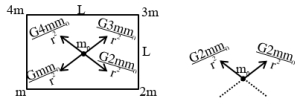
(A) Let the distance from the centre to each corner be $r$. Let a test mass $m_{0}$ be placed at the centre.
In the initial configuration,the forces exerted by the masses at the corners on $m_{0}$ are directed towards the corners. Let $k = \frac{Gm_{0}}{r^{2}}$.
The forces are $F_{M} = kM$,$F_{2M} = 2kM$,$F_{3M} = 3kM$,and $F_{4M} = 4kM$.
Opposite pairs are $(M, 3M)$ and $(2M, 4M)$.
The net force along the diagonal with $M$ and $3M$ is $F_{diag1} = (3M - M)k = 2kM$ (towards $3M$).
The net force along the diagonal with $2M$ and $4M$ is $F_{diag2} = (4M - 2M)k = 2kM$ (towards $4M$).
Since the diagonals are perpendicular,$F_{1} = \sqrt{(2kM)^{2} + (2kM)^{2}} = 2\sqrt{2}kM$.
In the new configuration,$3M$ and $4M$ are interchanged. The corners now have $M, 2M, 4M,$ and $3M$ in order.
Opposite pairs are $(M, 4M)$ and $(2M, 3M)$.
The net force along the diagonal with $M$ and $4M$ is $F'_{diag1} = (4M - M)k = 3kM$ (towards $4M$).
The net force along the diagonal with $2M$ and $3M$ is $F'_{diag2} = (3M - 2M)k = kM$ (towards $3M$).
$F_{2} = \sqrt{(3kM)^{2} + (kM)^{2}} = \sqrt{9+1}kM = \sqrt{10}kM$.
Ratio $\frac{F_{1}}{F_{2}} = \frac{2\sqrt{2}kM}{\sqrt{10}kM} = \frac{2\sqrt{2}}{\sqrt{2}\sqrt{5}} = \frac{2}{\sqrt{5}}$.
Comparing with $\frac{\alpha}{\sqrt{5}}$,we get $\alpha = 2$.
In the initial configuration,the forces exerted by the masses at the corners on $m_{0}$ are directed towards the corners. Let $k = \frac{Gm_{0}}{r^{2}}$.
The forces are $F_{M} = kM$,$F_{2M} = 2kM$,$F_{3M} = 3kM$,and $F_{4M} = 4kM$.
Opposite pairs are $(M, 3M)$ and $(2M, 4M)$.
The net force along the diagonal with $M$ and $3M$ is $F_{diag1} = (3M - M)k = 2kM$ (towards $3M$).
The net force along the diagonal with $2M$ and $4M$ is $F_{diag2} = (4M - 2M)k = 2kM$ (towards $4M$).
Since the diagonals are perpendicular,$F_{1} = \sqrt{(2kM)^{2} + (2kM)^{2}} = 2\sqrt{2}kM$.
In the new configuration,$3M$ and $4M$ are interchanged. The corners now have $M, 2M, 4M,$ and $3M$ in order.
Opposite pairs are $(M, 4M)$ and $(2M, 3M)$.
The net force along the diagonal with $M$ and $4M$ is $F'_{diag1} = (4M - M)k = 3kM$ (towards $4M$).
The net force along the diagonal with $2M$ and $3M$ is $F'_{diag2} = (3M - 2M)k = kM$ (towards $3M$).
$F_{2} = \sqrt{(3kM)^{2} + (kM)^{2}} = \sqrt{9+1}kM = \sqrt{10}kM$.
Ratio $\frac{F_{1}}{F_{2}} = \frac{2\sqrt{2}kM}{\sqrt{10}kM} = \frac{2\sqrt{2}}{\sqrt{2}\sqrt{5}} = \frac{2}{\sqrt{5}}$.
Comparing with $\frac{\alpha}{\sqrt{5}}$,we get $\alpha = 2$.
0 likes
View SolutionGravitation — Gravitational Intensity · Frequently Asked Questions
1Are these Gravitation questions useful for JEE and NEET?
Yes. All questions in this section are mapped to JEE Main and NEET exam patterns. Previous year questions from JEE Main, NEET, GUJCET and state-level exams are included with full solutions.
2Can I switch to Hindi or Gujarati for these questions?
Yes. Use the language tabs in the hero section or the sidebar to view the same questions and solutions in English, Hindi or Gujarati.
3How do I generate a question paper from this subtopic?
Use the Vedclass Exam Paper Generator — select the chapter and subtopic, set difficulty, and generate Sets A, B, C, D automatically. First 3 chapters of every subject are free.
Vedclass Products
For Students
Vedclass Test Series
Mock tests in real JEE/NEET style with performance analysis. 5-day free trial.
Start Free TrialFor Teachers
Exam Paper Generator
Generate Set A/B/C/D papers from this chapter in 2 minutes. 3 chapters free.
Try FreeFor Institutes
Online Exam Module
Live online exams with unlimited students, 360° analytics & white-label branding.
See DemoFor Teachers & Institutes
Generate a Gravitation Exam Paper in 2 Minutes
Select subtopic & difficulty — Sets A, B, C, D auto-generated with No Repeat logic.
First 3 chapters of every subject are free — no payment required.