
A English
Periodic functions Questions in English
Class 11 Mathematics · Trigonometrical Equations · Periodic functions
67+
Questions
English
Language
100%
With Solutions
Showing 46 of 67 questions in English
1
EasyMCQ
The period of $|\sin 2x|$ is
A
$\frac{\pi}{4}$
B
$\frac{\pi}{2}$
C
$\pi$
D
$2\pi$
Solution
(B) The period of $\sin(ax)$ is $\frac{2\pi}{|a|}$.
So,the period of $\sin 2x$ is $\frac{2\pi}{2} = \pi$.
For a function $f(x) = |\sin(ax)|$,the period is $\frac{\pi}{|a|}$.
Therefore,the period of $|\sin 2x|$ is $\frac{\pi}{2}$.
So,the period of $\sin 2x$ is $\frac{2\pi}{2} = \pi$.
For a function $f(x) = |\sin(ax)|$,the period is $\frac{\pi}{|a|}$.
Therefore,the period of $|\sin 2x|$ is $\frac{\pi}{2}$.
0 likes
View Solution2
EasyMCQ
The period of $\sin \theta \cos \theta$ is
A
$\frac{\pi}{2}$
B
$\pi$
C
$2\pi$
D
None of these
Solution
(B) Given expression is $f(\theta) = \sin \theta \cos \theta$.
Using the identity $\sin 2\theta = 2 \sin \theta \cos \theta$,we can write:
$f(\theta) = \frac{1}{2} \sin 2\theta$.
The period of $\sin(k\theta)$ is given by $\frac{2\pi}{|k|}$.
Here,$k = 2$,so the period is $\frac{2\pi}{2} = \pi$.
Thus,the correct option is $B$.
Using the identity $\sin 2\theta = 2 \sin \theta \cos \theta$,we can write:
$f(\theta) = \frac{1}{2} \sin 2\theta$.
The period of $\sin(k\theta)$ is given by $\frac{2\pi}{|k|}$.
Here,$k = 2$,so the period is $\frac{2\pi}{2} = \pi$.
Thus,the correct option is $B$.
0 likes
View Solution3
EasyMCQ
The period of $\frac{\sin \theta + \sin 2\theta}{\cos \theta + \cos 2\theta}$ is
A
$2\pi$
B
$\pi$
C
$\frac{2\pi}{3}$
D
$\frac{\pi}{3}$
Solution
(C) Let $f(\theta) = \frac{\sin \theta + \sin 2\theta}{\cos \theta + \cos 2\theta}$.
Using the sum-to-product formulas $\sin A + \sin B = 2 \sin \left(\frac{A+B}{2}\right) \cos \left(\frac{A-B}{2}\right)$ and $\cos A + \cos B = 2 \cos \left(\frac{A+B}{2}\right) \cos \left(\frac{A-B}{2}\right)$:
$f(\theta) = \frac{2 \sin \left(\frac{3\theta}{2}\right) \cos \left(\frac{\theta}{2}\right)}{2 \cos \left(\frac{3\theta}{2}\right) \cos \left(\frac{\theta}{2}\right)} = \tan \left(\frac{3\theta}{2}\right)$.
The period of $\tan(k\theta)$ is $\frac{\pi}{|k|}$.
Here,$k = \frac{3}{2}$,so the period is $\frac{\pi}{3/2} = \frac{2\pi}{3}$.
Using the sum-to-product formulas $\sin A + \sin B = 2 \sin \left(\frac{A+B}{2}\right) \cos \left(\frac{A-B}{2}\right)$ and $\cos A + \cos B = 2 \cos \left(\frac{A+B}{2}\right) \cos \left(\frac{A-B}{2}\right)$:
$f(\theta) = \frac{2 \sin \left(\frac{3\theta}{2}\right) \cos \left(\frac{\theta}{2}\right)}{2 \cos \left(\frac{3\theta}{2}\right) \cos \left(\frac{\theta}{2}\right)} = \tan \left(\frac{3\theta}{2}\right)$.
The period of $\tan(k\theta)$ is $\frac{\pi}{|k|}$.
Here,$k = \frac{3}{2}$,so the period is $\frac{\pi}{3/2} = \frac{2\pi}{3}$.
0 likes
View Solution4
EasyMCQ
The period of $\cos(7x - 5)$ is
A
$\frac{2\pi - 5}{7}$
B
$2\pi - 5$
C
$\frac{2\pi}{7}$
D
$\frac{\pi}{7}$
Solution
(C) The period of a trigonometric function of the form $\cos(ax + b)$ is given by $T = \frac{2\pi}{|a|}$.
Here,$a = 7$ and $b = -5$.
Therefore,the period $T = \frac{2\pi}{|7|} = \frac{2\pi}{7}$.
Here,$a = 7$ and $b = -5$.
Therefore,the period $T = \frac{2\pi}{|7|} = \frac{2\pi}{7}$.
0 likes
View Solution5
EasyMCQ
The period of $\sin \theta - \sqrt{3} \cos \theta$ is
A
$\frac{\pi}{4}$
B
$\frac{\pi}{2}$
C
$\pi$
D
$2\pi$
Solution
(D) We can rewrite the expression as: $\sin \theta - \sqrt{3} \cos \theta = 2 \left( \frac{1}{2} \sin \theta - \frac{\sqrt{3}}{2} \cos \theta \right)$.
Using the identity $\sin(A - B) = \sin A \cos B - \cos A \sin B$,we get: $2 \sin \left( \theta - \frac{\pi}{3} \right)$.
The period of $\sin(k\theta)$ is $\frac{2\pi}{|k|}$.
Here,$k = 1$,so the period is $\frac{2\pi}{1} = 2\pi$.
Using the identity $\sin(A - B) = \sin A \cos B - \cos A \sin B$,we get: $2 \sin \left( \theta - \frac{\pi}{3} \right)$.
The period of $\sin(k\theta)$ is $\frac{2\pi}{|k|}$.
Here,$k = 1$,so the period is $\frac{2\pi}{1} = 2\pi$.
0 likes
View Solution6
MediumMCQ
The period of $\sin \frac{x}{2} - \cos \frac{x}{3}$ is (in $\pi$)
A
$2$
B
$4$
C
$8$
D
$12$
Solution
(D) The period of $\sin(ax)$ is given by $\frac{2\pi}{|a|}$.
For $\sin \frac{x}{2}$, the period is $\frac{2\pi}{1/2} = 4\pi$.
For $\cos \frac{x}{3}$, the period is $\frac{2\pi}{1/3} = 6\pi$.
The period of the expression $\sin \frac{x}{2} - \cos \frac{x}{3}$ is the least common multiple $(LCM)$ of $4\pi$ and $6\pi$.
$LCM(4\pi, 6\pi) = 12\pi$.
For $\sin \frac{x}{2}$, the period is $\frac{2\pi}{1/2} = 4\pi$.
For $\cos \frac{x}{3}$, the period is $\frac{2\pi}{1/3} = 6\pi$.
The period of the expression $\sin \frac{x}{2} - \cos \frac{x}{3}$ is the least common multiple $(LCM)$ of $4\pi$ and $6\pi$.
$LCM(4\pi, 6\pi) = 12\pi$.
0 likes
View Solution7
MediumMCQ
The period of $\cot 3x - \cos (4x + 3)$ is
A
$\frac{\pi }{3}$
B
$\frac{\pi }{4}$
C
$\pi $
D
$2\pi $
Solution
(C) The period of $\cot 3x$ is $T_1 = \frac{\pi }{3}$.
The period of $\cos (4x + 3)$ is $T_2 = \frac{2\pi }{4} = \frac{\pi }{2}$.
The period of the function $f(x) = \cot 3x - \cos (4x + 3)$ is the $L.C.M.$ of $T_1$ and $T_2$.
$L.C.M. \left( \frac{\pi }{3}, \frac{\pi }{2} \right) = \frac{L.C.M. (\pi, \pi)}{H.C.F. (3, 2)} = \frac{\pi }{1} = \pi$.
Thus,the period is $\pi$.
The period of $\cos (4x + 3)$ is $T_2 = \frac{2\pi }{4} = \frac{\pi }{2}$.
The period of the function $f(x) = \cot 3x - \cos (4x + 3)$ is the $L.C.M.$ of $T_1$ and $T_2$.
$L.C.M. \left( \frac{\pi }{3}, \frac{\pi }{2} \right) = \frac{L.C.M. (\pi, \pi)}{H.C.F. (3, 2)} = \frac{\pi }{1} = \pi$.
Thus,the period is $\pi$.
0 likes
View Solution8
MediumMCQ
The period of $|2\sin 3\theta + 4\cos 3\theta |$ is
A
$\frac{2\pi}{3}$
B
$\pi$
C
$\frac{\pi}{2}$
D
$\frac{\pi}{3}$
Solution
(D) Let $f(\theta) = 2\sin 3\theta + 4\cos 3\theta$.
We can write this as $f(\theta) = R\sin(3\theta + \alpha)$,where $R = \sqrt{2^2 + 4^2} = \sqrt{20} = 2\sqrt{5}$.
So,$f(\theta) = 2\sqrt{5} \sin(3\theta + \alpha)$.
The function given is $g(\theta) = |f(\theta)| = |2\sqrt{5} \sin(3\theta + \alpha)|$.
The period of $\sin(3\theta + \alpha)$ is $T = \frac{2\pi}{3}$.
The period of $|\sin(3\theta + \alpha)|$ is $\frac{T}{2} = \frac{2\pi/3}{2} = \frac{\pi}{3}$.
Thus,the period of $|2\sin 3\theta + 4\cos 3\theta |$ is $\frac{\pi}{3}$.
We can write this as $f(\theta) = R\sin(3\theta + \alpha)$,where $R = \sqrt{2^2 + 4^2} = \sqrt{20} = 2\sqrt{5}$.
So,$f(\theta) = 2\sqrt{5} \sin(3\theta + \alpha)$.
The function given is $g(\theta) = |f(\theta)| = |2\sqrt{5} \sin(3\theta + \alpha)|$.
The period of $\sin(3\theta + \alpha)$ is $T = \frac{2\pi}{3}$.
The period of $|\sin(3\theta + \alpha)|$ is $\frac{T}{2} = \frac{2\pi/3}{2} = \frac{\pi}{3}$.
Thus,the period of $|2\sin 3\theta + 4\cos 3\theta |$ is $\frac{\pi}{3}$.
0 likes
View Solution9
MediumMCQ
The period of $\sin^4 x + \cos^4 x$ is
A
$\pi / 2$
B
$\pi$
C
$2\pi$
D
$3\pi / 2$
Solution
(A) Let $f(x) = \sin^4 x + \cos^4 x$.
Using the identity $a^2 + b^2 = (a+b)^2 - 2ab$,we have:
$f(x) = (\sin^2 x + \cos^2 x)^2 - 2\sin^2 x \cos^2 x$
$f(x) = 1 - 2(\sin x \cos x)^2$
$f(x) = 1 - 2(\frac{\sin 2x}{2})^2$
$f(x) = 1 - \frac{\sin^2 2x}{2}$
Using the identity $\sin^2 \theta = \frac{1 - \cos 2\theta}{2}$:
$f(x) = 1 - \frac{1}{2} \left( \frac{1 - \cos 4x}{2} \right)$
$f(x) = 1 - \frac{1}{4} + \frac{1}{4} \cos 4x$
$f(x) = \frac{3}{4} + \frac{1}{4} \cos 4x$
The period of $\cos(kx)$ is $\frac{2\pi}{|k|}$.
Therefore,the period of $f(x)$ is $\frac{2\pi}{4} = \frac{\pi}{2}$.
Using the identity $a^2 + b^2 = (a+b)^2 - 2ab$,we have:
$f(x) = (\sin^2 x + \cos^2 x)^2 - 2\sin^2 x \cos^2 x$
$f(x) = 1 - 2(\sin x \cos x)^2$
$f(x) = 1 - 2(\frac{\sin 2x}{2})^2$
$f(x) = 1 - \frac{\sin^2 2x}{2}$
Using the identity $\sin^2 \theta = \frac{1 - \cos 2\theta}{2}$:
$f(x) = 1 - \frac{1}{2} \left( \frac{1 - \cos 4x}{2} \right)$
$f(x) = 1 - \frac{1}{4} + \frac{1}{4} \cos 4x$
$f(x) = \frac{3}{4} + \frac{1}{4} \cos 4x$
The period of $\cos(kx)$ is $\frac{2\pi}{|k|}$.
Therefore,the period of $f(x)$ is $\frac{2\pi}{4} = \frac{\pi}{2}$.
0 likes
View Solution10
EasyMCQ
If the period of the function $f(x) = \sin \left( \frac{x}{n} \right)$ is $4\pi$,then $n$ is equal to
A
$1$
B
$4$
C
$8$
D
$2$
Solution
(D) The period of the function $f(x) = \sin(kx)$ is given by $\frac{2\pi}{|k|}$.
Here,$k = \frac{1}{n}$.
Therefore,the period of $f(x) = \sin \left( \frac{x}{n} \right)$ is $\frac{2\pi}{|1/n|} = 2n\pi$ (assuming $n > 0$).
Given that the period is $4\pi$,we have $2n\pi = 4\pi$.
Solving for $n$,we get $n = 2$.
Here,$k = \frac{1}{n}$.
Therefore,the period of $f(x) = \sin \left( \frac{x}{n} \right)$ is $\frac{2\pi}{|1/n|} = 2n\pi$ (assuming $n > 0$).
Given that the period is $4\pi$,we have $2n\pi = 4\pi$.
Solving for $n$,we get $n = 2$.
0 likes
View Solution11
MediumMCQ
The period of $\sin^2 x$ is
A
$\pi$
B
$2\pi$
C
$\frac{\pi}{2}$
D
None of these
Solution
(A) We know that $\sin^2 x = \frac{1 - \cos(2x)}{2}$.
The period of $\cos(kx)$ is given by $\frac{2\pi}{|k|}$.
Here,$k = 2$,so the period is $\frac{2\pi}{2} = \pi$.
Thus,the period of $\sin^2 x$ is $\pi$.
The period of $\cos(kx)$ is given by $\frac{2\pi}{|k|}$.
Here,$k = 2$,so the period is $\frac{2\pi}{2} = \pi$.
Thus,the period of $\sin^2 x$ is $\pi$.
0 likes
View Solution12
MediumMCQ
The period of the function $y = \sin 2x$ is
A
$2\pi$
B
$\pi$
C
$\pi / 2$
D
$4\pi$
Solution
(B) The period of a function of the form $y = \sin(ax + b)$ is given by the formula $T = \frac{2\pi}{|a|}$.
Given the function $y = \sin 2x$,here $a = 2$.
Therefore,the period $T = \frac{2\pi}{|2|} = \pi$.
Given the function $y = \sin 2x$,here $a = 2$.
Therefore,the period $T = \frac{2\pi}{|2|} = \pi$.
0 likes
View Solution13
EasyMCQ
Which of the following functions has a period of $2\pi$?
A
$y = \sin(2\pi t + \frac{\pi}{3}) + 2\sin(3\pi t + \frac{\pi}{4}) + 3\sin(5\pi t)$
B
$y = \sin(\frac{\pi}{3}t) + \sin(\frac{\pi}{4}t)$
C
$y = \sin t + \cos 2t$
D
None of these
Solution
(C) function $y = f(t)$ is periodic with period $T$ if $f(t + T) = f(t)$.
For option $(a)$,the terms have frequencies $2\pi, 3\pi, 5\pi$. The periods are $T_1 = \frac{2\pi}{2\pi} = 1$,$T_2 = \frac{2\pi}{3\pi} = \frac{2}{3}$,$T_3 = \frac{2\pi}{5\pi} = \frac{2}{5}$. The $LCM$ of $(1, \frac{2}{3}, \frac{2}{5})$ is $2$.
For option $(b)$,the periods are $T_1 = \frac{2\pi}{\pi/3} = 6$ and $T_2 = \frac{2\pi}{\pi/4} = 8$. The $LCM$ of $(6, 8)$ is $24$.
For option $(c)$,the period of $\sin t$ is $2\pi$ and the period of $\cos 2t$ is $\frac{2\pi}{2} = \pi$. The $LCM$ of $(2\pi, \pi)$ is $2\pi$. Thus,the function $y = \sin t + \cos 2t$ has a period of $2\pi$.
For option $(a)$,the terms have frequencies $2\pi, 3\pi, 5\pi$. The periods are $T_1 = \frac{2\pi}{2\pi} = 1$,$T_2 = \frac{2\pi}{3\pi} = \frac{2}{3}$,$T_3 = \frac{2\pi}{5\pi} = \frac{2}{5}$. The $LCM$ of $(1, \frac{2}{3}, \frac{2}{5})$ is $2$.
For option $(b)$,the periods are $T_1 = \frac{2\pi}{\pi/3} = 6$ and $T_2 = \frac{2\pi}{\pi/4} = 8$. The $LCM$ of $(6, 8)$ is $24$.
For option $(c)$,the period of $\sin t$ is $2\pi$ and the period of $\cos 2t$ is $\frac{2\pi}{2} = \pi$. The $LCM$ of $(2\pi, \pi)$ is $2\pi$. Thus,the function $y = \sin t + \cos 2t$ has a period of $2\pi$.
0 likes
View Solution14
MediumMCQ
The period of the function $\sin \left( \frac{2x}{3} \right) + \sin \left( \frac{3x}{2} \right)$ is (in $\pi$)
A
$2$
B
$10$
C
$6$
D
$12$
Solution
(D) The period of $\sin \left( \frac{2x}{3} \right)$ is $T_1 = \frac{2\pi}{2/3} = 3\pi$.
The period of $\sin \left( \frac{3x}{2} \right)$ is $T_2 = \frac{2\pi}{3/2} = \frac{4\pi}{3}$.
The period of the sum of two periodic functions is the $L.C.M.$ of their individual periods.
We need to find the $L.C.M.$ of $3\pi$ and $\frac{4\pi}{3}$.
$L.C.M. \left( \frac{a}{b}, \frac{c}{d} \right) = \frac{L.C.M.(a, c)}{H.C.F.(b, d)}$.
$L.C.M. \left( \frac{3\pi}{1}, \frac{4\pi}{3} \right) = \frac{L.C.M.(3\pi, 4\pi)}{H.C.F.(1, 3)} = \frac{12\pi}{1} = 12\pi$.
Thus, the period is $12\pi$.
The period of $\sin \left( \frac{3x}{2} \right)$ is $T_2 = \frac{2\pi}{3/2} = \frac{4\pi}{3}$.
The period of the sum of two periodic functions is the $L.C.M.$ of their individual periods.
We need to find the $L.C.M.$ of $3\pi$ and $\frac{4\pi}{3}$.
$L.C.M. \left( \frac{a}{b}, \frac{c}{d} \right) = \frac{L.C.M.(a, c)}{H.C.F.(b, d)}$.
$L.C.M. \left( \frac{3\pi}{1}, \frac{4\pi}{3} \right) = \frac{L.C.M.(3\pi, 4\pi)}{H.C.F.(1, 3)} = \frac{12\pi}{1} = 12\pi$.
Thus, the period is $12\pi$.
0 likes
View Solution15
DifficultMCQ
Let $f(x) = \cos px + \sin x$ be a periodic function,then $p$ must be
A
Rational
B
Irrational
C
Positive real number
D
None of these
Solution
(A) function $f(x) = \cos px + \sin x$ is periodic if there exists a period $\lambda > 0$ such that $f(x + \lambda) = f(x)$ for all $x \in R$.
This implies $\sin(x + \lambda) + \cos p(x + \lambda) = \sin x + \cos px$.
For this to hold,both $\sin x$ and $\cos px$ must be periodic with a common period $\lambda$.
The period of $\sin x$ is $2\pi$,and the period of $\cos px$ is $\frac{2\pi}{|p|}$.
For the sum to be periodic,the ratio of the periods must be a rational number:
$\frac{2\pi}{2\pi/|p|} = |p| \in Q$.
Thus,$p$ must be a rational number.
This implies $\sin(x + \lambda) + \cos p(x + \lambda) = \sin x + \cos px$.
For this to hold,both $\sin x$ and $\cos px$ must be periodic with a common period $\lambda$.
The period of $\sin x$ is $2\pi$,and the period of $\cos px$ is $\frac{2\pi}{|p|}$.
For the sum to be periodic,the ratio of the periods must be a rational number:
$\frac{2\pi}{2\pi/|p|} = |p| \in Q$.
Thus,$p$ must be a rational number.
0 likes
View Solution16
EasyMCQ
The period of the function $\sin \left( \frac{\pi x}{2} \right) + \cos \left( \frac{\pi x}{2} \right)$ is
A
$4$
B
$6$
C
$12$
D
$24$
Solution
(A) The period of a function $f(x) = \sin(ax)$ is given by $T = \frac{2\pi}{|a|}$.
For the term $\sin \left( \frac{\pi x}{2} \right)$,the period $T_1 = \frac{2\pi}{\pi/2} = 4$.
For the term $\cos \left( \frac{\pi x}{2} \right)$,the period $T_2 = \frac{2\pi}{\pi/2} = 4$.
The period of the sum of two periodic functions is the least common multiple ($L$.$C$.$M$.) of their individual periods.
Therefore,the period of $\sin \left( \frac{\pi x}{2} \right) + \cos \left( \frac{\pi x}{2} \right) = \text{L.C.M. of } (4, 4) = 4$.
For the term $\sin \left( \frac{\pi x}{2} \right)$,the period $T_1 = \frac{2\pi}{\pi/2} = 4$.
For the term $\cos \left( \frac{\pi x}{2} \right)$,the period $T_2 = \frac{2\pi}{\pi/2} = 4$.
The period of the sum of two periodic functions is the least common multiple ($L$.$C$.$M$.) of their individual periods.
Therefore,the period of $\sin \left( \frac{\pi x}{2} \right) + \cos \left( \frac{\pi x}{2} \right) = \text{L.C.M. of } (4, 4) = 4$.
0 likes
View Solution17
MediumMCQ
The function $f(x) = \sin \frac{\pi x}{2} + 2\cos \frac{\pi x}{3} - \tan \frac{\pi x}{4}$ is periodic with period
A
$6$
B
$3$
C
$4$
D
$12$
Solution
(D) The period of $\sin \frac{\pi x}{2}$ is $T_1 = \frac{2\pi}{\pi/2} = 4$.
The period of $\cos \frac{\pi x}{3}$ is $T_2 = \frac{2\pi}{\pi/3} = 6$.
The period of $\tan \frac{\pi x}{4}$ is $T_3 = \frac{\pi}{\pi/4} = 4$.
The period of the function $f(x)$ is the $L.C.M.$ of $(T_1, T_2, T_3) = L.C.M.(4, 6, 4) = 12$.
The period of $\cos \frac{\pi x}{3}$ is $T_2 = \frac{2\pi}{\pi/3} = 6$.
The period of $\tan \frac{\pi x}{4}$ is $T_3 = \frac{\pi}{\pi/4} = 4$.
The period of the function $f(x)$ is the $L.C.M.$ of $(T_1, T_2, T_3) = L.C.M.(4, 6, 4) = 12$.
0 likes
View Solution18
MediumMCQ
The period of the function $|\sin(\pi x)|$ is
A
${\pi}^2$
B
$2\pi$
C
$2$
D
$1$
Solution
(D) The function is given by $f(x) = |\sin(\pi x)|$.
We know that the period of $\sin(ax)$ is $\frac{2\pi}{|a|}$.
For the function $|\sin(ax)|$,the period is $\frac{\pi}{|a|}$.
Here,$a = \pi$.
Therefore,the period is $\frac{\pi}{\pi} = 1$.
We know that the period of $\sin(ax)$ is $\frac{2\pi}{|a|}$.
For the function $|\sin(ax)|$,the period is $\frac{\pi}{|a|}$.
Here,$a = \pi$.
Therefore,the period is $\frac{\pi}{\pi} = 1$.
0 likes
View Solution19
MediumMCQ
The period of $f(x) = \sin \left( \frac{\pi x}{n - 1} \right) + \cos \left( \frac{\pi x}{n} \right)$,where $n \in \mathbb{Z}$ and $n > 2$,is:
A
$2\pi n(n - 1)$
B
$4n(n - 1)$
C
$2n(n - 1)$
D
None of these
Solution
(C) The given function is $f(x) = \sin \left( \frac{\pi x}{n - 1} \right) + \cos \left( \frac{\pi x}{n} \right)$.
The period of $\sin \left( \frac{\pi x}{n - 1} \right)$ is $T_1 = \frac{2\pi}{\left( \frac{\pi}{n - 1} \right)} = 2(n - 1)$.
The period of $\cos \left( \frac{\pi x}{n} \right)$ is $T_2 = \frac{2\pi}{\left( \frac{\pi}{n} \right)} = 2n$.
The period of $f(x)$ is the $LCM$ of $T_1$ and $T_2$,which is the $LCM$ of $2(n - 1)$ and $2n$.
Since $n$ and $n-1$ are coprime,the $LCM(2(n-1), 2n) = 2n(n - 1)$.
Thus,the period is $2n(n - 1)$.
The period of $\sin \left( \frac{\pi x}{n - 1} \right)$ is $T_1 = \frac{2\pi}{\left( \frac{\pi}{n - 1} \right)} = 2(n - 1)$.
The period of $\cos \left( \frac{\pi x}{n} \right)$ is $T_2 = \frac{2\pi}{\left( \frac{\pi}{n} \right)} = 2n$.
The period of $f(x)$ is the $LCM$ of $T_1$ and $T_2$,which is the $LCM$ of $2(n - 1)$ and $2n$.
Since $n$ and $n-1$ are coprime,the $LCM(2(n-1), 2n) = 2n(n - 1)$.
Thus,the period is $2n(n - 1)$.
0 likes
View Solution20
DifficultMCQ
The value of $n \in \mathbb{Z}$ for which the function $f(x) = \frac{\sin(nx)}{\sin(x/n)}$ has $4\pi$ as its period,is
A
$2$
B
$3$
C
$4$
D
$5$
Solution
(A) For $n = 2$,the function is $f(x) = \frac{\sin(2x)}{\sin(x/2)}$.
Using the identity $\sin(2\theta) = 2\sin(\theta)\cos(\theta)$,we have $\sin(2x) = 2\sin(x)\cos(x) = 2(2\sin(x/2)\cos(x/2))\cos(x) = 4\sin(x/2)\cos(x/2)\cos(x)$.
Thus,$f(x) = \frac{4\sin(x/2)\cos(x/2)\cos(x)}{\sin(x/2)} = 4\cos(x/2)\cos(x)$.
The period of $\cos(x)$ is $2\pi$ and the period of $\cos(x/2)$ is $\frac{2\pi}{1/2} = 4\pi$.
The period of the product of two functions is the least common multiple of their individual periods. The $LCM$ of $2\pi$ and $4\pi$ is $4\pi$.
For $n = 3$,$f(x) = \frac{\sin(3x)}{\sin(x/3)}$. The period of $\sin(3x)$ is $2\pi/3$ and the period of $\sin(x/3)$ is $6\pi$. The period of $f(x)$ is $LCM(2\pi/3, 6\pi) = 6\pi \neq 4\pi$.
Similarly,for other values of $n$,the period will not be $4\pi$.
Therefore,the correct value is $n = 2$.
Using the identity $\sin(2\theta) = 2\sin(\theta)\cos(\theta)$,we have $\sin(2x) = 2\sin(x)\cos(x) = 2(2\sin(x/2)\cos(x/2))\cos(x) = 4\sin(x/2)\cos(x/2)\cos(x)$.
Thus,$f(x) = \frac{4\sin(x/2)\cos(x/2)\cos(x)}{\sin(x/2)} = 4\cos(x/2)\cos(x)$.
The period of $\cos(x)$ is $2\pi$ and the period of $\cos(x/2)$ is $\frac{2\pi}{1/2} = 4\pi$.
The period of the product of two functions is the least common multiple of their individual periods. The $LCM$ of $2\pi$ and $4\pi$ is $4\pi$.
For $n = 3$,$f(x) = \frac{\sin(3x)}{\sin(x/3)}$. The period of $\sin(3x)$ is $2\pi/3$ and the period of $\sin(x/3)$ is $6\pi$. The period of $f(x)$ is $LCM(2\pi/3, 6\pi) = 6\pi \neq 4\pi$.
Similarly,for other values of $n$,the period will not be $4\pi$.
Therefore,the correct value is $n = 2$.
0 likes
View Solution21
EasyMCQ
The period of $f(x) = x - [x]$,if it is periodic,is
A
$f(x)$ is not periodic
B
$\frac{1}{2}$
C
$1$
D
$2$
Solution
(C) Let $f(x)$ be a periodic function with period $T > 0$.
Then,by definition,$f(x + T) = f(x)$ for all $x \in \mathbb{R}$.
Substituting the given function $f(x) = x - [x]$:
$(x + T) - [x + T] = x - [x]$
$x + T - [x + T] = x - [x]$
$T = [x + T] - [x]$
For this equation to hold for all $x \in \mathbb{R}$,$T$ must be an integer.
The smallest positive value of $T$ that satisfies this condition is $T = 1$.
Therefore,the period of the function $f(x) = x - [x]$ (which is the fractional part function ${x}$) is $1$.
Then,by definition,$f(x + T) = f(x)$ for all $x \in \mathbb{R}$.
Substituting the given function $f(x) = x - [x]$:
$(x + T) - [x + T] = x - [x]$
$x + T - [x + T] = x - [x]$
$T = [x + T] - [x]$
For this equation to hold for all $x \in \mathbb{R}$,$T$ must be an integer.
The smallest positive value of $T$ that satisfies this condition is $T = 1$.
Therefore,the period of the function $f(x) = x - [x]$ (which is the fractional part function ${x}$) is $1$.
0 likes
View Solution22
EasyMCQ
If $f(x)$ is a periodic function with period $T$,then the function $f(ax + b)$ where $a > 0$,is periodic with period:
A
$T/b$
B
$aT$
C
$bT$
D
$T/a$
Solution
(D) function $f(x)$ is periodic with period $T$ if $f(x + T) = f(x)$ for all $x$.
Let $g(x) = f(ax + b)$.
We want to find the period $T'$ such that $g(x + T') = g(x)$.
$g(x + T') = f(a(x + T') + b) = f(ax + aT' + b)$.
For this to be equal to $f(ax + b)$,we must have $aT' = T$.
Therefore,$T' = T/a$.
Thus,the function $f(ax + b)$ is periodic with period $T/a$.
Let $g(x) = f(ax + b)$.
We want to find the period $T'$ such that $g(x + T') = g(x)$.
$g(x + T') = f(a(x + T') + b) = f(ax + aT' + b)$.
For this to be equal to $f(ax + b)$,we must have $aT' = T$.
Therefore,$T' = T/a$.
Thus,the function $f(ax + b)$ is periodic with period $T/a$.
0 likes
View Solution23
MediumMCQ
If $f(x)$ is an odd periodic function with period $1$,then $f(2)$ is equal to:
A
$0$
B
$1$
C
$-1$
D
Cannot be determined
Solution
(A) Given that $f(x)$ is an odd function,we have $f(-x) = -f(x)$.
For any odd function,$f(0) = -f(0)$,which implies $2f(0) = 0$,so $f(0) = 0$.
Given that $f(x)$ is a periodic function with period $T = 1$,we have $f(x + 1) = f(x)$ for all $x$.
By the property of periodicity,$f(x + nT) = f(x)$ for any integer $n$.
Therefore,$f(2) = f(0 + 2 \times 1) = f(0)$.
Since $f(0) = 0$,it follows that $f(2) = 0$.
For any odd function,$f(0) = -f(0)$,which implies $2f(0) = 0$,so $f(0) = 0$.
Given that $f(x)$ is a periodic function with period $T = 1$,we have $f(x + 1) = f(x)$ for all $x$.
By the property of periodicity,$f(x + nT) = f(x)$ for any integer $n$.
Therefore,$f(2) = f(0 + 2 \times 1) = f(0)$.
Since $f(0) = 0$,it follows that $f(2) = 0$.
0 likes
View Solution24
MediumMCQ
Let $f(x) = \cos \sqrt{x}$,then which of the following is true?
A
$f(x)$ is periodic with period $\sqrt{2}\pi$
B
$f(x)$ is periodic with period $\sqrt{\pi}$
C
$f(x)$ is periodic with period $4\pi^2$
D
$f(x)$ is not a periodic function
Solution
(D) function $f(x)$ is periodic if there exists a constant $T > 0$ such that $f(x + T) = f(x)$ for all $x$ in the domain.
For $f(x) = \cos \sqrt{x}$,we check if $\cos \sqrt{x + T} = \cos \sqrt{x}$.
This implies $\sqrt{x + T} = \sqrt{x} + 2n\pi$ or $\sqrt{x + T} = 2n\pi - \sqrt{x}$.
Squaring both sides,we get $x + T = x + 4n\pi\sqrt{x} + 4n^2\pi^2$.
Since $T$ must be a constant independent of $x$,and the expression contains $\sqrt{x}$,no such constant $T$ exists.
Therefore,$f(x) = \cos \sqrt{x}$ is not a periodic function.
For $f(x) = \cos \sqrt{x}$,we check if $\cos \sqrt{x + T} = \cos \sqrt{x}$.
This implies $\sqrt{x + T} = \sqrt{x} + 2n\pi$ or $\sqrt{x + T} = 2n\pi - \sqrt{x}$.
Squaring both sides,we get $x + T = x + 4n\pi\sqrt{x} + 4n^2\pi^2$.
Since $T$ must be a constant independent of $x$,and the expression contains $\sqrt{x}$,no such constant $T$ exists.
Therefore,$f(x) = \cos \sqrt{x}$ is not a periodic function.
0 likes
View Solution25
AdvancedMCQ
The period of the function $f(x) = \frac{|\sin x| + |\cos x|}{|\sin x - \cos x|}$ is
A
$\pi / 2$
B
$\pi / 4$
C
$\pi$
D
$2\pi$
Solution
(A) Let $f(x) = \frac{|\sin x| + |\cos x|}{|\sin x - \cos x|}$.
Square the function to simplify: $f(x)^2 = \frac{(|\sin x| + |\cos x|)^2}{(|\sin x - \cos x|)^2} = \frac{\sin^2 x + \cos^2 x + 2|\sin x \cos x|}{\sin^2 x + \cos^2 x - 2\sin x \cos x} = \frac{1 + |\sin 2x|}{1 - \sin 2x}$.
Alternatively,observe the symmetry: $f(x + \pi/2) = \frac{|\sin(x + \pi/2)| + |\cos(x + \pi/2)|}{|\sin(x + \pi/2) - \cos(x + \pi/2)|} = \frac{|\cos x| + |\sin x|}{|\cos x - (-\sin x)|} = \frac{|\sin x| + |\cos x|}{|\cos x + \sin x|} = f(x)$.
Since $f(x + \pi/2) = f(x)$,the period is $\pi/2$.
Square the function to simplify: $f(x)^2 = \frac{(|\sin x| + |\cos x|)^2}{(|\sin x - \cos x|)^2} = \frac{\sin^2 x + \cos^2 x + 2|\sin x \cos x|}{\sin^2 x + \cos^2 x - 2\sin x \cos x} = \frac{1 + |\sin 2x|}{1 - \sin 2x}$.
Alternatively,observe the symmetry: $f(x + \pi/2) = \frac{|\sin(x + \pi/2)| + |\cos(x + \pi/2)|}{|\sin(x + \pi/2) - \cos(x + \pi/2)|} = \frac{|\cos x| + |\sin x|}{|\cos x - (-\sin x)|} = \frac{|\sin x| + |\cos x|}{|\cos x + \sin x|} = f(x)$.
Since $f(x + \pi/2) = f(x)$,the period is $\pi/2$.
0 likes
View Solution26
AdvancedMCQ
The period of $f(x) = nx + n - [nx + n]$,where $n \in N$ and $[ \cdot ]$ denotes the greatest integer function,is:
A
$1$
B
$1/n$
C
$n$
D
none of these
Solution
(B) Given the function $f(x) = nx + n - [nx + n]$.
We know that the fractional part function is defined as $\{y\} = y - [y]$.
Therefore,$f(x) = \{nx + n\}$.
Since $n$ is an integer,$nx + n = n(x + 1)$.
Thus,$f(x) = \{n(x + 1)\}$.
The fractional part function $\{u\}$ has a fundamental period of $1$.
For a function $f(x) = g(ax)$,the period is $\frac{T}{|a|}$,where $T$ is the period of $g(x)$.
Here,the period of $\{u\}$ is $1$,so the period of $\{n(x + 1)\}$ is $\frac{1}{|n|}$.
Since $n \in N$,$n > 0$,so the period is $\frac{1}{n}$.
We know that the fractional part function is defined as $\{y\} = y - [y]$.
Therefore,$f(x) = \{nx + n\}$.
Since $n$ is an integer,$nx + n = n(x + 1)$.
Thus,$f(x) = \{n(x + 1)\}$.
The fractional part function $\{u\}$ has a fundamental period of $1$.
For a function $f(x) = g(ax)$,the period is $\frac{T}{|a|}$,where $T$ is the period of $g(x)$.
Here,the period of $\{u\}$ is $1$,so the period of $\{n(x + 1)\}$ is $\frac{1}{|n|}$.
Since $n \in N$,$n > 0$,so the period is $\frac{1}{n}$.
0 likes
View Solution27
AdvancedMCQ
Which of the following function$(s)$ is/are periodic?
A
$f(x) = x - [x]$
B
$w(x) = \sin^{-1} (\sin x)$
C
$h(x) = x \cos x$
D
$(A)$ and $(B)$ both
Solution
(D) function $f(x)$ is periodic if there exists a positive real number $T$ such that $f(x + T) = f(x)$ for all $x$ in the domain.
$1$. For $f(x) = x - [x]$,this is the fractional part function,denoted as $\{x\}$. It is periodic with a fundamental period $T = 1$,because $\{x + 1\} = (x + 1) - [x + 1] = x + 1 - ([x] + 1) = x - [x] = \{x\}$. Thus,$(A)$ is periodic.
$2$. For $w(x) = \sin^{-1} (\sin x)$,this function is periodic with a fundamental period $T = 2\pi$. Since $\sin(x + 2\pi) = \sin x$,it follows that $\sin^{-1}(\sin(x + 2\pi)) = \sin^{-1}(\sin x)$. Thus,$(B)$ is periodic.
$3$. For $h(x) = x \cos x$,as $x \to \infty$,the amplitude of the oscillations increases linearly,so it does not repeat its values at regular intervals. Thus,$(C)$ is not periodic.
Therefore,both $(A)$ and $(B)$ are periodic functions.
$1$. For $f(x) = x - [x]$,this is the fractional part function,denoted as $\{x\}$. It is periodic with a fundamental period $T = 1$,because $\{x + 1\} = (x + 1) - [x + 1] = x + 1 - ([x] + 1) = x - [x] = \{x\}$. Thus,$(A)$ is periodic.
$2$. For $w(x) = \sin^{-1} (\sin x)$,this function is periodic with a fundamental period $T = 2\pi$. Since $\sin(x + 2\pi) = \sin x$,it follows that $\sin^{-1}(\sin(x + 2\pi)) = \sin^{-1}(\sin x)$. Thus,$(B)$ is periodic.
$3$. For $h(x) = x \cos x$,as $x \to \infty$,the amplitude of the oscillations increases linearly,so it does not repeat its values at regular intervals. Thus,$(C)$ is not periodic.
Therefore,both $(A)$ and $(B)$ are periodic functions.
0 likes
View Solution28
AdvancedMCQ
Let $f(x) = \sin^2 x + \cos^4 x + 2$ and $g(x) = \cos(\cos x) + \cos(\sin x)$. Also,let the period of $f(x)$ and $g(x)$ be $T_1$ and $T_2$ respectively,then:
A
$T_1 = 2T_2$
B
$2T_1 = T_2$
C
$T_1 = T_2$
D
$T_1 = 4T_2$
Solution
(C) $f(x) = \sin^2 x + \cos^4 x + 2$
$= \sin^2 x + (1 - \sin^2 x)^2 + 2$
$= \sin^2 x + 1 - 2\sin^2 x + \sin^4 x + 2$
$= \sin^4 x - \sin^2 x + 3$
$= (\sin^2 x - \frac{1}{2})^2 + 3 - \frac{1}{4} = (\sin^2 x - \frac{1}{2})^2 + \frac{11}{4}$
Using $\sin^2 x = \frac{1 - \cos 2x}{2}$,we get $f(x) = (\frac{1 - \cos 2x}{2} - \frac{1}{2})^2 + \frac{11}{4} = (-\frac{\cos 2x}{2})^2 + \frac{11}{4} = \frac{1}{4} \cos^2 2x + \frac{11}{4} = \frac{1}{4} (\frac{1 + \cos 4x}{2}) + \frac{11}{4} = \frac{1}{8} \cos 4x + \frac{23}{8}$.
The period $T_1$ of $\cos 4x$ is $\frac{2\pi}{4} = \frac{\pi}{2}$.
For $g(x) = \cos(\cos x) + \cos(\sin x)$,
$g(x + \frac{\pi}{2}) = \cos(\cos(x + \frac{\pi}{2})) + \cos(\sin(x + \frac{\pi}{2})) = \cos(-\sin x) + \cos(\cos x) = \cos(\sin x) + \cos(\cos x) = g(x)$.
Thus,the period $T_2 = \frac{\pi}{2}$.
Therefore,$T_1 = T_2$.
$= \sin^2 x + (1 - \sin^2 x)^2 + 2$
$= \sin^2 x + 1 - 2\sin^2 x + \sin^4 x + 2$
$= \sin^4 x - \sin^2 x + 3$
$= (\sin^2 x - \frac{1}{2})^2 + 3 - \frac{1}{4} = (\sin^2 x - \frac{1}{2})^2 + \frac{11}{4}$
Using $\sin^2 x = \frac{1 - \cos 2x}{2}$,we get $f(x) = (\frac{1 - \cos 2x}{2} - \frac{1}{2})^2 + \frac{11}{4} = (-\frac{\cos 2x}{2})^2 + \frac{11}{4} = \frac{1}{4} \cos^2 2x + \frac{11}{4} = \frac{1}{4} (\frac{1 + \cos 4x}{2}) + \frac{11}{4} = \frac{1}{8} \cos 4x + \frac{23}{8}$.
The period $T_1$ of $\cos 4x$ is $\frac{2\pi}{4} = \frac{\pi}{2}$.
For $g(x) = \cos(\cos x) + \cos(\sin x)$,
$g(x + \frac{\pi}{2}) = \cos(\cos(x + \frac{\pi}{2})) + \cos(\sin(x + \frac{\pi}{2})) = \cos(-\sin x) + \cos(\cos x) = \cos(\sin x) + \cos(\cos x) = g(x)$.
Thus,the period $T_2 = \frac{\pi}{2}$.
Therefore,$T_1 = T_2$.
0 likes
View Solution29
AdvancedMCQ
The period of the function $f(x) = \frac{x}{3} - \left[ \frac{x}{3} - 5 \right] + \frac{x}{4} - \left[ \frac{x}{4} - 5 \right] + \frac{x}{5} - \left[ \frac{x}{5} - 5 \right]$ is (where $[.]$ is the $G.I.F.$).
A
$\frac{1}{60}$
B
$60$
C
$1$
D
Not defined
Solution
(B) We know that the fractional part function is defined as $\{x\} = x - [x]$.
Given the function $f(x) = \left( \frac{x}{3} - \left[ \frac{x}{3} - 5 \right] \right) + \left( \frac{x}{4} - \left[ \frac{x}{4} - 5 \right] \right) + \left( \frac{x}{5} - \left[ \frac{x}{5} - 5 \right] \right)$.
Since $[x - n] = [x] - n$ for any integer $n$,we have $\left[ \frac{x}{k} - 5 \right] = \left[ \frac{x}{k} \right] - 5$.
Substituting this into the function:
$f(x) = \left( \frac{x}{3} - \left[ \frac{x}{3} \right] + 5 \right) + \left( \frac{x}{4} - \left[ \frac{x}{4} \right] + 5 \right) + \left( \frac{x}{5} - \left[ \frac{x}{5} \right] + 5 \right)$.
$f(x) = \left\{ \frac{x}{3} \right\} + \left\{ \frac{x}{4} \right\} + \left\{ \frac{x}{5} \right\} + 15$.
The period of $\{ax\}$ is $\frac{1}{|a|}$.
So,the periods of the individual terms are $T_1 = \frac{1}{1/3} = 3$,$T_2 = \frac{1}{1/4} = 4$,and $T_3 = \frac{1}{1/5} = 5$.
The period of the sum of these functions is the $L.C.M.$ of their individual periods.
$T = L.C.M.(3, 4, 5) = 60$.
Given the function $f(x) = \left( \frac{x}{3} - \left[ \frac{x}{3} - 5 \right] \right) + \left( \frac{x}{4} - \left[ \frac{x}{4} - 5 \right] \right) + \left( \frac{x}{5} - \left[ \frac{x}{5} - 5 \right] \right)$.
Since $[x - n] = [x] - n$ for any integer $n$,we have $\left[ \frac{x}{k} - 5 \right] = \left[ \frac{x}{k} \right] - 5$.
Substituting this into the function:
$f(x) = \left( \frac{x}{3} - \left[ \frac{x}{3} \right] + 5 \right) + \left( \frac{x}{4} - \left[ \frac{x}{4} \right] + 5 \right) + \left( \frac{x}{5} - \left[ \frac{x}{5} \right] + 5 \right)$.
$f(x) = \left\{ \frac{x}{3} \right\} + \left\{ \frac{x}{4} \right\} + \left\{ \frac{x}{5} \right\} + 15$.
The period of $\{ax\}$ is $\frac{1}{|a|}$.
So,the periods of the individual terms are $T_1 = \frac{1}{1/3} = 3$,$T_2 = \frac{1}{1/4} = 4$,and $T_3 = \frac{1}{1/5} = 5$.
The period of the sum of these functions is the $L.C.M.$ of their individual periods.
$T = L.C.M.(3, 4, 5) = 60$.
0 likes
View Solution30
AdvancedMCQ
The period of the function $f(x) = \cos^2(\sin x) + \sin^2(\cos x)$ is
A
$\frac{\pi}{4}$
B
$\frac{\pi}{2}$
C
$\pi$
D
$2\pi$
Solution
(C) Given the function $f(x) = \cos^2(\sin x) + \sin^2(\cos x)$.
We check for the period $T$ such that $f(x+T) = f(x)$.
Let us test $T = \pi$:
$f(x + \pi) = \cos^2(\sin(x + \pi)) + \sin^2(\cos(x + \pi))$
Since $\sin(x + \pi) = -\sin x$ and $\cos(x + \pi) = -\cos x$,we have:
$f(x + \pi) = \cos^2(-\sin x) + \sin^2(-\cos x)$
Using the properties $\cos(-\theta) = \cos \theta$ and $\sin(-\theta) = -\sin \theta$,we get:
$f(x + \pi) = \cos^2(\sin x) + (-\sin(\cos x))^2 = \cos^2(\sin x) + \sin^2(\cos x) = f(x)$.
Since $f(x + \pi) = f(x)$,the period is $\pi$.
We check for the period $T$ such that $f(x+T) = f(x)$.
Let us test $T = \pi$:
$f(x + \pi) = \cos^2(\sin(x + \pi)) + \sin^2(\cos(x + \pi))$
Since $\sin(x + \pi) = -\sin x$ and $\cos(x + \pi) = -\cos x$,we have:
$f(x + \pi) = \cos^2(-\sin x) + \sin^2(-\cos x)$
Using the properties $\cos(-\theta) = \cos \theta$ and $\sin(-\theta) = -\sin \theta$,we get:
$f(x + \pi) = \cos^2(\sin x) + (-\sin(\cos x))^2 = \cos^2(\sin x) + \sin^2(\cos x) = f(x)$.
Since $f(x + \pi) = f(x)$,the period is $\pi$.
0 likes
View Solution31
AdvancedMCQ
The period of the function $f(x) = \log(\cos 2x) + \sin 4x$ is :-
A
$\pi$
B
$2\pi$
C
$\frac{\pi}{2}$
D
Not defined
Solution
(A) To find the period of the function $f(x) = \log(\cos 2x) + \sin 4x$,we analyze the individual components.
For the term $\log(\cos 2x)$,the function is defined only when $\cos 2x > 0$.
The period of $\cos 2x$ is $\frac{2\pi}{2} = \pi$.
For the term $\sin 4x$,the period is $\frac{2\pi}{4} = \frac{\pi}{2}$.
The period of the sum of two functions is the least common multiple $(LCM)$ of their individual periods.
The $LCM$ of $\pi$ and $\frac{\pi}{2}$ is $\pi$.
Thus,the period of the function $f(x)$ is $\pi$.
For the term $\log(\cos 2x)$,the function is defined only when $\cos 2x > 0$.
The period of $\cos 2x$ is $\frac{2\pi}{2} = \pi$.
For the term $\sin 4x$,the period is $\frac{2\pi}{4} = \frac{\pi}{2}$.
The period of the sum of two functions is the least common multiple $(LCM)$ of their individual periods.
The $LCM$ of $\pi$ and $\frac{\pi}{2}$ is $\pi$.
Thus,the period of the function $f(x)$ is $\pi$.
0 likes
View Solution32
AdvancedMCQ
The period of the function $f(x) = e^{x - [x] + |\cos \pi x| + |\cos 2\pi x| + \dots + |\cos n\pi x|}$ (where $[.]$ denotes the greatest integer function) is:
A
$1$
B
$n \pi$
C
$n$
D
$\frac{\pi}{n}$
Solution
(A) The function is given by $f(x) = e^{\{x\} + |\cos \pi x| + |\cos 2\pi x| + \dots + |\cos n\pi x|}$,where $\{x\} = x - [x]$ is the fractional part function.
$1$. The period of the fractional part function $\{x\}$ is $T_0 = 1$.
$2$. For each term of the form $|\cos(k\pi x)|$,the period $T_k$ is given by $\frac{\pi}{k\pi} = \frac{1}{k}$ for $k = 1, 2, \dots, n$.
$3$. The period of the function $f(x)$ is the least common multiple $(LCM)$ of the periods of its individual components: $T = \text{LCM}(T_0, T_1, T_2, \dots, T_n) = \text{LCM}(1, 1, \frac{1}{2}, \frac{1}{3}, \dots, \frac{1}{n})$.
$4$. The $LCM$ of a set of fractions $\frac{a}{b}, \frac{c}{d}, \dots$ is given by $\frac{\text{LCM}(a, c, \dots)}{\text{GCD}(b, d, \dots)}$.
$5$. Thus,$T = \frac{\text{LCM}(1, 1, 1, \dots, 1)}{\text{GCD}(1, 2, 3, \dots, n)} = \frac{1}{1} = 1$.
Therefore,the period of the function is $1$.
$1$. The period of the fractional part function $\{x\}$ is $T_0 = 1$.
$2$. For each term of the form $|\cos(k\pi x)|$,the period $T_k$ is given by $\frac{\pi}{k\pi} = \frac{1}{k}$ for $k = 1, 2, \dots, n$.
$3$. The period of the function $f(x)$ is the least common multiple $(LCM)$ of the periods of its individual components: $T = \text{LCM}(T_0, T_1, T_2, \dots, T_n) = \text{LCM}(1, 1, \frac{1}{2}, \frac{1}{3}, \dots, \frac{1}{n})$.
$4$. The $LCM$ of a set of fractions $\frac{a}{b}, \frac{c}{d}, \dots$ is given by $\frac{\text{LCM}(a, c, \dots)}{\text{GCD}(b, d, \dots)}$.
$5$. Thus,$T = \frac{\text{LCM}(1, 1, 1, \dots, 1)}{\text{GCD}(1, 2, 3, \dots, n)} = \frac{1}{1} = 1$.
Therefore,the period of the function is $1$.
0 likes
View Solution33
DifficultMCQ
The function $f(x) = |\sin 4x| + |\cos 2x|$ is a periodic function with period
A
$\pi$
B
$\frac{\pi}{2}$
C
$\frac{\pi}{4}$
D
$\frac{\pi}{8}$
Solution
(B) Let $f(x) = |\sin 4x| + |\cos 2x|$.
We know that the period of $|\sin ax|$ is $\frac{\pi}{|a|}$ and the period of $|\cos ax|$ is $\frac{\pi}{|a|}$.
For $|\sin 4x|$,the period is $T_1 = \frac{\pi}{4}$.
For $|\cos 2x|$,the period is $T_2 = \frac{\pi}{2}$.
The period of the sum of two periodic functions is the least common multiple $(LCM)$ of their individual periods.
$T = \text{LCM}\left(\frac{\pi}{4}, \frac{\pi}{2}\right) = \frac{\text{LCM}(\pi, \pi)}{\text{HCF}(4, 2)} = \frac{\pi}{2}$.
Thus,the period of $f(x)$ is $\frac{\pi}{2}$.
We know that the period of $|\sin ax|$ is $\frac{\pi}{|a|}$ and the period of $|\cos ax|$ is $\frac{\pi}{|a|}$.
For $|\sin 4x|$,the period is $T_1 = \frac{\pi}{4}$.
For $|\cos 2x|$,the period is $T_2 = \frac{\pi}{2}$.
The period of the sum of two periodic functions is the least common multiple $(LCM)$ of their individual periods.
$T = \text{LCM}\left(\frac{\pi}{4}, \frac{\pi}{2}\right) = \frac{\text{LCM}(\pi, \pi)}{\text{HCF}(4, 2)} = \frac{\pi}{2}$.
Thus,the period of $f(x)$ is $\frac{\pi}{2}$.
0 likes
View Solution34
EasyMCQ
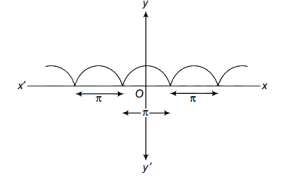
The period of $|\cos x|$ is
A
$\frac{\pi}{4}$
B
$\frac{\pi}{2}$
C
$\pi$
D
$2 \pi$
Solution
(C) Let $f(x) = |\cos x|$.
We know that the function $\cos x$ has a period of $2\pi$.
However,when we take the absolute value,the negative parts of the graph are reflected above the $x$-axis.
Specifically,$|\cos(x + \pi)| = |-\cos x| = |\cos x|$.
Since $f(x + \pi) = f(x)$,the fundamental period of the function $f(x) = |\cos x|$ is $\pi$.
As shown in the graph,the pattern of the function repeats every $\pi$ units.
We know that the function $\cos x$ has a period of $2\pi$.
However,when we take the absolute value,the negative parts of the graph are reflected above the $x$-axis.
Specifically,$|\cos(x + \pi)| = |-\cos x| = |\cos x|$.
Since $f(x + \pi) = f(x)$,the fundamental period of the function $f(x) = |\cos x|$ is $\pi$.
As shown in the graph,the pattern of the function repeats every $\pi$ units.
0 likes
View Solution35
EasyMCQ
Which of the following functions has a period of $2$?
A
$\cos \left( \frac{\pi}{3} x \right)$
B
$\cos \left( \frac{\pi}{2} x \right)$
C
$\cos (2 \pi x)$
D
$\cos (\pi x)$
Solution
(D) The period of the function $\cos (kx)$ is given by $T = \frac{2 \pi}{|k|}$.
We check each option:
$A) \cos \left( \frac{\pi}{3} x \right) \implies T = \frac{2 \pi}{\pi/3} = 6$.
$B) \cos \left( \frac{\pi}{2} x \right) \implies T = \frac{2 \pi}{\pi/2} = 4$.
$C) \cos (2 \pi x) \implies T = \frac{2 \pi}{2 \pi} = 1$.
$D) \cos (\pi x) \implies T = \frac{2 \pi}{\pi} = 2$.
Therefore,the function with period $2$ is $\cos (\pi x)$.
We check each option:
$A) \cos \left( \frac{\pi}{3} x \right) \implies T = \frac{2 \pi}{\pi/3} = 6$.
$B) \cos \left( \frac{\pi}{2} x \right) \implies T = \frac{2 \pi}{\pi/2} = 4$.
$C) \cos (2 \pi x) \implies T = \frac{2 \pi}{2 \pi} = 1$.
$D) \cos (\pi x) \implies T = \frac{2 \pi}{\pi} = 2$.
Therefore,the function with period $2$ is $\cos (\pi x)$.
0 likes
View Solution36
DifficultMCQ
If $n \in N$ and the period of $\frac{\cos nx}{\sin \left(\frac{x}{n}\right)}$ is $4\pi$,then $n$ is equal to
A
$4$
B
$3$
C
$2$
D
$1$
Solution
(C) The period of a function $f(x) = \frac{g(x)}{h(x)}$ is the least common multiple of the periods of $g(x)$ and $h(x)$.
Given $g(x) = \cos(nx)$,its period is $T_1 = \frac{2\pi}{n}$.
Given $h(x) = \sin\left(\frac{x}{n}\right)$,its period is $T_2 = \frac{2\pi}{1/n} = 2n\pi$.
The period of the quotient is the $LCM$ of $T_1$ and $T_2$.
Since $T_2$ is a multiple of $T_1$ (as $2n\pi = n^2 \cdot \frac{2\pi}{n}$),the period of the function is $T_2 = 2n\pi$.
Given $2n\pi = 4\pi$,we get $n = 2$.
Given $g(x) = \cos(nx)$,its period is $T_1 = \frac{2\pi}{n}$.
Given $h(x) = \sin\left(\frac{x}{n}\right)$,its period is $T_2 = \frac{2\pi}{1/n} = 2n\pi$.
The period of the quotient is the $LCM$ of $T_1$ and $T_2$.
Since $T_2$ is a multiple of $T_1$ (as $2n\pi = n^2 \cdot \frac{2\pi}{n}$),the period of the function is $T_2 = 2n\pi$.
Given $2n\pi = 4\pi$,we get $n = 2$.
0 likes
View Solution37
DifficultMCQ
If $f(x) = \sin^2\left(\frac{\pi}{8} + \frac{x}{2}\right) - \sin^2\left(\frac{\pi}{8} - \frac{x}{2}\right)$,then the period of $f$ is
A
$\frac{\pi}{3}$
B
$\frac{\pi}{2}$
C
$\pi$
D
$2\pi$
Solution
(D) We use the identity $\sin^2 A - \sin^2 B = \sin(A + B) \sin(A - B)$.
Here,$A = \frac{\pi}{8} + \frac{x}{2}$ and $B = \frac{\pi}{8} - \frac{x}{2}$.
Then $A + B = \frac{\pi}{8} + \frac{x}{2} + \frac{\pi}{8} - \frac{x}{2} = \frac{\pi}{4}$.
And $A - B = \frac{\pi}{8} + \frac{x}{2} - \left(\frac{\pi}{8} - \frac{x}{2}\right) = x$.
So,$f(x) = \sin\left(\frac{\pi}{4}\right) \sin(x) = \frac{1}{\sqrt{2}} \sin(x)$.
The period of $\sin(x)$ is $2\pi$.
Therefore,the period of $f(x)$ is $2\pi$.
Here,$A = \frac{\pi}{8} + \frac{x}{2}$ and $B = \frac{\pi}{8} - \frac{x}{2}$.
Then $A + B = \frac{\pi}{8} + \frac{x}{2} + \frac{\pi}{8} - \frac{x}{2} = \frac{\pi}{4}$.
And $A - B = \frac{\pi}{8} + \frac{x}{2} - \left(\frac{\pi}{8} - \frac{x}{2}\right) = x$.
So,$f(x) = \sin\left(\frac{\pi}{4}\right) \sin(x) = \frac{1}{\sqrt{2}} \sin(x)$.
The period of $\sin(x)$ is $2\pi$.
Therefore,the period of $f(x)$ is $2\pi$.
0 likes
View Solution38
MediumMCQ
If the period of the function $f(x) = \frac{\tan 5x \cos 3x}{\sin 6x}$ is $\alpha$,then find the value of $f\left(\frac{\alpha}{8}\right)$.
A
$\frac{1}{2}$
B
$-1$
C
$\frac{1}{\sqrt{2}}$
D
$-\frac{1}{\sqrt{2}}$
Solution
(C) The periods of $\tan 5x$,$\cos 3x$,and $\sin 6x$ are $\frac{\pi}{5}$,$\frac{2\pi}{3}$,and $\frac{\pi}{3}$ respectively.
To find the period $\alpha$ of $f(x) = \frac{\tan 5x \cos 3x}{\sin 6x}$,we simplify the expression:
$f(x) = \frac{\tan 5x \cos 3x}{2 \sin 3x \cos 3x} = \frac{\tan 5x}{2 \sin 3x}$.
The period of $\tan 5x$ is $\frac{\pi}{5}$ and the period of $\sin 3x$ is $\frac{2\pi}{3}$.
The period $\alpha$ of $f(x)$ is the least common multiple of $\frac{\pi}{5}$ and $\frac{2\pi}{3}$,which is $\frac{2\pi}{\gcd(1, 1)} = 2\pi$.
Thus,$\alpha = 2\pi$.
We need to evaluate $f\left(\frac{\alpha}{8}\right) = f\left(\frac{2\pi}{8}\right) = f\left(\frac{\pi}{4}\right)$.
$f\left(\frac{\pi}{4}\right) = \frac{\tan(5\pi/4)}{2 \sin(3\pi/4)} = \frac{1}{2 \times (1/\sqrt{2})} = \frac{1}{\sqrt{2}}$.
To find the period $\alpha$ of $f(x) = \frac{\tan 5x \cos 3x}{\sin 6x}$,we simplify the expression:
$f(x) = \frac{\tan 5x \cos 3x}{2 \sin 3x \cos 3x} = \frac{\tan 5x}{2 \sin 3x}$.
The period of $\tan 5x$ is $\frac{\pi}{5}$ and the period of $\sin 3x$ is $\frac{2\pi}{3}$.
The period $\alpha$ of $f(x)$ is the least common multiple of $\frac{\pi}{5}$ and $\frac{2\pi}{3}$,which is $\frac{2\pi}{\gcd(1, 1)} = 2\pi$.
Thus,$\alpha = 2\pi$.
We need to evaluate $f\left(\frac{\alpha}{8}\right) = f\left(\frac{2\pi}{8}\right) = f\left(\frac{\pi}{4}\right)$.
$f\left(\frac{\pi}{4}\right) = \frac{\tan(5\pi/4)}{2 \sin(3\pi/4)} = \frac{1}{2 \times (1/\sqrt{2})} = \frac{1}{\sqrt{2}}$.
0 likes
View Solution39
EasyMCQ
Let $f(x) = \cos(ax) + \sin(x)$ be a periodic function. Then $a$ must be
A
Irrational
B
Rational
C
Positive real number
D
Negative real number
Solution
(B) function $f(x) = f_1(x) + f_2(x)$ is periodic if both $f_1(x)$ and $f_2(x)$ are periodic and the ratio of their periods is a rational number.
Here,$f_1(x) = \cos(ax)$ has a period $T_1 = \frac{2\pi}{|a|}$ and $f_2(x) = \sin(x)$ has a period $T_2 = 2\pi$.
For $f(x)$ to be periodic,the ratio $\frac{T_1}{T_2} = \frac{2\pi/|a|}{2\pi} = \frac{1}{|a|}$ must be a rational number.
If $\frac{1}{|a|}$ is a rational number,then $|a|$ must be a rational number,which implies $a$ is a rational number.
Therefore,$a$ must be a rational number. Hence,option $B$ is correct.
Here,$f_1(x) = \cos(ax)$ has a period $T_1 = \frac{2\pi}{|a|}$ and $f_2(x) = \sin(x)$ has a period $T_2 = 2\pi$.
For $f(x)$ to be periodic,the ratio $\frac{T_1}{T_2} = \frac{2\pi/|a|}{2\pi} = \frac{1}{|a|}$ must be a rational number.
If $\frac{1}{|a|}$ is a rational number,then $|a|$ must be a rational number,which implies $a$ is a rational number.
Therefore,$a$ must be a rational number. Hence,option $B$ is correct.
0 likes
View Solution40
MediumMCQ
If $n \in N$ and the period of $\frac{\cos(nx)}{\sin(x/n)}$ is $4\pi$,then $n$ is equal to
A
$4$
B
$3$
C
$2$
D
$1$
Solution
(C) The period of $\cos(nx)$ is $T_1 = \frac{2\pi}{n}$.
The period of $\sin(x/n)$ is $T_2 = \frac{2\pi}{1/n} = 2n\pi$.
The period of the quotient $\frac{\cos(nx)}{\sin(x/n)}$ is the least common multiple of the periods of the numerator and the denominator.
Given that the period is $4\pi$,we have $2n\pi = 4\pi$.
Solving for $n$,we get $n = 2$.
The period of $\sin(x/n)$ is $T_2 = \frac{2\pi}{1/n} = 2n\pi$.
The period of the quotient $\frac{\cos(nx)}{\sin(x/n)}$ is the least common multiple of the periods of the numerator and the denominator.
Given that the period is $4\pi$,we have $2n\pi = 4\pi$.
Solving for $n$,we get $n = 2$.
0 likes
View Solution41
EasyMCQ
The period of $\tan(ky) + \sin(ky)$,where $k = 1 + 4 + 9 + \ldots$ ($20$ terms),is
A
$\frac{\pi}{1435}$
B
$\frac{2\pi}{1435}$
C
$\pi$
D
$2\pi$
Solution
(B) The value of $k$ is the sum of the squares of the first $20$ natural numbers:
$k = \sum_{n=1}^{20} n^2 = \frac{n(n+1)(2n+1)}{6}$ for $n=20$.
$k = \frac{20 \times 21 \times 41}{6} = 70 \times 41 = 2870$.
We need the period of $f(y) = \tan(2870y) + \sin(2870y)$.
The period of $\tan(ky)$ is $T_1 = \frac{\pi}{k} = \frac{\pi}{2870}$.
The period of $\sin(ky)$ is $T_2 = \frac{2\pi}{k} = \frac{2\pi}{2870} = \frac{\pi}{1435}$.
The period of the sum of two functions is the Least Common Multiple $(LCM)$ of their individual periods.
$LCM\left(\frac{\pi}{2870}, \frac{2\pi}{2870}\right) = \frac{LCM(\pi, 2\pi)}{GCD(2870, 2870)} = \frac{2\pi}{2870} = \frac{\pi}{1435}$.
$k = \sum_{n=1}^{20} n^2 = \frac{n(n+1)(2n+1)}{6}$ for $n=20$.
$k = \frac{20 \times 21 \times 41}{6} = 70 \times 41 = 2870$.
We need the period of $f(y) = \tan(2870y) + \sin(2870y)$.
The period of $\tan(ky)$ is $T_1 = \frac{\pi}{k} = \frac{\pi}{2870}$.
The period of $\sin(ky)$ is $T_2 = \frac{2\pi}{k} = \frac{2\pi}{2870} = \frac{\pi}{1435}$.
The period of the sum of two functions is the Least Common Multiple $(LCM)$ of their individual periods.
$LCM\left(\frac{\pi}{2870}, \frac{2\pi}{2870}\right) = \frac{LCM(\pi, 2\pi)}{GCD(2870, 2870)} = \frac{2\pi}{2870} = \frac{\pi}{1435}$.
0 likes
View Solution42
EasyMCQ
Let $\alpha$ be the period of $3 \sin \frac{\pi x}{3} - \cos \frac{\pi x}{2} + \tan \frac{\pi x}{4}$,$\beta$ be the period of $\sin^2 \left( \frac{\pi}{7} + \frac{x}{4} \right) - \sin^2 \left( \frac{\pi}{7} - \frac{x}{4} \right)$,and $\gamma$ be the period of $\cos^4 x + \sin^4 x$. Then $\frac{\alpha \gamma}{\beta} = $
A
$\frac{3}{2}$
B
$\frac{3}{4}$
C
$3$
D
$6$
Solution
(A) The period of $f(x) = 3 \sin \frac{\pi x}{3} - \cos \frac{\pi x}{2} + \tan \frac{\pi x}{4}$ is the $LCM$ of the periods of its components. The periods are $T_1 = \frac{2\pi}{\pi/3} = 6$,$T_2 = \frac{2\pi}{\pi/2} = 4$,and $T_3 = \frac{\pi}{\pi/4} = 4$. Thus,$\alpha = \text{LCM}(6, 4, 4) = 12$.
For $\beta$,use the identity $\sin^2 A - \sin^2 B = \sin(A+B)\sin(A-B)$. Here,$\sin^2 \left( \frac{\pi}{7} + \frac{x}{4} \right) - \sin^2 \left( \frac{\pi}{7} - \frac{x}{4} \right) = \sin \left( \frac{2\pi}{7} \right) \sin \left( \frac{x}{2} \right)$. The period is $\beta = \frac{2\pi}{1/2} = 4\pi$.
For $\gamma$,$\cos^4 x + \sin^4 x = 1 - 2 \sin^2 x \cos^2 x = 1 - \frac{1}{2} \sin^2(2x) = 1 - \frac{1}{2} \left( \frac{1 - \cos(4x)}{2} \right) = \frac{3}{4} + \frac{1}{4} \cos(4x)$. The period is $\gamma = \frac{2\pi}{4} = \frac{\pi}{2}$.
Finally,$\frac{\alpha \gamma}{\beta} = \frac{12 \times \frac{\pi}{2}}{4\pi} = \frac{6\pi}{4\pi} = \frac{3}{2}$.
For $\beta$,use the identity $\sin^2 A - \sin^2 B = \sin(A+B)\sin(A-B)$. Here,$\sin^2 \left( \frac{\pi}{7} + \frac{x}{4} \right) - \sin^2 \left( \frac{\pi}{7} - \frac{x}{4} \right) = \sin \left( \frac{2\pi}{7} \right) \sin \left( \frac{x}{2} \right)$. The period is $\beta = \frac{2\pi}{1/2} = 4\pi$.
For $\gamma$,$\cos^4 x + \sin^4 x = 1 - 2 \sin^2 x \cos^2 x = 1 - \frac{1}{2} \sin^2(2x) = 1 - \frac{1}{2} \left( \frac{1 - \cos(4x)}{2} \right) = \frac{3}{4} + \frac{1}{4} \cos(4x)$. The period is $\gamma = \frac{2\pi}{4} = \frac{\pi}{2}$.
Finally,$\frac{\alpha \gamma}{\beta} = \frac{12 \times \frac{\pi}{2}}{4\pi} = \frac{6\pi}{4\pi} = \frac{3}{2}$.
0 likes
View Solution43
EasyMCQ
The period of the function $f(\theta) = \sin \frac{\theta}{3} + \cos \frac{\theta}{2}$ is (in $\pi$)
A
$3$
B
$6$
C
$9$
D
$12$
Solution
(D) The period of $\sin(a\theta)$ is $\frac{2\pi}{|a|}$ and the period of $\cos(b\theta)$ is $\frac{2\pi}{|b|}$.
For $f(\theta) = \sin \frac{\theta}{3} + \cos \frac{\theta}{2}$, the period of $\sin \frac{\theta}{3}$ is $T_1 = \frac{2\pi}{1/3} = 6\pi$.
The period of $\cos \frac{\theta}{2}$ is $T_2 = \frac{2\pi}{1/2} = 4\pi$.
The period of the sum of two periodic functions is the Least Common Multiple $(LCM)$ of their individual periods.
We need to find the $LCM(6\pi, 4\pi)$.
$LCM(6, 4) = 12$.
Therefore, the period of $f(\theta)$ is $12\pi$.
For $f(\theta) = \sin \frac{\theta}{3} + \cos \frac{\theta}{2}$, the period of $\sin \frac{\theta}{3}$ is $T_1 = \frac{2\pi}{1/3} = 6\pi$.
The period of $\cos \frac{\theta}{2}$ is $T_2 = \frac{2\pi}{1/2} = 4\pi$.
The period of the sum of two periodic functions is the Least Common Multiple $(LCM)$ of their individual periods.
We need to find the $LCM(6\pi, 4\pi)$.
$LCM(6, 4) = 12$.
Therefore, the period of $f(\theta)$ is $12\pi$.
0 likes
View Solution44
DifficultMCQ
If the period of the function $f(x) = 2 \cos(3x + 4) - 3 \tan(2x - 3) + 5 \sin(5x) - 7$ is $k$,then
A
$\sin \frac{k}{8} = \frac{1}{2}$
B
$\cos \frac{k}{6} = \frac{1}{\sqrt{2}}$
C
$\tan \frac{k}{3} = -\sqrt{3}$
D
$\sec \frac{k}{2} = 2$
Solution
(C) The period of $\cos(3x + 4)$ is $T_1 = \frac{2\pi}{3}$.
The period of $\tan(2x - 3)$ is $T_2 = \frac{\pi}{2}$.
The period of $\sin(5x)$ is $T_3 = \frac{2\pi}{5}$.
The period $k$ of $f(x)$ is the $L$.$C$.$M$. of $T_1, T_2, T_3$,which is $\text{L.C.M.}\left(\frac{2\pi}{3}, \frac{\pi}{2}, \frac{2\pi}{5}\right) = \frac{\text{L.C.M.}(2\pi, \pi, 2\pi)}{\text{H.C.F.}(3, 2, 5)} = \frac{2\pi}{1} = 2\pi$.
Thus,$k = 2\pi$.
Checking option $C$: $\tan \frac{k}{3} = \tan \frac{2\pi}{3} = -\sqrt{3}$.
The period of $\tan(2x - 3)$ is $T_2 = \frac{\pi}{2}$.
The period of $\sin(5x)$ is $T_3 = \frac{2\pi}{5}$.
The period $k$ of $f(x)$ is the $L$.$C$.$M$. of $T_1, T_2, T_3$,which is $\text{L.C.M.}\left(\frac{2\pi}{3}, \frac{\pi}{2}, \frac{2\pi}{5}\right) = \frac{\text{L.C.M.}(2\pi, \pi, 2\pi)}{\text{H.C.F.}(3, 2, 5)} = \frac{2\pi}{1} = 2\pi$.
Thus,$k = 2\pi$.
Checking option $C$: $\tan \frac{k}{3} = \tan \frac{2\pi}{3} = -\sqrt{3}$.
0 likes
View Solution45
MediumMCQ
The period of $\frac{\sin x}{\cos 3x} + \frac{\sin 3x}{\cos 9x} + \frac{\sin 9x}{\cos 27x} + \frac{\sin 27x}{\cos 81x}$ is
A
$\frac{2\pi}{3}$
B
$\frac{\pi}{81}$
C
$2\pi$
D
$\pi$
Solution
(D) Let $f(x) = \frac{\sin x}{\cos 3x} + \frac{\sin 3x}{\cos 9x} + \frac{\sin 9x}{\cos 27x} + \frac{\sin 27x}{\cos 81x}$.
Using the identity $\tan \theta - \tan \phi = \frac{\sin(\theta - \phi)}{\cos \theta \cos \phi}$,we can rewrite each term:
$\frac{\sin x}{\cos 3x} = \frac{1}{2} \frac{\sin(3x - x)}{\cos 3x \cos x} = \frac{1}{2}(\tan 3x - \tan x)$.
Similarly,$\frac{\sin 3x}{\cos 9x} = \frac{1}{2}(\tan 9x - \tan 3x)$,
$\frac{\sin 9x}{\cos 27x} = \frac{1}{2}(\tan 27x - \tan 9x)$,
$\frac{\sin 27x}{\cos 81x} = \frac{1}{2}(\tan 81x - \tan 27x)$.
Summing these,we get $f(x) = \frac{1}{2}(\tan 81x - \tan x)$.
The period of $\tan(kx)$ is $\frac{\pi}{|k|}$.
The period of $\tan 81x$ is $\frac{\pi}{81}$ and the period of $\tan x$ is $\pi$.
The period of the sum is the $L$.$C$.$M$. of the individual periods: $\text{L.C.M.}\left(\frac{\pi}{81}, \pi\right) = \pi$.
Using the identity $\tan \theta - \tan \phi = \frac{\sin(\theta - \phi)}{\cos \theta \cos \phi}$,we can rewrite each term:
$\frac{\sin x}{\cos 3x} = \frac{1}{2} \frac{\sin(3x - x)}{\cos 3x \cos x} = \frac{1}{2}(\tan 3x - \tan x)$.
Similarly,$\frac{\sin 3x}{\cos 9x} = \frac{1}{2}(\tan 9x - \tan 3x)$,
$\frac{\sin 9x}{\cos 27x} = \frac{1}{2}(\tan 27x - \tan 9x)$,
$\frac{\sin 27x}{\cos 81x} = \frac{1}{2}(\tan 81x - \tan 27x)$.
Summing these,we get $f(x) = \frac{1}{2}(\tan 81x - \tan x)$.
The period of $\tan(kx)$ is $\frac{\pi}{|k|}$.
The period of $\tan 81x$ is $\frac{\pi}{81}$ and the period of $\tan x$ is $\pi$.
The period of the sum is the $L$.$C$.$M$. of the individual periods: $\text{L.C.M.}\left(\frac{\pi}{81}, \pi\right) = \pi$.
0 likes
View Solution46
MediumMCQ
The period of the function $f(x) = \frac{2 \sin \left(\frac{\pi x}{3}\right) \cos \left(\frac{2 \pi x}{5}\right)}{3 \tan \left(\frac{7 \pi x}{2}\right) - 5 \sec \left(\frac{5 \pi x}{3}\right)}$ is
A
$30$
B
$60$
C
$300$
D
$150$
Solution
(A) To find the period of $f(x)$,we find the periods of the individual trigonometric functions in the numerator and denominator.
Numerator: $2 \sin \left(\frac{\pi x}{3}\right) \cos \left(\frac{2 \pi x}{5}\right) = \sin \left(\frac{\pi x}{3} + \frac{2 \pi x}{5}\right) + \sin \left(\frac{\pi x}{3} - \frac{2 \pi x}{5}\right) = \sin \left(\frac{11 \pi x}{15}\right) - \sin \left(\frac{\pi x}{15}\right)$.
The period of $\sin \left(\frac{11 \pi x}{15}\right)$ is $T_1 = \frac{2 \pi}{11 \pi / 15} = \frac{30}{11}$.
The period of $\sin \left(\frac{\pi x}{15}\right)$ is $T_2 = \frac{2 \pi}{\pi / 15} = 30$.
The period of the numerator is $\text{LCM} \left(\frac{30}{11}, 30\right) = \frac{\text{LCM}(30, 30)}{\text{HCF}(11, 1)} = 30$.
Denominator: The period of $\tan \left(\frac{7 \pi x}{2}\right)$ is $T_3 = \frac{\pi}{7 \pi / 2} = \frac{2}{7}$.
The period of $\sec \left(\frac{5 \pi x}{3}\right)$ is $T_4 = \frac{2 \pi}{5 \pi / 3} = \frac{6}{5}$.
The period of the denominator is $\text{LCM} \left(\frac{2}{7}, \frac{6}{5}\right) = \frac{\text{LCM}(2, 6)}{\text{HCF}(7, 5)} = \frac{6}{1} = 6$.
The period of $f(x)$ is $\text{LCM}(30, 6) = 30$.
Numerator: $2 \sin \left(\frac{\pi x}{3}\right) \cos \left(\frac{2 \pi x}{5}\right) = \sin \left(\frac{\pi x}{3} + \frac{2 \pi x}{5}\right) + \sin \left(\frac{\pi x}{3} - \frac{2 \pi x}{5}\right) = \sin \left(\frac{11 \pi x}{15}\right) - \sin \left(\frac{\pi x}{15}\right)$.
The period of $\sin \left(\frac{11 \pi x}{15}\right)$ is $T_1 = \frac{2 \pi}{11 \pi / 15} = \frac{30}{11}$.
The period of $\sin \left(\frac{\pi x}{15}\right)$ is $T_2 = \frac{2 \pi}{\pi / 15} = 30$.
The period of the numerator is $\text{LCM} \left(\frac{30}{11}, 30\right) = \frac{\text{LCM}(30, 30)}{\text{HCF}(11, 1)} = 30$.
Denominator: The period of $\tan \left(\frac{7 \pi x}{2}\right)$ is $T_3 = \frac{\pi}{7 \pi / 2} = \frac{2}{7}$.
The period of $\sec \left(\frac{5 \pi x}{3}\right)$ is $T_4 = \frac{2 \pi}{5 \pi / 3} = \frac{6}{5}$.
The period of the denominator is $\text{LCM} \left(\frac{2}{7}, \frac{6}{5}\right) = \frac{\text{LCM}(2, 6)}{\text{HCF}(7, 5)} = \frac{6}{1} = 6$.
The period of $f(x)$ is $\text{LCM}(30, 6) = 30$.
0 likes
View SolutionTrigonometrical Equations — Periodic functions · Frequently Asked Questions
1Are these Trigonometrical Equations questions useful for JEE and NEET?
Yes. All questions in this section are mapped to JEE Main and NEET exam patterns. Previous year questions from JEE Main, NEET, GUJCET and state-level exams are included with full solutions.
2Can I switch to Hindi or Gujarati for these questions?
Yes. Use the language tabs in the hero section or the sidebar to view the same questions and solutions in English, Hindi or Gujarati.
3How do I generate a question paper from this subtopic?
Use the Vedclass Exam Paper Generator — select the chapter and subtopic, set difficulty, and generate Sets A, B, C, D automatically. First 3 chapters of every subject are free.
Vedclass Products
For Students
Vedclass Test Series
Mock tests in real JEE/NEET style with performance analysis. 5-day free trial.
Start Free TrialFor Teachers
Exam Paper Generator
Generate Set A/B/C/D papers from this chapter in 2 minutes. 3 chapters free.
Try FreeFor Institutes
Online Exam Module
Live online exams with unlimited students, 360° analytics & white-label branding.
See DemoFor Teachers & Institutes
Generate a Trigonometrical Equations Exam Paper in 2 Minutes
Select subtopic & difficulty — Sets A, B, C, D auto-generated with No Repeat logic.
First 3 chapters of every subject are free — no payment required.