
A English
System of co-ordinates, Distance between two points, Section formulae Questions in English
Class 11 Mathematics · Straight Line · System of co-ordinates, Distance between two points, Section formulae
89+
Questions
English
Language
100%
With Solutions
Showing 38 of 89 questions in English
51
EasyMCQ
Find the number of points on the $x$-axis that are at a distance of $c$ units from $(2, 3)$,where $c < 3$.
A
$1$
B
$2$
C
$0$
D
$3$
Solution
(C) Let the point on the $x$-axis be $P(x, 0)$.
Given the distance between $P(x, 0)$ and $(2, 3)$ is $c$.
Using the distance formula: $\sqrt{(x-2)^2 + (0-3)^2} = c$.
Squaring both sides: $(x-2)^2 + 9 = c^2$.
Since $c < 3$,$c^2 < 9$.
Therefore,$(x-2)^2 = c^2 - 9$.
Since $c^2 < 9$,$c^2 - 9 < 0$.
Since the square of a real number cannot be negative,there is no real value of $x$ that satisfies this equation.
Thus,the number of such points is $0$.
Given the distance between $P(x, 0)$ and $(2, 3)$ is $c$.
Using the distance formula: $\sqrt{(x-2)^2 + (0-3)^2} = c$.
Squaring both sides: $(x-2)^2 + 9 = c^2$.
Since $c < 3$,$c^2 < 9$.
Therefore,$(x-2)^2 = c^2 - 9$.
Since $c^2 < 9$,$c^2 - 9 < 0$.
Since the square of a real number cannot be negative,there is no real value of $x$ that satisfies this equation.
Thus,the number of such points is $0$.
0 likes
View Solution52
EasyMCQ
In what ratio does the point $(8, 4)$ divide the line segment joining the points $(5, -2)$ and $(9, 6)$?
A
$2 : 1$
B
$3 : 1$
C
$2 : 3$
D
$1 : 2$
Solution
(B) Let the point $P(8, 4)$ divide the line segment joining $A(5, -2)$ and $B(9, 6)$ in the ratio $k : 1$.
Using the section formula,the coordinates of $P$ are given by:
$P = \left( \frac{k(9) + 1(5)}{k + 1}, \frac{k(6) + 1(-2)}{k + 1} \right)$
Equating the $x$-coordinate:
$8 = \frac{9k + 5}{k + 1}$
$8(k + 1) = 9k + 5$
$8k + 8 = 9k + 5$
$8 - 5 = 9k - 8k$
$k = 3$
Thus,the ratio $k : 1$ is $3 : 1$.
Using the section formula,the coordinates of $P$ are given by:
$P = \left( \frac{k(9) + 1(5)}{k + 1}, \frac{k(6) + 1(-2)}{k + 1} \right)$
Equating the $x$-coordinate:
$8 = \frac{9k + 5}{k + 1}$
$8(k + 1) = 9k + 5$
$8k + 8 = 9k + 5$
$8 - 5 = 9k - 8k$
$k = 3$
Thus,the ratio $k : 1$ is $3 : 1$.
0 likes
View Solution53
MediumMCQ
Three points $P, Q,$ and $R$ lie on the line segment joining points $A(-6, 8)$ and $B(8, -6)$ such that $AP = PQ = QR = RB$. Find the coordinates of $R$.
A
$(-5/2, 9/2)$
B
$(5/2, 9/2)$
C
$(5/2, -9/2)$
D
$(9/2, -5/2)$
Solution
(D) The points $P, Q,$ and $R$ divide the line segment $AB$ into four equal parts. Thus,the ratio $AR:RB$ is $3:1$.
Using the section formula,if a point $(x, y)$ divides the line segment joining $(x_1, y_1)$ and $(x_2, y_2)$ in the ratio $m:n$,the coordinates are given by:
$x = \frac{mx_2 + nx_1}{m+n}, y = \frac{my_2 + ny_1}{m+n}$
For point $R$,$m=3$ and $n=1$,with $A(-6, 8)$ and $B(8, -6)$:
$x = \frac{3(8) + 1(-6)}{3+1} = \frac{24 - 6}{4} = \frac{18}{4} = \frac{9}{2}$
$y = \frac{3(-6) + 1(8)}{3+1} = \frac{-18 + 8}{4} = \frac{-10}{4} = -\frac{5}{2}$
Therefore,the coordinates of $R$ are $(\frac{9}{2}, -\frac{5}{2})$.
Using the section formula,if a point $(x, y)$ divides the line segment joining $(x_1, y_1)$ and $(x_2, y_2)$ in the ratio $m:n$,the coordinates are given by:
$x = \frac{mx_2 + nx_1}{m+n}, y = \frac{my_2 + ny_1}{m+n}$
For point $R$,$m=3$ and $n=1$,with $A(-6, 8)$ and $B(8, -6)$:
$x = \frac{3(8) + 1(-6)}{3+1} = \frac{24 - 6}{4} = \frac{18}{4} = \frac{9}{2}$
$y = \frac{3(-6) + 1(8)}{3+1} = \frac{-18 + 8}{4} = \frac{-10}{4} = -\frac{5}{2}$
Therefore,the coordinates of $R$ are $(\frac{9}{2}, -\frac{5}{2})$.
0 likes
View Solution54
EasyMCQ
What is the distance of the point $(6, 8)$ from the $x$-axis?
A
$10$
B
$6$
C
$8$
D
None of these
Solution
(C) The distance of a point $(x, y)$ from the $x$-axis is given by the absolute value of its $y$-coordinate,which is $|y|$.
Given the point $(6, 8)$,the $x$-coordinate is $6$ and the $y$-coordinate is $8$.
Therefore,the distance from the $x$-axis is $|8| = 8$ units.
Given the point $(6, 8)$,the $x$-coordinate is $6$ and the $y$-coordinate is $8$.
Therefore,the distance from the $x$-axis is $|8| = 8$ units.
0 likes
View Solution55
EasyMCQ
What are the coordinates of the point that divides the line segment joining the points $(-3, -4)$ and $(-8, 7)$ externally in the ratio $7 : 5$?
A
$(41/2, 69/2)$
B
$(-41/2, -69/2)$
C
$(-41/2, 69/2)$
D
None of these
Solution
(C) The formula for external division of a line segment joining points $(x_1, y_1)$ and $(x_2, y_2)$ in the ratio $m : n$ is given by:
$P = (\frac{mx_2 - nx_1}{m - n}, \frac{my_2 - ny_1}{m - n})$
Given points are $(x_1, y_1) = (-3, -4)$ and $(x_2, y_2) = (-8, 7)$ with ratio $m : n = 7 : 5$.
Substituting the values:
$x = \frac{7(-8) - 5(-3)}{7 - 5} = \frac{-56 + 15}{2} = \frac{-41}{2}$
$y = \frac{7(7) - 5(-4)}{7 - 5} = \frac{49 + 20}{2} = \frac{69}{2}$
Thus,the coordinates are $(-41/2, 69/2)$.
$P = (\frac{mx_2 - nx_1}{m - n}, \frac{my_2 - ny_1}{m - n})$
Given points are $(x_1, y_1) = (-3, -4)$ and $(x_2, y_2) = (-8, 7)$ with ratio $m : n = 7 : 5$.
Substituting the values:
$x = \frac{7(-8) - 5(-3)}{7 - 5} = \frac{-56 + 15}{2} = \frac{-41}{2}$
$y = \frac{7(7) - 5(-4)}{7 - 5} = \frac{49 + 20}{2} = \frac{69}{2}$
Thus,the coordinates are $(-41/2, 69/2)$.
0 likes
View Solution56
EasyMCQ
What is the square root of the sum of the squares of the lengths of the perpendiculars drawn from the point $(-3, 4)$ to both axes?
A
$5$
B
$2$
C
$4$
D
$1$
Solution
(A) Let the point be $P(-3, 4)$.
The perpendicular distance from $P(-3, 4)$ to the $x$-axis is $|y| = |4| = 4$.
The perpendicular distance from $P(-3, 4)$ to the $y$-axis is $|x| = |-3| = 3$.
The sum of the squares of these lengths is $4^2 + 3^2 = 16 + 9 = 25$.
The square root of this sum is $\sqrt{25} = 5$.
The perpendicular distance from $P(-3, 4)$ to the $x$-axis is $|y| = |4| = 4$.
The perpendicular distance from $P(-3, 4)$ to the $y$-axis is $|x| = |-3| = 3$.
The sum of the squares of these lengths is $4^2 + 3^2 = 16 + 9 = 25$.
The square root of this sum is $\sqrt{25} = 5$.
0 likes
View Solution57
MediumMCQ
What are the Cartesian coordinates of $(2, \pi /4)$?
A
$(2, 2)$
B
$(\sqrt{2}, 2)$
C
$(\sqrt{2}, \sqrt{2})$
D
$(-\sqrt{2}, -\sqrt{2})$
Solution
(C) The polar coordinates are given as $(r, \theta) = (2, \pi /4)$.
To convert polar coordinates $(r, \theta)$ to Cartesian coordinates $(x, y)$,we use the formulas:
$x = r \cos \theta$
$y = r \sin \theta$
Substituting the given values:
$x = 2 \cos(\pi /4) = 2 \times (1 / \sqrt{2}) = \sqrt{2}$
$y = 2 \sin(\pi /4) = 2 \times (1 / \sqrt{2}) = \sqrt{2}$
Thus,the Cartesian coordinates are $(\sqrt{2}, \sqrt{2})$.
To convert polar coordinates $(r, \theta)$ to Cartesian coordinates $(x, y)$,we use the formulas:
$x = r \cos \theta$
$y = r \sin \theta$
Substituting the given values:
$x = 2 \cos(\pi /4) = 2 \times (1 / \sqrt{2}) = \sqrt{2}$
$y = 2 \sin(\pi /4) = 2 \times (1 / \sqrt{2}) = \sqrt{2}$
Thus,the Cartesian coordinates are $(\sqrt{2}, \sqrt{2})$.
0 likes
View Solution58
EasyMCQ
$A (-3, 4)$ and $B (2, 1)$ are two given points. If $C$ is a point on $AB$ such that $AC = 2BC$,find the coordinates of $C$.
A
$(3, 7)$
B
$(2, 4)$
C
$(7, -2)$
D
$(-1/2, -5/2)$
Solution
(C) Given $AC = 2BC$,which implies $\frac{AC}{BC} = \frac{2}{1}$.
Since $C$ lies on the line segment $AB$,it divides $AB$ internally in the ratio $m:n = 2:1$.
Using the internal section formula,the coordinates of $C(x, y)$ are given by:
$x = \frac{mx_2 + nx_1}{m+n} = \frac{2(2) + 1(-3)}{2+1} = \frac{4-3}{3} = \frac{1}{3}$
$y = \frac{my_2 + ny_1}{m+n} = \frac{2(1) + 1(4)}{2+1} = \frac{2+4}{3} = \frac{6}{3} = 2$
Thus,the coordinates of $C$ are $(\frac{1}{3}, 2)$.
Note: The provided options do not contain the correct result $(\frac{1}{3}, 2)$. However,if $C$ were to divide $AB$ externally in the ratio $2:1$,the coordinates would be:
$x = \frac{mx_2 - nx_1}{m-n} = \frac{2(2) - 1(-3)}{2-1} = \frac{4+3}{1} = 7$
$y = \frac{my_2 - ny_1}{m-n} = \frac{2(1) - 1(4)}{2-1} = \frac{2-4}{1} = -2$
This matches option $C$.
Since $C$ lies on the line segment $AB$,it divides $AB$ internally in the ratio $m:n = 2:1$.
Using the internal section formula,the coordinates of $C(x, y)$ are given by:
$x = \frac{mx_2 + nx_1}{m+n} = \frac{2(2) + 1(-3)}{2+1} = \frac{4-3}{3} = \frac{1}{3}$
$y = \frac{my_2 + ny_1}{m+n} = \frac{2(1) + 1(4)}{2+1} = \frac{2+4}{3} = \frac{6}{3} = 2$
Thus,the coordinates of $C$ are $(\frac{1}{3}, 2)$.
Note: The provided options do not contain the correct result $(\frac{1}{3}, 2)$. However,if $C$ were to divide $AB$ externally in the ratio $2:1$,the coordinates would be:
$x = \frac{mx_2 - nx_1}{m-n} = \frac{2(2) - 1(-3)}{2-1} = \frac{4+3}{1} = 7$
$y = \frac{my_2 - ny_1}{m-n} = \frac{2(1) - 1(4)}{2-1} = \frac{2-4}{1} = -2$
This matches option $C$.
0 likes
View Solution59
DifficultMCQ
If the line segment joining the points $(0, 0)$ and $(3, 4)$ is the hypotenuse of a right-angled triangle,what is the length of the median to the hypotenuse?
A
$3$
B
$2$
C
$2.5$
D
$3.5$
Solution
(C) In a right-angled triangle,the length of the median to the hypotenuse is equal to half the length of the hypotenuse.
First,calculate the length of the hypotenuse using the distance formula between $(0, 0)$ and $(3, 4)$:
$L = \sqrt{(3 - 0)^2 + (4 - 0)^2} = \sqrt{3^2 + 4^2} = \sqrt{9 + 16} = \sqrt{25} = 5$.
The length of the median to the hypotenuse is half of the hypotenuse length:
$\text{Median} = \frac{1}{2} \times 5 = 2.5$.
First,calculate the length of the hypotenuse using the distance formula between $(0, 0)$ and $(3, 4)$:
$L = \sqrt{(3 - 0)^2 + (4 - 0)^2} = \sqrt{3^2 + 4^2} = \sqrt{9 + 16} = \sqrt{25} = 5$.
The length of the median to the hypotenuse is half of the hypotenuse length:
$\text{Median} = \frac{1}{2} \times 5 = 2.5$.
0 likes
View Solution60
MediumMCQ
The point $A$ divides the join of the points $(-5, 1)$ and $(3, 5)$ in the ratio $k : 1$. The coordinates of the points $B$ and $C$ are $(1, 5)$ and $(7, -2)$ respectively. If the area of the triangle $ABC$ is $2$ square units,then $k =$
A
$6, 7$
B
$31/9, 9$
C
$7, 31/9$
D
$7, 9$
Solution
(C) The coordinates of point $A$ using the section formula are $\left( \frac{3k - 5}{k + 1}, \frac{5k + 1}{k + 1} \right)$.
Given $B = (1, 5)$ and $C = (7, -2)$,the area of $\triangle ABC$ is given by $\frac{1}{2} |x_1(y_2 - y_3) + x_2(y_3 - y_1) + x_3(y_1 - y_2)| = 2$.
Substituting the coordinates: $\frac{1}{2} \left| \frac{3k - 5}{k + 1}(5 - (-2)) + 1(-2 - \frac{5k + 1}{k + 1}) + 7(\frac{5k + 1}{k + 1} - 5) \right| = 2$.
$\frac{1}{2} \left| \frac{7(3k - 5) - (2k + 2 + 5k + 1) + 7(5k + 1 - 5k - 5)}{k + 1} \right| = 2$.
$\frac{1}{2} \left| \frac{21k - 35 - 7k - 3 - 28}{k + 1} \right| = 2$.
$|14k - 66| = 4|k + 1|$.
Case $1$: $14k - 66 = 4k + 4$ $\Rightarrow 10k = 70$ $\Rightarrow k = 7$.
Case $2$: $14k - 66 = -4k - 4$ $\Rightarrow 18k = 62$ $\Rightarrow k = 31/9$.
Given $B = (1, 5)$ and $C = (7, -2)$,the area of $\triangle ABC$ is given by $\frac{1}{2} |x_1(y_2 - y_3) + x_2(y_3 - y_1) + x_3(y_1 - y_2)| = 2$.
Substituting the coordinates: $\frac{1}{2} \left| \frac{3k - 5}{k + 1}(5 - (-2)) + 1(-2 - \frac{5k + 1}{k + 1}) + 7(\frac{5k + 1}{k + 1} - 5) \right| = 2$.
$\frac{1}{2} \left| \frac{7(3k - 5) - (2k + 2 + 5k + 1) + 7(5k + 1 - 5k - 5)}{k + 1} \right| = 2$.
$\frac{1}{2} \left| \frac{21k - 35 - 7k - 3 - 28}{k + 1} \right| = 2$.
$|14k - 66| = 4|k + 1|$.
Case $1$: $14k - 66 = 4k + 4$ $\Rightarrow 10k = 70$ $\Rightarrow k = 7$.
Case $2$: $14k - 66 = -4k - 4$ $\Rightarrow 18k = 62$ $\Rightarrow k = 31/9$.
0 likes
View Solution61
AdvancedMCQ
If $A$ and $B$ are the points $(-3, 4)$ and $(2, 1)$,then the coordinates of the point $C$ on $AB$ produced such that $AC = 2 BC$ are:
A
$(2, 4)$
B
$(3, 7)$
C
$(7, -2)$
D
$\left(-\frac{1}{2}, \frac{5}{2}\right)$
Solution
(C) Given $AC = 2 BC$,we have $\frac{AC}{BC} = \frac{2}{1}$.
Since $C$ lies on $AB$ produced,$C$ divides the line segment $AB$ externally in the ratio $m:n = 2:1$.
The coordinates of a point dividing the segment joining $(x_1, y_1)$ and $(x_2, y_2)$ externally in the ratio $m:n$ are given by $\left(\frac{mx_2 - nx_1}{m-n}, \frac{my_2 - ny_1}{m-n}\right)$.
Substituting $(x_1, y_1) = (-3, 4)$,$(x_2, y_2) = (2, 1)$,$m = 2$,and $n = 1$:
$x = \frac{2(2) - 1(-3)}{2-1} = \frac{4 + 3}{1} = 7$
$y = \frac{2(1) - 1(4)}{2-1} = \frac{2 - 4}{1} = -2$
Thus,the coordinates of $C$ are $(7, -2)$.
Since $C$ lies on $AB$ produced,$C$ divides the line segment $AB$ externally in the ratio $m:n = 2:1$.
The coordinates of a point dividing the segment joining $(x_1, y_1)$ and $(x_2, y_2)$ externally in the ratio $m:n$ are given by $\left(\frac{mx_2 - nx_1}{m-n}, \frac{my_2 - ny_1}{m-n}\right)$.
Substituting $(x_1, y_1) = (-3, 4)$,$(x_2, y_2) = (2, 1)$,$m = 2$,and $n = 1$:
$x = \frac{2(2) - 1(-3)}{2-1} = \frac{4 + 3}{1} = 7$
$y = \frac{2(1) - 1(4)}{2-1} = \frac{2 - 4}{1} = -2$
Thus,the coordinates of $C$ are $(7, -2)$.
0 likes
View Solution62
EasyMCQ
Find the distance between $P(x_{1}, y_{1})$ and $Q(x_{2}, y_{2})$ when $PQ$ is parallel to the $y$-axis.
A
$|y_{2}-y_{1}|$
B
$|x_{2}-x_{1}|$
C
$|x_{1}+x_{2}|$
D
$|y_{1}+y_{2}|$
Solution
(A) The given points are $P(x_{1}, y_{1})$ and $Q(x_{2}, y_{2})$.
When $PQ$ is parallel to the $y$-axis,the $x$-coordinates are equal,so $x_{1} = x_{2}$.
The distance formula between two points is given by $d = \sqrt{(x_{2}-x_{1})^{2} + (y_{2}-y_{1})^{2}}$.
Substituting $x_{1} = x_{2}$ into the formula,we get $d = \sqrt{(x_{2}-x_{2})^{2} + (y_{2}-y_{1})^{2}}$.
$d = \sqrt{0^{2} + (y_{2}-y_{1})^{2}}$.
$d = \sqrt{(y_{2}-y_{1})^{2}} = |y_{2}-y_{1}|$.
When $PQ$ is parallel to the $y$-axis,the $x$-coordinates are equal,so $x_{1} = x_{2}$.
The distance formula between two points is given by $d = \sqrt{(x_{2}-x_{1})^{2} + (y_{2}-y_{1})^{2}}$.
Substituting $x_{1} = x_{2}$ into the formula,we get $d = \sqrt{(x_{2}-x_{2})^{2} + (y_{2}-y_{1})^{2}}$.
$d = \sqrt{0^{2} + (y_{2}-y_{1})^{2}}$.
$d = \sqrt{(y_{2}-y_{1})^{2}} = |y_{2}-y_{1}|$.
0 likes
View Solution63
MediumMCQ
Find the distance between $P(x_{1}, y_{1})$ and $Q(x_{2}, y_{2})$ when $PQ$ is parallel to the $x$-axis.
A
$|x_{2} - x_{1}|$
B
$|y_{2} - y_{1}|$
C
$\sqrt{(x_{2}-x_{1})^2 + (y_{2}-y_{1})^2}$
D
$0$
Solution
(A) The given points are $P(x_{1}, y_{1})$ and $Q(x_{2}, y_{2})$.
Since $PQ$ is parallel to the $x$-axis,the $y$-coordinates of both points must be equal,i.e.,$y_{1} = y_{2}$.
The distance formula is $d = \sqrt{(x_{2}-x_{1})^2 + (y_{2}-y_{1})^2}$.
Substituting $y_{2} = y_{1}$ into the formula,we get $d = \sqrt{(x_{2}-x_{1})^2 + (y_{1}-y_{1})^2}$.
$d = \sqrt{(x_{2}-x_{1})^2 + 0^2}$.
$d = \sqrt{(x_{2}-x_{1})^2} = |x_{2}-x_{1}|$.
Since $PQ$ is parallel to the $x$-axis,the $y$-coordinates of both points must be equal,i.e.,$y_{1} = y_{2}$.
The distance formula is $d = \sqrt{(x_{2}-x_{1})^2 + (y_{2}-y_{1})^2}$.
Substituting $y_{2} = y_{1}$ into the formula,we get $d = \sqrt{(x_{2}-x_{1})^2 + (y_{1}-y_{1})^2}$.
$d = \sqrt{(x_{2}-x_{1})^2 + 0^2}$.
$d = \sqrt{(x_{2}-x_{1})^2} = |x_{2}-x_{1}|$.
0 likes
View Solution64
MediumMCQ
Find a point on the $x$-axis,which is equidistant from the points $(7, 6)$ and $(3, 4)$.
A
$(15/2, 0)$
B
$(15/4, 0)$
C
$(15/8, 0)$
D
$(15/3, 0)$
Solution
(A) Let $(a, 0)$ be the point on the $x$-axis that is equidistant from the points $P(7, 6)$ and $Q(3, 4)$.
According to the distance formula,the distance from $(a, 0)$ to $(7, 6)$ is equal to the distance from $(a, 0)$ to $(3, 4)$.
$\sqrt{(7-a)^2 + (6-0)^2} = \sqrt{(3-a)^2 + (4-0)^2}$
Squaring both sides:
$(7-a)^2 + 36 = (3-a)^2 + 16$
$(49 - 14a + a^2) + 36 = (9 - 6a + a^2) + 16$
$85 - 14a = 25 - 6a$
$85 - 25 = 14a - 6a$
$60 = 8a$
$a = \frac{60}{8} = \frac{15}{2}$
Thus,the required point on the $x$-axis is $(\frac{15}{2}, 0)$.
According to the distance formula,the distance from $(a, 0)$ to $(7, 6)$ is equal to the distance from $(a, 0)$ to $(3, 4)$.
$\sqrt{(7-a)^2 + (6-0)^2} = \sqrt{(3-a)^2 + (4-0)^2}$
Squaring both sides:
$(7-a)^2 + 36 = (3-a)^2 + 16$
$(49 - 14a + a^2) + 36 = (9 - 6a + a^2) + 16$
$85 - 14a = 25 - 6a$
$85 - 25 = 14a - 6a$
$60 = 8a$
$a = \frac{60}{8} = \frac{15}{2}$
Thus,the required point on the $x$-axis is $(\frac{15}{2}, 0)$.
0 likes
View Solution65
MediumMCQ
Find the slope of a line,which passes through the origin and the mid-point of the line segment joining the points $P(0, -4)$ and $B(8, 0)$.
A
$1/2$
B
$-1/2$
C
$2$
D
$-2$
Solution
(B) The coordinates of the mid-point of the line segment joining the points $P(0, -4)$ and $B(8, 0)$ are calculated as:
$\left(\frac{0+8}{2}, \frac{-4+0}{2}\right) = (4, -2)$.
The slope $(m)$ of a line passing through two points $(x_1, y_1)$ and $(x_2, y_2)$ is given by the formula:
$m = \frac{y_2 - y_1}{x_2 - x_1}$.
The line passes through the origin $(0, 0)$ and the mid-point $(4, -2)$.
Substituting these values into the slope formula:
$m = \frac{-2 - 0}{4 - 0} = \frac{-2}{4} = -\frac{1}{2}$.
Thus,the slope of the line is $-\frac{1}{2}$.
$\left(\frac{0+8}{2}, \frac{-4+0}{2}\right) = (4, -2)$.
The slope $(m)$ of a line passing through two points $(x_1, y_1)$ and $(x_2, y_2)$ is given by the formula:
$m = \frac{y_2 - y_1}{x_2 - x_1}$.
The line passes through the origin $(0, 0)$ and the mid-point $(4, -2)$.
Substituting these values into the slope formula:
$m = \frac{-2 - 0}{4 - 0} = \frac{-2}{4} = -\frac{1}{2}$.
Thus,the slope of the line is $-\frac{1}{2}$.
0 likes
View Solution66
EasyMCQ
Write the equations for the $x$-axis and $y$-axis.
A
$x=0, y=0$
B
$x=1, y=1$
C
$x=0, y=1$
D
$x=1, y=0$
Solution
(A) The $y$-coordinate of every point on the $x$-axis is $0$.
Therefore,the equation of the $x$-axis is $y=0$.
The $x$-coordinate of every point on the $y$-axis is $0$.
Therefore,the equation of the $y$-axis is $x=0$.
Therefore,the equation of the $x$-axis is $y=0$.
The $x$-coordinate of every point on the $y$-axis is $0$.
Therefore,the equation of the $y$-axis is $x=0$.
0 likes
View Solution67
AdvancedMCQ
Let $A = (a_1, a_2)$ and $B = (b_1, b_2)$ be two points in the plane with integer coordinates. Which one of the following is not a possible value of the distance between $A$ and $B$?
A
$\sqrt{65}$
B
$\sqrt{74}$
C
$\sqrt{83}$
D
$\sqrt{97}$
Solution
(C) The distance $d$ between two points $A(a_1, a_2)$ and $B(b_1, b_2)$ is given by $d = \sqrt{(b_1 - a_1)^2 + (b_2 - a_2)^2}$.
Since $a_1, a_2, b_1, b_2$ are integers,let $x = |b_1 - a_1|$ and $y = |b_2 - a_2|$,where $x$ and $y$ are non-negative integers.
Thus,$d^2 = x^2 + y^2$.
We check the given options:
$A: \sqrt{65} = \sqrt{8^2 + 1^2}$,which is possible.
$B: \sqrt{74} = \sqrt{7^2 + 5^2}$,which is possible.
$C: \sqrt{83}$. We check if $83$ can be written as the sum of two squares. The squares less than $83$ are $0, 1, 4, 9, 16, 25, 36, 49, 64, 81$. No two of these sum to $83$.
$D: \sqrt{97} = \sqrt{9^2 + 4^2}$,which is possible.
Therefore,$\sqrt{83}$ is not a possible value.
Since $a_1, a_2, b_1, b_2$ are integers,let $x = |b_1 - a_1|$ and $y = |b_2 - a_2|$,where $x$ and $y$ are non-negative integers.
Thus,$d^2 = x^2 + y^2$.
We check the given options:
$A: \sqrt{65} = \sqrt{8^2 + 1^2}$,which is possible.
$B: \sqrt{74} = \sqrt{7^2 + 5^2}$,which is possible.
$C: \sqrt{83}$. We check if $83$ can be written as the sum of two squares. The squares less than $83$ are $0, 1, 4, 9, 16, 25, 36, 49, 64, 81$. No two of these sum to $83$.
$D: \sqrt{97} = \sqrt{9^2 + 4^2}$,which is possible.
Therefore,$\sqrt{83}$ is not a possible value.
0 likes
View Solution68
DifficultMCQ
Let $A$ and $B$ be two finite sets with $m$ and $n$ elements respectively. The total number of subsets of set $A$ is $56$ more than the total number of subsets of set $B$. Then the distance of the point $P(m, n)$ from the point $Q(-2, -3)$ is
A
$10$
B
$6$
C
$4$
D
$8$
Solution
(A) Given that the number of subsets of set $A$ is $2^m$ and the number of subsets of set $B$ is $2^n$.
According to the problem,$2^m - 2^n = 56$.
$2^n(2^{m-n} - 1) = 56 = 8 \times 7 = 2^3 \times 7$.
Comparing the powers of $2$,we get $2^n = 2^3$,which implies $n = 3$.
Also,$2^{m-n} - 1 = 7$,so $2^{m-n} = 8 = 2^3$.
Thus,$m - n = 3$,and substituting $n = 3$,we get $m = 6$.
The points are $P(6, 3)$ and $Q(-2, -3)$.
The distance $PQ = \sqrt{(6 - (-2))^2 + (3 - (-3))^2} = \sqrt{8^2 + 6^2} = \sqrt{64 + 36} = \sqrt{100} = 10$.
Therefore,the correct option is $A$.
According to the problem,$2^m - 2^n = 56$.
$2^n(2^{m-n} - 1) = 56 = 8 \times 7 = 2^3 \times 7$.
Comparing the powers of $2$,we get $2^n = 2^3$,which implies $n = 3$.
Also,$2^{m-n} - 1 = 7$,so $2^{m-n} = 8 = 2^3$.
Thus,$m - n = 3$,and substituting $n = 3$,we get $m = 6$.
The points are $P(6, 3)$ and $Q(-2, -3)$.
The distance $PQ = \sqrt{(6 - (-2))^2 + (3 - (-3))^2} = \sqrt{8^2 + 6^2} = \sqrt{64 + 36} = \sqrt{100} = 10$.
Therefore,the correct option is $A$.
0 likes
View Solution69
DifficultMCQ
Consider three points $P = (-\sin(\beta - \alpha), -\cos \beta)$,$Q = (\cos(\beta - \alpha), \sin \beta)$,and $R = (\cos(\beta - \alpha + \theta), \sin(\beta - \theta))$,where $0 < \alpha, \beta, \theta < \frac{\pi}{4}$. Then:
A
$P$ lies on the line segment $RQ$
B
$Q$ lies on the line segment $PR$
C
$R$ lies on the line segment $QP$
D
$P, Q, R$ are non-collinear
Solution
(C) Let $P = (x_1, y_1) = (-\sin(\beta - \alpha), -\cos \beta)$ and $Q = (x_2, y_2) = (\cos(\beta - \alpha), \sin \beta)$.
We observe that $R = (\cos(\beta - \alpha + \theta), \sin(\beta - \theta))$.
Using trigonometric identities,$\cos(\beta - \alpha + \theta) = \cos(\beta - \alpha)\cos \theta - \sin(\beta - \alpha)\sin \theta = x_2 \cos \theta + x_1 \sin \theta$.
Similarly,$\sin(\beta - \theta) = \sin \beta \cos \theta - \cos \beta \sin \theta = y_2 \cos \theta + y_1 \sin \theta$.
Thus,$R = (x_2 \cos \theta + x_1 \sin \theta, y_2 \cos \theta + y_1 \sin \theta)$.
This shows that $R$ divides the line segment $PQ$ internally in the ratio $\sin \theta : \cos \theta$.
Since $0 < \theta < \frac{\pi}{4}$,both $\sin \theta$ and $\cos \theta$ are positive,so $R$ lies on the line segment $PQ$ (or $QP$).
We observe that $R = (\cos(\beta - \alpha + \theta), \sin(\beta - \theta))$.
Using trigonometric identities,$\cos(\beta - \alpha + \theta) = \cos(\beta - \alpha)\cos \theta - \sin(\beta - \alpha)\sin \theta = x_2 \cos \theta + x_1 \sin \theta$.
Similarly,$\sin(\beta - \theta) = \sin \beta \cos \theta - \cos \beta \sin \theta = y_2 \cos \theta + y_1 \sin \theta$.
Thus,$R = (x_2 \cos \theta + x_1 \sin \theta, y_2 \cos \theta + y_1 \sin \theta)$.
This shows that $R$ divides the line segment $PQ$ internally in the ratio $\sin \theta : \cos \theta$.
Since $0 < \theta < \frac{\pi}{4}$,both $\sin \theta$ and $\cos \theta$ are positive,so $R$ lies on the line segment $PQ$ (or $QP$).
0 likes
View Solution70
EasyMCQ
If the line $2x + y = k$ passes through the point which divides the line segment joining the points $(1, 1)$ and $(2, 4)$ internally in the ratio $3:2$,then $(k+1):(k-1) =$
A
$5/7$
B
$7/5$
C
$8/5$
D
$6/5$
Solution
(B) Let the points be $A(1, 1)$ and $B(2, 4)$. The point $P(x, y)$ divides $AB$ in the ratio $m:n = 3:2$.
Using the section formula,$x = \frac{mx_2 + nx_1}{m+n} = \frac{3(2) + 2(1)}{3+2} = \frac{6+2}{5} = \frac{8}{5}$.
$y = \frac{my_2 + ny_1}{m+n} = \frac{3(4) + 2(1)}{3+2} = \frac{12+2}{5} = \frac{14}{5}$.
The point $P$ is $(\frac{8}{5}, \frac{14}{5})$.
Since the line $2x + y = k$ passes through $P$,we substitute the coordinates of $P$ into the equation:
$2(\frac{8}{5}) + \frac{14}{5} = k \implies \frac{16}{5} + \frac{14}{5} = k \implies k = \frac{30}{5} = 6$.
Now,we need to find the ratio $(k+1):(k-1)$.
Substituting $k=6$,we get $(6+1):(6-1) = 7:5$.
Thus,the value is $\frac{7}{5}$.
Using the section formula,$x = \frac{mx_2 + nx_1}{m+n} = \frac{3(2) + 2(1)}{3+2} = \frac{6+2}{5} = \frac{8}{5}$.
$y = \frac{my_2 + ny_1}{m+n} = \frac{3(4) + 2(1)}{3+2} = \frac{12+2}{5} = \frac{14}{5}$.
The point $P$ is $(\frac{8}{5}, \frac{14}{5})$.
Since the line $2x + y = k$ passes through $P$,we substitute the coordinates of $P$ into the equation:
$2(\frac{8}{5}) + \frac{14}{5} = k \implies \frac{16}{5} + \frac{14}{5} = k \implies k = \frac{30}{5} = 6$.
Now,we need to find the ratio $(k+1):(k-1)$.
Substituting $k=6$,we get $(6+1):(6-1) = 7:5$.
Thus,the value is $\frac{7}{5}$.
0 likes
View Solution71
EasyMCQ
If the polar coordinates of a point are $\left(\sqrt{2}, \frac{\pi}{4}\right)$,then its Cartesian coordinates are
A
$(\sqrt{2}, 2)$
B
$(1, -1)$
C
$(2, \sqrt{2})$
D
$(1, 1)$
Solution
(D) The relation between polar coordinates $(r, \theta)$ and Cartesian coordinates $(x, y)$ is given by $x = r \cos \theta$ and $y = r \sin \theta$.
Given $r = \sqrt{2}$ and $\theta = \frac{\pi}{4}$.
$x = \sqrt{2} \cos \left(\frac{\pi}{4}\right) = \sqrt{2} \times \frac{1}{\sqrt{2}} = 1$.
$y = \sqrt{2} \sin \left(\frac{\pi}{4}\right) = \sqrt{2} \times \frac{1}{\sqrt{2}} = 1$.
Therefore,the Cartesian coordinates are $(1, 1)$.
Given $r = \sqrt{2}$ and $\theta = \frac{\pi}{4}$.
$x = \sqrt{2} \cos \left(\frac{\pi}{4}\right) = \sqrt{2} \times \frac{1}{\sqrt{2}} = 1$.
$y = \sqrt{2} \sin \left(\frac{\pi}{4}\right) = \sqrt{2} \times \frac{1}{\sqrt{2}} = 1$.
Therefore,the Cartesian coordinates are $(1, 1)$.
0 likes
View Solution72
MediumMCQ
If the polar coordinates of a point are $\left(2, \frac{\pi}{4}\right)$,then its Cartesian coordinates are
A
$(\sqrt{2}, \sqrt{2})$
B
$(2, 2)$
C
$(2, \sqrt{2})$
D
$(\sqrt{2}, 2)$
Solution
(A) The relationship between polar coordinates $(r, \theta)$ and Cartesian coordinates $(x, y)$ is given by $x = r \cos \theta$ and $y = r \sin \theta$.
Given $r = 2$ and $\theta = \frac{\pi}{4}$.
$x = 2 \cos \left(\frac{\pi}{4}\right) = 2 \times \frac{1}{\sqrt{2}} = \sqrt{2}$.
$y = 2 \sin \left(\frac{\pi}{4}\right) = 2 \times \frac{1}{\sqrt{2}} = \sqrt{2}$.
Thus,the Cartesian coordinates are $(\sqrt{2}, \sqrt{2})$.
Given $r = 2$ and $\theta = \frac{\pi}{4}$.
$x = 2 \cos \left(\frac{\pi}{4}\right) = 2 \times \frac{1}{\sqrt{2}} = \sqrt{2}$.
$y = 2 \sin \left(\frac{\pi}{4}\right) = 2 \times \frac{1}{\sqrt{2}} = \sqrt{2}$.
Thus,the Cartesian coordinates are $(\sqrt{2}, \sqrt{2})$.
0 likes
View Solution73
EasyMCQ
The polar coordinates of the point whose Cartesian coordinates are $(-2, -2)$ are given by
A
$(2 \sqrt{2}, \frac{5 \pi}{4})$
B
$(2 \sqrt{2}, \frac{3 \pi}{4})$
C
$(2 \sqrt{2}, \frac{7 \pi}{6})$
D
$(2 \sqrt{2}, \frac{\pi}{4})$
Solution
(A) We know that $r = \sqrt{x^2 + y^2} = \sqrt{(-2)^2 + (-2)^2} = \sqrt{4 + 4} = \sqrt{8} = 2 \sqrt{2}$.
Since the point $(-2, -2)$ lies in the $III$ quadrant,the angle $\theta$ is given by $\tan \theta = \frac{y}{x} = \frac{-2}{-2} = 1$.
Since the point is in the $III$ quadrant,$\theta = \pi + \tan^{-1}(1) = \pi + \frac{\pi}{4} = \frac{5 \pi}{4}$.
Therefore,the polar coordinates $(r, \theta)$ are $(2 \sqrt{2}, \frac{5 \pi}{4})$.
Since the point $(-2, -2)$ lies in the $III$ quadrant,the angle $\theta$ is given by $\tan \theta = \frac{y}{x} = \frac{-2}{-2} = 1$.
Since the point is in the $III$ quadrant,$\theta = \pi + \tan^{-1}(1) = \pi + \frac{\pi}{4} = \frac{5 \pi}{4}$.
Therefore,the polar coordinates $(r, \theta)$ are $(2 \sqrt{2}, \frac{5 \pi}{4})$.
0 likes
View Solution74
EasyMCQ
The line segment joining $A(2, -7)$ and $B(6, 5)$ is divided into $4$ equal parts by the points $P, Q$ and $R$ such that $AP = PQ = QR = RB$. The midpoint of $PR$ is
A
$(4, -1)$
B
$(-8, 1)$
C
$(4, 12)$
D
$(8, -2)$
Solution
(A) The points $P, Q, R$ divide the line segment $AB$ into $4$ equal parts. Thus,$AP = PQ = QR = RB = k$ (let).
$P$ divides $AB$ in the ratio $1:3$,$Q$ divides $AB$ in the ratio $2:2$ (or $1:1$),and $R$ divides $AB$ in the ratio $3:1$.
Since $Q$ is the midpoint of $AB$,its coordinates are $\left( \frac{2+6}{2}, \frac{-7+5}{2} \right) = (4, -1)$.
$P$ is the midpoint of $AQ$. The coordinates of $A$ are $(2, -7)$ and $Q$ are $(4, -1)$.
Coordinates of $P = \left( \frac{2+4}{2}, \frac{-7-1}{2} \right) = (3, -4)$.
$R$ is the midpoint of $QB$. The coordinates of $Q$ are $(4, -1)$ and $B$ are $(6, 5)$.
Coordinates of $R = \left( \frac{4+6}{2}, \frac{-1+5}{2} \right) = (5, 2)$.
The midpoint of $PR$ is $\left( \frac{3+5}{2}, \frac{-4+2}{2} \right) = (4, -1)$.
$P$ divides $AB$ in the ratio $1:3$,$Q$ divides $AB$ in the ratio $2:2$ (or $1:1$),and $R$ divides $AB$ in the ratio $3:1$.
Since $Q$ is the midpoint of $AB$,its coordinates are $\left( \frac{2+6}{2}, \frac{-7+5}{2} \right) = (4, -1)$.
$P$ is the midpoint of $AQ$. The coordinates of $A$ are $(2, -7)$ and $Q$ are $(4, -1)$.
Coordinates of $P = \left( \frac{2+4}{2}, \frac{-7-1}{2} \right) = (3, -4)$.
$R$ is the midpoint of $QB$. The coordinates of $Q$ are $(4, -1)$ and $B$ are $(6, 5)$.
Coordinates of $R = \left( \frac{4+6}{2}, \frac{-1+5}{2} \right) = (5, 2)$.
The midpoint of $PR$ is $\left( \frac{3+5}{2}, \frac{-4+2}{2} \right) = (4, -1)$.

0 likes
View Solution75
EasyMCQ
The ratio in which the straight line $3x + 4y = 6$ divides the join of the points $(2, -1)$ and $(1, 1)$ is
A
$1:4$
B
$8:13$
C
$4:1$
D
$-4:1$
Solution
(C) Let the line $3x + 4y = 6$ divide the line segment joining the points $P(2, -1)$ and $Q(1, 1)$ in the ratio $k:1$.
Using the section formula,the coordinates of the point of intersection are $\left(\frac{1(2) + k(1)}{k+1}, \frac{1(-1) + k(1)}{k+1}\right) = \left(\frac{2+k}{k+1}, \frac{k-1}{k+1}\right)$.
Since this point lies on the line $3x + 4y = 6$,we substitute these coordinates into the equation:
$3\left(\frac{2+k}{k+1}\right) + 4\left(\frac{k-1}{k+1}\right) = 6$.
Multiplying by $(k+1)$,we get:
$3(2+k) + 4(k-1) = 6(k+1)$.
$6 + 3k + 4k - 4 = 6k + 6$.
$7k + 2 = 6k + 6$.
$k = 4$.
Thus,the ratio is $4:1$.
Using the section formula,the coordinates of the point of intersection are $\left(\frac{1(2) + k(1)}{k+1}, \frac{1(-1) + k(1)}{k+1}\right) = \left(\frac{2+k}{k+1}, \frac{k-1}{k+1}\right)$.
Since this point lies on the line $3x + 4y = 6$,we substitute these coordinates into the equation:
$3\left(\frac{2+k}{k+1}\right) + 4\left(\frac{k-1}{k+1}\right) = 6$.
Multiplying by $(k+1)$,we get:
$3(2+k) + 4(k-1) = 6(k+1)$.
$6 + 3k + 4k - 4 = 6k + 6$.
$7k + 2 = 6k + 6$.
$k = 4$.
Thus,the ratio is $4:1$.
0 likes
View Solution76
EasyMCQ
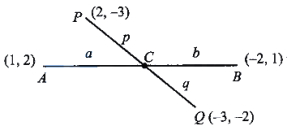
The line $2x + y - 3 = 0$ divides the line segment joining the points $A(1, 2)$ and $B(-2, 1)$ in the ratio $a : b$ at the point $C$. If the point $C$ divides the line segment joining the points $P\left(\frac{b}{3a}, -3\right)$ and $Q\left(-3, -\frac{b}{3a}\right)$ in the ratio $p : q$,then $\frac{p}{q} + \frac{q}{p} =$
A
$\frac{29}{10}$
B
$\frac{17}{10}$
C
$6$
D
$5$
Solution
(A) The point $C$ divides the segment $AB$ in the ratio $a:b$. Using the section formula,the coordinates of $C$ are $\left(\frac{-2a + b}{a + b}, \frac{a + 2b}{a + b}\right)$.
Since $C$ lies on the line $2x + y - 3 = 0$,we have:
$2\left(\frac{-2a + b}{a + b}\right) + \left(\frac{a + 2b}{a + b}\right) - 3 = 0$
$-4a + 2b + a + 2b - 3(a + b) = 0$
$-3a + 4b - 3a - 3b = 0$
$b = 6a \Rightarrow \frac{b}{a} = 6$.
Now,substitute $\frac{b}{a} = 6$ into the coordinates of $P$ and $Q$:
$P = \left(\frac{6}{3}, -3\right) = (2, -3)$
$Q = \left(-3, -\frac{6}{3}\right) = (-3, -2)$
Point $C$ is $\left(\frac{-2a + 6a}{a + 6a}, \frac{a + 12a}{a + 6a}\right) = \left(\frac{4a}{7a}, \frac{13a}{7a}\right) = \left(\frac{4}{7}, \frac{13}{7}\right)$.
Let $C$ divide $PQ$ in the ratio $p:q$. Using the section formula for $x$-coordinate:
$\frac{-3p + 2q}{p + q} = \frac{4}{7}$
$-21p + 14q = 4p + 4q$
$10q = 25p \Rightarrow \frac{p}{q} = \frac{10}{25} = \frac{2}{5}$.
Then,$\frac{p}{q} + \frac{q}{p} = \frac{2}{5} + \frac{5}{2} = \frac{4 + 25}{10} = \frac{29}{10}$.
Since $C$ lies on the line $2x + y - 3 = 0$,we have:
$2\left(\frac{-2a + b}{a + b}\right) + \left(\frac{a + 2b}{a + b}\right) - 3 = 0$
$-4a + 2b + a + 2b - 3(a + b) = 0$
$-3a + 4b - 3a - 3b = 0$
$b = 6a \Rightarrow \frac{b}{a} = 6$.
Now,substitute $\frac{b}{a} = 6$ into the coordinates of $P$ and $Q$:
$P = \left(\frac{6}{3}, -3\right) = (2, -3)$
$Q = \left(-3, -\frac{6}{3}\right) = (-3, -2)$
Point $C$ is $\left(\frac{-2a + 6a}{a + 6a}, \frac{a + 12a}{a + 6a}\right) = \left(\frac{4a}{7a}, \frac{13a}{7a}\right) = \left(\frac{4}{7}, \frac{13}{7}\right)$.
Let $C$ divide $PQ$ in the ratio $p:q$. Using the section formula for $x$-coordinate:
$\frac{-3p + 2q}{p + q} = \frac{4}{7}$
$-21p + 14q = 4p + 4q$
$10q = 25p \Rightarrow \frac{p}{q} = \frac{10}{25} = \frac{2}{5}$.
Then,$\frac{p}{q} + \frac{q}{p} = \frac{2}{5} + \frac{5}{2} = \frac{4 + 25}{10} = \frac{29}{10}$.
0 likes
View Solution77
EasyMCQ
If the line $2x - 3y + 4 = 0$ divides the line segment joining the points $A(-2, 3)$ and $B(3, -2)$ in the ratio $m:n$,then the point which divides $AB$ in the ratio $-4m:3n$ is
A
$(-17, 18)$
B
$\left(-\frac{59}{7}, \frac{66}{7}\right)$
C
$(-5, 6)$
D
$\left(-\frac{5}{7}, \frac{12}{7}\right)$
Solution
(A) Let the point $P$ divide the segment $AB$ in the ratio $m:n$. By the section formula,the coordinates of $P$ are $\left(\frac{3m - 2n}{m + n}, \frac{-2m + 3n}{m + n}\right)$.
Since $P$ lies on the line $2x - 3y + 4 = 0$,we have $2\left(\frac{3m - 2n}{m + n}\right) - 3\left(\frac{-2m + 3n}{m + n}\right) + 4 = 0$.
Multiplying by $(m + n)$,we get $6m - 4n + 6m - 9n + 4m + 4n = 0$,which simplifies to $16m - 9n = 0$,so $\frac{m}{n} = \frac{9}{16}$.
We need to find the point dividing $AB$ in the ratio $k = \frac{-4m}{3n} = \frac{-4}{3} \times \frac{9}{16} = -\frac{3}{4}$.
Using the section formula for ratio $k = -\frac{3}{4}$ with $A(-2, 3)$ and $B(3, -2)$:
$x = \frac{k x_2 + x_1}{k + 1} = \frac{-\frac{3}{4}(3) + (-2)}{-\frac{3}{4} + 1} = \frac{-\frac{9}{4} - 2}{\frac{1}{4}} = -9 - 8 = -17$.
$y = \frac{k y_2 + y_1}{k + 1} = \frac{-\frac{3}{4}(-2) + 3}{-\frac{3}{4} + 1} = \frac{\frac{3}{2} + 3}{\frac{1}{4}} = 4 \times \frac{9}{2} = 18$.
Thus,the point is $(-17, 18)$.
Since $P$ lies on the line $2x - 3y + 4 = 0$,we have $2\left(\frac{3m - 2n}{m + n}\right) - 3\left(\frac{-2m + 3n}{m + n}\right) + 4 = 0$.
Multiplying by $(m + n)$,we get $6m - 4n + 6m - 9n + 4m + 4n = 0$,which simplifies to $16m - 9n = 0$,so $\frac{m}{n} = \frac{9}{16}$.
We need to find the point dividing $AB$ in the ratio $k = \frac{-4m}{3n} = \frac{-4}{3} \times \frac{9}{16} = -\frac{3}{4}$.
Using the section formula for ratio $k = -\frac{3}{4}$ with $A(-2, 3)$ and $B(3, -2)$:
$x = \frac{k x_2 + x_1}{k + 1} = \frac{-\frac{3}{4}(3) + (-2)}{-\frac{3}{4} + 1} = \frac{-\frac{9}{4} - 2}{\frac{1}{4}} = -9 - 8 = -17$.
$y = \frac{k y_2 + y_1}{k + 1} = \frac{-\frac{3}{4}(-2) + 3}{-\frac{3}{4} + 1} = \frac{\frac{3}{2} + 3}{\frac{1}{4}} = 4 \times \frac{9}{2} = 18$.
Thus,the point is $(-17, 18)$.
0 likes
View Solution78
EasyMCQ
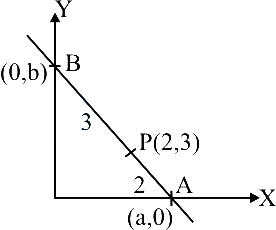
If the portion of a straight line intercepted between the coordinate axes is divided by the point $(2,3)$ in the ratio $2:3$,then the product of the intercepts made by this line on the axes is
A
$25$
B
$\frac{29}{6}$
C
$50$
D
$\frac{31}{3}$
Solution
(A) Let the intercepts on the $x$-axis and $y$-axis be $a$ and $b$ respectively. The coordinates of the points are $A(a, 0)$ and $B(0, b)$.
Given that the point $P(2, 3)$ divides the line segment $AB$ in the ratio $2:3$.
Using the section formula,the coordinates of $P$ are given by:
$P = \left(\frac{2 \cdot 0 + 3 \cdot a}{2 + 3}, \frac{2 \cdot b + 3 \cdot 0}{2 + 3}\right) = \left(\frac{3a}{5}, \frac{2b}{5}\right)$.
Equating the coordinates with $(2, 3)$:
$\frac{3a}{5} = 2$ $\Rightarrow 3a = 10$ $\Rightarrow a = \frac{10}{3}$.
$\frac{2b}{5} = 3$ $\Rightarrow 2b = 15$ $\Rightarrow b = \frac{15}{2}$.
The product of the intercepts is $a \cdot b = \left(\frac{10}{3}\right) \cdot \left(\frac{15}{2}\right) = 5 \cdot 5 = 25$.
Given that the point $P(2, 3)$ divides the line segment $AB$ in the ratio $2:3$.
Using the section formula,the coordinates of $P$ are given by:
$P = \left(\frac{2 \cdot 0 + 3 \cdot a}{2 + 3}, \frac{2 \cdot b + 3 \cdot 0}{2 + 3}\right) = \left(\frac{3a}{5}, \frac{2b}{5}\right)$.
Equating the coordinates with $(2, 3)$:
$\frac{3a}{5} = 2$ $\Rightarrow 3a = 10$ $\Rightarrow a = \frac{10}{3}$.
$\frac{2b}{5} = 3$ $\Rightarrow 2b = 15$ $\Rightarrow b = \frac{15}{2}$.
The product of the intercepts is $a \cdot b = \left(\frac{10}{3}\right) \cdot \left(\frac{15}{2}\right) = 5 \cdot 5 = 25$.
0 likes
View Solution79
DifficultMCQ
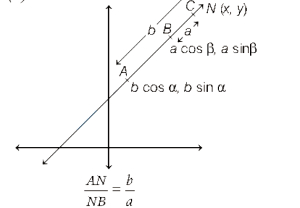
If the line joining the points $A(b \cos \alpha, b \sin \alpha)$ and $B(a \cos \beta, a \sin \beta)$ is extended to the point $N(x, y)$ such that $AN: NB = b: a$,then
A
$x \cos \frac{\alpha-\beta}{2}+y \sin \frac{\alpha+\beta}{2}=0$
B
$x \cos \frac{\alpha-\beta}{2}+y \sin \frac{\alpha-\beta}{2}=0$
C
$x \cos \frac{\alpha+\beta}{2}+y \sin \frac{\alpha+\beta}{2}=0$
D
$x \cos \frac{\alpha+\beta}{2}+y \sin \frac{\alpha-\beta}{2}=0$
Solution
(C) The point $N(x, y)$ divides the line segment $AB$ externally in the ratio $b: a$.
Using the external section formula,the coordinates of $N$ are given by:
$x = \frac{b(a \cos \beta) - a(b \cos \alpha)}{b - a} = \frac{ab(\cos \beta - \cos \alpha)}{b - a}$
$y = \frac{b(a \sin \beta) - a(b \sin \alpha)}{b - a} = \frac{ab(\sin \beta - \sin \alpha)}{b - a}$
From these,we have:
$\frac{x}{ab} = \frac{\cos \beta - \cos \alpha}{b - a} \implies \frac{b - a}{ab} = \frac{\cos \beta - \cos \alpha}{x}$
$\frac{y}{ab} = \frac{\sin \beta - \sin \alpha}{b - a} \implies \frac{b - a}{ab} = \frac{\sin \beta - \sin \alpha}{y}$
Equating the two expressions for $\frac{b - a}{ab}$:
$\frac{\cos \beta - \cos \alpha}{x} = \frac{\sin \beta - \sin \alpha}{y}$
$y(\cos \beta - \cos \alpha) = x(\sin \beta - \sin \alpha)$
Using the sum-to-product formulas:
$y \left( -2 \sin \frac{\beta + \alpha}{2} \sin \frac{\beta - \alpha}{2} \right) = x \left( 2 \cos \frac{\beta + \alpha}{2} \sin \frac{\beta - \alpha}{2} \right)$
Assuming $\sin \frac{\beta - \alpha}{2} \neq 0$,we divide both sides by $2 \sin \frac{\beta - \alpha}{2}$:
$-y \sin \frac{\alpha + \beta}{2} = x \cos \frac{\alpha + \beta}{2}$
$x \cos \frac{\alpha + \beta}{2} + y \sin \frac{\alpha + \beta}{2} = 0$
Using the external section formula,the coordinates of $N$ are given by:
$x = \frac{b(a \cos \beta) - a(b \cos \alpha)}{b - a} = \frac{ab(\cos \beta - \cos \alpha)}{b - a}$
$y = \frac{b(a \sin \beta) - a(b \sin \alpha)}{b - a} = \frac{ab(\sin \beta - \sin \alpha)}{b - a}$
From these,we have:
$\frac{x}{ab} = \frac{\cos \beta - \cos \alpha}{b - a} \implies \frac{b - a}{ab} = \frac{\cos \beta - \cos \alpha}{x}$
$\frac{y}{ab} = \frac{\sin \beta - \sin \alpha}{b - a} \implies \frac{b - a}{ab} = \frac{\sin \beta - \sin \alpha}{y}$
Equating the two expressions for $\frac{b - a}{ab}$:
$\frac{\cos \beta - \cos \alpha}{x} = \frac{\sin \beta - \sin \alpha}{y}$
$y(\cos \beta - \cos \alpha) = x(\sin \beta - \sin \alpha)$
Using the sum-to-product formulas:
$y \left( -2 \sin \frac{\beta + \alpha}{2} \sin \frac{\beta - \alpha}{2} \right) = x \left( 2 \cos \frac{\beta + \alpha}{2} \sin \frac{\beta - \alpha}{2} \right)$
Assuming $\sin \frac{\beta - \alpha}{2} \neq 0$,we divide both sides by $2 \sin \frac{\beta - \alpha}{2}$:
$-y \sin \frac{\alpha + \beta}{2} = x \cos \frac{\alpha + \beta}{2}$
$x \cos \frac{\alpha + \beta}{2} + y \sin \frac{\alpha + \beta}{2} = 0$
0 likes
View Solution80
EasyMCQ
If the distance between the points $(a \cos \theta, a \sin \theta)$ and $(a \cos \phi, a \sin \phi)$ is $2a$,then $\theta$ is equal to
A
$2n\pi \pm \pi + \phi, n \in Z$
B
$n\pi + \frac{\pi}{2} + \phi, n \in Z$
C
$n\pi - \phi, n \in Z$
D
$2n\pi + \phi, n \in Z$
Solution
(A) Let the points be $A = (a \cos \theta, a \sin \theta)$ and $B = (a \cos \phi, a \sin \phi)$.
Given the distance $AB = 2a$.
Using the distance formula:
$AB^2 = (a \cos \theta - a \cos \phi)^2 + (a \sin \theta - a \sin \phi)^2 = (2a)^2$
$a^2(\cos^2 \theta + \cos^2 \phi - 2 \cos \theta \cos \phi + \sin^2 \theta + \sin^2 \phi - 2 \sin \theta \sin \phi) = 4a^2$
$a^2(2 - 2(\cos \theta \cos \phi + \sin \theta \sin \phi)) = 4a^2$
$2 - 2 \cos(\theta - \phi) = 4$
$-2 \cos(\theta - \phi) = 2$
$\cos(\theta - \phi) = -1$
Since $\cos(\theta - \phi) = -1$,we have $\theta - \phi = (2n + 1)\pi = 2n\pi + \pi$ for $n \in Z$.
Therefore,$\theta = 2n\pi + \pi + \phi$.
Given the distance $AB = 2a$.
Using the distance formula:
$AB^2 = (a \cos \theta - a \cos \phi)^2 + (a \sin \theta - a \sin \phi)^2 = (2a)^2$
$a^2(\cos^2 \theta + \cos^2 \phi - 2 \cos \theta \cos \phi + \sin^2 \theta + \sin^2 \phi - 2 \sin \theta \sin \phi) = 4a^2$
$a^2(2 - 2(\cos \theta \cos \phi + \sin \theta \sin \phi)) = 4a^2$
$2 - 2 \cos(\theta - \phi) = 4$
$-2 \cos(\theta - \phi) = 2$
$\cos(\theta - \phi) = -1$
Since $\cos(\theta - \phi) = -1$,we have $\theta - \phi = (2n + 1)\pi = 2n\pi + \pi$ for $n \in Z$.
Therefore,$\theta = 2n\pi + \pi + \phi$.
0 likes
View Solution81
EasyMCQ
If the line $2x - y - 4 = 0$ divides the line segment joining the points $(2, -1)$ and $(1, -4)$ at the point $(a, b)$ in the ratio $m:n$,then $4(a - b(\frac{m}{n})^2) = $
A
-$5$
B
$14$
C
$11$
D
$10$
Solution
(D) Let the ratio be $m:n = k:1$. The point $(a, b)$ divides the segment joining $(2, -1)$ and $(1, -4)$ in the ratio $k:1$.
Using the section formula,$a = \frac{k(1) + 1(2)}{k+1} = \frac{k+2}{k+1}$ and $b = \frac{k(-4) + 1(-1)}{k+1} = \frac{-4k-1}{k+1}$.
Since $(a, b)$ lies on the line $2x - y - 4 = 0$,we have $2(\frac{k+2}{k+1}) - (\frac{-4k-1}{k+1}) - 4 = 0$.
Multiplying by $(k+1)$,we get $2k + 4 + 4k + 1 - 4(k+1) = 0$,which simplifies to $6k + 5 - 4k - 4 = 0$,so $2k + 1 = 0$,giving $k = -\frac{1}{2}$.
Thus,$\frac{m}{n} = -\frac{1}{2}$.
Substituting $k = -\frac{1}{2}$ into the coordinates: $a = \frac{-0.5+2}{-0.5+1} = \frac{1.5}{0.5} = 3$ and $b = \frac{-4(-0.5)-1}{-0.5+1} = \frac{2-1}{0.5} = 2$.
Finally,$4(a - b(\frac{m}{n})^2) = 4(3 - 2(-\frac{1}{2})^2) = 4(3 - 2(\frac{1}{4})) = 4(3 - 0.5) = 4(2.5) = 10$.
Using the section formula,$a = \frac{k(1) + 1(2)}{k+1} = \frac{k+2}{k+1}$ and $b = \frac{k(-4) + 1(-1)}{k+1} = \frac{-4k-1}{k+1}$.
Since $(a, b)$ lies on the line $2x - y - 4 = 0$,we have $2(\frac{k+2}{k+1}) - (\frac{-4k-1}{k+1}) - 4 = 0$.
Multiplying by $(k+1)$,we get $2k + 4 + 4k + 1 - 4(k+1) = 0$,which simplifies to $6k + 5 - 4k - 4 = 0$,so $2k + 1 = 0$,giving $k = -\frac{1}{2}$.
Thus,$\frac{m}{n} = -\frac{1}{2}$.
Substituting $k = -\frac{1}{2}$ into the coordinates: $a = \frac{-0.5+2}{-0.5+1} = \frac{1.5}{0.5} = 3$ and $b = \frac{-4(-0.5)-1}{-0.5+1} = \frac{2-1}{0.5} = 2$.
Finally,$4(a - b(\frac{m}{n})^2) = 4(3 - 2(-\frac{1}{2})^2) = 4(3 - 2(\frac{1}{4})) = 4(3 - 0.5) = 4(2.5) = 10$.
0 likes
View Solution82
MediumMCQ
The line $L \equiv 6x + 3y + k = 0$ divides the line segment joining the points $(3, 5)$ and $(4, 6)$ in the ratio $-5: 4$. If the point of intersection of the lines $L = 0$ and $x - y + 1 = 0$ is $P(g, h)$,then $h =$
A
$2g$
B
$2g - 1$
C
$3g$
D
$g + 1$
Solution
(D) Let the points be $A(3, 5)$ and $B(4, 6)$. The line $L \equiv 6x + 3y + k = 0$ divides $AB$ in the ratio $m:n = -5: 4$.
Using the section formula,the point of intersection $Q$ is given by $\left( \frac{m x_2 + n x_1}{m + n}, \frac{m y_2 + n y_1}{m + n} \right) = \left( \frac{-5(4) + 4(3)}{-5 + 4}, \frac{-5(6) + 4(5)}{-5 + 4} \right) = \left( \frac{-20 + 12}{-1}, \frac{-30 + 20}{-1} \right) = (8, 10)$.
Since $Q(8, 10)$ lies on $L = 0$,we have $6(8) + 3(10) + k = 0 \implies 48 + 30 + k = 0 \implies k = -78$.
So,the line $L$ is $6x + 3y - 78 = 0$,which simplifies to $2x + y - 26 = 0$.
The point $P(g, h)$ is the intersection of $2x + y = 26$ and $x - y = -1$.
Adding the two equations: $(2x + y) + (x - y) = 26 - 1 \implies 3x = 25 \implies g = \frac{25}{3}$.
Substituting $g$ into $x - y = -1$: $h = g + 1 = \frac{25}{3} + 1 = \frac{28}{3}$.
Checking the options: $g + 1 = \frac{25}{3} + 1 = \frac{28}{3} = h$. Thus,$h = g + 1$.
Using the section formula,the point of intersection $Q$ is given by $\left( \frac{m x_2 + n x_1}{m + n}, \frac{m y_2 + n y_1}{m + n} \right) = \left( \frac{-5(4) + 4(3)}{-5 + 4}, \frac{-5(6) + 4(5)}{-5 + 4} \right) = \left( \frac{-20 + 12}{-1}, \frac{-30 + 20}{-1} \right) = (8, 10)$.
Since $Q(8, 10)$ lies on $L = 0$,we have $6(8) + 3(10) + k = 0 \implies 48 + 30 + k = 0 \implies k = -78$.
So,the line $L$ is $6x + 3y - 78 = 0$,which simplifies to $2x + y - 26 = 0$.
The point $P(g, h)$ is the intersection of $2x + y = 26$ and $x - y = -1$.
Adding the two equations: $(2x + y) + (x - y) = 26 - 1 \implies 3x = 25 \implies g = \frac{25}{3}$.
Substituting $g$ into $x - y = -1$: $h = g + 1 = \frac{25}{3} + 1 = \frac{28}{3}$.
Checking the options: $g + 1 = \frac{25}{3} + 1 = \frac{28}{3} = h$. Thus,$h = g + 1$.
0 likes
View Solution83
EasyMCQ
Two particles $P$ and $Q$ located at the points with coordinates $P(t, t^3-16t-3)$ and $Q(t+1, t^3-6t-6)$ are moving in a plane. The minimum distance between them in their motion is
A
$1$
B
$5$
C
$169$
D
$49$
Solution
(A) The distance $PQ$ between the two particles is given by the distance formula:
$PQ = \sqrt{((t+1) - t)^2 + ((t^3 - 6t - 6) - (t^3 - 16t - 3))^2}$
$PQ = \sqrt{(1)^2 + (t^3 - 6t - 6 - t^3 + 16t + 3)^2}$
$PQ = \sqrt{1 + (10t - 3)^2}$
To find the minimum distance,we minimize $PQ^2 = 1 + (10t - 3)^2$.
Since $(10t - 3)^2 \geq 0$ for all real $t$,the minimum value of $(10t - 3)^2$ is $0$ when $10t - 3 = 0$,i.e.,$t = 0.3$.
Thus,the minimum distance is $\sqrt{1 + 0} = 1$.
$PQ = \sqrt{((t+1) - t)^2 + ((t^3 - 6t - 6) - (t^3 - 16t - 3))^2}$
$PQ = \sqrt{(1)^2 + (t^3 - 6t - 6 - t^3 + 16t + 3)^2}$
$PQ = \sqrt{1 + (10t - 3)^2}$
To find the minimum distance,we minimize $PQ^2 = 1 + (10t - 3)^2$.
Since $(10t - 3)^2 \geq 0$ for all real $t$,the minimum value of $(10t - 3)^2$ is $0$ when $10t - 3 = 0$,i.e.,$t = 0.3$.
Thus,the minimum distance is $\sqrt{1 + 0} = 1$.
0 likes
View Solution84
MediumMCQ
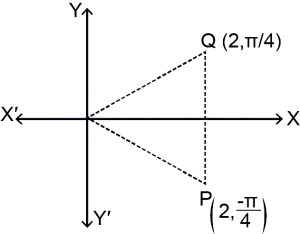
The polar coordinate of a point $P$ is $\left(2, -\frac{\pi}{4}\right)$. The polar coordinate of the point $Q$,which is such that the line joining $PQ$ is bisected perpendicularly by the initial line,is
A
$\left(2, \frac{\pi}{4}\right)$
B
$\left(2, \frac{\pi}{6}\right)$
C
$\left(-2, \frac{\pi}{4}\right)$
D
$\left(-2, \frac{\pi}{6}\right)$
Solution
(A) The polar coordinate of point $P$ is given as $\left(2, -\frac{\pi}{4}\right)$.
Since the line segment $PQ$ is bisected perpendicularly by the initial line (the $X$-axis),point $Q$ must be the reflection of point $P$ across the $X$-axis.
In polar coordinates $(r, \theta)$,reflecting a point across the initial line changes the sign of the angle $\theta$ while keeping $r$ constant.
Therefore,the reflection of $\left(2, -\frac{\pi}{4}\right)$ across the $X$-axis is $\left(2, -\left(-\frac{\pi}{4}\right)\right) = \left(2, \frac{\pi}{4}\right)$.
Thus,the coordinates of $Q$ are $\left(2, \frac{\pi}{4}\right)$.
Since the line segment $PQ$ is bisected perpendicularly by the initial line (the $X$-axis),point $Q$ must be the reflection of point $P$ across the $X$-axis.
In polar coordinates $(r, \theta)$,reflecting a point across the initial line changes the sign of the angle $\theta$ while keeping $r$ constant.
Therefore,the reflection of $\left(2, -\frac{\pi}{4}\right)$ across the $X$-axis is $\left(2, -\left(-\frac{\pi}{4}\right)\right) = \left(2, \frac{\pi}{4}\right)$.
Thus,the coordinates of $Q$ are $\left(2, \frac{\pi}{4}\right)$.
0 likes
View Solution85
EasyMCQ
The line joining $A(b \cos \alpha, b \sin \alpha)$ and $B(a \cos \beta, a \sin \beta),$ where $a \neq b,$ is produced to the point $M(x, y)$ such that $AM : MB = b : a$. Then,$x \cos \frac{\alpha+\beta}{2} + y \sin \frac{\alpha+\beta}{2}$ is equal to
A
$0$
B
$1$
C
-$1$
D
$a^{2}+b^{2}$
Solution
(A) Given $A(b \cos \alpha, b \sin \alpha)$ and $B(a \cos \beta, a \sin \beta)$.
Since $M(x, y)$ divides $AB$ externally in the ratio $b : a$,the coordinates of $M$ are given by the section formula for external division:
$x = \frac{b(a \cos \beta) - a(b \cos \alpha)}{b - a} = \frac{ab(\cos \beta - \cos \alpha)}{b - a}$
$y = \frac{b(a \sin \beta) - a(b \sin \alpha)}{b - a} = \frac{ab(\sin \beta - \sin \alpha)}{b - a}$
Now,consider the expression $E = x \cos \frac{\alpha+\beta}{2} + y \sin \frac{\alpha+\beta}{2}$.
Substituting $x$ and $y$:
$E = \frac{ab}{b-a} [(\cos \beta - \cos \alpha) \cos \frac{\alpha+\beta}{2} + (\sin \beta - \sin \alpha) \sin \frac{\alpha+\beta}{2}]$
Using the identity $\cos C - \cos D = -2 \sin \frac{C+D}{2} \sin \frac{C-D}{2}$ and $\sin C - \sin D = 2 \cos \frac{C+D}{2} \sin \frac{C-D}{2}$:
$E = \frac{ab}{b-a} [(-2 \sin \frac{\beta+\alpha}{2} \sin \frac{\beta-\alpha}{2}) \cos \frac{\alpha+\beta}{2} + (2 \cos \frac{\beta+\alpha}{2} \sin \frac{\beta-\alpha}{2}) \sin \frac{\alpha+\beta}{2}]$
$E = \frac{2ab \sin \frac{\beta-\alpha}{2}}{b-a} [-\sin \frac{\alpha+\beta}{2} \cos \frac{\alpha+\beta}{2} + \cos \frac{\alpha+\beta}{2} \sin \frac{\alpha+\beta}{2}]$
$E = \frac{2ab \sin \frac{\beta-\alpha}{2}}{b-a} [0] = 0$.
Since $M(x, y)$ divides $AB$ externally in the ratio $b : a$,the coordinates of $M$ are given by the section formula for external division:
$x = \frac{b(a \cos \beta) - a(b \cos \alpha)}{b - a} = \frac{ab(\cos \beta - \cos \alpha)}{b - a}$
$y = \frac{b(a \sin \beta) - a(b \sin \alpha)}{b - a} = \frac{ab(\sin \beta - \sin \alpha)}{b - a}$
Now,consider the expression $E = x \cos \frac{\alpha+\beta}{2} + y \sin \frac{\alpha+\beta}{2}$.
Substituting $x$ and $y$:
$E = \frac{ab}{b-a} [(\cos \beta - \cos \alpha) \cos \frac{\alpha+\beta}{2} + (\sin \beta - \sin \alpha) \sin \frac{\alpha+\beta}{2}]$
Using the identity $\cos C - \cos D = -2 \sin \frac{C+D}{2} \sin \frac{C-D}{2}$ and $\sin C - \sin D = 2 \cos \frac{C+D}{2} \sin \frac{C-D}{2}$:
$E = \frac{ab}{b-a} [(-2 \sin \frac{\beta+\alpha}{2} \sin \frac{\beta-\alpha}{2}) \cos \frac{\alpha+\beta}{2} + (2 \cos \frac{\beta+\alpha}{2} \sin \frac{\beta-\alpha}{2}) \sin \frac{\alpha+\beta}{2}]$
$E = \frac{2ab \sin \frac{\beta-\alpha}{2}}{b-a} [-\sin \frac{\alpha+\beta}{2} \cos \frac{\alpha+\beta}{2} + \cos \frac{\alpha+\beta}{2} \sin \frac{\alpha+\beta}{2}]$
$E = \frac{2ab \sin \frac{\beta-\alpha}{2}}{b-a} [0] = 0$.
0 likes
View Solution86
MediumMCQ
The straight line $3x + y = 9$ divides the line segment joining the points $(1, 3)$ and $(2, 7)$ in the ratio
A
$3: 4$ externally
B
$3: 4$ internally
C
$4: 5$ internally
D
$5: 6$ externally
Solution
(B) Let the line $3x + y - 9 = 0$ divide the line segment joining $A(1, 3)$ and $B(2, 7)$ in the ratio $k: 1$.
Using the section formula,the coordinates of the dividing point are $(\frac{2k+1}{k+1}, \frac{7k+3}{k+1})$.
Since this point lies on the line $3x + y = 9$,we have:
$3(\frac{2k+1}{k+1}) + (\frac{7k+3}{k+1}) = 9$
$6k + 3 + 7k + 3 = 9(k + 1)$
$13k + 6 = 9k + 9$
$4k = 3$
$k = \frac{3}{4}$.
Since $k > 0$,the division is internal in the ratio $3: 4$.
Using the section formula,the coordinates of the dividing point are $(\frac{2k+1}{k+1}, \frac{7k+3}{k+1})$.
Since this point lies on the line $3x + y = 9$,we have:
$3(\frac{2k+1}{k+1}) + (\frac{7k+3}{k+1}) = 9$
$6k + 3 + 7k + 3 = 9(k + 1)$
$13k + 6 = 9k + 9$
$4k = 3$
$k = \frac{3}{4}$.
Since $k > 0$,the division is internal in the ratio $3: 4$.
0 likes
View Solution87
EasyMCQ
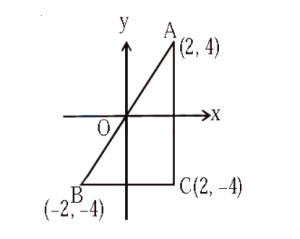
If $C$ is the reflection of $A(2, 4)$ in the $x$-axis and $B$ is the reflection of $C$ in the $y$-axis,then $|AB|$ is
A
$20$
B
$2 \sqrt{5}$
C
$4 \sqrt{5}$
D
$4$
Solution
(C) Given $A \equiv (2, 4)$.
Since $C$ is the reflection of $A$ in the $x$-axis,the coordinates of $C$ are $(2, -4)$.
Since $B$ is the reflection of $C$ in the $y$-axis,the coordinates of $B$ are $(-2, -4)$.
Now,we calculate the distance $|AB|$ using the distance formula:
$|AB| = \sqrt{(2 - (-2))^2 + (4 - (-4))^2}$
$|AB| = \sqrt{(2 + 2)^2 + (4 + 4)^2}$
$|AB| = \sqrt{4^2 + 8^2}$
$|AB| = \sqrt{16 + 64}$
$|AB| = \sqrt{80}$
$|AB| = \sqrt{16 \times 5} = 4 \sqrt{5}$
Since $C$ is the reflection of $A$ in the $x$-axis,the coordinates of $C$ are $(2, -4)$.
Since $B$ is the reflection of $C$ in the $y$-axis,the coordinates of $B$ are $(-2, -4)$.
Now,we calculate the distance $|AB|$ using the distance formula:
$|AB| = \sqrt{(2 - (-2))^2 + (4 - (-4))^2}$
$|AB| = \sqrt{(2 + 2)^2 + (4 + 4)^2}$
$|AB| = \sqrt{4^2 + 8^2}$
$|AB| = \sqrt{16 + 64}$
$|AB| = \sqrt{80}$
$|AB| = \sqrt{16 \times 5} = 4 \sqrt{5}$
0 likes
View Solution88
EasyMCQ
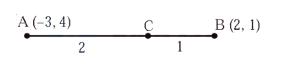
If $C$ is a point on the line segment joining $A(-3, 4)$ and $B(2, 1)$ such that $AC = 2BC$,then the coordinates of $C$ are
A
$\left(\frac{1}{3}, 2\right)$
B
$\left(2, \frac{1}{3}\right)$
C
$(2, 7)$
D
$(7, 2)$
Solution
(A) Given that $C$ divides the line segment joining $A(-3, 4)$ and $B(2, 1)$ in the ratio $AC : BC = 2 : 1$.
Using the section formula,the coordinates of $C(x, y)$ are given by:
$x = \frac{m_1x_2 + m_2x_1}{m_1 + m_2} = \frac{2(2) + 1(-3)}{2 + 1} = \frac{4 - 3}{3} = \frac{1}{3}$
$y = \frac{m_1y_2 + m_2y_1}{m_1 + m_2} = \frac{2(1) + 1(4)}{2 + 1} = \frac{2 + 4}{3} = \frac{6}{3} = 2$
Thus,the coordinates of $C$ are $\left(\frac{1}{3}, 2\right)$.
Using the section formula,the coordinates of $C(x, y)$ are given by:
$x = \frac{m_1x_2 + m_2x_1}{m_1 + m_2} = \frac{2(2) + 1(-3)}{2 + 1} = \frac{4 - 3}{3} = \frac{1}{3}$
$y = \frac{m_1y_2 + m_2y_1}{m_1 + m_2} = \frac{2(1) + 1(4)}{2 + 1} = \frac{2 + 4}{3} = \frac{6}{3} = 2$
Thus,the coordinates of $C$ are $\left(\frac{1}{3}, 2\right)$.
0 likes
View SolutionStraight Line — System of co-ordinates, Distance between two points, Section formulae · Frequently Asked Questions
1Are these Straight Line questions useful for JEE and NEET?
Yes. All questions in this section are mapped to JEE Main and NEET exam patterns. Previous year questions from JEE Main, NEET, GUJCET and state-level exams are included with full solutions.
2Can I switch to Hindi or Gujarati for these questions?
Yes. Use the language tabs in the hero section or the sidebar to view the same questions and solutions in English, Hindi or Gujarati.
3How do I generate a question paper from this subtopic?
Use the Vedclass Exam Paper Generator — select the chapter and subtopic, set difficulty, and generate Sets A, B, C, D automatically. First 3 chapters of every subject are free.
Vedclass Products
For Students
Vedclass Test Series
Mock tests in real JEE/NEET style with performance analysis. 5-day free trial.
Start Free TrialFor Teachers
Exam Paper Generator
Generate Set A/B/C/D papers from this chapter in 2 minutes. 3 chapters free.
Try FreeFor Institutes
Online Exam Module
Live online exams with unlimited students, 360° analytics & white-label branding.
See DemoFor Teachers & Institutes
Generate a Straight Line Exam Paper in 2 Minutes
Select subtopic & difficulty — Sets A, B, C, D auto-generated with No Repeat logic.
First 3 chapters of every subject are free — no payment required.