
A English
Problems related to triangle and quadrilateral Questions in English
Class 11 Mathematics · Straight Line · Problems related to triangle and quadrilateral
325+
Questions
English
Language
100%
With Solutions
Showing 24 of 325 questions in English
301
DifficultMCQ
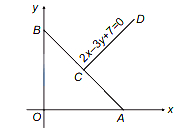
If a straight line perpendicular to $2x - 3y + 7 = 0$ forms a triangle with the coordinate axes whose area is $3 \text{ sq. units}$,then the equation of the straight line is:
A
$3x + 2y = \pm 2$
B
$3x + 2y = \pm 6$
C
$3x + 2y = \pm 4$
D
$3x + 2y = \pm 8$
Solution
(B) The given line is $2x - 3y + 7 = 0$.
Any line perpendicular to the given line is of the form $3x + 2y + k = 0$.
To find the intercepts,set $y = 0$: $3x + k = 0 \Rightarrow x = -\frac{k}{3}$.
Set $x = 0$: $2y + k = 0 \Rightarrow y = -\frac{k}{2}$.
The area of the triangle formed with the coordinate axes is given by $\frac{1}{2} |x_{intercept} \cdot y_{intercept}| = 3$.
$\frac{1}{2} |(-\frac{k}{3}) \cdot (-\frac{k}{2})| = 3$.
$\frac{1}{2} |\frac{k^2}{6}| = 3$.
$|k^2| = 36 \Rightarrow k = \pm 6$.
Substituting $k$ into the equation $3x + 2y + k = 0$,we get $3x + 2y = \pm 6$.
Any line perpendicular to the given line is of the form $3x + 2y + k = 0$.
To find the intercepts,set $y = 0$: $3x + k = 0 \Rightarrow x = -\frac{k}{3}$.
Set $x = 0$: $2y + k = 0 \Rightarrow y = -\frac{k}{2}$.
The area of the triangle formed with the coordinate axes is given by $\frac{1}{2} |x_{intercept} \cdot y_{intercept}| = 3$.
$\frac{1}{2} |(-\frac{k}{3}) \cdot (-\frac{k}{2})| = 3$.
$\frac{1}{2} |\frac{k^2}{6}| = 3$.
$|k^2| = 36 \Rightarrow k = \pm 6$.
Substituting $k$ into the equation $3x + 2y + k = 0$,we get $3x + 2y = \pm 6$.
0 likes
View Solution302
MediumMCQ
$L \equiv 7x - y + 8 = 0$ is one of the diagonals of a square for which $(-4, 5)$ and $(3, 4)$ are two vertices. Find the coordinates of the two vertices lying on the diagonal $L = 0$.
A
$(0, 8), (-1, 1)$
B
$(-1, 1), (0, 8)$
C
$(-2, -6), (1, 15)$
D
$(1, 3), (-2, -6)$
Solution
(A) Let the vertices of the square be $A(-4, 5)$ and $B(3, 4)$. The diagonal $L$ is $7x - y + 8 = 0$.
Since $A$ and $B$ are vertices of the square,the midpoint of the diagonal $AB$ is $M = (\frac{-4+3}{2}, \frac{5+4}{2}) = (-0.5, 4.5)$.
Check if $M$ lies on $L$: $7(-0.5) - 4.5 + 8 = -3.5 - 4.5 + 8 = 0$. Thus,$AB$ is the other diagonal.
The slope of $AB$ is $m_1 = \frac{4-5}{3-(-4)} = \frac{-1}{7}$.
The slope of diagonal $L$ is $m_2 = 7$. Since $m_1 \times m_2 = -1$,the diagonals are perpendicular,which is consistent with a square.
The vertices on $L$ are equidistant from $M$ and at a distance equal to half the length of diagonal $AB$.
Length $AB = \sqrt{(3 - (-4))^2 + (4 - 5)^2} = \sqrt{7^2 + (-1)^2} = \sqrt{50} = 5\sqrt{2}$.
Half-length $d = \frac{5\sqrt{2}}{2} = \frac{5}{\sqrt{2}}$.
The line $L$ has direction vector $(1, 7)$. The unit vector is $u = \pm(\frac{1}{\sqrt{50}}, \frac{7}{\sqrt{50}}) = \pm(\frac{1}{5\sqrt{2}}, \frac{7}{5\sqrt{2}})$.
The vertices on $L$ are $M \pm d \cdot u = (-0.5, 4.5) \pm \frac{5}{\sqrt{2}} \cdot (\frac{1}{5\sqrt{2}}, \frac{7}{5\sqrt{2}}) = (-0.5, 4.5) \pm (0.5, 3.5)$.
Vertex $1: (-0.5 + 0.5, 4.5 + 3.5) = (0, 8)$.
Vertex $2: (-0.5 - 0.5, 4.5 - 3.5) = (-1, 1)$.
Thus,the vertices are $(0, 8)$ and $(-1, 1)$.
Since $A$ and $B$ are vertices of the square,the midpoint of the diagonal $AB$ is $M = (\frac{-4+3}{2}, \frac{5+4}{2}) = (-0.5, 4.5)$.
Check if $M$ lies on $L$: $7(-0.5) - 4.5 + 8 = -3.5 - 4.5 + 8 = 0$. Thus,$AB$ is the other diagonal.
The slope of $AB$ is $m_1 = \frac{4-5}{3-(-4)} = \frac{-1}{7}$.
The slope of diagonal $L$ is $m_2 = 7$. Since $m_1 \times m_2 = -1$,the diagonals are perpendicular,which is consistent with a square.
The vertices on $L$ are equidistant from $M$ and at a distance equal to half the length of diagonal $AB$.
Length $AB = \sqrt{(3 - (-4))^2 + (4 - 5)^2} = \sqrt{7^2 + (-1)^2} = \sqrt{50} = 5\sqrt{2}$.
Half-length $d = \frac{5\sqrt{2}}{2} = \frac{5}{\sqrt{2}}$.
The line $L$ has direction vector $(1, 7)$. The unit vector is $u = \pm(\frac{1}{\sqrt{50}}, \frac{7}{\sqrt{50}}) = \pm(\frac{1}{5\sqrt{2}}, \frac{7}{5\sqrt{2}})$.
The vertices on $L$ are $M \pm d \cdot u = (-0.5, 4.5) \pm \frac{5}{\sqrt{2}} \cdot (\frac{1}{5\sqrt{2}}, \frac{7}{5\sqrt{2}}) = (-0.5, 4.5) \pm (0.5, 3.5)$.
Vertex $1: (-0.5 + 0.5, 4.5 + 3.5) = (0, 8)$.
Vertex $2: (-0.5 - 0.5, 4.5 - 3.5) = (-1, 1)$.
Thus,the vertices are $(0, 8)$ and $(-1, 1)$.
0 likes
View Solution303
MediumMCQ
The area of the quadrilateral formed by the lines $x+2y+3=0$,$2x+4y+9=0$,$x-2y+3=0$,and $3x-6y+11=0$ is
A
$\frac{5}{12}$
B
$\frac{1}{4}$
C
$\frac{3}{4}$
D
$\frac{7}{12}$
Solution
(B) The given lines are $L_1: x+2y+3=0$,$L_2: 2x+4y+9=0$,$L_3: x-2y+3=0$,and $L_4: 3x-6y+11=0$.
Notice that $L_1$ and $L_2$ are parallel,and $L_3$ and $L_4$ are parallel.
Let $L_1: x+2y+3=0$ and $L_2: x+2y+4.5=0$. The distance between these parallel lines is $d_1 = \frac{|4.5-3|}{\sqrt{1^2+2^2}} = \frac{1.5}{\sqrt{5}} = \frac{3}{2\sqrt{5}}$.
Let $L_3: x-2y+3=0$ and $L_4: x-2y+\frac{11}{3}=0$. The distance between these parallel lines is $d_2 = \frac{|11/3-3|}{\sqrt{1^2+(-2)^2}} = \frac{2/3}{\sqrt{5}} = \frac{2}{3\sqrt{5}}$.
The area of a parallelogram formed by two pairs of parallel lines $a_1x+b_1y+c_1=0, a_1x+b_1y+c_2=0$ and $a_2x+b_2y+d_1=0, a_2x+b_2y+d_2=0$ is given by $\frac{|c_1-c_2||d_1-d_2|}{|a_1b_2-a_2b_1|}$.
Here,$a_1=1, b_1=2, c_1=3, c_2=4.5$ and $a_2=1, b_2=-2, d_1=3, d_2=11/3$.
The denominator is $|(1)(-2) - (1)(2)| = |-2-2| = 4$.
The area is $\frac{|3-4.5| \times |3-11/3|}{4} = \frac{1.5 \times 2/3}{4} = \frac{1}{4}$.
Notice that $L_1$ and $L_2$ are parallel,and $L_3$ and $L_4$ are parallel.
Let $L_1: x+2y+3=0$ and $L_2: x+2y+4.5=0$. The distance between these parallel lines is $d_1 = \frac{|4.5-3|}{\sqrt{1^2+2^2}} = \frac{1.5}{\sqrt{5}} = \frac{3}{2\sqrt{5}}$.
Let $L_3: x-2y+3=0$ and $L_4: x-2y+\frac{11}{3}=0$. The distance between these parallel lines is $d_2 = \frac{|11/3-3|}{\sqrt{1^2+(-2)^2}} = \frac{2/3}{\sqrt{5}} = \frac{2}{3\sqrt{5}}$.
The area of a parallelogram formed by two pairs of parallel lines $a_1x+b_1y+c_1=0, a_1x+b_1y+c_2=0$ and $a_2x+b_2y+d_1=0, a_2x+b_2y+d_2=0$ is given by $\frac{|c_1-c_2||d_1-d_2|}{|a_1b_2-a_2b_1|}$.
Here,$a_1=1, b_1=2, c_1=3, c_2=4.5$ and $a_2=1, b_2=-2, d_1=3, d_2=11/3$.
The denominator is $|(1)(-2) - (1)(2)| = |-2-2| = 4$.
The area is $\frac{|3-4.5| \times |3-11/3|}{4} = \frac{1.5 \times 2/3}{4} = \frac{1}{4}$.
0 likes
View Solution304
EasyMCQ
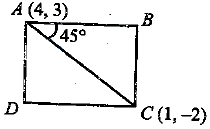
If $(4,3)$ and $(1,-2)$ are the end points of a diagonal of a square,then the equation of one of its sides is
A
$4x+y-11=0$
B
$2x+y=0$
C
$2x-3y+1=0$
D
$x-4y-9=0$
Solution
(D) Let the vertices of the square be $A(4,3)$ and $C(1,-2)$ as the endpoints of a diagonal. The angle between the diagonal and any side of a square is $45^{\circ}$.
Slope of diagonal $AC = \frac{3 - (-2)}{4 - 1} = \frac{5}{3}$.
Let $m$ be the slope of a side. Then,$\tan 45^{\circ} = \left| \frac{m - 5/3}{1 + m(5/3)} \right|$.
$1 = \left| \frac{3m - 5}{3 + 5m} \right|$.
This gives two cases:
Case $1$: $\frac{3m - 5}{3 + 5m} = 1$ $\Rightarrow 3m - 5 = 3 + 5m$ $\Rightarrow 2m = -8$ $\Rightarrow m = -4$.
The equation of the side passing through $(1,-2)$ with slope $-4$ is $y - (-2) = -4(x - 1)$ $\Rightarrow y + 2 = -4x + 4$ $\Rightarrow 4x + y - 2 = 0$.
Case $2$: $\frac{3m - 5}{3 + 5m} = -1$ $\Rightarrow 3m - 5 = -3 - 5m$ $\Rightarrow 8m = 2$ $\Rightarrow m = \frac{1}{4}$.
The equation of the side passing through $(1,-2)$ with slope $\frac{1}{4}$ is $y - (-2) = \frac{1}{4}(x - 1)$ $\Rightarrow 4y + 8 = x - 1$ $\Rightarrow x - 4y - 9 = 0$.
Comparing with the options,$x - 4y - 9 = 0$ is present.
Slope of diagonal $AC = \frac{3 - (-2)}{4 - 1} = \frac{5}{3}$.
Let $m$ be the slope of a side. Then,$\tan 45^{\circ} = \left| \frac{m - 5/3}{1 + m(5/3)} \right|$.
$1 = \left| \frac{3m - 5}{3 + 5m} \right|$.
This gives two cases:
Case $1$: $\frac{3m - 5}{3 + 5m} = 1$ $\Rightarrow 3m - 5 = 3 + 5m$ $\Rightarrow 2m = -8$ $\Rightarrow m = -4$.
The equation of the side passing through $(1,-2)$ with slope $-4$ is $y - (-2) = -4(x - 1)$ $\Rightarrow y + 2 = -4x + 4$ $\Rightarrow 4x + y - 2 = 0$.
Case $2$: $\frac{3m - 5}{3 + 5m} = -1$ $\Rightarrow 3m - 5 = -3 - 5m$ $\Rightarrow 8m = 2$ $\Rightarrow m = \frac{1}{4}$.
The equation of the side passing through $(1,-2)$ with slope $\frac{1}{4}$ is $y - (-2) = \frac{1}{4}(x - 1)$ $\Rightarrow 4y + 8 = x - 1$ $\Rightarrow x - 4y - 9 = 0$.
Comparing with the options,$x - 4y - 9 = 0$ is present.
0 likes
View Solution305
MediumMCQ
The lines $x+y+4=0$,$x-2y-4=0$,and $3x+4y-2=0$:
A
are concurrent
B
form an isosceles triangle
C
form a right-angled triangle
D
form a scalene triangle
Solution
(D) To check if the lines are concurrent,we solve the first two equations for their point of intersection:
$x+y = -4$ $(1)$
$x-2y = 4$ $(2)$
Subtracting $(2)$ from $(1)$: $(x+y) - (x-2y) = -4 - 4 \implies 3y = -8 \implies y = -8/3$.
Substituting $y = -8/3$ into $(1)$: $x - 8/3 = -4 \implies x = -4 + 8/3 = -4/3$.
The intersection point is $(-4/3, -8/3)$.
Now,check if this point satisfies the third equation $3x+4y-2=0$:
$3(-4/3) + 4(-8/3) - 2 = -4 - 32/3 - 2 = -6 - 32/3 = -18/3 - 32/3 = -50/3 \neq 0$.
Since the point does not satisfy the third equation,the lines are not concurrent.
Next,find the slopes of the lines:
$L_1: x+y+4=0 \implies m_1 = -1$.
$L_2: x-2y-4=0 \implies m_2 = 1/2$.
$L_3: 3x+4y-2=0 \implies m_3 = -3/4$.
Since no two slopes are equal,the lines are not parallel.
Since $m_1 \times m_2 = -1/2 \neq -1$,$m_2 \times m_3 = -3/8 \neq -1$,and $m_1 \times m_3 = 3/4 \neq -1$,no two lines are perpendicular.
Calculate the lengths of the sides of the triangle formed by the intersection points:
$P_1 (L_1 \cap L_2) = (-4/3, -8/3)$.
$P_2 (L_2 \cap L_3)$: $x-2y=4$ and $3x+4y=2$. Solving gives $x=2, y=-1$. $P_2 = (2, -1)$.
$P_3 (L_3 \cap L_1)$: $3x+4y=2$ and $x+y=-4$. Solving gives $x=18, y=-22$. $P_3 = (18, -22)$.
Calculate side lengths:
$d_{12} = \sqrt{(2 - (-4/3))^2 + (-1 - (-8/3))^2} = \sqrt{(10/3)^2 + (5/3)^2} = \sqrt{125/9} = 5\sqrt{5}/3$.
$d_{23} = \sqrt{(18 - 2)^2 + (-22 - (-1))^2} = \sqrt{16^2 + (-21)^2} = \sqrt{256 + 441} = \sqrt{697}$.
$d_{31} = \sqrt{(18 - (-4/3))^2 + (-22 - (-8/3))^2} = \sqrt{(58/3)^2 + (-58/3)^2} = 58\sqrt{2}/3$.
Since all side lengths are distinct,the triangle is scalene.
$x+y = -4$ $(1)$
$x-2y = 4$ $(2)$
Subtracting $(2)$ from $(1)$: $(x+y) - (x-2y) = -4 - 4 \implies 3y = -8 \implies y = -8/3$.
Substituting $y = -8/3$ into $(1)$: $x - 8/3 = -4 \implies x = -4 + 8/3 = -4/3$.
The intersection point is $(-4/3, -8/3)$.
Now,check if this point satisfies the third equation $3x+4y-2=0$:
$3(-4/3) + 4(-8/3) - 2 = -4 - 32/3 - 2 = -6 - 32/3 = -18/3 - 32/3 = -50/3 \neq 0$.
Since the point does not satisfy the third equation,the lines are not concurrent.
Next,find the slopes of the lines:
$L_1: x+y+4=0 \implies m_1 = -1$.
$L_2: x-2y-4=0 \implies m_2 = 1/2$.
$L_3: 3x+4y-2=0 \implies m_3 = -3/4$.
Since no two slopes are equal,the lines are not parallel.
Since $m_1 \times m_2 = -1/2 \neq -1$,$m_2 \times m_3 = -3/8 \neq -1$,and $m_1 \times m_3 = 3/4 \neq -1$,no two lines are perpendicular.
Calculate the lengths of the sides of the triangle formed by the intersection points:
$P_1 (L_1 \cap L_2) = (-4/3, -8/3)$.
$P_2 (L_2 \cap L_3)$: $x-2y=4$ and $3x+4y=2$. Solving gives $x=2, y=-1$. $P_2 = (2, -1)$.
$P_3 (L_3 \cap L_1)$: $3x+4y=2$ and $x+y=-4$. Solving gives $x=18, y=-22$. $P_3 = (18, -22)$.
Calculate side lengths:
$d_{12} = \sqrt{(2 - (-4/3))^2 + (-1 - (-8/3))^2} = \sqrt{(10/3)^2 + (5/3)^2} = \sqrt{125/9} = 5\sqrt{5}/3$.
$d_{23} = \sqrt{(18 - 2)^2 + (-22 - (-1))^2} = \sqrt{16^2 + (-21)^2} = \sqrt{256 + 441} = \sqrt{697}$.
$d_{31} = \sqrt{(18 - (-4/3))^2 + (-22 - (-8/3))^2} = \sqrt{(58/3)^2 + (-58/3)^2} = 58\sqrt{2}/3$.
Since all side lengths are distinct,the triangle is scalene.
0 likes
View Solution306
MediumMCQ
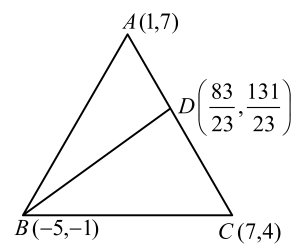
If the vertices of a triangle $ABC$ are $A(1,7)$,$B(-5,-1)$,and $C(7,4)$,then the equation of the internal angle bisector of $\angle ABC$ is
A
$7x-9y+26=0$
B
$9x-7y+38=0$
C
$7x+9y+44=0$
D
$9x+7y+52=0$
Solution
(A) Given vertices are $A(1,7)$,$B(-5,-1)$,and $C(7,4)$.
Let the internal angle bisector of $\angle ABC$ meet the side $AC$ at point $D$.
By the Angle Bisector Theorem,the ratio in which $D$ divides $AC$ is $\frac{AD}{DC} = \frac{BA}{BC}$.
Calculating the lengths of sides $BA$ and $BC$:
$BA = \sqrt{(1 - (-5))^2 + (7 - (-1))^2} = \sqrt{6^2 + 8^2} = \sqrt{36 + 64} = \sqrt{100} = 10$.
$BC = \sqrt{(7 - (-5))^2 + (4 - (-1))^2} = \sqrt{12^2 + 5^2} = \sqrt{144 + 25} = \sqrt{169} = 13$.
Thus,$\frac{AD}{DC} = \frac{10}{13}$.
Using the section formula,the coordinates of $D$ are:
$D = \left( \frac{10(7) + 13(1)}{10 + 13}, \frac{10(4) + 13(7)}{10 + 13} \right) = \left( \frac{70 + 13}{23}, \frac{40 + 91}{23} \right) = \left( \frac{83}{23}, \frac{131}{23} \right)$.
The equation of the line passing through $B(-5, -1)$ and $D\left(\frac{83}{23}, \frac{131}{23}\right)$ is:
$y - (-1) = \frac{\frac{131}{23} - (-1)}{\frac{83}{23} - (-5)} (x - (-5))$
$y + 1 = \frac{\frac{131 + 23}{23}}{\frac{83 + 115}{23}} (x + 5)$
$y + 1 = \frac{154}{198} (x + 5)$
$y + 1 = \frac{7}{9} (x + 5)$
$9y + 9 = 7x + 35$
$7x - 9y + 26 = 0$.
Let the internal angle bisector of $\angle ABC$ meet the side $AC$ at point $D$.
By the Angle Bisector Theorem,the ratio in which $D$ divides $AC$ is $\frac{AD}{DC} = \frac{BA}{BC}$.
Calculating the lengths of sides $BA$ and $BC$:
$BA = \sqrt{(1 - (-5))^2 + (7 - (-1))^2} = \sqrt{6^2 + 8^2} = \sqrt{36 + 64} = \sqrt{100} = 10$.
$BC = \sqrt{(7 - (-5))^2 + (4 - (-1))^2} = \sqrt{12^2 + 5^2} = \sqrt{144 + 25} = \sqrt{169} = 13$.
Thus,$\frac{AD}{DC} = \frac{10}{13}$.
Using the section formula,the coordinates of $D$ are:
$D = \left( \frac{10(7) + 13(1)}{10 + 13}, \frac{10(4) + 13(7)}{10 + 13} \right) = \left( \frac{70 + 13}{23}, \frac{40 + 91}{23} \right) = \left( \frac{83}{23}, \frac{131}{23} \right)$.
The equation of the line passing through $B(-5, -1)$ and $D\left(\frac{83}{23}, \frac{131}{23}\right)$ is:
$y - (-1) = \frac{\frac{131}{23} - (-1)}{\frac{83}{23} - (-5)} (x - (-5))$
$y + 1 = \frac{\frac{131 + 23}{23}}{\frac{83 + 115}{23}} (x + 5)$
$y + 1 = \frac{154}{198} (x + 5)$
$y + 1 = \frac{7}{9} (x + 5)$
$9y + 9 = 7x + 35$
$7x - 9y + 26 = 0$.
0 likes
View Solution307
EasyMCQ
Let one of the sides of a triangle be $17 \text{ cm}$ and the sum of all the sides of the triangle be $40 \text{ cm}$. If the sum of two adjacent sides is $35 \text{ cm}$, then the area (in $\text{cm}^2$) of the triangle is (in $\sqrt{2}$)
A
$15$
B
$20$
C
$30$
D
$35$
Solution
(C) Let the sides of the triangle be $a, b, c$. Given $a = 17 \text{ cm}$ and the perimeter $P = a + b + c = 40 \text{ cm}$.
Given the sum of two sides is $a + b = 35 \text{ cm}$.
Substituting $a = 17$, we get $17 + b = 35$, so $b = 18 \text{ cm}$.
Since $a + b + c = 40$, we have $17 + 18 + c = 40$, which gives $c = 5 \text{ cm}$.
The semi-perimeter $s = \frac{40}{2} = 20 \text{ cm}$.
Using Heron's formula, the area $A = \sqrt{s(s-a)(s-b)(s-c)}$.
$A = \sqrt{20(20-17)(20-18)(20-5)} = \sqrt{20 \times 3 \times 2 \times 15}$.
$A = \sqrt{1800} = \sqrt{900 \times 2} = 30 \sqrt{2} \text{ cm}^2$.
Thus, the correct option is $C$.
Given the sum of two sides is $a + b = 35 \text{ cm}$.
Substituting $a = 17$, we get $17 + b = 35$, so $b = 18 \text{ cm}$.
Since $a + b + c = 40$, we have $17 + 18 + c = 40$, which gives $c = 5 \text{ cm}$.
The semi-perimeter $s = \frac{40}{2} = 20 \text{ cm}$.
Using Heron's formula, the area $A = \sqrt{s(s-a)(s-b)(s-c)}$.
$A = \sqrt{20(20-17)(20-18)(20-5)} = \sqrt{20 \times 3 \times 2 \times 15}$.
$A = \sqrt{1800} = \sqrt{900 \times 2} = 30 \sqrt{2} \text{ cm}^2$.
Thus, the correct option is $C$.
0 likes
View Solution308
EasyMCQ
In a triangle $ABC$,$AD$ and $BE$ are medians. If $AD=4$,$\angle DAB = \frac{\pi}{6}$ and $\angle ABE = \frac{\pi}{3}$,then the area of $\triangle ABC$ is
A
$\frac{14}{3 \sqrt{3}}$
B
$\frac{28}{3 \sqrt{3}}$
C
$\frac{11}{3 \sqrt{3}}$
D
$\frac{32}{3 \sqrt{3}}$
Solution
(D) Let $G$ be the centroid of $\triangle ABC$. Since $AD$ and $BE$ are medians,$G$ divides $AD$ and $BE$ in the ratio $2:1$.
Thus,$AG = \frac{2}{3} AD = \frac{2}{3} \times 4 = \frac{8}{3}$ and $BG = \frac{2}{3} BE$.
In $\triangle ABG$,by the Sine Rule: $\frac{AG}{\sin(\angle ABG)} = \frac{BG}{\sin(\angle BAG)}$.
Given $\angle BAG = \frac{\pi}{6}$ and $\angle ABG = \frac{\pi}{3}$,we have $\frac{8/3}{\sin(\pi/3)} = \frac{BG}{\sin(\pi/6)}$.
$BG = \frac{8}{3} \times \frac{\sin(\pi/6)}{\sin(\pi/3)} = \frac{8}{3} \times \frac{1/2}{\sqrt{3}/2} = \frac{8}{3 \sqrt{3}}$.
Area of $\triangle ABG = \frac{1}{2} \times AG \times BG \times \sin(\angle AGB)$.
Since $\angle AGB = \pi - (\pi/6 + \pi/3) = \pi/2$,$\sin(\angle AGB) = 1$.
Area of $\triangle ABG = \frac{1}{2} \times \frac{8}{3} \times \frac{8}{3 \sqrt{3}} = \frac{32}{9 \sqrt{3}}$.
Since the centroid divides the triangle into three triangles of equal area,Area of $\triangle ABC = 3 \times \text{Area of } \triangle ABG = 3 \times \frac{32}{9 \sqrt{3}} = \frac{32}{3 \sqrt{3}}$.
Thus,$AG = \frac{2}{3} AD = \frac{2}{3} \times 4 = \frac{8}{3}$ and $BG = \frac{2}{3} BE$.
In $\triangle ABG$,by the Sine Rule: $\frac{AG}{\sin(\angle ABG)} = \frac{BG}{\sin(\angle BAG)}$.
Given $\angle BAG = \frac{\pi}{6}$ and $\angle ABG = \frac{\pi}{3}$,we have $\frac{8/3}{\sin(\pi/3)} = \frac{BG}{\sin(\pi/6)}$.
$BG = \frac{8}{3} \times \frac{\sin(\pi/6)}{\sin(\pi/3)} = \frac{8}{3} \times \frac{1/2}{\sqrt{3}/2} = \frac{8}{3 \sqrt{3}}$.
Area of $\triangle ABG = \frac{1}{2} \times AG \times BG \times \sin(\angle AGB)$.
Since $\angle AGB = \pi - (\pi/6 + \pi/3) = \pi/2$,$\sin(\angle AGB) = 1$.
Area of $\triangle ABG = \frac{1}{2} \times \frac{8}{3} \times \frac{8}{3 \sqrt{3}} = \frac{32}{9 \sqrt{3}}$.
Since the centroid divides the triangle into three triangles of equal area,Area of $\triangle ABC = 3 \times \text{Area of } \triangle ABG = 3 \times \frac{32}{9 \sqrt{3}} = \frac{32}{3 \sqrt{3}}$.
0 likes
View Solution309
DifficultMCQ
The perimeter of a triangle is $16 \text{ cm}$,one of the sides is of length $6 \text{ cm}$. If the area of the triangle is $12 \text{ cm}^2$,then the triangle is:
A
right angled
B
isosceles
C
equilateral
D
scalene
Solution
(B) Given that the perimeter $2s = 16 \text{ cm}$,so the semi-perimeter $s = 8 \text{ cm}$.
Let the sides be $a, b, c$. Given $a = 6 \text{ cm}$ and area $\Delta = 12 \text{ cm}^2$.
Using Heron's formula: $\Delta^2 = s(s-a)(s-b)(s-c)$.
$144 = 8(8-6)(8-b)(8-c)$.
$144 = 8(2)(8-b)(8-c) \Rightarrow 144 = 16(8-b)(8-c)$.
$9 = (8-b)(8-c)$.
Since $a+b+c = 16$ and $a=6$,we have $b+c = 10$,so $c = 10-b$.
Substituting $c$: $9 = (8-b)(8-(10-b)) = (8-b)(b-2)$.
$9 = 8b - 16 - b^2 + 2b \Rightarrow b^2 - 10b + 25 = 0$.
$(b-5)^2 = 0 \Rightarrow b = 5 \text{ cm}$.
Then $c = 10 - 5 = 5 \text{ cm}$.
Since two sides are equal $(b=c=5 \text{ cm})$,the triangle is isosceles.
Let the sides be $a, b, c$. Given $a = 6 \text{ cm}$ and area $\Delta = 12 \text{ cm}^2$.
Using Heron's formula: $\Delta^2 = s(s-a)(s-b)(s-c)$.
$144 = 8(8-6)(8-b)(8-c)$.
$144 = 8(2)(8-b)(8-c) \Rightarrow 144 = 16(8-b)(8-c)$.
$9 = (8-b)(8-c)$.
Since $a+b+c = 16$ and $a=6$,we have $b+c = 10$,so $c = 10-b$.
Substituting $c$: $9 = (8-b)(8-(10-b)) = (8-b)(b-2)$.
$9 = 8b - 16 - b^2 + 2b \Rightarrow b^2 - 10b + 25 = 0$.
$(b-5)^2 = 0 \Rightarrow b = 5 \text{ cm}$.
Then $c = 10 - 5 = 5 \text{ cm}$.
Since two sides are equal $(b=c=5 \text{ cm})$,the triangle is isosceles.
0 likes
View Solution310
DifficultMCQ
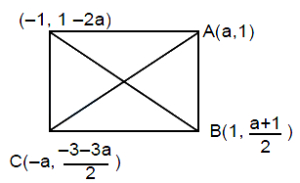
$A$ rectangle $ABCD$ has its side parallel to the line $y=2x$ and vertices $A, B, D$ are on lines $y=1, x=1$ and $x=-1$ respectively. The coordinate of $C$ can be
A
$(3,8)$
B
$(-3,8)$
C
$(-3,-1)$
D
None of these
Solution
(D) Let the vertices be $A(a, 1)$,$B(1, b)$,and $D(-1, d)$. Since $AD$ is parallel to $y=2x$,the slope of $AD$ is $2$. Thus,$\frac{d-1}{-1-a} = 2$ $\Rightarrow d-1 = -2-2a$ $\Rightarrow d = -1-2a$. Since $AB$ is perpendicular to $AD$,the slope of $AB$ is $-\frac{1}{2}$. Thus,$\frac{b-1}{1-a} = -\frac{1}{2}$ $\Rightarrow 2b-2 = a-1$ $\Rightarrow b = \frac{a+1}{2}$. Since $ABCD$ is a rectangle,the midpoint of diagonal $AC$ is the same as the midpoint of diagonal $BD$. Midpoint of $BD = (\frac{1-1}{2}, \frac{b+d}{2}) = (0, \frac{b+d}{2})$. Midpoint of $AC = (\frac{a+x_c}{2}, \frac{1+y_c}{2})$. Equating these,we get $x_c = -a$ and $y_c = b+d-1 = \frac{a+1}{2} - 1 - 2a - 1 = \frac{a+1-2-4a-2}{2} = \frac{-3a-3}{2}$. Thus,$C$ is $(-a, \frac{-3(a+1)}{2})$. Checking the options,none of the given coordinates match this form for any real $a$.
0 likes
View Solution311
MediumMCQ
$x+8y-22=0$,$5x+2y-34=0$,and $2x-3y+13=0$ are the three sides of a triangle. The area of the triangle is
A
$36$ sq units
B
$19$ sq units
C
$42$ sq units
D
$72$ sq units
Solution
(B) Given the three sides of a triangle are:
$x+8y-22=0$ $(i)$
$5x+2y-34=0$ $(ii)$
$2x-3y+13=0$ $(iii)$
Solving $(i)$ and $(ii)$:
$x=6, y=2$. Vertex $A = (6, 2)$.
Solving $(ii)$ and $(iii)$:
$x=4, y=7$. Vertex $B = (4, 7)$.
Solving $(i)$ and $(iii)$:
$x=-2, y=3$. Vertex $C = (-2, 3)$.
The area of the triangle with vertices $(x_1, y_1), (x_2, y_2), (x_3, y_3)$ is given by:
$\text{Area} = \frac{1}{2} |x_1(y_2-y_3) + x_2(y_3-y_1) + x_3(y_1-y_2)|$
$\text{Area} = \frac{1}{2} |6(7-3) + 4(3-2) + (-2)(2-7)|$
$\text{Area} = \frac{1}{2} |6(4) + 4(1) - 2(-5)|$
$\text{Area} = \frac{1}{2} |24 + 4 + 10|$
$\text{Area} = \frac{1}{2} |38| = 19$ sq units.
$x+8y-22=0$ $(i)$
$5x+2y-34=0$ $(ii)$
$2x-3y+13=0$ $(iii)$
Solving $(i)$ and $(ii)$:
$x=6, y=2$. Vertex $A = (6, 2)$.
Solving $(ii)$ and $(iii)$:
$x=4, y=7$. Vertex $B = (4, 7)$.
Solving $(i)$ and $(iii)$:
$x=-2, y=3$. Vertex $C = (-2, 3)$.
The area of the triangle with vertices $(x_1, y_1), (x_2, y_2), (x_3, y_3)$ is given by:
$\text{Area} = \frac{1}{2} |x_1(y_2-y_3) + x_2(y_3-y_1) + x_3(y_1-y_2)|$
$\text{Area} = \frac{1}{2} |6(7-3) + 4(3-2) + (-2)(2-7)|$
$\text{Area} = \frac{1}{2} |6(4) + 4(1) - 2(-5)|$
$\text{Area} = \frac{1}{2} |24 + 4 + 10|$
$\text{Area} = \frac{1}{2} |38| = 19$ sq units.
0 likes
View Solution312
EasyMCQ
The equations $y = \pm \sqrt{3}x$ and $y = 1$ represent the sides of which triangle?
A
an equilateral triangle
B
a right-angled triangle
C
an isosceles triangle
D
an obtuse-angled triangle
Solution
(A) The given equations are $y = \sqrt{3}x$,$y = -\sqrt{3}x$,and $y = 1$.
These can be written as $y = \tan(60^{\circ})x$,$y = \tan(120^{\circ})x$,and $y = 1$.
The lines $y = \sqrt{3}x$ and $y = -\sqrt{3}x$ pass through the origin $(0,0)$ and make angles of $60^{\circ}$ and $120^{\circ}$ with the positive $x$-axis,respectively.
The angle between these two lines is $120^{\circ} - 60^{\circ} = 60^{\circ}$.
The line $y = 1$ intersects $y = \sqrt{3}x$ at $(\frac{1}{\sqrt{3}}, 1)$ and $y = -\sqrt{3}x$ at $(-\frac{1}{\sqrt{3}}, 1)$.
The length of the base on the line $y = 1$ is $\frac{1}{\sqrt{3}} - (-\frac{1}{\sqrt{3}}) = \frac{2}{\sqrt{3}}$.
The lengths of the other two sides are $\sqrt{(\frac{1}{\sqrt{3}})^2 + 1^2} = \sqrt{\frac{1}{3} + 1} = \sqrt{\frac{4}{3}} = \frac{2}{\sqrt{3}}$.
Since all three sides are equal to $\frac{2}{\sqrt{3}}$,the triangle is an equilateral triangle.
These can be written as $y = \tan(60^{\circ})x$,$y = \tan(120^{\circ})x$,and $y = 1$.
The lines $y = \sqrt{3}x$ and $y = -\sqrt{3}x$ pass through the origin $(0,0)$ and make angles of $60^{\circ}$ and $120^{\circ}$ with the positive $x$-axis,respectively.
The angle between these two lines is $120^{\circ} - 60^{\circ} = 60^{\circ}$.
The line $y = 1$ intersects $y = \sqrt{3}x$ at $(\frac{1}{\sqrt{3}}, 1)$ and $y = -\sqrt{3}x$ at $(-\frac{1}{\sqrt{3}}, 1)$.
The length of the base on the line $y = 1$ is $\frac{1}{\sqrt{3}} - (-\frac{1}{\sqrt{3}}) = \frac{2}{\sqrt{3}}$.
The lengths of the other two sides are $\sqrt{(\frac{1}{\sqrt{3}})^2 + 1^2} = \sqrt{\frac{1}{3} + 1} = \sqrt{\frac{4}{3}} = \frac{2}{\sqrt{3}}$.
Since all three sides are equal to $\frac{2}{\sqrt{3}}$,the triangle is an equilateral triangle.
0 likes
View Solution313
MediumMCQ
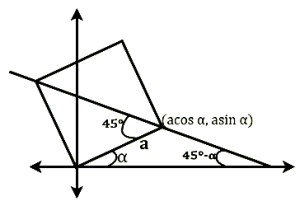
$A$ square with each side of length $a$ lies above the $x$-axis and has one vertex at the origin. One of the sides passing through the origin makes an angle $\alpha$ $(0 < \alpha < \frac{\pi}{4})$ with the positive direction of the $x$-axis. Find the equations of the diagonals of the square.
A
$y(\cos \alpha - \sin \alpha) = x(\sin \alpha + \cos \alpha)$
B
$y(\cos \alpha + \sin \alpha) = x(\cos \alpha - \sin \alpha)$
C
$y(\sin \alpha + \cos \alpha) + x(\cos \alpha - \sin \alpha) = a$
D
$y(\cos \alpha - \sin \alpha) + x(\cos \alpha + \sin \alpha) = a$
Solution
(A, C) Let the vertices of the square be $O(0,0)$,$A(a \cos \alpha, a \sin \alpha)$,$C(a \cos(\alpha + 90^{\circ}), a \sin(\alpha + 90^{\circ})) = (-a \sin \alpha, a \cos \alpha)$,and $B(a \cos \alpha - a \sin \alpha, a \sin \alpha + a \cos \alpha)$.
The first diagonal passes through $O(0,0)$ and $B(a(\cos \alpha - \sin \alpha), a(\sin \alpha + \cos \alpha))$.
The slope of this diagonal is $m_1 = \frac{a(\sin \alpha + \cos \alpha)}{a(\cos \alpha - \sin \alpha)} = \frac{\sin \alpha + \cos \alpha}{\cos \alpha - \sin \alpha}$.
The equation is $y = m_1 x \Rightarrow y(\cos \alpha - \sin \alpha) = x(\sin \alpha + \cos \alpha)$.
The second diagonal passes through $A(a \cos \alpha, a \sin \alpha)$ and $C(-a \sin \alpha, a \cos \alpha)$.
The slope of this diagonal is $m_2 = \frac{a \cos \alpha - a \sin \alpha}{-a \sin \alpha - a \cos \alpha} = -\frac{\cos \alpha - \sin \alpha}{\cos \alpha + \sin \alpha}$.
The equation is $y - a \sin \alpha = m_2(x - a \cos \alpha)$.
$(y - a \sin \alpha)(\cos \alpha + \sin \alpha) = -(\cos \alpha - \sin \alpha)(x - a \cos \alpha)$.
$y(\cos \alpha + \sin \alpha) - a \sin \alpha \cos \alpha - a \sin^2 \alpha = -x(\cos \alpha - \sin \alpha) + a \cos^2 \alpha - a \sin \alpha \cos \alpha$.
$y(\cos \alpha + \sin \alpha) + x(\cos \alpha - \sin \alpha) = a(\cos^2 \alpha + \sin^2 \alpha) = a$.
The first diagonal passes through $O(0,0)$ and $B(a(\cos \alpha - \sin \alpha), a(\sin \alpha + \cos \alpha))$.
The slope of this diagonal is $m_1 = \frac{a(\sin \alpha + \cos \alpha)}{a(\cos \alpha - \sin \alpha)} = \frac{\sin \alpha + \cos \alpha}{\cos \alpha - \sin \alpha}$.
The equation is $y = m_1 x \Rightarrow y(\cos \alpha - \sin \alpha) = x(\sin \alpha + \cos \alpha)$.
The second diagonal passes through $A(a \cos \alpha, a \sin \alpha)$ and $C(-a \sin \alpha, a \cos \alpha)$.
The slope of this diagonal is $m_2 = \frac{a \cos \alpha - a \sin \alpha}{-a \sin \alpha - a \cos \alpha} = -\frac{\cos \alpha - \sin \alpha}{\cos \alpha + \sin \alpha}$.
The equation is $y - a \sin \alpha = m_2(x - a \cos \alpha)$.
$(y - a \sin \alpha)(\cos \alpha + \sin \alpha) = -(\cos \alpha - \sin \alpha)(x - a \cos \alpha)$.
$y(\cos \alpha + \sin \alpha) - a \sin \alpha \cos \alpha - a \sin^2 \alpha = -x(\cos \alpha - \sin \alpha) + a \cos^2 \alpha - a \sin \alpha \cos \alpha$.
$y(\cos \alpha + \sin \alpha) + x(\cos \alpha - \sin \alpha) = a(\cos^2 \alpha + \sin^2 \alpha) = a$.
0 likes
View Solution314
MediumMCQ
The straight lines $x+y=0$,$5x+y=4$,and $x+5y=4$ form
A
an isosceles triangle
B
an equilateral triangle
C
a scalene triangle
D
a right angled triangle
Solution
(A) The given lines are $L_1: x+y=0$,$L_2: 5x+y=4$,and $L_3: x+5y=4$.
Solving $L_1$ and $L_2$: $x+y=0 \implies y=-x$. Substituting into $L_2$: $5x-x=4 \implies 4x=4 \implies x=1, y=-1$. So,$A = (1, -1)$.
Solving $L_1$ and $L_3$: $x+y=0 \implies x=-y$. Substituting into $L_3$: $-y+5y=4 \implies 4y=4 \implies y=1, x=-1$. So,$C = (-1, 1)$.
Solving $L_2$ and $L_3$: $5x+y=4$ and $x+5y=4$. Subtracting: $4x-4y=0 \implies x=y$. Substituting into $L_2$: $5x+x=4 \implies 6x=4 \implies x=2/3, y=2/3$. So,$B = (2/3, 2/3)$.
Calculating side lengths:
$AB = \sqrt{(2/3 - 1)^2 + (2/3 + 1)^2} = \sqrt{(-1/3)^2 + (5/3)^2} = \sqrt{1/9 + 25/9} = \sqrt{26/9} = \frac{\sqrt{26}}{3}$.
$BC = \sqrt{(-1 - 2/3)^2 + (1 - 2/3)^2} = \sqrt{(-5/3)^2 + (1/3)^2} = \sqrt{25/9 + 1/9} = \sqrt{26/9} = \frac{\sqrt{26}}{3}$.
$CA = \sqrt{(-1 - 1)^2 + (1 - (-1))^2} = \sqrt{(-2)^2 + 2^2} = \sqrt{4+4} = \sqrt{8} = 2\sqrt{2}$.
Since $AB = BC$,the triangle is an isosceles triangle.
Solving $L_1$ and $L_2$: $x+y=0 \implies y=-x$. Substituting into $L_2$: $5x-x=4 \implies 4x=4 \implies x=1, y=-1$. So,$A = (1, -1)$.
Solving $L_1$ and $L_3$: $x+y=0 \implies x=-y$. Substituting into $L_3$: $-y+5y=4 \implies 4y=4 \implies y=1, x=-1$. So,$C = (-1, 1)$.
Solving $L_2$ and $L_3$: $5x+y=4$ and $x+5y=4$. Subtracting: $4x-4y=0 \implies x=y$. Substituting into $L_2$: $5x+x=4 \implies 6x=4 \implies x=2/3, y=2/3$. So,$B = (2/3, 2/3)$.
Calculating side lengths:
$AB = \sqrt{(2/3 - 1)^2 + (2/3 + 1)^2} = \sqrt{(-1/3)^2 + (5/3)^2} = \sqrt{1/9 + 25/9} = \sqrt{26/9} = \frac{\sqrt{26}}{3}$.
$BC = \sqrt{(-1 - 2/3)^2 + (1 - 2/3)^2} = \sqrt{(-5/3)^2 + (1/3)^2} = \sqrt{25/9 + 1/9} = \sqrt{26/9} = \frac{\sqrt{26}}{3}$.
$CA = \sqrt{(-1 - 1)^2 + (1 - (-1))^2} = \sqrt{(-2)^2 + 2^2} = \sqrt{4+4} = \sqrt{8} = 2\sqrt{2}$.
Since $AB = BC$,the triangle is an isosceles triangle.
0 likes
View Solution315
EasyMCQ
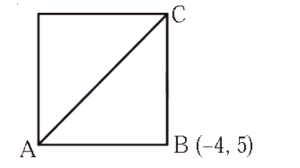
The point $(-4, 5)$ is a vertex of a square and one of its diagonals lies along the line $7x - y + 8 = 0$. The equation of the other diagonal is:
A
$7x - y + 23 = 0$
B
$7y + x = 30$
C
$7y + x = 31$
D
$x - 7y = 30$
Solution
(C) Let the given vertex be $V = (-4, 5)$ and the given diagonal be $L_1: 7x - y + 8 = 0$.
Note that the vertex $V(-4, 5)$ does not lie on the diagonal $L_1$ because $7(-4) - 5 + 8 = -28 - 5 + 8 = -25 \neq 0$.
In a square,the diagonals are perpendicular to each other and bisect each other.
Let the other diagonal be $L_2$. Since $L_2$ passes through the vertex $V(-4, 5)$ and is perpendicular to $L_1$,its slope must be the negative reciprocal of the slope of $L_1$.
The slope of $L_1$ is $m_1 = 7$.
Therefore,the slope of $L_2$ is $m_2 = -1/7$.
The equation of $L_2$ passing through $(-4, 5)$ is:
$y - 5 = -\frac{1}{7}(x + 4)$
$7(y - 5) = -(x + 4)$
$7y - 35 = -x - 4$
$x + 7y = 31$
Thus,the equation of the other diagonal is $x + 7y = 31$ or $7y + x = 31$.
Note that the vertex $V(-4, 5)$ does not lie on the diagonal $L_1$ because $7(-4) - 5 + 8 = -28 - 5 + 8 = -25 \neq 0$.
In a square,the diagonals are perpendicular to each other and bisect each other.
Let the other diagonal be $L_2$. Since $L_2$ passes through the vertex $V(-4, 5)$ and is perpendicular to $L_1$,its slope must be the negative reciprocal of the slope of $L_1$.
The slope of $L_1$ is $m_1 = 7$.
Therefore,the slope of $L_2$ is $m_2 = -1/7$.
The equation of $L_2$ passing through $(-4, 5)$ is:
$y - 5 = -\frac{1}{7}(x + 4)$
$7(y - 5) = -(x + 4)$
$7y - 35 = -x - 4$
$x + 7y = 31$
Thus,the equation of the other diagonal is $x + 7y = 31$ or $7y + x = 31$.
0 likes
View Solution316
DifficultMCQ
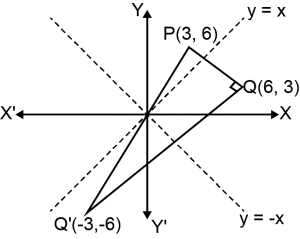
The point $P(3,6)$ is first reflected on the line $y=x$ and then the image point $Q$ is again reflected on the line $y=-x$ to get the image point $Q^{\prime}$. Then,the circumcentre of the $\Delta P Q Q^{\prime}$ is
A
$(6,3)$
B
$(6,-3)$
C
$(3,-6)$
D
$(0,0)$
Solution
(D) The reflection of point $P(3,6)$ on the line $y=x$ gives the point $Q(6,3)$.
The reflection of point $Q(6,3)$ on the line $y=-x$ gives the point $Q^{\prime}(-3,-6)$.
Now,the slope of $PQ = \frac{3-6}{6-3} = \frac{-3}{3} = -1$.
The slope of $QQ^{\prime} = \frac{-6-3}{-3-6} = \frac{-9}{-9} = 1$.
Since the product of the slopes is $(-1) \times (1) = -1$,the lines $PQ$ and $QQ^{\prime}$ are perpendicular.
Therefore,$\Delta PQQ^{\prime}$ is a right-angled triangle with the right angle at $Q$.
The circumcentre of a right-angled triangle is the midpoint of its hypotenuse.
The hypotenuse is $PQ^{\prime}$,with endpoints $P(3,6)$ and $Q^{\prime}(-3,-6)$.
Midpoint of $PQ^{\prime} = \left(\frac{3+(-3)}{2}, \frac{6+(-6)}{2}\right) = (0,0)$.
The reflection of point $Q(6,3)$ on the line $y=-x$ gives the point $Q^{\prime}(-3,-6)$.
Now,the slope of $PQ = \frac{3-6}{6-3} = \frac{-3}{3} = -1$.
The slope of $QQ^{\prime} = \frac{-6-3}{-3-6} = \frac{-9}{-9} = 1$.
Since the product of the slopes is $(-1) \times (1) = -1$,the lines $PQ$ and $QQ^{\prime}$ are perpendicular.
Therefore,$\Delta PQQ^{\prime}$ is a right-angled triangle with the right angle at $Q$.
The circumcentre of a right-angled triangle is the midpoint of its hypotenuse.
The hypotenuse is $PQ^{\prime}$,with endpoints $P(3,6)$ and $Q^{\prime}(-3,-6)$.
Midpoint of $PQ^{\prime} = \left(\frac{3+(-3)}{2}, \frac{6+(-6)}{2}\right) = (0,0)$.
0 likes
View Solution317
MediumMCQ
The points $(-a,-b), (a, b), (0,0)$ and $(a^{2}, ab)$ where $a \neq 0, b \neq 0$ are always
A
collinear
B
vertices of a parallelogram
C
vertices of a rectangle
D
lie on a circle
Solution
(A) Let the four points be $A(-a,-b)$,$B(a, b)$,$C(0,0)$,and $D(a^{2}, ab)$.
To check if $A, B$,and $C$ are collinear,we calculate the determinant:
$\left|\begin{array}{ccc}-a & -b & 1 \\ a & b & 1 \\ 0 & 0 & 1\end{array}\right| = -a(b-0) + b(a-0) + 1(0) = -ab + ab = 0$.
Since the determinant is $0$,points $A, B$,and $C$ are collinear.
Now,check if $B, C$,and $D$ are collinear:
$\left|\begin{array}{ccc}a & b & 1 \\ 0 & 0 & 1 \\ a^{2} & ab & 1\end{array}\right| = a(0-ab) - b(0-a^{2}) + 1(0) = -a^{2}b + a^{2}b = 0$.
Since the determinant is $0$,points $B, C$,and $D$ are collinear.
Since $A, B, C$ are collinear and $B, C, D$ are collinear,all four points $A, B, C$,and $D$ must lie on the same line.
To check if $A, B$,and $C$ are collinear,we calculate the determinant:
$\left|\begin{array}{ccc}-a & -b & 1 \\ a & b & 1 \\ 0 & 0 & 1\end{array}\right| = -a(b-0) + b(a-0) + 1(0) = -ab + ab = 0$.
Since the determinant is $0$,points $A, B$,and $C$ are collinear.
Now,check if $B, C$,and $D$ are collinear:
$\left|\begin{array}{ccc}a & b & 1 \\ 0 & 0 & 1 \\ a^{2} & ab & 1\end{array}\right| = a(0-ab) - b(0-a^{2}) + 1(0) = -a^{2}b + a^{2}b = 0$.
Since the determinant is $0$,points $B, C$,and $D$ are collinear.
Since $A, B, C$ are collinear and $B, C, D$ are collinear,all four points $A, B, C$,and $D$ must lie on the same line.
0 likes
View Solution318
MediumMCQ
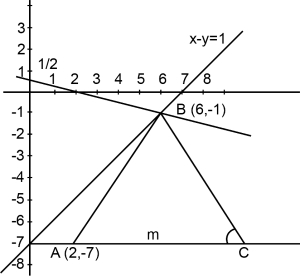
Straight lines $x-y=7$ and $x+4y=2$ intersect at $B$. Points $A$ and $C$ are so chosen on these two lines such that $AB=AC$. The equation of line $AC$ passing through $(2,-7)$ is
A
$x-y-9=0$
B
$23x+7y+3=0$
C
$2x-y-11=0$
D
$7x-6y-56=0$
Solution
(B) The given equations of the lines are:
$x-y=7$ ...$(i)$
$x+4y=2$ ...(ii)
Solving equations $(i)$ and (ii),we find the intersection point $B(6,-1)$.
Let the slope of line $AC$ be $m$. Since $A(2,-7)$ lies on $x-y=7$,line $AC$ passes through $A(2,-7)$.
The angle between line $AC$ and line $AB$ (which is $x-y=7$,slope $m_1=1$) must be equal to the angle between line $AC$ and line $BC$ (which is $x+4y=2$,slope $m_2=-1/4$) because $AB=AC$ implies $\triangle ABC$ is isosceles with $\angle ABC = \angle ACB$.
Using the formula for the angle between two lines $\tan \theta = \left| \frac{m_1-m_2}{1+m_1m_2} \right|$,we equate the tangents of the angles:
$\left| \frac{m-1}{1+m} \right| = \left| \frac{m-(-1/4)}{1+m(-1/4)} \right| = \left| \frac{4m+1}{4-m} \right|$.
Solving this gives $m=1$ or $m=-23/7$.
For $m=1$,the line equation is $y-(-7)=1(x-2) \Rightarrow x-y-9=0$.
For $m=-23/7$,the line equation is $y-(-7)=-\frac{23}{7}(x-2) \Rightarrow 23x+7y+3=0$.
$x-y=7$ ...$(i)$
$x+4y=2$ ...(ii)
Solving equations $(i)$ and (ii),we find the intersection point $B(6,-1)$.
Let the slope of line $AC$ be $m$. Since $A(2,-7)$ lies on $x-y=7$,line $AC$ passes through $A(2,-7)$.
The angle between line $AC$ and line $AB$ (which is $x-y=7$,slope $m_1=1$) must be equal to the angle between line $AC$ and line $BC$ (which is $x+4y=2$,slope $m_2=-1/4$) because $AB=AC$ implies $\triangle ABC$ is isosceles with $\angle ABC = \angle ACB$.
Using the formula for the angle between two lines $\tan \theta = \left| \frac{m_1-m_2}{1+m_1m_2} \right|$,we equate the tangents of the angles:
$\left| \frac{m-1}{1+m} \right| = \left| \frac{m-(-1/4)}{1+m(-1/4)} \right| = \left| \frac{4m+1}{4-m} \right|$.
Solving this gives $m=1$ or $m=-23/7$.
For $m=1$,the line equation is $y-(-7)=1(x-2) \Rightarrow x-y-9=0$.
For $m=-23/7$,the line equation is $y-(-7)=-\frac{23}{7}(x-2) \Rightarrow 23x+7y+3=0$.
0 likes
View Solution319
MediumMCQ
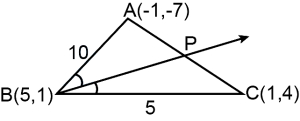
The angular points of a triangle are $A(-1, -7)$,$B(5, 1)$,and $C(1, 4)$. The equation of the bisector of the angle $\angle ABC$ is
A
$x = 7y + 2$
B
$7y = x + 2$
C
$y = 7x + 2$
D
$7x = y + 2$
Solution
(B) The side lengths are calculated as follows:
$AB = \sqrt{(5 - (-1))^2 + (1 - (-7))^2} = \sqrt{6^2 + 8^2} = \sqrt{36 + 64} = 10$
$BC = \sqrt{(1 - 5)^2 + (4 - 1)^2} = \sqrt{(-4)^2 + 3^2} = \sqrt{16 + 9} = 5$
By the Angle Bisector Theorem,the bisector of $\angle ABC$ divides the opposite side $AC$ in the ratio of the adjacent sides $AB:BC = 10:5 = 2:1$.
Let $P$ be the point on $AC$ that divides it in the ratio $2:1$. Using the section formula:
$P = \left( \frac{2(1) + 1(-1)}{2 + 1}, \frac{2(4) + 1(-7)}{2 + 1} \right) = \left( \frac{2 - 1}{3}, \frac{8 - 7}{3} \right) = \left( \frac{1}{3}, \frac{1}{3} \right)$
The equation of the line passing through $B(5, 1)$ and $P(\frac{1}{3}, \frac{1}{3})$ is given by:
$y - 1 = \frac{\frac{1}{3} - 1}{\frac{1}{3} - 5}(x - 5)$
$y - 1 = \frac{-2/3}{-14/3}(x - 5)$
$y - 1 = \frac{1}{7}(x - 5)$
$7y - 7 = x - 5$
$7y = x + 2$
$AB = \sqrt{(5 - (-1))^2 + (1 - (-7))^2} = \sqrt{6^2 + 8^2} = \sqrt{36 + 64} = 10$
$BC = \sqrt{(1 - 5)^2 + (4 - 1)^2} = \sqrt{(-4)^2 + 3^2} = \sqrt{16 + 9} = 5$
By the Angle Bisector Theorem,the bisector of $\angle ABC$ divides the opposite side $AC$ in the ratio of the adjacent sides $AB:BC = 10:5 = 2:1$.
Let $P$ be the point on $AC$ that divides it in the ratio $2:1$. Using the section formula:
$P = \left( \frac{2(1) + 1(-1)}{2 + 1}, \frac{2(4) + 1(-7)}{2 + 1} \right) = \left( \frac{2 - 1}{3}, \frac{8 - 7}{3} \right) = \left( \frac{1}{3}, \frac{1}{3} \right)$
The equation of the line passing through $B(5, 1)$ and $P(\frac{1}{3}, \frac{1}{3})$ is given by:
$y - 1 = \frac{\frac{1}{3} - 1}{\frac{1}{3} - 5}(x - 5)$
$y - 1 = \frac{-2/3}{-14/3}(x - 5)$
$y - 1 = \frac{1}{7}(x - 5)$
$7y - 7 = x - 5$
$7y = x + 2$
0 likes
View Solution320
DifficultMCQ
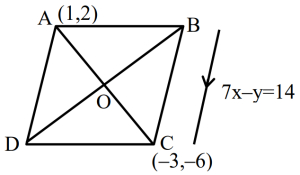
Let $A(1,2)$ and $C(-3,-6)$ be two diagonally opposite vertices of a rhombus,whose sides $AD$ and $BC$ are parallel to the line $7x-y=14$. If $B(\alpha, \beta)$ and $D(\gamma, \delta)$ are the other two vertices,then $|\alpha+\beta+\gamma+\delta|$ is equal to:
A
$9$
B
$3$
C
$6$
D
$1$
Solution
(C) In a rhombus,the diagonals bisect each other at right angles. Let $O$ be the intersection of diagonals $AC$ and $BD$. The coordinates of $O$ are the midpoint of $AC$:
$O = \left(\frac{1-3}{2}, \frac{2-6}{2}\right) = (-1, -2)$.
Since $O$ is also the midpoint of $BD$,we have:
$\frac{\alpha+\gamma}{2} = -1 \implies \alpha+\gamma = -2$
$\frac{\beta+\delta}{2} = -2 \implies \beta+\delta = -4$
We need to find $|\alpha+\beta+\gamma+\delta|$.
$|\alpha+\beta+\gamma+\delta| = |(\alpha+\gamma) + (\beta+\delta)| = |-2 + (-4)| = |-6| = 6$.
$O = \left(\frac{1-3}{2}, \frac{2-6}{2}\right) = (-1, -2)$.
Since $O$ is also the midpoint of $BD$,we have:
$\frac{\alpha+\gamma}{2} = -1 \implies \alpha+\gamma = -2$
$\frac{\beta+\delta}{2} = -2 \implies \beta+\delta = -4$
We need to find $|\alpha+\beta+\gamma+\delta|$.
$|\alpha+\beta+\gamma+\delta| = |(\alpha+\gamma) + (\beta+\delta)| = |-2 + (-4)| = |-6| = 6$.
0 likes
View Solution321
DifficultMCQ
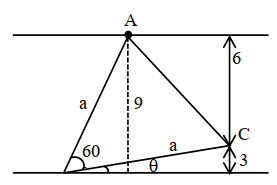
Let a point $A$ lie between the parallel lines $L_1$ and $L_2$ such that its distances from $L_1$ and $L_2$ are $6$ and $3$ units,respectively. Then the area (in sq. units) of the equilateral triangle $ABC$,where the points $B$ and $C$ lie on the lines $L_1$ and $L_2$ respectively,is:
A
$15 \sqrt{6}$
B
$27$
C
$21 \sqrt{3}$
D
$12 \sqrt{2}$
Solution
(C) Let the side length of the equilateral triangle $ABC$ be $a$. The distance between the parallel lines $L_1$ and $L_2$ is $6 + 3 = 9$ units.
Let $\theta$ be the angle that the side $BC$ makes with the line $L_2$. Since $C$ lies on $L_2$,the vertical distance from $A$ to $L_2$ is $9$. In the right-angled triangle formed by the projection of $A$ onto $L_2$,we have $\sin \theta = \frac{3}{a}$ and $\sin(60^{\circ} + \theta) = \frac{9}{a}$.
Expanding $\sin(60^{\circ} + \theta) = \sin 60^{\circ} \cos \theta + \cos 60^{\circ} \sin \theta = \frac{\sqrt{3}}{2} \cos \theta + \frac{1}{2} \sin \theta = \frac{9}{a}$.
Substituting $\sin \theta = \frac{3}{a}$ and $\cos \theta = \sqrt{1 - \frac{9}{a^2}}$,we get $\frac{\sqrt{3}}{2} \sqrt{1 - \frac{9}{a^2}} + \frac{1}{2} \cdot \frac{3}{a} = \frac{9}{a}$.
$\frac{\sqrt{3}}{2} \sqrt{\frac{a^2 - 9}{a^2}} = \frac{9}{a} - \frac{3}{2a} = \frac{15}{2a}$.
$\sqrt{3} \sqrt{a^2 - 9} = 15 \implies 3(a^2 - 9) = 225 \implies a^2 - 9 = 75 \implies a^2 = 84$.
The area of the equilateral triangle is $\frac{\sqrt{3}}{4} a^2 = \frac{\sqrt{3}}{4} \times 84 = 21 \sqrt{3}$ sq. units.
Let $\theta$ be the angle that the side $BC$ makes with the line $L_2$. Since $C$ lies on $L_2$,the vertical distance from $A$ to $L_2$ is $9$. In the right-angled triangle formed by the projection of $A$ onto $L_2$,we have $\sin \theta = \frac{3}{a}$ and $\sin(60^{\circ} + \theta) = \frac{9}{a}$.
Expanding $\sin(60^{\circ} + \theta) = \sin 60^{\circ} \cos \theta + \cos 60^{\circ} \sin \theta = \frac{\sqrt{3}}{2} \cos \theta + \frac{1}{2} \sin \theta = \frac{9}{a}$.
Substituting $\sin \theta = \frac{3}{a}$ and $\cos \theta = \sqrt{1 - \frac{9}{a^2}}$,we get $\frac{\sqrt{3}}{2} \sqrt{1 - \frac{9}{a^2}} + \frac{1}{2} \cdot \frac{3}{a} = \frac{9}{a}$.
$\frac{\sqrt{3}}{2} \sqrt{\frac{a^2 - 9}{a^2}} = \frac{9}{a} - \frac{3}{2a} = \frac{15}{2a}$.
$\sqrt{3} \sqrt{a^2 - 9} = 15 \implies 3(a^2 - 9) = 225 \implies a^2 - 9 = 75 \implies a^2 = 84$.
The area of the equilateral triangle is $\frac{\sqrt{3}}{4} a^2 = \frac{\sqrt{3}}{4} \times 84 = 21 \sqrt{3}$ sq. units.
0 likes
View Solution322
DifficultMCQ
Let the midpoints of the sides of a triangle $ABC$ be $(\frac{5}{2}, 7)$,$(\frac{5}{2}, 3)$,and $(4, 5)$. If its incentre is $(h, k)$,then $3h + k$ is equal to:
A
$11$
B
$12$
C
$13$
D
$14$
Solution
(C) Let the midpoints be $D(\frac{5}{2}, 7)$,$E(\frac{5}{2}, 3)$,and $F(4, 5)$.
The vertices of $\triangle ABC$ are $A, B, C$. Using the property that the vertices of the original triangle are $A = E+F-D$,$B = D+F-E$,and $C = D+E-F$:
$A = (\frac{5}{2}+4-\frac{5}{2}, 3+5-7) = (4, 1)$
$B = (\frac{5}{2}+4-\frac{5}{2}, 7+5-3) = (4, 9)$
$C = (\frac{5}{2}+\frac{5}{2}-4, 7+3-5) = (1, 5)$
The side lengths are $a = BC = \sqrt{(4-1)^2 + (9-5)^2} = \sqrt{3^2+4^2} = 5$,$b = AC = \sqrt{(4-1)^2 + (1-5)^2} = \sqrt{3^2+(-4)^2} = 5$,and $c = AB = \sqrt{(4-4)^2 + (9-1)^2} = 8$.
Since $a=b=5$,the triangle is isosceles. The incentre $(h, k)$ is given by $(\frac{ax_A+bx_B+cx_C}{a+b+c}, \frac{ay_A+by_B+cy_C}{a+b+c})$.
$h = \frac{5(4)+5(4)+8(1)}{5+5+8} = \frac{20+20+8}{18} = \frac{48}{18} = \frac{8}{3}$.
$k = \frac{5(1)+5(9)+8(5)}{5+5+8} = \frac{5+45+40}{18} = \frac{90}{18} = 5$.
Thus,$3h + k = 3(\frac{8}{3}) + 5 = 8 + 5 = 13$.
The vertices of $\triangle ABC$ are $A, B, C$. Using the property that the vertices of the original triangle are $A = E+F-D$,$B = D+F-E$,and $C = D+E-F$:
$A = (\frac{5}{2}+4-\frac{5}{2}, 3+5-7) = (4, 1)$
$B = (\frac{5}{2}+4-\frac{5}{2}, 7+5-3) = (4, 9)$
$C = (\frac{5}{2}+\frac{5}{2}-4, 7+3-5) = (1, 5)$
The side lengths are $a = BC = \sqrt{(4-1)^2 + (9-5)^2} = \sqrt{3^2+4^2} = 5$,$b = AC = \sqrt{(4-1)^2 + (1-5)^2} = \sqrt{3^2+(-4)^2} = 5$,and $c = AB = \sqrt{(4-4)^2 + (9-1)^2} = 8$.
Since $a=b=5$,the triangle is isosceles. The incentre $(h, k)$ is given by $(\frac{ax_A+bx_B+cx_C}{a+b+c}, \frac{ay_A+by_B+cy_C}{a+b+c})$.
$h = \frac{5(4)+5(4)+8(1)}{5+5+8} = \frac{20+20+8}{18} = \frac{48}{18} = \frac{8}{3}$.
$k = \frac{5(1)+5(9)+8(5)}{5+5+8} = \frac{5+45+40}{18} = \frac{90}{18} = 5$.
Thus,$3h + k = 3(\frac{8}{3}) + 5 = 8 + 5 = 13$.
0 likes
View Solution323
DifficultMCQ
In an equilateral triangle $PQR$,let the vertex $P$ be at $(3, 5)$ and the side $QR$ be along the line $x + y = 4$. If the orthocentre of the triangle $PQR$ is $(\alpha, \beta)$,then $9(\alpha + \beta)$ is equal to:
A
$16$
B
$27$
C
$36$
D
$48$
Solution
(D) In an equilateral triangle,the orthocentre coincides with the centroid.
Let $P = (3, 5)$ and the line $QR$ be $x + y - 4 = 0$.
The altitude from $P$ to $QR$ is perpendicular to $x + y = 4$. The slope of $QR$ is $-1$,so the slope of the altitude is $1$.
The equation of the altitude passing through $(3, 5)$ is $y - 5 = 1(x - 3)$,which simplifies to $y = x + 2$.
The foot of the altitude $F$ is the intersection of $x + y = 4$ and $y = x + 2$. Substituting $y$,we get $x + (x + 2) = 4$,so $2x = 2$,$x = 1$. Then $y = 3$. Thus,$F = (1, 3)$.
The centroid $G(\alpha, \beta)$ divides the altitude $PF$ in the ratio $2:1$ from the vertex $P$.
Using the section formula,$G = \left( \frac{2(1) + 1(3)}{2 + 1}, \frac{2(3) + 1(5)}{2 + 1} \right) = \left( \frac{5}{3}, \frac{11}{3} \right)$.
Thus,$\alpha = 5/3$ and $\beta = 11/3$.
Therefore,$9(\alpha + \beta) = 9(5/3 + 11/3) = 9(16/3) = 48$.
Let $P = (3, 5)$ and the line $QR$ be $x + y - 4 = 0$.
The altitude from $P$ to $QR$ is perpendicular to $x + y = 4$. The slope of $QR$ is $-1$,so the slope of the altitude is $1$.
The equation of the altitude passing through $(3, 5)$ is $y - 5 = 1(x - 3)$,which simplifies to $y = x + 2$.
The foot of the altitude $F$ is the intersection of $x + y = 4$ and $y = x + 2$. Substituting $y$,we get $x + (x + 2) = 4$,so $2x = 2$,$x = 1$. Then $y = 3$. Thus,$F = (1, 3)$.
The centroid $G(\alpha, \beta)$ divides the altitude $PF$ in the ratio $2:1$ from the vertex $P$.
Using the section formula,$G = \left( \frac{2(1) + 1(3)}{2 + 1}, \frac{2(3) + 1(5)}{2 + 1} \right) = \left( \frac{5}{3}, \frac{11}{3} \right)$.
Thus,$\alpha = 5/3$ and $\beta = 11/3$.
Therefore,$9(\alpha + \beta) = 9(5/3 + 11/3) = 9(16/3) = 48$.
0 likes
View Solution324
DifficultMCQ
Let $A, B$ be points on the two half-lines $x - \sqrt{3}|y| = \alpha, \alpha > 0$ at a distance of $\alpha$ from their point of intersection $P$. The line segment $AB$ meets the angle bisector of the given half-lines at the point $Q$. If $PQ = \frac{9}{2}$ and $R$ is the radius of the circumcircle of $\triangle PAB$,then $\frac{\alpha^2}{R}$ is equal to . . . . . .
A
$9$
B
$18$
C
$27$
D
$36$
Solution
(A) The given lines are $x - \sqrt{3}y = \alpha$ (for $y \ge 0$) and $x + \sqrt{3}y = \alpha$ (for $y < 0$).
The point of intersection $P$ is $(\alpha, 0)$.
The angle between the lines is $60^\circ$ because the slopes are $m_1 = 1/\sqrt{3}$ and $m_2 = -1/\sqrt{3}$.
Since $PA = PB = \alpha$ and the angle $\angle APB = 60^\circ$,$\triangle PAB$ is an equilateral triangle with side length $a = \alpha$.
The height $PQ$ of the equilateral triangle is given by $PQ = \frac{\sqrt{3}}{2}a = \frac{\sqrt{3}}{2}\alpha$.
Given $PQ = \frac{9}{2}$,we have $\frac{\sqrt{3}}{2}\alpha = \frac{9}{2}$,which implies $\alpha = 3\sqrt{3}$.
The circumradius $R$ of an equilateral triangle with side $a$ is $R = \frac{a}{\sqrt{3}}$.
Thus,$R = \frac{\alpha}{\sqrt{3}} = \frac{3\sqrt{3}}{\sqrt{3}} = 3$.
Finally,$\frac{\alpha^2}{R} = \frac{(3\sqrt{3})^2}{3} = \frac{27}{3} = 9$.
The point of intersection $P$ is $(\alpha, 0)$.
The angle between the lines is $60^\circ$ because the slopes are $m_1 = 1/\sqrt{3}$ and $m_2 = -1/\sqrt{3}$.
Since $PA = PB = \alpha$ and the angle $\angle APB = 60^\circ$,$\triangle PAB$ is an equilateral triangle with side length $a = \alpha$.
The height $PQ$ of the equilateral triangle is given by $PQ = \frac{\sqrt{3}}{2}a = \frac{\sqrt{3}}{2}\alpha$.
Given $PQ = \frac{9}{2}$,we have $\frac{\sqrt{3}}{2}\alpha = \frac{9}{2}$,which implies $\alpha = 3\sqrt{3}$.
The circumradius $R$ of an equilateral triangle with side $a$ is $R = \frac{a}{\sqrt{3}}$.
Thus,$R = \frac{\alpha}{\sqrt{3}} = \frac{3\sqrt{3}}{\sqrt{3}} = 3$.
Finally,$\frac{\alpha^2}{R} = \frac{(3\sqrt{3})^2}{3} = \frac{27}{3} = 9$.
0 likes
View SolutionStraight Line — Problems related to triangle and quadrilateral · Frequently Asked Questions
1Are these Straight Line questions useful for JEE and NEET?
Yes. All questions in this section are mapped to JEE Main and NEET exam patterns. Previous year questions from JEE Main, NEET, GUJCET and state-level exams are included with full solutions.
2Can I switch to Hindi or Gujarati for these questions?
Yes. Use the language tabs in the hero section or the sidebar to view the same questions and solutions in English, Hindi or Gujarati.
3How do I generate a question paper from this subtopic?
Use the Vedclass Exam Paper Generator — select the chapter and subtopic, set difficulty, and generate Sets A, B, C, D automatically. First 3 chapters of every subject are free.
Vedclass Products
For Students
Vedclass Test Series
Mock tests in real JEE/NEET style with performance analysis. 5-day free trial.
Start Free TrialFor Teachers
Exam Paper Generator
Generate Set A/B/C/D papers from this chapter in 2 minutes. 3 chapters free.
Try FreeFor Institutes
Online Exam Module
Live online exams with unlimited students, 360° analytics & white-label branding.
See DemoFor Teachers & Institutes
Generate a Straight Line Exam Paper in 2 Minutes
Select subtopic & difficulty — Sets A, B, C, D auto-generated with No Repeat logic.
First 3 chapters of every subject are free — no payment required.