
A English
Problems related to triangle and quadrilateral Questions in English
Class 11 Mathematics · Straight Line · Problems related to triangle and quadrilateral
325+
Questions
English
Language
100%
With Solutions
Showing 46 of 325 questions in English
251
EasyMCQ
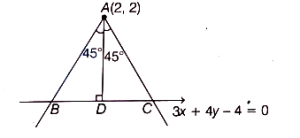
Suppose the hypotenuse and its opposite vertex of an isosceles right-angled triangle are $3x + 4y - 4 = 0$ and $(2, 2)$ respectively. Then,which of the following is another side of the triangle?
A
$x - 7y - 12 = 0$
B
$x + 7y + 12 = 0$
C
$7x + y - 16 = 0$
D
$7x + y + 16 = 0$
Solution
(C) The equation of the hypotenuse $BC$ is $3x + 4y - 4 = 0$.
Let $A = (2, 2)$ be the vertex opposite to the hypotenuse.
The altitude $AD$ from $A$ to $BC$ is perpendicular to $BC$.
The slope of $BC$ is $m_{BC} = -\frac{3}{4}$.
Since $AD \perp BC$,the slope of $AD$ is $m_{AD} = \frac{4}{3}$.
In an isosceles right-angled triangle,the altitude from the vertex to the hypotenuse bisects the angle at the vertex. Thus,the sides $AB$ and $AC$ make an angle of $45^{\circ}$ with the altitude $AD$.
Let $m$ be the slope of side $AB$ or $AC$. Using the formula $\tan \theta = \left| \frac{m_1 - m_2}{1 + m_1 m_2} \right|$:
$\tan 45^{\circ} = \left| \frac{m - \frac{4}{3}}{1 + m(\frac{4}{3})} \right|$ $\Rightarrow 1 = \left| \frac{3m - 4}{3 + 4m} \right|$.
This gives two cases:
$1 = \frac{3m - 4}{3 + 4m}$ $\Rightarrow 3 + 4m = 3m - 4$ $\Rightarrow m = -7$.
$-1 = \frac{3m - 4}{3 + 4m}$ $\Rightarrow -3 - 4m = 3m - 4$ $\Rightarrow 7m = 1$ $\Rightarrow m = \frac{1}{7}$.
Using the point-slope form $y - y_1 = m(x - x_1)$ with point $(2, 2)$:
For $m = -7$: $y - 2 = -7(x - 2)$ $\Rightarrow y - 2 = -7x + 14$ $\Rightarrow 7x + y - 16 = 0$.
For $m = \frac{1}{7}$: $y - 2 = \frac{1}{7}(x - 2)$ $\Rightarrow 7y - 14 = x - 2$ $\Rightarrow x - 7y + 12 = 0$.
Comparing with the options,$7x + y - 16 = 0$ is present.
Let $A = (2, 2)$ be the vertex opposite to the hypotenuse.
The altitude $AD$ from $A$ to $BC$ is perpendicular to $BC$.
The slope of $BC$ is $m_{BC} = -\frac{3}{4}$.
Since $AD \perp BC$,the slope of $AD$ is $m_{AD} = \frac{4}{3}$.
In an isosceles right-angled triangle,the altitude from the vertex to the hypotenuse bisects the angle at the vertex. Thus,the sides $AB$ and $AC$ make an angle of $45^{\circ}$ with the altitude $AD$.
Let $m$ be the slope of side $AB$ or $AC$. Using the formula $\tan \theta = \left| \frac{m_1 - m_2}{1 + m_1 m_2} \right|$:
$\tan 45^{\circ} = \left| \frac{m - \frac{4}{3}}{1 + m(\frac{4}{3})} \right|$ $\Rightarrow 1 = \left| \frac{3m - 4}{3 + 4m} \right|$.
This gives two cases:
$1 = \frac{3m - 4}{3 + 4m}$ $\Rightarrow 3 + 4m = 3m - 4$ $\Rightarrow m = -7$.
$-1 = \frac{3m - 4}{3 + 4m}$ $\Rightarrow -3 - 4m = 3m - 4$ $\Rightarrow 7m = 1$ $\Rightarrow m = \frac{1}{7}$.
Using the point-slope form $y - y_1 = m(x - x_1)$ with point $(2, 2)$:
For $m = -7$: $y - 2 = -7(x - 2)$ $\Rightarrow y - 2 = -7x + 14$ $\Rightarrow 7x + y - 16 = 0$.
For $m = \frac{1}{7}$: $y - 2 = \frac{1}{7}(x - 2)$ $\Rightarrow 7y - 14 = x - 2$ $\Rightarrow x - 7y + 12 = 0$.
Comparing with the options,$7x + y - 16 = 0$ is present.
0 likes
View Solution252
MediumMCQ
Points inside the triangle with vertices at $(1,3), (5,0)$ and $(-1,2)$ must necessarily satisfy which of the following conditions?
A
$3x + 2y \leq 0$
B
$3x + 2y > 0$
C
$2x - 3y - 12 > 0$
D
$2x + y - 13 > 0$
Solution
(B) Let the vertices be $A(1,3), B(5,0)$,and $C(-1,2)$.
For any point $(x,y)$ inside the triangle,the expression must maintain the same sign as it does for the vertices if the line does not pass through the triangle.
Testing the expression $3x + 2y$ for the vertices:
For $A(1,3): 3(1) + 2(3) = 3 + 6 = 9 > 0$.
For $B(5,0): 3(5) + 2(0) = 15 + 0 = 15 > 0$.
For $C(-1,2): 3(-1) + 2(2) = -3 + 4 = 1 > 0$.
Since the value is positive for all vertices,any point inside the triangle must satisfy $3x + 2y > 0$.
Therefore,option $B$ is correct.
For any point $(x,y)$ inside the triangle,the expression must maintain the same sign as it does for the vertices if the line does not pass through the triangle.
Testing the expression $3x + 2y$ for the vertices:
For $A(1,3): 3(1) + 2(3) = 3 + 6 = 9 > 0$.
For $B(5,0): 3(5) + 2(0) = 15 + 0 = 15 > 0$.
For $C(-1,2): 3(-1) + 2(2) = -3 + 4 = 1 > 0$.
Since the value is positive for all vertices,any point inside the triangle must satisfy $3x + 2y > 0$.
Therefore,option $B$ is correct.
0 likes
View Solution253
EasyMCQ
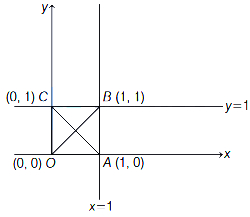
$A$ square is formed by the lines $x=0, y=0, x=1, y=1$. Then,the equations of its diagonals will be
A
$y=x, x+y=2$
B
$2y=x, x+y=\frac{1}{2}$
C
$y=x, x+y=1$
D
$y=2x, x+y=\frac{1}{4}$
Solution
(C) The vertices of the square are $O(0,0), A(1,0), B(1,1),$ and $C(0,1)$.
The diagonals are the line segments connecting opposite vertices,which are $OB$ and $AC$.
$1$. Equation of diagonal $OB$ passing through $(0,0)$ and $(1,1)$:
The slope $m = \frac{1-0}{1-0} = 1$.
Using the point-slope form $y - y_1 = m(x - x_1)$:
$y - 0 = 1(x - 0) \Rightarrow y = x$.
$2$. Equation of diagonal $AC$ passing through $(1,0)$ and $(0,1)$:
The slope $m = \frac{1-0}{0-1} = -1$.
Using the point-slope form $y - 0 = -1(x - 1)$:
$y = -x + 1 \Rightarrow x + y = 1$.
Thus,the equations of the diagonals are $y = x$ and $x + y = 1$.
The diagonals are the line segments connecting opposite vertices,which are $OB$ and $AC$.
$1$. Equation of diagonal $OB$ passing through $(0,0)$ and $(1,1)$:
The slope $m = \frac{1-0}{1-0} = 1$.
Using the point-slope form $y - y_1 = m(x - x_1)$:
$y - 0 = 1(x - 0) \Rightarrow y = x$.
$2$. Equation of diagonal $AC$ passing through $(1,0)$ and $(0,1)$:
The slope $m = \frac{1-0}{0-1} = -1$.
Using the point-slope form $y - 0 = -1(x - 1)$:
$y = -x + 1 \Rightarrow x + y = 1$.
Thus,the equations of the diagonals are $y = x$ and $x + y = 1$.
0 likes
View Solution254
EasyMCQ
If a diagonal of a square is along the line $8x - 15y = 0$ and one of its vertices is $(1, 2)$,then the equations of the sides of the square passing through this vertex are
A
$23x - 7y + 9 = 0, 7x + 23y + 53 = 0$
B
$23x - 7y - 9 = 0, 7x + 23y - 53 = 0$
C
$23x + 7y - 9 = 0, 7x + 23y - 53 = 0$
D
$23x + 7y - 9 = 0, 7x + 23y + 53 = 0$
Solution
(B) The sides of a square make an angle of $45^{\circ}$ with the diagonal. The slope of the given diagonal $8x - 15y = 0$ is $m_1 = \frac{8}{15}$.
Let the slope of the sides passing through $(1, 2)$ be $m$. Using the formula $\tan(45^{\circ}) = |\frac{m - m_1}{1 + m \cdot m_1}|$,we get:
$1 = |\frac{m - 8/15}{1 + 8m/15}|$
$1 = |\frac{15m - 8}{15 + 8m}|$
This gives two cases:
Case $1$: $15m - 8 = 15 + 8m$ $\Rightarrow 7m = 23$ $\Rightarrow m = \frac{23}{7}$.
The equation of the side is $y - 2 = \frac{23}{7}(x - 1)$ $\Rightarrow 7y - 14 = 23x - 23$ $\Rightarrow 23x - 7y - 9 = 0$.
Case $2$: $15m - 8 = -(15 + 8m)$ $\Rightarrow 15m - 8 = -15 - 8m$ $\Rightarrow 23m = -7$ $\Rightarrow m = -\frac{7}{23}$.
The equation of the side is $y - 2 = -\frac{7}{23}(x - 1)$ $\Rightarrow 23y - 46 = -7x + 7$ $\Rightarrow 7x + 23y - 53 = 0$.
Let the slope of the sides passing through $(1, 2)$ be $m$. Using the formula $\tan(45^{\circ}) = |\frac{m - m_1}{1 + m \cdot m_1}|$,we get:
$1 = |\frac{m - 8/15}{1 + 8m/15}|$
$1 = |\frac{15m - 8}{15 + 8m}|$
This gives two cases:
Case $1$: $15m - 8 = 15 + 8m$ $\Rightarrow 7m = 23$ $\Rightarrow m = \frac{23}{7}$.
The equation of the side is $y - 2 = \frac{23}{7}(x - 1)$ $\Rightarrow 7y - 14 = 23x - 23$ $\Rightarrow 23x - 7y - 9 = 0$.
Case $2$: $15m - 8 = -(15 + 8m)$ $\Rightarrow 15m - 8 = -15 - 8m$ $\Rightarrow 23m = -7$ $\Rightarrow m = -\frac{7}{23}$.
The equation of the side is $y - 2 = -\frac{7}{23}(x - 1)$ $\Rightarrow 23y - 46 = -7x + 7$ $\Rightarrow 7x + 23y - 53 = 0$.
0 likes
View Solution255
EasyMCQ
$A$ straight line $4x+y-1=0$ passing through the point $A(2,-7)$ meets the line $BC$ whose equation is $3x-4y+1=0$ at the point $B$. Then the equation of the line $AC$ such that $AB=AC$,is
A
$89x-52y-162=0$
B
$52x+89y+519=0$
C
$4x-y-15=0$
D
$4x+3y+13=0$
Solution
(B) The given lines are $L_1: 4x+y-1=0$ and $L_2: 3x-4y+1=0$. The slope of $L_1$ is $m_1 = -4$ and the slope of $L_2$ is $m_2 = \frac{3}{4}$.
Point $A$ is $(2, -7)$. Line $AB$ is $L_1$. Point $B$ is the intersection of $L_1$ and $L_2$.
Since $AB=AC$ and $A$ is common,the angle between $AB$ and $BC$ must be equal to the angle between $AC$ and $BC$. Let the slope of $AC$ be $m$. The angle $\theta$ between $AB$ and $BC$ is given by $\tan \theta = |\frac{m_1-m_2}{1+m_1m_2}| = |\frac{-4 - 3/4}{1 + (-4)(3/4)}| = |\frac{-19/4}{1-3}| = |\frac{-19/4}{-2}| = \frac{19}{8}$.
Since $BC$ is the base of the isosceles triangle $ABC$,the line $BC$ makes the same angle with $AB$ and $AC$. Thus,the angle between $AC$ and $BC$ is also $\theta = \tan^{-1}(\frac{19}{8})$.
Using $\tan \theta = |\frac{m-m_2}{1+mm_2}|$,we have $\frac{19}{8} = |\frac{m-3/4}{1+m(3/4)}| = |\frac{4m-3}{4+3m}|$.
This gives two cases: $\frac{4m-3}{4+3m} = \frac{19}{8}$ or $\frac{4m-3}{4+3m} = -\frac{19}{8}$.
Case $1$: $32m - 24 = 76 + 57m$ $\Rightarrow -25m = 100$ $\Rightarrow m = -4$ (This is line $AB$).
Case $2$: $32m - 24 = -76 - 57m$ $\Rightarrow 89m = -52$ $\Rightarrow m = -\frac{52}{89}$.
The equation of line $AC$ is $y - (-7) = -\frac{52}{89}(x - 2)$ $\Rightarrow 89(y+7) = -52(x-2)$ $\Rightarrow 89y + 623 = -52x + 104$ $\Rightarrow 52x + 89y + 519 = 0$.
Point $A$ is $(2, -7)$. Line $AB$ is $L_1$. Point $B$ is the intersection of $L_1$ and $L_2$.
Since $AB=AC$ and $A$ is common,the angle between $AB$ and $BC$ must be equal to the angle between $AC$ and $BC$. Let the slope of $AC$ be $m$. The angle $\theta$ between $AB$ and $BC$ is given by $\tan \theta = |\frac{m_1-m_2}{1+m_1m_2}| = |\frac{-4 - 3/4}{1 + (-4)(3/4)}| = |\frac{-19/4}{1-3}| = |\frac{-19/4}{-2}| = \frac{19}{8}$.
Since $BC$ is the base of the isosceles triangle $ABC$,the line $BC$ makes the same angle with $AB$ and $AC$. Thus,the angle between $AC$ and $BC$ is also $\theta = \tan^{-1}(\frac{19}{8})$.
Using $\tan \theta = |\frac{m-m_2}{1+mm_2}|$,we have $\frac{19}{8} = |\frac{m-3/4}{1+m(3/4)}| = |\frac{4m-3}{4+3m}|$.
This gives two cases: $\frac{4m-3}{4+3m} = \frac{19}{8}$ or $\frac{4m-3}{4+3m} = -\frac{19}{8}$.
Case $1$: $32m - 24 = 76 + 57m$ $\Rightarrow -25m = 100$ $\Rightarrow m = -4$ (This is line $AB$).
Case $2$: $32m - 24 = -76 - 57m$ $\Rightarrow 89m = -52$ $\Rightarrow m = -\frac{52}{89}$.
The equation of line $AC$ is $y - (-7) = -\frac{52}{89}(x - 2)$ $\Rightarrow 89(y+7) = -52(x-2)$ $\Rightarrow 89y + 623 = -52x + 104$ $\Rightarrow 52x + 89y + 519 = 0$.
0 likes
View Solution256
EasyMCQ
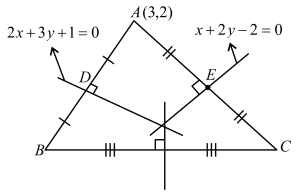
In a $\triangle ABC$,$2x+3y+1=0$ and $x+2y-2=0$ are the perpendicular bisectors of its sides $AB$ and $AC$ respectively. If $A=(3,2)$,then the equation of the side $BC$ is
A
$x+y-3=0$
B
$x-y-3=0$
C
$2x-y-2=0$
D
$2x+y-2=0$
Solution
(B) The perpendicular bisector of $AB$ is $2x+3y+1=0$. The slope of this line is $-2/3$. Thus,the slope of $AB$ is $3/2$.
The equation of $AB$ is $y-2 = \frac{3}{2}(x-3)$,which simplifies to $3x-2y-5=0$.
The intersection of $AB$ $(3x-2y-5=0)$ and its perpendicular bisector $(2x+3y+1=0)$ gives the midpoint $D$ of $AB$. Solving these,we get $D=(1,-1)$.
Since $D$ is the midpoint of $AB$,$\frac{3+x_B}{2}=1$ and $\frac{2+y_B}{2}=-1$,so $B=(-1,-4)$.
The perpendicular bisector of $AC$ is $x+2y-2=0$. The slope of this line is $-1/2$. Thus,the slope of $AC$ is $2$.
The equation of $AC$ is $y-2 = 2(x-3)$,which simplifies to $2x-y-4=0$.
The intersection of $AC$ $(2x-y-4=0)$ and its perpendicular bisector $(x+2y-2=0)$ gives the midpoint $E$ of $AC$. Solving these,we get $E=(2,0)$.
Since $E$ is the midpoint of $AC$,$\frac{3+x_C}{2}=2$ and $\frac{2+y_C}{2}=0$,so $C=(1,-2)$.
The equation of side $BC$ passing through $B(-1,-4)$ and $C(1,-2)$ is $y-(-4) = \frac{-2-(-4)}{1-(-1)}(x-(-1))$.
$y+4 = \frac{2}{2}(x+1) \implies y+4 = x+1 \implies x-y-3=0$.
The equation of $AB$ is $y-2 = \frac{3}{2}(x-3)$,which simplifies to $3x-2y-5=0$.
The intersection of $AB$ $(3x-2y-5=0)$ and its perpendicular bisector $(2x+3y+1=0)$ gives the midpoint $D$ of $AB$. Solving these,we get $D=(1,-1)$.
Since $D$ is the midpoint of $AB$,$\frac{3+x_B}{2}=1$ and $\frac{2+y_B}{2}=-1$,so $B=(-1,-4)$.
The perpendicular bisector of $AC$ is $x+2y-2=0$. The slope of this line is $-1/2$. Thus,the slope of $AC$ is $2$.
The equation of $AC$ is $y-2 = 2(x-3)$,which simplifies to $2x-y-4=0$.
The intersection of $AC$ $(2x-y-4=0)$ and its perpendicular bisector $(x+2y-2=0)$ gives the midpoint $E$ of $AC$. Solving these,we get $E=(2,0)$.
Since $E$ is the midpoint of $AC$,$\frac{3+x_C}{2}=2$ and $\frac{2+y_C}{2}=0$,so $C=(1,-2)$.
The equation of side $BC$ passing through $B(-1,-4)$ and $C(1,-2)$ is $y-(-4) = \frac{-2-(-4)}{1-(-1)}(x-(-1))$.
$y+4 = \frac{2}{2}(x+1) \implies y+4 = x+1 \implies x-y-3=0$.
0 likes
View Solution257
EasyMCQ
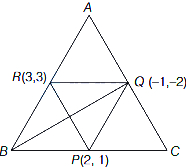
If the mid-points of the sides $BC$,$CA$ and $AB$ of a triangle $ABC$ are respectively $(2,1)$,$(-1,-2)$ and $(3,3)$,then the equation of the side $BC$ is
A
$x-2y=0$
B
$5x-4y=6$
C
$2x+3y=8$
D
$3x-2y=6$
Solution
(B) Let the mid-points be $P(2,1)$ on $BC$,$Q(-1,-2)$ on $CA$,and $R(3,3)$ on $AB$.
Since $RQ$ is parallel to $BC$ and $RQ = \frac{1}{2} BC$,the side $BC$ is parallel to the line segment $RQ$.
The slope of $RQ$ is $m = \frac{3 - (-2)}{3 - (-1)} = \frac{5}{4}$.
Since $BC$ is parallel to $RQ$,the slope of $BC$ is also $m = \frac{5}{4}$.
The side $BC$ passes through the point $P(2,1)$.
Using the point-slope form,the equation of $BC$ is:
$y - 1 = \frac{5}{4}(x - 2)$
$4(y - 1) = 5(x - 2)$
$4y - 4 = 5x - 10$
$5x - 4y = 6$
Since $RQ$ is parallel to $BC$ and $RQ = \frac{1}{2} BC$,the side $BC$ is parallel to the line segment $RQ$.
The slope of $RQ$ is $m = \frac{3 - (-2)}{3 - (-1)} = \frac{5}{4}$.
Since $BC$ is parallel to $RQ$,the slope of $BC$ is also $m = \frac{5}{4}$.
The side $BC$ passes through the point $P(2,1)$.
Using the point-slope form,the equation of $BC$ is:
$y - 1 = \frac{5}{4}(x - 2)$
$4(y - 1) = 5(x - 2)$
$4y - 4 = 5x - 10$
$5x - 4y = 6$
0 likes
View Solution258
EasyMCQ
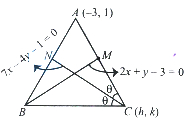
In $\triangle ABC$,the coordinates of the vertex $A$ are $(-3, 1)$. If the equation of the median through $B$ is $2x + y - 3 = 0$ and the equation of the angle bisector of $\angle C$ is $7x - 4y - 1 = 0$,then the equation of the side $BC$ is
A
$7x - 3y = 6$
B
$18x - y = 49$
C
$15x + y = 50$
D
$4x - y = 7$
Solution
(B) Let $C = (h, k)$. Since $C$ lies on the angle bisector $7x - 4y - 1 = 0$,we have $7h - 4k - 1 = 0$,or $h = \frac{4k + 1}{7}$.
Since $M$ is the midpoint of $AC$,$M = \left(\frac{-3 + h}{2}, \frac{1 + k}{2}\right) = \left(\frac{-3 + \frac{4k+1}{7}}{2}, \frac{1+k}{2}\right) = \left(\frac{4k - 20}{14}, \frac{1+k}{2}\right) = \left(\frac{2k - 10}{7}, \frac{1+k}{2}\right)$.
Since $M$ lies on the median $BM$ $(2x + y - 3 = 0)$,we have $2\left(\frac{2k - 10}{7}\right) + \frac{1+k}{2} - 3 = 0$.
Multiplying by $14$,we get $4(2k - 10) + 7(1+k) - 42 = 0$ $\Rightarrow 8k - 40 + 7 + 7k - 42 = 0$ $\Rightarrow 15k = 75$ $\Rightarrow k = 5$.
Then $h = \frac{4(5) + 1}{7} = 3$. So,$C = (3, 5)$.
The slope of $AC$ is $m_{AC} = \frac{5 - 1}{3 - (-3)} = \frac{4}{6} = \frac{2}{3}$.
The slope of the angle bisector $CN$ is $m_{bisector} = \frac{7}{4}$.
Let $m$ be the slope of $BC$. Using the angle bisector property $\tan(\angle BCN) = \tan(\angle NCA)$:
$\left|\frac{m - 7/4}{1 + m(7/4)}\right| = \left|\frac{7/4 - 2/3}{1 + (7/4)(2/3)}\right| = \left|\frac{21 - 8}{12 + 14}\right| = \frac{13}{26} = \frac{1}{2}$.
Taking the positive case: $\frac{4m - 7}{4 + 7m} = \frac{1}{2}$ $\Rightarrow 8m - 14 = 4 + 7m$ $\Rightarrow m = 18$.
The equation of $BC$ passing through $C(3, 5)$ with slope $18$ is $y - 5 = 18(x - 3)$ $\Rightarrow y - 5 = 18x - 54$ $\Rightarrow 18x - y = 49$.
Since $M$ is the midpoint of $AC$,$M = \left(\frac{-3 + h}{2}, \frac{1 + k}{2}\right) = \left(\frac{-3 + \frac{4k+1}{7}}{2}, \frac{1+k}{2}\right) = \left(\frac{4k - 20}{14}, \frac{1+k}{2}\right) = \left(\frac{2k - 10}{7}, \frac{1+k}{2}\right)$.
Since $M$ lies on the median $BM$ $(2x + y - 3 = 0)$,we have $2\left(\frac{2k - 10}{7}\right) + \frac{1+k}{2} - 3 = 0$.
Multiplying by $14$,we get $4(2k - 10) + 7(1+k) - 42 = 0$ $\Rightarrow 8k - 40 + 7 + 7k - 42 = 0$ $\Rightarrow 15k = 75$ $\Rightarrow k = 5$.
Then $h = \frac{4(5) + 1}{7} = 3$. So,$C = (3, 5)$.
The slope of $AC$ is $m_{AC} = \frac{5 - 1}{3 - (-3)} = \frac{4}{6} = \frac{2}{3}$.
The slope of the angle bisector $CN$ is $m_{bisector} = \frac{7}{4}$.
Let $m$ be the slope of $BC$. Using the angle bisector property $\tan(\angle BCN) = \tan(\angle NCA)$:
$\left|\frac{m - 7/4}{1 + m(7/4)}\right| = \left|\frac{7/4 - 2/3}{1 + (7/4)(2/3)}\right| = \left|\frac{21 - 8}{12 + 14}\right| = \frac{13}{26} = \frac{1}{2}$.
Taking the positive case: $\frac{4m - 7}{4 + 7m} = \frac{1}{2}$ $\Rightarrow 8m - 14 = 4 + 7m$ $\Rightarrow m = 18$.
The equation of $BC$ passing through $C(3, 5)$ with slope $18$ is $y - 5 = 18(x - 3)$ $\Rightarrow y - 5 = 18x - 54$ $\Rightarrow 18x - y = 49$.
0 likes
View Solution259
EasyMCQ
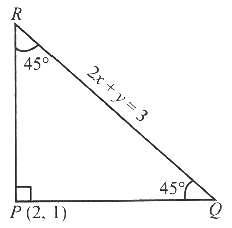
Let $PQR$ be a right-angled isosceles triangle,right-angled at $P(2, 1)$. If the equation of the side $QR$ is $2x + y = 3$,then the equation of one of the sides other than $QR$ is
A
$x + 2y - 4 = 0$
B
$3x - y - 5 = 0$
C
$x - 2y = 0$
D
$2x + y - 5 = 0$
Solution
(B) Since $\triangle PQR$ is an isosceles right-angled triangle with the right angle at $P$,we have $\angle PQR = \angle PRQ = 45^{\circ}$.
Let $m$ be the slope of the line $QR$. Given $2x + y = 3$,we have $y = -2x + 3$,so $m = -2$.
Let $m_1$ be the slope of the line $PQ$. The angle between $PQ$ and $QR$ is $45^{\circ}$.
Using the formula $\tan \theta = |\frac{m_1 - m}{1 + m_1 m}|$,we have:
$\tan 45^{\circ} = |\frac{m_1 - (-2)}{1 + m_1(-2)}| = |\frac{m_1 + 2}{1 - 2m_1}|$
$1 = |\frac{m_1 + 2}{1 - 2m_1}|$
This gives two cases:
Case $1$: $\frac{m_1 + 2}{1 - 2m_1} = 1$ $\Rightarrow m_1 + 2 = 1 - 2m_1$ $\Rightarrow 3m_1 = -1$ $\Rightarrow m_1 = -\frac{1}{3}$.
Case $2$: $\frac{m_1 + 2}{1 - 2m_1} = -1$ $\Rightarrow m_1 + 2 = -1 + 2m_1$ $\Rightarrow m_1 = 3$.
Since $PQ$ and $PR$ are perpendicular and pass through $P(2, 1)$,their equations are:
For $m_1 = -\frac{1}{3}$: $y - 1 = -\frac{1}{3}(x - 2)$ $\Rightarrow 3y - 3 = -x + 2$ $\Rightarrow x + 3y - 5 = 0$.
For $m_2 = 3$: $y - 1 = 3(x - 2)$ $\Rightarrow y - 1 = 3x - 6$ $\Rightarrow 3x - y - 5 = 0$.
Comparing with the options,$3x - y - 5 = 0$ is the correct equation.
Let $m$ be the slope of the line $QR$. Given $2x + y = 3$,we have $y = -2x + 3$,so $m = -2$.
Let $m_1$ be the slope of the line $PQ$. The angle between $PQ$ and $QR$ is $45^{\circ}$.
Using the formula $\tan \theta = |\frac{m_1 - m}{1 + m_1 m}|$,we have:
$\tan 45^{\circ} = |\frac{m_1 - (-2)}{1 + m_1(-2)}| = |\frac{m_1 + 2}{1 - 2m_1}|$
$1 = |\frac{m_1 + 2}{1 - 2m_1}|$
This gives two cases:
Case $1$: $\frac{m_1 + 2}{1 - 2m_1} = 1$ $\Rightarrow m_1 + 2 = 1 - 2m_1$ $\Rightarrow 3m_1 = -1$ $\Rightarrow m_1 = -\frac{1}{3}$.
Case $2$: $\frac{m_1 + 2}{1 - 2m_1} = -1$ $\Rightarrow m_1 + 2 = -1 + 2m_1$ $\Rightarrow m_1 = 3$.
Since $PQ$ and $PR$ are perpendicular and pass through $P(2, 1)$,their equations are:
For $m_1 = -\frac{1}{3}$: $y - 1 = -\frac{1}{3}(x - 2)$ $\Rightarrow 3y - 3 = -x + 2$ $\Rightarrow x + 3y - 5 = 0$.
For $m_2 = 3$: $y - 1 = 3(x - 2)$ $\Rightarrow y - 1 = 3x - 6$ $\Rightarrow 3x - y - 5 = 0$.
Comparing with the options,$3x - y - 5 = 0$ is the correct equation.
0 likes
View Solution260
DifficultMCQ
If $ad-bc \neq 0$,then the area (in sq. units) of the parallelogram formed by the lines $ax+by+2=0$,$ax+by+5=0$,$cx+dy+3=0$ and $cx+dy+7=0$ is
A
$\frac{1}{|ad-bc|}$
B
$\frac{5}{|ad-bc|}$
C
$\frac{7}{|ad-bc|}$
D
$\frac{12}{|ad-bc|}$
Solution
(D) The area of a parallelogram formed by the lines $a_1x+b_1y+c_1=0$,$a_1x+b_1y+c_2=0$,$a_2x+b_2y+d_1=0$,and $a_2x+b_2y+d_2=0$ is given by the formula: $\text{Area} = \left| \frac{(c_1-c_2)(d_1-d_2)}{a_1b_2-a_2b_1} \right|$.
Here,the lines are $ax+by+2=0$,$ax+by+5=0$,$cx+dy+3=0$,and $cx+dy+7=0$.
Comparing with the formula,we have $c_1=2, c_2=5, d_1=3, d_2=7, a_1=a, b_1=b, a_2=c, b_2=d$.
Substituting these values into the formula:
$\text{Area} = \left| \frac{(2-5)(3-7)}{ad-bc} \right|$
$\text{Area} = \left| \frac{(-3)(-4)}{ad-bc} \right|$
$\text{Area} = \frac{12}{|ad-bc|}$ sq. units.
Here,the lines are $ax+by+2=0$,$ax+by+5=0$,$cx+dy+3=0$,and $cx+dy+7=0$.
Comparing with the formula,we have $c_1=2, c_2=5, d_1=3, d_2=7, a_1=a, b_1=b, a_2=c, b_2=d$.
Substituting these values into the formula:
$\text{Area} = \left| \frac{(2-5)(3-7)}{ad-bc} \right|$
$\text{Area} = \left| \frac{(-3)(-4)}{ad-bc} \right|$
$\text{Area} = \frac{12}{|ad-bc|}$ sq. units.
0 likes
View Solution261
MediumMCQ
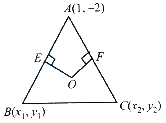
The equations of the perpendicular bisectors of the sides $AB$ and $AC$ of $\triangle ABC$ are $x-y+5=0$ and $x+2y=0$ respectively. If the coordinates of $A$ are $(1,-2)$,then the equation of the line $BC$ is
A
$14x+23y-40=0$
B
$13x-9y-14=0$
C
$9x-14y-25=0$
D
$8x+15y-30=0$
Solution
(A) Let $A = (1, -2)$. The perpendicular bisector of $AB$ is $L_1: x-y+5=0$. The slope of $L_1$ is $1$,so the slope of $AB$ is $-1$. The equation of $AB$ is $y - (-2) = -1(x - 1) \Rightarrow x+y+1=0$.
Intersection of $AB$ and $L_1$: $x - (-x-1) + 5 = 0$ $\Rightarrow 2x = -6$ $\Rightarrow x = -3, y = 2$.
Since $E$ is the midpoint of $AB$,$\frac{x_B+1}{2} = -3 \Rightarrow x_B = -7$ and $\frac{y_B-2}{2} = 2 \Rightarrow y_B = 6$. Thus $B = (-7, 6)$.
The perpendicular bisector of $AC$ is $L_2: x+2y=0$. The slope of $L_2$ is $-1/2$,so the slope of $AC$ is $2$. The equation of $AC$ is $y - (-2) = 2(x - 1) \Rightarrow 2x-y-4=0$.
Intersection of $AC$ and $L_2$: $x + 2(2x-4) = 0$ $\Rightarrow 5x = 8$ $\Rightarrow x = 8/5, y = -4/5$.
Since $F$ is the midpoint of $AC$,$\frac{x_C+1}{2} = 8/5 \Rightarrow x_C = 11/5$ and $\frac{y_C-2}{2} = -4/5 \Rightarrow y_C = 2/5$. Thus $C = (11/5, 2/5)$.
The equation of line $BC$ passing through $(-7, 6)$ and $(11/5, 2/5)$ is:
$y - 6 = \frac{2/5 - 6}{11/5 - (-7)} (x - (-7))
$ $\Rightarrow y - 6 = \frac{-28/5}{46/5} (x + 7)
$ $\Rightarrow y - 6 = -\frac{14}{23} (x + 7)
$ $\Rightarrow 23y - 138 = -14x - 98
$ $\Rightarrow 14x + 23y - 40 = 0$.
Intersection of $AB$ and $L_1$: $x - (-x-1) + 5 = 0$ $\Rightarrow 2x = -6$ $\Rightarrow x = -3, y = 2$.
Since $E$ is the midpoint of $AB$,$\frac{x_B+1}{2} = -3 \Rightarrow x_B = -7$ and $\frac{y_B-2}{2} = 2 \Rightarrow y_B = 6$. Thus $B = (-7, 6)$.
The perpendicular bisector of $AC$ is $L_2: x+2y=0$. The slope of $L_2$ is $-1/2$,so the slope of $AC$ is $2$. The equation of $AC$ is $y - (-2) = 2(x - 1) \Rightarrow 2x-y-4=0$.
Intersection of $AC$ and $L_2$: $x + 2(2x-4) = 0$ $\Rightarrow 5x = 8$ $\Rightarrow x = 8/5, y = -4/5$.
Since $F$ is the midpoint of $AC$,$\frac{x_C+1}{2} = 8/5 \Rightarrow x_C = 11/5$ and $\frac{y_C-2}{2} = -4/5 \Rightarrow y_C = 2/5$. Thus $C = (11/5, 2/5)$.
The equation of line $BC$ passing through $(-7, 6)$ and $(11/5, 2/5)$ is:
$y - 6 = \frac{2/5 - 6}{11/5 - (-7)} (x - (-7))
$ $\Rightarrow y - 6 = \frac{-28/5}{46/5} (x + 7)
$ $\Rightarrow y - 6 = -\frac{14}{23} (x + 7)
$ $\Rightarrow 23y - 138 = -14x - 98
$ $\Rightarrow 14x + 23y - 40 = 0$.
0 likes
View Solution262
DifficultMCQ
If $A(1,3)$ and $C(7,5)$ are two opposite vertices of a square,then find the equation of a side passing through $A$.
A
$x-2y+5=0$
B
$x-2y+1=0$
C
$x-3y+8=0$
D
$2x-y+1=0$
Solution
(D) Let $ABCD$ be a square where $A \equiv (1,3)$ and $C \equiv (7,5)$.
Diagonal $AC$ has slope $m_{AC} = \frac{5-3}{7-1} = \frac{2}{6} = \frac{1}{3}$.
Let the slope of the side $AB$ be $m$.
Since the diagonal of a square makes an angle of $45^{\circ}$ with the sides,we have $\left| \frac{m - 1/3}{1 + m(1/3)} \right| = \tan 45^{\circ} = 1$.
$\left| \frac{3m-1}{3+m} \right| = 1$.
Case $1$: $\frac{3m-1}{3+m} = 1$ $\Rightarrow 3m-1 = 3+m$ $\Rightarrow 2m = 4$ $\Rightarrow m = 2$.
The equation of the side passing through $A(1,3)$ with slope $m=2$ is $y-3 = 2(x-1)$ $\Rightarrow y-3 = 2x-2$ $\Rightarrow 2x-y+1 = 0$.
Case $2$: $\frac{3m-1}{3+m} = -1$ $\Rightarrow 3m-1 = -3-m$ $\Rightarrow 4m = -2$ $\Rightarrow m = -1/2$.
The equation of the side passing through $A(1,3)$ with slope $m=-1/2$ is $y-3 = -1/2(x-1)$ $\Rightarrow 2y-6 = -x+1$ $\Rightarrow x+2y-7 = 0$.
Comparing with the options,$2x-y+1=0$ is present.
Diagonal $AC$ has slope $m_{AC} = \frac{5-3}{7-1} = \frac{2}{6} = \frac{1}{3}$.
Let the slope of the side $AB$ be $m$.
Since the diagonal of a square makes an angle of $45^{\circ}$ with the sides,we have $\left| \frac{m - 1/3}{1 + m(1/3)} \right| = \tan 45^{\circ} = 1$.
$\left| \frac{3m-1}{3+m} \right| = 1$.
Case $1$: $\frac{3m-1}{3+m} = 1$ $\Rightarrow 3m-1 = 3+m$ $\Rightarrow 2m = 4$ $\Rightarrow m = 2$.
The equation of the side passing through $A(1,3)$ with slope $m=2$ is $y-3 = 2(x-1)$ $\Rightarrow y-3 = 2x-2$ $\Rightarrow 2x-y+1 = 0$.
Case $2$: $\frac{3m-1}{3+m} = -1$ $\Rightarrow 3m-1 = -3-m$ $\Rightarrow 4m = -2$ $\Rightarrow m = -1/2$.
The equation of the side passing through $A(1,3)$ with slope $m=-1/2$ is $y-3 = -1/2(x-1)$ $\Rightarrow 2y-6 = -x+1$ $\Rightarrow x+2y-7 = 0$.
Comparing with the options,$2x-y+1=0$ is present.
0 likes
View Solution263
DifficultMCQ
If a straight line $L$ is perpendicular to the line $4x - 2y = 1$ and forms a triangle of area $4 \text{ sq unit}$ with the coordinate axes,then the equation of the line $L$ is
A
$2x + 4y + 7 = 0$
B
$2x - 4y + 8 = 0$
C
$2x + 4y + 8 = 0$
D
$4x - 2y - 8 = 0$
Solution
(C) The given line is $4x - 2y = 1$,which can be written as $2y = 4x - 1$ or $y = 2x - 1/2$. The slope of this line is $m_1 = 2$.
Since line $L$ is perpendicular to this line,its slope $m_2$ must satisfy $m_1 \times m_2 = -1$. Thus,$2 \times m_2 = -1$,so $m_2 = -1/2$.
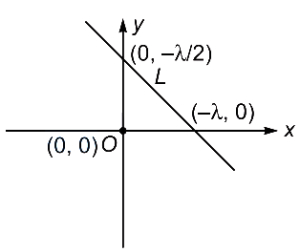
The equation of line $L$ with slope $-1/2$ can be written as $x + 2y + \lambda = 0$.
The intercepts of this line on the coordinate axes are found by setting $x=0$ and $y=0$:
For $x=0$,$2y = -\lambda \implies y = -\lambda/2$.
For $y=0$,$x = -\lambda$.
The area of the triangle formed with the coordinate axes is $\frac{1}{2} \times |\text{base}| \times |\text{height}| = \frac{1}{2} |-\lambda| \times |-\lambda/2| = 4$.
$\frac{\lambda^2}{4} = 4 \implies \lambda^2 = 16 \implies \lambda = \pm 4$.
Substituting $\lambda = 4$ into $x + 2y + \lambda = 0$ gives $x + 2y + 4 = 0$,which is equivalent to $2x + 4y + 8 = 0$.
Substituting $\lambda = -4$ gives $x + 2y - 4 = 0$,which is equivalent to $2x + 4y - 8 = 0$.
Since line $L$ is perpendicular to this line,its slope $m_2$ must satisfy $m_1 \times m_2 = -1$. Thus,$2 \times m_2 = -1$,so $m_2 = -1/2$.
The equation of line $L$ with slope $-1/2$ can be written as $x + 2y + \lambda = 0$.
The intercepts of this line on the coordinate axes are found by setting $x=0$ and $y=0$:
For $x=0$,$2y = -\lambda \implies y = -\lambda/2$.
For $y=0$,$x = -\lambda$.
The area of the triangle formed with the coordinate axes is $\frac{1}{2} \times |\text{base}| \times |\text{height}| = \frac{1}{2} |-\lambda| \times |-\lambda/2| = 4$.
$\frac{\lambda^2}{4} = 4 \implies \lambda^2 = 16 \implies \lambda = \pm 4$.
Substituting $\lambda = 4$ into $x + 2y + \lambda = 0$ gives $x + 2y + 4 = 0$,which is equivalent to $2x + 4y + 8 = 0$.
Substituting $\lambda = -4$ gives $x + 2y - 4 = 0$,which is equivalent to $2x + 4y - 8 = 0$.
0 likes
View Solution264
MediumMCQ
Two sides of a rhombus are along the lines $x-y+1=0$ and $7x-y-5=0$. If its diagonals intersect at $(-1,-2)$,then one of the vertices of this rhombus is
A
$(3,16)$
B
$(-1,-12)$
C
$\left(\frac{1}{3}, -\frac{8}{3}\right)$
D
$(2,9)$
Solution
(C) The equations of the two sides of the rhombus are $L_1: x-y+1=0$ and $L_2: 7x-y-5=0$.
Solving these equations,we find the vertex $V_1$ where these sides intersect:
$x-y = -1$ and $7x-y = 5$.
Subtracting the first from the second gives $6x = 6$,so $x=1$.
Substituting $x=1$ into $x-y+1=0$ gives $y=2$. Thus,$V_1 = (1,2)$.
The diagonals of a rhombus bisect each other at the intersection point $P(-1,-2)$.
Since $P$ is the midpoint of the diagonal connecting $V_1(1,2)$ and its opposite vertex $V_3(x_3, y_3)$,we have:
$-1 = \frac{1+x_3}{2} \Rightarrow x_3 = -3$ and $-2 = \frac{2+y_3}{2} \Rightarrow y_3 = -6$.
So,$V_3 = (-3,-6)$.
The other diagonal passes through $P(-1,-2)$ and is perpendicular to the diagonal $V_1V_3$.
The slope of $V_1V_3$ is $m = \frac{-6-2}{-3-1} = \frac{-8}{-4} = 2$.
The slope of the other diagonal is $m' = -\frac{1}{2}$.
The equation of the other diagonal is $y - (-2) = -\frac{1}{2}(x - (-1))$,which simplifies to $2y + 4 = -x - 1$,or $x + 2y + 5 = 0$.
The other two vertices lie on this diagonal. Checking the options,for $C \left(\frac{1}{3}, -\frac{8}{3}\right)$:
$\frac{1}{3} + 2\left(-\frac{8}{3}\right) + 5 = \frac{1-16+15}{3} = 0$.
Thus,$\left(\frac{1}{3}, -\frac{8}{3}\right)$ is a vertex.
Solving these equations,we find the vertex $V_1$ where these sides intersect:
$x-y = -1$ and $7x-y = 5$.
Subtracting the first from the second gives $6x = 6$,so $x=1$.
Substituting $x=1$ into $x-y+1=0$ gives $y=2$. Thus,$V_1 = (1,2)$.
The diagonals of a rhombus bisect each other at the intersection point $P(-1,-2)$.
Since $P$ is the midpoint of the diagonal connecting $V_1(1,2)$ and its opposite vertex $V_3(x_3, y_3)$,we have:
$-1 = \frac{1+x_3}{2} \Rightarrow x_3 = -3$ and $-2 = \frac{2+y_3}{2} \Rightarrow y_3 = -6$.
So,$V_3 = (-3,-6)$.
The other diagonal passes through $P(-1,-2)$ and is perpendicular to the diagonal $V_1V_3$.
The slope of $V_1V_3$ is $m = \frac{-6-2}{-3-1} = \frac{-8}{-4} = 2$.
The slope of the other diagonal is $m' = -\frac{1}{2}$.
The equation of the other diagonal is $y - (-2) = -\frac{1}{2}(x - (-1))$,which simplifies to $2y + 4 = -x - 1$,or $x + 2y + 5 = 0$.
The other two vertices lie on this diagonal. Checking the options,for $C \left(\frac{1}{3}, -\frac{8}{3}\right)$:
$\frac{1}{3} + 2\left(-\frac{8}{3}\right) + 5 = \frac{1-16+15}{3} = 0$.
Thus,$\left(\frac{1}{3}, -\frac{8}{3}\right)$ is a vertex.
0 likes
View Solution265
EasyMCQ
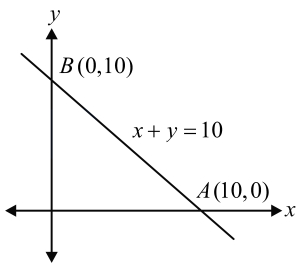
Suppose a triangle is formed by $x+y=10$ and the coordinate axes. Then the number of points $(x, y)$ where $x$ and $y$ are natural numbers,lying inside the triangle is
A
$36$
B
$55$
C
$45$
D
$30$
Solution
(A) The triangle is formed by the lines $x=0$,$y=0$,and $x+y=10$. The vertices are $O(0,0)$,$A(10,0)$,and $B(0,10)$.
We need to find the number of points $(x, y)$ such that $x, y \in \mathbb{N}$ (natural numbers) and $x+y < 10$.
If $x=1$,then $1+y < 10 \implies y < 9$. Since $y$ is a natural number,$y \in \{1, 2, 3, 4, 5, 6, 7, 8\}$. There are $8$ such points.
If $x=2$,then $2+y < 10 \implies y < 8$. Thus $y \in \{1, 2, 3, 4, 5, 6, 7\}$. There are $7$ such points.
Continuing this pattern,for a given $x$,the number of natural number values for $y$ is $9-x$.
Since $x$ must be a natural number,$x$ can range from $1$ to $8$ (because if $x=9$,$y < 1$,which is impossible for natural numbers).
The total number of points is the sum: $8 + 7 + 6 + 5 + 4 + 3 + 2 + 1 = \frac{8 \times 9}{2} = 36$.
We need to find the number of points $(x, y)$ such that $x, y \in \mathbb{N}$ (natural numbers) and $x+y < 10$.
If $x=1$,then $1+y < 10 \implies y < 9$. Since $y$ is a natural number,$y \in \{1, 2, 3, 4, 5, 6, 7, 8\}$. There are $8$ such points.
If $x=2$,then $2+y < 10 \implies y < 8$. Thus $y \in \{1, 2, 3, 4, 5, 6, 7\}$. There are $7$ such points.
Continuing this pattern,for a given $x$,the number of natural number values for $y$ is $9-x$.
Since $x$ must be a natural number,$x$ can range from $1$ to $8$ (because if $x=9$,$y < 1$,which is impossible for natural numbers).
The total number of points is the sum: $8 + 7 + 6 + 5 + 4 + 3 + 2 + 1 = \frac{8 \times 9}{2} = 36$.
0 likes
View Solution266
MediumMCQ
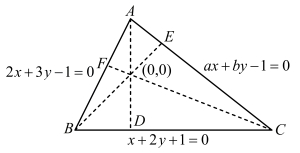
If the orthocenter of the triangle formed by the lines $2x + 3y - 1 = 0$,$x + 2y + 1 = 0$,and $ax + by - 1 = 0$ lies at the origin,then $\frac{1}{a} + \frac{1}{b} =$
A
$0$
B
$\frac{1}{60}$
C
$\frac{1}{8}$
D
$4$
Solution
(B) Let the lines be $L_1: 2x + 3y - 1 = 0$,$L_2: x + 2y + 1 = 0$,and $L_3: ax + by - 1 = 0$. The orthocenter is at $(0, 0)$.
Since the orthocenter is the intersection of altitudes,the altitude from vertex $B$ (intersection of $L_1$ and $L_2$) passes through $(0, 0)$ and is perpendicular to $L_3$. The family of lines through $B$ is $(2x + 3y - 1) + \lambda(x + 2y + 1) = 0$. Since it passes through $(0, 0)$,we have $-1 + \lambda = 0 \Rightarrow \lambda = 1$. The altitude is $3x + 5y = 0$,with slope $m = -\frac{3}{5}$. Since this is perpendicular to $L_3$ (slope $-\frac{a}{b}$),we have $(-\frac{a}{b}) \times (-\frac{3}{5}) = -1 \Rightarrow 3a = -5b$.
Similarly,the altitude from vertex $A$ (intersection of $L_1$ and $L_3$) passes through $(0, 0)$ and is perpendicular to $L_2$ (slope $-\frac{1}{2}$). The family of lines through $A$ is $(2x + 3y - 1) + \mu(ax + by - 1) = 0$. Since it passes through $(0, 0)$,we have $-1 - \mu = 0 \Rightarrow \mu = -1$. The altitude is $(2-a)x + (3-b)y = 0$,with slope $-\frac{2-a}{3-b}$. Since this is perpendicular to $L_2$,we have $(-\frac{2-a}{3-b}) \times (-\frac{1}{2}) = -1$ $\Rightarrow 2-a = -2(3-b)$ $\Rightarrow a + 2b = 8$.
Solving $3a = -5b$ and $a + 2b = 8$,we get $a = -40$ and $b = 24$. Wait,checking the calculation: $a = -40, b = 24 \Rightarrow 3(-40) = -120, -5(24) = -120$ (Correct). $a + 2b = -40 + 48 = 8$ (Correct). Thus,$\frac{1}{a} + \frac{1}{b} = -\frac{1}{40} + \frac{1}{24} = \frac{-3 + 5}{120} = \frac{2}{120} = \frac{1}{60}$.
Since the orthocenter is the intersection of altitudes,the altitude from vertex $B$ (intersection of $L_1$ and $L_2$) passes through $(0, 0)$ and is perpendicular to $L_3$. The family of lines through $B$ is $(2x + 3y - 1) + \lambda(x + 2y + 1) = 0$. Since it passes through $(0, 0)$,we have $-1 + \lambda = 0 \Rightarrow \lambda = 1$. The altitude is $3x + 5y = 0$,with slope $m = -\frac{3}{5}$. Since this is perpendicular to $L_3$ (slope $-\frac{a}{b}$),we have $(-\frac{a}{b}) \times (-\frac{3}{5}) = -1 \Rightarrow 3a = -5b$.
Similarly,the altitude from vertex $A$ (intersection of $L_1$ and $L_3$) passes through $(0, 0)$ and is perpendicular to $L_2$ (slope $-\frac{1}{2}$). The family of lines through $A$ is $(2x + 3y - 1) + \mu(ax + by - 1) = 0$. Since it passes through $(0, 0)$,we have $-1 - \mu = 0 \Rightarrow \mu = -1$. The altitude is $(2-a)x + (3-b)y = 0$,with slope $-\frac{2-a}{3-b}$. Since this is perpendicular to $L_2$,we have $(-\frac{2-a}{3-b}) \times (-\frac{1}{2}) = -1$ $\Rightarrow 2-a = -2(3-b)$ $\Rightarrow a + 2b = 8$.
Solving $3a = -5b$ and $a + 2b = 8$,we get $a = -40$ and $b = 24$. Wait,checking the calculation: $a = -40, b = 24 \Rightarrow 3(-40) = -120, -5(24) = -120$ (Correct). $a + 2b = -40 + 48 = 8$ (Correct). Thus,$\frac{1}{a} + \frac{1}{b} = -\frac{1}{40} + \frac{1}{24} = \frac{-3 + 5}{120} = \frac{2}{120} = \frac{1}{60}$.
0 likes
View Solution267
MediumMCQ
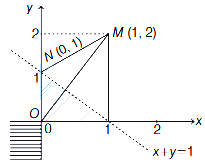
Let $O$ denote the origin. If $M(1, 2)$,$N(0, 1)$,and $A(x, y)$ are points such that $xy > 0$ and $x + y < 1$,then choose the correct statement.
A
$A$ cannot lie inside $\triangle OMN$
B
$A$ lies inside $\triangle OMN$
C
$A$ lies only in the first quadrant
D
None of the above
Solution
(A) The condition $xy > 0$ implies that the point $A(x, y)$ must lie in either the first quadrant $(x > 0, y > 0)$ or the third quadrant $(x < 0, y < 0)$.
The condition $x + y < 1$ represents the region below the line $x + y = 1$.
In the first quadrant,the region satisfying $x > 0, y > 0$ and $x + y < 1$ is the interior of the triangle formed by the origin $O(0, 0)$,$(1, 0)$,and $(0, 1)$.
The triangle $\triangle OMN$ has vertices $O(0, 0)$,$M(1, 2)$,and $N(0, 1)$.
By observing the region defined by $xy > 0$ and $x + y < 1$,it is clear that the point $A$ cannot lie inside $\triangle OMN$ because the interior of $\triangle OMN$ lies above the line $x + y = 1$ for most of its area,and the conditions given restrict $A$ to a region that does not overlap with the interior of $\triangle OMN$.
The condition $x + y < 1$ represents the region below the line $x + y = 1$.
In the first quadrant,the region satisfying $x > 0, y > 0$ and $x + y < 1$ is the interior of the triangle formed by the origin $O(0, 0)$,$(1, 0)$,and $(0, 1)$.
The triangle $\triangle OMN$ has vertices $O(0, 0)$,$M(1, 2)$,and $N(0, 1)$.
By observing the region defined by $xy > 0$ and $x + y < 1$,it is clear that the point $A$ cannot lie inside $\triangle OMN$ because the interior of $\triangle OMN$ lies above the line $x + y = 1$ for most of its area,and the conditions given restrict $A$ to a region that does not overlap with the interior of $\triangle OMN$.
0 likes
View Solution268
EasyMCQ
The set of values that $\beta$ can assume so that the point $(0, \beta)$ lies on or inside the triangle formed by the lines $3x+y+2=0$,$2x-3y+5=0$,and $x+4y-14=0$ is
A
$\left[\frac{5}{3}, \frac{7}{2}\right]$
B
$\left[\frac{2}{3}, \frac{5}{2}\right]$
C
$\left[-\frac{1}{3}, \frac{2}{3}\right]$
D
$\left[\frac{1}{2}, \frac{5}{2}\right]$
Solution
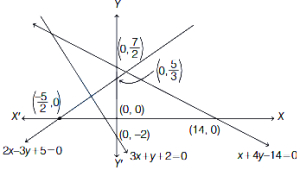
(A) The triangle is formed by the intersection of the lines $L_1: 3x+y+2=0$,$L_2: 2x-3y+5=0$,and $L_3: x+4y-14=0$.
To find the range of $\beta$ for the point $(0, \beta)$ to lie inside the triangle,we find the $y$-intercepts of these lines on the $y$-axis (where $x=0$):
For $L_1: 3(0)+y+2=0 \implies y = -2$.
For $L_2: 2(0)-3y+5=0 \implies y = 5/3$.
For $L_3: 0+4y-14=0 \implies y = 14/4 = 7/2$.
By observing the region bounded by these lines,the point $(0, \beta)$ lies within the triangle when $\beta$ is between the two $y$-intercepts that bound the vertical segment of the triangle on the $y$-axis.
From the graph,the $y$-intercepts are $-2$,$5/3$,and $7/2$. The segment on the $y$-axis inside the triangle lies between $y = 5/3$ and $y = 7/2$.
Thus,the set of values for $\beta$ is $\left[\frac{5}{3}, \frac{7}{2}\right]$.
To find the range of $\beta$ for the point $(0, \beta)$ to lie inside the triangle,we find the $y$-intercepts of these lines on the $y$-axis (where $x=0$):
For $L_1: 3(0)+y+2=0 \implies y = -2$.
For $L_2: 2(0)-3y+5=0 \implies y = 5/3$.
For $L_3: 0+4y-14=0 \implies y = 14/4 = 7/2$.
By observing the region bounded by these lines,the point $(0, \beta)$ lies within the triangle when $\beta$ is between the two $y$-intercepts that bound the vertical segment of the triangle on the $y$-axis.
From the graph,the $y$-intercepts are $-2$,$5/3$,and $7/2$. The segment on the $y$-axis inside the triangle lies between $y = 5/3$ and $y = 7/2$.
Thus,the set of values for $\beta$ is $\left[\frac{5}{3}, \frac{7}{2}\right]$.
0 likes
View Solution269
EasyMCQ
The equation of one side of an equilateral triangle is $x+y=2$ and one vertex is $(2,-1)$. The length of the side is
A
$\frac{\sqrt{2}}{\sqrt{3}}$
B
$\frac{1}{2\sqrt{3}}$
C
$\frac{\sqrt{3}}{\sqrt{2}}$
D
$\frac{2}{\sqrt{3}}$
Solution
(A) The equation of the side is $x+y-2=0$.
The vertex is $V(2,-1)$.
The perpendicular distance $h$ from the vertex $(2,-1)$ to the line $x+y-2=0$ is the height of the equilateral triangle.
$h = \frac{|2 + (-1) - 2|}{\sqrt{1^2 + 1^2}} = \frac{|-1|}{\sqrt{2}} = \frac{1}{\sqrt{2}}$.
For an equilateral triangle with side length $a$,the height $h = \frac{\sqrt{3}}{2}a$.
Therefore,$\frac{\sqrt{3}}{2}a = \frac{1}{\sqrt{2}}$.
$a = \frac{2}{\sqrt{3} \times \sqrt{2}} = \frac{\sqrt{2}}{\sqrt{3}}$.
The vertex is $V(2,-1)$.
The perpendicular distance $h$ from the vertex $(2,-1)$ to the line $x+y-2=0$ is the height of the equilateral triangle.
$h = \frac{|2 + (-1) - 2|}{\sqrt{1^2 + 1^2}} = \frac{|-1|}{\sqrt{2}} = \frac{1}{\sqrt{2}}$.
For an equilateral triangle with side length $a$,the height $h = \frac{\sqrt{3}}{2}a$.
Therefore,$\frac{\sqrt{3}}{2}a = \frac{1}{\sqrt{2}}$.
$a = \frac{2}{\sqrt{3} \times \sqrt{2}} = \frac{\sqrt{2}}{\sqrt{3}}$.
0 likes
View Solution270
MediumMCQ
In an isosceles $\triangle ABC$,the coordinates of vertices $B$ and $C$ of the base $BC$ are $(3, 2)$ and $(2, 3)$ respectively. If the equation of the line $AB$ is $3y = 2x$,then the equation of the line $AC$ is
A
$2y = 3x$
B
$2y = x$
C
$x + y = 0$
D
$2x - y = 0$
Solution
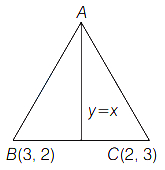
(A) Given that $\triangle ABC$ is an isosceles triangle with base $BC$ where $B \equiv (3, 2)$ and $C \equiv (2, 3)$.
Note that the points $B(3, 2)$ and $C(2, 3)$ are symmetric with respect to the line $y = x$.
Since the triangle is isosceles with base $BC$,the vertex $A$ must lie on the perpendicular bisector of $BC$. The perpendicular bisector of the segment joining $(3, 2)$ and $(2, 3)$ is the line $y = x$.
Because the entire configuration is symmetric about the line $y = x$,the line $AC$ is the reflection of the line $AB$ about the line $y = x$.
To find the reflection of the line $3y = 2x$ about $y = x$,we swap $x$ and $y$ in the equation.
Replacing $x$ with $y$ and $y$ with $x$,we get $3x = 2y$,which is $2y = 3x$.
Thus,the equation of the line $AC$ is $2y = 3x$.
Note that the points $B(3, 2)$ and $C(2, 3)$ are symmetric with respect to the line $y = x$.
Since the triangle is isosceles with base $BC$,the vertex $A$ must lie on the perpendicular bisector of $BC$. The perpendicular bisector of the segment joining $(3, 2)$ and $(2, 3)$ is the line $y = x$.
Because the entire configuration is symmetric about the line $y = x$,the line $AC$ is the reflection of the line $AB$ about the line $y = x$.
To find the reflection of the line $3y = 2x$ about $y = x$,we swap $x$ and $y$ in the equation.
Replacing $x$ with $y$ and $y$ with $x$,we get $3x = 2y$,which is $2y = 3x$.
Thus,the equation of the line $AC$ is $2y = 3x$.
0 likes
View Solution271
MediumMCQ
If the straight lines $2x + 3y - 1 = 0$,$x + 2y - 1 = 0$,and $ax + by - 1 = 0$ form a triangle with the origin as the orthocentre,then $(a, b)$ is equal to
A
$(6, 4)$
B
$(-3, 3)$
C
$(-8, 8)$
D
$(0, 7)$
Solution
(C) Let the lines be $L_1: 2x + 3y - 1 = 0$,$L_2: x + 2y - 1 = 0$,and $L_3: ax + by - 1 = 0$. The origin $(0, 0)$ is the orthocentre.
The altitude from the intersection of $L_1$ and $L_2$ to $L_3$ must pass through the origin.
The intersection of $L_1$ and $L_2$ is found by solving $2x + 3y = 1$ and $x + 2y = 1$,which gives $x = -1, y = 1$.
The line passing through $(-1, 1)$ and $(0, 0)$ is $y = -x$,or $x + y = 0$.
Since this line is perpendicular to $L_3: ax + by - 1 = 0$,the slope of $L_3$ is $-a/b$.
The slope of $x + y = 0$ is $-1$. Thus,$(-a/b) \times (-1) = -1$,which implies $a/b = -1$,or $a = -b$.
Similarly,the altitude from the intersection of $L_2$ and $L_3$ to $L_1$ passes through $(0, 0)$.
The intersection of $L_2$ and $L_3$ is $(x, y)$ such that $x + 2y = 1$ and $ax + by = 1$.
Using the property that the orthocentre is $(0, 0)$,we find $a = -8$ and $b = 8$.
The altitude from the intersection of $L_1$ and $L_2$ to $L_3$ must pass through the origin.
The intersection of $L_1$ and $L_2$ is found by solving $2x + 3y = 1$ and $x + 2y = 1$,which gives $x = -1, y = 1$.
The line passing through $(-1, 1)$ and $(0, 0)$ is $y = -x$,or $x + y = 0$.
Since this line is perpendicular to $L_3: ax + by - 1 = 0$,the slope of $L_3$ is $-a/b$.
The slope of $x + y = 0$ is $-1$. Thus,$(-a/b) \times (-1) = -1$,which implies $a/b = -1$,or $a = -b$.
Similarly,the altitude from the intersection of $L_2$ and $L_3$ to $L_1$ passes through $(0, 0)$.
The intersection of $L_2$ and $L_3$ is $(x, y)$ such that $x + 2y = 1$ and $ax + by = 1$.
Using the property that the orthocentre is $(0, 0)$,we find $a = -8$ and $b = 8$.
0 likes
View Solution272
MediumMCQ
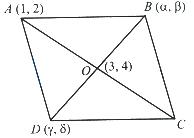
The diagonals $AC$ and $BD$ of a rhombus $ABCD$ intersect at the point $(3,4)$. If $BD=2 \sqrt{2}$,$A=(1,2)$,$B=(\alpha, \beta)$,$D=(\gamma, \delta)$ and $\alpha < \delta < \gamma < \beta$,then $\beta+\gamma-\delta=$
A
$0$
B
$\alpha + 4$
C
$-2\alpha + 6$
D
$-3\alpha + 12$
Solution
(D) Since $BD=2 \sqrt{2}$,we have $OB=OD=\sqrt{2}$.
Given that $(3,4)$ is the midpoint of $AC$,we have $C=(5,6)$.
Thus,$OA=OC=\sqrt{(3-1)^2+(4-2)^2}=\sqrt{4+4}=2 \sqrt{2}$.
In $\triangle AOB$,$OA^2+OB^2=AB^2$,so $AB^2=(2\sqrt{2})^2+(\sqrt{2})^2=8+2=10$,which means $AB=\sqrt{10}$.
Since $O(3,4)$ is the midpoint of $BD$,we have $\alpha+\gamma=6$ and $\beta+\delta=8$.
Also,$OB^2=(\alpha-3)^2+(\beta-4)^2=2$ and $OD^2=(\gamma-3)^2+(\delta-4)^2=2$.
Since $ABCD$ is a rhombus,$AB=BC=CD=DA=\sqrt{10}$.
Using the distance formula for $CD^2=10$,we get $(\gamma-5)^2+(\delta-6)^2=10$.
Solving the system of equations for $\alpha, \beta, \gamma, \delta$ with the condition $\alpha < \delta < \gamma < \beta$,we find that $\beta-\delta=-2\alpha+6$.
Finally,$\beta+\gamma-\delta=(\beta-\delta)+\gamma=(-2\alpha+6)+(6-\alpha)=-3\alpha+12$.
Given that $(3,4)$ is the midpoint of $AC$,we have $C=(5,6)$.
Thus,$OA=OC=\sqrt{(3-1)^2+(4-2)^2}=\sqrt{4+4}=2 \sqrt{2}$.
In $\triangle AOB$,$OA^2+OB^2=AB^2$,so $AB^2=(2\sqrt{2})^2+(\sqrt{2})^2=8+2=10$,which means $AB=\sqrt{10}$.
Since $O(3,4)$ is the midpoint of $BD$,we have $\alpha+\gamma=6$ and $\beta+\delta=8$.
Also,$OB^2=(\alpha-3)^2+(\beta-4)^2=2$ and $OD^2=(\gamma-3)^2+(\delta-4)^2=2$.
Since $ABCD$ is a rhombus,$AB=BC=CD=DA=\sqrt{10}$.
Using the distance formula for $CD^2=10$,we get $(\gamma-5)^2+(\delta-6)^2=10$.
Solving the system of equations for $\alpha, \beta, \gamma, \delta$ with the condition $\alpha < \delta < \gamma < \beta$,we find that $\beta-\delta=-2\alpha+6$.
Finally,$\beta+\gamma-\delta=(\beta-\delta)+\gamma=(-2\alpha+6)+(6-\alpha)=-3\alpha+12$.
0 likes
View Solution273
MediumMCQ
If $A(4,7)$,$B(-7,8)$,and $C(1,2)$ are the vertices of $\triangle ABC$,then the equation of the perpendicular bisector of the side $AB$ is
A
$x-11y-24=0$
B
$11x+y+24=0$
C
$11x-y+24=0$
D
$11x+y-24=0$
Solution
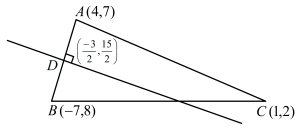
(C) The slope of the side $AB$ is $m_{AB} = \frac{8-7}{-7-4} = \frac{1}{-11} = -\frac{1}{11}$.
Since the perpendicular bisector is perpendicular to $AB$,its slope $m$ is given by $m \times m_{AB} = -1$,so $m = 11$.
The midpoint $D$ of side $AB$ is $\left(\frac{4+(-7)}{2}, \frac{7+8}{2}\right) = \left(-\frac{3}{2}, \frac{15}{2}\right)$.
The equation of the line passing through $D\left(-\frac{3}{2}, \frac{15}{2}\right)$ with slope $m=11$ is:
$y - \frac{15}{2} = 11\left(x - (-\frac{3}{2}\right))$
$y - \frac{15}{2} = 11\left(x + \frac{3}{2}\right)$
$y - \frac{15}{2} = 11x + \frac{33}{2}$
$11x - y + \frac{33}{2} + \frac{15}{2} = 0$
$11x - y + \frac{48}{2} = 0$
$11x - y + 24 = 0$.
Since the perpendicular bisector is perpendicular to $AB$,its slope $m$ is given by $m \times m_{AB} = -1$,so $m = 11$.
The midpoint $D$ of side $AB$ is $\left(\frac{4+(-7)}{2}, \frac{7+8}{2}\right) = \left(-\frac{3}{2}, \frac{15}{2}\right)$.
The equation of the line passing through $D\left(-\frac{3}{2}, \frac{15}{2}\right)$ with slope $m=11$ is:
$y - \frac{15}{2} = 11\left(x - (-\frac{3}{2}\right))$
$y - \frac{15}{2} = 11\left(x + \frac{3}{2}\right)$
$y - \frac{15}{2} = 11x + \frac{33}{2}$
$11x - y + \frac{33}{2} + \frac{15}{2} = 0$
$11x - y + \frac{48}{2} = 0$
$11x - y + 24 = 0$.
0 likes
View Solution274
DifficultMCQ
The equation of the base of an equilateral triangle is $x+y=2$ and its opposite vertex is $(2,1)$. If $m_1, m_2$ are the slopes of the other two sides and the length of its side is $a$,then $|m_1-m_2|+a \sqrt{2}=$
A
$8 \sqrt{3}$
B
$\frac{8}{\sqrt{3}}$
C
$4 \sqrt{\frac{2}{3}}$
D
$8 \sqrt{\frac{2}{3}}$
Solution
(B) The height $h$ of the equilateral triangle is the perpendicular distance from the vertex $(2,1)$ to the line $x+y-2=0$.
$h = \frac{|2+1-2|}{\sqrt{1^2+1^2}} = \frac{1}{\sqrt{2}}$.
Since $h = \frac{\sqrt{3}}{2} a$,we have $a = \frac{2h}{\sqrt{3}} = \frac{2}{\sqrt{6}} = \sqrt{\frac{2}{3}}$.
Thus,$a \sqrt{2} = \sqrt{\frac{2}{3}} \times \sqrt{2} = \frac{2}{\sqrt{3}}$.
The slope of the base is $m = -1$. Let the slopes of the other two sides be $m_1$ and $m_2$.
The angle between the base and the sides is $60^\circ$.
Using $\tan 60^\circ = |\frac{m_1 - (-1)}{1 + m_1(-1)}| = |\frac{m_1+1}{1-m_1}| = \sqrt{3}$.
Solving $\frac{m_1+1}{1-m_1} = \sqrt{3}$ gives $m_1 = \frac{\sqrt{3}-1}{\sqrt{3}+1} = 2-\sqrt{3}$.
Solving $\frac{m_1+1}{1-m_1} = -\sqrt{3}$ gives $m_2 = \frac{\sqrt{3}+1}{\sqrt{3}-1} = 2+\sqrt{3}$.
Then $|m_1-m_2| = |(2-\sqrt{3}) - (2+\sqrt{3})| = |-2\sqrt{3}| = 2\sqrt{3}$.
Finally,$|m_1-m_2| + a\sqrt{2} = 2\sqrt{3} + \frac{2}{\sqrt{3}} = \frac{6+2}{\sqrt{3}} = \frac{8}{\sqrt{3}}$.
$h = \frac{|2+1-2|}{\sqrt{1^2+1^2}} = \frac{1}{\sqrt{2}}$.
Since $h = \frac{\sqrt{3}}{2} a$,we have $a = \frac{2h}{\sqrt{3}} = \frac{2}{\sqrt{6}} = \sqrt{\frac{2}{3}}$.
Thus,$a \sqrt{2} = \sqrt{\frac{2}{3}} \times \sqrt{2} = \frac{2}{\sqrt{3}}$.
The slope of the base is $m = -1$. Let the slopes of the other two sides be $m_1$ and $m_2$.
The angle between the base and the sides is $60^\circ$.
Using $\tan 60^\circ = |\frac{m_1 - (-1)}{1 + m_1(-1)}| = |\frac{m_1+1}{1-m_1}| = \sqrt{3}$.
Solving $\frac{m_1+1}{1-m_1} = \sqrt{3}$ gives $m_1 = \frac{\sqrt{3}-1}{\sqrt{3}+1} = 2-\sqrt{3}$.
Solving $\frac{m_1+1}{1-m_1} = -\sqrt{3}$ gives $m_2 = \frac{\sqrt{3}+1}{\sqrt{3}-1} = 2+\sqrt{3}$.
Then $|m_1-m_2| = |(2-\sqrt{3}) - (2+\sqrt{3})| = |-2\sqrt{3}| = 2\sqrt{3}$.
Finally,$|m_1-m_2| + a\sqrt{2} = 2\sqrt{3} + \frac{2}{\sqrt{3}} = \frac{6+2}{\sqrt{3}} = \frac{8}{\sqrt{3}}$.
0 likes
View Solution275
EasyMCQ
$A$ farmer owns a triangular plot in Guntur. He measures the lengths of the sides of his property as $4 \text{ cm}$,$5 \text{ cm}$,and $7 \text{ cm}$. Then the area of land of the farmer in $\text{sq. cm}$ is
A
$2 \sqrt{6}$
B
$4 \sqrt{6}$
C
$\sqrt{6}$
D
$8 \sqrt{6}$
Solution
(B) Given sides are $a = 4 \text{ cm}$,$b = 5 \text{ cm}$,and $c = 7 \text{ cm}$.
First,calculate the semi-perimeter $s$:
$s = \frac{a + b + c}{2} = \frac{4 + 5 + 7}{2} = \frac{16}{2} = 8 \text{ cm}$.
Using Heron's formula,the area of the triangle is:
$\text{Area} = \sqrt{s(s - a)(s - b)(s - c)}$
$= \sqrt{8(8 - 4)(8 - 5)(8 - 7)}$
$= \sqrt{8 \times 4 \times 3 \times 1}$
$= \sqrt{96}$
$= \sqrt{16 \times 6}$
$= 4 \sqrt{6} \text{ cm}^2$.
First,calculate the semi-perimeter $s$:
$s = \frac{a + b + c}{2} = \frac{4 + 5 + 7}{2} = \frac{16}{2} = 8 \text{ cm}$.
Using Heron's formula,the area of the triangle is:
$\text{Area} = \sqrt{s(s - a)(s - b)(s - c)}$
$= \sqrt{8(8 - 4)(8 - 5)(8 - 7)}$
$= \sqrt{8 \times 4 \times 3 \times 1}$
$= \sqrt{96}$
$= \sqrt{16 \times 6}$
$= 4 \sqrt{6} \text{ cm}^2$.
0 likes
View Solution276
MediumMCQ
The perimeter of a triangle is $16 \text{ cm}$,and one of the sides is of length $6 \text{ cm}$. If the area of the triangle is $12 \text{ cm}^2$,then the triangle is:
A
right angled
B
isosceles
C
equilateral
D
scalene
Solution
(B) Given that the perimeter $2s = 16 \text{ cm}$,so the semi-perimeter $s = 8 \text{ cm}$.
Let the sides be $a, b, c$. Given $a = 6 \text{ cm}$ and area $\Delta = 12 \text{ cm}^2$.
Using Heron's formula: $\Delta^2 = s(s-a)(s-b)(s-c)$.
$144 = 8(8-6)(8-b)(8-c)$.
$144 = 8(2)(8-b)(8-c)$.
$144 = 16(8-b)(8-c) \Rightarrow 9 = (8-b)(8-c)$.
Since $a+b+c = 16$ and $a=6$,we have $b+c = 10$,so $c = 10-b$.
Substituting $c$ into the equation: $9 = (8-b)(8-(10-b))$.
$9 = (8-b)(b-2)$.
$9 = 8b - 16 - b^2 + 2b$.
$b^2 - 10b + 25 = 0$.
$(b-5)^2 = 0 \Rightarrow b = 5$.
Since $b=5$,then $c = 10-5 = 5$.
As two sides are equal $(b=c=5)$,the triangle is isosceles.
Let the sides be $a, b, c$. Given $a = 6 \text{ cm}$ and area $\Delta = 12 \text{ cm}^2$.
Using Heron's formula: $\Delta^2 = s(s-a)(s-b)(s-c)$.
$144 = 8(8-6)(8-b)(8-c)$.
$144 = 8(2)(8-b)(8-c)$.
$144 = 16(8-b)(8-c) \Rightarrow 9 = (8-b)(8-c)$.
Since $a+b+c = 16$ and $a=6$,we have $b+c = 10$,so $c = 10-b$.
Substituting $c$ into the equation: $9 = (8-b)(8-(10-b))$.
$9 = (8-b)(b-2)$.
$9 = 8b - 16 - b^2 + 2b$.
$b^2 - 10b + 25 = 0$.
$(b-5)^2 = 0 \Rightarrow b = 5$.
Since $b=5$,then $c = 10-5 = 5$.
As two sides are equal $(b=c=5)$,the triangle is isosceles.
0 likes
View Solution277
EasyMCQ
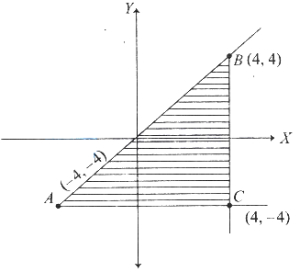
The area (in sq. units) bounded by $x=4$,$y=-4$ and $y=x$ is
A
$48$
B
$32$
C
$24$
D
$16$
Solution
(B) The region is bounded by the lines $x=4$,$y=-4$,and $y=x$.
To find the vertices of the triangle,we find the intersection points of these lines:
$1$. Intersection of $x=4$ and $y=x$ is $B(4, 4)$.
$2$. Intersection of $y=-4$ and $y=x$ is $A(-4, -4)$.
$3$. Intersection of $x=4$ and $y=-4$ is $C(4, -4)$.
The region is a right-angled triangle $ABC$ with vertices $A(-4, -4)$,$B(4, 4)$,and $C(4, -4)$.
The length of the base $AC$ is the distance between $(-4, -4)$ and $(4, -4)$,which is $|4 - (-4)| = 8$ units.
The length of the height $BC$ is the distance between $(4, -4)$ and $(4, 4)$,which is $|4 - (-4)| = 8$ units.
The area of the triangle is given by $\frac{1}{2} \times \text{base} \times \text{height}$.
Area $= \frac{1}{2} \times 8 \times 8 = 32$ sq. units.
To find the vertices of the triangle,we find the intersection points of these lines:
$1$. Intersection of $x=4$ and $y=x$ is $B(4, 4)$.
$2$. Intersection of $y=-4$ and $y=x$ is $A(-4, -4)$.
$3$. Intersection of $x=4$ and $y=-4$ is $C(4, -4)$.
The region is a right-angled triangle $ABC$ with vertices $A(-4, -4)$,$B(4, 4)$,and $C(4, -4)$.
The length of the base $AC$ is the distance between $(-4, -4)$ and $(4, -4)$,which is $|4 - (-4)| = 8$ units.
The length of the height $BC$ is the distance between $(4, -4)$ and $(4, 4)$,which is $|4 - (-4)| = 8$ units.
The area of the triangle is given by $\frac{1}{2} \times \text{base} \times \text{height}$.
Area $= \frac{1}{2} \times 8 \times 8 = 32$ sq. units.
0 likes
View Solution278
EasyMCQ
For a right-angled triangle having the lengths of two sides as $2 \sqrt{2}$ and $5$,find the possible lengths of the third side.
A
$4 \sqrt{2}$
B
$\sqrt{15}$
C
$\sqrt{17}$
D
$\sqrt{13}$
Solution
(C) In a right-angled triangle,let the sides be $a = 2 \sqrt{2}$,$b = 5$,and the third side be $p$.
Case $1$: If $p$ is the hypotenuse,then by the Pythagorean theorem,$p^2 = a^2 + b^2$.
$p^2 = (2 \sqrt{2})^2 + 5^2 = 8 + 25 = 33$.
So,$p = \sqrt{33}$.
Case $2$: If $5$ is the hypotenuse,then $p^2 + a^2 = 5^2$.
$p^2 + 8 = 25 \Rightarrow p^2 = 17$.
So,$p = \sqrt{17}$.
Since $\sqrt{17}$ is one of the given options,option $(c)$ is correct.
Case $1$: If $p$ is the hypotenuse,then by the Pythagorean theorem,$p^2 = a^2 + b^2$.
$p^2 = (2 \sqrt{2})^2 + 5^2 = 8 + 25 = 33$.
So,$p = \sqrt{33}$.
Case $2$: If $5$ is the hypotenuse,then $p^2 + a^2 = 5^2$.
$p^2 + 8 = 25 \Rightarrow p^2 = 17$.
So,$p = \sqrt{17}$.
Since $\sqrt{17}$ is one of the given options,option $(c)$ is correct.
0 likes
View Solution279
EasyMCQ
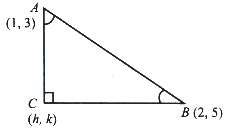
Let $A(1, 3)$ and $B(2, 5)$ be two points and $C(h, k)$ be a point such that $BC$ is perpendicular to $AC$. If $\angle CAB = \angle CBA$,then $h =$
A
$\frac{24}{5}$ or $\frac{7}{2}$
B
$\frac{2}{5}$ or $\frac{7}{2}$
C
$\frac{1}{2}$ or $\frac{5}{2}$
D
$\frac{24}{5}$ or $\frac{2}{5}$
Solution
(C) Given that $\angle CAB = \angle CBA$,the triangle $\triangle ABC$ is an isosceles triangle with $AC = BC$.
Squaring both sides,we get $AC^2 = BC^2$.
$(h-1)^2 + (k-3)^2 = (h-2)^2 + (k-5)^2$
$h^2 - 2h + 1 + k^2 - 6k + 9 = h^2 - 4h + 4 + k^2 - 10k + 25$
$-2h - 6k + 10 = -4h - 10k + 29$
$2h + 4k = 19 \implies k = \frac{19-2h}{4} \quad (1)$
Since $AC \perp BC$,the product of their slopes is $-1$:
$m_{AC} \times m_{BC} = -1$
$\frac{k-3}{h-1} \times \frac{k-5}{h-2} = -1$
$(k-3)(k-5) = -(h-1)(h-2)$
$k^2 - 8k + 15 = -(h^2 - 3h + 2) = -h^2 + 3h - 2$
$h^2 + k^2 - 3h - 8k + 17 = 0 \quad (2)$
Substituting $(1)$ into $(2)$:
$h^2 + (\frac{19-2h}{4})^2 - 3h - 8(\frac{19-2h}{4}) + 17 = 0$
$16h^2 + (361 - 76h + 4h^2) - 48h - 32(19-2h) + 272 = 0$
$20h^2 - 124h + 361 - 608 + 64h + 272 = 0$
$20h^2 - 60h + 25 = 0$
$4h^2 - 12h + 5 = 0$
$(2h-1)(2h-5) = 0$
$h = \frac{1}{2}$ or $h = \frac{5}{2}$.
Squaring both sides,we get $AC^2 = BC^2$.
$(h-1)^2 + (k-3)^2 = (h-2)^2 + (k-5)^2$
$h^2 - 2h + 1 + k^2 - 6k + 9 = h^2 - 4h + 4 + k^2 - 10k + 25$
$-2h - 6k + 10 = -4h - 10k + 29$
$2h + 4k = 19 \implies k = \frac{19-2h}{4} \quad (1)$
Since $AC \perp BC$,the product of their slopes is $-1$:
$m_{AC} \times m_{BC} = -1$
$\frac{k-3}{h-1} \times \frac{k-5}{h-2} = -1$
$(k-3)(k-5) = -(h-1)(h-2)$
$k^2 - 8k + 15 = -(h^2 - 3h + 2) = -h^2 + 3h - 2$
$h^2 + k^2 - 3h - 8k + 17 = 0 \quad (2)$
Substituting $(1)$ into $(2)$:
$h^2 + (\frac{19-2h}{4})^2 - 3h - 8(\frac{19-2h}{4}) + 17 = 0$
$16h^2 + (361 - 76h + 4h^2) - 48h - 32(19-2h) + 272 = 0$
$20h^2 - 124h + 361 - 608 + 64h + 272 = 0$
$20h^2 - 60h + 25 = 0$
$4h^2 - 12h + 5 = 0$
$(2h-1)(2h-5) = 0$
$h = \frac{1}{2}$ or $h = \frac{5}{2}$.
0 likes
View Solution280
EasyMCQ
If the circumcenter of the triangle formed by the points $A(a, 3)$,$B(b, 5)$,and $C(a, b)$ is $(1, 1)$,then out of all the possible coordinates of $C$,the sum of the absolute values of the distinct coordinates of $C$ is
A
$8$
B
$9$
C
$12$
D
$4$
Solution
(B) Let $O(1, 1)$ be the circumcenter. The perpendicular bisector of $AC$ passes through $O(1, 1)$ and the midpoint $P(a, \frac{b+3}{2})$. The slope of $AC$ is $\frac{b-3}{a-a}$,which is undefined (vertical line). Thus,the perpendicular bisector is horizontal: $y = \frac{b+3}{2} = 1$ $\Rightarrow b+3=2$ $\Rightarrow b=-1$.
Alternatively,from the image,the slope of $OP$ is $\frac{\frac{b+3}{2}-1}{a-1} = -\frac{a-a}{b-3} = 0$. This implies $\frac{b+3}{2} = 1$,so $b=-1$.
Using $OQ \perp AB$,where $Q$ is the midpoint of $AB$ $(\frac{a+b}{2}, 4)$,the slope of $AB$ is $\frac{5-3}{b-a} = \frac{2}{b-a}$. The slope of $OQ$ is $\frac{4-1}{\frac{a+b}{2}-1} = \frac{3}{\frac{a+b-2}{2}} = \frac{6}{a+b-2}$.
Since $OQ \perp AB$,$(\frac{2}{b-a}) \times (\frac{6}{a+b-2}) = -1 \Rightarrow 12 = -(b-a)(a+b-2) = (a-b)(a+b-2)$.
Substituting $b=-1$: $12 = (a+1)(a-3) = a^2 - 2a - 3$ $\Rightarrow a^2 - 2a - 15 = 0$ $\Rightarrow (a-5)(a+3) = 0$. So $a=5$ or $a=-3$.
Coordinates of $C(a, b)$ are $(5, -1)$ and $(-3, -1)$.
The distinct coordinates are $5, -3, -1$. The sum of their absolute values is $|5| + |-3| + |-1| = 5 + 3 + 1 = 9$.
Alternatively,from the image,the slope of $OP$ is $\frac{\frac{b+3}{2}-1}{a-1} = -\frac{a-a}{b-3} = 0$. This implies $\frac{b+3}{2} = 1$,so $b=-1$.
Using $OQ \perp AB$,where $Q$ is the midpoint of $AB$ $(\frac{a+b}{2}, 4)$,the slope of $AB$ is $\frac{5-3}{b-a} = \frac{2}{b-a}$. The slope of $OQ$ is $\frac{4-1}{\frac{a+b}{2}-1} = \frac{3}{\frac{a+b-2}{2}} = \frac{6}{a+b-2}$.
Since $OQ \perp AB$,$(\frac{2}{b-a}) \times (\frac{6}{a+b-2}) = -1 \Rightarrow 12 = -(b-a)(a+b-2) = (a-b)(a+b-2)$.
Substituting $b=-1$: $12 = (a+1)(a-3) = a^2 - 2a - 3$ $\Rightarrow a^2 - 2a - 15 = 0$ $\Rightarrow (a-5)(a+3) = 0$. So $a=5$ or $a=-3$.
Coordinates of $C(a, b)$ are $(5, -1)$ and $(-3, -1)$.
The distinct coordinates are $5, -3, -1$. The sum of their absolute values is $|5| + |-3| + |-1| = 5 + 3 + 1 = 9$.
0 likes
View Solution281
MediumMCQ
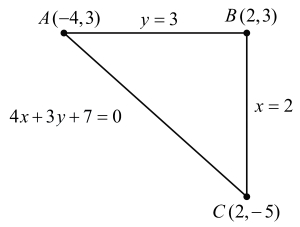
If the incentre and the circumcentre of the triangle formed by the lines $x=2$,$4x+3y+7=0$ and $y=3$ are $I$ and $S$ respectively,then $IS=$
A
$5$
B
$\sqrt{5}$
C
$4\sqrt{2}$
D
$2\sqrt{5}$
Solution
(B) The lines are $L_1: x=2$,$L_2: y=3$,and $L_3: 4x+3y+7=0$.
The vertices are found by intersection:
$A = L_2 \cap L_3: y=3$ $\Rightarrow 4x+9+7=0$ $\Rightarrow 4x=-16$ $\Rightarrow x=-4$. So $A=(-4, 3)$.
$B = L_1 \cap L_2: x=2, y=3$. So $B=(2, 3)$.
$C = L_1 \cap L_3: x=2$ $\Rightarrow 8+3y+7=0$ $\Rightarrow 3y=-15$ $\Rightarrow y=-5$. So $C=(2, -5)$.
The side lengths are $c = AB = \sqrt{(2-(-4))^2 + (3-3)^2} = 6$,$a = BC = \sqrt{(2-2)^2 + (-5-3)^2} = 8$,and $b = AC = \sqrt{(2-(-4))^2 + (-5-3)^2} = \sqrt{6^2 + (-8)^2} = 10$.
The incentre $I = \left(\frac{ax_1+bx_2+cx_3}{a+b+c}, \frac{ay_1+by_2+cy_3}{a+b+c}\right) = \left(\frac{8(-4)+10(2)+6(2)}{8+10+6}, \frac{8(3)+10(3)+6(-5)}{8+10+6}\right) = \left(\frac{-32+20+12}{24}, \frac{24+30-30}{24}\right) = (0, 1)$.
Since $\triangle ABC$ is a right-angled triangle at $B(2, 3)$,the circumcentre $S$ is the midpoint of the hypotenuse $AC$.
$S = \left(\frac{-4+2}{2}, \frac{3-5}{2}\right) = (-1, -1)$.
The distance $IS = \sqrt{(0-(-1))^2 + (1-(-1))^2} = \sqrt{1^2 + 2^2} = \sqrt{5}$.
The vertices are found by intersection:
$A = L_2 \cap L_3: y=3$ $\Rightarrow 4x+9+7=0$ $\Rightarrow 4x=-16$ $\Rightarrow x=-4$. So $A=(-4, 3)$.
$B = L_1 \cap L_2: x=2, y=3$. So $B=(2, 3)$.
$C = L_1 \cap L_3: x=2$ $\Rightarrow 8+3y+7=0$ $\Rightarrow 3y=-15$ $\Rightarrow y=-5$. So $C=(2, -5)$.
The side lengths are $c = AB = \sqrt{(2-(-4))^2 + (3-3)^2} = 6$,$a = BC = \sqrt{(2-2)^2 + (-5-3)^2} = 8$,and $b = AC = \sqrt{(2-(-4))^2 + (-5-3)^2} = \sqrt{6^2 + (-8)^2} = 10$.
The incentre $I = \left(\frac{ax_1+bx_2+cx_3}{a+b+c}, \frac{ay_1+by_2+cy_3}{a+b+c}\right) = \left(\frac{8(-4)+10(2)+6(2)}{8+10+6}, \frac{8(3)+10(3)+6(-5)}{8+10+6}\right) = \left(\frac{-32+20+12}{24}, \frac{24+30-30}{24}\right) = (0, 1)$.
Since $\triangle ABC$ is a right-angled triangle at $B(2, 3)$,the circumcentre $S$ is the midpoint of the hypotenuse $AC$.
$S = \left(\frac{-4+2}{2}, \frac{3-5}{2}\right) = (-1, -1)$.
The distance $IS = \sqrt{(0-(-1))^2 + (1-(-1))^2} = \sqrt{1^2 + 2^2} = \sqrt{5}$.
0 likes
View Solution282
EasyMCQ
In an isosceles triangle,the ends of its base are $(2a, 0)$ and $(0, a)$. One of its two other sides is a horizontal line (not the $X$-axis). If the third vertex is $(x_1, y_1)$,then $x_1 + y_1 =$
A
$\frac{9a}{2}$
B
$3a$
C
$\frac{9a}{4}$
D
$5a$
Solution
(C) Let the vertices be $A(0, a)$,$B(2a, 0)$,and $C(x_1, y_1)$.
Since one of the sides is a horizontal line and it is not the $X$-axis,the side $AC$ must be horizontal.
Therefore,the $y$-coordinate of $C$ must be equal to the $y$-coordinate of $A$,so $y_1 = a$.
Since the triangle is isosceles and $AC$ is a side,we have $AC = BC$ or $AC = AB$ or $BC = AB$.
Given $AC$ is horizontal,$AC = \sqrt{(x_1 - 0)^2 + (a - a)^2} = |x_1|$.
$BC = \sqrt{(x_1 - 2a)^2 + (a - 0)^2} = \sqrt{(x_1 - 2a)^2 + a^2}$.
Setting $AC^2 = BC^2$,we get $x_1^2 = (x_1 - 2a)^2 + a^2$.
$x_1^2 = x_1^2 - 4ax_1 + 4a^2 + a^2$.
$4ax_1 = 5a^2$.
Since $a \neq 0$,$x_1 = \frac{5a}{4}$.
Thus,$x_1 + y_1 = \frac{5a}{4} + a = \frac{9a}{4}$.
Since one of the sides is a horizontal line and it is not the $X$-axis,the side $AC$ must be horizontal.
Therefore,the $y$-coordinate of $C$ must be equal to the $y$-coordinate of $A$,so $y_1 = a$.
Since the triangle is isosceles and $AC$ is a side,we have $AC = BC$ or $AC = AB$ or $BC = AB$.
Given $AC$ is horizontal,$AC = \sqrt{(x_1 - 0)^2 + (a - a)^2} = |x_1|$.
$BC = \sqrt{(x_1 - 2a)^2 + (a - 0)^2} = \sqrt{(x_1 - 2a)^2 + a^2}$.
Setting $AC^2 = BC^2$,we get $x_1^2 = (x_1 - 2a)^2 + a^2$.
$x_1^2 = x_1^2 - 4ax_1 + 4a^2 + a^2$.
$4ax_1 = 5a^2$.
Since $a \neq 0$,$x_1 = \frac{5a}{4}$.
Thus,$x_1 + y_1 = \frac{5a}{4} + a = \frac{9a}{4}$.
0 likes
View Solution283
EasyMCQ
Let $L_1$ be a line passing through $(2,1)$ and $(3, \frac{5}{2})$. $L_2$ is a line perpendicular to $L_1$ and passing through $(4,-1)$. The area of the triangle formed by $L_1$,$L_2$ and the $y$-axis is
A
$\frac{121}{39}$
B
$\frac{121}{13}$
C
$\frac{154}{169}$
D
$\frac{22}{13}$
Solution
(A) Line $L_1$ passes through $(2,1)$ and $(3, \frac{5}{2})$.
Slope of $L_1$ is $m_1 = \frac{\frac{5}{2} - 1}{3 - 2} = \frac{3/2}{1} = \frac{3}{2}$.
The equation of $L_1$ is $(y - 1) = \frac{3}{2}(x - 2)$,which simplifies to $3x - 2y = 4$.
Line $L_2$ is perpendicular to $L_1$,so its slope $m_2 = -\frac{1}{m_1} = -\frac{2}{3}$.
$L_2$ passes through $(4, -1)$,so its equation is $(y + 1) = -\frac{2}{3}(x - 4)$,which simplifies to $2x + 3y = 5$.
$L_1$ intersects the $y$-axis at $x=0$,so $-2y = 4 \Rightarrow y = -2$. Point is $(0, -2)$.
$L_2$ intersects the $y$-axis at $x=0$,so $3y = 5 \Rightarrow y = \frac{5}{3}$. Point is $(0, \frac{5}{3})$.
To find the intersection of $L_1$ and $L_2$,solve $3x - 2y = 4$ and $2x + 3y = 5$. Multiplying the first by $3$ and second by $2$: $9x - 6y = 12$ and $4x + 6y = 10$. Adding them gives $13x = 22 \Rightarrow x = \frac{22}{13}$. Substituting $x$ gives $y = \frac{7}{13}$.
The vertices of the triangle are $(0, -2)$,$(0, \frac{5}{3})$,and $(\frac{22}{13}, \frac{7}{13})$.
Area $= \frac{1}{2} \times \text{base} \times \text{height} = \frac{1}{2} \times |\frac{5}{3} - (-2)| \times |\frac{22}{13}| = \frac{1}{2} \times \frac{11}{3} \times \frac{22}{13} = \frac{121}{39}$.
Slope of $L_1$ is $m_1 = \frac{\frac{5}{2} - 1}{3 - 2} = \frac{3/2}{1} = \frac{3}{2}$.
The equation of $L_1$ is $(y - 1) = \frac{3}{2}(x - 2)$,which simplifies to $3x - 2y = 4$.
Line $L_2$ is perpendicular to $L_1$,so its slope $m_2 = -\frac{1}{m_1} = -\frac{2}{3}$.
$L_2$ passes through $(4, -1)$,so its equation is $(y + 1) = -\frac{2}{3}(x - 4)$,which simplifies to $2x + 3y = 5$.
$L_1$ intersects the $y$-axis at $x=0$,so $-2y = 4 \Rightarrow y = -2$. Point is $(0, -2)$.
$L_2$ intersects the $y$-axis at $x=0$,so $3y = 5 \Rightarrow y = \frac{5}{3}$. Point is $(0, \frac{5}{3})$.
To find the intersection of $L_1$ and $L_2$,solve $3x - 2y = 4$ and $2x + 3y = 5$. Multiplying the first by $3$ and second by $2$: $9x - 6y = 12$ and $4x + 6y = 10$. Adding them gives $13x = 22 \Rightarrow x = \frac{22}{13}$. Substituting $x$ gives $y = \frac{7}{13}$.
The vertices of the triangle are $(0, -2)$,$(0, \frac{5}{3})$,and $(\frac{22}{13}, \frac{7}{13})$.
Area $= \frac{1}{2} \times \text{base} \times \text{height} = \frac{1}{2} \times |\frac{5}{3} - (-2)| \times |\frac{22}{13}| = \frac{1}{2} \times \frac{11}{3} \times \frac{22}{13} = \frac{121}{39}$.
0 likes
View Solution284
EasyMCQ
For all $\alpha, \beta \in R$ and $\alpha \beta > 0$,the line $\alpha x + \beta y + \sqrt{\alpha \beta} = 0$ is such that it
A
possesses a slope independent of $\alpha$ and $\beta$
B
passes through a fixed point
C
forms a triangle of constant area with coordinate axes
D
possesses intercepts on the axes that differ by a quantity independent of $\alpha, \beta$
Solution
(C) Given the line equation: $\alpha x + \beta y + \sqrt{\alpha \beta} = 0$.
Dividing the equation by $-\sqrt{\alpha \beta}$,we get:
$\frac{\alpha x}{-\sqrt{\alpha \beta}} + \frac{\beta y}{-\sqrt{\alpha \beta}} = 1$
$\Rightarrow \frac{\sqrt{\alpha}}{\sqrt{\beta}} x + \frac{\sqrt{\beta}}{\sqrt{\alpha}} y = -1$.
The $x$-intercept is $a = -\sqrt{\frac{\beta}{\alpha}}$ and the $y$-intercept is $b = -\sqrt{\frac{\alpha}{\beta}}$.
The area of the triangle formed by the line with the coordinate axes is given by $Area = \frac{1}{2} |ab|$.
$Area = \frac{1}{2} |(-\sqrt{\frac{\beta}{\alpha}}) \times (-\sqrt{\frac{\alpha}{\beta}})| = \frac{1}{2} |1| = \frac{1}{2}$ square units.
Since the area is $\frac{1}{2}$,which is independent of $\alpha$ and $\beta$,the line forms a triangle of constant area with the coordinate axes.
Dividing the equation by $-\sqrt{\alpha \beta}$,we get:
$\frac{\alpha x}{-\sqrt{\alpha \beta}} + \frac{\beta y}{-\sqrt{\alpha \beta}} = 1$
$\Rightarrow \frac{\sqrt{\alpha}}{\sqrt{\beta}} x + \frac{\sqrt{\beta}}{\sqrt{\alpha}} y = -1$.
The $x$-intercept is $a = -\sqrt{\frac{\beta}{\alpha}}$ and the $y$-intercept is $b = -\sqrt{\frac{\alpha}{\beta}}$.
The area of the triangle formed by the line with the coordinate axes is given by $Area = \frac{1}{2} |ab|$.
$Area = \frac{1}{2} |(-\sqrt{\frac{\beta}{\alpha}}) \times (-\sqrt{\frac{\alpha}{\beta}})| = \frac{1}{2} |1| = \frac{1}{2}$ square units.
Since the area is $\frac{1}{2}$,which is independent of $\alpha$ and $\beta$,the line forms a triangle of constant area with the coordinate axes.
0 likes
View Solution285
MediumMCQ
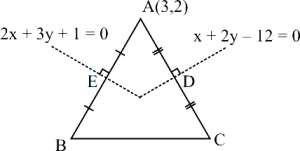
In a $\triangle ABC$,$2x+3y+1=0$ and $x+2y-12=0$ are the perpendicular bisectors of its sides $AB$ and $AC$ respectively. If $A$ is $(3,2)$,then the slope of the side $BC$ is
A
$1$
B
$\frac{1}{3}$
C
$\frac{5}{3}$
D
$\frac{5}{2}$
Solution
(C) The slope of the perpendicular bisector of $AB$ is $m_1 = -\frac{2}{3}$. Thus,the slope of $AB$ is $m_{AB} = -\frac{1}{m_1} = \frac{3}{2}$.
Since $AB$ passes through $A(3,2)$,its equation is $y-2 = \frac{3}{2}(x-3) \Rightarrow 3x-2y-5=0$.
The intersection of $AB$ and its perpendicular bisector $2x+3y+1=0$ gives the midpoint $E$ of $AB$. Solving $3x-2y-5=0$ and $2x+3y+1=0$,we get $E(1,-1)$.
Let $B$ be $(x_1, y_1)$. Since $E$ is the midpoint of $AB$,$\frac{x_1+3}{2} = 1 \Rightarrow x_1 = -1$ and $\frac{y_1+2}{2} = -1 \Rightarrow y_1 = -4$. So,$B(-1,-4)$.
The slope of the perpendicular bisector of $AC$ is $m_2 = -\frac{1}{2}$. Thus,the slope of $AC$ is $m_{AC} = -\frac{1}{m_2} = 2$.
Since $AC$ passes through $A(3,2)$,its equation is $y-2 = 2(x-3) \Rightarrow 2x-y-4=0$.
The intersection of $AC$ and its perpendicular bisector $x+2y-12=0$ gives the midpoint $D$ of $AC$. Solving $2x-y-4=0$ and $x+2y-12=0$,we get $D(4,4)$.
Let $C$ be $(x_2, y_2)$. Since $D$ is the midpoint of $AC$,$\frac{x_2+3}{2} = 4 \Rightarrow x_2 = 5$ and $\frac{y_2+2}{2} = 4 \Rightarrow y_2 = 6$. So,$C(5,6)$.
The slope of $BC$ is $\frac{6-(-4)}{5-(-1)} = \frac{10}{6} = \frac{5}{3}$.
Since $AB$ passes through $A(3,2)$,its equation is $y-2 = \frac{3}{2}(x-3) \Rightarrow 3x-2y-5=0$.
The intersection of $AB$ and its perpendicular bisector $2x+3y+1=0$ gives the midpoint $E$ of $AB$. Solving $3x-2y-5=0$ and $2x+3y+1=0$,we get $E(1,-1)$.
Let $B$ be $(x_1, y_1)$. Since $E$ is the midpoint of $AB$,$\frac{x_1+3}{2} = 1 \Rightarrow x_1 = -1$ and $\frac{y_1+2}{2} = -1 \Rightarrow y_1 = -4$. So,$B(-1,-4)$.
The slope of the perpendicular bisector of $AC$ is $m_2 = -\frac{1}{2}$. Thus,the slope of $AC$ is $m_{AC} = -\frac{1}{m_2} = 2$.
Since $AC$ passes through $A(3,2)$,its equation is $y-2 = 2(x-3) \Rightarrow 2x-y-4=0$.
The intersection of $AC$ and its perpendicular bisector $x+2y-12=0$ gives the midpoint $D$ of $AC$. Solving $2x-y-4=0$ and $x+2y-12=0$,we get $D(4,4)$.
Let $C$ be $(x_2, y_2)$. Since $D$ is the midpoint of $AC$,$\frac{x_2+3}{2} = 4 \Rightarrow x_2 = 5$ and $\frac{y_2+2}{2} = 4 \Rightarrow y_2 = 6$. So,$C(5,6)$.
The slope of $BC$ is $\frac{6-(-4)}{5-(-1)} = \frac{10}{6} = \frac{5}{3}$.
0 likes
View Solution286
MediumMCQ
In an isosceles right-angled triangle,if the equation of the hypotenuse is $3x + 4y = 4$ and its opposite vertex is $(2, 2)$,then the slopes of the remaining two sides are:
A
$\frac{1}{7}, -7$
B
$\frac{-1}{7}, 7$
C
$\frac{1}{7}, 7$
D
$\frac{-1}{7}, -7$
Solution
(A) The equation of the hypotenuse is $3x + 4y = 4$,which can be written as $y = -\frac{3}{4}x + 1$.
Thus,the slope of the hypotenuse is $m_1 = -\frac{3}{4}$.
Let the slopes of the other two sides be $m$.
Since it is an isosceles right-angled triangle,the angle between the hypotenuse and each of the other two sides is $45^{\circ}$.
Using the formula $\tan \theta = \left| \frac{m - m_1}{1 + m \cdot m_1} \right|$,we have:
$\tan 45^{\circ} = \left| \frac{m - (-3/4)}{1 + m(-3/4)} \right| = 1$.
$1 = \left| \frac{4m + 3}{4 - 3m} \right|$.
This gives two cases:
Case $1$: $\frac{4m + 3}{4 - 3m} = 1$ $\Rightarrow 4m + 3 = 4 - 3m$ $\Rightarrow 7m = 1$ $\Rightarrow m = \frac{1}{7}$.
Case $2$: $\frac{4m + 3}{4 - 3m} = -1$ $\Rightarrow 4m + 3 = -4 + 3m$ $\Rightarrow m = -7$.
Therefore,the slopes of the remaining two sides are $\frac{1}{7}$ and $-7$.
Thus,the slope of the hypotenuse is $m_1 = -\frac{3}{4}$.
Let the slopes of the other two sides be $m$.
Since it is an isosceles right-angled triangle,the angle between the hypotenuse and each of the other two sides is $45^{\circ}$.
Using the formula $\tan \theta = \left| \frac{m - m_1}{1 + m \cdot m_1} \right|$,we have:
$\tan 45^{\circ} = \left| \frac{m - (-3/4)}{1 + m(-3/4)} \right| = 1$.
$1 = \left| \frac{4m + 3}{4 - 3m} \right|$.
This gives two cases:
Case $1$: $\frac{4m + 3}{4 - 3m} = 1$ $\Rightarrow 4m + 3 = 4 - 3m$ $\Rightarrow 7m = 1$ $\Rightarrow m = \frac{1}{7}$.
Case $2$: $\frac{4m + 3}{4 - 3m} = -1$ $\Rightarrow 4m + 3 = -4 + 3m$ $\Rightarrow m = -7$.
Therefore,the slopes of the remaining two sides are $\frac{1}{7}$ and $-7$.
0 likes
View Solution287
MediumMCQ
The straight lines $x+3y-4=0$,$x+y-4=0$,and $3x+y-4=0$
A
form an isosceles triangle
B
are concurrent
C
form an equilateral triangle
D
form a right angled isosceles triangle
Solution
(A) To find the vertices of the triangle,we solve the equations of the lines in pairs:
$1$. For vertex $A$,solve $x+3y-4=0$ and $3x+y-4=0$:
Multiplying the first equation by $3$,we get $3x+9y-12=0$.
Subtracting $3x+y-4=0$ from this,we get $8y-8=0$,so $y=1$. Substituting $y=1$ into $x+3(1)-4=0$,we get $x=1$. Thus,$A = (1, 1)$.
$2$. For vertex $B$,solve $x+3y-4=0$ and $x+y-4=0$:
Subtracting the second from the first,we get $2y=0$,so $y=0$. Substituting $y=0$ into $x+y-4=0$,we get $x=4$. Thus,$B = (4, 0)$.
$3$. For vertex $C$,solve $3x+y-4=0$ and $x+y-4=0$:
Subtracting the second from the first,we get $2x=0$,so $x=0$. Substituting $x=0$ into $x+y-4=0$,we get $y=4$. Thus,$C = (0, 4)$.
Now,calculate the lengths of the sides:
$AB = \sqrt{(4-1)^2 + (0-1)^2} = \sqrt{3^2 + (-1)^2} = \sqrt{9+1} = \sqrt{10}$
$BC = \sqrt{(0-4)^2 + (4-0)^2} = \sqrt{(-4)^2 + 4^2} = \sqrt{16+16} = \sqrt{32} = 4\sqrt{2}$
$CA = \sqrt{(1-0)^2 + (1-4)^2} = \sqrt{1^2 + (-3)^2} = \sqrt{1+9} = \sqrt{10}$
Since $AB = CA = \sqrt{10}$,the triangle is an isosceles triangle.
$1$. For vertex $A$,solve $x+3y-4=0$ and $3x+y-4=0$:
Multiplying the first equation by $3$,we get $3x+9y-12=0$.
Subtracting $3x+y-4=0$ from this,we get $8y-8=0$,so $y=1$. Substituting $y=1$ into $x+3(1)-4=0$,we get $x=1$. Thus,$A = (1, 1)$.
$2$. For vertex $B$,solve $x+3y-4=0$ and $x+y-4=0$:
Subtracting the second from the first,we get $2y=0$,so $y=0$. Substituting $y=0$ into $x+y-4=0$,we get $x=4$. Thus,$B = (4, 0)$.
$3$. For vertex $C$,solve $3x+y-4=0$ and $x+y-4=0$:
Subtracting the second from the first,we get $2x=0$,so $x=0$. Substituting $x=0$ into $x+y-4=0$,we get $y=4$. Thus,$C = (0, 4)$.
Now,calculate the lengths of the sides:
$AB = \sqrt{(4-1)^2 + (0-1)^2} = \sqrt{3^2 + (-1)^2} = \sqrt{9+1} = \sqrt{10}$
$BC = \sqrt{(0-4)^2 + (4-0)^2} = \sqrt{(-4)^2 + 4^2} = \sqrt{16+16} = \sqrt{32} = 4\sqrt{2}$
$CA = \sqrt{(1-0)^2 + (1-4)^2} = \sqrt{1^2 + (-3)^2} = \sqrt{1+9} = \sqrt{10}$
Since $AB = CA = \sqrt{10}$,the triangle is an isosceles triangle.
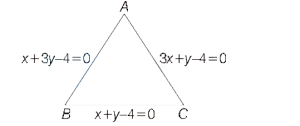
0 likes
View Solution288
EasyMCQ
$A$ triangle is formed by the $Y$-axis,the straight line $L$ passing through the points $(3,0)$ and $(1, 4/3)$,and the straight line perpendicular to the line $L$ and passing through the point $(8,1)$. The area of the triangle (in sq units) is
A
$16$
B
$21$
C
$36$
D
$39$
Solution
(D) The equation of line $L$ passing through $(3,0)$ and $(1, 4/3)$ is given by:
$y - 0 = \frac{4/3 - 0}{1 - 3}(x - 3)$
$y = -\frac{2}{3}(x - 3)$ $\Rightarrow 3y = -2x + 6$ $\Rightarrow 2x + 3y = 6$ (Eq. $i$)
The slope of line $L$ is $m_1 = -2/3$. The slope of the line perpendicular to $L$ is $m_2 = -1/m_1 = 3/2$.
The equation of the line passing through $(8,1)$ with slope $3/2$ is:
$y - 1 = \frac{3}{2}(x - 8)$ $\Rightarrow 2y - 2 = 3x - 24$ $\Rightarrow 3x - 2y = 22$ (Eq. $ii$)
Solving Eq. $i$ and Eq. $ii$ for the intersection point:
$2x + 3y = 6$ (multiply by $2$) $\Rightarrow 4x + 6y = 12$
$3x - 2y = 22$ (multiply by $3$) $\Rightarrow 9x - 6y = 66$
Adding these gives $13x = 78 \Rightarrow x = 6$. Substituting $x=6$ into $2x + 3y = 6$ gives $12 + 3y = 6$ $\Rightarrow 3y = -6$ $\Rightarrow y = -2$. The intersection point is $(6, -2)$.
The line $2x + 3y = 6$ intersects the $Y$-axis $(x=0)$ at $(0, 2)$.
The line $3x - 2y = 22$ intersects the $Y$-axis $(x=0)$ at $(0, -11)$.
The vertices of the triangle are $(6, -2)$,$(0, 2)$,and $(0, -11)$.
The base of the triangle on the $Y$-axis is $|2 - (-11)| = 13$.
The height of the triangle is the absolute value of the $x$-coordinate of the intersection point,which is $|6| = 6$.
Area $= \frac{1}{2} \times \text{base} \times \text{height} = \frac{1}{2} \times 13 \times 6 = 39 \text{ sq units}$.
$y - 0 = \frac{4/3 - 0}{1 - 3}(x - 3)$
$y = -\frac{2}{3}(x - 3)$ $\Rightarrow 3y = -2x + 6$ $\Rightarrow 2x + 3y = 6$ (Eq. $i$)
The slope of line $L$ is $m_1 = -2/3$. The slope of the line perpendicular to $L$ is $m_2 = -1/m_1 = 3/2$.
The equation of the line passing through $(8,1)$ with slope $3/2$ is:
$y - 1 = \frac{3}{2}(x - 8)$ $\Rightarrow 2y - 2 = 3x - 24$ $\Rightarrow 3x - 2y = 22$ (Eq. $ii$)
Solving Eq. $i$ and Eq. $ii$ for the intersection point:
$2x + 3y = 6$ (multiply by $2$) $\Rightarrow 4x + 6y = 12$
$3x - 2y = 22$ (multiply by $3$) $\Rightarrow 9x - 6y = 66$
Adding these gives $13x = 78 \Rightarrow x = 6$. Substituting $x=6$ into $2x + 3y = 6$ gives $12 + 3y = 6$ $\Rightarrow 3y = -6$ $\Rightarrow y = -2$. The intersection point is $(6, -2)$.
The line $2x + 3y = 6$ intersects the $Y$-axis $(x=0)$ at $(0, 2)$.
The line $3x - 2y = 22$ intersects the $Y$-axis $(x=0)$ at $(0, -11)$.
The vertices of the triangle are $(6, -2)$,$(0, 2)$,and $(0, -11)$.
The base of the triangle on the $Y$-axis is $|2 - (-11)| = 13$.
The height of the triangle is the absolute value of the $x$-coordinate of the intersection point,which is $|6| = 6$.
Area $= \frac{1}{2} \times \text{base} \times \text{height} = \frac{1}{2} \times 13 \times 6 = 39 \text{ sq units}$.
0 likes
View Solution289
MediumMCQ
$7x+y-24=0$ and $x+7y-24=0$ represent the equal sides of an isosceles triangle. If the third side passes through $(-1, 1)$,then a possible equation for the third side is
A
$3x-y=-4$
B
$x+y=0$
C
$x-2y=-3$
D
$3x+y=-2$
Solution
(B) Let the lines be $L_1: 7x+y-24=0$ and $L_2: x+7y-24=0$. The slopes are $m_1 = -7$ and $m_2 = -\frac{1}{7}$.
Since the lines are equal sides of an isosceles triangle,the third side makes equal angles with $L_1$ and $L_2$.
Let the slope of the third side be $m$. Then $\left| \frac{m - (-7)}{1 + m(-7)} \right| = \left| \frac{m - (-1/7)}{1 + m(-1/7)} \right|$.
$\left| \frac{m+7}{1-7m} \right| = \left| \frac{7m+1}{7-m} \right|$.
Case $1$: $\frac{m+7}{1-7m} = \frac{7m+1}{7-m}$ $\Rightarrow (m+7)(7-m) = (7m+1)(1-7m)$ $\Rightarrow 49-m^2 = 1-49m^2$ $\Rightarrow 48m^2 = -48$ (No real solution).
Case $2$: $\frac{m+7}{1-7m} = -\frac{7m+1}{7-m}$ $\Rightarrow (m+7)(7-m) = -(7m+1)(1-7m)$ $\Rightarrow 49-m^2 = -(1-49m^2-7m+7m) = 49m^2-1$ $\Rightarrow 50m^2 = 50$ $\Rightarrow m = \pm 1$.
For $m = -1$,the line passing through $(-1, 1)$ is $y-1 = -1(x+1)$ $\Rightarrow y-1 = -x-1$ $\Rightarrow x+y=0$.
For $m = 1$,the line passing through $(-1, 1)$ is $y-1 = 1(x+1)$ $\Rightarrow y-1 = x+1$ $\Rightarrow x-y+2=0$.
Since the lines are equal sides of an isosceles triangle,the third side makes equal angles with $L_1$ and $L_2$.
Let the slope of the third side be $m$. Then $\left| \frac{m - (-7)}{1 + m(-7)} \right| = \left| \frac{m - (-1/7)}{1 + m(-1/7)} \right|$.
$\left| \frac{m+7}{1-7m} \right| = \left| \frac{7m+1}{7-m} \right|$.
Case $1$: $\frac{m+7}{1-7m} = \frac{7m+1}{7-m}$ $\Rightarrow (m+7)(7-m) = (7m+1)(1-7m)$ $\Rightarrow 49-m^2 = 1-49m^2$ $\Rightarrow 48m^2 = -48$ (No real solution).
Case $2$: $\frac{m+7}{1-7m} = -\frac{7m+1}{7-m}$ $\Rightarrow (m+7)(7-m) = -(7m+1)(1-7m)$ $\Rightarrow 49-m^2 = -(1-49m^2-7m+7m) = 49m^2-1$ $\Rightarrow 50m^2 = 50$ $\Rightarrow m = \pm 1$.
For $m = -1$,the line passing through $(-1, 1)$ is $y-1 = -1(x+1)$ $\Rightarrow y-1 = -x-1$ $\Rightarrow x+y=0$.
For $m = 1$,the line passing through $(-1, 1)$ is $y-1 = 1(x+1)$ $\Rightarrow y-1 = x+1$ $\Rightarrow x-y+2=0$.
0 likes
View Solution290
EasyMCQ
The points $A(2, 1)$,$B(3, -2)$ and $C(a, b)$ are vertices of the rectangle $ABCD$. If the point $P(3, 4)$ lies on the line $CD$,then $5a + 10b = $
A
$41$
B
$10$
C
$45$
D
$-15$
Solution
(B) Given,$ABCD$ is a rectangle.
Slope of $AB = \frac{-2-1}{3-2} = -3 = m_1$.
Since $AB \perp BC$,the slope of $BC$ is $m_2 = -\frac{1}{m_1} = \frac{1}{3}$.
Slope of $BC = \frac{b - (-2)}{a - 3} = \frac{b+2}{a-3} = \frac{1}{3}$.
$3(b+2) = a-3$ $\Rightarrow 3b + 6 = a - 3$ $\Rightarrow a - 3b = 9$ ... $(i)$.
Since $CD \parallel AB$,the slope of $CD$ is $m_3 = m_1 = -3$.
The points $C(a, b)$ and $P(3, 4)$ lie on the line $CD$.
Slope of $CP = \frac{4-b}{3-a} = -3$.
$4-b = -3(3-a)$ $\Rightarrow 4-b = -9 + 3a$ $\Rightarrow 3a + b = 13$ ... $(ii)$.
Multiplying $(ii)$ by $3$: $9a + 3b = 39$ ... $(iii)$.
Adding $(i)$ and $(iii)$: $(a - 3b) + (9a + 3b) = 9 + 39$ $\Rightarrow 10a = 48$ $\Rightarrow a = 4.8 = \frac{24}{5}$.
Substituting $a = 4.8$ in $(ii)$: $3(4.8) + b = 13$ $\Rightarrow 14.4 + b = 13$ $\Rightarrow b = -1.4 = -\frac{7}{5}$.
Now,$5a + 10b = 5(\frac{24}{5}) + 10(-\frac{7}{5}) = 24 - 14 = 10$.
Slope of $AB = \frac{-2-1}{3-2} = -3 = m_1$.
Since $AB \perp BC$,the slope of $BC$ is $m_2 = -\frac{1}{m_1} = \frac{1}{3}$.
Slope of $BC = \frac{b - (-2)}{a - 3} = \frac{b+2}{a-3} = \frac{1}{3}$.
$3(b+2) = a-3$ $\Rightarrow 3b + 6 = a - 3$ $\Rightarrow a - 3b = 9$ ... $(i)$.
Since $CD \parallel AB$,the slope of $CD$ is $m_3 = m_1 = -3$.
The points $C(a, b)$ and $P(3, 4)$ lie on the line $CD$.
Slope of $CP = \frac{4-b}{3-a} = -3$.
$4-b = -3(3-a)$ $\Rightarrow 4-b = -9 + 3a$ $\Rightarrow 3a + b = 13$ ... $(ii)$.
Multiplying $(ii)$ by $3$: $9a + 3b = 39$ ... $(iii)$.
Adding $(i)$ and $(iii)$: $(a - 3b) + (9a + 3b) = 9 + 39$ $\Rightarrow 10a = 48$ $\Rightarrow a = 4.8 = \frac{24}{5}$.
Substituting $a = 4.8$ in $(ii)$: $3(4.8) + b = 13$ $\Rightarrow 14.4 + b = 13$ $\Rightarrow b = -1.4 = -\frac{7}{5}$.
Now,$5a + 10b = 5(\frac{24}{5}) + 10(-\frac{7}{5}) = 24 - 14 = 10$.
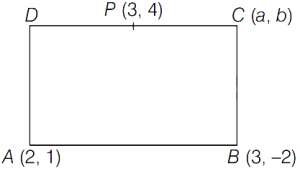
0 likes
View Solution291
EasyMCQ
If the lines $3x + y - 4 = 0$,$x - ay - 10 = 0$,and $bx + 2y + 9 = 0$ form three successive sides of a rectangle in that order and the fourth side passes through $(1, 2)$,then the area of that rectangle (in sq. units) is
A
$8$
B
$\frac{15}{\sqrt{10}}$
C
$\frac{51}{\sqrt{40}}$
D
$\frac{51}{4}$
Solution
(D) Let the rectangle be $ABCD$. The lines are $AB: 3x + y - 4 = 0$,$BC: x - ay - 10 = 0$,and $CD: bx + 2y + 9 = 0$.
Since $AB \parallel CD$,their slopes must be equal. Slope of $AB$ is $-3$. Slope of $CD$ is $-\frac{b}{2}$. Thus,$-\frac{b}{2} = -3 \Rightarrow b = 6$.
Since $AB \perp BC$,the product of their slopes is $-1$. Slope of $BC$ is $\frac{1}{a}$. Thus,$(-3) \times (\frac{1}{a}) = -1 \Rightarrow a = 3$.
Now,$AB: 3x + y - 4 = 0$ and $CD: 6x + 2y + 9 = 0$,which can be written as $3x + y + \frac{9}{2} = 0$.
The distance between parallel lines $AB$ and $CD$ is $BC = \frac{|-4 - 9/2|}{\sqrt{3^2 + 1^2}} = \frac{17/2}{\sqrt{10}} = \frac{17}{2\sqrt{10}}$.
The line $BC$ is $x - 3y - 10 = 0$. The side $CD$ is a line parallel to $AB$ and $AD$ is a line parallel to $BC$. The distance $CD$ is the distance between the parallel lines $AD$ and $BC$. Since $AD$ passes through $(1, 2)$,the distance $CD$ is the perpendicular distance from $(1, 2)$ to the line $BC: x - 3y - 10 = 0$.
$CD = \frac{|1 - 3(2) - 10|}{\sqrt{1^2 + (-3)^2}} = \frac{|1 - 6 - 10|}{\sqrt{10}} = \frac{15}{\sqrt{10}}$.
Area of rectangle $ABCD = BC \times CD = \frac{17}{2\sqrt{10}} \times \frac{15}{\sqrt{10}} = \frac{17 \times 15}{2 \times 10} = \frac{255}{20} = \frac{51}{4}$.
Since $AB \parallel CD$,their slopes must be equal. Slope of $AB$ is $-3$. Slope of $CD$ is $-\frac{b}{2}$. Thus,$-\frac{b}{2} = -3 \Rightarrow b = 6$.
Since $AB \perp BC$,the product of their slopes is $-1$. Slope of $BC$ is $\frac{1}{a}$. Thus,$(-3) \times (\frac{1}{a}) = -1 \Rightarrow a = 3$.
Now,$AB: 3x + y - 4 = 0$ and $CD: 6x + 2y + 9 = 0$,which can be written as $3x + y + \frac{9}{2} = 0$.
The distance between parallel lines $AB$ and $CD$ is $BC = \frac{|-4 - 9/2|}{\sqrt{3^2 + 1^2}} = \frac{17/2}{\sqrt{10}} = \frac{17}{2\sqrt{10}}$.
The line $BC$ is $x - 3y - 10 = 0$. The side $CD$ is a line parallel to $AB$ and $AD$ is a line parallel to $BC$. The distance $CD$ is the distance between the parallel lines $AD$ and $BC$. Since $AD$ passes through $(1, 2)$,the distance $CD$ is the perpendicular distance from $(1, 2)$ to the line $BC: x - 3y - 10 = 0$.
$CD = \frac{|1 - 3(2) - 10|}{\sqrt{1^2 + (-3)^2}} = \frac{|1 - 6 - 10|}{\sqrt{10}} = \frac{15}{\sqrt{10}}$.
Area of rectangle $ABCD = BC \times CD = \frac{17}{2\sqrt{10}} \times \frac{15}{\sqrt{10}} = \frac{17 \times 15}{2 \times 10} = \frac{255}{20} = \frac{51}{4}$.
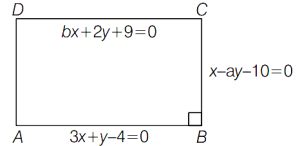
0 likes
View Solution292
EasyMCQ
The equations of two altitudes of an equilateral triangle are $\sqrt{3}x - y + 8 - 4\sqrt{3} = 0$ and $\sqrt{3}x + y - 12 - 4\sqrt{3} = 0$. The equation of the third altitude is
A
$\sqrt{3}x + y = 4$
B
$y = 10$
C
$x = 10$
D
$x - \sqrt{3}y = 4$
Solution
(B) Let the two given altitudes be $L_1: \sqrt{3}x - y + 8 - 4\sqrt{3} = 0$ and $L_2: \sqrt{3}x + y - 12 - 4\sqrt{3} = 0$.
The intersection of these two altitudes is the orthocenter of the triangle.
Adding $L_1$ and $L_2$: $(\sqrt{3}x - y + 8 - 4\sqrt{3}) + (\sqrt{3}x + y - 12 - 4\sqrt{3}) = 0$.
$2\sqrt{3}x - 4 - 8\sqrt{3} = 0$ $\Rightarrow 2\sqrt{3}x = 4 + 8\sqrt{3}$ $\Rightarrow x = \frac{2 + 4\sqrt{3}}{\sqrt{3}} = 4 + \frac{2}{\sqrt{3}}$.
Subtracting $L_1$ from $L_2$: $(\sqrt{3}x + y - 12 - 4\sqrt{3}) - (\sqrt{3}x - y + 8 - 4\sqrt{3}) = 0$.
$2y - 20 = 0 \Rightarrow y = 10$.
The orthocenter is $(4 + \frac{2}{\sqrt{3}}, 10)$.
In an equilateral triangle,the orthocenter is the same as the centroid.
Since the third altitude must pass through the orthocenter $(x_0, y_0) = (4 + \frac{2}{\sqrt{3}}, 10)$,we check the given options.
Substituting $(4 + \frac{2}{\sqrt{3}}, 10)$ into $y = 10$,we see it satisfies the equation.
Thus,the equation of the third altitude is $y = 10$.
The intersection of these two altitudes is the orthocenter of the triangle.
Adding $L_1$ and $L_2$: $(\sqrt{3}x - y + 8 - 4\sqrt{3}) + (\sqrt{3}x + y - 12 - 4\sqrt{3}) = 0$.
$2\sqrt{3}x - 4 - 8\sqrt{3} = 0$ $\Rightarrow 2\sqrt{3}x = 4 + 8\sqrt{3}$ $\Rightarrow x = \frac{2 + 4\sqrt{3}}{\sqrt{3}} = 4 + \frac{2}{\sqrt{3}}$.
Subtracting $L_1$ from $L_2$: $(\sqrt{3}x + y - 12 - 4\sqrt{3}) - (\sqrt{3}x - y + 8 - 4\sqrt{3}) = 0$.
$2y - 20 = 0 \Rightarrow y = 10$.
The orthocenter is $(4 + \frac{2}{\sqrt{3}}, 10)$.
In an equilateral triangle,the orthocenter is the same as the centroid.
Since the third altitude must pass through the orthocenter $(x_0, y_0) = (4 + \frac{2}{\sqrt{3}}, 10)$,we check the given options.
Substituting $(4 + \frac{2}{\sqrt{3}}, 10)$ into $y = 10$,we see it satisfies the equation.
Thus,the equation of the third altitude is $y = 10$.
0 likes
View Solution293
MediumMCQ
$A$ line $L_1$ passing through $A(3,4)$ and having slope $1$ cuts another line $L_2$ passing through $C$ at $B$,such that $AB = AC$. If the equation of line $BC$ is $2x - y + 4 = 0$,then the equation of $AC$ is
A
$7x - y - 17 = 0$
B
$x - y + 1 = 0$
C
$x - 7y + 25 = 0$
D
$2x + 3y - 18 = 0$
Solution
(A) The equation of line $L_1$ passing through $A(3,4)$ with slope $m_1 = 1$ is:
$y - 4 = 1(x - 3) \implies x - y + 1 = 0$.
Let the slope of line $AC$ be $m$. The line $BC$ has the equation $2x - y + 4 = 0$,so its slope is $m_{BC} = 2$.
Since $AB = AC$,$\triangle ABC$ is an isosceles triangle with $A$ as the vertex. Thus,the base angles are equal: $\angle B = \angle C$.
The angle between $AC$ (slope $m$) and $BC$ (slope $2$) is equal to the angle between $AB$ (slope $1$) and $BC$ (slope $2$).
Using the formula $\tan \theta = \left| \frac{m_1 - m_2}{1 + m_1 m_2} \right|$,we have:
$\left| \frac{m - 2}{1 + 2m} \right| = \left| \frac{1 - 2}{1 + (1)(2)} \right| = \left| \frac{-1}{3} \right| = \frac{1}{3}$.
This gives two cases:
$1) \frac{m - 2}{1 + 2m} = \frac{1}{3} \implies 3m - 6 = 1 + 2m \implies m = 7$.
$2) \frac{m - 2}{1 + 2m} = -\frac{1}{3} \implies 3m - 6 = -1 - 2m \implies 5m = 5 \implies m = 1$.
Since $m = 1$ corresponds to line $L_1$ (which is $AB$),the slope of $AC$ must be $m = 7$.
The equation of $AC$ passing through $A(3,4)$ with slope $7$ is:
$y - 4 = 7(x - 3) \implies y - 4 = 7x - 21 \implies 7x - y - 17 = 0$.
$y - 4 = 1(x - 3) \implies x - y + 1 = 0$.
Let the slope of line $AC$ be $m$. The line $BC$ has the equation $2x - y + 4 = 0$,so its slope is $m_{BC} = 2$.
Since $AB = AC$,$\triangle ABC$ is an isosceles triangle with $A$ as the vertex. Thus,the base angles are equal: $\angle B = \angle C$.
The angle between $AC$ (slope $m$) and $BC$ (slope $2$) is equal to the angle between $AB$ (slope $1$) and $BC$ (slope $2$).
Using the formula $\tan \theta = \left| \frac{m_1 - m_2}{1 + m_1 m_2} \right|$,we have:
$\left| \frac{m - 2}{1 + 2m} \right| = \left| \frac{1 - 2}{1 + (1)(2)} \right| = \left| \frac{-1}{3} \right| = \frac{1}{3}$.
This gives two cases:
$1) \frac{m - 2}{1 + 2m} = \frac{1}{3} \implies 3m - 6 = 1 + 2m \implies m = 7$.
$2) \frac{m - 2}{1 + 2m} = -\frac{1}{3} \implies 3m - 6 = -1 - 2m \implies 5m = 5 \implies m = 1$.
Since $m = 1$ corresponds to line $L_1$ (which is $AB$),the slope of $AC$ must be $m = 7$.
The equation of $AC$ passing through $A(3,4)$ with slope $7$ is:
$y - 4 = 7(x - 3) \implies y - 4 = 7x - 21 \implies 7x - y - 17 = 0$.
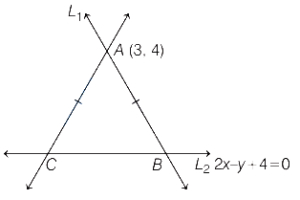
0 likes
View Solution294
EasyMCQ
The area of the parallelogram formed by the lines $L_1 \equiv \lambda x+4 y+2=0$,$L_2 \equiv 3 x+4 y-3=0$,$L_3 \equiv 2 x+\mu y+6=0$,and $L_4 \equiv 2 x+y+3=0$,where $L_1$ is parallel to $L_2$ and $L_3$ is parallel to $L_4$,is
A
$9$
B
$7$
C
$5$
D
$3$
Solution
(D) Given lines are $L_1: \lambda x+4 y+2=0$,$L_2: 3 x+4 y-3=0$,$L_3: 2 x+\mu y+6=0$,$L_4: 2 x+y+3=0$.
Since $L_1 \parallel L_2$,their slopes must be equal: $-\frac{\lambda}{4} = -\frac{3}{4} \Rightarrow \lambda = 3$.
Since $L_3 \parallel L_4$,their slopes must be equal: $-\frac{2}{\mu} = -\frac{2}{1} \Rightarrow \mu = 1$.
The area of a parallelogram formed by lines $a_1 x+b_1 y+c_1=0$,$a_1 x+b_1 y+c_2=0$,$a_2 x+b_2 y+d_1=0$,and $a_2 x+b_2 y+d_2=0$ is given by $\frac{|(c_1-c_2)(d_1-d_2)|}{|a_1 b_2 - a_2 b_1|}$.
Here,$L_1: 3x+4y+2=0$,$L_2: 3x+4y-3=0$,$L_3: 2x+y+6=0$,$L_4: 2x+y+3=0$.
$c_1=2, c_2=-3, d_1=6, d_2=3$.
$a_1=3, b_1=4, a_2=2, b_2=1$.
Area $= \frac{|(2 - (-3))(6 - 3)|}{|(3)(1) - (2)(4)|} = \frac{|5 \times 3|}{|3 - 8|} = \frac{15}{|-5|} = \frac{15}{5} = 3$.
Thus,the area is $3$ square units.
Since $L_1 \parallel L_2$,their slopes must be equal: $-\frac{\lambda}{4} = -\frac{3}{4} \Rightarrow \lambda = 3$.
Since $L_3 \parallel L_4$,their slopes must be equal: $-\frac{2}{\mu} = -\frac{2}{1} \Rightarrow \mu = 1$.
The area of a parallelogram formed by lines $a_1 x+b_1 y+c_1=0$,$a_1 x+b_1 y+c_2=0$,$a_2 x+b_2 y+d_1=0$,and $a_2 x+b_2 y+d_2=0$ is given by $\frac{|(c_1-c_2)(d_1-d_2)|}{|a_1 b_2 - a_2 b_1|}$.
Here,$L_1: 3x+4y+2=0$,$L_2: 3x+4y-3=0$,$L_3: 2x+y+6=0$,$L_4: 2x+y+3=0$.
$c_1=2, c_2=-3, d_1=6, d_2=3$.
$a_1=3, b_1=4, a_2=2, b_2=1$.
Area $= \frac{|(2 - (-3))(6 - 3)|}{|(3)(1) - (2)(4)|} = \frac{|5 \times 3|}{|3 - 8|} = \frac{15}{|-5|} = \frac{15}{5} = 3$.
Thus,the area is $3$ square units.
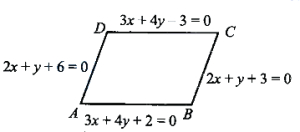
0 likes
View Solution295
EasyMCQ
The equation of a straight line,perpendicular to $3x - 4y = 6$ and forming a triangle of area $6 \text{ sq. units}$ with the coordinate axes,is
A
$x - 2y = 6$
B
$4x + 3y = 12$
C
$4x + 3y + 24 = 0$
D
$3x + 4y = 12$
Solution
(B) The given equation of the line is $3x - 4y = 6$.
Any line perpendicular to this line is of the form $4x + 3y = k$.
The intercepts of this line on the coordinate axes are $x = \frac{k}{4}$ and $y = \frac{k}{3}$.
The area of the triangle formed by the line with the coordinate axes is given by $\text{Area} = \frac{1}{2} \times |\text{base}| \times |\text{height}|$.
$\frac{1}{2} \times |\frac{k}{4}| \times |\frac{k}{3}| = 6$.
$|\frac{k^2}{24}| = 6$.
$k^2 = 144$.
$k = \pm 12$.
Thus,the required equations of the lines are $4x + 3y = 12$ or $4x + 3y = -12$.
Any line perpendicular to this line is of the form $4x + 3y = k$.
The intercepts of this line on the coordinate axes are $x = \frac{k}{4}$ and $y = \frac{k}{3}$.
The area of the triangle formed by the line with the coordinate axes is given by $\text{Area} = \frac{1}{2} \times |\text{base}| \times |\text{height}|$.
$\frac{1}{2} \times |\frac{k}{4}| \times |\frac{k}{3}| = 6$.
$|\frac{k^2}{24}| = 6$.
$k^2 = 144$.
$k = \pm 12$.
Thus,the required equations of the lines are $4x + 3y = 12$ or $4x + 3y = -12$.
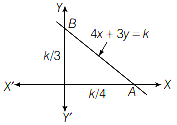
0 likes
View Solution296
DifficultMCQ
If a straight line perpendicular to $2x - 3y + 7 = 0$ forms a triangle with the coordinate axes whose area is $3 \text{ sq. units}$,then the equation of the straight line is:
A
$3x + 2y = \pm 2$
B
$3x + 2y = \pm 6$
C
$3x + 2y = \pm 4$
D
$3x + 2y = \pm 8$
Solution
(B) The given line is $2x - 3y + 7 = 0$.
Any line perpendicular to the given line is of the form $3x + 2y + k = 0$.
To find the intercepts,set $y = 0$: $3x + k = 0 \Rightarrow x = -\frac{k}{3}$.
Set $x = 0$: $2y + k = 0 \Rightarrow y = -\frac{k}{2}$.
The area of the triangle formed with the coordinate axes is given by $\frac{1}{2} |x_{intercept} \cdot y_{intercept}| = 3$.
$\frac{1}{2} |(-\frac{k}{3}) \cdot (-\frac{k}{2})| = 3$.
$\frac{1}{2} |\frac{k^2}{6}| = 3$.
$|k^2| = 36 \Rightarrow k = \pm 6$.
Substituting $k$ into the equation $3x + 2y + k = 0$,we get $3x + 2y = \pm 6$.
Any line perpendicular to the given line is of the form $3x + 2y + k = 0$.
To find the intercepts,set $y = 0$: $3x + k = 0 \Rightarrow x = -\frac{k}{3}$.
Set $x = 0$: $2y + k = 0 \Rightarrow y = -\frac{k}{2}$.
The area of the triangle formed with the coordinate axes is given by $\frac{1}{2} |x_{intercept} \cdot y_{intercept}| = 3$.
$\frac{1}{2} |(-\frac{k}{3}) \cdot (-\frac{k}{2})| = 3$.
$\frac{1}{2} |\frac{k^2}{6}| = 3$.
$|k^2| = 36 \Rightarrow k = \pm 6$.
Substituting $k$ into the equation $3x + 2y + k = 0$,we get $3x + 2y = \pm 6$.
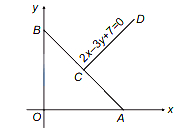
0 likes
View SolutionStraight Line — Problems related to triangle and quadrilateral · Frequently Asked Questions
1Are these Straight Line questions useful for JEE and NEET?
Yes. All questions in this section are mapped to JEE Main and NEET exam patterns. Previous year questions from JEE Main, NEET, GUJCET and state-level exams are included with full solutions.
2Can I switch to Hindi or Gujarati for these questions?
Yes. Use the language tabs in the hero section or the sidebar to view the same questions and solutions in English, Hindi or Gujarati.
3How do I generate a question paper from this subtopic?
Use the Vedclass Exam Paper Generator — select the chapter and subtopic, set difficulty, and generate Sets A, B, C, D automatically. First 3 chapters of every subject are free.
Vedclass Products
For Students
Vedclass Test Series
Mock tests in real JEE/NEET style with performance analysis. 5-day free trial.
Start Free TrialFor Teachers
Exam Paper Generator
Generate Set A/B/C/D papers from this chapter in 2 minutes. 3 chapters free.
Try FreeFor Institutes
Online Exam Module
Live online exams with unlimited students, 360° analytics & white-label branding.
See DemoFor Teachers & Institutes
Generate a Straight Line Exam Paper in 2 Minutes
Select subtopic & difficulty — Sets A, B, C, D auto-generated with No Repeat logic.
First 3 chapters of every subject are free — no payment required.