
A English
Points related to triangle Questions in English
Class 11 Mathematics · Straight Line · Points related to triangle
157+
Questions
English
Language
100%
With Solutions
Showing 49 of 157 questions in English
101
Difficult
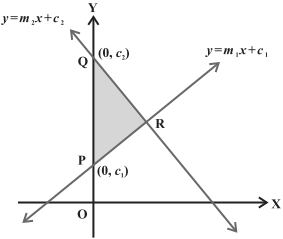
Show that the area of the triangle formed by the lines $y=m_{1}x+c_{1}$,$y=m_{2}x+c_{2}$ and $x=0$ is $\frac{(c_{1}-c_{2})^{2}}{2|m_{1}-m_{2}|}$.
Solution
(N/A) Given lines are:
$y=m_{1}x+c_{1}$ ..... $(1)$
$y=m_{2}x+c_{2}$ ..... $(2)$
$x=0$ ..... $(3)$
We know that the line $y=mx+c$ meets the line $x=0$ ($y$-axis) at the point $(0, c)$. Therefore,two vertices of the triangle formed by lines $(1)$,$(2)$,and $(3)$ are $P(0, c_{1})$ and $Q(0, c_{2})$.
The third vertex $R$ is obtained by solving equations $(1)$ and $(2)$:
$m_{1}x+c_{1} = m_{2}x+c_{2}$
$x(m_{1}-m_{2}) = c_{2}-c_{1}$
$x = \frac{c_{2}-c_{1}}{m_{1}-m_{2}}$
Substituting $x$ in $(1)$:
$y = m_{1}\left(\frac{c_{2}-c_{1}}{m_{1}-m_{2}}\right) + c_{1} = \frac{m_{1}c_{2}-m_{1}c_{1}+m_{1}c_{1}-m_{2}c_{1}}{m_{1}-m_{2}} = \frac{m_{1}c_{2}-m_{2}c_{1}}{m_{1}-m_{2}}$
So,$R = \left(\frac{c_{2}-c_{1}}{m_{1}-m_{2}}, \frac{m_{1}c_{2}-m_{2}c_{1}}{m_{1}-m_{2}}\right)$.
The area of the triangle with vertices $(x_{1}, y_{1}), (x_{2}, y_{2}), (x_{3}, y_{3})$ is $\frac{1}{2}|x_{1}(y_{2}-y_{3}) + x_{2}(y_{3}-y_{1}) + x_{3}(y_{1}-y_{2})|$.
Here,vertices are $(0, c_{1}), (0, c_{2}), \left(\frac{c_{2}-c_{1}}{m_{1}-m_{2}}, \frac{m_{1}c_{2}-m_{2}c_{1}}{m_{1}-m_{2}}\right)$.
Area $= \frac{1}{2} |0(c_{2} - y_{R}) + 0(y_{R} - c_{1}) + \frac{c_{2}-c_{1}}{m_{1}-m_{2}}(c_{1}-c_{2})|$
Area $= \frac{1}{2} |\frac{-(c_{2}-c_{1})^{2}}{m_{1}-m_{2}}| = \frac{(c_{1}-c_{2})^{2}}{2|m_{1}-m_{2}|}$.
$y=m_{1}x+c_{1}$ ..... $(1)$
$y=m_{2}x+c_{2}$ ..... $(2)$
$x=0$ ..... $(3)$
We know that the line $y=mx+c$ meets the line $x=0$ ($y$-axis) at the point $(0, c)$. Therefore,two vertices of the triangle formed by lines $(1)$,$(2)$,and $(3)$ are $P(0, c_{1})$ and $Q(0, c_{2})$.
The third vertex $R$ is obtained by solving equations $(1)$ and $(2)$:
$m_{1}x+c_{1} = m_{2}x+c_{2}$
$x(m_{1}-m_{2}) = c_{2}-c_{1}$
$x = \frac{c_{2}-c_{1}}{m_{1}-m_{2}}$
Substituting $x$ in $(1)$:
$y = m_{1}\left(\frac{c_{2}-c_{1}}{m_{1}-m_{2}}\right) + c_{1} = \frac{m_{1}c_{2}-m_{1}c_{1}+m_{1}c_{1}-m_{2}c_{1}}{m_{1}-m_{2}} = \frac{m_{1}c_{2}-m_{2}c_{1}}{m_{1}-m_{2}}$
So,$R = \left(\frac{c_{2}-c_{1}}{m_{1}-m_{2}}, \frac{m_{1}c_{2}-m_{2}c_{1}}{m_{1}-m_{2}}\right)$.
The area of the triangle with vertices $(x_{1}, y_{1}), (x_{2}, y_{2}), (x_{3}, y_{3})$ is $\frac{1}{2}|x_{1}(y_{2}-y_{3}) + x_{2}(y_{3}-y_{1}) + x_{3}(y_{1}-y_{2})|$.
Here,vertices are $(0, c_{1}), (0, c_{2}), \left(\frac{c_{2}-c_{1}}{m_{1}-m_{2}}, \frac{m_{1}c_{2}-m_{2}c_{1}}{m_{1}-m_{2}}\right)$.
Area $= \frac{1}{2} |0(c_{2} - y_{R}) + 0(y_{R} - c_{1}) + \frac{c_{2}-c_{1}}{m_{1}-m_{2}}(c_{1}-c_{2})|$
Area $= \frac{1}{2} |\frac{-(c_{2}-c_{1})^{2}}{m_{1}-m_{2}}| = \frac{(c_{1}-c_{2})^{2}}{2|m_{1}-m_{2}|}$.
0 likes
View Solution102
DifficultMCQ
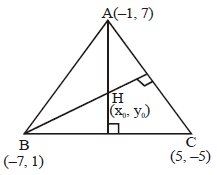
If a $\triangle ABC$ has vertices $A(-1, 7)$,$B(-7, 1)$ and $C(5, -5)$,then its orthocentre has coordinates
A
$(3, -3)$
B
$\left(-\frac{3}{5}, \frac{3}{5}\right)$
C
$(-3, 3)$
D
$\left(\frac{3}{5}, -\frac{3}{5}\right)$
Solution
(C) Let the orthocentre be $H(x_0, y_0)$.
The slope of $BC$ is $m_{BC} = \frac{-5-1}{5-(-7)} = \frac{-6}{12} = -\frac{1}{2}$.
Since $AH \perp BC$,the slope of $AH$ is $m_{AH} = -\frac{1}{m_{BC}} = 2$.
The equation of altitude $AH$ passing through $A(-1, 7)$ is $y - 7 = 2(x + 1)$,which simplifies to $2x - y + 9 = 0$ ... $(1)$.
The slope of $AC$ is $m_{AC} = \frac{-5-7}{5-(-1)} = \frac{-12}{6} = -2$.
Since $BH \perp AC$,the slope of $BH$ is $m_{BH} = -\frac{1}{m_{AC}} = \frac{1}{2}$.
The equation of altitude $BH$ passing through $B(-7, 1)$ is $y - 1 = \frac{1}{2}(x + 7)$,which simplifies to $x - 2y + 9 = 0$ ... $(2)$.
Solving equations $(1)$ and $(2)$:
From $(1)$,$y = 2x + 9$. Substituting into $(2)$:
$x - 2(2x + 9) + 9 = 0$
$x - 4x - 18 + 9 = 0$
$-3x - 9 = 0 \Rightarrow x = -3$.
Then $y = 2(-3) + 9 = 3$.
Thus,the orthocentre is $(-3, 3)$.
The slope of $BC$ is $m_{BC} = \frac{-5-1}{5-(-7)} = \frac{-6}{12} = -\frac{1}{2}$.
Since $AH \perp BC$,the slope of $AH$ is $m_{AH} = -\frac{1}{m_{BC}} = 2$.
The equation of altitude $AH$ passing through $A(-1, 7)$ is $y - 7 = 2(x + 1)$,which simplifies to $2x - y + 9 = 0$ ... $(1)$.
The slope of $AC$ is $m_{AC} = \frac{-5-7}{5-(-1)} = \frac{-12}{6} = -2$.
Since $BH \perp AC$,the slope of $BH$ is $m_{BH} = -\frac{1}{m_{AC}} = \frac{1}{2}$.
The equation of altitude $BH$ passing through $B(-7, 1)$ is $y - 1 = \frac{1}{2}(x + 7)$,which simplifies to $x - 2y + 9 = 0$ ... $(2)$.
Solving equations $(1)$ and $(2)$:
From $(1)$,$y = 2x + 9$. Substituting into $(2)$:
$x - 2(2x + 9) + 9 = 0$
$x - 4x - 18 + 9 = 0$
$-3x - 9 = 0 \Rightarrow x = -3$.
Then $y = 2(-3) + 9 = 3$.
Thus,the orthocentre is $(-3, 3)$.
0 likes
View Solution103
DifficultMCQ
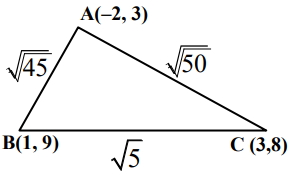
Consider a triangle having vertices $A(-2, 3)$,$B(1, 9)$,and $C(3, 8)$. If a line $L$ passing through the circum-center of triangle $ABC$ bisects line $BC$ and intersects the $y$-axis at point $\left(0, \frac{\alpha}{2}\right)$,then the value of the real number $\alpha$ is $.....$
A
$81$
B
$3$
C
$9$
D
$45$
Solution
(C) First,calculate the lengths of the sides of $\triangle ABC$:
$AB^2 = (1 - (-2))^2 + (9 - 3)^2 = 3^2 + 6^2 = 9 + 36 = 45 \Rightarrow AB = \sqrt{45}$
$BC^2 = (3 - 1)^2 + (8 - 9)^2 = 2^2 + (-1)^2 = 4 + 1 = 5 \Rightarrow BC = \sqrt{5}$
$AC^2 = (3 - (-2))^2 + (8 - 3)^2 = 5^2 + 5^2 = 25 + 25 = 50 \Rightarrow AC = \sqrt{50}$
Since $AB^2 + BC^2 = 45 + 5 = 50 = AC^2$,the triangle is a right-angled triangle with $\angle B = 90^{\circ}$.
In a right-angled triangle,the circum-center is the midpoint of the hypotenuse $AC$.
Circum-center $= \left(\frac{-2 + 3}{2}, \frac{3 + 8}{2}\right) = \left(\frac{1}{2}, \frac{11}{2}\right)$.
The midpoint of $BC$ is $\left(\frac{1 + 3}{2}, \frac{9 + 8}{2}\right) = \left(2, \frac{17}{2}\right)$.
The line $L$ passes through $\left(\frac{1}{2}, \frac{11}{2}\right)$ and $\left(2, \frac{17}{2}\right)$.
The slope $m = \frac{\frac{17}{2} - \frac{11}{2}}{2 - \frac{1}{2}} = \frac{3}{\frac{3}{2}} = 2$.
The equation of line $L$ is $y - \frac{11}{2} = 2(x - \frac{1}{2})$ $\Rightarrow y = 2x - 1 + \frac{11}{2}$ $\Rightarrow y = 2x + \frac{9}{2}$.
Since the line intersects the $y$-axis at $\left(0, \frac{\alpha}{2}\right)$,we have $\frac{\alpha}{2} = \frac{9}{2}$,which gives $\alpha = 9$.
$AB^2 = (1 - (-2))^2 + (9 - 3)^2 = 3^2 + 6^2 = 9 + 36 = 45 \Rightarrow AB = \sqrt{45}$
$BC^2 = (3 - 1)^2 + (8 - 9)^2 = 2^2 + (-1)^2 = 4 + 1 = 5 \Rightarrow BC = \sqrt{5}$
$AC^2 = (3 - (-2))^2 + (8 - 3)^2 = 5^2 + 5^2 = 25 + 25 = 50 \Rightarrow AC = \sqrt{50}$
Since $AB^2 + BC^2 = 45 + 5 = 50 = AC^2$,the triangle is a right-angled triangle with $\angle B = 90^{\circ}$.
In a right-angled triangle,the circum-center is the midpoint of the hypotenuse $AC$.
Circum-center $= \left(\frac{-2 + 3}{2}, \frac{3 + 8}{2}\right) = \left(\frac{1}{2}, \frac{11}{2}\right)$.
The midpoint of $BC$ is $\left(\frac{1 + 3}{2}, \frac{9 + 8}{2}\right) = \left(2, \frac{17}{2}\right)$.
The line $L$ passes through $\left(\frac{1}{2}, \frac{11}{2}\right)$ and $\left(2, \frac{17}{2}\right)$.
The slope $m = \frac{\frac{17}{2} - \frac{11}{2}}{2 - \frac{1}{2}} = \frac{3}{\frac{3}{2}} = 2$.
The equation of line $L$ is $y - \frac{11}{2} = 2(x - \frac{1}{2})$ $\Rightarrow y = 2x - 1 + \frac{11}{2}$ $\Rightarrow y = 2x + \frac{9}{2}$.
Since the line intersects the $y$-axis at $\left(0, \frac{\alpha}{2}\right)$,we have $\frac{\alpha}{2} = \frac{9}{2}$,which gives $\alpha = 9$.
0 likes
View Solution104
MediumMCQ
The distance of the origin from the centroid of the triangle whose two sides have the equations $x - 2y + 1 = 0$ and $2x - y - 1 = 0$ and whose orthocenter is $\left(\frac{7}{3}, \frac{7}{3}\right)$ is
A
$\sqrt{2}$
B
$2$
C
$2\sqrt{2}$
D
$4$
Solution
(C) Let the sides be $AB: x - 2y + 1 = 0$ and $AC: 2x - y - 1 = 0$. Solving these,we get vertex $A(1, 1)$.
The altitude from vertex $B$ passes through $H\left(\frac{7}{3}, \frac{7}{3}\right)$ and is perpendicular to $AC$. The slope of $AC$ is $2$,so the slope of altitude $BH$ is $-\frac{1}{2}$. The equation of $BH$ is $y - \frac{7}{3} = -\frac{1}{2}\left(x - \frac{7}{3}\right)$,which simplifies to $x + 2y - 7 = 0$.
Vertex $B$ is the intersection of $AB$ and $BH$: $x - 2y = -1$ and $x + 2y = 7$. Adding gives $2x = 6 \Rightarrow x = 3$,so $y = 2$. Thus,$B(3, 2)$.
The altitude from vertex $C$ passes through $H\left(\frac{7}{3}, \frac{7}{3}\right)$ and is perpendicular to $AB$. The slope of $AB$ is $\frac{1}{2}$,so the slope of altitude $CH$ is $-2$. The equation of $CH$ is $y - \frac{7}{3} = -2\left(x - \frac{7}{3}\right)$,which simplifies to $2x + y - 7 = 0$.
Vertex $C$ is the intersection of $AC$ and $CH$: $2x - y = 1$ and $2x + y = 7$. Adding gives $4x = 8 \Rightarrow x = 2$,so $y = 3$. Thus,$C(2, 3)$.
The centroid $G$ of $\triangle ABC$ with vertices $A(1, 1), B(3, 2), C(2, 3)$ is $\left(\frac{1+3+2}{3}, \frac{1+2+3}{3}\right) = (2, 2)$.
The distance of the centroid $(2, 2)$ from the origin $(0, 0)$ is $\sqrt{2^2 + 2^2} = \sqrt{8} = 2\sqrt{2}$.
The altitude from vertex $B$ passes through $H\left(\frac{7}{3}, \frac{7}{3}\right)$ and is perpendicular to $AC$. The slope of $AC$ is $2$,so the slope of altitude $BH$ is $-\frac{1}{2}$. The equation of $BH$ is $y - \frac{7}{3} = -\frac{1}{2}\left(x - \frac{7}{3}\right)$,which simplifies to $x + 2y - 7 = 0$.
Vertex $B$ is the intersection of $AB$ and $BH$: $x - 2y = -1$ and $x + 2y = 7$. Adding gives $2x = 6 \Rightarrow x = 3$,so $y = 2$. Thus,$B(3, 2)$.
The altitude from vertex $C$ passes through $H\left(\frac{7}{3}, \frac{7}{3}\right)$ and is perpendicular to $AB$. The slope of $AB$ is $\frac{1}{2}$,so the slope of altitude $CH$ is $-2$. The equation of $CH$ is $y - \frac{7}{3} = -2\left(x - \frac{7}{3}\right)$,which simplifies to $2x + y - 7 = 0$.
Vertex $C$ is the intersection of $AC$ and $CH$: $2x - y = 1$ and $2x + y = 7$. Adding gives $4x = 8 \Rightarrow x = 2$,so $y = 3$. Thus,$C(2, 3)$.
The centroid $G$ of $\triangle ABC$ with vertices $A(1, 1), B(3, 2), C(2, 3)$ is $\left(\frac{1+3+2}{3}, \frac{1+2+3}{3}\right) = (2, 2)$.
The distance of the centroid $(2, 2)$ from the origin $(0, 0)$ is $\sqrt{2^2 + 2^2} = \sqrt{8} = 2\sqrt{2}$.
0 likes
View Solution105
AdvancedMCQ
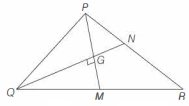
Consider a $\triangle PQR$ in which the relation $QR^2 + PR^2 = 5PQ^2$ holds. Let $G$ be the point of intersection of medians $PM$ and $QN$. Then,$\angle QGM$ is always
A
less than $45^{\circ}$
B
obtuse
C
a right angle
D
acute and larger than $45^{\circ}$
Solution
(C) In $\triangle PQR$,let the vertices be $P, Q, R$. Let $M$ be the midpoint of $QR$ and $N$ be the midpoint of $PR$. The medians $PM$ and $QN$ intersect at the centroid $G$.
Using the property of medians,$QG = \frac{2}{3}QN$ and $GM = \frac{1}{3}PM$.
In $\triangle QGM$,by the Pythagorean theorem,if $\angle QGM = 90^{\circ}$,then $QG^2 + GM^2 = QM^2$.
We know $QM = \frac{1}{2}QR$,so $QM^2 = \frac{1}{4}QR^2$.
Using Apollonius theorem for medians:
$QN^2 = \frac{2PQ^2 + 2QR^2 - PR^2}{4}$ and $PM^2 = \frac{2PQ^2 + 2PR^2 - QR^2}{4}$.
Then $QG^2 + GM^2 = \left(\frac{2}{3}QN\right)^2 + \left(\frac{1}{3}PM\right)^2 = \frac{4}{9}QN^2 + \frac{1}{9}PM^2$.
Substituting the expressions for $QN^2$ and $PM^2$:
$= \frac{4}{9} \left(\frac{2PQ^2 + 2QR^2 - PR^2}{4}\right) + \frac{1}{9} \left(\frac{2PQ^2 + 2PR^2 - QR^2}{4}\right)$
$= \frac{1}{9} \left( \frac{8PQ^2 + 8QR^2 - 4PR^2 + 2PQ^2 + 2PR^2 - QR^2}{4} \right)$
$= \frac{1}{9} \left( \frac{10PQ^2 + 7QR^2 - 2PR^2}{4} \right)$.
Given $PR^2 = 5PQ^2 - QR^2$,substitute this:
$= \frac{1}{9} \left( \frac{10PQ^2 + 7QR^2 - 2(5PQ^2 - QR^2)}{4} \right)$
$= \frac{1}{9} \left( \frac{10PQ^2 + 7QR^2 - 10PQ^2 + 2QR^2}{4} \right) = \frac{1}{9} \left( \frac{9QR^2}{4} \right) = \frac{1}{4}QR^2 = QM^2$.
Since $QG^2 + GM^2 = QM^2$,$\triangle QGM$ is a right-angled triangle with $\angle QGM = 90^{\circ}$.
Using the property of medians,$QG = \frac{2}{3}QN$ and $GM = \frac{1}{3}PM$.
In $\triangle QGM$,by the Pythagorean theorem,if $\angle QGM = 90^{\circ}$,then $QG^2 + GM^2 = QM^2$.
We know $QM = \frac{1}{2}QR$,so $QM^2 = \frac{1}{4}QR^2$.
Using Apollonius theorem for medians:
$QN^2 = \frac{2PQ^2 + 2QR^2 - PR^2}{4}$ and $PM^2 = \frac{2PQ^2 + 2PR^2 - QR^2}{4}$.
Then $QG^2 + GM^2 = \left(\frac{2}{3}QN\right)^2 + \left(\frac{1}{3}PM\right)^2 = \frac{4}{9}QN^2 + \frac{1}{9}PM^2$.
Substituting the expressions for $QN^2$ and $PM^2$:
$= \frac{4}{9} \left(\frac{2PQ^2 + 2QR^2 - PR^2}{4}\right) + \frac{1}{9} \left(\frac{2PQ^2 + 2PR^2 - QR^2}{4}\right)$
$= \frac{1}{9} \left( \frac{8PQ^2 + 8QR^2 - 4PR^2 + 2PQ^2 + 2PR^2 - QR^2}{4} \right)$
$= \frac{1}{9} \left( \frac{10PQ^2 + 7QR^2 - 2PR^2}{4} \right)$.
Given $PR^2 = 5PQ^2 - QR^2$,substitute this:
$= \frac{1}{9} \left( \frac{10PQ^2 + 7QR^2 - 2(5PQ^2 - QR^2)}{4} \right)$
$= \frac{1}{9} \left( \frac{10PQ^2 + 7QR^2 - 10PQ^2 + 2QR^2}{4} \right) = \frac{1}{9} \left( \frac{9QR^2}{4} \right) = \frac{1}{4}QR^2 = QM^2$.
Since $QG^2 + GM^2 = QM^2$,$\triangle QGM$ is a right-angled triangle with $\angle QGM = 90^{\circ}$.
0 likes
View Solution106
AdvancedMCQ
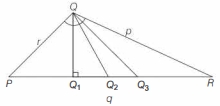
Let $PQR$ be an acute-angled triangle in which $PQ < QR$. From the vertex $Q$,draw the altitude $QQ_1$,the angle bisector $QQ_2$,and the median $QQ_3$,with $Q_1, Q_2, Q_3$ lying on $PR$. Then,
A
$PQ_1 < PQ_2 < PQ_3$
B
$PQ_2 < PQ_1 < PQ_3$
C
$PQ_1 < PQ_3 < PQ_2$
D
$PQ_3 < PQ_1 < PQ_2$
Solution
(A) In $\triangle PQR$,let $PQ = r$,$QR = p$,and $PR = q$. Since $PQ < QR$,we have $r < p$.
$1$. The altitude $QQ_1$ is the shortest segment from $Q$ to the line $PR$. Thus,$PQ_1$ is the smallest distance.
$2$. The median $QQ_3$ bisects $PR$,so $PQ_3 = \frac{1}{2} PR$.
$3$. By the Angle Bisector Theorem,the angle bisector $QQ_2$ divides $PR$ in the ratio of the adjacent sides $PQ:QR = r:p$. Thus,$PQ_2 = \left(\frac{r}{r+p}\right) PR$.
Since $r < p$,we have $r+p > 2r$,which implies $\frac{r}{r+p} < \frac{r}{2r} = \frac{1}{2}$.
Therefore,$PQ_2 < \frac{1}{2} PR = PQ_3$.
Comparing the positions of the feet on $PR$,we have $PQ_1 < PQ_2 < PQ_3$. The correct option is $A$.
$1$. The altitude $QQ_1$ is the shortest segment from $Q$ to the line $PR$. Thus,$PQ_1$ is the smallest distance.
$2$. The median $QQ_3$ bisects $PR$,so $PQ_3 = \frac{1}{2} PR$.
$3$. By the Angle Bisector Theorem,the angle bisector $QQ_2$ divides $PR$ in the ratio of the adjacent sides $PQ:QR = r:p$. Thus,$PQ_2 = \left(\frac{r}{r+p}\right) PR$.
Since $r < p$,we have $r+p > 2r$,which implies $\frac{r}{r+p} < \frac{r}{2r} = \frac{1}{2}$.
Therefore,$PQ_2 < \frac{1}{2} PR = PQ_3$.
Comparing the positions of the feet on $PR$,we have $PQ_1 < PQ_2 < PQ_3$. The correct option is $A$.
0 likes
View Solution107
DifficultMCQ
If the orthocentre of the triangle,whose vertices are $(1,2), (2,3)$ and $(3,1)$ is $(\alpha, \beta)$,then the quadratic equation whose roots are $\alpha+4\beta$ and $4\alpha+\beta$ is:
A
$x^2-19x+90=0$
B
$x^2-18x+80=0$
C
$x^2-22x+120=0$
D
$x^2-20x+99=0$
Solution
(D) Let the vertices be $A(1,2), B(2,3)$ and $C(3,1)$.
Let the orthocentre be $H(\alpha, \beta)$.
The slope of $AC$ is $m_{AC} = \frac{1-2}{3-1} = -\frac{1}{2}$.
Since $BH \perp AC$,the slope of $BH$ is $m_{BH} = 2$. Thus,$\frac{\beta-3}{\alpha-2} = 2$ $\Rightarrow \beta-3 = 2\alpha-4$ $\Rightarrow \beta = 2\alpha-1$.
The slope of $AB$ is $m_{AB} = \frac{3-2}{2-1} = 1$.
Since $CH \perp AB$,the slope of $CH$ is $m_{CH} = -1$. Thus,$\frac{\beta-1}{\alpha-3} = -1$ $\Rightarrow \beta-1 = -\alpha+3$ $\Rightarrow \beta = -\alpha+4$.
Equating the two expressions for $\beta$: $2\alpha-1 = -\alpha+4$ $\Rightarrow 3\alpha = 5$ $\Rightarrow \alpha = \frac{5}{3}$.
Then $\beta = 2(\frac{5}{3})-1 = \frac{7}{3}$.
The roots of the quadratic equation are $p = \alpha+4\beta = \frac{5}{3} + \frac{28}{3} = 11$ and $q = 4\alpha+\beta = \frac{20}{3} + \frac{7}{3} = 9$.
The quadratic equation is $(x-p)(x-q) = 0$ $\Rightarrow (x-11)(x-9) = 0$ $\Rightarrow x^2-20x+99 = 0$.
Let the orthocentre be $H(\alpha, \beta)$.
The slope of $AC$ is $m_{AC} = \frac{1-2}{3-1} = -\frac{1}{2}$.
Since $BH \perp AC$,the slope of $BH$ is $m_{BH} = 2$. Thus,$\frac{\beta-3}{\alpha-2} = 2$ $\Rightarrow \beta-3 = 2\alpha-4$ $\Rightarrow \beta = 2\alpha-1$.
The slope of $AB$ is $m_{AB} = \frac{3-2}{2-1} = 1$.
Since $CH \perp AB$,the slope of $CH$ is $m_{CH} = -1$. Thus,$\frac{\beta-1}{\alpha-3} = -1$ $\Rightarrow \beta-1 = -\alpha+3$ $\Rightarrow \beta = -\alpha+4$.
Equating the two expressions for $\beta$: $2\alpha-1 = -\alpha+4$ $\Rightarrow 3\alpha = 5$ $\Rightarrow \alpha = \frac{5}{3}$.
Then $\beta = 2(\frac{5}{3})-1 = \frac{7}{3}$.
The roots of the quadratic equation are $p = \alpha+4\beta = \frac{5}{3} + \frac{28}{3} = 11$ and $q = 4\alpha+\beta = \frac{20}{3} + \frac{7}{3} = 9$.
The quadratic equation is $(x-p)(x-q) = 0$ $\Rightarrow (x-11)(x-9) = 0$ $\Rightarrow x^2-20x+99 = 0$.
0 likes
View Solution108
DifficultMCQ
Let $C(\alpha, \beta)$ be the circumcenter of the triangle formed by the lines $4x + 3y = 69$,$4y - 3x = 17$,and $x + 7y = 61$. Then $(\alpha - \beta)^2 + \alpha + \beta$ is equal to $.........$.
A
$18$
B
$17$
C
$16$
D
$15$
Solution
(B) First,find the vertices of the triangle by solving the equations in pairs:
$1$. $4x + 3y = 69$ and $4y - 3x = 17$: Multiplying the first by $4$ and second by $3$,we get $16x + 12y = 276$ and $-9x + 12y = 51$. Subtracting gives $25x = 225$,so $x = 9$. Then $36 + 3y = 69 \implies 3y = 33 \implies y = 11$. Vertex $A = (9, 11)$.
$2$. $4x + 3y = 69$ and $x + 7y = 61$: Multiplying the second by $4$,we get $4x + 28y = 244$. Subtracting the first gives $25y = 175$,so $y = 7$. Then $x + 49 = 61 \implies x = 12$. Vertex $B = (12, 7)$.
$3$. $4y - 3x = 17$ and $x + 7y = 61$: Multiplying the second by $3$,we get $3x + 21y = 183$. Adding to the first gives $25y = 200$,so $y = 8$. Then $x + 56 = 61 \implies x = 5$. Vertex $C = (5, 8)$.
Note that the lines $4x + 3y = 69$ and $4y - 3x = 17$ are perpendicular since $(4)(-3) + (3)(4) = 0$. Thus,the triangle is a right-angled triangle with the right angle at the intersection of these two lines,which is $(9, 11)$.
The circumcenter of a right-angled triangle is the midpoint of the hypotenuse. The hypotenuse is the line $x + 7y = 61$ connecting $(12, 7)$ and $(5, 8)$.
Circumcenter $(\alpha, \beta) = \left(\frac{12+5}{2}, \frac{7+8}{2}\right) = \left(\frac{17}{2}, \frac{15}{2}\right)$.
Now,calculate $(\alpha - \beta)^2 + \alpha + \beta = \left(\frac{17}{2} - \frac{15}{2}\right)^2 + \frac{17}{2} + \frac{15}{2} = (1)^2 + \frac{32}{2} = 1 + 16 = 17$.
$1$. $4x + 3y = 69$ and $4y - 3x = 17$: Multiplying the first by $4$ and second by $3$,we get $16x + 12y = 276$ and $-9x + 12y = 51$. Subtracting gives $25x = 225$,so $x = 9$. Then $36 + 3y = 69 \implies 3y = 33 \implies y = 11$. Vertex $A = (9, 11)$.
$2$. $4x + 3y = 69$ and $x + 7y = 61$: Multiplying the second by $4$,we get $4x + 28y = 244$. Subtracting the first gives $25y = 175$,so $y = 7$. Then $x + 49 = 61 \implies x = 12$. Vertex $B = (12, 7)$.
$3$. $4y - 3x = 17$ and $x + 7y = 61$: Multiplying the second by $3$,we get $3x + 21y = 183$. Adding to the first gives $25y = 200$,so $y = 8$. Then $x + 56 = 61 \implies x = 5$. Vertex $C = (5, 8)$.
Note that the lines $4x + 3y = 69$ and $4y - 3x = 17$ are perpendicular since $(4)(-3) + (3)(4) = 0$. Thus,the triangle is a right-angled triangle with the right angle at the intersection of these two lines,which is $(9, 11)$.
The circumcenter of a right-angled triangle is the midpoint of the hypotenuse. The hypotenuse is the line $x + 7y = 61$ connecting $(12, 7)$ and $(5, 8)$.
Circumcenter $(\alpha, \beta) = \left(\frac{12+5}{2}, \frac{7+8}{2}\right) = \left(\frac{17}{2}, \frac{15}{2}\right)$.
Now,calculate $(\alpha - \beta)^2 + \alpha + \beta = \left(\frac{17}{2} - \frac{15}{2}\right)^2 + \frac{17}{2} + \frac{15}{2} = (1)^2 + \frac{32}{2} = 1 + 16 = 17$.
0 likes
View Solution109
DifficultMCQ
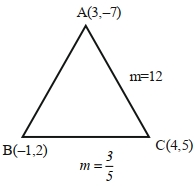
If $(\alpha, \beta)$ is the orthocentre of the triangle $ABC$ with vertices $A(3, -7)$,$B(-1, 2)$,and $C(4, 5)$,then $9\alpha - 6\beta + 60$ is equal to:
A
$30$
B
$25$
C
$40$
D
$35$
Solution
(B) Let $A = (3, -7)$,$B = (-1, 2)$,and $C = (4, 5)$.
Slope of $BC = \frac{5 - 2}{4 - (-1)} = \frac{3}{5}$.
The altitude from $A$ to $BC$ is perpendicular to $BC$,so its slope is $-\frac{5}{3}$.
The equation of the altitude from $A$ is $y - (-7) = -\frac{5}{3}(x - 3)$,which simplifies to $3y + 21 = -5x + 15$,or $5x + 3y + 6 = 0$.
Slope of $AC = \frac{5 - (-7)}{4 - 3} = \frac{12}{1} = 12$.
The altitude from $B$ to $AC$ is perpendicular to $AC$,so its slope is $-\frac{1}{12}$.
The equation of the altitude from $B$ is $y - 2 = -\frac{1}{12}(x - (-1))$,which simplifies to $12y - 24 = -x - 1$,or $x + 12y = 23$.
Solving the system of equations:
$1) 5x + 3y = -6$
$2) x + 12y = 23 \implies x = 23 - 12y$
Substitute $x$ into equation $1$:
$5(23 - 12y) + 3y = -6$
$115 - 60y + 3y = -6$
$-57y = -121 \implies y = \frac{121}{57} = \beta$
$x = 23 - 12(\frac{121}{57}) = 23 - 4(\frac{121}{19}) = \frac{437 - 484}{19} = -\frac{47}{19} = \alpha$
Now,calculate $9\alpha - 6\beta + 60$:
$9(-\frac{47}{19}) - 6(\frac{121}{57}) + 60 = -\frac{423}{19} - \frac{2(121)}{19} + 60 = \frac{-423 - 242}{19} + 60 = -\frac{665}{19} + 60 = -35 + 60 = 25$.
Slope of $BC = \frac{5 - 2}{4 - (-1)} = \frac{3}{5}$.
The altitude from $A$ to $BC$ is perpendicular to $BC$,so its slope is $-\frac{5}{3}$.
The equation of the altitude from $A$ is $y - (-7) = -\frac{5}{3}(x - 3)$,which simplifies to $3y + 21 = -5x + 15$,or $5x + 3y + 6 = 0$.
Slope of $AC = \frac{5 - (-7)}{4 - 3} = \frac{12}{1} = 12$.
The altitude from $B$ to $AC$ is perpendicular to $AC$,so its slope is $-\frac{1}{12}$.
The equation of the altitude from $B$ is $y - 2 = -\frac{1}{12}(x - (-1))$,which simplifies to $12y - 24 = -x - 1$,or $x + 12y = 23$.
Solving the system of equations:
$1) 5x + 3y = -6$
$2) x + 12y = 23 \implies x = 23 - 12y$
Substitute $x$ into equation $1$:
$5(23 - 12y) + 3y = -6$
$115 - 60y + 3y = -6$
$-57y = -121 \implies y = \frac{121}{57} = \beta$
$x = 23 - 12(\frac{121}{57}) = 23 - 4(\frac{121}{19}) = \frac{437 - 484}{19} = -\frac{47}{19} = \alpha$
Now,calculate $9\alpha - 6\beta + 60$:
$9(-\frac{47}{19}) - 6(\frac{121}{57}) + 60 = -\frac{423}{19} - \frac{2(121)}{19} + 60 = \frac{-423 - 242}{19} + 60 = -\frac{665}{19} + 60 = -35 + 60 = 25$.
0 likes
View Solution110
DifficultMCQ
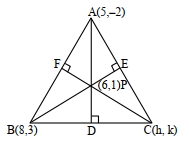
If $P(6,1)$ is the orthocentre of the triangle whose vertices are $A(5,-2)$,$B(8,3)$,and $C(h, k)$,then the point $C$ lies on the circle:
A
$x^2+y^2-65=0$
B
$x^2+y^2-74=0$
C
$x^2+y^2-61=0$
D
$x^2+y^2-52=0$
Solution
(A) Let $P(6,1)$ be the orthocentre of $\triangle ABC$ with $A(5,-2)$,$B(8,3)$,and $C(h, k)$.
Since $AP \perp BC$,the slope of $AP = \frac{1 - (-2)}{6 - 5} = \frac{3}{1} = 3$.
Therefore,the slope of $BC = -\frac{1}{3}$.
The equation of line $BC$ passing through $B(8,3)$ is $y - 3 = -\frac{1}{3}(x - 8)$,which simplifies to $3y - 9 = -x + 8$,or $x + 3y - 17 = 0$.
Since $BP \perp AC$,the slope of $BP = \frac{1 - 3}{6 - 8} = \frac{-2}{-2} = 1$.
Therefore,the slope of $AC = -1$.
The equation of line $AC$ passing through $A(5,-2)$ is $y - (-2) = -1(x - 5)$,which simplifies to $y + 2 = -x + 5$,or $x + y - 3 = 0$.
To find $C(h, k)$,we solve the system:
$1) x + 3y = 17$
$2) x + y = 3$
Subtracting $(2)$ from $(1)$ gives $2y = 14$,so $y = 7$.
Substituting $y = 7$ into $(2)$ gives $x + 7 = 3$,so $x = -4$.
Thus,$C = (-4, 7)$.
Now,check which circle equation is satisfied by $C(-4, 7)$:
$(-4)^2 + (7)^2 = 16 + 49 = 65$.
So,$x^2 + y^2 - 65 = 0$ is the correct equation.
Since $AP \perp BC$,the slope of $AP = \frac{1 - (-2)}{6 - 5} = \frac{3}{1} = 3$.
Therefore,the slope of $BC = -\frac{1}{3}$.
The equation of line $BC$ passing through $B(8,3)$ is $y - 3 = -\frac{1}{3}(x - 8)$,which simplifies to $3y - 9 = -x + 8$,or $x + 3y - 17 = 0$.
Since $BP \perp AC$,the slope of $BP = \frac{1 - 3}{6 - 8} = \frac{-2}{-2} = 1$.
Therefore,the slope of $AC = -1$.
The equation of line $AC$ passing through $A(5,-2)$ is $y - (-2) = -1(x - 5)$,which simplifies to $y + 2 = -x + 5$,or $x + y - 3 = 0$.
To find $C(h, k)$,we solve the system:
$1) x + 3y = 17$
$2) x + y = 3$
Subtracting $(2)$ from $(1)$ gives $2y = 14$,so $y = 7$.
Substituting $y = 7$ into $(2)$ gives $x + 7 = 3$,so $x = -4$.
Thus,$C = (-4, 7)$.
Now,check which circle equation is satisfied by $C(-4, 7)$:
$(-4)^2 + (7)^2 = 16 + 49 = 65$.
So,$x^2 + y^2 - 65 = 0$ is the correct equation.
1 likes
View Solution111
DifficultMCQ
If the orthocentre of the triangle formed by the lines $2x+3y-1=0$,$x+2y-1=0$,and $ax+by-1=0$ is the centroid of another triangle,whose circumcentre and orthocentre are $(3,4)$ and $(-6,-8)$ respectively,then the value of $|a-b|$ is..........
A
$14$
B
$16$
C
$23$
D
$46$
Solution
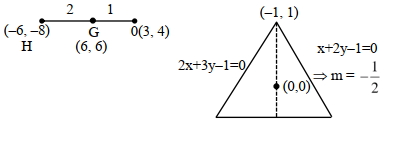
(B) The centroid $G$ of a triangle divides the line segment joining the orthocentre $H$ and circumcentre $O$ in the ratio $2:1$. Given $H = (-6, -8)$ and $O = (3, 4)$,the centroid $G$ is:
$G = \left( \frac{2(3) + 1(-6)}{2+1}, \frac{2(4) + 1(-8)}{2+1} \right) = (0, 0)$.
The lines $2x+3y-1=0$ and $x+2y-1=0$ intersect at $(-1, 1)$.
Since the orthocentre of the triangle is $(0, 0)$,the altitude from the vertex $(-1, 1)$ to the opposite side $ax+by-1=0$ passes through $(0, 0)$.
The slope of the line joining $(-1, 1)$ and $(0, 0)$ is $m_1 = \frac{0-1}{0-(-1)} = -1$.
The slope of the line $ax+by-1=0$ is $m_2 = -a/b$.
Since the altitude is perpendicular to the side,$m_1 \times m_2 = -1$ $\Rightarrow (-1) \times (-a/b) = -1$ $\Rightarrow a/b = -1$ $\Rightarrow a = -b$.
The side is $ax - ay - 1 = 0$.
Since the orthocentre $(0, 0)$ is the intersection of altitudes,the altitude from the intersection of $2x+3y-1=0$ and $ax-ay-1=0$ must pass through $(0, 0)$.
Solving $2x+3y=1$ and $ax-ay=1$ gives the vertex $V = \left( \frac{a+3}{5a}, \frac{a-2}{5a} \right)$.
The altitude from $V$ to $x+2y-1=0$ (slope $-1/2$) has slope $2$. The line passing through $(0, 0)$ with slope $2$ is $y=2x$.
Substituting $V$ into $y=2x$: $\frac{a-2}{5a} = 2 \left( \frac{a+3}{5a} \right)$ $\Rightarrow a-2 = 2a+6$ $\Rightarrow a = -8$.
Thus $b = 8$,and $|a-b| = |-8-8| = 16$.
$G = \left( \frac{2(3) + 1(-6)}{2+1}, \frac{2(4) + 1(-8)}{2+1} \right) = (0, 0)$.
The lines $2x+3y-1=0$ and $x+2y-1=0$ intersect at $(-1, 1)$.
Since the orthocentre of the triangle is $(0, 0)$,the altitude from the vertex $(-1, 1)$ to the opposite side $ax+by-1=0$ passes through $(0, 0)$.
The slope of the line joining $(-1, 1)$ and $(0, 0)$ is $m_1 = \frac{0-1}{0-(-1)} = -1$.
The slope of the line $ax+by-1=0$ is $m_2 = -a/b$.
Since the altitude is perpendicular to the side,$m_1 \times m_2 = -1$ $\Rightarrow (-1) \times (-a/b) = -1$ $\Rightarrow a/b = -1$ $\Rightarrow a = -b$.
The side is $ax - ay - 1 = 0$.
Since the orthocentre $(0, 0)$ is the intersection of altitudes,the altitude from the intersection of $2x+3y-1=0$ and $ax-ay-1=0$ must pass through $(0, 0)$.
Solving $2x+3y=1$ and $ax-ay=1$ gives the vertex $V = \left( \frac{a+3}{5a}, \frac{a-2}{5a} \right)$.
The altitude from $V$ to $x+2y-1=0$ (slope $-1/2$) has slope $2$. The line passing through $(0, 0)$ with slope $2$ is $y=2x$.
Substituting $V$ into $y=2x$: $\frac{a-2}{5a} = 2 \left( \frac{a+3}{5a} \right)$ $\Rightarrow a-2 = 2a+6$ $\Rightarrow a = -8$.
Thus $b = 8$,and $|a-b| = |-8-8| = 16$.
0 likes
View Solution112
DifficultMCQ
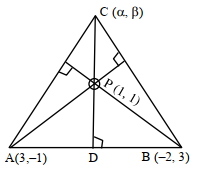
Two vertices of a triangle $ABC$ are $A(3, -1)$ and $B(-2, 3)$,and its orthocentre is $P(1, 1)$. If the coordinates of the point $C$ are $(\alpha, \beta)$ and the centre of the circle circumscribing the triangle $PAB$ is $(h, k)$,then the value of $(\alpha + \beta) + 2(h + k)$ equals :
A
$51$
B
$81$
C
$5$
D
$15$
Solution
(C) The slope of $AB$ is $M_{AB} = \frac{3 - (-1)}{-2 - 3} = \frac{4}{-5}$.
Since $CP \perp AB$,the slope of $CP$ is $M_{CP} = \frac{5}{4}$.
The equation of line $CP$ passing through $P(1, 1)$ is $y - 1 = \frac{5}{4}(x - 1) \Rightarrow 5x - 4y - 1 = 0$ ... $(1)$.
The slope of $AP$ is $M_{AP} = \frac{1 - (-1)}{1 - 3} = \frac{2}{-2} = -1$.
Since $BC \perp AP$,the slope of $BC$ is $M_{BC} = 1$.
The equation of line $BC$ passing through $B(-2, 3)$ is $y - 3 = 1(x + 2) \Rightarrow x - y + 5 = 0$ ... $(2)$.
Solving $(1)$ and $(2)$: From $(2)$,$y = x + 5$. Substituting into $(1)$: $5x - 4(x + 5) - 1 = 0$ $\Rightarrow 5x - 4x - 20 - 1 = 0$ $\Rightarrow x = 21$. Thus $\alpha = 21$.
Then $\beta = 21 + 5 = 26$. So,$\alpha + \beta = 21 + 26 = 47$.
For the circumcentre $(h, k)$ of $\triangle PAB$,note that $P$ is the orthocentre of $\triangle ABC$. $A$ known property is that the circumcircle of $\triangle PAB$ has the same radius as the circumcircle of $\triangle ABC$,and its centre is the reflection of the circumcentre of $\triangle ABC$ across $AB$. Alternatively,the circumcentre of $\triangle PAB$ is the point $O'$ such that $O'A = O'B = O'P$. The perpendicular bisector of $AB$ is $y - 1 = \frac{5}{4}(x - 0.5)$. The perpendicular bisector of $AP$ is $y - 0 = 1(x - 2)$. Solving these gives $h = -19/2$ and $k = -23/2$.
Thus,$2(h + k) = 2(-19/2 - 23/2) = -42$.
The final value is $(\alpha + \beta) + 2(h + k) = 47 - 42 = 5$.
Since $CP \perp AB$,the slope of $CP$ is $M_{CP} = \frac{5}{4}$.
The equation of line $CP$ passing through $P(1, 1)$ is $y - 1 = \frac{5}{4}(x - 1) \Rightarrow 5x - 4y - 1 = 0$ ... $(1)$.
The slope of $AP$ is $M_{AP} = \frac{1 - (-1)}{1 - 3} = \frac{2}{-2} = -1$.
Since $BC \perp AP$,the slope of $BC$ is $M_{BC} = 1$.
The equation of line $BC$ passing through $B(-2, 3)$ is $y - 3 = 1(x + 2) \Rightarrow x - y + 5 = 0$ ... $(2)$.
Solving $(1)$ and $(2)$: From $(2)$,$y = x + 5$. Substituting into $(1)$: $5x - 4(x + 5) - 1 = 0$ $\Rightarrow 5x - 4x - 20 - 1 = 0$ $\Rightarrow x = 21$. Thus $\alpha = 21$.
Then $\beta = 21 + 5 = 26$. So,$\alpha + \beta = 21 + 26 = 47$.
For the circumcentre $(h, k)$ of $\triangle PAB$,note that $P$ is the orthocentre of $\triangle ABC$. $A$ known property is that the circumcircle of $\triangle PAB$ has the same radius as the circumcircle of $\triangle ABC$,and its centre is the reflection of the circumcentre of $\triangle ABC$ across $AB$. Alternatively,the circumcentre of $\triangle PAB$ is the point $O'$ such that $O'A = O'B = O'P$. The perpendicular bisector of $AB$ is $y - 1 = \frac{5}{4}(x - 0.5)$. The perpendicular bisector of $AP$ is $y - 0 = 1(x - 2)$. Solving these gives $h = -19/2$ and $k = -23/2$.
Thus,$2(h + k) = 2(-19/2 - 23/2) = -42$.
The final value is $(\alpha + \beta) + 2(h + k) = 47 - 42 = 5$.
0 likes
View Solution113
DifficultMCQ
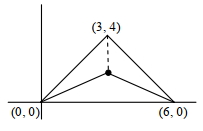
Let $O(0,0), P(3,4), Q(6,0)$ be the vertices of the triangle $OPQ$. The point $R$ inside the triangle $OPQ$ is such that the triangles $OPR, PQR, OQR$ are of equal area. The coordinates of $R$ are
A
$\left(\frac{4}{3}, 3\right)$
B
$\left(3, \frac{2}{3}\right)$
C
$\left(3, \frac{4}{3}\right)$
D
$\left(\frac{4}{3}, 2\right)$
Solution
(C) point $R$ inside a triangle $OPQ$ such that the areas of triangles $OPR, PQR, OQR$ are equal is the centroid of the triangle.
Given the vertices $O(0,0), P(3,4), Q(6,0)$,the coordinates of the centroid $R(x, y)$ are given by:
$x = \frac{x_1 + x_2 + x_3}{3} = \frac{0 + 3 + 6}{3} = \frac{9}{3} = 3$
$y = \frac{y_1 + y_2 + y_3}{3} = \frac{0 + 4 + 0}{3} = \frac{4}{3}$
Thus,the coordinates of $R$ are $\left(3, \frac{4}{3}\right)$.
Given the vertices $O(0,0), P(3,4), Q(6,0)$,the coordinates of the centroid $R(x, y)$ are given by:
$x = \frac{x_1 + x_2 + x_3}{3} = \frac{0 + 3 + 6}{3} = \frac{9}{3} = 3$
$y = \frac{y_1 + y_2 + y_3}{3} = \frac{0 + 4 + 0}{3} = \frac{4}{3}$
Thus,the coordinates of $R$ are $\left(3, \frac{4}{3}\right)$.
0 likes
View Solution114
DifficultMCQ
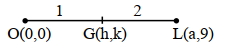
Let $A(6,8)$,$B(10 \cos \alpha, -10 \sin \alpha)$ and $C(-10 \sin \alpha, 10 \cos \alpha)$ be the vertices of a triangle. If $L(a, 9)$ and $G(h, k)$ are its orthocenter and centroid respectively,then $(5a - 3h + 6k + 100 \sin 2\alpha)$ is equal to . . . . . .
A
$204$
B
$145$
C
$753$
D
$254$
Solution
(B) The vertices $A(6, 8)$,$B(10 \cos \alpha, -10 \sin \alpha)$,and $C(-10 \sin \alpha, 10 \cos \alpha)$ all lie on the circle $x^2 + y^2 = 100$. Thus,the circumcenter $O$ is $(0, 0)$.
In any triangle,the orthocenter $L$,centroid $G$,and circumcenter $O$ are collinear,and $G$ divides $OL$ in the ratio $2:1$.
Using the section formula,$G(h, k) = \left(\frac{1 \cdot a + 2 \cdot 0}{1+2}, \frac{1 \cdot 9 + 2 \cdot 0}{1+2}\right) = \left(\frac{a}{3}, 3\right)$.
Thus,$h = \frac{a}{3} \Rightarrow a = 3h$ and $k = 3$.
Also,the centroid $G(h, k)$ is given by $\left(\frac{6 + 10 \cos \alpha - 10 \sin \alpha}{3}, \frac{8 - 10 \sin \alpha + 10 \cos \alpha}{3}\right) = (h, k)$.
Since $k = 3$,we have $\frac{8 + 10(\cos \alpha - \sin \alpha)}{3} = 3 \Rightarrow 10(\cos \alpha - \sin \alpha) = 1$.
Squaring both sides,$100(\cos^2 \alpha + \sin^2 \alpha - 2 \sin \alpha \cos \alpha) = 1$ $\Rightarrow 100(1 - \sin 2\alpha) = 1$ $\Rightarrow 100 \sin 2\alpha = 99$.
From $h = \frac{6 + 10(\cos \alpha - \sin \alpha)}{3}$,we get $h = \frac{6 + 1}{3} = \frac{7}{3}$.
Now,calculate $5a - 3h + 6k + 100 \sin 2\alpha = 5(3h) - 3h + 6(3) + 99 = 12h + 18 + 99 = 12(\frac{7}{3}) + 117 = 28 + 117 = 145$.
In any triangle,the orthocenter $L$,centroid $G$,and circumcenter $O$ are collinear,and $G$ divides $OL$ in the ratio $2:1$.
Using the section formula,$G(h, k) = \left(\frac{1 \cdot a + 2 \cdot 0}{1+2}, \frac{1 \cdot 9 + 2 \cdot 0}{1+2}\right) = \left(\frac{a}{3}, 3\right)$.
Thus,$h = \frac{a}{3} \Rightarrow a = 3h$ and $k = 3$.
Also,the centroid $G(h, k)$ is given by $\left(\frac{6 + 10 \cos \alpha - 10 \sin \alpha}{3}, \frac{8 - 10 \sin \alpha + 10 \cos \alpha}{3}\right) = (h, k)$.
Since $k = 3$,we have $\frac{8 + 10(\cos \alpha - \sin \alpha)}{3} = 3 \Rightarrow 10(\cos \alpha - \sin \alpha) = 1$.
Squaring both sides,$100(\cos^2 \alpha + \sin^2 \alpha - 2 \sin \alpha \cos \alpha) = 1$ $\Rightarrow 100(1 - \sin 2\alpha) = 1$ $\Rightarrow 100 \sin 2\alpha = 99$.
From $h = \frac{6 + 10(\cos \alpha - \sin \alpha)}{3}$,we get $h = \frac{6 + 1}{3} = \frac{7}{3}$.
Now,calculate $5a - 3h + 6k + 100 \sin 2\alpha = 5(3h) - 3h + 6(3) + 99 = 12h + 18 + 99 = 12(\frac{7}{3}) + 117 = 28 + 117 = 145$.
0 likes
View Solution115
MediumMCQ
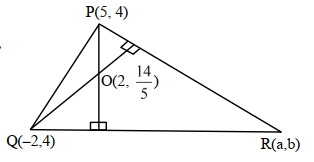
Let the area of a $\triangle PQR$ with vertices $P(5, 4)$,$Q(-2, 4)$,and $R(a, b)$ be $35$ square units. If its orthocenter and centroid are $O\left(2, \frac{14}{5}\right)$ and $C(c, d)$ respectively,then $c+2d$ is equal to:
A
$\frac{7}{3}$
B
$3$
C
$2$
D
$\frac{8}{3}$
Solution
(B) The altitude from $P$ to $QR$ is a vertical line since $P$ and $Q$ have the same $y$-coordinate $(y=4)$. The line $PQ$ is horizontal. The altitude from $P$ to $QR$ passes through $P(5, 4)$ and the orthocenter $O\left(2, \frac{14}{5}\right)$. Since $QR$ is perpendicular to $PO$,the slope of $PO$ is $m_{PO} = \frac{4 - 14/5}{5 - 2} = \frac{6/5}{3} = \frac{2}{5}$. Thus,the slope of $QR$ is $m_{QR} = -\frac{5}{2}$.
Since $Q(-2, 4)$ lies on $QR$,the equation of $QR$ is $y - 4 = -\frac{5}{2}(x + 2) \implies 2y - 8 = -5x - 10 \implies 5x + 2y + 2 = 0$.
The altitude from $Q$ to $PR$ passes through $Q(-2, 4)$ and $O\left(2, \frac{14}{5}\right)$. The slope of $QO$ is $m_{QO} = \frac{14/5 - 4}{2 - (-2)} = \frac{-6/5}{4} = -\frac{3}{10}$. Thus,the slope of $PR$ is $m_{PR} = \frac{10}{3}$.
The equation of $PR$ is $y - 4 = \frac{10}{3}(x - 5) \implies 3y - 12 = 10x - 50 \implies 10x - 3y - 38 = 0$.
Solving $5x + 2y = -2$ and $10x - 3y = 38$: Multiply the first by $2$: $10x + 4y = -4$. Subtracting: $7y = -42 \implies y = -6$. Then $5x + 2(-6) = -2 \implies 5x = 10 \implies x = 2$. So $R(2, -6)$.
The area is $\frac{1}{2} |x_P(y_Q - y_R) + x_Q(y_R - y_P) + x_R(y_P - y_Q)| = 35 \implies \frac{1}{2} |5(4 - (-6)) + (-2)(-6 - 4) + 2(4 - 4)| = 35 \implies \frac{1}{2} |50 + 20 + 0| = 35$,which is consistent.
The centroid $C(c, d) = \left(\frac{5 - 2 + 2}{3}, \frac{4 + 4 - 6}{3}\right) = \left(\frac{5}{3}, \frac{2}{3}\right)$.
Therefore,$c + 2d = \frac{5}{3} + 2\left(\frac{2}{3}\right) = \frac{5+4}{3} = 3$.
Since $Q(-2, 4)$ lies on $QR$,the equation of $QR$ is $y - 4 = -\frac{5}{2}(x + 2) \implies 2y - 8 = -5x - 10 \implies 5x + 2y + 2 = 0$.
The altitude from $Q$ to $PR$ passes through $Q(-2, 4)$ and $O\left(2, \frac{14}{5}\right)$. The slope of $QO$ is $m_{QO} = \frac{14/5 - 4}{2 - (-2)} = \frac{-6/5}{4} = -\frac{3}{10}$. Thus,the slope of $PR$ is $m_{PR} = \frac{10}{3}$.
The equation of $PR$ is $y - 4 = \frac{10}{3}(x - 5) \implies 3y - 12 = 10x - 50 \implies 10x - 3y - 38 = 0$.
Solving $5x + 2y = -2$ and $10x - 3y = 38$: Multiply the first by $2$: $10x + 4y = -4$. Subtracting: $7y = -42 \implies y = -6$. Then $5x + 2(-6) = -2 \implies 5x = 10 \implies x = 2$. So $R(2, -6)$.
The area is $\frac{1}{2} |x_P(y_Q - y_R) + x_Q(y_R - y_P) + x_R(y_P - y_Q)| = 35 \implies \frac{1}{2} |5(4 - (-6)) + (-2)(-6 - 4) + 2(4 - 4)| = 35 \implies \frac{1}{2} |50 + 20 + 0| = 35$,which is consistent.
The centroid $C(c, d) = \left(\frac{5 - 2 + 2}{3}, \frac{4 + 4 - 6}{3}\right) = \left(\frac{5}{3}, \frac{2}{3}\right)$.
Therefore,$c + 2d = \frac{5}{3} + 2\left(\frac{2}{3}\right) = \frac{5+4}{3} = 3$.
0 likes
View Solution116
MediumMCQ
If the equation of the median through vertex $A(3, k)$ of $\triangle ABC$ with vertices $B(2, 1)$ and $C(-4, 5)$ is $x + 4y = p$,then $k = ?$ where $p$ and $k$ are constants.
A
$1$
B
$2$
C
$-2$
D
$3$
Solution
(B) The median through vertex $A$ passes through the midpoint $M$ of the side $BC$.
Midpoint $M$ of $BC$ is given by $(\frac{2-4}{2}, \frac{1+5}{2}) = (-1, 3)$.
The median passes through $A(3, k)$ and $M(-1, 3)$.
The slope of the median $AM$ is $m = \frac{3-k}{-1-3} = \frac{3-k}{-4}$.
The equation of the line $AM$ is $y - 3 = \frac{3-k}{-4}(x + 1)$.
$-4y + 12 = (3-k)x + (3-k)$.
$(3-k)x + 4y = 9+k$.
Comparing this with the given equation $x + 4y = p$,we equate the coefficients of $x$ and $y$.
Since the coefficient of $y$ is $4$ in both,we have $3-k = 1$,which gives $k = 2$.
Thus,$k = 2$.
Midpoint $M$ of $BC$ is given by $(\frac{2-4}{2}, \frac{1+5}{2}) = (-1, 3)$.
The median passes through $A(3, k)$ and $M(-1, 3)$.
The slope of the median $AM$ is $m = \frac{3-k}{-1-3} = \frac{3-k}{-4}$.
The equation of the line $AM$ is $y - 3 = \frac{3-k}{-4}(x + 1)$.
$-4y + 12 = (3-k)x + (3-k)$.
$(3-k)x + 4y = 9+k$.
Comparing this with the given equation $x + 4y = p$,we equate the coefficients of $x$ and $y$.
Since the coefficient of $y$ is $4$ in both,we have $3-k = 1$,which gives $k = 2$.
Thus,$k = 2$.
0 likes
View Solution117
MediumMCQ
Let $A(0,0), B(3,0), C(0,-4)$ be the vertices of $\triangle ABC$. Then the coordinates of the incentre of $\triangle ABC$ are:
A
$(1,1)$
B
$(1,-1)$
C
$(-1,1)$
D
$(-1,-1)$
Solution
(B) The vertices are $A(0,0)$,$B(3,0)$,and $C(0,-4)$.
Calculate the side lengths:
$c = AB = \sqrt{(3-0)^2 + (0-0)^2} = \sqrt{9} = 3$
$b = AC = \sqrt{(0-0)^2 + (-4-0)^2} = \sqrt{16} = 4$
$a = BC = \sqrt{(0-3)^2 + (-4-0)^2} = \sqrt{9+16} = \sqrt{25} = 5$
The coordinates of the incentre $(I)$ are given by the formula:
$I = \left( \frac{ax_1 + bx_2 + cx_3}{a+b+c}, \frac{ay_1 + by_2 + cy_3}{a+b+c} \right)$
Here,$(x_1, y_1) = (0,0)$,$(x_2, y_2) = (3,0)$,and $(x_3, y_3) = (0,-4)$.
$I = \left( \frac{5(0) + 4(3) + 3(0)}{5+4+3}, \frac{5(0) + 4(0) + 3(-4)}{5+4+3} \right)$
$I = \left( \frac{12}{12}, \frac{-12}{12} \right) = (1, -1)$.
Calculate the side lengths:
$c = AB = \sqrt{(3-0)^2 + (0-0)^2} = \sqrt{9} = 3$
$b = AC = \sqrt{(0-0)^2 + (-4-0)^2} = \sqrt{16} = 4$
$a = BC = \sqrt{(0-3)^2 + (-4-0)^2} = \sqrt{9+16} = \sqrt{25} = 5$
The coordinates of the incentre $(I)$ are given by the formula:
$I = \left( \frac{ax_1 + bx_2 + cx_3}{a+b+c}, \frac{ay_1 + by_2 + cy_3}{a+b+c} \right)$
Here,$(x_1, y_1) = (0,0)$,$(x_2, y_2) = (3,0)$,and $(x_3, y_3) = (0,-4)$.
$I = \left( \frac{5(0) + 4(3) + 3(0)}{5+4+3}, \frac{5(0) + 4(0) + 3(-4)}{5+4+3} \right)$
$I = \left( \frac{12}{12}, \frac{-12}{12} \right) = (1, -1)$.
0 likes
View Solution118
EasyMCQ
If the vertices of a triangle are $(-2,3), (6,-1)$ and $(4,3)$,then the coordinates of the circumcentre of the triangle are
A
$(1,1)$
B
$(-1,-1)$
C
$(-1,1)$
D
$(1,-1)$
Solution
(D) Let the vertices of the triangle be $A(-2,3)$,$B(6,-1)$,and $C(4,3)$. Let $F(x,y)$ be the circumcentre. The circumcentre is equidistant from the vertices,so $FA^2 = FB^2 = FC^2$.
$FA^2 = (x+2)^2 + (y-3)^2$
$FB^2 = (x-6)^2 + (y+1)^2$
$FC^2 = (x-4)^2 + (y-3)^2$
Equating $FA^2 = FC^2$:
$(x+2)^2 + (y-3)^2 = (x-4)^2 + (y-3)^2$
$(x+2)^2 = (x-4)^2$
$x^2 + 4x + 4 = x^2 - 8x + 16$
$12x = 12 \implies x = 1$
Equating $FA^2 = FB^2$:
$(1+2)^2 + (y-3)^2 = (1-6)^2 + (y+1)^2$
$9 + y^2 - 6y + 9 = 25 + y^2 + 2y + 1$
$18 - 6y = 26 + 2y$
$-8 = 8y \implies y = -1$
Thus,the coordinates of the circumcentre are $(1,-1)$.
$FA^2 = (x+2)^2 + (y-3)^2$
$FB^2 = (x-6)^2 + (y+1)^2$
$FC^2 = (x-4)^2 + (y-3)^2$
Equating $FA^2 = FC^2$:
$(x+2)^2 + (y-3)^2 = (x-4)^2 + (y-3)^2$
$(x+2)^2 = (x-4)^2$
$x^2 + 4x + 4 = x^2 - 8x + 16$
$12x = 12 \implies x = 1$
Equating $FA^2 = FB^2$:
$(1+2)^2 + (y-3)^2 = (1-6)^2 + (y+1)^2$
$9 + y^2 - 6y + 9 = 25 + y^2 + 2y + 1$
$18 - 6y = 26 + 2y$
$-8 = 8y \implies y = -1$
Thus,the coordinates of the circumcentre are $(1,-1)$.
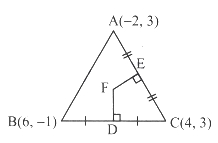
0 likes
View Solution119
MediumMCQ
The orthocentre and centroid of a triangle are $A(-3, 5)$ and $B(3, 3)$ respectively. If $C$ is the circumcentre of this triangle,then the radius of the circle having line segment $AC$ as a diameter is:
A
$\sqrt{10}$
B
$3 \sqrt{\frac{5}{2}}$
C
$2 \sqrt{10}$
D
$\frac{3 \sqrt{5}}{2}$
Solution
(C) The circumcentre $C$ divides the line segment joining the orthocentre $A(-3, 5)$ and the centroid $B(3, 3)$ in the ratio $2:1$ externally,such that $B$ lies between $A$ and $C$.
Using the section formula for external division,the coordinates of $C(x, y)$ are given by:
$x = \frac{2(3) - 1(-3)}{2 - 1} = \frac{6 + 3}{1} = 9$
$y = \frac{2(3) - 1(5)}{2 - 1} = \frac{6 - 5}{1} = 1$
So,$C = (9, 1)$.
The diameter of the circle is the length of the segment $AC$.
$AC = \sqrt{(9 - (-3))^2 + (1 - 5)^2} = \sqrt{12^2 + (-4)^2} = \sqrt{144 + 16} = \sqrt{160} = 4\sqrt{10}$.
The radius of the circle is $\frac{1}{2} AC = \frac{1}{2} \times 4\sqrt{10} = 2\sqrt{10}$.
Using the section formula for external division,the coordinates of $C(x, y)$ are given by:
$x = \frac{2(3) - 1(-3)}{2 - 1} = \frac{6 + 3}{1} = 9$
$y = \frac{2(3) - 1(5)}{2 - 1} = \frac{6 - 5}{1} = 1$
So,$C = (9, 1)$.
The diameter of the circle is the length of the segment $AC$.
$AC = \sqrt{(9 - (-3))^2 + (1 - 5)^2} = \sqrt{12^2 + (-4)^2} = \sqrt{144 + 16} = \sqrt{160} = 4\sqrt{10}$.
The radius of the circle is $\frac{1}{2} AC = \frac{1}{2} \times 4\sqrt{10} = 2\sqrt{10}$.
0 likes
View Solution120
EasyMCQ
If $P(2, 2)$,$Q(-2, 4)$,and $R(3, 4)$ are the vertices of $\triangle PQR$,then the equation of the median through vertex $R$ is $........$
A
$x+3y-9=0$
B
$x-3y+9=0$
C
$x-3y-9=0$
D
$x+3y+9=0$
Solution
(B) The median through vertex $R$ bisects the side $PQ$ at point $M$.
$M$ is the midpoint of $PQ$,so $M = \left( \frac{2 + (-2)}{2}, \frac{2 + 4}{2} \right) = (0, 3)$.
The median passes through $R(3, 4)$ and $M(0, 3)$.
The slope of the line $RM$ is $m = \frac{3 - 4}{0 - 3} = \frac{-1}{-3} = \frac{1}{3}$.
The equation of the line is $y - y_1 = m(x - x_1)$.
$y - 3 = \frac{1}{3}(x - 0)$
$3(y - 3) = x$
$3y - 9 = x$
$x - 3y + 9 = 0$.
$M$ is the midpoint of $PQ$,so $M = \left( \frac{2 + (-2)}{2}, \frac{2 + 4}{2} \right) = (0, 3)$.
The median passes through $R(3, 4)$ and $M(0, 3)$.
The slope of the line $RM$ is $m = \frac{3 - 4}{0 - 3} = \frac{-1}{-3} = \frac{1}{3}$.
The equation of the line is $y - y_1 = m(x - x_1)$.
$y - 3 = \frac{1}{3}(x - 0)$
$3(y - 3) = x$
$3y - 9 = x$
$x - 3y + 9 = 0$.
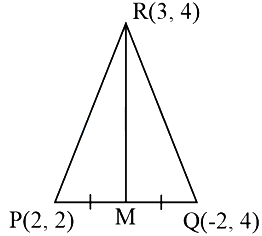
0 likes
View Solution121
MediumMCQ
The points $(11,9), (2,1)$ and $(2,-1)$ are the mid-points of the sides of a triangle. Then,the centroid is
A
$(-5,-3)$
B
$(5,-3)$
C
$(3,5)$
D
$(5,3)$
Solution
(D) Let the vertices of the triangle be $A(x_1, y_1)$,$B(x_2, y_2)$,and $C(x_3, y_3)$.
Given mid-points are $F(11, 9)$,$E(2, 1)$,and $D(2, -1)$.
Since the centroid of a triangle formed by joining the mid-points of the sides of a triangle is the same as the centroid of the original triangle,we can directly calculate it.
The centroid $(G)$ of the triangle with vertices $(x_1, y_1), (x_2, y_2), (x_3, y_3)$ is given by $\left(\frac{x_1+x_2+x_3}{3}, \frac{y_1+y_2+y_3}{3}\right)$.
Let the mid-points be $(x_a, y_a) = (11, 9)$,$(x_b, y_b) = (2, 1)$,and $(x_c, y_c) = (2, -1)$.
The centroid of the triangle formed by these mid-points is $\left(\frac{11+2+2}{3}, \frac{9+1-1}{3}\right) = \left(\frac{15}{3}, \frac{9}{3}\right) = (5, 3)$.
Thus,the centroid of the original triangle is $(5, 3)$.
Given mid-points are $F(11, 9)$,$E(2, 1)$,and $D(2, -1)$.
Since the centroid of a triangle formed by joining the mid-points of the sides of a triangle is the same as the centroid of the original triangle,we can directly calculate it.
The centroid $(G)$ of the triangle with vertices $(x_1, y_1), (x_2, y_2), (x_3, y_3)$ is given by $\left(\frac{x_1+x_2+x_3}{3}, \frac{y_1+y_2+y_3}{3}\right)$.
Let the mid-points be $(x_a, y_a) = (11, 9)$,$(x_b, y_b) = (2, 1)$,and $(x_c, y_c) = (2, -1)$.
The centroid of the triangle formed by these mid-points is $\left(\frac{11+2+2}{3}, \frac{9+1-1}{3}\right) = \left(\frac{15}{3}, \frac{9}{3}\right) = (5, 3)$.
Thus,the centroid of the original triangle is $(5, 3)$.
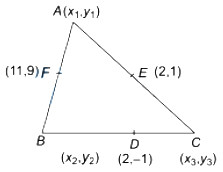
0 likes
View Solution122
MediumMCQ
The vertices of a triangle are $(6,0), (0,6)$ and $(6,6)$. The distance between its circumcentre and centroid is
A
$2$
B
$\sqrt{2}$
C
$1$
D
$2\sqrt{2}$
Solution
(B) Let the vertices of the triangle be $A(6,0), B(0,6)$ and $C(6,6)$.
First,we calculate the lengths of the sides:
$AB = \sqrt{(0-6)^2 + (6-0)^2} = \sqrt{36+36} = 6\sqrt{2}$
$BC = \sqrt{(6-0)^2 + (6-6)^2} = \sqrt{36+0} = 6$
$CA = \sqrt{(6-6)^2 + (0-6)^2} = \sqrt{0+36} = 6$
Since $AB^2 = BC^2 + CA^2$ $(72 = 36 + 36)$,the triangle is a right-angled triangle at vertex $C(6,6)$.
For a right-angled triangle,the circumcentre is the midpoint of the hypotenuse $AB$.
Circumcentre $O = \left(\frac{6+0}{2}, \frac{0+6}{2}\right) = (3,3)$.
The centroid $G$ is given by $\left(\frac{x_1+x_2+x_3}{3}, \frac{y_1+y_2+y_3}{3}\right) = \left(\frac{6+0+6}{3}, \frac{0+6+6}{3}\right) = (4,4)$.
The distance between the circumcentre $(3,3)$ and the centroid $(4,4)$ is $\sqrt{(4-3)^2 + (4-3)^2} = \sqrt{1^2 + 1^2} = \sqrt{2}$.
First,we calculate the lengths of the sides:
$AB = \sqrt{(0-6)^2 + (6-0)^2} = \sqrt{36+36} = 6\sqrt{2}$
$BC = \sqrt{(6-0)^2 + (6-6)^2} = \sqrt{36+0} = 6$
$CA = \sqrt{(6-6)^2 + (0-6)^2} = \sqrt{0+36} = 6$
Since $AB^2 = BC^2 + CA^2$ $(72 = 36 + 36)$,the triangle is a right-angled triangle at vertex $C(6,6)$.
For a right-angled triangle,the circumcentre is the midpoint of the hypotenuse $AB$.
Circumcentre $O = \left(\frac{6+0}{2}, \frac{0+6}{2}\right) = (3,3)$.
The centroid $G$ is given by $\left(\frac{x_1+x_2+x_3}{3}, \frac{y_1+y_2+y_3}{3}\right) = \left(\frac{6+0+6}{3}, \frac{0+6+6}{3}\right) = (4,4)$.
The distance between the circumcentre $(3,3)$ and the centroid $(4,4)$ is $\sqrt{(4-3)^2 + (4-3)^2} = \sqrt{1^2 + 1^2} = \sqrt{2}$.
0 likes
View Solution123
EasyMCQ
The centroid of the triangle $ABC$,where $A \equiv (2,3)$,$B \equiv (8,10)$,and $C \equiv (5,5)$ is
A
$(5,6)$
B
$(6,5)$
C
$(6,6)$
D
$(15,18)$
Solution
(A) The vertices of the triangle are $A \equiv (2,3)$,$B \equiv (8,10)$,and $C \equiv (5,5)$.
The formula for the centroid $(G)$ of a triangle with vertices $(x_1, y_1)$,$(x_2, y_2)$,and $(x_3, y_3)$ is given by $G = \left(\frac{x_1+x_2+x_3}{3}, \frac{y_1+y_2+y_3}{3}\right)$.
Substituting the given values:
$G = \left(\frac{2+8+5}{3}, \frac{3+10+5}{3}\right)$
$G = \left(\frac{15}{3}, \frac{18}{3}\right)$
$G = (5, 6)$
The formula for the centroid $(G)$ of a triangle with vertices $(x_1, y_1)$,$(x_2, y_2)$,and $(x_3, y_3)$ is given by $G = \left(\frac{x_1+x_2+x_3}{3}, \frac{y_1+y_2+y_3}{3}\right)$.
Substituting the given values:
$G = \left(\frac{2+8+5}{3}, \frac{3+10+5}{3}\right)$
$G = \left(\frac{15}{3}, \frac{18}{3}\right)$
$G = (5, 6)$
0 likes
View Solution124
DifficultMCQ
$ABC$ is a triangle,$G$ is the centroid,and $D$ is the mid-point of $BC$. If $A = (2, 3)$ and $G = (7, 5)$,then the point $D$ is
A
$\left(\frac{9}{2}, 4\right)$
B
$\left(\frac{19}{2}, 6\right)$
C
$\left(\frac{11}{2}, \frac{11}{2}\right)$
D
$\left(8, \frac{13}{2}\right)$
Solution
(B) The centroid $G$ of a triangle $ABC$ divides the median $AD$ in the ratio $2:1$.
Let $A = (2, 3)$,$G = (7, 5)$,and $D = (x, y)$.
Using the section formula,the coordinates of $G$ are given by:
$G = \left(\frac{2 \cdot x + 1 \cdot 2}{2+1}, \frac{2 \cdot y + 1 \cdot 3}{2+1}\right)$
Equating the coordinates:
$7 = \frac{2x + 2}{3}$ $\Rightarrow 21 = 2x + 2$ $\Rightarrow 2x = 19$ $\Rightarrow x = \frac{19}{2}$
$5 = \frac{2y + 3}{3}$ $\Rightarrow 15 = 2y + 3$ $\Rightarrow 2y = 12$ $\Rightarrow y = 6$
Therefore,the coordinates of point $D$ are $\left(\frac{19}{2}, 6\right)$.
Let $A = (2, 3)$,$G = (7, 5)$,and $D = (x, y)$.
Using the section formula,the coordinates of $G$ are given by:
$G = \left(\frac{2 \cdot x + 1 \cdot 2}{2+1}, \frac{2 \cdot y + 1 \cdot 3}{2+1}\right)$
Equating the coordinates:
$7 = \frac{2x + 2}{3}$ $\Rightarrow 21 = 2x + 2$ $\Rightarrow 2x = 19$ $\Rightarrow x = \frac{19}{2}$
$5 = \frac{2y + 3}{3}$ $\Rightarrow 15 = 2y + 3$ $\Rightarrow 2y = 12$ $\Rightarrow y = 6$
Therefore,the coordinates of point $D$ are $\left(\frac{19}{2}, 6\right)$.
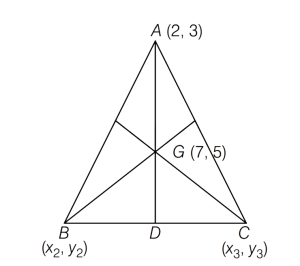
0 likes
View Solution125
MediumMCQ
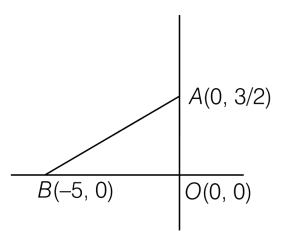
The orthocentre of the triangle with vertices $A(0,0)$,$B(0, \frac{3}{2})$,and $C(-5,0)$ is
A
$\left(\frac{5}{2}, \frac{3}{4}\right)$
B
$\left(-\frac{5}{2}, \frac{3}{4}\right)$
C
$\left(-5, \frac{3}{2}\right)$
D
$(0,0)$
Solution
(D) The given vertices are $A(0,0)$,$B(0, \frac{3}{2})$,and $C(-5,0)$.
Since $A$ is at the origin $(0,0)$,$AB$ lies on the $y$-axis and $AC$ lies on the $x$-axis.
This means the triangle is a right-angled triangle with the right angle at vertex $A(0,0)$.
In a right-angled triangle,the orthocentre is the vertex where the right angle is located.
Therefore,the orthocentre of $\triangle ABC$ is $(0,0)$.
Since $A$ is at the origin $(0,0)$,$AB$ lies on the $y$-axis and $AC$ lies on the $x$-axis.
This means the triangle is a right-angled triangle with the right angle at vertex $A(0,0)$.
In a right-angled triangle,the orthocentre is the vertex where the right angle is located.
Therefore,the orthocentre of $\triangle ABC$ is $(0,0)$.
0 likes
View Solution126
MediumMCQ
If the median $AD$ of the triangle $ABC$ is bisected at $E$ and $BE$ meets $AC$ in $F$,then $AF: AC=$
A
$1: 4$
B
$1: 3$
C
$1: 2$
D
$3: 4$
Solution
(B) Let the vertices of the triangle be $A(x_1, y_1)$,$B(x_2, y_2)$,and $C(x_3, y_3)$.
Since $AD$ is the median,$D$ is the midpoint of $BC$,so $D = (\frac{x_2+x_3}{2}, \frac{y_2+y_3}{2})$.
$E$ is the midpoint of $AD$,so $E = (\frac{x_1 + \frac{x_2+x_3}{2}}{2}, \frac{y_1 + \frac{y_2+y_3}{2}}{2}) = (\frac{2x_1+x_2+x_3}{4}, \frac{2y_1+y_2+y_3}{4})$.
Using the property of the centroid $G$ of triangle $ABC$,$G = (\frac{x_1+x_2+x_3}{3}, \frac{y_1+y_2+y_3}{3})$.
By applying Menelaus' theorem to triangle $ADC$ with transversal $B-E-F$,we find that $F$ divides $AC$ in the ratio $1: 2$.
Thus,$AF: FC = 1: 2$,which implies $AF: AC = 1: (1+2) = 1: 3$.
Since $AD$ is the median,$D$ is the midpoint of $BC$,so $D = (\frac{x_2+x_3}{2}, \frac{y_2+y_3}{2})$.
$E$ is the midpoint of $AD$,so $E = (\frac{x_1 + \frac{x_2+x_3}{2}}{2}, \frac{y_1 + \frac{y_2+y_3}{2}}{2}) = (\frac{2x_1+x_2+x_3}{4}, \frac{2y_1+y_2+y_3}{4})$.
Using the property of the centroid $G$ of triangle $ABC$,$G = (\frac{x_1+x_2+x_3}{3}, \frac{y_1+y_2+y_3}{3})$.
By applying Menelaus' theorem to triangle $ADC$ with transversal $B-E-F$,we find that $F$ divides $AC$ in the ratio $1: 2$.
Thus,$AF: FC = 1: 2$,which implies $AF: AC = 1: (1+2) = 1: 3$.
0 likes
View Solution127
MediumMCQ
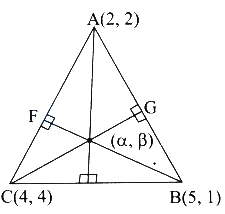
If $(\alpha, \beta)$ is the orthocentre of the triangle with the vertices $(2,2), (5,1), (4,4)$,then $\alpha+\beta=$
A
$6$
B
$5$
C
$\frac{5}{2}$
D
$\frac{7}{2}$
Solution
(A) Let the vertices be $A(2,2)$,$B(5,1)$,and $C(4,4)$.
To find the orthocentre,we find the equations of two altitudes.
Slope of $BC = \frac{4-1}{4-5} = \frac{3}{-1} = -3$.
The altitude from $A(2,2)$ to $BC$ has slope $m_1 = -\frac{1}{-3} = \frac{1}{3}$.
Equation of altitude from $A$: $y-2 = \frac{1}{3}(x-2)$ $\Rightarrow 3y-6 = x-2$ $\Rightarrow x-3y = -4 \quad \dots(i)$.
Slope of $AC = \frac{4-2}{4-2} = \frac{2}{2} = 1$.
The altitude from $B(5,1)$ to $AC$ has slope $m_2 = -\frac{1}{1} = -1$.
Equation of altitude from $B$: $y-1 = -1(x-5)$ $\Rightarrow y-1 = -x+5$ $\Rightarrow x+y = 6 \quad \dots(ii)$.
Adding $(i)$ and $(ii)$ multiplied by $3$: $(x-3y) + 3(x+y) = -4 + 18$ $\Rightarrow 4x = 14$ $\Rightarrow x = \frac{7}{2}$.
Substituting $x = \frac{7}{2}$ in $(ii)$: $\frac{7}{2} + y = 6 \Rightarrow y = 6 - \frac{7}{2} = \frac{5}{2}$.
Thus,the orthocentre $(\alpha, \beta) = (\frac{7}{2}, \frac{5}{2})$.
Therefore,$\alpha+\beta = \frac{7}{2} + \frac{5}{2} = \frac{12}{2} = 6$.
To find the orthocentre,we find the equations of two altitudes.
Slope of $BC = \frac{4-1}{4-5} = \frac{3}{-1} = -3$.
The altitude from $A(2,2)$ to $BC$ has slope $m_1 = -\frac{1}{-3} = \frac{1}{3}$.
Equation of altitude from $A$: $y-2 = \frac{1}{3}(x-2)$ $\Rightarrow 3y-6 = x-2$ $\Rightarrow x-3y = -4 \quad \dots(i)$.
Slope of $AC = \frac{4-2}{4-2} = \frac{2}{2} = 1$.
The altitude from $B(5,1)$ to $AC$ has slope $m_2 = -\frac{1}{1} = -1$.
Equation of altitude from $B$: $y-1 = -1(x-5)$ $\Rightarrow y-1 = -x+5$ $\Rightarrow x+y = 6 \quad \dots(ii)$.
Adding $(i)$ and $(ii)$ multiplied by $3$: $(x-3y) + 3(x+y) = -4 + 18$ $\Rightarrow 4x = 14$ $\Rightarrow x = \frac{7}{2}$.
Substituting $x = \frac{7}{2}$ in $(ii)$: $\frac{7}{2} + y = 6 \Rightarrow y = 6 - \frac{7}{2} = \frac{5}{2}$.
Thus,the orthocentre $(\alpha, \beta) = (\frac{7}{2}, \frac{5}{2})$.
Therefore,$\alpha+\beta = \frac{7}{2} + \frac{5}{2} = \frac{12}{2} = 6$.
0 likes
View Solution128
EasyMCQ
The circumcentre of the triangle with vertices $(-2, 3)$,$(2, -1)$,and $(4, 0)$ is:
A
$\left(\frac{3}{2}, \frac{5}{2}\right)$
B
$\left(\frac{3}{2}, -\frac{5}{2}\right)$
C
$\left(-\frac{3}{2}, \frac{5}{2}\right)$
D
$\left(-\frac{3}{2}, -\frac{5}{2}\right)$
Solution
(A) Let the vertices of the triangle be $A(-2, 3)$,$B(2, -1)$,and $C(4, 0)$.
Let $O(x, y)$ be the circumcentre of the triangle.
By definition,the circumcentre is equidistant from all vertices,so $OA = OB = OC$,which implies $OA^2 = OB^2 = OC^2$.
First,set $OA^2 = OB^2$:
$(x + 2)^2 + (y - 3)^2 = (x - 2)^2 + (y + 1)^2$
$x^2 + 4x + 4 + y^2 - 6y + 9 = x^2 - 4x + 4 + y^2 + 2y + 1$
$8x - 8y = -8 \Rightarrow x - y = -1$ ... $(i)$
Next,set $OB^2 = OC^2$:
$(x - 2)^2 + (y + 1)^2 = (x - 4)^2 + (y - 0)^2$
$x^2 - 4x + 4 + y^2 + 2y + 1 = x^2 - 8x + 16 + y^2$
$4x + 2y = 11$ ... $(ii)$
Solving equations $(i)$ and $(ii)$:
From $(i)$,$y = x + 1$.
Substitute into $(ii)$: $4x + 2(x + 1) = 11$ $\Rightarrow 6x = 9$ $\Rightarrow x = \frac{3}{2}$.
Then $y = \frac{3}{2} + 1 = \frac{5}{2}$.
Thus,the circumcentre is $\left(\frac{3}{2}, \frac{5}{2}\right)$.
Let $O(x, y)$ be the circumcentre of the triangle.
By definition,the circumcentre is equidistant from all vertices,so $OA = OB = OC$,which implies $OA^2 = OB^2 = OC^2$.
First,set $OA^2 = OB^2$:
$(x + 2)^2 + (y - 3)^2 = (x - 2)^2 + (y + 1)^2$
$x^2 + 4x + 4 + y^2 - 6y + 9 = x^2 - 4x + 4 + y^2 + 2y + 1$
$8x - 8y = -8 \Rightarrow x - y = -1$ ... $(i)$
Next,set $OB^2 = OC^2$:
$(x - 2)^2 + (y + 1)^2 = (x - 4)^2 + (y - 0)^2$
$x^2 - 4x + 4 + y^2 + 2y + 1 = x^2 - 8x + 16 + y^2$
$4x + 2y = 11$ ... $(ii)$
Solving equations $(i)$ and $(ii)$:
From $(i)$,$y = x + 1$.
Substitute into $(ii)$: $4x + 2(x + 1) = 11$ $\Rightarrow 6x = 9$ $\Rightarrow x = \frac{3}{2}$.
Then $y = \frac{3}{2} + 1 = \frac{5}{2}$.
Thus,the circumcentre is $\left(\frac{3}{2}, \frac{5}{2}\right)$.
0 likes
View Solution129
EasyMCQ
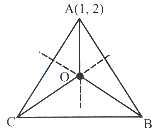
In $\triangle ABC$,if $A=(1,2)$ and the equations of the medians through $B$ and $C$ are $x+y=5$ and $x=4$ respectively,then the area of $\triangle ABC$ is
A
$12$
B
$9$
C
$4$
D
$5$
Solution
(B) Let the equations of the medians through $B$ and $C$ be $L_1: x+y=5$ and $L_2: x=4$ respectively. The point of intersection of these medians is the centroid $G$. Solving $x+y=5$ and $x=4$,we get $G=(4, 1)$.
Let $C$ lie on $x=4$,so $C=(4, y_C)$. Let $B$ lie on $x+y=5$,so $B=(x_B, 5-x_B)$.
Using the centroid formula $G = (\frac{x_A+x_B+x_C}{3}, \frac{y_A+y_B+y_C}{3})$:
$4 = \frac{1+x_B+4}{3}$ $\Rightarrow 12 = 5+x_B$ $\Rightarrow x_B=7$. Thus $B=(7, 5-7) = (7, -2)$.
$1 = \frac{2+y_B+y_C}{3}$ $\Rightarrow 3 = 2+(-2)+y_C$ $\Rightarrow y_C=3$. Thus $C=(4, 3)$.
The vertices are $A(1, 2)$,$B(7, -2)$,and $C(4, 3)$.
The area of $\triangle ABC = \frac{1}{2} |x_A(y_B-y_C) + x_B(y_C-y_A) + x_C(y_A-y_B)|$
$= \frac{1}{2} |1(-2-3) + 7(3-2) + 4(2-(-2))|$
$= \frac{1}{2} |-5 + 7 + 16| = \frac{1}{2} |18| = 9$.
Let $C$ lie on $x=4$,so $C=(4, y_C)$. Let $B$ lie on $x+y=5$,so $B=(x_B, 5-x_B)$.
Using the centroid formula $G = (\frac{x_A+x_B+x_C}{3}, \frac{y_A+y_B+y_C}{3})$:
$4 = \frac{1+x_B+4}{3}$ $\Rightarrow 12 = 5+x_B$ $\Rightarrow x_B=7$. Thus $B=(7, 5-7) = (7, -2)$.
$1 = \frac{2+y_B+y_C}{3}$ $\Rightarrow 3 = 2+(-2)+y_C$ $\Rightarrow y_C=3$. Thus $C=(4, 3)$.
The vertices are $A(1, 2)$,$B(7, -2)$,and $C(4, 3)$.
The area of $\triangle ABC = \frac{1}{2} |x_A(y_B-y_C) + x_B(y_C-y_A) + x_C(y_A-y_B)|$
$= \frac{1}{2} |1(-2-3) + 7(3-2) + 4(2-(-2))|$
$= \frac{1}{2} |-5 + 7 + 16| = \frac{1}{2} |18| = 9$.
0 likes
View Solution130
EasyMCQ
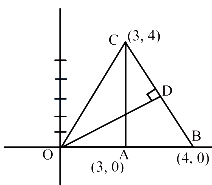
For a triangle formed by the vertices $(0,0)$,$(4,0)$,and $(3,4)$,the orthocenter is:
A
$\left(3, \frac{3}{4}\right)$
B
$\left(3, \frac{5}{4}\right)$
C
$(3,12)$
D
$(3,9)$
Solution
(A) Let the vertices of the triangle be $O(0,0)$,$B(4,0)$,and $C(3,4)$.
To find the orthocenter,we need the intersection of the altitudes.
$1$. The altitude from $C(3,4)$ to the side $OB$ (which lies on the $x$-axis) is a vertical line passing through $x=3$. Thus,the equation of this altitude is $x=3$.
$2$. The slope of side $BC$ is $m_{BC} = \frac{4-0}{3-4} = \frac{4}{-1} = -4$.
$3$. The altitude from $O(0,0)$ to $BC$ is perpendicular to $BC$. Its slope is $m_{\perp} = -\frac{1}{m_{BC}} = -\frac{1}{-4} = \frac{1}{4}$.
$4$. The equation of the altitude from $O$ is $y - 0 = \frac{1}{4}(x - 0)$,which simplifies to $y = \frac{1}{4}x$.
$5$. Substituting $x=3$ into the equation $y = \frac{1}{4}x$,we get $y = \frac{1}{4}(3) = \frac{3}{4}$.
Therefore,the orthocenter is $\left(3, \frac{3}{4}\right)$.
To find the orthocenter,we need the intersection of the altitudes.
$1$. The altitude from $C(3,4)$ to the side $OB$ (which lies on the $x$-axis) is a vertical line passing through $x=3$. Thus,the equation of this altitude is $x=3$.
$2$. The slope of side $BC$ is $m_{BC} = \frac{4-0}{3-4} = \frac{4}{-1} = -4$.
$3$. The altitude from $O(0,0)$ to $BC$ is perpendicular to $BC$. Its slope is $m_{\perp} = -\frac{1}{m_{BC}} = -\frac{1}{-4} = \frac{1}{4}$.
$4$. The equation of the altitude from $O$ is $y - 0 = \frac{1}{4}(x - 0)$,which simplifies to $y = \frac{1}{4}x$.
$5$. Substituting $x=3$ into the equation $y = \frac{1}{4}x$,we get $y = \frac{1}{4}(3) = \frac{3}{4}$.
Therefore,the orthocenter is $\left(3, \frac{3}{4}\right)$.
0 likes
View Solution131
EasyMCQ
The circumcentre of the triangle formed by the points $A(1, \sqrt{3})$,$B(-1, -\sqrt{3})$,and $C(3, -\sqrt{3})$ is
A
$(1, -\sqrt{3})$
B
$\left(-1, \frac{1}{\sqrt{3}}\right)$
C
$(0, 0)$
D
$\left(1, -\frac{1}{\sqrt{3}}\right)$
Solution
(D) Let the vertices be $A(1, \sqrt{3})$,$B(-1, -\sqrt{3})$,and $C(3, -\sqrt{3})$.
Calculate the side lengths:
$AB = \sqrt{(-1-1)^2 + (-\sqrt{3}-\sqrt{3})^2} = \sqrt{(-2)^2 + (-2\sqrt{3})^2} = \sqrt{4 + 12} = 4$.
$BC = \sqrt{(3 - (-1))^2 + (-\sqrt{3} - (-\sqrt{3}))^2} = \sqrt{4^2 + 0^2} = 4$.
$AC = \sqrt{(3-1)^2 + (-\sqrt{3}-\sqrt{3})^2} = \sqrt{2^2 + (-2\sqrt{3})^2} = \sqrt{4 + 12} = 4$.
Since $AB = BC = AC = 4$,the triangle is an equilateral triangle.
In an equilateral triangle,the circumcentre coincides with the centroid.
The centroid $(G)$ is given by $\left(\frac{x_1+x_2+x_3}{3}, \frac{y_1+y_2+y_3}{3}\right)$.
$G = \left(\frac{1-1+3}{3}, \frac{\sqrt{3}-\sqrt{3}-\sqrt{3}}{3}\right) = \left(\frac{3}{3}, \frac{-\sqrt{3}}{3}\right) = \left(1, -\frac{1}{\sqrt{3}}\right)$.
Calculate the side lengths:
$AB = \sqrt{(-1-1)^2 + (-\sqrt{3}-\sqrt{3})^2} = \sqrt{(-2)^2 + (-2\sqrt{3})^2} = \sqrt{4 + 12} = 4$.
$BC = \sqrt{(3 - (-1))^2 + (-\sqrt{3} - (-\sqrt{3}))^2} = \sqrt{4^2 + 0^2} = 4$.
$AC = \sqrt{(3-1)^2 + (-\sqrt{3}-\sqrt{3})^2} = \sqrt{2^2 + (-2\sqrt{3})^2} = \sqrt{4 + 12} = 4$.
Since $AB = BC = AC = 4$,the triangle is an equilateral triangle.
In an equilateral triangle,the circumcentre coincides with the centroid.
The centroid $(G)$ is given by $\left(\frac{x_1+x_2+x_3}{3}, \frac{y_1+y_2+y_3}{3}\right)$.
$G = \left(\frac{1-1+3}{3}, \frac{\sqrt{3}-\sqrt{3}-\sqrt{3}}{3}\right) = \left(\frac{3}{3}, \frac{-\sqrt{3}}{3}\right) = \left(1, -\frac{1}{\sqrt{3}}\right)$.
0 likes
View Solution132
MediumMCQ
The quadratic equation whose roots are the coordinates of the circumcentre of the triangle formed by the points $(-2,-1), (6,-1),$ and $(2,5)$ is
A
$x^2-5x+6=0$
B
$2x^2-9x+9=0$
C
$3x^2-8x+4=0$
D
$6x^2-13x+6=0$
Solution
(C) Let the vertices be $A(-2,-1)$,$B(6,-1)$,and $C(2,5)$.
First,find the perpendicular bisector of $AB$. Since $A$ and $B$ have the same $y$-coordinate,the line $AB$ is horizontal. The midpoint is $(\frac{-2+6}{2}, -1) = (2,-1)$. The perpendicular bisector is the vertical line $x=2$ ... $(i)$.
Next,find the perpendicular bisector of $BC$. The midpoint of $BC$ is $(\frac{6+2}{2}, \frac{-1+5}{2}) = (4,2)$. The slope of $BC$ is $m = \frac{5-(-1)}{2-6} = \frac{6}{-4} = -\frac{3}{2}$. The slope of the perpendicular bisector is $\frac{2}{3}$. The equation is $y-2 = \frac{2}{3}(x-4)$ $\Rightarrow 3y-6 = 2x-8$ $\Rightarrow 2x-3y=2$ ... (ii).
Substitute $x=2$ from $(i)$ into (ii): $2(2)-3y=2$ $\Rightarrow 4-3y=2$ $\Rightarrow 3y=2$ $\Rightarrow y=\frac{2}{3}$.
The circumcentre is $(2, \frac{2}{3})$.
The quadratic equation with roots $2$ and $\frac{2}{3}$ is $x^2 - (2+\frac{2}{3})x + 2(\frac{2}{3}) = 0$.
$x^2 - \frac{8}{3}x + \frac{4}{3} = 0 \Rightarrow 3x^2-8x+4=0$.
Thus,option $(c)$ is correct.
First,find the perpendicular bisector of $AB$. Since $A$ and $B$ have the same $y$-coordinate,the line $AB$ is horizontal. The midpoint is $(\frac{-2+6}{2}, -1) = (2,-1)$. The perpendicular bisector is the vertical line $x=2$ ... $(i)$.
Next,find the perpendicular bisector of $BC$. The midpoint of $BC$ is $(\frac{6+2}{2}, \frac{-1+5}{2}) = (4,2)$. The slope of $BC$ is $m = \frac{5-(-1)}{2-6} = \frac{6}{-4} = -\frac{3}{2}$. The slope of the perpendicular bisector is $\frac{2}{3}$. The equation is $y-2 = \frac{2}{3}(x-4)$ $\Rightarrow 3y-6 = 2x-8$ $\Rightarrow 2x-3y=2$ ... (ii).
Substitute $x=2$ from $(i)$ into (ii): $2(2)-3y=2$ $\Rightarrow 4-3y=2$ $\Rightarrow 3y=2$ $\Rightarrow y=\frac{2}{3}$.
The circumcentre is $(2, \frac{2}{3})$.
The quadratic equation with roots $2$ and $\frac{2}{3}$ is $x^2 - (2+\frac{2}{3})x + 2(\frac{2}{3}) = 0$.
$x^2 - \frac{8}{3}x + \frac{4}{3} = 0 \Rightarrow 3x^2-8x+4=0$.
Thus,option $(c)$ is correct.
0 likes
View Solution133
MediumMCQ
Two vertices of a triangle are $(5, -1)$ and $(-2, 3)$. If the origin $(0, 0)$ is the orthocentre of this triangle,then the coordinates of the third vertex of that triangle are
A
$(4, 7)$
B
$\left(-2, \frac{-7}{2}\right)$
C
$(-4, -7)$
D
$(-2, 3)$
Solution
(C) Let the vertices of the triangle be $A(h, k)$,$B(5, -1)$,and $C(-2, 3)$. The origin $O(0, 0)$ is the orthocentre.
Since $AO \perp BC$,the slope of $AO \times$ slope of $BC = -1$.
Slope of $BC = \frac{3 - (-1)}{-2 - 5} = \frac{4}{-7}$.
Slope of $AO = \frac{k - 0}{h - 0} = \frac{k}{h}$.
Thus,$\frac{k}{h} \times \left(-\frac{4}{7}\right) = -1$ $\Rightarrow \frac{k}{h} = \frac{7}{4}$ $\Rightarrow 7h - 4k = 0$ (Eq. $1$).
Since $BO \perp AC$,the slope of $BO \times$ slope of $AC = -1$.
Slope of $BO = \frac{-1 - 0}{5 - 0} = -\frac{1}{5}$.
Slope of $AC = \frac{k - 3}{h - (-2)} = \frac{k - 3}{h + 2}$.
Thus,$\left(-\frac{1}{5}\right) \times \left(\frac{k - 3}{h + 2}\right) = -1$ $\Rightarrow k - 3 = 5(h + 2)$ $\Rightarrow 5h - k + 13 = 0$ (Eq. $2$).
From Eq. $1$,$k = \frac{7h}{4}$. Substituting this into Eq. $2$:
$5h - \frac{7h}{4} + 13 = 0$ $\Rightarrow \frac{20h - 7h}{4} = -13$ $\Rightarrow 13h = -52$ $\Rightarrow h = -4$.
Then $k = \frac{7(-4)}{4} = -7$.
Therefore,the third vertex is $(-4, -7)$.
Since $AO \perp BC$,the slope of $AO \times$ slope of $BC = -1$.
Slope of $BC = \frac{3 - (-1)}{-2 - 5} = \frac{4}{-7}$.
Slope of $AO = \frac{k - 0}{h - 0} = \frac{k}{h}$.
Thus,$\frac{k}{h} \times \left(-\frac{4}{7}\right) = -1$ $\Rightarrow \frac{k}{h} = \frac{7}{4}$ $\Rightarrow 7h - 4k = 0$ (Eq. $1$).
Since $BO \perp AC$,the slope of $BO \times$ slope of $AC = -1$.
Slope of $BO = \frac{-1 - 0}{5 - 0} = -\frac{1}{5}$.
Slope of $AC = \frac{k - 3}{h - (-2)} = \frac{k - 3}{h + 2}$.
Thus,$\left(-\frac{1}{5}\right) \times \left(\frac{k - 3}{h + 2}\right) = -1$ $\Rightarrow k - 3 = 5(h + 2)$ $\Rightarrow 5h - k + 13 = 0$ (Eq. $2$).
From Eq. $1$,$k = \frac{7h}{4}$. Substituting this into Eq. $2$:
$5h - \frac{7h}{4} + 13 = 0$ $\Rightarrow \frac{20h - 7h}{4} = -13$ $\Rightarrow 13h = -52$ $\Rightarrow h = -4$.
Then $k = \frac{7(-4)}{4} = -7$.
Therefore,the third vertex is $(-4, -7)$.
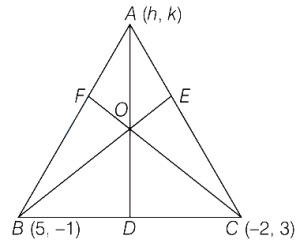
0 likes
View Solution134
EasyMCQ
The equation of the line joining the centroid with the orthocentre of the triangle formed by the points $(-2, 3), (2, -1), (4, 0)$ is
A
$x+y-2=0$
B
$11x-y-14=0$
C
$x-11y+6=0$
D
$2x-y-2=0$
Solution
(B) Let the vertices be $A(-2, 3), B(2, -1)$,and $C(4, 0)$.
First,find the orthocentre $H$. The slope of $BC = \frac{0 - (-1)}{4 - 2} = \frac{1}{2}$. The altitude from $A$ is perpendicular to $BC$,so its slope is $-2$. The equation is $y - 3 = -2(x + 2) \Rightarrow 2x + y + 1 = 0$.
The slope of $AC = \frac{0 - 3}{4 - (-2)} = \frac{-3}{6} = -\frac{1}{2}$. The altitude from $B$ is perpendicular to $AC$,so its slope is $2$. The equation is $y - (-1) = 2(x - 2)$ $\Rightarrow y + 1 = 2x - 4$ $\Rightarrow 2x - y - 5 = 0$.
Solving $2x + y + 1 = 0$ and $2x - y - 5 = 0$ by adding them: $4x - 4 = 0 \Rightarrow x = 1$. Substituting $x=1$ into $2x + y + 1 = 0$ gives $2(1) + y + 1 = 0 \Rightarrow y = -3$. Thus,the orthocentre $H = (1, -3)$.
Next,find the centroid $G = \left(\frac{-2+2+4}{3}, \frac{3-1+0}{3}\right) = \left(\frac{4}{3}, \frac{2}{3}\right)$.
The equation of the line joining $H(1, -3)$ and $G\left(\frac{4}{3}, \frac{2}{3}\right)$ is given by $y - y_1 = m(x - x_1)$,where $m = \frac{\frac{2}{3} - (-3)}{\frac{4}{3} - 1} = \frac{\frac{11}{3}}{\frac{1}{3}} = 11$.
So,$y - (-3) = 11(x - 1)$ $\Rightarrow y + 3 = 11x - 11$ $\Rightarrow 11x - y - 14 = 0$.
First,find the orthocentre $H$. The slope of $BC = \frac{0 - (-1)}{4 - 2} = \frac{1}{2}$. The altitude from $A$ is perpendicular to $BC$,so its slope is $-2$. The equation is $y - 3 = -2(x + 2) \Rightarrow 2x + y + 1 = 0$.
The slope of $AC = \frac{0 - 3}{4 - (-2)} = \frac{-3}{6} = -\frac{1}{2}$. The altitude from $B$ is perpendicular to $AC$,so its slope is $2$. The equation is $y - (-1) = 2(x - 2)$ $\Rightarrow y + 1 = 2x - 4$ $\Rightarrow 2x - y - 5 = 0$.
Solving $2x + y + 1 = 0$ and $2x - y - 5 = 0$ by adding them: $4x - 4 = 0 \Rightarrow x = 1$. Substituting $x=1$ into $2x + y + 1 = 0$ gives $2(1) + y + 1 = 0 \Rightarrow y = -3$. Thus,the orthocentre $H = (1, -3)$.
Next,find the centroid $G = \left(\frac{-2+2+4}{3}, \frac{3-1+0}{3}\right) = \left(\frac{4}{3}, \frac{2}{3}\right)$.
The equation of the line joining $H(1, -3)$ and $G\left(\frac{4}{3}, \frac{2}{3}\right)$ is given by $y - y_1 = m(x - x_1)$,where $m = \frac{\frac{2}{3} - (-3)}{\frac{4}{3} - 1} = \frac{\frac{11}{3}}{\frac{1}{3}} = 11$.
So,$y - (-3) = 11(x - 1)$ $\Rightarrow y + 3 = 11x - 11$ $\Rightarrow 11x - y - 14 = 0$.
0 likes
View Solution135
EasyMCQ
If $O, G, S$ are respectively the orthocentre,centroid and circumcentre of a triangle whose vertices are $A(2,3), B(2,4)$ and $C(4,3)$,then $AO^2 + 9BG^2 + 4CS^2 =$
A
$\frac{77}{36}$
B
$13$
C
$\frac{8}{9}$
D
$\frac{5}{4}$
Solution
(B) The vertices of the triangle are $A(2,3)$,$B(2,4)$,and $C(4,3)$.
Since $AB$ is vertical (along $x=2$) and $AC$ is horizontal (along $y=3$),the triangle is a right-angled triangle with the right angle at $A$.
For a right-angled triangle,the orthocentre $O$ is the vertex at the right angle. Thus,$O = A = (2,3)$.
Therefore,$AO^2 = (2-2)^2 + (3-3)^2 = 0$.
The centroid $G$ is given by $\left(\frac{x_1+x_2+x_3}{3}, \frac{y_1+y_2+y_3}{3}\right) = \left(\frac{2+2+4}{3}, \frac{3+4+3}{3}\right) = \left(\frac{8}{3}, \frac{10}{3}\right)$.
We calculate $9BG^2 = 9 \times \left[ (2 - \frac{8}{3})^2 + (4 - \frac{10}{3})^2 \right] = 9 \times [(-\frac{2}{3})^2 + (\frac{2}{3})^2] = 9 \times [\frac{4}{9} + \frac{4}{9}] = 9 \times \frac{8}{9} = 8$.
The centroid $G$ divides the line segment joining the orthocentre $O$ and the circumcentre $S$ in the ratio $2:1$. Using the section formula,$G = \frac{1 \cdot O + 2 \cdot S}{3}$ $\Rightarrow 3G = O + 2S$ $\Rightarrow S = \frac{3G - O}{2}$.
$S = \frac{3(\frac{8}{3}, \frac{10}{3}) - (2,3)}{2} = \frac{(8-2, 10-3)}{2} = \frac{(6, 7)}{2} = (3, \frac{7}{2})$.
Now,$4CS^2 = 4 \times [(4-3)^2 + (3-\frac{7}{2})^2] = 4 \times [1^2 + (-\frac{1}{2})^2] = 4 \times [1 + \frac{1}{4}] = 4 \times \frac{5}{4} = 5$.
Finally,$AO^2 + 9BG^2 + 4CS^2 = 0 + 8 + 5 = 13$.
Since $AB$ is vertical (along $x=2$) and $AC$ is horizontal (along $y=3$),the triangle is a right-angled triangle with the right angle at $A$.
For a right-angled triangle,the orthocentre $O$ is the vertex at the right angle. Thus,$O = A = (2,3)$.
Therefore,$AO^2 = (2-2)^2 + (3-3)^2 = 0$.
The centroid $G$ is given by $\left(\frac{x_1+x_2+x_3}{3}, \frac{y_1+y_2+y_3}{3}\right) = \left(\frac{2+2+4}{3}, \frac{3+4+3}{3}\right) = \left(\frac{8}{3}, \frac{10}{3}\right)$.
We calculate $9BG^2 = 9 \times \left[ (2 - \frac{8}{3})^2 + (4 - \frac{10}{3})^2 \right] = 9 \times [(-\frac{2}{3})^2 + (\frac{2}{3})^2] = 9 \times [\frac{4}{9} + \frac{4}{9}] = 9 \times \frac{8}{9} = 8$.
The centroid $G$ divides the line segment joining the orthocentre $O$ and the circumcentre $S$ in the ratio $2:1$. Using the section formula,$G = \frac{1 \cdot O + 2 \cdot S}{3}$ $\Rightarrow 3G = O + 2S$ $\Rightarrow S = \frac{3G - O}{2}$.
$S = \frac{3(\frac{8}{3}, \frac{10}{3}) - (2,3)}{2} = \frac{(8-2, 10-3)}{2} = \frac{(6, 7)}{2} = (3, \frac{7}{2})$.
Now,$4CS^2 = 4 \times [(4-3)^2 + (3-\frac{7}{2})^2] = 4 \times [1^2 + (-\frac{1}{2})^2] = 4 \times [1 + \frac{1}{4}] = 4 \times \frac{5}{4} = 5$.
Finally,$AO^2 + 9BG^2 + 4CS^2 = 0 + 8 + 5 = 13$.
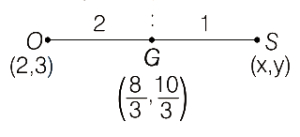
0 likes
View Solution136
EasyMCQ
The circumcentre of the triangle with vertices at $(-2, 3), (1, -2)$ and $(2, 1)$ is
A
$\left(\frac{6}{7}, \frac{2}{7}\right)$
B
$\left(-\frac{6}{7}, \frac{2}{7}\right)$
C
$\left(\frac{6}{7}, -\frac{2}{7}\right)$
D
$\left(-\frac{6}{7}, -\frac{2}{7}\right)$
Solution
(B) The circumcentre of a triangle is equidistant from its vertices. Let $O(x, y)$ be the circumcentre of the triangle with vertices $A(-2, 3), B(1, -2)$,and $C(2, 1)$.
Since $OA = OB = OC$,we have $OA^2 = OB^2 = OC^2$.
$OA^2 = (x + 2)^2 + (y - 3)^2 = x^2 + 4x + 4 + y^2 - 6y + 9 = x^2 + y^2 + 4x - 6y + 13$
$OB^2 = (x - 1)^2 + (y + 2)^2 = x^2 - 2x + 1 + y^2 + 4y + 4 = x^2 + y^2 - 2x + 4y + 5$
$OC^2 = (x - 2)^2 + (y - 1)^2 = x^2 - 4x + 4 + y^2 - 2y + 1 = x^2 + y^2 - 4x - 2y + 5$
Equating $OA^2 = OB^2$:
$x^2 + y^2 + 4x - 6y + 13 = x^2 + y^2 - 2x + 4y + 5$
$6x - 10y + 8 = 0 \Rightarrow 3x - 5y + 4 = 0 \dots (i)$
Equating $OB^2 = OC^2$:
$x^2 + y^2 - 2x + 4y + 5 = x^2 + y^2 - 4x - 2y + 5$
$2x + 6y = 0$ $\Rightarrow x + 3y = 0$ $\Rightarrow x = -3y \dots (ii)$
Substituting $(ii)$ into $(i)$:
$3(-3y) - 5y + 4 = 0$
$-9y - 5y + 4 = 0$ $\Rightarrow -14y = -4$ $\Rightarrow y = \frac{4}{14} = \frac{2}{7}$
Now,$x = -3\left(\frac{2}{7}\right) = -\frac{6}{7}$.
Thus,the circumcentre is $\left(-\frac{6}{7}, \frac{2}{7}\right)$.
Since $OA = OB = OC$,we have $OA^2 = OB^2 = OC^2$.
$OA^2 = (x + 2)^2 + (y - 3)^2 = x^2 + 4x + 4 + y^2 - 6y + 9 = x^2 + y^2 + 4x - 6y + 13$
$OB^2 = (x - 1)^2 + (y + 2)^2 = x^2 - 2x + 1 + y^2 + 4y + 4 = x^2 + y^2 - 2x + 4y + 5$
$OC^2 = (x - 2)^2 + (y - 1)^2 = x^2 - 4x + 4 + y^2 - 2y + 1 = x^2 + y^2 - 4x - 2y + 5$
Equating $OA^2 = OB^2$:
$x^2 + y^2 + 4x - 6y + 13 = x^2 + y^2 - 2x + 4y + 5$
$6x - 10y + 8 = 0 \Rightarrow 3x - 5y + 4 = 0 \dots (i)$
Equating $OB^2 = OC^2$:
$x^2 + y^2 - 2x + 4y + 5 = x^2 + y^2 - 4x - 2y + 5$
$2x + 6y = 0$ $\Rightarrow x + 3y = 0$ $\Rightarrow x = -3y \dots (ii)$
Substituting $(ii)$ into $(i)$:
$3(-3y) - 5y + 4 = 0$
$-9y - 5y + 4 = 0$ $\Rightarrow -14y = -4$ $\Rightarrow y = \frac{4}{14} = \frac{2}{7}$
Now,$x = -3\left(\frac{2}{7}\right) = -\frac{6}{7}$.
Thus,the circumcentre is $\left(-\frac{6}{7}, \frac{2}{7}\right)$.
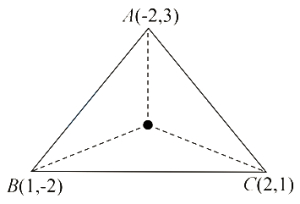
0 likes
View Solution137
MediumMCQ
The incentre of the triangle formed by the straight lines $y=\sqrt{3}x$,$y=-\sqrt{3}x$ and $y=3$ is
A
$(0, 2)$
B
$(0, 1)$
C
$(1, 2)$
D
$(2, 1)$
Solution
(A) The vertices of the triangle are the intersection points of the lines:
$1$. $y=\sqrt{3}x$ and $y=-\sqrt{3}x$ intersect at $A(0, 0)$.
$2$. $y=\sqrt{3}x$ and $y=3$ intersect at $B(\sqrt{3}, 3)$.
$3$. $y=-\sqrt{3}x$ and $y=3$ intersect at $C(-\sqrt{3}, 3)$.
The lengths of the sides are:
$c = AB = \sqrt{(\sqrt{3}-0)^2 + (3-0)^2} = \sqrt{3+9} = \sqrt{12} = 2\sqrt{3}$.
$b = AC = \sqrt{(-\sqrt{3}-0)^2 + (3-0)^2} = \sqrt{3+9} = 2\sqrt{3}$.
$a = BC = \sqrt{(\sqrt{3}-(-\sqrt{3}))^2 + (3-3)^2} = \sqrt{(2\sqrt{3})^2} = 2\sqrt{3}$.
Since $a=b=c$,the triangle is equilateral.
The incentre $(I)$ of an equilateral triangle is the same as its centroid $(G)$.
$I = G = \left(\frac{x_1+x_2+x_3}{3}, \frac{y_1+y_2+y_3}{3}\right) = \left(\frac{0+\sqrt{3}-\sqrt{3}}{3}, \frac{0+3+3}{3}\right) = \left(0, \frac{6}{3}\right) = (0, 2)$.
$1$. $y=\sqrt{3}x$ and $y=-\sqrt{3}x$ intersect at $A(0, 0)$.
$2$. $y=\sqrt{3}x$ and $y=3$ intersect at $B(\sqrt{3}, 3)$.
$3$. $y=-\sqrt{3}x$ and $y=3$ intersect at $C(-\sqrt{3}, 3)$.
The lengths of the sides are:
$c = AB = \sqrt{(\sqrt{3}-0)^2 + (3-0)^2} = \sqrt{3+9} = \sqrt{12} = 2\sqrt{3}$.
$b = AC = \sqrt{(-\sqrt{3}-0)^2 + (3-0)^2} = \sqrt{3+9} = 2\sqrt{3}$.
$a = BC = \sqrt{(\sqrt{3}-(-\sqrt{3}))^2 + (3-3)^2} = \sqrt{(2\sqrt{3})^2} = 2\sqrt{3}$.
Since $a=b=c$,the triangle is equilateral.
The incentre $(I)$ of an equilateral triangle is the same as its centroid $(G)$.
$I = G = \left(\frac{x_1+x_2+x_3}{3}, \frac{y_1+y_2+y_3}{3}\right) = \left(\frac{0+\sqrt{3}-\sqrt{3}}{3}, \frac{0+3+3}{3}\right) = \left(0, \frac{6}{3}\right) = (0, 2)$.
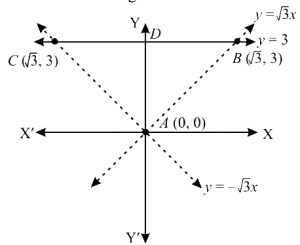
0 likes
View Solution138
EasyMCQ
The mid-point of the line segment joining the centroid and the orthocentre of the triangle whose vertices are $(a, b), (a, c)$ and $(d, c)$ is
A
$\left(\frac{5 a+d}{6}, \frac{b+5 c}{6}\right)$
B
$\left(\frac{a+5 d}{6}, \frac{5 b+c}{6}\right)$
C
$(a, c)$
D
$(0, 0)$
Solution
(A) The vertices of the triangle are $A(a, b), B(a, c)$ and $C(d, c)$.
Since the $x$-coordinate of $A$ and $B$ is $a$,the side $AB$ is vertical. Since the $y$-coordinate of $B$ and $C$ is $c$,the side $BC$ is horizontal. Thus,$\triangle ABC$ is a right-angled triangle at vertex $B(a, c)$.
The orthocentre of a right-angled triangle is the vertex at which the right angle is formed. Therefore,the orthocentre is $B(a, c)$.
The centroid $G$ of the triangle with vertices $(x_1, y_1), (x_2, y_2), (x_3, y_3)$ is given by $\left(\frac{x_1+x_2+x_3}{3}, \frac{y_1+y_2+y_3}{3}\right)$.
$G = \left(\frac{a+a+d}{3}, \frac{b+c+c}{3}\right) = \left(\frac{2 a+d}{3}, \frac{b+2 c}{3}\right)$.
The mid-point of the line segment joining the centroid $G\left(\frac{2 a+d}{3}, \frac{b+2 c}{3}\right)$ and the orthocentre $H(a, c)$ is:
$M = \left(\frac{\frac{2 a+d}{3}+a}{2}, \frac{\frac{b+2 c}{3}+c}{2}\right) = \left(\frac{2 a+d+3 a}{6}, \frac{b+2 c+3 c}{6}\right) = \left(\frac{5 a+d}{6}, \frac{b+5 c}{6}\right)$.
Since the $x$-coordinate of $A$ and $B$ is $a$,the side $AB$ is vertical. Since the $y$-coordinate of $B$ and $C$ is $c$,the side $BC$ is horizontal. Thus,$\triangle ABC$ is a right-angled triangle at vertex $B(a, c)$.
The orthocentre of a right-angled triangle is the vertex at which the right angle is formed. Therefore,the orthocentre is $B(a, c)$.
The centroid $G$ of the triangle with vertices $(x_1, y_1), (x_2, y_2), (x_3, y_3)$ is given by $\left(\frac{x_1+x_2+x_3}{3}, \frac{y_1+y_2+y_3}{3}\right)$.
$G = \left(\frac{a+a+d}{3}, \frac{b+c+c}{3}\right) = \left(\frac{2 a+d}{3}, \frac{b+2 c}{3}\right)$.
The mid-point of the line segment joining the centroid $G\left(\frac{2 a+d}{3}, \frac{b+2 c}{3}\right)$ and the orthocentre $H(a, c)$ is:
$M = \left(\frac{\frac{2 a+d}{3}+a}{2}, \frac{\frac{b+2 c}{3}+c}{2}\right) = \left(\frac{2 a+d+3 a}{6}, \frac{b+2 c+3 c}{6}\right) = \left(\frac{5 a+d}{6}, \frac{b+5 c}{6}\right)$.
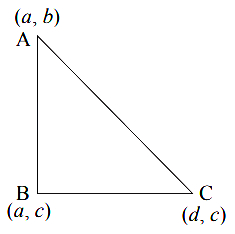
0 likes
View Solution139
EasyMCQ
The orthocentre of the triangle formed by lines $x+y+1=0$,$x-y-1=0$,and $3x+4y+5=0$ is
A
$(0,-1)$
B
$(0,0)$
C
$(1,1)$
D
$(-1,0)$
Solution
(A) Given lines are:
$L_1: x+y+1=0$
$L_2: x-y-1=0$
$L_3: 3x+4y+5=0$
Slope of $L_1$ $(m_1)$ is $-1$.
Slope of $L_2$ $(m_2)$ is $1$.
Since $m_1 \times m_2 = (-1) \times (1) = -1$,the lines $L_1$ and $L_2$ are perpendicular to each other.
Therefore,the triangle is a right-angled triangle,and the orthocentre of a right-angled triangle is the vertex where the right angle is formed.
To find the vertex,solve $L_1$ and $L_2$:
$x+y+1=0$
$x-y-1=0$
Adding the two equations: $2x = 0 \Rightarrow x = 0$.
Substituting $x=0$ in $x+y+1=0$,we get $0+y+1=0 \Rightarrow y = -1$.
Thus,the orthocentre is $(0, -1)$.
$L_1: x+y+1=0$
$L_2: x-y-1=0$
$L_3: 3x+4y+5=0$
Slope of $L_1$ $(m_1)$ is $-1$.
Slope of $L_2$ $(m_2)$ is $1$.
Since $m_1 \times m_2 = (-1) \times (1) = -1$,the lines $L_1$ and $L_2$ are perpendicular to each other.
Therefore,the triangle is a right-angled triangle,and the orthocentre of a right-angled triangle is the vertex where the right angle is formed.
To find the vertex,solve $L_1$ and $L_2$:
$x+y+1=0$
$x-y-1=0$
Adding the two equations: $2x = 0 \Rightarrow x = 0$.
Substituting $x=0$ in $x+y+1=0$,we get $0+y+1=0 \Rightarrow y = -1$.
Thus,the orthocentre is $(0, -1)$.
0 likes
View Solution140
MediumMCQ
The vertices of a triangle are $A(0,0), B(0,2)$ and $C(2,0)$. Find the distance between its orthocentre and circumcentre.
A
$0$
B
$\sqrt{2} \text{ units}$
C
$\frac{1}{\sqrt{2}} \text{ units}$
D
$\sqrt{3} \text{ units}$
Solution
(B) Given vertices are $A(0,0)$,$B(0,2)$,and $C(2,0)$.
Since $\overline{AC}$ lies on the $x$-axis and $\overline{AB}$ lies on the $y$-axis,the triangle is a right-angled triangle with the right angle at vertex $A(0,0)$.
In a right-angled triangle,the orthocentre is the vertex where the right angle is formed,so the orthocentre is $H(0,0)$.
The circumcentre of a right-angled triangle is the midpoint of the hypotenuse $\overline{BC}$.
Circumcentre $O = \left(\frac{0+2}{2}, \frac{2+0}{2}\right) = (1,1)$.
The distance between the orthocentre $(0,0)$ and the circumcentre $(1,1)$ is $\sqrt{(1-0)^2 + (1-0)^2} = \sqrt{1^2 + 1^2} = \sqrt{2} \text{ units}$.
Since $\overline{AC}$ lies on the $x$-axis and $\overline{AB}$ lies on the $y$-axis,the triangle is a right-angled triangle with the right angle at vertex $A(0,0)$.
In a right-angled triangle,the orthocentre is the vertex where the right angle is formed,so the orthocentre is $H(0,0)$.
The circumcentre of a right-angled triangle is the midpoint of the hypotenuse $\overline{BC}$.
Circumcentre $O = \left(\frac{0+2}{2}, \frac{2+0}{2}\right) = (1,1)$.
The distance between the orthocentre $(0,0)$ and the circumcentre $(1,1)$ is $\sqrt{(1-0)^2 + (1-0)^2} = \sqrt{1^2 + 1^2} = \sqrt{2} \text{ units}$.
0 likes
View Solution141
EasyMCQ
The vertices of a triangle are at $-\hat{i}+3 \hat{j}$ and $2 \hat{i}+5 \hat{j}$ and its orthocenter is at $\hat{i}+2 \hat{j}$. If the position vector of the third vertex is $a \hat{i}+b \hat{j}$,then $(a, b)=$
A
$\left(\frac{5}{7}, \frac{5}{7}\right)$
B
$\left(\frac{5}{7}, \frac{17}{7}\right)$
C
$\left(\frac{-5}{7}, \frac{17}{7}\right)$
D
$\left(\frac{5}{7}, \frac{-17}{7}\right)$
Solution
(B) Let the vertices be $A=(-1, 3)$,$B=(2, 5)$,and $C=(a, b)$. The orthocenter is $H=(1, 2)$.
Since $AH \perp BC$,the slope of $AH$ $(m_{AH})$ multiplied by the slope of $BC$ $(m_{BC})$ is $-1$.
$m_{AH} = \frac{2-3}{1-(-1)} = \frac{-1}{2}$.
$m_{BC} = \frac{b-5}{a-2}$.
Since $m_{AH} \times m_{BC} = -1$,we have $\left(\frac{-1}{2}\right) \times \left(\frac{b-5}{a-2}\right) = -1 \Rightarrow b-5 = 2(a-2) \Rightarrow b-5 = 2a-4 \Rightarrow 2a-b = -1$ ... $(i)$
Similarly,since $BH \perp AC$,the slope of $BH$ $(m_{BH})$ multiplied by the slope of $AC$ $(m_{AC})$ is $-1$.
$m_{BH} = \frac{2-5}{1-2} = \frac{-3}{-1} = 3$.
$m_{AC} = \frac{b-3}{a-(-1)} = \frac{b-3}{a+1}$.
Since $m_{BH} \times m_{AC} = -1$,we have $3 \times \left(\frac{b-3}{a+1}\right) = -1 \Rightarrow 3b-9 = -a-1 \Rightarrow a+3b = 8$ ... (ii)
Solving equations $(i)$ and (ii):
From $(i)$,$b = 2a+1$. Substituting into (ii): $a + 3(2a+1) = 8 \Rightarrow a + 6a + 3 = 8 \Rightarrow 7a = 5 \Rightarrow a = \frac{5}{7}$.
Then $b = 2(\frac{5}{7}) + 1 = \frac{10}{7} + \frac{7}{7} = \frac{17}{7}$.
Thus,$(a, b) = \left(\frac{5}{7}, \frac{17}{7}\right)$.
Since $AH \perp BC$,the slope of $AH$ $(m_{AH})$ multiplied by the slope of $BC$ $(m_{BC})$ is $-1$.
$m_{AH} = \frac{2-3}{1-(-1)} = \frac{-1}{2}$.
$m_{BC} = \frac{b-5}{a-2}$.
Since $m_{AH} \times m_{BC} = -1$,we have $\left(\frac{-1}{2}\right) \times \left(\frac{b-5}{a-2}\right) = -1 \Rightarrow b-5 = 2(a-2) \Rightarrow b-5 = 2a-4 \Rightarrow 2a-b = -1$ ... $(i)$
Similarly,since $BH \perp AC$,the slope of $BH$ $(m_{BH})$ multiplied by the slope of $AC$ $(m_{AC})$ is $-1$.
$m_{BH} = \frac{2-5}{1-2} = \frac{-3}{-1} = 3$.
$m_{AC} = \frac{b-3}{a-(-1)} = \frac{b-3}{a+1}$.
Since $m_{BH} \times m_{AC} = -1$,we have $3 \times \left(\frac{b-3}{a+1}\right) = -1 \Rightarrow 3b-9 = -a-1 \Rightarrow a+3b = 8$ ... (ii)
Solving equations $(i)$ and (ii):
From $(i)$,$b = 2a+1$. Substituting into (ii): $a + 3(2a+1) = 8 \Rightarrow a + 6a + 3 = 8 \Rightarrow 7a = 5 \Rightarrow a = \frac{5}{7}$.
Then $b = 2(\frac{5}{7}) + 1 = \frac{10}{7} + \frac{7}{7} = \frac{17}{7}$.
Thus,$(a, b) = \left(\frac{5}{7}, \frac{17}{7}\right)$.
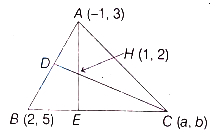
0 likes
View Solution142
MediumMCQ
$(-2, -1)$ and $(2, 5)$ are two vertices of a triangle and $\left(2, \frac{5}{3}\right)$ is its orthocenter. If $(m, n)$ is the third vertex of that triangle,then $m+n=$
A
-$4$
B
-$2$
C
$5$
D
$8$
Solution
(C) Let the vertices be $A(-2, -1)$,$B(2, 5)$,and $C(m, n)$. Let $H\left(2, \frac{5}{3}\right)$ be the orthocenter.
Slope of $AH = \frac{\frac{5}{3} - (-1)}{2 - (-2)} = \frac{8/3}{4} = \frac{2}{3}$.
Since $AH \perp BC$,the slope of $BC = -\frac{1}{2/3} = -\frac{3}{2}$.
Equation of $BC$: $y - 5 = -\frac{3}{2}(x - 2)$ $\Rightarrow 2y - 10 = -3x + 6$ $\Rightarrow 3x + 2y = 16 \quad ...(i)$
Slope of $BH = \frac{\frac{5}{3} - 5}{2 - 2} = \frac{-10/3}{0}$,which is undefined. This means $BH$ is a vertical line $x = 2$.
Since $BH \perp AC$,$AC$ must be a horizontal line. Since $A$ is $(-2, -1)$,the equation of $AC$ is $y = -1$.
Since $C(m, n)$ lies on $AC$,$n = -1$.
Substitute $n = -1$ into equation $(i)$: $3m + 2(-1) = 16$ $\Rightarrow 3m = 18$ $\Rightarrow m = 6$.
Thus,the third vertex is $(6, -1)$.
Therefore,$m + n = 6 + (-1) = 5$.
Slope of $AH = \frac{\frac{5}{3} - (-1)}{2 - (-2)} = \frac{8/3}{4} = \frac{2}{3}$.
Since $AH \perp BC$,the slope of $BC = -\frac{1}{2/3} = -\frac{3}{2}$.
Equation of $BC$: $y - 5 = -\frac{3}{2}(x - 2)$ $\Rightarrow 2y - 10 = -3x + 6$ $\Rightarrow 3x + 2y = 16 \quad ...(i)$
Slope of $BH = \frac{\frac{5}{3} - 5}{2 - 2} = \frac{-10/3}{0}$,which is undefined. This means $BH$ is a vertical line $x = 2$.
Since $BH \perp AC$,$AC$ must be a horizontal line. Since $A$ is $(-2, -1)$,the equation of $AC$ is $y = -1$.
Since $C(m, n)$ lies on $AC$,$n = -1$.
Substitute $n = -1$ into equation $(i)$: $3m + 2(-1) = 16$ $\Rightarrow 3m = 18$ $\Rightarrow m = 6$.
Thus,the third vertex is $(6, -1)$.
Therefore,$m + n = 6 + (-1) = 5$.
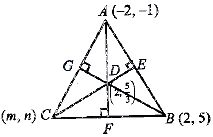
0 likes
View Solution143
EasyMCQ
The orthocenter of the triangle whose sides are given by $x+y+10=0$,$x-y-2=0$,and $2x+y-7=0$ is
A
$(-4,-3)$
B
$(-4,-6)$
C
$(4,6)$
D
$(3,6)$
Solution
(B) Let the lines be $L_1: x+y+10=0$,$L_2: x-y-2=0$,and $L_3: 2x+y-7=0$.
First,check the slopes of the lines:
Slope of $L_1$ is $m_1 = -1$.
Slope of $L_2$ is $m_2 = 1$.
Since $m_1 \times m_2 = (-1) \times (1) = -1$,the lines $L_1$ and $L_2$ are perpendicular to each other.
In a right-angled triangle,the orthocenter is the vertex where the right angle is formed.
Therefore,the orthocenter is the point of intersection of $L_1$ and $L_2$.
Solving $x+y+10=0$ and $x-y-2=0$:
Adding the two equations: $(x+y+10) + (x-y-2) = 0 \implies 2x + 8 = 0 \implies x = -4$.
Substituting $x = -4$ into $x-y-2=0$: $-4 - y - 2 = 0 \implies y = -6$.
Thus,the orthocenter is $(-4, -6)$.
First,check the slopes of the lines:
Slope of $L_1$ is $m_1 = -1$.
Slope of $L_2$ is $m_2 = 1$.
Since $m_1 \times m_2 = (-1) \times (1) = -1$,the lines $L_1$ and $L_2$ are perpendicular to each other.
In a right-angled triangle,the orthocenter is the vertex where the right angle is formed.
Therefore,the orthocenter is the point of intersection of $L_1$ and $L_2$.
Solving $x+y+10=0$ and $x-y-2=0$:
Adding the two equations: $(x+y+10) + (x-y-2) = 0 \implies 2x + 8 = 0 \implies x = -4$.
Substituting $x = -4$ into $x-y-2=0$: $-4 - y - 2 = 0 \implies y = -6$.
Thus,the orthocenter is $(-4, -6)$.
0 likes
View Solution144
EasyMCQ
The centroid of the triangle formed by the lines $x-3y+3=0$,$x+3y+3=0$,and $x+y-1=0$ is
A
$\left(0, -\frac{1}{3}\right)$
B
$\left(\frac{2}{3}, -1\right)$
C
$\left(-\frac{1}{3}, 1\right)$
D
$\left(1, -\frac{1}{3}\right)$
Solution
(A) Let the intersection of lines $x-3y+3=0$ and $x+3y+3=0$ be $A$. Adding the equations: $2x+6=0 \implies x=-3$. Substituting $x=-3$ in $x-3y+3=0$,we get $y=0$. So,$A = (-3, 0)$.
Let the intersection of lines $x+3y+3=0$ and $x+y-1=0$ be $B$. Subtracting the equations: $(x+3y+3) - (x+y-1) = 0 \implies 2y+4=0 \implies y=-2$. Substituting $y=-2$ in $x+y-1=0$,we get $x-2-1=0 \implies x=3$. So,$B = (3, -2)$.
Let the intersection of lines $x-3y+3=0$ and $x+y-1=0$ be $C$. Subtracting the equations: $(x-3y+3) - (x+y-1) = 0 \implies -4y+4=0 \implies y=1$. Substituting $y=1$ in $x+y-1=0$,we get $x+1-1=0 \implies x=0$. So,$C = (0, 1)$.
The centroid $G$ of a triangle with vertices $(x_1, y_1)$,$(x_2, y_2)$,and $(x_3, y_3)$ is given by $\left(\frac{x_1+x_2+x_3}{3}, \frac{y_1+y_2+y_3}{3}\right)$.
$G = \left(\frac{-3+3+0}{3}, \frac{0-2+1}{3}\right) = \left(0, -\frac{1}{3}\right)$.
Let the intersection of lines $x+3y+3=0$ and $x+y-1=0$ be $B$. Subtracting the equations: $(x+3y+3) - (x+y-1) = 0 \implies 2y+4=0 \implies y=-2$. Substituting $y=-2$ in $x+y-1=0$,we get $x-2-1=0 \implies x=3$. So,$B = (3, -2)$.
Let the intersection of lines $x-3y+3=0$ and $x+y-1=0$ be $C$. Subtracting the equations: $(x-3y+3) - (x+y-1) = 0 \implies -4y+4=0 \implies y=1$. Substituting $y=1$ in $x+y-1=0$,we get $x+1-1=0 \implies x=0$. So,$C = (0, 1)$.
The centroid $G$ of a triangle with vertices $(x_1, y_1)$,$(x_2, y_2)$,and $(x_3, y_3)$ is given by $\left(\frac{x_1+x_2+x_3}{3}, \frac{y_1+y_2+y_3}{3}\right)$.
$G = \left(\frac{-3+3+0}{3}, \frac{0-2+1}{3}\right) = \left(0, -\frac{1}{3}\right)$.
0 likes
View Solution145
EasyMCQ
If $P$ is a point equidistant from all the vertices $A(-1, 3)$,$B(3, 5)$,and $C(5, 7)$ of a triangle $ABC$,then $PA=$
A
$11$
B
$\sqrt{140}$
C
$13$
D
$\sqrt{130}$
Solution
(D) Let the coordinates of point $P$ be $(x, y)$. Since $P$ is equidistant from $A(-1, 3)$,$B(3, 5)$,and $C(5, 7)$,we have $PA = PB = PC$,which implies $PA^2 = PB^2 = PC^2$.
$PA^2 = (x+1)^2 + (y-3)^2 = x^2 + 2x + 1 + y^2 - 6y + 9 = x^2 + y^2 + 2x - 6y + 10$
$PB^2 = (x-3)^2 + (y-5)^2 = x^2 - 6x + 9 + y^2 - 10y + 25 = x^2 + y^2 - 6x - 10y + 34$
$PC^2 = (x-5)^2 + (y-7)^2 = x^2 - 10x + 25 + y^2 - 14y + 49 = x^2 + y^2 - 10x - 14y + 74$
Equating $PA^2 = PB^2$:
$x^2 + y^2 + 2x - 6y + 10 = x^2 + y^2 - 6x - 10y + 34$
$8x + 4y = 24 \implies 2x + y = 6$ $(i)$
Equating $PB^2 = PC^2$:
$x^2 + y^2 - 6x - 10y + 34 = x^2 + y^2 - 10x - 14y + 74$
$4x + 4y = 40 \implies x + y = 10$ $(ii)$
Subtracting $(ii)$ from $(i)$:
$(2x + y) - (x + y) = 6 - 10 \implies x = -4$
Substituting $x = -4$ into $(ii)$:
$-4 + y = 10 \implies y = 14$
Thus,$P$ is $(-4, 14)$.
$PA = \sqrt{(-4 - (-1))^2 + (14 - 3)^2} = \sqrt{(-3)^2 + (11)^2} = \sqrt{9 + 121} = \sqrt{130}$.
Therefore,option $(d)$ is correct.
$PA^2 = (x+1)^2 + (y-3)^2 = x^2 + 2x + 1 + y^2 - 6y + 9 = x^2 + y^2 + 2x - 6y + 10$
$PB^2 = (x-3)^2 + (y-5)^2 = x^2 - 6x + 9 + y^2 - 10y + 25 = x^2 + y^2 - 6x - 10y + 34$
$PC^2 = (x-5)^2 + (y-7)^2 = x^2 - 10x + 25 + y^2 - 14y + 49 = x^2 + y^2 - 10x - 14y + 74$
Equating $PA^2 = PB^2$:
$x^2 + y^2 + 2x - 6y + 10 = x^2 + y^2 - 6x - 10y + 34$
$8x + 4y = 24 \implies 2x + y = 6$ $(i)$
Equating $PB^2 = PC^2$:
$x^2 + y^2 - 6x - 10y + 34 = x^2 + y^2 - 10x - 14y + 74$
$4x + 4y = 40 \implies x + y = 10$ $(ii)$
Subtracting $(ii)$ from $(i)$:
$(2x + y) - (x + y) = 6 - 10 \implies x = -4$
Substituting $x = -4$ into $(ii)$:
$-4 + y = 10 \implies y = 14$
Thus,$P$ is $(-4, 14)$.
$PA = \sqrt{(-4 - (-1))^2 + (14 - 3)^2} = \sqrt{(-3)^2 + (11)^2} = \sqrt{9 + 121} = \sqrt{130}$.
Therefore,option $(d)$ is correct.
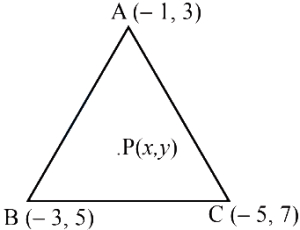
0 likes
View Solution146
EasyMCQ
The incentre of the triangle with vertices $(1, \sqrt{3}), (0, 0)$ and $(2, 0)$ is:
A
$\left(1, \frac{\sqrt{3}}{2}\right)$
B
$\left(\frac{2}{3}, \frac{1}{\sqrt{3}}\right)$
C
$\left(\frac{2}{3}, \frac{\sqrt{3}}{2}\right)$
D
$\left(1, \frac{1}{\sqrt{3}}\right)$
Solution
(D) Let the vertices be $A(1, \sqrt{3})$,$B(0, 0)$,and $C(2, 0)$.
Calculate the side lengths:
$AB = \sqrt{(1-0)^2 + (\sqrt{3}-0)^2} = \sqrt{1 + 3} = 2$
$BC = \sqrt{(2-0)^2 + (0-0)^2} = \sqrt{4} = 2$
$AC = \sqrt{(2-1)^2 + (0-\sqrt{3})^2} = \sqrt{1 + 3} = 2$
Since all sides are equal,the triangle is an equilateral triangle.
For an equilateral triangle,the incentre is the same as the centroid.
The centroid $(G)$ is given by $\left(\frac{x_1+x_2+x_3}{3}, \frac{y_1+y_2+y_3}{3}\right)$.
$G = \left(\frac{1+0+2}{3}, \frac{\sqrt{3}+0+0}{3}\right) = \left(\frac{3}{3}, \frac{\sqrt{3}}{3}\right) = \left(1, \frac{1}{\sqrt{3}}\right)$.
Calculate the side lengths:
$AB = \sqrt{(1-0)^2 + (\sqrt{3}-0)^2} = \sqrt{1 + 3} = 2$
$BC = \sqrt{(2-0)^2 + (0-0)^2} = \sqrt{4} = 2$
$AC = \sqrt{(2-1)^2 + (0-\sqrt{3})^2} = \sqrt{1 + 3} = 2$
Since all sides are equal,the triangle is an equilateral triangle.
For an equilateral triangle,the incentre is the same as the centroid.
The centroid $(G)$ is given by $\left(\frac{x_1+x_2+x_3}{3}, \frac{y_1+y_2+y_3}{3}\right)$.
$G = \left(\frac{1+0+2}{3}, \frac{\sqrt{3}+0+0}{3}\right) = \left(\frac{3}{3}, \frac{\sqrt{3}}{3}\right) = \left(1, \frac{1}{\sqrt{3}}\right)$.
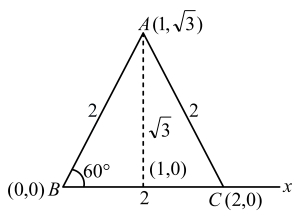
0 likes
View Solution147
MediumMCQ
Let $A(1,1), B(1,-1), C(-1,1)$ be the vertices of $\triangle ABC$. Let $S$ be the circumcentre,$O$ be the orthocentre,and $I$ be the incentre of the $\triangle ABC$. Then $IS + OS =$ ?
A
$4$
B
$2$
C
$2+2\sqrt{2}$
D
$2+\sqrt{2}$
Solution
(B) The vertices are $A(1,1), B(1,-1), C(-1,1)$.
Since $AB$ is vertical (along $x=1$) and $AC$ is horizontal (along $y=1$),$\triangle ABC$ is a right-angled triangle at $A(1,1)$.
$1$. Circumcentre $S$: For a right-angled triangle,the circumcentre is the midpoint of the hypotenuse $BC$.
$S = \left(\frac{1+(-1)}{2}, \frac{-1+1}{2}\right) = (0,0)$.
$2$. Orthocentre $O$: For a right-angled triangle,the orthocentre is the vertex at the right angle.
$O = A = (1,1)$.
$3$. Incentre $I$: The side lengths are $c = AB = \sqrt{(1-1)^2 + (1-(-1))^2} = 2$,$b = AC = \sqrt{(1-(-1))^2 + (1-1)^2} = 2$,and $a = BC = \sqrt{(1-(-1))^2 + (-1-1)^2} = \sqrt{2^2 + (-2)^2} = \sqrt{8} = 2\sqrt{2}$.
The coordinates of the incentre $I$ are given by $\left(\frac{ax_A + bx_B + cx_C}{a+b+c}, \frac{ay_A + by_B + cy_C}{a+b+c}\right)$.
$I = \left(\frac{2\sqrt{2}(1) + 2(1) + 2(-1)}{2\sqrt{2}+2+2}, \frac{2\sqrt{2}(1) + 2(-1) + 2(1)}{2\sqrt{2}+2+2}\right) = \left(\frac{2\sqrt{2}}{2\sqrt{2}+4}, \frac{2\sqrt{2}}{2\sqrt{2}+4}\right) = \left(\frac{\sqrt{2}}{\sqrt{2}+2}, \frac{\sqrt{2}}{\sqrt{2}+2}\right) = \left(\frac{1}{1+\sqrt{2}}, \frac{1}{1+\sqrt{2}}\right) = (\sqrt{2}-1, \sqrt{2}-1)$.
Now,calculate $IS + OS$:
$OS = \sqrt{(1-0)^2 + (1-0)^2} = \sqrt{1+1} = \sqrt{2}$.
$IS = \sqrt{(\sqrt{2}-1-0)^2 + (\sqrt{2}-1-0)^2} = \sqrt{2(\sqrt{2}-1)^2} = \sqrt{2}(\sqrt{2}-1) = 2 - \sqrt{2}$.
$IS + OS = (2 - \sqrt{2}) + \sqrt{2} = 2$.
Since $AB$ is vertical (along $x=1$) and $AC$ is horizontal (along $y=1$),$\triangle ABC$ is a right-angled triangle at $A(1,1)$.
$1$. Circumcentre $S$: For a right-angled triangle,the circumcentre is the midpoint of the hypotenuse $BC$.
$S = \left(\frac{1+(-1)}{2}, \frac{-1+1}{2}\right) = (0,0)$.
$2$. Orthocentre $O$: For a right-angled triangle,the orthocentre is the vertex at the right angle.
$O = A = (1,1)$.
$3$. Incentre $I$: The side lengths are $c = AB = \sqrt{(1-1)^2 + (1-(-1))^2} = 2$,$b = AC = \sqrt{(1-(-1))^2 + (1-1)^2} = 2$,and $a = BC = \sqrt{(1-(-1))^2 + (-1-1)^2} = \sqrt{2^2 + (-2)^2} = \sqrt{8} = 2\sqrt{2}$.
The coordinates of the incentre $I$ are given by $\left(\frac{ax_A + bx_B + cx_C}{a+b+c}, \frac{ay_A + by_B + cy_C}{a+b+c}\right)$.
$I = \left(\frac{2\sqrt{2}(1) + 2(1) + 2(-1)}{2\sqrt{2}+2+2}, \frac{2\sqrt{2}(1) + 2(-1) + 2(1)}{2\sqrt{2}+2+2}\right) = \left(\frac{2\sqrt{2}}{2\sqrt{2}+4}, \frac{2\sqrt{2}}{2\sqrt{2}+4}\right) = \left(\frac{\sqrt{2}}{\sqrt{2}+2}, \frac{\sqrt{2}}{\sqrt{2}+2}\right) = \left(\frac{1}{1+\sqrt{2}}, \frac{1}{1+\sqrt{2}}\right) = (\sqrt{2}-1, \sqrt{2}-1)$.
Now,calculate $IS + OS$:
$OS = \sqrt{(1-0)^2 + (1-0)^2} = \sqrt{1+1} = \sqrt{2}$.
$IS = \sqrt{(\sqrt{2}-1-0)^2 + (\sqrt{2}-1-0)^2} = \sqrt{2(\sqrt{2}-1)^2} = \sqrt{2}(\sqrt{2}-1) = 2 - \sqrt{2}$.
$IS + OS = (2 - \sqrt{2}) + \sqrt{2} = 2$.
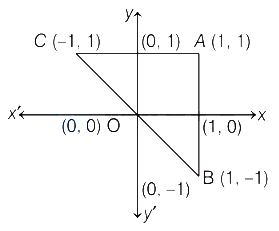
0 likes
View Solution148
DifficultMCQ
The distance (in units) between the circumcentre and the centroid of the triangle formed by the vertices $(1, 2)$,$(3, -1)$ and $(4, 0)$ is
A
$1/2$
B
$1$
C
$\frac{11 \sqrt{2}}{30}$
D
$\frac{9 \sqrt{2}}{5}$
Solution
(C) Let the vertices be $A(1, 2)$,$B(3, -1)$,and $C(4, 0)$.
First,calculate the lengths of the sides:
$AB = \sqrt{(3-1)^2 + (-1-2)^2} = \sqrt{2^2 + (-3)^2} = \sqrt{4+9} = \sqrt{13}$
$AC = \sqrt{(4-1)^2 + (0-2)^2} = \sqrt{3^2 + (-2)^2} = \sqrt{9+4} = \sqrt{13}$
Since $AB = AC$,the triangle is isosceles.
Centroid $G = \left(\frac{1+3+4}{3}, \frac{2-1+0}{3}\right) = \left(\frac{8}{3}, \frac{1}{3}\right)$.
For an isosceles triangle,the circumcentre $O$ lies on the altitude from $A$ to $BC$. The slope of $BC$ is $m_{BC} = \frac{0 - (-1)}{4 - 3} = 1$. The altitude from $A$ has slope $-1$ and passes through $(1, 2)$,so its equation is $y - 2 = -1(x - 1) \Rightarrow y = -x + 3$.
The circumcentre $O$ is the intersection of the perpendicular bisectors. The perpendicular bisector of $AC$ passes through the midpoint $E\left(\frac{1+4}{2}, \frac{2+0}{2}\right) = \left(\frac{2.5}{1}, 1\right)$ with slope $m = -\frac{1}{m_{AC}} = -\frac{1}{-2/3} = \frac{3}{2}$.
Equation of perpendicular bisector of $AC$: $y - 1 = \frac{3}{2}(x - 2.5)$ $\Rightarrow y = 1.5x - 3.75 + 1$ $\Rightarrow y = 1.5x - 2.75$.
Solving $y = -x + 3$ and $y = 1.5x - 2.75$: $-x + 3 = 1.5x - 2.75$ $\Rightarrow 2.5x = 5.75$ $\Rightarrow x = 2.3 = \frac{23}{10}$.
Then $y = -2.3 + 3 = 0.7 = \frac{7}{10}$. So $O = \left(\frac{23}{10}, \frac{7}{10}\right)$.
The distance $OG = \sqrt{(\frac{8}{3} - \frac{23}{10})^2 + (\frac{1}{3} - \frac{7}{10})^2} = \sqrt{(\frac{80-69}{30})^2 + (\frac{10-21}{30})^2} = \sqrt{(\frac{11}{30})^2 + (-\frac{11}{30})^2} = \frac{11}{30} \sqrt{2}$.
First,calculate the lengths of the sides:
$AB = \sqrt{(3-1)^2 + (-1-2)^2} = \sqrt{2^2 + (-3)^2} = \sqrt{4+9} = \sqrt{13}$
$AC = \sqrt{(4-1)^2 + (0-2)^2} = \sqrt{3^2 + (-2)^2} = \sqrt{9+4} = \sqrt{13}$
Since $AB = AC$,the triangle is isosceles.
Centroid $G = \left(\frac{1+3+4}{3}, \frac{2-1+0}{3}\right) = \left(\frac{8}{3}, \frac{1}{3}\right)$.
For an isosceles triangle,the circumcentre $O$ lies on the altitude from $A$ to $BC$. The slope of $BC$ is $m_{BC} = \frac{0 - (-1)}{4 - 3} = 1$. The altitude from $A$ has slope $-1$ and passes through $(1, 2)$,so its equation is $y - 2 = -1(x - 1) \Rightarrow y = -x + 3$.
The circumcentre $O$ is the intersection of the perpendicular bisectors. The perpendicular bisector of $AC$ passes through the midpoint $E\left(\frac{1+4}{2}, \frac{2+0}{2}\right) = \left(\frac{2.5}{1}, 1\right)$ with slope $m = -\frac{1}{m_{AC}} = -\frac{1}{-2/3} = \frac{3}{2}$.
Equation of perpendicular bisector of $AC$: $y - 1 = \frac{3}{2}(x - 2.5)$ $\Rightarrow y = 1.5x - 3.75 + 1$ $\Rightarrow y = 1.5x - 2.75$.
Solving $y = -x + 3$ and $y = 1.5x - 2.75$: $-x + 3 = 1.5x - 2.75$ $\Rightarrow 2.5x = 5.75$ $\Rightarrow x = 2.3 = \frac{23}{10}$.
Then $y = -2.3 + 3 = 0.7 = \frac{7}{10}$. So $O = \left(\frac{23}{10}, \frac{7}{10}\right)$.
The distance $OG = \sqrt{(\frac{8}{3} - \frac{23}{10})^2 + (\frac{1}{3} - \frac{7}{10})^2} = \sqrt{(\frac{80-69}{30})^2 + (\frac{10-21}{30})^2} = \sqrt{(\frac{11}{30})^2 + (-\frac{11}{30})^2} = \frac{11}{30} \sqrt{2}$.
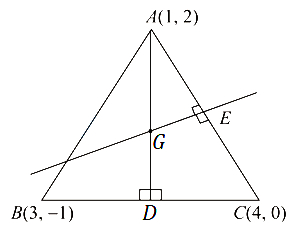
0 likes
View Solution149
DifficultMCQ
If the equations of the perpendicular bisectors of the sides $AB$ and $AC$ of a $\triangle ABC$ are $x-y+5=0$ and $x+2y=0$ respectively,and if $A$ is $(1,-2)$,then the equation of the perpendicular bisector of the side $BC$ is
A
$3x+3y+5=0$
B
$9x-23y+40=0$
C
$6x+15y=5$
D
$23x-14y+100=0$
Solution
(D) The intersection of the perpendicular bisectors of the sides of a triangle is the circumcenter $O$. Solving the equations $x-y+5=0$ and $x+2y=0$,we get $x = -10/3$ and $y = 5/3$. Thus,the circumcenter $O$ is $(-10/3, 5/3)$.
Since $B$ is the reflection of $A(1,-2)$ across the line $x-y+5=0$,we have $\frac{x_B-1}{1} = \frac{y_B+2}{-1} = -2 \frac{1-(-2)+5}{1^2+(-1)^2} = -2 \frac{8}{2} = -8$. This gives $x_B = -7$ and $y_B = 6$. So $B = (-7, 6)$.
Since $C$ is the reflection of $A(1,-2)$ across the line $x+2y=0$,we have $\frac{x_C-1}{1} = \frac{y_C+2}{2} = -2 \frac{1+2(-2)}{1^2+2^2} = -2 \frac{-3}{5} = 6/5$. This gives $x_C = 1+6/5 = 11/5$ and $y_C = -2+12/5 = 2/5$. So $C = (11/5, 2/5)$.
The perpendicular bisector of $BC$ passes through the circumcenter $O(-10/3, 5/3)$ and the midpoint $M$ of $BC$. The midpoint $M$ is $(\frac{-7+11/5}{2}, \frac{6+2/5}{2}) = (-12/5, 16/5)$.
The slope of the line passing through $O(-10/3, 5/3)$ and $M(-12/5, 16/5)$ is $m = \frac{16/5 - 5/3}{-12/5 - (-10/3)} = \frac{48/15 - 25/15}{-36/15 + 50/15} = \frac{23/15}{14/15} = 23/14$.
The equation of the line is $y - 5/3 = 23/14(x + 10/3)$,which simplifies to $14(3y-5) = 69(x+10/3)$ $\Rightarrow 42y - 70 = 69x + 230$ $\Rightarrow 69x - 42y + 300 = 0$ $\Rightarrow 23x - 14y + 100 = 0$.
Since $B$ is the reflection of $A(1,-2)$ across the line $x-y+5=0$,we have $\frac{x_B-1}{1} = \frac{y_B+2}{-1} = -2 \frac{1-(-2)+5}{1^2+(-1)^2} = -2 \frac{8}{2} = -8$. This gives $x_B = -7$ and $y_B = 6$. So $B = (-7, 6)$.
Since $C$ is the reflection of $A(1,-2)$ across the line $x+2y=0$,we have $\frac{x_C-1}{1} = \frac{y_C+2}{2} = -2 \frac{1+2(-2)}{1^2+2^2} = -2 \frac{-3}{5} = 6/5$. This gives $x_C = 1+6/5 = 11/5$ and $y_C = -2+12/5 = 2/5$. So $C = (11/5, 2/5)$.
The perpendicular bisector of $BC$ passes through the circumcenter $O(-10/3, 5/3)$ and the midpoint $M$ of $BC$. The midpoint $M$ is $(\frac{-7+11/5}{2}, \frac{6+2/5}{2}) = (-12/5, 16/5)$.
The slope of the line passing through $O(-10/3, 5/3)$ and $M(-12/5, 16/5)$ is $m = \frac{16/5 - 5/3}{-12/5 - (-10/3)} = \frac{48/15 - 25/15}{-36/15 + 50/15} = \frac{23/15}{14/15} = 23/14$.
The equation of the line is $y - 5/3 = 23/14(x + 10/3)$,which simplifies to $14(3y-5) = 69(x+10/3)$ $\Rightarrow 42y - 70 = 69x + 230$ $\Rightarrow 69x - 42y + 300 = 0$ $\Rightarrow 23x - 14y + 100 = 0$.
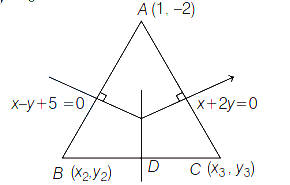
0 likes
View SolutionStraight Line — Points related to triangle · Frequently Asked Questions
1Are these Straight Line questions useful for JEE and NEET?
Yes. All questions in this section are mapped to JEE Main and NEET exam patterns. Previous year questions from JEE Main, NEET, GUJCET and state-level exams are included with full solutions.
2Can I switch to Hindi or Gujarati for these questions?
Yes. Use the language tabs in the hero section or the sidebar to view the same questions and solutions in English, Hindi or Gujarati.
3How do I generate a question paper from this subtopic?
Use the Vedclass Exam Paper Generator — select the chapter and subtopic, set difficulty, and generate Sets A, B, C, D automatically. First 3 chapters of every subject are free.
Vedclass Products
For Students
Vedclass Test Series
Mock tests in real JEE/NEET style with performance analysis. 5-day free trial.
Start Free TrialFor Teachers
Exam Paper Generator
Generate Set A/B/C/D papers from this chapter in 2 minutes. 3 chapters free.
Try FreeFor Institutes
Online Exam Module
Live online exams with unlimited students, 360° analytics & white-label branding.
See DemoFor Teachers & Institutes
Generate a Straight Line Exam Paper in 2 Minutes
Select subtopic & difficulty — Sets A, B, C, D auto-generated with No Repeat logic.
First 3 chapters of every subject are free — no payment required.