
A English
Foot of perpendicular, Image of a point and Reflexive properties Questions in English
Class 11 Mathematics · Straight Line · Foot of perpendicular, Image of a point and Reflexive properties
154+
Questions
English
Language
100%
With Solutions
Showing 48 of 154 questions in English
51
DifficultMCQ
Let $a$ and $b$ be any two numbers satisfying $\frac{1}{a^2} + \frac{1}{b^2} = \frac{1}{4}$. Then,the foot of the perpendicular from the origin on the variable line $\frac{x}{a} + \frac{y}{b} = 1$ lies on
A
a hyperbola with each semi-axis $= \sqrt{2}$
B
a hyperbola with each semi-axis $= 2$
C
a circle of radius $= 2$
D
a circle of radius $= \sqrt{2}$
Solution
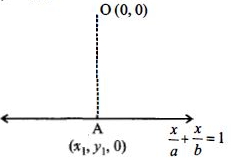
(C) Let the foot of the perpendicular from the origin $(0,0)$ to the variable line $\frac{x}{a} + \frac{y}{b} = 1$ be $P(x_1, y_1)$.
Since $P(x_1, y_1)$ lies on the line $\frac{x}{a} + \frac{y}{b} = 1$,we have $\frac{x_1}{a} + \frac{y_1}{b} = 1$.
The slope of the line $\frac{x}{a} + \frac{y}{b} = 1$ is $m_1 = -\frac{b}{a}$.
The slope of the line segment $OP$ is $m_2 = \frac{y_1}{x_1}$.
Since $OP$ is perpendicular to the line,$m_1 \times m_2 = -1$,so $(-\frac{b}{a}) \times (\frac{y_1}{x_1}) = -1$,which implies $\frac{y_1}{x_1} = \frac{a}{b}$,or $\frac{x_1}{a} = \frac{y_1}{b} = k$.
Substituting this into the line equation: $k + k = 1 \Rightarrow k = \frac{1}{2}$.
Thus,$x_1 = \frac{a}{2}$ and $y_1 = \frac{b}{2}$,which means $a = 2x_1$ and $b = 2y_1$.
Given $\frac{1}{a^2} + \frac{1}{b^2} = \frac{1}{4}$,we substitute $a$ and $b$: $\frac{1}{(2x_1)^2} + \frac{1}{(2y_1)^2} = \frac{1}{4}$.
$\frac{1}{4x_1^2} + \frac{1}{4y_1^2} = \frac{1}{4}$ $\Rightarrow \frac{1}{x_1^2} + \frac{1}{y_1^2} = 1$ $\Rightarrow x_1^2 + y_1^2 = x_1^2 y_1^2$.
Alternatively,using the perpendicular distance formula $d = \frac{|c|}{\sqrt{A^2 + B^2}}$ from $(0,0)$ to $\frac{x}{a} + \frac{y}{b} - 1 = 0$:
$d = \frac{|-1|}{\sqrt{\frac{1}{a^2} + \frac{1}{b^2}}} = \sqrt{x_1^2 + y_1^2}$.
Since $\frac{1}{a^2} + \frac{1}{b^2} = \frac{1}{4}$,we have $\sqrt{x_1^2 + y_1^2} = \sqrt{4} = 2$.
Thus,$x_1^2 + y_1^2 = 4$,which is a circle with radius $2$.
Since $P(x_1, y_1)$ lies on the line $\frac{x}{a} + \frac{y}{b} = 1$,we have $\frac{x_1}{a} + \frac{y_1}{b} = 1$.
The slope of the line $\frac{x}{a} + \frac{y}{b} = 1$ is $m_1 = -\frac{b}{a}$.
The slope of the line segment $OP$ is $m_2 = \frac{y_1}{x_1}$.
Since $OP$ is perpendicular to the line,$m_1 \times m_2 = -1$,so $(-\frac{b}{a}) \times (\frac{y_1}{x_1}) = -1$,which implies $\frac{y_1}{x_1} = \frac{a}{b}$,or $\frac{x_1}{a} = \frac{y_1}{b} = k$.
Substituting this into the line equation: $k + k = 1 \Rightarrow k = \frac{1}{2}$.
Thus,$x_1 = \frac{a}{2}$ and $y_1 = \frac{b}{2}$,which means $a = 2x_1$ and $b = 2y_1$.
Given $\frac{1}{a^2} + \frac{1}{b^2} = \frac{1}{4}$,we substitute $a$ and $b$: $\frac{1}{(2x_1)^2} + \frac{1}{(2y_1)^2} = \frac{1}{4}$.
$\frac{1}{4x_1^2} + \frac{1}{4y_1^2} = \frac{1}{4}$ $\Rightarrow \frac{1}{x_1^2} + \frac{1}{y_1^2} = 1$ $\Rightarrow x_1^2 + y_1^2 = x_1^2 y_1^2$.
Alternatively,using the perpendicular distance formula $d = \frac{|c|}{\sqrt{A^2 + B^2}}$ from $(0,0)$ to $\frac{x}{a} + \frac{y}{b} - 1 = 0$:
$d = \frac{|-1|}{\sqrt{\frac{1}{a^2} + \frac{1}{b^2}}} = \sqrt{x_1^2 + y_1^2}$.
Since $\frac{1}{a^2} + \frac{1}{b^2} = \frac{1}{4}$,we have $\sqrt{x_1^2 + y_1^2} = \sqrt{4} = 2$.
Thus,$x_1^2 + y_1^2 = 4$,which is a circle with radius $2$.
0 likes
View Solution52
DifficultMCQ
If the image of point $P(2, 3)$ in a line $L$ is $Q(4, 5)$,then the image of point $R(0, 0)$ in the same line is
A
$(2, 2)$
B
$(4, 5)$
C
$(3, 4)$
D
$(7, 7)$
Solution
(D) Mid-point of $P(2, 3)$ and $Q(4, 5)$ is $(\frac{2+4}{2}, \frac{3+5}{2}) = (3, 4)$.
Slope of $PQ = \frac{5-3}{4-2} = \frac{2}{2} = 1$.
Since the line $L$ is the perpendicular bisector of $PQ$,the slope of line $L$ is $m = -1$.
The equation of line $L$ passing through $(3, 4)$ with slope $-1$ is $y - 4 = -1(x - 3) \Rightarrow x + y - 7 = 0$.
Let the image of point $R(0, 0)$ be $S(x_1, y_1)$.
The mid-point of $RS$ is $(\frac{x_1}{2}, \frac{y_1}{2})$,which lies on line $L$,so $\frac{x_1}{2} + \frac{y_1}{2} - 7 = 0 \Rightarrow x_1 + y_1 = 14$.
The slope of $RS$ is $\frac{y_1}{x_1}$. Since $RS \perp L$,the slope of $RS$ must be $1$ (negative reciprocal of $-1$).
Thus,$\frac{y_1}{x_1} = 1 \Rightarrow x_1 = y_1$.
Substituting $x_1 = y_1$ into $x_1 + y_1 = 14$,we get $2x_1 = 14 \Rightarrow x_1 = 7$ and $y_1 = 7$.
Therefore,the image of $R$ is $(7, 7)$.
Slope of $PQ = \frac{5-3}{4-2} = \frac{2}{2} = 1$.
Since the line $L$ is the perpendicular bisector of $PQ$,the slope of line $L$ is $m = -1$.
The equation of line $L$ passing through $(3, 4)$ with slope $-1$ is $y - 4 = -1(x - 3) \Rightarrow x + y - 7 = 0$.
Let the image of point $R(0, 0)$ be $S(x_1, y_1)$.
The mid-point of $RS$ is $(\frac{x_1}{2}, \frac{y_1}{2})$,which lies on line $L$,so $\frac{x_1}{2} + \frac{y_1}{2} - 7 = 0 \Rightarrow x_1 + y_1 = 14$.
The slope of $RS$ is $\frac{y_1}{x_1}$. Since $RS \perp L$,the slope of $RS$ must be $1$ (negative reciprocal of $-1$).
Thus,$\frac{y_1}{x_1} = 1 \Rightarrow x_1 = y_1$.
Substituting $x_1 = y_1$ into $x_1 + y_1 = 14$,we get $2x_1 = 14 \Rightarrow x_1 = 7$ and $y_1 = 7$.
Therefore,the image of $R$ is $(7, 7)$.
0 likes
View Solution53
DifficultMCQ
Let $L$ be the line $y = 2x$ in the two-dimensional plane.
Statement $1$: The image of the point $(0, 1)$ in $L$ is the point $\left( \frac{4}{5}, \frac{3}{5} \right)$.
Statement $2$: The points $(0, 1)$ and $\left( \frac{4}{5}, \frac{3}{5} \right)$ lie on opposite sides of the line $L$ and are at equal distance from it.
Statement $1$: The image of the point $(0, 1)$ in $L$ is the point $\left( \frac{4}{5}, \frac{3}{5} \right)$.
Statement $2$: The points $(0, 1)$ and $\left( \frac{4}{5}, \frac{3}{5} \right)$ lie on opposite sides of the line $L$ and are at equal distance from it.
A
Statement $1$ is true,Statement $2$ is false.
B
Statement $1$ is true,Statement $2$ is true,Statement $2$ is not a correct explanation for Statement $1$.
C
Statement $1$ is true,Statement $2$ is true,Statement $2$ is a correct explanation for Statement $1$.
D
Statement $1$ is false,Statement $2$ is true.
Solution
(C) Let $P(0, 1)$ be the given point and $L: 2x - y = 0$ be the line.
The formula for the image $(x_1, y_1)$ of a point $(x_0, y_0)$ in the line $ax + by + c = 0$ is given by $\frac{x_1 - x_0}{a} = \frac{y_1 - y_0}{b} = -2 \frac{ax_0 + by_0 + c}{a^2 + b^2}$.
Substituting the values: $\frac{x_1 - 0}{2} = \frac{y_1 - 1}{-1} = -2 \frac{2(0) - 1(1)}{2^2 + (-1)^2} = -2 \frac{-1}{5} = \frac{2}{5}$.
Thus,$x_1 = 2 \times \frac{2}{5} = \frac{4}{5}$ and $y_1 = 1 - \frac{2}{5} = \frac{3}{5}$.
So,Statement $1$ is true.
By definition,the image of a point in a line is the point such that the line is the perpendicular bisector of the segment joining the point and its image. This implies the points lie on opposite sides and are equidistant from the line. Thus,Statement $2$ is true and is the correct explanation for Statement $1$.
The formula for the image $(x_1, y_1)$ of a point $(x_0, y_0)$ in the line $ax + by + c = 0$ is given by $\frac{x_1 - x_0}{a} = \frac{y_1 - y_0}{b} = -2 \frac{ax_0 + by_0 + c}{a^2 + b^2}$.
Substituting the values: $\frac{x_1 - 0}{2} = \frac{y_1 - 1}{-1} = -2 \frac{2(0) - 1(1)}{2^2 + (-1)^2} = -2 \frac{-1}{5} = \frac{2}{5}$.
Thus,$x_1 = 2 \times \frac{2}{5} = \frac{4}{5}$ and $y_1 = 1 - \frac{2}{5} = \frac{3}{5}$.
So,Statement $1$ is true.
By definition,the image of a point in a line is the point such that the line is the perpendicular bisector of the segment joining the point and its image. This implies the points lie on opposite sides and are equidistant from the line. Thus,Statement $2$ is true and is the correct explanation for Statement $1$.
0 likes
View Solution54
DifficultMCQ
The length of the perpendicular from the origin,on the normal to the curve $x^{2}+2xy-3y^{2}=0$ at the point $(2,2)$ is
A
$4\sqrt{2}$
B
$2\sqrt{2}$
C
$2$
D
$\sqrt{2}$
Solution
(B) Given the curve $x^{2}+2xy-3y^{2}=0$.
Differentiating with respect to $x$: $2x + 2y + 2x\frac{dy}{dx} - 6y\frac{dy}{dx} = 0$.
At point $(2,2)$: $2(2) + 2(2) + 2(2)\frac{dy}{dx} - 6(2)\frac{dy}{dx} = 0$.
$4 + 4 + 4\frac{dy}{dx} - 12\frac{dy}{dx} = 0 \implies 8 - 8\frac{dy}{dx} = 0 \implies \frac{dy}{dx} = 1$.
The slope of the tangent at $(2,2)$ is $m_{T} = 1$.
The slope of the normal at $(2,2)$ is $m_{N} = -\frac{1}{m_{T}} = -1$.
The equation of the normal at $(2,2)$ is $(y - 2) = -1(x - 2) \implies y - 2 = -x + 2 \implies x + y - 4 = 0$.
The perpendicular distance from the origin $(0,0)$ to the line $x + y - 4 = 0$ is given by $d = \frac{|ax_{0} + by_{0} + c|}{\sqrt{a^{2} + b^{2}}}$.
$d = \frac{|0 + 0 - 4|}{\sqrt{1^{2} + 1^{2}}} = \frac{4}{\sqrt{2}} = 2\sqrt{2}$.
Differentiating with respect to $x$: $2x + 2y + 2x\frac{dy}{dx} - 6y\frac{dy}{dx} = 0$.
At point $(2,2)$: $2(2) + 2(2) + 2(2)\frac{dy}{dx} - 6(2)\frac{dy}{dx} = 0$.
$4 + 4 + 4\frac{dy}{dx} - 12\frac{dy}{dx} = 0 \implies 8 - 8\frac{dy}{dx} = 0 \implies \frac{dy}{dx} = 1$.
The slope of the tangent at $(2,2)$ is $m_{T} = 1$.
The slope of the normal at $(2,2)$ is $m_{N} = -\frac{1}{m_{T}} = -1$.
The equation of the normal at $(2,2)$ is $(y - 2) = -1(x - 2) \implies y - 2 = -x + 2 \implies x + y - 4 = 0$.
The perpendicular distance from the origin $(0,0)$ to the line $x + y - 4 = 0$ is given by $d = \frac{|ax_{0} + by_{0} + c|}{\sqrt{a^{2} + b^{2}}}$.
$d = \frac{|0 + 0 - 4|}{\sqrt{1^{2} + 1^{2}}} = \frac{4}{\sqrt{2}} = 2\sqrt{2}$.
0 likes
View Solution55
MediumMCQ
$A$ line perpendicular to the line segment joining the points $(1,0)$ and $(2,3)$ divides it in the ratio $1:n$. Find the equation of the line.
A
$(1+n)x + 3(1+n)y = n+11$
B
$(1+n)x + 3(1+n)y = n+12$
C
$(1+n)x + 3(1+n)y = n+10$
D
$(1+n)x + 3(1+n)y = n+9$
Solution
(A) Using the section formula,the coordinates of the point $P$ that divides the line segment joining $A(1,0)$ and $B(2,3)$ in the ratio $1:n$ are:
$P = \left(\frac{n(1)+1(2)}{1+n}, \frac{n(0)+1(3)}{1+n}\right) = \left(\frac{n+2}{n+1}, \frac{3}{n+1}\right)$
The slope of the line segment $AB$ is $m = \frac{3-0}{2-1} = 3$.
The slope of the line perpendicular to $AB$ is $m' = -\frac{1}{m} = -\frac{1}{3}$.
The equation of the line passing through $P$ with slope $m'$ is:
$y - \frac{3}{n+1} = -\frac{1}{3} \left(x - \frac{n+2}{n+1}\right)$
Multiplying by $3(n+1)$:
$3(n+1)y - 9 = -(x(n+1) - (n+2))$
$3(n+1)y - 9 = -(n+1)x + n + 2$
$(n+1)x + 3(n+1)y = n + 11$
$P = \left(\frac{n(1)+1(2)}{1+n}, \frac{n(0)+1(3)}{1+n}\right) = \left(\frac{n+2}{n+1}, \frac{3}{n+1}\right)$
The slope of the line segment $AB$ is $m = \frac{3-0}{2-1} = 3$.
The slope of the line perpendicular to $AB$ is $m' = -\frac{1}{m} = -\frac{1}{3}$.
The equation of the line passing through $P$ with slope $m'$ is:
$y - \frac{3}{n+1} = -\frac{1}{3} \left(x - \frac{n+2}{n+1}\right)$
Multiplying by $3(n+1)$:
$3(n+1)y - 9 = -(x(n+1) - (n+2))$
$3(n+1)y - 9 = -(n+1)x + n + 2$
$(n+1)x + 3(n+1)y = n + 11$
0 likes
View Solution56
MediumMCQ
The perpendicular from the origin to a line meets it at the point $(-2, 9)$. Find the equation of the line.
A
$2x - 9y + 85 = 0$
B
$2x + 9y + 85 = 0$
C
$9x - 2y + 85 = 0$
D
$9x + 2y + 85 = 0$
Solution
(A) Let the origin be $O(0, 0)$ and the given point be $P(-2, 9)$.
The slope of the line segment $OP$ is $m_{1} = \frac{9 - 0}{-2 - 0} = -\frac{9}{2}$.
Since the line is perpendicular to $OP$,its slope $m_{2}$ is given by $m_{2} = -\frac{1}{m_{1}} = -\frac{1}{(-9/2)} = \frac{2}{9}$.
The equation of the line passing through $P(-2, 9)$ with slope $m_{2} = \frac{2}{9}$ is given by the point-slope form:
$y - y_{1} = m(x - x_{1})$
$y - 9 = \frac{2}{9}(x - (-2))$
$9(y - 9) = 2(x + 2)$
$9y - 81 = 2x + 4$
$2x - 9y + 85 = 0$.
The slope of the line segment $OP$ is $m_{1} = \frac{9 - 0}{-2 - 0} = -\frac{9}{2}$.
Since the line is perpendicular to $OP$,its slope $m_{2}$ is given by $m_{2} = -\frac{1}{m_{1}} = -\frac{1}{(-9/2)} = \frac{2}{9}$.
The equation of the line passing through $P(-2, 9)$ with slope $m_{2} = \frac{2}{9}$ is given by the point-slope form:
$y - y_{1} = m(x - x_{1})$
$y - 9 = \frac{2}{9}(x - (-2))$
$9(y - 9) = 2(x + 2)$
$9y - 81 = 2x + 4$
$2x - 9y + 85 = 0$.
0 likes
View Solution57
MediumMCQ
Find the equation of the right bisector of the line segment joining the points $(3, 4)$ and $(-1, 2).$
A
$2x + y = 5$
B
$2x + y = 6$
C
$x + 2y = 5$
D
$x - 2y = 5$
Solution
(A) The right bisector of a line segment passes through the midpoint of the segment and is perpendicular to it.
The endpoints of the line segment are $A(3, 4)$ and $B(-1, 2)$.
The midpoint of $AB$ is $\left(\frac{3-1}{2}, \frac{4+2}{2}\right) = (1, 3)$.
The slope of $AB$ is $m_{AB} = \frac{2-4}{-1-3} = \frac{-2}{-4} = \frac{1}{2}$.
The slope of the perpendicular bisector is $m = -\frac{1}{m_{AB}} = -\frac{1}{1/2} = -2$.
The equation of the line passing through $(1, 3)$ with slope $-2$ is given by $(y - 3) = -2(x - 1)$.
$y - 3 = -2x + 2$
$2x + y = 5$.
The endpoints of the line segment are $A(3, 4)$ and $B(-1, 2)$.
The midpoint of $AB$ is $\left(\frac{3-1}{2}, \frac{4+2}{2}\right) = (1, 3)$.
The slope of $AB$ is $m_{AB} = \frac{2-4}{-1-3} = \frac{-2}{-4} = \frac{1}{2}$.
The slope of the perpendicular bisector is $m = -\frac{1}{m_{AB}} = -\frac{1}{1/2} = -2$.
The equation of the line passing through $(1, 3)$ with slope $-2$ is given by $(y - 3) = -2(x - 1)$.
$y - 3 = -2x + 2$
$2x + y = 5$.
0 likes
View Solution58
DifficultMCQ
Find the coordinates of the foot of the perpendicular from the point $(-1, 3)$ to the line $3x - 4y - 16 = 0$.
A
$\left(\frac{68}{25}, -\frac{49}{25}\right)$
B
$\left(\frac{49}{25}, -\frac{68}{25}\right)$
C
$\left(-\frac{68}{25}, \frac{49}{25}\right)$
D
$\left(-\frac{49}{25}, \frac{68}{25}\right)$
Solution
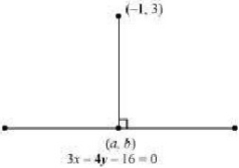
(A) Let $(a, b)$ be the coordinates of the foot of the perpendicular from the point $(-1, 3)$ to the line $3x - 4y - 16 = 0$.
The slope of the line joining $(-1, 3)$ and $(a, b)$ is $m_1 = \frac{b - 3}{a + 1}$.
The slope of the given line $3x - 4y - 16 = 0$ is $m_2 = \frac{3}{4}$.
Since the two lines are perpendicular,$m_1 \times m_2 = -1$.
$\therefore \left(\frac{b - 3}{a + 1}\right) \times \left(\frac{3}{4}\right) = -1$
$\Rightarrow 3b - 9 = -4a - 4$
$\Rightarrow 4a + 3b = 5$ ..... $(1)$
Since the point $(a, b)$ lies on the line $3x - 4y - 16 = 0$,we have:
$3a - 4b = 16$ ..... $(2)$
Solving equations $(1)$ and $(2)$:
Multiply $(1)$ by $4$ and $(2)$ by $3$:
$16a + 12b = 20$
$9a - 12b = 48$
Adding these,$25a = 68 \Rightarrow a = \frac{68}{25}$.
Substituting $a$ in $(1)$: $4(\frac{68}{25}) + 3b = 5$ $\Rightarrow \frac{272}{25} + 3b = 5$ $\Rightarrow 3b = 5 - \frac{272}{25} = \frac{125 - 272}{25} = -\frac{147}{25}$ $\Rightarrow b = -\frac{49}{25}$.
Thus,the coordinates of the foot of the perpendicular are $\left(\frac{68}{25}, -\frac{49}{25}\right)$.
The slope of the line joining $(-1, 3)$ and $(a, b)$ is $m_1 = \frac{b - 3}{a + 1}$.
The slope of the given line $3x - 4y - 16 = 0$ is $m_2 = \frac{3}{4}$.
Since the two lines are perpendicular,$m_1 \times m_2 = -1$.
$\therefore \left(\frac{b - 3}{a + 1}\right) \times \left(\frac{3}{4}\right) = -1$
$\Rightarrow 3b - 9 = -4a - 4$
$\Rightarrow 4a + 3b = 5$ ..... $(1)$
Since the point $(a, b)$ lies on the line $3x - 4y - 16 = 0$,we have:
$3a - 4b = 16$ ..... $(2)$
Solving equations $(1)$ and $(2)$:
Multiply $(1)$ by $4$ and $(2)$ by $3$:
$16a + 12b = 20$
$9a - 12b = 48$
Adding these,$25a = 68 \Rightarrow a = \frac{68}{25}$.
Substituting $a$ in $(1)$: $4(\frac{68}{25}) + 3b = 5$ $\Rightarrow \frac{272}{25} + 3b = 5$ $\Rightarrow 3b = 5 - \frac{272}{25} = \frac{125 - 272}{25} = -\frac{147}{25}$ $\Rightarrow b = -\frac{49}{25}$.
Thus,the coordinates of the foot of the perpendicular are $\left(\frac{68}{25}, -\frac{49}{25}\right)$.
0 likes
View Solution59
MediumMCQ
The perpendicular from the origin to the line $y=mx+c$ meets it at the point $(-1, 2)$. Find the values of $m$ and $c$.
A
$m = \frac{1}{2}, c = \frac{5}{2}$
B
$m = -\frac{1}{2}, c = \frac{5}{2}$
C
$m = \frac{1}{2}, c = -\frac{5}{2}$
D
$m = -\frac{1}{2}, c = -\frac{5}{2}$
Solution
(A) The given equation of the line is $y = mx + c$.
The perpendicular from the origin $(0, 0)$ meets the line at the point $P(-1, 2)$.
The slope of the line segment joining $(0, 0)$ and $(-1, 2)$ is $m_1 = \frac{2 - 0}{-1 - 0} = -2$.
Since the line $y = mx + c$ is perpendicular to this segment,the product of their slopes must be $-1$.
Therefore,$m \times (-2) = -1$,which gives $m = \frac{1}{2}$.
Since the point $(-1, 2)$ lies on the line $y = mx + c$,it must satisfy the equation:
$2 = m(-1) + c$
Substituting $m = \frac{1}{2}$:
$2 = \frac{1}{2}(-1) + c$
$2 = -\frac{1}{2} + c$
$c = 2 + \frac{1}{2} = \frac{5}{2}$.
Thus,the values are $m = \frac{1}{2}$ and $c = \frac{5}{2}$.
The perpendicular from the origin $(0, 0)$ meets the line at the point $P(-1, 2)$.
The slope of the line segment joining $(0, 0)$ and $(-1, 2)$ is $m_1 = \frac{2 - 0}{-1 - 0} = -2$.
Since the line $y = mx + c$ is perpendicular to this segment,the product of their slopes must be $-1$.
Therefore,$m \times (-2) = -1$,which gives $m = \frac{1}{2}$.
Since the point $(-1, 2)$ lies on the line $y = mx + c$,it must satisfy the equation:
$2 = m(-1) + c$
Substituting $m = \frac{1}{2}$:
$2 = \frac{1}{2}(-1) + c$
$2 = -\frac{1}{2} + c$
$c = 2 + \frac{1}{2} = \frac{5}{2}$.
Thus,the values are $m = \frac{1}{2}$ and $c = \frac{5}{2}$.
0 likes
View Solution60
DifficultMCQ
Assuming that straight lines work as the plane mirror for a point,find the image of the point $(1, 2)$ in the line $x - 3y + 4 = 0$.
A
$\left(\frac{6}{5}, \frac{7}{5}\right)$
B
$\left(\frac{7}{5}, \frac{6}{5}\right)$
C
$\left(\frac{1}{5}, \frac{2}{5}\right)$
D
$\left(\frac{2}{5}, \frac{1}{5}\right)$
Solution
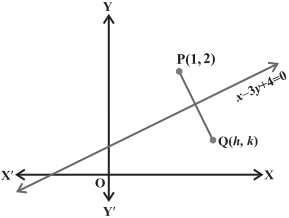
(A) Let $Q(h, k)$ be the image of the point $P(1, 2)$ in the line $x - 3y + 4 = 0$ ... $(1)$.
The line $(1)$ is the perpendicular bisector of the line segment $PQ$.
The slope of the line $x - 3y + 4 = 0$ is $m_1 = \frac{1}{3}$.
The slope of the line $PQ$ is $m_2 = \frac{k - 2}{h - 1}$.
Since $PQ$ is perpendicular to the line $(1)$,$m_1 \times m_2 = -1$,so $\frac{1}{3} \times \frac{k - 2}{h - 1} = -1$,which gives $k - 2 = -3(h - 1)$,or $3h + k = 5$ ... $(2)$.
The midpoint of $PQ$ is $M = \left(\frac{h + 1}{2}, \frac{k + 2}{2}\right)$.
Since $M$ lies on the line $(1)$,$\frac{h + 1}{2} - 3\left(\frac{k + 2}{2}\right) + 4 = 0$,which simplifies to $h + 1 - 3k - 6 + 8 = 0$,or $h - 3k = -3$ ... $(3)$.
Solving equations $(2)$ and $(3)$:
Multiply $(2)$ by $3$: $9h + 3k = 15$.
Adding to $(3)$: $(9h + 3k) + (h - 3k) = 15 - 3$,so $10h = 12$,$h = \frac{6}{5}$.
Substituting $h$ into $(3)$: $\frac{6}{5} - 3k = -3$,so $3k = \frac{6}{5} + 3 = \frac{21}{5}$,$k = \frac{7}{5}$.
Thus,the image is $\left(\frac{6}{5}, \frac{7}{5}\right)$.
The line $(1)$ is the perpendicular bisector of the line segment $PQ$.
The slope of the line $x - 3y + 4 = 0$ is $m_1 = \frac{1}{3}$.
The slope of the line $PQ$ is $m_2 = \frac{k - 2}{h - 1}$.
Since $PQ$ is perpendicular to the line $(1)$,$m_1 \times m_2 = -1$,so $\frac{1}{3} \times \frac{k - 2}{h - 1} = -1$,which gives $k - 2 = -3(h - 1)$,or $3h + k = 5$ ... $(2)$.
The midpoint of $PQ$ is $M = \left(\frac{h + 1}{2}, \frac{k + 2}{2}\right)$.
Since $M$ lies on the line $(1)$,$\frac{h + 1}{2} - 3\left(\frac{k + 2}{2}\right) + 4 = 0$,which simplifies to $h + 1 - 3k - 6 + 8 = 0$,or $h - 3k = -3$ ... $(3)$.
Solving equations $(2)$ and $(3)$:
Multiply $(2)$ by $3$: $9h + 3k = 15$.
Adding to $(3)$: $(9h + 3k) + (h - 3k) = 15 - 3$,so $10h = 12$,$h = \frac{6}{5}$.
Substituting $h$ into $(3)$: $\frac{6}{5} - 3k = -3$,so $3k = \frac{6}{5} + 3 = \frac{21}{5}$,$k = \frac{7}{5}$.
Thus,the image is $\left(\frac{6}{5}, \frac{7}{5}\right)$.
0 likes
View Solution61
DifficultMCQ
Find the image of the point $(3,8)$ with respect to the line $x+3y=7$,assuming the line to be a plane mirror.
A
$(-1,-4)$
B
$(1,4)$
C
$(2,3)$
D
$(0,0)$
Solution
(A) The equation of the given line is $x+3y=7$ ... $(1)$.
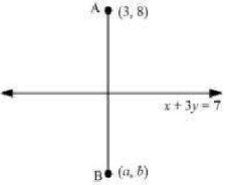
Let point $B(a,b)$ be the image of point $A(3,8)$.
Accordingly,line $(1)$ is the perpendicular bisector of $AB$.
The slope of $AB = \frac{b-8}{a-3}$,while the slope of line $(1) = -\frac{1}{3}$.
Since line $(1)$ is perpendicular to $AB$,we have $\left(\frac{b-8}{a-3}\right) \times \left(-\frac{1}{3}\right) = -1$.
This simplifies to $\frac{b-8}{3a-9} = 1$,which gives $b-8 = 3a-9$,or $3a-b = 1$ ... $(2)$.
The mid-point of $AB$ is $\left(\frac{a+3}{2}, \frac{b+8}{2}\right)$.
Since this mid-point lies on line $(1)$,we have $\left(\frac{a+3}{2}\right) + 3\left(\frac{b+8}{2}\right) = 7$.
Multiplying by $2$,we get $a+3 + 3b+24 = 14$,which simplifies to $a+3b = -13$ ... $(3)$.
Solving equations $(2)$ and $(3)$ simultaneously: From $(2)$,$b = 3a-1$. Substituting into $(3)$,$a + 3(3a-1) = -13$,so $a + 9a - 3 = -13$,$10a = -10$,$a = -1$.
Then $b = 3(-1)-1 = -4$.
Thus,the image of the point is $(-1,-4)$.
Let point $B(a,b)$ be the image of point $A(3,8)$.
Accordingly,line $(1)$ is the perpendicular bisector of $AB$.
The slope of $AB = \frac{b-8}{a-3}$,while the slope of line $(1) = -\frac{1}{3}$.
Since line $(1)$ is perpendicular to $AB$,we have $\left(\frac{b-8}{a-3}\right) \times \left(-\frac{1}{3}\right) = -1$.
This simplifies to $\frac{b-8}{3a-9} = 1$,which gives $b-8 = 3a-9$,or $3a-b = 1$ ... $(2)$.
The mid-point of $AB$ is $\left(\frac{a+3}{2}, \frac{b+8}{2}\right)$.
Since this mid-point lies on line $(1)$,we have $\left(\frac{a+3}{2}\right) + 3\left(\frac{b+8}{2}\right) = 7$.
Multiplying by $2$,we get $a+3 + 3b+24 = 14$,which simplifies to $a+3b = -13$ ... $(3)$.
Solving equations $(2)$ and $(3)$ simultaneously: From $(2)$,$b = 3a-1$. Substituting into $(3)$,$a + 3(3a-1) = -13$,so $a + 9a - 3 = -13$,$10a = -10$,$a = -1$.
Then $b = 3(-1)-1 = -4$.
Thus,the image of the point is $(-1,-4)$.
0 likes
View Solution62
DifficultMCQ
$A$ person standing at the junction of two straight paths represented by the equations $2x - 3y + 4 = 0$ and $3x + 4y - 5 = 0$ wants to reach the path whose equation is $6x - 7y + 8 = 0$ in the least time. Find the equation of the path that he should follow.
A
$119x + 102y = 125$
B
$119x - 102y = 125$
C
$102x + 119y = 125$
D
$102x - 119y = 125$
Solution
(A) The equations of the given lines are:
$2x - 3y + 4 = 0$ $(1)$
$3x + 4y - 5 = 0$ $(2)$
$6x - 7y + 8 = 0$ $(3)$
The person is standing at the junction of the paths represented by lines $(1)$ and $(2)$.
Solving equations $(1)$ and $(2)$ by multiplying $(1)$ by $4$ and $(2)$ by $3$:
$8x - 12y + 16 = 0$
$9x + 12y - 15 = 0$
Adding these,we get $17x + 1 = 0$,so $x = -\frac{1}{17}$.
Substituting $x$ into $(1)$: $2(-\frac{1}{17}) - 3y + 4 = 0 \implies -\frac{2}{17} + 4 = 3y \implies \frac{66}{17} = 3y \implies y = \frac{22}{17}$.
Thus,the person is at point $(-\frac{1}{17}, \frac{22}{17})$.
To reach path $(3)$ in the least time,the person must walk along the perpendicular line to $(3)$ from the point $(-\frac{1}{17}, \frac{22}{17})$.
The slope of line $(3)$ is $m = \frac{6}{7}$.
The slope of the perpendicular line is $m' = -\frac{1}{m} = -\frac{7}{6}$.
The equation of the line passing through $(-\frac{1}{17}, \frac{22}{17})$ with slope $-\frac{7}{6}$ is:
$(y - \frac{22}{17}) = -\frac{7}{6}(x + \frac{1}{17})$
$6(17y - 22) = -7(17x + 1)$
$102y - 132 = -119x - 7$
$119x + 102y = 125$.
$2x - 3y + 4 = 0$ $(1)$
$3x + 4y - 5 = 0$ $(2)$
$6x - 7y + 8 = 0$ $(3)$
The person is standing at the junction of the paths represented by lines $(1)$ and $(2)$.
Solving equations $(1)$ and $(2)$ by multiplying $(1)$ by $4$ and $(2)$ by $3$:
$8x - 12y + 16 = 0$
$9x + 12y - 15 = 0$
Adding these,we get $17x + 1 = 0$,so $x = -\frac{1}{17}$.
Substituting $x$ into $(1)$: $2(-\frac{1}{17}) - 3y + 4 = 0 \implies -\frac{2}{17} + 4 = 3y \implies \frac{66}{17} = 3y \implies y = \frac{22}{17}$.
Thus,the person is at point $(-\frac{1}{17}, \frac{22}{17})$.
To reach path $(3)$ in the least time,the person must walk along the perpendicular line to $(3)$ from the point $(-\frac{1}{17}, \frac{22}{17})$.
The slope of line $(3)$ is $m = \frac{6}{7}$.
The slope of the perpendicular line is $m' = -\frac{1}{m} = -\frac{7}{6}$.
The equation of the line passing through $(-\frac{1}{17}, \frac{22}{17})$ with slope $-\frac{7}{6}$ is:
$(y - \frac{22}{17}) = -\frac{7}{6}(x + \frac{1}{17})$
$6(17y - 22) = -7(17x + 1)$
$102y - 132 = -119x - 7$
$119x + 102y = 125$.
0 likes
View Solution63
MediumMCQ
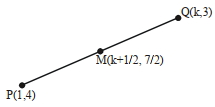
If the perpendicular bisector of the line segment joining the points $P(1, 4)$ and $Q(k, 3)$ has a $y$-intercept equal to $-4$,then a value of $k$ is
A
$\sqrt{15}$
B
$-2$
C
$\sqrt{14}$
D
$-4$
Solution
(D) The midpoint $M$ of the line segment $PQ$ is given by $M = \left(\frac{1+k}{2}, \frac{4+3}{2}\right) = \left(\frac{k+1}{2}, \frac{7}{2}\right)$.
The slope of the line segment $PQ$ is $m_{PQ} = \frac{3-4}{k-1} = \frac{-1}{k-1}$.
The slope of the perpendicular bisector is $m = -\frac{1}{m_{PQ}} = k-1$.
The equation of the perpendicular bisector passing through $M$ with slope $m$ is $y - \frac{7}{2} = (k-1)\left(x - \frac{k+1}{2}\right)$.
The $y$-intercept is the value of $y$ when $x=0$. Given the $y$-intercept is $-4$,we substitute $x=0$ and $y=-4$ into the equation:
$-4 - \frac{7}{2} = (k-1)\left(0 - \frac{k+1}{2}\right)$
$-\frac{15}{2} = (k-1)\left(-\frac{k+1}{2}\right)$
$\frac{15}{2} = \frac{(k-1)(k+1)}{2}$
$15 = k^2 - 1$
$k^2 = 16$
$k = \pm 4$.
Since $-4$ is an option,the correct value is $-4$.
The slope of the line segment $PQ$ is $m_{PQ} = \frac{3-4}{k-1} = \frac{-1}{k-1}$.
The slope of the perpendicular bisector is $m = -\frac{1}{m_{PQ}} = k-1$.
The equation of the perpendicular bisector passing through $M$ with slope $m$ is $y - \frac{7}{2} = (k-1)\left(x - \frac{k+1}{2}\right)$.
The $y$-intercept is the value of $y$ when $x=0$. Given the $y$-intercept is $-4$,we substitute $x=0$ and $y=-4$ into the equation:
$-4 - \frac{7}{2} = (k-1)\left(0 - \frac{k+1}{2}\right)$
$-\frac{15}{2} = (k-1)\left(-\frac{k+1}{2}\right)$
$\frac{15}{2} = \frac{(k-1)(k+1)}{2}$
$15 = k^2 - 1$
$k^2 = 16$
$k = \pm 4$.
Since $-4$ is an option,the correct value is $-4$.
0 likes
View Solution64
DifficultMCQ
Let $L$ denote the line in the $xy$-plane with $x$ and $y$ intercepts as $3$ and $1$ respectively. Then the image of the point $(-1, -4)$ in this line is
A
$\left(\frac{8}{5}, \frac{29}{5}\right)$
B
$\left(\frac{29}{5}, \frac{11}{5}\right)$
C
$\left(\frac{11}{5}, \frac{28}{5}\right)$
D
$\left(\frac{29}{5}, \frac{8}{5}\right)$
Solution
(C) The equation of the line $L$ with $x$-intercept $3$ and $y$-intercept $1$ is given by $\frac{x}{3} + \frac{y}{1} = 1$,which simplifies to $x + 3y - 3 = 0$.
To find the image $(x', y')$ of the point $(x_0, y_0) = (-1, -4)$ in the line $ax + by + c = 0$,we use the formula $\frac{x' - x_0}{a} = \frac{y' - y_0}{b} = -2 \frac{ax_0 + by_0 + c}{a^2 + b^2}$.
Substituting the values: $\frac{x' - (-1)}{1} = \frac{y' - (-4)}{3} = -2 \frac{1(-1) + 3(-4) - 3}{1^2 + 3^2}$.
$\frac{x' + 1}{1} = \frac{y' + 4}{3} = -2 \frac{-1 - 12 - 3}{1 + 9} = -2 \frac{-16}{10} = \frac{32}{10} = \frac{16}{5}$.
For $x'$: $x' + 1 = \frac{16}{5} \Rightarrow x' = \frac{16}{5} - 1 = \frac{11}{5}$.
For $y'$: $\frac{y' + 4}{3} = \frac{16}{5}$ $\Rightarrow y' + 4 = \frac{48}{5}$ $\Rightarrow y' = \frac{48}{5} - 4 = \frac{28}{5}$.
Thus,the image is $\left(\frac{11}{5}, \frac{28}{5}\right)$.
To find the image $(x', y')$ of the point $(x_0, y_0) = (-1, -4)$ in the line $ax + by + c = 0$,we use the formula $\frac{x' - x_0}{a} = \frac{y' - y_0}{b} = -2 \frac{ax_0 + by_0 + c}{a^2 + b^2}$.
Substituting the values: $\frac{x' - (-1)}{1} = \frac{y' - (-4)}{3} = -2 \frac{1(-1) + 3(-4) - 3}{1^2 + 3^2}$.
$\frac{x' + 1}{1} = \frac{y' + 4}{3} = -2 \frac{-1 - 12 - 3}{1 + 9} = -2 \frac{-16}{10} = \frac{32}{10} = \frac{16}{5}$.
For $x'$: $x' + 1 = \frac{16}{5} \Rightarrow x' = \frac{16}{5} - 1 = \frac{11}{5}$.
For $y'$: $\frac{y' + 4}{3} = \frac{16}{5}$ $\Rightarrow y' + 4 = \frac{48}{5}$ $\Rightarrow y' = \frac{48}{5} - 4 = \frac{28}{5}$.
Thus,the image is $\left(\frac{11}{5}, \frac{28}{5}\right)$.
0 likes
View Solution65
MediumMCQ
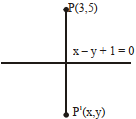
The image of the point $(3,5)$ in the line $x-y+1=0$ lies on:
A
$(x-2)^{2}+(y-2)^{2}=12$
B
$(x-4)^{2}+(y+2)^{2}=16$
C
$(x-4)^{2}+(y-4)^{2}=8$
D
$(x-2)^{2}+(y-4)^{2}=4$
Solution
(D) Let the image of the point $P(3,5)$ in the line $x-y+1=0$ be $P'(x,y)$.
Using the formula for the image of a point $(x_1, y_1)$ in the line $ax+by+c=0$:
$\frac{x-x_1}{a} = \frac{y-y_1}{b} = -2 \left( \frac{ax_1+by_1+c}{a^2+b^2} \right)$
Substituting the values $x_1=3, y_1=5, a=1, b=-1, c=1$:
$\frac{x-3}{1} = \frac{y-5}{-1} = -2 \left( \frac{3-5+1}{1^2+(-1)^2} \right)$
$\frac{x-3}{1} = \frac{y-5}{-1} = -2 \left( \frac{-1}{2} \right) = 1$
So,$x-3=1 \implies x=4$ and $y-5=-1 \implies y=4$.
The image point is $(4,4)$.
Now,check which option is satisfied by the point $(4,4)$:
For option $D$: $(4-2)^2 + (4-4)^2 = 2^2 + 0^2 = 4$.
Thus,the point $(4,4)$ lies on the circle $(x-2)^2 + (y-4)^2 = 4$.
Using the formula for the image of a point $(x_1, y_1)$ in the line $ax+by+c=0$:
$\frac{x-x_1}{a} = \frac{y-y_1}{b} = -2 \left( \frac{ax_1+by_1+c}{a^2+b^2} \right)$
Substituting the values $x_1=3, y_1=5, a=1, b=-1, c=1$:
$\frac{x-3}{1} = \frac{y-5}{-1} = -2 \left( \frac{3-5+1}{1^2+(-1)^2} \right)$
$\frac{x-3}{1} = \frac{y-5}{-1} = -2 \left( \frac{-1}{2} \right) = 1$
So,$x-3=1 \implies x=4$ and $y-5=-1 \implies y=4$.
The image point is $(4,4)$.
Now,check which option is satisfied by the point $(4,4)$:
For option $D$: $(4-2)^2 + (4-4)^2 = 2^2 + 0^2 = 4$.
Thus,the point $(4,4)$ lies on the circle $(x-2)^2 + (y-4)^2 = 4$.
0 likes
View Solution66
DifficultMCQ
Let $A \left(\frac{3}{\sqrt{a}}, \sqrt{a}\right)$ with $a > 0$ be a fixed point in the $xy$-plane. The image of $A$ in the $y$-axis is $B$,and the image of $B$ in the $x$-axis is $C$. If $D(3 \cos \theta, a \sin \theta)$ is a point in the fourth quadrant such that the maximum area of $\triangle ACD$ is $12$ square units,then $a$ is equal to:
A
$12$
B
$8$
C
$6$
D
$3$
Solution
(B) Given $A = \left(\frac{3}{\sqrt{a}}, \sqrt{a}\right)$.
The image of $A$ in the $y$-axis is $B = \left(-\frac{3}{\sqrt{a}}, \sqrt{a}\right)$.
The image of $B$ in the $x$-axis is $C = \left(-\frac{3}{\sqrt{a}}, -\sqrt{a}\right)$.
The area of $\triangle ACD$ with vertices $A\left(\frac{3}{\sqrt{a}}, \sqrt{a}\right)$,$C\left(-\frac{3}{\sqrt{a}}, -\sqrt{a}\right)$,and $D(3 \cos \theta, a \sin \theta)$ is given by the determinant formula:
$\text{Area} = \frac{1}{2} \left| x_A(y_C - y_D) + x_C(y_D - y_A) + x_D(y_A - y_C) \right|$
Substituting the coordinates:
$\text{Area} = \frac{1}{2} \left| \frac{3}{\sqrt{a}}(-\sqrt{a} - a \sin \theta) - \frac{3}{\sqrt{a}}(a \sin \theta - \sqrt{a}) + 3 \cos \theta(\sqrt{a} - (-\sqrt{a})) \right|$
$\text{Area} = \frac{1}{2} \left| -3 - 3\sqrt{a} \sin \theta - 3\sqrt{a} \sin \theta + 3 + 6\sqrt{a} \cos \theta \right|$
$\text{Area} = \frac{1}{2} \left| 6\sqrt{a} \cos \theta - 6\sqrt{a} \sin \theta \right| = 3\sqrt{a} |\cos \theta - \sin \theta|$
Since $D$ is in the fourth quadrant,$\theta \in (\frac{3\pi}{2}, 2\pi)$,so $\cos \theta > 0$ and $\sin \theta < 0$. Thus,$(\cos \theta - \sin \theta) > 0$.
The maximum value of $(\cos \theta - \sin \theta)$ is $\sqrt{1^2 + (-1)^2} = \sqrt{2}$.
Therefore,$\text{Max Area} = 3\sqrt{a} \cdot \sqrt{2} = 12$.
$\sqrt{2a} = 4 \implies 2a = 16 \implies a = 8$.
The image of $A$ in the $y$-axis is $B = \left(-\frac{3}{\sqrt{a}}, \sqrt{a}\right)$.
The image of $B$ in the $x$-axis is $C = \left(-\frac{3}{\sqrt{a}}, -\sqrt{a}\right)$.
The area of $\triangle ACD$ with vertices $A\left(\frac{3}{\sqrt{a}}, \sqrt{a}\right)$,$C\left(-\frac{3}{\sqrt{a}}, -\sqrt{a}\right)$,and $D(3 \cos \theta, a \sin \theta)$ is given by the determinant formula:
$\text{Area} = \frac{1}{2} \left| x_A(y_C - y_D) + x_C(y_D - y_A) + x_D(y_A - y_C) \right|$
Substituting the coordinates:
$\text{Area} = \frac{1}{2} \left| \frac{3}{\sqrt{a}}(-\sqrt{a} - a \sin \theta) - \frac{3}{\sqrt{a}}(a \sin \theta - \sqrt{a}) + 3 \cos \theta(\sqrt{a} - (-\sqrt{a})) \right|$
$\text{Area} = \frac{1}{2} \left| -3 - 3\sqrt{a} \sin \theta - 3\sqrt{a} \sin \theta + 3 + 6\sqrt{a} \cos \theta \right|$
$\text{Area} = \frac{1}{2} \left| 6\sqrt{a} \cos \theta - 6\sqrt{a} \sin \theta \right| = 3\sqrt{a} |\cos \theta - \sin \theta|$
Since $D$ is in the fourth quadrant,$\theta \in (\frac{3\pi}{2}, 2\pi)$,so $\cos \theta > 0$ and $\sin \theta < 0$. Thus,$(\cos \theta - \sin \theta) > 0$.
The maximum value of $(\cos \theta - \sin \theta)$ is $\sqrt{1^2 + (-1)^2} = \sqrt{2}$.
Therefore,$\text{Max Area} = 3\sqrt{a} \cdot \sqrt{2} = 12$.
$\sqrt{2a} = 4 \implies 2a = 16 \implies a = 8$.
0 likes
View Solution67
DifficultMCQ
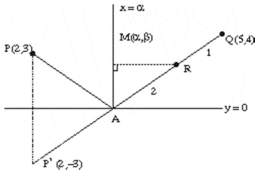
$A$ ray of light passing through the point $P(2, 3)$ reflects on the $x$-axis at point $A$ and the reflected ray passes through the point $Q(5, 4)$. Let $R$ be the point that divides the line segment $AQ$ internally in the ratio $2:1$. Let the coordinates of the foot of the perpendicular $M$ from $R$ on the bisector of the angle $PAQ$ be $(\alpha, \beta)$. Then,the value of $7\alpha + 3\beta$ is equal to.......
A
$31$
B
$91$
C
$310$
D
$312$
Solution
(A) Let $P'(2, -3)$ be the reflection of $P(2, 3)$ across the $x$-axis $(y=0)$.
Since the ray reflects at $A$ on the $x$-axis,$P', A,$ and $Q$ are collinear.
The equation of line $P'Q$ passing through $(2, -3)$ and $(5, 4)$ is:
$y - (-3) = \frac{4 - (-3)}{5 - 2}(x - 2)$
$y + 3 = \frac{7}{3}(x - 2) \implies 3y + 9 = 7x - 14 \implies 7x - 3y = 23$.
At point $A$,$y = 0$,so $7x = 23 \implies x = \frac{23}{7}$. Thus,$A = (\frac{23}{7}, 0)$.
$R$ divides $AQ$ in ratio $2:1$. $A = (\frac{23}{7}, 0)$ and $Q = (5, 4)$.
$R = (\frac{2(5) + 1(23/7)}{2+1}, \frac{2(4) + 1(0)}{2+1}) = (\frac{10 + 23/7}{3}, \frac{8}{3}) = (\frac{93/7}{3}, \frac{8}{3}) = (\frac{31}{7}, \frac{8}{3})$.
The bisector of $\angle PAQ$ is the line perpendicular to the $x$-axis passing through $A$ (since the angle of incidence equals the angle of reflection). This is the line $x = \frac{23}{7}$.
The foot of the perpendicular $M$ from $R(\frac{31}{7}, \frac{8}{3})$ to the line $x = \frac{23}{7}$ is $M(\frac{23}{7}, \frac{8}{3})$.
Thus,$\alpha = \frac{23}{7}$ and $\beta = \frac{8}{3}$.
$7\alpha + 3\beta = 7(\frac{23}{7}) + 3(\frac{8}{3}) = 23 + 8 = 31$.
Since the ray reflects at $A$ on the $x$-axis,$P', A,$ and $Q$ are collinear.
The equation of line $P'Q$ passing through $(2, -3)$ and $(5, 4)$ is:
$y - (-3) = \frac{4 - (-3)}{5 - 2}(x - 2)$
$y + 3 = \frac{7}{3}(x - 2) \implies 3y + 9 = 7x - 14 \implies 7x - 3y = 23$.
At point $A$,$y = 0$,so $7x = 23 \implies x = \frac{23}{7}$. Thus,$A = (\frac{23}{7}, 0)$.
$R$ divides $AQ$ in ratio $2:1$. $A = (\frac{23}{7}, 0)$ and $Q = (5, 4)$.
$R = (\frac{2(5) + 1(23/7)}{2+1}, \frac{2(4) + 1(0)}{2+1}) = (\frac{10 + 23/7}{3}, \frac{8}{3}) = (\frac{93/7}{3}, \frac{8}{3}) = (\frac{31}{7}, \frac{8}{3})$.
The bisector of $\angle PAQ$ is the line perpendicular to the $x$-axis passing through $A$ (since the angle of incidence equals the angle of reflection). This is the line $x = \frac{23}{7}$.
The foot of the perpendicular $M$ from $R(\frac{31}{7}, \frac{8}{3})$ to the line $x = \frac{23}{7}$ is $M(\frac{23}{7}, \frac{8}{3})$.
Thus,$\alpha = \frac{23}{7}$ and $\beta = \frac{8}{3}$.
$7\alpha + 3\beta = 7(\frac{23}{7}) + 3(\frac{8}{3}) = 23 + 8 = 31$.
0 likes
View Solution68
AdvancedMCQ
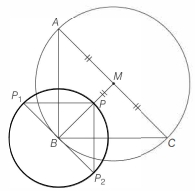
Let $P$ be a point inside a $\triangle ABC$ with $\angle ABC = 90^{\circ}$. Let $P_1$ and $P_2$ be the images of $P$ under reflection in $AB$ and $BC$ respectively. The distance between the circumcenters of $\triangle ABC$ and $\triangle P_1PP_2$ is
A
$\frac{AB}{2}$
B
$\frac{AP+BP+CP}{3}$
C
$\frac{AC}{2}$
D
$\frac{AB+BC+AC}{2}$
Solution
(C) $\triangle ABC$ is a right-angled triangle with $\angle ABC = 90^{\circ}$.
The circumcenter of $\triangle ABC$ is the midpoint of the hypotenuse $AC$,denoted as $M$.
By the properties of reflection,$AB$ is the perpendicular bisector of $PP_1$,and $BC$ is the perpendicular bisector of $PP_2$.
Since $AB \perp BC$ at $B$,the point $B$ is equidistant from $P, P_1,$ and $P_2$ because $BP = BP_1$ and $BP = BP_2$.
Thus,$B$ is the circumcenter of $\triangle P_1PP_2$.
In $\triangle ABC$,$M$ is the midpoint of $AC$,so $BM = AM = MC = \frac{AC}{2}$ (property of the median to the hypotenuse in a right triangle).
Therefore,the distance between the circumcenters $B$ and $M$ is $BM = \frac{AC}{2}$.
The circumcenter of $\triangle ABC$ is the midpoint of the hypotenuse $AC$,denoted as $M$.
By the properties of reflection,$AB$ is the perpendicular bisector of $PP_1$,and $BC$ is the perpendicular bisector of $PP_2$.
Since $AB \perp BC$ at $B$,the point $B$ is equidistant from $P, P_1,$ and $P_2$ because $BP = BP_1$ and $BP = BP_2$.
Thus,$B$ is the circumcenter of $\triangle P_1PP_2$.
In $\triangle ABC$,$M$ is the midpoint of $AC$,so $BM = AM = MC = \frac{AC}{2}$ (property of the median to the hypotenuse in a right triangle).
Therefore,the distance between the circumcenters $B$ and $M$ is $BM = \frac{AC}{2}$.
0 likes
View Solution69
AdvancedMCQ
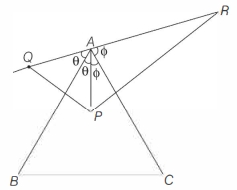
Let $P$ be an interior point of a $\triangle ABC$. Let $Q$ and $R$ be the reflections of $P$ in $AB$ and $AC$,respectively. If $Q, A, R$ are collinear,then $\angle A$ equals (in $^{\circ}$)
A
$30$
B
$60$
C
$90$
D
$120$
Solution
(C) Let $\angle PAB = \theta$ and $\angle PAC = \phi$.
Since $Q$ is the reflection of $P$ in $AB$,we have $AQ = AP$ and $\angle QAB = \angle PAB = \theta$.
Since $R$ is the reflection of $P$ in $AC$,we have $AR = AP$ and $\angle RAC = \angle PAC = \phi$.
Given that $Q, A, R$ are collinear,the angle $\angle QAR = 180^{\circ}$.
From the figure,$\angle QAR = \angle QAB + \angle BAC + \angle RAC = \theta + (\theta + \phi) + \phi = 2(\theta + \phi) = 180^{\circ}$.
Thus,$\theta + \phi = 90^{\circ}$.
Since $\angle BAC = \theta + \phi$,we have $\angle BAC = 90^{\circ}$.
Since $Q$ is the reflection of $P$ in $AB$,we have $AQ = AP$ and $\angle QAB = \angle PAB = \theta$.
Since $R$ is the reflection of $P$ in $AC$,we have $AR = AP$ and $\angle RAC = \angle PAC = \phi$.
Given that $Q, A, R$ are collinear,the angle $\angle QAR = 180^{\circ}$.
From the figure,$\angle QAR = \angle QAB + \angle BAC + \angle RAC = \theta + (\theta + \phi) + \phi = 2(\theta + \phi) = 180^{\circ}$.
Thus,$\theta + \phi = 90^{\circ}$.
Since $\angle BAC = \theta + \phi$,we have $\angle BAC = 90^{\circ}$.
0 likes
View Solution70
DifficultMCQ
$A$ light ray emits from the origin making an angle $30^{\circ}$ with the positive $x$-axis. After getting reflected by the line $x + y = 1$,if this ray intersects the $x$-axis at $Q$,then the abscissa of $Q$ is
A
$\frac{2}{\sqrt{3}-1}$
B
$\frac{2}{3+\sqrt{3}}$
C
$\frac{2}{3-\sqrt{3}}$
D
$\frac{\sqrt{3}}{2(\sqrt{3}+1)}$
Solution
(B) The incident ray passes through the origin $(0, 0)$ with slope $m = \tan 30^{\circ} = \frac{1}{\sqrt{3}}$.
Its equation is $y = \frac{1}{\sqrt{3}}x$.
The intersection point $P$ of this ray with the line $x + y = 1$ is found by substituting $y = \frac{x}{\sqrt{3}}$ into $x + y = 1$:
$x + \frac{x}{\sqrt{3}} = 1$ $\Rightarrow x(1 + \frac{1}{\sqrt{3}}) = 1$ $\Rightarrow x = \frac{\sqrt{3}}{\sqrt{3} + 1}$.
Thus,$P = \left(\frac{\sqrt{3}}{\sqrt{3} + 1}, \frac{1}{\sqrt{3} + 1}\right)$.
The line $x + y = 1$ has slope $m_1 = -1$,so its angle is $135^{\circ}$.
The incident ray makes $30^{\circ}$ with the $x$-axis. The angle of incidence with the normal is $135^{\circ} - 30^{\circ} = 105^{\circ}$ (relative to the line). The reflected ray makes an angle of $135^{\circ} + (135^{\circ} - 30^{\circ}) = 240^{\circ}$ or $60^{\circ}$ with the positive $x$-axis.
The slope of the reflected ray is $\tan 60^{\circ} = \sqrt{3}$.
The equation of the reflected ray passing through $P$ is $y - \frac{1}{\sqrt{3} + 1} = \sqrt{3}(x - \frac{\sqrt{3}}{\sqrt{3} + 1})$.
Setting $y = 0$ to find the $x$-intercept $Q$:
$-\frac{1}{\sqrt{3} + 1} = \sqrt{3}x - \frac{3}{\sqrt{3} + 1}$ $\Rightarrow \sqrt{3}x = \frac{3 - 1}{\sqrt{3} + 1} = \frac{2}{\sqrt{3} + 1}$.
$x = \frac{2}{\sqrt{3}(\sqrt{3} + 1)} = \frac{2}{3 + \sqrt{3}}$.
Its equation is $y = \frac{1}{\sqrt{3}}x$.
The intersection point $P$ of this ray with the line $x + y = 1$ is found by substituting $y = \frac{x}{\sqrt{3}}$ into $x + y = 1$:
$x + \frac{x}{\sqrt{3}} = 1$ $\Rightarrow x(1 + \frac{1}{\sqrt{3}}) = 1$ $\Rightarrow x = \frac{\sqrt{3}}{\sqrt{3} + 1}$.
Thus,$P = \left(\frac{\sqrt{3}}{\sqrt{3} + 1}, \frac{1}{\sqrt{3} + 1}\right)$.
The line $x + y = 1$ has slope $m_1 = -1$,so its angle is $135^{\circ}$.
The incident ray makes $30^{\circ}$ with the $x$-axis. The angle of incidence with the normal is $135^{\circ} - 30^{\circ} = 105^{\circ}$ (relative to the line). The reflected ray makes an angle of $135^{\circ} + (135^{\circ} - 30^{\circ}) = 240^{\circ}$ or $60^{\circ}$ with the positive $x$-axis.
The slope of the reflected ray is $\tan 60^{\circ} = \sqrt{3}$.
The equation of the reflected ray passing through $P$ is $y - \frac{1}{\sqrt{3} + 1} = \sqrt{3}(x - \frac{\sqrt{3}}{\sqrt{3} + 1})$.
Setting $y = 0$ to find the $x$-intercept $Q$:
$-\frac{1}{\sqrt{3} + 1} = \sqrt{3}x - \frac{3}{\sqrt{3} + 1}$ $\Rightarrow \sqrt{3}x = \frac{3 - 1}{\sqrt{3} + 1} = \frac{2}{\sqrt{3} + 1}$.
$x = \frac{2}{\sqrt{3}(\sqrt{3} + 1)} = \frac{2}{3 + \sqrt{3}}$.
0 likes
View Solution71
DifficultMCQ
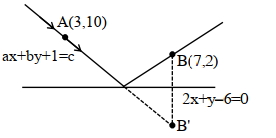
Let a ray of light passing through the point $(3,10)$ reflect on the line $2x+y=6$ and the reflected ray pass through the point $(7,2)$. If the equation of the incident ray is $ax+by+1=0$,then $a^2+b^2+3ab$ is equal to:
A
$50$
B
$10$
C
$1$
D
$5$
Solution
(C) To find the reflection of point $B(7,2)$ about the line $2x+y-6=0$,let the reflected point be $B'(x', y')$.
Using the reflection formula $\frac{x'-7}{2} = \frac{y'-2}{1} = -2 \left( \frac{2(7)+1(2)-6}{2^2+1^2} \right)$,
$\frac{x'-7}{2} = \frac{y'-2}{1} = -2 \left( \frac{14+2-6}{5} \right) = -2 \left( \frac{10}{5} \right) = -4$.
Thus,$x'-7 = -8 \implies x' = -1$ and $y'-2 = -4 \implies y' = -2$.
So,$B' = (-1, -2)$.
The incident ray passes through $A(3, 10)$ and $B'(-1, -2)$.
The slope of the incident ray is $m = \frac{10 - (-2)}{3 - (-1)} = \frac{12}{4} = 3$.
The equation of the incident ray is $y - 10 = 3(x - 3) \implies y - 10 = 3x - 9 \implies 3x - y + 1 = 0$.
Comparing this with $ax + by + 1 = 0$,we get $a = 3$ and $b = -1$.
Therefore,$a^2 + b^2 + 3ab = (3)^2 + (-1)^2 + 3(3)(-1) = 9 + 1 - 9 = 1$.
Using the reflection formula $\frac{x'-7}{2} = \frac{y'-2}{1} = -2 \left( \frac{2(7)+1(2)-6}{2^2+1^2} \right)$,
$\frac{x'-7}{2} = \frac{y'-2}{1} = -2 \left( \frac{14+2-6}{5} \right) = -2 \left( \frac{10}{5} \right) = -4$.
Thus,$x'-7 = -8 \implies x' = -1$ and $y'-2 = -4 \implies y' = -2$.
So,$B' = (-1, -2)$.
The incident ray passes through $A(3, 10)$ and $B'(-1, -2)$.
The slope of the incident ray is $m = \frac{10 - (-2)}{3 - (-1)} = \frac{12}{4} = 3$.
The equation of the incident ray is $y - 10 = 3(x - 3) \implies y - 10 = 3x - 9 \implies 3x - y + 1 = 0$.
Comparing this with $ax + by + 1 = 0$,we get $a = 3$ and $b = -1$.
Therefore,$a^2 + b^2 + 3ab = (3)^2 + (-1)^2 + 3(3)(-1) = 9 + 1 - 9 = 1$.
0 likes
View Solution72
DifficultMCQ
Let the triangle $PQR$ be the image of the triangle with vertices $(1,3), (3,1)$ and $(2,4)$ in the line $x+2y=2$. If the centroid of $\triangle PQR$ is the point $(\alpha, \beta)$,then $15(\alpha-\beta)$ is equal to:
A
$24$
B
$19$
C
$21$
D
$22$
Solution
(D) Let $G$ be the centroid of the triangle formed by vertices $(1,3), (3,1)$ and $(2,4)$.
$G = \left(\frac{1+3+2}{3}, \frac{3+1+4}{3}\right) = \left(2, \frac{8}{3}\right)$.
Let $(\alpha, \beta)$ be the image of $G$ with respect to the line $x+2y-2=0$.
The formula for the image $(x', y')$ of a point $(x_0, y_0)$ in the line $ax+by+c=0$ is $\frac{x'-x_0}{a} = \frac{y'-y_0}{b} = -2\frac{ax_0+by_0+c}{a^2+b^2}$.
Substituting the values: $\frac{\alpha-2}{1} = \frac{\beta-8/3}{2} = -2\frac{2+2(8/3)-2}{1^2+2^2}$.
$\frac{\alpha-2}{1} = \frac{\beta-8/3}{2} = -2\frac{16/3}{5} = -\frac{32}{15}$.
Thus,$\alpha = 2 - \frac{32}{15} = -\frac{2}{15}$ and $\beta = \frac{8}{3} - \frac{64}{15} = \frac{40-64}{15} = -\frac{24}{15}$.
Finally,$15(\alpha-\beta) = 15\left(-\frac{2}{15} - (-\frac{24}{15})\right) = 15\left(\frac{22}{15}\right) = 22$.
$G = \left(\frac{1+3+2}{3}, \frac{3+1+4}{3}\right) = \left(2, \frac{8}{3}\right)$.
Let $(\alpha, \beta)$ be the image of $G$ with respect to the line $x+2y-2=0$.
The formula for the image $(x', y')$ of a point $(x_0, y_0)$ in the line $ax+by+c=0$ is $\frac{x'-x_0}{a} = \frac{y'-y_0}{b} = -2\frac{ax_0+by_0+c}{a^2+b^2}$.
Substituting the values: $\frac{\alpha-2}{1} = \frac{\beta-8/3}{2} = -2\frac{2+2(8/3)-2}{1^2+2^2}$.
$\frac{\alpha-2}{1} = \frac{\beta-8/3}{2} = -2\frac{16/3}{5} = -\frac{32}{15}$.
Thus,$\alpha = 2 - \frac{32}{15} = -\frac{2}{15}$ and $\beta = \frac{8}{3} - \frac{64}{15} = \frac{40-64}{15} = -\frac{24}{15}$.
Finally,$15(\alpha-\beta) = 15\left(-\frac{2}{15} - (-\frac{24}{15})\right) = 15\left(\frac{22}{15}\right) = 22$.
0 likes
View Solution73
DifficultMCQ
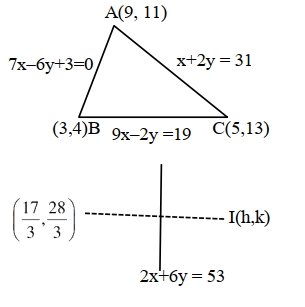
Let $ABC$ be a triangle formed by the lines $7x-6y+3=0$,$x+2y-31=0$,and $9x-2y-19=0$. Let the point $(h, k)$ be the image of the centroid of $\Delta ABC$ in the line $3x+6y-53=0$. Then $h^2+k^2+hk$ is equal to
A
$37$
B
$47$
C
$40$
D
$36$
Solution
(A) First,find the vertices of the triangle by solving the equations of the lines pairwise:
$1$) $7x-6y+3=0$ and $x+2y-31=0$ intersect at $A(9, 11)$.
$2$) $7x-6y+3=0$ and $9x-2y-19=0$ intersect at $B(3, 4)$.
$3$) $x+2y-31=0$ and $9x-2y-19=0$ intersect at $C(5, 13)$.
The centroid $G$ of $\Delta ABC$ is given by $\left(\frac{9+3+5}{3}, \frac{11+4+13}{3}\right) = \left(\frac{17}{3}, \frac{28}{3}\right)$.
Let $(h, k)$ be the image of $G\left(\frac{17}{3}, \frac{28}{3}\right)$ in the line $3x+6y-53=0$. The formula for the image $(h, k)$ of a point $(x_1, y_1)$ in the line $ax+by+c=0$ is $\frac{h-x_1}{a} = \frac{k-y_1}{b} = -2\frac{ax_1+by_1+c}{a^2+b^2}$.
Here,$a=3, b=6, c=-53, x_1=\frac{17}{3}, y_1=\frac{28}{3}$.
$\frac{h-17/3}{3} = \frac{k-28/3}{6} = -2\frac{3(17/3)+6(28/3)-53}{3^2+6^2} = -2\frac{17+56-53}{9+36} = -2\frac{20}{45} = -2\frac{4}{9} = -\frac{8}{9}$.
$h - \frac{17}{3} = 3 \times (-\frac{8}{9}) = -\frac{8}{3} \implies h = \frac{17-8}{3} = 3$.
$k - \frac{28}{3} = 6 \times (-\frac{8}{9}) = -\frac{16}{3} \implies k = \frac{28-16}{3} = 4$.
Thus,$h^2+k^2+hk = 3^2+4^2+(3)(4) = 9+16+12 = 37$.
$1$) $7x-6y+3=0$ and $x+2y-31=0$ intersect at $A(9, 11)$.
$2$) $7x-6y+3=0$ and $9x-2y-19=0$ intersect at $B(3, 4)$.
$3$) $x+2y-31=0$ and $9x-2y-19=0$ intersect at $C(5, 13)$.
The centroid $G$ of $\Delta ABC$ is given by $\left(\frac{9+3+5}{3}, \frac{11+4+13}{3}\right) = \left(\frac{17}{3}, \frac{28}{3}\right)$.
Let $(h, k)$ be the image of $G\left(\frac{17}{3}, \frac{28}{3}\right)$ in the line $3x+6y-53=0$. The formula for the image $(h, k)$ of a point $(x_1, y_1)$ in the line $ax+by+c=0$ is $\frac{h-x_1}{a} = \frac{k-y_1}{b} = -2\frac{ax_1+by_1+c}{a^2+b^2}$.
Here,$a=3, b=6, c=-53, x_1=\frac{17}{3}, y_1=\frac{28}{3}$.
$\frac{h-17/3}{3} = \frac{k-28/3}{6} = -2\frac{3(17/3)+6(28/3)-53}{3^2+6^2} = -2\frac{17+56-53}{9+36} = -2\frac{20}{45} = -2\frac{4}{9} = -\frac{8}{9}$.
$h - \frac{17}{3} = 3 \times (-\frac{8}{9}) = -\frac{8}{3} \implies h = \frac{17-8}{3} = 3$.
$k - \frac{28}{3} = 6 \times (-\frac{8}{9}) = -\frac{16}{3} \implies k = \frac{28-16}{3} = 4$.
Thus,$h^2+k^2+hk = 3^2+4^2+(3)(4) = 9+16+12 = 37$.
0 likes
View Solution74
DifficultMCQ
Consider the lines $x(3 \lambda+1)+y(7 \lambda+2)=17 \lambda+5$,where $\lambda$ is a parameter. All these lines pass through a fixed point $P$. One of these lines (say $L$) is farthest from the origin. If the distance of $L$ from the point $(3,6)$ is $d$,then the value of $d^2$ is
A
$20$
B
$30$
C
$10$
D
$15$
Solution
(A) The given equation of the family of lines is $x(3 \lambda+1)+y(7 \lambda+2)=17 \lambda+5$.
Rearranging the terms,we get $(x+2y-5) + \lambda(3x+7y-17) = 0$.
This family of lines passes through the intersection of $x+2y-5=0$ and $3x+7y-17=0$.
Solving these equations: $x = 5-2y$,substituting into the second: $3(5-2y)+7y-17=0 \implies 15-6y+7y-17=0 \implies y=2$.
Thus,$x = 5-2(2) = 1$. The fixed point is $P(1, 2)$.
The line $L$ that is farthest from the origin $(0, 0)$ is the line perpendicular to the vector $\vec{OP}$,where $O$ is the origin.
The slope of $OP$ is $m_{OP} = \frac{2-0}{1-0} = 2$.
The slope of line $L$ is $m_L = -\frac{1}{m_{OP}} = -\frac{1}{2}$.
The equation of line $L$ passing through $P(1, 2)$ is $y-2 = -\frac{1}{2}(x-1) \implies 2y-4 = -x+1 \implies x+2y-5=0$.
We need to find the distance $d$ of line $L$ from the point $Q(3, 6)$.
$d = \frac{|1(3) + 2(6) - 5|}{\sqrt{1^2 + 2^2}} = \frac{|3+12-5|}{\sqrt{5}} = \frac{10}{\sqrt{5}} = 2\sqrt{5}$.
Therefore,$d^2 = (2\sqrt{5})^2 = 4 \times 5 = 20$.
Rearranging the terms,we get $(x+2y-5) + \lambda(3x+7y-17) = 0$.
This family of lines passes through the intersection of $x+2y-5=0$ and $3x+7y-17=0$.
Solving these equations: $x = 5-2y$,substituting into the second: $3(5-2y)+7y-17=0 \implies 15-6y+7y-17=0 \implies y=2$.
Thus,$x = 5-2(2) = 1$. The fixed point is $P(1, 2)$.
The line $L$ that is farthest from the origin $(0, 0)$ is the line perpendicular to the vector $\vec{OP}$,where $O$ is the origin.
The slope of $OP$ is $m_{OP} = \frac{2-0}{1-0} = 2$.
The slope of line $L$ is $m_L = -\frac{1}{m_{OP}} = -\frac{1}{2}$.
The equation of line $L$ passing through $P(1, 2)$ is $y-2 = -\frac{1}{2}(x-1) \implies 2y-4 = -x+1 \implies x+2y-5=0$.
We need to find the distance $d$ of line $L$ from the point $Q(3, 6)$.
$d = \frac{|1(3) + 2(6) - 5|}{\sqrt{1^2 + 2^2}} = \frac{|3+12-5|}{\sqrt{5}} = \frac{10}{\sqrt{5}} = 2\sqrt{5}$.
Therefore,$d^2 = (2\sqrt{5})^2 = 4 \times 5 = 20$.
0 likes
View Solution75
EasyMCQ
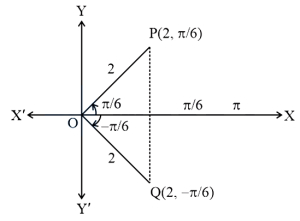
The polar coordinates of $P$ are $\left(2, \frac{\pi}{6}\right)$. If $Q$ is the image of $P$ about the $X$-axis,then the polar coordinates of $Q$ are...
A
$\left(2, \frac{5 \pi}{6}\right)$
B
$\left(2, \frac{\pi}{6}\right)$
C
$\left(2, \frac{\pi}{3}\right)$
D
$\left(2, \frac{11 \pi}{6}\right)$
Solution
(D) The polar coordinates of $P$ are given as $\left(2, \frac{\pi}{6}\right)$.
If $Q$ is the reflection (image) of $P$ about the $X$-axis,the radial distance $r$ remains the same,and the angle $\theta$ changes to $-\theta$.
Therefore,the coordinates of $Q$ are $\left(2, -\frac{\pi}{6}\right)$.
To express the angle in the standard range $[0, 2\pi)$,we add $2\pi$ to the angle:
$-\frac{\pi}{6} + 2\pi = \frac{11\pi}{6}$.
Thus,the polar coordinates of $Q$ are $\left(2, \frac{11\pi}{6}\right)$.
If $Q$ is the reflection (image) of $P$ about the $X$-axis,the radial distance $r$ remains the same,and the angle $\theta$ changes to $-\theta$.
Therefore,the coordinates of $Q$ are $\left(2, -\frac{\pi}{6}\right)$.
To express the angle in the standard range $[0, 2\pi)$,we add $2\pi$ to the angle:
$-\frac{\pi}{6} + 2\pi = \frac{11\pi}{6}$.
Thus,the polar coordinates of $Q$ are $\left(2, \frac{11\pi}{6}\right)$.
0 likes
View Solution76
EasyMCQ
The equation of the perpendicular bisector of the line segment joining $A(-2, 3)$ and $B(6, -5)$ is
A
$x+y=3$
B
$x+y=1$
C
$x-y=-1$
D
$x-y=3$
Solution
(D) The slope of line segment $AB$ is $m_{AB} = \frac{-5-3}{6-(-2)} = \frac{-8}{8} = -1$.
Since the perpendicular bisector is perpendicular to $AB$,its slope $m$ must satisfy $m \times m_{AB} = -1$,so $m = 1$.
The midpoint of $AB$ is $M = \left( \frac{-2+6}{2}, \frac{3-5}{2} \right) = (2, -1)$.
The equation of the line with slope $m=1$ passing through $(2, -1)$ is given by $y - y_1 = m(x - x_1)$.
Substituting the values: $y - (-1) = 1(x - 2)$,which simplifies to $y + 1 = x - 2$,or $x - y = 3$.
Since the perpendicular bisector is perpendicular to $AB$,its slope $m$ must satisfy $m \times m_{AB} = -1$,so $m = 1$.
The midpoint of $AB$ is $M = \left( \frac{-2+6}{2}, \frac{3-5}{2} \right) = (2, -1)$.
The equation of the line with slope $m=1$ passing through $(2, -1)$ is given by $y - y_1 = m(x - x_1)$.
Substituting the values: $y - (-1) = 1(x - 2)$,which simplifies to $y + 1 = x - 2$,or $x - y = 3$.
0 likes
View Solution77
EasyMCQ
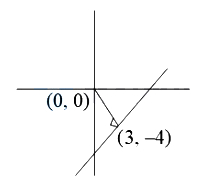
$N(3, -4)$ is the foot of the perpendicular drawn from the origin to a line $L$. Then the equation of the line $L$ is
A
$4x - 3y - 24 = 0$
B
$x - y - 7 = 0$
C
$3x - 4y - 25 = 0$
D
$4x + 3y = 0$
Solution
(C) Let the origin be $O(0, 0)$ and the foot of the perpendicular be $N(3, -4)$.
The slope of the line segment $ON$ is $m_{ON} = \frac{-4 - 0}{3 - 0} = -\frac{4}{3}$.
Since the line $L$ is perpendicular to $ON$,the slope of line $L$ $(m_L)$ is given by $m_L \times m_{ON} = -1$.
$m_L \times (-\frac{4}{3}) = -1 \Rightarrow m_L = \frac{3}{4}$.
The line $L$ passes through the point $N(3, -4)$ and has a slope $m_L = \frac{3}{4}$.
Using the point-slope form,the equation of the line $L$ is $y - y_1 = m(x - x_1)$.
$y - (-4) = \frac{3}{4}(x - 3)$
$4(y + 4) = 3(x - 3)$
$4y + 16 = 3x - 9$
$3x - 4y - 25 = 0$.
The slope of the line segment $ON$ is $m_{ON} = \frac{-4 - 0}{3 - 0} = -\frac{4}{3}$.
Since the line $L$ is perpendicular to $ON$,the slope of line $L$ $(m_L)$ is given by $m_L \times m_{ON} = -1$.
$m_L \times (-\frac{4}{3}) = -1 \Rightarrow m_L = \frac{3}{4}$.
The line $L$ passes through the point $N(3, -4)$ and has a slope $m_L = \frac{3}{4}$.
Using the point-slope form,the equation of the line $L$ is $y - y_1 = m(x - x_1)$.
$y - (-4) = \frac{3}{4}(x - 3)$
$4(y + 4) = 3(x - 3)$
$4y + 16 = 3x - 9$
$3x - 4y - 25 = 0$.
0 likes
View Solution78
EasyMCQ
The coordinates of the foot of the perpendicular drawn from the point $(-2, 3)$ to the line $3x - y - 1 = 0$ are:
A
$(-1, 2)$
B
$(1, -2)$
C
$(-1, -2)$
D
$(1, 2)$
Solution
(D) Let the foot of the perpendicular be $(h, k)$.
Since $(h, k)$ lies on the line $3x - y - 1 = 0$,we have $3h - k - 1 = 0 \implies k = 3h - 1$ ... $(i)$.
The slope of the given line $3x - y - 1 = 0$ is $m_1 = 3$.
The slope of the line segment joining $(-2, 3)$ and $(h, k)$ is $m_2 = \frac{k - 3}{h - (-2)} = \frac{k - 3}{h + 2}$.
Since the lines are perpendicular,$m_1 \times m_2 = -1$,so $3 \times \frac{k - 3}{h + 2} = -1$.
$3(k - 3) = -(h + 2) \implies 3k - 9 = -h - 2 \implies h + 3k = 7$ ... $(ii)$.
Substituting $k = 3h - 1$ from $(i)$ into $(ii)$:
$h + 3(3h - 1) = 7 \implies h + 9h - 3 = 7 \implies 10h = 10 \implies h = 1$.
Substituting $h = 1$ into $(i)$,$k = 3(1) - 1 = 2$.
Thus,the coordinates of the foot of the perpendicular are $(1, 2)$.
Since $(h, k)$ lies on the line $3x - y - 1 = 0$,we have $3h - k - 1 = 0 \implies k = 3h - 1$ ... $(i)$.
The slope of the given line $3x - y - 1 = 0$ is $m_1 = 3$.
The slope of the line segment joining $(-2, 3)$ and $(h, k)$ is $m_2 = \frac{k - 3}{h - (-2)} = \frac{k - 3}{h + 2}$.
Since the lines are perpendicular,$m_1 \times m_2 = -1$,so $3 \times \frac{k - 3}{h + 2} = -1$.
$3(k - 3) = -(h + 2) \implies 3k - 9 = -h - 2 \implies h + 3k = 7$ ... $(ii)$.
Substituting $k = 3h - 1$ from $(i)$ into $(ii)$:
$h + 3(3h - 1) = 7 \implies h + 9h - 3 = 7 \implies 10h = 10 \implies h = 1$.
Substituting $h = 1$ into $(i)$,$k = 3(1) - 1 = 2$.
Thus,the coordinates of the foot of the perpendicular are $(1, 2)$.
0 likes
View Solution79
EasyMCQ
The coordinates of the foot of the perpendicular from the point $(1, 2)$ on the line $x - 3y + 7 = 0$ are
A
$\left(\frac{4}{5}, \frac{13}{5}\right)$
B
$(-13, -2)$
C
$\left(-\frac{13}{5}, -\frac{2}{5}\right)$
D
$(2, 3)$
Solution
(A) Let the foot of the perpendicular be $(x, y)$.
Using the formula for the foot of the perpendicular from $(x_1, y_1)$ to $ax + by + c = 0$:
$\frac{x - x_1}{a} = \frac{y - y_1}{b} = -\frac{ax_1 + by_1 + c}{a^2 + b^2}$
Substituting the values $(x_1, y_1) = (1, 2)$ and $x - 3y + 7 = 0$:
$\frac{x - 1}{1} = \frac{y - 2}{-3} = -\frac{1 - 3(2) + 7}{1^2 + (-3)^2}$
$\frac{x - 1}{1} = \frac{y - 2}{-3} = -\frac{1 - 6 + 7}{1 + 9} = -\frac{2}{10} = -\frac{1}{5}$
Now,solve for $x$ and $y$:
$x - 1 = -\frac{1}{5} \Rightarrow x = 1 - \frac{1}{5} = \frac{4}{5}$
$y - 2 = -3 \times \left(-\frac{1}{5}\right) = \frac{3}{5} \Rightarrow y = 2 + \frac{3}{5} = \frac{13}{5}$
Thus,the foot of the perpendicular is $\left(\frac{4}{5}, \frac{13}{5}\right)$.
Using the formula for the foot of the perpendicular from $(x_1, y_1)$ to $ax + by + c = 0$:
$\frac{x - x_1}{a} = \frac{y - y_1}{b} = -\frac{ax_1 + by_1 + c}{a^2 + b^2}$
Substituting the values $(x_1, y_1) = (1, 2)$ and $x - 3y + 7 = 0$:
$\frac{x - 1}{1} = \frac{y - 2}{-3} = -\frac{1 - 3(2) + 7}{1^2 + (-3)^2}$
$\frac{x - 1}{1} = \frac{y - 2}{-3} = -\frac{1 - 6 + 7}{1 + 9} = -\frac{2}{10} = -\frac{1}{5}$
Now,solve for $x$ and $y$:
$x - 1 = -\frac{1}{5} \Rightarrow x = 1 - \frac{1}{5} = \frac{4}{5}$
$y - 2 = -3 \times \left(-\frac{1}{5}\right) = \frac{3}{5} \Rightarrow y = 2 + \frac{3}{5} = \frac{13}{5}$
Thus,the foot of the perpendicular is $\left(\frac{4}{5}, \frac{13}{5}\right)$.
0 likes
View Solution80
MediumMCQ
The equation of the straight line which passes through the point $(a \cos^{3} \theta, a \sin^{3} \theta)$ and is perpendicular to $x \sec \theta + y \operatorname{cosec} \theta = a$ is
A
$x \cos \theta + y \sin \theta = a \cos 2 \theta$
B
$x \cos \theta - y \sin \theta = a \cos 2 \theta$
C
$x \sin \theta - y \cos \theta = a \cos 2 \theta$
D
$x \sin \theta + y \cos \theta = a \cos 2 \theta$
Solution
(B) Given point $(x_{1}, y_{1}) = (a \cos^{3} \theta, a \sin^{3} \theta)$.
Given line: $x \sec \theta + y \operatorname{cosec} \theta = a$.
Rewriting the given line in slope-intercept form:
$y \operatorname{cosec} \theta = -x \sec \theta + a$
$y = -\frac{\sec \theta}{\operatorname{cosec} \theta} x + \frac{a}{\operatorname{cosec} \theta}$
$y = -\frac{\sin \theta}{\cos \theta} x + a \sin \theta$.
Thus,the slope $m_{1} = -\frac{\sin \theta}{\cos \theta}$.
The slope $m$ of the line perpendicular to this line is $m = -\frac{1}{m_{1}} = \frac{\cos \theta}{\sin \theta}$.
The equation of the required line is $(y - y_{1}) = m(x - x_{1})$:
$y - a \sin^{3} \theta = \frac{\cos \theta}{\sin \theta} (x - a \cos^{3} \theta)$
$y \sin \theta - a \sin^{4} \theta = x \cos \theta - a \cos^{4} \theta$
$x \cos \theta - y \sin \theta = a \cos^{4} \theta - a \sin^{4} \theta$
$x \cos \theta - y \sin \theta = a (\cos^{2} \theta - \sin^{2} \theta) (\cos^{2} \theta + \sin^{2} \theta)$
Since $\cos^{2} \theta + \sin^{2} \theta = 1$ and $\cos^{2} \theta - \sin^{2} \theta = \cos 2 \theta$,we get:
$x \cos \theta - y \sin \theta = a \cos 2 \theta$.
Given line: $x \sec \theta + y \operatorname{cosec} \theta = a$.
Rewriting the given line in slope-intercept form:
$y \operatorname{cosec} \theta = -x \sec \theta + a$
$y = -\frac{\sec \theta}{\operatorname{cosec} \theta} x + \frac{a}{\operatorname{cosec} \theta}$
$y = -\frac{\sin \theta}{\cos \theta} x + a \sin \theta$.
Thus,the slope $m_{1} = -\frac{\sin \theta}{\cos \theta}$.
The slope $m$ of the line perpendicular to this line is $m = -\frac{1}{m_{1}} = \frac{\cos \theta}{\sin \theta}$.
The equation of the required line is $(y - y_{1}) = m(x - x_{1})$:
$y - a \sin^{3} \theta = \frac{\cos \theta}{\sin \theta} (x - a \cos^{3} \theta)$
$y \sin \theta - a \sin^{4} \theta = x \cos \theta - a \cos^{4} \theta$
$x \cos \theta - y \sin \theta = a \cos^{4} \theta - a \sin^{4} \theta$
$x \cos \theta - y \sin \theta = a (\cos^{2} \theta - \sin^{2} \theta) (\cos^{2} \theta + \sin^{2} \theta)$
Since $\cos^{2} \theta + \sin^{2} \theta = 1$ and $\cos^{2} \theta - \sin^{2} \theta = \cos 2 \theta$,we get:
$x \cos \theta - y \sin \theta = a \cos 2 \theta$.
0 likes
View Solution81
MediumMCQ
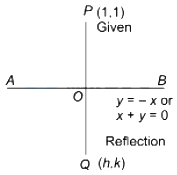
The reflection of the point $(1, 1)$ along the line $y = -x$ is
A
$(0, 0)$
B
$(-1, 1)$
C
$(-1, -1)$
D
$(1, -1)$
Solution
(C) Let the reflection of the point $P(1, 1)$ be $Q(h, k)$.
The line of reflection is $x + y = 0$.
The mid-point of $PQ$ is $\left(\frac{h+1}{2}, \frac{k+1}{2}\right)$,which must lie on the line $x + y = 0$.
$\frac{h+1}{2} + \frac{k+1}{2} = 0 \Rightarrow h + k + 2 = 0 \quad \dots(i)$
The line $PQ$ is perpendicular to the line $x + y = 0$ (which has slope $-1$).
The slope of $PQ$ is $\frac{k-1}{h-1}$.
Since $PQ$ is perpendicular to $x + y = 0$,the product of their slopes is $-1$.
$\left(\frac{k-1}{h-1}\right) \times (-1) = -1$ $\Rightarrow \frac{k-1}{h-1} = 1$ $\Rightarrow k - 1 = h - 1$ $\Rightarrow k = h$.
Substituting $k = h$ into equation $(i)$:
$h + h + 2 = 0$ $\Rightarrow 2h = -2$ $\Rightarrow h = -1$.
Since $k = h$,we have $k = -1$.
Thus,the reflection of the point $(1, 1)$ along the line $y = -x$ is $(-1, -1)$.
The line of reflection is $x + y = 0$.
The mid-point of $PQ$ is $\left(\frac{h+1}{2}, \frac{k+1}{2}\right)$,which must lie on the line $x + y = 0$.
$\frac{h+1}{2} + \frac{k+1}{2} = 0 \Rightarrow h + k + 2 = 0 \quad \dots(i)$
The line $PQ$ is perpendicular to the line $x + y = 0$ (which has slope $-1$).
The slope of $PQ$ is $\frac{k-1}{h-1}$.
Since $PQ$ is perpendicular to $x + y = 0$,the product of their slopes is $-1$.
$\left(\frac{k-1}{h-1}\right) \times (-1) = -1$ $\Rightarrow \frac{k-1}{h-1} = 1$ $\Rightarrow k - 1 = h - 1$ $\Rightarrow k = h$.
Substituting $k = h$ into equation $(i)$:
$h + h + 2 = 0$ $\Rightarrow 2h = -2$ $\Rightarrow h = -1$.
Since $k = h$,we have $k = -1$.
Thus,the reflection of the point $(1, 1)$ along the line $y = -x$ is $(-1, -1)$.
0 likes
View Solution82
EasyMCQ
The foot of the perpendicular from the point $(2,4)$ upon the line $x+y=4$ is:
A
$(2,2)$
B
$(4,0)$
C
$(1,3)$
D
$(3,-1)$
Solution
(C) Let the given line be $L_1: x+y=4$. The slope of $L_1$ is $m_1 = -1$.
The slope of the line $L_2$ perpendicular to $L_1$ is $m_2 = -\frac{1}{m_1} = 1$.
The equation of the line $L_2$ passing through $(2,4)$ is $y-4 = 1(x-2)$,which simplifies to $y-x=2$.
To find the foot of the perpendicular,we solve the system of equations:
$x+y=4$
$y-x=2$
Adding the two equations: $2y = 6 \Rightarrow y=3$.
Substituting $y=3$ into $x+y=4$,we get $x+3=4 \Rightarrow x=1$.
Thus,the foot of the perpendicular is $(1,3)$.
The slope of the line $L_2$ perpendicular to $L_1$ is $m_2 = -\frac{1}{m_1} = 1$.
The equation of the line $L_2$ passing through $(2,4)$ is $y-4 = 1(x-2)$,which simplifies to $y-x=2$.
To find the foot of the perpendicular,we solve the system of equations:
$x+y=4$
$y-x=2$
Adding the two equations: $2y = 6 \Rightarrow y=3$.
Substituting $y=3$ into $x+y=4$,we get $x+3=4 \Rightarrow x=1$.
Thus,the foot of the perpendicular is $(1,3)$.
0 likes
View Solution83
DifficultMCQ
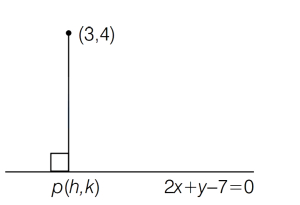
The coordinates of the foot of the perpendicular drawn from the point $(3,4)$ on the line $2x+y-7=0$ are
A
$\left(\frac{9}{5}, \frac{17}{5}\right)$
B
$(1,5)$
C
$(-5,1)$
D
$(1,-5)$
Solution
(A) We know that the foot of the perpendicular $(h, k)$ from a point $(x_1, y_1)$ to the line $ax+by+c=0$ is given by the formula:
$\frac{h-x_1}{a} = \frac{k-y_1}{b} = \frac{-(ax_1+by_1+c)}{a^2+b^2}$
Here,the point $(x_1, y_1) = (3,4)$ and the line is $2x+y-7=0$.
Thus,$a=2, b=1, c=-7$.
Substituting these values into the formula:
$\frac{h-3}{2} = \frac{k-4}{1} = \frac{-(2(3) + 1(4) - 7)}{2^2 + 1^2}$
$\frac{h-3}{2} = \frac{k-4}{1} = \frac{-(6+4-7)}{4+1}$
$\frac{h-3}{2} = \frac{k-4}{1} = \frac{-3}{5}$
Now,solving for $h$:
$h-3 = 2 \times \left(\frac{-3}{5}\right) = \frac{-6}{5}$
$h = 3 - \frac{6}{5} = \frac{15-6}{5} = \frac{9}{5}$
Solving for $k$:
$k-4 = 1 \times \left(\frac{-3}{5}\right) = \frac{-3}{5}$
$k = 4 - \frac{3}{5} = \frac{20-3}{5} = \frac{17}{5}$
Therefore,the coordinates of the foot of the perpendicular are $\left(\frac{9}{5}, \frac{17}{5}\right)$.
$\frac{h-x_1}{a} = \frac{k-y_1}{b} = \frac{-(ax_1+by_1+c)}{a^2+b^2}$
Here,the point $(x_1, y_1) = (3,4)$ and the line is $2x+y-7=0$.
Thus,$a=2, b=1, c=-7$.
Substituting these values into the formula:
$\frac{h-3}{2} = \frac{k-4}{1} = \frac{-(2(3) + 1(4) - 7)}{2^2 + 1^2}$
$\frac{h-3}{2} = \frac{k-4}{1} = \frac{-(6+4-7)}{4+1}$
$\frac{h-3}{2} = \frac{k-4}{1} = \frac{-3}{5}$
Now,solving for $h$:
$h-3 = 2 \times \left(\frac{-3}{5}\right) = \frac{-6}{5}$
$h = 3 - \frac{6}{5} = \frac{15-6}{5} = \frac{9}{5}$
Solving for $k$:
$k-4 = 1 \times \left(\frac{-3}{5}\right) = \frac{-3}{5}$
$k = 4 - \frac{3}{5} = \frac{20-3}{5} = \frac{17}{5}$
Therefore,the coordinates of the foot of the perpendicular are $\left(\frac{9}{5}, \frac{17}{5}\right)$.
0 likes
View Solution84
MediumMCQ
Starting from the point $A(-3, 4)$,a moving object touches the line $2x + y - 7 = 0$ at point $B$ and reaches the point $C(0, 1)$. If the object travels along the shortest path,the distance between $A$ and $B$ is:
A
$\frac{9 \sqrt{170}}{25}$
B
$\frac{9}{\sqrt{5}}$
C
$3 \sqrt{2}$
D
$\frac{6}{\sqrt{5}}$
Solution
(A) To find the shortest path from $A(-3, 4)$ to $C(0, 1)$ touching the line $L: 2x + y - 7 = 0$,we reflect point $A$ across the line $L$ to get $A'$.
Let $A'(x', y')$ be the reflection of $A(-3, 4)$ in $2x + y - 7 = 0$.
Using the formula $\frac{x' - (-3)}{2} = \frac{y' - 4}{1} = -2 \frac{2(-3) + 4 - 7}{2^2 + 1^2} = -2 \frac{-9}{5} = \frac{18}{5}$.
$x' = -3 + 2(\frac{18}{5}) = -3 + \frac{36}{5} = \frac{21}{5}$.
$y' = 4 + 1(\frac{18}{5}) = 4 + \frac{18}{5} = \frac{38}{5}$.
So,$A' = (\frac{21}{5}, \frac{38}{5})$.
The shortest path distance is the length of the line segment $A'C$.
The point $B$ is the intersection of $A'C$ and the line $2x + y - 7 = 0$.
The line $A'C$ passes through $(\frac{21}{5}, \frac{38}{5})$ and $(0, 1)$.
Slope $m = \frac{1 - 38/5}{0 - 21/5} = \frac{-33/5}{-21/5} = \frac{33}{21} = \frac{11}{7}$.
Equation of $A'C$: $y - 1 = \frac{11}{7}(x - 0) \Rightarrow 11x - 7y + 7 = 0$.
Solving $2x + y - 7 = 0$ and $11x - 7y + 7 = 0$:
$y = 7 - 2x$ $\Rightarrow 11x - 7(7 - 2x) + 7 = 0$ $\Rightarrow 11x - 49 + 14x + 7 = 0$ $\Rightarrow 25x = 42$ $\Rightarrow x = \frac{42}{25}$.
$y = 7 - 2(\frac{42}{25}) = \frac{175 - 84}{25} = \frac{91}{25}$.
So,$B = (\frac{42}{25}, \frac{91}{25})$.
Distance $AB = \sqrt{(\frac{42}{25} + 3)^2 + (\frac{91}{25} - 4)^2} = \sqrt{(\frac{117}{25})^2 + (\frac{-9}{25})^2} = \frac{1}{25} \sqrt{13689 + 81} = \frac{\sqrt{13770}}{25} = \frac{9 \sqrt{170}}{25}$.
Let $A'(x', y')$ be the reflection of $A(-3, 4)$ in $2x + y - 7 = 0$.
Using the formula $\frac{x' - (-3)}{2} = \frac{y' - 4}{1} = -2 \frac{2(-3) + 4 - 7}{2^2 + 1^2} = -2 \frac{-9}{5} = \frac{18}{5}$.
$x' = -3 + 2(\frac{18}{5}) = -3 + \frac{36}{5} = \frac{21}{5}$.
$y' = 4 + 1(\frac{18}{5}) = 4 + \frac{18}{5} = \frac{38}{5}$.
So,$A' = (\frac{21}{5}, \frac{38}{5})$.
The shortest path distance is the length of the line segment $A'C$.
The point $B$ is the intersection of $A'C$ and the line $2x + y - 7 = 0$.
The line $A'C$ passes through $(\frac{21}{5}, \frac{38}{5})$ and $(0, 1)$.
Slope $m = \frac{1 - 38/5}{0 - 21/5} = \frac{-33/5}{-21/5} = \frac{33}{21} = \frac{11}{7}$.
Equation of $A'C$: $y - 1 = \frac{11}{7}(x - 0) \Rightarrow 11x - 7y + 7 = 0$.
Solving $2x + y - 7 = 0$ and $11x - 7y + 7 = 0$:
$y = 7 - 2x$ $\Rightarrow 11x - 7(7 - 2x) + 7 = 0$ $\Rightarrow 11x - 49 + 14x + 7 = 0$ $\Rightarrow 25x = 42$ $\Rightarrow x = \frac{42}{25}$.
$y = 7 - 2(\frac{42}{25}) = \frac{175 - 84}{25} = \frac{91}{25}$.
So,$B = (\frac{42}{25}, \frac{91}{25})$.
Distance $AB = \sqrt{(\frac{42}{25} + 3)^2 + (\frac{91}{25} - 4)^2} = \sqrt{(\frac{117}{25})^2 + (\frac{-9}{25})^2} = \frac{1}{25} \sqrt{13689 + 81} = \frac{\sqrt{13770}}{25} = \frac{9 \sqrt{170}}{25}$.
0 likes
View Solution85
DifficultMCQ
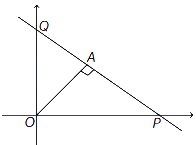
$A$ straight line $L_1$ passing through $A(3,1)$ meets the coordinate axes at $P$ and $Q$ such that its distance from the origin $O$ is maximum. Then the area of $\triangle OPQ$ is (in sq. units):
A
$\frac{100}{3}$
B
$\frac{25}{3}$
C
$\frac{50}{3}$
D
$\frac{200}{3}$
Solution
(C) Let the line passing through $A(3,1)$ be $y - 1 = m(x - 3)$,which simplifies to $mx - y + (1 - 3m) = 0$.
The distance $d$ of this line from the origin $O(0,0)$ is given by $d = \frac{|1 - 3m|}{\sqrt{m^2 + 1}}$.
For the distance to be maximum,the line must be perpendicular to the line segment $OA$.
The slope of $OA$ is $\frac{1-0}{3-0} = \frac{1}{3}$.
Since the line is perpendicular to $OA$,its slope $m$ must satisfy $m \times \frac{1}{3} = -1$,so $m = -3$.
Substituting $m = -3$ into the line equation: $-3x - y + (1 - 3(-3)) = 0$,which gives $3x + y = 10$.
To find the intercepts $P$ and $Q$,set $y=0$ to get $x = \frac{10}{3}$ (point $P(\frac{10}{3}, 0)$) and set $x=0$ to get $y = 10$ (point $Q(0, 10)$).
The area of $\triangle OPQ = \frac{1}{2} \times |OP| \times |OQ| = \frac{1}{2} \times \frac{10}{3} \times 10 = \frac{50}{3}$ sq. units.
The distance $d$ of this line from the origin $O(0,0)$ is given by $d = \frac{|1 - 3m|}{\sqrt{m^2 + 1}}$.
For the distance to be maximum,the line must be perpendicular to the line segment $OA$.
The slope of $OA$ is $\frac{1-0}{3-0} = \frac{1}{3}$.
Since the line is perpendicular to $OA$,its slope $m$ must satisfy $m \times \frac{1}{3} = -1$,so $m = -3$.
Substituting $m = -3$ into the line equation: $-3x - y + (1 - 3(-3)) = 0$,which gives $3x + y = 10$.
To find the intercepts $P$ and $Q$,set $y=0$ to get $x = \frac{10}{3}$ (point $P(\frac{10}{3}, 0)$) and set $x=0$ to get $y = 10$ (point $Q(0, 10)$).
The area of $\triangle OPQ = \frac{1}{2} \times |OP| \times |OQ| = \frac{1}{2} \times \frac{10}{3} \times 10 = \frac{50}{3}$ sq. units.
0 likes
View Solution86
MediumMCQ
The orthocentre and the centroid of $\triangle ABC$ are $(5,8)$ and $\left(3, \frac{14}{3}\right)$ respectively. The equation of the side $BC$ is $x-y=0$. Given that the image of the orthocentre of a triangle with respect to any side lies on the circumcircle of that triangle,then the diameter of the circumcircle of $\triangle ABC$ is
A
$\sqrt{10}$
B
$2 \sqrt{10}$
C
$4 \sqrt{10}$
D
$8 \sqrt{10}$
Solution
(C) The centroid $G$ divides the line segment joining the orthocentre $H(5,8)$ and the circumcentre $O(h,k)$ in the ratio $2:1$.
Using the section formula,we have:
$\left(\frac{2h+5}{3}, \frac{2k+8}{3}\right) = \left(3, \frac{14}{3}\right)$
Equating the coordinates:
$\frac{2h+5}{3} = 3$ $\Rightarrow 2h+5 = 9$ $\Rightarrow h = 2$
$\frac{2k+8}{3} = \frac{14}{3}$ $\Rightarrow 2k+8 = 14$ $\Rightarrow k = 3$
So,the circumcentre $O$ is $(2,3)$.
The image of the orthocentre $H(5,8)$ with respect to the line $x-y=0$ (side $BC$) lies on the circumcircle. Let the image be $(x', y')$.
Using the formula $\frac{x'-5}{1} = \frac{y'-8}{-1} = -2 \frac{5-8}{1^2+(-1)^2} = -2 \frac{-3}{2} = 3$.
$x'-5 = 3 \Rightarrow x' = 8$
$y'-8 = -3 \Rightarrow y' = 5$
The point $(8,5)$ lies on the circumcircle. The radius $R$ is the distance between the circumcentre $(2,3)$ and $(8,5)$:
$R = \sqrt{(8-2)^2 + (5-3)^2} = \sqrt{6^2 + 2^2} = \sqrt{36+4} = \sqrt{40} = 2\sqrt{10}$.
The diameter is $2R = 2(2\sqrt{10}) = 4\sqrt{10}$.
Using the section formula,we have:
$\left(\frac{2h+5}{3}, \frac{2k+8}{3}\right) = \left(3, \frac{14}{3}\right)$
Equating the coordinates:
$\frac{2h+5}{3} = 3$ $\Rightarrow 2h+5 = 9$ $\Rightarrow h = 2$
$\frac{2k+8}{3} = \frac{14}{3}$ $\Rightarrow 2k+8 = 14$ $\Rightarrow k = 3$
So,the circumcentre $O$ is $(2,3)$.
The image of the orthocentre $H(5,8)$ with respect to the line $x-y=0$ (side $BC$) lies on the circumcircle. Let the image be $(x', y')$.
Using the formula $\frac{x'-5}{1} = \frac{y'-8}{-1} = -2 \frac{5-8}{1^2+(-1)^2} = -2 \frac{-3}{2} = 3$.
$x'-5 = 3 \Rightarrow x' = 8$
$y'-8 = -3 \Rightarrow y' = 5$
The point $(8,5)$ lies on the circumcircle. The radius $R$ is the distance between the circumcentre $(2,3)$ and $(8,5)$:
$R = \sqrt{(8-2)^2 + (5-3)^2} = \sqrt{6^2 + 2^2} = \sqrt{36+4} = \sqrt{40} = 2\sqrt{10}$.
The diameter is $2R = 2(2\sqrt{10}) = 4\sqrt{10}$.
0 likes
View Solution87
MediumMCQ
If the point $P(4,1)$ undergoes a reflection in the line $x-y=0$,then a translation through a distance of $2$ units along the positive $X$-axis and finally projected on the $X$-axis,then the coordinates of $P$ in the final position are
A
$(3,4)$
B
$(3,0)$
C
$(1,0)$
D
$(4,3)$
Solution
(B) Step $1$: Reflection of point $P(4,1)$ in the line $x-y=0$ (or $y=x$). The rule for reflection in $y=x$ is $(x,y) \to (y,x)$. Thus,the new point $P'$ is $(1,4)$.
Step $2$: Translation through a distance of $2$ units along the positive $X$-axis. The rule is $(x,y) \to (x+2, y)$. Thus,$P'' = (1+2, 4) = (3,4)$.
Step $3$: Projection on the $X$-axis. The projection of a point $(x,y)$ on the $X$-axis is $(x,0)$. Thus,the final point is $(3,0)$.
Step $2$: Translation through a distance of $2$ units along the positive $X$-axis. The rule is $(x,y) \to (x+2, y)$. Thus,$P'' = (1+2, 4) = (3,4)$.
Step $3$: Projection on the $X$-axis. The projection of a point $(x,y)$ on the $X$-axis is $(x,0)$. Thus,the final point is $(3,0)$.
0 likes
View Solution88
EasyMCQ
If the reflection of a point $A(2,3)$ in the $X$-axis is $B$; the reflection of $B$ in the line $x+y=0$ is $C$,and the reflection of $C$ in $x-y=0$ is $D$,then the point of intersection of the lines $CD$ and $AB$ is:
A
$(3,-2)$
B
$(0,1)$
C
$(4,-3)$
D
$(2,-1)$
Solution
(D) The reflection of a point $(x, y)$ about the $X$-axis is $(x, -y)$.
Therefore,the coordinates of $B$ are $(2, -3)$.
The reflection of a point $(x, y)$ about the line $x+y=0$ is $(-y, -x)$.
Therefore,the coordinates of $C$ are $(-(-3), -(2)) = (3, -2)$.
The reflection of a point $(x, y)$ about the line $x-y=0$ is $(y, x)$.
Therefore,the coordinates of $D$ are $(-2, 3)$.
The line $AB$ passes through $(2, 3)$ and $(2, -3)$,so its equation is $x=2$.
The line $CD$ passes through $(3, -2)$ and $(-2, 3)$. The slope $m = \frac{3 - (-2)}{-2 - 3} = \frac{5}{-5} = -1$.
The equation of $CD$ is $y - 3 = -1(x + 2)$ $\Rightarrow y - 3 = -x - 2$ $\Rightarrow x + y = 1$.
Substituting $x=2$ into $x+y=1$,we get $2+y=1 \Rightarrow y=-1$.
Thus,the point of intersection is $(2, -1)$.
Therefore,the coordinates of $B$ are $(2, -3)$.
The reflection of a point $(x, y)$ about the line $x+y=0$ is $(-y, -x)$.
Therefore,the coordinates of $C$ are $(-(-3), -(2)) = (3, -2)$.
The reflection of a point $(x, y)$ about the line $x-y=0$ is $(y, x)$.
Therefore,the coordinates of $D$ are $(-2, 3)$.
The line $AB$ passes through $(2, 3)$ and $(2, -3)$,so its equation is $x=2$.
The line $CD$ passes through $(3, -2)$ and $(-2, 3)$. The slope $m = \frac{3 - (-2)}{-2 - 3} = \frac{5}{-5} = -1$.
The equation of $CD$ is $y - 3 = -1(x + 2)$ $\Rightarrow y - 3 = -x - 2$ $\Rightarrow x + y = 1$.
Substituting $x=2$ into $x+y=1$,we get $2+y=1 \Rightarrow y=-1$.
Thus,the point of intersection is $(2, -1)$.
0 likes
View Solution89
EasyMCQ
The equation of a straight line which passes through the point $(a \cos^3 \theta, a \sin^3 \theta)$ and is perpendicular to $x \sec \theta + y \operatorname{cosec} \theta = a$ is
A
$\frac{x}{a} + \frac{y}{a} = a \cos \theta$
B
$x \cos \theta - y \sin \theta = a \cos 2 \theta$
C
$x \cos \theta + y \sin \theta = a \cos 2 \theta$
D
$x \cos \theta + y \sin \theta - a \cos 2 \theta = 1$
Solution
(B) The given line is $x \sec \theta + y \operatorname{cosec} \theta = a$,which can be written as $\frac{x}{\cos \theta} + \frac{y}{\sin \theta} = a$.
Any line perpendicular to $Ax + By + C = 0$ is of the form $Bx - Ay + k = 0$.
Thus,the line perpendicular to the given line is $x \operatorname{cosec} \theta - y \sec \theta + k = 0$,or $\frac{x}{\sin \theta} - \frac{y}{\cos \theta} = -k$.
Since this line passes through $(a \cos^3 \theta, a \sin^3 \theta)$,we substitute these coordinates:
$\frac{a \cos^3 \theta}{\sin \theta} - \frac{a \sin^3 \theta}{\cos \theta} = -k$
$\frac{a(\cos^4 \theta - \sin^4 \theta)}{\sin \theta \cos \theta} = -k$
Using $\cos^4 \theta - \sin^4 \theta = (\cos^2 \theta - \sin^2 \theta)(\cos^2 \theta + \sin^2 \theta) = \cos 2 \theta$,we get:
$\frac{a \cos 2 \theta}{\sin \theta \cos \theta} = -k$
Substituting $-k$ back into the equation $\frac{x}{\sin \theta} - \frac{y}{\cos \theta} = -k$:
$\frac{x}{\sin \theta} - \frac{y}{\cos \theta} = \frac{a \cos 2 \theta}{\sin \theta \cos \theta}$
Multiplying by $\sin \theta \cos \theta$ gives:
$x \cos \theta - y \sin \theta = a \cos 2 \theta$.
Any line perpendicular to $Ax + By + C = 0$ is of the form $Bx - Ay + k = 0$.
Thus,the line perpendicular to the given line is $x \operatorname{cosec} \theta - y \sec \theta + k = 0$,or $\frac{x}{\sin \theta} - \frac{y}{\cos \theta} = -k$.
Since this line passes through $(a \cos^3 \theta, a \sin^3 \theta)$,we substitute these coordinates:
$\frac{a \cos^3 \theta}{\sin \theta} - \frac{a \sin^3 \theta}{\cos \theta} = -k$
$\frac{a(\cos^4 \theta - \sin^4 \theta)}{\sin \theta \cos \theta} = -k$
Using $\cos^4 \theta - \sin^4 \theta = (\cos^2 \theta - \sin^2 \theta)(\cos^2 \theta + \sin^2 \theta) = \cos 2 \theta$,we get:
$\frac{a \cos 2 \theta}{\sin \theta \cos \theta} = -k$
Substituting $-k$ back into the equation $\frac{x}{\sin \theta} - \frac{y}{\cos \theta} = -k$:
$\frac{x}{\sin \theta} - \frac{y}{\cos \theta} = \frac{a \cos 2 \theta}{\sin \theta \cos \theta}$
Multiplying by $\sin \theta \cos \theta$ gives:
$x \cos \theta - y \sin \theta = a \cos 2 \theta$.
0 likes
View Solution90
EasyMCQ
Find the equation of a line which passes through $(2 \cos^3 \theta, 2 \sin^3 \theta)$ and is perpendicular to the line $x \cos \theta - y \sin \theta = 2 \cos 2 \theta$.
A
$x \sec \theta + y \operatorname{cosec} \theta = 2$
B
$x \operatorname{cosec} \theta + y \sec \theta = 2$
C
$x \sin \theta + y \cos \theta = 2$
D
$x \cos \theta + y \sin \theta = 2$
Solution
(A) The given line is $x \cos \theta - y \sin \theta = 2 \cos 2 \theta$.
Comparing this with $y = mx + c$,the slope $m_1 = \frac{\cos \theta}{\sin \theta}$.
The slope of the line perpendicular to this line is $m_2 = -\frac{1}{m_1} = -\frac{\sin \theta}{\cos \theta}$.
The equation of the line passing through $(2 \cos^3 \theta, 2 \sin^3 \theta)$ with slope $m_2$ is:
$y - 2 \sin^3 \theta = -\frac{\sin \theta}{\cos \theta} (x - 2 \cos^3 \theta)$
$y \cos \theta - 2 \sin^3 \theta \cos \theta = -x \sin \theta + 2 \cos^3 \theta \sin \theta$
$x \sin \theta + y \cos \theta = 2 \sin \theta \cos \theta (\cos^2 \theta + \sin^2 \theta)$
Since $\cos^2 \theta + \sin^2 \theta = 1$,we have:
$x \sin \theta + y \cos \theta = 2 \sin \theta \cos \theta$
Dividing both sides by $\sin \theta \cos \theta$:
$\frac{x \sin \theta}{\sin \theta \cos \theta} + \frac{y \cos \theta}{\sin \theta \cos \theta} = \frac{2 \sin \theta \cos \theta}{\sin \theta \cos \theta}$
$x \sec \theta + y \operatorname{cosec} \theta = 2$.
Comparing this with $y = mx + c$,the slope $m_1 = \frac{\cos \theta}{\sin \theta}$.
The slope of the line perpendicular to this line is $m_2 = -\frac{1}{m_1} = -\frac{\sin \theta}{\cos \theta}$.
The equation of the line passing through $(2 \cos^3 \theta, 2 \sin^3 \theta)$ with slope $m_2$ is:
$y - 2 \sin^3 \theta = -\frac{\sin \theta}{\cos \theta} (x - 2 \cos^3 \theta)$
$y \cos \theta - 2 \sin^3 \theta \cos \theta = -x \sin \theta + 2 \cos^3 \theta \sin \theta$
$x \sin \theta + y \cos \theta = 2 \sin \theta \cos \theta (\cos^2 \theta + \sin^2 \theta)$
Since $\cos^2 \theta + \sin^2 \theta = 1$,we have:
$x \sin \theta + y \cos \theta = 2 \sin \theta \cos \theta$
Dividing both sides by $\sin \theta \cos \theta$:
$\frac{x \sin \theta}{\sin \theta \cos \theta} + \frac{y \cos \theta}{\sin \theta \cos \theta} = \frac{2 \sin \theta \cos \theta}{\sin \theta \cos \theta}$
$x \sec \theta + y \operatorname{cosec} \theta = 2$.
0 likes
View Solution91
EasyMCQ
$A$ person standing at the junction (crossing) of $2$ straight paths represented by the equations $2x - 3y + 4 = 0$ and $3x + 4y - 5 = 0$,wants to reach the path whose equation is $6x - 7y + 8 = 0$ in the least time. The equation of the path he should follow is:
A
$119x - 102y - 125 = 0$
B
$119x + 102y - 125 = 0$
C
$102x + 119y - 125 = 0$
D
$102x - 119y + 125 = 0$
Solution
(B) The person is standing at the intersection of the lines $2x - 3y + 4 = 0$ and $3x + 4y - 5 = 0$.
Solving these equations,we multiply the first by $4$ and the second by $3$:
$8x - 12y + 16 = 0$
$9x + 12y - 15 = 0$
Adding these gives $17x + 1 = 0$,so $x = -\frac{1}{17}$.
Substituting $x$ into the first equation: $2(-\frac{1}{17}) - 3y + 4 = 0$ $\Rightarrow -\frac{2}{17} + 4 = 3y$ $\Rightarrow 3y = \frac{66}{17}$ $\Rightarrow y = \frac{22}{17}$.
The junction point is $A = (-\frac{1}{17}, \frac{22}{17})$.
To reach the path $6x - 7y + 8 = 0$ in the least time,the person must walk along the perpendicular line.
The slope of the given path is $m_1 = \frac{6}{7}$.
The slope of the perpendicular line is $m_2 = -\frac{1}{m_1} = -\frac{7}{6}$.
The equation of the line passing through $(-\frac{1}{17}, \frac{22}{17})$ with slope $-\frac{7}{6}$ is:
$y - \frac{22}{17} = -\frac{7}{6}(x + \frac{1}{17})$
$6(17y - 22) = -7(17x + 1)$
$102y - 132 = -119x - 7$
$119x + 102y - 125 = 0$.
Solving these equations,we multiply the first by $4$ and the second by $3$:
$8x - 12y + 16 = 0$
$9x + 12y - 15 = 0$
Adding these gives $17x + 1 = 0$,so $x = -\frac{1}{17}$.
Substituting $x$ into the first equation: $2(-\frac{1}{17}) - 3y + 4 = 0$ $\Rightarrow -\frac{2}{17} + 4 = 3y$ $\Rightarrow 3y = \frac{66}{17}$ $\Rightarrow y = \frac{22}{17}$.
The junction point is $A = (-\frac{1}{17}, \frac{22}{17})$.
To reach the path $6x - 7y + 8 = 0$ in the least time,the person must walk along the perpendicular line.
The slope of the given path is $m_1 = \frac{6}{7}$.
The slope of the perpendicular line is $m_2 = -\frac{1}{m_1} = -\frac{7}{6}$.
The equation of the line passing through $(-\frac{1}{17}, \frac{22}{17})$ with slope $-\frac{7}{6}$ is:
$y - \frac{22}{17} = -\frac{7}{6}(x + \frac{1}{17})$
$6(17y - 22) = -7(17x + 1)$
$102y - 132 = -119x - 7$
$119x + 102y - 125 = 0$.
0 likes
View Solution92
DifficultMCQ
$A(3, -4)$ is a vertex of $\triangle ABC$ and $3x + 4y - 18 = 0$ is the perpendicular bisector of the side $AB$. If $C = (6, 3)$,then the centroid of the triangle is:
A
$(6, 1)$
B
$(-6, 1)$
C
$(-6, -1)$
D
$(6, -1)$
Solution
(A) Let $B = (x_1, y_1)$. Since $3x + 4y - 18 = 0$ is the perpendicular bisector of $AB$,the midpoint $M$ of $AB$ lies on the line.
$M = (\frac{x_1+3}{2}, \frac{y_1-4}{2})$. Substituting into the line equation: $3(\frac{x_1+3}{2}) + 4(\frac{y_1-4}{2}) - 18 = 0 \implies 3x_1 + 9 + 4y_1 - 16 - 36 = 0 \implies 3x_1 + 4y_1 = 43$.
Also,the slope of $AB$ is perpendicular to the line $3x + 4y - 18 = 0$ (slope $-3/4$). So,slope of $AB = 4/3$.
$\frac{y_1+4}{x_1-3} = \frac{4}{3} \implies 3y_1 + 12 = 4x_1 - 12 \implies 4x_1 - 3y_1 = 24$.
Solving the system: $3x_1 + 4y_1 = 43$ and $4x_1 - 3y_1 = 24$. Multiplying by $3$ and $4$: $9x_1 + 12y_1 = 129$ and $16x_1 - 12y_1 = 96$. Adding gives $25x_1 = 225 \implies x_1 = 9$. Then $4(9) - 3y_1 = 24 \implies 36 - 24 = 3y_1 \implies y_1 = 4$. So $B = (9, 4)$.
The centroid $G$ is $(\frac{x_A+x_B+x_C}{3}, \frac{y_A+y_B+y_C}{3}) = (\frac{3+9+6}{3}, \frac{-4+4+3}{3}) = (6, 1)$.
$M = (\frac{x_1+3}{2}, \frac{y_1-4}{2})$. Substituting into the line equation: $3(\frac{x_1+3}{2}) + 4(\frac{y_1-4}{2}) - 18 = 0 \implies 3x_1 + 9 + 4y_1 - 16 - 36 = 0 \implies 3x_1 + 4y_1 = 43$.
Also,the slope of $AB$ is perpendicular to the line $3x + 4y - 18 = 0$ (slope $-3/4$). So,slope of $AB = 4/3$.
$\frac{y_1+4}{x_1-3} = \frac{4}{3} \implies 3y_1 + 12 = 4x_1 - 12 \implies 4x_1 - 3y_1 = 24$.
Solving the system: $3x_1 + 4y_1 = 43$ and $4x_1 - 3y_1 = 24$. Multiplying by $3$ and $4$: $9x_1 + 12y_1 = 129$ and $16x_1 - 12y_1 = 96$. Adding gives $25x_1 = 225 \implies x_1 = 9$. Then $4(9) - 3y_1 = 24 \implies 36 - 24 = 3y_1 \implies y_1 = 4$. So $B = (9, 4)$.
The centroid $G$ is $(\frac{x_A+x_B+x_C}{3}, \frac{y_A+y_B+y_C}{3}) = (\frac{3+9+6}{3}, \frac{-4+4+3}{3}) = (6, 1)$.
0 likes
View Solution93
MediumMCQ
The image of the line $x+y-2=0$ in the $y$-axis is
A
$x-y+2=0$
B
$y-x+2=0$
C
$x+y+2=0$
D
$x+y-2=0$
Solution
(A) To find the image of the line $x+y-2=0$ in the $y$-axis,we replace $x$ with $-x$ in the equation of the line.
Substituting $x = -x$ into $x+y-2=0$,we get:
$(-x)+y-2=0$
$-x+y-2=0$
Multiplying by $-1$,we get:
$x-y+2=0$
Alternatively,the line $x+y=2$ passes through points $A(2, 0)$ and $B(0, 2)$.
The image of $A(2, 0)$ in the $y$-axis is $A'(-2, 0)$,and the image of $B(0, 2)$ is $B(0, 2)$ itself.
The equation of the line passing through $A'(-2, 0)$ and $B(0, 2)$ is:
$y-0 = \frac{2-0}{0-(-2)}(x-(-2))$
$y = \frac{2}{2}(x+2)$
$y = x+2$
$x-y+2=0$
Substituting $x = -x$ into $x+y-2=0$,we get:
$(-x)+y-2=0$
$-x+y-2=0$
Multiplying by $-1$,we get:
$x-y+2=0$
Alternatively,the line $x+y=2$ passes through points $A(2, 0)$ and $B(0, 2)$.
The image of $A(2, 0)$ in the $y$-axis is $A'(-2, 0)$,and the image of $B(0, 2)$ is $B(0, 2)$ itself.
The equation of the line passing through $A'(-2, 0)$ and $B(0, 2)$ is:
$y-0 = \frac{2-0}{0-(-2)}(x-(-2))$
$y = \frac{2}{2}(x+2)$
$y = x+2$
$x-y+2=0$
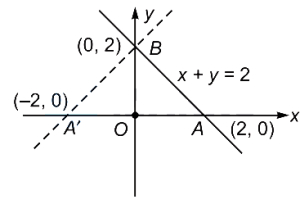
0 likes
View Solution94
EasyMCQ
If the line $2x - 3y + 5 = 0$ is the perpendicular bisector of the line segment joining $(1, -2)$ and $(\alpha, \beta)$,then $\alpha + \beta =$
A
$7$
B
$1$
C
$-1$
D
$-7$
Solution
(B) Let the points be $A(1, -2)$ and $B(\alpha, \beta)$. The midpoint $M$ of $AB$ is $\left(\frac{\alpha + 1}{2}, \frac{\beta - 2}{2}\right)$.
Since $M$ lies on the line $2x - 3y + 5 = 0$,we have $2\left(\frac{\alpha + 1}{2}\right) - 3\left(\frac{\beta - 2}{2}\right) + 5 = 0$,which simplifies to $2\alpha - 3\beta + 18 = 0$ $(i)$.
The slope of line $AB$ is $m_1 = \frac{\beta + 2}{\alpha - 1}$. The slope of the given line $2x - 3y + 5 = 0$ is $m_2 = \frac{2}{3}$.
Since $AB$ is perpendicular to the given line,$m_1 \times m_2 = -1$,so $\left(\frac{\beta + 2}{\alpha - 1}\right) \times \frac{2}{3} = -1$,which gives $2\beta + 4 = -3\alpha + 3$,or $3\alpha + 2\beta + 1 = 0$ $(ii)$.
Solving equations $(i)$ and $(ii)$ simultaneously: Multiply $(i)$ by $2$ and $(ii)$ by $3$: $4\alpha - 6\beta + 36 = 0$ and $9\alpha + 6\beta + 3 = 0$.
Adding these gives $13\alpha + 39 = 0$,so $\alpha = -3$. Substituting $\alpha = -3$ into $(ii)$,we get $3(-3) + 2\beta + 1 = 0$,so $2\beta = 8$,which means $\beta = 4$.
Thus,$\alpha + \beta = -3 + 4 = 1$.
Since $M$ lies on the line $2x - 3y + 5 = 0$,we have $2\left(\frac{\alpha + 1}{2}\right) - 3\left(\frac{\beta - 2}{2}\right) + 5 = 0$,which simplifies to $2\alpha - 3\beta + 18 = 0$ $(i)$.
The slope of line $AB$ is $m_1 = \frac{\beta + 2}{\alpha - 1}$. The slope of the given line $2x - 3y + 5 = 0$ is $m_2 = \frac{2}{3}$.
Since $AB$ is perpendicular to the given line,$m_1 \times m_2 = -1$,so $\left(\frac{\beta + 2}{\alpha - 1}\right) \times \frac{2}{3} = -1$,which gives $2\beta + 4 = -3\alpha + 3$,or $3\alpha + 2\beta + 1 = 0$ $(ii)$.
Solving equations $(i)$ and $(ii)$ simultaneously: Multiply $(i)$ by $2$ and $(ii)$ by $3$: $4\alpha - 6\beta + 36 = 0$ and $9\alpha + 6\beta + 3 = 0$.
Adding these gives $13\alpha + 39 = 0$,so $\alpha = -3$. Substituting $\alpha = -3$ into $(ii)$,we get $3(-3) + 2\beta + 1 = 0$,so $2\beta = 8$,which means $\beta = 4$.
Thus,$\alpha + \beta = -3 + 4 = 1$.
0 likes
View Solution95
MediumMCQ
If the $y$-intercept of the perpendicular bisector of the line segment joining $P(1, 4)$ and $Q(k, 3)$ is $-4$,then a possible value of $k$ is
A
$2$
B
$-2$
C
$-4$
D
$1$
Solution
(C) The midpoint $M$ of $PQ$ is given by $M = \left(\frac{1+k}{2}, \frac{4+3}{2}\right) = \left(\frac{1+k}{2}, \frac{7}{2}\right)$.
The slope of line $PQ$ is $m = \frac{3-4}{k-1} = \frac{-1}{k-1}$.
The slope of the perpendicular bisector $m'$ is given by $m \times m' = -1$,so $m' = \frac{1}{m} = -(k-1) = 1-k$.
The equation of the perpendicular bisector is $y - \frac{7}{2} = (1-k)(x - \frac{1+k}{2})$.
For the $y$-intercept,we set $x = 0$ and $y = -4$:
$-4 - \frac{7}{2} = (1-k)(0 - \frac{1+k}{2})$
$-\frac{15}{2} = (1-k)(-\frac{1+k}{2})$
$15 = (1-k)(1+k)$
$15 = 1 - k^2$
$k^2 = 1 - 15 = -14$.
Wait,re-evaluating the slope calculation: $m = \frac{3-4}{k-1} = \frac{-1}{k-1}$. Thus $m' = k-1$.
The equation is $y - \frac{7}{2} = (k-1)(x - \frac{1+k}{2})$.
Setting $x=0, y=-4$:
$-4 - \frac{7}{2} = (k-1)(-\frac{1+k}{2})$
$-\frac{15}{2} = -\frac{k^2-1}{2}$
$15 = k^2 - 1$ $\Rightarrow k^2 = 16$ $\Rightarrow k = \pm 4$.
Thus,a possible value of $k$ is $-4$.
The slope of line $PQ$ is $m = \frac{3-4}{k-1} = \frac{-1}{k-1}$.
The slope of the perpendicular bisector $m'$ is given by $m \times m' = -1$,so $m' = \frac{1}{m} = -(k-1) = 1-k$.
The equation of the perpendicular bisector is $y - \frac{7}{2} = (1-k)(x - \frac{1+k}{2})$.
For the $y$-intercept,we set $x = 0$ and $y = -4$:
$-4 - \frac{7}{2} = (1-k)(0 - \frac{1+k}{2})$
$-\frac{15}{2} = (1-k)(-\frac{1+k}{2})$
$15 = (1-k)(1+k)$
$15 = 1 - k^2$
$k^2 = 1 - 15 = -14$.
Wait,re-evaluating the slope calculation: $m = \frac{3-4}{k-1} = \frac{-1}{k-1}$. Thus $m' = k-1$.
The equation is $y - \frac{7}{2} = (k-1)(x - \frac{1+k}{2})$.
Setting $x=0, y=-4$:
$-4 - \frac{7}{2} = (k-1)(-\frac{1+k}{2})$
$-\frac{15}{2} = -\frac{k^2-1}{2}$
$15 = k^2 - 1$ $\Rightarrow k^2 = 16$ $\Rightarrow k = \pm 4$.
Thus,a possible value of $k$ is $-4$.
0 likes
View Solution96
MediumMCQ
$A$ ray of light incident along a line meets another line $7x - y + 1 = 0$ at the point $(0, 1)$ and is then reflected from this point along the line $y + 2x = 1$. Then the equation of the line of incidence of the ray of light is
A
$41x - 25y + 25 = 0$
B
$41x + 38y + 38 = 0$
C
$41x - 38y + 38 = 0$
D
$41x + 25y - 25 = 0$
Solution
(C) Let the slope of the incident ray be $m$. The mirror line is $7x - y + 1 = 0$,which has a slope $m_1 = 7$. The reflected ray is $y + 2x = 1$,which has a slope $m_2 = -2$. The point of incidence is $(0, 1)$.
Since the angle of incidence equals the angle of reflection,the angle between the incident ray and the mirror is equal to the angle between the reflected ray and the mirror.
Using the formula $\tan \theta = \left| \frac{m_1 - m_2}{1 + m_1 m_2} \right|$,we have:
$\left| \frac{m - 7}{1 + 7m} \right| = \left| \frac{7 - (-2)}{1 + 7(-2)} \right| = \left| \frac{9}{1 - 14} \right| = \left| \frac{9}{-13} \right| = \frac{9}{13}$.
$\frac{m - 7}{1 + 7m} = \frac{9}{13}$ or $\frac{m - 7}{1 + 7m} = -\frac{9}{13}$.
Case $1$: $13(m - 7) = 9(1 + 7m)$ $\Rightarrow 13m - 91 = 9 + 63m$ $\Rightarrow -50m = 100$ $\Rightarrow m = -2$. This is the slope of the reflected ray.
Case $2$: $13(m - 7) = -9(1 + 7m)$ $\Rightarrow 13m - 91 = -9 - 63m$ $\Rightarrow 76m = 82$ $\Rightarrow m = \frac{41}{38}$.
The equation of the incident line passing through $(0, 1)$ with slope $m = \frac{41}{38}$ is:
$y - 1 = \frac{41}{38}(x - 0)$ $\Rightarrow 38y - 38 = 41x$ $\Rightarrow 41x - 38y + 38 = 0$.
Since the angle of incidence equals the angle of reflection,the angle between the incident ray and the mirror is equal to the angle between the reflected ray and the mirror.
Using the formula $\tan \theta = \left| \frac{m_1 - m_2}{1 + m_1 m_2} \right|$,we have:
$\left| \frac{m - 7}{1 + 7m} \right| = \left| \frac{7 - (-2)}{1 + 7(-2)} \right| = \left| \frac{9}{1 - 14} \right| = \left| \frac{9}{-13} \right| = \frac{9}{13}$.
$\frac{m - 7}{1 + 7m} = \frac{9}{13}$ or $\frac{m - 7}{1 + 7m} = -\frac{9}{13}$.
Case $1$: $13(m - 7) = 9(1 + 7m)$ $\Rightarrow 13m - 91 = 9 + 63m$ $\Rightarrow -50m = 100$ $\Rightarrow m = -2$. This is the slope of the reflected ray.
Case $2$: $13(m - 7) = -9(1 + 7m)$ $\Rightarrow 13m - 91 = -9 - 63m$ $\Rightarrow 76m = 82$ $\Rightarrow m = \frac{41}{38}$.
The equation of the incident line passing through $(0, 1)$ with slope $m = \frac{41}{38}$ is:
$y - 1 = \frac{41}{38}(x - 0)$ $\Rightarrow 38y - 38 = 41x$ $\Rightarrow 41x - 38y + 38 = 0$.
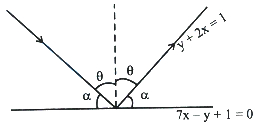
0 likes
View Solution97
MediumMCQ
If a particle moving along $x-2y-3=0$ gets reflected in a perpendicular direction upon hitting the line $3x-2y-5=0$,then the line of the movement of the particle after reflection is
A
$2x+y+1=0$
B
$2x+y-1=0$
C
$2x+y-3=0$
D
$2x+y+3=0$
Solution
(B) The equation of the incident line is $x-2y-3=0$. The slope of this line is $m_1 = \frac{1}{2}$.
Since the particle is reflected in a perpendicular direction,the slope of the reflected line $m_2$ must satisfy $m_1 \times m_2 = -1$.
Thus,$m_2 = -2$.
The point of incidence is the intersection of $x-2y-3=0$ and $3x-2y-5=0$.
Subtracting the first equation from the second: $(3x-2y-5) - (x-2y-3) = 0$ $\Rightarrow 2x-2=0$ $\Rightarrow x=1$.
Substituting $x=1$ into $x-2y-3=0$,we get $1-2y-3=0$ $\Rightarrow -2y=2$ $\Rightarrow y=-1$.
The point of intersection is $(1, -1)$.
The equation of the reflected line passing through $(1, -1)$ with slope $m_2 = -2$ is:
$y - (-1) = -2(x - 1)$
$y + 1 = -2x + 2$
$2x + y - 1 = 0$.
Since the particle is reflected in a perpendicular direction,the slope of the reflected line $m_2$ must satisfy $m_1 \times m_2 = -1$.
Thus,$m_2 = -2$.
The point of incidence is the intersection of $x-2y-3=0$ and $3x-2y-5=0$.
Subtracting the first equation from the second: $(3x-2y-5) - (x-2y-3) = 0$ $\Rightarrow 2x-2=0$ $\Rightarrow x=1$.
Substituting $x=1$ into $x-2y-3=0$,we get $1-2y-3=0$ $\Rightarrow -2y=2$ $\Rightarrow y=-1$.
The point of intersection is $(1, -1)$.
The equation of the reflected line passing through $(1, -1)$ with slope $m_2 = -2$ is:
$y - (-1) = -2(x - 1)$
$y + 1 = -2x + 2$
$2x + y - 1 = 0$.
0 likes
View Solution98
DifficultMCQ
If $2x + 3y = 5$ is the perpendicular bisector of the line segment joining the points $A\left(1, \frac{1}{3}\right)$ and $B$,then $B$ is equal to
A
$\left(\frac{21}{13}, \frac{49}{39}\right)$
B
$\left(\frac{17}{13}, \frac{31}{39}\right)$
C
$\left(\frac{7}{13}, \frac{49}{39}\right)$
D
$\left(\frac{21}{13}, \frac{31}{39}\right)$
Solution
(A) Let $l_1 \equiv 2x + 3y = 5$.
Since the line $AB$ is perpendicular to $l_1$,the slope of $l_1$ is $m_1 = -\frac{2}{3}$.
Therefore,the slope of $AB$ is $m_{AB} = -\frac{1}{m_1} = \frac{3}{2}$.
The equation of line $AB$ passing through $A\left(1, \frac{1}{3}\right)$ with slope $\frac{3}{2}$ is:
$\left(y - \frac{1}{3}\right) = \frac{3}{2}(x - 1)$
$\Rightarrow 2y - \frac{2}{3} = 3x - 3$
$\Rightarrow 3x - 2y = 3 - \frac{2}{3} = \frac{7}{3}$
$\Rightarrow 9x - 6y = 7$ $(i)$
The equation of line $l_1$ is $2x + 3y = 5$. Multiplying by $2$,we get $4x + 6y = 10$ (ii).
Adding $(i)$ and (ii): $13x = 17 \Rightarrow x = \frac{17}{13}$.
Substituting $x$ in $2x + 3y = 5$: $2\left(\frac{17}{13}\right) + 3y = 5$ $\Rightarrow 3y = 5 - \frac{34}{13} = \frac{31}{13}$ $\Rightarrow y = \frac{31}{39}$.
The intersection point $P$ (mid-point of $AB$) is $\left(\frac{17}{13}, \frac{31}{39}\right)$.
Let $B = (x_2, y_2)$. Since $P$ is the mid-point of $AB$:
$\frac{1 + x_2}{2} = \frac{17}{13}$ $\Rightarrow 1 + x_2 = \frac{34}{13}$ $\Rightarrow x_2 = \frac{21}{13}$
$\frac{1/3 + y_2}{2} = \frac{31}{39}$ $\Rightarrow \frac{1}{3} + y_2 = \frac{62}{39}$ $\Rightarrow y_2 = \frac{62}{39} - \frac{13}{39} = \frac{49}{39}$
Thus,$B = \left(\frac{21}{13}, \frac{49}{39}\right)$.
Since the line $AB$ is perpendicular to $l_1$,the slope of $l_1$ is $m_1 = -\frac{2}{3}$.
Therefore,the slope of $AB$ is $m_{AB} = -\frac{1}{m_1} = \frac{3}{2}$.
The equation of line $AB$ passing through $A\left(1, \frac{1}{3}\right)$ with slope $\frac{3}{2}$ is:
$\left(y - \frac{1}{3}\right) = \frac{3}{2}(x - 1)$
$\Rightarrow 2y - \frac{2}{3} = 3x - 3$
$\Rightarrow 3x - 2y = 3 - \frac{2}{3} = \frac{7}{3}$
$\Rightarrow 9x - 6y = 7$ $(i)$
The equation of line $l_1$ is $2x + 3y = 5$. Multiplying by $2$,we get $4x + 6y = 10$ (ii).
Adding $(i)$ and (ii): $13x = 17 \Rightarrow x = \frac{17}{13}$.
Substituting $x$ in $2x + 3y = 5$: $2\left(\frac{17}{13}\right) + 3y = 5$ $\Rightarrow 3y = 5 - \frac{34}{13} = \frac{31}{13}$ $\Rightarrow y = \frac{31}{39}$.
The intersection point $P$ (mid-point of $AB$) is $\left(\frac{17}{13}, \frac{31}{39}\right)$.
Let $B = (x_2, y_2)$. Since $P$ is the mid-point of $AB$:
$\frac{1 + x_2}{2} = \frac{17}{13}$ $\Rightarrow 1 + x_2 = \frac{34}{13}$ $\Rightarrow x_2 = \frac{21}{13}$
$\frac{1/3 + y_2}{2} = \frac{31}{39}$ $\Rightarrow \frac{1}{3} + y_2 = \frac{62}{39}$ $\Rightarrow y_2 = \frac{62}{39} - \frac{13}{39} = \frac{49}{39}$
Thus,$B = \left(\frac{21}{13}, \frac{49}{39}\right)$.
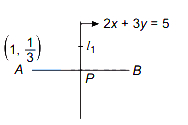
0 likes
View SolutionStraight Line — Foot of perpendicular, Image of a point and Reflexive properties · Frequently Asked Questions
1Are these Straight Line questions useful for JEE and NEET?
Yes. All questions in this section are mapped to JEE Main and NEET exam patterns. Previous year questions from JEE Main, NEET, GUJCET and state-level exams are included with full solutions.
2Can I switch to Hindi or Gujarati for these questions?
Yes. Use the language tabs in the hero section or the sidebar to view the same questions and solutions in English, Hindi or Gujarati.
3How do I generate a question paper from this subtopic?
Use the Vedclass Exam Paper Generator — select the chapter and subtopic, set difficulty, and generate Sets A, B, C, D automatically. First 3 chapters of every subject are free.
Vedclass Products
For Students
Vedclass Test Series
Mock tests in real JEE/NEET style with performance analysis. 5-day free trial.
Start Free TrialFor Teachers
Exam Paper Generator
Generate Set A/B/C/D papers from this chapter in 2 minutes. 3 chapters free.
Try FreeFor Institutes
Online Exam Module
Live online exams with unlimited students, 360° analytics & white-label branding.
See DemoFor Teachers & Institutes
Generate a Straight Line Exam Paper in 2 Minutes
Select subtopic & difficulty — Sets A, B, C, D auto-generated with No Repeat logic.
First 3 chapters of every subject are free — no payment required.