
A English
Bisector of angle between two lines Questions in English
Class 11 Mathematics · Straight Line · Bisector of angle between two lines
56+
Questions
English
Language
100%
With Solutions
Showing 6 of 56 questions in English
51
MediumMCQ
If the lengths of the perpendiculars drawn from a point $(a, b)$ to the lines $2x + 3y + 4 = 0$ and $3x - 2y + 4 = 0$ are equal,then the point $(a, b)$ lies on the line
A
$x - 5y + 8 = 0$ or $5x + y = 0$
B
$x + 5y + 8 = 0$ or $5x - y + 8 = 0$
C
$x - 5y = 0$ or $5x + y + 8 = 0$
D
$x + 5y = 0$ or $5x - y + 8 = 0$
Solution
(C) Let the lines be $L_1: 2x + 3y + 4 = 0$ and $L_2: 3x - 2y + 4 = 0$.
The length of the perpendicular from $(a, b)$ to $L_1$ is $d_1 = \frac{|2a + 3b + 4|}{\sqrt{2^2 + 3^2}} = \frac{|2a + 3b + 4|}{\sqrt{13}}$.
The length of the perpendicular from $(a, b)$ to $L_2$ is $d_2 = \frac{|3a - 2b + 4|}{\sqrt{3^2 + (-2)^2}} = \frac{|3a - 2b + 4|}{\sqrt{13}}$.
Given $d_1 = d_2$,we have $|2a + 3b + 4| = |3a - 2b + 4|$.
This implies $2a + 3b + 4 = 3a - 2b + 4$ or $2a + 3b + 4 = -(3a - 2b + 4)$.
Case $1$: $2a + 3b + 4 = 3a - 2b + 4 \Rightarrow a - 5b = 0$.
Case $2$: $2a + 3b + 4 = -3a + 2b - 4 \Rightarrow 5a + b + 8 = 0$.
Thus,the locus of $(a, b)$ is $x - 5y = 0$ or $5x + y + 8 = 0$.
The length of the perpendicular from $(a, b)$ to $L_1$ is $d_1 = \frac{|2a + 3b + 4|}{\sqrt{2^2 + 3^2}} = \frac{|2a + 3b + 4|}{\sqrt{13}}$.
The length of the perpendicular from $(a, b)$ to $L_2$ is $d_2 = \frac{|3a - 2b + 4|}{\sqrt{3^2 + (-2)^2}} = \frac{|3a - 2b + 4|}{\sqrt{13}}$.
Given $d_1 = d_2$,we have $|2a + 3b + 4| = |3a - 2b + 4|$.
This implies $2a + 3b + 4 = 3a - 2b + 4$ or $2a + 3b + 4 = -(3a - 2b + 4)$.
Case $1$: $2a + 3b + 4 = 3a - 2b + 4 \Rightarrow a - 5b = 0$.
Case $2$: $2a + 3b + 4 = -3a + 2b - 4 \Rightarrow 5a + b + 8 = 0$.
Thus,the locus of $(a, b)$ is $x - 5y = 0$ or $5x + y + 8 = 0$.
0 likes
View Solution52
MediumMCQ
If two equal sides of an isosceles triangle are given by the equations $7x-y+3=0$ and $x+y-3=0$,then the equation of its third side passing through the point $(2,-5)$ is
A
$x-3y=17$
B
$3x-y=11$
C
$7x+2y=4$
D
none of these
Solution
(A) The third side of an isosceles triangle is perpendicular to the angle bisector of the two equal sides. However,in this specific geometry,the third side is parallel to the angle bisector of the given lines $7x-y+3=0$ and $x+y-3=0$ if the vertex is the intersection point.
First,find the intersection point of the two lines: $7x-y+3=0$ and $x+y-3=0$. Adding them gives $8x=0$,so $x=0$,which implies $y=3$. The vertex is $(0,3)$.
The angle bisectors are given by $\frac{7x-y+3}{\sqrt{7^2+(-1)^2}} = \pm \frac{x+y-3}{\sqrt{1^2+1^2}}$.
$\frac{7x-y+3}{\sqrt{50}} = \pm \frac{x+y-3}{\sqrt{2}} \Rightarrow 7x-y+3 = \pm 5(x+y-3)$.
Case $1$: $7x-y+3 = 5x+5y-15$ $\Rightarrow 2x-6y+18=0$ $\Rightarrow x-3y+9=0$.
Case $2$: $7x-y+3 = -5x-5y+15$ $\Rightarrow 12x+4y-12=0$ $\Rightarrow 3x+y-3=0$.
The third side is perpendicular to these bisectors.
For $x-3y+9=0$,the perpendicular line is $3x+y+k=0$. Passing through $(2,-5)$: $3(2)+(-5)+k=0$ $\Rightarrow 6-5+k=0$ $\Rightarrow k=-1$. So,$3x+y-1=0$.
For $3x+y-3=0$,the perpendicular line is $x-3y+k=0$. Passing through $(2,-5)$: $2-3(-5)+k=0$ $\Rightarrow 2+15+k=0$ $\Rightarrow k=-17$. So,$x-3y=17$.
Comparing with options,$x-3y=17$ is present.
First,find the intersection point of the two lines: $7x-y+3=0$ and $x+y-3=0$. Adding them gives $8x=0$,so $x=0$,which implies $y=3$. The vertex is $(0,3)$.
The angle bisectors are given by $\frac{7x-y+3}{\sqrt{7^2+(-1)^2}} = \pm \frac{x+y-3}{\sqrt{1^2+1^2}}$.
$\frac{7x-y+3}{\sqrt{50}} = \pm \frac{x+y-3}{\sqrt{2}} \Rightarrow 7x-y+3 = \pm 5(x+y-3)$.
Case $1$: $7x-y+3 = 5x+5y-15$ $\Rightarrow 2x-6y+18=0$ $\Rightarrow x-3y+9=0$.
Case $2$: $7x-y+3 = -5x-5y+15$ $\Rightarrow 12x+4y-12=0$ $\Rightarrow 3x+y-3=0$.
The third side is perpendicular to these bisectors.
For $x-3y+9=0$,the perpendicular line is $3x+y+k=0$. Passing through $(2,-5)$: $3(2)+(-5)+k=0$ $\Rightarrow 6-5+k=0$ $\Rightarrow k=-1$. So,$3x+y-1=0$.
For $3x+y-3=0$,the perpendicular line is $x-3y+k=0$. Passing through $(2,-5)$: $2-3(-5)+k=0$ $\Rightarrow 2+15+k=0$ $\Rightarrow k=-17$. So,$x-3y=17$.
Comparing with options,$x-3y=17$ is present.
0 likes
View Solution53
MediumMCQ
The straight line $x+y+1=0$ bisects an angle between the pair of lines of which one is $2x+3y-4=0$. Then,the equation of the other line is
A
$3x-2y+9=0$
B
$3x-2y-9=0$
C
$3x+2y+9=0$
D
$x-y-1=0$
Solution
(C) Let the slope of the required line be $m$.
Since the line $x+y+1=0$ is the angle bisector,the angle between the bisector and the given line $2x+3y-4=0$ must be equal to the angle between the bisector and the required line.
The slope of the bisector is $m_1 = -1$. The slope of the given line is $m_2 = -2/3$.
The tangent of the angle $\theta$ between the bisector and the given line is:
$\tan \theta = \left| \frac{-2/3 - (-1)}{1 + (-2/3)(-1)} \right| = \left| \frac{1/3}{1 + 2/3} \right| = \left| \frac{1/3}{5/3} \right| = \frac{1}{5}$.
Now,let the slope of the required line be $m$. The tangent of the angle between the bisector and the required line is:
$\tan \theta = \left| \frac{m - (-1)}{1 + m(-1)} \right| = \left| \frac{m+1}{1-m} \right|$.
Equating the two:
$\left| \frac{m+1}{1-m} \right| = \frac{1}{5} \implies \frac{m+1}{1-m} = \frac{1}{5}$ or $\frac{m+1}{1-m} = -\frac{1}{5}$.
Case $1$: $5m+5 = 1-m \implies 6m = -4 \implies m = -2/3$ (This is the given line).
Case $2$: $5m+5 = -1+m \implies 4m = -6 \implies m = -3/2$ (This is the required line).
The point of intersection of $x+y+1=0$ and $2x+3y-4=0$ is found by solving the system:
$2x+2y = -2$ and $2x+3y = 4$.
Subtracting gives $y = 6$,and substituting back gives $x = -7$.
The equation of the line with slope $m = -3/2$ passing through $(-7, 6)$ is:
$y - 6 = -\frac{3}{2}(x + 7) \implies 2y - 12 = -3x - 21 \implies 3x + 2y + 9 = 0$.
Since the line $x+y+1=0$ is the angle bisector,the angle between the bisector and the given line $2x+3y-4=0$ must be equal to the angle between the bisector and the required line.
The slope of the bisector is $m_1 = -1$. The slope of the given line is $m_2 = -2/3$.
The tangent of the angle $\theta$ between the bisector and the given line is:
$\tan \theta = \left| \frac{-2/3 - (-1)}{1 + (-2/3)(-1)} \right| = \left| \frac{1/3}{1 + 2/3} \right| = \left| \frac{1/3}{5/3} \right| = \frac{1}{5}$.
Now,let the slope of the required line be $m$. The tangent of the angle between the bisector and the required line is:
$\tan \theta = \left| \frac{m - (-1)}{1 + m(-1)} \right| = \left| \frac{m+1}{1-m} \right|$.
Equating the two:
$\left| \frac{m+1}{1-m} \right| = \frac{1}{5} \implies \frac{m+1}{1-m} = \frac{1}{5}$ or $\frac{m+1}{1-m} = -\frac{1}{5}$.
Case $1$: $5m+5 = 1-m \implies 6m = -4 \implies m = -2/3$ (This is the given line).
Case $2$: $5m+5 = -1+m \implies 4m = -6 \implies m = -3/2$ (This is the required line).
The point of intersection of $x+y+1=0$ and $2x+3y-4=0$ is found by solving the system:
$2x+2y = -2$ and $2x+3y = 4$.
Subtracting gives $y = 6$,and substituting back gives $x = -7$.
The equation of the line with slope $m = -3/2$ passing through $(-7, 6)$ is:
$y - 6 = -\frac{3}{2}(x + 7) \implies 2y - 12 = -3x - 21 \implies 3x + 2y + 9 = 0$.
0 likes
View Solution54
DifficultMCQ
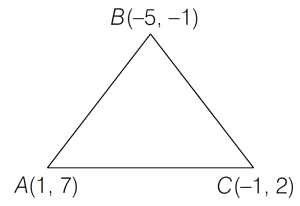
The vertices of a triangle are $A(1, 7)$,$B(-5, -1)$,and $C(-1, 2)$. Then,the equation of a bisector of the $\angle ABC$ is
A
$x-y+4=0$
B
$x+y+4=0$
C
$2x-3y+6=0$
D
$x-2y+4=0$
Solution
(A) The vertices of the triangle are $A(1, 7)$,$B(-5, -1)$,and $C(-1, 2)$.
The equation of line $AB$ passing through $(1, 7)$ and $(-5, -1)$ is:
$y - 7 = \frac{-1 - 7}{-5 - 1}(x - 1)$ $\Rightarrow y - 7 = \frac{-8}{-6}(x - 1)$ $\Rightarrow y - 7 = \frac{4}{3}(x - 1)$
$3y - 21 = 4x - 4 \Rightarrow 4x - 3y + 17 = 0$.
The equation of line $BC$ passing through $(-5, -1)$ and $(-1, 2)$ is:
$y - (-1) = \frac{2 - (-1)}{-1 - (-5)}(x - (-5)) \Rightarrow y + 1 = \frac{3}{4}(x + 5)$
$4y + 4 = 3x + 15 \Rightarrow 3x - 4y + 11 = 0$.
The equation of the angle bisector of $\angle ABC$ is given by:
$\frac{4x - 3y + 17}{\sqrt{4^2 + (-3)^2}} = \pm \frac{3x - 4y + 11}{\sqrt{3^2 + (-4)^2}}$
$\frac{4x - 3y + 17}{5} = \pm \frac{3x - 4y + 11}{5}$
Case $1$: $4x - 3y + 17 = 3x - 4y + 11 \Rightarrow x + y + 6 = 0$.
Case $2$: $4x - 3y + 17 = -(3x - 4y + 11)$ $\Rightarrow 4x - 3y + 17 = -3x + 4y - 11$ $\Rightarrow 7x - 7y + 28 = 0$ $\Rightarrow x - y + 4 = 0$.
Comparing with the options,$x - y + 4 = 0$ is the correct equation.
The equation of line $AB$ passing through $(1, 7)$ and $(-5, -1)$ is:
$y - 7 = \frac{-1 - 7}{-5 - 1}(x - 1)$ $\Rightarrow y - 7 = \frac{-8}{-6}(x - 1)$ $\Rightarrow y - 7 = \frac{4}{3}(x - 1)$
$3y - 21 = 4x - 4 \Rightarrow 4x - 3y + 17 = 0$.
The equation of line $BC$ passing through $(-5, -1)$ and $(-1, 2)$ is:
$y - (-1) = \frac{2 - (-1)}{-1 - (-5)}(x - (-5)) \Rightarrow y + 1 = \frac{3}{4}(x + 5)$
$4y + 4 = 3x + 15 \Rightarrow 3x - 4y + 11 = 0$.
The equation of the angle bisector of $\angle ABC$ is given by:
$\frac{4x - 3y + 17}{\sqrt{4^2 + (-3)^2}} = \pm \frac{3x - 4y + 11}{\sqrt{3^2 + (-4)^2}}$
$\frac{4x - 3y + 17}{5} = \pm \frac{3x - 4y + 11}{5}$
Case $1$: $4x - 3y + 17 = 3x - 4y + 11 \Rightarrow x + y + 6 = 0$.
Case $2$: $4x - 3y + 17 = -(3x - 4y + 11)$ $\Rightarrow 4x - 3y + 17 = -3x + 4y - 11$ $\Rightarrow 7x - 7y + 28 = 0$ $\Rightarrow x - y + 4 = 0$.
Comparing with the options,$x - y + 4 = 0$ is the correct equation.
0 likes
View Solution55
DifficultMCQ
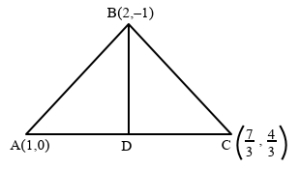
Let $A(1,0)$,$B(2,-1)$,and $C(\frac{7}{3},\frac{4}{3})$ be three points. If the equation of the internal angle bisector of $\angle ABC$ is $\alpha x+\beta y=5$,then the value of $\alpha^2+\beta^2$ is
A
$8$
B
$5$
C
$13$
D
$10$
Solution
(D) First,calculate the lengths of sides $AB$ and $BC$:
$AB = \sqrt{(2-1)^2 + (-1-0)^2} = \sqrt{1^2 + (-1)^2} = \sqrt{2}$
$BC = \sqrt{(\frac{7}{3}-2)^2 + (\frac{4}{3}-(-1))^2} = \sqrt{(\frac{1}{3})^2 + (\frac{7}{3})^2} = \sqrt{\frac{1}{9} + \frac{49}{9}} = \sqrt{\frac{50}{9}} = \frac{5\sqrt{2}}{3}$
By the Angle Bisector Theorem,the bisector of $\angle ABC$ divides the opposite side $AC$ in the ratio $AB:BC = \sqrt{2} : \frac{5\sqrt{2}}{3} = 3:5$.
Let $D$ be the point on $AC$ dividing it in ratio $3:5$. Using the section formula:
$D = \left( \frac{3(\frac{7}{3}) + 5(1)}{3+5}, \frac{3(\frac{4}{3}) + 5(0)}{3+5} \right) = \left( \frac{7+5}{8}, \frac{4+0}{8} \right) = (\frac{12}{8}, \frac{4}{8}) = (\frac{3}{2}, \frac{1}{2})$.
The angle bisector passes through $B(2,-1)$ and $D(\frac{3}{2}, \frac{1}{2})$.
The slope $m = \frac{\frac{1}{2} - (-1)}{\frac{3}{2} - 2} = \frac{\frac{3}{2}}{-\frac{1}{2}} = -3$.
The equation of the line is $y - (-1) = -3(x - 2) \implies y + 1 = -3x + 6 \implies 3x + y = 5$.
Comparing with $\alpha x + \beta y = 5$,we get $\alpha = 3$ and $\beta = 1$.
Thus,$\alpha^2 + \beta^2 = 3^2 + 1^2 = 9 + 1 = 10$.
$AB = \sqrt{(2-1)^2 + (-1-0)^2} = \sqrt{1^2 + (-1)^2} = \sqrt{2}$
$BC = \sqrt{(\frac{7}{3}-2)^2 + (\frac{4}{3}-(-1))^2} = \sqrt{(\frac{1}{3})^2 + (\frac{7}{3})^2} = \sqrt{\frac{1}{9} + \frac{49}{9}} = \sqrt{\frac{50}{9}} = \frac{5\sqrt{2}}{3}$
By the Angle Bisector Theorem,the bisector of $\angle ABC$ divides the opposite side $AC$ in the ratio $AB:BC = \sqrt{2} : \frac{5\sqrt{2}}{3} = 3:5$.
Let $D$ be the point on $AC$ dividing it in ratio $3:5$. Using the section formula:
$D = \left( \frac{3(\frac{7}{3}) + 5(1)}{3+5}, \frac{3(\frac{4}{3}) + 5(0)}{3+5} \right) = \left( \frac{7+5}{8}, \frac{4+0}{8} \right) = (\frac{12}{8}, \frac{4}{8}) = (\frac{3}{2}, \frac{1}{2})$.
The angle bisector passes through $B(2,-1)$ and $D(\frac{3}{2}, \frac{1}{2})$.
The slope $m = \frac{\frac{1}{2} - (-1)}{\frac{3}{2} - 2} = \frac{\frac{3}{2}}{-\frac{1}{2}} = -3$.
The equation of the line is $y - (-1) = -3(x - 2) \implies y + 1 = -3x + 6 \implies 3x + y = 5$.
Comparing with $\alpha x + \beta y = 5$,we get $\alpha = 3$ and $\beta = 1$.
Thus,$\alpha^2 + \beta^2 = 3^2 + 1^2 = 9 + 1 = 10$.
0 likes
View Solution56
DifficultMCQ
Let the line $L_1 : x + 3 = 0$ intersect the lines $L_2 : x - y = 0$ and $L_3 : 3x + y = 0$ at the points $A$ and $B$,respectively. Let the bisector of the obtuse angle between the lines $L_2$ and $L_3$ intersect the line $L_1$ at the point $C$. Then $BC^2 : AC^2$ is equal to:
A
$5$ : $1$
B
$1$ : $5$
C
$2$ : $3$
D
$3$ : $2$
Solution
(D) The line $L_1$ is $x = -3$.
Intersection of $L_1$ and $L_2$ $(y = x)$ gives point $A(-3, -3)$.
Intersection of $L_1$ and $L_3$ $(y = -3x)$ gives point $B(-3, 9)$.
The angle bisectors of $L_2$ $(x - y = 0)$ and $L_3$ $(3x + y = 0)$ are given by $\frac{x - y}{\sqrt{1^2 + (-1)^2}} = \pm \frac{3x + y}{\sqrt{3^2 + 1^2}}$,which simplifies to $\frac{x - y}{\sqrt{2}} = \pm \frac{3x + y}{\sqrt{10}}$,or $\sqrt{5}(x - y) = \pm (3x + y)$.
Case $1$: $\sqrt{5}x - \sqrt{5}y = 3x + y \implies x(\sqrt{5} - 3) = y(1 + \sqrt{5}) \implies y = \frac{\sqrt{5} - 3}{\sqrt{5} + 1}x$.
Case $2$: $\sqrt{5}x - \sqrt{5}y = -3x - y \implies x(\sqrt{5} + 3) = y(\sqrt{5} - 1) \implies y = \frac{\sqrt{5} + 3}{\sqrt{5} - 1}x$.
Checking the obtuse angle bisector: The product of slopes $m_2 m_3 = (1)(-3) = -3$. Since $m_1 m_2 + 1 > 0$,the origin is in the acute angle. The obtuse bisector is the one that does not contain the origin. Substituting $x = -3$ into the bisector equations,we find point $C$. Calculating distances $AC$ and $BC$ and their ratio,we get $BC^2 : AC^2 = 3 : 2$.
Intersection of $L_1$ and $L_2$ $(y = x)$ gives point $A(-3, -3)$.
Intersection of $L_1$ and $L_3$ $(y = -3x)$ gives point $B(-3, 9)$.
The angle bisectors of $L_2$ $(x - y = 0)$ and $L_3$ $(3x + y = 0)$ are given by $\frac{x - y}{\sqrt{1^2 + (-1)^2}} = \pm \frac{3x + y}{\sqrt{3^2 + 1^2}}$,which simplifies to $\frac{x - y}{\sqrt{2}} = \pm \frac{3x + y}{\sqrt{10}}$,or $\sqrt{5}(x - y) = \pm (3x + y)$.
Case $1$: $\sqrt{5}x - \sqrt{5}y = 3x + y \implies x(\sqrt{5} - 3) = y(1 + \sqrt{5}) \implies y = \frac{\sqrt{5} - 3}{\sqrt{5} + 1}x$.
Case $2$: $\sqrt{5}x - \sqrt{5}y = -3x - y \implies x(\sqrt{5} + 3) = y(\sqrt{5} - 1) \implies y = \frac{\sqrt{5} + 3}{\sqrt{5} - 1}x$.
Checking the obtuse angle bisector: The product of slopes $m_2 m_3 = (1)(-3) = -3$. Since $m_1 m_2 + 1 > 0$,the origin is in the acute angle. The obtuse bisector is the one that does not contain the origin. Substituting $x = -3$ into the bisector equations,we find point $C$. Calculating distances $AC$ and $BC$ and their ratio,we get $BC^2 : AC^2 = 3 : 2$.
0 likes
View SolutionStraight Line — Bisector of angle between two lines · Frequently Asked Questions
1Are these Straight Line questions useful for JEE and NEET?
Yes. All questions in this section are mapped to JEE Main and NEET exam patterns. Previous year questions from JEE Main, NEET, GUJCET and state-level exams are included with full solutions.
2Can I switch to Hindi or Gujarati for these questions?
Yes. Use the language tabs in the hero section or the sidebar to view the same questions and solutions in English, Hindi or Gujarati.
3How do I generate a question paper from this subtopic?
Use the Vedclass Exam Paper Generator — select the chapter and subtopic, set difficulty, and generate Sets A, B, C, D automatically. First 3 chapters of every subject are free.
Vedclass Products
For Students
Vedclass Test Series
Mock tests in real JEE/NEET style with performance analysis. 5-day free trial.
Start Free TrialFor Teachers
Exam Paper Generator
Generate Set A/B/C/D papers from this chapter in 2 minutes. 3 chapters free.
Try FreeFor Institutes
Online Exam Module
Live online exams with unlimited students, 360° analytics & white-label branding.
See DemoFor Teachers & Institutes
Generate a Straight Line Exam Paper in 2 Minutes
Select subtopic & difficulty — Sets A, B, C, D auto-generated with No Repeat logic.
First 3 chapters of every subject are free — no payment required.