
A English
Angle between two straight lines Questions in English
Class 11 Mathematics · Straight Line · Angle between two straight lines
121+
Questions
English
Language
100%
With Solutions
Showing 19 of 121 questions in English
101
DifficultMCQ
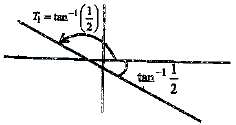
The slope of a line $L$ passing through the point $(-2, -3)$ is not defined. If the angle between the lines $L$ and $ax - 2y + 3 = 0$ $(a > 0)$ is $45^{\circ}$,then the angle made by the line $x + ay - 4 = 0$ with the positive $X$-axis in the anticlockwise direction is
A
$\pi - \tan^{-1}\left(\frac{1}{2}\right)$
B
$\frac{\pi}{3}$
C
$\frac{2\pi}{3}$
D
$\tan^{-1}\left(\frac{1}{2}\right)$
Solution
(A) The line $L$ passes through $(-2, -3)$ and has an undefined slope,so its equation is $x = -2$ (a vertical line).
The angle between $x = -2$ and the line $ax - 2y + 3 = 0$ is $45^{\circ}$.
The slope of the line $ax - 2y + 3 = 0$ is $m_1 = \frac{a}{2}$.
The angle $\theta$ between a vertical line and a line with slope $m_1$ is given by $|\tan(90^{\circ} - \theta)| = |\frac{1}{m_1}|$.
Since the angle is $45^{\circ}$,we have $|\frac{1}{a/2}| = \tan(45^{\circ}) = 1$.
Thus,$\frac{2}{a} = 1$,which gives $a = 2$.
Now,substitute $a = 2$ into the equation $x + ay - 4 = 0$ to get $x + 2y - 4 = 0$.
The slope of this line is $m = -\frac{1}{2}$.
The angle $\theta$ made with the positive $X$-axis is given by $\tan \theta = -\frac{1}{2}$.
Since the slope is negative,the angle is in the second quadrant,so $\theta = \pi - \tan^{-1}\left(\frac{1}{2}\right)$.
The angle between $x = -2$ and the line $ax - 2y + 3 = 0$ is $45^{\circ}$.
The slope of the line $ax - 2y + 3 = 0$ is $m_1 = \frac{a}{2}$.
The angle $\theta$ between a vertical line and a line with slope $m_1$ is given by $|\tan(90^{\circ} - \theta)| = |\frac{1}{m_1}|$.
Since the angle is $45^{\circ}$,we have $|\frac{1}{a/2}| = \tan(45^{\circ}) = 1$.
Thus,$\frac{2}{a} = 1$,which gives $a = 2$.
Now,substitute $a = 2$ into the equation $x + ay - 4 = 0$ to get $x + 2y - 4 = 0$.
The slope of this line is $m = -\frac{1}{2}$.
The angle $\theta$ made with the positive $X$-axis is given by $\tan \theta = -\frac{1}{2}$.
Since the slope is negative,the angle is in the second quadrant,so $\theta = \pi - \tan^{-1}\left(\frac{1}{2}\right)$.
0 likes
View Solution102
EasyMCQ
If the equation of a line having a slope $m$ $(m \in \mathbb{Z})$,passing through $(1, 1)$ and making an angle of $\tan^{-1}\left(\frac{5}{7}\right)$ with the line $x + y - 3 = 0$ is $ax + y + c = 0$,then $ac =$
A
$-7$
B
$-42$
C
$-21$
D
$12$
Solution
(B) The slope of the line is $m$. The slope of the line $x + y - 3 = 0$ is $m_2 = -1$.
Given $\tan \theta = \left|\frac{m - m_2}{1 + m m_2}\right| = \frac{5}{7}$.
Substituting $m_2 = -1$,we get $\left|\frac{m + 1}{1 - m}\right| = \frac{5}{7}$.
This implies $7|m + 1| = 5|1 - m|$.
Case $1$: $7(m + 1) = 5(1 - m)$ $\Rightarrow 7m + 7 = 5 - 5m$ $\Rightarrow 12m = -2$ $\Rightarrow m = -1/6$.
Case $2$: $7(m + 1) = -5(1 - m)$ $\Rightarrow 7m + 7 = -5 + 5m$ $\Rightarrow 2m = -12$ $\Rightarrow m = -6$.
Since $m \in \mathbb{Z}$,we must have $m = -6$.
The equation of the line passing through $(1, 1)$ with slope $m = -6$ is $y - 1 = -6(x - 1)$.
$y - 1 = -6x + 6 \Rightarrow 6x + y - 7 = 0$.
Comparing with $ax + y + c = 0$,we get $a = 6$ and $c = -7$.
Therefore,$ac = 6 \times (-7) = -42$.
Given $\tan \theta = \left|\frac{m - m_2}{1 + m m_2}\right| = \frac{5}{7}$.
Substituting $m_2 = -1$,we get $\left|\frac{m + 1}{1 - m}\right| = \frac{5}{7}$.
This implies $7|m + 1| = 5|1 - m|$.
Case $1$: $7(m + 1) = 5(1 - m)$ $\Rightarrow 7m + 7 = 5 - 5m$ $\Rightarrow 12m = -2$ $\Rightarrow m = -1/6$.
Case $2$: $7(m + 1) = -5(1 - m)$ $\Rightarrow 7m + 7 = -5 + 5m$ $\Rightarrow 2m = -12$ $\Rightarrow m = -6$.
Since $m \in \mathbb{Z}$,we must have $m = -6$.
The equation of the line passing through $(1, 1)$ with slope $m = -6$ is $y - 1 = -6(x - 1)$.
$y - 1 = -6x + 6 \Rightarrow 6x + y - 7 = 0$.
Comparing with $ax + y + c = 0$,we get $a = 6$ and $c = -7$.
Therefore,$ac = 6 \times (-7) = -42$.
0 likes
View Solution103
EasyMCQ
The slope of a line $L$ is $2$. If $m_1$ and $m_2$ are the slopes of two lines which are inclined at an angle of $\frac{\pi}{6}$ with $L$,then $m_1 + m_2 =$
A
$-11$
B
$16$
C
$11$
D
$-16$
Solution
(D) The angle $\theta$ between two lines with slopes $m$ and $m'$ is given by $\tan \theta = \left| \frac{m - m'}{1 + m m'} \right|$.
Given $\theta = \frac{\pi}{6}$ and $m' = 2$,we have $\tan \frac{\pi}{6} = \left| \frac{m - 2}{1 + 2m} \right|$.
Since $\tan \frac{\pi}{6} = \frac{1}{\sqrt{3}}$,we have $\frac{1}{\sqrt{3}} = \left| \frac{m - 2}{1 + 2m} \right|$.
Squaring both sides,we get $\frac{1}{3} = \frac{(m - 2)^2}{(1 + 2m)^2}$.
$(1 + 2m)^2 = 3(m - 2)^2$.
$1 + 4m + 4m^2 = 3(m^2 - 4m + 4)$.
$1 + 4m + 4m^2 = 3m^2 - 12m + 12$.
$m^2 + 16m - 11 = 0$.
This is a quadratic equation in $m$ whose roots are $m_1$ and $m_2$.
Using the sum of roots formula,$m_1 + m_2 = -\frac{b}{a} = -\frac{16}{1} = -16$.
Given $\theta = \frac{\pi}{6}$ and $m' = 2$,we have $\tan \frac{\pi}{6} = \left| \frac{m - 2}{1 + 2m} \right|$.
Since $\tan \frac{\pi}{6} = \frac{1}{\sqrt{3}}$,we have $\frac{1}{\sqrt{3}} = \left| \frac{m - 2}{1 + 2m} \right|$.
Squaring both sides,we get $\frac{1}{3} = \frac{(m - 2)^2}{(1 + 2m)^2}$.
$(1 + 2m)^2 = 3(m - 2)^2$.
$1 + 4m + 4m^2 = 3(m^2 - 4m + 4)$.
$1 + 4m + 4m^2 = 3m^2 - 12m + 12$.
$m^2 + 16m - 11 = 0$.
This is a quadratic equation in $m$ whose roots are $m_1$ and $m_2$.
Using the sum of roots formula,$m_1 + m_2 = -\frac{b}{a} = -\frac{16}{1} = -16$.
0 likes
View Solution104
EasyMCQ
The equation of a line making an angle $60^{\circ}$ with the line $x+y-3=0$ and passing through the point $(1,1)$ is
A
$(1+\sqrt{3})x+(1-\sqrt{3})y-2=0$
B
$2x+y-3=0$
C
$\sqrt{3}x+(1-\sqrt{3})y=1$
D
$\sqrt{3}x+(2+\sqrt{3})y=2(1+\sqrt{3})$
Solution
(A) The slope of the given line $x+y-3=0$ is $m_1 = -1$. Let the slope of the required line be $m$. The angle between the two lines is $60^{\circ}$.
Using the formula $\tan \theta = \left| \frac{m - m_1}{1 + m m_1} \right|$,we have $\tan 60^{\circ} = \left| \frac{m - (-1)}{1 + m(-1)} \right|$.
$\sqrt{3} = \left| \frac{m+1}{1-m} \right|$.
This gives two cases: $\frac{m+1}{1-m} = \sqrt{3}$ or $\frac{m+1}{1-m} = -\sqrt{3}$.
Case $1$: $m+1 = \sqrt{3} - \sqrt{3}m$ $\Rightarrow m(1+\sqrt{3}) = \sqrt{3}-1$ $\Rightarrow m = \frac{\sqrt{3}-1}{\sqrt{3}+1} = 2-\sqrt{3}$.
The equation of the line is $y-1 = (2-\sqrt{3})(x-1)$ $\Rightarrow y-1 = (2-\sqrt{3})x - 2 + \sqrt{3}$ $\Rightarrow (2-\sqrt{3})x - y + (1-\sqrt{3}) = 0$.
Case $2$: $m+1 = -\sqrt{3} + \sqrt{3}m$ $\Rightarrow m(1-\sqrt{3}) = -\sqrt{3}-1$ $\Rightarrow m = \frac{\sqrt{3}+1}{\sqrt{3}-1} = 2+\sqrt{3}$.
The equation of the line is $y-1 = (2+\sqrt{3})(x-1)$ $\Rightarrow y-1 = (2+\sqrt{3})x - 2 - \sqrt{3}$ $\Rightarrow (2+\sqrt{3})x - y - (1+\sqrt{3}) = 0$.
Comparing with the options,option $A$ is $(1+\sqrt{3})x+(1-\sqrt{3})y-2=0$ which simplifies to $y-1 = \frac{1+\sqrt{3}}{\sqrt{3}-1}(x-1) = (2+\sqrt{3})(x-1)$,matching Case $2$.
Using the formula $\tan \theta = \left| \frac{m - m_1}{1 + m m_1} \right|$,we have $\tan 60^{\circ} = \left| \frac{m - (-1)}{1 + m(-1)} \right|$.
$\sqrt{3} = \left| \frac{m+1}{1-m} \right|$.
This gives two cases: $\frac{m+1}{1-m} = \sqrt{3}$ or $\frac{m+1}{1-m} = -\sqrt{3}$.
Case $1$: $m+1 = \sqrt{3} - \sqrt{3}m$ $\Rightarrow m(1+\sqrt{3}) = \sqrt{3}-1$ $\Rightarrow m = \frac{\sqrt{3}-1}{\sqrt{3}+1} = 2-\sqrt{3}$.
The equation of the line is $y-1 = (2-\sqrt{3})(x-1)$ $\Rightarrow y-1 = (2-\sqrt{3})x - 2 + \sqrt{3}$ $\Rightarrow (2-\sqrt{3})x - y + (1-\sqrt{3}) = 0$.
Case $2$: $m+1 = -\sqrt{3} + \sqrt{3}m$ $\Rightarrow m(1-\sqrt{3}) = -\sqrt{3}-1$ $\Rightarrow m = \frac{\sqrt{3}+1}{\sqrt{3}-1} = 2+\sqrt{3}$.
The equation of the line is $y-1 = (2+\sqrt{3})(x-1)$ $\Rightarrow y-1 = (2+\sqrt{3})x - 2 - \sqrt{3}$ $\Rightarrow (2+\sqrt{3})x - y - (1+\sqrt{3}) = 0$.
Comparing with the options,option $A$ is $(1+\sqrt{3})x+(1-\sqrt{3})y-2=0$ which simplifies to $y-1 = \frac{1+\sqrt{3}}{\sqrt{3}-1}(x-1) = (2+\sqrt{3})(x-1)$,matching Case $2$.
0 likes
View Solution105
MediumMCQ
If $m_1$ and $m_2$ $(m_1 > m_2)$ are the slopes of the lines which make an angle of $30^{\circ}$ with the line joining the points $(1, 2)$ and $(3, 4)$,then $\frac{m_1}{m_2} = $
A
$2+\sqrt{3}$
B
$2-\sqrt{3}$
C
$7+4\sqrt{3}$
D
$7-4\sqrt{3}$
Solution
(C) The slope of the line joining the points $(1, 2)$ and $(3, 4)$ is $m = \frac{4-2}{3-1} = \frac{2}{2} = 1$.
Let the slopes of the required lines be $m_1$ and $m_2$. The angle between these lines and the given line is $30^{\circ}$.
Using the formula $\tan \theta = \left| \frac{m_1 - m_2}{1 + m_1 m_2} \right|$,we have $\tan 30^{\circ} = \left| \frac{m - 1}{1 + m(1)} \right| = \left| \frac{m - 1}{1 + m} \right|$.
$\frac{1}{\sqrt{3}} = \left| \frac{m - 1}{m + 1} \right| \Rightarrow \pm \frac{1}{\sqrt{3}} = \frac{m - 1}{m + 1}$.
Case $1$: $\frac{1}{\sqrt{3}} = \frac{m - 1}{m + 1}$ $\Rightarrow m + 1 = \sqrt{3}m - \sqrt{3}$ $\Rightarrow m(\sqrt{3} - 1) = \sqrt{3} + 1$ $\Rightarrow m = \frac{\sqrt{3} + 1}{\sqrt{3} - 1} = \frac{(\sqrt{3} + 1)^2}{3 - 1} = \frac{3 + 1 + 2\sqrt{3}}{2} = 2 + \sqrt{3}$.
Case $2$: $-\frac{1}{\sqrt{3}} = \frac{m - 1}{m + 1}$ $\Rightarrow -m - 1 = \sqrt{3}m - \sqrt{3}$ $\Rightarrow m(\sqrt{3} + 1) = \sqrt{3} - 1$ $\Rightarrow m = \frac{\sqrt{3} - 1}{\sqrt{3} + 1} = \frac{(\sqrt{3} - 1)^2}{3 - 1} = \frac{3 + 1 - 2\sqrt{3}}{2} = 2 - \sqrt{3}$.
Since $m_1 > m_2$,we have $m_1 = 2 + \sqrt{3}$ and $m_2 = 2 - \sqrt{3}$.
Therefore,$\frac{m_1}{m_2} = \frac{2 + \sqrt{3}}{2 - \sqrt{3}} = \frac{(2 + \sqrt{3})^2}{4 - 3} = 4 + 3 + 4\sqrt{3} = 7 + 4\sqrt{3}$.
Let the slopes of the required lines be $m_1$ and $m_2$. The angle between these lines and the given line is $30^{\circ}$.
Using the formula $\tan \theta = \left| \frac{m_1 - m_2}{1 + m_1 m_2} \right|$,we have $\tan 30^{\circ} = \left| \frac{m - 1}{1 + m(1)} \right| = \left| \frac{m - 1}{1 + m} \right|$.
$\frac{1}{\sqrt{3}} = \left| \frac{m - 1}{m + 1} \right| \Rightarrow \pm \frac{1}{\sqrt{3}} = \frac{m - 1}{m + 1}$.
Case $1$: $\frac{1}{\sqrt{3}} = \frac{m - 1}{m + 1}$ $\Rightarrow m + 1 = \sqrt{3}m - \sqrt{3}$ $\Rightarrow m(\sqrt{3} - 1) = \sqrt{3} + 1$ $\Rightarrow m = \frac{\sqrt{3} + 1}{\sqrt{3} - 1} = \frac{(\sqrt{3} + 1)^2}{3 - 1} = \frac{3 + 1 + 2\sqrt{3}}{2} = 2 + \sqrt{3}$.
Case $2$: $-\frac{1}{\sqrt{3}} = \frac{m - 1}{m + 1}$ $\Rightarrow -m - 1 = \sqrt{3}m - \sqrt{3}$ $\Rightarrow m(\sqrt{3} + 1) = \sqrt{3} - 1$ $\Rightarrow m = \frac{\sqrt{3} - 1}{\sqrt{3} + 1} = \frac{(\sqrt{3} - 1)^2}{3 - 1} = \frac{3 + 1 - 2\sqrt{3}}{2} = 2 - \sqrt{3}$.
Since $m_1 > m_2$,we have $m_1 = 2 + \sqrt{3}$ and $m_2 = 2 - \sqrt{3}$.
Therefore,$\frac{m_1}{m_2} = \frac{2 + \sqrt{3}}{2 - \sqrt{3}} = \frac{(2 + \sqrt{3})^2}{4 - 3} = 4 + 3 + 4\sqrt{3} = 7 + 4\sqrt{3}$.
0 likes
View Solution106
MediumMCQ
The equation of the straight line passing through the point $(3, 2)$ and inclined at an angle of $60^{\circ}$ with the line $\sqrt{3} x + y = 1$ is
A
$\sqrt{3} x + y - (2 + 3 \sqrt{3}) = 0$
B
$\sqrt{3} x - y + (2 - 3 \sqrt{3}) = 0$
C
$-\sqrt{3} x + y - (2 - 3 \sqrt{3}) = 0$
D
$-\sqrt{3} x + y + (2 - 3 \sqrt{3}) = 0$
Solution
(B) The given line is $\sqrt{3} x + y = 1$,which can be written as $y = -\sqrt{3} x + 1$. The slope $m_1 = -\sqrt{3}$.
Let the slope of the required line be $m_2$. The angle between the two lines is $60^{\circ}$.
Using the formula $\tan \theta = \left| \frac{m_1 - m_2}{1 + m_1 m_2} \right|$,we have:
$\tan 60^{\circ} = \left| \frac{-\sqrt{3} - m_2}{1 + (-\sqrt{3})m_2} \right|$
$\sqrt{3} = \left| \frac{-\sqrt{3} - m_2}{1 - \sqrt{3} m_2} \right|$
Squaring both sides:
$3 = \frac{(-\sqrt{3} - m_2)^2}{(1 - \sqrt{3} m_2)^2}$
$3(1 - \sqrt{3} m_2)^2 = (\sqrt{3} + m_2)^2$
$3(1 + 3m_2^2 - 2\sqrt{3} m_2) = 3 + m_2^2 + 2\sqrt{3} m_2$
$3 + 9m_2^2 - 6\sqrt{3} m_2 = 3 + m_2^2 + 2\sqrt{3} m_2$
$8m_2^2 - 8\sqrt{3} m_2 = 0$
$8m_2(m_2 - \sqrt{3}) = 0$
So,$m_2 = 0$ or $m_2 = \sqrt{3}$.
For $m_2 = \sqrt{3}$,the equation of the line passing through $(3, 2)$ is:
$y - 2 = \sqrt{3}(x - 3)$
$y - 2 = \sqrt{3} x - 3\sqrt{3}$
$\sqrt{3} x - y + (2 - 3\sqrt{3}) = 0$.
Let the slope of the required line be $m_2$. The angle between the two lines is $60^{\circ}$.
Using the formula $\tan \theta = \left| \frac{m_1 - m_2}{1 + m_1 m_2} \right|$,we have:
$\tan 60^{\circ} = \left| \frac{-\sqrt{3} - m_2}{1 + (-\sqrt{3})m_2} \right|$
$\sqrt{3} = \left| \frac{-\sqrt{3} - m_2}{1 - \sqrt{3} m_2} \right|$
Squaring both sides:
$3 = \frac{(-\sqrt{3} - m_2)^2}{(1 - \sqrt{3} m_2)^2}$
$3(1 - \sqrt{3} m_2)^2 = (\sqrt{3} + m_2)^2$
$3(1 + 3m_2^2 - 2\sqrt{3} m_2) = 3 + m_2^2 + 2\sqrt{3} m_2$
$3 + 9m_2^2 - 6\sqrt{3} m_2 = 3 + m_2^2 + 2\sqrt{3} m_2$
$8m_2^2 - 8\sqrt{3} m_2 = 0$
$8m_2(m_2 - \sqrt{3}) = 0$
So,$m_2 = 0$ or $m_2 = \sqrt{3}$.
For $m_2 = \sqrt{3}$,the equation of the line passing through $(3, 2)$ is:
$y - 2 = \sqrt{3}(x - 3)$
$y - 2 = \sqrt{3} x - 3\sqrt{3}$
$\sqrt{3} x - y + (2 - 3\sqrt{3}) = 0$.
0 likes
View Solution107
EasyMCQ
Let the angle between the lines $x-2y+3=0$ and $kx-y+2=0$ be $45^{\circ}$. If $k_1, k_2$ $(k_1 > k_2)$ are two distinct real values of $k$,then $k_1-2=$
A
$k_2$
B
$-k_2$
C
$-3k_2$
D
$3k_2$
Solution
(C) The slopes of the lines $x-2y+3=0$ and $kx-y+2=0$ are $m_1 = \frac{1}{2}$ and $m_2 = k$ respectively.
Given the angle $\theta = 45^{\circ}$,we use the formula $\tan \theta = \left| \frac{m_1 - m_2}{1 + m_1 m_2} \right|$.
$\tan 45^{\circ} = \left| \frac{\frac{1}{2} - k}{1 + \frac{k}{2}} \right| = 1$.
$|1 - 2k| = |2 + k|$.
Case $1$: $1 - 2k = 2 + k$ $\Rightarrow 3k = -1$ $\Rightarrow k = -\frac{1}{3}$.
Case $2$: $1 - 2k = -(2 + k)$ $\Rightarrow 1 - 2k = -2 - k$ $\Rightarrow k = 3$.
Since $k_1 > k_2$,we have $k_1 = 3$ and $k_2 = -\frac{1}{3}$.
Then $k_1 - 2 = 3 - 2 = 1$.
Checking the options: $-3k_2 = -3(-\frac{1}{3}) = 1$.
Thus,$k_1 - 2 = -3k_2$.
Given the angle $\theta = 45^{\circ}$,we use the formula $\tan \theta = \left| \frac{m_1 - m_2}{1 + m_1 m_2} \right|$.
$\tan 45^{\circ} = \left| \frac{\frac{1}{2} - k}{1 + \frac{k}{2}} \right| = 1$.
$|1 - 2k| = |2 + k|$.
Case $1$: $1 - 2k = 2 + k$ $\Rightarrow 3k = -1$ $\Rightarrow k = -\frac{1}{3}$.
Case $2$: $1 - 2k = -(2 + k)$ $\Rightarrow 1 - 2k = -2 - k$ $\Rightarrow k = 3$.
Since $k_1 > k_2$,we have $k_1 = 3$ and $k_2 = -\frac{1}{3}$.
Then $k_1 - 2 = 3 - 2 = 1$.
Checking the options: $-3k_2 = -3(-\frac{1}{3}) = 1$.
Thus,$k_1 - 2 = -3k_2$.
0 likes
View Solution108
EasyMCQ
If $\alpha, \beta$ $(\alpha > \beta)$ are two values of $k$ such that the equations $2x + (3 - 2k)y + (2k + 1) = 0$ and $kx + (k - 1)y - 4 = 0$ represent two perpendicular lines,then $\alpha^2 + 2\beta =$
A
$1$
B
$\frac{7}{4}$
C
$7$
D
$10$
Solution
(D) For two lines $a_1x + b_1y + c_1 = 0$ and $a_2x + b_2y + c_2 = 0$ to be perpendicular,the product of their slopes must be $-1$,or $a_1a_2 + b_1b_2 = 0$.
Here,$a_1 = 2, b_1 = (3 - 2k)$ and $a_2 = k, b_2 = (k - 1)$.
Applying the condition $a_1a_2 + b_1b_2 = 0$:
$2(k) + (3 - 2k)(k - 1) = 0$
$2k + (3k - 3 - 2k^2 + 2k) = 0$
$-2k^2 + 7k - 3 = 0$
$2k^2 - 7k + 3 = 0$
$(2k - 1)(k - 3) = 0$
Thus,$k = 3$ or $k = \frac{1}{2}$.
Given $\alpha > \beta$,we have $\alpha = 3$ and $\beta = \frac{1}{2}$.
Therefore,$\alpha^2 + 2\beta = (3)^2 + 2(\frac{1}{2}) = 9 + 1 = 10$.
Here,$a_1 = 2, b_1 = (3 - 2k)$ and $a_2 = k, b_2 = (k - 1)$.
Applying the condition $a_1a_2 + b_1b_2 = 0$:
$2(k) + (3 - 2k)(k - 1) = 0$
$2k + (3k - 3 - 2k^2 + 2k) = 0$
$-2k^2 + 7k - 3 = 0$
$2k^2 - 7k + 3 = 0$
$(2k - 1)(k - 3) = 0$
Thus,$k = 3$ or $k = \frac{1}{2}$.
Given $\alpha > \beta$,we have $\alpha = 3$ and $\beta = \frac{1}{2}$.
Therefore,$\alpha^2 + 2\beta = (3)^2 + 2(\frac{1}{2}) = 9 + 1 = 10$.
0 likes
View Solution109
EasyMCQ
If $\theta$ is the acute angle between the lines $\frac{x}{a}+\frac{y}{b}=1$ and $\frac{x}{b}+\frac{y}{a}=1$,then $\sin \theta=$
A
$\left|\frac{2ab}{a^2+b^2}\right|$
B
$\left|\frac{a-b}{a+b}\right|$
C
$\left|\frac{a^2-b^2}{2ab}\right|$
D
$\left|\frac{a^2-b^2}{a^2+b^2}\right|$
Solution
(D) Given lines are $L_1: \frac{x}{a} + \frac{y}{b} = 1$ and $L_2: \frac{x}{b} + \frac{y}{a} = 1$.
Slope of $L_1$ is $m_1 = -\frac{b}{a}$.
Slope of $L_2$ is $m_2 = -\frac{a}{b}$.
The angle $\theta$ between two lines is given by $\tan \theta = \left| \frac{m_1 - m_2}{1 + m_1 m_2} \right|$.
Substituting the slopes: $\tan \theta = \left| \frac{-\frac{b}{a} - (-\frac{a}{b})}{1 + (-\frac{b}{a})(-\frac{a}{b})} \right| = \left| \frac{\frac{a}{b} - \frac{b}{a}}{1 + 1} \right| = \left| \frac{a^2 - b^2}{2ab} \right|$.
Since $\tan \theta = \frac{\text{opposite}}{\text{adjacent}} = \frac{|a^2 - b^2|}{|2ab|}$,the hypotenuse is $\sqrt{(a^2 - b^2)^2 + (2ab)^2} = \sqrt{a^4 + b^4 - 2a^2b^2 + 4a^2b^2} = \sqrt{(a^2 + b^2)^2} = |a^2 + b^2|$.
Therefore,$\sin \theta = \frac{\text{opposite}}{\text{hypotenuse}} = \left| \frac{a^2 - b^2}{a^2 + b^2} \right|$.
Slope of $L_1$ is $m_1 = -\frac{b}{a}$.
Slope of $L_2$ is $m_2 = -\frac{a}{b}$.
The angle $\theta$ between two lines is given by $\tan \theta = \left| \frac{m_1 - m_2}{1 + m_1 m_2} \right|$.
Substituting the slopes: $\tan \theta = \left| \frac{-\frac{b}{a} - (-\frac{a}{b})}{1 + (-\frac{b}{a})(-\frac{a}{b})} \right| = \left| \frac{\frac{a}{b} - \frac{b}{a}}{1 + 1} \right| = \left| \frac{a^2 - b^2}{2ab} \right|$.
Since $\tan \theta = \frac{\text{opposite}}{\text{adjacent}} = \frac{|a^2 - b^2|}{|2ab|}$,the hypotenuse is $\sqrt{(a^2 - b^2)^2 + (2ab)^2} = \sqrt{a^4 + b^4 - 2a^2b^2 + 4a^2b^2} = \sqrt{(a^2 + b^2)^2} = |a^2 + b^2|$.
Therefore,$\sin \theta = \frac{\text{opposite}}{\text{hypotenuse}} = \left| \frac{a^2 - b^2}{a^2 + b^2} \right|$.
0 likes
View Solution110
EasyMCQ
If a straight line $L$ passing through the point $(5, -3)$ is inclined at an angle of $60^{\circ}$ to the line $\sqrt{3}x + y - 9 = 0$ and $L$ intersects the $X$-axis,then the equation of $L$ is
A
$x - \sqrt{3}y - 3 - 5\sqrt{3} = 0$
B
$\sqrt{3}x - y - 3 - 5\sqrt{3} = 0$
C
$\sqrt{3}x - y + 3 + 5\sqrt{3} = 0$
D
$x - \sqrt{3}y + 3 + 5\sqrt{3} = 0$
Solution
(B) Let the given line be $L_1: \sqrt{3}x + y - 9 = 0$. The slope of $L_1$ is $m_1 = -\sqrt{3}$.
Let the slope of the required line $L$ be $m$. The angle between $L$ and $L_1$ is $60^{\circ}$.
Using the formula $\tan \theta = \left| \frac{m - m_1}{1 + m \cdot m_1} \right|$,we have:
$\tan 60^{\circ} = \left| \frac{m - (-\sqrt{3})}{1 + m(-\sqrt{3})} \right|$ $\Rightarrow \sqrt{3} = \left| \frac{m + \sqrt{3}}{1 - \sqrt{3}m} \right|$.
Case $1$: $\sqrt{3} = \frac{m + \sqrt{3}}{1 - \sqrt{3}m}$ $\Rightarrow \sqrt{3} - 3m = m + \sqrt{3}$ $\Rightarrow 4m = 0$ $\Rightarrow m = 0$.
The equation is $y - (-3) = 0(x - 5) \Rightarrow y + 3 = 0$. This line is parallel to the $X$-axis and does not intersect it at a unique point (it is the $X$-axis itself if $y=0$,but here $y=-3$).
Case $2$: $-\sqrt{3} = \frac{m + \sqrt{3}}{1 - \sqrt{3}m}$ $\Rightarrow -\sqrt{3} + 3m = m + \sqrt{3}$ $\Rightarrow 2m = 2\sqrt{3}$ $\Rightarrow m = \sqrt{3}$.
The equation of line $L$ is $y - (-3) = \sqrt{3}(x - 5)$ $\Rightarrow y + 3 = \sqrt{3}x - 5\sqrt{3}$ $\Rightarrow \sqrt{3}x - y - 3 - 5\sqrt{3} = 0$.
Let the slope of the required line $L$ be $m$. The angle between $L$ and $L_1$ is $60^{\circ}$.
Using the formula $\tan \theta = \left| \frac{m - m_1}{1 + m \cdot m_1} \right|$,we have:
$\tan 60^{\circ} = \left| \frac{m - (-\sqrt{3})}{1 + m(-\sqrt{3})} \right|$ $\Rightarrow \sqrt{3} = \left| \frac{m + \sqrt{3}}{1 - \sqrt{3}m} \right|$.
Case $1$: $\sqrt{3} = \frac{m + \sqrt{3}}{1 - \sqrt{3}m}$ $\Rightarrow \sqrt{3} - 3m = m + \sqrt{3}$ $\Rightarrow 4m = 0$ $\Rightarrow m = 0$.
The equation is $y - (-3) = 0(x - 5) \Rightarrow y + 3 = 0$. This line is parallel to the $X$-axis and does not intersect it at a unique point (it is the $X$-axis itself if $y=0$,but here $y=-3$).
Case $2$: $-\sqrt{3} = \frac{m + \sqrt{3}}{1 - \sqrt{3}m}$ $\Rightarrow -\sqrt{3} + 3m = m + \sqrt{3}$ $\Rightarrow 2m = 2\sqrt{3}$ $\Rightarrow m = \sqrt{3}$.
The equation of line $L$ is $y - (-3) = \sqrt{3}(x - 5)$ $\Rightarrow y + 3 = \sqrt{3}x - 5\sqrt{3}$ $\Rightarrow \sqrt{3}x - y - 3 - 5\sqrt{3} = 0$.
0 likes
View Solution111
MediumMCQ
The angle between the line joining the points $(1, -2)$ and $(3, 2)$ and the line $x + 2y - 7 = 0$ is
A
$0$
B
$\frac{\pi}{4}$
C
$\frac{\pi}{2}$
D
$\pi$
Solution
(C) The slope $m_1$ of the line passing through $(1, -2)$ and $(3, 2)$ is given by $m_1 = \frac{2 - (-2)}{3 - 1} = \frac{4}{2} = 2$.
The slope $m_2$ of the line $x + 2y - 7 = 0$ is given by $m_2 = -\frac{1}{2}$.
Since $m_1 \times m_2 = 2 \times (-\frac{1}{2}) = -1$,the two lines are perpendicular to each other.
Therefore,the angle between the lines is $\frac{\pi}{2}$.
The slope $m_2$ of the line $x + 2y - 7 = 0$ is given by $m_2 = -\frac{1}{2}$.
Since $m_1 \times m_2 = 2 \times (-\frac{1}{2}) = -1$,the two lines are perpendicular to each other.
Therefore,the angle between the lines is $\frac{\pi}{2}$.
0 likes
View Solution112
MediumMCQ
The value of $k (> 0)$,such that the angle between the lines $4x - y + 7 = 0$ and $kx - 5y - 9 = 0$ is $45^{\circ}$,is
A
$\frac{25}{3}$
B
$\frac{5}{3}$
C
$3$
D
$5$
Solution
(C) The slopes of the lines $4x - y + 7 = 0$ and $kx - 5y - 9 = 0$ are $m_1 = 4$ and $m_2 = \frac{k}{5}$,respectively.
Given the angle $\theta = 45^{\circ}$ between the lines,we use the formula:
$\tan \theta = \left| \frac{m_1 - m_2}{1 + m_1 m_2} \right|$
$\tan 45^{\circ} = \left| \frac{4 - \frac{k}{5}}{1 + 4 \cdot \frac{k}{5}} \right|$
$1 = \left| \frac{20 - k}{5 + 4k} \right|$
This implies $\frac{20 - k}{5 + 4k} = 1$ or $\frac{20 - k}{5 + 4k} = -1$.
Case $1$: $20 - k = 5 + 4k$ $\Rightarrow 5k = 15$ $\Rightarrow k = 3$.
Case $2$: $20 - k = -5 - 4k$ $\Rightarrow 3k = -25$ $\Rightarrow k = -\frac{25}{3}$.
Since $k > 0$,the only valid solution is $k = 3$.
Given the angle $\theta = 45^{\circ}$ between the lines,we use the formula:
$\tan \theta = \left| \frac{m_1 - m_2}{1 + m_1 m_2} \right|$
$\tan 45^{\circ} = \left| \frac{4 - \frac{k}{5}}{1 + 4 \cdot \frac{k}{5}} \right|$
$1 = \left| \frac{20 - k}{5 + 4k} \right|$
This implies $\frac{20 - k}{5 + 4k} = 1$ or $\frac{20 - k}{5 + 4k} = -1$.
Case $1$: $20 - k = 5 + 4k$ $\Rightarrow 5k = 15$ $\Rightarrow k = 3$.
Case $2$: $20 - k = -5 - 4k$ $\Rightarrow 3k = -25$ $\Rightarrow k = -\frac{25}{3}$.
Since $k > 0$,the only valid solution is $k = 3$.
0 likes
View Solution113
MediumMCQ
The equation of a straight line passing through the point $(1, 2)$ and inclined at $45^{\circ}$ to the line $y = 2x + 1$ is
A
$5x + y = 7$
B
$3x + y = 5$
C
$x + y = 3$
D
$x - y + 1 = 0$
Solution
(B) Let the slope of the required line be $m$. The line passes through $(1, 2)$,so its equation is $(y - 2) = m(x - 1)$.
Given that the angle between this line and $y = 2x + 1$ is $45^{\circ}$.
The slope of the given line is $m_1 = 2$.
Using the formula $\tan \theta = \left| \frac{m - m_1}{1 + m \cdot m_1} \right|$,we have:
$\tan 45^{\circ} = \left| \frac{m - 2}{1 + 2m} \right|$
$1 = \left| \frac{m - 2}{1 + 2m} \right|$
This gives two cases:
Case $1$: $\frac{m - 2}{1 + 2m} = 1$ $\Rightarrow m - 2 = 1 + 2m$ $\Rightarrow m = -3$.
The equation is $(y - 2) = -3(x - 1)$ $\Rightarrow y - 2 = -3x + 3$ $\Rightarrow 3x + y = 5$.
Case $2$: $\frac{m - 2}{1 + 2m} = -1$ $\Rightarrow m - 2 = -1 - 2m$ $\Rightarrow 3m = 1$ $\Rightarrow m = \frac{1}{3}$.
The equation is $(y - 2) = \frac{1}{3}(x - 1)$ $\Rightarrow 3y - 6 = x - 1$ $\Rightarrow x - 3y + 5 = 0$.
Comparing with the options,$3x + y = 5$ is correct.
Given that the angle between this line and $y = 2x + 1$ is $45^{\circ}$.
The slope of the given line is $m_1 = 2$.
Using the formula $\tan \theta = \left| \frac{m - m_1}{1 + m \cdot m_1} \right|$,we have:
$\tan 45^{\circ} = \left| \frac{m - 2}{1 + 2m} \right|$
$1 = \left| \frac{m - 2}{1 + 2m} \right|$
This gives two cases:
Case $1$: $\frac{m - 2}{1 + 2m} = 1$ $\Rightarrow m - 2 = 1 + 2m$ $\Rightarrow m = -3$.
The equation is $(y - 2) = -3(x - 1)$ $\Rightarrow y - 2 = -3x + 3$ $\Rightarrow 3x + y = 5$.
Case $2$: $\frac{m - 2}{1 + 2m} = -1$ $\Rightarrow m - 2 = -1 - 2m$ $\Rightarrow 3m = 1$ $\Rightarrow m = \frac{1}{3}$.
The equation is $(y - 2) = \frac{1}{3}(x - 1)$ $\Rightarrow 3y - 6 = x - 1$ $\Rightarrow x - 3y + 5 = 0$.
Comparing with the options,$3x + y = 5$ is correct.
0 likes
View Solution114
EasyMCQ
The angle between the line joining the points $(1, -2)$ and $(3, 2)$ and the line $x + 2y - 7 = 0$ is
A
$\pi$
B
$\pi / 2$
C
$\pi / 3$
D
$\pi / 6$
Solution
(B) Let the line joining the points $(1, -2)$ and $(3, 2)$ be $L_1$. The slope $m_1$ of $L_1$ is given by $m_1 = \frac{2 - (-2)}{3 - 1} = \frac{4}{2} = 2$.
The equation of the second line $L_2$ is $x + 2y - 7 = 0$,which can be written as $2y = -x + 7$ or $y = -\frac{1}{2}x + \frac{7}{2}$.
The slope $m_2$ of $L_2$ is $-\frac{1}{2}$.
Now,calculate the product of the slopes: $m_1 \times m_2 = 2 \times (-\frac{1}{2}) = -1$.
Since the product of the slopes is $-1$,the two lines are perpendicular to each other.
Therefore,the angle between the lines is $\frac{\pi}{2}$.
The equation of the second line $L_2$ is $x + 2y - 7 = 0$,which can be written as $2y = -x + 7$ or $y = -\frac{1}{2}x + \frac{7}{2}$.
The slope $m_2$ of $L_2$ is $-\frac{1}{2}$.
Now,calculate the product of the slopes: $m_1 \times m_2 = 2 \times (-\frac{1}{2}) = -1$.
Since the product of the slopes is $-1$,the two lines are perpendicular to each other.
Therefore,the angle between the lines is $\frac{\pi}{2}$.
0 likes
View Solution115
EasyMCQ
If the two lines $\frac{3}{2} x + (2a - 1)y = 3$ and $2x + a^2y = -3$ are perpendicular,then the distance of their point of intersection from the point $(1, 1)$ is
A
$\frac{9}{\sqrt{5}}$
B
$3$
C
$\frac{\sqrt{45}}{5}$
D
$\sqrt{\frac{3}{5}}$
Solution
(B) Given that the two lines $L_1: \frac{3}{2}x + (2a - 1)y = 3$ and $L_2: 2x + a^2y = -3$ are perpendicular.
Since $L_1 \perp L_2$,the product of their slopes $m_1 \times m_2 = -1$.
The slope of $L_1$ is $m_1 = -\frac{3/2}{2a - 1} = -\frac{3}{4a - 2}$.
The slope of $L_2$ is $m_2 = -\frac{2}{a^2}$.
Thus,$(-\frac{3}{4a - 2}) \times (-\frac{2}{a^2}) = -1 \Rightarrow \frac{6}{a^2(4a - 2)} = -1$.
$6 = -4a^3 + 2a^2$ $\Rightarrow 4a^3 - 2a^2 + 6 = 0$ $\Rightarrow 2a^3 - a^2 + 3 = 0$.
Testing $a = -1$: $2(-1)^3 - (-1)^2 + 3 = -2 - 1 + 3 = 0$. So,$(a + 1)$ is a factor.
Dividing $2a^3 - a^2 + 3$ by $(a + 1)$ gives $2a^2 - 3a + 3 = 0$,which has no real roots $(D = 9 - 24 < 0)$.
So,$a = -1$.
Substituting $a = -1$ into the lines:
$L_1: \frac{3}{2}x + (2(-1) - 1)y = 3$ $\Rightarrow \frac{3}{2}x - 3y = 3$ $\Rightarrow x - 2y = 2$.
$L_2: 2x + (-1)^2y = -3 \Rightarrow 2x + y = -3$.
Solving the system:
$x - 2y = 2$ $(i)$
$2x + y = -3$ (ii)
From (ii),$y = -3 - 2x$. Substituting into $(i)$: $x - 2(-3 - 2x) = 2$ $\Rightarrow x + 6 + 4x = 2$ $\Rightarrow 5x = -4$ $\Rightarrow x = -\frac{4}{5}$.
Then $y = -3 - 2(-\frac{4}{5}) = -3 + \frac{8}{5} = -\frac{7}{5}$.
The intersection point is $(-\frac{4}{5}, -\frac{7}{5})$.
The distance from $(1, 1)$ is $\sqrt{(1 - (-\frac{4}{5}))^2 + (1 - (-\frac{7}{5}))^2} = \sqrt{(\frac{9}{5})^2 + (\frac{12}{5})^2} = \sqrt{\frac{81 + 144}{25}} = \sqrt{\frac{225}{25}} = \sqrt{9} = 3$.
Since $L_1 \perp L_2$,the product of their slopes $m_1 \times m_2 = -1$.
The slope of $L_1$ is $m_1 = -\frac{3/2}{2a - 1} = -\frac{3}{4a - 2}$.
The slope of $L_2$ is $m_2 = -\frac{2}{a^2}$.
Thus,$(-\frac{3}{4a - 2}) \times (-\frac{2}{a^2}) = -1 \Rightarrow \frac{6}{a^2(4a - 2)} = -1$.
$6 = -4a^3 + 2a^2$ $\Rightarrow 4a^3 - 2a^2 + 6 = 0$ $\Rightarrow 2a^3 - a^2 + 3 = 0$.
Testing $a = -1$: $2(-1)^3 - (-1)^2 + 3 = -2 - 1 + 3 = 0$. So,$(a + 1)$ is a factor.
Dividing $2a^3 - a^2 + 3$ by $(a + 1)$ gives $2a^2 - 3a + 3 = 0$,which has no real roots $(D = 9 - 24 < 0)$.
So,$a = -1$.
Substituting $a = -1$ into the lines:
$L_1: \frac{3}{2}x + (2(-1) - 1)y = 3$ $\Rightarrow \frac{3}{2}x - 3y = 3$ $\Rightarrow x - 2y = 2$.
$L_2: 2x + (-1)^2y = -3 \Rightarrow 2x + y = -3$.
Solving the system:
$x - 2y = 2$ $(i)$
$2x + y = -3$ (ii)
From (ii),$y = -3 - 2x$. Substituting into $(i)$: $x - 2(-3 - 2x) = 2$ $\Rightarrow x + 6 + 4x = 2$ $\Rightarrow 5x = -4$ $\Rightarrow x = -\frac{4}{5}$.
Then $y = -3 - 2(-\frac{4}{5}) = -3 + \frac{8}{5} = -\frac{7}{5}$.
The intersection point is $(-\frac{4}{5}, -\frac{7}{5})$.
The distance from $(1, 1)$ is $\sqrt{(1 - (-\frac{4}{5}))^2 + (1 - (-\frac{7}{5}))^2} = \sqrt{(\frac{9}{5})^2 + (\frac{12}{5})^2} = \sqrt{\frac{81 + 144}{25}} = \sqrt{\frac{225}{25}} = \sqrt{9} = 3$.
0 likes
View Solution116
DifficultMCQ
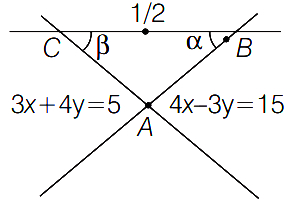
Two straight lines $3x + 4y = 5$ and $4x - 3y = 15$ intersect at the point $A$. The equations of the lines passing through $(1, 2)$ and intersecting the given lines at $B$ and $C$ such that $AB = AC$ are
A
$x + 4y = 9, 4x - y = 2$
B
$9x - 2y = 5, 2x + 9y = 20$
C
$6x - y = 4, x + 6y = 13$
D
$7x + y = 9, x - 7y + 13 = 0$
Solution
(D) Let the given lines be $L_1: 3x + 4y - 5 = 0$ and $L_2: 4x - 3y - 15 = 0$. The slopes are $m_1 = -\frac{3}{4}$ and $m_2 = \frac{4}{3}$.
Since $m_1 \times m_2 = -1$,the lines are perpendicular.
Let the line passing through $(1, 2)$ have slope $m$. Its equation is $y - 2 = m(x - 1)$,or $mx - y + (2 - m) = 0$.
Since $AB = AC$,the line $BC$ must make equal angles with $L_1$ and $L_2$. Since $L_1 \perp L_2$,the line $BC$ must make an angle of $45^\circ$ with both lines.
The angle between the line with slope $m$ and $L_1$ is given by $\tan 45^\circ = |\frac{m - (-3/4)}{1 + m(-3/4)}| = 1$.
$|\frac{4m + 3}{4 - 3m}| = 1$.
Case $1$: $\frac{4m + 3}{4 - 3m} = 1$ $\Rightarrow 4m + 3 = 4 - 3m$ $\Rightarrow 7m = 1$ $\Rightarrow m = \frac{1}{7}$.
The equation is $y - 2 = \frac{1}{7}(x - 1)$ $\Rightarrow 7y - 14 = x - 1$ $\Rightarrow x - 7y + 13 = 0$.
Case $2$: $\frac{4m + 3}{4 - 3m} = -1$ $\Rightarrow 4m + 3 = -4 + 3m$ $\Rightarrow m = -7$.
The equation is $y - 2 = -7(x - 1)$ $\Rightarrow y - 2 = -7x + 7$ $\Rightarrow 7x + y = 9$.
Thus,the lines are $7x + y = 9$ and $x - 7y + 13 = 0$.
Since $m_1 \times m_2 = -1$,the lines are perpendicular.
Let the line passing through $(1, 2)$ have slope $m$. Its equation is $y - 2 = m(x - 1)$,or $mx - y + (2 - m) = 0$.
Since $AB = AC$,the line $BC$ must make equal angles with $L_1$ and $L_2$. Since $L_1 \perp L_2$,the line $BC$ must make an angle of $45^\circ$ with both lines.
The angle between the line with slope $m$ and $L_1$ is given by $\tan 45^\circ = |\frac{m - (-3/4)}{1 + m(-3/4)}| = 1$.
$|\frac{4m + 3}{4 - 3m}| = 1$.
Case $1$: $\frac{4m + 3}{4 - 3m} = 1$ $\Rightarrow 4m + 3 = 4 - 3m$ $\Rightarrow 7m = 1$ $\Rightarrow m = \frac{1}{7}$.
The equation is $y - 2 = \frac{1}{7}(x - 1)$ $\Rightarrow 7y - 14 = x - 1$ $\Rightarrow x - 7y + 13 = 0$.
Case $2$: $\frac{4m + 3}{4 - 3m} = -1$ $\Rightarrow 4m + 3 = -4 + 3m$ $\Rightarrow m = -7$.
The equation is $y - 2 = -7(x - 1)$ $\Rightarrow y - 2 = -7x + 7$ $\Rightarrow 7x + y = 9$.
Thus,the lines are $7x + y = 9$ and $x - 7y + 13 = 0$.
0 likes
View Solution117
MediumMCQ
$A$ value of $k$ such that the straight lines $y-3kx+4=0$ and $(2k-1)x-(8k-1)y-6=0$ are perpendicular is
A
$1/6$
B
$-1/6$
C
$1$
D
$0$
Solution
(A) Given lines are $y-3kx+4=0$ $(i)$ and $(2k-1)x-(8k-1)y-6=0$ (ii).
The slope of line $(i)$ is $m_1 = \frac{-(-3k)}{1} = 3k$.
The slope of line (ii) is $m_2 = \frac{-(2k-1)}{-(8k-1)} = \frac{2k-1}{8k-1}$.
Since the lines are perpendicular,the product of their slopes must be $-1$,i.e.,$m_1 m_2 = -1$.
$3k \times \frac{2k-1}{8k-1} = -1$
$3k(2k-1) = -(8k-1)$
$6k^2 - 3k = -8k + 1$
$6k^2 + 5k - 1 = 0$
$6k^2 + 6k - k - 1 = 0$
$6k(k+1) - 1(k+1) = 0$
$(6k-1)(k+1) = 0$
Therefore,$k = 1/6$ or $k = -1$.
The slope of line $(i)$ is $m_1 = \frac{-(-3k)}{1} = 3k$.
The slope of line (ii) is $m_2 = \frac{-(2k-1)}{-(8k-1)} = \frac{2k-1}{8k-1}$.
Since the lines are perpendicular,the product of their slopes must be $-1$,i.e.,$m_1 m_2 = -1$.
$3k \times \frac{2k-1}{8k-1} = -1$
$3k(2k-1) = -(8k-1)$
$6k^2 - 3k = -8k + 1$
$6k^2 + 5k - 1 = 0$
$6k^2 + 6k - k - 1 = 0$
$6k(k+1) - 1(k+1) = 0$
$(6k-1)(k+1) = 0$
Therefore,$k = 1/6$ or $k = -1$.
0 likes
View Solution118
MediumMCQ
$A$ straight line through the point $(3, -2)$ is inclined at an angle $60^{\circ}$ to the line $\sqrt{3}x + y = 1$. If it intersects the $X$-axis,then its equation will be
A
$y + x\sqrt{3} + 2 + 3\sqrt{3} = 0$
B
$y - x\sqrt{3} + 2 + 3\sqrt{3} = 0$
C
$y - x\sqrt{3} - 2 - 2\sqrt{3} = 0$
D
$x - x\sqrt{3} + 2 - 3\sqrt{3} = 0$
Solution
(B) Given line: $\sqrt{3}x + y = 1$,which can be written as $y = -\sqrt{3}x + 1$. The slope $m_2 = -\sqrt{3}$.
Let the slope of the required line be $m_1$. The angle between the lines is $\theta = 60^{\circ}$.
Using the formula $\tan \theta = \left| \frac{m_1 - m_2}{1 + m_1 m_2} \right|$,we have:
$\tan 60^{\circ} = \left| \frac{m_1 - (-\sqrt{3})}{1 + m_1(-\sqrt{3})} \right|$
$\sqrt{3} = \left| \frac{m_1 + \sqrt{3}}{1 - \sqrt{3}m_1} \right|$
This gives two cases:
Case $1$: $\sqrt{3} = \frac{m_1 + \sqrt{3}}{1 - \sqrt{3}m_1} \implies \sqrt{3} - 3m_1 = m_1 + \sqrt{3} \implies 4m_1 = 0 \implies m_1 = 0$.
The equation of the line passing through $(3, -2)$ with slope $0$ is $y - (-2) = 0(x - 3) \implies y + 2 = 0$.
Case $2$: $-\sqrt{3} = \frac{m_1 + \sqrt{3}}{1 - \sqrt{3}m_1} \implies -\sqrt{3} + 3m_1 = m_1 + \sqrt{3} \implies 2m_1 = 2\sqrt{3} \implies m_1 = \sqrt{3}$.
The equation of the line passing through $(3, -2)$ with slope $\sqrt{3}$ is $y - (-2) = \sqrt{3}(x - 3) \implies y + 2 = x\sqrt{3} - 3\sqrt{3} \implies y - x\sqrt{3} + 2 + 3\sqrt{3} = 0$.
Comparing with the given options,the correct equation is $y - x\sqrt{3} + 2 + 3\sqrt{3} = 0$.
Let the slope of the required line be $m_1$. The angle between the lines is $\theta = 60^{\circ}$.
Using the formula $\tan \theta = \left| \frac{m_1 - m_2}{1 + m_1 m_2} \right|$,we have:
$\tan 60^{\circ} = \left| \frac{m_1 - (-\sqrt{3})}{1 + m_1(-\sqrt{3})} \right|$
$\sqrt{3} = \left| \frac{m_1 + \sqrt{3}}{1 - \sqrt{3}m_1} \right|$
This gives two cases:
Case $1$: $\sqrt{3} = \frac{m_1 + \sqrt{3}}{1 - \sqrt{3}m_1} \implies \sqrt{3} - 3m_1 = m_1 + \sqrt{3} \implies 4m_1 = 0 \implies m_1 = 0$.
The equation of the line passing through $(3, -2)$ with slope $0$ is $y - (-2) = 0(x - 3) \implies y + 2 = 0$.
Case $2$: $-\sqrt{3} = \frac{m_1 + \sqrt{3}}{1 - \sqrt{3}m_1} \implies -\sqrt{3} + 3m_1 = m_1 + \sqrt{3} \implies 2m_1 = 2\sqrt{3} \implies m_1 = \sqrt{3}$.
The equation of the line passing through $(3, -2)$ with slope $\sqrt{3}$ is $y - (-2) = \sqrt{3}(x - 3) \implies y + 2 = x\sqrt{3} - 3\sqrt{3} \implies y - x\sqrt{3} + 2 + 3\sqrt{3} = 0$.
Comparing with the given options,the correct equation is $y - x\sqrt{3} + 2 + 3\sqrt{3} = 0$.
0 likes
View Solution119
MediumMCQ
The equations of the lines passing through $(1,1)$ and making an angle of $45^{\circ}$ with the line $x+y=0$ are
A
$x-1=0, x-y=0$
B
$x-y=0, y-1=0$
C
$x+y-2=0, y-1=0$
D
$x-1=0, y-1=0$
Solution
(D) The given line is $x+y=0$,which can be written as $y = -x$. The slope of this line is $m_1 = -1$.
Let the slope of the required lines be $m$. The angle between the lines is $45^{\circ}$.
Using the formula $\tan \theta = \left| \frac{m - m_1}{1 + m m_1} \right|$,we have:
$\tan 45^{\circ} = \left| \frac{m - (-1)}{1 + m(-1)} \right|$
$1 = \left| \frac{m+1}{1-m} \right|$
This gives two cases:
Case $1$: $\frac{m+1}{1-m} = 1 \implies m+1 = 1-m \implies 2m = 0 \implies m = 0$.
The equation of the line passing through $(1,1)$ with slope $0$ is $y-1 = 0(x-1) \implies y-1 = 0$.
Case $2$: $\frac{m+1}{1-m} = -1 \implies m+1 = -1+m \implies 1 = -1$,which is impossible (this implies the line is vertical).
$A$ vertical line passing through $(1,1)$ is $x=1$,or $x-1=0$.
Thus,the equations of the lines are $x-1=0$ and $y-1=0$.
Let the slope of the required lines be $m$. The angle between the lines is $45^{\circ}$.
Using the formula $\tan \theta = \left| \frac{m - m_1}{1 + m m_1} \right|$,we have:
$\tan 45^{\circ} = \left| \frac{m - (-1)}{1 + m(-1)} \right|$
$1 = \left| \frac{m+1}{1-m} \right|$
This gives two cases:
Case $1$: $\frac{m+1}{1-m} = 1 \implies m+1 = 1-m \implies 2m = 0 \implies m = 0$.
The equation of the line passing through $(1,1)$ with slope $0$ is $y-1 = 0(x-1) \implies y-1 = 0$.
Case $2$: $\frac{m+1}{1-m} = -1 \implies m+1 = -1+m \implies 1 = -1$,which is impossible (this implies the line is vertical).
$A$ vertical line passing through $(1,1)$ is $x=1$,or $x-1=0$.
Thus,the equations of the lines are $x-1=0$ and $y-1=0$.
0 likes
View SolutionStraight Line — Angle between two straight lines · Frequently Asked Questions
1Are these Straight Line questions useful for JEE and NEET?
Yes. All questions in this section are mapped to JEE Main and NEET exam patterns. Previous year questions from JEE Main, NEET, GUJCET and state-level exams are included with full solutions.
2Can I switch to Hindi or Gujarati for these questions?
Yes. Use the language tabs in the hero section or the sidebar to view the same questions and solutions in English, Hindi or Gujarati.
3How do I generate a question paper from this subtopic?
Use the Vedclass Exam Paper Generator — select the chapter and subtopic, set difficulty, and generate Sets A, B, C, D automatically. First 3 chapters of every subject are free.
Vedclass Products
For Students
Vedclass Test Series
Mock tests in real JEE/NEET style with performance analysis. 5-day free trial.
Start Free TrialFor Teachers
Exam Paper Generator
Generate Set A/B/C/D papers from this chapter in 2 minutes. 3 chapters free.
Try FreeFor Institutes
Online Exam Module
Live online exams with unlimited students, 360° analytics & white-label branding.
See DemoFor Teachers & Institutes
Generate a Straight Line Exam Paper in 2 Minutes
Select subtopic & difficulty — Sets A, B, C, D auto-generated with No Repeat logic.
First 3 chapters of every subject are free — no payment required.