
A English
Word Problem - Set Theory Questions in English
Class 11 Mathematics · Set Theory · Word Problem - Set Theory
180+
Questions
English
Language
100%
With Solutions
Showing 28 of 180 questions in English
151
EasyMCQ
If $P(A) = \frac{2}{5}$,$P(B) = \frac{1}{4}$ and $P(A \cup B) = \frac{1}{2}$,then $P(A' \cup B') = $
A
$\frac{1}{2}$
B
$\frac{1}{4}$
C
$\frac{3}{20}$
D
$\frac{17}{20}$
Solution
(D) Given: $P(A) = \frac{2}{5}$,$P(B) = \frac{1}{4}$,$P(A \cup B) = \frac{1}{2}$.
By De Morgan's Law,$P(A' \cup B') = P((A \cap B)') = 1 - P(A \cap B)$.
First,find $P(A \cap B)$ using the formula $P(A \cup B) = P(A) + P(B) - P(A \cap B)$:
$\frac{1}{2} = \frac{2}{5} + \frac{1}{4} - P(A \cap B)$
$\frac{1}{2} = \frac{8+5}{20} - P(A \cap B)$
$\frac{1}{2} = \frac{13}{20} - P(A \cap B)$
$P(A \cap B) = \frac{13}{20} - \frac{10}{20} = \frac{3}{20}$.
Now,$P(A' \cup B') = 1 - \frac{3}{20} = \frac{17}{20}$.
By De Morgan's Law,$P(A' \cup B') = P((A \cap B)') = 1 - P(A \cap B)$.
First,find $P(A \cap B)$ using the formula $P(A \cup B) = P(A) + P(B) - P(A \cap B)$:
$\frac{1}{2} = \frac{2}{5} + \frac{1}{4} - P(A \cap B)$
$\frac{1}{2} = \frac{8+5}{20} - P(A \cap B)$
$\frac{1}{2} = \frac{13}{20} - P(A \cap B)$
$P(A \cap B) = \frac{13}{20} - \frac{10}{20} = \frac{3}{20}$.
Now,$P(A' \cup B') = 1 - \frac{3}{20} = \frac{17}{20}$.
0 likes
View Solution152
EasyMCQ
In a certain examination,a candidate has to pass in each of the $5$ subjects. The number of ways in which the candidate can fail is:
A
$5!$
B
$5$
C
$2^5 - 1$
D
$2^5$
Solution
(C) For each of the $5$ subjects,a candidate has $2$ possibilities: either pass or fail.
Since there are $5$ subjects,the total number of possible outcomes (combinations of pass/fail) is $2 \times 2 \times 2 \times 2 \times 2 = 2^5 = 32$.
The candidate passes the examination only if they pass in all $5$ subjects. There is only $1$ such way (Pass,Pass,Pass,Pass,Pass).
Therefore,the number of ways in which the candidate can fail (i.e.,fail in at least one subject) is the total number of outcomes minus the case where they pass all subjects.
Number of ways to fail $= 2^5 - 1 = 32 - 1 = 31$.
Since there are $5$ subjects,the total number of possible outcomes (combinations of pass/fail) is $2 \times 2 \times 2 \times 2 \times 2 = 2^5 = 32$.
The candidate passes the examination only if they pass in all $5$ subjects. There is only $1$ such way (Pass,Pass,Pass,Pass,Pass).
Therefore,the number of ways in which the candidate can fail (i.e.,fail in at least one subject) is the total number of outcomes minus the case where they pass all subjects.
Number of ways to fail $= 2^5 - 1 = 32 - 1 = 31$.
0 likes
View Solution153
EasyMCQ
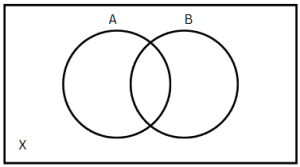
If $A$ and $B$ are subsets of universal set $X$ such that $n(X)=200, n(A)=90, n(B)=80$ and $n(A' \cap B')=40$,then $n(A \cap B')=$
A
$70$
B
$80$
C
$20$
D
$10$
Solution
(B) Given that $n(X)=200, n(A)=90, n(B)=80$ and $n(A' \cap B')=40$.
By De Morgan's Law,$n(A' \cap B') = n((A \cup B)') = n(X) - n(A \cup B)$.
So,$40 = 200 - n(A \cup B)$,which implies $n(A \cup B) = 160$.
We know that $n(A \cup B) = n(A) + n(B) - n(A \cap B)$.
$160 = 90 + 80 - n(A \cap B) \implies 160 = 170 - n(A \cap B) \implies n(A \cap B) = 10$.
Now,$n(A \cap B') = n(A) - n(A \cap B) = 90 - 10 = 80$.
By De Morgan's Law,$n(A' \cap B') = n((A \cup B)') = n(X) - n(A \cup B)$.
So,$40 = 200 - n(A \cup B)$,which implies $n(A \cup B) = 160$.
We know that $n(A \cup B) = n(A) + n(B) - n(A \cap B)$.
$160 = 90 + 80 - n(A \cap B) \implies 160 = 170 - n(A \cap B) \implies n(A \cap B) = 10$.
Now,$n(A \cap B') = n(A) - n(A \cap B) = 90 - 10 = 80$.
0 likes
View Solution154
MediumMCQ
If $A = \{1, 2, 3, 4, 5, 6\}$,then the number of subsets of $A$ which contain at least two elements is
A
$64$
B
$63$
C
$57$
D
$58$
Solution
(C) Given set $A = \{1, 2, 3, 4, 5, 6\}$.
The total number of subsets of $A$ is $2^n$,where $n = 6$,so $2^6 = 64$.
The subsets containing at least two elements are the total subsets minus the subsets with zero elements (empty set) and the subsets with exactly one element.
Number of subsets with zero elements = ${}^6C_0 = 1$.
Number of subsets with one element = ${}^6C_1 = 6$.
Therefore,the number of subsets with at least two elements = $64 - (1 + 6) = 64 - 7 = 57$.
The total number of subsets of $A$ is $2^n$,where $n = 6$,so $2^6 = 64$.
The subsets containing at least two elements are the total subsets minus the subsets with zero elements (empty set) and the subsets with exactly one element.
Number of subsets with zero elements = ${}^6C_0 = 1$.
Number of subsets with one element = ${}^6C_1 = 6$.
Therefore,the number of subsets with at least two elements = $64 - (1 + 6) = 64 - 7 = 57$.
0 likes
View Solution155
EasyMCQ
In a class of $60$ students,$25$ students play cricket and $20$ students play tennis,and $10$ students play both the games. The number of students who play neither is:
A
$00$
B
$35$
C
$15$
D
$25$
Solution
(D) Let $n(U) = 60$ be the total number of students.
Let $C$ be the set of students who play cricket,$n(C) = 25$.
Let $T$ be the set of students who play tennis,$n(T) = 20$.
Given $n(C \cap T) = 10$.
The number of students who play at least one game is $n(C \cup T) = n(C) + n(T) - n(C \cap T)$.
$n(C \cup T) = 25 + 20 - 10 = 35$.
The number of students who play neither game is $n(U) - n(C \cup T)$.
$60 - 35 = 25$.
Let $C$ be the set of students who play cricket,$n(C) = 25$.
Let $T$ be the set of students who play tennis,$n(T) = 20$.
Given $n(C \cap T) = 10$.
The number of students who play at least one game is $n(C \cup T) = n(C) + n(T) - n(C \cap T)$.
$n(C \cup T) = 25 + 20 - 10 = 35$.
The number of students who play neither game is $n(U) - n(C \cup T)$.
$60 - 35 = 25$.
0 likes
View Solution156
EasyMCQ
$A$ and $B$ are two sets having $3$ and $6$ elements respectively. Consider the following statements. Statement $(I)$: Minimum number of elements in $A \cup B$ is $6$. Statement $(II)$: Maximum number of elements in $A \cap B$ is $3$. Which of the following is correct?
A
Statement $(I)$ is true,statement $(II)$ is false
B
Statement $(I)$ is false,statement $(II)$ is true
C
Both statements $(I)$ and $(II)$ are true
D
Both statements $(I)$ and $(II)$ are false
Solution
(C) Given $|A| = 3$ and $|B| = 6$.
For $A \cup B$,the formula is $|A \cup B| = |A| + |B| - |A \cap B|$.
To minimize $|A \cup B|$,we must maximize $|A \cap B|$. The maximum value of $|A \cap B|$ is $\min(|A|, |B|) = 3$.
Thus,$\min |A \cup B| = 3 + 6 - 3 = 6$. So,Statement $(I)$ is true.
For $A \cap B$,the maximum value is $\min(|A|, |B|) = 3$.
Thus,$\max |A \cap B| = 3$. So,Statement $(II)$ is true.
For $A \cup B$,the formula is $|A \cup B| = |A| + |B| - |A \cap B|$.
To minimize $|A \cup B|$,we must maximize $|A \cap B|$. The maximum value of $|A \cap B|$ is $\min(|A|, |B|) = 3$.
Thus,$\min |A \cup B| = 3 + 6 - 3 = 6$. So,Statement $(I)$ is true.
For $A \cap B$,the maximum value is $\min(|A|, |B|) = 3$.
Thus,$\max |A \cap B| = 3$. So,Statement $(II)$ is true.
0 likes
View Solution157
EasyMCQ
$A$ and $B$ are non-singleton sets and $n(A \times B) = 35$. If $B \subset A$,then ${}^{n(A)}C_{n(B)}$ is equal to
A
$28$
B
$35$
C
$42$
D
$21$
Solution
(D) Given,$n(A \times B) = 35$ and $B \subset A$.
Since $n(A \times B) = n(A) \times n(B) = 35$,the possible factors of $35$ are $(35, 1)$ or $(7, 5)$.
Since $B \subset A$ and $A, B$ are non-singleton sets,$n(A) > n(B) > 1$.
Thus,$n(A) = 7$ and $n(B) = 5$.
Now,calculating ${}^{n(A)}C_{n(B)} = {}^{7}C_{5}$.
Using the property ${}^{n}C_{r} = {}^{n}C_{n-r}$,we get ${}^{7}C_{5} = {}^{7}C_{2}$.
${}^{7}C_{2} = \frac{7 \times 6}{2 \times 1} = 21$.
Since $n(A \times B) = n(A) \times n(B) = 35$,the possible factors of $35$ are $(35, 1)$ or $(7, 5)$.
Since $B \subset A$ and $A, B$ are non-singleton sets,$n(A) > n(B) > 1$.
Thus,$n(A) = 7$ and $n(B) = 5$.
Now,calculating ${}^{n(A)}C_{n(B)} = {}^{7}C_{5}$.
Using the property ${}^{n}C_{r} = {}^{n}C_{n-r}$,we get ${}^{7}C_{5} = {}^{7}C_{2}$.
${}^{7}C_{2} = \frac{7 \times 6}{2 \times 1} = 21$.
0 likes
View Solution158
EasyMCQ
If $U$ is the universal set with $100$ elements; $A$ and $B$ are two sets such that $n(A)=50$,$n(B)=60$,and $n(A \cap B)=20$,then find $n(A^{\prime} \cap B^{\prime})$.
A
$20$
B
$10$
C
$40$
D
$90$
Solution
(B) Given: $n(U)=100$,$n(A)=50$,$n(B)=60$,$n(A \cap B)=20$.
Using the formula for the union of two sets:
$n(A \cup B) = n(A) + n(B) - n(A \cap B)$
$n(A \cup B) = 50 + 60 - 20 = 90$.
By De Morgan's Law,$A^{\prime} \cap B^{\prime} = (A \cup B)^{\prime}$.
Therefore,$n(A^{\prime} \cap B^{\prime}) = n(U) - n(A \cup B)$.
$n(A^{\prime} \cap B^{\prime}) = 100 - 90 = 10$.
Using the formula for the union of two sets:
$n(A \cup B) = n(A) + n(B) - n(A \cap B)$
$n(A \cup B) = 50 + 60 - 20 = 90$.
By De Morgan's Law,$A^{\prime} \cap B^{\prime} = (A \cup B)^{\prime}$.
Therefore,$n(A^{\prime} \cap B^{\prime}) = n(U) - n(A \cup B)$.
$n(A^{\prime} \cap B^{\prime}) = 100 - 90 = 10$.
0 likes
View Solution159
MediumMCQ
In a certain town,$65\%$ of families own cell phones,$15000$ families own scooters,and $15\%$ of families own both. Given that every family owns at least one of the two,the total number of families in the town is:
A
$20000$
B
$30000$
C
$40000$
D
$50000$
Solution
(B) Let the total number of families be $x$.
Let $A$ be the set of families that own cell phones,so $n(A) = \frac{65}{100}x$.
Let $B$ be the set of families that own scooters,so $n(B) = 15000$.
The number of families that own both is $n(A \cap B) = \frac{15}{100}x$.
Since every family owns at least one,$n(A \cup B) = x$.
Using the formula $n(A \cup B) = n(A) + n(B) - n(A \cap B)$,we have:
$x = \frac{65x}{100} + 15000 - \frac{15x}{100}$
$x = \frac{50x}{100} + 15000$
$x = 0.5x + 15000$
$0.5x = 15000$
$x = \frac{15000}{0.5} = 30000$.
Thus,the total number of families in the town is $30000$.
Let $A$ be the set of families that own cell phones,so $n(A) = \frac{65}{100}x$.
Let $B$ be the set of families that own scooters,so $n(B) = 15000$.
The number of families that own both is $n(A \cap B) = \frac{15}{100}x$.
Since every family owns at least one,$n(A \cup B) = x$.
Using the formula $n(A \cup B) = n(A) + n(B) - n(A \cap B)$,we have:
$x = \frac{65x}{100} + 15000 - \frac{15x}{100}$
$x = \frac{50x}{100} + 15000$
$x = 0.5x + 15000$
$0.5x = 15000$
$x = \frac{15000}{0.5} = 30000$.
Thus,the total number of families in the town is $30000$.
0 likes
View Solution160
EasyMCQ
The number of integers from $1$ to $1000$ which are divisible by $2$ or $3$ is
A
$88$
B
$667$
C
$58$
D
$47$
Solution
(B) Let $A$ be the set of integers from $1$ to $1000$ divisible by $2$,and $B$ be the set of integers from $1$ to $1000$ divisible by $3$.
We need to find $|A \cup B| = |A| + |B| - |A \cap B|$.
$|A| = \lfloor \frac{1000}{2} \rfloor = 500$.
$|B| = \lfloor \frac{1000}{3} \rfloor = 333$.
$|A \cap B|$ is the number of integers divisible by both $2$ and $3$,i.e.,divisible by $\text{lcm}(2, 3) = 6$.
$|A \cap B| = \lfloor \frac{1000}{6} \rfloor = 166$.
Therefore,$|A \cup B| = 500 + 333 - 166 = 667$.
We need to find $|A \cup B| = |A| + |B| - |A \cap B|$.
$|A| = \lfloor \frac{1000}{2} \rfloor = 500$.
$|B| = \lfloor \frac{1000}{3} \rfloor = 333$.
$|A \cap B|$ is the number of integers divisible by both $2$ and $3$,i.e.,divisible by $\text{lcm}(2, 3) = 6$.
$|A \cap B| = \lfloor \frac{1000}{6} \rfloor = 166$.
Therefore,$|A \cup B| = 500 + 333 - 166 = 667$.
0 likes
View Solution161
DifficultMCQ
$a, b, c, d, e, f, g, h$ are distinct elements in the set $\{-7, -5, -3, -2, 2, 4, 6, 13\}$. The minimum value of $(a+b+c+d)^2+(e+f+g+h)^2$ is
A
$30$
B
$32$
C
$34$
D
$40$
Solution
(C) Let $S = \{-7, -5, -3, -2, 2, 4, 6, 13\}$. The sum of all elements is $S_{total} = -7-5-3-2+2+4+6+13 = 8$.
Let $x = a+b+c+d$ and $y = e+f+g+h$.
Since $a, b, c, d, e, f, g, h$ are distinct elements of $S$,we have $x+y = 8$.
We want to minimize $x^2+y^2$.
We know that $x^2+y^2 = \frac{1}{2}((x+y)^2 + (x-y)^2)$.
Since $(x+y)^2 = 8^2 = 64$ is constant,we minimize $x^2+y^2$ by minimizing $|x-y|$.
We have $x+y = 8$,so $y = 8-x$.
Then $x-y = x-(8-x) = 2x-8 = 2(x-4)$.
We want $x$ to be as close to $4$ as possible.
The sum of four elements from $S$ that is closest to $4$ is $x = -2-3+6+4 = 5$ or $x = -7+2+4+6 = 5$.
If $x=5$,then $y = 8-5 = 3$.
Then $x^2+y^2 = 5^2+3^2 = 25+9 = 34$.
Alternatively,if $x=4$,then $y=4$. This is impossible as elements are distinct.
If $x=6$,then $y=2$. $x^2+y^2 = 36+4 = 40$.
If $x=3$,then $y=5$. $x^2+y^2 = 9+25 = 34$.
Thus,the minimum value is $34$.
Let $x = a+b+c+d$ and $y = e+f+g+h$.
Since $a, b, c, d, e, f, g, h$ are distinct elements of $S$,we have $x+y = 8$.
We want to minimize $x^2+y^2$.
We know that $x^2+y^2 = \frac{1}{2}((x+y)^2 + (x-y)^2)$.
Since $(x+y)^2 = 8^2 = 64$ is constant,we minimize $x^2+y^2$ by minimizing $|x-y|$.
We have $x+y = 8$,so $y = 8-x$.
Then $x-y = x-(8-x) = 2x-8 = 2(x-4)$.
We want $x$ to be as close to $4$ as possible.
The sum of four elements from $S$ that is closest to $4$ is $x = -2-3+6+4 = 5$ or $x = -7+2+4+6 = 5$.
If $x=5$,then $y = 8-5 = 3$.
Then $x^2+y^2 = 5^2+3^2 = 25+9 = 34$.
Alternatively,if $x=4$,then $y=4$. This is impossible as elements are distinct.
If $x=6$,then $y=2$. $x^2+y^2 = 36+4 = 40$.
If $x=3$,then $y=5$. $x^2+y^2 = 9+25 = 34$.
Thus,the minimum value is $34$.
0 likes
View Solution162
EasyMCQ
In a committee of $25$ members,each member is proficient either in Mathematics or in Statistics or in both. If $19$ of them are proficient in Mathematics and $16$ of them are proficient in Statistics,then the probability that a person selected at random from the committee is proficient in both is
A
$\frac{1}{5}$
B
$\frac{3}{5}$
C
$\frac{2}{5}$
D
$\frac{1}{2}$
Solution
(C) Let $n(M)$ be the number of members proficient in Mathematics and $n(S)$ be the number of members proficient in Statistics.
Given $n(M \cup S) = 25$,$n(M) = 19$,and $n(S) = 16$.
Using the formula $n(M \cup S) = n(M) + n(S) - n(M \cap S)$:
$25 = 19 + 16 - n(M \cap S)$
$25 = 35 - n(M \cap S)$
$n(M \cap S) = 35 - 25 = 10$.
The probability that a person selected at random is proficient in both is $P(M \cap S) = \frac{n(M \cap S)}{n(M \cup S)} = \frac{10}{25} = \frac{2}{5}$.
Given $n(M \cup S) = 25$,$n(M) = 19$,and $n(S) = 16$.
Using the formula $n(M \cup S) = n(M) + n(S) - n(M \cap S)$:
$25 = 19 + 16 - n(M \cap S)$
$25 = 35 - n(M \cap S)$
$n(M \cap S) = 35 - 25 = 10$.
The probability that a person selected at random is proficient in both is $P(M \cap S) = \frac{n(M \cap S)}{n(M \cup S)} = \frac{10}{25} = \frac{2}{5}$.
0 likes
View Solution163
EasyMCQ
$205$ students take an examination,of whom $105$ pass in English,$70$ students pass in Mathematics,and $30$ students pass in both. How many students fail in both subjects?
A
$60$
B
$145$
C
$175$
D
$30$
Solution
(A) Let $E$ be the set of students who passed in English and $M$ be the set of students who passed in Mathematics.
Given:
Total students $= 205$
$n(E) = 105$
$n(M) = 70$
$n(E \cap M) = 30$
We need to find the number of students who passed in at least one subject,which is $n(E \cup M)$.
Using the formula: $n(E \cup M) = n(E) + n(M) - n(E \cap M)$
$n(E \cup M) = 105 + 70 - 30 = 145$
Now,the number of students who failed in both subjects is the total number of students minus those who passed in at least one subject.
Students failed in both $= 205 - 145 = 60$
Given:
Total students $= 205$
$n(E) = 105$
$n(M) = 70$
$n(E \cap M) = 30$
We need to find the number of students who passed in at least one subject,which is $n(E \cup M)$.
Using the formula: $n(E \cup M) = n(E) + n(M) - n(E \cap M)$
$n(E \cup M) = 105 + 70 - 30 = 145$
Now,the number of students who failed in both subjects is the total number of students minus those who passed in at least one subject.
Students failed in both $= 205 - 145 = 60$
0 likes
View Solution164
EasyMCQ
$A$ number is selected at random from the set $\{1, 2, 3, 4, \ldots, 1000\}$. What is the probability of getting a number which is a perfect cube or a natural number having an odd number of divisors?
A
$\frac{481}{500}$
B
$\frac{483}{500}$
C
$\frac{19}{500}$
D
$\frac{477}{500}$
Solution
(C) Let $S = \{1, 2, 3, \ldots, 1000\}$. The total number of outcomes is $n(S) = 1000$.
Let $A$ be the set of perfect cubes in $S$. Since $10^3 = 1000$,$A = \{1^3, 2^3, \ldots, 10^3\}$,so $n(A) = 10$.
Let $B$ be the set of natural numbers having an odd number of divisors. $A$ number has an odd number of divisors if and only if it is a perfect square. The largest perfect square $\le 1000$ is $31^2 = 961$. Thus,$B = \{1^2, 2^2, \ldots, 31^2\}$,so $n(B) = 31$.
The intersection $A \cap B$ consists of numbers that are both perfect cubes and perfect squares,i.e.,perfect sixth powers. These are $1^6 = 1$,$2^6 = 64$,and $3^6 = 729$. Thus,$n(A \cap B) = 3$.
Using the inclusion-exclusion principle,$n(A \cup B) = n(A) + n(B) - n(A \cap B) = 10 + 31 - 3 = 38$.
The probability is $P(A \cup B) = \frac{n(A \cup B)}{n(S)} = \frac{38}{1000} = \frac{19}{500}$.
Let $A$ be the set of perfect cubes in $S$. Since $10^3 = 1000$,$A = \{1^3, 2^3, \ldots, 10^3\}$,so $n(A) = 10$.
Let $B$ be the set of natural numbers having an odd number of divisors. $A$ number has an odd number of divisors if and only if it is a perfect square. The largest perfect square $\le 1000$ is $31^2 = 961$. Thus,$B = \{1^2, 2^2, \ldots, 31^2\}$,so $n(B) = 31$.
The intersection $A \cap B$ consists of numbers that are both perfect cubes and perfect squares,i.e.,perfect sixth powers. These are $1^6 = 1$,$2^6 = 64$,and $3^6 = 729$. Thus,$n(A \cap B) = 3$.
Using the inclusion-exclusion principle,$n(A \cup B) = n(A) + n(B) - n(A \cap B) = 10 + 31 - 3 = 38$.
The probability is $P(A \cup B) = \frac{n(A \cup B)}{n(S)} = \frac{38}{1000} = \frac{19}{500}$.
0 likes
View Solution165
MediumMCQ
If $A$ and $B$ are events of a random experiment such that $P(A \cup B) = \frac{3}{4}$,$P(A \cap B) = \frac{1}{4}$,and $P(\bar{A}) = \frac{2}{3}$,then find $P(\bar{A} \cap B)$.
A
$\frac{5}{8}$
B
$\frac{5}{12}$
C
$\frac{3}{8}$
D
$\frac{2}{5}$
Solution
(B) Given that $P(\bar{A}) = \frac{2}{3}$,we can find $P(A)$ using the complement rule: $P(A) = 1 - P(\bar{A}) = 1 - \frac{2}{3} = \frac{1}{3}$.
We know the formula for the union of two events: $P(A \cup B) = P(A) + P(B) - P(A \cap B)$.
Substituting the given values: $\frac{3}{4} = \frac{1}{3} + P(B) - \frac{1}{4}$.
Rearranging to solve for $P(B)$: $P(B) = \frac{3}{4} + \frac{1}{4} - \frac{1}{3} = 1 - \frac{1}{3} = \frac{2}{3}$.
We need to find $P(\bar{A} \cap B)$. Using the set theory property,$P(\bar{A} \cap B) = P(B) - P(A \cap B)$.
Substituting the values: $P(\bar{A} \cap B) = \frac{2}{3} - \frac{1}{4} = \frac{8 - 3}{12} = \frac{5}{12}$.
Thus,the correct option is $B$.
We know the formula for the union of two events: $P(A \cup B) = P(A) + P(B) - P(A \cap B)$.
Substituting the given values: $\frac{3}{4} = \frac{1}{3} + P(B) - \frac{1}{4}$.
Rearranging to solve for $P(B)$: $P(B) = \frac{3}{4} + \frac{1}{4} - \frac{1}{3} = 1 - \frac{1}{3} = \frac{2}{3}$.
We need to find $P(\bar{A} \cap B)$. Using the set theory property,$P(\bar{A} \cap B) = P(B) - P(A \cap B)$.
Substituting the values: $P(\bar{A} \cap B) = \frac{2}{3} - \frac{1}{4} = \frac{8 - 3}{12} = \frac{5}{12}$.
Thus,the correct option is $B$.
0 likes
View Solution166
EasyMCQ
If $A$ and $B$ are events of a random experiment with $P(A) = 0.5$,$P(B) = 0.4$ and $P(A \cap B) = 0.3$,then the probability that neither $A$ nor $B$ occurs is
A
$0.04$
B
$0.4$
C
$0.8$
D
$0.2$
Solution
(B) We know that the probability of the union of two events is given by $P(A \cup B) = P(A) + P(B) - P(A \cap B)$.
Substituting the given values: $P(A \cup B) = 0.5 + 0.4 - 0.3 = 0.6$.
The probability that neither $A$ nor $B$ occurs is given by $P(A^c \cap B^c) = 1 - P(A \cup B)$.
Therefore,$P(A^c \cap B^c) = 1 - 0.6 = 0.4$.
Substituting the given values: $P(A \cup B) = 0.5 + 0.4 - 0.3 = 0.6$.
The probability that neither $A$ nor $B$ occurs is given by $P(A^c \cap B^c) = 1 - P(A \cup B)$.
Therefore,$P(A^c \cap B^c) = 1 - 0.6 = 0.4$.
0 likes
View Solution167
EasyMCQ
An electronic assembly consists of two subsystems $A$ and $B$. Past testing procedures data show that probabilities of failure are $P(A \text{ fails}) = 0.2$, $P(B \text{ fails alone}) = 0.15$, and $P(A \cap B \text{ fail}) = 0.15$. Then the probability that $A$ fails alone is equal to
A
$0.02$
B
$0.03$
C
$0.04$
D
$0.05$
Solution
(D) Given data:
$P(A \text{ fails}) = 0.2$
$P(A \cap B \text{ fail}) = 0.15$
To find the probability that $A$ fails alone, we subtract the probability that both $A$ and $B$ fail from the total probability that $A$ fails.
$P(A \text{ fails alone}) = P(A \text{ fails}) - P(A \cap B \text{ fail})$
$P(A \text{ fails alone}) = 0.2 - 0.15 = 0.05$
Thus, the correct option is $D$.
$P(A \text{ fails}) = 0.2$
$P(A \cap B \text{ fail}) = 0.15$
To find the probability that $A$ fails alone, we subtract the probability that both $A$ and $B$ fail from the total probability that $A$ fails.
$P(A \text{ fails alone}) = P(A \text{ fails}) - P(A \cap B \text{ fail})$
$P(A \text{ fails alone}) = 0.2 - 0.15 = 0.05$
Thus, the correct option is $D$.
0 likes
View Solution168
DifficultMCQ
The set $\{x \in R : [x - |x|] = 5\}$ is equal to
A
$R$,the set of all real numbers
B
$\phi$,the empty set
C
$\{x \in R : x < 0\}$
D
$\{x \in R : x \geq 0\}$
Solution
(B) We are given the expression $[x - |x|] = 5$.
Case $1$: If $x \geq 0$,then $|x| = x$.
Substituting this into the expression,we get $[x - x] = [0] = 0$.
Since $0 \neq 5$,there is no solution for $x \geq 0$.
Case $2$: If $x < 0$,then $|x| = -x$.
Substituting this into the expression,we get $[x - (-x)] = [2x] = 5$.
For $[2x] = 5$,we must have $5 \leq 2x < 6$,which implies $2.5 \leq x < 3$.
However,this contradicts our assumption that $x < 0$.
Therefore,there is no real value of $x$ that satisfies the given equation.
Thus,the set is the empty set,$\phi$.
Case $1$: If $x \geq 0$,then $|x| = x$.
Substituting this into the expression,we get $[x - x] = [0] = 0$.
Since $0 \neq 5$,there is no solution for $x \geq 0$.
Case $2$: If $x < 0$,then $|x| = -x$.
Substituting this into the expression,we get $[x - (-x)] = [2x] = 5$.
For $[2x] = 5$,we must have $5 \leq 2x < 6$,which implies $2.5 \leq x < 3$.
However,this contradicts our assumption that $x < 0$.
Therefore,there is no real value of $x$ that satisfies the given equation.
Thus,the set is the empty set,$\phi$.
0 likes
View Solution169
DifficultMCQ
$A$ number $n$ is chosen at random from $S=\{1, 2, 3, \ldots, 50\}$. Let $A=\{n \in S: n+\frac{50}{n} > 27\}$,$B=\{n \in S: n \text{ is a prime}\}$ and $C=\{n \in S: n \text{ is a square}\}$. Then,the correct order of their probabilities is:
A
$P(A) < P(B) < P(C)$
B
$P(A) > P(B) > P(C)$
C
$P(B) < P(A) < P(C)$
D
$P(A) > P(C) > P(B)$
Solution
(B) Given $S = \{1, 2, 3, \ldots, 50\}$,so $n(S) = 50$.
For set $A$,we solve $n + \frac{50}{n} > 27$.
$n^2 - 27n + 50 > 0$.
$(n - 25)(n - 2) > 0$.
This holds for $n < 2$ or $n > 25$.
Since $n \in S$,$n=1$ or $n \in \{26, 27, \ldots, 50\}$.
Thus,$A = \{1, 26, 27, \ldots, 50\}$,so $n(A) = 1 + 25 = 26$.
For set $B$,primes in $S$ are $\{2, 3, 5, 7, 11, 13, 17, 19, 23, 29, 31, 37, 41, 43, 47\}$,so $n(B) = 15$.
For set $C$,squares in $S$ are $\{1, 4, 9, 16, 25, 36, 49\}$,so $n(C) = 7$.
Probabilities are $P(A) = \frac{26}{50}$,$P(B) = \frac{15}{50}$,$P(C) = \frac{7}{50}$.
Therefore,$P(A) > P(B) > P(C)$.
For set $A$,we solve $n + \frac{50}{n} > 27$.
$n^2 - 27n + 50 > 0$.
$(n - 25)(n - 2) > 0$.
This holds for $n < 2$ or $n > 25$.
Since $n \in S$,$n=1$ or $n \in \{26, 27, \ldots, 50\}$.
Thus,$A = \{1, 26, 27, \ldots, 50\}$,so $n(A) = 1 + 25 = 26$.
For set $B$,primes in $S$ are $\{2, 3, 5, 7, 11, 13, 17, 19, 23, 29, 31, 37, 41, 43, 47\}$,so $n(B) = 15$.
For set $C$,squares in $S$ are $\{1, 4, 9, 16, 25, 36, 49\}$,so $n(C) = 7$.
Probabilities are $P(A) = \frac{26}{50}$,$P(B) = \frac{15}{50}$,$P(C) = \frac{7}{50}$.
Therefore,$P(A) > P(B) > P(C)$.
0 likes
View Solution170
EasyMCQ
Let $A$ be a set containing $n$ elements. If $P$ and $Q$ are two subsets of $A$,then the number of ways of choosing $P$ and $Q$ such that $P \cap Q = \phi$ is:
A
$2^{2n}$
B
$2^n$
C
$3^n - 1$
D
$3^n$
Solution
(D) For each element $x \in A$,there are three mutually exclusive possibilities regarding its membership in subsets $P$ and $Q$ such that $P \cap Q = \phi$:
$1$. $x \in P$ and $x \notin Q$
$2$. $x \notin P$ and $x \in Q$
$3$. $x \notin P$ and $x \notin Q$
Since there are $n$ elements in $A$ and each element has $3$ independent choices,the total number of ways to choose subsets $P$ and $Q$ is $3 \times 3 \times \dots \times 3$ ($n$ times) = $3^n$.
$1$. $x \in P$ and $x \notin Q$
$2$. $x \notin P$ and $x \in Q$
$3$. $x \notin P$ and $x \notin Q$
Since there are $n$ elements in $A$ and each element has $3$ independent choices,the total number of ways to choose subsets $P$ and $Q$ is $3 \times 3 \times \dots \times 3$ ($n$ times) = $3^n$.
0 likes
View Solution171
MediumMCQ
There is a group of $265$ persons who like either singing,dancing,or painting. In this group,$200$ like singing,$110$ like dancing,and $55$ like painting. If $60$ persons like both singing and dancing,$30$ like both singing and painting,and $10$ like all three activities,then the number of persons who like only dancing and painting is:
A
$10$
B
$20$
C
$30$
D
$40$
Solution
(A) Let $S$,$D$,and $P$ denote the sets of persons who like singing,dancing,and painting,respectively.
Given: $n(S \cup D \cup P) = 265$,$n(S) = 200$,$n(D) = 110$,$n(P) = 55$,$n(S \cap D) = 60$,$n(S \cap P) = 30$,and $n(S \cap D \cap P) = 10$.
Using the principle of inclusion-exclusion:
$n(S \cup D \cup P) = n(S) + n(D) + n(P) - n(S \cap D) - n(S \cap P) - n(D \cap P) + n(S \cap D \cap P)$
$265 = 200 + 110 + 55 - 60 - 30 - n(D \cap P) + 10$
$265 = 285 - n(D \cap P)$
$n(D \cap P) = 285 - 265 = 20$
The number of persons who like only dancing and painting is given by $n(D \cap P) - n(S \cap D \cap P)$.
Therefore,$20 - 10 = 10$.
Given: $n(S \cup D \cup P) = 265$,$n(S) = 200$,$n(D) = 110$,$n(P) = 55$,$n(S \cap D) = 60$,$n(S \cap P) = 30$,and $n(S \cap D \cap P) = 10$.
Using the principle of inclusion-exclusion:
$n(S \cup D \cup P) = n(S) + n(D) + n(P) - n(S \cap D) - n(S \cap P) - n(D \cap P) + n(S \cap D \cap P)$
$265 = 200 + 110 + 55 - 60 - 30 - n(D \cap P) + 10$
$265 = 285 - n(D \cap P)$
$n(D \cap P) = 285 - 265 = 20$
The number of persons who like only dancing and painting is given by $n(D \cap P) - n(S \cap D \cap P)$.
Therefore,$20 - 10 = 10$.
0 likes
View Solution172
MediumMCQ
There are $100$ students in a class. In an examination,$50$ of them failed in Mathematics,$45$ failed in Physics,$40$ failed in Biology and $32$ failed in exactly two of the three subjects. Only one student passed in all the subjects. Then,the number of students failing in all the three subjects is:
A
is $12$
B
is $4$
C
is $2$
D
cannot be determined from the given information
Solution
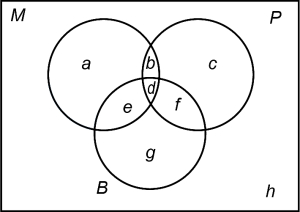
(C) Let $M, P, B$ be the sets of students who failed in Mathematics,Physics,and Biology respectively. Let the regions in the Venn diagram be represented by $a, b, c, d, e, f, g$ as shown,and $h$ be the number of students who passed in all subjects.
Total students = $100$,so $a+b+c+d+e+f+g+h = 100$. Given $h = 1$,so $a+b+c+d+e+f+g = 99$.
Given:
$1) \text{ Failed in Mathematics: } a+b+d+e = 50$
$2) \text{ Failed in Physics: } b+c+d+f = 45$
$3) \text{ Failed in Biology: } d+e+f+g = 40$
$4) \text{ Failed in exactly two subjects: } b+e+f = 32$
Summing equations $(1), (2), (3)$:
$(a+b+d+e) + (b+c+d+f) + (d+e+f+g) = 50 + 45 + 40 = 135$
$(a+b+c+d+e+f+g) + (b+d+e+f) + d = 135$
$99 + (b+e+f) + 2d = 135$
$99 + 32 + 2d = 135$
$131 + 2d = 135$
$2d = 4 \implies d = 2$.
Thus,the number of students failing in all three subjects is $2$.
Total students = $100$,so $a+b+c+d+e+f+g+h = 100$. Given $h = 1$,so $a+b+c+d+e+f+g = 99$.
Given:
$1) \text{ Failed in Mathematics: } a+b+d+e = 50$
$2) \text{ Failed in Physics: } b+c+d+f = 45$
$3) \text{ Failed in Biology: } d+e+f+g = 40$
$4) \text{ Failed in exactly two subjects: } b+e+f = 32$
Summing equations $(1), (2), (3)$:
$(a+b+d+e) + (b+c+d+f) + (d+e+f+g) = 50 + 45 + 40 = 135$
$(a+b+c+d+e+f+g) + (b+d+e+f) + d = 135$
$99 + (b+e+f) + 2d = 135$
$99 + 32 + 2d = 135$
$131 + 2d = 135$
$2d = 4 \implies d = 2$.
Thus,the number of students failing in all three subjects is $2$.
0 likes
View Solution173
EasyMCQ
Let $A, B, C$ be three non-void subsets of set $S$. Let $(A \cap C) \cup (B \cap C^{\prime}) = \phi$,where $C^{\prime}$ denotes the complement of set $C$ in $S$. Then:
A
$A \cap B = \phi$
B
$A \cap B \neq \phi$
C
$A \cap C = A$
D
$A \cup C = A$
Solution
(A) Given $(A \cap C) \cup (B \cap C^{\prime}) = \phi$.
Since the union of two sets is the empty set $\phi$,each set must be empty.
Therefore,$A \cap C = \phi$ and $B \cap C^{\prime} = \phi$.
From $B \cap C^{\prime} = \phi$,we have $B \subseteq C$.
Since $A \cap C = \phi$ and $B \subseteq C$,it follows that $A \cap B = \phi$.
Since the union of two sets is the empty set $\phi$,each set must be empty.
Therefore,$A \cap C = \phi$ and $B \cap C^{\prime} = \phi$.
From $B \cap C^{\prime} = \phi$,we have $B \subseteq C$.
Since $A \cap C = \phi$ and $B \subseteq C$,it follows that $A \cap B = \phi$.
0 likes
View Solution174
EasyMCQ
If $A = \{5^{n} - 4n - 1 : n \in N\}$ and $B = \{16(n - 1) : n \in N\}$,then:
A
$A = B$
B
$A \cap B = \phi$
C
$A \subseteq B$
D
$B \subseteq A$
Solution
(C) We have $A = 5^{n} - 4n - 1 = (1 + 4)^{n} - 4n - 1$.
Using the binomial expansion,$(1 + 4)^{n} = {}^{n}C_{0} + {}^{n}C_{1}(4) + {}^{n}C_{2}(4^{2}) + \dots + {}^{n}C_{n}(4^{n})$.
So,$A = (1 + 4n + 16({}^{n}C_{2} + {}^{n}C_{3}(4) + \dots + {}^{n}C_{n}(4^{n-2}))) - 4n - 1$.
$A = 16({}^{n}C_{2} + {}^{n}C_{3}(4) + \dots + {}^{n}C_{n}(4^{n-2}))$.
This shows that every element of $A$ is a multiple of $16$.
For $n=1$,$5^{1}-4(1)-1 = 0$.
For $n=2$,$5^{2}-4(2)-1 = 16$.
For $n=3$,$5^{3}-4(3)-1 = 112 = 16 \times 7$.
Thus,$A = \{0, 16, 112, \dots\}$.
$B = \{16(n-1) : n \in N\} = \{0, 16, 32, 48, \dots\}$.
Since every element of $A$ is a multiple of $16$,$A \subseteq B$.
Using the binomial expansion,$(1 + 4)^{n} = {}^{n}C_{0} + {}^{n}C_{1}(4) + {}^{n}C_{2}(4^{2}) + \dots + {}^{n}C_{n}(4^{n})$.
So,$A = (1 + 4n + 16({}^{n}C_{2} + {}^{n}C_{3}(4) + \dots + {}^{n}C_{n}(4^{n-2}))) - 4n - 1$.
$A = 16({}^{n}C_{2} + {}^{n}C_{3}(4) + \dots + {}^{n}C_{n}(4^{n-2}))$.
This shows that every element of $A$ is a multiple of $16$.
For $n=1$,$5^{1}-4(1)-1 = 0$.
For $n=2$,$5^{2}-4(2)-1 = 16$.
For $n=3$,$5^{3}-4(3)-1 = 112 = 16 \times 7$.
Thus,$A = \{0, 16, 112, \dots\}$.
$B = \{16(n-1) : n \in N\} = \{0, 16, 32, 48, \dots\}$.
Since every element of $A$ is a multiple of $16$,$A \subseteq B$.
0 likes
View Solution175
EasyMCQ
In a certain town,$60 \%$ of the families own a car,$30 \%$ own a house and $20 \%$ own both a car and a house. If a family is randomly chosen,what is the probability that this family owns a car or a house but not both?
A
$0.5$
B
$0.7$
C
$0.1$
D
$0.9$
Solution
(A) Let $A$ be the set of families who own a car and $B$ be the set of families who own a house.
Given: $P(A) = 0.60$,$P(B) = 0.30$,and $P(A \cap B) = 0.20$.
We need to find the probability that a family owns a car or a house but not both,which is represented by the symmetric difference $P(A \Delta B)$.
The formula for symmetric difference is $P(A \Delta B) = P(A \cup B) - P(A \cap B)$.
First,calculate $P(A \cup B) = P(A) + P(B) - P(A \cap B) = 0.60 + 0.30 - 0.20 = 0.70$.
Now,$P(A \Delta B) = P(A \cup B) - P(A \cap B) = 0.70 - 0.20 = 0.50$.
Thus,the probability is $0.5$.
Given: $P(A) = 0.60$,$P(B) = 0.30$,and $P(A \cap B) = 0.20$.
We need to find the probability that a family owns a car or a house but not both,which is represented by the symmetric difference $P(A \Delta B)$.
The formula for symmetric difference is $P(A \Delta B) = P(A \cup B) - P(A \cap B)$.
First,calculate $P(A \cup B) = P(A) + P(B) - P(A \cap B) = 0.60 + 0.30 - 0.20 = 0.70$.
Now,$P(A \Delta B) = P(A \cup B) - P(A \cap B) = 0.70 - 0.20 = 0.50$.
Thus,the probability is $0.5$.
0 likes
View Solution176
MediumMCQ
The probability that at least one of $A$ and $B$ occurs is $0.6$. If $A$ and $B$ occur simultaneously with probability $0.3$,then $P(A') + P(B')$ is
A
$0.9$
B
$0.15$
C
$1.1$
D
$1.2$
Solution
(C) Given that $P(A \cup B) = 0.6$ and $P(A \cap B) = 0.3$.
We know that $P(A \cup B) = P(A) + P(B) - P(A \cap B)$.
So,$P(A) + P(B) = P(A \cup B) + P(A \cap B) = 0.6 + 0.3 = 0.9$.
We need to find $P(A') + P(B')$.
Since $P(A') = 1 - P(A)$ and $P(B') = 1 - P(B)$,
$P(A') + P(B') = (1 - P(A)) + (1 - P(B)) = 2 - (P(A) + P(B))$.
Substituting the value,$P(A') + P(B') = 2 - 0.9 = 1.1$.
We know that $P(A \cup B) = P(A) + P(B) - P(A \cap B)$.
So,$P(A) + P(B) = P(A \cup B) + P(A \cap B) = 0.6 + 0.3 = 0.9$.
We need to find $P(A') + P(B')$.
Since $P(A') = 1 - P(A)$ and $P(B') = 1 - P(B)$,
$P(A') + P(B') = (1 - P(A)) + (1 - P(B)) = 2 - (P(A) + P(B))$.
Substituting the value,$P(A') + P(B') = 2 - 0.9 = 1.1$.
0 likes
View Solution177
MediumMCQ
Let $A = \{x : |x^{2} - 10| \le 6\}$ and $B = \{x : |x - 2| > 1\}$. Then:
A
$A \cup B = (-\infty, 1) \cup [2, \infty)$
B
$A - B = [2, 3]$
C
$A \cap B = [-4, -2] \cup (3, 4]$
D
$B - A = (-\infty, -4) \cup (-2, 1) \cup (4, \infty)$
Solution
(C) Given $|x^{2} - 10| \le 6$,we have $-6 \le x^{2} - 10 \le 6$.
Adding $10$ to all sides,we get $4 \le x^{2} \le 16$.
Taking the square root,$x \in [-4, -2] \cup [2, 4]$,so $A = [-4, -2] \cup [2, 4]$.
Given $|x - 2| > 1$,we have $x - 2 > 1$ or $x - 2 < -1$.
This implies $x > 3$ or $x < 1$,so $B = (-\infty, 1) \cup (3, \infty)$.
Now,$A \cap B = ([-4, -2] \cup [2, 4]) \cap ((-\infty, 1) \cup (3, \infty)) = [-4, -2] \cup (3, 4]$.
Thus,option $C$ is correct.
Adding $10$ to all sides,we get $4 \le x^{2} \le 16$.
Taking the square root,$x \in [-4, -2] \cup [2, 4]$,so $A = [-4, -2] \cup [2, 4]$.
Given $|x - 2| > 1$,we have $x - 2 > 1$ or $x - 2 < -1$.
This implies $x > 3$ or $x < 1$,so $B = (-\infty, 1) \cup (3, \infty)$.
Now,$A \cap B = ([-4, -2] \cup [2, 4]) \cap ((-\infty, 1) \cup (3, \infty)) = [-4, -2] \cup (3, 4]$.
Thus,option $C$ is correct.
0 likes
View Solution178
DifficultMCQ
Let $S$ be the set of the first $11$ natural numbers. Then the number of elements in $A = \{B \subseteq S : n(B) \ge 2 \text{ and the product of all elements of } B \text{ is even}\}$ is . . . . . . .
A
$1979$
B
$2048$
C
$1984$
D
$1974$
Solution
(A) The set $S = \{1, 2, 3, . . . , 11\}$ contains $6$ odd numbers $\{1, 3, 5, 7, 9, 11\}$ and $5$ even numbers $\{2, 4, 6, 8, 10\}$.
The total number of subsets of $S$ is $2^{11} = 2048$.
$A$ subset $B$ has an odd product if and only if all elements of $B$ are odd. The number of such subsets is $2^6 = 64$.
$A$ subset $B$ has an even product if it contains at least one even number. The number of such subsets is $2^{11} - 2^6 = 2048 - 64 = 1984$.
The condition $n(B) \ge 2$ excludes subsets with $0$ or $1$ element.
Subsets with $0$ elements: $\emptyset$ (product is not defined or considered odd,so it is excluded).
Subsets with $1$ element: $\{1\}, \{3\}, \{5\}, \{7\}, \{9\}, \{11\}$ (all odd products) and $\{2\}, \{4\}, \{6\}, \{8\}, \{10\}$ (all even products).
We must exclude the $5$ subsets that contain exactly one even number (since their product is even but $n(B) < 2$).
Therefore,the required number of subsets is $1984 - 5 = 1979$.
The total number of subsets of $S$ is $2^{11} = 2048$.
$A$ subset $B$ has an odd product if and only if all elements of $B$ are odd. The number of such subsets is $2^6 = 64$.
$A$ subset $B$ has an even product if it contains at least one even number. The number of such subsets is $2^{11} - 2^6 = 2048 - 64 = 1984$.
The condition $n(B) \ge 2$ excludes subsets with $0$ or $1$ element.
Subsets with $0$ elements: $\emptyset$ (product is not defined or considered odd,so it is excluded).
Subsets with $1$ element: $\{1\}, \{3\}, \{5\}, \{7\}, \{9\}, \{11\}$ (all odd products) and $\{2\}, \{4\}, \{6\}, \{8\}, \{10\}$ (all even products).
We must exclude the $5$ subsets that contain exactly one even number (since their product is even but $n(B) < 2$).
Therefore,the required number of subsets is $1984 - 5 = 1979$.
0 likes
View SolutionSet Theory — Word Problem - Set Theory · Frequently Asked Questions
1Are these Set Theory questions useful for JEE and NEET?
Yes. All questions in this section are mapped to JEE Main and NEET exam patterns. Previous year questions from JEE Main, NEET, GUJCET and state-level exams are included with full solutions.
2Can I switch to Hindi or Gujarati for these questions?
Yes. Use the language tabs in the hero section or the sidebar to view the same questions and solutions in English, Hindi or Gujarati.
3How do I generate a question paper from this subtopic?
Use the Vedclass Exam Paper Generator — select the chapter and subtopic, set difficulty, and generate Sets A, B, C, D automatically. First 3 chapters of every subject are free.
Vedclass Products
For Students
Vedclass Test Series
Mock tests in real JEE/NEET style with performance analysis. 5-day free trial.
Start Free TrialFor Teachers
Exam Paper Generator
Generate Set A/B/C/D papers from this chapter in 2 minutes. 3 chapters free.
Try FreeFor Institutes
Online Exam Module
Live online exams with unlimited students, 360° analytics & white-label branding.
See DemoFor Teachers & Institutes
Generate a Set Theory Exam Paper in 2 Minutes
Select subtopic & difficulty — Sets A, B, C, D auto-generated with No Repeat logic.
First 3 chapters of every subject are free — no payment required.