
A English
Basic of Set theory Questions in English
Class 11 Mathematics · Set Theory · Basic of Set theory
221+
Questions
English
Language
100%
With Solutions
Showing 19 of 221 questions in English
201
DifficultMCQ
If $D_{30}$ is the set of all divisors of $30$,$x, y \in D_{30}$,we define $x+y=\operatorname{LCM}(x, y)$,$x \cdot y=\operatorname{GCD}(x, y)$,$x^{\prime}=\frac{30}{x}$ and $f(x, y, z)=(x+y) \cdot (y^{\prime}+z)$,then $f(2, 5, 15)$ is equal to
A
$2$
B
$5$
C
$10$
D
$15$
Solution
(C) Given $D_{30} = \{1, 2, 3, 5, 6, 10, 15, 30\}$.
We need to calculate $f(2, 5, 15) = (2+5) \cdot (5^{\prime} + 15)$.
First,calculate $2+5 = \operatorname{LCM}(2, 5) = 10$.
Next,calculate $5^{\prime} = \frac{30}{5} = 6$.
Then,$5^{\prime} + 15 = 6 + 15 = \operatorname{LCM}(6, 15) = 30$.
Finally,$f(2, 5, 15) = 10 \cdot 30 = \operatorname{GCD}(10, 30) = 10$.
We need to calculate $f(2, 5, 15) = (2+5) \cdot (5^{\prime} + 15)$.
First,calculate $2+5 = \operatorname{LCM}(2, 5) = 10$.
Next,calculate $5^{\prime} = \frac{30}{5} = 6$.
Then,$5^{\prime} + 15 = 6 + 15 = \operatorname{LCM}(6, 15) = 30$.
Finally,$f(2, 5, 15) = 10 \cdot 30 = \operatorname{GCD}(10, 30) = 10$.
0 likes
View Solution202
EasyMCQ
The dual of $(x+y) \cdot (x^{\prime} \cdot 1)$ is:
A
$(x \cdot y) + (x^{\prime} + 1)$
B
$(x \cdot y) \cdot (x^{\prime} + 1)$
C
$(x \cdot y) + (x + 1)$
D
None of these
Solution
(A) To find the dual of a Boolean expression,we replace the $OR$ operator $(+)$ with the $AND$ operator $(\cdot)$ and vice versa,and replace $0$ with $1$ and $1$ with $0$.
Given expression: $(x+y) \cdot (x^{\prime} \cdot 1)$.
Replacing $+$ with $\cdot$ and $\cdot$ with $+$,and replacing $1$ with $0$ (though $0$ is not present,we focus on the operators):
The dual is $(x \cdot y) + (x^{\prime} + 0)$.
Since $x^{\prime} + 0 = x^{\prime}$,the expression simplifies to $(x \cdot y) + x^{\prime}$.
However,looking at the provided options,the transformation of the operator $1$ is often treated as a constant in dual logic. Replacing the operators in $(x+y) \cdot (x^{\prime} \cdot 1)$ gives $(x \cdot y) + (x^{\prime} + 1)$.
Given expression: $(x+y) \cdot (x^{\prime} \cdot 1)$.
Replacing $+$ with $\cdot$ and $\cdot$ with $+$,and replacing $1$ with $0$ (though $0$ is not present,we focus on the operators):
The dual is $(x \cdot y) + (x^{\prime} + 0)$.
Since $x^{\prime} + 0 = x^{\prime}$,the expression simplifies to $(x \cdot y) + x^{\prime}$.
However,looking at the provided options,the transformation of the operator $1$ is often treated as a constant in dual logic. Replacing the operators in $(x+y) \cdot (x^{\prime} \cdot 1)$ gives $(x \cdot y) + (x^{\prime} + 1)$.
0 likes
View Solution203
EasyMCQ
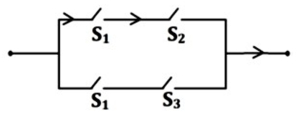
An alternative equivalent circuit for the circuit is
A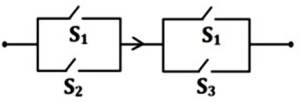
B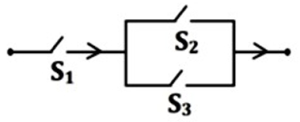
C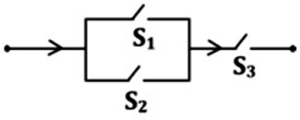
D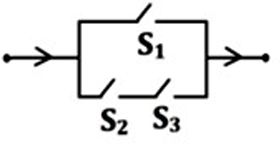
Solution
(C) The given circuit consists of two parallel branches. The first branch has switches $S_1$ and $S_2$ in series,which can be represented by the logical expression $(S_1 \land S_2)$.
The second branch has switches $S_1$ and $S_3$ in series,which can be represented by the logical expression $(S_1 \land S_3)$.
Since these two branches are in parallel,the total circuit is represented by the expression $(S_1 \land S_2) \lor (S_1 \land S_3)$.
Using the distributive law of Boolean algebra,we can factor out $S_1$:
$(S_1 \land S_2) \lor (S_1 \land S_3) = S_1 \land (S_2 \lor S_3)$.
This expression represents a switch $S_1$ in series with a parallel combination of switches $S_2$ and $S_3$.
The second branch has switches $S_1$ and $S_3$ in series,which can be represented by the logical expression $(S_1 \land S_3)$.
Since these two branches are in parallel,the total circuit is represented by the expression $(S_1 \land S_2) \lor (S_1 \land S_3)$.
Using the distributive law of Boolean algebra,we can factor out $S_1$:
$(S_1 \land S_2) \lor (S_1 \land S_3) = S_1 \land (S_2 \lor S_3)$.
This expression represents a switch $S_1$ in series with a parallel combination of switches $S_2$ and $S_3$.
0 likes
View Solution204
EasyMCQ
If $A = \{2, 3, 4, 5, 6\}$,then which of the following statements has a truth value of 'false'?
A
$\exists x \in A$,such that $(x-2) \in \mathbb{N}$
B
$\forall x \in A, x+6$ is divisible by $2$
C
$\exists x \in A$,such that $x+2$ is a prime number.
D
$\exists x \in A$,such that $x^{2}+1$ is an even number.
Solution
(B) Let us evaluate each statement for the set $A = \{2, 3, 4, 5, 6\}$.
$A$: $\exists x \in A$ such that $(x-2) \in \mathbb{N}$. If $x=3$,$3-2=1 \in \mathbb{N}$. This is true.
$B$: $\forall x \in A, x+6$ is divisible by $2$. If $x=3$,$3+6=9$,which is not divisible by $2$. This is false.
$C$: $\exists x \in A$ such that $x+2$ is a prime number. If $x=3$,$3+2=5$,which is prime. This is true.
$D$: $\exists x \in A$ such that $x^{2}+1$ is an even number. If $x=3$,$3^{2}+1=10$,which is even. This is true.
Therefore,the statement in option $B$ is false.
$A$: $\exists x \in A$ such that $(x-2) \in \mathbb{N}$. If $x=3$,$3-2=1 \in \mathbb{N}$. This is true.
$B$: $\forall x \in A, x+6$ is divisible by $2$. If $x=3$,$3+6=9$,which is not divisible by $2$. This is false.
$C$: $\exists x \in A$ such that $x+2$ is a prime number. If $x=3$,$3+2=5$,which is prime. This is true.
$D$: $\exists x \in A$ such that $x^{2}+1$ is an even number. If $x=3$,$3^{2}+1=10$,which is even. This is true.
Therefore,the statement in option $B$ is false.
0 likes
View Solution205
MediumMCQ
If $A = \{x \in \mathbb{R} : x^2 + 5|x| + 6 = 0\}$,then $n(A) = $
A
$0$
B
$4$
C
$1$
D
$2$
Solution
(A) We are given the set $A = \{x \in \mathbb{R} : x^2 + 5|x| + 6 = 0\}$.
Since $x^2 = |x|^2$,the equation can be written as $|x|^2 + 5|x| + 6 = 0$.
Let $|x| = t$,where $t \ge 0$. The equation becomes $t^2 + 5t + 6 = 0$.
Factoring the quadratic,we get $(t + 2)(t + 3) = 0$.
This gives $t = -2$ or $t = -3$.
Since $t = |x|$ must be non-negative $(t \ge 0)$,there are no real values of $x$ that satisfy these conditions.
Therefore,the set $A$ is an empty set,i.e.,$A = \emptyset$.
Thus,the number of elements in $A$ is $n(A) = 0$.
Since $x^2 = |x|^2$,the equation can be written as $|x|^2 + 5|x| + 6 = 0$.
Let $|x| = t$,where $t \ge 0$. The equation becomes $t^2 + 5t + 6 = 0$.
Factoring the quadratic,we get $(t + 2)(t + 3) = 0$.
This gives $t = -2$ or $t = -3$.
Since $t = |x|$ must be non-negative $(t \ge 0)$,there are no real values of $x$ that satisfy these conditions.
Therefore,the set $A$ is an empty set,i.e.,$A = \emptyset$.
Thus,the number of elements in $A$ is $n(A) = 0$.
0 likes
View Solution206
EasyMCQ
If $A = \{x \mid x \text{ is a prime number, } 0 \leq x \leq 9\}$,then the number of elements of the power set of $A$ is
A
$12$
B
$4$
C
$16$
D
$8$
Solution
(C) The set $A$ consists of prime numbers between $0$ and $9$.
$A = \{2, 3, 5, 7\}$.
The number of elements in set $A$ is $n(A) = 4$.
The number of elements in the power set of $A$ is given by $2^{n(A)}$.
$2^{4} = 16$.
$A = \{2, 3, 5, 7\}$.
The number of elements in set $A$ is $n(A) = 4$.
The number of elements in the power set of $A$ is given by $2^{n(A)}$.
$2^{4} = 16$.
0 likes
View Solution207
EasyMCQ
If $A = \{x \in R : x^2 - 5|x| + 6 = 0\}$,then find $n(A)$.
A
$2$
B
$0$
C
$1$
D
$4$
Solution
(D) Given the set $A = \{x \in R : x^2 - 5|x| + 6 = 0\}$.
Since $x^2 = |x|^2$,the equation becomes $|x|^2 - 5|x| + 6 = 0$.
Let $|x| = t$,then $t^2 - 5t + 6 = 0$.
Factoring the quadratic equation: $(t - 2)(t - 3) = 0$.
So,$|x| = 2$ or $|x| = 3$.
If $|x| = 2$,then $x = 2$ or $x = -2$.
If $|x| = 3$,then $x = 3$ or $x = -3$.
Thus,the set $A = \{-3, -2, 2, 3\}$.
The number of elements in set $A$ is $n(A) = 4$.
Since $x^2 = |x|^2$,the equation becomes $|x|^2 - 5|x| + 6 = 0$.
Let $|x| = t$,then $t^2 - 5t + 6 = 0$.
Factoring the quadratic equation: $(t - 2)(t - 3) = 0$.
So,$|x| = 2$ or $|x| = 3$.
If $|x| = 2$,then $x = 2$ or $x = -2$.
If $|x| = 3$,then $x = 3$ or $x = -3$.
Thus,the set $A = \{-3, -2, 2, 3\}$.
The number of elements in set $A$ is $n(A) = 4$.
0 likes
View Solution208
MediumMCQ
$A$ graph $G$ has $m$ vertices of odd degree and $n$ vertices of even degree. Then which of the following statements is necessarily true?
A
$m+n$ is an odd number
B
$m$ is an even number
C
$n+1$ is an even number
D
$m+1$ is an odd number
Solution
(B) According to the Handshaking Lemma,the sum of the degrees of all vertices in a graph is equal to twice the number of edges,which is an even number.
Let $V_{odd}$ be the set of vertices with odd degree and $V_{even}$ be the set of vertices with even degree.
The sum of degrees is $\sum_{v \in V_{odd}} \text{deg}(v) + \sum_{v \in V_{even}} \text{deg}(v) = 2|E|$.
Since $\sum_{v \in V_{even}} \text{deg}(v)$ is always even,the sum $\sum_{v \in V_{odd}} \text{deg}(v)$ must also be even for the total sum to be even.
For the sum of $m$ odd numbers to be even,$m$ must be an even number.
Therefore,the number of vertices of odd degree,$m$,is always even.
Let $V_{odd}$ be the set of vertices with odd degree and $V_{even}$ be the set of vertices with even degree.
The sum of degrees is $\sum_{v \in V_{odd}} \text{deg}(v) + \sum_{v \in V_{even}} \text{deg}(v) = 2|E|$.
Since $\sum_{v \in V_{even}} \text{deg}(v)$ is always even,the sum $\sum_{v \in V_{odd}} \text{deg}(v)$ must also be even for the total sum to be even.
For the sum of $m$ odd numbers to be even,$m$ must be an even number.
Therefore,the number of vertices of odd degree,$m$,is always even.
0 likes
View Solution209
MediumMCQ
The number of subgroups of the group $(Z_{5}, +_{5})$ is
A
$1$
B
$3$
C
$4$
D
$2$
Solution
(D) The group $(Z_{5}, +_{5})$ is a cyclic group of prime order $p = 5$.
By Lagrange's Theorem,the order of any subgroup must divide the order of the group.
Since $5$ is a prime number,its only divisors are $1$ and $5$.
Therefore,the only subgroups are the trivial subgroup ${0}$ of order $1$ and the group itself $Z_{5}$ of order $5$.
Thus,the total number of subgroups is $2$.
By Lagrange's Theorem,the order of any subgroup must divide the order of the group.
Since $5$ is a prime number,its only divisors are $1$ and $5$.
Therefore,the only subgroups are the trivial subgroup ${0}$ of order $1$ and the group itself $Z_{5}$ of order $5$.
Thus,the total number of subgroups is $2$.
0 likes
View Solution210
EasyMCQ
Two finite sets have $m$ and $n$ elements respectively. The total number of subsets of the first set is $56$ more than the total number of subsets of the second set. The values of $m$ and $n$,respectively are
A
$7, 6$
B
$5, 1$
C
$6, 3$
D
$8, 7$
Solution
(C) Let set $A$ have $m$ elements and set $B$ have $n$ elements.
The number of subsets of set $A$ is $2^m$ and the number of subsets of set $B$ is $2^n$.
According to the problem,$2^m - 2^n = 56$.
We can write this as $2^n(2^{m-n} - 1) = 56$.
Factorizing $56$,we get $56 = 8 \times 7 = 2^3 \times (2^3 - 1)$.
Comparing $2^n(2^{m-n} - 1) = 2^3(2^3 - 1)$,we get $n = 3$ and $m - n = 3$.
Substituting $n = 3$ into $m - n = 3$,we get $m - 3 = 3$,which implies $m = 6$.
Thus,the values of $m$ and $n$ are $6$ and $3$ respectively.
The number of subsets of set $A$ is $2^m$ and the number of subsets of set $B$ is $2^n$.
According to the problem,$2^m - 2^n = 56$.
We can write this as $2^n(2^{m-n} - 1) = 56$.
Factorizing $56$,we get $56 = 8 \times 7 = 2^3 \times (2^3 - 1)$.
Comparing $2^n(2^{m-n} - 1) = 2^3(2^3 - 1)$,we get $n = 3$ and $m - n = 3$.
Substituting $n = 3$ into $m - n = 3$,we get $m - 3 = 3$,which implies $m = 6$.
Thus,the values of $m$ and $n$ are $6$ and $3$ respectively.
0 likes
View Solution211
EasyMCQ
Which of the following is an empty set?
A
$\left\{x: x^2+1=0, x \in \mathbb{R}\right\}$
B
$\left\{x: x^2-9=0, x \in \mathbb{R}\right\}$
C
$\left\{x: x^2=x+2, x \in \mathbb{R}\right\}$
D
$\left\{x: x^2-1=0, x \in \mathbb{R}\right\}$
Solution
(A) For option $A$: $x^2+1=0 \Rightarrow x^2=-1$. Since the square of any real number $x \in \mathbb{R}$ is always non-negative $(x^2 \ge 0)$,there is no real number $x$ that satisfies $x^2=-1$. Thus,the set is empty.
For option $B$: $x^2-9=0$ $\Rightarrow x^2=9$ $\Rightarrow x = \pm 3$. This set is $\{3, -3\}$,which is not empty.
For option $C$: $x^2-x-2=0$ $\Rightarrow (x-2)(x+1)=0$ $\Rightarrow x=2, -1$. This set is $\{2, -1\}$,which is not empty.
For option $D$: $x^2-1=0$ $\Rightarrow x^2=1$ $\Rightarrow x = \pm 1$. This set is $\{1, -1\}$,which is not empty.
Therefore,the correct option is $A$.
For option $B$: $x^2-9=0$ $\Rightarrow x^2=9$ $\Rightarrow x = \pm 3$. This set is $\{3, -3\}$,which is not empty.
For option $C$: $x^2-x-2=0$ $\Rightarrow (x-2)(x+1)=0$ $\Rightarrow x=2, -1$. This set is $\{2, -1\}$,which is not empty.
For option $D$: $x^2-1=0$ $\Rightarrow x^2=1$ $\Rightarrow x = \pm 1$. This set is $\{1, -1\}$,which is not empty.
Therefore,the correct option is $A$.
0 likes
View Solution212
EasyMCQ
If $A = \{1, 2, 3, \ldots, 10\}$,then the number of non-empty subsets of $A$ containing only odd numbers is
A
$31$
B
$27$
C
$32$
D
$30$
Solution
(A) Given,$A = \{1, 2, 3, \ldots, 10\}$.
The set of odd numbers in $A$ is $S = \{1, 3, 5, 7, 9\}$.
The number of elements in $S$ is $n = 5$.
The total number of subsets of $S$ is $2^n = 2^5 = 32$.
Since the question asks for subsets containing only odd numbers,we exclude the empty set (which contains no elements and thus no odd numbers).
Therefore,the number of non-empty subsets is $2^5 - 1 = 32 - 1 = 31$.
The set of odd numbers in $A$ is $S = \{1, 3, 5, 7, 9\}$.
The number of elements in $S$ is $n = 5$.
The total number of subsets of $S$ is $2^n = 2^5 = 32$.
Since the question asks for subsets containing only odd numbers,we exclude the empty set (which contains no elements and thus no odd numbers).
Therefore,the number of non-empty subsets is $2^5 - 1 = 32 - 1 = 31$.
0 likes
View Solution213
MediumMCQ
Write the set builder form of the set $ A = \{-1, 1\} $.
A
$ A = \{x : x \text{ is a real number} \} $
B
$ A = \{x : x \text{ is an integer} \} $
C
$ A = \{x : x \text{ is a root of the equation } x^{2} = 1\} $
D
$ A = \{x : x \text{ is a root of the equation } x^{2} + 1 = 0\} $
Solution
(C) Given the set $ A = \{-1, 1\} $.
We analyze the given options:
For option $ C $,the equation is $ x^{2} = 1 $.
Solving $ x^{2} = 1 $,we get $ x = \pm 1 $.
Thus,the set of roots is $ \{-1, 1\} $.
Therefore,the set builder form is $ A = \{x : x \text{ is a root of the equation } x^{2} = 1\} $.
We analyze the given options:
For option $ C $,the equation is $ x^{2} = 1 $.
Solving $ x^{2} = 1 $,we get $ x = \pm 1 $.
Thus,the set of roots is $ \{-1, 1\} $.
Therefore,the set builder form is $ A = \{x : x \text{ is a root of the equation } x^{2} = 1\} $.
0 likes
View Solution214
MediumMCQ
Determine the subset for the set $\{n(n+1)(2n+1) : n \in \mathbb{Z}\}$.
A
$\{6k : k \in \mathbb{Z}\}$
B
$\{12k : k \in \mathbb{Z}\}$
C
$\{18k : k \in \mathbb{Z}\}$
D
$\{24k : k \in \mathbb{Z}\}$
Solution
(A) Let $f(n) = n(n+1)(2n+1)$.
We know that $2n+1 = (n-1) + (n+2)$,so $n(n+1)(2n+1) = n(n+1)(n-1+n+2) = n(n+1)(n-1) + n(n+1)(n+2)$.
Note that $n(n+1)(n-1)$ is the product of three consecutive integers,which is always divisible by $3! = 6$.
Similarly,$n(n+1)(n+2)$ is also the product of three consecutive integers,which is always divisible by $3! = 6$.
Therefore,$f(n)$ is divisible by $6$ for all $n \in \mathbb{Z}$.
Thus,$\{n(n+1)(2n+1) : n \in \mathbb{Z}\} \subset \{6k : k \in \mathbb{Z}\}$.
We know that $2n+1 = (n-1) + (n+2)$,so $n(n+1)(2n+1) = n(n+1)(n-1+n+2) = n(n+1)(n-1) + n(n+1)(n+2)$.
Note that $n(n+1)(n-1)$ is the product of three consecutive integers,which is always divisible by $3! = 6$.
Similarly,$n(n+1)(n+2)$ is also the product of three consecutive integers,which is always divisible by $3! = 6$.
Therefore,$f(n)$ is divisible by $6$ for all $n \in \mathbb{Z}$.
Thus,$\{n(n+1)(2n+1) : n \in \mathbb{Z}\} \subset \{6k : k \in \mathbb{Z}\}$.
0 likes
View Solution215
EasyMCQ
Let $a, b, c$ be real numbers. $A$ set formed with $a, b, c$ whose order of occurrence is preassigned is called:
A
An ordered triad
B
An ordered pair
C
Both ordered triad and ordered pair
D
None of these options are correct
Solution
(A) set formed with three real numbers $a, b, c$ where the order of elements is fixed or preassigned is defined as an ordered triad,denoted as $(a, b, c)$.
0 likes
View Solution216
EasyMCQ
The set $\{n(n+1)(2n+1) : n \in \mathbb{Z}\}$ is a subset of:
A
$\{6k : k \in \mathbb{Z}\}$
B
$\{12k : k \in \mathbb{Z}\}$
C
$\{18k : k \in \mathbb{Z}\}$
D
$\{24k : k \in \mathbb{Z}\}$
Solution
(A) Let $f(n) = n(n+1)(2n+1)$.
We know that $n(n+1)(2n+1) = n(n+1)(n-1+n+2) = n(n+1)(n-1) + n(n+1)(n+2)$.
Each term $n(n+1)(n-1)$ and $n(n+1)(n+2)$ is a product of three consecutive integers.
The product of three consecutive integers is always divisible by $3! = 6$.
Therefore,$n(n+1)(n-1) = 6k_1$ and $n(n+1)(n+2) = 6k_2$ for some integers $k_1, k_2$.
Thus,$f(n) = 6(k_1 + k_2) = 6k$ for some integer $k$.
Hence,the set is a subset of $\{6k : k \in \mathbb{Z}\}$.
We know that $n(n+1)(2n+1) = n(n+1)(n-1+n+2) = n(n+1)(n-1) + n(n+1)(n+2)$.
Each term $n(n+1)(n-1)$ and $n(n+1)(n+2)$ is a product of three consecutive integers.
The product of three consecutive integers is always divisible by $3! = 6$.
Therefore,$n(n+1)(n-1) = 6k_1$ and $n(n+1)(n+2) = 6k_2$ for some integers $k_1, k_2$.
Thus,$f(n) = 6(k_1 + k_2) = 6k$ for some integer $k$.
Hence,the set is a subset of $\{6k : k \in \mathbb{Z}\}$.
0 likes
View Solution217
MediumMCQ
Let $x_{1}, x_{2}, \ldots, x_{15}$ be $15$ distinct numbers chosen from $1, 2, 3, \ldots, 15$. Then,the value of $(x_{1}-1)(x_{2}-1)(x_{3}-1) \ldots (x_{15}-1)$ is
A
always $\leq 0$
B
$0$
C
always even
D
always odd
Solution
(B) Given that $x_{1}, x_{2}, \ldots, x_{15}$ are $15$ distinct numbers chosen from the set $\{1, 2, 3, \ldots, 15\}$.
Since there are exactly $15$ distinct numbers in the set and we are choosing $15$ distinct numbers,the set $\{x_{1}, x_{2}, \ldots, x_{15}\}$ must be exactly the set $\{1, 2, 3, \ldots, 15\}$ in some order.
Therefore,one of the values $x_{i}$ must be equal to $1$.
If $x_{i} = 1$ for some $i \in \{1, 2, \ldots, 15\}$,then the term $(x_{i}-1) = (1-1) = 0$.
Since the product contains a factor of $0$,the entire product $(x_{1}-1)(x_{2}-1) \ldots (x_{15}-1)$ is equal to $0$.
Since there are exactly $15$ distinct numbers in the set and we are choosing $15$ distinct numbers,the set $\{x_{1}, x_{2}, \ldots, x_{15}\}$ must be exactly the set $\{1, 2, 3, \ldots, 15\}$ in some order.
Therefore,one of the values $x_{i}$ must be equal to $1$.
If $x_{i} = 1$ for some $i \in \{1, 2, \ldots, 15\}$,then the term $(x_{i}-1) = (1-1) = 0$.
Since the product contains a factor of $0$,the entire product $(x_{1}-1)(x_{2}-1) \ldots (x_{15}-1)$ is equal to $0$.
0 likes
View Solution218
EasyMCQ
Let $A, B, C$ be subsets of a set $X$. Which of the following set-theoretic statements is valid?
A
$A \cup (B \setminus C) = (A \cup B) \setminus (A \cup C)$
B
$(A \setminus B) \setminus C = A \setminus (B \cup C)$
C
$(A \cup B) \setminus A = A \setminus B$
D
$A \setminus C = B \setminus C$
Solution
(B) We evaluate the expression $(A \setminus B) \setminus C$:
By definition of set difference,$A \setminus B = A \cap B'$.
Thus,$(A \setminus B) \setminus C = (A \cap B') \cap C'$.
Using the associative property of intersection,we get $A \cap (B' \cap C')$.
By De Morgan's Law,$B' \cap C' = (B \cup C)'$.
Therefore,$(A \setminus B) \setminus C = A \cap (B \cup C)' = A \setminus (B \cup C)$.
Hence,the statement in option $B$ is valid.
By definition of set difference,$A \setminus B = A \cap B'$.
Thus,$(A \setminus B) \setminus C = (A \cap B') \cap C'$.
Using the associative property of intersection,we get $A \cap (B' \cap C')$.
By De Morgan's Law,$B' \cap C' = (B \cup C)'$.
Therefore,$(A \setminus B) \setminus C = A \cap (B \cup C)' = A \setminus (B \cup C)$.
Hence,the statement in option $B$ is valid.
0 likes
View Solution219
MediumMCQ
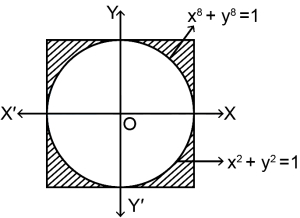
Let $P$ and $T$ be the subsets of the $xy$-plane defined by $P = \{(x, y) : x > 0, y > 0 \text{ and } x^2 + y^2 = 1\}$ and $T = \{(x, y) : x > 0, y > 0 \text{ and } x^8 + y^8 < 1\}$. Then,$P \cap T$ is
A
the void set $\phi$
B
$P$
C
$T$
D
$P - T^C$
Solution
(B) The set $P$ represents the arc of the unit circle $x^2 + y^2 = 1$ in the first quadrant $(x > 0, y > 0)$.
The set $T$ represents the region inside the curve $x^8 + y^8 = 1$ in the first quadrant.
For any point $(x, y)$ on the circle $x^2 + y^2 = 1$ in the first quadrant,we have $0 < x < 1$ and $0 < y < 1$.
Since $0 < x < 1$,we have $x^8 < x^2$,and since $0 < y < 1$,we have $y^8 < y^2$.
Therefore,$x^8 + y^8 < x^2 + y^2 = 1$.
This means that every point $(x, y)$ in $P$ also satisfies the condition $x^8 + y^8 < 1$,so $P \subset T$.
Thus,$P \cap T = P$.
The set $T$ represents the region inside the curve $x^8 + y^8 = 1$ in the first quadrant.
For any point $(x, y)$ on the circle $x^2 + y^2 = 1$ in the first quadrant,we have $0 < x < 1$ and $0 < y < 1$.
Since $0 < x < 1$,we have $x^8 < x^2$,and since $0 < y < 1$,we have $y^8 < y^2$.
Therefore,$x^8 + y^8 < x^2 + y^2 = 1$.
This means that every point $(x, y)$ in $P$ also satisfies the condition $x^8 + y^8 < 1$,so $P \subset T$.
Thus,$P \cap T = P$.
0 likes
View SolutionSet Theory — Basic of Set theory · Frequently Asked Questions
1Are these Set Theory questions useful for JEE and NEET?
Yes. All questions in this section are mapped to JEE Main and NEET exam patterns. Previous year questions from JEE Main, NEET, GUJCET and state-level exams are included with full solutions.
2Can I switch to Hindi or Gujarati for these questions?
Yes. Use the language tabs in the hero section or the sidebar to view the same questions and solutions in English, Hindi or Gujarati.
3How do I generate a question paper from this subtopic?
Use the Vedclass Exam Paper Generator — select the chapter and subtopic, set difficulty, and generate Sets A, B, C, D automatically. First 3 chapters of every subject are free.
Vedclass Products
For Students
Vedclass Test Series
Mock tests in real JEE/NEET style with performance analysis. 5-day free trial.
Start Free TrialFor Teachers
Exam Paper Generator
Generate Set A/B/C/D papers from this chapter in 2 minutes. 3 chapters free.
Try FreeFor Institutes
Online Exam Module
Live online exams with unlimited students, 360° analytics & white-label branding.
See DemoFor Teachers & Institutes
Generate a Set Theory Exam Paper in 2 Minutes
Select subtopic & difficulty — Sets A, B, C, D auto-generated with No Repeat logic.
First 3 chapters of every subject are free — no payment required.