
A English
Transformation of axes Questions in English
Class 11 Mathematics · Rectangular Cartesian Co-ordinates · Transformation of axes
127+
Questions
English
Language
100%
With Solutions
Showing 22 of 127 questions in English
101
EasyMCQ
The point $P(1,4)$ occupies the positions $A, B$ and $C$ respectively after undergoing the following three transformations successively:
$I$. Reflection about the line $y=x$.
$II$. Translation through a distance of $1$ unit along the positive direction of $X$-axis.
$III$. Rotation of the line $OB$ through an angle $\frac{\pi}{4}$ about the origin in the anti-clockwise direction. Then,the coordinates of $C$ are
$I$. Reflection about the line $y=x$.
$II$. Translation through a distance of $1$ unit along the positive direction of $X$-axis.
$III$. Rotation of the line $OB$ through an angle $\frac{\pi}{4}$ about the origin in the anti-clockwise direction. Then,the coordinates of $C$ are
A
$(\sqrt{2}, 2 \sqrt{2})$
B
$(2 \sqrt{2}, 3 \sqrt{2})$
C
$(\frac{5}{\sqrt{2}}, \frac{7}{\sqrt{2}})$
D
$(\frac{2}{\sqrt{2}}, \frac{3}{\sqrt{2}})$
Solution
(B) Reflection of point $P(1,4)$ about the line $y=x$ is $A(4,1)$.
After translation of point $A(4,1)$ through a distance of $1$ unit along the positive direction of $X$-axis,the new coordinate is $B(5,1)$.
After rotation of the point $B(5,1)$ through an angle $\theta = \frac{\pi}{4}$ about the origin in the anti-clockwise direction,the new coordinates $(x', y')$ are given by:
$x' = x \cos \theta - y \sin \theta = 5 \cos \frac{\pi}{4} - 1 \sin \frac{\pi}{4} = \frac{5}{\sqrt{2}} - \frac{1}{\sqrt{2}} = \frac{4}{\sqrt{2}} = 2\sqrt{2}$.
$y' = x \sin \theta + y \cos \theta = 5 \sin \frac{\pi}{4} + 1 \cos \frac{\pi}{4} = \frac{5}{\sqrt{2}} + \frac{1}{\sqrt{2}} = \frac{6}{\sqrt{2}} = 3\sqrt{2}$.
Thus,the coordinates of $C$ are $(2\sqrt{2}, 3\sqrt{2})$.
Hence,option $B$ is correct.
After translation of point $A(4,1)$ through a distance of $1$ unit along the positive direction of $X$-axis,the new coordinate is $B(5,1)$.
After rotation of the point $B(5,1)$ through an angle $\theta = \frac{\pi}{4}$ about the origin in the anti-clockwise direction,the new coordinates $(x', y')$ are given by:
$x' = x \cos \theta - y \sin \theta = 5 \cos \frac{\pi}{4} - 1 \sin \frac{\pi}{4} = \frac{5}{\sqrt{2}} - \frac{1}{\sqrt{2}} = \frac{4}{\sqrt{2}} = 2\sqrt{2}$.
$y' = x \sin \theta + y \cos \theta = 5 \sin \frac{\pi}{4} + 1 \cos \frac{\pi}{4} = \frac{5}{\sqrt{2}} + \frac{1}{\sqrt{2}} = \frac{6}{\sqrt{2}} = 3\sqrt{2}$.
Thus,the coordinates of $C$ are $(2\sqrt{2}, 3\sqrt{2})$.
Hence,option $B$ is correct.
0 likes
View Solution102
MediumMCQ
By rotating the coordinate axes in the positive direction about the origin by an angle $\alpha$,if the point $(1,2)$ is transformed to $\left(\frac{3 \sqrt{3}-1}{2 \sqrt{2}}, \frac{\sqrt{3}+3}{2 \sqrt{2}}\right)$ in the new coordinate system,then $\alpha=$
A
$\frac{\pi}{3}$
B
$\frac{\pi}{6}$
C
$\frac{\pi}{9}$
D
$\frac{\pi}{12}$
Solution
(D) The transformation equations for rotating the axes by an angle $\alpha$ are given by:
$x' = x \cos \alpha + y \sin \alpha$
$y' = -x \sin \alpha + y \cos \alpha$
Given $(x, y) = (1, 2)$ and $(x', y') = \left(\frac{3 \sqrt{3}-1}{2 \sqrt{2}}, \frac{\sqrt{3}+3}{2 \sqrt{2}}\right)$:
$\frac{3 \sqrt{3}-1}{2 \sqrt{2}} = 1 \cos \alpha + 2 \sin \alpha$ $(1)$
$\frac{\sqrt{3}+3}{2 \sqrt{2}} = -1 \sin \alpha + 2 \cos \alpha$ $(2)$
Multiply $(1)$ by $2$ and $(2)$ by $1$ and add them:
$2 \left(\frac{3 \sqrt{3}-1}{2 \sqrt{2}}\right) + \frac{\sqrt{3}+3}{2 \sqrt{2}} = 2 \cos \alpha + 4 \sin \alpha - \sin \alpha + 2 \cos \alpha$
$\frac{6 \sqrt{3}-2 + \sqrt{3}+3}{2 \sqrt{2}} = 4 \cos \alpha + 3 \sin \alpha$ (This approach is complex,let's use $x'^2 + y'^2 = x^2 + y^2$)
$x'^2 + y'^2 = 1^2 + 2^2 = 5$
$\left(\frac{3 \sqrt{3}-1}{2 \sqrt{2}}\right)^2 + \left(\frac{\sqrt{3}+3}{2 \sqrt{2}}\right)^2 = \frac{27+1-6 \sqrt{3}}{8} + \frac{3+9+6 \sqrt{3}}{8} = \frac{28+12}{8} = 5$ (Consistent)
From $(1)$ and $(2)$,solving for $\alpha$ gives $\alpha = 15^{\circ} = \frac{\pi}{12}$.
$x' = x \cos \alpha + y \sin \alpha$
$y' = -x \sin \alpha + y \cos \alpha$
Given $(x, y) = (1, 2)$ and $(x', y') = \left(\frac{3 \sqrt{3}-1}{2 \sqrt{2}}, \frac{\sqrt{3}+3}{2 \sqrt{2}}\right)$:
$\frac{3 \sqrt{3}-1}{2 \sqrt{2}} = 1 \cos \alpha + 2 \sin \alpha$ $(1)$
$\frac{\sqrt{3}+3}{2 \sqrt{2}} = -1 \sin \alpha + 2 \cos \alpha$ $(2)$
Multiply $(1)$ by $2$ and $(2)$ by $1$ and add them:
$2 \left(\frac{3 \sqrt{3}-1}{2 \sqrt{2}}\right) + \frac{\sqrt{3}+3}{2 \sqrt{2}} = 2 \cos \alpha + 4 \sin \alpha - \sin \alpha + 2 \cos \alpha$
$\frac{6 \sqrt{3}-2 + \sqrt{3}+3}{2 \sqrt{2}} = 4 \cos \alpha + 3 \sin \alpha$ (This approach is complex,let's use $x'^2 + y'^2 = x^2 + y^2$)
$x'^2 + y'^2 = 1^2 + 2^2 = 5$
$\left(\frac{3 \sqrt{3}-1}{2 \sqrt{2}}\right)^2 + \left(\frac{\sqrt{3}+3}{2 \sqrt{2}}\right)^2 = \frac{27+1-6 \sqrt{3}}{8} + \frac{3+9+6 \sqrt{3}}{8} = \frac{28+12}{8} = 5$ (Consistent)
From $(1)$ and $(2)$,solving for $\alpha$ gives $\alpha = 15^{\circ} = \frac{\pi}{12}$.
0 likes
View Solution103
MediumMCQ
The point $P(3,2)$ undergoes the following transformations successively:
$(i)$ Reflection about the line $y=x$
(ii) Translation to a distance of $3$ units in the positive direction of $X$-axis
(iii) Rotation through an angle $\frac{\pi}{4}$ about the origin in the counter-clockwise direction
Then,the final position of that point is
$(i)$ Reflection about the line $y=x$
(ii) Translation to a distance of $3$ units in the positive direction of $X$-axis
(iii) Rotation through an angle $\frac{\pi}{4}$ about the origin in the counter-clockwise direction
Then,the final position of that point is
A
$(2,4)$
B
$(4 \sqrt{2}, -\sqrt{2})$
C
$\left(\frac{1}{\sqrt{2}}, \sqrt{2}\right)$
D
$(\sqrt{2}, 2 \sqrt{2})$
Solution
(B) Step $1$: Reflection of the point $P(3,2)$ about the line $y=x$ swaps the coordinates,resulting in $(2,3)$.
Step $2$: Translation of $(2,3)$ by $3$ units in the positive direction of the $X$-axis adds $3$ to the $x$-coordinate,resulting in $(2+3, 3) = (5,3)$.
Step $3$: Rotation of the point $(x,y) = (5,3)$ through an angle $\theta = \frac{\pi}{4}$ about the origin in the counter-clockwise direction is given by the transformation:
$x' = x \cos \theta - y \sin \theta$
$y' = x \sin \theta + y \cos \theta$
Substituting $x=5, y=3, \theta = \frac{\pi}{4}$:
$x' = 5 \left(\frac{1}{\sqrt{2}}\right) - 3 \left(\frac{1}{\sqrt{2}}\right) = \frac{2}{\sqrt{2}} = \sqrt{2}$
$y' = 5 \left(\frac{1}{\sqrt{2}}\right) + 3 \left(\frac{1}{\sqrt{2}}\right) = \frac{8}{\sqrt{2}} = 4\sqrt{2}$
Thus,the final position is $(\sqrt{2}, 4\sqrt{2})$. Note: The provided option $B$ in the source was $(4\sqrt{2}, -\sqrt{2})$,which corresponds to a clockwise rotation. Given the standard counter-clockwise rotation formula,the result is $(\sqrt{2}, 4\sqrt{2})$.
Step $2$: Translation of $(2,3)$ by $3$ units in the positive direction of the $X$-axis adds $3$ to the $x$-coordinate,resulting in $(2+3, 3) = (5,3)$.
Step $3$: Rotation of the point $(x,y) = (5,3)$ through an angle $\theta = \frac{\pi}{4}$ about the origin in the counter-clockwise direction is given by the transformation:
$x' = x \cos \theta - y \sin \theta$
$y' = x \sin \theta + y \cos \theta$
Substituting $x=5, y=3, \theta = \frac{\pi}{4}$:
$x' = 5 \left(\frac{1}{\sqrt{2}}\right) - 3 \left(\frac{1}{\sqrt{2}}\right) = \frac{2}{\sqrt{2}} = \sqrt{2}$
$y' = 5 \left(\frac{1}{\sqrt{2}}\right) + 3 \left(\frac{1}{\sqrt{2}}\right) = \frac{8}{\sqrt{2}} = 4\sqrt{2}$
Thus,the final position is $(\sqrt{2}, 4\sqrt{2})$. Note: The provided option $B$ in the source was $(4\sqrt{2}, -\sqrt{2})$,which corresponds to a clockwise rotation. Given the standard counter-clockwise rotation formula,the result is $(\sqrt{2}, 4\sqrt{2})$.
0 likes
View Solution104
EasyMCQ
If the origin of a coordinate system is shifted to $(-\sqrt{2}, \sqrt{2})$ and the coordinate system is rotated anti-clockwise through an angle $45^{\circ}$,then the point $P(1, -1)$ in the original system has new coordinates
A
$(\sqrt{2}, -2\sqrt{2})$
B
$(0, -2\sqrt{2})$
C
$(0, -2-\sqrt{2})$
D
$(0, -2+\sqrt{2})$
Solution
(C) Let the new coordinates of the point be $(X, Y)$.
Given that the origin is shifted to $(h, k) = (-\sqrt{2}, \sqrt{2})$ and the axes are rotated anti-clockwise by an angle $\theta = 45^{\circ} = \frac{\pi}{4}$.
The original coordinates are $(x, y) = (1, -1)$.
The transformation formulas for new coordinates $(X, Y)$ are:
$X = (x - h) \cos \theta + (y - k) \sin \theta$
$Y = -(x - h) \sin \theta + (y - k) \cos \theta$
Substituting the values:
$X = (1 - (-\sqrt{2})) \cos(45^{\circ}) + (-1 - \sqrt{2}) \sin(45^{\circ})$
$X = (1 + \sqrt{2}) \frac{1}{\sqrt{2}} + (-1 - \sqrt{2}) \frac{1}{\sqrt{2}} = \frac{1}{\sqrt{2}} + 1 - \frac{1}{\sqrt{2}} - 1 = 0$
$Y = -(1 + \sqrt{2}) \sin(45^{\circ}) + (-1 - \sqrt{2}) \cos(45^{\circ})$
$Y = -(1 + \sqrt{2}) \frac{1}{\sqrt{2}} + (-1 - \sqrt{2}) \frac{1}{\sqrt{2}}$
$Y = -\frac{1}{\sqrt{2}} - 1 - \frac{1}{\sqrt{2}} - 1 = -2 - \frac{2}{\sqrt{2}} = -2 - \sqrt{2}$
Thus,the new coordinates are $(0, -2-\sqrt{2})$.
Given that the origin is shifted to $(h, k) = (-\sqrt{2}, \sqrt{2})$ and the axes are rotated anti-clockwise by an angle $\theta = 45^{\circ} = \frac{\pi}{4}$.
The original coordinates are $(x, y) = (1, -1)$.
The transformation formulas for new coordinates $(X, Y)$ are:
$X = (x - h) \cos \theta + (y - k) \sin \theta$
$Y = -(x - h) \sin \theta + (y - k) \cos \theta$
Substituting the values:
$X = (1 - (-\sqrt{2})) \cos(45^{\circ}) + (-1 - \sqrt{2}) \sin(45^{\circ})$
$X = (1 + \sqrt{2}) \frac{1}{\sqrt{2}} + (-1 - \sqrt{2}) \frac{1}{\sqrt{2}} = \frac{1}{\sqrt{2}} + 1 - \frac{1}{\sqrt{2}} - 1 = 0$
$Y = -(1 + \sqrt{2}) \sin(45^{\circ}) + (-1 - \sqrt{2}) \cos(45^{\circ})$
$Y = -(1 + \sqrt{2}) \frac{1}{\sqrt{2}} + (-1 - \sqrt{2}) \frac{1}{\sqrt{2}}$
$Y = -\frac{1}{\sqrt{2}} - 1 - \frac{1}{\sqrt{2}} - 1 = -2 - \frac{2}{\sqrt{2}} = -2 - \sqrt{2}$
Thus,the new coordinates are $(0, -2-\sqrt{2})$.
0 likes
View Solution105
DifficultMCQ
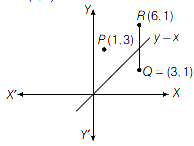
If the point $P(1,3)$ undergoes the following transformations successively:
$(i)$ Reflection with respect to the line $y=x$.
(ii) Translation through $3$ units along the positive direction of the $X$-axis.
(iii) Rotation through an angle of $\frac{\pi}{6}$ about the origin in the clockwise direction.
Then,the final position of the point $P$ is
$(i)$ Reflection with respect to the line $y=x$.
(ii) Translation through $3$ units along the positive direction of the $X$-axis.
(iii) Rotation through an angle of $\frac{\pi}{6}$ about the origin in the clockwise direction.
Then,the final position of the point $P$ is
A
$\left(\frac{6 \sqrt{3}+1}{2}, \frac{\sqrt{3}-6}{2}\right)$
B
$\left(\frac{\sqrt{7}}{2}, \frac{-5}{\sqrt{2}}\right)$
C
$\left(\frac{6+\sqrt{3}}{2}, \frac{1-6 \sqrt{3}}{2}\right)$
D
$\left(\frac{6+\sqrt{3}-1}{2}, \frac{6+\sqrt{3}}{2}\right)$
Solution
(A) $1$. Reflection of $P(1,3)$ about $y=x$ gives $Q(3,1)$.
$2$. Translation of $Q(3,1)$ by $3$ units along the positive $X$-axis gives $R(3+3, 1) = R(6,1)$.
$3$. Rotation of $R(6,1)$ by $\theta = -\frac{\pi}{6}$ (clockwise) about the origin:
$x' = x \cos(\theta) - y \sin(\theta) = 6 \cos(-\frac{\pi}{6}) - 1 \sin(-\frac{\pi}{6}) = 6(\frac{\sqrt{3}}{2}) - 1(-\frac{1}{2}) = \frac{6\sqrt{3}+1}{2}$
$y' = x \sin(\theta) + y \cos(\theta) = 6 \sin(-\frac{\pi}{6}) + 1 \cos(-\frac{\pi}{6}) = 6(-\frac{1}{2}) + 1(\frac{\sqrt{3}}{2}) = \frac{\sqrt{3}-6}{2}$
The final position is $\left(\frac{6 \sqrt{3}+1}{2}, \frac{\sqrt{3}-6}{2}\right)$.
$2$. Translation of $Q(3,1)$ by $3$ units along the positive $X$-axis gives $R(3+3, 1) = R(6,1)$.
$3$. Rotation of $R(6,1)$ by $\theta = -\frac{\pi}{6}$ (clockwise) about the origin:
$x' = x \cos(\theta) - y \sin(\theta) = 6 \cos(-\frac{\pi}{6}) - 1 \sin(-\frac{\pi}{6}) = 6(\frac{\sqrt{3}}{2}) - 1(-\frac{1}{2}) = \frac{6\sqrt{3}+1}{2}$
$y' = x \sin(\theta) + y \cos(\theta) = 6 \sin(-\frac{\pi}{6}) + 1 \cos(-\frac{\pi}{6}) = 6(-\frac{1}{2}) + 1(\frac{\sqrt{3}}{2}) = \frac{\sqrt{3}-6}{2}$
The final position is $\left(\frac{6 \sqrt{3}+1}{2}, \frac{\sqrt{3}-6}{2}\right)$.
0 likes
View Solution106
DifficultMCQ
The transformed equation of $3x^2 + 3y^2 + 2xy = 2$,when the coordinate axes are rotated through an angle of $45^{\circ}$,is
A
$x^2 + 2y^2 = 1$
B
$2x^2 + y^2 = 1$
C
$x^2 + y^2 = 1$
D
$x^2 + 3y^2 = 1$
Solution
(B) Since the axes are rotated through an angle $\theta = 45^{\circ}$,we replace $(x, y)$ with $(x \cos 45^{\circ} - y \sin 45^{\circ}, x \sin 45^{\circ} + y \cos 45^{\circ})$,which is $\left(\frac{x-y}{\sqrt{2}}, \frac{x+y}{\sqrt{2}}\right)$.
Substituting these into the equation $3x^2 + 3y^2 + 2xy = 2$:
$3\left(\frac{x-y}{\sqrt{2}}\right)^2 + 3\left(\frac{x+y}{\sqrt{2}}\right)^2 + 2\left(\frac{x-y}{\sqrt{2}}\right)\left(\frac{x+y}{\sqrt{2}}\right) = 2$
$\frac{3}{2}(x^2 + y^2 - 2xy) + \frac{3}{2}(x^2 + y^2 + 2xy) + \frac{2}{2}(x^2 - y^2) = 2$
$\frac{3}{2}(2x^2 + 2y^2) + (x^2 - y^2) = 2$
$3x^2 + 3y^2 + x^2 - y^2 = 2$
$4x^2 + 2y^2 = 2$
Dividing by $2$,we get $2x^2 + y^2 = 1$.
Substituting these into the equation $3x^2 + 3y^2 + 2xy = 2$:
$3\left(\frac{x-y}{\sqrt{2}}\right)^2 + 3\left(\frac{x+y}{\sqrt{2}}\right)^2 + 2\left(\frac{x-y}{\sqrt{2}}\right)\left(\frac{x+y}{\sqrt{2}}\right) = 2$
$\frac{3}{2}(x^2 + y^2 - 2xy) + \frac{3}{2}(x^2 + y^2 + 2xy) + \frac{2}{2}(x^2 - y^2) = 2$
$\frac{3}{2}(2x^2 + 2y^2) + (x^2 - y^2) = 2$
$3x^2 + 3y^2 + x^2 - y^2 = 2$
$4x^2 + 2y^2 = 2$
Dividing by $2$,we get $2x^2 + y^2 = 1$.
0 likes
View Solution107
DifficultMCQ
If the axes are rotated through an angle $45^{\circ}$ in the positive direction without changing the origin,then the coordinates of the point $(\sqrt{2}, 4)$ in the old system are
A
$(1-2 \sqrt{2}, 1+2 \sqrt{2})$
B
$(1+2 \sqrt{2}, 1-2 \sqrt{2})$
C
$(2 \sqrt{2}, \sqrt{2})$
D
$(\sqrt{2}, 2)$
Solution
(A) Let the old coordinates be $(x, y)$ and the new coordinates be $(x', y')$. The transformation equations for rotation of axes by an angle $\theta$ are:
$x = x' \cos \theta - y' \sin \theta$
$y = x' \sin \theta + y' \cos \theta$
Given $\theta = 45^{\circ}$,$x' = \sqrt{2}$,and $y' = 4$.
Substituting these values:
$x = \sqrt{2} \cos 45^{\circ} - 4 \sin 45^{\circ} = \sqrt{2} \left( \frac{1}{\sqrt{2}} \right) - 4 \left( \frac{1}{\sqrt{2}} \right) = 1 - \frac{4}{\sqrt{2}} = 1 - 2\sqrt{2}$
$y = \sqrt{2} \sin 45^{\circ} + 4 \cos 45^{\circ} = \sqrt{2} \left( \frac{1}{\sqrt{2}} \right) + 4 \left( \frac{1}{\sqrt{2}} \right) = 1 + \frac{4}{\sqrt{2}} = 1 + 2\sqrt{2}$
Thus,the coordinates in the old system are $(1 - 2\sqrt{2}, 1 + 2\sqrt{2})$.
$x = x' \cos \theta - y' \sin \theta$
$y = x' \sin \theta + y' \cos \theta$
Given $\theta = 45^{\circ}$,$x' = \sqrt{2}$,and $y' = 4$.
Substituting these values:
$x = \sqrt{2} \cos 45^{\circ} - 4 \sin 45^{\circ} = \sqrt{2} \left( \frac{1}{\sqrt{2}} \right) - 4 \left( \frac{1}{\sqrt{2}} \right) = 1 - \frac{4}{\sqrt{2}} = 1 - 2\sqrt{2}$
$y = \sqrt{2} \sin 45^{\circ} + 4 \cos 45^{\circ} = \sqrt{2} \left( \frac{1}{\sqrt{2}} \right) + 4 \left( \frac{1}{\sqrt{2}} \right) = 1 + \frac{4}{\sqrt{2}} = 1 + 2\sqrt{2}$
Thus,the coordinates in the old system are $(1 - 2\sqrt{2}, 1 + 2\sqrt{2})$.
0 likes
View Solution108
DifficultMCQ
The transformed equation of $3x^2+4xy+y^2-8x-4y-4=0$ is $f(X, Y)=aX^2+2hXY+bY^2+c=0$ when the origin is shifted to a new point by the translation of axes. Then $f(1,1)=$
A
$0$
B
$1$
C
$-1$
D
$-8$
Solution
(A) The given equation is $3x^2+4xy+y^2-8x-4y-4=0$.
To eliminate the linear terms,we shift the origin to $(h, k)$.
Let $x = X+h$ and $y = Y+k$. Substituting these into the equation:
$3(X+h)^2 + 4(X+h)(Y+k) + (Y+k)^2 - 8(X+h) - 4(Y+k) - 4 = 0$.
Expanding this,we get:
$3X^2 + 4XY + Y^2 + X(6h+4k-8) + Y(4h+2k-4) + (3h^2+4hk+k^2-8h-4k-4) = 0$.
For the linear terms to vanish,we set the coefficients of $X$ and $Y$ to zero:
$6h+4k-8 = 0 \Rightarrow 3h+2k=4$
$4h+2k-4 = 0 \Rightarrow 2h+k=2$
Solving these,we get $h=0$ and $k=2$.
Substituting $h=0, k=2$ into the constant term:
$c = 3(0)^2 + 4(0)(2) + (2)^2 - 8(0) - 4(2) - 4 = 4 - 8 - 4 = -8$.
Thus,the transformed equation is $f(X, Y) = 3X^2 + 4XY + Y^2 - 8 = 0$.
Therefore,$f(1,1) = 3(1)^2 + 4(1)(1) + (1)^2 - 8 = 3 + 4 + 1 - 8 = 0$.
To eliminate the linear terms,we shift the origin to $(h, k)$.
Let $x = X+h$ and $y = Y+k$. Substituting these into the equation:
$3(X+h)^2 + 4(X+h)(Y+k) + (Y+k)^2 - 8(X+h) - 4(Y+k) - 4 = 0$.
Expanding this,we get:
$3X^2 + 4XY + Y^2 + X(6h+4k-8) + Y(4h+2k-4) + (3h^2+4hk+k^2-8h-4k-4) = 0$.
For the linear terms to vanish,we set the coefficients of $X$ and $Y$ to zero:
$6h+4k-8 = 0 \Rightarrow 3h+2k=4$
$4h+2k-4 = 0 \Rightarrow 2h+k=2$
Solving these,we get $h=0$ and $k=2$.
Substituting $h=0, k=2$ into the constant term:
$c = 3(0)^2 + 4(0)(2) + (2)^2 - 8(0) - 4(2) - 4 = 4 - 8 - 4 = -8$.
Thus,the transformed equation is $f(X, Y) = 3X^2 + 4XY + Y^2 - 8 = 0$.
Therefore,$f(1,1) = 3(1)^2 + 4(1)(1) + (1)^2 - 8 = 3 + 4 + 1 - 8 = 0$.
0 likes
View Solution109
MediumMCQ
$A$ line makes intercepts $5$ and $7$ on the coordinate axes. The axes are rotated through an angle $\theta$ in the positive direction about the origin so that the line makes equal intercepts on the new axes,then $|\tan \theta|=$
A
$6$
B
$\frac{1}{6}$
C
$\frac{12}{35}$
D
$\frac{35}{12}$
Solution
(B) The equation of the line with intercepts $a=5$ and $b=7$ is $\frac{x}{5} + \frac{y}{7} = 1$,which simplifies to $7x + 5y = 35$.
When the axes are rotated by an angle $\theta$,the new coordinates $(x', y')$ are given by $x = x' \cos \theta - y' \sin \theta$ and $y = x' \sin \theta + y' \cos \theta$.
Substituting these into the line equation: $7(x' \cos \theta - y' \sin \theta) + 5(x' \sin \theta + y' \cos \theta) = 35$.
Rearranging terms: $x'(7 \cos \theta + 5 \sin \theta) + y'(5 \cos \theta - 7 \sin \theta) = 35$.
The intercepts on the new axes are $a' = \frac{35}{7 \cos \theta + 5 \sin \theta}$ and $b' = \frac{35}{5 \cos \theta - 7 \sin \theta}$.
Since the intercepts are equal,$a' = b'$,so $7 \cos \theta + 5 \sin \theta = 5 \cos \theta - 7 \sin \theta$.
$12 \sin \theta = -2 \cos \theta$.
$\tan \theta = -\frac{2}{12} = -\frac{1}{6}$.
Therefore,$|\tan \theta| = \frac{1}{6}$.
When the axes are rotated by an angle $\theta$,the new coordinates $(x', y')$ are given by $x = x' \cos \theta - y' \sin \theta$ and $y = x' \sin \theta + y' \cos \theta$.
Substituting these into the line equation: $7(x' \cos \theta - y' \sin \theta) + 5(x' \sin \theta + y' \cos \theta) = 35$.
Rearranging terms: $x'(7 \cos \theta + 5 \sin \theta) + y'(5 \cos \theta - 7 \sin \theta) = 35$.
The intercepts on the new axes are $a' = \frac{35}{7 \cos \theta + 5 \sin \theta}$ and $b' = \frac{35}{5 \cos \theta - 7 \sin \theta}$.
Since the intercepts are equal,$a' = b'$,so $7 \cos \theta + 5 \sin \theta = 5 \cos \theta - 7 \sin \theta$.
$12 \sin \theta = -2 \cos \theta$.
$\tan \theta = -\frac{2}{12} = -\frac{1}{6}$.
Therefore,$|\tan \theta| = \frac{1}{6}$.
0 likes
View Solution110
MediumMCQ
$(a, b)$ is the point to which the origin has to be shifted by translation of axes so as to remove the first-degree terms from the equation $2x^2 - 3xy + 4y^2 + 5y - 6 = 0$. If the angle by which the axes are to be rotated in the positive direction about the origin to remove the $xy$-term from the equation $ax^2 + 23abxy + by^2 = 0$ is $\theta$,then $\tan 2\theta =$
A
$\frac{\pi}{4}$
B
$60$
C
$\frac{\pi}{3}$
D
$15$
Solution
(B) Step $1$: Shifting the origin to $(h, k)$ to remove first-degree terms from $2x^2 - 3xy + 4y^2 + 5y - 6 = 0$. Let $x = X + h$ and $y = Y + k$. Substituting these into the equation,the coefficients of $X$ and $Y$ must be zero.
$4h - 3k = 0$ and $-3h + 8k + 5 = 0$.
Solving these,we get $h = -\frac{15}{23}$ and $k = -\frac{20}{23}$.
The origin is shifted to $(h, k)$,so the point $(a, b)$ is $(-\frac{15}{23}, -\frac{20}{23})$.
Step $2$: Substitute $a = -\frac{15}{23}$ and $b = -\frac{20}{23}$ into the equation $ax^2 + 23abxy + by^2 = 0$.
$-\frac{15}{23}x^2 + 23(-\frac{15}{23})(-\frac{20}{23})xy - \frac{20}{23}y^2 = 0$.
Multiplying by $-23$,we get $15x^2 - 300xy + 20y^2 = 0$,or $3x^2 - 60xy + 4y^2 = 0$.
Step $3$: To remove the $xy$-term by rotating axes by angle $\theta$,the formula is $\tan 2\theta = \frac{B}{A - C}$,where the equation is $Ax^2 + Bxy + Cy^2 = 0$.
Here $A = 3, B = -60, C = 4$.
$\tan 2\theta = \frac{-60}{3 - 4} = \frac{-60}{-1} = 60$.
$4h - 3k = 0$ and $-3h + 8k + 5 = 0$.
Solving these,we get $h = -\frac{15}{23}$ and $k = -\frac{20}{23}$.
The origin is shifted to $(h, k)$,so the point $(a, b)$ is $(-\frac{15}{23}, -\frac{20}{23})$.
Step $2$: Substitute $a = -\frac{15}{23}$ and $b = -\frac{20}{23}$ into the equation $ax^2 + 23abxy + by^2 = 0$.
$-\frac{15}{23}x^2 + 23(-\frac{15}{23})(-\frac{20}{23})xy - \frac{20}{23}y^2 = 0$.
Multiplying by $-23$,we get $15x^2 - 300xy + 20y^2 = 0$,or $3x^2 - 60xy + 4y^2 = 0$.
Step $3$: To remove the $xy$-term by rotating axes by angle $\theta$,the formula is $\tan 2\theta = \frac{B}{A - C}$,where the equation is $Ax^2 + Bxy + Cy^2 = 0$.
Here $A = 3, B = -60, C = 4$.
$\tan 2\theta = \frac{-60}{3 - 4} = \frac{-60}{-1} = 60$.
0 likes
View Solution111
DifficultMCQ
If $\theta_1, \theta_2, \theta_3$ are respectively the angles by which the coordinate axes are to be rotated to eliminate the $xy$ term from the following equations,then the descending order of these angles is:
$A_1 = 3x^2 + 5xy + 3y^2 + 2x + 3y + 4 = 0$
$A_2 = 5x^2 + 2\sqrt{3}xy + 3y^2 + 6 = 0$
$A_3 = 4x^2 + \sqrt{3}xy + 5y^2 - 4 = 0$
$A_1 = 3x^2 + 5xy + 3y^2 + 2x + 3y + 4 = 0$
$A_2 = 5x^2 + 2\sqrt{3}xy + 3y^2 + 6 = 0$
$A_3 = 4x^2 + \sqrt{3}xy + 5y^2 - 4 = 0$
A
$\theta_1, \theta_2, \theta_3$
B
$\theta_3, \theta_1, \theta_2$
C
$\theta_2, \theta_1, \theta_3$
D
$\theta_3, \theta_2, \theta_1$
Solution
(B) To eliminate the $xy$ term in a general quadratic equation $ax^2 + bxy + cy^2 + dx + ey + f = 0$,the axes must be rotated by an angle $\theta$ such that $\tan 2\theta = \frac{b}{a-c}$.
For $A_1$: $a=3, b=5, c=3$. $\tan 2\theta_1 = \frac{5}{3-3} = \infty$ $\Rightarrow 2\theta_1 = \frac{\pi}{2}$ $\Rightarrow \theta_1 = \frac{\pi}{4}$.
For $A_2$: $a=5, b=2\sqrt{3}, c=3$. $\tan 2\theta_2 = \frac{2\sqrt{3}}{5-3} = \sqrt{3}$ $\Rightarrow 2\theta_2 = \frac{\pi}{3}$ $\Rightarrow \theta_2 = \frac{\pi}{6}$.
For $A_3$: $a=4, b=\sqrt{3}, c=5$. $\tan 2\theta_3 = \frac{\sqrt{3}}{4-5} = -\sqrt{3}$ $\Rightarrow 2\theta_3 = \frac{2\pi}{3}$ $\Rightarrow \theta_3 = \frac{\pi}{3}$.
Comparing the angles: $\frac{\pi}{3} > \frac{\pi}{4} > \frac{\pi}{6}$,which means $\theta_3 > \theta_1 > \theta_2$.
For $A_1$: $a=3, b=5, c=3$. $\tan 2\theta_1 = \frac{5}{3-3} = \infty$ $\Rightarrow 2\theta_1 = \frac{\pi}{2}$ $\Rightarrow \theta_1 = \frac{\pi}{4}$.
For $A_2$: $a=5, b=2\sqrt{3}, c=3$. $\tan 2\theta_2 = \frac{2\sqrt{3}}{5-3} = \sqrt{3}$ $\Rightarrow 2\theta_2 = \frac{\pi}{3}$ $\Rightarrow \theta_2 = \frac{\pi}{6}$.
For $A_3$: $a=4, b=\sqrt{3}, c=5$. $\tan 2\theta_3 = \frac{\sqrt{3}}{4-5} = -\sqrt{3}$ $\Rightarrow 2\theta_3 = \frac{2\pi}{3}$ $\Rightarrow \theta_3 = \frac{\pi}{3}$.
Comparing the angles: $\frac{\pi}{3} > \frac{\pi}{4} > \frac{\pi}{6}$,which means $\theta_3 > \theta_1 > \theta_2$.
0 likes
View Solution112
EasyMCQ
When the origin is shifted to $(1, -2)$ by translation of coordinate axes,the transformed coordinates of $(3, -2)$ are $(\alpha, \beta)$. If the axes are rotated about the origin through an angle of $45^{\circ}$ after the translation,then the transformed coordinates of $(\alpha, \beta)$ are
A
$(\sqrt{2}, 0)$
B
$(0, \sqrt{2})$
C
$(-\sqrt{2}, \sqrt{2})$
D
$(\sqrt{2}, -\sqrt{2})$
Solution
(D) Given,origin is shifted to $(h, k) = (1, -2)$.
Let the original coordinates be $(x, y) = (3, -2)$.
The new coordinates $(\alpha, \beta)$ after translation are given by $\alpha = x - h$ and $\beta = y - k$.
$\alpha = 3 - 1 = 2$ and $\beta = -2 - (-2) = 0$.
So,$(\alpha, \beta) = (2, 0)$.
Now,the axes are rotated about the origin by an angle $\theta = 45^{\circ}$.
The new coordinates $(x', y')$ after rotation are given by:
$x' = \alpha \cos \theta + \beta \sin \theta = 2 \cos 45^{\circ} + 0 \sin 45^{\circ} = 2 \times \frac{1}{\sqrt{2}} = \sqrt{2}$.
$y' = -\alpha \sin \theta + \beta \cos \theta = -2 \sin 45^{\circ} + 0 \cos 45^{\circ} = -2 \times \frac{1}{\sqrt{2}} = -\sqrt{2}$.
Thus,the transformed coordinates are $(\sqrt{2}, -\sqrt{2})$.
Let the original coordinates be $(x, y) = (3, -2)$.
The new coordinates $(\alpha, \beta)$ after translation are given by $\alpha = x - h$ and $\beta = y - k$.
$\alpha = 3 - 1 = 2$ and $\beta = -2 - (-2) = 0$.
So,$(\alpha, \beta) = (2, 0)$.
Now,the axes are rotated about the origin by an angle $\theta = 45^{\circ}$.
The new coordinates $(x', y')$ after rotation are given by:
$x' = \alpha \cos \theta + \beta \sin \theta = 2 \cos 45^{\circ} + 0 \sin 45^{\circ} = 2 \times \frac{1}{\sqrt{2}} = \sqrt{2}$.
$y' = -\alpha \sin \theta + \beta \cos \theta = -2 \sin 45^{\circ} + 0 \cos 45^{\circ} = -2 \times \frac{1}{\sqrt{2}} = -\sqrt{2}$.
Thus,the transformed coordinates are $(\sqrt{2}, -\sqrt{2})$.
0 likes
View Solution113
EasyMCQ
The transformed equation of the curve $2x^2+y^2-3x+5y-8=0$ when the origin is translated to the point $(-1, 2)$ is
A
$2x^2+y^2-7x+9y+11=0$
B
$2x^2+y^2+7x+9y+11=0$
C
$2x^2+y^2-x+y+11=0$
D
$2x^2+y^2+7x-9y+11=0$
Solution
(A) Given that the origin is translated from $(0, 0)$ to $(h, k) = (-1, 2)$.
We use the transformation equations $x = X + h$ and $y = Y + k$.
Substituting the values,we get $x = X - 1$ and $y = Y + 2$.
Substitute these into the original equation $2x^2 + y^2 - 3x + 5y - 8 = 0$:
$2(X - 1)^2 + (Y + 2)^2 - 3(X - 1) + 5(Y + 2) - 8 = 0$
$2(X^2 - 2X + 1) + (Y^2 + 4Y + 4) - 3X + 3 + 5Y + 10 - 8 = 0$
$2X^2 - 4X + 2 + Y^2 + 4Y + 4 - 3X + 5Y + 5 = 0$
Combining like terms: $2X^2 + Y^2 - 7X + 9Y + 11 = 0$.
Replacing $(X, Y)$ with $(x, y)$,the transformed equation is $2x^2 + y^2 - 7x + 9y + 11 = 0$.
We use the transformation equations $x = X + h$ and $y = Y + k$.
Substituting the values,we get $x = X - 1$ and $y = Y + 2$.
Substitute these into the original equation $2x^2 + y^2 - 3x + 5y - 8 = 0$:
$2(X - 1)^2 + (Y + 2)^2 - 3(X - 1) + 5(Y + 2) - 8 = 0$
$2(X^2 - 2X + 1) + (Y^2 + 4Y + 4) - 3X + 3 + 5Y + 10 - 8 = 0$
$2X^2 - 4X + 2 + Y^2 + 4Y + 4 - 3X + 5Y + 5 = 0$
Combining like terms: $2X^2 + Y^2 - 7X + 9Y + 11 = 0$.
Replacing $(X, Y)$ with $(x, y)$,the transformed equation is $2x^2 + y^2 - 7x + 9y + 11 = 0$.
0 likes
View Solution114
MediumMCQ
The transformed equation of $x^2+6xy+8y^2=10$ when the axes are rotated through an angle $\frac{\pi}{4}$ is:
A
$15x^2-14xy+3y^2=20$
B
$15x^2+14xy-3y^2=20$
C
$15x^2+14xy+3y^2=20$
D
$15x^2-14xy-3y^2=20$
Solution
(C) The given equation is $x^2+6xy+8y^2=10$ $\dots$ $(i)$.
Since the axes are rotated through an angle $\theta = \frac{\pi}{4}$,the transformation equations are:
$x = x_1 \cos \frac{\pi}{4} - y_1 \sin \frac{\pi}{4} = \frac{x_1-y_1}{\sqrt{2}}$
$y = x_1 \sin \frac{\pi}{4} + y_1 \cos \frac{\pi}{4} = \frac{x_1+y_1}{\sqrt{2}}$
Substituting these into $(i)$:
$\left(\frac{x_1-y_1}{\sqrt{2}}\right)^2 + 6\left(\frac{x_1-y_1}{\sqrt{2}}\right)\left(\frac{x_1+y_1}{\sqrt{2}}\right) + 8\left(\frac{x_1+y_1}{\sqrt{2}}\right)^2 = 10$
$\frac{x_1^2+y_1^2-2x_1y_1}{2} + \frac{6(x_1^2-y_1^2)}{2} + \frac{8(x_1^2+y_1^2+2x_1y_1)}{2} = 10$
Multiplying by $2$:
$(x_1^2+y_1^2-2x_1y_1) + (6x_1^2-6y_1^2) + (8x_1^2+8y_1^2+16x_1y_1) = 20$
$(1+6+8)x_1^2 + (1-6+8)y_1^2 + (-2+16)x_1y_1 = 20$
$15x_1^2 + 3y_1^2 + 14x_1y_1 = 20$
Thus,the transformed equation is $15x^2+14xy+3y^2=20$.
Since the axes are rotated through an angle $\theta = \frac{\pi}{4}$,the transformation equations are:
$x = x_1 \cos \frac{\pi}{4} - y_1 \sin \frac{\pi}{4} = \frac{x_1-y_1}{\sqrt{2}}$
$y = x_1 \sin \frac{\pi}{4} + y_1 \cos \frac{\pi}{4} = \frac{x_1+y_1}{\sqrt{2}}$
Substituting these into $(i)$:
$\left(\frac{x_1-y_1}{\sqrt{2}}\right)^2 + 6\left(\frac{x_1-y_1}{\sqrt{2}}\right)\left(\frac{x_1+y_1}{\sqrt{2}}\right) + 8\left(\frac{x_1+y_1}{\sqrt{2}}\right)^2 = 10$
$\frac{x_1^2+y_1^2-2x_1y_1}{2} + \frac{6(x_1^2-y_1^2)}{2} + \frac{8(x_1^2+y_1^2+2x_1y_1)}{2} = 10$
Multiplying by $2$:
$(x_1^2+y_1^2-2x_1y_1) + (6x_1^2-6y_1^2) + (8x_1^2+8y_1^2+16x_1y_1) = 20$
$(1+6+8)x_1^2 + (1-6+8)y_1^2 + (-2+16)x_1y_1 = 20$
$15x_1^2 + 3y_1^2 + 14x_1y_1 = 20$
Thus,the transformed equation is $15x^2+14xy+3y^2=20$.
0 likes
View Solution115
MediumMCQ
If $(h, k)$ is the new origin to be chosen to eliminate first degree terms from the equation $S \equiv 2x^2 - xy - y^2 - 3x + 3y = 0$ by translation and if $\theta$ is the angle with which the axes are to be rotated about the origin in anticlockwise direction to eliminate the $xy$-term from $S = 0$,then $\tan 2\theta =$
A
$h+k$
B
$h-k$
C
$hk$
D
$-\frac{h}{3k}$
Solution
(D) Given equation: $S \equiv 2x^2 - xy - y^2 - 3x + 3y = 0$.
To eliminate first-degree terms,we find the new origin $(h, k)$ by solving $\frac{\partial S}{\partial x} = 0$ and $\frac{\partial S}{\partial y} = 0$.
$\frac{\partial S}{\partial x} = 4x - y - 3 = 0$ and $\frac{\partial S}{\partial y} = -x - 2y + 3 = 0$.
Solving these,we get $x = 1, y = 1$,so $(h, k) = (1, 1)$.
To eliminate the $xy$-term by rotation,we use the formula $\tan 2\theta = \frac{B}{A - C}$,where the equation is $Ax^2 + Bxy + Cy^2 + Dx + Ey + F = 0$.
Here $A = 2, B = -1, C = -1$.
Thus,$\tan 2\theta = \frac{-1}{2 - (-1)} = \frac{-1}{3}$.
Since $h = 1$ and $k = 1$,we have $h = k$,so $\tan 2\theta = -\frac{h}{3k} = -\frac{1}{3}$.
Therefore,the correct option is $D$.
To eliminate first-degree terms,we find the new origin $(h, k)$ by solving $\frac{\partial S}{\partial x} = 0$ and $\frac{\partial S}{\partial y} = 0$.
$\frac{\partial S}{\partial x} = 4x - y - 3 = 0$ and $\frac{\partial S}{\partial y} = -x - 2y + 3 = 0$.
Solving these,we get $x = 1, y = 1$,so $(h, k) = (1, 1)$.
To eliminate the $xy$-term by rotation,we use the formula $\tan 2\theta = \frac{B}{A - C}$,where the equation is $Ax^2 + Bxy + Cy^2 + Dx + Ey + F = 0$.
Here $A = 2, B = -1, C = -1$.
Thus,$\tan 2\theta = \frac{-1}{2 - (-1)} = \frac{-1}{3}$.
Since $h = 1$ and $k = 1$,we have $h = k$,so $\tan 2\theta = -\frac{h}{3k} = -\frac{1}{3}$.
Therefore,the correct option is $D$.
0 likes
View Solution116
MediumMCQ
If $2x^2+xy-6y^2+k=0$ is the transformed equation of $2x^2+xy-6y^2-13x+9y+15=0$ when the origin is shifted to the point $(a, b)$ by translation of axes,then $k=$
A
$1$
B
$0$
C
$21$
D
$15$
Solution
(B) Let the original equation be $f(x, y) = 2x^2+xy-6y^2-13x+9y+15=0$.
When the origin is shifted to $(a, b)$,we substitute $x = X+a$ and $y = Y+b$.
The equation becomes $2(X+a)^2 + (X+a)(Y+b) - 6(Y+b)^2 - 13(X+a) + 9(Y+b) + 15 = 0$.
Expanding this,the linear terms in $X$ and $Y$ must vanish for the equation to take the form $2X^2+XY-6Y^2+k=0$.
The partial derivatives $\frac{\partial f}{\partial x} = 4x+y-13 = 0$ and $\frac{\partial f}{\partial y} = x-12y+9 = 0$ give the center $(a, b)$.
Solving $4a+b=13$ and $a-12b=-9$,we get $a=3$ and $b=1$.
Substituting $x=X+3$ and $y=Y+1$ into the original equation:
$2(X+3)^2 + (X+3)(Y+1) - 6(Y+1)^2 - 13(X+3) + 9(Y+1) + 15 = 0$.
$2(X^2+6X+9) + (XY+X+3Y+3) - 6(Y^2+2Y+1) - 13X-39 + 9Y+9 + 15 = 0$.
$2X^2+12X+18 + XY+X+3Y+3 - 6Y^2-12Y-6 - 13X+9Y+9+15 = 0$.
Grouping terms: $2X^2+XY-6Y^2 + (12+1-13)X + (3-12+9)Y + (18+3-6-39+9+15) = 0$.
$2X^2+XY-6Y^2 + 0X + 0Y + 0 = 0$.
Thus,$k=0$.
When the origin is shifted to $(a, b)$,we substitute $x = X+a$ and $y = Y+b$.
The equation becomes $2(X+a)^2 + (X+a)(Y+b) - 6(Y+b)^2 - 13(X+a) + 9(Y+b) + 15 = 0$.
Expanding this,the linear terms in $X$ and $Y$ must vanish for the equation to take the form $2X^2+XY-6Y^2+k=0$.
The partial derivatives $\frac{\partial f}{\partial x} = 4x+y-13 = 0$ and $\frac{\partial f}{\partial y} = x-12y+9 = 0$ give the center $(a, b)$.
Solving $4a+b=13$ and $a-12b=-9$,we get $a=3$ and $b=1$.
Substituting $x=X+3$ and $y=Y+1$ into the original equation:
$2(X+3)^2 + (X+3)(Y+1) - 6(Y+1)^2 - 13(X+3) + 9(Y+1) + 15 = 0$.
$2(X^2+6X+9) + (XY+X+3Y+3) - 6(Y^2+2Y+1) - 13X-39 + 9Y+9 + 15 = 0$.
$2X^2+12X+18 + XY+X+3Y+3 - 6Y^2-12Y-6 - 13X+9Y+9+15 = 0$.
Grouping terms: $2X^2+XY-6Y^2 + (12+1-13)X + (3-12+9)Y + (18+3-6-39+9+15) = 0$.
$2X^2+XY-6Y^2 + 0X + 0Y + 0 = 0$.
Thus,$k=0$.
0 likes
View Solution117
DifficultMCQ
When the origin is shifted to the point $(h, k)$ by translating the coordinate axes,the equation $S = 2x^2 - xy + y^2 + 2x + 3y + 1 = 0$ is changed to $S' = ax^2 + 2hxy + by^2 + C' = 0$. If the coordinate axes are then rotated about the new origin through an angle $\theta$ in the positive direction to eliminate the $xy$ term,the equation $S' = 0$ becomes $Ax^2 + By^2 + C = 0$. Find the value of $h + k + \tan 2\theta$.
A
-$4$
B
$0$
C
$1$
D
None of these
Solution
(A) The original equation is $2x^2 - xy + y^2 + 2x + 3y + 1 = 0$.
To shift the origin to $(h, k)$,we substitute $x = X + h$ and $y = Y + k$.
The new equation is $2(X+h)^2 - (X+h)(Y+k) + (Y+k)^2 + 2(X+h) + 3(Y+k) + 1 = 0$.
Expanding this,the linear terms in $X$ and $Y$ are $(4h - k + 2)X + (-h + 2k + 3)Y = 0$.
For the origin to be the new center,these coefficients must be zero:
$4h - k = -2$ and $-h + 2k = -3$.
Solving these,we get $h = -1$ and $k = -2$.
Thus,$h + k = -3$.
The equation becomes $2X^2 - XY + Y^2 + C' = 0$.
To eliminate the $XY$ term by rotation,we use $\tan 2\theta = \frac{2H}{A-B}$,where the equation is $AX^2 + 2HXY + BY^2 = 0$.
Here $A = 2, H = -1/2, B = 1$.
So,$\tan 2\theta = \frac{2(-1/2)}{2 - 1} = \frac{-1}{1} = -1$.
Therefore,$h + k + \tan 2\theta = -3 + (-1) = -4$.
To shift the origin to $(h, k)$,we substitute $x = X + h$ and $y = Y + k$.
The new equation is $2(X+h)^2 - (X+h)(Y+k) + (Y+k)^2 + 2(X+h) + 3(Y+k) + 1 = 0$.
Expanding this,the linear terms in $X$ and $Y$ are $(4h - k + 2)X + (-h + 2k + 3)Y = 0$.
For the origin to be the new center,these coefficients must be zero:
$4h - k = -2$ and $-h + 2k = -3$.
Solving these,we get $h = -1$ and $k = -2$.
Thus,$h + k = -3$.
The equation becomes $2X^2 - XY + Y^2 + C' = 0$.
To eliminate the $XY$ term by rotation,we use $\tan 2\theta = \frac{2H}{A-B}$,where the equation is $AX^2 + 2HXY + BY^2 = 0$.
Here $A = 2, H = -1/2, B = 1$.
So,$\tan 2\theta = \frac{2(-1/2)}{2 - 1} = \frac{-1}{1} = -1$.
Therefore,$h + k + \tan 2\theta = -3 + (-1) = -4$.
0 likes
View Solution118
DifficultMCQ
By rotating the axes through an angle of $30^{\circ}$ in the anti-clockwise direction about the origin,the equation $4x^2+12xy+9y^2+6x+9y+2=0$ becomes $ax^2+2hxy+by^2+2gx+2fy+c=0$. Then which of the following is true?
A
$a=21-6\sqrt{3}$
B
$g/f=\frac{3+2\sqrt{3}}{3\sqrt{3}-2}$
C
$b=31+6\sqrt{3}$
D
$c=6$
Solution
(B) The rotation of axes by an angle $\theta = 30^{\circ}$ is given by the transformation:
$x = X \cos \theta - Y \sin \theta = X \frac{\sqrt{3}}{2} - Y \frac{1}{2}$
$y = X \sin \theta + Y \cos \theta = X \frac{1}{2} + Y \frac{\sqrt{3}}{2}$
Substituting these into the equation $4x^2+12xy+9y^2+6x+9y+2=0$:
Note that $4x^2+12xy+9y^2 = (2x+3y)^2$.
Substituting $x$ and $y$:
$2x+3y = 2(\frac{\sqrt{3}}{2}X - \frac{1}{2}Y) + 3(\frac{1}{2}X + \frac{\sqrt{3}}{2}Y) = X(\sqrt{3} + \frac{3}{2}) + Y(\frac{3\sqrt{3}-2}{2})$.
Squaring this gives the $X^2, XY, Y^2$ terms.
The linear part is $6x+9y = 6(\frac{\sqrt{3}}{2}X - \frac{1}{2}Y) + 9(\frac{1}{2}X + \frac{\sqrt{3}}{2}Y) = X(3\sqrt{3} + \frac{9}{2}) + Y(\frac{9\sqrt{3}-6}{2})$.
Thus,$2g = \frac{6\sqrt{3}+9}{2}$ and $2f = \frac{9\sqrt{3}-6}{2}$.
Calculating the ratio:
$\frac{g}{f} = \frac{6\sqrt{3}+9}{9\sqrt{3}-6} = \frac{3(2\sqrt{3}+3)}{3(3\sqrt{3}-2)} = \frac{3+2\sqrt{3}}{3\sqrt{3}-2}$.
Therefore,option $B$ is correct.
$x = X \cos \theta - Y \sin \theta = X \frac{\sqrt{3}}{2} - Y \frac{1}{2}$
$y = X \sin \theta + Y \cos \theta = X \frac{1}{2} + Y \frac{\sqrt{3}}{2}$
Substituting these into the equation $4x^2+12xy+9y^2+6x+9y+2=0$:
Note that $4x^2+12xy+9y^2 = (2x+3y)^2$.
Substituting $x$ and $y$:
$2x+3y = 2(\frac{\sqrt{3}}{2}X - \frac{1}{2}Y) + 3(\frac{1}{2}X + \frac{\sqrt{3}}{2}Y) = X(\sqrt{3} + \frac{3}{2}) + Y(\frac{3\sqrt{3}-2}{2})$.
Squaring this gives the $X^2, XY, Y^2$ terms.
The linear part is $6x+9y = 6(\frac{\sqrt{3}}{2}X - \frac{1}{2}Y) + 9(\frac{1}{2}X + \frac{\sqrt{3}}{2}Y) = X(3\sqrt{3} + \frac{9}{2}) + Y(\frac{9\sqrt{3}-6}{2})$.
Thus,$2g = \frac{6\sqrt{3}+9}{2}$ and $2f = \frac{9\sqrt{3}-6}{2}$.
Calculating the ratio:
$\frac{g}{f} = \frac{6\sqrt{3}+9}{9\sqrt{3}-6} = \frac{3(2\sqrt{3}+3)}{3(3\sqrt{3}-2)} = \frac{3+2\sqrt{3}}{3\sqrt{3}-2}$.
Therefore,option $B$ is correct.
0 likes
View Solution119
EasyMCQ
In order to eliminate the first degree terms from the equation $4x^2+8xy+10y^2-8x-44y+14=0$,the point to which the origin has to be shifted is
A
$(-2,3)$
B
$(2,-3)$
C
$(1,-3)$
D
$(-1,3)$
Solution
(A) Comparing the given equation with $ax^2+2hxy+by^2+2gx+2fy+c=0$,we get $a=4, h=4, b=10, g=-4, f=-22$ and $c=14$.
To eliminate the first degree terms,the origin $(0,0)$ must be shifted to $(h_0, k_0)$ where $h_0 = \frac{bg-fh}{h^2-ab}$ and $k_0 = \frac{af-gh}{h^2-ab}$.
Calculating the denominator: $h^2-ab = 4^2 - (4)(10) = 16 - 40 = -24$.
Calculating $h_0$: $h_0 = \frac{(10)(-4) - (-22)(4)}{-24} = \frac{-40 + 88}{-24} = \frac{48}{-24} = -2$.
Calculating $k_0$: $k_0 = \frac{(4)(-22) - (-4)(4)}{-24} = \frac{-88 + 16}{-24} = \frac{-72}{-24} = 3$.
Thus,the origin must be shifted to $(-2, 3)$.
To eliminate the first degree terms,the origin $(0,0)$ must be shifted to $(h_0, k_0)$ where $h_0 = \frac{bg-fh}{h^2-ab}$ and $k_0 = \frac{af-gh}{h^2-ab}$.
Calculating the denominator: $h^2-ab = 4^2 - (4)(10) = 16 - 40 = -24$.
Calculating $h_0$: $h_0 = \frac{(10)(-4) - (-22)(4)}{-24} = \frac{-40 + 88}{-24} = \frac{48}{-24} = -2$.
Calculating $k_0$: $k_0 = \frac{(4)(-22) - (-4)(4)}{-24} = \frac{-88 + 16}{-24} = \frac{-72}{-24} = 3$.
Thus,the origin must be shifted to $(-2, 3)$.
0 likes
View Solution120
MediumMCQ
Let $P$ be the point to which the origin is shifted by the translation of axes so as to remove the first-degree terms from the equation $3x^2+y^2-6x+4y+4=0$. If the origin is shifted to $P$ by the translation of axes,then the transformed equation of $2x^2+3xy-5y^2+2x-23y-24=0$ is
A
$x^2+4xy-3y^2-4x+20y+23=0$
B
$2x^2-3xy+5y^2=0$
C
$2x^2+3xy-5y^2=0$
D
$2x^2+3xy-5y^2-13=0$
Solution
(C) Let the origin be shifted to $P(h, k)$. The transformation equations are $x = x' + h$ and $y = y' + k$.
Substituting these into the first equation $3x^2 + y^2 - 6x + 4y + 4 = 0$:
$3(x' + h)^2 + (y' + k)^2 - 6(x' + h) + 4(y' + k) + 4 = 0$
$3(x'^2 + 2hx' + h^2) + (y'^2 + 2ky' + k^2) - 6x' - 6h + 4y' + 4k + 4 = 0$
$3x'^2 + y'^2 + (6h - 6)x' + (2k + 4)y' + (3h^2 + k^2 - 6h + 4k + 4) = 0$.
To remove the first-degree terms,set the coefficients of $x'$ and $y'$ to zero:
$6h - 6 = 0 \Rightarrow h = 1$
$2k + 4 = 0 \Rightarrow k = -2$.
So,the origin is shifted to $P(1, -2)$.
Now,substitute $x = x' + 1$ and $y = y' - 2$ into the second equation $2x^2 + 3xy - 5y^2 + 2x - 23y - 24 = 0$:
$2(x' + 1)^2 + 3(x' + 1)(y' - 2) - 5(y' - 2)^2 + 2(x' + 1) - 23(y' - 2) - 24 = 0$
$2(x'^2 + 2x' + 1) + 3(x'y' - 2x' + y' - 2) - 5(y'^2 - 4y' + 4) + 2x' + 2 - 23y' + 46 - 24 = 0$
$2x'^2 + 4x' + 2 + 3x'y' - 6x' + 3y' - 6 - 5y'^2 + 20y' - 20 + 2x' - 23y' + 46 - 24 = 0$
Grouping the terms:
$2x'^2 + 3x'y' - 5y'^2 + (4 - 6 + 2)x' + (3 + 20 - 23)y' + (2 - 6 - 20 + 46 - 24) = 0$
$2x'^2 + 3x'y' - 5y'^2 + 0x' + 0y' + 0 = 0$.
Thus,the transformed equation is $2x^2 + 3xy - 5y^2 = 0$.
Substituting these into the first equation $3x^2 + y^2 - 6x + 4y + 4 = 0$:
$3(x' + h)^2 + (y' + k)^2 - 6(x' + h) + 4(y' + k) + 4 = 0$
$3(x'^2 + 2hx' + h^2) + (y'^2 + 2ky' + k^2) - 6x' - 6h + 4y' + 4k + 4 = 0$
$3x'^2 + y'^2 + (6h - 6)x' + (2k + 4)y' + (3h^2 + k^2 - 6h + 4k + 4) = 0$.
To remove the first-degree terms,set the coefficients of $x'$ and $y'$ to zero:
$6h - 6 = 0 \Rightarrow h = 1$
$2k + 4 = 0 \Rightarrow k = -2$.
So,the origin is shifted to $P(1, -2)$.
Now,substitute $x = x' + 1$ and $y = y' - 2$ into the second equation $2x^2 + 3xy - 5y^2 + 2x - 23y - 24 = 0$:
$2(x' + 1)^2 + 3(x' + 1)(y' - 2) - 5(y' - 2)^2 + 2(x' + 1) - 23(y' - 2) - 24 = 0$
$2(x'^2 + 2x' + 1) + 3(x'y' - 2x' + y' - 2) - 5(y'^2 - 4y' + 4) + 2x' + 2 - 23y' + 46 - 24 = 0$
$2x'^2 + 4x' + 2 + 3x'y' - 6x' + 3y' - 6 - 5y'^2 + 20y' - 20 + 2x' - 23y' + 46 - 24 = 0$
Grouping the terms:
$2x'^2 + 3x'y' - 5y'^2 + (4 - 6 + 2)x' + (3 + 20 - 23)y' + (2 - 6 - 20 + 46 - 24) = 0$
$2x'^2 + 3x'y' - 5y'^2 + 0x' + 0y' + 0 = 0$.
Thus,the transformed equation is $2x^2 + 3xy - 5y^2 = 0$.
0 likes
View Solution121
DifficultMCQ
Transforming to parallel axes through a point $(p, q)$,the equation $2x^2 + 3xy + 4y^2 + x + 18y + 25 = 0$ becomes $2x^2 + 3xy + 4y^2 = 1$. Then:
A
$p = -2, q = 3$
B
$p = 2, q = -3$
C
$p = 3, q = -4$
D
$p = -4, q = 3$
Solution
(B) Let the origin be shifted to $(p, q)$ such that the new axes are parallel to the original axes. The transformation equations are $x = x' + p$ and $y = y' + q$.
Substituting these into the given equation $2x^2 + 3xy + 4y^2 + x + 18y + 25 = 0$:
$2(x' + p)^2 + 3(x' + p)(y' + q) + 4(y' + q)^2 + (x' + p) + 18(y' + q) + 25 = 0$
Expanding the terms:
$2(x'^2 + 2px' + p^2) + 3(x'y' + qx' + py' + pq) + 4(y'^2 + 2qy' + q^2) + x' + p + 18y' + 18q + 25 = 0$
Grouping the terms by $x'$,$y'$,and constants:
$2x'^2 + 3x'y' + 4y'^2 + (4p + 3q + 1)x' + (3p + 8q + 18)y' + (2p^2 + 3pq + 4q^2 + p + 18q + 25) = 0$
Comparing this with the given transformed equation $2x^2 + 3xy + 4y^2 = 1$ (or $2x'^2 + 3x'y' + 4y'^2 - 1 = 0$),the coefficients of $x'$ and $y'$ must be zero:
$4p + 3q + 1 = 0$ ... $(i)$
$3p + 8q + 18 = 0$ ... (ii)
Solving these linear equations:
From $(i)$,$4p = -3q - 1 \implies p = \frac{-3q - 1}{4}$.
Substituting into (ii): $3(\frac{-3q - 1}{4}) + 8q + 18 = 0$
$-9q - 3 + 32q + 72 = 0 \implies 23q + 69 = 0 \implies q = -3$.
Substituting $q = -3$ into $(i)$: $4p + 3(-3) + 1 = 0 \implies 4p - 8 = 0 \implies p = 2$.
Thus,$p = 2, q = -3$.
Substituting these into the given equation $2x^2 + 3xy + 4y^2 + x + 18y + 25 = 0$:
$2(x' + p)^2 + 3(x' + p)(y' + q) + 4(y' + q)^2 + (x' + p) + 18(y' + q) + 25 = 0$
Expanding the terms:
$2(x'^2 + 2px' + p^2) + 3(x'y' + qx' + py' + pq) + 4(y'^2 + 2qy' + q^2) + x' + p + 18y' + 18q + 25 = 0$
Grouping the terms by $x'$,$y'$,and constants:
$2x'^2 + 3x'y' + 4y'^2 + (4p + 3q + 1)x' + (3p + 8q + 18)y' + (2p^2 + 3pq + 4q^2 + p + 18q + 25) = 0$
Comparing this with the given transformed equation $2x^2 + 3xy + 4y^2 = 1$ (or $2x'^2 + 3x'y' + 4y'^2 - 1 = 0$),the coefficients of $x'$ and $y'$ must be zero:
$4p + 3q + 1 = 0$ ... $(i)$
$3p + 8q + 18 = 0$ ... (ii)
Solving these linear equations:
From $(i)$,$4p = -3q - 1 \implies p = \frac{-3q - 1}{4}$.
Substituting into (ii): $3(\frac{-3q - 1}{4}) + 8q + 18 = 0$
$-9q - 3 + 32q + 72 = 0 \implies 23q + 69 = 0 \implies q = -3$.
Substituting $q = -3$ into $(i)$: $4p + 3(-3) + 1 = 0 \implies 4p - 8 = 0 \implies p = 2$.
Thus,$p = 2, q = -3$.
0 likes
View Solution122
MediumMCQ
Without changing the direction of the axes,the origin is shifted to the point $(2, 3)$. Then the equation $x^{2} + y^{2} - 4x - 6y + 9 = 0$ changes to
A
$x^{2} + y^{2} + 4 = 0$
B
$x^{2} + y^{2} = 4$
C
$x^{2} + y^{2} - 8x - 12y + 48 = 0$
D
$x^{2} + y^{2} = 9$
Solution
(B) Let the new coordinates be $(x', y')$. The transformation equations are $x = x' + 2$ and $y = y' + 3$.
Substituting these into the given equation $x^{2} + y^{2} - 4x - 6y + 9 = 0$:
$(x' + 2)^{2} + (y' + 3)^{2} - 4(x' + 2) - 6(y' + 3) + 9 = 0$
Expanding the terms:
$(x'^{2} + 4x' + 4) + (y'^{2} + 6y' + 9) - 4x' - 8 - 6y' - 18 + 9 = 0$
Combining like terms:
$x'^{2} + y'^{2} + (4x' - 4x') + (6y' - 6y') + (4 + 9 - 8 - 18 + 9) = 0$
$x'^{2} + y'^{2} - 4 = 0$
Therefore,the new equation is $x^{2} + y^{2} = 4$.
Substituting these into the given equation $x^{2} + y^{2} - 4x - 6y + 9 = 0$:
$(x' + 2)^{2} + (y' + 3)^{2} - 4(x' + 2) - 6(y' + 3) + 9 = 0$
Expanding the terms:
$(x'^{2} + 4x' + 4) + (y'^{2} + 6y' + 9) - 4x' - 8 - 6y' - 18 + 9 = 0$
Combining like terms:
$x'^{2} + y'^{2} + (4x' - 4x') + (6y' - 6y') + (4 + 9 - 8 - 18 + 9) = 0$
$x'^{2} + y'^{2} - 4 = 0$
Therefore,the new equation is $x^{2} + y^{2} = 4$.
0 likes
View SolutionRectangular Cartesian Co-ordinates — Transformation of axes · Frequently Asked Questions
1Are these Rectangular Cartesian Co-ordinates questions useful for JEE and NEET?
Yes. All questions in this section are mapped to JEE Main and NEET exam patterns. Previous year questions from JEE Main, NEET, GUJCET and state-level exams are included with full solutions.
2Can I switch to Hindi or Gujarati for these questions?
Yes. Use the language tabs in the hero section or the sidebar to view the same questions and solutions in English, Hindi or Gujarati.
3How do I generate a question paper from this subtopic?
Use the Vedclass Exam Paper Generator — select the chapter and subtopic, set difficulty, and generate Sets A, B, C, D automatically. First 3 chapters of every subject are free.
Vedclass Products
For Students
Vedclass Test Series
Mock tests in real JEE/NEET style with performance analysis. 5-day free trial.
Start Free TrialFor Teachers
Exam Paper Generator
Generate Set A/B/C/D papers from this chapter in 2 minutes. 3 chapters free.
Try FreeFor Institutes
Online Exam Module
Live online exams with unlimited students, 360° analytics & white-label branding.
See DemoFor Teachers & Institutes
Generate a Rectangular Cartesian Co-ordinates Exam Paper in 2 Minutes
Select subtopic & difficulty — Sets A, B, C, D auto-generated with No Repeat logic.
First 3 chapters of every subject are free — no payment required.