
A English
Transformation of axes Questions in English
Class 11 Mathematics · Rectangular Cartesian Co-ordinates · Transformation of axes
127+
Questions
English
Language
100%
With Solutions
Showing 46 of 127 questions in English
51
MediumMCQ
When the coordinate axes are rotated by an angle $\tan^{-1}\left(\frac{3}{4}\right)$ about the origin,then the equation $x^2+y^2=9$ is transformed to the equation
A
$x^2-y^2=9$
B
$x^2+y^2+2xy=4$
C
$x^2+y^2=9$
D
$x^2-y^2+9=0$
Solution
(C) Let $\theta = \tan^{-1}\left(\frac{3}{4}\right)$ be the angle of rotation. Then $\cos \theta = \frac{4}{5}$ and $\sin \theta = \frac{3}{5}$.
When the axes are rotated by an angle $\theta$,the transformation equations are $x = X \cos \theta - Y \sin \theta$ and $y = X \sin \theta + Y \cos \theta$.
Substituting the values of $\sin \theta$ and $\cos \theta$,we get $x = \frac{4X - 3Y}{5}$ and $y = \frac{3X + 4Y}{5}$.
Substituting these into the original equation $x^2 + y^2 = 9$:
$\left(\frac{4X - 3Y}{5}\right)^2 + \left(\frac{3X + 4Y}{5}\right)^2 = 9$
$\frac{16X^2 + 9Y^2 - 24XY + 9X^2 + 16Y^2 + 24XY}{25} = 9$
$\frac{25X^2 + 25Y^2}{25} = 9$
$X^2 + Y^2 = 9$.
Thus,the equation remains unchanged.
When the axes are rotated by an angle $\theta$,the transformation equations are $x = X \cos \theta - Y \sin \theta$ and $y = X \sin \theta + Y \cos \theta$.
Substituting the values of $\sin \theta$ and $\cos \theta$,we get $x = \frac{4X - 3Y}{5}$ and $y = \frac{3X + 4Y}{5}$.
Substituting these into the original equation $x^2 + y^2 = 9$:
$\left(\frac{4X - 3Y}{5}\right)^2 + \left(\frac{3X + 4Y}{5}\right)^2 = 9$
$\frac{16X^2 + 9Y^2 - 24XY + 9X^2 + 16Y^2 + 24XY}{25} = 9$
$\frac{25X^2 + 25Y^2}{25} = 9$
$X^2 + Y^2 = 9$.
Thus,the equation remains unchanged.
0 likes
View Solution52
MediumMCQ
The angle through which the coordinate axes are to be rotated to remove the $xy$ term in the equation $x^2+2xy-y^2=0$ is
A
$\frac{\pi}{4}$
B
$\frac{\pi}{3}$
C
$\frac{\pi}{8}$
D
$\frac{\pi}{6}$
Solution
(C) The general equation of the second degree is $ax^2 + 2hxy + by^2 = 0$.
Comparing this with $x^2 + 2xy - y^2 = 0$,we get $a = 1$,$h = 1$,and $b = -1$.
The angle of rotation $\theta$ required to remove the $xy$ term is given by $\tan(2\theta) = \frac{2h}{a-b}$.
Substituting the values,$\tan(2\theta) = \frac{2(1)}{1 - (-1)} = \frac{2}{2} = 1$.
Since $\tan(2\theta) = 1$,we have $2\theta = \frac{\pi}{4}$.
Therefore,$\theta = \frac{\pi}{8}$.
Comparing this with $x^2 + 2xy - y^2 = 0$,we get $a = 1$,$h = 1$,and $b = -1$.
The angle of rotation $\theta$ required to remove the $xy$ term is given by $\tan(2\theta) = \frac{2h}{a-b}$.
Substituting the values,$\tan(2\theta) = \frac{2(1)}{1 - (-1)} = \frac{2}{2} = 1$.
Since $\tan(2\theta) = 1$,we have $2\theta = \frac{\pi}{4}$.
Therefore,$\theta = \frac{\pi}{8}$.
0 likes
View Solution53
MediumMCQ
When the coordinate axes are rotated through an angle $\frac{\pi}{4}$ in the positive direction,an equation is transformed to $x^2+y^2-6x+8y+21=0$. Then the original equation is
A
$x^2+y^2-7\sqrt{2}x+\sqrt{2}y+21=0$
B
$\sqrt{2}x^2+\sqrt{2}y^2-7x+y+21\sqrt{2}=0$
C
$x^2+y^2-14x+2y+21=0$
D
$x^2+y^2-7\sqrt{2}x+\sqrt{2}y+21=0$
Solution
(A) Let the original coordinates be $(X, Y)$ and the new coordinates be $(x, y)$.
Given the rotation angle $\theta = \frac{\pi}{4}$,the transformation equations are:
$X = x \cos\theta - y \sin\theta = x \frac{1}{\sqrt{2}} - y \frac{1}{\sqrt{2}} = \frac{x-y}{\sqrt{2}}$
$Y = x \sin\theta + y \cos\theta = x \frac{1}{\sqrt{2}} + y \frac{1}{\sqrt{2}} = \frac{x+y}{\sqrt{2}}$
Substituting these into the transformed equation $x^2+y^2-6x+8y+21=0$ is incorrect because the question asks for the original equation given the transformed one.
Actually,if the original equation is $f(X, Y) = 0$,the transformed equation is $f(x \cos\theta - y \sin\theta, x \sin\theta + y \cos\theta) = 0$.
Given $x^2+y^2-6x+8y+21=0$ is the transformed equation,we substitute $x = X \cos\theta + Y \sin\theta$ and $y = -X \sin\theta + Y \cos\theta$ where $\theta = \frac{\pi}{4}$.
$x = \frac{X+Y}{\sqrt{2}}, y = \frac{-X+Y}{\sqrt{2}}$
Substituting into $x^2+y^2-6x+8y+21=0$:
$(\frac{X+Y}{\sqrt{2}})^2 + (\frac{-X+Y}{\sqrt{2}})^2 - 6(\frac{X+Y}{\sqrt{2}}) + 8(\frac{-X+Y}{\sqrt{2}}) + 21 = 0$
$\frac{X^2+Y^2+2XY}{2} + \frac{X^2+Y^2-2XY}{2} - \frac{6X+6Y}{\sqrt{2}} + \frac{-8X+8Y}{\sqrt{2}} + 21 = 0$
$X^2+Y^2 - \frac{14X}{\sqrt{2}} + \frac{2Y}{\sqrt{2}} + 21 = 0$
$X^2+Y^2 - 7\sqrt{2}X + \sqrt{2}Y + 21 = 0$.
Given the rotation angle $\theta = \frac{\pi}{4}$,the transformation equations are:
$X = x \cos\theta - y \sin\theta = x \frac{1}{\sqrt{2}} - y \frac{1}{\sqrt{2}} = \frac{x-y}{\sqrt{2}}$
$Y = x \sin\theta + y \cos\theta = x \frac{1}{\sqrt{2}} + y \frac{1}{\sqrt{2}} = \frac{x+y}{\sqrt{2}}$
Substituting these into the transformed equation $x^2+y^2-6x+8y+21=0$ is incorrect because the question asks for the original equation given the transformed one.
Actually,if the original equation is $f(X, Y) = 0$,the transformed equation is $f(x \cos\theta - y \sin\theta, x \sin\theta + y \cos\theta) = 0$.
Given $x^2+y^2-6x+8y+21=0$ is the transformed equation,we substitute $x = X \cos\theta + Y \sin\theta$ and $y = -X \sin\theta + Y \cos\theta$ where $\theta = \frac{\pi}{4}$.
$x = \frac{X+Y}{\sqrt{2}}, y = \frac{-X+Y}{\sqrt{2}}$
Substituting into $x^2+y^2-6x+8y+21=0$:
$(\frac{X+Y}{\sqrt{2}})^2 + (\frac{-X+Y}{\sqrt{2}})^2 - 6(\frac{X+Y}{\sqrt{2}}) + 8(\frac{-X+Y}{\sqrt{2}}) + 21 = 0$
$\frac{X^2+Y^2+2XY}{2} + \frac{X^2+Y^2-2XY}{2} - \frac{6X+6Y}{\sqrt{2}} + \frac{-8X+8Y}{\sqrt{2}} + 21 = 0$
$X^2+Y^2 - \frac{14X}{\sqrt{2}} + \frac{2Y}{\sqrt{2}} + 21 = 0$
$X^2+Y^2 - 7\sqrt{2}X + \sqrt{2}Y + 21 = 0$.
0 likes
View Solution54
MediumMCQ
If the coordinate axes are rotated through an angle $\frac{\pi}{6}$ about the origin,then the transformed equation of $\sqrt{3} x^2-4 x y+\sqrt{3} y^2=0$ is
A
$\sqrt{3} y^2+x y=0$
B
$x^2 - y^2 = 0$
C
$\sqrt{3} y^2-x y=0$
D
$\sqrt{3} y^2- 2x y=0$
Solution
(C) Let the original coordinates be $(x, y)$ and the new coordinates be $(X, Y)$. The rotation transformation is given by:
$x = X \cos \frac{\pi}{6} - Y \sin \frac{\pi}{6} = \frac{\sqrt{3}X - Y}{2}$
$y = X \sin \frac{\pi}{6} + Y \cos \frac{\pi}{6} = \frac{X + \sqrt{3}Y}{2}$
Substituting these into the equation $\sqrt{3}x^2 - 4xy + \sqrt{3}y^2 = 0$:
$\sqrt{3} \left( \frac{\sqrt{3}X - Y}{2} \right)^2 - 4 \left( \frac{\sqrt{3}X - Y}{2} \right) \left( \frac{X + \sqrt{3}Y}{2} \right) + \sqrt{3} \left( \frac{X + \sqrt{3}Y}{2} \right)^2 = 0$
$\frac{\sqrt{3}}{4} (3X^2 - 2\sqrt{3}XY + Y^2) - \frac{4}{4} (\sqrt{3}X^2 + 3XY - XY - \sqrt{3}Y^2) + \frac{\sqrt{3}}{4} (X^2 + 2\sqrt{3}XY + 3Y^2) = 0$
Multiplying by $4$:
$3\sqrt{3}X^2 - 6XY + \sqrt{3}Y^2 - 4\sqrt{3}X^2 - 8XY + 4\sqrt{3}Y^2 + \sqrt{3}X^2 + 6XY + 3\sqrt{3}Y^2 = 0$
Combining like terms:
$(3\sqrt{3} - 4\sqrt{3} + \sqrt{3})X^2 + (-6 - 8 + 6)XY + (\sqrt{3} + 4\sqrt{3} + 3\sqrt{3})Y^2 = 0$
$0X^2 - 8XY + 8\sqrt{3}Y^2 = 0$
Dividing by $-8$:
$XY - \sqrt{3}Y^2 = 0$
Thus,the transformed equation is $\sqrt{3}Y^2 - XY = 0$.
$x = X \cos \frac{\pi}{6} - Y \sin \frac{\pi}{6} = \frac{\sqrt{3}X - Y}{2}$
$y = X \sin \frac{\pi}{6} + Y \cos \frac{\pi}{6} = \frac{X + \sqrt{3}Y}{2}$
Substituting these into the equation $\sqrt{3}x^2 - 4xy + \sqrt{3}y^2 = 0$:
$\sqrt{3} \left( \frac{\sqrt{3}X - Y}{2} \right)^2 - 4 \left( \frac{\sqrt{3}X - Y}{2} \right) \left( \frac{X + \sqrt{3}Y}{2} \right) + \sqrt{3} \left( \frac{X + \sqrt{3}Y}{2} \right)^2 = 0$
$\frac{\sqrt{3}}{4} (3X^2 - 2\sqrt{3}XY + Y^2) - \frac{4}{4} (\sqrt{3}X^2 + 3XY - XY - \sqrt{3}Y^2) + \frac{\sqrt{3}}{4} (X^2 + 2\sqrt{3}XY + 3Y^2) = 0$
Multiplying by $4$:
$3\sqrt{3}X^2 - 6XY + \sqrt{3}Y^2 - 4\sqrt{3}X^2 - 8XY + 4\sqrt{3}Y^2 + \sqrt{3}X^2 + 6XY + 3\sqrt{3}Y^2 = 0$
Combining like terms:
$(3\sqrt{3} - 4\sqrt{3} + \sqrt{3})X^2 + (-6 - 8 + 6)XY + (\sqrt{3} + 4\sqrt{3} + 3\sqrt{3})Y^2 = 0$
$0X^2 - 8XY + 8\sqrt{3}Y^2 = 0$
Dividing by $-8$:
$XY - \sqrt{3}Y^2 = 0$
Thus,the transformed equation is $\sqrt{3}Y^2 - XY = 0$.
0 likes
View Solution55
DifficultMCQ
The origin is translated to $(1,2)$. The point $(7,5)$ in the old system undergoes the following transformations successively.
$I$. Moves to the new point under the given translation of origin.
$II$. Translated through $2$ units along the negative direction of the new $X$-axis.
$III$. Rotated through an angle $\frac{\pi}{4}$ about the origin of the new system in the clockwise direction. The final position of the point $(7,5)$ is
$I$. Moves to the new point under the given translation of origin.
$II$. Translated through $2$ units along the negative direction of the new $X$-axis.
$III$. Rotated through an angle $\frac{\pi}{4}$ about the origin of the new system in the clockwise direction. The final position of the point $(7,5)$ is
A
$\left(\frac{9}{\sqrt{2}}, \frac{-1}{\sqrt{2}}\right)$
B
$\left(\frac{7}{\sqrt{2}}, \frac{1}{\sqrt{2}}\right)$
C
$\left(\frac{7}{\sqrt{2}}, \frac{-1}{\sqrt{2}}\right)$
D
$\left(\frac{5}{\sqrt{2}}, \frac{-1}{\sqrt{2}}\right)$
Solution
(C) Step $1$: Under the translation of the origin to $(1,2)$,the point $(7,5)$ in the old system becomes $(7-1, 5-2) = (6,3)$ in the new system.
Step $2$: Translating the point $(6,3)$ by $2$ units along the negative direction of the new $X$-axis results in $(6-2, 3) = (4,3)$.
Step $3$: Rotating the point $(4,3)$ through an angle $\theta = \frac{\pi}{4}$ clockwise about the origin of the new system. The clockwise rotation formula is $(x', y') = (x \cos \theta + y \sin \theta, -x \sin \theta + y \cos \theta)$.
Substituting $x=4, y=3, \theta = \frac{\pi}{4}$:
$x' = 4 \cos \frac{\pi}{4} + 3 \sin \frac{\pi}{4} = \frac{4}{\sqrt{2}} + \frac{3}{\sqrt{2}} = \frac{7}{\sqrt{2}}$
$y' = -4 \sin \frac{\pi}{4} + 3 \cos \frac{\pi}{4} = -\frac{4}{\sqrt{2}} + \frac{3}{\sqrt{2}} = -\frac{1}{\sqrt{2}}$
Thus,the final position is $\left(\frac{7}{\sqrt{2}}, -\frac{1}{\sqrt{2}}\right)$.
Step $2$: Translating the point $(6,3)$ by $2$ units along the negative direction of the new $X$-axis results in $(6-2, 3) = (4,3)$.
Step $3$: Rotating the point $(4,3)$ through an angle $\theta = \frac{\pi}{4}$ clockwise about the origin of the new system. The clockwise rotation formula is $(x', y') = (x \cos \theta + y \sin \theta, -x \sin \theta + y \cos \theta)$.
Substituting $x=4, y=3, \theta = \frac{\pi}{4}$:
$x' = 4 \cos \frac{\pi}{4} + 3 \sin \frac{\pi}{4} = \frac{4}{\sqrt{2}} + \frac{3}{\sqrt{2}} = \frac{7}{\sqrt{2}}$
$y' = -4 \sin \frac{\pi}{4} + 3 \cos \frac{\pi}{4} = -\frac{4}{\sqrt{2}} + \frac{3}{\sqrt{2}} = -\frac{1}{\sqrt{2}}$
Thus,the final position is $\left(\frac{7}{\sqrt{2}}, -\frac{1}{\sqrt{2}}\right)$.
0 likes
View Solution56
MediumMCQ
The transformed equation of $x^2+y^2=r^2$ when the axes are rotated through an angle $36^{\circ}$ is
A
$X^2+Y^2=r^2$
B
$X^2+2XY-Y^2=r^2$
C
$X^2-Y^2=r^2$
D
$X^2+Y^2=2r^2$
Solution
(A) The given equation is $x^2+y^2=r^2$.
When the axes are rotated through an angle $\theta = 36^{\circ}$,the transformation equations are:
$x = X \cos \theta - Y \sin \theta$
$y = X \sin \theta + Y \cos \theta$
Substituting these into the original equation:
$(X \cos \theta - Y \sin \theta)^2 + (X \sin \theta + Y \cos \theta)^2 = r^2$
Expanding the terms:
$(X^2 \cos^2 \theta + Y^2 \sin^2 \theta - 2XY \sin \theta \cos \theta) + (X^2 \sin^2 \theta + Y^2 \cos^2 \theta + 2XY \sin \theta \cos \theta) = r^2$
Simplifying:
$X^2(\cos^2 \theta + \sin^2 \theta) + Y^2(\sin^2 \theta + \cos^2 \theta) = r^2$
Since $\cos^2 \theta + \sin^2 \theta = 1$,we get:
$X^2 + Y^2 = r^2$.
When the axes are rotated through an angle $\theta = 36^{\circ}$,the transformation equations are:
$x = X \cos \theta - Y \sin \theta$
$y = X \sin \theta + Y \cos \theta$
Substituting these into the original equation:
$(X \cos \theta - Y \sin \theta)^2 + (X \sin \theta + Y \cos \theta)^2 = r^2$
Expanding the terms:
$(X^2 \cos^2 \theta + Y^2 \sin^2 \theta - 2XY \sin \theta \cos \theta) + (X^2 \sin^2 \theta + Y^2 \cos^2 \theta + 2XY \sin \theta \cos \theta) = r^2$
Simplifying:
$X^2(\cos^2 \theta + \sin^2 \theta) + Y^2(\sin^2 \theta + \cos^2 \theta) = r^2$
Since $\cos^2 \theta + \sin^2 \theta = 1$,we get:
$X^2 + Y^2 = r^2$.
0 likes
View Solution57
MediumMCQ
The coordinate axes are rotated through an angle $135^{\circ}$. If the coordinates of a point $P$ in the new system are known to be $(4, -3)$,then the coordinates of $P$ in the original system are
A
$(\frac{1}{\sqrt{2}}, \frac{7}{\sqrt{2}})$
B
$(\frac{1}{\sqrt{2}}, -\frac{7}{\sqrt{2}})$
C
$(-\frac{1}{\sqrt{2}}, -\frac{7}{\sqrt{2}})$
D
$(-\frac{1}{\sqrt{2}}, \frac{7}{\sqrt{2}})$
Solution
(D) Let $(x, y)$ be the coordinates in the original system and $(x', y')$ be the coordinates in the new system after rotation by an angle $\theta = 135^{\circ}$.
The transformation equations are:
$x' = x \cos \theta + y \sin \theta$
$y' = -x \sin \theta + y \cos \theta$
Given $(x', y') = (4, -3)$ and $\theta = 135^{\circ}$,we have:
$4 = x \cos 135^{\circ} + y \sin 135^{\circ} = -\frac{x}{\sqrt{2}} + \frac{y}{\sqrt{2}}$
$\Rightarrow -x + y = 4\sqrt{2} \quad (i)$
$-3 = -x \sin 135^{\circ} + y \cos 135^{\circ} = -\frac{x}{\sqrt{2}} - \frac{y}{\sqrt{2}}$
$\Rightarrow x + y = 3\sqrt{2} \quad (ii)$
Adding $(i)$ and $(ii)$ gives $2y = 7\sqrt{2} \Rightarrow y = \frac{7}{\sqrt{2}}$.
Subtracting $(i)$ from $(ii)$ gives $2x = -\sqrt{2} \Rightarrow x = -\frac{1}{\sqrt{2}}$.
Thus,the coordinates in the original system are $(-\frac{1}{\sqrt{2}}, \frac{7}{\sqrt{2}})$.
The transformation equations are:
$x' = x \cos \theta + y \sin \theta$
$y' = -x \sin \theta + y \cos \theta$
Given $(x', y') = (4, -3)$ and $\theta = 135^{\circ}$,we have:
$4 = x \cos 135^{\circ} + y \sin 135^{\circ} = -\frac{x}{\sqrt{2}} + \frac{y}{\sqrt{2}}$
$\Rightarrow -x + y = 4\sqrt{2} \quad (i)$
$-3 = -x \sin 135^{\circ} + y \cos 135^{\circ} = -\frac{x}{\sqrt{2}} - \frac{y}{\sqrt{2}}$
$\Rightarrow x + y = 3\sqrt{2} \quad (ii)$
Adding $(i)$ and $(ii)$ gives $2y = 7\sqrt{2} \Rightarrow y = \frac{7}{\sqrt{2}}$.
Subtracting $(i)$ from $(ii)$ gives $2x = -\sqrt{2} \Rightarrow x = -\frac{1}{\sqrt{2}}$.
Thus,the coordinates in the original system are $(-\frac{1}{\sqrt{2}}, \frac{7}{\sqrt{2}})$.
0 likes
View Solution58
MediumMCQ
$A$ line $L$ has intercepts $a$ and $b$ on the coordinate axes. When the axes are rotated through a given angle $\theta$ keeping the origin fixed,this line $L$ has the intercepts $p$ and $q$. Then
A
$a^2+b^2=p^2+q^2$
B
$a^2+p^2=b^2+q^2$
C
$\frac{1}{a^2}+\frac{1}{p^2}=\frac{1}{b^2}+\frac{1}{q^2}$
D
$\frac{1}{a^2}+\frac{1}{b^2}=\frac{1}{p^2}+\frac{1}{q^2}$
Solution
(D) The equation of the line $L$ with intercepts $a$ and $b$ is given by $\frac{x}{a} + \frac{y}{b} = 1$.
When the axes are rotated by an angle $\theta$,the new coordinates $(x', y')$ are related to the old coordinates $(x, y)$ by $x = x' \cos \theta - y' \sin \theta$ and $y = x' \sin \theta + y' \cos \theta$.
Substituting these into the equation of the line:
$\frac{x' \cos \theta - y' \sin \theta}{a} + \frac{x' \sin \theta + y' \cos \theta}{b} = 1$
$x' \left( \frac{\cos \theta}{a} + \frac{\sin \theta}{b} \right) + y' \left( \frac{\cos \theta}{b} - \frac{\sin \theta}{a} \right) = 1$.
Comparing this with the intercept form of the line in the new axes,$\frac{x'}{p} + \frac{y'}{q} = 1$,we get:
$\frac{1}{p} = \frac{\cos \theta}{a} + \frac{\sin \theta}{b}$ and $\frac{1}{q} = \frac{\cos \theta}{b} - \frac{\sin \theta}{a}$.
Squaring and adding these equations:
$\frac{1}{p^2} + \frac{1}{q^2} = \left( \frac{\cos \theta}{a} + \frac{\sin \theta}{b} \right)^2 + \left( \frac{\cos \theta}{b} - \frac{\sin \theta}{a} \right)^2$
$= \frac{\cos^2 \theta}{a^2} + \frac{\sin^2 \theta}{b^2} + \frac{2 \sin \theta \cos \theta}{ab} + \frac{\cos^2 \theta}{b^2} + \frac{\sin^2 \theta}{a^2} - \frac{2 \sin \theta \cos \theta}{ab}$
$= \frac{\cos^2 \theta + \sin^2 \theta}{a^2} + \frac{\cos^2 \theta + \sin^2 \theta}{b^2}$
$= \frac{1}{a^2} + \frac{1}{b^2}$.
Thus,$\frac{1}{a^2} + \frac{1}{b^2} = \frac{1}{p^2} + \frac{1}{q^2}$.
When the axes are rotated by an angle $\theta$,the new coordinates $(x', y')$ are related to the old coordinates $(x, y)$ by $x = x' \cos \theta - y' \sin \theta$ and $y = x' \sin \theta + y' \cos \theta$.
Substituting these into the equation of the line:
$\frac{x' \cos \theta - y' \sin \theta}{a} + \frac{x' \sin \theta + y' \cos \theta}{b} = 1$
$x' \left( \frac{\cos \theta}{a} + \frac{\sin \theta}{b} \right) + y' \left( \frac{\cos \theta}{b} - \frac{\sin \theta}{a} \right) = 1$.
Comparing this with the intercept form of the line in the new axes,$\frac{x'}{p} + \frac{y'}{q} = 1$,we get:
$\frac{1}{p} = \frac{\cos \theta}{a} + \frac{\sin \theta}{b}$ and $\frac{1}{q} = \frac{\cos \theta}{b} - \frac{\sin \theta}{a}$.
Squaring and adding these equations:
$\frac{1}{p^2} + \frac{1}{q^2} = \left( \frac{\cos \theta}{a} + \frac{\sin \theta}{b} \right)^2 + \left( \frac{\cos \theta}{b} - \frac{\sin \theta}{a} \right)^2$
$= \frac{\cos^2 \theta}{a^2} + \frac{\sin^2 \theta}{b^2} + \frac{2 \sin \theta \cos \theta}{ab} + \frac{\cos^2 \theta}{b^2} + \frac{\sin^2 \theta}{a^2} - \frac{2 \sin \theta \cos \theta}{ab}$
$= \frac{\cos^2 \theta + \sin^2 \theta}{a^2} + \frac{\cos^2 \theta + \sin^2 \theta}{b^2}$
$= \frac{1}{a^2} + \frac{1}{b^2}$.
Thus,$\frac{1}{a^2} + \frac{1}{b^2} = \frac{1}{p^2} + \frac{1}{q^2}$.
0 likes
View Solution59
MediumMCQ
The point to which the origin should be shifted in order to eliminate the $x$ and $y$ terms from the equation $9x^2+4y^2+10x+12y+1=0$ is
A
$\left(\frac{5}{9}, \frac{3}{2}\right)$
B
$\left(-\frac{5}{2}, -\frac{3}{9}\right)$
C
$\left(-\frac{5}{9}, -\frac{3}{2}\right)$
D
$\left(-\frac{3}{2}, -\frac{5}{9}\right)$
Solution
(C) Let the origin be shifted to $(h, k)$.
Let $(x', y')$ be the new coordinates.
Then $x = x' + h$ and $y = y' + k$.
Substituting these into the given equation $9x^2 + 4y^2 + 10x + 12y + 1 = 0$:
$9(x' + h)^2 + 4(y' + k)^2 + 10(x' + h) + 12(y' + k) + 1 = 0$
Expanding the terms:
$9(x'^2 + 2x'h + h^2) + 4(y'^2 + 2y'k + k^2) + 10x' + 10h + 12y' + 12k + 1 = 0$
Grouping the $x'$ and $y'$ terms:
$9x'^2 + 4y'^2 + x'(18h + 10) + y'(8k + 12) + (9h^2 + 4k^2 + 10h + 12k + 1) = 0$
To eliminate the $x'$ and $y'$ terms,we set their coefficients to zero:
$18h + 10 = 0 \implies h = -\frac{10}{18} = -\frac{5}{9}$
$8k + 12 = 0 \implies k = -\frac{12}{8} = -\frac{3}{2}$
Thus,the origin should be shifted to $\left(-\frac{5}{9}, -\frac{3}{2}\right)$.
Let $(x', y')$ be the new coordinates.
Then $x = x' + h$ and $y = y' + k$.
Substituting these into the given equation $9x^2 + 4y^2 + 10x + 12y + 1 = 0$:
$9(x' + h)^2 + 4(y' + k)^2 + 10(x' + h) + 12(y' + k) + 1 = 0$
Expanding the terms:
$9(x'^2 + 2x'h + h^2) + 4(y'^2 + 2y'k + k^2) + 10x' + 10h + 12y' + 12k + 1 = 0$
Grouping the $x'$ and $y'$ terms:
$9x'^2 + 4y'^2 + x'(18h + 10) + y'(8k + 12) + (9h^2 + 4k^2 + 10h + 12k + 1) = 0$
To eliminate the $x'$ and $y'$ terms,we set their coefficients to zero:
$18h + 10 = 0 \implies h = -\frac{10}{18} = -\frac{5}{9}$
$8k + 12 = 0 \implies k = -\frac{12}{8} = -\frac{3}{2}$
Thus,the origin should be shifted to $\left(-\frac{5}{9}, -\frac{3}{2}\right)$.
0 likes
View Solution60
DifficultMCQ
If the transformed equation of the equation $2x^2+3xy-2y^2-17x+6y+8=0$ after translating the coordinate axes to a new origin $(\alpha, \beta)$ is $aX^2+2hXY+bY^2+c=0$,then $3\alpha+c=$
A
$h$
B
$2h$
C
$2\beta$
D
$\beta$
Solution
(C) The given equation is $f(x, y) = 2x^2+3xy-2y^2-17x+6y+8=0$.
To eliminate the linear terms by shifting the origin to $(\alpha, \beta)$,we set the partial derivatives with respect to $x$ and $y$ to zero:
$f_x = 4x+3y-17 = 0$
$f_y = 3x-4y+6 = 0$
Solving these equations:
Multiply $f_x$ by $4$ and $f_y$ by $3$:
$16x+12y-68 = 0$
$9x-12y+18 = 0$
Adding these,$25x = 50 \implies x = 2$.
Substituting $x=2$ into $f_x$: $4(2)+3y-17=0 \implies 3y=9 \implies y=3$.
So,the new origin is $(\alpha, \beta) = (2, 3)$.
The constant term $c$ in the transformed equation is $f(\alpha, \beta) = 2(2)^2+3(2)(3)-2(3)^2-17(2)+6(3)+8 = 8+18-18-34+18+8 = 0$.
Thus,$c = 0$.
We need to find $3\alpha+c = 3(2)+0 = 6$.
Comparing with the options,since $h$ is the coefficient of $XY$ in the original equation $2x^2+3xy-2y^2...$,$2h=3 \implies h=1.5$.
Given the structure,the value $6$ corresponds to $2\beta = 2(3) = 6$.
To eliminate the linear terms by shifting the origin to $(\alpha, \beta)$,we set the partial derivatives with respect to $x$ and $y$ to zero:
$f_x = 4x+3y-17 = 0$
$f_y = 3x-4y+6 = 0$
Solving these equations:
Multiply $f_x$ by $4$ and $f_y$ by $3$:
$16x+12y-68 = 0$
$9x-12y+18 = 0$
Adding these,$25x = 50 \implies x = 2$.
Substituting $x=2$ into $f_x$: $4(2)+3y-17=0 \implies 3y=9 \implies y=3$.
So,the new origin is $(\alpha, \beta) = (2, 3)$.
The constant term $c$ in the transformed equation is $f(\alpha, \beta) = 2(2)^2+3(2)(3)-2(3)^2-17(2)+6(3)+8 = 8+18-18-34+18+8 = 0$.
Thus,$c = 0$.
We need to find $3\alpha+c = 3(2)+0 = 6$.
Comparing with the options,since $h$ is the coefficient of $XY$ in the original equation $2x^2+3xy-2y^2...$,$2h=3 \implies h=1.5$.
Given the structure,the value $6$ corresponds to $2\beta = 2(3) = 6$.
0 likes
View Solution61
DifficultMCQ
The transformed equation of $x^2-y^2+2x+4y=0$ when the origin is shifted to the point $(-1, 2)$ is
A
$x^2-y^2=1$
B
$x^2-y^2=3$
C
$x^2-y^2+3=0$
D
$x^2+y^2=3$
Solution
(C) Given equation: $x^2-y^2+2x+4y=0$
Let the new coordinates be $(X, Y)$ and the origin be shifted to $(h, k) = (-1, 2)$.
The transformation equations are $x = X + h = X - 1$ and $y = Y + k = Y + 2$.
Substituting these into the original equation:
$(X-1)^2 - (Y+2)^2 + 2(X-1) + 4(Y+2) = 0$
$(X^2 - 2X + 1) - (Y^2 + 4Y + 4) + 2X - 2 + 4Y + 8 = 0$
$X^2 - 2X + 1 - Y^2 - 4Y - 4 + 2X - 2 + 4Y + 8 = 0$
$X^2 - Y^2 + (1 - 4 - 2 + 8) = 0$
$X^2 - Y^2 + 3 = 0$
Let the new coordinates be $(X, Y)$ and the origin be shifted to $(h, k) = (-1, 2)$.
The transformation equations are $x = X + h = X - 1$ and $y = Y + k = Y + 2$.
Substituting these into the original equation:
$(X-1)^2 - (Y+2)^2 + 2(X-1) + 4(Y+2) = 0$
$(X^2 - 2X + 1) - (Y^2 + 4Y + 4) + 2X - 2 + 4Y + 8 = 0$
$X^2 - 2X + 1 - Y^2 - 4Y - 4 + 2X - 2 + 4Y + 8 = 0$
$X^2 - Y^2 + (1 - 4 - 2 + 8) = 0$
$X^2 - Y^2 + 3 = 0$
0 likes
View Solution62
EasyMCQ
The transformed equation of $x^2-y^2+2x+4y=0$ when the origin is shifted to the point $(-1, 2)$ is
A
$X^2-Y^2=1$
B
$X^2-Y^2=3$
C
$X^2-Y^2+3=0$
D
$X^2-Y^2-3=0$
Solution
(C) Given equation: $x^2-y^2+2x+4y=0$.
When the origin is shifted to $(h, k) = (-1, 2)$,the transformation equations are $x = X + h = X - 1$ and $y = Y + k = Y + 2$.
Substituting these into the original equation:
$(X-1)^2 - (Y+2)^2 + 2(X-1) + 4(Y+2) = 0$.
Expanding the terms:
$(X^2 - 2X + 1) - (Y^2 + 4Y + 4) + 2X - 2 + 4Y + 8 = 0$.
Simplifying:
$X^2 - 2X + 1 - Y^2 - 4Y - 4 + 2X - 2 + 4Y + 8 = 0$.
$X^2 - Y^2 + (1 - 4 - 2 + 8) = 0$.
$X^2 - Y^2 + 3 = 0$.
When the origin is shifted to $(h, k) = (-1, 2)$,the transformation equations are $x = X + h = X - 1$ and $y = Y + k = Y + 2$.
Substituting these into the original equation:
$(X-1)^2 - (Y+2)^2 + 2(X-1) + 4(Y+2) = 0$.
Expanding the terms:
$(X^2 - 2X + 1) - (Y^2 + 4Y + 4) + 2X - 2 + 4Y + 8 = 0$.
Simplifying:
$X^2 - 2X + 1 - Y^2 - 4Y - 4 + 2X - 2 + 4Y + 8 = 0$.
$X^2 - Y^2 + (1 - 4 - 2 + 8) = 0$.
$X^2 - Y^2 + 3 = 0$.
0 likes
View Solution63
DifficultMCQ
If the axes are rotated through an angle $\alpha$,then the number of values of $\alpha$ such that the transformed equation of $x^2+y^2+2x+2y-5=0$ contains no linear terms is
A
$0$
B
$1$
C
$2$
D
infinite
Solution
(A) The given equation is $x^2+y^2+2x+2y-5=0$.
Let the axes be rotated by an angle $\alpha$. The transformation equations are $x = X \cos \alpha - Y \sin \alpha$ and $y = X \sin \alpha + Y \cos \alpha$.
Substituting these into the equation:
$(X \cos \alpha - Y \sin \alpha)^2 + (X \sin \alpha + Y \cos \alpha)^2 + 2(X \cos \alpha - Y \sin \alpha) + 2(X \sin \alpha + Y \cos \alpha) - 5 = 0$.
Simplifying the quadratic terms:
$X^2(\cos^2 \alpha + \sin^2 \alpha) + Y^2(\sin^2 \alpha + \cos^2 \alpha) = X^2 + Y^2$.
Simplifying the linear terms:
$2X(\cos \alpha + \sin \alpha) + 2Y(\cos \alpha - \sin \alpha)$.
Thus,the transformed equation is $X^2 + Y^2 + 2X(\cos \alpha + \sin \alpha) + 2Y(\cos \alpha - \sin \alpha) - 5 = 0$.
For the equation to have no linear terms,the coefficients of $X$ and $Y$ must be zero:
$\cos \alpha + \sin \alpha = 0 \implies \tan \alpha = -1$
$\cos \alpha - \sin \alpha = 0 \implies \tan \alpha = 1$
Since $\tan \alpha$ cannot be both $1$ and $-1$ simultaneously,there is no value of $\alpha$ that satisfies both conditions.
Therefore,the number of values of $\alpha$ is $0$.
Let the axes be rotated by an angle $\alpha$. The transformation equations are $x = X \cos \alpha - Y \sin \alpha$ and $y = X \sin \alpha + Y \cos \alpha$.
Substituting these into the equation:
$(X \cos \alpha - Y \sin \alpha)^2 + (X \sin \alpha + Y \cos \alpha)^2 + 2(X \cos \alpha - Y \sin \alpha) + 2(X \sin \alpha + Y \cos \alpha) - 5 = 0$.
Simplifying the quadratic terms:
$X^2(\cos^2 \alpha + \sin^2 \alpha) + Y^2(\sin^2 \alpha + \cos^2 \alpha) = X^2 + Y^2$.
Simplifying the linear terms:
$2X(\cos \alpha + \sin \alpha) + 2Y(\cos \alpha - \sin \alpha)$.
Thus,the transformed equation is $X^2 + Y^2 + 2X(\cos \alpha + \sin \alpha) + 2Y(\cos \alpha - \sin \alpha) - 5 = 0$.
For the equation to have no linear terms,the coefficients of $X$ and $Y$ must be zero:
$\cos \alpha + \sin \alpha = 0 \implies \tan \alpha = -1$
$\cos \alpha - \sin \alpha = 0 \implies \tan \alpha = 1$
Since $\tan \alpha$ cannot be both $1$ and $-1$ simultaneously,there is no value of $\alpha$ that satisfies both conditions.
Therefore,the number of values of $\alpha$ is $0$.
0 likes
View Solution64
MediumMCQ
The transformed equation of $3x^2 - 4xy = r^2$ when the coordinate axes are rotated about the origin through an angle of $\operatorname{Tan}^{-1}(2)$ in the positive direction is:
A
$x^2 - 4y^2 = r^2$
B
$2xy + r^2 = 0$
C
$4y^2 - x^2 = r^2$
D
$xy = r^2$
Solution
(C) Let the angle of rotation be $\theta = \operatorname{Tan}^{-1}(2)$. Then $\tan \theta = 2$.
Using the trigonometric identities,$\sin \theta = \frac{2}{\sqrt{5}}$ and $\cos \theta = \frac{1}{\sqrt{5}}$.
The transformation equations for rotation of axes are $x = X \cos \theta - Y \sin \theta$ and $y = X \sin \theta + Y \cos \theta$.
Substituting the values,$x = \frac{X - 2Y}{\sqrt{5}}$ and $y = \frac{2X + Y}{\sqrt{5}}$.
Substitute these into the given equation $3x^2 - 4xy = r^2$:
$3 \left( \frac{X - 2Y}{\sqrt{5}} \right)^2 - 4 \left( \frac{X - 2Y}{\sqrt{5}} \right) \left( \frac{2X + Y}{\sqrt{5}} \right) = r^2$.
$\frac{3}{5} (X^2 - 4XY + 4Y^2) - \frac{4}{5} (2X^2 + XY - 2Y^2) = r^2$.
$\frac{1}{5} (3X^2 - 12XY + 12Y^2 - 8X^2 - 4XY + 8Y^2) = r^2$.
$\frac{1}{5} (-5X^2 - 16XY + 20Y^2) = r^2$.
Wait,re-evaluating the substitution:
$3x^2 - 4xy = 3(\frac{X-2Y}{\sqrt{5}})^2 - 4(\frac{X-2Y}{\sqrt{5}})(\frac{2X+Y}{\sqrt{5}}) = \frac{3(X^2-4XY+4Y^2) - 4(2X^2-3XY-2Y^2)}{5} = \frac{3X^2-12XY+12Y^2-8X^2+12XY+8Y^2}{5} = \frac{-5X^2+20Y^2}{5} = 4Y^2 - X^2$.
Thus,the transformed equation is $4Y^2 - X^2 = r^2$.
Using the trigonometric identities,$\sin \theta = \frac{2}{\sqrt{5}}$ and $\cos \theta = \frac{1}{\sqrt{5}}$.
The transformation equations for rotation of axes are $x = X \cos \theta - Y \sin \theta$ and $y = X \sin \theta + Y \cos \theta$.
Substituting the values,$x = \frac{X - 2Y}{\sqrt{5}}$ and $y = \frac{2X + Y}{\sqrt{5}}$.
Substitute these into the given equation $3x^2 - 4xy = r^2$:
$3 \left( \frac{X - 2Y}{\sqrt{5}} \right)^2 - 4 \left( \frac{X - 2Y}{\sqrt{5}} \right) \left( \frac{2X + Y}{\sqrt{5}} \right) = r^2$.
$\frac{3}{5} (X^2 - 4XY + 4Y^2) - \frac{4}{5} (2X^2 + XY - 2Y^2) = r^2$.
$\frac{1}{5} (3X^2 - 12XY + 12Y^2 - 8X^2 - 4XY + 8Y^2) = r^2$.
$\frac{1}{5} (-5X^2 - 16XY + 20Y^2) = r^2$.
Wait,re-evaluating the substitution:
$3x^2 - 4xy = 3(\frac{X-2Y}{\sqrt{5}})^2 - 4(\frac{X-2Y}{\sqrt{5}})(\frac{2X+Y}{\sqrt{5}}) = \frac{3(X^2-4XY+4Y^2) - 4(2X^2-3XY-2Y^2)}{5} = \frac{3X^2-12XY+12Y^2-8X^2+12XY+8Y^2}{5} = \frac{-5X^2+20Y^2}{5} = 4Y^2 - X^2$.
Thus,the transformed equation is $4Y^2 - X^2 = r^2$.
0 likes
View Solution65
MediumMCQ
By rotating the axes about the origin in an anti-clockwise direction by a certain angle,if the equation $x^2+4xy+y^2=1$ is transformed to $\frac{x^2}{a^2}-\frac{y^2}{b^2}=1$,then find the value of $\sqrt{\frac{a^2+b^2}{a^2}}$.
A
$2$
B
$\frac{\sqrt{13}}{3}$
C
$\frac{3}{2}$
D
$\sqrt{10}$
Solution
(A) The given equation is $x^2+4xy+y^2=1$. This is a conic section of the form $Ax^2+2Hxy+By^2=C$.
Here,$A=1, H=2, B=1, C=1$.
The invariants under rotation of axes are $A+B$ and $AB-H^2$.
Sum of coefficients: $A+B = 1+1 = 2$.
Discriminant: $AB-H^2 = (1)(1) - (2)^2 = 1-4 = -3$.
After rotation,the equation becomes $\frac{x^2}{a^2}-\frac{y^2}{b^2}=1$,which can be written as $\frac{1}{a^2}x^2 - \frac{1}{b^2}y^2 = 1$.
Comparing this with the standard form $A'x^2+B'y^2=C'$,we have $A' = \frac{1}{a^2}$,$B' = -\frac{1}{b^2}$,and $C'=1$.
The invariants are:
$A'+B' = \frac{1}{a^2} - \frac{1}{b^2} = 2$
$A'B' = (\frac{1}{a^2})(-\frac{1}{b^2}) = -3$
From these,we have $\frac{1}{a^2} - \frac{1}{b^2} = 2$ and $\frac{1}{a^2b^2} = 3$.
We need to find $\sqrt{\frac{a^2+b^2}{a^2}} = \sqrt{1+\frac{b^2}{a^2}}$.
Since $\frac{1}{a^2b^2} = 3$,we have $b^2 = \frac{1}{3a^2}$.
Substituting this into the first invariant: $\frac{1}{a^2} - 3a^2 = 2$.
Let $u = \frac{1}{a^2}$. Then $u - 3/u = 2 \implies u^2 - 2u - 3 = 0$.
$(u-3)(u+1) = 0$. Since $u = 1/a^2 > 0$,we have $u = 3$,so $a^2 = 1/3$.
Then $b^2 = 1/(3 \times 1/3) = 1$.
Thus,$\sqrt{1+\frac{1}{1/3}} = \sqrt{1+3} = \sqrt{4} = 2$.
Here,$A=1, H=2, B=1, C=1$.
The invariants under rotation of axes are $A+B$ and $AB-H^2$.
Sum of coefficients: $A+B = 1+1 = 2$.
Discriminant: $AB-H^2 = (1)(1) - (2)^2 = 1-4 = -3$.
After rotation,the equation becomes $\frac{x^2}{a^2}-\frac{y^2}{b^2}=1$,which can be written as $\frac{1}{a^2}x^2 - \frac{1}{b^2}y^2 = 1$.
Comparing this with the standard form $A'x^2+B'y^2=C'$,we have $A' = \frac{1}{a^2}$,$B' = -\frac{1}{b^2}$,and $C'=1$.
The invariants are:
$A'+B' = \frac{1}{a^2} - \frac{1}{b^2} = 2$
$A'B' = (\frac{1}{a^2})(-\frac{1}{b^2}) = -3$
From these,we have $\frac{1}{a^2} - \frac{1}{b^2} = 2$ and $\frac{1}{a^2b^2} = 3$.
We need to find $\sqrt{\frac{a^2+b^2}{a^2}} = \sqrt{1+\frac{b^2}{a^2}}$.
Since $\frac{1}{a^2b^2} = 3$,we have $b^2 = \frac{1}{3a^2}$.
Substituting this into the first invariant: $\frac{1}{a^2} - 3a^2 = 2$.
Let $u = \frac{1}{a^2}$. Then $u - 3/u = 2 \implies u^2 - 2u - 3 = 0$.
$(u-3)(u+1) = 0$. Since $u = 1/a^2 > 0$,we have $u = 3$,so $a^2 = 1/3$.
Then $b^2 = 1/(3 \times 1/3) = 1$.
Thus,$\sqrt{1+\frac{1}{1/3}} = \sqrt{1+3} = \sqrt{4} = 2$.
0 likes
View Solution66
DifficultMCQ
Suppose the axes are to be rotated through an angle $\theta$ so as to remove the $xy$ term from the equation $3x^2+2\sqrt{3}xy+y^2=0$. Then in the new coordinate system,the equation $x^2+y^2+2xy=2$ is transformed to:
A
$(2+\sqrt{3})x^2+(2-\sqrt{3})y^2+2xy=4$
B
$(2+\sqrt{3})x^2+(2+\sqrt{3})y^2-2xy=4$
C
$x^2+y^2-2(2-\sqrt{3})xy=4(2-\sqrt{3})$
D
$x^2+y^2+2(2+\sqrt{3})xy=4(2+\sqrt{3})$
Solution
(A) Let the axes be rotated through an angle $\theta$. The transformation equations are $x = X \cos \theta - Y \sin \theta$ and $y = X \sin \theta + Y \cos \theta$.
For the equation $3x^2 + 2\sqrt{3}xy + y^2 = 0$,the coefficient of $XY$ is $2(A-B)\sin \theta \cos \theta + 2H(\cos^2 \theta - \sin^2 \theta)$.
Here $A=3, H=\sqrt{3}, B=1$. Setting the new $XY$ coefficient to $0$ gives $2(3-1)\sin \theta \cos \theta + 2\sqrt{3}\cos 2\theta = 0$,which simplifies to $2\sin 2\theta + 2\sqrt{3}\cos 2\theta = 0$.
This implies $\tan 2\theta = -\sqrt{3}$,so $2\theta = 120^{\circ}$ or $\theta = 60^{\circ}$.
Substituting $\theta = 60^{\circ}$ into $x^2 + y^2 + 2xy = 2$,we use $x+y = X(\cos \theta + \sin \theta) + Y(\cos \theta - \sin \theta) = X(\frac{1+\sqrt{3}}{2}) + Y(\frac{1-\sqrt{3}}{2})$.
Since $x^2+y^2+2xy = (x+y)^2 = 2$,we have $(x+y)^2 = 2$.
Substituting the values,we get the transformed equation as $(2+\sqrt{3})X^2 + (2-\sqrt{3})Y^2 + 2XY = 4$.
For the equation $3x^2 + 2\sqrt{3}xy + y^2 = 0$,the coefficient of $XY$ is $2(A-B)\sin \theta \cos \theta + 2H(\cos^2 \theta - \sin^2 \theta)$.
Here $A=3, H=\sqrt{3}, B=1$. Setting the new $XY$ coefficient to $0$ gives $2(3-1)\sin \theta \cos \theta + 2\sqrt{3}\cos 2\theta = 0$,which simplifies to $2\sin 2\theta + 2\sqrt{3}\cos 2\theta = 0$.
This implies $\tan 2\theta = -\sqrt{3}$,so $2\theta = 120^{\circ}$ or $\theta = 60^{\circ}$.
Substituting $\theta = 60^{\circ}$ into $x^2 + y^2 + 2xy = 2$,we use $x+y = X(\cos \theta + \sin \theta) + Y(\cos \theta - \sin \theta) = X(\frac{1+\sqrt{3}}{2}) + Y(\frac{1-\sqrt{3}}{2})$.
Since $x^2+y^2+2xy = (x+y)^2 = 2$,we have $(x+y)^2 = 2$.
Substituting the values,we get the transformed equation as $(2+\sqrt{3})X^2 + (2-\sqrt{3})Y^2 + 2XY = 4$.
0 likes
View Solution67
DifficultMCQ
After the coordinate axes are rotated through an angle $\frac{\pi}{4}$ in the anti-clockwise direction without shifting the origin,if the equation $x^2+y^2-2x-4y-20=0$ transforms to $ax^2+2hxy+by^2+2gx+2fy+c=0$ in the new coordinate system,then $\left|\begin{array}{lll}a & h & g \\ h & b & f \\ g & f & c\end{array}\right|=$
A
$-20$
B
$-25$
C
$-30$
D
$-35$
0 likes
View Solution68
EasyMCQ
When the origin is shifted to $(h, k)$ by translation of axes,the transformed equation of $x^2+2x+2y-7=0$ does not contain the $x$ term and the constant term. Then $(2h+k) =$
A
$\frac{7}{2}$
B
$\frac{1}{2}$
C
$2$
D
$0$
Solution
(C) Let the new coordinates be $(X, Y)$ such that $x = X+h$ and $y = Y+k$.
Substituting these into the equation $x^2+2x+2y-7=0$:
$(X+h)^2 + 2(X+h) + 2(Y+k) - 7 = 0$
$X^2 + 2hX + h^2 + 2X + 2h + 2Y + 2k - 7 = 0$
$X^2 + (2h+2)X + 2Y + (h^2+2h+2k-7) = 0$
For the $x$ term to be absent,the coefficient of $X$ must be zero:
$2h+2 = 0 \Rightarrow h = -1$
For the constant term to be absent,the constant part must be zero:
$h^2+2h+2k-7 = 0$
Substituting $h = -1$:
$(-1)^2 + 2(-1) + 2k - 7 = 0$
$1 - 2 + 2k - 7 = 0$
$2k - 8 = 0 \Rightarrow k = 4$
Therefore,$2h+k = 2(-1) + 4 = -2 + 4 = 2$.
Substituting these into the equation $x^2+2x+2y-7=0$:
$(X+h)^2 + 2(X+h) + 2(Y+k) - 7 = 0$
$X^2 + 2hX + h^2 + 2X + 2h + 2Y + 2k - 7 = 0$
$X^2 + (2h+2)X + 2Y + (h^2+2h+2k-7) = 0$
For the $x$ term to be absent,the coefficient of $X$ must be zero:
$2h+2 = 0 \Rightarrow h = -1$
For the constant term to be absent,the constant part must be zero:
$h^2+2h+2k-7 = 0$
Substituting $h = -1$:
$(-1)^2 + 2(-1) + 2k - 7 = 0$
$1 - 2 + 2k - 7 = 0$
$2k - 8 = 0 \Rightarrow k = 4$
Therefore,$2h+k = 2(-1) + 4 = -2 + 4 = 2$.
0 likes
View Solution69
MediumMCQ
If the equation of a curve $C$ is transformed to $9x^2 + 25y^2 = 225$ by the rotation of the coordinate axes about the origin through an angle $\frac{\pi}{4}$ in the positive direction,then the equation of the curve $C$ before the transformation is:
A
$17x^2 + 16xy + 17y^2 = 225$
B
$17x^2 + 23y^2 = 391$
C
$17x^2 - 16xy + 17y^2 = 225$
D
$23x^2 + 17y^2 = 391$
Solution
(C) Let the original coordinates be $(x, y)$ and the new coordinates be $(X, Y)$.
The rotation transformation is given by:
$x = X \cos \theta - Y \sin \theta$
$y = X \sin \theta + Y \cos \theta$
Given $\theta = \frac{\pi}{4}$,we have $\cos \frac{\pi}{4} = \sin \frac{\pi}{4} = \frac{1}{\sqrt{2}}$.
So,$x = \frac{X - Y}{\sqrt{2}}$ and $y = \frac{X + Y}{\sqrt{2}}$.
The transformed equation is $9X^2 + 25Y^2 = 225$.
Substituting the expressions for $X$ and $Y$ in terms of $x$ and $y$ (or vice versa,here we substitute $X$ and $Y$ back to $x$ and $y$ to find the original equation):
$9\left(\frac{x+y}{\sqrt{2}}\right)^2 + 25\left(\frac{-x+y}{\sqrt{2}}\right)^2 = 225$
$\frac{9}{2}(x^2 + y^2 + 2xy) + \frac{25}{2}(x^2 + y^2 - 2xy) = 225$
$9(x^2 + y^2 + 2xy) + 25(x^2 + y^2 - 2xy) = 450$
$34x^2 + 34y^2 - 32xy = 450$
Dividing by $2$,we get $17x^2 - 16xy + 17y^2 = 225$.
The rotation transformation is given by:
$x = X \cos \theta - Y \sin \theta$
$y = X \sin \theta + Y \cos \theta$
Given $\theta = \frac{\pi}{4}$,we have $\cos \frac{\pi}{4} = \sin \frac{\pi}{4} = \frac{1}{\sqrt{2}}$.
So,$x = \frac{X - Y}{\sqrt{2}}$ and $y = \frac{X + Y}{\sqrt{2}}$.
The transformed equation is $9X^2 + 25Y^2 = 225$.
Substituting the expressions for $X$ and $Y$ in terms of $x$ and $y$ (or vice versa,here we substitute $X$ and $Y$ back to $x$ and $y$ to find the original equation):
$9\left(\frac{x+y}{\sqrt{2}}\right)^2 + 25\left(\frac{-x+y}{\sqrt{2}}\right)^2 = 225$
$\frac{9}{2}(x^2 + y^2 + 2xy) + \frac{25}{2}(x^2 + y^2 - 2xy) = 225$
$9(x^2 + y^2 + 2xy) + 25(x^2 + y^2 - 2xy) = 450$
$34x^2 + 34y^2 - 32xy = 450$
Dividing by $2$,we get $17x^2 - 16xy + 17y^2 = 225$.
0 likes
View Solution70
MediumMCQ
If the axes are rotated through an angle $45^{\circ}$ about the origin in an anticlockwise direction,then the transformed equation of $y^2=4ax$ is
A
$(x+y)^2=4\sqrt{2}a(x-y)$
B
$(x-y)^2=4\sqrt{2}a(x+y)$
C
$(x-y)^2=\frac{4a}{\sqrt{2}}(x+y)$
D
$(x+y)^2=\frac{4a}{\sqrt{2}}(x-y)$
Solution
(A) Given the rotation angle $\theta = 45^{\circ}$.
Let the new coordinates be $(x', y')$ and the old coordinates be $(x, y)$.
The transformation equations are:
$x = x' \cos 45^{\circ} - y' \sin 45^{\circ} = \frac{x'-y'}{\sqrt{2}}$
$y = x' \sin 45^{\circ} + y' \cos 45^{\circ} = \frac{x'+y'}{\sqrt{2}}$
Substituting these into the equation $y^2 = 4ax$:
$(\frac{x'+y'}{\sqrt{2}})^2 = 4a(\frac{x'-y'}{\sqrt{2}})$
$\frac{(x'+y')^2}{2} = \frac{4a(x'-y')}{\sqrt{2}}$
$(x'+y')^2 = \frac{8a}{\sqrt{2}}(x'-y') = 4\sqrt{2}a(x'-y')$
Replacing $(x', y')$ with $(x, y)$,the transformed equation is $(x+y)^2 = 4\sqrt{2}a(x-y)$.
Let the new coordinates be $(x', y')$ and the old coordinates be $(x, y)$.
The transformation equations are:
$x = x' \cos 45^{\circ} - y' \sin 45^{\circ} = \frac{x'-y'}{\sqrt{2}}$
$y = x' \sin 45^{\circ} + y' \cos 45^{\circ} = \frac{x'+y'}{\sqrt{2}}$
Substituting these into the equation $y^2 = 4ax$:
$(\frac{x'+y'}{\sqrt{2}})^2 = 4a(\frac{x'-y'}{\sqrt{2}})$
$\frac{(x'+y')^2}{2} = \frac{4a(x'-y')}{\sqrt{2}}$
$(x'+y')^2 = \frac{8a}{\sqrt{2}}(x'-y') = 4\sqrt{2}a(x'-y')$
Replacing $(x', y')$ with $(x, y)$,the transformed equation is $(x+y)^2 = 4\sqrt{2}a(x-y)$.
0 likes
View Solution71
EasyMCQ
If the area of the region bounded by the curves $y=x^2$ and $x=y^2$ is $k$,then the area of the region bounded by the curves $\frac{x+\sqrt{3} y}{2}=\left(\frac{\sqrt{3} x-y}{2}\right)^2$ and $\frac{\sqrt{3} x-y}{2}=\left(\frac{x+\sqrt{3} y}{2}\right)^2$ is:
A
$\frac{\sqrt{3}}{2} k$
B
$\frac{1}{2} k$
C
$k$
D
$\left(\frac{\sqrt{3}+1}{2}\right) k$
Solution
(C) Let $X = \frac{\sqrt{3}x - y}{2}$ and $Y = \frac{x + \sqrt{3}y}{2}$.
This transformation represents a rotation of the coordinate axes by an angle $\theta = 30^\circ$ (or $\pi/6$ radians).
Since rotation is an isometry (it preserves distances and areas),the area of the region bounded by the curves in the new coordinate system $(X, Y)$ is identical to the area of the region bounded by the curves $Y = X^2$ and $X = Y^2$ in the original coordinate system $(x, y)$.
The given equations $\frac{x+\sqrt{3} y}{2}=\left(\frac{\sqrt{3} x-y}{2}\right)^2$ and $\frac{\sqrt{3} x-y}{2}=\left(\frac{x+\sqrt{3} y}{2}\right)^2$ transform into $Y = X^2$ and $X = Y^2$ respectively.
Therefore,the area of the region bounded by these curves is equal to the area of the region bounded by $y=x^2$ and $x=y^2$,which is given as $k$.
This transformation represents a rotation of the coordinate axes by an angle $\theta = 30^\circ$ (or $\pi/6$ radians).
Since rotation is an isometry (it preserves distances and areas),the area of the region bounded by the curves in the new coordinate system $(X, Y)$ is identical to the area of the region bounded by the curves $Y = X^2$ and $X = Y^2$ in the original coordinate system $(x, y)$.
The given equations $\frac{x+\sqrt{3} y}{2}=\left(\frac{\sqrt{3} x-y}{2}\right)^2$ and $\frac{\sqrt{3} x-y}{2}=\left(\frac{x+\sqrt{3} y}{2}\right)^2$ transform into $Y = X^2$ and $X = Y^2$ respectively.
Therefore,the area of the region bounded by these curves is equal to the area of the region bounded by $y=x^2$ and $x=y^2$,which is given as $k$.
0 likes
View Solution72
EasyMCQ
The coordinates of the point $(3,-7,5)$ in the new system,when the origin is shifted to the point $(-1,-1,-1)$ by the translation of axes,are
A
$(4,-6,6)$
B
$(4,6,6)$
C
$(6,6,6)$
D
$(4,4,4)$
Solution
(A) Let the original coordinates be $(x, y, z) = (3, -7, 5)$.
Let the origin be shifted to $(h, k, l) = (-1, -1, -1)$.
The new coordinates $(x', y', z')$ are given by the transformation:
$x' = x - h$
$y' = y - k$
$z' = z - l$
Substituting the values:
$x' = 3 - (-1) = 3 + 1 = 4$
$y' = -7 - (-1) = -7 + 1 = -6$
$z' = 5 - (-1) = 5 + 1 = 6$
Therefore,the new coordinates are $(4, -6, 6)$.
Let the origin be shifted to $(h, k, l) = (-1, -1, -1)$.
The new coordinates $(x', y', z')$ are given by the transformation:
$x' = x - h$
$y' = y - k$
$z' = z - l$
Substituting the values:
$x' = 3 - (-1) = 3 + 1 = 4$
$y' = -7 - (-1) = -7 + 1 = -6$
$z' = 5 - (-1) = 5 + 1 = 6$
Therefore,the new coordinates are $(4, -6, 6)$.
0 likes
View Solution73
MediumMCQ
The point $P(\alpha, \beta)$ with $\alpha > 0, \beta > 0$ undergoes the following transformations successively:
$a)$ Translation by $3$ units in the positive direction of the $x$-axis.
$b)$ Reflection about the line $y = -x$.
$c)$ Rotation of axes through an angle of $\frac{\pi}{4}$ about the origin in the positive direction.
If the final position of the point $P$ is $(-4\sqrt{2}, -2\sqrt{2})$,then find the value of $(\alpha + \beta)$.
$a)$ Translation by $3$ units in the positive direction of the $x$-axis.
$b)$ Reflection about the line $y = -x$.
$c)$ Rotation of axes through an angle of $\frac{\pi}{4}$ about the origin in the positive direction.
If the final position of the point $P$ is $(-4\sqrt{2}, -2\sqrt{2})$,then find the value of $(\alpha + \beta)$.
A
$5$
B
$7$
C
$6\sqrt{2}$
D
$2\sqrt{2}$
Solution
(A) Let the initial point be $P_0 = (\alpha, \beta)$.
Step $1$: Translation by $3$ units in the positive $x$-direction gives $P_1 = (\alpha + 3, \beta)$.
Step $2$: Reflection about $y = -x$ maps $(x, y)$ to $(-y, -x)$. Thus,$P_2 = (-\beta, -(\alpha + 3)) = (-\beta, -\alpha - 3)$.
Step $3$: Rotation of axes by $\theta = \frac{\pi}{4}$ in the positive direction. The new coordinates $(x', y')$ are related to old coordinates $(x, y)$ by $x = x' \cos \theta - y' \sin \theta$ and $y = x' \sin \theta + y' \cos \theta$. Given $(x', y') = (-4\sqrt{2}, -2\sqrt{2})$,we have:
$x = (-4\sqrt{2}) \cos \frac{\pi}{4} - (-2\sqrt{2}) \sin \frac{\pi}{4} = (-4\sqrt{2}) \cdot \frac{1}{\sqrt{2}} + (2\sqrt{2}) \cdot \frac{1}{\sqrt{2}} = -4 + 2 = -2$.
$y = (-4\sqrt{2}) \sin \frac{\pi}{4} + (-2\sqrt{2}) \cos \frac{\pi}{4} = (-4\sqrt{2}) \cdot \frac{1}{\sqrt{2}} - (2\sqrt{2}) \cdot \frac{1}{\sqrt{2}} = -4 - 2 = -6$.
Equating $P_2 = (x, y)$,we get $-\beta = -2 \implies \beta = 2$ and $-\alpha - 3 = -6 \implies \alpha = 3$.
Thus,$\alpha + \beta = 3 + 2 = 5$.
Step $1$: Translation by $3$ units in the positive $x$-direction gives $P_1 = (\alpha + 3, \beta)$.
Step $2$: Reflection about $y = -x$ maps $(x, y)$ to $(-y, -x)$. Thus,$P_2 = (-\beta, -(\alpha + 3)) = (-\beta, -\alpha - 3)$.
Step $3$: Rotation of axes by $\theta = \frac{\pi}{4}$ in the positive direction. The new coordinates $(x', y')$ are related to old coordinates $(x, y)$ by $x = x' \cos \theta - y' \sin \theta$ and $y = x' \sin \theta + y' \cos \theta$. Given $(x', y') = (-4\sqrt{2}, -2\sqrt{2})$,we have:
$x = (-4\sqrt{2}) \cos \frac{\pi}{4} - (-2\sqrt{2}) \sin \frac{\pi}{4} = (-4\sqrt{2}) \cdot \frac{1}{\sqrt{2}} + (2\sqrt{2}) \cdot \frac{1}{\sqrt{2}} = -4 + 2 = -2$.
$y = (-4\sqrt{2}) \sin \frac{\pi}{4} + (-2\sqrt{2}) \cos \frac{\pi}{4} = (-4\sqrt{2}) \cdot \frac{1}{\sqrt{2}} - (2\sqrt{2}) \cdot \frac{1}{\sqrt{2}} = -4 - 2 = -6$.
Equating $P_2 = (x, y)$,we get $-\beta = -2 \implies \beta = 2$ and $-\alpha - 3 = -6 \implies \alpha = 3$.
Thus,$\alpha + \beta = 3 + 2 = 5$.
0 likes
View Solution74
MediumMCQ
By shifting the origin to the point $(-1, 2)$ through translation of axes,if $ax^2+2hxy+by^2+2gx+2fy+c=0$ is the transformed equation of $2x^2-xy+y^2-3x+4y-5=0$,then $2(f+g+h)=$
A
$a+b+c$
B
$a-5(b+c)$
C
$3(a+b+c)$
D
$c-5(a+b)$
Solution
(D) Let the original coordinates be $(x, y)$ and the new coordinates be $(X, Y)$.
The translation of axes to the origin $(-1, 2)$ implies $x = X - 1$ and $y = Y + 2$.
Substituting these into the equation $2x^2 - xy + y^2 - 3x + 4y - 5 = 0$:
$2(X-1)^2 - (X-1)(Y+2) + (Y+2)^2 - 3(X-1) + 4(Y+2) - 5 = 0$
$2(X^2 - 2X + 1) - (XY + 2X - Y - 2) + (Y^2 + 4Y + 4) - 3X + 3 + 4Y + 8 - 5 = 0$
$2X^2 - 4X + 2 - XY - 2X + Y + 2 + Y^2 + 4Y + 4 - 3X + 4Y + 11 - 5 = 0$
$2X^2 - XY + Y^2 + (-4 - 2 - 3)X + (1 + 4 + 4)Y + (2 + 2 + 4 + 11 - 5) = 0$
$2X^2 - XY + Y^2 - 9X + 9Y + 14 = 0$
Comparing this with $aX^2 + 2hXY + bY^2 + 2gX + 2fY + c = 0$,we get:
$a = 2, 2h = -1 \implies h = -0.5, b = 1, 2g = -9 \implies g = -4.5, 2f = 9 \implies f = 4.5, c = 14$.
Now,calculate $2(f + g + h) = 2(4.5 - 4.5 - 0.5) = 2(-0.5) = -1$.
Checking the options,$c - 5(a + b) = 14 - 5(2 + 1) = 14 - 15 = -1$.
Thus,the correct option is $D$.
The translation of axes to the origin $(-1, 2)$ implies $x = X - 1$ and $y = Y + 2$.
Substituting these into the equation $2x^2 - xy + y^2 - 3x + 4y - 5 = 0$:
$2(X-1)^2 - (X-1)(Y+2) + (Y+2)^2 - 3(X-1) + 4(Y+2) - 5 = 0$
$2(X^2 - 2X + 1) - (XY + 2X - Y - 2) + (Y^2 + 4Y + 4) - 3X + 3 + 4Y + 8 - 5 = 0$
$2X^2 - 4X + 2 - XY - 2X + Y + 2 + Y^2 + 4Y + 4 - 3X + 4Y + 11 - 5 = 0$
$2X^2 - XY + Y^2 + (-4 - 2 - 3)X + (1 + 4 + 4)Y + (2 + 2 + 4 + 11 - 5) = 0$
$2X^2 - XY + Y^2 - 9X + 9Y + 14 = 0$
Comparing this with $aX^2 + 2hXY + bY^2 + 2gX + 2fY + c = 0$,we get:
$a = 2, 2h = -1 \implies h = -0.5, b = 1, 2g = -9 \implies g = -4.5, 2f = 9 \implies f = 4.5, c = 14$.
Now,calculate $2(f + g + h) = 2(4.5 - 4.5 - 0.5) = 2(-0.5) = -1$.
Checking the options,$c - 5(a + b) = 14 - 5(2 + 1) = 14 - 15 = -1$.
Thus,the correct option is $D$.
0 likes
View Solution75
MediumMCQ
If $(a, b)$ are the new coordinates of the point $(2, 3)$ after shifting the origin to the point $(3, 2)$ by translation of axes,and $(c, d)$ are the new coordinates of the point $(a, b)$ after rotating the axes through an angle $\frac{\pi}{4}$ about the origin in the anti-clockwise direction,then find the value of $d-c$.
A
$0$
B
$1$
C
$\sqrt{2}$
D
$2 \sqrt{2}$
Solution
(C) Step $1$: Translation of axes. The original coordinates are $(x, y) = (2, 3)$ and the origin is shifted to $(h, k) = (3, 2)$. The new coordinates $(a, b)$ are given by $a = x - h = 2 - 3 = -1$ and $b = y - k = 3 - 2 = 1$. So,$(a, b) = (-1, 1)$.
Step $2$: Rotation of axes. The point $(a, b) = (-1, 1)$ is rotated by $\theta = \frac{\pi}{4}$ anti-clockwise. The new coordinates $(c, d)$ are given by $c = a \cos \theta + b \sin \theta$ and $d = -a \sin \theta + b \cos \theta$.
Step $3$: Calculate $c$ and $d$. Since $\cos \frac{\pi}{4} = \sin \frac{\pi}{4} = \frac{1}{\sqrt{2}}$,we have $c = (-1)(\frac{1}{\sqrt{2}}) + (1)(\frac{1}{\sqrt{2}}) = 0$ and $d = -(-1)(\frac{1}{\sqrt{2}}) + (1)(\frac{1}{\sqrt{2}}) = \frac{1}{\sqrt{2}} + \frac{1}{\sqrt{2}} = \frac{2}{\sqrt{2}} = \sqrt{2}$.
Step $4$: Calculate $d - c = \sqrt{2} - 0 = \sqrt{2}$.
Step $2$: Rotation of axes. The point $(a, b) = (-1, 1)$ is rotated by $\theta = \frac{\pi}{4}$ anti-clockwise. The new coordinates $(c, d)$ are given by $c = a \cos \theta + b \sin \theta$ and $d = -a \sin \theta + b \cos \theta$.
Step $3$: Calculate $c$ and $d$. Since $\cos \frac{\pi}{4} = \sin \frac{\pi}{4} = \frac{1}{\sqrt{2}}$,we have $c = (-1)(\frac{1}{\sqrt{2}}) + (1)(\frac{1}{\sqrt{2}}) = 0$ and $d = -(-1)(\frac{1}{\sqrt{2}}) + (1)(\frac{1}{\sqrt{2}}) = \frac{1}{\sqrt{2}} + \frac{1}{\sqrt{2}} = \frac{2}{\sqrt{2}} = \sqrt{2}$.
Step $4$: Calculate $d - c = \sqrt{2} - 0 = \sqrt{2}$.
0 likes
View Solution76
MediumMCQ
When the coordinate axes are rotated about the origin through an angle $\frac{\pi}{4}$ in the positive direction,the equation $ax^2+2hxy+by^2=c$ is transformed to $25x^2+9y^2=225$,then $(a+2h+b-\sqrt{c})^2=$
A
$3$
B
$1225$
C
$9$
D
$225$
Solution
(B) The transformation equations for rotation of axes by an angle $\theta = \frac{\pi}{4}$ are:
$x = X \cos \theta - Y \sin \theta = \frac{X-Y}{\sqrt{2}}$
$y = X \sin \theta + Y \cos \theta = \frac{X+Y}{\sqrt{2}}$
Substituting these into $ax^2+2hxy+by^2=c$:
$a(\frac{X-Y}{\sqrt{2}})^2 + 2h(\frac{X-Y}{\sqrt{2}})(\frac{X+Y}{\sqrt{2}}) + b(\frac{X+Y}{\sqrt{2}})^2 = c$
$\frac{a}{2}(X^2-2XY+Y^2) + h(X^2-Y^2) + \frac{b}{2}(X^2+2XY+Y^2) = c$
$X^2(\frac{a+2h+b}{2}) + XY(b-a) + Y^2(\frac{a-2h+b}{2}) = c$
Comparing with $25X^2+9Y^2=225$,we get:
$\frac{a+2h+b}{2} = 25 \implies a+2h+b = 50$
$b-a = 0 \implies a=b$
$\frac{a-2h+b}{2} = 9 \implies a-2h+b = 18$
$c = 225 \implies \sqrt{c} = 15$
Thus,$(a+2h+b-\sqrt{c})^2 = (50-15)^2 = 35^2 = 1225$.
$x = X \cos \theta - Y \sin \theta = \frac{X-Y}{\sqrt{2}}$
$y = X \sin \theta + Y \cos \theta = \frac{X+Y}{\sqrt{2}}$
Substituting these into $ax^2+2hxy+by^2=c$:
$a(\frac{X-Y}{\sqrt{2}})^2 + 2h(\frac{X-Y}{\sqrt{2}})(\frac{X+Y}{\sqrt{2}}) + b(\frac{X+Y}{\sqrt{2}})^2 = c$
$\frac{a}{2}(X^2-2XY+Y^2) + h(X^2-Y^2) + \frac{b}{2}(X^2+2XY+Y^2) = c$
$X^2(\frac{a+2h+b}{2}) + XY(b-a) + Y^2(\frac{a-2h+b}{2}) = c$
Comparing with $25X^2+9Y^2=225$,we get:
$\frac{a+2h+b}{2} = 25 \implies a+2h+b = 50$
$b-a = 0 \implies a=b$
$\frac{a-2h+b}{2} = 9 \implies a-2h+b = 18$
$c = 225 \implies \sqrt{c} = 15$
Thus,$(a+2h+b-\sqrt{c})^2 = (50-15)^2 = 35^2 = 1225$.
0 likes
View Solution77
MediumMCQ
When the origin is shifted to the point $(2, b)$ by translation of axes,the coordinates of the point $(a, 4)$ change to $(6, 8)$. When the origin is shifted to $(a, b)$ by translation of axes,if the transformed equation of $x^2+4xy+y^2=0$ is $X^2+2HXY+Y^2+2GX+2FY+C=0$,then $2H(G+F)=$
A
$C$
B
$-2C$
C
$2C$
D
$-C$
Solution
(D) Given that the origin is shifted to $(2, b)$,the transformation equations are $x = X + 2$ and $y = Y + b$.
Since the point $(a, 4)$ changes to $(6, 8)$,we have $a = 6 + 2 = 8$ and $4 = 8 + b$,which gives $b = -4$.
Now,the origin is shifted to $(a, b) = (8, -4)$,so the transformation equations are $x = X + 8$ and $y = Y - 4$.
Substituting these into the equation $x^2 + 4xy + y^2 = 0$:
$(X + 8)^2 + 4(X + 8)(Y - 4) + (Y - 4)^2 = 0$
$(X^2 + 16X + 64) + 4(XY - 4X + 8Y - 32) + (Y^2 - 8Y + 16) = 0$
$X^2 + 16X + 64 + 4XY - 16X + 32Y - 128 + Y^2 - 8Y + 16 = 0$
$X^2 + 4XY + Y^2 + 24Y - 48 = 0$
Comparing this with $X^2 + 2HXY + Y^2 + 2GX + 2FY + C = 0$,we get $2H = 4 \Rightarrow H = 2$,$2G = 0 \Rightarrow G = 0$,$2F = 24 \Rightarrow F = 12$,and $C = -48$.
Finally,$2H(G + F) = 2(2)(0 + 12) = 4(12) = 48$.
Since $C = -48$,$48 = -C$.
Since the point $(a, 4)$ changes to $(6, 8)$,we have $a = 6 + 2 = 8$ and $4 = 8 + b$,which gives $b = -4$.
Now,the origin is shifted to $(a, b) = (8, -4)$,so the transformation equations are $x = X + 8$ and $y = Y - 4$.
Substituting these into the equation $x^2 + 4xy + y^2 = 0$:
$(X + 8)^2 + 4(X + 8)(Y - 4) + (Y - 4)^2 = 0$
$(X^2 + 16X + 64) + 4(XY - 4X + 8Y - 32) + (Y^2 - 8Y + 16) = 0$
$X^2 + 16X + 64 + 4XY - 16X + 32Y - 128 + Y^2 - 8Y + 16 = 0$
$X^2 + 4XY + Y^2 + 24Y - 48 = 0$
Comparing this with $X^2 + 2HXY + Y^2 + 2GX + 2FY + C = 0$,we get $2H = 4 \Rightarrow H = 2$,$2G = 0 \Rightarrow G = 0$,$2F = 24 \Rightarrow F = 12$,and $C = -48$.
Finally,$2H(G + F) = 2(2)(0 + 12) = 4(12) = 48$.
Since $C = -48$,$48 = -C$.
0 likes
View Solution78
MediumMCQ
If the origin is shifted to the point $\left(\frac{3}{2},-2\right)$ by the translation of axes,then the transformed equation of $2x^2+4xy+y^2+2x-2y+1=0$ is
A
$4x^2+8xy+2y^2-16=0$
B
$2x^2-8xy+y^2=0$
C
$4x^2+8xy+2y^2+9=0$
D
$2x^2-4xy+y^2+16=0$
Solution
(C) Let the new coordinates be $(x', y')$. The transformation equations are $x = x' + \frac{3}{2}$ and $y = y' - 2$.
Substituting these into the given equation $2x^2 + 4xy + y^2 + 2x - 2y + 1 = 0$:
$2(x' + \frac{3}{2})^2 + 4(x' + \frac{3}{2})(y' - 2) + (y' - 2)^2 + 2(x' + \frac{3}{2}) - 2(y' - 2) + 1 = 0$
Expanding the terms:
$2((x')^2 + 3x' + \frac{9}{4}) + 4(x'y' - 2x' + \frac{3}{2}y' - 3) + ((y')^2 - 4y' + 4) + 2x' + 3 - 2y' + 4 + 1 = 0$
$2(x')^2 + 6x' + \frac{9}{2} + 4x'y' - 8x' + 6y' - 12 + (y')^2 - 4y' + 4 + 2x' - 2y' + 8 = 0$
Combining like terms:
$2(x')^2 + 4x'y' + (y')^2 + (6x' - 8x' + 2x') + (6y' - 4y' - 2y') + (\frac{9}{2} - 12 + 4 + 8) = 0$
$2(x')^2 + 4x'y' + (y')^2 + \frac{9}{2} = 0$
Multiplying by $2$ to clear the fraction:
$4(x')^2 + 8x'y' + 2(y')^2 + 9 = 0$.
Thus,the transformed equation is $4x^2 + 8xy + 2y^2 + 9 = 0$.
Substituting these into the given equation $2x^2 + 4xy + y^2 + 2x - 2y + 1 = 0$:
$2(x' + \frac{3}{2})^2 + 4(x' + \frac{3}{2})(y' - 2) + (y' - 2)^2 + 2(x' + \frac{3}{2}) - 2(y' - 2) + 1 = 0$
Expanding the terms:
$2((x')^2 + 3x' + \frac{9}{4}) + 4(x'y' - 2x' + \frac{3}{2}y' - 3) + ((y')^2 - 4y' + 4) + 2x' + 3 - 2y' + 4 + 1 = 0$
$2(x')^2 + 6x' + \frac{9}{2} + 4x'y' - 8x' + 6y' - 12 + (y')^2 - 4y' + 4 + 2x' - 2y' + 8 = 0$
Combining like terms:
$2(x')^2 + 4x'y' + (y')^2 + (6x' - 8x' + 2x') + (6y' - 4y' - 2y') + (\frac{9}{2} - 12 + 4 + 8) = 0$
$2(x')^2 + 4x'y' + (y')^2 + \frac{9}{2} = 0$
Multiplying by $2$ to clear the fraction:
$4(x')^2 + 8x'y' + 2(y')^2 + 9 = 0$.
Thus,the transformed equation is $4x^2 + 8xy + 2y^2 + 9 = 0$.
0 likes
View Solution79
EasyMCQ
By shifting the origin to the point $(h, 5)$ by the translation of coordinate axes,if the equation $y=x^3-9x^2+cx-d$ transforms to $Y=X^3$,then $\left(d-\frac{c}{h}\right)=$
A
$0$
B
$13$
C
$11$
D
$25$
Solution
(B) Given the transformation of axes by shifting the origin to $(h, 5)$,the relations are $x = X + h$ and $y = Y + 5$.
Substituting these into the equation $y = x^3 - 9x^2 + cx - d$:
$Y + 5 = (X + h)^3 - 9(X + h)^2 + c(X + h) - d$
$Y + 5 = (X^3 + 3hX^2 + 3h^2X + h^3) - 9(X^2 + 2hX + h^2) + cX + ch - d$
$Y = X^3 + (3h - 9)X^2 + (3h^2 - 18h + c)X + (h^3 - 9h^2 + ch - d - 5)$
Comparing this with $Y = X^3$,the coefficients of $X^2$ and $X$ must be zero,and the constant term must be zero:
$1) 3h - 9 = 0 \Rightarrow h = 3$
$2) 3h^2 - 18h + c = 0$ $\Rightarrow 3(9) - 18(3) + c = 0$ $\Rightarrow 27 - 54 + c = 0$ $\Rightarrow c = 27$
$3) h^3 - 9h^2 + ch - d - 5 = 0$ $\Rightarrow 27 - 9(9) + 27(3) - d - 5 = 0$ $\Rightarrow 27 - 81 + 81 - d - 5 = 0$ $\Rightarrow d = 22$
Now,calculate $\left(d - \frac{c}{h}\right) = 22 - \frac{27}{3} = 22 - 9 = 13$.
Substituting these into the equation $y = x^3 - 9x^2 + cx - d$:
$Y + 5 = (X + h)^3 - 9(X + h)^2 + c(X + h) - d$
$Y + 5 = (X^3 + 3hX^2 + 3h^2X + h^3) - 9(X^2 + 2hX + h^2) + cX + ch - d$
$Y = X^3 + (3h - 9)X^2 + (3h^2 - 18h + c)X + (h^3 - 9h^2 + ch - d - 5)$
Comparing this with $Y = X^3$,the coefficients of $X^2$ and $X$ must be zero,and the constant term must be zero:
$1) 3h - 9 = 0 \Rightarrow h = 3$
$2) 3h^2 - 18h + c = 0$ $\Rightarrow 3(9) - 18(3) + c = 0$ $\Rightarrow 27 - 54 + c = 0$ $\Rightarrow c = 27$
$3) h^3 - 9h^2 + ch - d - 5 = 0$ $\Rightarrow 27 - 9(9) + 27(3) - d - 5 = 0$ $\Rightarrow 27 - 81 + 81 - d - 5 = 0$ $\Rightarrow d = 22$
Now,calculate $\left(d - \frac{c}{h}\right) = 22 - \frac{27}{3} = 22 - 9 = 13$.
0 likes
View Solution80
MediumMCQ
The angle by which the coordinate axes are to be rotated about the origin so that the transformed equation of $\sqrt{3} x^2+(\sqrt{3}-1) x y-y^2=0$ is free from the $xy$ term is: (in $^{\circ}$)
A
$45$
B
$22.5$
C
$15$
D
$7.5$
Solution
(D) The general second-degree equation is $ax^2 + 2hxy + by^2 = 0$.
Here,$a = \sqrt{3}$,$2h = \sqrt{3}-1$,and $b = -1$.
To eliminate the $xy$ term,the axes must be rotated by an angle $\theta$ given by the formula:
$\tan 2\theta = \frac{2h}{a-b}$
Substituting the values:
$\tan 2\theta = \frac{\sqrt{3}-1}{\sqrt{3}-(-1)} = \frac{\sqrt{3}-1}{\sqrt{3}+1}$
Multiplying the numerator and denominator by $(\sqrt{3}-1)$:
$\tan 2\theta = \frac{(\sqrt{3}-1)^2}{3-1} = \frac{3+1-2\sqrt{3}}{2} = \frac{4-2\sqrt{3}}{2} = 2-\sqrt{3}$
We know that $\tan 15^{\circ} = \tan(45^{\circ}-30^{\circ}) = \frac{\tan 45^{\circ}-\tan 30^{\circ}}{1+\tan 45^{\circ}\tan 30^{\circ}} = \frac{1-1/\sqrt{3}}{1+1/\sqrt{3}} = \frac{\sqrt{3}-1}{\sqrt{3}+1} = 2-\sqrt{3}$.
Therefore,$\tan 2\theta = \tan 15^{\circ}$.
$2\theta = 15^{\circ} \implies \theta = 7.5^{\circ}$.
Here,$a = \sqrt{3}$,$2h = \sqrt{3}-1$,and $b = -1$.
To eliminate the $xy$ term,the axes must be rotated by an angle $\theta$ given by the formula:
$\tan 2\theta = \frac{2h}{a-b}$
Substituting the values:
$\tan 2\theta = \frac{\sqrt{3}-1}{\sqrt{3}-(-1)} = \frac{\sqrt{3}-1}{\sqrt{3}+1}$
Multiplying the numerator and denominator by $(\sqrt{3}-1)$:
$\tan 2\theta = \frac{(\sqrt{3}-1)^2}{3-1} = \frac{3+1-2\sqrt{3}}{2} = \frac{4-2\sqrt{3}}{2} = 2-\sqrt{3}$
We know that $\tan 15^{\circ} = \tan(45^{\circ}-30^{\circ}) = \frac{\tan 45^{\circ}-\tan 30^{\circ}}{1+\tan 45^{\circ}\tan 30^{\circ}} = \frac{1-1/\sqrt{3}}{1+1/\sqrt{3}} = \frac{\sqrt{3}-1}{\sqrt{3}+1} = 2-\sqrt{3}$.
Therefore,$\tan 2\theta = \tan 15^{\circ}$.
$2\theta = 15^{\circ} \implies \theta = 7.5^{\circ}$.
0 likes
View Solution81
MediumMCQ
When the origin is shifted to the point $P$ by translation of axes,the equation $2x^2+y^2-4x+4y=0$ is transformed to $2x^2+y^2-8x+8y+18=0$. Then the transformed equation of the straight line $x+2y+2=0$ if the origin is shifted to the same point $P$ is
A
$x+2y-1=0$
B
$x+2y-3=0$
C
$x+2y+7=0$
D
$x+2y+5=0$
Solution
(D) Let the origin be shifted to the point $P(h, k)$.
Then,the transformation equations are $x = X+h$ and $y = Y+k$.
Substituting these into the given equation $2x^2+y^2-4x+4y=0$:
$2(X+h)^2 + (Y+k)^2 - 4(X+h) + 4(Y+k) = 0$
$2(X^2+2hX+h^2) + (Y^2+2kY+k^2) - 4X - 4h + 4Y + 4k = 0$
$2X^2 + Y^2 + (4h-4)X + (2k+4)Y + (2h^2+k^2-4h+4k) = 0$.
Comparing this with the transformed equation $2X^2+Y^2-8X+8Y+18=0$:
$4h-4 = -8$ $\Rightarrow 4h = -4$ $\Rightarrow h = -1$.
$2k+4 = 8$ $\Rightarrow 2k = 4$ $\Rightarrow k = 2$.
Thus,the origin is shifted to $P(-1, 2)$.
For the line $x+2y+2=0$,the new coordinates are $x = X-1$ and $y = Y+2$.
Substituting these into the line equation:
$(X-1) + 2(Y+2) + 2 = 0$
$X-1 + 2Y+4 + 2 = 0$
$X+2Y+5 = 0$.
Then,the transformation equations are $x = X+h$ and $y = Y+k$.
Substituting these into the given equation $2x^2+y^2-4x+4y=0$:
$2(X+h)^2 + (Y+k)^2 - 4(X+h) + 4(Y+k) = 0$
$2(X^2+2hX+h^2) + (Y^2+2kY+k^2) - 4X - 4h + 4Y + 4k = 0$
$2X^2 + Y^2 + (4h-4)X + (2k+4)Y + (2h^2+k^2-4h+4k) = 0$.
Comparing this with the transformed equation $2X^2+Y^2-8X+8Y+18=0$:
$4h-4 = -8$ $\Rightarrow 4h = -4$ $\Rightarrow h = -1$.
$2k+4 = 8$ $\Rightarrow 2k = 4$ $\Rightarrow k = 2$.
Thus,the origin is shifted to $P(-1, 2)$.
For the line $x+2y+2=0$,the new coordinates are $x = X-1$ and $y = Y+2$.
Substituting these into the line equation:
$(X-1) + 2(Y+2) + 2 = 0$
$X-1 + 2Y+4 + 2 = 0$
$X+2Y+5 = 0$.
0 likes
View Solution82
DifficultMCQ
When the coordinate axes are rotated about the origin in the positive direction through an angle $\frac{\pi}{4}$,if the equation $49x^2+25y^2=1225$ is transformed to $px^2+qxy+ry^2=t$ and the $G.C.D$ of $p, q, r, t$ is $1$,then:
A
$(p-q+r-32)^2=4t$
B
$(p-q-r+12)^2=t$
C
$(p+q+r-15)^2=t$
D
$(-p-q+r+13)^2=t$
Solution
(C) The rotation of coordinate axes by an angle $\theta$ is given by the transformation:
$x = X \cos \theta - Y \sin \theta$
$y = X \sin \theta + Y \cos \theta$
Given $\theta = \frac{\pi}{4} = 45^{\circ}$,we have $\cos \theta = \sin \theta = \frac{1}{\sqrt{2}}$.
Thus,$x = \frac{X-Y}{\sqrt{2}}$ and $y = \frac{X+Y}{\sqrt{2}}$.
Substituting these into the equation $49x^2 + 25y^2 = 1225$:
$49 \left( \frac{X-Y}{\sqrt{2}} \right)^2 + 25 \left( \frac{X+Y}{\sqrt{2}} \right)^2 = 1225$
$\frac{49}{2} (X^2 + Y^2 - 2XY) + \frac{25}{2} (X^2 + Y^2 + 2XY) = 1225$
Multiplying by $2$:
$49(X^2 + Y^2 - 2XY) + 25(X^2 + Y^2 + 2XY) = 2450$
$(49+25)X^2 + (-98+50)XY + (49+25)Y^2 = 2450$
$74X^2 - 48XY + 74Y^2 = 2450$
Dividing by $2$:
$37X^2 - 24XY + 37Y^2 = 1225$
Comparing with $px^2 + qxy + ry^2 = t$,we get $p=37, q=-24, r=37, t=1225$.
Checking option $C$: $(p+q+r-15)^2 = (37 - 24 + 37 - 15)^2 = (35)^2 = 1225 = t$.
$x = X \cos \theta - Y \sin \theta$
$y = X \sin \theta + Y \cos \theta$
Given $\theta = \frac{\pi}{4} = 45^{\circ}$,we have $\cos \theta = \sin \theta = \frac{1}{\sqrt{2}}$.
Thus,$x = \frac{X-Y}{\sqrt{2}}$ and $y = \frac{X+Y}{\sqrt{2}}$.
Substituting these into the equation $49x^2 + 25y^2 = 1225$:
$49 \left( \frac{X-Y}{\sqrt{2}} \right)^2 + 25 \left( \frac{X+Y}{\sqrt{2}} \right)^2 = 1225$
$\frac{49}{2} (X^2 + Y^2 - 2XY) + \frac{25}{2} (X^2 + Y^2 + 2XY) = 1225$
Multiplying by $2$:
$49(X^2 + Y^2 - 2XY) + 25(X^2 + Y^2 + 2XY) = 2450$
$(49+25)X^2 + (-98+50)XY + (49+25)Y^2 = 2450$
$74X^2 - 48XY + 74Y^2 = 2450$
Dividing by $2$:
$37X^2 - 24XY + 37Y^2 = 1225$
Comparing with $px^2 + qxy + ry^2 = t$,we get $p=37, q=-24, r=37, t=1225$.
Checking option $C$: $(p+q+r-15)^2 = (37 - 24 + 37 - 15)^2 = (35)^2 = 1225 = t$.
0 likes
View Solution83
MediumMCQ
The point to which the origin is to be shifted by translation of axes so that the transformed equation of $y^2+4y+8x-2=0$ will not contain $y$ term and constant term is
A
$\left(\frac{3}{4}, -2\right)$
B
$\left(-\frac{3}{4}, -2\right)$
C
$\left(2, \frac{3}{4}\right)$
D
$\left(-2, -\frac{3}{4}\right)$
Solution
(A) Given equation is $y^2+4y+8x-2=0$.
Let the origin be shifted to $(\alpha, \beta)$.
Then,$x = X + \alpha$ and $y = Y + \beta$.
Substituting these into the original equation:
$(Y + \beta)^2 + 4(Y + \beta) + 8(X + \alpha) - 2 = 0$
$Y^2 + 2Y\beta + \beta^2 + 4Y + 4\beta + 8X + 8\alpha - 2 = 0$
$Y^2 + Y(2\beta + 4) + 8X + (\beta^2 + 4\beta + 8\alpha - 2) = 0$.
For the transformed equation to have no $Y$ term and no constant term,we set their coefficients to zero:
$2\beta + 4 = 0 \Rightarrow \beta = -2$.
$\beta^2 + 4\beta + 8\alpha - 2 = 0$.
Substituting $\beta = -2$:
$(-2)^2 + 4(-2) + 8\alpha - 2 = 0$
$4 - 8 + 8\alpha - 2 = 0$
$8\alpha - 6 = 0 \Rightarrow \alpha = \frac{6}{8} = \frac{3}{4}$.
Thus,the origin is shifted to $\left(\frac{3}{4}, -2\right)$.
Let the origin be shifted to $(\alpha, \beta)$.
Then,$x = X + \alpha$ and $y = Y + \beta$.
Substituting these into the original equation:
$(Y + \beta)^2 + 4(Y + \beta) + 8(X + \alpha) - 2 = 0$
$Y^2 + 2Y\beta + \beta^2 + 4Y + 4\beta + 8X + 8\alpha - 2 = 0$
$Y^2 + Y(2\beta + 4) + 8X + (\beta^2 + 4\beta + 8\alpha - 2) = 0$.
For the transformed equation to have no $Y$ term and no constant term,we set their coefficients to zero:
$2\beta + 4 = 0 \Rightarrow \beta = -2$.
$\beta^2 + 4\beta + 8\alpha - 2 = 0$.
Substituting $\beta = -2$:
$(-2)^2 + 4(-2) + 8\alpha - 2 = 0$
$4 - 8 + 8\alpha - 2 = 0$
$8\alpha - 6 = 0 \Rightarrow \alpha = \frac{6}{8} = \frac{3}{4}$.
Thus,the origin is shifted to $\left(\frac{3}{4}, -2\right)$.
0 likes
View Solution84
EasyMCQ
When the origin is shifted to $(-1, 2)$ by the translation of axes,the transformed equation of $x^2+y^2+2x-4y+1=0$ is
A
$X^2+Y^2=4$
B
$X^2+Y^2=16$
C
$X^2+2X+Y^2=4$
D
$X^2-2X+Y^2=16$
Solution
(A) Let the new coordinates be $(X, Y)$ and the old coordinates be $(x, y)$.
Given that the origin is shifted to $(h, k) = (-1, 2)$.
The transformation equations are $x = X + h$ and $y = Y + k$.
So,$x = X - 1$ and $y = Y + 2$.
Substitute these into the given equation $x^2+y^2+2x-4y+1=0$:
$(X-1)^2 + (Y+2)^2 + 2(X-1) - 4(Y+2) + 1 = 0$
$(X^2 - 2X + 1) + (Y^2 + 4Y + 4) + 2X - 2 - 4Y - 8 + 1 = 0$
$X^2 + Y^2 + (-2X + 2X) + (4Y - 4Y) + (1 + 4 - 2 - 8 + 1) = 0$
$X^2 + Y^2 - 4 = 0$
$X^2 + Y^2 = 4$
Given that the origin is shifted to $(h, k) = (-1, 2)$.
The transformation equations are $x = X + h$ and $y = Y + k$.
So,$x = X - 1$ and $y = Y + 2$.
Substitute these into the given equation $x^2+y^2+2x-4y+1=0$:
$(X-1)^2 + (Y+2)^2 + 2(X-1) - 4(Y+2) + 1 = 0$
$(X^2 - 2X + 1) + (Y^2 + 4Y + 4) + 2X - 2 - 4Y - 8 + 1 = 0$
$X^2 + Y^2 + (-2X + 2X) + (4Y - 4Y) + (1 + 4 - 2 - 8 + 1) = 0$
$X^2 + Y^2 - 4 = 0$
$X^2 + Y^2 = 4$
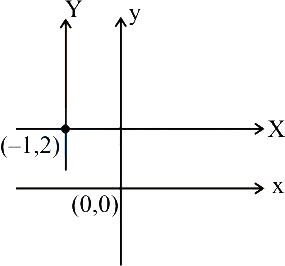
0 likes
View Solution85
MediumMCQ
The angle by which axes are to be rotated without changing the origin so that the transformed equation of $x^2+4xy-y^2=0$ in new coordinates $(X, Y)$ does not contain the $XY$ term is
A
$\frac{1}{2} \tan^{-1}(2)$
B
$\tan^{-1}(2)$
C
$\frac{\pi}{8}$
D
$\frac{\pi}{4}$
Solution
(A) The given equation is $x^2+4xy-y^2=0$.
Comparing this with the general second-degree equation $Ax^2+Bxy+Cy^2=0$,we get $A=1, B=4, C=-1$.
To eliminate the $xy$ term,the axes must be rotated by an angle $\theta$ such that $\cot(2\theta) = \frac{A-C}{B}$.
Substituting the values,we get $\cot(2\theta) = \frac{1-(-1)}{4} = \frac{2}{4} = \frac{1}{2}$.
Therefore,$\tan(2\theta) = 2$,which implies $2\theta = \tan^{-1}(2)$.
Thus,$\theta = \frac{1}{2} \tan^{-1}(2)$.
Comparing this with the general second-degree equation $Ax^2+Bxy+Cy^2=0$,we get $A=1, B=4, C=-1$.
To eliminate the $xy$ term,the axes must be rotated by an angle $\theta$ such that $\cot(2\theta) = \frac{A-C}{B}$.
Substituting the values,we get $\cot(2\theta) = \frac{1-(-1)}{4} = \frac{2}{4} = \frac{1}{2}$.
Therefore,$\tan(2\theta) = 2$,which implies $2\theta = \tan^{-1}(2)$.
Thus,$\theta = \frac{1}{2} \tan^{-1}(2)$.
0 likes
View Solution86
MediumMCQ
If the coordinate axes are rotated in the positive direction by $45^{\circ}$ without changing the origin,then the transformed equation of $3x^2 + 3y^2 + 2xy - 2 = 0$ is
A
$2x^2 + y^2 = 1$
B
$x^2 + 2y^2 = 1$
C
$x^2 - 2y^2 = 1$
D
$2x^2 - y^2 = 1$
Solution
(A) Since the coordinate axes are rotated through an angle $\theta = 45^{\circ}$,we replace $(x, y)$ by $(x \cos 45^{\circ} - y \sin 45^{\circ}, x \sin 45^{\circ} + y \cos 45^{\circ})$.
This simplifies to $\left(\frac{x-y}{\sqrt{2}}, \frac{x+y}{\sqrt{2}}\right)$.
Substituting these into the equation $3x^2 + 3y^2 + 2xy - 2 = 0$:
$3\left(\frac{x-y}{\sqrt{2}}\right)^2 + 3\left(\frac{x+y}{\sqrt{2}}\right)^2 + 2\left(\frac{x-y}{\sqrt{2}}\right)\left(\frac{x+y}{\sqrt{2}}\right) - 2 = 0$
$\Rightarrow \frac{3}{2}(x^2 + y^2 - 2xy) + \frac{3}{2}(x^2 + y^2 + 2xy) + (x^2 - y^2) - 2 = 0$
$\Rightarrow \frac{3}{2}(2x^2 + 2y^2) + x^2 - y^2 - 2 = 0$
$\Rightarrow 3x^2 + 3y^2 + x^2 - y^2 - 2 = 0$
$\Rightarrow 4x^2 + 2y^2 = 2$
$\Rightarrow 2x^2 + y^2 = 1$.
This simplifies to $\left(\frac{x-y}{\sqrt{2}}, \frac{x+y}{\sqrt{2}}\right)$.
Substituting these into the equation $3x^2 + 3y^2 + 2xy - 2 = 0$:
$3\left(\frac{x-y}{\sqrt{2}}\right)^2 + 3\left(\frac{x+y}{\sqrt{2}}\right)^2 + 2\left(\frac{x-y}{\sqrt{2}}\right)\left(\frac{x+y}{\sqrt{2}}\right) - 2 = 0$
$\Rightarrow \frac{3}{2}(x^2 + y^2 - 2xy) + \frac{3}{2}(x^2 + y^2 + 2xy) + (x^2 - y^2) - 2 = 0$
$\Rightarrow \frac{3}{2}(2x^2 + 2y^2) + x^2 - y^2 - 2 = 0$
$\Rightarrow 3x^2 + 3y^2 + x^2 - y^2 - 2 = 0$
$\Rightarrow 4x^2 + 2y^2 = 2$
$\Rightarrow 2x^2 + y^2 = 1$.
0 likes
View Solution87
DifficultMCQ
The equation of a curve $C$ is transformed to $X^2+Y^2-6X+8Y+21=0$ by the rotation of coordinate axes about the origin through an angle of $\frac{\pi}{4}$ in the positive direction. If $ax^2+by^2+cx+dy+e=0$ is the equation of the curve $C$ before the transformation,then find the value of $(a+b+c^2+d^2-5e)^2$.
A
$4$
B
$9$
C
$16$
D
$25$
Solution
(B) The transformation equations for rotation of axes by an angle $\theta = \frac{\pi}{4}$ are given by:
$x = X \cos \theta - Y \sin \theta = \frac{X-Y}{\sqrt{2}}$
$y = X \sin \theta + Y \cos \theta = \frac{X+Y}{\sqrt{2}}$
Substituting these into the transformed equation $X^2+Y^2-6X+8Y+21=0$:
$\left(\frac{X-Y}{\sqrt{2}}\right)^2 + \left(\frac{X+Y}{\sqrt{2}}\right)^2 - 6\left(\frac{X-Y}{\sqrt{2}}\right) + 8\left(\frac{X+Y}{\sqrt{2}}\right) + 21 = 0$
$\frac{X^2+Y^2-2XY}{2} + \frac{X^2+Y^2+2XY}{2} - 3\sqrt{2}(X-Y) + 4\sqrt{2}(X+Y) + 21 = 0$
$X^2 + Y^2 - 3\sqrt{2}X + 3\sqrt{2}Y + 4\sqrt{2}X + 4\sqrt{2}Y + 21 = 0$
$X^2 + Y^2 + \sqrt{2}X + 7\sqrt{2}Y + 21 = 0$
Comparing with $ax^2+by^2+cx+dy+e=0$,we get $a=1, b=1, c=\sqrt{2}, d=7\sqrt{2}, e=21$.
Now,calculate $(a+b+c^2+d^2-5e)^2$:
$(1+1+(\sqrt{2})^2+(7\sqrt{2})^2-5(21))^2$
$= (2 + 2 + 98 - 105)^2$
$= (102 - 105)^2 = (-3)^2 = 9$.
$x = X \cos \theta - Y \sin \theta = \frac{X-Y}{\sqrt{2}}$
$y = X \sin \theta + Y \cos \theta = \frac{X+Y}{\sqrt{2}}$
Substituting these into the transformed equation $X^2+Y^2-6X+8Y+21=0$:
$\left(\frac{X-Y}{\sqrt{2}}\right)^2 + \left(\frac{X+Y}{\sqrt{2}}\right)^2 - 6\left(\frac{X-Y}{\sqrt{2}}\right) + 8\left(\frac{X+Y}{\sqrt{2}}\right) + 21 = 0$
$\frac{X^2+Y^2-2XY}{2} + \frac{X^2+Y^2+2XY}{2} - 3\sqrt{2}(X-Y) + 4\sqrt{2}(X+Y) + 21 = 0$
$X^2 + Y^2 - 3\sqrt{2}X + 3\sqrt{2}Y + 4\sqrt{2}X + 4\sqrt{2}Y + 21 = 0$
$X^2 + Y^2 + \sqrt{2}X + 7\sqrt{2}Y + 21 = 0$
Comparing with $ax^2+by^2+cx+dy+e=0$,we get $a=1, b=1, c=\sqrt{2}, d=7\sqrt{2}, e=21$.
Now,calculate $(a+b+c^2+d^2-5e)^2$:
$(1+1+(\sqrt{2})^2+(7\sqrt{2})^2-5(21))^2$
$= (2 + 2 + 98 - 105)^2$
$= (102 - 105)^2 = (-3)^2 = 9$.
0 likes
View Solution88
MediumMCQ
The transformed equation of $3x^2 - 4xy = r^2$ when the coordinate axes are rotated through an angle $\tan^{-1}(2)$ is:
A
$X^2 - 4Y^2 = r^2$
B
$2XY + r^2 = 0$
C
$4Y^2 - X^2 = r^2$
D
$XY = r^2$
Solution
(C) Given $\theta = \tan^{-1}(2)$,so $\tan \theta = 2$.
Since $\tan \theta = \frac{2}{1}$,we have $\sin \theta = \frac{2}{\sqrt{5}}$ and $\cos \theta = \frac{1}{\sqrt{5}}$.
The transformation equations for rotation of axes are $x = X \cos \theta - Y \sin \theta$ and $y = X \sin \theta + Y \cos \theta$.
Substituting the values: $x = \frac{X - 2Y}{\sqrt{5}}$ and $y = \frac{2X + Y}{\sqrt{5}}$.
Substitute these into the original equation $3x^2 - 4xy = r^2$:
$3\left(\frac{X - 2Y}{\sqrt{5}}\right)^2 - 4\left(\frac{X - 2Y}{\sqrt{5}}\right)\left(\frac{2X + Y}{\sqrt{5}}\right) = r^2$.
$\frac{3}{5}(X^2 - 4XY + 4Y^2) - \frac{4}{5}(2X^2 + XY - 2Y^2) = r^2$.
$\frac{1}{5}(3X^2 - 12XY + 12Y^2 - 8X^2 - 4XY + 8Y^2) = r^2$.
$\frac{1}{5}(-5X^2 - 16XY + 20Y^2) = r^2$.
Wait,re-evaluating the original equation $3x^2 - 4xy = r^2$ with rotation $\theta = \tan^{-1}(2)$:
Using the general form $ax^2 + 2hxy + by^2 = r^2$,where $a=3, h=-2, b=0$.
The new coefficients $a', h', b'$ are given by $a' = a \cos^2 \theta + 2h \sin \theta \cos \theta + b \sin^2 \theta$ and $b' = a \sin^2 \theta - 2h \sin \theta \cos \theta + b \cos^2 \theta$.
$a' = 3(\frac{1}{5}) + 2(-2)(\frac{2}{5}) + 0 = \frac{3-8}{5} = -1$.
$b' = 3(\frac{4}{5}) - 2(-2)(\frac{2}{5}) + 0 = \frac{12+8}{5} = 4$.
$h' = (b-a) \sin \theta \cos \theta + h(\cos^2 \theta - \sin^2 \theta) = (0-3)(\frac{2}{5}) + (-2)(\frac{1-4}{5}) = -\frac{6}{5} + \frac{6}{5} = 0$.
Thus,the equation becomes $-X^2 + 4Y^2 = r^2$,or $4Y^2 - X^2 = r^2$.
Since $\tan \theta = \frac{2}{1}$,we have $\sin \theta = \frac{2}{\sqrt{5}}$ and $\cos \theta = \frac{1}{\sqrt{5}}$.
The transformation equations for rotation of axes are $x = X \cos \theta - Y \sin \theta$ and $y = X \sin \theta + Y \cos \theta$.
Substituting the values: $x = \frac{X - 2Y}{\sqrt{5}}$ and $y = \frac{2X + Y}{\sqrt{5}}$.
Substitute these into the original equation $3x^2 - 4xy = r^2$:
$3\left(\frac{X - 2Y}{\sqrt{5}}\right)^2 - 4\left(\frac{X - 2Y}{\sqrt{5}}\right)\left(\frac{2X + Y}{\sqrt{5}}\right) = r^2$.
$\frac{3}{5}(X^2 - 4XY + 4Y^2) - \frac{4}{5}(2X^2 + XY - 2Y^2) = r^2$.
$\frac{1}{5}(3X^2 - 12XY + 12Y^2 - 8X^2 - 4XY + 8Y^2) = r^2$.
$\frac{1}{5}(-5X^2 - 16XY + 20Y^2) = r^2$.
Wait,re-evaluating the original equation $3x^2 - 4xy = r^2$ with rotation $\theta = \tan^{-1}(2)$:
Using the general form $ax^2 + 2hxy + by^2 = r^2$,where $a=3, h=-2, b=0$.
The new coefficients $a', h', b'$ are given by $a' = a \cos^2 \theta + 2h \sin \theta \cos \theta + b \sin^2 \theta$ and $b' = a \sin^2 \theta - 2h \sin \theta \cos \theta + b \cos^2 \theta$.
$a' = 3(\frac{1}{5}) + 2(-2)(\frac{2}{5}) + 0 = \frac{3-8}{5} = -1$.
$b' = 3(\frac{4}{5}) - 2(-2)(\frac{2}{5}) + 0 = \frac{12+8}{5} = 4$.
$h' = (b-a) \sin \theta \cos \theta + h(\cos^2 \theta - \sin^2 \theta) = (0-3)(\frac{2}{5}) + (-2)(\frac{1-4}{5}) = -\frac{6}{5} + \frac{6}{5} = 0$.
Thus,the equation becomes $-X^2 + 4Y^2 = r^2$,or $4Y^2 - X^2 = r^2$.
0 likes
View Solution89
DifficultMCQ
By shifting the origin to the point $(2, 3)$ and then rotating the coordinate axes through an angle $\theta$ in the counter-clockwise direction,if the equation $3x^2 + 2xy + 3y^2 - 18x - 22y + 50 = 0$ is transformed to $4X^2 + 2Y^2 - 1 = 0$,then the angle $\theta =$
A
$\frac{\pi}{6}$
B
$\frac{\pi}{2}$
C
$\frac{\pi}{4}$
D
$\frac{\pi}{3}$
Solution
(C) Let the origin be shifted to $(h, k) = (2, 3)$. The transformation equations are $x = X \cos \theta - Y \sin \theta + 2$ and $y = X \sin \theta + Y \cos \theta + 3$.
Substituting these into the equation $3x^2 + 2xy + 3y^2 - 18x - 22y + 50 = 0$,the $XY$ term must vanish in the transformed equation $4X^2 + 2Y^2 - 1 = 0$.
The coefficient of $XY$ in the general quadratic $ax^2 + 2hxy + by^2 + 2gx + 2fy + c = 0$ after rotation by $\theta$ is given by $2h' = (b - a) \sin 2\theta + 2h \cos 2\theta$.
Here,$a = 3, b = 3, h = 1$.
Setting $2h' = 0$,we get $(3 - 3) \sin 2\theta + 2(1) \cos 2\theta = 0$.
This implies $2 \cos 2\theta = 0$,so $\cos 2\theta = 0$.
Thus,$2\theta = \frac{\pi}{2}$,which gives $\theta = \frac{\pi}{4}$.
Substituting these into the equation $3x^2 + 2xy + 3y^2 - 18x - 22y + 50 = 0$,the $XY$ term must vanish in the transformed equation $4X^2 + 2Y^2 - 1 = 0$.
The coefficient of $XY$ in the general quadratic $ax^2 + 2hxy + by^2 + 2gx + 2fy + c = 0$ after rotation by $\theta$ is given by $2h' = (b - a) \sin 2\theta + 2h \cos 2\theta$.
Here,$a = 3, b = 3, h = 1$.
Setting $2h' = 0$,we get $(3 - 3) \sin 2\theta + 2(1) \cos 2\theta = 0$.
This implies $2 \cos 2\theta = 0$,so $\cos 2\theta = 0$.
Thus,$2\theta = \frac{\pi}{2}$,which gives $\theta = \frac{\pi}{4}$.
0 likes
View Solution90
MediumMCQ
When the origin is shifted to the point $\left(\frac{3}{2}, \frac{3}{2}\right)$ by the translation of coordinate axes,then the transformed equation of $32 x^2+8 x y+32 y^2-108 x-108 y+99=0$ is
A
$72 X^2+56 Y^2-63=0$
B
$X^2-14 X Y-7 Y^2-2=0$
C
$32 X^2-16 X Y+32 Y^2-225=0$
D
$32 X^2+8 X Y+32 Y^2-63=0$
Solution
(D) Substituting $x=X+\frac{3}{2}$ and $y=Y+\frac{3}{2}$ into the equation $32 x^2+8 x y+32 y^2-108 x-108 y+99=0$:
$32(X+\frac{3}{2})^2 + 8(X+\frac{3}{2})(Y+\frac{3}{2}) + 32(Y+\frac{3}{2})^2 - 108(X+\frac{3}{2}) - 108(Y+\frac{3}{2}) + 99 = 0$
Expanding the terms:
$32(X^2 + 3X + \frac{9}{4}) + 8(XY + \frac{3}{2}X + \frac{3}{2}Y + \frac{9}{4}) + 32(Y^2 + 3Y + \frac{9}{4}) - 108X - 162 - 108Y - 162 + 99 = 0$
$32X^2 + 96X + 72 + 8XY + 12X + 12Y + 18 + 32Y^2 + 96Y + 72 - 108X - 108Y - 162 - 162 + 99 = 0$
Combining like terms:
$32X^2 + 32Y^2 + 8XY + (96+12-108)X + (96+12-108)Y + (72+18+72-162-162+99) = 0$
$32X^2 + 8XY + 32Y^2 - 63 = 0$
$32(X+\frac{3}{2})^2 + 8(X+\frac{3}{2})(Y+\frac{3}{2}) + 32(Y+\frac{3}{2})^2 - 108(X+\frac{3}{2}) - 108(Y+\frac{3}{2}) + 99 = 0$
Expanding the terms:
$32(X^2 + 3X + \frac{9}{4}) + 8(XY + \frac{3}{2}X + \frac{3}{2}Y + \frac{9}{4}) + 32(Y^2 + 3Y + \frac{9}{4}) - 108X - 162 - 108Y - 162 + 99 = 0$
$32X^2 + 96X + 72 + 8XY + 12X + 12Y + 18 + 32Y^2 + 96Y + 72 - 108X - 108Y - 162 - 162 + 99 = 0$
Combining like terms:
$32X^2 + 32Y^2 + 8XY + (96+12-108)X + (96+12-108)Y + (72+18+72-162-162+99) = 0$
$32X^2 + 8XY + 32Y^2 - 63 = 0$
0 likes
View Solution91
MediumMCQ
When the coordinate axes are rotated through an angle $\theta$ in anti-clockwise direction,if the transformed equation of $x^2+y^2+2xy+2x+6y+1=0$ is $(2+\sqrt{3})X^2+2XY+(2-\sqrt{3})Y^2+aX+bY+2=0$,then $3a-b=$
A
$10$
B
$2(1+2\sqrt{3})$
C
$20$
D
$2(3+\sqrt{3})$
Solution
(C) When coordinate axes are rotated through an angle $\theta$ in anti-clockwise direction,the transformation is given by:
$x = X \cos \theta - Y \sin \theta$
$y = X \sin \theta + Y \cos \theta$
Substituting these into $x^2+y^2+2xy+2x+6y+1=0$:
$(X \cos \theta - Y \sin \theta)^2 + (X \sin \theta + Y \cos \theta)^2 + 2(X \cos \theta - Y \sin \theta)(X \sin \theta + Y \cos \theta) + 2(X \cos \theta - Y \sin \theta) + 6(X \sin \theta + Y \cos \theta) + 1 = 0$
Simplifying the coefficients:
$X^2(1 + \sin 2\theta) + 2XY(\cos 2\theta) + Y^2(1 - \sin 2\theta) + X(2 \cos \theta + 6 \sin \theta) + Y(6 \cos \theta - 2 \sin \theta) + 1 = 0$
Comparing with $(2+\sqrt{3})X^2 + 2XY + (2-\sqrt{3})Y^2 + aX + bY + 2 = 0$:
Note: The constant term in the given equation is $2$,so we multiply the derived equation by $2$ to match:
$2(1 + \sin 2\theta) = 2 + \sqrt{3}$ $\Rightarrow \sin 2\theta = \frac{\sqrt{3}}{2}$ $\Rightarrow 2\theta = 60^\circ$ $\Rightarrow \theta = 30^\circ$
Then $a = 2(2 \cos 30^\circ + 6 \sin 30^\circ) = 2(2 \cdot \frac{\sqrt{3}}{2} + 6 \cdot \frac{1}{2}) = 2(\sqrt{3} + 3) = 6 + 2\sqrt{3}$
$b = 2(6 \cos 30^\circ - 2 \sin 30^\circ) = 2(6 \cdot \frac{\sqrt{3}}{2} - 2 \cdot \frac{1}{2}) = 2(3\sqrt{3} - 1) = 6\sqrt{3} - 2$
$3a - b = 3(6 + 2\sqrt{3}) - (6\sqrt{3} - 2) = 18 + 6\sqrt{3} - 6\sqrt{3} + 2 = 20$
$x = X \cos \theta - Y \sin \theta$
$y = X \sin \theta + Y \cos \theta$
Substituting these into $x^2+y^2+2xy+2x+6y+1=0$:
$(X \cos \theta - Y \sin \theta)^2 + (X \sin \theta + Y \cos \theta)^2 + 2(X \cos \theta - Y \sin \theta)(X \sin \theta + Y \cos \theta) + 2(X \cos \theta - Y \sin \theta) + 6(X \sin \theta + Y \cos \theta) + 1 = 0$
Simplifying the coefficients:
$X^2(1 + \sin 2\theta) + 2XY(\cos 2\theta) + Y^2(1 - \sin 2\theta) + X(2 \cos \theta + 6 \sin \theta) + Y(6 \cos \theta - 2 \sin \theta) + 1 = 0$
Comparing with $(2+\sqrt{3})X^2 + 2XY + (2-\sqrt{3})Y^2 + aX + bY + 2 = 0$:
Note: The constant term in the given equation is $2$,so we multiply the derived equation by $2$ to match:
$2(1 + \sin 2\theta) = 2 + \sqrt{3}$ $\Rightarrow \sin 2\theta = \frac{\sqrt{3}}{2}$ $\Rightarrow 2\theta = 60^\circ$ $\Rightarrow \theta = 30^\circ$
Then $a = 2(2 \cos 30^\circ + 6 \sin 30^\circ) = 2(2 \cdot \frac{\sqrt{3}}{2} + 6 \cdot \frac{1}{2}) = 2(\sqrt{3} + 3) = 6 + 2\sqrt{3}$
$b = 2(6 \cos 30^\circ - 2 \sin 30^\circ) = 2(6 \cdot \frac{\sqrt{3}}{2} - 2 \cdot \frac{1}{2}) = 2(3\sqrt{3} - 1) = 6\sqrt{3} - 2$
$3a - b = 3(6 + 2\sqrt{3}) - (6\sqrt{3} - 2) = 18 + 6\sqrt{3} - 6\sqrt{3} + 2 = 20$
0 likes
View Solution92
DifficultMCQ
Suppose the axes $X$ and $Y$ are obtained by rotating the axes $x$ and $y$ by an angle $\theta$. If the equation $x^2+2 \sqrt{3} x y-y^2=4 a^2$ is transformed to $X^2-Y^2=2 a^2$ with respect to the $XY$-axes,then $\theta$ is equal to (in $^{\circ}$)
A
$45$
B
$60$
C
$90$
D
$30$
Solution
(D) The transformation equations for rotation of axes by an angle $\theta$ are $x = X \cos \theta - Y \sin \theta$ and $y = X \sin \theta + Y \cos \theta$.
Substituting these into the given equation $x^2 + 2\sqrt{3}xy - y^2 = 4a^2$:
$(X \cos \theta - Y \sin \theta)^2 + 2\sqrt{3}(X \cos \theta - Y \sin \theta)(X \sin \theta + Y \cos \theta) - (X \sin \theta + Y \cos \theta)^2 = 4a^2$.
Expanding the terms,the coefficient of the $XY$ term must be zero for the equation to take the form $X^2 - Y^2 = 2a^2$.
The $XY$ term coefficient is $-2 \sin \theta \cos \theta + 2\sqrt{3}(\cos^2 \theta - \sin^2 \theta) - 2 \sin \theta \cos \theta = 0$.
This simplifies to $-4 \sin \theta \cos \theta + 2\sqrt{3} \cos 2\theta = 0$,which is $-2 \sin 2\theta + 2\sqrt{3} \cos 2\theta = 0$.
Thus,$\tan 2\theta = \sqrt{3}$,which implies $2\theta = 60^{\circ}$,so $\theta = 30^{\circ}$.
Substituting these into the given equation $x^2 + 2\sqrt{3}xy - y^2 = 4a^2$:
$(X \cos \theta - Y \sin \theta)^2 + 2\sqrt{3}(X \cos \theta - Y \sin \theta)(X \sin \theta + Y \cos \theta) - (X \sin \theta + Y \cos \theta)^2 = 4a^2$.
Expanding the terms,the coefficient of the $XY$ term must be zero for the equation to take the form $X^2 - Y^2 = 2a^2$.
The $XY$ term coefficient is $-2 \sin \theta \cos \theta + 2\sqrt{3}(\cos^2 \theta - \sin^2 \theta) - 2 \sin \theta \cos \theta = 0$.
This simplifies to $-4 \sin \theta \cos \theta + 2\sqrt{3} \cos 2\theta = 0$,which is $-2 \sin 2\theta + 2\sqrt{3} \cos 2\theta = 0$.
Thus,$\tan 2\theta = \sqrt{3}$,which implies $2\theta = 60^{\circ}$,so $\theta = 30^{\circ}$.
0 likes
View Solution93
DifficultMCQ
If $a \alpha^2+b \beta^2+c \alpha \beta+d=0$ is the transformed equation of $4 x^2+\sqrt{3} x y+5 y^2-4=0$ obtained by using $\alpha=\frac{\sqrt{3}}{2} x+\frac{y}{2}$ and $\beta=-\frac{x}{2}+\frac{\sqrt{3}}{2} y$,then $c(a+b+d)=$
A
$0$
B
$13 \sqrt{3}$
C
$5 \sqrt{3}$
D
$6$
Solution
(C) $a \alpha^2+b \beta^2+c \alpha \beta+d=0$ is the transformed equation of $4 x^2+\sqrt{3} x y+5 y^2-4=0$.
Given the transformation equations:
$\alpha=\frac{\sqrt{3}}{2} x+\frac{y}{2}$ and $\beta=-\frac{x}{2}+\frac{\sqrt{3}}{2} y$.
Solving for $x$ and $y$ in terms of $\alpha$ and $\beta$,we get:
$x=\frac{\sqrt{3}}{2} \alpha-\frac{1}{2} \beta$ and $y=\frac{1}{2} \alpha+\frac{\sqrt{3}}{2} \beta$.
Substituting these into $4 x^2+\sqrt{3} x y+5 y^2-4=0$:
$4(\frac{\sqrt{3}}{2} \alpha-\frac{1}{2} \beta)^2+\sqrt{3}(\frac{\sqrt{3}}{2} \alpha-\frac{1}{2} \beta)(\frac{1}{2} \alpha+\frac{\sqrt{3}}{2} \beta)+5(\frac{1}{2} \alpha+\frac{\sqrt{3}}{2} \beta)^2-4=0$.
Expanding and simplifying,we obtain:
$5 \alpha^2+4 \beta^2+\sqrt{3} \alpha \beta-4=0$.
Comparing this with $a \alpha^2+b \beta^2+c \alpha \beta+d=0$,we find $a=5, b=4, c=\sqrt{3}, d=-4$.
Therefore,$c(a+b+d)=\sqrt{3}(5+4-4)=5 \sqrt{3}$.
Given the transformation equations:
$\alpha=\frac{\sqrt{3}}{2} x+\frac{y}{2}$ and $\beta=-\frac{x}{2}+\frac{\sqrt{3}}{2} y$.
Solving for $x$ and $y$ in terms of $\alpha$ and $\beta$,we get:
$x=\frac{\sqrt{3}}{2} \alpha-\frac{1}{2} \beta$ and $y=\frac{1}{2} \alpha+\frac{\sqrt{3}}{2} \beta$.
Substituting these into $4 x^2+\sqrt{3} x y+5 y^2-4=0$:
$4(\frac{\sqrt{3}}{2} \alpha-\frac{1}{2} \beta)^2+\sqrt{3}(\frac{\sqrt{3}}{2} \alpha-\frac{1}{2} \beta)(\frac{1}{2} \alpha+\frac{\sqrt{3}}{2} \beta)+5(\frac{1}{2} \alpha+\frac{\sqrt{3}}{2} \beta)^2-4=0$.
Expanding and simplifying,we obtain:
$5 \alpha^2+4 \beta^2+\sqrt{3} \alpha \beta-4=0$.
Comparing this with $a \alpha^2+b \beta^2+c \alpha \beta+d=0$,we find $a=5, b=4, c=\sqrt{3}, d=-4$.
Therefore,$c(a+b+d)=\sqrt{3}(5+4-4)=5 \sqrt{3}$.
0 likes
View Solution94
MediumMCQ
$A$ line $L$ makes intercepts $a$ and $b$ on the coordinate axes. The axes are rotated through an angle $\theta$ in the positive direction,keeping the origin fixed. If the line $L$ makes intercepts $p$ and $q$ on the new coordinate axes,then $\frac{1}{a^2}+\frac{1}{b^2}=$
A
$\frac{1}{p^2 q^2}$
B
$\frac{1}{p^2}-\frac{1}{q^2}$
C
$\frac{1}{p^2}+\frac{1}{q^2}$
D
$\frac{p q}{p^2+q^2}$
Solution
(C) The equation of the line $L$ with intercepts $a$ and $b$ is given by $\frac{x}{a} + \frac{y}{b} = 1$.
The perpendicular distance $d$ from the origin $(0, 0)$ to this line is given by $d = \frac{|-1|}{\sqrt{(\frac{1}{a})^2 + (\frac{1}{b})^2}} = \frac{1}{\sqrt{\frac{1}{a^2} + \frac{1}{b^2}}}$.
Squaring both sides,we get $\frac{1}{d^2} = \frac{1}{a^2} + \frac{1}{b^2}$.
When the axes are rotated,the origin remains fixed,so the perpendicular distance $d$ from the origin to the line $L$ remains invariant.
In the new coordinate system,the line $L$ makes intercepts $p$ and $q$,so its equation is $\frac{x}{p} + \frac{y}{q} = 1$.
The perpendicular distance $d$ from the origin to this new line is $d = \frac{1}{\sqrt{\frac{1}{p^2} + \frac{1}{q^2}}}$,which implies $\frac{1}{d^2} = \frac{1}{p^2} + \frac{1}{q^2}$.
Since $d$ is the same in both cases,we have $\frac{1}{a^2} + \frac{1}{b^2} = \frac{1}{p^2} + \frac{1}{q^2}$.
The perpendicular distance $d$ from the origin $(0, 0)$ to this line is given by $d = \frac{|-1|}{\sqrt{(\frac{1}{a})^2 + (\frac{1}{b})^2}} = \frac{1}{\sqrt{\frac{1}{a^2} + \frac{1}{b^2}}}$.
Squaring both sides,we get $\frac{1}{d^2} = \frac{1}{a^2} + \frac{1}{b^2}$.
When the axes are rotated,the origin remains fixed,so the perpendicular distance $d$ from the origin to the line $L$ remains invariant.
In the new coordinate system,the line $L$ makes intercepts $p$ and $q$,so its equation is $\frac{x}{p} + \frac{y}{q} = 1$.
The perpendicular distance $d$ from the origin to this new line is $d = \frac{1}{\sqrt{\frac{1}{p^2} + \frac{1}{q^2}}}$,which implies $\frac{1}{d^2} = \frac{1}{p^2} + \frac{1}{q^2}$.
Since $d$ is the same in both cases,we have $\frac{1}{a^2} + \frac{1}{b^2} = \frac{1}{p^2} + \frac{1}{q^2}$.
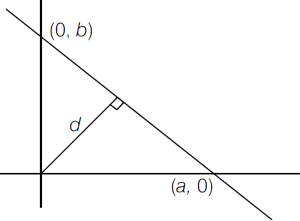
0 likes
View Solution95
DifficultMCQ
Suppose the new axes $X, Y$ are generated by rotating the coordinate axes $x, y$ about the origin through an angle of $30^{\circ}$ in the anti-clockwise direction. Then,the transformed equation of $x^2+2 \sqrt{3} xy - y^2 = 2a^2$ with respect to the new axes $X, Y$ is
A
$X^2 - Y^2 = a^2$
B
$X^2 + Y^2 = 2a^2$
C
$X^2 + 2\sqrt{3}XY - Y^2 = 2a^2$
D
$X^2 - Y^2 = 2a^2$
Solution
(A) The given equation is $x^2 + 2\sqrt{3}xy - y^2 = 2a^2$.
Since the axes are rotated through an angle $\theta = 30^{\circ}$,the transformation equations are:
$x = X \cos 30^{\circ} - Y \sin 30^{\circ} = \frac{\sqrt{3}X - Y}{2}$
$y = X \sin 30^{\circ} + Y \cos 30^{\circ} = \frac{X + \sqrt{3}Y}{2}$
Substituting these into the given equation:
$\left(\frac{\sqrt{3}X - Y}{2}\right)^2 + 2\sqrt{3}\left(\frac{\sqrt{3}X - Y}{2}\right)\left(\frac{X + \sqrt{3}Y}{2}\right) - \left(\frac{X + \sqrt{3}Y}{2}\right)^2 = 2a^2$
Multiplying by $4$:
$(\sqrt{3}X - Y)^2 + 2\sqrt{3}(\sqrt{3}X^2 + 3XY - XY - \sqrt{3}Y^2) - (X + \sqrt{3}Y)^2 = 8a^2$
$(3X^2 - 2\sqrt{3}XY + Y^2) + 2\sqrt{3}(\sqrt{3}X^2 + 2XY - \sqrt{3}Y^2) - (X^2 + 2\sqrt{3}XY + 3Y^2) = 8a^2$
$3X^2 - 2\sqrt{3}XY + Y^2 + 6X^2 + 4\sqrt{3}XY - 6Y^2 - X^2 - 2\sqrt{3}XY - 3Y^2 = 8a^2$
Combining like terms:
$(3 + 6 - 1)X^2 + (-2\sqrt{3} + 4\sqrt{3} - 2\sqrt{3})XY + (1 - 6 - 3)Y^2 = 8a^2$
$8X^2 - 8Y^2 = 8a^2$
$X^2 - Y^2 = a^2$
Since the axes are rotated through an angle $\theta = 30^{\circ}$,the transformation equations are:
$x = X \cos 30^{\circ} - Y \sin 30^{\circ} = \frac{\sqrt{3}X - Y}{2}$
$y = X \sin 30^{\circ} + Y \cos 30^{\circ} = \frac{X + \sqrt{3}Y}{2}$
Substituting these into the given equation:
$\left(\frac{\sqrt{3}X - Y}{2}\right)^2 + 2\sqrt{3}\left(\frac{\sqrt{3}X - Y}{2}\right)\left(\frac{X + \sqrt{3}Y}{2}\right) - \left(\frac{X + \sqrt{3}Y}{2}\right)^2 = 2a^2$
Multiplying by $4$:
$(\sqrt{3}X - Y)^2 + 2\sqrt{3}(\sqrt{3}X^2 + 3XY - XY - \sqrt{3}Y^2) - (X + \sqrt{3}Y)^2 = 8a^2$
$(3X^2 - 2\sqrt{3}XY + Y^2) + 2\sqrt{3}(\sqrt{3}X^2 + 2XY - \sqrt{3}Y^2) - (X^2 + 2\sqrt{3}XY + 3Y^2) = 8a^2$
$3X^2 - 2\sqrt{3}XY + Y^2 + 6X^2 + 4\sqrt{3}XY - 6Y^2 - X^2 - 2\sqrt{3}XY - 3Y^2 = 8a^2$
Combining like terms:
$(3 + 6 - 1)X^2 + (-2\sqrt{3} + 4\sqrt{3} - 2\sqrt{3})XY + (1 - 6 - 3)Y^2 = 8a^2$
$8X^2 - 8Y^2 = 8a^2$
$X^2 - Y^2 = a^2$
0 likes
View Solution96
MediumMCQ
If the origin is shifted to a point $(h, k)$ by translation of axes in order to make the equation $x^2+5xy+2y^2+5x+6y+7=0$ free from first-order terms,then:
A
$h=-\frac{10}{17}, k=\frac{13}{17}$
B
$h=-\frac{10}{17}, k=-\frac{13}{17}$
C
$h=\frac{10}{17}, k=\frac{13}{17}$
D
$h=\frac{10}{17}, k=-\frac{13}{17}$
Solution
(B) Let the origin be shifted to $(h, k)$. The transformation equations are $x = x' + h$ and $y = y' + k$. Substituting these into the given equation $x^2 + 5xy + 2y^2 + 5x + 6y + 7 = 0$ gives:
$(x' + h)^2 + 5(x' + h)(y' + k) + 2(y' + k)^2 + 5(x' + h) + 6(y' + k) + 7 = 0$.
Expanding this,the terms of the first degree in $x'$ and $y'$ are:
$(2h + 5k + 5)x' + (5h + 4k + 6)y'$.
For the equation to be free from first-order terms,these coefficients must be zero:
$2h + 5k + 5 = 0$ $(i)$
$5h + 4k + 6 = 0$ (ii)
Multiplying $(i)$ by $4$ and (ii) by $5$:
$8h + 20k + 20 = 0$
$25h + 20k + 30 = 0$
Subtracting the first from the second: $17h + 10 = 0 \implies h = -\frac{10}{17}$.
Substituting $h$ into $(i)$: $2(-\frac{10}{17}) + 5k + 5 = 0 \implies -\frac{20}{17} + 5k + 5 = 0 \implies 5k = \frac{20}{17} - 5 = \frac{20-85}{17} = -\frac{65}{17} \implies k = -\frac{13}{17}$.
Thus,$h = -\frac{10}{17}$ and $k = -\frac{13}{17}$.
$(x' + h)^2 + 5(x' + h)(y' + k) + 2(y' + k)^2 + 5(x' + h) + 6(y' + k) + 7 = 0$.
Expanding this,the terms of the first degree in $x'$ and $y'$ are:
$(2h + 5k + 5)x' + (5h + 4k + 6)y'$.
For the equation to be free from first-order terms,these coefficients must be zero:
$2h + 5k + 5 = 0$ $(i)$
$5h + 4k + 6 = 0$ (ii)
Multiplying $(i)$ by $4$ and (ii) by $5$:
$8h + 20k + 20 = 0$
$25h + 20k + 30 = 0$
Subtracting the first from the second: $17h + 10 = 0 \implies h = -\frac{10}{17}$.
Substituting $h$ into $(i)$: $2(-\frac{10}{17}) + 5k + 5 = 0 \implies -\frac{20}{17} + 5k + 5 = 0 \implies 5k = \frac{20}{17} - 5 = \frac{20-85}{17} = -\frac{65}{17} \implies k = -\frac{13}{17}$.
Thus,$h = -\frac{10}{17}$ and $k = -\frac{13}{17}$.
0 likes
View SolutionRectangular Cartesian Co-ordinates — Transformation of axes · Frequently Asked Questions
1Are these Rectangular Cartesian Co-ordinates questions useful for JEE and NEET?
Yes. All questions in this section are mapped to JEE Main and NEET exam patterns. Previous year questions from JEE Main, NEET, GUJCET and state-level exams are included with full solutions.
2Can I switch to Hindi or Gujarati for these questions?
Yes. Use the language tabs in the hero section or the sidebar to view the same questions and solutions in English, Hindi or Gujarati.
3How do I generate a question paper from this subtopic?
Use the Vedclass Exam Paper Generator — select the chapter and subtopic, set difficulty, and generate Sets A, B, C, D automatically. First 3 chapters of every subject are free.
Vedclass Products
For Students
Vedclass Test Series
Mock tests in real JEE/NEET style with performance analysis. 5-day free trial.
Start Free TrialFor Teachers
Exam Paper Generator
Generate Set A/B/C/D papers from this chapter in 2 minutes. 3 chapters free.
Try FreeFor Institutes
Online Exam Module
Live online exams with unlimited students, 360° analytics & white-label branding.
See DemoFor Teachers & Institutes
Generate a Rectangular Cartesian Co-ordinates Exam Paper in 2 Minutes
Select subtopic & difficulty — Sets A, B, C, D auto-generated with No Repeat logic.
First 3 chapters of every subject are free — no payment required.