
A English
Set Based probability Questions in English
Class 11 Mathematics · Probability · Set Based probability
510+
Questions
English
Language
100%
With Solutions
Showing 49 of 510 questions in English
151
MediumMCQ
In a random experiment of selecting a ticket from $50$ tickets numbered $00, 01, 02, 03, ..., 47, 49$,if a ticket is selected such that the product of its digits is $0$,what is the probability that the sum of its digits is $8$?
A
$1/50$
B
$1/14$
C
$1/34$
D
None of these
Solution
(B) The sample space $S$ consists of tickets where the product of digits is $0$. $A$ product of digits is $0$ if at least one digit is $0$. The numbers are $00, 01, 02, 03, 04, 05, 06, 07, 08, 09, 10, 20, 30, 40$.
Total number of such tickets $n(S) = 14$.
Let $A$ be the event that the sum of the digits is $8$.
Checking the numbers: $00 (0), 01 (1), 02 (2), 03 (3), 04 (4), 05 (5), 06 (6), 07 (7), 08 (8), 09 (9), 10 (1), 20 (2), 30 (3), 40 (4)$.
The only number with a sum of digits equal to $8$ is $08$.
So,$n(A) = 1$.
The probability $P(A) = \frac{n(A)}{n(S)} = \frac{1}{14}$.
Total number of such tickets $n(S) = 14$.
Let $A$ be the event that the sum of the digits is $8$.
Checking the numbers: $00 (0), 01 (1), 02 (2), 03 (3), 04 (4), 05 (5), 06 (6), 07 (7), 08 (8), 09 (9), 10 (1), 20 (2), 30 (3), 40 (4)$.
The only number with a sum of digits equal to $8$ is $08$.
So,$n(A) = 1$.
The probability $P(A) = \frac{n(A)}{n(S)} = \frac{1}{14}$.
0 likes
View Solution152
EasyMCQ
When a die is thrown,let event $A$ be getting a number greater than $3$,and let event $B$ be getting a number less than $5$. What is $P(A \cup B)$?
A
$3/5$
B
$0$
C
$1$
D
$2/5$
Solution
(C) The sample space $S = \{1, 2, 3, 4, 5, 6\}$,so $n(S) = 6$.
Event $A$ is getting a number greater than $3$,so $A = \{4, 5, 6\}$ and $n(A) = 3$.
Event $B$ is getting a number less than $5$,so $B = \{1, 2, 3, 4\}$ and $n(B) = 4$.
The intersection $A \cap B$ is the set of numbers that are both greater than $3$ and less than $5$,so $A \cap B = \{4\}$ and $n(A \cap B) = 1$.
The union $A \cup B$ is the set of numbers that are either in $A$ or in $B$,so $A \cup B = \{1, 2, 3, 4, 5, 6\}$ and $n(A \cup B) = 6$.
Therefore,$P(A \cup B) = \frac{n(A \cup B)}{n(S)} = \frac{6}{6} = 1$.
Event $A$ is getting a number greater than $3$,so $A = \{4, 5, 6\}$ and $n(A) = 3$.
Event $B$ is getting a number less than $5$,so $B = \{1, 2, 3, 4\}$ and $n(B) = 4$.
The intersection $A \cap B$ is the set of numbers that are both greater than $3$ and less than $5$,so $A \cap B = \{4\}$ and $n(A \cap B) = 1$.
The union $A \cup B$ is the set of numbers that are either in $A$ or in $B$,so $A \cup B = \{1, 2, 3, 4, 5, 6\}$ and $n(A \cup B) = 6$.
Therefore,$P(A \cup B) = \frac{n(A \cup B)}{n(S)} = \frac{6}{6} = 1$.
0 likes
View Solution153
EasyMCQ
If there are $4$ red,$3$ pink,$5$ yellow,and $8$ white roses in a garden,what is the probability that a blind person touches a red or a white rose?
A
$1/5$
B
$2/5$
C
$3/5$
D
None of these
Solution
(C) Total number of roses = $4 + 3 + 5 + 8 = 20$.
Number of red roses = $4$.
Number of white roses = $8$.
Number of favorable outcomes (red or white) = $4 + 8 = 12$.
Probability = $\frac{\text{Favorable outcomes}}{\text{Total outcomes}} = \frac{12}{20} = \frac{3}{5}$.
Number of red roses = $4$.
Number of white roses = $8$.
Number of favorable outcomes (red or white) = $4 + 8 = 12$.
Probability = $\frac{\text{Favorable outcomes}}{\text{Total outcomes}} = \frac{12}{20} = \frac{3}{5}$.
0 likes
View Solution154
EasyMCQ
When three fair dice are tossed simultaneously,find the probability that the integers on all three dice are the same.
A
$1/6$
B
$1/18$
C
$1/36$
D
None of these
Solution
(C) The total number of outcomes when three fair dice are tossed is $6 \times 6 \times 6 = 216$. So,$n = 216$.
Let $A$ be the event that the integers on all three dice are the same.
The favorable outcomes are $A = \{(1,1,1), (2,2,2), (3,3,3), (4,4,4), (5,5,5), (6,6,6)\}$.
Thus,the number of favorable outcomes is $r = 6$.
The probability $P(A)$ is given by $P(A) = \frac{r}{n} = \frac{6}{216} = \frac{1}{36}$.
Let $A$ be the event that the integers on all three dice are the same.
The favorable outcomes are $A = \{(1,1,1), (2,2,2), (3,3,3), (4,4,4), (5,5,5), (6,6,6)\}$.
Thus,the number of favorable outcomes is $r = 6$.
The probability $P(A)$ is given by $P(A) = \frac{r}{n} = \frac{6}{216} = \frac{1}{36}$.
0 likes
View Solution155
EasyMCQ
If a die is thrown twice,what is the probability of getting $4$ at least once?
A
$11/36$
B
$7/12$
C
$35/36$
D
None of these
Solution
(A) When a die is thrown twice,the total number of possible outcomes is $6 \times 6 = 36$.
Let $E$ be the event of getting $4$ at least once.
It is easier to find the probability of the complement event $E'$,which is the event of not getting $4$ in either throw.
For a single throw,the outcomes that are not $4$ are $\{1, 2, 3, 5, 6\}$,which are $5$ outcomes.
For two throws,the number of outcomes where $4$ does not appear is $5 \times 5 = 25$.
Therefore,the probability of not getting $4$ at all is $P(E') = \frac{25}{36}$.
The probability of getting $4$ at least once is $P(E) = 1 - P(E') = 1 - \frac{25}{36} = \frac{11}{36}$.
Let $E$ be the event of getting $4$ at least once.
It is easier to find the probability of the complement event $E'$,which is the event of not getting $4$ in either throw.
For a single throw,the outcomes that are not $4$ are $\{1, 2, 3, 5, 6\}$,which are $5$ outcomes.
For two throws,the number of outcomes where $4$ does not appear is $5 \times 5 = 25$.
Therefore,the probability of not getting $4$ at all is $P(E') = \frac{25}{36}$.
The probability of getting $4$ at least once is $P(E) = 1 - P(E') = 1 - \frac{25}{36} = \frac{11}{36}$.
0 likes
View Solution156
MediumMCQ
$A$ bag contains $3$ red and $3$ white balls. If two balls are drawn one after another,what is the probability that they are of different colors?
A
$3/10$
B
$2/5$
C
$3/5$
D
None of these
Solution
(C) Let $R_1$ be the event that the first ball is red and $W_1$ be the event that the first ball is white.
Let $R_2$ be the event that the second ball is red and $W_2$ be the event that the second ball is white.
We want to find the probability that the balls are of different colors,which means the outcomes are $(R_1, W_2)$ or $(W_1, R_2)$.
The total number of balls is $6$.
$P(R_1, W_2) = P(R_1) \times P(W_2 | R_1) = \frac{3}{6} \times \frac{3}{5} = \frac{9}{30} = \frac{3}{10}$.
$P(W_1, R_2) = P(W_1) \times P(R_2 | W_1) = \frac{3}{6} \times \frac{3}{5} = \frac{9}{30} = \frac{3}{10}$.
The total probability is $P(R_1, W_2) + P(W_1, R_2) = \frac{3}{10} + \frac{3}{10} = \frac{6}{10} = \frac{3}{5}$.
Let $R_2$ be the event that the second ball is red and $W_2$ be the event that the second ball is white.
We want to find the probability that the balls are of different colors,which means the outcomes are $(R_1, W_2)$ or $(W_1, R_2)$.
The total number of balls is $6$.
$P(R_1, W_2) = P(R_1) \times P(W_2 | R_1) = \frac{3}{6} \times \frac{3}{5} = \frac{9}{30} = \frac{3}{10}$.
$P(W_1, R_2) = P(W_1) \times P(R_2 | W_1) = \frac{3}{6} \times \frac{3}{5} = \frac{9}{30} = \frac{3}{10}$.
The total probability is $P(R_1, W_2) + P(W_1, R_2) = \frac{3}{10} + \frac{3}{10} = \frac{6}{10} = \frac{3}{5}$.
0 likes
View Solution157
MediumMCQ
Statement-$I$: If a leap year is selected at random,the probability of it having $53$ Sundays is $2/7$.
Statement-$II$: $A$ leap year has $366$ days.
Statement-$II$: $A$ leap year has $366$ days.
A
Statement-$I$ is true. Statement-$II$ is true. Statement-$II$ is the correct explanation for Statement-$I$.
B
Statement-$I$ is true. Statement-$II$ is true. Statement-$II$ is not the correct explanation for Statement-$I$.
C
Statement-$I$ is true,Statement-$II$ is false.
D
Statement-$I$ is false,Statement-$II$ is true.
Solution
(A) leap year consists of $366$ days.
$366$ days = $52$ weeks and $2$ extra days.
These $2$ extra days can be: (Sunday,Monday),(Monday,Tuesday),(Tuesday,Wednesday),(Wednesday,Thursday),(Thursday,Friday),(Friday,Saturday),or (Saturday,Sunday).
There are $7$ possible outcomes for these $2$ days.
For the year to have $53$ Sundays,one of the $2$ extra days must be a Sunday.
This occurs in $2$ cases: (Saturday,Sunday) and (Sunday,Monday).
Therefore,the probability is $2/7$.
Since Statement-$II$ provides the basis for calculating the extra days in a leap year,it is the correct explanation for Statement-$I$.
$366$ days = $52$ weeks and $2$ extra days.
These $2$ extra days can be: (Sunday,Monday),(Monday,Tuesday),(Tuesday,Wednesday),(Wednesday,Thursday),(Thursday,Friday),(Friday,Saturday),or (Saturday,Sunday).
There are $7$ possible outcomes for these $2$ days.
For the year to have $53$ Sundays,one of the $2$ extra days must be a Sunday.
This occurs in $2$ cases: (Saturday,Sunday) and (Sunday,Monday).
Therefore,the probability is $2/7$.
Since Statement-$II$ provides the basis for calculating the extra days in a leap year,it is the correct explanation for Statement-$I$.
0 likes
View Solution158
EasyMCQ
$A$ fair die is rolled once. Let $A$ be the event of getting an integer greater than $3$ and $B$ be the event of getting an integer less than $5$. Find $P(A \cup B)$.
A
$2/5$
B
$3/5$
C
$0$
D
$1$
Solution
(D) The sample space for rolling a fair die is $S = \{1, 2, 3, 4, 5, 6\}$.
Event $A$ is getting an integer greater than $3$,so $A = \{4, 5, 6\}$.
Event $B$ is getting an integer less than $5$,so $B = \{1, 2, 3, 4\}$.
The union of events $A$ and $B$ is $A \cup B = \{1, 2, 3, 4, 5, 6\}$.
Since $A \cup B$ is the entire sample space $S$,the probability $P(A \cup B) = P(S) = 1$.
Event $A$ is getting an integer greater than $3$,so $A = \{4, 5, 6\}$.
Event $B$ is getting an integer less than $5$,so $B = \{1, 2, 3, 4\}$.
The union of events $A$ and $B$ is $A \cup B = \{1, 2, 3, 4, 5, 6\}$.
Since $A \cup B$ is the entire sample space $S$,the probability $P(A \cup B) = P(S) = 1$.
0 likes
View Solution159
MediumMCQ
When two dice are thrown simultaneously,find the probability of the following:
$(1)$ The numbers are the same.
$(2)$ The difference between the numbers is $1$.
$(1)$ The numbers are the same.
$(2)$ The difference between the numbers is $1$.
A
$1/6, 5/18$
B
$1/6, 1/6$
C
$5/18, 5/18$
D
$1/6, 5/8$
Solution
(A) When two dice are thrown,the sample space is $S = \{(1, 1), (1, 2), ..., (6, 6)\}$.
The total number of outcomes is $n(S) = 6 \times 6 = 36$.
$(1)$ Let $E_1$ be the event that the numbers on both dice are the same.
$E_1 = \{(1, 1), (2, 2), (3, 3), (4, 4), (5, 5), (6, 6)\}$.
$n(E_1) = 6$.
$P(E_1) = \frac{n(E_1)}{n(S)} = \frac{6}{36} = \frac{1}{6}$.
$(2)$ Let $E_2$ be the event that the difference between the numbers is $1$.
$E_2 = \{(1, 2), (2, 1), (2, 3), (3, 2), (3, 4), (4, 3), (4, 5), (5, 4), (5, 6), (6, 5)\}$.
$n(E_2) = 10$.
$P(E_2) = \frac{n(E_2)}{n(S)} = \frac{10}{36} = \frac{5}{18}$.
The total number of outcomes is $n(S) = 6 \times 6 = 36$.
$(1)$ Let $E_1$ be the event that the numbers on both dice are the same.
$E_1 = \{(1, 1), (2, 2), (3, 3), (4, 4), (5, 5), (6, 6)\}$.
$n(E_1) = 6$.
$P(E_1) = \frac{n(E_1)}{n(S)} = \frac{6}{36} = \frac{1}{6}$.
$(2)$ Let $E_2$ be the event that the difference between the numbers is $1$.
$E_2 = \{(1, 2), (2, 1), (2, 3), (3, 2), (3, 4), (4, 3), (4, 5), (5, 4), (5, 6), (6, 5)\}$.
$n(E_2) = 10$.
$P(E_2) = \frac{n(E_2)}{n(S)} = \frac{10}{36} = \frac{5}{18}$.
0 likes
View Solution160
DifficultMCQ
Three students $A, B,$ and $C$ are given a mathematics problem. The probabilities of them solving the problem are $1/2, 1/3,$ and $1/4$ respectively. What is the probability that the problem is solved?
A
$3/4$
B
$1/2$
C
$2/3$
D
$1/3$
Solution
(A) Let $P(A), P(B),$ and $P(C)$ be the probabilities of students $A, B,$ and $C$ solving the problem respectively.
$P(A) = 1/2, P(B) = 1/3, P(C) = 1/4$.
The probability that the problem is not solved by any of them is the probability that all three fail to solve it.
$P(\text{not } A) = 1 - 1/2 = 1/2$
$P(\text{not } B) = 1 - 1/3 = 2/3$
$P(\text{not } C) = 1 - 1/4 = 3/4$
Since the events are independent,the probability that none of them solve the problem is:
$P(\text{none solve}) = P(\text{not } A) \times P(\text{not } B) \times P(\text{not } C) = \frac{1}{2} \times \frac{2}{3} \times \frac{3}{4} = \frac{1}{4}$.
The probability that the problem is solved is $1 - P(\text{none solve})$.
$P(\text{solved}) = 1 - \frac{1}{4} = \frac{3}{4}$.
$P(A) = 1/2, P(B) = 1/3, P(C) = 1/4$.
The probability that the problem is not solved by any of them is the probability that all three fail to solve it.
$P(\text{not } A) = 1 - 1/2 = 1/2$
$P(\text{not } B) = 1 - 1/3 = 2/3$
$P(\text{not } C) = 1 - 1/4 = 3/4$
Since the events are independent,the probability that none of them solve the problem is:
$P(\text{none solve}) = P(\text{not } A) \times P(\text{not } B) \times P(\text{not } C) = \frac{1}{2} \times \frac{2}{3} \times \frac{3}{4} = \frac{1}{4}$.
The probability that the problem is solved is $1 - P(\text{none solve})$.
$P(\text{solved}) = 1 - \frac{1}{4} = \frac{3}{4}$.
0 likes
View Solution161
MediumMCQ
The probabilities of two events $A$ and $B$ are $0.25$ and $0.50$ respectively. The probability of both $A$ and $B$ occurring simultaneously is $0.14$. What is the probability that neither $A$ nor $B$ occurs?
A
$0.39$
B
$0.25$
C
$0.904$
D
None of these.
Solution
(A) Given: $P(A) = 0.25$,$P(B) = 0.50$,and $P(A \cap B) = 0.14$.
We need to find the probability that neither $A$ nor $B$ occurs,which is $P(A^c \cap B^c)$.
By De Morgan's Law,$P(A^c \cap B^c) = P((A \cup B)^c) = 1 - P(A \cup B)$.
Using the Addition Theorem,$P(A \cup B) = P(A) + P(B) - P(A \cap B)$.
$P(A \cup B) = 0.25 + 0.50 - 0.14 = 0.61$.
Therefore,$P(A^c \cap B^c) = 1 - 0.61 = 0.39$.
We need to find the probability that neither $A$ nor $B$ occurs,which is $P(A^c \cap B^c)$.
By De Morgan's Law,$P(A^c \cap B^c) = P((A \cup B)^c) = 1 - P(A \cup B)$.
Using the Addition Theorem,$P(A \cup B) = P(A) + P(B) - P(A \cap B)$.
$P(A \cup B) = 0.25 + 0.50 - 0.14 = 0.61$.
Therefore,$P(A^c \cap B^c) = 1 - 0.61 = 0.39$.
0 likes
View Solution162
MediumMCQ
The probability that Krishna will be alive in $10$ years is $7/15$ and the probability that Hari will be alive in $10$ years is $7/10$. What is the probability that both will die within the next $10$ years (in $/150$)?
A
$21$
B
$24$
C
$49$
D
$56$
Solution
(B) Let $A$ and $B$ be the events that Krishna and Hari are alive in $10$ years,respectively.
Given $P(A) = \frac{7}{15}$ and $P(B) = \frac{7}{10}$.
The probability that Krishna dies is $P(A^c) = 1 - P(A) = 1 - \frac{7}{15} = \frac{8}{15}$.
The probability that Hari dies is $P(B^c) = 1 - P(B) = 1 - \frac{7}{10} = \frac{3}{10}$.
Since the events are independent,the probability that both die is $P(A^c \cap B^c) = P(A^c) \times P(B^c)$.
$P(A^c \cap B^c) = \frac{8}{15} \times \frac{3}{10} = \frac{24}{150}$.
Given $P(A) = \frac{7}{15}$ and $P(B) = \frac{7}{10}$.
The probability that Krishna dies is $P(A^c) = 1 - P(A) = 1 - \frac{7}{15} = \frac{8}{15}$.
The probability that Hari dies is $P(B^c) = 1 - P(B) = 1 - \frac{7}{10} = \frac{3}{10}$.
Since the events are independent,the probability that both die is $P(A^c \cap B^c) = P(A^c) \times P(B^c)$.
$P(A^c \cap B^c) = \frac{8}{15} \times \frac{3}{10} = \frac{24}{150}$.
0 likes
View Solution163
DifficultMCQ
Let $X$ be a set containing $n$ elements. If two subsets $A$ and $B$ of $X$ are chosen at random,what is the probability that $A$ and $B$ have the same number of elements?
A
$\frac{{}^{2n}C_n}{2^{2n}}$
B
$\frac{1}{{}^{2n}C_n}$
C
$\frac{1 \cdot 3 \cdot 5 \cdots (2n - 1)}{2^n}$
D
$\frac{3^n}{4^n}$
Solution
(A) The total number of subsets of a set $X$ with $n$ elements is $2^n$.
Since $A$ and $B$ are chosen from these subsets,the total number of ways to choose the pair $(A, B)$ is $2^n \times 2^n = 2^{2n}$.
The number of subsets of $X$ having $r$ elements is given by ${}^nC_r$.
For $A$ and $B$ to have the same number of elements,say $r$,we must choose $A$ with $r$ elements and $B$ with $r$ elements.
The number of ways to choose $A$ and $B$ such that $|A| = |B| = r$ is ${}^nC_r \times {}^nC_r = ({}^nC_r)^2$.
Summing over all possible values of $r$ from $0$ to $n$,the total number of favorable outcomes is $\sum_{r=0}^{n} ({}^nC_r)^2$.
Using the identity $\sum_{r=0}^{n} ({}^nC_r)^2 = {}^{2n}C_n$,the total favorable outcomes is ${}^{2n}C_n$.
Thus,the probability is $\frac{{}^{2n}C_n}{2^{2n}}$.
Since $A$ and $B$ are chosen from these subsets,the total number of ways to choose the pair $(A, B)$ is $2^n \times 2^n = 2^{2n}$.
The number of subsets of $X$ having $r$ elements is given by ${}^nC_r$.
For $A$ and $B$ to have the same number of elements,say $r$,we must choose $A$ with $r$ elements and $B$ with $r$ elements.
The number of ways to choose $A$ and $B$ such that $|A| = |B| = r$ is ${}^nC_r \times {}^nC_r = ({}^nC_r)^2$.
Summing over all possible values of $r$ from $0$ to $n$,the total number of favorable outcomes is $\sum_{r=0}^{n} ({}^nC_r)^2$.
Using the identity $\sum_{r=0}^{n} ({}^nC_r)^2 = {}^{2n}C_n$,the total favorable outcomes is ${}^{2n}C_n$.
Thus,the probability is $\frac{{}^{2n}C_n}{2^{2n}}$.
0 likes
View Solution164
MediumMCQ
There are $3$ families,each having $1$ boy and $1$ girl. If one child is selected from each family,what are the elements of the event that only girls are selected?
A
$\{ggb, gbg, gbb\}$
B
$\{bgb, gbb\}$
C
$\{bbb, bgb\}$
D
$\{ggg\}$
Solution
(D) Let $b$ represent a boy and $g$ represent a girl.
Since there are $3$ families,the sample space $S$ is the Cartesian product of the choices from each family:
$S = \{b, g\} \times \{b, g\} \times \{b, g\}$
$S = \{bbb, bbg, bgb, bgg, gbb, gbg, ggb, ggg\}$
The event of selecting only girls means choosing $g$ from all $3$ families.
Therefore,the event is $\{ggg\}$.
Since there are $3$ families,the sample space $S$ is the Cartesian product of the choices from each family:
$S = \{b, g\} \times \{b, g\} \times \{b, g\}$
$S = \{bbb, bbg, bgb, bgg, gbb, gbg, ggb, ggg\}$
The event of selecting only girls means choosing $g$ from all $3$ families.
Therefore,the event is $\{ggg\}$.
0 likes
View Solution165
MediumMCQ
There are $5$ horses in a race. Mr. $A$ selects $2$ horses at random and bets on them. What is the probability that the winning horse is among the horses selected by Mr. $A$ (in $/5$)?
A
$4$
B
$3$
C
$1$
D
$2$
Solution
(D) Total number of horses = $5$.
Number of horses selected by Mr. $A$ = $2$.
Number of horses not selected by Mr. $A$ = $5 - 2 = 3$.
There is only $1$ winning horse.
The probability that the winning horse is $NOT$ among the $2$ horses selected by Mr. $A$ is the probability that the winning horse is among the $3$ horses not selected.
$P(\text{Winning horse not selected}) = \frac{3}{5}$.
The probability that the winning horse $IS$ among the $2$ horses selected by Mr. $A$ is:
$P(\text{Winning horse selected}) = 1 - P(\text{Winning horse not selected}) = 1 - \frac{3}{5} = \frac{2}{5}$.
Number of horses selected by Mr. $A$ = $2$.
Number of horses not selected by Mr. $A$ = $5 - 2 = 3$.
There is only $1$ winning horse.
The probability that the winning horse is $NOT$ among the $2$ horses selected by Mr. $A$ is the probability that the winning horse is among the $3$ horses not selected.
$P(\text{Winning horse not selected}) = \frac{3}{5}$.
The probability that the winning horse $IS$ among the $2$ horses selected by Mr. $A$ is:
$P(\text{Winning horse selected}) = 1 - P(\text{Winning horse not selected}) = 1 - \frac{3}{5} = \frac{2}{5}$.
0 likes
View Solution166
MediumMCQ
Two fair dice are thrown simultaneously. The probability of getting the same number on both dice is $......$.
A
$\frac{1}{36}$
B
$\frac{1}{18}$
C
$\frac{1}{6}$
D
$\frac{3}{28}$
Solution
(C) When two fair dice are thrown simultaneously,the total number of possible outcomes is $n(S) = 6 \times 6 = 36$.
Let $A$ be the event of getting the same number on both dice.
The favorable outcomes are $A = \{(1, 1), (2, 2), (3, 3), (4, 4), (5, 5), (6, 6)\}$.
The number of favorable outcomes is $n(A) = 6$.
The probability of event $A$ is $P(A) = \frac{n(A)}{n(S)} = \frac{6}{36} = \frac{1}{6}$.
Let $A$ be the event of getting the same number on both dice.
The favorable outcomes are $A = \{(1, 1), (2, 2), (3, 3), (4, 4), (5, 5), (6, 6)\}$.
The number of favorable outcomes is $n(A) = 6$.
The probability of event $A$ is $P(A) = \frac{n(A)}{n(S)} = \frac{6}{36} = \frac{1}{6}$.
0 likes
View Solution167
MediumMCQ
What is the probability of getting a doublet when two dice are thrown?
A
$\frac{2}{3}$
B
$\frac{1}{6}$
C
$\frac{5}{6}$
D
$\frac{5}{36}$
Solution
(B) When two dice are thrown,the total number of possible outcomes is $6 \times 6 = 36$.
$A$ doublet occurs when both dice show the same number. The favorable outcomes are $(1, 1), (2, 2), (3, 3), (4, 4), (5, 5), (6, 6)$.
The number of favorable outcomes is $6$.
The probability of getting a doublet is $\frac{\text{Number of favorable outcomes}}{\text{Total number of outcomes}} = \frac{6}{36} = \frac{1}{6}$.
$A$ doublet occurs when both dice show the same number. The favorable outcomes are $(1, 1), (2, 2), (3, 3), (4, 4), (5, 5), (6, 6)$.
The number of favorable outcomes is $6$.
The probability of getting a doublet is $\frac{\text{Number of favorable outcomes}}{\text{Total number of outcomes}} = \frac{6}{36} = \frac{1}{6}$.
0 likes
View Solution168
EasyMCQ
The probability of choosing a vowel from the letters of the word $PROBABILITY$ is ........
A
$\frac{2}{11}$
B
$\frac{3}{11}$
C
$\frac{4}{11}$
D
$0$
Solution
(C) The word $PROBABILITY$ contains $11$ letters in total.
The vowels in the word are $O, A, I, I$.
There are $4$ vowels in total.
The probability of choosing a vowel is given by the ratio of the number of favorable outcomes to the total number of outcomes.
Probability $= \frac{4}{11}$.
The vowels in the word are $O, A, I, I$.
There are $4$ vowels in total.
The probability of choosing a vowel is given by the ratio of the number of favorable outcomes to the total number of outcomes.
Probability $= \frac{4}{11}$.
0 likes
View Solution169
MediumMCQ
$A$ person can hit a bird once in three attempts. If the person makes three attempts, what is the probability that the bird is hit (in $/27$)?
A
$8$
B
$19$
C
$7$
D
$11$
Solution
(B) The probability of hitting the bird in one attempt is $P(H) = 1/3$.
The probability of missing the bird in one attempt is $P(M) = 1 - 1/3 = 2/3$.
The probability of hitting the bird at least once in three attempts is $1 - P(\text{missing all three times})$.
The probability of missing all three times is $P(M)^3 = (2/3)^3 = 8/27$.
Therefore, the probability of hitting the bird is $1 - 8/27 = 19/27$.
The probability of missing the bird in one attempt is $P(M) = 1 - 1/3 = 2/3$.
The probability of hitting the bird at least once in three attempts is $1 - P(\text{missing all three times})$.
The probability of missing all three times is $P(M)^3 = (2/3)^3 = 8/27$.
Therefore, the probability of hitting the bird is $1 - 8/27 = 19/27$.
0 likes
View Solution170
MediumMCQ
An event $A$ is independent of itself if $P(A) = \dots$
A
$0$
B
$1$
C
$0, 1$
D
None of these
Solution
(C) An event $A$ is independent of itself if $P(A \cap A) = P(A)P(A)$.
Since $A \cap A = A$,we have $P(A) = P(A)^2$.
This implies $P(A)^2 - P(A) = 0$.
$P(A)(P(A) - 1) = 0$.
Therefore,$P(A) = 0$ or $P(A) = 1$.
Since $A \cap A = A$,we have $P(A) = P(A)^2$.
This implies $P(A)^2 - P(A) = 0$.
$P(A)(P(A) - 1) = 0$.
Therefore,$P(A) = 0$ or $P(A) = 1$.
0 likes
View Solution171
MediumMCQ
Let $A = \{1, 3, 5, 7, 9\}$ and $B = \{2, 4, 6, 8\}$. If an ordered pair $(a, b)$ is chosen at random from the Cartesian product $A \times B$,what is the probability that $a + b = 9$?
A
$\frac{3}{2}$
B
$\frac{3}{4}$
C
$1$
D
$\frac{1}{5}$
Solution
(D) The total number of elements in the Cartesian product $A \times B$ is $n(A \times B) = n(A) \times n(B) = 5 \times 4 = 20$.
The ordered pairs $(a, b)$ such that $a + b = 9$ are $\{(1, 8), (3, 6), (5, 4), (7, 2)\}$.
The number of favorable outcomes is $r = 4$.
The probability of the event is $P = \frac{r}{n} = \frac{4}{20} = \frac{1}{5}$.
The ordered pairs $(a, b)$ such that $a + b = 9$ are $\{(1, 8), (3, 6), (5, 4), (7, 2)\}$.
The number of favorable outcomes is $r = 4$.
The probability of the event is $P = \frac{r}{n} = \frac{4}{20} = \frac{1}{5}$.
0 likes
View Solution172
MediumMCQ
Two cards are drawn from a pack of $52$ cards. What is the probability that both cards are red or both cards are kings?
A
$50/189$
B
$70/237$
C
$55/221$
D
$52/217$
Solution
(C) The total number of ways to draw $2$ cards from $52$ cards is $^{52}C_2$.
Let $A$ be the event that both cards are red.
Let $B$ be the event that both cards are kings.
We need to find $P(A \cup B) = P(A) + P(B) - P(A \cap B)$.
There are $26$ red cards,so the number of ways to choose $2$ red cards is $^{26}C_2$.
$P(A) = \frac{^{26}C_2}{^{52}C_2} = \frac{325}{1326}$.
There are $4$ kings,so the number of ways to choose $2$ kings is $^4C_2$.
$P(B) = \frac{^4C_2}{^{52}C_2} = \frac{6}{1326} = \frac{1}{221}$.
$A \cap B$ is the event that both cards are red kings. There are $2$ red kings (King of Hearts and King of Diamonds),so the number of ways to choose $2$ red kings is $^2C_2 = 1$.
$P(A \cap B) = \frac{^2C_2}{^{52}C_2} = \frac{1}{1326}$.
Using the formula: $P(A \cup B) = \frac{325}{1326} + \frac{6}{1326} - \frac{1}{1326} = \frac{330}{1326}$.
Simplifying the fraction: $\frac{330}{1326} = \frac{55}{221}$.
Let $A$ be the event that both cards are red.
Let $B$ be the event that both cards are kings.
We need to find $P(A \cup B) = P(A) + P(B) - P(A \cap B)$.
There are $26$ red cards,so the number of ways to choose $2$ red cards is $^{26}C_2$.
$P(A) = \frac{^{26}C_2}{^{52}C_2} = \frac{325}{1326}$.
There are $4$ kings,so the number of ways to choose $2$ kings is $^4C_2$.
$P(B) = \frac{^4C_2}{^{52}C_2} = \frac{6}{1326} = \frac{1}{221}$.
$A \cap B$ is the event that both cards are red kings. There are $2$ red kings (King of Hearts and King of Diamonds),so the number of ways to choose $2$ red kings is $^2C_2 = 1$.
$P(A \cap B) = \frac{^2C_2}{^{52}C_2} = \frac{1}{1326}$.
Using the formula: $P(A \cup B) = \frac{325}{1326} + \frac{6}{1326} - \frac{1}{1326} = \frac{330}{1326}$.
Simplifying the fraction: $\frac{330}{1326} = \frac{55}{221}$.
0 likes
View Solution173
EasyMCQ
When two dice are thrown simultaneously,what is the probability that at least one of the dice shows a number greater than $3$?
A
$1/4$
B
$3/4$
C
$1/2$
D
$1/8$
Solution
(B) The total number of possible outcomes when two dice are thrown is $6^2 = 36$.
Let $E$ be the event that at least one die shows a number greater than $3$.
It is easier to find the probability of the complement event $E'$,where neither die shows a number greater than $3$.
This means both dice must show a number from the set $\{1, 2, 3\}$.
The number of outcomes for $E'$ is $3 \times 3 = 9$.
The outcomes are: $(1, 1), (1, 2), (1, 3), (2, 1), (2, 2), (2, 3), (3, 1), (3, 2), (3, 3)$.
Therefore,$P(E') = \frac{9}{36} = \frac{1}{4}$.
The probability of the required event is $P(E) = 1 - P(E') = 1 - \frac{1}{4} = \frac{3}{4}$.
Let $E$ be the event that at least one die shows a number greater than $3$.
It is easier to find the probability of the complement event $E'$,where neither die shows a number greater than $3$.
This means both dice must show a number from the set $\{1, 2, 3\}$.
The number of outcomes for $E'$ is $3 \times 3 = 9$.
The outcomes are: $(1, 1), (1, 2), (1, 3), (2, 1), (2, 2), (2, 3), (3, 1), (3, 2), (3, 3)$.
Therefore,$P(E') = \frac{9}{36} = \frac{1}{4}$.
The probability of the required event is $P(E) = 1 - P(E') = 1 - \frac{1}{4} = \frac{3}{4}$.
0 likes
View Solution174
MediumMCQ
When two dice are rolled,what is the probability that the sum of the numbers on the faces is a multiple of $4$?
A
$1/9$
B
$1/3$
C
$1/4$
D
$5/9$
Solution
(C) The total number of possible outcomes when two dice are rolled is $6^2 = 36$.
The sums that are multiples of $4$ are $4, 8,$ and $12$.
The pairs $(x, y)$ that result in these sums are:
For sum $= 4$: $(1, 3), (2, 2), (3, 1)$
For sum $= 8$: $(2, 6), (3, 5), (4, 4), (5, 3), (6, 2)$
For sum $= 12$: $(6, 6)$
Counting these,we have $3 + 5 + 1 = 9$ favorable outcomes.
The required probability is $P = \frac{9}{36} = \frac{1}{4}$.
The sums that are multiples of $4$ are $4, 8,$ and $12$.
The pairs $(x, y)$ that result in these sums are:
For sum $= 4$: $(1, 3), (2, 2), (3, 1)$
For sum $= 8$: $(2, 6), (3, 5), (4, 4), (5, 3), (6, 2)$
For sum $= 12$: $(6, 6)$
Counting these,we have $3 + 5 + 1 = 9$ favorable outcomes.
The required probability is $P = \frac{9}{36} = \frac{1}{4}$.
0 likes
View Solution175
MediumMCQ
The probability of at least one of the events $A$ and $B$ occurring is $0.6$. If the probability of both $A$ and $B$ occurring simultaneously is $0.3$,then $P(A') + P(B') = \dots$
A
$0.9$
B
$1.15$
C
$1.1$
D
$1.2$
Solution
(C) Given that the probability of at least one event occurring is $P(A \cup B) = 0.6$.
By De Morgan's Law,$P(A \cup B) = 1 - P(A' \cap B') = 0.6$,so $P(A' \cap B') = 0.4$.
We know that $P(A \cap B) = 0.3$.
Using the formula $P(A' \cup B') = P(A') + P(B') - P(A' \cap B')$,
where $P(A' \cup B') = 1 - P(A \cap B) = 1 - 0.3 = 0.7$.
Substituting the values: $0.7 = P(A') + P(B') - 0.4$.
Therefore,$P(A') + P(B') = 0.7 + 0.4 = 1.1$.
By De Morgan's Law,$P(A \cup B) = 1 - P(A' \cap B') = 0.6$,so $P(A' \cap B') = 0.4$.
We know that $P(A \cap B) = 0.3$.
Using the formula $P(A' \cup B') = P(A') + P(B') - P(A' \cap B')$,
where $P(A' \cup B') = 1 - P(A \cap B) = 1 - 0.3 = 0.7$.
Substituting the values: $0.7 = P(A') + P(B') - 0.4$.
Therefore,$P(A') + P(B') = 0.7 + 0.4 = 1.1$.
0 likes
View Solution176
EasyMCQ
When three coins are tossed simultaneously,what is the probability of getting a head on the first,a tail on the second,and a head on the third?
A
$3/5$
B
$2/3$
C
$5/3$
D
$1/8$
Solution
(D) Let the outcomes of the three coins be independent events $A, B,$ and $C$.
The probability of getting a head on the first coin is $P(A) = 1/2$.
The probability of getting a tail on the second coin is $P(B) = 1/2$.
The probability of getting a head on the third coin is $P(C) = 1/2$.
Since the events are independent,the joint probability is $P(A \cap B \cap C) = P(A) \times P(B) \times P(C)$.
$P(A \cap B \cap C) = \frac{1}{2} \times \frac{1}{2} \times \frac{1}{2} = \frac{1}{8}$.
The probability of getting a head on the first coin is $P(A) = 1/2$.
The probability of getting a tail on the second coin is $P(B) = 1/2$.
The probability of getting a head on the third coin is $P(C) = 1/2$.
Since the events are independent,the joint probability is $P(A \cap B \cap C) = P(A) \times P(B) \times P(C)$.
$P(A \cap B \cap C) = \frac{1}{2} \times \frac{1}{2} \times \frac{1}{2} = \frac{1}{8}$.
0 likes
View Solution177
DifficultMCQ
The probabilities of $A$ and $B$ dying in a year are $p$ and $q$ respectively. What is the probability that only one of them will be alive at the end of the year?
A
$p + q$
B
$p + q - 2pq$
C
$p + q - pq$
D
$p + q + pq$
Solution
(B) Let $P(A) = p$ be the probability that $A$ dies,so $P(A') = 1 - p$ is the probability that $A$ lives.
Let $P(B) = q$ be the probability that $B$ dies,so $P(B') = 1 - q$ is the probability that $B$ lives.
The event that only one of them is alive at the end of the year means either ($A$ dies and $B$ lives) or ($B$ dies and $A$ lives).
Since the events are independent,the required probability is $P(A \cap B') + P(B \cap A') = P(A) \cdot P(B') + P(B) \cdot P(A')$.
Substituting the values: $p(1 - q) + q(1 - p) = p - pq + q - pq = p + q - 2pq$.
Let $P(B) = q$ be the probability that $B$ dies,so $P(B') = 1 - q$ is the probability that $B$ lives.
The event that only one of them is alive at the end of the year means either ($A$ dies and $B$ lives) or ($B$ dies and $A$ lives).
Since the events are independent,the required probability is $P(A \cap B') + P(B \cap A') = P(A) \cdot P(B') + P(B) \cdot P(A')$.
Substituting the values: $p(1 - q) + q(1 - p) = p - pq + q - pq = p + q - 2pq$.
0 likes
View Solution178
MediumMCQ
Let $A$ and $B$ be two events such that $P(\overline{A \cup B}) = \frac{1}{6}$,$P(A \cap B) = \frac{1}{4}$ and $P(\bar{A}) = \frac{1}{4}$,where $\bar{A}$ stands for the complement of the event $A$. Then the events $A$ and $B$ are
A
independent but not equally likely.
B
independent but equally likely.
C
mutually exclusive and independent.
D
equally likely but not independent.
Solution
(A) $P(\overline{A \cup B}) = \frac{1}{6} \implies P(A \cup B) = 1 - \frac{1}{6} = \frac{5}{6}$.
Given $P(A \cap B) = \frac{1}{4}$ and $P(\bar{A}) = \frac{1}{4}$,we have $P(A) = 1 - \frac{1}{4} = \frac{3}{4}$.
Using the addition theorem,$P(A \cup B) = P(A) + P(B) - P(A \cap B)$.
Substituting the values: $\frac{5}{6} = \frac{3}{4} + P(B) - \frac{1}{4}$.
$\frac{5}{6} = \frac{1}{2} + P(B) \implies P(B) = \frac{5}{6} - \frac{1}{2} = \frac{5-3}{6} = \frac{2}{6} = \frac{1}{3}$.
Now,check for independence: $P(A) \cdot P(B) = \frac{3}{4} \times \frac{1}{3} = \frac{1}{4} = P(A \cap B)$.
Since $P(A \cap B) = P(A) \cdot P(B)$,the events are independent.
Since $P(A) = \frac{3}{4}$ and $P(B) = \frac{1}{3}$,$P(A) \neq P(B)$,so they are not equally likely.
Given $P(A \cap B) = \frac{1}{4}$ and $P(\bar{A}) = \frac{1}{4}$,we have $P(A) = 1 - \frac{1}{4} = \frac{3}{4}$.
Using the addition theorem,$P(A \cup B) = P(A) + P(B) - P(A \cap B)$.
Substituting the values: $\frac{5}{6} = \frac{3}{4} + P(B) - \frac{1}{4}$.
$\frac{5}{6} = \frac{1}{2} + P(B) \implies P(B) = \frac{5}{6} - \frac{1}{2} = \frac{5-3}{6} = \frac{2}{6} = \frac{1}{3}$.
Now,check for independence: $P(A) \cdot P(B) = \frac{3}{4} \times \frac{1}{3} = \frac{1}{4} = P(A \cap B)$.
Since $P(A \cap B) = P(A) \cdot P(B)$,the events are independent.
Since $P(A) = \frac{3}{4}$ and $P(B) = \frac{1}{3}$,$P(A) \neq P(B)$,so they are not equally likely.
0 likes
View Solution179
DifficultMCQ
Let two fair six-faced dice $A$ and $B$ be thrown simultaneously. If $E_1$ is the event that die $A$ shows up $4$,$E_2$ is the event that die $B$ shows up $2$,and $E_3$ is the event that the sum of numbers on both dice is odd,then which of the following statements is $NOT$ true?
A
$E_1$ and $E_3$ are independent.
B
$E_1, E_2$ and $E_3$ are independent.
C
$E_1$ and $E_2$ are independent.
D
$E_2$ and $E_3$ are independent.
Solution
(B) The sample space $S$ has $6 \times 6 = 36$ outcomes.
$E_1 = \{(4, 1), (4, 2), (4, 3), (4, 4), (4, 5), (4, 6)\}$,so $P(E_1) = \frac{6}{36} = \frac{1}{6}$.
$E_2 = \{(1, 2), (2, 2), (3, 2), (4, 2), (5, 2), (6, 2)\}$,so $P(E_2) = \frac{6}{36} = \frac{1}{6}$.
$E_3$ is the event that the sum is odd,which occurs if one die is even and the other is odd. $P(E_3) = \frac{18}{36} = \frac{1}{2}$.
$E_1 \cap E_2 = \{(4, 2)\}$,so $P(E_1 \cap E_2) = \frac{1}{36} = P(E_1)P(E_2)$. Thus,$E_1$ and $E_2$ are independent.
$E_1 \cap E_3 = \{(4, 1), (4, 3), (4, 5)\}$,so $P(E_1 \cap E_3) = \frac{3}{36} = \frac{1}{12} = P(E_1)P(E_3)$. Thus,$E_1$ and $E_3$ are independent.
$E_2 \cap E_3 = \{(1, 2), (3, 2), (5, 2)\}$,so $P(E_2 \cap E_3) = \frac{3}{36} = \frac{1}{12} = P(E_2)P(E_3)$. Thus,$E_2$ and $E_3$ are independent.
For $E_1, E_2, E_3$ to be independent,we must have $P(E_1 \cap E_2 \cap E_3) = P(E_1)P(E_2)P(E_3)$.
$E_1 \cap E_2 \cap E_3 = \{(4, 2)\} \cap E_3 = \emptyset$ because the sum $4+2=6$ is even. So $P(E_1 \cap E_2 \cap E_3) = 0$.
Since $0 \neq \frac{1}{6} \times \frac{1}{6} \times \frac{1}{2} = \frac{1}{72}$,the events are not mutually independent.
$E_1 = \{(4, 1), (4, 2), (4, 3), (4, 4), (4, 5), (4, 6)\}$,so $P(E_1) = \frac{6}{36} = \frac{1}{6}$.
$E_2 = \{(1, 2), (2, 2), (3, 2), (4, 2), (5, 2), (6, 2)\}$,so $P(E_2) = \frac{6}{36} = \frac{1}{6}$.
$E_3$ is the event that the sum is odd,which occurs if one die is even and the other is odd. $P(E_3) = \frac{18}{36} = \frac{1}{2}$.
$E_1 \cap E_2 = \{(4, 2)\}$,so $P(E_1 \cap E_2) = \frac{1}{36} = P(E_1)P(E_2)$. Thus,$E_1$ and $E_2$ are independent.
$E_1 \cap E_3 = \{(4, 1), (4, 3), (4, 5)\}$,so $P(E_1 \cap E_3) = \frac{3}{36} = \frac{1}{12} = P(E_1)P(E_3)$. Thus,$E_1$ and $E_3$ are independent.
$E_2 \cap E_3 = \{(1, 2), (3, 2), (5, 2)\}$,so $P(E_2 \cap E_3) = \frac{3}{36} = \frac{1}{12} = P(E_2)P(E_3)$. Thus,$E_2$ and $E_3$ are independent.
For $E_1, E_2, E_3$ to be independent,we must have $P(E_1 \cap E_2 \cap E_3) = P(E_1)P(E_2)P(E_3)$.
$E_1 \cap E_2 \cap E_3 = \{(4, 2)\} \cap E_3 = \emptyset$ because the sum $4+2=6$ is even. So $P(E_1 \cap E_2 \cap E_3) = 0$.
Since $0 \neq \frac{1}{6} \times \frac{1}{6} \times \frac{1}{2} = \frac{1}{72}$,the events are not mutually independent.
0 likes
View Solution180
DifficultMCQ
If two different numbers are taken from the set $\{0, 1, 2, 3, \dots, 10\}$,then the probability that their sum as well as their absolute difference are both multiples of $4$ is:
A
$\frac{7}{55}$
B
$\frac{6}{55}$
C
$\frac{12}{55}$
D
$\frac{14}{55}$
Solution
(B) Let the set be $S = \{0, 1, 2, 3, 4, 5, 6, 7, 8, 9, 10\}$.
Total number of ways to choose two distinct numbers is $n(S) = \binom{11}{2} = \frac{11 \times 10}{2} = 55$.
Let the two numbers be $x$ and $y$ where $x > y$.
We require $(x+y)$ to be a multiple of $4$ and $(x-y)$ to be a multiple of $4$.
If $(x+y)$ and $(x-y)$ are both multiples of $4$,then their sum $(x+y) + (x-y) = 2x$ must be a multiple of $4$,implying $x$ is an even number.
Similarly,their difference $(x+y) - (x-y) = 2y$ must be a multiple of $4$,implying $y$ is an even number.
Thus,both $x$ and $y$ must be even numbers from the set $\{0, 2, 4, 6, 8, 10\}$.
Let the chosen numbers be $x, y \in \{0, 2, 4, 6, 8, 10\}$.
For $(x+y)$ and $(x-y)$ to be multiples of $4$,$x+y \equiv 0 \pmod{4}$ and $x-y \equiv 0 \pmod{4}$.
This implies $x \equiv y \pmod{4}$.
Possible pairs $(x, y)$ with $x > y$ such that $x \equiv y \pmod{4}$:
If $x, y \equiv 0 \pmod{4}$: $(4, 0), (8, 0), (8, 4)$.
If $x, y \equiv 2 \pmod{4}$: $(6, 2), (10, 2), (10, 6)$.
Total favorable outcomes $n(E) = 3 + 3 = 6$.
Therefore,the probability $P(E) = \frac{n(E)}{n(S)} = \frac{6}{55}$.
Total number of ways to choose two distinct numbers is $n(S) = \binom{11}{2} = \frac{11 \times 10}{2} = 55$.
Let the two numbers be $x$ and $y$ where $x > y$.
We require $(x+y)$ to be a multiple of $4$ and $(x-y)$ to be a multiple of $4$.
If $(x+y)$ and $(x-y)$ are both multiples of $4$,then their sum $(x+y) + (x-y) = 2x$ must be a multiple of $4$,implying $x$ is an even number.
Similarly,their difference $(x+y) - (x-y) = 2y$ must be a multiple of $4$,implying $y$ is an even number.
Thus,both $x$ and $y$ must be even numbers from the set $\{0, 2, 4, 6, 8, 10\}$.
Let the chosen numbers be $x, y \in \{0, 2, 4, 6, 8, 10\}$.
For $(x+y)$ and $(x-y)$ to be multiples of $4$,$x+y \equiv 0 \pmod{4}$ and $x-y \equiv 0 \pmod{4}$.
This implies $x \equiv y \pmod{4}$.
Possible pairs $(x, y)$ with $x > y$ such that $x \equiv y \pmod{4}$:
If $x, y \equiv 0 \pmod{4}$: $(4, 0), (8, 0), (8, 4)$.
If $x, y \equiv 2 \pmod{4}$: $(6, 2), (10, 2), (10, 6)$.
Total favorable outcomes $n(E) = 3 + 3 = 6$.
Therefore,the probability $P(E) = \frac{n(E)}{n(S)} = \frac{6}{55}$.
0 likes
View Solution181
DifficultMCQ
If $\frac{1 - 3p}{2}, \frac{1 + 4p}{3}$ and $\frac{1 + p}{6}$ are the probabilities of three mutually exclusive and exhaustive events,then the set of all values of $p$ is
A
$[0, 1]$
B
$[ - \frac{1}{4}, \frac{1}{3} ]$
C
$[ 0, \frac{1}{3} ]$
D
$(0, \infty )$
Solution
(B) Since the events are mutually exclusive and exhaustive,the sum of their probabilities must be $1$.
$\frac{1 - 3p}{2} + \frac{1 + 4p}{3} + \frac{1 + p}{6} = 1$
Multiplying by $6$,we get $3(1 - 3p) + 2(1 + 4p) + (1 + p) = 6$.
$3 - 9p + 2 + 8p + 1 + p = 6$
$6 = 6$,which is always true for any $p$. However,each probability must lie in the interval $[0, 1]$.
$1) \ 0 \le \frac{1 - 3p}{2} \le 1 \Rightarrow 0 \le 1 - 3p \le 2 \Rightarrow -1 \le -3p \le 1 \Rightarrow -\frac{1}{3} \le p \le \frac{1}{3}$.
$2) \ 0 \le \frac{1 + 4p}{3} \le 1 \Rightarrow 0 \le 1 + 4p \le 3 \Rightarrow -1 \le 4p \le 2 \Rightarrow -\frac{1}{4} \le p \le \frac{1}{2}$.
$3) \ 0 \le \frac{1 + p}{6} \le 1 \Rightarrow 0 \le 1 + p \le 6 \Rightarrow -1 \le p \le 5$.
Taking the intersection of all these intervals: $[-\frac{1}{3}, \frac{1}{3}] \cap [-\frac{1}{4}, \frac{1}{2}] \cap [-1, 5] = [-\frac{1}{4}, \frac{1}{3}]$.
$\frac{1 - 3p}{2} + \frac{1 + 4p}{3} + \frac{1 + p}{6} = 1$
Multiplying by $6$,we get $3(1 - 3p) + 2(1 + 4p) + (1 + p) = 6$.
$3 - 9p + 2 + 8p + 1 + p = 6$
$6 = 6$,which is always true for any $p$. However,each probability must lie in the interval $[0, 1]$.
$1) \ 0 \le \frac{1 - 3p}{2} \le 1 \Rightarrow 0 \le 1 - 3p \le 2 \Rightarrow -1 \le -3p \le 1 \Rightarrow -\frac{1}{3} \le p \le \frac{1}{3}$.
$2) \ 0 \le \frac{1 + 4p}{3} \le 1 \Rightarrow 0 \le 1 + 4p \le 3 \Rightarrow -1 \le 4p \le 2 \Rightarrow -\frac{1}{4} \le p \le \frac{1}{2}$.
$3) \ 0 \le \frac{1 + p}{6} \le 1 \Rightarrow 0 \le 1 + p \le 6 \Rightarrow -1 \le p \le 5$.
Taking the intersection of all these intervals: $[-\frac{1}{3}, \frac{1}{3}] \cap [-\frac{1}{4}, \frac{1}{2}] \cap [-1, 5] = [-\frac{1}{4}, \frac{1}{3}]$.
0 likes
View Solution182
DifficultMCQ
$A$ man alternately tosses a coin and throws a dice,beginning with the coin. The probability that he gets a head in the coin before he gets a $5$ or $6$ in the dice is
A
$\frac{3}{4}$
B
$\frac{1}{2}$
C
$\frac{1}{3}$
D
None of these
Solution
(A) Let $H$ be the event of getting a head in a coin toss,$P(H) = \frac{1}{2}$. The probability of not getting a head is $P(H') = 1 - \frac{1}{2} = \frac{1}{2}$.
Let $D$ be the event of getting a $5$ or $6$ in a dice throw,$P(D) = \frac{2}{6} = \frac{1}{3}$. The probability of not getting a $5$ or $6$ is $P(D') = 1 - \frac{1}{3} = \frac{2}{3}$.
The man starts with the coin and they alternate. He wins if he gets a head before getting a $5$ or $6$.
This can happen in the following ways:
$1$. He gets a head on the first toss: $P_1 = \frac{1}{2}$.
$2$. He fails on the first toss,fails on the first dice throw,and gets a head on the second toss: $P_2 = (\frac{1}{2} \times \frac{2}{3}) \times \frac{1}{2}$.
$3$. He fails on the first two tosses and first two dice throws,and gets a head on the third toss: $P_3 = (\frac{1}{2} \times \frac{2}{3})^2 \times \frac{1}{2}$.
The total probability is the sum of this infinite geometric series:
$P = \frac{1}{2} + (\frac{1}{2} \cdot \frac{2}{3}) \cdot \frac{1}{2} + (\frac{1}{2} \cdot \frac{2}{3})^2 \cdot \frac{1}{2} + \dots$
$P = \frac{1}{2} [1 + \frac{1}{3} + (\frac{1}{3})^2 + \dots]$
Using the sum formula for an infinite geometric series $S = \frac{a}{1-r}$ where $a=1$ and $r=\frac{1}{3}$:
$P = \frac{1}{2} \times \frac{1}{1 - 1/3} = \frac{1}{2} \times \frac{1}{2/3} = \frac{1}{2} \times \frac{3}{2} = \frac{3}{4}$.
Let $D$ be the event of getting a $5$ or $6$ in a dice throw,$P(D) = \frac{2}{6} = \frac{1}{3}$. The probability of not getting a $5$ or $6$ is $P(D') = 1 - \frac{1}{3} = \frac{2}{3}$.
The man starts with the coin and they alternate. He wins if he gets a head before getting a $5$ or $6$.
This can happen in the following ways:
$1$. He gets a head on the first toss: $P_1 = \frac{1}{2}$.
$2$. He fails on the first toss,fails on the first dice throw,and gets a head on the second toss: $P_2 = (\frac{1}{2} \times \frac{2}{3}) \times \frac{1}{2}$.
$3$. He fails on the first two tosses and first two dice throws,and gets a head on the third toss: $P_3 = (\frac{1}{2} \times \frac{2}{3})^2 \times \frac{1}{2}$.
The total probability is the sum of this infinite geometric series:
$P = \frac{1}{2} + (\frac{1}{2} \cdot \frac{2}{3}) \cdot \frac{1}{2} + (\frac{1}{2} \cdot \frac{2}{3})^2 \cdot \frac{1}{2} + \dots$
$P = \frac{1}{2} [1 + \frac{1}{3} + (\frac{1}{3})^2 + \dots]$
Using the sum formula for an infinite geometric series $S = \frac{a}{1-r}$ where $a=1$ and $r=\frac{1}{3}$:
$P = \frac{1}{2} \times \frac{1}{1 - 1/3} = \frac{1}{2} \times \frac{1}{2/3} = \frac{1}{2} \times \frac{3}{2} = \frac{3}{4}$.
0 likes
View Solution183
DifficultMCQ
Two dice are rolled one after the other. The probability that the number on the first die is smaller than the number on the second die is
A
$1/2$
B
$7/18$
C
$3/4$
D
$5/12$
Solution
(D) When two dice are rolled,the total number of possible outcomes is $6 \times 6 = 36$.
Let $X$ be the number on the first die and $Y$ be the number on the second die.
We want to find the probability $P(X < Y)$.
The possible pairs $(X, Y)$ such that $X < Y$ are:
If $X=1$,$Y \in \{2, 3, 4, 5, 6\}$ ($5$ outcomes).
If $X=2$,$Y \in \{3, 4, 5, 6\}$ ($4$ outcomes).
If $X=3$,$Y \in \{4, 5, 6\}$ ($3$ outcomes).
If $X=4$,$Y \in \{5, 6\}$ ($2$ outcomes).
If $X=5$,$Y \in \{6\}$ ($1$ outcome).
If $X=6$,there are no possible values for $Y$ such that $X < Y$.
Total favorable outcomes $= 5 + 4 + 3 + 2 + 1 = 15$.
The required probability is $\frac{15}{36} = \frac{5}{12}$.
Let $X$ be the number on the first die and $Y$ be the number on the second die.
We want to find the probability $P(X < Y)$.
The possible pairs $(X, Y)$ such that $X < Y$ are:
If $X=1$,$Y \in \{2, 3, 4, 5, 6\}$ ($5$ outcomes).
If $X=2$,$Y \in \{3, 4, 5, 6\}$ ($4$ outcomes).
If $X=3$,$Y \in \{4, 5, 6\}$ ($3$ outcomes).
If $X=4$,$Y \in \{5, 6\}$ ($2$ outcomes).
If $X=5$,$Y \in \{6\}$ ($1$ outcome).
If $X=6$,there are no possible values for $Y$ such that $X < Y$.
Total favorable outcomes $= 5 + 4 + 3 + 2 + 1 = 15$.
The required probability is $\frac{15}{36} = \frac{5}{12}$.
0 likes
View Solution184
DifficultMCQ
$A$ student appears for tests $I, II$ and $III$. The student is successful if he passes either in tests $I$ and $II$ or tests $I$ and $III$. The probabilities of the student passing in tests $I, II, III$ are $p, q$ and $\frac{1}{2}$ respectively. If the probability that the student is successful is $\frac{1}{2}$,then
A
$p = 1, q = 0$
B
$p = \frac{2}{3}, q = \frac{1}{2}$
C
There are infinitely many values of $p$ and $q$
D
All of the above
Solution
(D) Let $A, B$ and $C$ be the events that the student passes tests $I, II$ and $III$ respectively. The student is successful if he passes in $(I \text{ and } II)$ or $(I \text{ and } III)$.
This is represented by the event $(A \cap B) \cup (A \cap C)$.
Using the inclusion-exclusion principle,$P((A \cap B) \cup (A \cap C)) = P(A \cap B) + P(A \cap C) - P(A \cap B \cap C)$.
Since the events are independent,$P(A \cap B) = P(A)P(B) = pq$,$P(A \cap C) = P(A)P(C) = p(\frac{1}{2})$,and $P(A \cap B \cap C) = P(A)P(B)P(C) = pq(\frac{1}{2})$.
Thus,the probability of success is $pq + \frac{p}{2} - \frac{pq}{2} = \frac{pq}{2} + \frac{p}{2} = \frac{p}{2}(q + 1)$.
Given the probability of success is $\frac{1}{2}$,we have $\frac{p}{2}(q + 1) = \frac{1}{2}$,which simplifies to $p(q + 1) = 1$.
If $p=1$,then $1+q=1 \Rightarrow q=0$. If $p=\frac{2}{3}$,then $\frac{2}{3}(q+1)=1 \Rightarrow q+1=\frac{3}{2} \Rightarrow q=\frac{1}{2}$.
Since there are multiple pairs $(p, q)$ satisfying $p(q+1)=1$,there are infinitely many values for $p$ and $q$. Thus,all options $A, B$ and $C$ are correct.
This is represented by the event $(A \cap B) \cup (A \cap C)$.
Using the inclusion-exclusion principle,$P((A \cap B) \cup (A \cap C)) = P(A \cap B) + P(A \cap C) - P(A \cap B \cap C)$.
Since the events are independent,$P(A \cap B) = P(A)P(B) = pq$,$P(A \cap C) = P(A)P(C) = p(\frac{1}{2})$,and $P(A \cap B \cap C) = P(A)P(B)P(C) = pq(\frac{1}{2})$.
Thus,the probability of success is $pq + \frac{p}{2} - \frac{pq}{2} = \frac{pq}{2} + \frac{p}{2} = \frac{p}{2}(q + 1)$.
Given the probability of success is $\frac{1}{2}$,we have $\frac{p}{2}(q + 1) = \frac{1}{2}$,which simplifies to $p(q + 1) = 1$.
If $p=1$,then $1+q=1 \Rightarrow q=0$. If $p=\frac{2}{3}$,then $\frac{2}{3}(q+1)=1 \Rightarrow q+1=\frac{3}{2} \Rightarrow q=\frac{1}{2}$.
Since there are multiple pairs $(p, q)$ satisfying $p(q+1)=1$,there are infinitely many values for $p$ and $q$. Thus,all options $A, B$ and $C$ are correct.
0 likes
View Solution185
DifficultMCQ
If from each of the three boxes containing $3$ white and $1$ black,$2$ white and $2$ black,and $1$ white and $3$ black balls,one ball is drawn at random,then the probability that $2$ white and $1$ black ball will be drawn is
A
$\frac{13}{32}$
B
$\frac{1}{4}$
C
$\frac{1}{32}$
D
$\frac{3}{16}$
Solution
(A) Let $P(W_i)$ and $P(B_i)$ be the probabilities of drawing one white and one black ball from the $i$-th box where $i = 1, 2, 3$ respectively.
$P(W_1) = \frac{3}{4}, P(B_1) = \frac{1}{4}$
$P(W_2) = \frac{2}{4} = \frac{1}{2}, P(B_2) = \frac{2}{4} = \frac{1}{2}$
$P(W_3) = \frac{1}{4}, P(B_3) = \frac{3}{4}$
Two white and one black ball may be drawn from $3$ boxes in the following three ways:
Required probability $= P(W_1)P(W_2)P(B_3) + P(W_1)P(B_2)P(W_3) + P(B_1)P(W_2)P(W_3)$
$= (\frac{3}{4} \times \frac{2}{4} \times \frac{3}{4}) + (\frac{3}{4} \times \frac{2}{4} \times \frac{1}{4}) + (\frac{1}{4} \times \frac{2}{4} \times \frac{1}{4})$
$= \frac{18}{64} + \frac{6}{64} + \frac{2}{64} = \frac{26}{64} = \frac{13}{32}$.
$P(W_1) = \frac{3}{4}, P(B_1) = \frac{1}{4}$
$P(W_2) = \frac{2}{4} = \frac{1}{2}, P(B_2) = \frac{2}{4} = \frac{1}{2}$
$P(W_3) = \frac{1}{4}, P(B_3) = \frac{3}{4}$
Two white and one black ball may be drawn from $3$ boxes in the following three ways:
| $Way 1$ | $W, W, B$ |
| $Way 2$ | $W, B, W$ |
| $Way 3$ | $B, W, W$ |
Required probability $= P(W_1)P(W_2)P(B_3) + P(W_1)P(B_2)P(W_3) + P(B_1)P(W_2)P(W_3)$
$= (\frac{3}{4} \times \frac{2}{4} \times \frac{3}{4}) + (\frac{3}{4} \times \frac{2}{4} \times \frac{1}{4}) + (\frac{1}{4} \times \frac{2}{4} \times \frac{1}{4})$
$= \frac{18}{64} + \frac{6}{64} + \frac{2}{64} = \frac{26}{64} = \frac{13}{32}$.
0 likes
View Solution186
AdvancedMCQ
Two numbers $x$ and $y$ are chosen at random from the set of integers $\{1, 2, 3, 4, \dots, 15\}$. The probability that the point $(x, y)$ lies on a line passing through $(0, 0)$ with a slope of $\frac{2}{3}$ is:
A
$\frac{1}{3}$
B
$\frac{1}{15}$
C
$\frac{1}{21}$
D
$\frac{1}{42}$
Solution
(D) The total number of ways to choose two distinct numbers $x$ and $y$ from the set $\{1, 2, \dots, 15\}$ is $15 \times 14 = 210$.
The equation of the line passing through $(0, 0)$ with a slope of $\frac{2}{3}$ is $y = \frac{2}{3}x$,which simplifies to $2x = 3y$.
We need to find pairs $(x, y)$ such that $x, y \in \{1, 2, \dots, 15\}$ and $2x = 3y$. This implies $x$ must be a multiple of $3$. Let $x = 3k$,then $2(3k) = 3y$,so $y = 2k$.
For $k=1, x=3, y=2$.
For $k=2, x=6, y=4$.
For $k=3, x=9, y=6$.
For $k=4, x=12, y=8$.
For $k=5, x=15, y=10$.
There are $5$ such favorable pairs.
The probability is $\frac{5}{210} = \frac{1}{42}$.
The equation of the line passing through $(0, 0)$ with a slope of $\frac{2}{3}$ is $y = \frac{2}{3}x$,which simplifies to $2x = 3y$.
We need to find pairs $(x, y)$ such that $x, y \in \{1, 2, \dots, 15\}$ and $2x = 3y$. This implies $x$ must be a multiple of $3$. Let $x = 3k$,then $2(3k) = 3y$,so $y = 2k$.
For $k=1, x=3, y=2$.
For $k=2, x=6, y=4$.
For $k=3, x=9, y=6$.
For $k=4, x=12, y=8$.
For $k=5, x=15, y=10$.
There are $5$ such favorable pairs.
The probability is $\frac{5}{210} = \frac{1}{42}$.
0 likes
View Solution187
AdvancedMCQ
$A$ bag contains $5$ distinct Red,$4$ distinct Green,and $3$ distinct Black balls. If balls are drawn one by one without replacement,what is the probability of getting a particular red ball in the fourth draw?
A
$\frac{1}{12}$
B
$\frac{223}{1188}$
C
$\frac{335}{1320}$
D
$\frac{5}{12}$
Solution
(A) Total number of balls $= 5 + 4 + 3 = 12$.
Let $R_1$ be the event that the first ball is not the particular red ball,$R_2$ be the event that the second ball is not the particular red ball,$R_3$ be the event that the third ball is not the particular red ball,and $E$ be the event that the fourth ball is the particular red ball.
The probability is given by $P(R_1 \cap R_2 \cap R_3 \cap E) = P(R_1) \cdot P(R_2|R_1) \cdot P(R_3|R_1 \cap R_2) \cdot P(E|R_1 \cap R_2 \cap R_3)$.
$P(R_1) = \frac{11}{12}$ (any ball except the particular red one).
$P(R_2|R_1) = \frac{10}{11}$ (any of the remaining $10$ balls except the particular red one).
$P(R_3|R_1 \cap R_2) = \frac{9}{10}$ (any of the remaining $9$ balls except the particular red one).
$P(E|R_1 \cap R_2 \cap R_3) = \frac{1}{9}$ (the particular red ball is now one of the $9$ remaining balls).
Required probability $= \frac{11}{12} \times \frac{10}{11} \times \frac{9}{10} \times \frac{1}{9} = \frac{1}{12}$.
Let $R_1$ be the event that the first ball is not the particular red ball,$R_2$ be the event that the second ball is not the particular red ball,$R_3$ be the event that the third ball is not the particular red ball,and $E$ be the event that the fourth ball is the particular red ball.
The probability is given by $P(R_1 \cap R_2 \cap R_3 \cap E) = P(R_1) \cdot P(R_2|R_1) \cdot P(R_3|R_1 \cap R_2) \cdot P(E|R_1 \cap R_2 \cap R_3)$.
$P(R_1) = \frac{11}{12}$ (any ball except the particular red one).
$P(R_2|R_1) = \frac{10}{11}$ (any of the remaining $10$ balls except the particular red one).
$P(R_3|R_1 \cap R_2) = \frac{9}{10}$ (any of the remaining $9$ balls except the particular red one).
$P(E|R_1 \cap R_2 \cap R_3) = \frac{1}{9}$ (the particular red ball is now one of the $9$ remaining balls).
Required probability $= \frac{11}{12} \times \frac{10}{11} \times \frac{9}{10} \times \frac{1}{9} = \frac{1}{12}$.
0 likes
View Solution188
DifficultMCQ
$A$ number $x$ is chosen at random from the set $\{1, 2, 3, 4, ......, 100\}$. Then the probability of the event that the chosen number $x$ satisfies the inequality $\frac{(x - 10)(x - 50)}{(x - 30)} \geqslant 0$ is:
A
$0.20$
B
$0.70$
C
$0.71$
D
$0.51$
Solution
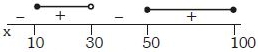
(C) To solve the inequality $\frac{(x - 10)(x - 50)}{(x - 30)} \geqslant 0$,we use the wavy curve method (sign scheme).
The critical points are $x = 10, 30, 50$.
Testing intervals:
For $x > 50$,the expression is positive.
For $30 < x < 50$,the expression is negative.
For $10 < x < 30$,the expression is positive.
For $x < 10$,the expression is negative.
Considering the inequality $\geqslant 0$:
- The expression is zero at $x = 10$ and $x = 50$.
- The expression is undefined at $x = 30$.
- Thus,the solution set is $x \in [10, 30) \cup [50, 100]$.
Counting the integers in this set:
- In $[10, 29]$,there are $29 - 10 + 1 = 20$ integers.
- In $[50, 100]$,there are $100 - 50 + 1 = 51$ integers.
- Total number of favorable integers $= 20 + 51 = 71$.
The total number of integers in the set $\{1, 2, ..., 100\}$ is $100$.
Therefore,the probability is $\frac{71}{100} = 0.71$.
The critical points are $x = 10, 30, 50$.
Testing intervals:
For $x > 50$,the expression is positive.
For $30 < x < 50$,the expression is negative.
For $10 < x < 30$,the expression is positive.
For $x < 10$,the expression is negative.
Considering the inequality $\geqslant 0$:
- The expression is zero at $x = 10$ and $x = 50$.
- The expression is undefined at $x = 30$.
- Thus,the solution set is $x \in [10, 30) \cup [50, 100]$.
Counting the integers in this set:
- In $[10, 29]$,there are $29 - 10 + 1 = 20$ integers.
- In $[50, 100]$,there are $100 - 50 + 1 = 51$ integers.
- Total number of favorable integers $= 20 + 51 = 71$.
The total number of integers in the set $\{1, 2, ..., 100\}$ is $100$.
Therefore,the probability is $\frac{71}{100} = 0.71$.
0 likes
View Solution189
AdvancedMCQ
The probability of hitting a target by three marksmen is $\frac{1}{2}, \frac{1}{3},$ and $\frac{1}{4}$ respectively. If the probability that exactly two of them will hit the target is $\lambda$ and that at least two of them hit the target is $\mu,$ then $\lambda + \mu$ is equal to :-
A
$\frac{13}{24}$
B
$\frac{6}{24}$
C
$\frac{7}{24}$
D
None
Solution
(A) Let $P(A) = \frac{1}{2}, P(B) = \frac{1}{3}, P(C) = \frac{1}{4}$.
Then $P(\overline{A}) = \frac{1}{2}, P(\overline{B}) = \frac{2}{3}, P(\overline{C}) = \frac{3}{4}$.
$\lambda$ is the probability that exactly two hit the target:
$\lambda = P(A)P(B)P(\overline{C}) + P(A)P(\overline{B})P(C) + P(\overline{A})P(B)P(C)$
$\lambda = (\frac{1}{2} \times \frac{1}{3} \times \frac{3}{4}) + (\frac{1}{2} \times \frac{2}{3} \times \frac{1}{4}) + (\frac{1}{2} \times \frac{1}{3} \times \frac{1}{4})$
$\lambda = \frac{3}{24} + \frac{2}{24} + \frac{1}{24} = \frac{6}{24} = \frac{1}{4}$.
$\mu$ is the probability that at least two hit the target:
$\mu = \lambda + P(A)P(B)P(C)$
$\mu = \frac{6}{24} + (\frac{1}{2} \times \frac{1}{3} \times \frac{1}{4}) = \frac{6}{24} + \frac{1}{24} = \frac{7}{24}$.
$\lambda + \mu = \frac{6}{24} + \frac{7}{24} = \frac{13}{24}$.
Then $P(\overline{A}) = \frac{1}{2}, P(\overline{B}) = \frac{2}{3}, P(\overline{C}) = \frac{3}{4}$.
$\lambda$ is the probability that exactly two hit the target:
$\lambda = P(A)P(B)P(\overline{C}) + P(A)P(\overline{B})P(C) + P(\overline{A})P(B)P(C)$
$\lambda = (\frac{1}{2} \times \frac{1}{3} \times \frac{3}{4}) + (\frac{1}{2} \times \frac{2}{3} \times \frac{1}{4}) + (\frac{1}{2} \times \frac{1}{3} \times \frac{1}{4})$
$\lambda = \frac{3}{24} + \frac{2}{24} + \frac{1}{24} = \frac{6}{24} = \frac{1}{4}$.
$\mu$ is the probability that at least two hit the target:
$\mu = \lambda + P(A)P(B)P(C)$
$\mu = \frac{6}{24} + (\frac{1}{2} \times \frac{1}{3} \times \frac{1}{4}) = \frac{6}{24} + \frac{1}{24} = \frac{7}{24}$.
$\lambda + \mu = \frac{6}{24} + \frac{7}{24} = \frac{13}{24}$.
0 likes
View Solution190
AdvancedMCQ
$A$ natural number is selected at random from the set $\{x \in \mathbb{N} : 1 \leq x \leq 100\}$. The probability that the number satisfies the inequation $x^2 - 13x \leq 30$ is:
A
$\frac{9}{20}$
B
$\frac{3}{20}$
C
$\frac{2}{11}$
D
$\frac{7}{9}$
Solution
(B) The given inequation is $x^2 - 13x - 30 \leq 0$.
Factoring the quadratic expression,we get $(x - 15)(x + 2) \leq 0$.
For this product to be less than or equal to zero,$x$ must lie in the interval $[-2, 15]$.
Since $x$ is a natural number $(x \in \mathbb{N})$,the possible values for $x$ are ${1, 2, 3, \dots, 15}$.
The total number of natural numbers in the set ${1, 2, \dots, 100}$ is $100$.
The number of favorable outcomes is $15$.
Therefore,the required probability is $\frac{15}{100} = \frac{3}{20}$.
Factoring the quadratic expression,we get $(x - 15)(x + 2) \leq 0$.
For this product to be less than or equal to zero,$x$ must lie in the interval $[-2, 15]$.
Since $x$ is a natural number $(x \in \mathbb{N})$,the possible values for $x$ are ${1, 2, 3, \dots, 15}$.
The total number of natural numbers in the set ${1, 2, \dots, 100}$ is $100$.
The number of favorable outcomes is $15$.
Therefore,the required probability is $\frac{15}{100} = \frac{3}{20}$.
0 likes
View Solution191
AdvancedMCQ
An anti-aircraft gun takes four shots at an enemy plane moving away from it. The probabilities of hitting the plane at the first,second,third,and fourth shots are $0.4, 0.3, 0.2$,and $0.1$ respectively. The probability that the gun hits the plane is:
A
$0.25$
B
$0.21$
C
$0.16$
D
$0.6976$
Solution
(D) Let $E_1, E_2, E_3, E_4$ be the events of hitting the plane in the first,second,third,and fourth shots respectively.
Given probabilities are $P(E_1) = 0.4, P(E_2) = 0.3, P(E_3) = 0.2, P(E_4) = 0.1$.
The probability of not hitting the plane in any shot is $P(E_i^c) = 1 - P(E_i)$.
$P(E_1^c) = 1 - 0.4 = 0.6$
$P(E_2^c) = 1 - 0.3 = 0.7$
$P(E_3^c) = 1 - 0.2 = 0.8$
$P(E_4^c) = 1 - 0.1 = 0.9$
The probability that the gun hits the plane at least once is $1 - P(\text{not hitting the plane in any shot})$.
Required probability $= 1 - (P(E_1^c) \times P(E_2^c) \times P(E_3^c) \times P(E_4^c))$
$= 1 - (0.6 \times 0.7 \times 0.8 \times 0.9)$
$= 1 - 0.3024$
$= 0.6976$
Given probabilities are $P(E_1) = 0.4, P(E_2) = 0.3, P(E_3) = 0.2, P(E_4) = 0.1$.
The probability of not hitting the plane in any shot is $P(E_i^c) = 1 - P(E_i)$.
$P(E_1^c) = 1 - 0.4 = 0.6$
$P(E_2^c) = 1 - 0.3 = 0.7$
$P(E_3^c) = 1 - 0.2 = 0.8$
$P(E_4^c) = 1 - 0.1 = 0.9$
The probability that the gun hits the plane at least once is $1 - P(\text{not hitting the plane in any shot})$.
Required probability $= 1 - (P(E_1^c) \times P(E_2^c) \times P(E_3^c) \times P(E_4^c))$
$= 1 - (0.6 \times 0.7 \times 0.8 \times 0.9)$
$= 1 - 0.3024$
$= 0.6976$
0 likes
View Solution192
AdvancedMCQ
An integer $x$ is chosen at random from $1$ to $50$. The probability that $x + \frac{336}{x} \leq 50$ is
A
$\frac{7}{10}$
B
$\frac{3}{10}$
C
$\frac{17}{25}$
D
$\frac{8}{25}$
Solution
(A) Given the inequality $x + \frac{336}{x} \leq 50$.
Since $x$ is a positive integer,we can multiply by $x$ without changing the inequality sign: $x^2 + 336 \leq 50x$.
Rearranging the terms,we get $x^2 - 50x + 336 \leq 0$.
Factoring the quadratic expression,we find $(x - 8)(x - 42) \leq 0$.
This inequality holds for $x$ in the interval $[8, 42]$.
Since $x$ must be an integer,the possible values for $x$ are ${8, 9, 10, \dots, 42}$.
The number of such integers is $42 - 8 + 1 = 35$.
The total number of integers from $1$ to $50$ is $50$.
Therefore,the required probability is $\frac{35}{50} = \frac{7}{10}$.
Since $x$ is a positive integer,we can multiply by $x$ without changing the inequality sign: $x^2 + 336 \leq 50x$.
Rearranging the terms,we get $x^2 - 50x + 336 \leq 0$.
Factoring the quadratic expression,we find $(x - 8)(x - 42) \leq 0$.
This inequality holds for $x$ in the interval $[8, 42]$.
Since $x$ must be an integer,the possible values for $x$ are ${8, 9, 10, \dots, 42}$.
The number of such integers is $42 - 8 + 1 = 35$.
The total number of integers from $1$ to $50$ is $50$.
Therefore,the required probability is $\frac{35}{50} = \frac{7}{10}$.
0 likes
View Solution193
AdvancedMCQ
Mr. $A$ has $6$ children and at least one child is a girl. What is the probability that Mr. $A$ has $3$ boys and $3$ girls?
A
$\frac{20}{63}$
B
$\frac{1}{6}$
C
$\frac{5}{11}$
D
$\frac{1}{32}$
Solution
(A) The total number of ways to have $6$ children is $2^6 = 64$.
Since at least one child is a girl,we exclude the case where all children are boys (which is $1$ case).
Thus,the total number of possible outcomes is $2^6 - 1 = 64 - 1 = 63$.
The number of ways to have $3$ boys and $3$ girls is given by the binomial coefficient $\binom{6}{3} = \frac{6!}{3!3!} = \frac{6 \times 5 \times 4}{3 \times 2 \times 1} = 20$.
Therefore,the required probability is $\frac{20}{63}$.
Since at least one child is a girl,we exclude the case where all children are boys (which is $1$ case).
Thus,the total number of possible outcomes is $2^6 - 1 = 64 - 1 = 63$.
The number of ways to have $3$ boys and $3$ girls is given by the binomial coefficient $\binom{6}{3} = \frac{6!}{3!3!} = \frac{6 \times 5 \times 4}{3 \times 2 \times 1} = 20$.
Therefore,the required probability is $\frac{20}{63}$.
0 likes
View Solution194
AdvancedMCQ
Let $A$, $B$, and $C$ be three events such that $P(A \cap \bar{B} \cap \bar{C}) = 0.6$, $P(A) = 0.8$, and $P(\bar{A} \cap B \cap C) = 0.1$. Then, the value of $P(\text{at least two among } A, B, \text{ and } C)$ equals:
A
$0.1$
B
$0.2$
C
$0.3$
D
$0.5$
Solution
(C) We are given the following probabilities:
$P(A \cap \bar{B} \cap \bar{C}) = 0.6$
$P(A) = 0.8$
$P(\bar{A} \cap B \cap C) = 0.1$
We know that $P(A) = P(A \cap \bar{B} \cap \bar{C}) + P(A \cap B \cap \bar{C}) + P(A \cap \bar{B} \cap C) + P(A \cap B \cap C)$.
Substituting the known values:
$0.8 = 0.6 + P(A \cap B \cap \bar{C}) + P(A \cap \bar{B} \cap C) + P(A \cap B \cap C)$
$P(A \cap B \cap \bar{C}) + P(A \cap \bar{B} \cap C) + P(A \cap B \cap C) = 0.8 - 0.6 = 0.2$.
The probability of at least two events occurring is given by:
$P(\text{at least two}) = P(A \cap B \cap \bar{C}) + P(A \cap \bar{B} \cap C) + P(\bar{A} \cap B \cap C) + P(A \cap B \cap C)$.
Substituting the sum calculated above and the given value for $P(\bar{A} \cap B \cap C)$:
$P(\text{at least two}) = 0.2 + 0.1 = 0.3$.
$P(A \cap \bar{B} \cap \bar{C}) = 0.6$
$P(A) = 0.8$
$P(\bar{A} \cap B \cap C) = 0.1$
We know that $P(A) = P(A \cap \bar{B} \cap \bar{C}) + P(A \cap B \cap \bar{C}) + P(A \cap \bar{B} \cap C) + P(A \cap B \cap C)$.
Substituting the known values:
$0.8 = 0.6 + P(A \cap B \cap \bar{C}) + P(A \cap \bar{B} \cap C) + P(A \cap B \cap C)$
$P(A \cap B \cap \bar{C}) + P(A \cap \bar{B} \cap C) + P(A \cap B \cap C) = 0.8 - 0.6 = 0.2$.
The probability of at least two events occurring is given by:
$P(\text{at least two}) = P(A \cap B \cap \bar{C}) + P(A \cap \bar{B} \cap C) + P(\bar{A} \cap B \cap C) + P(A \cap B \cap C)$.
Substituting the sum calculated above and the given value for $P(\bar{A} \cap B \cap C)$:
$P(\text{at least two}) = 0.2 + 0.1 = 0.3$.
0 likes
View Solution195
AdvancedMCQ
Let two fair dice $A$ and $B$ be thrown. What is the probability that the number appearing on dice $A$ is greater than the number appearing on dice $B$?
A
$\frac{5}{12}$
B
$\frac{1}{2}$
C
$\frac{3}{4}$
D
$\frac{7}{17}$
Solution
(A) The total number of outcomes when two dice are thrown is $6 \times 6 = 36$.
Let $A$ be the outcome of the first die and $B$ be the outcome of the second die. We want to find the number of outcomes where $A > B$.
If $A=2$,$B=1$ ($1$ outcome).
If $A=3$,$B=1, 2$ ($2$ outcomes).
If $A=4$,$B=1, 2, 3$ ($3$ outcomes).
If $A=5$,$B=1, 2, 3, 4$ ($4$ outcomes).
If $A=6$,$B=1, 2, 3, 4, 5$ ($5$ outcomes).
Total favorable outcomes $= 1 + 2 + 3 + 4 + 5 = 15$.
The probability is $\frac{\text{favorable outcomes}}{\text{total outcomes}} = \frac{15}{36} = \frac{5}{12}$.
Let $A$ be the outcome of the first die and $B$ be the outcome of the second die. We want to find the number of outcomes where $A > B$.
If $A=2$,$B=1$ ($1$ outcome).
If $A=3$,$B=1, 2$ ($2$ outcomes).
If $A=4$,$B=1, 2, 3$ ($3$ outcomes).
If $A=5$,$B=1, 2, 3, 4$ ($4$ outcomes).
If $A=6$,$B=1, 2, 3, 4, 5$ ($5$ outcomes).
Total favorable outcomes $= 1 + 2 + 3 + 4 + 5 = 15$.
The probability is $\frac{\text{favorable outcomes}}{\text{total outcomes}} = \frac{15}{36} = \frac{5}{12}$.
0 likes
View Solution196
AdvancedMCQ
If three students $A, B, C$ independently solve a problem with probabilities $\frac{1}{3}, \frac{1}{4}$ and $\frac{1}{5}$ respectively,then the probability that the problem will be solved is
A
$\frac{3}{5}$
B
$\frac{4}{5}$
C
$\frac{2}{5}$
D
$\frac{47}{60}$
Solution
(A) Let $P(A), P(B), P(C)$ be the probabilities that students $A, B, C$ solve the problem respectively.
$P(A) = \frac{1}{3}, P(B) = \frac{1}{4}, P(C) = \frac{1}{5}$.
The probability that the problem is not solved by any of them is:
$P(\text{not solved}) = (1 - P(A)) \times (1 - P(B)) \times (1 - P(C))$
$P(\text{not solved}) = (1 - \frac{1}{3}) \times (1 - \frac{1}{4}) \times (1 - \frac{1}{5})$
$P(\text{not solved}) = \frac{2}{3} \times \frac{3}{4} \times \frac{4}{5} = \frac{2}{5}$.
The probability that the problem is solved is:
$P(\text{solved}) = 1 - P(\text{not solved}) = 1 - \frac{2}{5} = \frac{3}{5}$.
$P(A) = \frac{1}{3}, P(B) = \frac{1}{4}, P(C) = \frac{1}{5}$.
The probability that the problem is not solved by any of them is:
$P(\text{not solved}) = (1 - P(A)) \times (1 - P(B)) \times (1 - P(C))$
$P(\text{not solved}) = (1 - \frac{1}{3}) \times (1 - \frac{1}{4}) \times (1 - \frac{1}{5})$
$P(\text{not solved}) = \frac{2}{3} \times \frac{3}{4} \times \frac{4}{5} = \frac{2}{5}$.
The probability that the problem is solved is:
$P(\text{solved}) = 1 - P(\text{not solved}) = 1 - \frac{2}{5} = \frac{3}{5}$.
0 likes
View Solution197
DifficultMCQ
Mr. $A$ has six children and at least one child is a girl. Then,the probability that Mr. $A$ has $3$ boys and $3$ girls is:
A
$\frac{20}{63}$
B
$\frac{1}{3}$
C
$\frac{5}{11}$
D
$\frac{1}{32}$
Solution
(A) The total number of ways to have $6$ children is $2^6 = 64$.
Since at least one child is a girl,we exclude the case where all children are boys.
The number of favorable outcomes where at least one child is a girl is $64 - 1 = 63$.
The number of ways to have $3$ boys and $3$ girls is given by the binomial coefficient $\binom{6}{3} = \frac{6!}{3!3!} = \frac{6 \times 5 \times 4}{3 \times 2 \times 1} = 20$.
Therefore,the required probability is $\frac{20}{63}$.
Since at least one child is a girl,we exclude the case where all children are boys.
The number of favorable outcomes where at least one child is a girl is $64 - 1 = 63$.
The number of ways to have $3$ boys and $3$ girls is given by the binomial coefficient $\binom{6}{3} = \frac{6!}{3!3!} = \frac{6 \times 5 \times 4}{3 \times 2 \times 1} = 20$.
Therefore,the required probability is $\frac{20}{63}$.
0 likes
View Solution198
DifficultMCQ
Two numbers $a$ and $b$ are chosen at random from the set of first $30$ natural numbers. Then the probability that $a^2 - b^2$ is divisible by $3$ is (in $/87$)
A
$9$
B
$12$
C
$15$
D
$47$
Solution
(D) Total ways to choose two distinct numbers from $30$ is $^{30}C_{2} = \frac{30 \times 29}{2} = 435$.
For $a^2 - b^2$ to be divisible by $3$,$(a-b)(a+b)$ must be divisible by $3$.
This happens if $a \equiv b \pmod{3}$ or $a \equiv -b \pmod{3}$.
Let the sets based on remainders modulo $3$ be:
$D_{1} = \{1, 4, 7, \dots, 28\}$ (size $10$,remainder $1$)
$D_{2} = \{2, 5, 8, \dots, 29\}$ (size $10$,remainder $2$)
$D_{3} = \{3, 6, 9, \dots, 30\}$ (size $10$,remainder $0$)
Favorable cases:
$1$. Both $a, b$ from the same set: $^{10}C_{2} + ^{10}C_{2} + ^{10}C_{2} = 45 + 45 + 45 = 135$.
$2$. One from $D_{1}$ and one from $D_{2}$: $^{10}C_{1} \times ^{10}C_{1} = 100$.
Total favorable cases $= 135 + 100 = 235$.
Probability $P = \frac{235}{435} = \frac{47}{87}$.
For $a^2 - b^2$ to be divisible by $3$,$(a-b)(a+b)$ must be divisible by $3$.
This happens if $a \equiv b \pmod{3}$ or $a \equiv -b \pmod{3}$.
Let the sets based on remainders modulo $3$ be:
$D_{1} = \{1, 4, 7, \dots, 28\}$ (size $10$,remainder $1$)
$D_{2} = \{2, 5, 8, \dots, 29\}$ (size $10$,remainder $2$)
$D_{3} = \{3, 6, 9, \dots, 30\}$ (size $10$,remainder $0$)
Favorable cases:
$1$. Both $a, b$ from the same set: $^{10}C_{2} + ^{10}C_{2} + ^{10}C_{2} = 45 + 45 + 45 = 135$.
$2$. One from $D_{1}$ and one from $D_{2}$: $^{10}C_{1} \times ^{10}C_{1} = 100$.
Total favorable cases $= 135 + 100 = 235$.
Probability $P = \frac{235}{435} = \frac{47}{87}$.
0 likes
View Solution199
AdvancedMCQ
$A$ die is loaded such that the probability of throwing the number $i$ is proportional to its reciprocal. Then the probability that $3$ appears in a single throw is
A
$3/22$
B
$3/11$
C
$9/22$
D
$20/147$
Solution
(D) Let $P(i)$ be the probability of getting the number $i$ on the die.
Given that $P(i) \propto \frac{1}{i}$,we have $P(i) = \frac{K}{i}$ for $i = 1, 2, 3, 4, 5, 6$,where $K$ is a constant.
Since the sum of all probabilities must be $1$,we have $\sum_{i=1}^{6} P(i) = 1$.
$K \left( \frac{1}{1} + \frac{1}{2} + \frac{1}{3} + \frac{1}{4} + \frac{1}{5} + \frac{1}{6} \right) = 1$.
Finding the common denominator for the sum: $\frac{60+30+20+15+12+10}{60} = \frac{147}{60}$.
So,$K \left( \frac{147}{60} \right) = 1 \Rightarrow K = \frac{60}{147} = \frac{20}{49}$.
The probability of getting $3$ is $P(3) = \frac{K}{3} = \frac{20}{49 \times 3} = \frac{20}{147}$.
Given that $P(i) \propto \frac{1}{i}$,we have $P(i) = \frac{K}{i}$ for $i = 1, 2, 3, 4, 5, 6$,where $K$ is a constant.
Since the sum of all probabilities must be $1$,we have $\sum_{i=1}^{6} P(i) = 1$.
$K \left( \frac{1}{1} + \frac{1}{2} + \frac{1}{3} + \frac{1}{4} + \frac{1}{5} + \frac{1}{6} \right) = 1$.
Finding the common denominator for the sum: $\frac{60+30+20+15+12+10}{60} = \frac{147}{60}$.
So,$K \left( \frac{147}{60} \right) = 1 \Rightarrow K = \frac{60}{147} = \frac{20}{49}$.
The probability of getting $3$ is $P(3) = \frac{K}{3} = \frac{20}{49 \times 3} = \frac{20}{147}$.
0 likes
View SolutionProbability — Set Based probability · Frequently Asked Questions
1Are these Probability questions useful for JEE and NEET?
Yes. All questions in this section are mapped to JEE Main and NEET exam patterns. Previous year questions from JEE Main, NEET, GUJCET and state-level exams are included with full solutions.
2Can I switch to Hindi or Gujarati for these questions?
Yes. Use the language tabs in the hero section or the sidebar to view the same questions and solutions in English, Hindi or Gujarati.
3How do I generate a question paper from this subtopic?
Use the Vedclass Exam Paper Generator — select the chapter and subtopic, set difficulty, and generate Sets A, B, C, D automatically. First 3 chapters of every subject are free.
Vedclass Products
For Students
Vedclass Test Series
Mock tests in real JEE/NEET style with performance analysis. 5-day free trial.
Start Free TrialFor Teachers
Exam Paper Generator
Generate Set A/B/C/D papers from this chapter in 2 minutes. 3 chapters free.
Try FreeFor Institutes
Online Exam Module
Live online exams with unlimited students, 360° analytics & white-label branding.
See DemoFor Teachers & Institutes
Generate a Probability Exam Paper in 2 Minutes
Select subtopic & difficulty — Sets A, B, C, D auto-generated with No Repeat logic.
First 3 chapters of every subject are free — no payment required.