
A English
Geometrical problems Questions in English
Class 11 Mathematics · Permutation and Combination · Geometrical problems
194+
Questions
English
Language
100%
With Solutions
Showing 48 of 194 questions in English
1
EasyMCQ
How many numbers divisible by $5$ and lying between $3000$ and $4000$ can be formed from the digits $1, 2, 3, 4, 5, 6$ (repetition is not allowed)?
A
$^6P_2$
B
$^5P_2$
C
$^4P_2$
D
$^6P_3$
Solution
(C) To be divisible by $5$,the unit place must be occupied by the digit $5$.
Since the number must lie between $3000$ and $4000$,the thousandth place must be occupied by the digit $3$.
We have $4$ remaining digits ${1, 2, 4, 6}$ to fill the remaining $2$ positions (hundreds and tens).
The number of ways to arrange these $2$ digits from the $4$ available is given by $^4P_2$.
Thus,the total number of such numbers is $^4P_2 = 4 \times 3 = 12$.
Since the number must lie between $3000$ and $4000$,the thousandth place must be occupied by the digit $3$.
We have $4$ remaining digits ${1, 2, 4, 6}$ to fill the remaining $2$ positions (hundreds and tens).
The number of ways to arrange these $2$ digits from the $4$ available is given by $^4P_2$.
Thus,the total number of such numbers is $^4P_2 = 4 \times 3 = 12$.
0 likes
View Solution2
MediumMCQ
In how many ways can $5$ boys and $3$ girls sit in a row so that no two girls are together?
A
$5! \times 3!$
B
$^4P_3 \times 5!$
C
$^6P_3 \times 5!$
D
$^5P_3 \times 3!$
Solution
(C) First,arrange the $5$ boys in a row. They can be arranged in $5!$ ways.
After arranging the boys,we create gaps between them to ensure no two girls are together.
The arrangement of $5$ boys creates $6$ possible gaps (including the ends): $\_ B_1 \_ B_2 \_ B_3 \_ B_4 \_ B_5 \_$.
We have $3$ girls to be placed in these $6$ gaps.
The number of ways to choose and arrange $3$ girls in $6$ gaps is given by $^6P_3$.
Therefore,the total number of ways is $^6P_3 \times 5!$.
After arranging the boys,we create gaps between them to ensure no two girls are together.
The arrangement of $5$ boys creates $6$ possible gaps (including the ends): $\_ B_1 \_ B_2 \_ B_3 \_ B_4 \_ B_5 \_$.
We have $3$ girls to be placed in these $6$ gaps.
The number of ways to choose and arrange $3$ girls in $6$ gaps is given by $^6P_3$.
Therefore,the total number of ways is $^6P_3 \times 5!$.
0 likes
View Solution3
EasyMCQ
In how many ways can $5$ boys and $5$ girls stand in a row so that no two girls may be together?
A
$5! \times 5!$
B
$5! \times 4!$
C
$5! \times 6!$
D
$6 \times 5!$
Solution
(C) First,arrange the $5$ boys in a row,which can be done in $5!$ ways.
This creates $6$ possible gaps (including the ends) where the $5$ girls can be placed to ensure no two girls are together: $\_ B_1 \_ B_2 \_ B_3 \_ B_4 \_ B_5 \_$.
The number of ways to arrange $5$ girls in these $6$ gaps is given by $^6P_5 = \frac{6!}{(6-5)!} = 6!$.
Therefore,the total number of arrangements is $5! \times 6!$.
This creates $6$ possible gaps (including the ends) where the $5$ girls can be placed to ensure no two girls are together: $\_ B_1 \_ B_2 \_ B_3 \_ B_4 \_ B_5 \_$.
The number of ways to arrange $5$ girls in these $6$ gaps is given by $^6P_5 = \frac{6!}{(6-5)!} = 6!$.
Therefore,the total number of arrangements is $5! \times 6!$.
0 likes
View Solution4
EasyMCQ
In how many ways can $21$ English books and $19$ Hindi books be placed in a row so that no two Hindi books are together?
A
$1540$
B
$1450$
C
$1504$
D
$1405$
Solution
(A) To ensure no two Hindi books are together,we first arrange the $21$ English books in a row.
This creates $22$ possible gaps (including the ends) where the $19$ Hindi books can be placed.
The number of ways to choose $19$ gaps out of $22$ is given by the combination formula $^{22}C_{19}$.
$^{22}C_{19} = ^{22}C_{22-19} = ^{22}C_3$.
$^{22}C_3 = \frac{22 \times 21 \times 20}{3 \times 2 \times 1} = 22 \times 7 \times 10 = 1540$.
Thus,there are $1540$ ways to arrange the books.
This creates $22$ possible gaps (including the ends) where the $19$ Hindi books can be placed.
The number of ways to choose $19$ gaps out of $22$ is given by the combination formula $^{22}C_{19}$.
$^{22}C_{19} = ^{22}C_{22-19} = ^{22}C_3$.
$^{22}C_3 = \frac{22 \times 21 \times 20}{3 \times 2 \times 1} = 22 \times 7 \times 10 = 1540$.
Thus,there are $1540$ ways to arrange the books.
0 likes
View Solution5
MediumMCQ
The number of triangles that can be formed by $5$ points on a line and $3$ points on a parallel line is
A
$^8C_3$
B
$^8C_3 - ^5C_3$
C
$^8C_3 - ^5C_3 - ^3C_3$
D
None of these
Solution
(C) Total number of points = $5 + 3 = 8$.
To form a triangle,we need to select $3$ points out of $8$,which can be done in $^8C_3$ ways.
However,if the $3$ selected points are collinear,they do not form a triangle.
There are $5$ points on one line,so the number of ways to select $3$ collinear points from these is $^5C_3$.
There are $3$ points on the other parallel line,so the number of ways to select $3$ collinear points from these is $^3C_3$.
Thus,the number of triangles = $^8C_3 - ^5C_3 - ^3C_3$.
To form a triangle,we need to select $3$ points out of $8$,which can be done in $^8C_3$ ways.
However,if the $3$ selected points are collinear,they do not form a triangle.
There are $5$ points on one line,so the number of ways to select $3$ collinear points from these is $^5C_3$.
There are $3$ points on the other parallel line,so the number of ways to select $3$ collinear points from these is $^3C_3$.
Thus,the number of triangles = $^8C_3 - ^5C_3 - ^3C_3$.
0 likes
View Solution6
EasyMCQ
The number of diagonals in an octagon is
A
$28$
B
$20$
C
$10$
D
$16$
Solution
(B) An octagon has $n = 8$ vertices.
To form a diagonal,we need to choose $2$ vertices out of $8$,which is given by $^8C_2$.
$^8C_2 = \frac{8 \times 7}{2 \times 1} = 28$.
These $28$ combinations include the $8$ sides of the octagon.
Therefore,the number of diagonals = $^8C_2 - 8 = 28 - 8 = 20$.
To form a diagonal,we need to choose $2$ vertices out of $8$,which is given by $^8C_2$.
$^8C_2 = \frac{8 \times 7}{2 \times 1} = 28$.
These $28$ combinations include the $8$ sides of the octagon.
Therefore,the number of diagonals = $^8C_2 - 8 = 28 - 8 = 20$.
0 likes
View Solution7
EasyMCQ
If a polygon has $44$ diagonals,then the number of its sides is:
A
$7$
B
$11$
C
$8$
D
None of these
Solution
(B) The number of diagonals in a polygon with $n$ sides is given by the formula $\frac{n(n-3)}{2}$.
Given that the number of diagonals is $44$,we have:
$\frac{n(n-3)}{2} = 44$
$n(n-3) = 88$
$n^2 - 3n - 88 = 0$
$(n - 11)(n + 8) = 0$
Since $n$ must be a positive integer,$n = 11$.
Therefore,the number of sides is $11$.
Given that the number of diagonals is $44$,we have:
$\frac{n(n-3)}{2} = 44$
$n(n-3) = 88$
$n^2 - 3n - 88 = 0$
$(n - 11)(n + 8) = 0$
Since $n$ must be a positive integer,$n = 11$.
Therefore,the number of sides is $11$.
0 likes
View Solution8
EasyMCQ
How many triangles can be formed by joining four points on a circle?
A
$4$
B
$6$
C
$8$
D
$10$
Solution
(A) To form a triangle,we need to select $3$ non-collinear points.
Since all points lie on a circle,no three points are collinear.
Therefore,the number of triangles that can be formed by joining $4$ points is given by the combination formula $^n{C_r}$,where $n = 4$ and $r = 3$.
Number of triangles = $^4{C_3} = \frac{4!}{3!(4-3)!} = \frac{4 \times 3!}{3! \times 1!} = 4$.
Since all points lie on a circle,no three points are collinear.
Therefore,the number of triangles that can be formed by joining $4$ points is given by the combination formula $^n{C_r}$,where $n = 4$ and $r = 3$.
Number of triangles = $^4{C_3} = \frac{4!}{3!(4-3)!} = \frac{4 \times 3!}{3! \times 1!} = 4$.
0 likes
View Solution9
EasyMCQ
How many triangles can be drawn by means of $9$ non-collinear points?
A
$84$
B
$72$
C
$144$
D
$126$
Solution
(A) To form a triangle,we need to select $3$ points out of the given $9$ non-collinear points.
Since the points are non-collinear,any selection of $3$ points will form a unique triangle.
The number of ways to select $3$ points from $9$ is given by the combination formula $^nC_r = \frac{n!}{r!(n-r)!}$.
Substituting $n = 9$ and $r = 3$:
$^9C_3 = \frac{9 \times 8 \times 7}{3 \times 2 \times 1} = 3 \times 4 \times 7 = 84$.
Therefore,$84$ triangles can be drawn.
Since the points are non-collinear,any selection of $3$ points will form a unique triangle.
The number of ways to select $3$ points from $9$ is given by the combination formula $^nC_r = \frac{n!}{r!(n-r)!}$.
Substituting $n = 9$ and $r = 3$:
$^9C_3 = \frac{9 \times 8 \times 7}{3 \times 2 \times 1} = 3 \times 4 \times 7 = 84$.
Therefore,$84$ triangles can be drawn.
0 likes
View Solution10
EasyMCQ
The number of diagonals in a polygon of $m$ sides is
A
$\frac{1}{2}m(m - 5)$
B
$\frac{1}{2}m(m - 1)$
C
$\frac{1}{2}m(m - 3)$
D
$\frac{1}{2}m(m - 2)$
Solution
(C) polygon with $m$ sides has $m$ vertices.
To form a line segment (side or diagonal),we choose $2$ vertices out of $m$,which is given by $^mC_2$.
Total number of line segments = $^mC_2 = \frac{m(m - 1)}{2}$.
These line segments include $m$ sides of the polygon.
Therefore,the number of diagonals = (Total line segments) - (Number of sides).
Number of diagonals = $\frac{m(m - 1)}{2} - m = \frac{m^2 - m - 2m}{2} = \frac{m(m - 3)}{2}$.
To form a line segment (side or diagonal),we choose $2$ vertices out of $m$,which is given by $^mC_2$.
Total number of line segments = $^mC_2 = \frac{m(m - 1)}{2}$.
These line segments include $m$ sides of the polygon.
Therefore,the number of diagonals = (Total line segments) - (Number of sides).
Number of diagonals = $\frac{m(m - 1)}{2} - m = \frac{m^2 - m - 2m}{2} = \frac{m(m - 3)}{2}$.
0 likes
View Solution11
EasyMCQ
The number of straight lines that can be formed by joining $8$ points on a circle is:
A
$8$
B
$16$
C
$24$
D
$28$
Solution
(D) To form a straight line,we need to select any $2$ points out of the given $8$ points.
Since the points are on a circle,no $3$ points are collinear.
Therefore,the number of straight lines is given by the combination formula $^nC_r = \frac{n!}{r!(n-r)!}$.
Here,$n = 8$ and $r = 2$.
Number of lines = $^8C_2 = \frac{8 \times 7}{2 \times 1} = 28$.
Since the points are on a circle,no $3$ points are collinear.
Therefore,the number of straight lines is given by the combination formula $^nC_r = \frac{n!}{r!(n-r)!}$.
Here,$n = 8$ and $r = 2$.
Number of lines = $^8C_2 = \frac{8 \times 7}{2 \times 1} = 28$.
0 likes
View Solution12
EasyMCQ
The number of triangles that can be formed by choosing the vertices from a set of $12$ points,$7$ of which lie on the same straight line,is
A
$185$
B
$175$
C
$115$
D
$105$
Solution
(A) To form a triangle,we need to select $3$ non-collinear points from the given set of points.
Total number of ways to select $3$ points from $12$ points is given by $^{12}C_3 = \frac{12 \times 11 \times 10}{3 \times 2 \times 1} = 220$.
Since $7$ points are collinear,selecting any $3$ points from these $7$ points will not form a triangle.
The number of ways to select $3$ points from these $7$ collinear points is $^{7}C_3 = \frac{7 \times 6 \times 5}{3 \times 2 \times 1} = 35$.
Therefore,the number of triangles that can be formed is the total number of selections minus the number of collinear selections:
Number of triangles $= 220 - 35 = 185$.
Total number of ways to select $3$ points from $12$ points is given by $^{12}C_3 = \frac{12 \times 11 \times 10}{3 \times 2 \times 1} = 220$.
Since $7$ points are collinear,selecting any $3$ points from these $7$ points will not form a triangle.
The number of ways to select $3$ points from these $7$ collinear points is $^{7}C_3 = \frac{7 \times 6 \times 5}{3 \times 2 \times 1} = 35$.
Therefore,the number of triangles that can be formed is the total number of selections minus the number of collinear selections:
Number of triangles $= 220 - 35 = 185$.
0 likes
View Solution13
EasyMCQ
In a plane,there are $10$ points,out of which $4$ are collinear. The number of triangles that can be formed by joining these points is:
A
$60$
B
$116$
C
$120$
D
None of these
Solution
(B) To form a triangle,we need $3$ non-collinear points.
Total number of ways to select $3$ points out of $10$ is given by $^{10}C_3$.
$^{10}C_3 = \frac{10 \times 9 \times 8}{3 \times 2 \times 1} = 120$.
Since $4$ points are collinear,selecting these $4$ points will not form a triangle. The number of ways to select $3$ points from these $4$ collinear points is $^4C_3$.
$^4C_3 = 4$.
Therefore,the number of triangles that can be formed is $120 - 4 = 116$.
Total number of ways to select $3$ points out of $10$ is given by $^{10}C_3$.
$^{10}C_3 = \frac{10 \times 9 \times 8}{3 \times 2 \times 1} = 120$.
Since $4$ points are collinear,selecting these $4$ points will not form a triangle. The number of ways to select $3$ points from these $4$ collinear points is $^4C_3$.
$^4C_3 = 4$.
Therefore,the number of triangles that can be formed is $120 - 4 = 116$.
0 likes
View Solution14
EasyMCQ
There are $16$ points in a plane out of which $6$ are collinear. How many lines can be drawn by joining these points?
A
$106$
B
$105$
C
$60$
D
$55$
Solution
(A) The total number of ways to select $2$ points out of $16$ is given by $^{16}C_2 = \frac{16 \times 15}{2} = 120$.
Since $6$ points are collinear,the number of lines formed by these $6$ points is only $1$,instead of $^{6}C_2 = \frac{6 \times 5}{2} = 15$.
Therefore,the total number of lines that can be drawn is $^{16}C_2 - ^{6}C_2 + 1 = 120 - 15 + 1 = 106$.
Since $6$ points are collinear,the number of lines formed by these $6$ points is only $1$,instead of $^{6}C_2 = \frac{6 \times 5}{2} = 15$.
Therefore,the total number of lines that can be drawn is $^{16}C_2 - ^{6}C_2 + 1 = 120 - 15 + 1 = 106$.
0 likes
View Solution15
MediumMCQ
The straight lines $l_1, l_2, l_3$ are parallel and lie in the same plane. $A$ total number of $m$ points are taken on $l_1$,$n$ points on $l_2$,and $k$ points on $l_3$. The maximum number of triangles formed with vertices at these points is:
A
$^{m+n+k}C_3$
B
$^{m+n+k}C_3 - ^mC_3 - ^nC_3 - ^kC_3$
C
$^mC_3 + ^nC_3 + ^kC_3$
D
None of these
Solution
(B) The total number of points is $m + n + k$. The number of ways to select $3$ points from these is $^{m+n+k}C_3$.
However,selecting $3$ points from the same line does not form a triangle. The number of such collinear sets is $^mC_3 + ^nC_3 + ^kC_3$.
Therefore,the required number of triangles is $^{m+n+k}C_3 - ^mC_3 - ^nC_3 - ^kC_3$.
However,selecting $3$ points from the same line does not form a triangle. The number of such collinear sets is $^mC_3 + ^nC_3 + ^kC_3$.
Therefore,the required number of triangles is $^{m+n+k}C_3 - ^mC_3 - ^nC_3 - ^kC_3$.
0 likes
View Solution16
MediumMCQ
The number of parallelograms that can be formed from a set of $4$ parallel lines intersecting another set of $3$ parallel lines is:
A
$6$
B
$18$
C
$12$
D
$9$
Solution
(B) To form a parallelogram,we need to select $2$ lines from the first set of $4$ parallel lines and $2$ lines from the second set of $3$ parallel lines.
The number of ways to select $2$ lines from $4$ is given by $^{4}C_{2} = \frac{4 \times 3}{2 \times 1} = 6$.
The number of ways to select $2$ lines from $3$ is given by $^{3}C_{2} = \frac{3 \times 2}{2 \times 1} = 3$.
The total number of parallelograms is the product of these two combinations:
Total $= ^{4}C_{2} \times ^{3}C_{2} = 6 \times 3 = 18$.
The number of ways to select $2$ lines from $4$ is given by $^{4}C_{2} = \frac{4 \times 3}{2 \times 1} = 6$.
The number of ways to select $2$ lines from $3$ is given by $^{3}C_{2} = \frac{3 \times 2}{2 \times 1} = 3$.
The total number of parallelograms is the product of these two combinations:
Total $= ^{4}C_{2} \times ^{3}C_{2} = 6 \times 3 = 18$.
0 likes
View Solution17
DifficultMCQ
$6$ points in a plane are joined in all possible ways by indefinite straight lines. If no two lines are coincident or parallel,and no three lines pass through the same point (with the exception of the original $6$ points),the number of distinct points of intersection is equal to:
A
$105$
B
$45$
C
$51$
D
None of these
Solution
(C) The number of lines formed by joining $6$ points is $^6C_2 = \frac{6 \times 5}{2} = 15$.
The total number of intersection points of these $15$ lines,assuming no three lines are concurrent,is $^{15}C_2 = \frac{15 \times 14}{2} = 105$.
However,at each of the original $6$ points,$5$ lines intersect. Since these $5$ lines are counted as intersecting at a single point,we must subtract the extra counts.
For each of the $6$ points,the number of pairs of lines intersecting at that point is $^5C_2 = 10$.
Since these $10$ pairs are counted as $10$ distinct intersection points in the initial $105$,but they all represent only $1$ point,we subtract $10 - 1 = 9$ for each of the $6$ points.
Total distinct points of intersection $= 105 - 6 \times (10 - 1) = 105 - 54 = 51$.
The total number of intersection points of these $15$ lines,assuming no three lines are concurrent,is $^{15}C_2 = \frac{15 \times 14}{2} = 105$.
However,at each of the original $6$ points,$5$ lines intersect. Since these $5$ lines are counted as intersecting at a single point,we must subtract the extra counts.
For each of the $6$ points,the number of pairs of lines intersecting at that point is $^5C_2 = 10$.
Since these $10$ pairs are counted as $10$ distinct intersection points in the initial $105$,but they all represent only $1$ point,we subtract $10 - 1 = 9$ for each of the $6$ points.
Total distinct points of intersection $= 105 - 6 \times (10 - 1) = 105 - 54 = 51$.
0 likes
View Solution18
DifficultMCQ
There are $m$ points on a straight line $AB$ and $n$ points on another line $AC$,none of them being the point $A$. Triangles are formed from these points as vertices when $(i)$ $A$ is excluded $(ii)$ $A$ is included. Then the ratio of the number of triangles in the two cases is
A
$\frac{m + n - 2}{m + n}$
B
$\frac{m + n - 2}{2}$
C
$\frac{m + n - 2}{m + n + 2}$
D
None of these
Solution
(A) Case $I$: When $A$ is excluded.
Number of triangles = (selection of $2$ points from $AB$ and $1$ point from $AC$) + (selection of $1$ point from $AB$ and $2$ points from $AC$).
Number of triangles = $^mC_2 \times ^nC_1 + ^mC_1 \times ^nC_2 = \frac{m(m-1)}{2} \times n + m \times \frac{n(n-1)}{2} = \frac{mn}{2}(m-1+n-1) = \frac{mn(m+n-2)}{2}$.
Case $II$: When $A$ is included.
Triangles can be formed by taking $A$ as one vertex and two other points from the lines $AB$ and $AC$.
If we take $A$ as a vertex,we need one point from $AB$ and one point from $AC$ to form a triangle.
Number of triangles = $^mC_1 \times ^nC_1 = mn$.
Total triangles when $A$ is included = (Triangles not involving $A$) + (Triangles involving $A$) = $\frac{mn(m+n-2)}{2} + mn = \frac{mn}{2}(m+n-2+2) = \frac{mn(m+n)}{2}$.
Required ratio = $\frac{\text{Case } I}{\text{Case } II} = \frac{\frac{mn(m+n-2)}{2}}{\frac{mn(m+n)}{2}} = \frac{m+n-2}{m+n}$.
Number of triangles = (selection of $2$ points from $AB$ and $1$ point from $AC$) + (selection of $1$ point from $AB$ and $2$ points from $AC$).
Number of triangles = $^mC_2 \times ^nC_1 + ^mC_1 \times ^nC_2 = \frac{m(m-1)}{2} \times n + m \times \frac{n(n-1)}{2} = \frac{mn}{2}(m-1+n-1) = \frac{mn(m+n-2)}{2}$.
Case $II$: When $A$ is included.
Triangles can be formed by taking $A$ as one vertex and two other points from the lines $AB$ and $AC$.
If we take $A$ as a vertex,we need one point from $AB$ and one point from $AC$ to form a triangle.
Number of triangles = $^mC_1 \times ^nC_1 = mn$.
Total triangles when $A$ is included = (Triangles not involving $A$) + (Triangles involving $A$) = $\frac{mn(m+n-2)}{2} + mn = \frac{mn}{2}(m+n-2+2) = \frac{mn(m+n)}{2}$.
Required ratio = $\frac{\text{Case } I}{\text{Case } II} = \frac{\frac{mn(m+n-2)}{2}}{\frac{mn(m+n)}{2}} = \frac{m+n-2}{m+n}$.
0 likes
View Solution19
DifficultMCQ
There are $n$ straight lines in a plane,no two of which are parallel and no three pass through the same point. Their points of intersection are joined. Then the number of fresh lines thus obtained is
A
$\frac{n(n - 1)(n - 2)}{8}$
B
$\frac{n(n - 1)(n - 2)(n - 3)}{6}$
C
$\frac{n(n - 1)(n - 2)(n - 3)}{8}$
D
None of these
Solution
(C) Since no two lines are parallel and no three are concurrent,the $n$ straight lines intersect at $N = ^nC_2$ points.
Two points are required to determine a straight line,so the total number of lines obtained by joining these $N$ points is $^NC_2$.
However,each original line contains $(n - 1)$ intersection points. The number of lines formed by these $(n - 1)$ points on a single original line is $^{n-1}C_2$. Since there are $n$ such original lines,we must subtract these lines from the total.
Thus,the number of fresh lines is $^NC_2 - n \times ^{n-1}C_2$.
Substituting $N = \frac{n(n-1)}{2}$,we get:
$\frac{N(N-1)}{2} - \frac{n(n-1)(n-2)}{2} = \frac{\frac{n(n-1)}{2} (\frac{n(n-1)}{2} - 1)}{2} - \frac{n(n-1)(n-2)}{2}$
$= \frac{n(n-1)(n^2-n-2)}{8} - \frac{4n(n-1)(n-2)}{8}$
$= \frac{n(n-1)(n-2)(n+1) - 4n(n-1)(n-2)}{8}$
$= \frac{n(n-1)(n-2)(n-3)}{8}$.
Two points are required to determine a straight line,so the total number of lines obtained by joining these $N$ points is $^NC_2$.
However,each original line contains $(n - 1)$ intersection points. The number of lines formed by these $(n - 1)$ points on a single original line is $^{n-1}C_2$. Since there are $n$ such original lines,we must subtract these lines from the total.
Thus,the number of fresh lines is $^NC_2 - n \times ^{n-1}C_2$.
Substituting $N = \frac{n(n-1)}{2}$,we get:
$\frac{N(N-1)}{2} - \frac{n(n-1)(n-2)}{2} = \frac{\frac{n(n-1)}{2} (\frac{n(n-1)}{2} - 1)}{2} - \frac{n(n-1)(n-2)}{2}$
$= \frac{n(n-1)(n^2-n-2)}{8} - \frac{4n(n-1)(n-2)}{8}$
$= \frac{n(n-1)(n-2)(n+1) - 4n(n-1)(n-2)}{8}$
$= \frac{n(n-1)(n-2)(n-3)}{8}$.
0 likes
View Solution20
MediumMCQ
$A$ parallelogram is cut by two sets of $m$ lines parallel to its sides. The number of parallelograms thus formed is
A
$({^mC_2})^2$
B
$({^{m+1}C_2})^2$
C
$({^{m+2}C_2})^2$
D
None of these
Solution
(C) parallelogram is defined by two pairs of parallel lines.
Initially,the parallelogram has $2$ sides in each direction.
When $m$ lines are added parallel to each set of sides,each set now contains $m + 2$ parallel lines.
$A$ parallelogram is formed by selecting $2$ lines from the first set of $m + 2$ lines and $2$ lines from the second set of $m + 2$ lines.
The number of ways to choose $2$ lines from $m + 2$ lines is given by $^{m+2}C_2$.
Since we need to choose from both sets independently,the total number of parallelograms is $^{m+2}C_2 \times {^{m+2}C_2} = ({^{m+2}C_2})^2$.
Initially,the parallelogram has $2$ sides in each direction.
When $m$ lines are added parallel to each set of sides,each set now contains $m + 2$ parallel lines.
$A$ parallelogram is formed by selecting $2$ lines from the first set of $m + 2$ lines and $2$ lines from the second set of $m + 2$ lines.
The number of ways to choose $2$ lines from $m + 2$ lines is given by $^{m+2}C_2$.
Since we need to choose from both sets independently,the total number of parallelograms is $^{m+2}C_2 \times {^{m+2}C_2} = ({^{m+2}C_2})^2$.
0 likes
View Solution21
MediumMCQ
In a plane,there are $37$ straight lines,of which $13$ pass through the point $A$ and $11$ pass through the point $B$. Besides,no three lines pass through one point,no line passes through both points $A$ and $B$,and no two lines are parallel. The number of intersection points the lines have is equal to:
A
$535$
B
$601$
C
$728$
D
None of these
Solution
(A) The total number of intersection points for $37$ lines,if no three were concurrent and no two were parallel,would be $^{37}C_2 = \frac{37 \times 36}{2} = 666$.
However,$13$ lines pass through point $A$. These lines should have produced $^{13}C_2 = \frac{13 \times 12}{2} = 78$ intersection points,but they only produce $1$ point. Thus,we must subtract $78$ and add $1$.
Similarly,$11$ lines pass through point $B$. These lines should have produced $^{11}C_2 = \frac{11 \times 10}{2} = 55$ intersection points,but they only produce $1$ point. Thus,we must subtract $55$ and add $1$.
The total number of intersection points is $666 - 78 + 1 - 55 + 1 = 535$.
However,$13$ lines pass through point $A$. These lines should have produced $^{13}C_2 = \frac{13 \times 12}{2} = 78$ intersection points,but they only produce $1$ point. Thus,we must subtract $78$ and add $1$.
Similarly,$11$ lines pass through point $B$. These lines should have produced $^{11}C_2 = \frac{11 \times 10}{2} = 55$ intersection points,but they only produce $1$ point. Thus,we must subtract $55$ and add $1$.
The total number of intersection points is $666 - 78 + 1 - 55 + 1 = 535$.
0 likes
View Solution22
DifficultMCQ
The greatest possible number of points of intersection of $8$ straight lines and $4$ circles is
A
$32$
B
$64$
C
$76$
D
$104$
Solution
(D) The maximum number of intersection points is calculated as follows:
$1$. Intersection between $8$ straight lines: $^8C_2 = \frac{8 \times 7}{2} = 28$.
$2$. Intersection between $4$ circles: $^4C_2 \times 2 = 6 \times 2 = 12$ (since two circles intersect at $2$ points).
$3$. Intersection between $8$ straight lines and $4$ circles: $^8C_1 \times ^4C_1 \times 2 = 8 \times 4 \times 2 = 64$ (since a line and a circle intersect at $2$ points).
Total points $= 28 + 12 + 64 = 104$.
$1$. Intersection between $8$ straight lines: $^8C_2 = \frac{8 \times 7}{2} = 28$.
$2$. Intersection between $4$ circles: $^4C_2 \times 2 = 6 \times 2 = 12$ (since two circles intersect at $2$ points).
$3$. Intersection between $8$ straight lines and $4$ circles: $^8C_1 \times ^4C_1 \times 2 = 8 \times 4 \times 2 = 64$ (since a line and a circle intersect at $2$ points).
Total points $= 28 + 12 + 64 = 104$.
1 likes
View Solution23
MediumMCQ
Out of $18$ points in a plane,no three are in the same straight line except five points which are collinear. The number of $(i)$ straight lines and $(ii)$ triangles which can be formed by joining them is:
A
$(i) 140, (ii) 816$
B
$(i) 142, (ii) 800$
C
$(i) 144, (ii) 806$
D
$(i) 146, (ii) 750$
Solution
(C) Given $18$ points in a plane,where $5$ points are collinear.
$(i)$ Number of straight lines:
Total lines possible from $18$ points is $^{18}C_2$.
Since $5$ points are collinear,they form only $1$ line instead of $^5C_2$ lines.
Number of lines $= ^{18}C_2 - ^5C_2 + 1 = \frac{18 \times 17}{2} - \frac{5 \times 4}{2} + 1 = 153 - 10 + 1 = 144$.
$(ii)$ Number of triangles:
Total triangles possible from $18$ points is $^{18}C_3$.
Since $5$ points are collinear,they do not form any triangle.
Number of triangles $= ^{18}C_3 - ^5C_3 = \frac{18 \times 17 \times 16}{3 \times 2 \times 1} - \frac{5 \times 4 \times 3}{3 \times 2 \times 1} = 816 - 10 = 806$.
$(i)$ Number of straight lines:
Total lines possible from $18$ points is $^{18}C_2$.
Since $5$ points are collinear,they form only $1$ line instead of $^5C_2$ lines.
Number of lines $= ^{18}C_2 - ^5C_2 + 1 = \frac{18 \times 17}{2} - \frac{5 \times 4}{2} + 1 = 153 - 10 + 1 = 144$.
$(ii)$ Number of triangles:
Total triangles possible from $18$ points is $^{18}C_3$.
Since $5$ points are collinear,they do not form any triangle.
Number of triangles $= ^{18}C_3 - ^5C_3 = \frac{18 \times 17 \times 16}{3 \times 2 \times 1} - \frac{5 \times 4 \times 3}{3 \times 2 \times 1} = 816 - 10 = 806$.
0 likes
View Solution24
EasyMCQ
There are $16$ points in a plane,no three of which are in a straight line except $8$ which are all in a straight line. The number of triangles that can be formed by joining them is equal to:
A
$504$
B
$552$
C
$560$
D
$1120$
Solution
(A) To form a triangle,we need to select $3$ non-collinear points from the given $16$ points.
Total ways to select $3$ points from $16$ is given by $^{16}C_3 = \frac{16 \times 15 \times 14}{3 \times 2 \times 1} = 560$.
Since $8$ points are collinear,any selection of $3$ points from these $8$ points will not form a triangle.
The number of ways to select $3$ points from these $8$ collinear points is $^{8}C_3 = \frac{8 \times 7 \times 6}{3 \times 2 \times 1} = 56$.
Therefore,the number of triangles that can be formed is $560 - 56 = 504$.
Total ways to select $3$ points from $16$ is given by $^{16}C_3 = \frac{16 \times 15 \times 14}{3 \times 2 \times 1} = 560$.
Since $8$ points are collinear,any selection of $3$ points from these $8$ points will not form a triangle.
The number of ways to select $3$ points from these $8$ collinear points is $^{8}C_3 = \frac{8 \times 7 \times 6}{3 \times 2 \times 1} = 56$.
Therefore,the number of triangles that can be formed is $560 - 56 = 504$.
0 likes
View Solution25
MediumMCQ
Let $T_n$ denote the number of triangles which can be formed using the vertices of a regular polygon of $n$ sides. If $T_{n+1} - T_n = 21$,then $n$ equals
A
$5$
B
$7$
C
$6$
D
$4$
Solution
(B) The number of triangles formed by $n$ vertices is given by $T_n = ^nC_3$.
Given the equation $T_{n+1} - T_n = 21$,we substitute the formula:
$^{n+1}C_3 - ^nC_3 = 21$.
Using the Pascal identity property,$^nC_r + ^nC_{r-1} = ^{n+1}C_r$,we can write $^{n+1}C_3 = ^nC_3 + ^nC_2$.
Substituting this into the equation:
$(^nC_3 + ^nC_2) - ^nC_3 = 21$
$^nC_2 = 21$.
Expanding the combination formula:
$\frac{n(n-1)}{2} = 21$
$n(n-1) = 42$
$n(n-1) = 7 \times 6$.
Thus,$n = 7$.
Given the equation $T_{n+1} - T_n = 21$,we substitute the formula:
$^{n+1}C_3 - ^nC_3 = 21$.
Using the Pascal identity property,$^nC_r + ^nC_{r-1} = ^{n+1}C_r$,we can write $^{n+1}C_3 = ^nC_3 + ^nC_2$.
Substituting this into the equation:
$(^nC_3 + ^nC_2) - ^nC_3 = 21$
$^nC_2 = 21$.
Expanding the combination formula:
$\frac{n(n-1)}{2} = 21$
$n(n-1) = 42$
$n(n-1) = 7 \times 6$.
Thus,$n = 7$.
0 likes
View Solution26
EasyMCQ
Out of $10$ points in a plane,$6$ are in a straight line. The number of triangles formed by joining these points is:
A
$100$
B
$150$
C
$120$
D
None of these
Solution
(A) To form a triangle,we need to select $3$ non-collinear points from the given set of points.
Total number of ways to select $3$ points from $10$ points is $^{10}C_3 = \frac{10 \times 9 \times 8}{3 \times 2 \times 1} = 120$.
Since $6$ points are collinear,any selection of $3$ points from these $6$ points will not form a triangle.
The number of ways to select $3$ points from these $6$ collinear points is $^6C_3 = \frac{6 \times 5 \times 4}{3 \times 2 \times 1} = 20$.
Therefore,the number of triangles formed = $^{10}C_3 - ^6C_3 = 120 - 20 = 100$.
Total number of ways to select $3$ points from $10$ points is $^{10}C_3 = \frac{10 \times 9 \times 8}{3 \times 2 \times 1} = 120$.
Since $6$ points are collinear,any selection of $3$ points from these $6$ points will not form a triangle.
The number of ways to select $3$ points from these $6$ collinear points is $^6C_3 = \frac{6 \times 5 \times 4}{3 \times 2 \times 1} = 20$.
Therefore,the number of triangles formed = $^{10}C_3 - ^6C_3 = 120 - 20 = 100$.
0 likes
View Solution27
EasyMCQ
There are $n$ points in a plane,of which $p$ points are collinear. How many lines can be formed from these points?
A
$^{n}C_{2}$
B
$^{n}C_{2} - ^{p}C_{2}$
C
$^{n}C_{2} - ^{p}C_{2} + 1$
D
$^{n}C_{2} - ^{p}C_{2} - 1$
Solution
(C) Total number of points is $n$. The number of ways to select $2$ points from $n$ points is $^{n}C_{2}$.
Since $p$ points are collinear,they all lie on a single line. The number of ways to select $2$ points from these $p$ points is $^{p}C_{2}$.
These $^{p}C_{2}$ selections would normally represent distinct lines,but since the points are collinear,they all form only $1$ single line.
Therefore,the total number of lines is given by the formula: $^{n}C_{2} - ^{p}C_{2} + 1$.
Since $p$ points are collinear,they all lie on a single line. The number of ways to select $2$ points from these $p$ points is $^{p}C_{2}$.
These $^{p}C_{2}$ selections would normally represent distinct lines,but since the points are collinear,they all form only $1$ single line.
Therefore,the total number of lines is given by the formula: $^{n}C_{2} - ^{p}C_{2} + 1$.
0 likes
View Solution28
DifficultMCQ
Given six line segments of lengths $2, 3, 4, 5, 6, 7$ units,the number of triangles that can be formed by these lines is
A
$^6C_3 - 7$
B
$^6C_3 - 6$
C
$^6C_3 - 5$
D
$^6C_3 - 4$
Solution
(A) The total number of ways to select $3$ line segments out of $6$ is given by $^6C_3 = \frac{6 \times 5 \times 4}{3 \times 2 \times 1} = 20$.
$A$ triangle can be formed if the sum of the lengths of any two sides is greater than the third side.
Let the set of lengths be $S = \{2, 3, 4, 5, 6, 7\}$.
The combinations that do $NOT$ form a triangle are those where the sum of the two smaller sides is less than or equal to the largest side:
$1$. $(2, 3, 5)$ since $2+3=5$
$2$. $(2, 3, 6)$ since $2+3 < 6$
$3$. $(2, 3, 7)$ since $2+3 < 7$
$4$. $(2, 4, 6)$ since $2+4=6$
$5$. $(2, 4, 7)$ since $2+4 < 7$
$6$. $(2, 5, 7)$ since $2+5=7$
$7$. $(3, 4, 7)$ since $3+4=7$
There are $7$ such combinations.
Therefore,the number of triangles that can be formed is $20 - 7 = 13$.
Looking at the options,the expression $^6C_3 - 7$ equals $20 - 7 = 13$.
$A$ triangle can be formed if the sum of the lengths of any two sides is greater than the third side.
Let the set of lengths be $S = \{2, 3, 4, 5, 6, 7\}$.
The combinations that do $NOT$ form a triangle are those where the sum of the two smaller sides is less than or equal to the largest side:
$1$. $(2, 3, 5)$ since $2+3=5$
$2$. $(2, 3, 6)$ since $2+3 < 6$
$3$. $(2, 3, 7)$ since $2+3 < 7$
$4$. $(2, 4, 6)$ since $2+4=6$
$5$. $(2, 4, 7)$ since $2+4 < 7$
$6$. $(2, 5, 7)$ since $2+5=7$
$7$. $(3, 4, 7)$ since $3+4=7$
There are $7$ such combinations.
Therefore,the number of triangles that can be formed is $20 - 7 = 13$.
Looking at the options,the expression $^6C_3 - 7$ equals $20 - 7 = 13$.
0 likes
View Solution29
EasyMCQ
$A$ polygon has $35$ diagonals,then the number of its sides is
A
$8$
B
$9$
C
$10$
D
$11$
Solution
(C) The number of diagonals in a polygon with $n$ sides is given by the formula $\frac{n(n-3)}{2}$.
Given that the number of diagonals is $35$,we have:
$\frac{n(n-3)}{2} = 35$
$n(n-3) = 70$
$n^2 - 3n - 70 = 0$
Factoring the quadratic equation:
$(n - 10)(n + 7) = 0$
Since $n$ must be a positive integer,we have $n = 10$.
Therefore,the number of sides is $10$.
Given that the number of diagonals is $35$,we have:
$\frac{n(n-3)}{2} = 35$
$n(n-3) = 70$
$n^2 - 3n - 70 = 0$
Factoring the quadratic equation:
$(n - 10)(n + 7) = 0$
Since $n$ must be a positive integer,we have $n = 10$.
Therefore,the number of sides is $10$.
0 likes
View Solution30
EasyMCQ
The number of straight lines that can be formed by joining $20$ points,no three of which are in the same straight line,except $4$ of them which are in the same line,is:
A
$183$
B
$186$
C
$197$
D
$185$
Solution
(D) The total number of lines formed by $n$ points is given by $^{n}C_{2}$.
Given $n = 20$ points,the total number of lines without any collinearity constraint is $^{20}C_{2} = \frac{20 \times 19}{2} = 190$.
Since $4$ points are collinear,they form only $1$ line instead of $^{4}C_{2} = \frac{4 \times 3}{2} = 6$ lines.
Therefore,the required number of lines is $190 - 6 + 1 = 185$.
Given $n = 20$ points,the total number of lines without any collinearity constraint is $^{20}C_{2} = \frac{20 \times 19}{2} = 190$.
Since $4$ points are collinear,they form only $1$ line instead of $^{4}C_{2} = \frac{4 \times 3}{2} = 6$ lines.
Therefore,the required number of lines is $190 - 6 + 1 = 185$.
0 likes
View Solution31
DifficultMCQ
There is a rectangular sheet of dimension $(2m - 1) \times (2n - 1)$,(where $m > 0, n > 0$). It has been divided into squares of unit area by drawing lines perpendicular to the sides. Find the number of rectangles having sides of odd unit length.
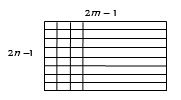
A
$(m + n + 1)^2$
B
$mn(m + 1)(n + 1)$
C
$4^{m + n - 2}$
D
$m^2n^2$
Solution
(D) rectangle is formed by choosing two horizontal lines and two vertical lines.
Let the horizontal lines be $y_0, y_1, \dots, y_{2n-1}$ and vertical lines be $x_0, x_1, \dots, x_{2m-1}$.
$A$ rectangle has odd side lengths if the difference between the indices of the chosen lines is odd.
For the horizontal side,we need to choose two lines $y_i, y_j$ such that $|i - j|$ is odd. This means one index must be even and the other must be odd.
In the set ${0, 1, \dots, 2n-1}$,there are $n$ even numbers ${0, 2, \dots, 2n-2}$ and $n$ odd numbers ${1, 3, \dots, 2n-1}$.
The number of ways to choose one even and one odd index is $n \times n = n^2$.
Similarly,for the vertical side,the number of ways to choose two lines such that the difference is odd is $m \times m = m^2$.
Therefore,the total number of rectangles with odd side lengths is $m^2 \times n^2 = m^2n^2$.
Let the horizontal lines be $y_0, y_1, \dots, y_{2n-1}$ and vertical lines be $x_0, x_1, \dots, x_{2m-1}$.
$A$ rectangle has odd side lengths if the difference between the indices of the chosen lines is odd.
For the horizontal side,we need to choose two lines $y_i, y_j$ such that $|i - j|$ is odd. This means one index must be even and the other must be odd.
In the set ${0, 1, \dots, 2n-1}$,there are $n$ even numbers ${0, 2, \dots, 2n-2}$ and $n$ odd numbers ${1, 3, \dots, 2n-1}$.
The number of ways to choose one even and one odd index is $n \times n = n^2$.
Similarly,for the vertical side,the number of ways to choose two lines such that the difference is odd is $m \times m = m^2$.
Therefore,the total number of rectangles with odd side lengths is $m^2 \times n^2 = m^2n^2$.
0 likes
View Solution32
MediumMCQ
$m$ men and $n$ women are to be seated in a row so that no two women sit together. If $m > n$,then the number of ways in which they can be seated is
A
$\frac{m! (m + 1)!}{(m - n + 1)!}$
B
$\frac{m! (m - 1)!}{(m - n + 1)!}$
C
$\frac{(m - 1)! (m + 1)!}{(m - n + 1)!}$
D
None of these
Solution
(A) First,arrange $m$ men in a row in $m!$ ways.
Since $n < m$ and no two women can sit together,we consider the gaps between the men.
In any one of the $m!$ arrangements,there are $(m + 1)$ available spaces (including the ends) where $n$ women can be placed.
The number of ways to arrange $n$ women in these $(m + 1)$ spaces is given by $^{m+1}P_n$.
Therefore,by the fundamental principle of counting,the total number of arrangements is $m! \times {}^{m+1}P_n$.
$= m! \times \frac{(m + 1)!}{(m + 1 - n)!} = \frac{m! (m + 1)!}{(m - n + 1)!}$.
Since $n < m$ and no two women can sit together,we consider the gaps between the men.
In any one of the $m!$ arrangements,there are $(m + 1)$ available spaces (including the ends) where $n$ women can be placed.
The number of ways to arrange $n$ women in these $(m + 1)$ spaces is given by $^{m+1}P_n$.
Therefore,by the fundamental principle of counting,the total number of arrangements is $m! \times {}^{m+1}P_n$.
$= m! \times \frac{(m + 1)!}{(m + 1 - n)!} = \frac{m! (m + 1)!}{(m - n + 1)!}$.
0 likes
View Solution33
MediumMCQ
There were two women participating in a chess tournament. Every participant played two games with every other participant. The number of games that the men played between themselves exceeded the number of games that the men played with the women by $66$. The total number of participants is
A
$6$
B
$11$
C
$13$
D
None of these
Solution
(C) Let the number of men be $n$. The total number of participants is $n + 2$.
Each participant plays $2$ games with every other participant.
The number of games played between men is $2 \times {^nC_2} = 2 \times \frac{n(n-1)}{2} = n(n-1) = n^2 - n$.
The number of games played between men and women is $2 \times (n \times 2) = 4n$.
According to the problem,the number of games between men exceeds the number of games between men and women by $66$:
$n^2 - n - 4n = 66$
$n^2 - 5n - 66 = 0$
$(n - 11)(n + 6) = 0$
Since $n$ must be positive,$n = 11$.
The total number of participants is $n + 2 = 11 + 2 = 13$.
Each participant plays $2$ games with every other participant.
The number of games played between men is $2 \times {^nC_2} = 2 \times \frac{n(n-1)}{2} = n(n-1) = n^2 - n$.
The number of games played between men and women is $2 \times (n \times 2) = 4n$.
According to the problem,the number of games between men exceeds the number of games between men and women by $66$:
$n^2 - n - 4n = 66$
$n^2 - 5n - 66 = 0$
$(n - 11)(n + 6) = 0$
Since $n$ must be positive,$n = 11$.
The total number of participants is $n + 2 = 11 + 2 = 13$.
0 likes
View Solution34
EasyMCQ
There are $3$ girls in a class of $10$ students. The number of different ways in which they can be seated in a row such that no two of the three girls are together is
A
$7! \times ^6P_3$
B
$7! \times ^8P_3$
C
$7! \times 3!$
D
$\frac{10!}{3!7!}$
Solution
(B) There are $10$ students in total,including $3$ girls and $7$ boys.
To ensure no two girls are seated together,we first arrange the $7$ boys in a row,which can be done in $7!$ ways.
This creates $8$ possible gaps (including the ends) where the $3$ girls can be seated: $\_ B_1 \_ B_2 \_ B_3 \_ B_4 \_ B_5 \_ B_6 \_ B_7 \_$.
The number of ways to choose $3$ gaps out of $8$ and arrange the $3$ girls in them is given by $^8P_3$.
Therefore,the total number of arrangements is $7! \times ^8P_3$.
To ensure no two girls are seated together,we first arrange the $7$ boys in a row,which can be done in $7!$ ways.
This creates $8$ possible gaps (including the ends) where the $3$ girls can be seated: $\_ B_1 \_ B_2 \_ B_3 \_ B_4 \_ B_5 \_ B_6 \_ B_7 \_$.
The number of ways to choose $3$ gaps out of $8$ and arrange the $3$ girls in them is given by $^8P_3$.
Therefore,the total number of arrangements is $7! \times ^8P_3$.
0 likes
View Solution35
DifficultMCQ
Three of the six vertices of a regular hexagon are chosen at random. The probability that the triangle formed by these three vertices is equilateral is equal to
A
$1/2$
B
$1/5$
C
$1/10$
D
$1/20$
Solution
(C) The total number of ways to choose $3$ vertices out of $6$ is given by the combination formula ${}^6C_3 = \frac{6 \times 5 \times 4}{1 \times 2 \times 3} = 20$.
In a regular hexagon,there are exactly $2$ equilateral triangles that can be formed by connecting the vertices. These are formed by taking alternating vertices (e.g.,vertices $1, 3, 5$ and $2, 4, 6$).
Therefore,the required probability is $\frac{\text{Number of equilateral triangles}}{\text{Total number of triangles}} = \frac{2}{20} = \frac{1}{10}$.
In a regular hexagon,there are exactly $2$ equilateral triangles that can be formed by connecting the vertices. These are formed by taking alternating vertices (e.g.,vertices $1, 3, 5$ and $2, 4, 6$).
Therefore,the required probability is $\frac{\text{Number of equilateral triangles}}{\text{Total number of triangles}} = \frac{2}{20} = \frac{1}{10}$.
0 likes
View Solution36
MediumMCQ
Six boys and six girls sit in a row randomly. What is the probability that the six girls sit together?
A
$\frac{1}{77}$
B
$\frac{1}{132}$
C
$\frac{1}{231}$
D
None of these
Solution
(B) Total number of ways to arrange $6$ boys and $6$ girls in a row is $12!$.
To find the number of arrangements where all $6$ girls sit together,we treat the $6$ girls as a single unit. This unit along with the $6$ boys gives us $7$ entities,which can be arranged in $7!$ ways.
The $6$ girls within their unit can be arranged among themselves in $6!$ ways.
So,the number of favorable arrangements is $7! \times 6!$.
The required probability is $\frac{7! \times 6!}{12!} = \frac{7! \times 720}{12 \times 11 \times 10 \times 9 \times 8 \times 7!} = \frac{720}{95040} = \frac{1}{132}$.
To find the number of arrangements where all $6$ girls sit together,we treat the $6$ girls as a single unit. This unit along with the $6$ boys gives us $7$ entities,which can be arranged in $7!$ ways.
The $6$ girls within their unit can be arranged among themselves in $6!$ ways.
So,the number of favorable arrangements is $7! \times 6!$.
The required probability is $\frac{7! \times 6!}{12!} = \frac{7! \times 720}{12 \times 11 \times 10 \times 9 \times 8 \times 7!} = \frac{720}{95040} = \frac{1}{132}$.
0 likes
View Solution37
MediumMCQ
Seven white balls and three black balls are randomly placed in a row. The probability that no two black balls are placed adjacently equals
A
$\frac{1}{2}$
B
$\frac{7}{15}$
C
$\frac{2}{15}$
D
$\frac{1}{3}$
Solution
(B) The total number of ways to arrange $7$ white balls and $3$ black balls in a row is given by the combination formula $\binom{10}{3} = \frac{10!}{7!3!} = \frac{10 \times 9 \times 8}{3 \times 2 \times 1} = 120$.
To ensure no two black balls are adjacent,we first arrange the $7$ white balls in a row. This creates $8$ possible spaces (gaps) where the $3$ black balls can be placed (one before the first ball,one after the last ball,and $6$ between the balls).
The number of ways to choose $3$ spaces out of $8$ is $\binom{8}{3} = \frac{8 \times 7 \times 6}{3 \times 2 \times 1} = 56$.
Therefore,the required probability is $\frac{56}{120} = \frac{7}{15}$.
To ensure no two black balls are adjacent,we first arrange the $7$ white balls in a row. This creates $8$ possible spaces (gaps) where the $3$ black balls can be placed (one before the first ball,one after the last ball,and $6$ between the balls).
The number of ways to choose $3$ spaces out of $8$ is $\binom{8}{3} = \frac{8 \times 7 \times 6}{3 \times 2 \times 1} = 56$.
Therefore,the required probability is $\frac{56}{120} = \frac{7}{15}$.
0 likes
View Solution38
MediumMCQ
$l_1, l_2, l_3$ are three parallel lines in the same plane. If there are $m$ points on $l_1$,$n$ points on $l_2$,and $k$ points on $l_3$,what is the maximum number of triangles that can be formed with vertices at these points?
A
$^{m+n+k}C_3$
B
$^{m+n+k}C_3 - ^mC_3 - ^nC_3 - ^kC_3$
C
$^mC_3 + ^nC_3 + ^kC_3$
D
None of these
Solution
(B) The total number of points is $m + n + k$.
Total ways to select $3$ points from these is $^{m+n+k}C_3$.
However,points lying on the same line cannot form a triangle.
Number of triangles formed by $3$ points on line $l_1$ is $^mC_3$.
Number of triangles formed by $3$ points on line $l_2$ is $^nC_3$.
Number of triangles formed by $3$ points on line $l_3$ is $^kC_3$.
Therefore,the number of triangles that can be formed is $^{m+n+k}C_3 - ^mC_3 - ^nC_3 - ^kC_3$.
Total ways to select $3$ points from these is $^{m+n+k}C_3$.
However,points lying on the same line cannot form a triangle.
Number of triangles formed by $3$ points on line $l_1$ is $^mC_3$.
Number of triangles formed by $3$ points on line $l_2$ is $^nC_3$.
Number of triangles formed by $3$ points on line $l_3$ is $^kC_3$.
Therefore,the number of triangles that can be formed is $^{m+n+k}C_3 - ^mC_3 - ^nC_3 - ^kC_3$.
0 likes
View Solution39
EasyMCQ
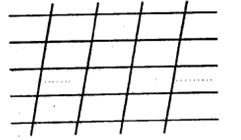
If $5$ parallel lines are intersected by $4$ parallel lines,then what is the number of parallelograms formed?
A
$20$
B
$60$
C
$101$
D
$126$
Solution
(B) To form a parallelogram,we need to select $2$ lines from the set of $5$ parallel lines and $2$ lines from the set of $4$ parallel lines.
The number of ways to select $2$ lines from $5$ is given by $^5C_2 = \frac{5 \times 4}{2 \times 1} = 10$.
The number of ways to select $2$ lines from $4$ is given by $^4C_2 = \frac{4 \times 3}{2 \times 1} = 6$.
Therefore,the total number of parallelograms formed is $^5C_2 \times ^4C_2 = 10 \times 6 = 60$.
The number of ways to select $2$ lines from $5$ is given by $^5C_2 = \frac{5 \times 4}{2 \times 1} = 10$.
The number of ways to select $2$ lines from $4$ is given by $^4C_2 = \frac{4 \times 3}{2 \times 1} = 6$.
Therefore,the total number of parallelograms formed is $^5C_2 \times ^4C_2 = 10 \times 6 = 60$.
0 likes
View Solution40
EasyMCQ
The number of diagonals in a convex polygon with $n$ sides is .....
A
$\frac{1}{2}n(n - 1)$
B
$\frac{1}{2}n(n - 2)$
C
$\frac{1}{2}n(n - 3)$
D
$\frac{1}{2}n(n - 4)$
Solution
(C) The number of ways to choose $2$ vertices from $n$ vertices is given by $\binom{n}{2}$.
This includes the $n$ sides of the polygon.
To find the number of diagonals,we subtract the number of sides from the total number of lines formed by connecting any two vertices:
$\text{Number of diagonals} = \binom{n}{2} - n$
$= \frac{n(n - 1)}{2} - n$
$= \frac{n^2 - n - 2n}{2}$
$= \frac{n^2 - 3n}{2}$
$= \frac{1}{2}n(n - 3)$
This includes the $n$ sides of the polygon.
To find the number of diagonals,we subtract the number of sides from the total number of lines formed by connecting any two vertices:
$\text{Number of diagonals} = \binom{n}{2} - n$
$= \frac{n(n - 1)}{2} - n$
$= \frac{n^2 - n - 2n}{2}$
$= \frac{n^2 - 3n}{2}$
$= \frac{1}{2}n(n - 3)$
0 likes
View Solution41
EasyMCQ
There are $10$ points in a plane,out of which $4$ are collinear. How many straight lines can be formed by joining any two of these points?
A
$45$
B
$40$
C
$39$
D
$38$
Solution
(B) straight line is formed by joining any two points. Therefore,the total number of lines that can be formed by joining $10$ points is $^{10}C_2$.
However,$4$ of these points are collinear. Joining any two of these $4$ points results in the same line.
The number of lines formed by $4$ collinear points is $^{4}C_2$,which counts as only $1$ line instead of $6$.
Therefore,the total number of distinct lines = $^{10}C_2 - ^{4}C_2 + 1$.
Calculation: $\frac{10 \times 9}{2} - \frac{4 \times 3}{2} + 1 = 45 - 6 + 1 = 40$.
However,$4$ of these points are collinear. Joining any two of these $4$ points results in the same line.
The number of lines formed by $4$ collinear points is $^{4}C_2$,which counts as only $1$ line instead of $6$.
Therefore,the total number of distinct lines = $^{10}C_2 - ^{4}C_2 + 1$.
Calculation: $\frac{10 \times 9}{2} - \frac{4 \times 3}{2} + 1 = 45 - 6 + 1 = 40$.
0 likes
View Solution42
DifficultMCQ
The number of triangles $(T_n)$ that can be formed using the vertices of a polygon with $n$ sides is given by $T_n = \binom{n}{3}$. If $T_{n+1} - T_n = 21$,then what is the value of $n$?
A
$5$
B
$7$
C
$6$
D
$4$
Solution
(B) Given that $T_n = \binom{n}{3}$.
We are given $T_{n+1} - T_n = 21$.
Using the property $\binom{n+1}{r} = \binom{n}{r} + \binom{n}{r-1}$,we have:
$T_{n+1} = \binom{n+1}{3} = \binom{n}{3} + \binom{n}{2}$.
Substituting this into the equation:
$(\binom{n}{3} + \binom{n}{2}) - \binom{n}{3} = 21$.
$\binom{n}{2} = 21$.
$\frac{n(n-1)}{2} = 21$.
$n(n-1) = 42$.
$n(n-1) = 7 \times 6$.
Thus,$n = 7$.
We are given $T_{n+1} - T_n = 21$.
Using the property $\binom{n+1}{r} = \binom{n}{r} + \binom{n}{r-1}$,we have:
$T_{n+1} = \binom{n+1}{3} = \binom{n}{3} + \binom{n}{2}$.
Substituting this into the equation:
$(\binom{n}{3} + \binom{n}{2}) - \binom{n}{3} = 21$.
$\binom{n}{2} = 21$.
$\frac{n(n-1)}{2} = 21$.
$n(n-1) = 42$.
$n(n-1) = 7 \times 6$.
Thus,$n = 7$.
0 likes
View Solution43
DifficultMCQ
How many necklaces can be formed by selecting $4$ beads from $6$ different colored glass beads and $4$ beads from $5$ different colored metal beads?
A
$^6P_4 \times ^5P_4 \times \frac{7!}{2!}$
B
$^6C_4 \times ^5C_4 \times \frac{7!}{2!}$
C
$^6C_4 \times ^5C_4 \times \frac{8!}{2!}$
D
$^6C_4 \times ^5C_4 \times 7!$
Solution
(B) Step $1$: Select $4$ glass beads from $6$ available: $^6C_4 = 15$ ways.
Step $2$: Select $4$ metal beads from $5$ available: $^5C_4 = 5$ ways.
Step $3$: Total beads selected = $4 + 4 = 8$ beads.
Step $4$: The number of ways to arrange $n$ distinct beads in a necklace is $\frac{(n-1)!}{2}$.
Step $5$: For $8$ beads,the number of arrangements is $\frac{(8-1)!}{2} = \frac{7!}{2!}$.
Step $6$: Total number of necklaces = $^6C_4 \times ^5C_4 \times \frac{7!}{2!}$.
Step $2$: Select $4$ metal beads from $5$ available: $^5C_4 = 5$ ways.
Step $3$: Total beads selected = $4 + 4 = 8$ beads.
Step $4$: The number of ways to arrange $n$ distinct beads in a necklace is $\frac{(n-1)!}{2}$.
Step $5$: For $8$ beads,the number of arrangements is $\frac{(8-1)!}{2} = \frac{7!}{2!}$.
Step $6$: Total number of necklaces = $^6C_4 \times ^5C_4 \times \frac{7!}{2!}$.
0 likes
View Solution44
EasyMCQ
What is the number of diagonals in an octagon?
A
$28$
B
$20$
C
$10$
D
$16$
Solution
(B) An octagon has $8$ vertices.
The total number of line segments formed by joining any two vertices is given by $^nC_2$,where $n = 8$.
Total line segments $= ^8C_2 = \frac{8 \times 7}{2} = 28$.
Out of these $28$ line segments,$8$ are the sides of the octagon.
The number of diagonals is the total number of line segments minus the number of sides.
Number of diagonals $= 28 - 8 = 20$.
The total number of line segments formed by joining any two vertices is given by $^nC_2$,where $n = 8$.
Total line segments $= ^8C_2 = \frac{8 \times 7}{2} = 28$.
Out of these $28$ line segments,$8$ are the sides of the octagon.
The number of diagonals is the total number of line segments minus the number of sides.
Number of diagonals $= 28 - 8 = 20$.
0 likes
View Solution45
DifficultMCQ
How many triangles $(T_n)$ can be formed by joining the vertices of a regular polygon with $n$ sides? If $T_{(n+1)} - T_n = 10$,what is the value of $n$?
A
$7$
B
$5$
C
$10$
D
$8$
Solution
(B) The number of triangles that can be formed by joining the vertices of a regular polygon with $n$ sides is given by the combination formula $T_n = \binom{n}{3} = \frac{n(n-1)(n-2)}{6}$.
Given the condition $T_{(n+1)} - T_n = 10$,we substitute the formula:
$\binom{n+1}{3} - \binom{n}{3} = 10$.
Using the identity $\binom{n+1}{k} - \binom{n}{k} = \binom{n}{k-1}$,we get:
$\binom{n}{2} = 10$.
$\frac{n(n-1)}{2} = 10$.
$n(n-1) = 20$.
$n^2 - n - 20 = 0$.
$(n-5)(n+4) = 0$.
Since $n$ must be a positive integer,$n = 5$.
Given the condition $T_{(n+1)} - T_n = 10$,we substitute the formula:
$\binom{n+1}{3} - \binom{n}{3} = 10$.
Using the identity $\binom{n+1}{k} - \binom{n}{k} = \binom{n}{k-1}$,we get:
$\binom{n}{2} = 10$.
$\frac{n(n-1)}{2} = 10$.
$n(n-1) = 20$.
$n^2 - n - 20 = 0$.
$(n-5)(n+4) = 0$.
Since $n$ must be a positive integer,$n = 5$.
0 likes
View Solution46
DifficultMCQ
The lengths of $6$ line segments are $2, 3, 4, 5, 6, 7$ units respectively. The number of triangles that can be formed using these line segments is ......
A
$\binom{6}{3} - 7$
B
$\binom{6}{3} - 6$
C
$\binom{6}{3} - 5$
D
$\binom{6}{3} - 4$
Solution
(A) For a triangle to be formed,the sum of the lengths of any two sides must be strictly greater than the length of the third side.
The total number of ways to select $3$ segments out of $6$ is $\binom{6}{3} = \frac{6 \times 5 \times 4}{3 \times 2 \times 1} = 20$.
We must subtract the combinations that do not satisfy the triangle inequality $(a + b \leq c)$:
$(2, 3, 5), (2, 3, 6), (2, 3, 7), (2, 4, 6), (2, 4, 7), (2, 5, 7), (3, 4, 7)$.
There are $7$ such combinations that cannot form a triangle.
Therefore,the number of triangles that can be formed is $\binom{6}{3} - 7$.
The total number of ways to select $3$ segments out of $6$ is $\binom{6}{3} = \frac{6 \times 5 \times 4}{3 \times 2 \times 1} = 20$.
We must subtract the combinations that do not satisfy the triangle inequality $(a + b \leq c)$:
$(2, 3, 5), (2, 3, 6), (2, 3, 7), (2, 4, 6), (2, 4, 7), (2, 5, 7), (3, 4, 7)$.
There are $7$ such combinations that cannot form a triangle.
Therefore,the number of triangles that can be formed is $\binom{6}{3} - 7$.
0 likes
View Solution47
MediumMCQ
Out of $20$ points,no three points are collinear except for $4$ points which are collinear. How many lines can be drawn by joining these points?
A
$183$
B
$186$
C
$197$
D
$185$
Solution
(D) To form a line,we need $2$ points. The total number of ways to select $2$ points from $20$ is given by $\binom{20}{2}$.
Since $4$ points are collinear,the number of lines formed by these $4$ points is only $1$ instead of $\binom{4}{2}$.
The formula for the number of lines is $\binom{n}{2} - \binom{m}{2} + 1$,where $n$ is the total number of points and $m$ is the number of collinear points.
Here,$n = 20$ and $m = 4$.
Number of lines $= \binom{20}{2} - \binom{4}{2} + 1$
$= \frac{20 \times 19}{2} - \frac{4 \times 3}{2} + 1$
$= 190 - 6 + 1 = 185$.
Since $4$ points are collinear,the number of lines formed by these $4$ points is only $1$ instead of $\binom{4}{2}$.
The formula for the number of lines is $\binom{n}{2} - \binom{m}{2} + 1$,where $n$ is the total number of points and $m$ is the number of collinear points.
Here,$n = 20$ and $m = 4$.
Number of lines $= \binom{20}{2} - \binom{4}{2} + 1$
$= \frac{20 \times 19}{2} - \frac{4 \times 3}{2} + 1$
$= 190 - 6 + 1 = 185$.
0 likes
View Solution48
MediumMCQ
Two lines $l_1$ and $l_2$ intersect at a point $P$. If $A_1, B_1, C_1$ are points on $l_1$ and $A_2, B_2, C_2, D_2, E_2$ are points on $l_2$,and none of these points coincide with $P$,how many triangles can be formed using these $8$ points?
A
$56$
B
$55$
C
$46$
D
$45$
Solution
(D) triangle is formed by selecting $3$ non-collinear points.
Total points on $l_1$ (excluding $P$) $= 3$.
Total points on $l_2$ (excluding $P$) $= 5$.
Total points $= 3 + 5 = 8$.
To form a triangle,we can select:
$1$. $2$ points from $l_1$ and $1$ point from $l_2$: $\binom{3}{2} \times \binom{5}{1} = 3 \times 5 = 15$.
$2$. $1$ point from $l_1$ and $2$ points from $l_2$: $\binom{3}{1} \times \binom{5}{2} = 3 \times 10 = 30$.
Total triangles $= 15 + 30 = 45$.
Total points on $l_1$ (excluding $P$) $= 3$.
Total points on $l_2$ (excluding $P$) $= 5$.
Total points $= 3 + 5 = 8$.
To form a triangle,we can select:
$1$. $2$ points from $l_1$ and $1$ point from $l_2$: $\binom{3}{2} \times \binom{5}{1} = 3 \times 5 = 15$.
$2$. $1$ point from $l_1$ and $2$ points from $l_2$: $\binom{3}{1} \times \binom{5}{2} = 3 \times 10 = 30$.
Total triangles $= 15 + 30 = 45$.
0 likes
View SolutionPermutation and Combination — Geometrical problems · Frequently Asked Questions
1Are these Permutation and Combination questions useful for JEE and NEET?
Yes. All questions in this section are mapped to JEE Main and NEET exam patterns. Previous year questions from JEE Main, NEET, GUJCET and state-level exams are included with full solutions.
2Can I switch to Hindi or Gujarati for these questions?
Yes. Use the language tabs in the hero section or the sidebar to view the same questions and solutions in English, Hindi or Gujarati.
3How do I generate a question paper from this subtopic?
Use the Vedclass Exam Paper Generator — select the chapter and subtopic, set difficulty, and generate Sets A, B, C, D automatically. First 3 chapters of every subject are free.
Vedclass Products
For Students
Vedclass Test Series
Mock tests in real JEE/NEET style with performance analysis. 5-day free trial.
Start Free TrialFor Teachers
Exam Paper Generator
Generate Set A/B/C/D papers from this chapter in 2 minutes. 3 chapters free.
Try FreeFor Institutes
Online Exam Module
Live online exams with unlimited students, 360° analytics & white-label branding.
See DemoFor Teachers & Institutes
Generate a Permutation and Combination Exam Paper in 2 Minutes
Select subtopic & difficulty — Sets A, B, C, D auto-generated with No Repeat logic.
First 3 chapters of every subject are free — no payment required.