
A English
Definition of permutation, Number of permutations with or without repetition, Conditional permutations Questions in English
Class 11 Mathematics · Permutation and Combination · Definition of permutation, Number of permutations with or without repetition, Conditional permutations
454+
Questions
English
Language
100%
With Solutions
Showing 44 of 454 questions in English
351
MediumMCQ
The total number of permutations of $n (> 1)$ different things taken not more than $r$ at a time,when each thing may be repeated any number of times is
A
$\frac{n(n^n-1)}{n-1}$
B
$\frac{n^r-1}{n-1}$
C
$\frac{n(n^r-1)}{n-1}$
D
None of these
Solution
(C) When we arrange $1$ thing at a time,the number of possible permutations is $n$.
When we arrange them $2$ at a time,the number of possible permutations is $n \times n = n^2$.
Continuing this process up to $r$ at a time,the number of permutations for $k$ things is $n^k$.
Thus,the total number of permutations taken not more than $r$ at a time is the sum of a geometric progression:
$n + n^2 + \ldots + n^r = \frac{n(n^r - 1)}{n - 1}$ (where $n > 1$).
When we arrange them $2$ at a time,the number of possible permutations is $n \times n = n^2$.
Continuing this process up to $r$ at a time,the number of permutations for $k$ things is $n^k$.
Thus,the total number of permutations taken not more than $r$ at a time is the sum of a geometric progression:
$n + n^2 + \ldots + n^r = \frac{n(n^r - 1)}{n - 1}$ (where $n > 1$).
0 likes
View Solution352
EasyMCQ
If ${}^n P_r = {}^{(n-1)} P_r + x \cdot {}^{(n-1)} P_{(r-1)}$,$\forall n, r \in N$ and $r \leq n$,then $x =$
A
$n+1$
B
$r+1$
C
$n$
D
$r$
Solution
(D) We know that ${}^n P_r = \frac{n!}{(n-r)!}$.
Consider the expression ${}^n P_r - {}^{n-1} P_r = \frac{n!}{(n-r)!} - \frac{(n-1)!}{(n-r-1)!}$.
$= \frac{(n-1)!}{(n-r-1)!} \left( \frac{n}{n-r} - 1 \right) = \frac{(n-1)!}{(n-r-1)!} \left( \frac{n - (n-r)}{n-r} \right)$.
$= \frac{(n-1)!}{(n-r-1)!} \cdot \frac{r}{n-r} = \frac{r \cdot (n-1)!}{(n-r)!}$.
$= r \cdot \frac{(n-1)!}{((n-1) - (r-1))!} = r \cdot {}^{n-1} P_{r-1}$.
Thus,${}^n P_r = {}^{n-1} P_r + r \cdot {}^{n-1} P_{r-1}$.
Comparing this with the given equation ${}^n P_r = {}^{n-1} P_r + x \cdot {}^{n-1} P_{r-1}$,we get $x = r$.
Consider the expression ${}^n P_r - {}^{n-1} P_r = \frac{n!}{(n-r)!} - \frac{(n-1)!}{(n-r-1)!}$.
$= \frac{(n-1)!}{(n-r-1)!} \left( \frac{n}{n-r} - 1 \right) = \frac{(n-1)!}{(n-r-1)!} \left( \frac{n - (n-r)}{n-r} \right)$.
$= \frac{(n-1)!}{(n-r-1)!} \cdot \frac{r}{n-r} = \frac{r \cdot (n-1)!}{(n-r)!}$.
$= r \cdot \frac{(n-1)!}{((n-1) - (r-1))!} = r \cdot {}^{n-1} P_{r-1}$.
Thus,${}^n P_r = {}^{n-1} P_r + r \cdot {}^{n-1} P_{r-1}$.
Comparing this with the given equation ${}^n P_r = {}^{n-1} P_r + x \cdot {}^{n-1} P_{r-1}$,we get $x = r$.
0 likes
View Solution353
MediumMCQ
For $1 \leq r \leq n$,the value of $\frac{1}{r+1}\left\{{ }^n P_{r+1}-{ }^{(n-1)} P_{r+1}\right\}$ is equal to
A
${ }^n P_n$
B
${ }^{n-1} P_r$
C
${ }^n P_{n+1}$
D
$0$
Solution
(B) Given expression: $\frac{1}{r+1}\left\{{ }^n P_{r+1}-{ }^{(n-1)} P_{r+1}\right\}$
Using the formula ${ }^n P_r = \frac{n!}{(n-r)!}$,we have:
$= \frac{1}{r+1} \left[ \frac{n!}{(n-(r+1))!} - \frac{(n-1)!}{(n-1-(r+1))!} \right]$
$= \frac{1}{r+1} \left[ \frac{n!}{(n-r-1)!} - \frac{(n-1)!}{(n-r-2)!} \right]$
$= \frac{1}{r+1} \left[ \frac{n(n-1)!}{(n-r-1)!} - \frac{(n-1)!(n-r-1)}{(n-r-1)!} \right]$
$= \frac{(n-1)!}{(r+1)(n-r-1)!} [n - (n-r-1)]$
$= \frac{(n-1)!}{(r+1)(n-r-1)!} [r+1]$
$= \frac{(n-1)!}{(n-r-1)!} = { }^{n-1} P_r$
Using the formula ${ }^n P_r = \frac{n!}{(n-r)!}$,we have:
$= \frac{1}{r+1} \left[ \frac{n!}{(n-(r+1))!} - \frac{(n-1)!}{(n-1-(r+1))!} \right]$
$= \frac{1}{r+1} \left[ \frac{n!}{(n-r-1)!} - \frac{(n-1)!}{(n-r-2)!} \right]$
$= \frac{1}{r+1} \left[ \frac{n(n-1)!}{(n-r-1)!} - \frac{(n-1)!(n-r-1)}{(n-r-1)!} \right]$
$= \frac{(n-1)!}{(r+1)(n-r-1)!} [n - (n-r-1)]$
$= \frac{(n-1)!}{(r+1)(n-r-1)!} [r+1]$
$= \frac{(n-1)!}{(n-r-1)!} = { }^{n-1} P_r$
0 likes
View Solution354
MediumMCQ
The value of ${}^7P_3 - 3({}^6P_2)$ is equal to
A
${}^7P_2$
B
$60$
C
${}^6P_3$
D
$240$
Solution
(C) We have,
${}^7P_3 - 3({}^6P_2)$
$= \frac{7!}{(7-3)!} - 3 \times \frac{6!}{(6-2)!}$
$= \frac{7!}{4!} - 3 \times \frac{6!}{4!}$
$= \frac{7 \times 6!}{4!} - \frac{3 \times 6!}{4!}$
$= \frac{6!}{4!} (7 - 3)$
$= \frac{6!}{4!} \times 4$
$= \frac{6 \times 5 \times 4!}{4!} \times 4$
$= 30 \times 4 = 120$
Alternatively,using the definition of permutation:
${}^6P_3 = \frac{6!}{(6-3)!} = \frac{6!}{3!} = 6 \times 5 \times 4 = 120$
Thus,the value is equal to ${}^6P_3$.
${}^7P_3 - 3({}^6P_2)$
$= \frac{7!}{(7-3)!} - 3 \times \frac{6!}{(6-2)!}$
$= \frac{7!}{4!} - 3 \times \frac{6!}{4!}$
$= \frac{7 \times 6!}{4!} - \frac{3 \times 6!}{4!}$
$= \frac{6!}{4!} (7 - 3)$
$= \frac{6!}{4!} \times 4$
$= \frac{6 \times 5 \times 4!}{4!} \times 4$
$= 30 \times 4 = 120$
Alternatively,using the definition of permutation:
${}^6P_3 = \frac{6!}{(6-3)!} = \frac{6!}{3!} = 6 \times 5 \times 4 = 120$
Thus,the value is equal to ${}^6P_3$.
0 likes
View Solution355
EasyMCQ
The letters of the word '$GOVIND$' are permuted and arranged as in a dictionary. The number of words that appear after the word '$GOVIND$' is . . . . . .
A
$519$
B
$510$
C
$506$
D
$511$
Solution
(C) The letters in '$GOVIND$' are $D, G, I, N, O, V$. Total letters = $6$. All letters are distinct.
Total number of words = $6! = 720$.
To find the rank of '$GOVIND$',we arrange the letters in alphabetical order: $D, G, I, N, O, V$.
$1$. Words starting with $D$: $5! = 120$.
$2$. Words starting with $G$:
- $GD...$: $4! = 24$.
- $GI...$: $4! = 24$.
- $GN...$: $4! = 24$.
- $GO...$: Next letter is $D$ (alphabetical order).
- $GOD...$: $3! = 6$.
- $GOI...$: $3! = 6$.
- $GON...$: $3! = 6$.
- $GOV...$: Next letter is $D$ (alphabetical order).
- $GOVD...$: $2! = 2$.
- $GOVI...$: Next letter is $D$ (alphabetical order).
- $GOVIDN$: $1$.
- $GOVIND$: $1$.
Rank of '$GOVIND$' = $120 + (24 \times 3) + (6 \times 3) + 2 + 1 + 1 = 120 + 72 + 18 + 4 = 214$.
Number of words after '$GOVIND$' = $720 - 214 = 506$.
Total number of words = $6! = 720$.
To find the rank of '$GOVIND$',we arrange the letters in alphabetical order: $D, G, I, N, O, V$.
$1$. Words starting with $D$: $5! = 120$.
$2$. Words starting with $G$:
- $GD...$: $4! = 24$.
- $GI...$: $4! = 24$.
- $GN...$: $4! = 24$.
- $GO...$: Next letter is $D$ (alphabetical order).
- $GOD...$: $3! = 6$.
- $GOI...$: $3! = 6$.
- $GON...$: $3! = 6$.
- $GOV...$: Next letter is $D$ (alphabetical order).
- $GOVD...$: $2! = 2$.
- $GOVI...$: Next letter is $D$ (alphabetical order).
- $GOVIDN$: $1$.
- $GOVIND$: $1$.
Rank of '$GOVIND$' = $120 + (24 \times 3) + (6 \times 3) + 2 + 1 + 1 = 120 + 72 + 18 + 4 = 214$.
Number of words after '$GOVIND$' = $720 - 214 = 506$.
0 likes
View Solution356
EasyMCQ
If all the letters of the word $REPEAT$ are permuted in all possible ways and if the six-letter permutations thus formed are arranged in the dictionary order,then the rank of the word $REPEAT$ is:
A
$133$
B
$267$
C
$266$
D
$132$
Solution
(B) The letters of the word $REPEAT$ are $\{A, E, E, P, R, T\}$.
Arranging these letters in alphabetical order,we get: $A, E, E, P, R, T$.
$1$. Words starting with $A$: $\frac{5!}{2!} = 60$.
$2$. Words starting with $E$: $5! = 120$.
$3$. Words starting with $P$: $\frac{5!}{2!} = 60$.
$4$. Words starting with $RA$: $\frac{4!}{2!} = 12$.
$5$. Words starting with $REA$: $3! = 6$.
$6$. Words starting with $REE$: $3! = 6$.
$7$. Words starting with $REPA$: $2! = 2$.
$8$. The next word is $REPEAT$: $1$.
Summing these up: $60 + 120 + 60 + 12 + 6 + 6 + 2 + 1 = 267$.
Thus,the rank of the word $REPEAT$ is $267$.
Arranging these letters in alphabetical order,we get: $A, E, E, P, R, T$.
$1$. Words starting with $A$: $\frac{5!}{2!} = 60$.
$2$. Words starting with $E$: $5! = 120$.
$3$. Words starting with $P$: $\frac{5!}{2!} = 60$.
$4$. Words starting with $RA$: $\frac{4!}{2!} = 12$.
$5$. Words starting with $REA$: $3! = 6$.
$6$. Words starting with $REE$: $3! = 6$.
$7$. Words starting with $REPA$: $2! = 2$.
$8$. The next word is $REPEAT$: $1$.
Summing these up: $60 + 120 + 60 + 12 + 6 + 6 + 2 + 1 = 267$.
Thus,the rank of the word $REPEAT$ is $267$.
0 likes
View Solution357
EasyMCQ
The number of $5$-letter words that can be formed by using the letters of the word $SARANAM$ is
A
$1120$
B
$6720$
C
$480$
D
$720$
Solution
(C) The word $SARANAM$ contains $7$ letters: $A, A, A, S, R, N, M$. The distinct letters are $\{A, S, R, N, M\}$.
We need to form $5$-letter words. The possible cases are:
$(i)$ All $5$ letters are different (using $S, A, R, N, M$):
Number of words $= 5! = 120$.
(ii) $2$ letters are alike (specifically $A$) and $3$ are different:
We choose $3$ letters from the remaining $4$ distinct letters $\{S, R, N, M\}$ in $^4C_3$ ways. The number of arrangements is $\frac{5!}{2!} = 60$.
Total words $= ^4C_3 \times 60 = 4 \times 60 = 240$.
(iii) $3$ letters are alike (specifically $A$) and $2$ are different:
We choose $2$ letters from the remaining $4$ distinct letters $\{S, R, N, M\}$ in $^4C_2$ ways. The number of arrangements is $\frac{5!}{3!} = 20$.
Total words $= ^4C_2 \times 20 = 6 \times 20 = 120$.
Total number of words $= 120 + 240 + 120 = 480$.
We need to form $5$-letter words. The possible cases are:
$(i)$ All $5$ letters are different (using $S, A, R, N, M$):
Number of words $= 5! = 120$.
(ii) $2$ letters are alike (specifically $A$) and $3$ are different:
We choose $3$ letters from the remaining $4$ distinct letters $\{S, R, N, M\}$ in $^4C_3$ ways. The number of arrangements is $\frac{5!}{2!} = 60$.
Total words $= ^4C_3 \times 60 = 4 \times 60 = 240$.
(iii) $3$ letters are alike (specifically $A$) and $2$ are different:
We choose $2$ letters from the remaining $4$ distinct letters $\{S, R, N, M\}$ in $^4C_2$ ways. The number of arrangements is $\frac{5!}{3!} = 20$.
Total words $= ^4C_2 \times 20 = 6 \times 20 = 120$.
Total number of words $= 120 + 240 + 120 = 480$.
0 likes
View Solution358
MediumMCQ
If all the digits in the number $53426$ are permuted in all possible ways and are arranged in decreasing order,then the number having rank $89$ is:
A
$34265$
B
$34256$
C
$43526$
D
$43265$
Solution
(A) The digits are $\{2, 3, 4, 5, 6\}$. Arranging them in decreasing order: $6, 5, 4, 3, 2$.
Total permutations possible = $5! = 120$.
We want the $89^{th}$ number when arranged in decreasing order.
Numbers starting with $6$: $4! = 24$ numbers (Ranks $1$ to $24$).
Numbers starting with $5$: $4! = 24$ numbers (Ranks $25$ to $48$).
Numbers starting with $4$: $4! = 24$ numbers (Ranks $49$ to $72$).
Numbers starting with $36$: $3! = 6$ numbers (Ranks $73$ to $78$).
Numbers starting with $35$: $3! = 6$ numbers (Ranks $79$ to $84$).
Numbers starting with $346$: $2! = 2$ numbers (Ranks $85$ to $86$).
Numbers starting with $345$: $2! = 2$ numbers (Ranks $87$ to $88$).
The $89^{th}$ number starts with $34265$ (Rank $89$) and the $90^{th}$ is $34256$ (Rank $90$).
Thus,the $89^{th}$ number is $34265$.
Total permutations possible = $5! = 120$.
We want the $89^{th}$ number when arranged in decreasing order.
Numbers starting with $6$: $4! = 24$ numbers (Ranks $1$ to $24$).
Numbers starting with $5$: $4! = 24$ numbers (Ranks $25$ to $48$).
Numbers starting with $4$: $4! = 24$ numbers (Ranks $49$ to $72$).
Numbers starting with $36$: $3! = 6$ numbers (Ranks $73$ to $78$).
Numbers starting with $35$: $3! = 6$ numbers (Ranks $79$ to $84$).
Numbers starting with $346$: $2! = 2$ numbers (Ranks $85$ to $86$).
Numbers starting with $345$: $2! = 2$ numbers (Ranks $87$ to $88$).
The $89^{th}$ number starts with $34265$ (Rank $89$) and the $90^{th}$ is $34256$ (Rank $90$).
Thus,the $89^{th}$ number is $34265$.
0 likes
View Solution359
DifficultMCQ
The number of four-digit numbers that can be formed using the digits $1, 2, 3, 4, 5, 6, 7, 8, 9$ which are divisible by $3$,when repetition of digits is allowed any number of times,is
A
$2187$
B
$1458$
C
$6561$
D
$2916$
Solution
(A) number is divisible by $3$ if the sum of its digits is divisible by $3$.
Let the four-digit number be $d_1 d_2 d_3 d_4$.
There are $9$ choices for each of the first three digits $(d_1, d_2, d_3)$,which are ${1, 2, 3, 4, 5, 6, 7, 8, 9}$.
Total ways to choose the first three digits is $9 \times 9 \times 9 = 729$.
Let the sum of the first three digits be $S = d_1 + d_2 + d_3$.
For the whole number to be divisible by $3$,$S + d_4$ must be a multiple of $3$.
For any value of $S$,we check the possible values of $d_4 \in {1, 2, 3, 4, 5, 6, 7, 8, 9}$ such that $S + d_4 \equiv 0 \pmod{3}$.
If $S \equiv 0 \pmod{3}$,then $d_4 \in {3, 6, 9}$ ($3$ choices).
If $S \equiv 1 \pmod{3}$,then $d_4 \in {2, 5, 8}$ ($3$ choices).
If $S \equiv 2 \pmod{3}$,then $d_4 \in {1, 4, 7}$ ($3$ choices).
In all cases,there are exactly $3$ choices for $d_4$.
Therefore,the total number of such four-digit numbers is $729 \times 3 = 2187$.
Let the four-digit number be $d_1 d_2 d_3 d_4$.
There are $9$ choices for each of the first three digits $(d_1, d_2, d_3)$,which are ${1, 2, 3, 4, 5, 6, 7, 8, 9}$.
Total ways to choose the first three digits is $9 \times 9 \times 9 = 729$.
Let the sum of the first three digits be $S = d_1 + d_2 + d_3$.
For the whole number to be divisible by $3$,$S + d_4$ must be a multiple of $3$.
For any value of $S$,we check the possible values of $d_4 \in {1, 2, 3, 4, 5, 6, 7, 8, 9}$ such that $S + d_4 \equiv 0 \pmod{3}$.
If $S \equiv 0 \pmod{3}$,then $d_4 \in {3, 6, 9}$ ($3$ choices).
If $S \equiv 1 \pmod{3}$,then $d_4 \in {2, 5, 8}$ ($3$ choices).
If $S \equiv 2 \pmod{3}$,then $d_4 \in {1, 4, 7}$ ($3$ choices).
In all cases,there are exactly $3$ choices for $d_4$.
Therefore,the total number of such four-digit numbers is $729 \times 3 = 2187$.
0 likes
View Solution360
EasyMCQ
The number of ways of arranging the letters of the word $BANANA$ so that the two $N$s do not come together is:
A
$60$
B
$80$
C
$40$
D
$120$
Solution
(C) The word $BANANA$ contains $6$ letters: $A, A, A, B, N, N$.
Total arrangements of $BANANA = \frac{6!}{3!2!1!} = \frac{720}{6 \times 2} = 60$.
To find the number of arrangements where the two $N$s do not come together,we subtract the arrangements where the two $N$s are together from the total arrangements.
Treat the two $N$s as a single unit $(NN)$. Now we have $5$ units: $A, A, A, B, (NN)$.
Arrangements with $N$s together $= \frac{5!}{3!1!1!} = \frac{120}{6} = 20$.
Number of ways where $N$s do not come together $= 60 - 20 = 40$.
Total arrangements of $BANANA = \frac{6!}{3!2!1!} = \frac{720}{6 \times 2} = 60$.
To find the number of arrangements where the two $N$s do not come together,we subtract the arrangements where the two $N$s are together from the total arrangements.
Treat the two $N$s as a single unit $(NN)$. Now we have $5$ units: $A, A, A, B, (NN)$.
Arrangements with $N$s together $= \frac{5!}{3!1!1!} = \frac{120}{6} = 20$.
Number of ways where $N$s do not come together $= 60 - 20 = 40$.
0 likes
View Solution361
DifficultMCQ
The number of five-digit numbers divisible by $5$ that can be formed using the digits $0, 1, 2, 3, 4, 5$ without repetition is
A
$240$
B
$216$
C
$120$
D
$96$
Solution
(B) five-digit number is divisible by $5$ if its unit place is either $0$ or $5$.
Case $I$: When $0$ is in the unit place,the remaining $4$ positions can be filled by the remaining $5$ digits $(1, 2, 3, 4, 5)$ in $^5P_4 = 120$ ways.
Case $II$: When $5$ is in the unit place,the first position (ten-thousands place) cannot be $0$. Thus,the first position can be filled by any of the $4$ digits $(1, 2, 3, 4)$. The remaining $3$ positions can be filled by the remaining $4$ digits (including $0$) in $^4P_3$ ways.
Number of ways for Case $II = 4 \times ^4P_3 = 4 \times 24 = 96$.
Total number of ways $= 120 + 96 = 216$.
Case $I$: When $0$ is in the unit place,the remaining $4$ positions can be filled by the remaining $5$ digits $(1, 2, 3, 4, 5)$ in $^5P_4 = 120$ ways.
Case $II$: When $5$ is in the unit place,the first position (ten-thousands place) cannot be $0$. Thus,the first position can be filled by any of the $4$ digits $(1, 2, 3, 4)$. The remaining $3$ positions can be filled by the remaining $4$ digits (including $0$) in $^4P_3$ ways.
Number of ways for Case $II = 4 \times ^4P_3 = 4 \times 24 = 96$.
Total number of ways $= 120 + 96 = 216$.
0 likes
View Solution362
MediumMCQ
Eight different letters of an alphabet are given. Words of four letters from these are formed. The number of such words with at least one letter repeated is:
A
$\binom{8}{4} - {}^{8}P_{4}$
B
$8^{4} + \binom{8}{4}$
C
$8^{4} - {}^{8}P_{4}$
D
$8^{4} - \binom{8}{4}$
Solution
(C) The total number of words of length $4$ that can be formed using $8$ different letters (with repetition allowed) is $8^{4}$.
The number of words of length $4$ that can be formed using $8$ different letters without any repetition is given by the permutation formula ${}^{8}P_{4}$.
The number of words with at least one letter repeated is the total number of words minus the number of words with no letters repeated.
Therefore,the required number of words is $8^{4} - {}^{8}P_{4}$.
The number of words of length $4$ that can be formed using $8$ different letters without any repetition is given by the permutation formula ${}^{8}P_{4}$.
The number of words with at least one letter repeated is the total number of words minus the number of words with no letters repeated.
Therefore,the required number of words is $8^{4} - {}^{8}P_{4}$.
0 likes
View Solution363
DifficultMCQ
The number of natural numbers less than $1000$,in which no two digits are repeated,is:
A
$738$
B
$792$
C
$837$
D
$720$
Solution
(A) Natural numbers less than $1000$ can be $1$-digit,$2$-digit,or $3$-digit numbers.
Case $1$: $1$-digit numbers: The digits can be $1, 2, 3, 4, 5, 6, 7, 8, 9$. Total $= 9$.
Case $2$: $2$-digit numbers: The tens place can be filled in $9$ ways (excluding $0$) and the units place can be filled in $9$ ways (including $0$ but excluding the digit used in the tens place). Total $= 9 \times 9 = 81$.
Case $3$: $3$-digit numbers: The hundreds place can be filled in $9$ ways (excluding $0$),the tens place in $9$ ways (including $0$ but excluding the digit used in the hundreds place),and the units place in $8$ ways (excluding the digits used in the hundreds and tens places). Total $= 9 \times 9 \times 8 = 648$.
Total number of natural numbers $= 9 + 81 + 648 = 738$.
Case $1$: $1$-digit numbers: The digits can be $1, 2, 3, 4, 5, 6, 7, 8, 9$. Total $= 9$.
Case $2$: $2$-digit numbers: The tens place can be filled in $9$ ways (excluding $0$) and the units place can be filled in $9$ ways (including $0$ but excluding the digit used in the tens place). Total $= 9 \times 9 = 81$.
Case $3$: $3$-digit numbers: The hundreds place can be filled in $9$ ways (excluding $0$),the tens place in $9$ ways (including $0$ but excluding the digit used in the hundreds place),and the units place in $8$ ways (excluding the digits used in the hundreds and tens places). Total $= 9 \times 9 \times 8 = 648$.
Total number of natural numbers $= 9 + 81 + 648 = 738$.
0 likes
View Solution364
MediumMCQ
$S_1, S_2, \ldots, S_{10}$ are the speakers in a conference. If $S_1$ addresses only after $S_2$,then the number of ways the speakers address is
A
$10!$
B
$9!$
C
$10 \times 8!$
D
$\frac{10!}{2}$
Solution
(D) There are $10$ speakers in total. The total number of ways to arrange $10$ speakers is $10!$.
In any arrangement,there are two possibilities for the relative order of $S_1$ and $S_2$: either $S_1$ speaks before $S_2$,or $S_2$ speaks before $S_1$.
Since the condition is that $S_1$ must address only after $S_2$,we only consider the cases where $S_2$ appears before $S_1$.
By symmetry,exactly half of the total arrangements satisfy this condition.
Therefore,the required number of ways is $\frac{10!}{2}$.
In any arrangement,there are two possibilities for the relative order of $S_1$ and $S_2$: either $S_1$ speaks before $S_2$,or $S_2$ speaks before $S_1$.
Since the condition is that $S_1$ must address only after $S_2$,we only consider the cases where $S_2$ appears before $S_1$.
By symmetry,exactly half of the total arrangements satisfy this condition.
Therefore,the required number of ways is $\frac{10!}{2}$.
0 likes
View Solution365
DifficultMCQ
Using the digits $0, 2, 4, 6, 8$ not more than once in any number,the number of $5$-digit numbers that can be formed is:
A
$16$
B
$24$
C
$96$
D
$120$
Solution
(C) $5$-digit number cannot start with $0$.
Total permutations of $5$ distinct digits taken all at once is $^5P_5 = 5! = 120$.
Numbers starting with $0$ are formed by arranging the remaining $4$ digits in the last $4$ positions,which is $^4P_4 = 4! = 24$.
Therefore,the number of $5$-digit numbers is $120 - 24 = 96$.
Total permutations of $5$ distinct digits taken all at once is $^5P_5 = 5! = 120$.
Numbers starting with $0$ are formed by arranging the remaining $4$ digits in the last $4$ positions,which is $^4P_4 = 4! = 24$.
Therefore,the number of $5$-digit numbers is $120 - 24 = 96$.
0 likes
View Solution366
EasyMCQ
How many words,with or without meaning,each of $2$ vowels and $3$ consonants can be formed from the letters of the word $DAUGHTER$?
A
$120$
B
$21600$
C
$720$
D
$3600$
Solution
(D) The word $DAUGHTER$ contains $8$ distinct letters: $D, A, U, G, H, T, E, R$.
There are $3$ vowels $(A, U, E)$ and $5$ consonants $(D, G, H, T, R)$.
We need to select $2$ vowels out of $3$ and $3$ consonants out of $5$.
The number of ways to select the letters is $^3C_2 \times ^5C_3 = 3 \times 10 = 30$.
Each selection consists of $5$ letters,which can be arranged among themselves in $5!$ ways.
$5! = 120$.
Therefore,the total number of words that can be formed is $30 \times 120 = 3600$.
There are $3$ vowels $(A, U, E)$ and $5$ consonants $(D, G, H, T, R)$.
We need to select $2$ vowels out of $3$ and $3$ consonants out of $5$.
The number of ways to select the letters is $^3C_2 \times ^5C_3 = 3 \times 10 = 30$.
Each selection consists of $5$ letters,which can be arranged among themselves in $5!$ ways.
$5! = 120$.
Therefore,the total number of words that can be formed is $30 \times 120 = 3600$.
0 likes
View Solution367
EasyMCQ
In how many ways can one send $6$ new-year greeting cards to $4$ people?
A
$360$
B
$180$
C
$4096$
D
$24$
Solution
(C) Each of the $6$ distinct greeting cards can be sent to any of the $4$ people.
Since each card has $4$ choices,the total number of ways to send the cards is $4 \times 4 \times 4 \times 4 \times 4 \times 4 = 4^6$.
$4^6 = 4096$.
Since each card has $4$ choices,the total number of ways to send the cards is $4 \times 4 \times 4 \times 4 \times 4 \times 4 = 4^6$.
$4^6 = 4096$.
0 likes
View Solution368
EasyMCQ
$A$ number lock has $3$ rings and each ring has $8$ digits. The total number of different ways in which the $3$ rings can be rotated is:
A
$3^8$
B
$8^3$
C
$3 \times 8$
D
$^8P_3$
Solution
(B) Given that a lock has $3$ rings and each ring has $8$ digits.
Each ring can be set to any of the $8$ digits independently.
Therefore,the total number of different ways in which the $3$ rings can be rotated is $8 \times 8 \times 8 = 8^3$.
Hence,option $B$ is correct.
Each ring can be set to any of the $8$ digits independently.
Therefore,the total number of different ways in which the $3$ rings can be rotated is $8 \times 8 \times 8 = 8^3$.
Hence,option $B$ is correct.
0 likes
View Solution369
EasyMCQ
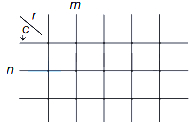
In an examination hall,there are $mn$ chairs arranged in $m$ rows and $n$ columns. The number of ways in which $m$ students can be seated such that no row is vacant is:
A
$m^n n!$
B
$n^m m!$
C
$m^m n!$
D
$n^n m!$
Solution
(B) We have $m$ rows and $n$ columns,making a total of $mn$ chairs.
We need to seat $m$ students such that no row is vacant. This means each of the $m$ rows must contain exactly one student.
First,we choose one chair out of $n$ available chairs in each of the $m$ rows. Since there are $n$ choices for each of the $m$ rows,the number of ways to select the chairs is $n \times n \times \dots \times n$ ($m$ times) $= n^m$.
Next,the $m$ students can be arranged in these $m$ selected chairs in $m!$ ways.
Therefore,the total number of ways is $n^m \times m!$.
We need to seat $m$ students such that no row is vacant. This means each of the $m$ rows must contain exactly one student.
First,we choose one chair out of $n$ available chairs in each of the $m$ rows. Since there are $n$ choices for each of the $m$ rows,the number of ways to select the chairs is $n \times n \times \dots \times n$ ($m$ times) $= n^m$.
Next,the $m$ students can be arranged in these $m$ selected chairs in $m!$ ways.
Therefore,the total number of ways is $n^m \times m!$.
0 likes
View Solution370
MediumMCQ
$5$ men and $4$ women are seated in a row. If the number of arrangements in which one particular man and one particular woman are together is $\alpha$ and the number of arrangements in which those two are not together is $\beta$,then $\alpha: \beta=$
A
$2: 7$
B
$2: 9$
C
$4: 5$
D
$7: 2$
Solution
(A) Total number of people = $5 + 4 = 9$.
Total arrangements = $9!$.
To find $\alpha$ (arrangements where one particular man and one particular woman are together),treat them as a single unit.
Now we have $8$ units to arrange,which can be done in $8!$ ways.
Within the unit,the man and woman can be arranged in $2!$ ways.
So,$\alpha = 8! \times 2!$.
To find $\beta$ (arrangements where they are not together),subtract $\alpha$ from the total arrangements:
$\beta = 9! - (8! \times 2!) = 9 \times 8! - 2 \times 8! = 7 \times 8!$.
Now,$\alpha: \beta = (8! \times 2) : (7 \times 8!) = 2 : 7$.
Total arrangements = $9!$.
To find $\alpha$ (arrangements where one particular man and one particular woman are together),treat them as a single unit.
Now we have $8$ units to arrange,which can be done in $8!$ ways.
Within the unit,the man and woman can be arranged in $2!$ ways.
So,$\alpha = 8! \times 2!$.
To find $\beta$ (arrangements where they are not together),subtract $\alpha$ from the total arrangements:
$\beta = 9! - (8! \times 2!) = 9 \times 8! - 2 \times 8! = 7 \times 8!$.
Now,$\alpha: \beta = (8! \times 2) : (7 \times 8!) = 2 : 7$.
0 likes
View Solution371
EasyMCQ
The number of ways in which $3$ men and $3$ women can be arranged in a row of $6$ seats,such that the first and last seats must be filled by men is
A
$720$
B
$36$
C
$144$
D
$72$
Solution
(C) We have $3$ men and $3$ women to be arranged in $6$ seats.
The first and last seats must be occupied by men.
Step $1$: Select $2$ men out of $3$ for the first and last seats and arrange them in $P(3, 2) = 3 \times 2 = 6$ ways.
Step $2$: The remaining $4$ people ($1$ man and $3$ women) can be arranged in the remaining $4$ middle seats in $4! = 24$ ways.
Total number of arrangements $= 6 \times 24 = 144$.
The first and last seats must be occupied by men.
Step $1$: Select $2$ men out of $3$ for the first and last seats and arrange them in $P(3, 2) = 3 \times 2 = 6$ ways.
Step $2$: The remaining $4$ people ($1$ man and $3$ women) can be arranged in the remaining $4$ middle seats in $4! = 24$ ways.
Total number of arrangements $= 6 \times 24 = 144$.
0 likes
View Solution372
MediumMCQ
The number of arrangements of the letters of the word $ARRANGEMENT$ in which two $E$s do not occur adjacently is
A
$\frac{9}{8}(10!)$
B
$\frac{9}{4}(10!)$
C
$\frac{9}{16}(10!)$
D
$\frac{9}{32}(10!)$
Solution
(C) The word $ARRANGEMENT$ has $11$ letters: $A(2), R(2), N(2), E(2), G(1), M(1), T(1)$.
Total arrangements $= \frac{11!}{2! \cdot 2! \cdot 2! \cdot 2!} = \frac{11!}{16}$.
To find the arrangements where two $E$s do not occur together,we subtract the arrangements where they do occur together from the total.
Treating the two $E$s as a single unit $(EE)$,we have $10$ items to arrange: $A(2), R(2), N(2), G(1), M(1), T(1), (EE)(1)$.
Number of arrangements with $E$s together $= \frac{10!}{2! \cdot 2! \cdot 2!} = \frac{10!}{8}$.
Number of arrangements with $E$s not together $= \frac{11!}{16} - \frac{10!}{8} = \frac{11 \cdot 10!}{16} - \frac{2 \cdot 10!}{16} = \frac{9 \cdot 10!}{16} = \frac{9}{16}(10!)$.
Total arrangements $= \frac{11!}{2! \cdot 2! \cdot 2! \cdot 2!} = \frac{11!}{16}$.
To find the arrangements where two $E$s do not occur together,we subtract the arrangements where they do occur together from the total.
Treating the two $E$s as a single unit $(EE)$,we have $10$ items to arrange: $A(2), R(2), N(2), G(1), M(1), T(1), (EE)(1)$.
Number of arrangements with $E$s together $= \frac{10!}{2! \cdot 2! \cdot 2!} = \frac{10!}{8}$.
Number of arrangements with $E$s not together $= \frac{11!}{16} - \frac{10!}{8} = \frac{11 \cdot 10!}{16} - \frac{2 \cdot 10!}{16} = \frac{9 \cdot 10!}{16} = \frac{9}{16}(10!)$.
0 likes
View Solution373
MediumMCQ
The number of words that can be formed using the letters of the word $VOWEL$ such that the vowels always remain together is
A
$60$
B
$48$
C
$36$
D
$45$
Solution
(B) The word $VOWEL$ consists of $5$ distinct letters: $V, O, W, E, L$.
There are $2$ vowels: $O$ and $E$.
Since the vowels must always remain together,we treat $(OE)$ as a single unit.
Now,we have $4$ units: $V, W, L, (OE)$.
These $4$ units can be arranged in $4! = 24$ ways.
The $2$ vowels within the unit $(OE)$ can be arranged in $2! = 2$ ways.
Therefore,the total number of words is $24 \times 2 = 48$.
There are $2$ vowels: $O$ and $E$.
Since the vowels must always remain together,we treat $(OE)$ as a single unit.
Now,we have $4$ units: $V, W, L, (OE)$.
These $4$ units can be arranged in $4! = 24$ ways.
The $2$ vowels within the unit $(OE)$ can be arranged in $2! = 2$ ways.
Therefore,the total number of words is $24 \times 2 = 48$.
0 likes
View Solution374
EasyMCQ
The number of all $8$-digit odd numbers is
A
$45 \times 10^6$
B
$90 \times 10^6$
C
$9 \times 10^8$
D
$9 \times 10^6$
Solution
(A) An $8$-digit number is formed by $8$ positions.
For the number to be odd,the last digit (units place) must be one of $\{1, 3, 5, 7, 9\}$,which gives $5$ choices.
The first digit cannot be $0$,so it has $9$ choices $(\{1, 2, 3, 4, 5, 6, 7, 8, 9\})$.
The remaining $6$ positions (from the $2^{nd}$ to the $7^{th}$ digit) can each be filled by any of the $10$ digits $(\{0, 1, 2, 3, 4, 5, 6, 7, 8, 9\})$,giving $10^6$ ways.
Therefore,the total number of $8$-digit odd numbers is $9 \times 10^6 \times 5 = 45 \times 10^6$.
For the number to be odd,the last digit (units place) must be one of $\{1, 3, 5, 7, 9\}$,which gives $5$ choices.
The first digit cannot be $0$,so it has $9$ choices $(\{1, 2, 3, 4, 5, 6, 7, 8, 9\})$.
The remaining $6$ positions (from the $2^{nd}$ to the $7^{th}$ digit) can each be filled by any of the $10$ digits $(\{0, 1, 2, 3, 4, 5, 6, 7, 8, 9\})$,giving $10^6$ ways.
Therefore,the total number of $8$-digit odd numbers is $9 \times 10^6 \times 5 = 45 \times 10^6$.
0 likes
View Solution375
EasyMCQ
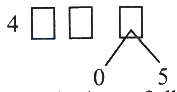
The number of all four-digit numbers which begin with $4$ and end with either $0$ or $5$ is:
A
$200$
B
$64$
C
$256$
D
$32$
Solution
(A) four-digit number has four places: $ABCD$.
Given that the first digit $A$ is fixed as $4$,there is only $1$ way to fill this place.
The last digit $D$ can be either $0$ or $5$,so there are $2$ ways to fill this place.
The second digit $B$ can be any digit from $0$ to $9$,so there are $10$ ways.
The third digit $C$ can be any digit from $0$ to $9$,so there are $10$ ways.
Therefore,the total number of such four-digit numbers is $1 \times 10 \times 10 \times 2 = 200$.
Given that the first digit $A$ is fixed as $4$,there is only $1$ way to fill this place.
The last digit $D$ can be either $0$ or $5$,so there are $2$ ways to fill this place.
The second digit $B$ can be any digit from $0$ to $9$,so there are $10$ ways.
The third digit $C$ can be any digit from $0$ to $9$,so there are $10$ ways.
Therefore,the total number of such four-digit numbers is $1 \times 10 \times 10 \times 2 = 200$.
0 likes
View Solution376
EasyMCQ
The number of arrangements of the word $KANGAROO$ in which $A$'s do not appear together is
A
$2520$
B
$3780$
C
$7650$
D
$7560$
Solution
(D) The word $KANGAROO$ contains $8$ letters: $K, A, N, G, A, R, O, O$. The letter $A$ appears $2$ times and $O$ appears $2$ times.
Total number of arrangements $= \frac{8!}{2!2!} = \frac{40320}{4} = 10080$.
To find the number of arrangements where $A$'s do not appear together,we subtract the arrangements where $A$'s are together from the total.
Treating the two $A$'s as a single unit $(AA)$,we have $7$ units: $(AA), K, N, G, R, O, O$.
The number of arrangements where $A$'s are together $= \frac{7!}{2!} = \frac{5040}{2} = 2520$.
Therefore,the number of required arrangements $= 10080 - 2520 = 7560$.
Total number of arrangements $= \frac{8!}{2!2!} = \frac{40320}{4} = 10080$.
To find the number of arrangements where $A$'s do not appear together,we subtract the arrangements where $A$'s are together from the total.
Treating the two $A$'s as a single unit $(AA)$,we have $7$ units: $(AA), K, N, G, R, O, O$.
The number of arrangements where $A$'s are together $= \frac{7!}{2!} = \frac{5040}{2} = 2520$.
Therefore,the number of required arrangements $= 10080 - 2520 = 7560$.
0 likes
View Solution377
EasyMCQ
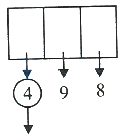
The number of natural numbers less than $500$ in which no two digits are repeated is
A
$374$
B
$376$
C
$378$
D
$380$
Solution
(C) To find the number of natural numbers less than $500$ with no repeated digits,we consider $1, 2,$ and $3$-digit numbers separately.
$1$. $1$-digit numbers: The possible numbers are $1, 2, 3, 4, 5, 6, 7, 8, 9$. Total = $9$.
$2$. $2$-digit numbers: The first digit can be any of $9$ digits $(1-9)$ and the second digit can be any of the remaining $9$ digits (including $0$). Total = $9 \times 9 = 81$.
$3$. $3$-digit numbers less than $500$: The hundreds place can be filled by $1, 2, 3,$ or $4$ ($4$ ways). The tens place can be filled by any of the remaining $9$ digits,and the units place by any of the remaining $8$ digits. Total = $4 \times 9 \times 8 = 288$.
Total count = $9 + 81 + 288 = 378$.
$1$. $1$-digit numbers: The possible numbers are $1, 2, 3, 4, 5, 6, 7, 8, 9$. Total = $9$.
$2$. $2$-digit numbers: The first digit can be any of $9$ digits $(1-9)$ and the second digit can be any of the remaining $9$ digits (including $0$). Total = $9 \times 9 = 81$.
$3$. $3$-digit numbers less than $500$: The hundreds place can be filled by $1, 2, 3,$ or $4$ ($4$ ways). The tens place can be filled by any of the remaining $9$ digits,and the units place by any of the remaining $8$ digits. Total = $4 \times 9 \times 8 = 288$.
Total count = $9 + 81 + 288 = 378$.
0 likes
View Solution378
MediumMCQ
In how many ways can the letters of the word "$ASSASSINATION$" be arranged so that all $S$'s are together?
A
$10!$
B
$\frac{10!}{3! 2! 2!}$
C
$\frac{9!}{3! 2! 2!}$
D
$9!$
Solution
(B) The word "$ASSASSINATION$" contains $13$ letters in total: $3$ $A$'s,$4$ $S$'s,$2$ $I$'s,$2$ $N$'s,$1$ $T$,and $1$ $O$.
To keep all $4$ $S$'s together,we treat them as a single block or unit,say $Z$.
Now,we have the letters: $A, A, A, I, I, N, N, T, O, Z$.
This gives us $10$ items to arrange,where $A$ repeats $3$ times,$I$ repeats $2$ times,and $N$ repeats $2$ times.
The number of arrangements is given by $\frac{10!}{3! 2! 2!}$.
To keep all $4$ $S$'s together,we treat them as a single block or unit,say $Z$.
Now,we have the letters: $A, A, A, I, I, N, N, T, O, Z$.
This gives us $10$ items to arrange,where $A$ repeats $3$ times,$I$ repeats $2$ times,and $N$ repeats $2$ times.
The number of arrangements is given by $\frac{10!}{3! 2! 2!}$.
0 likes
View Solution379
MediumMCQ
How many numbers between $10$ and $10000$ can be formed by using the digits $1, 2, 3, 4, 5$,if no digit is repeated in any number?
A
$200$
B
$775$
C
$60$
D
$120$
Solution
(A) Numbers between $10$ and $10000$ can be $2$-digit,$3$-digit,or $4$-digit numbers.
Number of ways to form a $2$-digit number using $5$ distinct digits: $5 \times 4 = 20$.
Number of ways to form a $3$-digit number using $5$ distinct digits: $5 \times 4 \times 3 = 60$.
Number of ways to form a $4$-digit number using $5$ distinct digits: $5 \times 4 \times 3 \times 2 = 120$.
Total numbers formed = $20 + 60 + 120 = 200$.
Number of ways to form a $2$-digit number using $5$ distinct digits: $5 \times 4 = 20$.
Number of ways to form a $3$-digit number using $5$ distinct digits: $5 \times 4 \times 3 = 60$.
Number of ways to form a $4$-digit number using $5$ distinct digits: $5 \times 4 \times 3 \times 2 = 120$.
Total numbers formed = $20 + 60 + 120 = 200$.
0 likes
View Solution380
EasyMCQ
In how many ways can $9$ examination papers be arranged so that the best and the worst papers are never together?
A
$9! - 2! \times 7!$
B
$9! - 2! \times 8!$
C
$9! - 8!$
D
$9! - 7!$
Solution
(B) The total number of ways to arrange $9$ papers is $9!$.
To find the number of ways where the best and worst papers are together,we treat them as a single unit.
This leaves us with $8$ units (the combined pair plus the other $7$ papers),which can be arranged in $8!$ ways.
The best and worst papers can be arranged within their unit in $2!$ ways.
So,the number of ways they are together is $2! \times 8!$.
The number of ways they are never together is the total arrangements minus the arrangements where they are together: $9! - 2! \times 8!$.
To find the number of ways where the best and worst papers are together,we treat them as a single unit.
This leaves us with $8$ units (the combined pair plus the other $7$ papers),which can be arranged in $8!$ ways.
The best and worst papers can be arranged within their unit in $2!$ ways.
So,the number of ways they are together is $2! \times 8!$.
The number of ways they are never together is the total arrangements minus the arrangements where they are together: $9! - 2! \times 8!$.
0 likes
View Solution381
EasyMCQ
In how many ways can the letters of the word $MAXIMA$ be arranged such that all vowels are together and all consonants are together?
A
$18$
B
$30$
C
$36$
D
$42$
Solution
(A) The word is $MAXIMA$. Total letters $= 6$.
Vowels are $\{A, I, A\}$ (Total $3$,with $A$ repeating $2$ times).
Consonants are $\{M, X, M\}$ (Total $3$,with $M$ repeating $2$ times).
Number of ways to arrange the vowels together $= \frac{3!}{2!} = 3$.
Number of ways to arrange the consonants together $= \frac{3!}{2!} = 3$.
Since we have two groups (one of vowels and one of consonants),these two groups can be arranged in $2! = 2$ ways.
Total number of arrangements $= 2! \times \left(\frac{3!}{2!}\right) \times \left(\frac{3!}{2!}\right) = 2 \times 3 \times 3 = 18$.
Vowels are $\{A, I, A\}$ (Total $3$,with $A$ repeating $2$ times).
Consonants are $\{M, X, M\}$ (Total $3$,with $M$ repeating $2$ times).
Number of ways to arrange the vowels together $= \frac{3!}{2!} = 3$.
Number of ways to arrange the consonants together $= \frac{3!}{2!} = 3$.
Since we have two groups (one of vowels and one of consonants),these two groups can be arranged in $2! = 2$ ways.
Total number of arrangements $= 2! \times \left(\frac{3!}{2!}\right) \times \left(\frac{3!}{2!}\right) = 2 \times 3 \times 3 = 18$.
0 likes
View Solution382
EasyMCQ
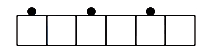
The number of words which can be made out of the letters of the word '$MOBILE$' when consonants occupy odd places is
A
$20$
B
$36$
C
$30$
D
$720$
Solution
(B) The word '$MOBILE$' has $6$ letters: $M, O, B, I, L, E$.
Consonants are $M, B, L$ ($3$ in total).
Vowels are $O, I, E$ ($3$ in total).
There are $6$ positions in total: $1, 2, 3, 4, 5, 6$.
Odd positions are $1, 3, 5$ ($3$ positions).
We need to place $3$ consonants in $3$ odd positions,which can be done in $3!$ ways.
The remaining $3$ vowels can be placed in the remaining $3$ even positions $(2, 4, 6)$ in $3!$ ways.
Total number of words $= 3! \times 3! = 6 \times 6 = 36$.
Consonants are $M, B, L$ ($3$ in total).
Vowels are $O, I, E$ ($3$ in total).
There are $6$ positions in total: $1, 2, 3, 4, 5, 6$.
Odd positions are $1, 3, 5$ ($3$ positions).
We need to place $3$ consonants in $3$ odd positions,which can be done in $3!$ ways.
The remaining $3$ vowels can be placed in the remaining $3$ even positions $(2, 4, 6)$ in $3!$ ways.
Total number of words $= 3! \times 3! = 6 \times 6 = 36$.
0 likes
View Solution383
EasyMCQ
All the words that can be formed using the letters $A, H, L, U, R$ are written as in a dictionary (no letter is repeated). Then the rank of the word $RAHUL$ is.......
A
$70$
B
$71$
C
$73$
D
$74$
Solution
(D) The given letters are $A, H, L, R, U$ in alphabetical order.
Total number of letters is $5$.
Words starting with $A$: $4! = 24$ words.
Words starting with $H$: $4! = 24$ words.
Words starting with $L$: $4! = 24$ words.
Now,words starting with $R$:
Words starting with $RA$:
$RAH...$: $RAHLU, RAHUL$ ($2$ words).
So,the rank of $RAHUL$ is $24 + 24 + 24 + 2 = 74$.
Thus,the rank of $RAHUL$ is $74$.
Total number of letters is $5$.
Words starting with $A$: $4! = 24$ words.
Words starting with $H$: $4! = 24$ words.
Words starting with $L$: $4! = 24$ words.
Now,words starting with $R$:
Words starting with $RA$:
$RAH...$: $RAHLU, RAHUL$ ($2$ words).
So,the rank of $RAHUL$ is $24 + 24 + 24 + 2 = 74$.
Thus,the rank of $RAHUL$ is $74$.
0 likes
View Solution384
EasyMCQ
Find the number of ways of arranging $6$ red balls and $6$ black balls in a row such that no two black balls are together.
A
$6! \times 6!$
B
$7! \times 6!$
C
$2 \times 6! \times 6!$
D
$7 \times 6! \times 6!$
Solution
(D) First,arrange the $6$ red balls in a row. The number of ways to arrange $6$ identical red balls is $1$ (since they are identical),but if we treat them as distinct for the sake of permutation logic,it is $6!$. However,usually,balls of the same color are considered identical. Assuming the balls are distinct,the arrangement is $6!$.
There are $7$ possible gaps created by $6$ red balls (including the ends) to place the $6$ black balls: $\_ R \_ R \_ R \_ R \_ R \_ R \_$.
The number of ways to choose $6$ positions out of $7$ is $\binom{7}{6} = 7$.
The number of ways to arrange $6$ black balls in these chosen positions is $6!$.
Thus,the total number of arrangements is $6! \times \binom{7}{6} \times 6! = 6! \times 7 \times 6! = 7 \times 6! \times 6!$.
There are $7$ possible gaps created by $6$ red balls (including the ends) to place the $6$ black balls: $\_ R \_ R \_ R \_ R \_ R \_ R \_$.
The number of ways to choose $6$ positions out of $7$ is $\binom{7}{6} = 7$.
The number of ways to arrange $6$ black balls in these chosen positions is $6!$.
Thus,the total number of arrangements is $6! \times \binom{7}{6} \times 6! = 6! \times 7 \times 6! = 7 \times 6! \times 6!$.
0 likes
View Solution385
EasyMCQ
In how many ways can you arrange the letters of the word "$ATTAIN$" so that the $T$'s are together?
A
$120$
B
$240$
C
$60$
D
$24$
Solution
(C) The word "$ATTAIN$" consists of $6$ letters: $A, T, T, A, I, N$.
To ensure the $T$'s are together,we treat the pair $(TT)$ as a single unit or block.
Now,the letters to be arranged are $(TT), A, A, I, N$.
This gives us $5$ units in total.
Among these $5$ units,the letter $A$ repeats $2$ times.
The number of ways to arrange these $5$ units is given by $\frac{5!}{2!} = \frac{120}{2} = 60$.
Since the two $T$'s are identical,there is only $1$ way to arrange them within their block.
Therefore,the total number of arrangements is $60 \times 1 = 60$.
To ensure the $T$'s are together,we treat the pair $(TT)$ as a single unit or block.
Now,the letters to be arranged are $(TT), A, A, I, N$.
This gives us $5$ units in total.
Among these $5$ units,the letter $A$ repeats $2$ times.
The number of ways to arrange these $5$ units is given by $\frac{5!}{2!} = \frac{120}{2} = 60$.
Since the two $T$'s are identical,there is only $1$ way to arrange them within their block.
Therefore,the total number of arrangements is $60 \times 1 = 60$.
0 likes
View Solution386
MediumMCQ
The number of ways in which all the letters of the word $COMBINATION$ can be arranged so that the vowels always come together is:
A
$45678$
B
$50400$
C
$75600$
D
$82300$
Solution
(C) The word $COMBINATION$ consists of $11$ letters: $C, O, M, B, I, N, A, T, I, O, N$.
The vowels are $O, I, A, I, O$ (total $5$ vowels).
The consonants are $C, M, B, N, N$ (total $6$ consonants).
Since the vowels must come together,we treat the group $(O, I, A, I, O)$ as a single entity.
Now,we have $6$ consonants + $1$ entity = $7$ items to arrange.
The number of arrangements of these $7$ items,where $N$ repeats $2$ times,is $\frac{7!}{2!} = \frac{5040}{2} = 2520$.
Within the vowel group $(O, I, A, I, O)$,there are $5$ letters where $O$ repeats $2$ times and $I$ repeats $2$ times.
The number of arrangements of these vowels is $\frac{5!}{2! \times 2!} = \frac{120}{4} = 30$.
The total number of ways is $2520 \times 30 = 75600$.
The vowels are $O, I, A, I, O$ (total $5$ vowels).
The consonants are $C, M, B, N, N$ (total $6$ consonants).
Since the vowels must come together,we treat the group $(O, I, A, I, O)$ as a single entity.
Now,we have $6$ consonants + $1$ entity = $7$ items to arrange.
The number of arrangements of these $7$ items,where $N$ repeats $2$ times,is $\frac{7!}{2!} = \frac{5040}{2} = 2520$.
Within the vowel group $(O, I, A, I, O)$,there are $5$ letters where $O$ repeats $2$ times and $I$ repeats $2$ times.
The number of arrangements of these vowels is $\frac{5!}{2! \times 2!} = \frac{120}{4} = 30$.
The total number of ways is $2520 \times 30 = 75600$.
0 likes
View Solution387
EasyMCQ
If all the seven letters of the word $LEADING$ are permuted in all possible ways and the words thus formed are arranged as in the dictionary order,then the word in $2017^{\text{th}}$ place is
A
$ELIGDAN$
B
$ELNADGI$
C
$ELINADG$
D
$ELNDAGI$
Solution
(B) First,we arrange the letters of the word $LEADING$ in alphabetical order: $A, D, E, G, I, L, N$.
Words starting with $A$: $6! = 720$.
Words starting with $D$: $6! = 720$.
Words starting with $E$: $6! = 720$.
Total words starting with $A, D, E$ is $720 + 720 + 720 = 2160 > 2017$.
So,the word starts with $E$. Words before $E$ are $720 + 720 = 1440$.
Now,words starting with $EA, ED, EG, EI$: $4 \times 5! = 4 \times 120 = 480$.
Total words up to $EI$: $1440 + 480 = 1920$.
Next,words starting with $ELA, ELD, ELG$: $3 \times 4! = 3 \times 24 = 72$.
Total words up to $ELG$: $1920 + 72 = 1992$.
Next,words starting with $ELI$: $4! = 24$.
Total words up to $ELI$: $1992 + 24 = 2016$.
The $2017^{\text{th}}$ word must be the first word starting with $ELN$.
The remaining letters after $ELN$ are $A, D, G, I$ in alphabetical order.
Thus,the $2017^{\text{th}}$ word is $ELNADGI$.
Words starting with $A$: $6! = 720$.
Words starting with $D$: $6! = 720$.
Words starting with $E$: $6! = 720$.
Total words starting with $A, D, E$ is $720 + 720 + 720 = 2160 > 2017$.
So,the word starts with $E$. Words before $E$ are $720 + 720 = 1440$.
Now,words starting with $EA, ED, EG, EI$: $4 \times 5! = 4 \times 120 = 480$.
Total words up to $EI$: $1440 + 480 = 1920$.
Next,words starting with $ELA, ELD, ELG$: $3 \times 4! = 3 \times 24 = 72$.
Total words up to $ELG$: $1920 + 72 = 1992$.
Next,words starting with $ELI$: $4! = 24$.
Total words up to $ELI$: $1992 + 24 = 2016$.
The $2017^{\text{th}}$ word must be the first word starting with $ELN$.
The remaining letters after $ELN$ are $A, D, G, I$ in alphabetical order.
Thus,the $2017^{\text{th}}$ word is $ELNADGI$.
0 likes
View Solution388
EasyMCQ
The number of integers greater than $3000$ that can be formed by using any number of digits from the set $\{0, 1, 2, 3, 4, 5\}$ without repetition is:
A
$1630$
B
$1380$
C
$1260$
D
$1200$
Solution
(B) To form integers greater than $3000$ using digits $\{0, 1, 2, 3, 4, 5\}$ without repetition,we consider numbers with $4, 5,$ and $6$ digits.
$1$. $4$-digit numbers: The first digit must be $3, 4,$ or $5$ ($3$ choices). The remaining $3$ positions can be filled by the remaining $5$ digits in $P(5, 3) = 5 \times 4 \times 3 = 60$ ways. Total = $3 \times 60 = 180$. However,if the first digit is $3$,the number is $3xyz$. If $x=0$,we have $30yz$,which is $> 3000$. If $x > 0$,it is also $> 3000$. So all $180$ are valid.
$2$. $5$-digit numbers: The first digit cannot be $0$ ($5$ choices: $1, 2, 3, 4, 5$). The remaining $4$ positions can be filled by the remaining $5$ digits in $P(5, 4) = 5 \times 4 \times 3 \times 2 = 120$ ways. Total = $5 \times 120 = 600$.
$3$. $6$-digit numbers: The first digit cannot be $0$ ($5$ choices). The remaining $5$ positions can be filled by the remaining $5$ digits in $P(5, 5) = 5! = 120$ ways. Total = $5 \times 120 = 600$.
Summing these: $180 + 600 + 600 = 1380$.
$1$. $4$-digit numbers: The first digit must be $3, 4,$ or $5$ ($3$ choices). The remaining $3$ positions can be filled by the remaining $5$ digits in $P(5, 3) = 5 \times 4 \times 3 = 60$ ways. Total = $3 \times 60 = 180$. However,if the first digit is $3$,the number is $3xyz$. If $x=0$,we have $30yz$,which is $> 3000$. If $x > 0$,it is also $> 3000$. So all $180$ are valid.
$2$. $5$-digit numbers: The first digit cannot be $0$ ($5$ choices: $1, 2, 3, 4, 5$). The remaining $4$ positions can be filled by the remaining $5$ digits in $P(5, 4) = 5 \times 4 \times 3 \times 2 = 120$ ways. Total = $5 \times 120 = 600$.
$3$. $6$-digit numbers: The first digit cannot be $0$ ($5$ choices). The remaining $5$ positions can be filled by the remaining $5$ digits in $P(5, 5) = 5! = 120$ ways. Total = $5 \times 120 = 600$.
Summing these: $180 + 600 + 600 = 1380$.
0 likes
View Solution389
MediumMCQ
If the letters of the word "$CAPITAL$" are permuted in all possible ways and the words are arranged in a dictionary order,then the rank of the word "$CAPITAL$" is
A
$802$
B
$803$
C
$720$
D
$712$
Solution
(A) The word is $CAPITAL$. The letters in alphabetical order are $A, A, C, I, L, P, T$.
Total letters = $7$. The letter $A$ repeats $2$ times.
Words starting with $A$: The remaining letters are $A, C, I, L, P, T$ ($6$ letters). Number of arrangements = $\frac{6!}{1!} = 720$.
Words starting with $C$:
Next letter is $A$: Remaining letters are $A, I, L, P, T$ ($5$ letters). Number of arrangements = $5! = 120$.
Next letter is $C$ (not possible).
Next letter is $I$: Remaining letters are $A, A, L, P, T$ ($5$ letters). Number of arrangements = $\frac{5!}{2!} = 60$.
Next letter is $L$: Remaining letters are $A, A, I, P, T$ ($5$ letters). Number of arrangements = $\frac{5!}{2!} = 60$.
Next letter is $P$: Remaining letters are $A, A, I, L, T$ ($5$ letters). Number of arrangements = $\frac{5!}{2!} = 60$.
Next letter is $T$: Remaining letters are $A, A, I, L, P$ ($5$ letters). Number of arrangements = $\frac{5!}{2!} = 60$.
Wait,let us re-evaluate:
Alphabetical order: $A, A, C, I, L, P, T$.
Words starting with $A$: $\frac{6!}{1!} = 720$.
Words starting with $C$:
$CA...$: Remaining letters $A, I, L, P, T$.
$CAA...$: $4! = 24$.
$CAI...$: $4! = 24$.
$CAL...$: $4! = 24$.
$CAP...$:
$CAPA...$: $3! = 6$.
$CAPI...$:
$CAPIA...$: $2! = 2$.
$CAPIL...$:
$CAPILA...$: $1! = 1$.
$CAPITAL$: $1$.
Total rank = $720 + 24 + 24 + 24 + 6 + 2 + 1 + 1 = 802$.
Total letters = $7$. The letter $A$ repeats $2$ times.
Words starting with $A$: The remaining letters are $A, C, I, L, P, T$ ($6$ letters). Number of arrangements = $\frac{6!}{1!} = 720$.
Words starting with $C$:
Next letter is $A$: Remaining letters are $A, I, L, P, T$ ($5$ letters). Number of arrangements = $5! = 120$.
Next letter is $C$ (not possible).
Next letter is $I$: Remaining letters are $A, A, L, P, T$ ($5$ letters). Number of arrangements = $\frac{5!}{2!} = 60$.
Next letter is $L$: Remaining letters are $A, A, I, P, T$ ($5$ letters). Number of arrangements = $\frac{5!}{2!} = 60$.
Next letter is $P$: Remaining letters are $A, A, I, L, T$ ($5$ letters). Number of arrangements = $\frac{5!}{2!} = 60$.
Next letter is $T$: Remaining letters are $A, A, I, L, P$ ($5$ letters). Number of arrangements = $\frac{5!}{2!} = 60$.
Wait,let us re-evaluate:
Alphabetical order: $A, A, C, I, L, P, T$.
Words starting with $A$: $\frac{6!}{1!} = 720$.
Words starting with $C$:
$CA...$: Remaining letters $A, I, L, P, T$.
$CAA...$: $4! = 24$.
$CAI...$: $4! = 24$.
$CAL...$: $4! = 24$.
$CAP...$:
$CAPA...$: $3! = 6$.
$CAPI...$:
$CAPIA...$: $2! = 2$.
$CAPIL...$:
$CAPILA...$: $1! = 1$.
$CAPITAL$: $1$.
Total rank = $720 + 24 + 24 + 24 + 6 + 2 + 1 + 1 = 802$.
0 likes
View Solution390
DifficultMCQ
$10$ men and $6$ women are to be seated in a row so that no two women sit together. The number of ways they can be seated is:
A
$11! 10!$
B
$\frac{11!}{6! 5!}$
C
$\frac{10! 9!}{5!}$
D
$\frac{11! 10!}{5!}$
Solution
(D) First,we arrange $10$ men in a row. The number of ways to arrange $10$ men is $10!$.
There are $11$ gaps created by $10$ men (including the ends) where $6$ women can be seated so that no two women sit together.
The number of ways to choose $6$ gaps out of $11$ and arrange $6$ women is given by $^{11}P_6$.
Total number of ways $= 10! \times ^{11}P_6 = 10! \times \frac{11!}{(11-6)!} = \frac{10! 11!}{5!}$.
There are $11$ gaps created by $10$ men (including the ends) where $6$ women can be seated so that no two women sit together.
The number of ways to choose $6$ gaps out of $11$ and arrange $6$ women is given by $^{11}P_6$.
Total number of ways $= 10! \times ^{11}P_6 = 10! \times \frac{11!}{(11-6)!} = \frac{10! 11!}{5!}$.
0 likes
View Solution391
EasyMCQ
The number of distinct positive integers that can be formed using $0, 1, 2, 3$,where each integer is used at most once,is equal to
A
$84$
B
$64$
C
$48$
D
$36$
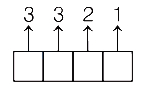
Solution
(C) The given digits are $0, 1, 2, 3$. We need to form distinct positive integers using these digits at most once.
Case $I$: $4$-digit integers.
The first place can be filled by any of the $3$ non-zero digits $(1, 2, 3)$. The remaining $3$ places can be filled by the remaining $3$ digits in $3 \times 2 \times 1$ ways.
Number of $4$-digit integers $= 3 \times 3 \times 2 \times 1 = 18$.
Case $II$: $3$-digit integers.
The first place can be filled by $3$ choices $(1, 2, 3)$. The remaining $2$ places can be filled by the remaining $3$ digits in $3 \times 2$ ways.
Number of $3$-digit integers $= 3 \times 3 \times 2 = 18$.
Case $III$: $2$-digit integers.
The first place can be filled by $3$ choices $(1, 2, 3)$. The second place can be filled by the remaining $3$ digits in $3$ ways.
Number of $2$-digit integers $= 3 \times 3 = 9$.
Case $IV$: $1$-digit integers.
The possible integers are $1, 2, 3$.
Number of $1$-digit integers $= 3$.
Total number of distinct positive integers $= 18 + 18 + 9 + 3 = 48$.
Case $I$: $4$-digit integers.
The first place can be filled by any of the $3$ non-zero digits $(1, 2, 3)$. The remaining $3$ places can be filled by the remaining $3$ digits in $3 \times 2 \times 1$ ways.
Number of $4$-digit integers $= 3 \times 3 \times 2 \times 1 = 18$.
Case $II$: $3$-digit integers.
The first place can be filled by $3$ choices $(1, 2, 3)$. The remaining $2$ places can be filled by the remaining $3$ digits in $3 \times 2$ ways.
Number of $3$-digit integers $= 3 \times 3 \times 2 = 18$.
Case $III$: $2$-digit integers.
The first place can be filled by $3$ choices $(1, 2, 3)$. The second place can be filled by the remaining $3$ digits in $3$ ways.
Number of $2$-digit integers $= 3 \times 3 = 9$.
Case $IV$: $1$-digit integers.
The possible integers are $1, 2, 3$.
Number of $1$-digit integers $= 3$.
Total number of distinct positive integers $= 18 + 18 + 9 + 3 = 48$.
0 likes
View Solution392
MediumMCQ
The number of ways in which $n$ distinct objects can be put into two different boxes is
A
${ }^n P_2$
B
$2^n$
C
${ }^n C_2$
D
$n(n-1)(n-2)$
Solution
(B) Each of the $n$ distinct objects can be placed in either of the $2$ different boxes.
Since each object has $2$ choices,the total number of ways to distribute $n$ distinct objects into $2$ different boxes is $2 \times 2 \times 2 \times \dots \times 2$ ($n$ times).
Therefore,the total number of ways is $2^n$.
Since each object has $2$ choices,the total number of ways to distribute $n$ distinct objects into $2$ different boxes is $2 \times 2 \times 2 \times \dots \times 2$ ($n$ times).
Therefore,the total number of ways is $2^n$.
0 likes
View Solution393
EasyMCQ
In how many ways can $5$ balls be placed in $4$ tins if any number of balls can be placed in any tin?
A
${ }^5 P_4$
B
${ }^5 C_4$
C
$4^5$
D
$5^4$
Solution
(C) Each of the $5$ balls can be placed in any of the $4$ tins independently.
Since each ball has $4$ choices,the total number of ways to place $5$ balls in $4$ tins is $4 \times 4 \times 4 \times 4 \times 4 = 4^5$.
Since each ball has $4$ choices,the total number of ways to place $5$ balls in $4$ tins is $4 \times 4 \times 4 \times 4 \times 4 = 4^5$.
0 likes
View Solution394
MediumMCQ
The number of four-digit numbers that can be formed using the digits $1, 2, 3, 4, 5, 6, 7$ which are divisible by $4$,when the repetition of any digit is not allowed,is:
A
$100$
B
$200$
C
$300$
D
$400$
Solution
(B) number is divisible by $4$ if the number formed by its last two digits is divisible by $4$. The available digits are ${1, 2, 3, 4, 5, 6, 7}$.
Possible two-digit combinations (tens,units) divisible by $4$ are: $12, 16, 24, 32, 36, 52, 56, 64, 72, 76$.
There are $10$ such pairs.
For each pair,we need to fill the remaining $2$ places (thousands and hundreds) using the remaining $5$ digits.
The number of ways to fill the remaining $2$ places is $P(5, 2) = 5 \times 4 = 20$.
Total numbers $= 10 \times 20 = 200$.
Possible two-digit combinations (tens,units) divisible by $4$ are: $12, 16, 24, 32, 36, 52, 56, 64, 72, 76$.
There are $10$ such pairs.
For each pair,we need to fill the remaining $2$ places (thousands and hundreds) using the remaining $5$ digits.
The number of ways to fill the remaining $2$ places is $P(5, 2) = 5 \times 4 = 20$.
Total numbers $= 10 \times 20 = 200$.
0 likes
View SolutionPermutation and Combination — Definition of permutation, Number of permutations with or without repetition, Conditional permutations · Frequently Asked Questions
1Are these Permutation and Combination questions useful for JEE and NEET?
Yes. All questions in this section are mapped to JEE Main and NEET exam patterns. Previous year questions from JEE Main, NEET, GUJCET and state-level exams are included with full solutions.
2Can I switch to Hindi or Gujarati for these questions?
Yes. Use the language tabs in the hero section or the sidebar to view the same questions and solutions in English, Hindi or Gujarati.
3How do I generate a question paper from this subtopic?
Use the Vedclass Exam Paper Generator — select the chapter and subtopic, set difficulty, and generate Sets A, B, C, D automatically. First 3 chapters of every subject are free.
Vedclass Products
For Students
Vedclass Test Series
Mock tests in real JEE/NEET style with performance analysis. 5-day free trial.
Start Free TrialFor Teachers
Exam Paper Generator
Generate Set A/B/C/D papers from this chapter in 2 minutes. 3 chapters free.
Try FreeFor Institutes
Online Exam Module
Live online exams with unlimited students, 360° analytics & white-label branding.
See DemoFor Teachers & Institutes
Generate a Permutation and Combination Exam Paper in 2 Minutes
Select subtopic & difficulty — Sets A, B, C, D auto-generated with No Repeat logic.
First 3 chapters of every subject are free — no payment required.