
A English
Triangle and Parallelogram Questions in English
Class 11 Mathematics · Introduction to Three Dimensional Geometry · Triangle and Parallelogram
112+
Questions
English
Language
100%
With Solutions
Showing 47 of 112 questions in English
51
EasyMCQ
If $A(1,4,2)$ and $C(5,-7,1)$ are two vertices of triangle $ABC$ and $G\left(\frac{4}{3}, 0, \frac{-2}{3}\right)$ is the centroid of the triangle $ABC$,then the midpoint of side $BC$ is
A
$\left(-2,-2, \frac{3}{2}\right)$
B
$\left(2,2, \frac{3}{2}\right)$
C
$\left(\frac{3}{2}, 2,-2\right)$
D
$\left(\frac{3}{2},-2,-2\right)$
Solution
(D) Let the coordinates of vertex $B$ be $(x_1, y_1, z_1)$.
The centroid $G$ of a triangle with vertices $A(x_A, y_A, z_A)$,$B(x_B, y_B, z_B)$,and $C(x_C, y_C, z_C)$ is given by $\left(\frac{x_A+x_B+x_C}{3}, \frac{y_A+y_B+y_C}{3}, \frac{z_A+z_B+z_C}{3}\right)$.
Given $A(1,4,2)$,$C(5,-7,1)$,and $G\left(\frac{4}{3}, 0, \frac{-2}{3}\right)$,we have:
$\frac{1+x_1+5}{3} = \frac{4}{3} \Rightarrow 6+x_1 = 4 \Rightarrow x_1 = -2$
$\frac{4+y_1-7}{3} = 0 \Rightarrow y_1-3 = 0 \Rightarrow y_1 = 3$
$\frac{2+z_1+1}{3} = \frac{-2}{3} \Rightarrow 3+z_1 = -2 \Rightarrow z_1 = -5$
So,$B = (-2, 3, -5)$.
The midpoint of side $BC$ is $\left(\frac{x_B+x_C}{2}, \frac{y_B+y_C}{2}, \frac{z_B+z_C}{2}\right)$.
Midpoint $= \left(\frac{-2+5}{2}, \frac{3-7}{2}, \frac{-5+1}{2}\right) = \left(\frac{3}{2}, -2, -2\right)$.
The centroid $G$ of a triangle with vertices $A(x_A, y_A, z_A)$,$B(x_B, y_B, z_B)$,and $C(x_C, y_C, z_C)$ is given by $\left(\frac{x_A+x_B+x_C}{3}, \frac{y_A+y_B+y_C}{3}, \frac{z_A+z_B+z_C}{3}\right)$.
Given $A(1,4,2)$,$C(5,-7,1)$,and $G\left(\frac{4}{3}, 0, \frac{-2}{3}\right)$,we have:
$\frac{1+x_1+5}{3} = \frac{4}{3} \Rightarrow 6+x_1 = 4 \Rightarrow x_1 = -2$
$\frac{4+y_1-7}{3} = 0 \Rightarrow y_1-3 = 0 \Rightarrow y_1 = 3$
$\frac{2+z_1+1}{3} = \frac{-2}{3} \Rightarrow 3+z_1 = -2 \Rightarrow z_1 = -5$
So,$B = (-2, 3, -5)$.
The midpoint of side $BC$ is $\left(\frac{x_B+x_C}{2}, \frac{y_B+y_C}{2}, \frac{z_B+z_C}{2}\right)$.
Midpoint $= \left(\frac{-2+5}{2}, \frac{3-7}{2}, \frac{-5+1}{2}\right) = \left(\frac{3}{2}, -2, -2\right)$.
0 likes
View Solution52
EasyMCQ
If $G(3, -5, r)$ is the centroid of triangle $ABC$ where $A(7, -8, 1)$,$B(p, q, 5)$,and $C(q+1, 5p, 0)$ are the vertices of the triangle,then the values of $p, q, r$ are respectively . . . . . . .
A
$6, 5, 4$
B
$-4, 5, 4$
C
$-3, 4, 3$
D
$-2, 3, 2$
Solution
(D) The centroid $G$ of a triangle with vertices $(x_1, y_1, z_1)$,$(x_2, y_2, z_2)$,and $(x_3, y_3, z_3)$ is given by $(\frac{x_1+x_2+x_3}{3}, \frac{y_1+y_2+y_3}{3}, \frac{z_1+z_2+z_3}{3})$.
Given $A(7, -8, 1)$,$B(p, q, 5)$,$C(q+1, 5p, 0)$,and $G(3, -5, r)$.
Equating the coordinates:
$x$-coordinate: $\frac{7+p+q+1}{3} = 3 \Rightarrow p+q+8 = 9 \Rightarrow p+q = 1$ (Equation $1$)
$y$-coordinate: $\frac{-8+q+5p}{3} = -5 \Rightarrow 5p+q-8 = -15 \Rightarrow 5p+q = -7$ (Equation $2$)
$z$-coordinate: $\frac{1+5+0}{3} = r \Rightarrow r = \frac{6}{3} = 2$
Subtracting Equation $1$ from Equation $2$: $(5p+q) - (p+q) = -7 - 1 \Rightarrow 4p = -8 \Rightarrow p = -2$.
Substituting $p = -2$ into Equation $1$: $-2 + q = 1 \Rightarrow q = 3$.
Thus,the values are $p = -2, q = 3, r = 2$.
Given $A(7, -8, 1)$,$B(p, q, 5)$,$C(q+1, 5p, 0)$,and $G(3, -5, r)$.
Equating the coordinates:
$x$-coordinate: $\frac{7+p+q+1}{3} = 3 \Rightarrow p+q+8 = 9 \Rightarrow p+q = 1$ (Equation $1$)
$y$-coordinate: $\frac{-8+q+5p}{3} = -5 \Rightarrow 5p+q-8 = -15 \Rightarrow 5p+q = -7$ (Equation $2$)
$z$-coordinate: $\frac{1+5+0}{3} = r \Rightarrow r = \frac{6}{3} = 2$
Subtracting Equation $1$ from Equation $2$: $(5p+q) - (p+q) = -7 - 1 \Rightarrow 4p = -8 \Rightarrow p = -2$.
Substituting $p = -2$ into Equation $1$: $-2 + q = 1 \Rightarrow q = 3$.
Thus,the values are $p = -2, q = 3, r = 2$.
0 likes
View Solution53
MediumMCQ
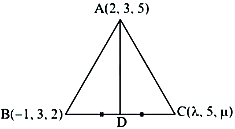
$\triangle ABC$ has vertices at $A \equiv (2, 3, 5)$,$B \equiv (-1, 3, 2)$ and $C \equiv (\lambda, 5, \mu)$. If the median through $A$ is equally inclined to the axes,then the values of $\lambda$ and $\mu$ respectively are
A
$10, 7$
B
$9, 10$
C
$7, 9$
D
$7, 10$
Solution
(D) Let $D$ be the midpoint of $BC$. The coordinates of $D$ are given by:
$D = \left( \frac{\lambda - 1}{2}, \frac{5 + 3}{2}, \frac{\mu + 2}{2} \right) = \left( \frac{\lambda - 1}{2}, 4, \frac{\mu + 2}{2} \right)$.
The direction ratios of the median $AD$ are given by the difference of the coordinates of $D$ and $A$:
$AD = \left( \frac{\lambda - 1}{2} - 2, 4 - 3, \frac{\mu + 2}{2} - 5 \right) = \left( \frac{\lambda - 5}{2}, 1, \frac{\mu - 8}{2} \right)$.
Since the median $AD$ is equally inclined to the coordinate axes,its direction ratios must be proportional to $(1, 1, 1)$ or $(\pm 1, \pm 1, \pm 1)$.
Thus,we have:
$\frac{\lambda - 5}{2} = 1 \implies \lambda - 5 = 2 \implies \lambda = 7$.
$\frac{\mu - 8}{2} = 1 \implies \mu - 8 = 2 \implies \mu = 10$.
Therefore,the values are $\lambda = 7$ and $\mu = 10$.
$D = \left( \frac{\lambda - 1}{2}, \frac{5 + 3}{2}, \frac{\mu + 2}{2} \right) = \left( \frac{\lambda - 1}{2}, 4, \frac{\mu + 2}{2} \right)$.
The direction ratios of the median $AD$ are given by the difference of the coordinates of $D$ and $A$:
$AD = \left( \frac{\lambda - 1}{2} - 2, 4 - 3, \frac{\mu + 2}{2} - 5 \right) = \left( \frac{\lambda - 5}{2}, 1, \frac{\mu - 8}{2} \right)$.
Since the median $AD$ is equally inclined to the coordinate axes,its direction ratios must be proportional to $(1, 1, 1)$ or $(\pm 1, \pm 1, \pm 1)$.
Thus,we have:
$\frac{\lambda - 5}{2} = 1 \implies \lambda - 5 = 2 \implies \lambda = 7$.
$\frac{\mu - 8}{2} = 1 \implies \mu - 8 = 2 \implies \mu = 10$.
Therefore,the values are $\lambda = 7$ and $\mu = 10$.
0 likes
View Solution54
MediumMCQ
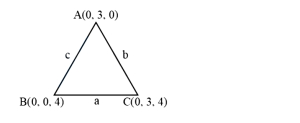
The incenter and centroid of the triangle,whose vertices are $A \equiv(0,3,0), B \equiv(0,0,4)$,and $C \equiv(0,3,4)$,are respectively given by
A
$(0,-2,-3),\left(0,-2, \frac{8}{3}\right)$
B
$(0,-2,3),\left(0,2,-\frac{8}{3}\right)$
C
$\left(0,2, \frac{8}{3}\right),(0,2,3)$
D
$(0,2,3),\left(0,2, \frac{8}{3}\right)$
Solution
(D) Given vertices are $A \equiv(0,3,0), B \equiv(0,0,4)$,and $C \equiv(0,3,4)$.
First,calculate the lengths of the sides:
$a = BC = \sqrt{(0-0)^2 + (3-0)^2 + (4-4)^2} = \sqrt{0+9+0} = 3$
$b = CA = \sqrt{(0-0)^2 + (3-3)^2 + (4-0)^2} = \sqrt{0+0+16} = 4$
$c = AB = \sqrt{(0-0)^2 + (0-3)^2 + (4-0)^2} = \sqrt{0+9+16} = \sqrt{25} = 5$
Now,the Incenter $I$ is given by $\left(\frac{ax_1+bx_2+cx_3}{a+b+c}, \frac{ay_1+by_2+cy_3}{a+b+c}, \frac{az_1+bz_2+cz_3}{a+b+c}\right)$:
$I = \left(\frac{3(0)+4(0)+5(0)}{3+4+5}, \frac{3(3)+4(0)+5(3)}{3+4+5}, \frac{3(0)+4(4)+5(4)}{3+4+5}\right)$
$I = \left(\frac{0}{12}, \frac{9+0+15}{12}, \frac{0+16+20}{12}\right) = \left(0, \frac{24}{12}, \frac{36}{12}\right) = (0, 2, 3)$
The Centroid $G$ is given by $\left(\frac{x_1+x_2+x_3}{3}, \frac{y_1+y_2+y_3}{3}, \frac{z_1+z_2+z_3}{3}\right)$:
$G = \left(\frac{0+0+0}{3}, \frac{3+0+3}{3}, \frac{0+4+4}{3}\right) = \left(0, \frac{6}{3}, \frac{8}{3}\right) = \left(0, 2, \frac{8}{3}\right)$
Thus,the incenter and centroid are $(0, 2, 3)$ and $\left(0, 2, \frac{8}{3}\right)$ respectively.
First,calculate the lengths of the sides:
$a = BC = \sqrt{(0-0)^2 + (3-0)^2 + (4-4)^2} = \sqrt{0+9+0} = 3$
$b = CA = \sqrt{(0-0)^2 + (3-3)^2 + (4-0)^2} = \sqrt{0+0+16} = 4$
$c = AB = \sqrt{(0-0)^2 + (0-3)^2 + (4-0)^2} = \sqrt{0+9+16} = \sqrt{25} = 5$
Now,the Incenter $I$ is given by $\left(\frac{ax_1+bx_2+cx_3}{a+b+c}, \frac{ay_1+by_2+cy_3}{a+b+c}, \frac{az_1+bz_2+cz_3}{a+b+c}\right)$:
$I = \left(\frac{3(0)+4(0)+5(0)}{3+4+5}, \frac{3(3)+4(0)+5(3)}{3+4+5}, \frac{3(0)+4(4)+5(4)}{3+4+5}\right)$
$I = \left(\frac{0}{12}, \frac{9+0+15}{12}, \frac{0+16+20}{12}\right) = \left(0, \frac{24}{12}, \frac{36}{12}\right) = (0, 2, 3)$
The Centroid $G$ is given by $\left(\frac{x_1+x_2+x_3}{3}, \frac{y_1+y_2+y_3}{3}, \frac{z_1+z_2+z_3}{3}\right)$:
$G = \left(\frac{0+0+0}{3}, \frac{3+0+3}{3}, \frac{0+4+4}{3}\right) = \left(0, \frac{6}{3}, \frac{8}{3}\right) = \left(0, 2, \frac{8}{3}\right)$
Thus,the incenter and centroid are $(0, 2, 3)$ and $\left(0, 2, \frac{8}{3}\right)$ respectively.
0 likes
View Solution55
MediumMCQ
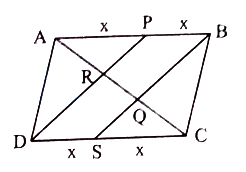
$ABCD$ is a parallelogram,$P$ is the mid-point of $AB$. If $R$ is the point of intersection of $AC$ and $DP$,then $R$ divides $AC$ internally in the ratio
A
$3: 1$
B
$2: 1$
C
$1: 2$
D
$2: 3$
Solution
(C) In $\triangle ABP$ and $\triangle CDP$,$AB \parallel DC$ and $AB = DC$. Since $P$ is the mid-point of $AB$,$AP = PB = \frac{1}{2} AB = \frac{1}{2} DC$.
Consider $\triangle APR$ and $\triangle CPD$:
$\angle PAR = \angle PCD$ (alternate interior angles as $AB \parallel DC$)
$\angle APR = \angle CPD$ (vertically opposite angles)
Thus,$\triangle APR \sim \triangle CPD$ by $AA$ similarity.
Therefore,the ratio of corresponding sides is equal:
$\frac{AR}{CR} = \frac{AP}{CD} = \frac{\frac{1}{2} AB}{AB} = \frac{1}{2}$.
Hence,$R$ divides $AC$ in the ratio $1: 2$.
Consider $\triangle APR$ and $\triangle CPD$:
$\angle PAR = \angle PCD$ (alternate interior angles as $AB \parallel DC$)
$\angle APR = \angle CPD$ (vertically opposite angles)
Thus,$\triangle APR \sim \triangle CPD$ by $AA$ similarity.
Therefore,the ratio of corresponding sides is equal:
$\frac{AR}{CR} = \frac{AP}{CD} = \frac{\frac{1}{2} AB}{AB} = \frac{1}{2}$.
Hence,$R$ divides $AC$ in the ratio $1: 2$.
0 likes
View Solution56
EasyMCQ
If $P(3,2,6), Q(1,4,5)$ and $R(3,5,3)$ are the vertices of $\Delta PQR$,then $m \angle PQR$ is (in $^{\circ}$)
A
$90$
B
$50$
C
$70$
D
$30$
Solution
(A) Given the vertices of the triangle are $P(3,2,6), Q(1,4,5)$,and $R(3,5,3)$.
First,we find the direction ratios of the vectors $\vec{QP}$ and $\vec{QR}$.
The vector $\vec{QP} = (3-1, 2-4, 6-5) = (2, -2, 1)$.
The vector $\vec{QR} = (3-1, 5-4, 3-5) = (2, 1, -2)$.
Now,we calculate the dot product of $\vec{QP}$ and $\vec{QR}$:
$\vec{QP} \cdot \vec{QR} = (2)(2) + (-2)(1) + (1)(-2) = 4 - 2 - 2 = 0$.
Since the dot product is $0$,the vectors $\vec{QP}$ and $\vec{QR}$ are perpendicular to each other.
Therefore,$m \angle PQR = 90^{\circ}$.
First,we find the direction ratios of the vectors $\vec{QP}$ and $\vec{QR}$.
The vector $\vec{QP} = (3-1, 2-4, 6-5) = (2, -2, 1)$.
The vector $\vec{QR} = (3-1, 5-4, 3-5) = (2, 1, -2)$.
Now,we calculate the dot product of $\vec{QP}$ and $\vec{QR}$:
$\vec{QP} \cdot \vec{QR} = (2)(2) + (-2)(1) + (1)(-2) = 4 - 2 - 2 = 0$.
Since the dot product is $0$,the vectors $\vec{QP}$ and $\vec{QR}$ are perpendicular to each other.
Therefore,$m \angle PQR = 90^{\circ}$.
0 likes
View Solution57
EasyMCQ
The centroid of a tetrahedron with vertices at $A(-1, 2, 3)$,$B(3, -2, 1)$,$C(2, 1, 3)$,and $D(-1, -2, 4)$ is:
A
$\left(\frac{3}{4}, \frac{-1}{4}, \frac{11}{4}\right)$
B
$\left(\frac{5}{4}, \frac{-3}{4}, \frac{7}{4}\right)$
C
$\left(\frac{-3}{4}, \frac{-1}{4}, \frac{11}{4}\right)$
D
$\left(\frac{-5}{4}, \frac{-3}{4}, \frac{-7}{4}\right)$
Solution
(A) The centroid $(G)$ of a tetrahedron with vertices $(x_1, y_1, z_1)$,$(x_2, y_2, z_2)$,$(x_3, y_3, z_3)$,and $(x_4, y_4, z_4)$ is given by the formula:
$G = \left(\frac{x_1+x_2+x_3+x_4}{4}, \frac{y_1+y_2+y_3+y_4}{4}, \frac{z_1+z_2+z_3+z_4}{4}\right)$
Substituting the given coordinates $A(-1, 2, 3)$,$B(3, -2, 1)$,$C(2, 1, 3)$,and $D(-1, -2, 4)$:
$G = \left(\frac{-1+3+2-1}{4}, \frac{2-2+1-2}{4}, \frac{3+1+3+4}{4}\right)$
$G = \left(\frac{3}{4}, \frac{-1}{4}, \frac{11}{4}\right)$
Thus,the correct option is $A$.
$G = \left(\frac{x_1+x_2+x_3+x_4}{4}, \frac{y_1+y_2+y_3+y_4}{4}, \frac{z_1+z_2+z_3+z_4}{4}\right)$
Substituting the given coordinates $A(-1, 2, 3)$,$B(3, -2, 1)$,$C(2, 1, 3)$,and $D(-1, -2, 4)$:
$G = \left(\frac{-1+3+2-1}{4}, \frac{2-2+1-2}{4}, \frac{3+1+3+4}{4}\right)$
$G = \left(\frac{3}{4}, \frac{-1}{4}, \frac{11}{4}\right)$
Thus,the correct option is $A$.
0 likes
View Solution58
EasyMCQ
The midpoints of the sides of a triangle are $(1, 5, -1)$,$(0, 4, -2)$,and $(2, 3, 4)$. Find the centroid of the triangle.
A
$(1, 4, 3)$
B
$(1, 4, 1/3)$
C
$(-1, 4, 3)$
D
$(1/3, 2, 4)$
Solution
(B) The centroid of a triangle formed by joining the midpoints of the sides of another triangle is the same as the centroid of the original triangle.
Let the midpoints be $M_1 = (1, 5, -1)$,$M_2 = (0, 4, -2)$,and $M_3 = (2, 3, 4)$.
The centroid $G(x, y, z)$ of the triangle formed by these midpoints is given by the average of their coordinates:
$x = \frac{1 + 0 + 2}{3} = \frac{3}{3} = 1$
$y = \frac{5 + 4 + 3}{3} = \frac{12}{3} = 4$
$z = \frac{-1 - 2 + 4}{3} = \frac{1}{3}$
Therefore,the centroid is $(1, 4, 1/3)$.
Let the midpoints be $M_1 = (1, 5, -1)$,$M_2 = (0, 4, -2)$,and $M_3 = (2, 3, 4)$.
The centroid $G(x, y, z)$ of the triangle formed by these midpoints is given by the average of their coordinates:
$x = \frac{1 + 0 + 2}{3} = \frac{3}{3} = 1$
$y = \frac{5 + 4 + 3}{3} = \frac{12}{3} = 4$
$z = \frac{-1 - 2 + 4}{3} = \frac{1}{3}$
Therefore,the centroid is $(1, 4, 1/3)$.
0 likes
View Solution59
MediumMCQ
If $O(0,0,0), A(3,0,0), B(0,4,0)$ form a triangle,then the incentre of triangle $OAB$ is
A
$(0,1,0)$
B
$(0,1,1)$
C
$(1,0,1)$
D
$(1,1,0)$
Solution
(D) The vertices of the triangle are $O(0,0,0)$,$A(3,0,0)$,and $B(0,4,0)$.
Let the side lengths be $a, b, c$ opposite to vertices $A, B, O$ respectively.
$a = |\overrightarrow{AB}| = \sqrt{(0-3)^2 + (4-0)^2 + (0-0)^2} = \sqrt{9+16} = 5$.
$b = |\overrightarrow{OB}| = \sqrt{(0-0)^2 + (4-0)^2 + (0-0)^2} = 4$.
$c = |\overrightarrow{OA}| = \sqrt{(3-0)^2 + (0-0)^2 + (0-0)^2} = 3$.
The coordinates of the incentre $I$ are given by $\left( \frac{ax_1 + bx_2 + cx_3}{a+b+c}, \frac{ay_1 + by_2 + cy_3}{a+b+c}, \frac{az_1 + bz_2 + cz_3}{a+b+c} \right)$.
Substituting the values: $I = \left( \frac{5(0) + 4(3) + 3(0)}{5+4+3}, \frac{5(0) + 4(0) + 3(4)}{5+4+3}, \frac{5(0) + 4(0) + 3(0)}{5+4+3} \right)$.
$I = \left( \frac{12}{12}, \frac{12}{12}, \frac{0}{12} \right) = (1, 1, 0)$.
Let the side lengths be $a, b, c$ opposite to vertices $A, B, O$ respectively.
$a = |\overrightarrow{AB}| = \sqrt{(0-3)^2 + (4-0)^2 + (0-0)^2} = \sqrt{9+16} = 5$.
$b = |\overrightarrow{OB}| = \sqrt{(0-0)^2 + (4-0)^2 + (0-0)^2} = 4$.
$c = |\overrightarrow{OA}| = \sqrt{(3-0)^2 + (0-0)^2 + (0-0)^2} = 3$.
The coordinates of the incentre $I$ are given by $\left( \frac{ax_1 + bx_2 + cx_3}{a+b+c}, \frac{ay_1 + by_2 + cy_3}{a+b+c}, \frac{az_1 + bz_2 + cz_3}{a+b+c} \right)$.
Substituting the values: $I = \left( \frac{5(0) + 4(3) + 3(0)}{5+4+3}, \frac{5(0) + 4(0) + 3(4)}{5+4+3}, \frac{5(0) + 4(0) + 3(0)}{5+4+3} \right)$.
$I = \left( \frac{12}{12}, \frac{12}{12}, \frac{0}{12} \right) = (1, 1, 0)$.
0 likes
View Solution60
EasyMCQ
If the centroid of the triangle whose vertices are $(a, 1, 3)$,$(-2, b, -5)$,and $(4, 7, c)$ is the origin,then $a^2 + b^2 + c^2 =$
A
$68$
B
$64$
C
$72$
D
$54$
Solution
(C) The centroid of a triangle with vertices $(x_1, y_1, z_1)$,$(x_2, y_2, z_2)$,and $(x_3, y_3, z_3)$ is given by $\left(\frac{x_1+x_2+x_3}{3}, \frac{y_1+y_2+y_3}{3}, \frac{z_1+z_2+z_3}{3}\right)$.
Given the vertices $(a, 1, 3)$,$(-2, b, -5)$,and $(4, 7, c)$ and the centroid as $(0, 0, 0)$:
$\frac{a-2+4}{3} = 0$ $\Rightarrow a+2 = 0$ $\Rightarrow a = -2$
$\frac{1+b+7}{3} = 0$ $\Rightarrow b+8 = 0$ $\Rightarrow b = -8$
$\frac{3-5+c}{3} = 0$ $\Rightarrow c-2 = 0$ $\Rightarrow c = 2$
Therefore,$a^2 + b^2 + c^2 = (-2)^2 + (-8)^2 + (2)^2 = 4 + 64 + 4 = 72$.
Given the vertices $(a, 1, 3)$,$(-2, b, -5)$,and $(4, 7, c)$ and the centroid as $(0, 0, 0)$:
$\frac{a-2+4}{3} = 0$ $\Rightarrow a+2 = 0$ $\Rightarrow a = -2$
$\frac{1+b+7}{3} = 0$ $\Rightarrow b+8 = 0$ $\Rightarrow b = -8$
$\frac{3-5+c}{3} = 0$ $\Rightarrow c-2 = 0$ $\Rightarrow c = 2$
Therefore,$a^2 + b^2 + c^2 = (-2)^2 + (-8)^2 + (2)^2 = 4 + 64 + 4 = 72$.
0 likes
View Solution61
MediumMCQ
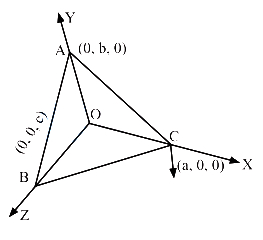
If $G(2, -1, 2)$ is the centroid of tetrahedron $OABC$ where $O=(0, 0, 0)$ and $G_1$ is the centroid of $\triangle ABC$,then $\left|\overline{O G_1}\right|=$
A
$1$
B
$\frac{3}{2}$
C
$4$
D
$\frac{9}{2}$
Solution
(C) Let the coordinates of the vertices be $O(0, 0, 0)$,$A(x_1, y_1, z_1)$,$B(x_2, y_2, z_2)$,and $C(x_3, y_3, z_3)$.
The centroid $G$ of the tetrahedron $OABC$ is given by $G = \left(\frac{0+x_1+x_2+x_3}{4}, \frac{0+y_1+y_2+y_3}{4}, \frac{0+z_1+z_2+z_3}{4}\right) = (2, -1, 2)$.
This implies $\frac{x_1+x_2+x_3}{4} = 2 \Rightarrow x_1+x_2+x_3 = 8$,$\frac{y_1+y_2+y_3}{4} = -1 \Rightarrow y_1+y_2+y_3 = -4$,and $\frac{z_1+z_2+z_3}{4} = 2 \Rightarrow z_1+z_2+z_3 = 8$.
The centroid $G_1$ of $\triangle ABC$ is given by $G_1 = \left(\frac{x_1+x_2+x_3}{3}, \frac{y_1+y_2+y_3}{3}, \frac{z_1+z_2+z_3}{3}\right)$.
Substituting the values,we get $G_1 = \left(\frac{8}{3}, \frac{-4}{3}, \frac{8}{3}\right)$.
The distance $\left|\overline{O G_1}\right| = \sqrt{\left(\frac{8}{3}\right)^2 + \left(-\frac{4}{3}\right)^2 + \left(\frac{8}{3}\right)^2} = \sqrt{\frac{64}{9} + \frac{16}{9} + \frac{64}{9}} = \sqrt{\frac{144}{9}} = \sqrt{16} = 4$.
The centroid $G$ of the tetrahedron $OABC$ is given by $G = \left(\frac{0+x_1+x_2+x_3}{4}, \frac{0+y_1+y_2+y_3}{4}, \frac{0+z_1+z_2+z_3}{4}\right) = (2, -1, 2)$.
This implies $\frac{x_1+x_2+x_3}{4} = 2 \Rightarrow x_1+x_2+x_3 = 8$,$\frac{y_1+y_2+y_3}{4} = -1 \Rightarrow y_1+y_2+y_3 = -4$,and $\frac{z_1+z_2+z_3}{4} = 2 \Rightarrow z_1+z_2+z_3 = 8$.
The centroid $G_1$ of $\triangle ABC$ is given by $G_1 = \left(\frac{x_1+x_2+x_3}{3}, \frac{y_1+y_2+y_3}{3}, \frac{z_1+z_2+z_3}{3}\right)$.
Substituting the values,we get $G_1 = \left(\frac{8}{3}, \frac{-4}{3}, \frac{8}{3}\right)$.
The distance $\left|\overline{O G_1}\right| = \sqrt{\left(\frac{8}{3}\right)^2 + \left(-\frac{4}{3}\right)^2 + \left(\frac{8}{3}\right)^2} = \sqrt{\frac{64}{9} + \frac{16}{9} + \frac{64}{9}} = \sqrt{\frac{144}{9}} = \sqrt{16} = 4$.
0 likes
View Solution62
EasyMCQ
The incenter of the triangle formed by the points $(0,0,0), (3,0,0)$ and $(0,4,0)$ is
A
$(1,1,0)$
B
$(-1,-1,0)$
C
$(1,0,1)$
D
$(-1,0,-1)$
Solution
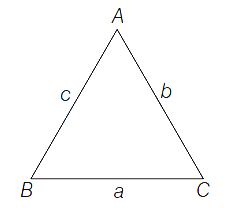
(A) Let the vertices of the triangle be $A(0,0,0), B(3,0,0)$,and $C(0,4,0)$.
First,we calculate the lengths of the sides opposite to the vertices $A, B$,and $C$:
$a = BC = \sqrt{(0-3)^2 + (4-0)^2 + (0-0)^2} = \sqrt{(-3)^2 + 4^2} = \sqrt{9+16} = \sqrt{25} = 5$
$b = AC = \sqrt{(0-0)^2 + (4-0)^2 + (0-0)^2} = \sqrt{4^2} = 4$
$c = AB = \sqrt{(3-0)^2 + (0-0)^2 + (0-0)^2} = \sqrt{3^2} = 3$
The coordinates of the incenter $(x, y, z)$ are given by the formula:
$x = \frac{ax_1 + bx_2 + cx_3}{a+b+c}, y = \frac{ay_1 + by_2 + cy_3}{a+b+c}, z = \frac{az_1 + bz_2 + cz_3}{a+b+c}$
Substituting the values $A(x_1, y_1, z_1) = (0,0,0), B(x_2, y_2, z_2) = (3,0,0), C(x_3, y_3, z_3) = (0,4,0)$ and side lengths $a=5, b=4, c=3$:
$x = \frac{5(0) + 4(3) + 3(0)}{5+4+3} = \frac{12}{12} = 1$
$y = \frac{5(0) + 4(0) + 3(4)}{5+4+3} = \frac{12}{12} = 1$
$z = \frac{5(0) + 4(0) + 3(0)}{5+4+3} = \frac{0}{12} = 0$
Thus,the incenter is $(1, 1, 0)$.
First,we calculate the lengths of the sides opposite to the vertices $A, B$,and $C$:
$a = BC = \sqrt{(0-3)^2 + (4-0)^2 + (0-0)^2} = \sqrt{(-3)^2 + 4^2} = \sqrt{9+16} = \sqrt{25} = 5$
$b = AC = \sqrt{(0-0)^2 + (4-0)^2 + (0-0)^2} = \sqrt{4^2} = 4$
$c = AB = \sqrt{(3-0)^2 + (0-0)^2 + (0-0)^2} = \sqrt{3^2} = 3$
The coordinates of the incenter $(x, y, z)$ are given by the formula:
$x = \frac{ax_1 + bx_2 + cx_3}{a+b+c}, y = \frac{ay_1 + by_2 + cy_3}{a+b+c}, z = \frac{az_1 + bz_2 + cz_3}{a+b+c}$
Substituting the values $A(x_1, y_1, z_1) = (0,0,0), B(x_2, y_2, z_2) = (3,0,0), C(x_3, y_3, z_3) = (0,4,0)$ and side lengths $a=5, b=4, c=3$:
$x = \frac{5(0) + 4(3) + 3(0)}{5+4+3} = \frac{12}{12} = 1$
$y = \frac{5(0) + 4(0) + 3(4)}{5+4+3} = \frac{12}{12} = 1$
$z = \frac{5(0) + 4(0) + 3(0)}{5+4+3} = \frac{0}{12} = 0$
Thus,the incenter is $(1, 1, 0)$.
0 likes
View Solution63
EasyMCQ
If $P(0, 7, 10)$,$Q(-1, 6, 6)$,and $R(-4, 9, 6)$ are three points in space,then $\triangle PQR$ is:
A
right-angled isosceles triangle
B
equilateral triangle
C
isosceles but not right-angled triangle
D
scalene triangle
Solution
(A) Given points are $P(0, 7, 10)$,$Q(-1, 6, 6)$,and $R(-4, 9, 6)$.
Using the distance formula $d = \sqrt{(x_2-x_1)^2 + (y_2-y_1)^2 + (z_2-z_1)^2}$:
$PQ = \sqrt{(-1-0)^2 + (6-7)^2 + (6-10)^2} = \sqrt{1 + 1 + 16} = \sqrt{18} = 3\sqrt{2}$.
$QR = \sqrt{(-4 - (-1))^2 + (9-6)^2 + (6-6)^2} = \sqrt{(-3)^2 + 3^2 + 0^2} = \sqrt{9 + 9 + 0} = \sqrt{18} = 3\sqrt{2}$.
$PR = \sqrt{(-4-0)^2 + (9-7)^2 + (6-10)^2} = \sqrt{(-4)^2 + 2^2 + (-4)^2} = \sqrt{16 + 4 + 16} = \sqrt{36} = 6$.
Since $PQ = QR = 3\sqrt{2}$,the triangle is isosceles.
Also,$PQ^2 + QR^2 = 18 + 18 = 36 = PR^2$. By the converse of the Pythagorean theorem,$\triangle PQR$ is a right-angled triangle.
Therefore,$\triangle PQR$ is a right-angled isosceles triangle.
Using the distance formula $d = \sqrt{(x_2-x_1)^2 + (y_2-y_1)^2 + (z_2-z_1)^2}$:
$PQ = \sqrt{(-1-0)^2 + (6-7)^2 + (6-10)^2} = \sqrt{1 + 1 + 16} = \sqrt{18} = 3\sqrt{2}$.
$QR = \sqrt{(-4 - (-1))^2 + (9-6)^2 + (6-6)^2} = \sqrt{(-3)^2 + 3^2 + 0^2} = \sqrt{9 + 9 + 0} = \sqrt{18} = 3\sqrt{2}$.
$PR = \sqrt{(-4-0)^2 + (9-7)^2 + (6-10)^2} = \sqrt{(-4)^2 + 2^2 + (-4)^2} = \sqrt{16 + 4 + 16} = \sqrt{36} = 6$.
Since $PQ = QR = 3\sqrt{2}$,the triangle is isosceles.
Also,$PQ^2 + QR^2 = 18 + 18 = 36 = PR^2$. By the converse of the Pythagorean theorem,$\triangle PQR$ is a right-angled triangle.
Therefore,$\triangle PQR$ is a right-angled isosceles triangle.
0 likes
View Solution64
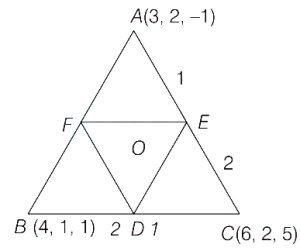
EasyMCQ
$A(3, 2, -1), B(4, 1, 1), C(6, 2, 5)$ are three points. If $D, E, F$ are three points which divide $BC, CA, AB$ respectively in the same ratio $2: 1$,then the centroid of $\triangle DEF$ is
A
$\left(\frac{13}{3}, \frac{5}{3}, \frac{5}{3}\right)$
B
$(13, 5, 5)$
C
$(4, 2, 1)$
D
$\left(\frac{11}{3}, \frac{4}{3}, \frac{1}{3}\right)$
Solution
(A) The centroid of $\triangle ABC$ is $G = \left(\frac{3+4+6}{3}, \frac{2+1+2}{3}, \frac{-1+1+5}{3}\right) = \left(\frac{13}{3}, \frac{5}{3}, \frac{5}{3}\right)$.
Since $D, E, F$ divide the sides $BC, CA, AB$ in the same ratio $k:1$ (where $k=2$),the centroid of $\triangle DEF$ is the same as the centroid of $\triangle ABC$.
Therefore,the centroid of $\triangle DEF$ is $\left(\frac{13}{3}, \frac{5}{3}, \frac{5}{3}\right)$.
Since $D, E, F$ divide the sides $BC, CA, AB$ in the same ratio $k:1$ (where $k=2$),the centroid of $\triangle DEF$ is the same as the centroid of $\triangle ABC$.
Therefore,the centroid of $\triangle DEF$ is $\left(\frac{13}{3}, \frac{5}{3}, \frac{5}{3}\right)$.
0 likes
View Solution65
MediumMCQ
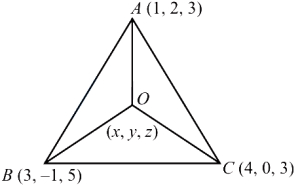
The circumcentre of the triangle formed by the points $(1, 2, 3), (3, -1, 5), (4, 0, -3)$ is
A
$(1, 1, 1)$
B
$(2, 2, 2)$
C
$(3, 3, 3)$
D
$\left(\frac{7}{2}, -\frac{1}{2}, 1\right)$
Solution
(D) Let $A(1, 2, 3), B(3, -1, 5), C(4, 0, -3)$ be the vertices of the triangle. Let $O(x, y, z)$ be the circumcentre. Then $OA = OB = OC$,which implies $OA^2 = OB^2 = OC^2$.
$OA^2 = OB^2 \Rightarrow (x-1)^2 + (y-2)^2 + (z-3)^2 = (x-3)^2 + (y+1)^2 + (z-5)^2$
$x^2 - 2x + 1 + y^2 - 4y + 4 + z^2 - 6z + 9 = x^2 - 6x + 9 + y^2 + 2y + 1 + z^2 - 10z + 25$
$4x - 6y + 4z = 20 \Rightarrow 2x - 3y + 2z = 10 \quad \dots (i)$
$OB^2 = OC^2 \Rightarrow (x-3)^2 + (y+1)^2 + (z-5)^2 = (x-4)^2 + y^2 + (z+3)^2$
$x^2 - 6x + 9 + y^2 + 2y + 1 + z^2 - 10z + 25 = x^2 - 8x + 16 + y^2 + z^2 + 6z + 9$
$2x + 2y - 16z = -10 \Rightarrow x + y - 8z = -5 \quad \dots (ii)$
$OA^2 = OC^2 \Rightarrow (x-1)^2 + (y-2)^2 + (z-3)^2 = (x-4)^2 + y^2 + (z+3)^2$
$x^2 - 2x + 1 + y^2 - 4y + 4 + z^2 - 6z + 9 = x^2 - 8x + 16 + y^2 + z^2 + 6z + 9$
$6x - 4y - 12z = 11 \quad \dots (iii)$
Solving equations $(i), (ii),$ and $(iii)$,we get $x = \frac{7}{2}, y = -\frac{1}{2}, z = 1$.
Thus,the circumcentre is $\left(\frac{7}{2}, -\frac{1}{2}, 1\right)$.
$OA^2 = OB^2 \Rightarrow (x-1)^2 + (y-2)^2 + (z-3)^2 = (x-3)^2 + (y+1)^2 + (z-5)^2$
$x^2 - 2x + 1 + y^2 - 4y + 4 + z^2 - 6z + 9 = x^2 - 6x + 9 + y^2 + 2y + 1 + z^2 - 10z + 25$
$4x - 6y + 4z = 20 \Rightarrow 2x - 3y + 2z = 10 \quad \dots (i)$
$OB^2 = OC^2 \Rightarrow (x-3)^2 + (y+1)^2 + (z-5)^2 = (x-4)^2 + y^2 + (z+3)^2$
$x^2 - 6x + 9 + y^2 + 2y + 1 + z^2 - 10z + 25 = x^2 - 8x + 16 + y^2 + z^2 + 6z + 9$
$2x + 2y - 16z = -10 \Rightarrow x + y - 8z = -5 \quad \dots (ii)$
$OA^2 = OC^2 \Rightarrow (x-1)^2 + (y-2)^2 + (z-3)^2 = (x-4)^2 + y^2 + (z+3)^2$
$x^2 - 2x + 1 + y^2 - 4y + 4 + z^2 - 6z + 9 = x^2 - 8x + 16 + y^2 + z^2 + 6z + 9$
$6x - 4y - 12z = 11 \quad \dots (iii)$
Solving equations $(i), (ii),$ and $(iii)$,we get $x = \frac{7}{2}, y = -\frac{1}{2}, z = 1$.
Thus,the circumcentre is $\left(\frac{7}{2}, -\frac{1}{2}, 1\right)$.
0 likes
View Solution66
DifficultMCQ
Match the following columns:
| Column $I$ | Column $II$ |
| $(A)$ The centroid of the triangle formed by $(2, 3, -1)$,$(5, 6, 3)$,$(2, -3, 1)$ is | $(p)$ $(2, 2, 2)$ |
| $(B)$ The circumcentre of the triangle formed by $(1, 2, 3)$,$(2, 3, 1)$,$(3, 1, 2)$ is | $(q)$ $(3, 1, 4)$ |
| $(C)$ The orthocentre of the triangle formed by $(2, 1, 5)$,$(3, 2, 3)$,$(4, 0, 4)$ is | $(r)$ $(1, 1, 0)$ |
| $(D)$ The incentre of the triangle formed by $(0, 0, 0)$,$(3, 0, 0)$,$(0, 4, 0)$ is | $(s)$ $(3, 2, 1)$ |
A
$A-s, B-p, C-q, D-r$
B
$A-p, B-q, C-r, D-s$
C
$A-s, B-r, C-q, D-p$
D
$A-s, B-p, C-r, D-q$
Solution
(A) The centroid $G$ of a triangle with vertices $(x_1, y_1, z_1)$,$(x_2, y_2, z_2)$,and $(x_3, y_3, z_3)$ is given by $(\frac{x_1+x_2+x_3}{3}, \frac{y_1+y_2+y_3}{3}, \frac{z_1+z_2+z_3}{3})$.
For vertices $(2, 3, -1)$,$(5, 6, 3)$,$(2, -3, 1)$:
$G = (\frac{2+5+2}{3}, \frac{3+6-3}{3}, \frac{-1+3+1}{3}) = (\frac{9}{3}, \frac{6}{3}, \frac{3}{3}) = (3, 2, 1)$. Thus,$A-s$.
$(B)$ For an equilateral triangle,the circumcentre is the same as the centroid.
For vertices $(1, 2, 3)$,$(2, 3, 1)$,$(3, 1, 2)$:
$C = (\frac{1+2+3}{3}, \frac{2+3+1}{3}, \frac{3+1+2}{3}) = (\frac{6}{3}, \frac{6}{3}, \frac{6}{3}) = (2, 2, 2)$. Thus,$B-p$.
$(C)$ For an equilateral triangle,the orthocentre is the same as the centroid.
For vertices $(2, 1, 5)$,$(3, 2, 3)$,$(4, 0, 4)$:
$O = (\frac{2+3+4}{3}, \frac{1+2+0}{3}, \frac{5+3+4}{3}) = (\frac{9}{3}, \frac{3}{3}, \frac{12}{3}) = (3, 1, 4)$. Thus,$C-q$.
$(D)$ For a right-angled triangle with vertices at $(0, 0, 0)$,$(a, 0, 0)$,and $(0, b, 0)$,the incentre is $(\frac{ab}{a+b+\sqrt{a^2+b^2}}, \frac{ab}{a+b+\sqrt{a^2+b^2}}, 0)$.
Here,vertices are $(0, 0, 0)$,$(3, 0, 0)$,$(0, 4, 0)$. So,$a=3, b=4$. The hypotenuse $c = \sqrt{3^2+4^2} = 5$.
$I = (\frac{3 \times 4}{3+4+5}, \frac{3 \times 4}{3+4+5}, 0) = (\frac{12}{12}, \frac{12}{12}, 0) = (1, 1, 0)$. Thus,$D-r$.
For vertices $(2, 3, -1)$,$(5, 6, 3)$,$(2, -3, 1)$:
$G = (\frac{2+5+2}{3}, \frac{3+6-3}{3}, \frac{-1+3+1}{3}) = (\frac{9}{3}, \frac{6}{3}, \frac{3}{3}) = (3, 2, 1)$. Thus,$A-s$.
$(B)$ For an equilateral triangle,the circumcentre is the same as the centroid.
For vertices $(1, 2, 3)$,$(2, 3, 1)$,$(3, 1, 2)$:
$C = (\frac{1+2+3}{3}, \frac{2+3+1}{3}, \frac{3+1+2}{3}) = (\frac{6}{3}, \frac{6}{3}, \frac{6}{3}) = (2, 2, 2)$. Thus,$B-p$.
$(C)$ For an equilateral triangle,the orthocentre is the same as the centroid.
For vertices $(2, 1, 5)$,$(3, 2, 3)$,$(4, 0, 4)$:
$O = (\frac{2+3+4}{3}, \frac{1+2+0}{3}, \frac{5+3+4}{3}) = (\frac{9}{3}, \frac{3}{3}, \frac{12}{3}) = (3, 1, 4)$. Thus,$C-q$.
$(D)$ For a right-angled triangle with vertices at $(0, 0, 0)$,$(a, 0, 0)$,and $(0, b, 0)$,the incentre is $(\frac{ab}{a+b+\sqrt{a^2+b^2}}, \frac{ab}{a+b+\sqrt{a^2+b^2}}, 0)$.
Here,vertices are $(0, 0, 0)$,$(3, 0, 0)$,$(0, 4, 0)$. So,$a=3, b=4$. The hypotenuse $c = \sqrt{3^2+4^2} = 5$.
$I = (\frac{3 \times 4}{3+4+5}, \frac{3 \times 4}{3+4+5}, 0) = (\frac{12}{12}, \frac{12}{12}, 0) = (1, 1, 0)$. Thus,$D-r$.
0 likes
View Solution67
EasyMCQ
If the vertices of a triangle $ABC$ are $A(1, 2, 3)$,$B(h, -3, 0)$,and $C(-4, k, -1)$ and the centroid of the triangle is $\left(5, -1, \frac{2}{3}\right)$,then triangle $ABC$ is
A
an obtuse angled triangle
B
an acute angled triangle
C
an isosceles triangle
D
a right angled triangle
Solution
(A) The centroid $G$ of a triangle with vertices $(x_1, y_1, z_1)$,$(x_2, y_2, z_2)$,and $(x_3, y_3, z_3)$ is given by $\left(\frac{x_1+x_2+x_3}{3}, \frac{y_1+y_2+y_3}{3}, \frac{z_1+z_2+z_3}{3}\right)$.
Given $G = \left(5, -1, \frac{2}{3}\right)$,we have:
$\frac{1+h-4}{3} = 5$ $\Rightarrow h-3 = 15$ $\Rightarrow h = 18$.
$\frac{2-3+k}{3} = -1$ $\Rightarrow k-1 = -3$ $\Rightarrow k = -2$.
Thus,the vertices are $A(1, 2, 3)$,$B(18, -3, 0)$,and $C(-4, -2, -1)$.
Calculate the squares of the side lengths:
$AB^2 = (18-1)^2 + (-3-2)^2 + (0-3)^2 = 17^2 + (-5)^2 + (-3)^2 = 289 + 25 + 9 = 323$.
$BC^2 = (-4-18)^2 + (-2-(-3))^2 + (-1-0)^2 = (-22)^2 + 1^2 + (-1)^2 = 484 + 1 + 1 = 486$.
$CA^2 = (-4-1)^2 + (-2-2)^2 + (-1-3)^2 = (-5)^2 + (-4)^2 + (-4)^2 = 25 + 16 + 16 = 57$.
Since $BC^2 = 486$ and $AB^2 + CA^2 = 323 + 57 = 380$,we observe that $BC^2 > AB^2 + CA^2$.
Therefore,the triangle is an obtuse angled triangle.
Given $G = \left(5, -1, \frac{2}{3}\right)$,we have:
$\frac{1+h-4}{3} = 5$ $\Rightarrow h-3 = 15$ $\Rightarrow h = 18$.
$\frac{2-3+k}{3} = -1$ $\Rightarrow k-1 = -3$ $\Rightarrow k = -2$.
Thus,the vertices are $A(1, 2, 3)$,$B(18, -3, 0)$,and $C(-4, -2, -1)$.
Calculate the squares of the side lengths:
$AB^2 = (18-1)^2 + (-3-2)^2 + (0-3)^2 = 17^2 + (-5)^2 + (-3)^2 = 289 + 25 + 9 = 323$.
$BC^2 = (-4-18)^2 + (-2-(-3))^2 + (-1-0)^2 = (-22)^2 + 1^2 + (-1)^2 = 484 + 1 + 1 = 486$.
$CA^2 = (-4-1)^2 + (-2-2)^2 + (-1-3)^2 = (-5)^2 + (-4)^2 + (-4)^2 = 25 + 16 + 16 = 57$.
Since $BC^2 = 486$ and $AB^2 + CA^2 = 323 + 57 = 380$,we observe that $BC^2 > AB^2 + CA^2$.
Therefore,the triangle is an obtuse angled triangle.
0 likes
View Solution68
MediumMCQ
The points $(2, 3, 4)$,$(-1, -2, 1)$,and $(5, 8, 7)$ are
A
collinear
B
vertices of a right-angled triangle
C
vertices of an equilateral triangle
D
vertices of an isosceles triangle
Solution
(A) Let the points be $A(2, 3, 4)$,$B(-1, -2, 1)$,and $C(5, 8, 7)$.
We check if the points are collinear by calculating the distance between them.
$AB = \sqrt{(-1-2)^2 + (-2-3)^2 + (1-4)^2} = \sqrt{(-3)^2 + (-5)^2 + (-3)^2} = \sqrt{9 + 25 + 9} = \sqrt{43}$.
$BC = \sqrt{(5-(-1))^2 + (8-(-2))^2 + (7-1)^2} = \sqrt{6^2 + 10^2 + 6^2} = \sqrt{36 + 100 + 36} = \sqrt{172} = 2\sqrt{43}$.
$AC = \sqrt{(5-2)^2 + (8-3)^2 + (7-4)^2} = \sqrt{3^2 + 5^2 + 3^2} = \sqrt{9 + 25 + 9} = \sqrt{43}$.
Since $AB + AC = \sqrt{43} + \sqrt{43} = 2\sqrt{43} = BC$,the points $A, B, C$ are collinear.
We check if the points are collinear by calculating the distance between them.
$AB = \sqrt{(-1-2)^2 + (-2-3)^2 + (1-4)^2} = \sqrt{(-3)^2 + (-5)^2 + (-3)^2} = \sqrt{9 + 25 + 9} = \sqrt{43}$.
$BC = \sqrt{(5-(-1))^2 + (8-(-2))^2 + (7-1)^2} = \sqrt{6^2 + 10^2 + 6^2} = \sqrt{36 + 100 + 36} = \sqrt{172} = 2\sqrt{43}$.
$AC = \sqrt{(5-2)^2 + (8-3)^2 + (7-4)^2} = \sqrt{3^2 + 5^2 + 3^2} = \sqrt{9 + 25 + 9} = \sqrt{43}$.
Since $AB + AC = \sqrt{43} + \sqrt{43} = 2\sqrt{43} = BC$,the points $A, B, C$ are collinear.
0 likes
View Solution69
MediumMCQ
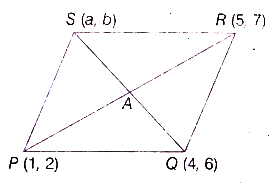
If the points $P = \hat{i} + 2 \hat{j}$,$Q = 4 \hat{i} + 6 \hat{j}$,$R = 5 \hat{i} + 7 \hat{j}$,and $S = a \hat{i} + b \hat{j}$ are the consecutive vertices of a parallelogram $PQRS$,then:
A
$a = 2, b = 4$
B
$a = 3, b = 4$
C
$a = 2, b = 3$
D
$a = 3, b = 5$
Solution
(C) Given vertices of the parallelogram $PQRS$ are $P(1, 2)$,$Q(4, 6)$,$R(5, 7)$,and $S(a, b)$.
In a parallelogram,the diagonals bisect each other,meaning they share the same midpoint.
Let $A$ be the midpoint of the diagonals $PR$ and $QS$.
The midpoint $A$ of diagonal $PR$ is given by:
$A = \left( \frac{1 + 5}{2}, \frac{2 + 7}{2} \right) = \left( \frac{6}{2}, \frac{9}{2} \right) = \left( 3, 4.5 \right)$.
The midpoint $A$ of diagonal $QS$ is given by:
$A = \left( \frac{4 + a}{2}, \frac{6 + b}{2} \right)$.
Equating the coordinates of the midpoints:
$\frac{4 + a}{2} = 3 \implies 4 + a = 6 \implies a = 2$.
$\frac{6 + b}{2} = 4.5 \implies 6 + b = 9 \implies b = 3$.
Therefore,the values are $a = 2$ and $b = 3$.
In a parallelogram,the diagonals bisect each other,meaning they share the same midpoint.
Let $A$ be the midpoint of the diagonals $PR$ and $QS$.
The midpoint $A$ of diagonal $PR$ is given by:
$A = \left( \frac{1 + 5}{2}, \frac{2 + 7}{2} \right) = \left( \frac{6}{2}, \frac{9}{2} \right) = \left( 3, 4.5 \right)$.
The midpoint $A$ of diagonal $QS$ is given by:
$A = \left( \frac{4 + a}{2}, \frac{6 + b}{2} \right)$.
Equating the coordinates of the midpoints:
$\frac{4 + a}{2} = 3 \implies 4 + a = 6 \implies a = 2$.
$\frac{6 + b}{2} = 4.5 \implies 6 + b = 9 \implies b = 3$.
Therefore,the values are $a = 2$ and $b = 3$.
0 likes
View Solution70
MediumMCQ
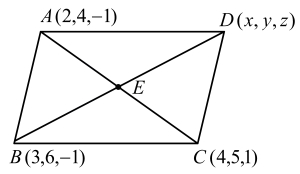
If the points $(2,4,-1), (3,6,-1)$ and $(4,5,1)$ are three consecutive vertices of a parallelogram,then its fourth vertex is
A
$(3,3,1)$
B
$(3,1,3)$
C
$(1,3,3)$
D
$(0,0,0)$
Solution
(A) Let the vertices of the parallelogram be $A(2,4,-1)$,$B(3,6,-1)$,and $C(4,5,1)$.
Let the fourth vertex be $D(x, y, z)$.
In a parallelogram,the diagonals bisect each other,which means the midpoint of diagonal $AC$ is the same as the midpoint of diagonal $BD$.
Midpoint of $AC = \left( \frac{2+4}{2}, \frac{4+5}{2}, \frac{-1+1}{2} \right) = \left( 3, \frac{9}{2}, 0 \right)$.
Midpoint of $BD = \left( \frac{3+x}{2}, \frac{6+y}{2}, \frac{-1+z}{2} \right)$.
Equating the midpoints:
$\frac{3+x}{2} = 3 \Rightarrow 3+x = 6 \Rightarrow x = 3$.
$\frac{6+y}{2} = \frac{9}{2} \Rightarrow 6+y = 9 \Rightarrow y = 3$.
$\frac{-1+z}{2} = 0 \Rightarrow -1+z = 0 \Rightarrow z = 1$.
Thus,the fourth vertex $D$ is $(3,3,1)$.
Let the fourth vertex be $D(x, y, z)$.
In a parallelogram,the diagonals bisect each other,which means the midpoint of diagonal $AC$ is the same as the midpoint of diagonal $BD$.
Midpoint of $AC = \left( \frac{2+4}{2}, \frac{4+5}{2}, \frac{-1+1}{2} \right) = \left( 3, \frac{9}{2}, 0 \right)$.
Midpoint of $BD = \left( \frac{3+x}{2}, \frac{6+y}{2}, \frac{-1+z}{2} \right)$.
Equating the midpoints:
$\frac{3+x}{2} = 3 \Rightarrow 3+x = 6 \Rightarrow x = 3$.
$\frac{6+y}{2} = \frac{9}{2} \Rightarrow 6+y = 9 \Rightarrow y = 3$.
$\frac{-1+z}{2} = 0 \Rightarrow -1+z = 0 \Rightarrow z = 1$.
Thus,the fourth vertex $D$ is $(3,3,1)$.
0 likes
View Solution71
EasyMCQ
Given $\triangle ABC$ such that $A = 2\hat{i} - \hat{j} + \hat{k}$,$B = \hat{i} - 3\hat{j} - 5\hat{k}$,and $C = 3\hat{i} - 4\hat{j} - 4\hat{k}$,then $\triangle ABC$ is:
A
An equilateral triangle
B
$A$ right-angled triangle
C
An isosceles triangle
D
$A$ scalene triangle
Solution
(B) The vertices of $\triangle ABC$ are $A(2, -1, 1)$,$B(1, -3, -5)$,and $C(3, -4, -4)$.
First,we calculate the lengths of the sides using the distance formula:
$AB = \sqrt{(1-2)^2 + (-3 - (-1))^2 + (-5-1)^2} = \sqrt{(-1)^2 + (-2)^2 + (-6)^2} = \sqrt{1 + 4 + 36} = \sqrt{41}$.
$BC = \sqrt{(3-1)^2 + (-4 - (-3))^2 + (-4 - (-5))^2} = \sqrt{2^2 + (-1)^2 + 1^2} = \sqrt{4 + 1 + 1} = \sqrt{6}$.
$CA = \sqrt{(2-3)^2 + (-1 - (-4))^2 + (1 - (-4))^2} = \sqrt{(-1)^2 + 3^2 + 5^2} = \sqrt{1 + 9 + 25} = \sqrt{35}$.
Now,check for the Pythagorean theorem:
$BC^2 + CA^2 = 6 + 35 = 41 = AB^2$.
Since $AB^2 = BC^2 + CA^2$,the triangle satisfies the condition for a right-angled triangle.
Thus,$\triangle ABC$ is a right-angled triangle.
First,we calculate the lengths of the sides using the distance formula:
$AB = \sqrt{(1-2)^2 + (-3 - (-1))^2 + (-5-1)^2} = \sqrt{(-1)^2 + (-2)^2 + (-6)^2} = \sqrt{1 + 4 + 36} = \sqrt{41}$.
$BC = \sqrt{(3-1)^2 + (-4 - (-3))^2 + (-4 - (-5))^2} = \sqrt{2^2 + (-1)^2 + 1^2} = \sqrt{4 + 1 + 1} = \sqrt{6}$.
$CA = \sqrt{(2-3)^2 + (-1 - (-4))^2 + (1 - (-4))^2} = \sqrt{(-1)^2 + 3^2 + 5^2} = \sqrt{1 + 9 + 25} = \sqrt{35}$.
Now,check for the Pythagorean theorem:
$BC^2 + CA^2 = 6 + 35 = 41 = AB^2$.
Since $AB^2 = BC^2 + CA^2$,the triangle satisfies the condition for a right-angled triangle.
Thus,$\triangle ABC$ is a right-angled triangle.
0 likes
View Solution72
MediumMCQ
$G(1,0,1)$ is the centroid of the triangle $ABC$. If $A=(1,-4,2)$ and $B=(3,1,0)$,then $AG^2+CG^2=$
A
$BG^2$
B
$2 BG^2$
C
$6 BG^2$
D
$5 BG^2$
Solution
(D) Let the coordinates of $C$ be $(x, y, z)$.
Since $G(1,0,1)$ is the centroid of $\triangle ABC$,we have:
$\frac{1+3+x}{3} = 1 \implies 4+x = 3 \implies x = -1$
$\frac{-4+1+y}{3} = 0 \implies -3+y = 0 \implies y = 3$
$\frac{2+0+z}{3} = 1 \implies 2+z = 3 \implies z = 1$
So,$C = (-1, 3, 1)$.
Now,calculate $AG^2$:
$AG^2 = (1-1)^2 + (0-(-4))^2 + (1-2)^2 = 0^2 + 4^2 + (-1)^2 = 16 + 1 = 17$.
Calculate $CG^2$:
$CG^2 = (-1-1)^2 + (3-0)^2 + (1-1)^2 = (-2)^2 + 3^2 + 0^2 = 4 + 9 = 13$.
Thus,$AG^2 + CG^2 = 17 + 13 = 30$.
Calculate $BG^2$:
$BG^2 = (3-1)^2 + (1-0)^2 + (0-1)^2 = 2^2 + 1^2 + (-1)^2 = 4 + 1 + 1 = 6$.
Comparing the values,$AG^2 + CG^2 = 30 = 5 \times 6 = 5 BG^2$.
Since $G(1,0,1)$ is the centroid of $\triangle ABC$,we have:
$\frac{1+3+x}{3} = 1 \implies 4+x = 3 \implies x = -1$
$\frac{-4+1+y}{3} = 0 \implies -3+y = 0 \implies y = 3$
$\frac{2+0+z}{3} = 1 \implies 2+z = 3 \implies z = 1$
So,$C = (-1, 3, 1)$.
Now,calculate $AG^2$:
$AG^2 = (1-1)^2 + (0-(-4))^2 + (1-2)^2 = 0^2 + 4^2 + (-1)^2 = 16 + 1 = 17$.
Calculate $CG^2$:
$CG^2 = (-1-1)^2 + (3-0)^2 + (1-1)^2 = (-2)^2 + 3^2 + 0^2 = 4 + 9 = 13$.
Thus,$AG^2 + CG^2 = 17 + 13 = 30$.
Calculate $BG^2$:
$BG^2 = (3-1)^2 + (1-0)^2 + (0-1)^2 = 2^2 + 1^2 + (-1)^2 = 4 + 1 + 1 = 6$.
Comparing the values,$AG^2 + CG^2 = 30 = 5 \times 6 = 5 BG^2$.
0 likes
View Solution73
MediumMCQ
The points $A(-1, 2, 3)$,$B(2, -3, 1)$,and $C(3, 1, -2)$:
A
are collinear
B
form an isosceles triangle
C
form a right angled triangle
D
form a scalene triangle
Solution
(D) To determine the nature of the triangle formed by points $A(-1, 2, 3)$,$B(2, -3, 1)$,and $C(3, 1, -2)$,we calculate the lengths of the sides using the distance formula $d = \sqrt{(x_2-x_1)^2 + (y_2-y_1)^2 + (z_2-z_1)^2}$.
$1$. Length of $AB$:
$AB = \sqrt{(2 - (-1))^2 + (-3 - 2)^2 + (1 - 3)^2} = \sqrt{3^2 + (-5)^2 + (-2)^2} = \sqrt{9 + 25 + 4} = \sqrt{38}$.
$2$. Length of $BC$:
$BC = \sqrt{(3 - 2)^2 + (1 - (-3))^2 + (-2 - 1)^2} = \sqrt{1^2 + 4^2 + (-3)^2} = \sqrt{1 + 16 + 9} = \sqrt{26}$.
$3$. Length of $AC$:
$AC = \sqrt{(3 - (-1))^2 + (1 - 2)^2 + (-2 - 3)^2} = \sqrt{4^2 + (-1)^2 + (-5)^2} = \sqrt{16 + 1 + 25} = \sqrt{42}$.
Since all sides $AB = \sqrt{38}$,$BC = \sqrt{26}$,and $AC = \sqrt{42}$ are unequal,the triangle is a scalene triangle.
$1$. Length of $AB$:
$AB = \sqrt{(2 - (-1))^2 + (-3 - 2)^2 + (1 - 3)^2} = \sqrt{3^2 + (-5)^2 + (-2)^2} = \sqrt{9 + 25 + 4} = \sqrt{38}$.
$2$. Length of $BC$:
$BC = \sqrt{(3 - 2)^2 + (1 - (-3))^2 + (-2 - 1)^2} = \sqrt{1^2 + 4^2 + (-3)^2} = \sqrt{1 + 16 + 9} = \sqrt{26}$.
$3$. Length of $AC$:
$AC = \sqrt{(3 - (-1))^2 + (1 - 2)^2 + (-2 - 3)^2} = \sqrt{4^2 + (-1)^2 + (-5)^2} = \sqrt{16 + 1 + 25} = \sqrt{42}$.
Since all sides $AB = \sqrt{38}$,$BC = \sqrt{26}$,and $AC = \sqrt{42}$ are unequal,the triangle is a scalene triangle.
0 likes
View Solution74
MediumMCQ
The circumradius of the triangle formed by the points $A(2, -1, 1)$,$B(1, -3, -5)$,and $C(3, -4, -4)$ is:
A
$\frac{\sqrt{35}}{2}$
B
$\frac{\sqrt{25}}{3}$
C
$\sqrt{41}$
D
$\frac{\sqrt{41}}{2}$
Solution
(D) Let the vertices be $A(2, -1, 1)$,$B(1, -3, -5)$,and $C(3, -4, -4)$.
First,calculate the side lengths:
$AB = \sqrt{(1-2)^2 + (-3-(-1))^2 + (-5-1)^2} = \sqrt{(-1)^2 + (-2)^2 + (-6)^2} = \sqrt{1 + 4 + 36} = \sqrt{41}$.
$BC = \sqrt{(3-1)^2 + (-4-(-3))^2 + (-4-(-5))^2} = \sqrt{2^2 + (-1)^2 + 1^2} = \sqrt{4 + 1 + 1} = \sqrt{6}$.
$AC = \sqrt{(3-2)^2 + (-4-(-1))^2 + (-4-1)^2} = \sqrt{1^2 + (-3)^2 + (-5)^2} = \sqrt{1 + 9 + 25} = \sqrt{35}$.
Observe that $AB^2 = 41$ and $BC^2 + AC^2 = 6 + 35 = 41$.
Since $AB^2 = BC^2 + AC^2$,the triangle is a right-angled triangle with the right angle at $C$.
For a right-angled triangle,the circumradius $R$ is half of the hypotenuse.
Here,the hypotenuse is $AB = \sqrt{41}$.
Therefore,$R = \frac{AB}{2} = \frac{\sqrt{41}}{2}$.
First,calculate the side lengths:
$AB = \sqrt{(1-2)^2 + (-3-(-1))^2 + (-5-1)^2} = \sqrt{(-1)^2 + (-2)^2 + (-6)^2} = \sqrt{1 + 4 + 36} = \sqrt{41}$.
$BC = \sqrt{(3-1)^2 + (-4-(-3))^2 + (-4-(-5))^2} = \sqrt{2^2 + (-1)^2 + 1^2} = \sqrt{4 + 1 + 1} = \sqrt{6}$.
$AC = \sqrt{(3-2)^2 + (-4-(-1))^2 + (-4-1)^2} = \sqrt{1^2 + (-3)^2 + (-5)^2} = \sqrt{1 + 9 + 25} = \sqrt{35}$.
Observe that $AB^2 = 41$ and $BC^2 + AC^2 = 6 + 35 = 41$.
Since $AB^2 = BC^2 + AC^2$,the triangle is a right-angled triangle with the right angle at $C$.
For a right-angled triangle,the circumradius $R$ is half of the hypotenuse.
Here,the hypotenuse is $AB = \sqrt{41}$.
Therefore,$R = \frac{AB}{2} = \frac{\sqrt{41}}{2}$.
0 likes
View Solution75
MediumMCQ
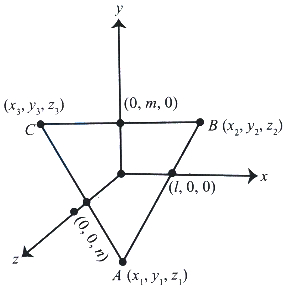
In $\triangle ABC$,if the midpoints of the sides $AB, BC$ and $CA$ are respectively $(l, 0, 0), (0, m, 0)$ and $(0, 0, n)$,then $\frac{AB^2+BC^2+CA^2}{l^2+m^2+n^2}=$
A
$2$
B
$4$
C
$8$
D
$16$
Solution
(C) Let the vertices of $\triangle ABC$ be $A(x_1, y_1, z_1)$,$B(x_2, y_2, z_2)$,and $C(x_3, y_3, z_3)$.
Given that the midpoints of $AB, BC, CA$ are $(l, 0, 0), (0, m, 0), (0, 0, n)$ respectively.
For midpoint of $AB$: $\frac{x_1+x_2}{2}=l, \frac{y_1+y_2}{2}=0, \frac{z_1+z_2}{2}=0 \Rightarrow x_1+x_2=2l, y_1+y_2=0, z_1+z_2=0$ ... $(i)$
For midpoint of $BC$: $\frac{x_2+x_3}{2}=0, \frac{y_2+y_3}{2}=m, \frac{z_2+z_3}{2}=0 \Rightarrow x_2+x_3=0, y_2+y_3=2m, z_2+z_3=0$ ... (ii)
For midpoint of $CA$: $\frac{x_3+x_1}{2}=0, \frac{y_3+y_1}{2}=0, \frac{z_3+z_1}{2}=n \Rightarrow x_3+x_1=0, y_3+y_1=0, z_3+z_1=2n$ ... (iii)
Solving these equations:
Adding $(i)$,(ii),and (iii): $2(x_1+x_2+x_3)=2l \Rightarrow x_1+x_2+x_3=l$. Similarly,$y_1+y_2+y_3=m$ and $z_1+z_2+z_3=n$.
Subtracting (ii) from the sum: $x_1=l, y_1=-m, z_1=n$ (Wait,let's re-evaluate).
From $(i)$,$x_2=2l-x_1$. Substituting into (ii): $2l-x_1+x_3=0 \Rightarrow x_1-x_3=2l$. From (iii),$x_1+x_3=0$. Adding gives $2x_1=2l \Rightarrow x_1=l, x_3=-l, x_2=l$.
Similarly,$y_1=m, y_2=-m, y_3=m$ and $z_1=-n, z_2=n, z_3=n$.
Thus,$A(l, m, -n), B(l, -m, n), C(-l, m, n)$.
$AB^2 = (l-l)^2 + (m-(-m))^2 + (-n-n)^2 = 0 + 4m^2 + 4n^2 = 4(m^2+n^2)$.
$BC^2 = (l-(-l))^2 + (-m-m)^2 + (n-n)^2 = 4l^2 + 4m^2 + 0 = 4(l^2+m^2)$.
$CA^2 = (-l-l)^2 + (m-m)^2 + (n-(-n))^2 = 4l^2 + 0 + 4n^2 = 4(l^2+n^2)$.
$AB^2+BC^2+CA^2 = 4(m^2+n^2+l^2+m^2+l^2+n^2) = 8(l^2+m^2+n^2)$.
Therefore,$\frac{AB^2+BC^2+CA^2}{l^2+m^2+n^2} = \frac{8(l^2+m^2+n^2)}{l^2+m^2+n^2} = 8$.
Given that the midpoints of $AB, BC, CA$ are $(l, 0, 0), (0, m, 0), (0, 0, n)$ respectively.
For midpoint of $AB$: $\frac{x_1+x_2}{2}=l, \frac{y_1+y_2}{2}=0, \frac{z_1+z_2}{2}=0 \Rightarrow x_1+x_2=2l, y_1+y_2=0, z_1+z_2=0$ ... $(i)$
For midpoint of $BC$: $\frac{x_2+x_3}{2}=0, \frac{y_2+y_3}{2}=m, \frac{z_2+z_3}{2}=0 \Rightarrow x_2+x_3=0, y_2+y_3=2m, z_2+z_3=0$ ... (ii)
For midpoint of $CA$: $\frac{x_3+x_1}{2}=0, \frac{y_3+y_1}{2}=0, \frac{z_3+z_1}{2}=n \Rightarrow x_3+x_1=0, y_3+y_1=0, z_3+z_1=2n$ ... (iii)
Solving these equations:
Adding $(i)$,(ii),and (iii): $2(x_1+x_2+x_3)=2l \Rightarrow x_1+x_2+x_3=l$. Similarly,$y_1+y_2+y_3=m$ and $z_1+z_2+z_3=n$.
Subtracting (ii) from the sum: $x_1=l, y_1=-m, z_1=n$ (Wait,let's re-evaluate).
From $(i)$,$x_2=2l-x_1$. Substituting into (ii): $2l-x_1+x_3=0 \Rightarrow x_1-x_3=2l$. From (iii),$x_1+x_3=0$. Adding gives $2x_1=2l \Rightarrow x_1=l, x_3=-l, x_2=l$.
Similarly,$y_1=m, y_2=-m, y_3=m$ and $z_1=-n, z_2=n, z_3=n$.
Thus,$A(l, m, -n), B(l, -m, n), C(-l, m, n)$.
$AB^2 = (l-l)^2 + (m-(-m))^2 + (-n-n)^2 = 0 + 4m^2 + 4n^2 = 4(m^2+n^2)$.
$BC^2 = (l-(-l))^2 + (-m-m)^2 + (n-n)^2 = 4l^2 + 4m^2 + 0 = 4(l^2+m^2)$.
$CA^2 = (-l-l)^2 + (m-m)^2 + (n-(-n))^2 = 4l^2 + 0 + 4n^2 = 4(l^2+n^2)$.
$AB^2+BC^2+CA^2 = 4(m^2+n^2+l^2+m^2+l^2+n^2) = 8(l^2+m^2+n^2)$.
Therefore,$\frac{AB^2+BC^2+CA^2}{l^2+m^2+n^2} = \frac{8(l^2+m^2+n^2)}{l^2+m^2+n^2} = 8$.
0 likes
View Solution76
EasyMCQ
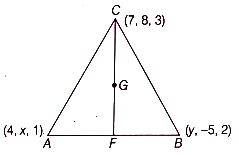
Let the centroid of a triangle formed by the points $A(4, x, 1)$,$B(y, -5, 2)$ and $C(7, 8, 3)$ be $G(3, 5, 2)$ and $CG$ meet $AB$ in $F$. Then,$F=$
A
$\left(\frac{5}{2}, \frac{3}{2}, \frac{5}{2}\right)$
B
$\left(\frac{11}{2}, 10, 2\right)$
C
$\left(1, \frac{7}{2}, \frac{3}{2}\right)$
D
$(10, 12, 5)$
Solution
(C) The coordinates of the centroid $G$ of a triangle with vertices $A(x_1, y_1, z_1)$,$B(x_2, y_2, z_2)$,and $C(x_3, y_3, z_3)$ are given by $\left(\frac{x_1+x_2+x_3}{3}, \frac{y_1+y_2+y_3}{3}, \frac{z_1+z_2+z_3}{3}\right)$.
Given $A(4, x, 1)$,$B(y, -5, 2)$,$C(7, 8, 3)$,and $G(3, 5, 2)$,we have:
$G = \left(\frac{4+y+7}{3}, \frac{x-5+8}{3}, \frac{1+2+3}{3}\right) = (3, 5, 2)$
Equating the coordinates:
$\frac{11+y}{3} = 3 \Rightarrow 11+y = 9 \Rightarrow y = -2$
$\frac{x+3}{3} = 5 \Rightarrow x+3 = 15 \Rightarrow x = 12$
Since $CG$ is a median,$F$ is the midpoint of $AB$. The coordinates of $F$ are:
$F = \left(\frac{4+y}{2}, \frac{x-5}{2}, \frac{1+2}{2}\right)$
Substituting $x=12$ and $y=-2$:
$F = \left(\frac{4-2}{2}, \frac{12-5}{2}, \frac{3}{2}\right) = \left(\frac{2}{2}, \frac{7}{2}, \frac{3}{2}\right) = \left(1, \frac{7}{2}, \frac{3}{2}\right)$.
Given $A(4, x, 1)$,$B(y, -5, 2)$,$C(7, 8, 3)$,and $G(3, 5, 2)$,we have:
$G = \left(\frac{4+y+7}{3}, \frac{x-5+8}{3}, \frac{1+2+3}{3}\right) = (3, 5, 2)$
Equating the coordinates:
$\frac{11+y}{3} = 3 \Rightarrow 11+y = 9 \Rightarrow y = -2$
$\frac{x+3}{3} = 5 \Rightarrow x+3 = 15 \Rightarrow x = 12$
Since $CG$ is a median,$F$ is the midpoint of $AB$. The coordinates of $F$ are:
$F = \left(\frac{4+y}{2}, \frac{x-5}{2}, \frac{1+2}{2}\right)$
Substituting $x=12$ and $y=-2$:
$F = \left(\frac{4-2}{2}, \frac{12-5}{2}, \frac{3}{2}\right) = \left(\frac{2}{2}, \frac{7}{2}, \frac{3}{2}\right) = \left(1, \frac{7}{2}, \frac{3}{2}\right)$.
0 likes
View Solution77
EasyMCQ
If the centroid of a triangle with vertices $(4, p, -3)$,$(-1, -1, 2)$,and $(3, 5, -8)$ is given by the mid-point of $(1, 4, -2)$ and $(q, 2, -4)$,then $p^2 + q^2 =$
A
$26$
B
$25$
C
$24$
D
$34$
Solution
(D) The centroid of a triangle with vertices $(x_1, y_1, z_1)$,$(x_2, y_2, z_2)$,and $(x_3, y_3, z_3)$ is given by $\left(\frac{x_1+x_2+x_3}{3}, \frac{y_1+y_2+y_3}{3}, \frac{z_1+z_2+z_3}{3}\right)$.
For the given vertices $(4, p, -3)$,$(-1, -1, 2)$,and $(3, 5, -8)$,the centroid is $\left(\frac{4-1+3}{3}, \frac{p-1+5}{3}, \frac{-3+2-8}{3}\right) = \left(2, \frac{p+4}{3}, -3\right)$.
The mid-point of $(1, 4, -2)$ and $(q, 2, -4)$ is $\left(\frac{1+q}{2}, \frac{4+2}{2}, \frac{-2-4}{2}\right) = \left(\frac{1+q}{2}, 3, -3\right)$.
Equating the coordinates of the centroid and the mid-point:
$2 = \frac{1+q}{2} \Rightarrow 4 = 1+q \Rightarrow q = 3$.
$\frac{p+4}{3} = 3 \Rightarrow p+4 = 9 \Rightarrow p = 5$.
Thus,$p^2 + q^2 = 5^2 + 3^2 = 25 + 9 = 34$.
For the given vertices $(4, p, -3)$,$(-1, -1, 2)$,and $(3, 5, -8)$,the centroid is $\left(\frac{4-1+3}{3}, \frac{p-1+5}{3}, \frac{-3+2-8}{3}\right) = \left(2, \frac{p+4}{3}, -3\right)$.
The mid-point of $(1, 4, -2)$ and $(q, 2, -4)$ is $\left(\frac{1+q}{2}, \frac{4+2}{2}, \frac{-2-4}{2}\right) = \left(\frac{1+q}{2}, 3, -3\right)$.
Equating the coordinates of the centroid and the mid-point:
$2 = \frac{1+q}{2} \Rightarrow 4 = 1+q \Rightarrow q = 3$.
$\frac{p+4}{3} = 3 \Rightarrow p+4 = 9 \Rightarrow p = 5$.
Thus,$p^2 + q^2 = 5^2 + 3^2 = 25 + 9 = 34$.
0 likes
View Solution78
EasyMCQ
If the origin is the centroid of the triangle for which $(-2, 3, 4)$ and $(3, -1, 5)$ are two vertices,then the third vertex is
A
$(-1, -2, -9)$
B
$(-1, -2, 9)$
C
$(1, -2, -9)$
D
$(1, 2, 9)$
Solution
(A) Let the vertices of the triangle be $A(x, y, z)$,$B(-2, 3, 4)$,and $C(3, -1, 5)$.
The centroid $G$ of a triangle with vertices $(x_1, y_1, z_1)$,$(x_2, y_2, z_2)$,and $(x_3, y_3, z_3)$ is given by $\left(\frac{x_1+x_2+x_3}{3}, \frac{y_1+y_2+y_3}{3}, \frac{z_1+z_2+z_3}{3}\right)$.
Given that the centroid is the origin $(0, 0, 0)$,we have:
$\frac{x-2+3}{3} = 0 \Rightarrow x+1 = 0 \Rightarrow x = -1$
$\frac{y+3-1}{3} = 0 \Rightarrow y+2 = 0 \Rightarrow y = -2$
$\frac{z+4+5}{3} = 0 \Rightarrow z+9 = 0 \Rightarrow z = -9$
Therefore,the third vertex is $(-1, -2, -9)$.
The centroid $G$ of a triangle with vertices $(x_1, y_1, z_1)$,$(x_2, y_2, z_2)$,and $(x_3, y_3, z_3)$ is given by $\left(\frac{x_1+x_2+x_3}{3}, \frac{y_1+y_2+y_3}{3}, \frac{z_1+z_2+z_3}{3}\right)$.
Given that the centroid is the origin $(0, 0, 0)$,we have:
$\frac{x-2+3}{3} = 0 \Rightarrow x+1 = 0 \Rightarrow x = -1$
$\frac{y+3-1}{3} = 0 \Rightarrow y+2 = 0 \Rightarrow y = -2$
$\frac{z+4+5}{3} = 0 \Rightarrow z+9 = 0 \Rightarrow z = -9$
Therefore,the third vertex is $(-1, -2, -9)$.
0 likes
View Solution79
EasyMCQ
If the origin is the centroid of the triangle $PQR$ with vertices $P(2a, 2, 6)$,$Q(-4, 3b, -10)$,and $R(8, 14, 2c)$,then the values of $a, b, c$ respectively are:
A
$2, \frac{16}{3}, -2$
B
$-2, -\frac{16}{3}, -2$
C
$-2, -\frac{16}{3}, 2$
D
$-2, \frac{16}{3}, -2$
Solution
(C) The centroid $(x, y, z)$ of a triangle with vertices $(x_1, y_1, z_1)$,$(x_2, y_2, z_2)$,and $(x_3, y_3, z_3)$ is given by:
$x = \frac{x_1+x_2+x_3}{3}$,$y = \frac{y_1+y_2+y_3}{3}$,$z = \frac{z_1+z_2+z_3}{3}$
Since the origin $(0, 0, 0)$ is the centroid,we have:
$0 = \frac{2a - 4 + 8}{3} \Rightarrow 2a + 4 = 0 \Rightarrow a = -2$
$0 = \frac{2 + 3b + 14}{3} \Rightarrow 3b + 16 = 0 \Rightarrow b = -\frac{16}{3}$
$0 = \frac{6 - 10 + 2c}{3} \Rightarrow 2c - 4 = 0 \Rightarrow c = 2$
Thus,the values are $a = -2, b = -\frac{16}{3}, c = 2$.
$x = \frac{x_1+x_2+x_3}{3}$,$y = \frac{y_1+y_2+y_3}{3}$,$z = \frac{z_1+z_2+z_3}{3}$
Since the origin $(0, 0, 0)$ is the centroid,we have:
$0 = \frac{2a - 4 + 8}{3} \Rightarrow 2a + 4 = 0 \Rightarrow a = -2$
$0 = \frac{2 + 3b + 14}{3} \Rightarrow 3b + 16 = 0 \Rightarrow b = -\frac{16}{3}$
$0 = \frac{6 - 10 + 2c}{3} \Rightarrow 2c - 4 = 0 \Rightarrow c = 2$
Thus,the values are $a = -2, b = -\frac{16}{3}, c = 2$.
0 likes
View Solution80
EasyMCQ
The points $(5,-4,5), (-3,-3,2)$ and $(-1,-6,8)$ form ......
A
an isosceles triangle
B
an equilateral triangle
C
a right-angled isosceles triangle
D
a right-angled triangle
Solution
(A) Let the points be $A(5, -4, 5)$,$B(-3, -3, 2)$,and $C(-1, -6, 8)$.
We calculate the lengths of the sides using the distance formula $d = \sqrt{(x_2-x_1)^2 + (y_2-y_1)^2 + (z_2-z_1)^2}$.
$AB = \sqrt{(-3-5)^2 + (-3-(-4))^2 + (2-5)^2} = \sqrt{(-8)^2 + (1)^2 + (-3)^2} = \sqrt{64 + 1 + 9} = \sqrt{74}$.
$BC = \sqrt{(-1-(-3))^2 + (-6-(-3))^2 + (8-2)^2} = \sqrt{(2)^2 + (-3)^2 + (6)^2} = \sqrt{4 + 9 + 36} = \sqrt{49} = 7$.
$CA = \sqrt{(5-(-1))^2 + (-4-(-6))^2 + (5-8)^2} = \sqrt{(6)^2 + (2)^2 + (-3)^2} = \sqrt{36 + 4 + 9} = \sqrt{49} = 7$.
Since $BC = CA = 7$,two sides of the triangle are equal.
Therefore,the points form an isosceles triangle.
We calculate the lengths of the sides using the distance formula $d = \sqrt{(x_2-x_1)^2 + (y_2-y_1)^2 + (z_2-z_1)^2}$.
$AB = \sqrt{(-3-5)^2 + (-3-(-4))^2 + (2-5)^2} = \sqrt{(-8)^2 + (1)^2 + (-3)^2} = \sqrt{64 + 1 + 9} = \sqrt{74}$.
$BC = \sqrt{(-1-(-3))^2 + (-6-(-3))^2 + (8-2)^2} = \sqrt{(2)^2 + (-3)^2 + (6)^2} = \sqrt{4 + 9 + 36} = \sqrt{49} = 7$.
$CA = \sqrt{(5-(-1))^2 + (-4-(-6))^2 + (5-8)^2} = \sqrt{(6)^2 + (2)^2 + (-3)^2} = \sqrt{36 + 4 + 9} = \sqrt{49} = 7$.
Since $BC = CA = 7$,two sides of the triangle are equal.
Therefore,the points form an isosceles triangle.
0 likes
View Solution81
EasyMCQ
If $A(2, 4, -1)$,$B(3, 6, -1)$,and $C(4, 5, 1)$ are three consecutive vertices of a parallelogram,then its fourth vertex is
A
$(1, 3, 3)$
B
$(1, 3, -3)$
C
$(3, 3, -1)$
D
$(3, 3, 1)$
Solution
(D) Let the vertices of the parallelogram be $A(2, 4, -1)$,$B(3, 6, -1)$,$C(4, 5, 1)$,and $D(x, y, z)$.
Since the diagonals of a parallelogram bisect each other,the midpoint of diagonal $AC$ is the same as the midpoint of diagonal $BD$.
Midpoint of $AC = \left( \frac{2+4}{2}, \frac{4+5}{2}, \frac{-1+1}{2} \right) = \left( 3, \frac{9}{2}, 0 \right)$.
Midpoint of $BD = \left( \frac{3+x}{2}, \frac{6+y}{2}, \frac{-1+z}{2} \right)$.
Equating the midpoints:
$\frac{3+x}{2} = 3 \implies 3+x = 6 \implies x = 3$.
$\frac{6+y}{2} = \frac{9}{2} \implies 6+y = 9 \implies y = 3$.
$\frac{-1+z}{2} = 0 \implies -1+z = 0 \implies z = 1$.
Thus,the fourth vertex $D$ is $(3, 3, 1)$.
Therefore,option $(D)$ is correct.
Since the diagonals of a parallelogram bisect each other,the midpoint of diagonal $AC$ is the same as the midpoint of diagonal $BD$.
Midpoint of $AC = \left( \frac{2+4}{2}, \frac{4+5}{2}, \frac{-1+1}{2} \right) = \left( 3, \frac{9}{2}, 0 \right)$.
Midpoint of $BD = \left( \frac{3+x}{2}, \frac{6+y}{2}, \frac{-1+z}{2} \right)$.
Equating the midpoints:
$\frac{3+x}{2} = 3 \implies 3+x = 6 \implies x = 3$.
$\frac{6+y}{2} = \frac{9}{2} \implies 6+y = 9 \implies y = 3$.
$\frac{-1+z}{2} = 0 \implies -1+z = 0 \implies z = 1$.
Thus,the fourth vertex $D$ is $(3, 3, 1)$.
Therefore,option $(D)$ is correct.
0 likes
View Solution82
EasyMCQ
The points $A(2, -1, 4)$,$B(1, 0, -1)$,$C(1, 2, 3)$,and $D(2, 1, 8)$ form a
A
rectangle
B
square
C
rhombus
D
parallelogram
Solution
(D) Given points are $A(2, -1, 4)$,$B(1, 0, -1)$,$C(1, 2, 3)$,and $D(2, 1, 8)$.
First,we calculate the lengths of the sides using the distance formula $d = \sqrt{(x_2-x_1)^2 + (y_2-y_1)^2 + (z_2-z_1)^2}$.
$AB = \sqrt{(1-2)^2 + (0-(-1))^2 + (-1-4)^2} = \sqrt{(-1)^2 + 1^2 + (-5)^2} = \sqrt{1+1+25} = \sqrt{27}$.
$BC = \sqrt{(1-1)^2 + (2-0)^2 + (3-(-1))^2} = \sqrt{0^2 + 2^2 + 4^2} = \sqrt{0+4+16} = \sqrt{20}$.
$CD = \sqrt{(2-1)^2 + (1-2)^2 + (8-3)^2} = \sqrt{1^2 + (-1)^2 + 5^2} = \sqrt{1+1+25} = \sqrt{27}$.
$DA = \sqrt{(2-2)^2 + (-1-1)^2 + (4-8)^2} = \sqrt{0^2 + (-2)^2 + (-4)^2} = \sqrt{0+4+16} = \sqrt{20}$.
Since $AB = CD = \sqrt{27}$ and $BC = DA = \sqrt{20}$,the opposite sides are equal.
Now,we check the diagonals $AC$ and $BD$.
$AC = \sqrt{(1-2)^2 + (2-(-1))^2 + (3-4)^2} = \sqrt{(-1)^2 + 3^2 + (-1)^2} = \sqrt{1+9+1} = \sqrt{11}$.
$BD = \sqrt{(2-1)^2 + (1-0)^2 + (8-(-1))^2} = \sqrt{1^2 + 1^2 + 9^2} = \sqrt{1+1+81} = \sqrt{83}$.
Since $AC \neq BD$,the diagonals are not equal.
Therefore,the points $A, B, C$,and $D$ form a parallelogram.
First,we calculate the lengths of the sides using the distance formula $d = \sqrt{(x_2-x_1)^2 + (y_2-y_1)^2 + (z_2-z_1)^2}$.
$AB = \sqrt{(1-2)^2 + (0-(-1))^2 + (-1-4)^2} = \sqrt{(-1)^2 + 1^2 + (-5)^2} = \sqrt{1+1+25} = \sqrt{27}$.
$BC = \sqrt{(1-1)^2 + (2-0)^2 + (3-(-1))^2} = \sqrt{0^2 + 2^2 + 4^2} = \sqrt{0+4+16} = \sqrt{20}$.
$CD = \sqrt{(2-1)^2 + (1-2)^2 + (8-3)^2} = \sqrt{1^2 + (-1)^2 + 5^2} = \sqrt{1+1+25} = \sqrt{27}$.
$DA = \sqrt{(2-2)^2 + (-1-1)^2 + (4-8)^2} = \sqrt{0^2 + (-2)^2 + (-4)^2} = \sqrt{0+4+16} = \sqrt{20}$.
Since $AB = CD = \sqrt{27}$ and $BC = DA = \sqrt{20}$,the opposite sides are equal.
Now,we check the diagonals $AC$ and $BD$.
$AC = \sqrt{(1-2)^2 + (2-(-1))^2 + (3-4)^2} = \sqrt{(-1)^2 + 3^2 + (-1)^2} = \sqrt{1+9+1} = \sqrt{11}$.
$BD = \sqrt{(2-1)^2 + (1-0)^2 + (8-(-1))^2} = \sqrt{1^2 + 1^2 + 9^2} = \sqrt{1+1+81} = \sqrt{83}$.
Since $AC \neq BD$,the diagonals are not equal.
Therefore,the points $A, B, C$,and $D$ form a parallelogram.
0 likes
View Solution83
EasyMCQ
The distance between the orthocentre and circumcentre of the triangle formed by the points $(1,2,3), (3,-1,5)$ and $(4,0,-3)$ is
A
$\sqrt{\frac{33}{2}}$
B
$\sqrt{\frac{31}{2}}$
C
$\sqrt{\frac{27}{2}}$
D
$\sqrt{\frac{23}{2}}$
Solution
(A) Let $A = (1,2,3)$,$B = (3,-1,5)$,and $C = (4,0,-3)$.
First,we find the direction ratios of the sides:
Direction ratios of $\overline{AB} = (3-1, -1-2, 5-3) = (2, -3, 2)$.
Direction ratios of $\overline{AC} = (4-1, 0-2, -3-3) = (3, -2, -6)$.
Check for orthogonality: $\vec{AB} \cdot \vec{AC} = (2)(3) + (-3)(-2) + (2)(-6) = 6 + 6 - 12 = 0$.
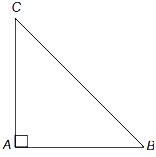
Since the dot product is $0$,$\overline{AB} \perp \overline{AC}$,which means $\angle A = 90^{\circ}$.
In a right-angled triangle,the orthocentre $H$ is the vertex where the right angle is located. Thus,$H = A = (1, 2, 3)$.
The circumcentre $S$ of a right-angled triangle is the midpoint of the hypotenuse $\overline{BC}$.
$S = \left( \frac{3+4}{2}, \frac{-1+0}{2}, \frac{5-3}{2} \right) = \left( \frac{7}{2}, -\frac{1}{2}, 1 \right)$.
The distance $HS$ is given by the distance formula:
$HS = \sqrt{\left( \frac{7}{2} - 1 \right)^2 + \left( -\frac{1}{2} - 2 \right)^2 + (1 - 3)^2}$
$HS = \sqrt{\left( \frac{5}{2} \right)^2 + \left( -\frac{5}{2} \right)^2 + (-2)^2}$
$HS = \sqrt{\frac{25}{4} + \frac{25}{4} + 4} = \sqrt{\frac{50}{4} + \frac{16}{4}} = \sqrt{\frac{66}{4}} = \sqrt{\frac{33}{2}}$.
Thus,the correct option is $(A)$.
First,we find the direction ratios of the sides:
Direction ratios of $\overline{AB} = (3-1, -1-2, 5-3) = (2, -3, 2)$.
Direction ratios of $\overline{AC} = (4-1, 0-2, -3-3) = (3, -2, -6)$.
Check for orthogonality: $\vec{AB} \cdot \vec{AC} = (2)(3) + (-3)(-2) + (2)(-6) = 6 + 6 - 12 = 0$.
Since the dot product is $0$,$\overline{AB} \perp \overline{AC}$,which means $\angle A = 90^{\circ}$.
In a right-angled triangle,the orthocentre $H$ is the vertex where the right angle is located. Thus,$H = A = (1, 2, 3)$.
The circumcentre $S$ of a right-angled triangle is the midpoint of the hypotenuse $\overline{BC}$.
$S = \left( \frac{3+4}{2}, \frac{-1+0}{2}, \frac{5-3}{2} \right) = \left( \frac{7}{2}, -\frac{1}{2}, 1 \right)$.
The distance $HS$ is given by the distance formula:
$HS = \sqrt{\left( \frac{7}{2} - 1 \right)^2 + \left( -\frac{1}{2} - 2 \right)^2 + (1 - 3)^2}$
$HS = \sqrt{\left( \frac{5}{2} \right)^2 + \left( -\frac{5}{2} \right)^2 + (-2)^2}$
$HS = \sqrt{\frac{25}{4} + \frac{25}{4} + 4} = \sqrt{\frac{50}{4} + \frac{16}{4}} = \sqrt{\frac{66}{4}} = \sqrt{\frac{33}{2}}$.
Thus,the correct option is $(A)$.
0 likes
View Solution84
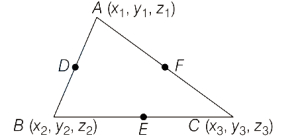
MediumMCQ
If the mid-points of the sides $AB, BC, CA$ of a triangle are $(1, 5, -1), (0, 4, -2), (2, 3, 4)$ respectively,then the length of the median drawn from $C$ to $AB$ is
A
$\sqrt{29}$
B
$\sqrt{27}$
C
$\sqrt{5}$
D
$5$
Solution
(D) Let the vertices of the triangle be $A(x_1, y_1, z_1)$,$B(x_2, y_2, z_2)$,and $C(x_3, y_3, z_3)$.
The mid-points of sides $AB, BC, CA$ are given as $D(1, 5, -1)$,$E(0, 4, -2)$,and $F(2, 3, 4)$ respectively.
By the mid-point formula:
For $AB$: $\frac{x_1+x_2}{2} = 1, \frac{y_1+y_2}{2} = 5, \frac{z_1+z_2}{2} = -1 \Rightarrow x_1+x_2 = 2, y_1+y_2 = 10, z_1+z_2 = -2$.
For $BC$: $\frac{x_2+x_3}{2} = 0, \frac{y_2+y_3}{2} = 4, \frac{z_2+z_3}{2} = -2 \Rightarrow x_2+x_3 = 0, y_2+y_3 = 8, z_2+z_3 = -4$.
For $CA$: $\frac{x_3+x_1}{2} = 2, \frac{y_3+y_1}{2} = 3, \frac{z_3+z_1}{2} = 4 \Rightarrow x_3+x_1 = 4, y_3+y_1 = 6, z_3+z_1 = 8$.
Adding these equations:
$2(x_1+x_2+x_3) = 2+0+4 = 6 \Rightarrow x_1+x_2+x_3 = 3$.
$2(y_1+y_2+y_3) = 10+8+6 = 24 \Rightarrow y_1+y_2+y_3 = 12$.
$2(z_1+z_2+z_3) = -2-4+8 = 2 \Rightarrow z_1+z_2+z_3 = 1$.
Now,to find $C(x_3, y_3, z_3)$,subtract the equations for $AB$ from the sums:
$x_3 = (x_1+x_2+x_3) - (x_1+x_2) = 3 - 2 = 1$.
$y_3 = (y_1+y_2+y_3) - (y_1+y_2) = 12 - 10 = 2$.
$z_3 = (z_1+z_2+z_3) - (z_1+z_2) = 1 - (-2) = 3$.
So,$C = (1, 2, 3)$.
The median from $C$ to $AB$ is the line segment $CD$,where $D$ is the mid-point of $AB$,$D(1, 5, -1)$.
Length $CD = \sqrt{(1-1)^2 + (5-2)^2 + (-1-3)^2} = \sqrt{0^2 + 3^2 + (-4)^2} = \sqrt{0 + 9 + 16} = \sqrt{25} = 5$.
The mid-points of sides $AB, BC, CA$ are given as $D(1, 5, -1)$,$E(0, 4, -2)$,and $F(2, 3, 4)$ respectively.
By the mid-point formula:
For $AB$: $\frac{x_1+x_2}{2} = 1, \frac{y_1+y_2}{2} = 5, \frac{z_1+z_2}{2} = -1 \Rightarrow x_1+x_2 = 2, y_1+y_2 = 10, z_1+z_2 = -2$.
For $BC$: $\frac{x_2+x_3}{2} = 0, \frac{y_2+y_3}{2} = 4, \frac{z_2+z_3}{2} = -2 \Rightarrow x_2+x_3 = 0, y_2+y_3 = 8, z_2+z_3 = -4$.
For $CA$: $\frac{x_3+x_1}{2} = 2, \frac{y_3+y_1}{2} = 3, \frac{z_3+z_1}{2} = 4 \Rightarrow x_3+x_1 = 4, y_3+y_1 = 6, z_3+z_1 = 8$.
Adding these equations:
$2(x_1+x_2+x_3) = 2+0+4 = 6 \Rightarrow x_1+x_2+x_3 = 3$.
$2(y_1+y_2+y_3) = 10+8+6 = 24 \Rightarrow y_1+y_2+y_3 = 12$.
$2(z_1+z_2+z_3) = -2-4+8 = 2 \Rightarrow z_1+z_2+z_3 = 1$.
Now,to find $C(x_3, y_3, z_3)$,subtract the equations for $AB$ from the sums:
$x_3 = (x_1+x_2+x_3) - (x_1+x_2) = 3 - 2 = 1$.
$y_3 = (y_1+y_2+y_3) - (y_1+y_2) = 12 - 10 = 2$.
$z_3 = (z_1+z_2+z_3) - (z_1+z_2) = 1 - (-2) = 3$.
So,$C = (1, 2, 3)$.
The median from $C$ to $AB$ is the line segment $CD$,where $D$ is the mid-point of $AB$,$D(1, 5, -1)$.
Length $CD = \sqrt{(1-1)^2 + (5-2)^2 + (-1-3)^2} = \sqrt{0^2 + 3^2 + (-4)^2} = \sqrt{0 + 9 + 16} = \sqrt{25} = 5$.
0 likes
View Solution85
EasyMCQ
The points $A(2, 3, 5)$,$B(-1, 5, -1)$,and $C(4, -3, 2)$ form:
A
a right angled but not an isosceles triangle
B
an isosceles but not a right angled triangle
C
an equilateral triangle
D
an isosceles right angled triangle
Solution
(D) Let the points be $A(2, 3, 5)$,$B(-1, 5, -1)$,and $C(4, -3, 2)$.
Calculate the squared distances between the points using the distance formula $d^2 = (x_2 - x_1)^2 + (y_2 - y_1)^2 + (z_2 - z_1)^2$:
$AB^2 = (-1 - 2)^2 + (5 - 3)^2 + (-1 - 5)^2 = (-3)^2 + (2)^2 + (-6)^2 = 9 + 4 + 36 = 49$.
$BC^2 = (4 - (-1))^2 + (-3 - 5)^2 + (2 - (-1))^2 = (5)^2 + (-8)^2 + (3)^2 = 25 + 64 + 9 = 98$.
$AC^2 = (4 - 2)^2 + (-3 - 3)^2 + (2 - 5)^2 = (2)^2 + (-6)^2 + (-3)^2 = 4 + 36 + 9 = 49$.
Since $AB^2 = AC^2 = 49$,the triangle is isosceles because $AB = AC = 7$.
Check for the right-angled condition: $AB^2 + AC^2 = 49 + 49 = 98 = BC^2$.
Since the sum of the squares of two sides equals the square of the third side,the triangle is a right-angled triangle.
Thus,the triangle is an isosceles right-angled triangle.
Calculate the squared distances between the points using the distance formula $d^2 = (x_2 - x_1)^2 + (y_2 - y_1)^2 + (z_2 - z_1)^2$:
$AB^2 = (-1 - 2)^2 + (5 - 3)^2 + (-1 - 5)^2 = (-3)^2 + (2)^2 + (-6)^2 = 9 + 4 + 36 = 49$.
$BC^2 = (4 - (-1))^2 + (-3 - 5)^2 + (2 - (-1))^2 = (5)^2 + (-8)^2 + (3)^2 = 25 + 64 + 9 = 98$.
$AC^2 = (4 - 2)^2 + (-3 - 3)^2 + (2 - 5)^2 = (2)^2 + (-6)^2 + (-3)^2 = 4 + 36 + 9 = 49$.
Since $AB^2 = AC^2 = 49$,the triangle is isosceles because $AB = AC = 7$.
Check for the right-angled condition: $AB^2 + AC^2 = 49 + 49 = 98 = BC^2$.
Since the sum of the squares of two sides equals the square of the third side,the triangle is a right-angled triangle.
Thus,the triangle is an isosceles right-angled triangle.
0 likes
View Solution86
EasyMCQ
The circumcentre of the triangle formed by the points $A(3,4,5)$,$B(2,3,1)$,and $C(-1,6,1)$ is:
A
$\left(\frac{1}{2}, \frac{9}{2}, 1\right)$
B
$(2,3,1)$
C
$(1,5,3)$
D
$\left(\frac{4}{3}, \frac{13}{3}, \frac{7}{3}\right)$
Solution
(C) Let the circumcentre be $P(x, y, z)$. The circumcentre is equidistant from the vertices $A, B$,and $C$. Thus,$PA^2 = PB^2 = PC^2$.
$PA^2 = (x-3)^2 + (y-4)^2 + (z-5)^2$
$PB^2 = (x-2)^2 + (y-3)^2 + (z-1)^2$
$PC^2 = (x+1)^2 + (y-6)^2 + (z-1)^2$
Equating $PB^2 = PC^2$:
$(x-2)^2 + (y-3)^2 + (z-1)^2 = (x+1)^2 + (y-6)^2 + (z-1)^2$
$x^2 - 4x + 4 + y^2 - 6y + 9 = x^2 + 2x + 1 + y^2 - 12y + 36$
$-6x + 6y = 24 \implies -x + y = 4 \implies y = x + 4$.
Equating $PA^2 = PB^2$:
$(x-3)^2 + (y-4)^2 + (z-5)^2 = (x-2)^2 + (y-3)^2 + (z-1)^2$
Substitute $y = x+4$:
$(x-3)^2 + (x+4-4)^2 + (z-5)^2 = (x-2)^2 + (x+4-3)^2 + (z-1)^2$
$(x-3)^2 + x^2 + (z-5)^2 = (x-2)^2 + (x+1)^2 + (z-1)^2$
$x^2 - 6x + 9 + x^2 + z^2 - 10z + 25 = x^2 - 4x + 4 + x^2 + 2x + 1 + z^2 - 2z + 1$
$-6x - 10z + 34 = -2x - 2z + 6$
$-4x - 8z = -28 \implies x + 2z = 7 \implies z = \frac{7-x}{2}$.
Since $P$ lies on the plane of the triangle,we check the options. For option $C(1, 5, 3)$:
$y = 1+4 = 5$ (Matches).
$z = (7-1)/2 = 3$ (Matches).
Thus,the circumcentre is $(1, 5, 3)$.
$PA^2 = (x-3)^2 + (y-4)^2 + (z-5)^2$
$PB^2 = (x-2)^2 + (y-3)^2 + (z-1)^2$
$PC^2 = (x+1)^2 + (y-6)^2 + (z-1)^2$
Equating $PB^2 = PC^2$:
$(x-2)^2 + (y-3)^2 + (z-1)^2 = (x+1)^2 + (y-6)^2 + (z-1)^2$
$x^2 - 4x + 4 + y^2 - 6y + 9 = x^2 + 2x + 1 + y^2 - 12y + 36$
$-6x + 6y = 24 \implies -x + y = 4 \implies y = x + 4$.
Equating $PA^2 = PB^2$:
$(x-3)^2 + (y-4)^2 + (z-5)^2 = (x-2)^2 + (y-3)^2 + (z-1)^2$
Substitute $y = x+4$:
$(x-3)^2 + (x+4-4)^2 + (z-5)^2 = (x-2)^2 + (x+4-3)^2 + (z-1)^2$
$(x-3)^2 + x^2 + (z-5)^2 = (x-2)^2 + (x+1)^2 + (z-1)^2$
$x^2 - 6x + 9 + x^2 + z^2 - 10z + 25 = x^2 - 4x + 4 + x^2 + 2x + 1 + z^2 - 2z + 1$
$-6x - 10z + 34 = -2x - 2z + 6$
$-4x - 8z = -28 \implies x + 2z = 7 \implies z = \frac{7-x}{2}$.
Since $P$ lies on the plane of the triangle,we check the options. For option $C(1, 5, 3)$:
$y = 1+4 = 5$ (Matches).
$z = (7-1)/2 = 3$ (Matches).
Thus,the circumcentre is $(1, 5, 3)$.
0 likes
View Solution87
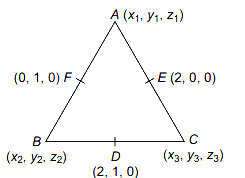
DifficultMCQ
If $D(2, 1, 0)$,$E(2, 0, 0)$,and $F(0, 1, 0)$ are mid-points of the sides $BC$,$CA$,and $AB$ of $\triangle ABC$,respectively,then the centroid of $\triangle ABC$ is
A
$\left(\frac{1}{3}, \frac{1}{3}, \frac{1}{3}\right)$
B
$\left(\frac{4}{3}, \frac{2}{3}, 0\right)$
C
$\left(-\frac{1}{3}, \frac{1}{3}, \frac{1}{3}\right)$
D
$\left(\frac{2}{3}, \frac{1}{3}, \frac{1}{3}\right)$
Solution
(B) Let $A \equiv (x_1, y_1, z_1)$,$B \equiv (x_2, y_2, z_2)$,and $C \equiv (x_3, y_3, z_3)$.
Since $F(0, 1, 0)$ is the mid-point of $AB$,we have:
$x_1 + x_2 = 0, y_1 + y_2 = 2, z_1 + z_2 = 0$ $(1)$
Since $D(2, 1, 0)$ is the mid-point of $BC$,we have:
$x_2 + x_3 = 4, y_2 + y_3 = 2, z_2 + z_3 = 0$ $(2)$
Since $E(2, 0, 0)$ is the mid-point of $AC$,we have:
$x_3 + x_1 = 4, y_3 + y_1 = 0, z_3 + z_1 = 0$ $(3)$
Adding $(1)$,$(2)$,and $(3)$,we get:
$2(x_1 + x_2 + x_3) = 8 \implies x_1 + x_2 + x_3 = 4$
$2(y_1 + y_2 + y_3) = 4 \implies y_1 + y_2 + y_3 = 2$
$2(z_1 + z_2 + z_3) = 0 \implies z_1 + z_2 + z_3 = 0$
The centroid of $\triangle ABC$ is given by $\left(\frac{x_1+x_2+x_3}{3}, \frac{y_1+y_2+y_3}{3}, \frac{z_1+z_2+z_3}{3}\right)$.
Substituting the sums,the centroid is $\left(\frac{4}{3}, \frac{2}{3}, 0\right)$.
Since $F(0, 1, 0)$ is the mid-point of $AB$,we have:
$x_1 + x_2 = 0, y_1 + y_2 = 2, z_1 + z_2 = 0$ $(1)$
Since $D(2, 1, 0)$ is the mid-point of $BC$,we have:
$x_2 + x_3 = 4, y_2 + y_3 = 2, z_2 + z_3 = 0$ $(2)$
Since $E(2, 0, 0)$ is the mid-point of $AC$,we have:
$x_3 + x_1 = 4, y_3 + y_1 = 0, z_3 + z_1 = 0$ $(3)$
Adding $(1)$,$(2)$,and $(3)$,we get:
$2(x_1 + x_2 + x_3) = 8 \implies x_1 + x_2 + x_3 = 4$
$2(y_1 + y_2 + y_3) = 4 \implies y_1 + y_2 + y_3 = 2$
$2(z_1 + z_2 + z_3) = 0 \implies z_1 + z_2 + z_3 = 0$
The centroid of $\triangle ABC$ is given by $\left(\frac{x_1+x_2+x_3}{3}, \frac{y_1+y_2+y_3}{3}, \frac{z_1+z_2+z_3}{3}\right)$.
Substituting the sums,the centroid is $\left(\frac{4}{3}, \frac{2}{3}, 0\right)$.
0 likes
View Solution88
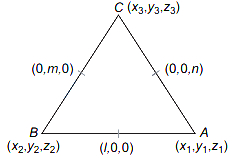
DifficultMCQ
In $\triangle ABC$,the midpoints of the sides $AB, BC$ and $CA$ are respectively $(l, 0, 0), (0, m, 0)$ and $(0, 0, n)$. Then,$\frac{AB^2+BC^2+CA^2}{l^2+m^2+n^2}$ is equal to
A
$2$
B
$4$
C
$8$
D
$16$
Solution
(C) Let the vertices of the triangle be $A(x_1, y_1, z_1)$,$B(x_2, y_2, z_2)$,and $C(x_3, y_3, z_3)$.
Given the midpoints of $AB, BC, CA$ are $(l, 0, 0), (0, m, 0), (0, 0, n)$ respectively.
Using the midpoint formula:
$x_1+x_2=2l, y_1+y_2=0, z_1+z_2=0$
$x_2+x_3=0, y_2+y_3=2m, z_2+z_3=0$
$x_1+x_3=0, y_1+y_3=0, z_1+z_3=2n$
Solving these systems of equations:
For $x$: $x_1+x_2=2l, x_2+x_3=0, x_1+x_3=0 \implies x_1=l, x_2=l, x_3=-l$
For $y$: $y_1+y_2=0, y_2+y_3=2m, y_1+y_3=0 \implies y_1=-m, y_2=m, y_3=m$
For $z$: $z_1+z_2=0, z_2+z_3=0, z_1+z_3=2n \implies z_1=n, z_2=-n, z_3=n$
Thus,the vertices are $A(l, -m, n), B(l, m, -n), C(-l, m, n)$.
Calculating the squared side lengths:
$AB^2 = (l-l)^2 + (m-(-m))^2 + (-n-n)^2 = 0 + (2m)^2 + (-2n)^2 = 4m^2 + 4n^2$
$BC^2 = (-l-l)^2 + (m-m)^2 + (n-(-n))^2 = (-2l)^2 + 0 + (2n)^2 = 4l^2 + 4n^2$
$CA^2 = (l-(-l))^2 + (-m-m)^2 + (n-n)^2 = (2l)^2 + (-2m)^2 + 0 = 4l^2 + 4m^2$
Summing these:
$AB^2+BC^2+CA^2 = (4m^2+4n^2) + (4l^2+4n^2) + (4l^2+4m^2) = 8(l^2+m^2+n^2)$
Therefore,$\frac{AB^2+BC^2+CA^2}{l^2+m^2+n^2} = \frac{8(l^2+m^2+n^2)}{l^2+m^2+n^2} = 8$.
Given the midpoints of $AB, BC, CA$ are $(l, 0, 0), (0, m, 0), (0, 0, n)$ respectively.
Using the midpoint formula:
$x_1+x_2=2l, y_1+y_2=0, z_1+z_2=0$
$x_2+x_3=0, y_2+y_3=2m, z_2+z_3=0$
$x_1+x_3=0, y_1+y_3=0, z_1+z_3=2n$
Solving these systems of equations:
For $x$: $x_1+x_2=2l, x_2+x_3=0, x_1+x_3=0 \implies x_1=l, x_2=l, x_3=-l$
For $y$: $y_1+y_2=0, y_2+y_3=2m, y_1+y_3=0 \implies y_1=-m, y_2=m, y_3=m$
For $z$: $z_1+z_2=0, z_2+z_3=0, z_1+z_3=2n \implies z_1=n, z_2=-n, z_3=n$
Thus,the vertices are $A(l, -m, n), B(l, m, -n), C(-l, m, n)$.
Calculating the squared side lengths:
$AB^2 = (l-l)^2 + (m-(-m))^2 + (-n-n)^2 = 0 + (2m)^2 + (-2n)^2 = 4m^2 + 4n^2$
$BC^2 = (-l-l)^2 + (m-m)^2 + (n-(-n))^2 = (-2l)^2 + 0 + (2n)^2 = 4l^2 + 4n^2$
$CA^2 = (l-(-l))^2 + (-m-m)^2 + (n-n)^2 = (2l)^2 + (-2m)^2 + 0 = 4l^2 + 4m^2$
Summing these:
$AB^2+BC^2+CA^2 = (4m^2+4n^2) + (4l^2+4n^2) + (4l^2+4m^2) = 8(l^2+m^2+n^2)$
Therefore,$\frac{AB^2+BC^2+CA^2}{l^2+m^2+n^2} = \frac{8(l^2+m^2+n^2)}{l^2+m^2+n^2} = 8$.
0 likes
View Solution89
EasyMCQ
$A(2,3,5), B(\alpha, 3,3)$ and $C(7,5, \beta)$ are the vertices of a triangle. If the median through $A$ is equally inclined with the coordinate axes,then $\frac{\beta}{\alpha}=$
A
-$9$
B
$\frac{-1}{9}$
C
$\frac{-2}{9}$
D
$\frac{9}{2}$
Solution
(A) Let $D$ be the midpoint of $BC$. The coordinates of $D$ are $\left(\frac{\alpha+7}{2}, \frac{3+5}{2}, \frac{3+\beta}{2}\right) = \left(\frac{\alpha+7}{2}, 4, \frac{3+\beta}{2}\right)$.
The direction ratios of the median $AD$ are given by the difference of coordinates of $D$ and $A$:
$\left(\frac{\alpha+7}{2} - 2, 4 - 3, \frac{3+\beta}{2} - 5\right) = \left(\frac{\alpha+3}{2}, 1, \frac{\beta-7}{2}\right)$.
Since the median $AD$ is equally inclined to the coordinate axes,its direction cosines are equal,which implies that its direction ratios must be proportional to $(1, 1, 1)$.
Thus,$\frac{\alpha+3}{2} = 1$ and $\frac{\beta-7}{2} = 1$.
Solving for $\alpha$: $\alpha+3 = 2 \Rightarrow \alpha = -1$.
Solving for $\beta$: $\beta-7 = 2 \Rightarrow \beta = 9$.
Therefore,$\frac{\beta}{\alpha} = \frac{9}{-1} = -9$.
The direction ratios of the median $AD$ are given by the difference of coordinates of $D$ and $A$:
$\left(\frac{\alpha+7}{2} - 2, 4 - 3, \frac{3+\beta}{2} - 5\right) = \left(\frac{\alpha+3}{2}, 1, \frac{\beta-7}{2}\right)$.
Since the median $AD$ is equally inclined to the coordinate axes,its direction cosines are equal,which implies that its direction ratios must be proportional to $(1, 1, 1)$.
Thus,$\frac{\alpha+3}{2} = 1$ and $\frac{\beta-7}{2} = 1$.
Solving for $\alpha$: $\alpha+3 = 2 \Rightarrow \alpha = -1$.
Solving for $\beta$: $\beta-7 = 2 \Rightarrow \beta = 9$.
Therefore,$\frac{\beta}{\alpha} = \frac{9}{-1} = -9$.
0 likes
View Solution90
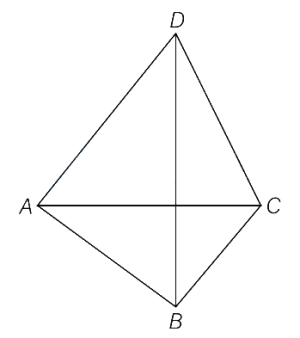
EasyMCQ
$A(2,3,-4), B(-3,3,-2), C(-1,4,2), D(3,5,1)$ are the vertices of a tetrahedron. If $G_1, G_2$ and $G_3$ are the centroids of the three faces having the vertex $D$ in common,then the centroid of the $\Delta G_1 G_2 G_3$ is
A
$(0,0,0)$
B
$\left(\frac{5}{9}, \frac{35}{9}, \frac{-5}{3}\right)$
C
$\left(\frac{5}{3}, \frac{35}{3}, \frac{-5}{3}\right)$
D
$\left(\frac{5}{9}, \frac{35}{9}, \frac{-5}{9}\right)$
Solution
(D) Let $A=(2,3,-4), B=(-3,3,-2), C=(-1,4,2), D=(3,5,1)$.
$G_1$ is the centroid of face $ABD$: $G_1 = \left(\frac{2-3+3}{3}, \frac{3+3+5}{3}, \frac{-4-2+1}{3}\right) = \left(\frac{2}{3}, \frac{11}{3}, -\frac{5}{3}\right)$.
$G_2$ is the centroid of face $BCD$: $G_2 = \left(\frac{-3-1+3}{3}, \frac{3+4+5}{3}, \frac{-2+2+1}{3}\right) = \left(-\frac{1}{3}, 4, \frac{1}{3}\right)$.
$G_3$ is the centroid of face $ACD$: $G_3 = \left(\frac{2-1+3}{3}, \frac{3+4+5}{3}, \frac{-4+2+1}{3}\right) = \left(\frac{4}{3}, 4, -\frac{1}{3}\right)$.
Let $G$ be the centroid of $\Delta G_1 G_2 G_3$:
$G = \left(\frac{\frac{2}{3} - \frac{1}{3} + \frac{4}{3}}{3}, \frac{\frac{11}{3} + 4 + 4}{3}, \frac{-\frac{5}{3} + \frac{1}{3} - \frac{1}{3}}{3}\right)$
$G = \left(\frac{\frac{5}{3}}{3}, \frac{\frac{11+24}{3}}{3}, \frac{-\frac{5}{3}}{3}\right) = \left(\frac{5}{9}, \frac{35}{9}, -\frac{5}{9}\right)$.
$G_1$ is the centroid of face $ABD$: $G_1 = \left(\frac{2-3+3}{3}, \frac{3+3+5}{3}, \frac{-4-2+1}{3}\right) = \left(\frac{2}{3}, \frac{11}{3}, -\frac{5}{3}\right)$.
$G_2$ is the centroid of face $BCD$: $G_2 = \left(\frac{-3-1+3}{3}, \frac{3+4+5}{3}, \frac{-2+2+1}{3}\right) = \left(-\frac{1}{3}, 4, \frac{1}{3}\right)$.
$G_3$ is the centroid of face $ACD$: $G_3 = \left(\frac{2-1+3}{3}, \frac{3+4+5}{3}, \frac{-4+2+1}{3}\right) = \left(\frac{4}{3}, 4, -\frac{1}{3}\right)$.
Let $G$ be the centroid of $\Delta G_1 G_2 G_3$:
$G = \left(\frac{\frac{2}{3} - \frac{1}{3} + \frac{4}{3}}{3}, \frac{\frac{11}{3} + 4 + 4}{3}, \frac{-\frac{5}{3} + \frac{1}{3} - \frac{1}{3}}{3}\right)$
$G = \left(\frac{\frac{5}{3}}{3}, \frac{\frac{11+24}{3}}{3}, \frac{-\frac{5}{3}}{3}\right) = \left(\frac{5}{9}, \frac{35}{9}, -\frac{5}{9}\right)$.
0 likes
View Solution91
MediumMCQ
Let $ABCD$ be a tetrahedron in which the coordinates of each of its vertices are in arithmetic progression. If the centroid $G$ of the tetrahedron is $(2, 3, k)$,then the distance of $G$ from the origin is
A
$\sqrt{38}$
B
$7$
C
$\sqrt{22}$
D
$\sqrt{29}$
Solution
(D) Let the vertices of the tetrahedron be $A(x_1, y_1, z_1)$,$B(x_2, y_2, z_2)$,$C(x_3, y_3, z_3)$,and $D(x_4, y_4, z_4)$.
Since the coordinates of each vertex are in arithmetic progression,we have $y_i = x_i + d_i$ and $z_i = x_i + 2d_i$ for $i = 1, 2, 3, 4$.
However,the problem implies a common difference $d$ for the coordinates of each vertex. Thus,$y_i = x_i + d$ and $z_i = x_i + 2d$.
The centroid $G$ is given by $\left(\frac{\sum x_i}{4}, \frac{\sum y_i}{4}, \frac{\sum z_i}{4}\right) = (2, 3, k)$.
From the $x$-coordinate: $\frac{\sum x_i}{4} = 2 \implies \sum x_i = 8$.
From the $y$-coordinate: $\frac{\sum (x_i + d)}{4} = 3 \implies \frac{\sum x_i + 4d}{4} = 3 \implies \frac{8 + 4d}{4} = 3 \implies 2 + d = 3 \implies d = 1$.
From the $z$-coordinate: $k = \frac{\sum (x_i + 2d)}{4} = \frac{\sum x_i + 8d}{4} = \frac{8 + 8(1)}{4} = \frac{16}{4} = 4$.
Thus,the centroid $G$ is $(2, 3, 4)$.
The distance of $G$ from the origin $(0, 0, 0)$ is $\sqrt{2^2 + 3^2 + 4^2} = \sqrt{4 + 9 + 16} = \sqrt{29}$.
Since the coordinates of each vertex are in arithmetic progression,we have $y_i = x_i + d_i$ and $z_i = x_i + 2d_i$ for $i = 1, 2, 3, 4$.
However,the problem implies a common difference $d$ for the coordinates of each vertex. Thus,$y_i = x_i + d$ and $z_i = x_i + 2d$.
The centroid $G$ is given by $\left(\frac{\sum x_i}{4}, \frac{\sum y_i}{4}, \frac{\sum z_i}{4}\right) = (2, 3, k)$.
From the $x$-coordinate: $\frac{\sum x_i}{4} = 2 \implies \sum x_i = 8$.
From the $y$-coordinate: $\frac{\sum (x_i + d)}{4} = 3 \implies \frac{\sum x_i + 4d}{4} = 3 \implies \frac{8 + 4d}{4} = 3 \implies 2 + d = 3 \implies d = 1$.
From the $z$-coordinate: $k = \frac{\sum (x_i + 2d)}{4} = \frac{\sum x_i + 8d}{4} = \frac{8 + 8(1)}{4} = \frac{16}{4} = 4$.
Thus,the centroid $G$ is $(2, 3, 4)$.
The distance of $G$ from the origin $(0, 0, 0)$ is $\sqrt{2^2 + 3^2 + 4^2} = \sqrt{4 + 9 + 16} = \sqrt{29}$.
0 likes
View Solution92
EasyMCQ
Let $ABCD$ be a parallelogram and $E$ be the mid-point of $AB$. If $P$ is the point of intersection of $DE$ and $AC$,then $\frac{DP}{PE} + \frac{AP}{PC} = $
A
$\frac{5}{2}$
B
$\frac{4}{3}$
C
$\frac{3}{2}$
D
$\frac{2}{3}$
Solution
(A) Given that $ABCD$ is a parallelogram and $E$ is the mid-point of $AB$.
Since $AB \parallel CD$,we have $AE \parallel CD$.
In $\triangle PAE$ and $\triangle PCD$,
$\angle PAE = \angle PCD$ (alternate interior angles)
$\angle APE = \angle CPD$ (vertically opposite angles)
Therefore,$\triangle PAE \sim \triangle PCD$ by $AA$ similarity.
From the property of similar triangles,we have:
$\frac{PA}{PC} = \frac{PE}{PD} = \frac{AE}{CD}$.
Since $E$ is the mid-point of $AB$,$AE = \frac{1}{2} AB$. Also,$AB = CD$ in a parallelogram,so $AE = \frac{1}{2} CD$.
Thus,$\frac{PA}{PC} = \frac{PE}{PD} = \frac{1}{2}$.
This implies $\frac{PA}{PC} = \frac{1}{2}$ and $\frac{PD}{PE} = 2$.
Therefore,$\frac{DP}{PE} + \frac{AP}{PC} = 2 + \frac{1}{2} = \frac{5}{2}$.
Since $AB \parallel CD$,we have $AE \parallel CD$.
In $\triangle PAE$ and $\triangle PCD$,
$\angle PAE = \angle PCD$ (alternate interior angles)
$\angle APE = \angle CPD$ (vertically opposite angles)
Therefore,$\triangle PAE \sim \triangle PCD$ by $AA$ similarity.
From the property of similar triangles,we have:
$\frac{PA}{PC} = \frac{PE}{PD} = \frac{AE}{CD}$.
Since $E$ is the mid-point of $AB$,$AE = \frac{1}{2} AB$. Also,$AB = CD$ in a parallelogram,so $AE = \frac{1}{2} CD$.
Thus,$\frac{PA}{PC} = \frac{PE}{PD} = \frac{1}{2}$.
This implies $\frac{PA}{PC} = \frac{1}{2}$ and $\frac{PD}{PE} = 2$.
Therefore,$\frac{DP}{PE} + \frac{AP}{PC} = 2 + \frac{1}{2} = \frac{5}{2}$.
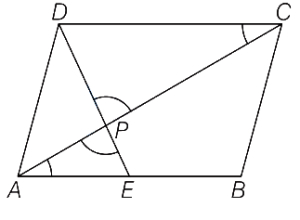
0 likes
View Solution93
EasyMCQ
$A$ parallelogram has vertices $A(4,4,-1)$,$B(5,6,-1)$,$C(6,5,1)$ and $D(x, y, z)$. Then the vertex $D$ is
A
$(5,1,0)$
B
$(-5,0,1)$
C
$(5,3,1)$
D
$(5,1,3)$
Solution
(C) Given,$ABCD$ is a parallelogram with vertices $A(4,4,-1)$,$B(5,6,-1)$,$C(6,5,1)$ and $D(x, y, z)$.
We know that the diagonals of a parallelogram $ABCD$ bisect each other.
Therefore,the mid-point of $AC$ = mid-point of $BD$.
$\left(\frac{4+6}{2}, \frac{4+5}{2}, \frac{-1+1}{2}\right) = \left(\frac{x+5}{2}, \frac{y+6}{2}, \frac{z-1}{2}\right)$
$\left(\frac{10}{2}, \frac{9}{2}, 0\right) = \left(\frac{x+5}{2}, \frac{y+6}{2}, \frac{z-1}{2}\right)$
On comparing both sides,we get:
$\frac{x+5}{2} = \frac{10}{2}$ $\Rightarrow x+5 = 10$ $\Rightarrow x = 5$
$\frac{y+6}{2} = \frac{9}{2}$ $\Rightarrow y+6 = 9$ $\Rightarrow y = 3$
$\frac{z-1}{2} = 0$ $\Rightarrow z-1 = 0$ $\Rightarrow z = 1$
Thus,the vertex $D(x, y, z)$ is $(5, 3, 1)$.
We know that the diagonals of a parallelogram $ABCD$ bisect each other.
Therefore,the mid-point of $AC$ = mid-point of $BD$.
$\left(\frac{4+6}{2}, \frac{4+5}{2}, \frac{-1+1}{2}\right) = \left(\frac{x+5}{2}, \frac{y+6}{2}, \frac{z-1}{2}\right)$
$\left(\frac{10}{2}, \frac{9}{2}, 0\right) = \left(\frac{x+5}{2}, \frac{y+6}{2}, \frac{z-1}{2}\right)$
On comparing both sides,we get:
$\frac{x+5}{2} = \frac{10}{2}$ $\Rightarrow x+5 = 10$ $\Rightarrow x = 5$
$\frac{y+6}{2} = \frac{9}{2}$ $\Rightarrow y+6 = 9$ $\Rightarrow y = 3$
$\frac{z-1}{2} = 0$ $\Rightarrow z-1 = 0$ $\Rightarrow z = 1$
Thus,the vertex $D(x, y, z)$ is $(5, 3, 1)$.
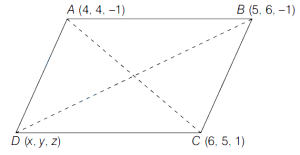
0 likes
View Solution94
EasyMCQ
If $A(1, 2, -3)$,$B(2, 3, -1)$,and $C(3, 1, 1)$ are the vertices of $\triangle ABC$,then $\left|\frac{\cos A}{\cos B}\right| = $
A
$\frac{3 \sqrt{3}}{4 \sqrt{2}}$
B
$\frac{3 \sqrt{3}}{\sqrt{7}}$
C
$\frac{4 \sqrt{2}}{3 \sqrt{3}}$
D
$\frac{\sqrt{7}}{3 \sqrt{3}}$
Solution
(B) First,calculate the lengths of the sides of $\triangle ABC$:
$c = AB = \sqrt{(2-1)^2 + (3-2)^2 + (-1 - (-3))^2} = \sqrt{1^2 + 1^2 + 2^2} = \sqrt{6}$
$a = BC = \sqrt{(3-2)^2 + (1-3)^2 + (1 - (-1))^2} = \sqrt{1^2 + (-2)^2 + 2^2} = \sqrt{9} = 3$
$b = AC = \sqrt{(3-1)^2 + (1-2)^2 + (1 - (-3))^2} = \sqrt{2^2 + (-1)^2 + 4^2} = \sqrt{21}$
Using the cosine rule:
$\cos A = \frac{b^2 + c^2 - a^2}{2bc} = \frac{21 + 6 - 9}{2 \times \sqrt{21} \times \sqrt{6}} = \frac{18}{2 \sqrt{126}} = \frac{9}{3 \sqrt{14}} = \frac{3}{\sqrt{14}}$
$\cos B = \frac{a^2 + c^2 - b^2}{2ac} = \frac{9 + 6 - 21}{2 \times 3 \times \sqrt{6}} = \frac{-6}{6 \sqrt{6}} = -\frac{1}{\sqrt{6}}$
Therefore,$\left|\frac{\cos A}{\cos B}\right| = \left|\frac{3}{\sqrt{14}} \div \left(-\frac{1}{\sqrt{6}}\right)\right| = \left| -\frac{3 \sqrt{6}}{\sqrt{14}} \right| = \frac{3 \sqrt{3 \times 2}}{\sqrt{7 \times 2}} = \frac{3 \sqrt{3}}{\sqrt{7}}$.
$c = AB = \sqrt{(2-1)^2 + (3-2)^2 + (-1 - (-3))^2} = \sqrt{1^2 + 1^2 + 2^2} = \sqrt{6}$
$a = BC = \sqrt{(3-2)^2 + (1-3)^2 + (1 - (-1))^2} = \sqrt{1^2 + (-2)^2 + 2^2} = \sqrt{9} = 3$
$b = AC = \sqrt{(3-1)^2 + (1-2)^2 + (1 - (-3))^2} = \sqrt{2^2 + (-1)^2 + 4^2} = \sqrt{21}$
Using the cosine rule:
$\cos A = \frac{b^2 + c^2 - a^2}{2bc} = \frac{21 + 6 - 9}{2 \times \sqrt{21} \times \sqrt{6}} = \frac{18}{2 \sqrt{126}} = \frac{9}{3 \sqrt{14}} = \frac{3}{\sqrt{14}}$
$\cos B = \frac{a^2 + c^2 - b^2}{2ac} = \frac{9 + 6 - 21}{2 \times 3 \times \sqrt{6}} = \frac{-6}{6 \sqrt{6}} = -\frac{1}{\sqrt{6}}$
Therefore,$\left|\frac{\cos A}{\cos B}\right| = \left|\frac{3}{\sqrt{14}} \div \left(-\frac{1}{\sqrt{6}}\right)\right| = \left| -\frac{3 \sqrt{6}}{\sqrt{14}} \right| = \frac{3 \sqrt{3 \times 2}}{\sqrt{7 \times 2}} = \frac{3 \sqrt{3}}{\sqrt{7}}$.
0 likes
View Solution95
EasyMCQ
The four points $A(2,-1,3), B(4,-2,1), C(4,5,-7)$ and $D(2,6,-5)$ form a:
A
Square
B
Parallelogram
C
Rectangle
D
Rhombus
Solution
(B) Let the given points be $A(2,-1,3), B(4,-2,1), C(4,5,-7)$ and $D(2,6,-5)$.
First,we find the mid-points of the diagonals $AC$ and $BD$:
Mid-point of $AC = \left(\frac{2+4}{2}, \frac{-1+5}{2}, \frac{3-7}{2}\right) = (3, 2, -2)$.
Mid-point of $BD = \left(\frac{4+2}{2}, \frac{-2+6}{2}, \frac{1-5}{2}\right) = (3, 2, -2)$.
Since the mid-points of the diagonals are the same,the quadrilateral $ABCD$ is a parallelogram.
Next,we check the side lengths:
$AB = \sqrt{(4-2)^2 + (-2 - (-1))^2 + (1-3)^2} = \sqrt{2^2 + (-1)^2 + (-2)^2} = \sqrt{4+1+4} = \sqrt{9} = 3$.
$BC = \sqrt{(4-4)^2 + (5 - (-2))^2 + (-7-1)^2} = \sqrt{0^2 + 7^2 + (-8)^2} = \sqrt{0+49+64} = \sqrt{113}$.
Since $AB \neq BC$,it is not a rhombus or a square.
Now,check if it is a rectangle by calculating the dot product of adjacent sides:
$\vec{AB} = (4-2)\hat{i} + (-2+1)\hat{j} + (1-3)\hat{k} = 2\hat{i} - \hat{j} - 2\hat{k}$.
$\vec{BC} = (4-4)\hat{i} + (5+2)\hat{j} + (-7-1)\hat{k} = 0\hat{i} + 7\hat{j} - 8\hat{k}$.
$\vec{AB} \cdot \vec{BC} = (2)(0) + (-1)(7) + (-2)(-8) = 0 - 7 + 16 = 9 \neq 0$.
Since the dot product is not zero,the sides are not perpendicular.
Therefore,$ABCD$ is a parallelogram.
First,we find the mid-points of the diagonals $AC$ and $BD$:
Mid-point of $AC = \left(\frac{2+4}{2}, \frac{-1+5}{2}, \frac{3-7}{2}\right) = (3, 2, -2)$.
Mid-point of $BD = \left(\frac{4+2}{2}, \frac{-2+6}{2}, \frac{1-5}{2}\right) = (3, 2, -2)$.
Since the mid-points of the diagonals are the same,the quadrilateral $ABCD$ is a parallelogram.
Next,we check the side lengths:
$AB = \sqrt{(4-2)^2 + (-2 - (-1))^2 + (1-3)^2} = \sqrt{2^2 + (-1)^2 + (-2)^2} = \sqrt{4+1+4} = \sqrt{9} = 3$.
$BC = \sqrt{(4-4)^2 + (5 - (-2))^2 + (-7-1)^2} = \sqrt{0^2 + 7^2 + (-8)^2} = \sqrt{0+49+64} = \sqrt{113}$.
Since $AB \neq BC$,it is not a rhombus or a square.
Now,check if it is a rectangle by calculating the dot product of adjacent sides:
$\vec{AB} = (4-2)\hat{i} + (-2+1)\hat{j} + (1-3)\hat{k} = 2\hat{i} - \hat{j} - 2\hat{k}$.
$\vec{BC} = (4-4)\hat{i} + (5+2)\hat{j} + (-7-1)\hat{k} = 0\hat{i} + 7\hat{j} - 8\hat{k}$.
$\vec{AB} \cdot \vec{BC} = (2)(0) + (-1)(7) + (-2)(-8) = 0 - 7 + 16 = 9 \neq 0$.
Since the dot product is not zero,the sides are not perpendicular.
Therefore,$ABCD$ is a parallelogram.
0 likes
View Solution96
EasyMCQ
$A(2, 3, k)$,$B(-1, k, -1)$,and $C(4, -3, 2)$ are the vertices of $\triangle ABC$. If $AB = AC$ and $k > 0$,then $\triangle ABC$ is:
A
an equilateral triangle
B
a right-angled isosceles triangle
C
an isosceles triangle but not right-angled
D
an obtuse-angled isosceles triangle
Solution
(B) Given that $AB = AC$.
Using the distance formula,$AB^2 = AC^2$.
$AB^2 = (2 - (-1))^2 + (3 - k)^2 + (k - (-1))^2 = 3^2 + (3 - k)^2 + (k + 1)^2 = 9 + 9 - 6k + k^2 + k^2 + 2k + 1 = 2k^2 - 4k + 19$.
$AC^2 = (2 - 4)^2 + (3 - (-3))^2 + (k - 2)^2 = (-2)^2 + 6^2 + (k - 2)^2 = 4 + 36 + k^2 - 4k + 4 = k^2 - 4k + 44$.
Equating $AB^2 = AC^2$:
$2k^2 - 4k + 19 = k^2 - 4k + 44$.
$k^2 = 25$.
Since $k > 0$,we have $k = 5$.
Now,calculate the side lengths:
$AB^2 = 2(5)^2 - 4(5) + 19 = 50 - 20 + 19 = 49 \Rightarrow AB = 7$.
$AC^2 = 49 \Rightarrow AC = 7$.
$BC^2 = (-1 - 4)^2 + (5 - (-3))^2 + (-1 - 2)^2 = (-5)^2 + 8^2 + (-3)^2 = 25 + 64 + 9 = 98$.
Since $AB^2 + AC^2 = 49 + 49 = 98 = BC^2$,the triangle satisfies the Pythagorean theorem.
Thus,$\triangle ABC$ is a right-angled isosceles triangle.
Using the distance formula,$AB^2 = AC^2$.
$AB^2 = (2 - (-1))^2 + (3 - k)^2 + (k - (-1))^2 = 3^2 + (3 - k)^2 + (k + 1)^2 = 9 + 9 - 6k + k^2 + k^2 + 2k + 1 = 2k^2 - 4k + 19$.
$AC^2 = (2 - 4)^2 + (3 - (-3))^2 + (k - 2)^2 = (-2)^2 + 6^2 + (k - 2)^2 = 4 + 36 + k^2 - 4k + 4 = k^2 - 4k + 44$.
Equating $AB^2 = AC^2$:
$2k^2 - 4k + 19 = k^2 - 4k + 44$.
$k^2 = 25$.
Since $k > 0$,we have $k = 5$.
Now,calculate the side lengths:
$AB^2 = 2(5)^2 - 4(5) + 19 = 50 - 20 + 19 = 49 \Rightarrow AB = 7$.
$AC^2 = 49 \Rightarrow AC = 7$.
$BC^2 = (-1 - 4)^2 + (5 - (-3))^2 + (-1 - 2)^2 = (-5)^2 + 8^2 + (-3)^2 = 25 + 64 + 9 = 98$.
Since $AB^2 + AC^2 = 49 + 49 = 98 = BC^2$,the triangle satisfies the Pythagorean theorem.
Thus,$\triangle ABC$ is a right-angled isosceles triangle.
0 likes
View Solution97
EasyMCQ
In a triangle $ABC$,if the midpoints of sides $AB, BC, CA$ are $(3,0,0), (0,4,0), (0,0,5)$ respectively,then $AB^2+BC^2+CA^2=$
A
$50$
B
$200$
C
$300$
D
$400$
Solution
(D) Let the vertices of the triangle be $A(x_1, y_1, z_1)$,$B(x_2, y_2, z_2)$,and $C(x_3, y_3, z_3)$.
Given the midpoints of $AB, BC, CA$ are $M_1(3,0,0)$,$M_2(0,4,0)$,and $M_3(0,0,5)$ respectively.
Using the midpoint formula:
$x_1+x_2=6, x_2+x_3=0, x_3+x_1=0$
Solving these,we get $x_1=3, x_2=3, x_3=-3$.
Similarly for $y$ coordinates:
$y_1+y_2=0, y_2+y_3=8, y_3+y_1=0$
Solving these,we get $y_1=-4, y_2=4, y_3=4$.
Similarly for $z$ coordinates:
$z_1+z_2=0, z_2+z_3=0, z_3+z_1=10$
Solving these,we get $z_1=5, z_2=-5, z_3=5$.
Thus,the vertices are $A(3, -4, 5)$,$B(3, 4, -5)$,and $C(-3, 4, 5)$.
Now,calculate the squares of the side lengths:
$AB^2 = (3-3)^2 + (4-(-4))^2 + (-5-5)^2 = 0^2 + 8^2 + (-10)^2 = 64 + 100 = 164$.
$BC^2 = (-3-3)^2 + (4-4)^2 + (5-(-5))^2 = (-6)^2 + 0^2 + 10^2 = 36 + 100 = 136$.
$CA^2 = (3-(-3))^2 + (-4-4)^2 + (5-5)^2 = 6^2 + (-8)^2 + 0^2 = 36 + 64 = 100$.
Finally,$AB^2+BC^2+CA^2 = 164 + 136 + 100 = 400$.
Given the midpoints of $AB, BC, CA$ are $M_1(3,0,0)$,$M_2(0,4,0)$,and $M_3(0,0,5)$ respectively.
Using the midpoint formula:
$x_1+x_2=6, x_2+x_3=0, x_3+x_1=0$
Solving these,we get $x_1=3, x_2=3, x_3=-3$.
Similarly for $y$ coordinates:
$y_1+y_2=0, y_2+y_3=8, y_3+y_1=0$
Solving these,we get $y_1=-4, y_2=4, y_3=4$.
Similarly for $z$ coordinates:
$z_1+z_2=0, z_2+z_3=0, z_3+z_1=10$
Solving these,we get $z_1=5, z_2=-5, z_3=5$.
Thus,the vertices are $A(3, -4, 5)$,$B(3, 4, -5)$,and $C(-3, 4, 5)$.
Now,calculate the squares of the side lengths:
$AB^2 = (3-3)^2 + (4-(-4))^2 + (-5-5)^2 = 0^2 + 8^2 + (-10)^2 = 64 + 100 = 164$.
$BC^2 = (-3-3)^2 + (4-4)^2 + (5-(-5))^2 = (-6)^2 + 0^2 + 10^2 = 36 + 100 = 136$.
$CA^2 = (3-(-3))^2 + (-4-4)^2 + (5-5)^2 = 6^2 + (-8)^2 + 0^2 = 36 + 64 = 100$.
Finally,$AB^2+BC^2+CA^2 = 164 + 136 + 100 = 400$.
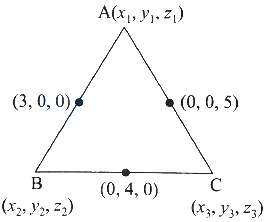
0 likes
View SolutionIntroduction to Three Dimensional Geometry — Triangle and Parallelogram · Frequently Asked Questions
1Are these Introduction to Three Dimensional Geometry questions useful for JEE and NEET?
Yes. All questions in this section are mapped to JEE Main and NEET exam patterns. Previous year questions from JEE Main, NEET, GUJCET and state-level exams are included with full solutions.
2Can I switch to Hindi or Gujarati for these questions?
Yes. Use the language tabs in the hero section or the sidebar to view the same questions and solutions in English, Hindi or Gujarati.
3How do I generate a question paper from this subtopic?
Use the Vedclass Exam Paper Generator — select the chapter and subtopic, set difficulty, and generate Sets A, B, C, D automatically. First 3 chapters of every subject are free.
Vedclass Products
For Students
Vedclass Test Series
Mock tests in real JEE/NEET style with performance analysis. 5-day free trial.
Start Free TrialFor Teachers
Exam Paper Generator
Generate Set A/B/C/D papers from this chapter in 2 minutes. 3 chapters free.
Try FreeFor Institutes
Online Exam Module
Live online exams with unlimited students, 360° analytics & white-label branding.
See DemoFor Teachers & Institutes
Generate a Introduction to Three Dimensional Geometry Exam Paper in 2 Minutes
Select subtopic & difficulty — Sets A, B, C, D auto-generated with No Repeat logic.
First 3 chapters of every subject are free — no payment required.