
A English
Parabola Questions in English
Class 11 Mathematics · 10-2. Parabola, Ellipse, Hyperbola · Parabola
1007+
Questions
English
Language
100%
With Solutions
Showing 50 of 1007 questions in English
401
AdvancedMCQ
$A$ normal chord of the parabola $y^2 = 4x$ subtending a right angle at the vertex makes an acute angle $\theta$ with the $x$-axis. Then $\theta$ is equal to:
A
$\tan^{-1}(2)$
B
$\sec^{-1}(\sqrt{3})$
C
$\cot^{-1}(\sqrt{2})$
D
None of these
Solution
(C) For the parabola $y^2 = 4ax$,the equation of a normal at point $t$ is $y + tx = 2at + at^3$. Here $a = 1$,so the normal is $y + tx = 2t + t^3$.
If a chord joining $t_1$ and $t_2$ subtends a right angle at the vertex $(0,0)$,then the product of the slopes of the lines joining the vertex to the points is $-1$. The slope of the line joining $(0,0)$ and $(at_1^2, 2at_1)$ is $m_1 = \frac{2}{t_1}$ and $m_2 = \frac{2}{t_2}$.
Thus,$\frac{2}{t_1} \times \frac{2}{t_2} = -1 \Rightarrow t_1t_2 = -4$.
Since the chord is a normal,$t_2 = -t_1 - \frac{2}{t_1}$.
Substituting $t_2 = -\frac{4}{t_1}$,we get $-\frac{4}{t_1} = -t_1 - \frac{2}{t_1}$ $\Rightarrow t_1^2 = 2$ $\Rightarrow t_1 = \sqrt{2}$ (for acute angle).
The slope of the normal is $m = -t_1 = -\sqrt{2}$.
The angle $\theta$ with the $x$-axis is given by $\tan(\pi - \theta) = |m| = \sqrt{2}$.
Therefore,$\tan(\theta) = \frac{1}{\sqrt{2}}$,which implies $\theta = \tan^{-1}(\frac{1}{\sqrt{2}}) = \cot^{-1}(\sqrt{2})$.
If a chord joining $t_1$ and $t_2$ subtends a right angle at the vertex $(0,0)$,then the product of the slopes of the lines joining the vertex to the points is $-1$. The slope of the line joining $(0,0)$ and $(at_1^2, 2at_1)$ is $m_1 = \frac{2}{t_1}$ and $m_2 = \frac{2}{t_2}$.
Thus,$\frac{2}{t_1} \times \frac{2}{t_2} = -1 \Rightarrow t_1t_2 = -4$.
Since the chord is a normal,$t_2 = -t_1 - \frac{2}{t_1}$.
Substituting $t_2 = -\frac{4}{t_1}$,we get $-\frac{4}{t_1} = -t_1 - \frac{2}{t_1}$ $\Rightarrow t_1^2 = 2$ $\Rightarrow t_1 = \sqrt{2}$ (for acute angle).
The slope of the normal is $m = -t_1 = -\sqrt{2}$.
The angle $\theta$ with the $x$-axis is given by $\tan(\pi - \theta) = |m| = \sqrt{2}$.
Therefore,$\tan(\theta) = \frac{1}{\sqrt{2}}$,which implies $\theta = \tan^{-1}(\frac{1}{\sqrt{2}}) = \cot^{-1}(\sqrt{2})$.
0 likes
View Solution402
AdvancedMCQ
The locus of the feet of the perpendiculars drawn from the vertex of the parabola $y^2 = 4ax$ upon all such chords of the parabola which subtend a right angle at the vertex is
A
$x^2 + y^2 - 4ax = 0$
B
$x^2 + y^2 - 2ax = 0$
C
$x^2 + y^2 + 2ax = 0$
D
$x^2 + y^2 + 4ax = 0$
Solution
(A) Let the chord be $y = mx + c$. The intersection points of the line and the parabola $y^2 = 4ax$ are given by $(mx + c)^2 = 4ax$,which simplifies to $m^2x^2 + (2mc - 4a)x + c^2 = 0$.
Let the points be $A(x_1, y_1)$ and $B(x_2, y_2)$. Then $x_1x_2 = \frac{c^2}{m^2}$ and $y_1y_2 = \frac{4ac}{m}$.
Since the chord subtends a right angle at the vertex $(0,0)$,the product of the slopes of $OA$ and $OB$ is $-1$,so $\frac{y_1}{x_1} \times \frac{y_2}{x_2} = -1$,which implies $y_1y_2 = -x_1x_2$.
Substituting the values,$\frac{4ac}{m} = -\frac{c^2}{m^2}$,which gives $c = -4am$.
The equation of the chord is $y = mx - 4am$.
Let $(h, k)$ be the foot of the perpendicular from the origin to this line. The slope of the perpendicular line is $-\frac{1}{m}$,so $\frac{k}{h} = -\frac{1}{m}$,which gives $m = -\frac{h}{k}$.
Since $(h, k)$ lies on the line $y = mx - 4am$,we have $k = mh - 4am = m(h - 4a)$.
Substituting $m = -\frac{h}{k}$,we get $k = -\frac{h}{k}(h - 4a)$,which simplifies to $k^2 = -h^2 + 4ah$.
Thus,$h^2 + k^2 - 4ah = 0$. Replacing $(h, k)$ with $(x, y)$,the locus is $x^2 + y^2 - 4ax = 0$.
Let the points be $A(x_1, y_1)$ and $B(x_2, y_2)$. Then $x_1x_2 = \frac{c^2}{m^2}$ and $y_1y_2 = \frac{4ac}{m}$.
Since the chord subtends a right angle at the vertex $(0,0)$,the product of the slopes of $OA$ and $OB$ is $-1$,so $\frac{y_1}{x_1} \times \frac{y_2}{x_2} = -1$,which implies $y_1y_2 = -x_1x_2$.
Substituting the values,$\frac{4ac}{m} = -\frac{c^2}{m^2}$,which gives $c = -4am$.
The equation of the chord is $y = mx - 4am$.
Let $(h, k)$ be the foot of the perpendicular from the origin to this line. The slope of the perpendicular line is $-\frac{1}{m}$,so $\frac{k}{h} = -\frac{1}{m}$,which gives $m = -\frac{h}{k}$.
Since $(h, k)$ lies on the line $y = mx - 4am$,we have $k = mh - 4am = m(h - 4a)$.
Substituting $m = -\frac{h}{k}$,we get $k = -\frac{h}{k}(h - 4a)$,which simplifies to $k^2 = -h^2 + 4ah$.
Thus,$h^2 + k^2 - 4ah = 0$. Replacing $(h, k)$ with $(x, y)$,the locus is $x^2 + y^2 - 4ax = 0$.
0 likes
View Solution403
AdvancedMCQ
Two parabolas $y^2 = 4a(x - l_1)$ and $x^2 = 4a(y - l_2)$ always touch one another,where $l_1$ and $l_2$ are variable. The locus of their point of contact has the equation:
A
$xy = a^2$
B
$xy = 2a^2$
C
$xy = 4a^2$
D
None of these
Solution
(C) Let the point of contact be $(x_1, y_1)$.
For the first parabola $y^2 = 4a(x - l_1)$,differentiating with respect to $x$ gives $2y \frac{dy}{dx} = 4a$,so $\frac{dy}{dx} = \frac{2a}{y_1}$.
For the second parabola $x^2 = 4a(y - l_2)$,differentiating with respect to $x$ gives $2x = 4a \frac{dy}{dx}$,so $\frac{dy}{dx} = \frac{x_1}{2a}$.
Since the parabolas touch at $(x_1, y_1)$,their slopes must be equal at this point.
Therefore,$\frac{2a}{y_1} = \frac{x_1}{2a}$.
This implies $x_1 y_1 = 4a^2$.
Thus,the locus of the point of contact is $xy = 4a^2$.
For the first parabola $y^2 = 4a(x - l_1)$,differentiating with respect to $x$ gives $2y \frac{dy}{dx} = 4a$,so $\frac{dy}{dx} = \frac{2a}{y_1}$.
For the second parabola $x^2 = 4a(y - l_2)$,differentiating with respect to $x$ gives $2x = 4a \frac{dy}{dx}$,so $\frac{dy}{dx} = \frac{x_1}{2a}$.
Since the parabolas touch at $(x_1, y_1)$,their slopes must be equal at this point.
Therefore,$\frac{2a}{y_1} = \frac{x_1}{2a}$.
This implies $x_1 y_1 = 4a^2$.
Thus,the locus of the point of contact is $xy = 4a^2$.
0 likes
View Solution404
AdvancedMCQ
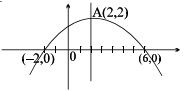
The vertex of a parabola is $(2, 2)$ and the coordinates of the two extremities of its latus rectum are $(-2, 0)$ and $(6, 0)$. The equation of the parabola is
A
$y^2 - 4y + 8x - 12 = 0$
B
$x^2 + 4x - 8y - 12 = 0$
C
$x^2 - 4x + 8y - 12 = 0$
D
$x^2 - 4x - 8y + 20 = 0$
Solution
(C) The vertex of the parabola is $(h, k) = (2, 2)$.
Since the extremities of the latus rectum are $(-2, 0)$ and $(6, 0)$,the axis of the parabola is the vertical line $x = 2$.
The parabola opens downwards,so its equation is of the form $(x - h)^2 = -4a(y - k)$.
Substituting the vertex $(2, 2)$,we get $(x - 2)^2 = -4a(y - 2)$.
The length of the latus rectum is the distance between $(-2, 0)$ and $(6, 0)$,which is $|6 - (-2)| = 8$.
Thus,$4a = 8$,so $a = 2$.
The equation becomes $(x - 2)^2 = -8(y - 2)$.
Expanding this,we get $x^2 - 4x + 4 = -8y + 16$,which simplifies to $x^2 - 4x + 8y - 12 = 0$.
Since the extremities of the latus rectum are $(-2, 0)$ and $(6, 0)$,the axis of the parabola is the vertical line $x = 2$.
The parabola opens downwards,so its equation is of the form $(x - h)^2 = -4a(y - k)$.
Substituting the vertex $(2, 2)$,we get $(x - 2)^2 = -4a(y - 2)$.
The length of the latus rectum is the distance between $(-2, 0)$ and $(6, 0)$,which is $|6 - (-2)| = 8$.
Thus,$4a = 8$,so $a = 2$.
The equation becomes $(x - 2)^2 = -8(y - 2)$.
Expanding this,we get $x^2 - 4x + 4 = -8y + 16$,which simplifies to $x^2 - 4x + 8y - 12 = 0$.
0 likes
View Solution405
AdvancedMCQ
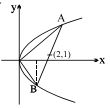
The length of the chord of the parabola $y^2 = x$ which is bisected at the point $(2, 1)$ is
A
$2\sqrt{3}$
B
$4\sqrt{3}$
C
$3\sqrt{2}$
D
$2\sqrt{5}$
Solution
(D) The equation of the chord of the parabola $y^2 = 4ax$ bisected at $(x_1, y_1)$ is given by $T = S_1$.
Here,$y^2 = x$,so $4a = 1 \Rightarrow a = 1/4$.
The equation of the chord is $y y_1 - 2a(x + x_1) = y_1^2 - 4ax_1$.
Substituting $(x_1, y_1) = (2, 1)$ and $a = 1/4$:
$y(1) - 2(1/4)(x + 2) = 1^2 - 4(1/4)(2)$
$y - 1/2(x + 2) = 1 - 2$
$y - 1/2x - 1 = -1$
$y = 1/2x \Rightarrow x = 2y$.
Substitute $x = 2y$ into $y^2 = x$:
$y^2 = 2y \Rightarrow y(y - 2) = 0$.
So,$y = 0$ or $y = 2$.
If $y = 0$,$x = 0$. Point $A = (0, 0)$.
If $y = 2$,$x = 4$. Point $B = (4, 2)$.
The length of the chord $AB = \sqrt{(4 - 0)^2 + (2 - 0)^2} = \sqrt{16 + 4} = \sqrt{20} = 2\sqrt{5}$.
Here,$y^2 = x$,so $4a = 1 \Rightarrow a = 1/4$.
The equation of the chord is $y y_1 - 2a(x + x_1) = y_1^2 - 4ax_1$.
Substituting $(x_1, y_1) = (2, 1)$ and $a = 1/4$:
$y(1) - 2(1/4)(x + 2) = 1^2 - 4(1/4)(2)$
$y - 1/2(x + 2) = 1 - 2$
$y - 1/2x - 1 = -1$
$y = 1/2x \Rightarrow x = 2y$.
Substitute $x = 2y$ into $y^2 = x$:
$y^2 = 2y \Rightarrow y(y - 2) = 0$.
So,$y = 0$ or $y = 2$.
If $y = 0$,$x = 0$. Point $A = (0, 0)$.
If $y = 2$,$x = 4$. Point $B = (4, 2)$.
The length of the chord $AB = \sqrt{(4 - 0)^2 + (2 - 0)^2} = \sqrt{16 + 4} = \sqrt{20} = 2\sqrt{5}$.
0 likes
View Solution406
AdvancedMCQ
If the tangents and normals at the extremities of a focal chord of a parabola $y^2 = 4ax$ intersect at $(x_1, y_1)$ and $(x_2, y_2)$ respectively,then:
A
$x_1 = x_2$
B
$x_1 = y_2$
C
$y_1 = y_2$
D
$x_2 = y_1$
Solution
(C) Let the extremities of the focal chord be $P(at_1^2, 2at_1)$ and $Q(at_2^2, 2at_2)$. Since $PQ$ is a focal chord,$t_1t_2 = -1$.
The intersection of tangents at $P$ and $Q$ is $(x_1, y_1) = (at_1t_2, a(t_1 + t_2))$.
Substituting $t_1t_2 = -1$,we get $x_1 = -a$ and $y_1 = a(t_1 + t_2)$.
The intersection of normals at $P$ and $Q$ is $(x_2, y_2) = (a(t_1^2 + t_2^2 + t_1t_2 + 2), -at_1t_2(t_1 + t_2))$.
Substituting $t_1t_2 = -1$,we get $x_2 = a(t_1^2 + t_2^2 + 1)$ and $y_2 = a(t_1 + t_2)$.
Comparing the coordinates,we see that $y_1 = y_2$.
The intersection of tangents at $P$ and $Q$ is $(x_1, y_1) = (at_1t_2, a(t_1 + t_2))$.
Substituting $t_1t_2 = -1$,we get $x_1 = -a$ and $y_1 = a(t_1 + t_2)$.
The intersection of normals at $P$ and $Q$ is $(x_2, y_2) = (a(t_1^2 + t_2^2 + t_1t_2 + 2), -at_1t_2(t_1 + t_2))$.
Substituting $t_1t_2 = -1$,we get $x_2 = a(t_1^2 + t_2^2 + 1)$ and $y_2 = a(t_1 + t_2)$.
Comparing the coordinates,we see that $y_1 = y_2$.
0 likes
View Solution407
AdvancedMCQ
The latus rectum of a parabola whose focal chord $PSQ$ is such that $SP = 3$ and $SQ = 2$ is given by
A
$24/5$
B
$12/5$
C
$6/5$
D
none of these
Solution
(A) For a parabola,the semi-latus rectum $l$ is the harmonic mean of the focal segments $SP$ and $SQ$.
Thus,$\frac{1}{SP} + \frac{1}{SQ} = \frac{2}{l}$.
Given $SP = 3$ and $SQ = 2$,we have $\frac{1}{3} + \frac{1}{2} = \frac{2}{l}$.
$\frac{2+3}{6} = \frac{2}{l} \implies \frac{5}{6} = \frac{2}{l}$.
$l = \frac{12}{5}$.
The latus rectum $L = 2l = 2 \times \frac{12}{5} = \frac{24}{5}$.
Thus,$\frac{1}{SP} + \frac{1}{SQ} = \frac{2}{l}$.
Given $SP = 3$ and $SQ = 2$,we have $\frac{1}{3} + \frac{1}{2} = \frac{2}{l}$.
$\frac{2+3}{6} = \frac{2}{l} \implies \frac{5}{6} = \frac{2}{l}$.
$l = \frac{12}{5}$.
The latus rectum $L = 2l = 2 \times \frac{12}{5} = \frac{24}{5}$.
0 likes
View Solution408
AdvancedMCQ
If two normals to a parabola $y^2 = 4ax$ intersect at right angles,then the chord joining their feet passes through a fixed point whose coordinates are:
A
$(-2a, 0)$
B
$(a, 0)$
C
$(2a, 0)$
D
None of these
Solution
(B) Let the two normals to the parabola $y^2 = 4ax$ be at points $t_1$ and $t_2$. The equation of a normal at point $t$ is $y + tx = 2at + at^3$.
If the normals intersect at $(h, k)$,then $at^3 + (2a - h)t + k = 0$. Let the roots be $t_1, t_2, t_3$.
Given that the normals are at right angles,the product of their slopes $m_1 m_2 = -1$. Since $m = -t$,we have $(-t_1)(-t_2) = -1$,so $t_1 t_2 = -1$.
The equation of the chord joining $t_1$ and $t_2$ is $y(t_1 + t_2) = 2x + 2a t_1 t_2$.
Substituting $t_1 t_2 = -1$,we get $y(t_1 + t_2) = 2x - 2a$,or $2x - 2a - y(t_1 + t_2) = 0$.
For this line to pass through a fixed point independent of $t_1$ and $t_2$,the coefficient of $(t_1 + t_2)$ must be zero,so $y = 0$.
Substituting $y = 0$ into the equation,we get $2x - 2a = 0$,which gives $x = a$.
Thus,the fixed point is $(a, 0)$.
If the normals intersect at $(h, k)$,then $at^3 + (2a - h)t + k = 0$. Let the roots be $t_1, t_2, t_3$.
Given that the normals are at right angles,the product of their slopes $m_1 m_2 = -1$. Since $m = -t$,we have $(-t_1)(-t_2) = -1$,so $t_1 t_2 = -1$.
The equation of the chord joining $t_1$ and $t_2$ is $y(t_1 + t_2) = 2x + 2a t_1 t_2$.
Substituting $t_1 t_2 = -1$,we get $y(t_1 + t_2) = 2x - 2a$,or $2x - 2a - y(t_1 + t_2) = 0$.
For this line to pass through a fixed point independent of $t_1$ and $t_2$,the coefficient of $(t_1 + t_2)$ must be zero,so $y = 0$.
Substituting $y = 0$ into the equation,we get $2x - 2a = 0$,which gives $x = a$.
Thus,the fixed point is $(a, 0)$.
0 likes
View Solution409
AdvancedMCQ
The locus of the point of intersection of the perpendicular tangents to the curve $y^2 + 4y - 6x - 2 = 0$ is:
A
$2x + 1 = 0$
B
$2x + 3 = 0$
C
$2y + 3 = 0$
D
$2x + 5 = 0$
Solution
(D) The given equation is $y^2 + 4y - 6x - 2 = 0$.
Completing the square for $y$,we get $(y^2 + 4y + 4) - 4 - 6x - 2 = 0$,which simplifies to $(y + 2)^2 = 6x + 6 = 6(x + 1)$.
Let $Y = y + 2$ and $X = x + 1$. The equation becomes $Y^2 = 6X$.
This is a parabola of the form $Y^2 = 4aX$,where $4a = 6$,so $a = 1.5$.
The locus of the point of intersection of perpendicular tangents to a parabola is its directrix.
The directrix of the parabola $Y^2 = 4aX$ is $X = -a$.
Substituting back,we get $x + 1 = -1.5$,which implies $x + 1 = -3/2$.
Multiplying by $2$,we get $2x + 2 = -3$,or $2x + 5 = 0$.
Completing the square for $y$,we get $(y^2 + 4y + 4) - 4 - 6x - 2 = 0$,which simplifies to $(y + 2)^2 = 6x + 6 = 6(x + 1)$.
Let $Y = y + 2$ and $X = x + 1$. The equation becomes $Y^2 = 6X$.
This is a parabola of the form $Y^2 = 4aX$,where $4a = 6$,so $a = 1.5$.
The locus of the point of intersection of perpendicular tangents to a parabola is its directrix.
The directrix of the parabola $Y^2 = 4aX$ is $X = -a$.
Substituting back,we get $x + 1 = -1.5$,which implies $x + 1 = -3/2$.
Multiplying by $2$,we get $2x + 2 = -3$,or $2x + 5 = 0$.
0 likes
View Solution410
AdvancedMCQ
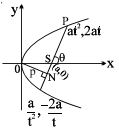
The length of the focal chord of the parabola $y^2 = 4ax$ at a distance $p$ from the vertex is:
A
$\frac{2a^2}{p}$
B
$\frac{a^3}{p^2}$
C
$\frac{4a^3}{p^2}$
D
$\frac{p^2}{a}$
Solution
(C) Let the focal chord make an angle $\theta$ with the $x$-axis. The length of the focal chord is given by $L = 4a \csc^2 \theta$.
The distance $p$ of the focal chord from the vertex $(0,0)$ is the perpendicular distance from the origin to the line passing through the focus $(a,0)$ with inclination $\theta$.
The equation of the focal chord is $(x - a) \sin \theta - y \cos \theta = 0$.
The distance $p$ from the origin $(0,0)$ is $p = |\frac{-a \sin \theta}{\sqrt{\sin^2 \theta + \cos^2 \theta}}| = |a \sin \theta|$.
Thus,$\sin \theta = \frac{p}{a}$,which implies $\csc \theta = \frac{a}{p}$.
Substituting this into the length formula: $L = 4a (\frac{a}{p})^2 = \frac{4a^3}{p^2}$.
The distance $p$ of the focal chord from the vertex $(0,0)$ is the perpendicular distance from the origin to the line passing through the focus $(a,0)$ with inclination $\theta$.
The equation of the focal chord is $(x - a) \sin \theta - y \cos \theta = 0$.
The distance $p$ from the origin $(0,0)$ is $p = |\frac{-a \sin \theta}{\sqrt{\sin^2 \theta + \cos^2 \theta}}| = |a \sin \theta|$.
Thus,$\sin \theta = \frac{p}{a}$,which implies $\csc \theta = \frac{a}{p}$.
Substituting this into the length formula: $L = 4a (\frac{a}{p})^2 = \frac{4a^3}{p^2}$.
0 likes
View Solution411
AdvancedMCQ
The locus of a point such that two tangents drawn from it to the parabola $y^2 = 4ax$ are such that the slope of one is double the other is:
A
$y^2 = \frac{9}{2}ax$
B
$y^2 = \frac{9}{4}ax$
C
$y^2 = 9ax$
D
$x^2 = 4ay$
Solution
(A) The equation of a tangent to the parabola $y^2 = 4ax$ with slope $m$ is $y = mx + \frac{a}{m}$.
If this tangent passes through the point $(h, k)$,then $k = mh + \frac{a}{m}$,which simplifies to the quadratic equation $m^2h - km + a = 0$.
Let the slopes of the two tangents be $m$ and $2m$.
From the properties of quadratic equations,the sum of the roots is $m + 2m = 3m = \frac{k}{h}$ and the product of the roots is $m \times 2m = 2m^2 = \frac{a}{h}$.
From the first equation,$m = \frac{k}{3h}$.
Substituting this into the second equation: $2(\frac{k}{3h})^2 = \frac{a}{h}$.
$2(\frac{k^2}{9h^2}) = \frac{a}{h}$.
$2k^2 = 9ah$.
Replacing $(h, k)$ with $(x, y)$,the locus is $2y^2 = 9ax$,or $y^2 = \frac{9}{2}ax$.
If this tangent passes through the point $(h, k)$,then $k = mh + \frac{a}{m}$,which simplifies to the quadratic equation $m^2h - km + a = 0$.
Let the slopes of the two tangents be $m$ and $2m$.
From the properties of quadratic equations,the sum of the roots is $m + 2m = 3m = \frac{k}{h}$ and the product of the roots is $m \times 2m = 2m^2 = \frac{a}{h}$.
From the first equation,$m = \frac{k}{3h}$.
Substituting this into the second equation: $2(\frac{k}{3h})^2 = \frac{a}{h}$.
$2(\frac{k^2}{9h^2}) = \frac{a}{h}$.
$2k^2 = 9ah$.
Replacing $(h, k)$ with $(x, y)$,the locus is $2y^2 = 9ax$,or $y^2 = \frac{9}{2}ax$.
0 likes
View Solution412
AdvancedMCQ
$A$ point $P$ moves such that the sum of the angles which the three normals drawn from $P$ to the standard parabola $y^2 = 4ax$ make with the axis of the parabola is constant. Then the locus of $P$ is:
A
a straight line
B
a circle
C
a parabola
D
a line pair
Solution
(A) Let the parabola be $y^2 = 4ax$. The equation of a normal to the parabola is $y = mx - 2am - am^3$.
If the normal passes through $P(h, k)$,then $k = mh - 2am - am^3$,which simplifies to $am^3 + (2a - h)m + k = 0$.
Let the roots of this cubic equation be $m_1, m_2, m_3$. These represent the slopes of the three normals.
The angles these normals make with the axis of the parabola (the $x$-axis) are $\theta_1, \theta_2, \theta_3$,where $\tan \theta_i = m_i$.
The sum of the angles is $\theta_1 + \theta_2 + \theta_3 = C$ (constant).
Taking the tangent on both sides,$\tan(\theta_1 + \theta_2 + \theta_3) = \tan C$.
Using the identity $\tan(\theta_1 + \theta_2 + \theta_3) = \frac{S_1 - S_3}{1 - S_2}$,where $S_1 = \sum m_i = 0$,$S_2 = \sum m_i m_j = \frac{2a - h}{a}$,and $S_3 = m_1 m_2 m_3 = -\frac{k}{a}$.
Substituting these,$\frac{0 - (-k/a)}{1 - (2a - h)/a} = \tan C$.
This simplifies to $\frac{k/a}{(a - 2a + h)/a} = \tan C$,so $\frac{k}{h - a} = \tan C$.
Thus,$k = (h - a) \tan C$,which represents a straight line passing through $(a, 0)$.
If the normal passes through $P(h, k)$,then $k = mh - 2am - am^3$,which simplifies to $am^3 + (2a - h)m + k = 0$.
Let the roots of this cubic equation be $m_1, m_2, m_3$. These represent the slopes of the three normals.
The angles these normals make with the axis of the parabola (the $x$-axis) are $\theta_1, \theta_2, \theta_3$,where $\tan \theta_i = m_i$.
The sum of the angles is $\theta_1 + \theta_2 + \theta_3 = C$ (constant).
Taking the tangent on both sides,$\tan(\theta_1 + \theta_2 + \theta_3) = \tan C$.
Using the identity $\tan(\theta_1 + \theta_2 + \theta_3) = \frac{S_1 - S_3}{1 - S_2}$,where $S_1 = \sum m_i = 0$,$S_2 = \sum m_i m_j = \frac{2a - h}{a}$,and $S_3 = m_1 m_2 m_3 = -\frac{k}{a}$.
Substituting these,$\frac{0 - (-k/a)}{1 - (2a - h)/a} = \tan C$.
This simplifies to $\frac{k/a}{(a - 2a + h)/a} = \tan C$,so $\frac{k}{h - a} = \tan C$.
Thus,$k = (h - a) \tan C$,which represents a straight line passing through $(a, 0)$.
0 likes
View Solution413
AdvancedMCQ
Three normals drawn from any point to the parabola $y^2 = 4ax$ cut the line $x = 2a$ in points whose ordinates are in arithmetical progression. Then the tangents of the angles which the normals make with the axis of the parabola are in:
A
$A.P.$
B
$G.P.$
C
$H.P.$
D
None of these
Solution
(B) The equation of the normal in parametric form is $y = -tx + 2at + at^3$.
Rearranging,we get $at^3 + (2a - x)t - y = 0$.
This is a cubic equation in $t$,so the sum of the roots $t_1 + t_2 + t_3 = 0$,which implies $t_1 + t_3 = -t_2$ $(i)$.
At $x = 2a$,the equation becomes $at^3 + (2a - 2a)t - y = 0$,so $y = at^3$.
The ordinates at $x = 2a$ are $at_1^3, at_2^3, at_3^3$.
Given these are in $A$.$P$.,we have $2at_2^3 = at_1^3 + at_3^3$,or $2t_2^3 = t_1^3 + t_3^3$.
Using the identity $t_1^3 + t_3^3 = (t_1 + t_3)(t_1^2 + t_3^2 - t_1t_3)$,we substitute $t_1 + t_3 = -t_2$:
$2t_2^3 = -t_2(t_1^2 + t_3^2 - t_1t_3)$.
Dividing by $-t_2$ (assuming $t_2 \neq 0$),we get $-2t_2^2 = t_1^2 + t_3^2 - t_1t_3$.
Since $t_1^2 + t_3^2 = (t_1 + t_3)^2 - 2t_1t_3 = (-t_2)^2 - 2t_1t_3 = t_2^2 - 2t_1t_3$,we have:
$-2t_2^2 = t_2^2 - 2t_1t_3 - t_1t_3 = t_2^2 - 3t_1t_3$.
$-3t_2^2 = -3t_1t_3$,so $t_2^2 = t_1t_3$.
The slope of the normal is $m = -t$,so $\tan \phi = -t$.
Thus,$(-\tan \phi_2)^2 = (-\tan \phi_1)(-\tan \phi_3)$,which simplifies to $\tan^2 \phi_2 = \tan \phi_1 \tan \phi_3$.
Therefore,$\tan \phi_1, \tan \phi_2, \tan \phi_3$ are in $G.P.$
Rearranging,we get $at^3 + (2a - x)t - y = 0$.
This is a cubic equation in $t$,so the sum of the roots $t_1 + t_2 + t_3 = 0$,which implies $t_1 + t_3 = -t_2$ $(i)$.
At $x = 2a$,the equation becomes $at^3 + (2a - 2a)t - y = 0$,so $y = at^3$.
The ordinates at $x = 2a$ are $at_1^3, at_2^3, at_3^3$.
Given these are in $A$.$P$.,we have $2at_2^3 = at_1^3 + at_3^3$,or $2t_2^3 = t_1^3 + t_3^3$.
Using the identity $t_1^3 + t_3^3 = (t_1 + t_3)(t_1^2 + t_3^2 - t_1t_3)$,we substitute $t_1 + t_3 = -t_2$:
$2t_2^3 = -t_2(t_1^2 + t_3^2 - t_1t_3)$.
Dividing by $-t_2$ (assuming $t_2 \neq 0$),we get $-2t_2^2 = t_1^2 + t_3^2 - t_1t_3$.
Since $t_1^2 + t_3^2 = (t_1 + t_3)^2 - 2t_1t_3 = (-t_2)^2 - 2t_1t_3 = t_2^2 - 2t_1t_3$,we have:
$-2t_2^2 = t_2^2 - 2t_1t_3 - t_1t_3 = t_2^2 - 3t_1t_3$.
$-3t_2^2 = -3t_1t_3$,so $t_2^2 = t_1t_3$.
The slope of the normal is $m = -t$,so $\tan \phi = -t$.
Thus,$(-\tan \phi_2)^2 = (-\tan \phi_1)(-\tan \phi_3)$,which simplifies to $\tan^2 \phi_2 = \tan \phi_1 \tan \phi_3$.
Therefore,$\tan \phi_1, \tan \phi_2, \tan \phi_3$ are in $G.P.$
0 likes
View Solution414
AdvancedMCQ
If $y = 2x - 3$ is a tangent to the parabola $y^2 = 4a(x - \frac{1}{3})$,then $a$ is equal to:
A
$-\frac{22}{3}$
B
$-1$
C
$\frac{14}{3}$
D
$\frac{-14}{3}$
Solution
(A) The condition for the line $y = mx + c$ to be a tangent to the parabola $y^2 = 4a(x - h)$ is $c = mh + \frac{a}{m}$.
Here,$m = 2$,$c = -3$,and $h = \frac{1}{3}$.
Substituting these values into the condition:
$-3 = 2(\frac{1}{3}) + \frac{a}{2}$
$-3 = \frac{2}{3} + \frac{a}{2}$
$-3 - \frac{2}{3} = \frac{a}{2}$
$-\frac{11}{3} = \frac{a}{2}$
$a = -\frac{22}{3}$.
Here,$m = 2$,$c = -3$,and $h = \frac{1}{3}$.
Substituting these values into the condition:
$-3 = 2(\frac{1}{3}) + \frac{a}{2}$
$-3 = \frac{2}{3} + \frac{a}{2}$
$-3 - \frac{2}{3} = \frac{a}{2}$
$-\frac{11}{3} = \frac{a}{2}$
$a = -\frac{22}{3}$.
0 likes
View Solution415
AdvancedMCQ
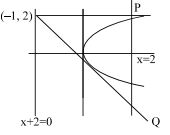
Tangents are drawn from the point $(-1, 2)$ to the parabola $y^2 = 4x$. The length of the intercept made by these tangents on the line $x = 2$ is:
A
$6$
B
$6 \sqrt{2}$
C
$2 \sqrt{6}$
D
None of these
Solution
(B) The equation of the pair of tangents from a point $(x_1, y_1)$ to the parabola $S: y^2 - 4x = 0$ is given by $SS_1 = T^2$.
Here,$S = y^2 - 4x$,$S_1 = (2)^2 - 4(-1) = 4 + 4 = 8$,and $T = y(2) - 2(x - 1) = 2y - 2x + 2$.
Substituting these into the equation:
$(y^2 - 4x)(8) = (2y - 2x + 2)^2$
$8(y^2 - 4x) = 4(y - x + 1)^2$
$2(y^2 - 4x) = (y - x + 1)^2$
To find the intercept on the line $x = 2$,substitute $x = 2$ into the equation:
$2(y^2 - 8) = (y - 2 + 1)^2$
$2y^2 - 16 = (y - 1)^2$
$2y^2 - 16 = y^2 - 2y + 1$
$y^2 + 2y - 17 = 0$
Let the roots be $y_1$ and $y_2$. Then $y_1 + y_2 = -2$ and $y_1 y_2 = -17$.
The length of the intercept is $|y_1 - y_2| = \sqrt{(y_1 + y_2)^2 - 4y_1 y_2}$.
$|y_1 - y_2| = \sqrt{(-2)^2 - 4(-17)} = \sqrt{4 + 68} = \sqrt{72} = 6 \sqrt{2}$.
Here,$S = y^2 - 4x$,$S_1 = (2)^2 - 4(-1) = 4 + 4 = 8$,and $T = y(2) - 2(x - 1) = 2y - 2x + 2$.
Substituting these into the equation:
$(y^2 - 4x)(8) = (2y - 2x + 2)^2$
$8(y^2 - 4x) = 4(y - x + 1)^2$
$2(y^2 - 4x) = (y - x + 1)^2$
To find the intercept on the line $x = 2$,substitute $x = 2$ into the equation:
$2(y^2 - 8) = (y - 2 + 1)^2$
$2y^2 - 16 = (y - 1)^2$
$2y^2 - 16 = y^2 - 2y + 1$
$y^2 + 2y - 17 = 0$
Let the roots be $y_1$ and $y_2$. Then $y_1 + y_2 = -2$ and $y_1 y_2 = -17$.
The length of the intercept is $|y_1 - y_2| = \sqrt{(y_1 + y_2)^2 - 4y_1 y_2}$.
$|y_1 - y_2| = \sqrt{(-2)^2 - 4(-17)} = \sqrt{4 + 68} = \sqrt{72} = 6 \sqrt{2}$.
0 likes
View Solution416
AdvancedMCQ
The curve described parametrically by $x = t^2 - 2t + 2$ and $y = t^2 + 2t + 2$ represents:
A
a straight line
B
a pair of straight lines
C
a circle
D
a parabola
0 likes
View Solution417
AdvancedMCQ
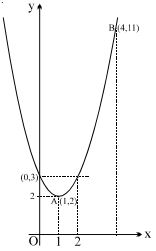
$A$ quadratic polynomial $y = f(x)$ with absolute term $3$ neither touches nor intersects the abscissa axis and is symmetric about the line $x = 1$. The coefficient of the leading term of the polynomial is unity. $A$ point $A(x_1, y_1)$ with abscissa $x_1 = 1$ and a point $B(x_2, y_2)$ with ordinate $y_2 = 11$ are given in a Cartesian rectangular system of coordinates $OXY$ in the first quadrant on the curve $y = f(x)$,where $O$ is the origin. The graph of $y = f(x)$ represents a parabola whose focus has the coordinates:
A
$(1, 7/4)$
B
$(1, 5/4)$
C
$(1, 5/2)$
D
$(1, 9/4)$
Solution
(D) Given $f(x) = ax^2 + bx + c$. Since the absolute term is $3$,$c = 3$. Since the leading coefficient is unity,$a = 1$. Thus,$f(x) = x^2 + bx + 3$.
Since the parabola is symmetric about $x = 1$,the vertex is at $x = 1$. The derivative $f'(x) = 2x + b$. Setting $f'(1) = 0$,we get $2(1) + b = 0$,so $b = -2$.
Therefore,the polynomial is $f(x) = x^2 - 2x + 3$.
We can rewrite this as $y = (x - 1)^2 + 2$,or $(x - 1)^2 = 1(y - 2)$.
Comparing this with the standard form of a parabola $(x - h)^2 = 4a(y - k)$,we have $h = 1$,$k = 2$,and $4a = 1$,which means $a = 1/4$.
The focus of the parabola $(x - h)^2 = 4a(y - k)$ is given by $(h, k + a)$.
Substituting the values,the focus is $(1, 2 + 1/4) = (1, 9/4)$.
Since the parabola is symmetric about $x = 1$,the vertex is at $x = 1$. The derivative $f'(x) = 2x + b$. Setting $f'(1) = 0$,we get $2(1) + b = 0$,so $b = -2$.
Therefore,the polynomial is $f(x) = x^2 - 2x + 3$.
We can rewrite this as $y = (x - 1)^2 + 2$,or $(x - 1)^2 = 1(y - 2)$.
Comparing this with the standard form of a parabola $(x - h)^2 = 4a(y - k)$,we have $h = 1$,$k = 2$,and $4a = 1$,which means $a = 1/4$.
The focus of the parabola $(x - h)^2 = 4a(y - k)$ is given by $(h, k + a)$.
Substituting the values,the focus is $(1, 2 + 1/4) = (1, 9/4)$.
0 likes
View Solution418
AdvancedMCQ
The locus of the midpoint of the focal radii of a variable point moving on the parabola $y^2 = 4ax$ is a parabola whose:
A
Latus rectum is half the latus rectum of the original parabola
B
Vertex is $(a/2, 0)$
C
Directrix is $y$-axis
D
All of the above
Solution
(D) Let the variable point on the parabola $y^2 = 4ax$ be $P(at^2, 2at)$.
The focus of the parabola is $S(a, 0)$.
The focal radius is the segment $SP$. The midpoint $M(x, y)$ of $SP$ is given by:
$x = \frac{at^2 + a}{2}, y = \frac{2at + 0}{2} = at$.
From $y = at$,we get $t = \frac{y}{a}$.
Substituting $t$ into the equation for $x$:
$x = \frac{a(\frac{y}{a})^2 + a}{2} = \frac{\frac{y^2}{a} + a}{2} = \frac{y^2 + a^2}{2a}$.
$2ax = y^2 + a^2 \implies y^2 = 2ax - a^2 = 2a(x - \frac{a}{2})$.
This is a parabola with vertex at $(\frac{a}{2}, 0)$.
The latus rectum of this new parabola is $4A = 2a$,which is half the latus rectum of the original parabola $(4a)$.
The directrix is $x - \frac{a}{2} = -\frac{a}{2} \implies x = 0$,which is the $y$-axis.
Thus,all the given statements are correct.
The focus of the parabola is $S(a, 0)$.
The focal radius is the segment $SP$. The midpoint $M(x, y)$ of $SP$ is given by:
$x = \frac{at^2 + a}{2}, y = \frac{2at + 0}{2} = at$.
From $y = at$,we get $t = \frac{y}{a}$.
Substituting $t$ into the equation for $x$:
$x = \frac{a(\frac{y}{a})^2 + a}{2} = \frac{\frac{y^2}{a} + a}{2} = \frac{y^2 + a^2}{2a}$.
$2ax = y^2 + a^2 \implies y^2 = 2ax - a^2 = 2a(x - \frac{a}{2})$.
This is a parabola with vertex at $(\frac{a}{2}, 0)$.
The latus rectum of this new parabola is $4A = 2a$,which is half the latus rectum of the original parabola $(4a)$.
The directrix is $x - \frac{a}{2} = -\frac{a}{2} \implies x = 0$,which is the $y$-axis.
Thus,all the given statements are correct.
0 likes
View Solution419
AdvancedMCQ
$P$ is a point on the parabola $y^2 = 4ax$ $(a > 0)$ whose vertex is $A$. $PA$ is produced to meet the directrix in $D$ and $M$ is the foot of the perpendicular from $P$ on the directrix. If a circle is described on $MD$ as a diameter,then it intersects the $x$-axis at a point whose coordinates are:
A
$(-3a, 0)$
B
$(a, 0)$
C
$(-2a, 0)$
D
Both $(A)$ and $(B)$
Solution
(D) Let the point $P$ on the parabola $y^2 = 4ax$ be $(at^2, 2at)$.
The vertex $A$ is $(0, 0)$.
The equation of the line $PA$ passing through $(0, 0)$ and $(at^2, 2at)$ is $y = \frac{2}{t}x$.
The directrix of the parabola is $x = -a$.
To find $D$,substitute $x = -a$ into the line equation: $y = \frac{2}{t}(-a) = -\frac{2a}{t}$. So,$D = (-a, -\frac{2a}{t})$.
$M$ is the foot of the perpendicular from $P(at^2, 2at)$ to the directrix $x = -a$,so $M = (-a, 2at)$.
The circle with $MD$ as diameter has the equation $(x - x_1)(x - x_2) + (y - y_1)(y - y_2) = 0$.
Here,$(x_1, y_1) = (-a, 2at)$ and $(x_2, y_2) = (-a, -\frac{2a}{t})$.
$(x + a)(x + a) + (y - 2at)(y + \frac{2a}{t}) = 0$.
To find the intersection with the $x$-axis,set $y = 0$:
$(x + a)^2 + (-2at)(\frac{2a}{t}) = 0$.
$(x + a)^2 - 4a^2 = 0$.
$(x + a)^2 = 4a^2$.
$x + a = \pm 2a$.
$x = a$ or $x = -3a$.
Thus,the coordinates are $(a, 0)$ and $(-3a, 0)$.
The vertex $A$ is $(0, 0)$.
The equation of the line $PA$ passing through $(0, 0)$ and $(at^2, 2at)$ is $y = \frac{2}{t}x$.
The directrix of the parabola is $x = -a$.
To find $D$,substitute $x = -a$ into the line equation: $y = \frac{2}{t}(-a) = -\frac{2a}{t}$. So,$D = (-a, -\frac{2a}{t})$.
$M$ is the foot of the perpendicular from $P(at^2, 2at)$ to the directrix $x = -a$,so $M = (-a, 2at)$.
The circle with $MD$ as diameter has the equation $(x - x_1)(x - x_2) + (y - y_1)(y - y_2) = 0$.
Here,$(x_1, y_1) = (-a, 2at)$ and $(x_2, y_2) = (-a, -\frac{2a}{t})$.
$(x + a)(x + a) + (y - 2at)(y + \frac{2a}{t}) = 0$.
To find the intersection with the $x$-axis,set $y = 0$:
$(x + a)^2 + (-2at)(\frac{2a}{t}) = 0$.
$(x + a)^2 - 4a^2 = 0$.
$(x + a)^2 = 4a^2$.
$x + a = \pm 2a$.
$x = a$ or $x = -3a$.
Thus,the coordinates are $(a, 0)$ and $(-3a, 0)$.
0 likes
View Solution420
AdvancedMCQ
Let $P, Q,$ and $R$ be three co-normal points on the parabola $y^2 = 4ax$. Then the correct statement$(s)$ is/are:
A
The algebraic sum of the slopes of the normals at $P, Q,$ and $R$ vanishes.
B
The algebraic sum of the ordinates of the points $P, Q,$ and $R$ vanishes.
C
The centroid of the triangle $PQR$ lies on the axis of the parabola.
D
All of the above.
0 likes
View Solution421
AdvancedMCQ
Variable chords of the parabola $y^2 = 4ax$ subtend a right angle at the vertex. Then:
A
locus of the feet of the perpendiculars from the vertex on these chords is a circle
B
locus of the middle points of the chords is a parabola
C
variable chords pass through a fixed point on the axis of the parabola
D
all of the above
Solution
(D) Let the chord be $y = mx + c$. Since it passes through the parabola $y^2 = 4ax$,the combined equation of the lines joining the vertex $(0, 0)$ to the points of intersection is $y^2 = 4ax \left(\frac{y-mx}{c}\right)$.
Since the chord subtends a right angle at the vertex,the sum of the coefficients of $x^2$ and $y^2$ is $0$.
$1 + \frac{4am}{c} = 0 \implies c = -4am$.
Thus,the chord is $y = mx - 4am$,which always passes through the fixed point $(4a, 0)$.
The locus of the feet of the perpendiculars from the vertex to the chord $y = mx - 4am$ is $x^2 + y^2 - 4ax = 0$,which is a circle.
The locus of the midpoints of the chords is $y^2 = 2a(x - 4a)$,which is a parabola.
Therefore,all the given statements are correct.
Since the chord subtends a right angle at the vertex,the sum of the coefficients of $x^2$ and $y^2$ is $0$.
$1 + \frac{4am}{c} = 0 \implies c = -4am$.
Thus,the chord is $y = mx - 4am$,which always passes through the fixed point $(4a, 0)$.
The locus of the feet of the perpendiculars from the vertex to the chord $y = mx - 4am$ is $x^2 + y^2 - 4ax = 0$,which is a circle.
The locus of the midpoints of the chords is $y^2 = 2a(x - 4a)$,which is a parabola.
Therefore,all the given statements are correct.
0 likes
View Solution422
AdvancedMCQ
The equation of the tangent to the parabola $y = (x - 3)^2$ parallel to the chord joining the points $(3, 0)$ and $(4, 1)$ is:
A
$2x - 2y + 6 = 0$
B
$4x - 4y = 13$
C
$4y - 4x + 13 = 0$
D
Both $(B)$ and $(C)$
Solution
(B) The slope of the chord joining the points $(3, 0)$ and $(4, 1)$ is given by $m = \frac{1 - 0}{4 - 3} = 1$.
Since the tangent is parallel to this chord,its slope must also be $1$.
Given the parabola $y = (x - 3)^2$,we differentiate with respect to $x$ to find the slope of the tangent at any point $(x, y)$:
$\frac{dy}{dx} = 2(x - 3)$.
Setting the slope equal to $1$:
$2(x - 3) = 1$ $\Rightarrow x - 3 = \frac{1}{2}$ $\Rightarrow x = 3.5 = \frac{7}{2}$.
Substituting $x = \frac{7}{2}$ into the parabola equation to find the $y$-coordinate:
$y = (\frac{7}{2} - 3)^2 = (\frac{1}{2})^2 = \frac{1}{4}$.
The point of tangency is $(\frac{7}{2}, \frac{1}{4})$.
The equation of the tangent line with slope $m = 1$ passing through $(\frac{7}{2}, \frac{1}{4})$ is:
$y - \frac{1}{4} = 1(x - \frac{7}{2})$
$y - \frac{1}{4} = x - \frac{14}{4}$
$x - y = \frac{14}{4} - \frac{1}{4} = \frac{13}{4}$
$4x - 4y = 13$.
Since the tangent is parallel to this chord,its slope must also be $1$.
Given the parabola $y = (x - 3)^2$,we differentiate with respect to $x$ to find the slope of the tangent at any point $(x, y)$:
$\frac{dy}{dx} = 2(x - 3)$.
Setting the slope equal to $1$:
$2(x - 3) = 1$ $\Rightarrow x - 3 = \frac{1}{2}$ $\Rightarrow x = 3.5 = \frac{7}{2}$.
Substituting $x = \frac{7}{2}$ into the parabola equation to find the $y$-coordinate:
$y = (\frac{7}{2} - 3)^2 = (\frac{1}{2})^2 = \frac{1}{4}$.
The point of tangency is $(\frac{7}{2}, \frac{1}{4})$.
The equation of the tangent line with slope $m = 1$ passing through $(\frac{7}{2}, \frac{1}{4})$ is:
$y - \frac{1}{4} = 1(x - \frac{7}{2})$
$y - \frac{1}{4} = x - \frac{14}{4}$
$x - y = \frac{14}{4} - \frac{1}{4} = \frac{13}{4}$
$4x - 4y = 13$.
0 likes
View Solution423
AdvancedMCQ
Let $A$ be the vertex and $L$ be the length of the latus rectum of the parabola $y^2 - 2y - 4x - 7 = 0$. Find the equation of the parabola with $A$ as the vertex,$2L$ as the length of the latus rectum,and the axis at right angles to that of the given curve.
A
$x^2 + 4x + 8y - 4 = 0$
B
$x^2 + 4x - 8y + 12 = 0$
C
$x^2 + 4x + 8y + 12 = 0$
D
Both $(A)$ and $(B)$
Solution
(D) Given parabola: $y^2 - 2y - 4x - 7 = 0$
$(y - 1)^2 = 4x + 8 = 4(x + 2)$
Vertex $A = (-2, 1)$ and length of latus rectum $L = 4$.
For the new parabola,the vertex is $A(-2, 1)$,the length of latus rectum is $2L = 8$,and the axis is perpendicular to the axis of the given parabola $(y = 1)$.
Thus,the axis of the new parabola is $x = -2$.
The equation of the new parabola is $(x + 2)^2 = \pm 4(2)(y - 1)$.
Case $1$: $(x + 2)^2 = 8(y - 1) \implies x^2 + 4x + 4 = 8y - 8 \implies x^2 + 4x - 8y + 12 = 0$.
Case $2$: $(x + 2)^2 = -8(y - 1) \implies x^2 + 4x + 4 = -8y + 8 \implies x^2 + 4x + 8y - 4 = 0$.
Both equations are valid,so the correct option is $(D)$.
$(y - 1)^2 = 4x + 8 = 4(x + 2)$
Vertex $A = (-2, 1)$ and length of latus rectum $L = 4$.
For the new parabola,the vertex is $A(-2, 1)$,the length of latus rectum is $2L = 8$,and the axis is perpendicular to the axis of the given parabola $(y = 1)$.
Thus,the axis of the new parabola is $x = -2$.
The equation of the new parabola is $(x + 2)^2 = \pm 4(2)(y - 1)$.
Case $1$: $(x + 2)^2 = 8(y - 1) \implies x^2 + 4x + 4 = 8y - 8 \implies x^2 + 4x - 8y + 12 = 0$.
Case $2$: $(x + 2)^2 = -8(y - 1) \implies x^2 + 4x + 4 = -8y + 8 \implies x^2 + 4x + 8y - 4 = 0$.
Both equations are valid,so the correct option is $(D)$.
0 likes
View Solution424
AdvancedMCQ
The straight line $y + x = 1$ touches the parabola:
A
$x^2 + 4y = 0$
B
$x^2 - x + y = 0$
C
$4x^2 - 3x + y = 0$
D
all of the above
Solution
(D) line touches a parabola if the quadratic equation formed by substituting the line equation into the parabola equation has a discriminant $D = 0$.
For $(A) x^2 + 4y = 0$:
Substitute $y = 1 - x$:
$x^2 + 4(1 - x) = 0 \Rightarrow x^2 - 4x + 4 = 0$.
$D = (-4)^2 - 4(1)(4) = 16 - 16 = 0$. (Touches)
For $(B) x^2 - x + y = 0$:
Substitute $y = 1 - x$:
$x^2 - x + 1 - x = 0 \Rightarrow x^2 - 2x + 1 = 0$.
$D = (-2)^2 - 4(1)(1) = 4 - 4 = 0$. (Touches)
For $(C) 4x^2 - 3x + y = 0$:
Substitute $y = 1 - x$:
$4x^2 - 3x + 1 - x = 0 \Rightarrow 4x^2 - 4x + 1 = 0$.
$D = (-4)^2 - 4(4)(1) = 16 - 16 = 0$. (Touches)
Since all options satisfy the condition,the correct answer is $(D)$.
For $(A) x^2 + 4y = 0$:
Substitute $y = 1 - x$:
$x^2 + 4(1 - x) = 0 \Rightarrow x^2 - 4x + 4 = 0$.
$D = (-4)^2 - 4(1)(4) = 16 - 16 = 0$. (Touches)
For $(B) x^2 - x + y = 0$:
Substitute $y = 1 - x$:
$x^2 - x + 1 - x = 0 \Rightarrow x^2 - 2x + 1 = 0$.
$D = (-2)^2 - 4(1)(1) = 4 - 4 = 0$. (Touches)
For $(C) 4x^2 - 3x + y = 0$:
Substitute $y = 1 - x$:
$4x^2 - 3x + 1 - x = 0 \Rightarrow 4x^2 - 4x + 1 = 0$.
$D = (-4)^2 - 4(4)(1) = 16 - 16 = 0$. (Touches)
Since all options satisfy the condition,the correct answer is $(D)$.
0 likes
View Solution425
AdvancedMCQ
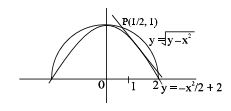
The equation of the line passing through the point $(1/2, 2)$ and tangent to the parabola $y = -\frac{x^2}{2} + 2$ and secant to the curve $y = \sqrt{4 - x^2}$ is
A
$2x + 2y - 5 = 0$
B
$2x + 2y - 3 = 0$
C
$y - 2 = 0$
D
none
Solution
(A) The equation of a line passing through $(1/2, 2)$ with slope $m$ is $y - 2 = m(x - 1/2)$,which simplifies to $y = mx - m/2 + 2$.
For this line to be tangent to the parabola $y = -x^2/2 + 2$,we substitute $y$ into the parabola equation:
$mx - m/2 + 2 = -x^2/2 + 2$
$x^2/2 + mx - m/2 = 0$
$x^2 + 2mx - m = 0$
For tangency,the discriminant $D = 0$:
$D = (2m)^2 - 4(1)(-m) = 0$
$4m^2 + 4m = 0$
$4m(m + 1) = 0$
So,$m = 0$ or $m = -1$.
If $m = 0$,the line is $y = 2$,which is a tangent to the parabola at $(0, 2)$ but is not a secant to the curve $y = \sqrt{4 - x^2}$ (it is a tangent to the circle at $(0, 2)$).
If $m = -1$,the line is $y - 2 = -1(x - 1/2)$,which simplifies to $y = -x + 5/2$,or $2x + 2y - 5 = 0$. This line intersects the curve $y = \sqrt{4 - x^2}$ at two points,thus it is a secant line.
For this line to be tangent to the parabola $y = -x^2/2 + 2$,we substitute $y$ into the parabola equation:
$mx - m/2 + 2 = -x^2/2 + 2$
$x^2/2 + mx - m/2 = 0$
$x^2 + 2mx - m = 0$
For tangency,the discriminant $D = 0$:
$D = (2m)^2 - 4(1)(-m) = 0$
$4m^2 + 4m = 0$
$4m(m + 1) = 0$
So,$m = 0$ or $m = -1$.
If $m = 0$,the line is $y = 2$,which is a tangent to the parabola at $(0, 2)$ but is not a secant to the curve $y = \sqrt{4 - x^2}$ (it is a tangent to the circle at $(0, 2)$).
If $m = -1$,the line is $y - 2 = -1(x - 1/2)$,which simplifies to $y = -x + 5/2$,or $2x + 2y - 5 = 0$. This line intersects the curve $y = \sqrt{4 - x^2}$ at two points,thus it is a secant line.
0 likes
View Solution426
AdvancedMCQ
The parabola $y = x^2 + px + q$ cuts the straight line $y = 2x - 3$ at a point with abscissa $1$. If the distance between the vertex of the parabola and the $x$-axis is least,then:
A
$p = 0$ and $q = -2$
B
$p = -2$ and $q = 0$
C
the least distance between the parabola and the $x$-axis is $1$
D
Both $(B)$ and $(C)$
Solution
(D) Given the line $y = 2x - 3$. At $x = 1$,$y = 2(1) - 3 = -1$.
Since the parabola $y = x^2 + px + q$ passes through $(1, -1)$,we have $-1 = 1^2 + p(1) + q$,which simplifies to $p + q = -2$,or $q = -2 - p$.
The vertex of the parabola $y = x^2 + px + q$ is at $x = -p/2$.
The $y$-coordinate of the vertex is $y_v = (-p/2)^2 + p(-p/2) + q = p^2/4 - p^2/2 + q = q - p^2/4$.
The distance of the vertex from the $x$-axis is $|y_v| = |q - p^2/4|$.
Substituting $q = -2 - p$,we get $d(p) = |(-2 - p) - p^2/4| = |- (p^2/4 + p + 2)|$.
To minimize the distance,we analyze $f(p) = p^2/4 + p + 2$.
Setting $f'(p) = p/2 + 1 = 0$,we get $p = -2$.
For $p = -2$,$q = -2 - (-2) = 0$.
The distance is $|0 - (-2)^2/4| = |-1| = 1$.
Thus,both $(B)$ and $(C)$ are correct.
Since the parabola $y = x^2 + px + q$ passes through $(1, -1)$,we have $-1 = 1^2 + p(1) + q$,which simplifies to $p + q = -2$,or $q = -2 - p$.
The vertex of the parabola $y = x^2 + px + q$ is at $x = -p/2$.
The $y$-coordinate of the vertex is $y_v = (-p/2)^2 + p(-p/2) + q = p^2/4 - p^2/2 + q = q - p^2/4$.
The distance of the vertex from the $x$-axis is $|y_v| = |q - p^2/4|$.
Substituting $q = -2 - p$,we get $d(p) = |(-2 - p) - p^2/4| = |- (p^2/4 + p + 2)|$.
To minimize the distance,we analyze $f(p) = p^2/4 + p + 2$.
Setting $f'(p) = p/2 + 1 = 0$,we get $p = -2$.
For $p = -2$,$q = -2 - (-2) = 0$.
The distance is $|0 - (-2)^2/4| = |-1| = 1$.
Thus,both $(B)$ and $(C)$ are correct.
0 likes
View Solution427
AdvancedMCQ
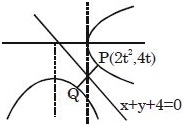
The minimum distance between the parabola $y^2 = 8x$ and its image with respect to the line $x + y + 4 = 0$ is:
A
$2\sqrt{2}$
B
$3\sqrt{2}$
C
$4\sqrt{2}$
D
$5\sqrt{2}$
Solution
(C) The parabola is $y^2 = 8x$,so $4a = 8$,which gives $a = 2$. The general point on the parabola is $P(2t^2, 4t)$.
The slope of the tangent at $P$ is given by $\frac{dy}{dx} = \frac{4}{2t} = \frac{2}{t}$.
For the minimum distance,the tangent at $P$ must be parallel to the line $x + y + 4 = 0$,which has a slope of $-1$.
Setting $\frac{2}{t} = -1$,we get $t = -2$.
The point $P$ is $(2(-2)^2, 4(-2)) = (8, -8)$.
The distance from point $P(8, -8)$ to the line $x + y + 4 = 0$ is $d = \frac{|8 - 8 + 4|}{\sqrt{1^2 + 1^2}} = \frac{4}{\sqrt{2}} = 2\sqrt{2}$.
The minimum distance between the parabola and its image is twice the distance from the point $P$ to the line of reflection,which is $2 \times (2\sqrt{2}) = 4\sqrt{2}$.
The slope of the tangent at $P$ is given by $\frac{dy}{dx} = \frac{4}{2t} = \frac{2}{t}$.
For the minimum distance,the tangent at $P$ must be parallel to the line $x + y + 4 = 0$,which has a slope of $-1$.
Setting $\frac{2}{t} = -1$,we get $t = -2$.
The point $P$ is $(2(-2)^2, 4(-2)) = (8, -8)$.
The distance from point $P(8, -8)$ to the line $x + y + 4 = 0$ is $d = \frac{|8 - 8 + 4|}{\sqrt{1^2 + 1^2}} = \frac{4}{\sqrt{2}} = 2\sqrt{2}$.
The minimum distance between the parabola and its image is twice the distance from the point $P$ to the line of reflection,which is $2 \times (2\sqrt{2}) = 4\sqrt{2}$.
0 likes
View Solution428
AdvancedMCQ
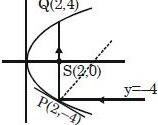
$A$ beam of light travels along the line $y = -4$ from right to left and strikes a parabola at point $P$. If the focus and directrix of the parabola are $(2, 0)$ and $x = -2$ respectively,then find the coordinates of the point where the reflected beam contacts the parabola again.
A
$(1, 2\sqrt{2})$
B
$(2, 4)$
C
$(\sqrt{2}, 2^{\frac{7}{4}})$
D
$(3, \sqrt{24})$
Solution
(B) The focus is $(2, 0)$ and the directrix is $x = -2$. The vertex is the midpoint of the focus and the intersection of the axis with the directrix,which is $(0, 0)$. The distance $a$ from the vertex to the focus is $2$. The equation of the parabola is $y^2 = 4ax = 8x$.
The incident beam travels along $y = -4$. Substituting $y = -4$ into $y^2 = 8x$,we get $(-4)^2 = 8x$,so $16 = 8x$,which gives $x = 2$. Thus,point $P$ is $(2, -4)$.
According to the reflection property of a parabola,any light ray traveling parallel to the axis of the parabola will reflect off the parabola and pass through its focus. The axis of this parabola is the $x$-axis $(y = 0)$. The incident ray $y = -4$ is parallel to the $x$-axis.
Therefore,the reflected ray passes through the focus $S(2, 0)$. The reflected ray is a vertical line passing through $P(2, -4)$ and $S(2, 0)$,which is the line $x = 2$.
To find the point $Q$ where the reflected ray hits the parabola again,we substitute $x = 2$ into the parabola equation $y^2 = 8x$:
$y^2 = 8(2) = 16$
$y = \pm 4$.
Since $P$ is $(2, -4)$,the other point $Q$ is $(2, 4)$.
The incident beam travels along $y = -4$. Substituting $y = -4$ into $y^2 = 8x$,we get $(-4)^2 = 8x$,so $16 = 8x$,which gives $x = 2$. Thus,point $P$ is $(2, -4)$.
According to the reflection property of a parabola,any light ray traveling parallel to the axis of the parabola will reflect off the parabola and pass through its focus. The axis of this parabola is the $x$-axis $(y = 0)$. The incident ray $y = -4$ is parallel to the $x$-axis.
Therefore,the reflected ray passes through the focus $S(2, 0)$. The reflected ray is a vertical line passing through $P(2, -4)$ and $S(2, 0)$,which is the line $x = 2$.
To find the point $Q$ where the reflected ray hits the parabola again,we substitute $x = 2$ into the parabola equation $y^2 = 8x$:
$y^2 = 8(2) = 16$
$y = \pm 4$.
Since $P$ is $(2, -4)$,the other point $Q$ is $(2, 4)$.
0 likes
View Solution429
DifficultMCQ
The length of the chord of the parabola $x^2 = 4ay$ passing through its vertex and having slope $\tan\alpha$ is:
A
$4a \csc\alpha \cot\alpha$
B
$4a \tan\alpha \sec\alpha$
C
$4a \cos\alpha \cot\alpha$
D
$4a \sin\alpha \tan\alpha$
Solution
(B) Let the vertex of the parabola $x^2 = 4ay$ be $A(0, 0)$.
Let the other end of the chord be $P(x_1, y_1) = (2at, at^2)$.
The slope of the chord $AP$ is given by $m = \frac{at^2 - 0}{2at - 0} = \frac{t}{2}$.
Given that the slope is $\tan\alpha$,we have $\frac{t}{2} = \tan\alpha$,which implies $t = 2\tan\alpha$.
The length of the chord $AP$ is $\sqrt{(2at - 0)^2 + (at^2 - 0)^2} = \sqrt{4a^2t^2 + a^2t^4} = at\sqrt{4 + t^2}$.
Substituting $t = 2\tan\alpha$:
$AP = a(2\tan\alpha)\sqrt{4 + (2\tan\alpha)^2} = 2a\tan\alpha \sqrt{4(1 + \tan^2\alpha)} = 2a\tan\alpha \sqrt{4\sec^2\alpha} = 2a\tan\alpha (2\sec\alpha) = 4a\tan\alpha \sec\alpha$.
Let the other end of the chord be $P(x_1, y_1) = (2at, at^2)$.
The slope of the chord $AP$ is given by $m = \frac{at^2 - 0}{2at - 0} = \frac{t}{2}$.
Given that the slope is $\tan\alpha$,we have $\frac{t}{2} = \tan\alpha$,which implies $t = 2\tan\alpha$.
The length of the chord $AP$ is $\sqrt{(2at - 0)^2 + (at^2 - 0)^2} = \sqrt{4a^2t^2 + a^2t^4} = at\sqrt{4 + t^2}$.
Substituting $t = 2\tan\alpha$:
$AP = a(2\tan\alpha)\sqrt{4 + (2\tan\alpha)^2} = 2a\tan\alpha \sqrt{4(1 + \tan^2\alpha)} = 2a\tan\alpha \sqrt{4\sec^2\alpha} = 2a\tan\alpha (2\sec\alpha) = 4a\tan\alpha \sec\alpha$.
0 likes
View Solution430
AdvancedMCQ
Let the line $y - \sqrt{3}x + 3 = 0$ cut the parabola $2y^2 = 2x + 3$ at $A$ and $B$. If $P(\sqrt{3}, 0)$,then the value of $|PA - PB|$ is [where $PA$ denotes the distance between points $P$ and $A$].
A
$\frac{6 + 4\sqrt{3}}{3}$
B
$\frac{2}{3}$
C
$\frac{\sqrt{76 + 48\sqrt{3}}}{3}$
D
$\frac{\sqrt{76 - 48\sqrt{3}}}{3}$
Solution
(C) The line equation is $y = \sqrt{3}x - 3$,which can be written as $\frac{y - 0}{x - \sqrt{3}} = \sqrt{3} = \tan(60^{\circ})$.
Using the parametric form of the line passing through $P(\sqrt{3}, 0)$ with angle $\theta = 60^{\circ}$:
$x = \sqrt{3} + r \cos(60^{\circ}) = \sqrt{3} + \frac{r}{2}$
$y = 0 + r \sin(60^{\circ}) = \frac{r\sqrt{3}}{2}$
Substitute these into the parabola equation $2y^2 = 2x + 3$:
$2(\frac{r\sqrt{3}}{2})^2 = 2(\sqrt{3} + \frac{r}{2}) + 3$
$\frac{3r^2}{2} = 2\sqrt{3} + r + 3$
$3r^2 - 2r - (6 + 4\sqrt{3}) = 0$
Let $r_1 = PA$ and $r_2 = -PB$ be the roots of this quadratic equation (since $P$ lies between $A$ and $B$ or on one side,we consider the directed distances).
The sum of roots $r_1 + r_2 = \frac{2}{3}$ and the product $r_1 r_2 = -\frac{6 + 4\sqrt{3}}{3}$.
We need $|PA - PB| = |r_1 - r_2|$.
Using $|r_1 - r_2| = \sqrt{(r_1 + r_2)^2 - 4r_1 r_2}$:
$|r_1 - r_2| = \sqrt{(\frac{2}{3})^2 - 4(-\frac{6 + 4\sqrt{3}}{3})} = \sqrt{\frac{4}{9} + \frac{24 + 16\sqrt{3}}{3}} = \sqrt{\frac{4 + 72 + 48\sqrt{3}}{9}} = \frac{\sqrt{76 + 48\sqrt{3}}}{3}$.
Using the parametric form of the line passing through $P(\sqrt{3}, 0)$ with angle $\theta = 60^{\circ}$:
$x = \sqrt{3} + r \cos(60^{\circ}) = \sqrt{3} + \frac{r}{2}$
$y = 0 + r \sin(60^{\circ}) = \frac{r\sqrt{3}}{2}$
Substitute these into the parabola equation $2y^2 = 2x + 3$:
$2(\frac{r\sqrt{3}}{2})^2 = 2(\sqrt{3} + \frac{r}{2}) + 3$
$\frac{3r^2}{2} = 2\sqrt{3} + r + 3$
$3r^2 - 2r - (6 + 4\sqrt{3}) = 0$
Let $r_1 = PA$ and $r_2 = -PB$ be the roots of this quadratic equation (since $P$ lies between $A$ and $B$ or on one side,we consider the directed distances).
The sum of roots $r_1 + r_2 = \frac{2}{3}$ and the product $r_1 r_2 = -\frac{6 + 4\sqrt{3}}{3}$.
We need $|PA - PB| = |r_1 - r_2|$.
Using $|r_1 - r_2| = \sqrt{(r_1 + r_2)^2 - 4r_1 r_2}$:
$|r_1 - r_2| = \sqrt{(\frac{2}{3})^2 - 4(-\frac{6 + 4\sqrt{3}}{3})} = \sqrt{\frac{4}{9} + \frac{24 + 16\sqrt{3}}{3}} = \sqrt{\frac{4 + 72 + 48\sqrt{3}}{9}} = \frac{\sqrt{76 + 48\sqrt{3}}}{3}$.
0 likes
View Solution431
AdvancedMCQ
The line $x + y = 6$ is a normal to the parabola $y^2 = 8x$ at the point
A
$(18, -12)$
B
$(4, 2)$
C
$(2, 4)$
D
$(8, 8)$
Solution
(C) The equation of the parabola is $y^2 = 8x$. Comparing this with $y^2 = 4ax$,we get $4a = 8$,so $a = 2$.
The equation of the line is $x + y = 6$,which can be written as $y = -x + 6$. Comparing this with $y = mx + c$,we get $m = -1$.
The condition for the line $y = mx + c$ to be a normal to the parabola $y^2 = 4ax$ is $c = -2am - am^3$.
Substituting the values: $c = -2(2)(-1) - 2(-1)^3 = 4 + 2 = 6$. This confirms the line is a normal.
The point of contact for a normal with slope $m$ is $(am^2, -2am)$.
Substituting $a = 2$ and $m = -1$,we get the point $(2(-1)^2, -2(2)(-1)) = (2, 4)$.
The equation of the line is $x + y = 6$,which can be written as $y = -x + 6$. Comparing this with $y = mx + c$,we get $m = -1$.
The condition for the line $y = mx + c$ to be a normal to the parabola $y^2 = 4ax$ is $c = -2am - am^3$.
Substituting the values: $c = -2(2)(-1) - 2(-1)^3 = 4 + 2 = 6$. This confirms the line is a normal.
The point of contact for a normal with slope $m$ is $(am^2, -2am)$.
Substituting $a = 2$ and $m = -1$,we get the point $(2(-1)^2, -2(2)(-1)) = (2, 4)$.
0 likes
View Solution432
AdvancedMCQ
One of the points on the parabola $y^2 = 12x$ with focal distance $12$ is:
A
$(3, 6)$
B
$(9, 6\sqrt{3})$
C
$(7, 2\sqrt{21})$
D
$(8, 4\sqrt{6})$
Solution
(B) The equation of the parabola is $y^2 = 12x$. Comparing this with $y^2 = 4ax$,we get $4a = 12$,so $a = 3$.
For any point $P(x, y)$ on the parabola,the focal distance is given by $x + a$.
Given the focal distance is $12$,we have $x + 3 = 12$,which implies $x = 9$.
Substituting $x = 9$ into the parabola equation $y^2 = 12x$,we get $y^2 = 12(9) = 108$.
Thus,$y = \pm \sqrt{108} = \pm 6\sqrt{3}$.
Therefore,the point is $(9, 6\sqrt{3})$ or $(9, -6\sqrt{3})$.
Comparing this with the given options,the correct point is $(9, 6\sqrt{3})$.
For any point $P(x, y)$ on the parabola,the focal distance is given by $x + a$.
Given the focal distance is $12$,we have $x + 3 = 12$,which implies $x = 9$.
Substituting $x = 9$ into the parabola equation $y^2 = 12x$,we get $y^2 = 12(9) = 108$.
Thus,$y = \pm \sqrt{108} = \pm 6\sqrt{3}$.
Therefore,the point is $(9, 6\sqrt{3})$ or $(9, -6\sqrt{3})$.
Comparing this with the given options,the correct point is $(9, 6\sqrt{3})$.
0 likes
View Solution433
MediumMCQ
The condition that the line $ax + by + c = 0$ is tangent to the parabola $y^2 = 4ax$ is:
A
$a^2 = b^2 = c^2$
B
$a = b$
C
$b^2 = ac$
D
$b^2 = a$
Solution
(C) The equation of the line is $ax + by + c = 0$,which can be rewritten as $y = -\frac{a}{b}x - \frac{c}{b}$.
For a line $y = mx + k$ to be tangent to the parabola $y^2 = 4Ax$ (where $A=a$),the condition is $k = \frac{A}{m}$.
Here,$m = -\frac{a}{b}$ and $k = -\frac{c}{b}$.
Substituting these into the condition: $-\frac{c}{b} = \frac{a}{-\frac{a}{b}}$.
$-\frac{c}{b} = -\frac{ab}{a} = -b$.
Therefore,$c = b^2$ is incorrect based on standard derivation; the correct condition is $c = ab^2/a = b^2$ is not standard. Let us re-evaluate: $k = A/m$ $\Rightarrow -c/b = a/(-a/b)$ $\Rightarrow -c/b = -b$ $\Rightarrow c = b^2$. Wait,the standard form $y^2=4ax$ with line $y=mx+c'$ gives $c'=a/m$. Here $m=-a/b$ and $c'=-c/b$. So $-c/b = a/(-a/b) = -b$. Thus $c = b^2$. The correct option is $c = b^2$.
For a line $y = mx + k$ to be tangent to the parabola $y^2 = 4Ax$ (where $A=a$),the condition is $k = \frac{A}{m}$.
Here,$m = -\frac{a}{b}$ and $k = -\frac{c}{b}$.
Substituting these into the condition: $-\frac{c}{b} = \frac{a}{-\frac{a}{b}}$.
$-\frac{c}{b} = -\frac{ab}{a} = -b$.
Therefore,$c = b^2$ is incorrect based on standard derivation; the correct condition is $c = ab^2/a = b^2$ is not standard. Let us re-evaluate: $k = A/m$ $\Rightarrow -c/b = a/(-a/b)$ $\Rightarrow -c/b = -b$ $\Rightarrow c = b^2$. Wait,the standard form $y^2=4ax$ with line $y=mx+c'$ gives $c'=a/m$. Here $m=-a/b$ and $c'=-c/b$. So $-c/b = a/(-a/b) = -b$. Thus $c = b^2$. The correct option is $c = b^2$.
0 likes
View Solution434
AdvancedMCQ
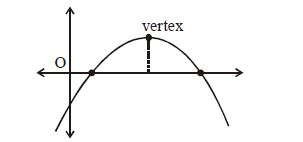
If the graph of $y = ax^2 - bx + c$ is as shown below,then the signs of $a$,$b$,and $c$ are:
A
$a < 0, b < 0, c < 0$
B
$a < 0, b > 0, c < 0$
C
$a < 0, b < 0, c > 0$
D
$a > 0, b > 0, c < 0$
Solution
(A) $1$. The parabola opens downwards,so the coefficient of $x^2$ must be negative. Thus,$a < 0$.
$2$. The $y$-intercept is the value of $y$ when $x = 0$. From the graph,the parabola intersects the $y$-axis below the origin,so $c < 0$.
$3$. The $x$-coordinate of the vertex is given by $x = -(-b) / (2a) = b / (2a)$.
$4$. From the graph,the vertex lies to the right of the $y$-axis,so the $x$-coordinate of the vertex is positive,i.e.,$b / (2a) > 0$.
$5$. Since $a < 0$,for the ratio $b / (2a)$ to be positive,$b$ must also be negative. Thus,$b < 0$.
$6$. Therefore,$a < 0, b < 0, c < 0$.
$2$. The $y$-intercept is the value of $y$ when $x = 0$. From the graph,the parabola intersects the $y$-axis below the origin,so $c < 0$.
$3$. The $x$-coordinate of the vertex is given by $x = -(-b) / (2a) = b / (2a)$.
$4$. From the graph,the vertex lies to the right of the $y$-axis,so the $x$-coordinate of the vertex is positive,i.e.,$b / (2a) > 0$.
$5$. Since $a < 0$,for the ratio $b / (2a)$ to be positive,$b$ must also be negative. Thus,$b < 0$.
$6$. Therefore,$a < 0, b < 0, c < 0$.
0 likes
View Solution435
AdvancedMCQ
The maximum number of points on the parabola $y^2 = 16x$ that are equidistant from a variable point $P$ (which lies inside the parabola) is -
A
$2$
B
$3$
C
$4$
D
more than $4$
Solution
(C) Let the point $P$ be $(h, k)$. $A$ point $(x, y)$ on the parabola $y^2 = 16x$ is equidistant from $P$ if it lies on a circle centered at $P$ with radius $r$.
Thus,the distance condition is $(x - h)^2 + (y - k)^2 = r^2$.
Substituting $x = \frac{y^2}{16}$ into the circle equation,we get $(\frac{y^2}{16} - h)^2 + (y - k)^2 = r^2$.
This simplifies to a quartic equation in $y$: $\frac{y^4}{256} - \frac{hy^2}{8} + h^2 + y^2 - 2ky + k^2 = r^2$,which is $\frac{y^4}{256} + (1 - \frac{h}{8})y^2 - 2ky + (h^2 + k^2 - r^2) = 0$.
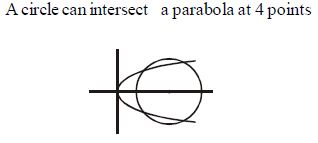
$A$ quartic equation can have at most $4$ real roots.
Therefore,a circle can intersect a parabola at a maximum of $4$ points.
Thus,the distance condition is $(x - h)^2 + (y - k)^2 = r^2$.
Substituting $x = \frac{y^2}{16}$ into the circle equation,we get $(\frac{y^2}{16} - h)^2 + (y - k)^2 = r^2$.
This simplifies to a quartic equation in $y$: $\frac{y^4}{256} - \frac{hy^2}{8} + h^2 + y^2 - 2ky + k^2 = r^2$,which is $\frac{y^4}{256} + (1 - \frac{h}{8})y^2 - 2ky + (h^2 + k^2 - r^2) = 0$.
$A$ quartic equation can have at most $4$ real roots.
Therefore,a circle can intersect a parabola at a maximum of $4$ points.
0 likes
View Solution436
AdvancedMCQ
If two tangents drawn from a point $P$ to the parabola $y^2 = 4x$ are such that the slope of one tangent is double the other,then $P$ lies on the curve:
A
$9y = 2x^2$
B
$9x = 2y^2$
C
$2x = 9y^2$
D
None of these
Solution
(B) Let $P(h, k)$ be the point from which two tangents are drawn to $y^2 = 4x$.
Any tangent to the parabola $y^2 = 4x$ is given by $y = mx + \frac{1}{m}$.
If it passes through $P(h, k)$,then $k = mh + \frac{1}{m}$,which simplifies to $m^2h - mk + 1 = 0$.
Let $m_1$ and $m_2$ be the roots of this quadratic equation.
From the properties of roots,we have $m_1 + m_2 = \frac{k}{h}$ and $m_1 m_2 = \frac{1}{h}$.
Given that $m_1 = 2m_2$,we substitute this into the equations:
$2m_2 + m_2 = 3m_2 = \frac{k}{h} \Rightarrow m_2 = \frac{k}{3h}$.
$2m_2 \times m_2 = 2m_2^2 = \frac{1}{h} \Rightarrow m_2^2 = \frac{1}{2h}$.
Substituting $m_2$ from the first into the second:
$2(\frac{k}{3h})^2 = \frac{1}{h}$ $\Rightarrow 2(\frac{k^2}{9h^2}) = \frac{1}{h}$ $\Rightarrow \frac{2k^2}{9h} = 1$ $\Rightarrow 2k^2 = 9h$.
Replacing $(h, k)$ with $(x, y)$,the locus of $P$ is $2y^2 = 9x$.
Any tangent to the parabola $y^2 = 4x$ is given by $y = mx + \frac{1}{m}$.
If it passes through $P(h, k)$,then $k = mh + \frac{1}{m}$,which simplifies to $m^2h - mk + 1 = 0$.
Let $m_1$ and $m_2$ be the roots of this quadratic equation.
From the properties of roots,we have $m_1 + m_2 = \frac{k}{h}$ and $m_1 m_2 = \frac{1}{h}$.
Given that $m_1 = 2m_2$,we substitute this into the equations:
$2m_2 + m_2 = 3m_2 = \frac{k}{h} \Rightarrow m_2 = \frac{k}{3h}$.
$2m_2 \times m_2 = 2m_2^2 = \frac{1}{h} \Rightarrow m_2^2 = \frac{1}{2h}$.
Substituting $m_2$ from the first into the second:
$2(\frac{k}{3h})^2 = \frac{1}{h}$ $\Rightarrow 2(\frac{k^2}{9h^2}) = \frac{1}{h}$ $\Rightarrow \frac{2k^2}{9h} = 1$ $\Rightarrow 2k^2 = 9h$.
Replacing $(h, k)$ with $(x, y)$,the locus of $P$ is $2y^2 = 9x$.
0 likes
View Solution437
AdvancedMCQ
If the normal at point $P(t)$ to the parabola $y^2 = 16x$ meets it again at point $Q(36, -24)$,then the maximum possible focal distance of point $P$ is-
A
$8$
B
$16$
C
$32$
D
$20$
Solution
(D) For the parabola $y^2 = 16x$,we have $4a = 16$,so $a = 4$.
Point $Q(36, -24)$ is on the parabola,so $(36, -24) = (at_2^2, 2at_2)$.
$2at_2 = -24$ $\Rightarrow 2(4)t_2 = -24$ $\Rightarrow t_2 = -3$.
The relation between the parameters of the normal at $t_1$ meeting the parabola at $t_2$ is $t_2 = -t_1 - \frac{2}{t_1}$.
Substituting $t_2 = -3$,we get $-3 = -t_1 - \frac{2}{t_1} \Rightarrow t_1^2 - 3t_1 + 2 = 0$.
Solving for $t_1$,we get $(t_1 - 1)(t_1 - 2) = 0$,so $t_1 = 1$ or $t_1 = 2$.
The focal distance of point $P(at_1^2, 2at_1)$ is $a(1 + t_1^2)$.
For $t_1 = 1$,focal distance $= 4(1 + 1^2) = 8$.
For $t_1 = 2$,focal distance $= 4(1 + 2^2) = 20$.
The maximum focal distance is $20$.
Point $Q(36, -24)$ is on the parabola,so $(36, -24) = (at_2^2, 2at_2)$.
$2at_2 = -24$ $\Rightarrow 2(4)t_2 = -24$ $\Rightarrow t_2 = -3$.
The relation between the parameters of the normal at $t_1$ meeting the parabola at $t_2$ is $t_2 = -t_1 - \frac{2}{t_1}$.
Substituting $t_2 = -3$,we get $-3 = -t_1 - \frac{2}{t_1} \Rightarrow t_1^2 - 3t_1 + 2 = 0$.
Solving for $t_1$,we get $(t_1 - 1)(t_1 - 2) = 0$,so $t_1 = 1$ or $t_1 = 2$.
The focal distance of point $P(at_1^2, 2at_1)$ is $a(1 + t_1^2)$.
For $t_1 = 1$,focal distance $= 4(1 + 1^2) = 8$.
For $t_1 = 2$,focal distance $= 4(1 + 2^2) = 20$.
The maximum focal distance is $20$.
0 likes
View Solution438
AdvancedMCQ
The normals at three points $P, Q, R$ of the parabola $y^2 = 4ax$ meet in $(h, k).$ The centroid of triangle $PQR$ lies on :
A
$y = 0$
B
$x = 0$
C
$x = -a$
D
$y = a$
Solution
(A) The equation of any normal to the parabola $y^{2}=4ax$ is $y=mx-2am-am^{3}$.
If it passes through $(h, k)$,then $k=mh-2am-am^{3}$,or $am^{3}+(2a-h)m+k=0$.
This is a cubic equation in $m$. Let its roots be $m_{1}, m_{2}, m_{3}$.
Then $m_{1}+m_{2}+m_{3}=0$ and $m_{1}m_{2}+m_{2}m_{3}+m_{3}m_{1}=\frac{2a-h}{a}$.
The coordinates of $P, Q, R$,the feet of the three normals,are $(am_{1}^{2}, -2am_{1}), (am_{2}^{2}, -2am_{2}), (am_{3}^{2}, -2am_{3})$.
Let $G(\bar{x}, \bar{y})$ be the centroid of $\Delta PQR$.
Then $\bar{x} = \frac{a(m_{1}^{2}+m_{2}^{2}+m_{3}^{2})}{3} = \frac{a}{3}[(m_{1}+m_{2}+m_{3})^{2}-2(m_{1}m_{2}+m_{2}m_{3}+m_{3}m_{1})] = \frac{a}{3}[0 - 2(\frac{2a-h}{a})] = \frac{2}{3}(h-2a)$.
And $\bar{y} = \frac{-2a(m_{1}+m_{2}+m_{3})}{3} = -\frac{2a}{3}(0) = 0$.
Thus,the centroid of $\Delta PQR$ is $G(\frac{2}{3}(h-2a), 0)$,which lies on the line $y=0$.
If it passes through $(h, k)$,then $k=mh-2am-am^{3}$,or $am^{3}+(2a-h)m+k=0$.
This is a cubic equation in $m$. Let its roots be $m_{1}, m_{2}, m_{3}$.
Then $m_{1}+m_{2}+m_{3}=0$ and $m_{1}m_{2}+m_{2}m_{3}+m_{3}m_{1}=\frac{2a-h}{a}$.
The coordinates of $P, Q, R$,the feet of the three normals,are $(am_{1}^{2}, -2am_{1}), (am_{2}^{2}, -2am_{2}), (am_{3}^{2}, -2am_{3})$.
Let $G(\bar{x}, \bar{y})$ be the centroid of $\Delta PQR$.
Then $\bar{x} = \frac{a(m_{1}^{2}+m_{2}^{2}+m_{3}^{2})}{3} = \frac{a}{3}[(m_{1}+m_{2}+m_{3})^{2}-2(m_{1}m_{2}+m_{2}m_{3}+m_{3}m_{1})] = \frac{a}{3}[0 - 2(\frac{2a-h}{a})] = \frac{2}{3}(h-2a)$.
And $\bar{y} = \frac{-2a(m_{1}+m_{2}+m_{3})}{3} = -\frac{2a}{3}(0) = 0$.
Thus,the centroid of $\Delta PQR$ is $G(\frac{2}{3}(h-2a), 0)$,which lies on the line $y=0$.
0 likes
View Solution439
AdvancedMCQ
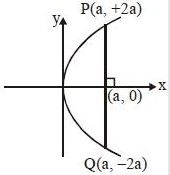
$PQ$ is any focal chord of the parabola $y^2=32x$. The length of $PQ$ can never be less than: ............ $unit$
A
$8$
B
$16$
C
$32$
D
$48$
Solution
(C) The given equation of the parabola is $y^2=32x$.
Comparing this with the standard form $y^2=4ax$,we get $4a=32$,which implies $a=8$.
The length of a focal chord of a parabola $y^2=4ax$ is given by $L = a(t + \frac{1}{t})^2$,where $t$ is the parameter of one end of the chord.
The minimum length of a focal chord is the length of the latus rectum,which is $4a$.
Therefore,the minimum length $= 4 \times 8 = 32 \text{ units}$.
Thus,the length of $PQ$ can never be less than $32$ units.
Comparing this with the standard form $y^2=4ax$,we get $4a=32$,which implies $a=8$.
The length of a focal chord of a parabola $y^2=4ax$ is given by $L = a(t + \frac{1}{t})^2$,where $t$ is the parameter of one end of the chord.
The minimum length of a focal chord is the length of the latus rectum,which is $4a$.
Therefore,the minimum length $= 4 \times 8 = 32 \text{ units}$.
Thus,the length of $PQ$ can never be less than $32$ units.
0 likes
View Solution440
DifficultMCQ
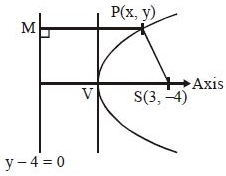
If the focus of the parabola is $(3, -4)$ and the directrix is $y - 4 = 0,$ then the equation of the parabola is :-
A
$(x - 3)^2 = -16y$
B
$(x + 3)^2 = 16y$
C
$(y - 3)^2 = -16x$
D
$(y - 3)^2 = 16x$
Solution
(A) By the definition of a parabola,the distance from any point $P(x, y)$ on the parabola to the focus $S(3, -4)$ is equal to the perpendicular distance from $P$ to the directrix $y - 4 = 0$.
$SP = PM$
$\sqrt{(x - 3)^2 + (y + 4)^2} = |y - 4|$
Squaring both sides:
$(x - 3)^2 + (y + 4)^2 = (y - 4)^2$
$(x - 3)^2 + y^2 + 8y + 16 = y^2 - 8y + 16$
$(x - 3)^2 = -8y - 8y$
$(x - 3)^2 = -16y$
$SP = PM$
$\sqrt{(x - 3)^2 + (y + 4)^2} = |y - 4|$
Squaring both sides:
$(x - 3)^2 + (y + 4)^2 = (y - 4)^2$
$(x - 3)^2 + y^2 + 8y + 16 = y^2 - 8y + 16$
$(x - 3)^2 = -8y - 8y$
$(x - 3)^2 = -16y$
0 likes
View Solution441
AdvancedMCQ
The point on the axis of the parabola $3y^2+4y-6x+8=0$ from which $3$ real normals can be drawn is given by:
A
$\left( a, \frac{4}{3} \right); a > \frac{19}{9}$
B
$\left( a, -\frac{2}{3} \right); a > \frac{19}{9}$
C
$\left( a, \frac{1}{3} \right); a > \frac{7}{9}$
D
$\left( a, -\frac{1}{3} \right); a > \frac{7}{9}$
Solution
(B) The given equation of the parabola is $3y^2 + 4y - 6x + 8 = 0$.
Rearranging the terms: $3(y^2 + \frac{4}{3}y) = 6x - 8$.
Completing the square: $3(y^2 + \frac{4}{3}y + \frac{4}{9}) = 6x - 8 + \frac{4}{3}$.
$3(y + \frac{2}{3})^2 = 6x - \frac{20}{3}$.
$(y + \frac{2}{3})^2 = 2(x - \frac{10}{9})$.
This is of the form $Y^2 = 4AX$,where $Y = y + \frac{2}{3}$,$X = x - \frac{10}{9}$,and $4A = 2 \implies A = \frac{1}{2}$.
The axis of the parabola is $Y = 0$,which implies $y = -\frac{2}{3}$.
Any point on the axis is $(a, -\frac{2}{3})$.
For a point $(X_0, 0)$ on the axis of $Y^2 = 4AX$ to have $3$ real normals,we must have $X_0 > 2A$.
Substituting the values: $x - \frac{10}{9} > 2(\frac{1}{2}) = 1$.
$x > 1 + \frac{10}{9} = \frac{19}{9}$.
Thus,the point is $(a, -\frac{2}{3})$ where $a > \frac{19}{9}$.
Rearranging the terms: $3(y^2 + \frac{4}{3}y) = 6x - 8$.
Completing the square: $3(y^2 + \frac{4}{3}y + \frac{4}{9}) = 6x - 8 + \frac{4}{3}$.
$3(y + \frac{2}{3})^2 = 6x - \frac{20}{3}$.
$(y + \frac{2}{3})^2 = 2(x - \frac{10}{9})$.
This is of the form $Y^2 = 4AX$,where $Y = y + \frac{2}{3}$,$X = x - \frac{10}{9}$,and $4A = 2 \implies A = \frac{1}{2}$.
The axis of the parabola is $Y = 0$,which implies $y = -\frac{2}{3}$.
Any point on the axis is $(a, -\frac{2}{3})$.
For a point $(X_0, 0)$ on the axis of $Y^2 = 4AX$ to have $3$ real normals,we must have $X_0 > 2A$.
Substituting the values: $x - \frac{10}{9} > 2(\frac{1}{2}) = 1$.
$x > 1 + \frac{10}{9} = \frac{19}{9}$.
Thus,the point is $(a, -\frac{2}{3})$ where $a > \frac{19}{9}$.
0 likes
View Solution442
AdvancedMCQ
If the line $y - \sqrt{3}x + 3 = 0$ cuts the parabola $y^2 = -x - 2$ at $A$ and $B$,then $PA \cdot PB$ is equal to,where $P \equiv (\sqrt{3}, 0)$.
A
$\frac{4(\sqrt{3} + 2)}{3}$
B
$\frac{4(2 - \sqrt{3})}{3}$
C
$\frac{4\sqrt{3}}{2}$
D
$\frac{2(\sqrt{3} + 2)}{3}$
Solution
(A) The line equation is $y - \sqrt{3}x + 3 = 0$. We can write it in parametric form as $\frac{x - \sqrt{3}}{\cos \theta} = \frac{y - 0}{\sin \theta} = r$.
Comparing with the line equation,the slope is $\tan \theta = \sqrt{3}$,so $\theta = 60^\circ$.
Thus,$\cos \theta = \frac{1}{2}$ and $\sin \theta = \frac{\sqrt{3}}{2}$.
The parametric coordinates are $x = \sqrt{3} + \frac{r}{2}$ and $y = \frac{\sqrt{3}r}{2}$.
Substituting these into the parabola equation $y^2 = -x - 2$:
$(\frac{\sqrt{3}r}{2})^2 = -(\sqrt{3} + \frac{r}{2}) - 2$
$\frac{3r^2}{4} = -\sqrt{3} - \frac{r}{2} - 2$
$3r^2 + 2r + 4(\sqrt{3} + 2) = 0$.
Since $PA \cdot PB = |r_1 r_2|$,by the product of roots formula,$|r_1 r_2| = |\frac{c}{a}| = |\frac{4(\sqrt{3} + 2)}{3}| = \frac{4(\sqrt{3} + 2)}{3}$.
Comparing with the line equation,the slope is $\tan \theta = \sqrt{3}$,so $\theta = 60^\circ$.
Thus,$\cos \theta = \frac{1}{2}$ and $\sin \theta = \frac{\sqrt{3}}{2}$.
The parametric coordinates are $x = \sqrt{3} + \frac{r}{2}$ and $y = \frac{\sqrt{3}r}{2}$.
Substituting these into the parabola equation $y^2 = -x - 2$:
$(\frac{\sqrt{3}r}{2})^2 = -(\sqrt{3} + \frac{r}{2}) - 2$
$\frac{3r^2}{4} = -\sqrt{3} - \frac{r}{2} - 2$
$3r^2 + 2r + 4(\sqrt{3} + 2) = 0$.
Since $PA \cdot PB = |r_1 r_2|$,by the product of roots formula,$|r_1 r_2| = |\frac{c}{a}| = |\frac{4(\sqrt{3} + 2)}{3}| = \frac{4(\sqrt{3} + 2)}{3}$.
0 likes
View Solution443
AdvancedMCQ
$A$ ray of light moving parallel to the $x$-axis gets reflected from a parabolic mirror whose equation is $(y - 2)^2 = 4(x + 1)$. After reflection,the ray must pass through the point:
A
$(-2, 0)$
B
$(-1, 2)$
C
$(0, 2)$
D
$(2, 0)$
Solution
(C) The given equation of the parabola is $(y - 2)^2 = 4(x + 1)$.
Comparing this with the standard form $(y - k)^2 = 4a(x - h)$,we get the vertex $(h, k) = (-1, 2)$ and $4a = 4$,which implies $a = 1$.
The axis of the parabola is $y - 2 = 0$,which is parallel to the $x$-axis.
According to the optical property of a parabola,any ray of light moving parallel to the axis of the parabola passes through its focus after reflection.
The focus of the parabola is given by $(h + a, k) = (-1 + 1, 2) = (0, 2)$.
Therefore,the reflected ray must pass through the point $(0, 2)$.
Comparing this with the standard form $(y - k)^2 = 4a(x - h)$,we get the vertex $(h, k) = (-1, 2)$ and $4a = 4$,which implies $a = 1$.
The axis of the parabola is $y - 2 = 0$,which is parallel to the $x$-axis.
According to the optical property of a parabola,any ray of light moving parallel to the axis of the parabola passes through its focus after reflection.
The focus of the parabola is given by $(h + a, k) = (-1 + 1, 2) = (0, 2)$.
Therefore,the reflected ray must pass through the point $(0, 2)$.
0 likes
View Solution444
AdvancedMCQ
The length of the latus rectum of the parabola $2\{(x - 1)^2 + (y - 3)^2\} = (x + y - 1)^2$ is:
A
$6$
B
$3$
C
$6 \sqrt{2}$
D
$3 \sqrt{2}$
Solution
(D) The given equation is $2\{(x - 1)^2 + (y - 3)^2\} = (x + y - 1)^2$.
Dividing by $2$,we get $(x - 1)^2 + (y - 3)^2 = \frac{1}{2}(x + y - 1)^2$.
This is in the form $SP^2 = e^2 PM^2$,where $S(1, 3)$ is the focus and $x + y - 1 = 0$ is the directrix.
Here,$e^2 = \frac{1}{2}$,so $e = \frac{1}{\sqrt{2}}$.
The distance from the focus $S(1, 3)$ to the directrix $L: x + y - 1 = 0$ is $d = \frac{|1 + 3 - 1|}{\sqrt{1^2 + 1^2}} = \frac{3}{\sqrt{2}}$.
The length of the latus rectum is $2e^2d$ or $2 \times \text{distance from focus to directrix} \times e^2$ is not correct here; rather,for a parabola $SP = PM$,the definition is $SP^2 = PM^2$.
Wait,the standard form is $SP^2 = PM^2$. Here,$SP^2 = \frac{1}{2} PM^2$. This implies $e^2 = 1/2$,which is an ellipse. However,the question states it is a parabola. Let's re-examine: $2\{(x-1)^2 + (y-3)^2\} = (x+y-1)^2 \implies (x-1)^2 + (y-3)^2 = \frac{(x+y-1)^2}{2} = \left(\frac{x+y-1}{\sqrt{2}}\right)^2$.
This is $SP^2 = PM^2$ where $PM = \frac{|x+y-1|}{\sqrt{2}}$. This is a parabola with focus $S(1, 3)$ and directrix $x+y-1=0$.
The distance $d$ from $S$ to the directrix is $\frac{|1+3-1|}{\sqrt{1^2+1^2}} = \frac{3}{\sqrt{2}}$.
The length of the latus rectum of a parabola is $2d = 2 \times \frac{3}{\sqrt{2}} = 3\sqrt{2}$.
Dividing by $2$,we get $(x - 1)^2 + (y - 3)^2 = \frac{1}{2}(x + y - 1)^2$.
This is in the form $SP^2 = e^2 PM^2$,where $S(1, 3)$ is the focus and $x + y - 1 = 0$ is the directrix.
Here,$e^2 = \frac{1}{2}$,so $e = \frac{1}{\sqrt{2}}$.
The distance from the focus $S(1, 3)$ to the directrix $L: x + y - 1 = 0$ is $d = \frac{|1 + 3 - 1|}{\sqrt{1^2 + 1^2}} = \frac{3}{\sqrt{2}}$.
The length of the latus rectum is $2e^2d$ or $2 \times \text{distance from focus to directrix} \times e^2$ is not correct here; rather,for a parabola $SP = PM$,the definition is $SP^2 = PM^2$.
Wait,the standard form is $SP^2 = PM^2$. Here,$SP^2 = \frac{1}{2} PM^2$. This implies $e^2 = 1/2$,which is an ellipse. However,the question states it is a parabola. Let's re-examine: $2\{(x-1)^2 + (y-3)^2\} = (x+y-1)^2 \implies (x-1)^2 + (y-3)^2 = \frac{(x+y-1)^2}{2} = \left(\frac{x+y-1}{\sqrt{2}}\right)^2$.
This is $SP^2 = PM^2$ where $PM = \frac{|x+y-1|}{\sqrt{2}}$. This is a parabola with focus $S(1, 3)$ and directrix $x+y-1=0$.
The distance $d$ from $S$ to the directrix is $\frac{|1+3-1|}{\sqrt{1^2+1^2}} = \frac{3}{\sqrt{2}}$.
The length of the latus rectum of a parabola is $2d = 2 \times \frac{3}{\sqrt{2}} = 3\sqrt{2}$.
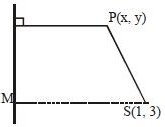
0 likes
View Solution445
AdvancedMCQ
$TP$ and $TQ$ are tangents of the parabola $y^2 = 8x$ at $P$ and $Q$ respectively. If the chord $PQ$ passes through the point $(-2, 3)$ and the locus of point $T$ is $y = mx + c$,then $(m + c)$ is equal to -
A
$0$
B
$\frac{16}{3}$
C
$- \frac{4}{3}$
D
$- \frac{8}{3}$
Solution
(C) Let the coordinates of point $T$ be $(h, k)$.
The equation of the chord of contact $PQ$ for the parabola $y^2 = 4ax$ from point $(h, k)$ is given by $ky = 2a(x + h)$.
For the given parabola $y^2 = 8x$,we have $4a = 8$,so $a = 2$.
Thus,the equation of the chord of contact is $ky = 2(2)(x + h)$,which simplifies to $ky = 4(x + h)$.
Since the chord $PQ$ passes through the point $(-2, 3)$,we substitute $x = -2$ and $y = 3$ into the equation:
$3k = 4(-2 + h)$
$3k = 4h - 8$
Replacing $(h, k)$ with $(x, y)$ to find the locus of $T$:
$3y = 4x - 8$
$y = \frac{4}{3}x - \frac{8}{3}$
Comparing this with $y = mx + c$,we get $m = \frac{4}{3}$ and $c = -\frac{8}{3}$.
Therefore,$m + c = \frac{4}{3} - \frac{8}{3} = -\frac{4}{3}$.
The equation of the chord of contact $PQ$ for the parabola $y^2 = 4ax$ from point $(h, k)$ is given by $ky = 2a(x + h)$.
For the given parabola $y^2 = 8x$,we have $4a = 8$,so $a = 2$.
Thus,the equation of the chord of contact is $ky = 2(2)(x + h)$,which simplifies to $ky = 4(x + h)$.
Since the chord $PQ$ passes through the point $(-2, 3)$,we substitute $x = -2$ and $y = 3$ into the equation:
$3k = 4(-2 + h)$
$3k = 4h - 8$
Replacing $(h, k)$ with $(x, y)$ to find the locus of $T$:
$3y = 4x - 8$
$y = \frac{4}{3}x - \frac{8}{3}$
Comparing this with $y = mx + c$,we get $m = \frac{4}{3}$ and $c = -\frac{8}{3}$.
Therefore,$m + c = \frac{4}{3} - \frac{8}{3} = -\frac{4}{3}$.
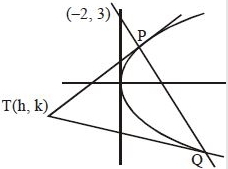
0 likes
View Solution446
AdvancedMCQ
The coordinates of a point on the parabola $y^2 = 8x$ whose focal distance is $4$ are:
A
$(2, 4)$ and $(2, -4)$
B
$(4, 2)$ and $(4, -2)$
C
$(-2, 4)$ and $(-2, -4)$
D
$(2, 2)$ and $(2, -2)$
Solution
(A) The equation of the parabola is $y^2 = 8x$. Comparing this with $y^2 = 4ax$,we get $4a = 8$,so $a = 2$.
The focal distance of a point $P(x_1, y_1)$ on the parabola $y^2 = 4ax$ is given by $x_1 + a$.
Given that the focal distance is $4$,we have $x_1 + 2 = 4$,which implies $x_1 = 2$.
Substituting $x_1 = 2$ into the parabola equation $y^2 = 8x$,we get $y^2 = 8(2) = 16$.
Therefore,$y = \pm 4$.
Thus,the coordinates of the point are $(2, 4)$ and $(2, -4)$.
The focal distance of a point $P(x_1, y_1)$ on the parabola $y^2 = 4ax$ is given by $x_1 + a$.
Given that the focal distance is $4$,we have $x_1 + 2 = 4$,which implies $x_1 = 2$.
Substituting $x_1 = 2$ into the parabola equation $y^2 = 8x$,we get $y^2 = 8(2) = 16$.
Therefore,$y = \pm 4$.
Thus,the coordinates of the point are $(2, 4)$ and $(2, -4)$.
0 likes
View Solution447
AdvancedMCQ
The equations of the tangents to the parabola $y^2 = 4ax$ at the ends of its latus rectum are-
A
$x - y + a = 0$
B
$x + y + a = 0$
C
$x + y - a = 0$
D
Both $(A)$ and $(B)$
Solution
(D) The ends of the latus rectum of the parabola $y^2 = 4ax$ are $(a, 2a)$ and $(a, -2a)$.
The equation of the tangent to the parabola $y^2 = 4ax$ at point $(x_1, y_1)$ is given by $yy_1 = 2a(x + x_1)$.
For the point $(a, 2a)$:
$y(2a) = 2a(x + a)$
$y = x + a$
$x - y + a = 0$
For the point $(a, -2a)$:
$y(-2a) = 2a(x + a)$
$-y = x + a$
$x + y + a = 0$
Thus,the equations of the tangents are $x - y + a = 0$ and $x + y + a = 0$.
The equation of the tangent to the parabola $y^2 = 4ax$ at point $(x_1, y_1)$ is given by $yy_1 = 2a(x + x_1)$.
For the point $(a, 2a)$:
$y(2a) = 2a(x + a)$
$y = x + a$
$x - y + a = 0$
For the point $(a, -2a)$:
$y(-2a) = 2a(x + a)$
$-y = x + a$
$x + y + a = 0$
Thus,the equations of the tangents are $x - y + a = 0$ and $x + y + a = 0$.
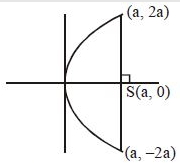
0 likes
View Solution448
AdvancedMCQ
The tangents drawn at the endpoints of the latus rectum of a parabola $S = 0$ intersect on the line $x + y = 2$. If $(3, 2)$ is the focus of the parabola,then the axis of the parabola $S = 0$ is:
A
$x + y = 5$
B
$2x - y = 4$
C
$x - y = 1$
D
$x + 2y = 7$
Solution
(C) Let the focus of the parabola be $F = (3, 2)$.
The tangents at the endpoints of the latus rectum of a parabola intersect at the point where the axis of the parabola meets the directrix.
This intersection point lies on the line $x + y = 2$.
Since the axis of the parabola passes through the focus $(3, 2)$ and is perpendicular to the directrix,and the intersection point of the tangents lies on the axis,the axis must pass through the point of intersection of the tangents.
However,the problem states the tangents intersect on the line $x + y = 2$. The intersection point of the tangents at the ends of the latus rectum is the point where the axis meets the directrix.
Let the intersection point be $P(h, k)$. Since $P$ lies on $x + y = 2$,we have $h + k = 2$.
The axis passes through the focus $(3, 2)$ and the point $P(h, k)$.
The slope of the axis is $m = \frac{2 - k}{3 - h}$.
Since the directrix is perpendicular to the axis,and the intersection point $P$ lies on the directrix,the line $x + y = 2$ is not necessarily the directrix,but the intersection point lies on it.
Given the standard properties,the axis of the parabola is the line passing through the focus $(3, 2)$ and perpendicular to the directrix.
By testing the options,the line $x - y = 1$ passes through $(3, 2)$ since $3 - 2 = 1$. Thus,$x - y = 1$ is the correct axis.
The tangents at the endpoints of the latus rectum of a parabola intersect at the point where the axis of the parabola meets the directrix.
This intersection point lies on the line $x + y = 2$.
Since the axis of the parabola passes through the focus $(3, 2)$ and is perpendicular to the directrix,and the intersection point of the tangents lies on the axis,the axis must pass through the point of intersection of the tangents.
However,the problem states the tangents intersect on the line $x + y = 2$. The intersection point of the tangents at the ends of the latus rectum is the point where the axis meets the directrix.
Let the intersection point be $P(h, k)$. Since $P$ lies on $x + y = 2$,we have $h + k = 2$.
The axis passes through the focus $(3, 2)$ and the point $P(h, k)$.
The slope of the axis is $m = \frac{2 - k}{3 - h}$.
Since the directrix is perpendicular to the axis,and the intersection point $P$ lies on the directrix,the line $x + y = 2$ is not necessarily the directrix,but the intersection point lies on it.
Given the standard properties,the axis of the parabola is the line passing through the focus $(3, 2)$ and perpendicular to the directrix.
By testing the options,the line $x - y = 1$ passes through $(3, 2)$ since $3 - 2 = 1$. Thus,$x - y = 1$ is the correct axis.
0 likes
View Solution449
AdvancedMCQ
Normals at $P$,$Q$,and $R$ are drawn to the parabola $y^2 = 4x$ which intersect at the point $(3, 0)$. Then,the triangle $\Delta PQR$ is:
A
acute angled but not equilateral
B
obtuse angled triangle
C
equilateral triangle
D
scalene triangle
Solution
(B) The equation of the normal to the parabola $y^2 = 4ax$ (where $a=1$) is $y = mx - 2am - am^3$. Substituting $a=1$,we get $y = mx - 2m - m^3$.
Since the normal passes through $(3, 0)$,we have $0 = 3m - 2m - m^3$,which simplifies to $m^3 - m = 0$.
Solving for $m$,we get $m(m-1)(m+1) = 0$,so $m = 0, 1, -1$.
The coordinates of the points are given by $(am^2, -2am)$.
For $m=0$,$P = (0, 0)$.
For $m=1$,$Q = (1, -2)$.
For $m=-1$,$R = (1, 2)$.
Now,calculate the side lengths:
$PQ = \sqrt{(1-0)^2 + (-2-0)^2} = \sqrt{1+4} = \sqrt{5}$.
$PR = \sqrt{(1-0)^2 + (2-0)^2} = \sqrt{1+4} = \sqrt{5}$.
$QR = \sqrt{(1-1)^2 + (2-(-2))^2} = \sqrt{0+16} = 4$.
Since $(QR)^2 = 16$ and $(PQ)^2 + (PR)^2 = 5 + 5 = 10$,we have $(QR)^2 > (PQ)^2 + (PR)^2$.
Therefore,$\Delta PQR$ is an obtuse-angled triangle.
Since the normal passes through $(3, 0)$,we have $0 = 3m - 2m - m^3$,which simplifies to $m^3 - m = 0$.
Solving for $m$,we get $m(m-1)(m+1) = 0$,so $m = 0, 1, -1$.
The coordinates of the points are given by $(am^2, -2am)$.
For $m=0$,$P = (0, 0)$.
For $m=1$,$Q = (1, -2)$.
For $m=-1$,$R = (1, 2)$.
Now,calculate the side lengths:
$PQ = \sqrt{(1-0)^2 + (-2-0)^2} = \sqrt{1+4} = \sqrt{5}$.
$PR = \sqrt{(1-0)^2 + (2-0)^2} = \sqrt{1+4} = \sqrt{5}$.
$QR = \sqrt{(1-1)^2 + (2-(-2))^2} = \sqrt{0+16} = 4$.
Since $(QR)^2 = 16$ and $(PQ)^2 + (PR)^2 = 5 + 5 = 10$,we have $(QR)^2 > (PQ)^2 + (PR)^2$.
Therefore,$\Delta PQR$ is an obtuse-angled triangle.
0 likes
View Solution450
AdvancedMCQ
Tangents are drawn at points $(x_i, y_i); i = 1, 2, 3$ lying on the parabola $y = x^2$ to enclose a triangle of area $\Delta$. If $x_1, x_2, x_3$ form an increasing arithmetic progression,where $x_1 = -1$ and $y_3 = 9$,then $\Delta$ is ............. $sq. \, units$.
A
$4$
B
$6$
C
$8$
D
$10$
Solution
(A) Given points on $y = x^2$ are $(x_i, x_i^2)$.
$x_1 = -1$,so $y_1 = 1$.
$y_3 = 9 \Rightarrow x_3^2 = 9$. Since $x_1, x_2, x_3$ is an increasing $AP$,$x_3$ must be $3$.
Common difference $d = \frac{x_3 - x_1}{3 - 1} = \frac{3 - (-1)}{2} = 2$.
Thus,$x_2 = x_1 + d = -1 + 2 = 1$,so $y_2 = 1^2 = 1$.
The points are $A(-1, 1)$,$B(1, 1)$,and $C(3, 9)$.
The tangents to $y = x^2$ at $(x_i, x_i^2)$ are given by $y - x_i^2 = 2x_i(x - x_i)$,or $y = 2x_ix - x_i^2$.
Tangent at $A(-1, 1): y = -2x - 1$.
Tangent at $B(1, 1): y = 2x - 1$.
Tangent at $C(3, 9): y = 6x - 9$.
Intersection of $A$ and $B$: $-2x - 1 = 2x - 1$ $\Rightarrow 4x = 0$ $\Rightarrow x = 0, y = -1$. Point $P(0, -1)$.
Intersection of $B$ and $C$: $2x - 1 = 6x - 9$ $\Rightarrow 4x = 8$ $\Rightarrow x = 2, y = 3$. Point $Q(2, 3)$.
Intersection of $A$ and $C$: $-2x - 1 = 6x - 9$ $\Rightarrow 8x = 8$ $\Rightarrow x = 1, y = -3$. Point $R(1, -3)$.
Area $\Delta = \frac{1}{2} |0(3 - (-3)) + 2(-3 - (-1)) + 1(-1 - 3)| = \frac{1}{2} |0 - 4 - 4| = \frac{1}{2} |-8| = 4$.
$x_1 = -1$,so $y_1 = 1$.
$y_3 = 9 \Rightarrow x_3^2 = 9$. Since $x_1, x_2, x_3$ is an increasing $AP$,$x_3$ must be $3$.
Common difference $d = \frac{x_3 - x_1}{3 - 1} = \frac{3 - (-1)}{2} = 2$.
Thus,$x_2 = x_1 + d = -1 + 2 = 1$,so $y_2 = 1^2 = 1$.
The points are $A(-1, 1)$,$B(1, 1)$,and $C(3, 9)$.
The tangents to $y = x^2$ at $(x_i, x_i^2)$ are given by $y - x_i^2 = 2x_i(x - x_i)$,or $y = 2x_ix - x_i^2$.
Tangent at $A(-1, 1): y = -2x - 1$.
Tangent at $B(1, 1): y = 2x - 1$.
Tangent at $C(3, 9): y = 6x - 9$.
Intersection of $A$ and $B$: $-2x - 1 = 2x - 1$ $\Rightarrow 4x = 0$ $\Rightarrow x = 0, y = -1$. Point $P(0, -1)$.
Intersection of $B$ and $C$: $2x - 1 = 6x - 9$ $\Rightarrow 4x = 8$ $\Rightarrow x = 2, y = 3$. Point $Q(2, 3)$.
Intersection of $A$ and $C$: $-2x - 1 = 6x - 9$ $\Rightarrow 8x = 8$ $\Rightarrow x = 1, y = -3$. Point $R(1, -3)$.
Area $\Delta = \frac{1}{2} |0(3 - (-3)) + 2(-3 - (-1)) + 1(-1 - 3)| = \frac{1}{2} |0 - 4 - 4| = \frac{1}{2} |-8| = 4$.
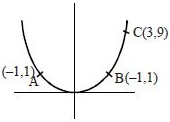
0 likes
View Solution10-2. Parabola, Ellipse, Hyperbola — Parabola · Frequently Asked Questions
1Are these 10-2. Parabola, Ellipse, Hyperbola questions useful for JEE and NEET?
Yes. All questions in this section are mapped to JEE Main and NEET exam patterns. Previous year questions from JEE Main, NEET, GUJCET and state-level exams are included with full solutions.
2Can I switch to Hindi or Gujarati for these questions?
Yes. Use the language tabs in the hero section or the sidebar to view the same questions and solutions in English, Hindi or Gujarati.
3How do I generate a question paper from this subtopic?
Use the Vedclass Exam Paper Generator — select the chapter and subtopic, set difficulty, and generate Sets A, B, C, D automatically. First 3 chapters of every subject are free.
Vedclass Products
For Students
Vedclass Test Series
Mock tests in real JEE/NEET style with performance analysis. 5-day free trial.
Start Free TrialFor Teachers
Exam Paper Generator
Generate Set A/B/C/D papers from this chapter in 2 minutes. 3 chapters free.
Try FreeFor Institutes
Online Exam Module
Live online exams with unlimited students, 360° analytics & white-label branding.
See DemoFor Teachers & Institutes
Generate a 10-2. Parabola, Ellipse, Hyperbola Exam Paper in 2 Minutes
Select subtopic & difficulty — Sets A, B, C, D auto-generated with No Repeat logic.
First 3 chapters of every subject are free — no payment required.