
A English
Parabola Questions in English
Class 11 Mathematics · 10-2. Parabola, Ellipse, Hyperbola · Parabola
1007+
Questions
English
Language
100%
With Solutions
Showing 50 of 1007 questions in English
351
DifficultMCQ
If three real normals can be drawn from a point on the $x$-axis to the parabola $y^2 = 4ax$ $(a > 0)$,what is the range of the $x$-coordinate of the point?
A
$x < 2a$
B
$x > 2a$
C
$x < a$
D
None of these
Solution
(B) Let the point on the $x$-axis be $(h, 0)$.
The equation of a normal to the parabola $y^2 = 4ax$ with slope $m$ is $y = mx - 2am - am^3$.
Since the normal passes through $(h, 0)$,we have $0 = mh - 2am - am^3$.
Assuming $m \neq 0$,we get $h = 2a + am^2$,or $am^2 = h - 2a$.
For three real normals,the cubic equation in $m$ must have three real roots.
This occurs when the point $(h, 0)$ lies inside the evolute of the parabola,which implies $h > 2a$.
Thus,the $x$-coordinate must be greater than $2a$.
The equation of a normal to the parabola $y^2 = 4ax$ with slope $m$ is $y = mx - 2am - am^3$.
Since the normal passes through $(h, 0)$,we have $0 = mh - 2am - am^3$.
Assuming $m \neq 0$,we get $h = 2a + am^2$,or $am^2 = h - 2a$.
For three real normals,the cubic equation in $m$ must have three real roots.
This occurs when the point $(h, 0)$ lies inside the evolute of the parabola,which implies $h > 2a$.
Thus,the $x$-coordinate must be greater than $2a$.
0 likes
View Solution352
EasyMCQ
The diameter of the parabola $y^2 = 4ax$ which bisects the chords parallel to $y = mx + \alpha$ is:
A
Parallel to the $y$-axis
B
Parallel to the $x$-axis
C
$A$ polar of the parabola
D
Passing through the focus
0 likes
View Solution353
MediumMCQ
What are the equations of the tangents at the endpoints of the latus rectum of the parabola $y^2 = 4ax$?
A
$x + y + a = 0$
B
$x - y + a = 0$
C
$x + y - a = 0$
D
Both $A$ and $B$
Solution
(D) The parabola is given by $y^2 = 4ax$. The endpoints of the latus rectum are $(a, 2a)$ and $(a, -2a)$.
For a point $(x_1, y_1)$ on the parabola $y^2 = 4ax$,the equation of the tangent is $yy_1 = 2a(x + x_1)$.
For the point $(a, 2a)$,the tangent is $y(2a) = 2a(x + a) \implies y = x + a \implies x - y + a = 0$.
For the point $(a, -2a)$,the tangent is $y(-2a) = 2a(x + a) \implies -y = x + a \implies x + y + a = 0$.
Thus,the equations of the tangents are $x - y + a = 0$ and $x + y + a = 0$.
For a point $(x_1, y_1)$ on the parabola $y^2 = 4ax$,the equation of the tangent is $yy_1 = 2a(x + x_1)$.
For the point $(a, 2a)$,the tangent is $y(2a) = 2a(x + a) \implies y = x + a \implies x - y + a = 0$.
For the point $(a, -2a)$,the tangent is $y(-2a) = 2a(x + a) \implies -y = x + a \implies x + y + a = 0$.
Thus,the equations of the tangents are $x - y + a = 0$ and $x + y + a = 0$.
0 likes
View Solution354
EasyMCQ
If $(x_1, y_1)$ and $(x_2, y_2)$ are the endpoints of a focal chord of the parabola $y^2 = 4ax$,then what is the square of the $G.M.$ of $x_1$ and $x_2$?
A
$-4a^2$
B
$4a^2$
C
$a^2$
D
$-a^2$
Solution
(C) For a parabola $y^2 = 4ax$,the endpoints of a focal chord can be represented as $(x_1, y_1) = (at^2, 2at)$ and $(x_2, y_2) = (a/t^2, -2a/t)$.
Here,$x_1 = at^2$ and $x_2 = a/t^2$.
The Geometric Mean $(G.M.)$ of $x_1$ and $x_2$ is $\sqrt{x_1 x_2}$.
Therefore,the square of the $G.M.$ is $(\sqrt{x_1 x_2})^2 = x_1 x_2$.
Substituting the values,we get $x_1 x_2 = (at^2) \times (a/t^2) = a^2$.
Thus,the square of the $G.M.$ is $a^2$.
Here,$x_1 = at^2$ and $x_2 = a/t^2$.
The Geometric Mean $(G.M.)$ of $x_1$ and $x_2$ is $\sqrt{x_1 x_2}$.
Therefore,the square of the $G.M.$ is $(\sqrt{x_1 x_2})^2 = x_1 x_2$.
Substituting the values,we get $x_1 x_2 = (at^2) \times (a/t^2) = a^2$.
Thus,the square of the $G.M.$ is $a^2$.
0 likes
View Solution355
EasyMCQ
What is the equation of the directrix of the parabola $x^2 = -8y$?
A
$x = 2$
B
$y = 2$
C
$y = -2$
D
$x = -2$
Solution
(B) The given equation of the parabola is $x^2 = -8y$.
Comparing this with the standard form $x^2 = -4ay$,we get:
$-4a = -8
\implies a = 2$.
The equation of the directrix for a parabola of the form $x^2 = -4ay$ is given by $y = a$.
Substituting the value of $a$,we get $y = 2$.
Thus,the equation of the directrix is $y = 2$.
Comparing this with the standard form $x^2 = -4ay$,we get:
$-4a = -8
\implies a = 2$.
The equation of the directrix for a parabola of the form $x^2 = -4ay$ is given by $y = a$.
Substituting the value of $a$,we get $y = 2$.
Thus,the equation of the directrix is $y = 2$.
0 likes
View Solution356
DifficultMCQ
The line $y = mx + c$ touches the parabola $y^2 = 4a(x + a)$ if...
A
$c = am - \frac{a}{m}$
B
$c = \frac{a}{m}$
C
$c = -\frac{a}{m}$
D
$c = am + \frac{a}{m}$
Solution
(D) The equation of the parabola is $y^2 = 4a(x + a)$.
Let $X = x + a$,then $x = X - a$. Substituting this into the equation,we get $y^2 = 4aX$.
The condition for the line $y = mx + c$ to touch the parabola $y^2 = 4aX$ is $c' = \frac{a}{m}$,where $c'$ is the intercept on the $Y$-axis.
Substituting $x = X - a$ into $y = mx + c$,we get $y = m(X - a) + c = mX + (c - am)$.
Comparing this with $y = mX + c'$,we have $c' = c - am$.
Equating the two expressions for $c'$,we get $c - am = \frac{a}{m}$.
Therefore,$c = am + \frac{a}{m}$.
Let $X = x + a$,then $x = X - a$. Substituting this into the equation,we get $y^2 = 4aX$.
The condition for the line $y = mx + c$ to touch the parabola $y^2 = 4aX$ is $c' = \frac{a}{m}$,where $c'$ is the intercept on the $Y$-axis.
Substituting $x = X - a$ into $y = mx + c$,we get $y = m(X - a) + c = mX + (c - am)$.
Comparing this with $y = mX + c'$,we have $c' = c - am$.
Equating the two expressions for $c'$,we get $c - am = \frac{a}{m}$.
Therefore,$c = am + \frac{a}{m}$.
0 likes
View Solution357
EasyMCQ
Find the equation of the tangent to the parabola $x^2 = y$ at one of the endpoints of its latus rectum in the first quadrant.
A
$y = x - 1/4$
B
$x = 2y - 1/2$
C
$2x - y = 1/4$
D
$x - 2y = 1/4$
0 likes
View Solution358
EasyMCQ
What is the equation of the directrix of the parabola $x^2 = -ay$?
A
$x = a/4$
B
$x = -a/2$
C
$y = a/4$
D
$y = -a/4$
Solution
(C) The given equation of the parabola is $x^2 = -ay$.
Comparing this with the standard form $x^2 = -4Ay$,we get $4A = a$,which implies $A = a/4$.
The parabola $x^2 = -4Ay$ opens downwards with its vertex at $(0, 0)$ and focus at $(0, -A)$.
The equation of the directrix for the parabola $x^2 = -4Ay$ is given by $y = A$.
Substituting $A = a/4$,we get the equation of the directrix as $y = a/4$.
Comparing this with the standard form $x^2 = -4Ay$,we get $4A = a$,which implies $A = a/4$.
The parabola $x^2 = -4Ay$ opens downwards with its vertex at $(0, 0)$ and focus at $(0, -A)$.
The equation of the directrix for the parabola $x^2 = -4Ay$ is given by $y = A$.
Substituting $A = a/4$,we get the equation of the directrix as $y = a/4$.
0 likes
View Solution359
MediumMCQ
What is the length of the subnormal at any point on the parabola $y^2 = 4ax$?
A
$1$
B
$2$
C
$2a$
D
$4a$
Solution
(C) Given the equation of the parabola is $y^2 = 4ax$.
Let $(x_1, y_1)$ be any point on the parabola.
Differentiating $y^2 = 4ax$ with respect to $x$,we get $2y \frac{dy}{dx} = 4a$,which implies $\frac{dy}{dx} = \frac{2a}{y}$.
At the point $(x_1, y_1)$,the slope of the tangent is $m = \frac{dy}{dx} = \frac{2a}{y_1}$.
The length of the subnormal is given by the formula $|y_1 \cdot \frac{dy}{dx}|$.
Substituting the value of the slope,we get the length of the subnormal $= |y_1 \cdot \frac{2a}{y_1}| = 2a$.
Let $(x_1, y_1)$ be any point on the parabola.
Differentiating $y^2 = 4ax$ with respect to $x$,we get $2y \frac{dy}{dx} = 4a$,which implies $\frac{dy}{dx} = \frac{2a}{y}$.
At the point $(x_1, y_1)$,the slope of the tangent is $m = \frac{dy}{dx} = \frac{2a}{y_1}$.
The length of the subnormal is given by the formula $|y_1 \cdot \frac{dy}{dx}|$.
Substituting the value of the slope,we get the length of the subnormal $= |y_1 \cdot \frac{2a}{y_1}| = 2a$.
0 likes
View Solution360
MediumMCQ
If $x + y = K$ is a normal to the parabola $y^2 = 12x$,then what is the value of $K$?
A
$3$
B
$9$
C
$-9$
D
$-3$
Solution
(B) The equation of the parabola is $y^2 = 12x$. Comparing this with $y^2 = 4ax$,we get $4a = 12$,so $a = 3$.
The given line is $x + y = K$,which can be written as $y = -x + K$. The slope of this line is $m = -1$.
The equation of a normal to the parabola $y^2 = 4ax$ with slope $m$ is given by $y = mx - 2am - am^3$.
Substituting $a = 3$ and $m = -1$ into the equation:
$y = (-1)x - 2(3)(-1) - (3)(-1)^3$
$y = -x + 6 + 3$
$y = -x + 9$
$x + y = 9$
Comparing this with $x + y = K$,we get $K = 9$.
The given line is $x + y = K$,which can be written as $y = -x + K$. The slope of this line is $m = -1$.
The equation of a normal to the parabola $y^2 = 4ax$ with slope $m$ is given by $y = mx - 2am - am^3$.
Substituting $a = 3$ and $m = -1$ into the equation:
$y = (-1)x - 2(3)(-1) - (3)(-1)^3$
$y = -x + 6 + 3$
$y = -x + 9$
$x + y = 9$
Comparing this with $x + y = K$,we get $K = 9$.
0 likes
View Solution361
MediumMCQ
What is the angle of intersection between the curves $y = x$ and $y^2 = 4x$ at the point $(4, 4)$?
A
$\tan^{-1}\left(\frac{1}{2}\right)$
B
$\tan^{-1}\left(\frac{1}{3}\right)$
C
$\frac{\pi}{4}$
D
$\frac{\pi}{2}$
Solution
(B) Given curves are $y = x$ and $y^2 = 4x$.
For $y = x$,differentiating with respect to $x$,we get $m_1 = \frac{dy}{dx} = 1$.
For $y^2 = 4x$,differentiating with respect to $x$,we get $2y \frac{dy}{dx} = 4$,which implies $m_2 = \frac{dy}{dx} = \frac{2}{y}$.
At the point $(4, 4)$,the slope $m_1 = 1$ and $m_2 = \frac{2}{4} = \frac{1}{2}$.
The angle of intersection $\theta$ is given by $\tan \theta = \left| \frac{m_1 - m_2}{1 + m_1 m_2} \right|$.
Substituting the values,$\tan \theta = \left| \frac{1 - 1/2}{1 + (1)(1/2)} \right| = \left| \frac{1/2}{3/2} \right| = \frac{1}{3}$.
Therefore,$\theta = \tan^{-1}\left(\frac{1}{3}\right)$.
For $y = x$,differentiating with respect to $x$,we get $m_1 = \frac{dy}{dx} = 1$.
For $y^2 = 4x$,differentiating with respect to $x$,we get $2y \frac{dy}{dx} = 4$,which implies $m_2 = \frac{dy}{dx} = \frac{2}{y}$.
At the point $(4, 4)$,the slope $m_1 = 1$ and $m_2 = \frac{2}{4} = \frac{1}{2}$.
The angle of intersection $\theta$ is given by $\tan \theta = \left| \frac{m_1 - m_2}{1 + m_1 m_2} \right|$.
Substituting the values,$\tan \theta = \left| \frac{1 - 1/2}{1 + (1)(1/2)} \right| = \left| \frac{1/2}{3/2} \right| = \frac{1}{3}$.
Therefore,$\theta = \tan^{-1}\left(\frac{1}{3}\right)$.
0 likes
View Solution362
EasyMCQ
What is the equation of the normal to the curve $y^2 = 4ax$ at the point $(a, 2a)$?
A
$x - y + a = 0$
B
$x + y - 3a = 0$
C
$x + 2y + 4a = 0$
D
$x + y + 4a = 0$
Solution
(B) Given the curve $y^2 = 4ax$.
Differentiating with respect to $x$,we get $2y \frac{dy}{dx} = 4a$,which implies $\frac{dy}{dx} = \frac{2a}{y}$.
At the point $(a, 2a)$,the slope of the tangent $m_t = \frac{2a}{2a} = 1$.
The slope of the normal $m_n$ is given by $-\frac{1}{m_t} = -\frac{1}{1} = -1$.
The equation of the normal at $(a, 2a)$ is $y - y_1 = m_n(x - x_1)$.
Substituting the values,we get $y - 2a = -1(x - a)$.
$y - 2a = -x + a$.
Therefore,$x + y - 3a = 0$.
Differentiating with respect to $x$,we get $2y \frac{dy}{dx} = 4a$,which implies $\frac{dy}{dx} = \frac{2a}{y}$.
At the point $(a, 2a)$,the slope of the tangent $m_t = \frac{2a}{2a} = 1$.
The slope of the normal $m_n$ is given by $-\frac{1}{m_t} = -\frac{1}{1} = -1$.
The equation of the normal at $(a, 2a)$ is $y - y_1 = m_n(x - x_1)$.
Substituting the values,we get $y - 2a = -1(x - a)$.
$y - 2a = -x + a$.
Therefore,$x + y - 3a = 0$.
0 likes
View Solution363
EasyMCQ
Find the equation of the tangent to the curve $y^2 = 6x$ at the point $(2, -3)$.
A
$x + y - 1 = 0$
B
$x + y + 1 = 0$
C
$x - y + 1 = 0$
D
$x + y + 2 = 0$
Solution
(B) Given the curve equation is $y^2 = 6x$.
Differentiating both sides with respect to $x$,we get:
$2y \frac{dy}{dx} = 6$
$\frac{dy}{dx} = \frac{6}{2y} = \frac{3}{y}$
Now,find the slope of the tangent at the point $(2, -3)$:
$m = \left( \frac{dy}{dx} \right)_{(2, -3)} = \frac{3}{-3} = -1$
The equation of the tangent line passing through $(x_1, y_1) = (2, -3)$ with slope $m = -1$ is given by:
$y - y_1 = m(x - x_1)$
$y - (-3) = -1(x - 2)$
$y + 3 = -x + 2$
$x + y + 1 = 0$
Differentiating both sides with respect to $x$,we get:
$2y \frac{dy}{dx} = 6$
$\frac{dy}{dx} = \frac{6}{2y} = \frac{3}{y}$
Now,find the slope of the tangent at the point $(2, -3)$:
$m = \left( \frac{dy}{dx} \right)_{(2, -3)} = \frac{3}{-3} = -1$
The equation of the tangent line passing through $(x_1, y_1) = (2, -3)$ with slope $m = -1$ is given by:
$y - y_1 = m(x - x_1)$
$y - (-3) = -1(x - 2)$
$y + 3 = -x + 2$
$x + y + 1 = 0$
0 likes
View Solution364
EasyMCQ
If the tangent to the curve $x = at^2, y = 2at$ is perpendicular to the $x$-axis,then what is the point of contact?
A
$(0, 0)$
B
$(0, a)$
C
$(a, 0)$
D
$(a, a)$
Solution
(A) Given the parametric equations of the curve: $x = at^2$ and $y = 2at$.
First,find the derivatives with respect to $t$:
$\frac{dx}{dt} = 2at$ and $\frac{dy}{dt} = 2a$.
The slope of the tangent is given by $\frac{dy}{dx} = \frac{dy/dt}{dx/dt} = \frac{2a}{2at} = \frac{1}{t}$.
For the tangent to be perpendicular to the $x$-axis,the slope must be undefined (i.e.,$\frac{dy}{dx} \to \infty$).
This occurs when the denominator $t = 0$.
Substituting $t = 0$ into the parametric equations:
$x = a(0)^2 = 0$
$y = 2a(0) = 0$
Therefore,the point of contact is $(0, 0)$.
First,find the derivatives with respect to $t$:
$\frac{dx}{dt} = 2at$ and $\frac{dy}{dt} = 2a$.
The slope of the tangent is given by $\frac{dy}{dx} = \frac{dy/dt}{dx/dt} = \frac{2a}{2at} = \frac{1}{t}$.
For the tangent to be perpendicular to the $x$-axis,the slope must be undefined (i.e.,$\frac{dy}{dx} \to \infty$).
This occurs when the denominator $t = 0$.
Substituting $t = 0$ into the parametric equations:
$x = a(0)^2 = 0$
$y = 2a(0) = 0$
Therefore,the point of contact is $(0, 0)$.
0 likes
View Solution365
EasyMCQ
What is the equation of the normal to the curve $y^2 = 16x$ at the point $(1, 4)$?
A
$2x + y = 6$
B
$x + 2y = 9$
C
$2x - y + 2 = 0$
D
None of these
Solution
(B) Given the curve equation: $y^2 = 16x$.
Differentiating with respect to $x$: $2y \frac{dy}{dx} = 16$,which gives $\frac{dy}{dx} = \frac{8}{y}$.
At the point $(1, 4)$,the slope of the tangent $m_t = \frac{8}{4} = 2$.
The slope of the normal $m_n = -\frac{1}{m_t} = -\frac{1}{2}$.
The equation of the normal at $(1, 4)$ is given by $y - y_1 = m_n(x - x_1)$.
Substituting the values: $y - 4 = -\frac{1}{2}(x - 1)$.
Multiplying by $2$: $2y - 8 = -x + 1$,which simplifies to $x + 2y = 9$.
Differentiating with respect to $x$: $2y \frac{dy}{dx} = 16$,which gives $\frac{dy}{dx} = \frac{8}{y}$.
At the point $(1, 4)$,the slope of the tangent $m_t = \frac{8}{4} = 2$.
The slope of the normal $m_n = -\frac{1}{m_t} = -\frac{1}{2}$.
The equation of the normal at $(1, 4)$ is given by $y - y_1 = m_n(x - x_1)$.
Substituting the values: $y - 4 = -\frac{1}{2}(x - 1)$.
Multiplying by $2$: $2y - 8 = -x + 1$,which simplifies to $x + 2y = 9$.
0 likes
View Solution366
DifficultMCQ
For the curve $y^2 = 4ax$,the lengths of the tangent,subtangent,normal,and subnormal at the point $(at^2, 2at)$ are respectively:
A
$2at\sqrt{t^2 + 1}, 2at^2, 2a\sqrt{t^2 + 1}, 2a$
B
$2at^2, 2a, 2at\sqrt{t^2 + 1}, 2a\sqrt{t^2 + 1}$
C
$2at\sqrt{t^2 + 1}, 2a, 2at^2, 2a\sqrt{t^2 + 1}$
D
$2a\sqrt{t^2 + 1}, 2at^2, 2at\sqrt{t^2 + 1}, 2a$
Solution
(A) Given the curve $y^2 = 4ax$. Differentiating with respect to $x$,we get $2y \frac{dy}{dx} = 4a$,which implies $\frac{dy}{dx} = \frac{2a}{y}$.
At the point $(at^2, 2at)$,the slope $m = \frac{dy}{dx} = \frac{2a}{2at} = \frac{1}{t}$.
$1$. Length of Subtangent = $|\frac{y}{m}| = |\frac{2at}{1/t}| = 2at^2$.
$2$. Length of Tangent = $|y \sqrt{1 + \frac{1}{m^2}}| = |2at \sqrt{1 + t^2}| = 2at\sqrt{t^2 + 1}$.
$3$. Length of Subnormal = $|y \cdot m| = |2at \cdot \frac{1}{t}| = 2a$.
$4$. Length of Normal = $|y \sqrt{1 + m^2}| = |2at \sqrt{1 + \frac{1}{t^2}}| = |2at \frac{\sqrt{t^2 + 1}}{t}| = 2a\sqrt{t^2 + 1}$.
Thus,the lengths are $2at\sqrt{t^2 + 1}, 2at^2, 2a\sqrt{t^2 + 1}, 2a$.
At the point $(at^2, 2at)$,the slope $m = \frac{dy}{dx} = \frac{2a}{2at} = \frac{1}{t}$.
$1$. Length of Subtangent = $|\frac{y}{m}| = |\frac{2at}{1/t}| = 2at^2$.
$2$. Length of Tangent = $|y \sqrt{1 + \frac{1}{m^2}}| = |2at \sqrt{1 + t^2}| = 2at\sqrt{t^2 + 1}$.
$3$. Length of Subnormal = $|y \cdot m| = |2at \cdot \frac{1}{t}| = 2a$.
$4$. Length of Normal = $|y \sqrt{1 + m^2}| = |2at \sqrt{1 + \frac{1}{t^2}}| = |2at \frac{\sqrt{t^2 + 1}}{t}| = 2a\sqrt{t^2 + 1}$.
Thus,the lengths are $2at\sqrt{t^2 + 1}, 2at^2, 2a\sqrt{t^2 + 1}, 2a$.
0 likes
View Solution367
EasyMCQ
What is the equation of the tangent to the curve $x^2 = -4y$ at the point $(-4, -4)$?
A
$2x + y + 4 = 0$
B
$2x - y - 12 = 0$
C
$2x + y - 4 = 0$
D
$2x - y + 4 = 0$
Solution
(D) Given the curve equation is $x^2 = -4y$.
Differentiating both sides with respect to $x$,we get $2x = -4 \frac{dy}{dx}$.
Thus,$\frac{dy}{dx} = -\frac{x}{2}$.
At the point $(-4, -4)$,the slope of the tangent is $m = \left( \frac{dy}{dx} \right)_{(-4, -4)} = -\frac{-4}{2} = 2$.
The equation of the tangent line passing through $(x_1, y_1) = (-4, -4)$ with slope $m = 2$ is given by $(y - y_1) = m(x - x_1)$.
Substituting the values,we get $y - (-4) = 2(x - (-4))$.
$y + 4 = 2(x + 4)$.
$y + 4 = 2x + 8$.
$2x - y + 4 = 0$.
Differentiating both sides with respect to $x$,we get $2x = -4 \frac{dy}{dx}$.
Thus,$\frac{dy}{dx} = -\frac{x}{2}$.
At the point $(-4, -4)$,the slope of the tangent is $m = \left( \frac{dy}{dx} \right)_{(-4, -4)} = -\frac{-4}{2} = 2$.
The equation of the tangent line passing through $(x_1, y_1) = (-4, -4)$ with slope $m = 2$ is given by $(y - y_1) = m(x - x_1)$.
Substituting the values,we get $y - (-4) = 2(x - (-4))$.
$y + 4 = 2(x + 4)$.
$y + 4 = 2x + 8$.
$2x - y + 4 = 0$.
0 likes
View Solution368
EasyMCQ
What is the equation of the tangent to the curve $x = at^2, y = 2at$ at any point $t$?
A
$x = ty + at^2$
B
$ty + x + at^2 = 0$
C
$ty = x + at^2$
D
$ty = x + at^3$
Solution
(C) Given the parametric equations of the curve are $x = at^2$ and $y = 2at$.
First,we find the derivative $\frac{dy}{dx}$:
$\frac{dx}{dt} = 2at$ and $\frac{dy}{dt} = 2a$.
Therefore,the slope of the tangent is $\frac{dy}{dx} = \frac{dy/dt}{dx/dt} = \frac{2a}{2at} = \frac{1}{t}$.
The equation of the tangent at point $(at^2, 2at)$ is given by $(y - y_1) = m(x - x_1)$.
Substituting the values: $(y - 2at) = \frac{1}{t}(x - at^2)$.
Multiplying both sides by $t$,we get $ty - 2at^2 = x - at^2$.
Rearranging the terms,we get $ty = x + at^2$.
First,we find the derivative $\frac{dy}{dx}$:
$\frac{dx}{dt} = 2at$ and $\frac{dy}{dt} = 2a$.
Therefore,the slope of the tangent is $\frac{dy}{dx} = \frac{dy/dt}{dx/dt} = \frac{2a}{2at} = \frac{1}{t}$.
The equation of the tangent at point $(at^2, 2at)$ is given by $(y - y_1) = m(x - x_1)$.
Substituting the values: $(y - 2at) = \frac{1}{t}(x - at^2)$.
Multiplying both sides by $t$,we get $ty - 2at^2 = x - at^2$.
Rearranging the terms,we get $ty = x + at^2$.
0 likes
View Solution369
DifficultMCQ
Find the angle of intersection of the curves $y^2 = 4x$ and $x^2 = 4y$.
A
$1/3$
B
$3/4$
C
$\pi /4$
D
$\tan^{-1}(3/4)$
Solution
(D) The equations of the curves are $y^2 = 4x \dots (i)$ and $x^2 = 4y \dots (ii)$.
To find the intersection points,substitute $x = y^2/4$ from $(i)$ into $(ii)$:
$(y^2/4)^2 = 4y \implies y^4/16 = 4y \implies y^4 - 64y = 0 \implies y(y^3 - 64) = 0$.
This gives $y = 0$ or $y = 4$. If $y = 0$,$x = 0$. If $y = 4$,$x = 4$. The intersection points are $(0, 0)$ and $(4, 4)$.
Differentiating $(i)$ with respect to $x$: $2y \frac{dy}{dx} = 4 \implies \frac{dy}{dx} = \frac{2}{y} = m_1$.
Differentiating $(ii)$ with respect to $x$: $2x = 4 \frac{dy}{dx} \implies \frac{dy}{dx} = \frac{x}{2} = m_2$.
At $(4, 4)$: $m_1 = \frac{2}{4} = 1/2$ and $m_2 = \frac{4}{2} = 2$.
The angle $\theta$ between the curves is given by $\tan \theta = \left| \frac{m_2 - m_1}{1 + m_1 m_2} \right|$.
$\tan \theta = \left| \frac{2 - 1/2}{1 + (2)(1/2)} \right| = \left| \frac{3/2}{2} \right| = 3/4$.
Thus,$\theta = \tan^{-1}(3/4)$.
To find the intersection points,substitute $x = y^2/4$ from $(i)$ into $(ii)$:
$(y^2/4)^2 = 4y \implies y^4/16 = 4y \implies y^4 - 64y = 0 \implies y(y^3 - 64) = 0$.
This gives $y = 0$ or $y = 4$. If $y = 0$,$x = 0$. If $y = 4$,$x = 4$. The intersection points are $(0, 0)$ and $(4, 4)$.
Differentiating $(i)$ with respect to $x$: $2y \frac{dy}{dx} = 4 \implies \frac{dy}{dx} = \frac{2}{y} = m_1$.
Differentiating $(ii)$ with respect to $x$: $2x = 4 \frac{dy}{dx} \implies \frac{dy}{dx} = \frac{x}{2} = m_2$.
At $(4, 4)$: $m_1 = \frac{2}{4} = 1/2$ and $m_2 = \frac{4}{2} = 2$.
The angle $\theta$ between the curves is given by $\tan \theta = \left| \frac{m_2 - m_1}{1 + m_1 m_2} \right|$.
$\tan \theta = \left| \frac{2 - 1/2}{1 + (2)(1/2)} \right| = \left| \frac{3/2}{2} \right| = 3/4$.
Thus,$\theta = \tan^{-1}(3/4)$.
0 likes
View Solution370
DifficultMCQ
Find the minimum distance from the point $(0, c)$ to the parabola $y = x^2$,where $0 \leq c \leq 5$.
A
$\sqrt{4c - 1}$
B
$\frac{\sqrt{2c - 1}}{3}$
C
$\frac{\sqrt{4c - 1}}{2}$
D
None of these
Solution
(C) Let $P(x, y)$ be a point on the parabola $y = x^2$ and $Q(0, c)$ be the given point.
Since $P$ lies on the parabola,$y = x^2$. The distance $PQ$ is given by $PQ = \sqrt{(x - 0)^2 + (y - c)^2}$.
To minimize the distance,we minimize $Z = PQ^2 = x^2 + (x^2 - c)^2$.
$Z = x^2 + x^4 - 2cx^2 + c^2 = x^4 + x^2(1 - 2c) + c^2$.
Taking the derivative with respect to $x$: $\frac{dZ}{dx} = 4x^3 + 2x(1 - 2c) = 2x(2x^2 + 1 - 2c)$.
Setting $\frac{dZ}{dx} = 0$,we get $x = 0$ or $x^2 = \frac{2c - 1}{2}$.
If $c \leq \frac{1}{2}$,then $x = 0$ is the only real solution,and the minimum distance is at $x = 0$,$PQ = \sqrt{0^2 + (0 - c)^2} = c$.
If $c > \frac{1}{2}$,then $x^2 = \frac{2c - 1}{2}$ gives the minimum. Substituting $x^2 = \frac{2c - 1}{2}$ into $Z$:
$Z = (\frac{2c - 1}{2})^2 + (\frac{2c - 1}{2} - c)^2 = \frac{(2c - 1)^2}{4} + (\frac{2c - 1 - 2c}{2})^2 = \frac{4c^2 - 4c + 1}{4} + \frac{1}{4} = \frac{4c^2 - 4c + 2}{4} = c^2 - c + \frac{1}{2}$.
Wait,re-evaluating $Z = x^2 + (x^2 - c)^2$ at $x^2 = c - \frac{1}{2}$:
$Z = (c - \frac{1}{2}) + (c - \frac{1}{2} - c)^2 = c - \frac{1}{2} + \frac{1}{4} = c - \frac{1}{4} = \frac{4c - 1}{4}$.
Thus,$PQ = \sqrt{\frac{4c - 1}{4}} = \frac{\sqrt{4c - 1}}{2}$.
Since $P$ lies on the parabola,$y = x^2$. The distance $PQ$ is given by $PQ = \sqrt{(x - 0)^2 + (y - c)^2}$.
To minimize the distance,we minimize $Z = PQ^2 = x^2 + (x^2 - c)^2$.
$Z = x^2 + x^4 - 2cx^2 + c^2 = x^4 + x^2(1 - 2c) + c^2$.
Taking the derivative with respect to $x$: $\frac{dZ}{dx} = 4x^3 + 2x(1 - 2c) = 2x(2x^2 + 1 - 2c)$.
Setting $\frac{dZ}{dx} = 0$,we get $x = 0$ or $x^2 = \frac{2c - 1}{2}$.
If $c \leq \frac{1}{2}$,then $x = 0$ is the only real solution,and the minimum distance is at $x = 0$,$PQ = \sqrt{0^2 + (0 - c)^2} = c$.
If $c > \frac{1}{2}$,then $x^2 = \frac{2c - 1}{2}$ gives the minimum. Substituting $x^2 = \frac{2c - 1}{2}$ into $Z$:
$Z = (\frac{2c - 1}{2})^2 + (\frac{2c - 1}{2} - c)^2 = \frac{(2c - 1)^2}{4} + (\frac{2c - 1 - 2c}{2})^2 = \frac{4c^2 - 4c + 1}{4} + \frac{1}{4} = \frac{4c^2 - 4c + 2}{4} = c^2 - c + \frac{1}{2}$.
Wait,re-evaluating $Z = x^2 + (x^2 - c)^2$ at $x^2 = c - \frac{1}{2}$:
$Z = (c - \frac{1}{2}) + (c - \frac{1}{2} - c)^2 = c - \frac{1}{2} + \frac{1}{4} = c - \frac{1}{4} = \frac{4c - 1}{4}$.
Thus,$PQ = \sqrt{\frac{4c - 1}{4}} = \frac{\sqrt{4c - 1}}{2}$.
0 likes
View Solution371
DifficultMCQ
If $0 \leq x \leq 5$,then the minimum distance from the point $(0, c)$ to the parabola $y = x^2$ is:
A
$\sqrt{c - 4}$
B
$\sqrt{c - 1/4}$
C
$\sqrt{c + 1/4}$
D
None of these
Solution
(B) Let a point on the parabola be $(x, x^2)$. The square of the distance $d$ from $(0, c)$ is given by $z = d^2 = x^2 + (x^2 - c)^2$.
Let $t = x^2$. Since $0 \leq x \leq 5$,we have $0 \leq t \leq 25$. Then $z = t + (t - c)^2 = t^2 + t(1 - 2c) + c^2$.
To find the minimum,differentiate with respect to $t$: $\frac{dz}{dt} = 2t + 1 - 2c$.
Setting $\frac{dz}{dt} = 0$ gives $t = c - 1/2$.
If $0 \leq c - 1/2 \leq 25$ (i.e.,$1/2 \leq c \leq 51/2$),the minimum occurs at $t = c - 1/2$.
The minimum distance is $\sqrt{t + (t - c)^2} = \sqrt{(c - 1/2) + (-1/2)^2} = \sqrt{c - 1/2 + 1/4} = \sqrt{c - 1/4}$.
Let $t = x^2$. Since $0 \leq x \leq 5$,we have $0 \leq t \leq 25$. Then $z = t + (t - c)^2 = t^2 + t(1 - 2c) + c^2$.
To find the minimum,differentiate with respect to $t$: $\frac{dz}{dt} = 2t + 1 - 2c$.
Setting $\frac{dz}{dt} = 0$ gives $t = c - 1/2$.
If $0 \leq c - 1/2 \leq 25$ (i.e.,$1/2 \leq c \leq 51/2$),the minimum occurs at $t = c - 1/2$.
The minimum distance is $\sqrt{t + (t - c)^2} = \sqrt{(c - 1/2) + (-1/2)^2} = \sqrt{c - 1/2 + 1/4} = \sqrt{c - 1/4}$.
0 likes
View Solution372
DifficultMCQ
If $x = t^2$ and $y = 2t$,what is the equation of the normal at $t = 1$?
A
$x + y + 3 = 0$
B
$x + y + 1 = 0$
C
$x + y - 1 = 0$
D
$x + y - 3 = 0$
Solution
(D) Given the parametric equations $x = t^2$ and $y = 2t$.
First,find the derivative $\frac{dy}{dx}$:
$\frac{dx}{dt} = 2t$ and $\frac{dy}{dt} = 2$.
Therefore,the slope of the tangent is $\frac{dy}{dx} = \frac{dy/dt}{dx/dt} = \frac{2}{2t} = \frac{1}{t}$.
At $t = 1$,the slope of the tangent is $m = \frac{1}{1} = 1$.
The slope of the normal is $m' = -\frac{1}{m} = -1$.
At $t = 1$,the coordinates of the point are $x = (1)^2 = 1$ and $y = 2(1) = 2$.
The equation of the normal line passing through $(1, 2)$ with slope $-1$ is:
$y - 2 = -1(x - 1)$
$y - 2 = -x + 1$
$x + y - 3 = 0$.
First,find the derivative $\frac{dy}{dx}$:
$\frac{dx}{dt} = 2t$ and $\frac{dy}{dt} = 2$.
Therefore,the slope of the tangent is $\frac{dy}{dx} = \frac{dy/dt}{dx/dt} = \frac{2}{2t} = \frac{1}{t}$.
At $t = 1$,the slope of the tangent is $m = \frac{1}{1} = 1$.
The slope of the normal is $m' = -\frac{1}{m} = -1$.
At $t = 1$,the coordinates of the point are $x = (1)^2 = 1$ and $y = 2(1) = 2$.
The equation of the normal line passing through $(1, 2)$ with slope $-1$ is:
$y - 2 = -1(x - 1)$
$y - 2 = -x + 1$
$x + y - 3 = 0$.
0 likes
View Solution373
DifficultMCQ
The locus of the vertices of the family of parabolas $y = \frac{a^3 x^2}{3} + \frac{a^2 x}{2} - 2a$ is
A
$xy = \frac{3}{4}$
B
$xy = \frac{35}{16}$
C
$xy = \frac{105}{64}$
D
$xy = \frac{64}{105}$
Solution
(C) The given equation of the parabola is $y = \frac{a^3 x^2}{3} + \frac{a^2 x}{2} - 2a$.
To find the vertex,we complete the square for $x$:
$y = \frac{a^3}{3} \left( x^2 + \frac{3}{2a} x \right) - 2a$
$y = \frac{a^3}{3} \left( x^2 + \frac{3}{2a} x + \left(\frac{3}{4a}\right)^2 - \left(\frac{3}{4a}\right)^2 \right) - 2a$
$y = \frac{a^3}{3} \left( x + \frac{3}{4a} \right)^2 - \frac{a^3}{3} \cdot \frac{9}{16a^2} - 2a$
$y = \frac{a^3}{3} \left( x + \frac{3}{4a} \right)^2 - \frac{3a}{16} - 2a$
$y + \frac{35a}{16} = \frac{a^3}{3} \left( x + \frac{3}{4a} \right)^2$.
The vertex $(h, k)$ is given by $h = -\frac{3}{4a}$ and $k = -\frac{35a}{16}$.
To find the locus,we eliminate $a$:
From $h = -\frac{3}{4a}$,we get $a = -\frac{3}{4h}$.
Substitute this into $k = -\frac{35a}{16}$:
$k = -\frac{35}{16} \left( -\frac{3}{4h} \right) = \frac{105}{64h}$.
Therefore,$hk = \frac{105}{64}$.
Replacing $(h, k)$ with $(x, y)$,the locus is $xy = \frac{105}{64}$.
To find the vertex,we complete the square for $x$:
$y = \frac{a^3}{3} \left( x^2 + \frac{3}{2a} x \right) - 2a$
$y = \frac{a^3}{3} \left( x^2 + \frac{3}{2a} x + \left(\frac{3}{4a}\right)^2 - \left(\frac{3}{4a}\right)^2 \right) - 2a$
$y = \frac{a^3}{3} \left( x + \frac{3}{4a} \right)^2 - \frac{a^3}{3} \cdot \frac{9}{16a^2} - 2a$
$y = \frac{a^3}{3} \left( x + \frac{3}{4a} \right)^2 - \frac{3a}{16} - 2a$
$y + \frac{35a}{16} = \frac{a^3}{3} \left( x + \frac{3}{4a} \right)^2$.
The vertex $(h, k)$ is given by $h = -\frac{3}{4a}$ and $k = -\frac{35a}{16}$.
To find the locus,we eliminate $a$:
From $h = -\frac{3}{4a}$,we get $a = -\frac{3}{4h}$.
Substitute this into $k = -\frac{35a}{16}$:
$k = -\frac{35}{16} \left( -\frac{3}{4h} \right) = \frac{105}{64h}$.
Therefore,$hk = \frac{105}{64}$.
Replacing $(h, k)$ with $(x, y)$,the locus is $xy = \frac{105}{64}$.
0 likes
View Solution374
DifficultMCQ
The equation of a tangent to the parabola $y^2 = 8x$ is $y = x + 2$. The point on this line from which the other tangent to the parabola is perpendicular to the given tangent is
A
$(-1, 1)$
B
$(2, 4)$
C
$(0, 2)$
D
$(-2, 0)$
Solution
(D) The equation of the parabola is $y^2 = 8x$,which is of the form $y^2 = 4ax$,where $4a = 8$,so $a = 2$.
The directrix of the parabola $y^2 = 4ax$ is given by $x = -a$,which is $x = -2$.
It is a standard property of parabolas that the locus of the intersection of two perpendicular tangents is the directrix of the parabola.
Since the point lies on the given tangent line $y = x + 2$ and also on the directrix $x = -2$,we substitute $x = -2$ into the line equation:
$y = (-2) + 2 = 0$.
Thus,the required point is $(-2, 0)$.
The directrix of the parabola $y^2 = 4ax$ is given by $x = -a$,which is $x = -2$.
It is a standard property of parabolas that the locus of the intersection of two perpendicular tangents is the directrix of the parabola.
Since the point lies on the given tangent line $y = x + 2$ and also on the directrix $x = -2$,we substitute $x = -2$ into the line equation:
$y = (-2) + 2 = 0$.
Thus,the required point is $(-2, 0)$.
0 likes
View Solution375
EasyMCQ
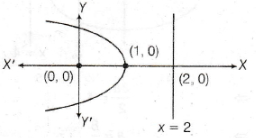
$A$ parabola has the origin $(0,0)$ as its focus and the line $x = 2$ as the directrix. Then the vertex of the parabola is at
A
$(0,2)$
B
$(1,0)$
C
$(0,1)$
D
$(2,0)$
Solution
(B) The focus of the parabola is $S = (0,0)$.
The directrix of the parabola is the line $x = 2$.
The axis of the parabola is the line passing through the focus and perpendicular to the directrix. Since the directrix is $x = 2$ (a vertical line),the axis is the $x$-axis $(y = 0)$.
The vertex of a parabola is the midpoint of the segment connecting the focus and the point of intersection of the axis and the directrix.
The point of intersection of the axis $(y = 0)$ and the directrix $(x = 2)$ is $(2,0)$.
The vertex is the midpoint of $(0,0)$ and $(2,0)$,which is $(\frac{0+2}{2}, \frac{0+0}{2}) = (1,0)$.
Thus,the vertex of the parabola is at $(1,0)$.
The directrix of the parabola is the line $x = 2$.
The axis of the parabola is the line passing through the focus and perpendicular to the directrix. Since the directrix is $x = 2$ (a vertical line),the axis is the $x$-axis $(y = 0)$.
The vertex of a parabola is the midpoint of the segment connecting the focus and the point of intersection of the axis and the directrix.
The point of intersection of the axis $(y = 0)$ and the directrix $(x = 2)$ is $(2,0)$.
The vertex is the midpoint of $(0,0)$ and $(2,0)$,which is $(\frac{0+2}{2}, \frac{0+0}{2}) = (1,0)$.
Thus,the vertex of the parabola is at $(1,0)$.
0 likes
View Solution376
EasyMCQ
If two tangents drawn from a point $P$ to the parabola $y^2 = 4x$ are at right angles,then the locus of $P$ is:
A
$2x - 1 = 0$
B
$x = 1$
C
$2x + 1 = 0$
D
$x = -1$
Solution
(D) The locus of the point of intersection of two perpendicular tangents to a parabola is its directrix.
For the parabola $y^2 = 4ax$,the equation of the directrix is $x = -a$.
Given the equation $y^2 = 4x$,we have $4a = 4$,which implies $a = 1$.
Therefore,the equation of the directrix is $x = -1$.
Thus,the locus of $P$ is $x = -1$.
For the parabola $y^2 = 4ax$,the equation of the directrix is $x = -a$.
Given the equation $y^2 = 4x$,we have $4a = 4$,which implies $a = 1$.
Therefore,the equation of the directrix is $x = -1$.
Thus,the locus of $P$ is $x = -1$.
0 likes
View Solution377
MediumMCQ
The slope of the line touching both the parabolas $y^2 = 4x$ and $x^2 = -32y$ is
A
$\frac{1}{8}$
B
$\frac{2}{3}$
C
$\frac{1}{2}$
D
$\frac{3}{2}$
Solution
(C) The equation of the first parabola is $y^2 = 4x$,which is of the form $y^2 = 4ax$ with $a = 1$.
The equation of the tangent to $y^2 = 4x$ with slope $m$ is $y = mx + \frac{a}{m} = mx + \frac{1}{m} \quad (1)$.
The equation of the second parabola is $x^2 = -32y$,which is of the form $x^2 = 4Ay$ with $4A = -32$,so $A = -8$.
The equation of the tangent to $x^2 = 4Ay$ with slope $m$ is $y = mx - Am^2$. Substituting $A = -8$,we get $y = mx - (-8)m^2 = mx + 8m^2 \quad (2)$.
Since the line is common to both parabolas,we equate the intercepts from $(1)$ and $(2)$:
$\frac{1}{m} = 8m^2$.
This simplifies to $8m^3 = 1$,which gives $m^3 = \frac{1}{8}$.
Taking the cube root,we get $m = \frac{1}{2}$.
The equation of the tangent to $y^2 = 4x$ with slope $m$ is $y = mx + \frac{a}{m} = mx + \frac{1}{m} \quad (1)$.
The equation of the second parabola is $x^2 = -32y$,which is of the form $x^2 = 4Ay$ with $4A = -32$,so $A = -8$.
The equation of the tangent to $x^2 = 4Ay$ with slope $m$ is $y = mx - Am^2$. Substituting $A = -8$,we get $y = mx - (-8)m^2 = mx + 8m^2 \quad (2)$.
Since the line is common to both parabolas,we equate the intercepts from $(1)$ and $(2)$:
$\frac{1}{m} = 8m^2$.
This simplifies to $8m^3 = 1$,which gives $m^3 = \frac{1}{8}$.
Taking the cube root,we get $m = \frac{1}{2}$.
0 likes
View Solution378
DifficultMCQ
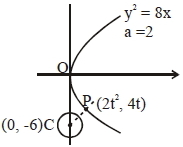
Let $P$ be the point on the parabola ${y^2} = 8x$ which is at a minimum distance from the centre $C$ of the circle ${x^2} + {(y + 6)^2} = 1$. Then the equation of the circle,passing through $C$ and having its centre at $P$,is:
A
${x^2} + {y^2} - \frac{x}{4} + 2y - 24 = 0$
B
${x^2} + {y^2} - 4x + 9y + 18 = 0$
C
${x^2} + {y^2} - 4x + 8y + 12 = 0$
D
${x^2} + {y^2} - x + 4y - 12 = 0$
Solution
(C) The minimum distance from a point to a curve occurs along the normal to the curve at that point.
For the parabola ${y^2} = 8x$,we have $4a = 8$,so $a = 2$.
The normal to the parabola at point $P(at^2, 2at) = (2t^2, 4t)$ is given by $y = -tx + 2at + at^3$.
Substituting $a = 2$,the normal is $y = -tx + 4t + 2t^3$.
Since this normal passes through the centre of the circle $C(0, -6)$,we have:
$-6 = -t(0) + 4t + 2t^3
$ $\Rightarrow 2t^3 + 4t + 6 = 0
$ $\Rightarrow t^3 + 2t + 3 = 0$.
By inspection,$t = -1$ is a root.
For $t = -1$,the point $P$ is $(2(-1)^2, 4(-1)) = (2, -4)$.
The distance $CP$ is the radius $r$ of the required circle:
$r^2 = CP^2 = (2 - 0)^2 + (-4 - (-6))^2 = 2^2 + 2^2 = 4 + 4 = 8$.
The equation of the circle with centre $P(2, -4)$ and radius squared $r^2 = 8$ is:
$(x - 2)^2 + (y + 4)^2 = 8
$ $\Rightarrow x^2 - 4x + 4 + y^2 + 8y + 16 = 8
$ $\Rightarrow x^2 + y^2 - 4x + 8y + 12 = 0$.
For the parabola ${y^2} = 8x$,we have $4a = 8$,so $a = 2$.
The normal to the parabola at point $P(at^2, 2at) = (2t^2, 4t)$ is given by $y = -tx + 2at + at^3$.
Substituting $a = 2$,the normal is $y = -tx + 4t + 2t^3$.
Since this normal passes through the centre of the circle $C(0, -6)$,we have:
$-6 = -t(0) + 4t + 2t^3
$ $\Rightarrow 2t^3 + 4t + 6 = 0
$ $\Rightarrow t^3 + 2t + 3 = 0$.
By inspection,$t = -1$ is a root.
For $t = -1$,the point $P$ is $(2(-1)^2, 4(-1)) = (2, -4)$.
The distance $CP$ is the radius $r$ of the required circle:
$r^2 = CP^2 = (2 - 0)^2 + (-4 - (-6))^2 = 2^2 + 2^2 = 4 + 4 = 8$.
The equation of the circle with centre $P(2, -4)$ and radius squared $r^2 = 8$ is:
$(x - 2)^2 + (y + 4)^2 = 8
$ $\Rightarrow x^2 - 4x + 4 + y^2 + 8y + 16 = 8
$ $\Rightarrow x^2 + y^2 - 4x + 8y + 12 = 0$.
0 likes
View Solution379
DifficultMCQ
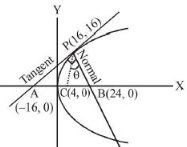
Tangent and normal are drawn at $P(16, 16)$ on the parabola ${y^2} = 16x$,which intersect the axis of the parabola at $A$ and $B$,respectively. If $C$ is the centre of the circle through the points $P, A$ and $B$ and $\angle CPB = \theta$,then a value of $\tan \theta$ is:
A
$2$
B
$3$
C
$\frac{4}{3}$
D
$\frac{1}{2}$
Solution
(A) The equation of the parabola is ${y^2} = 16x$,so $4a = 16$,which implies $a = 4$.
For the point $P(16, 16)$,we have $y_1^2 = 16x_1$,so $16^2 = 16(16)$,which is satisfied.
The tangent at $P(x_1, y_1)$ is $yy_1 = 2a(x + x_1)$,so $16y = 8(x + 16)$,which simplifies to $2y = x + 16$.
Setting $y = 0$ for the intersection with the $x$-axis,we get $x = -16$,so $A = (-16, 0)$.
The normal at $P(x_1, y_1)$ is $y - y_1 = -\frac{y_1}{2a}(x - x_1)$,so $y - 16 = -\frac{16}{8}(x - 16)$,which simplifies to $y - 16 = -2(x - 16)$,or $y = -2x + 48$.
Setting $y = 0$ for the intersection with the $x$-axis,we get $2x = 48$,so $x = 24$,thus $B = (24, 0)$.
The circle passes through $A(-16, 0)$,$B(24, 0)$,and $P(16, 16)$. Since $A$ and $B$ lie on the $x$-axis,the center $C$ must have an $x$-coordinate of $\frac{-16 + 24}{2} = 4$.
Let $C = (4, k)$. Since $CA = CP$,we have $(4 - (-16))^2 + (k - 0)^2 = (4 - 16)^2 + (k - 16)^2$.
$20^2 + k^2 = (-12)^2 + (k - 16)^2 \Rightarrow 400 + k^2 = 144 + k^2 - 32k + 256$.
$400 = 400 - 32k \Rightarrow k = 0$. Thus,$C = (4, 0)$.
Slope of $PC$ $(m_1)$ = $\frac{16 - 0}{16 - 4} = \frac{16}{12} = \frac{4}{3}$.
Slope of $PB$ $(m_2)$ = $\frac{16 - 0}{16 - 24} = \frac{16}{-8} = -2$.
$\tan \theta = \left| \frac{m_1 - m_2}{1 + m_1 m_2} \right| = \left| \frac{\frac{4}{3} - (-2)}{1 + (\frac{4}{3})(-2)} \right| = \left| \frac{\frac{10}{3}}{1 - \frac{8}{3}} \right| = \left| \frac{\frac{10}{3}}{-\frac{5}{3}} \right| = |-2| = 2$.
For the point $P(16, 16)$,we have $y_1^2 = 16x_1$,so $16^2 = 16(16)$,which is satisfied.
The tangent at $P(x_1, y_1)$ is $yy_1 = 2a(x + x_1)$,so $16y = 8(x + 16)$,which simplifies to $2y = x + 16$.
Setting $y = 0$ for the intersection with the $x$-axis,we get $x = -16$,so $A = (-16, 0)$.
The normal at $P(x_1, y_1)$ is $y - y_1 = -\frac{y_1}{2a}(x - x_1)$,so $y - 16 = -\frac{16}{8}(x - 16)$,which simplifies to $y - 16 = -2(x - 16)$,or $y = -2x + 48$.
Setting $y = 0$ for the intersection with the $x$-axis,we get $2x = 48$,so $x = 24$,thus $B = (24, 0)$.
The circle passes through $A(-16, 0)$,$B(24, 0)$,and $P(16, 16)$. Since $A$ and $B$ lie on the $x$-axis,the center $C$ must have an $x$-coordinate of $\frac{-16 + 24}{2} = 4$.
Let $C = (4, k)$. Since $CA = CP$,we have $(4 - (-16))^2 + (k - 0)^2 = (4 - 16)^2 + (k - 16)^2$.
$20^2 + k^2 = (-12)^2 + (k - 16)^2 \Rightarrow 400 + k^2 = 144 + k^2 - 32k + 256$.
$400 = 400 - 32k \Rightarrow k = 0$. Thus,$C = (4, 0)$.
Slope of $PC$ $(m_1)$ = $\frac{16 - 0}{16 - 4} = \frac{16}{12} = \frac{4}{3}$.
Slope of $PB$ $(m_2)$ = $\frac{16 - 0}{16 - 24} = \frac{16}{-8} = -2$.
$\tan \theta = \left| \frac{m_1 - m_2}{1 + m_1 m_2} \right| = \left| \frac{\frac{4}{3} - (-2)}{1 + (\frac{4}{3})(-2)} \right| = \left| \frac{\frac{10}{3}}{1 - \frac{8}{3}} \right| = \left| \frac{\frac{10}{3}}{-\frac{5}{3}} \right| = |-2| = 2$.
0 likes
View Solution380
MediumMCQ
The length of the latus rectum of the parabola whose focus is $(3, 3)$ and directrix is $3x - 4y - 2 = 0$ is
A
$2$
B
$1$
C
$4$
D
None of these
Solution
(A) The length of the latus rectum of a parabola is given by $L.R. = 2 \times d$,where $d$ is the perpendicular distance from the focus $(x_1, y_1)$ to the directrix $ax + by + c = 0$.
The distance $d$ is calculated as $d = \left| \frac{ax_1 + by_1 + c}{\sqrt{a^2 + b^2}} \right|$.
Given focus $(3, 3)$ and directrix $3x - 4y - 2 = 0$,we have:
$d = \left| \frac{3(3) - 4(3) - 2}{\sqrt{3^2 + (-4)^2}} \right| = \left| \frac{9 - 12 - 2}{\sqrt{9 + 16}} \right| = \left| \frac{-5}{5} \right| = 1$.
Therefore,the length of the latus rectum is $L.R. = 2 \times 1 = 2$.
The distance $d$ is calculated as $d = \left| \frac{ax_1 + by_1 + c}{\sqrt{a^2 + b^2}} \right|$.
Given focus $(3, 3)$ and directrix $3x - 4y - 2 = 0$,we have:
$d = \left| \frac{3(3) - 4(3) - 2}{\sqrt{3^2 + (-4)^2}} \right| = \left| \frac{9 - 12 - 2}{\sqrt{9 + 16}} \right| = \left| \frac{-5}{5} \right| = 1$.
Therefore,the length of the latus rectum is $L.R. = 2 \times 1 = 2$.
0 likes
View Solution381
MediumMCQ
The equation ${y^2} - 2x - 2y + 5 = 0$ represents:
A
$A$ circle whose centre is $(1, 1)$
B
$A$ parabola whose focus is $(1, 2)$
C
$A$ parabola whose directrix is $x = \frac{3}{2}$
D
$A$ parabola whose directrix is $x = - \frac{1}{2}$
Solution
(C) Given equation: ${y^2} - 2x - 2y + 5 = 0$
Rearranging the terms: ${y^2} - 2y = 2x - 5$
Adding $1$ to both sides to complete the square: ${y^2} - 2y + 1 = 2x - 5 + 1$
${(y - 1)^2} = 2x - 4$
${(y - 1)^2} = 2(x - 2)$
This is of the form ${(y - k)^2} = 4a(x - h)$,where $4a = 2$,so $a = \frac{1}{2}$,vertex $(h, k) = (2, 1)$.
The focus is $(h + a, k) = (2 + \frac{1}{2}, 1) = (\frac{5}{2}, 1)$.
The directrix is $x = h - a = 2 - \frac{1}{2} = \frac{3}{2}$.
Rearranging the terms: ${y^2} - 2y = 2x - 5$
Adding $1$ to both sides to complete the square: ${y^2} - 2y + 1 = 2x - 5 + 1$
${(y - 1)^2} = 2x - 4$
${(y - 1)^2} = 2(x - 2)$
This is of the form ${(y - k)^2} = 4a(x - h)$,where $4a = 2$,so $a = \frac{1}{2}$,vertex $(h, k) = (2, 1)$.
The focus is $(h + a, k) = (2 + \frac{1}{2}, 1) = (\frac{5}{2}, 1)$.
The directrix is $x = h - a = 2 - \frac{1}{2} = \frac{3}{2}$.
0 likes
View Solution382
DifficultMCQ
The curve described parametrically by $x = t^2 + t + 1$ and $y = t^2 - t + 1$ represents:
A
$A$ pair of straight lines
B
An ellipse
C
$A$ parabola
D
$A$ hyperbola
Solution
(C) Given $x = t^2 + t + 1$ and $y = t^2 - t + 1$.
Adding the two equations: $x + y = 2t^2 + 2 = 2(t^2 + 1)$.
Subtracting the two equations: $x - y = 2t$,which implies $t = \frac{x - y}{2}$.
Substituting $t$ into the expression for $x + y$:
$x + y = 2\left(\left(\frac{x - y}{2}\right)^2 + 1\right) = 2\left(\frac{(x - y)^2}{4} + 1\right) = \frac{(x - y)^2}{2} + 2$.
Multiplying by $2$: $2(x + y) = (x - y)^2 + 4$.
Expanding: $2x + 2y = x^2 - 2xy + y^2 + 4$.
Rearranging: $x^2 - 2xy + y^2 - 2x - 2y + 4 = 0$.
Comparing with the general second-degree equation $ax^2 + 2hxy + by^2 + 2gx + 2fy + c = 0$,we have $a = 1, h = -1, b = 1$.
Since $h^2 - ab = (-1)^2 - (1)(1) = 1 - 1 = 0$,the curve represents a parabola.
Adding the two equations: $x + y = 2t^2 + 2 = 2(t^2 + 1)$.
Subtracting the two equations: $x - y = 2t$,which implies $t = \frac{x - y}{2}$.
Substituting $t$ into the expression for $x + y$:
$x + y = 2\left(\left(\frac{x - y}{2}\right)^2 + 1\right) = 2\left(\frac{(x - y)^2}{4} + 1\right) = \frac{(x - y)^2}{2} + 2$.
Multiplying by $2$: $2(x + y) = (x - y)^2 + 4$.
Expanding: $2x + 2y = x^2 - 2xy + y^2 + 4$.
Rearranging: $x^2 - 2xy + y^2 - 2x - 2y + 4 = 0$.
Comparing with the general second-degree equation $ax^2 + 2hxy + by^2 + 2gx + 2fy + c = 0$,we have $a = 1, h = -1, b = 1$.
Since $h^2 - ab = (-1)^2 - (1)(1) = 1 - 1 = 0$,the curve represents a parabola.
0 likes
View Solution383
DifficultMCQ
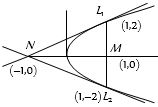
The point of intersection of tangents at the ends of the latus rectum of the parabola $y^2 = 4x$ is
A
$(1, 0)$
B
$(-1, 0)$
C
$(0, 1)$
D
$(0, -1)$
Solution
(B) The equation of the tangent at point $(x_1, y_1)$ on the parabola $y^2 = 4ax$ is given by $yy_1 = 2a(x + x_1)$.
For the given parabola $y^2 = 4x$,we have $a = 1$.
The coordinates of the ends of the latus rectum are $L(1, 2)$ and $L'(1, -2)$.
The equation of the tangent at $L(1, 2)$ is $2y = 2(x + 1)$,which simplifies to $y = x + 1$.
The equation of the tangent at $L'(1, -2)$ is $-2y = 2(x + 1)$,which simplifies to $y = -(x + 1)$.
Solving these two equations simultaneously:
$x + 1 = -(x + 1)$
$2(x + 1) = 0$
$x = -1$
Substituting $x = -1$ into $y = x + 1$,we get $y = 0$.
Thus,the point of intersection is $(-1, 0)$.
For the given parabola $y^2 = 4x$,we have $a = 1$.
The coordinates of the ends of the latus rectum are $L(1, 2)$ and $L'(1, -2)$.
The equation of the tangent at $L(1, 2)$ is $2y = 2(x + 1)$,which simplifies to $y = x + 1$.
The equation of the tangent at $L'(1, -2)$ is $-2y = 2(x + 1)$,which simplifies to $y = -(x + 1)$.
Solving these two equations simultaneously:
$x + 1 = -(x + 1)$
$2(x + 1) = 0$
$x = -1$
Substituting $x = -1$ into $y = x + 1$,we get $y = 0$.
Thus,the point of intersection is $(-1, 0)$.
0 likes
View Solution384
DifficultMCQ
If the tangents at $P$ and $Q$ on a parabola meet at $T$,then $SP, ST$ and $SQ$ are in
A
$A.P.$
B
$G.P.$
C
$H.P.$
D
None of these
Solution
(B) Let $P(at_1^2, 2at_1)$ and $Q(at_2^2, 2at_2)$ be two points on the parabola $y^2 = 4ax$.
Then the tangents at $P$ and $Q$ intersect at $T(at_1t_2, a(t_1 + t_2))$.
Now,$SP = \sqrt{(at_1^2 - a)^2 + (2at_1 - 0)^2} = a(t_1^2 + 1)$.
$SQ = a(t_2^2 + 1)$.
$ST = \sqrt{(at_1t_2 - a)^2 + (a(t_1 + t_2) - 0)^2} = a\sqrt{(1 + t_1^2)(1 + t_2^2)}$.
Therefore,$ST^2 = a^2(1 + t_1^2)(1 + t_2^2) = SP \cdot SQ$.
Since $ST^2 = SP \cdot SQ$,the terms $SP, ST, SQ$ are in $G.P.$
Then the tangents at $P$ and $Q$ intersect at $T(at_1t_2, a(t_1 + t_2))$.
Now,$SP = \sqrt{(at_1^2 - a)^2 + (2at_1 - 0)^2} = a(t_1^2 + 1)$.
$SQ = a(t_2^2 + 1)$.
$ST = \sqrt{(at_1t_2 - a)^2 + (a(t_1 + t_2) - 0)^2} = a\sqrt{(1 + t_1^2)(1 + t_2^2)}$.
Therefore,$ST^2 = a^2(1 + t_1^2)(1 + t_2^2) = SP \cdot SQ$.
Since $ST^2 = SP \cdot SQ$,the terms $SP, ST, SQ$ are in $G.P.$
0 likes
View Solution385
MediumMCQ
The angle between tangents to the parabola $y^2 = 4ax$ at the points where it intersects with the line $x - y - a = 0$ is
A
$\frac{\pi}{3}$
B
$\frac{\pi}{4}$
C
$\frac{\pi}{6}$
D
$\frac{\pi}{2}$
Solution
(D) The equation of the parabola is $y^2 = 4ax$. The focus of this parabola is at $(a, 0)$.
Substituting the coordinates of the focus $(a, 0)$ into the line equation $x - y - a = 0$,we get $a - 0 - a = 0$,which is $0 = 0$.
Since the line passes through the focus,it is a focal chord of the parabola.
It is a standard property of parabolas that the tangents drawn at the endpoints of any focal chord intersect at a right angle $(\frac{\pi}{2})$ on the directrix.
Therefore,the angle between the tangents is $\frac{\pi}{2}$.
Substituting the coordinates of the focus $(a, 0)$ into the line equation $x - y - a = 0$,we get $a - 0 - a = 0$,which is $0 = 0$.
Since the line passes through the focus,it is a focal chord of the parabola.
It is a standard property of parabolas that the tangents drawn at the endpoints of any focal chord intersect at a right angle $(\frac{\pi}{2})$ on the directrix.
Therefore,the angle between the tangents is $\frac{\pi}{2}$.
0 likes
View Solution386
MediumMCQ
The tangents drawn from the ends of the latus rectum of the parabola ${y^2} = 12x$ meet at:
A
Directrix
B
Vertex
C
Focus
D
None of these
Solution
(A) For the parabola ${y^2} = 4ax$,we have $4a = 12$,so $a = 3$.
The coordinates of the ends of the latus rectum are $(a, 2a)$ and $(a, -2a)$,which are $(3, 6)$ and $(3, -6)$.
The equation of the tangent to the parabola ${y^2} = 4ax$ at point $(x_1, y_1)$ is $yy_1 = 2a(x + x_1)$.
For point $(3, 6)$,the tangent is $6y = 6(x + 3) \implies y = x + 3$.
For point $(3, -6)$,the tangent is $-6y = 6(x + 3) \implies y = -(x + 3)$.
Solving these two equations: $x + 3 = -(x + 3) \implies 2x + 6 = 0 \implies x = -3$.
Since the equation of the directrix for ${y^2} = 12x$ is $x = -a$,which is $x = -3$,the tangents meet at the directrix.
The coordinates of the ends of the latus rectum are $(a, 2a)$ and $(a, -2a)$,which are $(3, 6)$ and $(3, -6)$.
The equation of the tangent to the parabola ${y^2} = 4ax$ at point $(x_1, y_1)$ is $yy_1 = 2a(x + x_1)$.
For point $(3, 6)$,the tangent is $6y = 6(x + 3) \implies y = x + 3$.
For point $(3, -6)$,the tangent is $-6y = 6(x + 3) \implies y = -(x + 3)$.
Solving these two equations: $x + 3 = -(x + 3) \implies 2x + 6 = 0 \implies x = -3$.
Since the equation of the directrix for ${y^2} = 12x$ is $x = -a$,which is $x = -3$,the tangents meet at the directrix.
0 likes
View Solution387
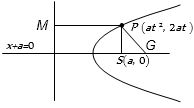
DifficultMCQ
If the tangent and normal at any point $P$ of a parabola meet the axis of the parabola in $T$ and $G$ respectively,then
A
$ST \ne SG = SP$
B
$ST - SG \ne SP$
C
$ST = SG = SP$
D
$ST = SG \cdot SP$
Solution
(C) Let $P(at^2, 2at)$ be any point on the parabola $y^2 = 4ax$. The equation of the tangent at $P$ is $ty = x + at^2$. It meets the axis $(y=0)$ at $T(-at^2, 0)$.
The equation of the normal at $P$ is $y = -tx + 2at + at^3$. It meets the axis $(y=0)$ at $G(2a + at^2, 0)$.
The focus $S$ is at $(a, 0)$.
$SP = \sqrt{(at^2 - a)^2 + (2at - 0)^2} = \sqrt{a^2(t^2-1)^2 + 4a^2t^2} = \sqrt{a^2(t^4 - 2t^2 + 1 + 4t^2)} = \sqrt{a^2(t^2+1)^2} = a(t^2+1)$.
$ST = |x_S - x_T| = |a - (-at^2)| = a(1 + t^2)$.
$SG = |x_G - x_S| = |(2a + at^2) - a| = a(1 + t^2)$.
Thus,$ST = SG = SP$.
The equation of the normal at $P$ is $y = -tx + 2at + at^3$. It meets the axis $(y=0)$ at $G(2a + at^2, 0)$.
The focus $S$ is at $(a, 0)$.
$SP = \sqrt{(at^2 - a)^2 + (2at - 0)^2} = \sqrt{a^2(t^2-1)^2 + 4a^2t^2} = \sqrt{a^2(t^4 - 2t^2 + 1 + 4t^2)} = \sqrt{a^2(t^2+1)^2} = a(t^2+1)$.
$ST = |x_S - x_T| = |a - (-at^2)| = a(1 + t^2)$.
$SG = |x_G - x_S| = |(2a + at^2) - a| = a(1 + t^2)$.
Thus,$ST = SG = SP$.
0 likes
View Solution388
DifficultMCQ
Three normals to the parabola $y^2 = x$ are drawn through a point $(C, 0)$. Then:
A
$C = \frac{1}{4}$
B
$C = \frac{1}{2}$
C
$C > \frac{1}{2}$
D
None of these
Solution
(C) The equation of the normal to the parabola $y^2 = 4ax$ in slope form is $y = mx - 2am - am^3$.
For the given parabola $y^2 = x$,we have $4a = 1$,which implies $a = \frac{1}{4}$.
Substituting $a$ into the normal equation,we get $y = mx - \frac{1}{2}m - \frac{1}{4}m^3$.
Since the normal passes through the point $(C, 0)$,we substitute $x = C$ and $y = 0$:
$0 = mC - \frac{1}{2}m - \frac{1}{4}m^3$.
This simplifies to $m(C - \frac{1}{2} - \frac{1}{4}m^2) = 0$.
One solution is $m = 0$. For the other two normals to be real and distinct,the quadratic equation $C - \frac{1}{2} - \frac{1}{4}m^2 = 0$ must have two distinct real roots for $m^2$.
This requires $C - \frac{1}{2} > 0$,which implies $C > \frac{1}{2}$.
For the given parabola $y^2 = x$,we have $4a = 1$,which implies $a = \frac{1}{4}$.
Substituting $a$ into the normal equation,we get $y = mx - \frac{1}{2}m - \frac{1}{4}m^3$.
Since the normal passes through the point $(C, 0)$,we substitute $x = C$ and $y = 0$:
$0 = mC - \frac{1}{2}m - \frac{1}{4}m^3$.
This simplifies to $m(C - \frac{1}{2} - \frac{1}{4}m^2) = 0$.
One solution is $m = 0$. For the other two normals to be real and distinct,the quadratic equation $C - \frac{1}{2} - \frac{1}{4}m^2 = 0$ must have two distinct real roots for $m^2$.
This requires $C - \frac{1}{2} > 0$,which implies $C > \frac{1}{2}$.
0 likes
View Solution389
MediumMCQ
If the points $(au^2, 2au)$ and $(av^2, 2av)$ are the extremities of a focal chord of the parabola $y^2 = 4ax$,then
A
$uv - 1 = 0$
B
$uv + 1 = 0$
C
$u + v = 0$
D
$u - v = 0$
Solution
(B) The equation of the line passing through the points $(au^2, 2au)$ and $(av^2, 2av)$ is given by:
$y - 2au = \frac{2av - 2au}{av^2 - au^2}(x - au^2)$
$y - 2au = \frac{2a(v - u)}{a(v - u)(v + u)}(x - au^2)$
$y - 2au = \frac{2}{v + u}(x - au^2)$
Since this is a focal chord,it must pass through the focus $(a, 0)$.
Substituting $(a, 0)$ into the equation:
$0 - 2au = \frac{2}{v + u}(a - au^2)$
$-2au = \frac{2a(1 - u^2)}{v + u}$
$-u(v + u) = 1 - u^2$
$-uv - u^2 = 1 - u^2$
$-uv = 1$
$uv + 1 = 0$
$y - 2au = \frac{2av - 2au}{av^2 - au^2}(x - au^2)$
$y - 2au = \frac{2a(v - u)}{a(v - u)(v + u)}(x - au^2)$
$y - 2au = \frac{2}{v + u}(x - au^2)$
Since this is a focal chord,it must pass through the focus $(a, 0)$.
Substituting $(a, 0)$ into the equation:
$0 - 2au = \frac{2}{v + u}(a - au^2)$
$-2au = \frac{2a(1 - u^2)}{v + u}$
$-u(v + u) = 1 - u^2$
$-uv - u^2 = 1 - u^2$
$-uv = 1$
$uv + 1 = 0$
0 likes
View Solution390
MediumMCQ
The length of the subnormal to the parabola $y^2 = 4ax$ at any point is equal to
A
$\sqrt{2}a$
B
$2\sqrt{2}$
C
$a/\sqrt{2}$
D
$2a$
Solution
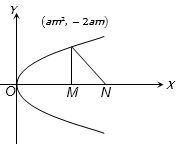
(D) Let the coordinates of point $P$ on the parabola $y^2 = 4ax$ be $(at^2, 2at)$.
The slope of the tangent at $P$ is given by differentiating $y^2 = 4ax$ with respect to $x$:
$2y \frac{dy}{dx} = 4a \implies \frac{dy}{dx} = \frac{2a}{y} = \frac{2a}{2at} = \frac{1}{t}$.
The slope of the normal at $P$ is $-t$.
The equation of the normal at $P(at^2, 2at)$ is:
$y - 2at = -t(x - at^2)$
$y - 2at = -tx + at^3$
$tx + y = 2at + at^3$.
To find the $x$-intercept $N$,set $y = 0$:
$tx = 2at + at^3 \implies x = 2a + at^2$.
Let $M$ be the projection of $P$ on the $x$-axis,so $M$ is $(at^2, 0)$.
The length of the subnormal is the distance $MN = |x_N - x_M| = |(2a + at^2) - at^2| = 2a$.
The slope of the tangent at $P$ is given by differentiating $y^2 = 4ax$ with respect to $x$:
$2y \frac{dy}{dx} = 4a \implies \frac{dy}{dx} = \frac{2a}{y} = \frac{2a}{2at} = \frac{1}{t}$.
The slope of the normal at $P$ is $-t$.
The equation of the normal at $P(at^2, 2at)$ is:
$y - 2at = -t(x - at^2)$
$y - 2at = -tx + at^3$
$tx + y = 2at + at^3$.
To find the $x$-intercept $N$,set $y = 0$:
$tx = 2at + at^3 \implies x = 2a + at^2$.
Let $M$ be the projection of $P$ on the $x$-axis,so $M$ is $(at^2, 0)$.
The length of the subnormal is the distance $MN = |x_N - x_M| = |(2a + at^2) - at^2| = 2a$.
0 likes
View Solution391
EasyMCQ
What is the eccentricity of a parabola?
A
$0$
B
$1$
C
$> 1$
D
$< 1$
Solution
(B) The eccentricity $e$ of a conic section is defined as the ratio of the distance of a point from the focus to its distance from the directrix.
For a parabola,the distance from the focus is equal to the distance from the directrix.
Therefore,the eccentricity $e = 1$.
For a parabola,the distance from the focus is equal to the distance from the directrix.
Therefore,the eccentricity $e = 1$.
0 likes
View Solution392
AdvancedMCQ
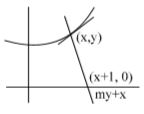
The latus rectum of the conic passing through the origin and having the property that the normal at each point $(x, y)$ intersects the $x$-axis at $(x + 1, 0)$ is:
A
$1$
B
$2$
C
$4$
D
None
Solution
(B) The slope of the tangent at any point $(x, y)$ is $\frac{dy}{dx}$.
The slope of the normal at $(x, y)$ is $-\frac{dx}{dy}$.
The equation of the normal at $(x, y)$ is given by:
$Y - y = -\frac{dx}{dy}(X - x)$
Since the normal intersects the $x$-axis at $(x + 1, 0)$,we substitute $X = x + 1$ and $Y = 0$:
$0 - y = -\frac{dx}{dy}(x + 1 - x)$
$-y = -\frac{dx}{dy}(1)$
$y = \frac{dx}{dy}$
$y \, dy = dx$
Integrating both sides,we get:
$\int y \, dy = \int dx$
$\frac{y^2}{2} = x + C$
Since the conic passes through the origin $(0, 0)$,we have $0 = 0 + C$,so $C = 0$.
Thus,the equation of the conic is $y^2 = 2x$.
Comparing this with the standard form $y^2 = 4ax$,we get $4a = 2$,which is the length of the latus rectum.
Therefore,the length of the latus rectum is $2$.
The slope of the normal at $(x, y)$ is $-\frac{dx}{dy}$.
The equation of the normal at $(x, y)$ is given by:
$Y - y = -\frac{dx}{dy}(X - x)$
Since the normal intersects the $x$-axis at $(x + 1, 0)$,we substitute $X = x + 1$ and $Y = 0$:
$0 - y = -\frac{dx}{dy}(x + 1 - x)$
$-y = -\frac{dx}{dy}(1)$
$y = \frac{dx}{dy}$
$y \, dy = dx$
Integrating both sides,we get:
$\int y \, dy = \int dx$
$\frac{y^2}{2} = x + C$
Since the conic passes through the origin $(0, 0)$,we have $0 = 0 + C$,so $C = 0$.
Thus,the equation of the conic is $y^2 = 2x$.
Comparing this with the standard form $y^2 = 4ax$,we get $4a = 2$,which is the length of the latus rectum.
Therefore,the length of the latus rectum is $2$.
0 likes
View Solution393
AdvancedMCQ
Which one of the following equations,represented parametrically,represents a parabolic profile?
A
$x = 3 \cos t; y = 4 \sin t$
B
$x^2 - 2 = -2 \cos t; y = 4 \cos^2 \frac{t}{2}$
C
$\sqrt{x} = \tan t; \sqrt{y} = \sec t$
D
$x = \sqrt{1 - \sin t}; y = \sin \frac{t}{2} + \cos \frac{t}{2}$
Solution
(B) Option $(A): x = 3 \cos t, y = 4 \sin t$
Eliminating $t$,we get $\frac{x^2}{9} + \frac{y^2}{16} = 1$,which is an ellipse.
Option $(B): x^2 - 2 = -2 \cos t \Rightarrow x^2 = 2 - 2 \cos t = 2(1 - \cos t)$.
Also,$y = 4 \cos^2 \frac{t}{2} = 2(1 + \cos t)$.
From the first,$\cos t = 1 - \frac{x^2}{2}$.
Substituting into $y$: $y = 2(1 + 1 - \frac{x^2}{2}) = 2(2 - \frac{x^2}{2}) = 4 - x^2$.
This is $x^2 = -(y - 4)$,which is a parabola.
Option $(C): \sqrt{x} = \tan t, \sqrt{y} = \sec t$
Eliminating $t$ using $\sec^2 t - \tan^2 t = 1$,we get $y - x = 1$,which is a straight line.
Option $(D): x = \sqrt{1 - \sin t}, y = \sin \frac{t}{2} + \cos \frac{t}{2}$
$x^2 = 1 - \sin t$ and $y^2 = 1 + \sin t$.
Adding them,$x^2 + y^2 = 2$,which is a circle.
Eliminating $t$,we get $\frac{x^2}{9} + \frac{y^2}{16} = 1$,which is an ellipse.
Option $(B): x^2 - 2 = -2 \cos t \Rightarrow x^2 = 2 - 2 \cos t = 2(1 - \cos t)$.
Also,$y = 4 \cos^2 \frac{t}{2} = 2(1 + \cos t)$.
From the first,$\cos t = 1 - \frac{x^2}{2}$.
Substituting into $y$: $y = 2(1 + 1 - \frac{x^2}{2}) = 2(2 - \frac{x^2}{2}) = 4 - x^2$.
This is $x^2 = -(y - 4)$,which is a parabola.
Option $(C): \sqrt{x} = \tan t, \sqrt{y} = \sec t$
Eliminating $t$ using $\sec^2 t - \tan^2 t = 1$,we get $y - x = 1$,which is a straight line.
Option $(D): x = \sqrt{1 - \sin t}, y = \sin \frac{t}{2} + \cos \frac{t}{2}$
$x^2 = 1 - \sin t$ and $y^2 = 1 + \sin t$.
Adding them,$x^2 + y^2 = 2$,which is a circle.
0 likes
View Solution394
AdvancedMCQ
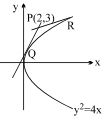
The points of contact $Q$ and $R$ of the tangents drawn from the point $P(2, 3)$ to the parabola $y^2 = 4x$ are
A
$(9, 6)$ and $(1, 2)$
B
$(1, 2)$ and $(4, 4)$
C
$(4, 4)$ and $(9, 6)$
D
$(9, 6)$ and $(\frac{1}{4}, 1)$
Solution
(B) For a parabola $y^2 = 4ax$,the chord of contact from a point $(x_1, y_1)$ is given by $yy_1 = 2a(x + x_1)$.
Here,$a = 1$ and the point is $(2, 3)$,so the chord of contact is $3y = 2(x + 2)$,which simplifies to $3y = 2x + 4$,or $x = \frac{3y - 4}{2}$.
Substituting this into the parabola equation $y^2 = 4x$:
$y^2 = 4(\frac{3y - 4}{2})$
$y^2 = 2(3y - 4)$
$y^2 - 6y + 8 = 0$
$(y - 2)(y - 4) = 0$
Thus,$y = 2$ or $y = 4$.
If $y = 2$,$x = \frac{3(2) - 4}{2} = \frac{2}{2} = 1$.
If $y = 4$,$x = \frac{3(4) - 4}{2} = \frac{8}{2} = 4$.
The points of contact are $(1, 2)$ and $(4, 4)$.
Here,$a = 1$ and the point is $(2, 3)$,so the chord of contact is $3y = 2(x + 2)$,which simplifies to $3y = 2x + 4$,or $x = \frac{3y - 4}{2}$.
Substituting this into the parabola equation $y^2 = 4x$:
$y^2 = 4(\frac{3y - 4}{2})$
$y^2 = 2(3y - 4)$
$y^2 - 6y + 8 = 0$
$(y - 2)(y - 4) = 0$
Thus,$y = 2$ or $y = 4$.
If $y = 2$,$x = \frac{3(2) - 4}{2} = \frac{2}{2} = 1$.
If $y = 4$,$x = \frac{3(4) - 4}{2} = \frac{8}{2} = 4$.
The points of contact are $(1, 2)$ and $(4, 4)$.
0 likes
View Solution395
AdvancedMCQ
From an external point $P(h, k)$,a pair of tangent lines are drawn to the parabola $y^2 = 4x$. If $\theta_1$ and $\theta_2$ are the inclinations of these tangents with the $x$-axis such that $\theta_1 + \theta_2 = \frac{\pi}{4}$,then the locus of $P$ is:
A
$x - y + 1 = 0$
B
$x + y - 1 = 0$
C
$x - y - 1 = 0$
D
$x + y + 1 = 0$
Solution
(C) The equation of a tangent to the parabola $y^2 = 4x$ with slope $m$ is $y = mx + \frac{1}{m}$.
Since the tangent passes through $P(h, k)$,we have $k = mh + \frac{1}{m}$,which simplifies to $m^2h - mk + 1 = 0$.
Let $m_1 = \tan \theta_1$ and $m_2 = \tan \theta_2$ be the roots of this quadratic equation.
From the properties of roots,$m_1 + m_2 = \frac{k}{h}$ and $m_1 m_2 = \frac{1}{h}$.
Given $\theta_1 + \theta_2 = \frac{\pi}{4}$,we have $\tan(\theta_1 + \theta_2) = \tan(\frac{\pi}{4}) = 1$.
Using the formula $\tan(\theta_1 + \theta_2) = \frac{m_1 + m_2}{1 - m_1 m_2} = 1$.
Substituting the values,$\frac{k/h}{1 - 1/h} = 1$.
$\frac{k}{h-1} = 1 \Rightarrow k = h - 1$.
Replacing $(h, k)$ with $(x, y)$,the locus is $y = x - 1$,or $x - y - 1 = 0$.
Since the tangent passes through $P(h, k)$,we have $k = mh + \frac{1}{m}$,which simplifies to $m^2h - mk + 1 = 0$.
Let $m_1 = \tan \theta_1$ and $m_2 = \tan \theta_2$ be the roots of this quadratic equation.
From the properties of roots,$m_1 + m_2 = \frac{k}{h}$ and $m_1 m_2 = \frac{1}{h}$.
Given $\theta_1 + \theta_2 = \frac{\pi}{4}$,we have $\tan(\theta_1 + \theta_2) = \tan(\frac{\pi}{4}) = 1$.
Using the formula $\tan(\theta_1 + \theta_2) = \frac{m_1 + m_2}{1 - m_1 m_2} = 1$.
Substituting the values,$\frac{k/h}{1 - 1/h} = 1$.
$\frac{k}{h-1} = 1 \Rightarrow k = h - 1$.
Replacing $(h, k)$ with $(x, y)$,the locus is $y = x - 1$,or $x - y - 1 = 0$.
0 likes
View Solution396
AdvancedMCQ
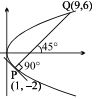
The length of the normal chord of the parabola $y^2 = 4x$,which makes an angle of $\frac{\pi}{4}$ with the $x$-axis,is:
A
$8$
B
$8\sqrt{2}$
C
$4$
D
$4\sqrt{2}$
Solution
(B) The equation of the normal to the parabola $y^2 = 4ax$ (where $a=1$) at parameter $t$ is $y + tx = 2at + at^3$,which simplifies to $y + tx = 2t + t^3$.
The slope of this normal is $-t$. Given that the normal makes an angle of $\frac{\pi}{4}$ with the $x$-axis,its slope is $\tan(\frac{\pi}{4}) = 1$.
Therefore,$-t = 1$,which gives $t = -1$.
The coordinates of point $P$ are $(at^2, 2at) = (1, -2)$.
If the normal at $t_1$ meets the parabola again at $t_2$,then $t_2 = -t_1 - \frac{2}{t_1}$.
Substituting $t_1 = -1$,we get $t_2 = -(-1) - \frac{2}{-1} = 1 + 2 = 3$.
The coordinates of point $Q$ are $(at_2^2, 2at_2) = (3^2, 2(3)) = (9, 6)$.
The length of the normal chord $PQ$ is the distance between $P(1, -2)$ and $Q(9, 6)$:
$PQ = \sqrt{(9-1)^2 + (6 - (-2))^2} = \sqrt{8^2 + 8^2} = \sqrt{64 + 64} = \sqrt{128} = 8\sqrt{2}$.
The slope of this normal is $-t$. Given that the normal makes an angle of $\frac{\pi}{4}$ with the $x$-axis,its slope is $\tan(\frac{\pi}{4}) = 1$.
Therefore,$-t = 1$,which gives $t = -1$.
The coordinates of point $P$ are $(at^2, 2at) = (1, -2)$.
If the normal at $t_1$ meets the parabola again at $t_2$,then $t_2 = -t_1 - \frac{2}{t_1}$.
Substituting $t_1 = -1$,we get $t_2 = -(-1) - \frac{2}{-1} = 1 + 2 = 3$.
The coordinates of point $Q$ are $(at_2^2, 2at_2) = (3^2, 2(3)) = (9, 6)$.
The length of the normal chord $PQ$ is the distance between $P(1, -2)$ and $Q(9, 6)$:
$PQ = \sqrt{(9-1)^2 + (6 - (-2))^2} = \sqrt{8^2 + 8^2} = \sqrt{64 + 64} = \sqrt{128} = 8\sqrt{2}$.
0 likes
View Solution397
AdvancedMCQ
The coordinates of the ends of a focal chord of a parabola $y^2 = 4ax$ are $(x_1, y_1)$ and $(x_2, y_2)$. Then $x_1x_2 + y_1y_2$ has the value equal to
A
$2a^2$
B
$-3a^2$
C
$-a^2$
D
$4a^2$
Solution
(B) Let the parameters of the endpoints of the focal chord be $t_1$ and $t_2$.
For a parabola $y^2 = 4ax$,the coordinates are $(at_1^2, 2at_1)$ and $(at_2^2, 2at_2)$.
Since it is a focal chord,the product of the parameters is $t_1t_2 = -1$.
We have $x_1 = at_1^2$ and $x_2 = at_2^2$,so $x_1x_2 = a^2(t_1t_2)^2 = a^2(-1)^2 = a^2$.
We have $y_1 = 2at_1$ and $y_2 = 2at_2$,so $y_1y_2 = 4a^2(t_1t_2) = 4a^2(-1) = -4a^2$.
Therefore,$x_1x_2 + y_1y_2 = a^2 - 4a^2 = -3a^2$.
For a parabola $y^2 = 4ax$,the coordinates are $(at_1^2, 2at_1)$ and $(at_2^2, 2at_2)$.
Since it is a focal chord,the product of the parameters is $t_1t_2 = -1$.
We have $x_1 = at_1^2$ and $x_2 = at_2^2$,so $x_1x_2 = a^2(t_1t_2)^2 = a^2(-1)^2 = a^2$.
We have $y_1 = 2at_1$ and $y_2 = 2at_2$,so $y_1y_2 = 4a^2(t_1t_2) = 4a^2(-1) = -4a^2$.
Therefore,$x_1x_2 + y_1y_2 = a^2 - 4a^2 = -3a^2$.
0 likes
View Solution398
AdvancedMCQ
If the normal to the parabola $y^2 = 4ax$ at the point with parameter $t_1$ cuts the parabola again at the point with parameter $t_2$,then:
A
$2 \leq t_2^2 \leq 8$
B
$2 \leq t_2^2 \leq 4$
C
$t_2^2 \geq 4$
D
$t_2^2 \geq 8$
Solution
(D) The equation of the normal to the parabola $y^2 = 4ax$ at parameter $t_1$ is $y + t_1x = 2at_1 + at_1^3$.
Since this normal cuts the parabola at $t_2$,we have the relation $t_2 = -(t_1 + \frac{2}{t_1})$.
Squaring both sides,we get $t_2^2 = (t_1 + \frac{2}{t_1})^2 = (t_1 - \frac{2}{t_1})^2 + 8$.
Since $(t_1 - \frac{2}{t_1})^2 \geq 0$,it follows that $t_2^2 \geq 8$.
Since this normal cuts the parabola at $t_2$,we have the relation $t_2 = -(t_1 + \frac{2}{t_1})$.
Squaring both sides,we get $t_2^2 = (t_1 + \frac{2}{t_1})^2 = (t_1 - \frac{2}{t_1})^2 + 8$.
Since $(t_1 - \frac{2}{t_1})^2 \geq 0$,it follows that $t_2^2 \geq 8$.
0 likes
View Solution399
AdvancedMCQ
Two parabolas have the same focus. If their directrices are the $x$-axis and the $y$-axis respectively,then the slope of their common chord is:
A
$\pm 1$
B
$4/3$
C
$3/4$
D
None of these
Solution
(A) Let the common focus be $(h, k)$.
The equation of a parabola with focus $(h, k)$ and directrix $L = 0$ is $(x - h)^2 + (y - k)^2 = L^2$.
For the first parabola with directrix $y = 0$ (the $x$-axis),the equation is $(x - h)^2 + (y - k)^2 = y^2$.
For the second parabola with directrix $x = 0$ (the $y$-axis),the equation is $(x - h)^2 + (y - k)^2 = x^2$.
To find the common chord,we subtract the two equations:
$((x - h)^2 + (y - k)^2 - y^2) - ((x - h)^2 + (y - k)^2 - x^2) = 0$
This simplifies to $x^2 - y^2 = 0$,which implies $x^2 = y^2$,or $y = \pm x$.
Thus,the slopes of the common chords are $m = 1$ and $m = -1$,which can be written as $\pm 1$.
The equation of a parabola with focus $(h, k)$ and directrix $L = 0$ is $(x - h)^2 + (y - k)^2 = L^2$.
For the first parabola with directrix $y = 0$ (the $x$-axis),the equation is $(x - h)^2 + (y - k)^2 = y^2$.
For the second parabola with directrix $x = 0$ (the $y$-axis),the equation is $(x - h)^2 + (y - k)^2 = x^2$.
To find the common chord,we subtract the two equations:
$((x - h)^2 + (y - k)^2 - y^2) - ((x - h)^2 + (y - k)^2 - x^2) = 0$
This simplifies to $x^2 - y^2 = 0$,which implies $x^2 = y^2$,or $y = \pm x$.
Thus,the slopes of the common chords are $m = 1$ and $m = -1$,which can be written as $\pm 1$.
0 likes
View Solution400
AdvancedMCQ
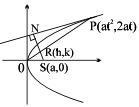
The straight line joining any point $P$ on the parabola $y^2 = 4ax$ to the vertex and the perpendicular from the focus to the tangent at $P$ intersect at $R$. Then the equation of the locus of $R$ is:
A
$x^2 + 2y^2 - ax = 0$
B
$2x^2 + y^2 - 2ax = 0$
C
$2x^2 + 2y^2 - ay = 0$
D
$x^2 + y^2 - ax = 0$
Solution
(B) Let the point $P$ on the parabola $y^2 = 4ax$ be $(at^2, 2at)$.
The equation of the tangent at $P$ is $ty = x + at^2$ $....(1)$
The focus of the parabola is $S(a, 0)$.
The line perpendicular to the tangent $(1)$ passing through $S(a, 0)$ has the slope $-t$. Its equation is $y - 0 = -t(x - a)$,which simplifies to $tx + y = at$ $....(2)$
The line joining the vertex $O(0, 0)$ to $P(at^2, 2at)$ has the slope $\frac{2at}{at^2} = \frac{2}{t}$. Its equation is $y = \frac{2}{t}x$,or $2x - ty = 0$ $....(3)$
To find the locus of $R(h, k)$,we eliminate $t$ from $(2)$ and $(3)$.
From $(3)$,$t = \frac{2h}{k}$.
Substituting this into $(2)$: $(\frac{2h}{k})h + k = a(\frac{2h}{k})$.
Multiplying by $k$: $2h^2 + k^2 = 2ah$.
Replacing $(h, k)$ with $(x, y)$,the locus is $2x^2 + y^2 - 2ax = 0$.
The equation of the tangent at $P$ is $ty = x + at^2$ $....(1)$
The focus of the parabola is $S(a, 0)$.
The line perpendicular to the tangent $(1)$ passing through $S(a, 0)$ has the slope $-t$. Its equation is $y - 0 = -t(x - a)$,which simplifies to $tx + y = at$ $....(2)$
The line joining the vertex $O(0, 0)$ to $P(at^2, 2at)$ has the slope $\frac{2at}{at^2} = \frac{2}{t}$. Its equation is $y = \frac{2}{t}x$,or $2x - ty = 0$ $....(3)$
To find the locus of $R(h, k)$,we eliminate $t$ from $(2)$ and $(3)$.
From $(3)$,$t = \frac{2h}{k}$.
Substituting this into $(2)$: $(\frac{2h}{k})h + k = a(\frac{2h}{k})$.
Multiplying by $k$: $2h^2 + k^2 = 2ah$.
Replacing $(h, k)$ with $(x, y)$,the locus is $2x^2 + y^2 - 2ax = 0$.
0 likes
View Solution10-2. Parabola, Ellipse, Hyperbola — Parabola · Frequently Asked Questions
1Are these 10-2. Parabola, Ellipse, Hyperbola questions useful for JEE and NEET?
Yes. All questions in this section are mapped to JEE Main and NEET exam patterns. Previous year questions from JEE Main, NEET, GUJCET and state-level exams are included with full solutions.
2Can I switch to Hindi or Gujarati for these questions?
Yes. Use the language tabs in the hero section or the sidebar to view the same questions and solutions in English, Hindi or Gujarati.
3How do I generate a question paper from this subtopic?
Use the Vedclass Exam Paper Generator — select the chapter and subtopic, set difficulty, and generate Sets A, B, C, D automatically. First 3 chapters of every subject are free.
Vedclass Products
For Students
Vedclass Test Series
Mock tests in real JEE/NEET style with performance analysis. 5-day free trial.
Start Free TrialFor Teachers
Exam Paper Generator
Generate Set A/B/C/D papers from this chapter in 2 minutes. 3 chapters free.
Try FreeFor Institutes
Online Exam Module
Live online exams with unlimited students, 360° analytics & white-label branding.
See DemoFor Teachers & Institutes
Generate a 10-2. Parabola, Ellipse, Hyperbola Exam Paper in 2 Minutes
Select subtopic & difficulty — Sets A, B, C, D auto-generated with No Repeat logic.
First 3 chapters of every subject are free — no payment required.