
A English
Parabola Questions in English
Class 11 Mathematics · 10-2. Parabola, Ellipse, Hyperbola · Parabola
1007+
Questions
English
Language
100%
With Solutions
Showing 50 of 1007 questions in English
451
AdvancedMCQ
If two perpendicular rays from the focus of the parabolic surface $y^2 = 4x$ are incident at points $A(t_1^2, 2t_1)$ and $B(t_2^2, 2t_2)$ such that $t_1t_2 = -1$,then the distance between the reflected rays is -
A
$4$
B
$6$
C
$8$
D
$10$
Solution
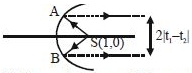
(A) The focus of the parabola $y^2 = 4x$ is $S(1, 0)$.
Reflected rays from a parabola for rays originating from the focus are parallel to the axis of the parabola.
The distance between two parallel reflected rays corresponding to points $A(t_1^2, 2t_1)$ and $B(t_2^2, 2t_2)$ is given by $|2t_1 - 2t_2| = 2|t_1 - t_2|$.
Since the rays $SA$ and $SB$ are perpendicular,the product of their slopes is $-1$.
The slope of $SA$ is $m_1 = \frac{2t_1 - 0}{t_1^2 - 1} = \frac{2t_1}{t_1^2 - 1}$.
The slope of $SB$ is $m_2 = \frac{2t_2}{t_2^2 - 1}$.
Given $m_1 m_2 = -1$,we have $\frac{4t_1t_2}{(t_1^2 - 1)(t_2^2 - 1)} = -1$.
Substituting $t_1t_2 = -1$,we get $\frac{-4}{(t_1t_2)^2 - (t_1^2 + t_2^2) + 1} = -1$.
$\Rightarrow 4 = 1 - (t_1^2 + t_2^2) + 1$ $\Rightarrow t_1^2 + t_2^2 = -2$,which is impossible for real $t_1, t_2$.
Assuming the condition $t_1t_2 = -1$ was intended for perpendicularity,the distance is $2|t_1 - t_2|$.
Using $(t_1 - t_2)^2 = (t_1 + t_2)^2 - 4t_1t_2$,and the property that for perpendicular focal chords $t_1t_2 = -1$,the distance is $2|t_1 - t_2| = 2\sqrt{(t_1+t_2)^2 - 4t_1t_2}$.
For a standard focal chord,the distance is $4a$. Here $a=1$,so distance $= 4$.
Reflected rays from a parabola for rays originating from the focus are parallel to the axis of the parabola.
The distance between two parallel reflected rays corresponding to points $A(t_1^2, 2t_1)$ and $B(t_2^2, 2t_2)$ is given by $|2t_1 - 2t_2| = 2|t_1 - t_2|$.
Since the rays $SA$ and $SB$ are perpendicular,the product of their slopes is $-1$.
The slope of $SA$ is $m_1 = \frac{2t_1 - 0}{t_1^2 - 1} = \frac{2t_1}{t_1^2 - 1}$.
The slope of $SB$ is $m_2 = \frac{2t_2}{t_2^2 - 1}$.
Given $m_1 m_2 = -1$,we have $\frac{4t_1t_2}{(t_1^2 - 1)(t_2^2 - 1)} = -1$.
Substituting $t_1t_2 = -1$,we get $\frac{-4}{(t_1t_2)^2 - (t_1^2 + t_2^2) + 1} = -1$.
$\Rightarrow 4 = 1 - (t_1^2 + t_2^2) + 1$ $\Rightarrow t_1^2 + t_2^2 = -2$,which is impossible for real $t_1, t_2$.
Assuming the condition $t_1t_2 = -1$ was intended for perpendicularity,the distance is $2|t_1 - t_2|$.
Using $(t_1 - t_2)^2 = (t_1 + t_2)^2 - 4t_1t_2$,and the property that for perpendicular focal chords $t_1t_2 = -1$,the distance is $2|t_1 - t_2| = 2\sqrt{(t_1+t_2)^2 - 4t_1t_2}$.
For a standard focal chord,the distance is $4a$. Here $a=1$,so distance $= 4$.
0 likes
View Solution452
DifficultMCQ
The coordinates of a point on the parabola $y^2 = 8x$ whose focal distance is $4$ are
A
$(2, \pm 4)$
B
$(\pm 2, 4)$
C
$(-2, \pm 4)$
D
$(\pm 2, -4)$
Solution
(A) The equation of the parabola is $y^2 = 8x$. Comparing this with $y^2 = 4ax$,we get $4a = 8$,so $a = 2$.
The focal distance of a point $(x, y)$ on the parabola $y^2 = 4ax$ is given by $x + a$.
Given that the focal distance is $4$,we have $x + 2 = 4$,which implies $x = 2$.
Substituting $x = 2$ into the parabola equation $y^2 = 8(2)$,we get $y^2 = 16$,so $y = \pm 4$.
Thus,the coordinates of the point are $(2, \pm 4)$.
The focal distance of a point $(x, y)$ on the parabola $y^2 = 4ax$ is given by $x + a$.
Given that the focal distance is $4$,we have $x + 2 = 4$,which implies $x = 2$.
Substituting $x = 2$ into the parabola equation $y^2 = 8(2)$,we get $y^2 = 16$,so $y = \pm 4$.
Thus,the coordinates of the point are $(2, \pm 4)$.
0 likes
View Solution453
AdvancedMCQ
The vertex of the parabola is at $(1, 2)$ and its axis is parallel to the $y$-axis. If the parabola passes through $(0, 6)$,then its latus rectum is:
A
$1/2$
B
$2$
C
$4$
D
$1/4$
Solution
(D) Since the axis of the parabola is parallel to the $y$-axis,its equation is of the form $(x - h)^2 = 4a(y - k)$,where $(h, k)$ is the vertex.
Given vertex $(h, k) = (1, 2)$,the equation becomes $(x - 1)^2 = 4a(y - 2)$.
Since the parabola passes through $(0, 6)$,we substitute these coordinates into the equation:
$(0 - 1)^2 = 4a(6 - 2)$
$1 = 4a(4)$
$1 = 16a$
$a = 1/16$.
The length of the latus rectum is given by $|4a|$.
$|4a| = 4 \times (1/16) = 1/4$.
Given vertex $(h, k) = (1, 2)$,the equation becomes $(x - 1)^2 = 4a(y - 2)$.
Since the parabola passes through $(0, 6)$,we substitute these coordinates into the equation:
$(0 - 1)^2 = 4a(6 - 2)$
$1 = 4a(4)$
$1 = 16a$
$a = 1/16$.
The length of the latus rectum is given by $|4a|$.
$|4a| = 4 \times (1/16) = 1/4$.
0 likes
View Solution454
AdvancedMCQ
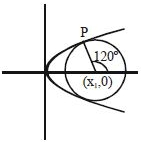
$A$ circle has its center $C$ on the axis of a parabola and it touches the parabola at point $P$. The line segment $CP$ makes an angle of $120^{\circ}$ with the axis of the parabola. If the radius of the circle is $2$,then the latus rectum of the parabola is:
A
$2$
B
$4$
C
$8$
D
$16$
Solution
(A) Let the parabola be $y^{2} = 4ax$. The center of the circle is $C(x_1, 0)$.
Since the circle touches the parabola at $P$,the radius $CP$ is perpendicular to the tangent at $P$.
The angle between $CP$ and the axis of the parabola is $120^{\circ}$,so the angle between $CP$ and the normal at $P$ is $30^{\circ}$ (or the slope of $CP$ is $\tan(180^{\circ}-120^{\circ}) = \tan 60^{\circ} = \sqrt{3}$ is incorrect,rather the angle with the negative x-axis is $60^{\circ}$).
Let $P = (x_0, y_0)$. The radius $r=2$. The coordinates of $P$ are $(x_1 - 2\cos 60^{\circ}, 2\sin 60^{\circ}) = (x_1 - 1, \sqrt{3})$.
Since $P$ lies on $y^2 = 4ax$,we have $(\sqrt{3})^2 = 4a(x_1 - 1) \Rightarrow 3 = 4a(x_1 - 1)$.
The slope of the tangent at $P$ is $m_t = \frac{2a}{y_0} = \frac{2a}{\sqrt{3}}$.
The slope of the normal $CP$ is $m_n = \frac{\sqrt{3} - 0}{(x_1 - 1) - x_1} = \frac{\sqrt{3}}{-1} = -\sqrt{3}$.
Since the normal is perpendicular to the tangent,$m_t \times m_n = -1$.
$\left(\frac{2a}{\sqrt{3}}\right)(-\sqrt{3}) = -1$ $\Rightarrow -2a = -1$ $\Rightarrow a = \frac{1}{2}$.
The latus rectum is $4a = 4 \times \frac{1}{2} = 2$.
Since the circle touches the parabola at $P$,the radius $CP$ is perpendicular to the tangent at $P$.
The angle between $CP$ and the axis of the parabola is $120^{\circ}$,so the angle between $CP$ and the normal at $P$ is $30^{\circ}$ (or the slope of $CP$ is $\tan(180^{\circ}-120^{\circ}) = \tan 60^{\circ} = \sqrt{3}$ is incorrect,rather the angle with the negative x-axis is $60^{\circ}$).
Let $P = (x_0, y_0)$. The radius $r=2$. The coordinates of $P$ are $(x_1 - 2\cos 60^{\circ}, 2\sin 60^{\circ}) = (x_1 - 1, \sqrt{3})$.
Since $P$ lies on $y^2 = 4ax$,we have $(\sqrt{3})^2 = 4a(x_1 - 1) \Rightarrow 3 = 4a(x_1 - 1)$.
The slope of the tangent at $P$ is $m_t = \frac{2a}{y_0} = \frac{2a}{\sqrt{3}}$.
The slope of the normal $CP$ is $m_n = \frac{\sqrt{3} - 0}{(x_1 - 1) - x_1} = \frac{\sqrt{3}}{-1} = -\sqrt{3}$.
Since the normal is perpendicular to the tangent,$m_t \times m_n = -1$.
$\left(\frac{2a}{\sqrt{3}}\right)(-\sqrt{3}) = -1$ $\Rightarrow -2a = -1$ $\Rightarrow a = \frac{1}{2}$.
The latus rectum is $4a = 4 \times \frac{1}{2} = 2$.
0 likes
View Solution455
AdvancedMCQ
If the tangent to the curve $y^2 = 4x$ at point $(1, 2)$ cuts the coordinate axes at points $A$ and $B$,then the area of $\Delta AOB$ is (where $'O'$ is the origin).
A
$0.5$
B
$1$
C
$2$
D
$4$
Solution
(A) The equation of the parabola is $y^2 = 4x$.
Comparing with $y^2 = 4ax$,we get $a = 1$.
The equation of the tangent at point $(x_1, y_1) = (1, 2)$ is given by $yy_1 = 2a(x + x_1)$.
Substituting the values,we get $2y = 2(1)(x + 1)$,which simplifies to $y = x + 1$.
To find the points $A$ and $B$ where the tangent cuts the coordinate axes:
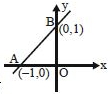
For the $x$-axis,set $y = 0$: $0 = x + 1 \implies x = -1$. So,point $A$ is $(-1, 0)$.
For the $y$-axis,set $x = 0$: $y = 0 + 1 \implies y = 1$. So,point $B$ is $(0, 1)$.
The triangle $\Delta AOB$ is a right-angled triangle with vertices at $O(0, 0)$,$A(-1, 0)$,and $B(0, 1)$.
The base $OA = |-1| = 1$ and the height $OB = |1| = 1$.
Area of $\Delta AOB = \frac{1}{2} \times \text{base} \times \text{height} = \frac{1}{2} \times 1 \times 1 = 0.5$.
Comparing with $y^2 = 4ax$,we get $a = 1$.
The equation of the tangent at point $(x_1, y_1) = (1, 2)$ is given by $yy_1 = 2a(x + x_1)$.
Substituting the values,we get $2y = 2(1)(x + 1)$,which simplifies to $y = x + 1$.
To find the points $A$ and $B$ where the tangent cuts the coordinate axes:
For the $x$-axis,set $y = 0$: $0 = x + 1 \implies x = -1$. So,point $A$ is $(-1, 0)$.
For the $y$-axis,set $x = 0$: $y = 0 + 1 \implies y = 1$. So,point $B$ is $(0, 1)$.
The triangle $\Delta AOB$ is a right-angled triangle with vertices at $O(0, 0)$,$A(-1, 0)$,and $B(0, 1)$.
The base $OA = |-1| = 1$ and the height $OB = |1| = 1$.
Area of $\Delta AOB = \frac{1}{2} \times \text{base} \times \text{height} = \frac{1}{2} \times 1 \times 1 = 0.5$.
0 likes
View Solution456
AdvancedMCQ
If the focus divides a focal chord of the parabola $y^2 = 16x$ into $2$ parts having lengths $a$ and $c$,such that $a, b, c$ are in $H.P.$,then the value of $b$ is equal to:
A
$2$
B
$4$
C
$6$
D
$8$
Solution
(D) For a parabola $y^2 = 4ax$,the length of the semi-latus rectum is $2a$.
Given the parabola $y^2 = 16x$,we have $4a = 16$,so $a = 4$. The semi-latus rectum is $2a = 8$.
If a focal chord is divided by the focus into two segments of lengths $a$ and $c$,then the harmonic mean of these segments is equal to the semi-latus rectum.
Thus,$b = \frac{2ac}{a+c} = 8$.
Given the parabola $y^2 = 16x$,we have $4a = 16$,so $a = 4$. The semi-latus rectum is $2a = 8$.
If a focal chord is divided by the focus into two segments of lengths $a$ and $c$,then the harmonic mean of these segments is equal to the semi-latus rectum.
Thus,$b = \frac{2ac}{a+c} = 8$.
0 likes
View Solution457
AdvancedMCQ
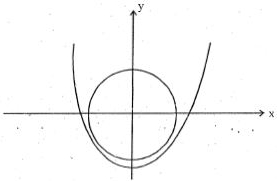
The maximum area of a circle centered at the origin,which is inscribed in the parabola $y = x^2 - 100$,can be expressed as $\frac{a\pi}{b}$,where $a$ and $b$ are coprime numbers. Then the value of $a + b$ is:
A
$5$
B
$403$
C
$407$
D
None of these
Solution
(B) Let the equation of the circle be $x^2 + y^2 = r^2$. The parabola is given by $y = x^2 - 100$,so $x^2 = y + 100$.
Substituting $x^2$ into the circle equation: $(y + 100) + y^2 = r^2$,which simplifies to $y^2 + y + (100 - r^2) = 0$.
For the circle to be inscribed in the parabola,the circle must be tangent to the parabola. This occurs when the quadratic equation in $y$ has exactly one solution,meaning its discriminant $D = 0$.
$D = b^2 - 4ac = 1^2 - 4(1)(100 - r^2) = 0$.
$1 - 400 + 4r^2 = 0 \implies 4r^2 = 399 \implies r^2 = \frac{399}{4}$.
The area of the circle is $\pi r^2 = \frac{399\pi}{4}$.
Given the area is $\frac{a\pi}{b}$ with $a = 399$ and $b = 4$,where $a$ and $b$ are coprime.
The value of $a + b = 399 + 4 = 403$.
Substituting $x^2$ into the circle equation: $(y + 100) + y^2 = r^2$,which simplifies to $y^2 + y + (100 - r^2) = 0$.
For the circle to be inscribed in the parabola,the circle must be tangent to the parabola. This occurs when the quadratic equation in $y$ has exactly one solution,meaning its discriminant $D = 0$.
$D = b^2 - 4ac = 1^2 - 4(1)(100 - r^2) = 0$.
$1 - 400 + 4r^2 = 0 \implies 4r^2 = 399 \implies r^2 = \frac{399}{4}$.
The area of the circle is $\pi r^2 = \frac{399\pi}{4}$.
Given the area is $\frac{a\pi}{b}$ with $a = 399$ and $b = 4$,where $a$ and $b$ are coprime.
The value of $a + b = 399 + 4 = 403$.
0 likes
View Solution458
AdvancedMCQ
Let the locus of the points from which the tangents drawn to $y = x^2$ make an angle of $45^{\circ}$ with each other be $16y^2 - 16x^2 + ky + 1 = 0$. Then $k$ is equal to:
A
$8$
B
$16$
C
$20$
D
$24$
Solution
(D) The equation of the parabola is $x^2 = y$,which is of the form $x^2 = 4ay$ with $4a = 1$,so $a = 1/4$.
The equation of a tangent with slope $m$ is $y = mx - am^2$,which becomes $y = mx - \frac{m^2}{4}$.
If this tangent passes through a point $(h, k)$,then $k = mh - \frac{m^2}{4}$,which simplifies to $m^2 - 4hm + 4k = 0$.
Let $m_1$ and $m_2$ be the slopes of the two tangents from $(h, k)$. Then $m_1 + m_2 = 4h$ and $m_1m_2 = 4k$.
The angle between the tangents is $45^{\circ}$,so $\tan 45^{\circ} = |\frac{m_1 - m_2}{1 + m_1m_2}| = 1$.
Thus,$(m_1 - m_2)^2 = (1 + m_1m_2)^2$.
Using $(m_1 - m_2)^2 = (m_1 + m_2)^2 - 4m_1m_2$,we get $(4h)^2 - 4(4k) = (1 + 4k)^2$.
$16h^2 - 16k = 1 + 8k + 16k^2$.
Replacing $(h, k)$ with $(x, y)$,we get $16x^2 - 16y = 1 + 8y + 16y^2$,or $16y^2 - 16x^2 + 24y + 1 = 0$.
Comparing this with $16y^2 - 16x^2 + ky + 1 = 0$,we find $k = 24$.
The equation of a tangent with slope $m$ is $y = mx - am^2$,which becomes $y = mx - \frac{m^2}{4}$.
If this tangent passes through a point $(h, k)$,then $k = mh - \frac{m^2}{4}$,which simplifies to $m^2 - 4hm + 4k = 0$.
Let $m_1$ and $m_2$ be the slopes of the two tangents from $(h, k)$. Then $m_1 + m_2 = 4h$ and $m_1m_2 = 4k$.
The angle between the tangents is $45^{\circ}$,so $\tan 45^{\circ} = |\frac{m_1 - m_2}{1 + m_1m_2}| = 1$.
Thus,$(m_1 - m_2)^2 = (1 + m_1m_2)^2$.
Using $(m_1 - m_2)^2 = (m_1 + m_2)^2 - 4m_1m_2$,we get $(4h)^2 - 4(4k) = (1 + 4k)^2$.
$16h^2 - 16k = 1 + 8k + 16k^2$.
Replacing $(h, k)$ with $(x, y)$,we get $16x^2 - 16y = 1 + 8y + 16y^2$,or $16y^2 - 16x^2 + 24y + 1 = 0$.
Comparing this with $16y^2 - 16x^2 + ky + 1 = 0$,we find $k = 24$.
0 likes
View Solution459
AdvancedMCQ
The slope of a chord of the parabola $y^2 = 4ax$ which is normal at one end and which subtends a right angle at the origin is
A
$\frac{1}{\sqrt{2}}$
B
$\sqrt{2}$
C
$2$
D
$\frac{1}{2}$
Solution
(B) Let the chord join the points $P(at_1^2, 2at_1)$ and $Q(at_2^2, 2at_2)$.
Since the chord subtends a right angle at the origin,the product of slopes of $OP$ and $OQ$ is $-1$,so $\frac{2at_1}{at_1^2} \times \frac{2at_2}{at_2^2} = -1$,which gives $t_1 t_2 = -4$.
Since the chord is normal at $P$,the slope of the normal at $P$ is $-t_1$. The slope of the chord $PQ$ is $m = \frac{2at_2 - 2at_1}{at_2^2 - at_1^2} = \frac{2}{t_1 + t_2}$.
Equating the slope of the normal to the slope of the chord: $-t_1 = \frac{2}{t_1 + t_2} \implies -t_1(t_1 + t_2) = 2 \implies -t_1^2 - t_1 t_2 = 2$.
Substituting $t_1 t_2 = -4$,we get $-t_1^2 - (-4) = 2 \implies t_1^2 = 2 \implies t_1 = \pm \sqrt{2}$.
The slope of the chord is $m = -t_1 = \mp \sqrt{2}$. Since the magnitude is requested,the slope is $\sqrt{2}$.
Since the chord subtends a right angle at the origin,the product of slopes of $OP$ and $OQ$ is $-1$,so $\frac{2at_1}{at_1^2} \times \frac{2at_2}{at_2^2} = -1$,which gives $t_1 t_2 = -4$.
Since the chord is normal at $P$,the slope of the normal at $P$ is $-t_1$. The slope of the chord $PQ$ is $m = \frac{2at_2 - 2at_1}{at_2^2 - at_1^2} = \frac{2}{t_1 + t_2}$.
Equating the slope of the normal to the slope of the chord: $-t_1 = \frac{2}{t_1 + t_2} \implies -t_1(t_1 + t_2) = 2 \implies -t_1^2 - t_1 t_2 = 2$.
Substituting $t_1 t_2 = -4$,we get $-t_1^2 - (-4) = 2 \implies t_1^2 = 2 \implies t_1 = \pm \sqrt{2}$.
The slope of the chord is $m = -t_1 = \mp \sqrt{2}$. Since the magnitude is requested,the slope is $\sqrt{2}$.
0 likes
View Solution460
DifficultMCQ
Normals at $P, Q, R$ are drawn to the parabola $y^2 = 4x$ which intersect at the point $(3, 0)$. Then,$\Delta PQR$ is:
A
acute angled but not equilateral
B
obtuse angled triangle
C
equilateral triangle
D
scalene triangle
Solution
(B) The equation of a normal to the parabola $y^2 = 4ax$ (where $a=1$) is $y = mx - 2am - am^3$.
Substituting $a=1$ and the point $(3, 0)$,we get $0 = 3m - 2m - m^3$.
$m^3 - m = 0 \Rightarrow m(m-1)(m+1) = 0$.
Thus,the slopes of the normals are $m = 0, 1, -1$.
The coordinates of the feet of the normals are given by $(am^2, -2am)$.
For $m=0$,$P = (0, 0)$.
For $m=1$,$Q = (1, -2)$.
For $m=-1$,$R = (1, 2)$.
Calculating the side lengths:
$PQ = \sqrt{(1-0)^2 + (-2-0)^2} = \sqrt{1+4} = \sqrt{5}$.
$PR = \sqrt{(1-0)^2 + (2-0)^2} = \sqrt{1+4} = \sqrt{5}$.
$QR = \sqrt{(1-1)^2 + (2 - (-2))^2} = \sqrt{0+16} = 4$.
Since $(QR)^2 = 16$ and $(PQ)^2 + (PR)^2 = 5 + 5 = 10$,we have $(QR)^2 > (PQ)^2 + (PR)^2$.
Therefore,$\Delta PQR$ is an obtuse angled triangle.
Substituting $a=1$ and the point $(3, 0)$,we get $0 = 3m - 2m - m^3$.
$m^3 - m = 0 \Rightarrow m(m-1)(m+1) = 0$.
Thus,the slopes of the normals are $m = 0, 1, -1$.
The coordinates of the feet of the normals are given by $(am^2, -2am)$.
For $m=0$,$P = (0, 0)$.
For $m=1$,$Q = (1, -2)$.
For $m=-1$,$R = (1, 2)$.
Calculating the side lengths:
$PQ = \sqrt{(1-0)^2 + (-2-0)^2} = \sqrt{1+4} = \sqrt{5}$.
$PR = \sqrt{(1-0)^2 + (2-0)^2} = \sqrt{1+4} = \sqrt{5}$.
$QR = \sqrt{(1-1)^2 + (2 - (-2))^2} = \sqrt{0+16} = 4$.
Since $(QR)^2 = 16$ and $(PQ)^2 + (PR)^2 = 5 + 5 = 10$,we have $(QR)^2 > (PQ)^2 + (PR)^2$.
Therefore,$\Delta PQR$ is an obtuse angled triangle.
0 likes
View Solution461
AdvancedMCQ
If the normal at $(ap^2, 2ap)$ on the parabola $y^2 = 4ax$ meets the parabola again at $(aq^2, 2aq)$,then:
A
$p^2 + pq + 2 = 0$
B
$p^2 - pq + 2 = 0$
C
$q^2 + pq + 2 = 0$
D
$p^2 + pq + 1 = 0$
Solution
(A) The equation of the normal to the parabola $y^2 = 4ax$ at point $(ap^2, 2ap)$ is $y = -px + 2ap + ap^3$.
Since this normal meets the parabola again at $(aq^2, 2aq)$,the point $(aq^2, 2aq)$ must satisfy the normal equation.
Substituting $x = aq^2$ and $y = 2aq$ into the equation:
$2aq = -p(aq^2) + 2ap + ap^3$
Dividing by $a$ (assuming $a \neq 0$):
$2q = -pq^2 + 2p + p^3$
$pq^2 - 2q + p^3 - 2p = 0$
$pq^2 - 2q + p(p^2 - 2) = 0$
Since $p \neq q$,we can simplify the relation between $p$ and $q$ as $q = -p - \frac{2}{p}$.
Multiplying by $p$,we get $pq = -p^2 - 2$,which rearranges to $p^2 + pq + 2 = 0$.
Since this normal meets the parabola again at $(aq^2, 2aq)$,the point $(aq^2, 2aq)$ must satisfy the normal equation.
Substituting $x = aq^2$ and $y = 2aq$ into the equation:
$2aq = -p(aq^2) + 2ap + ap^3$
Dividing by $a$ (assuming $a \neq 0$):
$2q = -pq^2 + 2p + p^3$
$pq^2 - 2q + p^3 - 2p = 0$
$pq^2 - 2q + p(p^2 - 2) = 0$
Since $p \neq q$,we can simplify the relation between $p$ and $q$ as $q = -p - \frac{2}{p}$.
Multiplying by $p$,we get $pq = -p^2 - 2$,which rearranges to $p^2 + pq + 2 = 0$.
0 likes
View Solution462
AdvancedMCQ
Let $A(1, 2)$ be a point on the parabola $y^2 = 4x$. Let $B$ and $C$ be the points of intersection of this parabola with a variable line passing through the point $P(5, -2)$. Then the $\Delta ABC$ (if it exists):
A
is always right-angled
B
is always acute-angled
C
is always obtuse-angled
D
can be acute or obtuse-angled depending on the position of $B$ and $C$
Solution
(A) Let the coordinates of points $B$ and $C$ on the parabola $y^2 = 4x$ be $(t_1^2, 2t_1)$ and $(t_2^2, 2t_2)$ respectively.
The line passing through $B(t_1^2, 2t_1)$ and $C(t_2^2, 2t_2)$ also passes through $P(5, -2)$.
The slope of the line $BC$ is $m = \frac{2t_1 - 2t_2}{t_1^2 - t_2^2} = \frac{2}{t_1 + t_2}$.
Since the line passes through $P(5, -2)$,the slope is also $m = \frac{2t_1 - (-2)}{t_1^2 - 5} = \frac{2(t_1 + 1)}{t_1^2 - 5}$.
Equating the slopes: $\frac{2}{t_1 + t_2} = \frac{2(t_1 + 1)}{t_1^2 - 5}$ $\Rightarrow t_1^2 - 5 = (t_1 + t_2)(t_1 + 1) = t_1^2 + t_1 + t_1t_2 + t_2$.
This simplifies to $t_1t_2 + t_1 + t_2 = -5$.
The slopes of lines $AB$ and $AC$ are $m_{AB} = \frac{2t_1 - 2}{t_1^2 - 1} = \frac{2}{t_1 + 1}$ and $m_{AC} = \frac{2}{t_2 + 1}$.
The product of the slopes is $m_{AB} \cdot m_{AC} = \frac{4}{(t_1 + 1)(t_2 + 1)} = \frac{4}{t_1t_2 + t_1 + t_2 + 1}$.
Substituting $t_1t_2 + t_1 + t_2 = -5$,we get $m_{AB} \cdot m_{AC} = \frac{4}{-5 + 1} = \frac{4}{-4} = -1$.
Since the product of the slopes is $-1$,the lines $AB$ and $AC$ are perpendicular,meaning $\angle BAC = 90^\circ$. Thus,$\Delta ABC$ is always right-angled.
The line passing through $B(t_1^2, 2t_1)$ and $C(t_2^2, 2t_2)$ also passes through $P(5, -2)$.
The slope of the line $BC$ is $m = \frac{2t_1 - 2t_2}{t_1^2 - t_2^2} = \frac{2}{t_1 + t_2}$.
Since the line passes through $P(5, -2)$,the slope is also $m = \frac{2t_1 - (-2)}{t_1^2 - 5} = \frac{2(t_1 + 1)}{t_1^2 - 5}$.
Equating the slopes: $\frac{2}{t_1 + t_2} = \frac{2(t_1 + 1)}{t_1^2 - 5}$ $\Rightarrow t_1^2 - 5 = (t_1 + t_2)(t_1 + 1) = t_1^2 + t_1 + t_1t_2 + t_2$.
This simplifies to $t_1t_2 + t_1 + t_2 = -5$.
The slopes of lines $AB$ and $AC$ are $m_{AB} = \frac{2t_1 - 2}{t_1^2 - 1} = \frac{2}{t_1 + 1}$ and $m_{AC} = \frac{2}{t_2 + 1}$.
The product of the slopes is $m_{AB} \cdot m_{AC} = \frac{4}{(t_1 + 1)(t_2 + 1)} = \frac{4}{t_1t_2 + t_1 + t_2 + 1}$.
Substituting $t_1t_2 + t_1 + t_2 = -5$,we get $m_{AB} \cdot m_{AC} = \frac{4}{-5 + 1} = \frac{4}{-4} = -1$.
Since the product of the slopes is $-1$,the lines $AB$ and $AC$ are perpendicular,meaning $\angle BAC = 90^\circ$. Thus,$\Delta ABC$ is always right-angled.
0 likes
View Solution463
AdvancedMCQ
Consider the conic $C: 25(x - 1)^2 + 25(y + 1)^2 = (3x - 4y)^2$. If the curve $E$ is the locus of the point of intersection of perpendicular tangents to the conic $C$,then the minimum distance between the curve $E$ and the point $(2, -1)$ is:
A
$1$
B
$2$
C
$4$
D
$3$
Solution
(B) The given equation of the conic $C$ is $25((x - 1)^2 + (y + 1)^2) = (3x - 4y)^2$.
Dividing by $25$,we get $(x - 1)^2 + (y + 1)^2 = \left(\frac{3x - 4y}{5}\right)^2$.
This is in the form $SP^2 = PM^2$,where $S = (1, -1)$ is the focus and $3x - 4y = 0$ is the directrix.
Since the eccentricity $e = 1$,the conic $C$ is a parabola.
The locus of the point of intersection of perpendicular tangents to a parabola is its directrix.
Thus,the curve $E$ is the line $3x - 4y = 0$.
The minimum distance between the point $(2, -1)$ and the line $3x - 4y = 0$ is the perpendicular distance $d = \frac{|3(2) - 4(-1)|}{\sqrt{3^2 + (-4)^2}}$.
$d = \frac{|6 + 4|}{\sqrt{9 + 16}} = \frac{10}{5} = 2$.
Dividing by $25$,we get $(x - 1)^2 + (y + 1)^2 = \left(\frac{3x - 4y}{5}\right)^2$.
This is in the form $SP^2 = PM^2$,where $S = (1, -1)$ is the focus and $3x - 4y = 0$ is the directrix.
Since the eccentricity $e = 1$,the conic $C$ is a parabola.
The locus of the point of intersection of perpendicular tangents to a parabola is its directrix.
Thus,the curve $E$ is the line $3x - 4y = 0$.
The minimum distance between the point $(2, -1)$ and the line $3x - 4y = 0$ is the perpendicular distance $d = \frac{|3(2) - 4(-1)|}{\sqrt{3^2 + (-4)^2}}$.
$d = \frac{|6 + 4|}{\sqrt{9 + 16}} = \frac{10}{5} = 2$.
0 likes
View Solution464
AdvancedMCQ
Let $P$ be the parabola in the plane determined by the equation $y = x^2$. Suppose a circle $C$ in the plane intersects $P$ at four distinct points. If three of these points are $(17, 289), (-2, 4), (13, 169)$,then the sum of the perpendicular distances from the directrix of $P$ to all four of the intersection points is:
A
$1177$
B
$1247$
C
$1369$
D
$1421$
Solution
(B) The equation of the parabola is $y = x^2$. $A$ circle $x^2 + y^2 + Dx + Ey + F = 0$ intersects the parabola at points where $y + y^2 + Dx + Ey + F = 0$. Substituting $x^2 = y$,we get $y^2 + (1+E)y + Dx + F = 0$. Since $x = \pm \sqrt{y}$,the equation becomes $y^2 + (1+E)y + F = \pm D\sqrt{y}$,which leads to $(y^2 + (1+E)y + F)^2 = D^2y$. This is a quartic in $y$,so the sum of the $y$-coordinates of the four intersection points is $y_1 + y_2 + y_3 + y_4 = -(1+E)^2 + 2F$. However,a simpler property for a circle intersecting $y=x^2$ is that the sum of the $x$-coordinates of the four points is $0$.
Let the points be $(x_1, x_1^2), (x_2, x_2^2), (x_3, x_3^2), (x_4, x_4^2)$. Given $x_1 = 17, x_2 = -2, x_3 = 13$,we have $17 - 2 + 13 + x_4 = 0$,which gives $x_4 = -28$. The fourth point is $(-28, 784)$.
The directrix of $y = x^2$ is $y = -\frac{1}{4}$.
The perpendicular distance from a point $(x_i, y_i)$ to the line $y = -\frac{1}{4}$ is $y_i - (-\frac{1}{4}) = y_i + \frac{1}{4}$.
The sum of the distances is $\sum_{i=1}^{4} (y_i + \frac{1}{4}) = (y_1 + y_2 + y_3 + y_4) + 4(\frac{1}{4}) = (289 + 4 + 169 + 784) + 1 = 1246 + 1 = 1247$.
Let the points be $(x_1, x_1^2), (x_2, x_2^2), (x_3, x_3^2), (x_4, x_4^2)$. Given $x_1 = 17, x_2 = -2, x_3 = 13$,we have $17 - 2 + 13 + x_4 = 0$,which gives $x_4 = -28$. The fourth point is $(-28, 784)$.
The directrix of $y = x^2$ is $y = -\frac{1}{4}$.
The perpendicular distance from a point $(x_i, y_i)$ to the line $y = -\frac{1}{4}$ is $y_i - (-\frac{1}{4}) = y_i + \frac{1}{4}$.
The sum of the distances is $\sum_{i=1}^{4} (y_i + \frac{1}{4}) = (y_1 + y_2 + y_3 + y_4) + 4(\frac{1}{4}) = (289 + 4 + 169 + 784) + 1 = 1246 + 1 = 1247$.
0 likes
View Solution465
AdvancedMCQ
If the line $x + \alpha y + \beta = 0$ touches the curve $4x^3 + 4y^3 = xy(xy + 16)$ at points $(x_1, y_1)$ and $(x_2, y_2)$,where $x_1 \neq x_2$,then the value of $\alpha + \beta$ is (given $\alpha, \beta \in R$).
A
$0$
B
$\frac{3}{2}$
C
$2$
D
$-1$
Solution
(C) The given equation is $4x^3 + 4y^3 = xy(xy + 16)$.
Rearranging the terms,we get $4x^3 + 4y^3 - x^2y^2 - 16xy = 0$.
Factoring the expression,we obtain $(4x - y^2)(x^2 - 4y) = 0$.
This represents the combined equation of two parabolas: $y^2 = 4x$ and $x^2 = 4y$.
The line $x + \alpha y + \beta = 0$ is a common tangent to these two parabolas.
The common tangent to $y^2 = 4x$ and $x^2 = 4y$ is $x + y + 1 = 0$.
Comparing $x + y + 1 = 0$ with $x + \alpha y + \beta = 0$,we find $\alpha = 1$ and $\beta = 1$.
Therefore,$\alpha + \beta = 1 + 1 = 2$.
Rearranging the terms,we get $4x^3 + 4y^3 - x^2y^2 - 16xy = 0$.
Factoring the expression,we obtain $(4x - y^2)(x^2 - 4y) = 0$.
This represents the combined equation of two parabolas: $y^2 = 4x$ and $x^2 = 4y$.
The line $x + \alpha y + \beta = 0$ is a common tangent to these two parabolas.
The common tangent to $y^2 = 4x$ and $x^2 = 4y$ is $x + y + 1 = 0$.
Comparing $x + y + 1 = 0$ with $x + \alpha y + \beta = 0$,we find $\alpha = 1$ and $\beta = 1$.
Therefore,$\alpha + \beta = 1 + 1 = 2$.
0 likes
View Solution466
AdvancedMCQ
Let $P_1 : y = -x^2 + 4x + 2$ and $P_2 : x^2 + 5x + \frac{17}{8} = y$ be two parabolas. Then,the number of common tangents of $P_1$ and $P_2$ is:
A
$0$
B
$1$
C
$2$
D
$3$
Solution
(B) To find the intersection points,set the equations equal to each other:
$-x^2 + 4x + 2 = x^2 + 5x + \frac{17}{8}$
$2x^2 + x + \frac{1}{8} = 0$
Multiply by $8$ to simplify:
$16x^2 + 8x + 1 = 0$
$(4x + 1)^2 = 0$
$x = -\frac{1}{4}$
Since there is only one real solution for $x$,the parabolas $P_1$ and $P_2$ touch each other at a single point.
When two parabolas touch each other,they share exactly one common tangent at the point of contact.
Therefore,the number of common tangents is $1$.
$-x^2 + 4x + 2 = x^2 + 5x + \frac{17}{8}$
$2x^2 + x + \frac{1}{8} = 0$
Multiply by $8$ to simplify:
$16x^2 + 8x + 1 = 0$
$(4x + 1)^2 = 0$
$x = -\frac{1}{4}$
Since there is only one real solution for $x$,the parabolas $P_1$ and $P_2$ touch each other at a single point.
When two parabolas touch each other,they share exactly one common tangent at the point of contact.
Therefore,the number of common tangents is $1$.
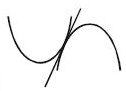
0 likes
View Solution467
AdvancedMCQ
The length of the latus rectum of the parabola $9x^2 + 16y^2 + 24xy - 4x + 3y = 0$ is
A
$\frac{1}{20}$
B
$\frac{1}{4}$
C
$\frac{1}{5}$
D
$1$
Solution
(D) The given equation is $9x^2 + 24xy + 16y^2 - 4x + 3y = 0$.
This can be written as $(3x + 4y)^2 - 4x + 3y = 0$.
Let $L = 3x + 4y$ and $M = 4x - 3y$. Note that $L$ and $M$ are perpendicular lines since their slopes are $-3/4$ and $4/3$ respectively.
We normalize the lines: $\left(\frac{3x + 4y}{5}\right)^2 = \frac{4x - 3y}{5}$.
This is of the form $Y^2 = 4aX$,where $Y = \frac{3x + 4y}{5}$ and $X = \frac{4x - 3y}{5}$.
Here,$4a = 1$,so $a = \frac{1}{4}$.
The length of the latus rectum is $4a = 1$.
This can be written as $(3x + 4y)^2 - 4x + 3y = 0$.
Let $L = 3x + 4y$ and $M = 4x - 3y$. Note that $L$ and $M$ are perpendicular lines since their slopes are $-3/4$ and $4/3$ respectively.
We normalize the lines: $\left(\frac{3x + 4y}{5}\right)^2 = \frac{4x - 3y}{5}$.
This is of the form $Y^2 = 4aX$,where $Y = \frac{3x + 4y}{5}$ and $X = \frac{4x - 3y}{5}$.
Here,$4a = 1$,so $a = \frac{1}{4}$.
The length of the latus rectum is $4a = 1$.
0 likes
View Solution468
AdvancedMCQ
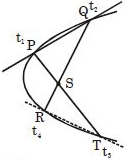
$P$ and $Q$ are two points on the parabola $y^2 = 8x$ and $S$ is its focus. $PS$ and $QS$ meet the curve again in $T$ and $R$ respectively. If $PQ$ passes through a fixed point $(-2, 3)$,then $TR$ also passes through a fixed point whose coordinates are
A
$(2, -3)$
B
$(3, -2)$
C
$(-2, 3)$
D
$(-3, 2)$
Solution
(C) Let the points $P, Q, R, T$ on the parabola $y^2 = 4ax$ (where $a=2$) be represented by parameters $t_1, t_2, t_4, t_3$ respectively.
Since $PS$ and $QS$ are focal chords,we have $t_1 t_3 = -1$ and $t_2 t_4 = -1$.
The equation of the chord $PQ$ is $y(t_1 + t_2) = 2x + 2a t_1 t_2$. Substituting $a=2$,we get $y(t_1 + t_2) = 2x + 4 t_1 t_2$.
Since $PQ$ passes through $(-2, 3)$,we have $3(t_1 + t_2) = -4 + 4 t_1 t_2$.
Substituting $t_1 = -1/t_3$ and $t_2 = -1/t_4$,we get $3(-1/t_3 - 1/t_4) = -4 + 4/(t_3 t_4)$.
Multiplying by $t_3 t_4$,we get $-3(t_4 + t_3) = -4 t_3 t_4 + 4$,which simplifies to $3(t_3 + t_4) = 4 t_3 t_4 - 4$.
The equation of the chord $TR$ is $y(t_3 + t_4) = 2x + 4 t_3 t_4$.
Comparing this with the condition $3(t_3 + t_4) = 4 t_3 t_4 - 4$,we see that the line $TR$ passes through the point $(-2, 3)$.
Since $PS$ and $QS$ are focal chords,we have $t_1 t_3 = -1$ and $t_2 t_4 = -1$.
The equation of the chord $PQ$ is $y(t_1 + t_2) = 2x + 2a t_1 t_2$. Substituting $a=2$,we get $y(t_1 + t_2) = 2x + 4 t_1 t_2$.
Since $PQ$ passes through $(-2, 3)$,we have $3(t_1 + t_2) = -4 + 4 t_1 t_2$.
Substituting $t_1 = -1/t_3$ and $t_2 = -1/t_4$,we get $3(-1/t_3 - 1/t_4) = -4 + 4/(t_3 t_4)$.
Multiplying by $t_3 t_4$,we get $-3(t_4 + t_3) = -4 t_3 t_4 + 4$,which simplifies to $3(t_3 + t_4) = 4 t_3 t_4 - 4$.
The equation of the chord $TR$ is $y(t_3 + t_4) = 2x + 4 t_3 t_4$.
Comparing this with the condition $3(t_3 + t_4) = 4 t_3 t_4 - 4$,we see that the line $TR$ passes through the point $(-2, 3)$.
0 likes
View Solution469
AdvancedMCQ
The locus of the orthocentre of the triangle formed by the focal chord of the parabola $y^2 = 4ax$ and the normals drawn at its extremities is
A
$y^2 = a(x - 3a)$
B
$y^2 = a(x + 3a)$
C
$y^2 = a(x - 4a)$
D
$y^2 = a(x + 4a)$
Solution
(A) Let the focal chord be $PQ$ where $P(at_1^2, 2at_1)$ and $Q(at_2^2, 2at_2)$. Since $PQ$ is a focal chord,$t_1t_2 = -1$.
The normals at $P$ and $Q$ intersect at $R(h, k)$,where $h = a(t_1^2 + t_2^2 + t_1t_2 + 2)$ and $k = -at_1t_2(t_1 + t_2)$.
Substituting $t_1t_2 = -1$ into the expressions:
$h = a(t_1^2 + t_2^2 - 1 + 2) = a(t_1^2 + t_2^2 + 1)$
$k = -a(-1)(t_1 + t_2) = a(t_1 + t_2)$
Now,$(t_1 + t_2)^2 = t_1^2 + t_2^2 + 2t_1t_2 = t_1^2 + t_2^2 - 2$.
So,$t_1^2 + t_2^2 = (t_1 + t_2)^2 + 2 = (k/a)^2 + 2$.
Substituting this into the expression for $h$:
$h = a((k/a)^2 + 2 + 1) = a(k^2/a^2 + 3) = k^2/a + 3a$.
Rearranging for $k^2$:
$k^2 = a(h - 3a)$.
Replacing $(h, k)$ with $(x, y)$,the locus is $y^2 = a(x - 3a)$.
The normals at $P$ and $Q$ intersect at $R(h, k)$,where $h = a(t_1^2 + t_2^2 + t_1t_2 + 2)$ and $k = -at_1t_2(t_1 + t_2)$.
Substituting $t_1t_2 = -1$ into the expressions:
$h = a(t_1^2 + t_2^2 - 1 + 2) = a(t_1^2 + t_2^2 + 1)$
$k = -a(-1)(t_1 + t_2) = a(t_1 + t_2)$
Now,$(t_1 + t_2)^2 = t_1^2 + t_2^2 + 2t_1t_2 = t_1^2 + t_2^2 - 2$.
So,$t_1^2 + t_2^2 = (t_1 + t_2)^2 + 2 = (k/a)^2 + 2$.
Substituting this into the expression for $h$:
$h = a((k/a)^2 + 2 + 1) = a(k^2/a^2 + 3) = k^2/a + 3a$.
Rearranging for $k^2$:
$k^2 = a(h - 3a)$.
Replacing $(h, k)$ with $(x, y)$,the locus is $y^2 = a(x - 3a)$.
0 likes
View Solution470
AdvancedMCQ
The tangents to the parabola $y^2 = 4ax$ make angles $\theta_1$ and $\theta_2$ with the positive $x$-axis. If $\cot \theta_1 + \cot \theta_2 = c$,then the locus of their point of intersection is
A
$y = ac$
B
$x = ac$
C
$xy = ac^2$
D
$xy = \frac{a}{c}$
Solution
(A) The equation of a tangent to the parabola $y^2 = 4ax$ with slope $m$ is $y = mx + \frac{a}{m}$.
Let the point of intersection be $(h, k)$. Since the tangent passes through $(h, k)$,we have $k = mh + \frac{a}{m}$.
Rearranging this gives the quadratic equation in $m$: $m^2h - mk + a = 0$.
Let $m_1 = \tan \theta_1$ and $m_2 = \tan \theta_2$ be the roots of this equation.
From the properties of roots,$m_1 + m_2 = \frac{k}{h}$ and $m_1 m_2 = \frac{a}{h}$.
Given $\cot \theta_1 + \cot \theta_2 = c$,we can write this as $\frac{1}{\tan \theta_1} + \frac{1}{\tan \theta_2} = c$.
This simplifies to $\frac{\tan \theta_1 + \tan \theta_2}{\tan \theta_1 \tan \theta_2} = c$.
Substituting the values of the sum and product of roots: $\frac{k/h}{a/h} = c$.
This simplifies to $\frac{k}{a} = c$,which implies $k = ac$.
Replacing $(h, k)$ with $(x, y)$,the locus is $y = ac$.
Let the point of intersection be $(h, k)$. Since the tangent passes through $(h, k)$,we have $k = mh + \frac{a}{m}$.
Rearranging this gives the quadratic equation in $m$: $m^2h - mk + a = 0$.
Let $m_1 = \tan \theta_1$ and $m_2 = \tan \theta_2$ be the roots of this equation.
From the properties of roots,$m_1 + m_2 = \frac{k}{h}$ and $m_1 m_2 = \frac{a}{h}$.
Given $\cot \theta_1 + \cot \theta_2 = c$,we can write this as $\frac{1}{\tan \theta_1} + \frac{1}{\tan \theta_2} = c$.
This simplifies to $\frac{\tan \theta_1 + \tan \theta_2}{\tan \theta_1 \tan \theta_2} = c$.
Substituting the values of the sum and product of roots: $\frac{k/h}{a/h} = c$.
This simplifies to $\frac{k}{a} = c$,which implies $k = ac$.
Replacing $(h, k)$ with $(x, y)$,the locus is $y = ac$.
0 likes
View Solution471
AdvancedMCQ
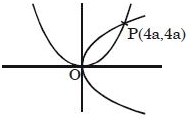
Find the angle of intersection between the curves $y^2 = 4ax$ and $x^2 = 4ay$.
A
is constant for all values of $a$
B
increases if $a > 0$
C
decreases if $a < 0$
D
both $(B)$ and $(C)$ are true
Solution
(A) The curves are $y^2 = 4ax$ and $x^2 = 4ay$. Solving these simultaneously,we get $x^2 = 4a(\sqrt{4ax}) \implies x^4 = 16a^2(4ax) = 64a^3x$. Thus,$x(x^3 - 64a^3) = 0$,giving $x = 0$ or $x = 4a$. The intersection points are $(0, 0)$ and $(4a, 4a)$.
At $(4a, 4a)$,for $y^2 = 4ax$,differentiating gives $2y \frac{dy}{dx} = 4a \implies \frac{dy}{dx} = \frac{2a}{y} = \frac{2a}{4a} = \frac{1}{2} = m_1$.
For $x^2 = 4ay$,differentiating gives $2x = 4a \frac{dy}{dx} \implies \frac{dy}{dx} = \frac{x}{2a} = \frac{4a}{2a} = 2 = m_2$.
The angle $\theta$ between the curves is given by $\tan \theta = |\frac{m_2 - m_1}{1 + m_1 m_2}| = |\frac{2 - 1/2}{1 + 2(1/2)}| = |\frac{3/2}{2}| = \frac{3}{4}$.
Since $\tan \theta = \frac{3}{4}$,the angle $\theta = \tan^{-1}(\frac{3}{4})$ is independent of $a$. Thus,the angle is constant for all values of $a$.
At $(4a, 4a)$,for $y^2 = 4ax$,differentiating gives $2y \frac{dy}{dx} = 4a \implies \frac{dy}{dx} = \frac{2a}{y} = \frac{2a}{4a} = \frac{1}{2} = m_1$.
For $x^2 = 4ay$,differentiating gives $2x = 4a \frac{dy}{dx} \implies \frac{dy}{dx} = \frac{x}{2a} = \frac{4a}{2a} = 2 = m_2$.
The angle $\theta$ between the curves is given by $\tan \theta = |\frac{m_2 - m_1}{1 + m_1 m_2}| = |\frac{2 - 1/2}{1 + 2(1/2)}| = |\frac{3/2}{2}| = \frac{3}{4}$.
Since $\tan \theta = \frac{3}{4}$,the angle $\theta = \tan^{-1}(\frac{3}{4})$ is independent of $a$. Thus,the angle is constant for all values of $a$.
0 likes
View Solution472
AdvancedMCQ
The condition that the parabolas $y^2 = 4ax$ and $y^2 = 4c(x - b)$ have a common normal other than the $x$-axis ($a, b, c$ being distinct positive real numbers) is
A
$0 < \frac{b}{a - c} < 1$
B
$\frac{b}{a - c} > 2$
C
$\frac{b}{a - c} < 0$
D
$1 < \frac{b}{a - c} < 2$
Solution
(B) The equation of a normal to the parabola $y^2 = 4ax$ with slope $m$ is $y = mx - 2am - am^3$ $(1)$.
The equation of a normal to the parabola $y^2 = 4c(x - b)$ with slope $m$ is $y = m(x - b) - 2cm - cm^3$,which simplifies to $y = mx - (b + 2c)m - cm^3$ $(2)$.
For a common normal,the equations $(1)$ and $(2)$ must represent the same line. Equating the constant terms:
$-2am - am^3 = -(b + 2c)m - cm^3$
$(c - a)m^3 + (b + 2c - 2a)m = 0$
Since the common normal is not the $x$-axis,$m \neq 0$. Dividing by $m$:
$(c - a)m^2 + (b + 2c - 2a) = 0$
$m^2 = \frac{2a - 2c - b}{c - a} = \frac{2(a - c) - b}{c - a} = -2 + \frac{b}{a - c}$.
Since $m^2 > 0$ for a real normal,we have:
$-2 + \frac{b}{a - c} > 0$
$\frac{b}{a - c} > 2$.
The equation of a normal to the parabola $y^2 = 4c(x - b)$ with slope $m$ is $y = m(x - b) - 2cm - cm^3$,which simplifies to $y = mx - (b + 2c)m - cm^3$ $(2)$.
For a common normal,the equations $(1)$ and $(2)$ must represent the same line. Equating the constant terms:
$-2am - am^3 = -(b + 2c)m - cm^3$
$(c - a)m^3 + (b + 2c - 2a)m = 0$
Since the common normal is not the $x$-axis,$m \neq 0$. Dividing by $m$:
$(c - a)m^2 + (b + 2c - 2a) = 0$
$m^2 = \frac{2a - 2c - b}{c - a} = \frac{2(a - c) - b}{c - a} = -2 + \frac{b}{a - c}$.
Since $m^2 > 0$ for a real normal,we have:
$-2 + \frac{b}{a - c} > 0$
$\frac{b}{a - c} > 2$.
0 likes
View Solution473
AdvancedMCQ
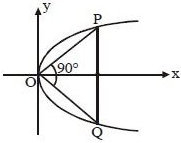
If a normal chord of the parabola $y^2 = 4ax$ subtends a right angle at the vertex,its slope is-
A
$\pm 1$
B
$\pm \sqrt{2}$
C
$\pm \sqrt{3}$
D
None of these
Solution
(B) Let the coordinates of the points $P$ and $Q$ on the parabola $y^2 = 4ax$ be $P(at_1^2, 2at_1)$ and $Q(at_2^2, 2at_2)$.
Since $PQ$ is a normal chord,we have the relation $t_2 = -t_1 - \frac{2}{t_1} \quad \dots(1)$.
The slopes of $OP$ and $OQ$ are $m_1 = \frac{2at_1}{at_1^2} = \frac{2}{t_1}$ and $m_2 = \frac{2at_2}{at_2^2} = \frac{2}{t_2}$ respectively.
Since $PQ$ subtends a right angle at the vertex $O(0,0)$,the product of the slopes of $OP$ and $OQ$ is $-1$.
$\frac{2}{t_1} \times \frac{2}{t_2} = -1 \Rightarrow t_1t_2 = -4 \quad \dots(2)$.
Substituting $t_2$ from $(1)$ into $(2)$,we get $t_1(-t_1 - \frac{2}{t_1}) = -4$.
$-t_1^2 - 2 = -4$ $\Rightarrow t_1^2 = 2$ $\Rightarrow t_1 = \pm \sqrt{2}$.
The slope of the normal at $P$ is $m = -t_1$.
Therefore,the slope of the normal chord is $m = \mp \sqrt{2}$.
Since the options represent the set of possible slopes,the correct choice is $\pm \sqrt{2}$.
Since $PQ$ is a normal chord,we have the relation $t_2 = -t_1 - \frac{2}{t_1} \quad \dots(1)$.
The slopes of $OP$ and $OQ$ are $m_1 = \frac{2at_1}{at_1^2} = \frac{2}{t_1}$ and $m_2 = \frac{2at_2}{at_2^2} = \frac{2}{t_2}$ respectively.
Since $PQ$ subtends a right angle at the vertex $O(0,0)$,the product of the slopes of $OP$ and $OQ$ is $-1$.
$\frac{2}{t_1} \times \frac{2}{t_2} = -1 \Rightarrow t_1t_2 = -4 \quad \dots(2)$.
Substituting $t_2$ from $(1)$ into $(2)$,we get $t_1(-t_1 - \frac{2}{t_1}) = -4$.
$-t_1^2 - 2 = -4$ $\Rightarrow t_1^2 = 2$ $\Rightarrow t_1 = \pm \sqrt{2}$.
The slope of the normal at $P$ is $m = -t_1$.
Therefore,the slope of the normal chord is $m = \mp \sqrt{2}$.
Since the options represent the set of possible slopes,the correct choice is $\pm \sqrt{2}$.
0 likes
View Solution474
AdvancedMCQ
If the focus and directrix of a parabola are $(3, 5)$ and $x + y = 4$,then the coordinates of its vertex are
A
$(1, 3)$
B
$(3, 4)$
C
$(2, 4)$
D
Data insufficient
Solution
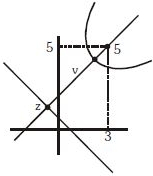
(C) The focus is $S(3, 5)$ and the directrix is $x + y - 4 = 0$.
The axis of the parabola passes through the focus and is perpendicular to the directrix. Since the directrix has a slope of $-1$,the axis has a slope of $1$.
The equation of the axis is $y - 5 = 1(x - 3)$,which simplifies to $x - y + 2 = 0$.
The foot of the directrix,$Z$,is the intersection of the axis and the directrix:
$x - y + 2 = 0$
$x + y - 4 = 0$
Adding these equations gives $2x - 2 = 0$,so $x = 1$. Substituting $x = 1$ into $x + y = 4$ gives $y = 3$. Thus,$Z = (1, 3)$.
The vertex $V$ is the midpoint of the segment $SZ$,where $S(3, 5)$ and $Z(1, 3)$.
$V = \left( \frac{3 + 1}{2}, \frac{5 + 3}{2} \right) = (2, 4)$.
The axis of the parabola passes through the focus and is perpendicular to the directrix. Since the directrix has a slope of $-1$,the axis has a slope of $1$.
The equation of the axis is $y - 5 = 1(x - 3)$,which simplifies to $x - y + 2 = 0$.
The foot of the directrix,$Z$,is the intersection of the axis and the directrix:
$x - y + 2 = 0$
$x + y - 4 = 0$
Adding these equations gives $2x - 2 = 0$,so $x = 1$. Substituting $x = 1$ into $x + y = 4$ gives $y = 3$. Thus,$Z = (1, 3)$.
The vertex $V$ is the midpoint of the segment $SZ$,where $S(3, 5)$ and $Z(1, 3)$.
$V = \left( \frac{3 + 1}{2}, \frac{5 + 3}{2} \right) = (2, 4)$.
0 likes
View Solution475
AdvancedMCQ
Two parabolas $x = cy^2 + ay + b$ and $x = cy - y^2$ touch each other at the point $(0, 1)$. Then the value of $2a + b - c$ is:
A
$-1$
B
$-7$
C
$-5$
D
$1$
Solution
(C) Given the parabolas $x_1 = cy^2 + ay + b$ and $x_2 = cy - y^2$ touch at $(0, 1)$.
Since $(0, 1)$ lies on both curves:
For $x_2$: $0 = c(1) - (1)^2 \Rightarrow c = 1$.
For $x_1$: $0 = c(1)^2 + a(1) + b$ $\Rightarrow 1 + a + b = 0$ $\Rightarrow a + b = -1$.
Now,find the derivatives $\frac{dx}{dy}$ at $y = 1$:
For $x_1$: $\frac{dx_1}{dy} = 2cy + a = 2(1)(1) + a = 2 + a$.
For $x_2$: $\frac{dx_2}{dy} = c - 2y = 1 - 2(1) = -1$.
Since the curves touch,their tangents at $(0, 1)$ are identical,so $\frac{dx_1}{dy} = \frac{dx_2}{dy}$ at $y = 1$.
$2 + a = -1 \Rightarrow a = -3$.
Using $a + b = -1$,we get $-3 + b = -1 \Rightarrow b = 2$.
Finally,calculate $2a + b - c = 2(-3) + 2 - 1 = -6 + 2 - 1 = -5$.
Since $(0, 1)$ lies on both curves:
For $x_2$: $0 = c(1) - (1)^2 \Rightarrow c = 1$.
For $x_1$: $0 = c(1)^2 + a(1) + b$ $\Rightarrow 1 + a + b = 0$ $\Rightarrow a + b = -1$.
Now,find the derivatives $\frac{dx}{dy}$ at $y = 1$:
For $x_1$: $\frac{dx_1}{dy} = 2cy + a = 2(1)(1) + a = 2 + a$.
For $x_2$: $\frac{dx_2}{dy} = c - 2y = 1 - 2(1) = -1$.
Since the curves touch,their tangents at $(0, 1)$ are identical,so $\frac{dx_1}{dy} = \frac{dx_2}{dy}$ at $y = 1$.
$2 + a = -1 \Rightarrow a = -3$.
Using $a + b = -1$,we get $-3 + b = -1 \Rightarrow b = 2$.
Finally,calculate $2a + b - c = 2(-3) + 2 - 1 = -6 + 2 - 1 = -5$.
0 likes
View Solution476
AdvancedMCQ
$A$ ray of light travelling along the line $x = 2$ strikes a parabolic mirror with the equation $y^2 - 2y - 4x + 5 = 0$ and gets reflected from its surface. Then,the equation of the reflected ray may be:
A
$y = 5$
B
$x = -1$
C
$y = -1$
D
$y = 1$
Solution
(C) The equation of the parabola is $y^2 - 2y - 4x + 5 = 0$.
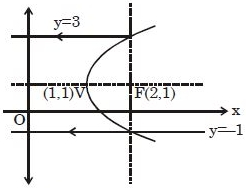
Completing the square for $y$,we get $(y-1)^2 - 1 - 4x + 5 = 0$,which simplifies to $(y-1)^2 = 4x - 4$,or $(y-1)^2 = 4(x-1)$.
This is a parabola with vertex $V(1, 1)$ and focus $F(1+1, 1) = (2, 1)$.
The incident ray travels along the line $x = 2$,which is the line passing through the focus $F(2, 1)$ and parallel to the $y$-axis.
According to the reflective property of a parabola,any ray of light parallel to the axis of the parabola and striking the mirror will pass through the focus after reflection,and conversely,any ray passing through the focus will be reflected parallel to the axis of the parabola.
The axis of this parabola is the line $y = 1$.
Since the incident ray passes through the focus $F(2, 1)$,the reflected ray must be parallel to the axis of the parabola,which is $y = 1$.
Thus,the reflected ray is a horizontal line of the form $y = k$.
From the provided image,the reflected rays are $y = 3$ and $y = -1$. Comparing this with the options,$y = -1$ is a valid reflected ray.
Completing the square for $y$,we get $(y-1)^2 - 1 - 4x + 5 = 0$,which simplifies to $(y-1)^2 = 4x - 4$,or $(y-1)^2 = 4(x-1)$.
This is a parabola with vertex $V(1, 1)$ and focus $F(1+1, 1) = (2, 1)$.
The incident ray travels along the line $x = 2$,which is the line passing through the focus $F(2, 1)$ and parallel to the $y$-axis.
According to the reflective property of a parabola,any ray of light parallel to the axis of the parabola and striking the mirror will pass through the focus after reflection,and conversely,any ray passing through the focus will be reflected parallel to the axis of the parabola.
The axis of this parabola is the line $y = 1$.
Since the incident ray passes through the focus $F(2, 1)$,the reflected ray must be parallel to the axis of the parabola,which is $y = 1$.
Thus,the reflected ray is a horizontal line of the form $y = k$.
From the provided image,the reflected rays are $y = 3$ and $y = -1$. Comparing this with the options,$y = -1$ is a valid reflected ray.
0 likes
View Solution477
AdvancedMCQ
Let $P(\alpha, \beta)$ be a point on the parabola $y^2 = 4x$ which is at minimum distance from the circle $x^2 + y^2 - 4x - 20y + 103 = 0$. Then $\alpha \beta$ is
A
$20$
B
$10$
C
$2(10)^{2/3}$
D
$2(10)^{1/3}$
Solution
(A) The equation of the circle is $x^2 - 4x + y^2 - 20y + 103 = 0$.
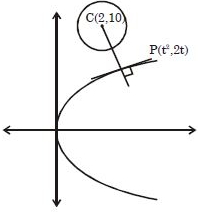
Completing the square,we get $(x-2)^2 - 4 + (y-10)^2 - 100 + 103 = 0$,which simplifies to $(x-2)^2 + (y-10)^2 = 1$.
The center of the circle is $C(2, 10)$ and its radius is $r = 1$.
Let the point $P$ on the parabola $y^2 = 4x$ be $(t^2, 2t)$.
The distance between $P$ and the center $C$ is minimized when the normal to the parabola at $P$ passes through the center $C(2, 10)$.
The slope of the tangent at $P(t^2, 2t)$ is $\frac{dy}{dx} = \frac{2}{2t} = \frac{1}{t}$.
The slope of the normal at $P$ is $-t$.
The slope of the line segment $CP$ is $\frac{2t - 10}{t^2 - 2}$.
Equating the slopes: $-t = \frac{2t - 10}{t^2 - 2}$.
$-t^3 + 2t = 2t - 10$,which implies $t^3 = 10$,so $t = (10)^{1/3}$.
Thus,$\alpha = t^2 = (10)^{2/3}$ and $\beta = 2t = 2(10)^{1/3}$.
Therefore,$\alpha \beta = (10)^{2/3} \times 2(10)^{1/3} = 2(10)^{2/3 + 1/3} = 2(10)^1 = 20$.
Completing the square,we get $(x-2)^2 - 4 + (y-10)^2 - 100 + 103 = 0$,which simplifies to $(x-2)^2 + (y-10)^2 = 1$.
The center of the circle is $C(2, 10)$ and its radius is $r = 1$.
Let the point $P$ on the parabola $y^2 = 4x$ be $(t^2, 2t)$.
The distance between $P$ and the center $C$ is minimized when the normal to the parabola at $P$ passes through the center $C(2, 10)$.
The slope of the tangent at $P(t^2, 2t)$ is $\frac{dy}{dx} = \frac{2}{2t} = \frac{1}{t}$.
The slope of the normal at $P$ is $-t$.
The slope of the line segment $CP$ is $\frac{2t - 10}{t^2 - 2}$.
Equating the slopes: $-t = \frac{2t - 10}{t^2 - 2}$.
$-t^3 + 2t = 2t - 10$,which implies $t^3 = 10$,so $t = (10)^{1/3}$.
Thus,$\alpha = t^2 = (10)^{2/3}$ and $\beta = 2t = 2(10)^{1/3}$.
Therefore,$\alpha \beta = (10)^{2/3} \times 2(10)^{1/3} = 2(10)^{2/3 + 1/3} = 2(10)^1 = 20$.
0 likes
View Solution478
DifficultMCQ
The locus of the midpoints of the chords of the parabola $y^2 = 4ax$ which pass through the origin is:
A
$y^2 = ax$
B
$y^2 = 2ax$
C
$y^2 = 4ax$
D
$x^2 = 4ay$
Solution
(B) Let the midpoint of the chord be $(h, k)$.
The equation of the chord of the parabola $y^2 = 4ax$ with midpoint $(h, k)$ is given by $T = S_1$,where $T = ky - 2a(x + h)$ and $S_1 = k^2 - 4ah$.
So,the equation is $ky - 2a(x + h) = k^2 - 4ah$.
Since the chord passes through the origin $(0, 0)$,we substitute $x = 0$ and $y = 0$ into the equation:
$k(0) - 2a(0 + h) = k^2 - 4ah$
$-2ah = k^2 - 4ah$
$k^2 = 2ah$.
Replacing $(h, k)$ with $(x, y)$,the locus is $y^2 = 2ax$.
The equation of the chord of the parabola $y^2 = 4ax$ with midpoint $(h, k)$ is given by $T = S_1$,where $T = ky - 2a(x + h)$ and $S_1 = k^2 - 4ah$.
So,the equation is $ky - 2a(x + h) = k^2 - 4ah$.
Since the chord passes through the origin $(0, 0)$,we substitute $x = 0$ and $y = 0$ into the equation:
$k(0) - 2a(0 + h) = k^2 - 4ah$
$-2ah = k^2 - 4ah$
$k^2 = 2ah$.
Replacing $(h, k)$ with $(x, y)$,the locus is $y^2 = 2ax$.
0 likes
View Solution479
AdvancedMCQ
From the point $(-1, 2)$, tangents are drawn to the parabola $y^2 = 4x$. The area of the triangle formed by the chord of contact and the tangents is: (in $\sqrt{2}$)
A
$2$
B
$3$
C
$4$
D
$8$
Solution
(D) The equation of the parabola is $y^2 = 4x$, so $a = 1$.
The point from which tangents are drawn is $(x_1, y_1) = (-1, 2)$.
The equation of the chord of contact is $yy_1 = 2a(x + x_1)$, which becomes $y(2) = 2(1)(x - 1)$, or $y = x - 1$.
Rearranging, we get $x - y - 1 = 0$.
The length of the chord of contact is given by $\frac{2}{a} \sqrt{(y_1^2 - 4ax_1)(a^2 + y_1^2)} = \frac{2}{1} \sqrt{(4 - 4(1)(-1))(1^2 + 2^2)} = 2 \sqrt{(8)(5)} = 2 \sqrt{40} = 4\sqrt{10}$.
The perpendicular distance $h$ from the point $(-1, 2)$ to the line $x - y - 1 = 0$ is $h = \frac{|-1 - 2 - 1|}{\sqrt{1^2 + (-1)^2}} = \frac{4}{\sqrt{2}} = 2\sqrt{2}$.
The area of the triangle formed by the tangents and the chord of contact is given by $\frac{(y_1^2 - 4ax_1)^{3/2}}{2a} = \frac{(4 - 4(1)(-1))^{3/2}}{2(1)} = \frac{8^{3/2}}{2} = \frac{16\sqrt{2}}{2} = 8\sqrt{2}$.
The point from which tangents are drawn is $(x_1, y_1) = (-1, 2)$.
The equation of the chord of contact is $yy_1 = 2a(x + x_1)$, which becomes $y(2) = 2(1)(x - 1)$, or $y = x - 1$.
Rearranging, we get $x - y - 1 = 0$.
The length of the chord of contact is given by $\frac{2}{a} \sqrt{(y_1^2 - 4ax_1)(a^2 + y_1^2)} = \frac{2}{1} \sqrt{(4 - 4(1)(-1))(1^2 + 2^2)} = 2 \sqrt{(8)(5)} = 2 \sqrt{40} = 4\sqrt{10}$.
The perpendicular distance $h$ from the point $(-1, 2)$ to the line $x - y - 1 = 0$ is $h = \frac{|-1 - 2 - 1|}{\sqrt{1^2 + (-1)^2}} = \frac{4}{\sqrt{2}} = 2\sqrt{2}$.
The area of the triangle formed by the tangents and the chord of contact is given by $\frac{(y_1^2 - 4ax_1)^{3/2}}{2a} = \frac{(4 - 4(1)(-1))^{3/2}}{2(1)} = \frac{8^{3/2}}{2} = \frac{16\sqrt{2}}{2} = 8\sqrt{2}$.
0 likes
View Solution480
DifficultMCQ
If the tangents at the extremities of a chord $PQ$ of a parabola intersect at $T$,then the distances of the focus of the parabola from the points $P, T, Q$ are in
A
$A.P.$
B
$G.P.$
C
$H.P.$
D
None of these
Solution
(B) Let the equation of the parabola be $y^{2} = 4ax$ and $P(at_{1}^{2}, 2at_{1}), Q(at_{2}^{2}, 2at_{2})$ be the extremities of the chord $PQ$.
The coordinates of $T$,the point of intersection of the tangents at $P$ and $Q$,are $(at_{1}t_{2}, a(t_{1} + t_{2}))$.
The distance of the focus $S(a, 0)$ from $P$ is $SP = \sqrt{(at_{1}^{2} - a)^{2} + (2at_{1} - 0)^{2}} = a(1 + t_{1}^{2})$.
Similarly,the distance of the focus $S$ from $Q$ is $SQ = a(1 + t_{2}^{2})$.
The distance of the focus $S$ from $T$ is $ST = \sqrt{(at_{1}t_{2} - a)^{2} + (a(t_{1} + t_{2}) - 0)^{2}}$.
$ST^{2} = a^{2}(t_{1}^{2}t_{2}^{2} - 2t_{1}t_{2} + 1 + t_{1}^{2} + 2t_{1}t_{2} + t_{2}^{2}) = a^{2}(1 + t_{1}^{2} + t_{2}^{2} + t_{1}^{2}t_{2}^{2}) = a^{2}(1 + t_{1}^{2})(1 + t_{2}^{2})$.
Thus,$ST^{2} = SP \cdot SQ$,which implies that $SP, ST, SQ$ are in $G.P.$
The coordinates of $T$,the point of intersection of the tangents at $P$ and $Q$,are $(at_{1}t_{2}, a(t_{1} + t_{2}))$.
The distance of the focus $S(a, 0)$ from $P$ is $SP = \sqrt{(at_{1}^{2} - a)^{2} + (2at_{1} - 0)^{2}} = a(1 + t_{1}^{2})$.
Similarly,the distance of the focus $S$ from $Q$ is $SQ = a(1 + t_{2}^{2})$.
The distance of the focus $S$ from $T$ is $ST = \sqrt{(at_{1}t_{2} - a)^{2} + (a(t_{1} + t_{2}) - 0)^{2}}$.
$ST^{2} = a^{2}(t_{1}^{2}t_{2}^{2} - 2t_{1}t_{2} + 1 + t_{1}^{2} + 2t_{1}t_{2} + t_{2}^{2}) = a^{2}(1 + t_{1}^{2} + t_{2}^{2} + t_{1}^{2}t_{2}^{2}) = a^{2}(1 + t_{1}^{2})(1 + t_{2}^{2})$.
Thus,$ST^{2} = SP \cdot SQ$,which implies that $SP, ST, SQ$ are in $G.P.$
0 likes
View Solution481
DifficultMCQ
If $x + by + c = 0$ is a normal to the parabola $y^2 = 12x$,then the complete set of all values of $c$ is -
A
$(-\infty, -6)$
B
$(9, \infty)$
C
$(-\infty, -6) \cup (9, \infty)$
D
$(-\infty, \infty) - \{0\}$
Solution
(A) The equation of the line is $x + by + c = 0$,which can be written as $y = -\frac{1}{b}x - \frac{c}{b}$.
Comparing this with $y = mx + k$,we get $m = -\frac{1}{b}$ and $k = -\frac{c}{b}$.
For the parabola $y^2 = 4ax$,here $4a = 12$,so $a = 3$.
The condition for the line $y = mx + k$ to be a normal to the parabola $y^2 = 4ax$ is $k = -2am - am^3$.
Substituting the values: $-\frac{c}{b} = -2(3)(-\frac{1}{b}) - 3(-\frac{1}{b})^3$.
$-\frac{c}{b} = \frac{6}{b} + \frac{3}{b^3}$.
Multiplying by $-b^3$ (assuming $b \neq 0$): $cb^2 = -6b^2 - 3$.
$b^2(c + 6) = -3$.
$b^2 = \frac{-3}{c + 6}$.
Since $b^2 > 0$,we must have $\frac{-3}{c + 6} > 0$,which implies $c + 6 < 0$.
Therefore,$c < -6$.
Comparing this with $y = mx + k$,we get $m = -\frac{1}{b}$ and $k = -\frac{c}{b}$.
For the parabola $y^2 = 4ax$,here $4a = 12$,so $a = 3$.
The condition for the line $y = mx + k$ to be a normal to the parabola $y^2 = 4ax$ is $k = -2am - am^3$.
Substituting the values: $-\frac{c}{b} = -2(3)(-\frac{1}{b}) - 3(-\frac{1}{b})^3$.
$-\frac{c}{b} = \frac{6}{b} + \frac{3}{b^3}$.
Multiplying by $-b^3$ (assuming $b \neq 0$): $cb^2 = -6b^2 - 3$.
$b^2(c + 6) = -3$.
$b^2 = \frac{-3}{c + 6}$.
Since $b^2 > 0$,we must have $\frac{-3}{c + 6} > 0$,which implies $c + 6 < 0$.
Therefore,$c < -6$.
0 likes
View Solution482
AdvancedMCQ
The shortest distance between the line $y - x = 1$ and the curve $x = y^2$ is
A
$\frac{8}{3\sqrt{2}}$
B
$\frac{4}{\sqrt{3}}$
C
$\frac{\sqrt{3}}{4}$
D
$\frac{3\sqrt{2}}{8}$
Solution
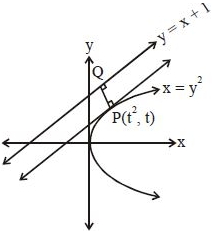
(D) The given line is $x - y + 1 = 0$,which has a slope of $1$.
For the shortest distance,the tangent to the curve $x = y^2$ must be parallel to the given line.
Differentiating $x = y^2$ with respect to $y$,we get $\frac{dx}{dy} = 2y$.
Since the slope of the tangent is $\frac{dy}{dx} = 1$,we have $\frac{1}{2y} = 1$,which gives $y = \frac{1}{2}$.
Substituting $y = \frac{1}{2}$ into $x = y^2$,we get $x = \left(\frac{1}{2}\right)^2 = \frac{1}{4}$.
So,the point $P$ on the curve is $\left(\frac{1}{4}, \frac{1}{2}\right)$.
The shortest distance is the perpendicular distance from point $P\left(\frac{1}{4}, \frac{1}{2}\right)$ to the line $x - y + 1 = 0$.
Distance $= \frac{|\frac{1}{4} - \frac{1}{2} + 1|}{\sqrt{1^2 + (-1)^2}} = \frac{|\frac{3}{4}|}{\sqrt{2}} = \frac{3}{4\sqrt{2}} = \frac{3\sqrt{2}}{8}$.
For the shortest distance,the tangent to the curve $x = y^2$ must be parallel to the given line.
Differentiating $x = y^2$ with respect to $y$,we get $\frac{dx}{dy} = 2y$.
Since the slope of the tangent is $\frac{dy}{dx} = 1$,we have $\frac{1}{2y} = 1$,which gives $y = \frac{1}{2}$.
Substituting $y = \frac{1}{2}$ into $x = y^2$,we get $x = \left(\frac{1}{2}\right)^2 = \frac{1}{4}$.
So,the point $P$ on the curve is $\left(\frac{1}{4}, \frac{1}{2}\right)$.
The shortest distance is the perpendicular distance from point $P\left(\frac{1}{4}, \frac{1}{2}\right)$ to the line $x - y + 1 = 0$.
Distance $= \frac{|\frac{1}{4} - \frac{1}{2} + 1|}{\sqrt{1^2 + (-1)^2}} = \frac{|\frac{3}{4}|}{\sqrt{2}} = \frac{3}{4\sqrt{2}} = \frac{3\sqrt{2}}{8}$.
0 likes
View Solution483
DifficultMCQ
Two parabolas with a common vertex at the origin and with axes along the $x-$ axis and $y-$ axis,respectively,intersect each other in the first quadrant. If the length of the latus rectum of each parabola is $3$,then the equation of the common tangent to the two parabolas is?
A
$3(x+y)+4 = 0$
B
$8(2x+y)+3 = 0$
C
$4(x+y)+3 = 0$
D
$x+2y+3 = 0$
Solution
(C) Since the origin is the common vertex,let the equations of the two parabolas be $y^2 = 4ax$ and $x^2 = 4by$.
Given the length of the latus rectum is $3$,we have $4a = 3$ and $4b = 3$,so $a = b = \frac{3}{4}$.
The equations are $y^2 = 3x$ and $x^2 = 3y$.
Let the common tangent be $y = mx + c$.
For $y^2 = 3x$,substituting $y = mx + c$ gives $(mx + c)^2 = 3x$,or $m^2x^2 + (2mc - 3)x + c^2 = 0$.
Since it is a tangent,the discriminant is zero: $(2mc - 3)^2 - 4m^2c^2 = 0$,which simplifies to $9 - 12mc = 0$,so $c = \frac{3}{4m}$.
For $x^2 = 3y$,substituting $y = mx + c$ gives $x^2 = 3(mx + c)$,or $x^2 - 3mx - 3c = 0$.
Setting the discriminant to zero: $(-3m)^2 - 4(1)(-3c) = 0$,which gives $9m^2 + 12c = 0$,so $c = -\frac{3m^2}{4}$.
Equating the two expressions for $c$: $\frac{3}{4m} = -\frac{3m^2}{4}$ $\Rightarrow m^3 = -1$ $\Rightarrow m = -1$.
Then $c = \frac{3}{4(-1)} = -\frac{3}{4}$.
The equation of the tangent is $y = -x - \frac{3}{4}$,which simplifies to $4(x + y) + 3 = 0$.
Given the length of the latus rectum is $3$,we have $4a = 3$ and $4b = 3$,so $a = b = \frac{3}{4}$.
The equations are $y^2 = 3x$ and $x^2 = 3y$.
Let the common tangent be $y = mx + c$.
For $y^2 = 3x$,substituting $y = mx + c$ gives $(mx + c)^2 = 3x$,or $m^2x^2 + (2mc - 3)x + c^2 = 0$.
Since it is a tangent,the discriminant is zero: $(2mc - 3)^2 - 4m^2c^2 = 0$,which simplifies to $9 - 12mc = 0$,so $c = \frac{3}{4m}$.
For $x^2 = 3y$,substituting $y = mx + c$ gives $x^2 = 3(mx + c)$,or $x^2 - 3mx - 3c = 0$.
Setting the discriminant to zero: $(-3m)^2 - 4(1)(-3c) = 0$,which gives $9m^2 + 12c = 0$,so $c = -\frac{3m^2}{4}$.
Equating the two expressions for $c$: $\frac{3}{4m} = -\frac{3m^2}{4}$ $\Rightarrow m^3 = -1$ $\Rightarrow m = -1$.
Then $c = \frac{3}{4(-1)} = -\frac{3}{4}$.
The equation of the tangent is $y = -x - \frac{3}{4}$,which simplifies to $4(x + y) + 3 = 0$.
0 likes
View Solution484
DifficultMCQ
Tangents drawn from the point $(-8, 0)$ to the parabola $y^2 = 8x$ touch the parabola at $P$ and $Q$. If $F$ is the focus of the parabola,then the area of the triangle $PFQ$ (in sq. units) is equal to
A
$48$
B
$32$
C
$24$
D
$64$
Solution
(A) The equation of the parabola is $y^2 = 8x$,so $4a = 8$,which implies $a = 2$. The focus $F$ is $(2, 0)$.
The equation of the chord of contact $PQ$ for a point $(x_1, y_1) = (-8, 0)$ is given by $T = 0$,which is $yy_1 = 2a(x + x_1)$.
Substituting the values,we get $y(0) = 2(2)(x - 8)$,which simplifies to $0 = 4(x - 8)$,so $x = 8$.
For $x = 8$,$y^2 = 8(8) = 64$,so $y = \pm 8$. Thus,the points are $P(8, 8)$ and $Q(8, -8)$.
The triangle $PFQ$ has vertices $P(8, 8)$,$F(2, 0)$,and $Q(8, -8)$.
The base $PQ$ is a vertical line segment with length $|8 - (-8)| = 16$.
The height of the triangle from $F(2, 0)$ to the line $x = 8$ is $|8 - 2| = 6$.
Area of $\triangle PFQ = \frac{1}{2} \times \text{base} \times \text{height} = \frac{1}{2} \times 16 \times 6 = 48$ sq. units.
The equation of the chord of contact $PQ$ for a point $(x_1, y_1) = (-8, 0)$ is given by $T = 0$,which is $yy_1 = 2a(x + x_1)$.
Substituting the values,we get $y(0) = 2(2)(x - 8)$,which simplifies to $0 = 4(x - 8)$,so $x = 8$.
For $x = 8$,$y^2 = 8(8) = 64$,so $y = \pm 8$. Thus,the points are $P(8, 8)$ and $Q(8, -8)$.
The triangle $PFQ$ has vertices $P(8, 8)$,$F(2, 0)$,and $Q(8, -8)$.
The base $PQ$ is a vertical line segment with length $|8 - (-8)| = 16$.
The height of the triangle from $F(2, 0)$ to the line $x = 8$ is $|8 - 2| = 6$.
Area of $\triangle PFQ = \frac{1}{2} \times \text{base} \times \text{height} = \frac{1}{2} \times 16 \times 6 = 48$ sq. units.
0 likes
View Solution485
DifficultMCQ
Let $P$ be a point on the parabola $x^2 = 4y$. If the distance of $P$ from the centre of the circle $x^2 + y^2 + 6x + 8 = 0$ is minimum,then the equation of the tangent to the parabola at $P$ is:
A
$x + 4y - 2 = 0$
B
$x + 2y = 0$
C
$x + y + 1 = 0$
D
$x - y + 3 = 0$
Solution
(C) Let the point $P$ on the parabola $x^2 = 4y$ be $(2t, t^2)$.
The given circle is $x^2 + y^2 + 6x + 8 = 0$. Its centre $C$ is $(-3, 0)$.
For the distance $PC$ to be minimum,the line $PC$ must be the normal to the parabola at $P$.
The slope of the tangent to the parabola at $P(2t, t^2)$ is $\frac{dy}{dx} = \frac{x}{2} = t$.
Therefore,the slope of the normal at $P$ is $-\frac{1}{t}$.
The slope of the line $PC$ connecting $P(2t, t^2)$ and $C(-3, 0)$ is $\frac{t^2 - 0}{2t - (-3)} = \frac{t^2}{2t + 3}$.
Equating the slopes: $\frac{t^2}{2t + 3} = -\frac{1}{t}$.
$t^3 = -2t - 3 \Rightarrow t^3 + 2t + 3 = 0$.
By inspection,$t = -1$ is a root: $(-1)^3 + 2(-1) + 3 = -1 - 2 + 3 = 0$.
For $t = -1$,the point $P$ is $(2(-1), (-1)^2) = (-2, 1)$.
The slope of the tangent at $P$ is $t = -1$.
The equation of the tangent at $(-2, 1)$ is $y - 1 = -1(x + 2)$.
$y - 1 = -x - 2 \Rightarrow x + y + 1 = 0$.
The given circle is $x^2 + y^2 + 6x + 8 = 0$. Its centre $C$ is $(-3, 0)$.
For the distance $PC$ to be minimum,the line $PC$ must be the normal to the parabola at $P$.
The slope of the tangent to the parabola at $P(2t, t^2)$ is $\frac{dy}{dx} = \frac{x}{2} = t$.
Therefore,the slope of the normal at $P$ is $-\frac{1}{t}$.
The slope of the line $PC$ connecting $P(2t, t^2)$ and $C(-3, 0)$ is $\frac{t^2 - 0}{2t - (-3)} = \frac{t^2}{2t + 3}$.
Equating the slopes: $\frac{t^2}{2t + 3} = -\frac{1}{t}$.
$t^3 = -2t - 3 \Rightarrow t^3 + 2t + 3 = 0$.
By inspection,$t = -1$ is a root: $(-1)^3 + 2(-1) + 3 = -1 - 2 + 3 = 0$.
For $t = -1$,the point $P$ is $(2(-1), (-1)^2) = (-2, 1)$.
The slope of the tangent at $P$ is $t = -1$.
The equation of the tangent at $(-2, 1)$ is $y - 1 = -1(x + 2)$.
$y - 1 = -x - 2 \Rightarrow x + y + 1 = 0$.
0 likes
View Solution486
DifficultMCQ
If $y = mx + c$ is the normal at a point on the parabola $y^2 = 8x$ whose focal distance is $8 \text{ units}$, then $|c|$ is equal to (in $\sqrt{3}$)
A
$2$
B
$8$
C
$10$
D
$16$
Solution
(C) For the parabola $y^2 = 4ax$, we have $4a = 8$, so $a = 2$.
The focal distance of a point $(at^2, 2at)$ on the parabola is given by $a(1 + t^2)$.
Given the focal distance is $8$, we have $2(1 + t^2) = 8$, which implies $1 + t^2 = 4$, so $t^2 = 3$ and $t = \pm\sqrt{3}$.
The equation of the normal to the parabola $y^2 = 4ax$ at parameter $t$ is $y = -tx + 2at + at^3$.
Comparing this with $y = mx + c$, we get $m = -t$ and $c = 2at + at^3 = at(2 + t^2)$.
Substituting $a = 2$ and $t = \sqrt{3}$ (or $t = -\sqrt{3}$ for the magnitude):
$|c| = |2(\sqrt{3})(2 + 3)| = |2\sqrt{3}(5)| = 10\sqrt{3}$.
The focal distance of a point $(at^2, 2at)$ on the parabola is given by $a(1 + t^2)$.
Given the focal distance is $8$, we have $2(1 + t^2) = 8$, which implies $1 + t^2 = 4$, so $t^2 = 3$ and $t = \pm\sqrt{3}$.
The equation of the normal to the parabola $y^2 = 4ax$ at parameter $t$ is $y = -tx + 2at + at^3$.
Comparing this with $y = mx + c$, we get $m = -t$ and $c = 2at + at^3 = at(2 + t^2)$.
Substituting $a = 2$ and $t = \sqrt{3}$ (or $t = -\sqrt{3}$ for the magnitude):
$|c| = |2(\sqrt{3})(2 + 3)| = |2\sqrt{3}(5)| = 10\sqrt{3}$.
0 likes
View Solution487
DifficultMCQ
If the tangent at a point $P,$ with parameter $t,$ on the curve $x = 4t^2 + 3, y = 8t^3 - 1, t \in R,$ meets the curve again at a point $Q,$ then the coordinates of $Q$ are
A
$(16t^2 + 3, -64t^3 - 1)$
B
$(4t^2 + 3, -8t^3 - 2)$
C
$(t^2 + 3, t^3 - 1)$
D
$(t^2 + 3, -t^3 - 1)$
Solution
(D) The coordinates of point $P$ are $(4t^2 + 3, 8t^3 - 1).$
The slope of the tangent at $P$ is given by $\frac{dy}{dx} = \frac{dy/dt}{dx/dt} = \frac{24t^2}{8t} = 3t.$
Let the coordinates of point $Q$ be $(4\lambda^2 + 3, 8\lambda^3 - 1).$
The slope of the line $PQ$ is $\frac{8\lambda^3 - 8t^3}{4\lambda^2 - 4t^2} = \frac{2(\lambda^3 - t^3)}{\lambda^2 - t^2} = \frac{2(\lambda - t)(\lambda^2 + \lambda t + t^2)}{(\lambda - t)(\lambda + t)} = \frac{2(\lambda^2 + \lambda t + t^2)}{\lambda + t}.$
Since $PQ$ is the tangent at $P,$ its slope must be $3t.$
So,$\frac{2(\lambda^2 + \lambda t + t^2)}{\lambda + t} = 3t.$
$2\lambda^2 + 2\lambda t + 2t^2 = 3t\lambda + 3t^2.$
$2\lambda^2 - t\lambda - t^2 = 0.$
$(2\lambda + t)(\lambda - t) = 0.$
Since $\lambda \neq t$ (as $Q$ is a different point),we have $\lambda = -t/2.$
Substituting $\lambda = -t/2$ into the coordinates of $Q,$ we get $x = 4(-t/2)^2 + 3 = t^2 + 3$ and $y = 8(-t/2)^3 - 1 = -t^3 - 1.$
Thus,the coordinates of $Q$ are $(t^2 + 3, -t^3 - 1).$
The slope of the tangent at $P$ is given by $\frac{dy}{dx} = \frac{dy/dt}{dx/dt} = \frac{24t^2}{8t} = 3t.$
Let the coordinates of point $Q$ be $(4\lambda^2 + 3, 8\lambda^3 - 1).$
The slope of the line $PQ$ is $\frac{8\lambda^3 - 8t^3}{4\lambda^2 - 4t^2} = \frac{2(\lambda^3 - t^3)}{\lambda^2 - t^2} = \frac{2(\lambda - t)(\lambda^2 + \lambda t + t^2)}{(\lambda - t)(\lambda + t)} = \frac{2(\lambda^2 + \lambda t + t^2)}{\lambda + t}.$
Since $PQ$ is the tangent at $P,$ its slope must be $3t.$
So,$\frac{2(\lambda^2 + \lambda t + t^2)}{\lambda + t} = 3t.$
$2\lambda^2 + 2\lambda t + 2t^2 = 3t\lambda + 3t^2.$
$2\lambda^2 - t\lambda - t^2 = 0.$
$(2\lambda + t)(\lambda - t) = 0.$
Since $\lambda \neq t$ (as $Q$ is a different point),we have $\lambda = -t/2.$
Substituting $\lambda = -t/2$ into the coordinates of $Q,$ we get $x = 4(-t/2)^2 + 3 = t^2 + 3$ and $y = 8(-t/2)^3 - 1 = -t^3 - 1.$
Thus,the coordinates of $Q$ are $(t^2 + 3, -t^3 - 1).$
0 likes
View Solution488
DifficultMCQ
$P$ and $Q$ are two distinct points on the parabola,$y^2 = 4x$,with parameters $t$ and $t_1$ respectively. If the normal at $P$ passes through $Q$,then the minimum value of $t_1^2$ is
A
$8$
B
$4$
C
$6$
D
$2$
Solution
(A) The equation of the normal to the parabola $y^2 = 4ax$ at parameter $t$ is $y = -tx + 2at + at^3$. Here $a = 1$,so the normal at $P(t)$ is $y = -tx + 2t + t^3$.
Since this normal passes through $Q(t_1)$,we have $t_1^2 = -t(t_1) + 2t + t^3$,which simplifies to $t_1^2 - t_1^2 = 0$ is not correct,rather the relation is $t_1 = -t - \frac{2}{t}$.
Squaring both sides,we get $t_1^2 = (-t - \frac{2}{t})^2 = t^2 + \frac{4}{t^2} + 4$.
Using the Arithmetic Mean-Geometric Mean inequality,$t^2 + \frac{4}{t^2} \ge 2\sqrt{t^2 \cdot \frac{4}{t^2}} = 4$.
Therefore,the minimum value of $t_1^2 = 4 + 4 = 8$.
Since this normal passes through $Q(t_1)$,we have $t_1^2 = -t(t_1) + 2t + t^3$,which simplifies to $t_1^2 - t_1^2 = 0$ is not correct,rather the relation is $t_1 = -t - \frac{2}{t}$.
Squaring both sides,we get $t_1^2 = (-t - \frac{2}{t})^2 = t^2 + \frac{4}{t^2} + 4$.
Using the Arithmetic Mean-Geometric Mean inequality,$t^2 + \frac{4}{t^2} \ge 2\sqrt{t^2 \cdot \frac{4}{t^2}} = 4$.
Therefore,the minimum value of $t_1^2 = 4 + 4 = 8$.
0 likes
View Solution489
DifficultMCQ
Let $PQ$ be a double ordinate of the parabola $y^2 = -4x$,where $P$ lies in the second quadrant. If $R$ divides $PQ$ in the ratio $2 : 1$,then the locus of $R$ is:
A
$3y^2 = -2x$
B
$3y^2 = 2x$
C
$9y^2 = 4x$
D
$9y^2 = -4x$
Solution
(D) The equation of the parabola is $y^2 = -4x$,which is of the form $y^2 = -4ax$ with $a = 1$.
Let the coordinates of $P$ be $(-t^2, 2t)$ and $Q$ be $(-t^2, -2t)$,where $t > 0$ (since $P$ is in the second quadrant).
Let $R(h, k)$ be the point that divides $PQ$ in the ratio $2 : 1$.
Using the section formula,the coordinates of $R$ are:
$h = \frac{2(-t^2) + 1(-t^2)}{2 + 1} = -t^2$
$k = \frac{2(-2t) + 1(2t)}{2 + 1} = \frac{-4t + 2t}{3} = -\frac{2t}{3}$
From $k = -\frac{2t}{3}$,we get $t = -\frac{3k}{2}$.
Substituting $t$ into the equation for $h$:
$h = -(-\frac{3k}{2})^2 = -\frac{9k^2}{4}$
$4h = -9k^2$
$9k^2 = -4h$
Replacing $(h, k)$ with $(x, y)$,the locus of $R$ is $9y^2 = -4x$.
Let the coordinates of $P$ be $(-t^2, 2t)$ and $Q$ be $(-t^2, -2t)$,where $t > 0$ (since $P$ is in the second quadrant).
Let $R(h, k)$ be the point that divides $PQ$ in the ratio $2 : 1$.
Using the section formula,the coordinates of $R$ are:
$h = \frac{2(-t^2) + 1(-t^2)}{2 + 1} = -t^2$
$k = \frac{2(-2t) + 1(2t)}{2 + 1} = \frac{-4t + 2t}{3} = -\frac{2t}{3}$
From $k = -\frac{2t}{3}$,we get $t = -\frac{3k}{2}$.
Substituting $t$ into the equation for $h$:
$h = -(-\frac{3k}{2})^2 = -\frac{9k^2}{4}$
$4h = -9k^2$
$9k^2 = -4h$
Replacing $(h, k)$ with $(x, y)$,the locus of $R$ is $9y^2 = -4x$.
0 likes
View Solution490
DifficultMCQ
Two tangents are drawn from a point $(-2, -1)$ to the curve $y^2 = 4x$. If $\alpha$ is the angle between them,then $|\tan \alpha|$ is equal to:
A
$1/3$
B
$1/\sqrt{3}$
C
$\sqrt{3}$
D
$3$
Solution
(D) The locus of the point of intersection of tangents to the parabola $y^2 = 4ax$ inclined at an angle $\alpha$ to each other is given by the equation:
$\tan^2 \alpha (x + a)^2 = y^2 - 4ax$
Given the equation of the parabola $y^2 = 4x$,we have $a = 1$.
The point of intersection is $(x, y) = (-2, -1)$.
Substituting these values into the locus equation:
$\tan^2 \alpha (-2 + 1)^2 = (-1)^2 - 4(1)(-2)$
$\tan^2 \alpha (-1)^2 = 1 + 8$
$\tan^2 \alpha (1) = 9$
$\tan^2 \alpha = 9$
Taking the square root on both sides:
$|\tan \alpha| = 3$
$\tan^2 \alpha (x + a)^2 = y^2 - 4ax$
Given the equation of the parabola $y^2 = 4x$,we have $a = 1$.
The point of intersection is $(x, y) = (-2, -1)$.
Substituting these values into the locus equation:
$\tan^2 \alpha (-2 + 1)^2 = (-1)^2 - 4(1)(-2)$
$\tan^2 \alpha (-1)^2 = 1 + 8$
$\tan^2 \alpha (1) = 9$
$\tan^2 \alpha = 9$
Taking the square root on both sides:
$|\tan \alpha| = 3$
0 likes
View Solution491
DifficultMCQ
$A$ chord is drawn through the focus of the parabola $y^2 = 6x$ such that its distance from the vertex of this parabola is $\frac{\sqrt{5}}{2}$. Then,its slope can be:
A
$\frac{\sqrt{5}}{2}$
B
$\frac{\sqrt{3}}{2}$
C
$\frac{2}{\sqrt{5}}$
D
$\frac{2}{\sqrt{3}}$
Solution
(A) The equation of the parabola is $y^2 = 6x$,which is of the form $y^2 = 4ax$ with $4a = 6$,so $a = \frac{3}{2}$.
The focus is $S = (\frac{3}{2}, 0)$ and the vertex is $V = (0, 0)$.
Let the equation of the chord passing through the focus be $y - 0 = m(x - \frac{3}{2})$,which simplifies to $mx - y - \frac{3m}{2} = 0$.
The distance $d$ of this line from the vertex $(0, 0)$ is given by $d = \frac{|m(0) - 0 - \frac{3m}{2}|}{\sqrt{m^2 + (-1)^2}} = \frac{|-\frac{3m}{2}|}{\sqrt{m^2 + 1}}$.
Given $d = \frac{\sqrt{5}}{2}$,we have $\frac{|\frac{3m}{2}|}{\sqrt{m^2 + 1}} = \frac{\sqrt{5}}{2}$.
Squaring both sides,we get $\frac{9m^2}{4(m^2 + 1)} = \frac{5}{4}$.
$9m^2 = 5(m^2 + 1)$ $\Rightarrow 9m^2 = 5m^2 + 5$ $\Rightarrow 4m^2 = 5$.
$m^2 = \frac{5}{4} \Rightarrow m = \pm \frac{\sqrt{5}}{2}$.
Thus,the slope can be $\frac{\sqrt{5}}{2}$.
The focus is $S = (\frac{3}{2}, 0)$ and the vertex is $V = (0, 0)$.
Let the equation of the chord passing through the focus be $y - 0 = m(x - \frac{3}{2})$,which simplifies to $mx - y - \frac{3m}{2} = 0$.
The distance $d$ of this line from the vertex $(0, 0)$ is given by $d = \frac{|m(0) - 0 - \frac{3m}{2}|}{\sqrt{m^2 + (-1)^2}} = \frac{|-\frac{3m}{2}|}{\sqrt{m^2 + 1}}$.
Given $d = \frac{\sqrt{5}}{2}$,we have $\frac{|\frac{3m}{2}|}{\sqrt{m^2 + 1}} = \frac{\sqrt{5}}{2}$.
Squaring both sides,we get $\frac{9m^2}{4(m^2 + 1)} = \frac{5}{4}$.
$9m^2 = 5(m^2 + 1)$ $\Rightarrow 9m^2 = 5m^2 + 5$ $\Rightarrow 4m^2 = 5$.
$m^2 = \frac{5}{4} \Rightarrow m = \pm \frac{\sqrt{5}}{2}$.
Thus,the slope can be $\frac{\sqrt{5}}{2}$.
0 likes
View Solution492
DifficultMCQ
Statement $-1:$ The line $x - 2y = 2$ meets the parabola $y^2 + 2x = 0$ only at the point $(-2, -2).$
Statement $-2:$ The line $y = mx - \frac{1}{2m}$ $(m \neq 0)$ is tangent to the parabola $y^2 = -2x$ at the point $\left( -\frac{1}{2m^2}, -\frac{1}{m} \right).$
Statement $-2:$ The line $y = mx - \frac{1}{2m}$ $(m \neq 0)$ is tangent to the parabola $y^2 = -2x$ at the point $\left( -\frac{1}{2m^2}, -\frac{1}{m} \right).$
A
Statement $-1$ is true; Statement $-2$ is false.
B
Statement $-1$ is true; Statement $-2$ is true; Statement $-2$ is a correct explanation for Statement $-1$.
C
Statement $-1$ is false; Statement $-2$ is true.
D
Statement $-1$ is true; Statement $-2$ is true; Statement $-2$ is not a correct explanation for Statement $-1$.
Solution
(B) For Statement $-2$: The parabola is $y^2 = -2x$,so $4a = -2$,which implies $a = -1/2$. The condition for the line $y = mx + c$ to be a tangent to $y^2 = 4ax$ is $c = a/m$. Here,$c = (-1/2)/m = -1/(2m)$. The point of contact is $(a/m^2, 2a/m) = (-1/(2m^2), -1/m)$. Thus,Statement $-2$ is true.
For Statement $-1$: The line is $x = 2y + 2$. Substituting into $y^2 + 2x = 0$,we get $y^2 + 2(2y + 2) = 0$,which simplifies to $y^2 + 4y + 4 = 0$,or $(y + 2)^2 = 0$. This gives $y = -2$. Substituting $y = -2$ into $x = 2y + 2$,we get $x = 2(-2) + 2 = -2$. Thus,the line meets the parabola only at $(-2, -2)$. This is consistent with the line being a tangent at that point. Thus,Statement $-1$ is true and Statement $-2$ is the correct explanation.
For Statement $-1$: The line is $x = 2y + 2$. Substituting into $y^2 + 2x = 0$,we get $y^2 + 2(2y + 2) = 0$,which simplifies to $y^2 + 4y + 4 = 0$,or $(y + 2)^2 = 0$. This gives $y = -2$. Substituting $y = -2$ into $x = 2y + 2$,we get $x = 2(-2) + 2 = -2$. Thus,the line meets the parabola only at $(-2, -2)$. This is consistent with the line being a tangent at that point. Thus,Statement $-1$ is true and Statement $-2$ is the correct explanation.
0 likes
View Solution493
DifficultMCQ
The point of intersection of the normals to the parabola $y^2 = 4x$ at the ends of its latus rectum is
A
$(0, 2)$
B
$(3, 0)$
C
$(0, 3)$
D
$(2, 0)$
Solution
(B) The equation of the parabola is $y^2 = 4x$. Comparing this with $y^2 = 4ax$,we get $a = 1$.
The ends of the latus rectum of the parabola $y^2 = 4ax$ are $(a, 2a)$ and $(a, -2a)$.
For $a = 1$,the ends are $(1, 2)$ and $(1, -2)$.
The normals to the parabola at the ends of the latus rectum $(a, 2a)$ and $(a, -2a)$ intersect at the point $(3a, 0)$.
Substituting $a = 1$,the point of intersection is $(3(1), 0) = (3, 0)$.
The ends of the latus rectum of the parabola $y^2 = 4ax$ are $(a, 2a)$ and $(a, -2a)$.
For $a = 1$,the ends are $(1, 2)$ and $(1, -2)$.
The normals to the parabola at the ends of the latus rectum $(a, 2a)$ and $(a, -2a)$ intersect at the point $(3a, 0)$.
Substituting $a = 1$,the point of intersection is $(3(1), 0) = (3, 0)$.
0 likes
View Solution494
DifficultMCQ
Statement $1$: $y = mx - \frac{1}{m}$ is always a tangent to the parabola $y^2 = -4x$ for all non-zero values of $m$.
Statement $2$: Every tangent to the parabola $y^2 = -4x$ will meet its axis at a point whose abscissa is non-negative.
Statement $2$: Every tangent to the parabola $y^2 = -4x$ will meet its axis at a point whose abscissa is non-negative.
A
Statement $1$ is true,Statement $2$ is true; Statement $2$ is a correct explanation of Statement $1$.
B
Statement $1$ is false,Statement $2$ is true.
C
Statement $1$ is true,Statement $2$ is false.
D
Statement $1$ is true,Statement $2$ is true,Statement $2$ is not a correct explanation of Statement $1$.
Solution
(D) For the parabola $y^2 = -4ax$,the equation of the tangent with slope $m$ is $y = mx + \frac{a}{m}$.
Here,$4a = 4$,so $a = 1$. The parabola is $y^2 = -4x$,so it opens to the left. The standard form is $y^2 = -4ax$ with $a=1$.
The tangent equation is $y = mx - \frac{1}{m}$. Thus,Statement $1$ is true.
For the tangent $y = mx - \frac{1}{m}$,the intersection with the axis $(y=0)$ is $0 = mx - \frac{1}{m}$,which gives $x = \frac{1}{m^2}$.
Since $m^2 > 0$ for all $m \neq 0$,$x = \frac{1}{m^2} > 0$. Thus,the abscissa is always positive (non-negative). Statement $2$ is true.
Statement $2$ describes a property of the tangent,but it is not the logical derivation or explanation for the specific form of the tangent equation given in Statement $1$. Therefore,Statement $2$ is not the correct explanation for Statement $1$.
Here,$4a = 4$,so $a = 1$. The parabola is $y^2 = -4x$,so it opens to the left. The standard form is $y^2 = -4ax$ with $a=1$.
The tangent equation is $y = mx - \frac{1}{m}$. Thus,Statement $1$ is true.
For the tangent $y = mx - \frac{1}{m}$,the intersection with the axis $(y=0)$ is $0 = mx - \frac{1}{m}$,which gives $x = \frac{1}{m^2}$.
Since $m^2 > 0$ for all $m \neq 0$,$x = \frac{1}{m^2} > 0$. Thus,the abscissa is always positive (non-negative). Statement $2$ is true.
Statement $2$ describes a property of the tangent,but it is not the logical derivation or explanation for the specific form of the tangent equation given in Statement $1$. Therefore,Statement $2$ is not the correct explanation for Statement $1$.
0 likes
View Solution495
DifficultMCQ
The area of the triangle formed by the lines joining the vertex of the parabola,$x^2 = 8y$,to the extremities of its latus rectum is
A
$2$
B
$8$
C
$1$
D
$4$
Solution
(B) The given equation of the parabola is $x^2 = 8y$.
Comparing this with the standard form $x^2 = 4ay$,we get $4a = 8$,which implies $a = 2$.
The vertex of the parabola is $C = (0, 0)$.
The extremities of the latus rectum are $A = (-2a, a) = (-4, 2)$ and $B = (2a, a) = (4, 2)$.
We need to find the area of the triangle formed by the vertices $A(-4, 2)$,$B(4, 2)$,and $C(0, 0)$.
The area of a triangle with vertices $(x_1, y_1)$,$(x_2, y_2)$,and $(x_3, y_3)$ is given by $\frac{1}{2} |x_1(y_2 - y_3) + x_2(y_3 - y_1) + x_3(y_1 - y_2)|$.
Substituting the coordinates: Area $= \frac{1}{2} |-4(2 - 0) + 4(0 - 2) + 0(2 - 2)|$.
Area $= \frac{1}{2} |-4(2) + 4(-2) + 0| = \frac{1}{2} |-8 - 8| = \frac{1}{2} |-16| = 8$.
Thus,the area of the triangle is $8$ square units.
Comparing this with the standard form $x^2 = 4ay$,we get $4a = 8$,which implies $a = 2$.
The vertex of the parabola is $C = (0, 0)$.
The extremities of the latus rectum are $A = (-2a, a) = (-4, 2)$ and $B = (2a, a) = (4, 2)$.
We need to find the area of the triangle formed by the vertices $A(-4, 2)$,$B(4, 2)$,and $C(0, 0)$.
The area of a triangle with vertices $(x_1, y_1)$,$(x_2, y_2)$,and $(x_3, y_3)$ is given by $\frac{1}{2} |x_1(y_2 - y_3) + x_2(y_3 - y_1) + x_3(y_1 - y_2)|$.
Substituting the coordinates: Area $= \frac{1}{2} |-4(2 - 0) + 4(0 - 2) + 0(2 - 2)|$.
Area $= \frac{1}{2} |-4(2) + 4(-2) + 0| = \frac{1}{2} |-8 - 8| = \frac{1}{2} |-16| = 8$.
Thus,the area of the triangle is $8$ square units.
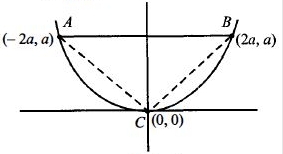
0 likes
View Solution496
DifficultMCQ
The equation of the normal to the parabola $x^2 = 8y$ at $x = 4$ is
A
$x + 2y = 0$
B
$x + y = 2$
C
$x - 2y = 0$
D
$x + y = 6$
Solution
(D) Given the parabola equation is $x^2 = 8y$.
When $x = 4$,we substitute into the equation: $4^2 = 8y \Rightarrow 16 = 8y \Rightarrow y = 2$.
So,the point of contact is $(4, 2)$.
Differentiating $x^2 = 8y$ with respect to $x$,we get $2x = 8 \frac{dy}{dx}$,which implies $\frac{dy}{dx} = \frac{2x}{8} = \frac{x}{4}$.
The slope of the tangent at $x = 4$ is $m_t = \left. \frac{x}{4} \right|_{x=4} = 1$.
The slope of the normal $m_n$ is given by $-\frac{1}{m_t} = -\frac{1}{1} = -1$.
The equation of the normal at $(4, 2)$ is $y - y_1 = m_n(x - x_1)$.
Substituting the values: $y - 2 = -1(x - 4)$.
$y - 2 = -x + 4$.
$x + y = 6$.
When $x = 4$,we substitute into the equation: $4^2 = 8y \Rightarrow 16 = 8y \Rightarrow y = 2$.
So,the point of contact is $(4, 2)$.
Differentiating $x^2 = 8y$ with respect to $x$,we get $2x = 8 \frac{dy}{dx}$,which implies $\frac{dy}{dx} = \frac{2x}{8} = \frac{x}{4}$.
The slope of the tangent at $x = 4$ is $m_t = \left. \frac{x}{4} \right|_{x=4} = 1$.
The slope of the normal $m_n$ is given by $-\frac{1}{m_t} = -\frac{1}{1} = -1$.
The equation of the normal at $(4, 2)$ is $y - y_1 = m_n(x - x_1)$.
Substituting the values: $y - 2 = -1(x - 4)$.
$y - 2 = -x + 4$.
$x + y = 6$.
0 likes
View Solution497
DifficultMCQ
The chord $PQ$ of the parabola $y^2 = x$,where one end $P$ of the chord is at point $(4, -2)$,is perpendicular to the axis of the parabola. Then the slope of the normal at $Q$ is
A
$-4$
B
$-\frac{1}{4}$
C
$4$
D
$\frac{1}{4}$
Solution
(A) The equation of the parabola is $y^2 = x$.
Given that the chord $PQ$ is perpendicular to the axis of the parabola (the $x$-axis) and one end $P$ is $(4, -2)$,the $x$-coordinate of $Q$ must also be $4$.
Since $Q$ lies on the parabola $y^2 = x$,substituting $x = 4$ gives $y^2 = 4$,so $y = \pm 2$. Since $P$ is $(4, -2)$,$Q$ must be $(4, 2)$.
The derivative of the parabola $y^2 = x$ with respect to $x$ is $2y \frac{dy}{dx} = 1$,which gives $\frac{dy}{dx} = \frac{1}{2y}$.
The slope of the tangent at $Q(4, 2)$ is $\frac{dy}{dx} \Big|_{(4, 2)} = \frac{1}{2(2)} = \frac{1}{4}$.
The slope of the normal at $Q$ is the negative reciprocal of the slope of the tangent.
Therefore,the slope of the normal is $-\frac{1}{1/4} = -4$.
Given that the chord $PQ$ is perpendicular to the axis of the parabola (the $x$-axis) and one end $P$ is $(4, -2)$,the $x$-coordinate of $Q$ must also be $4$.
Since $Q$ lies on the parabola $y^2 = x$,substituting $x = 4$ gives $y^2 = 4$,so $y = \pm 2$. Since $P$ is $(4, -2)$,$Q$ must be $(4, 2)$.
The derivative of the parabola $y^2 = x$ with respect to $x$ is $2y \frac{dy}{dx} = 1$,which gives $\frac{dy}{dx} = \frac{1}{2y}$.
The slope of the tangent at $Q(4, 2)$ is $\frac{dy}{dx} \Big|_{(4, 2)} = \frac{1}{2(2)} = \frac{1}{4}$.
The slope of the normal at $Q$ is the negative reciprocal of the slope of the tangent.
Therefore,the slope of the normal is $-\frac{1}{1/4} = -4$.
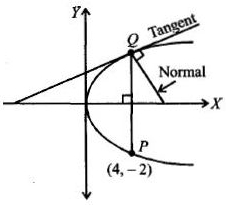
0 likes
View Solution498
DifficultMCQ
The axis of a parabola lies along the $x$-axis. If its vertex and focus are at distances $2$ and $4$ respectively from the origin on the positive $x$-axis,then which of the following points does not lie on it?
A
$(5, 2\sqrt{6})$
B
$(8, 6)$
C
$(6, 4\sqrt{2})$
D
$(4, -4)$
Solution
(B) The vertex is at $(2, 0)$ and the focus is at $(4, 0)$.
Since the axis is the $x$-axis,the parabola opens to the right.
The distance between the vertex and the focus is $a = 4 - 2 = 2$.
The equation of the parabola is $(y - 0)^2 = 4a(x - 2)$,which simplifies to $y^2 = 8(x - 2)$.
Now,we check each option:
$A$: $y^2 = (2\sqrt{6})^2 = 4 \times 6 = 24$ and $8(5 - 2) = 8 \times 3 = 24$. (Lies on parabola)
$B$: $y^2 = 6^2 = 36$ and $8(8 - 2) = 8 \times 6 = 48$. Since $36 \neq 48$,$(8, 6)$ does not lie on the parabola.
$C$: $y^2 = (4\sqrt{2})^2 = 16 \times 2 = 32$ and $8(6 - 2) = 8 \times 4 = 32$. (Lies on parabola)
$D$: $y^2 = (-4)^2 = 16$ and $8(4 - 2) = 8 \times 2 = 16$. (Lies on parabola)
Thus,the point $(8, 6)$ does not lie on the parabola.
Since the axis is the $x$-axis,the parabola opens to the right.
The distance between the vertex and the focus is $a = 4 - 2 = 2$.
The equation of the parabola is $(y - 0)^2 = 4a(x - 2)$,which simplifies to $y^2 = 8(x - 2)$.
Now,we check each option:
$A$: $y^2 = (2\sqrt{6})^2 = 4 \times 6 = 24$ and $8(5 - 2) = 8 \times 3 = 24$. (Lies on parabola)
$B$: $y^2 = 6^2 = 36$ and $8(8 - 2) = 8 \times 6 = 48$. Since $36 \neq 48$,$(8, 6)$ does not lie on the parabola.
$C$: $y^2 = (4\sqrt{2})^2 = 16 \times 2 = 32$ and $8(6 - 2) = 8 \times 4 = 32$. (Lies on parabola)
$D$: $y^2 = (-4)^2 = 16$ and $8(4 - 2) = 8 \times 2 = 16$. (Lies on parabola)
Thus,the point $(8, 6)$ does not lie on the parabola.
0 likes
View Solution499
DifficultMCQ
Let $A(4, -4)$ and $B(9, 6)$ be points on the parabola $y^2 = 4x$. Let $C$ be a point chosen on the arc $AOB$ of the parabola,where $O$ is the origin,such that the area of $\Delta ACB$ is maximum. Then,the area (in sq. units) of $\Delta ACB$ is
A
$31\frac{3}{4}$
B
$32$
C
$30\frac{1}{2}$
D
$31\frac{1}{4}$
Solution
(D) The equation of the parabola is $y^2 = 4x$,so $a = 1$. Let the coordinates of point $C$ be $(t^2, 2t)$.
The area of $\Delta ACB$ with vertices $A(4, -4)$,$B(9, 6)$,and $C(t^2, 2t)$ is given by the determinant formula:
$\text{Area} = \frac{1}{2} |x_A(y_B - y_C) + x_B(y_C - y_A) + x_C(y_A - y_B)|$
$= \frac{1}{2} |4(6 - 2t) + 9(2t - (-4)) + t^2(-4 - 6)|$
$= \frac{1}{2} |24 - 8t + 18t + 36 - 10t^2|$
$= \frac{1}{2} |-10t^2 + 10t + 60| = |-5t^2 + 5t + 30|$
To maximize the area,we find the derivative of $f(t) = -5t^2 + 5t + 30$ with respect to $t$ and set it to $0$:
$f'(t) = -10t + 5 = 0 \implies t = \frac{1}{2}$.
Substituting $t = \frac{1}{2}$ into the area expression:
$\text{Area} = |-5(\frac{1}{4}) + 5(\frac{1}{2}) + 30| = |-\frac{5}{4} + \frac{10}{4} + \frac{120}{4}| = \frac{125}{4} = 31\frac{1}{4}$ sq. units.
The area of $\Delta ACB$ with vertices $A(4, -4)$,$B(9, 6)$,and $C(t^2, 2t)$ is given by the determinant formula:
$\text{Area} = \frac{1}{2} |x_A(y_B - y_C) + x_B(y_C - y_A) + x_C(y_A - y_B)|$
$= \frac{1}{2} |4(6 - 2t) + 9(2t - (-4)) + t^2(-4 - 6)|$
$= \frac{1}{2} |24 - 8t + 18t + 36 - 10t^2|$
$= \frac{1}{2} |-10t^2 + 10t + 60| = |-5t^2 + 5t + 30|$
To maximize the area,we find the derivative of $f(t) = -5t^2 + 5t + 30$ with respect to $t$ and set it to $0$:
$f'(t) = -10t + 5 = 0 \implies t = \frac{1}{2}$.
Substituting $t = \frac{1}{2}$ into the area expression:
$\text{Area} = |-5(\frac{1}{4}) + 5(\frac{1}{2}) + 30| = |-\frac{5}{4} + \frac{10}{4} + \frac{120}{4}| = \frac{125}{4} = 31\frac{1}{4}$ sq. units.
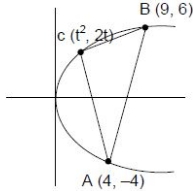
0 likes
View Solution500
DifficultMCQ
If the parabolas $y^2 = 4b(x - c)$ and $y^2 = 8ax$ have a common normal,then which one of the following is a valid choice for the ordered triad $(a, b, c)$?
A
$\left( \frac{1}{2}, 2, 3 \right)$
B
$(1, 1, 3)$
C
$\left( \frac{1}{2}, 2, 0 \right)$
D
$(1, 1, 0)$
Solution
(B) The equation of the normal to the parabola $y^2 = 4b(x - c)$ with slope $m$ is $y = m(x - c) - 2bm - bm^3$.
The equation of the normal to the parabola $y^2 = 8ax$ with slope $m$ is $y = mx - 4am - 2am^3$.
For these two parabolas to have a common normal with slope $m \neq 0$,the equations must represent the same line. Comparing the coefficients:
$m(x - c) - 2bm - bm^3 = mx - 4am - 2am^3$
$-mc - 2bm - bm^3 = -4am - 2am^3$
$mc = 4am - 2bm + 2am^3 - bm^3$
$mc = m(4a - 2b) + m^3(2a - b)$
Dividing by $m$ (assuming $m \neq 0$):
$c = 4a - 2b + m^2(2a - b)$
$m^2 = \frac{c - 4a + 2b}{2a - b} = \frac{c - 2(2a - b)}{2a - b} = \frac{c}{2a - b} - 2$.
For a common normal to exist,we require $m^2 > 0$,so $\frac{c}{2a - b} > 2$.
Testing option $(B)$ $(a=1, b=1, c=3)$:
$m^2 = \frac{3}{2(1) - 1} - 2 = \frac{3}{1} - 2 = 1 > 0$.
Thus,$(1, 1, 3)$ is a valid choice.
The equation of the normal to the parabola $y^2 = 8ax$ with slope $m$ is $y = mx - 4am - 2am^3$.
For these two parabolas to have a common normal with slope $m \neq 0$,the equations must represent the same line. Comparing the coefficients:
$m(x - c) - 2bm - bm^3 = mx - 4am - 2am^3$
$-mc - 2bm - bm^3 = -4am - 2am^3$
$mc = 4am - 2bm + 2am^3 - bm^3$
$mc = m(4a - 2b) + m^3(2a - b)$
Dividing by $m$ (assuming $m \neq 0$):
$c = 4a - 2b + m^2(2a - b)$
$m^2 = \frac{c - 4a + 2b}{2a - b} = \frac{c - 2(2a - b)}{2a - b} = \frac{c}{2a - b} - 2$.
For a common normal to exist,we require $m^2 > 0$,so $\frac{c}{2a - b} > 2$.
Testing option $(B)$ $(a=1, b=1, c=3)$:
$m^2 = \frac{3}{2(1) - 1} - 2 = \frac{3}{1} - 2 = 1 > 0$.
Thus,$(1, 1, 3)$ is a valid choice.
0 likes
View Solution10-2. Parabola, Ellipse, Hyperbola — Parabola · Frequently Asked Questions
1Are these 10-2. Parabola, Ellipse, Hyperbola questions useful for JEE and NEET?
Yes. All questions in this section are mapped to JEE Main and NEET exam patterns. Previous year questions from JEE Main, NEET, GUJCET and state-level exams are included with full solutions.
2Can I switch to Hindi or Gujarati for these questions?
Yes. Use the language tabs in the hero section or the sidebar to view the same questions and solutions in English, Hindi or Gujarati.
3How do I generate a question paper from this subtopic?
Use the Vedclass Exam Paper Generator — select the chapter and subtopic, set difficulty, and generate Sets A, B, C, D automatically. First 3 chapters of every subject are free.
Vedclass Products
For Students
Vedclass Test Series
Mock tests in real JEE/NEET style with performance analysis. 5-day free trial.
Start Free TrialFor Teachers
Exam Paper Generator
Generate Set A/B/C/D papers from this chapter in 2 minutes. 3 chapters free.
Try FreeFor Institutes
Online Exam Module
Live online exams with unlimited students, 360° analytics & white-label branding.
See DemoFor Teachers & Institutes
Generate a 10-2. Parabola, Ellipse, Hyperbola Exam Paper in 2 Minutes
Select subtopic & difficulty — Sets A, B, C, D auto-generated with No Repeat logic.
First 3 chapters of every subject are free — no payment required.