
A English
Parabola Questions in English
Class 11 Mathematics · 10-2. Parabola, Ellipse, Hyperbola · Parabola
1007+
Questions
English
Language
100%
With Solutions
Showing 49 of 1007 questions in English
651
EasyMCQ
The length of the latus rectum of the parabola $x^{2}+2y=8x-7$ is
A
$8$
B
$2$
C
$6$
D
$4$
Solution
(B) Given equation of the parabola is $x^{2}+2y=8x-7$.
Rearranging the terms,we get $x^{2}-8x=-2y-7$.
Completing the square on the left side: $x^{2}-8x+16=-2y-7+16$.
This simplifies to $(x-4)^{2}=-2y+9$.
Factoring out $-2$ on the right side: $(x-4)^{2}=-2(y-\frac{9}{2})$.
Comparing this with the standard form $(x-h)^{2}=4a(y-k)$,where the length of the latus rectum is $|4a|$.
Here,$4a = -2$,so the length of the latus rectum is $|-2| = 2$.
Rearranging the terms,we get $x^{2}-8x=-2y-7$.
Completing the square on the left side: $x^{2}-8x+16=-2y-7+16$.
This simplifies to $(x-4)^{2}=-2y+9$.
Factoring out $-2$ on the right side: $(x-4)^{2}=-2(y-\frac{9}{2})$.
Comparing this with the standard form $(x-h)^{2}=4a(y-k)$,where the length of the latus rectum is $|4a|$.
Here,$4a = -2$,so the length of the latus rectum is $|-2| = 2$.
0 likes
View Solution652
EasyMCQ
The equation of the directrix of the parabola $3x^{2} = 16y$ is
A
$3y + 4 = 0$
B
$3x + 4 = 0$
C
$3y - 4 = 0$
D
$3x - 4 = 0$
Solution
(A) The given equation of the parabola is $3x^{2} = 16y$.
Dividing by $3$,we get $x^{2} = \frac{16}{3}y$.
Comparing this with the standard form $x^{2} = 4ay$,we have $4a = \frac{16}{3}$,which gives $a = \frac{4}{3}$.
The equation of the directrix for the parabola $x^{2} = 4ay$ is $y = -a$.
Substituting the value of $a$,we get $y = -\frac{4}{3}$,which simplifies to $3y + 4 = 0$.
Dividing by $3$,we get $x^{2} = \frac{16}{3}y$.
Comparing this with the standard form $x^{2} = 4ay$,we have $4a = \frac{16}{3}$,which gives $a = \frac{4}{3}$.
The equation of the directrix for the parabola $x^{2} = 4ay$ is $y = -a$.
Substituting the value of $a$,we get $y = -\frac{4}{3}$,which simplifies to $3y + 4 = 0$.
0 likes
View Solution653
MediumMCQ
The Cartesian coordinates of the point on the parabola $y^2 = -16x$,whose parameter is $t = \frac{1}{2}$,are
A
$(-2, 4)$
B
$(4, -1)$
C
$(-1, -4)$
D
$(-1, 4)$
Solution
(D) Given the parabola equation $y^2 = -16x$ and parameter $t = \frac{1}{2}$.
Comparing $y^2 = -16x$ with the standard form $y^2 = -4ax$,we get $4a = 16$,which implies $a = 4$.
The parametric coordinates of a point on the parabola $y^2 = -4ax$ are given by $P(t) = (-at^2, 2at)$.
Substituting $a = 4$ and $t = \frac{1}{2}$ into the coordinates:
$x = -a t^2 = -4 \times (\frac{1}{2})^2 = -4 \times \frac{1}{4} = -1$.
$y = 2at = 2 \times 4 \times \frac{1}{2} = 4$.
Therefore,the coordinates of the point are $(-1, 4)$.
Comparing $y^2 = -16x$ with the standard form $y^2 = -4ax$,we get $4a = 16$,which implies $a = 4$.
The parametric coordinates of a point on the parabola $y^2 = -4ax$ are given by $P(t) = (-at^2, 2at)$.
Substituting $a = 4$ and $t = \frac{1}{2}$ into the coordinates:
$x = -a t^2 = -4 \times (\frac{1}{2})^2 = -4 \times \frac{1}{4} = -1$.
$y = 2at = 2 \times 4 \times \frac{1}{2} = 4$.
Therefore,the coordinates of the point are $(-1, 4)$.
0 likes
View Solution654
EasyMCQ
The equation of the directrix for the parabola $4x^{2}-4x-2y+3=0$ is
A
$2y=1$
B
$2x=1$
C
$2y=3$
D
$2x=3$
Solution
(A) Given the parabola equation: $4x^{2}-4x-2y+3=0$
$4(x^{2}-x) = 2y-3$
$4(x^{2}-x+\frac{1}{4}-\frac{1}{4}) = 2y-3$
$4(x-\frac{1}{2})^{2}-1 = 2y-3$
$4(x-\frac{1}{2})^{2} = 2y-2$
$(x-\frac{1}{2})^{2} = \frac{1}{2}(y-1)$
Comparing this with the standard form $X^{2} = 4aY$,where $X = x-\frac{1}{2}$ and $Y = y-1$:
$4a = \frac{1}{2} \implies a = \frac{1}{8}$
The equation of the directrix is $Y+a = 0$
$y-1+\frac{1}{8} = 0$
$y = \frac{7}{8}$
Wait,re-evaluating the standard form: $(x-\frac{1}{2})^{2} = 2(y-1)$ implies $4a = 2$,so $a = \frac{1}{2}$.
The directrix is $Y = -a \implies y-1 = -\frac{1}{2}$
$y = 1 - \frac{1}{2} = \frac{1}{2}$
$2y = 1$.
$4(x^{2}-x) = 2y-3$
$4(x^{2}-x+\frac{1}{4}-\frac{1}{4}) = 2y-3$
$4(x-\frac{1}{2})^{2}-1 = 2y-3$
$4(x-\frac{1}{2})^{2} = 2y-2$
$(x-\frac{1}{2})^{2} = \frac{1}{2}(y-1)$
Comparing this with the standard form $X^{2} = 4aY$,where $X = x-\frac{1}{2}$ and $Y = y-1$:
$4a = \frac{1}{2} \implies a = \frac{1}{8}$
The equation of the directrix is $Y+a = 0$
$y-1+\frac{1}{8} = 0$
$y = \frac{7}{8}$
Wait,re-evaluating the standard form: $(x-\frac{1}{2})^{2} = 2(y-1)$ implies $4a = 2$,so $a = \frac{1}{2}$.
The directrix is $Y = -a \implies y-1 = -\frac{1}{2}$
$y = 1 - \frac{1}{2} = \frac{1}{2}$
$2y = 1$.
0 likes
View Solution655
EasyMCQ
The intercepts of the focal chord (which is a part of the latus rectum) to the parabola $y^{2}=4ax$ are $b$ and $k$. Then $k$ is equal to:
A
$\frac{ab}{a-b}$
B
$\frac{a}{b-a}$
C
$\frac{b}{b-a}$
D
$\frac{ab}{b-a}$
Solution
(D) Let the focal chord be $PQ$ passing through the focus $S(a, 0)$. Let the coordinates of $P$ be $(at_{1}^{2}, 2at_{1})$ and $Q$ be $(at_{2}^{2}, 2at_{2})$.
Since it is a focal chord,$t_{1}t_{2} = -1$.
The focal distance of any point $P(x, y)$ on the parabola is $SP = a + x = a + at_{1}^{2} = a(1 + t_{1}^{2})$.
Given the intercepts of the focal chord are $b$ and $k$,we have $b = a(1 + t_{1}^{2})$ and $k = a(1 + t_{2}^{2})$.
Since $t_{2} = -1/t_{1}$,we have $k = a(1 + (-1/t_{1})^{2}) = a(1 + 1/t_{1}^{2}) = a(\frac{t_{1}^{2} + 1}{t_{1}^{2}})$.
From $b = a(1 + t_{1}^{2})$,we get $t_{1}^{2} = \frac{b}{a} - 1 = \frac{b-a}{a}$.
Substituting this into the expression for $k$:
$k = a(1 + \frac{1}{(b-a)/a}) = a(1 + \frac{a}{b-a}) = a(\frac{b-a+a}{b-a}) = a(\frac{b}{b-a}) = \frac{ab}{b-a}$.
Since it is a focal chord,$t_{1}t_{2} = -1$.
The focal distance of any point $P(x, y)$ on the parabola is $SP = a + x = a + at_{1}^{2} = a(1 + t_{1}^{2})$.
Given the intercepts of the focal chord are $b$ and $k$,we have $b = a(1 + t_{1}^{2})$ and $k = a(1 + t_{2}^{2})$.
Since $t_{2} = -1/t_{1}$,we have $k = a(1 + (-1/t_{1})^{2}) = a(1 + 1/t_{1}^{2}) = a(\frac{t_{1}^{2} + 1}{t_{1}^{2}})$.
From $b = a(1 + t_{1}^{2})$,we get $t_{1}^{2} = \frac{b}{a} - 1 = \frac{b-a}{a}$.
Substituting this into the expression for $k$:
$k = a(1 + \frac{1}{(b-a)/a}) = a(1 + \frac{a}{b-a}) = a(\frac{b-a+a}{b-a}) = a(\frac{b}{b-a}) = \frac{ab}{b-a}$.
0 likes
View Solution656
EasyMCQ
The equation of the parabola with vertex at $(0,0)$ and length of latus rectum equal to $\frac{16}{3}$ is:
A
$8x^{2} + 3y^{2} = 72$
B
$16y^{2} = 3x$
C
$3y^{2} = 16x$
D
$3x^{2} + 16y^{2} = 48$
Solution
(C) The standard equation of a parabola with vertex at $(0,0)$ opening along the positive $x$-axis is $y^{2} = 4ax$.
The length of the latus rectum is given by $4a = \frac{16}{3}$.
Substituting $4a = \frac{16}{3}$ into the standard equation $y^{2} = 4ax$,we get $y^{2} = \frac{16}{3}x$.
Multiplying both sides by $3$,we obtain $3y^{2} = 16x$.
The length of the latus rectum is given by $4a = \frac{16}{3}$.
Substituting $4a = \frac{16}{3}$ into the standard equation $y^{2} = 4ax$,we get $y^{2} = \frac{16}{3}x$.
Multiplying both sides by $3$,we obtain $3y^{2} = 16x$.
0 likes
View Solution657
EasyMCQ
The focal distance of a point $P$ on the parabola $y^{2}=12x$ if the ordinate of $P$ is $6$,is
A
$12$
B
$6$
C
$3$
D
$9$
Solution
(B) The given equation of the parabola is $y^{2}=12x$.
Comparing this with $y^{2}=4ax$,we get $4a=12$,which implies $a=3$.
For the point $P(x, y)$,the ordinate is given as $y=6$.
Since the point $P$ lies on the parabola,we substitute $y=6$ into the equation:
$(6)^{2}=12x$ $\Rightarrow 36=12x$ $\Rightarrow x=3$.
The focal distance of a point $P(x, y)$ on the parabola $y^{2}=4ax$ is given by the formula $x+a$.
Substituting the values $x=3$ and $a=3$,we get:
Focal distance $= 3+3=6$.
Comparing this with $y^{2}=4ax$,we get $4a=12$,which implies $a=3$.
For the point $P(x, y)$,the ordinate is given as $y=6$.
Since the point $P$ lies on the parabola,we substitute $y=6$ into the equation:
$(6)^{2}=12x$ $\Rightarrow 36=12x$ $\Rightarrow x=3$.
The focal distance of a point $P(x, y)$ on the parabola $y^{2}=4ax$ is given by the formula $x+a$.
Substituting the values $x=3$ and $a=3$,we get:
Focal distance $= 3+3=6$.
0 likes
View Solution658
EasyMCQ
The focal distance of a point on the parabola $y^{2}=16x$ whose ordinate is twice the abscissa,is
A
$6$
B
$8$
C
$10$
D
$12$
Solution
(B) The given parabola is $y^{2}=16x$. Comparing with $y^{2}=4ax$,we get $4a=16$,so $a=4$.
Let the point on the parabola be $(h, k)$.
Given that the ordinate is twice the abscissa,we have $k=2h$.
Substituting $k=2h$ into the parabola equation: $(2h)^{2}=16h$ $\Rightarrow 4h^{2}=16h$ $\Rightarrow 4h(h-4)=0$.
Thus,$h=0$ or $h=4$.
For $h=0$,$k=0$. For $h=4$,$k=8$.
The point $(0,0)$ is the vertex,where the focal distance is $a=4$.
The point $(4,8)$ is on the parabola,where the focal distance is $h+a = 4+4 = 8$.
Since the question asks for the focal distance of a point (implying a non-vertex point),the answer is $8$.
Let the point on the parabola be $(h, k)$.
Given that the ordinate is twice the abscissa,we have $k=2h$.
Substituting $k=2h$ into the parabola equation: $(2h)^{2}=16h$ $\Rightarrow 4h^{2}=16h$ $\Rightarrow 4h(h-4)=0$.
Thus,$h=0$ or $h=4$.
For $h=0$,$k=0$. For $h=4$,$k=8$.
The point $(0,0)$ is the vertex,where the focal distance is $a=4$.
The point $(4,8)$ is on the parabola,where the focal distance is $h+a = 4+4 = 8$.
Since the question asks for the focal distance of a point (implying a non-vertex point),the answer is $8$.
0 likes
View Solution659
MediumMCQ
The angle between the tangents drawn from the point $(1,4)$ to the parabola $y^2=4x$ is
A
$\frac{\pi}{6}$
B
$\frac{\pi}{2}$
C
$\frac{\pi}{3}$
D
$\frac{\pi}{4}$
Solution
(C) The equation of the parabola is $y^2 = 4ax$,where $a = 1$.
The point is $(x_1, y_1) = (1, 4)$.
The locus of the point of intersection of perpendicular tangents to a parabola is its directrix.
The directrix of the parabola $y^2 = 4x$ is $x = -a$,which is $x = -1$.
Since the point $(1, 4)$ does not lie on the directrix $x = -1$,the tangents are not perpendicular.
The angle $\theta$ between the tangents from a point $(x_1, y_1)$ to the parabola $y^2 = 4ax$ is given by $\tan \theta = \left| \frac{\sqrt{y_1^2 - 4ax_1}}{x_1 + a} \right|$.
Substituting the values: $a = 1, x_1 = 1, y_1 = 4$.
$\tan \theta = \left| \frac{\sqrt{4^2 - 4(1)(1)}}{1 + 1} \right| = \left| \frac{\sqrt{16 - 4}}{2} \right| = \frac{\sqrt{12}}{2} = \frac{2\sqrt{3}}{2} = \sqrt{3}$.
Therefore,$\theta = \tan^{-1}(\sqrt{3}) = \frac{\pi}{3}$.
The point is $(x_1, y_1) = (1, 4)$.
The locus of the point of intersection of perpendicular tangents to a parabola is its directrix.
The directrix of the parabola $y^2 = 4x$ is $x = -a$,which is $x = -1$.
Since the point $(1, 4)$ does not lie on the directrix $x = -1$,the tangents are not perpendicular.
The angle $\theta$ between the tangents from a point $(x_1, y_1)$ to the parabola $y^2 = 4ax$ is given by $\tan \theta = \left| \frac{\sqrt{y_1^2 - 4ax_1}}{x_1 + a} \right|$.
Substituting the values: $a = 1, x_1 = 1, y_1 = 4$.
$\tan \theta = \left| \frac{\sqrt{4^2 - 4(1)(1)}}{1 + 1} \right| = \left| \frac{\sqrt{16 - 4}}{2} \right| = \frac{\sqrt{12}}{2} = \frac{2\sqrt{3}}{2} = \sqrt{3}$.
Therefore,$\theta = \tan^{-1}(\sqrt{3}) = \frac{\pi}{3}$.
0 likes
View Solution660
MediumMCQ
The equation of the tangent to the parabola $y^2=8x$,which is parallel to the line $4x-y+3=0$,is
A
$2x-8y+1=0$
B
$8x-2y+1=0$
C
$8x+2y+1=0$
D
$2x-8y-1=0$
Solution
(B) The given parabola is $y^2=8x$. Comparing with $y^2=4ax$,we get $4a=8$,so $a=2$.
The slope of the line $4x-y+3=0$ is $m=4$.
The equation of a tangent to the parabola $y^2=4ax$ with slope $m$ is $y=mx+\frac{a}{m}$.
Substituting $a=2$ and $m=4$ into the formula:
$y=4x+\frac{2}{4}$
$y=4x+\frac{1}{2}$
$2y=8x+1$
$8x-2y+1=0$.
The slope of the line $4x-y+3=0$ is $m=4$.
The equation of a tangent to the parabola $y^2=4ax$ with slope $m$ is $y=mx+\frac{a}{m}$.
Substituting $a=2$ and $m=4$ into the formula:
$y=4x+\frac{2}{4}$
$y=4x+\frac{1}{2}$
$2y=8x+1$
$8x-2y+1=0$.
0 likes
View Solution661
EasyMCQ
If the line $lx + my + n = 0$ is tangent to the parabola $y^{2} = 4ax$,then
A
$mn = al^{2}$
B
$lm = an^{2}$
C
$ln = am^{2}$
D
None of the above
Solution
(C) The equation of the parabola is $y^{2} = 4ax$.
Let the line $lx + my + n = 0$ be tangent to the parabola.
Rewriting the line equation as $y = -\frac{l}{m}x - \frac{n}{m}$,which is in the form $y = mx + c$ where the slope $M = -\frac{l}{m}$ and intercept $C = -\frac{n}{m}$.
The condition for the line $y = Mx + C$ to be tangent to the parabola $y^{2} = 4ax$ is $C = \frac{a}{M}$.
Substituting the values of $M$ and $C$:
$-\frac{n}{m} = \frac{a}{-l/m} = -\frac{am}{l}$.
Multiplying both sides by $-1$,we get $\frac{n}{m} = \frac{am}{l}$.
Cross-multiplying gives $nl = am^{2}$.
Let the line $lx + my + n = 0$ be tangent to the parabola.
Rewriting the line equation as $y = -\frac{l}{m}x - \frac{n}{m}$,which is in the form $y = mx + c$ where the slope $M = -\frac{l}{m}$ and intercept $C = -\frac{n}{m}$.
The condition for the line $y = Mx + C$ to be tangent to the parabola $y^{2} = 4ax$ is $C = \frac{a}{M}$.
Substituting the values of $M$ and $C$:
$-\frac{n}{m} = \frac{a}{-l/m} = -\frac{am}{l}$.
Multiplying both sides by $-1$,we get $\frac{n}{m} = \frac{am}{l}$.
Cross-multiplying gives $nl = am^{2}$.
0 likes
View Solution662
EasyMCQ
The equation of the tangent to the parabola $y^{2}=16x$ at the point $P(3, 6)$ is:
A
$4x - 3y + 12 = 0$
B
$3y - 4x - 12 = 0$
C
$4x - 3y - 24 = 0$
D
$3y - x - 24 = 0$
Solution
(B) The equation of the tangent to the parabola $y^{2} = 4ax$ at point $(x_{1}, y_{1})$ is given by $yy_{1} = 2a(x + x_{1})$.
Here,the parabola is $y^{2} = 16x$,so $4a = 16$,which implies $a = 4$.
The point is $(x_{1}, y_{1}) = (3, 6)$.
Substituting these values into the formula:
$y(6) = 2(4)(x + 3)$
$6y = 8(x + 3)$
$6y = 8x + 24$
Dividing by $2$:
$3y = 4x + 12$
Rearranging the terms:
$3y - 4x - 12 = 0$.
Here,the parabola is $y^{2} = 16x$,so $4a = 16$,which implies $a = 4$.
The point is $(x_{1}, y_{1}) = (3, 6)$.
Substituting these values into the formula:
$y(6) = 2(4)(x + 3)$
$6y = 8(x + 3)$
$6y = 8x + 24$
Dividing by $2$:
$3y = 4x + 12$
Rearranging the terms:
$3y - 4x - 12 = 0$.
0 likes
View Solution663
EasyMCQ
The $Y$-intercept of the common tangent to the parabola $y^2 = 32x$ and $x^2 = 108y$ is
A
$3$
B
$-12$
C
$-3$
D
$2$
Solution
(B) The given parabolas are $y^2 = 32x$ (where $4a = 32 \implies a = 8$) and $x^2 = 108y$ (where $4b = 108 \implies b = 27$).
Any tangent to $y^2 = 32x$ is of the form $y = mx + \frac{8}{m}$.
This line is also a tangent to $x^2 = 108y$. Substituting $y = mx + \frac{8}{m}$ into $x^2 = 108y$ gives $x^2 = 108(mx + \frac{8}{m}) \implies x^2 - 108mx - \frac{864}{m} = 0$.
Since the line is tangent,the discriminant $D = 0$:
$(-108m)^2 - 4(1)(-\frac{864}{m}) = 0 \implies 11664m^2 + \frac{3456}{m} = 0$.
$11664m^3 = -3456 \implies m^3 = -\frac{3456}{11664} = -\frac{1}{3.375} = -\frac{8}{27}$.
Thus,$m = -\frac{2}{3}$.
The $Y$-intercept is $c = \frac{8}{m} = \frac{8}{-2/3} = 8 \times (-\frac{3}{2}) = -12$.
Any tangent to $y^2 = 32x$ is of the form $y = mx + \frac{8}{m}$.
This line is also a tangent to $x^2 = 108y$. Substituting $y = mx + \frac{8}{m}$ into $x^2 = 108y$ gives $x^2 = 108(mx + \frac{8}{m}) \implies x^2 - 108mx - \frac{864}{m} = 0$.
Since the line is tangent,the discriminant $D = 0$:
$(-108m)^2 - 4(1)(-\frac{864}{m}) = 0 \implies 11664m^2 + \frac{3456}{m} = 0$.
$11664m^3 = -3456 \implies m^3 = -\frac{3456}{11664} = -\frac{1}{3.375} = -\frac{8}{27}$.
Thus,$m = -\frac{2}{3}$.
The $Y$-intercept is $c = \frac{8}{m} = \frac{8}{-2/3} = 8 \times (-\frac{3}{2}) = -12$.
0 likes
View Solution664
DifficultMCQ
The angle between the parabolas $y^2 = 4(x-1)$ and $x^2 + 4(y-3) = 0$ at the common end of their latus rectum is:
A
$\frac{\pi}{2}$
B
$\frac{\pi}{4}$
C
$\frac{\pi}{6}$
D
$\frac{\pi}{3}$
Solution
(A) For the parabola $y^2 = 4(x-1)$,the vertex is $(1, 0)$ and $a = 1$. The latus rectum is $x = 1+1 = 2$. The ends of the latus rectum are $(2, 2)$ and $(2, -2)$.
For the parabola $x^2 = -4(y-3)$,the vertex is $(0, 3)$ and $a = 1$. The latus rectum is $y = 3-1 = 2$. The ends of the latus rectum are $(2, 2)$ and $(-2, 2)$.
The common point is $(2, 2)$.
For $y^2 = 4(x-1)$,differentiating with respect to $x$: $2y \frac{dy}{dx} = 4 \implies \frac{dy}{dx} = \frac{2}{y}$. At $(2, 2)$,$m_1 = \frac{2}{2} = 1$.
For $x^2 = -4(y-3)$,differentiating with respect to $x$: $2x = -4 \frac{dy}{dx} \implies \frac{dy}{dx} = -\frac{x}{2}$. At $(2, 2)$,$m_2 = -\frac{2}{2} = -1$.
Since $m_1 \times m_2 = 1 \times (-1) = -1$,the tangents are perpendicular.
Therefore,the angle between the parabolas is $\frac{\pi}{2}$.
For the parabola $x^2 = -4(y-3)$,the vertex is $(0, 3)$ and $a = 1$. The latus rectum is $y = 3-1 = 2$. The ends of the latus rectum are $(2, 2)$ and $(-2, 2)$.
The common point is $(2, 2)$.
For $y^2 = 4(x-1)$,differentiating with respect to $x$: $2y \frac{dy}{dx} = 4 \implies \frac{dy}{dx} = \frac{2}{y}$. At $(2, 2)$,$m_1 = \frac{2}{2} = 1$.
For $x^2 = -4(y-3)$,differentiating with respect to $x$: $2x = -4 \frac{dy}{dx} \implies \frac{dy}{dx} = -\frac{x}{2}$. At $(2, 2)$,$m_2 = -\frac{2}{2} = -1$.
Since $m_1 \times m_2 = 1 \times (-1) = -1$,the tangents are perpendicular.
Therefore,the angle between the parabolas is $\frac{\pi}{2}$.
0 likes
View Solution665
EasyMCQ
If $2x + y + \lambda = 0$ is a normal to the parabola $y^{2} = 8x$,then the value of $\lambda$ is
A
$-24$
B
$8$
C
$-16$
D
$24$
Solution
(A) Given the parabola equation is $y^{2} = 8x$.
Comparing with $y^{2} = 4ax$,we get $a = 2$.
The slope of the normal to the parabola $y^{2} = 4ax$ at point $(x_{1}, y_{1})$ is given by $m = -\frac{y_{1}}{2a}$.
Given the normal equation $2x + y + \lambda = 0$,which can be written as $y = -2x - \lambda$.
Comparing this with $y = mx + c$,the slope $m = -2$.
Equating the slopes: $-2 = -\frac{y_{1}}{2(2)}$ $\Rightarrow -2 = -\frac{y_{1}}{4}$ $\Rightarrow y_{1} = 8$.
Since the point $(x_{1}, y_{1})$ lies on the parabola $y^{2} = 8x$,we have $8^{2} = 8x_{1}$ $\Rightarrow 64 = 8x_{1}$ $\Rightarrow x_{1} = 8$.
Since the point $(8, 8)$ lies on the line $2x + y + \lambda = 0$,we substitute the values:
$2(8) + 8 + \lambda = 0$
$16 + 8 + \lambda = 0$
$24 + \lambda = 0$
$\lambda = -24$.
Comparing with $y^{2} = 4ax$,we get $a = 2$.
The slope of the normal to the parabola $y^{2} = 4ax$ at point $(x_{1}, y_{1})$ is given by $m = -\frac{y_{1}}{2a}$.
Given the normal equation $2x + y + \lambda = 0$,which can be written as $y = -2x - \lambda$.
Comparing this with $y = mx + c$,the slope $m = -2$.
Equating the slopes: $-2 = -\frac{y_{1}}{2(2)}$ $\Rightarrow -2 = -\frac{y_{1}}{4}$ $\Rightarrow y_{1} = 8$.
Since the point $(x_{1}, y_{1})$ lies on the parabola $y^{2} = 8x$,we have $8^{2} = 8x_{1}$ $\Rightarrow 64 = 8x_{1}$ $\Rightarrow x_{1} = 8$.
Since the point $(8, 8)$ lies on the line $2x + y + \lambda = 0$,we substitute the values:
$2(8) + 8 + \lambda = 0$
$16 + 8 + \lambda = 0$
$24 + \lambda = 0$
$\lambda = -24$.
0 likes
View Solution666
MediumMCQ
The equations of the normals at the ends of the latus rectum of the parabola $y^{2}=4ax$ are given by
A
$x^{2}-y^{2}-6ax+9a^{2}=0$
B
$x^{2}-y^{2}-6ax-6ay+9a^{2}=0$
C
$x^{2}-y^{2}-6ay+9a^{2}=0$
D
None of the above
Solution
(A) The coordinates of the ends of the latus rectum of the parabola $y^{2}=4ax$ are $(a, 2a)$ and $(a, -2a)$.
For the parabola $y^{2}=4ax$,the slope of the tangent at $(x_{1}, y_{1})$ is $m = \frac{2a}{y_{1}}$.
At $(a, 2a)$,the slope of the tangent is $m = \frac{2a}{2a} = 1$,so the slope of the normal is $-1$.
The equation of the normal at $(a, 2a)$ is $y - 2a = -1(x - a)$,which simplifies to $x + y - 3a = 0$.
At $(a, -2a)$,the slope of the tangent is $m = \frac{2a}{-2a} = -1$,so the slope of the normal is $1$.
The equation of the normal at $(a, -2a)$ is $y - (-2a) = 1(x - a)$,which simplifies to $x - y - 3a = 0$.
The combined equation is $(x + y - 3a)(x - y - 3a) = 0$.
Expanding this,we get $((x - 3a) + y)((x - 3a) - y) = 0$,which is $(x - 3a)^{2} - y^{2} = 0$.
Thus,$x^{2} - 6ax + 9a^{2} - y^{2} = 0$,or $x^{2} - y^{2} - 6ax + 9a^{2} = 0$.
For the parabola $y^{2}=4ax$,the slope of the tangent at $(x_{1}, y_{1})$ is $m = \frac{2a}{y_{1}}$.
At $(a, 2a)$,the slope of the tangent is $m = \frac{2a}{2a} = 1$,so the slope of the normal is $-1$.
The equation of the normal at $(a, 2a)$ is $y - 2a = -1(x - a)$,which simplifies to $x + y - 3a = 0$.
At $(a, -2a)$,the slope of the tangent is $m = \frac{2a}{-2a} = -1$,so the slope of the normal is $1$.
The equation of the normal at $(a, -2a)$ is $y - (-2a) = 1(x - a)$,which simplifies to $x - y - 3a = 0$.
The combined equation is $(x + y - 3a)(x - y - 3a) = 0$.
Expanding this,we get $((x - 3a) + y)((x - 3a) - y) = 0$,which is $(x - 3a)^{2} - y^{2} = 0$.
Thus,$x^{2} - 6ax + 9a^{2} - y^{2} = 0$,or $x^{2} - y^{2} - 6ax + 9a^{2} = 0$.
0 likes
View Solution667
MediumMCQ
The pole of the line $lx + my + n = 0$ with respect to the parabola $y^{2} = 4ax$ is
A
$\left(\frac{n}{l}, \frac{-2am}{l}\right)$
B
$\left(\frac{-n}{l}, \frac{2am}{l}\right)$
C
$\left(\frac{n}{l}, \frac{2am}{l}\right)$
D
$\left(\frac{-n}{l}, \frac{-2am}{l}\right)$
Solution
(A) The equation of the polar of a point $P(x_{1}, y_{1})$ with respect to the parabola $y^{2} = 4ax$ is given by $yy_{1} = 2a(x + x_{1})$.
This can be rewritten as $2ax - yy_{1} + 2ax_{1} = 0 \dots(i)$.
The given line is $lx + my + n = 0 \dots(ii)$.
Comparing equations $(i)$ and $(ii)$,we have:
$\frac{2a}{l} = \frac{-y_{1}}{m} = \frac{2ax_{1}}{n}$.
From the first and third ratios: $\frac{2a}{l} = \frac{2ax_{1}}{n} \Rightarrow x_{1} = \frac{n}{l}$.
From the first and second ratios: $\frac{2a}{l} = \frac{-y_{1}}{m} \Rightarrow y_{1} = \frac{-2am}{l}$.
Thus,the pole is $\left(\frac{n}{l}, \frac{-2am}{l}\right)$.
This can be rewritten as $2ax - yy_{1} + 2ax_{1} = 0 \dots(i)$.
The given line is $lx + my + n = 0 \dots(ii)$.
Comparing equations $(i)$ and $(ii)$,we have:
$\frac{2a}{l} = \frac{-y_{1}}{m} = \frac{2ax_{1}}{n}$.
From the first and third ratios: $\frac{2a}{l} = \frac{2ax_{1}}{n} \Rightarrow x_{1} = \frac{n}{l}$.
From the first and second ratios: $\frac{2a}{l} = \frac{-y_{1}}{m} \Rightarrow y_{1} = \frac{-2am}{l}$.
Thus,the pole is $\left(\frac{n}{l}, \frac{-2am}{l}\right)$.
0 likes
View Solution668
EasyMCQ
The line $y=mx+3$ is tangent to the parabola $y^2=4x$,if the value of $m$ is
A
$3$
B
$1/3$
C
$4$
D
$1/4$
Solution
(B) The equation of the parabola is $y^2 = 4ax$,where $4a = 4$,so $a = 1$.
The condition for the line $y = mx + c$ to be tangent to the parabola $y^2 = 4ax$ is $c = a/m$.
Given the line $y = mx + 3$,we have $c = 3$.
Substituting the values into the condition: $3 = 1/m$.
Therefore,$m = 1/3$.
The condition for the line $y = mx + c$ to be tangent to the parabola $y^2 = 4ax$ is $c = a/m$.
Given the line $y = mx + 3$,we have $c = 3$.
Substituting the values into the condition: $3 = 1/m$.
Therefore,$m = 1/3$.
0 likes
View Solution669
EasyMCQ
The nearest point on the curve $x^2=2y$ to the point $(0,5)$ is . . . . . . .
A
$(2,2)$
B
$(0,0)$
C
$(2\sqrt{2}, 0)$
D
$(2, 2)$
Solution
(D) Let the point on the curve $x^2=2y$ be $P(x, y)$. Since $x^2=2y$,we have $y = \frac{x^2}{2}$.
Thus,the point $P$ is $(x, \frac{x^2}{2})$.
The distance $D$ between $P(x, \frac{x^2}{2})$ and $(0, 5)$ is given by $D^2 = (x-0)^2 + (\frac{x^2}{2}-5)^2$.
Let $f(x) = D^2 = x^2 + (\frac{x^2}{2}-5)^2 = x^2 + \frac{x^4}{4} - 5x^2 + 25 = \frac{x^4}{4} - 4x^2 + 25$.
To find the minimum distance,we differentiate $f(x)$ with respect to $x$ and set it to $0$:
$f'(x) = x^3 - 8x = x(x^2 - 8) = 0$.
This gives $x = 0$ or $x^2 = 8$,so $x = \pm 2\sqrt{2}$.
For $x=0$,$y=0$,$D^2 = 25$,$D=5$.
For $x^2=8$,$y = \frac{8}{2} = 4$. Then $D^2 = 8 + (4-5)^2 = 8 + 1 = 9$,so $D=3$.
Since $3 < 5$,the nearest point is $(2\sqrt{2}, 4)$ or $(-2\sqrt{2}, 4)$.
Comparing with the given options,the correct point is $(2\sqrt{2}, 4)$.
Thus,the point $P$ is $(x, \frac{x^2}{2})$.
The distance $D$ between $P(x, \frac{x^2}{2})$ and $(0, 5)$ is given by $D^2 = (x-0)^2 + (\frac{x^2}{2}-5)^2$.
Let $f(x) = D^2 = x^2 + (\frac{x^2}{2}-5)^2 = x^2 + \frac{x^4}{4} - 5x^2 + 25 = \frac{x^4}{4} - 4x^2 + 25$.
To find the minimum distance,we differentiate $f(x)$ with respect to $x$ and set it to $0$:
$f'(x) = x^3 - 8x = x(x^2 - 8) = 0$.
This gives $x = 0$ or $x^2 = 8$,so $x = \pm 2\sqrt{2}$.
For $x=0$,$y=0$,$D^2 = 25$,$D=5$.
For $x^2=8$,$y = \frac{8}{2} = 4$. Then $D^2 = 8 + (4-5)^2 = 8 + 1 = 9$,so $D=3$.
Since $3 < 5$,the nearest point is $(2\sqrt{2}, 4)$ or $(-2\sqrt{2}, 4)$.
Comparing with the given options,the correct point is $(2\sqrt{2}, 4)$.
0 likes
View Solution670
EasyMCQ
The length of the subnormal to any point of a curve is constant. Then,the eccentricity of the curve is . . . . . .
A
$e = \sqrt{2}$
B
$e > 1$
C
$0 < e < 1$
D
$e = 1$
Solution
(D) The length of the subnormal at any point $(x, y)$ on a curve is given by the formula $L = |y \frac{dy}{dx}|$.
Given that the length of the subnormal is constant,let $L = k$,where $k$ is a constant.
Thus,$|y \frac{dy}{dx}| = k$.
Assuming $y > 0$,we have $y \frac{dy}{dx} = k$.
Integrating both sides with respect to $x$: $\int y \, dy = \int k \, dx$.
This gives $\frac{y^2}{2} = kx + C$.
For simplicity,let $C = 0$,so $y^2 = 2kx$.
This is the equation of a parabola.
The eccentricity of a parabola is $e = 1$.
Given that the length of the subnormal is constant,let $L = k$,where $k$ is a constant.
Thus,$|y \frac{dy}{dx}| = k$.
Assuming $y > 0$,we have $y \frac{dy}{dx} = k$.
Integrating both sides with respect to $x$: $\int y \, dy = \int k \, dx$.
This gives $\frac{y^2}{2} = kx + C$.
For simplicity,let $C = 0$,so $y^2 = 2kx$.
This is the equation of a parabola.
The eccentricity of a parabola is $e = 1$.
0 likes
View Solution671
MediumMCQ
The length of the latus rectum of the parabola $4y^{2} + 3x + 3y + 1 = 0$ is
A
$\frac{4}{3}$
B
$7$
C
$12$
D
$\frac{3}{4}$
Solution
(D) Given the equation of the parabola: $4y^{2} + 3x + 3y + 1 = 0$.
Rearranging the terms to isolate $y$ terms: $4y^{2} + 3y = -3x - 1$.
Dividing by $4$: $y^{2} + \frac{3}{4}y = -\frac{3}{4}x - \frac{1}{4}$.
Completing the square on the left side: $(y + \frac{3}{8})^{2} - \frac{9}{64} = -\frac{3}{4}x - \frac{1}{4}$.
$(y + \frac{3}{8})^{2} = -\frac{3}{4}x - \frac{1}{4} + \frac{9}{64}$.
$(y + \frac{3}{8})^{2} = -\frac{3}{4}x - \frac{16}{64} + \frac{9}{64}$.
$(y + \frac{3}{8})^{2} = -\frac{3}{4}x - \frac{7}{64}$.
$(y + \frac{3}{8})^{2} = -\frac{3}{4}(x + \frac{7}{48})$.
Comparing this with the standard form $(y - k)^{2} = -4a(x - h)$,we get $4a = \frac{3}{4}$.
Thus,the length of the latus rectum is $4a = \frac{3}{4}$.
Rearranging the terms to isolate $y$ terms: $4y^{2} + 3y = -3x - 1$.
Dividing by $4$: $y^{2} + \frac{3}{4}y = -\frac{3}{4}x - \frac{1}{4}$.
Completing the square on the left side: $(y + \frac{3}{8})^{2} - \frac{9}{64} = -\frac{3}{4}x - \frac{1}{4}$.
$(y + \frac{3}{8})^{2} = -\frac{3}{4}x - \frac{1}{4} + \frac{9}{64}$.
$(y + \frac{3}{8})^{2} = -\frac{3}{4}x - \frac{16}{64} + \frac{9}{64}$.
$(y + \frac{3}{8})^{2} = -\frac{3}{4}x - \frac{7}{64}$.
$(y + \frac{3}{8})^{2} = -\frac{3}{4}(x + \frac{7}{48})$.
Comparing this with the standard form $(y - k)^{2} = -4a(x - h)$,we get $4a = \frac{3}{4}$.
Thus,the length of the latus rectum is $4a = \frac{3}{4}$.
0 likes
View Solution672
EasyMCQ
The equation of the parabola whose focus is $(6,0)$ and directrix is $x=-6$ is
A
$y^2=24x$
B
$y^2=-24x$
C
$x^2=24y$
D
$x^2=-24y$
Solution
(A) The focus of the parabola is $(a, 0) = (6, 0)$,which implies $a = 6$.
The directrix of the parabola is $x = -a$,which is $x = -6$.
Since the focus lies on the $x$-axis and the directrix is a vertical line,the parabola is of the form $y^2 = 4ax$.
Substituting $a = 6$ into the equation,we get $y^2 = 4(6)x$.
Therefore,the equation of the parabola is $y^2 = 24x$.
The directrix of the parabola is $x = -a$,which is $x = -6$.
Since the focus lies on the $x$-axis and the directrix is a vertical line,the parabola is of the form $y^2 = 4ax$.
Substituting $a = 6$ into the equation,we get $y^2 = 4(6)x$.
Therefore,the equation of the parabola is $y^2 = 24x$.
0 likes
View Solution673
MediumMCQ
The length of the latus rectum of $3x^{2} - 4y + 6x - 3 = 0$ is
A
$\frac{3}{4}$
B
$\frac{4}{3}$
C
$2$
D
$3$
Solution
(B) Given equation of the conic is $3x^{2} - 4y + 6x - 3 = 0$.
Rearranging the terms,we get $3x^{2} + 6x = 4y + 3$.
Taking $3$ as a common factor,$3(x^{2} + 2x) = 4y + 3$.
Completing the square inside the bracket,$3(x^{2} + 2x + 1 - 1) = 4y + 3$.
$3((x + 1)^{2} - 1) = 4y + 3$.
$3(x + 1)^{2} - 3 = 4y + 3$.
$3(x + 1)^{2} = 4y + 6$.
$(x + 1)^{2} = \frac{4}{3}(y + \frac{6}{4}) = \frac{4}{3}(y + \frac{3}{2})$.
Comparing this with the standard form of a parabola $X^{2} = 4aY$,where $X = x + 1$ and $Y = y + \frac{3}{2}$,we have $4a = \frac{4}{3}$.
The length of the latus rectum is $4a = \frac{4}{3}$.
Rearranging the terms,we get $3x^{2} + 6x = 4y + 3$.
Taking $3$ as a common factor,$3(x^{2} + 2x) = 4y + 3$.
Completing the square inside the bracket,$3(x^{2} + 2x + 1 - 1) = 4y + 3$.
$3((x + 1)^{2} - 1) = 4y + 3$.
$3(x + 1)^{2} - 3 = 4y + 3$.
$3(x + 1)^{2} = 4y + 6$.
$(x + 1)^{2} = \frac{4}{3}(y + \frac{6}{4}) = \frac{4}{3}(y + \frac{3}{2})$.
Comparing this with the standard form of a parabola $X^{2} = 4aY$,where $X = x + 1$ and $Y = y + \frac{3}{2}$,we have $4a = \frac{4}{3}$.
The length of the latus rectum is $4a = \frac{4}{3}$.
0 likes
View Solution674
MediumMCQ
The focus of the parabola $y = 2x^{2} + x$ is
A
$(0, 0)$
B
$(\frac{1}{2}, \frac{1}{4})$
C
$(-\frac{1}{4}, 0)$
D
$(-\frac{1}{4}, \frac{1}{8})$
Solution
(C) The given equation of the parabola is $y = 2x^{2} + x$.
Dividing by $2$,we get $x^{2} + \frac{x}{2} = \frac{y}{2}$.
Completing the square,$x^{2} + \frac{x}{2} + \frac{1}{16} = \frac{y}{2} + \frac{1}{16}$.
This simplifies to $(x + \frac{1}{4})^{2} = \frac{1}{2}(y + \frac{1}{8})$.
Comparing this with the standard form $X^{2} = 4AY$,where $X = x + \frac{1}{4}$,$Y = y + \frac{1}{8}$,and $4A = \frac{1}{2}$,we find $A = \frac{1}{8}$.
The focus in the $(X, Y)$ coordinate system is $(0, A) = (0, \frac{1}{8})$.
Substituting back,$x + \frac{1}{4} = 0 \Rightarrow x = -\frac{1}{4}$ and $y + \frac{1}{8} = \frac{1}{8} \Rightarrow y = 0$.
Thus,the focus of the given parabola is $(-\frac{1}{4}, 0)$.
Dividing by $2$,we get $x^{2} + \frac{x}{2} = \frac{y}{2}$.
Completing the square,$x^{2} + \frac{x}{2} + \frac{1}{16} = \frac{y}{2} + \frac{1}{16}$.
This simplifies to $(x + \frac{1}{4})^{2} = \frac{1}{2}(y + \frac{1}{8})$.
Comparing this with the standard form $X^{2} = 4AY$,where $X = x + \frac{1}{4}$,$Y = y + \frac{1}{8}$,and $4A = \frac{1}{2}$,we find $A = \frac{1}{8}$.
The focus in the $(X, Y)$ coordinate system is $(0, A) = (0, \frac{1}{8})$.
Substituting back,$x + \frac{1}{4} = 0 \Rightarrow x = -\frac{1}{4}$ and $y + \frac{1}{8} = \frac{1}{8} \Rightarrow y = 0$.
Thus,the focus of the given parabola is $(-\frac{1}{4}, 0)$.
0 likes
View Solution675
MediumMCQ
For the parabola $y^{2} = 4x$,the point $P$ whose focal distance is $17$ is
A
$(8, 8)$ or $(8, -8)$
B
$(4, 8)$ or $(4, -8)$
C
$(2, 8)$ or $(2, -8)$
D
$(16, 8)$ or $(16, -8)$
Solution
(D) The equation of the parabola is $y^{2} = 4x$. Comparing this with $y^{2} = 4ax$,we get $a = 1$.
For any point $P(x, y)$ on the parabola,the focal distance is given by $x + a$.
Given that the focal distance is $17$,we have $x + 1 = 17$,which implies $x = 16$.
Substituting $x = 16$ into the parabola equation: $y^{2} = 4(16) = 64$.
Thus,$y = \pm 8$.
Therefore,the required points are $(16, 8)$ or $(16, -8)$.
For any point $P(x, y)$ on the parabola,the focal distance is given by $x + a$.
Given that the focal distance is $17$,we have $x + 1 = 17$,which implies $x = 16$.
Substituting $x = 16$ into the parabola equation: $y^{2} = 4(16) = 64$.
Thus,$y = \pm 8$.
Therefore,the required points are $(16, 8)$ or $(16, -8)$.
0 likes
View Solution676
EasyMCQ
The sum of the reciprocals of the focal distances of a focal chord $PQ$ of the parabola $y^{2} = 4ax$ is:
A
$\frac{1}{a}$
B
$a$
C
$2a$
D
$\frac{1}{2a}$
Solution
(A) Let the coordinates of points $P$ and $Q$ on the parabola $y^{2} = 4ax$ be $(at_{1}^{2}, 2at_{1})$ and $(at_{2}^{2}, 2at_{2})$ respectively.
Since $PQ$ is a focal chord,$t_{1}t_{2} = -1$.
The focal distances of points $P$ and $Q$ are $r_{1} = a(1 + t_{1}^{2})$ and $r_{2} = a(1 + t_{2}^{2})$.
The sum of the reciprocals is $\frac{1}{r_{1}} + \frac{1}{r_{2}} = \frac{1}{a(1 + t_{1}^{2})} + \frac{1}{a(1 + t_{2}^{2})}$.
Substituting $t_{2} = -\frac{1}{t_{1}}$,we get $\frac{1}{a(1 + t_{1}^{2})} + \frac{1}{a(1 + \frac{1}{t_{1}^{2}})} = \frac{1}{a(1 + t_{1}^{2})} + \frac{t_{1}^{2}}{a(t_{1}^{2} + 1)}$.
$= \frac{1 + t_{1}^{2}}{a(1 + t_{1}^{2})} = \frac{1}{a}$.
Since $PQ$ is a focal chord,$t_{1}t_{2} = -1$.
The focal distances of points $P$ and $Q$ are $r_{1} = a(1 + t_{1}^{2})$ and $r_{2} = a(1 + t_{2}^{2})$.
The sum of the reciprocals is $\frac{1}{r_{1}} + \frac{1}{r_{2}} = \frac{1}{a(1 + t_{1}^{2})} + \frac{1}{a(1 + t_{2}^{2})}$.
Substituting $t_{2} = -\frac{1}{t_{1}}$,we get $\frac{1}{a(1 + t_{1}^{2})} + \frac{1}{a(1 + \frac{1}{t_{1}^{2}})} = \frac{1}{a(1 + t_{1}^{2})} + \frac{t_{1}^{2}}{a(t_{1}^{2} + 1)}$.
$= \frac{1 + t_{1}^{2}}{a(1 + t_{1}^{2})} = \frac{1}{a}$.
0 likes
View Solution677
MediumMCQ
If the parabola $y = \alpha x^{2} - 6x + \beta$ passes through the point $(0, 2)$ and has its tangent at $x = \frac{3}{2}$ parallel to the $X$-axis,then:
A
$\alpha = 2, \beta = -2$
B
$\alpha = -2, \beta = 2$
C
$\alpha = 2, \beta = 2$
D
$\alpha = -2, \beta = -2$
Solution
(C) Given the parabola equation: $y = \alpha x^{2} - 6x + \beta \dots (i)$
Since the parabola passes through the point $(0, 2)$,we substitute $x = 0$ and $y = 2$ into equation $(i)$:
$2 = \alpha(0)^{2} - 6(0) + \beta \implies \beta = 2$
Now,differentiate equation $(i)$ with respect to $x$:
$\frac{dy}{dx} = 2\alpha x - 6$
The tangent at $x = \frac{3}{2}$ is parallel to the $X$-axis,which means the slope $\frac{dy}{dx} = 0$ at $x = \frac{3}{2}$:
$\left(\frac{dy}{dx}\right)_{x = 3/2} = 2\alpha \left(\frac{3}{2}\right) - 6 = 0$
$3\alpha - 6 = 0 \implies 3\alpha = 6 \implies \alpha = 2$
Thus,the values are $\alpha = 2$ and $\beta = 2$.
Since the parabola passes through the point $(0, 2)$,we substitute $x = 0$ and $y = 2$ into equation $(i)$:
$2 = \alpha(0)^{2} - 6(0) + \beta \implies \beta = 2$
Now,differentiate equation $(i)$ with respect to $x$:
$\frac{dy}{dx} = 2\alpha x - 6$
The tangent at $x = \frac{3}{2}$ is parallel to the $X$-axis,which means the slope $\frac{dy}{dx} = 0$ at $x = \frac{3}{2}$:
$\left(\frac{dy}{dx}\right)_{x = 3/2} = 2\alpha \left(\frac{3}{2}\right) - 6 = 0$
$3\alpha - 6 = 0 \implies 3\alpha = 6 \implies \alpha = 2$
Thus,the values are $\alpha = 2$ and $\beta = 2$.
0 likes
View Solution678
EasyMCQ
The equation of the tangent to the parabola $y^{2}=4x$ inclined at an angle of $\frac{\pi}{4}$ to the positive direction of $x$-axis is:
A
$x+y-4=0$
B
$x-y+4=0$
C
$x-y-1=0$
D
$x-y+1=0$
Solution
(D) Given,the equation of the parabola is $y^{2}=4x$.
Comparing with $y^{2}=4ax$,we get $a=1$.
The equation of the tangent to the parabola in slope form is $y=mx+\frac{a}{m}$.
Substituting $a=1$,we get $y=mx+\frac{1}{m} \quad (i)$.
The tangent is inclined at an angle of $\frac{\pi}{4}$ to the positive direction of the $x$-axis,so the slope $m = \tan(\frac{\pi}{4}) = 1$.
Substituting $m=1$ into equation $(i)$,we get $y = (1)x + \frac{1}{1}$.
This simplifies to $y = x + 1$,or $x - y + 1 = 0$.
Comparing with $y^{2}=4ax$,we get $a=1$.
The equation of the tangent to the parabola in slope form is $y=mx+\frac{a}{m}$.
Substituting $a=1$,we get $y=mx+\frac{1}{m} \quad (i)$.
The tangent is inclined at an angle of $\frac{\pi}{4}$ to the positive direction of the $x$-axis,so the slope $m = \tan(\frac{\pi}{4}) = 1$.
Substituting $m=1$ into equation $(i)$,we get $y = (1)x + \frac{1}{1}$.
This simplifies to $y = x + 1$,or $x - y + 1 = 0$.
0 likes
View Solution679
DifficultMCQ
The locus of the point of intersection of the tangents drawn at the ends of a focal chord of the parabola $x^{2}=-8y$ is
A
$x=2$
B
$x=-2$
C
$y=2$
D
$y=-2$
Solution
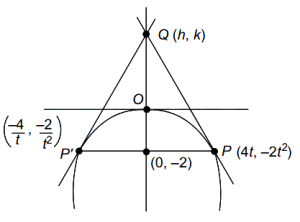
(C) The equation of the parabola is $x^{2}=-8y$. Comparing this with $x^{2}=4ay$,we get $4a=-8$,so $a=-2$. The focus of the parabola is $(0, a) = (0, -2)$.
Let the ends of a focal chord be $P(x_1, y_1)$ and $P'(x_2, y_2)$. The tangents at the ends of a focal chord of a parabola intersect at the directrix.
The directrix of the parabola $x^{2}=4ay$ is $y=-a$.
Here,$a=-2$,so the directrix is $y=-(-2) = 2$.
Therefore,the locus of the point of intersection of the tangents is the line $y=2$.
Let the ends of a focal chord be $P(x_1, y_1)$ and $P'(x_2, y_2)$. The tangents at the ends of a focal chord of a parabola intersect at the directrix.
The directrix of the parabola $x^{2}=4ay$ is $y=-a$.
Here,$a=-2$,so the directrix is $y=-(-2) = 2$.
Therefore,the locus of the point of intersection of the tangents is the line $y=2$.
0 likes
View Solution680
EasyMCQ
The tangents drawn at the extremities of a focal chord of the parabola $y^{2}=16x$:
A
intersect on $x=0$
B
intersect on the line $x+4=0$
C
intersect at an angle of $60^{\circ}$
D
intersect at an angle of $45^{\circ}$
Solution
(B) The given equation of the parabola is $y^{2}=16x$.
Comparing this with the standard form $y^{2}=4ax$,we get $4a=16$,which implies $a=4$.
It is a standard property of parabolas that the tangents drawn at the extremities of any focal chord intersect at right angles on the directrix of the parabola.
The equation of the directrix for the parabola $y^{2}=4ax$ is $x=-a$.
Substituting $a=4$,the equation of the directrix is $x=-4$,which can be written as $x+4=0$.
Therefore,the tangents intersect on the line $x+4=0$.
Comparing this with the standard form $y^{2}=4ax$,we get $4a=16$,which implies $a=4$.
It is a standard property of parabolas that the tangents drawn at the extremities of any focal chord intersect at right angles on the directrix of the parabola.
The equation of the directrix for the parabola $y^{2}=4ax$ is $x=-a$.
Substituting $a=4$,the equation of the directrix is $x=-4$,which can be written as $x+4=0$.
Therefore,the tangents intersect on the line $x+4=0$.
0 likes
View Solution681
DifficultMCQ
The condition for the line $y=mx+c$ to be a normal to the parabola $y^{2}=4ax$ is
A
$c=-2am-am^{3}$
B
$c=-\frac{a}{m}$
C
$c=\frac{a}{m}$
D
$c=2am+am^{3}$
Solution
(A) Given the equation of the parabola $y^{2}=4ax$. Let the parametric point on the parabola be $(at^{2}, 2at)$.
The slope of the tangent at this point is $\frac{dy}{dx} = \frac{2a}{y} = \frac{2a}{2at} = \frac{1}{t}$.
The slope of the normal is $-t$. Let the slope of the normal be $m$,so $m = -t$,which implies $t = -m$.
The equation of the normal at point $(at^{2}, 2at)$ is $y - 2at = -t(x - at^{2})$.
Substituting $t = -m$,we get $y - 2a(-m) = -(-m)(x - a(-m)^{2})$.
$y + 2am = m(x - am^{2})$.
$y + 2am = mx - am^{3}$.
$y = mx - 2am - am^{3}$.
Comparing this with the given line $y = mx + c$,we get $c = -2am - am^{3}$.
The slope of the tangent at this point is $\frac{dy}{dx} = \frac{2a}{y} = \frac{2a}{2at} = \frac{1}{t}$.
The slope of the normal is $-t$. Let the slope of the normal be $m$,so $m = -t$,which implies $t = -m$.
The equation of the normal at point $(at^{2}, 2at)$ is $y - 2at = -t(x - at^{2})$.
Substituting $t = -m$,we get $y - 2a(-m) = -(-m)(x - a(-m)^{2})$.
$y + 2am = m(x - am^{2})$.
$y + 2am = mx - am^{3}$.
$y = mx - 2am - am^{3}$.
Comparing this with the given line $y = mx + c$,we get $c = -2am - am^{3}$.
0 likes
View Solution682
DifficultMCQ
The angle between the tangents drawn to the parabola $y^{2}=12x$ from the point $(-3, 2)$ is (in $^{\circ}$)
A
$90$
B
$60$
C
$30$
D
$45$
Solution
(A) The equation of the parabola is $y^{2} = 12x$,which is of the form $y^{2} = 4ax$,where $a = 3$.
For any point $(x_{1}, y_{1})$,the pair of tangents is given by $SS_{1} = T^{2}$.
Here,$S = y^{2} - 12x$,$S_{1} = (2)^{2} - 12(-3) = 4 + 36 = 40$,and $T = y(2) - 6(x - 3) = 2y - 6x + 18$.
Substituting these into the formula:
$(y^{2} - 12x)(40) = (2y - 6x + 18)^{2}$
$40y^{2} - 480x = 4(y - 3x + 9)^{2}$
$10y^{2} - 120x = y^{2} + 9x^{2} + 81 - 6xy - 54x + 18y$
$9x^{2} - 9y^{2} - 6xy + 66x + 18y + 81 = 0$.
For a general second-degree equation $Ax^{2} + 2Hxy + By^{2} + 2Gx + 2Fy + C = 0$,the angle $\theta$ between the lines is given by $\tan \theta = \left| \frac{2\sqrt{H^{2} - AB}}{A + B} \right|$.
Here,$A = 9$,$B = -9$,and $H = -3$.
Since $A + B = 9 + (-9) = 0$,the lines are perpendicular.
Therefore,the angle between the tangents is $90^{\circ}$.
For any point $(x_{1}, y_{1})$,the pair of tangents is given by $SS_{1} = T^{2}$.
Here,$S = y^{2} - 12x$,$S_{1} = (2)^{2} - 12(-3) = 4 + 36 = 40$,and $T = y(2) - 6(x - 3) = 2y - 6x + 18$.
Substituting these into the formula:
$(y^{2} - 12x)(40) = (2y - 6x + 18)^{2}$
$40y^{2} - 480x = 4(y - 3x + 9)^{2}$
$10y^{2} - 120x = y^{2} + 9x^{2} + 81 - 6xy - 54x + 18y$
$9x^{2} - 9y^{2} - 6xy + 66x + 18y + 81 = 0$.
For a general second-degree equation $Ax^{2} + 2Hxy + By^{2} + 2Gx + 2Fy + C = 0$,the angle $\theta$ between the lines is given by $\tan \theta = \left| \frac{2\sqrt{H^{2} - AB}}{A + B} \right|$.
Here,$A = 9$,$B = -9$,and $H = -3$.
Since $A + B = 9 + (-9) = 0$,the lines are perpendicular.
Therefore,the angle between the tangents is $90^{\circ}$.
0 likes
View Solution683
EasyMCQ
If $x = t^{2} + 2$ and $y = 2t$ represent the parametric equations of a parabola,find its Cartesian equation.
A
$x^{2} = 4(y - 2)$
B
$(y - 2)^{2} = 4x$
C
$y^{2} = 4(x - 2)$
D
$(x - 2)^{2} = 4y$
Solution
(C) Given the parametric equations:
$x = t^{2} + 2$
$y = 2t$
From the second equation,we have $t = \frac{y}{2}$.
Substituting this value of $t$ into the first equation:
$x = (\frac{y}{2})^{2} + 2$
$x = \frac{y^{2}}{4} + 2$
$x - 2 = \frac{y^{2}}{4}$
$y^{2} = 4(x - 2)$
Thus,the correct option is $C$.
$x = t^{2} + 2$
$y = 2t$
From the second equation,we have $t = \frac{y}{2}$.
Substituting this value of $t$ into the first equation:
$x = (\frac{y}{2})^{2} + 2$
$x = \frac{y^{2}}{4} + 2$
$x - 2 = \frac{y^{2}}{4}$
$y^{2} = 4(x - 2)$
Thus,the correct option is $C$.
0 likes
View Solution684
DifficultMCQ
The locus of the mid-point of the line segment joining the focus and any point on the parabola $y^{2}=4ax$ is a parabola. Find the equation of its directrix.
A
$x+a=0$
B
$2x+a=0$
C
$x=0$
D
$x=\frac{a}{2}$
Solution
(C) Let the focus be $S(a, 0)$.
Let any point on the parabola $y^{2}=4ax$ be $P(at^{2}, 2at)$.
Let the mid-point of $SP$ be $(x, y)$.
Then,$x = \frac{a + at^{2}}{2}$ and $y = \frac{0 + 2at}{2} = at$.
From $y = at$,we get $t = \frac{y}{a}$.
Substituting $t$ into the equation for $x$:
$x = \frac{a + a(\frac{y}{a})^{2}}{2} = \frac{a + \frac{y^{2}}{a}}{2}$.
$2x = a + \frac{y^{2}}{a} \implies \frac{y^{2}}{a} = 2x - a \implies y^{2} = 2a(x - \frac{a}{2})$.
This is a parabola of the form $Y^{2} = 4AX$ where $A = \frac{a}{2}$ and $X = x - \frac{a}{2}$.
The directrix of $Y^{2} = 4AX$ is $X = -A$.
Therefore,$x - \frac{a}{2} = -\frac{a}{2}$.
$x = 0$.
Let any point on the parabola $y^{2}=4ax$ be $P(at^{2}, 2at)$.
Let the mid-point of $SP$ be $(x, y)$.
Then,$x = \frac{a + at^{2}}{2}$ and $y = \frac{0 + 2at}{2} = at$.
From $y = at$,we get $t = \frac{y}{a}$.
Substituting $t$ into the equation for $x$:
$x = \frac{a + a(\frac{y}{a})^{2}}{2} = \frac{a + \frac{y^{2}}{a}}{2}$.
$2x = a + \frac{y^{2}}{a} \implies \frac{y^{2}}{a} = 2x - a \implies y^{2} = 2a(x - \frac{a}{2})$.
This is a parabola of the form $Y^{2} = 4AX$ where $A = \frac{a}{2}$ and $X = x - \frac{a}{2}$.
The directrix of $Y^{2} = 4AX$ is $X = -A$.
Therefore,$x - \frac{a}{2} = -\frac{a}{2}$.
$x = 0$.
0 likes
View Solution685
EasyMCQ
If the parabola $x^{2} = 4ay$ passes through the point $(2, 1)$,then the length of the latus rectum is
A
$1$
B
$4$
C
$2$
D
$8$
Solution
(B) The equation of the parabola is $x^{2} = 4ay$.
Since the parabola passes through the point $(2, 1)$,we substitute $x = 2$ and $y = 1$ into the equation:
$(2)^{2} = 4a(1)$
$4 = 4a$
The length of the latus rectum of the parabola $x^{2} = 4ay$ is defined as $4a$.
From the equation $4 = 4a$,we can see that the length of the latus rectum is $4$.
Since the parabola passes through the point $(2, 1)$,we substitute $x = 2$ and $y = 1$ into the equation:
$(2)^{2} = 4a(1)$
$4 = 4a$
The length of the latus rectum of the parabola $x^{2} = 4ay$ is defined as $4a$.
From the equation $4 = 4a$,we can see that the length of the latus rectum is $4$.
0 likes
View Solution686
DifficultMCQ
Let $P(x, y)$ be the midpoint of the line joining $(1, 0)$ to a point on the curve $y^{2} = \left|\begin{array}{ll}x+1 & x+2 \\ x+3 & x+5\end{array}\right|$. Then,the locus of $P$ is symmetrical about
A
$y$-axis
B
$x$-axis
C
$x=1$
D
$y=1$
Solution
(B) The given curve is $y^{2} = \left|\begin{array}{ll}x+1 & x+2 \\ x+3 & x+5\end{array}\right|$.
Expanding the determinant:
$y^{2} = (x+1)(x+5) - (x+2)(x+3)$
$y^{2} = (x^{2} + 6x + 5) - (x^{2} + 5x + 6)$
$y^{2} = x - 1$,which is a parabola.
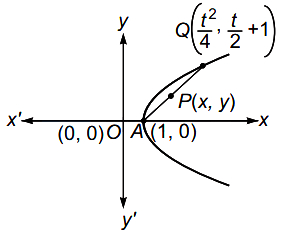
Let the parametric coordinates of a point $Q$ on the parabola be $Q(t^{2}+1, t)$.
Given $P(x, y)$ is the midpoint of the line segment joining $A(1, 0)$ and $Q(t^{2}+1, t)$:
$x = \frac{1 + t^{2} + 1}{2} = \frac{t^{2} + 2}{2} \Rightarrow t^{2} = 2x - 2$
$y = \frac{0 + t}{2} = \frac{t}{2} \Rightarrow t = 2y$
Substituting $t$ in the equation for $x$:
$(2y)^{2} = 2x - 2$
$4y^{2} = 2(x - 1)$
$y^{2} = \frac{1}{2}(x - 1)$
This is a parabola with its axis along the $x$-axis. Therefore,the locus of $P$ is symmetrical about the $x$-axis.
Expanding the determinant:
$y^{2} = (x+1)(x+5) - (x+2)(x+3)$
$y^{2} = (x^{2} + 6x + 5) - (x^{2} + 5x + 6)$
$y^{2} = x - 1$,which is a parabola.
Let the parametric coordinates of a point $Q$ on the parabola be $Q(t^{2}+1, t)$.
Given $P(x, y)$ is the midpoint of the line segment joining $A(1, 0)$ and $Q(t^{2}+1, t)$:
$x = \frac{1 + t^{2} + 1}{2} = \frac{t^{2} + 2}{2} \Rightarrow t^{2} = 2x - 2$
$y = \frac{0 + t}{2} = \frac{t}{2} \Rightarrow t = 2y$
Substituting $t$ in the equation for $x$:
$(2y)^{2} = 2x - 2$
$4y^{2} = 2(x - 1)$
$y^{2} = \frac{1}{2}(x - 1)$
This is a parabola with its axis along the $x$-axis. Therefore,the locus of $P$ is symmetrical about the $x$-axis.
0 likes
View Solution687
DifficultMCQ
The area of the triangle formed by the lines joining the vertex of the parabola $x^{2}=12y$ to the ends of the latus rectum is
A
$18 \text{ sq. units}$
B
$19 \text{ sq. units}$
C
$20 \text{ sq. units}$
D
$17 \text{ sq. units}$
Solution
(A) The given equation of the parabola is $x^{2}=12y$.
Comparing this with the standard form $x^{2}=4ay$,we get $4a=12$,which implies $a=3$.
The vertex of the parabola is at $(0,0)$.
The ends of the latus rectum are at $(2a, a)$ and $(-2a, a)$,which are $(6, 3)$ and $(-6, 3)$.
The area of the triangle formed by the vertex $(0,0)$ and the points $(6, 3)$ and $(-6, 3)$ is given by:
$\text{Area} = \frac{1}{2} \times \text{base} \times \text{height}$
Here,the base is the length of the latus rectum,which is $4a = 12$.
The height is the distance from the vertex to the latus rectum,which is $a = 3$.
$\text{Area} = \frac{1}{2} \times 12 \times 3 = 18 \text{ sq. units}$.
Comparing this with the standard form $x^{2}=4ay$,we get $4a=12$,which implies $a=3$.
The vertex of the parabola is at $(0,0)$.
The ends of the latus rectum are at $(2a, a)$ and $(-2a, a)$,which are $(6, 3)$ and $(-6, 3)$.
The area of the triangle formed by the vertex $(0,0)$ and the points $(6, 3)$ and $(-6, 3)$ is given by:
$\text{Area} = \frac{1}{2} \times \text{base} \times \text{height}$
Here,the base is the length of the latus rectum,which is $4a = 12$.
The height is the distance from the vertex to the latus rectum,which is $a = 3$.
$\text{Area} = \frac{1}{2} \times 12 \times 3 = 18 \text{ sq. units}$.
0 likes
View Solution688
MediumMCQ
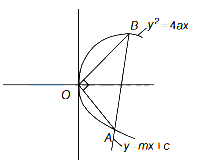
Variable straight lines $y=mx+c$ make intercepts on the curve $y^2-4ax=0$ which subtend a right angle at the origin. Then the point of concurrence of these lines $y=mx+c$ is
A
$(4a, 0)$
B
$(2a, 0)$
C
$(-4a, 0)$
D
$(-2a, 0)$
Solution
(A) The equation of the parabola is $y^2 = 4ax$. The equation of the line is $y = mx + c$,which can be written as $\frac{y-mx}{c} = 1$.
To find the combined equation of the lines joining the origin $(0,0)$ to the points of intersection of the line and the parabola,we homogenize the equation of the parabola using the line equation:
$y^2 - 4ax \left( \frac{y-mx}{c} \right) = 0$
$cy^2 - 4axy + 4amx^2 = 0$
$4amx^2 - 4axy + cy^2 = 0$
Since these lines subtend a right angle at the origin,the sum of the coefficients of $x^2$ and $y^2$ must be zero:
$4am + c = 0$
Substituting $c = -4am$ into the line equation $y = mx + c$:
$y = mx - 4am$
$y = m(x - 4a)$
This equation represents a family of lines passing through the fixed point $(4a, 0)$.
Thus,the point of concurrence is $(4a, 0)$.
To find the combined equation of the lines joining the origin $(0,0)$ to the points of intersection of the line and the parabola,we homogenize the equation of the parabola using the line equation:
$y^2 - 4ax \left( \frac{y-mx}{c} \right) = 0$
$cy^2 - 4axy + 4amx^2 = 0$
$4amx^2 - 4axy + cy^2 = 0$
Since these lines subtend a right angle at the origin,the sum of the coefficients of $x^2$ and $y^2$ must be zero:
$4am + c = 0$
Substituting $c = -4am$ into the line equation $y = mx + c$:
$y = mx - 4am$
$y = m(x - 4a)$
This equation represents a family of lines passing through the fixed point $(4a, 0)$.
Thus,the point of concurrence is $(4a, 0)$.
0 likes
View Solution689
EasyMCQ
If $(2,3)$ is the vertex and $(3,2)$ is the focus of a parabola,then its equation is
A
$x^2+2xy+y^2-18x-2y+35=0$
B
$2x^2+4xy+2y^2-9x-y+17=0$
C
$x^2+2xy+y^2-18x-2y+17=0$
D
$x^2+4xy+4y^2-18x+2y+9=0$
Solution
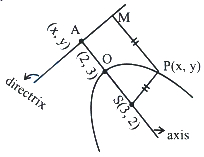
(C) Given vertex $O = (2,3)$ and focus $S = (3,2)$.
Let the directrix intersect the axis at point $A = (x_1, y_1)$. Since the vertex $O$ is the midpoint of $AS$,we have:
$\frac{x_1+3}{2} = 2 \Rightarrow x_1 = 1$
$\frac{y_1+2}{2} = 3 \Rightarrow y_1 = 4$
So,$A = (1,4)$.
The slope of the axis $AS$ is $m_1 = \frac{2-3}{3-2} = -1$.
The directrix is perpendicular to the axis,so its slope $m_2 = -\frac{1}{m_1} = 1$.
The equation of the directrix passing through $(1,4)$ with slope $1$ is:
$y-4 = 1(x-1) \Rightarrow y-x-3 = 0$.
By the definition of a parabola,for any point $P(x,y)$ on it,the distance to the focus equals the distance to the directrix:
$PS^2 = PM^2$
$(x-3)^2 + (y-2)^2 = \left(\frac{|x-y+3|}{\sqrt{1^2+(-1)^2}}\right)^2$
$(x^2-6x+9) + (y^2-4y+4) = \frac{(x-y+3)^2}{2}$
$2(x^2+y^2-6x-4y+13) = x^2+y^2+9-2xy+6x-6y$
$x^2+2xy+y^2-18x-2y+17 = 0$.
Let the directrix intersect the axis at point $A = (x_1, y_1)$. Since the vertex $O$ is the midpoint of $AS$,we have:
$\frac{x_1+3}{2} = 2 \Rightarrow x_1 = 1$
$\frac{y_1+2}{2} = 3 \Rightarrow y_1 = 4$
So,$A = (1,4)$.
The slope of the axis $AS$ is $m_1 = \frac{2-3}{3-2} = -1$.
The directrix is perpendicular to the axis,so its slope $m_2 = -\frac{1}{m_1} = 1$.
The equation of the directrix passing through $(1,4)$ with slope $1$ is:
$y-4 = 1(x-1) \Rightarrow y-x-3 = 0$.
By the definition of a parabola,for any point $P(x,y)$ on it,the distance to the focus equals the distance to the directrix:
$PS^2 = PM^2$
$(x-3)^2 + (y-2)^2 = \left(\frac{|x-y+3|}{\sqrt{1^2+(-1)^2}}\right)^2$
$(x^2-6x+9) + (y^2-4y+4) = \frac{(x-y+3)^2}{2}$
$2(x^2+y^2-6x-4y+13) = x^2+y^2+9-2xy+6x-6y$
$x^2+2xy+y^2-18x-2y+17 = 0$.
0 likes
View Solution690
EasyMCQ
The parabola with directrix $x+2y-1=0$ and focus $(1,0)$ is
A
$4x^2-4xy+y^2-8x+4y+4=0$
B
$4x^2+4xy+y^2-8x+4y+4=0$
C
$4x^2+4xy+y^2+8x-4y+4=0$
D
$4x^2-4xy+y^2-8x-4y+4=0$
Solution
(A) The definition of a parabola is the locus of a point $P(x, y)$ such that its distance from the focus is equal to its perpendicular distance from the directrix.
Given focus $S(1, 0)$ and directrix $x+2y-1=0$.
Using the distance formula,the equation is:
$\frac{|x+2y-1|}{\sqrt{1^2+2^2}} = \sqrt{(x-1)^2 + (y-0)^2}$
Squaring both sides:
$\frac{(x+2y-1)^2}{5} = (x-1)^2 + y^2$
$(x+2y-1)^2 = 5(x^2-2x+1+y^2)$
$x^2 + 4y^2 + 1 + 4xy - 2x - 4y = 5x^2 - 10x + 5 + 5y^2$
Rearranging the terms to one side:
$4x^2 - 4xy + y^2 - 8x + 4y + 4 = 0$
Thus,option $A$ is correct.
Given focus $S(1, 0)$ and directrix $x+2y-1=0$.
Using the distance formula,the equation is:
$\frac{|x+2y-1|}{\sqrt{1^2+2^2}} = \sqrt{(x-1)^2 + (y-0)^2}$
Squaring both sides:
$\frac{(x+2y-1)^2}{5} = (x-1)^2 + y^2$
$(x+2y-1)^2 = 5(x^2-2x+1+y^2)$
$x^2 + 4y^2 + 1 + 4xy - 2x - 4y = 5x^2 - 10x + 5 + 5y^2$
Rearranging the terms to one side:
$4x^2 - 4xy + y^2 - 8x + 4y + 4 = 0$
Thus,option $A$ is correct.
0 likes
View Solution691
MediumMCQ
The vertex and the focus of the parabola $2y^2 + 5x - 6y + 1 = 0$ are respectively
A
$\left(\frac{7}{10}, \frac{3}{2}\right), \left(\frac{3}{40}, \frac{3}{2}\right)$
B
$\left(\frac{-7}{10}, \frac{3}{2}\right), \left(\frac{53}{40}, \frac{3}{2}\right)$
C
$\left(\frac{7}{10}, \frac{-3}{2}\right), \left(\frac{7}{10}, \frac{7}{8}\right)$
D
$\left(\frac{-7}{10}, \frac{-3}{2}\right), \left(\frac{7}{10}, \frac{17}{8}\right)$
Solution
(A) The equation of the given parabola is $2y^2 + 5x - 6y + 1 = 0$.
Rearranging the terms,we get $2(y^2 - 3y) = -5x - 1$.
Completing the square for $y$: $2(y^2 - 3y + \frac{9}{4}) = -5x - 1 + \frac{9}{2}$.
$2(y - \frac{3}{2})^2 = -5x + \frac{7}{2}$.
$2(y - \frac{3}{2})^2 = -5(x - \frac{7}{10})$.
$(y - \frac{3}{2})^2 = 4(-\frac{5}{8})(x - \frac{7}{10})$.
Comparing this with the standard form $(y - k)^2 = 4a(x - h)$,we have the vertex $(h, k) = (\frac{7}{10}, \frac{3}{2})$ and $a = -\frac{5}{8}$.
The focus is given by $(h + a, k) = (\frac{7}{10} - \frac{5}{8}, \frac{3}{2}) = (\frac{28 - 25}{40}, \frac{3}{2}) = (\frac{3}{40}, \frac{3}{2})$.
Thus,the vertex and focus are $(\frac{7}{10}, \frac{3}{2})$ and $(\frac{3}{40}, \frac{3}{2})$ respectively.
Rearranging the terms,we get $2(y^2 - 3y) = -5x - 1$.
Completing the square for $y$: $2(y^2 - 3y + \frac{9}{4}) = -5x - 1 + \frac{9}{2}$.
$2(y - \frac{3}{2})^2 = -5x + \frac{7}{2}$.
$2(y - \frac{3}{2})^2 = -5(x - \frac{7}{10})$.
$(y - \frac{3}{2})^2 = 4(-\frac{5}{8})(x - \frac{7}{10})$.
Comparing this with the standard form $(y - k)^2 = 4a(x - h)$,we have the vertex $(h, k) = (\frac{7}{10}, \frac{3}{2})$ and $a = -\frac{5}{8}$.
The focus is given by $(h + a, k) = (\frac{7}{10} - \frac{5}{8}, \frac{3}{2}) = (\frac{28 - 25}{40}, \frac{3}{2}) = (\frac{3}{40}, \frac{3}{2})$.
Thus,the vertex and focus are $(\frac{7}{10}, \frac{3}{2})$ and $(\frac{3}{40}, \frac{3}{2})$ respectively.
0 likes
View Solution692
MediumMCQ
If $(h, k)$ is the point to which the origin is shifted in order to transform the equation $y^2-4x+6y+17=0$ into the form $Y^2=4aX$,then $h^2+k^2=$
A
$11$
B
$1$
C
$25$
D
$13$
Solution
(D) The given equation is $y^2-4x+6y+17=0$.
Completing the square for the $y$ terms:
$(y^2+6y+9)-9-4x+17=0$
$(y+3)^2-4x+8=0$
$(y+3)^2=4x-8$
$(y+3)^2=4(x-2)$.
Comparing this with the standard form $Y^2=4aX$,where $Y=y+3$ and $X=x-2$,we see that the origin must be shifted to $(h, k) = (2, -3)$.
Thus,$h=2$ and $k=-3$.
Calculating $h^2+k^2$:
$h^2+k^2 = (2)^2+(-3)^2 = 4+9 = 13$.
Therefore,the correct option is $D$.
Completing the square for the $y$ terms:
$(y^2+6y+9)-9-4x+17=0$
$(y+3)^2-4x+8=0$
$(y+3)^2=4x-8$
$(y+3)^2=4(x-2)$.
Comparing this with the standard form $Y^2=4aX$,where $Y=y+3$ and $X=x-2$,we see that the origin must be shifted to $(h, k) = (2, -3)$.
Thus,$h=2$ and $k=-3$.
Calculating $h^2+k^2$:
$h^2+k^2 = (2)^2+(-3)^2 = 4+9 = 13$.
Therefore,the correct option is $D$.
0 likes
View Solution693
MediumMCQ
$A$ circle is drawn with its centre at the focus of the parabola $y^2 = 2px$ such that it touches the directrix of the parabola. Then a point of intersection of the circle and the parabola is
A
$(2p, 2p)$
B
$(\frac{p}{2}, -p)$
C
$(2p, -2p)$
D
$(p, \sqrt{2}p)$
Solution
(B) The parabola is $y^2 = 2px$. Comparing this with $y^2 = 4ax$,we get $4a = 2p$,so $a = \frac{p}{2}$.
The focus of the parabola is $S = (a, 0) = (\frac{p}{2}, 0)$.
The directrix of the parabola is $x = -a = -\frac{p}{2}$.
The circle is centered at $(\frac{p}{2}, 0)$ and touches the directrix $x = -\frac{p}{2}$.
The radius $r$ of the circle is the distance from the focus to the directrix,which is $r = \frac{p}{2} - (-\frac{p}{2}) = p$.
The equation of the circle is $(x - \frac{p}{2})^2 + y^2 = p^2$.
Substitute $y^2 = 2px$ into the circle equation:
$(x - \frac{p}{2})^2 + 2px = p^2$
$x^2 - px + \frac{p^2}{4} + 2px = p^2$
$x^2 + px - \frac{3p^2}{4} = 0$
Using the quadratic formula $x = \frac{-p \pm \sqrt{p^2 - 4(1)(-\frac{3p^2}{4})}}{2} = \frac{-p \pm \sqrt{p^2 + 3p^2}}{2} = \frac{-p \pm 2p}{2}$.
Since $x$ must be positive for the parabola $y^2 = 2px$,we take $x = \frac{p}{2}$.
If $x = \frac{p}{2}$,then $y^2 = 2p(\frac{p}{2}) = p^2$,so $y = \pm p$.
Thus,the points of intersection are $(\frac{p}{2}, p)$ and $(\frac{p}{2}, -p)$.
The focus of the parabola is $S = (a, 0) = (\frac{p}{2}, 0)$.
The directrix of the parabola is $x = -a = -\frac{p}{2}$.
The circle is centered at $(\frac{p}{2}, 0)$ and touches the directrix $x = -\frac{p}{2}$.
The radius $r$ of the circle is the distance from the focus to the directrix,which is $r = \frac{p}{2} - (-\frac{p}{2}) = p$.
The equation of the circle is $(x - \frac{p}{2})^2 + y^2 = p^2$.
Substitute $y^2 = 2px$ into the circle equation:
$(x - \frac{p}{2})^2 + 2px = p^2$
$x^2 - px + \frac{p^2}{4} + 2px = p^2$
$x^2 + px - \frac{3p^2}{4} = 0$
Using the quadratic formula $x = \frac{-p \pm \sqrt{p^2 - 4(1)(-\frac{3p^2}{4})}}{2} = \frac{-p \pm \sqrt{p^2 + 3p^2}}{2} = \frac{-p \pm 2p}{2}$.
Since $x$ must be positive for the parabola $y^2 = 2px$,we take $x = \frac{p}{2}$.
If $x = \frac{p}{2}$,then $y^2 = 2p(\frac{p}{2}) = p^2$,so $y = \pm p$.
Thus,the points of intersection are $(\frac{p}{2}, p)$ and $(\frac{p}{2}, -p)$.
0 likes
View Solution694
EasyMCQ
If a parabola having its axis parallel to the $X$-axis passes through the points $(0, -1)$,$(6, 1)$,and $(-2, -3)$,then the point at which this parabola cuts the $X$-axis is
A
$\left(\frac{5}{2}, 0\right)$
B
$(-1, 0)$
C
$(6, 0)$
D
$\left(\frac{8}{5}, 0\right)$
Solution
(A) Since the axis of the parabola is parallel to the $X$-axis,the equation of the parabola is of the form $x = ay^2 + by + c$ $(i)$.
Given that the points $(0, -1)$,$(6, 1)$,and $(-2, -3)$ lie on the parabola,we have:
$0 = a - b + c$ $(ii)$
$6 = a + b + c$ $(iii)$
$-2 = 9a - 3b + c$ $(iv)$
Subtracting $(ii)$ from $(iii)$,we get $2b = 6$,so $b = 3$.
Substituting $b = 3$ into $(ii)$ and $(iii)$,we get $a + c = 3$ and $a + c = 3$ (consistent).
Substituting $b = 3$ into $(iv)$,we get $-2 = 9a - 9 + c$,so $9a + c = 7$.
Solving $a + c = 3$ and $9a + c = 7$,we subtract the first from the second to get $8a = 4$,so $a = \frac{1}{2}$.
Then $c = 3 - \frac{1}{2} = \frac{5}{2}$.
The equation is $x = \frac{1}{2}y^2 + 3y + \frac{5}{2}$.
To find the point where it cuts the $X$-axis,set $y = 0$:
$x = \frac{1}{2}(0)^2 + 3(0) + \frac{5}{2} = \frac{5}{2}$.
Thus,the point is $\left(\frac{5}{2}, 0\right)$.
Given that the points $(0, -1)$,$(6, 1)$,and $(-2, -3)$ lie on the parabola,we have:
$0 = a - b + c$ $(ii)$
$6 = a + b + c$ $(iii)$
$-2 = 9a - 3b + c$ $(iv)$
Subtracting $(ii)$ from $(iii)$,we get $2b = 6$,so $b = 3$.
Substituting $b = 3$ into $(ii)$ and $(iii)$,we get $a + c = 3$ and $a + c = 3$ (consistent).
Substituting $b = 3$ into $(iv)$,we get $-2 = 9a - 9 + c$,so $9a + c = 7$.
Solving $a + c = 3$ and $9a + c = 7$,we subtract the first from the second to get $8a = 4$,so $a = \frac{1}{2}$.
Then $c = 3 - \frac{1}{2} = \frac{5}{2}$.
The equation is $x = \frac{1}{2}y^2 + 3y + \frac{5}{2}$.
To find the point where it cuts the $X$-axis,set $y = 0$:
$x = \frac{1}{2}(0)^2 + 3(0) + \frac{5}{2} = \frac{5}{2}$.
Thus,the point is $\left(\frac{5}{2}, 0\right)$.
0 likes
View Solution695
MediumMCQ
Let $l$ be the directrix of the parabola $9y^2+12y+9x-14=0$ and $l_1$ be the line passing through the vertex of this parabola and the origin. If $(h, k)$ is the point of intersection of $l$ and $l_1$,then $h+k=$
A
$-9/2$
B
$3/2$
C
$-3/4$
D
$9/4$
Solution
(B) Given equation: $9y^2+12y+9x-14=0$
Rewrite as: $9(y^2 + \frac{4}{3}y) = -9x + 14$
$9(y + \frac{2}{3})^2 = -9x + 14 + 4 = -9x + 18$
$(y + \frac{2}{3})^2 = -(x - 2)$
Comparing with $(y-k')^2 = -4a(x-h')$,we get vertex $(h', k') = (2, -2/3)$ and $4a = 1 \Rightarrow a = 1/4$.
The directrix $l$ is $x = h' + a = 2 + 1/4 = 9/4$.
The line $l_1$ passes through $(2, -2/3)$ and $(0, 0)$,so its slope is $m = \frac{-2/3 - 0}{2 - 0} = -1/3$.
Equation of $l_1$: $y = -\frac{1}{3}x$.
Intersection of $l$ $(x = 9/4)$ and $l_1$ $(y = -x/3)$:
$h = 9/4$,$k = -\frac{1}{3}(9/4) = -3/4$.
Thus,$h+k = 9/4 - 3/4 = 6/4 = 3/2$.
Rewrite as: $9(y^2 + \frac{4}{3}y) = -9x + 14$
$9(y + \frac{2}{3})^2 = -9x + 14 + 4 = -9x + 18$
$(y + \frac{2}{3})^2 = -(x - 2)$
Comparing with $(y-k')^2 = -4a(x-h')$,we get vertex $(h', k') = (2, -2/3)$ and $4a = 1 \Rightarrow a = 1/4$.
The directrix $l$ is $x = h' + a = 2 + 1/4 = 9/4$.
The line $l_1$ passes through $(2, -2/3)$ and $(0, 0)$,so its slope is $m = \frac{-2/3 - 0}{2 - 0} = -1/3$.
Equation of $l_1$: $y = -\frac{1}{3}x$.
Intersection of $l$ $(x = 9/4)$ and $l_1$ $(y = -x/3)$:
$h = 9/4$,$k = -\frac{1}{3}(9/4) = -3/4$.
Thus,$h+k = 9/4 - 3/4 = 6/4 = 3/2$.
0 likes
View Solution696
EasyMCQ
$A$ parabola having its axis parallel to the $Y$-axis passes through the points $(0, 2/5)$,$(4, -2)$,and $(1, 8/5)$. Which of the following points lies on this parabola?
A
$(3, 5/2)$
B
$(-1, 2)$
C
$(-2, 28/5)$
D
$(2, 8/5)$
Solution
(D) The equation of a parabola with its axis parallel to the $Y$-axis is given by $(x - h)^2 = 4a(y - k)$.
Substituting the given points $(0, 2/5)$,$(4, -2)$,and $(1, 8/5)$ into the equation:
$(0 - h)^2 = 4a(2/5 - k) \implies h^2 = 4a(2/5 - k) \quad (i)$
$(4 - h)^2 = 4a(-2 - k) \quad (ii)$
$(1 - h)^2 = 4a(8/5 - k) \quad (iii)$
Subtracting $(iii)$ from $(i)$: $h^2 - (1 - h)^2 = 4a(2/5 - 8/5) \implies 2h - 1 = -24a/5 \implies a = -5(2h - 1)/24$.
Solving the system of equations,we find $h = 3/2$,$k = 7/4$,and $a = -5/12$.
The equation of the parabola is $(x - 3/2)^2 = -5/3(y - 7/4)$.
Checking the point $(2, 8/5)$:
$(2 - 3/2)^2 = (1/2)^2 = 1/4$.
$-5/3(8/5 - 7/4) = -5/3(32/20 - 35/20) = -5/3(-3/20) = 1/4$.
Since $1/4 = 1/4$,the point $(2, 8/5)$ lies on the parabola.
Substituting the given points $(0, 2/5)$,$(4, -2)$,and $(1, 8/5)$ into the equation:
$(0 - h)^2 = 4a(2/5 - k) \implies h^2 = 4a(2/5 - k) \quad (i)$
$(4 - h)^2 = 4a(-2 - k) \quad (ii)$
$(1 - h)^2 = 4a(8/5 - k) \quad (iii)$
Subtracting $(iii)$ from $(i)$: $h^2 - (1 - h)^2 = 4a(2/5 - 8/5) \implies 2h - 1 = -24a/5 \implies a = -5(2h - 1)/24$.
Solving the system of equations,we find $h = 3/2$,$k = 7/4$,and $a = -5/12$.
The equation of the parabola is $(x - 3/2)^2 = -5/3(y - 7/4)$.
Checking the point $(2, 8/5)$:
$(2 - 3/2)^2 = (1/2)^2 = 1/4$.
$-5/3(8/5 - 7/4) = -5/3(32/20 - 35/20) = -5/3(-3/20) = 1/4$.
Since $1/4 = 1/4$,the point $(2, 8/5)$ lies on the parabola.
0 likes
View Solution697
MediumMCQ
Suppose a parabola passes through $(0,4), (1,9)$ and $(4,5)$ and has its axis parallel to the $y$-axis. Then the equation of the parabola is
A
$19x^2 + 12y - 79x - 48 = 0$
B
$19x^2 + 12y - 79x + 48 = 0$
C
$19y^2 + 12x - 79y - 48 = 0$
D
$19y^2 + 12x - 79y + 48 = 0$
Solution
(A) Let the equation of the parabola be $y = ax^2 + bx + c$.
Given that it passes through $(0,4), (1,9),$ and $(4,5)$.
Substituting $(0,4)$ into the equation: $4 = a(0)^2 + b(0) + c \implies c = 4$.
Substituting $(1,9)$ into the equation: $9 = a(1)^2 + b(1) + 4 \implies a + b = 5 \dots (1)$.
Substituting $(4,5)$ into the equation: $5 = a(4)^2 + b(4) + 4 \implies 16a + 4b = 1 \dots (2)$.
Multiplying equation $(1)$ by $4$: $4a + 4b = 20 \dots (3)$.
Subtracting equation $(3)$ from equation $(2)$: $(16a - 4a) = 1 - 20 \implies 12a = -19 \implies a = -\frac{19}{12}$.
Substituting $a$ into equation $(1)$: $-\frac{19}{12} + b = 5 \implies b = 5 + \frac{19}{12} = \frac{60+19}{12} = \frac{79}{12}$.
Substituting $a, b, c$ into the general equation: $y = -\frac{19}{12}x^2 + \frac{79}{12}x + 4$.
Multiplying by $12$: $12y = -19x^2 + 79x + 48$.
Rearranging terms: $19x^2 + 12y - 79x - 48 = 0$.
Given that it passes through $(0,4), (1,9),$ and $(4,5)$.
Substituting $(0,4)$ into the equation: $4 = a(0)^2 + b(0) + c \implies c = 4$.
Substituting $(1,9)$ into the equation: $9 = a(1)^2 + b(1) + 4 \implies a + b = 5 \dots (1)$.
Substituting $(4,5)$ into the equation: $5 = a(4)^2 + b(4) + 4 \implies 16a + 4b = 1 \dots (2)$.
Multiplying equation $(1)$ by $4$: $4a + 4b = 20 \dots (3)$.
Subtracting equation $(3)$ from equation $(2)$: $(16a - 4a) = 1 - 20 \implies 12a = -19 \implies a = -\frac{19}{12}$.
Substituting $a$ into equation $(1)$: $-\frac{19}{12} + b = 5 \implies b = 5 + \frac{19}{12} = \frac{60+19}{12} = \frac{79}{12}$.
Substituting $a, b, c$ into the general equation: $y = -\frac{19}{12}x^2 + \frac{79}{12}x + 4$.
Multiplying by $12$: $12y = -19x^2 + 79x + 48$.
Rearranging terms: $19x^2 + 12y - 79x - 48 = 0$.
0 likes
View Solution698
EasyMCQ
Which of the following represents a parabola?
A
$x=4 \cos t, y=4 \sin t$
B
$x^2-2=-2 \cos t, y=\cos^2\left(\frac{t}{2}\right)$
C
$\sqrt{x}=\tan t, \sqrt{y}=\sec t$
D
$x=\sqrt{1-\sin t}, y=\sin\left(\frac{t}{2}\right)+\cos\left(\frac{t}{2}\right)$
Solution
(B) For option $(A)$: $x=4 \cos t, y=4 \sin t$. Squaring and adding,$x^2+y^2=16(\cos^2 t + \sin^2 t) = 16$. This represents a circle.
For option $(B)$: $x^2-2=-2 \cos t$ and $y=\cos^2\left(\frac{t}{2}\right)$.
Using the identity $\cos t = 2\cos^2\left(\frac{t}{2}\right)-1$,we have $y = \frac{1+\cos t}{2}$,which implies $\cos t = 2y-1$.
Substituting this into the first equation: $x^2-2 = -2(2y-1) = -4y+2$.
Thus,$x^2 = -4y+4$,which is $x^2 = -4(y-1)$. This is the equation of a parabola.
For option $(B)$: $x^2-2=-2 \cos t$ and $y=\cos^2\left(\frac{t}{2}\right)$.
Using the identity $\cos t = 2\cos^2\left(\frac{t}{2}\right)-1$,we have $y = \frac{1+\cos t}{2}$,which implies $\cos t = 2y-1$.
Substituting this into the first equation: $x^2-2 = -2(2y-1) = -4y+2$.
Thus,$x^2 = -4y+4$,which is $x^2 = -4(y-1)$. This is the equation of a parabola.
0 likes
View Solution699
EasyMCQ
The parabola with focus at $(4, -3)$ and vertex at $(4, -1)$ is
A
$x^2+8x+6y+22=0$
B
$x^2-8x-10y+6=0$
C
$x^2-8x-16y=0$
D
$x^2-8x+8y+24=0$
Solution
(D) The focus is at $(4, -3)$ and the vertex is at $(4, -1)$.
Since the $x$-coordinates are the same,the axis of the parabola is the vertical line $x=4$.
Since the focus lies below the vertex,the parabola opens downwards.
The distance $a$ between the vertex $(4, -1)$ and the focus $(4, -3)$ is $a = |-1 - (-3)| = 2$.
The standard equation for a downward-opening parabola with vertex $(h, k)$ is $(x-h)^2 = -4a(y-k)$.
Substituting $h=4, k=-1, a=2$:
$(x-4)^2 = -4(2)(y - (-1))$
$(x-4)^2 = -8(y+1)$
$x^2 - 8x + 16 = -8y - 8$
$x^2 - 8x + 8y + 24 = 0$.
Since the $x$-coordinates are the same,the axis of the parabola is the vertical line $x=4$.
Since the focus lies below the vertex,the parabola opens downwards.
The distance $a$ between the vertex $(4, -1)$ and the focus $(4, -3)$ is $a = |-1 - (-3)| = 2$.
The standard equation for a downward-opening parabola with vertex $(h, k)$ is $(x-h)^2 = -4a(y-k)$.
Substituting $h=4, k=-1, a=2$:
$(x-4)^2 = -4(2)(y - (-1))$
$(x-4)^2 = -8(y+1)$
$x^2 - 8x + 16 = -8y - 8$
$x^2 - 8x + 8y + 24 = 0$.
0 likes
View Solution10-2. Parabola, Ellipse, Hyperbola — Parabola · Frequently Asked Questions
1Are these 10-2. Parabola, Ellipse, Hyperbola questions useful for JEE and NEET?
Yes. All questions in this section are mapped to JEE Main and NEET exam patterns. Previous year questions from JEE Main, NEET, GUJCET and state-level exams are included with full solutions.
2Can I switch to Hindi or Gujarati for these questions?
Yes. Use the language tabs in the hero section or the sidebar to view the same questions and solutions in English, Hindi or Gujarati.
3How do I generate a question paper from this subtopic?
Use the Vedclass Exam Paper Generator — select the chapter and subtopic, set difficulty, and generate Sets A, B, C, D automatically. First 3 chapters of every subject are free.
Vedclass Products
For Students
Vedclass Test Series
Mock tests in real JEE/NEET style with performance analysis. 5-day free trial.
Start Free TrialFor Teachers
Exam Paper Generator
Generate Set A/B/C/D papers from this chapter in 2 minutes. 3 chapters free.
Try FreeFor Institutes
Online Exam Module
Live online exams with unlimited students, 360° analytics & white-label branding.
See DemoFor Teachers & Institutes
Generate a 10-2. Parabola, Ellipse, Hyperbola Exam Paper in 2 Minutes
Select subtopic & difficulty — Sets A, B, C, D auto-generated with No Repeat logic.
First 3 chapters of every subject are free — no payment required.