
A English
Parabola Questions in English
Class 11 Mathematics · 10-2. Parabola, Ellipse, Hyperbola · Parabola
1007+
Questions
English
Language
100%
With Solutions
Showing 48 of 1007 questions in English
751
MediumMCQ
$y = 3x - 2$ is a straight line touching the parabola $(y - 3)^2 = 12(x - 2)$. If a line drawn perpendicular to this line at point $P$ on it touches the given parabola,then the point $P$ is:
A
$(-1, -5)$
B
$(-1, 5)$
C
$(-2, -8)$
D
$(2, 4)$
Solution
(A) The given parabola is $(y - 3)^2 = 12(x - 2)$.
Comparing this with $(y - k)^2 = 4a(x - h)$,we get $h = 2, k = 3$,and $4a = 12$,so $a = 3$.
The directrix of the parabola is $x = h - a = 2 - 3 = -1$.
It is a known property of parabolas that the locus of the intersection of two perpendicular tangents is the directrix.
Since the two tangents are perpendicular and meet at point $P$,point $P$ must lie on the directrix $x = -1$.
Substituting $x = -1$ into the equation of the first tangent $y = 3x - 2$:
$y = 3(-1) - 2 = -3 - 2 = -5$.
Therefore,the point $P$ is $(-1, -5)$.
Comparing this with $(y - k)^2 = 4a(x - h)$,we get $h = 2, k = 3$,and $4a = 12$,so $a = 3$.
The directrix of the parabola is $x = h - a = 2 - 3 = -1$.
It is a known property of parabolas that the locus of the intersection of two perpendicular tangents is the directrix.
Since the two tangents are perpendicular and meet at point $P$,point $P$ must lie on the directrix $x = -1$.
Substituting $x = -1$ into the equation of the first tangent $y = 3x - 2$:
$y = 3(-1) - 2 = -3 - 2 = -5$.
Therefore,the point $P$ is $(-1, -5)$.
0 likes
View Solution752
EasyMCQ
For any non-zero real value of $m$,the equation of the parabola to which the line $m x-y+10+m^2=0$ is a tangent,is
A
$x^2=y-10$
B
$y^2=4(x-2)$
C
$x^2=-4(y-10)$
D
$x^2=-4 y$
Solution
(C) The given equation of the line is $m x - y + (10 + m^2) = 0$.
Rearranging this as a quadratic equation in $m$: $m^2 + m x + (10 - y) = 0$.
Since the line is a tangent to the parabola,the discriminant $D$ of this quadratic equation must be zero.
For $a m^2 + b m + c = 0$,$D = b^2 - 4ac = 0$.
Here,$a = 1$,$b = x$,and $c = (10 - y)$.
Substituting these values: $x^2 - 4(1)(10 - y) = 0$.
$x^2 - 40 + 4y = 0$.
$x^2 = -4y + 40$.
$x^2 = -4(y - 10)$.
Thus,the correct option is $C$.
Rearranging this as a quadratic equation in $m$: $m^2 + m x + (10 - y) = 0$.
Since the line is a tangent to the parabola,the discriminant $D$ of this quadratic equation must be zero.
For $a m^2 + b m + c = 0$,$D = b^2 - 4ac = 0$.
Here,$a = 1$,$b = x$,and $c = (10 - y)$.
Substituting these values: $x^2 - 4(1)(10 - y) = 0$.
$x^2 - 40 + 4y = 0$.
$x^2 = -4y + 40$.
$x^2 = -4(y - 10)$.
Thus,the correct option is $C$.
0 likes
View Solution753
EasyMCQ
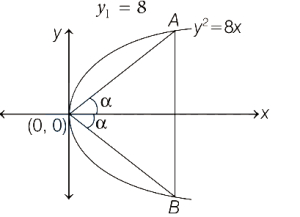
If the double ordinate of the parabola $y^2 = 8x$ is of length $16$,then the angle subtended by it at the vertex of the parabola is
A
$\frac{\pi}{2}$
B
$\frac{\pi}{3}$
C
$\frac{3\pi}{4}$
D
$\frac{\pi}{4}$
Solution
(A) Let the coordinates of the end points of the double ordinate be $A(x_1, y_1)$ and $B(x_1, -y_1)$.
Given the length of the double ordinate $AB = 2y_1 = 16$,so $y_1 = 8$.
Thus,the coordinates are $A(x_1, 8)$ and $B(x_1, -8)$.
Since $A$ and $B$ lie on the parabola $y^2 = 8x$,we have $8^2 = 8x_1$,which gives $64 = 8x_1$,so $x_1 = 8$.
The coordinates of $A$ and $B$ are $(8, 8)$ and $(8, -8)$.
Let $\alpha$ be the angle made by $OA$ with the $X$-axis,where $O$ is the vertex $(0, 0)$.
Then $\tan \alpha = \frac{8}{8} = 1$,which implies $\alpha = \frac{\pi}{4}$.
The angle subtended by the double ordinate $AB$ at the vertex is $2\alpha = 2 \times \frac{\pi}{4} = \frac{\pi}{2}$.
Given the length of the double ordinate $AB = 2y_1 = 16$,so $y_1 = 8$.
Thus,the coordinates are $A(x_1, 8)$ and $B(x_1, -8)$.
Since $A$ and $B$ lie on the parabola $y^2 = 8x$,we have $8^2 = 8x_1$,which gives $64 = 8x_1$,so $x_1 = 8$.
The coordinates of $A$ and $B$ are $(8, 8)$ and $(8, -8)$.
Let $\alpha$ be the angle made by $OA$ with the $X$-axis,where $O$ is the vertex $(0, 0)$.
Then $\tan \alpha = \frac{8}{8} = 1$,which implies $\alpha = \frac{\pi}{4}$.
The angle subtended by the double ordinate $AB$ at the vertex is $2\alpha = 2 \times \frac{\pi}{4} = \frac{\pi}{2}$.
0 likes
View Solution754
MediumMCQ
If the perpendicular distance from the focus of a parabola $y^2=4ax$ to its directrix is $\frac{3}{2}$,then the equation of the normal drawn at $(4a, -4a)$ is
A
$2x+y=3$
B
$2x-y=9$
C
$x-2y=9$
D
$x+2y+3=0$
Solution
(B) The equation of the parabola is $y^2=4ax$. The focus is $(a, 0)$ and the directrix is $x=-a$.
The distance between the focus and the directrix is $2a$.
Given $2a = \frac{3}{2}$,so $a = \frac{3}{4}$.
The point on the parabola is $(4a, -4a) = (4 \times \frac{3}{4}, -4 \times \frac{3}{4}) = (3, -3)$.
The equation of the normal to the parabola $y^2=4ax$ at $(x_1, y_1)$ is $y-y_1 = -\frac{y_1}{2a}(x-x_1)$.
Substituting $x_1=3, y_1=-3$ and $a=\frac{3}{4}$:
$y - (-3) = -\frac{-3}{2(3/4)}(x-3)$
$y+3 = \frac{3}{3/2}(x-3)$
$y+3 = 2(x-3)$
$y+3 = 2x-6$
$2x-y=9$.
The distance between the focus and the directrix is $2a$.
Given $2a = \frac{3}{2}$,so $a = \frac{3}{4}$.
The point on the parabola is $(4a, -4a) = (4 \times \frac{3}{4}, -4 \times \frac{3}{4}) = (3, -3)$.
The equation of the normal to the parabola $y^2=4ax$ at $(x_1, y_1)$ is $y-y_1 = -\frac{y_1}{2a}(x-x_1)$.
Substituting $x_1=3, y_1=-3$ and $a=\frac{3}{4}$:
$y - (-3) = -\frac{-3}{2(3/4)}(x-3)$
$y+3 = \frac{3}{3/2}(x-3)$
$y+3 = 2(x-3)$
$y+3 = 2x-6$
$2x-y=9$.
0 likes
View Solution755
MediumMCQ
Tangents are drawn at three points $P(t_1), Q(t_2), R(t_3)$ on the parabola $y^2 = x$. Let these tangents intersect each other at the points $L, M, N$. If $t_1 = 2, t_2 = -4, t_3 = 6$,then the area of the triangle $LMN$ is
A
$24$
B
$18.5$
C
$7.5$
D
$12$
Solution
(C) For a parabola $y^2 = 4ax$,the tangent at point $t$ is given by $ty = x + at^2$. Here,$4a = 1$,so $a = 1/4$.
The intersection point of tangents at $t_i$ and $t_j$ is $(at_it_j, a(t_i + t_j))$.
Given $t_1 = 2, t_2 = -4, t_3 = 6$ and $a = 1/4$:
Point $L$ (intersection of $t_1, t_2$) = $(1/4(2)(-4), 1/4(2-4)) = (-2, -0.5)$.
Point $M$ (intersection of $t_2, t_3$) = $(1/4(-4)(6), 1/4(-4+6)) = (-6, 0.5)$.
Point $N$ (intersection of $t_3, t_1$) = $(1/4(6)(2), 1/4(6+2)) = (3, 2)$.
The area of triangle with vertices $(x_1, y_1), (x_2, y_2), (x_3, y_3)$ is $\frac{1}{2} |x_1(y_2 - y_3) + x_2(y_3 - y_1) + x_3(y_1 - y_2)|$.
Area = $\frac{1}{2} |(-2)(0.5 - 2) + (-6)(2 - (-0.5)) + 3(-0.5 - 0.5)|$.
Area = $\frac{1}{2} |(-2)(-1.5) + (-6)(2.5) + 3(-1)|$.
Area = $\frac{1}{2} |3 - 15 - 3| = \frac{1}{2} |-15| = 7.5$.
The intersection point of tangents at $t_i$ and $t_j$ is $(at_it_j, a(t_i + t_j))$.
Given $t_1 = 2, t_2 = -4, t_3 = 6$ and $a = 1/4$:
Point $L$ (intersection of $t_1, t_2$) = $(1/4(2)(-4), 1/4(2-4)) = (-2, -0.5)$.
Point $M$ (intersection of $t_2, t_3$) = $(1/4(-4)(6), 1/4(-4+6)) = (-6, 0.5)$.
Point $N$ (intersection of $t_3, t_1$) = $(1/4(6)(2), 1/4(6+2)) = (3, 2)$.
The area of triangle with vertices $(x_1, y_1), (x_2, y_2), (x_3, y_3)$ is $\frac{1}{2} |x_1(y_2 - y_3) + x_2(y_3 - y_1) + x_3(y_1 - y_2)|$.
Area = $\frac{1}{2} |(-2)(0.5 - 2) + (-6)(2 - (-0.5)) + 3(-0.5 - 0.5)|$.
Area = $\frac{1}{2} |(-2)(-1.5) + (-6)(2.5) + 3(-1)|$.
Area = $\frac{1}{2} |3 - 15 - 3| = \frac{1}{2} |-15| = 7.5$.
0 likes
View Solution756
EasyMCQ
The equation of a tangent line to the parabola $y^2 = 8x$,which passes through the point $(1, 3)$,is:
A
$y = 2x + 1$
B
$2y = x + 5$
C
$y = -2x + 5$
D
$2y = 3x + 3$
Solution
(A) The equation of a tangent to the parabola $y^2 = 4ax$ with slope $m$ is $y = mx + \frac{a}{m}$.
Here,$4a = 8$,so $a = 2$.
The equation of the tangent is $y = mx + \frac{2}{m}$.
Since it passes through the point $(1, 3)$,we substitute $x = 1$ and $y = 3$:
$3 = m(1) + \frac{2}{m}$
$3 = m + \frac{2}{m}$
$m^2 - 3m + 2 = 0$
$(m - 1)(m - 2) = 0$
Thus,$m = 1$ or $m = 2$.
For $m = 1$,the tangent is $y = 1x + \frac{2}{1} \Rightarrow y = x + 2$.
For $m = 2$,the tangent is $y = 2x + \frac{2}{2} \Rightarrow y = 2x + 1$.
Comparing with the given options,$y = 2x + 1$ is present.
Here,$4a = 8$,so $a = 2$.
The equation of the tangent is $y = mx + \frac{2}{m}$.
Since it passes through the point $(1, 3)$,we substitute $x = 1$ and $y = 3$:
$3 = m(1) + \frac{2}{m}$
$3 = m + \frac{2}{m}$
$m^2 - 3m + 2 = 0$
$(m - 1)(m - 2) = 0$
Thus,$m = 1$ or $m = 2$.
For $m = 1$,the tangent is $y = 1x + \frac{2}{1} \Rightarrow y = x + 2$.
For $m = 2$,the tangent is $y = 2x + \frac{2}{2} \Rightarrow y = 2x + 1$.
Comparing with the given options,$y = 2x + 1$ is present.
0 likes
View Solution757
EasyMCQ
The equation of the directrix of the parabola whose focus is $(0,0)$ and the tangent at the vertex is $x-y+1=0$ is
A
$x-y=0$
B
$x-y-1=0$
C
$x-y+2=0$
D
$x+y-1=0$
Solution
(C) The tangent at the vertex is given by $x-y+1=0 \dots (i)$.
The focus of the parabola is $S(0,0)$.
The distance from the focus to the tangent at the vertex is $a = \left|\frac{0-0+1}{\sqrt{1^2+(-1)^2}}\right| = \frac{1}{\sqrt{2}}$.
The directrix is parallel to the tangent at the vertex,so its equation is of the form $x-y+c=0$.
The distance from the focus to the directrix is $2a = 2 \times \frac{1}{\sqrt{2}} = \sqrt{2}$.
Thus,$\left|\frac{0-0+c}{\sqrt{1^2+(-1)^2}}\right| = \sqrt{2}$ $\Rightarrow \frac{|c|}{\sqrt{2}} = \sqrt{2}$ $\Rightarrow |c| = 2$.
Since the focus $(0,0)$ and the tangent at the vertex $x-y+1=0$ lie on the same side of the directrix,we choose $c=2$.
Therefore,the equation of the directrix is $x-y+2=0$.
The focus of the parabola is $S(0,0)$.
The distance from the focus to the tangent at the vertex is $a = \left|\frac{0-0+1}{\sqrt{1^2+(-1)^2}}\right| = \frac{1}{\sqrt{2}}$.
The directrix is parallel to the tangent at the vertex,so its equation is of the form $x-y+c=0$.
The distance from the focus to the directrix is $2a = 2 \times \frac{1}{\sqrt{2}} = \sqrt{2}$.
Thus,$\left|\frac{0-0+c}{\sqrt{1^2+(-1)^2}}\right| = \sqrt{2}$ $\Rightarrow \frac{|c|}{\sqrt{2}} = \sqrt{2}$ $\Rightarrow |c| = 2$.
Since the focus $(0,0)$ and the tangent at the vertex $x-y+1=0$ lie on the same side of the directrix,we choose $c=2$.
Therefore,the equation of the directrix is $x-y+2=0$.
0 likes
View Solution758
EasyMCQ
If $x-2=t^2$ and $y=2t$ are the parametric equations of the parabola $y^2=a(x-b)$,then the value of $a+b$ equals
A
$4$
B
$2$
C
$0$
D
$6$
Solution
(D) Given the parametric equations $x-2=t^2$ and $y=2t$,we have $x=t^2+2$ and $y=2t$.
Substituting these into the parabola equation $y^2=a(x-b)$:
$(2t)^2 = a(t^2+2-b)$
$4t^2 = at^2 + a(2-b)$
Comparing the coefficients of $t^2$ and the constant terms on both sides:
$a = 4$
$a(2-b) = 0$ $\Rightarrow 4(2-b) = 0$ $\Rightarrow b = 2$
Therefore,$a+b = 4+2 = 6$.
Substituting these into the parabola equation $y^2=a(x-b)$:
$(2t)^2 = a(t^2+2-b)$
$4t^2 = at^2 + a(2-b)$
Comparing the coefficients of $t^2$ and the constant terms on both sides:
$a = 4$
$a(2-b) = 0$ $\Rightarrow 4(2-b) = 0$ $\Rightarrow b = 2$
Therefore,$a+b = 4+2 = 6$.
0 likes
View Solution759
EasyMCQ
The equation of the tangent to the parabola $y^2=12x$,which makes an angle $30^{\circ}$ with the positive direction of the $X$-axis is given by $x-\sqrt{3}y+9=0$. The point of contact is:
A
$(-9, -6\sqrt{3})$
B
$(9, -6\sqrt{3})$
C
$(-9, 6\sqrt{3})$
D
$(9, 6\sqrt{3})$
Solution
(D) The equation of the parabola is $y^2 = 12x$,which is of the form $y^2 = 4ax$,where $4a = 12$,so $a = 3$.
Let the point of contact be $(x_1, y_1)$.
The equation of the tangent to the parabola $y^2 = 4ax$ at $(x_1, y_1)$ is $yy_1 = 2a(x + x_1)$.
Substituting $a = 3$,we get $yy_1 = 6(x + x_1)$,which simplifies to $6x - y_1y + 6x_1 = 0$.
We are given the tangent equation as $x - \sqrt{3}y + 9 = 0$.
Comparing the two equations: $\frac{6}{1} = \frac{-y_1}{-\sqrt{3}} = \frac{6x_1}{9}$.
From $\frac{6}{1} = \frac{y_1}{\sqrt{3}}$,we get $y_1 = 6\sqrt{3}$.
From $\frac{6}{1} = \frac{6x_1}{9}$,we get $x_1 = 9$.
Thus,the point of contact is $(9, 6\sqrt{3})$.
Let the point of contact be $(x_1, y_1)$.
The equation of the tangent to the parabola $y^2 = 4ax$ at $(x_1, y_1)$ is $yy_1 = 2a(x + x_1)$.
Substituting $a = 3$,we get $yy_1 = 6(x + x_1)$,which simplifies to $6x - y_1y + 6x_1 = 0$.
We are given the tangent equation as $x - \sqrt{3}y + 9 = 0$.
Comparing the two equations: $\frac{6}{1} = \frac{-y_1}{-\sqrt{3}} = \frac{6x_1}{9}$.
From $\frac{6}{1} = \frac{y_1}{\sqrt{3}}$,we get $y_1 = 6\sqrt{3}$.
From $\frac{6}{1} = \frac{6x_1}{9}$,we get $x_1 = 9$.
Thus,the point of contact is $(9, 6\sqrt{3})$.
0 likes
View Solution760
EasyMCQ
The equation of the tangent to the parabola $y^2=16x$,which is perpendicular to the line $3x-4y+5=0$,is given by
A
$4x-3y+9=0$
B
$4x+3y-9=0$
C
$4x+3y+9=0$
D
$4x-3y-9=0$
Solution
(C) The equation of the parabola is $y^2=16x$,so $4a=16$,which gives $a=4$.
The given line is $3x-4y+5=0$,which can be written as $y=\frac{3}{4}x+\frac{5}{4}$.
The slope of this line is $m_1=\frac{3}{4}$.
Since the tangent is perpendicular to this line,its slope $m$ must satisfy $m \times m_1 = -1$.
Thus,$m = -\frac{4}{3}$.
The equation of a tangent to the parabola $y^2=4ax$ with slope $m$ is $y=mx+\frac{a}{m}$.
Substituting $a=4$ and $m=-\frac{4}{3}$,we get $y=-\frac{4}{3}x+\frac{4}{-4/3}$.
$y=-\frac{4}{3}x-3$.
Multiplying by $3$,we get $3y=-4x-9$,which simplifies to $4x+3y+9=0$.
The given line is $3x-4y+5=0$,which can be written as $y=\frac{3}{4}x+\frac{5}{4}$.
The slope of this line is $m_1=\frac{3}{4}$.
Since the tangent is perpendicular to this line,its slope $m$ must satisfy $m \times m_1 = -1$.
Thus,$m = -\frac{4}{3}$.
The equation of a tangent to the parabola $y^2=4ax$ with slope $m$ is $y=mx+\frac{a}{m}$.
Substituting $a=4$ and $m=-\frac{4}{3}$,we get $y=-\frac{4}{3}x+\frac{4}{-4/3}$.
$y=-\frac{4}{3}x-3$.
Multiplying by $3$,we get $3y=-4x-9$,which simplifies to $4x+3y+9=0$.
0 likes
View Solution761
EasyMCQ
The tangent at the point $(1, 2)$ to the curve $y^2 = 4x$ makes an angle $\theta$ with the positive direction of the $X$-axis. Then $\theta =$ (in $^{\circ}$)
A
$60$
B
$30$
C
$90$
D
$45$
Solution
(D) Given the curve $y^2 = 4x$ and the point $P(1, 2)$.
Differentiating both sides with respect to $x$:
$2y \cdot \frac{dy}{dx} = 4$
$\frac{dy}{dx} = \frac{4}{2y} = \frac{2}{y}$
At the point $P(1, 2)$,the slope of the tangent $m$ is:
$m = \left. \frac{dy}{dx} \right|_{(1, 2)} = \frac{2}{2} = 1$
Since the slope $m = \tan \theta$,we have:
$\tan \theta = 1$
$\theta = 45^{\circ}$
Thus,the correct option is $D$.
Differentiating both sides with respect to $x$:
$2y \cdot \frac{dy}{dx} = 4$
$\frac{dy}{dx} = \frac{4}{2y} = \frac{2}{y}$
At the point $P(1, 2)$,the slope of the tangent $m$ is:
$m = \left. \frac{dy}{dx} \right|_{(1, 2)} = \frac{2}{2} = 1$
Since the slope $m = \tan \theta$,we have:
$\tan \theta = 1$
$\theta = 45^{\circ}$
Thus,the correct option is $D$.
0 likes
View Solution762
EasyMCQ
The equation of the tangent to the parabola $y^2=12x$ at the point $(3,-6)$ is:
A
$x-y+9=0$
B
$x+y+3=0$
C
$x+y-3=0$
D
$x=3$
Solution
(B) The equation of the tangent to the parabola $y^2=4ax$ at point $(x_1, y_1)$ is given by $yy_1 = 2a(x+x_1)$.
Here,$4a = 12$,so $a = 3$.
The point is $(x_1, y_1) = (3, -6)$.
Substituting these values into the formula:
$y(-6) = 2(3)(x+3)$
$-6y = 6(x+3)$
$-y = x+3$
$x+y+3 = 0$
Hence,option $B$ is correct.
Here,$4a = 12$,so $a = 3$.
The point is $(x_1, y_1) = (3, -6)$.
Substituting these values into the formula:
$y(-6) = 2(3)(x+3)$
$-6y = 6(x+3)$
$-y = x+3$
$x+y+3 = 0$
Hence,option $B$ is correct.
0 likes
View Solution763
EasyMCQ
The equation of the tangent to the parabola $y^2=8x$ inclined at $30^{\circ}$ to the $X$-axis is
A
$3x-\sqrt{3}y+14=0$
B
$2x-3y+14=0$
C
$2x-\sqrt{3}y+7=0$
D
$x-\sqrt{3}y+6=0$
Solution
(D) The equation of the tangent to the parabola $y^2=4ax$ with slope $m$ is given by $y=mx+\frac{a}{m}$.
Here,the parabola is $y^2=8x$,so $4a=8$,which implies $a=2$.
The inclination is $30^{\circ}$,so the slope $m=\tan(30^{\circ})=\frac{1}{\sqrt{3}}$.
Substituting these values into the tangent equation:
$y=\frac{1}{\sqrt{3}}x+\frac{2}{1/\sqrt{3}}$
$y=\frac{x}{\sqrt{3}}+2\sqrt{3}$
Multiplying by $\sqrt{3}$ on both sides:
$\sqrt{3}y=x+6$
$x-\sqrt{3}y+6=0$.
Thus,the correct option is $D$.
Here,the parabola is $y^2=8x$,so $4a=8$,which implies $a=2$.
The inclination is $30^{\circ}$,so the slope $m=\tan(30^{\circ})=\frac{1}{\sqrt{3}}$.
Substituting these values into the tangent equation:
$y=\frac{1}{\sqrt{3}}x+\frac{2}{1/\sqrt{3}}$
$y=\frac{x}{\sqrt{3}}+2\sqrt{3}$
Multiplying by $\sqrt{3}$ on both sides:
$\sqrt{3}y=x+6$
$x-\sqrt{3}y+6=0$.
Thus,the correct option is $D$.
0 likes
View Solution764
EasyMCQ
If $5x - 2y + k = 0$ is a tangent to the parabola $y^2 = 6x$,then their point of contact is
A
$\left(\frac{6}{5}, \frac{6}{5}\right)$
B
$\left(\frac{6}{5}, \frac{6}{25}\right)$
C
$\left(\frac{6}{25}, \frac{6}{5}\right)$
D
$\left(\frac{6}{25}, \frac{6}{25}\right)$
Solution
(C) Given the parabola $y^2 = 6x$.
Differentiating with respect to $x$,we get:
$2y \frac{dy}{dx} = 6 \Rightarrow \frac{dy}{dx} = \frac{3}{y}$.
The given equation of the tangent is $5x - 2y + k = 0$,which can be written as $2y = 5x + k$,or $y = \frac{5}{2}x + \frac{k}{2}$.
The slope of this tangent is $m = \frac{5}{2}$.
Equating the slope of the tangent to the derivative at the point of contact:
$\frac{3}{y} = \frac{5}{2} \Rightarrow y = \frac{6}{5}$.
Substituting the value of $y$ into the parabola equation $y^2 = 6x$:
$\left(\frac{6}{5}\right)^2 = 6x$ $\Rightarrow \frac{36}{25} = 6x$ $\Rightarrow x = \frac{6}{25}$.
Thus,the point of contact is $\left(\frac{6}{25}, \frac{6}{5}\right)$.
Differentiating with respect to $x$,we get:
$2y \frac{dy}{dx} = 6 \Rightarrow \frac{dy}{dx} = \frac{3}{y}$.
The given equation of the tangent is $5x - 2y + k = 0$,which can be written as $2y = 5x + k$,or $y = \frac{5}{2}x + \frac{k}{2}$.
The slope of this tangent is $m = \frac{5}{2}$.
Equating the slope of the tangent to the derivative at the point of contact:
$\frac{3}{y} = \frac{5}{2} \Rightarrow y = \frac{6}{5}$.
Substituting the value of $y$ into the parabola equation $y^2 = 6x$:
$\left(\frac{6}{5}\right)^2 = 6x$ $\Rightarrow \frac{36}{25} = 6x$ $\Rightarrow x = \frac{6}{25}$.
Thus,the point of contact is $\left(\frac{6}{25}, \frac{6}{5}\right)$.
0 likes
View Solution765
MediumMCQ
If $P$ and the origin are the points of intersection of the parabolas $y^2=32x$ and $2x^2=27y$,and if $\theta$ is the acute angle between these curves at $P$,then $5\sqrt{\tan \theta} =$
A
$2$
B
$2\sqrt{3}$
C
$3\sqrt{2}$
D
$3$
Solution
(C) The given parabolas are $y^2=32x$ $(i)$ and $2x^2=27y$ (ii).
To find the intersection points,substitute $x = \frac{y^2}{32}$ into (ii):
$2(\frac{y^2}{32})^2 = 27y \implies 2 \cdot \frac{y^4}{1024} = 27y \implies \frac{y^4}{512} = 27y \implies y(y^3 - 512 \cdot 27) = 0$.
Thus,$y=0$ or $y^3 = (8^3)(3^3) = 24^3$,so $y=24$.
For $y=24$,$x = \frac{24^2}{32} = \frac{576}{32} = 18$. So $P = (18, 24)$.
For $y^2=32x$,differentiating gives $2y \frac{dy}{dx} = 32 \implies \frac{dy}{dx} = \frac{16}{y}$. At $P(18, 24)$,$m_1 = \frac{16}{24} = \frac{2}{3}$.
For $2x^2=27y$,differentiating gives $4x = 27 \frac{dy}{dx} \implies \frac{dy}{dx} = \frac{4x}{27}$. At $P(18, 24)$,$m_2 = \frac{4(18)}{27} = \frac{72}{27} = \frac{8}{3}$.
The tangent of the angle $\theta$ is given by $\tan \theta = |\frac{m_2 - m_1}{1 + m_1 m_2}| = |\frac{8/3 - 2/3}{1 + (8/3)(2/3)}| = |\frac{6/3}{1 + 16/9}| = |\frac{2}{25/9}| = \frac{18}{25}$.
Therefore,$5\sqrt{\tan \theta} = 5\sqrt{\frac{18}{25}} = 5 \cdot \frac{3\sqrt{2}}{5} = 3\sqrt{2}$.
To find the intersection points,substitute $x = \frac{y^2}{32}$ into (ii):
$2(\frac{y^2}{32})^2 = 27y \implies 2 \cdot \frac{y^4}{1024} = 27y \implies \frac{y^4}{512} = 27y \implies y(y^3 - 512 \cdot 27) = 0$.
Thus,$y=0$ or $y^3 = (8^3)(3^3) = 24^3$,so $y=24$.
For $y=24$,$x = \frac{24^2}{32} = \frac{576}{32} = 18$. So $P = (18, 24)$.
For $y^2=32x$,differentiating gives $2y \frac{dy}{dx} = 32 \implies \frac{dy}{dx} = \frac{16}{y}$. At $P(18, 24)$,$m_1 = \frac{16}{24} = \frac{2}{3}$.
For $2x^2=27y$,differentiating gives $4x = 27 \frac{dy}{dx} \implies \frac{dy}{dx} = \frac{4x}{27}$. At $P(18, 24)$,$m_2 = \frac{4(18)}{27} = \frac{72}{27} = \frac{8}{3}$.
The tangent of the angle $\theta$ is given by $\tan \theta = |\frac{m_2 - m_1}{1 + m_1 m_2}| = |\frac{8/3 - 2/3}{1 + (8/3)(2/3)}| = |\frac{6/3}{1 + 16/9}| = |\frac{2}{25/9}| = \frac{18}{25}$.
Therefore,$5\sqrt{\tan \theta} = 5\sqrt{\frac{18}{25}} = 5 \cdot \frac{3\sqrt{2}}{5} = 3\sqrt{2}$.
0 likes
View Solution766
MediumMCQ
If a perpendicular drawn through the vertex $O$ of the parabola $y^2=4ax$ to any of its tangent meets the tangent at $N$ and the parabola at $M$,then $ON \cdot OM=$
A
$4a^2$
B
$3a^2$
C
$2a^2$
D
$a^2$
Solution
(A) Let the tangent to the parabola $y^2=4ax$ at point $P(at^2, 2at)$ be $yt = x + at^2$ ... $(i)$.
Since the line $NM$ is perpendicular to the tangent and passes through the origin $O(0,0)$,its equation is $y = -tx$ ... (ii).
To find $N$,substitute $y = -tx$ into $(i)$: $t(-tx) = x + at^2 \implies -t^2x - x = at^2 \implies x = -\frac{at^2}{1+t^2}$.
Then $y = -t(-\frac{at^2}{1+t^2}) = \frac{at^3}{1+t^2}$. So,$N \equiv (-\frac{at^2}{1+t^2}, \frac{at^3}{1+t^2})$.
To find $M$,substitute $y = -tx$ into $y^2 = 4ax$: $(-tx)^2 = 4ax \implies t^2x^2 = 4ax$. Since $x \neq 0$,$x = \frac{4a}{t^2}$.
Then $y = -t(\frac{4a}{t^2}) = -\frac{4a}{t}$. So,$M \equiv (\frac{4a}{t^2}, -\frac{4a}{t})$.
Now,$ON = \sqrt{(-\frac{at^2}{1+t^2})^2 + (\frac{at^3}{1+t^2})^2} = \sqrt{\frac{a^2t^4(1+t^2)}{(1+t^2)^2}} = \frac{at^2}{\sqrt{1+t^2}}$.
And $OM = \sqrt{(\frac{4a}{t^2})^2 + (-\frac{4a}{t})^2} = \sqrt{\frac{16a^2}{t^4} + \frac{16a^2}{t^2}} = \frac{4a}{t^2} \sqrt{1+t^2}$.
Therefore,$ON \cdot OM = \frac{at^2}{\sqrt{1+t^2}} \cdot \frac{4a}{t^2} \sqrt{1+t^2} = 4a^2$.
Since the line $NM$ is perpendicular to the tangent and passes through the origin $O(0,0)$,its equation is $y = -tx$ ... (ii).
To find $N$,substitute $y = -tx$ into $(i)$: $t(-tx) = x + at^2 \implies -t^2x - x = at^2 \implies x = -\frac{at^2}{1+t^2}$.
Then $y = -t(-\frac{at^2}{1+t^2}) = \frac{at^3}{1+t^2}$. So,$N \equiv (-\frac{at^2}{1+t^2}, \frac{at^3}{1+t^2})$.
To find $M$,substitute $y = -tx$ into $y^2 = 4ax$: $(-tx)^2 = 4ax \implies t^2x^2 = 4ax$. Since $x \neq 0$,$x = \frac{4a}{t^2}$.
Then $y = -t(\frac{4a}{t^2}) = -\frac{4a}{t}$. So,$M \equiv (\frac{4a}{t^2}, -\frac{4a}{t})$.
Now,$ON = \sqrt{(-\frac{at^2}{1+t^2})^2 + (\frac{at^3}{1+t^2})^2} = \sqrt{\frac{a^2t^4(1+t^2)}{(1+t^2)^2}} = \frac{at^2}{\sqrt{1+t^2}}$.
And $OM = \sqrt{(\frac{4a}{t^2})^2 + (-\frac{4a}{t})^2} = \sqrt{\frac{16a^2}{t^4} + \frac{16a^2}{t^2}} = \frac{4a}{t^2} \sqrt{1+t^2}$.
Therefore,$ON \cdot OM = \frac{at^2}{\sqrt{1+t^2}} \cdot \frac{4a}{t^2} \sqrt{1+t^2} = 4a^2$.
0 likes
View Solution767
DifficultMCQ
Let $\alpha_1$ and $\alpha_2$ be the ordinates of two points $A$ and $B$ on a parabola $y^2=4ax$ and let $\alpha_3$ be the ordinate of the point of intersection of its tangents at $A$ and $B$. Then,$\alpha_3-\alpha_2=$
A
$\alpha_3-\alpha_1$
B
$\alpha_3+\alpha_1$
C
$\alpha_1$
D
$\alpha_1-\alpha_3$
Solution
(D) Let the coordinates of points $A$ and $B$ be $(x_1, \alpha_1)$ and $(x_2, \alpha_2)$ respectively. Since they lie on $y^2=4ax$,we have $\alpha_1^2=4ax_1$ and $\alpha_2^2=4ax_2$.
The tangent at point $(x_i, \alpha_i)$ is given by $y\alpha_i = 2a(x+x_i)$.
The intersection point $(x_3, \alpha_3)$ of the tangents at $A$ and $B$ is given by $\alpha_3 = \frac{\alpha_1+\alpha_2}{2}$.
From this,we have $2\alpha_3 = \alpha_1+\alpha_2$.
Rearranging the terms,we get $\alpha_3-\alpha_2 = \alpha_1-\alpha_3$.
The tangent at point $(x_i, \alpha_i)$ is given by $y\alpha_i = 2a(x+x_i)$.
The intersection point $(x_3, \alpha_3)$ of the tangents at $A$ and $B$ is given by $\alpha_3 = \frac{\alpha_1+\alpha_2}{2}$.
From this,we have $2\alpha_3 = \alpha_1+\alpha_2$.
Rearranging the terms,we get $\alpha_3-\alpha_2 = \alpha_1-\alpha_3$.
0 likes
View Solution768
EasyMCQ
$A = (-2, 0)$ and $P$ is a point on the parabola $y^2 = 8x$. If $Q$ bisects $\overline{AP}$ and the locus of $Q$ is a parabola,then its focus is
A
$(0, 0)$
B
$(1, 1)$
C
$(5, 0)$
D
$(4, 0)$
Solution
(A) Let the point $P$ on the parabola $y^2 = 8x$ be $(2t^2, 4t)$.
Given $A = (-2, 0)$,let $Q = (h, k)$ be the midpoint of $\overline{AP}$.
Then $h = \frac{2t^2 - 2}{2} = t^2 - 1$ and $k = \frac{4t + 0}{2} = 2t$.
From $k = 2t$,we have $t = \frac{k}{2}$.
Substituting $t$ into the equation for $h$: $h = (\frac{k}{2})^2 - 1 = \frac{k^2}{4} - 1$.
Rearranging gives $k^2 = 4(h + 1)$.
The locus of $Q$ is $y^2 = 4(x + 1)$.
Comparing this with the standard form $Y^2 = 4aX$,where $Y = y$,$X = x + 1$,and $4a = 4$,we get $a = 1$.
The vertex of this parabola is $(-1, 0)$.
The focus is at $(X + a, Y) = (-1 + 1, 0) = (0, 0)$.
Given $A = (-2, 0)$,let $Q = (h, k)$ be the midpoint of $\overline{AP}$.
Then $h = \frac{2t^2 - 2}{2} = t^2 - 1$ and $k = \frac{4t + 0}{2} = 2t$.
From $k = 2t$,we have $t = \frac{k}{2}$.
Substituting $t$ into the equation for $h$: $h = (\frac{k}{2})^2 - 1 = \frac{k^2}{4} - 1$.
Rearranging gives $k^2 = 4(h + 1)$.
The locus of $Q$ is $y^2 = 4(x + 1)$.
Comparing this with the standard form $Y^2 = 4aX$,where $Y = y$,$X = x + 1$,and $4a = 4$,we get $a = 1$.
The vertex of this parabola is $(-1, 0)$.
The focus is at $(X + a, Y) = (-1 + 1, 0) = (0, 0)$.
0 likes
View Solution769
MediumMCQ
The tangents to the parabola $y^2 = 4ax$ from an external point $P$ make angles $\theta_1$ and $\theta_2$ with the axis of the parabola,such that $\tan \theta_1 + \tan \theta_2 = b$,where $b$ is a constant. Then $P$ lies on
A
$y = x + b$
B
$y + x = b$
C
$y = \frac{x}{b}$
D
$y = bx$
Solution
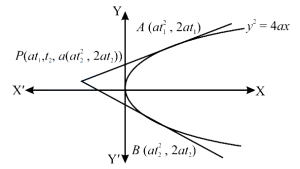
(D) Let the point of contact of the tangents from $P$ to the parabola $y^2 = 4ax$ be $A(at_1^2, 2at_1)$ and $B(at_2^2, 2at_2)$.
The point of intersection $P$ of the tangents at $A$ and $B$ is given by $P(at_1t_2, a(t_1 + t_2))$.
Let $P = (x, y)$,so $x = at_1t_2$ and $y = a(t_1 + t_2)$.
The slope of the tangent at $A(at_1^2, 2at_1)$ is $m_1 = \tan \theta_1 = \frac{1}{t_1}$.
The slope of the tangent at $B(at_2^2, 2at_2)$ is $m_2 = \tan \theta_2 = \frac{1}{t_2}$.
Given that $\tan \theta_1 + \tan \theta_2 = b$,we have $\frac{1}{t_1} + \frac{1}{t_2} = b$.
This simplifies to $\frac{t_1 + t_2}{t_1t_2} = b$.
Substituting the coordinates of $P$,we get $\frac{y/a}{x/a} = b$,which implies $\frac{y}{x} = b$.
Therefore,$y = bx$.
The point of intersection $P$ of the tangents at $A$ and $B$ is given by $P(at_1t_2, a(t_1 + t_2))$.
Let $P = (x, y)$,so $x = at_1t_2$ and $y = a(t_1 + t_2)$.
The slope of the tangent at $A(at_1^2, 2at_1)$ is $m_1 = \tan \theta_1 = \frac{1}{t_1}$.
The slope of the tangent at $B(at_2^2, 2at_2)$ is $m_2 = \tan \theta_2 = \frac{1}{t_2}$.
Given that $\tan \theta_1 + \tan \theta_2 = b$,we have $\frac{1}{t_1} + \frac{1}{t_2} = b$.
This simplifies to $\frac{t_1 + t_2}{t_1t_2} = b$.
Substituting the coordinates of $P$,we get $\frac{y/a}{x/a} = b$,which implies $\frac{y}{x} = b$.
Therefore,$y = bx$.
0 likes
View Solution770
EasyMCQ
The equation of the line touching both parabolas $y^2=4x$ and $x^2=-32y$ is
A
$x+2y+4=0$
B
$2x+y-4=0$
C
$x-2y-4=0$
D
$x-2y+4=0$
Solution
(D) Let the equation of the tangent to the parabola $y^2=4x$ be $y=mx+\frac{1}{m}$.
For the parabola $x^2=-32y$,the equation of the tangent with slope $m$ is $y=mx-a m^2$,where $x^2=4ay$ gives $a=-8$.
Thus,the tangent is $y=mx-(-8)m^2$,which simplifies to $y=mx+8m^2$.
Comparing the two tangent equations,we have $\frac{1}{m}=8m^2$.
This implies $m^3=\frac{1}{8}$,so $m=\frac{1}{2}$.
Substituting $m=\frac{1}{2}$ into the first tangent equation: $y=\frac{1}{2}x+\frac{1}{1/2} = \frac{1}{2}x+2$.
Multiplying by $2$,we get $2y=x+4$,or $x-2y+4=0$.
For the parabola $x^2=-32y$,the equation of the tangent with slope $m$ is $y=mx-a m^2$,where $x^2=4ay$ gives $a=-8$.
Thus,the tangent is $y=mx-(-8)m^2$,which simplifies to $y=mx+8m^2$.
Comparing the two tangent equations,we have $\frac{1}{m}=8m^2$.
This implies $m^3=\frac{1}{8}$,so $m=\frac{1}{2}$.
Substituting $m=\frac{1}{2}$ into the first tangent equation: $y=\frac{1}{2}x+\frac{1}{1/2} = \frac{1}{2}x+2$.
Multiplying by $2$,we get $2y=x+4$,or $x-2y+4=0$.
0 likes
View Solution771
EasyMCQ
The common tangent to the parabolas $y^2=32x$ and $x^2=256y$ is:
A
$2x+4y+64=0$
B
$x+2y-32=0$
C
$2x+4y+32=0$
D
$4x+2y+64=0$
Solution
(A) The given parabolas are $y^2=32x$ and $x^2=256y$.
The equation of a common tangent to the parabolas $y^2=4ax$ and $x^2=4by$ is given by $b^{1/3}y + a^{1/3}x + (a^2b^2)^{1/3} = 0$.
Comparing $y^2=32x$ with $y^2=4ax$,we get $4a=32 \Rightarrow a=8$.
Comparing $x^2=256y$ with $x^2=4by$,we get $4b=256 \Rightarrow b=64$.
Substituting these values into the formula:
$(64)^{1/3}y + (8)^{1/3}x + (8^2 \times 64^2)^{1/3} = 0$
$4y + 2x + (64 \times 4096)^{1/3} = 0$
$4y + 2x + (262144)^{1/3} = 0$
$4y + 2x + 64 = 0$
Dividing by $2$,we get $x + 2y + 32 = 0$. However,checking the options,the equation $2x+4y+64=0$ is equivalent to $x+2y+32=0$.
The equation of a common tangent to the parabolas $y^2=4ax$ and $x^2=4by$ is given by $b^{1/3}y + a^{1/3}x + (a^2b^2)^{1/3} = 0$.
Comparing $y^2=32x$ with $y^2=4ax$,we get $4a=32 \Rightarrow a=8$.
Comparing $x^2=256y$ with $x^2=4by$,we get $4b=256 \Rightarrow b=64$.
Substituting these values into the formula:
$(64)^{1/3}y + (8)^{1/3}x + (8^2 \times 64^2)^{1/3} = 0$
$4y + 2x + (64 \times 4096)^{1/3} = 0$
$4y + 2x + (262144)^{1/3} = 0$
$4y + 2x + 64 = 0$
Dividing by $2$,we get $x + 2y + 32 = 0$. However,checking the options,the equation $2x+4y+64=0$ is equivalent to $x+2y+32=0$.
0 likes
View Solution772
MediumMCQ
The equation of the common tangent to the parabolas $y^2 = 32x$ and $x^2 = 256y$ is
A
$x + 2y + 32 = 0$
B
$x + 2y - 32 = 0$
C
$2x + y - 32 = 0$
D
$2x + y + 32 = 0$
Solution
(A) For the parabola $y^2 = 4ax$,the tangent is $y = mx + \frac{a}{m}$. Here $4a = 32$,so $a = 8$. Thus,the tangent is $y = mx + \frac{8}{m}$.
For the parabola $x^2 = 4by$,the tangent is $x = my - bm^2$. Here $4b = 256$,so $b = 64$. Thus,the tangent is $x = my - 64m^2$.
Rewriting the first equation: $mx - y + \frac{8}{m} = 0$. Rewriting the second equation: $x - my + 64m^2 = 0$.
Since these represent the same line,the ratio of coefficients must be equal: $\frac{m}{1} = \frac{-1}{-m} = \frac{8/m}{64m^2}$.
From $\frac{m}{1} = \frac{1}{m}$,we get $m^2 = 1$,so $m = \pm 1$.
Checking the ratio $\frac{8/m}{64m^2} = \frac{1}{8m^3}$.
For $m = 1$,the ratio is $\frac{1}{8} \neq 1$. For $m = -1$,the ratio is $\frac{1}{-8} \neq -1$.
Let the tangent be $y = mx + c$. For $y^2 = 32x$,$c = \frac{8}{m}$. For $x^2 = 256y$,$c = -64m^2$.
Equating $c$: $\frac{8}{m} = -64m^2 \implies m^3 = -\frac{8}{64} = -\frac{1}{8} \implies m = -\frac{1}{2}$.
Then $c = -64(-\frac{1}{2})^2 = -64(\frac{1}{4}) = -16$.
The equation is $y = -\frac{1}{2}x - 16$,which simplifies to $2y = -x - 32$,or $x + 2y + 32 = 0$.
For the parabola $x^2 = 4by$,the tangent is $x = my - bm^2$. Here $4b = 256$,so $b = 64$. Thus,the tangent is $x = my - 64m^2$.
Rewriting the first equation: $mx - y + \frac{8}{m} = 0$. Rewriting the second equation: $x - my + 64m^2 = 0$.
Since these represent the same line,the ratio of coefficients must be equal: $\frac{m}{1} = \frac{-1}{-m} = \frac{8/m}{64m^2}$.
From $\frac{m}{1} = \frac{1}{m}$,we get $m^2 = 1$,so $m = \pm 1$.
Checking the ratio $\frac{8/m}{64m^2} = \frac{1}{8m^3}$.
For $m = 1$,the ratio is $\frac{1}{8} \neq 1$. For $m = -1$,the ratio is $\frac{1}{-8} \neq -1$.
Let the tangent be $y = mx + c$. For $y^2 = 32x$,$c = \frac{8}{m}$. For $x^2 = 256y$,$c = -64m^2$.
Equating $c$: $\frac{8}{m} = -64m^2 \implies m^3 = -\frac{8}{64} = -\frac{1}{8} \implies m = -\frac{1}{2}$.
Then $c = -64(-\frac{1}{2})^2 = -64(\frac{1}{4}) = -16$.
The equation is $y = -\frac{1}{2}x - 16$,which simplifies to $2y = -x - 32$,or $x + 2y + 32 = 0$.
0 likes
View Solution773
MediumMCQ
If $L$ is the normal drawn to the parabola $y^2 = 8x$ at the point $t = \frac{1}{\sqrt{2}}$,then the foot of the perpendicular drawn from the focus of the parabola on to the normal $L$ is
A
$(3, 2)$
B
$(5, \sqrt{2})$
C
$(0, \sqrt{2})$
D
$(3, \sqrt{2})$
Solution
(D) The equation of the parabola is $y^2 = 8x$,so $4a = 8$,which gives $a = 2$.
The point on the parabola at parameter $t$ is $(at^2, 2at) = (2t^2, 4t)$.
For $t = \frac{1}{\sqrt{2}}$,the point is $(2(\frac{1}{2}), 4(\frac{1}{\sqrt{2}})) = (1, 2\sqrt{2})$.
The equation of the normal to the parabola $y^2 = 4ax$ at parameter $t$ is $y + tx = 2at + at^3$.
Substituting $a = 2$ and $t = \frac{1}{\sqrt{2}}$,the equation of the normal $L$ is $y + \frac{1}{\sqrt{2}}x = 2(2)(\frac{1}{\sqrt{2}}) + 2(\frac{1}{2\sqrt{2}}) = \frac{4}{\sqrt{2}} + \frac{1}{\sqrt{2}} = \frac{5}{\sqrt{2}}$.
Multiplying by $\sqrt{2}$,we get $x + \sqrt{2}y = 5$.
The focus of the parabola is $(a, 0) = (2, 0)$.
The foot of the perpendicular $(h, k)$ from $(x_1, y_1)$ to the line $Ax + By + C = 0$ is given by $\frac{h - x_1}{A} = \frac{k - y_1}{B} = -\frac{Ax_1 + By_1 + C}{A^2 + B^2}$.
Here $A = 1, B = \sqrt{2}, C = -5$ and $(x_1, y_1) = (2, 0)$.
$\frac{h - 2}{1} = \frac{k - 0}{\sqrt{2}} = -\frac{1(2) + \sqrt{2}(0) - 5}{1^2 + (\sqrt{2})^2} = -\frac{2 - 5}{1 + 2} = -\frac{-3}{3} = 1$.
So,$h - 2 = 1 \implies h = 3$ and $\frac{k}{\sqrt{2}} = 1 \implies k = \sqrt{2}$.
The foot of the perpendicular is $(3, \sqrt{2})$.
The point on the parabola at parameter $t$ is $(at^2, 2at) = (2t^2, 4t)$.
For $t = \frac{1}{\sqrt{2}}$,the point is $(2(\frac{1}{2}), 4(\frac{1}{\sqrt{2}})) = (1, 2\sqrt{2})$.
The equation of the normal to the parabola $y^2 = 4ax$ at parameter $t$ is $y + tx = 2at + at^3$.
Substituting $a = 2$ and $t = \frac{1}{\sqrt{2}}$,the equation of the normal $L$ is $y + \frac{1}{\sqrt{2}}x = 2(2)(\frac{1}{\sqrt{2}}) + 2(\frac{1}{2\sqrt{2}}) = \frac{4}{\sqrt{2}} + \frac{1}{\sqrt{2}} = \frac{5}{\sqrt{2}}$.
Multiplying by $\sqrt{2}$,we get $x + \sqrt{2}y = 5$.
The focus of the parabola is $(a, 0) = (2, 0)$.
The foot of the perpendicular $(h, k)$ from $(x_1, y_1)$ to the line $Ax + By + C = 0$ is given by $\frac{h - x_1}{A} = \frac{k - y_1}{B} = -\frac{Ax_1 + By_1 + C}{A^2 + B^2}$.
Here $A = 1, B = \sqrt{2}, C = -5$ and $(x_1, y_1) = (2, 0)$.
$\frac{h - 2}{1} = \frac{k - 0}{\sqrt{2}} = -\frac{1(2) + \sqrt{2}(0) - 5}{1^2 + (\sqrt{2})^2} = -\frac{2 - 5}{1 + 2} = -\frac{-3}{3} = 1$.
So,$h - 2 = 1 \implies h = 3$ and $\frac{k}{\sqrt{2}} = 1 \implies k = \sqrt{2}$.
The foot of the perpendicular is $(3, \sqrt{2})$.
0 likes
View Solution774
MediumMCQ
If $x-y-3=0$ is a normal drawn through the point $(5,2)$ to the parabola $y^2=4x$,then the slope of the other normal that can be drawn through the same point to the parabola $y^2=4x$ is
A
$0$
B
$-1$
C
$2$
D
$-2$
Solution
(D) The equation of a normal to the parabola $y^2=4ax$ with slope $m$ is $y=mx-2am-am^3$.
Here,$a=1$. So,the normal equation is $y=mx-2m-m^3$.
Since the normal passes through $(5,2)$,we have $2=5m-2m-m^3$,which simplifies to $m^3-3m+2=0$.
Factoring the cubic equation,we get $(m-1)^2(m+2)=0$.
The roots are $m=1$ and $m=-2$.
The slope of the given normal $x-y-3=0$ is $m=1$.
Therefore,the slope of the other normal is $m=-2$.
Here,$a=1$. So,the normal equation is $y=mx-2m-m^3$.
Since the normal passes through $(5,2)$,we have $2=5m-2m-m^3$,which simplifies to $m^3-3m+2=0$.
Factoring the cubic equation,we get $(m-1)^2(m+2)=0$.
The roots are $m=1$ and $m=-2$.
The slope of the given normal $x-y-3=0$ is $m=1$.
Therefore,the slope of the other normal is $m=-2$.
0 likes
View Solution775
MediumMCQ
The normal drawn at a point $(2, -4)$ on the parabola $y^2 = 8x$ cuts the same parabola again at $(\alpha, \beta)$. Then $\alpha + \beta =$
A
$8$
B
$16$
C
$24$
D
$30$
Solution
(D) Given the parabola $y^2 = 8x$,we have $4a = 8$,so $a = 2$.
For a point $(at^2, 2at)$ on the parabola,we have $(2, -4) = (2t^2, 4t)$,which gives $t = -1$.
The normal at parameter $t$ meets the parabola again at parameter $t_2 = -t - \frac{2}{t}$.
Substituting $t = -1$,we get $t_2 = -(-1) - \frac{2}{-1} = 1 + 2 = 3$.
The coordinates of the point $(\alpha, \beta)$ are $(at_2^2, 2at_2) = (2(3)^2, 2(2)(3)) = (18, 12)$.
Thus,$\alpha + \beta = 18 + 12 = 30$.
For a point $(at^2, 2at)$ on the parabola,we have $(2, -4) = (2t^2, 4t)$,which gives $t = -1$.
The normal at parameter $t$ meets the parabola again at parameter $t_2 = -t - \frac{2}{t}$.
Substituting $t = -1$,we get $t_2 = -(-1) - \frac{2}{-1} = 1 + 2 = 3$.
The coordinates of the point $(\alpha, \beta)$ are $(at_2^2, 2at_2) = (2(3)^2, 2(2)(3)) = (18, 12)$.
Thus,$\alpha + \beta = 18 + 12 = 30$.
0 likes
View Solution776
EasyMCQ
The equation of the normal drawn to the parabola $y^2=6x$ at the point $(24,12)$ is
A
$3x-y=60$
B
$4x+y=108$
C
$2x+y=60$
D
$x-2y=0$
Solution
(B) The equation of the parabola is $y^2=6x$. Comparing this with $y^2=4ax$,we get $4a=6$,so $a=1.5$.
The equation of the normal to the parabola $y^2=4ax$ at the point $(x_1, y_1)$ is given by $y-y_1 = -\frac{y_1}{2a}(x-x_1)$.
Substituting the values $x_1=24$,$y_1=12$,and $a=1.5$:
$y-12 = -\frac{12}{2(1.5)}(x-24)$
$y-12 = -\frac{12}{3}(x-24)$
$y-12 = -4(x-24)$
$y-12 = -4x+96$
$4x+y = 108$.
The equation of the normal to the parabola $y^2=4ax$ at the point $(x_1, y_1)$ is given by $y-y_1 = -\frac{y_1}{2a}(x-x_1)$.
Substituting the values $x_1=24$,$y_1=12$,and $a=1.5$:
$y-12 = -\frac{12}{2(1.5)}(x-24)$
$y-12 = -\frac{12}{3}(x-24)$
$y-12 = -4(x-24)$
$y-12 = -4x+96$
$4x+y = 108$.
0 likes
View Solution777
EasyMCQ
If the normal chord drawn at $(2 a, 2 a \sqrt{2})$ on the parabola $y^2=4 a x$ subtends an angle $\theta$ at its vertex,then $\theta=$ (in $^{\circ}$)
A
$45$
B
$90$
C
$135$
D
$60$
Solution
(B) The parabola is $y^2 = 4ax$. The point $P$ is $(2a, 2a\sqrt{2})$.
Comparing $P(2a, 2a\sqrt{2})$ with $(at^2, 2at)$,we get $t = \sqrt{2}$.
The normal at $t$ meets the parabola at $t_1 = -t - \frac{2}{t} = -\sqrt{2} - \frac{2}{\sqrt{2}} = -2\sqrt{2}$.
The coordinates of $Q$ are $(at_1^2, 2at_1) = (a(-2\sqrt{2})^2, 2a(-2\sqrt{2})) = (8a, -4a\sqrt{2})$.
The vertex is $O(0, 0)$.
The slope of $OP$ is $m_1 = \frac{2a\sqrt{2}}{2a} = \sqrt{2}$.
The slope of $OQ$ is $m_2 = \frac{-4a\sqrt{2}}{8a} = -\frac{\sqrt{2}}{2} = -\frac{1}{\sqrt{2}}$.
Since $m_1 \times m_2 = \sqrt{2} \times (-\frac{1}{\sqrt{2}}) = -1$,the lines $OP$ and $OQ$ are perpendicular.
Therefore,$\theta = 90^{\circ}$.
Comparing $P(2a, 2a\sqrt{2})$ with $(at^2, 2at)$,we get $t = \sqrt{2}$.
The normal at $t$ meets the parabola at $t_1 = -t - \frac{2}{t} = -\sqrt{2} - \frac{2}{\sqrt{2}} = -2\sqrt{2}$.
The coordinates of $Q$ are $(at_1^2, 2at_1) = (a(-2\sqrt{2})^2, 2a(-2\sqrt{2})) = (8a, -4a\sqrt{2})$.
The vertex is $O(0, 0)$.
The slope of $OP$ is $m_1 = \frac{2a\sqrt{2}}{2a} = \sqrt{2}$.
The slope of $OQ$ is $m_2 = \frac{-4a\sqrt{2}}{8a} = -\frac{\sqrt{2}}{2} = -\frac{1}{\sqrt{2}}$.
Since $m_1 \times m_2 = \sqrt{2} \times (-\frac{1}{\sqrt{2}}) = -1$,the lines $OP$ and $OQ$ are perpendicular.
Therefore,$\theta = 90^{\circ}$.
0 likes
View Solution778
EasyMCQ
If $ax + by = 1$ is a normal to the parabola $y^2 = 4px$, then the condition is:
A
$4ab = a^2 + b^2$
B
$4pab + ab^3 = a^2b^2$
C
$pa^3 = b^2 - 2pab^2$
D
$pa^2 + 1pa = a + b$
Solution
(C) The equation of a normal to the parabola $y^2 = 4px$ with slope $m$ is given by $y = mx - 2pm - pm^3$.
Given the normal equation $ax + by = 1$, we can rewrite it as $y = -\frac{a}{b}x + \frac{1}{b}$.
Comparing the two equations, we get $m = -\frac{a}{b}$ and the constant term $-2pm - pm^3 = \frac{1}{b}$.
Substituting $m = -\frac{a}{b}$ into the constant term equation:
$-2p(-\frac{a}{b}) - p(-\frac{a}{b})^3 = \frac{1}{b}$
$\frac{2pa}{b} + \frac{pa^3}{b^3} = \frac{1}{b}$
Multiplying both sides by $b^3$, we get $2pab^2 + pa^3 = b^2$, which can be rearranged as $pa^3 = b^2 - 2pab^2$.
Given the normal equation $ax + by = 1$, we can rewrite it as $y = -\frac{a}{b}x + \frac{1}{b}$.
Comparing the two equations, we get $m = -\frac{a}{b}$ and the constant term $-2pm - pm^3 = \frac{1}{b}$.
Substituting $m = -\frac{a}{b}$ into the constant term equation:
$-2p(-\frac{a}{b}) - p(-\frac{a}{b})^3 = \frac{1}{b}$
$\frac{2pa}{b} + \frac{pa^3}{b^3} = \frac{1}{b}$
Multiplying both sides by $b^3$, we get $2pab^2 + pa^3 = b^2$, which can be rearranged as $pa^3 = b^2 - 2pab^2$.
0 likes
View Solution779
MediumMCQ
If the line $y=2x+k$ is a normal to the parabola $y^2=4x$,then $k=$
A
-$10$
B
$10$
C
$12$
D
-$12$
Solution
(D) The equation of a normal to the parabola $y^2=4ax$ with slope $m$ is given by $y=mx-2am-am^3$.
Comparing the given parabola $y^2=4x$ with $y^2=4ax$,we get $a=1$.
The given line is $y=2x+k$,so the slope $m=2$.
Substituting $a=1$ and $m=2$ into the normal equation:
$k = -2(1)(2) - (1)(2)^3$
$k = -4 - 8$
$k = -12$.
Thus,the correct option is $D$.
Comparing the given parabola $y^2=4x$ with $y^2=4ax$,we get $a=1$.
The given line is $y=2x+k$,so the slope $m=2$.
Substituting $a=1$ and $m=2$ into the normal equation:
$k = -2(1)(2) - (1)(2)^3$
$k = -4 - 8$
$k = -12$.
Thus,the correct option is $D$.
0 likes
View Solution780
MediumMCQ
The locus of the points of intersection of perpendicular normals to the parabola $y^2=4ax$ is
A
$y^2-2ax+a^2=0$
B
$y^2+ax+2a^2=0$
C
$y^2-ax+2a^2=0$
D
$y^2-ax+3a^2=0$
Solution
(D) The equation of a normal with slope $m$ to the parabola $y^2=4ax$ is given by $y=mx-2am-am^3$.
If this normal passes through a point $(h, k)$,then $k=mh-2am-am^3$,which is a cubic equation in $m$: $am^3 + (2a-h)m + k = 0$.
Let the roots of this equation be $m_1, m_2, m_3$.
Since the normals are perpendicular,let $m_1m_2 = -1$.
From the properties of roots,the product of roots is $m_1m_2m_3 = -k/a$.
Substituting $m_1m_2 = -1$,we get $(-1)m_3 = -k/a$,so $m_3 = k/a$.
Since $m_3$ is a root,it must satisfy the cubic equation: $a(k/a)^3 + (2a-h)(k/a) + k = 0$.
Simplifying this: $k^3/a^2 + 2k - hk/a + k = 0$.
Dividing by $k$ (assuming $k \neq 0$): $k^2/a^2 + 3 - h/a = 0$.
$k^2/a^2 = h/a - 3$.
$k^2 = ah - 3a^2$.
Replacing $(h, k)$ with $(x, y)$,the locus is $y^2 = ax - 3a^2$,or $y^2 - ax + 3a^2 = 0$.
If this normal passes through a point $(h, k)$,then $k=mh-2am-am^3$,which is a cubic equation in $m$: $am^3 + (2a-h)m + k = 0$.
Let the roots of this equation be $m_1, m_2, m_3$.
Since the normals are perpendicular,let $m_1m_2 = -1$.
From the properties of roots,the product of roots is $m_1m_2m_3 = -k/a$.
Substituting $m_1m_2 = -1$,we get $(-1)m_3 = -k/a$,so $m_3 = k/a$.
Since $m_3$ is a root,it must satisfy the cubic equation: $a(k/a)^3 + (2a-h)(k/a) + k = 0$.
Simplifying this: $k^3/a^2 + 2k - hk/a + k = 0$.
Dividing by $k$ (assuming $k \neq 0$): $k^2/a^2 + 3 - h/a = 0$.
$k^2/a^2 = h/a - 3$.
$k^2 = ah - 3a^2$.
Replacing $(h, k)$ with $(x, y)$,the locus is $y^2 = ax - 3a^2$,or $y^2 - ax + 3a^2 = 0$.
0 likes
View Solution781
EasyMCQ
The equation of the normal to the parabola $y^2=4x$ which is perpendicular to the line $x+3y+1=0$ is
A
$3x-y=33$
B
$3x-y+33=0$
C
$3x+y=33$
D
$3x+y+33=0$
Solution
(A) The given equation of the parabola is $y^2=4x$,which implies $a=1$.
The equation of the normal to the parabola $y^2=4ax$ with slope $m$ is given by $y=mx-2am-am^3$.
Substituting $a=1$,the equation of the normal is $y=mx-2m-m^3 \dots(I)$.
The given line is $x+3y+1=0$,which can be written as $y=-\frac{1}{3}x-\frac{1}{3}$. The slope of this line is $m_1 = -\frac{1}{3}$.
Since the normal is perpendicular to this line,the product of their slopes must be $-1$. Let $m$ be the slope of the normal,then $m \times (-\frac{1}{3}) = -1$,which gives $m=3$.
Substituting $m=3$ into equation $(I)$:
$y = 3x - 2(3) - (3)^3$
$y = 3x - 6 - 27$
$y = 3x - 33$
$3x - y = 33$.
The equation of the normal to the parabola $y^2=4ax$ with slope $m$ is given by $y=mx-2am-am^3$.
Substituting $a=1$,the equation of the normal is $y=mx-2m-m^3 \dots(I)$.
The given line is $x+3y+1=0$,which can be written as $y=-\frac{1}{3}x-\frac{1}{3}$. The slope of this line is $m_1 = -\frac{1}{3}$.
Since the normal is perpendicular to this line,the product of their slopes must be $-1$. Let $m$ be the slope of the normal,then $m \times (-\frac{1}{3}) = -1$,which gives $m=3$.
Substituting $m=3$ into equation $(I)$:
$y = 3x - 2(3) - (3)^3$
$y = 3x - 6 - 27$
$y = 3x - 33$
$3x - y = 33$.
0 likes
View Solution782
DifficultMCQ
$A$ point on the parabola whose focus is $S(1,-1)$ and whose vertex is $A(1,1)$ is
A
$\left(3, \frac{1}{2}\right)$
B
$(1,2)$
C
$\left(2, \frac{1}{2}\right)$
D
$(2,2)$
Solution
(A) The axis of the parabola is the line passing through the focus $S(1,-1)$ and vertex $A(1,1)$. Since the $x$-coordinates are the same,the axis is the vertical line $x=1$.
The distance between the vertex $A(1,1)$ and focus $S(1,-1)$ is $a = \sqrt{(1-1)^2 + (1 - (-1))^2} = 2$.
Since the vertex is above the focus,the parabola opens downwards. The directrix is a horizontal line at a distance $a=2$ above the vertex $A(1,1)$.
The equation of the directrix is $y = 1 + 2 = 3$.
By the definition of a parabola,for any point $P(x,y)$ on it,the distance to the focus equals the distance to the directrix: $PS^2 = PM^2$.
$(x-1)^2 + (y+1)^2 = (y-3)^2$.
$(x-1)^2 + y^2 + 2y + 1 = y^2 - 6y + 9$.
$(x-1)^2 = -8y + 8 = 8(1-y)$.
Checking option $A$: For $\left(3, \frac{1}{2}\right)$,$(3-1)^2 = 2^2 = 4$ and $8(1 - \frac{1}{2}) = 8(\frac{1}{2}) = 4$.
Since $4=4$,the point $\left(3, \frac{1}{2}\right)$ lies on the parabola.
The distance between the vertex $A(1,1)$ and focus $S(1,-1)$ is $a = \sqrt{(1-1)^2 + (1 - (-1))^2} = 2$.
Since the vertex is above the focus,the parabola opens downwards. The directrix is a horizontal line at a distance $a=2$ above the vertex $A(1,1)$.
The equation of the directrix is $y = 1 + 2 = 3$.
By the definition of a parabola,for any point $P(x,y)$ on it,the distance to the focus equals the distance to the directrix: $PS^2 = PM^2$.
$(x-1)^2 + (y+1)^2 = (y-3)^2$.
$(x-1)^2 + y^2 + 2y + 1 = y^2 - 6y + 9$.
$(x-1)^2 = -8y + 8 = 8(1-y)$.
Checking option $A$: For $\left(3, \frac{1}{2}\right)$,$(3-1)^2 = 2^2 = 4$ and $8(1 - \frac{1}{2}) = 8(\frac{1}{2}) = 4$.
Since $4=4$,the point $\left(3, \frac{1}{2}\right)$ lies on the parabola.
0 likes
View Solution783
EasyMCQ
If the normal at the point $t_1$ (i.e.,at $(at_1^2, 2at_1)$) on the parabola $y^2 = 4ax$ meets the parabola again at the point $t_2$,then $t_1t_2$ is equal to:
A
$-2 - t_1^2$
B
$-2$
C
$-t_1^2 + 2$
D
$t_1^2 + 2$
Solution
(A) The equation of the normal to the parabola $y^2 = 4ax$ at point $t_1$ is given by $y + t_1x = 2at_1 + at_1^3$.
Since this normal meets the parabola again at point $t_2 = (at_2^2, 2at_2)$,the point $(at_2^2, 2at_2)$ must satisfy the equation of the normal.
Substituting $x = at_2^2$ and $y = 2at_2$ into the normal equation:
$2at_2 + t_1(at_2^2) = 2at_1 + at_1^3$.
Dividing by $a$ (assuming $a \neq 0$):
$2t_2 + t_1t_2^2 = 2t_1 + t_1^3$.
Rearranging the terms:
$t_1(t_2^2 - t_1^2) + 2(t_2 - t_1) = 0$.
$t_1(t_2 - t_1)(t_2 + t_1) + 2(t_2 - t_1) = 0$.
Since $t_1 \neq t_2$ for the normal to meet the parabola at a distinct second point,we can divide by $(t_2 - t_1)$:
$t_1(t_2 + t_1) + 2 = 0$.
$t_1t_2 + t_1^2 + 2 = 0$.
Therefore,$t_1t_2 = -2 - t_1^2$.
Since this normal meets the parabola again at point $t_2 = (at_2^2, 2at_2)$,the point $(at_2^2, 2at_2)$ must satisfy the equation of the normal.
Substituting $x = at_2^2$ and $y = 2at_2$ into the normal equation:
$2at_2 + t_1(at_2^2) = 2at_1 + at_1^3$.
Dividing by $a$ (assuming $a \neq 0$):
$2t_2 + t_1t_2^2 = 2t_1 + t_1^3$.
Rearranging the terms:
$t_1(t_2^2 - t_1^2) + 2(t_2 - t_1) = 0$.
$t_1(t_2 - t_1)(t_2 + t_1) + 2(t_2 - t_1) = 0$.
Since $t_1 \neq t_2$ for the normal to meet the parabola at a distinct second point,we can divide by $(t_2 - t_1)$:
$t_1(t_2 + t_1) + 2 = 0$.
$t_1t_2 + t_1^2 + 2 = 0$.
Therefore,$t_1t_2 = -2 - t_1^2$.
0 likes
View Solution784
MediumMCQ
The locus of the point of intersection of the normals to the parabola $x^2=8y$,which are at right angles to each other,is
A
$y^2=2x-5$
B
$y^2=x-12$
C
$x^2=y-10$
D
$x^2=2y-12$
Solution
(D) For a parabola $x^2=4ay$,the equation of the normal at point $(2at, at^2)$ is $y-at^2 = -t(x-2at)$,which simplifies to $x+ty = 2at+at^3$.
Here,$4a=8$,so $a=2$.
The equation of the normal is $x+ty = 4t+2t^3$.
Let the intersection point be $(h, k)$. Then $h+tk = 4t+2t^3$,or $2t^3 + (4-k)t - h = 0$.
This cubic equation in $t$ has three roots $t_1, t_2, t_3$. Since the normals are at right angles,the product of the slopes of the two normals is $-1$.
The slope of the normal is $m = -t$. Thus,$(-t_1)(-t_2) = -1$,which means $t_1 t_2 = -1$.
From the cubic equation,the product of the roots $t_1 t_2 t_3 = -h/2$.
Substituting $t_1 t_2 = -1$,we get $-t_3 = -h/2$,so $t_3 = h/2$.
Since $t_3$ is a root of the cubic equation,we substitute it back: $2(h/2)^3 + (4-k)(h/2) - h = 0$.
$h^3/4 + 2h - kh/2 - h = 0$.
$h^3/4 + h - kh/2 = 0$.
Dividing by $h$ (assuming $h \neq 0$),$h^2/4 + 1 - k/2 = 0$,which gives $h^2 + 4 - 2k = 0$,or $h^2 = 2k-4$.
Replacing $(h, k)$ with $(x, y)$,the locus is $x^2 = 2y-4$.
Wait,checking the options,the standard result for $x^2=4ay$ is $x^2 = a(y-3a)$. For $a=2$,$x^2 = 2(y-6) = 2y-12$.
Thus,the correct option is $D$.
Here,$4a=8$,so $a=2$.
The equation of the normal is $x+ty = 4t+2t^3$.
Let the intersection point be $(h, k)$. Then $h+tk = 4t+2t^3$,or $2t^3 + (4-k)t - h = 0$.
This cubic equation in $t$ has three roots $t_1, t_2, t_3$. Since the normals are at right angles,the product of the slopes of the two normals is $-1$.
The slope of the normal is $m = -t$. Thus,$(-t_1)(-t_2) = -1$,which means $t_1 t_2 = -1$.
From the cubic equation,the product of the roots $t_1 t_2 t_3 = -h/2$.
Substituting $t_1 t_2 = -1$,we get $-t_3 = -h/2$,so $t_3 = h/2$.
Since $t_3$ is a root of the cubic equation,we substitute it back: $2(h/2)^3 + (4-k)(h/2) - h = 0$.
$h^3/4 + 2h - kh/2 - h = 0$.
$h^3/4 + h - kh/2 = 0$.
Dividing by $h$ (assuming $h \neq 0$),$h^2/4 + 1 - k/2 = 0$,which gives $h^2 + 4 - 2k = 0$,or $h^2 = 2k-4$.
Replacing $(h, k)$ with $(x, y)$,the locus is $x^2 = 2y-4$.
Wait,checking the options,the standard result for $x^2=4ay$ is $x^2 = a(y-3a)$. For $a=2$,$x^2 = 2(y-6) = 2y-12$.
Thus,the correct option is $D$.
0 likes
View Solution785
MediumMCQ
If the angle between the tangents drawn through the point $(-2, -1)$ to the parabola $y^2 = 4x$ is $\theta$,then $\tan 2\theta =$
A
$3$
B
$-3$
C
$\frac{-3}{4}$
D
$\frac{3}{4}$
Solution
(C) The equation of the parabola is $y^2 = 4x$,so $a = 1$.
The point $(-2, -1)$ lies outside the parabola because $(-1)^2 - 4(-2) = 1 + 8 = 9 > 0$.
The equation of a tangent to $y^2 = 4ax$ with slope $m$ is $y = mx + \frac{a}{m}$.
Substituting $a = 1$ and the point $(-2, -1)$,we get $-1 = -2m + \frac{1}{m}$.
Multiplying by $m$,we get $-m = -2m^2 + 1$,which simplifies to $2m^2 - m - 1 = 0$.
Factoring the quadratic,$(2m + 1)(m - 1) = 0$,so the slopes are $m_1 = 1$ and $m_2 = -1/2$.
The angle $\theta$ between the tangents is given by $\tan \theta = |\frac{m_1 - m_2}{1 + m_1 m_2}|$.
$\tan \theta = |\frac{1 - (-1/2)}{1 + (1)(-1/2)}| = |\frac{3/2}{1/2}| = 3$.
We need to find $\tan 2\theta = \frac{2 \tan \theta}{1 - \tan^2 \theta}$.
Substituting $\tan \theta = 3$,we get $\tan 2\theta = \frac{2(3)}{1 - 3^2} = \frac{6}{1 - 9} = \frac{6}{-8} = -\frac{3}{4}$.
The point $(-2, -1)$ lies outside the parabola because $(-1)^2 - 4(-2) = 1 + 8 = 9 > 0$.
The equation of a tangent to $y^2 = 4ax$ with slope $m$ is $y = mx + \frac{a}{m}$.
Substituting $a = 1$ and the point $(-2, -1)$,we get $-1 = -2m + \frac{1}{m}$.
Multiplying by $m$,we get $-m = -2m^2 + 1$,which simplifies to $2m^2 - m - 1 = 0$.
Factoring the quadratic,$(2m + 1)(m - 1) = 0$,so the slopes are $m_1 = 1$ and $m_2 = -1/2$.
The angle $\theta$ between the tangents is given by $\tan \theta = |\frac{m_1 - m_2}{1 + m_1 m_2}|$.
$\tan \theta = |\frac{1 - (-1/2)}{1 + (1)(-1/2)}| = |\frac{3/2}{1/2}| = 3$.
We need to find $\tan 2\theta = \frac{2 \tan \theta}{1 - \tan^2 \theta}$.
Substituting $\tan \theta = 3$,we get $\tan 2\theta = \frac{2(3)}{1 - 3^2} = \frac{6}{1 - 9} = \frac{6}{-8} = -\frac{3}{4}$.
0 likes
View Solution786
MediumMCQ
If tangent lines are drawn from the point $(-1, 2)$ to the parabola $y^2 = 4x$, then the area of the triangle (in sq. units) formed by the chord of contact and the tangents drawn is: (in $\sqrt{2}$)
A
$4$
B
$5$
C
$7$
D
$8$
Solution
(D) Given the parabola $y^2 = 4x$, we have $a = 1$. The point is $P(-1, 2)$.
The equation of the chord of contact for $P(x_1, y_1)$ is $yy_1 = 2a(x + x_1)$.
Substituting $x_1 = -1, y_1 = 2, a = 1$, we get $2y = 2(x - 1)$, which simplifies to $y = x - 1$ or $x - y - 1 = 0$.
The length of the chord of contact $L$ is given by $\frac{\sqrt{(y_1^2 - 4ax_1)^3}}{2a} = \frac{\sqrt{(2^2 - 4(1)(-1))^3}}{2(1)} = \frac{\sqrt{(4 + 4)^3}}{2} = \frac{\sqrt{8^3}}{2} = \frac{16\sqrt{2}}{2} = 8\sqrt{2}$.
The perpendicular distance $h$ from the point $(-1, 2)$ to the chord $x - y - 1 = 0$ is $h = \frac{|(-1) - (2) - 1|}{\sqrt{1^2 + (-1)^2}} = \frac{|-4|}{\sqrt{2}} = 2\sqrt{2}$.
The area of the triangle formed by the tangents and the chord of contact is given by $\frac{h^3}{2a} = \frac{(2\sqrt{2})^3}{2(1)} = \frac{8 \times 2\sqrt{2}}{2} = 8\sqrt{2}$.
The equation of the chord of contact for $P(x_1, y_1)$ is $yy_1 = 2a(x + x_1)$.
Substituting $x_1 = -1, y_1 = 2, a = 1$, we get $2y = 2(x - 1)$, which simplifies to $y = x - 1$ or $x - y - 1 = 0$.
The length of the chord of contact $L$ is given by $\frac{\sqrt{(y_1^2 - 4ax_1)^3}}{2a} = \frac{\sqrt{(2^2 - 4(1)(-1))^3}}{2(1)} = \frac{\sqrt{(4 + 4)^3}}{2} = \frac{\sqrt{8^3}}{2} = \frac{16\sqrt{2}}{2} = 8\sqrt{2}$.
The perpendicular distance $h$ from the point $(-1, 2)$ to the chord $x - y - 1 = 0$ is $h = \frac{|(-1) - (2) - 1|}{\sqrt{1^2 + (-1)^2}} = \frac{|-4|}{\sqrt{2}} = 2\sqrt{2}$.
The area of the triangle formed by the tangents and the chord of contact is given by $\frac{h^3}{2a} = \frac{(2\sqrt{2})^3}{2(1)} = \frac{8 \times 2\sqrt{2}}{2} = 8\sqrt{2}$.
0 likes
View Solution787
MediumMCQ
If the ordinates of points $P$ and $Q$ on the parabola $y^2=12x$ are in the ratio $1:2$,then the locus of the point of intersection of the normals to the parabola at $P$ and $Q$ is
A
$y+18\left(\frac{x-6}{21}\right)^{3/2}=0$
B
$y-18\left(\frac{x-6}{12}\right)^{3/2}=0$
C
$y+12\left(\frac{x-6}{14}\right)^{1/2}=0$
D
$y-12\left(\frac{x-6}{18}\right)^{3/2}=0$
Solution
(A) Given the parabola $y^2=12x$,we have $4a=12$,so $a=3$. Let the parameters of points $P$ and $Q$ be $t_1$ and $t_2$ respectively. The ordinates are $y_1=2at_1$ and $y_2=2at_2$. Given $y_1:y_2=1:2$,we have $t_1:t_2=1:2$,so $t_2=2t_1$. Let $t_1=t$,then $t_2=2t$.
The point of intersection $(x, y)$ of the normals at $t_1$ and $t_2$ is given by:
$x = 2a + a(t_1^2 + t_2^2 + t_1t_2) = 2(3) + 3(t^2 + 4t^2 + 2t^2) = 6 + 21t^2$
$y = -at_1t_2(t_1+t_2) = -3(t)(2t)(t+2t) = -6t^2(3t) = -18t^3$
From $x=6+21t^2$,we get $t^2 = \frac{x-6}{21}$,so $t = \pm \left(\frac{x-6}{21}\right)^{1/2}$.
Substituting $t$ into $y=-18t^3$,we get $y = -18 \left(\frac{x-6}{21}\right)^{3/2}$,which simplifies to $y+18\left(\frac{x-6}{21}\right)^{3/2}=0$.
The point of intersection $(x, y)$ of the normals at $t_1$ and $t_2$ is given by:
$x = 2a + a(t_1^2 + t_2^2 + t_1t_2) = 2(3) + 3(t^2 + 4t^2 + 2t^2) = 6 + 21t^2$
$y = -at_1t_2(t_1+t_2) = -3(t)(2t)(t+2t) = -6t^2(3t) = -18t^3$
From $x=6+21t^2$,we get $t^2 = \frac{x-6}{21}$,so $t = \pm \left(\frac{x-6}{21}\right)^{1/2}$.
Substituting $t$ into $y=-18t^3$,we get $y = -18 \left(\frac{x-6}{21}\right)^{3/2}$,which simplifies to $y+18\left(\frac{x-6}{21}\right)^{3/2}=0$.
0 likes
View Solution788
EasyMCQ
If $P$ is a point which divides the line segment joining the focus of the parabola $y^2=12x$ and a point on the parabola in the ratio $1:2$,then the locus of $P$ is:
A
$y^2=2(x-2)$
B
$y^2=4x$
C
$y^2=4(x-2)$
D
$y^2=9(x-3)$
Solution
(C) The given parabola is $y^2=12x$. Comparing with $y^2=4ax$,we get $a=3$. The focus is $(3, 0)$.
Let $Q(3t^2, 6t)$ be a point on the parabola.
Point $P(x, y)$ divides the segment joining $(3, 0)$ and $(3t^2, 6t)$ in the ratio $1:2$.
Using the section formula,$P(x, y) = \left(\frac{1(3t^2) + 2(3)}{1+2}, \frac{1(6t) + 2(0)}{1+2}\right) = \left(\frac{3t^2+6}{3}, \frac{6t}{3}\right) = (t^2+2, 2t)$.
Thus,$x = t^2+2$ and $y = 2t$.
From $y = 2t$,we get $t = \frac{y}{2}$.
Substituting $t$ into the equation for $x$: $x = (\frac{y}{2})^2 + 2 = \frac{y^2}{4} + 2$.
$x - 2 = \frac{y^2}{4} \Rightarrow y^2 = 4(x-2)$.
Let $Q(3t^2, 6t)$ be a point on the parabola.
Point $P(x, y)$ divides the segment joining $(3, 0)$ and $(3t^2, 6t)$ in the ratio $1:2$.
Using the section formula,$P(x, y) = \left(\frac{1(3t^2) + 2(3)}{1+2}, \frac{1(6t) + 2(0)}{1+2}\right) = \left(\frac{3t^2+6}{3}, \frac{6t}{3}\right) = (t^2+2, 2t)$.
Thus,$x = t^2+2$ and $y = 2t$.
From $y = 2t$,we get $t = \frac{y}{2}$.
Substituting $t$ into the equation for $x$: $x = (\frac{y}{2})^2 + 2 = \frac{y^2}{4} + 2$.
$x - 2 = \frac{y^2}{4} \Rightarrow y^2 = 4(x-2)$.
0 likes
View Solution789
DifficultMCQ
If the line $2bx + 3cy + 4d = 0$ passes through the points of intersection of $y^2 = 4ax$ and $x^2 = 4ay$,then
A
$d^2 + (2b + 3c)^2 = 0$
B
$d^2 + (3b + 2c)^2 = 0$
C
$d^2 + (2b - 3c)^2 = 0$
D
$d^2 + (3b - 2c)^2 = 0$
Solution
(A) The given parabolas are $y^2 = 4ax$ and $x^2 = 4ay$.
Solving these,we substitute $y = x^2 / (4a)$ into $y^2 = 4ax$,giving $(x^2 / (4a))^2 = 4ax$,which simplifies to $x^4 = 64a^3x$.
This yields $x(x^3 - 64a^3) = 0$,so $x = 0$ or $x = 4a$.
The intersection points are $(0, 0)$ and $(4a, 4a)$.
The line $2bx + 3cy + 4d = 0$ passes through both points.
For $(0, 0)$: $2b(0) + 3c(0) + 4d = 0 \Rightarrow d = 0$.
For $(4a, 4a)$: $2b(4a) + 3c(4a) + 4d = 0$.
Since $d = 0$,this simplifies to $8ab + 12ac = 0$,which implies $4a(2b + 3c) = 0$.
Assuming $a \neq 0$,we get $2b + 3c = 0$.
Combining $d = 0$ and $2b + 3c = 0$,we get $d^2 + (2b + 3c)^2 = 0$.
Solving these,we substitute $y = x^2 / (4a)$ into $y^2 = 4ax$,giving $(x^2 / (4a))^2 = 4ax$,which simplifies to $x^4 = 64a^3x$.
This yields $x(x^3 - 64a^3) = 0$,so $x = 0$ or $x = 4a$.
The intersection points are $(0, 0)$ and $(4a, 4a)$.
The line $2bx + 3cy + 4d = 0$ passes through both points.
For $(0, 0)$: $2b(0) + 3c(0) + 4d = 0 \Rightarrow d = 0$.
For $(4a, 4a)$: $2b(4a) + 3c(4a) + 4d = 0$.
Since $d = 0$,this simplifies to $8ab + 12ac = 0$,which implies $4a(2b + 3c) = 0$.
Assuming $a \neq 0$,we get $2b + 3c = 0$.
Combining $d = 0$ and $2b + 3c = 0$,we get $d^2 + (2b + 3c)^2 = 0$.
0 likes
View Solution790
MediumMCQ
The largest value of $k$ for which the circle $x^2+y^2=k^2$ lies completely in the interior of the parabola $y^2=4x+16$ is
A
$4\sqrt{3}$
B
$2\sqrt{3}$
C
$2\sqrt{6}$
D
$4\sqrt{6}$
Solution
(B) The equation of the parabola is $y^2 = 4(x+4)$.
Let a point on the parabola be $P(x, y) = (t^2-4, 2t)$.
The distance squared from the origin $(0,0)$ to any point on the parabola is $d^2 = x^2 + y^2 = (t^2-4)^2 + (2t)^2$.
$d^2 = t^4 - 8t^2 + 16 + 4t^2 = t^4 - 4t^2 + 16$.
For the circle $x^2+y^2=k^2$ to lie inside the parabola,we must have $k^2 \leq d^2$ for all $t$.
Let $u = t^2$,where $u \geq 0$. Then $f(u) = u^2 - 4u + 16$.
The minimum value of $f(u)$ occurs at $u = -(-4)/(2 \times 1) = 2$.
Since $u=2 \geq 0$,the minimum value is $f(2) = 2^2 - 4(2) + 16 = 4 - 8 + 16 = 12$.
Thus,$k^2 \leq 12$,which implies $k \leq \sqrt{12} = 2\sqrt{3}$.
The largest value of $k$ is $2\sqrt{3}$.
Let a point on the parabola be $P(x, y) = (t^2-4, 2t)$.
The distance squared from the origin $(0,0)$ to any point on the parabola is $d^2 = x^2 + y^2 = (t^2-4)^2 + (2t)^2$.
$d^2 = t^4 - 8t^2 + 16 + 4t^2 = t^4 - 4t^2 + 16$.
For the circle $x^2+y^2=k^2$ to lie inside the parabola,we must have $k^2 \leq d^2$ for all $t$.
Let $u = t^2$,where $u \geq 0$. Then $f(u) = u^2 - 4u + 16$.
The minimum value of $f(u)$ occurs at $u = -(-4)/(2 \times 1) = 2$.
Since $u=2 \geq 0$,the minimum value is $f(2) = 2^2 - 4(2) + 16 = 4 - 8 + 16 = 12$.
Thus,$k^2 \leq 12$,which implies $k \leq \sqrt{12} = 2\sqrt{3}$.
The largest value of $k$ is $2\sqrt{3}$.
0 likes
View Solution791
DifficultMCQ
$PQ$ is a focal chord of the parabola $y^2 = 4x$ with focus $S$. If $P = (4, 4)$,then $SQ = $
A
$2$
B
$\frac{5}{4}$
C
$5$
D
$\frac{3}{2}$
Solution
(B) The equation of the parabola is $y^2 = 4x$. Comparing this with $y^2 = 4ax$,we get $a = 1$. The focus $S$ is $(a, 0) = (1, 0)$.
Since $P = (4, 4)$ lies on the parabola,we can find the parameter $t_1$ for point $P$ using $x = at_1^2$ and $y = 2at_1$. Thus,$4 = 1 \cdot t_1^2 \implies t_1 = 2$.
For a focal chord,the parameters $t_1$ and $t_2$ of the endpoints $P$ and $Q$ satisfy $t_1 t_2 = -1$. Therefore,$t_2 = -\frac{1}{t_1} = -\frac{1}{2}$.
The focal distance of a point with parameter $t$ on the parabola $y^2 = 4ax$ is given by $a(1 + t^2)$.
For point $Q$ with parameter $t_2 = -\frac{1}{2}$,the focal distance $SQ = a(1 + t_2^2) = 1 \cdot (1 + (-\frac{1}{2})^2) = 1 + \frac{1}{4} = \frac{5}{4}$.
Since $P = (4, 4)$ lies on the parabola,we can find the parameter $t_1$ for point $P$ using $x = at_1^2$ and $y = 2at_1$. Thus,$4 = 1 \cdot t_1^2 \implies t_1 = 2$.
For a focal chord,the parameters $t_1$ and $t_2$ of the endpoints $P$ and $Q$ satisfy $t_1 t_2 = -1$. Therefore,$t_2 = -\frac{1}{t_1} = -\frac{1}{2}$.
The focal distance of a point with parameter $t$ on the parabola $y^2 = 4ax$ is given by $a(1 + t^2)$.
For point $Q$ with parameter $t_2 = -\frac{1}{2}$,the focal distance $SQ = a(1 + t_2^2) = 1 \cdot (1 + (-\frac{1}{2})^2) = 1 + \frac{1}{4} = \frac{5}{4}$.
0 likes
View Solution792
DifficultMCQ
The lengths of the two focal chords of the parabola $y^2 = 16x$ are $25$ units each. If these two chords cut the parabola at $A, B, C$ and $D$,then the area (in sq. units) of the quadrilateral formed by $A, B, C$ and $D$ is
A
$\frac{625}{2}$
B
$180$
C
$150$
D
$300$
Solution
(D) For a parabola $y^2 = 4ax$,the length of a focal chord making an angle $\theta$ with the axis is $L = 4a \csc^2 \theta$.
Given $4a = 16$,so $a = 4$. The length $L = 25$.
Thus,$25 = 16 \csc^2 \theta \implies \csc^2 \theta = \frac{25}{16} \implies \sin^2 \theta = \frac{16}{25} \implies \sin \theta = \pm \frac{4}{5}$.
Let the two chords be at angles $\theta$ and $\pi - \theta$ (or $-\theta$) with the axis. The area of the quadrilateral formed by the endpoints of two focal chords is given by the formula $Area = \frac{1}{2} |(x_1 - x_2)(y_1 + y_2)|$ or more simply $Area = 2a^2 \sin(2\theta) \csc^4 \theta$ is not standard,but the area of a quadrilateral formed by two focal chords is $Area = \frac{1}{2} L_1 L_2 \sin \phi$,where $\phi$ is the angle between the chords.
Here $L_1 = L_2 = 25$. The angle between the chords is $2\theta$. Since $\sin \theta = \frac{4}{5}$,$\cos \theta = \frac{3}{5}$.
Then $\sin(2\theta) = 2 \sin \theta \cos \theta = 2 \times \frac{4}{5} \times \frac{3}{5} = \frac{24}{25}$.
Area $= \frac{1}{2} \times 25 \times 25 \times \frac{24}{25} = \frac{1}{2} \times 25 \times 24 = 300$ sq. units.
Given $4a = 16$,so $a = 4$. The length $L = 25$.
Thus,$25 = 16 \csc^2 \theta \implies \csc^2 \theta = \frac{25}{16} \implies \sin^2 \theta = \frac{16}{25} \implies \sin \theta = \pm \frac{4}{5}$.
Let the two chords be at angles $\theta$ and $\pi - \theta$ (or $-\theta$) with the axis. The area of the quadrilateral formed by the endpoints of two focal chords is given by the formula $Area = \frac{1}{2} |(x_1 - x_2)(y_1 + y_2)|$ or more simply $Area = 2a^2 \sin(2\theta) \csc^4 \theta$ is not standard,but the area of a quadrilateral formed by two focal chords is $Area = \frac{1}{2} L_1 L_2 \sin \phi$,where $\phi$ is the angle between the chords.
Here $L_1 = L_2 = 25$. The angle between the chords is $2\theta$. Since $\sin \theta = \frac{4}{5}$,$\cos \theta = \frac{3}{5}$.
Then $\sin(2\theta) = 2 \sin \theta \cos \theta = 2 \times \frac{4}{5} \times \frac{3}{5} = \frac{24}{25}$.
Area $= \frac{1}{2} \times 25 \times 25 \times \frac{24}{25} = \frac{1}{2} \times 25 \times 24 = 300$ sq. units.
0 likes
View Solution793
DifficultMCQ
If the normal chord drawn at the point $\left(\frac{15}{2}, \frac{15}{\sqrt{2}}\right)$ to the parabola $y^2=15x$ subtends an angle $\theta$ at the vertex of the parabola,then $\sin \frac{\theta}{3}+\cos \frac{2\theta}{3}-\sec \frac{4\theta}{3}=$
A
$0$
B
$3$
C
$1$
D
$2$
Solution
(B) The equation of the parabola is $y^2 = 15x$,so $4a = 15$,which gives $a = \frac{15}{4}$.
The point $P$ is $\left(\frac{15}{2}, \frac{15}{\sqrt{2}}\right)$. Let $P = (at^2, 2at)$.
$at^2 = \frac{15}{2} \implies \frac{15}{4}t^2 = \frac{15}{2} \implies t^2 = 2 \implies t = \sqrt{2}$.
The normal at $t$ meets the parabola again at $t_1 = -t - \frac{2}{t} = -\sqrt{2} - \frac{2}{\sqrt{2}} = -2\sqrt{2}$.
The vertex is $V(0,0)$. The angle $\theta$ subtended by the chord $PQ$ at the vertex is given by the angle between vectors $\vec{VP}$ and $\vec{VQ}$.
$P = (at^2, 2at) = (\frac{15}{2}, \frac{15}{\sqrt{2}})$ and $Q = (at_1^2, 2at_1) = (\frac{15}{4}(8), 2(\frac{15}{4})(-2\sqrt{2})) = (30, -15\sqrt{2})$.
The slopes are $m_1 = \frac{2at}{at^2} = \frac{2}{t} = \frac{2}{\sqrt{2}} = \sqrt{2}$ and $m_2 = \frac{2}{t_1} = \frac{2}{-2\sqrt{2}} = -\frac{1}{\sqrt{2}}$.
$\tan \theta = |\frac{m_1 - m_2}{1 + m_1 m_2}| = |\frac{\sqrt{2} + \frac{1}{\sqrt{2}}}{1 + \sqrt{2}(-\frac{1}{\sqrt{2}})}| = |\frac{3/\sqrt{2}}{0}| = \infty$.
Thus,$\theta = 90^\circ$ or $\frac{\pi}{2}$.
Substituting $\theta = 90^\circ$ into the expression: $\sin(30^\circ) + \cos(60^\circ) - \sec(120^\circ) = \frac{1}{2} + \frac{1}{2} - (-2) = 1 + 2 = 3$.
The point $P$ is $\left(\frac{15}{2}, \frac{15}{\sqrt{2}}\right)$. Let $P = (at^2, 2at)$.
$at^2 = \frac{15}{2} \implies \frac{15}{4}t^2 = \frac{15}{2} \implies t^2 = 2 \implies t = \sqrt{2}$.
The normal at $t$ meets the parabola again at $t_1 = -t - \frac{2}{t} = -\sqrt{2} - \frac{2}{\sqrt{2}} = -2\sqrt{2}$.
The vertex is $V(0,0)$. The angle $\theta$ subtended by the chord $PQ$ at the vertex is given by the angle between vectors $\vec{VP}$ and $\vec{VQ}$.
$P = (at^2, 2at) = (\frac{15}{2}, \frac{15}{\sqrt{2}})$ and $Q = (at_1^2, 2at_1) = (\frac{15}{4}(8), 2(\frac{15}{4})(-2\sqrt{2})) = (30, -15\sqrt{2})$.
The slopes are $m_1 = \frac{2at}{at^2} = \frac{2}{t} = \frac{2}{\sqrt{2}} = \sqrt{2}$ and $m_2 = \frac{2}{t_1} = \frac{2}{-2\sqrt{2}} = -\frac{1}{\sqrt{2}}$.
$\tan \theta = |\frac{m_1 - m_2}{1 + m_1 m_2}| = |\frac{\sqrt{2} + \frac{1}{\sqrt{2}}}{1 + \sqrt{2}(-\frac{1}{\sqrt{2}})}| = |\frac{3/\sqrt{2}}{0}| = \infty$.
Thus,$\theta = 90^\circ$ or $\frac{\pi}{2}$.
Substituting $\theta = 90^\circ$ into the expression: $\sin(30^\circ) + \cos(60^\circ) - \sec(120^\circ) = \frac{1}{2} + \frac{1}{2} - (-2) = 1 + 2 = 3$.
0 likes
View Solution794
MediumMCQ
The equation of the common tangent drawn to the curves $y^2 = 8x$ and $xy = -1$ is
A
$y = 2x + 1$
B
$2y = x + 6$
C
$y = x + 2$
D
$3y = 8x + 2$
Solution
(C) Let $P(t, -1/t)$ be a point on the curve $xy = -1$. The equation of the tangent at $P$ is given by $x(-1/t) + y(t) = -2$,which simplifies to $y = x/t^2 + 2/t$.
For this line to be a tangent to the parabola $y^2 = 8x$ (where $a = 2$),the condition $c = a/m$ must be satisfied.
Here,$m = 1/t^2$ and $c = 2/t$.
Substituting these into the condition: $2/t = 2 / (1/t^2) \implies 2/t = 2t^2 \implies t^3 = 1 \implies t = 1$.
Substituting $t = 1$ into the tangent equation $y = x/t^2 + 2/t$,we get $y = x + 2$.
For this line to be a tangent to the parabola $y^2 = 8x$ (where $a = 2$),the condition $c = a/m$ must be satisfied.
Here,$m = 1/t^2$ and $c = 2/t$.
Substituting these into the condition: $2/t = 2 / (1/t^2) \implies 2/t = 2t^2 \implies t^3 = 1 \implies t = 1$.
Substituting $t = 1$ into the tangent equation $y = x/t^2 + 2/t$,we get $y = x + 2$.
0 likes
View Solution795
DifficultMCQ
If $a \neq 0$ and the line $2bx + 3cy + 4d = 0$ passes through the points of intersection of the parabolas $y^2 = 4ax$ and $x^2 = 4ay$,then
A
$d^2 + (2b + 3c)^2 = 0$
B
$d^2 + (3b + 2c)^2 = 0$
C
$d^2 + (2b - 3c)^2 = 0$
D
$d^2 + (3b - 2c)^2 = 0$
Solution
(A) The parabolas $y^2 = 4ax$ and $x^2 = 4ay$ are symmetric with respect to the line $y = x$.
Therefore,the line $y = x$ passes through their points of intersection.
Solving $y^2 = 4ax$ and $y = x$:
$x^2 = 4ax \Rightarrow x(x - 4a) = 0 \Rightarrow x = 0$ or $x = 4a$.
When $x = 0$,$y = 0$. When $x = 4a$,$y = 4a$.
Thus,the points of intersection are $(0, 0)$ and $(4a, 4a)$.
Since the line $2bx + 3cy + 4d = 0$ passes through $(0, 0)$:
$2b(0) + 3c(0) + 4d = 0 \Rightarrow 4d = 0 \Rightarrow d = 0$.
Since it also passes through $(4a, 4a)$:
$2b(4a) + 3c(4a) + 4d = 0 \Rightarrow 8ab + 12ac + 4d = 0$.
Since $d = 0$ and $a \neq 0$,we have $8ab + 12ac = 0 \Rightarrow 4a(2b + 3c) = 0 \Rightarrow 2b + 3c = 0$.
Therefore,$d^2 + (2b + 3c)^2 = 0^2 + 0^2 = 0$.
Therefore,the line $y = x$ passes through their points of intersection.
Solving $y^2 = 4ax$ and $y = x$:
$x^2 = 4ax \Rightarrow x(x - 4a) = 0 \Rightarrow x = 0$ or $x = 4a$.
When $x = 0$,$y = 0$. When $x = 4a$,$y = 4a$.
Thus,the points of intersection are $(0, 0)$ and $(4a, 4a)$.
Since the line $2bx + 3cy + 4d = 0$ passes through $(0, 0)$:
$2b(0) + 3c(0) + 4d = 0 \Rightarrow 4d = 0 \Rightarrow d = 0$.
Since it also passes through $(4a, 4a)$:
$2b(4a) + 3c(4a) + 4d = 0 \Rightarrow 8ab + 12ac + 4d = 0$.
Since $d = 0$ and $a \neq 0$,we have $8ab + 12ac = 0 \Rightarrow 4a(2b + 3c) = 0 \Rightarrow 2b + 3c = 0$.
Therefore,$d^2 + (2b + 3c)^2 = 0^2 + 0^2 = 0$.
0 likes
View Solution796
MediumMCQ
The condition that the two curves $y^2 = 4ax$ and $xy = c^2$ cut orthogonally is
A
$c^2 = 16a^2$
B
$c^2 = 32a^2$
C
$c^4 = 16a^4$
D
$c^4 = 32a^4$
Solution
(D) Let the point of intersection be $(x_1, y_1)$.
For the curve $y^2 = 4ax$,differentiating with respect to $x$ gives $2y \frac{dy}{dx} = 4a$,so $\frac{dy}{dx} = \frac{2a}{y}$.
Thus,the slope of the tangent at $(x_1, y_1)$ is $m_1 = \frac{2a}{y_1}$.
For the curve $xy = c^2$,differentiating with respect to $x$ gives $x \frac{dy}{dx} + y = 0$,so $\frac{dy}{dx} = -\frac{y}{x}$.
Thus,the slope of the tangent at $(x_1, y_1)$ is $m_2 = -\frac{y_1}{x_1}$.
Since the curves cut orthogonally,$m_1 \times m_2 = -1$.
$\frac{2a}{y_1} \times (-\frac{y_1}{x_1}) = -1 \Rightarrow \frac{2a}{x_1} = 1 \Rightarrow x_1 = 2a$.
Since $(x_1, y_1)$ lies on $y^2 = 4ax$,$y_1^2 = 4a(2a) = 8a^2$.
Since $(x_1, y_1)$ lies on $xy = c^2$,$x_1 y_1 = c^2$,so $(x_1 y_1)^2 = c^4$.
Substituting $x_1 = 2a$ and $y_1^2 = 8a^2$,we get $c^4 = x_1^2 y_1^2 = (2a)^2 (8a^2) = 4a^2 \times 8a^2 = 32a^4$.
For the curve $y^2 = 4ax$,differentiating with respect to $x$ gives $2y \frac{dy}{dx} = 4a$,so $\frac{dy}{dx} = \frac{2a}{y}$.
Thus,the slope of the tangent at $(x_1, y_1)$ is $m_1 = \frac{2a}{y_1}$.
For the curve $xy = c^2$,differentiating with respect to $x$ gives $x \frac{dy}{dx} + y = 0$,so $\frac{dy}{dx} = -\frac{y}{x}$.
Thus,the slope of the tangent at $(x_1, y_1)$ is $m_2 = -\frac{y_1}{x_1}$.
Since the curves cut orthogonally,$m_1 \times m_2 = -1$.
$\frac{2a}{y_1} \times (-\frac{y_1}{x_1}) = -1 \Rightarrow \frac{2a}{x_1} = 1 \Rightarrow x_1 = 2a$.
Since $(x_1, y_1)$ lies on $y^2 = 4ax$,$y_1^2 = 4a(2a) = 8a^2$.
Since $(x_1, y_1)$ lies on $xy = c^2$,$x_1 y_1 = c^2$,so $(x_1 y_1)^2 = c^4$.
Substituting $x_1 = 2a$ and $y_1^2 = 8a^2$,we get $c^4 = x_1^2 y_1^2 = (2a)^2 (8a^2) = 4a^2 \times 8a^2 = 32a^4$.
0 likes
View Solution797
MediumMCQ
The acute angle between the tangents drawn at the point of intersection (other than the origin) of the curves $x^2=4y$ and $y^2=4x$ is
A
$\tan^{-1}\left(\frac{1}{2}\right)$
B
$\sin^{-1}\left(\frac{3}{5}\right)$
C
$\cos^{-1}\left(\frac{1}{3}\right)$
D
$\tan^{-1}\left(\frac{2}{3}\right)$
Solution
(B) Given curves are $x^2=4y$ $(i)$ and $y^2=4x$ $(ii)$.
To find the point of intersection,substitute $y = \frac{x^2}{4}$ into $(ii)$:
$\left(\frac{x^2}{4}\right)^2 = 4x \implies \frac{x^4}{16} = 4x \implies x^4 = 64x \implies x(x^3 - 64) = 0$.
So,$x=0$ or $x=4$. For $x=4$,$y = \frac{16}{4} = 4$. Thus,the point of intersection other than the origin is $(4,4)$.
Now,differentiate $(i)$ with respect to $x$: $2x = 4 \frac{dy}{dx} \implies \frac{dy}{dx} = \frac{x}{2}$.
At $(4,4)$,the slope $m_1 = \frac{4}{2} = 2$.
Differentiate $(ii)$ with respect to $x$: $2y \frac{dy}{dx} = 4 \implies \frac{dy}{dx} = \frac{2}{y}$.
At $(4,4)$,the slope $m_2 = \frac{2}{4} = \frac{1}{2}$.
The angle $\theta$ between the tangents is given by $\tan \theta = \left| \frac{m_1 - m_2}{1 + m_1 m_2} \right|$.
$\tan \theta = \left| \frac{2 - \frac{1}{2}}{1 + 2 \times \frac{1}{2}} \right| = \left| \frac{\frac{3}{2}}{2} \right| = \frac{3}{4}$.
Since $\tan \theta = \frac{3}{4}$,we have $\sin \theta = \frac{3}{5}$,so $\theta = \sin^{-1}\left(\frac{3}{5}\right)$.
To find the point of intersection,substitute $y = \frac{x^2}{4}$ into $(ii)$:
$\left(\frac{x^2}{4}\right)^2 = 4x \implies \frac{x^4}{16} = 4x \implies x^4 = 64x \implies x(x^3 - 64) = 0$.
So,$x=0$ or $x=4$. For $x=4$,$y = \frac{16}{4} = 4$. Thus,the point of intersection other than the origin is $(4,4)$.
Now,differentiate $(i)$ with respect to $x$: $2x = 4 \frac{dy}{dx} \implies \frac{dy}{dx} = \frac{x}{2}$.
At $(4,4)$,the slope $m_1 = \frac{4}{2} = 2$.
Differentiate $(ii)$ with respect to $x$: $2y \frac{dy}{dx} = 4 \implies \frac{dy}{dx} = \frac{2}{y}$.
At $(4,4)$,the slope $m_2 = \frac{2}{4} = \frac{1}{2}$.
The angle $\theta$ between the tangents is given by $\tan \theta = \left| \frac{m_1 - m_2}{1 + m_1 m_2} \right|$.
$\tan \theta = \left| \frac{2 - \frac{1}{2}}{1 + 2 \times \frac{1}{2}} \right| = \left| \frac{\frac{3}{2}}{2} \right| = \frac{3}{4}$.
Since $\tan \theta = \frac{3}{4}$,we have $\sin \theta = \frac{3}{5}$,so $\theta = \sin^{-1}\left(\frac{3}{5}\right)$.
0 likes
View Solution798
EasyMCQ
If $5x - 2y + k = 0$ is a tangent to the parabola $y^2 = 6x$,then their point of contact is
A
$(\frac{6}{5}, \frac{6}{5})$
B
$(\frac{6}{5}, \frac{6}{25})$
C
$(\frac{6}{25}, \frac{6}{5})$
D
$(\frac{6}{25}, \frac{6}{25})$
Solution
(C) Given the parabola $y^2 = 6x$.
Differentiating with respect to $x$,we get $2y \frac{dy}{dx} = 6$,which implies $\frac{dy}{dx} = \frac{3}{y}$.
Given the tangent line $5x - 2y + k = 0$,we can rewrite it as $y = \frac{5}{2}x + \frac{k}{2}$.
The slope of this line is $m = \frac{5}{2}$.
At the point of contact,the slope of the tangent to the parabola must equal the slope of the line: $\frac{3}{y} = \frac{5}{2}$.
Solving for $y$,we get $y = \frac{6}{5}$.
Substituting $y = \frac{6}{5}$ into the parabola equation $y^2 = 6x$:
$(\frac{6}{5})^2 = 6x$
$\frac{36}{25} = 6x$
$x = \frac{36}{25 \times 6} = \frac{6}{25}$.
Thus,the point of contact is $(\frac{6}{25}, \frac{6}{5})$.
Differentiating with respect to $x$,we get $2y \frac{dy}{dx} = 6$,which implies $\frac{dy}{dx} = \frac{3}{y}$.
Given the tangent line $5x - 2y + k = 0$,we can rewrite it as $y = \frac{5}{2}x + \frac{k}{2}$.
The slope of this line is $m = \frac{5}{2}$.
At the point of contact,the slope of the tangent to the parabola must equal the slope of the line: $\frac{3}{y} = \frac{5}{2}$.
Solving for $y$,we get $y = \frac{6}{5}$.
Substituting $y = \frac{6}{5}$ into the parabola equation $y^2 = 6x$:
$(\frac{6}{5})^2 = 6x$
$\frac{36}{25} = 6x$
$x = \frac{36}{25 \times 6} = \frac{6}{25}$.
Thus,the point of contact is $(\frac{6}{25}, \frac{6}{5})$.
0 likes
View Solution10-2. Parabola, Ellipse, Hyperbola — Parabola · Frequently Asked Questions
1Are these 10-2. Parabola, Ellipse, Hyperbola questions useful for JEE and NEET?
Yes. All questions in this section are mapped to JEE Main and NEET exam patterns. Previous year questions from JEE Main, NEET, GUJCET and state-level exams are included with full solutions.
2Can I switch to Hindi or Gujarati for these questions?
Yes. Use the language tabs in the hero section or the sidebar to view the same questions and solutions in English, Hindi or Gujarati.
3How do I generate a question paper from this subtopic?
Use the Vedclass Exam Paper Generator — select the chapter and subtopic, set difficulty, and generate Sets A, B, C, D automatically. First 3 chapters of every subject are free.
Vedclass Products
For Students
Vedclass Test Series
Mock tests in real JEE/NEET style with performance analysis. 5-day free trial.
Start Free TrialFor Teachers
Exam Paper Generator
Generate Set A/B/C/D papers from this chapter in 2 minutes. 3 chapters free.
Try FreeFor Institutes
Online Exam Module
Live online exams with unlimited students, 360° analytics & white-label branding.
See DemoFor Teachers & Institutes
Generate a 10-2. Parabola, Ellipse, Hyperbola Exam Paper in 2 Minutes
Select subtopic & difficulty — Sets A, B, C, D auto-generated with No Repeat logic.
First 3 chapters of every subject are free — no payment required.