
A English
Locus Related Problem Questions in English
Class 11 Mathematics · 10-1.Circle and System of Circles · Locus Related Problem
308+
Questions
English
Language
100%
With Solutions
Showing 49 of 308 questions in English
51
MediumMCQ
The locus of a point,such that the difference of the squares of the lengths of the tangents drawn from it to two given circles is constant,is:
A
Circle
B
Parabola
C
Straight line
D
None of these
Solution
(C) Let the two circles be $S_1 = 0$ and $S_2 = 0$.
Let the point be $P(x, y)$.
The square of the length of the tangent from $P$ to $S_1 = 0$ is $t_1^2 = S_1$.
The square of the length of the tangent from $P$ to $S_2 = 0$ is $t_2^2 = S_2$.
Given that $t_1^2 - t_2^2 = k$,where $k$ is a constant.
Substituting the expressions,we get $S_1 - S_2 = k$.
Since $S_1$ and $S_2$ are second-degree equations in $x$ and $y$ of the form $x^2 + y^2 + 2g_ix + 2f_iy + c_i = 0$,the difference $S_1 - S_2$ results in a linear equation of the form $2(g_1 - g_2)x + 2(f_1 - f_2)y + (c_1 - c_2) = k$.
This is a first-degree equation in $x$ and $y$,which represents a straight line parallel to the radical axis $S_1 - S_2 = 0$.
Let the point be $P(x, y)$.
The square of the length of the tangent from $P$ to $S_1 = 0$ is $t_1^2 = S_1$.
The square of the length of the tangent from $P$ to $S_2 = 0$ is $t_2^2 = S_2$.
Given that $t_1^2 - t_2^2 = k$,where $k$ is a constant.
Substituting the expressions,we get $S_1 - S_2 = k$.
Since $S_1$ and $S_2$ are second-degree equations in $x$ and $y$ of the form $x^2 + y^2 + 2g_ix + 2f_iy + c_i = 0$,the difference $S_1 - S_2$ results in a linear equation of the form $2(g_1 - g_2)x + 2(f_1 - f_2)y + (c_1 - c_2) = k$.
This is a first-degree equation in $x$ and $y$,which represents a straight line parallel to the radical axis $S_1 - S_2 = 0$.
0 likes
View Solution52
DifficultMCQ
The locus of the center of the circle which cuts the circles $x^2 + y^2 + 2g_1x + 2f_1y + c_1 = 0$ and $x^2 + y^2 + 2g_2x + 2f_2y + c_2 = 0$ orthogonally is
A
An ellipse
B
The radical axis of the given circles
C
$A$ conic
D
Another circle
Solution
(B) Let the circle be $x^2 + y^2 + 2gx + 2fy + c = 0$. This circle cuts the two given circles orthogonally.
The condition for two circles $x^2 + y^2 + 2g_1x + 2f_1y + c_1 = 0$ and $x^2 + y^2 + 2g_2x + 2f_2y + c_2 = 0$ to cut orthogonally is $2g_1g_2 + 2f_1f_2 = c_1 + c_2$.
Applying this to our circle,we get:
$2gg_1 + 2ff_1 = c + c_1$ .... $(i)$
$2gg_2 + 2ff_2 = c + c_2$ .... $(ii)$
Subtracting $(ii)$ from $(i)$,we get:
$2g(g_1 - g_2) + 2f(f_1 - f_2) = c_1 - c_2$
The center of the circle is $(-g, -f)$. Let the center be $(x, y)$,so $g = -x$ and $f = -y$.
Substituting these into the equation:
$2(-x)(g_1 - g_2) + 2(-y)(f_1 - f_2) = c_1 - c_2$
$-2x(g_1 - g_2) - 2y(f_1 - f_2) = c_1 - c_2$
$2x(g_1 - g_2) + 2y(f_1 - f_2) + c_1 - c_2 = 0$
This is the equation of the radical axis of the two given circles.
The condition for two circles $x^2 + y^2 + 2g_1x + 2f_1y + c_1 = 0$ and $x^2 + y^2 + 2g_2x + 2f_2y + c_2 = 0$ to cut orthogonally is $2g_1g_2 + 2f_1f_2 = c_1 + c_2$.
Applying this to our circle,we get:
$2gg_1 + 2ff_1 = c + c_1$ .... $(i)$
$2gg_2 + 2ff_2 = c + c_2$ .... $(ii)$
Subtracting $(ii)$ from $(i)$,we get:
$2g(g_1 - g_2) + 2f(f_1 - f_2) = c_1 - c_2$
The center of the circle is $(-g, -f)$. Let the center be $(x, y)$,so $g = -x$ and $f = -y$.
Substituting these into the equation:
$2(-x)(g_1 - g_2) + 2(-y)(f_1 - f_2) = c_1 - c_2$
$-2x(g_1 - g_2) - 2y(f_1 - f_2) = c_1 - c_2$
$2x(g_1 - g_2) + 2y(f_1 - f_2) + c_1 - c_2 = 0$
This is the equation of the radical axis of the two given circles.
0 likes
View Solution53
DifficultMCQ
The locus of the centre of a circle which cuts orthogonally the circle $x^2 + y^2 - 20x + 4 = 0$ and which touches the line $x = 2$ is:
A
$y^2 = 16x + 4$
B
$x^2 = 16y$
C
$x^2 = 16y + 4$
D
$y^2 = 16x$
Solution
(D) Let the circle be $x^2 + y^2 + 2gx + 2fy + c = 0$ $(i)$.
It cuts the circle $x^2 + y^2 - 20x + 4 = 0$ orthogonally.
The condition for orthogonality is $2g_1g_2 + 2f_1f_2 = c_1 + c_2$.
Here,$2g(-10) + 2f(0) = c + 4$,which gives $-20g = c + 4$ $(ii)$.
Circle $(i)$ touches the line $x = 2$,so the perpendicular distance from the centre $(-g, -f)$ to the line $x - 2 = 0$ equals the radius $\sqrt{g^2 + f^2 - c}$.
$|(-g) - 2| = \sqrt{g^2 + f^2 - c} \Rightarrow (g + 2)^2 = g^2 + f^2 - c$.
$g^2 + 4g + 4 = g^2 + f^2 - c \Rightarrow 4g + 4 = f^2 - c$ $(iii)$.
Adding $(ii)$ and $(iii)$,we get $-20g + 4g + 4 = c + 4 + f^2 - c$.
$-16g + 4 = f^2 + 4 \Rightarrow f^2 = -16g$.
Replacing $(-g, -f)$ with $(x, y)$,we have $g = -x$ and $f = -y$.
Substituting these,$(-y)^2 = -16(-x) \Rightarrow y^2 = 16x$.
It cuts the circle $x^2 + y^2 - 20x + 4 = 0$ orthogonally.
The condition for orthogonality is $2g_1g_2 + 2f_1f_2 = c_1 + c_2$.
Here,$2g(-10) + 2f(0) = c + 4$,which gives $-20g = c + 4$ $(ii)$.
Circle $(i)$ touches the line $x = 2$,so the perpendicular distance from the centre $(-g, -f)$ to the line $x - 2 = 0$ equals the radius $\sqrt{g^2 + f^2 - c}$.
$|(-g) - 2| = \sqrt{g^2 + f^2 - c} \Rightarrow (g + 2)^2 = g^2 + f^2 - c$.
$g^2 + 4g + 4 = g^2 + f^2 - c \Rightarrow 4g + 4 = f^2 - c$ $(iii)$.
Adding $(ii)$ and $(iii)$,we get $-20g + 4g + 4 = c + 4 + f^2 - c$.
$-16g + 4 = f^2 + 4 \Rightarrow f^2 = -16g$.
Replacing $(-g, -f)$ with $(x, y)$,we have $g = -x$ and $f = -y$.
Substituting these,$(-y)^2 = -16(-x) \Rightarrow y^2 = 16x$.
0 likes
View Solution54
DifficultMCQ
The locus of the centre of a circle which cuts the circles $x^2 + y^2 + 4x - 6y + 9 = 0$ and $x^2 + y^2 - 4x + 6y + 4 = 0$ orthogonally is
A
$12x + 8y + 5 = 0$
B
$8x + 12y + 5 = 0$
C
$8x - 12y + 5 = 0$
D
None of these
Solution
(C) Let the required circle be $x^2 + y^2 + 2gx + 2fy + c = 0$.
Since this circle cuts the circle $x^2 + y^2 + 4x - 6y + 9 = 0$ orthogonally,we use the condition $2g_1g_2 + 2f_1f_2 = c_1 + c_2$:
$2g(2) + 2f(-3) = c + 9 \Rightarrow 4g - 6f = c + 9$ .....$(i)$
Since it also cuts $x^2 + y^2 - 4x + 6y + 4 = 0$ orthogonally:
$2g(-2) + 2f(3) = c + 4 \Rightarrow -4g + 6f = c + 4$ .....$(ii)$
Adding $(i)$ and $(ii)$ gives $0 = 2c + 13$,so $c = -\frac{13}{2}$.
Subtracting $(ii)$ from $(i)$ gives $8g - 12f = 5$.
The centre of the circle is $(-g, -f)$. Let the locus be $(x, y)$,so $x = -g$ and $y = -f$,which means $g = -x$ and $f = -y$.
Substituting these into the equation $8g - 12f = 5$ gives $8(-x) - 12(-y) = 5$,which simplifies to $-8x + 12y = 5$ or $8x - 12y + 5 = 0$.
Since this circle cuts the circle $x^2 + y^2 + 4x - 6y + 9 = 0$ orthogonally,we use the condition $2g_1g_2 + 2f_1f_2 = c_1 + c_2$:
$2g(2) + 2f(-3) = c + 9 \Rightarrow 4g - 6f = c + 9$ .....$(i)$
Since it also cuts $x^2 + y^2 - 4x + 6y + 4 = 0$ orthogonally:
$2g(-2) + 2f(3) = c + 4 \Rightarrow -4g + 6f = c + 4$ .....$(ii)$
Adding $(i)$ and $(ii)$ gives $0 = 2c + 13$,so $c = -\frac{13}{2}$.
Subtracting $(ii)$ from $(i)$ gives $8g - 12f = 5$.
The centre of the circle is $(-g, -f)$. Let the locus be $(x, y)$,so $x = -g$ and $y = -f$,which means $g = -x$ and $f = -y$.
Substituting these into the equation $8g - 12f = 5$ gives $8(-x) - 12(-y) = 5$,which simplifies to $-8x + 12y = 5$ or $8x - 12y + 5 = 0$.
0 likes
View Solution55
DifficultMCQ
If $P(x, y)$ is a point such that the ratio of the squares of the lengths of the tangents from $P$ to the circles $x^2 + y^2 + 2x - 4y - 20 = 0$ and $x^2 + y^2 - 4x + 2y - 44 = 0$ is $2 : 3$,then the locus of $P$ is a circle with centre
A
$(7, -8)$
B
$(-7, 8)$
C
$(7, 8)$
D
$(-7, -8)$
Solution
(B) Let the point $P$ be $(x, y)$. The square of the length of the tangent from $P(x, y)$ to a circle $S = x^2 + y^2 + 2gx + 2fy + c = 0$ is given by $S_1 = x^2 + y^2 + 2gx + 2fy + c$.
Given the ratio of the squares of the lengths of the tangents is $2 : 3$:
$\frac{x^2 + y^2 + 2x - 4y - 20}{x^2 + y^2 - 4x + 2y - 44} = \frac{2}{3}$
$3(x^2 + y^2 + 2x - 4y - 20) = 2(x^2 + y^2 - 4x + 2y - 44)$
$3x^2 + 3y^2 + 6x - 12y - 60 = 2x^2 + 2y^2 - 8x + 4y - 88$
$x^2 + y^2 + 14x - 16y + 28 = 0$
Comparing this with the general equation of a circle $x^2 + y^2 + 2gx + 2fy + c = 0$,we have $2g = 14 \Rightarrow g = 7$ and $2f = -16 \Rightarrow f = -8$.
The centre of the circle is $(-g, -f) = (-7, 8)$.
Given the ratio of the squares of the lengths of the tangents is $2 : 3$:
$\frac{x^2 + y^2 + 2x - 4y - 20}{x^2 + y^2 - 4x + 2y - 44} = \frac{2}{3}$
$3(x^2 + y^2 + 2x - 4y - 20) = 2(x^2 + y^2 - 4x + 2y - 44)$
$3x^2 + 3y^2 + 6x - 12y - 60 = 2x^2 + 2y^2 - 8x + 4y - 88$
$x^2 + y^2 + 14x - 16y + 28 = 0$
Comparing this with the general equation of a circle $x^2 + y^2 + 2gx + 2fy + c = 0$,we have $2g = 14 \Rightarrow g = 7$ and $2f = -16 \Rightarrow f = -8$.
The centre of the circle is $(-g, -f) = (-7, 8)$.
0 likes
View Solution56
MediumMCQ
$A$ circle touches the $x$-axis and also touches the circle with centre at $(0, 3)$ and radius $2$. The locus of the centre of the circle is
A
$A$ hyperbola
B
$A$ parabola
C
An ellipse
D
$A$ circle
Solution
(B) Let the centre of the circle be $(h, k)$ and its radius be $r$.
Since the circle touches the $x$-axis,the radius $r = |k|$.
The circle also touches the circle with centre $(0, 3)$ and radius $2$.
The distance between the centres is equal to the sum of the radii: $\sqrt{(h - 0)^2 + (k - 3)^2} = r + 2$.
Substituting $r = |k|$,we get $\sqrt{h^2 + (k - 3)^2} = |k| + 2$.
Squaring both sides: $h^2 + (k - 3)^2 = (|k| + 2)^2$.
$h^2 + k^2 - 6k + 9 = k^2 + 4|k| + 4$.
$h^2 = 4|k| + 6k + 5$.
If $k > 0$,$h^2 = 10k + 5 = 10(k + 0.5)$,which represents a parabola.
Thus,the locus of the centre $(x, y)$ is $x^2 = 10y + 5$.
Since the circle touches the $x$-axis,the radius $r = |k|$.
The circle also touches the circle with centre $(0, 3)$ and radius $2$.
The distance between the centres is equal to the sum of the radii: $\sqrt{(h - 0)^2 + (k - 3)^2} = r + 2$.
Substituting $r = |k|$,we get $\sqrt{h^2 + (k - 3)^2} = |k| + 2$.
Squaring both sides: $h^2 + (k - 3)^2 = (|k| + 2)^2$.
$h^2 + k^2 - 6k + 9 = k^2 + 4|k| + 4$.
$h^2 = 4|k| + 6k + 5$.
If $k > 0$,$h^2 = 10k + 5 = 10(k + 0.5)$,which represents a parabola.
Thus,the locus of the centre $(x, y)$ is $x^2 = 10y + 5$.
0 likes
View Solution57
MediumMCQ
The locus of the point given by the equations $x = \frac{2at}{1 + t^2}$ and $y = \frac{a(1 - t^2)}{1 + t^2}$ for $-1 \le t \le 1$ is a
A
Straight line
B
Circle
C
Ellipse
D
Hyperbola
Solution
(B) Given equations are $x = \frac{2at}{1 + t^2}$ and $y = \frac{a(1 - t^2)}{1 + t^2}$.
Squaring both equations,we get $x^2 = \frac{4a^2t^2}{(1 + t^2)^2}$ and $y^2 = \frac{a^2(1 - t^2)^2}{(1 + t^2)^2}$.
Adding $x^2$ and $y^2$,we have $x^2 + y^2 = \frac{4a^2t^2 + a^2(1 - 2t^2 + t^4)}{(1 + t^2)^2}$.
$x^2 + y^2 = \frac{a^2(4t^2 + 1 - 2t^2 + t^4)}{(1 + t^2)^2} = \frac{a^2(t^4 + 2t^2 + 1)}{(1 + t^2)^2}$.
Since $t^4 + 2t^2 + 1 = (1 + t^2)^2$,we get $x^2 + y^2 = \frac{a^2(1 + t^2)^2}{(1 + t^2)^2} = a^2$.
This represents a circle with radius $a$ centered at the origin.
Squaring both equations,we get $x^2 = \frac{4a^2t^2}{(1 + t^2)^2}$ and $y^2 = \frac{a^2(1 - t^2)^2}{(1 + t^2)^2}$.
Adding $x^2$ and $y^2$,we have $x^2 + y^2 = \frac{4a^2t^2 + a^2(1 - 2t^2 + t^4)}{(1 + t^2)^2}$.
$x^2 + y^2 = \frac{a^2(4t^2 + 1 - 2t^2 + t^4)}{(1 + t^2)^2} = \frac{a^2(t^4 + 2t^2 + 1)}{(1 + t^2)^2}$.
Since $t^4 + 2t^2 + 1 = (1 + t^2)^2$,we get $x^2 + y^2 = \frac{a^2(1 + t^2)^2}{(1 + t^2)^2} = a^2$.
This represents a circle with radius $a$ centered at the origin.
0 likes
View Solution58
MediumMCQ
The two points $A$ and $B$ in a plane are such that for all points $P$ lying on a circle satisfying $\frac{PA}{PB} = k$,then $k$ will not be equal to:
A
$0$
B
$1$
C
$2$
D
None of these
Solution
(B) Let $A = (a, 0)$,$B = (-a, 0)$,and $P = (x, y)$.
Given the condition $\frac{PA}{PB} = k$,we have $\frac{PA^2}{PB^2} = k^2$.
Substituting the coordinates,we get $\frac{(x - a)^2 + y^2}{(x + a)^2 + y^2} = k^2$.
$(x - a)^2 + y^2 = k^2((x + a)^2 + y^2)$.
$(x^2 - 2ax + a^2 + y^2) = k^2(x^2 + 2ax + a^2 + y^2)$.
$(x^2 + y^2)(1 - k^2) - 2ax(1 + k^2) + a^2(1 - k^2) = 0$.
If $k = 1$,the equation becomes $-4ax = 0$,which represents a straight line (the perpendicular bisector of $AB$),not a circle.
Therefore,for the locus to be a circle,$k$ must not be equal to $1$.
Given the condition $\frac{PA}{PB} = k$,we have $\frac{PA^2}{PB^2} = k^2$.
Substituting the coordinates,we get $\frac{(x - a)^2 + y^2}{(x + a)^2 + y^2} = k^2$.
$(x - a)^2 + y^2 = k^2((x + a)^2 + y^2)$.
$(x^2 - 2ax + a^2 + y^2) = k^2(x^2 + 2ax + a^2 + y^2)$.
$(x^2 + y^2)(1 - k^2) - 2ax(1 + k^2) + a^2(1 - k^2) = 0$.
If $k = 1$,the equation becomes $-4ax = 0$,which represents a straight line (the perpendicular bisector of $AB$),not a circle.
Therefore,for the locus to be a circle,$k$ must not be equal to $1$.
0 likes
View Solution59
DifficultMCQ
The locus of a point which divides the join of $A(-1, 1)$ and a variable point $B$ on the circle ${x^2} + {y^2} = 4$ in the ratio $3 : 2$ is:
A
$25({x^2} + {y^2}) + 20(x - y) + 28 = 0$
B
$25({x^2} + {y^2}) + 20(x - y) - 28 = 0$
C
$20({x^2} + {y^2}) + 25(x - y) + 28 = 0$
D
None of these
Solution
(B) Let the variable point on the circle be $B(x_1, y_1)$. Since $B$ lies on the circle ${x^2} + {y^2} = 4$,we have ${x_1}^2 + {y_1}^2 = 4$.
Let the point dividing the segment $AB$ in the ratio $3 : 2$ be $P(h, k)$.
Using the section formula,we have:
$h = \frac{3x_1 + 2(-1)}{3 + 2} = \frac{3x_1 - 2}{5} \implies x_1 = \frac{5h + 2}{3}$
$k = \frac{3y_1 + 2(1)}{3 + 2} = \frac{3y_1 + 2}{5} \implies y_1 = \frac{5k - 2}{3}$
Substituting these values into the circle equation ${x_1}^2 + {y_1}^2 = 4$:
$(\frac{5h + 2}{3})^2 + (\frac{5k - 2}{3})^2 = 4$
$\frac{25h^2 + 20h + 4}{9} + \frac{25k^2 - 20k + 4}{9} = 4$
$25(h^2 + k^2) + 20(h - k) + 8 = 36$
$25(h^2 + k^2) + 20(h - k) - 28 = 0$
Replacing $(h, k)$ with $(x, y)$,the locus is $25(x^2 + y^2) + 20(x - y) - 28 = 0$.
Let the point dividing the segment $AB$ in the ratio $3 : 2$ be $P(h, k)$.
Using the section formula,we have:
$h = \frac{3x_1 + 2(-1)}{3 + 2} = \frac{3x_1 - 2}{5} \implies x_1 = \frac{5h + 2}{3}$
$k = \frac{3y_1 + 2(1)}{3 + 2} = \frac{3y_1 + 2}{5} \implies y_1 = \frac{5k - 2}{3}$
Substituting these values into the circle equation ${x_1}^2 + {y_1}^2 = 4$:
$(\frac{5h + 2}{3})^2 + (\frac{5k - 2}{3})^2 = 4$
$\frac{25h^2 + 20h + 4}{9} + \frac{25k^2 - 20k + 4}{9} = 4$
$25(h^2 + k^2) + 20(h - k) + 8 = 36$
$25(h^2 + k^2) + 20(h - k) - 28 = 0$
Replacing $(h, k)$ with $(x, y)$,the locus is $25(x^2 + y^2) + 20(x - y) - 28 = 0$.
0 likes
View Solution60
DifficultMCQ
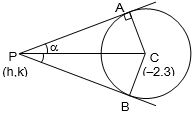
The angle between a pair of tangents drawn from a point $P$ to the circle ${x^2} + {y^2} + 4x - 6y + 9{\sin ^2}\alpha + 13{\cos ^2}\alpha = 0$ is $2\alpha$. The equation of the locus of the point $P$ is
A
${x^2} + {y^2} + 4x - 6y + 4 = 0$
B
${x^2} + {y^2} + 4x - 6y - 9 = 0$
C
${x^2} + {y^2} + 4x - 6y - 4 = 0$
D
${x^2} + {y^2} + 4x - 6y + 9 = 0$
Solution
(D) The equation of the circle is ${x^2} + {y^2} + 4x - 6y + 9{\sin ^2}\alpha + 13{\cos ^2}\alpha = 0$.
Comparing with ${x^2} + {y^2} + 2gx + 2fy + c = 0$,we have $g = 2, f = -3, c = 9{\sin ^2}\alpha + 13{\cos ^2}\alpha$.
The centre is $C(-g, -f) = (-2, 3)$.
The radius $r = \sqrt{g^2 + f^2 - c} = \sqrt{4 + 9 - (9{\sin ^2}\alpha + 13{\cos ^2}\alpha)} = \sqrt{13 - 9{\sin ^2}\alpha - 13{\cos ^2}\alpha} = \sqrt{13(1 - {\cos ^2}\alpha) - 9{\sin ^2}\alpha} = \sqrt{13{\sin ^2}\alpha - 9{\sin ^2}\alpha} = \sqrt{4{\sin ^2}\alpha} = 2\sin \alpha$.
Let $P(h, k)$ be a point on the locus. The angle between the tangents is $2\alpha$,so $\angle APC = \alpha$.
In the right-angled triangle $\triangle PAC$,$\sin \alpha = \frac{AC}{PC} = \frac{r}{PC} = \frac{2\sin \alpha}{\sqrt{(h + 2)^2 + (k - 3)^2}}$.
Thus,$\sqrt{(h + 2)^2 + (k - 3)^2} = 2$.
Squaring both sides,$(h + 2)^2 + (k - 3)^2 = 4$.
Expanding,$h^2 + 4h + 4 + k^2 - 6k + 9 = 4$,which simplifies to $h^2 + k^2 + 4h - 6k + 9 = 0$.
Replacing $(h, k)$ with $(x, y)$,the locus is ${x^2} + {y^2} + 4x - 6y + 9 = 0$.
Comparing with ${x^2} + {y^2} + 2gx + 2fy + c = 0$,we have $g = 2, f = -3, c = 9{\sin ^2}\alpha + 13{\cos ^2}\alpha$.
The centre is $C(-g, -f) = (-2, 3)$.
The radius $r = \sqrt{g^2 + f^2 - c} = \sqrt{4 + 9 - (9{\sin ^2}\alpha + 13{\cos ^2}\alpha)} = \sqrt{13 - 9{\sin ^2}\alpha - 13{\cos ^2}\alpha} = \sqrt{13(1 - {\cos ^2}\alpha) - 9{\sin ^2}\alpha} = \sqrt{13{\sin ^2}\alpha - 9{\sin ^2}\alpha} = \sqrt{4{\sin ^2}\alpha} = 2\sin \alpha$.
Let $P(h, k)$ be a point on the locus. The angle between the tangents is $2\alpha$,so $\angle APC = \alpha$.
In the right-angled triangle $\triangle PAC$,$\sin \alpha = \frac{AC}{PC} = \frac{r}{PC} = \frac{2\sin \alpha}{\sqrt{(h + 2)^2 + (k - 3)^2}}$.
Thus,$\sqrt{(h + 2)^2 + (k - 3)^2} = 2$.
Squaring both sides,$(h + 2)^2 + (k - 3)^2 = 4$.
Expanding,$h^2 + 4h + 4 + k^2 - 6k + 9 = 4$,which simplifies to $h^2 + k^2 + 4h - 6k + 9 = 0$.
Replacing $(h, k)$ with $(x, y)$,the locus is ${x^2} + {y^2} + 4x - 6y + 9 = 0$.
0 likes
View Solution61
DifficultMCQ
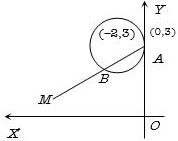
$A$ chord $AB$ is drawn from the point $A(0,3)$ on the circle $x^2 + 4x + (y - 3)^2 = 0$. If the point $M$ lies on the chord such that $AM = 2AB$,then the locus of point $M$ is:
A
Straight line
B
Circle
C
Parabola
D
None of these
Solution
(B) Let the coordinates of point $M$ be $(h, k)$.
Given $A = (0, 3)$ and $M = (h, k)$. Since $M$ lies on the line segment $AB$ such that $AM = 2AB$,point $B$ is the midpoint of $AM$.
Thus,the coordinates of $B$ are $\left( \frac{h+0}{2}, \frac{k+3}{2} \right) = \left( \frac{h}{2}, \frac{k+3}{2} \right)$.
Since $B$ lies on the circle $x^2 + 4x + (y - 3)^2 = 0$,we substitute the coordinates of $B$ into the circle equation:
$\left( \frac{h}{2} \right)^2 + 4\left( \frac{h}{2} \right) + \left( \frac{k+3}{2} - 3 \right)^2 = 0$
$\Rightarrow \frac{h^2}{4} + 2h + \left( \frac{k-3}{2} \right)^2 = 0$
$\Rightarrow \frac{h^2}{4} + 2h + \frac{(k-3)^2}{4} = 0$
Multiplying by $4$,we get $h^2 + 8h + (k-3)^2 = 0$,which simplifies to $h^2 + k^2 + 8h - 6k + 9 = 0$.
Replacing $(h, k)$ with $(x, y)$,the locus is $x^2 + y^2 + 8x - 6y + 9 = 0$,which represents a circle.
Given $A = (0, 3)$ and $M = (h, k)$. Since $M$ lies on the line segment $AB$ such that $AM = 2AB$,point $B$ is the midpoint of $AM$.
Thus,the coordinates of $B$ are $\left( \frac{h+0}{2}, \frac{k+3}{2} \right) = \left( \frac{h}{2}, \frac{k+3}{2} \right)$.
Since $B$ lies on the circle $x^2 + 4x + (y - 3)^2 = 0$,we substitute the coordinates of $B$ into the circle equation:
$\left( \frac{h}{2} \right)^2 + 4\left( \frac{h}{2} \right) + \left( \frac{k+3}{2} - 3 \right)^2 = 0$
$\Rightarrow \frac{h^2}{4} + 2h + \left( \frac{k-3}{2} \right)^2 = 0$
$\Rightarrow \frac{h^2}{4} + 2h + \frac{(k-3)^2}{4} = 0$
Multiplying by $4$,we get $h^2 + 8h + (k-3)^2 = 0$,which simplifies to $h^2 + k^2 + 8h - 6k + 9 = 0$.
Replacing $(h, k)$ with $(x, y)$,the locus is $x^2 + y^2 + 8x - 6y + 9 = 0$,which represents a circle.
0 likes
View Solution62
MediumMCQ
From the origin,chords are drawn to the circle $(x - 1)^2 + y^2 = 1$. The locus of the midpoints of these chords is a
A
Circle
B
Straight line
C
Pair of straight lines
D
None of these
Solution
(A) Let $(x', y')$ be the midpoint of a chord.
The equation of the chord with midpoint $(x', y')$ for the circle $x^2 + y^2 - 2x = 0$ is given by $T = S_1$.
$x x' + y y' - (x + x') = x'^2 + y'^2 - 2x'$
Since the chord passes through the origin $(0, 0)$,we substitute $x = 0$ and $y = 0$ into the equation:
$0 + 0 - (0 + x') = x'^2 + y'^2 - 2x'$
$-x' = x'^2 + y'^2 - 2x'$
$x'^2 + y'^2 - x' = 0$
Replacing $(x', y')$ with $(x, y)$,the locus is $x^2 + y^2 - x = 0$,which represents a circle.
The equation of the chord with midpoint $(x', y')$ for the circle $x^2 + y^2 - 2x = 0$ is given by $T = S_1$.
$x x' + y y' - (x + x') = x'^2 + y'^2 - 2x'$
Since the chord passes through the origin $(0, 0)$,we substitute $x = 0$ and $y = 0$ into the equation:
$0 + 0 - (0 + x') = x'^2 + y'^2 - 2x'$
$-x' = x'^2 + y'^2 - 2x'$
$x'^2 + y'^2 - x' = 0$
Replacing $(x', y')$ with $(x, y)$,the locus is $x^2 + y^2 - x = 0$,which represents a circle.
0 likes
View Solution63
DifficultMCQ
If a circle passes through the point $(a, b)$ and cuts the circle ${x^2} + {y^2} = 4$ orthogonally,then the locus of its centre is
A
$2ax - 2by - ({a^2} + {b^2} + 4) = 0$
B
$2ax + 2by - ({a^2} + {b^2} + 4) = 0$
C
$2ax - 2by + ({a^2} + {b^2} + 4) = 0$
D
$2ax + 2by + ({a^2} + {b^2} + 4) = 0$
Solution
(B) Let the equation of the variable circle be ${x^2} + {y^2} + 2gx + 2fy + c = 0$ $... (i)$.
Since circle $(i)$ cuts the circle ${x^2} + {y^2} - 4 = 0$ orthogonally,the condition $2g_1g_2 + 2f_1f_2 = c_1 + c_2$ gives $2g(0) + 2f(0) = c - 4$,which implies $c = 4$.
Since the circle $(i)$ passes through the point $(a, b)$,we have ${a^2} + {b^2} + 2ga + 2fb + 4 = 0$.
To find the locus of the centre $(-g, -f)$,let $x = -g$ and $y = -f$,so $g = -x$ and $f = -y$.
Substituting these into the equation,we get ${a^2} + {b^2} + 2(-x)a + 2(-y)b + 4 = 0$.
Thus,the locus is $2ax + 2by - ({a^2} + {b^2} + 4) = 0$.
Since circle $(i)$ cuts the circle ${x^2} + {y^2} - 4 = 0$ orthogonally,the condition $2g_1g_2 + 2f_1f_2 = c_1 + c_2$ gives $2g(0) + 2f(0) = c - 4$,which implies $c = 4$.
Since the circle $(i)$ passes through the point $(a, b)$,we have ${a^2} + {b^2} + 2ga + 2fb + 4 = 0$.
To find the locus of the centre $(-g, -f)$,let $x = -g$ and $y = -f$,so $g = -x$ and $f = -y$.
Substituting these into the equation,we get ${a^2} + {b^2} + 2(-x)a + 2(-y)b + 4 = 0$.
Thus,the locus is $2ax + 2by - ({a^2} + {b^2} + 4) = 0$.
0 likes
View Solution64
DifficultMCQ
If ${\theta _1}$ and ${\theta _2}$ are the inclinations of the tangents drawn from a point $P(h, k)$ to the circle ${x^2} + {y^2} = {a^2}$ with the $x$-axis,then the locus of $P$,given that $\cot {\theta _1} + \cot {\theta _2} = c$,is:
A
$c({x^2} - {a^2}) = 2xy$
B
$c({x^2} - {a^2}) = {y^2} - {a^2}$
C
$c({y^2} - {a^2}) = 2xy$
D
None of these
Solution
(C) The equation of any tangent to the circle ${x^2} + {y^2} = {a^2}$ with slope $m$ is $y = mx \pm a\sqrt{1 + {m^2}}$.
If this tangent passes through the point $P(h, k)$,then $(k - mh)^2 = {a^2}(1 + {m^2})$.
Expanding this,we get ${k^2} - 2mhk + {m^2}{h^2} = {a^2} + {a^2}{m^2}$,which rearranges to ${m^2}({h^2} - {a^2}) - 2mhk + ({k^2} - {a^2}) = 0$.
Since $m = \tan \theta$,the roots of this quadratic equation in $m$ are ${m_1} = \tan {\theta _1}$ and ${m_2} = \tan {\theta _2}$.
Given $\cot {\theta _1} + \cot {\theta _2} = c$,we have $\frac{1}{{{m_1}}} + \frac{1}{{{m_2}}} = c$,which implies $\frac{{{m_1} + {m_2}}}{{{m_1}{m_2}}} = c$.
From the quadratic equation,the sum of roots ${m_1} + {m_2} = \frac{2hk}{{{h^2} - {a^2}}}$ and the product of roots ${m_1}{m_2} = \frac{{{k^2} - {a^2}}}{{{h^2} - {a^2}}}$.
Substituting these into the expression,we get $\frac{2hk}{{{k^2} - {a^2}}} = c$,which simplifies to $c({k^2} - {a^2}) = 2hk$.
Replacing $(h, k)$ with $(x, y)$,the locus of $P$ is $c({y^2} - {a^2}) = 2xy$.
If this tangent passes through the point $P(h, k)$,then $(k - mh)^2 = {a^2}(1 + {m^2})$.
Expanding this,we get ${k^2} - 2mhk + {m^2}{h^2} = {a^2} + {a^2}{m^2}$,which rearranges to ${m^2}({h^2} - {a^2}) - 2mhk + ({k^2} - {a^2}) = 0$.
Since $m = \tan \theta$,the roots of this quadratic equation in $m$ are ${m_1} = \tan {\theta _1}$ and ${m_2} = \tan {\theta _2}$.
Given $\cot {\theta _1} + \cot {\theta _2} = c$,we have $\frac{1}{{{m_1}}} + \frac{1}{{{m_2}}} = c$,which implies $\frac{{{m_1} + {m_2}}}{{{m_1}{m_2}}} = c$.
From the quadratic equation,the sum of roots ${m_1} + {m_2} = \frac{2hk}{{{h^2} - {a^2}}}$ and the product of roots ${m_1}{m_2} = \frac{{{k^2} - {a^2}}}{{{h^2} - {a^2}}}$.
Substituting these into the expression,we get $\frac{2hk}{{{k^2} - {a^2}}} = c$,which simplifies to $c({k^2} - {a^2}) = 2hk$.
Replacing $(h, k)$ with $(x, y)$,the locus of $P$ is $c({y^2} - {a^2}) = 2xy$.
0 likes
View Solution65
EasyMCQ
The equation of the locus of a point which moves so as to be at equal distances from the point $(a, 0)$ and the $y$-axis is
A
$y^2 - 2ax + a^2 = 0$
B
$y^2 + 2ax + a^2 = 0$
C
$x^2 - 2ay + a^2 = 0$
D
$x^2 + 2ay + a^2 = 0$
Solution
(A) Let the moving point be $P(h, k)$.
The distance of $P(h, k)$ from the point $(a, 0)$ is $\sqrt{(h - a)^2 + (k - 0)^2}$.
The distance of $P(h, k)$ from the $y$-axis (the line $x = 0$) is $|h|$.
According to the problem,these distances are equal:
$\sqrt{(h - a)^2 + k^2} = |h|$
Squaring both sides,we get:
$(h - a)^2 + k^2 = h^2$
$h^2 - 2ah + a^2 + k^2 = h^2$
$-2ah + a^2 + k^2 = 0$
Replacing $(h, k)$ with $(x, y)$,the equation of the locus is:
$y^2 - 2ax + a^2 = 0$.
The distance of $P(h, k)$ from the point $(a, 0)$ is $\sqrt{(h - a)^2 + (k - 0)^2}$.
The distance of $P(h, k)$ from the $y$-axis (the line $x = 0$) is $|h|$.
According to the problem,these distances are equal:
$\sqrt{(h - a)^2 + k^2} = |h|$
Squaring both sides,we get:
$(h - a)^2 + k^2 = h^2$
$h^2 - 2ah + a^2 + k^2 = h^2$
$-2ah + a^2 + k^2 = 0$
Replacing $(h, k)$ with $(x, y)$,the equation of the locus is:
$y^2 - 2ax + a^2 = 0$.
0 likes
View Solution66
EasyMCQ
If a bar of given length moves with its extremities on two fixed straight lines at right angles,then the locus of any point marked on the bar describes a/an
A
Circle
B
Parabola
C
Ellipse
D
Hyperbola
Solution
(C) Let the two fixed straight lines be the coordinate axes $x$ and $y$. Let the bar have length $L = a + b$,where $a$ and $b$ are the segments of the bar divided by the point $P(h, k)$.
When the bar makes an angle $\theta$ with the $x$-axis,the coordinates of point $P$ are given by $h = a \cos \theta$ and $k = b \sin \theta$.
From these,we have $\cos \theta = \frac{h}{a}$ and $\sin \theta = \frac{k}{b}$.
Using the identity $\cos^2 \theta + \sin^2 \theta = 1$,we get:
$\frac{h^2}{a^2} + \frac{k^2}{b^2} = 1$.
This is the equation of an ellipse.
When the bar makes an angle $\theta$ with the $x$-axis,the coordinates of point $P$ are given by $h = a \cos \theta$ and $k = b \sin \theta$.
From these,we have $\cos \theta = \frac{h}{a}$ and $\sin \theta = \frac{k}{b}$.
Using the identity $\cos^2 \theta + \sin^2 \theta = 1$,we get:
$\frac{h^2}{a^2} + \frac{k^2}{b^2} = 1$.
This is the equation of an ellipse.
0 likes
View Solution67
EasyMCQ
The locus of the centre of a circle,which touches two given circles externally,is
A
Circle
B
Parabola
C
Hyperbola
D
Ellipse
Solution
(C) Let the two given circles have centres $C_1$ and $C_2$ and radii $r_1$ and $r_2$ respectively.
Let the circle with centre $P(x, y)$ and radius $r$ touch these two circles externally.
Then,the distance $PC_1 = r + r_1$ and $PC_2 = r + r_2$.
Subtracting these equations,we get $PC_1 - PC_2 = (r + r_1) - (r + r_2) = r_1 - r_2$.
Since $r_1$ and $r_2$ are constants,$PC_1 - PC_2$ is a constant.
The locus of a point such that the difference of its distances from two fixed points (foci) is constant is a hyperbola.
Let the circle with centre $P(x, y)$ and radius $r$ touch these two circles externally.
Then,the distance $PC_1 = r + r_1$ and $PC_2 = r + r_2$.
Subtracting these equations,we get $PC_1 - PC_2 = (r + r_1) - (r + r_2) = r_1 - r_2$.
Since $r_1$ and $r_2$ are constants,$PC_1 - PC_2$ is a constant.
The locus of a point such that the difference of its distances from two fixed points (foci) is constant is a hyperbola.
0 likes
View Solution68
MediumMCQ
If the equation of a curve remains unchanged by replacing $x$ and $y$ with $-x$ and $-y$ respectively,then the curve is
A
Symmetric along the $x$-axis
B
Symmetric along the $y$-axis
C
Symmetric in opposite quadrants
D
Symmetric along the line $y = x$
Solution
(C) If an equation $f(x, y) = 0$ remains unchanged when $x$ is replaced by $-x$ and $y$ is replaced by $-y$,then $f(-x, -y) = f(x, y) = 0$.
This condition implies that for every point $(x, y)$ on the curve,the point $(-x, -y)$ also lies on the curve.
This geometric property is known as symmetry about the origin or symmetry in opposite quadrants.
This condition implies that for every point $(x, y)$ on the curve,the point $(-x, -y)$ also lies on the curve.
This geometric property is known as symmetry about the origin or symmetry in opposite quadrants.
0 likes
View Solution69
DifficultMCQ
If a chord is drawn from the origin to the circle $(x - 1)^2 + y^2 = 1$,then the equation of the locus of the midpoint of this chord is:
A
$x^2 + y^2 = 1$
B
$x^2 + y^2 = x$
C
$x^2 + y^2 = y$
D
None of these
Solution
(B) The given equation of the circle is $(x - 1)^2 + y^2 = 1$,which simplifies to $x^2 + y^2 - 2x = 0$.
Let the midpoint of the chord be $(h, k)$.
The equation of the chord with midpoint $(h, k)$ is given by $T = S_1$.
Here,$T = xh + yk - (x + h)$ and $S_1 = h^2 + k^2 - 2h$.
So,the equation of the chord is $xh + yk - x - h = h^2 + k^2 - 2h$.
Since this chord passes through the origin $(0, 0)$,we substitute $x = 0$ and $y = 0$ into the equation:
$0(h) + 0(k) - 0 - h = h^2 + k^2 - 2h$.
$-h = h^2 + k^2 - 2h$.
$h^2 + k^2 = h$.
Replacing $(h, k)$ with $(x, y)$,the locus is $x^2 + y^2 = x$.
Let the midpoint of the chord be $(h, k)$.
The equation of the chord with midpoint $(h, k)$ is given by $T = S_1$.
Here,$T = xh + yk - (x + h)$ and $S_1 = h^2 + k^2 - 2h$.
So,the equation of the chord is $xh + yk - x - h = h^2 + k^2 - 2h$.
Since this chord passes through the origin $(0, 0)$,we substitute $x = 0$ and $y = 0$ into the equation:
$0(h) + 0(k) - 0 - h = h^2 + k^2 - 2h$.
$-h = h^2 + k^2 - 2h$.
$h^2 + k^2 = h$.
Replacing $(h, k)$ with $(x, y)$,the locus is $x^2 + y^2 = x$.
0 likes
View Solution70
MediumMCQ
If $P(1, 0)$,$Q(-1, 0)$,and $R(2, 0)$ are three given points,then find the locus of $S(x, y)$ which satisfies the relation $SQ^2 + SR^2 = 2SP^2$.
A
$A$ straight line parallel to the $x$-axis
B
$A$ circle passing through the origin
C
$A$ circle with the origin as the center
D
$A$ straight line parallel to the $y$-axis
Solution
(D) Let $S = (x, y)$. The given relation is $SQ^2 + SR^2 = 2SP^2$.
Using the distance formula,we have:
$((x + 1)^2 + y^2) + ((x - 2)^2 + y^2) = 2((x - 1)^2 + y^2)$
Expanding the terms:
$(x^2 + 2x + 1 + y^2) + (x^2 - 4x + 4 + y^2) = 2(x^2 - 2x + 1 + y^2)$
$2x^2 - 2x + 5 + 2y^2 = 2x^2 - 4x + 2 + 2y^2$
Subtracting $2x^2 + 2y^2$ from both sides:
$-2x + 5 = -4x + 2$
$2x = -3$
$x = -\frac{3}{2}$
This represents a straight line parallel to the $y$-axis.
Using the distance formula,we have:
$((x + 1)^2 + y^2) + ((x - 2)^2 + y^2) = 2((x - 1)^2 + y^2)$
Expanding the terms:
$(x^2 + 2x + 1 + y^2) + (x^2 - 4x + 4 + y^2) = 2(x^2 - 2x + 1 + y^2)$
$2x^2 - 2x + 5 + 2y^2 = 2x^2 - 4x + 2 + 2y^2$
Subtracting $2x^2 + 2y^2$ from both sides:
$-2x + 5 = -4x + 2$
$2x = -3$
$x = -\frac{3}{2}$
This represents a straight line parallel to the $y$-axis.
0 likes
View Solution71
DifficultMCQ
$A$ circle touches the $X$-axis and also touches the circle with radius $2$ and center at $(0, 3)$. Find the locus of the center of the circle.
A
Ellipse
B
Circle
C
Hyperbola
D
Parabola
Solution
(D) Let the center of the circle be $(h, k)$ and its radius be $r$. Since the circle touches the $X$-axis,$r = |k|$.
The distance between the centers $(h, k)$ and $(0, 3)$ is $\sqrt{h^2 + (k - 3)^2}$.
Since the circles touch each other externally,the distance between their centers is equal to the sum of their radii: $\sqrt{h^2 + (k - 3)^2} = |k| + 2$.
Squaring both sides: $h^2 + (k - 3)^2 = (|k| + 2)^2$.
$h^2 + k^2 - 6k + 9 = k^2 + 4|k| + 4$.
$h^2 = 4|k| + 6k + 5 - 9 = 4|k| + 6k - 4$.
If $k > 0$,$h^2 = 4k + 6k - 4 = 10k - 4 = 10(k - 0.4)$.
This represents a parabola.
The distance between the centers $(h, k)$ and $(0, 3)$ is $\sqrt{h^2 + (k - 3)^2}$.
Since the circles touch each other externally,the distance between their centers is equal to the sum of their radii: $\sqrt{h^2 + (k - 3)^2} = |k| + 2$.
Squaring both sides: $h^2 + (k - 3)^2 = (|k| + 2)^2$.
$h^2 + k^2 - 6k + 9 = k^2 + 4|k| + 4$.
$h^2 = 4|k| + 6k + 5 - 9 = 4|k| + 6k - 4$.
If $k > 0$,$h^2 = 4k + 6k - 4 = 10k - 4 = 10(k - 0.4)$.
This represents a parabola.
0 likes
View Solution72
DifficultMCQ
At which point on the line $x = 3$ are the tangents drawn to the circle $x^2 + y^2 = 8$ perpendicular to each other?
A
$(3, \sqrt{7})$
B
$(3, \sqrt{23})$
C
$(3, -\sqrt{23})$
D
None of these
Solution
(A) The locus of the point of intersection of perpendicular tangents to a circle is called the director circle.
For a circle $x^2 + y^2 = r^2$,the equation of the director circle is $x^2 + y^2 = 2r^2$.
Here,the given circle is $x^2 + y^2 = 8$,so $r^2 = 8$.
The equation of the director circle is $x^2 + y^2 = 2(8) = 16$.
We are given that the point lies on the line $x = 3$.
Substituting $x = 3$ into the equation of the director circle:
$(3)^2 + y^2 = 16$
$9 + y^2 = 16$
$y^2 = 7$
$y = \pm \sqrt{7}$.
Thus,the points are $(3, \sqrt{7})$ and $(3, -\sqrt{7})$.
Comparing this with the given options,option $A$ is correct.
For a circle $x^2 + y^2 = r^2$,the equation of the director circle is $x^2 + y^2 = 2r^2$.
Here,the given circle is $x^2 + y^2 = 8$,so $r^2 = 8$.
The equation of the director circle is $x^2 + y^2 = 2(8) = 16$.
We are given that the point lies on the line $x = 3$.
Substituting $x = 3$ into the equation of the director circle:
$(3)^2 + y^2 = 16$
$9 + y^2 = 16$
$y^2 = 7$
$y = \pm \sqrt{7}$.
Thus,the points are $(3, \sqrt{7})$ and $(3, -\sqrt{7})$.
Comparing this with the given options,option $A$ is correct.
0 likes
View Solution73
DifficultMCQ
If a circle passes through the point $(1, 2)$ and intersects the circle $x^2 + y^2 = 4$ orthogonally,then the equation of the locus of its center is:
A
$x^2 + y^2 - 2x - 6y - 7 = 0$
B
$x^2 + y^2 - 3x - 8y + 1 = 0$
C
$2x + 4y - 9 = 0$
D
$2x + 4y - 1 = 0$
Solution
(C) Let the equation of the circle be $x^2 + y^2 + 2gx + 2fy + c = 0$.
Since it passes through $(1, 2)$,we have $1^2 + 2^2 + 2g(1) + 2f(2) + c = 0$,which simplifies to $2g + 4f + c + 5 = 0$.
Since the circle intersects $x^2 + y^2 = 4$ (or $x^2 + y^2 - 4 = 0$) orthogonally,the condition $2g_1g_2 + 2f_1f_2 = c_1 + c_2$ applies.
Here,$g_1 = g, f_1 = f, c_1 = c$ and $g_2 = 0, f_2 = 0, c_2 = -4$.
Thus,$2g(0) + 2f(0) = c - 4$,which gives $c = 4$.
Substituting $c = 4$ into the first equation: $2g + 4f + 4 + 5 = 0$,so $2g + 4f + 9 = 0$.
The center of the circle is $(-g, -f)$. Let the center be $(x, y)$,so $g = -x$ and $f = -y$.
Substituting these into the equation $2g + 4f + 9 = 0$,we get $2(-x) + 4(-y) + 9 = 0$,which simplifies to $2x + 4y - 9 = 0$.
Since it passes through $(1, 2)$,we have $1^2 + 2^2 + 2g(1) + 2f(2) + c = 0$,which simplifies to $2g + 4f + c + 5 = 0$.
Since the circle intersects $x^2 + y^2 = 4$ (or $x^2 + y^2 - 4 = 0$) orthogonally,the condition $2g_1g_2 + 2f_1f_2 = c_1 + c_2$ applies.
Here,$g_1 = g, f_1 = f, c_1 = c$ and $g_2 = 0, f_2 = 0, c_2 = -4$.
Thus,$2g(0) + 2f(0) = c - 4$,which gives $c = 4$.
Substituting $c = 4$ into the first equation: $2g + 4f + 4 + 5 = 0$,so $2g + 4f + 9 = 0$.
The center of the circle is $(-g, -f)$. Let the center be $(x, y)$,so $g = -x$ and $f = -y$.
Substituting these into the equation $2g + 4f + 9 = 0$,we get $2(-x) + 4(-y) + 9 = 0$,which simplifies to $2x + 4y - 9 = 0$.
0 likes
View Solution74
DifficultMCQ
If $A (c, 0)$ and $B (-c, 0)$ are two points,find the locus of point $P$ such that $PA^{2} + PB^{2} = AB^{2}$.
A
$x^{2} - y^{2} = c^{2}$
B
$y^{2} = 4cx$
C
$x^{2} + y^{2} = c^{2}$
D
None of these
Solution
(C) Let the coordinates of point $P$ be $(x, y)$.
Given $A = (c, 0)$ and $B = (-c, 0)$.
$PA^{2} = (x - c)^{2} + (y - 0)^{2} = x^{2} - 2cx + c^{2} + y^{2}$.
$PB^{2} = (x + c)^{2} + (y - 0)^{2} = x^{2} + 2cx + c^{2} + y^{2}$.
$AB^{2} = (c - (-c))^{2} + (0 - 0)^{2} = (2c)^{2} = 4c^{2}$.
Given the condition $PA^{2} + PB^{2} = AB^{2}$,we substitute the expressions:
$(x^{2} - 2cx + c^{2} + y^{2}) + (x^{2} + 2cx + c^{2} + y^{2}) = 4c^{2}$.
$2x^{2} + 2y^{2} + 2c^{2} = 4c^{2}$.
$2x^{2} + 2y^{2} = 2c^{2}$.
Dividing by $2$,we get $x^{2} + y^{2} = c^{2}$.
Given $A = (c, 0)$ and $B = (-c, 0)$.
$PA^{2} = (x - c)^{2} + (y - 0)^{2} = x^{2} - 2cx + c^{2} + y^{2}$.
$PB^{2} = (x + c)^{2} + (y - 0)^{2} = x^{2} + 2cx + c^{2} + y^{2}$.
$AB^{2} = (c - (-c))^{2} + (0 - 0)^{2} = (2c)^{2} = 4c^{2}$.
Given the condition $PA^{2} + PB^{2} = AB^{2}$,we substitute the expressions:
$(x^{2} - 2cx + c^{2} + y^{2}) + (x^{2} + 2cx + c^{2} + y^{2}) = 4c^{2}$.
$2x^{2} + 2y^{2} + 2c^{2} = 4c^{2}$.
$2x^{2} + 2y^{2} = 2c^{2}$.
Dividing by $2$,we get $x^{2} + y^{2} = c^{2}$.
0 likes
View Solution75
MediumMCQ
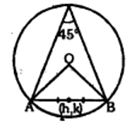
The locus of the midpoint of a chord of the circle $x^{2} + y^{2} = 4$ which subtends an angle of $45^{\circ}$ at the major arc of the circle is:
A
$x^{2} + y^{2} = 1$
B
$x^{2} + y^{2} = 2$
C
$2(x^{2} + y^{2}) = 1$
D
None of these
Solution
(B) The angle subtended by the chord at the center of the circle $x^{2} + y^{2} = 4$ is $2 \times 45^{\circ} = 90^{\circ}$.
Let the midpoint of the chord $AB$ be $(h, k)$. The equation of the chord $AB$ is given by $T = S_1$,which is:
$hx + ky - 4 = h^{2} + k^{2} - 4$
$hx + ky = h^{2} + k^{2}$
$\Rightarrow \frac{hx + ky}{h^{2} + k^{2}} = 1$
Using this line to homogenize the circle equation $x^{2} + y^{2} - 4 = 0$,we get:
$x^{2} + y^{2} - 4 \left( \frac{hx + ky}{h^{2} + k^{2}} \right)^{2} = 0$
This represents the combined equation of lines $OA$ and $OB$. Since the angle at the center is $90^{\circ}$,the lines $OA$ and $OB$ are perpendicular.
For perpendicular lines,the sum of the coefficients of $x^{2}$ and $y^{2}$ must be zero:
$(1 - \frac{4h^{2}}{(h^{2} + k^{2})^{2}}) + (1 - \frac{4k^{2}}{(h^{2} + k^{2})^{2}}) = 0$
$2 - \frac{4(h^{2} + k^{2})}{(h^{2} + k^{2})^{2}} = 0$
$2 - \frac{4}{h^{2} + k^{2}} = 0$
$h^{2} + k^{2} = 2$
Thus,the locus is $x^{2} + y^{2} = 2$.
Let the midpoint of the chord $AB$ be $(h, k)$. The equation of the chord $AB$ is given by $T = S_1$,which is:
$hx + ky - 4 = h^{2} + k^{2} - 4$
$hx + ky = h^{2} + k^{2}$
$\Rightarrow \frac{hx + ky}{h^{2} + k^{2}} = 1$
Using this line to homogenize the circle equation $x^{2} + y^{2} - 4 = 0$,we get:
$x^{2} + y^{2} - 4 \left( \frac{hx + ky}{h^{2} + k^{2}} \right)^{2} = 0$
This represents the combined equation of lines $OA$ and $OB$. Since the angle at the center is $90^{\circ}$,the lines $OA$ and $OB$ are perpendicular.
For perpendicular lines,the sum of the coefficients of $x^{2}$ and $y^{2}$ must be zero:
$(1 - \frac{4h^{2}}{(h^{2} + k^{2})^{2}}) + (1 - \frac{4k^{2}}{(h^{2} + k^{2})^{2}}) = 0$
$2 - \frac{4(h^{2} + k^{2})}{(h^{2} + k^{2})^{2}} = 0$
$2 - \frac{4}{h^{2} + k^{2}} = 0$
$h^{2} + k^{2} = 2$
Thus,the locus is $x^{2} + y^{2} = 2$.
0 likes
View Solution76
DifficultMCQ
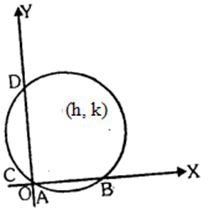
Two rods of lengths $a$ and $b$ slide along the coordinate axes in such a way that their ends are always concyclic. The locus of the center of the circle passing through the ends is:
A
$4(x^2 - y^2) = a^2 - b^2$
B
$x^2 - y^2 = a^2 - b^2$
C
$x^2 - y^2 = 4(a^2 - b^2)$
D
$x^2 + y^2 = a^2 + b^2$
Solution
(A) Let the circle passing through the ends of the rods be $x^2 + y^2 + 2gx + 2fy + c = 0$.
The rod of length $a$ lies on the $x$-axis,so its intercepts on the $x$-axis are the roots of $x^2 + 2gx + c = 0$. The length of the intercept is $2\sqrt{g^2 - c} = a$,which implies $4(g^2 - c) = a^2$.
The rod of length $b$ lies on the $y$-axis,so its intercepts on the $y$-axis are the roots of $y^2 + 2fy + c = 0$. The length of the intercept is $2\sqrt{f^2 - c} = b$,which implies $4(f^2 - c) = b^2$.
Subtracting the two equations: $4(g^2 - f^2) = a^2 - b^2$.
Since the center of the circle is $(h, k) = (-g, -f)$,we have $g = -h$ and $f = -k$.
Substituting these into the equation: $4((-h)^2 - (-k)^2) = a^2 - b^2$,which simplifies to $4(h^2 - k^2) = a^2 - b^2$.
Thus,the locus of the center $(h, k)$ is $4(x^2 - y^2) = a^2 - b^2$.
The rod of length $a$ lies on the $x$-axis,so its intercepts on the $x$-axis are the roots of $x^2 + 2gx + c = 0$. The length of the intercept is $2\sqrt{g^2 - c} = a$,which implies $4(g^2 - c) = a^2$.
The rod of length $b$ lies on the $y$-axis,so its intercepts on the $y$-axis are the roots of $y^2 + 2fy + c = 0$. The length of the intercept is $2\sqrt{f^2 - c} = b$,which implies $4(f^2 - c) = b^2$.
Subtracting the two equations: $4(g^2 - f^2) = a^2 - b^2$.
Since the center of the circle is $(h, k) = (-g, -f)$,we have $g = -h$ and $f = -k$.
Substituting these into the equation: $4((-h)^2 - (-k)^2) = a^2 - b^2$,which simplifies to $4(h^2 - k^2) = a^2 - b^2$.
Thus,the locus of the center $(h, k)$ is $4(x^2 - y^2) = a^2 - b^2$.
0 likes
View Solution77
MediumMCQ
Find the locus of a point such that its distance from the point $(0, -1)$ is twice its distance from the line $3x + 4y + 1 = 0$.
A
$11x^{2} + 39y^{2} + 96xy + 24x - 18y - 21 = 0$
B
$11x^{2} - 39y^{2} + 96xy + 24x - 18y + 21 = 0$
C
$11x^{2} + 39y^{2} - 96xy - 24x - 18y - 21 = 0$
D
$11x^{2} - 39y^{2} - 96xy + 24x - 18y - 21 = 0$
Solution
(A) Let the point be $P(x, y)$.
According to the problem,the distance of $P$ from $(0, -1)$ is twice its distance from the line $3x + 4y + 1 = 0$.
$\sqrt{(x - 0)^2 + (y + 1)^2} = 2 \times \frac{|3x + 4y + 1|}{\sqrt{3^2 + 4^2}}$
$\sqrt{x^2 + (y + 1)^2} = 2 \times \frac{|3x + 4y + 1|}{5}$
$5\sqrt{x^2 + y^2 + 2y + 1} = 2|3x + 4y + 1|$
Squaring both sides:
$25(x^2 + y^2 + 2y + 1) = 4(3x + 4y + 1)^2$
$25(x^2 + y^2 + 2y + 1) = 4(9x^2 + 16y^2 + 1 + 24xy + 6x + 8y)$
$25x^2 + 25y^2 + 50y + 25 = 36x^2 + 64y^2 + 4 + 96xy + 24x + 32y$
Rearranging the terms to one side:
$(36 - 25)x^2 + (64 - 25)y^2 + 96xy + 24x + (32 - 50)y + (4 - 25) = 0$
$11x^2 + 39y^2 + 96xy + 24x - 18y - 21 = 0$
According to the problem,the distance of $P$ from $(0, -1)$ is twice its distance from the line $3x + 4y + 1 = 0$.
$\sqrt{(x - 0)^2 + (y + 1)^2} = 2 \times \frac{|3x + 4y + 1|}{\sqrt{3^2 + 4^2}}$
$\sqrt{x^2 + (y + 1)^2} = 2 \times \frac{|3x + 4y + 1|}{5}$
$5\sqrt{x^2 + y^2 + 2y + 1} = 2|3x + 4y + 1|$
Squaring both sides:
$25(x^2 + y^2 + 2y + 1) = 4(3x + 4y + 1)^2$
$25(x^2 + y^2 + 2y + 1) = 4(9x^2 + 16y^2 + 1 + 24xy + 6x + 8y)$
$25x^2 + 25y^2 + 50y + 25 = 36x^2 + 64y^2 + 4 + 96xy + 24x + 32y$
Rearranging the terms to one side:
$(36 - 25)x^2 + (64 - 25)y^2 + 96xy + 24x + (32 - 50)y + (4 - 25) = 0$
$11x^2 + 39y^2 + 96xy + 24x - 18y - 21 = 0$
0 likes
View Solution78
MediumMCQ
The line segment joining the points $(-5, 1)$ and $(3, 2)$ subtends a right angle at a variable point $P$. Find the locus of the point $P$.
A
$x^{2} + y^{2} + 2x - 3y - 13 = 0$
B
$x^{2} - y^{2} + 2x + 3y - 13 = 0$
C
$x^{2} + y^{2} - 2x + 3y - 13 = 0$
D
$x^{2} + y^{2} - 2x - 3y - 13 = 0$
Solution
(A) Let $P(h, k)$ be the variable point and $A(-5, 1)$ and $B(3, 2)$ be the given points.
According to the given condition,$\angle APB = 90^{\circ}$.
This implies that the point $P$ lies on a circle with diameter $AB$.
The equation of a circle with diameter endpoints $(x_1, y_1)$ and $(x_2, y_2)$ is $(x - x_1)(x - x_2) + (y - y_1)(y - y_2) = 0$.
Substituting the coordinates of $A$ and $B$:
$(x - (-5))(x - 3) + (y - 1)(y - 2) = 0$
$(x + 5)(x - 3) + (y - 1)(y - 2) = 0$
$x^{2} + 2x - 15 + y^{2} - 3y + 2 = 0$
$x^{2} + y^{2} + 2x - 3y - 13 = 0$
Thus,the locus of $P(h, k)$ is $x^{2} + y^{2} + 2x - 3y - 13 = 0$.
According to the given condition,$\angle APB = 90^{\circ}$.
This implies that the point $P$ lies on a circle with diameter $AB$.
The equation of a circle with diameter endpoints $(x_1, y_1)$ and $(x_2, y_2)$ is $(x - x_1)(x - x_2) + (y - y_1)(y - y_2) = 0$.
Substituting the coordinates of $A$ and $B$:
$(x - (-5))(x - 3) + (y - 1)(y - 2) = 0$
$(x + 5)(x - 3) + (y - 1)(y - 2) = 0$
$x^{2} + 2x - 15 + y^{2} - 3y + 2 = 0$
$x^{2} + y^{2} + 2x - 3y - 13 = 0$
Thus,the locus of $P(h, k)$ is $x^{2} + y^{2} + 2x - 3y - 13 = 0$.
0 likes
View Solution79
DifficultMCQ
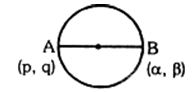
$A$ variable circle passes through a fixed point $A(p, q)$ and touches the $x$-axis. The locus of the other end of the diameter passing through $A$ is:
A
$(x - p)^{2} = 4qy$
B
$(x - q)^{2} = 4py$
C
$(y - p)^{2} = 4qx$
D
$(y - q)^{2} = 4px$
Solution
(A) Let the other end of the diameter be $B(\alpha, \beta)$.
The equation of the circle with diameter $AB$ is:
$(x - p)(x - \alpha) + (y - q)(y - \beta) = 0$
$x^{2} + y^{2} - (p + \alpha)x - (q + \beta)y + p\alpha + q\beta = 0$ ... $(i)$
Since the circle touches the $x$-axis,the $y$-coordinate of the center is equal to the radius,or the discriminant of the equation obtained by setting $y = 0$ is zero.
Setting $y = 0$ in $(i)$:
$x^{2} - (p + \alpha)x + (p\alpha + q\beta) = 0$
Since it touches the $x$-axis,the discriminant $D = 0$:
$(p + \alpha)^{2} - 4(p\alpha + q\beta) = 0$
$p^{2} + 2p\alpha + \alpha^{2} - 4p\alpha - 4q\beta = 0$
$p^{2} - 2p\alpha + \alpha^{2} = 4q\beta$
$(p - \alpha)^{2} = 4q\beta$
Replacing $(\alpha, \beta)$ with $(x, y)$,the locus is $(x - p)^{2} = 4qy$.
The equation of the circle with diameter $AB$ is:
$(x - p)(x - \alpha) + (y - q)(y - \beta) = 0$
$x^{2} + y^{2} - (p + \alpha)x - (q + \beta)y + p\alpha + q\beta = 0$ ... $(i)$
Since the circle touches the $x$-axis,the $y$-coordinate of the center is equal to the radius,or the discriminant of the equation obtained by setting $y = 0$ is zero.
Setting $y = 0$ in $(i)$:
$x^{2} - (p + \alpha)x + (p\alpha + q\beta) = 0$
Since it touches the $x$-axis,the discriminant $D = 0$:
$(p + \alpha)^{2} - 4(p\alpha + q\beta) = 0$
$p^{2} + 2p\alpha + \alpha^{2} - 4p\alpha - 4q\beta = 0$
$p^{2} - 2p\alpha + \alpha^{2} = 4q\beta$
$(p - \alpha)^{2} = 4q\beta$
Replacing $(\alpha, \beta)$ with $(x, y)$,the locus is $(x - p)^{2} = 4qy$.
0 likes
View Solution80
EasyMCQ
Find the locus of point $P$ such that $2PA = 3PB$,where $A = (0, 0)$ and $B = (4, -3)$.
A
$5x^{2} + 5y^{2} + 72x + 54y + 225 = 0$
B
$5x^{2} - 5y^{2} + 72x + 54y + 225 = 0$
C
$5x^{2} - 5y^{2} - 72x + 54y + 225 = 0$
D
$5x^{2} + 5y^{2} - 72x + 54y + 225 = 0$
Solution
(D) Let the coordinates of point $P$ be $(x, y)$.
Given the condition $2PA = 3PB$,we square both sides to get $4PA^{2} = 9PB^{2}$.
Using the distance formula,$PA^{2} = x^{2} + y^{2}$ and $PB^{2} = (x - 4)^{2} + (y + 3)^{2}$.
Substituting these into the equation: $4(x^{2} + y^{2}) = 9[(x - 4)^{2} + (y + 3)^{2}]$.
Expanding the terms: $4x^{2} + 4y^{2} = 9[x^{2} - 8x + 16 + y^{2} + 6y + 9]$.
$4x^{2} + 4y^{2} = 9x^{2} - 72x + 144 + 9y^{2} + 54y + 81$.
Rearranging the terms to one side: $5x^{2} + 5y^{2} - 72x + 54y + 225 = 0$.
Thus,the locus of point $P$ is $5x^{2} + 5y^{2} - 72x + 54y + 225 = 0$.
Given the condition $2PA = 3PB$,we square both sides to get $4PA^{2} = 9PB^{2}$.
Using the distance formula,$PA^{2} = x^{2} + y^{2}$ and $PB^{2} = (x - 4)^{2} + (y + 3)^{2}$.
Substituting these into the equation: $4(x^{2} + y^{2}) = 9[(x - 4)^{2} + (y + 3)^{2}]$.
Expanding the terms: $4x^{2} + 4y^{2} = 9[x^{2} - 8x + 16 + y^{2} + 6y + 9]$.
$4x^{2} + 4y^{2} = 9x^{2} - 72x + 144 + 9y^{2} + 54y + 81$.
Rearranging the terms to one side: $5x^{2} + 5y^{2} - 72x + 54y + 225 = 0$.
Thus,the locus of point $P$ is $5x^{2} + 5y^{2} - 72x + 54y + 225 = 0$.
0 likes
View Solution81
DifficultMCQ
The locus of the center of a circle which touches the circle $x^{2} + y^{2} - 6x - 6y + 14 = 0$ externally and also touches the $y$-axis is:
A
$x^{2} - 10x - 6y + 14 = 0$
B
$x^{2} - 6x - 10y + 14 = 0$
C
$y^{2} - 6x - 10y + 14 = 0$
D
$y^{2} - 10x - 6y + 14 = 0$
Solution
(D) Let the center of the required circle be $C_1 = (h, k)$. Since it touches the $y$-axis,its radius $r_1 = |h|$.
For the given circle $x^{2} + y^{2} - 6x - 6y + 14 = 0$,the center $C_2 = (3, 3)$ and radius $r_2 = \sqrt{3^{2} + 3^{2} - 14} = \sqrt{9 + 9 - 14} = \sqrt{4} = 2$.
Since the circles touch externally,the distance between their centers is $C_1 C_2 = r_1 + r_2$.
Thus,$\sqrt{(h - 3)^{2} + (k - 3)^{2}} = |h| + 2$.
Squaring both sides,$(h - 3)^{2} + (k - 3)^{2} = (|h| + 2)^{2}$.
$h^{2} - 6h + 9 + k^{2} - 6k + 9 = h^{2} + 4|h| + 4$.
$k^{2} - 6k + 14 = 6h + 4|h|$.
Assuming $h > 0$,$k^{2} - 6k + 14 = 10h$.
Replacing $(h, k)$ with $(x, y)$,the locus is $y^{2} - 6y + 14 = 10x$,or $y^{2} - 10x - 6y + 14 = 0$.
For the given circle $x^{2} + y^{2} - 6x - 6y + 14 = 0$,the center $C_2 = (3, 3)$ and radius $r_2 = \sqrt{3^{2} + 3^{2} - 14} = \sqrt{9 + 9 - 14} = \sqrt{4} = 2$.
Since the circles touch externally,the distance between their centers is $C_1 C_2 = r_1 + r_2$.
Thus,$\sqrt{(h - 3)^{2} + (k - 3)^{2}} = |h| + 2$.
Squaring both sides,$(h - 3)^{2} + (k - 3)^{2} = (|h| + 2)^{2}$.
$h^{2} - 6h + 9 + k^{2} - 6k + 9 = h^{2} + 4|h| + 4$.
$k^{2} - 6k + 14 = 6h + 4|h|$.
Assuming $h > 0$,$k^{2} - 6k + 14 = 10h$.
Replacing $(h, k)$ with $(x, y)$,the locus is $y^{2} - 6y + 14 = 10x$,or $y^{2} - 10x - 6y + 14 = 0$.
0 likes
View Solution82
DifficultMCQ
If a circle passes through the point $(a, b)$ and intersects the circle $x^{2} + y^{2} = 4$ orthogonally,then the locus of its center is:
A
$2ax + 2by + (a^{2} + b^{2} + 4) = 0$
B
$2ax + 2by - (a^{2} + b^{2} + 4) = 0$
C
$2ax - 2by + (a^{2} + b^{2} + 4) = 0$
D
$2ax - 2by - (a^{2} + b^{2} + 4) = 0$
Solution
(B) Let the equation of the variable circle be $x^{2} + y^{2} + 2gx + 2fy + c = 0$ ... $(i)$.
Since the circle $(i)$ intersects the circle $x^{2} + y^{2} - 4 = 0$ orthogonally,the condition $2g_{1}g_{2} + 2f_{1}f_{2} = c_{1} + c_{2}$ applies.
Here,$g_{2} = 0, f_{2} = 0, c_{2} = -4$.
So,$2g(0) + 2f(0) = c - 4$,which gives $c = 4$.
Since the circle passes through the point $(a, b)$,we have $a^{2} + b^{2} + 2ga + 2fb + 4 = 0$.
To find the locus of the center $(-g, -f)$,let $x = -g$ and $y = -f$,so $g = -x$ and $f = -y$.
Substituting these into the equation: $a^{2} + b^{2} + 2(-x)a + 2(-y)b + 4 = 0$.
This simplifies to $a^{2} + b^{2} - 2ax - 2by + 4 = 0$,or $2ax + 2by - (a^{2} + b^{2} + 4) = 0$.
Since the circle $(i)$ intersects the circle $x^{2} + y^{2} - 4 = 0$ orthogonally,the condition $2g_{1}g_{2} + 2f_{1}f_{2} = c_{1} + c_{2}$ applies.
Here,$g_{2} = 0, f_{2} = 0, c_{2} = -4$.
So,$2g(0) + 2f(0) = c - 4$,which gives $c = 4$.
Since the circle passes through the point $(a, b)$,we have $a^{2} + b^{2} + 2ga + 2fb + 4 = 0$.
To find the locus of the center $(-g, -f)$,let $x = -g$ and $y = -f$,so $g = -x$ and $f = -y$.
Substituting these into the equation: $a^{2} + b^{2} + 2(-x)a + 2(-y)b + 4 = 0$.
This simplifies to $a^{2} + b^{2} - 2ax - 2by + 4 = 0$,or $2ax + 2by - (a^{2} + b^{2} + 4) = 0$.
0 likes
View Solution83
DifficultMCQ
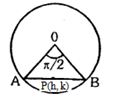
Find the locus of the midpoint of a chord of the circle $x^2 + y^2 = a^2$ which subtends a right angle at the center.
A
$2(x^2 + y^2) - a^2 = 0$
B
$2(x^2 - y^2) + a^2 = 0$
C
$2(x^2 - y^2) - a^2 = 0$
D
$(x^2 + y^2) + a^2 = 0$
Solution
(A) Let the midpoint of the chord $AB$ of the circle $x^2 + y^2 = a^2$ be $P(h, k)$.
The equation of the chord with midpoint $(h, k)$ is given by $T = S_1$,which is $hx + ky = h^2 + k^2$.
The combined equation of the lines $OA$ and $OB$ is obtained by homogenizing the circle equation $x^2 + y^2 = a^2$ using the chord equation:
$x^2 + y^2 = a^2 \left( \frac{hx + ky}{h^2 + k^2} \right)^2$
$(h^2 + k^2)(x^2 + y^2) = a^2(hx + ky)^2$
$(h^2 + k^2)(x^2 + y^2) - a^2(h^2x^2 + k^2y^2 + 2hkxy) = 0$
$(h^2 + k^2 - a^2h^2)x^2 + (h^2 + k^2 - a^2k^2)y^2 - 2a^2hkxy = 0$
Since the chord subtends a right angle at the center,the sum of the coefficients of $x^2$ and $y^2$ must be zero:
$(h^2 + k^2 - a^2h^2) + (h^2 + k^2 - a^2k^2) = 0$
$2(h^2 + k^2) - a^2(h^2 + k^2) = 0$
$(h^2 + k^2)(2 - a^2) = 0$
Wait,re-evaluating: The distance from the center $(0,0)$ to the chord $hx + ky = h^2 + k^2$ is $d = \frac{|h^2 + k^2|}{\sqrt{h^2 + k^2}} = \sqrt{h^2 + k^2}$.
In a right-angled triangle formed by the center and the chord,the distance $d$ from the center to the chord is $a \cos(45^\circ) = \frac{a}{\sqrt{2}}$.
So,$\sqrt{h^2 + k^2} = \frac{a}{\sqrt{2}}$.
Squaring both sides,$h^2 + k^2 = \frac{a^2}{2}$,which gives $2(h^2 + k^2) - a^2 = 0$.
Replacing $(h, k)$ with $(x, y)$,the locus is $2(x^2 + y^2) - a^2 = 0$.
The equation of the chord with midpoint $(h, k)$ is given by $T = S_1$,which is $hx + ky = h^2 + k^2$.
The combined equation of the lines $OA$ and $OB$ is obtained by homogenizing the circle equation $x^2 + y^2 = a^2$ using the chord equation:
$x^2 + y^2 = a^2 \left( \frac{hx + ky}{h^2 + k^2} \right)^2$
$(h^2 + k^2)(x^2 + y^2) = a^2(hx + ky)^2$
$(h^2 + k^2)(x^2 + y^2) - a^2(h^2x^2 + k^2y^2 + 2hkxy) = 0$
$(h^2 + k^2 - a^2h^2)x^2 + (h^2 + k^2 - a^2k^2)y^2 - 2a^2hkxy = 0$
Since the chord subtends a right angle at the center,the sum of the coefficients of $x^2$ and $y^2$ must be zero:
$(h^2 + k^2 - a^2h^2) + (h^2 + k^2 - a^2k^2) = 0$
$2(h^2 + k^2) - a^2(h^2 + k^2) = 0$
$(h^2 + k^2)(2 - a^2) = 0$
Wait,re-evaluating: The distance from the center $(0,0)$ to the chord $hx + ky = h^2 + k^2$ is $d = \frac{|h^2 + k^2|}{\sqrt{h^2 + k^2}} = \sqrt{h^2 + k^2}$.
In a right-angled triangle formed by the center and the chord,the distance $d$ from the center to the chord is $a \cos(45^\circ) = \frac{a}{\sqrt{2}}$.
So,$\sqrt{h^2 + k^2} = \frac{a}{\sqrt{2}}$.
Squaring both sides,$h^2 + k^2 = \frac{a^2}{2}$,which gives $2(h^2 + k^2) - a^2 = 0$.
Replacing $(h, k)$ with $(x, y)$,the locus is $2(x^2 + y^2) - a^2 = 0$.
0 likes
View Solution84
DifficultMCQ
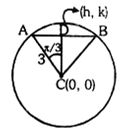
Let $C$ be a circle with radius $3$ and center at $(0, 0)$. The equation of the locus of the midpoint of the chord of the circle that subtends an angle of $\frac{2\pi}{3}$ at the center is:
A
$x^2 + y^2 = 1$
B
$x^2 + y^2 = \frac{27}{4}$
C
$x^2 + y^2 = \frac{9}{4}$
D
$x^2 + y^2 = \frac{3}{2}$
Solution
(C) Let $AB$ be a chord of the circle that subtends an angle of $\frac{2\pi}{3}$ at the center $C(0, 0)$.
Let $D$ be the midpoint of the chord $AB$. Then $CD \perp AB$.
In $\Delta ACD$,the angle $\angle ACD = \frac{1}{2} \angle ACB = \frac{1}{2} \times \frac{2\pi}{3} = \frac{\pi}{3}$.
The radius $CA = 3$.
Let the coordinates of the midpoint $D$ be $(h, k)$. Then $CD = \sqrt{h^2 + k^2}$.
In the right-angled triangle $\Delta ACD$,we have $\cos(\angle ACD) = \frac{CD}{CA}$.
$\cos(\frac{\pi}{3}) = \frac{\sqrt{h^2 + k^2}}{3}$.
$\frac{1}{2} = \frac{\sqrt{h^2 + k^2}}{3}$.
$\sqrt{h^2 + k^2} = \frac{3}{2}$.
Squaring both sides,we get $h^2 + k^2 = \frac{9}{4}$.
Replacing $(h, k)$ with $(x, y)$,the locus is $x^2 + y^2 = \frac{9}{4}$.
Let $D$ be the midpoint of the chord $AB$. Then $CD \perp AB$.
In $\Delta ACD$,the angle $\angle ACD = \frac{1}{2} \angle ACB = \frac{1}{2} \times \frac{2\pi}{3} = \frac{\pi}{3}$.
The radius $CA = 3$.
Let the coordinates of the midpoint $D$ be $(h, k)$. Then $CD = \sqrt{h^2 + k^2}$.
In the right-angled triangle $\Delta ACD$,we have $\cos(\angle ACD) = \frac{CD}{CA}$.
$\cos(\frac{\pi}{3}) = \frac{\sqrt{h^2 + k^2}}{3}$.
$\frac{1}{2} = \frac{\sqrt{h^2 + k^2}}{3}$.
$\sqrt{h^2 + k^2} = \frac{3}{2}$.
Squaring both sides,we get $h^2 + k^2 = \frac{9}{4}$.
Replacing $(h, k)$ with $(x, y)$,the locus is $x^2 + y^2 = \frac{9}{4}$.
0 likes
View Solution85
DifficultMCQ
Find the locus of the midpoint of the chord of the circle $x^2 + y^2 = 16$ which is a tangent to the hyperbola $9x^2 - 16y^2 = 144$.
A
${\left( {{x^2} + {y^2}} \right)^2} = 11x^2 - 10y^2$
B
$x^2 + y^2 = 16$
C
${\left( {{x^2} + {y^2}} \right)^2} = 16x^2 - 9y^2$
D
${\left( {{x^2} + {y^2}} \right)^2} = 9x^2 - 16y^2$
Solution
(C) The equation of the hyperbola is $\frac{x^2}{16} - \frac{y^2}{9} = 1$. The equation of a tangent to this hyperbola with slope $m$ is $y = mx \pm \sqrt{16m^2 - 9} \dots (i)$.
Let $(x_1, y_1)$ be the midpoint of the chord of the circle $x^2 + y^2 = 16$. The equation of the chord with midpoint $(x_1, y_1)$ is given by $T = S_1$,which is $xx_1 + yy_1 = x_1^2 + y_1^2 \dots (ii)$.
Comparing $(i)$ and $(ii)$,we rewrite $(ii)$ as $y = -\frac{x_1}{y_1}x + \frac{x_1^2 + y_1^2}{y_1}$.
Equating the slopes and intercepts: $m = -\frac{x_1}{y_1}$ and $\sqrt{16m^2 - 9} = \frac{x_1^2 + y_1^2}{y_1}$.
Squaring both sides: $16m^2 - 9 = \frac{(x_1^2 + y_1^2)^2}{y_1^2}$.
Substituting $m = -\frac{x_1}{y_1}$: $16\left(-\frac{x_1}{y_1}\right)^2 - 9 = \frac{(x_1^2 + y_1^2)^2}{y_1^2}$.
$16x_1^2 - 9y_1^2 = (x_1^2 + y_1^2)^2$.
Replacing $(x_1, y_1)$ with $(x, y)$,the locus is $(x^2 + y^2)^2 = 16x^2 - 9y^2$.
Let $(x_1, y_1)$ be the midpoint of the chord of the circle $x^2 + y^2 = 16$. The equation of the chord with midpoint $(x_1, y_1)$ is given by $T = S_1$,which is $xx_1 + yy_1 = x_1^2 + y_1^2 \dots (ii)$.
Comparing $(i)$ and $(ii)$,we rewrite $(ii)$ as $y = -\frac{x_1}{y_1}x + \frac{x_1^2 + y_1^2}{y_1}$.
Equating the slopes and intercepts: $m = -\frac{x_1}{y_1}$ and $\sqrt{16m^2 - 9} = \frac{x_1^2 + y_1^2}{y_1}$.
Squaring both sides: $16m^2 - 9 = \frac{(x_1^2 + y_1^2)^2}{y_1^2}$.
Substituting $m = -\frac{x_1}{y_1}$: $16\left(-\frac{x_1}{y_1}\right)^2 - 9 = \frac{(x_1^2 + y_1^2)^2}{y_1^2}$.
$16x_1^2 - 9y_1^2 = (x_1^2 + y_1^2)^2$.
Replacing $(x_1, y_1)$ with $(x, y)$,the locus is $(x^2 + y^2)^2 = 16x^2 - 9y^2$.
0 likes
View Solution86
DifficultMCQ
The angle between the pair of tangents from a point $P$ to the circle $x^2 + y^2 + 4x - 6y + 9\sin^2\alpha + 13\cos^2\alpha = 0$ is $2\alpha$. The equation of the locus of $P$ is...
A
$x^2 + y^2 + 4x - 6y + 4 = 0$
B
$x^2 + y^2 + 4x - 6y - 9 = 0$
C
$x^2 + y^2 + 4x - 6y - 4 = 0$
D
$x^2 + y^2 + 4x - 6y + 9 = 0$
Solution
(D) The circle is $x^2 + y^2 + 4x - 6y + 9\sin^2\alpha + 13\cos^2\alpha = 0$.
Its center is $C(-2, 3)$.
The radius $r$ is given by $\sqrt{(-2)^2 + (3)^2 - (9\sin^2\alpha + 13\cos^2\alpha)} = \sqrt{4 + 9 - 9\sin^2\alpha - 13\cos^2\alpha} = \sqrt{13 - 9\sin^2\alpha - 13\cos^2\alpha} = \sqrt{13(1 - \cos^2\alpha) - 9\sin^2\alpha} = \sqrt{13\sin^2\alpha - 9\sin^2\alpha} = \sqrt{4\sin^2\alpha} = 2\sin\alpha$.
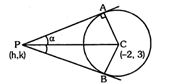
Let $P(h, k)$ be the point. The angle between the tangents is $2\alpha$,so the angle between the line $PC$ and a tangent is $\alpha$.
In the right-angled triangle $\triangle PAC$,$\sin\alpha = \frac{AC}{PC} = \frac{r}{PC}$.
Thus,$\sin\alpha = \frac{2\sin\alpha}{\sqrt{(h+2)^2 + (k-3)^2}}$.
This implies $\sqrt{(h+2)^2 + (k-3)^2} = 2$.
Squaring both sides,$(h+2)^2 + (k-3)^2 = 4$.
Expanding this,$h^2 + 4h + 4 + k^2 - 6k + 9 = 4$.
$h^2 + k^2 + 4h - 6k + 9 = 0$.
Replacing $(h, k)$ with $(x, y)$,the locus is $x^2 + y^2 + 4x - 6y + 9 = 0$.
Its center is $C(-2, 3)$.
The radius $r$ is given by $\sqrt{(-2)^2 + (3)^2 - (9\sin^2\alpha + 13\cos^2\alpha)} = \sqrt{4 + 9 - 9\sin^2\alpha - 13\cos^2\alpha} = \sqrt{13 - 9\sin^2\alpha - 13\cos^2\alpha} = \sqrt{13(1 - \cos^2\alpha) - 9\sin^2\alpha} = \sqrt{13\sin^2\alpha - 9\sin^2\alpha} = \sqrt{4\sin^2\alpha} = 2\sin\alpha$.
Let $P(h, k)$ be the point. The angle between the tangents is $2\alpha$,so the angle between the line $PC$ and a tangent is $\alpha$.
In the right-angled triangle $\triangle PAC$,$\sin\alpha = \frac{AC}{PC} = \frac{r}{PC}$.
Thus,$\sin\alpha = \frac{2\sin\alpha}{\sqrt{(h+2)^2 + (k-3)^2}}$.
This implies $\sqrt{(h+2)^2 + (k-3)^2} = 2$.
Squaring both sides,$(h+2)^2 + (k-3)^2 = 4$.
Expanding this,$h^2 + 4h + 4 + k^2 - 6k + 9 = 4$.
$h^2 + k^2 + 4h - 6k + 9 = 0$.
Replacing $(h, k)$ with $(x, y)$,the locus is $x^2 + y^2 + 4x - 6y + 9 = 0$.
0 likes
View Solution87
EasyMCQ
If the endpoints of the hypotenuse of a right-angled triangle are $(2, 0)$ and $(0, 2)$,find the locus of its third vertex.
A
$x^2 + y^2 - 2x - 2y = 0$
B
$x^2 + y^2 + 2x - 2y = 0$
C
$x^2 + y^2 - 2x + 2y = 0$
D
$x^2 + y^2 + 2x + 2y = 0$
Solution
(A) Let the third vertex be $P(x, y)$.
Since the triangle is a right-angled triangle with the hypotenuse connecting $(2, 0)$ and $(0, 2)$,the angle at vertex $P$ is $90^{\circ}$.
The product of the slopes of the two sides meeting at $P$ must be $-1$.
Slope $m_1 = \frac{y - 0}{x - 2} = \frac{y}{x - 2}$.
Slope $m_2 = \frac{y - 2}{x - 0} = \frac{y - 2}{x}$.
Setting $m_1 \times m_2 = -1$:
$\frac{y}{x - 2} \times \frac{y - 2}{x} = -1$
$y(y - 2) = -x(x - 2)$
$y^2 - 2y = -x^2 + 2x$
$x^2 + y^2 - 2x - 2y = 0$.
Since the triangle is a right-angled triangle with the hypotenuse connecting $(2, 0)$ and $(0, 2)$,the angle at vertex $P$ is $90^{\circ}$.
The product of the slopes of the two sides meeting at $P$ must be $-1$.
Slope $m_1 = \frac{y - 0}{x - 2} = \frac{y}{x - 2}$.
Slope $m_2 = \frac{y - 2}{x - 0} = \frac{y - 2}{x}$.
Setting $m_1 \times m_2 = -1$:
$\frac{y}{x - 2} \times \frac{y - 2}{x} = -1$
$y(y - 2) = -x(x - 2)$
$y^2 - 2y = -x^2 + 2x$
$x^2 + y^2 - 2x - 2y = 0$.
0 likes
View Solution88
DifficultMCQ
The tangent at any point on the curve $x^2 + y^2 = r^2$ meets the coordinate axes at $A$ and $B$. If lines are drawn through $A$ and $B$ parallel to the coordinate axes to intersect at $P$,find the locus of $P$.
A
$x^2 + y^2 = r^2$
B
$x^2 + y^2 = 4r^2$
C
$\frac{1}{x^2} + \frac{1}{y^2} = \frac{1}{r^2}$
D
$\frac{1}{x^2} - \frac{1}{y^2} = \frac{1}{r^2}$
0 likes
View Solution89
EasyMCQ
Find the locus of a point such that the sum of the squares of its distances from the axes is $4$.
A
$x + y = 2$
B
$x^2 + y^2 = 16$
C
$x + y = 4$
D
$x^2 + y^2 = 4$
Solution
(D) Let the point be $P(x, y)$.
The distance of point $P(x, y)$ from the $X$-axis is $|y|$.
The distance of point $P(x, y)$ from the $Y$-axis is $|x|$.
According to the problem,the sum of the squares of these distances is $4$.
Therefore,$|x|^2 + |y|^2 = 4$.
This simplifies to $x^2 + y^2 = 4$.
The distance of point $P(x, y)$ from the $X$-axis is $|y|$.
The distance of point $P(x, y)$ from the $Y$-axis is $|x|$.
According to the problem,the sum of the squares of these distances is $4$.
Therefore,$|x|^2 + |y|^2 = 4$.
This simplifies to $x^2 + y^2 = 4$.
0 likes
View Solution90
DifficultMCQ
Three distinct points $A, B$,and $C$ are given in a two-dimensional coordinate plane such that for each point,the ratio of its distance from $(1, 0)$ to its distance from $(-1, 0)$ is equal to $\frac{1}{3}$. What is the circumcenter of triangle $ABC$?
A
$\left( \frac{5}{2}, 0 \right)$
B
$\left( \frac{5}{3}, 0 \right)$
C
$(0, 0)$
D
$\left( \frac{5}{4}, 0 \right)$
Solution
(D) Let the point be $(h, k)$.
Given the ratio of distances is $\frac{1}{3}$:
$\frac{\sqrt{(h-1)^2 + k^2}}{\sqrt{(h+1)^2 + k^2}} = \frac{1}{3}$
Squaring both sides:
$9((h-1)^2 + k^2) = (h+1)^2 + k^2$
$9(h^2 - 2h + 1 + k^2) = h^2 + 2h + 1 + k^2$
$9h^2 - 18h + 9 + 9k^2 = h^2 + 2h + 1 + k^2$
$8h^2 + 8k^2 - 20h + 8 = 0$
Dividing by $8$:
$h^2 + k^2 - \frac{5}{2}h + 1 = 0$
Completing the square for $h$:
$(h^2 - \frac{5}{2}h + \frac{25}{16}) + k^2 = \frac{25}{16} - 1$
$(h - \frac{5}{4})^2 + k^2 = \frac{9}{16} = (\frac{3}{4})^2$
This is the equation of a circle with center $(\frac{5}{4}, 0)$ and radius $\frac{3}{4}$.
Since points $A, B$,and $C$ lie on this circle,the triangle $ABC$ is inscribed in this circle.
The circumcenter of any triangle inscribed in a circle is the center of that circle.
Therefore,the circumcenter is $(\frac{5}{4}, 0)$.
Given the ratio of distances is $\frac{1}{3}$:
$\frac{\sqrt{(h-1)^2 + k^2}}{\sqrt{(h+1)^2 + k^2}} = \frac{1}{3}$
Squaring both sides:
$9((h-1)^2 + k^2) = (h+1)^2 + k^2$
$9(h^2 - 2h + 1 + k^2) = h^2 + 2h + 1 + k^2$
$9h^2 - 18h + 9 + 9k^2 = h^2 + 2h + 1 + k^2$
$8h^2 + 8k^2 - 20h + 8 = 0$
Dividing by $8$:
$h^2 + k^2 - \frac{5}{2}h + 1 = 0$
Completing the square for $h$:
$(h^2 - \frac{5}{2}h + \frac{25}{16}) + k^2 = \frac{25}{16} - 1$
$(h - \frac{5}{4})^2 + k^2 = \frac{9}{16} = (\frac{3}{4})^2$
This is the equation of a circle with center $(\frac{5}{4}, 0)$ and radius $\frac{3}{4}$.
Since points $A, B$,and $C$ lie on this circle,the triangle $ABC$ is inscribed in this circle.
The circumcenter of any triangle inscribed in a circle is the center of that circle.
Therefore,the circumcenter is $(\frac{5}{4}, 0)$.
0 likes
View Solution91
EasyMCQ
If the coordinates of a moving point $P$ are $(\cos \theta + \sin \theta, \sin \theta - \cos \theta)$,where $\theta$ is a parameter,find the locus of $P$.
A
$x^2 - y^2 = 4$
B
$x^2 + y^2 = 2$
C
$xy = 3$
D
$x^2 + 2y^2 = 3$
Solution
(B) Given the coordinates of point $P$ are $x = \cos \theta + \sin \theta$ and $y = \sin \theta - \cos \theta$.
To find the locus,we eliminate the parameter $\theta$ by squaring and adding the expressions for $x$ and $y$:
$x^2 + y^2 = (\cos \theta + \sin \theta)^2 + (\sin \theta - \cos \theta)^2$
Expanding the squares:
$x^2 + y^2 = (\cos^2 \theta + \sin^2 \theta + 2 \sin \theta \cos \theta) + (\sin^2 \theta + \cos^2 \theta - 2 \sin \theta \cos \theta)$
Using the identity $\sin^2 \theta + \cos^2 \theta = 1$:
$x^2 + y^2 = (1 + 2 \sin \theta \cos \theta) + (1 - 2 \sin \theta \cos \theta)$
Simplifying the expression:
$x^2 + y^2 = 1 + 1 = 2$
Thus,the locus of $P$ is $x^2 + y^2 = 2$.
To find the locus,we eliminate the parameter $\theta$ by squaring and adding the expressions for $x$ and $y$:
$x^2 + y^2 = (\cos \theta + \sin \theta)^2 + (\sin \theta - \cos \theta)^2$
Expanding the squares:
$x^2 + y^2 = (\cos^2 \theta + \sin^2 \theta + 2 \sin \theta \cos \theta) + (\sin^2 \theta + \cos^2 \theta - 2 \sin \theta \cos \theta)$
Using the identity $\sin^2 \theta + \cos^2 \theta = 1$:
$x^2 + y^2 = (1 + 2 \sin \theta \cos \theta) + (1 - 2 \sin \theta \cos \theta)$
Simplifying the expression:
$x^2 + y^2 = 1 + 1 = 2$
Thus,the locus of $P$ is $x^2 + y^2 = 2$.
0 likes
View Solution92
EasyMCQ
What does the equation $\sqrt{(x - 2)^2 + (y + 1)^2} + \sqrt{(x + 2)^2 + (y + 4)^2} = 5$ represent?
A
Circle
B
Ellipse
C
Line
D
None of these
Solution
(C) The given equation is of the form $PF_1 + PF_2 = 2a$,where $P = (x, y)$,$F_1 = (2, -1)$,and $F_2 = (-2, -4)$.
First,calculate the distance between the two fixed points $F_1$ and $F_2$:
$d = \sqrt{(2 - (-2))^2 + (-1 - (-4))^2} = \sqrt{4^2 + 3^2} = \sqrt{16 + 9} = \sqrt{25} = 5$.
Here,the sum of the distances from point $P$ to two fixed points $F_1$ and $F_2$ is equal to the distance between the two fixed points $(PF_1 + PF_2 = F_1F_2 = 5)$.
When the sum of distances from a point to two fixed points equals the distance between the fixed points,the locus of the point $P$ is the line segment joining the two fixed points $F_1$ and $F_2$.
Therefore,the equation represents a line segment.
First,calculate the distance between the two fixed points $F_1$ and $F_2$:
$d = \sqrt{(2 - (-2))^2 + (-1 - (-4))^2} = \sqrt{4^2 + 3^2} = \sqrt{16 + 9} = \sqrt{25} = 5$.
Here,the sum of the distances from point $P$ to two fixed points $F_1$ and $F_2$ is equal to the distance between the two fixed points $(PF_1 + PF_2 = F_1F_2 = 5)$.
When the sum of distances from a point to two fixed points equals the distance between the fixed points,the locus of the point $P$ is the line segment joining the two fixed points $F_1$ and $F_2$.
Therefore,the equation represents a line segment.
0 likes
View Solution93
DifficultMCQ
Let $A = (a, 0)$ and $B = (-a, 0)$ be two fixed points. For $a \in (-\infty, 0)$,point $P$ moves in the plane such that $PA = nPB$ $(n \neq 0, n \neq 1)$. If $n > 1$,then which of the following is true regarding the positions of $A$ and $B$ with respect to the locus of $P$?
A
$A$ lies inside the circle and $B$ lies outside the circle.
B
$A$ lies outside the circle and $B$ lies inside the circle.
C
Both $A$ and $B$ lie on the circle.
D
Both $A$ and $B$ lie inside the circle.
Solution
(B) Let $P = (x, y)$. The condition $PA = nPB$ implies $PA^2 = n^2 PB^2$.
$(x - a)^2 + y^2 = n^2((x + a)^2 + y^2)$.
$x^2 - 2ax + a^2 + y^2 = n^2(x^2 + 2ax + a^2 + y^2)$.
$(n^2 - 1)x^2 + (n^2 - 1)y^2 + 2ax(n^2 + 1) + a^2(n^2 - 1) = 0$.
Dividing by $(n^2 - 1)$,we get $x^2 + y^2 + 2ax \frac{n^2 + 1}{n^2 - 1} + a^2 = 0$.
This is the equation of a circle with center $C = (-a \frac{n^2 + 1}{n^2 - 1}, 0)$ and radius $r = |\frac{2an}{n^2 - 1}|$.
Since $a < 0$,let $a = -k$ where $k > 0$. Then the center is $C = (k \frac{n^2 + 1}{n^2 - 1}, 0)$.
For $n > 1$,the circle encloses the point $B(-a, 0)$ because $B$ is closer to the center relative to the radius,while $A(a, 0)$ lies outside.
$(x - a)^2 + y^2 = n^2((x + a)^2 + y^2)$.
$x^2 - 2ax + a^2 + y^2 = n^2(x^2 + 2ax + a^2 + y^2)$.
$(n^2 - 1)x^2 + (n^2 - 1)y^2 + 2ax(n^2 + 1) + a^2(n^2 - 1) = 0$.
Dividing by $(n^2 - 1)$,we get $x^2 + y^2 + 2ax \frac{n^2 + 1}{n^2 - 1} + a^2 = 0$.
This is the equation of a circle with center $C = (-a \frac{n^2 + 1}{n^2 - 1}, 0)$ and radius $r = |\frac{2an}{n^2 - 1}|$.
Since $a < 0$,let $a = -k$ where $k > 0$. Then the center is $C = (k \frac{n^2 + 1}{n^2 - 1}, 0)$.
For $n > 1$,the circle encloses the point $B(-a, 0)$ because $B$ is closer to the center relative to the radius,while $A(a, 0)$ lies outside.
0 likes
View Solution94
MediumMCQ
If the tangents drawn from a point $P$ to the circle $x^2 + y^2 = a^2$ are perpendicular to the tangents drawn to the circle $x^2 + y^2 = b^2$,then the locus of $P$ is:
A
$x^2 + y^2 = a^2 + b^2$
B
$x^2 + y^2 = a^2 - b^2$
C
$x^2 + y^2 = (ab)^2$
D
$x^2 + y^2 = a + b$
Solution
(A) Let the point $P$ be $(h, k)$.
The equation of the pair of tangents from $P(h, k)$ to the circle $x^2 + y^2 = a^2$ is given by $SS_1 = T^2$.
$(x^2 + y^2 - a^2)(h^2 + k^2 - a^2) = (xh + yk - a^2)^2$.
Expanding this,the coefficient of $x^2$ is $(h^2 + k^2 - a^2) - h^2 = k^2 - a^2$.
The coefficient of $y^2$ is $(h^2 + k^2 - a^2) - k^2 = h^2 - a^2$.
Since the tangents are perpendicular,the sum of the coefficients of $x^2$ and $y^2$ must be zero.
$(k^2 - a^2) + (h^2 - a^2) = 0 \implies h^2 + k^2 = 2a^2$.
However,the problem states the tangents to the first circle are perpendicular to the tangents to the second circle. This implies the locus of $P$ is the director circle of the system. For the condition where tangents from $P$ to $x^2 + y^2 = a^2$ are perpendicular to tangents from $P$ to $x^2 + y^2 = b^2$,the locus is $x^2 + y^2 = a^2 + b^2$.
The equation of the pair of tangents from $P(h, k)$ to the circle $x^2 + y^2 = a^2$ is given by $SS_1 = T^2$.
$(x^2 + y^2 - a^2)(h^2 + k^2 - a^2) = (xh + yk - a^2)^2$.
Expanding this,the coefficient of $x^2$ is $(h^2 + k^2 - a^2) - h^2 = k^2 - a^2$.
The coefficient of $y^2$ is $(h^2 + k^2 - a^2) - k^2 = h^2 - a^2$.
Since the tangents are perpendicular,the sum of the coefficients of $x^2$ and $y^2$ must be zero.
$(k^2 - a^2) + (h^2 - a^2) = 0 \implies h^2 + k^2 = 2a^2$.
However,the problem states the tangents to the first circle are perpendicular to the tangents to the second circle. This implies the locus of $P$ is the director circle of the system. For the condition where tangents from $P$ to $x^2 + y^2 = a^2$ are perpendicular to tangents from $P$ to $x^2 + y^2 = b^2$,the locus is $x^2 + y^2 = a^2 + b^2$.
0 likes
View Solution95
DifficultMCQ
The locus of the midpoint of the chord of contact of tangents drawn from a point on the line $4x - 5y = 20$ to the circle $x^2 + y^2 = 9$ is:
A
$20(x^2 + y^2) - 36x + 45y = 0$
B
$20(x^2 + y^2) + 36x - 45y = 0$
C
$36(x^2 + y^2) - 20x + 45y = 0$
D
$36(x^2 + y^2) + 20x - 45y = 0$
Solution
(A) Let the midpoint of the chord of contact be $(h, k)$.
The equation of the chord of contact with midpoint $(h, k)$ for the circle $x^2 + y^2 = 9$ is given by $hx + ky = h^2 + k^2$ ... $(1)$.
Let a point on the line $4x - 5y = 20$ be $P(\alpha, \beta)$,where $4\alpha - 5\beta = 20$,so $\beta = \frac{4\alpha - 20}{5}$.
The equation of the chord of contact from point $P(\alpha, \beta)$ to the circle $x^2 + y^2 = 9$ is $\alpha x + \beta y = 9$ ... $(2)$.
Comparing $(1)$ and $(2)$,we have $\frac{h}{\alpha} = \frac{k}{\beta} = \frac{h^2 + k^2}{9}$.
Thus,$\alpha = \frac{9h}{h^2 + k^2}$ and $\beta = \frac{9k}{h^2 + k^2}$.
Substitute these into the line equation $4\alpha - 5\beta = 20$:
$4\left(\frac{9h}{h^2 + k^2}\right) - 5\left(\frac{9k}{h^2 + k^2}\right) = 20$.
$36h - 45k = 20(h^2 + k^2)$.
Replacing $(h, k)$ with $(x, y)$,the locus is $20(x^2 + y^2) - 36x + 45y = 0$.
The equation of the chord of contact with midpoint $(h, k)$ for the circle $x^2 + y^2 = 9$ is given by $hx + ky = h^2 + k^2$ ... $(1)$.
Let a point on the line $4x - 5y = 20$ be $P(\alpha, \beta)$,where $4\alpha - 5\beta = 20$,so $\beta = \frac{4\alpha - 20}{5}$.
The equation of the chord of contact from point $P(\alpha, \beta)$ to the circle $x^2 + y^2 = 9$ is $\alpha x + \beta y = 9$ ... $(2)$.
Comparing $(1)$ and $(2)$,we have $\frac{h}{\alpha} = \frac{k}{\beta} = \frac{h^2 + k^2}{9}$.
Thus,$\alpha = \frac{9h}{h^2 + k^2}$ and $\beta = \frac{9k}{h^2 + k^2}$.
Substitute these into the line equation $4\alpha - 5\beta = 20$:
$4\left(\frac{9h}{h^2 + k^2}\right) - 5\left(\frac{9k}{h^2 + k^2}\right) = 20$.
$36h - 45k = 20(h^2 + k^2)$.
Replacing $(h, k)$ with $(x, y)$,the locus is $20(x^2 + y^2) - 36x + 45y = 0$.
0 likes
View Solution96
DifficultMCQ
$A$ point $P(x, y)$ divides the line segment joining the points $(5, 0)$ and $(10 \cos \theta, 10 \sin \theta)$ in the ratio $2 : 3$. Find the locus of point $P$ as $\theta$ varies.
A
Pair of straight lines
B
Circle
C
Straight line
D
Parabola
Solution
(B) Let the points be $A(5, 0)$ and $B(10 \cos \theta, 10 \sin \theta)$.
Using the section formula,the coordinates of point $P(x, y)$ dividing $AB$ in the ratio $2 : 3$ are:
$x = \frac{2(10 \cos \theta) + 3(5)}{2 + 3} = \frac{20 \cos \theta + 15}{5} = 4 \cos \theta + 3$
$y = \frac{2(10 \sin \theta) + 3(0)}{2 + 3} = \frac{20 \sin \theta}{5} = 4 \sin \theta$
From these equations,we have:
$x - 3 = 4 \cos \theta \implies \cos \theta = \frac{x - 3}{4}$
$y = 4 \sin \theta \implies \sin \theta = \frac{y}{4}$
Using the identity $\cos^2 \theta + \sin^2 \theta = 1$,we get:
$(\frac{x - 3}{4})^2 + (\frac{y}{4})^2 = 1$
$(x - 3)^2 + y^2 = 16$
This is the equation of a circle with center $(3, 0)$ and radius $4$.
Using the section formula,the coordinates of point $P(x, y)$ dividing $AB$ in the ratio $2 : 3$ are:
$x = \frac{2(10 \cos \theta) + 3(5)}{2 + 3} = \frac{20 \cos \theta + 15}{5} = 4 \cos \theta + 3$
$y = \frac{2(10 \sin \theta) + 3(0)}{2 + 3} = \frac{20 \sin \theta}{5} = 4 \sin \theta$
From these equations,we have:
$x - 3 = 4 \cos \theta \implies \cos \theta = \frac{x - 3}{4}$
$y = 4 \sin \theta \implies \sin \theta = \frac{y}{4}$
Using the identity $\cos^2 \theta + \sin^2 \theta = 1$,we get:
$(\frac{x - 3}{4})^2 + (\frac{y}{4})^2 = 1$
$(x - 3)^2 + y^2 = 16$
This is the equation of a circle with center $(3, 0)$ and radius $4$.
0 likes
View Solution97
EasyMCQ
Two perpendicular tangents to the circle $x^2 + y^2 = a^2$ meet at point $P$. The equation of the locus of $P$ is:
A
$x^2 + y^2 = 2a^2$
B
$x^2 + y^2 = 3a^2$
C
$x^2 + y^2 = 4a^2$
D
None of these
Solution
(A) Let the point $P$ be $(h, k)$.
Since the tangents are perpendicular,the angle between them is $90^{\circ}$.
The locus of the intersection of two perpendicular tangents to a circle is known as the director circle.
For a circle $x^2 + y^2 = a^2$,the radius is $a$ and the center is $(0, 0)$.
The distance from the center $(0, 0)$ to the point $P(h, k)$ is $\sqrt{h^2 + k^2}$.
In the right-angled triangle formed by the center,the point of contact,and $P$,the distance $PC$ is given by $\sqrt{a^2 + a^2} = \sqrt{2a^2} = a\sqrt{2}$.
Thus,$\sqrt{h^2 + k^2} = a\sqrt{2}$.
Squaring both sides,we get $h^2 + k^2 = 2a^2$.
Replacing $(h, k)$ with $(x, y)$,the equation of the locus is $x^2 + y^2 = 2a^2$.
Since the tangents are perpendicular,the angle between them is $90^{\circ}$.
The locus of the intersection of two perpendicular tangents to a circle is known as the director circle.
For a circle $x^2 + y^2 = a^2$,the radius is $a$ and the center is $(0, 0)$.
The distance from the center $(0, 0)$ to the point $P(h, k)$ is $\sqrt{h^2 + k^2}$.
In the right-angled triangle formed by the center,the point of contact,and $P$,the distance $PC$ is given by $\sqrt{a^2 + a^2} = \sqrt{2a^2} = a\sqrt{2}$.
Thus,$\sqrt{h^2 + k^2} = a\sqrt{2}$.
Squaring both sides,we get $h^2 + k^2 = 2a^2$.
Replacing $(h, k)$ with $(x, y)$,the equation of the locus is $x^2 + y^2 = 2a^2$.
0 likes
View Solution98
DifficultMCQ
Let $A = (a, 0)$ and $B = (-a, 0)$ be two fixed points. For $a \in (-\infty, 0)$ and a point $P$ moving in the plane such that $PA = nPB$ $(n \neq 0)$. If $|n| \neq 1$,then the locus of point $P$ is....
A
$A$ straight line
B
$A$ circle
C
$A$ parabola
D
An ellipse
Solution
(B) Let the coordinates of point $P$ be $(x, y)$.
Given $PA = nPB$,squaring both sides gives $PA^2 = n^2 PB^2$.
Substituting the coordinates,we get $(x - a)^2 + (y - 0)^2 = n^2 ((x + a)^2 + (y - 0)^2)$.
Expanding the terms: $x^2 - 2ax + a^2 + y^2 = n^2 (x^2 + 2ax + a^2 + y^2)$.
Rearranging the terms: $x^2(1 - n^2) + y^2(1 - n^2) - 2ax(1 + n^2) + a^2(1 - n^2) = 0$.
Since $|n| \neq 1$,we have $1 - n^2 \neq 0$. Dividing by $(1 - n^2)$,we get $x^2 + y^2 - 2ax \frac{1 + n^2}{1 - n^2} + a^2 = 0$.
This is the equation of a circle of the form $x^2 + y^2 + 2gx + 2fy + c = 0$.
Given $PA = nPB$,squaring both sides gives $PA^2 = n^2 PB^2$.
Substituting the coordinates,we get $(x - a)^2 + (y - 0)^2 = n^2 ((x + a)^2 + (y - 0)^2)$.
Expanding the terms: $x^2 - 2ax + a^2 + y^2 = n^2 (x^2 + 2ax + a^2 + y^2)$.
Rearranging the terms: $x^2(1 - n^2) + y^2(1 - n^2) - 2ax(1 + n^2) + a^2(1 - n^2) = 0$.
Since $|n| \neq 1$,we have $1 - n^2 \neq 0$. Dividing by $(1 - n^2)$,we get $x^2 + y^2 - 2ax \frac{1 + n^2}{1 - n^2} + a^2 = 0$.
This is the equation of a circle of the form $x^2 + y^2 + 2gx + 2fy + c = 0$.
0 likes
View Solution99
MediumMCQ
The angle between the tangents drawn from a point $P$ to the circle $x^2 + y^2 + 4x - 2y - 4 = 0$ is $60^{\circ}$. The locus of $P$ is:
A
$x^2 + y^2 + 4x - 2y - 31 = 0$
B
$x^2 + y^2 + 4x - 2y - 21 = 0$
C
$x^2 + y^2 + 4x - 2y - 11 = 0$
D
$x^2 + y^2 + 4x - 2y = 0$
Solution
(A) The given circle is $x^2 + y^2 + 4x - 2y - 4 = 0$.
Comparing with $x^2 + y^2 + 2gx + 2fy + c = 0$,we get $g = 2, f = -1, c = -4$.
The center is $C(-g, -f) = (-2, 1)$ and the radius $r = \sqrt{g^2 + f^2 - c} = \sqrt{4 + 1 - (-4)} = \sqrt{9} = 3$.
Let $P(h, k)$ be a point on the locus. The angle between the tangents is $60^{\circ}$,so the angle between the line joining the center to $P$ and the radius is $30^{\circ}$.
In the right-angled triangle formed by the center,the point of contact,and $P$,we have $\sin(30^{\circ}) = \frac{r}{CP}$.
$\frac{1}{2} = \frac{3}{CP} \implies CP = 6$.
$CP^2 = 36$.
$(h + 2)^2 + (k - 1)^2 = 36$.
$h^2 + 4h + 4 + k^2 - 2k + 1 = 36$.
$h^2 + k^2 + 4h - 2k - 31 = 0$.
Replacing $(h, k)$ with $(x, y)$,the locus is $x^2 + y^2 + 4x - 2y - 31 = 0$.
Comparing with $x^2 + y^2 + 2gx + 2fy + c = 0$,we get $g = 2, f = -1, c = -4$.
The center is $C(-g, -f) = (-2, 1)$ and the radius $r = \sqrt{g^2 + f^2 - c} = \sqrt{4 + 1 - (-4)} = \sqrt{9} = 3$.
Let $P(h, k)$ be a point on the locus. The angle between the tangents is $60^{\circ}$,so the angle between the line joining the center to $P$ and the radius is $30^{\circ}$.
In the right-angled triangle formed by the center,the point of contact,and $P$,we have $\sin(30^{\circ}) = \frac{r}{CP}$.
$\frac{1}{2} = \frac{3}{CP} \implies CP = 6$.
$CP^2 = 36$.
$(h + 2)^2 + (k - 1)^2 = 36$.
$h^2 + 4h + 4 + k^2 - 2k + 1 = 36$.
$h^2 + k^2 + 4h - 2k - 31 = 0$.
Replacing $(h, k)$ with $(x, y)$,the locus is $x^2 + y^2 + 4x - 2y - 31 = 0$.
0 likes
View Solution10-1.Circle and System of Circles — Locus Related Problem · Frequently Asked Questions
1Are these 10-1.Circle and System of Circles questions useful for JEE and NEET?
Yes. All questions in this section are mapped to JEE Main and NEET exam patterns. Previous year questions from JEE Main, NEET, GUJCET and state-level exams are included with full solutions.
2Can I switch to Hindi or Gujarati for these questions?
Yes. Use the language tabs in the hero section or the sidebar to view the same questions and solutions in English, Hindi or Gujarati.
3How do I generate a question paper from this subtopic?
Use the Vedclass Exam Paper Generator — select the chapter and subtopic, set difficulty, and generate Sets A, B, C, D automatically. First 3 chapters of every subject are free.
Vedclass Products
For Students
Vedclass Test Series
Mock tests in real JEE/NEET style with performance analysis. 5-day free trial.
Start Free TrialFor Teachers
Exam Paper Generator
Generate Set A/B/C/D papers from this chapter in 2 minutes. 3 chapters free.
Try FreeFor Institutes
Online Exam Module
Live online exams with unlimited students, 360° analytics & white-label branding.
See DemoFor Teachers & Institutes
Generate a 10-1.Circle and System of Circles Exam Paper in 2 Minutes
Select subtopic & difficulty — Sets A, B, C, D auto-generated with No Repeat logic.
First 3 chapters of every subject are free — no payment required.