
A English
Locus Related Problem Questions in English
Class 11 Mathematics · 10-1.Circle and System of Circles · Locus Related Problem
308+
Questions
English
Language
100%
With Solutions
Showing 50 of 308 questions in English
151
DifficultMCQ
If a tangent to the circle $x^2 + y^2 = 1$ intersects the coordinate axes at distinct points $P$ and $Q,$ then the locus of the mid-point of $PQ$ is
A
$x^2 + y^2 - 16x^2y^2 = 0$
B
$x^2 + y^2 - 2x^2y^2 = 0$
C
$x^2 + y^2 - 4x^2y^2 = 0$
D
$x^2 + y^2 - 2xy = 0$
Solution
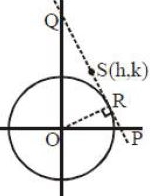
(C) Let the mid-point of $PQ$ be $S(h, k).$
Since $P$ lies on the $x$-axis and $Q$ lies on the $y$-axis,let $P = (a, 0)$ and $Q = (0, b).$
The mid-point $S(h, k)$ is given by $h = \frac{a}{2}$ and $k = \frac{b}{2},$ so $a = 2h$ and $b = 2k.$
The equation of the line $PQ$ is $\frac{x}{a} + \frac{y}{b} = 1,$ which becomes $\frac{x}{2h} + \frac{y}{2k} = 1.$
Since this line is a tangent to the circle $x^2 + y^2 = 1,$ the perpendicular distance from the origin $(0, 0)$ to the line must be equal to the radius $r = 1.$
The distance $d = \frac{|-1|}{\sqrt{(\frac{1}{2h})^2 + (\frac{1}{2k})^2}} = 1.$
Squaring both sides,we get $\frac{1}{\frac{1}{4h^2} + \frac{1}{4k^2}} = 1,$
which simplifies to $\frac{1}{4h^2} + \frac{1}{4k^2} = 1.$
Multiplying by $4h^2k^2,$ we get $k^2 + h^2 = 4h^2k^2.$
Replacing $(h, k)$ with $(x, y),$ the locus is $x^2 + y^2 = 4x^2y^2$ or $x^2 + y^2 - 4x^2y^2 = 0.$
Since $P$ lies on the $x$-axis and $Q$ lies on the $y$-axis,let $P = (a, 0)$ and $Q = (0, b).$
The mid-point $S(h, k)$ is given by $h = \frac{a}{2}$ and $k = \frac{b}{2},$ so $a = 2h$ and $b = 2k.$
The equation of the line $PQ$ is $\frac{x}{a} + \frac{y}{b} = 1,$ which becomes $\frac{x}{2h} + \frac{y}{2k} = 1.$
Since this line is a tangent to the circle $x^2 + y^2 = 1,$ the perpendicular distance from the origin $(0, 0)$ to the line must be equal to the radius $r = 1.$
The distance $d = \frac{|-1|}{\sqrt{(\frac{1}{2h})^2 + (\frac{1}{2k})^2}} = 1.$
Squaring both sides,we get $\frac{1}{\frac{1}{4h^2} + \frac{1}{4k^2}} = 1,$
which simplifies to $\frac{1}{4h^2} + \frac{1}{4k^2} = 1.$
Multiplying by $4h^2k^2,$ we get $k^2 + h^2 = 4h^2k^2.$
Replacing $(h, k)$ with $(x, y),$ the locus is $x^2 + y^2 = 4x^2y^2$ or $x^2 + y^2 - 4x^2y^2 = 0.$
0 likes
View Solution152
DifficultMCQ
The locus of the centres of the circles,which touch the circle $x^2 + y^2 = 1$ externally,also touch the $y$-axis and lie in the first quadrant is
A
$x = \sqrt{1 + 2y}, y \ge 0$
B
$x = \sqrt{1 + 4x}, x \ge 0$
C
$x = \sqrt{1 + 4y}, y \ge 0$
D
$y = \sqrt{1 + 2x}, x \ge 0$
Solution
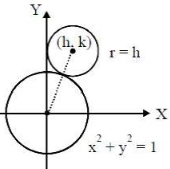
(D) Let the centre of the circle be $(h, k)$ and its radius be $r$.
Since the circle touches the $y$-axis,the radius $r = |h| = h$ (as it lies in the first quadrant,$h > 0$).
Since the circle touches $x^2 + y^2 = 1$ externally,the distance between the centres is equal to the sum of the radii:
$\sqrt{h^2 + k^2} = r + 1 = h + 1$.
Squaring both sides,we get:
$h^2 + k^2 = (h + 1)^2$
$h^2 + k^2 = h^2 + 2h + 1$
$k^2 = 2h + 1$.
Replacing $(h, k)$ with $(x, y)$,the locus is $y^2 = 2x + 1$,or $y = \sqrt{2x + 1}$ for $x \ge 0$.
Since the circle touches the $y$-axis,the radius $r = |h| = h$ (as it lies in the first quadrant,$h > 0$).
Since the circle touches $x^2 + y^2 = 1$ externally,the distance between the centres is equal to the sum of the radii:
$\sqrt{h^2 + k^2} = r + 1 = h + 1$.
Squaring both sides,we get:
$h^2 + k^2 = (h + 1)^2$
$h^2 + k^2 = h^2 + 2h + 1$
$k^2 = 2h + 1$.
Replacing $(h, k)$ with $(x, y)$,the locus is $y^2 = 2x + 1$,or $y = \sqrt{2x + 1}$ for $x \ge 0$.
0 likes
View Solution153
Medium
The hypotenuse of a right-angled triangle has its endpoints at the points $(1, 3)$ and $(-4, 1)$. Find the equations of the legs (perpendicular sides) of the triangle.
Solution
(N/A) Let the vertices of the right-angled triangle be $A(1, 3)$,$B(-4, 1)$,and $C(x, y)$,where $\angle C = 90^{\circ}$.
Since $C$ lies on a circle with diameter $AB$,the locus of $C$ is $(x - 1)(x + 4) + (y - 3)(y - 1) = 0$.
There are infinitely many such triangles depending on the choice of point $C$ on this circle.
Let the slope of leg $AC$ be $m$. Then the slope of leg $BC$ is $-\frac{1}{m}$ (since $AC \perp BC$).
The equation of line $AC$ passing through $(1, 3)$ is $y - 3 = m(x - 1)$.
The equation of line $BC$ passing through $(-4, 1)$ is $y - 1 = -\frac{1}{m}(x + 4)$.
For any real value of $m$,these two lines represent the legs of a right-angled triangle with the given hypotenuse.
Since $C$ lies on a circle with diameter $AB$,the locus of $C$ is $(x - 1)(x + 4) + (y - 3)(y - 1) = 0$.
There are infinitely many such triangles depending on the choice of point $C$ on this circle.
Let the slope of leg $AC$ be $m$. Then the slope of leg $BC$ is $-\frac{1}{m}$ (since $AC \perp BC$).
The equation of line $AC$ passing through $(1, 3)$ is $y - 3 = m(x - 1)$.
The equation of line $BC$ passing through $(-4, 1)$ is $y - 1 = -\frac{1}{m}(x + 4)$.
For any real value of $m$,these two lines represent the legs of a right-angled triangle with the given hypotenuse.
0 likes
View Solution154
DifficultMCQ
$A$ rod of length $12 \, cm$ moves with its ends always touching the coordinate axes. Determine the equation of the locus of a point $P$ on the rod,which is $3 \, cm$ from the end in contact with the $x-$axis.
A
$\frac{x^{2}}{81} + \frac{y^{2}}{9} = 1$
B
$\frac{x^{2}}{9} + \frac{y^{2}}{81} = 1$
C
$\frac{x^{2}}{144} + \frac{y^{2}}{9} = 1$
D
$\frac{x^{2}}{9} + \frac{y^{2}}{144} = 1$
Solution
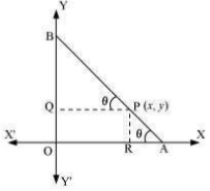
(B) Let $AB$ be the rod of length $12 \, cm$. Let $A$ be on the $x-$axis and $B$ be on the $y-$axis. Let $P(x, y)$ be a point on the rod such that $AP = 3 \, cm$. Then $PB = AB - AP = 12 - 3 = 9 \, cm$.
Let $\angle OAB = \theta$. Then in $\triangle PRA$ (where $PR \perp OA$),we have $\cos \theta = \frac{AR}{AP} = \frac{x}{3}$,so $x = 3 \cos \theta$.
In $\triangle PQB$ (where $PQ \perp OB$),we have $\sin \theta = \frac{QB}{PB} = \frac{y}{9}$,so $y = 9 \sin \theta$.
Using the identity $\cos^{2} \theta + \sin^{2} \theta = 1$,we get $\left(\frac{x}{3}\right)^{2} + \left(\frac{y}{9}\right)^{2} = 1$.
Thus,the equation of the locus is $\frac{x^{2}}{9} + \frac{y^{2}}{81} = 1$.
Let $\angle OAB = \theta$. Then in $\triangle PRA$ (where $PR \perp OA$),we have $\cos \theta = \frac{AR}{AP} = \frac{x}{3}$,so $x = 3 \cos \theta$.
In $\triangle PQB$ (where $PQ \perp OB$),we have $\sin \theta = \frac{QB}{PB} = \frac{y}{9}$,so $y = 9 \sin \theta$.
Using the identity $\cos^{2} \theta + \sin^{2} \theta = 1$,we get $\left(\frac{x}{3}\right)^{2} + \left(\frac{y}{9}\right)^{2} = 1$.
Thus,the equation of the locus is $\frac{x^{2}}{9} + \frac{y^{2}}{81} = 1$.
0 likes
View Solution155
MediumMCQ
Let a point $P$ be such that its distance from the point $(5, 0)$ is thrice the distance of $P$ from the point $(-5, 0)$. If the locus of the point $P$ is a circle of radius $r$,then $4r^{2}$ is equal to ...... .
A
$56$
B
$42$
C
$64$
D
$48$
Solution
(A) Let the point $P$ be $(x, y)$.
According to the problem,the distance from $(5, 0)$ is thrice the distance from $(-5, 0)$:
$\sqrt{(x-5)^{2} + y^{2}} = 3\sqrt{(x+5)^{2} + y^{2}}$
Squaring both sides:
$(x-5)^{2} + y^{2} = 9((x+5)^{2} + y^{2})$
$x^{2} - 10x + 25 + y^{2} = 9(x^{2} + 10x + 25 + y^{2})$
$x^{2} - 10x + 25 + y^{2} = 9x^{2} + 90x + 225 + 9y^{2}$
$8x^{2} + 8y^{2} + 100x + 200 = 0$
Dividing by $8$:
$x^{2} + y^{2} + 12.5x + 25 = 0$
Comparing with the standard circle equation $x^{2} + y^{2} + 2gx + 2fy + c = 0$,we have $g = 6.25$,$f = 0$,and $c = 25$.
The radius $r$ is given by $r = \sqrt{g^{2} + f^{2} - c} = \sqrt{(6.25)^{2} - 25} = \sqrt{39.0625 - 25} = \sqrt{14.0625}$.
Thus,$r^{2} = 14.0625$.
Therefore,$4r^{2} = 4 \times 14.0625 = 56.25$.
According to the problem,the distance from $(5, 0)$ is thrice the distance from $(-5, 0)$:
$\sqrt{(x-5)^{2} + y^{2}} = 3\sqrt{(x+5)^{2} + y^{2}}$
Squaring both sides:
$(x-5)^{2} + y^{2} = 9((x+5)^{2} + y^{2})$
$x^{2} - 10x + 25 + y^{2} = 9(x^{2} + 10x + 25 + y^{2})$
$x^{2} - 10x + 25 + y^{2} = 9x^{2} + 90x + 225 + 9y^{2}$
$8x^{2} + 8y^{2} + 100x + 200 = 0$
Dividing by $8$:
$x^{2} + y^{2} + 12.5x + 25 = 0$
Comparing with the standard circle equation $x^{2} + y^{2} + 2gx + 2fy + c = 0$,we have $g = 6.25$,$f = 0$,and $c = 25$.
The radius $r$ is given by $r = \sqrt{g^{2} + f^{2} - c} = \sqrt{(6.25)^{2} - 25} = \sqrt{39.0625 - 25} = \sqrt{14.0625}$.
Thus,$r^{2} = 14.0625$.
Therefore,$4r^{2} = 4 \times 14.0625 = 56.25$.
0 likes
View Solution156
MediumMCQ
If the locus of the mid-point of the line segment from the point $(3, 2)$ to a point on the circle $x^{2} + y^{2} = 1$ is a circle of radius $r$,then $r$ is equal to:
A
$1$
B
$\frac{1}{2}$
C
$\frac{1}{3}$
D
$\frac{1}{4}$
Solution
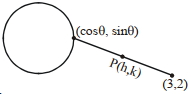
(B) Let the point on the circle be $(\cos \theta, \sin \theta)$.
Let the mid-point of the line segment joining $(3, 2)$ and $(\cos \theta, \sin \theta)$ be $P(h, k)$.
Then,$h = \frac{\cos \theta + 3}{2}$ and $k = \frac{\sin \theta + 2}{2}$.
This implies $\cos \theta = 2h - 3$ and $\sin \theta = 2k - 2$.
Since $\cos^{2} \theta + \sin^{2} \theta = 1$,we have $(2h - 3)^{2} + (2k - 2)^{2} = 1$.
Dividing by $4$,we get $(h - \frac{3}{2})^{2} + (k - 1)^{2} = \frac{1}{4}$.
This represents a circle with radius $r = \sqrt{\frac{1}{4}} = \frac{1}{2}$.
Let the mid-point of the line segment joining $(3, 2)$ and $(\cos \theta, \sin \theta)$ be $P(h, k)$.
Then,$h = \frac{\cos \theta + 3}{2}$ and $k = \frac{\sin \theta + 2}{2}$.
This implies $\cos \theta = 2h - 3$ and $\sin \theta = 2k - 2$.
Since $\cos^{2} \theta + \sin^{2} \theta = 1$,we have $(2h - 3)^{2} + (2k - 2)^{2} = 1$.
Dividing by $4$,we get $(h - \frac{3}{2})^{2} + (k - 1)^{2} = \frac{1}{4}$.
This represents a circle with radius $r = \sqrt{\frac{1}{4}} = \frac{1}{2}$.
0 likes
View Solution157
MediumMCQ
The locus of a point,which moves such that the sum of squares of its distances from the points $(0,0), (1,0), (0,1), (1,1)$ is $18$ units,is a circle of diameter $d$. Then $d^{2}$ is equal to ...... .
A
$16$
B
$4$
C
$216$
D
$6$
Solution
(A) Let the point be $P(x, y)$.
The sum of the squares of the distances from $(0,0), (1,0), (0,1), (1,1)$ is given by:
$(x^2 + y^2) + ((x-1)^2 + y^2) + (x^2 + (y-1)^2) + ((x-1)^2 + (y-1)^2) = 18$
Expanding the terms:
$(x^2 + y^2) + (x^2 - 2x + 1 + y^2) + (x^2 + y^2 - 2y + 1) + (x^2 - 2x + 1 + y^2 - 2y + 1) = 18$
Combining like terms:
$4x^2 + 4y^2 - 4x - 4y + 4 = 18$
Dividing by $4$:
$x^2 + y^2 - x - y + 1 = 4.5$
$x^2 + y^2 - x - y - 3.5 = 0$
The radius $r$ of the circle $x^2 + y^2 + 2gx + 2fy + c = 0$ is $\sqrt{g^2 + f^2 - c}$.
Here,$2g = -1 \Rightarrow g = -0.5$,$2f = -1 \Rightarrow f = -0.5$,and $c = -3.5$.
$r = \sqrt{(-0.5)^2 + (-0.5)^2 - (-3.5)} = \sqrt{0.25 + 0.25 + 3.5} = \sqrt{4} = 2$.
The diameter $d = 2r = 2(2) = 4$.
Therefore,$d^2 = 4^2 = 16$.
The sum of the squares of the distances from $(0,0), (1,0), (0,1), (1,1)$ is given by:
$(x^2 + y^2) + ((x-1)^2 + y^2) + (x^2 + (y-1)^2) + ((x-1)^2 + (y-1)^2) = 18$
Expanding the terms:
$(x^2 + y^2) + (x^2 - 2x + 1 + y^2) + (x^2 + y^2 - 2y + 1) + (x^2 - 2x + 1 + y^2 - 2y + 1) = 18$
Combining like terms:
$4x^2 + 4y^2 - 4x - 4y + 4 = 18$
Dividing by $4$:
$x^2 + y^2 - x - y + 1 = 4.5$
$x^2 + y^2 - x - y - 3.5 = 0$
The radius $r$ of the circle $x^2 + y^2 + 2gx + 2fy + c = 0$ is $\sqrt{g^2 + f^2 - c}$.
Here,$2g = -1 \Rightarrow g = -0.5$,$2f = -1 \Rightarrow f = -0.5$,and $c = -3.5$.
$r = \sqrt{(-0.5)^2 + (-0.5)^2 - (-3.5)} = \sqrt{0.25 + 0.25 + 3.5} = \sqrt{4} = 2$.
The diameter $d = 2r = 2(2) = 4$.
Therefore,$d^2 = 4^2 = 16$.
0 likes
View Solution158
DifficultMCQ
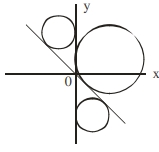
$A$ circle touches both the $y$-axis and the line $x+y=0$. Then the locus of its center is
A
$y=\sqrt{2} x$
B
$x=\sqrt{2} y$
C
$y^{2}-x^{2}=2xy$
D
$x^{2}-y^{2}=2xy$
Solution
(D) Let the center of the circle be $(h, k)$ and its radius be $r$.
Since the circle touches the $y$-axis $(x=0)$,the radius $r = |h|$.
Since the circle also touches the line $x+y=0$,the perpendicular distance from the center $(h, k)$ to the line $x+y=0$ must be equal to the radius $r$.
Thus,$r = \frac{|h+k|}{\sqrt{1^{2}+1^{2}}} = \frac{|h+k|}{\sqrt{2}}$.
Equating the two expressions for $r$,we get $|h| = \frac{|h+k|}{\sqrt{2}}$.
Squaring both sides,we have $h^{2} = \frac{(h+k)^{2}}{2}$.
$2h^{2} = h^{2} + k^{2} + 2hk$.
$h^{2} - k^{2} = 2hk$.
Replacing $(h, k)$ with $(x, y)$,the locus of the center is $x^{2}-y^{2}=2xy$.
Since the circle touches the $y$-axis $(x=0)$,the radius $r = |h|$.
Since the circle also touches the line $x+y=0$,the perpendicular distance from the center $(h, k)$ to the line $x+y=0$ must be equal to the radius $r$.
Thus,$r = \frac{|h+k|}{\sqrt{1^{2}+1^{2}}} = \frac{|h+k|}{\sqrt{2}}$.
Equating the two expressions for $r$,we get $|h| = \frac{|h+k|}{\sqrt{2}}$.
Squaring both sides,we have $h^{2} = \frac{(h+k)^{2}}{2}$.
$2h^{2} = h^{2} + k^{2} + 2hk$.
$h^{2} - k^{2} = 2hk$.
Replacing $(h, k)$ with $(x, y)$,the locus of the center is $x^{2}-y^{2}=2xy$.
0 likes
View Solution159
DifficultMCQ
Let the locus of the centre $(\alpha, \beta)$,$\beta > 0$,of the circle which touches the circle $x^{2} + (y - 1)^{2} = 1$ externally and also touches the $x$-axis be $L$. Then the area bounded by $L$ and the line $y = 4$ is.
A
$\frac{32 \sqrt{2}}{3}$
B
$\frac{40 \sqrt{2}}{3}$
C
$\frac{64}{3}$
D
$\frac{32}{3}$
Solution
(C) Let the centre of the circle be $(\alpha, \beta)$ and its radius be $r$. Since the circle touches the $x$-axis,$r = \beta$.
Since it touches the circle $x^{2} + (y - 1)^{2} = 1$ (centre $(0, 1)$,radius $1$) externally,the distance between the centres equals the sum of the radii:
$\sqrt{(\alpha - 0)^{2} + (\beta - 1)^{2}} = \beta + 1$
Squaring both sides:
$\alpha^{2} + (\beta - 1)^{2} = (\beta + 1)^{2}$
$\alpha^{2} + \beta^{2} - 2\beta + 1 = \beta^{2} + 2\beta + 1$
$\alpha^{2} = 4\beta$
Replacing $(\alpha, \beta)$ with $(x, y)$,the locus $L$ is the parabola $x^{2} = 4y$.
The area bounded by $x^{2} = 4y$ and $y = 4$ is given by:
$A = 2 \int_{0}^{4} \sqrt{4y} \, dy = 2 \int_{0}^{4} 2 \sqrt{y} \, dy = 4 \left[ \frac{y^{3/2}}{3/2} \right]_{0}^{4} = 4 \times \frac{2}{3} \times 8 = \frac{64}{3}$.
Since it touches the circle $x^{2} + (y - 1)^{2} = 1$ (centre $(0, 1)$,radius $1$) externally,the distance between the centres equals the sum of the radii:
$\sqrt{(\alpha - 0)^{2} + (\beta - 1)^{2}} = \beta + 1$
Squaring both sides:
$\alpha^{2} + (\beta - 1)^{2} = (\beta + 1)^{2}$
$\alpha^{2} + \beta^{2} - 2\beta + 1 = \beta^{2} + 2\beta + 1$
$\alpha^{2} = 4\beta$
Replacing $(\alpha, \beta)$ with $(x, y)$,the locus $L$ is the parabola $x^{2} = 4y$.
The area bounded by $x^{2} = 4y$ and $y = 4$ is given by:
$A = 2 \int_{0}^{4} \sqrt{4y} \, dy = 2 \int_{0}^{4} 2 \sqrt{y} \, dy = 4 \left[ \frac{y^{3/2}}{3/2} \right]_{0}^{4} = 4 \times \frac{2}{3} \times 8 = \frac{64}{3}$.
0 likes
View Solution160
DifficultMCQ
$A$ point $P(x, y)$ moves such that the sum of the squares of its distances from the points $(1, 2)$ and $(-2, 1)$ is $14$. Let $f(x, y) = 0$ be the locus of $P$,which intersects the $x$-axis at points $A, B$ and the $y$-axis at points $C, D$. Then the area of the quadrilateral $ACBD$ is equal to:
A
$\frac{9}{2}$
B
$\frac{3 \sqrt{17}}{2}$
C
$\frac{3 \sqrt{17}}{4}$
D
$9$
Solution
(B) Let $P = (x, y)$. The sum of the squares of the distances from $(1, 2)$ and $(-2, 1)$ is $14$:
$(x-1)^2 + (y-2)^2 + (x+2)^2 + (y-1)^2 = 14$
Expanding the terms:
$(x^2 - 2x + 1) + (y^2 - 4y + 4) + (x^2 + 4x + 4) + (y^2 - 2y + 1) = 14$
$2x^2 + 2y^2 + 2x - 6y + 10 = 14$
$2x^2 + 2y^2 + 2x - 6y - 4 = 0$
$x^2 + y^2 + x - 3y - 2 = 0$
For $x$-intercepts,set $y = 0$:
$x^2 + x - 2 = 0$ $\Rightarrow (x+2)(x-1) = 0$ $\Rightarrow x = -2, 1$. So $A = (-2, 0)$ and $B = (1, 0)$.
For $y$-intercepts,set $x = 0$:
$y^2 - 3y - 2 = 0$. Using the quadratic formula $y = \frac{-b \pm \sqrt{b^2 - 4ac}}{2a}$:
$y = \frac{3 \pm \sqrt{9 - 4(1)(-2)}}{2} = \frac{3 \pm \sqrt{17}}{2}$. So $C = (0, \frac{3+\sqrt{17}}{2})$ and $D = (0, \frac{3-\sqrt{17}}{2})$.
The quadrilateral $ACBD$ is a rhombus-like shape with diagonals along the axes. The length of the horizontal diagonal $AB = |1 - (-2)| = 3$.
The length of the vertical diagonal $CD = |\frac{3+\sqrt{17}}{2} - \frac{3-\sqrt{17}}{2}| = \sqrt{17}$.
The area of the quadrilateral is $\frac{1}{2} \times d_1 \times d_2 = \frac{1}{2} \times 3 \times \sqrt{17} = \frac{3\sqrt{17}}{2}$.
$(x-1)^2 + (y-2)^2 + (x+2)^2 + (y-1)^2 = 14$
Expanding the terms:
$(x^2 - 2x + 1) + (y^2 - 4y + 4) + (x^2 + 4x + 4) + (y^2 - 2y + 1) = 14$
$2x^2 + 2y^2 + 2x - 6y + 10 = 14$
$2x^2 + 2y^2 + 2x - 6y - 4 = 0$
$x^2 + y^2 + x - 3y - 2 = 0$
For $x$-intercepts,set $y = 0$:
$x^2 + x - 2 = 0$ $\Rightarrow (x+2)(x-1) = 0$ $\Rightarrow x = -2, 1$. So $A = (-2, 0)$ and $B = (1, 0)$.
For $y$-intercepts,set $x = 0$:
$y^2 - 3y - 2 = 0$. Using the quadratic formula $y = \frac{-b \pm \sqrt{b^2 - 4ac}}{2a}$:
$y = \frac{3 \pm \sqrt{9 - 4(1)(-2)}}{2} = \frac{3 \pm \sqrt{17}}{2}$. So $C = (0, \frac{3+\sqrt{17}}{2})$ and $D = (0, \frac{3-\sqrt{17}}{2})$.
The quadrilateral $ACBD$ is a rhombus-like shape with diagonals along the axes. The length of the horizontal diagonal $AB = |1 - (-2)| = 3$.
The length of the vertical diagonal $CD = |\frac{3+\sqrt{17}}{2} - \frac{3-\sqrt{17}}{2}| = \sqrt{17}$.
The area of the quadrilateral is $\frac{1}{2} \times d_1 \times d_2 = \frac{1}{2} \times 3 \times \sqrt{17} = \frac{3\sqrt{17}}{2}$.
0 likes
View Solution161
DifficultMCQ
Let the function $f(x) = 2x^{2} - \log_{e} x$,$x > 0$,be decreasing in $(0, a)$ and increasing in $(a, 4)$. $A$ tangent to the parabola $y^{2} = 4ax$ at a point $P$ on it passes through the point $(8a, 8a - 1)$ but does not pass through the point $(-\frac{1}{a}, 0)$. If the equation of the normal at $P$ is $\frac{x}{\alpha} + \frac{y}{\beta} = 1$,then $\alpha + \beta$ is equal to-
A
$45$
B
$44$
C
$43$
D
$46$
Solution
(A) Given $f(x) = 2x^{2} - \log_{e} x$. The derivative is $f'(x) = 4x - \frac{1}{x} = \frac{4x^{2} - 1}{x}$.
For $f(x)$ to be decreasing in $(0, a)$ and increasing in $(a, 4)$,we set $f'(x) = 0$,which gives $4x^{2} = 1$,so $x = \frac{1}{2}$ (since $x > 0$). Thus,$a = \frac{1}{2}$.
The parabola is $y^{2} = 4(\frac{1}{2})x = 2x$.
$A$ point $P$ on $y^{2} = 2x$ is $(2t^{2}, 2t)$. The tangent at $P$ is $ty = x + 2t^{2}$.
This tangent passes through $(8a, 8a - 1) = (4, 3)$.
So,$t(3) = 4 + 2t^{2} \Rightarrow 2t^{2} - 3t + 4 = 0$. This has no real roots. Re-evaluating the parabola equation: $y^{2} = 4ax$. If $a = 1/2$,$y^{2} = 2x$. The point is $(8a, 8a-1) = (4, 3)$.
Using the standard form $y^{2} = 4ax$,the tangent at $(at^{2}, 2at)$ is $ty = x + at^{2}$.
Substituting $(8a, 8a-1)$: $t(8a-1) = 8a + at^{2} \Rightarrow at^{2} - t(8a-1) + 8a = 0$.
Given $a = 1/2$,$\frac{1}{2}t^{2} - t(4-1) + 4 = 0 \Rightarrow \frac{1}{2}t^{2} - 3t + 4 = 0 \Rightarrow t^{2} - 6t + 8 = 0$.
Roots are $t = 2, 4$. If $t=2$,$P = (at^{2}, 2at) = (2, 2)$. If $t=4$,$P = (8, 4)$.
The normal at $P(at^{2}, 2at)$ is $y = -tx + 2at + at^{3}$.
For $t=4, a=1/2$: $y = -4x + 2(1/2)(4) + (1/2)(64) = -4x + 4 + 32 = -4x + 36$.
$4x + y = 36 \Rightarrow \frac{x}{9} + \frac{y}{36} = 1$. Thus $\alpha = 9, \beta = 36$.
$\alpha + \beta = 9 + 36 = 45$.
For $f(x)$ to be decreasing in $(0, a)$ and increasing in $(a, 4)$,we set $f'(x) = 0$,which gives $4x^{2} = 1$,so $x = \frac{1}{2}$ (since $x > 0$). Thus,$a = \frac{1}{2}$.
The parabola is $y^{2} = 4(\frac{1}{2})x = 2x$.
$A$ point $P$ on $y^{2} = 2x$ is $(2t^{2}, 2t)$. The tangent at $P$ is $ty = x + 2t^{2}$.
This tangent passes through $(8a, 8a - 1) = (4, 3)$.
So,$t(3) = 4 + 2t^{2} \Rightarrow 2t^{2} - 3t + 4 = 0$. This has no real roots. Re-evaluating the parabola equation: $y^{2} = 4ax$. If $a = 1/2$,$y^{2} = 2x$. The point is $(8a, 8a-1) = (4, 3)$.
Using the standard form $y^{2} = 4ax$,the tangent at $(at^{2}, 2at)$ is $ty = x + at^{2}$.
Substituting $(8a, 8a-1)$: $t(8a-1) = 8a + at^{2} \Rightarrow at^{2} - t(8a-1) + 8a = 0$.
Given $a = 1/2$,$\frac{1}{2}t^{2} - t(4-1) + 4 = 0 \Rightarrow \frac{1}{2}t^{2} - 3t + 4 = 0 \Rightarrow t^{2} - 6t + 8 = 0$.
Roots are $t = 2, 4$. If $t=2$,$P = (at^{2}, 2at) = (2, 2)$. If $t=4$,$P = (8, 4)$.
The normal at $P(at^{2}, 2at)$ is $y = -tx + 2at + at^{3}$.
For $t=4, a=1/2$: $y = -4x + 2(1/2)(4) + (1/2)(64) = -4x + 4 + 32 = -4x + 36$.
$4x + y = 36 \Rightarrow \frac{x}{9} + \frac{y}{36} = 1$. Thus $\alpha = 9, \beta = 36$.
$\alpha + \beta = 9 + 36 = 45$.
0 likes
View Solution162
DifficultMCQ
For $t \in (0, 2\pi)$,if $ABC$ is an equilateral triangle with vertices $A(\sin t, -\cos t)$,$B(\cos t, \sin t)$,and $C(a, b)$ such that its orthocentre lies on a circle with centre $(1, 1/3)$,then $(a^2 - b^2)$ is equal to.
A
$8/3$
B
$8$
C
$77/9$
D
$80/9$
Solution
(B) Let $s = \sin t$ and $c = \cos t$.
For an equilateral triangle,the orthocentre $(h, k)$ coincides with the centroid.
The centroid $(h, k)$ is given by $h = \frac{a + s + c}{3}$ and $k = \frac{b - c + s}{3}$.
Thus,$3h - a = s + c$ and $3k - b = s - c$.
Squaring and adding these equations:
$(3h - a)^2 + (3k - b)^2 = (s + c)^2 + (s - c)^2 = 2(s^2 + c^2) = 2$.
Dividing by $9$:
$(h - a/3)^2 + (k - b/3)^2 = 2/9$.
This represents a circle with centre $(a/3, b/3)$ and radius $\sqrt{2}/3$.
Given the centre of the circle is $(1, 1/3)$,we have $a/3 = 1$ and $b/3 = 1/3$.
Therefore,$a = 3$ and $b = 1$.
Finally,$a^2 - b^2 = 3^2 - 1^2 = 9 - 1 = 8$.
For an equilateral triangle,the orthocentre $(h, k)$ coincides with the centroid.
The centroid $(h, k)$ is given by $h = \frac{a + s + c}{3}$ and $k = \frac{b - c + s}{3}$.
Thus,$3h - a = s + c$ and $3k - b = s - c$.
Squaring and adding these equations:
$(3h - a)^2 + (3k - b)^2 = (s + c)^2 + (s - c)^2 = 2(s^2 + c^2) = 2$.
Dividing by $9$:
$(h - a/3)^2 + (k - b/3)^2 = 2/9$.
This represents a circle with centre $(a/3, b/3)$ and radius $\sqrt{2}/3$.
Given the centre of the circle is $(1, 1/3)$,we have $a/3 = 1$ and $b/3 = 1/3$.
Therefore,$a = 3$ and $b = 1$.
Finally,$a^2 - b^2 = 3^2 - 1^2 = 9 - 1 = 8$.
0 likes
View Solution163
AdvancedMCQ
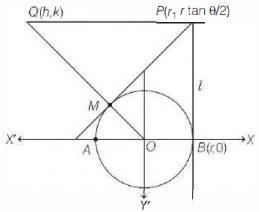
Let $\Gamma$ be a circle with diameter $AB$ and centre $O$. Let $l$ be the tangent to $\Gamma$ at $B$. For each point $M$ on $\Gamma$ different from $A$,consider the tangent $t$ at $M$ and let it intersect $l$ at $P$. Draw a line parallel to $AB$ through $P$ intersecting $OM$ at $Q$. The locus of $Q$ as $M$ varies over $\Gamma$ is
A
an arc of a circle
B
a parabola
C
an arc of an ellipse
D
a branch of a hyperbola
Solution
(B) Let the circle be $x^2 + y^2 = r^2$ with centre $O(0, 0)$.
Let $M = (r \cos \theta, r \sin \theta)$.
The tangent at $M$ is $x \cos \theta + y \sin \theta = r$.
The tangent $l$ at $B(r, 0)$ is $x = r$.
Intersection $P$ of tangent at $M$ and $l$ is found by substituting $x = r$ into the tangent equation:
$r \cos \theta + y \sin \theta = r \implies y \sin \theta = r(1 - \cos \theta) \implies y = r \tan(\theta/2)$.
So,$P = (r, r \tan(\theta/2))$.
The line through $P$ parallel to $AB$ (the $x$-axis) is $y = r \tan(\theta/2)$.
The line $OM$ passes through $(0, 0)$ and $(r \cos \theta, r \sin \theta)$,so its equation is $y = x \tan \theta$.
$Q(h, k)$ is the intersection of $y = r \tan(\theta/2)$ and $y = x \tan \theta$.
Thus,$k = r \tan(\theta/2)$ and $k = h \tan \theta$.
Using $\tan \theta = \frac{2 \tan(\theta/2)}{1 - \tan^2(\theta/2)}$,we have $k = h \cdot \frac{2(k/r)}{1 - (k/r)^2}$.
$1 - k^2/r^2 = 2h/r \implies r^2 - k^2 = 2hr \implies k^2 = -2r(h - r/2)$.
The locus of $Q(x, y)$ is $y^2 = -2r(x - r/2)$,which is a parabola.
Let $M = (r \cos \theta, r \sin \theta)$.
The tangent at $M$ is $x \cos \theta + y \sin \theta = r$.
The tangent $l$ at $B(r, 0)$ is $x = r$.
Intersection $P$ of tangent at $M$ and $l$ is found by substituting $x = r$ into the tangent equation:
$r \cos \theta + y \sin \theta = r \implies y \sin \theta = r(1 - \cos \theta) \implies y = r \tan(\theta/2)$.
So,$P = (r, r \tan(\theta/2))$.
The line through $P$ parallel to $AB$ (the $x$-axis) is $y = r \tan(\theta/2)$.
The line $OM$ passes through $(0, 0)$ and $(r \cos \theta, r \sin \theta)$,so its equation is $y = x \tan \theta$.
$Q(h, k)$ is the intersection of $y = r \tan(\theta/2)$ and $y = x \tan \theta$.
Thus,$k = r \tan(\theta/2)$ and $k = h \tan \theta$.
Using $\tan \theta = \frac{2 \tan(\theta/2)}{1 - \tan^2(\theta/2)}$,we have $k = h \cdot \frac{2(k/r)}{1 - (k/r)^2}$.
$1 - k^2/r^2 = 2h/r \implies r^2 - k^2 = 2hr \implies k^2 = -2r(h - r/2)$.
The locus of $Q(x, y)$ is $y^2 = -2r(x - r/2)$,which is a parabola.
0 likes
View Solution164
AdvancedMCQ
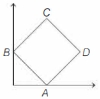
Consider a rigid square $ABCD$ as in the figure with $A$ and $B$ on the $X$ and $Y$-axes,respectively. When $A$ and $B$ slide along their respective axes,the locus of $C$ forms a part of
A
a circle
B
a parabola
C
a hyperbola
D
an ellipse which is not a circle
Solution
(D) Let the side length of the square $ABCD$ be $a$. Let the coordinates of $A$ be $(x_A, 0)$ and $B$ be $(0, y_B)$. Let the angle $\angle OAB = \theta$. Then $A = (a \cos \theta, 0)$ and $B = (0, a \sin \theta)$.
Since $ABCD$ is a square,the vector $\vec{BC}$ is perpendicular to $\vec{AB}$ and has the same length $a$. The vector $\vec{AB} = (-a \cos \theta, a \sin \theta)$. Rotating this by $90^\circ$ gives $\vec{BC} = (a \sin \theta, a \cos \theta)$.
Thus,$C = B + \vec{BC} = (0 + a \sin \theta, a \sin \theta + a \cos \theta) = (a \sin \theta, a(\sin \theta + \cos \theta))$.
Let $C = (x, y)$. Then $x = a \sin \theta$ and $y = a \sin \theta + a \cos \theta$.
From the first equation,$\sin \theta = \frac{x}{a}$. Then $\cos \theta = \sqrt{1 - (\frac{x}{a})^2} = \frac{\sqrt{a^2 - x^2}}{a}$.
Substituting into the second equation: $y = x + \sqrt{a^2 - x^2}$.
$y - x = \sqrt{a^2 - x^2}$.
Squaring both sides: $(y - x)^2 = a^2 - x^2$.
$y^2 - 2xy + x^2 = a^2 - x^2$.
$2x^2 + y^2 - 2xy = a^2$.
This is the equation of an ellipse,as the discriminant $B^2 - 4AC = (-2)^2 - 4(2)(1) = 4 - 8 = -4 < 0$. Since the coefficients of $x^2$ and $y^2$ are not equal,it is not a circle.
Since $ABCD$ is a square,the vector $\vec{BC}$ is perpendicular to $\vec{AB}$ and has the same length $a$. The vector $\vec{AB} = (-a \cos \theta, a \sin \theta)$. Rotating this by $90^\circ$ gives $\vec{BC} = (a \sin \theta, a \cos \theta)$.
Thus,$C = B + \vec{BC} = (0 + a \sin \theta, a \sin \theta + a \cos \theta) = (a \sin \theta, a(\sin \theta + \cos \theta))$.
Let $C = (x, y)$. Then $x = a \sin \theta$ and $y = a \sin \theta + a \cos \theta$.
From the first equation,$\sin \theta = \frac{x}{a}$. Then $\cos \theta = \sqrt{1 - (\frac{x}{a})^2} = \frac{\sqrt{a^2 - x^2}}{a}$.
Substituting into the second equation: $y = x + \sqrt{a^2 - x^2}$.
$y - x = \sqrt{a^2 - x^2}$.
Squaring both sides: $(y - x)^2 = a^2 - x^2$.
$y^2 - 2xy + x^2 = a^2 - x^2$.
$2x^2 + y^2 - 2xy = a^2$.
This is the equation of an ellipse,as the discriminant $B^2 - 4AC = (-2)^2 - 4(2)(1) = 4 - 8 = -4 < 0$. Since the coefficients of $x^2$ and $y^2$ are not equal,it is not a circle.
0 likes
View Solution165
AdvancedMCQ
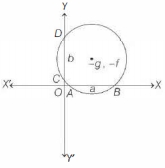
Two line segments $AB$ and $CD$ are constrained to move along the $X$ and $Y$-axes,respectively,in such a way that the points $A, B, C, D$ are concyclic. If $AB = a$ and $CD = b$,then the locus of the centre of the circle passing through $A, B, C, D$ in polar coordinates is
A
$r^2 = \frac{a^2+b^2}{4}$
B
$r^2 \cos 2\theta = \frac{a^2-b^2}{4}$
C
$r^2 = 4(a^2+b^2)$
D
$r^2 \cos 2\theta = 4(a^2-b^2)$
Solution
(B) Let the equation of the circle passing through $A, B, C, D$ be $x^2+y^2+2gx+2fy+c=0$.
The polar coordinates of the centre $(-g, -f)$ are given by $-g = r \cos \theta$ and $-f = r \sin \theta$.
$AB$ is the length of the intercept on the $X$-axis,so $a = 2\sqrt{g^2-c} \implies \frac{a^2}{4} = g^2-c$.
$CD$ is the length of the intercept on the $Y$-axis,so $b = 2\sqrt{f^2-c} \implies \frac{b^2}{4} = f^2-c$.
Subtracting the two equations: $g^2-f^2 = \frac{a^2-b^2}{4}$.
Substituting $g = -r \cos \theta$ and $f = -r \sin \theta$:
$(-r \cos \theta)^2 - (-r \sin \theta)^2 = \frac{a^2-b^2}{4}$
$r^2(\cos^2 \theta - \sin^2 \theta) = \frac{a^2-b^2}{4}$
$r^2 \cos 2\theta = \frac{a^2-b^2}{4}$.
The polar coordinates of the centre $(-g, -f)$ are given by $-g = r \cos \theta$ and $-f = r \sin \theta$.
$AB$ is the length of the intercept on the $X$-axis,so $a = 2\sqrt{g^2-c} \implies \frac{a^2}{4} = g^2-c$.
$CD$ is the length of the intercept on the $Y$-axis,so $b = 2\sqrt{f^2-c} \implies \frac{b^2}{4} = f^2-c$.
Subtracting the two equations: $g^2-f^2 = \frac{a^2-b^2}{4}$.
Substituting $g = -r \cos \theta$ and $f = -r \sin \theta$:
$(-r \cos \theta)^2 - (-r \sin \theta)^2 = \frac{a^2-b^2}{4}$
$r^2(\cos^2 \theta - \sin^2 \theta) = \frac{a^2-b^2}{4}$
$r^2 \cos 2\theta = \frac{a^2-b^2}{4}$.
0 likes
View Solution166
DifficultMCQ
The maximum possible value of $x^2+y^2-4x-6y$,where $x, y$ are real,subject to the condition $|x+y|+|x-y|=4$ is
A
$12$
B
$28$
C
$72$
D
does not exist
Solution
(B) The given condition $|x+y|+|x-y|=4$ represents a square in the $xy$-plane with vertices at $(2, 2), (-2, 2), (-2, -2), (2, -2)$ is incorrect; let us re-evaluate.
The condition $|x+y|+|x-y|=4$ is equivalent to $\max(|x|, |y|) = 2$,which represents a square with vertices at $(2, 2), (-2, 2), (-2, -2), (2, -2)$.
We want to maximize $f(x, y) = x^2+y^2-4x-6y = (x-2)^2 + (y-3)^2 - 13$.
This expression represents the square of the distance from the point $(2, 3)$ to any point $(x, y)$ on the square,minus $13$.
To maximize this,we look for the point on the square boundary furthest from $(2, 3)$.
The vertices of the square are $V_1(2, 2), V_2(-2, 2), V_3(-2, -2), V_4(2, -2)$.
Calculating the squared distances $d^2$ from $(2, 3)$ to each vertex:
$d_1^2 = (2-2)^2 + (2-3)^2 = 1$
$d_2^2 = (-2-2)^2 + (2-3)^2 = 16 + 1 = 17$
$d_3^2 = (-2-2)^2 + (-2-3)^2 = 16 + 25 = 41$
$d_4^2 = (2-2)^2 + (-2-3)^2 = 25$
The maximum squared distance is $41$ at vertex $(-2, -2)$.
Thus,the maximum value of $f(x, y) = 41 - 13 = 28$.
The condition $|x+y|+|x-y|=4$ is equivalent to $\max(|x|, |y|) = 2$,which represents a square with vertices at $(2, 2), (-2, 2), (-2, -2), (2, -2)$.
We want to maximize $f(x, y) = x^2+y^2-4x-6y = (x-2)^2 + (y-3)^2 - 13$.
This expression represents the square of the distance from the point $(2, 3)$ to any point $(x, y)$ on the square,minus $13$.
To maximize this,we look for the point on the square boundary furthest from $(2, 3)$.
The vertices of the square are $V_1(2, 2), V_2(-2, 2), V_3(-2, -2), V_4(2, -2)$.
Calculating the squared distances $d^2$ from $(2, 3)$ to each vertex:
$d_1^2 = (2-2)^2 + (2-3)^2 = 1$
$d_2^2 = (-2-2)^2 + (2-3)^2 = 16 + 1 = 17$
$d_3^2 = (-2-2)^2 + (-2-3)^2 = 16 + 25 = 41$
$d_4^2 = (2-2)^2 + (-2-3)^2 = 25$
The maximum squared distance is $41$ at vertex $(-2, -2)$.
Thus,the maximum value of $f(x, y) = 41 - 13 = 28$.
0 likes
View Solution167
AdvancedMCQ
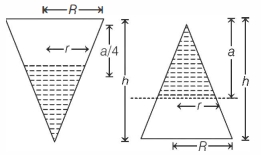
$A$ bottle in the shape of a right-circular cone with height $h$ contains some water. When its base is placed on a flat surface,the height of the vertex from the water level is $a$ units. When it is kept upside down,the height of the base from the water level is $\frac{a}{4}$ units. Then the ratio $\frac{h}{a}$ is
A
$\frac{1+\sqrt{85}}{4}$
B
$\frac{1+\sqrt{85}}{8}$
C
$\frac{1+\sqrt{65}}{4}$
D
$\frac{1+\sqrt{65}}{8}$
Solution
(B) Let $R$ be the radius of the base of the cone and $h$ be its height. Let $V$ be the volume of water.
Case $1$: Base is on the surface. The empty part is a smaller cone at the top with height $a$. By similar triangles,the radius of the water surface is $r = \frac{R}{h}(h-a)$. The volume of water is $V = \frac{1}{3}\pi R^2 h - \frac{1}{3}\pi r^2 a = \frac{1}{3}\pi R^2 h - \frac{1}{3}\pi (\frac{R}{h}(h-a))^2 a = \frac{1}{3}\pi R^2 h [1 - (\frac{h-a}{h})^2 \frac{a}{h}] = \frac{1}{3}\pi R^2 h [1 - (1 - \frac{a}{h})^2 \frac{a}{h}]$.
Case $2$: Upside down. The water forms a smaller cone at the bottom with height $h - \frac{a}{4}$. The radius of the water surface is $r_1 = \frac{R}{h}(h - \frac{a}{4})$. The volume of water is $V = \frac{1}{3}\pi r_1^2 (h - \frac{a}{4}) = \frac{1}{3}\pi [\frac{R}{h}(h - \frac{a}{4})]^2 (h - \frac{a}{4}) = \frac{1}{3}\pi R^2 h (\frac{h - a/4}{h})^3$.
Equating the volumes: $1 - (1 - \frac{a}{h})^2 \frac{a}{h} = (1 - \frac{a}{4h})^3$. Let $x = \frac{a}{h}$. Then $1 - (1-x)^2 x = (1 - \frac{x}{4})^3$.
$1 - x(1 - 2x + x^2) = 1 - 3(\frac{x}{4}) + 3(\frac{x}{4})^2 - (\frac{x}{4})^3$.
$1 - x + 2x^2 - x^3 = 1 - \frac{3x}{4} + \frac{3x^2}{16} - \frac{x^3}{64}$.
Multiply by $64$: $64 - 64x + 128x^2 - 64x^3 = 64 - 48x + 12x^2 - x^3$.
$63x^3 - 116x^2 + 16x = 0$. Since $x \neq 0$,$63x^2 - 116x + 16 = 0$.
Using the quadratic formula for $\frac{h}{a} = \frac{1}{x}$: $x = \frac{116 \pm \sqrt{116^2 - 4(63)(16)}}{2(63)} = \frac{116 \pm \sqrt{13456 - 4032}}{126} = \frac{116 \pm \sqrt{9424}}{126} = \frac{116 \pm 8\sqrt{147.25}}{126}$.
Re-evaluating the volume equation: The volume of water in Case $1$ is the total volume minus the volume of the empty cone: $V = \frac{1}{3}\pi R^2 h - \frac{1}{3}\pi (\frac{R}{h}a)^2 a = \frac{1}{3}\pi R^2 h (1 - \frac{a^3}{h^3})$.
Equating: $1 - \frac{a^3}{h^3} = (1 - \frac{a}{4h})^3$. Let $k = \frac{h}{a}$. $1 - \frac{1}{k^3} = (1 - \frac{1}{4k})^3 = (\frac{4k-1}{4k})^3$.
$\frac{k^3-1}{k^3} = \frac{(4k-1)^3}{64k^3} \Rightarrow 64(k^3-1) = (4k-1)^3 = 64k^3 - 48k^2 + 12k - 1$.
$64k^3 - 64 = 64k^3 - 48k^2 + 12k - 1 \Rightarrow 48k^2 - 12k - 63 = 0$.
Divide by $3$: $16k^2 - 4k - 21 = 0$. $k = \frac{4 \pm \sqrt{16 - 4(16)(-21)}}{32} = \frac{4 \pm \sqrt{16 + 1344}}{32} = \frac{4 \pm \sqrt{1360}}{32} = \frac{4 \pm 4\sqrt{85}}{32} = \frac{1 \pm \sqrt{85}}{8}$.
Since $k > 0$,$k = \frac{1+\sqrt{85}}{8}$.
Case $1$: Base is on the surface. The empty part is a smaller cone at the top with height $a$. By similar triangles,the radius of the water surface is $r = \frac{R}{h}(h-a)$. The volume of water is $V = \frac{1}{3}\pi R^2 h - \frac{1}{3}\pi r^2 a = \frac{1}{3}\pi R^2 h - \frac{1}{3}\pi (\frac{R}{h}(h-a))^2 a = \frac{1}{3}\pi R^2 h [1 - (\frac{h-a}{h})^2 \frac{a}{h}] = \frac{1}{3}\pi R^2 h [1 - (1 - \frac{a}{h})^2 \frac{a}{h}]$.
Case $2$: Upside down. The water forms a smaller cone at the bottom with height $h - \frac{a}{4}$. The radius of the water surface is $r_1 = \frac{R}{h}(h - \frac{a}{4})$. The volume of water is $V = \frac{1}{3}\pi r_1^2 (h - \frac{a}{4}) = \frac{1}{3}\pi [\frac{R}{h}(h - \frac{a}{4})]^2 (h - \frac{a}{4}) = \frac{1}{3}\pi R^2 h (\frac{h - a/4}{h})^3$.
Equating the volumes: $1 - (1 - \frac{a}{h})^2 \frac{a}{h} = (1 - \frac{a}{4h})^3$. Let $x = \frac{a}{h}$. Then $1 - (1-x)^2 x = (1 - \frac{x}{4})^3$.
$1 - x(1 - 2x + x^2) = 1 - 3(\frac{x}{4}) + 3(\frac{x}{4})^2 - (\frac{x}{4})^3$.
$1 - x + 2x^2 - x^3 = 1 - \frac{3x}{4} + \frac{3x^2}{16} - \frac{x^3}{64}$.
Multiply by $64$: $64 - 64x + 128x^2 - 64x^3 = 64 - 48x + 12x^2 - x^3$.
$63x^3 - 116x^2 + 16x = 0$. Since $x \neq 0$,$63x^2 - 116x + 16 = 0$.
Using the quadratic formula for $\frac{h}{a} = \frac{1}{x}$: $x = \frac{116 \pm \sqrt{116^2 - 4(63)(16)}}{2(63)} = \frac{116 \pm \sqrt{13456 - 4032}}{126} = \frac{116 \pm \sqrt{9424}}{126} = \frac{116 \pm 8\sqrt{147.25}}{126}$.
Re-evaluating the volume equation: The volume of water in Case $1$ is the total volume minus the volume of the empty cone: $V = \frac{1}{3}\pi R^2 h - \frac{1}{3}\pi (\frac{R}{h}a)^2 a = \frac{1}{3}\pi R^2 h (1 - \frac{a^3}{h^3})$.
Equating: $1 - \frac{a^3}{h^3} = (1 - \frac{a}{4h})^3$. Let $k = \frac{h}{a}$. $1 - \frac{1}{k^3} = (1 - \frac{1}{4k})^3 = (\frac{4k-1}{4k})^3$.
$\frac{k^3-1}{k^3} = \frac{(4k-1)^3}{64k^3} \Rightarrow 64(k^3-1) = (4k-1)^3 = 64k^3 - 48k^2 + 12k - 1$.
$64k^3 - 64 = 64k^3 - 48k^2 + 12k - 1 \Rightarrow 48k^2 - 12k - 63 = 0$.
Divide by $3$: $16k^2 - 4k - 21 = 0$. $k = \frac{4 \pm \sqrt{16 - 4(16)(-21)}}{32} = \frac{4 \pm \sqrt{16 + 1344}}{32} = \frac{4 \pm \sqrt{1360}}{32} = \frac{4 \pm 4\sqrt{85}}{32} = \frac{1 \pm \sqrt{85}}{8}$.
Since $k > 0$,$k = \frac{1+\sqrt{85}}{8}$.
0 likes
View Solution168
AdvancedMCQ
The number of pairs $(a, b)$ of positive real numbers satisfying $a^4+b^4 < 1$ and $a^2+b^2 > 1$ is
A
$0$
B
$1$
C
$2$
D
More than $2$
Solution
(D) The given inequalities are $a^4+b^4 < 1$ and $a^2+b^2 > 1$ for positive real numbers $a$ and $b$.
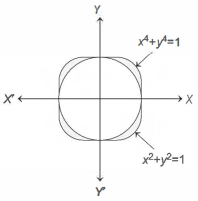
Consider the curves $x^2+y^2=1$ (a circle of radius $1$) and $x^4+y^4=1$ (a squircle) in the first quadrant where $x, y > 0$.
For any point $(x, y)$ on the circle $x^2+y^2=1$,we have $x^4+y^4 = (x^2+y^2)^2 - 2x^2y^2 = 1 - 2x^2y^2$. Since $x, y > 0$,$x^2y^2 > 0$,which implies $x^4+y^4 < 1$.
This means the region $a^4+b^4 < 1$ lies outside the circle $a^2+b^2=1$ in the first quadrant,while the region $a^2+b^2 > 1$ lies outside the circle. However,the curve $a^4+b^4=1$ actually encloses a larger area than the circle $a^2+b^2=1$ in the first quadrant.
Specifically,for $a, b > 0$,the region $a^2+b^2 > 1$ and $a^4+b^4 < 1$ represents the area between the circle and the squircle in the first quadrant.
Since this region has a non-zero area,there are infinitely many pairs $(a, b)$ of positive real numbers satisfying these inequalities.
Thus,the number of such pairs is more than $2$.
Consider the curves $x^2+y^2=1$ (a circle of radius $1$) and $x^4+y^4=1$ (a squircle) in the first quadrant where $x, y > 0$.
For any point $(x, y)$ on the circle $x^2+y^2=1$,we have $x^4+y^4 = (x^2+y^2)^2 - 2x^2y^2 = 1 - 2x^2y^2$. Since $x, y > 0$,$x^2y^2 > 0$,which implies $x^4+y^4 < 1$.
This means the region $a^4+b^4 < 1$ lies outside the circle $a^2+b^2=1$ in the first quadrant,while the region $a^2+b^2 > 1$ lies outside the circle. However,the curve $a^4+b^4=1$ actually encloses a larger area than the circle $a^2+b^2=1$ in the first quadrant.
Specifically,for $a, b > 0$,the region $a^2+b^2 > 1$ and $a^4+b^4 < 1$ represents the area between the circle and the squircle in the first quadrant.
Since this region has a non-zero area,there are infinitely many pairs $(a, b)$ of positive real numbers satisfying these inequalities.
Thus,the number of such pairs is more than $2$.
0 likes
View Solution169
AdvancedMCQ
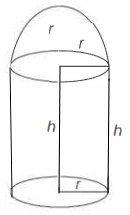
$A$ solid hemisphere is attached to the top of a cylinder,having the same radius as that of the cylinder. If the height of the cylinder were doubled (keeping both radii fixed),the volume of the entire system would have increased by $50\,\%$. By what percentage would the volume have increased if the radii of the hemisphere and the cylinder were doubled (keeping the height fixed) (in $,\%$)?
A
$300$
B
$400$
C
$500$
D
$600$
Solution
(C) Let the height of the cylinder be $h$ and the radius be $r$.
The volume of the cylinder is $V_{cyl} = \pi r^2 h$ and the volume of the hemisphere is $V_{hemi} = \frac{2}{3} \pi r^3$.
The total volume of the system is $V_1 = \pi r^2 h + \frac{2}{3} \pi r^3$.
When the height of the cylinder is doubled $(h \to 2h)$,the new volume $V_2$ is:
$V_2 = \pi r^2 (2h) + \frac{2}{3} \pi r^3 = 2 \pi r^2 h + \frac{2}{3} \pi r^3$.
Given that the volume increases by $50\,\%$,we have $V_2 = 1.5 V_1 = \frac{3}{2} V_1$.
$\frac{2 \pi r^2 h + \frac{2}{3} \pi r^3}{\pi r^2 h + \frac{2}{3} \pi r^3} = \frac{3}{2}$.
Cross-multiplying gives $4 \pi r^2 h + \frac{4}{3} \pi r^3 = 3 \pi r^2 h + 2 \pi r^3$.
$\pi r^2 h = \frac{2}{3} \pi r^3$,which implies $h = \frac{2}{3} r$.
Now,if the radii are doubled $(r \to 2r)$ while keeping the height $h$ fixed,the new volume $V'_2$ is:
$V'_2 = \pi (2r)^2 h + \frac{2}{3} \pi (2r)^3 = 4 \pi r^2 h + \frac{16}{3} \pi r^3$.
Substituting $h = \frac{2}{3} r$ into the expression for $V'_2$:
$V'_2 = 4 \pi r^2 (\frac{2}{3} r) + \frac{16}{3} \pi r^3 = \frac{8}{3} \pi r^3 + \frac{16}{3} \pi r^3 = \frac{24}{3} \pi r^3 = 8 \pi r^3$.
The original volume $V_1$ in terms of $r$ is:
$V_1 = \pi r^2 (\frac{2}{3} r) + \frac{2}{3} \pi r^3 = \frac{2}{3} \pi r^3 + \frac{2}{3} \pi r^3 = \frac{4}{3} \pi r^3$.
The ratio $\frac{V'_2}{V_1} = \frac{8 \pi r^3}{\frac{4}{3} \pi r^3} = 8 \times \frac{3}{4} = 6$.
The increase in volume is $V'_2 - V_1 = 6 V_1 - V_1 = 5 V_1$.
Percentage increase = $\frac{5 V_1}{V_1} \times 100\,\% = 500\,\%$.
The volume of the cylinder is $V_{cyl} = \pi r^2 h$ and the volume of the hemisphere is $V_{hemi} = \frac{2}{3} \pi r^3$.
The total volume of the system is $V_1 = \pi r^2 h + \frac{2}{3} \pi r^3$.
When the height of the cylinder is doubled $(h \to 2h)$,the new volume $V_2$ is:
$V_2 = \pi r^2 (2h) + \frac{2}{3} \pi r^3 = 2 \pi r^2 h + \frac{2}{3} \pi r^3$.
Given that the volume increases by $50\,\%$,we have $V_2 = 1.5 V_1 = \frac{3}{2} V_1$.
$\frac{2 \pi r^2 h + \frac{2}{3} \pi r^3}{\pi r^2 h + \frac{2}{3} \pi r^3} = \frac{3}{2}$.
Cross-multiplying gives $4 \pi r^2 h + \frac{4}{3} \pi r^3 = 3 \pi r^2 h + 2 \pi r^3$.
$\pi r^2 h = \frac{2}{3} \pi r^3$,which implies $h = \frac{2}{3} r$.
Now,if the radii are doubled $(r \to 2r)$ while keeping the height $h$ fixed,the new volume $V'_2$ is:
$V'_2 = \pi (2r)^2 h + \frac{2}{3} \pi (2r)^3 = 4 \pi r^2 h + \frac{16}{3} \pi r^3$.
Substituting $h = \frac{2}{3} r$ into the expression for $V'_2$:
$V'_2 = 4 \pi r^2 (\frac{2}{3} r) + \frac{16}{3} \pi r^3 = \frac{8}{3} \pi r^3 + \frac{16}{3} \pi r^3 = \frac{24}{3} \pi r^3 = 8 \pi r^3$.
The original volume $V_1$ in terms of $r$ is:
$V_1 = \pi r^2 (\frac{2}{3} r) + \frac{2}{3} \pi r^3 = \frac{2}{3} \pi r^3 + \frac{2}{3} \pi r^3 = \frac{4}{3} \pi r^3$.
The ratio $\frac{V'_2}{V_1} = \frac{8 \pi r^3}{\frac{4}{3} \pi r^3} = 8 \times \frac{3}{4} = 6$.
The increase in volume is $V'_2 - V_1 = 6 V_1 - V_1 = 5 V_1$.
Percentage increase = $\frac{5 V_1}{V_1} \times 100\,\% = 500\,\%$.
0 likes
View Solution170
AdvancedMCQ
The number of solid cones with integer radius and integer height each having its volume numerically equal to its total surface area is
A
$0$
B
$1$
C
$2$
D
$infinite$
Solution
(B) Let the height and radius of the cone be $h$ and $r$ respectively,where $h, r \in \mathbb{Z}^+$.
Given that the volume of the cone is numerically equal to its total surface area:
$\frac{1}{3} \pi r^2 h = \pi r l + \pi r^2$,where $l = \sqrt{h^2 + r^2}$.
Dividing by $\pi r$ (since $r \neq 0$):
$\frac{1}{3} r h = \sqrt{h^2 + r^2} + r$
$\frac{1}{3} r h - r = \sqrt{h^2 + r^2}$
$r(\frac{h}{3} - 1) = \sqrt{h^2 + r^2}$
Squaring both sides:
$r^2(\frac{h-3}{3})^2 = h^2 + r^2$
$r^2(\frac{h^2 - 6h + 9}{9}) = h^2 + r^2$
$r^2(h^2 - 6h + 9) = 9h^2 + 9r^2$
$r^2 h^2 - 6h r^2 + 9r^2 = 9h^2 + 9r^2$
$r^2 h^2 - 6h r^2 = 9h^2$
Since $h \neq 0$,divide by $h$:
$r^2 h - 6r^2 = 9h$
$h(r^2 - 9) = 6r^2$
$h = \frac{6r^2}{r^2 - 9} = \frac{6(r^2 - 9) + 54}{r^2 - 9} = 6 + \frac{54}{r^2 - 9}$.
For $h$ to be an integer,$r^2 - 9$ must be a divisor of $54$. Also,$r^2 - 9 > 0$ implies $r > 3$.
The divisors of $54$ are $1, 2, 3, 6, 9, 18, 27, 54$.
Testing $r^2 - 9 = k$:
If $r^2 - 9 = 27$,$r^2 = 36 \Rightarrow r = 6$. Then $h = 6 + \frac{54}{27} = 6 + 2 = 8$.
If $r^2 - 9 = 54$,$r^2 = 63$ (not a perfect square).
Other values of $k$ do not yield integer $r$.
Thus,only one such cone exists with $(r, h) = (6, 8)$.
Given that the volume of the cone is numerically equal to its total surface area:
$\frac{1}{3} \pi r^2 h = \pi r l + \pi r^2$,where $l = \sqrt{h^2 + r^2}$.
Dividing by $\pi r$ (since $r \neq 0$):
$\frac{1}{3} r h = \sqrt{h^2 + r^2} + r$
$\frac{1}{3} r h - r = \sqrt{h^2 + r^2}$
$r(\frac{h}{3} - 1) = \sqrt{h^2 + r^2}$
Squaring both sides:
$r^2(\frac{h-3}{3})^2 = h^2 + r^2$
$r^2(\frac{h^2 - 6h + 9}{9}) = h^2 + r^2$
$r^2(h^2 - 6h + 9) = 9h^2 + 9r^2$
$r^2 h^2 - 6h r^2 + 9r^2 = 9h^2 + 9r^2$
$r^2 h^2 - 6h r^2 = 9h^2$
Since $h \neq 0$,divide by $h$:
$r^2 h - 6r^2 = 9h$
$h(r^2 - 9) = 6r^2$
$h = \frac{6r^2}{r^2 - 9} = \frac{6(r^2 - 9) + 54}{r^2 - 9} = 6 + \frac{54}{r^2 - 9}$.
For $h$ to be an integer,$r^2 - 9$ must be a divisor of $54$. Also,$r^2 - 9 > 0$ implies $r > 3$.
The divisors of $54$ are $1, 2, 3, 6, 9, 18, 27, 54$.
Testing $r^2 - 9 = k$:
If $r^2 - 9 = 27$,$r^2 = 36 \Rightarrow r = 6$. Then $h = 6 + \frac{54}{27} = 6 + 2 = 8$.
If $r^2 - 9 = 54$,$r^2 = 63$ (not a perfect square).
Other values of $k$ do not yield integer $r$.
Thus,only one such cone exists with $(r, h) = (6, 8)$.
0 likes
View Solution171
AdvancedMCQ
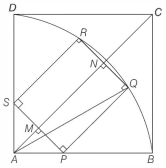
Let $ABCD$ be a square. An arc of a circle with $A$ as center and $AB$ as radius is drawn inside the square joining the points $B$ and $D$. Points $P$ on $AB$,$S$ on $AD$,$Q$ and $R$ on $\operatorname{arc} BD$ are taken such that $PQRS$ is a square. Further suppose that $PQ$ and $RS$ are parallel to $AC$. Then,$\frac{\text{Area}(PQRS)}{\text{Area}(ABCD)}$ is
A
$\frac{1}{8}$
B
$\frac{1}{5}$
C
$\frac{1}{4}$
D
$\frac{2}{5}$
Solution
(D) Let the side length of square $ABCD$ be $1$. Thus,$AB = AD = 1$.
Let the side length of square $PQRS$ be $s$.
Since $PQ$ and $RS$ are parallel to $AC$,the diagonal $AC$ makes an angle of $45^{\circ}$ with $AB$ and $AD$.
Let $A$ be the origin $(0,0)$. Then $A=(0,0)$,$B=(1,0)$,$D=(0,1)$.
The arc $BD$ is part of the circle $x^2 + y^2 = 1$.
The line $AC$ is $y=x$. Since $PQ$ is parallel to $AC$,its equation is $y=x+c$.
Let $P=(p,0)$ and $S=(0,s_0)$. Since $PQRS$ is a square,the vector $\vec{PS} = (-p, s_0)$ must be perpendicular to $\vec{PQ}$.
Using the geometry of the square and the arc,let $AM$ be the perpendicular distance from $A$ to $PS$. Since $PQRS$ is a square,$PS = s$. $AM = s/2$.
Given the symmetry and the parallel condition,the side length $s$ of the square $PQRS$ satisfies $s^2 = 2/5$ when the side of $ABCD$ is $1$.
Thus,the ratio of the areas is $\frac{s^2}{1^2} = \frac{2}{5}$.
Let the side length of square $PQRS$ be $s$.
Since $PQ$ and $RS$ are parallel to $AC$,the diagonal $AC$ makes an angle of $45^{\circ}$ with $AB$ and $AD$.
Let $A$ be the origin $(0,0)$. Then $A=(0,0)$,$B=(1,0)$,$D=(0,1)$.
The arc $BD$ is part of the circle $x^2 + y^2 = 1$.
The line $AC$ is $y=x$. Since $PQ$ is parallel to $AC$,its equation is $y=x+c$.
Let $P=(p,0)$ and $S=(0,s_0)$. Since $PQRS$ is a square,the vector $\vec{PS} = (-p, s_0)$ must be perpendicular to $\vec{PQ}$.
Using the geometry of the square and the arc,let $AM$ be the perpendicular distance from $A$ to $PS$. Since $PQRS$ is a square,$PS = s$. $AM = s/2$.
Given the symmetry and the parallel condition,the side length $s$ of the square $PQRS$ satisfies $s^2 = 2/5$ when the side of $ABCD$ is $1$.
Thus,the ratio of the areas is $\frac{s^2}{1^2} = \frac{2}{5}$.
0 likes
View Solution172
DifficultMCQ
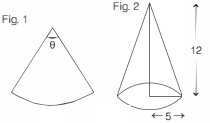
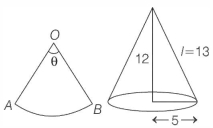
$A$ piece of paper in the shape of a sector of a circle (see $Fig. 1$) is rolled up to form a right-circular cone (see $Fig. 2$). The value of the angle $\theta$ is
A
$\frac{10 \pi}{13}$
B
$\frac{9 \pi}{13}$
C
$\frac{5 \pi}{13}$
D
$\frac{6 \pi}{13}$
Solution
(A) The slant height $l$ of the cone is equal to the radius of the sector,which is $l = \sqrt{12^2 + 5^2} = \sqrt{144 + 25} = \sqrt{169} = 13$.
The circumference of the base of the cone is equal to the arc length of the sector.
Base circumference of the cone $= 2 \pi r = 2 \pi (5) = 10 \pi$.
Arc length of the sector $= l \theta = 13 \theta$.
Equating the two,we get $13 \theta = 10 \pi$.
Therefore,$\theta = \frac{10 \pi}{13}$.
The circumference of the base of the cone is equal to the arc length of the sector.
Base circumference of the cone $= 2 \pi r = 2 \pi (5) = 10 \pi$.
Arc length of the sector $= l \theta = 13 \theta$.
Equating the two,we get $13 \theta = 10 \pi$.
Therefore,$\theta = \frac{10 \pi}{13}$.
0 likes
View Solution173
DifficultMCQ
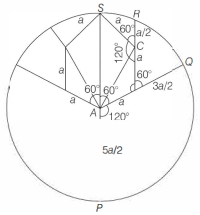
$A$ cow is tied to a corner (vertex) of a regular hexagonal fenced area of side $a \ m$ by a rope of length $\frac{5a}{2} \ m$ in a grass field. (The cow cannot graze inside the fenced area). What is the maximum possible area of the grass field to which the cow has access to graze?
A
$5 \pi a^2$
B
$\frac{5}{2} \pi a^2$
C
$6 \pi a^2$
D
$3 \pi a^2$
Solution
(B) The interior angle of a regular hexagon is $120^\circ$. The exterior angle is $360^\circ - 120^\circ = 240^\circ$. The cow can graze in a sector of radius $R = \frac{5a}{2}$ and angle $240^\circ$.
As the rope wraps around the vertices of the hexagon,the radius decreases by $a$ at each turn.
$1$. Sector $1$: Radius $R_1 = \frac{5a}{2}$,Angle $\theta_1 = 240^\circ = \frac{2\pi}{3}$ radians. Area $A_1 = \frac{1}{2} R_1^2 \theta_1 = \frac{1}{2} (\frac{5a}{2})^2 (\frac{2\pi}{3}) = \frac{25\pi a^2}{12}$.
$2$. Sector $2$: Radius $R_2 = \frac{5a}{2} - a = \frac{3a}{2}$,Angle $\theta_2 = 60^\circ = \frac{\pi}{3}$ radians. Area $A_2 = \frac{1}{2} R_2^2 \theta_2 = \frac{1}{2} (\frac{3a}{2})^2 (\frac{\pi}{3}) = \frac{3\pi a^2}{8}$.
$3$. Sector $3$: Radius $R_3 = \frac{3a}{2} - a = \frac{a}{2}$,Angle $\theta_3 = 60^\circ = \frac{\pi}{3}$ radians. Area $A_3 = \frac{1}{2} R_3^2 \theta_3 = \frac{1}{2} (\frac{a}{2})^2 (\frac{\pi}{3}) = \frac{\pi a^2}{24}$.
Total Area $= A_1 + A_2 + A_3 = \pi a^2 (\frac{25}{12} + \frac{3}{8} + \frac{1}{24}) = \pi a^2 (\frac{50 + 9 + 1}{24}) = \pi a^2 (\frac{60}{24}) = \frac{5}{2} \pi a^2$.
As the rope wraps around the vertices of the hexagon,the radius decreases by $a$ at each turn.
$1$. Sector $1$: Radius $R_1 = \frac{5a}{2}$,Angle $\theta_1 = 240^\circ = \frac{2\pi}{3}$ radians. Area $A_1 = \frac{1}{2} R_1^2 \theta_1 = \frac{1}{2} (\frac{5a}{2})^2 (\frac{2\pi}{3}) = \frac{25\pi a^2}{12}$.
$2$. Sector $2$: Radius $R_2 = \frac{5a}{2} - a = \frac{3a}{2}$,Angle $\theta_2 = 60^\circ = \frac{\pi}{3}$ radians. Area $A_2 = \frac{1}{2} R_2^2 \theta_2 = \frac{1}{2} (\frac{3a}{2})^2 (\frac{\pi}{3}) = \frac{3\pi a^2}{8}$.
$3$. Sector $3$: Radius $R_3 = \frac{3a}{2} - a = \frac{a}{2}$,Angle $\theta_3 = 60^\circ = \frac{\pi}{3}$ radians. Area $A_3 = \frac{1}{2} R_3^2 \theta_3 = \frac{1}{2} (\frac{a}{2})^2 (\frac{\pi}{3}) = \frac{\pi a^2}{24}$.
Total Area $= A_1 + A_2 + A_3 = \pi a^2 (\frac{25}{12} + \frac{3}{8} + \frac{1}{24}) = \pi a^2 (\frac{50 + 9 + 1}{24}) = \pi a^2 (\frac{60}{24}) = \frac{5}{2} \pi a^2$.
0 likes
View Solution174
AdvancedMCQ
$A$ company situated at $(2,0)$ in the $XY$-plane charges $RS. 2$ per $km$ for delivery. $A$ second company at $(0,3)$ charges $RS. 3$ per $km$ for delivery. The region of the plane where it is cheaper to use the first company is
A
the inside of the circle $(x+5.4)^2+y^2=18.72$
B
the outside of the circle $(x+1.6)^2+(y-5.4)^2=18.72$
C
the inside of the circle $(x-1.6)^2+(y+5.4)^2=18.72$
D
the outside of the circle $(x-5.4)^2+(y+1.6)^2=18.72$
Solution
(B) Let $P(x, y)$ be any point in the $XY$-plane.
According to the problem,the cost of the first company is $2 \times PA$ and the second is $3 \times PB$.
We want the region where it is cheaper to use the first company,so $2 PA < 3 PB$.
Squaring both sides,we get $4 PA^2 < 9 PB^2$.
Substituting the coordinates $A(2, 0)$ and $B(0, 3)$,we have $4[(x-2)^2 + y^2] < 9[x^2 + (y-3)^2]$.
Expanding this,$4(x^2 - 4x + 4 + y^2) < 9(x^2 + y^2 - 6y + 9)$.
$4x^2 - 16x + 16 + 4y^2 < 9x^2 + 9y^2 - 54y + 81$.
Rearranging terms,$5x^2 + 5y^2 + 16x - 54y + 65 > 0$.
Dividing by $5$,$x^2 + y^2 + 3.2x - 10.8y + 13 > 0$.
Completing the square,$(x^2 + 3.2x + 1.6^2) + (y^2 - 10.8y + 5.4^2) > -13 + 2.56 + 29.16$.
$(x + 1.6)^2 + (y - 5.4)^2 > 18.72$.
This represents the region outside the circle $(x + 1.6)^2 + (y - 5.4)^2 = 18.72$.
According to the problem,the cost of the first company is $2 \times PA$ and the second is $3 \times PB$.
We want the region where it is cheaper to use the first company,so $2 PA < 3 PB$.
Squaring both sides,we get $4 PA^2 < 9 PB^2$.
Substituting the coordinates $A(2, 0)$ and $B(0, 3)$,we have $4[(x-2)^2 + y^2] < 9[x^2 + (y-3)^2]$.
Expanding this,$4(x^2 - 4x + 4 + y^2) < 9(x^2 + y^2 - 6y + 9)$.
$4x^2 - 16x + 16 + 4y^2 < 9x^2 + 9y^2 - 54y + 81$.
Rearranging terms,$5x^2 + 5y^2 + 16x - 54y + 65 > 0$.
Dividing by $5$,$x^2 + y^2 + 3.2x - 10.8y + 13 > 0$.
Completing the square,$(x^2 + 3.2x + 1.6^2) + (y^2 - 10.8y + 5.4^2) > -13 + 2.56 + 29.16$.
$(x + 1.6)^2 + (y - 5.4)^2 > 18.72$.
This represents the region outside the circle $(x + 1.6)^2 + (y - 5.4)^2 = 18.72$.
0 likes
View Solution175
DifficultMCQ
Let $AB$ be the diameter of a semicircle $S$. The locus of the centres of circles which are tangent to $AB$ and to $S$ is an arc of
A
a circle
B
an ellipse
C
a parabola
D
a cycloid
Solution
(C) Let $R$ be the radius of the semicircle $S$ and $r$ be the radius of the small circle with center $C$.
Let $O$ be the center of the semicircle $S$.
The distance from $C$ to the diameter $AB$ is $r$.
The distance from $C$ to the center $O$ is $R - r$ (since the small circle is tangent to the semicircle $S$).
Let $T$ be the projection of $C$ onto the diameter $AB$. Then $CT = r$.
Thus,the distance of $C$ from the point $O$ is equal to the distance of $C$ from the line $AB$ plus some constant,or more precisely,$CO + CT = R$.
Since the distance from $C$ to the point $O$ is equal to the distance from $C$ to a line parallel to $AB$ at a distance $r$ below it,this definition fits the geometric property of a parabola where the distance to a fixed point (focus) equals the distance to a fixed line (directrix).
Therefore,the locus of $C$ is an arc of a parabola.
Let $O$ be the center of the semicircle $S$.
The distance from $C$ to the diameter $AB$ is $r$.
The distance from $C$ to the center $O$ is $R - r$ (since the small circle is tangent to the semicircle $S$).
Let $T$ be the projection of $C$ onto the diameter $AB$. Then $CT = r$.
Thus,the distance of $C$ from the point $O$ is equal to the distance of $C$ from the line $AB$ plus some constant,or more precisely,$CO + CT = R$.
Since the distance from $C$ to the point $O$ is equal to the distance from $C$ to a line parallel to $AB$ at a distance $r$ below it,this definition fits the geometric property of a parabola where the distance to a fixed point (focus) equals the distance to a fixed line (directrix).
Therefore,the locus of $C$ is an arc of a parabola.
0 likes
View Solution176
DifficultMCQ
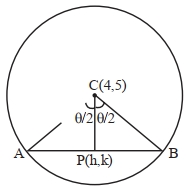
The locus of the midpoints of the chords of the circle $C_1: (x-4)^2 + (y-5)^2 = 4$ which subtend an angle $\theta_i$ at the centre of the circle $C_1$,is a circle of radius $r_i$. If $\theta_1 = \frac{\pi}{3}$,$\theta_3 = \frac{2\pi}{3}$ and $r_1^2 = r_2^2 + r_3^2$,then $\theta_2$ is equal to
A
$\frac{\pi}{4}$
B
$\frac{3\pi}{4}$
C
$\frac{\pi}{6}$
D
$\frac{\pi}{2}$
Solution
(D) Let $C(4, 5)$ be the centre of the circle with radius $R = 2$. Let $P(h, k)$ be the midpoint of a chord $AB$ that subtends an angle $\theta$ at the centre $C$.
In the right-angled triangle $\triangle CPB$,we have $CP = R \cos(\frac{\theta}{2}) = 2 \cos(\frac{\theta}{2})$.
The distance $CP$ is the distance from the centre $(4, 5)$ to the point $P(h, k)$,so $CP^2 = (h-4)^2 + (k-5)^2$.
Thus,$(h-4)^2 + (k-5)^2 = 4 \cos^2(\frac{\theta}{2})$.
This represents a circle with radius $r = 2 \cos(\frac{\theta}{2})$.
Given $r_i = 2 \cos(\frac{\theta_i}{2})$,we have $r_i^2 = 4 \cos^2(\frac{\theta_i}{2})$.
Given $\theta_1 = \frac{\pi}{3}$,$r_1^2 = 4 \cos^2(\frac{\pi}{6}) = 4 \times (\frac{\sqrt{3}}{2})^2 = 3$.
Given $\theta_3 = \frac{2\pi}{3}$,$r_3^2 = 4 \cos^2(\frac{\pi}{3}) = 4 \times (\frac{1}{2})^2 = 1$.
Since $r_1^2 = r_2^2 + r_3^2$,we have $3 = r_2^2 + 1$,which implies $r_2^2 = 2$.
Substituting $r_2^2 = 4 \cos^2(\frac{\theta_2}{2})$,we get $4 \cos^2(\frac{\theta_2}{2}) = 2$,so $\cos^2(\frac{\theta_2}{2}) = \frac{1}{2}$.
This means $\cos(\frac{\theta_2}{2}) = \frac{1}{\sqrt{2}}$,so $\frac{\theta_2}{2} = \frac{\pi}{4}$,which gives $\theta_2 = \frac{\pi}{2}$.
In the right-angled triangle $\triangle CPB$,we have $CP = R \cos(\frac{\theta}{2}) = 2 \cos(\frac{\theta}{2})$.
The distance $CP$ is the distance from the centre $(4, 5)$ to the point $P(h, k)$,so $CP^2 = (h-4)^2 + (k-5)^2$.
Thus,$(h-4)^2 + (k-5)^2 = 4 \cos^2(\frac{\theta}{2})$.
This represents a circle with radius $r = 2 \cos(\frac{\theta}{2})$.
Given $r_i = 2 \cos(\frac{\theta_i}{2})$,we have $r_i^2 = 4 \cos^2(\frac{\theta_i}{2})$.
Given $\theta_1 = \frac{\pi}{3}$,$r_1^2 = 4 \cos^2(\frac{\pi}{6}) = 4 \times (\frac{\sqrt{3}}{2})^2 = 3$.
Given $\theta_3 = \frac{2\pi}{3}$,$r_3^2 = 4 \cos^2(\frac{\pi}{3}) = 4 \times (\frac{1}{2})^2 = 1$.
Since $r_1^2 = r_2^2 + r_3^2$,we have $3 = r_2^2 + 1$,which implies $r_2^2 = 2$.
Substituting $r_2^2 = 4 \cos^2(\frac{\theta_2}{2})$,we get $4 \cos^2(\frac{\theta_2}{2}) = 2$,so $\cos^2(\frac{\theta_2}{2}) = \frac{1}{2}$.
This means $\cos(\frac{\theta_2}{2}) = \frac{1}{\sqrt{2}}$,so $\frac{\theta_2}{2} = \frac{\pi}{4}$,which gives $\theta_2 = \frac{\pi}{2}$.
0 likes
View Solution177
AdvancedMCQ
Let the point $(p, p+1)$ lie inside the region $E = \{(x, y) : 3-x \leq y \leq \sqrt{9-x^2}, 0 \leq x \leq 3\}$. If the set of all values of $p$ is the interval $(a, b)$,then $b^2+b-a^2$ is equal to $.................$.
A
$2$
B
$1$
C
$4$
D
$3$
Solution
(D) The region $E$ is bounded by $y \geq 3-x$ and $y \leq \sqrt{9-x^2}$ for $0 \leq x \leq 3$.
The point $(p, p+1)$ lies on the line $y = x+1$.
To find the range of $p$,we find the intersection of $y = x+1$ with the boundaries of $E$.
$1$. Intersection with $y = 3-x$:
$x+1 = 3-x \implies 2x = 2 \implies x = 1$.
Thus,$p = 1$ (this is $a$).
$2$. Intersection with $y = \sqrt{9-x^2}$:
$x+1 = \sqrt{9-x^2} \implies (x+1)^2 = 9-x^2 \implies x^2+2x+1 = 9-x^2 \implies 2x^2+2x-8 = 0 \implies x^2+x-4 = 0$.
Using the quadratic formula,$x = \frac{-1 \pm \sqrt{1+16}}{2} = \frac{-1 \pm \sqrt{17}}{2}$.
Since $x \geq 0$,we take $x = \frac{-1+\sqrt{17}}{2}$.
Thus,$p = \frac{-1+\sqrt{17}}{2}$ (this is $b$).
So,$p \in \left(1, \frac{-1+\sqrt{17}}{2}\right)$,where $a = 1$ and $b = \frac{-1+\sqrt{17}}{2}$.
We need to calculate $b^2+b-a^2$:
Since $b^2+b-4 = 0$,we have $b^2+b = 4$.
Therefore,$b^2+b-a^2 = 4 - (1)^2 = 4-1 = 3$.
The point $(p, p+1)$ lies on the line $y = x+1$.
To find the range of $p$,we find the intersection of $y = x+1$ with the boundaries of $E$.
$1$. Intersection with $y = 3-x$:
$x+1 = 3-x \implies 2x = 2 \implies x = 1$.
Thus,$p = 1$ (this is $a$).
$2$. Intersection with $y = \sqrt{9-x^2}$:
$x+1 = \sqrt{9-x^2} \implies (x+1)^2 = 9-x^2 \implies x^2+2x+1 = 9-x^2 \implies 2x^2+2x-8 = 0 \implies x^2+x-4 = 0$.
Using the quadratic formula,$x = \frac{-1 \pm \sqrt{1+16}}{2} = \frac{-1 \pm \sqrt{17}}{2}$.
Since $x \geq 0$,we take $x = \frac{-1+\sqrt{17}}{2}$.
Thus,$p = \frac{-1+\sqrt{17}}{2}$ (this is $b$).
So,$p \in \left(1, \frac{-1+\sqrt{17}}{2}\right)$,where $a = 1$ and $b = \frac{-1+\sqrt{17}}{2}$.
We need to calculate $b^2+b-a^2$:
Since $b^2+b-4 = 0$,we have $b^2+b = 4$.
Therefore,$b^2+b-a^2 = 4 - (1)^2 = 4-1 = 3$.
0 likes
View Solution178
AdvancedMCQ
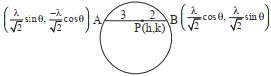
$A$ line segment $AB$ of length $\lambda$ moves such that the points $A$ and $B$ remain on the periphery of a circle of radius $\lambda$. Then the locus of the point,that divides the line segment $AB$ in the ratio $2:3$,is a circle of radius
A
$\frac{3}{5} \lambda$
B
$\frac{\sqrt{19}}{7} \lambda$
C
$\frac{2}{3} \lambda$
D
$\frac{\sqrt{19}}{5} \lambda$
Solution
(D) Let the coordinates of $A$ be $(x_1, y_1)$ and $B$ be $(x_2, y_2)$. Since $A$ and $B$ lie on a circle of radius $\lambda$ centered at the origin,$x_1^2 + y_1^2 = \lambda^2$ and $x_2^2 + y_2^2 = \lambda^2$.
Given the length $AB = \lambda$,the distance formula gives $(x_2 - x_1)^2 + (y_2 - y_1)^2 = \lambda^2$,which simplifies to $x_1^2 + y_1^2 + x_2^2 + y_2^2 - 2(x_1x_2 + y_1y_2) = \lambda^2$.
Substituting the circle equations,we get $2\lambda^2 - 2(x_1x_2 + y_1y_2) = \lambda^2$,so $x_1x_2 + y_1y_2 = \frac{\lambda^2}{2}$.
Let $P(h, k)$ be the point dividing $AB$ in the ratio $2:3$. By the section formula,$h = \frac{2x_2 + 3x_1}{5}$ and $k = \frac{2y_2 + 3y_1}{5}$.
Then $25(h^2 + k^2) = (2x_2 + 3x_1)^2 + (2y_2 + 3y_1)^2 = 4(x_2^2 + y_2^2) + 9(x_1^2 + y_1^2) + 12(x_1x_2 + y_1y_2)$.
Substituting the known values: $25(h^2 + k^2) = 4\lambda^2 + 9\lambda^2 + 12(\frac{\lambda^2}{2}) = 13\lambda^2 + 6\lambda^2 = 19\lambda^2$.
Thus,$h^2 + k^2 = \frac{19}{25}\lambda^2$,which represents a circle of radius $\frac{\sqrt{19}}{5}\lambda$.
Given the length $AB = \lambda$,the distance formula gives $(x_2 - x_1)^2 + (y_2 - y_1)^2 = \lambda^2$,which simplifies to $x_1^2 + y_1^2 + x_2^2 + y_2^2 - 2(x_1x_2 + y_1y_2) = \lambda^2$.
Substituting the circle equations,we get $2\lambda^2 - 2(x_1x_2 + y_1y_2) = \lambda^2$,so $x_1x_2 + y_1y_2 = \frac{\lambda^2}{2}$.
Let $P(h, k)$ be the point dividing $AB$ in the ratio $2:3$. By the section formula,$h = \frac{2x_2 + 3x_1}{5}$ and $k = \frac{2y_2 + 3y_1}{5}$.
Then $25(h^2 + k^2) = (2x_2 + 3x_1)^2 + (2y_2 + 3y_1)^2 = 4(x_2^2 + y_2^2) + 9(x_1^2 + y_1^2) + 12(x_1x_2 + y_1y_2)$.
Substituting the known values: $25(h^2 + k^2) = 4\lambda^2 + 9\lambda^2 + 12(\frac{\lambda^2}{2}) = 13\lambda^2 + 6\lambda^2 = 19\lambda^2$.
Thus,$h^2 + k^2 = \frac{19}{25}\lambda^2$,which represents a circle of radius $\frac{\sqrt{19}}{5}\lambda$.
0 likes
View Solution179
DifficultMCQ
Let $A$ be the point $(1, 2)$ and $B$ be any point on the curve $x^2 + y^2 = 16$. If the centre of the locus of the point $P$,which divides the line segment $AB$ in the ratio $3:2$ is the point $C(\alpha, \beta)$,then the length of the line segment $AC$ is
A
$\frac{6 \sqrt{5}}{5}$
B
$\frac{4 \sqrt{5}}{5}$
C
$\frac{2 \sqrt{5}}{5}$
D
$\frac{3 \sqrt{5}}{5}$
Solution
(D) Let $B = (4 \cos \theta, 4 \sin \theta)$ be any point on the circle $x^2 + y^2 = 16$.
Point $P(h, k)$ divides $AB$ in the ratio $3:2$. Using the section formula:
$h = \frac{3(4 \cos \theta) + 2(1)}{3 + 2} = \frac{12 \cos \theta + 2}{5} \Rightarrow 12 \cos \theta = 5h - 2$
$k = \frac{3(4 \sin \theta) + 2(2)}{3 + 2} = \frac{12 \sin \theta + 4}{5} \Rightarrow 12 \sin \theta = 5k - 4$
Squaring and adding the two equations:
$(12 \cos \theta)^2 + (12 \sin \theta)^2 = (5h - 2)^2 + (5k - 4)^2$
$144 = 25(h - \frac{2}{5})^2 + 25(k - \frac{4}{5})^2$
$(h - \frac{2}{5})^2 + (k - \frac{4}{5})^2 = \frac{144}{25} = (\frac{12}{5})^2$
This represents a circle with centre $C(\alpha, \beta) = (\frac{2}{5}, \frac{4}{5})$.
The length of $AC$ is the distance between $A(1, 2)$ and $C(\frac{2}{5}, \frac{4}{5})$:
$AC = \sqrt{(1 - \frac{2}{5})^2 + (2 - \frac{4}{5})^2} = \sqrt{(\frac{3}{5})^2 + (\frac{6}{5})^2} = \sqrt{\frac{9}{25} + \frac{36}{25}} = \sqrt{\frac{45}{25}} = \frac{3 \sqrt{5}}{5}$
Point $P(h, k)$ divides $AB$ in the ratio $3:2$. Using the section formula:
$h = \frac{3(4 \cos \theta) + 2(1)}{3 + 2} = \frac{12 \cos \theta + 2}{5} \Rightarrow 12 \cos \theta = 5h - 2$
$k = \frac{3(4 \sin \theta) + 2(2)}{3 + 2} = \frac{12 \sin \theta + 4}{5} \Rightarrow 12 \sin \theta = 5k - 4$
Squaring and adding the two equations:
$(12 \cos \theta)^2 + (12 \sin \theta)^2 = (5h - 2)^2 + (5k - 4)^2$
$144 = 25(h - \frac{2}{5})^2 + 25(k - \frac{4}{5})^2$
$(h - \frac{2}{5})^2 + (k - \frac{4}{5})^2 = \frac{144}{25} = (\frac{12}{5})^2$
This represents a circle with centre $C(\alpha, \beta) = (\frac{2}{5}, \frac{4}{5})$.
The length of $AC$ is the distance between $A(1, 2)$ and $C(\frac{2}{5}, \frac{4}{5})$:
$AC = \sqrt{(1 - \frac{2}{5})^2 + (2 - \frac{4}{5})^2} = \sqrt{(\frac{3}{5})^2 + (\frac{6}{5})^2} = \sqrt{\frac{9}{25} + \frac{36}{25}} = \sqrt{\frac{45}{25}} = \frac{3 \sqrt{5}}{5}$

0 likes
View Solution180
DifficultMCQ
Let a variable line passing through the centre of the circle $x^2+y^2-16x-4y=0$ meet the positive coordinate axes at points $A$ and $B$. Then the minimum value of $OA+OB$,where $O$ is the origin,is equal to
A
$12$
B
$18$
C
$20$
D
$24$
Solution
(B) The equation of the circle is $x^2+y^2-16x-4y=0$. The centre of the circle is $(8, 2)$.
Let the variable line passing through $(8, 2)$ have slope $m$. The equation of the line is $(y-2) = m(x-8)$.
Since the line meets the positive coordinate axes at $A$ and $B$,the line must have a negative slope,so let $m = -k$ where $k > 0$.
The $x$-intercept $OA$ is found by setting $y=0$: $-2 = m(x-8) \Rightarrow x-8 = -2/m \Rightarrow OA = 8 - 2/m$.
Since $m < 0$,let $m = -k$ $(k > 0)$,then $OA = 8 + 2/k$.
The $y$-intercept $OB$ is found by setting $x=0$: $(y-2) = m(-8) \Rightarrow y = 2 - 8m = 2 + 8k$.
We want to minimize $f(k) = OA + OB = 8 + 2/k + 2 + 8k = 10 + 2/k + 8k$.
Using the $AM$-$GM$ inequality: $\frac{2/k + 8k}{2} \geq \sqrt{(2/k)(8k)} = \sqrt{16} = 4$.
So,$2/k + 8k \geq 8$.
The minimum value of $OA+OB = 10 + 8 = 18$.
Let the variable line passing through $(8, 2)$ have slope $m$. The equation of the line is $(y-2) = m(x-8)$.
Since the line meets the positive coordinate axes at $A$ and $B$,the line must have a negative slope,so let $m = -k$ where $k > 0$.
The $x$-intercept $OA$ is found by setting $y=0$: $-2 = m(x-8) \Rightarrow x-8 = -2/m \Rightarrow OA = 8 - 2/m$.
Since $m < 0$,let $m = -k$ $(k > 0)$,then $OA = 8 + 2/k$.
The $y$-intercept $OB$ is found by setting $x=0$: $(y-2) = m(-8) \Rightarrow y = 2 - 8m = 2 + 8k$.
We want to minimize $f(k) = OA + OB = 8 + 2/k + 2 + 8k = 10 + 2/k + 8k$.
Using the $AM$-$GM$ inequality: $\frac{2/k + 8k}{2} \geq \sqrt{(2/k)(8k)} = \sqrt{16} = 4$.
So,$2/k + 8k \geq 8$.
The minimum value of $OA+OB = 10 + 8 = 18$.
0 likes
View Solution181
DifficultMCQ
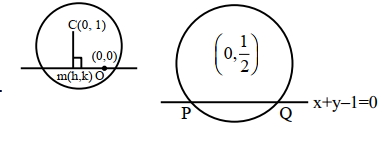
Let the locus of the midpoints of the chords of the circle $x^2+(y-1)^2=1$ drawn from the origin intersect the line $x+y=1$ at $P$ and $Q$. Then,the length of $PQ$ is:
A
$\frac{1}{\sqrt{2}}$
B
$\sqrt{2}$
C
$\frac{1}{2}$
D
$1$
Solution
(A) Let $M(h, k)$ be the midpoint of a chord drawn from the origin $O(0, 0)$.
The center of the circle $x^2+(y-1)^2=1$ is $C(0, 1)$.
Since $CM \perp OM$,the product of their slopes is $-1$:
$\left(\frac{k-1}{h-0}\right) \cdot \left(\frac{k-0}{h-0}\right) = -1$
$\frac{k(k-1)}{h^2} = -1$
$k^2-k = -h^2$
$h^2+k^2-k = 0$
Replacing $(h, k)$ with $(x, y)$,the locus is $x^2+y^2-y=0$.
This is a circle with center $(0, 1/2)$ and radius $r = 1/2$.
The line is $x+y-1=0$.
The perpendicular distance $p$ from the center $(0, 1/2)$ to the line $x+y-1=0$ is:
$p = \frac{|0 + 1/2 - 1|}{\sqrt{1^2+1^2}} = \frac{1/2}{\sqrt{2}} = \frac{1}{2\sqrt{2}}$.
The length of the chord $PQ$ is $2\sqrt{r^2-p^2}$:
$PQ = 2\sqrt{(1/2)^2 - (1/(2\sqrt{2}))^2} = 2\sqrt{1/4 - 1/8} = 2\sqrt{1/8} = 2 \cdot \frac{1}{2\sqrt{2}} = \frac{1}{\sqrt{2}}$.
The center of the circle $x^2+(y-1)^2=1$ is $C(0, 1)$.
Since $CM \perp OM$,the product of their slopes is $-1$:
$\left(\frac{k-1}{h-0}\right) \cdot \left(\frac{k-0}{h-0}\right) = -1$
$\frac{k(k-1)}{h^2} = -1$
$k^2-k = -h^2$
$h^2+k^2-k = 0$
Replacing $(h, k)$ with $(x, y)$,the locus is $x^2+y^2-y=0$.
This is a circle with center $(0, 1/2)$ and radius $r = 1/2$.
The line is $x+y-1=0$.
The perpendicular distance $p$ from the center $(0, 1/2)$ to the line $x+y-1=0$ is:
$p = \frac{|0 + 1/2 - 1|}{\sqrt{1^2+1^2}} = \frac{1/2}{\sqrt{2}} = \frac{1}{2\sqrt{2}}$.
The length of the chord $PQ$ is $2\sqrt{r^2-p^2}$:
$PQ = 2\sqrt{(1/2)^2 - (1/(2\sqrt{2}))^2} = 2\sqrt{1/4 - 1/8} = 2\sqrt{1/8} = 2 \cdot \frac{1}{2\sqrt{2}} = \frac{1}{\sqrt{2}}$.
0 likes
View Solution182
DifficultMCQ
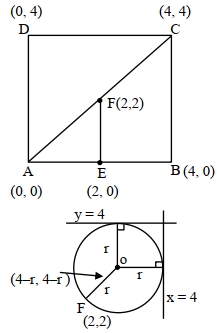
Let $ABCD$ and $AEFG$ be squares of side $4$ and $2$ units,respectively. The point $E$ is on the line segment $AB$ and the point $F$ is on the diagonal $AC$. Then the radius $r$ of the circle passing through the point $F$ and touching the line segments $BC$ and $CD$ satisfies:
A
$r=1$
B
$r^2-8r+8=0$
C
$2r^2-4r+1=0$
D
$2r^2-8r+7=0$
Solution
(B) Let the square $ABCD$ have vertices $A(0,0)$,$B(4,0)$,$C(4,4)$,and $D(0,4)$.
The diagonal $AC$ lies on the line $y=x$.
Since $AEFG$ is a square of side $2$ with $E$ on $AB$ and $F$ on $AC$,the coordinates are $A(0,0)$,$E(2,0)$,$G(0,2)$,and $F(2,2)$.
The circle touches the lines $BC$ $(x=4)$ and $CD$ $(y=4)$.
Let the center of the circle be $O(h,k)$. Since it touches $x=4$ and $y=4$ with radius $r$,the center is $O(4-r, 4-r)$.
The circle passes through $F(2,2)$,so the distance $OF=r$.
Using the distance formula: $(4-r-2)^2 + (4-r-2)^2 = r^2$.
$(2-r)^2 + (2-r)^2 = r^2$.
$2(4 - 4r + r^2) = r^2$.
$8 - 8r + 2r^2 = r^2$.
$r^2 - 8r + 8 = 0$.
The diagonal $AC$ lies on the line $y=x$.
Since $AEFG$ is a square of side $2$ with $E$ on $AB$ and $F$ on $AC$,the coordinates are $A(0,0)$,$E(2,0)$,$G(0,2)$,and $F(2,2)$.
The circle touches the lines $BC$ $(x=4)$ and $CD$ $(y=4)$.
Let the center of the circle be $O(h,k)$. Since it touches $x=4$ and $y=4$ with radius $r$,the center is $O(4-r, 4-r)$.
The circle passes through $F(2,2)$,so the distance $OF=r$.
Using the distance formula: $(4-r-2)^2 + (4-r-2)^2 = r^2$.
$(2-r)^2 + (2-r)^2 = r^2$.
$2(4 - 4r + r^2) = r^2$.
$8 - 8r + 2r^2 = r^2$.
$r^2 - 8r + 8 = 0$.
0 likes
View Solution183
DifficultMCQ
If the locus of the point,whose distances from the point $(2,1)$ and $(1,3)$ are in the ratio $5:4$,is $ax^2+by^2+cxy+dx+ey+170=0$,then the value of $a^2+2b+3c+4d+e$ is equal to:
A
$5$
B
$-27$
C
$37$
D
$437$
Solution
(C) Let the point be $P(x, y)$.
According to the problem,the ratio of distances from $P(x, y)$ to $(2, 1)$ and $(1, 3)$ is $5:4$.
So,$\frac{\sqrt{(x-2)^2 + (y-1)^2}}{\sqrt{(x-1)^2 + (y-3)^2}} = \frac{5}{4}$.
Squaring both sides,we get $\frac{(x-2)^2 + (y-1)^2}{(x-1)^2 + (y-3)^2} = \frac{25}{16}$.
$16(x^2 - 4x + 4 + y^2 - 2y + 1) = 25(x^2 - 2x + 1 + y^2 - 6y + 9)$.
$16x^2 - 64x + 80 + 16y^2 - 32y + 16 = 25x^2 - 50x + 25 + 25y^2 - 150y + 225$.
Rearranging the terms,we get $9x^2 + 9y^2 + 14x - 118y + 170 = 0$.
Comparing this with $ax^2 + by^2 + cxy + dx + ey + 170 = 0$,we get $a=9, b=9, c=0, d=14, e=-118$.
Now,calculate $a^2 + 2b + 3c + 4d + e = (9)^2 + 2(9) + 3(0) + 4(14) - 118$.
$= 81 + 18 + 0 + 56 - 118 = 155 - 118 = 37$.
According to the problem,the ratio of distances from $P(x, y)$ to $(2, 1)$ and $(1, 3)$ is $5:4$.
So,$\frac{\sqrt{(x-2)^2 + (y-1)^2}}{\sqrt{(x-1)^2 + (y-3)^2}} = \frac{5}{4}$.
Squaring both sides,we get $\frac{(x-2)^2 + (y-1)^2}{(x-1)^2 + (y-3)^2} = \frac{25}{16}$.
$16(x^2 - 4x + 4 + y^2 - 2y + 1) = 25(x^2 - 2x + 1 + y^2 - 6y + 9)$.
$16x^2 - 64x + 80 + 16y^2 - 32y + 16 = 25x^2 - 50x + 25 + 25y^2 - 150y + 225$.
Rearranging the terms,we get $9x^2 + 9y^2 + 14x - 118y + 170 = 0$.
Comparing this with $ax^2 + by^2 + cxy + dx + ey + 170 = 0$,we get $a=9, b=9, c=0, d=14, e=-118$.
Now,calculate $a^2 + 2b + 3c + 4d + e = (9)^2 + 2(9) + 3(0) + 4(14) - 118$.
$= 81 + 18 + 0 + 56 - 118 = 155 - 118 = 37$.
0 likes
View Solution184
DifficultMCQ
Tangents are drawn from the point $(17,7)$ to the circle $x^2+y^2=169$.
$STATEMENT-1$: The tangents are mutually perpendicular.
$STATEMENT-2$: The locus of the points from which mutually perpendicular tangents can be drawn to the given circle is $x^2+y^2=338$.
$STATEMENT-1$: The tangents are mutually perpendicular.
$STATEMENT-2$: The locus of the points from which mutually perpendicular tangents can be drawn to the given circle is $x^2+y^2=338$.
A
$Statement-1$ is True,$Statement-2$ is True; $Statement-2$ is a correct explanation for $Statement-1$.
B
$Statement-1$ is True,$Statement-2$ is True; $Statement-2$ is $NOT$ a correct explanation for $Statement-1$.
C
$Statement-1$ is True,$Statement-2$ is False.
D
$Statement-1$ is False,$Statement-2$ is True.
Solution
(A) The equation of the circle is $x^2+y^2=169$,which is of the form $x^2+y^2=r^2$ with $r=13$.
The director circle of a circle $x^2+y^2=r^2$ is the locus of points from which mutually perpendicular tangents can be drawn to the circle,given by $x^2+y^2=2r^2$.
For the given circle,$r^2=169$,so the director circle is $x^2+y^2=2(169) = 338$.
Thus,$Statement-2$ is True.
Now,check if the point $(17,7)$ lies on the director circle $x^2+y^2=338$:
$17^2 + 7^2 = 289 + 49 = 338$.
Since the point $(17,7)$ satisfies the equation of the director circle,the tangents drawn from this point to the circle are mutually perpendicular.
Thus,$Statement-1$ is True and $Statement-2$ is the correct explanation for $Statement-1$.
The director circle of a circle $x^2+y^2=r^2$ is the locus of points from which mutually perpendicular tangents can be drawn to the circle,given by $x^2+y^2=2r^2$.
For the given circle,$r^2=169$,so the director circle is $x^2+y^2=2(169) = 338$.
Thus,$Statement-2$ is True.
Now,check if the point $(17,7)$ lies on the director circle $x^2+y^2=338$:
$17^2 + 7^2 = 289 + 49 = 338$.
Since the point $(17,7)$ satisfies the equation of the director circle,the tangents drawn from this point to the circle are mutually perpendicular.
Thus,$Statement-1$ is True and $Statement-2$ is the correct explanation for $Statement-1$.
0 likes
View Solution185
AdvancedMCQ
Let $RS$ be the diameter of the circle $x^2+y^2=1$,where $S$ is the point $(1,0)$. Let $P$ be a variable point (other than $R$ and $S$) on the circle and tangents to the circle at $S$ and $P$ meet at the point $Q$. The normal to the circle at $P$ intersects a line drawn through $Q$ parallel to $RS$ at point $E$. Then the locus of $E$ passes through the point$(s)$:
$(A)$ $\left(\frac{1}{3}, \frac{1}{\sqrt{3}}\right)$ $(B)$ $\left(\frac{1}{4}, \frac{1}{2}\right)$ $(C)$ $\left(\frac{1}{3},-\frac{1}{\sqrt{3}}\right)$ $(D)$ $\left(\frac{1}{4},-\frac{1}{2}\right)$
$(A)$ $\left(\frac{1}{3}, \frac{1}{\sqrt{3}}\right)$ $(B)$ $\left(\frac{1}{4}, \frac{1}{2}\right)$ $(C)$ $\left(\frac{1}{3},-\frac{1}{\sqrt{3}}\right)$ $(D)$ $\left(\frac{1}{4},-\frac{1}{2}\right)$
A
$A, D$
B
$A, B$
C
$A, C$
D
$A, C, B$
Solution
(C) Given,$RS$ is the diameter of $x^2+y^2=1$. Let $P = (\cos \theta, \sin \theta)$.
The tangent at $P$ is $x \cos \theta + y \sin \theta = 1$. The tangent at $S(1,0)$ is $x = 1$.
Solving these,$Q = \left(1, \frac{1-\cos \theta}{\sin \theta}\right) = \left(1, \tan \frac{\theta}{2}\right)$.
The line through $Q$ parallel to $RS$ (the $x$-axis) is $y = \tan \frac{\theta}{2}$.
The normal at $P$ is $y = x \tan \theta$.
Let $E = (h, k)$. Then $k = \tan \frac{\theta}{2}$ and $k = h \tan \theta$.
Using $\tan \theta = \frac{2 \tan(\theta/2)}{1 - \tan^2(\theta/2)}$,we get $k = h \frac{2k}{1-k^2}$.
Thus,$1-k^2 = 2h$,or the locus is $2x = 1-y^2$.
Checking the points:
For $x = 1/3$,$1-y^2 = 2/3$ $\Rightarrow y^2 = 1/3$ $\Rightarrow y = \pm 1/\sqrt{3}$.
Thus,points $(1/3, 1/\sqrt{3})$ and $(1/3, -1/\sqrt{3})$ lie on the locus.
For $x = 1/4$,$1-y^2 = 2/4 = 1/2$ $\Rightarrow y^2 = 1/2$ $\Rightarrow y = \pm 1/\sqrt{2} \neq \pm 1/2$.
Therefore,the locus passes through points $A$ and $C$.
The tangent at $P$ is $x \cos \theta + y \sin \theta = 1$. The tangent at $S(1,0)$ is $x = 1$.
Solving these,$Q = \left(1, \frac{1-\cos \theta}{\sin \theta}\right) = \left(1, \tan \frac{\theta}{2}\right)$.
The line through $Q$ parallel to $RS$ (the $x$-axis) is $y = \tan \frac{\theta}{2}$.
The normal at $P$ is $y = x \tan \theta$.
Let $E = (h, k)$. Then $k = \tan \frac{\theta}{2}$ and $k = h \tan \theta$.
Using $\tan \theta = \frac{2 \tan(\theta/2)}{1 - \tan^2(\theta/2)}$,we get $k = h \frac{2k}{1-k^2}$.
Thus,$1-k^2 = 2h$,or the locus is $2x = 1-y^2$.
Checking the points:
For $x = 1/3$,$1-y^2 = 2/3$ $\Rightarrow y^2 = 1/3$ $\Rightarrow y = \pm 1/\sqrt{3}$.
Thus,points $(1/3, 1/\sqrt{3})$ and $(1/3, -1/\sqrt{3})$ lie on the locus.
For $x = 1/4$,$1-y^2 = 2/4 = 1/2$ $\Rightarrow y^2 = 1/2$ $\Rightarrow y = \pm 1/\sqrt{2} \neq \pm 1/2$.
Therefore,the locus passes through points $A$ and $C$.
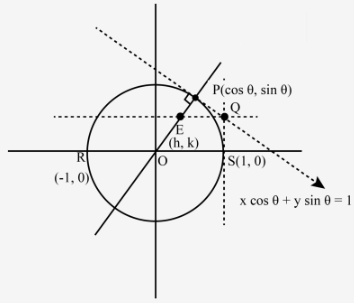
0 likes
View Solution186
AdvancedMCQ
Let $T'$ be the line passing through the points $P(-2, 7)$ and $Q(2, -5)$. Let $F_1$ be the set of all pairs of circles $(S_1, S_2)$ such that $T'$ is tangent to $S_1$ at $P$ and tangent to $S_2$ at $Q$,and also such that $S_1$ and $S_2$ touch each other at a point,say,$M$. Let $E_1$ be the set representing the locus of $M$ as the pair $(S_1, S_2)$ varies in $F_1$. Let the set of all straight line segments joining a pair of distinct points of $E_1$ and passing through the point $R(1, 1)$ be $F_2$. Let $E_2$ be the set of the mid-points of the line segments in the set $F_2$. Then,which of the following statement$(s)$ is (are) $TRUE$?
A
The point $(-2, 7)$ lies in $E_1$
B
The point $(\frac{4}{5}, \frac{7}{5})$ does $NOT$ lie in $E_2$
C
The point $(\frac{1}{2}, 1)$ lies in $E_2$
D
The point $(0, \frac{3}{2})$ does $NOT$ lie in $E_1$
Solution
(D) Let $M \equiv (h, k)$. Since $MP$ and $MQ$ are tangents from $M$ to the circles $S_1$ and $S_2$ respectively,and $M$ is the point of contact,$MP = MQ$. Also,the angle $\angle PMQ = 90^{\circ}$.
Thus,the slope of $MP \times$ slope of $MQ = -1$.
$\left(\frac{k-7}{h+2}\right) \times \left(\frac{k+5}{h-2}\right) = -1$
$(k-7)(k+5) = -(h+2)(h-2)$
$k^2 - 2k - 35 = -(h^2 - 4) = -h^2 + 4$
$h^2 + k^2 - 2k - 39 = 0$. Thus,$E_1: x^2 + y^2 - 2y - 39 = 0$.
For $E_2$,let a chord of $E_1$ have midpoint $(h, k)$. The equation of the chord is $T = S_1$,i.e.,$xh + yk - (y + k) - 39 = h^2 + k^2 - 2k - 39$.
Since it passes through $R(1, 1)$,$h + k - (1 + k) - 39 = h^2 + k^2 - 2k - 39 \Rightarrow h^2 + k^2 - h - 2k + 1 = 0$.
Checking options: $(A)$ $(-2, 7)$ gives $4 + 49 - 14 - 39 = 0$,but $P$ is the point of tangency,not $M$. $(D)$ $(0, 3/2)$ gives $0 + 9/4 - 3 - 39 \neq 0$,so it does not lie in $E_1$. Thus $(D)$ is true.
Thus,the slope of $MP \times$ slope of $MQ = -1$.
$\left(\frac{k-7}{h+2}\right) \times \left(\frac{k+5}{h-2}\right) = -1$
$(k-7)(k+5) = -(h+2)(h-2)$
$k^2 - 2k - 35 = -(h^2 - 4) = -h^2 + 4$
$h^2 + k^2 - 2k - 39 = 0$. Thus,$E_1: x^2 + y^2 - 2y - 39 = 0$.
For $E_2$,let a chord of $E_1$ have midpoint $(h, k)$. The equation of the chord is $T = S_1$,i.e.,$xh + yk - (y + k) - 39 = h^2 + k^2 - 2k - 39$.
Since it passes through $R(1, 1)$,$h + k - (1 + k) - 39 = h^2 + k^2 - 2k - 39 \Rightarrow h^2 + k^2 - h - 2k + 1 = 0$.
Checking options: $(A)$ $(-2, 7)$ gives $4 + 49 - 14 - 39 = 0$,but $P$ is the point of tangency,not $M$. $(D)$ $(0, 3/2)$ gives $0 + 9/4 - 3 - 39 \neq 0$,so it does not lie in $E_1$. Thus $(D)$ is true.
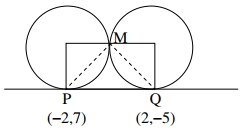
0 likes
View Solution187
DifficultMCQ
If $A$ and $B$ are the points of intersection of the circle $x^2+y^2-8x=0$ and the hyperbola $\frac{x^2}{9}-\frac{y^2}{4}=1$,and a point $P$ moves on the line $2x-3y+4=0$,then the centroid of $\triangle PAB$ lies on the line:
A
$4x-9y=12$
B
$x+9y=36$
C
$9x-9y=32$
D
$6x-9y=20$
Solution
(D) Given equations: $x^2+y^2-8x=0$ $(1)$ and $\frac{x^2}{9}-\frac{y^2}{4}=1$ $(2)$.
From $(2)$,$4x^2-9y^2=36 \Rightarrow 9y^2=4x^2-36$.
Substitute $y^2=8x-x^2$ from $(1)$ into $(2)$: $4x^2-9(8x-x^2)=36$.
$4x^2-72x+9x^2=36 \Rightarrow 13x^2-72x-36=0$.
$(13x+6)(x-6)=0$,so $x=6$ or $x=-\frac{6}{13}$.
For $x=6$,$y^2=8(6)-6^2=48-36=12$,so $y=\pm\sqrt{12}$.
Thus,$A=(6, \sqrt{12})$ and $B=(6, -\sqrt{12})$.
Let $P=(\alpha, \beta)$ be a point on $2x-3y+4=0$,so $2\alpha-3\beta+4=0$.
The centroid $(h, k)$ of $\triangle PAB$ is $h=\frac{6+6+\alpha}{3} = \frac{12+\alpha}{3}$ and $k=\frac{\sqrt{12}-\sqrt{12}+\beta}{3} = \frac{\beta}{3}$.
Then $\alpha=3h-12$ and $\beta=3k$.
Substitute into $2\alpha-3\beta+4=0$: $2(3h-12)-3(3k)+4=0$.
$6h-24-9k+4=0 \Rightarrow 6h-9k=20$.
The locus of the centroid is $6x-9y=20$.
From $(2)$,$4x^2-9y^2=36 \Rightarrow 9y^2=4x^2-36$.
Substitute $y^2=8x-x^2$ from $(1)$ into $(2)$: $4x^2-9(8x-x^2)=36$.
$4x^2-72x+9x^2=36 \Rightarrow 13x^2-72x-36=0$.
$(13x+6)(x-6)=0$,so $x=6$ or $x=-\frac{6}{13}$.
For $x=6$,$y^2=8(6)-6^2=48-36=12$,so $y=\pm\sqrt{12}$.
Thus,$A=(6, \sqrt{12})$ and $B=(6, -\sqrt{12})$.
Let $P=(\alpha, \beta)$ be a point on $2x-3y+4=0$,so $2\alpha-3\beta+4=0$.
The centroid $(h, k)$ of $\triangle PAB$ is $h=\frac{6+6+\alpha}{3} = \frac{12+\alpha}{3}$ and $k=\frac{\sqrt{12}-\sqrt{12}+\beta}{3} = \frac{\beta}{3}$.
Then $\alpha=3h-12$ and $\beta=3k$.
Substitute into $2\alpha-3\beta+4=0$: $2(3h-12)-3(3k)+4=0$.
$6h-24-9k+4=0 \Rightarrow 6h-9k=20$.
The locus of the centroid is $6x-9y=20$.
0 likes
View Solution188
MediumMCQ
If one end of the diameter is $(1, 1)$ and the other end lies on the line $x+y=3$,then the locus of the centre of the circle is
A
$x+y=1$
B
$2(x-y)=5$
C
$2x+2y=5$
D
None of these
Solution
(C) Let the coordinates of the other end of the diameter be $(t, 3-t)$ since it lies on the line $x+y=3$.
Let the centre of the circle be $(h, k)$.
The centre is the midpoint of the diameter with endpoints $(1, 1)$ and $(t, 3-t)$.
So,$h = \frac{1+t}{2}$ and $k = \frac{1+3-t}{2} = \frac{4-t}{2}$.
From these equations,we have $t = 2h-1$ and $t = 4-2k$.
Equating the two expressions for $t$:
$2h-1 = 4-2k$
$2h+2k = 5$.
Replacing $(h, k)$ with $(x, y)$,the locus of the centre is $2x+2y=5$.
Let the centre of the circle be $(h, k)$.
The centre is the midpoint of the diameter with endpoints $(1, 1)$ and $(t, 3-t)$.
So,$h = \frac{1+t}{2}$ and $k = \frac{1+3-t}{2} = \frac{4-t}{2}$.
From these equations,we have $t = 2h-1$ and $t = 4-2k$.
Equating the two expressions for $t$:
$2h-1 = 4-2k$
$2h+2k = 5$.
Replacing $(h, k)$ with $(x, y)$,the locus of the centre is $2x+2y=5$.
0 likes
View Solution189
MediumMCQ
The locus of the point of intersection of the tangents to the circle $x^2+y^2=16$,such that the angle between them is $60^{\circ}$,is
A
$x^2+y^2=4$
B
$x^2+y^2=64$
C
$x^2+y^2=32$
D
$x^2+y^2=48$
Solution
(B) The given circle is $x^2+y^2=16$,which has radius $r=4$ and center at the origin $(0,0)$.
Let $P(h,k)$ be the point of intersection of the tangents.
The angle between the tangents is $60^{\circ}$,so the angle between the line joining the center to $P$ and the tangent is $30^{\circ}$.
In the right-angled triangle formed by the center,the point of tangency,and $P$,we have $\sin(30^{\circ}) = \frac{r}{OP}$.
$\frac{1}{2} = \frac{4}{\sqrt{h^2+k^2}}$.
$\sqrt{h^2+k^2} = 8$.
Squaring both sides,we get $h^2+k^2=64$.
Replacing $(h,k)$ with $(x,y)$,the locus is $x^2+y^2=64$.
Let $P(h,k)$ be the point of intersection of the tangents.
The angle between the tangents is $60^{\circ}$,so the angle between the line joining the center to $P$ and the tangent is $30^{\circ}$.
In the right-angled triangle formed by the center,the point of tangency,and $P$,we have $\sin(30^{\circ}) = \frac{r}{OP}$.
$\frac{1}{2} = \frac{4}{\sqrt{h^2+k^2}}$.
$\sqrt{h^2+k^2} = 8$.
Squaring both sides,we get $h^2+k^2=64$.
Replacing $(h,k)$ with $(x,y)$,the locus is $x^2+y^2=64$.
0 likes
View Solution190
MediumMCQ
The locus of the point of intersection of perpendicular tangents to the circle $x^{2}+y^{2}=16$ is
A
$x^{2}+y^{2}=8$
B
$x^{2}+y^{2}=32$
C
$x^{2}+y^{2}=64$
D
$x^{2}+y^{2}=16$
Solution
(B) The locus of the point of intersection of perpendicular tangents to a circle is known as its director circle.
For a circle given by the equation $x^{2}+y^{2}=r^{2}$,the equation of the director circle is $x^{2}+y^{2}=2r^{2}$.
Here,the given circle is $x^{2}+y^{2}=16$,so $r^{2}=16$.
Substituting this into the director circle equation,we get $x^{2}+y^{2}=2(16) = 32$.
Thus,the required locus is $x^{2}+y^{2}=32$.
For a circle given by the equation $x^{2}+y^{2}=r^{2}$,the equation of the director circle is $x^{2}+y^{2}=2r^{2}$.
Here,the given circle is $x^{2}+y^{2}=16$,so $r^{2}=16$.
Substituting this into the director circle equation,we get $x^{2}+y^{2}=2(16) = 32$.
Thus,the required locus is $x^{2}+y^{2}=32$.
0 likes
View Solution191
DifficultMCQ
The locus of the midpoints of the chords of the circle $x^{2}+y^{2}=4$ which subtend a right angle at the origin is
A
$x^{2}+y^{2}=1$
B
$x^{2}+y^{2}=2$
C
$x+y=1$
D
$x+y=2$
Solution
(B) Let the midpoint of the chord $AB$ be $C(x_{1}, y_{1})$. The origin is $O(0, 0)$.
Since the chord $AB$ subtends a right angle at the origin,$\angle AOB = 90^{\circ}$.
In $\Delta OAB$,$OA = OB = r = 2$ (radius of the circle).
Since $C$ is the midpoint of $AB$,$OC \perp AB$.
In $\Delta OCB$,$\angle COB = \frac{1}{2} \angle AOB = 45^{\circ}$.
Using trigonometry in $\Delta OCB$:
$\cos(45^{\circ}) = \frac{OC}{OB}$
$\frac{1}{\sqrt{2}} = \frac{\sqrt{x_{1}^{2} + y_{1}^{2}}}{2}$
Squaring both sides:
$\frac{1}{2} = \frac{x_{1}^{2} + y_{1}^{2}}{4}$
$x_{1}^{2} + y_{1}^{2} = 2$
Replacing $(x_{1}, y_{1})$ with $(x, y)$,the locus is $x^{2} + y^{2} = 2$.
Since the chord $AB$ subtends a right angle at the origin,$\angle AOB = 90^{\circ}$.
In $\Delta OAB$,$OA = OB = r = 2$ (radius of the circle).
Since $C$ is the midpoint of $AB$,$OC \perp AB$.
In $\Delta OCB$,$\angle COB = \frac{1}{2} \angle AOB = 45^{\circ}$.
Using trigonometry in $\Delta OCB$:
$\cos(45^{\circ}) = \frac{OC}{OB}$
$\frac{1}{\sqrt{2}} = \frac{\sqrt{x_{1}^{2} + y_{1}^{2}}}{2}$
Squaring both sides:
$\frac{1}{2} = \frac{x_{1}^{2} + y_{1}^{2}}{4}$
$x_{1}^{2} + y_{1}^{2} = 2$
Replacing $(x_{1}, y_{1})$ with $(x, y)$,the locus is $x^{2} + y^{2} = 2$.
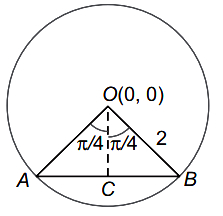
0 likes
View Solution192
MediumMCQ
If $A(\cos \alpha, \sin \alpha)$,$B(\sin \alpha, -\cos \alpha)$,and $C(1, 2)$ are the vertices of a $\triangle ABC$,then the locus of its centroid is:
A
$3(x^2 + y^2) - 2x - 4y + 1 = 0$
B
$x^2 + y^2 - 2x - 4y + 1 = 0$
C
$x^2 + y^2 - 2x - 4y + 3 = 0$
D
$2(x^2 + y^2) - 2x - 4y + 5 = 0$
Solution
(A) Let the centroid of $\triangle ABC$ be $(x, y)$.
The coordinates of the vertices are $A(\cos \alpha, \sin \alpha)$,$B(\sin \alpha, -\cos \alpha)$,and $C(1, 2)$.
The centroid $(x, y)$ is given by:
$x = \frac{\cos \alpha + \sin \alpha + 1}{3} \implies 3x - 1 = \cos \alpha + \sin \alpha$
$y = \frac{\sin \alpha - \cos \alpha + 2}{3} \implies 3y - 2 = \sin \alpha - \cos \alpha$
Squaring both equations:
$(3x - 1)^2 = (\cos \alpha + \sin \alpha)^2 = \cos^2 \alpha + \sin^2 \alpha + 2 \sin \alpha \cos \alpha = 1 + 2 \sin \alpha \cos \alpha$
$(3y - 2)^2 = (\sin \alpha - \cos \alpha)^2 = \sin^2 \alpha + \cos^2 \alpha - 2 \sin \alpha \cos \alpha = 1 - 2 \sin \alpha \cos \alpha$
Adding the two squared equations:
$(3x - 1)^2 + (3y - 2)^2 = 1 + 2 \sin \alpha \cos \alpha + 1 - 2 \sin \alpha \cos \alpha = 2$
$9x^2 - 6x + 1 + 9y^2 - 12y + 4 = 2$
$9x^2 + 9y^2 - 6x - 12y + 3 = 0$
Dividing by $3$:
$3(x^2 + y^2) - 2x - 4y + 1 = 0$.
The coordinates of the vertices are $A(\cos \alpha, \sin \alpha)$,$B(\sin \alpha, -\cos \alpha)$,and $C(1, 2)$.
The centroid $(x, y)$ is given by:
$x = \frac{\cos \alpha + \sin \alpha + 1}{3} \implies 3x - 1 = \cos \alpha + \sin \alpha$
$y = \frac{\sin \alpha - \cos \alpha + 2}{3} \implies 3y - 2 = \sin \alpha - \cos \alpha$
Squaring both equations:
$(3x - 1)^2 = (\cos \alpha + \sin \alpha)^2 = \cos^2 \alpha + \sin^2 \alpha + 2 \sin \alpha \cos \alpha = 1 + 2 \sin \alpha \cos \alpha$
$(3y - 2)^2 = (\sin \alpha - \cos \alpha)^2 = \sin^2 \alpha + \cos^2 \alpha - 2 \sin \alpha \cos \alpha = 1 - 2 \sin \alpha \cos \alpha$
Adding the two squared equations:
$(3x - 1)^2 + (3y - 2)^2 = 1 + 2 \sin \alpha \cos \alpha + 1 - 2 \sin \alpha \cos \alpha = 2$
$9x^2 - 6x + 1 + 9y^2 - 12y + 4 = 2$
$9x^2 + 9y^2 - 6x - 12y + 3 = 0$
Dividing by $3$:
$3(x^2 + y^2) - 2x - 4y + 1 = 0$.
0 likes
View Solution193
EasyMCQ
For two points $A(2,1)$ and $B(1,2)$,$P$ is a point such that $PA:PB = 2:1$. Then the locus of $P$ is:
A
$3x^2+3y^2+4x+14y-15=0$
B
$3x^2+3y^2-4x-14y+15=0$
C
$3x^2+3y^2+2x+7y+13=0$
D
$3x^2+3y^2-2x-7y-13=0$
Solution
(B) Let the coordinates of point $P$ be $(x, y)$.
Given $PA:PB = 2:1$,we have $PA^2 = 4PB^2$.
Using the distance formula,$PA^2 = (x-2)^2 + (y-1)^2$ and $PB^2 = (x-1)^2 + (y-2)^2$.
Substituting these into the equation:
$(x-2)^2 + (y-1)^2 = 4[(x-1)^2 + (y-2)^2]$
$x^2 - 4x + 4 + y^2 - 2y + 1 = 4[x^2 - 2x + 1 + y^2 - 4y + 4]$
$x^2 + y^2 - 4x - 2y + 5 = 4[x^2 + y^2 - 2x - 4y + 5]$
$x^2 + y^2 - 4x - 2y + 5 = 4x^2 + 4y^2 - 8x - 16y + 20$
Rearranging the terms to one side:
$3x^2 + 3y^2 - 4x - 14y + 15 = 0$.
Given $PA:PB = 2:1$,we have $PA^2 = 4PB^2$.
Using the distance formula,$PA^2 = (x-2)^2 + (y-1)^2$ and $PB^2 = (x-1)^2 + (y-2)^2$.
Substituting these into the equation:
$(x-2)^2 + (y-1)^2 = 4[(x-1)^2 + (y-2)^2]$
$x^2 - 4x + 4 + y^2 - 2y + 1 = 4[x^2 - 2x + 1 + y^2 - 4y + 4]$
$x^2 + y^2 - 4x - 2y + 5 = 4[x^2 + y^2 - 2x - 4y + 5]$
$x^2 + y^2 - 4x - 2y + 5 = 4x^2 + 4y^2 - 8x - 16y + 20$
Rearranging the terms to one side:
$3x^2 + 3y^2 - 4x - 14y + 15 = 0$.
0 likes
View Solution194
EasyMCQ
If $P$ is a variable point such that the sum of the distances from $P$ to the points $A(2,2)$ and $B(2,-2)$ is $4$,then the locus of $P$ represents
A
an ellipse
B
a vertical line
C
a segment of a vertical line
D
a segment of a horizontal line
Solution
(C) Let $P = (x, y)$. The given condition is $PA + PB = 4$.
The distance between $A(2, 2)$ and $B(2, -2)$ is $d = \sqrt{(2-2)^2 + (2 - (-2))^2} = \sqrt{0^2 + 4^2} = 4$.
Since the sum of the distances $PA + PB$ is equal to the distance between the fixed points $A$ and $B$ (i.e.,$PA + PB = AB = 4$),the point $P$ must lie on the line segment joining $A$ and $B$.
The points $A(2, 2)$ and $B(2, -2)$ both have an $x$-coordinate of $2$,so the line segment connecting them is a vertical line segment.
Therefore,the locus of $P$ is the segment of the vertical line $x = 2$ between $y = -2$ and $y = 2$.
The distance between $A(2, 2)$ and $B(2, -2)$ is $d = \sqrt{(2-2)^2 + (2 - (-2))^2} = \sqrt{0^2 + 4^2} = 4$.
Since the sum of the distances $PA + PB$ is equal to the distance between the fixed points $A$ and $B$ (i.e.,$PA + PB = AB = 4$),the point $P$ must lie on the line segment joining $A$ and $B$.
The points $A(2, 2)$ and $B(2, -2)$ both have an $x$-coordinate of $2$,so the line segment connecting them is a vertical line segment.
Therefore,the locus of $P$ is the segment of the vertical line $x = 2$ between $y = -2$ and $y = 2$.
0 likes
View Solution195
EasyMCQ
$P$ is a variable point such that the distance of $P$ from $A(4,0)$ is twice the distance of $P$ from $B(-4,0)$. If the line $3y - 3x - 20 = 0$ intersects the locus of $P$ at the points $C$ and $D$,then the distance between $C$ and $D$ is:
A
$8$
B
$\frac{8\sqrt{2}}{3}$
C
$\frac{32}{3}$
D
$\frac{8}{3}$
Solution
(C) Let $P = (x, y)$. The given condition is $PA = 2PB$.
$\sqrt{(x-4)^2 + y^2} = 2\sqrt{(x+4)^2 + y^2}$.
Squaring both sides: $(x-4)^2 + y^2 = 4((x+4)^2 + y^2)$.
$x^2 - 8x + 16 + y^2 = 4(x^2 + 8x + 16 + y^2)$.
$x^2 - 8x + 16 + y^2 = 4x^2 + 32x + 64 + 4y^2$.
$3x^2 + 3y^2 + 40x + 48 = 0$.
Dividing by $3$: $x^2 + y^2 + \frac{40}{3}x + 16 = 0$.
This is a circle with center $O' = (-\frac{20}{3}, 0)$ and radius $r = \sqrt{(-\frac{20}{3})^2 - 16} = \sqrt{\frac{400}{9} - 16} = \sqrt{\frac{400-144}{9}} = \sqrt{\frac{256}{9}} = \frac{16}{3}$.
The given line is $3y - 3x - 20 = 0$,which can be written as $y - x - \frac{20}{3} = 0$.
Check if the center $(-\frac{20}{3}, 0)$ lies on the line: $0 - (-\frac{20}{3}) - \frac{20}{3} = 0$. Yes,it does.
Since the line passes through the center of the circle,the chord $CD$ is a diameter.
Distance $CD = 2r = 2 \times \frac{16}{3} = \frac{32}{3}$.
$\sqrt{(x-4)^2 + y^2} = 2\sqrt{(x+4)^2 + y^2}$.
Squaring both sides: $(x-4)^2 + y^2 = 4((x+4)^2 + y^2)$.
$x^2 - 8x + 16 + y^2 = 4(x^2 + 8x + 16 + y^2)$.
$x^2 - 8x + 16 + y^2 = 4x^2 + 32x + 64 + 4y^2$.
$3x^2 + 3y^2 + 40x + 48 = 0$.
Dividing by $3$: $x^2 + y^2 + \frac{40}{3}x + 16 = 0$.
This is a circle with center $O' = (-\frac{20}{3}, 0)$ and radius $r = \sqrt{(-\frac{20}{3})^2 - 16} = \sqrt{\frac{400}{9} - 16} = \sqrt{\frac{400-144}{9}} = \sqrt{\frac{256}{9}} = \frac{16}{3}$.
The given line is $3y - 3x - 20 = 0$,which can be written as $y - x - \frac{20}{3} = 0$.
Check if the center $(-\frac{20}{3}, 0)$ lies on the line: $0 - (-\frac{20}{3}) - \frac{20}{3} = 0$. Yes,it does.
Since the line passes through the center of the circle,the chord $CD$ is a diameter.
Distance $CD = 2r = 2 \times \frac{16}{3} = \frac{32}{3}$.
0 likes
View Solution196
MediumMCQ
If the sum of the distances from a variable point $P$ to the given points $A(1,0)$ and $B(0,1)$ is $2$,then the locus of $P$ is
A
$3x^2+3y^2-4x-4y=0$
B
$16x^2+7y^2-64x-48y=0$
C
$3x^2+2xy+3y^2-4x-4y=0$
D
$16x^2+38xy+7y^2-64x-48y=0$
Solution
(C) Let the point $P$ be $(x, y)$.
Given that $AP + BP = 2$.
$\sqrt{(x-1)^2 + y^2} + \sqrt{x^2 + (y-1)^2} = 2$.
$\sqrt{(x-1)^2 + y^2} = 2 - \sqrt{x^2 + (y-1)^2}$.
Squaring both sides:
$(x-1)^2 + y^2 = 4 + x^2 + (y-1)^2 - 4\sqrt{x^2 + (y-1)^2}$.
$x^2 - 2x + 1 + y^2 = 4 + x^2 + y^2 - 2y + 1 - 4\sqrt{x^2 + (y-1)^2}$.
$-2x + 2y - 4 = -4\sqrt{x^2 + (y-1)^2}$.
Dividing by $-2$:
$x - y + 2 = 2\sqrt{x^2 + (y-1)^2}$.
Squaring both sides again:
$(x - y + 2)^2 = 4(x^2 + y^2 - 2y + 1)$.
$x^2 + y^2 + 4 - 2xy + 4x - 4y = 4x^2 + 4y^2 - 8y + 4$.
$3x^2 + 2xy + 3y^2 - 4x - 4y = 0$.
Given that $AP + BP = 2$.
$\sqrt{(x-1)^2 + y^2} + \sqrt{x^2 + (y-1)^2} = 2$.
$\sqrt{(x-1)^2 + y^2} = 2 - \sqrt{x^2 + (y-1)^2}$.
Squaring both sides:
$(x-1)^2 + y^2 = 4 + x^2 + (y-1)^2 - 4\sqrt{x^2 + (y-1)^2}$.
$x^2 - 2x + 1 + y^2 = 4 + x^2 + y^2 - 2y + 1 - 4\sqrt{x^2 + (y-1)^2}$.
$-2x + 2y - 4 = -4\sqrt{x^2 + (y-1)^2}$.
Dividing by $-2$:
$x - y + 2 = 2\sqrt{x^2 + (y-1)^2}$.
Squaring both sides again:
$(x - y + 2)^2 = 4(x^2 + y^2 - 2y + 1)$.
$x^2 + y^2 + 4 - 2xy + 4x - 4y = 4x^2 + 4y^2 - 8y + 4$.
$3x^2 + 2xy + 3y^2 - 4x - 4y = 0$.
0 likes
View Solution197
MediumMCQ
If the distance of a variable point $P(x, y)$ from a point $A(2, -2)$ is twice the distance of $P$ from the $Y$-axis,then the equation of the locus of $P$ is:
A
$3x^2 - y^2 + 4x - 4y - 8 = 0$
B
$x^2 - 4x + 4y + 8 = 0$
C
$3x^2 - y^2 + 4x - 4y + 8 = 0$
D
$y^2 - 4x + 4y + 8 = 0$
Solution
(A) Let the coordinates of the variable point $P$ be $(x, y)$.
The distance of $P(x, y)$ from $A(2, -2)$ is given by $PA = \sqrt{(x - 2)^2 + (y + 2)^2}$.
The distance of $P(x, y)$ from the $Y$-axis is $|x|$.
According to the problem,$PA = 2|x|$.
Squaring both sides,we get $PA^2 = 4x^2$.
$(x - 2)^2 + (y + 2)^2 = 4x^2$.
$x^2 - 4x + 4 + y^2 + 4y + 4 = 4x^2$.
Rearranging the terms,we get $3x^2 - y^2 + 4x - 4y - 8 = 0$.
The distance of $P(x, y)$ from $A(2, -2)$ is given by $PA = \sqrt{(x - 2)^2 + (y + 2)^2}$.
The distance of $P(x, y)$ from the $Y$-axis is $|x|$.
According to the problem,$PA = 2|x|$.
Squaring both sides,we get $PA^2 = 4x^2$.
$(x - 2)^2 + (y + 2)^2 = 4x^2$.
$x^2 - 4x + 4 + y^2 + 4y + 4 = 4x^2$.
Rearranging the terms,we get $3x^2 - y^2 + 4x - 4y - 8 = 0$.
0 likes
View Solution198
MediumMCQ
$A(a, 0)$ is a fixed point and $\theta$ is a parameter such that $0 < \theta < 2 \pi$. If $P(a \cos \theta, a \sin \theta)$ is a point on the circle $x^2+y^2=a^2$ and $Q(b \sin \theta, -b \cos \theta)$ is a point on the circle $x^2+y^2=b^2$,then the locus of the centroid of the triangle $APQ$ is
A
a circle with centre at $\left(\frac{a}{3}, 0\right)$ and radius $\frac{\sqrt{a^2+b^2}}{3}$
B
a circle with centre at $(a, 0)$ and radius $\frac{\sqrt{a^2+b^2}}{3}$
C
a parabola with focus at $\left(\frac{a}{3}, 0\right)$
D
a parabola with focus at $(a, 0)$
Solution
(A) Let the centroid of $\triangle APQ$ be $(h, k)$.
Given vertices are $A(a, 0)$,$P(a \cos \theta, a \sin \theta)$,and $Q(b \sin \theta, -b \cos \theta)$.
The centroid $(h, k)$ is given by:
$h = \frac{a + a \cos \theta + b \sin \theta}{3} \implies 3h - a = a \cos \theta + b \sin \theta$
$k = \frac{0 + a \sin \theta - b \cos \theta}{3} \implies 3k = a \sin \theta - b \cos \theta$
Squaring and adding the two equations:
$(3h - a)^2 + (3k)^2 = (a \cos \theta + b \sin \theta)^2 + (a \sin \theta - b \cos \theta)^2$
$(3h - a)^2 + 9k^2 = a^2(\cos^2 \theta + \sin^2 \theta) + b^2(\sin^2 \theta + \cos^2 \theta) + 2ab \cos \theta \sin \theta - 2ab \sin \theta \cos \theta$
$(3h - a)^2 + 9k^2 = a^2 + b^2$
$9(h - \frac{a}{3})^2 + 9k^2 = a^2 + b^2$
$(h - \frac{a}{3})^2 + k^2 = \frac{a^2 + b^2}{9} = \left(\frac{\sqrt{a^2 + b^2}}{3}\right)^2$
Thus,the locus is a circle with centre at $\left(\frac{a}{3}, 0\right)$ and radius $\frac{\sqrt{a^2 + b^2}}{3}$.
Given vertices are $A(a, 0)$,$P(a \cos \theta, a \sin \theta)$,and $Q(b \sin \theta, -b \cos \theta)$.
The centroid $(h, k)$ is given by:
$h = \frac{a + a \cos \theta + b \sin \theta}{3} \implies 3h - a = a \cos \theta + b \sin \theta$
$k = \frac{0 + a \sin \theta - b \cos \theta}{3} \implies 3k = a \sin \theta - b \cos \theta$
Squaring and adding the two equations:
$(3h - a)^2 + (3k)^2 = (a \cos \theta + b \sin \theta)^2 + (a \sin \theta - b \cos \theta)^2$
$(3h - a)^2 + 9k^2 = a^2(\cos^2 \theta + \sin^2 \theta) + b^2(\sin^2 \theta + \cos^2 \theta) + 2ab \cos \theta \sin \theta - 2ab \sin \theta \cos \theta$
$(3h - a)^2 + 9k^2 = a^2 + b^2$
$9(h - \frac{a}{3})^2 + 9k^2 = a^2 + b^2$
$(h - \frac{a}{3})^2 + k^2 = \frac{a^2 + b^2}{9} = \left(\frac{\sqrt{a^2 + b^2}}{3}\right)^2$
Thus,the locus is a circle with centre at $\left(\frac{a}{3}, 0\right)$ and radius $\frac{\sqrt{a^2 + b^2}}{3}$.
0 likes
View Solution199
MediumMCQ
$A(4,3)$ and $B(2,5)$ are two points. If $P$ is a variable point on the same side as the origin with respect to the line $AB$ and is at most at a distance of $5$ units from the midpoint of $AB$,then the locus of $P$ is
A
$x^2+y^2-6x-8y=0$
B
$x^2+y^2-6x-8y \leq 0, x+y-7 < 0$
C
$x^2+y^2+6x+8y-25=0, x+y-7 \leq 0$
D
$x^2+y^2-6x+8y \geq 0, x+y-7 < 0$
Solution
(B) $1$. Find the midpoint $M$ of $AB$: $M = (\frac{4+2}{2}, \frac{3+5}{2}) = (3, 4)$.
$2$. The distance of $P(x, y)$ from $M(3, 4)$ is at most $5$ units: $(x-3)^2 + (y-4)^2 \leq 5^2$,which simplifies to $x^2 + y^2 - 6x - 8y \leq 0$.
$3$. The equation of line $AB$ is $y - 3 = \frac{5-3}{2-4}(x - 4)$ $\Rightarrow y - 3 = -1(x - 4)$ $\Rightarrow x + y - 7 = 0$.
$4$. The origin $(0, 0)$ satisfies $0 + 0 - 7 = -7 < 0$. Since $P$ is on the same side as the origin,$P$ must satisfy $x + y - 7 < 0$.
$5$. Combining these,the locus is $x^2 + y^2 - 6x - 8y \leq 0$ and $x + y - 7 < 0$.
$2$. The distance of $P(x, y)$ from $M(3, 4)$ is at most $5$ units: $(x-3)^2 + (y-4)^2 \leq 5^2$,which simplifies to $x^2 + y^2 - 6x - 8y \leq 0$.
$3$. The equation of line $AB$ is $y - 3 = \frac{5-3}{2-4}(x - 4)$ $\Rightarrow y - 3 = -1(x - 4)$ $\Rightarrow x + y - 7 = 0$.
$4$. The origin $(0, 0)$ satisfies $0 + 0 - 7 = -7 < 0$. Since $P$ is on the same side as the origin,$P$ must satisfy $x + y - 7 < 0$.
$5$. Combining these,the locus is $x^2 + y^2 - 6x - 8y \leq 0$ and $x + y - 7 < 0$.
0 likes
View Solution200
MediumMCQ
The locus of the third vertex of a right-angled triangle,the ends of whose hypotenuse are $(1,2)$ and $(4,5)$,is
A
$x^2+y^2-5x-7y+14=0$
B
$x^2+y^2+5x+7y+14=0$
C
$x^2+y^2-5x-7y-14=0$
D
$x^2+y^2+5x+7y-14=0$
Solution
(A) Let the third vertex be $P(x, y)$.
Since the triangle is right-angled at $P$,the angle $\angle P = 90^{\circ}$.
This implies that the point $P$ lies on a circle where the hypotenuse joining $(1, 2)$ and $(4, 5)$ is the diameter.
The equation of a circle with diameter endpoints $(x_1, y_1)$ and $(x_2, y_2)$ is $(x-x_1)(x-x_2) + (y-y_1)(y-y_2) = 0$.
Substituting the given points $(1, 2)$ and $(4, 5)$:
$(x-1)(x-4) + (y-2)(y-5) = 0$
$x^2 - 5x + 4 + y^2 - 7y + 10 = 0$
$x^2 + y^2 - 5x - 7y + 14 = 0$.
Note: The vertex $P$ cannot be $(1, 2)$ or $(4, 5)$ as it would not form a triangle.
Since the triangle is right-angled at $P$,the angle $\angle P = 90^{\circ}$.
This implies that the point $P$ lies on a circle where the hypotenuse joining $(1, 2)$ and $(4, 5)$ is the diameter.
The equation of a circle with diameter endpoints $(x_1, y_1)$ and $(x_2, y_2)$ is $(x-x_1)(x-x_2) + (y-y_1)(y-y_2) = 0$.
Substituting the given points $(1, 2)$ and $(4, 5)$:
$(x-1)(x-4) + (y-2)(y-5) = 0$
$x^2 - 5x + 4 + y^2 - 7y + 10 = 0$
$x^2 + y^2 - 5x - 7y + 14 = 0$.
Note: The vertex $P$ cannot be $(1, 2)$ or $(4, 5)$ as it would not form a triangle.
0 likes
View Solution10-1.Circle and System of Circles — Locus Related Problem · Frequently Asked Questions
1Are these 10-1.Circle and System of Circles questions useful for JEE and NEET?
Yes. All questions in this section are mapped to JEE Main and NEET exam patterns. Previous year questions from JEE Main, NEET, GUJCET and state-level exams are included with full solutions.
2Can I switch to Hindi or Gujarati for these questions?
Yes. Use the language tabs in the hero section or the sidebar to view the same questions and solutions in English, Hindi or Gujarati.
3How do I generate a question paper from this subtopic?
Use the Vedclass Exam Paper Generator — select the chapter and subtopic, set difficulty, and generate Sets A, B, C, D automatically. First 3 chapters of every subject are free.
Vedclass Products
For Students
Vedclass Test Series
Mock tests in real JEE/NEET style with performance analysis. 5-day free trial.
Start Free TrialFor Teachers
Exam Paper Generator
Generate Set A/B/C/D papers from this chapter in 2 minutes. 3 chapters free.
Try FreeFor Institutes
Online Exam Module
Live online exams with unlimited students, 360° analytics & white-label branding.
See DemoFor Teachers & Institutes
Generate a 10-1.Circle and System of Circles Exam Paper in 2 Minutes
Select subtopic & difficulty — Sets A, B, C, D auto-generated with No Repeat logic.
First 3 chapters of every subject are free — no payment required.