
A English
Geometrical problems regarding circle and its properties Questions in English
Class 11 Mathematics · 10-1.Circle and System of Circles · Geometrical problems regarding circle and its properties
598+
Questions
English
Language
100%
With Solutions
Showing 49 of 598 questions in English
351
EasyMCQ
The total number of common tangents of $x^{2}+y^{2}-6x-8y+9=0$ and $x^{2}+y^{2}=1$ is
A
$4$
B
$2$
C
$3$
D
$1$
Solution
(C) The given equations of the circles are:
$C_1: x^2 + y^2 - 6x - 8y + 9 = 0$
$C_2: x^2 + y^2 = 1$
For $C_1$,the center is $(3, 4)$ and the radius $R_1 = \sqrt{3^2 + 4^2 - 9} = \sqrt{9 + 16 - 9} = \sqrt{16} = 4$.
For $C_2$,the center is $(0, 0)$ and the radius $R_2 = 1$.
The distance between the centers $C_1(3, 4)$ and $C_2(0, 0)$ is $d = \sqrt{(3-0)^2 + (4-0)^2} = \sqrt{9 + 16} = 5$.
We observe that $R_1 + R_2 = 4 + 1 = 5$.
Since the distance between the centers $d = R_1 + R_2$,the two circles touch each other externally.
When two circles touch each other externally,they have $3$ common tangents (two direct common tangents and one transverse common tangent).
$C_1: x^2 + y^2 - 6x - 8y + 9 = 0$
$C_2: x^2 + y^2 = 1$
For $C_1$,the center is $(3, 4)$ and the radius $R_1 = \sqrt{3^2 + 4^2 - 9} = \sqrt{9 + 16 - 9} = \sqrt{16} = 4$.
For $C_2$,the center is $(0, 0)$ and the radius $R_2 = 1$.
The distance between the centers $C_1(3, 4)$ and $C_2(0, 0)$ is $d = \sqrt{(3-0)^2 + (4-0)^2} = \sqrt{9 + 16} = 5$.
We observe that $R_1 + R_2 = 4 + 1 = 5$.
Since the distance between the centers $d = R_1 + R_2$,the two circles touch each other externally.
When two circles touch each other externally,they have $3$ common tangents (two direct common tangents and one transverse common tangent).
0 likes
View Solution352
MediumMCQ
The number of common tangents to the circles $x^{2}+y^{2}-y=0$ and $x^{2}+y^{2}+y=0$ is
A
$2$
B
$3$
C
$0$
D
$1$
Solution
(B) The given circles are $x^{2}+y^{2}-y=0$ and $x^{2}+y^{2}+y=0$.
For the first circle $x^{2}+y^{2}-y=0$,the center is $C_{1}(0, 1/2)$ and radius $r_{1} = \sqrt{0^{2} + (1/2)^{2} - 0} = 1/2$.
For the second circle $x^{2}+y^{2}+y=0$,the center is $C_{2}(0, -1/2)$ and radius $r_{2} = \sqrt{0^{2} + (-1/2)^{2} - 0} = 1/2$.
The distance between the centers is $C_{1}C_{2} = \sqrt{(0-0)^{2} + (1/2 - (-1/2))^{2}} = \sqrt{1^{2}} = 1$.
Since $r_{1} + r_{2} = 1/2 + 1/2 = 1$,we have $C_{1}C_{2} = r_{1} + r_{2}$.
This condition implies that the two circles touch each other externally at a single point.
When two circles touch each other externally,they have exactly $3$ common tangents (two external and one internal).
For the first circle $x^{2}+y^{2}-y=0$,the center is $C_{1}(0, 1/2)$ and radius $r_{1} = \sqrt{0^{2} + (1/2)^{2} - 0} = 1/2$.
For the second circle $x^{2}+y^{2}+y=0$,the center is $C_{2}(0, -1/2)$ and radius $r_{2} = \sqrt{0^{2} + (-1/2)^{2} - 0} = 1/2$.
The distance between the centers is $C_{1}C_{2} = \sqrt{(0-0)^{2} + (1/2 - (-1/2))^{2}} = \sqrt{1^{2}} = 1$.
Since $r_{1} + r_{2} = 1/2 + 1/2 = 1$,we have $C_{1}C_{2} = r_{1} + r_{2}$.
This condition implies that the two circles touch each other externally at a single point.
When two circles touch each other externally,they have exactly $3$ common tangents (two external and one internal).
0 likes
View Solution353
MediumMCQ
The number of common tangents to the circles $x^{2}+y^{2}=4$ and $x^{2}+y^{2}-6x-8y-24=0$ is
A
$3$
B
$4$
C
$2$
D
$1$
Solution
(D) The given equations of the circles are:
$C_{1}: x^{2}+y^{2}=4$,with center $O_{1}=(0,0)$ and radius $r_{1}=2$.
$C_{2}: x^{2}+y^{2}-6x-8y-24=0$,with center $O_{2}=(3,4)$ and radius $r_{2}=\sqrt{3^{2}+4^{2}-(-24)}=\sqrt{9+16+24}=\sqrt{49}=7$.
Now,calculate the distance between the centers $O_{1}$ and $O_{2}$:
$d = \sqrt{(3-0)^{2}+(4-0)^{2}} = \sqrt{9+16} = 5$.
Compare the distance $d$ with the sum and difference of the radii:
$r_{1}+r_{2} = 2+7 = 9$.
$|r_{1}-r_{2}| = |2-7| = 5$.
Since $d = |r_{1}-r_{2}|$,the circles touch each other internally.
Therefore,the number of common tangents is $1$.
$C_{1}: x^{2}+y^{2}=4$,with center $O_{1}=(0,0)$ and radius $r_{1}=2$.
$C_{2}: x^{2}+y^{2}-6x-8y-24=0$,with center $O_{2}=(3,4)$ and radius $r_{2}=\sqrt{3^{2}+4^{2}-(-24)}=\sqrt{9+16+24}=\sqrt{49}=7$.
Now,calculate the distance between the centers $O_{1}$ and $O_{2}$:
$d = \sqrt{(3-0)^{2}+(4-0)^{2}} = \sqrt{9+16} = 5$.
Compare the distance $d$ with the sum and difference of the radii:
$r_{1}+r_{2} = 2+7 = 9$.
$|r_{1}-r_{2}| = |2-7| = 5$.
Since $d = |r_{1}-r_{2}|$,the circles touch each other internally.
Therefore,the number of common tangents is $1$.
0 likes
View Solution354
DifficultMCQ
If $\sin ^{-1} a$ is the acute angle between the curves $x^{2}+y^{2}=4 x$ and $x^{2}+y^{2}=8$ at $(2,2)$,then $a$ is equal to
A
$1$
B
$0$
C
$\frac{1}{\sqrt{2}}$
D
$\frac{\sqrt{3}}{2}$
Solution
(C) The given curves are $x^{2}+y^{2}=4x$ and $x^{2}+y^{2}=8$.
For the first curve $x^{2}+y^{2}=4x$,differentiating with respect to $x$ gives $2x + 2y \frac{dy}{dx} = 4$,so $\frac{dy}{dx} = \frac{2-x}{y}$.
At the point $(2,2)$,the slope $m_{1} = \frac{2-2}{2} = 0$.
For the second curve $x^{2}+y^{2}=8$,differentiating with respect to $x$ gives $2x + 2y \frac{dy}{dx} = 0$,so $\frac{dy}{dx} = -\frac{x}{y}$.
At the point $(2,2)$,the slope $m_{2} = -\frac{2}{2} = -1$.
The angle $\theta$ between the curves is given by $\tan \theta = \left| \frac{m_{1}-m_{2}}{1+m_{1}m_{2}} \right|$.
Substituting the values,$\tan \theta = \left| \frac{0 - (-1)}{1 + (0)(-1)} \right| = \left| \frac{1}{1} \right| = 1$.
Since $\tan \theta = 1$,we have $\theta = 45^{\circ}$.
Given that $\theta = \sin^{-1} a$,we have $\sin^{-1} a = 45^{\circ}$,which implies $a = \sin 45^{\circ} = \frac{1}{\sqrt{2}}$.
For the first curve $x^{2}+y^{2}=4x$,differentiating with respect to $x$ gives $2x + 2y \frac{dy}{dx} = 4$,so $\frac{dy}{dx} = \frac{2-x}{y}$.
At the point $(2,2)$,the slope $m_{1} = \frac{2-2}{2} = 0$.
For the second curve $x^{2}+y^{2}=8$,differentiating with respect to $x$ gives $2x + 2y \frac{dy}{dx} = 0$,so $\frac{dy}{dx} = -\frac{x}{y}$.
At the point $(2,2)$,the slope $m_{2} = -\frac{2}{2} = -1$.
The angle $\theta$ between the curves is given by $\tan \theta = \left| \frac{m_{1}-m_{2}}{1+m_{1}m_{2}} \right|$.
Substituting the values,$\tan \theta = \left| \frac{0 - (-1)}{1 + (0)(-1)} \right| = \left| \frac{1}{1} \right| = 1$.
Since $\tan \theta = 1$,we have $\theta = 45^{\circ}$.
Given that $\theta = \sin^{-1} a$,we have $\sin^{-1} a = 45^{\circ}$,which implies $a = \sin 45^{\circ} = \frac{1}{\sqrt{2}}$.
0 likes
View Solution355
DifficultMCQ
The maximum area of a rectangle inscribed in the circle $(x+1)^{2}+(y-3)^{2}=64$ is
A
$64 \text{ sq. units}$
B
$72 \text{ sq. units}$
C
$128 \text{ sq. units}$
D
$8 \text{ sq. units}$
Solution
(C) The given equation of the circle is $(x+1)^{2}+(y-3)^{2}=64$.
Comparing this with the standard form $(x-h)^{2}+(y-k)^{2}=r^{2}$,we get the radius $r = \sqrt{64} = 8$.
For a rectangle inscribed in a circle,the maximum area is achieved when the rectangle is a square.
The diagonal of this square is equal to the diameter of the circle,which is $d = 2r = 2 \times 8 = 16$.
Let the side of the square be $a$. Then,by Pythagoras theorem,$a^{2} + a^{2} = d^{2}$.
$2a^{2} = 16^{2} = 256$.
$a^{2} = 128$.
The area of the square is $a^{2} = 128 \text{ sq. units}$.
Comparing this with the standard form $(x-h)^{2}+(y-k)^{2}=r^{2}$,we get the radius $r = \sqrt{64} = 8$.
For a rectangle inscribed in a circle,the maximum area is achieved when the rectangle is a square.
The diagonal of this square is equal to the diameter of the circle,which is $d = 2r = 2 \times 8 = 16$.
Let the side of the square be $a$. Then,by Pythagoras theorem,$a^{2} + a^{2} = d^{2}$.
$2a^{2} = 16^{2} = 256$.
$a^{2} = 128$.
The area of the square is $a^{2} = 128 \text{ sq. units}$.
0 likes
View Solution356
MediumMCQ
The equation of the circle circumscribing the triangle formed by the straight lines $x+y=6$,$2x+y=4$,and $x+2y=5$ is given by:
A
$x^2+y^2+17x+19y+50=0$
B
$x^2+y^2-17x-19y+50=0$
C
$x^2+y^2+17x-19y-50=0$
D
$x^2+y^2-17x+19y-50=0$
Solution
(B) The equation of a circle passing through the intersection of lines $L_1=0, L_2=0, L_3=0$ is given by $L_1 L_2 + \lambda L_2 L_3 + \mu L_3 L_1 = 0$.
Let $L_1: x+y-6=0$,$L_2: 2x+y-4=0$,$L_3: x+2y-5=0$.
The equation is $(x+y-6)(2x+y-4) + \lambda(2x+y-4)(x+2y-5) + \mu(x+2y-5)(x+y-6) = 0$.
Expanding the terms,the coefficient of $x^2$ is $2 + 2\lambda + \mu$ and the coefficient of $y^2$ is $1 + 2\lambda + 2\mu$.
For a circle,coeff$(x^2)$ = coeff$(y^2)$ $\Rightarrow 2 + 2\lambda + \mu = 1 + 2\lambda + 2\mu$ $\Rightarrow \mu = 1$.
The coefficient of $xy$ is $1 + 2 + 4\lambda + \lambda + \mu + 2\mu = 3 + 5\lambda + 3\mu = 0$.
Substituting $\mu = 1$,we get $3 + 5\lambda + 3 = 0$ $\Rightarrow 5\lambda = -6$ $\Rightarrow \lambda = -6/5$.
Substituting $\lambda$ and $\mu$ into the equation: $(x+y-6)(2x+y-4) - \frac{6}{5}(2x+y-4)(x+2y-5) + (x+2y-5)(x+y-6) = 0$.
Multiplying by $5$: $5(x+y-6)(2x+y-4) - 6(2x+y-4)(x+2y-5) + 5(x+2y-5)(x+y-6) = 0$.
Simplifying the expression leads to $x^2+y^2-17x-19y+50=0$.
Let $L_1: x+y-6=0$,$L_2: 2x+y-4=0$,$L_3: x+2y-5=0$.
The equation is $(x+y-6)(2x+y-4) + \lambda(2x+y-4)(x+2y-5) + \mu(x+2y-5)(x+y-6) = 0$.
Expanding the terms,the coefficient of $x^2$ is $2 + 2\lambda + \mu$ and the coefficient of $y^2$ is $1 + 2\lambda + 2\mu$.
For a circle,coeff$(x^2)$ = coeff$(y^2)$ $\Rightarrow 2 + 2\lambda + \mu = 1 + 2\lambda + 2\mu$ $\Rightarrow \mu = 1$.
The coefficient of $xy$ is $1 + 2 + 4\lambda + \lambda + \mu + 2\mu = 3 + 5\lambda + 3\mu = 0$.
Substituting $\mu = 1$,we get $3 + 5\lambda + 3 = 0$ $\Rightarrow 5\lambda = -6$ $\Rightarrow \lambda = -6/5$.
Substituting $\lambda$ and $\mu$ into the equation: $(x+y-6)(2x+y-4) - \frac{6}{5}(2x+y-4)(x+2y-5) + (x+2y-5)(x+y-6) = 0$.
Multiplying by $5$: $5(x+y-6)(2x+y-4) - 6(2x+y-4)(x+2y-5) + 5(x+2y-5)(x+y-6) = 0$.
Simplifying the expression leads to $x^2+y^2-17x-19y+50=0$.
0 likes
View Solution357
DifficultMCQ
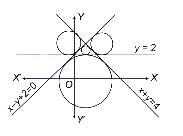
The number of circles that touch all the straight lines $x+y=4$,$x-y=-2$,and $y=2$ is
A
$1$
B
$2$
C
$3$
D
$4$
Solution
(D) The given lines are $L_1: x+y-4=0$,$L_2: x-y+2=0$,and $L_3: y-2=0$.
These three lines form a triangle.
$A$ circle that touches all three lines is an incircle or an excircle of the triangle formed by these lines.
For any triangle,there is one incircle and three excircles.
Therefore,there are $1+3=4$ circles that touch all three given lines.
These three lines form a triangle.
$A$ circle that touches all three lines is an incircle or an excircle of the triangle formed by these lines.
For any triangle,there is one incircle and three excircles.
Therefore,there are $1+3=4$ circles that touch all three given lines.
0 likes
View Solution358
MediumMCQ
Let the tangents drawn from $P(-1, -1)$ to the circle $x^2 + y^2 - 2x - 4y - 4 = 0$ touch the circle at the points $A$ and $B$. Then the area of the triangle $PAB$ (in square units) is
A
$\frac{24}{13}$
B
$\frac{24}{7}$
C
$\frac{8}{13}$
D
$\frac{3}{13} 4^{2/3}$
Solution
(A) The equation of the circle is $x^2 + y^2 - 2x - 4y - 4 = 0$.
Comparing with $x^2 + y^2 + 2gx + 2fy + c = 0$,we get the center $C(1, 2)$ and radius $r = \sqrt{g^2 + f^2 - c} = \sqrt{1^2 + 2^2 - (-4)} = \sqrt{9} = 3$.
The distance $PC$ from $P(-1, -1)$ to $C(1, 2)$ is $d = \sqrt{(1 - (-1))^2 + (2 - (-1))^2} = \sqrt{2^2 + 3^2} = \sqrt{13}$.
The length of the tangent $L = \sqrt{d^2 - r^2} = \sqrt{13 - 9} = \sqrt{4} = 2$.
Let $h$ be the altitude from $A$ to $PC$ and $k$ be the length $PM$ where $M$ is the intersection of $AB$ and $PC$.
In $\triangle PAC$,$\angle PAC = 90^\circ$. The area of $\triangle PAC = \frac{1}{2} \times AC \times AP = \frac{1}{2} \times 3 \times 2 = 3$.
Also,area of $\triangle PAC = \frac{1}{2} \times PC \times h = \frac{1}{2} \times \sqrt{13} \times h = 3$,so $h = \frac{6}{\sqrt{13}}$.
In $\triangle PAM$,$PM = \sqrt{AP^2 - h^2} = \sqrt{4 - \frac{36}{13}} = \sqrt{\frac{52 - 36}{13}} = \sqrt{\frac{16}{13}} = \frac{4}{\sqrt{13}}$.
The length of the chord $AB = 2h = \frac{12}{\sqrt{13}}$.
The area of $\triangle PAB = \frac{1}{2} \times AB \times PM = \frac{1}{2} \times \frac{12}{\sqrt{13}} \times \frac{4}{\sqrt{13}} = \frac{24}{13}$.
Comparing with $x^2 + y^2 + 2gx + 2fy + c = 0$,we get the center $C(1, 2)$ and radius $r = \sqrt{g^2 + f^2 - c} = \sqrt{1^2 + 2^2 - (-4)} = \sqrt{9} = 3$.
The distance $PC$ from $P(-1, -1)$ to $C(1, 2)$ is $d = \sqrt{(1 - (-1))^2 + (2 - (-1))^2} = \sqrt{2^2 + 3^2} = \sqrt{13}$.
The length of the tangent $L = \sqrt{d^2 - r^2} = \sqrt{13 - 9} = \sqrt{4} = 2$.
Let $h$ be the altitude from $A$ to $PC$ and $k$ be the length $PM$ where $M$ is the intersection of $AB$ and $PC$.
In $\triangle PAC$,$\angle PAC = 90^\circ$. The area of $\triangle PAC = \frac{1}{2} \times AC \times AP = \frac{1}{2} \times 3 \times 2 = 3$.
Also,area of $\triangle PAC = \frac{1}{2} \times PC \times h = \frac{1}{2} \times \sqrt{13} \times h = 3$,so $h = \frac{6}{\sqrt{13}}$.
In $\triangle PAM$,$PM = \sqrt{AP^2 - h^2} = \sqrt{4 - \frac{36}{13}} = \sqrt{\frac{52 - 36}{13}} = \sqrt{\frac{16}{13}} = \frac{4}{\sqrt{13}}$.
The length of the chord $AB = 2h = \frac{12}{\sqrt{13}}$.
The area of $\triangle PAB = \frac{1}{2} \times AB \times PM = \frac{1}{2} \times \frac{12}{\sqrt{13}} \times \frac{4}{\sqrt{13}} = \frac{24}{13}$.
0 likes
View Solution359
EasyMCQ
The circumference of a circle passing through the point $(4,6)$ with two normals represented by $2x - 3y + 4 = 0$ and $x + y - 3 = 0$ is (in $\pi$)
A
$5$
B
$10$
C
$25$
D
$8$
Solution
(B) The intersection point of two normals to a circle is the center of the circle.
Given equations of normals are:
$2x - 3y + 4 = 0$ ... $(i)$
$x + y - 3 = 0$ ... $(ii)$
Multiplying $(ii)$ by $2$,we get $2x + 2y - 6 = 0$ ... $(iii)$
Subtracting $(i)$ from $(iii)$:
$(2x + 2y - 6) - (2x - 3y + 4) = 0$
$5y - 10 = 0 \implies y = 2$
Substituting $y = 2$ in $(ii)$:
$x + 2 - 3 = 0 \implies x = 1$
So,the center of the circle is $(1, 2)$.
The circle passes through the point $(4, 6)$.
The radius $r$ is the distance between $(1, 2)$ and $(4, 6)$:
$r = \sqrt{(4 - 1)^2 + (6 - 2)^2} = \sqrt{3^2 + 4^2} = \sqrt{9 + 16} = \sqrt{25} = 5$.
The circumference of the circle is $2 \pi r = 2 \pi (5) = 10 \pi$.
Given equations of normals are:
$2x - 3y + 4 = 0$ ... $(i)$
$x + y - 3 = 0$ ... $(ii)$
Multiplying $(ii)$ by $2$,we get $2x + 2y - 6 = 0$ ... $(iii)$
Subtracting $(i)$ from $(iii)$:
$(2x + 2y - 6) - (2x - 3y + 4) = 0$
$5y - 10 = 0 \implies y = 2$
Substituting $y = 2$ in $(ii)$:
$x + 2 - 3 = 0 \implies x = 1$
So,the center of the circle is $(1, 2)$.
The circle passes through the point $(4, 6)$.
The radius $r$ is the distance between $(1, 2)$ and $(4, 6)$:
$r = \sqrt{(4 - 1)^2 + (6 - 2)^2} = \sqrt{3^2 + 4^2} = \sqrt{9 + 16} = \sqrt{25} = 5$.
The circumference of the circle is $2 \pi r = 2 \pi (5) = 10 \pi$.
0 likes
View Solution360
MediumMCQ
$ABC$ is a triangle and the radical centre of the circles with $AB, BC, CA$ as the diameters is $(-6,5)$. If $A=(3,2)$ and $B=(2,1)$,then $C=$
A
$(1,1)$
B
$(1,2)$
C
$(2,3)$
D
$(9,22)$
Solution
(NONE) The radical centre of the circles described on the sides of a triangle as diameters is the orthocentre of the triangle.
Let the orthocentre $H = (-6,5)$.
Let $A = (3,2)$,$B = (2,1)$,and $C = (x,y)$.
The slope of $BC$ is $m_{BC} = \frac{y-1}{x-2}$.
Since $AH \perp BC$,the slope of $AH$ is $m_{AH} = \frac{5-2}{-6-3} = \frac{3}{-9} = -\frac{1}{3}$.
Therefore,$m_{BC} = -\frac{1}{m_{AH}} = 3$.
So,$\frac{y-1}{x-2} = 3 \implies y-1 = 3x-6 \implies 3x-y = 5$ $(1)$.
The slope of $AC$ is $m_{AC} = \frac{y-2}{x-3}$.
Since $BH \perp AC$,the slope of $BH$ is $m_{BH} = \frac{5-1}{-6-2} = \frac{4}{-8} = -\frac{1}{2}$.
Therefore,$m_{AC} = -\frac{1}{m_{BH}} = 2$.
So,$\frac{y-2}{x-3} = 2 \implies y-2 = 2x-6 \implies 2x-y = -4$ $(2)$.
Subtracting $(2)$ from $(1)$: $(3x-y) - (2x-y) = 5 - (-4) \implies x = 9$.
Substituting $x=9$ in $(1)$: $3(9) - y = 5 \implies 27 - y = 5 \implies y = 22$.
Thus,$C = (9,22)$.
Note: Given options do not contain the correct coordinate. Based on the calculation,the correct point is $(9,22)$.
Let the orthocentre $H = (-6,5)$.
Let $A = (3,2)$,$B = (2,1)$,and $C = (x,y)$.
The slope of $BC$ is $m_{BC} = \frac{y-1}{x-2}$.
Since $AH \perp BC$,the slope of $AH$ is $m_{AH} = \frac{5-2}{-6-3} = \frac{3}{-9} = -\frac{1}{3}$.
Therefore,$m_{BC} = -\frac{1}{m_{AH}} = 3$.
So,$\frac{y-1}{x-2} = 3 \implies y-1 = 3x-6 \implies 3x-y = 5$ $(1)$.
The slope of $AC$ is $m_{AC} = \frac{y-2}{x-3}$.
Since $BH \perp AC$,the slope of $BH$ is $m_{BH} = \frac{5-1}{-6-2} = \frac{4}{-8} = -\frac{1}{2}$.
Therefore,$m_{AC} = -\frac{1}{m_{BH}} = 2$.
So,$\frac{y-2}{x-3} = 2 \implies y-2 = 2x-6 \implies 2x-y = -4$ $(2)$.
Subtracting $(2)$ from $(1)$: $(3x-y) - (2x-y) = 5 - (-4) \implies x = 9$.
Substituting $x=9$ in $(1)$: $3(9) - y = 5 \implies 27 - y = 5 \implies y = 22$.
Thus,$C = (9,22)$.
Note: Given options do not contain the correct coordinate. Based on the calculation,the correct point is $(9,22)$.
0 likes
View Solution361
MediumMCQ
If $(\frac{1}{10}, \frac{-1}{5})$ is the inverse point of a point $(-1, 2)$ with respect to the circle $x^2 + y^2 - 2x + 4y + c = 0$,then $c =$
A
$4$
B
$-4$
C
$2$
D
$-2$
Solution
(B) The inverse point $P'(x', y')$ of a point $P(x_1, y_1)$ with respect to a circle $S: x^2 + y^2 + 2gx + 2fy + c = 0$ lies on the line joining the center $O(-g, -f)$ and the point $P$.
Given the circle $x^2 + y^2 - 2x + 4y + c = 0$,the center is $O(1, -2)$.
The point $P$ is $(-1, 2)$.
The inverse point $P'$ is $(\frac{1}{10}, \frac{-1}{5})$.
The power of point $P$ with respect to the circle is $S_1 = x_1^2 + y_1^2 - 2x_1 + 4y_1 + c = (-1)^2 + (2)^2 - 2(-1) + 4(2) + c = 1 + 4 + 2 + 8 + c = 15 + c$.
For an inverse point,the relation is $OP \cdot OP' = r^2$,where $r^2 = g^2 + f^2 - c = 1^2 + (-2)^2 - c = 5 - c$.
Using the property of inverse points,the point $P'$ must satisfy the condition that the power of the point $P$ is related to the circle.
Alternatively,since $P'$ is the inverse of $P$,$P'$ lies on the line $OP$ and $OP \cdot OP' = r^2$.
Vector $OP = (-1-1, 2-(-2)) = (-2, 4)$.
Vector $OP' = (\frac{1}{10}-1, \frac{-1}{5}-(-2)) = (-\frac{9}{10}, \frac{9}{5})$.
$OP \cdot OP' = (-2)(-\frac{9}{10}) + (4)(\frac{9}{5}) = \frac{18}{10} + \frac{36}{5} = 1.8 + 7.2 = 9$.
Thus,$r^2 = 9$.
Since $r^2 = 5 - c$,we have $5 - c = 9$,which gives $c = -4$.
Given the circle $x^2 + y^2 - 2x + 4y + c = 0$,the center is $O(1, -2)$.
The point $P$ is $(-1, 2)$.
The inverse point $P'$ is $(\frac{1}{10}, \frac{-1}{5})$.
The power of point $P$ with respect to the circle is $S_1 = x_1^2 + y_1^2 - 2x_1 + 4y_1 + c = (-1)^2 + (2)^2 - 2(-1) + 4(2) + c = 1 + 4 + 2 + 8 + c = 15 + c$.
For an inverse point,the relation is $OP \cdot OP' = r^2$,where $r^2 = g^2 + f^2 - c = 1^2 + (-2)^2 - c = 5 - c$.
Using the property of inverse points,the point $P'$ must satisfy the condition that the power of the point $P$ is related to the circle.
Alternatively,since $P'$ is the inverse of $P$,$P'$ lies on the line $OP$ and $OP \cdot OP' = r^2$.
Vector $OP = (-1-1, 2-(-2)) = (-2, 4)$.
Vector $OP' = (\frac{1}{10}-1, \frac{-1}{5}-(-2)) = (-\frac{9}{10}, \frac{9}{5})$.
$OP \cdot OP' = (-2)(-\frac{9}{10}) + (4)(\frac{9}{5}) = \frac{18}{10} + \frac{36}{5} = 1.8 + 7.2 = 9$.
Thus,$r^2 = 9$.
Since $r^2 = 5 - c$,we have $5 - c = 9$,which gives $c = -4$.
0 likes
View Solution362
DifficultMCQ
If $r_1$ and $r_2$ are the radii of two circles that touch all four circles given by $(x \pm r)^2 + (y \pm r)^2 = r^2$,then find the value of $\frac{r_1+r_2}{r}$.
A
$2\sqrt{2}$
B
$3\sqrt{2}$
C
$2\sqrt{2}+2$
D
$2\sqrt{2}-2$
Solution
(A) The four circles are centered at $(\pm r, \pm r)$ with radius $r$. These circles are located in the four quadrants.
Let the circle touching all four be centered at the origin $(0,0)$ with radius $R$.
The distance from the origin to the center of any of the four circles is $\sqrt{r^2 + r^2} = r\sqrt{2}$.
For the circle to touch these circles externally,$R + r = r\sqrt{2} \implies R = r(\sqrt{2}-1)$.
For the circle to touch these circles internally,$R - r = r\sqrt{2} \implies R = r(\sqrt{2}+1)$.
Thus,$r_1 = r(\sqrt{2}-1)$ and $r_2 = r(\sqrt{2}+1)$.
Then,$r_1 + r_2 = r(\sqrt{2}-1 + \sqrt{2}+1) = 2r\sqrt{2}$.
Therefore,$\frac{r_1+r_2}{r} = 2\sqrt{2}$.
Let the circle touching all four be centered at the origin $(0,0)$ with radius $R$.
The distance from the origin to the center of any of the four circles is $\sqrt{r^2 + r^2} = r\sqrt{2}$.
For the circle to touch these circles externally,$R + r = r\sqrt{2} \implies R = r(\sqrt{2}-1)$.
For the circle to touch these circles internally,$R - r = r\sqrt{2} \implies R = r(\sqrt{2}+1)$.
Thus,$r_1 = r(\sqrt{2}-1)$ and $r_2 = r(\sqrt{2}+1)$.
Then,$r_1 + r_2 = r(\sqrt{2}-1 + \sqrt{2}+1) = 2r\sqrt{2}$.
Therefore,$\frac{r_1+r_2}{r} = 2\sqrt{2}$.
0 likes
View Solution363
EasyMCQ
If $Q(h, k)$ is the inverse point of the point $P(1, 2)$ with respect to the circle $x^2+y^2-4x+1=0$,then $2h+k=$
A
$3$
B
$4$
C
$7$
D
$11$
Solution
(B) The given equation of the circle is $x^2+y^2-4x+1=0$.
Rewriting it in the form $(x-g)^2+(y-f)^2=r^2$,we get $(x-2)^2+y^2=3$.
Thus,the center $C = (2, 0)$ and the radius squared $r^2 = 3$.
The inverse point $Q(h, k)$ of $P(x_1, y_1)$ with respect to a circle with center $(x_0, y_0)$ and radius $r$ is given by the formula:
$h = x_0 + \frac{r^2(x_1-x_0)}{(x_1-x_0)^2+(y_1-y_0)^2}$ and $k = y_0 + \frac{r^2(y_1-y_0)}{(x_1-x_0)^2+(y_1-y_0)^2}$.
Here,$(x_0, y_0) = (2, 0)$,$(x_1, y_1) = (1, 2)$,and $r^2 = 3$.
The denominator is $(1-2)^2+(2-0)^2 = (-1)^2 + 2^2 = 1+4 = 5$.
So,$h = 2 + \frac{3(1-2)}{5} = 2 - \frac{3}{5} = \frac{7}{5}$.
And $k = 0 + \frac{3(2-0)}{5} = \frac{6}{5}$.
Finally,$2h+k = 2(\frac{7}{5}) + \frac{6}{5} = \frac{14}{5} + \frac{6}{5} = \frac{20}{5} = 4$.
Rewriting it in the form $(x-g)^2+(y-f)^2=r^2$,we get $(x-2)^2+y^2=3$.
Thus,the center $C = (2, 0)$ and the radius squared $r^2 = 3$.
The inverse point $Q(h, k)$ of $P(x_1, y_1)$ with respect to a circle with center $(x_0, y_0)$ and radius $r$ is given by the formula:
$h = x_0 + \frac{r^2(x_1-x_0)}{(x_1-x_0)^2+(y_1-y_0)^2}$ and $k = y_0 + \frac{r^2(y_1-y_0)}{(x_1-x_0)^2+(y_1-y_0)^2}$.
Here,$(x_0, y_0) = (2, 0)$,$(x_1, y_1) = (1, 2)$,and $r^2 = 3$.
The denominator is $(1-2)^2+(2-0)^2 = (-1)^2 + 2^2 = 1+4 = 5$.
So,$h = 2 + \frac{3(1-2)}{5} = 2 - \frac{3}{5} = \frac{7}{5}$.
And $k = 0 + \frac{3(2-0)}{5} = \frac{6}{5}$.
Finally,$2h+k = 2(\frac{7}{5}) + \frac{6}{5} = \frac{14}{5} + \frac{6}{5} = \frac{20}{5} = 4$.
0 likes
View Solution364
MediumMCQ
If the power of a point $(4, 2)$ with respect to the circle $x^2 + y^2 - 2\alpha x + 6y + \alpha^2 - 16 = 0$ is $9$,then the sum of the lengths of all possible intercepts made by such circles on the coordinate axes is:
A
$16 + 4\sqrt{6}$
B
$16 + 4\sqrt{6} - 6\sqrt{2}$
C
$16 + 4\sqrt{6} + 6\sqrt{2}$
D
$16 + 6\sqrt{2}$
Solution
(A) The equation of the circle is $x^2 + y^2 - 2\alpha x + 6y + \alpha^2 - 16 = 0$.
Comparing with $x^2 + y^2 + 2gx + 2fy + c = 0$,we get $g = -\alpha, f = 3, c = \alpha^2 - 16$.
The power of a point $(x_1, y_1)$ with respect to a circle $S = 0$ is $S(x_1, y_1) = x_1^2 + y_1^2 + 2gx_1 + 2fy_1 + c$.
Given power is $9$ at $(4, 2)$:
$4^2 + 2^2 - 2\alpha(4) + 6(2) + \alpha^2 - 16 = 9$
$16 + 4 - 8\alpha + 12 + \alpha^2 - 16 = 9$
$\alpha^2 - 8\alpha + 7 = 0$ $\Rightarrow (\alpha - 1)(\alpha - 7) = 0$ $\Rightarrow \alpha = 1, 7$.
Case $1$: $\alpha = 1$,circle is $x^2 + y^2 - 2x + 6y - 15 = 0$.
$x$-intercept: set $y = 0$ $\Rightarrow x^2 - 2x - 15 = 0$ $\Rightarrow (x-5)(x+3) = 0$ $\Rightarrow x = 5, -3$. Length $= |5 - (-3)| = 8$.
$y$-intercept: set $x = 0$ $\Rightarrow y^2 + 6y - 15 = 0$ $\Rightarrow y = -3 \pm \sqrt{9 + 15} = -3 \pm 2\sqrt{6}$. Length $= |(-3 + 2\sqrt{6}) - (-3 - 2\sqrt{6})| = 4\sqrt{6}$.
Case $2$: $\alpha = 7$,circle is $x^2 + y^2 - 14x + 6y + 33 = 0$.
$x$-intercept: set $y = 0$ $\Rightarrow x^2 - 14x + 33 = 0$ $\Rightarrow (x-11)(x-3) = 0$ $\Rightarrow x = 11, 3$. Length $= |11 - 3| = 8$.
$y$-intercept: set $x = 0 \Rightarrow y^2 + 6y + 33 = 0$. Discriminant $D = 36 - 4(33) < 0$,no real intercept.
Total sum of lengths $= 8 + 4\sqrt{6} + 8 = 16 + 4\sqrt{6}$.
Comparing with $x^2 + y^2 + 2gx + 2fy + c = 0$,we get $g = -\alpha, f = 3, c = \alpha^2 - 16$.
The power of a point $(x_1, y_1)$ with respect to a circle $S = 0$ is $S(x_1, y_1) = x_1^2 + y_1^2 + 2gx_1 + 2fy_1 + c$.
Given power is $9$ at $(4, 2)$:
$4^2 + 2^2 - 2\alpha(4) + 6(2) + \alpha^2 - 16 = 9$
$16 + 4 - 8\alpha + 12 + \alpha^2 - 16 = 9$
$\alpha^2 - 8\alpha + 7 = 0$ $\Rightarrow (\alpha - 1)(\alpha - 7) = 0$ $\Rightarrow \alpha = 1, 7$.
Case $1$: $\alpha = 1$,circle is $x^2 + y^2 - 2x + 6y - 15 = 0$.
$x$-intercept: set $y = 0$ $\Rightarrow x^2 - 2x - 15 = 0$ $\Rightarrow (x-5)(x+3) = 0$ $\Rightarrow x = 5, -3$. Length $= |5 - (-3)| = 8$.
$y$-intercept: set $x = 0$ $\Rightarrow y^2 + 6y - 15 = 0$ $\Rightarrow y = -3 \pm \sqrt{9 + 15} = -3 \pm 2\sqrt{6}$. Length $= |(-3 + 2\sqrt{6}) - (-3 - 2\sqrt{6})| = 4\sqrt{6}$.
Case $2$: $\alpha = 7$,circle is $x^2 + y^2 - 14x + 6y + 33 = 0$.
$x$-intercept: set $y = 0$ $\Rightarrow x^2 - 14x + 33 = 0$ $\Rightarrow (x-11)(x-3) = 0$ $\Rightarrow x = 11, 3$. Length $= |11 - 3| = 8$.
$y$-intercept: set $x = 0 \Rightarrow y^2 + 6y + 33 = 0$. Discriminant $D = 36 - 4(33) < 0$,no real intercept.
Total sum of lengths $= 8 + 4\sqrt{6} + 8 = 16 + 4\sqrt{6}$.
0 likes
View Solution365
EasyMCQ
The largest among the distances from the point $P(15, 9)$ to the points on the circle $x^2 + y^2 - 6x - 8y - 11 = 0$ is
A
$12$
B
$13$
C
$19$
D
$7$
Solution
(C) The equation of the circle is $x^2 + y^2 - 6x - 8y - 11 = 0$.
Comparing this with the general form $x^2 + y^2 + 2gx + 2fy + c = 0$,we get $g = -3$ and $f = -4$.
The center of the circle is $C(-g, -f) = (3, 4)$.
The radius of the circle is $r = \sqrt{g^2 + f^2 - c} = \sqrt{(-3)^2 + (-4)^2 - (-11)} = \sqrt{9 + 16 + 11} = \sqrt{36} = 6$.
The distance between the point $P(15, 9)$ and the center $C(3, 4)$ is $CP = \sqrt{(15 - 3)^2 + (9 - 4)^2} = \sqrt{12^2 + 5^2} = \sqrt{144 + 25} = \sqrt{169} = 13$.
The largest distance from point $P$ to the circle is given by $CP + r = 13 + 6 = 19$.
Comparing this with the general form $x^2 + y^2 + 2gx + 2fy + c = 0$,we get $g = -3$ and $f = -4$.
The center of the circle is $C(-g, -f) = (3, 4)$.
The radius of the circle is $r = \sqrt{g^2 + f^2 - c} = \sqrt{(-3)^2 + (-4)^2 - (-11)} = \sqrt{9 + 16 + 11} = \sqrt{36} = 6$.
The distance between the point $P(15, 9)$ and the center $C(3, 4)$ is $CP = \sqrt{(15 - 3)^2 + (9 - 4)^2} = \sqrt{12^2 + 5^2} = \sqrt{144 + 25} = \sqrt{169} = 13$.
The largest distance from point $P$ to the circle is given by $CP + r = 13 + 6 = 19$.
0 likes
View Solution366
EasyMCQ
If the equation of the circle whose radius is $3$ units and which touches internally the circle $x^2+y^2-4x-6y-12=0$ at the point $(-1,-1)$ is $x^2+y^2+px+qy+r=0$,then $p+q-r=$
A
$2$
B
$\frac{5}{2}$
C
$\frac{26}{5}$
D
$3$
Solution
(A) The given circle is $C_1: x^2+y^2-4x-6y-12=0$. Its center $O_1$ is $(2, 3)$ and radius $R_1 = \sqrt{2^2+3^2-(-12)} = \sqrt{4+9+12} = 5$.
Let the required circle be $C_2$ with center $O_2(h, k)$ and radius $R_2 = 3$.
Since $C_2$ touches $C_1$ internally at $P(-1, -1)$,the center $O_2$ lies on the line joining $O_1(2, 3)$ and $P(-1, -1)$.
The distance $O_1O_2 = R_1 - R_2 = 5 - 3 = 2$.
Using the section formula,$O_2$ divides $O_1P$ externally in the ratio $R_1 : R_2 = 5 : 3$.
$O_2 = \left( \frac{5(-1) - 3(2)}{5-3}, \frac{5(-1) - 3(3)}{5-3} \right) = \left( \frac{-11}{2}, -7 \right)$.
The equation of $C_2$ is $(x + \frac{11}{2})^2 + (y + 7)^2 = 3^2$.
$x^2 + 11x + \frac{121}{4} + y^2 + 14y + 49 = 9$.
$x^2 + y^2 + 11x + 14y + \frac{121}{4} + 40 = 0$.
$x^2 + y^2 + 11x + 14y + \frac{281}{4} = 0$.
Here $p=11, q=14, r=\frac{281}{4}$.
$p+q-r = 11+14-\frac{281}{4} = 25 - 70.25 = -45.25$.
Wait,checking the point $(-1, -1)$ in the circle equation: $(-1)^2+(-1)^2+p(-1)+q(-1)+r = 0$ $\Rightarrow 2-p-q+r=0$ $\Rightarrow p+q-r=2$.
Let the required circle be $C_2$ with center $O_2(h, k)$ and radius $R_2 = 3$.
Since $C_2$ touches $C_1$ internally at $P(-1, -1)$,the center $O_2$ lies on the line joining $O_1(2, 3)$ and $P(-1, -1)$.
The distance $O_1O_2 = R_1 - R_2 = 5 - 3 = 2$.
Using the section formula,$O_2$ divides $O_1P$ externally in the ratio $R_1 : R_2 = 5 : 3$.
$O_2 = \left( \frac{5(-1) - 3(2)}{5-3}, \frac{5(-1) - 3(3)}{5-3} \right) = \left( \frac{-11}{2}, -7 \right)$.
The equation of $C_2$ is $(x + \frac{11}{2})^2 + (y + 7)^2 = 3^2$.
$x^2 + 11x + \frac{121}{4} + y^2 + 14y + 49 = 9$.
$x^2 + y^2 + 11x + 14y + \frac{121}{4} + 40 = 0$.
$x^2 + y^2 + 11x + 14y + \frac{281}{4} = 0$.
Here $p=11, q=14, r=\frac{281}{4}$.
$p+q-r = 11+14-\frac{281}{4} = 25 - 70.25 = -45.25$.
Wait,checking the point $(-1, -1)$ in the circle equation: $(-1)^2+(-1)^2+p(-1)+q(-1)+r = 0$ $\Rightarrow 2-p-q+r=0$ $\Rightarrow p+q-r=2$.
0 likes
View Solution367
EasyMCQ
The equation of the circle touching the circle $x^2+y^2-6x+6y+17=0$ externally and to which the lines $x^2-3xy-3x+9y=0$ are normal is
A
$x^2+y^2-3x+2y-2=0$
B
$x^2+y^2-6x-2y+1=0$
C
$x^2+y^2+6x-2y-1=0$
D
$x^2+y^2-9x-3y+2=0$
Solution
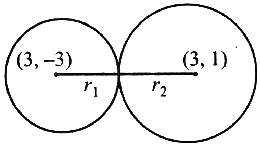
(B) The given circle is $x^2+y^2-6x+6y+17=0$. Its center is $C_1 = (3, -3)$ and its radius is $r_1 = \sqrt{3^2+(-3)^2-17} = \sqrt{9+9-17} = 1$.
The lines $x^2-3xy-3x+9y=0$ are normal to the required circle. Factoring the equation: $x(x-3y) - 3(x-3y) = 0 \Rightarrow (x-3)(x-3y) = 0$. Thus,the lines are $x=3$ and $y=x/3$. The intersection of these normals is the center of the required circle,$C_2 = (3, 1)$.
Since the circles touch externally,the distance between centers $d = C_1C_2 = \sqrt{(3-3)^2 + (1-(-3))^2} = \sqrt{0^2 + 4^2} = 4$.
For external contact,$d = r_1 + r_2$. So,$4 = 1 + r_2$,which gives $r_2 = 3$.
The equation of the required circle with center $(3, 1)$ and radius $3$ is $(x-3)^2 + (y-1)^2 = 3^2$.
Expanding this: $x^2 - 6x + 9 + y^2 - 2y + 1 = 9 \Rightarrow x^2 + y^2 - 6x - 2y + 1 = 0$.
The lines $x^2-3xy-3x+9y=0$ are normal to the required circle. Factoring the equation: $x(x-3y) - 3(x-3y) = 0 \Rightarrow (x-3)(x-3y) = 0$. Thus,the lines are $x=3$ and $y=x/3$. The intersection of these normals is the center of the required circle,$C_2 = (3, 1)$.
Since the circles touch externally,the distance between centers $d = C_1C_2 = \sqrt{(3-3)^2 + (1-(-3))^2} = \sqrt{0^2 + 4^2} = 4$.
For external contact,$d = r_1 + r_2$. So,$4 = 1 + r_2$,which gives $r_2 = 3$.
The equation of the required circle with center $(3, 1)$ and radius $3$ is $(x-3)^2 + (y-1)^2 = 3^2$.
Expanding this: $x^2 - 6x + 9 + y^2 - 2y + 1 = 9 \Rightarrow x^2 + y^2 - 6x - 2y + 1 = 0$.
0 likes
View Solution368
EasyMCQ
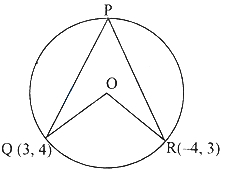
The triangle $PQR$ is inscribed in the circle $x^2+y^2=25$. If $Q=(3,4)$ and $R=(-4,3)$,then $\angle QPR=$
A
$\frac{\pi}{2}$
B
$\frac{\pi}{3}$
C
$\frac{\pi}{4}$
D
$\frac{\pi}{6}$
Solution
(C) The given equation of the circle is $x^2+y^2=25$.
Therefore,the centre $O$ is $(0,0)$ and the radius $r=5$.
Now,calculate the distance $QR$:
$QR = \sqrt{(-4-3)^2 + (3-4)^2} = \sqrt{(-7)^2 + (-1)^2} = \sqrt{49+1} = \sqrt{50} = 5\sqrt{2}$.
Since $O$ is the centre,$OQ = OR = 5$.
Using the law of cosines in $\triangle OQR$:
$\cos(\angle QOR) = \frac{OQ^2 + OR^2 - QR^2}{2 \times OQ \times OR} = \frac{25 + 25 - 50}{2 \times 5 \times 5} = \frac{0}{50} = 0$.
Thus,$\angle QOR = \frac{\pi}{2}$.
We know that the angle subtended by an arc at the centre is double the angle subtended by the same arc at any point on the remaining part of the circle.
Therefore,$\angle QOR = 2 \angle QPR$.
$\frac{\pi}{2} = 2 \angle QPR \implies \angle QPR = \frac{\pi}{4}$.
Therefore,the centre $O$ is $(0,0)$ and the radius $r=5$.
Now,calculate the distance $QR$:
$QR = \sqrt{(-4-3)^2 + (3-4)^2} = \sqrt{(-7)^2 + (-1)^2} = \sqrt{49+1} = \sqrt{50} = 5\sqrt{2}$.
Since $O$ is the centre,$OQ = OR = 5$.
Using the law of cosines in $\triangle OQR$:
$\cos(\angle QOR) = \frac{OQ^2 + OR^2 - QR^2}{2 \times OQ \times OR} = \frac{25 + 25 - 50}{2 \times 5 \times 5} = \frac{0}{50} = 0$.
Thus,$\angle QOR = \frac{\pi}{2}$.
We know that the angle subtended by an arc at the centre is double the angle subtended by the same arc at any point on the remaining part of the circle.
Therefore,$\angle QOR = 2 \angle QPR$.
$\frac{\pi}{2} = 2 \angle QPR \implies \angle QPR = \frac{\pi}{4}$.
0 likes
View Solution369
EasyMCQ
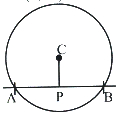
If the midpoint of the chord intercepted by the circle $x^2+y^2-8x+10y+5=0$ on the line $2x+y+2=0$ is $(h, k)$,then $k+4h=$
A
$2$
B
$0$
C
$1$
D
$-1$
Solution
(A) The equation of the circle is $x^2+y^2-8x+10y+5=0$. Comparing this with $x^2+y^2+2gx+2fy+c=0$,we get $g=-4$ and $f=5$. The center of the circle is $C(-g, -f) = (4, -5)$.
Let the midpoint of the chord be $P(h, k)$. Since $P$ lies on the line $2x+y+2=0$,we have $2h+k+2=0$ ... $(i)$.
The line segment $CP$ is perpendicular to the chord $2x+y+2=0$. The slope of the chord is $-2$. Therefore,the slope of $CP$ is $\frac{1}{2}$.
The slope of $CP$ is given by $\frac{k-(-5)}{h-4} = \frac{k+5}{h-4}$.
Equating the slopes: $\frac{k+5}{h-4} = \frac{1}{2}$ $\Rightarrow 2k+10 = h-4$ $\Rightarrow h-2k=14$ ... (ii).
Solving equations $(i)$ and (ii):
From $(i)$,$k = -2h-2$. Substituting into (ii): $h-2(-2h-2) = 14$ $\Rightarrow h+4h+4=14$ $\Rightarrow 5h=10$ $\Rightarrow h=2$.
Then $k = -2(2)-2 = -6$.
Thus,$k+4h = -6+4(2) = -6+8 = 2$.
Let the midpoint of the chord be $P(h, k)$. Since $P$ lies on the line $2x+y+2=0$,we have $2h+k+2=0$ ... $(i)$.
The line segment $CP$ is perpendicular to the chord $2x+y+2=0$. The slope of the chord is $-2$. Therefore,the slope of $CP$ is $\frac{1}{2}$.
The slope of $CP$ is given by $\frac{k-(-5)}{h-4} = \frac{k+5}{h-4}$.
Equating the slopes: $\frac{k+5}{h-4} = \frac{1}{2}$ $\Rightarrow 2k+10 = h-4$ $\Rightarrow h-2k=14$ ... (ii).
Solving equations $(i)$ and (ii):
From $(i)$,$k = -2h-2$. Substituting into (ii): $h-2(-2h-2) = 14$ $\Rightarrow h+4h+4=14$ $\Rightarrow 5h=10$ $\Rightarrow h=2$.
Then $k = -2(2)-2 = -6$.
Thus,$k+4h = -6+4(2) = -6+8 = 2$.
0 likes
View Solution370
MediumMCQ
$A$ circle $S$ touches the $Y$-axis at $(0,3)$ and makes an intercept of length $8$ units on the $X$-axis. If the centre $C$ of the circle $S$ lies in the second quadrant,then the distance of $C$ from the point $(-2,-1)$ is
A
$13$
B
$10$
C
$5$
D
$\sqrt{2}$
Solution
(C) The equation of a circle that touches the $Y$-axis at $(0,3)$ is given by $(x-a)^2 + (y-3)^2 = a^2$,which simplifies to $x^2 + y^2 - 2ax - 6y + 9 = 0$.
Since the length of the intercept on the $X$-axis is $8$ units,we use the formula $2\sqrt{g^2 - c} = 8$,where $g = -a$ and $c = 9$.
$2\sqrt{(-a)^2 - 9} = 8$ $\Rightarrow \sqrt{a^2 - 9} = 4$ $\Rightarrow a^2 - 9 = 16$ $\Rightarrow a^2 = 25$ $\Rightarrow a = \pm 5$.
Since the centre $C(a, 3)$ lies in the second quadrant,$a$ must be negative,so $a = -5$.
Thus,the centre is $C(-5, 3)$.
The distance of $C(-5, 3)$ from the point $(-2, -1)$ is $\sqrt{(-2 - (-5))^2 + (-1 - 3)^2} = \sqrt{(3)^2 + (-4)^2} = \sqrt{9 + 16} = \sqrt{25} = 5$.
Since the length of the intercept on the $X$-axis is $8$ units,we use the formula $2\sqrt{g^2 - c} = 8$,where $g = -a$ and $c = 9$.
$2\sqrt{(-a)^2 - 9} = 8$ $\Rightarrow \sqrt{a^2 - 9} = 4$ $\Rightarrow a^2 - 9 = 16$ $\Rightarrow a^2 = 25$ $\Rightarrow a = \pm 5$.
Since the centre $C(a, 3)$ lies in the second quadrant,$a$ must be negative,so $a = -5$.
Thus,the centre is $C(-5, 3)$.
The distance of $C(-5, 3)$ from the point $(-2, -1)$ is $\sqrt{(-2 - (-5))^2 + (-1 - 3)^2} = \sqrt{(3)^2 + (-4)^2} = \sqrt{9 + 16} = \sqrt{25} = 5$.
0 likes
View Solution371
EasyMCQ
If the lines joining the origin to the points of intersection of a line $L$ and $x^2+y^2=4$ are the coordinate axes,then the equation of the line $L$ is
A
$x+y=2$
B
$x+y=4$
C
$x+y=1$
D
$x+y=0$
Solution
(A) The given circle is $x^2+y^2=4$,which can be written as $x^2+y^2=2^2$.
This represents a circle with center at the origin $(0,0)$ and radius $r=2$.
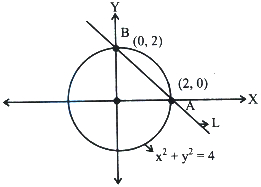
From the figure,the lines joining the origin to the points of intersection of line $L$ and the circle are the coordinate axes.
The points of intersection are $A(2,0)$ and $B(0,2)$.
The equation of the line $L$ passing through $(2,0)$ and $(0,2)$ is given by the intercept form: $\frac{x}{a}+\frac{y}{b}=1$.
Substituting $a=2$ and $b=2$,we get $\frac{x}{2}+\frac{y}{2}=1$,which simplifies to $x+y=2$.
This represents a circle with center at the origin $(0,0)$ and radius $r=2$.
From the figure,the lines joining the origin to the points of intersection of line $L$ and the circle are the coordinate axes.
The points of intersection are $A(2,0)$ and $B(0,2)$.
The equation of the line $L$ passing through $(2,0)$ and $(0,2)$ is given by the intercept form: $\frac{x}{a}+\frac{y}{b}=1$.
Substituting $a=2$ and $b=2$,we get $\frac{x}{2}+\frac{y}{2}=1$,which simplifies to $x+y=2$.
0 likes
View Solution372
MediumMCQ
The length of the intercept on the line $4x - 3y - 10 = 0$ by the circle $x^2 + y^2 - 2x + 4y - 20 = 0$ is
A
$5$
B
$2$
C
$10$
D
$6$
Solution
(C) The given circle equation is $x^2 + y^2 - 2x + 4y - 20 = 0$.
Comparing this with the general form $x^2 + y^2 + 2gx + 2fy + c = 0$,we get $g = -1$,$f = 2$,and $c = -20$.
The center of the circle is $(-g, -f) = (1, -2)$.
Check if the line $4x - 3y - 10 = 0$ passes through the center $(1, -2)$:
$4(1) - 3(-2) - 10 = 4 + 6 - 10 = 0$.
Since the line passes through the center,the intercept is the diameter of the circle.
The radius $r$ is given by $\sqrt{g^2 + f^2 - c} = \sqrt{(-1)^2 + (2)^2 - (-20)} = \sqrt{1 + 4 + 20} = \sqrt{25} = 5$.
The length of the intercept (diameter) is $2r = 2 \times 5 = 10$.
Comparing this with the general form $x^2 + y^2 + 2gx + 2fy + c = 0$,we get $g = -1$,$f = 2$,and $c = -20$.
The center of the circle is $(-g, -f) = (1, -2)$.
Check if the line $4x - 3y - 10 = 0$ passes through the center $(1, -2)$:
$4(1) - 3(-2) - 10 = 4 + 6 - 10 = 0$.
Since the line passes through the center,the intercept is the diameter of the circle.
The radius $r$ is given by $\sqrt{g^2 + f^2 - c} = \sqrt{(-1)^2 + (2)^2 - (-20)} = \sqrt{1 + 4 + 20} = \sqrt{25} = 5$.
The length of the intercept (diameter) is $2r = 2 \times 5 = 10$.
0 likes
View Solution373
EasyMCQ
The area of the circle passing through the points $(5, 2), (5, -2),$ and $(1, 2)$ is (in $\pi$)
A
$8$
B
$4$
C
$2$
D
$16$
Solution
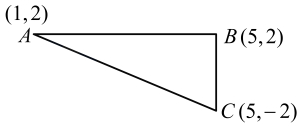
(A) Let the points be $A(1, 2)$, $B(5, 2)$, and $C(5, -2)$.
Plotting these points, we observe that $AB$ is a horizontal line segment of length $4$ and $BC$ is a vertical line segment of length $4$.
Since $AB \perp BC$, the triangle $\triangle ABC$ is a right-angled triangle with the right angle at $B$.
For a circle passing through the vertices of a right-angled triangle, the hypotenuse is the diameter of the circle.
The hypotenuse is $AC = \sqrt{(5-1)^2 + (-2-2)^2} = \sqrt{4^2 + (-4)^2} = \sqrt{16 + 16} = \sqrt{32} = 4\sqrt{2}$.
Thus, the diameter of the circle is $4\sqrt{2}$.
The radius $r$ is half of the diameter, so $r = \frac{4\sqrt{2}}{2} = 2\sqrt{2}$.
The area of the circle is $\pi r^2 = \pi(2\sqrt{2})^2 = \pi(8) = 8\pi$.
Plotting these points, we observe that $AB$ is a horizontal line segment of length $4$ and $BC$ is a vertical line segment of length $4$.
Since $AB \perp BC$, the triangle $\triangle ABC$ is a right-angled triangle with the right angle at $B$.
For a circle passing through the vertices of a right-angled triangle, the hypotenuse is the diameter of the circle.
The hypotenuse is $AC = \sqrt{(5-1)^2 + (-2-2)^2} = \sqrt{4^2 + (-4)^2} = \sqrt{16 + 16} = \sqrt{32} = 4\sqrt{2}$.
Thus, the diameter of the circle is $4\sqrt{2}$.
The radius $r$ is half of the diameter, so $r = \frac{4\sqrt{2}}{2} = 2\sqrt{2}$.
The area of the circle is $\pi r^2 = \pi(2\sqrt{2})^2 = \pi(8) = 8\pi$.
0 likes
View Solution374
MediumMCQ
The radius of the circle having $3x - 4y + 4 = 0$ and $6x - 8y - 7 = 0$ as its tangents is
A
$\frac{3}{2}$
B
$3$
C
$6$
D
$\frac{3}{4}$
Solution
(D) The equations of the given tangents are:
$E_1: 3x - 4y + 4 = 0$
$E_2: 6x - 8y - 7 = 0 \Rightarrow 3x - 4y - \frac{7}{2} = 0$
Since the slopes of both lines are equal to $\frac{3}{4}$,the tangents are parallel.
The distance $d$ between two parallel lines $ax + by + c_1 = 0$ and $ax + by + c_2 = 0$ is given by $d = \left| \frac{c_1 - c_2}{\sqrt{a^2 + b^2}} \right|$.
Here,$a = 3, b = -4, c_1 = 4, c_2 = -\frac{7}{2}$.
$d = \left| \frac{4 - (-\frac{7}{2})}{\sqrt{3^2 + (-4)^2}} \right| = \left| \frac{\frac{8+7}{2}}{\sqrt{9 + 16}} \right| = \frac{15/2}{5} = \frac{3}{2}$.
The distance between two parallel tangents of a circle is equal to the diameter of the circle.
Therefore,Diameter $= \frac{3}{2}$.
Radius $= \frac{\text{Diameter}}{2} = \frac{3/2}{2} = \frac{3}{4}$.
$E_1: 3x - 4y + 4 = 0$
$E_2: 6x - 8y - 7 = 0 \Rightarrow 3x - 4y - \frac{7}{2} = 0$
Since the slopes of both lines are equal to $\frac{3}{4}$,the tangents are parallel.
The distance $d$ between two parallel lines $ax + by + c_1 = 0$ and $ax + by + c_2 = 0$ is given by $d = \left| \frac{c_1 - c_2}{\sqrt{a^2 + b^2}} \right|$.
Here,$a = 3, b = -4, c_1 = 4, c_2 = -\frac{7}{2}$.
$d = \left| \frac{4 - (-\frac{7}{2})}{\sqrt{3^2 + (-4)^2}} \right| = \left| \frac{\frac{8+7}{2}}{\sqrt{9 + 16}} \right| = \frac{15/2}{5} = \frac{3}{2}$.
The distance between two parallel tangents of a circle is equal to the diameter of the circle.
Therefore,Diameter $= \frac{3}{2}$.
Radius $= \frac{\text{Diameter}}{2} = \frac{3/2}{2} = \frac{3}{4}$.
0 likes
View Solution375
MediumMCQ
The circle touching the coordinate axes with its centre lying on $x-2y-3=0$ is
A
$x^2+y^2-2x+2y+1=0$
B
$x^2+y^2+2x-2y+1=0$
C
$x^2+y^2+6x+6y-9=0$
D
$x^2+y^2-6x-6y+9=0$
Solution
(A) Since the circle touches both coordinate axes,its centre $(h, k)$ must satisfy $|h| = |k| = r$,where $r$ is the radius.
Thus,the centre is either $(r, r), (r, -r), (-r, r),$ or $(-r, -r)$.
The centre lies on the line $x-2y-3=0$.
Case $1$: Centre is $(r, r)$. Then $r-2r-3=0$ $\Rightarrow -r=3$ $\Rightarrow r=-3$. Since $r > 0$,this is not possible.
Case $2$: Centre is $(r, -r)$. Then $r-2(-r)-3=0$ $\Rightarrow 3r=3$ $\Rightarrow r=1$. The centre is $(1, -1)$.
The equation of the circle is $(x-1)^2+(y+1)^2=1^2$ $\Rightarrow x^2-2x+1+y^2+2y+1=1$ $\Rightarrow x^2+y^2-2x+2y+1=0$.
Case $3$: Centre is $(-r, r)$. Then $-r-2r-3=0$ $\Rightarrow -3r=3$ $\Rightarrow r=-1$. Not possible.
Case $4$: Centre is $(-r, -r)$. Then $-r-2(-r)-3=0 \Rightarrow r=3$. The centre is $(-3, -3)$.
The equation of the circle is $(x+3)^2+(y+3)^2=3^2$ $\Rightarrow x^2+6x+9+y^2+6y+9=9$ $\Rightarrow x^2+y^2+6x+6y+9=0$ (not in options).
Therefore,the correct equation is $x^2+y^2-2x+2y+1=0$.
Thus,the centre is either $(r, r), (r, -r), (-r, r),$ or $(-r, -r)$.
The centre lies on the line $x-2y-3=0$.
Case $1$: Centre is $(r, r)$. Then $r-2r-3=0$ $\Rightarrow -r=3$ $\Rightarrow r=-3$. Since $r > 0$,this is not possible.
Case $2$: Centre is $(r, -r)$. Then $r-2(-r)-3=0$ $\Rightarrow 3r=3$ $\Rightarrow r=1$. The centre is $(1, -1)$.
The equation of the circle is $(x-1)^2+(y+1)^2=1^2$ $\Rightarrow x^2-2x+1+y^2+2y+1=1$ $\Rightarrow x^2+y^2-2x+2y+1=0$.
Case $3$: Centre is $(-r, r)$. Then $-r-2r-3=0$ $\Rightarrow -3r=3$ $\Rightarrow r=-1$. Not possible.
Case $4$: Centre is $(-r, -r)$. Then $-r-2(-r)-3=0 \Rightarrow r=3$. The centre is $(-3, -3)$.
The equation of the circle is $(x+3)^2+(y+3)^2=3^2$ $\Rightarrow x^2+6x+9+y^2+6y+9=9$ $\Rightarrow x^2+y^2+6x+6y+9=0$ (not in options).
Therefore,the correct equation is $x^2+y^2-2x+2y+1=0$.
0 likes
View Solution376
MediumMCQ
Suppose a circle passes through $(0, a)$ and $(b, h)$ having its centre at $(c, 0)$. Then the value of $c$ is
A
$\frac{b^2-a^2+h^2}{2 b}$
B
$\frac{b^2+a^2-h^2}{2 b}$
C
$\frac{b^2-a^2+h^2}{2 a}$
D
$\frac{b^2+a^2-h^2}{2 a}$
Solution
(A) Let the centre of the circle be $O = (c, 0)$.
Let the points on the circle be $A = (0, a)$ and $B = (b, h)$.
Since $O$ is the centre,the distance from $O$ to $A$ must equal the distance from $O$ to $B$,so $OA^2 = OB^2$.
$OA^2 = (c - 0)^2 + (0 - a)^2 = c^2 + a^2$.
$OB^2 = (c - b)^2 + (0 - h)^2 = (c - b)^2 + h^2$.
Equating the two distances:
$c^2 + a^2 = (c - b)^2 + h^2$.
$c^2 + a^2 = c^2 - 2bc + b^2 + h^2$.
$a^2 = -2bc + b^2 + h^2$.
$2bc = b^2 + h^2 - a^2$.
$c = \frac{b^2 - a^2 + h^2}{2b}$.
Let the points on the circle be $A = (0, a)$ and $B = (b, h)$.
Since $O$ is the centre,the distance from $O$ to $A$ must equal the distance from $O$ to $B$,so $OA^2 = OB^2$.
$OA^2 = (c - 0)^2 + (0 - a)^2 = c^2 + a^2$.
$OB^2 = (c - b)^2 + (0 - h)^2 = (c - b)^2 + h^2$.
Equating the two distances:
$c^2 + a^2 = (c - b)^2 + h^2$.
$c^2 + a^2 = c^2 - 2bc + b^2 + h^2$.
$a^2 = -2bc + b^2 + h^2$.
$2bc = b^2 + h^2 - a^2$.
$c = \frac{b^2 - a^2 + h^2}{2b}$.
0 likes
View Solution377
EasyMCQ
For any real number $\lambda \neq 1$,the centre of the circle that passes through $A(1, \lambda)$,$B(\lambda, 1)$,and $C(\lambda, \lambda)$ is
A
$\left(\frac{1+\lambda}{2}, \frac{1+\lambda}{2}\right)$
B
$\left(\frac{1+2\lambda}{3}, \frac{1+2\lambda}{3}\right)$
C
$(1+2\lambda, 1+2\lambda)$
D
$\left(\frac{\lambda}{2}, \frac{\lambda}{2}\right)$
Solution
(A) Let the circle pass through $A(1, \lambda)$,$B(\lambda, 1)$,and $C(\lambda, \lambda)$.
Since the points $B(\lambda, 1)$ and $C(\lambda, \lambda)$ have the same $x$-coordinate,the perpendicular bisector of $BC$ is the horizontal line $y = \frac{1+\lambda}{2}$.
Since the points $A(1, \lambda)$ and $C(\lambda, \lambda)$ have the same $y$-coordinate,the perpendicular bisector of $AC$ is the vertical line $x = \frac{1+\lambda}{2}$.
The centre of the circle is the intersection of these perpendicular bisectors.
Therefore,the centre is $\left(\frac{1+\lambda}{2}, \frac{1+\lambda}{2}\right)$.
Since the points $B(\lambda, 1)$ and $C(\lambda, \lambda)$ have the same $x$-coordinate,the perpendicular bisector of $BC$ is the horizontal line $y = \frac{1+\lambda}{2}$.
Since the points $A(1, \lambda)$ and $C(\lambda, \lambda)$ have the same $y$-coordinate,the perpendicular bisector of $AC$ is the vertical line $x = \frac{1+\lambda}{2}$.
The centre of the circle is the intersection of these perpendicular bisectors.
Therefore,the centre is $\left(\frac{1+\lambda}{2}, \frac{1+\lambda}{2}\right)$.
0 likes
View Solution378
MediumMCQ
Let $L_1$ be a straight line passing through the origin and $L_2$ be the straight line $x+y=1$. If the intercepts made by the circle $x^2+y^2-x+3y=0$ on $L_1$ and $L_2$ are equal,then which of the following equations represent $L_1$?
A
$x+y=0 \text{ and } x+7y=0$
B
$x-y=0 \text{ and } x+7y=0$
C
$x-7y=0 \text{ and } x+y=0$
D
$x-7y=0 \text{ and } x-y=0$
Solution
(B) The equation of the circle is $x^2+y^2-x+3y=0$. The center is $C = (\frac{1}{2}, -\frac{3}{2})$.
Let the line $L_1$ passing through the origin be $y = mx$,or $mx - y = 0$.
The line $L_2$ is $x + y - 1 = 0$.
Since the intercepts made by the circle on $L_1$ and $L_2$ are equal,the perpendicular distances from the center $C$ to these lines must be equal.
The perpendicular distance from $C(\frac{1}{2}, -\frac{3}{2})$ to $L_1$ is $d_1 = \frac{|m(\frac{1}{2}) - (-\frac{3}{2})|}{\sqrt{m^2 + (-1)^2}} = \frac{|\frac{m+3}{2}|}{\sqrt{m^2+1}}$.
The perpendicular distance from $C(\frac{1}{2}, -\frac{3}{2})$ to $L_2$ is $d_2 = \frac{|\frac{1}{2} - \frac{3}{2} - 1|}{\sqrt{1^2 + 1^2}} = \frac{|-2|}{\sqrt{2}} = \sqrt{2}$.
Equating $d_1^2 = d_2^2$,we get $\frac{(m+3)^2}{4(m^2+1)} = 2$.
$(m+3)^2 = 8(m^2+1) \Rightarrow m^2 + 6m + 9 = 8m^2 + 8$.
$7m^2 - 6m - 1 = 0$.
$(7m+1)(m-1) = 0$,so $m = 1$ or $m = -\frac{1}{7}$.
For $m = 1$,$L_1$ is $y = x$ or $x - y = 0$.
For $m = -\frac{1}{7}$,$L_1$ is $y = -\frac{1}{7}x$ or $x + 7y = 0$.
Let the line $L_1$ passing through the origin be $y = mx$,or $mx - y = 0$.
The line $L_2$ is $x + y - 1 = 0$.
Since the intercepts made by the circle on $L_1$ and $L_2$ are equal,the perpendicular distances from the center $C$ to these lines must be equal.
The perpendicular distance from $C(\frac{1}{2}, -\frac{3}{2})$ to $L_1$ is $d_1 = \frac{|m(\frac{1}{2}) - (-\frac{3}{2})|}{\sqrt{m^2 + (-1)^2}} = \frac{|\frac{m+3}{2}|}{\sqrt{m^2+1}}$.
The perpendicular distance from $C(\frac{1}{2}, -\frac{3}{2})$ to $L_2$ is $d_2 = \frac{|\frac{1}{2} - \frac{3}{2} - 1|}{\sqrt{1^2 + 1^2}} = \frac{|-2|}{\sqrt{2}} = \sqrt{2}$.
Equating $d_1^2 = d_2^2$,we get $\frac{(m+3)^2}{4(m^2+1)} = 2$.
$(m+3)^2 = 8(m^2+1) \Rightarrow m^2 + 6m + 9 = 8m^2 + 8$.
$7m^2 - 6m - 1 = 0$.
$(7m+1)(m-1) = 0$,so $m = 1$ or $m = -\frac{1}{7}$.
For $m = 1$,$L_1$ is $y = x$ or $x - y = 0$.
For $m = -\frac{1}{7}$,$L_1$ is $y = -\frac{1}{7}x$ or $x + 7y = 0$.
0 likes
View Solution379
EasyMCQ
The circle $x^2+y^2+4x-4y+4=0$ touches...
A
$X$-axis only
B
$Y$-axis only
C
$X$-axis and $Y$-axis
D
$x=y$
Solution
(C) Given circle equation is $x^2+y^2+4x-4y+4=0$.
Comparing this with the general form $x^2+y^2+2gx+2fy+c=0$,we get $g=2$,$f=-2$,and $c=4$.
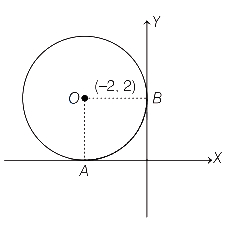
The center of the circle is $(-g, -f) = (-2, 2)$.
The radius of the circle is $r = \sqrt{g^2+f^2-c} = \sqrt{2^2+(-2)^2-4} = \sqrt{4+4-4} = \sqrt{4} = 2$.
Since the absolute value of the $x$-coordinate of the center is $|-2| = 2$ (which equals the radius) and the absolute value of the $y$-coordinate of the center is $|2| = 2$ (which also equals the radius),the circle touches both the $X$-axis and the $Y$-axis.
Comparing this with the general form $x^2+y^2+2gx+2fy+c=0$,we get $g=2$,$f=-2$,and $c=4$.
The center of the circle is $(-g, -f) = (-2, 2)$.
The radius of the circle is $r = \sqrt{g^2+f^2-c} = \sqrt{2^2+(-2)^2-4} = \sqrt{4+4-4} = \sqrt{4} = 2$.
Since the absolute value of the $x$-coordinate of the center is $|-2| = 2$ (which equals the radius) and the absolute value of the $y$-coordinate of the center is $|2| = 2$ (which also equals the radius),the circle touches both the $X$-axis and the $Y$-axis.
0 likes
View Solution380
MediumMCQ
If the parametric values of two points $A$ and $B$ on the circle $x^2+y^2-6x+4y-12=0$ are $30^{\circ}$ and $90^{\circ}$ respectively,then the equation of chord $AB$ is
A
$x+\sqrt{3}y=0$
B
$x-\sqrt{3}y=0$
C
$x+\sqrt{3}y-3(1+\sqrt{3})=0$
D
$\sqrt{3}x+\sqrt{3}y+61=0$
Solution
(C) The given equation of the circle is $x^2+y^2-6x+4y-12=0$.
Completing the square,we get $(x-3)^2+(y+2)^2=5^2$.
The center is $(h, k) = (3, -2)$ and the radius $r=5$.
The parametric coordinates are $x=3+5\cos\theta$ and $y=-2+5\sin\theta$.
For point $A$ with $\theta=30^{\circ}$,$A = (3+5\cos 30^{\circ}, -2+5\sin 30^{\circ}) = (3+\frac{5\sqrt{3}}{2}, -2+\frac{5}{2}) = (\frac{6+5\sqrt{3}}{2}, \frac{1}{2})$.
For point $B$ with $\theta=90^{\circ}$,$B = (3+5\cos 90^{\circ}, -2+5\sin 90^{\circ}) = (3, 3)$.
The slope of chord $AB$ is $m = \frac{3-1/2}{3-(6+5\sqrt{3})/2} = \frac{5/2}{(6-5\sqrt{3})/2} = \frac{5}{6-5\sqrt{3}}$.
Wait,calculating slope $m = \frac{3-0.5}{3-(3+2.5\sqrt{3})} = \frac{2.5}{-2.5\sqrt{3}} = -\frac{1}{\sqrt{3}}$.
Using the point-slope form $y-y_1 = m(x-x_1)$ at point $B(3, 3)$:
$y-3 = -\frac{1}{\sqrt{3}}(x-3)$.
$\sqrt{3}y-3\sqrt{3} = -x+3$.
$x+\sqrt{3}y-3-3\sqrt{3} = 0$.
$x+\sqrt{3}y-3(1+\sqrt{3}) = 0$.
Completing the square,we get $(x-3)^2+(y+2)^2=5^2$.
The center is $(h, k) = (3, -2)$ and the radius $r=5$.
The parametric coordinates are $x=3+5\cos\theta$ and $y=-2+5\sin\theta$.
For point $A$ with $\theta=30^{\circ}$,$A = (3+5\cos 30^{\circ}, -2+5\sin 30^{\circ}) = (3+\frac{5\sqrt{3}}{2}, -2+\frac{5}{2}) = (\frac{6+5\sqrt{3}}{2}, \frac{1}{2})$.
For point $B$ with $\theta=90^{\circ}$,$B = (3+5\cos 90^{\circ}, -2+5\sin 90^{\circ}) = (3, 3)$.
The slope of chord $AB$ is $m = \frac{3-1/2}{3-(6+5\sqrt{3})/2} = \frac{5/2}{(6-5\sqrt{3})/2} = \frac{5}{6-5\sqrt{3}}$.
Wait,calculating slope $m = \frac{3-0.5}{3-(3+2.5\sqrt{3})} = \frac{2.5}{-2.5\sqrt{3}} = -\frac{1}{\sqrt{3}}$.
Using the point-slope form $y-y_1 = m(x-x_1)$ at point $B(3, 3)$:
$y-3 = -\frac{1}{\sqrt{3}}(x-3)$.
$\sqrt{3}y-3\sqrt{3} = -x+3$.
$x+\sqrt{3}y-3-3\sqrt{3} = 0$.
$x+\sqrt{3}y-3(1+\sqrt{3}) = 0$.
0 likes
View Solution381
EasyMCQ
If one end of the diameter of the circle $x^2+y^2-4x-6y+11=0$ is $(3,4)$,then the other end of the diameter is
A
$(0,1)$
B
$(1,1)$
C
$(1,2)$
D
$(1,0)$
Solution
(C) The given equation of the circle is $x^2+y^2-4x-6y+11=0$.
Comparing this with the general form $x^2+y^2+2gx+2fy+c=0$,we get $2g=-4 \Rightarrow g=-2$ and $2f=-6 \Rightarrow f=-3$.
The center of the circle is $(-g, -f) = (2, 3)$.
Let the other end of the diameter be $(h, k)$.
Since the center of the circle is the midpoint of the diameter,we have:
$\frac{h+3}{2} = 2$ $\Rightarrow h+3 = 4$ $\Rightarrow h = 1$
$\frac{k+4}{2} = 3$ $\Rightarrow k+4 = 6$ $\Rightarrow k = 2$
Thus,the other end of the diameter is $(1, 2)$.
Comparing this with the general form $x^2+y^2+2gx+2fy+c=0$,we get $2g=-4 \Rightarrow g=-2$ and $2f=-6 \Rightarrow f=-3$.
The center of the circle is $(-g, -f) = (2, 3)$.
Let the other end of the diameter be $(h, k)$.
Since the center of the circle is the midpoint of the diameter,we have:
$\frac{h+3}{2} = 2$ $\Rightarrow h+3 = 4$ $\Rightarrow h = 1$
$\frac{k+4}{2} = 3$ $\Rightarrow k+4 = 6$ $\Rightarrow k = 2$
Thus,the other end of the diameter is $(1, 2)$.
0 likes
View Solution382
EasyMCQ
If one end of the diameter of $x^2+y^2-2x-6y-15=0$ is $(4,1)$,then the coordinates of the other end are:
A
$(5,-2)$
B
$(-2,5)$
C
$(1,3)$
D
$(-2,-5)$
Solution
(B) The given equation of the circle is $x^2+y^2-2x-6y-15=0$.
Comparing this with the general form $x^2+y^2+2gx+2fy+c=0$,we get $g=-1$ and $f=-3$.
The centre of the circle is $(-g, -f) = (1, 3)$.
We know that the centre of a circle is the midpoint of any diameter.
Let the coordinates of the other end of the diameter be $(a, b)$.
Given one end is $(4, 1)$,by the midpoint formula:
$1 = \frac{4+a}{2}$ $\Rightarrow 2 = 4+a$ $\Rightarrow a = -2$.
$3 = \frac{1+b}{2}$ $\Rightarrow 6 = 1+b$ $\Rightarrow b = 5$.
Thus,the coordinates of the other end are $(-2, 5)$.
Comparing this with the general form $x^2+y^2+2gx+2fy+c=0$,we get $g=-1$ and $f=-3$.
The centre of the circle is $(-g, -f) = (1, 3)$.
We know that the centre of a circle is the midpoint of any diameter.
Let the coordinates of the other end of the diameter be $(a, b)$.
Given one end is $(4, 1)$,by the midpoint formula:
$1 = \frac{4+a}{2}$ $\Rightarrow 2 = 4+a$ $\Rightarrow a = -2$.
$3 = \frac{1+b}{2}$ $\Rightarrow 6 = 1+b$ $\Rightarrow b = 5$.
Thus,the coordinates of the other end are $(-2, 5)$.
0 likes
View Solution383
MediumMCQ
If a circle with radius $2.5$ units passes through the points $(2, 3)$ and $(5, 7)$,then its centre is
A
$(1.5, 2)$
B
$(7, 10)$
C
$(3, 4)$
D
$(3.5, 5)$
Solution
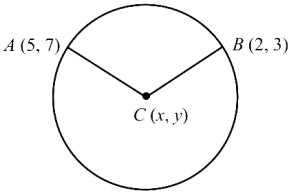
(D) Let the centre of the circle be $C(x, y)$.
Since the circle passes through $A(5, 7)$ and $B(2, 3)$,the distances $CA$ and $CB$ are equal to the radius $r = 2.5$.
$CA^2 = CB^2 = r^2 = (2.5)^2 = 6.25$.
Using the distance formula:
$(x - 5)^2 + (y - 7)^2 = 6.25$ ---$(1)$
$(x - 2)^2 + (y - 3)^2 = 6.25$ ---$(2)$
Subtracting $(2)$ from $(1)$:
$(x - 5)^2 - (x - 2)^2 + (y - 7)^2 - (y - 3)^2 = 0$
$(x^2 - 10x + 25 - x^2 + 4x - 4) + (y^2 - 14y + 49 - y^2 + 6y - 9) = 0$
$-6x + 21 - 8y + 40 = 0$
$6x + 8y = 61$
Checking the options:
For $(3.5, 5)$: $6(3.5) + 8(5) = 21 + 40 = 61$. This satisfies the equation.
Now check the radius: $(3.5 - 2)^2 + (5 - 3)^2 = (1.5)^2 + (2)^2 = 2.25 + 4 = 6.25 = (2.5)^2$.
Thus,the centre is $(3.5, 5)$.
Since the circle passes through $A(5, 7)$ and $B(2, 3)$,the distances $CA$ and $CB$ are equal to the radius $r = 2.5$.
$CA^2 = CB^2 = r^2 = (2.5)^2 = 6.25$.
Using the distance formula:
$(x - 5)^2 + (y - 7)^2 = 6.25$ ---$(1)$
$(x - 2)^2 + (y - 3)^2 = 6.25$ ---$(2)$
Subtracting $(2)$ from $(1)$:
$(x - 5)^2 - (x - 2)^2 + (y - 7)^2 - (y - 3)^2 = 0$
$(x^2 - 10x + 25 - x^2 + 4x - 4) + (y^2 - 14y + 49 - y^2 + 6y - 9) = 0$
$-6x + 21 - 8y + 40 = 0$
$6x + 8y = 61$
Checking the options:
For $(3.5, 5)$: $6(3.5) + 8(5) = 21 + 40 = 61$. This satisfies the equation.
Now check the radius: $(3.5 - 2)^2 + (5 - 3)^2 = (1.5)^2 + (2)^2 = 2.25 + 4 = 6.25 = (2.5)^2$.
Thus,the centre is $(3.5, 5)$.
0 likes
View Solution384
EasyMCQ
Let $S=0$ be the circle passing through the points $(2,0)$,$(1,-2)$,and $(-1,1)$. Then the point $(1,2)$
A
lies inside the circle $S=0$
B
lies outside the circle $S=0$
C
lies on the circle $S=0$
D
is the centre of the circle $S=0$
Solution
(B) Let the equation of the circle be $(x-a)^2+(y-b)^2=r^2$.
Since the circle passes through $(2,0)$,$(1,-2)$,and $(-1,1)$,we have:
$(2-a)^2+b^2=r^2$
$(1-a)^2+(-2-b)^2=r^2$
$(-1-a)^2+(1-b)^2=r^2$
Solving these equations,we find $a=\frac{3}{14}$,$b=-\frac{5}{14}$,and $r^2=\frac{325}{98}$.
The equation of the circle is $\left(x-\frac{3}{14}\right)^2+\left(y+\frac{5}{14}\right)^2=\frac{325}{98}$.
Let $S(x,y) = \left(x-\frac{3}{14}\right)^2+\left(y+\frac{5}{14}\right)^2-\frac{325}{98}$.
For the point $(1,2)$,$S(1,2) = \left(1-\frac{3}{14}\right)^2+\left(2+\frac{5}{14}\right)^2-\frac{325}{98} = \left(\frac{11}{14}\right)^2+\left(\frac{33}{14}\right)^2-\frac{325}{98} = \frac{121}{196}+\frac{1089}{196}-\frac{650}{196} = \frac{560}{196} > 0$.
Since $S(1,2) > 0$,the point $(1,2)$ lies outside the circle.
Since the circle passes through $(2,0)$,$(1,-2)$,and $(-1,1)$,we have:
$(2-a)^2+b^2=r^2$
$(1-a)^2+(-2-b)^2=r^2$
$(-1-a)^2+(1-b)^2=r^2$
Solving these equations,we find $a=\frac{3}{14}$,$b=-\frac{5}{14}$,and $r^2=\frac{325}{98}$.
The equation of the circle is $\left(x-\frac{3}{14}\right)^2+\left(y+\frac{5}{14}\right)^2=\frac{325}{98}$.
Let $S(x,y) = \left(x-\frac{3}{14}\right)^2+\left(y+\frac{5}{14}\right)^2-\frac{325}{98}$.
For the point $(1,2)$,$S(1,2) = \left(1-\frac{3}{14}\right)^2+\left(2+\frac{5}{14}\right)^2-\frac{325}{98} = \left(\frac{11}{14}\right)^2+\left(\frac{33}{14}\right)^2-\frac{325}{98} = \frac{121}{196}+\frac{1089}{196}-\frac{650}{196} = \frac{560}{196} > 0$.
Since $S(1,2) > 0$,the point $(1,2)$ lies outside the circle.
0 likes
View Solution385
MediumMCQ
The ratio of the largest and shortest distances from the point $(2, -7)$ to the circle $x^2 + y^2 - 14x - 10y - 151 = 0$ is
A
$15:13$
B
$7:1$
C
$3:2$
D
$14:1$
Solution
(D) The given equation of the circle is $x^2 + y^2 - 14x - 10y - 151 = 0$.
Completing the square,we get $(x - 7)^2 + (y - 5)^2 = 151 + 49 + 25 = 225$.
Thus,the center $C = (7, 5)$ and the radius $r = 15$.
Let $P = (2, -7)$. The distance $d$ from $P$ to the center $C$ is $d = \sqrt{(7 - 2)^2 + (5 - (-7))^2} = \sqrt{5^2 + 12^2} = \sqrt{25 + 144} = 13$.
Since $d < r$ $(13 < 15)$,the point $P$ lies inside the circle.
The shortest distance from $P$ to the circle is $r - d = 15 - 13 = 2$.
The largest distance from $P$ to the circle is $r + d = 15 + 13 = 28$.
The ratio of the largest to the shortest distance is $28 : 2 = 14 : 1$.
Completing the square,we get $(x - 7)^2 + (y - 5)^2 = 151 + 49 + 25 = 225$.
Thus,the center $C = (7, 5)$ and the radius $r = 15$.
Let $P = (2, -7)$. The distance $d$ from $P$ to the center $C$ is $d = \sqrt{(7 - 2)^2 + (5 - (-7))^2} = \sqrt{5^2 + 12^2} = \sqrt{25 + 144} = 13$.
Since $d < r$ $(13 < 15)$,the point $P$ lies inside the circle.
The shortest distance from $P$ to the circle is $r - d = 15 - 13 = 2$.
The largest distance from $P$ to the circle is $r + d = 15 + 13 = 28$.
The ratio of the largest to the shortest distance is $28 : 2 = 14 : 1$.
0 likes
View Solution386
MediumMCQ
The image of the point $(3, 4)$ with respect to the radical axis of the circles $x^2 + y^2 + 8x + 2y + 10 = 0$ and $x^2 + y^2 + 7x + 3y + 10 = 0$ is
A
$(3, 4)$
B
$(-4, -3)$
C
$(4, 3)$
D
$(-3, -4)$
Solution
(C) Given circles are $S_1 \equiv x^2 + y^2 + 8x + 2y + 10 = 0$ and $S_2 \equiv x^2 + y^2 + 7x + 3y + 10 = 0$.
The radical axis is given by the equation $S_1 - S_2 = 0$.
Subtracting the two equations: $(x^2 + y^2 + 8x + 2y + 10) - (x^2 + y^2 + 7x + 3y + 10) = 0$.
This simplifies to $x - y = 0$,or $y = x$.
The image of a point $(x_0, y_0)$ with respect to the line $y = x$ is $(y_0, x_0)$.
Therefore,the image of the point $(3, 4)$ with respect to the line $y = x$ is $(4, 3)$.
The radical axis is given by the equation $S_1 - S_2 = 0$.
Subtracting the two equations: $(x^2 + y^2 + 8x + 2y + 10) - (x^2 + y^2 + 7x + 3y + 10) = 0$.
This simplifies to $x - y = 0$,or $y = x$.
The image of a point $(x_0, y_0)$ with respect to the line $y = x$ is $(y_0, x_0)$.
Therefore,the image of the point $(3, 4)$ with respect to the line $y = x$ is $(4, 3)$.
0 likes
View Solution387
EasyMCQ
The least distance of the point $(10, 7)$ from the circle $x^2 + y^2 - 4x - 2y - 20 = 0$ is
A
$6$
B
$7$
C
$4$
D
$5$
Solution
(D) The given equation of the circle is $x^2 + y^2 - 4x - 2y - 20 = 0$.
Comparing this with the standard form $x^2 + y^2 + 2gx + 2fy + c = 0$,we get $g = -2$,$f = -1$,and $c = -20$.
The center of the circle is $C = (-g, -f) = (2, 1)$.
The radius $r$ is given by $\sqrt{g^2 + f^2 - c} = \sqrt{(-2)^2 + (-1)^2 - (-20)} = \sqrt{4 + 1 + 20} = \sqrt{25} = 5$.
Let the point be $P = (10, 7)$. The distance $d$ between the point $P$ and the center $C$ is $\sqrt{(10 - 2)^2 + (7 - 1)^2} = \sqrt{8^2 + 6^2} = \sqrt{64 + 36} = \sqrt{100} = 10$.
Since the distance $d = 10$ is greater than the radius $r = 5$,the point lies outside the circle.
The least distance of the point from the circle is $d - r = 10 - 5 = 5$ units.
Comparing this with the standard form $x^2 + y^2 + 2gx + 2fy + c = 0$,we get $g = -2$,$f = -1$,and $c = -20$.
The center of the circle is $C = (-g, -f) = (2, 1)$.
The radius $r$ is given by $\sqrt{g^2 + f^2 - c} = \sqrt{(-2)^2 + (-1)^2 - (-20)} = \sqrt{4 + 1 + 20} = \sqrt{25} = 5$.
Let the point be $P = (10, 7)$. The distance $d$ between the point $P$ and the center $C$ is $\sqrt{(10 - 2)^2 + (7 - 1)^2} = \sqrt{8^2 + 6^2} = \sqrt{64 + 36} = \sqrt{100} = 10$.
Since the distance $d = 10$ is greater than the radius $r = 5$,the point lies outside the circle.
The least distance of the point from the circle is $d - r = 10 - 5 = 5$ units.
0 likes
View Solution388
EasyMCQ
If the power of the point $(1, 6)$ with respect to the circle $x^2 + y^2 + 4x - 6y - a = 0$ is $-16$,then $a$ equals:
A
$5$
B
$11$
C
$21$
D
$6$
Solution
(C) The power of a point $(x_1, y_1)$ with respect to a circle $x^2 + y^2 + 2gx + 2fy + c = 0$ is given by the expression $x_1^2 + y_1^2 + 2gx_1 + 2fy_1 + c$.
Given the point $(1, 6)$ and the circle $x^2 + y^2 + 4x - 6y - a = 0$,the power is:
$1^2 + 6^2 + 4(1) - 6(6) - a = -16$
$1 + 36 + 4 - 36 - a = -16$
$5 - a = -16$
$a = 5 + 16$
$a = 21$
Given the point $(1, 6)$ and the circle $x^2 + y^2 + 4x - 6y - a = 0$,the power is:
$1^2 + 6^2 + 4(1) - 6(6) - a = -16$
$1 + 36 + 4 - 36 - a = -16$
$5 - a = -16$
$a = 5 + 16$
$a = 21$
0 likes
View Solution389
EasyMCQ
If the point $(\lambda, 1+\lambda)$ lies inside the circle $x^2+y^2=1$,then
A
$\lambda > 0$
B
$\lambda < 0$
C
$-1 < \lambda < 0$
D
$0 < \lambda < 1$
Solution
(C) For a point $(x_1, y_1)$ to lie inside the circle $x^2+y^2-r^2=0$,the condition is $x_1^2+y_1^2-r^2 < 0$.
Given the point $(\lambda, 1+\lambda)$ and the circle $x^2+y^2-1=0$,we substitute the point into the equation:
$\lambda^2 + (1+\lambda)^2 - 1 < 0$
$\lambda^2 + 1 + 2\lambda + \lambda^2 - 1 < 0$
$2\lambda^2 + 2\lambda < 0$
$2\lambda(\lambda+1) < 0$
Dividing by $2$,we get $\lambda(\lambda+1) < 0$.
This inequality holds when $\lambda$ lies between the roots $-1$ and $0$.
Therefore,$-1 < \lambda < 0$.
Given the point $(\lambda, 1+\lambda)$ and the circle $x^2+y^2-1=0$,we substitute the point into the equation:
$\lambda^2 + (1+\lambda)^2 - 1 < 0$
$\lambda^2 + 1 + 2\lambda + \lambda^2 - 1 < 0$
$2\lambda^2 + 2\lambda < 0$
$2\lambda(\lambda+1) < 0$
Dividing by $2$,we get $\lambda(\lambda+1) < 0$.
This inequality holds when $\lambda$ lies between the roots $-1$ and $0$.
Therefore,$-1 < \lambda < 0$.
0 likes
View Solution390
MediumMCQ
The point on the circle $x^2+y^2=4$ whose distance from the line $4x+3y-12=0$ is $4/5$ units is equal to
A
$\left(\frac{12}{25}, \frac{36}{25}\right)$
B
$(4,0)$
C
$(2,0)$
D
$\left(\frac{14}{25}, \frac{48}{25}\right)$
Solution
(C) Let the point on the circle be $(h, k)$. Since it lies on the circle $x^2+y^2=4$,we have $h^2+k^2=4$.
The distance of $(h, k)$ from the line $4x+3y-12=0$ is given by $\frac{|4h+3k-12|}{\sqrt{4^2+3^2}} = \frac{4}{5}$.
This simplifies to $|4h+3k-12|=4$,which gives two cases: $4h+3k=16$ or $4h+3k=8$.
Case $1$: $4h+3k=16 \Rightarrow k = \frac{16-4h}{3}$. Substituting into $h^2+k^2=4$ gives $h^2 + (\frac{16-4h}{3})^2 = 4$,which simplifies to $25h^2-128h+220=0$. The discriminant $D = 128^2 - 4(25)(220) = 16384 - 22000 < 0$,so no real solutions exist.
Case $2$: $4h+3k=8 \Rightarrow k = \frac{8-4h}{3}$. Substituting into $h^2+k^2=4$ gives $h^2 + (\frac{8-4h}{3})^2 = 4$,which simplifies to $25h^2-64h+28=0$.
Solving for $h$ using the quadratic formula: $h = \frac{64 \pm \sqrt{64^2 - 4(25)(28)}}{2(25)} = \frac{64 \pm \sqrt{4096 - 2800}}{50} = \frac{64 \pm \sqrt{1296}}{50} = \frac{64 \pm 36}{50}$.
This gives $h = \frac{100}{50} = 2$ or $h = \frac{28}{50} = \frac{14}{25}$.
If $h=2$,$k = \frac{8-4(2)}{3} = 0$. If $h=\frac{14}{25}$,$k = \frac{8-4(14/25)}{3} = \frac{200-56}{75} = \frac{144}{75} = \frac{48}{25}$.
Thus,the points are $(2,0)$ and $(\frac{14}{25}, \frac{48}{25})$.
The distance of $(h, k)$ from the line $4x+3y-12=0$ is given by $\frac{|4h+3k-12|}{\sqrt{4^2+3^2}} = \frac{4}{5}$.
This simplifies to $|4h+3k-12|=4$,which gives two cases: $4h+3k=16$ or $4h+3k=8$.
Case $1$: $4h+3k=16 \Rightarrow k = \frac{16-4h}{3}$. Substituting into $h^2+k^2=4$ gives $h^2 + (\frac{16-4h}{3})^2 = 4$,which simplifies to $25h^2-128h+220=0$. The discriminant $D = 128^2 - 4(25)(220) = 16384 - 22000 < 0$,so no real solutions exist.
Case $2$: $4h+3k=8 \Rightarrow k = \frac{8-4h}{3}$. Substituting into $h^2+k^2=4$ gives $h^2 + (\frac{8-4h}{3})^2 = 4$,which simplifies to $25h^2-64h+28=0$.
Solving for $h$ using the quadratic formula: $h = \frac{64 \pm \sqrt{64^2 - 4(25)(28)}}{2(25)} = \frac{64 \pm \sqrt{4096 - 2800}}{50} = \frac{64 \pm \sqrt{1296}}{50} = \frac{64 \pm 36}{50}$.
This gives $h = \frac{100}{50} = 2$ or $h = \frac{28}{50} = \frac{14}{25}$.
If $h=2$,$k = \frac{8-4(2)}{3} = 0$. If $h=\frac{14}{25}$,$k = \frac{8-4(14/25)}{3} = \frac{200-56}{75} = \frac{144}{75} = \frac{48}{25}$.
Thus,the points are $(2,0)$ and $(\frac{14}{25}, \frac{48}{25})$.
0 likes
View Solution391
MediumMCQ
The circle $x^2+y^2-6x-10y+p=0$ neither intersects nor touches the coordinate axes and the point $(1,4)$ lies inside the circle. Then the range of possible values of $p$ is
A
$23 < p < 25$
B
$25 < p < 29$
C
$21 < p < 23$
D
$12 < p < 21$
Solution
(B) The equation of the given circle is $x^2+y^2-6x-10y+p=0$.
Completing the square,we get $(x-3)^2+(y-5)^2 = 34-p$.
For the circle to exist,$34-p > 0$,so $p < 34$.
The center is $(3,5)$ and the radius is $r = \sqrt{34-p}$.
Since the point $(1,4)$ lies inside the circle,the power of the point must be negative: $1^2+4^2-6(1)-10(4)+p < 0$ $\Rightarrow 1+16-6-40+p < 0$ $\Rightarrow p < 29$ $(i)$.
Since the circle does not intersect or touch the coordinate axes,the distance from the center $(3,5)$ to the axes must be greater than the radius $r$.
Distance to $y$-axis is $|3| = 3$,so $r < 3$ $\Rightarrow \sqrt{34-p} < 3$ $\Rightarrow 34-p < 9$ $\Rightarrow p > 25$ (ii).
Distance to $x$-axis is $|5| = 5$,so $r < 5$ $\Rightarrow \sqrt{34-p} < 5$ $\Rightarrow 34-p < 25$ $\Rightarrow p > 9$ (iii).
Combining $(i)$,(ii),and (iii),we get $25 < p < 29$.
Completing the square,we get $(x-3)^2+(y-5)^2 = 34-p$.
For the circle to exist,$34-p > 0$,so $p < 34$.
The center is $(3,5)$ and the radius is $r = \sqrt{34-p}$.
Since the point $(1,4)$ lies inside the circle,the power of the point must be negative: $1^2+4^2-6(1)-10(4)+p < 0$ $\Rightarrow 1+16-6-40+p < 0$ $\Rightarrow p < 29$ $(i)$.
Since the circle does not intersect or touch the coordinate axes,the distance from the center $(3,5)$ to the axes must be greater than the radius $r$.
Distance to $y$-axis is $|3| = 3$,so $r < 3$ $\Rightarrow \sqrt{34-p} < 3$ $\Rightarrow 34-p < 9$ $\Rightarrow p > 25$ (ii).
Distance to $x$-axis is $|5| = 5$,so $r < 5$ $\Rightarrow \sqrt{34-p} < 5$ $\Rightarrow 34-p < 25$ $\Rightarrow p > 9$ (iii).
Combining $(i)$,(ii),and (iii),we get $25 < p < 29$.
0 likes
View Solution392
MediumMCQ
Find the maximum distance of the point $K(10, 7)$ from the circle $x^2 + y^2 - 4x - 2y - 20 = 0$.
A
$25$
B
$10$
C
$15$
D
$5$
Solution
(C) The equation of the given circle is $x^2 + y^2 - 4x - 2y - 20 = 0$.
Completing the square,we get $(x - 2)^2 + (y - 1)^2 = 25$.
This circle has center $C(2, 1)$ and radius $r = \sqrt{25} = 5$.
The distance between the point $K(10, 7)$ and the center $C(2, 1)$ is $CK = \sqrt{(10 - 2)^2 + (7 - 1)^2} = \sqrt{8^2 + 6^2} = \sqrt{64 + 36} = \sqrt{100} = 10$.
The maximum distance of the point $K$ from the circle is given by $CK + r = 10 + 5 = 15 \text{ units}$.
Thus,option $C$ is correct.
Completing the square,we get $(x - 2)^2 + (y - 1)^2 = 25$.
This circle has center $C(2, 1)$ and radius $r = \sqrt{25} = 5$.
The distance between the point $K(10, 7)$ and the center $C(2, 1)$ is $CK = \sqrt{(10 - 2)^2 + (7 - 1)^2} = \sqrt{8^2 + 6^2} = \sqrt{64 + 36} = \sqrt{100} = 10$.
The maximum distance of the point $K$ from the circle is given by $CK + r = 10 + 5 = 15 \text{ units}$.
Thus,option $C$ is correct.
0 likes
View Solution393
EasyMCQ
$A$ square is inscribed in the circle $x^2+y^2-2x+4y-93=0$ with its sides parallel to the coordinate axes. Which of the following can be one of the vertices of the square?
A
$(5,8)$
B
$(8,5)$
C
$(8,-5)$
D
$(-8,5)$
Solution
(B) The equation of the given circle is $x^2+y^2-2x+4y-93=0$.
Completing the square,we get $(x-1)^2+(y+2)^2 = 93+1+4 = 98$.
The center of the circle is $(h, k) = (1, -2)$ and the radius is $r = \sqrt{98} = 7\sqrt{2}$.
For a square inscribed in a circle with sides parallel to the coordinate axes,the vertices are given by $(h \pm r\cos(\pi/4), k \pm r\sin(\pi/4))$.
Since $\cos(\pi/4) = \sin(\pi/4) = 1/\sqrt{2}$,the vertices are $(1 \pm (7\sqrt{2})(1/\sqrt{2}), -2 \pm (7\sqrt{2})(1/\sqrt{2}))$.
This simplifies to $(1 \pm 7, -2 \pm 7)$.
The possible vertices are $(1+7, -2+7) = (8, 5)$,$(1+7, -2-7) = (8, -9)$,$(1-7, -2+7) = (-6, 5)$,and $(1-7, -2-7) = (-6, -9)$.
Comparing these with the given options,$(8, 5)$ is a valid vertex.
Completing the square,we get $(x-1)^2+(y+2)^2 = 93+1+4 = 98$.
The center of the circle is $(h, k) = (1, -2)$ and the radius is $r = \sqrt{98} = 7\sqrt{2}$.
For a square inscribed in a circle with sides parallel to the coordinate axes,the vertices are given by $(h \pm r\cos(\pi/4), k \pm r\sin(\pi/4))$.
Since $\cos(\pi/4) = \sin(\pi/4) = 1/\sqrt{2}$,the vertices are $(1 \pm (7\sqrt{2})(1/\sqrt{2}), -2 \pm (7\sqrt{2})(1/\sqrt{2}))$.
This simplifies to $(1 \pm 7, -2 \pm 7)$.
The possible vertices are $(1+7, -2+7) = (8, 5)$,$(1+7, -2-7) = (8, -9)$,$(1-7, -2+7) = (-6, 5)$,and $(1-7, -2-7) = (-6, -9)$.
Comparing these with the given options,$(8, 5)$ is a valid vertex.
0 likes
View Solution394
MediumMCQ
If $(1, a)$ and $(b, 2)$ are conjugate points with respect to the circle $x^2+y^2=25$,then $4a+2b=$
A
$25$
B
$50$
C
$75$
D
$100$
Solution
(B) Two points $(x_1, y_1)$ and $(x_2, y_2)$ are conjugate with respect to the circle $x^2+y^2=r^2$ if $x_1x_2 + y_1y_2 = r^2$.
Given the points $(1, a)$ and $(b, 2)$ and the circle $x^2+y^2=25$,we have $r^2=25$.
Substituting the coordinates into the condition,we get $(1)(b) + (a)(2) = 25$.
This simplifies to $b + 2a = 25$.
We need to find the value of $4a + 2b$.
Multiplying the equation $2a + b = 25$ by $2$,we get $2(2a + b) = 2(25)$,which is $4a + 2b = 50$.
Given the points $(1, a)$ and $(b, 2)$ and the circle $x^2+y^2=25$,we have $r^2=25$.
Substituting the coordinates into the condition,we get $(1)(b) + (a)(2) = 25$.
This simplifies to $b + 2a = 25$.
We need to find the value of $4a + 2b$.
Multiplying the equation $2a + b = 25$ by $2$,we get $2(2a + b) = 2(25)$,which is $4a + 2b = 50$.
0 likes
View Solution395
EasyMCQ
If the shortest distance from $(2,-14)$ to the circle $x^2+y^2+6x+4y-12=0$ is $d$ and the length of the tangent drawn from the same point to the circle is $l$,then $\sqrt{d+l}=$
A
$13$
B
$2\sqrt{5}$
C
$12$
D
$5$
Solution
(B) Given circle: $x^2+y^2+6x+4y-12=0$.
Comparing with $x^2+y^2+2gx+2fy+c=0$,we get $g=3, f=2, c=-12$.
Centre $O = (-g, -f) = (-3, -2)$.
Radius $R = \sqrt{g^2+f^2-c} = \sqrt{3^2+2^2-(-12)} = \sqrt{9+4+12} = \sqrt{25} = 5$.
Let $P = (2, -14)$. The distance $OP = \sqrt{(2 - (-3))^2 + (-14 - (-2))^2} = \sqrt{5^2 + (-12)^2} = \sqrt{25 + 144} = \sqrt{169} = 13$.
The shortest distance $d = OP - R = 13 - 5 = 8$.
The length of the tangent $l = \sqrt{OP^2 - R^2} = \sqrt{13^2 - 5^2} = \sqrt{169 - 25} = \sqrt{144} = 12$.
Therefore,$\sqrt{d+l} = \sqrt{8+12} = \sqrt{20} = 2\sqrt{5}$.
Comparing with $x^2+y^2+2gx+2fy+c=0$,we get $g=3, f=2, c=-12$.
Centre $O = (-g, -f) = (-3, -2)$.
Radius $R = \sqrt{g^2+f^2-c} = \sqrt{3^2+2^2-(-12)} = \sqrt{9+4+12} = \sqrt{25} = 5$.
Let $P = (2, -14)$. The distance $OP = \sqrt{(2 - (-3))^2 + (-14 - (-2))^2} = \sqrt{5^2 + (-12)^2} = \sqrt{25 + 144} = \sqrt{169} = 13$.
The shortest distance $d = OP - R = 13 - 5 = 8$.
The length of the tangent $l = \sqrt{OP^2 - R^2} = \sqrt{13^2 - 5^2} = \sqrt{169 - 25} = \sqrt{144} = 12$.
Therefore,$\sqrt{d+l} = \sqrt{8+12} = \sqrt{20} = 2\sqrt{5}$.
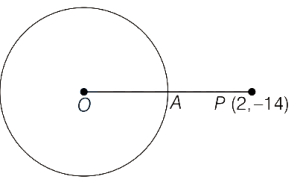
0 likes
View Solution396
EasyMCQ
The sum of the minimum and maximum distances of the point $(4,-3)$ to the circle $x^2+y^2+4x-10y-7=0$ is
A
$20$
B
$16$
C
$12$
D
$64$
Solution
(A) The equation of the circle is $x^2+y^2+4x-10y-7=0$.
Comparing this with $x^2+y^2+2gx+2fy+c=0$,we get $g=2$,$f=-5$,and $c=-7$.
The center of the circle is $C(-g, -f) = (-2, 5)$ and the radius $r = \sqrt{g^2+f^2-c} = \sqrt{2^2+(-5)^2-(-7)} = \sqrt{4+25+7} = \sqrt{36} = 6$.
Let $P$ be the point $(4, -3)$. The distance $d$ between the center $C(-2, 5)$ and point $P(4, -3)$ is $d = \sqrt{(4 - (-2))^2 + (-3 - 5)^2} = \sqrt{6^2 + (-8)^2} = \sqrt{36 + 64} = \sqrt{100} = 10$.
The minimum distance from the point to the circle is $|d - r| = |10 - 6| = 4$.
The maximum distance from the point to the circle is $d + r = 10 + 6 = 16$.
The sum of the minimum and maximum distances is $4 + 16 = 20$.
Comparing this with $x^2+y^2+2gx+2fy+c=0$,we get $g=2$,$f=-5$,and $c=-7$.
The center of the circle is $C(-g, -f) = (-2, 5)$ and the radius $r = \sqrt{g^2+f^2-c} = \sqrt{2^2+(-5)^2-(-7)} = \sqrt{4+25+7} = \sqrt{36} = 6$.
Let $P$ be the point $(4, -3)$. The distance $d$ between the center $C(-2, 5)$ and point $P(4, -3)$ is $d = \sqrt{(4 - (-2))^2 + (-3 - 5)^2} = \sqrt{6^2 + (-8)^2} = \sqrt{36 + 64} = \sqrt{100} = 10$.
The minimum distance from the point to the circle is $|d - r| = |10 - 6| = 4$.
The maximum distance from the point to the circle is $d + r = 10 + 6 = 16$.
The sum of the minimum and maximum distances is $4 + 16 = 20$.
0 likes
View Solution397
MediumMCQ
The inverse point of $(1, 3)$ with respect to the circle $x^2 + y^2 - 4x - 6y + 9 = 0$ is
A
$(2, 3)$
B
$(2, -3)$
C
$(-2, 3)$
D
$(-2, -3)$
Solution
(C) The equation of the circle is $x^2 + y^2 - 4x - 6y + 9 = 0$.
Comparing this with $x^2 + y^2 + 2gx + 2fy + c = 0$,we get $g = -2$,$f = -3$,and $c = 9$.
The center of the circle is $C(-g, -f) = (2, 3)$ and the radius is $r = \sqrt{g^2 + f^2 - c} = \sqrt{(-2)^2 + (-3)^2 - 9} = \sqrt{4 + 9 - 9} = 2$.
Let $P(x_1, y_1) = (1, 3)$ be the given point.
The inverse point $P'(x', y')$ of $P$ with respect to the circle is given by the formula:
$x' - h = \frac{r^2(x_1 - h)}{(x_1 - h)^2 + (y_1 - k)^2}$ and $y' - k = \frac{r^2(y_1 - k)}{(x_1 - h)^2 + (y_1 - k)^2}$,where $(h, k)$ is the center $(2, 3)$.
Substituting the values:
$x' - 2 = \frac{2^2(1 - 2)}{(1 - 2)^2 + (3 - 3)^2} = \frac{4(-1)}{(-1)^2 + 0} = -4 \implies x' = -2$.
$y' - 3 = \frac{2^2(3 - 3)}{(1 - 2)^2 + (3 - 3)^2} = \frac{4(0)}{1} = 0 \implies y' = 3$.
Thus,the inverse point is $(-2, 3)$.
Comparing this with $x^2 + y^2 + 2gx + 2fy + c = 0$,we get $g = -2$,$f = -3$,and $c = 9$.
The center of the circle is $C(-g, -f) = (2, 3)$ and the radius is $r = \sqrt{g^2 + f^2 - c} = \sqrt{(-2)^2 + (-3)^2 - 9} = \sqrt{4 + 9 - 9} = 2$.
Let $P(x_1, y_1) = (1, 3)$ be the given point.
The inverse point $P'(x', y')$ of $P$ with respect to the circle is given by the formula:
$x' - h = \frac{r^2(x_1 - h)}{(x_1 - h)^2 + (y_1 - k)^2}$ and $y' - k = \frac{r^2(y_1 - k)}{(x_1 - h)^2 + (y_1 - k)^2}$,where $(h, k)$ is the center $(2, 3)$.
Substituting the values:
$x' - 2 = \frac{2^2(1 - 2)}{(1 - 2)^2 + (3 - 3)^2} = \frac{4(-1)}{(-1)^2 + 0} = -4 \implies x' = -2$.
$y' - 3 = \frac{2^2(3 - 3)}{(1 - 2)^2 + (3 - 3)^2} = \frac{4(0)}{1} = 0 \implies y' = 3$.
Thus,the inverse point is $(-2, 3)$.
0 likes
View Solution398
MediumMCQ
The sum of the minimum and maximum distance of the point $(4, -3)$ to the circle $x^2 + y^2 + 4x - 10y - 7 = 0$ is:
A
$10$
B
$12$
C
$16$
D
$20$
Solution
(D) Let the given point be $P(4, -3)$ and the given circle be $x^2 + y^2 + 4x - 10y - 7 = 0$.
The center of the circle $C$ is $(-2, 5)$ and the radius $r$ is $\sqrt{(-2)^2 + (5)^2 - (-7)} = \sqrt{4 + 25 + 7} = \sqrt{36} = 6$.
The distance between the point $P$ and the center $C$ is $CP = \sqrt{(4 - (-2))^2 + (-3 - 5)^2} = \sqrt{6^2 + (-8)^2} = \sqrt{36 + 64} = \sqrt{100} = 10$.
The maximum distance from the point to the circle is $d_{max} = CP + r = 10 + 6 = 16$.
The minimum distance from the point to the circle is $d_{min} = |CP - r| = |10 - 6| = 4$.
The sum of the minimum and maximum distance is $d_{max} + d_{min} = 16 + 4 = 20$.
The center of the circle $C$ is $(-2, 5)$ and the radius $r$ is $\sqrt{(-2)^2 + (5)^2 - (-7)} = \sqrt{4 + 25 + 7} = \sqrt{36} = 6$.
The distance between the point $P$ and the center $C$ is $CP = \sqrt{(4 - (-2))^2 + (-3 - 5)^2} = \sqrt{6^2 + (-8)^2} = \sqrt{36 + 64} = \sqrt{100} = 10$.
The maximum distance from the point to the circle is $d_{max} = CP + r = 10 + 6 = 16$.
The minimum distance from the point to the circle is $d_{min} = |CP - r| = |10 - 6| = 4$.
The sum of the minimum and maximum distance is $d_{max} + d_{min} = 16 + 4 = 20$.
0 likes
View Solution399
MediumMCQ
If the product of the lengths of the perpendiculars drawn from the ends of a diameter of the circle $x^2+y^2=4$ onto the line $x+y+1=0$ is maximum,then the two ends of that diameter are
A
$(-2,0), (2,0)$
B
$(\sqrt{2}, \sqrt{2}), (-\sqrt{2}, -\sqrt{2})$
C
$(\sqrt{3}, 1), (-\sqrt{3}, -1)$
D
$(0,2), (0,-2)$
Solution
(B) Let the ends of the diameter be $A(2\cos\theta, 2\sin\theta)$ and $B(-2\cos\theta, -2\sin\theta)$.
The length of the perpendicular from $(x_1, y_1)$ to $x+y+1=0$ is $d = \frac{|x_1+y_1+1|}{\sqrt{1^2+1^2}} = \frac{|x_1+y_1+1|}{\sqrt{2}}$.
Let $d_1$ and $d_2$ be the lengths of the perpendiculars from $A$ and $B$ respectively.
$d_1 = \frac{|2\cos\theta+2\sin\theta+1|}{\sqrt{2}}$ and $d_2 = \frac{|-2\cos\theta-2\sin\theta+1|}{\sqrt{2}}$.
The product $P = d_1 d_2 = \frac{|(1+2(\cos\theta+\sin\theta))(1-2(\cos\theta+\sin\theta))|}{2} = \frac{|1-4(\cos\theta+\sin\theta)^2|}{2}$.
$P = \frac{|1-4(1+2\sin\theta\cos\theta)|}{2} = \frac{|1-4-4\sin(2\theta)|}{2} = \frac{|-3-4\sin(2\theta)|}{2} = \frac{3+4\sin(2\theta)}{2}$.
For $P$ to be maximum,$\sin(2\theta) = 1$,which means $2\theta = \frac{\pi}{2}$,so $\theta = \frac{\pi}{4}$.
Substituting $\theta = \frac{\pi}{4}$ into the coordinates of $A$ and $B$:
$A = (2\cos\frac{\pi}{4}, 2\sin\frac{\pi}{4}) = (2\frac{1}{\sqrt{2}}, 2\frac{1}{\sqrt{2}}) = (\sqrt{2}, \sqrt{2})$.
$B = (-2\cos\frac{\pi}{4}, -2\sin\frac{\pi}{4}) = (-\sqrt{2}, -\sqrt{2})$.
Thus,the correct option is $B$.
The length of the perpendicular from $(x_1, y_1)$ to $x+y+1=0$ is $d = \frac{|x_1+y_1+1|}{\sqrt{1^2+1^2}} = \frac{|x_1+y_1+1|}{\sqrt{2}}$.
Let $d_1$ and $d_2$ be the lengths of the perpendiculars from $A$ and $B$ respectively.
$d_1 = \frac{|2\cos\theta+2\sin\theta+1|}{\sqrt{2}}$ and $d_2 = \frac{|-2\cos\theta-2\sin\theta+1|}{\sqrt{2}}$.
The product $P = d_1 d_2 = \frac{|(1+2(\cos\theta+\sin\theta))(1-2(\cos\theta+\sin\theta))|}{2} = \frac{|1-4(\cos\theta+\sin\theta)^2|}{2}$.
$P = \frac{|1-4(1+2\sin\theta\cos\theta)|}{2} = \frac{|1-4-4\sin(2\theta)|}{2} = \frac{|-3-4\sin(2\theta)|}{2} = \frac{3+4\sin(2\theta)}{2}$.
For $P$ to be maximum,$\sin(2\theta) = 1$,which means $2\theta = \frac{\pi}{2}$,so $\theta = \frac{\pi}{4}$.
Substituting $\theta = \frac{\pi}{4}$ into the coordinates of $A$ and $B$:
$A = (2\cos\frac{\pi}{4}, 2\sin\frac{\pi}{4}) = (2\frac{1}{\sqrt{2}}, 2\frac{1}{\sqrt{2}}) = (\sqrt{2}, \sqrt{2})$.
$B = (-2\cos\frac{\pi}{4}, -2\sin\frac{\pi}{4}) = (-\sqrt{2}, -\sqrt{2})$.
Thus,the correct option is $B$.
0 likes
View Solution10-1.Circle and System of Circles — Geometrical problems regarding circle and its properties · Frequently Asked Questions
1Are these 10-1.Circle and System of Circles questions useful for JEE and NEET?
Yes. All questions in this section are mapped to JEE Main and NEET exam patterns. Previous year questions from JEE Main, NEET, GUJCET and state-level exams are included with full solutions.
2Can I switch to Hindi or Gujarati for these questions?
Yes. Use the language tabs in the hero section or the sidebar to view the same questions and solutions in English, Hindi or Gujarati.
3How do I generate a question paper from this subtopic?
Use the Vedclass Exam Paper Generator — select the chapter and subtopic, set difficulty, and generate Sets A, B, C, D automatically. First 3 chapters of every subject are free.
Vedclass Products
For Students
Vedclass Test Series
Mock tests in real JEE/NEET style with performance analysis. 5-day free trial.
Start Free TrialFor Teachers
Exam Paper Generator
Generate Set A/B/C/D papers from this chapter in 2 minutes. 3 chapters free.
Try FreeFor Institutes
Online Exam Module
Live online exams with unlimited students, 360° analytics & white-label branding.
See DemoFor Teachers & Institutes
Generate a 10-1.Circle and System of Circles Exam Paper in 2 Minutes
Select subtopic & difficulty — Sets A, B, C, D auto-generated with No Repeat logic.
First 3 chapters of every subject are free — no payment required.