
A English
Heat of reaction, Bond energy and Hess law Questions in English
Class 11 Chemistry · Thermodynamics · Heat of reaction, Bond energy and Hess law
682+
Questions
English
Language
100%
With Solutions
Showing 50 of 682 questions in English
451
Medium
Enthalpy of combustion of carbon to $CO_{2}$ is $-393.5 \, kJ \, mol^{-1}$. Calculate the heat released upon formation of $35.2 \, g$ of $CO_{2}$ from carbon and dioxygen gas.
Solution
(N/A) The combustion of carbon to form $CO_{2}$ is represented as:
$C_{(s)} + O_{2(g)} \longrightarrow CO_{2(g)}$; $\Delta H = -393.5 \, kJ \, mol^{-1}$
The molar mass of $CO_{2}$ is $12 + (2 \times 16) = 44 \, g \, mol^{-1}$.
Heat released for the formation of $44 \, g$ of $CO_{2} = 393.5 \, kJ$.
Therefore,heat released for the formation of $35.2 \, g$ of $CO_{2}$ is:
$= \frac{393.5 \, kJ}{44 \, g} \times 35.2 \, g$
$= 8.943 \times 35.2 \, kJ$
$= 314.8 \, kJ$.
$C_{(s)} + O_{2(g)} \longrightarrow CO_{2(g)}$; $\Delta H = -393.5 \, kJ \, mol^{-1}$
The molar mass of $CO_{2}$ is $12 + (2 \times 16) = 44 \, g \, mol^{-1}$.
Heat released for the formation of $44 \, g$ of $CO_{2} = 393.5 \, kJ$.
Therefore,heat released for the formation of $35.2 \, g$ of $CO_{2}$ is:
$= \frac{393.5 \, kJ}{44 \, g} \times 35.2 \, g$
$= 8.943 \times 35.2 \, kJ$
$= 314.8 \, kJ$.
0 likes
View Solution452
Medium
Enthalpies of formation of $CO_{(g)}$,$CO_{2(g)}$,$N_2O_{(g)}$ and $N_2O_{4(g)}$ are $-110$,$-393$,$81$ and $9.7 \, kJ \, mol^{-1}$ respectively. Find the value of $\Delta_r H$ for the reaction:
$N_2O_{4(g)} + 3 CO_{(g)} \rightarrow N_2O_{(g)} + 3 CO_{2(g)}$
$N_2O_{4(g)} + 3 CO_{(g)} \rightarrow N_2O_{(g)} + 3 CO_{2(g)}$
Solution
(D) $\Delta_r H$ for a reaction is defined as the difference between the sum of $\Delta_f H$ values of products and the sum of $\Delta_f H$ values of reactants.
$\Delta_r H = \sum \Delta_f H(\text{products}) - \sum \Delta_f H(\text{reactants})$
For the given reaction:
$N_2O_{4(g)} + 3 CO_{(g)} \rightarrow N_2O_{(g)} + 3 CO_{2(g)}$
$\Delta_r H = [\Delta_f H(N_2O) + 3 \Delta_f H(CO_2)] - [\Delta_f H(N_2O_4) + 3 \Delta_f H(CO)]$
Substituting the given values:
$\Delta_r H = [81 + 3(-393)] - [9.7 + 3(-110)] \, kJ \, mol^{-1}$
$\Delta_r H = [81 - 1179] - [9.7 - 330] \, kJ \, mol^{-1}$
$\Delta_r H = -1098 - (-320.3) \, kJ \, mol^{-1}$
$\Delta_r H = -777.7 \, kJ \, mol^{-1}$
$\Delta_r H = \sum \Delta_f H(\text{products}) - \sum \Delta_f H(\text{reactants})$
For the given reaction:
$N_2O_{4(g)} + 3 CO_{(g)} \rightarrow N_2O_{(g)} + 3 CO_{2(g)}$
$\Delta_r H = [\Delta_f H(N_2O) + 3 \Delta_f H(CO_2)] - [\Delta_f H(N_2O_4) + 3 \Delta_f H(CO)]$
Substituting the given values:
$\Delta_r H = [81 + 3(-393)] - [9.7 + 3(-110)] \, kJ \, mol^{-1}$
$\Delta_r H = [81 - 1179] - [9.7 - 330] \, kJ \, mol^{-1}$
$\Delta_r H = -1098 - (-320.3) \, kJ \, mol^{-1}$
$\Delta_r H = -777.7 \, kJ \, mol^{-1}$
0 likes
View Solution453
Easy
Given
$N_{2(g)} + 3H_{2(g)} \longrightarrow 2NH_{3(g)} \quad \Delta_{r}H^{\theta} = -92.4 \, kJ \, mol^{-1}$
What is the standard enthalpy of formation of $NH_{3}$ gas?
$N_{2(g)} + 3H_{2(g)} \longrightarrow 2NH_{3(g)} \quad \Delta_{r}H^{\theta} = -92.4 \, kJ \, mol^{-1}$
What is the standard enthalpy of formation of $NH_{3}$ gas?
Solution
(C) The standard enthalpy of formation of a compound is the change in enthalpy that occurs during the formation of $1 \, mol$ of a substance in its standard state from its constituent elements in their standard states.
Rewriting the given equation for the formation of $1 \, mol$ of $NH_{3(g)}$:
$\frac{1}{2} N_{2(g)} + \frac{3}{2} H_{2(g)} \longrightarrow NH_{3(g)}$
Therefore,the standard enthalpy of formation of $NH_{3(g)}$ is:
$\Delta_{f}H^{\theta} = \frac{1}{2} \Delta_{r}H^{\theta}$
$\Delta_{f}H^{\theta} = \frac{1}{2} (-92.4 \, kJ \, mol^{-1})$
$\Delta_{f}H^{\theta} = -46.2 \, kJ \, mol^{-1}$
Rewriting the given equation for the formation of $1 \, mol$ of $NH_{3(g)}$:
$\frac{1}{2} N_{2(g)} + \frac{3}{2} H_{2(g)} \longrightarrow NH_{3(g)}$
Therefore,the standard enthalpy of formation of $NH_{3(g)}$ is:
$\Delta_{f}H^{\theta} = \frac{1}{2} \Delta_{r}H^{\theta}$
$\Delta_{f}H^{\theta} = \frac{1}{2} (-92.4 \, kJ \, mol^{-1})$
$\Delta_{f}H^{\theta} = -46.2 \, kJ \, mol^{-1}$
0 likes
View Solution454
Medium
Calculate the standard enthalpy of formation of $CH_{3}OH_{(l)}$ from the following data:
$CH_{3}OH_{(l)} + \frac{3}{2} O_{2_{(g)}} \rightarrow CO_{2_{(g)}} + 2 H_{2}O_{(l)}$; $\Delta_{r} H^{\ominus} = -726 \ kJ \ mol^{-1}$
$C_{(graphite)} + O_{2_{(g)}} \rightarrow CO_{2_{(g)}}$; $\Delta_{c} H^{\ominus} = -393 \ kJ \ mol^{-1}$
$H_{2_{(g)}} + \frac{1}{2} O_{2_{(g)}} \rightarrow H_{2}O_{(l)}$; $\Delta_{f} H^{\ominus} = -286 \ kJ \ mol^{-1}$
$CH_{3}OH_{(l)} + \frac{3}{2} O_{2_{(g)}} \rightarrow CO_{2_{(g)}} + 2 H_{2}O_{(l)}$; $\Delta_{r} H^{\ominus} = -726 \ kJ \ mol^{-1}$
$C_{(graphite)} + O_{2_{(g)}} \rightarrow CO_{2_{(g)}}$; $\Delta_{c} H^{\ominus} = -393 \ kJ \ mol^{-1}$
$H_{2_{(g)}} + \frac{1}{2} O_{2_{(g)}} \rightarrow H_{2}O_{(l)}$; $\Delta_{f} H^{\ominus} = -286 \ kJ \ mol^{-1}$
Solution
(N/A) The reaction for the formation of $CH_{3}OH_{(l)}$ is:
$C_{(graphite)} + 2 H_{2_{(g)}} + \frac{1}{2} O_{2_{(g)}} \rightarrow CH_{3}OH_{(l)}$
Using Hess's Law,we manipulate the given equations:
$(i) CH_{3}OH_{(l)} + \frac{3}{2} O_{2_{(g)}} \rightarrow CO_{2_{(g)}} + 2 H_{2}O_{(l)}$; $\Delta_{r} H^{\ominus} = -726 \ kJ \ mol^{-1}$
$(ii) C_{(graphite)} + O_{2_{(g)}} \rightarrow CO_{2_{(g)}}$; $\Delta_{c} H^{\ominus} = -393 \ kJ \ mol^{-1}$
$(iii) H_{2_{(g)}} + \frac{1}{2} O_{2_{(g)}} \rightarrow H_{2}O_{(l)}$; $\Delta_{f} H^{\ominus} = -286 \ kJ \ mol^{-1}$
Target reaction = $(ii) + 2 \times (iii) - (i)$
$\Delta_{f} H^{\ominus} = (-393) + 2(-286) - (-726)$
$\Delta_{f} H^{\ominus} = -393 - 572 + 726$
$\Delta_{f} H^{\ominus} = -239 \ kJ \ mol^{-1}$
$C_{(graphite)} + 2 H_{2_{(g)}} + \frac{1}{2} O_{2_{(g)}} \rightarrow CH_{3}OH_{(l)}$
Using Hess's Law,we manipulate the given equations:
$(i) CH_{3}OH_{(l)} + \frac{3}{2} O_{2_{(g)}} \rightarrow CO_{2_{(g)}} + 2 H_{2}O_{(l)}$; $\Delta_{r} H^{\ominus} = -726 \ kJ \ mol^{-1}$
$(ii) C_{(graphite)} + O_{2_{(g)}} \rightarrow CO_{2_{(g)}}$; $\Delta_{c} H^{\ominus} = -393 \ kJ \ mol^{-1}$
$(iii) H_{2_{(g)}} + \frac{1}{2} O_{2_{(g)}} \rightarrow H_{2}O_{(l)}$; $\Delta_{f} H^{\ominus} = -286 \ kJ \ mol^{-1}$
Target reaction = $(ii) + 2 \times (iii) - (i)$
$\Delta_{f} H^{\ominus} = (-393) + 2(-286) - (-726)$
$\Delta_{f} H^{\ominus} = -393 - 572 + 726$
$\Delta_{f} H^{\ominus} = -239 \ kJ \ mol^{-1}$
0 likes
View Solution455
Medium
Calculate the enthalpy change for the process $CCl_{4(g)} \to C_{(g)} + 4Cl_{(g)}$ and calculate the bond enthalpy of the $C-Cl$ bond in $CCl_{4(g)}$.
$\Delta_{vap} H^{\theta}(CCl_{4}) = 30.5 \, kJ \, mol^{-1}$
$\Delta_{f} H^{\theta}(CCl_{4}) = -135.5 \, kJ \, mol^{-1}$
$\Delta_{a} H^{\theta}(C) = 715.0 \, kJ \, mol^{-1}$ (where $\Delta_{a} H^{\theta}$ is enthalpy of atomisation)
$\Delta_{a} H^{\theta}(Cl_{2}) = 242 \, kJ \, mol^{-1}$
$\Delta_{vap} H^{\theta}(CCl_{4}) = 30.5 \, kJ \, mol^{-1}$
$\Delta_{f} H^{\theta}(CCl_{4}) = -135.5 \, kJ \, mol^{-1}$
$\Delta_{a} H^{\theta}(C) = 715.0 \, kJ \, mol^{-1}$ (where $\Delta_{a} H^{\theta}$ is enthalpy of atomisation)
$\Delta_{a} H^{\theta}(Cl_{2}) = 242 \, kJ \, mol^{-1}$
Solution
The chemical equations for the given enthalpy values are:
$(i) \quad CCl_{4(l)} \longrightarrow CCl_{4(g)} \quad \Delta_{vap}H^{\theta} = 30.5 \, kJ \, mol^{-1}$
$(ii) \quad C_{(s)} \longrightarrow C_{(g)} \quad \Delta_{a}H^{\theta} = 715.0 \, kJ \, mol^{-1}$
$(iii) \quad Cl_{2(g)} \longrightarrow 2Cl_{(g)} \quad \Delta_{a}H^{\theta} = 242 \, kJ \, mol^{-1}$
$(iv) \quad C_{(s)} + 2Cl_{2(g)} \longrightarrow CCl_{4(l)} \quad \Delta_{f}H^{\theta} = -135.5 \, kJ \, mol^{-1}$
To find the enthalpy change for $CCl_{4(g)} \longrightarrow C_{(g)} + 4Cl_{(g)}$,we rearrange the equations:
$\Delta H = \Delta_{a}H^{\theta}(C) + 2\Delta_{a}H^{\theta}(Cl_{2}) - \Delta_{vap}H^{\theta} - \Delta_{f}H^{\theta}$
$\Delta H = 715.0 + 2(242) - 30.5 - (-135.5)$
$\Delta H = 715.0 + 484 - 30.5 + 135.5 = 1304 \, kJ \, mol^{-1}$
Bond enthalpy of $C-Cl$ bond in $CCl_{4(g)} = \frac{1304}{4} = 326 \, kJ \, mol^{-1}$.
$(i) \quad CCl_{4(l)} \longrightarrow CCl_{4(g)} \quad \Delta_{vap}H^{\theta} = 30.5 \, kJ \, mol^{-1}$
$(ii) \quad C_{(s)} \longrightarrow C_{(g)} \quad \Delta_{a}H^{\theta} = 715.0 \, kJ \, mol^{-1}$
$(iii) \quad Cl_{2(g)} \longrightarrow 2Cl_{(g)} \quad \Delta_{a}H^{\theta} = 242 \, kJ \, mol^{-1}$
$(iv) \quad C_{(s)} + 2Cl_{2(g)} \longrightarrow CCl_{4(l)} \quad \Delta_{f}H^{\theta} = -135.5 \, kJ \, mol^{-1}$
To find the enthalpy change for $CCl_{4(g)} \longrightarrow C_{(g)} + 4Cl_{(g)}$,we rearrange the equations:
$\Delta H = \Delta_{a}H^{\theta}(C) + 2\Delta_{a}H^{\theta}(Cl_{2}) - \Delta_{vap}H^{\theta} - \Delta_{f}H^{\theta}$
$\Delta H = 715.0 + 2(242) - 30.5 - (-135.5)$
$\Delta H = 715.0 + 484 - 30.5 + 135.5 = 1304 \, kJ \, mol^{-1}$
Bond enthalpy of $C-Cl$ bond in $CCl_{4(g)} = \frac{1304}{4} = 326 \, kJ \, mol^{-1}$.
0 likes
View Solution456
Easy
Comment on the thermodynamic stability of $NO_{(g)}$,given:
$\frac{1}{2} N_{2(g)} + \frac{1}{2} O_{2(g)} \rightarrow NO_{(g)}; \Delta_r H^{\ominus} = 90 \, kJ \, mol^{-1}$
$NO_{(g)} + \frac{1}{2} O_{2(g)} \rightarrow NO_{2(g)}; \Delta_r H^{\ominus} = -74 \, kJ \, mol^{-1}$
$\frac{1}{2} N_{2(g)} + \frac{1}{2} O_{2(g)} \rightarrow NO_{(g)}; \Delta_r H^{\ominus} = 90 \, kJ \, mol^{-1}$
$NO_{(g)} + \frac{1}{2} O_{2(g)} \rightarrow NO_{2(g)}; \Delta_r H^{\ominus} = -74 \, kJ \, mol^{-1}$
Solution
(N/A) The positive value of $\Delta_r H^{\ominus} = 90 \, kJ \, mol^{-1}$ indicates that heat is absorbed during the formation of $NO_{(g)}$ from its elements.
This means that $NO_{(g)}$ has higher energy than the reactants ($N_{2(g)}$ and $O_{2(g)}$),making it thermodynamically unstable.
Conversely,the negative value of $\Delta_r H^{\ominus} = -74 \, kJ \, mol^{-1}$ for the reaction $NO_{(g)} + \frac{1}{2} O_{2(g)} \rightarrow NO_{2(g)}$ indicates that heat is evolved,leading to a more stable product $NO_{2(g)}$.
Therefore,$NO_{(g)}$ is thermodynamically unstable and tends to convert into $NO_{2(g)}$.
This means that $NO_{(g)}$ has higher energy than the reactants ($N_{2(g)}$ and $O_{2(g)}$),making it thermodynamically unstable.
Conversely,the negative value of $\Delta_r H^{\ominus} = -74 \, kJ \, mol^{-1}$ for the reaction $NO_{(g)} + \frac{1}{2} O_{2(g)} \rightarrow NO_{2(g)}$ indicates that heat is evolved,leading to a more stable product $NO_{2(g)}$.
Therefore,$NO_{(g)}$ is thermodynamically unstable and tends to convert into $NO_{2(g)}$.
0 likes
View Solution457
Medium
What do you understand by exothermic reaction and endothermic reaction? Give one example of each type.
Solution
(N/A) Exothermic reactions: Reactions which evolve heat are known as exothermic reactions. Evolution of heat can be shown using a '$+$' sign or by a $\Delta H$ with a '$-$' sign along with the product.
Example: $C_{(s)} + O_{2(g)} \longrightarrow CO_{2(g)} + 393.5 \ kJ$
Endothermic reactions: Reactions which absorb heat are called endothermic reactions. Absorbed heat can be shown as a '$-$' sign or in terms of $\Delta H$ with a '$+$' sign.
Example: $C_{(s)} + H_{2}O_{(g)} \longrightarrow CO_{(g)} + H_{2(g)} - 131.4 \ kJ$
Example: $C_{(s)} + O_{2(g)} \longrightarrow CO_{2(g)} + 393.5 \ kJ$
Endothermic reactions: Reactions which absorb heat are called endothermic reactions. Absorbed heat can be shown as a '$-$' sign or in terms of $\Delta H$ with a '$+$' sign.
Example: $C_{(s)} + H_{2}O_{(g)} \longrightarrow CO_{(g)} + H_{2(g)} - 131.4 \ kJ$
0 likes
View Solution458
Difficult
What is bond enthalpy? Explain bond enthalpy in polyatomic molecules like $H_2O$.
Solution
(N/A) Bond enthalpy is defined as the amount of energy required to break one mole of bonds of a particular type between two atoms in the gaseous state.
The unit of bond enthalpy is $kJ \ mol^{-1}$.
For diatomic molecules,it is the bond dissociation enthalpy. For example,for $H_2$:
$H_{2(g)} \rightarrow H_{(g)} + H_{(g)} ; \Delta_{a} H^{\ominus} = 435.8 \ kJ \ mol^{-1}$
In polyatomic molecules like $H_2O$,the energy required to break the two $O-H$ bonds is not the same due to the change in the chemical environment after the first bond breaks:
$H_2O_{(g)} \rightarrow H_{(g)} + OH_{(g)} ; \Delta_{a} H_{1}^{\ominus} = 502 \ kJ \ mol^{-1}$
$OH_{(g)} \rightarrow H_{(g)} + O_{(g)} ; \Delta_{a} H_{2}^{\ominus} = 427 \ kJ \ mol^{-1}$
The average bond enthalpy for $O-H$ in water is the mean of these values: $(502 + 427) / 2 = 464.5 \ kJ \ mol^{-1}$.
This difference in energy values occurs because the electronic environment of the $O-H$ bond changes once one hydrogen atom is removed.
The unit of bond enthalpy is $kJ \ mol^{-1}$.
For diatomic molecules,it is the bond dissociation enthalpy. For example,for $H_2$:
$H_{2(g)} \rightarrow H_{(g)} + H_{(g)} ; \Delta_{a} H^{\ominus} = 435.8 \ kJ \ mol^{-1}$
In polyatomic molecules like $H_2O$,the energy required to break the two $O-H$ bonds is not the same due to the change in the chemical environment after the first bond breaks:
$H_2O_{(g)} \rightarrow H_{(g)} + OH_{(g)} ; \Delta_{a} H_{1}^{\ominus} = 502 \ kJ \ mol^{-1}$
$OH_{(g)} \rightarrow H_{(g)} + O_{(g)} ; \Delta_{a} H_{2}^{\ominus} = 427 \ kJ \ mol^{-1}$
The average bond enthalpy for $O-H$ in water is the mean of these values: $(502 + 427) / 2 = 464.5 \ kJ \ mol^{-1}$.
This difference in energy values occurs because the electronic environment of the $O-H$ bond changes once one hydrogen atom is removed.
0 likes
View Solution459
Medium
Explain the change in enthalpy related to a chemical reaction.
Solution
In a chemical reaction,reactants are converted into products,represented as: $\text{Reactants} \rightarrow \text{Products}$.
The enthalpy change accompanying a reaction is called the reaction enthalpy. The enthalpy change of a chemical reaction is denoted by the symbol $\Delta_{r} H$.
$\Delta_{r} H = (\sum \text{Enthalpies of products}) - (\sum \text{Enthalpies of reactants}) = \sum a_{i} H_{\text{products}} - \sum b_{i} H_{\text{reactants}}$
Here,the symbol $\sum$ represents summation,and $a_{i}$ and $b_{i}$ are the stoichiometric coefficients of the products and reactants,respectively,in the balanced chemical equation.
For example,for the reaction: $CH_{4(g)} + 2O_{2(g)} \rightarrow CO_{2(g)} + 2H_{2}O_{(l)}$
$\Delta_{r} H = [H_{m}(CO_{2}, g) + 2H_{m}(H_{2}O, l)] - [H_{m}(CH_{4}, g) + 2H_{m}(O_{2}, g)]$
where $H_{m}$ represents the molar enthalpy.
The enthalpy change accompanying a reaction is called the reaction enthalpy. The enthalpy change of a chemical reaction is denoted by the symbol $\Delta_{r} H$.
$\Delta_{r} H = (\sum \text{Enthalpies of products}) - (\sum \text{Enthalpies of reactants}) = \sum a_{i} H_{\text{products}} - \sum b_{i} H_{\text{reactants}}$
Here,the symbol $\sum$ represents summation,and $a_{i}$ and $b_{i}$ are the stoichiometric coefficients of the products and reactants,respectively,in the balanced chemical equation.
For example,for the reaction: $CH_{4(g)} + 2O_{2(g)} \rightarrow CO_{2(g)} + 2H_{2}O_{(l)}$
$\Delta_{r} H = [H_{m}(CO_{2}, g) + 2H_{m}(H_{2}O, l)] - [H_{m}(CH_{4}, g) + 2H_{m}(O_{2}, g)]$
where $H_{m}$ represents the molar enthalpy.
0 likes
View Solution460
Medium
Explain the standard enthalpy of formation.
Solution
The standard enthalpy change for the formation of one mole of a compound from its elements in their most stable states of aggregation is called standard molar enthalpy of formation. Its symbol is $\Delta_{f} H^{\ominus}$.
Elements are considered in their most stable states of aggregation. For example,$H_{2}$ and $O_{2}$ are in their gaseous state at $298 \ K$ temperature and $1 \ bar$ pressure.
$H_{2(g)} + \frac{1}{2} O_{2(g)} \rightarrow H_{2}O_{(l)} ; \Delta_{f} H^{\ominus} = -285.8 \ kJ \ mol^{-1}$
$C_{\text{(graphite,s)}} + 2H_{2(g)} \rightarrow CH_{4(g)} ; \Delta_{f} H^{\ominus} = -74.81 \ kJ \ mol^{-1}$
In these examples,one mole of a compound is formed from its constituent elements.
In contrast,consider the enthalpy change for the following exothermic reaction:
$CaO_{(s)} + CO_{2(g)} \rightarrow CaCO_{3(s)} ; \Delta_{r} H^{\ominus} = -178.3 \ kJ \ mol^{-1}$
This is not an enthalpy of formation of calcium carbonate,since calcium carbonate is formed from other compounds,not from its constituent elements.
Similarly,the following reaction is not the standard enthalpy of formation for $HBr_{(g)}$ because two moles are formed:
$H_{2(g)} + Br_{2(l)} \rightarrow 2HBr_{(g)} ; \Delta_{r} H^{\ominus} = -72.8 \ kJ \ mol^{-1}$
By convention,the standard enthalpy of any element in its most stable state is taken as zero.
Calculation of heat needed for the decomposition of $CaCO_{3}$:
$CaCO_{3(s)} \rightarrow CaO_{(s)} + CO_{2(g)} ; \Delta_{r} H^{\ominus} = ?$
$\Delta_{r} H^{\ominus} = \sum a_{i} \Delta_{f} H^{\ominus} \text{(products)} - \sum b_{i} \Delta_{f} H^{\ominus} \text{(reactants)}$
$\Delta_{r} H^{\ominus} = \Delta_{f} H^{\ominus} [CaO_{(s)}] + \Delta_{f} H^{\ominus} [CO_{2(g)}] - \Delta_{f} H^{\ominus} [CaCO_{3(s)}]$
$= [1(-635.1) + 1(-393.5)] - [-1206.9]$
$= 178.3 \ kJ \ mol^{-1}$
Thus,the decomposition of $CaCO_{3(s)}$ is an endothermic process.
Elements are considered in their most stable states of aggregation. For example,$H_{2}$ and $O_{2}$ are in their gaseous state at $298 \ K$ temperature and $1 \ bar$ pressure.
$H_{2(g)} + \frac{1}{2} O_{2(g)} \rightarrow H_{2}O_{(l)} ; \Delta_{f} H^{\ominus} = -285.8 \ kJ \ mol^{-1}$
$C_{\text{(graphite,s)}} + 2H_{2(g)} \rightarrow CH_{4(g)} ; \Delta_{f} H^{\ominus} = -74.81 \ kJ \ mol^{-1}$
In these examples,one mole of a compound is formed from its constituent elements.
In contrast,consider the enthalpy change for the following exothermic reaction:
$CaO_{(s)} + CO_{2(g)} \rightarrow CaCO_{3(s)} ; \Delta_{r} H^{\ominus} = -178.3 \ kJ \ mol^{-1}$
This is not an enthalpy of formation of calcium carbonate,since calcium carbonate is formed from other compounds,not from its constituent elements.
Similarly,the following reaction is not the standard enthalpy of formation for $HBr_{(g)}$ because two moles are formed:
$H_{2(g)} + Br_{2(l)} \rightarrow 2HBr_{(g)} ; \Delta_{r} H^{\ominus} = -72.8 \ kJ \ mol^{-1}$
By convention,the standard enthalpy of any element in its most stable state is taken as zero.
Calculation of heat needed for the decomposition of $CaCO_{3}$:
$CaCO_{3(s)} \rightarrow CaO_{(s)} + CO_{2(g)} ; \Delta_{r} H^{\ominus} = ?$
$\Delta_{r} H^{\ominus} = \sum a_{i} \Delta_{f} H^{\ominus} \text{(products)} - \sum b_{i} \Delta_{f} H^{\ominus} \text{(reactants)}$
$\Delta_{r} H^{\ominus} = \Delta_{f} H^{\ominus} [CaO_{(s)}] + \Delta_{f} H^{\ominus} [CO_{2(g)}] - \Delta_{f} H^{\ominus} [CaCO_{3(s)}]$
$= [1(-635.1) + 1(-393.5)] - [-1206.9]$
$= 178.3 \ kJ \ mol^{-1}$
Thus,the decomposition of $CaCO_{3(s)}$ is an endothermic process.
0 likes
View Solution461
Difficult
Define thermochemical equations and explain the conventions used in them.
Solution
$A$ balanced chemical equation together with the value of its $\Delta_{r} H$ is called a thermochemical equation.
It is necessary to remember the following conventions regarding thermochemical equations:
$(1)$ The coefficients in a balanced thermochemical equation refer to the number of moles of the substances involved in the reaction.
$(2)$ The numerical value of $\Delta_{r} H^{\ominus}$ refers to the number of moles of substances specified by the equation. Standard enthalpy change $\Delta_{r} H^{\ominus}$ has units of $kJ \ mol^{-1}$.
Example: $Fe_{2}O_{3(s)} + 3H_{2(g)} \rightarrow 2Fe_{(s)} + 3H_{2}O_{(l)}$
Given standard enthalpies of formation:
$\Delta_{f} H^{\ominus}(H_{2}O) = -285.83 \ kJ \ mol^{-1}$
$\Delta_{f} H^{\ominus}(Fe_{2}O_{3}) = -824.2 \ kJ \ mol^{-1}$
$\Delta_{f} H^{\ominus}(Fe) = 0$ and $\Delta_{f} H^{\ominus}(H_{2}) = 0$
Then,$\Delta_{r} H^{\ominus} = [3(-285.83)] - [1(-824.2)] = -33.3 \ kJ \ mol^{-1}$.
If the equation is balanced differently,e.g.,$\frac{1}{2} Fe_{2}O_{3(s)} + \frac{3}{2} H_{2(g)} \rightarrow Fe_{(s)} + \frac{3}{2} H_{2}O_{(l)}$,then $\Delta_{r} H^{\ominus} = -16.6 \ kJ \ mol^{-1} = \frac{1}{2} \Delta_{r} H_{1}^{\ominus}$. This shows that enthalpy is an extensive property.
$(3)$ When a chemical equation is reversed,the sign of $\Delta_{r} H^{\ominus}$ is reversed.
$N_{2(g)} + 3H_{2(g)} \rightarrow 2NH_{3(g)}, \Delta_{r} H^{\ominus} = -91.8 \ kJ \ mol^{-1}$
$2NH_{3(g)} \rightarrow N_{2(g)} + 3H_{2(g)}, \Delta_{r} H^{\ominus} = +91.8 \ kJ \ mol^{-1}$
It is necessary to remember the following conventions regarding thermochemical equations:
$(1)$ The coefficients in a balanced thermochemical equation refer to the number of moles of the substances involved in the reaction.
$(2)$ The numerical value of $\Delta_{r} H^{\ominus}$ refers to the number of moles of substances specified by the equation. Standard enthalpy change $\Delta_{r} H^{\ominus}$ has units of $kJ \ mol^{-1}$.
Example: $Fe_{2}O_{3(s)} + 3H_{2(g)} \rightarrow 2Fe_{(s)} + 3H_{2}O_{(l)}$
Given standard enthalpies of formation:
$\Delta_{f} H^{\ominus}(H_{2}O) = -285.83 \ kJ \ mol^{-1}$
$\Delta_{f} H^{\ominus}(Fe_{2}O_{3}) = -824.2 \ kJ \ mol^{-1}$
$\Delta_{f} H^{\ominus}(Fe) = 0$ and $\Delta_{f} H^{\ominus}(H_{2}) = 0$
Then,$\Delta_{r} H^{\ominus} = [3(-285.83)] - [1(-824.2)] = -33.3 \ kJ \ mol^{-1}$.
If the equation is balanced differently,e.g.,$\frac{1}{2} Fe_{2}O_{3(s)} + \frac{3}{2} H_{2(g)} \rightarrow Fe_{(s)} + \frac{3}{2} H_{2}O_{(l)}$,then $\Delta_{r} H^{\ominus} = -16.6 \ kJ \ mol^{-1} = \frac{1}{2} \Delta_{r} H_{1}^{\ominus}$. This shows that enthalpy is an extensive property.
$(3)$ When a chemical equation is reversed,the sign of $\Delta_{r} H^{\ominus}$ is reversed.
$N_{2(g)} + 3H_{2(g)} \rightarrow 2NH_{3(g)}, \Delta_{r} H^{\ominus} = -91.8 \ kJ \ mol^{-1}$
$2NH_{3(g)} \rightarrow N_{2(g)} + 3H_{2(g)}, \Delta_{r} H^{\ominus} = +91.8 \ kJ \ mol^{-1}$
0 likes
View Solution462
Difficult
State and prove Hess's law of constant heat summation.
Solution
(N/A) Hess's law states that if a reaction takes place in several steps,then its standard reaction enthalpy is the sum of the standard enthalpies of the intermediate reactions into which the overall reaction may be divided at the same temperature.
Example: Consider the formation of carbon monoxide:
$C_{(s)} + \frac{1}{2} O_{2(g)} \longrightarrow CO_{(g)} ; \Delta H^{\ominus} = ?$
Since this reaction cannot be measured directly due to the formation of $CO_2$,we use the following known reactions:
$(i) C_{(s)} + O_{2(g)} \longrightarrow CO_{2(g)} ; \Delta_{r} H^{\ominus} = -393.5 \ kJ \ mol^{-1}$
$(ii) CO_{(g)} + \frac{1}{2} O_{2(g)} \longrightarrow CO_{2(g)} ; \Delta_{r} H^{\ominus} = -283.0 \ kJ \ mol^{-1}$
To obtain the target reaction,we reverse equation $(ii)$:
$(iii) CO_{2(g)} \longrightarrow CO_{(g)} + \frac{1}{2} O_{2(g)} ; \Delta_{r} H^{\ominus} = +283.0 \ kJ \ mol^{-1}$
Adding equations $(i)$ and $(iii)$:
$C_{(s)} + \frac{1}{2} O_{2(g)}$ $\longrightarrow CO_{(g)} ; \Delta_{r} H^{\ominus} = (-393.5) + (283.0) = -110.5 \ kJ \ mol^{-1}$
In general,for a reaction $A \longrightarrow B$,if the enthalpy change is $\Delta_{r} H$ along one route and $\Delta_{r} H_1, \Delta_{r} H_2, \dots$ along another route,then $\Delta_{r} H = \sum \Delta_{r} H_i$.
Example: Consider the formation of carbon monoxide:
$C_{(s)} + \frac{1}{2} O_{2(g)} \longrightarrow CO_{(g)} ; \Delta H^{\ominus} = ?$
Since this reaction cannot be measured directly due to the formation of $CO_2$,we use the following known reactions:
$(i) C_{(s)} + O_{2(g)} \longrightarrow CO_{2(g)} ; \Delta_{r} H^{\ominus} = -393.5 \ kJ \ mol^{-1}$
$(ii) CO_{(g)} + \frac{1}{2} O_{2(g)} \longrightarrow CO_{2(g)} ; \Delta_{r} H^{\ominus} = -283.0 \ kJ \ mol^{-1}$
To obtain the target reaction,we reverse equation $(ii)$:
$(iii) CO_{2(g)} \longrightarrow CO_{(g)} + \frac{1}{2} O_{2(g)} ; \Delta_{r} H^{\ominus} = +283.0 \ kJ \ mol^{-1}$
Adding equations $(i)$ and $(iii)$:
$C_{(s)} + \frac{1}{2} O_{2(g)}$ $\longrightarrow CO_{(g)} ; \Delta_{r} H^{\ominus} = (-393.5) + (283.0) = -110.5 \ kJ \ mol^{-1}$
In general,for a reaction $A \longrightarrow B$,if the enthalpy change is $\Delta_{r} H$ along one route and $\Delta_{r} H_1, \Delta_{r} H_2, \dots$ along another route,then $\Delta_{r} H = \sum \Delta_{r} H_i$.
0 likes
View Solution463
EasyMCQ
If the ratio of the enthalpy of formation of $CO_2$ and $SO_2$ is $4:3$ and the enthalpy of formation of $CS_2$ is $26 \ kcal/mol$,then what will be the enthalpy of formation of $SO_2(g)$ based on the following reaction?
$CS_2(l) + 3O_2(g) \to CO_2(g) + 2SO_2(g)$
$CS_2(l) + 3O_2(g) \to CO_2(g) + 2SO_2(g)$
A
$-71.7 \ kcal/mol$
B
$-75.5 \ kcal/mol$
C
$-65.2 \ kcal/mol$
D
$-80.0 \ kcal/mol$
Solution
(A) Let the enthalpy of formation of $CO_2$ be $4x$ and $SO_2$ be $3x$.
Given: $\Delta H_f(CS_2) = 26 \ kcal/mol$.
The reaction is: $CS_2(l) + 3O_2(g) \to CO_2(g) + 2SO_2(g)$.
The enthalpy of reaction $\Delta H_r$ is given by: $\Delta H_r = [\Delta H_f(CO_2) + 2 \times \Delta H_f(SO_2)] - [\Delta H_f(CS_2) + 3 \times \Delta H_f(O_2)]$.
Assuming the standard enthalpy of combustion of $CS_2$ is $-265 \ kcal/mol$ (a standard value for this problem type to solve for $x$): $-265 = [4x + 2(3x)] - [26 + 0]$.
$-265 = 10x - 26$.
$10x = -239$.
$x = -23.9 \ kcal/mol$.
Thus,$\Delta H_f(SO_2) = 3x = 3 \times (-23.9) = -71.7 \ kcal/mol$.
Given: $\Delta H_f(CS_2) = 26 \ kcal/mol$.
The reaction is: $CS_2(l) + 3O_2(g) \to CO_2(g) + 2SO_2(g)$.
The enthalpy of reaction $\Delta H_r$ is given by: $\Delta H_r = [\Delta H_f(CO_2) + 2 \times \Delta H_f(SO_2)] - [\Delta H_f(CS_2) + 3 \times \Delta H_f(O_2)]$.
Assuming the standard enthalpy of combustion of $CS_2$ is $-265 \ kcal/mol$ (a standard value for this problem type to solve for $x$): $-265 = [4x + 2(3x)] - [26 + 0]$.
$-265 = 10x - 26$.
$10x = -239$.
$x = -23.9 \ kcal/mol$.
Thus,$\Delta H_f(SO_2) = 3x = 3 \times (-23.9) = -71.7 \ kcal/mol$.
0 likes
View Solution464
Medium
Explain the standard enthalpy of combustion $\left( \Delta_{c} H^{\theta} \right)$.
Solution
The standard enthalpy of combustion $\left( \Delta_{c} H^{\theta} \right)$ is defined as the enthalpy change per mole of a substance when it undergoes complete combustion,with all reactants and products being in their standard states at a specified temperature (usually $298 \ K$).
For example,cooking gas in cylinders contains mostly butane $(C_{4}H_{10})$. The thermo-chemical reaction is:
$C_{4}H_{10(g)} + \frac{13}{2} O_{2(g)}$ $\rightarrow 4 CO_{2(g)} + 5 H_{2}O_{(l)} ; \Delta_{c} H^{\theta} = -2658.0 \ kJ \ mol^{-1}$
Another example is the combustion of glucose:
$C_{6}H_{12}O_{6(s)} + 6 O_{2(g)}$ $\rightarrow 6 CO_{2(g)} + 6 H_{2}O_{(l)} ; \Delta_{c} H^{\theta} = -2802.0 \ kJ \ mol^{-1}$
For example,cooking gas in cylinders contains mostly butane $(C_{4}H_{10})$. The thermo-chemical reaction is:
$C_{4}H_{10(g)} + \frac{13}{2} O_{2(g)}$ $\rightarrow 4 CO_{2(g)} + 5 H_{2}O_{(l)} ; \Delta_{c} H^{\theta} = -2658.0 \ kJ \ mol^{-1}$
Another example is the combustion of glucose:
$C_{6}H_{12}O_{6(s)} + 6 O_{2(g)}$ $\rightarrow 6 CO_{2(g)} + 6 H_{2}O_{(l)} ; \Delta_{c} H^{\theta} = -2802.0 \ kJ \ mol^{-1}$
0 likes
View Solution465
Medium
Explain Enthalpy of atomization $\left( \Delta_{a} H^{\theta} \right)$.
Solution
The enthalpy of atomization $\left( \Delta_{a} H^{\theta} \right)$ is defined as the enthalpy change occurring when one mole of bonds in a compound is completely broken to obtain atoms in the gas phase.
For example,in the case of dihydrogen:
$H_{2(g)} \rightarrow 2H_{(g)} ; \Delta_{a} H^{\theta} = 435.0 \ kJ \ mol^{-1}$
In this process,the $H-H$ bond is broken to form gaseous $H$ atoms. For diatomic molecules,the enthalpy of atomization is equivalent to the bond dissociation enthalpy.
For polyatomic molecules like methane:
$CH_{4(g)} \rightarrow C_{(g)} + 4H_{(g)} ; \Delta_{a} H^{\theta} = 1665 \ kJ \ mol^{-1}$
For solid elements like sodium:
$Na_{(s)} \rightarrow Na_{(g)} ; \Delta_{a} H^{\theta} = 108.4 \ kJ \ mol^{-1}$
In this case,the enthalpy of atomization is equal to the enthalpy of sublimation.
For example,in the case of dihydrogen:
$H_{2(g)} \rightarrow 2H_{(g)} ; \Delta_{a} H^{\theta} = 435.0 \ kJ \ mol^{-1}$
In this process,the $H-H$ bond is broken to form gaseous $H$ atoms. For diatomic molecules,the enthalpy of atomization is equivalent to the bond dissociation enthalpy.
For polyatomic molecules like methane:
$CH_{4(g)} \rightarrow C_{(g)} + 4H_{(g)} ; \Delta_{a} H^{\theta} = 1665 \ kJ \ mol^{-1}$
For solid elements like sodium:
$Na_{(s)} \rightarrow Na_{(g)} ; \Delta_{a} H^{\theta} = 108.4 \ kJ \ mol^{-1}$
In this case,the enthalpy of atomization is equal to the enthalpy of sublimation.
0 likes
View Solution466
Medium
Write notes on diatomic molecules and polyatomic molecules with respect to bond dissociation enthalpy.
Solution
(N/A) Diatomic Molecules:
For diatomic molecules,the bond dissociation enthalpy is equal to the enthalpy of atomization.
$H_{2(g)} \rightarrow 2H_{(g)} ; \Delta_{H-H} H^{\ominus} = 435.0 \ kJ \ mol^{-1}$
$Cl_{2(g)} \rightarrow 2Cl_{(g)} ; \Delta_{Cl-Cl} H^{\ominus} = 242 \ kJ \ mol^{-1}$
$O_{2(g)} \rightarrow 2O_{(g)} ; \Delta_{O=O} H^{\ominus} = 428 \ kJ \ mol^{-1}$
Bond dissociation enthalpy is the change in enthalpy when one mole of a covalent bond in a gaseous molecule is broken to form products in the gaseous phase.
Polyatomic Molecules:
In polyatomic molecules,the bond dissociation enthalpy varies for the same type of bonds within the molecule due to the changing chemical environment.
Example: Methane $(CH_4)$
$CH_{4(g)} \rightarrow C_{(g)} + 4H_{(g)} ; \Delta_{a} H^{\ominus} = 1665 \ kJ \ mol^{-1}$
The individual steps for breaking $C-H$ bonds are:
$CH_{4(g)} \rightarrow CH_{3(g)} + H_{(g)} ; \Delta_{bond} H^{\ominus} = +427 \ kJ \ mol^{-1}$
$CH_{3(g)} \rightarrow CH_{2(g)} + H_{(g)} ; \Delta_{bond} H^{\ominus} = +439 \ kJ \ mol^{-1}$
$CH_{2(g)} \rightarrow CH_{(g)} + H_{(g)} ; \Delta_{bond} H^{\ominus} = +452 \ kJ \ mol^{-1}$
$CH_{(g)} \rightarrow C_{(g)} + H_{(g)} ; \Delta_{bond} H^{\ominus} = +347 \ kJ \ mol^{-1}$
Since the energies differ,we use the mean bond enthalpy:
$\Delta_{C-H} H^{\ominus} = \frac{1}{4} (1665) = 416 \ kJ \ mol^{-1}$
General formula for reaction enthalpy: $\Delta_{r} H^{\ominus} = \Sigma \text{bond enthalpies of reactants} - \Sigma \text{bond enthalpies of products}$.
For diatomic molecules,the bond dissociation enthalpy is equal to the enthalpy of atomization.
$H_{2(g)} \rightarrow 2H_{(g)} ; \Delta_{H-H} H^{\ominus} = 435.0 \ kJ \ mol^{-1}$
$Cl_{2(g)} \rightarrow 2Cl_{(g)} ; \Delta_{Cl-Cl} H^{\ominus} = 242 \ kJ \ mol^{-1}$
$O_{2(g)} \rightarrow 2O_{(g)} ; \Delta_{O=O} H^{\ominus} = 428 \ kJ \ mol^{-1}$
Bond dissociation enthalpy is the change in enthalpy when one mole of a covalent bond in a gaseous molecule is broken to form products in the gaseous phase.
Polyatomic Molecules:
In polyatomic molecules,the bond dissociation enthalpy varies for the same type of bonds within the molecule due to the changing chemical environment.
Example: Methane $(CH_4)$
$CH_{4(g)} \rightarrow C_{(g)} + 4H_{(g)} ; \Delta_{a} H^{\ominus} = 1665 \ kJ \ mol^{-1}$
The individual steps for breaking $C-H$ bonds are:
$CH_{4(g)} \rightarrow CH_{3(g)} + H_{(g)} ; \Delta_{bond} H^{\ominus} = +427 \ kJ \ mol^{-1}$
$CH_{3(g)} \rightarrow CH_{2(g)} + H_{(g)} ; \Delta_{bond} H^{\ominus} = +439 \ kJ \ mol^{-1}$
$CH_{2(g)} \rightarrow CH_{(g)} + H_{(g)} ; \Delta_{bond} H^{\ominus} = +452 \ kJ \ mol^{-1}$
$CH_{(g)} \rightarrow C_{(g)} + H_{(g)} ; \Delta_{bond} H^{\ominus} = +347 \ kJ \ mol^{-1}$
Since the energies differ,we use the mean bond enthalpy:
$\Delta_{C-H} H^{\ominus} = \frac{1}{4} (1665) = 416 \ kJ \ mol^{-1}$
General formula for reaction enthalpy: $\Delta_{r} H^{\ominus} = \Sigma \text{bond enthalpies of reactants} - \Sigma \text{bond enthalpies of products}$.
0 likes
View Solution467
Medium
Explain the bond enthalpy.
Solution
(N/A) Bond enthalpy is the enthalpy change when one mole of a covalent bond in a gaseous molecule is broken to form products in the gaseous phase.
Diatomic Molecules:
For diatomic molecules like $H_{2_{(g)}} \rightarrow 2 H_{(g)}$,the enthalpy change $\Delta_{H-H} H^{\ominus} = 435.0 \ kJ \ mol^{-1}$ is the bond dissociation enthalpy.
Similarly,for $Cl_{2_{(g)}} \rightarrow 2 Cl_{(g)}$,$\Delta_{Cl-Cl} H^{\ominus} = 242 \ kJ \ mol^{-1}$ and for $O_{2_{(g)}} \rightarrow 2 O_{(g)}$,$\Delta_{O=O} H^{\ominus} = 428 \ kJ \ mol^{-1}$.
Polyatomic Molecules:
In polyatomic molecules,bond dissociation enthalpy varies for the same type of bond in different steps. For example,in methane $(CH_{4})$:
$CH_{4_{(g)}} \rightarrow CH_{3_{(g)}} + H_{(g)}$ ; $\Delta_{bond} H^{\ominus} = +427 \ kJ \ mol^{-1}$
$CH_{3_{(g)}} \rightarrow CH_{2_{(g)}} + H_{(g)}$ ; $\Delta_{bond} H^{\ominus} = +439 \ kJ \ mol^{-1}$
$CH_{2_{(g)}} \rightarrow CH_{(g)} + H_{(g)}$ ; $\Delta_{bond} H^{\ominus} = +452 \ kJ \ mol^{-1}$
$CH_{(g)} \rightarrow C_{(g)} + H_{(g)}$ ; $\Delta_{bond} H^{\ominus} = +347 \ kJ \ mol^{-1}$
In such cases,we use the mean bond enthalpy. For $CH_{4}$,the total enthalpy of atomization is $\Delta_{a} H^{\ominus} = 1665 \ kJ \ mol^{-1}$.
The mean $C-H$ bond enthalpy is $\Delta_{C-H} H^{\ominus} = \frac{1}{4}(1665) = 416 \ kJ \ mol^{-1}$.
General formula for reaction enthalpy: $\Delta_{r} H^{\ominus} = \Sigma \text{bond enthalpies}_{\text{reactants}} - \Sigma \text{bond enthalpies}_{\text{products}}$.
Diatomic Molecules:
For diatomic molecules like $H_{2_{(g)}} \rightarrow 2 H_{(g)}$,the enthalpy change $\Delta_{H-H} H^{\ominus} = 435.0 \ kJ \ mol^{-1}$ is the bond dissociation enthalpy.
Similarly,for $Cl_{2_{(g)}} \rightarrow 2 Cl_{(g)}$,$\Delta_{Cl-Cl} H^{\ominus} = 242 \ kJ \ mol^{-1}$ and for $O_{2_{(g)}} \rightarrow 2 O_{(g)}$,$\Delta_{O=O} H^{\ominus} = 428 \ kJ \ mol^{-1}$.
Polyatomic Molecules:
In polyatomic molecules,bond dissociation enthalpy varies for the same type of bond in different steps. For example,in methane $(CH_{4})$:
$CH_{4_{(g)}} \rightarrow CH_{3_{(g)}} + H_{(g)}$ ; $\Delta_{bond} H^{\ominus} = +427 \ kJ \ mol^{-1}$
$CH_{3_{(g)}} \rightarrow CH_{2_{(g)}} + H_{(g)}$ ; $\Delta_{bond} H^{\ominus} = +439 \ kJ \ mol^{-1}$
$CH_{2_{(g)}} \rightarrow CH_{(g)} + H_{(g)}$ ; $\Delta_{bond} H^{\ominus} = +452 \ kJ \ mol^{-1}$
$CH_{(g)} \rightarrow C_{(g)} + H_{(g)}$ ; $\Delta_{bond} H^{\ominus} = +347 \ kJ \ mol^{-1}$
In such cases,we use the mean bond enthalpy. For $CH_{4}$,the total enthalpy of atomization is $\Delta_{a} H^{\ominus} = 1665 \ kJ \ mol^{-1}$.
The mean $C-H$ bond enthalpy is $\Delta_{C-H} H^{\ominus} = \frac{1}{4}(1665) = 416 \ kJ \ mol^{-1}$.
General formula for reaction enthalpy: $\Delta_{r} H^{\ominus} = \Sigma \text{bond enthalpies}_{\text{reactants}} - \Sigma \text{bond enthalpies}_{\text{products}}$.
0 likes
View Solution468
Medium
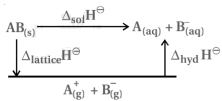
Explain Enthalpy of Solution $\Delta_{sol}H^{\theta}$.
Solution
(N/A) The enthalpy of solution of a substance is the enthalpy change when $1 \ mole$ of it dissolves in a specified amount of solvent. The enthalpy of solution at infinite dilution is the enthalpy change observed on dissolving the substance in an infinite amount of solvent when the interactions between the ions are negligible.
When an ionic compound dissolves in a solvent,the ions leave their ordered positions on the crystal lattice. These are now more free in solution. Simultaneously,solvation of these ions occurs. This is shown diagrammatically for an ionic compound,$AB_{(s)}$:
$\Delta_{sol}H^{\theta} = \Delta_{lattice}H^{\theta} + \Delta_{hyd}H^{\theta}$
For most ionic compounds,$\Delta_{sol}H^{\theta}$ is positive and the dissociation process is endothermic.
When an ionic compound dissolves in a solvent,the ions leave their ordered positions on the crystal lattice. These are now more free in solution. Simultaneously,solvation of these ions occurs. This is shown diagrammatically for an ionic compound,$AB_{(s)}$:
$\Delta_{sol}H^{\theta} = \Delta_{lattice}H^{\theta} + \Delta_{hyd}H^{\theta}$
For most ionic compounds,$\Delta_{sol}H^{\theta}$ is positive and the dissociation process is endothermic.
0 likes
View Solution469
MediumMCQ
The values of bond enthalpy of $H_2$,$Cl_2$ and $HCl$ are $104$,$58$ and $103 \ kcal/mol$ respectively. Find the enthalpy of formation of $HCl_{(g)}$. Reaction: $\frac{1}{2}H_{2(g)} + \frac{1}{2}Cl_{2(g)} \to HCl_{(g)}$
A
$22 \ kcal/mol$
B
$-22 \ kcal/mol$
C
$59 \ kcal/mol$
D
$-59 \ kcal/mol$
Solution
(B) The enthalpy of formation $(\Delta H_f)$ can be calculated using bond enthalpies as: $\Delta H_f = \Sigma \Delta H_{\text{bond(reactants)}} - \Sigma \Delta H_{\text{bond(products)}}$
For the reaction: $\frac{1}{2}H_{2(g)} + \frac{1}{2}Cl_{2(g)} \to HCl_{(g)}$
$\Delta H_f = [\frac{1}{2} \times \Delta H_{H-H} + \frac{1}{2} \times \Delta H_{Cl-Cl}] - [\Delta H_{H-Cl}]$
Substituting the given values:
$\Delta H_f = [\frac{1}{2} \times 104 + \frac{1}{2} \times 58] - 103$
$\Delta H_f = [52 + 29] - 103$
$\Delta H_f = 81 - 103 = -22 \ kcal/mol$
For the reaction: $\frac{1}{2}H_{2(g)} + \frac{1}{2}Cl_{2(g)} \to HCl_{(g)}$
$\Delta H_f = [\frac{1}{2} \times \Delta H_{H-H} + \frac{1}{2} \times \Delta H_{Cl-Cl}] - [\Delta H_{H-Cl}]$
Substituting the given values:
$\Delta H_f = [\frac{1}{2} \times 104 + \frac{1}{2} \times 58] - 103$
$\Delta H_f = [52 + 29] - 103$
$\Delta H_f = 81 - 103 = -22 \ kcal/mol$
0 likes
View Solution470
Medium
$C_6H_{6(l)} + 7.5O_{2(g)} \to 6CO_{2(g)} + 3H_2O_{(g)}$; $\Delta H = -3267.7 \ kJ \ mol^{-1}$. Given that the standard enthalpies of formation of $CO_{2(g)}$ and $H_2O_{(g)}$ are $-393.5 \ kJ \ mol^{-1}$ and $-285.85 \ kJ \ mol^{-1}$ respectively,calculate the standard enthalpy of formation of benzene $(C_6H_{6(l)})$.
Solution
(A) The combustion reaction is: $C_6H_{6(l)} + 7.5O_{2(g)} \to 6CO_{2(g)} + 3H_2O_{(g)}$
$\Delta H_{comb} = [6 \times \Delta H_f(CO_2) + 3 \times \Delta H_f(H_2O)] - [\Delta H_f(C_6H_6) + 7.5 \times \Delta H_f(O_2)]$
Given $\Delta H_{comb} = -3267.7 \ kJ \ mol^{-1}$,$\Delta H_f(CO_2) = -393.5 \ kJ \ mol^{-1}$,$\Delta H_f(H_2O) = -285.85 \ kJ \ mol^{-1}$,and $\Delta H_f(O_2) = 0 \ kJ \ mol^{-1}$.
$-3267.7 = [6 \times (-393.5) + 3 \times (-285.85)] - \Delta H_f(C_6H_6)$
$-3267.7 = [-2361 - 857.55] - \Delta H_f(C_6H_6)$
$-3267.7 = -3218.55 - \Delta H_f(C_6H_6)$
$\Delta H_f(C_6H_6) = -3218.55 + 3267.7 = 49.15 \ kJ \ mol^{-1}$.
$\Delta H_{comb} = [6 \times \Delta H_f(CO_2) + 3 \times \Delta H_f(H_2O)] - [\Delta H_f(C_6H_6) + 7.5 \times \Delta H_f(O_2)]$
Given $\Delta H_{comb} = -3267.7 \ kJ \ mol^{-1}$,$\Delta H_f(CO_2) = -393.5 \ kJ \ mol^{-1}$,$\Delta H_f(H_2O) = -285.85 \ kJ \ mol^{-1}$,and $\Delta H_f(O_2) = 0 \ kJ \ mol^{-1}$.
$-3267.7 = [6 \times (-393.5) + 3 \times (-285.85)] - \Delta H_f(C_6H_6)$
$-3267.7 = [-2361 - 857.55] - \Delta H_f(C_6H_6)$
$-3267.7 = -3218.55 - \Delta H_f(C_6H_6)$
$\Delta H_f(C_6H_6) = -3218.55 + 3267.7 = 49.15 \ kJ \ mol^{-1}$.
0 likes
View Solution471
Difficult
Calculate the heat of formation for propene $(C_3H_6)$ using the following thermochemical equations:
$(i) C_{(s)} + O_{2(g)} \to CO_{2(g)}; \Delta H_1 = -94.05 \ k.cal/mole$
$(ii) H_{2(g)} + \frac{1}{2} O_{2(g)} \to H_2O_{(l)}; \Delta H_2 = -68.32 \ k.cal/mole$
$(iii) C_3H_{6(g)} + \frac{9}{2} O_{2(g)} \to 3 CO_{2(g)} + 3 H_2O_{(l)}; \Delta H_3 = -499.7 \ k.cal/mole$
(Note: The original question provided propane combustion data; assuming propene combustion data for consistency).
$(i) C_{(s)} + O_{2(g)} \to CO_{2(g)}; \Delta H_1 = -94.05 \ k.cal/mole$
$(ii) H_{2(g)} + \frac{1}{2} O_{2(g)} \to H_2O_{(l)}; \Delta H_2 = -68.32 \ k.cal/mole$
$(iii) C_3H_{6(g)} + \frac{9}{2} O_{2(g)} \to 3 CO_{2(g)} + 3 H_2O_{(l)}; \Delta H_3 = -499.7 \ k.cal/mole$
(Note: The original question provided propane combustion data; assuming propene combustion data for consistency).
Solution
(A) The formation reaction for propene is: $3 C_{(s)} + 3 H_{2(g)} \to C_3H_{6(g)}$.
Using Hess's Law:
Multiply equation $(i)$ by $3$: $3 C_{(s)} + 3 O_{2(g)} \to 3 CO_{2(g)}$; $\Delta H = 3 \times (-94.05) = -282.15 \ k.cal/mole$.
Multiply equation $(ii)$ by $3$: $3 H_{2(g)} + \frac{3}{2} O_{2(g)} \to 3 H_2O_{(l)}$; $\Delta H = 3 \times (-68.32) = -204.96 \ k.cal/mole$.
Reverse equation $(iii)$: $3 CO_{2(g)} + 3 H_2O_{(l)} \to C_3H_{6(g)} + \frac{9}{2} O_{2(g)}$; $\Delta H = +499.7 \ k.cal/mole$.
Adding these equations:
$3 C_{(s)} + 3 H_{2(g)} + (3 + 1.5 - 4.5) O_{2(g)} \to C_3H_{6(g)}$
$\Delta H_f = -282.15 - 204.96 + 499.7 = +12.59 \ k.cal/mole$.
Using Hess's Law:
Multiply equation $(i)$ by $3$: $3 C_{(s)} + 3 O_{2(g)} \to 3 CO_{2(g)}$; $\Delta H = 3 \times (-94.05) = -282.15 \ k.cal/mole$.
Multiply equation $(ii)$ by $3$: $3 H_{2(g)} + \frac{3}{2} O_{2(g)} \to 3 H_2O_{(l)}$; $\Delta H = 3 \times (-68.32) = -204.96 \ k.cal/mole$.
Reverse equation $(iii)$: $3 CO_{2(g)} + 3 H_2O_{(l)} \to C_3H_{6(g)} + \frac{9}{2} O_{2(g)}$; $\Delta H = +499.7 \ k.cal/mole$.
Adding these equations:
$3 C_{(s)} + 3 H_{2(g)} + (3 + 1.5 - 4.5) O_{2(g)} \to C_3H_{6(g)}$
$\Delta H_f = -282.15 - 204.96 + 499.7 = +12.59 \ k.cal/mole$.
0 likes
View Solution472
Medium
Find the standard enthalpy of formation of $SO_{3(g)}$ from the following reactions:
$S_{8(s)} + 8O_{2(g)} \to 8SO_{2(g)}$; $\Delta H_1 = -2775 \ kJ/mol$
$2SO_{2(g)} + O_{2(g)} \to 2SO_{3(g)}$; $\Delta H_2 = -198 \ kJ/mol$
$S_{8(s)} + 8O_{2(g)} \to 8SO_{2(g)}$; $\Delta H_1 = -2775 \ kJ/mol$
$2SO_{2(g)} + O_{2(g)} \to 2SO_{3(g)}$; $\Delta H_2 = -198 \ kJ/mol$
Solution
(N/A) The formation reaction of $SO_{3(g)}$ is: $S_{(s)} + \frac{3}{2}O_{2(g)} \to SO_{3(g)}$.
From the first reaction: $S_{8(s)} + 8O_{2(g)} \to 8SO_{2(g)}$,$\Delta H_1 = -2775 \ kJ/mol$.
Dividing by $8$: $S_{(s)} + O_{2(g)} \to SO_{2(g)}$,$\Delta H = \frac{-2775}{8} = -346.875 \ kJ/mol$.
From the second reaction: $2SO_{2(g)} + O_{2(g)} \to 2SO_{3(g)}$,$\Delta H_2 = -198 \ kJ/mol$.
Dividing by $2$: $SO_{2(g)} + \frac{1}{2}O_{2(g)} \to SO_{3(g)}$,$\Delta H = \frac{-198}{2} = -99 \ kJ/mol$.
Adding the two equations:
$S_{(s)} + O_{2(g)} + SO_{2(g)} + \frac{1}{2}O_{2(g)} \to SO_{2(g)} + SO_{3(g)}$
$S_{(s)} + \frac{3}{2}O_{2(g)} \to SO_{3(g)}$
$\Delta H_f = -346.875 + (-99) = -445.875 \ kJ/mol$.
From the first reaction: $S_{8(s)} + 8O_{2(g)} \to 8SO_{2(g)}$,$\Delta H_1 = -2775 \ kJ/mol$.
Dividing by $8$: $S_{(s)} + O_{2(g)} \to SO_{2(g)}$,$\Delta H = \frac{-2775}{8} = -346.875 \ kJ/mol$.
From the second reaction: $2SO_{2(g)} + O_{2(g)} \to 2SO_{3(g)}$,$\Delta H_2 = -198 \ kJ/mol$.
Dividing by $2$: $SO_{2(g)} + \frac{1}{2}O_{2(g)} \to SO_{3(g)}$,$\Delta H = \frac{-198}{2} = -99 \ kJ/mol$.
Adding the two equations:
$S_{(s)} + O_{2(g)} + SO_{2(g)} + \frac{1}{2}O_{2(g)} \to SO_{2(g)} + SO_{3(g)}$
$S_{(s)} + \frac{3}{2}O_{2(g)} \to SO_{3(g)}$
$\Delta H_f = -346.875 + (-99) = -445.875 \ kJ/mol$.
0 likes
View Solution473
Medium
$AB$,$A_2$,and $B_2$ are diatomic molecules. Enthalpies of dissociation of $AB$,$A_2$,and $B_2$ are in the ratio of $1:1:0.5$. Enthalpy of formation of $AB$,$\Delta_f H = -100 \ kJ \ mol^{-1}$. Find the dissociation enthalpy of $A_2$?
Reaction : $\frac{1}{2} A_2 + \frac{1}{2} B_2 \to AB$
Reaction : $\frac{1}{2} A_2 + \frac{1}{2} B_2 \to AB$
Solution
(400) Let the dissociation enthalpy (bond energy) of $A_2$ be $X$.
Given the ratio $1:1:0.5$ for $AB:A_2:B_2$,the bond energy of $AB$ is $X$ and the bond energy of $B_2$ is $0.5X$.
The enthalpy of formation reaction is: $\frac{1}{2} A_2 + \frac{1}{2} B_2 \to AB ; \Delta_f H = -100 \ kJ \ mol^{-1}$.
Using the bond energy formula: $\Delta_f H = \Sigma BE_{\text{reactants}} - \Sigma BE_{\text{products}}$.
$-100 = (\frac{1}{2} \times BE_{A_2} + \frac{1}{2} \times BE_{B_2}) - BE_{AB}$.
$-100 = (\frac{1}{2} X + \frac{1}{2} \times 0.5X) - X$.
$-100 = (0.5X + 0.25X) - X$.
$-100 = 0.75X - X$.
$-100 = -0.25X$.
$X = \frac{100}{0.25} = 400 \ kJ \ mol^{-1}$.
Given the ratio $1:1:0.5$ for $AB:A_2:B_2$,the bond energy of $AB$ is $X$ and the bond energy of $B_2$ is $0.5X$.
The enthalpy of formation reaction is: $\frac{1}{2} A_2 + \frac{1}{2} B_2 \to AB ; \Delta_f H = -100 \ kJ \ mol^{-1}$.
Using the bond energy formula: $\Delta_f H = \Sigma BE_{\text{reactants}} - \Sigma BE_{\text{products}}$.
$-100 = (\frac{1}{2} \times BE_{A_2} + \frac{1}{2} \times BE_{B_2}) - BE_{AB}$.
$-100 = (\frac{1}{2} X + \frac{1}{2} \times 0.5X) - X$.
$-100 = (0.5X + 0.25X) - X$.
$-100 = 0.75X - X$.
$-100 = -0.25X$.
$X = \frac{100}{0.25} = 400 \ kJ \ mol^{-1}$.
0 likes
View Solution474
Medium
Find the bond enthalpy of $N-H$ bond in ammonia by using the change in enthalpy for the reaction given below: $N_{2(g)} + 3H_{2(g)} \to 2NH_{3(g)}$; $\Delta H = -23 \ kcal$. Given bond energies: $N \equiv N = 226 \ kcal/mol$,$H-H = 103 \ kcal/mol$.
Solution
(N/A) The reaction is: $N_{2(g)} + 3H_{2(g)} \to 2NH_{3(g)}$.
$\Delta H = \sum \text{Bond Energy of Reactants} - \sum \text{Bond Energy of Products}$.
$-23 = [1 \times BE(N \equiv N) + 3 \times BE(H-H)] - [2 \times 3 \times BE(N-H)]$.
$-23 = [226 + 3 \times 103] - 6 \times BE(N-H)$.
$-23 = [226 + 309] - 6 \times BE(N-H)$.
$-23 = 535 - 6 \times BE(N-H)$.
$6 \times BE(N-H) = 535 + 23 = 558$.
$BE(N-H) = 558 / 6 = 93 \ kcal/mol$.
$\Delta H = \sum \text{Bond Energy of Reactants} - \sum \text{Bond Energy of Products}$.
$-23 = [1 \times BE(N \equiv N) + 3 \times BE(H-H)] - [2 \times 3 \times BE(N-H)]$.
$-23 = [226 + 3 \times 103] - 6 \times BE(N-H)$.
$-23 = [226 + 309] - 6 \times BE(N-H)$.
$-23 = 535 - 6 \times BE(N-H)$.
$6 \times BE(N-H) = 535 + 23 = 558$.
$BE(N-H) = 558 / 6 = 93 \ kcal/mol$.
0 likes
View Solution475
Medium
$18.0 \ g$ of water completely vaporises at $100^{\circ}C$ and $1 \ bar$ pressure and the enthalpy change in the process is $40.79 \ kJ \ mol^{-1}$. What will be the enthalpy change for vaporising two moles of water under the same conditions? What is the standard enthalpy of vaporisation for water?
Solution
(N/A) Given: Mass of water $= 18.0 \ g$,Pressure $= 1 \ bar$.
Since the molar mass of $H_2O$ is $18.0 \ g \ mol^{-1}$,$18.0 \ g$ of $H_2O$ corresponds to $1 \ mole$.
Enthalpy change for vaporising $1 \ mole$ of $H_2O$ is given as $\Delta_{vap}H = 40.79 \ kJ \ mol^{-1}$.
Therefore,the enthalpy change for vaporising $2 \ moles$ of $H_2O = 2 \times 40.79 \ kJ = 81.58 \ kJ$.
The standard enthalpy of vaporisation $(\Delta_{vap}H^{\circ})$ at $100^{\circ}C$ and $1 \ bar$ pressure is $40.79 \ kJ \ mol^{-1}$.
Since the molar mass of $H_2O$ is $18.0 \ g \ mol^{-1}$,$18.0 \ g$ of $H_2O$ corresponds to $1 \ mole$.
Enthalpy change for vaporising $1 \ mole$ of $H_2O$ is given as $\Delta_{vap}H = 40.79 \ kJ \ mol^{-1}$.
Therefore,the enthalpy change for vaporising $2 \ moles$ of $H_2O = 2 \times 40.79 \ kJ = 81.58 \ kJ$.
The standard enthalpy of vaporisation $(\Delta_{vap}H^{\circ})$ at $100^{\circ}C$ and $1 \ bar$ pressure is $40.79 \ kJ \ mol^{-1}$.
0 likes
View Solution476
Medium
One mole of acetone requires less heat to vaporise than $1$ mol of water. Which of the two liquids has higher enthalpy of vaporisation?
Solution
(B) One mole of acetone requires less heat to vaporise than $1$ mole of water.
Enthalpy of vaporisation is the amount of energy required to vaporise one mole of a liquid at constant temperature and pressure.
Since water requires more heat for vaporisation,it has a higher enthalpy of vaporisation compared to acetone.
This can be represented as $(\Delta H_{vap})_{water} > (\Delta H_{vap})_{acetone}$.
Enthalpy of vaporisation is the amount of energy required to vaporise one mole of a liquid at constant temperature and pressure.
Since water requires more heat for vaporisation,it has a higher enthalpy of vaporisation compared to acetone.
This can be represented as $(\Delta H_{vap})_{water} > (\Delta H_{vap})_{acetone}$.
0 likes
View Solution477
Medium
Standard molar enthalpy of formation,$\Delta _{f}H^{o}$ is just a special case of enthalpy of reaction,$\Delta _{r}H^{o}$. Is the $\Delta _{r}H^{o}$ for the following reaction same as $\Delta _{f}H^{o}$? Give reason for your answer. $CaO_{(s)} + CO_{2_{(g)}} \to CaCO_{3_{(s)}}$; $\Delta _{r}H^{o} = -178.3 \ kJ \ mol^{-1}$
Solution
(N/A) No,the $\Delta _{r}H^{o}$ for the given reaction is not the same as $\Delta _{f}H^{o}$.
The standard molar enthalpy of formation,$\Delta _{f}H^{o}$,is defined as the standard enthalpy change for the formation of $1 \ mol$ of a compound from its constituent elements in their most stable reference states.
The reaction for the formation of $CaCO_{3(s)}$ is:
$Ca_{(s)} + C_{(s)} + \frac{3}{2} O_{2(g)} \to CaCO_{3(s)}$
In the given reaction,$CaO_{(s)} + CO_{2(g)} \to CaCO_{3(s)}$,the product is formed from compounds ($CaO$ and $CO_{2}$) rather than from elements in their standard states.
Therefore,$\Delta _{r}H^{o} \neq \Delta _{f}H^{o}$.
The standard molar enthalpy of formation,$\Delta _{f}H^{o}$,is defined as the standard enthalpy change for the formation of $1 \ mol$ of a compound from its constituent elements in their most stable reference states.
The reaction for the formation of $CaCO_{3(s)}$ is:
$Ca_{(s)} + C_{(s)} + \frac{3}{2} O_{2(g)} \to CaCO_{3(s)}$
In the given reaction,$CaO_{(s)} + CO_{2(g)} \to CaCO_{3(s)}$,the product is formed from compounds ($CaO$ and $CO_{2}$) rather than from elements in their standard states.
Therefore,$\Delta _{r}H^{o} \neq \Delta _{f}H^{o}$.
0 likes
View Solution478
Medium
The value of $\Delta_{f} H^{o}$ for $NH_3$ is $-91.8 \ kJ \ mol^{-1}$. Calculate the enthalpy change for the following reaction: $2NH_{3(g)} \to N_{2(g)} + 3H_{2(g)}$
Solution
The formation reaction for $1 \ mole$ of $NH_3$ is: $\frac{1}{2} N_{2(g)} + \frac{3}{2} H_{2(g)} \to NH_{3(g)}$; $\Delta_f H^o = -91.8 \ kJ \ mol^{-1}$.
For the formation of $2 \ moles$ of $NH_3$,the reaction is: $N_{2(g)} + 3H_{2(g)} \to 2NH_{3(g)}$; $\Delta_r H^o = 2 \times (-91.8 \ kJ \ mol^{-1}) = -183.6 \ kJ \ mol^{-1}$.
The given reaction is the reverse of the formation of $2 \ moles$ of $NH_3$.
Therefore,for the reaction $2NH_{3(g)} \to N_{2(g)} + 3H_{2(g)}$,the enthalpy change is: $\Delta_r H^o = -(-183.6 \ kJ \ mol^{-1}) = +183.6 \ kJ \ mol^{-1}$.
For the formation of $2 \ moles$ of $NH_3$,the reaction is: $N_{2(g)} + 3H_{2(g)} \to 2NH_{3(g)}$; $\Delta_r H^o = 2 \times (-91.8 \ kJ \ mol^{-1}) = -183.6 \ kJ \ mol^{-1}$.
The given reaction is the reverse of the formation of $2 \ moles$ of $NH_3$.
Therefore,for the reaction $2NH_{3(g)} \to N_{2(g)} + 3H_{2(g)}$,the enthalpy change is: $\Delta_r H^o = -(-183.6 \ kJ \ mol^{-1}) = +183.6 \ kJ \ mol^{-1}$.
0 likes
View Solution479
DifficultMCQ
Enthalpy is an extensive property. In general,if enthalpy of an overall reaction $A \to B$ along one route is $\Delta_r H$ and $\Delta_r H_1, \Delta_r H_2, \Delta_r H_3, \dots$ represent enthalpies of intermediate reactions leading to product $B$. What will be the relation between $\Delta_r H$ for overall reaction and $\Delta_r H_1, \Delta_r H_2, \Delta_r H_3, \dots$ etc. for intermediate reactions?
A
$\Delta_r H = \Delta_r H_1 + \Delta_r H_2 + \Delta_r H_3 + \dots$
B
$\Delta_r H = \Delta_r H_1 - \Delta_r H_2 - \Delta_r H_3 - \dots$
C
$\Delta_r H = \Delta_r H_1 \times \Delta_r H_2 \times \Delta_r H_3 \times \dots$
D
$\Delta_r H = \Delta_r H_1 / \Delta_r H_2 / \Delta_r H_3 / \dots$
Solution
(A) According to Hess's Law of Constant Heat Summation,if a reaction can take place in one step or in several steps,the total enthalpy change for the reaction is the same regardless of the path taken.
Therefore,if the overall reaction $A \to B$ has an enthalpy change of $\Delta_r H$,and the intermediate steps have enthalpy changes $\Delta_r H_1, \Delta_r H_2, \Delta_r H_3, \dots$,then the relationship is given by $\Delta_r H = \Delta_r H_1 + \Delta_r H_2 + \Delta_r H_3 + \dots$
Therefore,if the overall reaction $A \to B$ has an enthalpy change of $\Delta_r H$,and the intermediate steps have enthalpy changes $\Delta_r H_1, \Delta_r H_2, \Delta_r H_3, \dots$,then the relationship is given by $\Delta_r H = \Delta_r H_1 + \Delta_r H_2 + \Delta_r H_3 + \dots$
0 likes
View Solution480
EasyMCQ
The enthalpy of atomisation for the reaction $CH_{4(g)} \to C_{(g)} + 4H_{(g)}$ is $1665 \ kJ \ mol^{-1}$. What is the bond energy of $C-H$ bond?
A
$416.25 \ kJ \ mol^{-1}$
B
$1665 \ kJ \ mol^{-1}$
C
$832.5 \ kJ \ mol^{-1}$
D
$208.125 \ kJ \ mol^{-1}$
Solution
(A) In $CH_4$,there are four $C-H$ bonds.
The enthalpy of atomisation of $1 \ mol$ of $CH_4$ represents the dissociation of four moles of $C-H$ bonds.
Therefore,the $C-H$ bond energy per $mol$ is calculated as:
$\text{Bond Energy} = \frac{1665 \ kJ \ mol^{-1}}{4} = 416.25 \ kJ \ mol^{-1}$
The enthalpy of atomisation of $1 \ mol$ of $CH_4$ represents the dissociation of four moles of $C-H$ bonds.
Therefore,the $C-H$ bond energy per $mol$ is calculated as:
$\text{Bond Energy} = \frac{1665 \ kJ \ mol^{-1}}{4} = 416.25 \ kJ \ mol^{-1}$
0 likes
View Solution481
Easy
If the combustion of $1 \ g$ of graphite produces $20.7 \ kJ$ of heat,what will be the molar enthalpy change? Give the significance of the sign also.
Solution
(N/A) The enthalpy of combustion of $1 \ g$ of graphite is $20.7 \ kJ$.
Since heat is released,the enthalpy change for $1 \ g$ is $-20.7 \ kJ \ g^{-1}$.
The molar mass of graphite $(C)$ is $12 \ g \ mol^{-1}$.
The molar enthalpy change $(\Delta H)$ is calculated as:
$\Delta H = -20.7 \ kJ \ g^{-1} \times 12 \ g \ mol^{-1} = -248.4 \ kJ \ mol^{-1} = -2.48 \times 10^{2} \ kJ \ mol^{-1}$.
The negative sign indicates that the combustion reaction is exothermic,meaning heat is released to the surroundings.
Since heat is released,the enthalpy change for $1 \ g$ is $-20.7 \ kJ \ g^{-1}$.
The molar mass of graphite $(C)$ is $12 \ g \ mol^{-1}$.
The molar enthalpy change $(\Delta H)$ is calculated as:
$\Delta H = -20.7 \ kJ \ g^{-1} \times 12 \ g \ mol^{-1} = -248.4 \ kJ \ mol^{-1} = -2.48 \times 10^{2} \ kJ \ mol^{-1}$.
The negative sign indicates that the combustion reaction is exothermic,meaning heat is released to the surroundings.
0 likes
View Solution482
MediumMCQ
The net enthalpy change of a reaction is the amount of energy required to break all the bonds in reactant molecules minus the amount of energy required to form all the bonds in the product molecules. What will be the enthalpy change for the following reaction: $H_{2(g)} + Br_{2(g)} \to 2HBr_{(g)}$? Given that the bond energy of $H_2$,$Br_2$,and $HBr$ is $435 \ kJ \ mol^{-1}$,$192 \ kJ \ mol^{-1}$,and $368 \ kJ \ mol^{-1}$ respectively.
A
$-109 \ kJ \ mol^{-1}$
B
$109 \ kJ \ mol^{-1}$
C
$259 \ kJ \ mol^{-1}$
D
$-259 \ kJ \ mol^{-1}$
Solution
(A) The enthalpy change of a reaction is calculated using the formula: $\Delta_{r}H^{\circ} = \Sigma BE \text{ (Reactants)} - \Sigma BE \text{ (Products)}$.
Given:
$BE(H_2) = 435 \ kJ \ mol^{-1}$
$BE(Br_2) = 192 \ kJ \ mol^{-1}$
$BE(HBr) = 368 \ kJ \ mol^{-1}$
For the reaction $H_{2(g)} + Br_{2(g)} \to 2HBr_{(g)}$:
$\Delta_{r}H^{\circ} = [BE(H-H) + BE(Br-Br)] - [2 \times BE(H-Br)]$
$\Delta_{r}H^{\circ} = [435 + 192] - [2 \times 368] \ kJ \ mol^{-1}$
$\Delta_{r}H^{\circ} = 627 - 736 \ kJ \ mol^{-1}$
$\Delta_{r}H^{\circ} = -109 \ kJ \ mol^{-1}$
Given:
$BE(H_2) = 435 \ kJ \ mol^{-1}$
$BE(Br_2) = 192 \ kJ \ mol^{-1}$
$BE(HBr) = 368 \ kJ \ mol^{-1}$
For the reaction $H_{2(g)} + Br_{2(g)} \to 2HBr_{(g)}$:
$\Delta_{r}H^{\circ} = [BE(H-H) + BE(Br-Br)] - [2 \times BE(H-Br)]$
$\Delta_{r}H^{\circ} = [435 + 192] - [2 \times 368] \ kJ \ mol^{-1}$
$\Delta_{r}H^{\circ} = 627 - 736 \ kJ \ mol^{-1}$
$\Delta_{r}H^{\circ} = -109 \ kJ \ mol^{-1}$
0 likes
View Solution483
Easy
The enthalpy of vaporisation of $CCl_4$ is $30.5 \ kJ \ mol^{-1}$. Calculate the heat required for the vaporisation of $284 \ g$ of $CCl_4$ at constant pressure. (Molar mass of $CCl_4 = 154 \ g \ mol^{-1}$).
Solution
(N/A) The molar mass of $CCl_4$ is $154 \ g \ mol^{-1}$.
The number of moles of $CCl_4$ in $284 \ g$ is given by $n = \frac{\text{mass}}{\text{molar mass}} = \frac{284 \ g}{154 \ g \ mol^{-1}} \approx 1.844 \ mol$.
The heat required for vaporisation is given by $q = n \times \Delta_{vap}H$.
$q = 1.844 \ mol \times 30.5 \ kJ \ mol^{-1} = 56.242 \ kJ$.
Rounding to two decimal places,the heat required is $56.24 \ kJ$.
The number of moles of $CCl_4$ in $284 \ g$ is given by $n = \frac{\text{mass}}{\text{molar mass}} = \frac{284 \ g}{154 \ g \ mol^{-1}} \approx 1.844 \ mol$.
The heat required for vaporisation is given by $q = n \times \Delta_{vap}H$.
$q = 1.844 \ mol \times 30.5 \ kJ \ mol^{-1} = 56.242 \ kJ$.
Rounding to two decimal places,the heat required is $56.24 \ kJ$.
0 likes
View Solution484
MediumMCQ
The enthalpy of reaction for the reaction: $2 H_{2(g)} + O_{2(g)} \to 2 H_{2}O_{(l)}$ is $\Delta_{r}H^{\theta} = -572 \ kJ \ mol^{-1}$. What will be the standard enthalpy of formation of $H_{2}O_{(l)}$?
A
$-286 \ kJ \ mol^{-1}$
B
$-572 \ kJ \ mol^{-1}$
C
$+286 \ kJ \ mol^{-1}$
D
$+572 \ kJ \ mol^{-1}$
Solution
(A) The given reaction is: $2 H_{2(g)} + O_{2(g)} \to 2 H_{2}O_{(l)}$ with $\Delta_{r}H^{\theta} = -572 \ kJ \ mol^{-1}$.
The standard enthalpy of formation $(\Delta_{f}H^{\theta})$ is defined as the enthalpy change when $1 \ mol$ of a compound is formed from its constituent elements in their standard states.
The formation reaction for $H_{2}O_{(l)}$ is: $H_{2(g)} + \frac{1}{2} O_{2(g)} \to H_{2}O_{(l)}$.
This reaction is exactly half of the given reaction. Therefore,the enthalpy of formation is half of the given enthalpy of reaction:
$\Delta_{f}H^{\theta}(H_{2}O) = \frac{\Delta_{r}H^{\theta}}{2} = \frac{-572 \ kJ \ mol^{-1}}{2} = -286 \ kJ \ mol^{-1}$.
The standard enthalpy of formation $(\Delta_{f}H^{\theta})$ is defined as the enthalpy change when $1 \ mol$ of a compound is formed from its constituent elements in their standard states.
The formation reaction for $H_{2}O_{(l)}$ is: $H_{2(g)} + \frac{1}{2} O_{2(g)} \to H_{2}O_{(l)}$.
This reaction is exactly half of the given reaction. Therefore,the enthalpy of formation is half of the given enthalpy of reaction:
$\Delta_{f}H^{\theta}(H_{2}O) = \frac{\Delta_{r}H^{\theta}}{2} = \frac{-572 \ kJ \ mol^{-1}}{2} = -286 \ kJ \ mol^{-1}$.
0 likes
View Solution485
Medium
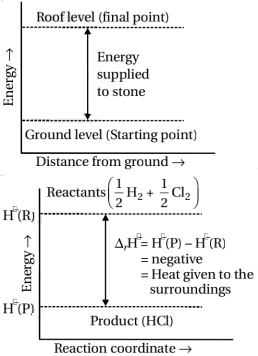
Represent the potential energy / enthalpy change in the following processes graphically.
$(a)$ Throwing a stone from the ground to the roof.
$(b)$ $\frac{1}{2} H_{2(g)} + \frac{1}{2} Cl_{2(g)} \rightarrow HCl_{(g)}$
In which of the processes is the potential energy/enthalpy change a contributing factor to the spontaneity?
$(a)$ Throwing a stone from the ground to the roof.
$(b)$ $\frac{1}{2} H_{2(g)} + \frac{1}{2} Cl_{2(g)} \rightarrow HCl_{(g)}$
In which of the processes is the potential energy/enthalpy change a contributing factor to the spontaneity?
Solution
(B) The graphical representation of potential energy/enthalpy change is as follows:
$(a)$ For throwing a stone from the ground to the roof,the potential energy of the stone increases as it moves against the gravitational field.
$(b)$ For the reaction $\frac{1}{2} H_{2(g)} + \frac{1}{2} Cl_{2(g)} \rightarrow HCl_{(g)}$,the enthalpy change is $\Delta_{r} H^{\ominus} = -92.32 \ kJ \ mol^{-1}$.
Energy increases in process $(a)$ and decreases in process $(b)$. $A$ decrease in enthalpy (exothermic process) generally favors spontaneity. Hence,in process $(b)$,the enthalpy change is a contributing factor to the spontaneity.
$(a)$ For throwing a stone from the ground to the roof,the potential energy of the stone increases as it moves against the gravitational field.
$(b)$ For the reaction $\frac{1}{2} H_{2(g)} + \frac{1}{2} Cl_{2(g)} \rightarrow HCl_{(g)}$,the enthalpy change is $\Delta_{r} H^{\ominus} = -92.32 \ kJ \ mol^{-1}$.
Energy increases in process $(a)$ and decreases in process $(b)$. $A$ decrease in enthalpy (exothermic process) generally favors spontaneity. Hence,in process $(b)$,the enthalpy change is a contributing factor to the spontaneity.
0 likes
View Solution486
EasyMCQ
What is enthalpy of reaction?
A
The total energy of the system.
B
The change in enthalpy that occurs during a chemical reaction.
C
The heat required to raise the temperature of a substance by $1 \ K$.
D
The energy required to break one mole of bonds.
Solution
(B) The enthalpy of reaction,denoted as $\Delta_r H$,is defined as the change in enthalpy that occurs when reactants are converted into products in a chemical reaction.
It is calculated as the difference between the sum of the enthalpies of the products and the sum of the enthalpies of the reactants: $\Delta_r H = \sum H_{\text{products}} - \sum H_{\text{reactants}}$.
It is calculated as the difference between the sum of the enthalpies of the products and the sum of the enthalpies of the reactants: $\Delta_r H = \sum H_{\text{products}} - \sum H_{\text{reactants}}$.
0 likes
View Solution487
EasyMCQ
What type of process is the formation of ozone from oxygen?
A
Endothermic
B
Exothermic
C
Isothermal
D
Adiabatic
Solution
(A) The formation of ozone from oxygen is represented by the equation: $3O_2(g) \rightarrow 2O_3(g)$.
This reaction is endothermic,meaning it requires the absorption of energy (specifically ultraviolet radiation) to proceed,as the enthalpy change $\Delta H$ is positive $(+142 \ kJ \ mol^{-1})$.
This reaction is endothermic,meaning it requires the absorption of energy (specifically ultraviolet radiation) to proceed,as the enthalpy change $\Delta H$ is positive $(+142 \ kJ \ mol^{-1})$.
0 likes
View Solution488
Easy
State Hess's Law of Constant Heat Summation.
Solution
(N/A) Hess's Law of Constant Heat Summation states that the total enthalpy change for a chemical reaction is the same,whether the reaction takes place in one step or in several steps. It is the algebraic sum of the enthalpy changes of the individual steps of the reaction.
0 likes
View Solution489
Medium
Fill in the blanks:
$(i)$ The enthalpy change that occurs when one mole of a compound is formed from its constituent elements in their standard states is called the ....... of that compound.
$(ii)$ The total heat change in a chemical reaction is equal to the algebraic sum of the heat changes of the individual steps of the reaction. This law was given by .......... .
$(iii)$ $A$ process during which there is no exchange of heat between the system and the surroundings is called an ........... process.
$(i)$ The enthalpy change that occurs when one mole of a compound is formed from its constituent elements in their standard states is called the ....... of that compound.
$(ii)$ The total heat change in a chemical reaction is equal to the algebraic sum of the heat changes of the individual steps of the reaction. This law was given by .......... .
$(iii)$ $A$ process during which there is no exchange of heat between the system and the surroundings is called an ........... process.
Solution
(N/A) $(i)$ Standard enthalpy of formation
$(ii)$ Hess's Law
$(iii)$ Adiabatic
$(ii)$ Hess's Law
$(iii)$ Adiabatic
0 likes
View Solution490
EasyMCQ
Match the following allotropes of carbon with their standard enthalpy of formation $(\Delta_f H^{\Theta})$:
| Allotrope | $\Delta_f H^{\Theta}$ |
| $i$. Graphite | $b$. $0 \ kJ/mol$ |
| $ii$. Diamond | $c$. $1.90 \ kJ/mol$ |
| $iii$. Fullerene | $a$. $38.1 \ kJ/mol$ |
A
$i-b, ii-c, iii-a$
B
$i-c, ii-b, iii-a$
C
$i-a, ii-b, iii-c$
D
$i-b, ii-a, iii-c$
Solution
(A) The standard enthalpy of formation $(\Delta_f H^{\Theta})$ of the most stable allotrope of an element in its standard state is defined as $0 \ kJ/mol$.
$i$. Graphite is the most stable allotrope of carbon,so its $\Delta_f H^{\Theta} = 0 \ kJ/mol$ $(i-b)$.
$ii$. Diamond is less stable than graphite,with $\Delta_f H^{\Theta} = 1.90 \ kJ/mol$ $(ii-c)$.
$iii$. Fullerene $(C_{60})$ has a higher enthalpy of formation,$\Delta_f H^{\Theta} = 38.1 \ kJ/mol$ $(iii-a)$.
Therefore,the correct match is $i-b, ii-c, iii-a$.
$i$. Graphite is the most stable allotrope of carbon,so its $\Delta_f H^{\Theta} = 0 \ kJ/mol$ $(i-b)$.
$ii$. Diamond is less stable than graphite,with $\Delta_f H^{\Theta} = 1.90 \ kJ/mol$ $(ii-c)$.
$iii$. Fullerene $(C_{60})$ has a higher enthalpy of formation,$\Delta_f H^{\Theta} = 38.1 \ kJ/mol$ $(iii-a)$.
Therefore,the correct match is $i-b, ii-c, iii-a$.
0 likes
View Solution491
Medium
What is meant by the term average bond enthalpy? Why is there a difference in the bond enthalpy of the $O-H$ bond in ethanol $(C_{2}H_{5}OH)$ and water $(H_{2}O)$?
Solution
(N/A) The similar bonds in a molecule do not possess the same bond enthalpies. For example,in an $H_{2}O$ $(H-O-H)$ molecule,after the breaking of the first $O-H$ bond,the second $O-H$ bond undergoes some change because of the changed chemical environment.
Therefore,in polyatomic molecules,the term mean or average bond enthalpy is used. It is obtained by dividing the total bond dissociation enthalpy by the number of bonds broken.
For example:
$H_{2}O_{(g)} \rightarrow H_{(g)} + OH_{(g)}$; $\Delta_{a} H_{1}^{0} = 502 \ kJ \ mol^{-1}$
$OH_{(g)} \rightarrow H_{(g)} + O_{(g)}$; $\Delta_{a} H_{2}^{0} = 427 \ kJ \ mol^{-1}$
Average $O-H$ bond enthalpy $= \frac{502 + 427}{2} = 464.5 \ kJ \ mol^{-1}$
The bond enthalpies of the $O-H$ bond in $C_{2}H_{5}OH$ and $H_{2}O$ are different because of the different chemical (electronic) environment around the oxygen atom.
Therefore,in polyatomic molecules,the term mean or average bond enthalpy is used. It is obtained by dividing the total bond dissociation enthalpy by the number of bonds broken.
For example:
$H_{2}O_{(g)} \rightarrow H_{(g)} + OH_{(g)}$; $\Delta_{a} H_{1}^{0} = 502 \ kJ \ mol^{-1}$
$OH_{(g)} \rightarrow H_{(g)} + O_{(g)}$; $\Delta_{a} H_{2}^{0} = 427 \ kJ \ mol^{-1}$
Average $O-H$ bond enthalpy $= \frac{502 + 427}{2} = 464.5 \ kJ \ mol^{-1}$
The bond enthalpies of the $O-H$ bond in $C_{2}H_{5}OH$ and $H_{2}O$ are different because of the different chemical (electronic) environment around the oxygen atom.
0 likes
View Solution492
Easy
State Hess's Law of Constant Heat Summation.
Solution
(N/A) Hess's Law of Constant Heat Summation states that the total enthalpy change for a chemical reaction is the same,whether the reaction occurs in one step or in several steps. Mathematically,the total enthalpy change is the algebraic sum of the enthalpy changes of the individual steps: $\Delta H_{total} = \sum \Delta H_{steps}$.
0 likes
View Solution493
Difficult
Fill in the blanks:
$(i)$ The enthalpy change that occurs when one mole of a compound is formed from its constituent elements in their standard states is called the ...... of that compound.
$(ii)$ The total heat change in a chemical reaction is equal to the algebraic sum of the heat changes of the individual steps of the reaction. This law was given by ............. .
$(iii)$ $A$ process during which there is no exchange of heat between the system and the surroundings is called an ................ process.
$(iv)$ The standard enthalpy value of any element in its standard state is considered to be ...... .
$(i)$ The enthalpy change that occurs when one mole of a compound is formed from its constituent elements in their standard states is called the ...... of that compound.
$(ii)$ The total heat change in a chemical reaction is equal to the algebraic sum of the heat changes of the individual steps of the reaction. This law was given by ............. .
$(iii)$ $A$ process during which there is no exchange of heat between the system and the surroundings is called an ................ process.
$(iv)$ The standard enthalpy value of any element in its standard state is considered to be ...... .
Solution
(N/A) $(i)$ Standard enthalpy of formation
$(ii)$ Hess's Law
$(iii)$ Adiabatic
$(iv)$ Zero
$(ii)$ Hess's Law
$(iii)$ Adiabatic
$(iv)$ Zero
0 likes
View Solution494
Medium
For the reaction $H_{2} + I_{2} \rightarrow 2 HI$,provide the potential energy profile diagram and prove that it is an exothermic reaction.
Solution
(N/A) The potential energy profile diagram shows the energy change during the reaction.
From the graph,it is clear that the potential energy of the products $(E_{P})$ is less than the potential energy of the reactants $(E_{R})$.
Since $H_{P} < H_{R}$,the change in enthalpy is given by:
$\Delta H = (H_{P} - H_{R}) < 0$ (negative value).
Because energy is released during the process,the reaction is exothermic.
From the graph,it is clear that the potential energy of the products $(E_{P})$ is less than the potential energy of the reactants $(E_{R})$.
Since $H_{P} < H_{R}$,the change in enthalpy is given by:
$\Delta H = (H_{P} - H_{R}) < 0$ (negative value).
Because energy is released during the process,the reaction is exothermic.
0 likes
View Solution495
DifficultMCQ
The heat of combustion of ethanol into carbon dioxide and water is $-327 \ kcal$ at constant pressure. The heat evolved (in $cal$) at constant volume and $27^{\circ} C$ (assuming all gases behave ideally) is $\left( R = 2 \ cal \ mol^{-1} \ K^{-1} \right)$
A
$326400$
B
$312400$
C
$322425$
D
$322500$
Solution
(A) The combustion reaction of ethanol is: $C_2H_5OH_{(\ell)} + 3O_{2_{(g)}} \longrightarrow 2CO_{2_{(g)}} + 3H_2O_{(\ell)}$
The change in the number of moles of gaseous species is $\Delta n_g = n_{p(g)} - n_{r(g)} = 2 - 3 = -1$.
The relationship between enthalpy change and internal energy change is given by $\Delta H = \Delta U + (\Delta n_g) RT$.
Given $\Delta H = -327 \ kcal = -327000 \ cal$,$T = 27 + 273 = 300 \ K$,and $R = 2 \ cal \ mol^{-1} \ K^{-1}$.
Substituting the values: $-327000 = \Delta U + (-1) \times 2 \times 300$.
$-327000 = \Delta U - 600$.
$\Delta U = -327000 + 600 = -326400 \ cal$.
The heat evolved at constant volume is equal to the magnitude of the change in internal energy,which is $326400 \ cal$.
The change in the number of moles of gaseous species is $\Delta n_g = n_{p(g)} - n_{r(g)} = 2 - 3 = -1$.
The relationship between enthalpy change and internal energy change is given by $\Delta H = \Delta U + (\Delta n_g) RT$.
Given $\Delta H = -327 \ kcal = -327000 \ cal$,$T = 27 + 273 = 300 \ K$,and $R = 2 \ cal \ mol^{-1} \ K^{-1}$.
Substituting the values: $-327000 = \Delta U + (-1) \times 2 \times 300$.
$-327000 = \Delta U - 600$.
$\Delta U = -327000 + 600 = -326400 \ cal$.
The heat evolved at constant volume is equal to the magnitude of the change in internal energy,which is $326400 \ cal$.
0 likes
View Solution496
MediumMCQ
At standard conditions,if the change in the enthalpy for the following reaction is $-109 \; kJ \ mol^{-1}$:
$H_{2(g)} + Br_{2(g)} \rightarrow 2HBr_{(g)}$
Given that bond energy of $H_2$ and $Br_2$ is $435 \; kJ \ mol^{-1}$ and $192 \; kJ \ mol^{-1}$,respectively,what is the bond energy (in $kJ \ mol^{-1}$) of $HBr$?
$H_{2(g)} + Br_{2(g)} \rightarrow 2HBr_{(g)}$
Given that bond energy of $H_2$ and $Br_2$ is $435 \; kJ \ mol^{-1}$ and $192 \; kJ \ mol^{-1}$,respectively,what is the bond energy (in $kJ \ mol^{-1}$) of $HBr$?
A
$259$
B
$368$
C
$736$
D
$518$
Solution
(B) The enthalpy change of a reaction is given by the difference between the sum of bond energies of reactants and the sum of bond energies of products:
$\Delta H = \sum(BE)_{reactants} - \sum(BE)_{products}$
For the reaction $H_{2(g)} + Br_{2(g)} \rightarrow 2HBr_{(g)}$,the equation is:
$\Delta H = [BE(H-H) + BE(Br-Br)] - [2 \times BE(H-Br)]$
Substituting the given values:
$-109 = [435 + 192] - 2 \times BE(H-Br)$
$-109 = 627 - 2 \times BE(H-Br)$
$2 \times BE(H-Br) = 627 + 109$
$2 \times BE(H-Br) = 736$
$BE(H-Br) = 368 \; kJ \ mol^{-1}$
$\Delta H = \sum(BE)_{reactants} - \sum(BE)_{products}$
For the reaction $H_{2(g)} + Br_{2(g)} \rightarrow 2HBr_{(g)}$,the equation is:
$\Delta H = [BE(H-H) + BE(Br-Br)] - [2 \times BE(H-Br)]$
Substituting the given values:
$-109 = [435 + 192] - 2 \times BE(H-Br)$
$-109 = 627 - 2 \times BE(H-Br)$
$2 \times BE(H-Br) = 627 + 109$
$2 \times BE(H-Br) = 736$
$BE(H-Br) = 368 \; kJ \ mol^{-1}$
0 likes
View Solution497
MediumMCQ
$C_{(s)} + O_{2(g)} \rightarrow CO_{2(g)} \dots \dots(I) \quad \Delta H = -393 \, kJ \, mol^{-1}$
$H_{2(g)} + \frac{1}{2} O_{2(g)} \rightarrow H_{2}O_{(l)} \dots \dots(II) \quad \Delta H = -287.3 \, kJ \, mol^{-1}$
$2CO_{2(g)} + 3H_{2}O_{(l)}$ $\rightarrow C_{2}H_{5}OH_{(l)} + 3O_{2(g)} \dots \dots(III) \quad \Delta H = 1366.8 \, kJ \, mol^{-1}$
Find the standard enthalpy of formation of $C_{2}H_{5}OH_{(l)}$.
$H_{2(g)} + \frac{1}{2} O_{2(g)} \rightarrow H_{2}O_{(l)} \dots \dots(II) \quad \Delta H = -287.3 \, kJ \, mol^{-1}$
$2CO_{2(g)} + 3H_{2}O_{(l)}$ $\rightarrow C_{2}H_{5}OH_{(l)} + 3O_{2(g)} \dots \dots(III) \quad \Delta H = 1366.8 \, kJ \, mol^{-1}$
Find the standard enthalpy of formation of $C_{2}H_{5}OH_{(l)}$.
A
$281.1 \, kJ \, mol^{-1}$
B
$-562.2 \, kJ \, mol^{-1}$
C
$562.2 \, kJ \, mol^{-1}$
D
$-281.1 \, kJ \, mol^{-1}$
Solution
(D) The formation reaction of $C_{2}H_{5}OH_{(l)}$ is:
$2C_{(s)} + 3H_{2(g)} + \frac{1}{2} O_{2(g)} \rightarrow C_{2}H_{5}OH_{(l)}$
To obtain this,we perform the operation: $2 \times (I) + 3 \times (II) + (III)$.
$\Delta H_f = 2 \times (-393) + 3 \times (-287.3) + 1366.8$
$\Delta H_f = -786 - 861.9 + 1366.8$
$\Delta H_f = -1647.9 + 1366.8 = -281.1 \, kJ \, mol^{-1}$.
$2C_{(s)} + 3H_{2(g)} + \frac{1}{2} O_{2(g)} \rightarrow C_{2}H_{5}OH_{(l)}$
To obtain this,we perform the operation: $2 \times (I) + 3 \times (II) + (III)$.
$\Delta H_f = 2 \times (-393) + 3 \times (-287.3) + 1366.8$
$\Delta H_f = -786 - 861.9 + 1366.8$
$\Delta H_f = -1647.9 + 1366.8 = -281.1 \, kJ \, mol^{-1}$.
0 likes
View Solution498
MediumMCQ
The standard enthalpies of formation of $Al_{2}O_{3}$ and $CaO$ are $-1675 \ kJ \ mol^{-1}$ and $-635 \ kJ \ mol^{-1}$ respectively.
For the reaction $3 CaO + 2 Al \rightarrow 3 Ca + Al_{2}O_{3}$,the standard reaction enthalpy $\Delta_{r}H^{\circ}$ is .......... $kJ$.
(Round off to the Nearest Integer).
For the reaction $3 CaO + 2 Al \rightarrow 3 Ca + Al_{2}O_{3}$,the standard reaction enthalpy $\Delta_{r}H^{\circ}$ is .......... $kJ$.
(Round off to the Nearest Integer).
A
$220$
B
$240$
C
$230$
D
$250$
Solution
(C) The given reaction is: $3 CaO + 2 Al \rightarrow Al_{2}O_{3} + 3 Ca$
The standard enthalpy of reaction is calculated using the formula: $\Delta_{r}H^{\circ} = \Sigma \Delta_{f}H^{\circ}(\text{products}) - \Sigma \Delta_{f}H^{\circ}(\text{reactants})$
Since the standard enthalpy of formation for elements in their standard state ($Ca$ and $Al$) is $0 \ kJ \ mol^{-1}$,we have:
$\Delta_{r}H^{\circ} = [1 \times \Delta_{f}H^{\circ}(Al_{2}O_{3}) + 3 \times \Delta_{f}H^{\circ}(Ca)] - [3 \times \Delta_{f}H^{\circ}(CaO) + 2 \times \Delta_{f}H^{\circ}(Al)]$
$\Delta_{r}H^{\circ} = [1 \times (-1675) + 3 \times 0] - [3 \times (-635) + 2 \times 0]$
$\Delta_{r}H^{\circ} = -1675 + 1905 = +230 \ kJ \ mol^{-1}$
The standard enthalpy of reaction is calculated using the formula: $\Delta_{r}H^{\circ} = \Sigma \Delta_{f}H^{\circ}(\text{products}) - \Sigma \Delta_{f}H^{\circ}(\text{reactants})$
Since the standard enthalpy of formation for elements in their standard state ($Ca$ and $Al$) is $0 \ kJ \ mol^{-1}$,we have:
$\Delta_{r}H^{\circ} = [1 \times \Delta_{f}H^{\circ}(Al_{2}O_{3}) + 3 \times \Delta_{f}H^{\circ}(Ca)] - [3 \times \Delta_{f}H^{\circ}(CaO) + 2 \times \Delta_{f}H^{\circ}(Al)]$
$\Delta_{r}H^{\circ} = [1 \times (-1675) + 3 \times 0] - [3 \times (-635) + 2 \times 0]$
$\Delta_{r}H^{\circ} = -1675 + 1905 = +230 \ kJ \ mol^{-1}$
0 likes
View Solution499
MediumMCQ
For the reaction $C_{2}H_{6} \rightarrow C_{2}H_{4} + H_{2}$,the reaction enthalpy $\Delta_{r}H = \dots \dots \dots \dots \dots \dots \dots \dots \dots \dots \dots \dots \, kJ \, mol^{-1}$. (Round off to the Nearest Integer). [Given: Bond enthalpies in $kJ \, mol^{-1} : C-C : 347, C=C : 611, C-H : 414, H-H : 436$]
A
$120$
B
$132$
C
$128$
D
$125$
Solution
(C) The reaction is $C_{2}H_{6} \rightarrow C_{2}H_{4} + H_{2}$.
In $C_{2}H_{6}$ (ethane),there are $1$ $C-C$ bond and $6$ $C-H$ bonds.
In $C_{2}H_{4}$ (ethene),there are $1$ $C=C$ bond and $4$ $C-H$ bonds.
In $H_{2}$,there is $1$ $H-H$ bond.
Reaction enthalpy $\Delta_{r}H = \sum \text{Bond Enthalpies of Reactants} - \sum \text{Bond Enthalpies of Products}$.
$\Delta_{r}H = [1 \times \epsilon_{C-C} + 6 \times \epsilon_{C-H}] - [1 \times \epsilon_{C=C} + 4 \times \epsilon_{C-H} + 1 \times \epsilon_{H-H}]$.
Simplifying,$\Delta_{r}H = [\epsilon_{C-C} + 2 \times \epsilon_{C-H}] - [\epsilon_{C=C} + \epsilon_{H-H}]$.
Substituting the values: $\Delta_{r}H = [347 + 2 \times 414] - [611 + 436]$.
$\Delta_{r}H = [347 + 828] - [1047]$.
$\Delta_{r}H = 1175 - 1047 = 128 \, kJ \, mol^{-1}$.
In $C_{2}H_{6}$ (ethane),there are $1$ $C-C$ bond and $6$ $C-H$ bonds.
In $C_{2}H_{4}$ (ethene),there are $1$ $C=C$ bond and $4$ $C-H$ bonds.
In $H_{2}$,there is $1$ $H-H$ bond.
Reaction enthalpy $\Delta_{r}H = \sum \text{Bond Enthalpies of Reactants} - \sum \text{Bond Enthalpies of Products}$.
$\Delta_{r}H = [1 \times \epsilon_{C-C} + 6 \times \epsilon_{C-H}] - [1 \times \epsilon_{C=C} + 4 \times \epsilon_{C-H} + 1 \times \epsilon_{H-H}]$.
Simplifying,$\Delta_{r}H = [\epsilon_{C-C} + 2 \times \epsilon_{C-H}] - [\epsilon_{C=C} + \epsilon_{H-H}]$.
Substituting the values: $\Delta_{r}H = [347 + 2 \times 414] - [611 + 436]$.
$\Delta_{r}H = [347 + 828] - [1047]$.
$\Delta_{r}H = 1175 - 1047 = 128 \, kJ \, mol^{-1}$.
0 likes
View Solution500
MediumMCQ
The average $S-F$ bond energy in $kJ \ mol^{-1}$ of $SF_{6}$ is $......$ . (Rounded off to the nearest integer) [Given : The values of standard enthalpy of formation of $SF_{6(g)}$,$S_{(g)}$ and $F_{(g)}$ are $-1100$,$275$ and $80 \ kJ \ mol^{-1}$ respectively.]
A
$309$
B
$459$
C
$193$
D
$123$
Solution
(A) The reaction for the atomization of $SF_{6(g)}$ is: $SF_{6(g)} \rightarrow S_{(g)} + 6F_{(g)}$
The enthalpy of reaction $(\Delta_{r}H)$ is given by: $\Delta_{r}H = \Delta_{f}H(S, g) + 6 \times \Delta_{f}H(F, g) - \Delta_{f}H(SF_{6}, g)$
Substituting the given values: $\Delta_{r}H = 275 + 6 \times 80 - (-1100)$
$\Delta_{r}H = 275 + 480 + 1100 = 1855 \ kJ \ mol^{-1}$
Since there are $6$ $S-F$ bonds in $SF_{6}$,the average bond energy $(\epsilon_{S-F})$ is: $\epsilon_{S-F} = \frac{1855}{6} \approx 309.16 \ kJ \ mol^{-1}$
Rounding off to the nearest integer,we get $309 \ kJ \ mol^{-1}$.
The enthalpy of reaction $(\Delta_{r}H)$ is given by: $\Delta_{r}H = \Delta_{f}H(S, g) + 6 \times \Delta_{f}H(F, g) - \Delta_{f}H(SF_{6}, g)$
Substituting the given values: $\Delta_{r}H = 275 + 6 \times 80 - (-1100)$
$\Delta_{r}H = 275 + 480 + 1100 = 1855 \ kJ \ mol^{-1}$
Since there are $6$ $S-F$ bonds in $SF_{6}$,the average bond energy $(\epsilon_{S-F})$ is: $\epsilon_{S-F} = \frac{1855}{6} \approx 309.16 \ kJ \ mol^{-1}$
Rounding off to the nearest integer,we get $309 \ kJ \ mol^{-1}$.
0 likes
View SolutionThermodynamics — Heat of reaction, Bond energy and Hess law · Frequently Asked Questions
1Are these Thermodynamics questions useful for JEE and NEET?
Yes. All questions in this section are mapped to JEE Main and NEET exam patterns. Previous year questions from JEE Main, NEET, GUJCET and state-level exams are included with full solutions.
2Can I switch to Hindi or Gujarati for these questions?
Yes. Use the language tabs in the hero section or the sidebar to view the same questions and solutions in English, Hindi or Gujarati.
3How do I generate a question paper from this subtopic?
Use the Vedclass Exam Paper Generator — select the chapter and subtopic, set difficulty, and generate Sets A, B, C, D automatically. First 3 chapters of every subject are free.
Vedclass Products
For Students
Vedclass Test Series
Mock tests in real JEE/NEET style with performance analysis. 5-day free trial.
Start Free TrialFor Teachers
Exam Paper Generator
Generate Set A/B/C/D papers from this chapter in 2 minutes. 3 chapters free.
Try FreeFor Institutes
Online Exam Module
Live online exams with unlimited students, 360° analytics & white-label branding.
See DemoFor Teachers & Institutes
Generate a Thermodynamics Exam Paper in 2 Minutes
Select subtopic & difficulty — Sets A, B, C, D auto-generated with No Repeat logic.
First 3 chapters of every subject are free — no payment required.