
A English
First law of thermodynamics Questions in English
Class 11 Chemistry · Thermodynamics · First law of thermodynamics
281+
Questions
English
Language
100%
With Solutions
Showing 48 of 281 questions in English
101
MediumMCQ
Calculate the internal energy change of one mole of an ideal gas during an adiabatic free expansion process from a volume of $2 \ L$ to $5 \ L$.
A
$0.6$
B
$80.79$
C
$60.79$
D
$0$
Solution
(D) For an adiabatic process,the heat exchange $q = 0$.
In a free expansion process,the gas expands against zero external pressure,so the work done $w = 0$.
According to the first law of thermodynamics,$\Delta U = q + w$.
Since $q = 0$ and $w = 0$,the change in internal energy $\Delta U = 0 + 0 = 0 \ J$.
In a free expansion process,the gas expands against zero external pressure,so the work done $w = 0$.
According to the first law of thermodynamics,$\Delta U = q + w$.
Since $q = 0$ and $w = 0$,the change in internal energy $\Delta U = 0 + 0 = 0 \ J$.
0 likes
View Solution102
MediumMCQ
$A$ piston filled with $0.04\, mol$ of an ideal gas expands reversibly from $50.0\, mL$ to $375\, mL$ at a constant temperature of $37\, ^oC$. It absorbs $208\, J$ of heat in this process. The value of $q$ and $w$ for the process will be: $(R = 8.314\, J / mol\, K)$ $(\ln 7.5 = 2.01)$
A
$q = -208\, J, w = +208\, J$
B
$q = +208\, J, w = +208\, J$
C
$q = +208\, J, w = -208\, J$
D
$q = -208\, J, w = -208\, J$
Solution
(C) Since the system absorbs heat,$q = +208\, J$.
For a reversible isothermal expansion,the work done $w$ is given by the formula: $w = -nRT \ln(\frac{V_2}{V_1})$.
Given: $n = 0.04\, mol$,$R = 8.314\, J / mol\, K$,$T = 37 + 273 = 310\, K$,$V_1 = 50.0\, mL$,$V_2 = 375\, mL$.
Ratio $\frac{V_2}{V_1} = \frac{375}{50} = 7.5$.
Substituting the values: $w = -0.04 \times 8.314 \times 310 \times \ln(7.5)$.
$w = -0.04 \times 8.314 \times 310 \times 2.01 = -207.22\, J \approx -208\, J$.
Thus,$q = +208\, J$ and $w = -208\, J$.
For a reversible isothermal expansion,the work done $w$ is given by the formula: $w = -nRT \ln(\frac{V_2}{V_1})$.
Given: $n = 0.04\, mol$,$R = 8.314\, J / mol\, K$,$T = 37 + 273 = 310\, K$,$V_1 = 50.0\, mL$,$V_2 = 375\, mL$.
Ratio $\frac{V_2}{V_1} = \frac{375}{50} = 7.5$.
Substituting the values: $w = -0.04 \times 8.314 \times 310 \times \ln(7.5)$.
$w = -0.04 \times 8.314 \times 310 \times 2.01 = -207.22\, J \approx -208\, J$.
Thus,$q = +208\, J$ and $w = -208\, J$.
0 likes
View Solution103
MediumMCQ
For the reaction $FeCO_{3(s)} \to FeO_{(s)} + CO_{2(g)}$,$\Delta H = 82.8 \ kJ$ at $25 \ ^oC$. What is $\Delta U$ at $25 \ ^oC$ in $kJ$?
A
$82.8$
B
$80.32$
C
$-2394.77$
D
$85.28$
Solution
(B) The relationship between enthalpy change and internal energy change is given by the equation: $\Delta H = \Delta U + \Delta n_g RT$.
Here,$\Delta n_g$ is the change in the number of moles of gaseous species,which is $1 - 0 = 1$.
The temperature $T = 25 + 273 = 298 \ K$.
The gas constant $R = 8.314 \ J \ K^{-1} \ mol^{-1} = 8.314 \times 10^{-3} \ kJ \ K^{-1} \ mol^{-1}$.
Substituting the values: $82.8 \ kJ = \Delta U + (1 \times 8.314 \times 10^{-3} \ kJ \ K^{-1} \ mol^{-1} \times 298 \ K)$.
$82.8 \ kJ = \Delta U + 2.477 \ kJ$.
$\Delta U = 82.8 - 2.477 = 80.323 \ kJ \approx 80.32 \ kJ$.
Here,$\Delta n_g$ is the change in the number of moles of gaseous species,which is $1 - 0 = 1$.
The temperature $T = 25 + 273 = 298 \ K$.
The gas constant $R = 8.314 \ J \ K^{-1} \ mol^{-1} = 8.314 \times 10^{-3} \ kJ \ K^{-1} \ mol^{-1}$.
Substituting the values: $82.8 \ kJ = \Delta U + (1 \times 8.314 \times 10^{-3} \ kJ \ K^{-1} \ mol^{-1} \times 298 \ K)$.
$82.8 \ kJ = \Delta U + 2.477 \ kJ$.
$\Delta U = 82.8 - 2.477 = 80.323 \ kJ \approx 80.32 \ kJ$.
0 likes
View Solution104
MediumMCQ
For a gaseous reaction,$A_{(g)} + 3B_{(g)} \to 3C_{(g)} + 3D_{(g)}$. The value of $\Delta E$ is $17 \ kcal$ at $27 \ ^oC$. The value of $\Delta H$ in $kcal$ will be:
A
$15.8$
B
$18.2$
C
$20$
D
$16.4$
Solution
(B) The relationship between $\Delta H$ and $\Delta E$ is given by the equation: $\Delta H = \Delta E + \Delta n_{g} RT$.
First,calculate the change in the number of gaseous moles,$\Delta n_{g}$:
$\Delta n_{g} = (3 + 3) - (1 + 3) = 6 - 4 = 2$.
Given:
$\Delta E = 17 \ kcal$,
$R = 2 \times 10^{-3} \ kcal \ K^{-1} \ mol^{-1}$,
$T = 27 + 273 = 300 \ K$.
Substituting the values into the equation:
$\Delta H = 17 + (2 \times 2 \times 10^{-3} \times 300) = 17 + 1.2 = 18.2 \ kcal$.
First,calculate the change in the number of gaseous moles,$\Delta n_{g}$:
$\Delta n_{g} = (3 + 3) - (1 + 3) = 6 - 4 = 2$.
Given:
$\Delta E = 17 \ kcal$,
$R = 2 \times 10^{-3} \ kcal \ K^{-1} \ mol^{-1}$,
$T = 27 + 273 = 300 \ K$.
Substituting the values into the equation:
$\Delta H = 17 + (2 \times 2 \times 10^{-3} \times 300) = 17 + 1.2 = 18.2 \ kcal$.
0 likes
View Solution105
MediumMCQ
For an isothermal reversible expansion process,the value of $q$ can be calculated by the expression
A
$q = 2.303 \ nRT \ \log \ \frac{V_2}{V_1}$
B
$q = -2.303 \ nRT \ \log \ \frac{V_2}{V_1}$
C
$q = - 2.303 \ nR \ \log \ \frac{V_1}{V_2}$
D
$q = - P_{\text{exp}} \ nRT \ \log \ \frac{V_1}{V_2}$
Solution
(A) For an isothermal process,the change in internal energy $\Delta U = 0$.
According to the first law of thermodynamics,$\Delta U = q + w$.
Since $\Delta U = 0$,we have $q = -w$.
For a reversible expansion process,the work done is $w = -2.303 \ nRT \ \log \ \frac{V_2}{V_1}$.
Therefore,$q = -(-2.303 \ nRT \ \log \ \frac{V_2}{V_1}) = 2.303 \ nRT \ \log \ \frac{V_2}{V_1}$.
According to the first law of thermodynamics,$\Delta U = q + w$.
Since $\Delta U = 0$,we have $q = -w$.
For a reversible expansion process,the work done is $w = -2.303 \ nRT \ \log \ \frac{V_2}{V_1}$.
Therefore,$q = -(-2.303 \ nRT \ \log \ \frac{V_2}{V_1}) = 2.303 \ nRT \ \log \ \frac{V_2}{V_1}$.
0 likes
View Solution106
MediumMCQ
One mole of an ideal gas is allowed to expand reversibly and adiabatically from a temperature of $27\,^{\circ}C$. If the work done during the process is $3\, kJ$,then the final temperature of the gas is $(C_v = 20\, J/K)$ .....$K$
A
$100$
B
$150$
C
$195$
D
$255$
Solution
(B) For an adiabatic process,the work done is given by the change in internal energy: $W = \Delta U = nC_v(T_2 - T_1)$.
Given: $n = 1\, mol$,$C_v = 20\, J/K$,$T_1 = 27 + 273 = 300\, K$,and $W = -3000\, J$ (work done by the system is negative).
Substituting the values: $-3000 = 1 \times 20 \times (T_2 - 300)$.
$-150 = T_2 - 300$.
$T_2 = 300 - 150 = 150\, K$.
Given: $n = 1\, mol$,$C_v = 20\, J/K$,$T_1 = 27 + 273 = 300\, K$,and $W = -3000\, J$ (work done by the system is negative).
Substituting the values: $-3000 = 1 \times 20 \times (T_2 - 300)$.
$-150 = T_2 - 300$.
$T_2 = 300 - 150 = 150\, K$.
0 likes
View Solution107
MediumMCQ
In a closed insulated container,a liquid is stirred with a paddle to increase its temperature. Which of the following is correct?
A
$\Delta U = W \neq 0, q = 0$
B
$\Delta U = W = q \neq 0$
C
$\Delta U = 0, W = q \neq 0$
D
$W = 0, \Delta U = q \neq 0$
Solution
(A) The container is insulated,which means no heat exchange occurs with the surroundings. Therefore,the process is adiabatic,so $q = 0$.
According to the first law of thermodynamics,$\Delta U = q + W$.
Since $q = 0$,we have $\Delta U = W$.
Stirring the liquid with a paddle performs work on the system,so $W \neq 0$,which consequently leads to $\Delta U \neq 0$.
According to the first law of thermodynamics,$\Delta U = q + W$.
Since $q = 0$,we have $\Delta U = W$.
Stirring the liquid with a paddle performs work on the system,so $W \neq 0$,which consequently leads to $\Delta U \neq 0$.
0 likes
View Solution108
EasyMCQ
Which of the following statements is correct?
A
In an isobaric process,heat absorbed by the system is equal to the decrease in enthalpy of the system.
B
In an isochoric process,heat released by the system is equal to the increase in internal energy of the system.
C
In an adiabatic process,work done by the system is equal to the decrease in internal energy of the system.
D
In a cyclic process,work done on the system is equal to the heat absorbed by the system.
Solution
(C) According to the first law of thermodynamics,$\Delta U = q + w$.
For an adiabatic process,the heat exchange $q = 0$.
Therefore,$\Delta U = w$.
If work is done by the system,$w$ is negative,so $\Delta U = -w_{by}$,which means the internal energy decreases by an amount equal to the work done by the system.
Thus,option $C$ is correct.
For an adiabatic process,the heat exchange $q = 0$.
Therefore,$\Delta U = w$.
If work is done by the system,$w$ is negative,so $\Delta U = -w_{by}$,which means the internal energy decreases by an amount equal to the work done by the system.
Thus,option $C$ is correct.
0 likes
View Solution109
EasyMCQ
The $\Delta U^o$ of combustion of $CH_{4(g)}$ at a certain temperature is $-393 \ kJ/mol$. Then the value of $\Delta H^o$ is:
A
Zero
B
$< \Delta U^o$
C
$> \Delta U^o$
D
equal to $\Delta U^o$
Solution
(B) The balanced chemical equation for the combustion of methane is:
$CH_{4(g)} + 2O_{2(g)} \rightarrow CO_{2(g)} + 2H_2O_{(l)}$
Calculate the change in the number of gaseous moles,$\Delta n_g$:
$\Delta n_g = (n_{products, gas}) - (n_{reactants, gas}) = 1 - (1 + 2) = 1 - 3 = -2$
Using the relation between enthalpy change and internal energy change:
$\Delta H^o = \Delta U^o + \Delta n_g RT$
Substituting the value of $\Delta n_g$:
$\Delta H^o = \Delta U^o + (-2)RT$
$\Delta H^o = \Delta U^o - 2RT$
Since $2RT$ is a positive value,subtracting it from $\Delta U^o$ results in a value smaller than $\Delta U^o$:
$\therefore \Delta H^o < \Delta U^o$
$CH_{4(g)} + 2O_{2(g)} \rightarrow CO_{2(g)} + 2H_2O_{(l)}$
Calculate the change in the number of gaseous moles,$\Delta n_g$:
$\Delta n_g = (n_{products, gas}) - (n_{reactants, gas}) = 1 - (1 + 2) = 1 - 3 = -2$
Using the relation between enthalpy change and internal energy change:
$\Delta H^o = \Delta U^o + \Delta n_g RT$
Substituting the value of $\Delta n_g$:
$\Delta H^o = \Delta U^o + (-2)RT$
$\Delta H^o = \Delta U^o - 2RT$
Since $2RT$ is a positive value,subtracting it from $\Delta U^o$ results in a value smaller than $\Delta U^o$:
$\therefore \Delta H^o < \Delta U^o$
0 likes
View Solution110
DifficultMCQ
What is the final temperature of $0.10 \, mol$ monoatomic ideal gas that performs $75 \, cal$ of work adiabatically if the initial temperature is $227 \, ^oC$? .......$K$ (use $R = 2 \, cal \cdot K^{-1} \cdot mol^{-1}$)
A
$250$
B
$300$
C
$350$
D
$750$
Solution
(A) For an adiabatic process,the first law of thermodynamics is given by $\Delta U = q + W$. Since $q = 0$,$\Delta U = W$.
Given that the gas performs work,$W = -75 \, cal$.
The change in internal energy for a monoatomic ideal gas is $\Delta U = n C_v \Delta T$.
For a monoatomic gas,$C_v = \frac{3}{2} R$.
Initial temperature $T_1 = 227 + 273 = 500 \, K$.
Substituting the values: $-75 = 0.10 \times (\frac{3}{2} \times 2) \times (T_2 - 500)$.
$-75 = 0.10 \times 3 \times (T_2 - 500)$.
$-75 = 0.3 \times (T_2 - 500)$.
$-250 = T_2 - 500$.
$T_2 = 500 - 250 = 250 \, K$.
Given that the gas performs work,$W = -75 \, cal$.
The change in internal energy for a monoatomic ideal gas is $\Delta U = n C_v \Delta T$.
For a monoatomic gas,$C_v = \frac{3}{2} R$.
Initial temperature $T_1 = 227 + 273 = 500 \, K$.
Substituting the values: $-75 = 0.10 \times (\frac{3}{2} \times 2) \times (T_2 - 500)$.
$-75 = 0.10 \times 3 \times (T_2 - 500)$.
$-75 = 0.3 \times (T_2 - 500)$.
$-250 = T_2 - 500$.
$T_2 = 500 - 250 = 250 \, K$.
0 likes
View Solution111
MediumMCQ
$A$ gas expands against a variable pressure given by $P = \frac{20}{V}$ ($P$ in $atm$ and $V$ in $L$). During expansion from volume of $1 \ L$ to $10 \ L$,the gas undergoes an increase in internal energy of $400 \ J$. How much heat is absorbed by gas during expansion (in $J$)? (Given: $1 \ L \cdot atm = 101.3 \ J$)
A
$46$
B
$4660$
C
$5065.8$
D
$4260$
Solution
(C) The work done during expansion against a variable pressure is given by $W = -\int_{V_1}^{V_2} P \, dV$.
Substituting $P = \frac{20}{V}$,we get $W = -\int_{1}^{10} \frac{20}{V} \, dV$.
$W = -20 \ln(\frac{10}{1}) = -20 \times 2.303 \log_{10}(10) = -46.06 \ L \cdot atm$.
Converting work to Joules: $W = -46.06 \times 101.3 \ J \approx -4665.88 \ J$.
According to the first law of thermodynamics,$\Delta U = q + W$.
Given $\Delta U = 400 \ J$,we have $400 = q - 4665.88$.
Therefore,$q = 400 + 4665.88 = 5065.88 \ J$.
Substituting $P = \frac{20}{V}$,we get $W = -\int_{1}^{10} \frac{20}{V} \, dV$.
$W = -20 \ln(\frac{10}{1}) = -20 \times 2.303 \log_{10}(10) = -46.06 \ L \cdot atm$.
Converting work to Joules: $W = -46.06 \times 101.3 \ J \approx -4665.88 \ J$.
According to the first law of thermodynamics,$\Delta U = q + W$.
Given $\Delta U = 400 \ J$,we have $400 = q - 4665.88$.
Therefore,$q = 400 + 4665.88 = 5065.88 \ J$.
0 likes
View Solution112
MediumMCQ
Work done in vaporisation of one mole of water at $373 \ K$ and the pressure of $1 \ atm$ is approximately (for ideal gas)......$J$
A
$-3100$
B
$-3000$
C
$+3200$
D
$+3000$
Solution
(A) The work done during expansion is given by $w = -P_{ext} \Delta V$.
For the vaporisation of $1 \ mole$ of water: $H_2O(l) \rightarrow H_2O(g)$.
Volume of $1 \ mole$ of liquid water $(V_1)$: Since density $\rho \approx 1 \ g/mL$,$V_1 = \frac{18 \ g}{1 \ g/mL} = 18 \ mL = 0.018 \ L$.
Volume of $1 \ mole$ of water vapour $(V_2)$ assuming ideal gas behavior: $V_2 = \frac{nRT}{P} = \frac{1 \times 0.0821 \times 373}{1} = 30.62 \ L$.
Change in volume $\Delta V = V_2 - V_1 = 30.62 - 0.018 \approx 30.6 \ L$.
Work done $w = -P \Delta V = -1 \ atm \times 30.6 \ L = -30.6 \ L \ atm$.
Converting to Joules: $w = -30.6 \times 101.3 \ J \approx -3099.78 \ J \approx -3100 \ J$.
For the vaporisation of $1 \ mole$ of water: $H_2O(l) \rightarrow H_2O(g)$.
Volume of $1 \ mole$ of liquid water $(V_1)$: Since density $\rho \approx 1 \ g/mL$,$V_1 = \frac{18 \ g}{1 \ g/mL} = 18 \ mL = 0.018 \ L$.
Volume of $1 \ mole$ of water vapour $(V_2)$ assuming ideal gas behavior: $V_2 = \frac{nRT}{P} = \frac{1 \times 0.0821 \times 373}{1} = 30.62 \ L$.
Change in volume $\Delta V = V_2 - V_1 = 30.62 - 0.018 \approx 30.6 \ L$.
Work done $w = -P \Delta V = -1 \ atm \times 30.6 \ L = -30.6 \ L \ atm$.
Converting to Joules: $w = -30.6 \times 101.3 \ J \approx -3099.78 \ J \approx -3100 \ J$.
0 likes
View Solution113
MediumMCQ
$5 \, mol$ of an ideal gas expands isothermally and irreversibly from a pressure of $10 \, atm$ to $1 \, atm$ against a constant external pressure of $1 \, atm$. The work done $(w_{irr})$ at $300 \, K$ is:
A
$-15.921 \, kJ$
B
$-11.224 \, kJ$
C
$-110.83 \, kJ$
D
None of these
Solution
(B) For an isothermal irreversible expansion of an ideal gas,the work done is given by: $w = -P_{ext} \Delta V$.
Since $V = \frac{nRT}{P}$,we have $\Delta V = nRT (\frac{1}{P_2} - \frac{1}{P_1})$.
Given $P_{ext} = P_2 = 1 \, atm$,$n = 5 \, mol$,$T = 300 \, K$,$P_1 = 10 \, atm$,and $R = 8.314 \, J \, K^{-1} \, mol^{-1}$.
Substituting the values: $w = -nRT P_{ext} (\frac{1}{P_2} - \frac{1}{P_1}) = -nRT (1 - \frac{P_2}{P_1})$.
$w = -5 \times 8.314 \times 300 \times (1 - \frac{1}{10}) \, J$.
$w = -12471 \times 0.9 \, J = -11223.9 \, J = -11.224 \, kJ$.
Since $V = \frac{nRT}{P}$,we have $\Delta V = nRT (\frac{1}{P_2} - \frac{1}{P_1})$.
Given $P_{ext} = P_2 = 1 \, atm$,$n = 5 \, mol$,$T = 300 \, K$,$P_1 = 10 \, atm$,and $R = 8.314 \, J \, K^{-1} \, mol^{-1}$.
Substituting the values: $w = -nRT P_{ext} (\frac{1}{P_2} - \frac{1}{P_1}) = -nRT (1 - \frac{P_2}{P_1})$.
$w = -5 \times 8.314 \times 300 \times (1 - \frac{1}{10}) \, J$.
$w = -12471 \times 0.9 \, J = -11223.9 \, J = -11.224 \, kJ$.
0 likes
View Solution114
MediumMCQ
If the internal energy of an ideal gas decreases by the same amount of the work done by the system,the process is
A
Cyclic
B
Isothermal
C
Adiabatic
D
Isobaric
Solution
(C) According to the first law of thermodynamics,the change in internal energy $(\Delta U)$ is given by: $\Delta U = q + w$.
Given that the internal energy decreases by the same amount as the work done by the system,we have $\Delta U = -w$.
Substituting this into the first law equation: $-w = q + w$.
This implies $q = 0$.
$A$ process in which there is no exchange of heat $(q = 0)$ between the system and the surroundings is known as an adiabatic process.
Given that the internal energy decreases by the same amount as the work done by the system,we have $\Delta U = -w$.
Substituting this into the first law equation: $-w = q + w$.
This implies $q = 0$.
$A$ process in which there is no exchange of heat $(q = 0)$ between the system and the surroundings is known as an adiabatic process.
0 likes
View Solution115
DifficultMCQ
For a reaction,$A_{(g)} \to A_{(l)}$; $\Delta H = -3RT$. The correct statement for the reaction is
A
$\Delta H = \Delta U \neq 0$
B
$\Delta H = \Delta U = 0$
C
$|\Delta H| < |\Delta U|$
D
$|\Delta H| > |\Delta U|$
Solution
(D) The reaction is $A_{(g)} \to A_{(l)}$.
The relationship between enthalpy change and internal energy change is $\Delta H = \Delta U + \Delta n_g RT$.
Given $\Delta H = -3RT$.
Here,$\Delta n_g = n_{g, \text{products}} - n_{g, \text{reactants}} = 0 - 1 = -1$.
Substituting the values: $\Delta H = \Delta U - RT$.
$-3RT = \Delta U - RT$.
$\Delta U = -3RT + RT = -2RT$.
Comparing the magnitudes: $|\Delta H| = |-3RT| = 3RT$ and $|\Delta U| = |-2RT| = 2RT$.
Therefore,$|\Delta H| > |\Delta U|$.
The relationship between enthalpy change and internal energy change is $\Delta H = \Delta U + \Delta n_g RT$.
Given $\Delta H = -3RT$.
Here,$\Delta n_g = n_{g, \text{products}} - n_{g, \text{reactants}} = 0 - 1 = -1$.
Substituting the values: $\Delta H = \Delta U - RT$.
$-3RT = \Delta U - RT$.
$\Delta U = -3RT + RT = -2RT$.
Comparing the magnitudes: $|\Delta H| = |-3RT| = 3RT$ and $|\Delta U| = |-2RT| = 2RT$.
Therefore,$|\Delta H| > |\Delta U|$.
0 likes
View Solution116
DifficultMCQ
$A$ gas undergoes a change from state $A$ to state $B$. In this process,the heat absorbed and work done by the gas are $5\, J$ and $8\, J$,respectively. Now,the gas is brought back to $A$ by another process during which $3\, J$ of heat is evolved. In this reverse process of $B$ to $A$:
A
$10\, J$ of work will be done by the gas.
B
$6\, J$ of work will be done by the gas.
C
$10\, J$ of work will be done by the surrounding on the gas.
D
$6\, J$ of work will be done by the surrounding on the gas.
Solution
(D) For the process $A \rightarrow B$:
Heat absorbed,$q_{AB} = +5\, J$
Work done by the gas,$w_{AB} = -8\, J$ (since work is done by the gas,it is negative in the system's perspective for $\Delta U = q + w$)
Change in internal energy,$\Delta U_{AB} = q_{AB} + w_{AB} = 5 + (-8) = -3\, J$
For the reverse process $B \rightarrow A$:
Since internal energy is a state function,$\Delta U_{BA} = -\Delta U_{AB} = -(-3) = +3\, J$
Heat evolved,$q_{BA} = -3\, J$
Using the first law of thermodynamics: $\Delta U_{BA} = q_{BA} + w_{BA}$
$3 = -3 + w_{BA}$
$w_{BA} = +6\, J$
Since the work done $w_{BA}$ is positive,it means work is done by the surrounding on the gas.
Heat absorbed,$q_{AB} = +5\, J$
Work done by the gas,$w_{AB} = -8\, J$ (since work is done by the gas,it is negative in the system's perspective for $\Delta U = q + w$)
Change in internal energy,$\Delta U_{AB} = q_{AB} + w_{AB} = 5 + (-8) = -3\, J$
For the reverse process $B \rightarrow A$:
Since internal energy is a state function,$\Delta U_{BA} = -\Delta U_{AB} = -(-3) = +3\, J$
Heat evolved,$q_{BA} = -3\, J$
Using the first law of thermodynamics: $\Delta U_{BA} = q_{BA} + w_{BA}$
$3 = -3 + w_{BA}$
$w_{BA} = +6\, J$
Since the work done $w_{BA}$ is positive,it means work is done by the surrounding on the gas.
0 likes
View Solution117
DifficultMCQ
Which one of the following equations does not correctly represent the first law of thermodynamics for the given processes involving an ideal gas? (Assume non-expansion work is zero)
A
Isochoric process: $\Delta U = q$
B
Adiabatic process: $\Delta U = w$
C
Cyclic process: $q = -w$
D
Isothermal process: $q = -w$
Solution
(NONE) The first law of thermodynamics is given by $\Delta U = q + w$.
$1$. For an isochoric process,volume is constant,so $w = 0$,which implies $\Delta U = q$. This is correct.
$2$. For an adiabatic process,$q = 0$,which implies $\Delta U = w$. This is correct.
$3$. For a cyclic process,the internal energy change $\Delta U = 0$,which implies $q = -w$. This is correct.
$4$. For an isothermal process of an ideal gas,$\Delta U = 0$ (since internal energy depends only on temperature),which implies $q = -w$. This is also correct.
Note: All given options are actually correct representations of the first law of thermodynamics for the specified processes. However,if the question implies a standard convention where $w = -P_{ext}\Delta V$,then all statements are valid.
$1$. For an isochoric process,volume is constant,so $w = 0$,which implies $\Delta U = q$. This is correct.
$2$. For an adiabatic process,$q = 0$,which implies $\Delta U = w$. This is correct.
$3$. For a cyclic process,the internal energy change $\Delta U = 0$,which implies $q = -w$. This is correct.
$4$. For an isothermal process of an ideal gas,$\Delta U = 0$ (since internal energy depends only on temperature),which implies $q = -w$. This is also correct.
Note: All given options are actually correct representations of the first law of thermodynamics for the specified processes. However,if the question implies a standard convention where $w = -P_{ext}\Delta V$,then all statements are valid.
0 likes
View Solution118
DifficultMCQ
During compression of a spring,the work done is $10 \ kJ$ and $2 \ kJ$ escaped to the surroundings as heat. The change in internal energy,$\Delta U$ (in $kJ$),is
A
$8$
B
$12$
C
$-12$
D
$-8$
Solution
(A) According to the first law of thermodynamics,$\Delta U = q + w$.
Work is done on the system during compression,so $w = +10 \ kJ$.
Heat is released to the surroundings,so $q = -2 \ kJ$.
Therefore,$\Delta U = -2 \ kJ + 10 \ kJ = +8 \ kJ$.
Work is done on the system during compression,so $w = +10 \ kJ$.
Heat is released to the surroundings,so $q = -2 \ kJ$.
Therefore,$\Delta U = -2 \ kJ + 10 \ kJ = +8 \ kJ$.
0 likes
View Solution119
MediumMCQ
One mole of gas absorbs $200 \ J$ of heat at constant volume,then its temperature rises from $298 \ K$ to $308 \ K$. The change in internal energy will be $... \ J$.
A
$200$
B
$-200$
C
$200 \times \frac{308}{298}$
D
$200 \times \frac{298}{308}$
Solution
(A) According to the first law of thermodynamics,$\Delta U = Q + W$.
Since the process occurs at constant volume,the work done $W = -P \Delta V = 0$.
Therefore,the change in internal energy $\Delta U$ is equal to the heat absorbed $Q$.
Given $Q = 200 \ J$,the change in internal energy $\Delta U = 200 \ J$.
Since the process occurs at constant volume,the work done $W = -P \Delta V = 0$.
Therefore,the change in internal energy $\Delta U$ is equal to the heat absorbed $Q$.
Given $Q = 200 \ J$,the change in internal energy $\Delta U = 200 \ J$.
0 likes
View Solution120
EasyMCQ
Identify the state function among the following.
A
$q$
B
$q - w$
C
$q + w$
D
$q / w$
Solution
(C) Both heat $(q)$ and work $(w)$ are path functions,meaning their values depend on the path taken to reach a specific state.
According to the first law of thermodynamics,the change in internal energy $(\Delta U)$ is given by $\Delta U = q + w$.
Since internal energy is a state function,its value depends only on the initial and final states,not on the path taken.
Therefore,$q + w$ represents a state function.
According to the first law of thermodynamics,the change in internal energy $(\Delta U)$ is given by $\Delta U = q + w$.
Since internal energy is a state function,its value depends only on the initial and final states,not on the path taken.
Therefore,$q + w$ represents a state function.
0 likes
View Solution121
MediumMCQ
One mole of an ideal gas is allowed to expand reversibly and adiabatically from a temperature of $27\, ^{\circ}C$. If the work done during the process is $3\, kJ$,then the final temperature of the gas is $(C_v = 20\, J\, K^{-1}\, mol^{-1})$ .....$K$
A
$150$
B
$450$
C
$1750$
D
$225$
Solution
(A) For an adiabatic process,the first law of thermodynamics states that $\Delta U = q + w$. Since $q = 0$,$\Delta U = w$.
Given $w = -3\, kJ = -3000\, J$ (work done by the system is negative).
We know $\Delta U = n \times C_v \times \Delta T$.
Substituting the values: $-3000 = 1 \times 20 \times (T_f - 300)$.
$-150 = T_f - 300$.
$T_f = 300 - 150 = 150\, K$.
Given $w = -3\, kJ = -3000\, J$ (work done by the system is negative).
We know $\Delta U = n \times C_v \times \Delta T$.
Substituting the values: $-3000 = 1 \times 20 \times (T_f - 300)$.
$-150 = T_f - 300$.
$T_f = 300 - 150 = 150\, K$.
0 likes
View Solution122
DifficultMCQ
$A$ gas present in a cylinder expands against a constant pressure of $1 \, atm$ from a volume of $2 \, L$ to a volume of $6 \, L$. In doing so,it absorbs $800 \, J$ of heat from the surroundings. The change in internal energy of the process is ..... $J$.
A
$+305.8$
B
$+796$
C
$+395$
D
$-463.28$
Solution
(C) The work done against constant external pressure is given by the formula $W = -P_{ext} \Delta V$.
Given: $P_{ext} = 1 \, atm$,$V_1 = 2 \, L$,$V_2 = 6 \, L$,and $q = +800 \, J$ (heat absorbed).
First,calculate the change in volume: $\Delta V = V_2 - V_1 = 6 \, L - 2 \, L = 4 \, L$.
Convert the work done from $L \cdot atm$ to $J$ using the conversion factor $1 \, L \cdot atm = 101.325 \, J$:
$W = -1 \, atm \times 4 \, L = -4 \, L \cdot atm = -4 \times 101.325 \, J = -405.3 \, J$.
According to the first law of thermodynamics: $\Delta U = q + W$.
Substituting the values: $\Delta U = 800 \, J + (-405.3 \, J) = 394.7 \, J$.
Rounding to the nearest integer,we get $\Delta U \approx 395 \, J$.
Given: $P_{ext} = 1 \, atm$,$V_1 = 2 \, L$,$V_2 = 6 \, L$,and $q = +800 \, J$ (heat absorbed).
First,calculate the change in volume: $\Delta V = V_2 - V_1 = 6 \, L - 2 \, L = 4 \, L$.
Convert the work done from $L \cdot atm$ to $J$ using the conversion factor $1 \, L \cdot atm = 101.325 \, J$:
$W = -1 \, atm \times 4 \, L = -4 \, L \cdot atm = -4 \times 101.325 \, J = -405.3 \, J$.
According to the first law of thermodynamics: $\Delta U = q + W$.
Substituting the values: $\Delta U = 800 \, J + (-405.3 \, J) = 394.7 \, J$.
Rounding to the nearest integer,we get $\Delta U \approx 395 \, J$.
0 likes
View Solution123
DifficultMCQ
What is the final temperature of $0.10 \ mol$ monoatomic ideal gas that performs $75 \ cal$ of work adiabatically if the initial temperature is $227 \ ^\circ C$? (Use $R = 2 \ cal \cdot K^{-1} \cdot mol^{-1}$)
A
$250$
B
$300$
C
$350$
D
$750$
Solution
(A) For an adiabatic process,the first law of thermodynamics is given by $\Delta U = q + w$. Since the process is adiabatic,$q = 0$,so $\Delta U = w$.
For an ideal gas,the change in internal energy is $\Delta U = nC_v \Delta T$.
For a monoatomic gas,$C_v = \frac{3}{2}R$.
Given: $n = 0.10 \ mol$,$w = -75 \ cal$ (work done by the system),$T_i = 227 + 273 = 500 \ K$,and $R = 2 \ cal \cdot K^{-1} \cdot mol^{-1}$.
Substituting the values: $n \times \frac{3}{2} \times R \times (T_f - T_i) = w$.
$0.10 \times \frac{3}{2} \times 2 \times (T_f - 500) = -75$.
$0.3 \times (T_f - 500) = -75$.
$T_f - 500 = \frac{-75}{0.3} = -250$.
$T_f = 500 - 250 = 250 \ K$.
For an ideal gas,the change in internal energy is $\Delta U = nC_v \Delta T$.
For a monoatomic gas,$C_v = \frac{3}{2}R$.
Given: $n = 0.10 \ mol$,$w = -75 \ cal$ (work done by the system),$T_i = 227 + 273 = 500 \ K$,and $R = 2 \ cal \cdot K^{-1} \cdot mol^{-1}$.
Substituting the values: $n \times \frac{3}{2} \times R \times (T_f - T_i) = w$.
$0.10 \times \frac{3}{2} \times 2 \times (T_f - 500) = -75$.
$0.3 \times (T_f - 500) = -75$.
$T_f - 500 = \frac{-75}{0.3} = -250$.
$T_f = 500 - 250 = 250 \ K$.
0 likes
View Solution124
MediumMCQ
If a gas expands adiabatically from $1 \, L$ to $12 \, L$ against a constant external pressure of $0.75 \, atm$,the $\Delta U$ of the gas is .... $J$. (in $.9$)
A
$-853$
B
$835$
C
$853$
D
$-835$
Solution
(D) For an adiabatic process,the heat exchange $Q = 0$.
According to the first law of thermodynamics,$\Delta U = Q + W$.
Since $Q = 0$,$\Delta U = W$.
The work done against a constant external pressure is given by $W = -P_{ext} \Delta V$.
Given $P_{ext} = 0.75 \, atm$,$V_1 = 1 \, L$,and $V_2 = 12 \, L$.
$\Delta V = V_2 - V_1 = 12 \, L - 1 \, L = 11 \, L$.
$W = -0.75 \, atm \times 11 \, L = -8.25 \, atm \cdot L$.
Converting $atm \cdot L$ to Joules $(1 \, atm \cdot L = 101.325 \, J)$:
$\Delta U = -8.25 \times 101.325 \, J = -835.93 \, J$.
Thus,the change in internal energy is approximately $-835.9 \, J$.
According to the first law of thermodynamics,$\Delta U = Q + W$.
Since $Q = 0$,$\Delta U = W$.
The work done against a constant external pressure is given by $W = -P_{ext} \Delta V$.
Given $P_{ext} = 0.75 \, atm$,$V_1 = 1 \, L$,and $V_2 = 12 \, L$.
$\Delta V = V_2 - V_1 = 12 \, L - 1 \, L = 11 \, L$.
$W = -0.75 \, atm \times 11 \, L = -8.25 \, atm \cdot L$.
Converting $atm \cdot L$ to Joules $(1 \, atm \cdot L = 101.325 \, J)$:
$\Delta U = -8.25 \times 101.325 \, J = -835.93 \, J$.
Thus,the change in internal energy is approximately $-835.9 \, J$.
0 likes
View Solution125
MediumMCQ
$A$ mixture of gas expands from $0.03\, m^3$ to $0.06\, m^3$ at a constant pressure of $1\, MPa$ and absorbs $84\, kJ$ of heat during the process. The change in internal energy of the mixture is $.....\, kJ$.
A
$30$
B
$54$
C
$84$
D
$3132$
Solution
(B) According to the first law of thermodynamics,$\Delta U = q + w$.
Given:
Heat absorbed,$q = +84\, kJ$.
Work done by the system,$w = -P \cdot \Delta V$.
Pressure,$P = 1\, MPa = 10^6\, Pa$.
Change in volume,$\Delta V = 0.06\, m^3 - 0.03\, m^3 = 0.03\, m^3$.
Calculating work done:
$w = - (10^6\, Pa) \times (0.03\, m^3) = -30,000\, J = -30\, kJ$.
Calculating change in internal energy:
$\Delta U = 84\, kJ + (-30\, kJ) = 54\, kJ$.
Given:
Heat absorbed,$q = +84\, kJ$.
Work done by the system,$w = -P \cdot \Delta V$.
Pressure,$P = 1\, MPa = 10^6\, Pa$.
Change in volume,$\Delta V = 0.06\, m^3 - 0.03\, m^3 = 0.03\, m^3$.
Calculating work done:
$w = - (10^6\, Pa) \times (0.03\, m^3) = -30,000\, J = -30\, kJ$.
Calculating change in internal energy:
$\Delta U = 84\, kJ + (-30\, kJ) = 54\, kJ$.
0 likes
View Solution126
MediumMCQ
The gas absorbs $100 \ J$ and is simultaneously compressed by a constant external pressure of $1.50 \ atm$ from $8 \ L$ to $2 \ L$ volume. Hence $\Delta U$ will be ..... $J$.
A
$-812$
B
$812$
C
$1011$
D
$911$
Solution
(C) Given: $q = +100 \ J$ (Heat absorbed).
$P_{ext} = 1.50 \ atm$.
$V_1 = 8 \ L, V_2 = 2 \ L$.
$\Delta V = V_2 - V_1 = 2 - 8 = -6 \ L$.
Work done $(w)$ $= -P_{ext} \Delta V = -(1.50 \ atm) \times (-6 \ L) = 9.0 \ L \cdot atm$.
Since $1 \ L \cdot atm = 101.325 \ J$,
$w = 9.0 \times 101.325 \ J = 911.925 \ J$.
According to the first law of thermodynamics: $\Delta U = q + w$.
$\Delta U = 100 \ J + 911.925 \ J = 1011.925 \ J \approx 1011 \ J$.
$P_{ext} = 1.50 \ atm$.
$V_1 = 8 \ L, V_2 = 2 \ L$.
$\Delta V = V_2 - V_1 = 2 - 8 = -6 \ L$.
Work done $(w)$ $= -P_{ext} \Delta V = -(1.50 \ atm) \times (-6 \ L) = 9.0 \ L \cdot atm$.
Since $1 \ L \cdot atm = 101.325 \ J$,
$w = 9.0 \times 101.325 \ J = 911.925 \ J$.
According to the first law of thermodynamics: $\Delta U = q + w$.
$\Delta U = 100 \ J + 911.925 \ J = 1011.925 \ J \approx 1011 \ J$.
0 likes
View Solution127
EasyMCQ
Which of the following is not equal to zero in a cyclic process?
A
$\Delta G$
B
$w$
C
$\Delta S$
D
$\Delta H$
Solution
(B) In a cyclic process,the system returns to its initial state.
Since state functions depend only on the initial and final states,the change in any state function (such as $\Delta G$,$\Delta S$,or $\Delta H$) is equal to zero.
Work $(w)$ is a path function,not a state function,and its value depends on the path taken.
Therefore,in a cyclic process,the net work done is not necessarily equal to zero.
Since state functions depend only on the initial and final states,the change in any state function (such as $\Delta G$,$\Delta S$,or $\Delta H$) is equal to zero.
Work $(w)$ is a path function,not a state function,and its value depends on the path taken.
Therefore,in a cyclic process,the net work done is not necessarily equal to zero.
0 likes
View Solution128
MediumMCQ
During the melting of an ice slab at $273 \ K$ and $1 \ atm$ pressure:
A
Zero work is done on the ice-water system by the atmosphere.
B
Positive work is done by the ice-water system on the atmosphere.
C
The internal energy of the ice-water system increases.
D
Both $(b)$ and $(c)$ are correct.
Solution
(C) When ice melts into water at $273 \ K$,the density of water is greater than that of ice,which means the volume of the system decreases $(dV < 0)$.
Since work done $W = P \Delta V$,and $\Delta V$ is negative,the work done by the system on the atmosphere is negative (or work is done on the system by the atmosphere).
Therefore,option $(b)$ is incorrect.
During the phase change,heat is absorbed by the system from the surroundings,which increases the internal energy of the system.
Thus,only statement $(c)$ is correct.
Since work done $W = P \Delta V$,and $\Delta V$ is negative,the work done by the system on the atmosphere is negative (or work is done on the system by the atmosphere).
Therefore,option $(b)$ is incorrect.
During the phase change,heat is absorbed by the system from the surroundings,which increases the internal energy of the system.
Thus,only statement $(c)$ is correct.
0 likes
View Solution129
MediumMCQ
When a system is supplied with $60 \ J$ of heat,it performs $15 \ J$ of work. The change in the internal energy of the system is ......... $J$.
A
$+45$
B
$-45$
C
$+75$
D
$-75$
Solution
(A) According to the first law of thermodynamics,$\Delta U = q + w$.
Here,the heat supplied to the system is $q = +60 \ J$.
The work done by the system is $w = -15 \ J$.
Therefore,$\Delta U = 60 \ J + (-15 \ J) = +45 \ J$.
Here,the heat supplied to the system is $q = +60 \ J$.
The work done by the system is $w = -15 \ J$.
Therefore,$\Delta U = 60 \ J + (-15 \ J) = +45 \ J$.
0 likes
View Solution130
MediumMCQ
When $1 \ mol$ of ice melts at $0 \ ^oC$ and a constant pressure of $1 \ atm$,the system absorbs $1440 \ cal$ of heat. If the molar volumes of ice and water are $0.0196 \ L$ and $0.0180 \ L$ respectively,calculate the change in internal energy $(\Delta U)$ of the system in $cal$.
A
$1440$
B
$1435$
C
$1126$
D
$1560$
Solution
(A) Given: $q = +1440 \ cal$ (heat absorbed by the system).
Pressure $P = 1 \ atm$.
Change in volume $\Delta V = V_{water} - V_{ice} = 0.0180 \ L - 0.0196 \ L = -0.0016 \ L$.
Work done $w = -P \Delta V = -1 \ atm \times (-0.0016 \ L) = +0.0016 \ L \cdot atm$.
Convert $w$ to calories: $1 \ L \cdot atm = 24.22 \ cal$.
$w = 0.0016 \times 24.22 \ cal \approx 0.0387 \ cal$.
Using the first law of thermodynamics: $\Delta U = q + w$.
$\Delta U = 1440 \ cal + 0.0387 \ cal \approx 1440 \ cal$ (since the work done is negligible compared to the heat absorbed).
Pressure $P = 1 \ atm$.
Change in volume $\Delta V = V_{water} - V_{ice} = 0.0180 \ L - 0.0196 \ L = -0.0016 \ L$.
Work done $w = -P \Delta V = -1 \ atm \times (-0.0016 \ L) = +0.0016 \ L \cdot atm$.
Convert $w$ to calories: $1 \ L \cdot atm = 24.22 \ cal$.
$w = 0.0016 \times 24.22 \ cal \approx 0.0387 \ cal$.
Using the first law of thermodynamics: $\Delta U = q + w$.
$\Delta U = 1440 \ cal + 0.0387 \ cal \approx 1440 \ cal$ (since the work done is negligible compared to the heat absorbed).
0 likes
View Solution131
MediumMCQ
The volume of a gas at $STP$ is $1.5 \ L$. When $300 \ J$ of heat is supplied to it at $1 \ atm$ pressure,its volume becomes $2 \ L$. What is the value of $\Delta U$ in $J$ for this process? $(1 \ L \cdot atm = 101 \ J)$
A
$249.5$
B
$236.8$
C
$246.8$
D
$160.8$
Solution
(A) According to the first law of thermodynamics,$\Delta U = q + w$.
Given: Heat supplied $q = +300 \ J$.
Pressure $P = 1 \ atm$.
Initial volume $V_1 = 1.5 \ L$,Final volume $V_2 = 2 \ L$.
Change in volume $\Delta V = V_2 - V_1 = 2 - 1.5 = 0.5 \ L$.
Work done $w = -P \Delta V = -1 \ atm \times 0.5 \ L = -0.5 \ L \cdot atm$.
Since $1 \ L \cdot atm = 101 \ J$,then $w = -0.5 \times 101 \ J = -50.5 \ J$.
Now,$\Delta U = 300 \ J - 50.5 \ J = 249.5 \ J$.
Given: Heat supplied $q = +300 \ J$.
Pressure $P = 1 \ atm$.
Initial volume $V_1 = 1.5 \ L$,Final volume $V_2 = 2 \ L$.
Change in volume $\Delta V = V_2 - V_1 = 2 - 1.5 = 0.5 \ L$.
Work done $w = -P \Delta V = -1 \ atm \times 0.5 \ L = -0.5 \ L \cdot atm$.
Since $1 \ L \cdot atm = 101 \ J$,then $w = -0.5 \times 101 \ J = -50.5 \ J$.
Now,$\Delta U = 300 \ J - 50.5 \ J = 249.5 \ J$.
0 likes
View Solution132
MediumMCQ
For $1 \, \text{mol}$ of an ideal gas,isothermal expansion occurs from $1 \, \text{L}$ to $10 \, \text{L}$ in a vacuum at $300 \, \text{K}$. What is the value of $\Delta U$ for this process? $(R = 2 \, \text{cal} \, \text{K}^{-1} \, \text{mol}^{-1})$
A
$163.7 \, \text{cal}$
B
$0$
C
$1381.1 \, \text{cal}$
D
$9 \, \text{L} \cdot \text{atm}$
Solution
(B) For an isothermal expansion of an ideal gas in a vacuum (free expansion),the external pressure $P_{ext} = 0$.
Since work done $W = -P_{ext} \Delta V$,the work done is $0$.
According to the first law of thermodynamics,$\Delta U = q + W$.
For an isothermal process of an ideal gas,the internal energy $\Delta U$ depends only on temperature.
Since the temperature is constant $(\Delta T = 0)$,the change in internal energy $\Delta U = 0$.
Since work done $W = -P_{ext} \Delta V$,the work done is $0$.
According to the first law of thermodynamics,$\Delta U = q + W$.
For an isothermal process of an ideal gas,the internal energy $\Delta U$ depends only on temperature.
Since the temperature is constant $(\Delta T = 0)$,the change in internal energy $\Delta U = 0$.
0 likes
View Solution133
DifficultMCQ
$A$ gas expands isothermally from $10 \, dm^3$ to $20 \, dm^3$ at a constant external pressure of $1 \, atm$. If it absorbs $800 \, J$ of heat from the surroundings,what is the value of $\Delta U$ in $J$ for this process?
A
$- 312$
B
$+ 123$
C
$- 213$
D
$+ 231$
0 likes
View Solution134
EasyMCQ
$A$ mixture of $2 \ mol$ of $CO_{(g)}$ and $1 \ mol$ of $O_{2(g)}$ is ignited to convert $CO$ to $CO_2$. Which of the following relations is correct?
A
$\Delta H > \Delta U$
B
$\Delta H = \Delta U$
C
$\Delta H < \Delta U$
D
None of these
Solution
(C) The balanced chemical equation for the combustion of carbon monoxide is:
$CO_{(g)} + \frac{1}{2} O_{2(g)} \longrightarrow CO_{2(g)}$
The change in the number of gaseous moles is given by:
$\Delta n_g = \sum n_{g(products)} - \sum n_{g(reactants)}$
$\Delta n_g = 1 - (1 + 0.5) = 1 - 1.5 = -0.5$
We know the relationship between enthalpy change $(\Delta H)$ and internal energy change $(\Delta U)$ is:
$\Delta H = \Delta U + \Delta n_g RT$
Since $\Delta n_g = -0.5$ (which is negative),the term $\Delta n_g RT$ will be negative.
Therefore,$\Delta H = \Delta U - 0.5 RT$.
This implies that $\Delta H < \Delta U$.
$CO_{(g)} + \frac{1}{2} O_{2(g)} \longrightarrow CO_{2(g)}$
The change in the number of gaseous moles is given by:
$\Delta n_g = \sum n_{g(products)} - \sum n_{g(reactants)}$
$\Delta n_g = 1 - (1 + 0.5) = 1 - 1.5 = -0.5$
We know the relationship between enthalpy change $(\Delta H)$ and internal energy change $(\Delta U)$ is:
$\Delta H = \Delta U + \Delta n_g RT$
Since $\Delta n_g = -0.5$ (which is negative),the term $\Delta n_g RT$ will be negative.
Therefore,$\Delta H = \Delta U - 0.5 RT$.
This implies that $\Delta H < \Delta U$.
0 likes
View Solution135
DifficultMCQ
If the heat of combustion of isobutane at constant volume is $Q_v$,what will be the heat of combustion of one mole of isobutane at constant pressure and standard conditions? (Given: $\Delta n_g = -3.5$)
A
$Q_v - 3.5RT$
B
$Q_v(1 - 3.5RT)$
C
$-3.5RT$
D
$Q_v(1 - T)$
Solution
(A) The relationship between enthalpy change $(\Delta H)$ and internal energy change $(\Delta U)$ is given by the equation: $\Delta H = \Delta U + \Delta n_g RT$.
Here,$\Delta H$ represents the heat of combustion at constant pressure $(Q_p)$ and $\Delta U$ represents the heat of combustion at constant volume $(Q_v)$.
Substituting these into the equation: $Q_p = Q_v + \Delta n_g RT$.
Given that $\Delta n_g = -3.5$,the equation becomes: $Q_p = Q_v - 3.5RT$.
Here,$\Delta H$ represents the heat of combustion at constant pressure $(Q_p)$ and $\Delta U$ represents the heat of combustion at constant volume $(Q_v)$.
Substituting these into the equation: $Q_p = Q_v + \Delta n_g RT$.
Given that $\Delta n_g = -3.5$,the equation becomes: $Q_p = Q_v - 3.5RT$.
0 likes
View Solution136
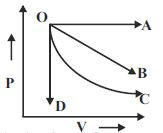
MediumMCQ
For which of the following processes is $q = \Delta U$?
A
$O \to A$
B
$O \to B$
C
$O \to C$
D
$O \to D$
Solution
(D) According to the first law of thermodynamics,$\Delta U = q + w$.
For a process to have $q = \Delta U$,the work done $(w)$ must be zero.
Work done is given by $w = -P \cdot \Delta V$.
For $w = 0$,the change in volume $(\Delta V)$ must be zero,which corresponds to an isochoric process.
In the given $P-V$ graph,the process $O \to D$ represents a vertical line where the volume $(V)$ remains constant.
Therefore,for the process $O \to D$,$\Delta V = 0$,which implies $w = 0$ and $q = \Delta U$.
For a process to have $q = \Delta U$,the work done $(w)$ must be zero.
Work done is given by $w = -P \cdot \Delta V$.
For $w = 0$,the change in volume $(\Delta V)$ must be zero,which corresponds to an isochoric process.
In the given $P-V$ graph,the process $O \to D$ represents a vertical line where the volume $(V)$ remains constant.
Therefore,for the process $O \to D$,$\Delta V = 0$,which implies $w = 0$ and $q = \Delta U$.
0 likes
View Solution137
EasyMCQ
In a process,the work done by the system is equal to the change in its internal energy. Then the process will be ...........
A
Isochoric
B
Isobaric
C
Isothermal
D
Adiabatic
Solution
(D) According to the first law of thermodynamics,$\Delta U = q + w$.
Given that the work done by the system is equal to the change in internal energy,we have $\Delta U = w$.
Substituting this into the first law equation: $\Delta U = q + \Delta U$,which implies $q = 0$.
$A$ process where heat exchange $q$ is zero is known as an adiabatic process.
Given that the work done by the system is equal to the change in internal energy,we have $\Delta U = w$.
Substituting this into the first law equation: $\Delta U = q + \Delta U$,which implies $q = 0$.
$A$ process where heat exchange $q$ is zero is known as an adiabatic process.
0 likes
View Solution138
EasyMCQ
The temperature of a system decreases in which of the following processes?
A
Adiabatic compression
B
Isothermal expansion
C
Isothermal compression
D
Adiabatic expansion
Solution
(D) In an adiabatic process,there is no exchange of heat between the system and the surroundings,so $q = 0$.
According to the first law of thermodynamics,$\Delta U = q + w$.
Since $q = 0$,$\Delta U = w$.
In an adiabatic expansion,the system does work on the surroundings,so $w < 0$.
This implies $\Delta U < 0$,which means the internal energy of the system decreases.
Since the internal energy of an ideal gas is a function of temperature $(U \propto T)$,a decrease in internal energy leads to a decrease in the temperature of the system.
According to the first law of thermodynamics,$\Delta U = q + w$.
Since $q = 0$,$\Delta U = w$.
In an adiabatic expansion,the system does work on the surroundings,so $w < 0$.
This implies $\Delta U < 0$,which means the internal energy of the system decreases.
Since the internal energy of an ideal gas is a function of temperature $(U \propto T)$,a decrease in internal energy leads to a decrease in the temperature of the system.
0 likes
View Solution139
EasyMCQ
In an isothermal expansion,the increase in volume with a decrease in pressure of a gas is greater than in an adiabatic expansion,because .............
A
The internal energy of the system does not change in isothermal and adiabatic expansion.
B
The temperature remains constant in isothermal expansion,whereas the temperature decreases in adiabatic expansion.
C
In isothermal expansion $q = w$,whereas in adiabatic expansion $\Delta U = w$.
D
Work is done by the system in an isothermal process,whereas work is done on the system in an adiabatic process.
0 likes
View Solution140
DifficultMCQ
Calculate the change in internal energy $(\Delta U)$ if $\Delta H = -92.2\, kJ$,$P = 40\, atm$,and $\Delta V = -1\, L$.
A
$-42\, kJ$
B
$-88\, kJ$
C
$+88\, kJ$
D
$+42\, kJ$
Solution
(B) Given: $\Delta H = -92.2\, kJ$,$P = 40\, atm$,$\Delta V = -1\, L$.
Using the relation: $\Delta H = \Delta U + P\Delta V$
Therefore: $\Delta U = \Delta H - P\Delta V$
First,convert $P\Delta V$ from $atm\, L$ to $kJ$ using the conversion factor $1\, atm\, L = 101.325\, J = 0.101325\, kJ$.
$P\Delta V = 40\, atm \times (-1\, L) = -40\, atm\, L$
$P\Delta V = -40 \times 0.101325\, kJ = -4.053\, kJ$
Now,calculate $\Delta U$:
$\Delta U = -92.2\, kJ - (-4.053\, kJ)$
$\Delta U = -92.2\, kJ + 4.053\, kJ = -88.147\, kJ$
Rounding to the nearest integer,we get $\Delta U \approx -88\, kJ$.
Using the relation: $\Delta H = \Delta U + P\Delta V$
Therefore: $\Delta U = \Delta H - P\Delta V$
First,convert $P\Delta V$ from $atm\, L$ to $kJ$ using the conversion factor $1\, atm\, L = 101.325\, J = 0.101325\, kJ$.
$P\Delta V = 40\, atm \times (-1\, L) = -40\, atm\, L$
$P\Delta V = -40 \times 0.101325\, kJ = -4.053\, kJ$
Now,calculate $\Delta U$:
$\Delta U = -92.2\, kJ - (-4.053\, kJ)$
$\Delta U = -92.2\, kJ + 4.053\, kJ = -88.147\, kJ$
Rounding to the nearest integer,we get $\Delta U \approx -88\, kJ$.
0 likes
View Solution141
DifficultMCQ
One mole of an ideal gas is allowed to expand reversibly and adiabatically from a temperature of $27\,^{\circ}C$. If the work done during the process is $3\, kJ$,then the final temperature of the gas is $...\, K$.
A
$100$
B
$150$
C
$195$
D
$255$
Solution
(B) For an adiabatic process,the change in internal energy $\Delta U$ is equal to the work done $w$ on the system. According to the first law of thermodynamics,$\Delta U = q + w$. Since the process is adiabatic,$q = 0$,so $\Delta U = w$.
Given that the gas expands,work is done by the system,so $w = -3000\, J$.
Using the relation $\Delta U = nC_V\Delta T$,where $n = 1\, mol$ and $C_V = 20\, J/(mol\cdot K)$:
$-3000\, J = 1\, mol \times 20\, J/(mol\cdot K) \times (T_f - T_i)$.
Initial temperature $T_i = 27 + 273 = 300\, K$.
$-3000 = 20 \times (T_f - 300)$.
$-150 = T_f - 300$.
$T_f = 300 - 150 = 150\, K$.
Given that the gas expands,work is done by the system,so $w = -3000\, J$.
Using the relation $\Delta U = nC_V\Delta T$,where $n = 1\, mol$ and $C_V = 20\, J/(mol\cdot K)$:
$-3000\, J = 1\, mol \times 20\, J/(mol\cdot K) \times (T_f - T_i)$.
Initial temperature $T_i = 27 + 273 = 300\, K$.
$-3000 = 20 \times (T_f - 300)$.
$-150 = T_f - 300$.
$T_f = 300 - 150 = 150\, K$.
0 likes
View Solution142
MediumMCQ
Assertion : For an isothermal reversible process $Q = -W$,i.e.,work done by the system equals the heat absorbed by the system.
Reason : Enthalpy change $(\Delta H)$ is zero for an isothermal process.
Reason : Enthalpy change $(\Delta H)$ is zero for an isothermal process.
A
If both Assertion and Reason are correct and the Reason is a correct explanation of the Assertion.
B
If both Assertion and Reason are correct but Reason is not a correct explanation of the Assertion.
C
If the Assertion is correct but Reason is incorrect.
D
If both the Assertion and Reason are incorrect.
Solution
(C) For an isothermal process,the temperature remains constant. Since internal energy $(\Delta U)$ of an ideal gas is a function of temperature only,$\Delta U = 0$.
According to the first law of thermodynamics,$\Delta U = Q + W$.
Substituting $\Delta U = 0$,we get $0 = Q + W$,which implies $Q = -W$.
This means the heat absorbed by the system is equal to the work done by the system.
However,for an isothermal process,enthalpy change $\Delta H = \Delta U + \Delta(PV)$. For an ideal gas,$\Delta H = \Delta U + \Delta(nRT) = 0 + nR\Delta T = 0$. While $\Delta H$ is zero for an ideal gas,the reason provided is not the fundamental explanation for $Q = -W$,which is based on the first law and $\Delta U = 0$. In general,$\Delta H$ is not necessarily zero for all isothermal processes (e.g.,real gases). Thus,the Assertion is correct,but the Reason is incorrect.
According to the first law of thermodynamics,$\Delta U = Q + W$.
Substituting $\Delta U = 0$,we get $0 = Q + W$,which implies $Q = -W$.
This means the heat absorbed by the system is equal to the work done by the system.
However,for an isothermal process,enthalpy change $\Delta H = \Delta U + \Delta(PV)$. For an ideal gas,$\Delta H = \Delta U + \Delta(nRT) = 0 + nR\Delta T = 0$. While $\Delta H$ is zero for an ideal gas,the reason provided is not the fundamental explanation for $Q = -W$,which is based on the first law and $\Delta U = 0$. In general,$\Delta H$ is not necessarily zero for all isothermal processes (e.g.,real gases). Thus,the Assertion is correct,but the Reason is incorrect.
0 likes
View Solution143
EasyMCQ
Assertion : For a reaction $2NH_{3(g)} \to N_{2(g)} + 3H_{2(g)}$ ; $\Delta H > \Delta E$.
Reason : Enthalpy change is always greater than internal energy change.
Reason : Enthalpy change is always greater than internal energy change.
A
If both Assertion and Reason are correct and the Reason is a correct explanation of the Assertion.
B
If both Assertion and Reason are correct but Reason is not a correct explanation of the Assertion.
C
If the Assertion is correct but Reason is incorrect.
D
If both the Assertion and Reason are incorrect.
Solution
(C) The relationship between enthalpy change $(\Delta H)$ and internal energy change $(\Delta E)$ is given by the equation: $\Delta H = \Delta E + \Delta n_g RT$.
For the reaction $2NH_{3(g)} \to N_{2(g)} + 3H_{2(g)}$,the change in the number of gaseous moles is $\Delta n_g = (1 + 3) - 2 = 2$.
Since $\Delta n_g = 2$ (which is positive),$\Delta H = \Delta E + 2RT$,implying $\Delta H > \Delta E$. Thus,the Assertion is correct.
The Reason states that enthalpy change is always greater than internal energy change,which is false because if $\Delta n_g$ is negative or zero,$\Delta H$ can be less than or equal to $\Delta E$.
For the reaction $2NH_{3(g)} \to N_{2(g)} + 3H_{2(g)}$,the change in the number of gaseous moles is $\Delta n_g = (1 + 3) - 2 = 2$.
Since $\Delta n_g = 2$ (which is positive),$\Delta H = \Delta E + 2RT$,implying $\Delta H > \Delta E$. Thus,the Assertion is correct.
The Reason states that enthalpy change is always greater than internal energy change,which is false because if $\Delta n_g$ is negative or zero,$\Delta H$ can be less than or equal to $\Delta E$.
0 likes
View Solution144
Easy
Express the change in internal energy of a system when
$(i)$ No heat is absorbed by the system from the surroundings,but work $(w)$ is done on the system. What type of wall does the system have?
$(ii)$ No work is done on the system,but $q$ amount of heat is taken out from the system and given to the surroundings. What type of wall does the system have?
$(iii)$ $w$ amount of work is done by the system and $q$ amount of heat is supplied to the system. What type of system would it be?
$(i)$ No heat is absorbed by the system from the surroundings,but work $(w)$ is done on the system. What type of wall does the system have?
$(ii)$ No work is done on the system,but $q$ amount of heat is taken out from the system and given to the surroundings. What type of wall does the system have?
$(iii)$ $w$ amount of work is done by the system and $q$ amount of heat is supplied to the system. What type of system would it be?
Solution
(N/A) The first law of thermodynamics states that $\Delta U = q + w$.
$(i)$ Since no heat is absorbed,$q = 0$. Therefore,$\Delta U = w$. The system has an adiabatic wall.
$(ii)$ Since no work is done,$w = 0$. Heat is taken out,so $q$ is negative. Therefore,$\Delta U = -q$. The system has thermally conducting walls (diathermal walls).
$(iii)$ Work is done by the system,so $w$ is negative. Heat is supplied to the system,so $q$ is positive. Therefore,$\Delta U = q - w$. This describes a closed system.
$(i)$ Since no heat is absorbed,$q = 0$. Therefore,$\Delta U = w$. The system has an adiabatic wall.
$(ii)$ Since no work is done,$w = 0$. Heat is taken out,so $q$ is negative. Therefore,$\Delta U = -q$. The system has thermally conducting walls (diathermal walls).
$(iii)$ Work is done by the system,so $w$ is negative. Heat is supplied to the system,so $q$ is positive. Therefore,$\Delta U = q - w$. This describes a closed system.
0 likes
View Solution145
EasyMCQ
Two litres of an ideal gas at a pressure of $10 \ atm$ expands isothermally at $25^{\circ}C$ into a vacuum until its total volume is $10 \ litres$. How much heat is absorbed and how much work is done in the expansion?
A
$q = 0, w = 0$
B
$q = 80 \ L \ atm, w = -80 \ L \ atm$
C
$q = -80 \ L \ atm, w = 80 \ L \ atm$
D
$q = 0, w = 80 \ L \ atm$
Solution
(A) For an expansion into a vacuum,the external pressure $p_{ex} = 0 \ atm$.
The work done in an expansion is given by $w = -p_{ex} \Delta V$.
Since $p_{ex} = 0$,the work done $w = 0 \ L \ atm$.
According to the first law of thermodynamics,$\Delta U = q + w$.
For an isothermal expansion of an ideal gas,the change in internal energy $\Delta U = 0$.
Therefore,$0 = q + 0$,which implies $q = 0$.
Thus,no work is done and no heat is absorbed.
The work done in an expansion is given by $w = -p_{ex} \Delta V$.
Since $p_{ex} = 0$,the work done $w = 0 \ L \ atm$.
According to the first law of thermodynamics,$\Delta U = q + w$.
For an isothermal expansion of an ideal gas,the change in internal energy $\Delta U = 0$.
Therefore,$0 = q + 0$,which implies $q = 0$.
Thus,no work is done and no heat is absorbed.
0 likes
View Solution146
Easy
Consider the same expansion,but this time against a constant external pressure of $1 \ atm$.
Solution
(N/A) The work done during expansion against a constant external pressure is given by the formula $w = -p_{ex} \Delta V$.
Assuming the change in volume $\Delta V$ is $8 \ L$,the work done is $w = -1 \ atm \times 8 \ L = -8 \ L \ atm$.
Since $q = -w$ for an adiabatic process or in the context of energy balance where heat absorbed equals work done,we have $q = 8 \ L \ atm$.
Assuming the change in volume $\Delta V$ is $8 \ L$,the work done is $w = -1 \ atm \times 8 \ L = -8 \ L \ atm$.
Since $q = -w$ for an adiabatic process or in the context of energy balance where heat absorbed equals work done,we have $q = 8 \ L \ atm$.
0 likes
View Solution147
MediumMCQ
The $\Delta U^{\theta}$ of combustion of methane is $-X \ kJ \ mol^{-1}.$ The value of $\Delta H^{\theta}$ is
A
$= \Delta U^{\theta}$
B
$< \Delta U^{\theta}$
C
$> \Delta U^{\theta}$
D
$= 0$
Solution
(B) The combustion reaction of methane is: $CH_4(g) + 2O_2(g) \rightarrow CO_2(g) + 2H_2O(l).$
The change in the number of gaseous moles is $\Delta n_g = n_p(g) - n_r(g) = 1 - (1 + 2) = -2.$
The relationship between enthalpy change and internal energy change is $\Delta H^{\theta} = \Delta U^{\theta} + \Delta n_g RT.$
Substituting $\Delta n_g = -2,$ we get $\Delta H^{\theta} = \Delta U^{\theta} - 2RT.$
Since $2RT$ is a positive value,$\Delta H^{\theta} < \Delta U^{\theta}.$
Therefore,option $(B)$ is correct.
The change in the number of gaseous moles is $\Delta n_g = n_p(g) - n_r(g) = 1 - (1 + 2) = -2.$
The relationship between enthalpy change and internal energy change is $\Delta H^{\theta} = \Delta U^{\theta} + \Delta n_g RT.$
Substituting $\Delta n_g = -2,$ we get $\Delta H^{\theta} = \Delta U^{\theta} - 2RT.$
Since $2RT$ is a positive value,$\Delta H^{\theta} < \Delta U^{\theta}.$
Therefore,option $(B)$ is correct.
0 likes
View Solution148
EasyMCQ
In a process,$701 \, J$ of heat is absorbed by a system and $394 \, J$ of work is done by the system. What is the change in internal energy for the process (in $, J$)?
A
$307$
B
$1095$
C
$-307$
D
$-1095$
Solution
(A) According to the first law of thermodynamics,$\Delta U = q + W$ $(i)$.
Where,$\Delta U$ is the change in internal energy,$q$ is the heat,and $W$ is the work done.
Given:
$q = +701 \, J$ (heat is absorbed by the system).
$W = -394 \, J$ (work is done by the system).
Substituting these values into equation $(i)$:
$\Delta U = 701 \, J + (-394 \, J) = 307 \, J$.
Therefore,the change in internal energy is $307 \, J$.
Where,$\Delta U$ is the change in internal energy,$q$ is the heat,and $W$ is the work done.
Given:
$q = +701 \, J$ (heat is absorbed by the system).
$W = -394 \, J$ (work is done by the system).
Substituting these values into equation $(i)$:
$\Delta U = 701 \, J + (-394 \, J) = 307 \, J$.
Therefore,the change in internal energy is $307 \, J$.
0 likes
View SolutionThermodynamics — First law of thermodynamics · Frequently Asked Questions
1Are these Thermodynamics questions useful for JEE and NEET?
Yes. All questions in this section are mapped to JEE Main and NEET exam patterns. Previous year questions from JEE Main, NEET, GUJCET and state-level exams are included with full solutions.
2Can I switch to Hindi or Gujarati for these questions?
Yes. Use the language tabs in the hero section or the sidebar to view the same questions and solutions in English, Hindi or Gujarati.
3How do I generate a question paper from this subtopic?
Use the Vedclass Exam Paper Generator — select the chapter and subtopic, set difficulty, and generate Sets A, B, C, D automatically. First 3 chapters of every subject are free.
Vedclass Products
For Students
Vedclass Test Series
Mock tests in real JEE/NEET style with performance analysis. 5-day free trial.
Start Free TrialFor Teachers
Exam Paper Generator
Generate Set A/B/C/D papers from this chapter in 2 minutes. 3 chapters free.
Try FreeFor Institutes
Online Exam Module
Live online exams with unlimited students, 360° analytics & white-label branding.
See DemoFor Teachers & Institutes
Generate a Thermodynamics Exam Paper in 2 Minutes
Select subtopic & difficulty — Sets A, B, C, D auto-generated with No Repeat logic.
First 3 chapters of every subject are free — no payment required.