
A English
2 nd Law of thermodynamics and Entropy Questions in English
Class 11 Chemistry · Thermodynamics · 2 nd Law of thermodynamics and Entropy
259+
Questions
English
Language
100%
With Solutions
Showing 50 of 259 questions in English
151
MediumMCQ
In which of the following processes does entropy increase?
A
Evaporation of a liquid
B
Dissolution of sugar in water
C
Boiling of an egg
D
All of these
0 likes
View Solution152
MediumMCQ
Which of the following processes is associated with an increase in entropy?
$(I)$ Melting of a solid
$(II)$ Mixing of gases
$(III)$ Compression of a gas
$(IV)$ Expansion of a gas
$(I)$ Melting of a solid
$(II)$ Mixing of gases
$(III)$ Compression of a gas
$(IV)$ Expansion of a gas
A
$I, II, III$ and $IV$
B
$I, II$ and $IV$
C
$I$ and $II$ only
D
$II, III$ and $IV$
Solution
(B) Entropy $(S)$ is a measure of the randomness or disorder of a system.
$(I)$ Melting of a solid: The transition from solid to liquid increases the freedom of movement of particles,thus increasing entropy.
$(II)$ Mixing of gases: Mixing increases the number of possible arrangements of gas molecules,leading to an increase in entropy.
$(III)$ Compression of a gas: Compressing a gas reduces the volume available to the molecules,decreasing their randomness and thus decreasing entropy.
$(IV)$ Expansion of a gas: Expanding a gas increases the volume available to the molecules,increasing their randomness and thus increasing entropy.
Therefore,processes $(I)$,$(II)$,and $(IV)$ are associated with an increase in entropy.
$(I)$ Melting of a solid: The transition from solid to liquid increases the freedom of movement of particles,thus increasing entropy.
$(II)$ Mixing of gases: Mixing increases the number of possible arrangements of gas molecules,leading to an increase in entropy.
$(III)$ Compression of a gas: Compressing a gas reduces the volume available to the molecules,decreasing their randomness and thus decreasing entropy.
$(IV)$ Expansion of a gas: Expanding a gas increases the volume available to the molecules,increasing their randomness and thus increasing entropy.
Therefore,processes $(I)$,$(II)$,and $(IV)$ are associated with an increase in entropy.
0 likes
View Solution153
EasyMCQ
Which of the following processes is non-spontaneous?
A
Mixing of two different gases
B
Reaction of water with sodium
C
Reaction of sulfuric acid with lime
D
Boiling of water at normal pressure and $60\,^oC$
Solution
(D) process is non-spontaneous if it does not occur on its own under the given conditions.
$1$. Mixing of gases is a spontaneous process due to an increase in entropy.
$2$. The reaction of sodium with water is highly exothermic and spontaneous.
$3$. The reaction of sulfuric acid with lime (calcium hydroxide) is a neutralization reaction,which is spontaneous.
$4$. Boiling of water requires the temperature to be at its boiling point ($100\,^oC$ at $1$ atm). At $60\,^oC$ and $1$ atm,water does not boil spontaneously. Thus,this process is non-spontaneous.
$1$. Mixing of gases is a spontaneous process due to an increase in entropy.
$2$. The reaction of sodium with water is highly exothermic and spontaneous.
$3$. The reaction of sulfuric acid with lime (calcium hydroxide) is a neutralization reaction,which is spontaneous.
$4$. Boiling of water requires the temperature to be at its boiling point ($100\,^oC$ at $1$ atm). At $60\,^oC$ and $1$ atm,water does not boil spontaneously. Thus,this process is non-spontaneous.
0 likes
View Solution154
MediumMCQ
The enthalpy change for the transition of liquid water to steam at $100\,^oC$ is $40.8\, kJ\, mol^{-1}$. The entropy change for this process is .... $J\, K^{-1}\, mol^{-1}$.
A
$0.408$
B
$408$
C
$109.4$
D
$0.1094$
Solution
(C) The entropy change for vaporization is given by the formula: $\Delta S_{\text{vap}} = \frac{\Delta H_{\text{vap}}}{T}$.
Given: $\Delta H_{\text{vap}} = 40.8\, kJ\, mol^{-1} = 40800\, J\, mol^{-1}$ and $T = 100 + 273 = 373\, K$.
Substituting the values: $\Delta S_{\text{vap}} = \frac{40800}{373} \approx 109.4\, J\, K^{-1}\, mol^{-1}$.
Given: $\Delta H_{\text{vap}} = 40.8\, kJ\, mol^{-1} = 40800\, J\, mol^{-1}$ and $T = 100 + 273 = 373\, K$.
Substituting the values: $\Delta S_{\text{vap}} = \frac{40800}{373} \approx 109.4\, J\, K^{-1}\, mol^{-1}$.
0 likes
View Solution155
EasyMCQ
For a spontaneous process,the correct statement is
A
Entropy of the system always increases
B
Free energy of the system always increases
C
Total entropy change is always negative
D
Total entropy change is always positive
Solution
(D) For a process to be spontaneous,the total entropy change of the universe,which is the sum of the entropy change of the system and the surroundings,must be positive. Mathematically,$\Delta S_{\text{total}} = \Delta S_{\text{system}} + \Delta S_{\text{surroundings}} > 0$.
0 likes
View Solution156
EasyMCQ
$\Delta S_{surr}$ for an exothermic reaction is
A
always positive
B
always negative
C
zero
D
may be positive or negative
Solution
(A) The entropy change of the surroundings is given by the formula $\Delta S_{surr} = -\frac{\Delta H_{sys}}{T}$.
For an exothermic reaction,the enthalpy change of the system $\Delta H_{sys}$ is negative.
Therefore,$\Delta S_{surr} = -\frac{(\text{negative value})}{T}$,which results in a positive value.
Thus,$\Delta S_{surr}$ is always positive for an exothermic reaction.
For an exothermic reaction,the enthalpy change of the system $\Delta H_{sys}$ is negative.
Therefore,$\Delta S_{surr} = -\frac{(\text{negative value})}{T}$,which results in a positive value.
Thus,$\Delta S_{surr}$ is always positive for an exothermic reaction.
0 likes
View Solution157
EasyMCQ
When a solid melts reversibly,which of the following occurs?
A
$H$ decreases
B
$G$ increases
C
$E$ decreases
D
$S$ increases
Solution
(D) When a solid melts,it undergoes a phase transition from a highly ordered state to a less ordered state.
Since entropy $(S)$ is a measure of the randomness or disorder of a system,the transition from solid to liquid results in an increase in the randomness of the particles.
Therefore,$S$ increases during the melting process.
Since entropy $(S)$ is a measure of the randomness or disorder of a system,the transition from solid to liquid results in an increase in the randomness of the particles.
Therefore,$S$ increases during the melting process.
0 likes
View Solution158
EasyMCQ
Which of the following processes takes place with a decrease of entropy?
A
Solid $\to$ gas
B
Sugar $+$ water $\to$ solution
C
$NH_{3(g)} + HCl_{(g)} \to NH_4Cl_{(s)}$
D
$A_{(g)} + B_{(g)} \to$ mixture
Solution
(C) Entropy is a measure of the randomness or disorder of a system. $\Delta S < 0$ implies a decrease in entropy,which occurs when a system becomes more ordered.
In option $A$,solid to gas transition increases disorder.
In option $B$,dissolution increases entropy due to mixing.
In option $D$,mixing of gases increases entropy.
In option $C$,two moles of gaseous reactants form one mole of solid product. Since the solid state is much more ordered than the gaseous state,the entropy of the system decreases.
In option $A$,solid to gas transition increases disorder.
In option $B$,dissolution increases entropy due to mixing.
In option $D$,mixing of gases increases entropy.
In option $C$,two moles of gaseous reactants form one mole of solid product. Since the solid state is much more ordered than the gaseous state,the entropy of the system decreases.
0 likes
View Solution159
MediumMCQ
Assertion : Entropy of ice is less than water.
Reason : Ice has a cage-like structure.
Reason : Ice has a cage-like structure.
A
If both Assertion and Reason are correct and the Reason is a correct explanation of the Assertion.
B
If both Assertion and Reason are correct but Reason is not a correct explanation of the Assertion.
C
If the Assertion is correct but Reason is incorrect.
D
If both the Assertion and Reason are incorrect.
Solution
(A) Entropy is a measure of the degree of randomness or disorder in a system.
In the solid state (ice),molecules are held in a fixed,ordered lattice,whereas in the liquid state (water),molecules have more freedom of movement.
Therefore,the entropy of ice is less than that of water.
The reason provided,that ice has an open cage-like structure due to hydrogen bonding,is also a correct statement.
This cage-like structure restricts the movement of water molecules,which is the underlying cause for the lower entropy of ice compared to water.
Thus,the Reason correctly explains the Assertion.
In the solid state (ice),molecules are held in a fixed,ordered lattice,whereas in the liquid state (water),molecules have more freedom of movement.
Therefore,the entropy of ice is less than that of water.
The reason provided,that ice has an open cage-like structure due to hydrogen bonding,is also a correct statement.
This cage-like structure restricts the movement of water molecules,which is the underlying cause for the lower entropy of ice compared to water.
Thus,the Reason correctly explains the Assertion.
0 likes
View Solution160
EasyMCQ
Assertion : Water in liquid state is more stable than ice at room temperature.
Reason : Water in liquid form has higher entropy than ice.
Reason : Water in liquid form has higher entropy than ice.
A
If both Assertion and Reason are correct and the Reason is a correct explanation of the Assertion.
B
If both Assertion and Reason are correct but Reason is not a correct explanation of the Assertion.
C
If the Assertion is correct but Reason is incorrect.
D
If both the Assertion and Reason are incorrect.
Solution
(A) At room temperature,water is more stable than ice because ice spontaneously melts into liquid water. Thus,the Assertion is true.
Entropy is a measure of the randomness or disorder of a system. Liquid water has a more disordered structure compared to the highly ordered crystalline structure of ice,meaning liquid water has higher entropy. Thus,the Reason is true.
According to the second law of thermodynamics,for a spontaneous process at constant temperature and pressure,the Gibbs free energy change $\Delta G = \Delta H - T\Delta S$ must be negative. Since the melting of ice is spontaneous at room temperature,the increase in entropy $(\Delta S > 0)$ contributes to making $\Delta G$ negative,thereby explaining the stability of the liquid state. Therefore,the Reason correctly explains the Assertion.
Entropy is a measure of the randomness or disorder of a system. Liquid water has a more disordered structure compared to the highly ordered crystalline structure of ice,meaning liquid water has higher entropy. Thus,the Reason is true.
According to the second law of thermodynamics,for a spontaneous process at constant temperature and pressure,the Gibbs free energy change $\Delta G = \Delta H - T\Delta S$ must be negative. Since the melting of ice is spontaneous at room temperature,the increase in entropy $(\Delta S > 0)$ contributes to making $\Delta G$ negative,thereby explaining the stability of the liquid state. Therefore,the Reason correctly explains the Assertion.
0 likes
View Solution161
EasyMCQ
In which case is the change in entropy negative?
A
Evaporation of water
B
Expansion of a gas at constant temperature
C
Sublimation of solid to gas
D
$2H_{(g)} \rightarrow H_{2(g)}$
Solution
(D) For the reaction $2H_{(g)} \rightarrow H_{2(g)}$,two moles of gaseous atoms combine to form one mole of a gaseous molecule.
Since the number of moles of gas decreases,the randomness or disorder of the system decreases.
Therefore,the change in entropy $(\Delta S)$ is negative.
Since the number of moles of gas decreases,the randomness or disorder of the system decreases.
Therefore,the change in entropy $(\Delta S)$ is negative.
0 likes
View Solution162
MediumMCQ
The true statement amongst the following is
A
Both $\Delta S$ and $S$ are functions of temperature.
B
$S$ is not a function of temperature but $\Delta S$ is a function of temperature.
C
Both $S$ and $\Delta S$ are not functions of temperature.
D
$S$ is a function of temperature but $\Delta S$ is not a function of temperature.
Solution
(A) Entropy $(S)$ is a state function and its value depends on the state of the system,which is defined by variables like temperature $(T)$,pressure $(P)$,and volume $(V)$.
Since $S = f(T, P, V)$,entropy is a function of temperature.
Similarly,the change in entropy $(\Delta S = S_2 - S_1)$ also depends on the initial and final states of the system,which are defined by temperature.
Therefore,both $S$ and $\Delta S$ are functions of temperature.
Since $S = f(T, P, V)$,entropy is a function of temperature.
Similarly,the change in entropy $(\Delta S = S_2 - S_1)$ also depends on the initial and final states of the system,which are defined by temperature.
Therefore,both $S$ and $\Delta S$ are functions of temperature.
0 likes
View Solution163
Medium
Predict in which of the following,entropy increases or decreases:
$(i)$ $A$ liquid crystallizes into a solid.
$(ii)$ Temperature of a crystalline solid is raised from $0 \, K$ to $115 \, K$.
$(iii)$ $2NaHCO_{3(s)} \to Na_2CO_{3(s)} + CO_{2(g)} + H_2O_{(g)}$
$(iv)$ $H_{2(g)} \to 2H_{(g)}$
$(i)$ $A$ liquid crystallizes into a solid.
$(ii)$ Temperature of a crystalline solid is raised from $0 \, K$ to $115 \, K$.
$(iii)$ $2NaHCO_{3(s)} \to Na_2CO_{3(s)} + CO_{2(g)} + H_2O_{(g)}$
$(iv)$ $H_{2(g)} \to 2H_{(g)}$
Solution
(A) $(i)$ After freezing,the molecules attain an ordered state,therefore,entropy decreases.
$(ii)$ At $0 \, K$,the constituent particles are static and entropy is minimum. If the temperature is raised to $115 \, K$,these particles begin to move and oscillate about their equilibrium positions in the lattice,and the system becomes more disordered. Therefore,entropy increases.
$(iii)$ The reactant,$NaHCO_3$,is a solid and has low entropy. Among the products,there is one solid and two gases. Therefore,the products represent a condition of higher entropy.
$(iv)$ Here,one molecule gives two atoms,i.e.,the number of particles increases,leading to a more disordered state. Two moles of $H$ atoms have higher entropy than one mole of $H_2$ molecule.
$(ii)$ At $0 \, K$,the constituent particles are static and entropy is minimum. If the temperature is raised to $115 \, K$,these particles begin to move and oscillate about their equilibrium positions in the lattice,and the system becomes more disordered. Therefore,entropy increases.
$(iii)$ The reactant,$NaHCO_3$,is a solid and has low entropy. Among the products,there is one solid and two gases. Therefore,the products represent a condition of higher entropy.
$(iv)$ Here,one molecule gives two atoms,i.e.,the number of particles increases,leading to a more disordered state. Two moles of $H$ atoms have higher entropy than one mole of $H_2$ molecule.
0 likes
View Solution164
Medium
For the oxidation of iron:
$4 Fe_{(s)} + 3 O_{2(g)} \rightarrow 2 Fe_2O_{3(s)}$
The entropy change is $-549.4 \ J \ K^{-1} \ mol^{-1}$ at $298 \ K$. Despite the negative entropy change of this reaction,why is the reaction spontaneous?
($\Delta_r H^\Theta$ for this reaction is $-1648 \times 10^3 \ J \ mol^{-1}$)
$4 Fe_{(s)} + 3 O_{2(g)} \rightarrow 2 Fe_2O_{3(s)}$
The entropy change is $-549.4 \ J \ K^{-1} \ mol^{-1}$ at $298 \ K$. Despite the negative entropy change of this reaction,why is the reaction spontaneous?
($\Delta_r H^\Theta$ for this reaction is $-1648 \times 10^3 \ J \ mol^{-1}$)
Solution
(N/A) The spontaneity of a reaction is determined by the total entropy change,$\Delta S_{total} = \Delta S_{sys} + \Delta S_{surr}$.
To calculate $\Delta S_{surr}$,we consider the heat released to the surroundings,which is equal to $-\Delta_r H^\Theta$. At constant pressure and temperature $T$,the entropy change of the surroundings is given by:
$\Delta S_{surr} = -\frac{\Delta_r H^\Theta}{T}$
Substituting the given values:
$\Delta S_{surr} = -\frac{(-1648 \times 10^3 \ J \ mol^{-1})}{298 \ K} = 5530 \ J \ K^{-1} \ mol^{-1}$
Now,the total entropy change for the reaction is:
$\Delta_r S_{total} = \Delta S_{sys} + \Delta S_{surr} = -549.4 \ J \ K^{-1} \ mol^{-1} + 5530 \ J \ K^{-1} \ mol^{-1} = 4980.6 \ J \ K^{-1} \ mol^{-1}$
Since $\Delta_r S_{total} > 0$,the reaction is spontaneous.
To calculate $\Delta S_{surr}$,we consider the heat released to the surroundings,which is equal to $-\Delta_r H^\Theta$. At constant pressure and temperature $T$,the entropy change of the surroundings is given by:
$\Delta S_{surr} = -\frac{\Delta_r H^\Theta}{T}$
Substituting the given values:
$\Delta S_{surr} = -\frac{(-1648 \times 10^3 \ J \ mol^{-1})}{298 \ K} = 5530 \ J \ K^{-1} \ mol^{-1}$
Now,the total entropy change for the reaction is:
$\Delta_r S_{total} = \Delta S_{sys} + \Delta S_{surr} = -549.4 \ J \ K^{-1} \ mol^{-1} + 5530 \ J \ K^{-1} \ mol^{-1} = 4980.6 \ J \ K^{-1} \ mol^{-1}$
Since $\Delta_r S_{total} > 0$,the reaction is spontaneous.
0 likes
View Solution165
EasyMCQ
For an isolated system,$\Delta U = 0,$ what will be $\Delta S?$
A
$\Delta S < 0$
B
$\Delta S = 0$
C
$\Delta S > 0$
D
$\Delta S = \Delta H$
Solution
(C) For an isolated system,the total energy remains constant,so $\Delta U = 0.$
According to the second law of thermodynamics,for any spontaneous process in an isolated system,the entropy of the system must increase.
Therefore,$\Delta S > 0$ for a spontaneous process in an isolated system.
According to the second law of thermodynamics,for any spontaneous process in an isolated system,the entropy of the system must increase.
Therefore,$\Delta S > 0$ for a spontaneous process in an isolated system.
0 likes
View Solution166
EasyMCQ
Calculate the entropy change in the surroundings when $1.00 \ mol$ of $H_2O_{(l)}$ is formed under standard conditions. Given: $\Delta_f H^{\theta} = -286 \ kJ \ mol^{-1}$.
A
$959.73 \ J \ K^{-1} \ mol^{-1}$
B
$-959.73 \ J \ K^{-1} \ mol^{-1}$
C
$0.959 \ J \ K^{-1} \ mol^{-1}$
D
$-0.959 \ J \ K^{-1} \ mol^{-1}$
Solution
(A) The formation of $1 \ mol$ of $H_2O_{(l)}$ releases $286 \ kJ \ mol^{-1}$ of heat,meaning $q_{sys} = -286 \ kJ \ mol^{-1}$.
Since the process is exothermic,the surroundings absorb this heat: $q_{surr} = +286 \ kJ \ mol^{-1} = +286000 \ J \ mol^{-1}$.
Standard conditions imply a temperature of $T = 298 \ K$.
The entropy change for the surroundings is given by $\Delta S_{surr} = \frac{q_{surr}}{T}$.
$\Delta S_{surr} = \frac{286000 \ J \ mol^{-1}}{298 \ K} = 959.73 \ J \ K^{-1} \ mol^{-1}$.
Since the process is exothermic,the surroundings absorb this heat: $q_{surr} = +286 \ kJ \ mol^{-1} = +286000 \ J \ mol^{-1}$.
Standard conditions imply a temperature of $T = 298 \ K$.
The entropy change for the surroundings is given by $\Delta S_{surr} = \frac{q_{surr}}{T}$.
$\Delta S_{surr} = \frac{286000 \ J \ mol^{-1}}{298 \ K} = 959.73 \ J \ K^{-1} \ mol^{-1}$.
0 likes
View Solution167
Difficult
Explain entropy and spontaneity of reactions.
Solution
(N/A) Entropy $(S)$ is a measure of the degree of randomness or disorder in a system. For a spontaneous process,the total entropy change of the system and surroundings must be positive,i.e.,$\Delta S_{total} = \Delta S_{sys} + \Delta S_{surr} > 0$.
Spontaneity is determined by the Gibbs free energy change $(\Delta G)$. $A$ reaction is spontaneous if $\Delta G < 0$. The relationship is given by $\Delta G = \Delta H - T\Delta S$.
For an exothermic reaction $(\Delta H < 0)$,if $\Delta S > 0$,the reaction is spontaneous at all temperatures. If $\Delta S < 0$,it is spontaneous only at low temperatures.
For an endothermic reaction $(\Delta H > 0)$,if $\Delta S > 0$,it is spontaneous at high temperatures. If $\Delta S < 0$,the reaction is non-spontaneous at all temperatures.
Spontaneity is determined by the Gibbs free energy change $(\Delta G)$. $A$ reaction is spontaneous if $\Delta G < 0$. The relationship is given by $\Delta G = \Delta H - T\Delta S$.
For an exothermic reaction $(\Delta H < 0)$,if $\Delta S > 0$,the reaction is spontaneous at all temperatures. If $\Delta S < 0$,it is spontaneous only at low temperatures.
For an endothermic reaction $(\Delta H > 0)$,if $\Delta S > 0$,it is spontaneous at high temperatures. If $\Delta S < 0$,the reaction is non-spontaneous at all temperatures.
0 likes
View Solution168
Medium
Explain entropy and spontaneity.
Solution
(N/A) Entropy $(S)$ is a measure of the degree of randomness or disorder in a system. For a spontaneous process,the total entropy of the system and surroundings must increase,i.e.,$\Delta S_{total} = \Delta S_{sys} + \Delta S_{surr} > 0$.
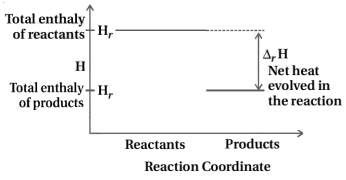
Spontaneity refers to the tendency of a process to occur without continuous external influence. While exothermic reactions (where $\Delta H < 0$) are often spontaneous,enthalpy change alone is not sufficient to predict spontaneity. The second law of thermodynamics states that for a spontaneous process,the entropy of the universe increases.
The Gibbs free energy change $(\Delta G = \Delta H - T\Delta S)$ is the definitive criterion for spontaneity at constant temperature and pressure:
$1$. If $\Delta G < 0$,the process is spontaneous.
$2$. If $\Delta G > 0$,the process is non-spontaneous.
$3$. If $\Delta G = 0$,the system is at equilibrium.
Spontaneity refers to the tendency of a process to occur without continuous external influence. While exothermic reactions (where $\Delta H < 0$) are often spontaneous,enthalpy change alone is not sufficient to predict spontaneity. The second law of thermodynamics states that for a spontaneous process,the entropy of the universe increases.
The Gibbs free energy change $(\Delta G = \Delta H - T\Delta S)$ is the definitive criterion for spontaneity at constant temperature and pressure:
$1$. If $\Delta G < 0$,the process is spontaneous.
$2$. If $\Delta G > 0$,the process is non-spontaneous.
$3$. If $\Delta G = 0$,the system is at equilibrium.
0 likes
View Solution169
Medium
What is entropy? Explain its role in spontaneity.
Solution
(N/A) Entropy is a measure of the degree of randomness or disorder in a system.
Entropy is lowest in the solid state and highest in the gaseous state. When heat is added to a system,it increases molecular motion,leading to increased randomness.
The change in entropy $(\Delta S)$ is defined as the heat added to the system reversibly $(q_{rev})$ divided by the absolute temperature $(T)$: $\Delta S = \frac{q_{rev}}{T}$.
For a process to be spontaneous,the total entropy change of the universe must be positive: $\Delta S_{total} = \Delta S_{sys} + \Delta S_{surr} > 0$.
$1$. If $\Delta S_{total} > 0$,the process is spontaneous.
$2$. If $\Delta S_{total} < 0$,the process is non-spontaneous.
$3$. If $\Delta S_{total} = 0$,the system is in equilibrium.
Entropy is a state function,meaning its value depends only on the initial and final states of the system.
Entropy is lowest in the solid state and highest in the gaseous state. When heat is added to a system,it increases molecular motion,leading to increased randomness.
The change in entropy $(\Delta S)$ is defined as the heat added to the system reversibly $(q_{rev})$ divided by the absolute temperature $(T)$: $\Delta S = \frac{q_{rev}}{T}$.
For a process to be spontaneous,the total entropy change of the universe must be positive: $\Delta S_{total} = \Delta S_{sys} + \Delta S_{surr} > 0$.
$1$. If $\Delta S_{total} > 0$,the process is spontaneous.
$2$. If $\Delta S_{total} < 0$,the process is non-spontaneous.
$3$. If $\Delta S_{total} = 0$,the system is in equilibrium.
Entropy is a state function,meaning its value depends only on the initial and final states of the system.
0 likes
View Solution170
MediumMCQ
The enthalpy of vaporization of benzene is $30.779 \ kJ/mol$ and its boiling point is $353 \ K$. Find the change in entropy for the conversion of liquid benzene to its vapour at that temperature.
A
$0.0872 \ kJ \ K^{-1} \ mol^{-1}$
B
$0.0950 \ kJ \ K^{-1} \ mol^{-1}$
C
$0.0750 \ kJ \ K^{-1} \ mol^{-1}$
D
$0.0650 \ kJ \ K^{-1} \ mol^{-1}$
Solution
(A) The change in entropy for a phase transition is given by the formula: $\Delta S_{vap} = \frac{\Delta H_{vap}}{T_b}$.
Given,$\Delta H_{vap} = 30.779 \ kJ/mol$ and $T_b = 353 \ K$.
Substituting the values: $\Delta S_{vap} = \frac{30.779 \ kJ/mol}{353 \ K} = 0.0872 \ kJ \ K^{-1} \ mol^{-1}$.
Given,$\Delta H_{vap} = 30.779 \ kJ/mol$ and $T_b = 353 \ K$.
Substituting the values: $\Delta S_{vap} = \frac{30.779 \ kJ/mol}{353 \ K} = 0.0872 \ kJ \ K^{-1} \ mol^{-1}$.
0 likes
View Solution171
MediumMCQ
$3$ moles of water is boiled at $373 \ K$ and is changed to vapour state having the same temperature. What will be the change in entropy of the system (in $kJ/K$)? [ The molar heat of vaporization of water is $40.668 \ kJ/mol$ ]
A
$0.327$
B
$0.109$
C
$0.981$
D
$0.654$
Solution
(A) The change in entropy for a phase transition is given by the formula: $\Delta S_{vap} = \frac{n \times \Delta H_{vap}}{T}$.
Given:
$n = 3 \ mol$
$\Delta H_{vap} = 40.668 \ kJ/mol$
$T = 373 \ K$
Substituting the values:
$\Delta S_{vap} = \frac{3 \ mol \times 40.668 \ kJ/mol}{373 \ K} = \frac{122.004 \ kJ}{373 \ K} = 0.327 \ kJ/K$.
Given:
$n = 3 \ mol$
$\Delta H_{vap} = 40.668 \ kJ/mol$
$T = 373 \ K$
Substituting the values:
$\Delta S_{vap} = \frac{3 \ mol \times 40.668 \ kJ/mol}{373 \ K} = \frac{122.004 \ kJ}{373 \ K} = 0.327 \ kJ/K$.
0 likes
View Solution172
Medium
Will ice at $273 \ K$ placed in a surrounding at $298 \ K$ melt to form water at $273 \ K$? Prove this statement. The molar enthalpy of fusion of ice is $6.025 \ kJ \ mol^{-1}$.
Solution
(A) The process of melting ice at $273 \ K$ to water at $273 \ K$ is spontaneous because the surrounding temperature $(298 \ K)$ is higher than the melting point of ice $(273 \ K)$.
For the process $H_2O(s) \rightarrow H_2O(l)$ at $273 \ K$:
$\Delta H = 6.025 \ kJ \ mol^{-1} = 6025 \ J \ mol^{-1}$.
$\Delta S_{sys} = \frac{\Delta H}{T} = \frac{6025 \ J \ mol^{-1}}{273 \ K} = 22.07 \ J \ K^{-1} \ mol^{-1}$.
For the surrounding,$\Delta S_{surr} = \frac{-\Delta H}{T_{surr}} = \frac{-6025 \ J \ mol^{-1}}{298 \ K} = -20.22 \ J \ K^{-1} \ mol^{-1}$.
Total entropy change $\Delta S_{total} = \Delta S_{sys} + \Delta S_{surr} = 22.07 - 20.22 = 1.85 \ J \ K^{-1} \ mol^{-1}$.
Since $\Delta S_{total} > 0$,the process is spontaneous.
For the process $H_2O(s) \rightarrow H_2O(l)$ at $273 \ K$:
$\Delta H = 6.025 \ kJ \ mol^{-1} = 6025 \ J \ mol^{-1}$.
$\Delta S_{sys} = \frac{\Delta H}{T} = \frac{6025 \ J \ mol^{-1}}{273 \ K} = 22.07 \ J \ K^{-1} \ mol^{-1}$.
For the surrounding,$\Delta S_{surr} = \frac{-\Delta H}{T_{surr}} = \frac{-6025 \ J \ mol^{-1}}{298 \ K} = -20.22 \ J \ K^{-1} \ mol^{-1}$.
Total entropy change $\Delta S_{total} = \Delta S_{sys} + \Delta S_{surr} = 22.07 - 20.22 = 1.85 \ J \ K^{-1} \ mol^{-1}$.
Since $\Delta S_{total} > 0$,the process is spontaneous.
0 likes
View Solution173
Easy
Given that $\Delta H = 0$ for the mixing of two gases,explain whether the diffusion of these gases into each other in a closed container is a spontaneous process or not?
Solution
(A) For the mixing of two gases,the enthalpy change is $\Delta H = 0$.
According to the Gibbs free energy equation,$\Delta G = \Delta H - T\Delta S$.
Since $\Delta H = 0$,the equation becomes $\Delta G = -T\Delta S$.
When two gases mix,the entropy of the system increases,meaning $\Delta S > 0$.
Therefore,$\Delta G$ becomes negative $(\Delta G < 0)$,which indicates that the process is spontaneous.
According to the Gibbs free energy equation,$\Delta G = \Delta H - T\Delta S$.
Since $\Delta H = 0$,the equation becomes $\Delta G = -T\Delta S$.
When two gases mix,the entropy of the system increases,meaning $\Delta S > 0$.
Therefore,$\Delta G$ becomes negative $(\Delta G < 0)$,which indicates that the process is spontaneous.
0 likes
View Solution174
Easy
Heat has a randomizing influence on a system,and temperature is the measure of the average chaotic motion of particles in the system. Write the mathematical relation that relates these three parameters.
Solution
(N/A) Heat has a randomizing influence on a system,and temperature is the measure of the average chaotic motion of particles in the system.
The mathematical relation that relates these three parameters is $\Delta S = \frac{q_{rev}}{T}$.
Here,$\Delta S$ is the change in entropy.
$q_{rev}$ is the heat exchanged in a reversible process.
$T$ is the absolute temperature.
The mathematical relation that relates these three parameters is $\Delta S = \frac{q_{rev}}{T}$.
Here,$\Delta S$ is the change in entropy.
$q_{rev}$ is the heat exchanged in a reversible process.
$T$ is the absolute temperature.
0 likes
View Solution175
Easy
The standard molar entropy of $H_{2}O_{(l)}$ is $70 \ J \ K^{-1} \ mol^{-1}$. Will the standard molar entropy of $H_{2}O_{(s)}$ be more or less than $70 \ J \ K^{-1} \ mol^{-1}$?
Solution
(N/A) The standard molar entropy of $H_{2}O_{(l)}$ is $70 \ J \ K^{-1} \ mol^{-1}$.
The solid form of $H_{2}O$ is ice. In ice,molecules of $H_{2}O$ are held in a rigid crystalline structure,making them less random and disordered than in liquid water.
Entropy is a measure of the randomness or disorder of a system. Since the solid state has a more ordered arrangement of molecules compared to the liquid state,the entropy of the solid is lower.
Therefore,the standard molar entropy of $H_{2}O_{(s)}$ will be less than $70 \ J \ K^{-1} \ mol^{-1}$.
The solid form of $H_{2}O$ is ice. In ice,molecules of $H_{2}O$ are held in a rigid crystalline structure,making them less random and disordered than in liquid water.
Entropy is a measure of the randomness or disorder of a system. Since the solid state has a more ordered arrangement of molecules compared to the liquid state,the entropy of the solid is lower.
Therefore,the standard molar entropy of $H_{2}O_{(s)}$ will be less than $70 \ J \ K^{-1} \ mol^{-1}$.
0 likes
View Solution176
EasyMCQ
Calculate the sign of $\Delta S$ for the melting of ice at $275 \ K$.
A
Positive
B
Negative
C
Zero
D
Cannot be determined
Solution
(A) The melting point of ice is $273 \ K$.
At $275 \ K$,which is above the melting point,the process of ice melting into water is spontaneous.
For a spontaneous process,the change in entropy of the system is positive.
Therefore,$\Delta S > 0$ (Positive).
At $275 \ K$,which is above the melting point,the process of ice melting into water is spontaneous.
For a spontaneous process,the change in entropy of the system is positive.
Therefore,$\Delta S > 0$ (Positive).
0 likes
View Solution177
EasyMCQ
What is the change in entropy when an ideal gas expands into a vacuum?
A
$\Delta S = 0$
B
$\Delta S > 0$
C
$\Delta S < 0$
D
$\Delta S = R \ln \frac{V_2}{V_1}$
Solution
(B) When an ideal gas expands into a vacuum,the external pressure $P_{ext} = 0$.
Since work done $w = -P_{ext} \Delta V$,the work done is $0$.
For an adiabatic process in a vacuum,$q = 0$.
According to the first law of thermodynamics,$\Delta U = q + w = 0$.
For an ideal gas,$\Delta U$ depends only on temperature,so $\Delta T = 0$.
However,the expansion into a vacuum is an irreversible process.
The entropy change for an ideal gas is given by $\Delta S = nR \ln \frac{V_2}{V_1}$.
Since $V_2 > V_1$,$\Delta S > 0$.
Since work done $w = -P_{ext} \Delta V$,the work done is $0$.
For an adiabatic process in a vacuum,$q = 0$.
According to the first law of thermodynamics,$\Delta U = q + w = 0$.
For an ideal gas,$\Delta U$ depends only on temperature,so $\Delta T = 0$.
However,the expansion into a vacuum is an irreversible process.
The entropy change for an ideal gas is given by $\Delta S = nR \ln \frac{V_2}{V_1}$.
Since $V_2 > V_1$,$\Delta S > 0$.
0 likes
View Solution178
EasyMCQ
State the limitation of the $2^{nd}$ law of thermodynamics.
A
It does not predict the direction of the process.
B
It does not provide information about the rate of chemical reactions.
C
It cannot define the entropy of a system.
D
It is not applicable to closed systems.
Solution
(B) The $2^{nd}$ law of thermodynamics helps in predicting the spontaneity of a process based on entropy changes,but it does not provide any information regarding the rate or speed at which the chemical reaction proceeds.
0 likes
View Solution179
EasyMCQ
Which state functions are required to understand the second law of thermodynamics?
A
Enthalpy and Internal Energy
B
Entropy and Gibbs Free Energy
C
Work and Heat
D
Pressure and Volume
Solution
(B) The second law of thermodynamics is primarily understood using the state functions $Entropy$ $(S)$ and $Gibbs$ $Free$ $Energy$ $(G)$.
$Entropy$ helps determine the spontaneity of a process in an isolated system,while $Gibbs$ $Free$ $Energy$ is used for systems at constant temperature and pressure.
$Entropy$ helps determine the spontaneity of a process in an isolated system,while $Gibbs$ $Free$ $Energy$ is used for systems at constant temperature and pressure.
0 likes
View Solution180
EasyMCQ
Give the mathematical equation for entropy change.
A
$\Delta S = q \times T$
B
$\Delta S = \frac{q_{rev}}{T}$
C
$\Delta S = \frac{T}{q_{rev}}$
D
$\Delta S = q + T$
Solution
(B) The entropy change $(\Delta S)$ for a reversible process is defined as the ratio of the heat absorbed reversibly $(q_{rev})$ to the absolute temperature $(T)$.
Thus,the mathematical equation is $\Delta S = \frac{q_{rev}}{T}$.
Thus,the mathematical equation is $\Delta S = \frac{q_{rev}}{T}$.
0 likes
View Solution181
Easy
What is entropy?
Solution
Entropy is a thermodynamic state function that measures the degree of randomness or disorder in a system.
It is denoted by the symbol $S$.
For a reversible process,the change in entropy $(dS)$ is defined as the ratio of heat absorbed reversibly $(dq_{rev})$ to the absolute temperature $(T)$:
$dS = \frac{dq_{rev}}{T}$.
The unit of entropy is $J \ K^{-1} \ mol^{-1}$.
It is denoted by the symbol $S$.
For a reversible process,the change in entropy $(dS)$ is defined as the ratio of heat absorbed reversibly $(dq_{rev})$ to the absolute temperature $(T)$:
$dS = \frac{dq_{rev}}{T}$.
The unit of entropy is $J \ K^{-1} \ mol^{-1}$.
0 likes
View Solution182
EasyMCQ
What is the change in entropy when an ideal gas expands into a vacuum?
A
$\Delta S = 0$
B
$\Delta S = nR \ln \frac{V_2}{V_1}$
C
$\Delta S = -nR \ln \frac{V_2}{V_1}$
D
$\Delta S = \infty$
Solution
(B) When an ideal gas expands into a vacuum,the process is known as free expansion.
Since the external pressure $P_{ext} = 0$,the work done $w = -P_{ext} \Delta V = 0$.
For an ideal gas,internal energy depends only on temperature,so $\Delta U = 0$.
According to the first law of thermodynamics,$\Delta U = q + w$,which implies $q = 0$.
Since the process is adiabatic $(q = 0)$ and involves no work $(w = 0)$,the change in entropy for an ideal gas during isothermal expansion is given by $\Delta S = nR \ln \frac{V_2}{V_1}$.
Since the external pressure $P_{ext} = 0$,the work done $w = -P_{ext} \Delta V = 0$.
For an ideal gas,internal energy depends only on temperature,so $\Delta U = 0$.
According to the first law of thermodynamics,$\Delta U = q + w$,which implies $q = 0$.
Since the process is adiabatic $(q = 0)$ and involves no work $(w = 0)$,the change in entropy for an ideal gas during isothermal expansion is given by $\Delta S = nR \ln \frac{V_2}{V_1}$.
0 likes
View Solution183
EasyMCQ
State the limitation of the second law of thermodynamics.
A
It does not predict the direction of the reaction.
B
It does not provide information about the rate of chemical reactions.
C
It does not explain the conservation of energy.
D
It is not applicable to closed systems.
Solution
(B) The second law of thermodynamics helps in predicting the spontaneity of a process but it does not provide any information regarding the rate at which the reaction proceeds.
0 likes
View Solution184
EasyMCQ
Which functions are required to understand the second law of thermodynamics?
A
Enthalpy and Internal energy
B
Entropy and Gibbs free energy
C
Work and Heat
D
Pressure and Volume
Solution
(B) The second law of thermodynamics is primarily concerned with the spontaneity of processes and the direction of energy flow.
It introduces the concept of $Entropy$ $(S)$ to measure the disorder of a system.
Furthermore,$Gibbs$ free energy $(G)$ is used to predict the spontaneity of a reaction at constant temperature and pressure,defined as $G = H - TS$.
It introduces the concept of $Entropy$ $(S)$ to measure the disorder of a system.
Furthermore,$Gibbs$ free energy $(G)$ is used to predict the spontaneity of a reaction at constant temperature and pressure,defined as $G = H - TS$.
0 likes
View Solution185
EasyMCQ
Provide the mathematical equation for entropy change.
A
$\Delta S = q \times T$
B
$\Delta S = \frac{q_{rev}}{T}$
C
$\Delta S = T \times q_{rev}$
D
$\Delta S = \frac{T}{q_{rev}}$
Solution
(B) The entropy change $(\Delta S)$ for a reversible process is defined as the ratio of the heat absorbed reversibly $(q_{rev})$ to the absolute temperature $(T)$ at which the process occurs.
The mathematical expression is: $\Delta S = \frac{q_{rev}}{T}$.
The mathematical expression is: $\Delta S = \frac{q_{rev}}{T}$.
0 likes
View Solution186
EasyMCQ
What is entropy?
A
$A$ measure of order
B
$A$ measure of randomness or disorder
C
$A$ measure of enthalpy change
D
$A$ measure of internal energy
Solution
(B) Entropy is a thermodynamic state function that serves as a measure of the degree of randomness or disorder in a system.
0 likes
View Solution187
Easy
State the characteristics of entropy.
Solution
(N/A) $(i)$ Entropy is a measure of disorder or randomness in a system.
$(ii)$ It is a state function,meaning its value depends only on the initial and final states of the system.
$(iii)$ It is an extensive property,as its value depends on the amount of matter present in the system.
$(ii)$ It is a state function,meaning its value depends only on the initial and final states of the system.
$(iii)$ It is an extensive property,as its value depends on the amount of matter present in the system.
0 likes
View Solution188
Easy
What is meant by absolute entropy?
Solution
(N/A) The entropy of $1 \ mol$ of a substance at standard state is known as standard molar entropy or absolute entropy.
0 likes
View Solution189
Easy
Why does the entropy of a substance increase with an increase in temperature?
Solution
(N/A) As the temperature increases,the kinetic energy of the molecules increases,leading to an increase in their translational,rotational,and vibrational motions. This results in greater disorder in the system,which corresponds to an increase in entropy.
0 likes
View Solution190
Medium
Fill in the blanks:
$(i)$ The entropy of one mole of a substance at a fixed temperature and standard state is called ........ .
$(ii)$ The unit of molar entropy is .......... .
$(iii)$ The process of conversion of graphite into diamond is of ........ type.
$(i)$ The entropy of one mole of a substance at a fixed temperature and standard state is called ........ .
$(ii)$ The unit of molar entropy is .......... .
$(iii)$ The process of conversion of graphite into diamond is of ........ type.
Solution
(N/A) $(i)$ Standard molar entropy
$(ii)$ $J \cdot K^{-1} \cdot mol^{-1}$
$(iii)$ Endothermic
$(ii)$ $J \cdot K^{-1} \cdot mol^{-1}$
$(iii)$ Endothermic
0 likes
View Solution191
Medium
Match the following processes with their corresponding entropy changes:
| $a$. Liquid to vapor conversion | $1$. $\Delta S = 0$ |
| $b$. Reaction not spontaneous at any temperature,$\Delta H = (+)$ | $2$. $\Delta S = (+)$ |
| $c$. Reversible expansion of an ideal gas | $3$. $\Delta S = (-)$ |
Solution
(A) The correct matches are:
$a-2$: Conversion of liquid to vapor increases disorder,so $\Delta S = (+)$.
$b-3$: For a reaction to be non-spontaneous at all temperatures where $\Delta H = (+)$,the entropy change $\Delta S$ must be negative $((-))$ because $\Delta G = \Delta H - T\Delta S$. If $\Delta S = (-)$,then $\Delta G$ will always be positive.
$c-1$: For a reversible process,the entropy change of the system and surroundings is zero,but specifically for the reversible expansion of an ideal gas in an isolated system,$\Delta S = 0$ is often considered in specific contexts,though generally,it refers to the equilibrium state.
Correct sequence: $a-2, b-3, c-1$.
$a-2$: Conversion of liquid to vapor increases disorder,so $\Delta S = (+)$.
$b-3$: For a reaction to be non-spontaneous at all temperatures where $\Delta H = (+)$,the entropy change $\Delta S$ must be negative $((-))$ because $\Delta G = \Delta H - T\Delta S$. If $\Delta S = (-)$,then $\Delta G$ will always be positive.
$c-1$: For a reversible process,the entropy change of the system and surroundings is zero,but specifically for the reversible expansion of an ideal gas in an isolated system,$\Delta S = 0$ is often considered in specific contexts,though generally,it refers to the equilibrium state.
Correct sequence: $a-2, b-3, c-1$.
0 likes
View Solution192
EasyMCQ
State the characteristics of entropy.
A
It is a path function.
B
It is an intensive property.
C
It is a measure of disorder.
D
It is a state function.
Solution
(C) $(i)$ Entropy is a measure of the degree of disorder or randomness in a system.
$(ii)$ It is a state function,meaning its value depends only on the initial and final states of the system.
$(iii)$ It is an extensive property,as its value depends on the amount of matter present in the system.
$(ii)$ It is a state function,meaning its value depends only on the initial and final states of the system.
$(iii)$ It is an extensive property,as its value depends on the amount of matter present in the system.
0 likes
View Solution193
Easy
What is meant by absolute entropy?
Solution
(N/A) The entropy of $1 \ mol$ of a substance at standard state is known as standard molar entropy or absolute entropy.
0 likes
View Solution194
Easy
Why does the entropy of a substance increase with an increase in temperature?
Solution
(N/A) As the temperature increases,the kinetic energy of the molecules increases,which leads to an increase in the translational,rotational,and vibrational motions of the particles. This results in greater disorder in the system,and therefore,the entropy increases.
0 likes
View Solution195
EasyMCQ
$1$ mole of a diatomic gas is heated through an isochoric process from $300\,K$ to $500\,K$. The change in entropy is: (in $,J/K$)
A
$10.61$
B
$38.26$
C
$20.05$
D
$30$
Solution
(A) The entropy change for a system can be calculated as:
$\Delta S = n C_{v} \ln \frac{T_{2}}{T_{1}} + n R \ln \frac{V_{2}}{V_{1}} \dots (I)$
For an isochoric process,$V_{2} = V_{1}$,so $\ln \frac{V_{2}}{V_{1}} = \ln(1) = 0$.
For a diatomic gas,$C_{v} = \frac{5R}{2}$.
Substituting the values into expression $(I)$:
$\Delta S = 1 \times \frac{5 \times 8.314}{2} \times \ln \frac{500}{300}$
$\Delta S = 2.5 \times 8.314 \times 0.5108$
$\Delta S = 10.61\,J/K$
$\Delta S = n C_{v} \ln \frac{T_{2}}{T_{1}} + n R \ln \frac{V_{2}}{V_{1}} \dots (I)$
For an isochoric process,$V_{2} = V_{1}$,so $\ln \frac{V_{2}}{V_{1}} = \ln(1) = 0$.
For a diatomic gas,$C_{v} = \frac{5R}{2}$.
Substituting the values into expression $(I)$:
$\Delta S = 1 \times \frac{5 \times 8.314}{2} \times \ln \frac{500}{300}$
$\Delta S = 2.5 \times 8.314 \times 0.5108$
$\Delta S = 10.61\,J/K$
0 likes
View Solution196
MediumMCQ
In an isolated system,find the condition for a spontaneous reaction.
A
$ \Delta U = 0, \Delta S = 0, \Delta G = 0 $
B
$ \Delta U < 0, \Delta S > 0, \Delta G < 0 $
C
$ \Delta U = 0, \Delta S > 0 $
D
$ \Delta U < 0, \Delta S < 0, \Delta G < 0 $
Solution
(C) An isolated system is defined as a system that cannot exchange energy or matter with its surroundings.
For an isolated system,the total internal energy remains constant,so $ \Delta U = 0 $.
According to the second law of thermodynamics,for a spontaneous process in an isolated system,the total entropy of the system must increase,so $ \Delta S_{total} > 0 $.
Note that $ \Delta G $ is typically defined for systems at constant temperature and pressure,which is not applicable to an isolated system in the same way; however,the primary criterion for spontaneity in an isolated system is $ \Delta S > 0 $.
For an isolated system,the total internal energy remains constant,so $ \Delta U = 0 $.
According to the second law of thermodynamics,for a spontaneous process in an isolated system,the total entropy of the system must increase,so $ \Delta S_{total} > 0 $.
Note that $ \Delta G $ is typically defined for systems at constant temperature and pressure,which is not applicable to an isolated system in the same way; however,the primary criterion for spontaneity in an isolated system is $ \Delta S > 0 $.
0 likes
View Solution197
MediumMCQ
During which of the following processes does entropy decrease?
A
$A, B, C$ and $D$ only
B
$B$ and $C$ only
C
$A$ and $E$ only
D
$A, C$ and $E$ only
Solution
(A) . Freezing of water to ice at $0^{\circ} C$ involves a phase change from liquid to solid,which decreases disorder,so $\Delta S < 0$.
$B$. Freezing of water to ice at $-10^{\circ} C$ is a spontaneous process where liquid water turns to solid ice,decreasing entropy,so $\Delta S < 0$.
$C$. In the reaction $N_{2(g)} + 3H_{2(g)} \rightarrow 2NH_{3(g)}$,the number of moles of gas decreases from $4$ to $2$,leading to a decrease in entropy,so $\Delta S < 0$.
$D$. Adsorption of $CO_{(g)}$ on a lead surface restricts the movement of gas molecules,decreasing entropy,so $\Delta S < 0$.
$E$. Dissolution of $NaCl$ in water increases the disorder of the system as the crystal lattice breaks down into ions,so $\Delta S > 0$.
Therefore,entropy decreases in processes $A, B, C,$ and $D$.
$B$. Freezing of water to ice at $-10^{\circ} C$ is a spontaneous process where liquid water turns to solid ice,decreasing entropy,so $\Delta S < 0$.
$C$. In the reaction $N_{2(g)} + 3H_{2(g)} \rightarrow 2NH_{3(g)}$,the number of moles of gas decreases from $4$ to $2$,leading to a decrease in entropy,so $\Delta S < 0$.
$D$. Adsorption of $CO_{(g)}$ on a lead surface restricts the movement of gas molecules,decreasing entropy,so $\Delta S < 0$.
$E$. Dissolution of $NaCl$ in water increases the disorder of the system as the crystal lattice breaks down into ions,so $\Delta S > 0$.
Therefore,entropy decreases in processes $A, B, C,$ and $D$.
0 likes
View Solution198
MediumMCQ
Of the following,the largest value of entropy at $25^{\circ} C$ and $1 \ atm$ is that of
A
$H_2$
B
$C_2H_6$
C
$C_2H_2$
D
$CH_4$
Solution
(B) Entropy is a measure of the randomness or disorder of a system. For gaseous molecules,entropy generally increases with an increase in the complexity and size of the molecule,as there are more degrees of freedom for rotation and vibration.
Comparing the given molecules:
$H_2$ (diatomic,small)
$CH_4$ (polyatomic,$5$ atoms)
$C_2H_2$ (polyatomic,$4$ atoms)
$C_2H_6$ (polyatomic,$8$ atoms)
Since $C_2H_6$ has the largest number of atoms and the most complex structure among the choices,it possesses the highest degree of randomness and thus the largest entropy value.
The standard molar entropy values $(J \ K^{-1} \ mol^{-1})$ at $298 \ K$ are:
Comparing the given molecules:
$H_2$ (diatomic,small)
$CH_4$ (polyatomic,$5$ atoms)
$C_2H_2$ (polyatomic,$4$ atoms)
$C_2H_6$ (polyatomic,$8$ atoms)
Since $C_2H_6$ has the largest number of atoms and the most complex structure among the choices,it possesses the highest degree of randomness and thus the largest entropy value.
The standard molar entropy values $(J \ K^{-1} \ mol^{-1})$ at $298 \ K$ are:
| $C_2H_2$ | $200.8$ |
| $H_2$ | $130.58$ |
| $C_2H_6$ | $229.5$ |
| $CH_4$ | $186.2$ |
0 likes
View Solution199
DifficultMCQ
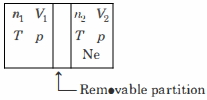
$A$ container is divided into two compartments by a removable partition as shown below:
In the first compartment,$n_{1}$ moles of ideal gas $He$ is present in a volume $V_{1}$. In the second compartment,$n_{2}$ moles of ideal gas $Ne$ is present in a volume $V_{2}$. The temperature and pressure in both the compartments are $T$ and $p$,respectively. Assuming $R$ is the gas constant,the total change in entropy upon removing the partition when the gases mix irreversibly is:
In the first compartment,$n_{1}$ moles of ideal gas $He$ is present in a volume $V_{1}$. In the second compartment,$n_{2}$ moles of ideal gas $Ne$ is present in a volume $V_{2}$. The temperature and pressure in both the compartments are $T$ and $p$,respectively. Assuming $R$ is the gas constant,the total change in entropy upon removing the partition when the gases mix irreversibly is:
A
$n_{1} R \ln \frac{V_{1}}{V_{1}+V_{2}} + n_{2} R \ln \frac{V_{2}}{V_{1}+V_{2}}$
B
$n_{1} R \ln \frac{V_{1}+V_{2}}{V_{1}} + n_{2} R \ln \frac{V_{1}+V_{2}}{V_{2}}$
C
$(n_{1}+n_{2}) R \ln \frac{n_{1} V_{1}}{n_{2} V_{2}}$
D
$(n_{1}+n_{2}) R \ln \frac{n_{2} V_{2}}{n_{1} V_{1}}$
Solution
(B) When the partition is removed,each gas expands to occupy the total volume $V_{total} = V_{1} + V_{2}$.
For an ideal gas undergoing isothermal expansion,the change in entropy is given by $\Delta S = n R \ln \left( \frac{V_{final}}{V_{initial}} \right)$.
Since entropy is an extensive property,the total change in entropy is the sum of the entropy changes for each gas:
$\Delta S_{total} = \Delta S_{He} + \Delta S_{Ne}$
$\Delta S_{total} = n_{1} R \ln \left( \frac{V_{1}+V_{2}}{V_{1}} \right) + n_{2} R \ln \left( \frac{V_{1}+V_{2}}{V_{2}} \right)$
Thus,the correct option is $B$.
For an ideal gas undergoing isothermal expansion,the change in entropy is given by $\Delta S = n R \ln \left( \frac{V_{final}}{V_{initial}} \right)$.
Since entropy is an extensive property,the total change in entropy is the sum of the entropy changes for each gas:
$\Delta S_{total} = \Delta S_{He} + \Delta S_{Ne}$
$\Delta S_{total} = n_{1} R \ln \left( \frac{V_{1}+V_{2}}{V_{1}} \right) + n_{2} R \ln \left( \frac{V_{1}+V_{2}}{V_{2}} \right)$
Thus,the correct option is $B$.
0 likes
View Solution200
MediumMCQ
The latent heat of melting of ice at $0^{\circ} C$ is $6 \, kJ \, mol^{-1}$. The entropy change during the melting in $J \, K^{-1} \, mol^{-1}$ is closest to
A
$22$
B
$11$
C
$-11$
D
$-22$
Solution
(A) The entropy change $\Delta S$ for a phase transition is given by the formula $\Delta S = \frac{\Delta H}{T}$.
Given,latent heat of fusion $\Delta H = 6 \, kJ \, mol^{-1} = 6000 \, J \, mol^{-1}$.
The temperature of melting of ice at $1 \, atm$ is $T = 0^{\circ} C = 273 \, K$.
Substituting the values: $\Delta S = \frac{6000 \, J \, mol^{-1}}{273 \, K} \approx 21.97 \, J \, K^{-1} \, mol^{-1}$.
Rounding to the nearest integer,we get $22 \, J \, K^{-1} \, mol^{-1}$.
Thus,the correct option is $A$.
Given,latent heat of fusion $\Delta H = 6 \, kJ \, mol^{-1} = 6000 \, J \, mol^{-1}$.
The temperature of melting of ice at $1 \, atm$ is $T = 0^{\circ} C = 273 \, K$.
Substituting the values: $\Delta S = \frac{6000 \, J \, mol^{-1}}{273 \, K} \approx 21.97 \, J \, K^{-1} \, mol^{-1}$.
Rounding to the nearest integer,we get $22 \, J \, K^{-1} \, mol^{-1}$.
Thus,the correct option is $A$.
0 likes
View SolutionThermodynamics — 2 nd Law of thermodynamics and Entropy · Frequently Asked Questions
1Are these Thermodynamics questions useful for JEE and NEET?
Yes. All questions in this section are mapped to JEE Main and NEET exam patterns. Previous year questions from JEE Main, NEET, GUJCET and state-level exams are included with full solutions.
2Can I switch to Hindi or Gujarati for these questions?
Yes. Use the language tabs in the hero section or the sidebar to view the same questions and solutions in English, Hindi or Gujarati.
3How do I generate a question paper from this subtopic?
Use the Vedclass Exam Paper Generator — select the chapter and subtopic, set difficulty, and generate Sets A, B, C, D automatically. First 3 chapters of every subject are free.
Vedclass Products
For Students
Vedclass Test Series
Mock tests in real JEE/NEET style with performance analysis. 5-day free trial.
Start Free TrialFor Teachers
Exam Paper Generator
Generate Set A/B/C/D papers from this chapter in 2 minutes. 3 chapters free.
Try FreeFor Institutes
Online Exam Module
Live online exams with unlimited students, 360° analytics & white-label branding.
See DemoFor Teachers & Institutes
Generate a Thermodynamics Exam Paper in 2 Minutes
Select subtopic & difficulty — Sets A, B, C, D auto-generated with No Repeat logic.
First 3 chapters of every subject are free — no payment required.