
A English
Molecular speeds Questions in English
Class 11 Chemistry · States of Matter · Molecular speeds
191+
Questions
English
Language
100%
With Solutions
Showing 39 of 191 questions in English
151
DifficultMCQ
$RMS$ velocity of one mole of an ideal gas was measured at different temperatures. $A$ graph of $(u_{rms})^2$ (on y-axis) and $T(K)$ (on x-axis) gave a straight line passing through the origin and its slope is $249 \ m^2 \ s^{-2} \ K^{-1}$. What is the molar mass (in $kg \ mol^{-1}$) of the ideal gas? $(R=8.3 \ J \ mol^{-1} \ K^{-1})$
A
$10$
B
$1.0$
C
$24.9$
D
$1 \times 10^{-1}$
Solution
(D) The formula for $RMS$ velocity is $v_{rms} = \sqrt{\frac{3RT}{M}}$.
Squaring both sides,we get $v_{rms}^2 = \frac{3RT}{M}$.
Comparing this with the equation of a straight line $y = mx + C$,where $y = v_{rms}^2$ and $x = T$:
The slope $m = \frac{3R}{M}$.
Given slope $m = 249 \ m^2 \ s^{-2} \ K^{-1}$ and $R = 8.3 \ J \ mol^{-1} \ K^{-1}$.
Substituting the values: $249 = \frac{3 \times 8.3}{M}$.
$M = \frac{3 \times 8.3}{249} = \frac{24.9}{249} = 0.1 \ kg \ mol^{-1}$.
Thus,$M = 1 \times 10^{-1} \ kg \ mol^{-1}$.
Squaring both sides,we get $v_{rms}^2 = \frac{3RT}{M}$.
Comparing this with the equation of a straight line $y = mx + C$,where $y = v_{rms}^2$ and $x = T$:
The slope $m = \frac{3R}{M}$.
Given slope $m = 249 \ m^2 \ s^{-2} \ K^{-1}$ and $R = 8.3 \ J \ mol^{-1} \ K^{-1}$.
Substituting the values: $249 = \frac{3 \times 8.3}{M}$.
$M = \frac{3 \times 8.3}{249} = \frac{24.9}{249} = 0.1 \ kg \ mol^{-1}$.
Thus,$M = 1 \times 10^{-1} \ kg \ mol^{-1}$.
0 likes
View Solution152
MediumMCQ
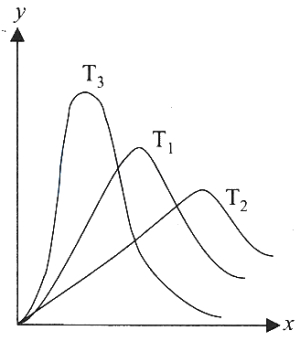
The following graph is obtained for a gas at different temperatures $T_1$,$T_2$,$T_3$. What is the correct order of temperature? ($x$-axis $=$ velocity; $y$-axis $=$ number of molecules)
A
$T_2 > T_1 > T_3$
B
$T_2 > T_3 > T_1$
C
$T_3 > T_1 > T_2$
D
$T_3 > T_2 > T_1$
Solution
(A) According to the Maxwell-Boltzmann distribution of molecular speeds,as the temperature increases,the peak of the curve shifts towards higher velocities and the curve becomes broader and flatter.
In the given graph,the peak for $T_2$ is at the highest velocity,followed by $T_1$,and then $T_3$.
Therefore,the correct order of temperature is $T_2 > T_1 > T_3$.
In the given graph,the peak for $T_2$ is at the highest velocity,followed by $T_1$,and then $T_3$.
Therefore,the correct order of temperature is $T_2 > T_1 > T_3$.
0 likes
View Solution153
EasyMCQ
At $133.33 \ K$,the $RMS$ velocity of an ideal gas is $(M = 0.083 \ kg \ mol^{-1}; R = 8.3 \ J \ mol^{-1} \ K^{-1})$ (in $m \ s^{-1}$)
A
$200$
B
$150$
C
$2000$
D
$400$
Solution
(A) Given: $T = 133.33 \ K$,$M = 0.083 \ kg \ mol^{-1}$,$R = 8.3 \ J \ mol^{-1} \ K^{-1}$.
The formula for the root mean square $(RMS)$ velocity of an ideal gas is $v_{rms} = \sqrt{\frac{3RT}{M}}$.
Substituting the given values into the formula:
$v_{rms} = \sqrt{\frac{3 \times 8.3 \times 133.33}{0.083}}$
$v_{rms} = \sqrt{\frac{3323.917}{0.083}}$
$v_{rms} = \sqrt{40047.19} \approx 200.12 \ m \ s^{-1}$.
Thus,the $RMS$ velocity is approximately $200 \ m \ s^{-1}$.
The formula for the root mean square $(RMS)$ velocity of an ideal gas is $v_{rms} = \sqrt{\frac{3RT}{M}}$.
Substituting the given values into the formula:
$v_{rms} = \sqrt{\frac{3 \times 8.3 \times 133.33}{0.083}}$
$v_{rms} = \sqrt{\frac{3323.917}{0.083}}$
$v_{rms} = \sqrt{40047.19} \approx 200.12 \ m \ s^{-1}$.
Thus,the $RMS$ velocity is approximately $200 \ m \ s^{-1}$.
0 likes
View Solution154
EasyMCQ
What is the kinetic energy (in $J \ mol^{-1}$) of one mole of an ideal gas (molar mass $= 0.1 \ kg \ mol^{-1}$) if its rms velocity is $4 \times 10^2 \ ms^{-1}$ at $T(K)$?
A
$2 \times 10^5$
B
$8 \times 10^4$
C
$8 \times 10^2$
D
$8 \times 10^3$
Solution
(D) The kinetic energy $(K.E.)$ for one mole of an ideal gas is given by the formula: $K.E. = \frac{1}{2} M v_{rms}^2$
Given:
Molar mass $(M)$ $= 0.1 \ kg \ mol^{-1}$
$v_{rms} = 4 \times 10^2 \ ms^{-1}$
Substituting the values:
$K.E. = \frac{1}{2} \times (0.1 \ kg \ mol^{-1}) \times (4 \times 10^2 \ ms^{-1})^2$
$K.E. = 0.05 \times (16 \times 10^4)$
$K.E. = 0.8 \times 10^4 = 8 \times 10^3 \ J \ mol^{-1}$
Given:
Molar mass $(M)$ $= 0.1 \ kg \ mol^{-1}$
$v_{rms} = 4 \times 10^2 \ ms^{-1}$
Substituting the values:
$K.E. = \frac{1}{2} \times (0.1 \ kg \ mol^{-1}) \times (4 \times 10^2 \ ms^{-1})^2$
$K.E. = 0.05 \times (16 \times 10^4)$
$K.E. = 0.8 \times 10^4 = 8 \times 10^3 \ J \ mol^{-1}$
0 likes
View Solution155
EasyMCQ
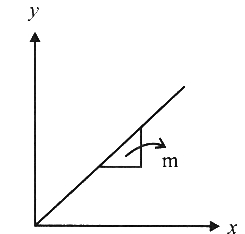
The $RMS$ velocity $(u_{rms})$ of one mole of an ideal gas was measured at different temperatures and the following graph is obtained. What is the slope $(m)$ of the straight line?
($x$-axis $= T$ $(K)$; $y$-axis $= (u_{rms})^2$; $M =$ molar mass; $R =$ gas constant)
($x$-axis $= T$ $(K)$; $y$-axis $= (u_{rms})^2$; $M =$ molar mass; $R =$ gas constant)
A
$(\frac{3 R}{M})^{1 / 2}$
B
$(\frac{M}{3 R})^{1 / 2}$
C
$\frac{M}{3 R}$
D
$\frac{3 R}{M}$
Solution
(D) $RMS$ velocity $(u_{rms})$ is given by the formula: $u_{rms} = \sqrt{\frac{3 RT}{M}}$
Squaring both sides,we get: $(u_{rms})^2 = \frac{3 RT}{M}$
Comparing this with the equation of a straight line passing through the origin,$y = mx + C$,where $y = (u_{rms})^2$ and $x = T$:
$(u_{rms})^2 = (\frac{3 R}{M}) \cdot T + 0$
Here,the slope $(m)$ is equal to $\frac{3 R}{M}$.
Squaring both sides,we get: $(u_{rms})^2 = \frac{3 RT}{M}$
Comparing this with the equation of a straight line passing through the origin,$y = mx + C$,where $y = (u_{rms})^2$ and $x = T$:
$(u_{rms})^2 = (\frac{3 R}{M}) \cdot T + 0$
Here,the slope $(m)$ is equal to $\frac{3 R}{M}$.
0 likes
View Solution156
MediumMCQ
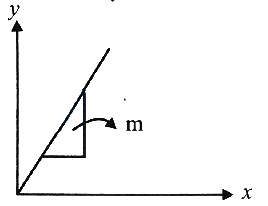
At $T$ $(K)$,the $P$,$V$ and $u_{rms}$ of $1$ mole of an ideal gas were measured. The following graph is obtained. What is its slope $(m)$? ($x$-axis $= PV$; $y$-axis $= u_{rms}^2$,$M =$ Molar mass)
A
$\frac{3}{M}$
B
$\frac{M}{3}$
C
$\left(\frac{M}{3}\right)^{1/2}$
D
$\left(\frac{3}{M}\right)^{1/2}$
Solution
(A) The root mean square velocity $(u_{rms})$ is given by the formula: $u_{rms} = \sqrt{\frac{3RT}{M}}$.
For $1$ mole of an ideal gas,the ideal gas equation is $PV = RT$.
Substituting $RT = PV$ into the $u_{rms}$ equation,we get:
$u_{rms} = \sqrt{\frac{3PV}{M}}$
Squaring both sides,we get:
$u_{rms}^2 = \frac{3PV}{M}$
Comparing this with the equation of a straight line $y = mx + C$,where $y = u_{rms}^2$ and $x = PV$:
$y = \left(\frac{3}{M}\right)x + 0$
Thus,the slope $(m)$ is $\frac{3}{M}$.
For $1$ mole of an ideal gas,the ideal gas equation is $PV = RT$.
Substituting $RT = PV$ into the $u_{rms}$ equation,we get:
$u_{rms} = \sqrt{\frac{3PV}{M}}$
Squaring both sides,we get:
$u_{rms}^2 = \frac{3PV}{M}$
Comparing this with the equation of a straight line $y = mx + C$,where $y = u_{rms}^2$ and $x = PV$:
$y = \left(\frac{3}{M}\right)x + 0$
Thus,the slope $(m)$ is $\frac{3}{M}$.
0 likes
View Solution157
EasyMCQ
The rms velocity $u_{rms}$,mean velocity $u_{av}$ and most probable velocity $u_{mp}$ of a gas differ from each other at a given temperature. Which of the following ratios regarding them is correct?
A
$\frac{u_{rms}}{u_{av}} = 1.20$
B
$\frac{u_{av}}{u_{mp}} = 1.12$
C
$\frac{u_{rms}}{u_{mp}} = 1.15$
D
$\frac{u_{av}}{u_{rms}} = 0.98$
Solution
(B) The formulas for the velocities are:
$u_{rms} = \sqrt{\frac{3RT}{M}}$
$u_{av} = \sqrt{\frac{8RT}{\pi M}}$
$u_{mp} = \sqrt{\frac{2RT}{M}}$
Calculating the ratios:
$1$. $\frac{u_{rms}}{u_{av}} = \frac{\sqrt{3}}{\sqrt{8/\pi}} = \sqrt{\frac{3\pi}{8}} \approx 1.085$
$2$. $\frac{u_{av}}{u_{mp}} = \frac{\sqrt{8/\pi}}{\sqrt{2}} = \sqrt{\frac{4}{\pi}} \approx 1.128 \approx 1.12$
$3$. $\frac{u_{rms}}{u_{mp}} = \frac{\sqrt{3}}{\sqrt{2}} = \sqrt{1.5} \approx 1.225$
Comparing these with the given options,the ratio $\frac{u_{av}}{u_{mp}} = 1.12$ is correct.
$u_{rms} = \sqrt{\frac{3RT}{M}}$
$u_{av} = \sqrt{\frac{8RT}{\pi M}}$
$u_{mp} = \sqrt{\frac{2RT}{M}}$
Calculating the ratios:
$1$. $\frac{u_{rms}}{u_{av}} = \frac{\sqrt{3}}{\sqrt{8/\pi}} = \sqrt{\frac{3\pi}{8}} \approx 1.085$
$2$. $\frac{u_{av}}{u_{mp}} = \frac{\sqrt{8/\pi}}{\sqrt{2}} = \sqrt{\frac{4}{\pi}} \approx 1.128 \approx 1.12$
$3$. $\frac{u_{rms}}{u_{mp}} = \frac{\sqrt{3}}{\sqrt{2}} = \sqrt{1.5} \approx 1.225$
Comparing these with the given options,the ratio $\frac{u_{av}}{u_{mp}} = 1.12$ is correct.
0 likes
View Solution158
EasyMCQ
When the temperature of a gas is increased from $30^{\circ} C$ to $930^{\circ} C$,the root mean square speed of the gas would
A
get doubled
B
remain constant
C
gets halved
D
increase by $5.5$ times
Solution
(A) The root mean square speed $(u_{rms})$ is directly proportional to the square root of the absolute temperature $(T)$:
$u_{rms} = \sqrt{\frac{3RT}{M}}$
For the same gas,$u_{rms} \propto \sqrt{T}$.
Initial temperature $T_{1} = 30 + 273 = 303 \ K$.
Final temperature $T_{2} = 930 + 273 = 1203 \ K$.
Taking the ratio:
$\frac{u_{2}}{u_{1}} = \sqrt{\frac{T_{2}}{T_{1}}} = \sqrt{\frac{1203}{303}} = \sqrt{3.97} \approx \sqrt{4} = 2$.
Therefore,$u_{2} = 2u_{1}$.
Thus,the root mean square speed of the gas gets doubled.
$u_{rms} = \sqrt{\frac{3RT}{M}}$
For the same gas,$u_{rms} \propto \sqrt{T}$.
Initial temperature $T_{1} = 30 + 273 = 303 \ K$.
Final temperature $T_{2} = 930 + 273 = 1203 \ K$.
Taking the ratio:
$\frac{u_{2}}{u_{1}} = \sqrt{\frac{T_{2}}{T_{1}}} = \sqrt{\frac{1203}{303}} = \sqrt{3.97} \approx \sqrt{4} = 2$.
Therefore,$u_{2} = 2u_{1}$.
Thus,the root mean square speed of the gas gets doubled.
0 likes
View Solution159
EasyMCQ
Among the following,identify the gas which has the greatest average speed of its molecules?
A
$0.5 \ mol$ of $O_2$ at $500 \ K$
B
$0.2 \ mol$ of $CO_2$ at $400 \ K$
C
$1.0 \ mol$ of $He$ at $200 \ K$
D
$0.4 \ mol$ of $NH_3$ at $300 \ K$
Solution
(C) The average molecular speed $(v_{avg})$ is given by the formula: $v_{avg} = \sqrt{\frac{8RT}{\pi M}}$.
This shows that $v_{avg} \propto \sqrt{\frac{T}{M}}$.
Comparing the ratios of $\frac{T}{M}$ for each gas:
$A: \frac{500}{32} = 15.625$
$B: \frac{400}{44} \approx 9.09$
$C: \frac{200}{4} = 50.0$
$D: \frac{300}{17} \approx 17.65$
Since the ratio $\frac{T}{M}$ is highest for $He$ $(50.0)$,it will have the greatest average speed.
This shows that $v_{avg} \propto \sqrt{\frac{T}{M}}$.
Comparing the ratios of $\frac{T}{M}$ for each gas:
$A: \frac{500}{32} = 15.625$
$B: \frac{400}{44} \approx 9.09$
$C: \frac{200}{4} = 50.0$
$D: \frac{300}{17} \approx 17.65$
Since the ratio $\frac{T}{M}$ is highest for $He$ $(50.0)$,it will have the greatest average speed.
0 likes
View Solution160
MediumMCQ
The rms velocity of oxygen molecules at $27^{\circ} C$ is around $800 \ m/s$. The rms velocity of methane molecules at $600 \ K$ temperature is around ...... (in $m/s$)
A
$400$
B
$1600$
C
$800$
D
$1200$
Solution
(B) The formula for rms velocity is $v_{rms} = \sqrt{\frac{3RT}{M}}$.
For oxygen $(O_2)$,$T_1 = 27 + 273 = 300 \ K$ and $M_1 = 32 \ g/mol$. Given $v_{rms,1} = 800 \ m/s$.
For methane $(CH_4)$,$T_2 = 600 \ K$ and $M_2 = 16 \ g/mol$. Let $v_{rms,2} = x$.
Taking the ratio: $\frac{v_{rms,1}}{v_{rms,2}} = \sqrt{\frac{T_1}{M_1} \times \frac{M_2}{T_2}}$.
Substituting the values: $\frac{800}{x} = \sqrt{\frac{300}{32} \times \frac{16}{600}} = \sqrt{\frac{1}{2} \times \frac{1}{2}} = \sqrt{\frac{1}{4}} = \frac{1}{2}$.
Thus,$x = 800 \times 2 = 1600 \ m/s$.
Therefore,the correct option is $B$.
For oxygen $(O_2)$,$T_1 = 27 + 273 = 300 \ K$ and $M_1 = 32 \ g/mol$. Given $v_{rms,1} = 800 \ m/s$.
For methane $(CH_4)$,$T_2 = 600 \ K$ and $M_2 = 16 \ g/mol$. Let $v_{rms,2} = x$.
Taking the ratio: $\frac{v_{rms,1}}{v_{rms,2}} = \sqrt{\frac{T_1}{M_1} \times \frac{M_2}{T_2}}$.
Substituting the values: $\frac{800}{x} = \sqrt{\frac{300}{32} \times \frac{16}{600}} = \sqrt{\frac{1}{2} \times \frac{1}{2}} = \sqrt{\frac{1}{4}} = \frac{1}{2}$.
Thus,$x = 800 \times 2 = 1600 \ m/s$.
Therefore,the correct option is $B$.
0 likes
View Solution161
EasyMCQ
If the kinetic energy of $O_2$ gas is $4.0 \ kJ \ mol^{-1}$,its $RMS$ speed in $cm \ s^{-1}$ is
A
$5.0 \times 10^2$
B
$5.0 \times 10^3$
C
$5.0 \times 10^4$
D
$5.0 \times 10^5$
Solution
(C) The kinetic energy $(KE)$ of an ideal gas is given by $KE = \frac{3}{2} RT$.
The root mean square speed $(v_{rms})$ is given by $v_{rms} = \sqrt{\frac{3 RT}{M}}$.
Substituting $\frac{3}{2} RT = KE$,we get $v_{rms} = \sqrt{\frac{2 KE}{M}}$.
Given $KE = 4.0 \ kJ \ mol^{-1} = 4000 \ J \ mol^{-1}$ and molar mass $M$ of $O_2 = 32 \times 10^{-3} \ kg \ mol^{-1}$.
$v_{rms} = \sqrt{\frac{2 \times 4000 \ J \ mol^{-1}}{32 \times 10^{-3} \ kg \ mol^{-1}}} = \sqrt{\frac{8000}{32 \times 10^{-3}}} = \sqrt{250000} = 500 \ m \ s^{-1}$.
Converting to $cm \ s^{-1}$: $500 \ m \ s^{-1} \times 100 \ cm \ m^{-1} = 5.0 \times 10^4 \ cm \ s^{-1}$.
The root mean square speed $(v_{rms})$ is given by $v_{rms} = \sqrt{\frac{3 RT}{M}}$.
Substituting $\frac{3}{2} RT = KE$,we get $v_{rms} = \sqrt{\frac{2 KE}{M}}$.
Given $KE = 4.0 \ kJ \ mol^{-1} = 4000 \ J \ mol^{-1}$ and molar mass $M$ of $O_2 = 32 \times 10^{-3} \ kg \ mol^{-1}$.
$v_{rms} = \sqrt{\frac{2 \times 4000 \ J \ mol^{-1}}{32 \times 10^{-3} \ kg \ mol^{-1}}} = \sqrt{\frac{8000}{32 \times 10^{-3}}} = \sqrt{250000} = 500 \ m \ s^{-1}$.
Converting to $cm \ s^{-1}$: $500 \ m \ s^{-1} \times 100 \ cm \ m^{-1} = 5.0 \times 10^4 \ cm \ s^{-1}$.
0 likes
View Solution162
EasyMCQ
The ratio between $RMS$ velocities of $H_2$ at $50 \ K$ and $O_2$ at $800 \ K$ is
A
$4 : 1$
B
$2 : 1$
C
$1 : 1$
D
$1 : 4$
Solution
(C) Root mean square speed $(v_{rms}) = \sqrt{\frac{3RT}{M}}$
Given:
$M_1 = \text{molar mass of } H_2 = 2 \ g/mol$
$M_2 = \text{molar mass of } O_2 = 32 \ g/mol$
$T_1 = 50 \ K, T_2 = 800 \ K$
Taking the ratio of $v_{rms,1}$ and $v_{rms,2}$:
$\frac{v_{rms,1}}{v_{rms,2}} = \sqrt{\frac{3RT_1}{M_1}} \times \sqrt{\frac{M_2}{3RT_2}} = \sqrt{\frac{M_2 \times T_1}{M_1 \times T_2}}$
$\frac{v_{rms,1}}{v_{rms,2}} = \sqrt{\frac{32}{2} \times \frac{50}{800}} = \sqrt{16 \times \frac{1}{16}} = \sqrt{1} = 1$
Thus,the ratio is $1 : 1$.
Hence,option $(C)$ is correct.
Given:
$M_1 = \text{molar mass of } H_2 = 2 \ g/mol$
$M_2 = \text{molar mass of } O_2 = 32 \ g/mol$
$T_1 = 50 \ K, T_2 = 800 \ K$
Taking the ratio of $v_{rms,1}$ and $v_{rms,2}$:
$\frac{v_{rms,1}}{v_{rms,2}} = \sqrt{\frac{3RT_1}{M_1}} \times \sqrt{\frac{M_2}{3RT_2}} = \sqrt{\frac{M_2 \times T_1}{M_1 \times T_2}}$
$\frac{v_{rms,1}}{v_{rms,2}} = \sqrt{\frac{32}{2} \times \frac{50}{800}} = \sqrt{16 \times \frac{1}{16}} = \sqrt{1} = 1$
Thus,the ratio is $1 : 1$.
Hence,option $(C)$ is correct.
0 likes
View Solution163
MediumMCQ
If the kinetic energy and $RMS$ speed of a gas at a certain temperature are $4.0 \ kJ \ mol^{-1}$ and $5.0 \times 10^4 \ cm \ s^{-1}$,respectively,the molecular weight of the gas is:
A
$16$
B
$32$
C
$64$
D
$44$
Solution
(B) The kinetic energy $(KE)$ of one mole of an ideal gas is given by the formula: $KE = \frac{1}{2} M v_{rms}^2$,where $M$ is the molar mass in $kg \ mol^{-1}$ and $v_{rms}$ is the root mean square speed in $m \ s^{-1}$.
Given: $KE = 4.0 \ kJ \ mol^{-1} = 4000 \ J \ mol^{-1}$ and $v_{rms} = 5.0 \times 10^4 \ cm \ s^{-1} = 500 \ m \ s^{-1}$.
Substituting the values into the equation: $4000 = \frac{1}{2} \times M \times (500)^2$.
$4000 = \frac{1}{2} \times M \times 250000$.
$4000 = M \times 125000$.
$M = \frac{4000}{125000} = 0.032 \ kg \ mol^{-1}$.
Converting to grams: $M = 0.032 \times 1000 \ g \ mol^{-1} = 32 \ g \ mol^{-1}$.
Given: $KE = 4.0 \ kJ \ mol^{-1} = 4000 \ J \ mol^{-1}$ and $v_{rms} = 5.0 \times 10^4 \ cm \ s^{-1} = 500 \ m \ s^{-1}$.
Substituting the values into the equation: $4000 = \frac{1}{2} \times M \times (500)^2$.
$4000 = \frac{1}{2} \times M \times 250000$.
$4000 = M \times 125000$.
$M = \frac{4000}{125000} = 0.032 \ kg \ mol^{-1}$.
Converting to grams: $M = 0.032 \times 1000 \ g \ mol^{-1} = 32 \ g \ mol^{-1}$.
0 likes
View Solution164
EasyMCQ
If the most probable speed of $CO_2$ at $27^{\circ} C$ is $400 \ ms^{-1}$,the root mean square velocity of $CO_2$ at the same temperature in $ms^{-1}$ is approximately:
A
$600$
B
$490$
C
$267$
D
$245$
Solution
(B) Given,\\ Temperature $(T)$ is the same for most probable velocity $(v_{mp})$ and root mean square velocity $(v_{rms})$. \\ The formulas are: \\ $v_{mp} = \sqrt{\frac{2RT}{M}}$ and $v_{rms} = \sqrt{\frac{3RT}{M}}$. \\ Taking the ratio: \\ $\frac{v_{rms}}{v_{mp}} = \sqrt{\frac{3RT/M}{2RT/M}} = \sqrt{\frac{3}{2}} = \sqrt{1.5} \approx 1.2247$. \\ Given $v_{mp} = 400 \ ms^{-1}$,then: \\ $v_{rms} = 1.2247 \times 400 \ ms^{-1} \approx 489.88 \ ms^{-1} \approx 490 \ ms^{-1}$. \\ Thus,option $(B)$ is the correct answer.
0 likes
View Solution165
EasyMCQ
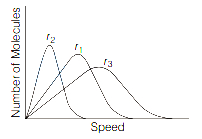
If $r_1, r_2$ and $r_3$ represent the most probable speeds of three different gases at the same temperature as shown in the figure,with molar masses $M_1, M_2$ and $M_3$ respectively,what is the correct order of the molar masses of these gases?
A
$M_1 > M_3 > M_2$
B
$M_3 > M_2 > M_1$
C
$M_2 > M_1 > M_3$
D
$M_2 > M_3 > M_1$
Solution
(C) The most probable speed $(v_{mp})$ is given by the formula $v_{mp} = \sqrt{\frac{2RT}{M}}$.
At a constant temperature,$v_{mp} \propto \frac{1}{\sqrt{M}}$.
From the given graph,the order of most probable speeds is $r_2 < r_1 < r_3$.
Since $v_{mp}$ is inversely proportional to the square root of the molar mass,a lower speed corresponds to a higher molar mass.
Therefore,the order of molar masses is $M_2 > M_1 > M_3$.
At a constant temperature,$v_{mp} \propto \frac{1}{\sqrt{M}}$.
From the given graph,the order of most probable speeds is $r_2 < r_1 < r_3$.
Since $v_{mp}$ is inversely proportional to the square root of the molar mass,a lower speed corresponds to a higher molar mass.
Therefore,the order of molar masses is $M_2 > M_1 > M_3$.
0 likes
View Solution166
MediumMCQ
If the $RMS$ speed of nitrogen at a certain temperature is $3000 \ ms^{-1}$,the approximate kinetic energy of one mole of nitrogen at that temperature in $kJ$ is (assume nitrogen as ideal gas)
A
$9$
B
$126$
C
$90$
D
$12.6$
Solution
(B) Given,$U_{rms} = 3000 \ ms^{-1}$.
The formula for $RMS$ speed is $U_{rms} = \sqrt{\frac{3RT}{M}}$.
Squaring both sides,we get $U_{rms}^2 = \frac{3RT}{M}$.
For nitrogen $(N_2)$,the molar mass $M = 28 \ g/mol = 28 \times 10^{-3} \ kg/mol$.
Substituting the values: $(3000)^2 = \frac{3RT}{28 \times 10^{-3}}$.
$9 \times 10^6 = \frac{3RT}{28 \times 10^{-3}}$.
$3RT = 9 \times 10^6 \times 28 \times 10^{-3} = 252 \times 10^3 \ J/mol$.
The kinetic energy $(K.E.)$ for $1$ mole of an ideal gas is given by $K.E. = \frac{3}{2} RT$.
$K.E. = \frac{1}{2} \times (3RT) = \frac{1}{2} \times 252 \times 10^3 \ J/mol = 126 \times 10^3 \ J/mol = 126 \ kJ$.
The formula for $RMS$ speed is $U_{rms} = \sqrt{\frac{3RT}{M}}$.
Squaring both sides,we get $U_{rms}^2 = \frac{3RT}{M}$.
For nitrogen $(N_2)$,the molar mass $M = 28 \ g/mol = 28 \times 10^{-3} \ kg/mol$.
Substituting the values: $(3000)^2 = \frac{3RT}{28 \times 10^{-3}}$.
$9 \times 10^6 = \frac{3RT}{28 \times 10^{-3}}$.
$3RT = 9 \times 10^6 \times 28 \times 10^{-3} = 252 \times 10^3 \ J/mol$.
The kinetic energy $(K.E.)$ for $1$ mole of an ideal gas is given by $K.E. = \frac{3}{2} RT$.
$K.E. = \frac{1}{2} \times (3RT) = \frac{1}{2} \times 252 \times 10^3 \ J/mol = 126 \times 10^3 \ J/mol = 126 \ kJ$.
0 likes
View Solution167
MediumMCQ
If the most probable speed of methane $(CH_4)$ at a certain temperature is $400 \ ms^{-1}$,what is the kinetic energy of one mole of methane at the same temperature in $J$?
A
$1024$
B
$2048$
C
$3072$
D
$1920$
Solution
(D) The most probable speed $(u_{mp})$ is given by the formula: $u_{mp} = \sqrt{\frac{2RT}{M}}$.
Given $u_{mp} = 400 \ ms^{-1}$ and molar mass of methane $(M)$ = $16 \ g \ mol^{-1} = 0.016 \ kg \ mol^{-1}$.
Squaring both sides: $u_{mp}^2 = \frac{2RT}{M} \Rightarrow \frac{RT}{M} = \frac{u_{mp}^2}{2}$.
Substituting the values: $\frac{RT}{0.016} = \frac{400^2}{2} = \frac{160000}{2} = 80000$.
Thus,$RT = 80000 \times 0.016 = 1280 \ J \ mol^{-1}$.
The kinetic energy $(KE)$ of one mole of an ideal gas is given by: $KE = \frac{3}{2} RT$.
$KE = \frac{3}{2} \times 1280 = 3 \times 640 = 1920 \ J$.
Given $u_{mp} = 400 \ ms^{-1}$ and molar mass of methane $(M)$ = $16 \ g \ mol^{-1} = 0.016 \ kg \ mol^{-1}$.
Squaring both sides: $u_{mp}^2 = \frac{2RT}{M} \Rightarrow \frac{RT}{M} = \frac{u_{mp}^2}{2}$.
Substituting the values: $\frac{RT}{0.016} = \frac{400^2}{2} = \frac{160000}{2} = 80000$.
Thus,$RT = 80000 \times 0.016 = 1280 \ J \ mol^{-1}$.
The kinetic energy $(KE)$ of one mole of an ideal gas is given by: $KE = \frac{3}{2} RT$.
$KE = \frac{3}{2} \times 1280 = 3 \times 640 = 1920 \ J$.
0 likes
View Solution168
MediumMCQ
At $T \ K$,the $RMS$ velocity of $He$ is equal to the $RMS$ velocity of $SO_2$ at $127^{\circ} C$. What is $T$ (in $K$)?
A
$64$
B
$50$
C
$250$
D
$25$
Solution
(D) The formula for $RMS$ velocity is $v_{rms} = \sqrt{\frac{3RT}{M}}$.
Given that the $RMS$ velocity of $He$ at $T \ K$ is equal to the $RMS$ velocity of $SO_2$ at $127^{\circ} C$ $(400 \ K)$:
$\sqrt{\frac{3RT}{M_{He}}} = \sqrt{\frac{3R(400)}{M_{SO_2}}}$
$\frac{T}{M_{He}} = \frac{400}{M_{SO_2}}$
Given $M_{He} = 4 \ g/mol$ and $M_{SO_2} = 64 \ g/mol$:
$\frac{T}{4} = \frac{400}{64}$
$T = \frac{400 \times 4}{64} = \frac{1600}{64} = 25 \ K$.
Given that the $RMS$ velocity of $He$ at $T \ K$ is equal to the $RMS$ velocity of $SO_2$ at $127^{\circ} C$ $(400 \ K)$:
$\sqrt{\frac{3RT}{M_{He}}} = \sqrt{\frac{3R(400)}{M_{SO_2}}}$
$\frac{T}{M_{He}} = \frac{400}{M_{SO_2}}$
Given $M_{He} = 4 \ g/mol$ and $M_{SO_2} = 64 \ g/mol$:
$\frac{T}{4} = \frac{400}{64}$
$T = \frac{400 \times 4}{64} = \frac{1600}{64} = 25 \ K$.
0 likes
View Solution169
EasyMCQ
The distribution of molecular velocities of three gases of molar masses $M_1$,$M_2$,and $M_3$ at $T(K)$ are shown below. The correct relation of their molar masses is:
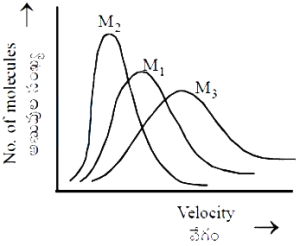
A
$M_2 > M_1 > M_3$
B
$M_3 > M_1 > M_2$
C
$M_1 > M_2 > M_3$
D
$M_1 = M_2 = M_3$
Solution
(A) According to the Maxwell-Boltzmann distribution,the most probable velocity $(v_{mp})$ is given by the formula $v_{mp} = \sqrt{\frac{2RT}{M}}$.
This shows that $v_{mp} \propto \frac{1}{\sqrt{M}}$.
From the given graph,the order of most probable velocities is $v_{mp}(M_2) < v_{mp}(M_1) < v_{mp}(M_3)$.
Since the velocity is inversely proportional to the square root of the molar mass,the order of molar masses will be $M_2 > M_1 > M_3$.
This shows that $v_{mp} \propto \frac{1}{\sqrt{M}}$.
From the given graph,the order of most probable velocities is $v_{mp}(M_2) < v_{mp}(M_1) < v_{mp}(M_3)$.
Since the velocity is inversely proportional to the square root of the molar mass,the order of molar masses will be $M_2 > M_1 > M_3$.
0 likes
View Solution170
EasyMCQ
If the $RMS$ velocity of an ideal gas is $v \ ms^{-1}$ at $127^{\circ} C$,at what temperature its $RMS$ velocity is doubled (in $K$)?
A
$200$
B
$160$
C
$1600$
D
$800$
Solution
(C) The root mean square $(RMS)$ velocity of an ideal gas is given by the formula: $v_{rms} = \sqrt{\frac{3RT}{M}}$.
Since $v_{rms} \propto \sqrt{T}$,we can write: $\frac{v_1}{v_2} = \sqrt{\frac{T_1}{T_2}}$.
Given $T_1 = 127^{\circ} C = 127 + 273 = 400 \ K$ and $v_1 = v$.
We want to find $T_2$ such that $v_2 = 2v$.
Substituting the values: $\frac{v}{2v} = \sqrt{\frac{400}{T_2}}$.
$\frac{1}{2} = \sqrt{\frac{400}{T_2}}$.
Squaring both sides: $\frac{1}{4} = \frac{400}{T_2}$.
$T_2 = 400 \times 4 = 1600 \ K$.
Since $v_{rms} \propto \sqrt{T}$,we can write: $\frac{v_1}{v_2} = \sqrt{\frac{T_1}{T_2}}$.
Given $T_1 = 127^{\circ} C = 127 + 273 = 400 \ K$ and $v_1 = v$.
We want to find $T_2$ such that $v_2 = 2v$.
Substituting the values: $\frac{v}{2v} = \sqrt{\frac{400}{T_2}}$.
$\frac{1}{2} = \sqrt{\frac{400}{T_2}}$.
Squaring both sides: $\frac{1}{4} = \frac{400}{T_2}$.
$T_2 = 400 \times 4 = 1600 \ K$.
0 likes
View Solution171
MediumMCQ
The $RMS$ velocity of dihydrogen $(H_2)$ is $\sqrt{7}$ times more than that of dinitrogen $(N_2)$. If $T_{H_2}$ and $T_{N_2}$ are the temperatures of dihydrogen and dinitrogen respectively,then the correct relationship between them is:
A
$T_{H_2} = T_{N_2}$
B
$T_{H_2} > T_{N_2}$
C
$T_{H_2} = \frac{T_{N_2}}{2}$
D
$T_{H_2} = \frac{T_{N_2}}{4}$
Solution
(C) The formula for $RMS$ velocity is $v_{rms} = \sqrt{\frac{3RT}{M}}$.
Given: $v_{H_2} = \sqrt{7} \times v_{N_2}$.
Substituting the formula: $\sqrt{\frac{3RT_{H_2}}{M_{H_2}}} = \sqrt{7} \times \sqrt{\frac{3RT_{N_2}}{M_{N_2}}}$.
Squaring both sides: $\frac{3RT_{H_2}}{M_{H_2}} = 7 \times \frac{3RT_{N_2}}{M_{N_2}}$.
Given molar masses: $M_{H_2} = 2 \ g/mol$ and $M_{N_2} = 28 \ g/mol$.
Substituting these values: $\frac{T_{H_2}}{2} = 7 \times \frac{T_{N_2}}{28}$.
Simplifying: $\frac{T_{H_2}}{2} = \frac{T_{N_2}}{4}$.
Therefore,$T_{H_2} = \frac{T_{N_2}}{2}$.
Given: $v_{H_2} = \sqrt{7} \times v_{N_2}$.
Substituting the formula: $\sqrt{\frac{3RT_{H_2}}{M_{H_2}}} = \sqrt{7} \times \sqrt{\frac{3RT_{N_2}}{M_{N_2}}}$.
Squaring both sides: $\frac{3RT_{H_2}}{M_{H_2}} = 7 \times \frac{3RT_{N_2}}{M_{N_2}}$.
Given molar masses: $M_{H_2} = 2 \ g/mol$ and $M_{N_2} = 28 \ g/mol$.
Substituting these values: $\frac{T_{H_2}}{2} = 7 \times \frac{T_{N_2}}{28}$.
Simplifying: $\frac{T_{H_2}}{2} = \frac{T_{N_2}}{4}$.
Therefore,$T_{H_2} = \frac{T_{N_2}}{2}$.
0 likes
View Solution172
MediumMCQ
At $T(K)$,the root mean square (rms) velocity of argon (molar mass $40 \ g \ mol^{-1}$) is $20 \ ms^{-1}$. The average kinetic energy of the same gas at $T(K)$ (in $J \ mol^{-1}$) is:
A
$8$
B
$16$
C
$4$
D
$2$
Solution
(A) The root mean square velocity $(u_{rms})$ is given by the formula: $u_{rms} = \sqrt{\frac{3RT}{M}}$.
Given $u_{rms} = 20 \ ms^{-1}$ and $M = 40 \ g \ mol^{-1} = 0.04 \ kg \ mol^{-1}$.
Squaring both sides: $u_{rms}^2 = \frac{3RT}{M} \implies 20^2 = \frac{3RT}{0.04}$.
$400 = \frac{3RT}{0.04} \implies 3RT = 400 \times 0.04 = 16$.
$RT = \frac{16}{3} \ J \ mol^{-1}$.
The average kinetic energy $(KE_{avg})$ for one mole of an ideal gas is given by: $KE_{avg} = \frac{3}{2}RT$.
Substituting the value of $RT$: $KE_{avg} = \frac{3}{2} \times \frac{16}{3} = 8 \ J \ mol^{-1}$.
Thus,the correct option is $A$.
Given $u_{rms} = 20 \ ms^{-1}$ and $M = 40 \ g \ mol^{-1} = 0.04 \ kg \ mol^{-1}$.
Squaring both sides: $u_{rms}^2 = \frac{3RT}{M} \implies 20^2 = \frac{3RT}{0.04}$.
$400 = \frac{3RT}{0.04} \implies 3RT = 400 \times 0.04 = 16$.
$RT = \frac{16}{3} \ J \ mol^{-1}$.
The average kinetic energy $(KE_{avg})$ for one mole of an ideal gas is given by: $KE_{avg} = \frac{3}{2}RT$.
Substituting the value of $RT$: $KE_{avg} = \frac{3}{2} \times \frac{16}{3} = 8 \ J \ mol^{-1}$.
Thus,the correct option is $A$.
0 likes
View Solution173
EasyMCQ
At what temperature will the $RMS$ velocity of sulphur dioxide $(SO_2)$ molecules at $400 \ K$ be the same as the most probable velocity of oxygen $(O_2)$ molecules (in $K$)?
A
$600$
B
$200$
C
$400$
D
$300$
Solution
(D) The formula for $RMS$ velocity is $v_{rms} = \sqrt{\frac{3RT}{M}}$ ...$(I)$
The formula for most probable velocity is $v_{mp} = \sqrt{\frac{2RT}{M}}$ ...$(II)$
Given:
For $SO_2$: $T_1 = 400 \ K$,$M_1 = 64 \ g/mol$
For $O_2$: $T_2 = ?$,$M_2 = 32 \ g/mol$
Equating the two velocities:
$\sqrt{\frac{3R \times 400}{64}} = \sqrt{\frac{2R \times T_2}{32}}$
Squaring both sides:
$\frac{1200}{64} = \frac{2T_2}{32}$
$\frac{1200}{64} = \frac{T_2}{16}$
$T_2 = \frac{1200 \times 16}{64} = \frac{1200}{4} = 300 \ K$
The formula for most probable velocity is $v_{mp} = \sqrt{\frac{2RT}{M}}$ ...$(II)$
Given:
For $SO_2$: $T_1 = 400 \ K$,$M_1 = 64 \ g/mol$
For $O_2$: $T_2 = ?$,$M_2 = 32 \ g/mol$
Equating the two velocities:
$\sqrt{\frac{3R \times 400}{64}} = \sqrt{\frac{2R \times T_2}{32}}$
Squaring both sides:
$\frac{1200}{64} = \frac{2T_2}{32}$
$\frac{1200}{64} = \frac{T_2}{16}$
$T_2 = \frac{1200 \times 16}{64} = \frac{1200}{4} = 300 \ K$
0 likes
View Solution174
EasyMCQ
At $300 \ K$ the average velocity of a gas is $3 \times 10^2 \ cm / s$. The average velocity (in $cm / s$) of it at $1200 \ K$ is
A
$6 \times 10^2$
B
$4 \times 10^2$
C
$8 \times 10^2$
D
$1 \times 10^3$
Solution
(A) The formula for average velocity is $\mu_{av} = \sqrt{\frac{8RT}{\pi M}}$.
Since $\mu_{av} \propto \sqrt{T}$,we have the ratio $\frac{\mu_{av_1}}{\mu_{av_2}} = \sqrt{\frac{T_1}{T_2}}$.
Given $T_1 = 300 \ K$,$T_2 = 1200 \ K$,and $\mu_{av_1} = 3 \times 10^2 \ cm / s$.
Substituting the values: $\frac{3 \times 10^2}{\mu_{av_2}} = \sqrt{\frac{300}{1200}} = \sqrt{\frac{1}{4}} = \frac{1}{2}$.
Therefore,$\mu_{av_2} = 2 \times 3 \times 10^2 = 6 \times 10^2 \ cm / s$.
Since $\mu_{av} \propto \sqrt{T}$,we have the ratio $\frac{\mu_{av_1}}{\mu_{av_2}} = \sqrt{\frac{T_1}{T_2}}$.
Given $T_1 = 300 \ K$,$T_2 = 1200 \ K$,and $\mu_{av_1} = 3 \times 10^2 \ cm / s$.
Substituting the values: $\frac{3 \times 10^2}{\mu_{av_2}} = \sqrt{\frac{300}{1200}} = \sqrt{\frac{1}{4}} = \frac{1}{2}$.
Therefore,$\mu_{av_2} = 2 \times 3 \times 10^2 = 6 \times 10^2 \ cm / s$.
0 likes
View Solution175
EasyMCQ
Root mean square $(rms)$ speed of $O_2$ is $500 \ m/s$ at a constant temperature. Calculate the $rms$ speed and the average kinetic energy of $H_2$ at the same temperature. (Consider,$R=8.33 \ J \ K^{-1} \ mol^{-1}$)
A
$500 \ m/s$ and $4.0 \ kJ/mol$
B
$2000 \ m/s$ and $4.0 \ kJ/mol$
C
$500 \ m/s$ and $4.7 \ kJ/mol$
D
$2000 \ m/s$ and $4.7 \ kJ/mol$
Solution
(B) Given,root mean square $(rms)$ speed of $O_2$ is $500 \ m/s$ at a constant temperature.
Root mean square speed is given by the expression $u_{rms} = \sqrt{\frac{3RT}{Mw}}$.
For $H_2$ gas,$u_{rms(H_2)} = \sqrt{\frac{3RT}{Mw_{H_2}}}$ where $Mw_{H_2} = 2 \ g/mol$.
For $O_2$ gas,$u_{rms(O_2)} = \sqrt{\frac{3RT}{Mw_{O_2}}}$ where $Mw_{O_2} = 32 \ g/mol$.
Taking the ratio: $\frac{u_{rms(H_2)}}{u_{rms(O_2)}} = \sqrt{\frac{Mw_{O_2}}{Mw_{H_2}}} = \sqrt{\frac{32}{2}} = \sqrt{16} = 4$.
Thus,$u_{rms(H_2)} = 4 \times 500 \ m/s = 2000 \ m/s$.
Average kinetic energy per mole is given by $KE_{avg} = \frac{3}{2} RT$.
First,find $T$ from $u_{rms(O_2)} = \sqrt{\frac{3RT}{Mw_{O_2}}}$.
$500 = \sqrt{\frac{3 \times 8.33 \times T}{0.032 \ kg/mol}}$.
$250000 = \frac{24.99 \times T}{0.032} \implies T = \frac{250000 \times 0.032}{24.99} \approx 320 \ K$.
$KE_{avg} = \frac{3}{2} \times 8.33 \times 320 \approx 4000 \ J/mol = 4 \ kJ/mol$.
Root mean square speed is given by the expression $u_{rms} = \sqrt{\frac{3RT}{Mw}}$.
For $H_2$ gas,$u_{rms(H_2)} = \sqrt{\frac{3RT}{Mw_{H_2}}}$ where $Mw_{H_2} = 2 \ g/mol$.
For $O_2$ gas,$u_{rms(O_2)} = \sqrt{\frac{3RT}{Mw_{O_2}}}$ where $Mw_{O_2} = 32 \ g/mol$.
Taking the ratio: $\frac{u_{rms(H_2)}}{u_{rms(O_2)}} = \sqrt{\frac{Mw_{O_2}}{Mw_{H_2}}} = \sqrt{\frac{32}{2}} = \sqrt{16} = 4$.
Thus,$u_{rms(H_2)} = 4 \times 500 \ m/s = 2000 \ m/s$.
Average kinetic energy per mole is given by $KE_{avg} = \frac{3}{2} RT$.
First,find $T$ from $u_{rms(O_2)} = \sqrt{\frac{3RT}{Mw_{O_2}}}$.
$500 = \sqrt{\frac{3 \times 8.33 \times T}{0.032 \ kg/mol}}$.
$250000 = \frac{24.99 \times T}{0.032} \implies T = \frac{250000 \times 0.032}{24.99} \approx 320 \ K$.
$KE_{avg} = \frac{3}{2} \times 8.33 \times 320 \approx 4000 \ J/mol = 4 \ kJ/mol$.
0 likes
View Solution176
MediumMCQ
What is the approximate most probable velocity of oxygen,if the kinetic energy of one mole of oxygen is $3741.3 \ J$?
A
$\sqrt{43851} \ m \ s^{-1}$
B
$\sqrt{48321} \ m \ s^{-1}$
C
$\sqrt{155887} \ m \ s^{-1}$
D
$\sqrt{3950} \ m \ s^{-1}$
Solution
(C) The kinetic energy $(KE)$ of one mole of an ideal gas is given by $KE = \frac{3}{2} RT$.
From this,we get $RT = \frac{2}{3} KE$.
The most probable velocity $(v_{mp})$ is given by $v_{mp} = \sqrt{\frac{2RT}{M}}$.
Here,$M$ is the molar mass of oxygen $(O_2)$,which is $32 \ g \ mol^{-1} = 0.032 \ kg \ mol^{-1}$.
Given $KE = 3741.3 \ J \ mol^{-1}$.
Substituting $RT = \frac{2}{3} \times 3741.3$ into the velocity formula:
$v_{mp} = \sqrt{\frac{2 \times (\frac{2}{3} \times 3741.3)}{0.032}}$
$v_{mp} = \sqrt{\frac{4 \times 3741.3}{3 \times 0.032}} = \sqrt{\frac{14965.2}{0.096}} = \sqrt{155887.5} \ m \ s^{-1}$.
Thus,the approximate most probable velocity is $\sqrt{155887} \ m \ s^{-1}$.
Therefore,option $(C)$ is the correct answer.
From this,we get $RT = \frac{2}{3} KE$.
The most probable velocity $(v_{mp})$ is given by $v_{mp} = \sqrt{\frac{2RT}{M}}$.
Here,$M$ is the molar mass of oxygen $(O_2)$,which is $32 \ g \ mol^{-1} = 0.032 \ kg \ mol^{-1}$.
Given $KE = 3741.3 \ J \ mol^{-1}$.
Substituting $RT = \frac{2}{3} \times 3741.3$ into the velocity formula:
$v_{mp} = \sqrt{\frac{2 \times (\frac{2}{3} \times 3741.3)}{0.032}}$
$v_{mp} = \sqrt{\frac{4 \times 3741.3}{3 \times 0.032}} = \sqrt{\frac{14965.2}{0.096}} = \sqrt{155887.5} \ m \ s^{-1}$.
Thus,the approximate most probable velocity is $\sqrt{155887} \ m \ s^{-1}$.
Therefore,option $(C)$ is the correct answer.
0 likes
View Solution177
EasyMCQ
The ratio between the most probable speed of $N_2$ at $400 \ K$ and $CO$ at $800 \ K$ is (molar mass of $N_2 = 28 \ g \ mol^{-1}$,molar mass of $CO = 28 \ g \ mol^{-1}$)
A
$0.75$
B
$0.25$
C
$0.707$
D
$1.414$
Solution
(C) The formula for the most probable speed $(v_{mp})$ is $v_{mp} = \sqrt{\frac{2RT}{M}}$.
Given:
Molar mass of $N_2$ $(M_1)$ = $28 \ g \ mol^{-1}$,Temperature $(T_1)$ = $400 \ K$.
Molar mass of $CO$ $(M_2)$ = $28 \ g \ mol^{-1}$,Temperature $(T_2)$ = $800 \ K$.
The ratio of the most probable speed of $N_2$ to $CO$ is:
$\frac{v_{mp(N_2)}}{v_{mp(CO)}} = \frac{\sqrt{\frac{2RT_1}{M_1}}}{\sqrt{\frac{2RT_2}{M_2}}} = \sqrt{\frac{T_1}{T_2} \times \frac{M_2}{M_1}}$
Substituting the values:
$\frac{v_{mp(N_2)}}{v_{mp(CO)}} = \sqrt{\frac{400}{800} \times \frac{28}{28}} = \sqrt{\frac{1}{2}} = \sqrt{0.5} \approx 0.707$.
Given:
Molar mass of $N_2$ $(M_1)$ = $28 \ g \ mol^{-1}$,Temperature $(T_1)$ = $400 \ K$.
Molar mass of $CO$ $(M_2)$ = $28 \ g \ mol^{-1}$,Temperature $(T_2)$ = $800 \ K$.
The ratio of the most probable speed of $N_2$ to $CO$ is:
$\frac{v_{mp(N_2)}}{v_{mp(CO)}} = \frac{\sqrt{\frac{2RT_1}{M_1}}}{\sqrt{\frac{2RT_2}{M_2}}} = \sqrt{\frac{T_1}{T_2} \times \frac{M_2}{M_1}}$
Substituting the values:
$\frac{v_{mp(N_2)}}{v_{mp(CO)}} = \sqrt{\frac{400}{800} \times \frac{28}{28}} = \sqrt{\frac{1}{2}} = \sqrt{0.5} \approx 0.707$.
0 likes
View Solution178
EasyMCQ
The ratio between the $RMS$ velocity of $N_2$ at $200 \ K$ and that of $CO$ at $800 \ K$ is (molecular mass of $N_2 = 28 \ g \ mol^{-1}$,molecular mass of $CO = 28 \ g \ mol^{-1}$)
A
$1$
B
$0.75$
C
$0.25$
D
$0.5$
Solution
(D) The formula for $RMS$ velocity is $v_{rms} = \sqrt{\frac{3RT}{M}}$.
Here,$R$ is the molar gas constant,$T$ is the temperature in Kelvin,and $M$ is the molar mass.
Given $M_{(N_2)} = 28 \ g \ mol^{-1}$ and $M_{(CO)} = 28 \ g \ mol^{-1}$.
Since the molar masses are equal,the ratio of $RMS$ velocities depends only on the square root of the temperatures:
$\frac{v_{rms}(N_2)}{v_{rms}(CO)} = \sqrt{\frac{T_{(N_2)}}{T_{(CO)}}} = \sqrt{\frac{200}{800}}$.
$\frac{v_{rms}(N_2)}{v_{rms}(CO)} = \sqrt{\frac{1}{4}} = \frac{1}{2} = 0.5$.
Here,$R$ is the molar gas constant,$T$ is the temperature in Kelvin,and $M$ is the molar mass.
Given $M_{(N_2)} = 28 \ g \ mol^{-1}$ and $M_{(CO)} = 28 \ g \ mol^{-1}$.
Since the molar masses are equal,the ratio of $RMS$ velocities depends only on the square root of the temperatures:
$\frac{v_{rms}(N_2)}{v_{rms}(CO)} = \sqrt{\frac{T_{(N_2)}}{T_{(CO)}}} = \sqrt{\frac{200}{800}}$.
$\frac{v_{rms}(N_2)}{v_{rms}(CO)} = \sqrt{\frac{1}{4}} = \frac{1}{2} = 0.5$.
0 likes
View Solution179
MediumMCQ
The given figure shows the Maxwell distribution of molecular speeds of a gas at three different temperatures $T_1$,$T_2$ and $T_3$. The correct order of temperature is
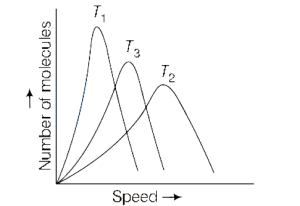
A
$T_1 > T_2 > T_3$
B
$T_1 > T_3 > T_2$
C
$T_3 > T_2 > T_1$
D
$T_2 > T_3 > T_1$
Solution
(D) According to the Maxwell-Boltzmann distribution,as the temperature of a gas increases,the most probable speed $(u_{mp})$ increases,and the peak of the distribution curve shifts to the right and flattens.
In the given figure,the peak for $T_2$ is at the highest speed,followed by $T_3$,and then $T_1$.
Therefore,the most probable speed follows the order $u_{mp}(T_2) > u_{mp}(T_3) > u_{mp}(T_1)$.
Since $u_{mp} = \sqrt{\frac{2RT}{M}}$,it implies that $u_{mp} \propto \sqrt{T}$.
Thus,the correct order of temperature is $T_2 > T_3 > T_1$.
In the given figure,the peak for $T_2$ is at the highest speed,followed by $T_3$,and then $T_1$.
Therefore,the most probable speed follows the order $u_{mp}(T_2) > u_{mp}(T_3) > u_{mp}(T_1)$.
Since $u_{mp} = \sqrt{\frac{2RT}{M}}$,it implies that $u_{mp} \propto \sqrt{T}$.
Thus,the correct order of temperature is $T_2 > T_3 > T_1$.
0 likes
View Solution180
EasyMCQ
The most probable speed of $O_2$ molecules at $T \ K$ is
A
$\sqrt{\frac{R T}{4 \pi}}$
B
$\sqrt{\frac{R T}{16 \pi}}$
C
$\sqrt{\frac{R T}{16}}$
D
$\sqrt{\frac{3 R T}{32}}$
Solution
(C) The formula for the most probable speed $(v_{mp})$ is given by $v_{mp} = \sqrt{\frac{2 R T}{M}}$.
For $O_2$ gas,the molar mass $M = 32 \ g \ mol^{-1}$.
Substituting the value of $M$ into the formula: $v_{mp} = \sqrt{\frac{2 R T}{32}}$.
Simplifying the expression,we get $v_{mp} = \sqrt{\frac{R T}{16}}$.
For $O_2$ gas,the molar mass $M = 32 \ g \ mol^{-1}$.
Substituting the value of $M$ into the formula: $v_{mp} = \sqrt{\frac{2 R T}{32}}$.
Simplifying the expression,we get $v_{mp} = \sqrt{\frac{R T}{16}}$.
0 likes
View Solution181
MediumMCQ
If a gas contains only three molecules that move with velocities of $100, 200, 500 \ ms^{-1}$. What is the rms velocity of that gas in $ms^{-1}$?
A
$100 \frac{\sqrt{8}}{3}$
B
$100 \sqrt{30}$
C
$100 \sqrt{10}$
D
$\frac{800}{3}$
Solution
(C) Given velocities: $C_1 = 100 \ ms^{-1}, C_2 = 200 \ ms^{-1}, C_3 = 500 \ ms^{-1}$.
Root mean square (rms) velocity is given by the formula: $C_{rms} = \sqrt{\frac{C_1^2 + C_2^2 + C_3^2}{n}}$.
Substituting the values: $C_{rms} = \sqrt{\frac{100^2 + 200^2 + 500^2}{3}}$.
$C_{rms} = \sqrt{\frac{10000 + 40000 + 250000}{3}}$.
$C_{rms} = \sqrt{\frac{300000}{3}} = \sqrt{100000}$.
$C_{rms} = 100 \sqrt{10} \ ms^{-1}$.
Root mean square (rms) velocity is given by the formula: $C_{rms} = \sqrt{\frac{C_1^2 + C_2^2 + C_3^2}{n}}$.
Substituting the values: $C_{rms} = \sqrt{\frac{100^2 + 200^2 + 500^2}{3}}$.
$C_{rms} = \sqrt{\frac{10000 + 40000 + 250000}{3}}$.
$C_{rms} = \sqrt{\frac{300000}{3}} = \sqrt{100000}$.
$C_{rms} = 100 \sqrt{10} \ ms^{-1}$.
0 likes
View Solution182
DifficultMCQ
The r.m.s. velocity of $CO_2$ at a temperature $T$ (in kelvin) is $x \ cm \ s^{-1}$. At what temperature (in kelvin),the r.m.s. velocity of nitrous oxide would be $4 x \ cm \ s^{-1}$ (in $T$)? (Atomic weights of $C, N$ and $O$ are respectively $12, 14$ and $16$)
A
$16$
B
$2$
C
$4$
D
$32$
Solution
(A) The formula for r.m.s. velocity is $v_{rms} = \sqrt{\frac{3RT}{M}}$.
For $CO_2$: $M_{CO_2} = 12 + (2 \times 16) = 44 \ g \ mol^{-1}$. Given $v_{rms} = x$ at temperature $T$.
For $N_2O$: $M_{N_2O} = (2 \times 14) + 16 = 44 \ g \ mol^{-1}$. Let the temperature be $T'$. Given $v_{rms} = 4x$.
Since $v_{rms} \propto \sqrt{T/M}$ and $M_{CO_2} = M_{N_2O} = 44$,we have $\frac{v_1}{v_2} = \sqrt{\frac{T_1}{T_2}}$.
Substituting the values: $\frac{x}{4x} = \sqrt{\frac{T}{T'}}$.
$\frac{1}{4} = \sqrt{\frac{T}{T'}}$.
Squaring both sides: $\frac{1}{16} = \frac{T}{T'}$.
Therefore,$T' = 16T$.
For $CO_2$: $M_{CO_2} = 12 + (2 \times 16) = 44 \ g \ mol^{-1}$. Given $v_{rms} = x$ at temperature $T$.
For $N_2O$: $M_{N_2O} = (2 \times 14) + 16 = 44 \ g \ mol^{-1}$. Let the temperature be $T'$. Given $v_{rms} = 4x$.
Since $v_{rms} \propto \sqrt{T/M}$ and $M_{CO_2} = M_{N_2O} = 44$,we have $\frac{v_1}{v_2} = \sqrt{\frac{T_1}{T_2}}$.
Substituting the values: $\frac{x}{4x} = \sqrt{\frac{T}{T'}}$.
$\frac{1}{4} = \sqrt{\frac{T}{T'}}$.
Squaring both sides: $\frac{1}{16} = \frac{T}{T'}$.
Therefore,$T' = 16T$.
0 likes
View Solution183
EasyMCQ
Molecular velocities of two gases at the same temperature $(T)$ are $u_{1}$ and $u_{2}$. Their masses are $m_{1}$ and $m_{2}$ respectively. Which of the following expressions is correct at temperature $T$?
A
$\frac{m_{1}}{u_{1}^{2}}=\frac{m_{2}}{u_{2}^{2}}$
B
$m_{1} u_{1}=m_{2} u_{2}$
C
$\frac{m_{1}}{u_{1}}=\frac{m_{2}}{u_{2}}$
D
$m_{1} u_{1}^{2}=m_{2} u_{2}^{2}$
Solution
(D) The root mean square velocity of a gas is given by $u = \sqrt{\frac{3RT}{M}}$.
Since the temperature $T$ is the same for both gases,$u \propto \frac{1}{\sqrt{m}}$.
Therefore,$\frac{u_{1}}{u_{2}} = \sqrt{\frac{m_{2}}{m_{1}}}$.
Squaring both sides,we get $\frac{u_{1}^{2}}{u_{2}^{2}} = \frac{m_{2}}{m_{1}}$.
Cross-multiplying gives $m_{1} u_{1}^{2} = m_{2} u_{2}^{2}$.
Since the temperature $T$ is the same for both gases,$u \propto \frac{1}{\sqrt{m}}$.
Therefore,$\frac{u_{1}}{u_{2}} = \sqrt{\frac{m_{2}}{m_{1}}}$.
Squaring both sides,we get $\frac{u_{1}^{2}}{u_{2}^{2}} = \frac{m_{2}}{m_{1}}$.
Cross-multiplying gives $m_{1} u_{1}^{2} = m_{2} u_{2}^{2}$.
0 likes
View Solution184
MediumMCQ
The root mean square (rms) speed of $X_2$ gas is $x \ m/s$ at a given temperature. When the temperature is doubled,the $X_2$ molecules dissociate completely into atoms. The root mean square speed of the sample of gas then becomes (in $m/s$):
A
$x / 2$
B
$x$
C
$2x$
D
$4x$
Solution
(C) The formula for root mean square speed is $C_{rms} = \sqrt{\frac{3RT}{M}}$.
Initially,for $X_2$ gas at temperature $T$,$C_1 = x = \sqrt{\frac{3RT}{M_{X_2}}}$.
When temperature is doubled $(T_2 = 2T)$ and $X_2$ dissociates into $2X$,the molar mass becomes $M_2 = \frac{M_{X_2}}{2}$.
The new rms speed $C_2$ is given by $C_2 = \sqrt{\frac{3R(2T)}{M_{X_2}/2}} = \sqrt{4 \times \frac{3RT}{M_{X_2}}} = 2 \times \sqrt{\frac{3RT}{M_{X_2}}}$.
Substituting $x$ for the initial speed,we get $C_2 = 2x \ m/s$.
Initially,for $X_2$ gas at temperature $T$,$C_1 = x = \sqrt{\frac{3RT}{M_{X_2}}}$.
When temperature is doubled $(T_2 = 2T)$ and $X_2$ dissociates into $2X$,the molar mass becomes $M_2 = \frac{M_{X_2}}{2}$.
The new rms speed $C_2$ is given by $C_2 = \sqrt{\frac{3R(2T)}{M_{X_2}/2}} = \sqrt{4 \times \frac{3RT}{M_{X_2}}} = 2 \times \sqrt{\frac{3RT}{M_{X_2}}}$.
Substituting $x$ for the initial speed,we get $C_2 = 2x \ m/s$.
0 likes
View Solution185
MediumMCQ
Case $-1:$ An ideal gas of molecular weight $M$ at temperature $T$.
Case $-2:$ Another ideal gas of molecular weight $2M$ at temperature $T/2$.
Identify the correct statement in the context of the above two cases.
Case $-2:$ Another ideal gas of molecular weight $2M$ at temperature $T/2$.
Identify the correct statement in the context of the above two cases.
A
Average kinetic energy and average speed will be the same in the two cases
B
Both the averages are halved
C
Both the averages are doubled
D
Only average speed is halved in the second case
Solution
(B) The average kinetic energy $(KE_{avg})$ of an ideal gas is given by $\frac{3}{2}kT$. Since the temperature $T$ is halved in Case $-2$,the average kinetic energy is also halved.
The average speed $(C_{avg})$ is given by $\sqrt{\frac{8RT}{\pi M}}$.
For Case $-1$: $C_1 \propto \sqrt{\frac{T}{M}}$.
For Case $-2$: $C_2 \propto \sqrt{\frac{T/2}{2M}} = \sqrt{\frac{T}{4M}} = \frac{1}{2} \sqrt{\frac{T}{M}}$.
Thus,$C_2 = \frac{1}{2} C_1$.
Therefore,both the average kinetic energy and the average speed are halved in the second case.
The average speed $(C_{avg})$ is given by $\sqrt{\frac{8RT}{\pi M}}$.
For Case $-1$: $C_1 \propto \sqrt{\frac{T}{M}}$.
For Case $-2$: $C_2 \propto \sqrt{\frac{T/2}{2M}} = \sqrt{\frac{T}{4M}} = \frac{1}{2} \sqrt{\frac{T}{M}}$.
Thus,$C_2 = \frac{1}{2} C_1$.
Therefore,both the average kinetic energy and the average speed are halved in the second case.
0 likes
View Solution186
EasyMCQ
The average speed of $H_2$ at $T_1 \ K$ is equal to that of $O_2$ at $T_2 \ K$. The ratio $T_1: T_2$ is
A
$1: 6$
B
$16: 1$
C
$1: 4$
D
None of these
Solution
(D) The formula for average speed is $C_{av} = \sqrt{\frac{8RT}{\pi M}}$.
Given that $(C_{av})_{H_2} = (C_{av})_{O_2}$,we have:
$\sqrt{\frac{8RT_1}{\pi M_{H_2}}} = \sqrt{\frac{8RT_2}{\pi M_{O_2}}}$
Squaring both sides:
$\frac{T_1}{M_{H_2}} = \frac{T_2}{M_{O_2}}$
$\frac{T_1}{T_2} = \frac{M_{H_2}}{M_{O_2}}$
Substituting the molar masses ($M_{H_2} = 2 \ g/mol$ and $M_{O_2} = 32 \ g/mol$):
$\frac{T_1}{T_2} = \frac{2}{32} = \frac{1}{16}$
Thus,the ratio $T_1: T_2$ is $1: 16$.
Given that $(C_{av})_{H_2} = (C_{av})_{O_2}$,we have:
$\sqrt{\frac{8RT_1}{\pi M_{H_2}}} = \sqrt{\frac{8RT_2}{\pi M_{O_2}}}$
Squaring both sides:
$\frac{T_1}{M_{H_2}} = \frac{T_2}{M_{O_2}}$
$\frac{T_1}{T_2} = \frac{M_{H_2}}{M_{O_2}}$
Substituting the molar masses ($M_{H_2} = 2 \ g/mol$ and $M_{O_2} = 32 \ g/mol$):
$\frac{T_1}{T_2} = \frac{2}{32} = \frac{1}{16}$
Thus,the ratio $T_1: T_2$ is $1: 16$.
0 likes
View Solution187
EasyMCQ
Let $(C_{rms})_{H_2}$ be the r.m.s. speed of $H_2$ at $150 \ K$. At what temperature will the most probable speed of helium $[(C_{mp})_{He}]$ be half of $(C_{rms})_{H_2}$ (in $K$)?
A
$75$
B
$112.5$
C
$225$
D
$900$
Solution
(B) The formula for r.m.s. speed is $(C_{rms}) = \sqrt{\frac{3RT}{M}}$ and for most probable speed is $(C_{mp}) = \sqrt{\frac{2RT}{M}}$.
Given $(C_{rms})_{H_2} = \sqrt{\frac{3 \times R \times 150}{2}}$.
According to the problem,$(C_{mp})_{He} = \frac{1}{2} (C_{rms})_{H_2}$.
Substituting the values: $\sqrt{\frac{2RT}{4}} = \frac{1}{2} \sqrt{\frac{3 \times R \times 150}{2}}$.
Squaring both sides: $\frac{2RT}{4} = \frac{1}{4} \times \frac{3 \times R \times 150}{2}$.
$\frac{RT}{2} = \frac{450R}{8}$.
$T = \frac{450}{4} = 112.5 \ K$.
Given $(C_{rms})_{H_2} = \sqrt{\frac{3 \times R \times 150}{2}}$.
According to the problem,$(C_{mp})_{He} = \frac{1}{2} (C_{rms})_{H_2}$.
Substituting the values: $\sqrt{\frac{2RT}{4}} = \frac{1}{2} \sqrt{\frac{3 \times R \times 150}{2}}$.
Squaring both sides: $\frac{2RT}{4} = \frac{1}{4} \times \frac{3 \times R \times 150}{2}$.
$\frac{RT}{2} = \frac{450R}{8}$.
$T = \frac{450}{4} = 112.5 \ K$.
0 likes
View Solution188
MediumMCQ
Amongst the following,which should have the highest $rms$ speed at the same temperature?
A
$SO_{2}$
B
$CO_{2}$
C
$O_{2}$
D
$H_{2}$
Solution
(D) The $rms$ velocity $(v_{rms})$ is given by the formula $v_{rms} = \sqrt{\frac{3RT}{M}}$.
Since $v_{rms} \propto \sqrt{\frac{1}{M}}$,the gas with the smallest molar mass $(M)$ will have the highest $rms$ speed at a constant temperature.
The molar masses are: $SO_{2} = 64 \ g/mol$,$CO_{2} = 44 \ g/mol$,$O_{2} = 32 \ g/mol$,and $H_{2} = 2 \ g/mol$.
Since $H_{2}$ has the minimum molar mass,it has the highest $rms$ speed.
Since $v_{rms} \propto \sqrt{\frac{1}{M}}$,the gas with the smallest molar mass $(M)$ will have the highest $rms$ speed at a constant temperature.
The molar masses are: $SO_{2} = 64 \ g/mol$,$CO_{2} = 44 \ g/mol$,$O_{2} = 32 \ g/mol$,and $H_{2} = 2 \ g/mol$.
Since $H_{2}$ has the minimum molar mass,it has the highest $rms$ speed.
0 likes
View Solution189
MediumMCQ
The $RMS$ velocity of $CO$ gas molecules at $27^{\circ} C$ is approximately $1000 \ m / s$. For molecules at $600 \ K$,the $RMS$ velocity is approximately (in $m / s$)
A
$2000$
B
$1414$
C
$1000$
D
$1500$
Solution
(B) The formula for $RMS$ velocity is $v_{rms} = \sqrt{\frac{3RT}{M}}$.
Since $v_{rms} \propto \sqrt{T}$,we have $\frac{v_1}{v_2} = \sqrt{\frac{T_1}{T_2}}$.
Given $T_1 = 27^{\circ} C = 300 \ K$ and $v_1 = 1000 \ m / s$.
Given $T_2 = 600 \ K$.
Substituting the values: $\frac{1000}{v_2} = \sqrt{\frac{300}{600}} = \sqrt{\frac{1}{2}} = \frac{1}{1.414}$.
Therefore,$v_2 = 1000 \times 1.414 = 1414 \ m / s$.
Since $v_{rms} \propto \sqrt{T}$,we have $\frac{v_1}{v_2} = \sqrt{\frac{T_1}{T_2}}$.
Given $T_1 = 27^{\circ} C = 300 \ K$ and $v_1 = 1000 \ m / s$.
Given $T_2 = 600 \ K$.
Substituting the values: $\frac{1000}{v_2} = \sqrt{\frac{300}{600}} = \sqrt{\frac{1}{2}} = \frac{1}{1.414}$.
Therefore,$v_2 = 1000 \times 1.414 = 1414 \ m / s$.
0 likes
View SolutionStates of Matter — Molecular speeds · Frequently Asked Questions
1Are these States of Matter questions useful for JEE and NEET?
Yes. All questions in this section are mapped to JEE Main and NEET exam patterns. Previous year questions from JEE Main, NEET, GUJCET and state-level exams are included with full solutions.
2Can I switch to Hindi or Gujarati for these questions?
Yes. Use the language tabs in the hero section or the sidebar to view the same questions and solutions in English, Hindi or Gujarati.
3How do I generate a question paper from this subtopic?
Use the Vedclass Exam Paper Generator — select the chapter and subtopic, set difficulty, and generate Sets A, B, C, D automatically. First 3 chapters of every subject are free.
Vedclass Products
For Students
Vedclass Test Series
Mock tests in real JEE/NEET style with performance analysis. 5-day free trial.
Start Free TrialFor Teachers
Exam Paper Generator
Generate Set A/B/C/D papers from this chapter in 2 minutes. 3 chapters free.
Try FreeFor Institutes
Online Exam Module
Live online exams with unlimited students, 360° analytics & white-label branding.
See DemoFor Teachers & Institutes
Generate a States of Matter Exam Paper in 2 Minutes
Select subtopic & difficulty — Sets A, B, C, D auto-generated with No Repeat logic.
First 3 chapters of every subject are free — no payment required.