
A English
Kinetic molecular theory of gases and Molecular collisions Questions in English
Class 11 Chemistry · States of Matter · Kinetic molecular theory of gases and Molecular collisions
151+
Questions
English
Language
100%
With Solutions
Showing 45 of 151 questions in English
101
MediumMCQ
Assertion : Gases do not settle to the bottom of a container.
Reason : Gases have high kinetic energy.
Reason : Gases have high kinetic energy.
A
If both Assertion and Reason are correct and the Reason is a correct explanation of the Assertion.
B
If both Assertion and Reason are correct but Reason is not a correct explanation of the Assertion.
C
If the Assertion is correct but Reason is incorrect.
D
If both the Assertion and Reason are incorrect.
Solution
(A) Gases do not settle to the bottom of a container because their particles possess high kinetic energy,which keeps them in constant,random motion.
Due to this high kinetic energy and their very small mass,the effect of gravity on individual gas molecules is negligible,preventing them from settling at the bottom.
Due to this high kinetic energy and their very small mass,the effect of gravity on individual gas molecules is negligible,preventing them from settling at the bottom.
0 likes
View Solution102
EasyMCQ
Assertion : All molecules in a gas have same speed.
Reason : Gas contains molecules of different size and shape.
Reason : Gas contains molecules of different size and shape.
A
If both Assertion and Reason are correct and the Reason is a correct explanation of the Assertion.
B
If both Assertion and Reason are correct but Reason is not a correct explanation of the Assertion.
C
If the Assertion is correct but Reason is incorrect.
D
If both the Assertion and Reason are incorrect.
Solution
(D) The Assertion is incorrect because molecules in a gas possess a distribution of speeds (Maxwell-Boltzmann distribution) at a given temperature,not the same speed.
The Reason is also incorrect because,for a pure gas,all molecules are identical in size and shape.
Therefore,both Assertion and Reason are incorrect.
The Reason is also incorrect because,for a pure gas,all molecules are identical in size and shape.
Therefore,both Assertion and Reason are incorrect.
0 likes
View Solution103
Difficult
Explain the assumptions (postulates) of the kinetic molecular theory of gases.
Solution
(N/A) The kinetic molecular theory provides a microscopic model for the behavior of gases based on the following postulates:
$1$. $Gases$ consist of a large number of identical particles (atoms or molecules) that are so small and so far apart that the actual volume of the molecules is negligible compared to the empty space between them. They are considered as 'point masses',which explains the high compressibility of gases.
$2$. There is no force of attraction between the particles of a gas at ordinary temperature and pressure. This explains why gases expand to occupy all available space.
$3$. Particles of a gas are in constant,random motion in straight lines. If they were at rest,the gas would have a fixed shape,which is not observed.
$4$. Gas pressure is exerted due to the collision of particles with the walls of the container.
$5$. Collisions of gas molecules are perfectly elastic. This means the total kinetic energy of the molecules remains constant before and after the collision,even if individual energies change.
$6$. At any given temperature,although individual particles have different speeds and kinetic energies that change constantly due to collisions,the overall distribution of speeds remains constant.
$1$. $Gases$ consist of a large number of identical particles (atoms or molecules) that are so small and so far apart that the actual volume of the molecules is negligible compared to the empty space between them. They are considered as 'point masses',which explains the high compressibility of gases.
$2$. There is no force of attraction between the particles of a gas at ordinary temperature and pressure. This explains why gases expand to occupy all available space.
$3$. Particles of a gas are in constant,random motion in straight lines. If they were at rest,the gas would have a fixed shape,which is not observed.
$4$. Gas pressure is exerted due to the collision of particles with the walls of the container.
$5$. Collisions of gas molecules are perfectly elastic. This means the total kinetic energy of the molecules remains constant before and after the collision,even if individual energies change.
$6$. At any given temperature,although individual particles have different speeds and kinetic energies that change constantly due to collisions,the overall distribution of speeds remains constant.
0 likes
View Solution104
Difficult
Explain the microscopic model of gases.
Solution
(N/A) The microscopic model of gases is based on the postulates of the Kinetic Molecular Theory of Gases:
$1$. $Particles$ $as$ $point$ $masses$: Gases consist of a large number of identical particles (atoms or molecules) that are so small and so far apart that the actual volume of the molecules is negligible compared to the empty space between them. This explains the high compressibility of gases.
$2$. $No$ $intermolecular$ $forces$: There is no force of attraction between gas particles at ordinary temperature and pressure. This explains why gases expand to occupy all available space.
$3$. $Constant$ $random$ $motion$: Gas particles are in constant,random,straight-line motion. If they were at rest,gases would have a fixed shape,which is not observed.
$4$. $Pressure$ $exertion$: Gas particles collide with each other and with the walls of the container. The pressure exerted by a gas is the result of these collisions with the container walls.
$5$. $Elastic$ $collisions$: Collisions between gas molecules are perfectly elastic. While individual energies may change during collisions,the total kinetic energy of the system remains constant at a given temperature.
$6$. $Distribution$ $of$ $speeds$: At any given temperature,although individual particles have different and constantly changing speeds due to collisions,the overall distribution of speeds remains constant.
$1$. $Particles$ $as$ $point$ $masses$: Gases consist of a large number of identical particles (atoms or molecules) that are so small and so far apart that the actual volume of the molecules is negligible compared to the empty space between them. This explains the high compressibility of gases.
$2$. $No$ $intermolecular$ $forces$: There is no force of attraction between gas particles at ordinary temperature and pressure. This explains why gases expand to occupy all available space.
$3$. $Constant$ $random$ $motion$: Gas particles are in constant,random,straight-line motion. If they were at rest,gases would have a fixed shape,which is not observed.
$4$. $Pressure$ $exertion$: Gas particles collide with each other and with the walls of the container. The pressure exerted by a gas is the result of these collisions with the container walls.
$5$. $Elastic$ $collisions$: Collisions between gas molecules are perfectly elastic. While individual energies may change during collisions,the total kinetic energy of the system remains constant at a given temperature.
$6$. $Distribution$ $of$ $speeds$: At any given temperature,although individual particles have different and constantly changing speeds due to collisions,the overall distribution of speeds remains constant.
0 likes
View Solution105
Difficult
Explain the kinetic energy,average translational kinetic energy,and root mean square speed of gas molecules.
Solution
(N/A) $1$. Kinetic Energy: The total kinetic energy of a gas is the sum of the kinetic energies of all its individual molecules. For an ideal gas,it is given by $E_k = \frac{3}{2} nRT$.
$2$. Average Translational Kinetic Energy: This is the average kinetic energy per mole of gas molecules,given by $E_{avg} = \frac{3}{2} RT$. For a single molecule,it is $\frac{3}{2} kT$,where $k$ is the Boltzmann constant.
$3$. Root Mean Square Speed $(u_{rms})$: It is defined as the square root of the mean of the squares of the speeds of different molecules of a gas. It is given by the formula $u_{rms} = \sqrt{\frac{3RT}{M}}$,where $R$ is the universal gas constant,$T$ is the absolute temperature,and $M$ is the molar mass of the gas.
$2$. Average Translational Kinetic Energy: This is the average kinetic energy per mole of gas molecules,given by $E_{avg} = \frac{3}{2} RT$. For a single molecule,it is $\frac{3}{2} kT$,where $k$ is the Boltzmann constant.
$3$. Root Mean Square Speed $(u_{rms})$: It is defined as the square root of the mean of the squares of the speeds of different molecules of a gas. It is given by the formula $u_{rms} = \sqrt{\frac{3RT}{M}}$,where $R$ is the universal gas constant,$T$ is the absolute temperature,and $M$ is the molar mass of the gas.
0 likes
View Solution106
Difficult
Give two unfair assumptions of the Kinetic Molecular Theory of gases. Justify them.
Solution
(N/A) The two main unfair assumptions of the Kinetic Molecular Theory of gases are:
$1$. The volume occupied by gas molecules is negligible compared to the total volume of the gas.
Justification: At high pressures,the gas molecules are pushed close together,and their actual volume becomes significant relative to the total volume of the container.
$2$. There are no forces of attraction or repulsion between gas molecules.
Justification: At low temperatures and high pressures,gas molecules move slowly and come closer to each other,leading to significant intermolecular forces of attraction,which causes the gas to deviate from ideal behavior and eventually liquefy.
$1$. The volume occupied by gas molecules is negligible compared to the total volume of the gas.
Justification: At high pressures,the gas molecules are pushed close together,and their actual volume becomes significant relative to the total volume of the container.
$2$. There are no forces of attraction or repulsion between gas molecules.
Justification: At low temperatures and high pressures,gas molecules move slowly and come closer to each other,leading to significant intermolecular forces of attraction,which causes the gas to deviate from ideal behavior and eventually liquefy.
0 likes
View Solution107
MediumMCQ
What kind of forces exist between the molecules in an ideal gas?
A
Attractive forces
B
Repulsive forces
C
No intermolecular forces
D
Both attractive and repulsive forces
Solution
(C) In an ideal gas,it is assumed that there are no intermolecular forces of attraction or repulsion between the molecules.
This is a hypothetical concept.
This is a hypothetical concept.
0 likes
View Solution108
MediumMCQ
The postulates of the kinetic molecular theory are related to what?
A
Solid particles
B
Liquid particles
C
Gas particles
D
Plasma particles
Solution
(C) The postulates of the kinetic molecular theory are related to the behavior of gas particles. It provides a microscopic model for the behavior of gases.
0 likes
View Solution109
MediumMCQ
Why do gases exert pressure?
A
Due to the high density of gas molecules.
B
Due to the collisions of gas molecules with the walls of the container.
C
Due to the attractive forces between gas molecules.
D
Due to the constant volume of gas molecules.
Solution
(B) Gas molecules are in constant,random,linear motion in all possible directions. $ \newline $ When these molecules collide with the walls of the container,they exert a force per unit area,which is defined as pressure.
0 likes
View Solution110
MediumMCQ
What happens when a gas is heated?
A
The kinetic energy of molecules increases.
B
The volume of the gas decreases.
C
The pressure of the gas decreases.
D
The number of molecules increases.
Solution
(A) When a gas is heated,the kinetic energy of the gas molecules increases.
As a result,the molecules move faster and collide more frequently and with greater force against the walls of the container,leading to an increase in pressure if the volume is constant.
As a result,the molecules move faster and collide more frequently and with greater force against the walls of the container,leading to an increase in pressure if the volume is constant.
0 likes
View Solution111
Medium
What is an elastic molecular collision?
Solution
(N/A) An elastic collision is a collision in which there is no net loss of total kinetic energy in the system as a result of the collision. The kinetic energy is only transferred between the colliding molecules.
0 likes
View Solution112
MediumMCQ
What is the average translational kinetic energy of a gas molecule?
A
$ \frac{1}{2} k_B T $
B
$ \frac{3}{2} k_B T $
C
$ \frac{3}{2} RT $
D
$ \frac{1}{2} RT $
Solution
(B) The average translational kinetic energy of a gas molecule is given by the expression $ \frac{3}{2} k_B T $.
Here,$ k_B $ is the Boltzmann constant and $ T $ is the absolute temperature in Kelvin.
This is derived from the kinetic theory of gases where the total kinetic energy for $ 1 \text{ mole} $ of gas is $ \frac{3}{2} RT $.
Here,$ k_B $ is the Boltzmann constant and $ T $ is the absolute temperature in Kelvin.
This is derived from the kinetic theory of gases where the total kinetic energy for $ 1 \text{ mole} $ of gas is $ \frac{3}{2} RT $.
0 likes
View Solution113
MediumMCQ
What happens to the pressure if the collisions of gas molecules are not elastic?
A
Pressure increases
B
Pressure decreases
C
Pressure becomes zero
D
Pressure remains constant
Solution
(C) In the kinetic molecular theory of gases,collisions are assumed to be perfectly elastic,meaning there is no loss of kinetic energy. If collisions were not elastic,the molecules would lose kinetic energy with each collision. Eventually,the molecules would lose all their kinetic energy,causing them to stop moving and hit the container walls with zero force,resulting in the pressure becoming $0$.
0 likes
View Solution114
EasyMCQ
At a temperature of $300 \ K$,which of the following has higher kinetic energy: $N_2$ or $O_2$?
A
$N_2$
B
$O_2$
C
Both have the same kinetic energy
D
Cannot be determined
Solution
(C) The kinetic energy of an ideal gas depends only on its absolute temperature,given by the formula $KE = \frac{3}{2} nRT$ for $n$ moles or $KE = \frac{3}{2} kT$ per molecule.
Since both $N_2$ and $O_2$ are at the same temperature of $300 \ K$,their average kinetic energy per mole (or per molecule) will be the same.
Therefore,the kinetic energy is equal for both.
Since both $N_2$ and $O_2$ are at the same temperature of $300 \ K$,their average kinetic energy per mole (or per molecule) will be the same.
Therefore,the kinetic energy is equal for both.
0 likes
View Solution115
MediumMCQ
State the relationship between kinetic energy and temperature for an ideal gas.
A
$KE = \frac{3}{2} RT$
B
$KE = \frac{3}{2} kT$
C
$KE = \frac{2}{3} kT$
D
$KE = \frac{1}{2} kT$
Solution
(B) The average kinetic energy $(KE)$ of an ideal gas is directly proportional to its absolute temperature $(T)$.
The relationship is given by the equation: $KE = \frac{3}{2} kT$,where $k$ is the Boltzmann constant.
The relationship is given by the equation: $KE = \frac{3}{2} kT$,where $k$ is the Boltzmann constant.
0 likes
View Solution116
EasyMCQ
What type of kinetic energy do $He$ and $Ne$ possess?
A
Translational kinetic energy
B
Rotational kinetic energy
C
Vibrational kinetic energy
D
All of the above
Solution
(A) Since $He$ and $Ne$ are monoatomic noble gases,they do not possess rotational or vibrational degrees of freedom. They only exhibit translational kinetic energy.
0 likes
View Solution117
MediumMCQ
Assuming ideal behaviour,the ratio of kinetic energies of $3 \ g$ of $H_2$ and $4 \ g$ of $O_2$ at any temperature is
A
$3: 4$
B
$1: 16$
C
$4: 3$
D
$12: 1$
Solution
(D) The kinetic energy $(KE)$ of an ideal gas is given by the formula $KE = \frac{3}{2} n R T$ (for translational kinetic energy of any ideal gas).
Number of moles of $H_2$ $(n_{H_2})$ = $\frac{3 \ g}{2 \ g/mol} = 1.5 \ mol$.
Number of moles of $O_2$ $(n_{O_2})$ = $\frac{4 \ g}{32 \ g/mol} = 0.125 \ mol = \frac{1}{8} \ mol$.
Since the temperature $T$ is the same for both,the ratio of kinetic energies is:
$\frac{KE_{H_2}}{KE_{O_2}} = \frac{\frac{3}{2} n_{H_2} R T}{\frac{3}{2} n_{O_2} R T} = \frac{n_{H_2}}{n_{O_2}} = \frac{1.5}{0.125} = \frac{1.5 \times 8}{1} = \frac{12}{1}$.
Thus,the ratio is $12: 1$.
Number of moles of $H_2$ $(n_{H_2})$ = $\frac{3 \ g}{2 \ g/mol} = 1.5 \ mol$.
Number of moles of $O_2$ $(n_{O_2})$ = $\frac{4 \ g}{32 \ g/mol} = 0.125 \ mol = \frac{1}{8} \ mol$.
Since the temperature $T$ is the same for both,the ratio of kinetic energies is:
$\frac{KE_{H_2}}{KE_{O_2}} = \frac{\frac{3}{2} n_{H_2} R T}{\frac{3}{2} n_{O_2} R T} = \frac{n_{H_2}}{n_{O_2}} = \frac{1.5}{0.125} = \frac{1.5 \times 8}{1} = \frac{12}{1}$.
Thus,the ratio is $12: 1$.
0 likes
View Solution118
MediumMCQ
Among the following,the plot that shows the correct marking of most probable velocity $(V_{mp})$,average velocity $(\bar{V})$,and root mean square velocity $(V_{rms})$ is
A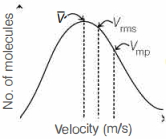
B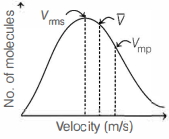
C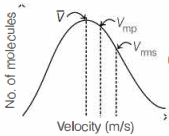
D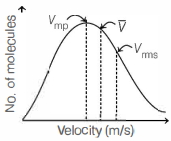
Solution
(D) The expressions for most probable velocity $(V_{mp})$,average velocity $(\bar{V})$,and root mean square velocity $(V_{rms})$ are as follows:
$V_{mp} = \sqrt{\frac{2RT}{M}}$
$\bar{V} = \sqrt{\frac{8RT}{\pi M}} \approx \sqrt{\frac{2.55RT}{M}}$
$V_{rms} = \sqrt{\frac{3RT}{M}}$
Comparing these values,we get the order: $V_{mp} < \bar{V} < V_{rms}$.
In the Maxwell-Boltzmann distribution curve,the peak corresponds to $V_{mp}$,followed by $\bar{V}$,and then $V_{rms}$ on the right side of the peak.
Thus,the correct plot is the one where the order from left to right is $V_{mp}$,$\bar{V}$,$V_{rms}$.
$V_{mp} = \sqrt{\frac{2RT}{M}}$
$\bar{V} = \sqrt{\frac{8RT}{\pi M}} \approx \sqrt{\frac{2.55RT}{M}}$
$V_{rms} = \sqrt{\frac{3RT}{M}}$
Comparing these values,we get the order: $V_{mp} < \bar{V} < V_{rms}$.
In the Maxwell-Boltzmann distribution curve,the peak corresponds to $V_{mp}$,followed by $\bar{V}$,and then $V_{rms}$ on the right side of the peak.
Thus,the correct plot is the one where the order from left to right is $V_{mp}$,$\bar{V}$,$V_{rms}$.
0 likes
View Solution119
MediumMCQ
At $298 \, K$,assuming ideal behaviour,the average kinetic energy of a deuterium molecule is
A
two times that of a hydrogen molecule
B
four times that of a hydrogen molecule
C
half of that of a hydrogen molecule
D
same as that of a hydrogen molecule
Solution
(D) The correct option is $D$.
Average kinetic energy depends only upon the temperature and is independent of the mass or type of gas molecules.
For any ideal gas,the average kinetic energy per molecule is given by the formula $(K.E.)_{avg} = \frac{3}{2}kT$,where $k$ is the Boltzmann constant and $T$ is the absolute temperature.
Since both deuterium $(D_2)$ and hydrogen $(H_2)$ are at the same temperature $(298 \, K)$,their average kinetic energies are equal.
Average kinetic energy depends only upon the temperature and is independent of the mass or type of gas molecules.
For any ideal gas,the average kinetic energy per molecule is given by the formula $(K.E.)_{avg} = \frac{3}{2}kT$,where $k$ is the Boltzmann constant and $T$ is the absolute temperature.
Since both deuterium $(D_2)$ and hydrogen $(H_2)$ are at the same temperature $(298 \, K)$,their average kinetic energies are equal.
0 likes
View Solution120
MediumMCQ
The diffusion coefficient of an ideal gas is proportional to its mean free path and mean speed. The absolute temperature of an ideal gas is increased $4$ times and its pressure is increased $2$ times. As a result,the diffusion coefficient of this gas increases $x$ times. The value of $x$ is
A
$4$
B
$5$
C
$8$
D
$9$
Solution
(A) The diffusion coefficient $D$ is proportional to the mean free path $\lambda$ and the mean speed $v$,so $D \propto \lambda \cdot v$.
We know that the mean free path $\lambda \propto \frac{T}{P}$ and the mean speed $v \propto \sqrt{T}$.
Therefore,$D \propto \frac{T}{P} \cdot \sqrt{T} = \frac{T^{3/2}}{P}$.
Given that the temperature $T_f = 4T_i$ and the pressure $P_f = 2P_i$,we can write the ratio:
$\frac{D_f}{D_i} = \left( \frac{T_f}{T_i} \right)^{3/2} \cdot \left( \frac{P_i}{P_f} \right)$
$\frac{D_f}{D_i} = (4)^{3/2} \cdot \left( \frac{1}{2} \right)$
$\frac{D_f}{D_i} = 8 \cdot \frac{1}{2} = 4$.
Thus,$D_f = 4D_i$,which means $x = 4$.
We know that the mean free path $\lambda \propto \frac{T}{P}$ and the mean speed $v \propto \sqrt{T}$.
Therefore,$D \propto \frac{T}{P} \cdot \sqrt{T} = \frac{T^{3/2}}{P}$.
Given that the temperature $T_f = 4T_i$ and the pressure $P_f = 2P_i$,we can write the ratio:
$\frac{D_f}{D_i} = \left( \frac{T_f}{T_i} \right)^{3/2} \cdot \left( \frac{P_i}{P_f} \right)$
$\frac{D_f}{D_i} = (4)^{3/2} \cdot \left( \frac{1}{2} \right)$
$\frac{D_f}{D_i} = 8 \cdot \frac{1}{2} = 4$.
Thus,$D_f = 4D_i$,which means $x = 4$.
0 likes
View Solution121
DifficultMCQ
According to the kinetic theory of gases,which of the following statements are correct?
$A$. Collisions are always elastic.
$B$. Heavier molecules transfer more momentum to the wall of the container.
$C$. Only a small number of molecules have very high velocity.
$D$. Between collisions,the molecules move in straight lines with constant velocities.
$A$. Collisions are always elastic.
$B$. Heavier molecules transfer more momentum to the wall of the container.
$C$. Only a small number of molecules have very high velocity.
$D$. Between collisions,the molecules move in straight lines with constant velocities.
A
$A, C, D$
B
$A, B, C$
C
$B, C, D$
D
$A, B, D$
Solution
(A) . According to the postulates of the kinetic theory of gases,collisions between molecules and with the walls of the container are perfectly elastic.
$B$. The momentum transferred to the wall is $\Delta p = 2mu$. Since momentum is proportional to mass $(m)$,heavier molecules transfer more momentum upon collision.
$C$. According to the Maxwell-Boltzmann distribution,the fraction of molecules with very high or very low velocities is extremely small.
$D$. Between two successive collisions,molecules move in straight lines with constant velocity due to the absence of intermolecular forces.
$B$. The momentum transferred to the wall is $\Delta p = 2mu$. Since momentum is proportional to mass $(m)$,heavier molecules transfer more momentum upon collision.
$C$. According to the Maxwell-Boltzmann distribution,the fraction of molecules with very high or very low velocities is extremely small.
$D$. Between two successive collisions,molecules move in straight lines with constant velocity due to the absence of intermolecular forces.
0 likes
View Solution122
AdvancedMCQ
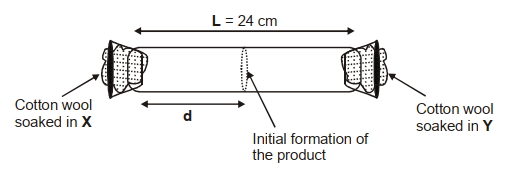
$X$ and $Y$ are two volatile liquids with molar weights of $10 \ g \ mol^{-1}$ and $40 \ g \ mol^{-1}$ respectively. Two cotton plugs,one soaked in $X$ and the other soaked in $Y$,are simultaneously placed at the ends of a tube of length $L = 24 \ cm$. The tube is filled with an inert gas at $1 \ atmosphere$ pressure and a temperature of $300 \ K$. Vapours of $X$ and $Y$ react to form a product which is first observed at a distance $d \ cm$ from the plug soaked in $X$. Take $X$ and $Y$ to have equal molecular diameters and assume ideal behaviour for the inert gas and the two vapours.
$1.$ The value of $d$ in $cm$,as estimated from Graham's law,is:
$(A) \ 8 \ (B) \ 12 \ (C) \ 16 \ (D) \ 20$
$2.$ The experimental value of $d$ is found to be smaller than the estimate obtained using Graham's law. This is due to:
$(A)$ larger mean free path for $X$ as compared to that of $Y$.
$(B)$ larger mean free path for $Y$ as compared to that of $X$.
$(C)$ increased collision frequency of $Y$ with the inert gas as compared to that of $X$ with the inert gas.
$(D)$ increased collision frequency of $X$ with the inert gas as compared to that of $Y$ with the inert gas.
Give the answer for question $1$ and $2$.
$1.$ The value of $d$ in $cm$,as estimated from Graham's law,is:
$(A) \ 8 \ (B) \ 12 \ (C) \ 16 \ (D) \ 20$
$2.$ The experimental value of $d$ is found to be smaller than the estimate obtained using Graham's law. This is due to:
$(A)$ larger mean free path for $X$ as compared to that of $Y$.
$(B)$ larger mean free path for $Y$ as compared to that of $X$.
$(C)$ increased collision frequency of $Y$ with the inert gas as compared to that of $X$ with the inert gas.
$(D)$ increased collision frequency of $X$ with the inert gas as compared to that of $Y$ with the inert gas.
Give the answer for question $1$ and $2$.
A
$(C, D)$
B
$(B, D)$
C
$(B, C)$
D
$(A, C)$
Solution
(A) $1.$ According to Graham's law,if all conditions are identical,$r \propto \frac{1}{\sqrt{M}}$.
Since all conditions are identical for $X$ and $Y$,we have $\frac{r_x}{r_y} = \sqrt{\frac{M_y}{M_x}}$.
$\frac{d}{24-d} = \sqrt{\frac{40}{10}} = 2$.
$d = 48 - 2d \implies 3d = 48 \implies d = 16 \ cm$.
$2.$ The mean free path $\lambda$ is given by $\lambda = \frac{RT}{\sqrt{2} \pi d^2 N_A P}$.
Since $d$ and $P$ are the same for both gases,their $\lambda$ values are identical. However,$X$ has a lower molar mass,so it has a higher average speed $(v_{avg} \propto \frac{1}{\sqrt{M}})$. Due to this higher drift speed,$X$ experiences a higher collision frequency with the inert gas molecules compared to $Y$. Consequently,$X$ encounters more resistance,causing it to cover a shorter distance than predicted by Graham's law.
Since all conditions are identical for $X$ and $Y$,we have $\frac{r_x}{r_y} = \sqrt{\frac{M_y}{M_x}}$.
$\frac{d}{24-d} = \sqrt{\frac{40}{10}} = 2$.
$d = 48 - 2d \implies 3d = 48 \implies d = 16 \ cm$.
$2.$ The mean free path $\lambda$ is given by $\lambda = \frac{RT}{\sqrt{2} \pi d^2 N_A P}$.
Since $d$ and $P$ are the same for both gases,their $\lambda$ values are identical. However,$X$ has a lower molar mass,so it has a higher average speed $(v_{avg} \propto \frac{1}{\sqrt{M}})$. Due to this higher drift speed,$X$ experiences a higher collision frequency with the inert gas molecules compared to $Y$. Consequently,$X$ encounters more resistance,causing it to cover a shorter distance than predicted by Graham's law.
0 likes
View Solution123
EasyMCQ
$Argon$ possesses
A
translational motion only
B
translational $+$ rotational motion
C
translational $+$ vibrational motion
D
translational $+$ rotational $+$ vibrational motion
Solution
(A) $Argon$ is a monatomic gas,thus its atoms can move in any direction in space.
Since it is a single atom,it does not have bonds to vibrate or an axis to rotate about.
Hence,it can have only three independent degrees of freedom,all of which are translational.
Therefore,$Argon$ possesses only translational motion.
Since it is a single atom,it does not have bonds to vibrate or an axis to rotate about.
Hence,it can have only three independent degrees of freedom,all of which are translational.
Therefore,$Argon$ possesses only translational motion.
0 likes
View Solution124
MediumMCQ
$0.5 \text{ mole}$ of each of $H_{2}$,$SO_{2}$,and $CH_{4}$ are kept in a container. $A$ hole was made in the container. After $3 \text{ h}$,the order of partial pressures in the container will be
A
$pSO_{2} > pH_{2} > pCH_{4}$
B
$pSO_{2} > pCH_{4} > pH_{2}$
C
$pH_{2} > pSO_{2} > pCH_{4}$
D
$pH_{2} > pCH_{4} > pSO_{2}$
Solution
(B) According to Graham's Law of diffusion,the rate of diffusion $r \propto \frac{1}{\sqrt{M}}$,where $M$ is the molar mass.
The molar masses are: $H_{2} = 2 \text{ g/mol}$,$CH_{4} = 16 \text{ g/mol}$,$SO_{2} = 64 \text{ g/mol}$.
Since $M(H_{2}) < M(CH_{4}) < M(SO_{2})$,the rate of diffusion is $r(H_{2}) > r(CH_{4}) > r(SO_{2})$.
Therefore,the amount of gas remaining in the container after time $t$ will be in the reverse order of their diffusion rates.
The amount left is in the order: $SO_{2} > CH_{4} > H_{2}$.
Since partial pressure $p$ is directly proportional to the number of moles $n$ $(p = \frac{nRT}{V})$,the order of partial pressures is $pSO_{2} > pCH_{4} > pH_{2}$.
The molar masses are: $H_{2} = 2 \text{ g/mol}$,$CH_{4} = 16 \text{ g/mol}$,$SO_{2} = 64 \text{ g/mol}$.
Since $M(H_{2}) < M(CH_{4}) < M(SO_{2})$,the rate of diffusion is $r(H_{2}) > r(CH_{4}) > r(SO_{2})$.
Therefore,the amount of gas remaining in the container after time $t$ will be in the reverse order of their diffusion rates.
The amount left is in the order: $SO_{2} > CH_{4} > H_{2}$.
Since partial pressure $p$ is directly proportional to the number of moles $n$ $(p = \frac{nRT}{V})$,the order of partial pressures is $pSO_{2} > pCH_{4} > pH_{2}$.
0 likes
View Solution125
EasyMCQ
One mole of oxygen at $273 \ K$ and one mole of sulphur dioxide at $546 \ K$ are taken in two separate containers,then:
A
Kinetic energy of $O_{2} >$ kinetic energy of $SO_{2}$
B
Kinetic energy of $O_{2} < $ kinetic energy of $SO_{2}$
C
Kinetic energy of both are equal
D
None of the above
Solution
(B) The average kinetic energy $(KE)$ of one mole of an ideal gas is given by the formula: $KE = \frac{3}{2} RT$.
Since $R$ is a constant,$KE \propto T$.
For oxygen $(O_{2})$: $T_{O_{2}} = 273 \ K$.
For sulphur dioxide $(SO_{2})$: $T_{SO_{2}} = 546 \ K$.
Comparing the kinetic energies: $\frac{KE_{O_{2}}}{KE_{SO_{2}}} = \frac{T_{O_{2}}}{T_{SO_{2}}} = \frac{273}{546} = \frac{1}{2}$.
Therefore,$KE_{SO_{2}} = 2 \times KE_{O_{2}}$,which implies $KE_{SO_{2}} > KE_{O_{2}}$ or $KE_{O_{2}} < KE_{SO_{2}}$.
Since $R$ is a constant,$KE \propto T$.
For oxygen $(O_{2})$: $T_{O_{2}} = 273 \ K$.
For sulphur dioxide $(SO_{2})$: $T_{SO_{2}} = 546 \ K$.
Comparing the kinetic energies: $\frac{KE_{O_{2}}}{KE_{SO_{2}}} = \frac{T_{O_{2}}}{T_{SO_{2}}} = \frac{273}{546} = \frac{1}{2}$.
Therefore,$KE_{SO_{2}} = 2 \times KE_{O_{2}}$,which implies $KE_{SO_{2}} > KE_{O_{2}}$ or $KE_{O_{2}} < KE_{SO_{2}}$.
0 likes
View Solution126
MediumMCQ
At $27^{\circ} C$ kinetic energy of $4 \ g$ of $H_2$ is $x \ J$. What is the kinetic energy (in $J$) of $6.4 \ g$ of oxygen at $127^{\circ} C$?
A
$\frac{x}{15}$
B
$\frac{4 x}{15}$
C
$\frac{8 x}{15}$
D
$\frac{2 x}{15}$
Solution
(D) The kinetic energy $(KE)$ of an ideal gas is given by the formula $KE = \frac{3}{2} nRT$.
For $H_2$:
Molar mass $M(H_2) = 2 \ g/mol$.
Number of moles $n_1 = \frac{4 \ g}{2 \ g/mol} = 2 \ mol$.
Temperature $T_1 = 27 + 273 = 300 \ K$.
$x = \frac{3}{2} \times 2 \times R \times 300 = 900R$.
For $O_2$:
Molar mass $M(O_2) = 32 \ g/mol$.
Number of moles $n_2 = \frac{6.4 \ g}{32 \ g/mol} = 0.2 \ mol$.
Temperature $T_2 = 127 + 273 = 400 \ K$.
$KE_2 = \frac{3}{2} \times 0.2 \times R \times 400 = 120R$.
Now,find the ratio: $\frac{KE_2}{x} = \frac{120R}{900R} = \frac{12}{90} = \frac{2}{15}$.
Therefore,$KE_2 = \frac{2x}{15} \ J$.
For $H_2$:
Molar mass $M(H_2) = 2 \ g/mol$.
Number of moles $n_1 = \frac{4 \ g}{2 \ g/mol} = 2 \ mol$.
Temperature $T_1 = 27 + 273 = 300 \ K$.
$x = \frac{3}{2} \times 2 \times R \times 300 = 900R$.
For $O_2$:
Molar mass $M(O_2) = 32 \ g/mol$.
Number of moles $n_2 = \frac{6.4 \ g}{32 \ g/mol} = 0.2 \ mol$.
Temperature $T_2 = 127 + 273 = 400 \ K$.
$KE_2 = \frac{3}{2} \times 0.2 \times R \times 400 = 120R$.
Now,find the ratio: $\frac{KE_2}{x} = \frac{120R}{900R} = \frac{12}{90} = \frac{2}{15}$.
Therefore,$KE_2 = \frac{2x}{15} \ J$.
0 likes
View Solution127
MediumMCQ
At $T(K)$,the $u_{rms}$ of $CO_2$ is $412 \ ms^{-1}$. What is its kinetic energy (in $kJ \ mol^{-1}$) at the same temperature? $(CO_2 = 44 \ u)$.
A
$3.7343$
B
$7.4687$
C
$14.9374$
D
$3734.3$
Solution
(A) The root mean square velocity $(u_{rms})$ is given by the formula $u_{rms} = \sqrt{\frac{3RT}{M}}$.
Given $u_{rms} = 412 \ ms^{-1}$ and molar mass $M = 44 \times 10^{-3} \ kg \ mol^{-1}$.
Squaring both sides: $u_{rms}^2 = \frac{3RT}{M} \implies \frac{3}{2}RT = \frac{1}{2} M u_{rms}^2$.
The kinetic energy $(KE)$ of $1 \ mol$ of an ideal gas is given by $KE = \frac{3}{2}RT = \frac{1}{2} M u_{rms}^2$.
Substituting the values: $KE = \frac{1}{2} \times (44 \times 10^{-3} \ kg \ mol^{-1}) \times (412 \ ms^{-1})^2$.
$KE = 0.5 \times 0.044 \times 169744 \ J \ mol^{-1} = 3734.368 \ J \ mol^{-1}$.
Converting to $kJ \ mol^{-1}$: $KE = \frac{3734.368}{1000} \approx 3.7344 \ kJ \ mol^{-1}$.
Thus,the correct option is $A$.
Given $u_{rms} = 412 \ ms^{-1}$ and molar mass $M = 44 \times 10^{-3} \ kg \ mol^{-1}$.
Squaring both sides: $u_{rms}^2 = \frac{3RT}{M} \implies \frac{3}{2}RT = \frac{1}{2} M u_{rms}^2$.
The kinetic energy $(KE)$ of $1 \ mol$ of an ideal gas is given by $KE = \frac{3}{2}RT = \frac{1}{2} M u_{rms}^2$.
Substituting the values: $KE = \frac{1}{2} \times (44 \times 10^{-3} \ kg \ mol^{-1}) \times (412 \ ms^{-1})^2$.
$KE = 0.5 \times 0.044 \times 169744 \ J \ mol^{-1} = 3734.368 \ J \ mol^{-1}$.
Converting to $kJ \ mol^{-1}$: $KE = \frac{3734.368}{1000} \approx 3.7344 \ kJ \ mol^{-1}$.
Thus,the correct option is $A$.
0 likes
View Solution128
EasyMCQ
Find the false statement for ideal gases.
A
Kinetic energy of $1 \ mol$ of gas depends on mass of the gas molecule.
B
Kinetic energy increases with increase in temperature.
C
Kinetic energy of $1 \ g$ of $H_2$ is higher than that of $8 \ g$ of $O_2$ at the same temperature.
D
At a given temperature,kinetic energy does not depend on the pressure of the gas.
Solution
(A) The average kinetic energy of an ideal gas is given by $K.E. = \frac{3}{2} nRT$ for $n$ moles of gas.
For $1 \ mol$ of any ideal gas,$K.E. = \frac{3}{2} RT$.
This shows that the kinetic energy of $1 \ mol$ of an ideal gas depends only on the temperature $T$ and is independent of the nature of the gas (mass of the molecule).
Therefore,the statement that kinetic energy depends on the mass of the gas molecule is false.
For $1 \ mol$ of any ideal gas,$K.E. = \frac{3}{2} RT$.
This shows that the kinetic energy of $1 \ mol$ of an ideal gas depends only on the temperature $T$ and is independent of the nature of the gas (mass of the molecule).
Therefore,the statement that kinetic energy depends on the mass of the gas molecule is false.
0 likes
View Solution129
EasyMCQ
The kinetic energy of one mole of any gas depends upon
A
pressure of the gas
B
volume of the gas
C
nature of the gas
D
absolute temperature of the gas
Solution
(D) The kinetic energy $(KE)$ of an ideal gas is directly proportional to its absolute temperature $(T)$.
For one mole of an ideal gas,the kinetic energy is given by the formula:
$KE = \frac{3}{2} RT$
Since $R$ is the universal gas constant,$KE$ depends only on the absolute temperature $T$.
For one mole of an ideal gas,the kinetic energy is given by the formula:
$KE = \frac{3}{2} RT$
Since $R$ is the universal gas constant,$KE$ depends only on the absolute temperature $T$.
0 likes
View Solution130
MediumMCQ
At what temperature will the total kinetic energy of $0.30 \ mol$ of $He$ be the same as the total kinetic energy of $0.40 \ mol$ of $Ar$ at $400 \ K$ (in $K$)?
A
$400$
B
$300$
C
$273$
D
$533$
Solution
(D) The total kinetic energy $(KE)$ of an ideal gas is given by the formula: $KE = \frac{3}{2} n R T$.
For the kinetic energies to be equal,we set the expressions for $He$ and $Ar$ equal to each other:
$\frac{3}{2} n_{He} R T_{He} = \frac{3}{2} n_{Ar} R T_{Ar}$.
Canceling the common terms $\frac{3}{2}$ and $R$,we get: $n_{He} \times T_{He} = n_{Ar} \times T_{Ar}$.
Given: $n_{He} = 0.30 \ mol$,$n_{Ar} = 0.40 \ mol$,and $T_{Ar} = 400 \ K$.
Substituting the values: $0.30 \times T_{He} = 0.40 \times 400$.
$T_{He} = \frac{0.40 \times 400}{0.30} = \frac{160}{0.30} = 533.33 \ K \approx 533 \ K$.
For the kinetic energies to be equal,we set the expressions for $He$ and $Ar$ equal to each other:
$\frac{3}{2} n_{He} R T_{He} = \frac{3}{2} n_{Ar} R T_{Ar}$.
Canceling the common terms $\frac{3}{2}$ and $R$,we get: $n_{He} \times T_{He} = n_{Ar} \times T_{Ar}$.
Given: $n_{He} = 0.30 \ mol$,$n_{Ar} = 0.40 \ mol$,and $T_{Ar} = 400 \ K$.
Substituting the values: $0.30 \times T_{He} = 0.40 \times 400$.
$T_{He} = \frac{0.40 \times 400}{0.30} = \frac{160}{0.30} = 533.33 \ K \approx 533 \ K$.
0 likes
View Solution131
EasyMCQ
Which among the following statements is correct?
$A$. There is a complete order of molecules in gases.
$B$. There is a complete disorder of molecules in gases.
$C$. Molecules are not always in random motion in gases.
$D$. Molecules are fixed at respective position in gases.
$A$. There is a complete order of molecules in gases.
$B$. There is a complete disorder of molecules in gases.
$C$. Molecules are not always in random motion in gases.
$D$. Molecules are fixed at respective position in gases.
A
$A$
B
$B$
C
$C$
D
$D$
Solution
(B) Gas molecules are in constant random motion with high velocities and change direction upon collision with other molecules. Therefore,there is a complete disorder of molecules in gases.
0 likes
View Solution132
EasyMCQ
The average kinetic energy of one molecule of an ideal gas at $27^{\circ} C$ and $1 \ atm$ pressure is
A
$900 \ cal \ K^{-1} \ mol^{-1}$
B
$6.21 \times 10^{-21} \ J \ molecule^{-1}$
C
$336.7 \ J \ K^{-1} \ molecule^{-1}$
D
$3741.3 \ J \ K^{-1} \ mol^{-1}$
Solution
(B) The average kinetic energy per molecule of an ideal gas is given by the formula: $KE_{avg} = \frac{3}{2} k T$
Where $k$ is the Boltzmann constant $(k = \frac{R}{N_A})$ and $T$ is the temperature in Kelvin.
Given $T = 27^{\circ} C = 27 + 273 = 300 \ K$.
Substituting the values:
$KE_{avg} = \frac{3}{2} \times \frac{8.314 \ J \ K^{-1} \ mol^{-1}}{6.022 \times 10^{23} \ mol^{-1}} \times 300 \ K$
$KE_{avg} = 1.5 \times 1.38 \times 10^{-23} \times 300 \ J$
$KE_{avg} \approx 6.21 \times 10^{-21} \ J \ molecule^{-1}$
Where $k$ is the Boltzmann constant $(k = \frac{R}{N_A})$ and $T$ is the temperature in Kelvin.
Given $T = 27^{\circ} C = 27 + 273 = 300 \ K$.
Substituting the values:
$KE_{avg} = \frac{3}{2} \times \frac{8.314 \ J \ K^{-1} \ mol^{-1}}{6.022 \times 10^{23} \ mol^{-1}} \times 300 \ K$
$KE_{avg} = 1.5 \times 1.38 \times 10^{-23} \times 300 \ J$
$KE_{avg} \approx 6.21 \times 10^{-21} \ J \ molecule^{-1}$
0 likes
View Solution133
EasyMCQ
What is the temperature at which the kinetic energy of $0.3 \ mol$ of helium is equal to the kinetic energy of $0.4 \ mol$ of argon at $400 \ K$ (in $K$)?
A
$400$
B
$873$
C
$533$
D
$300$
Solution
(C) The kinetic energy $(KE)$ of an ideal gas is given by the formula $KE = nRT$,where $n$ is the number of moles,$R$ is the universal gas constant,and $T$ is the temperature in Kelvin.
For helium: $n_1 = 0.3 \ mol$,$T_1 = T$.
$KE_{He} = 0.3 \times R \times T$.
For argon: $n_2 = 0.4 \ mol$,$T_2 = 400 \ K$.
$KE_{Ar} = 0.4 \times R \times 400$.
According to the problem,$KE_{He} = KE_{Ar}$.
$0.3 \times R \times T = 0.4 \times R \times 400$.
Dividing both sides by $R$:
$0.3 \times T = 160$.
$T = \frac{160}{0.3} = 533.33 \ K \approx 533 \ K$.
For helium: $n_1 = 0.3 \ mol$,$T_1 = T$.
$KE_{He} = 0.3 \times R \times T$.
For argon: $n_2 = 0.4 \ mol$,$T_2 = 400 \ K$.
$KE_{Ar} = 0.4 \times R \times 400$.
According to the problem,$KE_{He} = KE_{Ar}$.
$0.3 \times R \times T = 0.4 \times R \times 400$.
Dividing both sides by $R$:
$0.3 \times T = 160$.
$T = \frac{160}{0.3} = 533.33 \ K \approx 533 \ K$.
0 likes
View Solution134
DifficultMCQ
Two gases $A$ and $B$ are released from the two ends of a tunnel of length $100 \ m$. $A$ travels $40 \ m$ before meeting the gas $B$ in the tunnel. If the molecular weight of $B$ is $18$,what is the molecular weight of $A$ (in $.5$)?
A
$28$
B
$10$
C
$8$
D
$40$
Solution
(D) According to Graham's Law of Diffusion,the rate of diffusion is proportional to the distance traveled in the same time interval.
$\frac{r_A}{r_B} = \frac{d_A}{d_B} = \sqrt{\frac{M_B}{M_A}}$
Given: $d_A = 40 \ m$,$d_B = 100 - 40 = 60 \ m$,$M_B = 18$.
Substituting the values:
$\frac{40}{60} = \sqrt{\frac{18}{M_A}}$
$\frac{2}{3} = \sqrt{\frac{18}{M_A}}$
Squaring both sides:
$\frac{4}{9} = \frac{18}{M_A}$
$M_A = \frac{18 \times 9}{4} = 40.5 \ g/mol$.
Thus,the molecular weight of $A$ is $40.5 \ g/mol$.
$\frac{r_A}{r_B} = \frac{d_A}{d_B} = \sqrt{\frac{M_B}{M_A}}$
Given: $d_A = 40 \ m$,$d_B = 100 - 40 = 60 \ m$,$M_B = 18$.
Substituting the values:
$\frac{40}{60} = \sqrt{\frac{18}{M_A}}$
$\frac{2}{3} = \sqrt{\frac{18}{M_A}}$
Squaring both sides:
$\frac{4}{9} = \frac{18}{M_A}$
$M_A = \frac{18 \times 9}{4} = 40.5 \ g/mol$.
Thus,the molecular weight of $A$ is $40.5 \ g/mol$.
0 likes
View Solution135
MediumMCQ
According to the kinetic molecular theory of gases,which of the following statements are correct?
$a$) The actual volume of the molecules is negligible in comparison to the empty space between them.
$b$) Collisions of gas molecules are inelastic.
$c$) At any particular time,different particles in the gas have the same speed and same kinetic energies.
$d$) Pressure is exerted by the gas as a result of the collision of the particles with the walls of the container.
$a$) The actual volume of the molecules is negligible in comparison to the empty space between them.
$b$) Collisions of gas molecules are inelastic.
$c$) At any particular time,different particles in the gas have the same speed and same kinetic energies.
$d$) Pressure is exerted by the gas as a result of the collision of the particles with the walls of the container.
A
$a$ and $b$ only
B
$a, b$ and $c$ only
C
$a$ and $d$ only
D
$a, b, c$ and $d$
Solution
(C) According to the kinetic molecular theory of gases:
$a$) The actual volume of the molecules is negligible in comparison to the empty space between them. This means the particle size is considered a point mass.
$b$) Collisions of gas molecules are perfectly elastic,not inelastic. Thus,statement $b$ is incorrect.
$c$) At any particular time,different particles in the gas have different speeds and different kinetic energies. Only the average kinetic energy is constant at a given temperature. Thus,statement $c$ is incorrect.
$d$) Pressure is exerted by the gas as a result of the collision of the particles with the walls of the container. This is a correct statement.
Therefore,statements $a$ and $d$ are correct.
$a$) The actual volume of the molecules is negligible in comparison to the empty space between them. This means the particle size is considered a point mass.
$b$) Collisions of gas molecules are perfectly elastic,not inelastic. Thus,statement $b$ is incorrect.
$c$) At any particular time,different particles in the gas have different speeds and different kinetic energies. Only the average kinetic energy is constant at a given temperature. Thus,statement $c$ is incorrect.
$d$) Pressure is exerted by the gas as a result of the collision of the particles with the walls of the container. This is a correct statement.
Therefore,statements $a$ and $d$ are correct.
0 likes
View Solution136
EasyMCQ
Which of the following describes an ideal gas?
$(i)$ The volume occupied by a gas molecule is negligible.
$(ii)$ The collision between ideal gas molecules are elastic.
$(iii)$ Particles are very small compared to the distance between each other.
$(i)$ The volume occupied by a gas molecule is negligible.
$(ii)$ The collision between ideal gas molecules are elastic.
$(iii)$ Particles are very small compared to the distance between each other.
A
$(i)$ and $(ii)$ only
B
$(i)$ and $(iii)$ only
C
$(ii)$ and $(iii)$ only
D
$(i)$,$(ii)$ and $(iii)$ only
Solution
(D) The correct answer is $(i)$,$(ii)$,and $(iii)$.
According to the kinetic molecular theory of gases:
$(i)$ The actual volume occupied by gas molecules is negligible compared to the total volume of the gas.
$(ii)$ The collisions between gas molecules and with the walls of the container are perfectly elastic,meaning there is no loss of kinetic energy.
$(iii)$ The particles are considered point masses,and their size is extremely small compared to the average distance between them.
According to the kinetic molecular theory of gases:
$(i)$ The actual volume occupied by gas molecules is negligible compared to the total volume of the gas.
$(ii)$ The collisions between gas molecules and with the walls of the container are perfectly elastic,meaning there is no loss of kinetic energy.
$(iii)$ The particles are considered point masses,and their size is extremely small compared to the average distance between them.
0 likes
View Solution137
EasyMCQ
Which of the following statements is not correct regarding the kinetic theory of gases?
A
Gases are considered as point masses.
B
Kinetic energy of gas molecules increases with temperature.
C
Total energy of molecules before and after the collisions is different.
D
The distribution of molecular speed of a gas remains constant at a particular temperature.
Solution
(C) The explanation of the given statements is as follows:
$(a)$ Gas particles are considered as point masses or rigid particles.
$(b)$ Kinetic energy of gas molecules is directly proportional to absolute temperature. $\text{K.E.} \propto T$. Therefore,$\text{K.E.}$ increases with increasing temperature.
$(c)$ Rigid elastic gas particles undergo collisions and follow the law of conservation of energy. Therefore,the total energy of molecules before and after the collisions remains equal.
$(d)$ The distribution of molecular speed of a gas remains constant at a particular temperature.
Hence,option $(C)$ is incorrect.
$(a)$ Gas particles are considered as point masses or rigid particles.
$(b)$ Kinetic energy of gas molecules is directly proportional to absolute temperature. $\text{K.E.} \propto T$. Therefore,$\text{K.E.}$ increases with increasing temperature.
$(c)$ Rigid elastic gas particles undergo collisions and follow the law of conservation of energy. Therefore,the total energy of molecules before and after the collisions remains equal.
$(d)$ The distribution of molecular speed of a gas remains constant at a particular temperature.
Hence,option $(C)$ is incorrect.
0 likes
View Solution138
EasyMCQ
The kinetic energy in $J$ of $1$ mole of $N_2$ at $27^{\circ} C$ is: $\left( R = 8.314 \ J \ mol^{-1} \ K^{-1} \right)$
A
$2494$
B
$18706$
C
$7482$
D
$3741$
Solution
(D) The kinetic energy of $n$ moles of an ideal gas is given by the formula: $KE = \frac{3}{2} nRT$
Given values are:
$n = 1 \ mol$
$T = 27 + 273 = 300 \ K$
$R = 8.314 \ J \ mol^{-1} \ K^{-1}$
Substituting these values into the formula:
$KE = \frac{3}{2} \times 1 \times 8.314 \times 300$
$KE = 1.5 \times 8.314 \times 300$
$KE = 3741.3 \ J$
Rounding to the nearest integer,we get $3741 \ J$.
Given values are:
$n = 1 \ mol$
$T = 27 + 273 = 300 \ K$
$R = 8.314 \ J \ mol^{-1} \ K^{-1}$
Substituting these values into the formula:
$KE = \frac{3}{2} \times 1 \times 8.314 \times 300$
$KE = 1.5 \times 8.314 \times 300$
$KE = 3741.3 \ J$
Rounding to the nearest integer,we get $3741 \ J$.
0 likes
View Solution139
MediumMCQ
$A$ helium molecule is two times heavier than a hydrogen molecule at $298 \ K$. According to the kinetic theory,the average kinetic energy of helium at $298 \ K$ is
A
two times higher than a hydrogen molecule
B
four times higher than a hydrogen molecule
C
same as that of a hydrogen molecule
D
half of a hydrogen molecule
Solution
(C) The average kinetic energy of gas molecules depends only on the absolute temperature $(T)$ and is independent of the nature of the gas.
The formula for average kinetic energy is given by $\text{Average Kinetic Energy} = \frac{3}{2} KT$,where $K$ is the Boltzmann constant.
Since both hydrogen and helium are at the same temperature $(298 \ K)$,their average kinetic energies will be equal.
The formula for average kinetic energy is given by $\text{Average Kinetic Energy} = \frac{3}{2} KT$,where $K$ is the Boltzmann constant.
Since both hydrogen and helium are at the same temperature $(298 \ K)$,their average kinetic energies will be equal.
0 likes
View Solution140
MediumMCQ
The correct plot of the Maxwell-Boltzmann distribution at different temperatures $(T)$ is:
A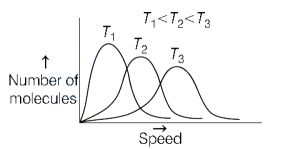
B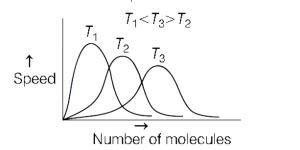
C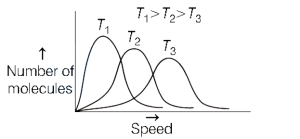
D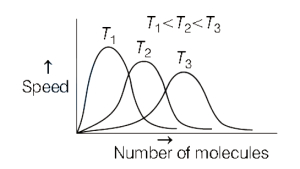
Solution
(A) According to the Maxwell-Boltzmann distribution law,the $x$-axis represents the speed of the molecules and the $y$-axis represents the fraction or number of molecules.
At lower temperatures,the molecules have lower average kinetic energy,so the peak of the distribution is shifted towards lower speeds and the curve is narrower and taller.
As the temperature increases,the average kinetic energy of the molecules increases,causing the peak of the distribution to shift towards higher speeds,and the curve becomes broader and flatter.
Therefore,for temperatures $T_1 < T_2 < T_3$,the correct plot shows the peak shifting to the right as temperature increases,which corresponds to the graph in option $A$.
At lower temperatures,the molecules have lower average kinetic energy,so the peak of the distribution is shifted towards lower speeds and the curve is narrower and taller.
As the temperature increases,the average kinetic energy of the molecules increases,causing the peak of the distribution to shift towards higher speeds,and the curve becomes broader and flatter.
Therefore,for temperatures $T_1 < T_2 < T_3$,the correct plot shows the peak shifting to the right as temperature increases,which corresponds to the graph in option $A$.
0 likes
View Solution141
EasyMCQ
Kinetic energy in $kJ$ of $280 \ g$ of $N_2$ at $27^{\circ} C$ is approximately $(R = 8.314 \ J \ mol^{-1} \ K^{-1})$
A
$18.7$
B
$37.4$
C
$56.1$
D
$74.8$
Solution
(B) Number of moles of $N_2$ $(n)$ = $\frac{\text{mass}}{\text{molar mass}} = \frac{280 \ g}{28 \ g \ mol^{-1}} = 10 \ mol$.
Temperature $(T)$ = $27^{\circ} C = (27 + 273) \ K = 300 \ K$.
The formula for kinetic energy of an ideal gas is $K.E. = \frac{3}{2} nRT$.
Substituting the values: $K.E. = \frac{3}{2} \times 10 \ mol \times 8.314 \ J \ mol^{-1} \ K^{-1} \times 300 \ K$.
$K.E. = 1.5 \times 10 \times 8.314 \times 300 = 37413 \ J$.
Converting to $kJ$: $37413 \ J = 37.413 \ kJ \approx 37.4 \ kJ$.
Temperature $(T)$ = $27^{\circ} C = (27 + 273) \ K = 300 \ K$.
The formula for kinetic energy of an ideal gas is $K.E. = \frac{3}{2} nRT$.
Substituting the values: $K.E. = \frac{3}{2} \times 10 \ mol \times 8.314 \ J \ mol^{-1} \ K^{-1} \times 300 \ K$.
$K.E. = 1.5 \times 10 \times 8.314 \times 300 = 37413 \ J$.
Converting to $kJ$: $37413 \ J = 37.413 \ kJ \approx 37.4 \ kJ$.
0 likes
View Solution142
EasyMCQ
If the kinetic energy in $J$,of $CH_4$ (molar mass $= 16 \ g \ mol^{-1}$) at $T(K)$ is $X$,the kinetic energy in $J$,of $O_2$ (molar mass $= 32 \ g \ mol^{-1}$) at the same temperature is
A
$X$
B
$2 X$
C
$X^2$
D
$\frac{X}{2}$
Solution
(A) The average kinetic energy of an ideal gas is given by the formula $KE = \frac{3}{2} RT$.
Since the kinetic energy depends only on the temperature $T$ and the gas constant $R$,it is independent of the nature or molar mass of the gas.
Therefore,at the same temperature $T$,the kinetic energy of $CH_4$ and $O_2$ will be equal.
Thus,$KE_{(CH_4)} = KE_{(O_2)} = X$.
Since the kinetic energy depends only on the temperature $T$ and the gas constant $R$,it is independent of the nature or molar mass of the gas.
Therefore,at the same temperature $T$,the kinetic energy of $CH_4$ and $O_2$ will be equal.
Thus,$KE_{(CH_4)} = KE_{(O_2)} = X$.
0 likes
View Solution143
EasyMCQ
At $T$ $K$,the ratio of kinetic energies of $4$ $g$ of $H_{2(g)}$ and $8$ $g$ of $O_{2(g)}$ is
A
$1: 4$
B
$4: 1$
C
$2: 1$
D
$8: 1$
Solution
(D) The kinetic energy $(KE)$ of $n$ moles of an ideal gas is given by $KE = n \times \frac{3}{2} RT$.
For $4$ $g$ of $H_2$,the number of moles $n_{H_2} = \frac{4 \ g}{2 \ g/mol} = 2$ $mol$.
So,$KE_{H_2} = 2 \times \frac{3}{2} RT = 3RT$.
For $8$ $g$ of $O_2$,the number of moles $n_{O_2} = \frac{8 \ g}{32 \ g/mol} = 0.25$ $mol$ or $\frac{1}{4}$ $mol$.
So,$KE_{O_2} = \frac{1}{4} \times \frac{3}{2} RT = \frac{3}{8} RT$.
The ratio $KE_{H_2} : KE_{O_2} = 3RT : \frac{3}{8} RT = 1 : \frac{1}{8} = 8 : 1$.
For $4$ $g$ of $H_2$,the number of moles $n_{H_2} = \frac{4 \ g}{2 \ g/mol} = 2$ $mol$.
So,$KE_{H_2} = 2 \times \frac{3}{2} RT = 3RT$.
For $8$ $g$ of $O_2$,the number of moles $n_{O_2} = \frac{8 \ g}{32 \ g/mol} = 0.25$ $mol$ or $\frac{1}{4}$ $mol$.
So,$KE_{O_2} = \frac{1}{4} \times \frac{3}{2} RT = \frac{3}{8} RT$.
The ratio $KE_{H_2} : KE_{O_2} = 3RT : \frac{3}{8} RT = 1 : \frac{1}{8} = 8 : 1$.
0 likes
View Solution144
MediumMCQ
The average kinetic energy of one molecule of an ideal gas at $27^{\circ} C$ and $1 \ atm$ pressure is
A
$900 \ cal \ K^{-1} \ mol^{-1}$
B
$6.21 \times 10^{-21} \ J \ \text{molecule}^{-1}$
C
$336.7 \ J \ \text{molecule}^{-1}$
D
$3741.3 \ J \ mol^{-1}$
Solution
(B) The average kinetic energy per molecule of an ideal gas is given by the formula: $KE_{avg} = \frac{3}{2} k T$.
Here,$k$ is the Boltzmann constant $(k = \frac{R}{N_A})$,$T$ is the temperature in Kelvin,and $N_A$ is Avogadro's number.
Given: $T = 27^{\circ} C = 27 + 273 = 300 \ K$.
Substituting the values:
$KE_{avg} = \frac{3}{2} \times \left( \frac{8.314 \ J \ K^{-1} \ mol^{-1}}{6.022 \times 10^{23} \ mol^{-1}} \right) \times 300 \ K$.
$KE_{avg} = 1.5 \times 1.38 \times 10^{-23} \ J \ K^{-1} \times 300 \ K$.
$KE_{avg} \approx 6.21 \times 10^{-21} \ J \ \text{molecule}^{-1}$.
Here,$k$ is the Boltzmann constant $(k = \frac{R}{N_A})$,$T$ is the temperature in Kelvin,and $N_A$ is Avogadro's number.
Given: $T = 27^{\circ} C = 27 + 273 = 300 \ K$.
Substituting the values:
$KE_{avg} = \frac{3}{2} \times \left( \frac{8.314 \ J \ K^{-1} \ mol^{-1}}{6.022 \times 10^{23} \ mol^{-1}} \right) \times 300 \ K$.
$KE_{avg} = 1.5 \times 1.38 \times 10^{-23} \ J \ K^{-1} \times 300 \ K$.
$KE_{avg} \approx 6.21 \times 10^{-21} \ J \ \text{molecule}^{-1}$.
0 likes
View Solution145
EasyMCQ
Assertion $(A)$ At $300 \ K$,kinetic energy of $16 \ g$ of methane is equal to the kinetic energy of $32 \ g$ of oxygen.
Reason $(R)$ At constant temperature,kinetic energy of one mole of all gases is equal.
Reason $(R)$ At constant temperature,kinetic energy of one mole of all gases is equal.
A
Both $(A)$ and $(R)$ are true and $(R)$ is the correct explanation of $(A)$
B
Both $(A)$ and $(R)$ are true but $(R)$ is not the correct explanation of $(A)$
C
$(A)$ is true but $(R)$ is not true
D
$(A)$ is not true but $(R)$ is true
Solution
(A) The kinetic energy $(KE)$ of $n$ moles of an ideal gas is given by $KE = \frac{3}{2} nRT$.
For $16 \ g$ of methane ($CH_4$,molar mass = $16 \ g/mol$),$n = \frac{16}{16} = 1 \ mol$.
For $32 \ g$ of oxygen ($O_2$,molar mass = $32 \ g/mol$),$n = \frac{32}{32} = 1 \ mol$.
Since both samples contain $1 \ mol$ of gas at the same temperature $(300 \ K)$,their kinetic energies are equal. Thus,$(A)$ is true.
The kinetic energy of $1 \ mol$ of any ideal gas is $\frac{3}{2} RT$,which depends only on temperature. Thus,$(R)$ is true and correctly explains $(A)$.
For $16 \ g$ of methane ($CH_4$,molar mass = $16 \ g/mol$),$n = \frac{16}{16} = 1 \ mol$.
For $32 \ g$ of oxygen ($O_2$,molar mass = $32 \ g/mol$),$n = \frac{32}{32} = 1 \ mol$.
Since both samples contain $1 \ mol$ of gas at the same temperature $(300 \ K)$,their kinetic energies are equal. Thus,$(A)$ is true.
The kinetic energy of $1 \ mol$ of any ideal gas is $\frac{3}{2} RT$,which depends only on temperature. Thus,$(R)$ is true and correctly explains $(A)$.
0 likes
View SolutionStates of Matter — Kinetic molecular theory of gases and Molecular collisions · Frequently Asked Questions
1Are these States of Matter questions useful for JEE and NEET?
Yes. All questions in this section are mapped to JEE Main and NEET exam patterns. Previous year questions from JEE Main, NEET, GUJCET and state-level exams are included with full solutions.
2Can I switch to Hindi or Gujarati for these questions?
Yes. Use the language tabs in the hero section or the sidebar to view the same questions and solutions in English, Hindi or Gujarati.
3How do I generate a question paper from this subtopic?
Use the Vedclass Exam Paper Generator — select the chapter and subtopic, set difficulty, and generate Sets A, B, C, D automatically. First 3 chapters of every subject are free.
Vedclass Products
For Students
Vedclass Test Series
Mock tests in real JEE/NEET style with performance analysis. 5-day free trial.
Start Free TrialFor Teachers
Exam Paper Generator
Generate Set A/B/C/D papers from this chapter in 2 minutes. 3 chapters free.
Try FreeFor Institutes
Online Exam Module
Live online exams with unlimited students, 360° analytics & white-label branding.
See DemoFor Teachers & Institutes
Generate a States of Matter Exam Paper in 2 Minutes
Select subtopic & difficulty — Sets A, B, C, D auto-generated with No Repeat logic.
First 3 chapters of every subject are free — no payment required.