
A English
Significant figures and Units for measurement Questions in English
Class 11 Chemistry · Some Basic Concepts of Chemistry · Significant figures and Units for measurement
149+
Questions
English
Language
100%
With Solutions
Showing 50 of 149 questions in English
51
EasyMCQ
$1 \, amu = ........ \, mg.$
A
$1.66056 \times 10^{-24}$
B
$1.66056 \times 10^{-21}$
C
$1.992648 \times 10^{-23}$
D
$1.992648 \times 10^{-24}$
Solution
(B) The value of $1 \, amu$ is defined as $1.66056 \times 10^{-24} \, g$.
To convert grams $(g)$ to milligrams $(mg)$,we multiply by $10^3$.
$1 \, amu = 1.66056 \times 10^{-24} \, g \times 10^3 \, mg/g = 1.66056 \times 10^{-21} \, mg$.
Therefore,the correct option is $B$.
To convert grams $(g)$ to milligrams $(mg)$,we multiply by $10^3$.
$1 \, amu = 1.66056 \times 10^{-24} \, g \times 10^3 \, mg/g = 1.66056 \times 10^{-21} \, mg$.
Therefore,the correct option is $B$.
0 likes
View Solution52
DifficultMCQ
Calculate the reported result and the number of significant figures for $(41.6325 - 41.612)$.
A
$0.0205, 4$
B
$0.020, 3$
C
$0.0205, 3$
D
$0.020, 2$
Solution
(D) The subtraction is performed as follows: $41.6325 - 41.612 = 0.0205$.
According to the rules of significant figures for addition and subtraction,the result should be reported to the same number of decimal places as the term with the fewest decimal places.
Here,$41.612$ has $3$ decimal places,so the result must be rounded to $3$ decimal places.
Rounding $0.0205$ to $3$ decimal places gives $0.020$.
The number $0.020$ has $2$ significant figures (the leading zeros are not significant,but the trailing zero is significant because it is to the right of the decimal point in a number less than $1$).
Thus,the result is $0.020$ and the number of significant figures is $2$.
According to the rules of significant figures for addition and subtraction,the result should be reported to the same number of decimal places as the term with the fewest decimal places.
Here,$41.612$ has $3$ decimal places,so the result must be rounded to $3$ decimal places.
Rounding $0.0205$ to $3$ decimal places gives $0.020$.
The number $0.020$ has $2$ significant figures (the leading zeros are not significant,but the trailing zero is significant because it is to the right of the decimal point in a number less than $1$).
Thus,the result is $0.020$ and the number of significant figures is $2$.
0 likes
View Solution53
EasyMCQ
$1 \, kg \, m^2 \, s^{-2}$ is equal to ...
A
$1 \, kJ$
B
$100 \, J$
C
$1 \, J$
D
$1 \, cal$
Solution
(C) The unit of energy in the $SI$ system is the Joule $(J)$.
By definition,$1 \, J = 1 \, kg \, m^2 \, s^{-2}$.
Therefore,$1 \, kg \, m^2 \, s^{-2}$ is equal to $1 \, J$.
By definition,$1 \, J = 1 \, kg \, m^2 \, s^{-2}$.
Therefore,$1 \, kg \, m^2 \, s^{-2}$ is equal to $1 \, J$.
0 likes
View Solution54
DifficultMCQ
$A$ piece of metal is $3 \, in$ long. What is its length in $cm$ (in $cm$)?
A
$7.62$
B
$1.18$
C
$0.85$
D
$3.00$
Solution
(A) We know that $1 \, in = 2.54 \, cm$.
To convert $3 \, in$ to $cm$, we use the unit factor $\frac{2.54 \, cm}{1 \, in}$.
$3 \, in \times \frac{2.54 \, cm}{1 \, in} = 3 \times 2.54 \, cm = 7.62 \, cm$.
Thus, the length of the metal piece is $7.62 \, cm$.
To convert $3 \, in$ to $cm$, we use the unit factor $\frac{2.54 \, cm}{1 \, in}$.
$3 \, in \times \frac{2.54 \, cm}{1 \, in} = 3 \times 2.54 \, cm = 7.62 \, cm$.
Thus, the length of the metal piece is $7.62 \, cm$.
0 likes
View Solution55
DifficultMCQ
$A$ jug contains $2 \ L$ of milk. Calculate the volume of the milk in $m^{3}$.
A
$2 \times 10^{-3} \ m^{3}$
B
$2 \times 10^{-2} \ m^{3}$
C
$2 \times 10^{3} \ m^{3}$
D
$2 \times 10^{2} \ m^{3}$
Solution
(A) We know that $1 \ L = 1000 \ cm^{3}$ and $1 \ m = 100 \ cm$.
To convert $cm^{3}$ to $m^{3}$,we use the conversion factor:
$\left(\frac{1 \ m}{100 \ cm}\right)^{3} = \frac{1 \ m^{3}}{10^{6} \ cm^{3}}$.
Given volume $= 2 \ L = 2 \times 1000 \ cm^{3} = 2000 \ cm^{3}$.
Now,convert to $m^{3}$:
$2000 \ cm^{3} \times \frac{1 \ m^{3}}{10^{6} \ cm^{3}} = \frac{2000}{10^{6}} \ m^{3} = 2 \times 10^{-3} \ m^{3}$.
To convert $cm^{3}$ to $m^{3}$,we use the conversion factor:
$\left(\frac{1 \ m}{100 \ cm}\right)^{3} = \frac{1 \ m^{3}}{10^{6} \ cm^{3}}$.
Given volume $= 2 \ L = 2 \times 1000 \ cm^{3} = 2000 \ cm^{3}$.
Now,convert to $m^{3}$:
$2000 \ cm^{3} \times \frac{1 \ m^{3}}{10^{6} \ cm^{3}} = \frac{2000}{10^{6}} \ m^{3} = 2 \times 10^{-3} \ m^{3}$.
0 likes
View Solution56
MediumMCQ
How many seconds are there in $2$ days (in $s$)?
A
$172800$
B
$86400$
C
$43200$
D
$3600$
Solution
(A) We know that $1 \text{ day} = 24 \text{ hours} (h)$.
Also,$1 \text{ hour} = 60 \text{ minutes} (min)$ and $1 \text{ minute} = 60 \text{ seconds} (s)$.
To convert $2 \text{ days}$ into seconds,we use the unit factor method:
$2 \text{ days} \times \frac{24 \text{ h}}{1 \text{ day}} \times \frac{60 \text{ min}}{1 \text{ h}} \times \frac{60 \text{ s}}{1 \text{ min}}$
$= 2 \times 24 \times 60 \times 60 \text{ s}$
$= 172800 \text{ s}$.
Also,$1 \text{ hour} = 60 \text{ minutes} (min)$ and $1 \text{ minute} = 60 \text{ seconds} (s)$.
To convert $2 \text{ days}$ into seconds,we use the unit factor method:
$2 \text{ days} \times \frac{24 \text{ h}}{1 \text{ day}} \times \frac{60 \text{ min}}{1 \text{ h}} \times \frac{60 \text{ s}}{1 \text{ min}}$
$= 2 \times 24 \times 60 \times 60 \text{ s}$
$= 172800 \text{ s}$.
0 likes
View Solution57
Difficult
Pressure is determined as force per unit area of the surface. The $SI$ unit of pressure, Pascal is as shown below:
$1 \, Pa = 1 \, N \, m^{-2}$
If mass of air at sea level is $1034 \, g \, cm^{-2}$, calculate the pressure in Pascal.
$1 \, Pa = 1 \, N \, m^{-2}$
If mass of air at sea level is $1034 \, g \, cm^{-2}$, calculate the pressure in Pascal.
Solution
Pressure is defined as force acting per unit area of the surface.
$P = \frac{F}{A}$
Force $(F)$ = $mass \times acceleration \, due \, to \, gravity = 1034 \, g \, cm^{-2} \times 9.8 \, m \, s^{-2}$
Convert units to $SI$ $(kg, m, s)$:
$F = 1034 \, g \times (10^{-3} \, kg / 1 \, g) \times 9.8 \, m \, s^{-2} = 1.034 \, kg \times 9.8 \, m \, s^{-2} = 10.1332 \, N$
Area $(A)$ = $1 \, cm^{2} = (10^{-2} \, m)^{2} = 10^{-4} \, m^{2}$
Pressure $(P)$ = $\frac{F}{A} = \frac{10.1332 \, N}{10^{-4} \, m^{2}} = 1.01332 \times 10^{5} \, N \, m^{-2}$
Since $1 \, Pa = 1 \, N \, m^{-2}$, the pressure is $1.01332 \times 10^{5} \, Pa$.
$P = \frac{F}{A}$
Force $(F)$ = $mass \times acceleration \, due \, to \, gravity = 1034 \, g \, cm^{-2} \times 9.8 \, m \, s^{-2}$
Convert units to $SI$ $(kg, m, s)$:
$F = 1034 \, g \times (10^{-3} \, kg / 1 \, g) \times 9.8 \, m \, s^{-2} = 1.034 \, kg \times 9.8 \, m \, s^{-2} = 10.1332 \, N$
Area $(A)$ = $1 \, cm^{2} = (10^{-2} \, m)^{2} = 10^{-4} \, m^{2}$
Pressure $(P)$ = $\frac{F}{A} = \frac{10.1332 \, N}{10^{-4} \, m^{2}} = 1.01332 \times 10^{5} \, N \, m^{-2}$
Since $1 \, Pa = 1 \, N \, m^{-2}$, the pressure is $1.01332 \times 10^{5} \, Pa$.
0 likes
View Solution58
Difficult
What is the $SI$ unit of mass? How is it defined?
Solution
(N/A) The $SI$ unit of mass is the kilogram $(kg)$.
$1$ kilogram is defined as the mass equal to the mass of the international prototype of the kilogram.
$1$ kilogram is defined as the mass equal to the mass of the international prototype of the kilogram.
0 likes
View Solution59
Easy
Match the following prefixes with their multiples:
| Prefixes | Multiples |
| $i$. micro | $10^{6}$ |
| $ii$. deca | $10^{9}$ |
| $iii$. mega | $10^{-6}$ |
| $iv$. giga | $10^{-15}$ |
| $v$. femto | $10$ |
Solution
(A) The correct matches for the given prefixes and their corresponding multiples are as follows:
| Prefixes | Multiples |
| $i$. micro | $10^{-6}$ |
| $ii$. deca | $10$ |
| $iii$. mega | $10^{6}$ |
| $iv$. giga | $10^{9}$ |
| $v$. femto | $10^{-15}$ |
0 likes
View Solution60
Medium
What do you mean by significant figures?
Solution
(N/A) Significant figures are the meaningful digits in a measured or calculated quantity that are known with certainty,plus one additional digit that is uncertain.
They indicate the precision of an experiment or a calculated value.
For example,if a volume is measured as $15.6 \, mL$,the digits $1$ and $5$ are certain,while the digit $6$ is uncertain.
Therefore,the total number of significant figures in $15.6$ is $3$.
They indicate the precision of an experiment or a calculated value.
For example,if a volume is measured as $15.6 \, mL$,the digits $1$ and $5$ are certain,while the digit $6$ is uncertain.
Therefore,the total number of significant figures in $15.6$ is $3$.
0 likes
View Solution61
Medium
Express the following in scientific notation:
$(i)$ $0.0048$
$(ii)$ $234,000$
$(iii)$ $8008$
$(iv)$ $500.0$
$(v)$ $6.0012$
$(i)$ $0.0048$
$(ii)$ $234,000$
$(iii)$ $8008$
$(iv)$ $500.0$
$(v)$ $6.0012$
Solution
$(i)$ To express $0.0048$ in scientific notation,move the decimal point $3$ places to the right: $4.8 \times 10^{-3}$.
$(ii)$ To express $234,000$ in scientific notation,move the decimal point $5$ places to the left: $2.34 \times 10^{5}$.
$(iii)$ To express $8008$ in scientific notation,move the decimal point $3$ places to the left: $8.008 \times 10^{3}$.
$(iv)$ To express $500.0$ in scientific notation,move the decimal point $2$ places to the left: $5.000 \times 10^{2}$.
$(v)$ To express $6.0012$ in scientific notation,the decimal point is already in the correct position: $6.0012 \times 10^{0}$.
$(ii)$ To express $234,000$ in scientific notation,move the decimal point $5$ places to the left: $2.34 \times 10^{5}$.
$(iii)$ To express $8008$ in scientific notation,move the decimal point $3$ places to the left: $8.008 \times 10^{3}$.
$(iv)$ To express $500.0$ in scientific notation,move the decimal point $2$ places to the left: $5.000 \times 10^{2}$.
$(v)$ To express $6.0012$ in scientific notation,the decimal point is already in the correct position: $6.0012 \times 10^{0}$.
0 likes
View Solution62
Medium
How many significant figures are present in the following?
$(i)$ $0.0025$ $(ii)$ $208$ $(iii)$ $5005$ $(iv)$ $126,000$ $(v)$ $500.0$ $(vi)$ $2.0034$
$(i)$ $0.0025$ $(ii)$ $208$ $(iii)$ $5005$ $(iv)$ $126,000$ $(v)$ $500.0$ $(vi)$ $2.0034$
Solution
$(i)$ $0.0025$: There are $2$ significant figures (leading zeros are not significant).
$(ii)$ $208$: There are $3$ significant figures (zeros between non-zero digits are significant).
$(iii)$ $5005$: There are $4$ significant figures (zeros between non-zero digits are significant).
$(iv)$ $126,000$: There are $3$ significant figures (trailing zeros in a number without a decimal point are not significant).
$(v)$ $500.0$: There are $4$ significant figures (trailing zeros in a number with a decimal point are significant).
$(vi)$ $2.0034$: There are $5$ significant figures (zeros between non-zero digits are significant).
$(ii)$ $208$: There are $3$ significant figures (zeros between non-zero digits are significant).
$(iii)$ $5005$: There are $4$ significant figures (zeros between non-zero digits are significant).
$(iv)$ $126,000$: There are $3$ significant figures (trailing zeros in a number without a decimal point are not significant).
$(v)$ $500.0$: There are $4$ significant figures (trailing zeros in a number with a decimal point are significant).
$(vi)$ $2.0034$: There are $5$ significant figures (zeros between non-zero digits are significant).
0 likes
View Solution63
Medium
Round up the following numbers to three significant figures:
$(i)$ $34.216$
$(ii)$ $10.4107$
$(iii)$ $0.04597$
$(iv)$ $2808$
$(i)$ $34.216$
$(ii)$ $10.4107$
$(iii)$ $0.04597$
$(iv)$ $2808$
Solution
To round to three significant figures:
$(i)$ $34.216$: The fourth digit is $1$ $(<5)$,so we keep the third digit as is. Result: $34.2$
$(ii)$ $10.4107$: The fourth digit is $1$ $(<5)$,so we keep the third digit as is. Result: $10.4$
$(iii)$ $0.04597$: The fourth digit is $9$ $(>5)$,so we round up the third digit ($9$ becomes $10$,carrying over to the second digit). Result: $0.0460$
$(iv)$ $2808$: The fourth digit is $8$ $(>5)$,so we round up the third digit ($0$ becomes $1$). Result: $2810$
$(i)$ $34.216$: The fourth digit is $1$ $(<5)$,so we keep the third digit as is. Result: $34.2$
$(ii)$ $10.4107$: The fourth digit is $1$ $(<5)$,so we keep the third digit as is. Result: $10.4$
$(iii)$ $0.04597$: The fourth digit is $9$ $(>5)$,so we round up the third digit ($9$ becomes $10$,carrying over to the second digit). Result: $0.0460$
$(iv)$ $2808$: The fourth digit is $8$ $(>5)$,so we round up the third digit ($0$ becomes $1$). Result: $2810$
0 likes
View Solution64
Difficult
If the speed of light is $3.0 \times 10^{8} \,m s^{-1}$,calculate the distance covered by light in $2.00 \,ns$.
Solution
Given:
Speed of light $(v)$ $= 3.0 \times 10^{8} \,m s^{-1}$
Time $(t)$ $= 2.00 \,ns = 2.00 \times 10^{-9} \,s$
Formula:
Distance $(d)$ $= v \times t$
Calculation:
$d = (3.0 \times 10^{8} \,m s^{-1}) \times (2.00 \times 10^{-9} \,s)$
$d = 6.00 \times 10^{-1} \,m$
$d = 0.600 \,m$
Speed of light $(v)$ $= 3.0 \times 10^{8} \,m s^{-1}$
Time $(t)$ $= 2.00 \,ns = 2.00 \times 10^{-9} \,s$
Formula:
Distance $(d)$ $= v \times t$
Calculation:
$d = (3.0 \times 10^{8} \,m s^{-1}) \times (2.00 \times 10^{-9} \,s)$
$d = 6.00 \times 10^{-1} \,m$
$d = 0.600 \,m$
0 likes
View Solution65
Difficult
Convert the following into basic units:
$(i)$ $28.7\, pm$
$(ii)$ $15.15\, pm$
$(iii)$ $25365\, mg$
$(i)$ $28.7\, pm$
$(ii)$ $15.15\, pm$
$(iii)$ $25365\, mg$
Solution
$(i)$ $28.7\, pm$
$1\, pm = 10^{-12}\, m$
$\therefore 28.7\, pm = 28.7 \times 10^{-12}\, m = 2.87 \times 10^{-11}\, m$
$(ii)$ $15.15\, pm$
$1\, pm = 10^{-12}\, m$
$\therefore 15.15\, pm = 15.15 \times 10^{-12}\, m = 1.515 \times 10^{-11}\, m$
$(iii)$ $25365\, mg$
$1\, mg = 10^{-3}\, g$ and $1\, g = 10^{-3}\, kg$, so $1\, mg = 10^{-6}\, kg$
$\therefore 25365\, mg = 25365 \times 10^{-6}\, kg = 2.5365 \times 10^{-2}\, kg$
$1\, pm = 10^{-12}\, m$
$\therefore 28.7\, pm = 28.7 \times 10^{-12}\, m = 2.87 \times 10^{-11}\, m$
$(ii)$ $15.15\, pm$
$1\, pm = 10^{-12}\, m$
$\therefore 15.15\, pm = 15.15 \times 10^{-12}\, m = 1.515 \times 10^{-11}\, m$
$(iii)$ $25365\, mg$
$1\, mg = 10^{-3}\, g$ and $1\, g = 10^{-3}\, kg$, so $1\, mg = 10^{-6}\, kg$
$\therefore 25365\, mg = 25365 \times 10^{-6}\, kg = 2.5365 \times 10^{-2}\, kg$
0 likes
View Solution66
Medium
How many significant figures should be present in the answer of the following calculations?
$(i)$ $\frac{0.02856 \times 298.15 \times 0.112}{0.5785}$
$(ii)$ $5 \times 5.364$
$(iii)$ $0.0125 + 0.7864 + 0.0215$
$(i)$ $\frac{0.02856 \times 298.15 \times 0.112}{0.5785}$
$(ii)$ $5 \times 5.364$
$(iii)$ $0.0125 + 0.7864 + 0.0215$
Solution
(N/A) $(i)$ For multiplication and division,the result should have the same number of significant figures as the term with the fewest significant figures.
In $\frac{0.02856 \times 298.15 \times 0.112}{0.5785}$,the term $0.112$ has the least number of significant figures,which is $3$.
Therefore,the answer should have $3$ significant figures.
$(ii)$ In $5 \times 5.364$,$5$ is an exact number (infinite significant figures),so the result should have the same number of significant figures as $5.364$,which is $4$.
$(iii)$ For addition,the result should have the same number of decimal places as the term with the fewest decimal places.
$0.0125 + 0.7864 + 0.0215 = 0.8204$.
Each term has $4$ decimal places,so the result should have $4$ decimal places,which corresponds to $3$ significant figures $(0.820)$.
In $\frac{0.02856 \times 298.15 \times 0.112}{0.5785}$,the term $0.112$ has the least number of significant figures,which is $3$.
Therefore,the answer should have $3$ significant figures.
$(ii)$ In $5 \times 5.364$,$5$ is an exact number (infinite significant figures),so the result should have the same number of significant figures as $5.364$,which is $4$.
$(iii)$ For addition,the result should have the same number of decimal places as the term with the fewest decimal places.
$0.0125 + 0.7864 + 0.0215 = 0.8204$.
Each term has $4$ decimal places,so the result should have $4$ decimal places,which corresponds to $3$ significant figures $(0.820)$.
0 likes
View Solution67
MediumMCQ
If the diameter of a carbon atom is $0.15 \,nm$,calculate the number of carbon atoms which can be placed side by side in a straight line across the length of a scale of length $20 \,cm$.
A
$1.33 \times 10^9$
B
$1.33 \times 10^8$
C
$1.33 \times 10^{10}$
D
$1.33 \times 10^7$
Solution
(A) Length of the scale $= 20 \,cm = 20 \times 10^{-2} \,m = 0.2 \,m$.
Diameter of a carbon atom $= 0.15 \,nm = 0.15 \times 10^{-9} \,m$.
Number of carbon atoms $= \frac{\text{Total length}}{\text{Diameter of one atom}}$.
Number of carbon atoms $= \frac{0.2 \,m}{0.15 \times 10^{-9} \,m} = \frac{0.2}{0.15} \times 10^9$.
Number of carbon atoms $= 1.333... \times 10^9 \approx 1.33 \times 10^9$.
Diameter of a carbon atom $= 0.15 \,nm = 0.15 \times 10^{-9} \,m$.
Number of carbon atoms $= \frac{\text{Total length}}{\text{Diameter of one atom}}$.
Number of carbon atoms $= \frac{0.2 \,m}{0.15 \times 10^{-9} \,m} = \frac{0.2}{0.15} \times 10^9$.
Number of carbon atoms $= 1.333... \times 10^9 \approx 1.33 \times 10^9$.
0 likes
View Solution68
Medium
$2 \times 10^{8}$ atoms of carbon are arranged side by side. Calculate the radius of a carbon atom if the length of this arrangement is $2.4 \, cm$.
Solution
Length of the given arrangement $= 2.4 \, cm = 2.4 \times 10^{-2} \, m$.
Number of carbon atoms present $= 2 \times 10^{8}$.
Diameter of a carbon atom $= \frac{\text{Total length}}{\text{Number of atoms}} = \frac{2.4 \times 10^{-2} \, m}{2 \times 10^{8}} = 1.2 \times 10^{-10} \, m$.
Radius of a carbon atom $= \frac{\text{Diameter}}{2} = \frac{1.2 \times 10^{-10} \, m}{2} = 6.0 \times 10^{-11} \, m$.
Number of carbon atoms present $= 2 \times 10^{8}$.
Diameter of a carbon atom $= \frac{\text{Total length}}{\text{Number of atoms}} = \frac{2.4 \times 10^{-2} \, m}{2 \times 10^{8}} = 1.2 \times 10^{-10} \, m$.
Radius of a carbon atom $= \frac{\text{Diameter}}{2} = \frac{1.2 \times 10^{-10} \, m}{2} = 6.0 \times 10^{-11} \, m$.
0 likes
View Solution69
Medium
The diameter of a zinc atom is $2.6 \, \mathring{A}$. Calculate $(a)$ the radius of the zinc atom in $pm$ and $(b)$ the number of atoms present in a length of $1.6 \, cm$ if the zinc atoms are arranged side by side lengthwise.
Solution
$(a)$ Radius of zinc atom $= \frac{\text{Diameter}}{2} = \frac{2.6 \, \mathring{A}}{2} = 1.3 \, \mathring{A} = 1.3 \times 10^{-10} \, m = 130 \, pm$.
$(b)$ Length of the arrangement $= 1.6 \, cm = 1.6 \times 10^{-2} \, m$.
Diameter of zinc atom $= 2.6 \, \mathring{A} = 2.6 \times 10^{-10} \, m$.
Number of zinc atoms $= \frac{\text{Total length}}{\text{Diameter of one atom}} = \frac{1.6 \times 10^{-2} \, m}{2.6 \times 10^{-10} \, m} \approx 6.153 \times 10^7$ atoms.
$(b)$ Length of the arrangement $= 1.6 \, cm = 1.6 \times 10^{-2} \, m$.
Diameter of zinc atom $= 2.6 \, \mathring{A} = 2.6 \times 10^{-10} \, m$.
Number of zinc atoms $= \frac{\text{Total length}}{\text{Diameter of one atom}} = \frac{1.6 \times 10^{-2} \, m}{2.6 \times 10^{-10} \, m} \approx 6.153 \times 10^7$ atoms.
0 likes
View Solution70
EasyMCQ
What would be the $SI$ unit for the quantity $\frac{p V^{2} T^{2}}{n}$?
A
$N \ m^{4} \ K^{2} \ mol^{-1}$
B
$N \ m^{2} \ K^{2} \ mol^{-1}$
C
$N \ m^{6} \ K^{2} \ mol^{-1}$
D
$N \ m^{4} \ K \ mol^{-1}$
Solution
(A) The $SI$ unit for pressure,$p$ is $N \ m^{-2}$.
The $SI$ unit for volume,$V$ is $m^{3}$.
The $SI$ unit for temperature,$T$ is $K$.
The $SI$ unit for the number of moles,$n$ is $mol$.
Therefore,the $SI$ unit for the quantity $\frac{p V^{2} T^{2}}{n}$ is calculated as:
$= \frac{(N \ m^{-2}) \times (m^{3})^{2} \times (K)^{2}}{mol}$
$= \frac{N \ m^{-2} \times m^{6} \times K^{2}}{mol}$
$= N \ m^{4} \ K^{2} \ mol^{-1}$
The $SI$ unit for volume,$V$ is $m^{3}$.
The $SI$ unit for temperature,$T$ is $K$.
The $SI$ unit for the number of moles,$n$ is $mol$.
Therefore,the $SI$ unit for the quantity $\frac{p V^{2} T^{2}}{n}$ is calculated as:
$= \frac{(N \ m^{-2}) \times (m^{3})^{2} \times (K)^{2}}{mol}$
$= \frac{N \ m^{-2} \times m^{6} \times K^{2}}{mol}$
$= N \ m^{4} \ K^{2} \ mol^{-1}$
0 likes
View Solution71
Difficult
Write a note about The International System of Units $(SI)$.
Solution
(N/A) The International System of Units (in French,$Le \text{ } Systeme \text{ } International \text{ } d' \text{ } Unites$) was established by the $11^{th}$ General Conference on Weights and Measures ($CGPM$ from $Conference \text{ } Generale \text{ } des \text{ } Poids \text{ } et \text{ } Mesures$).
The $CGPM$ is an intergovernmental treaty organization created by a diplomatic treaty known as the Metre Convention,which was signed in Paris in $1875$.
The $SI$ system has seven base units,which are listed in the table below. These units pertain to the seven fundamental scientific quantities. Other physical quantities,such as speed,volume,and density,can be derived from these base quantities. The $SI$ system allows the use of prefixes to indicate the multiples or submultiples of a unit.
The $CGPM$ is an intergovernmental treaty organization created by a diplomatic treaty known as the Metre Convention,which was signed in Paris in $1875$.
The $SI$ system has seven base units,which are listed in the table below. These units pertain to the seven fundamental scientific quantities. Other physical quantities,such as speed,volume,and density,can be derived from these base quantities. The $SI$ system allows the use of prefixes to indicate the multiples or submultiples of a unit.
| Base Physical Quantity ($SI$ Symbol) | Name of Unit ($SI$ Unit Symbol) |
| Length $(l)$ | metre $(m)$ |
| Mass $(m)$ | kilogram $(kg)$ |
| Time $(t)$ | second $(s)$ |
| Electric current $(I)$ | ampere $(A)$ |
| Thermodynamic temperature $(T)$ | kelvin $(K)$ |
| Amount of substance $(n)$ | mole $(mol)$ |
| Luminous intensity $(I_{v})$ | candela $(cd)$ |
0 likes
View Solution72
Easy
What is the $SI$ unit of mass? How is it defined?
Solution
(N/A) The $SI$ unit of mass is the kilogram $(kg)$.
It is defined by taking the fixed numerical value of the Planck constant,$h$,to be $6.62607015 \times 10^{-34}$ when expressed in the unit $J \cdot s$,which is equal to $kg \cdot m^2 \cdot s^{-1}$,where the meter and the second are defined in terms of $c$ and $\Delta \nu_{Cs}$.
It is defined by taking the fixed numerical value of the Planck constant,$h$,to be $6.62607015 \times 10^{-34}$ when expressed in the unit $J \cdot s$,which is equal to $kg \cdot m^2 \cdot s^{-1}$,where the meter and the second are defined in terms of $c$ and $\Delta \nu_{Cs}$.
0 likes
View Solution73
Easy
Match the following prefixes with their multiples:
| Prefixes | Multiples |
|---|---|
| $i$. micro | $10^6$ |
| $ii$. deca | $10^9$ |
| $iii$. mega | $10^{-6}$ |
| $iv$. giga | $10^{15}$ |
| $v$. femto | $10$ |
Solution
(A) The correct matches for the prefixes and their corresponding multiples are as follows:
$i$. micro = $10^{-6}$
$ii$. deca = $10^1$
$iii$. mega = $10^6$
$iv$. giga = $10^9$
$v$. femto = $10^{-15}$
$i$. micro = $10^{-6}$
$ii$. deca = $10^1$
$iii$. mega = $10^6$
$iv$. giga = $10^9$
$v$. femto = $10^{-15}$
0 likes
View Solution74
Difficult
Define Mass and Weight.
Solution
(N/A) Mass of a substance is the amount of matter present in it,while weight is the force exerted by gravity on an object.
The mass of a substance is constant,whereas its weight may vary from one place to another due to the change in gravity.
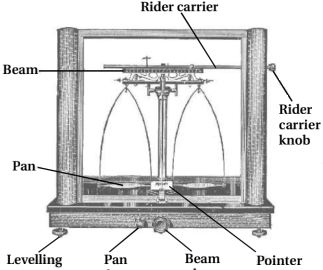
The mass of a substance can be determined very accurately in the laboratory by using an analytical balance.
The $SI$ unit of mass is kilogram $(kg)$. Its fraction,gram $(1 \ kg = 1000 \ g)$,is used in laboratories due to the smaller amounts of chemicals used in chemical reactions.
Volume has the units of $(\text{length})^3$. So in the $SI$ system,volume has units of $m^3$. However,in chemistry laboratories,smaller volumes are used. Hence,volume is often denoted in $cm^3$ or $dm^3$ units. $A$ common unit,litre $(L)$,which is not an $SI$ unit,is used for the measurement of the volume of liquids. $1 \ L = 1000 \ mL$,$1000 \ cm^3 = 1 \ dm^3$.
The mass of a substance is constant,whereas its weight may vary from one place to another due to the change in gravity.
The mass of a substance can be determined very accurately in the laboratory by using an analytical balance.
The $SI$ unit of mass is kilogram $(kg)$. Its fraction,gram $(1 \ kg = 1000 \ g)$,is used in laboratories due to the smaller amounts of chemicals used in chemical reactions.
Volume has the units of $(\text{length})^3$. So in the $SI$ system,volume has units of $m^3$. However,in chemistry laboratories,smaller volumes are used. Hence,volume is often denoted in $cm^3$ or $dm^3$ units. $A$ common unit,litre $(L)$,which is not an $SI$ unit,is used for the measurement of the volume of liquids. $1 \ L = 1000 \ mL$,$1000 \ cm^3 = 1 \ dm^3$.
0 likes
View Solution75
Easy
Define density and provide its $SI$ unit.
Solution
(N/A) Density of a substance is defined as its mass per unit volume.
The formula for density is: $D = \frac{m}{V}$
$SI$ units of density are derived as follows:
$SI$ unit of density $= \frac{\text{SI unit of mass}}{\text{SI unit of volume}} = \frac{kg}{m^{3}} = kg \ m^{-3}$
Since this unit is quite large,chemists often express density in $g \ cm^{-3}$,where mass is measured in grams and volume in $cm^{3}$.
The formula for density is: $D = \frac{m}{V}$
$SI$ units of density are derived as follows:
$SI$ unit of density $= \frac{\text{SI unit of mass}}{\text{SI unit of volume}} = \frac{kg}{m^{3}} = kg \ m^{-3}$
Since this unit is quite large,chemists often express density in $g \ cm^{-3}$,where mass is measured in grams and volume in $cm^{3}$.
0 likes
View Solution76
Easy
Describe the temperature scales used to measure the properties of matter.
Solution
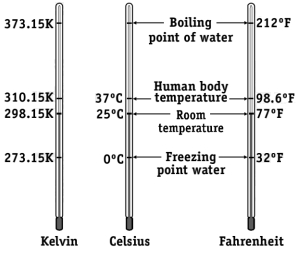
(N/A) There are three common scales to measure temperature:
$(i)$ $^{\circ}C$ (degree Celsius)
$(ii)$ $^{\circ}F$ (degree Fahrenheit)
$(iii)$ $K$ (Kelvin),where $K$ is the $SI$ unit.
The thermometers based on these scales are shown in the figure.
Generally,the thermometer with the Celsius scale is calibrated from $0^{\circ}C$ to $100^{\circ}C$,where these two temperatures are the freezing point and the boiling point of water,respectively.
The Fahrenheit scale is represented between $32^{\circ}F$ to $212^{\circ}F$.
The temperatures on the two scales are related to each other by the following relationship:
$^{\circ}F = \frac{9}{5}(^{\circ}C) + 32$
The Kelvin scale is related to the Celsius scale as follows:
$K = ^{\circ}C + 273.15$
Temperatures below $0^{\circ}C$ (i.e.,negative values) are possible on the Celsius scale,but on the Kelvin scale,negative temperature is not possible.
$(i)$ $^{\circ}C$ (degree Celsius)
$(ii)$ $^{\circ}F$ (degree Fahrenheit)
$(iii)$ $K$ (Kelvin),where $K$ is the $SI$ unit.
The thermometers based on these scales are shown in the figure.
Generally,the thermometer with the Celsius scale is calibrated from $0^{\circ}C$ to $100^{\circ}C$,where these two temperatures are the freezing point and the boiling point of water,respectively.
The Fahrenheit scale is represented between $32^{\circ}F$ to $212^{\circ}F$.
The temperatures on the two scales are related to each other by the following relationship:
$^{\circ}F = \frac{9}{5}(^{\circ}C) + 32$
The Kelvin scale is related to the Celsius scale as follows:
$K = ^{\circ}C + 273.15$
Temperatures below $0^{\circ}C$ (i.e.,negative values) are possible on the Celsius scale,but on the Kelvin scale,negative temperature is not possible.
0 likes
View Solution77
EasyMCQ
If the speed of light is $3.0 \times 10^8 \ ms^{-1}$,calculate the distance covered by light in $2.00 \ ns$. (in $m$)
A
$0.6$
B
$0.06$
C
$6.0$
D
$60$
Solution
(A) Given:
Speed of light $(v)$ = $3.0 \times 10^8 \ ms^{-1}$
Time $(t)$ = $2.00 \ ns = 2.00 \times 10^{-9} \ s$
Formula:
Distance $(d)$ = Speed $\times$ Time
Calculation:
$d = (3.0 \times 10^8 \ ms^{-1}) \times (2.00 \times 10^{-9} \ s)$
$d = 6.0 \times 10^{-1} \ m$
$d = 0.6 \ m$
Speed of light $(v)$ = $3.0 \times 10^8 \ ms^{-1}$
Time $(t)$ = $2.00 \ ns = 2.00 \times 10^{-9} \ s$
Formula:
Distance $(d)$ = Speed $\times$ Time
Calculation:
$d = (3.0 \times 10^8 \ ms^{-1}) \times (2.00 \times 10^{-9} \ s)$
$d = 6.0 \times 10^{-1} \ m$
$d = 0.6 \ m$
0 likes
View Solution78
Difficult
Explain the scientific notation method of measurement.
Solution
Chemistry involves the study of atoms and molecules,which have extremely low masses and are present in extremely large numbers.
Chemists often deal with very large numbers,such as $602,200,000,000,000,000,000,000$ for the number of molecules in $2 \ g$ of hydrogen gas,or very small numbers,such as $0.00000000000000000000000166 \ g$ for the mass of a single $H$ atom.
To simplify calculations,scientific notation (exponential notation) is used,where any number is represented as $N \times 10^{n}$.
Here,$n$ is an exponent that can be positive or negative,and $N$ is a digit term varying between $1.000$ and $9.999$.
For example,$232.508$ is written as $2.32508 \times 10^{2}$,and $0.00016$ is written as $1.6 \times 10^{-4}$.
Multiplication and Division:
These operations follow standard rules for exponents.
Example (Multiplication): $(5.6 \times 10^{5}) \times (6.9 \times 10^{8}) = (5.6 \times 6.9) \times 10^{5+8} = 38.64 \times 10^{13} = 3.864 \times 10^{14}$.
Example (Division): $\frac{2.7 \times 10^{-3}}{5.5 \times 10^{-4}} = (2.7 \div 5.5) \times 10^{-3 - (-4)} = 0.4909 \times 10^{1} = 4.909$.
Addition and Subtraction:
For these operations,the numbers must first be converted to have the same exponent.
Example (Addition): $6.65 \times 10^{4} + 8.95 \times 10^{3} = 6.65 \times 10^{4} + 0.895 \times 10^{4} = (6.65 + 0.895) \times 10^{4} = 7.545 \times 10^{4}$.
Example (Subtraction): $2.5 \times 10^{-2} - 4.8 \times 10^{-3} = 2.5 \times 10^{-2} - 0.48 \times 10^{-2} = (2.5 - 0.48) \times 10^{-2} = 2.02 \times 10^{-2}$.
Chemists often deal with very large numbers,such as $602,200,000,000,000,000,000,000$ for the number of molecules in $2 \ g$ of hydrogen gas,or very small numbers,such as $0.00000000000000000000000166 \ g$ for the mass of a single $H$ atom.
To simplify calculations,scientific notation (exponential notation) is used,where any number is represented as $N \times 10^{n}$.
Here,$n$ is an exponent that can be positive or negative,and $N$ is a digit term varying between $1.000$ and $9.999$.
For example,$232.508$ is written as $2.32508 \times 10^{2}$,and $0.00016$ is written as $1.6 \times 10^{-4}$.
Multiplication and Division:
These operations follow standard rules for exponents.
Example (Multiplication): $(5.6 \times 10^{5}) \times (6.9 \times 10^{8}) = (5.6 \times 6.9) \times 10^{5+8} = 38.64 \times 10^{13} = 3.864 \times 10^{14}$.
Example (Division): $\frac{2.7 \times 10^{-3}}{5.5 \times 10^{-4}} = (2.7 \div 5.5) \times 10^{-3 - (-4)} = 0.4909 \times 10^{1} = 4.909$.
Addition and Subtraction:
For these operations,the numbers must first be converted to have the same exponent.
Example (Addition): $6.65 \times 10^{4} + 8.95 \times 10^{3} = 6.65 \times 10^{4} + 0.895 \times 10^{4} = (6.65 + 0.895) \times 10^{4} = 7.545 \times 10^{4}$.
Example (Subtraction): $2.5 \times 10^{-2} - 4.8 \times 10^{-3} = 2.5 \times 10^{-2} - 0.48 \times 10^{-2} = (2.5 - 0.48) \times 10^{-2} = 2.02 \times 10^{-2}$.
0 likes
View Solution79
Medium
Express the following in scientific notation:
$(i)$ $0.0048$
$(ii)$ $234,000$
$(iii)$ $8008$
$(iv)$ $500.0$
$(v)$ $6.0012$
$(i)$ $0.0048$
$(ii)$ $234,000$
$(iii)$ $8008$
$(iv)$ $500.0$
$(v)$ $6.0012$
Solution
$(i)$ $0.0048 = 4.8 \times 10^{-3}$
$(ii)$ $234,000 = 2.34 \times 10^{5}$
$(iii)$ $8008 = 8.008 \times 10^{3}$
$(iv)$ $500.0 = 5.000 \times 10^{2}$
$(v)$ $6.0012 = 6.0012 \times 10^{0}$
$(ii)$ $234,000 = 2.34 \times 10^{5}$
$(iii)$ $8008 = 8.008 \times 10^{3}$
$(iv)$ $500.0 = 5.000 \times 10^{2}$
$(v)$ $6.0012 = 6.0012 \times 10^{0}$
0 likes
View Solution80
Medium
Define significant figures.
Solution
(N/A) Significant figures are meaningful digits in a measured or calculated quantity. They indicate the precision of a measurement,which depends on the least count of the measuring instrument.
Rules for determining significant figures:
$1$. All non-zero digits are significant.
$2$. Zeros preceding the first non-zero digit are not significant. They indicate the position of the decimal point.
$3$. Zeros between two non-zero digits are significant.
$4$. Zeros at the end or right of a number are significant,provided they are on the right side of the decimal point.
$5$. Counting numbers of objects,for example,$2$ balls or $20$ eggs,have infinite significant figures as these are exact numbers.
Rules for determining significant figures:
$1$. All non-zero digits are significant.
$2$. Zeros preceding the first non-zero digit are not significant. They indicate the position of the decimal point.
$3$. Zeros between two non-zero digits are significant.
$4$. Zeros at the end or right of a number are significant,provided they are on the right side of the decimal point.
$5$. Counting numbers of objects,for example,$2$ balls or $20$ eggs,have infinite significant figures as these are exact numbers.
0 likes
View Solution81
Medium
Write about significant figures.
Solution
(N/A) Significant figures are meaningful digits in a measured or calculated quantity. The rules for determining them are as follows:
$(i)$ All non-zero digits are significant. For example,in $285 \ cm$,there are $3$ significant figures,and in $0.25 \ mL$,there are $2$ significant figures.
$(ii)$ Zeros preceding the first non-zero digit are not significant. They only indicate the position of the decimal point. Thus,$0.03$ has $1$ significant figure and $0.0052$ has $2$ significant figures.
$(iii)$ Zeros between two non-zero digits are significant. Thus,$2.005$ has $4$ significant figures.
$(iv)$ Zeros at the end or to the right of a number are significant if they are on the right side of the decimal point. For example,$0.200 \ g$ has $3$ significant figures. However,terminal zeros are not significant if there is no decimal point. For example,$100$ has only $1$ significant figure.
$(v)$ Exact numbers,such as $2$ balls or $20$ eggs,have an infinite number of significant figures because they can be represented as $2.0000...$ or $20.0000...$.
Addition and Subtraction: The result should have the same number of decimal places as the measurement with the fewest decimal places. For example,$12.11 + 18.0 + 1.012 = 31.122$,which is rounded to $31.1$ because $18.0$ has only one decimal place.
Multiplication and Division: The result should have the same number of significant figures as the measurement with the fewest significant figures. For example,$2.5 \times 1.25 = 3.125$,which is rounded to $3.1$ because $2.5$ has only $2$ significant figures.
$(i)$ All non-zero digits are significant. For example,in $285 \ cm$,there are $3$ significant figures,and in $0.25 \ mL$,there are $2$ significant figures.
$(ii)$ Zeros preceding the first non-zero digit are not significant. They only indicate the position of the decimal point. Thus,$0.03$ has $1$ significant figure and $0.0052$ has $2$ significant figures.
$(iii)$ Zeros between two non-zero digits are significant. Thus,$2.005$ has $4$ significant figures.
$(iv)$ Zeros at the end or to the right of a number are significant if they are on the right side of the decimal point. For example,$0.200 \ g$ has $3$ significant figures. However,terminal zeros are not significant if there is no decimal point. For example,$100$ has only $1$ significant figure.
$(v)$ Exact numbers,such as $2$ balls or $20$ eggs,have an infinite number of significant figures because they can be represented as $2.0000...$ or $20.0000...$.
Addition and Subtraction: The result should have the same number of decimal places as the measurement with the fewest decimal places. For example,$12.11 + 18.0 + 1.012 = 31.122$,which is rounded to $31.1$ because $18.0$ has only one decimal place.
Multiplication and Division: The result should have the same number of significant figures as the measurement with the fewest significant figures. For example,$2.5 \times 1.25 = 3.125$,which is rounded to $3.1$ because $2.5$ has only $2$ significant figures.
0 likes
View Solution82
Medium
What do you mean by significant figures?
Solution
(N/A) Significant figures are the total number of digits in a number,including the last digit whose value is uncertain.
They represent the precision of a measurement and include all certain digits plus one uncertain digit.
They represent the precision of a measurement and include all certain digits plus one uncertain digit.
0 likes
View Solution83
Medium
How many significant figures are present in the following?
$(i)$ $0.0025$
$(ii)$ $208$
$(iii)$ $5005$
$(iv)$ $126.000$
$(v)$ $500.0$
$(vi)$ $2.0034$
$(i)$ $0.0025$
$(ii)$ $208$
$(iii)$ $5005$
$(iv)$ $126.000$
$(v)$ $500.0$
$(vi)$ $2.0034$
Solution
$(i)$ $0.0025$: Leading zeros are not significant. Significant figures = $2$.
$(ii)$ $208$: Zeros between non-zero digits are significant. Significant figures = $3$.
$(iii)$ $5005$: Zeros between non-zero digits are significant. Significant figures = $4$.
$(iv)$ $126.000$: Trailing zeros in a decimal number are significant. Significant figures = $6$.
$(v)$ $500.0$: Trailing zeros in a decimal number are significant. Significant figures = $4$.
$(vi)$ $2.0034$: Zeros between non-zero digits are significant. Significant figures = $5$.
$(ii)$ $208$: Zeros between non-zero digits are significant. Significant figures = $3$.
$(iii)$ $5005$: Zeros between non-zero digits are significant. Significant figures = $4$.
$(iv)$ $126.000$: Trailing zeros in a decimal number are significant. Significant figures = $6$.
$(v)$ $500.0$: Trailing zeros in a decimal number are significant. Significant figures = $4$.
$(vi)$ $2.0034$: Zeros between non-zero digits are significant. Significant figures = $5$.
0 likes
View Solution84
Medium
Round up the following up to three significant figures:
$(i) 34.216$
$(ii) 10.4107$
$(iii) 0.04597$
$(iv) 2808$
$(i) 34.216$
$(ii) 10.4107$
$(iii) 0.04597$
$(iv) 2808$
Solution
$(i) 34.216 \rightarrow 34.2$ (The fourth digit is $1$,which is less than $5$,so we keep the third digit as is.)
$(ii) 10.4107 \rightarrow 10.4$ (The fourth digit is $1$,which is less than $5$,so we keep the third digit as is.)
$(iii) 0.04597 \rightarrow 0.0460$ (The fourth digit is $9$,which is greater than $5$,so we round up the third digit $5$ to $6$.)
$(iv) 2808 \rightarrow 2810$ (The fourth digit is $8$,which is greater than $5$,so we round up the third digit $0$ to $1$.)
$(ii) 10.4107 \rightarrow 10.4$ (The fourth digit is $1$,which is less than $5$,so we keep the third digit as is.)
$(iii) 0.04597 \rightarrow 0.0460$ (The fourth digit is $9$,which is greater than $5$,so we round up the third digit $5$ to $6$.)
$(iv) 2808 \rightarrow 2810$ (The fourth digit is $8$,which is greater than $5$,so we round up the third digit $0$ to $1$.)
0 likes
View Solution85
MediumMCQ
How many significant figures should be present in the answer of the following calculations?
$(i)$ $\frac{0.02856 \times 298.15 \times 0.112}{0.5785}$
$(ii)$ $5 \times 5.364$
$(iii)$ $0.0125 + 0.7864 + 0.0215$
$(i)$ $\frac{0.02856 \times 298.15 \times 0.112}{0.5785}$
$(ii)$ $5 \times 5.364$
$(iii)$ $0.0125 + 0.7864 + 0.0215$
A
$3, 4, 4$
B
$3, 3, 4$
C
$4, 4, 3$
D
$3, 4, 3$
Solution
(A) $(i)$ In multiplication and division,the result should have the same number of significant figures as the term with the least significant figures. Here,$0.112$ has $3$ significant figures,so the answer should have $3$ significant figures.
$(ii)$ In multiplication,when one number is an exact constant (like $5$),the result should have the same number of significant figures as the other number. $5.364$ has $4$ significant figures,so the answer should have $4$ significant figures.
$(iii)$ In addition,the result should have the same number of decimal places as the term with the fewest decimal places. All terms $(0.0125, 0.7864, 0.0215)$ have $4$ decimal places. The sum is $0.8204$,which has $4$ significant figures.
$(ii)$ In multiplication,when one number is an exact constant (like $5$),the result should have the same number of significant figures as the other number. $5.364$ has $4$ significant figures,so the answer should have $4$ significant figures.
$(iii)$ In addition,the result should have the same number of decimal places as the term with the fewest decimal places. All terms $(0.0125, 0.7864, 0.0215)$ have $4$ decimal places. The sum is $0.8204$,which has $4$ significant figures.
0 likes
View Solution86
DifficultMCQ
Pressure is defined as the force acting per unit area of a surface. The $SI$ unit of pressure,$Pascal$ $(Pa)$,is defined as $1 \ Pa = 1 \ N \ m^{-2}$. If the mass of air at sea level is $1034 \ g \ cm^{-2}$,calculate the pressure in $Pascal$.
A
$1.01332 \times 10^5 \ Pa$
B
$1.01332 \times 10^4 \ Pa$
C
$1.01332 \times 10^6 \ Pa$
D
$1.01332 \times 10^3 \ Pa$
Solution
(A) Pressure is defined as force per unit area.
Given mass $m = 1034 \ g \ cm^{-2} = 1034 \times 10^{-3} \ kg \ cm^{-2}$.
Area $A = 1 \ cm^2 = 10^{-4} \ m^2$.
Force $F = m \times g = (1034 \times 10^{-3} \ kg) \times (9.8 \ m \ s^{-2}) = 10.1332 \ N$.
Pressure $P = \frac{F}{A} = \frac{10.1332 \ N}{10^{-4} \ m^2} = 10.1332 \times 10^4 \ N \ m^{-2} = 1.01332 \times 10^5 \ Pa$.
Given mass $m = 1034 \ g \ cm^{-2} = 1034 \times 10^{-3} \ kg \ cm^{-2}$.
Area $A = 1 \ cm^2 = 10^{-4} \ m^2$.
Force $F = m \times g = (1034 \times 10^{-3} \ kg) \times (9.8 \ m \ s^{-2}) = 10.1332 \ N$.
Pressure $P = \frac{F}{A} = \frac{10.1332 \ N}{10^{-4} \ m^2} = 10.1332 \times 10^4 \ N \ m^{-2} = 1.01332 \times 10^5 \ Pa$.
0 likes
View Solution87
Medium
Convert the following into basic $SI$ units:
$(i)$ $28.7 \, pm$
$(ii)$ $15.15 \, pm$
$(iii)$ $25365 \, mg$
$(i)$ $28.7 \, pm$
$(ii)$ $15.15 \, pm$
$(iii)$ $25365 \, mg$
Solution
The $SI$ unit of length is $\text{metre}$ $(m)$ and the $SI$ unit of mass is $\text{kilogram}$ $(kg)$.
The conversions are as follows:
$(i)$ $28.7 \, pm = 28.7 \times 10^{-12} \, m = 2.87 \times 10^{-11} \, m$
$(ii)$ $15.15 \, pm = 15.15 \times 10^{-12} \, m = 1.515 \times 10^{-11} \, m$
$(iii)$ $25365 \, mg = 25365 \times 10^{-6} \, kg = 2.5365 \times 10^{-2} \, kg$
The conversions are as follows:
$(i)$ $28.7 \, pm = 28.7 \times 10^{-12} \, m = 2.87 \times 10^{-11} \, m$
$(ii)$ $15.15 \, pm = 15.15 \times 10^{-12} \, m = 1.515 \times 10^{-11} \, m$
$(iii)$ $25365 \, mg = 25365 \times 10^{-6} \, kg = 2.5365 \times 10^{-2} \, kg$
0 likes
View Solution88
EasyMCQ
How many significant figures should be present in the answer of the following calculation? $\frac{2.5 \times 1.25 \times 3.5}{2.01}$
A
$1$
B
$2$
C
$3$
D
$4$
Solution
(B) In multiplication and division,the result should be reported to the same number of significant figures as the term with the least number of significant figures.
The given values are $2.5$ ($2$ significant figures),$1.25$ ($3$ significant figures),$3.5$ ($2$ significant figures),and $2.01$ ($3$ significant figures).
The least number of significant figures is $2$.
Therefore,the final result of the calculation $\frac{2.5 \times 1.25 \times 3.5}{2.01} = 5.4415$ should be rounded to $2$ significant figures,which is $5.4$.
The given values are $2.5$ ($2$ significant figures),$1.25$ ($3$ significant figures),$3.5$ ($2$ significant figures),and $2.01$ ($3$ significant figures).
The least number of significant figures is $2$.
Therefore,the final result of the calculation $\frac{2.5 \times 1.25 \times 3.5}{2.01} = 5.4415$ should be rounded to $2$ significant figures,which is $5.4$.
0 likes
View Solution89
DifficultMCQ
What do you mean by $1 \ kg$?
A
Mass of $1000 \ cm^3$ of water at $4 \ ^\circ C$
B
Mass of $100 \ cm^3$ of water at $4 \ ^\circ C$
C
Mass of $10 \ cm^3$ of water at $4 \ ^\circ C$
D
Mass of $1 \ cm^3$ of water at $4 \ ^\circ C$
Solution
(A) The standard unit of mass in the $SI$ system is the kilogram $(kg)$.
By definition,$1 \ kg$ is equal to the mass of $1000 \ cm^3$ (or $1 \ L$) of pure water at $4 \ ^\circ C$,where water has its maximum density.
By definition,$1 \ kg$ is equal to the mass of $1000 \ cm^3$ (or $1 \ L$) of pure water at $4 \ ^\circ C$,where water has its maximum density.
0 likes
View Solution90
EasyMCQ
What is the $SI$ unit of luminous intensity?
A
Mole $(mol)$
B
Candela $(cd)$
C
Kelvin $(K)$
D
Ampere $(A)$
Solution
(B) The $SI$ unit of luminous intensity is the candela $(cd)$.
0 likes
View Solution91
Medium
What is $NTP$ or $STP$ and $SATP$? Mention their molar volumes.
Solution
(N/A) $STP$ (Standard Temperature and Pressure) is defined as $0^{\circ}C$ $(273.15 \ K)$ temperature and $1 \ atm$ $(101.325 \ kPa)$ pressure. At $STP$,the molar volume of an ideal gas is $22.414 \ L \ mol^{-1}$.
$SATP$ (Standard Ambient Temperature and Pressure) is defined as $298.15 \ K$ $(25^{\circ}C)$ temperature and $1 \ bar$ $(10^{5} \ Pa)$ pressure. At $SATP$,the molar volume of an ideal gas is $24.789 \ L \ mol^{-1}$.
$SATP$ (Standard Ambient Temperature and Pressure) is defined as $298.15 \ K$ $(25^{\circ}C)$ temperature and $1 \ bar$ $(10^{5} \ Pa)$ pressure. At $SATP$,the molar volume of an ideal gas is $24.789 \ L \ mol^{-1}$.
0 likes
View Solution92
Difficult
Convert the following pressure values into atmosphere $(atm)$:
$(a)$ $735 \ torr$
$(b)$ $985 \ mbar$
$(c)$ $1.42 \times 10^5 \ Nm^{-2}$
$(a)$ $735 \ torr$
$(b)$ $985 \ mbar$
$(c)$ $1.42 \times 10^5 \ Nm^{-2}$
Solution
(N/A) The conversion factors are: $1 \ atm = 760 \ torr$,$1 \ atm = 1013.25 \ mbar$,and $1 \ atm = 1.01325 \times 10^5 \ Nm^{-2}$.
$(a)$ $735 \ torr = \frac{735}{760} \ atm \approx 0.967 \ atm$.
$(b)$ $985 \ mbar = \frac{985}{1013.25} \ atm \approx 0.972 \ atm$.
$(c)$ $1.42 \times 10^5 \ Nm^{-2} = \frac{1.42 \times 10^5}{1.01325 \times 10^5} \ atm \approx 1.401 \ atm$.
$(a)$ $735 \ torr = \frac{735}{760} \ atm \approx 0.967 \ atm$.
$(b)$ $985 \ mbar = \frac{985}{1013.25} \ atm \approx 0.972 \ atm$.
$(c)$ $1.42 \times 10^5 \ Nm^{-2} = \frac{1.42 \times 10^5}{1.01325 \times 10^5} \ atm \approx 1.401 \ atm$.
0 likes
View Solution93
Difficult
Define the meter.
Solution
The meter is the $SI$ unit of length.
It is defined as the distance traveled by light in vacuum during a time interval of $1/299,792,458$ of a second.
It is defined as the distance traveled by light in vacuum during a time interval of $1/299,792,458$ of a second.
0 likes
View Solution94
EasyMCQ
Which smaller units of $kg$ are used to measure the mass of chemicals with very low mass?
A
$g$ (gram)
B
$mg$ (milligram)
C
$\mu g$ (microgram)
D
All of the above
Solution
(D) To measure the mass of chemicals with very low mass,smaller units of $kg$ such as $g$ (gram),$mg$ (milligram),and $\mu g$ (microgram) are used.
Therefore,all the given options are correct.
Therefore,all the given options are correct.
0 likes
View Solution95
EasyMCQ
What is the temperature of $343 \ K$ in $^\circ F$ (in $^\circ F$)?
A
$158$
B
$70$
C
$180$
D
$140$
Solution
(A) To convert temperature from Kelvin $(K)$ to Celsius $(^\circ C)$,use the formula: $^\circ C = K - 273.15$.
$343 \ K - 273.15 = 69.85 \ ^\circ C \approx 70 \ ^\circ C$.
To convert Celsius to Fahrenheit $(^\circ F)$,use the formula: $^\circ F = \frac{9}{5}(^\circ C) + 32$.
$^\circ F = \frac{9}{5}(70) + 32 = 126 + 32 = 158 \ ^\circ F$.
$343 \ K - 273.15 = 69.85 \ ^\circ C \approx 70 \ ^\circ C$.
To convert Celsius to Fahrenheit $(^\circ F)$,use the formula: $^\circ F = \frac{9}{5}(^\circ C) + 32$.
$^\circ F = \frac{9}{5}(70) + 32 = 126 + 32 = 158 \ ^\circ F$.
0 likes
View Solution96
EasyMCQ
What is the boiling point of water in the Fahrenheit scale (in $^\circ F$)?
A
$100$
B
$212$
C
$32$
D
$180$
Solution
(B) The relationship between Celsius and Fahrenheit scales is given by the formula: $F = \frac{9}{5}(C) + 32$.
Since the boiling point of water in Celsius is $100 \ ^\circ C$,we substitute $C = 100$ into the equation.
$F = \frac{9}{5}(100) + 32$.
$F = 180 + 32 = 212 \ ^\circ F$.
Therefore,the boiling point of water in the Fahrenheit scale is $212 \ ^\circ F$.
Since the boiling point of water in Celsius is $100 \ ^\circ C$,we substitute $C = 100$ into the equation.
$F = \frac{9}{5}(100) + 32$.
$F = 180 + 32 = 212 \ ^\circ F$.
Therefore,the boiling point of water in the Fahrenheit scale is $212 \ ^\circ F$.
0 likes
View Solution97
EasyMCQ
Which prefix used in the $SI$ system has a multiplier of $10^{-6}$?
A
Milli
B
Micro
C
Nano
D
Pico
Solution
(B) The prefix $Micro$ corresponds to the multiplier $10^{-6}$.
For example,$1 \ \mu m = 10^{-6} \ m$.
For example,$1 \ \mu m = 10^{-6} \ m$.
0 likes
View Solution98
MediumMCQ
Name the different systems of measurement used.
A
English system and Metric system
B
$SI$ system and $CGS$ system
C
$MKS$ system and $FPS$ system
D
None of the above
Solution
(A) There are two main systems of measurement:
$(i)$ English system
$(ii)$ Metric system
$(i)$ English system
$(ii)$ Metric system
0 likes
View Solution99
DifficultMCQ
State the $SI$ unit of thermodynamic temperature and provide an explanation for this unit.
A
Celsius $(^{\circ}C)$
B
Kelvin $(K)$
C
Fahrenheit $(^{\circ}F)$
D
Rankine $(R)$
Solution
(B) The $SI$ unit of thermodynamic temperature is the Kelvin $(K)$.
It is defined as the fraction $1 / 273.16$ of the thermodynamic temperature of the triple point of water.
It is defined as the fraction $1 / 273.16$ of the thermodynamic temperature of the triple point of water.
0 likes
View Solution100
Medium
Perform the following calculations for the given exponential numbers:
$(i)$ $(6.7 \times 10^4) \times (8.4 \times 10^7)$
$(ii)$ $\frac{(3.4 \times 10^{-3})}{(6.5 \times 10^{-7})}$
$(i)$ $(6.7 \times 10^4) \times (8.4 \times 10^7)$
$(ii)$ $\frac{(3.4 \times 10^{-3})}{(6.5 \times 10^{-7})}$
Solution
$(i)$ $(6.7 \times 10^4) \times (8.4 \times 10^7) = (6.7 \times 8.4) \times (10^{4+7})$
$= 56.28 \times 10^{11}$
$= 5.628 \times 10^{12}$
$(ii)$ $\frac{(3.4 \times 10^{-3})}{(6.5 \times 10^{-7})} = (3.4 \div 6.5) \times (10^{-3 - (-7)})$
$= 0.5230 \times 10^4$
$= 5.230 \times 10^3$
$= 56.28 \times 10^{11}$
$= 5.628 \times 10^{12}$
$(ii)$ $\frac{(3.4 \times 10^{-3})}{(6.5 \times 10^{-7})} = (3.4 \div 6.5) \times (10^{-3 - (-7)})$
$= 0.5230 \times 10^4$
$= 5.230 \times 10^3$
0 likes
View SolutionSome Basic Concepts of Chemistry — Significant figures and Units for measurement · Frequently Asked Questions
1Are these Some Basic Concepts of Chemistry questions useful for JEE and NEET?
Yes. All questions in this section are mapped to JEE Main and NEET exam patterns. Previous year questions from JEE Main, NEET, GUJCET and state-level exams are included with full solutions.
2Can I switch to Hindi or Gujarati for these questions?
Yes. Use the language tabs in the hero section or the sidebar to view the same questions and solutions in English, Hindi or Gujarati.
3How do I generate a question paper from this subtopic?
Use the Vedclass Exam Paper Generator — select the chapter and subtopic, set difficulty, and generate Sets A, B, C, D automatically. First 3 chapters of every subject are free.
Vedclass Products
For Students
Vedclass Test Series
Mock tests in real JEE/NEET style with performance analysis. 5-day free trial.
Start Free TrialFor Teachers
Exam Paper Generator
Generate Set A/B/C/D papers from this chapter in 2 minutes. 3 chapters free.
Try FreeFor Institutes
Online Exam Module
Live online exams with unlimited students, 360° analytics & white-label branding.
See DemoFor Teachers & Institutes
Generate a Some Basic Concepts of Chemistry Exam Paper in 2 Minutes
Select subtopic & difficulty — Sets A, B, C, D auto-generated with No Repeat logic.
First 3 chapters of every subject are free — no payment required.