
A English
Auto oxidation and Disproportionation Questions in English
Class 11 Chemistry · Redox Reactions · Auto oxidation and Disproportionation
164+
Questions
English
Language
100%
With Solutions
Showing 50 of 164 questions in English
51
EasyMCQ
$3Br_2 + 6CO_3^{2-} + 3H_2O \to 5Br^- + BrO_3^- + 6HCO_3^-$
In the above reaction,
In the above reaction,
A
Bromine is oxidized and carbonate is reduced.
B
Bromine is both oxidized and reduced.
C
Bromine is reduced and water is oxidized.
D
Bromine is neither oxidized nor reduced.
Solution
(B) In the given reaction: $3Br_2 + 6CO_3^{2-} + 3H_2O \to 5Br^- + BrO_3^- + 6HCO_3^-$
The oxidation state of $Br$ in $Br_2$ is $0$.
In $Br^-$,the oxidation state of $Br$ is $-1$ (reduction).
In $BrO_3^-$,the oxidation state of $Br$ is $+5$ (oxidation).
Since bromine undergoes both oxidation and reduction,this is a disproportionation reaction.
Therefore,bromine is both oxidized and reduced.
The oxidation state of $Br$ in $Br_2$ is $0$.
In $Br^-$,the oxidation state of $Br$ is $-1$ (reduction).
In $BrO_3^-$,the oxidation state of $Br$ is $+5$ (oxidation).
Since bromine undergoes both oxidation and reduction,this is a disproportionation reaction.
Therefore,bromine is both oxidized and reduced.
0 likes
View Solution52
MediumMCQ
$3NaClO \xrightarrow{\Delta} NaClO_3 + 2NaCl$
Which of the following is true for the given reaction?
Which of the following is true for the given reaction?
A
It is a disproportionation reaction.
B
The oxidation state of chlorine increases and decreases simultaneously.
C
This reaction is used in the production of halates.
D
All of the above.
Solution
(D) In the reaction $3NaClO \xrightarrow{\Delta} NaClO_3 + 2NaCl$,the oxidation state of $Cl$ in $NaClO$ is $+1$.
In $NaClO_3$,the oxidation state of $Cl$ is $+5$ (increase).
In $NaCl$,the oxidation state of $Cl$ is $-1$ (decrease).
Since the oxidation state of the same element $(Cl)$ both increases and decreases,it is a disproportionation reaction.
This method is commonly used for the preparation of chlorates (a type of halate).
In $NaClO_3$,the oxidation state of $Cl$ is $+5$ (increase).
In $NaCl$,the oxidation state of $Cl$ is $-1$ (decrease).
Since the oxidation state of the same element $(Cl)$ both increases and decreases,it is a disproportionation reaction.
This method is commonly used for the preparation of chlorates (a type of halate).
0 likes
View Solution53
EasyMCQ
$3ClO^- \to ClO_3^- + 2Cl^-$; This reaction is an example of which of the following?
A
Oxidation
B
Reduction
C
Disproportionation
D
Decomposition
Solution
(C) In the given reaction: $3ClO^- \to ClO_3^- + 2Cl^-$
The oxidation state of chlorine in $ClO^-$ is $+1$.
In $ClO_3^-$,the oxidation state of chlorine is $+5$ (Oxidation).
In $Cl^-$,the oxidation state of chlorine is $-1$ (Reduction).
Since the same element $(Cl)$ is simultaneously oxidized and reduced,this is a disproportionation reaction.
The oxidation state of chlorine in $ClO^-$ is $+1$.
In $ClO_3^-$,the oxidation state of chlorine is $+5$ (Oxidation).
In $Cl^-$,the oxidation state of chlorine is $-1$ (Reduction).
Since the same element $(Cl)$ is simultaneously oxidized and reduced,this is a disproportionation reaction.
0 likes
View Solution54
MediumMCQ
Which of the following best describes the behavior of bromine in the reaction given below?
$H_2O + Br_2 \to HOBr + HBr$
$H_2O + Br_2 \to HOBr + HBr$
A
It is a proton acceptor.
B
It is both oxidized and reduced.
C
It is only oxidized.
D
It is only reduced.
Solution
(B) In the reaction $H_2O + \mathop{Br_2}\limits^{0} \to \mathop{HOBr}\limits^{+1} + \mathop{HBr}\limits^{-1}$,the oxidation state of bromine changes from $0$ to $+1$ (oxidation) and from $0$ to $-1$ (reduction).
Since bromine undergoes both oxidation and reduction,it is a disproportionation reaction where bromine is both oxidized and reduced.
Since bromine undergoes both oxidation and reduction,it is a disproportionation reaction where bromine is both oxidized and reduced.
0 likes
View Solution55
MediumMCQ
$P_4 + 3NaOH + 3H_2O \to 3NaH_2PO_2 + PH_3$ is an example of
A
Intermolecular Redox
B
Intramolecular Redox
C
Disproportionation Redox
D
None of these
Solution
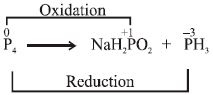
(C) In the given reaction: $P_4 + 3NaOH + 3H_2O \to 3NaH_2PO_2 + PH_3$
The oxidation state of phosphorus $(P)$ in $P_4$ is $0$.
In $NaH_2PO_2$,the oxidation state of $P$ is $+1$.
In $PH_3$,the oxidation state of $P$ is $-3$.
Since the same element $(P)$ is simultaneously oxidized (from $0$ to $+1$) and reduced (from $0$ to $-3$),this is a disproportionation reaction.
The oxidation state of phosphorus $(P)$ in $P_4$ is $0$.
In $NaH_2PO_2$,the oxidation state of $P$ is $+1$.
In $PH_3$,the oxidation state of $P$ is $-3$.
Since the same element $(P)$ is simultaneously oxidized (from $0$ to $+1$) and reduced (from $0$ to $-3$),this is a disproportionation reaction.
0 likes
View Solution56
MediumMCQ
What is the equivalent weight of $H_3PO_3$ in the following disproportionation reaction?
$4H_3PO_3 \rightarrow 3H_3PO_4 + PH_3$
$4H_3PO_3 \rightarrow 3H_3PO_4 + PH_3$
A
$\frac{M}{6}$
B
$\frac{M}{2}$
C
$\frac{2M}{3}$
D
$\frac{M}{3}$
Solution
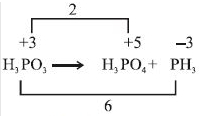
(C) The oxidation state of $P$ in $H_3PO_3$ is $+3$. In $H_3PO_4$,it is $+5$ (oxidation) and in $PH_3$,it is $-3$ (reduction).
Change in oxidation state for oxidation: $5 - 3 = 2$.
Change in oxidation state for reduction: $3 - (-3) = 6$.
For a disproportionation reaction,the equivalent weight is calculated using the formula:
$E_w = \frac{M}{n_f}$,where $n_f = \frac{n_1 \times n_2}{n_1 + n_2}$.
Here,$n_1 = 2$ and $n_2 = 6$.
$n_f = \frac{2 \times 6}{2 + 6} = \frac{12}{8} = \frac{3}{2}$.
Therefore,$E_w = \frac{M}{3/2} = \frac{2M}{3}$.
Change in oxidation state for oxidation: $5 - 3 = 2$.
Change in oxidation state for reduction: $3 - (-3) = 6$.
For a disproportionation reaction,the equivalent weight is calculated using the formula:
$E_w = \frac{M}{n_f}$,where $n_f = \frac{n_1 \times n_2}{n_1 + n_2}$.
Here,$n_1 = 2$ and $n_2 = 6$.
$n_f = \frac{2 \times 6}{2 + 6} = \frac{12}{8} = \frac{3}{2}$.
Therefore,$E_w = \frac{M}{3/2} = \frac{2M}{3}$.
0 likes
View Solution57
MediumMCQ
Assign $A, B, C, D$ from the given type of reaction.
$Hg_2(NO_3)_2 + 2NH_3(aq) + H_2O \longrightarrow Hg \downarrow + Hg(NH_2)NO_3 \downarrow + NH_4NO_3$
(Note: The reaction represents the disproportionation of mercury$(I)$ nitrate with ammonia.)
$Hg_2(NO_3)_2 + 2NH_3(aq) + H_2O \longrightarrow Hg \downarrow + Hg(NH_2)NO_3 \downarrow + NH_4NO_3$
(Note: The reaction represents the disproportionation of mercury$(I)$ nitrate with ammonia.)
A
Precipitate formation reaction
B
Precipitate dissolution reaction
C
Precipitate exchange reaction
D
No reaction
Solution
(A) The reaction of mercury$(I)$ nitrate with ammonia is a classic example of a disproportionation reaction where $Hg_2^{2+}$ is converted into metallic mercury $(Hg^0)$ and mercury$(II)$ species $(Hg^{2+})$.
This reaction results in the formation of a black precipitate consisting of a mixture of finely divided metallic mercury and an insoluble mercury$(II)$ amido-nitrate complex.
Therefore,this is classified as a precipitate formation reaction.
This reaction results in the formation of a black precipitate consisting of a mixture of finely divided metallic mercury and an insoluble mercury$(II)$ amido-nitrate complex.
Therefore,this is classified as a precipitate formation reaction.
0 likes
View Solution58
DifficultMCQ
In the following reaction,assign the state for the underlined atom in the products of complete hydrolysis at $R.T.$:
$\underline{N_2}O_4 + H_2O \longrightarrow HNO_3 + HNO_2$
$\underline{N_2}O_4 + H_2O \longrightarrow HNO_3 + HNO_2$
A
If the product is an oxyacid with an $-ic$ suffix.
B
If the product is an oxyacid with an $-ous$ suffix.
C
If the product is not an oxyacid,neither with an $-ic$ suffix nor with an $-ous$ suffix.
D
If the products are two oxyacids,one with an $-ic$ suffix and the other with an $-ous$ suffix.
Solution
(D) The reaction is: $\underline{N_2}O_4 + H_2O \longrightarrow HNO_3 + HNO_2$.
In this reaction,$N_2O_4$ undergoes disproportionation upon hydrolysis.
The products are $HNO_3$ (Nitric acid) and $HNO_2$ (Nitrous acid).
$HNO_3$ is an oxyacid with an $-ic$ suffix (Nitric acid).
$HNO_2$ is an oxyacid with an $-ous$ suffix (Nitrous acid).
Therefore,the products are two oxyacids,one with an $-ic$ suffix and the other with an $-ous$ suffix.
In this reaction,$N_2O_4$ undergoes disproportionation upon hydrolysis.
The products are $HNO_3$ (Nitric acid) and $HNO_2$ (Nitrous acid).
$HNO_3$ is an oxyacid with an $-ic$ suffix (Nitric acid).
$HNO_2$ is an oxyacid with an $-ous$ suffix (Nitrous acid).
Therefore,the products are two oxyacids,one with an $-ic$ suffix and the other with an $-ous$ suffix.
0 likes
View Solution59
DifficultMCQ
In the following reaction,assign the state for the underlined atom in the product of complete hydrolysis at $R.T.$:
$\underline{Cl}O_2 + H_2O \longrightarrow HClO_2 + HClO_3$
$\underline{Cl}O_2 + H_2O \longrightarrow HClO_2 + HClO_3$
A
If product is oxy acid with $-ic$ suffix
B
If product is oxy acid with $-ous$ suffix
C
If product are two oxy acids,one with $-ic$ suffix and the other with $-ous$ suffix
D
If product is not an oxy acid,neither with $-ic$ suffix nor with $-ous$ suffix
Solution
(C) The reaction is: $2ClO_2 + H_2O \longrightarrow HClO_2 + HClO_3$.
In this reaction,$ClO_2$ undergoes disproportionation.
The products are $HClO_2$ (chlorous acid) and $HClO_3$ (chloric acid).
$HClO_2$ has the $-ous$ suffix,and $HClO_3$ has the $-ic$ suffix.
Therefore,the products are two oxy acids,one with $-ic$ suffix and the other with $-ous$ suffix.
In this reaction,$ClO_2$ undergoes disproportionation.
The products are $HClO_2$ (chlorous acid) and $HClO_3$ (chloric acid).
$HClO_2$ has the $-ous$ suffix,and $HClO_3$ has the $-ic$ suffix.
Therefore,the products are two oxy acids,one with $-ic$ suffix and the other with $-ous$ suffix.
0 likes
View Solution60
DifficultMCQ
In the following reaction,assign the oxidation state for the underlined atom in the product of complete hydrolysis at $R.T.$:
$\underline{Cl}O_3 + H_2O \longrightarrow HClO_3 + HClO_4$
$\underline{Cl}O_3 + H_2O \longrightarrow HClO_3 + HClO_4$
A
If product is oxy acid with $-ic$ suffix
B
If product is oxy acid with $-ous$ suffix
C
If product are two oxy acids,one with $-ic$ suffix and the other with $-ous$ suffix
D
If product is not an oxy acid,neither with $-ic$ suffix nor with $-ous$ suffix
Solution
(A) The reaction is a disproportionation reaction of chlorine dioxide ($ClO_2$,often represented as $Cl_2O_4$ or $ClO_3$ in specific contexts) with water.
$2ClO_2 + H_2O \longrightarrow HClO_2 + HClO_3$
In the given reaction: $\underline{Cl}O_3 + H_2O \longrightarrow HClO_3 + HClO_4$.
The products are $HClO_3$ (chloric acid,$-ic$ suffix) and $HClO_4$ (perchloric acid,$-ic$ suffix).
Since both products are oxy acids with $-ic$ suffixes,the condition matches option $A$.
$2ClO_2 + H_2O \longrightarrow HClO_2 + HClO_3$
In the given reaction: $\underline{Cl}O_3 + H_2O \longrightarrow HClO_3 + HClO_4$.
The products are $HClO_3$ (chloric acid,$-ic$ suffix) and $HClO_4$ (perchloric acid,$-ic$ suffix).
Since both products are oxy acids with $-ic$ suffixes,the condition matches option $A$.
0 likes
View Solution61
DifficultMCQ
In the following reaction,assign the state for the underlined atom in the products of complete hydrolysis at $R.T.$: $\underline{N}_2O_4 + H_2O \longrightarrow HNO_3 + HNO_2$
A
If product is oxy acid with $-ic$ suffix
B
If product is oxy acid with $-ous$ suffix
C
If product are two oxy acids,one with $-ic$ suffix and the other with $-ous$ suffix
D
If product is not an oxy acid,neither with $-ic$ suffix nor with $-ous$ suffix
Solution
(C) The reaction is a disproportionation reaction where $N_2O_4$ reacts with water to form two oxyacids of nitrogen.
The reaction is: $N_2O_4 + H_2O \longrightarrow HNO_3 + HNO_2$.
In $HNO_3$ (nitric acid),the oxidation state of nitrogen is $+5$,and it ends with the suffix $-ic$.
In $HNO_2$ (nitrous acid),the oxidation state of nitrogen is $+3$,and it ends with the suffix $-ous$.
Since both products are oxyacids of nitrogen,one with an $-ic$ suffix and the other with an $-ous$ suffix,option $C$ is correct.
The reaction is: $N_2O_4 + H_2O \longrightarrow HNO_3 + HNO_2$.
In $HNO_3$ (nitric acid),the oxidation state of nitrogen is $+5$,and it ends with the suffix $-ic$.
In $HNO_2$ (nitrous acid),the oxidation state of nitrogen is $+3$,and it ends with the suffix $-ous$.
Since both products are oxyacids of nitrogen,one with an $-ic$ suffix and the other with an $-ous$ suffix,option $C$ is correct.
0 likes
View Solution62
DifficultMCQ
In the following reaction,assign the oxidation state for the underlined atom in the products of complete hydrolysis at $R.T.$:
$H_2\underline{S}_2O_6 + H_2O \longrightarrow H_2SO_3 + H_2SO_4$
$H_2\underline{S}_2O_6 + H_2O \longrightarrow H_2SO_3 + H_2SO_4$
A
If product is oxy acid with $-ic$ suffix
B
If product is oxy acid with $-ous$ suffix
C
If product are two oxy acids,one with $-ic$ suffix and the other with $-ous$ suffix
D
If product is not an oxy acid,neither with $-ic$ suffix nor with $-ous$ suffix
Solution
(C) The reaction given is the disproportionation of dithionic acid $(H_2S_2O_6)$ upon hydrolysis.
$H_2S_2O_6 + H_2O \longrightarrow H_2SO_3 + H_2SO_4$
In $H_2SO_3$ (sulfurous acid),the oxidation state of $S$ is $+4$,and it ends with the suffix $-ous$.
In $H_2SO_4$ (sulfuric acid),the oxidation state of $S$ is $+6$,and it ends with the suffix $-ic$.
Since the products are two oxy acids,one with an $-ic$ suffix $(H_2SO_4)$ and the other with an $-ous$ suffix $(H_2SO_3)$,option $C$ is correct.
$H_2S_2O_6 + H_2O \longrightarrow H_2SO_3 + H_2SO_4$
In $H_2SO_3$ (sulfurous acid),the oxidation state of $S$ is $+4$,and it ends with the suffix $-ous$.
In $H_2SO_4$ (sulfuric acid),the oxidation state of $S$ is $+6$,and it ends with the suffix $-ic$.
Since the products are two oxy acids,one with an $-ic$ suffix $(H_2SO_4)$ and the other with an $-ous$ suffix $(H_2SO_3)$,option $C$ is correct.
0 likes
View Solution63
DifficultMCQ
In the following reaction,identify the nature of the product formed by the complete hydrolysis of the underlined atom at $R.T.$:
$\underline{Cl}_2 + H_2O \longrightarrow HOCl + HCl$
$\underline{Cl}_2 + H_2O \longrightarrow HOCl + HCl$
A
If the product is an oxyacid with an $-ic$ suffix.
B
If the product is an oxyacid with an $-ous$ suffix.
C
If the products are two oxyacids,one with an $-ic$ suffix and the other with an $-ous$ suffix.
D
If the product is not an oxyacid,neither with an $-ic$ suffix nor with an $-ous$ suffix.
Solution
(B) The reaction is: $\underline{Cl}_2 + H_2O \longrightarrow HOCl + HCl$.
In this reaction,$Cl_2$ undergoes disproportionation.
The products are $HOCl$ (hypochlorous acid) and $HCl$ (hydrochloric acid).
$HOCl$ is an oxyacid of chlorine where the oxidation state of $Cl$ is $+1$,which corresponds to the $-ous$ suffix (hypochlorous acid).
$HCl$ is a binary acid (hydrohalic acid),not an oxyacid.
Therefore,the product $HOCl$ is an oxyacid with an $-ous$ suffix.
In this reaction,$Cl_2$ undergoes disproportionation.
The products are $HOCl$ (hypochlorous acid) and $HCl$ (hydrochloric acid).
$HOCl$ is an oxyacid of chlorine where the oxidation state of $Cl$ is $+1$,which corresponds to the $-ous$ suffix (hypochlorous acid).
$HCl$ is a binary acid (hydrohalic acid),not an oxyacid.
Therefore,the product $HOCl$ is an oxyacid with an $-ous$ suffix.
0 likes
View Solution64
MediumMCQ
Assign $A$,$B$,$C$,$D$ from the given type of reaction.
$H_2O_2 \xrightarrow{R.T} H_2O + \frac{1}{2} O_2$
$H_2O_2 \xrightarrow{R.T} H_2O + \frac{1}{2} O_2$
A
for disproportionation reaction.
B
for comproportionation reaction.
C
for either thermal combination redox reaction or thermal decomposition redox reaction.
D
Both $(A)$ and $(C)$
Solution
(D) In the reaction $H_2O_2 \xrightarrow{R.T} H_2O + \frac{1}{2} O_2$,the oxidation state of oxygen in $H_2O_2$ is $-1$.
In the products,the oxidation state of oxygen in $H_2O$ is $-2$ and in $O_2$ is $0$.
Since the oxidation state of oxygen decreases from $-1$ to $-2$ (reduction) and increases from $-1$ to $0$ (oxidation) in the same reaction,it is a disproportionation reaction.
Also,since $H_2O_2$ decomposes into simpler substances upon heating or at room temperature,it is a thermal decomposition redox reaction.
Therefore,both $(A)$ and $(C)$ are correct.
In the products,the oxidation state of oxygen in $H_2O$ is $-2$ and in $O_2$ is $0$.
Since the oxidation state of oxygen decreases from $-1$ to $-2$ (reduction) and increases from $-1$ to $0$ (oxidation) in the same reaction,it is a disproportionation reaction.
Also,since $H_2O_2$ decomposes into simpler substances upon heating or at room temperature,it is a thermal decomposition redox reaction.
Therefore,both $(A)$ and $(C)$ are correct.
0 likes
View Solution65
MediumMCQ
Assign $A$,$B$,$C$,$D$ from given type of reaction.
$A$ for precipitate formation reaction.
$B$ for precipitate dissolution reaction.
$C$ for precipitate exchange reaction.
$D$ for no reaction.
$P_4 + 3NaOH + 3H_2O \longrightarrow PH_3 + 3NaH_2PO_2$
Identify the correct category for the given reaction.
$A$ for precipitate formation reaction.
$B$ for precipitate dissolution reaction.
$C$ for precipitate exchange reaction.
$D$ for no reaction.
$P_4 + 3NaOH + 3H_2O \longrightarrow PH_3 + 3NaH_2PO_2$
Identify the correct category for the given reaction.
A
$A$
B
$B$
C
$C$
D
$D$
Solution
(D) The given reaction is $P_4 + 3NaOH + 3H_2O \longrightarrow PH_3 + 3NaH_2PO_2$.
In this reaction,the oxidation state of phosphorus $(P)$ changes from $0$ in $P_4$ to $-3$ in $PH_3$ and $+1$ in $NaH_2PO_2$.
Since the same element is simultaneously oxidized and reduced,this is a disproportionation reaction.
None of the categories $A$,$B$,or $C$ describe a redox reaction of this type.
Therefore,the correct assignment is $D$ (no reaction among the given categories).
In this reaction,the oxidation state of phosphorus $(P)$ changes from $0$ in $P_4$ to $-3$ in $PH_3$ and $+1$ in $NaH_2PO_2$.
Since the same element is simultaneously oxidized and reduced,this is a disproportionation reaction.
None of the categories $A$,$B$,or $C$ describe a redox reaction of this type.
Therefore,the correct assignment is $D$ (no reaction among the given categories).
0 likes
View Solution66
MediumMCQ
Assign $A, B, C, D$ from the given type of reaction.
$S_8 + NaOH \longrightarrow Na_2S + Na_2S_2O_3$
$S_8 + NaOH \longrightarrow Na_2S + Na_2S_2O_3$
A
$A$. For disproportionation reaction.
B
$B$. For comproportionation reaction.
C
$C$. For either intermolecular redox reaction or displacement reaction.
D
$D$. For either thermal combination redox reaction or thermal decomposition redox reaction.
Solution
(A) In the reaction $S_8 + 12NaOH \longrightarrow 4Na_2S + 2Na_2S_2O_3 + 6H_2O$,the oxidation state of sulfur changes from $0$ in $S_8$ to $-2$ in $Na_2S$ and $+2$ in $Na_2S_2O_3$.
Since the same element $(S)$ is simultaneously oxidized and reduced,this is a disproportionation reaction.
Therefore,the correct assignment is $A$.
Since the same element $(S)$ is simultaneously oxidized and reduced,this is a disproportionation reaction.
Therefore,the correct assignment is $A$.
0 likes
View Solution67
MediumMCQ
Assign $A, B, C, D$ from the given type of reaction.
$Cl_2 + 2NaOH \longrightarrow NaCl + NaOCl + H_2O$
$Cl_2 + 2NaOH \longrightarrow NaCl + NaOCl + H_2O$
A
for disproportionation reaction.
B
for comproportionation reaction.
C
for either intermolecular redox reaction or displacement reaction.
D
for either thermal combination redox reaction or thermal decomposition redox reaction.
Solution
(A) In the reaction $Cl_2 + 2NaOH \longrightarrow NaCl + NaOCl + H_2O$,the oxidation state of chlorine $(Cl)$ changes from $0$ in $Cl_2$ to $-1$ in $NaCl$ and $+1$ in $NaOCl$.
Since the same element $(Cl)$ is simultaneously oxidized and reduced,this is a disproportionation reaction.
Therefore,the correct assignment is $A$.
Since the same element $(Cl)$ is simultaneously oxidized and reduced,this is a disproportionation reaction.
Therefore,the correct assignment is $A$.
0 likes
View Solution68
MediumMCQ
Assign $A, B, C, D$ from the given type of reaction.
$I_2 + 2NaOH \longrightarrow NaI + NaOI + H_2O$
$I_2 + 2NaOH \longrightarrow NaI + NaOI + H_2O$
A
$A$. For disproportionation reaction.
B
$B$. For comproportionation reaction.
C
$C$. For either intermolecular redox reaction or displacement reaction.
D
$D$. For either thermal combination redox reaction or thermal decomposition redox reaction.
Solution
(A) In the reaction $I_2 + 2NaOH \longrightarrow NaI + NaOI + H_2O$,the oxidation state of iodine $(I)$ changes from $0$ in $I_2$ to $-1$ in $NaI$ and $+1$ in $NaOI$.
Since the same element $(I)$ is simultaneously oxidized and reduced,this is a disproportionation reaction.
Therefore,the correct assignment is $A$.
Since the same element $(I)$ is simultaneously oxidized and reduced,this is a disproportionation reaction.
Therefore,the correct assignment is $A$.
0 likes
View Solution69
MediumMCQ
Assign $A, B, C, D$ from the given type of reaction.
$N_2O_3 \xrightarrow{R.T.} NO + NO_2$
$N_2O_3 \xrightarrow{R.T.} NO + NO_2$
A
for disproportionation reaction.
B
for comproportionation reaction.
C
for either thermal combination redox reaction or thermal decomposition redox reaction.
D
Both $(A)$ and $(C)$
Solution
(A) In the reaction $N_2O_3 \rightarrow NO + NO_2$,the oxidation state of nitrogen in $N_2O_3$ is $+3$.
In the products,the oxidation state of nitrogen in $NO$ is $+2$ and in $NO_2$ is $+4$.
Since the oxidation state of nitrogen increases from $+3$ to $+4$ (oxidation) and decreases from $+3$ to $+2$ (reduction) simultaneously,this is a disproportionation reaction.
Therefore,the correct option is $A$.
In the products,the oxidation state of nitrogen in $NO$ is $+2$ and in $NO_2$ is $+4$.
Since the oxidation state of nitrogen increases from $+3$ to $+4$ (oxidation) and decreases from $+3$ to $+2$ (reduction) simultaneously,this is a disproportionation reaction.
Therefore,the correct option is $A$.
0 likes
View Solution70
MediumMCQ
Assign $A$,$B$,$C$,$D$ from the given type of reaction.
$Ca(OH)_2 + Cl_2 \longrightarrow CaOCl_2 + H_2O$
$Ca(OH)_2 + Cl_2 \longrightarrow CaOCl_2 + H_2O$
A
for disproportionation reaction.
B
for comproportionation reaction.
C
for either intermolecular redox reaction or displacement reaction.
D
for either thermal combination redox reaction or thermal decomposition redox reaction.
Solution
(A) The reaction is $2Ca(OH)_2 + 2Cl_2 \longrightarrow Ca(OCl)_2 + CaCl_2 + 2H_2O$.
In this reaction,the oxidation state of $Cl$ in $Cl_2$ is $0$. In the products,the oxidation state of $Cl$ in $Ca(OCl)_2$ is $+1$ and in $CaCl_2$ is $-1$.
Since the same element $(Cl)$ is simultaneously oxidized and reduced,this is a disproportionation reaction.
Therefore,the correct assignment is $A$.
In this reaction,the oxidation state of $Cl$ in $Cl_2$ is $0$. In the products,the oxidation state of $Cl$ in $Ca(OCl)_2$ is $+1$ and in $CaCl_2$ is $-1$.
Since the same element $(Cl)$ is simultaneously oxidized and reduced,this is a disproportionation reaction.
Therefore,the correct assignment is $A$.
0 likes
View Solution71
MediumMCQ
Assign $A$,$B$,$C$,$D$ from given type of reaction. $XeF_4 + H_2O \longrightarrow Xe + XeO_3 + HF + O_2$
A
$A$. for disproportionation reaction.
B
$B$. for comproportionation reaction.
C
$C$. for either intermolecular redox reaction or displacement reaction.
D
$D$. for either thermal combination redox reaction or thermal decomposition redox reaction.
Solution
(A) The given reaction is: $3XeF_4 + 6H_2O \longrightarrow Xe + 2XeO_3 + 12HF + 1.5O_2$.
In this reaction,the oxidation state of $Xe$ in $XeF_4$ is $+4$.
In the products,$Xe$ is in $0$ oxidation state (in $Xe$) and $+6$ oxidation state (in $XeO_3$).
Since the same element $(Xe)$ is simultaneously oxidized (from $+4$ to $+6$) and reduced (from $+4$ to $0$),this is a disproportionation reaction.
Therefore,the correct assignment is $A$.
In this reaction,the oxidation state of $Xe$ in $XeF_4$ is $+4$.
In the products,$Xe$ is in $0$ oxidation state (in $Xe$) and $+6$ oxidation state (in $XeO_3$).
Since the same element $(Xe)$ is simultaneously oxidized (from $+4$ to $+6$) and reduced (from $+4$ to $0$),this is a disproportionation reaction.
Therefore,the correct assignment is $A$.
0 likes
View Solution72
MediumMCQ
Assign $A, B, C, D$ from the given type of reaction.
$K_2MnO_4 + H^{+} \longrightarrow KMnO_4 + MnO_2 \downarrow$
$K_2MnO_4 + H^{+} \longrightarrow KMnO_4 + MnO_2 \downarrow$
A
$A$. for disproportionation reaction.
B
$B$. for comproportionation reaction.
C
$C$. for either intermolecular redox reaction or displacement reaction.
D
$D$. for either thermal combination redox reaction or thermal decomposition redox reaction.
Solution
(A) In the reaction $K_2MnO_4 + H^{+} \longrightarrow KMnO_4 + MnO_2 + H_2O$,the oxidation state of $Mn$ in $K_2MnO_4$ is $+6$.
In $KMnO_4$,the oxidation state of $Mn$ is $+7$ (oxidation).
In $MnO_2$,the oxidation state of $Mn$ is $+4$ (reduction).
Since the same element $(Mn)$ in the same oxidation state $(+6)$ is simultaneously oxidized to $+7$ and reduced to $+4$,this is a disproportionation reaction.
Therefore,the correct assignment is $A$.
In $KMnO_4$,the oxidation state of $Mn$ is $+7$ (oxidation).
In $MnO_2$,the oxidation state of $Mn$ is $+4$ (reduction).
Since the same element $(Mn)$ in the same oxidation state $(+6)$ is simultaneously oxidized to $+7$ and reduced to $+4$,this is a disproportionation reaction.
Therefore,the correct assignment is $A$.
0 likes
View Solution73
EasyMCQ
Assign $A$,$B$,$C$,$D$ from the given type of reaction.
$P_4 + 3NaOH + 3H_2O \longrightarrow PH_3 + 3NaH_2PO_2$
(Note: The reaction provided is the standard balanced equation for the disproportionation of white phosphorus.)
$P_4 + 3NaOH + 3H_2O \longrightarrow PH_3 + 3NaH_2PO_2$
(Note: The reaction provided is the standard balanced equation for the disproportionation of white phosphorus.)
A
for disproportionation reaction.
B
for comproportionation reaction.
C
for either intermolecular redox reaction or displacement reaction.
D
for either thermal combination redox reaction or thermal decomposition redox reaction.
Solution
(A) In the given reaction: $P_4 + 3NaOH + 3H_2O \longrightarrow PH_3 + 3NaH_2PO_2$
The oxidation state of phosphorus $(P)$ in $P_4$ is $0$.
In $PH_3$,the oxidation state of $P$ is $-3$ (reduction).
In $NaH_2PO_2$,the oxidation state of $P$ is $+1$ (oxidation).
Since the same element $(P)$ is simultaneously oxidized and reduced in the same reaction,this is a disproportionation reaction.
Therefore,the correct option is $A$.
The oxidation state of phosphorus $(P)$ in $P_4$ is $0$.
In $PH_3$,the oxidation state of $P$ is $-3$ (reduction).
In $NaH_2PO_2$,the oxidation state of $P$ is $+1$ (oxidation).
Since the same element $(P)$ is simultaneously oxidized and reduced in the same reaction,this is a disproportionation reaction.
Therefore,the correct option is $A$.
0 likes
View Solution74
MediumMCQ
Assign $A, B, C, D$ from the given type of reaction.
$H_3PO_3 \xrightarrow{\Delta} H_3PO_4 + PH_3 \uparrow$
$H_3PO_3 \xrightarrow{\Delta} H_3PO_4 + PH_3 \uparrow$
A
$A$. For disproportionation reaction.
B
$B$. For either thermal combination redox reaction or thermal decomposition redox reaction.
C
$C$. For either intermolecular redox reaction or displacement reaction.
D
$D$. Both $(A)$ and $(B)$.
Solution
(A) In the reaction $4H_3PO_3 \xrightarrow{\Delta} 3H_3PO_4 + PH_3$,the oxidation state of phosphorus $(P)$ in $H_3PO_3$ is $+3$.
In $H_3PO_4$,the oxidation state of $P$ is $+5$ (oxidation).
In $PH_3$,the oxidation state of $P$ is $-3$ (reduction).
Since the same element $(P)$ is simultaneously oxidized and reduced,this is a disproportionation reaction.
Therefore,the correct classification is $A$.
In $H_3PO_4$,the oxidation state of $P$ is $+5$ (oxidation).
In $PH_3$,the oxidation state of $P$ is $-3$ (reduction).
Since the same element $(P)$ is simultaneously oxidized and reduced,this is a disproportionation reaction.
Therefore,the correct classification is $A$.
0 likes
View Solution75
MediumMCQ
Assign $A, B, C, D$ from the given type of reaction.
$2Se_2Cl_2 \xrightarrow{\Delta} SeCl_4 + 3Se$
$2Se_2Cl_2 \xrightarrow{\Delta} SeCl_4 + 3Se$
A
for disproportionation reaction.
B
for either thermal combination redox reaction or thermal decomposition redox reaction.
C
for either intermolecular redox reaction or displacement reaction.
D
Both $(A)$ and $(B)$.
Solution
(A) In the reaction $2Se_2Cl_2 \xrightarrow{\Delta} SeCl_4 + 3Se$,the oxidation state of $Se$ in $Se_2Cl_2$ is $+1$.
In $SeCl_4$,the oxidation state of $Se$ is $+4$.
In $Se$,the oxidation state of $Se$ is $0$.
Since the same element $(Se)$ is simultaneously oxidized (from $+1$ to $+4$) and reduced (from $+1$ to $0$),this is a disproportionation reaction.
Therefore,the correct assignment is $(A)$.
In $SeCl_4$,the oxidation state of $Se$ is $+4$.
In $Se$,the oxidation state of $Se$ is $0$.
Since the same element $(Se)$ is simultaneously oxidized (from $+1$ to $+4$) and reduced (from $+1$ to $0$),this is a disproportionation reaction.
Therefore,the correct assignment is $(A)$.
0 likes
View Solution76
EasyMCQ
Assign $A, B, C, D$ from the given type of reaction.
$Na_2S + H_2SO_4$ $(Conc.)$ $\longrightarrow S\downarrow + SO_2 + Na_2SO_4$
$Na_2S + H_2SO_4$ $(Conc.)$ $\longrightarrow S\downarrow + SO_2 + Na_2SO_4$
A
$A$. for disproportionation reaction.
B
$B$. for comproportionation reaction.
C
$C$. for either intermolecular redox reaction or displacement reaction.
D
$D$. for either thermal combination redox reaction or thermal decomposition redox reaction.
Solution
(B) In the reaction $Na_2S + H_2SO_4 \longrightarrow S + SO_2 + Na_2SO_4$,we analyze the oxidation states:
$S$ in $Na_2S$ is $-2$.
$S$ in $H_2SO_4$ is $+6$.
In the products,$S$ in $S\downarrow$ is $0$ and $S$ in $SO_2$ is $+4$.
Here,the sulfur atom with oxidation state $-2$ is oxidized to $0$,and the sulfur atom with oxidation state $+6$ is reduced to $+4$.
Since two different oxidation states of the same element ($S^{-2}$ and $S^{+6}$) combine to form intermediate oxidation states ($S^0$ and $S^{+4}$),this is a comproportionation reaction.
Therefore,the correct assignment is $B$.
$S$ in $Na_2S$ is $-2$.
$S$ in $H_2SO_4$ is $+6$.
In the products,$S$ in $S\downarrow$ is $0$ and $S$ in $SO_2$ is $+4$.
Here,the sulfur atom with oxidation state $-2$ is oxidized to $0$,and the sulfur atom with oxidation state $+6$ is reduced to $+4$.
Since two different oxidation states of the same element ($S^{-2}$ and $S^{+6}$) combine to form intermediate oxidation states ($S^0$ and $S^{+4}$),this is a comproportionation reaction.
Therefore,the correct assignment is $B$.
0 likes
View Solution77
EasyMCQ
Assign $A, B, C, D$ from the given type of reaction.
$Na_2C_2O_4 + H_2SO_4 \text{ (conc.)} \longrightarrow Na_2SO_4 + CO + CO_2$
$Na_2C_2O_4 + H_2SO_4 \text{ (conc.)} \longrightarrow Na_2SO_4 + CO + CO_2$
A
for disproportionation reaction.
B
for comproportionation reaction.
C
for either intermolecular redox reaction or displacement reaction.
D
for either thermal combination redox reaction or thermal decomposition redox reaction.
Solution
(A) In the given reaction: $Na_2C_2O_4 + H_2SO_4 \longrightarrow Na_2SO_4 + CO + CO_2$.
The oxidation state of carbon in $Na_2C_2O_4$ is $+3$.
In the products,the oxidation state of carbon in $CO$ is $+2$ and in $CO_2$ is $+4$.
Since the same element (carbon) is simultaneously oxidized (from $+3$ to $+4$) and reduced (from $+3$ to $+2$),this is a disproportionation reaction.
Therefore,the correct assignment is $A$.
The oxidation state of carbon in $Na_2C_2O_4$ is $+3$.
In the products,the oxidation state of carbon in $CO$ is $+2$ and in $CO_2$ is $+4$.
Since the same element (carbon) is simultaneously oxidized (from $+3$ to $+4$) and reduced (from $+3$ to $+2$),this is a disproportionation reaction.
Therefore,the correct assignment is $A$.
0 likes
View Solution78
MediumMCQ
Which of the following ionic or molecular species does not disproportionate in water at room temperature?
A
$NO_2$
B
$Cu^{+}$
C
$MnO_4^{2-}$
D
$Ca(OCl)Cl$
Solution
(D) $NO_2$ disproportionates in water: $2NO_2 + H_2O \to HNO_3 + HNO_2$. The $HNO_2$ further disproportionates at room temperature $(R.T.)$ to form $HNO_3$ and $NO$.
$Cu^{+}$ ions are unstable in aqueous solution and undergo disproportionation: $2Cu^{+}(aq) \to Cu(s) + Cu^{2+}(aq)$.
$MnO_4^{2-}$ (manganate ion) is unstable in neutral or acidic medium and disproportionates: $3MnO_4^{2-}(aq) + 2H_2O(l) \to 2MnO_4^-(aq) + MnO_2(s) + 4OH^-(aq)$.
$Ca(OCl)Cl$ (bleaching powder) is a salt that dissociates in water into $Ca^{2+}$,$Cl^-$,and $OCl^-$ ions. It does not undergo disproportionation in water at room temperature.
$Cu^{+}$ ions are unstable in aqueous solution and undergo disproportionation: $2Cu^{+}(aq) \to Cu(s) + Cu^{2+}(aq)$.
$MnO_4^{2-}$ (manganate ion) is unstable in neutral or acidic medium and disproportionates: $3MnO_4^{2-}(aq) + 2H_2O(l) \to 2MnO_4^-(aq) + MnO_2(s) + 4OH^-(aq)$.
$Ca(OCl)Cl$ (bleaching powder) is a salt that dissociates in water into $Ca^{2+}$,$Cl^-$,and $OCl^-$ ions. It does not undergo disproportionation in water at room temperature.
0 likes
View Solution79
DifficultMCQ
Which of the following does not undergo a comproportionation reaction?
A
$H_2S + SO_2 \to S + H_2O$
B
$I^{-} + IO_3^{-} + H^{+} \to I_2 + H_2O$
C
$K_2MnO_4 + H^{+} \to KMnO_4 + MnO_2$
D
$MnO_4^{-} + Mn^{2+} \to MnO_2$
Solution
(C) comproportionation reaction is a type of redox reaction where two reactants,each containing an element in a different oxidation state,form a product in which the element is in an intermediate oxidation state.
$1$. $H_2S (-2) + SO_2 (+4) \to S (0) + H_2O$: This is a comproportionation reaction.
$2$. $I^{-} (-1) + IO_3^{-} (+5) + H^{+} \to I_2 (0) + H_2O$: This is a comproportionation reaction.
$3$. $K_2MnO_4 (+6) + H^{+} \to KMnO_4 (+7) + MnO_2 (+4)$: This is a disproportionation reaction,where a single reactant in an intermediate oxidation state forms products with higher and lower oxidation states.
$4$. $MnO_4^{-} (+7) + Mn^{2+} (+2) \to MnO_2 (+4)$: This is a comproportionation reaction.
Therefore,the reaction in option $C$ is a disproportionation reaction,not a comproportionation reaction.
$1$. $H_2S (-2) + SO_2 (+4) \to S (0) + H_2O$: This is a comproportionation reaction.
$2$. $I^{-} (-1) + IO_3^{-} (+5) + H^{+} \to I_2 (0) + H_2O$: This is a comproportionation reaction.
$3$. $K_2MnO_4 (+6) + H^{+} \to KMnO_4 (+7) + MnO_2 (+4)$: This is a disproportionation reaction,where a single reactant in an intermediate oxidation state forms products with higher and lower oxidation states.
$4$. $MnO_4^{-} (+7) + Mn^{2+} (+2) \to MnO_2 (+4)$: This is a comproportionation reaction.
Therefore,the reaction in option $C$ is a disproportionation reaction,not a comproportionation reaction.
0 likes
View Solution80
DifficultMCQ
Which of the following compounds undergoes disproportionation in the presence of $SO_3$ gas?
A
$K_2MnO_4$
B
$K_2CrO_4$
C
$I_2$
D
$Hg(NO_3)_2$
Solution
(A) The green solution of $MnO_4^{2-}$ is stable only in a strongly basic medium.
In a neutral,acidic,or less basic medium,it undergoes disproportionation into $MnO_2$ and $MnO_4^-$.
Since $SO_3$ gas reacts with water to form $H_2SO_4$ (an acid),it creates an acidic medium.
Therefore,$K_2MnO_4$ undergoes disproportionation in the presence of $SO_3$ gas:
$3K_2MnO_4 + 2SO_3 \rightarrow 2KMnO_4 + MnO_2 + 2K_2SO_4$.
In a neutral,acidic,or less basic medium,it undergoes disproportionation into $MnO_2$ and $MnO_4^-$.
Since $SO_3$ gas reacts with water to form $H_2SO_4$ (an acid),it creates an acidic medium.
Therefore,$K_2MnO_4$ undergoes disproportionation in the presence of $SO_3$ gas:
$3K_2MnO_4 + 2SO_3 \rightarrow 2KMnO_4 + MnO_2 + 2K_2SO_4$.
0 likes
View Solution81
DifficultMCQ
Comproportionation occurs between
A
$Cl^{-}(aq.) + ClO^{-}(aq.) + H^{+}(aq.)$
B
$PH_{3(g)} + H_3PO_4(aq.)$
C
$Na_2S(aq.) + Na_2SO_3(aq.)$
D
$MnO_4^{-}(aq.) + Mn^{2+}(aq.)$
Solution
(D) comproportionation reaction is a type of redox reaction where two reactants,each containing the same element but in different oxidation states,form a product in which the element is in an intermediate oxidation state.
In the reaction between $MnO_4^{-}$ ($Mn$ is $+7$) and $Mn^{2+}$ ($Mn$ is $+2$),they react to form $MnO_2$ ($Mn$ is $+4$).
Since $+4$ is intermediate between $+7$ and $+2$,this is a comproportionation reaction.
The reaction is: $2MnO_4^{-}(aq.) + 3Mn^{2+}(aq.) + 4OH^{-}(aq.) \rightarrow 5MnO_2(s) + 2H_2O(l)$.
In the reaction between $MnO_4^{-}$ ($Mn$ is $+7$) and $Mn^{2+}$ ($Mn$ is $+2$),they react to form $MnO_2$ ($Mn$ is $+4$).
Since $+4$ is intermediate between $+7$ and $+2$,this is a comproportionation reaction.
The reaction is: $2MnO_4^{-}(aq.) + 3Mn^{2+}(aq.) + 4OH^{-}(aq.) \rightarrow 5MnO_2(s) + 2H_2O(l)$.
0 likes
View Solution82
MediumMCQ
Which of the following is a disproportionation reaction?
A
$Cu_2O + 2H^{+} \to Cu + Cu^{2+} + H_2O$
B
$2CrO_4^{2-} + 2H^{+} \to Cr_2O_7^{2-} + H_2O$
C
$CaCO_3 + 2H^{+} \to Ca^{2+} + H_2O + CO_2$
D
$Cr_2O_7^{2-} + 2OH^{-} \to 2Cr_2O_4^{2-} + H_2O$
Solution
(A) disproportionation reaction is a type of redox reaction in which the same element is simultaneously oxidized and reduced.
In the reaction $Cu_2O + 2H^{+} \to Cu + Cu^{2+} + H_2O$:
$1$. The oxidation state of $Cu$ in $Cu_2O$ is $+1$.
$2$. In the product $Cu$,the oxidation state of $Cu$ is $0$ (reduction).
$3$. In the product $Cu^{2+}$,the oxidation state of $Cu$ is $+2$ (oxidation).
Since the same element $(Cu)$ undergoes both oxidation and reduction,this is a disproportionation reaction.
In the reaction $Cu_2O + 2H^{+} \to Cu + Cu^{2+} + H_2O$:
$1$. The oxidation state of $Cu$ in $Cu_2O$ is $+1$.
$2$. In the product $Cu$,the oxidation state of $Cu$ is $0$ (reduction).
$3$. In the product $Cu^{2+}$,the oxidation state of $Cu$ is $+2$ (oxidation).
Since the same element $(Cu)$ undergoes both oxidation and reduction,this is a disproportionation reaction.
0 likes
View Solution83
DifficultMCQ
Which of the following is not a disproportionation reaction?
A
$P_4 + OH^{-} \to PH_3 + H_2PO_2^-$
B
$Cl_2 + OH^{-} \to Cl^{-} + ClO^-$
C
$Br_2 + OH^{-} \to Br^{-} + BrO_3^-$
D
$2KClO_3 \to 2KCl + 3O_2$
Solution
(D) disproportionation reaction is a redox reaction in which the same element is simultaneously oxidized and reduced.
$A) \, P_4 + OH^{-} \to PH_3 + H_2PO_2^-$: Phosphorus $(P)$ is oxidized and reduced. This is a disproportionation reaction.
$B) \, Cl_2 + OH^{-} \to Cl^{-} + ClO^-$: Chlorine $(Cl)$ is oxidized and reduced. This is a disproportionation reaction.
$C) \, Br_2 + OH^{-} \to Br^{-} + BrO_3^-$: Bromine $(Br)$ is oxidized and reduced. This is a disproportionation reaction.
$D) \, 2KClO_3 \to 2KCl + 3O_2$: Here,chlorine is reduced from $+5$ to $-1$ oxidation state,while oxygen is oxidized from $-2$ to $0$ oxidation state. Since two different elements are undergoing oxidation and reduction,it is not a disproportionation reaction.
$A) \, P_4 + OH^{-} \to PH_3 + H_2PO_2^-$: Phosphorus $(P)$ is oxidized and reduced. This is a disproportionation reaction.
$B) \, Cl_2 + OH^{-} \to Cl^{-} + ClO^-$: Chlorine $(Cl)$ is oxidized and reduced. This is a disproportionation reaction.
$C) \, Br_2 + OH^{-} \to Br^{-} + BrO_3^-$: Bromine $(Br)$ is oxidized and reduced. This is a disproportionation reaction.
$D) \, 2KClO_3 \to 2KCl + 3O_2$: Here,chlorine is reduced from $+5$ to $-1$ oxidation state,while oxygen is oxidized from $-2$ to $0$ oxidation state. Since two different elements are undergoing oxidation and reduction,it is not a disproportionation reaction.
0 likes
View Solution84
MediumMCQ
$Cl_2 + NaOH$ (dil. and cold) $\longrightarrow A + B + H_2O$. The anions of $A$ and $B$ are respectively . . . . . .
A
Chlorite and hypochlorite
B
Chloride and hypochlorite
C
Chlorite and Chlorate
D
Chloride and Chlorate
Solution
(B) The reaction of chlorine with dilute and cold sodium hydroxide is a disproportionation reaction:
$Cl_2 + 2NaOH \text{ (dil. and cold)} \longrightarrow NaCl + NaOCl + H_2O$
Here,$A$ is $NaCl$ (anion is $Cl^-$) and $B$ is $NaOCl$ (anion is $OCl^-$).
$Cl^-$ is the chloride ion and $OCl^-$ is the hypochlorite ion.
Therefore,the correct option is $B$.
$Cl_2 + 2NaOH \text{ (dil. and cold)} \longrightarrow NaCl + NaOCl + H_2O$
Here,$A$ is $NaCl$ (anion is $Cl^-$) and $B$ is $NaOCl$ (anion is $OCl^-$).
$Cl^-$ is the chloride ion and $OCl^-$ is the hypochlorite ion.
Therefore,the correct option is $B$.
0 likes
View Solution85
EasyMCQ
In the reaction $P_4 + 3KOH + 3H_2O \to PH_3 + 3KH_2PO_2$,phosphorus is .........
A
oxidized
B
reduced
C
both oxidized and reduced
D
neither oxidized nor reduced
Solution
(C) In the reaction $P_4 + 3KOH + 3H_2O \to PH_3 + 3KH_2PO_2$,the oxidation state of phosphorus changes as follows:
$1$. In $P_4$,the oxidation state of $P$ is $0$.
$2$. In $PH_3$,the oxidation state of $P$ is $-3$ (reduction).
$3$. In $KH_2PO_2$,the oxidation state of $P$ is $+1$ (oxidation).
Since phosphorus is simultaneously oxidized and reduced,this is a disproportionation reaction.
$1$. In $P_4$,the oxidation state of $P$ is $0$.
$2$. In $PH_3$,the oxidation state of $P$ is $-3$ (reduction).
$3$. In $KH_2PO_2$,the oxidation state of $P$ is $+1$ (oxidation).
Since phosphorus is simultaneously oxidized and reduced,this is a disproportionation reaction.
0 likes
View Solution86
EasyMCQ
Which of the following acts as both an oxidizing and a reducing agent?
A
$HNO_3$
B
$HNO_2$
C
$H_2SO_4$
D
$He$
Solution
(B) In $HNO_2$ (nitrous acid),the oxidation state of nitrogen is $+3$.
Nitrogen can be oxidized to a higher oxidation state (e.g.,$+5$ in $HNO_3$) or reduced to a lower oxidation state (e.g.,$+2$ in $NO$ or $0$ in $N_2$).
Therefore,$HNO_2$ can act as both an oxidizing and a reducing agent.
$HNO_3$ acts only as an oxidizing agent (nitrogen is in its maximum $+5$ state),$H_2SO_4$ acts primarily as an oxidizing agent,and $He$ is an inert noble gas.
Nitrogen can be oxidized to a higher oxidation state (e.g.,$+5$ in $HNO_3$) or reduced to a lower oxidation state (e.g.,$+2$ in $NO$ or $0$ in $N_2$).
Therefore,$HNO_2$ can act as both an oxidizing and a reducing agent.
$HNO_3$ acts only as an oxidizing agent (nitrogen is in its maximum $+5$ state),$H_2SO_4$ acts primarily as an oxidizing agent,and $He$ is an inert noble gas.
0 likes
View Solution87
EasyMCQ
Which of the following acts as both an oxidizing and a reducing agent?
A
$H_2SO_4$
B
$SO_2$
C
$H_2S$
D
$HNO_3$
Solution
(B) In $SO_2$,the oxidation state of sulfur is $+4$.
Sulfur can be oxidized to $+6$ (e.g.,in $SO_3$ or $H_2SO_4$) and reduced to $0$ (e.g.,in $S$).
Therefore,$SO_2$ can act as both an oxidizing agent and a reducing agent.
$H_2SO_4$ acts only as an oxidizing agent because sulfur is in its maximum oxidation state $(+6)$.
$H_2S$ acts only as a reducing agent because sulfur is in its minimum oxidation state $(-2)$.
$HNO_3$ acts only as an oxidizing agent because nitrogen is in its maximum oxidation state $(+5)$.
Sulfur can be oxidized to $+6$ (e.g.,in $SO_3$ or $H_2SO_4$) and reduced to $0$ (e.g.,in $S$).
Therefore,$SO_2$ can act as both an oxidizing agent and a reducing agent.
$H_2SO_4$ acts only as an oxidizing agent because sulfur is in its maximum oxidation state $(+6)$.
$H_2S$ acts only as a reducing agent because sulfur is in its minimum oxidation state $(-2)$.
$HNO_3$ acts only as an oxidizing agent because nitrogen is in its maximum oxidation state $(+5)$.
0 likes
View Solution88
MediumMCQ
The reaction of $ClO_2$ with $NaOH$ gives a mixture of ..........
A
$NaClO_2$ and $NaClO_4$
B
$NaClO_2$ and $NaClO_3$
C
$NaClO$ and $NaClO_2$
D
$NaClO_3$ and $NaClO_4$
Solution
(B) The reaction of chlorine dioxide $(ClO_2)$ with sodium hydroxide $(NaOH)$ is a disproportionation reaction.
The balanced chemical equation is:
$2ClO_2 + 2NaOH \rightarrow NaClO_2 + NaClO_3 + H_2O$
In this reaction,the oxidation state of chlorine in $ClO_2$ is $+4$.
It is reduced to $+3$ in $NaClO_2$ and oxidized to $+5$ in $NaClO_3$.
Therefore,the mixture obtained consists of $NaClO_2$ and $NaClO_3$.
The balanced chemical equation is:
$2ClO_2 + 2NaOH \rightarrow NaClO_2 + NaClO_3 + H_2O$
In this reaction,the oxidation state of chlorine in $ClO_2$ is $+4$.
It is reduced to $+3$ in $NaClO_2$ and oxidized to $+5$ in $NaClO_3$.
Therefore,the mixture obtained consists of $NaClO_2$ and $NaClO_3$.
0 likes
View Solution89
MediumMCQ
Which of the following reactions is $NOT$ a disproportionation reaction?
A
$KO_2 + H_2O + CO_2 \to KHCO_3 + O_2$
B
$KClO_3 \to KClO_4 + KCl$
C
$PbO_2 + H_2O \to PbO + H_2O_2$
D
$OHC-COOH \to HOCH_2-COOH + ^-OOC-COO^-$
Solution
(C) disproportionation reaction is a redox reaction in which the same element is simultaneously oxidized and reduced.
In option $A$: $KO_2 + H_2O + CO_2 \to KHCO_3 + O_2$. The oxidation state of $O$ in $KO_2$ is $-1/2$. In $KHCO_3$,it is $-2$,and in $O_2$,it is $0$. This is a disproportionation reaction.
In option $B$: $KClO_3 \to KClO_4 + KCl$. The oxidation state of $Cl$ changes from $+5$ to $+7$ (oxidation) and $-1$ (reduction). This is a disproportionation reaction.
In option $C$: $PbO_2 + H_2O \to PbO + H_2O_2$. The oxidation state of $Pb$ changes from $+4$ to $+2$ (reduction). The oxidation state of $O$ in $PbO_2$ is $-2$ and in $H_2O_2$ is $-1$. This is $NOT$ a disproportionation reaction because only $Pb$ is reduced and $O$ is oxidized; they are different elements.
In option $D$: This is a Cannizzaro-type reaction where the same carbon atom undergoes oxidation and reduction. This is a disproportionation reaction.
In option $A$: $KO_2 + H_2O + CO_2 \to KHCO_3 + O_2$. The oxidation state of $O$ in $KO_2$ is $-1/2$. In $KHCO_3$,it is $-2$,and in $O_2$,it is $0$. This is a disproportionation reaction.
In option $B$: $KClO_3 \to KClO_4 + KCl$. The oxidation state of $Cl$ changes from $+5$ to $+7$ (oxidation) and $-1$ (reduction). This is a disproportionation reaction.
In option $C$: $PbO_2 + H_2O \to PbO + H_2O_2$. The oxidation state of $Pb$ changes from $+4$ to $+2$ (reduction). The oxidation state of $O$ in $PbO_2$ is $-2$ and in $H_2O_2$ is $-1$. This is $NOT$ a disproportionation reaction because only $Pb$ is reduced and $O$ is oxidized; they are different elements.
In option $D$: This is a Cannizzaro-type reaction where the same carbon atom undergoes oxidation and reduction. This is a disproportionation reaction.
0 likes
View Solution90
DifficultMCQ
Which of the following species can function both as an oxidizing as well as a reducing agent?
A
$Cl^{-}$
B
$ClO_4^{-}$
C
$ClO^{-}$
D
$MnO_4^{-}$
Solution
(C) species can act as both an oxidizing and a reducing agent if the central atom is in an intermediate oxidation state,allowing it to either increase (oxidation) or decrease (reduction) its oxidation number.
In $ClO^{-}$,the chlorine atom is in the $+1$ oxidation state. Since its oxidation state can increase (e.g.,to $+3, +5, +7$) or decrease (e.g.,to $-1$),it can function as both an oxidizing and a reducing agent.
| Species | Oxidation State of Central Atom |
|---|---|
| $Cl^{-}$ | $-1$ (Minimum) |
| $ClO_4^{-}$ | $+7$ (Maximum) |
| $ClO^{-}$ | $+1$ (Intermediate) |
| $MnO_4^{-}$ | $+7$ (Maximum) |
In $ClO^{-}$,the chlorine atom is in the $+1$ oxidation state. Since its oxidation state can increase (e.g.,to $+3, +5, +7$) or decrease (e.g.,to $-1$),it can function as both an oxidizing and a reducing agent.
0 likes
View Solution91
MediumMCQ
Which of the following reactions are disproportionation reactions?
$(a)$ $2 Cu^{+} \rightarrow Cu^{2+} + Cu^{0}$
$(b)$ $3 MnO_{4}^{2-} + 4 H^{+} \rightarrow 2 MnO_{4}^{-} + MnO_{2} + 2 H_{2}O$
$(c)$ $2 KMnO_{4} \xrightarrow{\Delta} K_{2}MnO_{4} + MnO_{2} + O_{2}$
$(d)$ $2 MnO_{4}^{-} + 3 Mn^{2+} + 2 H_{2}O \rightarrow 5 MnO_{2} + 4 H^{+}$
Select the correct option from the following:
$(a)$ $2 Cu^{+} \rightarrow Cu^{2+} + Cu^{0}$
$(b)$ $3 MnO_{4}^{2-} + 4 H^{+} \rightarrow 2 MnO_{4}^{-} + MnO_{2} + 2 H_{2}O$
$(c)$ $2 KMnO_{4} \xrightarrow{\Delta} K_{2}MnO_{4} + MnO_{2} + O_{2}$
$(d)$ $2 MnO_{4}^{-} + 3 Mn^{2+} + 2 H_{2}O \rightarrow 5 MnO_{2} + 4 H^{+}$
Select the correct option from the following:
A
$(a)$ and $(b)$ only
B
$(a), (b)$ and $(c)$
C
$(a), (c)$ and $(d)$
D
$(a)$ and $(d)$ only
Solution
(A) disproportionation reaction is a redox reaction in which the same element is simultaneously oxidized and reduced.
$(a)$ $2 Cu^{+} \rightarrow Cu^{2+} + Cu^{0}$
Here,$Cu^{+}$ (oxidation state $+1$) is oxidized to $Cu^{2+}$ $(+2)$ and reduced to $Cu^{0}$ $(0)$. This is a disproportionation reaction.
$(b)$ $3 MnO_{4}^{2-} + 4 H^{+} \rightarrow 2 MnO_{4}^{-} + MnO_{2} + 2 H_{2}O$
Here,$Mn$ in $MnO_{4}^{2-}$ (oxidation state $+6$) is oxidized to $MnO_{4}^{-}$ $(+7)$ and reduced to $MnO_{2}$ $(+4)$. This is a disproportionation reaction.
$(c)$ $2 KMnO_{4} \xrightarrow{\Delta} K_{2}MnO_{4} + MnO_{2} + O_{2}$
This is a decomposition reaction,not a disproportionation reaction.
$(d)$ $2 MnO_{4}^{-} + 3 Mn^{2+} + 2 H_{2}O \rightarrow 5 MnO_{2} + 4 H^{+}$
This is a comproportionation reaction where $Mn(+7)$ and $Mn(+2)$ combine to form $Mn(+4)$.
Therefore,only $(a)$ and $(b)$ are disproportionation reactions.
$(a)$ $2 Cu^{+} \rightarrow Cu^{2+} + Cu^{0}$
Here,$Cu^{+}$ (oxidation state $+1$) is oxidized to $Cu^{2+}$ $(+2)$ and reduced to $Cu^{0}$ $(0)$. This is a disproportionation reaction.
$(b)$ $3 MnO_{4}^{2-} + 4 H^{+} \rightarrow 2 MnO_{4}^{-} + MnO_{2} + 2 H_{2}O$
Here,$Mn$ in $MnO_{4}^{2-}$ (oxidation state $+6$) is oxidized to $MnO_{4}^{-}$ $(+7)$ and reduced to $MnO_{2}$ $(+4)$. This is a disproportionation reaction.
$(c)$ $2 KMnO_{4} \xrightarrow{\Delta} K_{2}MnO_{4} + MnO_{2} + O_{2}$
This is a decomposition reaction,not a disproportionation reaction.
$(d)$ $2 MnO_{4}^{-} + 3 Mn^{2+} + 2 H_{2}O \rightarrow 5 MnO_{2} + 4 H^{+}$
This is a comproportionation reaction where $Mn(+7)$ and $Mn(+2)$ combine to form $Mn(+4)$.
Therefore,only $(a)$ and $(b)$ are disproportionation reactions.
0 likes
View Solution92
MediumMCQ
The compound that cannot act both as an oxidising and reducing agent is:
A
$H_2O_2$
B
$H_2SO_3$
C
$HNO_2$
D
$H_3PO_4$
Solution
(D) substance can act as both an oxidising and a reducing agent if the central atom is in an intermediate oxidation state.
$1$. In $H_2O_2$,the oxidation state of $O$ is $-1$,which can increase to $0$ (reducing) or decrease to $-2$ (oxidising).
$2$. In $H_2SO_3$,the oxidation state of $S$ is $+4$,which can increase to $+6$ (reducing) or decrease to lower values (oxidising).
$3$. In $HNO_2$,the oxidation state of $N$ is $+3$,which can increase to $+5$ (reducing) or decrease to lower values (oxidising).
$4$. In $H_3PO_4$,the oxidation state of $P$ is $+5$,which is its maximum oxidation state. Therefore,it can only act as an oxidising agent and cannot be further oxidised to act as a reducing agent.
$1$. In $H_2O_2$,the oxidation state of $O$ is $-1$,which can increase to $0$ (reducing) or decrease to $-2$ (oxidising).
$2$. In $H_2SO_3$,the oxidation state of $S$ is $+4$,which can increase to $+6$ (reducing) or decrease to lower values (oxidising).
$3$. In $HNO_2$,the oxidation state of $N$ is $+3$,which can increase to $+5$ (reducing) or decrease to lower values (oxidising).
$4$. In $H_3PO_4$,the oxidation state of $P$ is $+5$,which is its maximum oxidation state. Therefore,it can only act as an oxidising agent and cannot be further oxidised to act as a reducing agent.
0 likes
View Solution93
Medium
Which of the following species do not show disproportionation reaction and why?
$ClO^{-}, ClO_{2}^{-}, ClO_{3}^{-}$ and $ClO_{4}^{-}$
Also write the reaction for each of the species that disproportionates.
$ClO^{-}, ClO_{2}^{-}, ClO_{3}^{-}$ and $ClO_{4}^{-}$
Also write the reaction for each of the species that disproportionates.
Solution
(D) Among the oxoanions of chlorine listed,$ClO_{4}^{-}$ does not undergo disproportionation because chlorine is present in its highest possible oxidation state,which is $+7$.
The disproportionation reactions for the other three oxoanions are as follows:
$1. \ 3ClO^{-} \to 2Cl^{-} + ClO_{3}^{-}$
$2. \ 3ClO_{2}^{-} \to 2ClO_{3}^{-} + Cl^{-}$
$3. \ 4ClO_{3}^{-} \to Cl^{-} + 3ClO_{4}^{-}$
The disproportionation reactions for the other three oxoanions are as follows:
$1. \ 3ClO^{-} \to 2Cl^{-} + ClO_{3}^{-}$
$2. \ 3ClO_{2}^{-} \to 2ClO_{3}^{-} + Cl^{-}$
$3. \ 4ClO_{3}^{-} \to Cl^{-} + 3ClO_{4}^{-}$
0 likes
View Solution94
Medium
What sorts of information can you draw from the following reaction?
$(CN)_{2}(g) + 2OH^{-}(aq) \rightarrow CN^{-}(aq) + CNO^{-}(aq) + H_{2}O(l)$
$(CN)_{2}(g) + 2OH^{-}(aq) \rightarrow CN^{-}(aq) + CNO^{-}(aq) + H_{2}O(l)$
Solution
(N/A) The oxidation numbers of carbon in $(CN)_{2}$,$CN^{-}$,and $CNO^{-}$ are $+3$,$+2$,and $+4$ respectively.
$1$. In $(CN)_{2}$,let the oxidation number of $C$ be $x$. Since $N$ is $-3$,$2(x - 3) = 0$,so $x = +3$.
$2$. In $CN^{-}$,the oxidation number of $C$ is $+2$ (since $x + (-3) = -1$).
$3$. In $CNO^{-}$,the oxidation number of $C$ is $+4$ (since $x - 3 - 2 = -1$).
The reaction is:
$(C^{+3}N)_{2}(g) + 2OH^{-}(aq) \rightarrow C^{+2}N^{-}(aq) + C^{+4}NO^{-}(aq) + H_{2}O(l)$
It can be observed that the same element (carbon) is being reduced (from $+3$ to $+2$) and oxidized (from $+3$ to $+4$) simultaneously. Reactions in which the same substance is both reduced and oxidized are known as disproportionation reactions. Thus,the alkaline decomposition of cyanogen is an example of a disproportionation reaction.
$1$. In $(CN)_{2}$,let the oxidation number of $C$ be $x$. Since $N$ is $-3$,$2(x - 3) = 0$,so $x = +3$.
$2$. In $CN^{-}$,the oxidation number of $C$ is $+2$ (since $x + (-3) = -1$).
$3$. In $CNO^{-}$,the oxidation number of $C$ is $+4$ (since $x - 3 - 2 = -1$).
The reaction is:
$(C^{+3}N)_{2}(g) + 2OH^{-}(aq) \rightarrow C^{+2}N^{-}(aq) + C^{+4}NO^{-}(aq) + H_{2}O(l)$
It can be observed that the same element (carbon) is being reduced (from $+3$ to $+2$) and oxidized (from $+3$ to $+4$) simultaneously. Reactions in which the same substance is both reduced and oxidized are known as disproportionation reactions. Thus,the alkaline decomposition of cyanogen is an example of a disproportionation reaction.
0 likes
View Solution95
Medium
Refer to the periodic table and answer the following questions:
$(a)$ Select the possible non-metals that can show disproportionation reaction.
$(b)$ Select three metals that can show disproportionation reaction.
$(a)$ Select the possible non-metals that can show disproportionation reaction.
$(b)$ Select three metals that can show disproportionation reaction.
Solution
(N/A) In disproportionation reactions,one of the reacting substances always contains an element that can exist in at least three oxidation states.
$(a)$ $P, Cl$,and $S$ can show disproportionation reactions as these elements can exist in three or more oxidation states.
$(b)$ $Mn, Cu$,and $Ga$ can show disproportionation reactions as these elements can exist in three or more oxidation states.
$(a)$ $P, Cl$,and $S$ can show disproportionation reactions as these elements can exist in three or more oxidation states.
$(b)$ $Mn, Cu$,and $Ga$ can show disproportionation reactions as these elements can exist in three or more oxidation states.
0 likes
View Solution96
Easy
Write the balanced chemical equation for the reaction of $Cl_{2}$ with hot and concentrated $NaOH$. Is this reaction a disproportionation reaction? Justify.
Solution
(N/A) The balanced chemical equation is: $3 Cl_{2} + 6 NaOH \rightarrow 5 NaCl + NaClO_{3} + 3 H_{2}O$
Yes,this is a disproportionation reaction because the oxidation state of chlorine changes from $0$ in $Cl_{2}$ to $-1$ in $NaCl$ and $+5$ in $NaClO_{3}$.
Yes,this is a disproportionation reaction because the oxidation state of chlorine changes from $0$ in $Cl_{2}$ to $-1$ in $NaCl$ and $+5$ in $NaClO_{3}$.
0 likes
View Solution97
Easy
What is meant by 'disproportionation' of an oxidation state? Give an example.
Solution
(N/A) reaction in which a species is simultaneously oxidized and reduced is called a disproportionation reaction. In this process,a particular oxidation state becomes less stable relative to other oxidation states,one lower and one higher.
For example,the manganate $(VI)$ ion $(MnO_4^{2-})$ is unstable in acidic solution and undergoes disproportionation to form permanganate $(VII)$ $(MnO_4^-)$ and manganese $(IV)$ oxide $(MnO_2)$.
$3MnO_4^{2-} + 4H^{+} \to 2MnO_4^{-} + MnO_2 + 2H_2O$
For example,the manganate $(VI)$ ion $(MnO_4^{2-})$ is unstable in acidic solution and undergoes disproportionation to form permanganate $(VII)$ $(MnO_4^-)$ and manganese $(IV)$ oxide $(MnO_2)$.
$3MnO_4^{2-} + 4H^{+} \to 2MnO_4^{-} + MnO_2 + 2H_2O$
1 likes
View Solution98
Medium
What is meant by 'disproportionation'? Give two examples of disproportionation reactions in aqueous solution.
Solution
(N/A) disproportionation reaction is a special type of redox reaction in which a species in a particular oxidation state is simultaneously oxidized and reduced.
Examples in aqueous solution:
$(i)$ $3CrO_4^{3-} + 8H^{+} \to 2CrO_4^{2-} + Cr^{3+} + 4H_2O$
Here,$Cr(V)$ is oxidized to $Cr(VI)$ and reduced to $Cr(III)$.
$(ii)$ $3MnO_4^{2-} + 4H^{+} \to 2MnO_4^{-} + MnO_2 + 2H_2O$
Here,$Mn(VI)$ is oxidized to $Mn(VII)$ and reduced to $Mn(IV)$.
Examples in aqueous solution:
$(i)$ $3CrO_4^{3-} + 8H^{+} \to 2CrO_4^{2-} + Cr^{3+} + 4H_2O$
Here,$Cr(V)$ is oxidized to $Cr(VI)$ and reduced to $Cr(III)$.
$(ii)$ $3MnO_4^{2-} + 4H^{+} \to 2MnO_4^{-} + MnO_2 + 2H_2O$
Here,$Mn(VI)$ is oxidized to $Mn(VII)$ and reduced to $Mn(IV)$.
0 likes
View Solution99
EasyMCQ
What change occurs in the oxidation state during a disproportionation reaction?
A
The oxidation state of the element increases only.
B
The oxidation state of the element decreases only.
C
The oxidation state of the same element increases as well as decreases.
D
The oxidation state of the element remains constant.
Solution
(C) disproportionation reaction is a special type of redox reaction in which the same element in a given oxidation state is simultaneously oxidized and reduced.
Therefore,the oxidation state of the same element increases as well as decreases in the reaction.
Therefore,the oxidation state of the same element increases as well as decreases in the reaction.
0 likes
View Solution100
Medium
Fluorine reacts with ice and results in the change: $H_2O_{(s)} + F_{2(g)} \to HF_{(g)} + HOF_{(g)}$. Justify that this reaction is a redox reaction.
Solution
(N/A) To justify that the reaction $H_2O_{(s)} + F_{2(g)} \to HF_{(g)} + HOF_{(g)}$ is a redox reaction,we assign oxidation numbers to each atom:
$1$. In $H_2O_{(s)}$,the oxidation number of $H$ is $+1$ and $O$ is $-2$.
$2$. In $F_{2(g)}$,the oxidation number of $F$ is $0$.
$3$. In $HF_{(g)}$,the oxidation number of $H$ is $+1$ and $F$ is $-1$.
$4$. In $HOF_{(g)}$,the oxidation number of $H$ is $+1$,$O$ is $-2$,and $F$ is $+1$.
Analysis:
- The oxidation number of $F$ changes from $0$ (in $F_2$) to $-1$ (in $HF$),which is a reduction.
- The oxidation number of $F$ also changes from $0$ (in $F_2$) to $+1$ (in $HOF$),which is an oxidation.
Since the same element $(F)$ is simultaneously oxidized and reduced,this is a disproportionation redox reaction.
$1$. In $H_2O_{(s)}$,the oxidation number of $H$ is $+1$ and $O$ is $-2$.
$2$. In $F_{2(g)}$,the oxidation number of $F$ is $0$.
$3$. In $HF_{(g)}$,the oxidation number of $H$ is $+1$ and $F$ is $-1$.
$4$. In $HOF_{(g)}$,the oxidation number of $H$ is $+1$,$O$ is $-2$,and $F$ is $+1$.
Analysis:
- The oxidation number of $F$ changes from $0$ (in $F_2$) to $-1$ (in $HF$),which is a reduction.
- The oxidation number of $F$ also changes from $0$ (in $F_2$) to $+1$ (in $HOF$),which is an oxidation.
Since the same element $(F)$ is simultaneously oxidized and reduced,this is a disproportionation redox reaction.
0 likes
View SolutionRedox Reactions — Auto oxidation and Disproportionation · Frequently Asked Questions
1Are these Redox Reactions questions useful for JEE and NEET?
Yes. All questions in this section are mapped to JEE Main and NEET exam patterns. Previous year questions from JEE Main, NEET, GUJCET and state-level exams are included with full solutions.
2Can I switch to Hindi or Gujarati for these questions?
Yes. Use the language tabs in the hero section or the sidebar to view the same questions and solutions in English, Hindi or Gujarati.
3How do I generate a question paper from this subtopic?
Use the Vedclass Exam Paper Generator — select the chapter and subtopic, set difficulty, and generate Sets A, B, C, D automatically. First 3 chapters of every subject are free.
Vedclass Products
For Students
Vedclass Test Series
Mock tests in real JEE/NEET style with performance analysis. 5-day free trial.
Start Free TrialFor Teachers
Exam Paper Generator
Generate Set A/B/C/D papers from this chapter in 2 minutes. 3 chapters free.
Try FreeFor Institutes
Online Exam Module
Live online exams with unlimited students, 360° analytics & white-label branding.
See DemoFor Teachers & Institutes
Generate a Redox Reactions Exam Paper in 2 Minutes
Select subtopic & difficulty — Sets A, B, C, D auto-generated with No Repeat logic.
First 3 chapters of every subject are free — no payment required.