
A English
Carbon family Questions in English
Class 11 Chemistry · p-Block Elements (Class 11) · Carbon family
635+
Questions
English
Language
100%
With Solutions
Showing 48 of 635 questions in English
351
MediumMCQ
Assertion : $PbI_4$ is a stable compound.
Reason : Iodide stabilizes higher oxidation state.
Reason : Iodide stabilizes higher oxidation state.
A
If both Assertion and Reason are correct and the Reason is a correct explanation of the Assertion.
B
If both Assertion and Reason are correct but Reason is not a correct explanation of the Assertion.
C
If the Assertion is correct but Reason is incorrect.
D
If both the Assertion and Reason are incorrect.
Solution
(D) In group $14$ (or $IVA$),the stability of the $+2$ oxidation state increases down the group due to the inert pair effect.
$Pb$ is at the bottom of the group,so $Pb^{2+}$ is much more stable than $Pb^{4+}$.
$I^-$ is a mild reducing agent and cannot oxidize $Pb^{2+}$ to $Pb^{4+}$.
Therefore,$PbI_4$ is not a stable compound.
Both the Assertion and the Reason are incorrect.
$Pb$ is at the bottom of the group,so $Pb^{2+}$ is much more stable than $Pb^{4+}$.
$I^-$ is a mild reducing agent and cannot oxidize $Pb^{2+}$ to $Pb^{4+}$.
Therefore,$PbI_4$ is not a stable compound.
Both the Assertion and the Reason are incorrect.
0 likes
View Solution352
MediumMCQ
Assertion : $SiF_6^{2-}$ is known but $SiCl_6^{2-}$ is not.
Reason : Size of fluorine is small and its lone pair of electrons interacts with $d-$orbitals of $Si$ strongly.
Reason : Size of fluorine is small and its lone pair of electrons interacts with $d-$orbitals of $Si$ strongly.
A
If both Assertion and Reason are correct and the Reason is a correct explanation of the Assertion.
B
If both Assertion and Reason are correct but Reason is not a correct explanation of the Assertion.
C
If the Assertion is correct but Reason is incorrect.
D
If both the Assertion and Reason are incorrect.
Solution
(C) $SiF_6^{2-}$ is known because $F$ has a small size,which allows six $F$ atoms to fit around the $Si$ atom without significant steric hindrance.
In $SiCl_6^{2-}$,the $Cl$ atoms are much larger than $F$ atoms,leading to significant inter-electronic repulsions and steric hindrance,which makes the ion unstable.
The reason provided is incorrect because the stability of $SiF_6^{2-}$ is primarily due to the small size of $F$ minimizing steric hindrance,not due to lone pair interaction with $d-$orbitals.
In $SiCl_6^{2-}$,the $Cl$ atoms are much larger than $F$ atoms,leading to significant inter-electronic repulsions and steric hindrance,which makes the ion unstable.
The reason provided is incorrect because the stability of $SiF_6^{2-}$ is primarily due to the small size of $F$ minimizing steric hindrance,not due to lone pair interaction with $d-$orbitals.
0 likes
View Solution353
MediumMCQ
Assertion : $PbCl_2$ is more stable than $PbCl_4$.
Reason : $PbCl_4$ is a powerful oxidising agent.
Reason : $PbCl_4$ is a powerful oxidising agent.
A
If both Assertion and Reason are correct and the Reason is a correct explanation of the Assertion.
B
If both Assertion and Reason are correct but Reason is not a correct explanation of the Assertion.
C
If the Assertion is correct but Reason is incorrect.
D
If both the Assertion and Reason are incorrect.
Solution
(A) $Pb^{2+}$ is more stable than $Pb^{4+}$ due to the inert pair effect.
Because of this,$PbCl_4$ decomposes readily into $PbCl_2$ and $Cl_2$ as shown in the reaction: $PbCl_4 \to PbCl_2 + Cl_2$.
Since $Pb^{4+}$ has a strong tendency to get reduced to $Pb^{2+}$,$PbCl_4$ acts as a powerful oxidising agent.
Therefore,both the Assertion and Reason are correct,and the Reason correctly explains the Assertion.
Because of this,$PbCl_4$ decomposes readily into $PbCl_2$ and $Cl_2$ as shown in the reaction: $PbCl_4 \to PbCl_2 + Cl_2$.
Since $Pb^{4+}$ has a strong tendency to get reduced to $Pb^{2+}$,$PbCl_4$ acts as a powerful oxidising agent.
Therefore,both the Assertion and Reason are correct,and the Reason correctly explains the Assertion.
0 likes
View Solution354
MediumMCQ
Assertion : $Pb^{4+}$ compounds are stronger oxidizing agents than $Sn^{4+}$ compounds.
Reason : The higher oxidation states for the group $14$ elements are more stable for the heavier members of the group due to 'inert pair effect'.
Reason : The higher oxidation states for the group $14$ elements are more stable for the heavier members of the group due to 'inert pair effect'.
A
If both Assertion and Reason are correct and the Reason is a correct explanation of the Assertion.
B
If both Assertion and Reason are correct but Reason is not a correct explanation of the Assertion.
C
If the Assertion is correct but Reason is incorrect.
D
If both the Assertion and Reason are incorrect.
Solution
(C) The assertion is correct because,due to the 'inert pair effect',the stability of the $+4$ oxidation state decreases down the group $14$ $(C > Si > Ge > Sn > Pb)$.
Consequently,$Pb^{4+}$ is highly unstable and acts as a strong oxidizing agent to reduce itself to the more stable $+2$ state.
The reason is incorrect because the higher oxidation states (like $+4$) become less stable,not more stable,for the heavier members of the group due to the 'inert pair effect'.
Consequently,$Pb^{4+}$ is highly unstable and acts as a strong oxidizing agent to reduce itself to the more stable $+2$ state.
The reason is incorrect because the higher oxidation states (like $+4$) become less stable,not more stable,for the heavier members of the group due to the 'inert pair effect'.
0 likes
View Solution355
MediumMCQ
Which of the following halides is the most stable?
A
$CCl_4$
B
$CBr_4$
C
$CF_4$
D
$CI_4$
Solution
(C) The stability of carbon tetrahalides depends on the bond dissociation energy of the $C-X$ bond.
As the size of the halogen atom increases from $F$ to $I$,the bond length increases and the bond strength decreases.
Therefore,the stability of carbon tetrahalides decreases in the order: $CF_4 > CCl_4 > CBr_4 > CI_4$.
Thus,$CF_4$ is the most stable halide among the given options.
As the size of the halogen atom increases from $F$ to $I$,the bond length increases and the bond strength decreases.
Therefore,the stability of carbon tetrahalides decreases in the order: $CF_4 > CCl_4 > CBr_4 > CI_4$.
Thus,$CF_4$ is the most stable halide among the given options.
0 likes
View Solution356
DifficultMCQ
Assertion : Silicones are hydrophobic in nature.
Reason : $Si-O-Si$ linkages are moisture sensitive.
Reason : $Si-O-Si$ linkages are moisture sensitive.
A
If both Assertion and Reason are correct and the Reason is a correct explanation of the Assertion.
B
If both Assertion and Reason are correct but Reason is not a correct explanation of the Assertion.
C
If the Assertion is correct but Reason is incorrect.
D
If both the Assertion and Reason are incorrect.
Solution
(C) Silicones are synthetic organosilicon polymers with the general formula $(R_2SiO)_n$.
They have a backbone of alternating silicon and oxygen atoms with organic side groups attached to the silicon atoms.
These organic groups (like alkyl groups) make the surface of silicones water-repellent or hydrophobic.
Therefore,the Assertion is correct.
However,the $Si-O-Si$ linkages in silicones are highly stable and are not moisture sensitive; in fact,they are resistant to water.
Thus,the Reason is incorrect.
They have a backbone of alternating silicon and oxygen atoms with organic side groups attached to the silicon atoms.
These organic groups (like alkyl groups) make the surface of silicones water-repellent or hydrophobic.
Therefore,the Assertion is correct.
However,the $Si-O-Si$ linkages in silicones are highly stable and are not moisture sensitive; in fact,they are resistant to water.
Thus,the Reason is incorrect.
0 likes
View Solution357
AdvancedMCQ
Which of the following species is not stable?
A
$[SiF_{6}]^{2-}$
B
$[GeCl_{6}]^{2-}$
C
$[Sn(OH)_{6}]^{2-}$
D
$[SiCl_{6}]^{2-}$
Solution
(D) $[SiCl_{6}]^{2-}$ does not exist because:
$(I)$ The size of the $Cl^{-}$ ion is large,so it cannot be accommodated around the small $Si^{4+}$ ion due to steric hindrance.
$(II)$ The interaction between the lone pair of the chloride ion and the $Si^{4+}$ ion is not strong enough to stabilize the complex.
$(I)$ The size of the $Cl^{-}$ ion is large,so it cannot be accommodated around the small $Si^{4+}$ ion due to steric hindrance.
$(II)$ The interaction between the lone pair of the chloride ion and the $Si^{4+}$ ion is not strong enough to stabilize the complex.
0 likes
View Solution358
EasyMCQ
Which of the following is an incorrect statement?
A
$PbF_4$ is covalent in nature
B
$SiCl_4$ is easily hydrolysed
C
$GeX_4$ $(X = F, Cl, Br, I)$ is more stable than $GeX_2$
D
$SnF_4$ is ionic in nature
Solution
(A) The statement '$PbF_4$ is covalent in nature' is incorrect.
$PbF_4$ is an ionic compound because the large size of the $Pb^{4+}$ cation and the small size of the $F^-$ anion favor ionic bonding.
$SiCl_4$ undergoes easy hydrolysis due to the presence of vacant $d$-orbitals.
$GeX_4$ is more stable than $GeX_2$ due to the inert pair effect being less pronounced in $Ge$ compared to $Pb$.
$SnF_4$ is ionic in nature.
$PbF_4$ is an ionic compound because the large size of the $Pb^{4+}$ cation and the small size of the $F^-$ anion favor ionic bonding.
$SiCl_4$ undergoes easy hydrolysis due to the presence of vacant $d$-orbitals.
$GeX_4$ is more stable than $GeX_2$ due to the inert pair effect being less pronounced in $Ge$ compared to $Pb$.
$SnF_4$ is ionic in nature.
0 likes
View Solution359
EasyMCQ
Which of the following compounds is used in cosmetic surgery?
A
Silica
B
Silicates
C
Silicones
D
Zeolites
Solution
(C) Silicones are synthetic polymers containing $Si-O-Si$ linkages. They are used as sealants,greases,electrical insulators,and for waterproofing fabrics. Due to their biocompatibility,they are also widely used in surgical and cosmetic implants.
0 likes
View Solution360
Easy
Select the member$(s)$ of group $14$ that $(i)$ forms the most acidic dioxide,$(ii)$ is commonly found in $+2$ oxidation state,$(iii)$ used as semiconductor.
Solution
(N/A) $(i)$ Carbon ($CO_2$ is the most acidic dioxide).
$(ii)$ Lead ($Pb$ shows inert pair effect and is stable in $+2$ oxidation state).
$(iii)$ Silicon and Germanium (both are widely used as semiconductors).
$(ii)$ Lead ($Pb$ shows inert pair effect and is stable in $+2$ oxidation state).
$(iii)$ Silicon and Germanium (both are widely used as semiconductors).
0 likes
View Solution361
Easy
$[SiF_6]^{2-}$ is known whereas $[SiCl_6]^{2-}$ is not. Give possible reasons.
Solution
(N/A) $i$. The size of the $Si^{4+}$ ion is too small to accommodate six large $Cl^-$ ions around it due to steric hindrance.
$ii$. The interaction between the lone pairs of the $Cl^-$ ions and the $Si^{4+}$ ion is not strong enough to stabilize the $[SiCl_6]^{2-}$ complex.
$ii$. The interaction between the lone pairs of the $Cl^-$ ions and the $Si^{4+}$ ion is not strong enough to stabilize the $[SiCl_6]^{2-}$ complex.
0 likes
View Solution362
Easy
What are silicones?
Solution
(N/A) Silicones are a group of organosilicon polymers that have the general empirical formula $(R_2SiO)_n$,where $R$ is an alkyl or aryl group.
They consist of $-(Si(R)_2-O)_n-$ chains in which the alkyl or phenyl groups occupy the remaining bonding positions on each silicon atom.
They are hydrophobic (water-repellent) in nature and possess high thermal stability.
They consist of $-(Si(R)_2-O)_n-$ chains in which the alkyl or phenyl groups occupy the remaining bonding positions on each silicon atom.
They are hydrophobic (water-repellent) in nature and possess high thermal stability.
0 likes
View Solution363
Medium
Explain the difference in properties of diamond and graphite on the basis of their structures.
Solution
(N/A)
| Diamond | Graphite |
|---|---|
| It has a three-dimensional crystalline lattice. | It has a two-dimensional layered structure. |
| Each carbon atom is $sp^{3}$ hybridized and bonded to four other carbon atoms. | Each carbon atom is $sp^{2}$ hybridized and bonded to three other carbon atoms. |
| It consists of a rigid tetrahedral network. | It consists of planar hexagonal rings. |
| The $C-C$ bond length is $154 \, pm$. | The $C-C$ bond length is $141.5 \, pm$. |
| It is extremely hard due to its rigid covalent network. | It is soft and slippery because layers can slide over each other. |
| It is an electrical insulator. | It is a good conductor of electricity due to free electrons. |
0 likes
View Solution364
Medium
Rationalise the given statements and give chemical reactions:
$1$. Lead $(II)$ chloride reacts with $Cl_2$ to give $PbCl_4$.
$2$. Lead $(IV)$ chloride is highly unstable towards heat.
$3$. Lead is known not to form an iodide,$PbI_4$.
$1$. Lead $(II)$ chloride reacts with $Cl_2$ to give $PbCl_4$.
$2$. Lead $(IV)$ chloride is highly unstable towards heat.
$3$. Lead is known not to form an iodide,$PbI_4$.
Solution
(N/A) Lead belongs to group $14$ of the periodic table. The two oxidation states displayed by this group are $+2$ and $+4$. On moving down the group,the $+2$ oxidation state becomes more stable and the $+4$ oxidation state becomes less stable due to the inert pair effect. Hence,$PbCl_4$ is much less stable than $PbCl_2$. However,the formation of $PbCl_4$ takes place when chlorine gas is bubbled through a saturated solution of $PbCl_2$.
$PbCl_{2(s)} + Cl_{2(g)} \longrightarrow PbCl_{4(l)}$
$(b)$ On moving down group $14$,the higher oxidation state becomes unstable because of the inert pair effect. $Pb(IV)$ is highly unstable and when heated,it reduces to $Pb(II)$.
$PbCl_{4(l)} \stackrel{\Delta}{\longrightarrow} PbCl_{2(s)} + Cl_{2(g)}$
$(c)$ Lead is known not to form $PbI_4$. $Pb(IV)$ is oxidising in nature and $I^-$ is reducing in nature. $A$ combination of $Pb(IV)$ and iodide ion is not stable. $Pb(IV)$ oxidises $I^-$ to $I_2$ and itself gets reduced to $Pb(II)$.
$PbI_4 \longrightarrow PbI_2 + I_2$
$PbCl_{2(s)} + Cl_{2(g)} \longrightarrow PbCl_{4(l)}$
$(b)$ On moving down group $14$,the higher oxidation state becomes unstable because of the inert pair effect. $Pb(IV)$ is highly unstable and when heated,it reduces to $Pb(II)$.
$PbCl_{4(l)} \stackrel{\Delta}{\longrightarrow} PbCl_{2(s)} + Cl_{2(g)}$
$(c)$ Lead is known not to form $PbI_4$. $Pb(IV)$ is oxidising in nature and $I^-$ is reducing in nature. $A$ combination of $Pb(IV)$ and iodide ion is not stable. $Pb(IV)$ oxidises $I^-$ to $I_2$ and itself gets reduced to $Pb(II)$.
$PbI_4 \longrightarrow PbI_2 + I_2$
0 likes
View Solution365
Easy
Suggest a reason as to why $CO$ is poisonous.
Solution
(N/A) $CO$ is highly poisonous because of its ability to form a complex with haemoglobin $(Hb)$.
The $CO-Hb$ complex is about $300$ times more stable than the $O_2-Hb$ complex.
This stability prevents $Hb$ from binding with oxygen,leading to oxygen deficiency in the body.
Consequently,a person dies due to suffocation.
The $CO-Hb$ complex is about $300$ times more stable than the $O_2-Hb$ complex.
This stability prevents $Hb$ from binding with oxygen,leading to oxygen deficiency in the body.
Consequently,a person dies due to suffocation.
0 likes
View Solution366
Medium
Explain the following reactions:
$(a)$ Silicon is heated with methyl chloride at high temperature in the presence of copper;
$(b)$ Silicon dioxide is treated with hydrogen fluoride;
$(c)$ $CO$ is heated with $ZnO$;
$(d)$ Hydrated alumina is treated with aqueous $NaOH$ solution.
$(a)$ Silicon is heated with methyl chloride at high temperature in the presence of copper;
$(b)$ Silicon dioxide is treated with hydrogen fluoride;
$(c)$ $CO$ is heated with $ZnO$;
$(d)$ Hydrated alumina is treated with aqueous $NaOH$ solution.
Solution
(N/A) When silicon reacts with methyl chloride in the presence of copper catalyst at about $570 \, K$,a mixture of methyl-substituted chlorosilanes like $(CH_3)_2SiCl_2$ is formed.
$2CH_3Cl + Si \xrightarrow[570 \, K]{Cu} (CH_3)_2SiCl_2$
$(b)$ Silicon dioxide $(SiO_2)$ reacts with hydrogen fluoride $(HF)$ to form silicon tetrafluoride $(SiF_4)$.
$SiO_2 + 4HF \longrightarrow SiF_4 + 2H_2O$
$SiF_4$ can further react with $HF$ to form hydrofluorosilicic acid $(H_2SiF_6)$.
$SiF_4 + 2HF \longrightarrow H_2SiF_6$
$(c)$ Carbon monoxide $(CO)$ acts as a reducing agent and reduces zinc oxide $(ZnO)$ to zinc $(Zn)$.
$ZnO_{(s)} + CO_{(g)} \stackrel{\Delta}{\longrightarrow} Zn_{(s)} + CO_{2_{(g)}}$
$(d)$ Hydrated alumina $(Al_2O_3 \cdot 2H_2O)$ dissolves in aqueous $NaOH$ to form sodium meta-aluminate $(NaAlO_2)$.
$Al_2O_3 \cdot 2H_2O + 2NaOH \longrightarrow 2NaAlO_2 + 3H_2O$
$2CH_3Cl + Si \xrightarrow[570 \, K]{Cu} (CH_3)_2SiCl_2$
$(b)$ Silicon dioxide $(SiO_2)$ reacts with hydrogen fluoride $(HF)$ to form silicon tetrafluoride $(SiF_4)$.
$SiO_2 + 4HF \longrightarrow SiF_4 + 2H_2O$
$SiF_4$ can further react with $HF$ to form hydrofluorosilicic acid $(H_2SiF_6)$.
$SiF_4 + 2HF \longrightarrow H_2SiF_6$
$(c)$ Carbon monoxide $(CO)$ acts as a reducing agent and reduces zinc oxide $(ZnO)$ to zinc $(Zn)$.
$ZnO_{(s)} + CO_{(g)} \stackrel{\Delta}{\longrightarrow} Zn_{(s)} + CO_{2_{(g)}}$
$(d)$ Hydrated alumina $(Al_2O_3 \cdot 2H_2O)$ dissolves in aqueous $NaOH$ to form sodium meta-aluminate $(NaAlO_2)$.
$Al_2O_3 \cdot 2H_2O + 2NaOH \longrightarrow 2NaAlO_2 + 3H_2O$
0 likes
View Solution367
Medium
Give reasons:
$(i)$ Conc. $HNO_3$ can be transported in aluminium container.
$(ii)$ $A$ mixture of dilute $NaOH$ and aluminium pieces is used to open drain.
$(iii)$ Graphite is used as lubricant.
$(iv)$ Diamond is used as an abrasive.
$(v)$ Aluminium alloys are used to make aircraft body.
$(vi)$ Aluminium utensils should not be kept in water overnight.
$(vii)$ Aluminium wire is used to make transmission cables.
$(i)$ Conc. $HNO_3$ can be transported in aluminium container.
$(ii)$ $A$ mixture of dilute $NaOH$ and aluminium pieces is used to open drain.
$(iii)$ Graphite is used as lubricant.
$(iv)$ Diamond is used as an abrasive.
$(v)$ Aluminium alloys are used to make aircraft body.
$(vi)$ Aluminium utensils should not be kept in water overnight.
$(vii)$ Aluminium wire is used to make transmission cables.
Solution
(N/A) $(i)$ Concentrated $HNO_3$ reacts with aluminium to form a thin,non-reactive protective oxide layer on the surface,rendering the metal passive.
$(ii)$ $NaOH$ and $Al$ react to produce $H_2$ gas: $2Al + 2NaOH + 6H_2O \longrightarrow 2Na[Al(OH)_4] + 3H_2$. The pressure of the evolved $H_2$ gas helps clear blocked drains.
$(iii)$ Graphite has a layered structure held by weak van der Waals' forces,allowing layers to slide over each other,making it soft and slippery.
$(iv)$ Diamond has a rigid $3-D$ network of strong $sp^3$ covalent bonds,making it the hardest known substance,suitable for abrasives.
$(v)$ Aluminium is lightweight,possesses high tensile strength,and can be alloyed to improve mechanical properties,making it ideal for aircraft.
$(vi)$ Aluminium reacts with water to form a thin oxide layer. Over time,some $Al^{3+}$ ions may dissolve,which are harmful to health.
$(vii)$ Aluminium is lightweight,ductile,and a good conductor of electricity,making it a cost-effective alternative to copper for transmission cables.
$(ii)$ $NaOH$ and $Al$ react to produce $H_2$ gas: $2Al + 2NaOH + 6H_2O \longrightarrow 2Na[Al(OH)_4] + 3H_2$. The pressure of the evolved $H_2$ gas helps clear blocked drains.
$(iii)$ Graphite has a layered structure held by weak van der Waals' forces,allowing layers to slide over each other,making it soft and slippery.
$(iv)$ Diamond has a rigid $3-D$ network of strong $sp^3$ covalent bonds,making it the hardest known substance,suitable for abrasives.
$(v)$ Aluminium is lightweight,possesses high tensile strength,and can be alloyed to improve mechanical properties,making it ideal for aircraft.
$(vi)$ Aluminium reacts with water to form a thin oxide layer. Over time,some $Al^{3+}$ ions may dissolve,which are harmful to health.
$(vii)$ Aluminium is lightweight,ductile,and a good conductor of electricity,making it a cost-effective alternative to copper for transmission cables.
0 likes
View Solution368
Medium
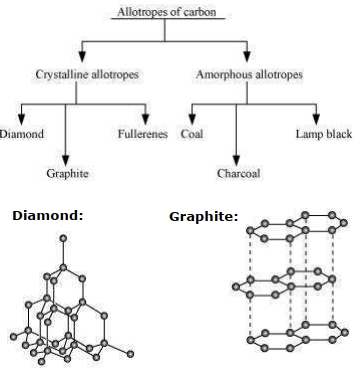
What are allotropes? Sketch the structure of two allotropes of carbon namely diamond and graphite. What is the impact of structure on physical properties of two allotropes?
Solution
(N/A) Allotropy is the existence of an element in more than one form,having the same chemical properties but different physical properties. The various forms of an element are called allotropes.
Diamond:
In diamond,each carbon atom is $sp^{3}$ hybridized and bonded to four other carbon atoms in a rigid $3-D$ tetrahedral network. This structure makes it a very hard substance. In fact,diamond is one of the hardest naturally-occurring substances. It is used as an abrasive and for cutting tools.
Graphite:
It has $sp^{2}$ hybridized carbon atoms,arranged in the form of hexagonal layers. These layers are held together by weak van der Waals' forces. These layers can slide over each other,making graphite soft and slippery. Therefore,it is used as a lubricant.
Diamond:
In diamond,each carbon atom is $sp^{3}$ hybridized and bonded to four other carbon atoms in a rigid $3-D$ tetrahedral network. This structure makes it a very hard substance. In fact,diamond is one of the hardest naturally-occurring substances. It is used as an abrasive and for cutting tools.
Graphite:
It has $sp^{2}$ hybridized carbon atoms,arranged in the form of hexagonal layers. These layers are held together by weak van der Waals' forces. These layers can slide over each other,making graphite soft and slippery. Therefore,it is used as a lubricant.
0 likes
View Solution369
Medium
$(a)$ Classify the following oxides as neutral,acidic,basic,or amphoteric:
$CO, B_2O_3, SiO_2, CO_2, Al_2O_3, PbO_2, Tl_2O_3$
$(b)$ Write suitable chemical equations to show their nature.
$CO, B_2O_3, SiO_2, CO_2, Al_2O_3, PbO_2, Tl_2O_3$
$(b)$ Write suitable chemical equations to show their nature.
Solution
(N/A) $(1)$ $CO$: Neutral
$(2)$ $B_2O_3$: Acidic. It reacts with $NaOH$ to form sodium metaborate: $B_2O_3 + 2NaOH \longrightarrow 2NaBO_2 + H_2O$
$(3)$ $SiO_2$: Acidic. It reacts with $NaOH$ to form sodium silicate: $SiO_2 + 2NaOH \longrightarrow Na_2SiO_3 + H_2O$
$(4)$ $CO_2$: Acidic. It reacts with $NaOH$ to form sodium carbonate: $CO_2 + 2NaOH \longrightarrow Na_2CO_3 + H_2O$
$(5)$ $Al_2O_3$: Amphoteric. It reacts with both $NaOH$ and $H_2SO_4$: $Al_2O_3 + 2NaOH \longrightarrow 2NaAlO_2 + H_2O$ and $Al_2O_3 + 3H_2SO_4 \longrightarrow Al_2(SO_4)_3 + 3H_2O$
$(6)$ $PbO_2$: Amphoteric. It reacts with both $NaOH$ and $H_2SO_4$: $PbO_2 + 2NaOH \longrightarrow Na_2PbO_3 + H_2O$ and $2PbO_2 + 2H_2SO_4 \longrightarrow 2PbSO_4 + 2H_2O + O_2$
$(7)$ $Tl_2O_3$: Basic. It reacts with $HCl$ to form thallium chloride: $Tl_2O_3 + 6HCl \longrightarrow 2TlCl_3 + 3H_2O$
$(2)$ $B_2O_3$: Acidic. It reacts with $NaOH$ to form sodium metaborate: $B_2O_3 + 2NaOH \longrightarrow 2NaBO_2 + H_2O$
$(3)$ $SiO_2$: Acidic. It reacts with $NaOH$ to form sodium silicate: $SiO_2 + 2NaOH \longrightarrow Na_2SiO_3 + H_2O$
$(4)$ $CO_2$: Acidic. It reacts with $NaOH$ to form sodium carbonate: $CO_2 + 2NaOH \longrightarrow Na_2CO_3 + H_2O$
$(5)$ $Al_2O_3$: Amphoteric. It reacts with both $NaOH$ and $H_2SO_4$: $Al_2O_3 + 2NaOH \longrightarrow 2NaAlO_2 + H_2O$ and $Al_2O_3 + 3H_2SO_4 \longrightarrow Al_2(SO_4)_3 + 3H_2O$
$(6)$ $PbO_2$: Amphoteric. It reacts with both $NaOH$ and $H_2SO_4$: $PbO_2 + 2NaOH \longrightarrow Na_2PbO_3 + H_2O$ and $2PbO_2 + 2H_2SO_4 \longrightarrow 2PbSO_4 + 2H_2O + O_2$
$(7)$ $Tl_2O_3$: Basic. It reacts with $HCl$ to form thallium chloride: $Tl_2O_3 + 6HCl \longrightarrow 2TlCl_3 + 3H_2O$
0 likes
View Solution370
Medium
What do you understand by $(a)$ inert pair effect,$(b)$ allotropy,and $(c)$ catenation?
Solution
(N/A) Inert pair effect: As one moves down the group,the tendency of $ns^{2}$ electrons to participate in chemical bonding decreases due to poor shielding by $d$- and $f$-electrons. This makes the lower oxidation state (group valency $- 2$) more stable.
$(b)$ Allotropy: It is the property of an element to exist in more than one physical form while maintaining the same chemical properties. These forms are called allotropes. For example,carbon exists as diamond,graphite,and fullerenes.
$(c)$ Catenation: It is the ability of atoms of an element to form strong covalent bonds with other atoms of the same element to create long chains or branched structures. This is most prominent in carbon.
$(b)$ Allotropy: It is the property of an element to exist in more than one physical form while maintaining the same chemical properties. These forms are called allotropes. For example,carbon exists as diamond,graphite,and fullerenes.
$(c)$ Catenation: It is the ability of atoms of an element to form strong covalent bonds with other atoms of the same element to create long chains or branched structures. This is most prominent in carbon.
0 likes
View Solution371
Medium
Give one method for industrial preparation and one for laboratory preparation of $CO$ and $CO_{2}$ each.
Solution
(N/A) Carbon monoxide $(CO)$:
- Industrial preparation: $CO$ is prepared by passing steam over hot coke at high temperatures (Water gas production).
$C_{(s)} + H_{2}O_{(g)} \xrightarrow{1273 \ K} CO_{(g)} + H_{2(g)}$
- Laboratory preparation: $CO$ is prepared by the dehydration of formic acid $(HCOOH)$ with concentrated $H_{2}SO_{4}$ at $373 \ K$.
$HCOOH \xrightarrow{conc. H_{2}SO_{4}} CO_{(g)} + H_{2}O_{(l)}$
Carbon dioxide $(CO_{2})$:
- Industrial preparation: $CO_{2}$ is prepared by the complete combustion of carbon or carbonaceous fuels.
$C_{(s)} + O_{2(g)} \xrightarrow{\Delta} CO_{2(g)}$
- Laboratory preparation: $CO_{2}$ is prepared by the action of dilute hydrochloric acid on calcium carbonate $(CaCO_{3})$.
$CaCO_{3(s)} + 2 HCl_{(aq)} \rightarrow CaCl_{2(aq)} + H_{2}O_{(l)} + CO_{2(g)}$
- Industrial preparation: $CO$ is prepared by passing steam over hot coke at high temperatures (Water gas production).
$C_{(s)} + H_{2}O_{(g)} \xrightarrow{1273 \ K} CO_{(g)} + H_{2(g)}$
- Laboratory preparation: $CO$ is prepared by the dehydration of formic acid $(HCOOH)$ with concentrated $H_{2}SO_{4}$ at $373 \ K$.
$HCOOH \xrightarrow{conc. H_{2}SO_{4}} CO_{(g)} + H_{2}O_{(l)}$
Carbon dioxide $(CO_{2})$:
- Industrial preparation: $CO_{2}$ is prepared by the complete combustion of carbon or carbonaceous fuels.
$C_{(s)} + O_{2(g)} \xrightarrow{\Delta} CO_{2(g)}$
- Laboratory preparation: $CO_{2}$ is prepared by the action of dilute hydrochloric acid on calcium carbonate $(CaCO_{3})$.
$CaCO_{3(s)} + 2 HCl_{(aq)} \rightarrow CaCl_{2(aq)} + H_{2}O_{(l)} + CO_{2(g)}$
0 likes
View Solution372
EasyMCQ
Elements of group $14$:
A
exhibit oxidation state of $+4$ only
B
exhibit oxidation state of $+2$ and $+4$
C
form $M^{2-}$ and $M^{4+}$ ions
D
form $M^{2+}$ and $M^{4+}$ ions
Solution
(B) The elements of group $14$ have $4$ valence electrons in their outermost shell $(ns^2 np^2)$.
Therefore,they typically exhibit $+4$ and $+2$ oxidation states.
Due to the inert pair effect,the stability of the $+2$ oxidation state increases down the group,while the stability of the $+4$ oxidation state decreases.
Therefore,they typically exhibit $+4$ and $+2$ oxidation states.
Due to the inert pair effect,the stability of the $+2$ oxidation state increases down the group,while the stability of the $+4$ oxidation state decreases.
| Group $14$ element | Oxidation state |
| $C$ | $+4$ |
| $Si$ | $+4$ |
| $Ge, Sn, Pb$ | $+2, +4$ |
0 likes
View Solution373
Medium
Carbon monoxide gas is more dangerous than carbon dioxide gas. Why?
Solution
(N/A) $CO$ and $CO_{2}$ gases are released by the burning of various types of fuel. Carbon monoxide is poisonous,whereas carbon dioxide is not poisonous in its nature.
Carbon monoxide reacts with hemoglobin in the blood to produce a carboxyhemoglobin complex. This complex is about $300$ times more stable than the oxygen-hemoglobin complex (oxyhemoglobin).
Carboxyhemoglobin,even at a concentration of $3-4 \%$,significantly reduces the oxygen-carrying capacity of the blood.
This oxygen deficiency leads to symptoms such as headaches,weak eyesight,nervousness,and cardiovascular disorders. Due to the increase in its proportion in the blood,the death rate is high. In contrast,carbon dioxide is non-poisonous,although its high concentration in the atmosphere is harmful due to the greenhouse effect.
Carbon monoxide reacts with hemoglobin in the blood to produce a carboxyhemoglobin complex. This complex is about $300$ times more stable than the oxygen-hemoglobin complex (oxyhemoglobin).
Carboxyhemoglobin,even at a concentration of $3-4 \%$,significantly reduces the oxygen-carrying capacity of the blood.
This oxygen deficiency leads to symptoms such as headaches,weak eyesight,nervousness,and cardiovascular disorders. Due to the increase in its proportion in the blood,the death rate is high. In contrast,carbon dioxide is non-poisonous,although its high concentration in the atmosphere is harmful due to the greenhouse effect.
0 likes
View Solution374
EasyMCQ
What are the properties of carbon nanotubes?
A
Stronger than steel
B
Lighter than aluminum
C
Better conductivity than copper
D
All of the above
Solution
(D) Carbon nanotubes possess unique properties: they are stronger than $steel$,lighter than $aluminum$,and exhibit higher electrical conductivity than $copper$.
0 likes
View Solution375
Difficult
Give a brief account of the production of cement and write its properties and uses.
Solution
(N/A) The raw materials for the manufacture of cement are limestone and clay. When clay and lime are strongly heated together,they fuse and react to form 'cement clinker'.
This clinker is mixed with $2-3 \%$ by weight of gypsum $(CaSO_{4} \cdot 2H_{2}O)$ to form cement.
Thus,the important ingredients present in Portland cement are dicalcium silicate $(Ca_{2}SiO_{4})$ $(26 \%)$,tricalcium silicate $(Ca_{3}SiO_{5})$ $(51 \%)$,and tricalcium aluminate $(Ca_{3}Al_{2}O_{6})$ $(11 \%)$.
Properties (Setting of Cement): When mixed with water,the setting of cement takes place to give a hard mass. This is due to the hydration of the molecules of the constituents and their rearrangement. The purpose of adding gypsum is to slow down the process of setting of the cement so that it gets sufficiently hardened.
Uses: Cement is a commodity of national necessity,second only to iron and steel. It is used in concrete and reinforced concrete,in plastering,and in the construction of bridges,dams,and buildings.
This clinker is mixed with $2-3 \%$ by weight of gypsum $(CaSO_{4} \cdot 2H_{2}O)$ to form cement.
Thus,the important ingredients present in Portland cement are dicalcium silicate $(Ca_{2}SiO_{4})$ $(26 \%)$,tricalcium silicate $(Ca_{3}SiO_{5})$ $(51 \%)$,and tricalcium aluminate $(Ca_{3}Al_{2}O_{6})$ $(11 \%)$.
Properties (Setting of Cement): When mixed with water,the setting of cement takes place to give a hard mass. This is due to the hydration of the molecules of the constituents and their rearrangement. The purpose of adding gypsum is to slow down the process of setting of the cement so that it gets sufficiently hardened.
Uses: Cement is a commodity of national necessity,second only to iron and steel. It is used in concrete and reinforced concrete,in plastering,and in the construction of bridges,dams,and buildings.
0 likes
View Solution376
Medium
Explain the origin and sources of group $14$ elements.
Solution
(N/A) The members of group $14$ are carbon $(C)$,silicon $(Si)$,germanium $(Ge)$,tin $(Sn)$,lead $(Pb)$,and flerovium $(Fl)$.
$C$: Carbon is the $17^{th}$ most abundant element by mass in the earth's crust. It exists in nature in both free and combined states.
In its elemental form,it is found as coal,graphite,and diamond. In its combined state,it exists as metal carbonates,hydrocarbons,and carbon dioxide gas $(0.03 \%)$ in the atmosphere.
Carbon is a highly versatile element,forming compounds with dihydrogen,dioxygen,chlorine,and sulphur,which are essential for living tissues,drugs,and plastics.
Organic chemistry is the study of carbon-containing compounds. Naturally occurring carbon has two stable isotopes,${}^{12}C$ and ${}^{13}C$,and one radioactive isotope,${}^{14}C$,which has a half-life of $5770 \ years$ and is used for radiocarbon dating.
$Si$: Silicon is the second most abundant element ($27.7 \%$ by mass) in the earth's crust,found primarily as silica and silicates. It is a vital component of ceramics,glass,and cement.
$Ge$: Germanium exists only in trace amounts.
$Sn$: Tin $(Sn)$ occurs mainly as the ore cassiterite $(SnO_{2})$.
$Pb$: Lead $(Pb)$ is primarily found as the ore galena $(PbS)$.
$Fl$: Flerovium is a synthetic,radioactive element.
$C$: Carbon is the $17^{th}$ most abundant element by mass in the earth's crust. It exists in nature in both free and combined states.
In its elemental form,it is found as coal,graphite,and diamond. In its combined state,it exists as metal carbonates,hydrocarbons,and carbon dioxide gas $(0.03 \%)$ in the atmosphere.
Carbon is a highly versatile element,forming compounds with dihydrogen,dioxygen,chlorine,and sulphur,which are essential for living tissues,drugs,and plastics.
Organic chemistry is the study of carbon-containing compounds. Naturally occurring carbon has two stable isotopes,${}^{12}C$ and ${}^{13}C$,and one radioactive isotope,${}^{14}C$,which has a half-life of $5770 \ years$ and is used for radiocarbon dating.
$Si$: Silicon is the second most abundant element ($27.7 \%$ by mass) in the earth's crust,found primarily as silica and silicates. It is a vital component of ceramics,glass,and cement.
$Ge$: Germanium exists only in trace amounts.
$Sn$: Tin $(Sn)$ occurs mainly as the ore cassiterite $(SnO_{2})$.
$Pb$: Lead $(Pb)$ is primarily found as the ore galena $(PbS)$.
$Fl$: Flerovium is a synthetic,radioactive element.
0 likes
View Solution377
Medium
Explain the physical properties of group $14$ elements.
Solution
(N/A) Electronic Configuration: The valence shell electronic configuration of these elements is $ns^{2} np^{2}$.
Covalent Radius: There is a considerable increase in covalent radius from $C$ to $Si$,thereafter from $Si$ to $Pb$ a small increase in radius is observed. This is due to the presence of completely filled $d$ and $f$ orbitals in heavier members.
Ionization Enthalpy: The first ionization enthalpy of group $14$ members is higher than the corresponding members of group $13$. The influence of inner core electrons is visible here also. In general,the ionization enthalpy decreases down the group. $A$ small decrease in $\Delta_{i}H$ from $Si$ to $Ge$ to $Sn$ and a slight increase in $\Delta_{i}H$ from $Sn$ to $Pb$ is the consequence of the poor shielding effect of intervening $d$ and $f$ orbitals and the increase in the size of the atom.
Electronegativity: Due to their small size,the elements of this group are slightly more electronegative than group $13$ elements. The electronegativity values for elements from $Si$ to $Pb$ are almost the same.
Covalent Radius: There is a considerable increase in covalent radius from $C$ to $Si$,thereafter from $Si$ to $Pb$ a small increase in radius is observed. This is due to the presence of completely filled $d$ and $f$ orbitals in heavier members.
Ionization Enthalpy: The first ionization enthalpy of group $14$ members is higher than the corresponding members of group $13$. The influence of inner core electrons is visible here also. In general,the ionization enthalpy decreases down the group. $A$ small decrease in $\Delta_{i}H$ from $Si$ to $Ge$ to $Sn$ and a slight increase in $\Delta_{i}H$ from $Sn$ to $Pb$ is the consequence of the poor shielding effect of intervening $d$ and $f$ orbitals and the increase in the size of the atom.
Electronegativity: Due to their small size,the elements of this group are slightly more electronegative than group $13$ elements. The electronegativity values for elements from $Si$ to $Pb$ are almost the same.
0 likes
View Solution378
Easy
Explain the oxidation states of group $14$ elements.
Solution
(A) The group $14$ elements have four electrons in their outermost shell $(ns^{2}np^{2})$. The common oxidation states exhibited by these elements are $+4$ and $+2$.
Carbon also exhibits negative oxidation states. Since the sum of the first four ionization enthalpies is very high,compounds in the $+4$ oxidation state are generally covalent in nature.
In heavier members,the tendency to show the $+2$ oxidation state increases in the sequence $Ge < Sn < Pb$. This is due to the inert pair effect,which is the inability of $ns^{2}$ electrons of the valence shell to participate in bonding.
The relative stabilities of these two oxidation states vary down the group. Carbon and silicon mostly show the $+4$ oxidation state. Germanium forms stable compounds in the $+4$ state and only a few compounds in the $+2$ state.
Tin forms compounds in both oxidation states ($Sn^{2+}$ acts as a reducing agent). Lead compounds in the $+2$ state are stable,while those in the $+4$ state are strong oxidizing agents.
In the tetravalent state,the number of electrons around the central atom in a molecule (e.g.,carbon in $CCl_{4}$) is eight. Being electron-precise molecules,they are normally not expected to act as electron acceptors or electron donors.
Although carbon cannot exceed its covalence of $4$,other elements of the group can do so due to the presence of vacant $d$-orbitals. Consequently,their halides undergo hydrolysis and they have a tendency to form complexes by accepting electron pairs from donor species.
For example,species like $SiF_{6}^{2-}$,$[GeCl_{6}]^{2-}$,and $[Sn(OH)_{6}]^{2-}$ exist,where the hybridization of the central atom is $sp^{3}d^{2}$.
Carbon also exhibits negative oxidation states. Since the sum of the first four ionization enthalpies is very high,compounds in the $+4$ oxidation state are generally covalent in nature.
In heavier members,the tendency to show the $+2$ oxidation state increases in the sequence $Ge < Sn < Pb$. This is due to the inert pair effect,which is the inability of $ns^{2}$ electrons of the valence shell to participate in bonding.
The relative stabilities of these two oxidation states vary down the group. Carbon and silicon mostly show the $+4$ oxidation state. Germanium forms stable compounds in the $+4$ state and only a few compounds in the $+2$ state.
Tin forms compounds in both oxidation states ($Sn^{2+}$ acts as a reducing agent). Lead compounds in the $+2$ state are stable,while those in the $+4$ state are strong oxidizing agents.
In the tetravalent state,the number of electrons around the central atom in a molecule (e.g.,carbon in $CCl_{4}$) is eight. Being electron-precise molecules,they are normally not expected to act as electron acceptors or electron donors.
Although carbon cannot exceed its covalence of $4$,other elements of the group can do so due to the presence of vacant $d$-orbitals. Consequently,their halides undergo hydrolysis and they have a tendency to form complexes by accepting electron pairs from donor species.
For example,species like $SiF_{6}^{2-}$,$[GeCl_{6}]^{2-}$,and $[Sn(OH)_{6}]^{2-}$ exist,where the hybridization of the central atom is $sp^{3}d^{2}$.
0 likes
View Solution379
Medium
Explain the reactivity of group $14$ elements towards oxygen.
Solution
(N/A) All members of group $14$ form oxides when heated in oxygen. They mainly form two types of oxides: monoxides $(MO)$ and dioxides $(MO_{2})$.
$SiO$ exists only at high temperatures.
Generally,oxides in higher oxidation states are more acidic than those in lower oxidation states.
Acidic oxides: $CO_{2}, SiO_{2}, GeO_{2}$.
Amphoteric oxides: $SnO_{2}, PbO_{2}$.
Among monoxides,$CO$ is neutral,$GeO$ is acidic,while $SnO$ and $PbO$ are amphoteric.
$SiO$ exists only at high temperatures.
Generally,oxides in higher oxidation states are more acidic than those in lower oxidation states.
Acidic oxides: $CO_{2}, SiO_{2}, GeO_{2}$.
Amphoteric oxides: $SnO_{2}, PbO_{2}$.
Among monoxides,$CO$ is neutral,$GeO$ is acidic,while $SnO$ and $PbO$ are amphoteric.
0 likes
View Solution380
Difficult
Discuss the reactivity of group $14$ elements towards water and halogens.
Solution
(N/A) Reactivity towards water:
Carbon,silicon,and germanium are not affected by water. Tin decomposes steam to form dioxide and dihydrogen gas:
$Sn + 2H_2O \xrightarrow{\Delta} SnO_2 + 2H_2$
Lead is unaffected by water,likely due to the formation of a protective oxide film.
Reactivity towards halogens:
- These elements form halides with the general formulas $MX_2$ and $MX_4$ (where $X = F, Cl, Br, I$).
- Except for carbon,all other members react directly with halogens under suitable conditions to form halides. Most $MX_4$ halides are covalent.
- The central metal atom in these halides typically undergoes $sp^3$ hybridization,resulting in a tetrahedral geometry. Exceptions include $SnF_4$ and $PbF_4$,which are ionic.
- $PbI_4$ does not exist because the $Pb-I$ bond energy is insufficient to unpair the $6s^2$ electrons and promote one to a higher orbital to achieve four unpaired electrons.
- Heavier members ($Ge$ to $Pb$) can form $MX_2$ halides,with the stability of dihalides increasing down the group.
- Regarding thermal and chemical stability,$GeX_4$ is more stable than $GeX_2$,whereas $PbX_2$ is more stable than $PbX_4$. Except for $CCl_4$,other tetrachlorides are easily hydrolyzed by water because the central atom can accommodate the lone pair of electrons from the water molecule in its vacant $d$-orbitals.
- Hydrolysis can be illustrated by $SiCl_4$,which reacts by accepting a lone pair of electrons from water into its $d$-orbitals,ultimately forming $Si(OH)_4$:
$SiCl_4 + 4H_2O \rightarrow Si(OH)_4 + 4HCl$
Carbon,silicon,and germanium are not affected by water. Tin decomposes steam to form dioxide and dihydrogen gas:
$Sn + 2H_2O \xrightarrow{\Delta} SnO_2 + 2H_2$
Lead is unaffected by water,likely due to the formation of a protective oxide film.
Reactivity towards halogens:
- These elements form halides with the general formulas $MX_2$ and $MX_4$ (where $X = F, Cl, Br, I$).
- Except for carbon,all other members react directly with halogens under suitable conditions to form halides. Most $MX_4$ halides are covalent.
- The central metal atom in these halides typically undergoes $sp^3$ hybridization,resulting in a tetrahedral geometry. Exceptions include $SnF_4$ and $PbF_4$,which are ionic.
- $PbI_4$ does not exist because the $Pb-I$ bond energy is insufficient to unpair the $6s^2$ electrons and promote one to a higher orbital to achieve four unpaired electrons.
- Heavier members ($Ge$ to $Pb$) can form $MX_2$ halides,with the stability of dihalides increasing down the group.
- Regarding thermal and chemical stability,$GeX_4$ is more stable than $GeX_2$,whereas $PbX_2$ is more stable than $PbX_4$. Except for $CCl_4$,other tetrachlorides are easily hydrolyzed by water because the central atom can accommodate the lone pair of electrons from the water molecule in its vacant $d$-orbitals.
- Hydrolysis can be illustrated by $SiCl_4$,which reacts by accepting a lone pair of electrons from water into its $d$-orbitals,ultimately forming $Si(OH)_4$:
$SiCl_4 + 4H_2O \rightarrow Si(OH)_4 + 4HCl$
0 likes
View Solution381
Medium
$(a)$ Classify the following oxides as neutral,acidic,basic,or amphoteric:
$CO, B_2O_3, SiO_2, CO_2, Al_2O_3, PbO_2, Tl_2O_3$
$(b)$ Write suitable chemical equations to show their nature.
$CO, B_2O_3, SiO_2, CO_2, Al_2O_3, PbO_2, Tl_2O_3$
$(b)$ Write suitable chemical equations to show their nature.
Solution
(N/A) Neutral oxide: $CO$
Acidic oxides: $B_2O_3, SiO_2, CO_2$
Amphoteric oxides: $Al_2O_3, PbO_2$
Basic oxide: $Tl_2O_3$
$(b)$ $(i)$ Acidic oxides $(B_2O_3, SiO_2, CO_2)$ react with bases:
$B_2O_3 + 2 NaOH \rightarrow 2 NaBO_2 + H_2O$
$SiO_2 + 2 NaOH \rightarrow Na_2SiO_3 + H_2O$
$CO_2 + 2 NaOH \rightarrow Na_2CO_3 + H_2O$
$(ii)$ Amphoteric oxides $(Al_2O_3, PbO_2)$ react with both acids and bases:
$Al_2O_3 + 2 NaOH \rightarrow 2 NaAlO_2 + H_2O$
$Al_2O_3 + 3 H_2SO_4 \rightarrow Al_2(SO_4)_3 + 3 H_2O$
$PbO_2 + 2 NaOH \rightarrow Na_2PbO_3 + H_2O$
$(iii)$ Basic oxide $(Tl_2O_3)$ reacts with acids:
$Tl_2O_3 + 6 HCl \rightarrow 2 TlCl_3 + 3 H_2O$
Acidic oxides: $B_2O_3, SiO_2, CO_2$
Amphoteric oxides: $Al_2O_3, PbO_2$
Basic oxide: $Tl_2O_3$
$(b)$ $(i)$ Acidic oxides $(B_2O_3, SiO_2, CO_2)$ react with bases:
$B_2O_3 + 2 NaOH \rightarrow 2 NaBO_2 + H_2O$
$SiO_2 + 2 NaOH \rightarrow Na_2SiO_3 + H_2O$
$CO_2 + 2 NaOH \rightarrow Na_2CO_3 + H_2O$
$(ii)$ Amphoteric oxides $(Al_2O_3, PbO_2)$ react with both acids and bases:
$Al_2O_3 + 2 NaOH \rightarrow 2 NaAlO_2 + H_2O$
$Al_2O_3 + 3 H_2SO_4 \rightarrow Al_2(SO_4)_3 + 3 H_2O$
$PbO_2 + 2 NaOH \rightarrow Na_2PbO_3 + H_2O$
$(iii)$ Basic oxide $(Tl_2O_3)$ reacts with acids:
$Tl_2O_3 + 6 HCl \rightarrow 2 TlCl_3 + 3 H_2O$
0 likes
View Solution382
Medium
Why does carbon differ from the rest of the members of its group? Explain.
Solution
(A) Like the first member of other groups,carbon also differs from the rest of the members of its group. This is due to its smaller size,higher electronegativity,higher ionization enthalpy,and the unavailability of $d$-orbitals.
In carbon,only $s$ and $p$-orbitals are available for bonding,and therefore,it can accommodate only four pairs of electrons around it.
This limits the maximum covalence to four,whereas other members can expand their covalence due to the presence of $d$-orbitals.
Carbon also has a unique ability to form $p\pi-p\pi$ multiple bonds with itself and with other atoms of small size and high electronegativity. Examples of multiple bonding include $C=C$,$C \equiv C$,$C=O$,$C=S$,and $C \equiv N$.
Heavier elements do not form $p\pi-p\pi$ bonds because their atomic orbitals are too large and diffuse to have effective overlapping.
Carbon atoms have the tendency to link with one another through covalent bonds to form chains and rings. This property is called catenation.
This is because $C-C$ bonds are very strong. Down the group,the size increases and electronegativity decreases,and thereby,the tendency to show catenation decreases. This can be clearly seen from bond enthalpy values.
The order of catenation is $C \gg Si > Ge \approx Sn$. Lead does not show catenation. Due to the property of catenation and $p\pi-p\pi$ bond formation,carbon is able to show allotropic forms.
In carbon,only $s$ and $p$-orbitals are available for bonding,and therefore,it can accommodate only four pairs of electrons around it.
This limits the maximum covalence to four,whereas other members can expand their covalence due to the presence of $d$-orbitals.
Carbon also has a unique ability to form $p\pi-p\pi$ multiple bonds with itself and with other atoms of small size and high electronegativity. Examples of multiple bonding include $C=C$,$C \equiv C$,$C=O$,$C=S$,and $C \equiv N$.
Heavier elements do not form $p\pi-p\pi$ bonds because their atomic orbitals are too large and diffuse to have effective overlapping.
Carbon atoms have the tendency to link with one another through covalent bonds to form chains and rings. This property is called catenation.
This is because $C-C$ bonds are very strong. Down the group,the size increases and electronegativity decreases,and thereby,the tendency to show catenation decreases. This can be clearly seen from bond enthalpy values.
The order of catenation is $C \gg Si > Ge \approx Sn$. Lead does not show catenation. Due to the property of catenation and $p\pi-p\pi$ bond formation,carbon is able to show allotropic forms.
| Bond | $C-C$ | $Si-Si$ | $Ge-Ge$ | $Sn-Sn$ |
| Bond enthalpy $(kJ \ mol^{-1})$ | $348$ | $297$ | $260$ | $240$ |
0 likes
View Solution383
Medium
What do you understand by $(a)$ inert pair effect,$(b)$ allotropy,and $(c)$ catenation?
Solution
(N/A) Inert pair effect: As one moves down the group,the tendency of $ns^2$ electrons to participate in chemical bonding decreases. This effect is known as the inert pair effect. In group $13$ to $16$ elements,the $ns^2$ electrons are held tightly by the nucleus due to poor shielding by $d$- and $f$-electrons,making them less available for bonding.
$(b)$ Allotropy: Allotropy is the existence of an element in more than one form,having the same chemical properties but different physical properties. The various forms of an element are called allotropes. For example,carbon exists in allotropic forms like diamond,graphite,and fullerenes.
$(c)$ Catenation: The ability of atoms of an element to link with one another through strong covalent bonds to form long chains or branched structures is known as catenation. It is most prominent in carbon and significant in $Si$ and $S$.
$(b)$ Allotropy: Allotropy is the existence of an element in more than one form,having the same chemical properties but different physical properties. The various forms of an element are called allotropes. For example,carbon exists in allotropic forms like diamond,graphite,and fullerenes.
$(c)$ Catenation: The ability of atoms of an element to link with one another through strong covalent bonds to form long chains or branched structures is known as catenation. It is most prominent in carbon and significant in $Si$ and $S$.
0 likes
View Solution384
Medium
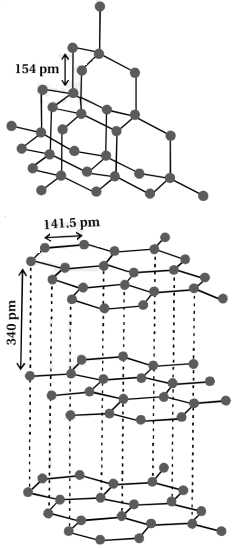
Explain the structures of diamond and graphite.
Solution
(N/A) Diamond has a crystalline lattice. In diamond, each carbon atom undergoes $sp^{3}$ hybridisation and is linked to four other carbon atoms using hybridised orbitals in a tetrahedral fashion.
The $C-C$ bond length is $154 \ pm$. The structure extends in space and produces a rigid three-dimensional network of carbon atoms.
In this structure, directional covalent bonds are present throughout the lattice. It is very difficult to break this extended covalent bonding, and therefore, diamond is the hardest substance on Earth.
Uses: It is used as an abrasive for sharpening hard tools, in making dies, and in the manufacture of tungsten filaments for electric light bulbs.
Graphite has a layered structure.
Layers are held by van der Waals forces, and the distance between two layers is $340 \ pm$.
Each layer is composed of planar hexagonal rings of carbon atoms. The $C-C$ bond length within the layer is $141.5 \ pm$.
Each carbon atom in the hexagonal ring undergoes $sp^{2}$ hybridisation and makes three sigma bonds with three neighbouring carbon atoms.
The fourth electron forms a $\pi$-bond. The electrons are delocalised over the whole sheet. These electrons are mobile, and therefore, graphite conducts electricity along the sheet.
Graphite cleaves easily between the layers, and therefore, it is very soft and slippery. For this reason, graphite is used as a dry lubricant in machines running at high temperatures, where oil cannot be used as a lubricant.
The $C-C$ bond length is $154 \ pm$. The structure extends in space and produces a rigid three-dimensional network of carbon atoms.
In this structure, directional covalent bonds are present throughout the lattice. It is very difficult to break this extended covalent bonding, and therefore, diamond is the hardest substance on Earth.
Uses: It is used as an abrasive for sharpening hard tools, in making dies, and in the manufacture of tungsten filaments for electric light bulbs.
Graphite has a layered structure.
Layers are held by van der Waals forces, and the distance between two layers is $340 \ pm$.
Each layer is composed of planar hexagonal rings of carbon atoms. The $C-C$ bond length within the layer is $141.5 \ pm$.
Each carbon atom in the hexagonal ring undergoes $sp^{2}$ hybridisation and makes three sigma bonds with three neighbouring carbon atoms.
The fourth electron forms a $\pi$-bond. The electrons are delocalised over the whole sheet. These electrons are mobile, and therefore, graphite conducts electricity along the sheet.
Graphite cleaves easily between the layers, and therefore, it is very soft and slippery. For this reason, graphite is used as a dry lubricant in machines running at high temperatures, where oil cannot be used as a lubricant.
0 likes
View Solution385
Easy
Give reasons: $A$ mixture of dilute $NaOH$ and aluminium pieces is used to open blocked drains.
Solution
(N/A) Sodium hydroxide and aluminium react to form sodium aluminate $(NaAlO_2)$ and hydrogen gas. The rapid evolution of hydrogen gas creates high pressure,which helps to clear the blockage in the drains.
The chemical reaction is:
$2 Al_{(s)} + 2 NaOH_{(aq)} + 2 H_2O_{(l)} \rightarrow 2 NaAlO_{2(aq)} + 3 H_{2(g)}$
The chemical reaction is:
$2 Al_{(s)} + 2 NaOH_{(aq)} + 2 H_2O_{(l)} \rightarrow 2 NaAlO_{2(aq)} + 3 H_{2(g)}$
0 likes
View Solution386
Easy
Give reasons: Diamond is used as an abrasive.
Solution
(N/A) In diamond,each carbon atom is $sp^{3}$ hybridized and bonded to four other carbon atoms through strong covalent bonds. These bonds extend throughout the crystal lattice,creating a highly rigid $3-D$ network structure. Due to this extended covalent bonding,diamond is the hardest known natural substance,making it suitable for use as an abrasive and in cutting tools.
0 likes
View Solution387
Medium
Explain the difference in properties of diamond and graphite on the basis of their structures.
Solution
(N/A)
| $Diamond$ | $Graphite$ |
| It has a three-dimensional crystalline lattice. | It has a two-dimensional layered structure. |
| Each carbon atom is $sp^3$ hybridized and bonded to four other carbon atoms in a tetrahedral arrangement. | Each carbon atom is $sp^2$ hybridized and bonded to three other carbon atoms in a planar hexagonal arrangement. |
| The $C-C$ bond length is $154 \ pm$. | The $C-C$ bond length within the layers is $141.5 \ pm$. |
| It acts as an electrical insulator because all valence electrons are involved in strong covalent bonds. | It is a good conductor of electricity due to the presence of free electrons in the delocalized $\pi$-system. |
| It has a rigid,hard covalent network structure. | It is soft and slippery because the layers are held together by weak van der Waals forces. |
| Used as an abrasive for sharpening hard tools. | Used as a dry lubricant in machines operating at high temperatures. |
0 likes
View Solution388
Advanced
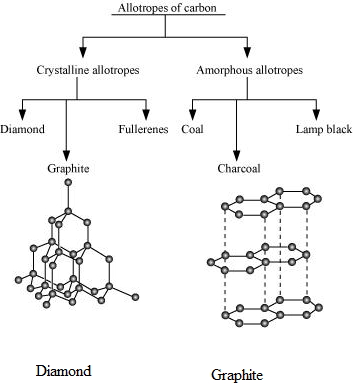
What are allotropes? Sketch the structure of two allotropes of carbon namely diamond and graphite. What is the impact of structure on physical properties of these two allotropes?
Solution
(N/A) The existence of an element in more than one form,having the same chemical properties but different physical properties is called allotropy. The various forms of an element are called allotropes.
Diamond has a rigid $3-D$ structure and is the hardest known substance. It is used as an abrasive and for cutting tools.
The carbon atom in diamond is $sp^3$ hybridized and forms strong covalent bonds with $4$ other carbon atoms.
Graphite is soft and slippery as it has a layered structure in which different layers are bonded to each other by weak Van der Waals forces and can slide over each other.
Hence,it is used as a lubricant.
Diamond has a rigid $3-D$ structure and is the hardest known substance. It is used as an abrasive and for cutting tools.
The carbon atom in diamond is $sp^3$ hybridized and forms strong covalent bonds with $4$ other carbon atoms.
Graphite is soft and slippery as it has a layered structure in which different layers are bonded to each other by weak Van der Waals forces and can slide over each other.
Hence,it is used as a lubricant.
0 likes
View Solution389
Difficult
Explain fullerenes.
Solution
(N/A) Fullerenes are prepared by heating graphite in an electric arc in the presence of inert gases such as helium or argon.
The sooty material formed by the condensation of vaporized $C_{n}$ small molecules consists mainly of $C_{60}$ with smaller quantities of $C_{70}$ and traces of fullerenes consisting of an even number of carbon atoms up to $350$ or above.
Fullerenes are considered the only pure form of carbon because they have a smooth structure without any 'dangling' bonds.
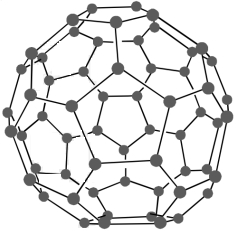
Fullerenes are cage-like molecules. The $C_{60}$ molecule has a shape like a soccer ball and is called Buckminsterfullerene.
It contains $20$ six-membered rings and $12$ five-membered rings.
$A$ six-membered ring can be fused with six- or five-membered rings,but a five-membered ring can only be fused with six-membered rings.
All the carbon atoms are equivalent and undergo $sp^{2}$ hybridization.
Each carbon atom forms three sigma bonds with three other carbon atoms. The remaining electron at each carbon is delocalized in molecular orbitals,which gives aromatic character to the molecule.
This ball-shaped molecule has $60$ vertices,each occupied by one carbon atom. It contains both single and double bonds with $C-C$ distances of $143.5 \text{ pm}$ and $138.3 \text{ pm}$ respectively. Spherical fullerenes are also called buckyballs.
The sooty material formed by the condensation of vaporized $C_{n}$ small molecules consists mainly of $C_{60}$ with smaller quantities of $C_{70}$ and traces of fullerenes consisting of an even number of carbon atoms up to $350$ or above.
Fullerenes are considered the only pure form of carbon because they have a smooth structure without any 'dangling' bonds.
Fullerenes are cage-like molecules. The $C_{60}$ molecule has a shape like a soccer ball and is called Buckminsterfullerene.
It contains $20$ six-membered rings and $12$ five-membered rings.
$A$ six-membered ring can be fused with six- or five-membered rings,but a five-membered ring can only be fused with six-membered rings.
All the carbon atoms are equivalent and undergo $sp^{2}$ hybridization.
Each carbon atom forms three sigma bonds with three other carbon atoms. The remaining electron at each carbon is delocalized in molecular orbitals,which gives aromatic character to the molecule.
This ball-shaped molecule has $60$ vertices,each occupied by one carbon atom. It contains both single and double bonds with $C-C$ distances of $143.5 \text{ pm}$ and $138.3 \text{ pm}$ respectively. Spherical fullerenes are also called buckyballs.
0 likes
View Solution390
Medium
Give uses of Carbon and its compounds.
Solution
(N/A) Carbon dioxide $(CO_{2})$ can be obtained as a solid in the form of dry ice by allowing liquefied $CO_{2}$ to expand rapidly.
$CO_{2}$ is neither combustible nor a supporter of combustion; therefore,it is used as a fire extinguisher.
Dry ice is used as a refrigerant for ice cream and frozen food. $CO_{2}$ is used in the manufacturing of washing soda (Solvay's Process).
Dry ice is used in the treatment of local burns and in hospitals for the surgical operation of sores.
$CO_{2}$ is used as carbogen $(95\% \ O_{2} + 5\% \ CO_{2})$ in artificial respiration to treat the poisonous effect of $CO$ in patients.
$CO_{2}$ is used for the purification of cane sugar juice in the manufacturing of sugar.
The $(H_{2}CO_{3} / HCO_{3}^{-})$ buffer system helps to maintain the $pH$ of blood between $7.26$ and $7.42$.
$A$ substantial amount of $CO_{2}$ is used to manufacture urea.
$CO_{2}$ is essential for photosynthesis in green plants.
$CO_{2}$ is neither combustible nor a supporter of combustion; therefore,it is used as a fire extinguisher.
Dry ice is used as a refrigerant for ice cream and frozen food. $CO_{2}$ is used in the manufacturing of washing soda (Solvay's Process).
Dry ice is used in the treatment of local burns and in hospitals for the surgical operation of sores.
$CO_{2}$ is used as carbogen $(95\% \ O_{2} + 5\% \ CO_{2})$ in artificial respiration to treat the poisonous effect of $CO$ in patients.
$CO_{2}$ is used for the purification of cane sugar juice in the manufacturing of sugar.
The $(H_{2}CO_{3} / HCO_{3}^{-})$ buffer system helps to maintain the $pH$ of blood between $7.26$ and $7.42$.
$A$ substantial amount of $CO_{2}$ is used to manufacture urea.
$CO_{2}$ is essential for photosynthesis in green plants.
0 likes
View Solution391
Difficult
Give the preparation of carbon monoxide. Explain the properties of carbon monoxide and give its uses.
Solution
(A) $(i)$ Direct oxidation of $C$ in limited supply of oxygen or air yields carbon monoxide: $C + \frac{1}{2} O_{2} \xrightarrow{\Delta} CO$.
$(ii)$ Reduction of heavy metal oxides with carbon gives $CO$: $ZnO + C \rightarrow Zn + CO$ and $Fe_{2}O_{3} + 3C \rightarrow 2Fe + 3CO$.
$(iii)$ On a small scale,pure $CO$ is prepared by dehydration of formic acid with concentrated $H_{2}SO_{4}$ at $373 \ K$: $HCOOH \xrightarrow[\text{Conc. } H_{2}SO_{4}]{373 \ K} CO + H_{2}O$.
$(iv)$ On a commercial scale,it is prepared by the passage of steam over hot coke. The mixture of $CO$ and $H_{2}$ thus produced is known as water gas or synthesis gas: $C_{(s)} + H_{2}O_{(g)} \xrightarrow{473 \ K - 1273 \ K} CO_{(g)} + H_{2(g)}$.
When air is used instead of steam,a mixture of $CO$ and $N_{2}$ is produced,which is called producer gas: $2C_{(s)} + O_{2(g)} + 4N_{2(g)} \xrightarrow{1273 \ K} 2CO_{(g)} + 4N_{2(g)}$.
Properties and Uses: $CO$ is a colorless,odorless,and toxic gas. It acts as a powerful reducing agent and is used in the extraction of metals. Water gas and producer gas are important industrial fuels.
$(ii)$ Reduction of heavy metal oxides with carbon gives $CO$: $ZnO + C \rightarrow Zn + CO$ and $Fe_{2}O_{3} + 3C \rightarrow 2Fe + 3CO$.
$(iii)$ On a small scale,pure $CO$ is prepared by dehydration of formic acid with concentrated $H_{2}SO_{4}$ at $373 \ K$: $HCOOH \xrightarrow[\text{Conc. } H_{2}SO_{4}]{373 \ K} CO + H_{2}O$.
$(iv)$ On a commercial scale,it is prepared by the passage of steam over hot coke. The mixture of $CO$ and $H_{2}$ thus produced is known as water gas or synthesis gas: $C_{(s)} + H_{2}O_{(g)} \xrightarrow{473 \ K - 1273 \ K} CO_{(g)} + H_{2(g)}$.
When air is used instead of steam,a mixture of $CO$ and $N_{2}$ is produced,which is called producer gas: $2C_{(s)} + O_{2(g)} + 4N_{2(g)} \xrightarrow{1273 \ K} 2CO_{(g)} + 4N_{2(g)}$.
Properties and Uses: $CO$ is a colorless,odorless,and toxic gas. It acts as a powerful reducing agent and is used in the extraction of metals. Water gas and producer gas are important industrial fuels.
0 likes
View Solution392
Difficult
Suggest a reason as to why $CO$ is poisonous.
Solution
(N/A) Carbon monoxide is highly poisonous because of its ability to form a complex with hemoglobin.
The $CO-Hb$ complex is about $300$ times more stable than the $O_{2}-Hb$ complex.
This complex prevents hemoglobin from binding with oxygen.
As a result,the oxygen-carrying capacity of blood decreases,leading to suffocation and death.
The $CO-Hb$ complex is about $300$ times more stable than the $O_{2}-Hb$ complex.
This complex prevents hemoglobin from binding with oxygen.
As a result,the oxygen-carrying capacity of blood decreases,leading to suffocation and death.
0 likes
View Solution393
Medium
Describe the preparation and properties of $CO_2$.
Solution
Preparation:
$1$. By complete combustion of carbon and carbonaceous fuels in excess of air: $C(s) + O_2(g) \rightarrow CO_2(g)$.
$2$. By the action of dilute hydrochloric acid on metal carbonates: $CaCO_3(s) + 2HCl(aq) \rightarrow CaCl_2(aq) + CO_2(g) + H_2O(l)$.
Properties:
$1$. It is a colourless and odourless gas.
$2$. It is slightly soluble in water,forming carbonic acid: $H_2O(l) + CO_2(g) \rightleftharpoons H_2CO_3(aq)$.
$3$. It is acidic in nature and reacts with alkalis to form carbonates: $2NaOH(aq) + CO_2(g) \rightarrow Na_2CO_3(aq) + H_2O(l)$.
$1$. By complete combustion of carbon and carbonaceous fuels in excess of air: $C(s) + O_2(g) \rightarrow CO_2(g)$.
$2$. By the action of dilute hydrochloric acid on metal carbonates: $CaCO_3(s) + 2HCl(aq) \rightarrow CaCl_2(aq) + CO_2(g) + H_2O(l)$.
Properties:
$1$. It is a colourless and odourless gas.
$2$. It is slightly soluble in water,forming carbonic acid: $H_2O(l) + CO_2(g) \rightleftharpoons H_2CO_3(aq)$.
$3$. It is acidic in nature and reacts with alkalis to form carbonates: $2NaOH(aq) + CO_2(g) \rightarrow Na_2CO_3(aq) + H_2O(l)$.
0 likes
View Solution394
Difficult
Explain the following reactions:
$(a)$ Silicon is heated with methyl chloride at high temperature in the presence of copper.
$(b)$ Silicon dioxide is treated with hydrogen fluoride.
$(c)$ $CO$ is heated with $ZnO$.
$(d)$ Hydrated alumina is treated with aqueous $NaOH$ solution.
$(a)$ Silicon is heated with methyl chloride at high temperature in the presence of copper.
$(b)$ Silicon dioxide is treated with hydrogen fluoride.
$(c)$ $CO$ is heated with $ZnO$.
$(d)$ Hydrated alumina is treated with aqueous $NaOH$ solution.
Solution
(N/A) When silicon is heated with methyl chloride at a high temperature of $573 \ K$ in the presence of copper catalyst,a mixture of methyl-substituted chlorosilanes like $MeSiCl_3$,$Me_2SiCl_2$,$Me_3SiCl$,and $Me_4Si$ is formed.
$(b)$ Silicon dioxide reacts with hydrogen fluoride to form silicon tetrafluoride,which further reacts with excess $HF$ to form hydrofluorosilicic acid:
$SiO_2 + 4HF \rightarrow SiF_4 + 2H_2O$
$SiF_4 + 2HF \rightarrow H_2SiF_6$
$(c)$ Carbon monoxide acts as a reducing agent and reduces zinc oxide to zinc metal upon heating:
$CO + ZnO \xrightarrow{\Delta} CO_2 + Zn$
$(d)$ Hydrated alumina dissolves in aqueous $NaOH$ solution to form sodium meta-aluminate:
$Al_2O_3 \cdot 2H_2O + 2NaOH \rightarrow 2NaAlO_2 + 3H_2O$
$(b)$ Silicon dioxide reacts with hydrogen fluoride to form silicon tetrafluoride,which further reacts with excess $HF$ to form hydrofluorosilicic acid:
$SiO_2 + 4HF \rightarrow SiF_4 + 2H_2O$
$SiF_4 + 2HF \rightarrow H_2SiF_6$
$(c)$ Carbon monoxide acts as a reducing agent and reduces zinc oxide to zinc metal upon heating:
$CO + ZnO \xrightarrow{\Delta} CO_2 + Zn$
$(d)$ Hydrated alumina dissolves in aqueous $NaOH$ solution to form sodium meta-aluminate:
$Al_2O_3 \cdot 2H_2O + 2NaOH \rightarrow 2NaAlO_2 + 3H_2O$
0 likes
View Solution395
Medium
Give uses of carbon dioxide.
Solution
(N/A) $1$. It is used in fire extinguishers.
$2$. It is used for the preparation of soda water and soft drinks.
$3$. It is used for the preparation of chemicals like washing soda $(Na_2CO_3)$ and baking soda $(NaHCO_3)$.
$4$. It is used for the preparation of fertilizers like urea $(NH_2CONH_2)$.
$5$. It is used for the preparation of carbogen,which is used for artificial breathing.
$2$. It is used for the preparation of soda water and soft drinks.
$3$. It is used for the preparation of chemicals like washing soda $(Na_2CO_3)$ and baking soda $(NaHCO_3)$.
$4$. It is used for the preparation of fertilizers like urea $(NH_2CONH_2)$.
$5$. It is used for the preparation of carbogen,which is used for artificial breathing.
0 likes
View Solution396
Medium
Give one method for industrial preparation and one for laboratory preparation of $CO$ and $CO_2$ each.
Solution
(N/A) Laboratory preparation of carbon dioxide:
Calcium carbonate reacts with dil $HCl$ to form carbon dioxide.
$CaCO_3 + 2HCl \rightarrow CaCl_2 + CO_2 + H_2O$
Industrial preparation of carbon dioxide:
Limestone is heated to produce carbon dioxide.
$CaCO_3 \xrightarrow{\Delta} CaO + CO_2$
Laboratory preparation of carbon monoxide:
Formic acid is dehydrated with conc $H_2SO_4$ at $373 \ K$.
$HCOOH \xrightarrow{\text{conc } H_2SO_4, 373 \ K} H_2O + CO$
Industrial preparation of carbon monoxide:
Steam is passed over hot coke at high temperature.
$C + H_2O \xrightarrow{473-1273 \ K} CO + H_2$ (Water gas)
Calcium carbonate reacts with dil $HCl$ to form carbon dioxide.
$CaCO_3 + 2HCl \rightarrow CaCl_2 + CO_2 + H_2O$
Industrial preparation of carbon dioxide:
Limestone is heated to produce carbon dioxide.
$CaCO_3 \xrightarrow{\Delta} CaO + CO_2$
Laboratory preparation of carbon monoxide:
Formic acid is dehydrated with conc $H_2SO_4$ at $373 \ K$.
$HCOOH \xrightarrow{\text{conc } H_2SO_4, 373 \ K} H_2O + CO$
Industrial preparation of carbon monoxide:
Steam is passed over hot coke at high temperature.
$C + H_2O \xrightarrow{473-1273 \ K} CO + H_2$ (Water gas)
0 likes
View Solution397
Medium
Explain silicon dioxide.
Solution
(N/A) $95 \%$ of the earth's crust is made up of silica and silicates. Silicon dioxide,commonly known as silica,occurs in several crystallographic forms.
Silica is found in the form of quartz,cristobalite,and tridymite.
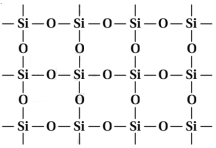
Silicon dioxide is a covalent,three-dimensional network solid in which each silicon atom is covalently bonded in a tetrahedral manner to four oxygen atoms.
Each oxygen atom is in turn covalently bonded to another silicon atom. The entire crystal may be considered as a giant molecule in which eight-membered rings are formed with alternate silicon and oxygen atoms.
Silica in its normal form is almost non-reactive because of the very high $Si-O$ bond enthalpy. It resists the attack by halogens,dihydrogen,and most of the acids and metals even at elevated temperatures.
$SiO_{2}$ reacts with $HF$ and $NaOH$:
$SiO_{2} + 2 NaOH \rightarrow Na_{2}SiO_{3} + H_{2}O$
$SiO_{2} + 4 HF \rightarrow SiF_{4} + 2 H_{2}O$
Silica is found in the form of quartz,cristobalite,and tridymite.
Silicon dioxide is a covalent,three-dimensional network solid in which each silicon atom is covalently bonded in a tetrahedral manner to four oxygen atoms.
Each oxygen atom is in turn covalently bonded to another silicon atom. The entire crystal may be considered as a giant molecule in which eight-membered rings are formed with alternate silicon and oxygen atoms.
Silica in its normal form is almost non-reactive because of the very high $Si-O$ bond enthalpy. It resists the attack by halogens,dihydrogen,and most of the acids and metals even at elevated temperatures.
$SiO_{2}$ reacts with $HF$ and $NaOH$:
$SiO_{2} + 2 NaOH \rightarrow Na_{2}SiO_{3} + H_{2}O$
$SiO_{2} + 4 HF \rightarrow SiF_{4} + 2 H_{2}O$
0 likes
View Solution398
Difficult
Discuss the preparation and properties of silicones.
Solution
(N/A) Silicones are a group of organosilicon polymers,which have $(R_{2}SiO)_{n}$ as a repeating unit. The starting materials for the manufacture of silicones are alkyl or aryl substituted silicon chlorides,$(R_{n}SiCl_{(4-n)})$ where $R$ is an alkyl or aryl group.
Preparation:
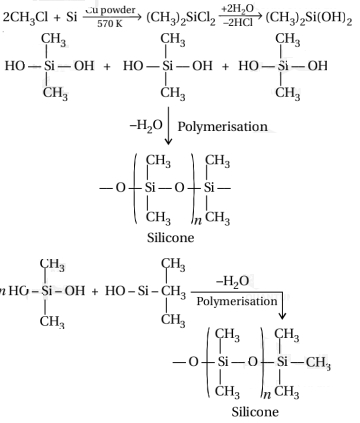
$1$. When methyl chloride reacts with silicon in the presence of copper as a catalyst at a temperature of $570 \ K$,various types of methyl-substituted chlorosilanes of formula $(MeSiCl_{3}, Me_{2}SiCl_{2}, Me_{3}SiCl)$ with a small amount of $Me_{4}Si$ are formed.
$2$. Hydrolysis of dimethyl dichlorosilane,$[(CH_{3})_{2}SiCl_{2}]$,followed by condensation polymerization,yields straight-chain polymers.
$3$. The chain length of the polymer can be controlled by adding $(CH_{3})_{3}SiCl$,which blocks the ends.
Properties:
$1$. Silicones are surrounded by non-polar alkyl groups,making them water-repellent in nature.
$2$. They generally have high thermal stability,high dielectric strength,and resistance to oxidation and chemicals.
Preparation:
$1$. When methyl chloride reacts with silicon in the presence of copper as a catalyst at a temperature of $570 \ K$,various types of methyl-substituted chlorosilanes of formula $(MeSiCl_{3}, Me_{2}SiCl_{2}, Me_{3}SiCl)$ with a small amount of $Me_{4}Si$ are formed.
$2$. Hydrolysis of dimethyl dichlorosilane,$[(CH_{3})_{2}SiCl_{2}]$,followed by condensation polymerization,yields straight-chain polymers.
$3$. The chain length of the polymer can be controlled by adding $(CH_{3})_{3}SiCl$,which blocks the ends.
Properties:
$1$. Silicones are surrounded by non-polar alkyl groups,making them water-repellent in nature.
$2$. They generally have high thermal stability,high dielectric strength,and resistance to oxidation and chemicals.
0 likes
View Solutionp-Block Elements (Class 11) — Carbon family · Frequently Asked Questions
1Are these p-Block Elements (Class 11) questions useful for JEE and NEET?
Yes. All questions in this section are mapped to JEE Main and NEET exam patterns. Previous year questions from JEE Main, NEET, GUJCET and state-level exams are included with full solutions.
2Can I switch to Hindi or Gujarati for these questions?
Yes. Use the language tabs in the hero section or the sidebar to view the same questions and solutions in English, Hindi or Gujarati.
3How do I generate a question paper from this subtopic?
Use the Vedclass Exam Paper Generator — select the chapter and subtopic, set difficulty, and generate Sets A, B, C, D automatically. First 3 chapters of every subject are free.
Vedclass Products
For Students
Vedclass Test Series
Mock tests in real JEE/NEET style with performance analysis. 5-day free trial.
Start Free TrialFor Teachers
Exam Paper Generator
Generate Set A/B/C/D papers from this chapter in 2 minutes. 3 chapters free.
Try FreeFor Institutes
Online Exam Module
Live online exams with unlimited students, 360° analytics & white-label branding.
See DemoFor Teachers & Institutes
Generate a p-Block Elements (Class 11) Exam Paper in 2 Minutes
Select subtopic & difficulty — Sets A, B, C, D auto-generated with No Repeat logic.
First 3 chapters of every subject are free — no payment required.