
A English
Carbon family Questions in English
Class 11 Chemistry · p-Block Elements (Class 11) · Carbon family
635+
Questions
English
Language
100%
With Solutions
Showing 50 of 635 questions in English
401
Medium
If the starting material for the manufacture of silicones is $RSiCl_3$,write the structure of the product formed.
Solution
(N/A) The hydrolysis of $RSiCl_3$ leads to the formation of a silanetriol,$RSi(OH)_3$,which undergoes polymerization to form a cross-linked silicone polymer.
Step $1$: Hydrolysis
$RSiCl_3 + 3H_2O \rightarrow RSi(OH)_3 + 3HCl$
Step $2$: Polymerization
The silanetriol units undergo condensation polymerization by eliminating water molecules to form a three-dimensional cross-linked structure:
$n RSi(OH)_3 \rightarrow (RSiO_{1.5})_n + 1.5n H_2O$
The resulting structure is a cross-linked polymer where each silicon atom is bonded to an $R$ group and three oxygen atoms,which are shared with other silicon atoms.
Step $1$: Hydrolysis
$RSiCl_3 + 3H_2O \rightarrow RSi(OH)_3 + 3HCl$
Step $2$: Polymerization
The silanetriol units undergo condensation polymerization by eliminating water molecules to form a three-dimensional cross-linked structure:
$n RSi(OH)_3 \rightarrow (RSiO_{1.5})_n + 1.5n H_2O$
The resulting structure is a cross-linked polymer where each silicon atom is bonded to an $R$ group and three oxygen atoms,which are shared with other silicon atoms.
0 likes
View Solution402
EasyMCQ
Give the uses of silicones.
A
As sealants and greases
B
As electrical insulators
C
For waterproofing of fabrics
D
All of the above
Solution
(D) Silicones are used as sealants,greases,and electrical insulators. They are also used for the waterproofing of fabrics. Due to their biocompatible nature,they are widely used in surgical and cosmetic implants.
0 likes
View Solution403
Medium
Provide information about silicon compounds (silicates).
Solution
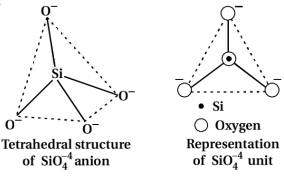
(N/A) Feldspar,zeolites,mica,and asbestos are silicate minerals. The basic structural unit of silicates is $SiO_{4}^{4-}$. In this unit,the silicon atom is bonded to four oxygen atoms in a tetrahedral fashion.
In silicate compounds,these units are joined together via corners by sharing $1, 2, 3,$ or $4$ oxygen atoms. When silicate units are linked together,they form chain,ring,sheet,or three-dimensional structures. The negative charge on the silicate structure is neutralized by positively charged metal ions. Two important man-made silicates are glass and cement.
In silicate compounds,these units are joined together via corners by sharing $1, 2, 3,$ or $4$ oxygen atoms. When silicate units are linked together,they form chain,ring,sheet,or three-dimensional structures. The negative charge on the silicate structure is neutralized by positively charged metal ions. Two important man-made silicates are glass and cement.
0 likes
View Solution404
Medium
Explain zeolite compounds.
Solution
(N/A) If aluminium atoms replace a few silicon atoms in the three-dimensional network of silicon dioxide,the overall structure,known as aluminosilicate,acquires a negative charge. Cations such as $Na^{+}$,$K^{+}$,and $Ca^{2+}$ balance this negative charge. Examples include feldspar and zeolites.
Uses: Zeolites are widely used as catalysts in petrochemical industries for the cracking of hydrocarbons and isomerisation. For example,$ZSM-5$ (a type of zeolite) is used to convert alcohols directly into gasoline. Hydrated zeolites are used as ion exchangers in the softening of "hard" water.
Uses: Zeolites are widely used as catalysts in petrochemical industries for the cracking of hydrocarbons and isomerisation. For example,$ZSM-5$ (a type of zeolite) is used to convert alcohols directly into gasoline. Hydrated zeolites are used as ion exchangers in the softening of "hard" water.
0 likes
View Solution405
Easy
What is catenation?
Solution
(N/A) Carbon atoms have the unique tendency to link with one another through covalent bonds to form long chains and rings. This property of self-linking is called catenation.
Carbon also exhibits the ability to form $p\pi - p\pi$ multiple bonds with itself and with other atoms of small size and high electronegativity,such as $C=C, C \equiv C, C=O, C \equiv N$.
Carbon also exhibits the ability to form $p\pi - p\pi$ multiple bonds with itself and with other atoms of small size and high electronegativity,such as $C=C, C \equiv C, C=O, C \equiv N$.
0 likes
View Solution406
EasyMCQ
Give the chemical reaction for preparing pure $CO$.
A
Dehydration of oxalic acid
B
Dehydration of formic acid
C
Reduction of $CO_2$
D
Thermal decomposition of carbonates
Solution
(B) On a small scale,pure $CO$ is prepared by the dehydration of formic acid $(HCOOH)$ using concentrated $H_2SO_4$ at $373 \ K$.
$HCOOH \xrightarrow[conc. \ H_2SO_4]{373 \ K} CO + H_2O$
$HCOOH \xrightarrow[conc. \ H_2SO_4]{373 \ K} CO + H_2O$
0 likes
View Solution407
EasyMCQ
Which ions are present in aluminosilicates?
A
$Si^{4+}$ and $Al^{3+}$
B
$Si^{2+}$ and $Al^{3+}$
C
$Si^{4+}$ and $Al^{2+}$
D
$Si^{3+}$ and $Al^{4+}$
Solution
(A) Aluminosilicates are formed when some of the $Si^{4+}$ ions in the three-dimensional network of $SiO_2$ are replaced by $Al^{3+}$ ions.
This substitution creates a negative charge on the framework,which is balanced by the presence of additional cations like $Na^+$,$K^+$,or $Ca^{2+}$.
This substitution creates a negative charge on the framework,which is balanced by the presence of additional cations like $Na^+$,$K^+$,or $Ca^{2+}$.
0 likes
View Solution408
EasyMCQ
Write the general and empirical formula of silicone.
A
$(R_{2}SiO)_{n}$
B
$R_{2}SiO$
C
$R_{3}SiO$
D
$(RSiO)_{n}$
Solution
(A) The general formula of silicone is $(R_{2}SiO)_{n}$,where $R$ represents an alkyl or aryl group (e.g.,methyl or phenyl).
The empirical formula of silicone is $R_{2}SiO$.
These compounds are structurally similar to ketones $(R_{2}C=O)$,which is why they are named silicones.
The empirical formula of silicone is $R_{2}SiO$.
These compounds are structurally similar to ketones $(R_{2}C=O)$,which is why they are named silicones.
0 likes
View Solution409
Medium
$(1)$ Half-life of $^{14}C$ is $...........$
$(2)$ $..........$ isotope of carbon is used in radiocarbon dating.
$(3)$ Main component of ceramic,cement and glass is $........$
$(2)$ $..........$ isotope of carbon is used in radiocarbon dating.
$(3)$ Main component of ceramic,cement and glass is $........$
Solution
(N/A) $(1)$ The half-life of $^{14}C$ is $5770 \ years$.
$(2)$ $^{14}C$ isotope of carbon is used in radiocarbon dating.
$(3)$ The main component of ceramic,cement,and glass is $SiO_2$ (silica).
$(2)$ $^{14}C$ isotope of carbon is used in radiocarbon dating.
$(3)$ The main component of ceramic,cement,and glass is $SiO_2$ (silica).
0 likes
View Solution410
Easy
Mention the uses of pure forms of germanium and silicon.
Solution
(N/A) Pure forms of germanium and silicon are primarily used as semiconductors in the manufacturing of electronic devices such as transistors,diodes,and integrated circuits.
0 likes
View Solution411
EasyMCQ
$Si(OH)_4$ acid is produced at the end of hydrolysis of $SiCl_4$. Is this statement true or false?
A
True
B
False
C
Cannot be determined
D
None of the above
Solution
(A) The hydrolysis of silicon tetrachloride $(SiCl_4)$ proceeds as follows:
$SiCl_4 + 4H_2O \rightarrow Si(OH)_4 + 4HCl$.
Thus,$Si(OH)_4$ (orthosilicic acid) is indeed the product formed at the end of the hydrolysis of $SiCl_4$.
Therefore,the statement is $True$.
$SiCl_4 + 4H_2O \rightarrow Si(OH)_4 + 4HCl$.
Thus,$Si(OH)_4$ (orthosilicic acid) is indeed the product formed at the end of the hydrolysis of $SiCl_4$.
Therefore,the statement is $True$.
0 likes
View Solution412
EasyMCQ
Mention the catenation order for group $14$ elements.
A
$C > Si > Ge > Sn > Pb$
B
$C \gg Si > Ge \approx Sn > Pb$
C
$C \gg Si > Ge = Sn > Pb$
D
$C > Si > Ge > Sn = Pb$
Solution
(C) Catenation is the ability of an element to form bonds with other atoms of the same element to form long chains or rings.
In group $14$,the tendency to show catenation decreases down the group due to the decrease in bond dissociation enthalpy of the $M-M$ bond as the atomic size increases.
The order of catenation is $C \gg Si > Ge = Sn$.
$Pb$ does not show catenation due to its large atomic size and weak $Pb-Pb$ bond.
In group $14$,the tendency to show catenation decreases down the group due to the decrease in bond dissociation enthalpy of the $M-M$ bond as the atomic size increases.
The order of catenation is $C \gg Si > Ge = Sn$.
$Pb$ does not show catenation due to its large atomic size and weak $Pb-Pb$ bond.
0 likes
View Solution413
EasyMCQ
Carbon can form $p\pi-p\pi$ bond with which kind of elements?
A
Elements with large size and low electronegativity
B
Elements with small size and high electronegativity
C
Elements with large size and high electronegativity
D
Elements with small size and low electronegativity
Solution
(B) Carbon has a small atomic size and high electronegativity,which allows its $2p$ orbitals to overlap effectively with the $2p$ orbitals of other small,highly electronegative atoms like $N$,$O$,and itself to form $p\pi-p\pi$ multiple bonds.
Therefore,carbon forms $p\pi-p\pi$ bonds with elements that have small size and high electronegativity.
Therefore,carbon forms $p\pi-p\pi$ bonds with elements that have small size and high electronegativity.
0 likes
View Solution414
EasyMCQ
Who discovered the allotrope of carbon known as fullerene?
A
Harold Kroto,Richard Smalley,and Robert Curl
B
Marie Curie and Pierre Curie
C
Dmitri Mendeleev and Lothar Meyer
D
Linus Pauling and Robert Mulliken
Solution
(A) Fullerenes were discovered by $H.W. \ Kroto$,$R.E. \ Smalley$,and $R.F. \ Curl$ in $1985$.
0 likes
View Solution415
EasyMCQ
Give the use of diamond.
A
Used in jewelry
B
Used as an abrasive for sharpening hard tools
C
Used in making dies for wire drawing
D
All of the above
Solution
(D) Diamond is used as an abrasive for sharpening hard tools.
It is used in making dies for wire drawing.
It is also used in the manufacture of tungsten filaments for electric light bulbs.
It is used in making dies for wire drawing.
It is also used in the manufacture of tungsten filaments for electric light bulbs.
0 likes
View Solution416
EasyMCQ
What are the $C-C$ single bond length and double bond length in fullerene?
A
$143.5 \ pm$ and $138.3 \ pm$
B
$138.3 \ pm$ and $143.5 \ pm$
C
$154 \ pm$ and $134 \ pm$
D
$140 \ pm$ and $140 \ pm$
Solution
(A) Fullerene $(C_{60})$ consists of pentagons and hexagons.
Due to the delocalization of electrons, the bond lengths are intermediate between single and double bonds.
The $C-C$ single bond length is $143.5 \ pm$ and the $C=C$ double bond length is $138.3 \ pm$.
Due to the delocalization of electrons, the bond lengths are intermediate between single and double bonds.
The $C-C$ single bond length is $143.5 \ pm$ and the $C=C$ double bond length is $138.3 \ pm$.
0 likes
View Solution417
EasyMCQ
Give uses of $CO_{2}$.
A
Preparation of urea
B
Preparation of carbonated water
C
Fire extinguisher
D
All of the above
Solution
(D) $(i)$ $CO_{2}$ is mainly used to prepare urea.
$(ii)$ $CO_{2}$ is used to prepare carbonated water.
$(iii)$ It is used as a fire extinguisher.
$(ii)$ $CO_{2}$ is used to prepare carbonated water.
$(iii)$ It is used as a fire extinguisher.
0 likes
View Solution418
Easy
How is dry ice produced? Mention its uses.
Solution
(N/A) Dry ice is produced by allowing liquefied $CO_{2}$ to expand rapidly,which causes it to solidify into a white,snow-like solid.
Its uses include:
$1$. It is used as a refrigerant for ice-cream and frozen foods.
$2$. It is used in the entertainment industry to create fog effects.
Its uses include:
$1$. It is used as a refrigerant for ice-cream and frozen foods.
$2$. It is used in the entertainment industry to create fog effects.
0 likes
View Solution419
EasyMCQ
Which are the various forms of silica?
A
Quartz,cristobalite,and tridymite
B
Graphite,diamond,and fullerene
C
Silicates,zeolites,and silicones
D
Quartz,mica,and feldspar
Solution
(A) Silica $(SiO_2)$ occurs in several crystallographic forms,which are interconvertible at suitable temperatures. The most common forms are $Quartz$,$cristobalite$,and $tridymite$.
0 likes
View Solution420
EasyMCQ
Mention the starting material to produce silicones.
A
Silicon dioxide
B
Alkyl or aryl substituted silicon chlorides
C
Silicates
D
Silicon carbide
Solution
(B) The starting materials for the manufacture of silicones are alkyl or aryl substituted silicon chlorides,$R_nSiCl_{(4-n)}$,where $R$ is an alkyl or aryl group.
0 likes
View Solution421
Easy
Give the name of the basic structural unit of silicates and provide its examples.
Solution
(N/A) The basic structural unit of silicates is the $SiO_4^{4-}$ tetrahedron. Examples include $Feldspar$,$Zeolites$,$Mica$,and $Asbestos$.
0 likes
View Solution422
Medium
Manmade silicate is $........$
$........$ is used to convert alcohols directly into gasoline. Give the use of hydrated zeolites.
$........$ is used to convert alcohols directly into gasoline. Give the use of hydrated zeolites.
Solution
(N/A) The manmade silicate is $Glass$ or $Cement$.
$ZSM-5$ is used to convert alcohols directly into gasoline.
Hydrated zeolites are used as ion exchangers in softening of hard water.
$ZSM-5$ is used to convert alcohols directly into gasoline.
Hydrated zeolites are used as ion exchangers in softening of hard water.
0 likes
View Solution423
Easy
What is aluminosilicate? Which ions are used to balance its electric charge?
Solution
(N/A) If aluminium atoms replace a few silicon atoms in the three-dimensional network of silicon dioxide,the overall structure,known as aluminosilicate,acquires a negative charge.
Cations such as $Na^{+}$,$K^{+}$,and $Ca^{2+}$ are used to balance the electric charge.
Cations such as $Na^{+}$,$K^{+}$,and $Ca^{2+}$ are used to balance the electric charge.
0 likes
View Solution424
EasyMCQ
When silicate units are linked together,they form which type of structures?
A
Chain structures
B
Ring structures
C
Sheet or three-dimensional structures
D
All of the above
Solution
(D) The basic structural unit of silicates is the $SiO_4^{4-}$ tetrahedron. When these units are linked together by sharing oxygen atoms,they can form various structures such as chains,rings,sheets,or three-dimensional networks.
0 likes
View Solution425
EasyMCQ
$Kieselghur$ is an amorphous form of silica which is used in filtration plants. Which of the following is true about it?
A
It is a crystalline form of $SiO_2$.
B
It is an amorphous form of $SiO_2$.
C
It is a form of $CO_2$.
D
It is a synthetic polymer.
Solution
(B) $Kieselghur$ is a naturally occurring,soft,siliceous sedimentary rock that is easily crumbled into a fine white to off-white powder.
It is an amorphous form of silica $(SiO_2)$ derived from the remains of diatoms.
Due to its porous nature,it is widely used in filtration plants and as an abrasive.
It is an amorphous form of silica $(SiO_2)$ derived from the remains of diatoms.
Due to its porous nature,it is widely used in filtration plants and as an abrasive.
0 likes
View Solution426
Difficult
State True or False for the following statements:
$(1)$ Fullerene has $20$ rings of $6$ members and $12$ rings of $5$ members.
$(2)$ $CO$ is neutral while $CO_2$ is acidic.
$(3)$ Boron fibres are used in making light composite material for aircraft.
$(4)$ When borax is heated in a Bunsen burner flame with $CoO$ on a loop of platinum wire,a yellow coloured $Co(BO_2)_2$ bead is formed.
$(1)$ Fullerene has $20$ rings of $6$ members and $12$ rings of $5$ members.
$(2)$ $CO$ is neutral while $CO_2$ is acidic.
$(3)$ Boron fibres are used in making light composite material for aircraft.
$(4)$ When borax is heated in a Bunsen burner flame with $CoO$ on a loop of platinum wire,a yellow coloured $Co(BO_2)_2$ bead is formed.
Solution
(A) Statement $(1)$ is True (Fullerene $C_{60}$ consists of $20$ hexagons and $12$ pentagons).
Statement $(2)$ is True ($CO$ is a neutral oxide,whereas $CO_2$ is an acidic oxide).
Statement $(3)$ is True (Boron fibres are used in high-strength,lightweight composite materials).
Statement $(4)$ is False (The bead formed with $CoO$ in the borax bead test is blue in colour,not yellow).
Statement $(2)$ is True ($CO$ is a neutral oxide,whereas $CO_2$ is an acidic oxide).
Statement $(3)$ is True (Boron fibres are used in high-strength,lightweight composite materials).
Statement $(4)$ is False (The bead formed with $CoO$ in the borax bead test is blue in colour,not yellow).
0 likes
View Solution427
Medium
State True or False for the following statements:
$(1)$ Oxides of indium and thallium are basic in their properties.
$(2)$ $C$,$Si$ are non-metals,while germanium,tin,and lead are high melting metals.
$(1)$ Oxides of indium and thallium are basic in their properties.
$(2)$ $C$,$Si$ are non-metals,while germanium,tin,and lead are high melting metals.
Solution
(A) $(1)$ True: As we move down the group $13$,the metallic character increases,and the oxides become more basic. Indium and thallium oxides are basic.
$(2)$ False: While $C$ and $Si$ are non-metals and $Ge$ is a metalloid,tin $(Sn)$ and lead $(Pb)$ are metals with relatively low melting points compared to other transition metals.
$(2)$ False: While $C$ and $Si$ are non-metals and $Ge$ is a metalloid,tin $(Sn)$ and lead $(Pb)$ are metals with relatively low melting points compared to other transition metals.
0 likes
View Solution428
Difficult
Give reasons for the following:
$(i)$ $CCl_4$ is immiscible in water,whereas $SiCl_4$ is easily hydrolyzed.
$(ii)$ Carbon has a strong tendency for catenation compared to silicon.
$(i)$ $CCl_4$ is immiscible in water,whereas $SiCl_4$ is easily hydrolyzed.
$(ii)$ Carbon has a strong tendency for catenation compared to silicon.
Solution
(N/A) $(i)$ $CCl_4$ is a non-polar covalent compound and cannot form hydrogen bonds with polar $H_2O$ molecules. Furthermore,$C$ does not have vacant $d$-orbitals to accommodate the lone pair of electrons from the oxygen atom of the water molecule,making it resistant to hydrolysis.
In contrast,$SiCl_4$ is easily hydrolyzed by water because the central $Si$ atom has vacant $d$-orbitals that can accommodate the lone pair of electrons from the oxygen atom of the water molecule. The hydrolysis reaction is as follows:
$SiCl_4 + 4H_2O \rightarrow Si(OH)_4 + 4HCl$
$(ii)$ Carbon atoms have a strong tendency to link with one another through covalent bonds to form long chains and rings; this property is called catenation. This is primarily because the $C-C$ bond enthalpy is very high,making the bond exceptionally strong. As we move down the group,the atomic size increases and electronegativity decreases,which leads to a significant reduction in the bond strength and,consequently,the tendency for catenation decreases. The order of catenation is $C \gg Si > Ge > Sn$. Lead $(Pb)$ does not show catenation.
In contrast,$SiCl_4$ is easily hydrolyzed by water because the central $Si$ atom has vacant $d$-orbitals that can accommodate the lone pair of electrons from the oxygen atom of the water molecule. The hydrolysis reaction is as follows:
$SiCl_4 + 4H_2O \rightarrow Si(OH)_4 + 4HCl$
$(ii)$ Carbon atoms have a strong tendency to link with one another through covalent bonds to form long chains and rings; this property is called catenation. This is primarily because the $C-C$ bond enthalpy is very high,making the bond exceptionally strong. As we move down the group,the atomic size increases and electronegativity decreases,which leads to a significant reduction in the bond strength and,consequently,the tendency for catenation decreases. The order of catenation is $C \gg Si > Ge > Sn$. Lead $(Pb)$ does not show catenation.
0 likes
View Solution429
Difficult
Explain the following:
$(a)$ $CO_2$ is a gas whereas $SiO_2$ is a solid.
$(b)$ Silicon forms $SiF_6^{2-}$ ion whereas corresponding fluoro compound of carbon is not known.
$(a)$ $CO_2$ is a gas whereas $SiO_2$ is a solid.
$(b)$ Silicon forms $SiF_6^{2-}$ ion whereas corresponding fluoro compound of carbon is not known.
Solution
(N/A) In $CO_2$, the carbon atom undergoes $sp$ hybridization. Two $sp$ hybridized orbitals of the carbon atom overlap with two $p$-orbitals of oxygen atoms to form two sigma bonds, while the other two electrons of the carbon atom are involved in $p\pi-p\pi$ bonding with oxygen atoms. This results in a linear shape with both $C-O$ bonds of equal length $(115 \ pm)$ and no dipole moment. $O=C=O \leftrightarrow -O-C \equiv O^{+} \leftrightarrow O^{+} \equiv C-O^{-}$
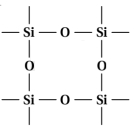
Silicon dioxide is a covalent, three-dimensional network solid in which each silicon atom is covalently bonded in a tetrahedral manner to four oxygen atoms. Each oxygen atom is in turn covalently bonded to another silicon atom. Each corner is shared with another tetrahedron. The entire crystal may be considered as a giant molecule in which eight-membered rings are formed with alternate silicon and oxygen atoms.
$(b)$ Silicon has vacant $d$-orbitals in its valence shell, due to which it can accommodate $6$ electrons from $6$ fluorine atoms, whereas carbon does not have $d$-orbitals and cannot expand its covalence beyond four.
Silicon dioxide is a covalent, three-dimensional network solid in which each silicon atom is covalently bonded in a tetrahedral manner to four oxygen atoms. Each oxygen atom is in turn covalently bonded to another silicon atom. Each corner is shared with another tetrahedron. The entire crystal may be considered as a giant molecule in which eight-membered rings are formed with alternate silicon and oxygen atoms.
$(b)$ Silicon has vacant $d$-orbitals in its valence shell, due to which it can accommodate $6$ electrons from $6$ fluorine atoms, whereas carbon does not have $d$-orbitals and cannot expand its covalence beyond four.
0 likes
View Solution430
Medium
Carbon and silicon both belong to group $14$, but despite the stoichiometric similarity, their dioxides (i.e., carbon dioxide and silicon dioxide) differ in their structures. Comment.
Solution
(N/A) In $CO_{2}$, the carbon atom undergoes $sp$ hybridization. Two $sp$ hybridized orbitals of the carbon atom overlap with two $p$ orbitals of oxygen atoms to form two sigma bonds, while the other two electrons of the carbon atom are involved in $p\pi-p\pi$ bonding with oxygen atoms.
This results in a linear shape [with both $C-O$ bonds of equal length $(115 \ pm)$] with no dipole moment. Carbon can form a double bond with oxygen due to its small size.
Silicon dioxide is a covalent, three-dimensional network solid in which each silicon atom is covalently bonded in a tetrahedral manner to four oxygen atoms. Each oxygen atom is, in turn, covalently bonded to another silicon atom.
Each corner is shared with another tetrahedron. The entire crystal may be considered a giant molecule in which eight-membered rings are formed with alternate silicon and oxygen atoms. Silicon cannot form a stable $p\pi-p\pi$ double bond with oxygen due to its large size and lower electronegativity compared to carbon.
This results in a linear shape [with both $C-O$ bonds of equal length $(115 \ pm)$] with no dipole moment. Carbon can form a double bond with oxygen due to its small size.
Silicon dioxide is a covalent, three-dimensional network solid in which each silicon atom is covalently bonded in a tetrahedral manner to four oxygen atoms. Each oxygen atom is, in turn, covalently bonded to another silicon atom.
Each corner is shared with another tetrahedron. The entire crystal may be considered a giant molecule in which eight-membered rings are formed with alternate silicon and oxygen atoms. Silicon cannot form a stable $p\pi-p\pi$ double bond with oxygen due to its large size and lower electronegativity compared to carbon.

0 likes
View Solution431
Difficult
Explain the following:
$(1)$ $Tl(NO_3)_3$ acts as an oxidizing agent.
$(2)$ Carbon shows catenation property but lead does not.
$(1)$ $Tl(NO_3)_3$ acts as an oxidizing agent.
$(2)$ Carbon shows catenation property but lead does not.
Solution
(N/A) Due to the inert pair effect,$Tl$ is more stable in the $+1$ oxidation state than in the $+3$ oxidation state. Therefore,$Tl(NO_3)_3$ acts as a strong oxidizing agent.
Carbon atoms have the tendency to link with one another through covalent bonds to form chains and rings. This property is called catenation. This is because $C-C$ bonds are very strong. Down the group,the atomic size increases and electronegativity decreases,and thereby,the tendency to show catenation decreases. This can be clearly seen from bond enthalpy values. The order of catenation is $C \gg Si > Ge \approx Sn$. Lead does not show catenation.
Carbon atoms have the tendency to link with one another through covalent bonds to form chains and rings. This property is called catenation. This is because $C-C$ bonds are very strong. Down the group,the atomic size increases and electronegativity decreases,and thereby,the tendency to show catenation decreases. This can be clearly seen from bond enthalpy values. The order of catenation is $C \gg Si > Ge \approx Sn$. Lead does not show catenation.
0 likes
View Solution432
Medium
Match the species given in Column-$I$ with the properties mentioned in Column-$II$.
| Column-$I$ | Column-$II$ |
| $A$. $BF_4^-$ | $1$. Oxidation state of central atom is $+4$ |
| $B$. $AlCl_3$ | $2$. Strong oxidizing agent |
| $C$. $SnO$ | $3$. Lewis acid |
| $D$. $PbO_2$ | $4$. Can be further oxidized |
| $5$. Tetrahedral shape |
Solution
(A-5, B-3, C-4, D-1, 2) $A-5, B-3, C-4, D-1, 2$
$A$. In $BF_4^-$,$B$ is $sp^3$ hybridized,surrounded by $4$ bond pairs,and has no lone pair,resulting in a tetrahedral shape.
$B$. In $AlCl_3$,the octet of $Al$ is incomplete,making it an electron-deficient compound and a Lewis acid.
$C$. In $SnO$,the oxidation state of $Sn$ is $+2$,which can be further oxidized to $+4$.
$D$. In $PbO_2$,the oxidation state of $Pb$ is $+4$. Due to the inert pair effect,$Pb^{2+}$ is more stable than $Pb^{4+}$. Thus,$PbO_2$ acts as a strong oxidizing agent by reducing to $Pb^{2+}$.
$A$. In $BF_4^-$,$B$ is $sp^3$ hybridized,surrounded by $4$ bond pairs,and has no lone pair,resulting in a tetrahedral shape.
$B$. In $AlCl_3$,the octet of $Al$ is incomplete,making it an electron-deficient compound and a Lewis acid.
$C$. In $SnO$,the oxidation state of $Sn$ is $+2$,which can be further oxidized to $+4$.
$D$. In $PbO_2$,the oxidation state of $Pb$ is $+4$. Due to the inert pair effect,$Pb^{2+}$ is more stable than $Pb^{4+}$. Thus,$PbO_2$ acts as a strong oxidizing agent by reducing to $Pb^{2+}$.
0 likes
View Solution433
Medium
$A$ tetravalent element forms monoxide and dioxide with oxygen. When air is passed over the heated element $(1273 \ K)$,producer gas is obtained. The monoxide of the element is a powerful reducing agent and reduces ferric oxide to iron. Identify the element and write the formulas of its monoxide and dioxide. Write chemical equations for the formation of producer gas and the reduction of ferric oxide with the monoxide.
Solution
The element is carbon $(C)$,which is tetravalent and forms monoxide $(CO)$ and dioxide $(CO_2)$.
Producer gas is a mixture of $CO_{(g)}$ and $N_{2_{(g)}}$.
Formation of producer gas:
$2C_{(s)} + O_{2_{(g)}} + 4N_{2_{(g)}} \xrightarrow{1273 \ K} 2CO_{(g)} + 4N_{2_{(g)}}$
Carbon monoxide acts as a strong reducing agent and reduces ferric oxide $(Fe_2O_3)$ to iron $(Fe)$.
Reduction of ferric oxide:
$Fe_2O_{3_{(s)}} + 3CO_{(g)} \xrightarrow{\Delta} 2Fe_{(s)} + 3CO_{2_{(g)}}$
Producer gas is a mixture of $CO_{(g)}$ and $N_{2_{(g)}}$.
Formation of producer gas:
$2C_{(s)} + O_{2_{(g)}} + 4N_{2_{(g)}} \xrightarrow{1273 \ K} 2CO_{(g)} + 4N_{2_{(g)}}$
Carbon monoxide acts as a strong reducing agent and reduces ferric oxide $(Fe_2O_3)$ to iron $(Fe)$.
Reduction of ferric oxide:
$Fe_2O_{3_{(s)}} + 3CO_{(g)} \xrightarrow{\Delta} 2Fe_{(s)} + 3CO_{2_{(g)}}$
0 likes
View Solution434
Medium
Which non-metals have high melting and boiling points? State them.
Solution
(N/A) The non-metals with high melting and boiling points are $Boron$ and $Carbon$ (in the form of diamond).
0 likes
View Solution435
MediumMCQ
Reaction of an inorganic sulphite $X$ with dilute $H_{2}SO_{4}$ generates compound $Y$. Reaction of $Y$ with $NaOH$ gives $X$. Further,the reaction of $X$ with $Y$ and water affords compound $Z$. $Y$ and $Z$,respectively,are:
A
$S$ and $Na_{2}SO_{3}$
B
$SO_{2}$ and $NaHSO_{3}$
C
$SO_{3}$ and $NaHSO_{3}$
D
$SO_{2}$ and $Na_{2}SO_{3}$
Solution
(B) The given reactions are as follows:
$1$. Reaction of inorganic sulphite $X$ $(Na_{2}SO_{3})$ with dilute $H_{2}SO_{4}$:
$Na_{2}SO_{3} + H_{2}SO_{4} \rightarrow Na_{2}SO_{4} + H_{2}O + SO_{2} (Y)$
$2$. Reaction of $Y$ $(SO_{2})$ with $NaOH$:
$SO_{2} + 2NaOH \rightarrow Na_{2}SO_{3} (X) + H_{2}O$
$3$. Reaction of $X$ $(Na_{2}SO_{3})$ with $Y$ $(SO_{2})$ and water:
$Na_{2}SO_{3} + H_{2}O + SO_{2} \rightarrow 2NaHSO_{3} (Z)$
Thus,$Y$ is $SO_{2}$ and $Z$ is $NaHSO_{3}$.
$1$. Reaction of inorganic sulphite $X$ $(Na_{2}SO_{3})$ with dilute $H_{2}SO_{4}$:
$Na_{2}SO_{3} + H_{2}SO_{4} \rightarrow Na_{2}SO_{4} + H_{2}O + SO_{2} (Y)$
$2$. Reaction of $Y$ $(SO_{2})$ with $NaOH$:
$SO_{2} + 2NaOH \rightarrow Na_{2}SO_{3} (X) + H_{2}O$
$3$. Reaction of $X$ $(Na_{2}SO_{3})$ with $Y$ $(SO_{2})$ and water:
$Na_{2}SO_{3} + H_{2}O + SO_{2} \rightarrow 2NaHSO_{3} (Z)$
Thus,$Y$ is $SO_{2}$ and $Z$ is $NaHSO_{3}$.
0 likes
View Solution436
MediumMCQ
Identify the correct statements from the following:
$(a)$ $CO_{2(s)}$ (dry ice) is used as a refrigerant for ice-cream and frozen food.
$(b)$ The structure of $C_{60}$ contains $20$ six-membered rings and $12$ five-membered rings.
$(c)$ $ZSM-5$,a type of zeolite,is used to convert alcohols into gasoline.
$(d)$ $CO$ is a colorless and odorless gas.
$(a)$ $CO_{2(s)}$ (dry ice) is used as a refrigerant for ice-cream and frozen food.
$(b)$ The structure of $C_{60}$ contains $20$ six-membered rings and $12$ five-membered rings.
$(c)$ $ZSM-5$,a type of zeolite,is used to convert alcohols into gasoline.
$(d)$ $CO$ is a colorless and odorless gas.
A
$(c)$ and $(d)$ only
B
$(a)$ and $(b)$ and $(c)$ only
C
$(a)$ and $(c)$ only
D
$(b)$ and $(c)$ only
Solution
(A) Let us analyze each statement:
$(a)$ Incorrect: Solid $CO_{2(s)}$ (dry ice) is used as a refrigerant,not gaseous $CO_{2(g)}$.
$(b)$ Incorrect: The structure of $C_{60}$ (Buckminsterfullerene) contains $20$ six-membered rings and $12$ five-membered rings,not $12$ six-membered and $20$ five-membered.
$(c)$ Correct: $ZSM-5$ is a shape-selective catalyst used in the petrochemical industry to convert alcohols directly into gasoline.
$(d)$ Correct: Carbon monoxide $(CO)$ is a colorless,odorless,and neutral gas.
Therefore,statements $(c)$ and $(d)$ are correct.
$(a)$ Incorrect: Solid $CO_{2(s)}$ (dry ice) is used as a refrigerant,not gaseous $CO_{2(g)}$.
$(b)$ Incorrect: The structure of $C_{60}$ (Buckminsterfullerene) contains $20$ six-membered rings and $12$ five-membered rings,not $12$ six-membered and $20$ five-membered.
$(c)$ Correct: $ZSM-5$ is a shape-selective catalyst used in the petrochemical industry to convert alcohols directly into gasoline.
$(d)$ Correct: Carbon monoxide $(CO)$ is a colorless,odorless,and neutral gas.
Therefore,statements $(c)$ and $(d)$ are correct.
0 likes
View Solution437
MediumMCQ
Which of the following oxides is amphoteric in nature?
A
$CO_{2}$
B
$SnO_{2}$
C
$SiO_{2}$
D
$GeO_{2}$
Solution
(B) $CO_{2}$ is an acidic oxide.
$SnO_{2}$ is an amphoteric oxide,meaning it reacts with both acids and bases.
$SiO_{2}$ is an acidic oxide.
$GeO_{2}$ is predominantly acidic in nature.
$SnO_{2}$ is an amphoteric oxide,meaning it reacts with both acids and bases.
$SiO_{2}$ is an acidic oxide.
$GeO_{2}$ is predominantly acidic in nature.
0 likes
View Solution438
MediumMCQ
Which of the following are methanides?
A
Only $a, d$
B
Only $a, b$
C
Only $c, d$
D
Only $b, d$
Solution
(A) Methanides are carbides that react with water to produce methane $(CH_{4})$ gas.
$Be_{2}C + 4 H_{2}O \rightarrow 2 Be(OH)_{2} + CH_{4}$
$Al_{4}C_{3} + 12 H_{2}O \rightarrow 4 Al(OH)_{3} + 3 CH_{4}$
$CaC_{2}$ is an acetylide,producing ethyne $(C_{2}H_{2})$.
$Mg_{2}C_{3}$ is an allylide,producing propyne $(C_{3}H_{4})$.
Therefore,$Be_{2}C$ and $Al_{4}C_{3}$ are methanides.
$Be_{2}C + 4 H_{2}O \rightarrow 2 Be(OH)_{2} + CH_{4}$
$Al_{4}C_{3} + 12 H_{2}O \rightarrow 4 Al(OH)_{3} + 3 CH_{4}$
$CaC_{2}$ is an acetylide,producing ethyne $(C_{2}H_{2})$.
$Mg_{2}C_{3}$ is an allylide,producing propyne $(C_{3}H_{4})$.
Therefore,$Be_{2}C$ and $Al_{4}C_{3}$ are methanides.
0 likes
View Solution439
MediumMCQ
In the dimer of phosphorus pentaoxide $(P_4O_{10})$,what is the correct order of the number of $P-O-P$,$P=O$,and $P-P$ bonds?
A
$P-O-P > P=O > P-P$
B
$P=O > P-O-P > P-P$
C
$P-O-P > P-P > P=O$
D
$P=O > P-P > P-O-P$
Solution
(A) The structure of $P_4O_{10}$ consists of a tetrahedral arrangement of four phosphorus atoms.
Each phosphorus atom is bonded to three oxygen atoms via $P-O-P$ bridges,and one terminal oxygen atom via a $P=O$ double bond.
Counting the bonds in the structure:
$1$. Total $P-O-P$ bonds = $6$.
$2$. Total $P=O$ bonds = $4$.
$3$. Total $P-P$ bonds = $0$.
Therefore,the order is $P-O-P (6) > P=O (4) > P-P (0)$.
Each phosphorus atom is bonded to three oxygen atoms via $P-O-P$ bridges,and one terminal oxygen atom via a $P=O$ double bond.
Counting the bonds in the structure:
$1$. Total $P-O-P$ bonds = $6$.
$2$. Total $P=O$ bonds = $4$.
$3$. Total $P-P$ bonds = $0$.
Therefore,the order is $P-O-P (6) > P=O (4) > P-P (0)$.
0 likes
View Solution440
MediumMCQ
The number of ionisable hydrogens present in the product obtained from a reaction of phosphorus trichloride $(PCl_3)$ and phosphonic acid $(H_3PO_3)$ is
A
$3$
B
$0$
C
$2$
D
$1$
Solution
(C) The reaction between phosphorus trichloride $(PCl_3)$ and phosphonic acid $(H_3PO_3)$ is given by:
$PCl_3 + 3H_3PO_3 \rightarrow 3H_3PO_2Cl + H_3PO_3$ (Note: The standard reaction for the formation of pyrophosphorous acid is $PCl_3 + 3H_3PO_3 \rightarrow 3H_3PO_2Cl + H_3PO_3$ is not the intended path here).
Based on the provided image,the reaction is $PCl_3 + H_3PO_3 \rightarrow H_4P_2O_5 + 3HCl$.
The product $H_4P_2O_5$ is pyrophosphorous acid.
In the structure of pyrophosphorous acid $(H_4P_2O_5)$,there are two $P-OH$ groups.
Since only the hydrogen atoms attached to oxygen atoms (in $P-OH$ groups) are ionisable,there are $2$ ionisable hydrogens in the molecule.
$PCl_3 + 3H_3PO_3 \rightarrow 3H_3PO_2Cl + H_3PO_3$ (Note: The standard reaction for the formation of pyrophosphorous acid is $PCl_3 + 3H_3PO_3 \rightarrow 3H_3PO_2Cl + H_3PO_3$ is not the intended path here).
Based on the provided image,the reaction is $PCl_3 + H_3PO_3 \rightarrow H_4P_2O_5 + 3HCl$.
The product $H_4P_2O_5$ is pyrophosphorous acid.
In the structure of pyrophosphorous acid $(H_4P_2O_5)$,there are two $P-OH$ groups.
Since only the hydrogen atoms attached to oxygen atoms (in $P-OH$ groups) are ionisable,there are $2$ ionisable hydrogens in the molecule.
0 likes
View Solution441
MediumMCQ
The $INCORRECT$ statement regarding the structure of $C_{60}$ is :
A
The six-membered rings are fused to both six and five-membered rings.
B
Each carbon atom forms three sigma bonds.
C
The five-membered rings are fused only to six-membered rings.
D
It contains $12$ six-membered rings and $24$ five-membered rings.
Solution
(D) The structure of $C_{60}$ (Buckminsterfullerene) consists of $60$ carbon atoms arranged in a truncated icosahedron shape.
It contains $20$ six-membered rings (hexagons) and $12$ five-membered rings (pentagons).
Each carbon atom is $sp^2$ hybridized and forms three sigma bonds.
The five-membered rings are fused only to six-membered rings,while the six-membered rings are fused to both six and five-membered rings.
Therefore,the statement that it contains $12$ six-membered rings and $24$ five-membered rings is incorrect.
It contains $20$ six-membered rings (hexagons) and $12$ five-membered rings (pentagons).
Each carbon atom is $sp^2$ hybridized and forms three sigma bonds.
The five-membered rings are fused only to six-membered rings,while the six-membered rings are fused to both six and five-membered rings.
Therefore,the statement that it contains $12$ six-membered rings and $24$ five-membered rings is incorrect.
0 likes
View Solution442
MediumMCQ
Find $A$,$B$ and $C$ in the following reactions:
$NH_3 + A + CO_2 \rightarrow (NH_4)_2CO_3$
$(NH_4)_2CO_3 + H_2O + B \rightarrow 2NH_4HCO_3$
$NH_4HCO_3 + NaCl \rightarrow NH_4Cl + C$
$NH_3 + A + CO_2 \rightarrow (NH_4)_2CO_3$
$(NH_4)_2CO_3 + H_2O + B \rightarrow 2NH_4HCO_3$
$NH_4HCO_3 + NaCl \rightarrow NH_4Cl + C$
A
$A - O_2; B - CO_2; C - Na_2CO_3$
B
$A - H_2O; B - O_2; C - Na_2CO_3$
C
$A - H_2O; B - O_2; C - NaHCO_3$
D
$A - H_2O; B - CO_2; C - NaHCO_3$
Solution
(D) The given reactions are part of the Solvay process for the production of sodium carbonate.
$1$. $2NH_3 + H_2O(A) + CO_2 \rightarrow (NH_4)_2CO_3$
$2$. $(NH_4)_2CO_3 + H_2O + CO_2(B) \rightarrow 2NH_4HCO_3$
$3$. $NH_4HCO_3 + NaCl \rightarrow NaHCO_3(C) + NH_4Cl$
Comparing these with the given equations,we identify $A = H_2O$,$B = CO_2$,and $C = NaHCO_3$.
$1$. $2NH_3 + H_2O(A) + CO_2 \rightarrow (NH_4)_2CO_3$
$2$. $(NH_4)_2CO_3 + H_2O + CO_2(B) \rightarrow 2NH_4HCO_3$
$3$. $NH_4HCO_3 + NaCl \rightarrow NaHCO_3(C) + NH_4Cl$
Comparing these with the given equations,we identify $A = H_2O$,$B = CO_2$,and $C = NaHCO_3$.
0 likes
View Solution443
MediumMCQ
Which one of the following compounds of Group-$14$ elements is not known?
A
$[GeCl_6]^{2-}$
B
$[SiCl_6]^{2-}$
C
$[Sn(OH)_6]^{2-}$
D
$[SiF_6]^{2-}$
Solution
(B) The compound $[SiCl_6]^{2-}$ does not exist.
This is because the six large $Cl^-$ ions cannot be accommodated around the small $Si^{4+}$ atom due to steric hindrance and the inability of the silicon atom to effectively coordinate six large chloride ions.
This is because the six large $Cl^-$ ions cannot be accommodated around the small $Si^{4+}$ atom due to steric hindrance and the inability of the silicon atom to effectively coordinate six large chloride ions.
0 likes
View Solution444
MediumMCQ
Which one of the following elemental forms is not present in the enamel of the teeth?
A
$Ca^{2+}$
B
$P^{3+}$
C
$F^{-}$
D
$P^{5+}$
Solution
(B) The enamel of human teeth is primarily composed of hydroxyapatite,which is a crystalline form of calcium phosphate,$Ca_{10}(PO_4)_6(OH)_2$.
In this structure,calcium exists in the $Ca^{2+}$ oxidation state.
Phosphorus exists in the phosphate ion $(PO_4)^{3-}$,where the oxidation state of phosphorus is $+5$ $(P^{5+})$.
Fluoride ions $(F^{-})$ are also often incorporated into the enamel structure to form fluorapatite,which strengthens the teeth.
Therefore,$P^{3+}$ is not present in the enamel of the teeth.
In this structure,calcium exists in the $Ca^{2+}$ oxidation state.
Phosphorus exists in the phosphate ion $(PO_4)^{3-}$,where the oxidation state of phosphorus is $+5$ $(P^{5+})$.
Fluoride ions $(F^{-})$ are also often incorporated into the enamel structure to form fluorapatite,which strengthens the teeth.
Therefore,$P^{3+}$ is not present in the enamel of the teeth.
0 likes
View Solution445
MediumMCQ
Consider the following reactions:
$PCl_{3} + 3H_{2}O \longrightarrow A + 3HCl$
$A + H_{2}O \longrightarrow B + HCl$
Identify the number of ionisable protons present in the product $B$.
$PCl_{3} + 3H_{2}O \longrightarrow A + 3HCl$
$A + H_{2}O \longrightarrow B + HCl$
Identify the number of ionisable protons present in the product $B$.
A
$1$
B
$2$
C
$3$
D
$4$
Solution
(B) The hydrolysis of $PCl_{3}$ proceeds as follows:
$PCl_{3} + 3H_{2}O \longrightarrow H_{3}PO_{3} (A) + 3HCl$
However,the question implies a stepwise hydrolysis where $A$ is an intermediate like $PCl_{2}(OH)$ or $PCl(OH)_{2}$.
Upon further hydrolysis,$A$ converts to $B$,which is phosphorous acid $(H_{3}PO_{3})$.
The structure of $H_{3}PO_{3}$ is $H-P(=O)(OH)_{2}$.
In $H_{3}PO_{3}$,only the two hydrogen atoms attached to oxygen atoms are ionisable as protons $(H^{+})$.
The hydrogen atom directly attached to the phosphorus atom is not ionisable.
Therefore,the number of ionisable protons in $B$ is $2$.
$PCl_{3} + 3H_{2}O \longrightarrow H_{3}PO_{3} (A) + 3HCl$
However,the question implies a stepwise hydrolysis where $A$ is an intermediate like $PCl_{2}(OH)$ or $PCl(OH)_{2}$.
Upon further hydrolysis,$A$ converts to $B$,which is phosphorous acid $(H_{3}PO_{3})$.
The structure of $H_{3}PO_{3}$ is $H-P(=O)(OH)_{2}$.
In $H_{3}PO_{3}$,only the two hydrogen atoms attached to oxygen atoms are ionisable as protons $(H^{+})$.
The hydrogen atom directly attached to the phosphorus atom is not ionisable.
Therefore,the number of ionisable protons in $B$ is $2$.
0 likes
View Solution446
MediumMCQ
Match List-$I$ with List-$II$.
Choose the correct answer from the options given below:
| List-$I$ (Si-Compounds) | List-$II$ (Si-Polymeric/other products) |
|---|---|
| $A$. $(CH_3)_4 Si$ | $I$. Chain silicone |
| $B$. $(CH_3) Si(OH)_3$ | $II$. Dimeric silicone |
| $C$. $(CH_3)_2 Si(OH)_2$ | $III$. Silane |
| $D$. $(CH_3)_3 Si(OH)$ | $IV$. $2D$-Silicone |
Choose the correct answer from the options given below:
A
$A-III, B-IV, C-I, D-II$
B
$A-IV, B-I, C-II, D-III$
C
$A-II, B-I, C-IV, D-III$
D
$A-III, B-IV, C-II, D-I$
Solution
(A) $(CH_3)_4 Si$ is a simple silane.
$(CH_3) Si(OH)_3$ undergoes polymerization to form $2D$-silicone (cross-linked).
$(CH_3)_2 Si(OH)_2$ undergoes polymerization to form linear chain silicone.
$(CH_3)_3 Si(OH)$ undergoes condensation to form a dimer,$(CH_3)_3 Si-O-Si(CH_3)_3$.
Thus,the correct matching is $A-III, B-IV, C-I, D-II$.
$(CH_3) Si(OH)_3$ undergoes polymerization to form $2D$-silicone (cross-linked).
$(CH_3)_2 Si(OH)_2$ undergoes polymerization to form linear chain silicone.
$(CH_3)_3 Si(OH)$ undergoes condensation to form a dimer,$(CH_3)_3 Si-O-Si(CH_3)_3$.
Thus,the correct matching is $A-III, B-IV, C-I, D-II$.
0 likes
View Solution447
MediumMCQ
The number of non-ionisable protons present in the product $B$ obtained from the following reaction is:
$3C_{2}H_{5}OH + PCl_{3} \rightarrow 3C_{2}H_{5}Cl + H_{3}PO_{3} (A)$
$H_{3}PO_{3} + PCl_{3} \rightarrow H_{4}P_{2}O_{5} (B) + HCl$
$3C_{2}H_{5}OH + PCl_{3} \rightarrow 3C_{2}H_{5}Cl + H_{3}PO_{3} (A)$
$H_{3}PO_{3} + PCl_{3} \rightarrow H_{4}P_{2}O_{5} (B) + HCl$
A
$9$
B
$2$
C
$4$
D
$3$
Solution
(B) The reaction of ethanol with $PCl_{3}$ produces ethyl chloride and phosphorous acid $(H_{3}PO_{3})$,which is compound $A$.
$3C_{2}H_{5}OH + PCl_{3} \rightarrow 3C_{2}H_{5}Cl + H_{3}PO_{3} (A)$
Further reaction of $H_{3}PO_{3}$ with $PCl_{3}$ yields pyrophosphorous acid $(H_{4}P_{2}O_{5})$,which is compound $B$.
$2H_{3}PO_{3} + PCl_{3} \rightarrow H_{4}P_{2}O_{5} (B) + PCl_{3} + ...$ (The reaction stoichiometry leads to $H_{4}P_{2}O_{5}$).
In the structure of pyrophosphorous acid $(H_{4}P_{2}O_{5})$,there are two $P-H$ bonds.
Protons attached directly to the phosphorus atom $(P-H)$ are non-ionisable.
Therefore,there are $2$ non-ionisable protons in $H_{4}P_{2}O_{5}$.
$3C_{2}H_{5}OH + PCl_{3} \rightarrow 3C_{2}H_{5}Cl + H_{3}PO_{3} (A)$
Further reaction of $H_{3}PO_{3}$ with $PCl_{3}$ yields pyrophosphorous acid $(H_{4}P_{2}O_{5})$,which is compound $B$.
$2H_{3}PO_{3} + PCl_{3} \rightarrow H_{4}P_{2}O_{5} (B) + PCl_{3} + ...$ (The reaction stoichiometry leads to $H_{4}P_{2}O_{5}$).
In the structure of pyrophosphorous acid $(H_{4}P_{2}O_{5})$,there are two $P-H$ bonds.
Protons attached directly to the phosphorus atom $(P-H)$ are non-ionisable.
Therefore,there are $2$ non-ionisable protons in $H_{4}P_{2}O_{5}$.
0 likes
View Solution448
MediumMCQ
An allotrope of carbon which exhibits only two types of $C-C$ bond distances of $143.5 \text{ pm}$ and $138.3 \text{ pm}$, is $....$
A
charcoal
B
graphite
C
diamond
D
fullerene
Solution
(D) In fullerene, each carbon atom is bonded to three other carbon atoms. Two types of these bonds exist: those with greater single bond character and longer length $(143.5 \text{ pm})$ and those with greater double bond character and shorter length $(138.3 \text{ pm})$.
0 likes
View Solution449
MediumMCQ
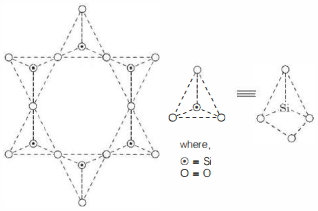
Identify the cyclic silicate ion given in the figure below:
A
$[Si_4O_{25}]^{24-}$
B
$[Si_6O_{18}]^{12-}$
C
$[Si_4O_{18}]^{12-}$
D
$[Si_6O_{24}]^{12-}$
Solution
(B) In cyclic silicates,two oxygen atoms of each $SiO_4^{4-}$ tetrahedron are shared to form a ring with the general formula $[SiO_3]_n^{2n-}$.
The figure shows a ring consisting of $6$ silicon atoms.
Substituting $n = 6$ into the general formula,we get $[SiO_3]_6^{2(6)-} = [Si_6O_{18}]^{12-}$.
Thus,the cyclic silicate ion is $[Si_6O_{18}]^{12-}$.
The figure shows a ring consisting of $6$ silicon atoms.
Substituting $n = 6$ into the general formula,we get $[SiO_3]_6^{2(6)-} = [Si_6O_{18}]^{12-}$.
Thus,the cyclic silicate ion is $[Si_6O_{18}]^{12-}$.
0 likes
View Solution450
MediumMCQ
The element $X$ which forms a stable product of the type $XCl_4$ is $....$
A
$Al$
B
$Na$
C
$Ca$
D
$Si$
Solution
(D)
As element $X$ forms a stable product of the type $XCl_4$,it must be tetravalent.
Among the given elements,$Al$ is trivalent ($+3$ oxidation state),$Na$ is monovalent ($+1$ oxidation state),$Ca$ is divalent ($+2$ oxidation state),and $Si$ is tetravalent ($+4$ oxidation state).
Therefore,$Si$ forms $SiCl_4$,which is a stable compound.
Thus,option $(d)$ is correct.
As element $X$ forms a stable product of the type $XCl_4$,it must be tetravalent.
Among the given elements,$Al$ is trivalent ($+3$ oxidation state),$Na$ is monovalent ($+1$ oxidation state),$Ca$ is divalent ($+2$ oxidation state),and $Si$ is tetravalent ($+4$ oxidation state).
Therefore,$Si$ forms $SiCl_4$,which is a stable compound.
Thus,option $(d)$ is correct.
0 likes
View Solutionp-Block Elements (Class 11) — Carbon family · Frequently Asked Questions
1Are these p-Block Elements (Class 11) questions useful for JEE and NEET?
Yes. All questions in this section are mapped to JEE Main and NEET exam patterns. Previous year questions from JEE Main, NEET, GUJCET and state-level exams are included with full solutions.
2Can I switch to Hindi or Gujarati for these questions?
Yes. Use the language tabs in the hero section or the sidebar to view the same questions and solutions in English, Hindi or Gujarati.
3How do I generate a question paper from this subtopic?
Use the Vedclass Exam Paper Generator — select the chapter and subtopic, set difficulty, and generate Sets A, B, C, D automatically. First 3 chapters of every subject are free.
Vedclass Products
For Students
Vedclass Test Series
Mock tests in real JEE/NEET style with performance analysis. 5-day free trial.
Start Free TrialFor Teachers
Exam Paper Generator
Generate Set A/B/C/D papers from this chapter in 2 minutes. 3 chapters free.
Try FreeFor Institutes
Online Exam Module
Live online exams with unlimited students, 360° analytics & white-label branding.
See DemoFor Teachers & Institutes
Generate a p-Block Elements (Class 11) Exam Paper in 2 Minutes
Select subtopic & difficulty — Sets A, B, C, D auto-generated with No Repeat logic.
First 3 chapters of every subject are free — no payment required.