
A English
Hydrogen Questions in English
Class 11 Chemistry · Hydrogen · Hydrogen
507+
Questions
English
Language
100%
With Solutions
Showing 7 of 507 questions in English
501
MediumMCQ
Calorific value of producer gas is low because of
A
high percent of $N_2$
B
low percent of $CO_2$
C
high percent of $CO$
D
low percent of $N_2$
Solution
(A) Producer gas is a mixture of $CO$ and $N_2$.
Its calorific value is low due to the high percentage of non-combustible nitrogen gas $(N_2)$ present in the mixture.
Its calorific value is low due to the high percentage of non-combustible nitrogen gas $(N_2)$ present in the mixture.
0 likes
View Solution502
EasyMCQ
Oxidation state of hydrogen in compound $X$ is $-1$ and in compound $Y$ is $+1$. $X$ and $Y$ are respectively
A
$LiAlH_4, H_2O$
B
$NH_3, NaH$
C
$CH_4, H_2O$
D
$H_2S, NaBH_4$
Solution
(A) The oxidation state of hydrogen is $-1$ in metal hydrides (where hydrogen is bonded to a less electronegative element) and $+1$ in compounds where hydrogen is bonded to a more electronegative non-metal.
In $LiAlH_4$,hydrogen is present as a hydride ion $(H^-)$,so its oxidation state is $-1$.
In $H_2O$,hydrogen is bonded to oxygen (which is more electronegative),so its oxidation state is $+1$.
Therefore,$X = LiAlH_4$ and $Y = H_2O$.
In $LiAlH_4$,hydrogen is present as a hydride ion $(H^-)$,so its oxidation state is $-1$.
In $H_2O$,hydrogen is bonded to oxygen (which is more electronegative),so its oxidation state is $+1$.
Therefore,$X = LiAlH_4$ and $Y = H_2O$.
0 likes
View Solution503
MediumMCQ
The sum of the total number of neutrons present in protium,deuterium,and tritium is:
A
$5$
B
$3$
C
$4$
D
$6$
Solution
(B) Protium,deuterium,and tritium are isotopes of hydrogen with the following notations:
Protium: $^1_1H$ (Number of neutrons $= 1 - 1 = 0$)
Deuterium: $^2_1H$ (Number of neutrons $= 2 - 1 = 1$)
Tritium: $^3_1H$ (Number of neutrons $= 3 - 1 = 2$)
The sum of the total number of neutrons $= 0 + 1 + 2 = 3$.
Protium: $^1_1H$ (Number of neutrons $= 1 - 1 = 0$)
Deuterium: $^2_1H$ (Number of neutrons $= 2 - 1 = 1$)
Tritium: $^3_1H$ (Number of neutrons $= 3 - 1 = 2$)
The sum of the total number of neutrons $= 0 + 1 + 2 = 3$.
0 likes
View Solution504
EasyMCQ
Which of the following is radioactive?
A
Hydrogen
B
Deuterium
C
Tritium
D
None of these
Solution
(C) Among the isotopes of hydrogen,$^1H$ (Protium),$^2H$ (Deuterium),and $^3H$ (Tritium),only $^3H$ (Tritium) is radioactive.
It emits low-energy $\beta$-particles and has a half-life of $12.33 \ \text{years}$.
It emits low-energy $\beta$-particles and has a half-life of $12.33 \ \text{years}$.
0 likes
View Solution505
MediumMCQ
Which statement is not correct for ortho and para hydrogen?
A
They have different boiling points
B
Ortho-form is more stable than para-form
C
They differ in their nuclear spin
D
The ratio of ortho to para hydrogen changes with change in temperature
Solution
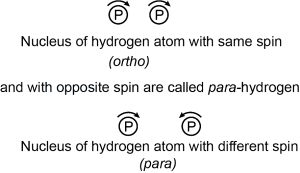
(B) $(i)$ Ortho and para hydrogens have different nuclear spin. In $H_2$ molecule,two protons in two $H$ atoms with parallel spin are called ortho-hydrogen.
$(ii)$ Para-hydrogen is more stable than ortho-form at low temperatures,whereas ortho-hydrogen is more stable at and above room temperature. Therefore,the statement that ortho-form is more stable than para-form is not universally correct.
$(iii)$ The percent composition of ortho and para changes with the temperature. Thus,their ratio also changes.
$(iv)$ They have slightly different boiling points.
Hence,$(B)$ is the answer.
$(ii)$ Para-hydrogen is more stable than ortho-form at low temperatures,whereas ortho-hydrogen is more stable at and above room temperature. Therefore,the statement that ortho-form is more stable than para-form is not universally correct.
$(iii)$ The percent composition of ortho and para changes with the temperature. Thus,their ratio also changes.
$(iv)$ They have slightly different boiling points.
Hence,$(B)$ is the answer.
0 likes
View Solution506
MediumMCQ
Ortho- and para-hydrogens have
A
Identical chemical properties but different physical properties
B
Identical physical and chemical properties
C
Identical physical properties but different chemical properties
D
Different physical and chemical properties
Solution
(A) Ortho-hydrogen and para-hydrogen are nuclear spin isomers of the hydrogen molecule $(H_2)$.
In ortho-hydrogen,the nuclear spins of the two protons are parallel,whereas in para-hydrogen,the nuclear spins are antiparallel.
Because they have the same electronic structure,their chemical properties are identical.
However,due to the difference in their nuclear spin states,they exhibit different physical properties,such as different thermal conductivities and specific heats.
In ortho-hydrogen,the nuclear spins of the two protons are parallel,whereas in para-hydrogen,the nuclear spins are antiparallel.
Because they have the same electronic structure,their chemical properties are identical.
However,due to the difference in their nuclear spin states,they exhibit different physical properties,such as different thermal conductivities and specific heats.
0 likes
View Solution507
EasyMCQ
$N_2H_4$ and $H_2O_2$ show similarity in
A
Density
B
Reducing nature
C
Oxidising nature
D
Hybridisation of central atoms
Solution
(D) In $N_2H_4$ (hydrazine),each nitrogen atom is bonded to two hydrogen atoms and one nitrogen atom,with one lone pair. The steric number for each $N$ atom is $3 + 1 = 4$,which corresponds to $sp^3$ hybridisation.
In $H_2O_2$ (hydrogen peroxide),each oxygen atom is bonded to one hydrogen atom and one oxygen atom,with two lone pairs. The steric number for each $O$ atom is $2 + 2 = 4$,which corresponds to $sp^3$ hybridisation.
Therefore,both compounds show similarity in the hybridisation of their central atoms $(sp^3)$.
In $H_2O_2$ (hydrogen peroxide),each oxygen atom is bonded to one hydrogen atom and one oxygen atom,with two lone pairs. The steric number for each $O$ atom is $2 + 2 = 4$,which corresponds to $sp^3$ hybridisation.
Therefore,both compounds show similarity in the hybridisation of their central atoms $(sp^3)$.
0 likes
View SolutionHydrogen — Hydrogen · Frequently Asked Questions
1Are these Hydrogen questions useful for JEE and NEET?
Yes. All questions in this section are mapped to JEE Main and NEET exam patterns. Previous year questions from JEE Main, NEET, GUJCET and state-level exams are included with full solutions.
2Can I switch to Hindi or Gujarati for these questions?
Yes. Use the language tabs in the hero section or the sidebar to view the same questions and solutions in English, Hindi or Gujarati.
3How do I generate a question paper from this subtopic?
Use the Vedclass Exam Paper Generator — select the chapter and subtopic, set difficulty, and generate Sets A, B, C, D automatically. First 3 chapters of every subject are free.
Vedclass Products
For Students
Vedclass Test Series
Mock tests in real JEE/NEET style with performance analysis. 5-day free trial.
Start Free TrialFor Teachers
Exam Paper Generator
Generate Set A/B/C/D papers from this chapter in 2 minutes. 3 chapters free.
Try FreeFor Institutes
Online Exam Module
Live online exams with unlimited students, 360° analytics & white-label branding.
See DemoFor Teachers & Institutes
Generate a Hydrogen Exam Paper in 2 Minutes
Select subtopic & difficulty — Sets A, B, C, D auto-generated with No Repeat logic.
First 3 chapters of every subject are free — no payment required.