
A English
Chemical Reactivity Questions in English
Class 11 Chemistry · Classification of Elements and Periodicity in Properties · Chemical Reactivity
261+
Questions
English
Language
100%
With Solutions
Showing 50 of 261 questions in English
101
EasyMCQ
Chemical properties of $Li$ and $Mg$ are similar because
A
They belong to the same group
B
Ionization potential of both is the same
C
They show a diagonal relationship
D
Both have the same electron affinity
Solution
(C) The similarity in chemical properties between $Li$ (Lithium) and $Mg$ (Magnesium) is due to the diagonal relationship in the periodic table.
Diagonal relationships occur because of similar ionic potential (charge/size ratio) and electronegativity values between elements placed diagonally to each other in the periodic table.
$Li$ is in Group $1$,Period $2$,and $Mg$ is in Group $2$,Period $3$.
Diagonal relationships occur because of similar ionic potential (charge/size ratio) and electronegativity values between elements placed diagonally to each other in the periodic table.
$Li$ is in Group $1$,Period $2$,and $Mg$ is in Group $2$,Period $3$.
0 likes
View Solution102
MediumMCQ
If $M^{+3}$ has configuration $[Ar]3d^{10}$,then $M$ belongs to :-
A
$s-$block
B
$p-$block
C
$d-$block
D
$f-$block
Solution
(B) The electronic configuration of the ion is $M^{+3} = [Ar]3d^{10}$.
To find the configuration of the neutral atom $M$,we add $3$ electrons back to the $4s$ and $4p$ orbitals.
Thus,$M = [Ar]3d^{10}4s^2 4p^1$.
Since the last electron enters the $p-$orbital,the element $M$ belongs to the $p-$block.
To find the configuration of the neutral atom $M$,we add $3$ electrons back to the $4s$ and $4p$ orbitals.
Thus,$M = [Ar]3d^{10}4s^2 4p^1$.
Since the last electron enters the $p-$orbital,the element $M$ belongs to the $p-$block.
0 likes
View Solution103
MediumMCQ
Based on the provided periodic table segment,identify the correct statement regarding the oxide of element $X$. The element with atomic number $Z = 52$ is Tellurium $(Te)$.
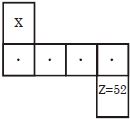
A
It reacts with $HCl$.
B
It reacts with $NaOH$.
C
Both $(A)$ and $(B)$.
D
It can neither react with $HCl$ nor $NaOH$.
Solution
(C) The element with atomic number $Z = 52$ is Tellurium $(Te)$,which belongs to group $16$ and period $5$.
Following the periodic table structure,the element $X$ is located in group $13$ and period $2$,which is Aluminum $(Al)$.
Aluminum oxide $(Al_2O_3)$ is an amphoteric oxide.
Amphoteric oxides react with both acids and bases.
Therefore,$Al_2O_3$ reacts with $HCl$ (acid) to form $AlCl_3$ and water,and it reacts with $NaOH$ (base) to form sodium aluminate $(NaAlO_2)$ and water.
Thus,the correct statement is that it reacts with both $HCl$ and $NaOH$.
Following the periodic table structure,the element $X$ is located in group $13$ and period $2$,which is Aluminum $(Al)$.
Aluminum oxide $(Al_2O_3)$ is an amphoteric oxide.
Amphoteric oxides react with both acids and bases.
Therefore,$Al_2O_3$ reacts with $HCl$ (acid) to form $AlCl_3$ and water,and it reacts with $NaOH$ (base) to form sodium aluminate $(NaAlO_2)$ and water.
Thus,the correct statement is that it reacts with both $HCl$ and $NaOH$.
0 likes
View Solution104
MediumMCQ
The correct order of acid strength is
A
$SO_3 < P_2O_3 < SiO_2 < Al_2O_3$
B
$Al_2O_3 < SiO_2 < P_2O_5 < SO_3$
C
$Al_2O_3 < SiO_2 < SO_2 < P_2O_3$
D
$SiO_2 < SO_2 < Al_2O_3 < P_2O_5$
Solution
(B) The acidic strength of oxides increases as the non-metallic character of the central atom increases across a period from left to right.
As the electronegativity $(EN)$ of the central atom increases,the acidic strength of its oxide increases.
The order of electronegativity for the given elements is $Al < Si < P < S$.
Therefore,the correct order of acidic strength is $Al_2O_3 < SiO_2 < P_2O_5 < SO_3$.
As the electronegativity $(EN)$ of the central atom increases,the acidic strength of its oxide increases.
The order of electronegativity for the given elements is $Al < Si < P < S$.
Therefore,the correct order of acidic strength is $Al_2O_3 < SiO_2 < P_2O_5 < SO_3$.
0 likes
View Solution105
MediumMCQ
Which of the following diagrams correctly represents the trend in the acidic strength of the given oxides?
A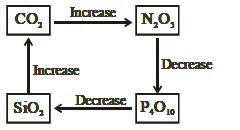
B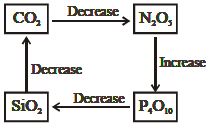
C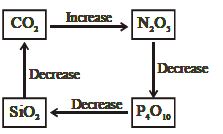
D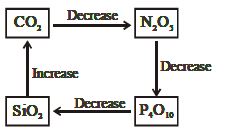
Solution
(C) The acidic strength of oxides generally increases from left to right across a period and decreases from top to bottom down a group.
Comparing the oxides:
$1$. Across a period (left to right): $SiO_2 < P_4O_{10} < CO_2 < N_2O_5$ (Acidic strength increases).
$2$. Down a group: Acidic strength decreases.
Looking at the cycle:
- $CO_2 \rightarrow N_2O_5$: Increase (Left to right)
- $N_2O_5 \rightarrow P_4O_{10}$: Decrease (Top to bottom)
- $P_4O_{10} \rightarrow SiO_2$: Decrease (Right to left)
- $SiO_2 \rightarrow CO_2$: Increase (Bottom to top)
This matches the diagram in option $C$.
Comparing the oxides:
$1$. Across a period (left to right): $SiO_2 < P_4O_{10} < CO_2 < N_2O_5$ (Acidic strength increases).
$2$. Down a group: Acidic strength decreases.
Looking at the cycle:
- $CO_2 \rightarrow N_2O_5$: Increase (Left to right)
- $N_2O_5 \rightarrow P_4O_{10}$: Decrease (Top to bottom)
- $P_4O_{10} \rightarrow SiO_2$: Decrease (Right to left)
- $SiO_2 \rightarrow CO_2$: Increase (Bottom to top)
This matches the diagram in option $C$.
0 likes
View Solution106
EasyMCQ
$Li$ resembles $Mg$ due to diagonal relationship which is attributed to
A
same ionic potential
B
same value of electron affinity
C
penetration of sub-shells
D
identical effective nuclear charge
Solution
(A) $Li$ and $Mg$ exhibit a diagonal relationship because they possess a similar ionic potential (also known as ionic potential or charge-to-size ratio,$\phi = \frac{\text{Charge}}{\text{Radius}}$).
This similarity in charge density leads to comparable polarizing power and chemical properties.
This similarity in charge density leads to comparable polarizing power and chemical properties.
0 likes
View Solution107
MediumMCQ
Red hot carbon will remove oxygen from the oxides $XO$ and $YO$ but not from $ZO$. $Y$ will remove oxygen from $XO$. Use this evidence to deduce the order of activity of the three metals $X, Y$ and $Z$ putting the most active first.
A
$XYZ$
B
$ZYX$
C
$YXZ$
D
$ZXY$
Solution
(B) Carbon can reduce $XO$ and $YO$ to their respective metals,which means $X$ and $Y$ are less reactive than carbon.
Since carbon cannot remove oxygen from $ZO$,$Z$ is more reactive than carbon.
Therefore,$Z$ is the most reactive metal.
Given that $Y$ can remove oxygen from $XO$,$Y$ is more reactive than $X$.
Combining these observations,the order of reactivity is $Z > Y > X$.
Thus,the correct order is $ZYX$.
Since carbon cannot remove oxygen from $ZO$,$Z$ is more reactive than carbon.
Therefore,$Z$ is the most reactive metal.
Given that $Y$ can remove oxygen from $XO$,$Y$ is more reactive than $X$.
Combining these observations,the order of reactivity is $Z > Y > X$.
Thus,the correct order is $ZYX$.
0 likes
View Solution108
MediumMCQ
$Be$ and $Al$ resemble in:
A
Both become passive on reaction with $HNO_3$ due to the formation of an oxide layer.
B
Their chlorides are Lewis acids.
C
Their hydroxides are soluble in both alkali and acid.
D
All of the above.
Solution
(D) $Be$ and $Al$ show a diagonal relationship in the periodic table.
Both elements exhibit similar properties due to their similar ionic potential (charge/size ratio).
$(1)$ Both form a protective oxide layer when treated with $HNO_3$,making them passive.
$(2)$ Both $BeCl_2$ and $AlCl_3$ act as Lewis acids due to their electron-deficient nature.
$(3)$ Both $Be(OH)_2$ and $Al(OH)_3$ are amphoteric,meaning they dissolve in both acids and bases.
Both elements exhibit similar properties due to their similar ionic potential (charge/size ratio).
$(1)$ Both form a protective oxide layer when treated with $HNO_3$,making them passive.
$(2)$ Both $BeCl_2$ and $AlCl_3$ act as Lewis acids due to their electron-deficient nature.
$(3)$ Both $Be(OH)_2$ and $Al(OH)_3$ are amphoteric,meaning they dissolve in both acids and bases.
0 likes
View Solution109
EasyMCQ
Similarity in chemical properties of the atoms of elements in a group of the Periodic table is most closely related to
A
atomic numbers
B
atomic masses
C
number of principal energy levels
D
number of valence electrons
Solution
(D) Elements in the same group of the Periodic table exhibit similar chemical properties because they possess the same number of valence electrons.
These valence electrons determine the chemical reactivity and bonding behavior of the atoms.
While the atomic number determines the position of an element,the specific configuration of valence electrons is the direct cause of the similarity in chemical properties within a group.
These valence electrons determine the chemical reactivity and bonding behavior of the atoms.
While the atomic number determines the position of an element,the specific configuration of valence electrons is the direct cause of the similarity in chemical properties within a group.
0 likes
View Solution110
MediumMCQ
Which pair of elements with the given atomic numbers is expected to have similar properties?
A
$40, 72$
B
$20, 36$
C
$10, 28$
D
$11, 12$
Solution
(A) Elements with atomic numbers $40$ $(Zr)$ and $72$ $(Hf)$ belong to the same group $(Group \ 4)$ in the periodic table.
Elements in the same group exhibit similar chemical properties due to having the same valence shell electronic configuration.
Therefore,the pair $(40, 72)$ is expected to have similar properties.
Elements in the same group exhibit similar chemical properties due to having the same valence shell electronic configuration.
Therefore,the pair $(40, 72)$ is expected to have similar properties.
0 likes
View Solution111
MediumMCQ
The element with $Z = 120$ (not yet discovered) will be a/an:
A
Inner transition metal
B
Alkaline earth metal
C
Alkali metal
D
Transition metal
Solution
(B) The electronic configuration of the element with $Z = 120$ is $[Og]_{118} \, 8s^2$,where $Og$ is Oganesson.
Since the valence shell configuration is $ns^2$,it belongs to Group $2$ of the periodic table.
Elements in Group $2$ are known as alkaline earth metals.
Since the valence shell configuration is $ns^2$,it belongs to Group $2$ of the periodic table.
Elements in Group $2$ are known as alkaline earth metals.
0 likes
View Solution112
MediumMCQ
With the help of the following reactions,arrange the metals $A$,$B$,$D$,and $E$ in decreasing order of their reactivity:
$(I)$ $B + ANO_3 \longrightarrow BNO_3 + A$
$(II)$ $A + HCl \longrightarrow ACl + \frac{1}{2} H_2$
$(III)$ $D + ECl \longrightarrow DCl + E$
$(IV)$ $D + HNO_3 \longrightarrow$ $H_2$ gas is not evolved
$(I)$ $B + ANO_3 \longrightarrow BNO_3 + A$
$(II)$ $A + HCl \longrightarrow ACl + \frac{1}{2} H_2$
$(III)$ $D + ECl \longrightarrow DCl + E$
$(IV)$ $D + HNO_3 \longrightarrow$ $H_2$ gas is not evolved
A
$B > A > D > E$
B
$B > A > E > D$
C
$E > D > B > A$
D
$D > E > B > A$
Solution
(A) $1$. From reaction $(I)$,$B + ANO_3 \longrightarrow BNO_3 + A$,metal $B$ displaces $A$ from its salt solution,so $B$ is more reactive than $A$ $(B > A)$.
$2$. From reaction $(II)$,$A + HCl \longrightarrow ACl + \frac{1}{2} H_2$,metal $A$ reacts with $HCl$ to evolve $H_2$ gas,meaning $A$ is more reactive than $H$ $(A > H)$.
$3$. From reaction $(III)$,$D + ECl \longrightarrow DCl + E$,metal $D$ displaces $E$ from its salt solution,so $D$ is more reactive than $E$ $(D > E)$.
$4$. From reaction $(IV)$,$D + HNO_3$ does not evolve $H_2$ gas,which is typical for metals less reactive than $H$ (or metals that act as reducing agents for $HNO_3$),implying $D < H$.
$5$. Combining these: $B > A > H > D > E$. Thus,the decreasing order of reactivity is $B > A > D > E$.
$2$. From reaction $(II)$,$A + HCl \longrightarrow ACl + \frac{1}{2} H_2$,metal $A$ reacts with $HCl$ to evolve $H_2$ gas,meaning $A$ is more reactive than $H$ $(A > H)$.
$3$. From reaction $(III)$,$D + ECl \longrightarrow DCl + E$,metal $D$ displaces $E$ from its salt solution,so $D$ is more reactive than $E$ $(D > E)$.
$4$. From reaction $(IV)$,$D + HNO_3$ does not evolve $H_2$ gas,which is typical for metals less reactive than $H$ (or metals that act as reducing agents for $HNO_3$),implying $D < H$.
$5$. Combining these: $B > A > H > D > E$. Thus,the decreasing order of reactivity is $B > A > D > E$.
0 likes
View Solution113
MediumMCQ
Arrange the following in the order of increasing basic character: $(NO_2, K_2O, ZnO)$
A
$NO_2 < ZnO < K_2O$
B
$K_2O < ZnO < NO_2$
C
$ZnO < NO_2 < K_2O$
D
$K_2O < NO_2 < ZnO$
Solution
(A) The basic character of oxides depends on the nature of the element forming the oxide.
$1$. $NO_2$ is a non-metallic oxide,which is acidic in nature.
$2$. $ZnO$ is an amphoteric oxide,which shows both acidic and basic properties.
$3$. $K_2O$ is a metallic oxide,which is strongly basic in nature.
Therefore,the order of increasing basic character is: $\text{Acidic oxide} < \text{Amphoteric oxide} < \text{Basic oxide}$.
Thus,the correct order is: $NO_2 < ZnO < K_2O$.
$1$. $NO_2$ is a non-metallic oxide,which is acidic in nature.
$2$. $ZnO$ is an amphoteric oxide,which shows both acidic and basic properties.
$3$. $K_2O$ is a metallic oxide,which is strongly basic in nature.
Therefore,the order of increasing basic character is: $\text{Acidic oxide} < \text{Amphoteric oxide} < \text{Basic oxide}$.
Thus,the correct order is: $NO_2 < ZnO < K_2O$.
0 likes
View Solution114
DifficultMCQ
The correct order of acidic strength is:
A
$Cl_2O_7 > SO_3 > P_4O_{10}$
B
$CO_2 > N_2O_5 > SO_3$
C
$Na_2O > MgO > Al_2O_3$
D
$K_2O > CaO > MgO$
Solution
(A) The acidic strength of oxides is directly proportional to the electronegativity $(EN)$ of the central atom and the oxidation state of the central atom.
For option $A$,the central atoms are $Cl$ $(+7)$,$S$ $(+6)$,and $P$ $(+5)$. Since electronegativity increases from $P$ to $S$ to $Cl$ and the oxidation state also increases,the acidic strength follows the order $Cl_2O_7 > SO_3 > P_4O_{10}$.
Thus,the correct option is $A$.
For option $A$,the central atoms are $Cl$ $(+7)$,$S$ $(+6)$,and $P$ $(+5)$. Since electronegativity increases from $P$ to $S$ to $Cl$ and the oxidation state also increases,the acidic strength follows the order $Cl_2O_7 > SO_3 > P_4O_{10}$.
Thus,the correct option is $A$.
0 likes
View Solution115
DifficultMCQ
The most electropositive element possesses the electronic configuration
A
$[He] \ 2s^1$
B
$[Ne] \ 3s^2$
C
$[Xe] \ 6s^1$
D
$[Xe] \ 6s^2$
Solution
(C) Electropositive character increases down a group and decreases across a period from left to right.
Cesium $(Cs)$ is the most electropositive stable element in the periodic table (excluding radioactive Francium).
The electronic configuration of Cesium ($Cs$,atomic number $55$) is $[Xe] \ 6s^1$.
Therefore,the element with the configuration $[Xe] \ 6s^1$ is the most electropositive.
Cesium $(Cs)$ is the most electropositive stable element in the periodic table (excluding radioactive Francium).
The electronic configuration of Cesium ($Cs$,atomic number $55$) is $[Xe] \ 6s^1$.
Therefore,the element with the configuration $[Xe] \ 6s^1$ is the most electropositive.
0 likes
View Solution116
DifficultMCQ
The atomic numbers of the metallic and non-metallic elements which are liquid at room temperature respectively are
A
$55, 87$
B
$33, 87$
C
$35, 80$
D
$80, 35$
Solution
(D) The metallic element that is liquid at room temperature is Mercury $(Hg)$,which has an atomic number of $80$.
The non-metallic element that is liquid at room temperature is Bromine $(Br)$,which has an atomic number of $35$.
Therefore,the atomic numbers of the metallic and non-metallic elements are $80$ and $35$ respectively.
The non-metallic element that is liquid at room temperature is Bromine $(Br)$,which has an atomic number of $35$.
Therefore,the atomic numbers of the metallic and non-metallic elements are $80$ and $35$ respectively.
0 likes
View Solution117
MediumMCQ
In the periodic table,metallic character of the elements shows one of the following trends:
A
Decreases down the group and increases across the period
B
Increases down the group and decreases across the period
C
Increases across the period and also down the group
D
Decreases across the period and also down the group
Solution
(B) Metallic character is defined by the ease with which an atom can lose electrons.
Across a period,from left to right,the effective nuclear charge increases and the atomic size decreases,making it harder to lose electrons; thus,metallic character decreases.
Down a group,the atomic size increases and the valence electrons are further from the nucleus,making it easier to lose electrons; thus,metallic character increases.
Across a period,from left to right,the effective nuclear charge increases and the atomic size decreases,making it harder to lose electrons; thus,metallic character decreases.
Down a group,the atomic size increases and the valence electrons are further from the nucleus,making it easier to lose electrons; thus,metallic character increases.
0 likes
View Solution118
DifficultMCQ
Which of the following metals is the most electropositive (metallic) in nature?
A
$Be$
B
$Rb$
C
$Mn$
D
$Tl$
Solution
(B) The electropositive character of an element increases down a group and decreases across a period from left to right in the periodic table.
$Be$ is in group $2$,period $2$.
$Rb$ is in group $1$,period $5$.
$Mn$ is a transition metal in period $4$.
$Tl$ is in group $13$,period $6$.
Among the given options,$Rb$ (Rubidium) is an alkali metal belonging to group $1$,which are the most electropositive elements in the periodic table. Therefore,$Rb$ is the most electropositive.
$Be$ is in group $2$,period $2$.
$Rb$ is in group $1$,period $5$.
$Mn$ is a transition metal in period $4$.
$Tl$ is in group $13$,period $6$.
Among the given options,$Rb$ (Rubidium) is an alkali metal belonging to group $1$,which are the most electropositive elements in the periodic table. Therefore,$Rb$ is the most electropositive.
0 likes
View Solution119
DifficultMCQ
Which of the following compounds is most acidic?
A
$Cl_2O_7$
B
$P_4O_{10}$
C
$SO_3$
D
$B_2O_3$
Solution
(A) The acidic nature of non-metal oxides increases as the oxidation state of the central non-metal atom increases.
Comparing the oxidation states:
$Cl_2O_7$: $Cl$ is in $+7$ state.
$P_4O_{10}$: $P$ is in $+5$ state.
$SO_3$: $S$ is in $+6$ state.
$B_2O_3$: $B$ is in $+3$ state.
Since $Cl$ has the highest oxidation state of $+7$,$Cl_2O_7$ is the most acidic oxide among the given options.
Comparing the oxidation states:
$Cl_2O_7$: $Cl$ is in $+7$ state.
$P_4O_{10}$: $P$ is in $+5$ state.
$SO_3$: $S$ is in $+6$ state.
$B_2O_3$: $B$ is in $+3$ state.
Since $Cl$ has the highest oxidation state of $+7$,$Cl_2O_7$ is the most acidic oxide among the given options.
0 likes
View Solution120
AdvancedMCQ
Consider the following four elements,which are represented according to the long form of the periodic table. Here $W$,$Y$,and $Z$ are left,up,and right elements with respect to the element $X$,and $X$ belongs to the $16^{th}$ group and $3^{rd}$ period. Then,according to the given information,the incorrect statement regarding the given elements is:

A
Maximum electronegativity : $Y$
B
Maximum catenation property : $X$
C
Maximum electron affinity : $Z$
D
$Y$ exhibits variable covalency
Solution
(D) Given that $X$ is in the $16^{th}$ group and $3^{rd}$ period,$X$ is Sulphur $(S)$.
Based on the relative positions:
$Y$ is above $X$ in the same group ($16^{th}$ group,$2^{nd}$ period),so $Y$ is Oxygen $(O)$.
$W$ is to the left of $X$ in the same period ($15^{th}$ group,$3^{rd}$ period),so $W$ is Phosphorus $(P)$.
$Z$ is to the right of $X$ in the same period ($17^{th}$ group,$3^{rd}$ period),so $Z$ is Chlorine $(Cl)$.
Evaluating the statements:
$(a)$ Electronegativity order: $O > Cl > S > P$. Thus,$Y$ $(O)$ has the maximum electronegativity. (Correct)
$(b)$ Catenation property order: $S > P > O > Cl$. Thus,$X$ $(S)$ has the maximum catenation property. (Correct)
$(c)$ Electron affinity order: $Cl > S > O > P$. Note: $Cl$ has higher electron affinity than $O$. Thus,$Z$ $(Cl)$ has the maximum electron affinity. (Correct)
$(d)$ Oxygen $(Y)$ has no $d$-orbitals and can only exhibit a covalency of $2$. It does not exhibit variable covalency. (Incorrect)
Therefore,the incorrect statement is $(d)$.
Based on the relative positions:
$Y$ is above $X$ in the same group ($16^{th}$ group,$2^{nd}$ period),so $Y$ is Oxygen $(O)$.
$W$ is to the left of $X$ in the same period ($15^{th}$ group,$3^{rd}$ period),so $W$ is Phosphorus $(P)$.
$Z$ is to the right of $X$ in the same period ($17^{th}$ group,$3^{rd}$ period),so $Z$ is Chlorine $(Cl)$.
Evaluating the statements:
$(a)$ Electronegativity order: $O > Cl > S > P$. Thus,$Y$ $(O)$ has the maximum electronegativity. (Correct)
$(b)$ Catenation property order: $S > P > O > Cl$. Thus,$X$ $(S)$ has the maximum catenation property. (Correct)
$(c)$ Electron affinity order: $Cl > S > O > P$. Note: $Cl$ has higher electron affinity than $O$. Thus,$Z$ $(Cl)$ has the maximum electron affinity. (Correct)
$(d)$ Oxygen $(Y)$ has no $d$-orbitals and can only exhibit a covalency of $2$. It does not exhibit variable covalency. (Incorrect)
Therefore,the incorrect statement is $(d)$.
0 likes
View Solution121
AdvancedMCQ
The electronic configurations of four elements are:
$I.$ $[Kr]\, 5s^1$
$II.$ $[Rn]\, 5f^{14}\, 6d^1\, 7s^2$
$III.$ $[Ar]\, 3d^{10}\, 4s^2\, 4p^5$
$IV.$ $[Ar]\, 3d^6\, 4s^2$
Consider the following statements:
$(i)$ $I$ shows variable oxidation state
$(ii)$ $II$ is a $d$-block element
$(iii)$ The compound formed between $I$ and $III$ is covalent
$(iv)$ $IV$ shows single oxidation state
Which statement is True $(T)$ or False $(F)$?
$I.$ $[Kr]\, 5s^1$
$II.$ $[Rn]\, 5f^{14}\, 6d^1\, 7s^2$
$III.$ $[Ar]\, 3d^{10}\, 4s^2\, 4p^5$
$IV.$ $[Ar]\, 3d^6\, 4s^2$
Consider the following statements:
$(i)$ $I$ shows variable oxidation state
$(ii)$ $II$ is a $d$-block element
$(iii)$ The compound formed between $I$ and $III$ is covalent
$(iv)$ $IV$ shows single oxidation state
Which statement is True $(T)$ or False $(F)$?
A
$FTFF$
B
$FTFT$
C
$FFTF$
D
$FFFF$
Solution
(D) $I.$ $[Kr]\, 5s^1$ is Rubidium $(Rb)$,an alkali metal,which shows only a single oxidation state of $+1$. Statement $(i)$ is False.
$II.$ $[Rn]\, 5f^{14}\, 6d^1\, 7s^2$ is Lawrencium ($Lr$,$Z=103$),which is an $f$-block element. Statement $(ii)$ is False.
$III.$ $I$ is a metal $(Rb)$ and $III$ is a non-metal (Bromine,$Br$). The compound formed between them $(RbBr)$ is ionic. Statement $(iii)$ is False.
$IV.$ $[Ar]\, 3d^6\, 4s^2$ is Iron ($Fe$,$Z=26$),which is a transition metal and shows variable oxidation states $(+2, +3)$. Statement $(iv)$ is False.
Therefore,all statements are False $(FFFF)$.
$II.$ $[Rn]\, 5f^{14}\, 6d^1\, 7s^2$ is Lawrencium ($Lr$,$Z=103$),which is an $f$-block element. Statement $(ii)$ is False.
$III.$ $I$ is a metal $(Rb)$ and $III$ is a non-metal (Bromine,$Br$). The compound formed between them $(RbBr)$ is ionic. Statement $(iii)$ is False.
$IV.$ $[Ar]\, 3d^6\, 4s^2$ is Iron ($Fe$,$Z=26$),which is a transition metal and shows variable oxidation states $(+2, +3)$. Statement $(iv)$ is False.
Therefore,all statements are False $(FFFF)$.
0 likes
View Solution122
MediumMCQ
The oxide of a metal $(R)$ can be reduced by the metal $(P)$,and metal $(R)$ can reduce the oxide of metal $(Q)$. Then the decreasing order of the reactivity of metals $(P)$,$(Q)$,and $(R)$ with oxygen is:
A
$P > Q > R$
B
$P > R > Q$
C
$R > P > Q$
D
$Q > P > R$
Solution
(B) metal with higher reactivity can reduce the oxide of a metal with lower reactivity.
Given that metal $(P)$ can reduce the oxide of $(R)$,it implies that $(P)$ is more reactive than $(R)$,i.e.,$P > R$.
Given that metal $(R)$ can reduce the oxide of $(Q)$,it implies that $(R)$ is more reactive than $(Q)$,i.e.,$R > Q$.
Combining these two relationships,we get the order of reactivity as $P > R > Q$.
Given that metal $(P)$ can reduce the oxide of $(R)$,it implies that $(P)$ is more reactive than $(R)$,i.e.,$P > R$.
Given that metal $(R)$ can reduce the oxide of $(Q)$,it implies that $(R)$ is more reactive than $(Q)$,i.e.,$R > Q$.
Combining these two relationships,we get the order of reactivity as $P > R > Q$.
0 likes
View Solution123
DifficultMCQ
In which case,the order of acidic strength is not correct?
A
$HI > HBr > HCl$
B
$HIO_4 > HBrO_4 > HClO_4$
C
$HClO_4 > HClO_3 > HClO_2$
D
$HF > H_2O > NH_3$
Solution
(B) For hydrohalic acids $(HI, HBr, HCl, HF)$,the acidic strength increases down the group due to the decrease in bond dissociation energy: $HI > HBr > HCl > HF$.
For oxoacids of halogens,the acidic strength is directly proportional to the electronegativity of the halogen atom when the oxidation state is the same.
In $HIO_4, HBrO_4,$ and $HClO_4$,the central atoms are in the same oxidation state $(+7)$. Since electronegativity follows the order $Cl > Br > I$,the correct order of acidic strength is $HClO_4 > HBrO_4 > HIO_4$.
Therefore,the order given in option $B$ is incorrect.
For oxoacids of halogens,the acidic strength is directly proportional to the electronegativity of the halogen atom when the oxidation state is the same.
In $HIO_4, HBrO_4,$ and $HClO_4$,the central atoms are in the same oxidation state $(+7)$. Since electronegativity follows the order $Cl > Br > I$,the correct order of acidic strength is $HClO_4 > HBrO_4 > HIO_4$.
Therefore,the order given in option $B$ is incorrect.
0 likes
View Solution124
MediumMCQ
Which of the following is the most acidic?
A
$Na_2O$
B
$MgO$
C
$Al_2O_3$
D
$CaO$
Solution
(C) Metallic oxides are generally basic in nature. As we move from left to right across a period in the periodic table,the acidic character of the oxides increases. Among the given options,$Na_2O$,$MgO$,and $CaO$ are basic oxides,while $Al_2O_3$ is amphoteric. However,in the context of comparing these specific oxides,$Al_2O_3$ exhibits the highest acidic character (or least basic character) compared to the others.
0 likes
View Solution125
MediumMCQ
Which of the following is the correct order of acidic strength for $Al_2O_3$,$SiO_2$,$P_2O_3$,and $SO_2$?
A
$SO_2 < P_2O_3 < SiO_2 < Al_2O_3$
B
$SiO_2 < SO_2 < Al_2O_3 < P_2O_3$
C
$Al_2O_3 < SiO_2 < SO_2 < P_2O_3$
D
$Al_2O_3 < SiO_2 < P_2O_3 < SO_2$
Solution
(D) The acidic strength of oxides in a period increases as we move from left to right.
$Al_2O_3$ is amphoteric,$SiO_2$ is weakly acidic,$P_2O_3$ is acidic,and $SO_2$ is strongly acidic.
Therefore,the correct order of acidic strength is $Al_2O_3 < SiO_2 < P_2O_3 < SO_2$.
$Al_2O_3$ is amphoteric,$SiO_2$ is weakly acidic,$P_2O_3$ is acidic,and $SO_2$ is strongly acidic.
Therefore,the correct order of acidic strength is $Al_2O_3 < SiO_2 < P_2O_3 < SO_2$.
0 likes
View Solution126
EasyMCQ
Choose the correct order of acidic strength for $CO_2, CuO, CaO, H_2O$.
A
$CaO < CuO < H_2O < CO_2$
B
$H_2O < CuO < CaO < CO_2$
C
$CaO < H_2O < CuO < CO_2$
D
$H_2O < CO_2 < CaO < CuO$
Solution
(A) $CaO$ and $CuO$ are metallic oxides and are basic in nature. $CaO$ is more basic than $CuO$.
$H_2O$ is neutral.
$CO_2$ is a non-metallic oxide and is acidic in nature.
Therefore,the correct order of acidic strength is $CaO < CuO < H_2O < CO_2$.
$H_2O$ is neutral.
$CO_2$ is a non-metallic oxide and is acidic in nature.
Therefore,the correct order of acidic strength is $CaO < CuO < H_2O < CO_2$.
0 likes
View Solution127
EasyMCQ
In the reaction $2Br^- + X_2 \to Br_2 + 2X^-$,what is $X_2$?
A
$Cl_2$
B
$C_2$
C
$I_2$
D
$N_2$
Solution
(A) more electronegative halogen can displace a less electronegative halogen from its salt solution.
Since $Cl$ is more electronegative than $Br$,$Cl_2$ can displace $Br^-$ from the solution to form $Br_2$ and $Cl^-$.
Therefore,$X_2$ is $Cl_2$.
Since $Cl$ is more electronegative than $Br$,$Cl_2$ can displace $Br^-$ from the solution to form $Br_2$ and $Cl^-$.
Therefore,$X_2$ is $Cl_2$.
0 likes
View Solution128
EasyMCQ
Which of the following sets has the highest tendency to form anions?
A
$Ga, In, Tl$
B
$Na, Mg, Al$
C
$N, O, F$
D
$V, Cr, Mn$
Solution
(C) Non-metals have a high tendency to form anions by gaining electrons.
Among the given sets,$N, O,$ and $F$ are non-metals with high electronegativity.
Due to their high electronegativity,they have the greatest tendency to gain electrons and form anions compared to the other sets,which consist mostly of metals.
Among the given sets,$N, O,$ and $F$ are non-metals with high electronegativity.
Due to their high electronegativity,they have the greatest tendency to gain electrons and form anions compared to the other sets,which consist mostly of metals.
0 likes
View Solution129
MediumMCQ
Which of the following substances will liberate bromine when reacted with a solution of potassium bromide?
A
Hydrogen iodide
B
Sulfur dioxide
C
Chlorine
D
Iodine
Solution
(C) more electronegative halogen displaces a less electronegative halogen from its salt solution.
Since chlorine is more electronegative than bromine,it displaces bromine from potassium bromide:
$2KBr + Cl_2 \to 2KCl + Br_2$
Since chlorine is more electronegative than bromine,it displaces bromine from potassium bromide:
$2KBr + Cl_2 \to 2KCl + Br_2$
0 likes
View Solution130
EasyMCQ
When $KI$ is passed through a solution containing $KCl, KF,$ and $KBr$,what happens?
A
$Cl_2$ and $Br_2$ are liberated.
B
$Cl_2$ is liberated.
C
$Cl_2, Br_2,$ and $F_2$ are liberated.
D
None of these.
Solution
(D) The oxidizing power of halogens decreases down the group $(F_2 > Cl_2 > Br_2 > I_2)$.
Since $I_2$ is the weakest oxidizing agent among the halogens,it cannot displace $Cl^-, Br^-,$ or $F^-$ ions from their respective salt solutions.
Therefore,no reaction occurs.
Since $I_2$ is the weakest oxidizing agent among the halogens,it cannot displace $Cl^-, Br^-,$ or $F^-$ ions from their respective salt solutions.
Therefore,no reaction occurs.
0 likes
View Solution131
MediumMCQ
Which of the following will liberate bromine from a potassium bromide solution?
A
Iodine solution
B
Chlorine water
C
Sodium chloride
D
Potassium iodide
Solution
(B) more electronegative element can displace a less electronegative element from its salt solution. The order of electronegativity/oxidizing power is $F_2 > Cl_2 > Br_2 > I_2$. Since chlorine is more electronegative than bromine,it will displace bromine from $KBr$ solution according to the reaction: $Cl_2 + 2KBr \rightarrow 2KCl + Br_2$.
0 likes
View Solution132
MediumMCQ
Arrange the acids $H_2SO_4$,$H_3PO_4$,and $HClO_3$ in the decreasing order of their acidic strength.
A
$I > III > II$
B
$I > II > III$
C
$III > I > II$
D
$II > III > I$
Solution
(C) The acidic strength of oxyacids depends on the oxidation state of the central atom and the electronegativity of the central atom.
For the given acids,the $pK_a$ values are:
$HClO_3$ $(pK_a \approx -3)$
$H_2SO_4$ ($pK_a \approx -3$ for the first dissociation,but generally considered stronger than $H_3PO_4$)
$H_3PO_4$ $(pK_a \approx 2.12)$
Comparing the acid dissociation constants,the order of acidic strength is $HClO_3 > H_2SO_4 > H_3PO_4$,which corresponds to $III > I > II$.
For the given acids,the $pK_a$ values are:
$HClO_3$ $(pK_a \approx -3)$
$H_2SO_4$ ($pK_a \approx -3$ for the first dissociation,but generally considered stronger than $H_3PO_4$)
$H_3PO_4$ $(pK_a \approx 2.12)$
Comparing the acid dissociation constants,the order of acidic strength is $HClO_3 > H_2SO_4 > H_3PO_4$,which corresponds to $III > I > II$.
0 likes
View Solution133
MediumMCQ
Arrange the following acids in the decreasing order of their acidic strength: $Cl(OH) \ (I)$,$Br(OH) \ (II)$,$I(OH) \ (III)$.
A
$I > II > III$
B
$II > I > III$
C
$III > II > I$
D
$I > III > II$
Solution
(A) The acidic strength of oxyacids depends on the electronegativity of the central atom.
As the electronegativity of the halogen atom decreases in the order $Cl > Br > I$,the electron-withdrawing effect on the $O-H$ bond decreases.
Consequently,the ability to release $H^+$ ions decreases.
Therefore,the correct order of acidic strength is $Cl(OH) > Br(OH) > I(OH)$,which corresponds to $I > II > III$.
As the electronegativity of the halogen atom decreases in the order $Cl > Br > I$,the electron-withdrawing effect on the $O-H$ bond decreases.
Consequently,the ability to release $H^+$ ions decreases.
Therefore,the correct order of acidic strength is $Cl(OH) > Br(OH) > I(OH)$,which corresponds to $I > II > III$.
0 likes
View Solution134
EasyMCQ
Which of the following represents the correct order of acidic strength?
A
$Cl_2O_7 > SO_2 > P_4O_{10}$
B
$CO_2 > N_2O_5 > SO_3$
C
$Na_2O > MgO > Al_2O_3$
D
$K_2O > CaO > MgO$
Solution
(A) The acidic strength of oxides increases as we move from left to right across a period in the periodic table.
Comparing the non-metallic character and oxidation states,the acidic strength order is $Cl_2O_7 > SO_2 > P_4O_{10}$ because chlorine is more electronegative and has a higher oxidation state compared to sulfur and phosphorus in these oxides.
Comparing the non-metallic character and oxidation states,the acidic strength order is $Cl_2O_7 > SO_2 > P_4O_{10}$ because chlorine is more electronegative and has a higher oxidation state compared to sulfur and phosphorus in these oxides.
0 likes
View Solution135
MediumMCQ
Which of the following orders correctly represents the increasing acidic strength of the given acids?
A
$HOClO < HOCl < HOClO_3 < HOClO_2$
B
$HOClO_2 < HOClO_3 < HOClO < HOCl$
C
$HOClO_3 < HOClO_2 < HOClO < HOCl$
D
$HOCl < HOClO < HOClO_2 < HOClO_3$
Solution
(D) The acidic strength of oxoacids of halogens increases with an increase in the oxidation state of the central halogen atom.
The oxidation states are as follows:
$HOCl$ $(+1)$
$HOClO$ $(+3)$
$HOClO_2$ $(+5)$
$HOClO_3$ $(+7)$
Therefore,the correct order of increasing acidic strength is: $HOCl < HOClO < HOClO_2 < HOClO_3$.
The oxidation states are as follows:
$HOCl$ $(+1)$
$HOClO$ $(+3)$
$HOClO_2$ $(+5)$
$HOClO_3$ $(+7)$
Therefore,the correct order of increasing acidic strength is: $HOCl < HOClO < HOClO_2 < HOClO_3$.
0 likes
View Solution136
DifficultMCQ
Among the following,the least and most metallic elements will be respectively:
$(I) [He] 2s^1$
$(II) [Kr] 5s^2 4d^{10} 5p^5$
$(III) [Xe] 6s^1$
$(IV) [He] 2s^2 2p^5$
$(I) [He] 2s^1$
$(II) [Kr] 5s^2 4d^{10} 5p^5$
$(III) [Xe] 6s^1$
$(IV) [He] 2s^2 2p^5$
A
$I$ and $II$
B
$II$ and $IV$
C
$III$ and $IV$
D
$IV$ and $III$
0 likes
View Solution137
MediumMCQ
The electronic configuration of three elements $A, B$ and $C$ are given below. The molecular formula of the compound formed from $B$ and $C$ will be
$A : 1s^2, 2s^2, 2p^6$
$B : 1s^2, 2s^2, 2p^6, 3s^2, 3p^3$
$C : 1s^2, 2s^2, 2p^6, 3s^2, 3p^5$
$A : 1s^2, 2s^2, 2p^6$
$B : 1s^2, 2s^2, 2p^6, 3s^2, 3p^3$
$C : 1s^2, 2s^2, 2p^6, 3s^2, 3p^5$
A
$BC$
B
$B_2C$
C
$BC_2$
D
$BC_3$
Solution
(D) Element $B$ has the valence shell configuration $3s^2, 3p^3$,which means it has $5$ valence electrons and belongs to Group $15$ (valency $3$).
Element $C$ has the valence shell configuration $3s^2, 3p^5$,which means it has $7$ valence electrons and belongs to Group $17$ (valency $1$).
To form a stable compound,$B$ shares its $3$ electrons with $3$ atoms of $C$.
Therefore,the molecular formula of the compound formed is $BC_3$.
Element $C$ has the valence shell configuration $3s^2, 3p^5$,which means it has $7$ valence electrons and belongs to Group $17$ (valency $1$).
To form a stable compound,$B$ shares its $3$ electrons with $3$ atoms of $C$.
Therefore,the molecular formula of the compound formed is $BC_3$.
0 likes
View Solution138
MediumMCQ
Select the correct order.
A
$Mg^{+2} < Ca^{+2} < Sr^{+2} < Ba^{+2}$ (conductivity in molten state)
B
$Li^{+1} < Na^{+1} < K^{+1} < Rb^{+1} < Cs^{+1}$ (Hydration energy)
C
$Li < Na < K < Rb < Cs$ (Reactivity)
D
All of them
Solution
(C) $1$. In molten state,conductivity depends on the mobility of ions. As the size of the cation increases $(Mg^{+2} < Ca^{+2} < Sr^{+2} < Ba^{+2})$,the degree of hydration decreases (in aqueous solution) or the ionic mobility increases,making the order $Mg^{+2} < Ca^{+2} < Sr^{+2} < Ba^{+2}$ correct for conductivity.
$2$. Hydration energy is inversely proportional to the size of the ion. Since the size increases from $Li^{+1}$ to $Cs^{+1}$,the hydration energy decreases. Thus,the order $Li^{+1} > Na^{+1} > K^{+1} > Rb^{+1} > Cs^{+1}$ is correct,making option $B$ incorrect.
$3$. Reactivity of alkali metals increases down the group due to the decrease in ionization enthalpy. Thus,$Li < Na < K < Rb < Cs$ is the correct order of reactivity.
$4$. Since option $B$ is incorrect,the correct answer is $C$.
$2$. Hydration energy is inversely proportional to the size of the ion. Since the size increases from $Li^{+1}$ to $Cs^{+1}$,the hydration energy decreases. Thus,the order $Li^{+1} > Na^{+1} > K^{+1} > Rb^{+1} > Cs^{+1}$ is correct,making option $B$ incorrect.
$3$. Reactivity of alkali metals increases down the group due to the decrease in ionization enthalpy. Thus,$Li < Na < K < Rb < Cs$ is the correct order of reactivity.
$4$. Since option $B$ is incorrect,the correct answer is $C$.
0 likes
View Solution139
DifficultMCQ
Which of the following order of acidic strength is correct?
A
$SO_2 > SO_3 > CO_2$
B
$Cs_2O > K_2O > Na_2O$
C
$CO_2 > N_2O_5 > B_2O_3$
D
$SO_3 > CO_2 > B_2O_3$
Solution
(D) The acidic strength of oxides increases as the non-metallic character increases across a period and decreases down a group.
For non-metallic oxides,the acidic strength is directly proportional to the oxidation state of the central atom.
Comparing the oxides: $SO_3$ (sulfur in $+6$ state),$CO_2$ (carbon in $+4$ state),and $B_2O_3$ (boron in $+3$ state).
Since the oxidation state decreases from $S$ to $C$ to $B$,the acidic strength follows the order $SO_3 > CO_2 > B_2O_3$.
For non-metallic oxides,the acidic strength is directly proportional to the oxidation state of the central atom.
Comparing the oxides: $SO_3$ (sulfur in $+6$ state),$CO_2$ (carbon in $+4$ state),and $B_2O_3$ (boron in $+3$ state).
Since the oxidation state decreases from $S$ to $C$ to $B$,the acidic strength follows the order $SO_3 > CO_2 > B_2O_3$.
0 likes
View Solution140
MediumMCQ
In which among the following pairs are both the elements metalloids?
A
$Be, B$
B
$Si, Ge$
C
$B, C$
D
$Sn, Pb$
Solution
(B) Metalloids are elements that exhibit properties intermediate between those of metals and non-metals.
In the periodic table,the metalloids are $B, Si, Ge, As, Sb, Te,$ and $Po$.
Looking at the options:
$A) Be$ is a metal,$B$ is a metalloid.
$B) Si$ and $Ge$ are both metalloids.
$C) B$ is a metalloid,$C$ is a non-metal.
$D) Sn$ and $Pb$ are metals.
Therefore,the correct pair is $Si$ and $Ge$.
In the periodic table,the metalloids are $B, Si, Ge, As, Sb, Te,$ and $Po$.
Looking at the options:
$A) Be$ is a metal,$B$ is a metalloid.
$B) Si$ and $Ge$ are both metalloids.
$C) B$ is a metalloid,$C$ is a non-metal.
$D) Sn$ and $Pb$ are metals.
Therefore,the correct pair is $Si$ and $Ge$.
0 likes
View Solution141
EasyMCQ
Which of the following orders of acidic strength is correct?
A
$SO_2 > SO_3 > CO_2$
B
$Cs_2O > K_2O > Na_2O$
C
$CO_2 > N_2O_5 > B_2O_3$
D
$SO_3 > CO_2 > B_2O_3$
Solution
(D) The acidic strength of oxides depends on the non-metallic character and the oxidation state of the central atom.
Acidic character increases as the non-metallic character increases across a period and decreases down a group.
Comparing the oxides:
$SO_3$ (Sulfur is in $+6$ oxidation state),$CO_2$ (Carbon is in $+4$ oxidation state),and $B_2O_3$ (Boron is in $+3$ oxidation state).
Since the non-metallic character follows the order $S > C > B$,the acidic strength of their oxides follows the order $SO_3 > CO_2 > B_2O_3$.
Therefore,option $D$ is correct.
Acidic character increases as the non-metallic character increases across a period and decreases down a group.
Comparing the oxides:
$SO_3$ (Sulfur is in $+6$ oxidation state),$CO_2$ (Carbon is in $+4$ oxidation state),and $B_2O_3$ (Boron is in $+3$ oxidation state).
Since the non-metallic character follows the order $S > C > B$,the acidic strength of their oxides follows the order $SO_3 > CO_2 > B_2O_3$.
Therefore,option $D$ is correct.
0 likes
View Solution142
DifficultMCQ
Which of the following ions has a pseudo-noble gas electronic configuration?
A
$Cu^{+}$
B
$Fe^{2+}$
C
$O^{-}$
D
$Cu^{2+}$
Solution
(A) pseudo-noble gas configuration is defined as an electronic configuration where the outermost shell contains $18$ electrons $(ns^2 np^6 nd^{10})$.
For $Cu$ $(Z=29)$,the ground state configuration is $[Ar] 3d^{10} 4s^1$.
When $Cu$ loses one electron to form $Cu^{+}$,the configuration becomes $[Ar] 3d^{10}$.
This configuration has $18$ electrons in the outermost shell $(3s^2 3p^6 3d^{10})$,which is characteristic of a pseudo-noble gas configuration.
Therefore,$Cu^{+}$ is the correct ion.
For $Cu$ $(Z=29)$,the ground state configuration is $[Ar] 3d^{10} 4s^1$.
When $Cu$ loses one electron to form $Cu^{+}$,the configuration becomes $[Ar] 3d^{10}$.
This configuration has $18$ electrons in the outermost shell $(3s^2 3p^6 3d^{10})$,which is characteristic of a pseudo-noble gas configuration.
Therefore,$Cu^{+}$ is the correct ion.
0 likes
View Solution143
MediumMCQ
Which of the following pairs of elements belongs to the group of representative elements in the periodic table?
A
$Al$ and $Mg$
B
$Cr$ and $Zn$
C
$Ag$ and $At$
D
$La$ and $Th$
Solution
(A) Representative elements are those elements that belong to the $s$-block and $p$-block of the periodic table (excluding noble gases in some definitions,but generally including groups $1, 2, 13-17$).
$Al$ (Aluminum) is in group $13$ ($p$-block) and $Mg$ (Magnesium) is in group $2$ ($s$-block).
Both $Al$ and $Mg$ are representative elements.
$Cr$ and $Zn$ are transition elements ($d$-block).
$Ag$ is a transition element and $At$ is a halogen (representative).
$La$ and $Th$ are inner transition elements ($f$-block).
Therefore,the correct pair is $Al$ and $Mg$.
$Al$ (Aluminum) is in group $13$ ($p$-block) and $Mg$ (Magnesium) is in group $2$ ($s$-block).
Both $Al$ and $Mg$ are representative elements.
$Cr$ and $Zn$ are transition elements ($d$-block).
$Ag$ is a transition element and $At$ is a halogen (representative).
$La$ and $Th$ are inner transition elements ($f$-block).
Therefore,the correct pair is $Al$ and $Mg$.
0 likes
View Solution144
DifficultMCQ
Identify the correct order of basicity for the following oxides: $Na_2O, MgO, CuO, SiO_2$.
A
$Na_2O > MgO > CuO > SiO_2$
B
$MgO > SiO_2 > CuO > Na_2O$
C
$SiO_2 > MgO > CuO > Na_2O$
D
$CuO > Na_2O > MgO > SiO_2$
Solution
(A) The basicity of oxides depends on the metallic character of the element. As we move from left to right across a period,the metallic character decreases and the non-metallic character increases,leading to a decrease in the basicity of the oxides.
$Na_2O$ is an oxide of an alkali metal (Group $1$),which is strongly basic.
$MgO$ is an oxide of an alkaline earth metal (Group $2$),which is basic.
$CuO$ is a transition metal oxide,which is amphoteric to weakly basic.
$SiO_2$ is a non-metal oxide (Group $14$),which is acidic.
Therefore,the correct order of decreasing basicity is $Na_2O > MgO > CuO > SiO_2$.
$Na_2O$ is an oxide of an alkali metal (Group $1$),which is strongly basic.
$MgO$ is an oxide of an alkaline earth metal (Group $2$),which is basic.
$CuO$ is a transition metal oxide,which is amphoteric to weakly basic.
$SiO_2$ is a non-metal oxide (Group $14$),which is acidic.
Therefore,the correct order of decreasing basicity is $Na_2O > MgO > CuO > SiO_2$.
0 likes
View Solution145
EasyMCQ
As the atomic number increases in a group,the atomic density .........
A
decreases
B
remains the same
C
generally increases
D
cannot be predicted
Solution
(C) In a group,as the atomic number increases,the atomic mass increases significantly more than the atomic volume. Since density is defined as $\text{density} = \frac{\text{mass}}{\text{volume}}$,the increase in mass dominates,leading to an overall increase in atomic density as we move down the group.
0 likes
View Solution146
DifficultMCQ
Which reaction is not feasible?
A
$2KI + Br_2 \to 2KBr + I_2$
B
$2KBr + I_2 \to 2KI + Br_2$
C
$2KBr + Cl_2 \to 2KCl + Br_2$
D
$2H_2O + 2F_2 \to 4HF + O_2$
Solution
(B) The reaction $2KBr + I_2 \to 2KI + Br_2$ is not feasible.
In this reaction,$I_2$ would need to act as an oxidizing agent to oxidize $Br^-$ to $Br_2$.
However,the standard reduction potential of $Br_2$ is higher than that of $I_2$,meaning $Br_2$ is a stronger oxidizing agent than $I_2$.
Therefore,$I_2$ cannot displace $Br^-$ from its salt solution,making the reaction non-spontaneous.
In this reaction,$I_2$ would need to act as an oxidizing agent to oxidize $Br^-$ to $Br_2$.
However,the standard reduction potential of $Br_2$ is higher than that of $I_2$,meaning $Br_2$ is a stronger oxidizing agent than $I_2$.
Therefore,$I_2$ cannot displace $Br^-$ from its salt solution,making the reaction non-spontaneous.
0 likes
View Solution147
EasyMCQ
Which of the following gases can displace all other gases from a mixture?
A
$O_2$
B
$N_2$
C
$CO$
D
$H_2$
Solution
(C) In the context of chemical reactivity and displacement in gaseous mixtures,$CO$ (carbon monoxide) is highly reactive due to its electronic structure and the presence of a lone pair on the carbon atom.
It acts as a strong ligand and reducing agent,allowing it to displace other gases like $O_2$,$N_2$,and $H_2$ in specific chemical environments or catalytic processes.
It acts as a strong ligand and reducing agent,allowing it to displace other gases like $O_2$,$N_2$,and $H_2$ in specific chemical environments or catalytic processes.
0 likes
View Solution148
MediumMCQ
The element with atomic number $Z = 117$ should:
A
be a halogen
B
have seven valence electrons
C
have a valence shell configuration of $7s^2 7p^5$
D
have all of the above properties
Solution
(D) The element with atomic number $Z = 117$ belongs to group $17$ of the periodic table.
Group $17$ elements are known as halogens.
These elements have a general valence shell electronic configuration of $ns^2 np^5$.
For $Z = 117$,the valence shell is $n = 7$,so the configuration is $7s^2 7p^5$.
This configuration indicates that the element has $7$ valence electrons $(2 + 5 = 7)$.
Therefore,all the given statements are correct.
Group $17$ elements are known as halogens.
These elements have a general valence shell electronic configuration of $ns^2 np^5$.
For $Z = 117$,the valence shell is $n = 7$,so the configuration is $7s^2 7p^5$.
This configuration indicates that the element has $7$ valence electrons $(2 + 5 = 7)$.
Therefore,all the given statements are correct.
0 likes
View Solution149
MediumMCQ
The correct sequence of acidic character is:
A
$SO_2 > CO_2 > CO > N_2O_5$
B
$SO_2 > N_2O_5 > CO > CO_2$
C
$N_2O_5 > SO_2 > CO > CO_2$
D
$N_2O_5 > SO_2 > CO_2 > CO$
Solution
(D) The acidic nature of non-metallic oxides is directly proportional to the oxidation state of the central atom.
Calculating the oxidation states:
$N_2O_5$: $N$ is $+5$
$SO_2$: $S$ is $+4$
$CO_2$: $C$ is $+4$
$CO$: $C$ is $+2$
Comparing the oxidation states: $+5 > +4 > +4 > +2$.
For oxides with the same oxidation state (like $SO_2$ and $CO_2$),the acidic strength depends on the electronegativity of the central atom. Since $S$ is more electronegative than $C$ in this context,$SO_2$ is more acidic than $CO_2$.
Thus,the correct order is $N_2O_5 > SO_2 > CO_2 > CO$.
Calculating the oxidation states:
$N_2O_5$: $N$ is $+5$
$SO_2$: $S$ is $+4$
$CO_2$: $C$ is $+4$
$CO$: $C$ is $+2$
Comparing the oxidation states: $+5 > +4 > +4 > +2$.
For oxides with the same oxidation state (like $SO_2$ and $CO_2$),the acidic strength depends on the electronegativity of the central atom. Since $S$ is more electronegative than $C$ in this context,$SO_2$ is more acidic than $CO_2$.
Thus,the correct order is $N_2O_5 > SO_2 > CO_2 > CO$.
0 likes
View Solution150
DifficultMCQ
Which one of the following orders represents the correct sequence of increasing basic nature of the given oxides?
A
$Na_2O < K_2O < MgO < Al_2O_3$
B
$K_2O < Na_2O < Al_2O_3 < MgO$
C
$Al_2O_3 < MgO < Na_2O < K_2O$
D
$MgO < K_2O < Al_2O_3 < Na_2O$
Solution
(C) The basic nature of oxides depends on the electropositivity of the metal.
As we move from left to right in the periodic table,the metallic character decreases,and thus the basic nature of oxides decreases.
$Al_2O_3$ is amphoteric,$MgO$ is basic,$Na_2O$ is more basic,and $K_2O$ is the most basic among these due to the highest electropositivity of $K$.
The correct order of increasing basic nature is: $Al_2O_3 < MgO < Na_2O < K_2O$.
As we move from left to right in the periodic table,the metallic character decreases,and thus the basic nature of oxides decreases.
$Al_2O_3$ is amphoteric,$MgO$ is basic,$Na_2O$ is more basic,and $K_2O$ is the most basic among these due to the highest electropositivity of $K$.
The correct order of increasing basic nature is: $Al_2O_3 < MgO < Na_2O < K_2O$.
0 likes
View SolutionClassification of Elements and Periodicity in Properties — Chemical Reactivity · Frequently Asked Questions
1Are these Classification of Elements and Periodicity in Properties questions useful for JEE and NEET?
Yes. All questions in this section are mapped to JEE Main and NEET exam patterns. Previous year questions from JEE Main, NEET, GUJCET and state-level exams are included with full solutions.
2Can I switch to Hindi or Gujarati for these questions?
Yes. Use the language tabs in the hero section or the sidebar to view the same questions and solutions in English, Hindi or Gujarati.
3How do I generate a question paper from this subtopic?
Use the Vedclass Exam Paper Generator — select the chapter and subtopic, set difficulty, and generate Sets A, B, C, D automatically. First 3 chapters of every subject are free.
Vedclass Products
For Students
Vedclass Test Series
Mock tests in real JEE/NEET style with performance analysis. 5-day free trial.
Start Free TrialFor Teachers
Exam Paper Generator
Generate Set A/B/C/D papers from this chapter in 2 minutes. 3 chapters free.
Try FreeFor Institutes
Online Exam Module
Live online exams with unlimited students, 360° analytics & white-label branding.
See DemoFor Teachers & Institutes
Generate a Classification of Elements and Periodicity in Properties Exam Paper in 2 Minutes
Select subtopic & difficulty — Sets A, B, C, D auto-generated with No Repeat logic.
First 3 chapters of every subject are free — no payment required.