
A English
VSEPR Theory Questions in English
Class 11 Chemistry · Chemical Bonding and Molecular Structure · VSEPR Theory
702+
Questions
English
Language
100%
With Solutions
Showing 50 of 702 questions in English
51
EasyMCQ
Which of the following molecules does not have a linear arrangement of atoms?
A
$H_2S$
B
$C_2H_2$
C
$BeH_2$
D
$CO_2$
Solution
(A) In $H_2S$,the central sulfur atom is $sp^3$ hybridized and possesses two lone pairs of electrons,resulting in a bent (angular) molecular geometry.
In contrast,$C_2H_2$ ($sp$ hybridization),$BeH_2$ ($sp$ hybridization),and $CO_2$ ($sp$ hybridization) all possess a linear arrangement of atoms due to their $sp$ hybridization and lack of lone pairs on the central atom.
In contrast,$C_2H_2$ ($sp$ hybridization),$BeH_2$ ($sp$ hybridization),and $CO_2$ ($sp$ hybridization) all possess a linear arrangement of atoms due to their $sp$ hybridization and lack of lone pairs on the central atom.
0 likes
View Solution52
MediumMCQ
$BCl_3$ is a planar molecule while $NCl_3$ is pyramidal,because
A
$BCl_3$ has no lone pair of electrons but $NCl_3$ has a lone pair of electrons
B
$B-Cl$ bond is more polar than $N-Cl$ bond
C
Nitrogen atom is smaller than boron atom
D
$N-Cl$ bond is more covalent than $B-Cl$ bond
Solution
(A) According to $VSEPR$ theory,the shape of a molecule is determined by the number of bond pairs and lone pairs around the central atom.
$BCl_3$: The central Boron atom has $3$ bond pairs and $0$ lone pairs,resulting in $sp^2$ hybridization and a trigonal planar geometry.
$NCl_3$: The central Nitrogen atom has $3$ bond pairs and $1$ lone pair,resulting in $sp^3$ hybridization and a pyramidal geometry due to the repulsion between the lone pair and bond pairs.
$BCl_3$: The central Boron atom has $3$ bond pairs and $0$ lone pairs,resulting in $sp^2$ hybridization and a trigonal planar geometry.
$NCl_3$: The central Nitrogen atom has $3$ bond pairs and $1$ lone pair,resulting in $sp^3$ hybridization and a pyramidal geometry due to the repulsion between the lone pair and bond pairs.
0 likes
View Solution53
EasyMCQ
According to $VSEPR$ theory,the most probable shape of the molecule having $4$ electron pairs in the outer shell of the central atom is
A
Linear
B
Tetrahedral
C
Hexahedral
D
Octahedral
Solution
(B) According to $VSEPR$ theory,when the central atom has $4$ electron pairs in its valence shell,it adopts a $Tetrahedral$ geometry to minimize the repulsion between electron pairs.
Therefore,the correct shape is $Tetrahedral$.
Therefore,the correct shape is $Tetrahedral$.
0 likes
View Solution54
MediumMCQ
The molecular shapes of $SF_4$,$CF_4$,and $XeF_4$ are
A
The same with $2, 0$ and $1$ lone pairs of electrons on the central atom,respectively
B
The same with $1, 1$ and $1$ lone pair of electrons on the central atoms,respectively
C
Different with $0, 1$ and $2$ lone pairs of electrons on the central atom,respectively
D
Different with $1, 0$ and $2$ lone pairs of electrons on the central atom,respectively
Solution
(D) To determine the molecular shapes and lone pairs,we calculate the number of lone pairs on the central atom for each molecule:
$1$. For $SF_4$: The central atom $S$ has $6$ valence electrons. It forms $4$ bonds with $F$ atoms. Lone pairs = $(6 - 4) / 2 = 1$ lone pair. The shape is see-saw.
$2$. For $CF_4$: The central atom $C$ has $4$ valence electrons. It forms $4$ bonds with $F$ atoms. Lone pairs = $(4 - 4) / 2 = 0$ lone pairs. The shape is tetrahedral.
$3$. For $XeF_4$: The central atom $Xe$ has $8$ valence electrons. It forms $4$ bonds with $F$ atoms. Lone pairs = $(8 - 4) / 2 = 2$ lone pairs. The shape is square planar.
Since the shapes and the number of lone pairs are different for all three,option $D$ is correct.
$1$. For $SF_4$: The central atom $S$ has $6$ valence electrons. It forms $4$ bonds with $F$ atoms. Lone pairs = $(6 - 4) / 2 = 1$ lone pair. The shape is see-saw.
$2$. For $CF_4$: The central atom $C$ has $4$ valence electrons. It forms $4$ bonds with $F$ atoms. Lone pairs = $(4 - 4) / 2 = 0$ lone pairs. The shape is tetrahedral.
$3$. For $XeF_4$: The central atom $Xe$ has $8$ valence electrons. It forms $4$ bonds with $F$ atoms. Lone pairs = $(8 - 4) / 2 = 2$ lone pairs. The shape is square planar.
Since the shapes and the number of lone pairs are different for all three,option $D$ is correct.
0 likes
View Solution55
MediumMCQ
Which of the following species is planar?
A
$CO_3^{2-}$
B
$NH_2^-$
C
$PCl_3$
D
None of these
Solution
(A) To determine the geometry,we calculate the hybridization of the central atom:
$1$. For $CO_3^{2-}$: The central carbon atom is $sp^2$ hybridized with no lone pairs,resulting in a trigonal planar geometry.
$2$. For $NH_2^-$: The nitrogen atom has $2$ bond pairs and $2$ lone pairs,resulting in $sp^3$ hybridization and a bent ($V$-shaped) geometry.
$3$. For $PCl_3$: The phosphorus atom has $3$ bond pairs and $1$ lone pair,resulting in $sp^3$ hybridization and a trigonal pyramidal geometry.
Therefore,only $CO_3^{2-}$ is planar.
$1$. For $CO_3^{2-}$: The central carbon atom is $sp^2$ hybridized with no lone pairs,resulting in a trigonal planar geometry.
$2$. For $NH_2^-$: The nitrogen atom has $2$ bond pairs and $2$ lone pairs,resulting in $sp^3$ hybridization and a bent ($V$-shaped) geometry.
$3$. For $PCl_3$: The phosphorus atom has $3$ bond pairs and $1$ lone pair,resulting in $sp^3$ hybridization and a trigonal pyramidal geometry.
Therefore,only $CO_3^{2-}$ is planar.
0 likes
View Solution56
MediumMCQ
Which compound has a bond angle nearly equal to $90^\circ$?
A
$H_2O$
B
$H_2S$
C
$NH_3$
D
$CH_4$
Solution
(B) In $H_2S$,the central atom $S$ is in the $3rd$ period and has a larger atomic size compared to $O$ in $H_2O$.
Due to the larger size of $S$,the $S-H$ bonds are formed by almost pure $p$-orbitals with very little hybridization.
Consequently,the bond angle in $H_2S$ is approximately $92^\circ$,which is very close to $90^\circ$.
Due to the larger size of $S$,the $S-H$ bonds are formed by almost pure $p$-orbitals with very little hybridization.
Consequently,the bond angle in $H_2S$ is approximately $92^\circ$,which is very close to $90^\circ$.
0 likes
View Solution57
MediumMCQ
The bond angle of water is $104.5^{\circ}$ due to
A
Repulsion between lone pair and bond pair
B
$sp^3$ hybridization of $O$
C
Bonding of $H_2O$
D
Higher electronegativity of $O$
Solution
(A) In $H_2O$,the oxygen atom undergoes $sp^3$ hybridization,which would ideally result in a tetrahedral geometry with a bond angle of $109.5^{\circ}$.
However,the presence of two lone pairs on the oxygen atom exerts strong repulsion on the two $O-H$ bond pairs.
According to the $VSEPR$ theory,the order of repulsion is $lp-lp > lp-bp > bp-bp$.
Due to the strong $lp-lp$ repulsion,the bond angle is compressed from the ideal $109.5^{\circ}$ to $104.5^{\circ}$.
However,the presence of two lone pairs on the oxygen atom exerts strong repulsion on the two $O-H$ bond pairs.
According to the $VSEPR$ theory,the order of repulsion is $lp-lp > lp-bp > bp-bp$.
Due to the strong $lp-lp$ repulsion,the bond angle is compressed from the ideal $109.5^{\circ}$ to $104.5^{\circ}$.
0 likes
View Solution58
MediumMCQ
Which of the following compounds has a central atom with one lone pair of electrons and three bond pairs of electrons?
A
$H_2S$
B
$AlCl_3$
C
$NH_3$
D
$BF_3$
Solution
(C) In $NH_3$,the central nitrogen atom has $5$ valence electrons. It forms $3$ covalent bonds with $3$ hydrogen atoms (bond pairs) and retains $1$ lone pair of electrons.
Thus,the nitrogen atom in $NH_3$ has $3$ bond pairs and $1$ lone pair.
Thus,the nitrogen atom in $NH_3$ has $3$ bond pairs and $1$ lone pair.
0 likes
View Solution59
MediumMCQ
The correct order of bond angle is:
A
$H_2O > H_2S > H_2Se > H_2Te$
B
$H_2Te > H_2Se > H_2S > H_2O$
C
$H_2S > H_2O > H_2Se > H_2Te$
D
$H_2O > H_2S > H_2Te > H_2Se$
Solution
(A) The bond angle depends on the electronegativity of the central atom and the size of the surrounding atoms.
As we move down the group $16$ from $O$ to $Te$,the electronegativity of the central atom decreases.
Consequently,the bond pairs move further away from the central atom,and the bond angle decreases.
Thus,the correct order is $H_2O (104.5^{\circ}) > H_2S (92.1^{\circ}) > H_2Se (91^{\circ}) > H_2Te (90^{\circ})$.
As we move down the group $16$ from $O$ to $Te$,the electronegativity of the central atom decreases.
Consequently,the bond pairs move further away from the central atom,and the bond angle decreases.
Thus,the correct order is $H_2O (104.5^{\circ}) > H_2S (92.1^{\circ}) > H_2Se (91^{\circ}) > H_2Te (90^{\circ})$.
0 likes
View Solution60
MediumMCQ
Which of the following does not have a lone pair on the central atom?
A
$NH_3$
B
$PH_3$
C
$BF_3$
D
$PCl_3$
Solution
(C) In $NH_3$,$PH_3$,and $PCl_3$,the central atom has one lone pair of electrons.
In $BF_3$,the central boron atom has $3$ valence electrons,all of which are involved in bonding with $3$ fluorine atoms.
Therefore,$BF_3$ has no lone pair on the central atom.
In $BF_3$,the central boron atom has $3$ valence electrons,all of which are involved in bonding with $3$ fluorine atoms.
Therefore,$BF_3$ has no lone pair on the central atom.
0 likes
View Solution61
MediumMCQ
In $BrF_3$ molecule,the lone pairs occupy equatorial positions to minimize
A
Lone pair-lone pair repulsion and lone pair-bond pair repulsion
B
Lone pair-lone pair repulsion only
C
Lone pair-bond pair repulsion only
D
Bond pair-bond pair repulsion only
Solution
(A) In $BrF_3$,the central atom $Br$ has $7$ valence electrons. It forms $3$ $Br-F$ bonds and has $2$ lone pairs,resulting in a total of $5$ electron pairs ($sp^3d$ hybridization).
According to $VSEPR$ theory,lone pairs prefer equatorial positions in a trigonal bipyramidal geometry to minimize lone pair-lone pair repulsion and lone pair-bond pair repulsion.
By placing both lone pairs in equatorial positions,the $90^{\circ}$ lone pair-lone pair interactions are avoided,which significantly reduces the overall repulsion in the molecule.
According to $VSEPR$ theory,lone pairs prefer equatorial positions in a trigonal bipyramidal geometry to minimize lone pair-lone pair repulsion and lone pair-bond pair repulsion.
By placing both lone pairs in equatorial positions,the $90^{\circ}$ lone pair-lone pair interactions are avoided,which significantly reduces the overall repulsion in the molecule.
0 likes
View Solution62
MediumMCQ
The shape of a molecule of $NH_3$,in which the central atom contains a lone pair of electrons,is
A
Tetrahedral
B
Planar trigonal
C
Square planar
D
Pyramidal
Solution
(D) The central atom in $NH_3$ is nitrogen $(N)$,which has $5$ valence electrons.
It forms $3$ covalent bonds with $3$ hydrogen atoms and retains $1$ lone pair of electrons.
According to $VSEPR$ theory,the presence of $1$ lone pair and $3$ bond pairs results in $sp^3$ hybridization with a distorted tetrahedral geometry.
Due to the lone pair-bond pair repulsion,the bond angle is reduced from $109.5^{\circ}$ to $107^{\circ}$,resulting in a pyramidal shape.
It forms $3$ covalent bonds with $3$ hydrogen atoms and retains $1$ lone pair of electrons.
According to $VSEPR$ theory,the presence of $1$ lone pair and $3$ bond pairs results in $sp^3$ hybridization with a distorted tetrahedral geometry.
Due to the lone pair-bond pair repulsion,the bond angle is reduced from $109.5^{\circ}$ to $107^{\circ}$,resulting in a pyramidal shape.
0 likes
View Solution63
DifficultMCQ
The largest bond angle is in
A
$AsH_3$
B
$NH_3$
C
$H_2O$
D
$PH_3$
Solution
(B) The bond angle in hydrides of group $15$ elements decreases as the electronegativity of the central atom decreases down the group $(NH_3 > PH_3 > AsH_3)$.
For $H_2O$,the bond angle is approximately $104.5^\circ$ (or $105^\circ$),which is smaller than the bond angle in $NH_3$ $(107^\circ)$.
Therefore,$NH_3$ has the largest bond angle among the given options.
For $H_2O$,the bond angle is approximately $104.5^\circ$ (or $105^\circ$),which is smaller than the bond angle in $NH_3$ $(107^\circ)$.
Therefore,$NH_3$ has the largest bond angle among the given options.
0 likes
View Solution64
DifficultMCQ
The bond angle in ammonia molecule is
A
$91^o 8'$
B
$93^o 3'$
C
$106^o 45'$
D
$109^o 28'$
Solution
(C) In $NH_3$,$sp^3$ hybridization is present.
According to $VSEPR$ theory,the presence of one lone pair on the nitrogen atom causes $lp-bp$ repulsion.
This repulsion is greater than $bp-bp$ repulsion,which compresses the bond angle from the ideal tetrahedral angle of $109^o 28'$ to $106^o 45'$.
According to $VSEPR$ theory,the presence of one lone pair on the nitrogen atom causes $lp-bp$ repulsion.
This repulsion is greater than $bp-bp$ repulsion,which compresses the bond angle from the ideal tetrahedral angle of $109^o 28'$ to $106^o 45'$.
0 likes
View Solution65
MediumMCQ
Which one has a pyramidal structure?
A
$CH_4$
B
$NH_3$
C
$H_2O$
D
$CO_2$
Solution
(B) $NH_3$ has a pyramidal structure because the nitrogen atom is $sp^3$ hybridized and contains one lone pair of electrons.
According to $VSEPR$ theory,the presence of one lone pair and three bond pairs results in a trigonal pyramidal geometry.
According to $VSEPR$ theory,the presence of one lone pair and three bond pairs results in a trigonal pyramidal geometry.
0 likes
View Solution66
MediumMCQ
Among the following,the pair in which the two species are not isostructural is
A
$BH_4^-$ and $NH_4^+$
B
$PF_6^-$ and $SF_6$
C
$SiF_4$ and $SF_4$
D
$IO_3^-$ and $XeO_3$
Solution
(C) $SiF_4$ has a symmetrical tetrahedral shape due to $sp^3$ hybridization of the central silicon atom.
$SF_4$ has a distorted tetrahedral or see-saw geometry due to $sp^3d$ hybridization of the central sulfur atom and the presence of one lone pair of electrons in an equatorial hybrid orbital.
Since $SiF_4$ is tetrahedral and $SF_4$ is see-saw,they are not isostructural.
$SF_4$ has a distorted tetrahedral or see-saw geometry due to $sp^3d$ hybridization of the central sulfur atom and the presence of one lone pair of electrons in an equatorial hybrid orbital.
Since $SiF_4$ is tetrahedral and $SF_4$ is see-saw,they are not isostructural.
0 likes
View Solution67
MediumMCQ
Among the following molecules,which one has the smallest bond angle?
A
$NH_3$
B
$PH_3$
C
$H_2O$
D
$H_2Se$
Solution
(D) The bond angle depends on the electronegativity of the central atom and the size of the surrounding atoms.
In $NH_3$ and $PH_3$,the bond angles are $107^\circ$ and $93^\circ$ respectively.
In $H_2O$ and $H_2Se$,the bond angles are $104.5^\circ$ and $91^\circ$ respectively.
As the electronegativity of the central atom decreases down the group,the bond angle decreases.
Comparing all,$H_2Se$ has the smallest bond angle of $91^\circ$.
In $NH_3$ and $PH_3$,the bond angles are $107^\circ$ and $93^\circ$ respectively.
In $H_2O$ and $H_2Se$,the bond angles are $104.5^\circ$ and $91^\circ$ respectively.
As the electronegativity of the central atom decreases down the group,the bond angle decreases.
Comparing all,$H_2Se$ has the smallest bond angle of $91^\circ$.
0 likes
View Solution68
MediumMCQ
Among the following species,identify the isostructural pairs: $NF_3, NO_3^-, BF_3, H_3O^+, HN_3$.
A
$[NF_3, NO_3^-]$ and $[BF_3, H_3O^+]$
B
$[NF_3, HN_3]$ and $[NO_3^-, BF_3]$
C
$[NF_3, H_3O^+]$ and $[NO_3^-, BF_3]$
D
$[NF_3, H_3O^+]$ and $[HN_3, BF_3]$
Solution
(C) To identify isostructural pairs,we determine the hybridization and geometry of each species:
$1$. $NF_3$: $N$ is $sp^3$ hybridized with one lone pair,resulting in a pyramidal geometry.
$2$. $H_3O^+$: $O$ is $sp^3$ hybridized with one lone pair,resulting in a pyramidal geometry.
$3$. $NO_3^-$: $N$ is $sp^2$ hybridized with no lone pairs,resulting in a trigonal planar geometry.
$4$. $BF_3$: $B$ is $sp^2$ hybridized with no lone pairs,resulting in a trigonal planar geometry.
$5$. $HN_3$: This is hydrazoic acid,which has a linear/bent structure depending on resonance,but it is not isostructural with the others.
Thus,the isostructural pairs are $[NF_3, H_3O^+]$ (both pyramidal) and $[NO_3^-, BF_3]$ (both trigonal planar).
Therefore,option $C$ is correct.
$1$. $NF_3$: $N$ is $sp^3$ hybridized with one lone pair,resulting in a pyramidal geometry.
$2$. $H_3O^+$: $O$ is $sp^3$ hybridized with one lone pair,resulting in a pyramidal geometry.
$3$. $NO_3^-$: $N$ is $sp^2$ hybridized with no lone pairs,resulting in a trigonal planar geometry.
$4$. $BF_3$: $B$ is $sp^2$ hybridized with no lone pairs,resulting in a trigonal planar geometry.
$5$. $HN_3$: This is hydrazoic acid,which has a linear/bent structure depending on resonance,but it is not isostructural with the others.
Thus,the isostructural pairs are $[NF_3, H_3O^+]$ (both pyramidal) and $[NO_3^-, BF_3]$ (both trigonal planar).
Therefore,option $C$ is correct.
0 likes
View Solution69
DifficultMCQ
Molecular shapes of $SF_4$,$CF_4$ and $XeF_4$ are
A
The same with $2, 0$ and $1$ lone pairs of electrons respectively
B
The same,with $1, 1$ and $1$ lone pairs of electrons respectively
C
Different,with $0, 1$ and $2$ lone pairs of electrons respectively
D
Different,with $1, 0$ and $2$ lone pairs of electrons respectively
Solution
(D) $SF_4$ has a see-saw shape due to $1$ lone pair on the $S$ atom.
$CF_4$ has a tetrahedral geometry with $0$ lone pairs on the $C$ atom.
$XeF_4$ has a square planar structure with $2$ lone pairs on the $Xe$ atom.
Therefore,the molecular shapes are different,with $1, 0$ and $2$ lone pairs of electrons respectively.
$CF_4$ has a tetrahedral geometry with $0$ lone pairs on the $C$ atom.
$XeF_4$ has a square planar structure with $2$ lone pairs on the $Xe$ atom.
Therefore,the molecular shapes are different,with $1, 0$ and $2$ lone pairs of electrons respectively.
0 likes
View Solution70
EasyMCQ
Which of the following molecules has the smallest bond angle?
A
$H_2O$
B
$NH_3$
C
$CH_4$
D
$CO_2$
Solution
(A) To determine the bond angle,we look at the hybridization and the number of lone pairs on the central atom:
$1$. $CO_2$: $sp$ hybridization,linear geometry,bond angle = $180^{\circ}$.
$2$. $CH_4$: $sp^3$ hybridization,tetrahedral geometry,bond angle = $109.5^{\circ}$.
$3$. $NH_3$: $sp^3$ hybridization,trigonal pyramidal geometry,one lone pair,bond angle = $107^{\circ}$.
$4$. $H_2O$: $sp^3$ hybridization,bent geometry,two lone pairs,bond angle = $104.5^{\circ}$.
Due to the presence of two lone pairs on the oxygen atom in $H_2O$,the lone pair-lone pair repulsion is greater than the lone pair-bond pair repulsion,which compresses the $H-O-H$ bond angle to $104.5^{\circ}$,the smallest among the given options.
$1$. $CO_2$: $sp$ hybridization,linear geometry,bond angle = $180^{\circ}$.
$2$. $CH_4$: $sp^3$ hybridization,tetrahedral geometry,bond angle = $109.5^{\circ}$.
$3$. $NH_3$: $sp^3$ hybridization,trigonal pyramidal geometry,one lone pair,bond angle = $107^{\circ}$.
$4$. $H_2O$: $sp^3$ hybridization,bent geometry,two lone pairs,bond angle = $104.5^{\circ}$.
Due to the presence of two lone pairs on the oxygen atom in $H_2O$,the lone pair-lone pair repulsion is greater than the lone pair-bond pair repulsion,which compresses the $H-O-H$ bond angle to $104.5^{\circ}$,the smallest among the given options.
0 likes
View Solution71
EasyMCQ
The $H-O-H$ bond angle in a water molecule is about .............. $^\circ$.
A
$90$
B
$180$
C
$102$
D
$105$
Solution
(D) The $H-O-H$ bond angle in a water molecule is approximately $104.5^\circ$ (often rounded to $105^\circ$).
This deviation from the ideal tetrahedral angle of $109.5^\circ$ is due to the presence of two lone pairs of electrons on the oxygen atom,which exert greater repulsion on the bonding pairs according to the $VSEPR$ theory.
This deviation from the ideal tetrahedral angle of $109.5^\circ$ is due to the presence of two lone pairs of electrons on the oxygen atom,which exert greater repulsion on the bonding pairs according to the $VSEPR$ theory.
0 likes
View Solution72
EasyMCQ
Carbon suboxide $C_3O_2$ has
A
Linear structure
B
Bent structure
C
Trigonal planar structure
D
Distorted tetrahedral structure
Solution
(A) Carbon suboxide $(C_3O_2)$ has a linear structure.
In this molecule, the central carbon atom is $sp$ hybridized, and the terminal carbon atoms are also $sp$ hybridized.
The structure is $O=C=C=C=O$.
The $C-C$ bond length is $130 \text{ pm}$ and the $C-O$ bond length is $120 \text{ pm}$.
In this molecule, the central carbon atom is $sp$ hybridized, and the terminal carbon atoms are also $sp$ hybridized.
The structure is $O=C=C=C=O$.
The $C-C$ bond length is $130 \text{ pm}$ and the $C-O$ bond length is $120 \text{ pm}$.
0 likes
View Solution73
MediumMCQ
In compounds of type $ECl_3$,where $E = B, P, As$ or $Bi$,the angles $\angle Cl-E-Cl$ for different $E$ are in the order
A
$B > P = As = Bi$
B
$B > P > As > Bi$
C
$B < P = As = Bi$
D
$B < P < As < Bi$
Solution
(B) The correct order is $BCl_3 > PCl_3 > AsCl_3 > BiCl_3$.
$BCl_3$ has a trigonal planar geometry with a bond angle of $120^{\circ}$ due to $sp^2$ hybridization.
In the case of $PCl_3$,$AsCl_3$,and $BiCl_3$,the central atom is $sp^3$ hybridized with one lone pair,resulting in a pyramidal geometry.
As we move down the group from $P$ to $Bi$,the electronegativity of the central atom decreases,causing the bond pairs to move further away from the central atom.
Consequently,the bond angle decreases as we move down the group.
$BCl_3$ has a trigonal planar geometry with a bond angle of $120^{\circ}$ due to $sp^2$ hybridization.
In the case of $PCl_3$,$AsCl_3$,and $BiCl_3$,the central atom is $sp^3$ hybridized with one lone pair,resulting in a pyramidal geometry.
As we move down the group from $P$ to $Bi$,the electronegativity of the central atom decreases,causing the bond pairs to move further away from the central atom.
Consequently,the bond angle decreases as we move down the group.
0 likes
View Solution74
MediumMCQ
Bond angle is minimum for
A
$H_2O$
B
$H_2S$
C
$H_2Se$
D
$H_2Te$
Solution
(D) The correct option is $(D)$. As we move down the group $16$,the electronegativity of the central atom decreases. Consequently,the bond pairs are further away from the central atom,leading to reduced repulsion between them,which results in a decrease in the bond angle.
All these molecules are hydrides of group $16$ elements. Although the central atoms undergo $sp^3$ hybridization (theoretically expecting a bond angle of $109.5^{\circ}$),the actual bond angles are significantly smaller due to the repulsion between lone pairs and bond pairs. As the size of the central atom increases from $O$ to $Te$,the bond length increases and the repulsion between the bond pairs decreases,leading to a minimum bond angle in $H_2Te$.
All these molecules are hydrides of group $16$ elements. Although the central atoms undergo $sp^3$ hybridization (theoretically expecting a bond angle of $109.5^{\circ}$),the actual bond angles are significantly smaller due to the repulsion between lone pairs and bond pairs. As the size of the central atom increases from $O$ to $Te$,the bond length increases and the repulsion between the bond pairs decreases,leading to a minimum bond angle in $H_2Te$.
| $H_2O$ | $104.5^{\circ}$ |
| $H_2S$ | $92.1^{\circ}$ |
| $H_2Se$ | $91^{\circ}$ |
| $H_2Te$ | $90^{\circ}$ |
0 likes
View Solution75
MediumMCQ
The shape of $O_2F_2$ is similar to that of
A
$C_2F_2$
B
$H_2O_2$
C
$H_2F_2$
D
$C_2H_2$
Solution
(B) Both $O_2F_2$ and $H_2O_2$ have a non-planar,open-book structure.
In both molecules,the central oxygen atoms are bonded to each other with a single bond,and each oxygen atom is further bonded to a terminal atom ($F$ in $O_2F_2$ and $H$ in $H_2O_2$).
The dihedral angle in $O_2F_2$ is $87.5^{\circ}$,which is similar to the dihedral angle in $H_2O_2$ ($111.5^{\circ}$ in gas phase).
Therefore,the shape of $O_2F_2$ is similar to that of $H_2O_2$.
In both molecules,the central oxygen atoms are bonded to each other with a single bond,and each oxygen atom is further bonded to a terminal atom ($F$ in $O_2F_2$ and $H$ in $H_2O_2$).
The dihedral angle in $O_2F_2$ is $87.5^{\circ}$,which is similar to the dihedral angle in $H_2O_2$ ($111.5^{\circ}$ in gas phase).
Therefore,the shape of $O_2F_2$ is similar to that of $H_2O_2$.
0 likes
View Solution76
EasyMCQ
$XeF_2$ molecule is
A
Square planar
B
Trigonal bipyramidal
C
Trigonal planar
D
Linear
Solution
(D) The central atom $Xe$ has $8$ valence electrons.
In $XeF_2$,$Xe$ forms $2$ sigma bonds with $F$ atoms and has $3$ lone pairs.
The steric number is $2 + 3 = 5$,which corresponds to $sp^3d$ hybridization.
According to $VSEPR$ theory,the $3$ lone pairs occupy the equatorial positions of the trigonal bipyramidal geometry to minimize repulsion.
Therefore,the molecule adopts a linear shape.
In $XeF_2$,$Xe$ forms $2$ sigma bonds with $F$ atoms and has $3$ lone pairs.
The steric number is $2 + 3 = 5$,which corresponds to $sp^3d$ hybridization.
According to $VSEPR$ theory,the $3$ lone pairs occupy the equatorial positions of the trigonal bipyramidal geometry to minimize repulsion.
Therefore,the molecule adopts a linear shape.
0 likes
View Solution77
MediumMCQ
Which of the following is planar?
A
$XeF_2$
B
$XeO_3F$
C
$XeO_2F_2$
D
$XeF_4$
Solution
(D) The correct answer is $(D)$.
$XeF_4$ has $sp^3d^2$ hybridization with two lone pairs and four bond pairs.
According to $VSEPR$ theory,the two lone pairs occupy the axial positions to minimize repulsion,while the four fluorine atoms occupy the equatorial positions,resulting in a square planar geometry.
$XeF_2$ is linear,$XeO_3F$ is tetrahedral,and $XeO_2F_2$ has a see-saw geometry.
$XeF_4$ has $sp^3d^2$ hybridization with two lone pairs and four bond pairs.
According to $VSEPR$ theory,the two lone pairs occupy the axial positions to minimize repulsion,while the four fluorine atoms occupy the equatorial positions,resulting in a square planar geometry.
$XeF_2$ is linear,$XeO_3F$ is tetrahedral,and $XeO_2F_2$ has a see-saw geometry.
0 likes
View Solution78
MediumMCQ
In carbon tetrachloride,the four valencies of carbon are directed towards the four corners of a:
A
Rectangle
B
Square
C
Tetrahedron
D
None of these
Solution
(C) In $CCl_4$,the carbon atom is $sp^3$ hybridized.
According to the Valence Shell Electron Pair Repulsion $(VSEPR)$ theory,the four $C-Cl$ bonds are arranged in a tetrahedral geometry to minimize electron repulsion.
Therefore,the four chlorine atoms lie at the four corners of a regular tetrahedron.
According to the Valence Shell Electron Pair Repulsion $(VSEPR)$ theory,the four $C-Cl$ bonds are arranged in a tetrahedral geometry to minimize electron repulsion.
Therefore,the four chlorine atoms lie at the four corners of a regular tetrahedron.
0 likes
View Solution79
DifficultMCQ
Which of the following molecules has a three-fold axis of symmetry?
A
$NH_3$
B
$C_2H_4$
C
$CO_2$
D
$SO_2$
Solution
(A) In the $NH_3$ molecule,the nitrogen atom is at the apex of a trigonal pyramid,and the three hydrogen atoms form the base.
Rotation of the molecule by $120^o$ $(360^o / 3)$ about the $C_3$ axis passing through the nitrogen atom and the center of the hydrogen triangle results in an identical configuration.
Therefore,$NH_3$ possesses a three-fold axis of symmetry ($C_3$ axis).
Rotation of the molecule by $120^o$ $(360^o / 3)$ about the $C_3$ axis passing through the nitrogen atom and the center of the hydrogen triangle results in an identical configuration.
Therefore,$NH_3$ possesses a three-fold axis of symmetry ($C_3$ axis).
0 likes
View Solution80
MediumMCQ
Which of the following has a pyramidal structure?
A
Trimethylamine
B
Methanol
C
Acetylene
D
Water
Solution
(A) Trimethylamine,$(CH_3)_3N$,has a pyramidal geometry.
In this molecule,the central nitrogen atom is $sp^3$ hybridized.
It contains three bond pairs ($N$-$C$ bonds) and one lone pair of electrons,which results in a trigonal pyramidal shape due to $VSEPR$ theory.
In this molecule,the central nitrogen atom is $sp^3$ hybridized.
It contains three bond pairs ($N$-$C$ bonds) and one lone pair of electrons,which results in a trigonal pyramidal shape due to $VSEPR$ theory.
0 likes
View Solution81
EasyMCQ
Which of the following statements is incorrect?
A
$BF_{3}$ has a dipole moment of zero.
B
$B_{2}H_{6}$ is an electron-deficient molecule.
C
Hydroboration-oxidation of alkenes with $H_{2}O_{2}$ and $NaOH$ results in syn-addition of water across the $C=C$ double bond following anti-Markovnikov rule to yield alcohols.
D
$BF_{3}$ and $BrF_{3}$ molecules have the same shape.
Solution
(D) $1$. $BF_{3}$ is a trigonal planar molecule with a dipole moment of $0$. This statement is correct.
$2$. $B_{2}H_{6}$ (diborane) is a classic example of an electron-deficient molecule due to $3c-2e^{-}$ bonds. This statement is correct.
$3$. Hydroboration-oxidation involves the syn-addition of $H$ and $OH$ across the double bond following anti-Markovnikov regioselectivity. This statement is correct.
$4$. $BF_{3}$ has a trigonal planar shape ($sp^{2}$ hybridization),whereas $BrF_{3}$ has a $T$-shaped geometry ($sp^{3}d$ hybridization with two lone pairs). Therefore,they have different shapes. The statement claiming they have the same shape is incorrect.
$2$. $B_{2}H_{6}$ (diborane) is a classic example of an electron-deficient molecule due to $3c-2e^{-}$ bonds. This statement is correct.
$3$. Hydroboration-oxidation involves the syn-addition of $H$ and $OH$ across the double bond following anti-Markovnikov regioselectivity. This statement is correct.
$4$. $BF_{3}$ has a trigonal planar shape ($sp^{2}$ hybridization),whereas $BrF_{3}$ has a $T$-shaped geometry ($sp^{3}d$ hybridization with two lone pairs). Therefore,they have different shapes. The statement claiming they have the same shape is incorrect.
0 likes
View Solution82
EasyMCQ
What is the bond angle of $H-O-H$ in $H_2O$ (in $^\circ$)?
A
$101.45$
B
$102.45$
C
$103.45$
D
$104.45$
Solution
(D) In a water molecule $(H_2O)$,the oxygen atom is $sp^3$ hybridized. Due to the presence of two lone pairs of electrons on the oxygen atom,the bond angle is compressed from the ideal tetrahedral angle of $109.5^\circ$ to approximately $104.5^\circ$ (often cited as $104.45^\circ$ in precise measurements) due to lone pair-bond pair repulsion.
0 likes
View Solution83
DifficultMCQ
Which of the following molecules possesses a three-fold axis of symmetry?
A
$NH_3$
B
$C_2H_4$
C
$CO_2$
D
$SO_2$
Solution
(A) In the $NH_3$ molecule,the principal axis of rotation is $120^o$.
Therefore,this axis is known as a three-fold axis of symmetry or a triad axis.
Therefore,this axis is known as a three-fold axis of symmetry or a triad axis.
0 likes
View Solution84
EasyMCQ
Which of the following substances is isostructural with carbon dioxide $(CO_2)$?
A
$HgCl_2$
B
$H_2O$
C
$SnCl_2$
D
$NO_2^-$
Solution
(A) The structure of carbon dioxide $(CO_2)$ is linear,with $sp$ hybridization at the central carbon atom.
$HgCl_2$ also exhibits a linear geometry with $sp$ hybridization at the mercury atom.
Therefore,$HgCl_2$ is isostructural with $CO_2$.
$HgCl_2$ also exhibits a linear geometry with $sp$ hybridization at the mercury atom.
Therefore,$HgCl_2$ is isostructural with $CO_2$.
0 likes
View Solution85
MediumMCQ
Which of the following has the smallest bond angle?
A
$H_2O$
B
$H_2S$
C
$NH_3$
D
$CH_4$
Solution
(B) The bond angles are as follows:
$CH_4$ has a bond angle of $109.5^o$.
$NH_3$ has a bond angle of $107^o$.
$H_2O$ has a bond angle of $104.5^o$.
$H_2S$ has a bond angle of approximately $92^o$.
As the electronegativity of the central atom decreases,the bond pair-bond pair repulsion decreases,leading to a smaller bond angle. Since $S$ is less electronegative than $O$,the bond angle in $H_2S$ is the smallest.
$CH_4$ has a bond angle of $109.5^o$.
$NH_3$ has a bond angle of $107^o$.
$H_2O$ has a bond angle of $104.5^o$.
$H_2S$ has a bond angle of approximately $92^o$.
As the electronegativity of the central atom decreases,the bond pair-bond pair repulsion decreases,leading to a smaller bond angle. Since $S$ is less electronegative than $O$,the bond angle in $H_2S$ is the smallest.
0 likes
View Solution86
MediumMCQ
Which of the following compounds has a pyramidal geometry?
A
$CH_4$
B
$NH_3$
C
$H_2O$
D
$CO_2$
Solution
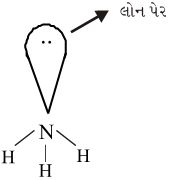
(B) In $NH_3$,the nitrogen atom undergoes $sp^3$ hybridization and possesses one lone pair of electrons.
Due to the presence of one lone pair and three bond pairs,the molecule adopts a trigonal pyramidal geometry.
Due to the presence of one lone pair and three bond pairs,the molecule adopts a trigonal pyramidal geometry.
0 likes
View Solution87
MediumMCQ
Which of the following has a tetrahedral shape?
A
$SO_2$
B
$SO_3$
C
$SO_4^{2-}$
D
$SO_3^{2-}$
Solution
(C) In $SO_4^{2-}$,the central sulfur atom undergoes $sp^3$ hybridization.
Since there are no lone pairs on the sulfur atom,the geometry is perfectly tetrahedral.
Since there are no lone pairs on the sulfur atom,the geometry is perfectly tetrahedral.
0 likes
View Solution88
MediumMCQ
The bond angle in $PH_3$ is closest to which of the following $^o$?
A
$90$
B
$105$
C
$109$
D
$120$
Solution
(A) In the corresponding compound $NH_3$,the bond angle is $107^o$.
However,in $PH_3$,the bond angle is approximately $90^o$.
This is because,despite having a similar electronic structure,the electronegativity of the central atom $(P)$ is lower than that of $N$. As a result,the bonding electrons are further from the central atom,reducing the $bp-bp$ repulsion and causing the bond angle to decrease towards $90^o$.
However,in $PH_3$,the bond angle is approximately $90^o$.
This is because,despite having a similar electronic structure,the electronegativity of the central atom $(P)$ is lower than that of $N$. As a result,the bonding electrons are further from the central atom,reducing the $bp-bp$ repulsion and causing the bond angle to decrease towards $90^o$.
0 likes
View Solution89
MediumMCQ
What is the shape of $XeF_4$?
A
Spherical
B
Trigonal bipyramidal
C
Tetrahedral
D
Square planar
Solution
(D) In $XeF_4$,the central atom $Xe$ undergoes $sp^3d^2$ hybridization.
It has $4$ bond pairs and $2$ lone pairs of electrons.
According to $VSEPR$ theory,the presence of $2$ lone pairs results in a square planar geometry.
It has $4$ bond pairs and $2$ lone pairs of electrons.
According to $VSEPR$ theory,the presence of $2$ lone pairs results in a square planar geometry.
0 likes
View Solution90
MediumMCQ
Which of the following molecules has a trigonal pyramidal shape?
A
$BF_3$
B
$NO_3^-$
C
$H_3O^+$
D
$CO_3^{2-}$
Solution
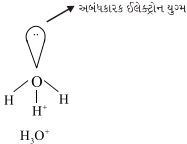
(C) In $H_3O^+$,the central oxygen atom undergoes $sp^3$ hybridization.
It has three bond pairs and one lone pair of electrons.
Due to the presence of one lone pair,the geometry is distorted from tetrahedral to trigonal pyramidal,similar to $NH_3$.
It has three bond pairs and one lone pair of electrons.
Due to the presence of one lone pair,the geometry is distorted from tetrahedral to trigonal pyramidal,similar to $NH_3$.
0 likes
View Solution91
EasyMCQ
The bond angle between two bonds in a water molecule is ............... $^o$?
A
$90$
B
$120$
C
$104.5$
D
$60$
Solution
(C) In a water molecule $(H_2O)$,the oxygen atom undergoes $sp^3$ hybridization.
Due to the presence of two lone pairs on the oxygen atom,the bond angle is compressed from the ideal tetrahedral angle of $109.5^o$ to $104.5^o$ according to the $VSEPR$ theory.
Due to the presence of two lone pairs on the oxygen atom,the bond angle is compressed from the ideal tetrahedral angle of $109.5^o$ to $104.5^o$ according to the $VSEPR$ theory.
0 likes
View Solution92
MediumMCQ
$BCl_3$ molecule is planar while $NCl_3$ is pyramidal because...
A
$B$ in $BCl_3$ has no lone pair of electrons,whereas $N$ in $NCl_3$ has one lone pair.
B
$B-Cl$ bond is more polar than $N-Cl$ bond.
C
$N$ atom is smaller than $B$ atom.
D
$N-Cl$ bond is more covalent than $B-Cl$ bond.
Solution
(A) According to $VSEPR$ theory,the shape of a molecule depends on the number of bonding and non-bonding electron pairs around the central atom.
In $BCl_3$,the central $B$ atom has $3$ bonding pairs and $0$ lone pairs,resulting in $sp^2$ hybridization and a trigonal planar geometry.
In $NCl_3$,the central $N$ atom has $3$ bonding pairs and $1$ lone pair,resulting in $sp^3$ hybridization and a pyramidal geometry due to the lone pair-bond pair repulsion.
In $BCl_3$,the central $B$ atom has $3$ bonding pairs and $0$ lone pairs,resulting in $sp^2$ hybridization and a trigonal planar geometry.
In $NCl_3$,the central $N$ atom has $3$ bonding pairs and $1$ lone pair,resulting in $sp^3$ hybridization and a pyramidal geometry due to the lone pair-bond pair repulsion.
0 likes
View Solution93
MediumMCQ
What is the geometry of $ICl_2^-$?
A
Trigonal
B
Linear
C
Octahedral
D
Square planar
Solution
(B) In $ICl_2^-$,the central iodine atom undergoes $sp^3d$ hybridization.
It has $3$ lone pairs of electrons and $2$ bond pairs.
According to $VSEPR$ theory,the presence of $3$ lone pairs in the equatorial positions results in a linear molecular geometry.
It has $3$ lone pairs of electrons and $2$ bond pairs.
According to $VSEPR$ theory,the presence of $3$ lone pairs in the equatorial positions results in a linear molecular geometry.
0 likes
View Solution94
MediumMCQ
In which of the following covalent compounds is the bond angle maximum?
A
$CH_4$
B
$BF_3$
C
$PF_3$
D
$NH_3$
Solution
(B) $BF_3$ has $sp^2$ hybridization with a bond angle of $120^o$.
$CH_4$ has $sp^3$ hybridization with a bond angle of $109.5^o$.
$NH_3$ has $sp^3$ hybridization with a bond angle of $107^o$ due to the presence of one lone pair.
$PF_3$ has $sp^3$ hybridization with a bond angle of approximately $96^o$.
Therefore,the bond angle is maximum in $BF_3$.
$CH_4$ has $sp^3$ hybridization with a bond angle of $109.5^o$.
$NH_3$ has $sp^3$ hybridization with a bond angle of $107^o$ due to the presence of one lone pair.
$PF_3$ has $sp^3$ hybridization with a bond angle of approximately $96^o$.
Therefore,the bond angle is maximum in $BF_3$.
0 likes
View Solution95
MediumMCQ
Which of the following has a square planar structure?
A
$NH_4^+$
B
$BF_4^-$
C
$XeF_4$
D
$CCl_4$
Solution
(C) In $XeF_4$,the central atom $Xe$ undergoes $sp^3d^2$ hybridization. It has $4$ bond pairs and $2$ lone pairs of electrons. According to $VSEPR$ theory,the two lone pairs occupy the axial positions of an octahedral geometry to minimize repulsion,resulting in a square planar molecular shape.
0 likes
View Solution96
EasyMCQ
According to the $VSEPR$ theory,what is the shape of the water molecule $(H_2O)$?
A
Octahedral
B
Distorted tetrahedral
C
Trigonal planar
D
Linear
Solution
(B) In the $H_2O$ molecule,the central oxygen atom has $2$ bond pairs and $2$ lone pairs of electrons.
According to $VSEPR$ theory,the presence of $2$ lone pairs causes repulsion,which distorts the expected tetrahedral geometry into a bent or $V$-shaped structure,often described as a distorted tetrahedral geometry.
According to $VSEPR$ theory,the presence of $2$ lone pairs causes repulsion,which distorts the expected tetrahedral geometry into a bent or $V$-shaped structure,often described as a distorted tetrahedral geometry.
0 likes
View Solution97
EasyMCQ
What is the shape of gaseous $SnCl_2$?
A
Tetrahedral
B
Linear
C
Bent (Angular)
D
Trigonal planar
Solution
(C) In $SnCl_2$,the central atom $Sn$ undergoes $sp^2$ hybridization. Due to the presence of one lone pair of electrons on the $Sn$ atom,the molecular geometry is bent or angular.
0 likes
View Solution98
MediumMCQ
In the $NO_3^-$ ion,what are the number of bond pairs and lone pairs of electrons,respectively?
A
$2, 2$
B
$3, 1$
C
$1, 3$
D
$4, 8$
Solution
(D) The Lewis structure of the nitrate ion $(NO_3^-)$ consists of one nitrogen atom bonded to three oxygen atoms.
There is one double bond $(N=O)$ and two single bonds $(N-O)$,resulting in a total of $4$ bond pairs.
The oxygen atoms have lone pairs: the double-bonded oxygen has $2$ lone pairs,and each of the two single-bonded oxygen atoms has $3$ lone pairs.
Total lone pairs = $2 + 3 + 3 = 8$.
Thus,there are $4$ bond pairs and $8$ lone pairs of electrons.
There is one double bond $(N=O)$ and two single bonds $(N-O)$,resulting in a total of $4$ bond pairs.
The oxygen atoms have lone pairs: the double-bonded oxygen has $2$ lone pairs,and each of the two single-bonded oxygen atoms has $3$ lone pairs.
Total lone pairs = $2 + 3 + 3 = 8$.
Thus,there are $4$ bond pairs and $8$ lone pairs of electrons.
0 likes
View Solution99
MediumMCQ
What is the shape of $ClO_3^-$?
A
Trigonal pyramidal
B
Tetrahedral
C
Trigonal planar
D
Trigonal bipyramidal
Solution
(A) In $ClO_3^-$,the central $Cl$ atom undergoes $sp^3$ hybridization.
It has $3$ bond pairs and $1$ lone pair of electrons.
According to $VSEPR$ theory,the presence of one lone pair distorts the geometry from tetrahedral to trigonal pyramidal.
It has $3$ bond pairs and $1$ lone pair of electrons.
According to $VSEPR$ theory,the presence of one lone pair distorts the geometry from tetrahedral to trigonal pyramidal.
0 likes
View Solution100
MediumMCQ
What is the correct order of bond angles in $H_2O, NH_3, CH_4, CO_2$?
A
$H_2O > NH_3 > CH_4 > CO_2$
B
$H_2O < NH_3 < CH_4 < CO_2$
C
$H_2O < NH_3 < CO_2 < CH_4$
D
$CO_2 > CH_4 > NH_3 > H_2O$
Solution
(D) The bond angles for the given molecules are as follows:
$CO_2$: $180^\circ$ (linear geometry)
$CH_4$: $109.5^\circ$ (tetrahedral geometry)
$NH_3$: $107^\circ$ (pyramidal geometry,due to one lone pair)
$H_2O$: $104.5^\circ$ (bent geometry,due to two lone pairs)
Therefore,the correct order is $CO_2 > CH_4 > NH_3 > H_2O$.
$CO_2$: $180^\circ$ (linear geometry)
$CH_4$: $109.5^\circ$ (tetrahedral geometry)
$NH_3$: $107^\circ$ (pyramidal geometry,due to one lone pair)
$H_2O$: $104.5^\circ$ (bent geometry,due to two lone pairs)
Therefore,the correct order is $CO_2 > CH_4 > NH_3 > H_2O$.
0 likes
View SolutionChemical Bonding and Molecular Structure — VSEPR Theory · Frequently Asked Questions
1Are these Chemical Bonding and Molecular Structure questions useful for JEE and NEET?
Yes. All questions in this section are mapped to JEE Main and NEET exam patterns. Previous year questions from JEE Main, NEET, GUJCET and state-level exams are included with full solutions.
2Can I switch to Hindi or Gujarati for these questions?
Yes. Use the language tabs in the hero section or the sidebar to view the same questions and solutions in English, Hindi or Gujarati.
3How do I generate a question paper from this subtopic?
Use the Vedclass Exam Paper Generator — select the chapter and subtopic, set difficulty, and generate Sets A, B, C, D automatically. First 3 chapters of every subject are free.
Vedclass Products
For Students
Vedclass Test Series
Mock tests in real JEE/NEET style with performance analysis. 5-day free trial.
Start Free TrialFor Teachers
Exam Paper Generator
Generate Set A/B/C/D papers from this chapter in 2 minutes. 3 chapters free.
Try FreeFor Institutes
Online Exam Module
Live online exams with unlimited students, 360° analytics & white-label branding.
See DemoFor Teachers & Institutes
Generate a Chemical Bonding and Molecular Structure Exam Paper in 2 Minutes
Select subtopic & difficulty — Sets A, B, C, D auto-generated with No Repeat logic.
First 3 chapters of every subject are free — no payment required.