
A English
Hybridisation Questions in English
Class 11 Chemistry · Chemical Bonding and Molecular Structure · Hybridisation
538+
Questions
English
Language
100%
With Solutions
Showing 31 of 538 questions in English
501
EasyMCQ
The hybridisation of the central atom of $BF_3$,$SnCl_2$,and $HgCl_2$ respectively is:
A
$sp^2, sp^2, sp$
B
$sp^2, sp^2, sp^2$
C
$sp^3, sp^2, sp^2$
D
$sp^3, sp, sp^2$
Solution
(A) For $BF_3$: The central atom $B$ has $3$ valence electrons and forms $3$ bonds with $F$ atoms. Steric number $= 3 + 0 = 3$,which corresponds to $sp^2$ hybridisation.
For $SnCl_2$: The central atom $Sn$ has $4$ valence electrons. It forms $2$ bonds with $Cl$ atoms and has $1$ lone pair. Steric number $= 2 + 1 = 3$,which corresponds to $sp^2$ hybridisation.
For $HgCl_2$: The central atom $Hg$ has $2$ valence electrons and forms $2$ bonds with $Cl$ atoms. Steric number $= 2 + 0 = 2$,which corresponds to $sp$ hybridisation.
Therefore,the correct sequence is $sp^2, sp^2, sp$.
For $SnCl_2$: The central atom $Sn$ has $4$ valence electrons. It forms $2$ bonds with $Cl$ atoms and has $1$ lone pair. Steric number $= 2 + 1 = 3$,which corresponds to $sp^2$ hybridisation.
For $HgCl_2$: The central atom $Hg$ has $2$ valence electrons and forms $2$ bonds with $Cl$ atoms. Steric number $= 2 + 0 = 2$,which corresponds to $sp$ hybridisation.
Therefore,the correct sequence is $sp^2, sp^2, sp$.
0 likes
View Solution502
MediumMCQ
In which of the following sets of molecules is the hybridisation of the central atoms different?
A
$H_2O, NH_3, CH_4$
B
$ClF_3, XeF_2, PCl_5$
C
$CO_2, CO, BeF_2$
D
$SF_4, XeF_4, CH_4$
Solution
(D) Let us analyze the hybridisation of the central atoms in each set:
$A$: $H_2O (sp^3), NH_3 (sp^3), CH_4 (sp^3)$. All are $sp^3$.
$B$: $ClF_3 (sp^3d), XeF_2 (sp^3d), PCl_5 (sp^3d)$. All are $sp^3d$.
$C$: $CO_2 (sp), CO (sp), BeF_2 (sp)$. All are $sp$.
$D$: $SF_4 (sp^3d), XeF_4 (sp^3d^2), CH_4 (sp^3)$. The hybridisations are different.
$A$: $H_2O (sp^3), NH_3 (sp^3), CH_4 (sp^3)$. All are $sp^3$.
$B$: $ClF_3 (sp^3d), XeF_2 (sp^3d), PCl_5 (sp^3d)$. All are $sp^3d$.
$C$: $CO_2 (sp), CO (sp), BeF_2 (sp)$. All are $sp$.
$D$: $SF_4 (sp^3d), XeF_4 (sp^3d^2), CH_4 (sp^3)$. The hybridisations are different.
0 likes
View Solution503
MediumMCQ
The hybridizations of the central atom in the molecules $BF_3, BeF_2, BrF_3$ are respectively
A
$sp^2, sp, sp^3d$
B
$sp, sp^2, sp^3$
C
$sp^3, sp, sp^3d$
D
$sp^2, sp^3, dsp^2$
Solution
(A) For $BF_3$: Number of bond pairs around $B = 3$,number of lone pairs around $B = 0$. $\Rightarrow$ Hybridization state $= sp^2$.
For $BeF_2$: Number of bond pairs around $Be = 2$,number of lone pairs around $Be = 0$. $\Rightarrow$ Hybridization state $= sp$.
For $BrF_3$: Number of bond pairs around $Br = 3$,number of lone pairs around $Br = 2$. $\Rightarrow$ Hybridization state $= sp^3d$.
For $BeF_2$: Number of bond pairs around $Be = 2$,number of lone pairs around $Be = 0$. $\Rightarrow$ Hybridization state $= sp$.
For $BrF_3$: Number of bond pairs around $Br = 3$,number of lone pairs around $Br = 2$. $\Rightarrow$ Hybridization state $= sp^3d$.
0 likes
View Solution504
MediumMCQ
In which of the following molecules,the number of lone pairs of electrons on the central atom and the number of $d$-orbitals involved in the hybridisation of the central atom are the same?
A
$ClF_3$
B
$PCl_5$
C
$BrF_5$
D
$SF_4$
Solution
(D) Let us analyze each molecule:
$1$. $ClF_3$: Central atom $Cl$ has $sp^3d$ hybridisation (uses $1$ $d$-orbital) and has $2$ lone pairs.
$2$. $PCl_5$: Central atom $P$ has $sp^3d$ hybridisation (uses $1$ $d$-orbital) and has $0$ lone pairs.
$3$. $BrF_5$: Central atom $Br$ has $sp^3d^2$ hybridisation (uses $2$ $d$-orbitals) and has $1$ lone pair.
$4$. $SF_4$: Central atom $S$ has $sp^3d$ hybridisation (uses $1$ $d$-orbital) and has $1$ lone pair.
In $SF_4$,the number of lone pairs on the central atom is $1$ and the number of $d$-orbitals involved in hybridisation is $1$. Thus,they are the same.
$1$. $ClF_3$: Central atom $Cl$ has $sp^3d$ hybridisation (uses $1$ $d$-orbital) and has $2$ lone pairs.
$2$. $PCl_5$: Central atom $P$ has $sp^3d$ hybridisation (uses $1$ $d$-orbital) and has $0$ lone pairs.
$3$. $BrF_5$: Central atom $Br$ has $sp^3d^2$ hybridisation (uses $2$ $d$-orbitals) and has $1$ lone pair.
$4$. $SF_4$: Central atom $S$ has $sp^3d$ hybridisation (uses $1$ $d$-orbital) and has $1$ lone pair.
In $SF_4$,the number of lone pairs on the central atom is $1$ and the number of $d$-orbitals involved in hybridisation is $1$. Thus,they are the same.
0 likes
View Solution505
EasyMCQ
In which of the following changes is there no change in the hybridisation of the central atom?
A
$C_2H_4 \xrightarrow{H_2 / Ni} C_2H_6$
B
$PCl_5 + Cl^{-} \longrightarrow PCl_6^{-}$
C
$BF_3 + F^{-} \longrightarrow BF_4^{-}$
D
$NH_3 + H^{+} \longrightarrow NH_4^{+}$
Solution
(D) $1$. In $C_2H_4$,$C$ is $sp^2$ hybridized,while in $C_2H_6$,$C$ is $sp^3$ hybridized.
$2$. In $PCl_5$,$P$ is $sp^3d$ hybridized,while in $PCl_6^{-}$,$P$ is $sp^3d^2$ hybridized.
$3$. In $BF_3$,$B$ is $sp^2$ hybridized,while in $BF_4^{-}$,$B$ is $sp^3$ hybridized.
$4$. In $NH_3$,$N$ is $sp^3$ hybridized (with one lone pair),and in $NH_4^{+}$,$N$ is also $sp^3$ hybridized (with four bond pairs and no lone pair). Thus,there is no change in the hybridisation of the central atom in this case.
$2$. In $PCl_5$,$P$ is $sp^3d$ hybridized,while in $PCl_6^{-}$,$P$ is $sp^3d^2$ hybridized.
$3$. In $BF_3$,$B$ is $sp^2$ hybridized,while in $BF_4^{-}$,$B$ is $sp^3$ hybridized.
$4$. In $NH_3$,$N$ is $sp^3$ hybridized (with one lone pair),and in $NH_4^{+}$,$N$ is also $sp^3$ hybridized (with four bond pairs and no lone pair). Thus,there is no change in the hybridisation of the central atom in this case.
0 likes
View Solution506
MediumMCQ
The hybridisation and shape of $I_3^{-}$ ion,respectively,are
A
$sp^3d^2$; distorted octahedral
B
$sp^3d$; linear
C
$sp^3d$; Trigonal bipyramid
D
$dsp^3$; Square pyramidal
Solution
(B) To determine the hybridisation of the central $I$ atom in $I_3^{-}$,we use the formula: $H = \frac{1}{2} (V + M - C + A)$,where $V$ is the number of valence electrons of the central atom,$M$ is the number of monovalent atoms,$C$ is the cationic charge,and $A$ is the anionic charge.
For $I_3^{-}$,the central $I$ atom has $V = 7$ valence electrons,$M = 2$ (two other $I$ atoms),$C = 0$,and $A = 1$.
$H = \frac{1}{2} (7 + 2 + 1) = \frac{10}{2} = 5$.
$A$ value of $5$ corresponds to $sp^3d$ hybridisation.
In $sp^3d$ hybridisation,the electron geometry is trigonal bipyramidal. The central $I$ atom has $3$ lone pairs and $2$ bond pairs. According to $VSEPR$ theory,the lone pairs occupy the equatorial positions to minimize repulsion,resulting in a linear shape for the $I_3^{-}$ ion.
For $I_3^{-}$,the central $I$ atom has $V = 7$ valence electrons,$M = 2$ (two other $I$ atoms),$C = 0$,and $A = 1$.
$H = \frac{1}{2} (7 + 2 + 1) = \frac{10}{2} = 5$.
$A$ value of $5$ corresponds to $sp^3d$ hybridisation.
In $sp^3d$ hybridisation,the electron geometry is trigonal bipyramidal. The central $I$ atom has $3$ lone pairs and $2$ bond pairs. According to $VSEPR$ theory,the lone pairs occupy the equatorial positions to minimize repulsion,resulting in a linear shape for the $I_3^{-}$ ion.
0 likes
View Solution507
MediumMCQ
The compounds with $sp^2$ hybridized central atom among the following are:
$(A)$ $H_2CO_3$
$(B)$ $SiF_4$
$(C)$ $BF_3$
$(D)$ $HClO_2$
$(A)$ $H_2CO_3$
$(B)$ $SiF_4$
$(C)$ $BF_3$
$(D)$ $HClO_2$
A
$A$ and $C$ only
B
$A$ and $B$ only
C
$C$ and $D$ only
D
$A, B, C$ and $D$
Solution
(A) To determine the hybridization of the central atom,we calculate the number of electron pairs (steric number) around it:
$(A)$ In $H_2CO_3$,the central carbon atom is bonded to three oxygen atoms (one double bond and two single bonds). Steric number = $3$ (sigma bonds) + $0$ (lone pairs) = $3$,which corresponds to $sp^2$ hybridization.
$(B)$ In $SiF_4$,the central silicon atom is bonded to four fluorine atoms. Steric number = $4$ (sigma bonds) + $0$ (lone pairs) = $4$,which corresponds to $sp^3$ hybridization.
$(C)$ In $BF_3$,the central boron atom is bonded to three fluorine atoms. Steric number = $3$ (sigma bonds) + $0$ (lone pairs) = $3$,which corresponds to $sp^2$ hybridization.
$(D)$ In $HClO_2$,the central chlorine atom is bonded to two oxygen atoms and one hydrogen atom,with two lone pairs. Steric number = $3$ (sigma bonds) + $2$ (lone pairs) = $5$,which corresponds to $sp^3d$ hybridization.
Thus,only $H_2CO_3$ $(A)$ and $BF_3$ $(C)$ have $sp^2$ hybridized central atoms.
$(A)$ In $H_2CO_3$,the central carbon atom is bonded to three oxygen atoms (one double bond and two single bonds). Steric number = $3$ (sigma bonds) + $0$ (lone pairs) = $3$,which corresponds to $sp^2$ hybridization.
$(B)$ In $SiF_4$,the central silicon atom is bonded to four fluorine atoms. Steric number = $4$ (sigma bonds) + $0$ (lone pairs) = $4$,which corresponds to $sp^3$ hybridization.
$(C)$ In $BF_3$,the central boron atom is bonded to three fluorine atoms. Steric number = $3$ (sigma bonds) + $0$ (lone pairs) = $3$,which corresponds to $sp^2$ hybridization.
$(D)$ In $HClO_2$,the central chlorine atom is bonded to two oxygen atoms and one hydrogen atom,with two lone pairs. Steric number = $3$ (sigma bonds) + $2$ (lone pairs) = $5$,which corresponds to $sp^3d$ hybridization.
Thus,only $H_2CO_3$ $(A)$ and $BF_3$ $(C)$ have $sp^2$ hybridized central atoms.
0 likes
View Solution508
MediumMCQ
The hybridisation of the central atom $I$ in $IF_7$ is:
A
$sp^2d^4$
B
$sp^3d^2$
C
$sp^3d^1$
D
$sp^3d^3$
Solution
(D) In the molecule $IF_7$,the central atom $I$ (Iodine) has $7$ valence electrons.
All $7$ valence electrons are involved in forming $7$ sigma bonds with $7$ fluorine atoms.
The steric number is calculated as: $\text{Steric Number} = \text{Number of sigma bonds} + \text{Number of lone pairs} = 7 + 0 = 7$.
$A$ steric number of $7$ corresponds to $sp^3d^3$ hybridization.
The geometry and shape of $IF_7$ is pentagonal bipyramidal,where $5$ $F$ atoms are in the equatorial plane and $2$ $F$ atoms are in the axial positions.
All $7$ valence electrons are involved in forming $7$ sigma bonds with $7$ fluorine atoms.
The steric number is calculated as: $\text{Steric Number} = \text{Number of sigma bonds} + \text{Number of lone pairs} = 7 + 0 = 7$.
$A$ steric number of $7$ corresponds to $sp^3d^3$ hybridization.
The geometry and shape of $IF_7$ is pentagonal bipyramidal,where $5$ $F$ atoms are in the equatorial plane and $2$ $F$ atoms are in the axial positions.
0 likes
View Solution509
EasyMCQ
In $CO_2$ molecule,the hybridizations of carbon and oxygen atoms are respectively:
A
Carbon: $sp$,Oxygen: $sp^2$
B
Carbon: $sp^2$,Oxygen: $sp^2$
C
Carbon: $sp$,Oxygen: $sp$
D
Carbon: $sp^2$,Oxygen: $sp^3$
Solution
(A) In the $CO_2$ molecule $(O=C=O)$,the carbon atom is bonded to two oxygen atoms via two double bonds.
Carbon has $2 \sigma$ bonds and $2 \pi$ bonds,so its steric number is $2$,which corresponds to $sp$ hybridization.
Each oxygen atom is bonded to the carbon atom via one double bond. An oxygen atom in $CO_2$ has $1 \sigma$ bond,$1 \pi$ bond,and $2$ lone pairs.
The steric number for oxygen is $1 (\sigma) + 2 (\text{lone pairs}) = 3$,which corresponds to $sp^2$ hybridization.
Carbon has $2 \sigma$ bonds and $2 \pi$ bonds,so its steric number is $2$,which corresponds to $sp$ hybridization.
Each oxygen atom is bonded to the carbon atom via one double bond. An oxygen atom in $CO_2$ has $1 \sigma$ bond,$1 \pi$ bond,and $2$ lone pairs.
The steric number for oxygen is $1 (\sigma) + 2 (\text{lone pairs}) = 3$,which corresponds to $sp^2$ hybridization.
0 likes
View Solution510
MediumMCQ
Find the hybridisation of the $C_1$,$C_2$,and $C_3$ labelled carbon atoms in the given molecule: $H-C \equiv C_1-C_2H-C_3H=CH_2$
A
| $C_1$ | $sp$ |
| $C_2$ | $sp^2$ |
| $C_3$ | $sp^2$ |
B
| $C_1$ | $sp$ |
| $C_2$ | $sp^2$ |
| $C_3$ | $sp^2$ |
C
| $C_1$ | $sp^2$ |
| $C_2$ | $sp$ |
| $C_3$ | $sp$ |
D
| $C_1$ | $sp^2$ |
| $C_2$ | $sp^2$ |
| $C_3$ | $sp^2$ |
Solution
(A) To determine the hybridisation of carbon atoms,we count the number of sigma $(\sigma)$ bonds and lone pairs (if any) attached to the carbon atom.
$1$. $C_1$ is involved in a triple bond with the terminal carbon and a single bond with $C_2$. It has $2$ sigma bonds and $2$ pi bonds. Thus,it is $sp$ hybridised.
$2$. $C_2$ is bonded to $C_1$,$H$,and $C_3$. It has $3$ sigma bonds and $1$ pi bond. Thus,it is $sp^2$ hybridised.
$3$. $C_3$ is bonded to $C_2$,$H$,and $CH_2$. It has $3$ sigma bonds and $1$ pi bond. Thus,it is $sp^2$ hybridised.
Therefore,the hybridisations are $C_1: sp$,$C_2: sp^2$,$C_3: sp^2$.
$1$. $C_1$ is involved in a triple bond with the terminal carbon and a single bond with $C_2$. It has $2$ sigma bonds and $2$ pi bonds. Thus,it is $sp$ hybridised.
$2$. $C_2$ is bonded to $C_1$,$H$,and $C_3$. It has $3$ sigma bonds and $1$ pi bond. Thus,it is $sp^2$ hybridised.
$3$. $C_3$ is bonded to $C_2$,$H$,and $CH_2$. It has $3$ sigma bonds and $1$ pi bond. Thus,it is $sp^2$ hybridised.
Therefore,the hybridisations are $C_1: sp$,$C_2: sp^2$,$C_3: sp^2$.
0 likes
View Solution511
MediumMCQ
Find out the correct hybridisation of the central atom in $BCl_3$,$PCl_5$,$NH_3$ and $SF_6$.
A
$(BCl_3: sp^3); (PCl_5: sp^3d^2); (NH_3: sp^2)$ and $(SF_6: sp^3d)$
B
$(BCl_3: sp^2); (PCl_5: sp^3d); (NH_3: sp^3)$ and $(SF_6: sp^3d^2)$
C
$(BCl_3: sp^2); (PCl_5: sp^3d^2); (NH_3: sp^3)$ and $(SF_6: sp^3d)$
D
$(BCl_3: sp^3); (PCl_5: sp^3d); (NH_3: sp^2)$ and $(SF_6: sp^3d^2)$
Solution
(B) To determine the hybridisation,we use the formula: $H = \frac{1}{2} (V + M - C + A)$,where $V$ is the number of valence electrons of the central atom,$M$ is the number of monovalent atoms,$C$ is the cationic charge,and $A$ is the anionic charge.
$1$. For $BCl_3$: $V=3, M=3$. $H = \frac{1}{2}(3+3) = 3$,which corresponds to $sp^2$ hybridisation.
$2$. For $PCl_5$: $V=5, M=5$. $H = \frac{1}{2}(5+5) = 5$,which corresponds to $sp^3d$ hybridisation.
$3$. For $NH_3$: $V=5, M=3$. $H = \frac{1}{2}(5+3) = 4$,which corresponds to $sp^3$ hybridisation.
$4$. For $SF_6$: $V=6, M=6$. $H = \frac{1}{2}(6+6) = 6$,which corresponds to $sp^3d^2$ hybridisation.
Thus,the correct hybridisation is $(BCl_3: sp^2); (PCl_5: sp^3d); (NH_3: sp^3)$ and $(SF_6: sp^3d^2)$.
$1$. For $BCl_3$: $V=3, M=3$. $H = \frac{1}{2}(3+3) = 3$,which corresponds to $sp^2$ hybridisation.
$2$. For $PCl_5$: $V=5, M=5$. $H = \frac{1}{2}(5+5) = 5$,which corresponds to $sp^3d$ hybridisation.
$3$. For $NH_3$: $V=5, M=3$. $H = \frac{1}{2}(5+3) = 4$,which corresponds to $sp^3$ hybridisation.
$4$. For $SF_6$: $V=6, M=6$. $H = \frac{1}{2}(6+6) = 6$,which corresponds to $sp^3d^2$ hybridisation.
Thus,the correct hybridisation is $(BCl_3: sp^2); (PCl_5: sp^3d); (NH_3: sp^3)$ and $(SF_6: sp^3d^2)$.
0 likes
View Solution512
MediumMCQ
Which of the following ions has Tetrahedral geometry and $sp^3$ hybridisation for its central atom?
A
$BH_4^{-}$
B
$NH_2^{-}$
C
$CO_3^{2-}$
D
$H_3O^{+}$
Solution
(A)
The central atom in $BH_4^{-}$ is $B$ (Boron). The steric number is $4$ ($4$ bond pairs,$0$ lone pairs),which corresponds to $sp^3$ hybridisation and a Tetrahedral geometry. Thus,$BH_4^{-}$ is the correct answer.
| Ionic species | Steric Number/Hybridisation/Geometry |
| $BH_4^{-}$ | $4, sp^3$,Tetrahedral |
| $NH_2^{-}$ | $4, sp^3$,$V$-shaped |
| $CO_3^{2-}$ | $3, sp^2$,Trigonal Planar |
| $H_3O^{+}$ | $4, sp^3$,Pyramidal |
The central atom in $BH_4^{-}$ is $B$ (Boron). The steric number is $4$ ($4$ bond pairs,$0$ lone pairs),which corresponds to $sp^3$ hybridisation and a Tetrahedral geometry. Thus,$BH_4^{-}$ is the correct answer.
0 likes
View Solution513
MediumMCQ
The hybridisation of $N$ in $NO_2^{+}$,$NO_3^{-}$ and $NH_4^{+}$ respectively is
A
$sp, sp^2, sp^3$
B
$sp, sp^3, sp^3$
C
$sp^2, sp^3, sp^3$
D
$sp, sp, sp^3$
Solution
(A) To determine the hybridisation,we use the formula: $\text{Steric Number} = \text{Number of bond pairs} + \text{Number of lone pairs}$.
For $NO_2^{+}$:
$\text{Steric Number} = 2 + 0 = 2$. Hybridisation is $sp$.
For $NO_3^{-}$:
$\text{Steric Number} = 3 + 0 = 3$. Hybridisation is $sp^2$.
For $NH_4^{+}$:
$\text{Steric Number} = 4 + 0 = 4$. Hybridisation is $sp^3$.
Thus,the hybridisation states are $sp, sp^2, sp^3$ respectively.
For $NO_2^{+}$:
$\text{Steric Number} = 2 + 0 = 2$. Hybridisation is $sp$.
For $NO_3^{-}$:
$\text{Steric Number} = 3 + 0 = 3$. Hybridisation is $sp^2$.
For $NH_4^{+}$:
$\text{Steric Number} = 4 + 0 = 4$. Hybridisation is $sp^3$.
Thus,the hybridisation states are $sp, sp^2, sp^3$ respectively.
0 likes
View Solution514
MediumMCQ
What are the shapes of ethyne and methane?
A
Square planar and linear
B
Tetrahedral and trigonal planar
C
Linear and tetrahedral
D
Trigonal planar and linear
Solution
(C) Ethyne $(C_2H_2)$: The carbon atom is $sp$ hybridized with $2$ $\sigma$-bonds and $0$ lone pairs,resulting in a linear geometry.
Methane $(CH_4)$: The carbon atom is $sp^3$ hybridized with $4$ $\sigma$-bonds and $0$ lone pairs,resulting in a tetrahedral geometry.
Therefore,the shapes are linear and tetrahedral.
Methane $(CH_4)$: The carbon atom is $sp^3$ hybridized with $4$ $\sigma$-bonds and $0$ lone pairs,resulting in a tetrahedral geometry.
Therefore,the shapes are linear and tetrahedral.
0 likes
View Solution515
EasyMCQ
The hybridisation of $Xe$ and the number of lone pairs of electrons on it in $XeF_6$ are
A
$sp^3d^2, 1$
B
$sp^3d^3, 2$
C
$sp^3d^2, 2$
D
$sp^3d^3, 1$
Solution
(D) In $XeF_6$,the central atom $Xe$ has $8$ valence electrons. It forms $6$ bonds with $F$ atoms,leaving $2$ electrons as one lone pair.
Steric number = (Number of sigma bonds) + (Number of lone pairs) = $6 + 1 = 7$.
$A$ steric number of $7$ corresponds to $sp^3d^3$ hybridisation.
Thus,$XeF_6$ has $sp^3d^3$ hybridisation and $1$ lone pair of electrons.
Steric number = (Number of sigma bonds) + (Number of lone pairs) = $6 + 1 = 7$.
$A$ steric number of $7$ corresponds to $sp^3d^3$ hybridisation.
Thus,$XeF_6$ has $sp^3d^3$ hybridisation and $1$ lone pair of electrons.
0 likes
View Solution516
MediumMCQ
Which of the following is a linear molecule?
A
$BeCl_2$
B
$H_2O$
C
$SO_2$
D
$CH_4$
Solution
(A) In $BeCl_2$,the central atom $Be$ undergoes $sp$-hybridization,resulting in a linear geometry with a bond angle of $180^{\circ}$.
$H_2O$ has a bent (angular) shape due to two lone pairs on oxygen.
$SO_2$ has a bent (angular) shape due to one lone pair on sulfur.
$CH_4$ has a tetrahedral geometry.
Therefore,$BeCl_2$ is the linear molecule.
$H_2O$ has a bent (angular) shape due to two lone pairs on oxygen.
$SO_2$ has a bent (angular) shape due to one lone pair on sulfur.
$CH_4$ has a tetrahedral geometry.
Therefore,$BeCl_2$ is the linear molecule.
0 likes
View Solution517
MediumMCQ
Chlorine atom,in its third excited state,reacts with fluorine to form a compound $X$. The formula and shape of $X$ are :
A
$ClF_5$,pentagonal
B
$ClF_4$,tetrahedral
C
$ClF_4$,pentagonal bipyramidal
D
$ClF_7$,pentagonal bipyramidal
Solution
(D) The ground state electronic configuration of $Cl$ $(Z=17)$ is $[Ne] 3s^2 3p_x^2 3p_y^2 3p_z^1$.
In the first excited state,one electron from $3p$ moves to $3d$,giving $3$ unpaired electrons.
In the second excited state,one electron from $3s$ moves to $3d$,giving $5$ unpaired electrons.
In the third excited state,one more electron from $3p$ moves to $3d$,resulting in $7$ unpaired electrons $(3s^1, 3p_x^1, 3p_y^1, 3p_z^1, 3d^3)$.
These $7$ unpaired electrons react with $7$ fluorine atoms to form $ClF_7$.
The hybridization is $sp^3d^3$,which corresponds to a pentagonal bipyramidal geometry.
In the first excited state,one electron from $3p$ moves to $3d$,giving $3$ unpaired electrons.
In the second excited state,one electron from $3s$ moves to $3d$,giving $5$ unpaired electrons.
In the third excited state,one more electron from $3p$ moves to $3d$,resulting in $7$ unpaired electrons $(3s^1, 3p_x^1, 3p_y^1, 3p_z^1, 3d^3)$.
These $7$ unpaired electrons react with $7$ fluorine atoms to form $ClF_7$.
The hybridization is $sp^3d^3$,which corresponds to a pentagonal bipyramidal geometry.
0 likes
View Solution518
EasyMCQ
Sulphur trioxide is dissolved in heavy water to form a compound $X$. The hybridisation state of sulphur in $X$ is :
A
$sp^2$
B
$sp^3$
C
$sp$
D
$dsp^2$
Solution
(B) When $SO_3$ is dissolved in heavy water $(D_2O)$,it forms deuterated sulphuric acid $(D_2SO_4)$ as the compound $X$.
The chemical reaction is: $SO_3 + D_2O \longrightarrow D_2SO_4$ $(X)$.
In $D_2SO_4$,the central sulphur atom is bonded to two $OD$ groups and two oxygen atoms via double bonds.
The steric number of sulphur is calculated as: $\text{Number of sigma bonds} + \text{Number of lone pairs} = 4 + 0 = 4$.
$A$ steric number of $4$ corresponds to $sp^3$ hybridisation.
The chemical reaction is: $SO_3 + D_2O \longrightarrow D_2SO_4$ $(X)$.
In $D_2SO_4$,the central sulphur atom is bonded to two $OD$ groups and two oxygen atoms via double bonds.
The steric number of sulphur is calculated as: $\text{Number of sigma bonds} + \text{Number of lone pairs} = 4 + 0 = 4$.
$A$ steric number of $4$ corresponds to $sp^3$ hybridisation.
0 likes
View Solution519
EasyMCQ
Which one of the following is a correct set?
A
$H_2O, sp^3$,angular
B
$H_2O, sp^2$,linear
C
$NH_4^+, dsp^2$,square planar
D
$CH_4, dsp^2$,tetrahedral
Solution
(A) In $H_2O$,the oxygen atom is $sp^3$ hybridized with two lone pairs and two bond pairs,resulting in an angular (bent) shape.
$NH_4^+$ is $sp^3$ hybridized and tetrahedral.
$CH_4$ is $sp^3$ hybridized and tetrahedral.
Therefore,the correct set is $H_2O, sp^3$,angular.
$NH_4^+$ is $sp^3$ hybridized and tetrahedral.
$CH_4$ is $sp^3$ hybridized and tetrahedral.
Therefore,the correct set is $H_2O, sp^3$,angular.
0 likes
View Solution520
MediumMCQ
What is the hybridization state of the central atom in the conjugate base of $NH_4^{+}$ ion?
A
$sp$
B
$sp^3$
C
$sp^2$
D
$dsp^2$
Solution
(B) The conjugate base of $NH_4^{+}$ is obtained by removing a proton $(H^{+})$ from it.
$NH_4^{+} \rightarrow NH_3 + H^{+}$.
The conjugate base is $NH_3$.
In $NH_3$,the central nitrogen atom has $3$ bond pairs and $1$ lone pair.
Total electron pairs = $3 + 1 = 4$.
Therefore,the hybridization state of the nitrogen atom is $sp^3$.
$NH_4^{+} \rightarrow NH_3 + H^{+}$.
The conjugate base is $NH_3$.
In $NH_3$,the central nitrogen atom has $3$ bond pairs and $1$ lone pair.
Total electron pairs = $3 + 1 = 4$.
Therefore,the hybridization state of the nitrogen atom is $sp^3$.
0 likes
View Solution521
EasyMCQ
The species in which the nitrogen atom is in a state of $sp$ hybridisation is
A
$NO_3^{-}$
B
$NO_2$
C
$NO_2^{+}$
D
$NO_2^{-}$
Solution
(C) The hybridisation of an atom can be determined by calculating the steric number $(SN)$:
$SN = \frac{1}{2} [V + M - C + A]$
Where $V$ is the number of valence electrons of the central atom,$M$ is the number of monovalent atoms,$C$ is the cationic charge,and $A$ is the anionic charge.
For $NO_2^{+}$:
$V = 5$ (nitrogen),$M = 0$,$C = 1$,$A = 0$.
$SN = \frac{1}{2} [5 + 0 - 1 + 0] = \frac{4}{2} = 2$.
$A$ steric number of $2$ corresponds to $sp$ hybridisation.
Therefore,the nitrogen atom in $NO_2^{+}$ is $sp$ hybridised.
$SN = \frac{1}{2} [V + M - C + A]$
Where $V$ is the number of valence electrons of the central atom,$M$ is the number of monovalent atoms,$C$ is the cationic charge,and $A$ is the anionic charge.
For $NO_2^{+}$:
$V = 5$ (nitrogen),$M = 0$,$C = 1$,$A = 0$.
$SN = \frac{1}{2} [5 + 0 - 1 + 0] = \frac{4}{2} = 2$.
$A$ steric number of $2$ corresponds to $sp$ hybridisation.
Therefore,the nitrogen atom in $NO_2^{+}$ is $sp$ hybridised.
0 likes
View Solution522
MediumMCQ
Which of the following molecules has a shape similar to $CO_{2}$?
A
$HgCl_{2}$
B
$SnCl_{2}$
C
$C_{2}H_{2}$
D
$NO_{2}$
Solution
(A, C) $CO_{2}$ has a linear shape due to $sp$ hybridization and the absence of lone pairs on the central carbon atom.
$HgCl_{2}$ ($sp$ hybridization,linear) and $C_{2}H_{2}$ ($sp$ hybridization,linear) both have a shape similar to $CO_{2}$.
$SnCl_{2}$ and $NO_{2}$ have bent shapes due to the presence of a lone pair on the central atom.
$HgCl_{2}$ ($sp$ hybridization,linear) and $C_{2}H_{2}$ ($sp$ hybridization,linear) both have a shape similar to $CO_{2}$.
$SnCl_{2}$ and $NO_{2}$ have bent shapes due to the presence of a lone pair on the central atom.
0 likes
View Solution523
EasyMCQ
The state of hybridization of the central atom and the number of lone pairs over the central atom in $POCl_{3}$ are
A
$sp, 0$
B
$sp^{2}, 0$
C
$sp^{3}, 0$
D
$dsp^{2}, 1$
Solution
(C) In $POCl_{3}$,the central phosphorus atom is bonded to one oxygen atom via a double bond and three chlorine atoms via single bonds.
Total number of electron pairs around the central atom = $4$ (three $P-Cl$ $\sigma$-bonds and one $P=O$ bond,where the double bond counts as one region of electron density for hybridization).
Since there are $4$ bonding pairs and no lone pairs,the hybridization is $sp^{3}$.
Therefore,the hybridization is $sp^{3}$ and the number of lone pairs is $0$.
Total number of electron pairs around the central atom = $4$ (three $P-Cl$ $\sigma$-bonds and one $P=O$ bond,where the double bond counts as one region of electron density for hybridization).
Since there are $4$ bonding pairs and no lone pairs,the hybridization is $sp^{3}$.
Therefore,the hybridization is $sp^{3}$ and the number of lone pairs is $0$.
0 likes
View Solution524
EasyMCQ
The $sp^3d^2$ hybridization of the central atom of a molecule leads to which geometry?
A
Square planar geometry
B
Tetrahedral geometry
C
Trigonal bipyramidal geometry
D
Octahedral geometry
Solution
(D) The hybridization $sp^3d^2$ involves the mixing of one $s$,three $p$,and two $d$ orbitals to form six equivalent hybrid orbitals.
These six hybrid orbitals are directed towards the corners of an octahedron.
Therefore,a molecule with $sp^3d^2$ hybridization of the central atom exhibits an octahedral geometry.
These six hybrid orbitals are directed towards the corners of an octahedron.
Therefore,a molecule with $sp^3d^2$ hybridization of the central atom exhibits an octahedral geometry.
0 likes
View Solution525
EasyMCQ
What type of orbital hybridisation is considered on $P$ in $PCl_5$?
A
$sp^3d$
B
$dsp^3$
C
$sp^3d^2$
D
$d^2sp^3$
Solution
(A) In $PCl_5$,the central phosphorus atom $(P)$ has $5$ valence electrons. It forms $5$ covalent bonds with $5$ chlorine atoms.
Using the formula for steric number: $\text{Steric Number} = \frac{1}{2} (V + M - C + A)$,where $V = 5$ (valence electrons of $P$),$M = 5$ (monovalent atoms),$C = 0$ (cationic charge),and $A = 0$ (anionic charge).
$\text{Steric Number} = \frac{1}{2} (5 + 5) = 5$.
$A$ steric number of $5$ corresponds to $sp^3d$ hybridisation,resulting in a trigonal bipyramidal geometry.
Using the formula for steric number: $\text{Steric Number} = \frac{1}{2} (V + M - C + A)$,where $V = 5$ (valence electrons of $P$),$M = 5$ (monovalent atoms),$C = 0$ (cationic charge),and $A = 0$ (anionic charge).
$\text{Steric Number} = \frac{1}{2} (5 + 5) = 5$.
$A$ steric number of $5$ corresponds to $sp^3d$ hybridisation,resulting in a trigonal bipyramidal geometry.
0 likes
View Solution526
EasyMCQ
The hybridisation of the central atom in $NF_3$ is:
A
$sp^3$
B
$sp$
C
$sp^2$
D
$dsp^2$
Solution
(A) In $NF_3$,the central nitrogen atom is bonded to three fluorine atoms by three $\sigma$-bonds and has one lone pair of electrons.
To calculate the hybridisation,we use the formula:
$\text{Steric Number} = \text{Number of } \sigma \text{-bonds} + \text{Number of lone pairs}$.
$\text{Steric Number} = 3 + 1 = 4$.
$A$ steric number of $4$ corresponds to $sp^3$ hybridisation.
To calculate the hybridisation,we use the formula:
$\text{Steric Number} = \text{Number of } \sigma \text{-bonds} + \text{Number of lone pairs}$.
$\text{Steric Number} = 3 + 1 = 4$.
$A$ steric number of $4$ corresponds to $sp^3$ hybridisation.
0 likes
View Solution527
DifficultMCQ
The correct order of decreasing $H-C-H$ bond angle in the following molecules is:
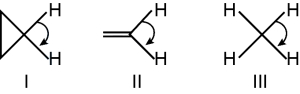
A
$I > II > III$
B
$II > I > III$
C
$III > II > I$
D
$I > III > II$
Solution
(B) To determine the $H-C-H$ bond angle,we look at the hybridization and geometry of the central carbon atom in each molecule:
$I$ (Cyclopropylidene): The central carbon atom is $sp^2$ hybridized. Due to the ring strain in the three-membered ring,the $H-C-H$ bond angle is approximately $115^{\circ}$.
$II$ (Ethene): The carbon atom is $sp^2$ hybridized. In a standard alkene,the $H-C-H$ bond angle is approximately $120^{\circ}$.
$III$ (Methane): The carbon atom is $sp^3$ hybridized with a tetrahedral geometry. The $H-C-H$ bond angle is $109^{\circ} 28^{\prime}$ (or $\approx 109.5^{\circ}$).
Comparing these values: $120^{\circ} (II) > 115^{\circ} (I) > 109.5^{\circ} (III)$.
Therefore,the correct decreasing order is $II > I > III$.
$I$ (Cyclopropylidene): The central carbon atom is $sp^2$ hybridized. Due to the ring strain in the three-membered ring,the $H-C-H$ bond angle is approximately $115^{\circ}$.
$II$ (Ethene): The carbon atom is $sp^2$ hybridized. In a standard alkene,the $H-C-H$ bond angle is approximately $120^{\circ}$.
$III$ (Methane): The carbon atom is $sp^3$ hybridized with a tetrahedral geometry. The $H-C-H$ bond angle is $109^{\circ} 28^{\prime}$ (or $\approx 109.5^{\circ}$).
Comparing these values: $120^{\circ} (II) > 115^{\circ} (I) > 109.5^{\circ} (III)$.
Therefore,the correct decreasing order is $II > I > III$.
0 likes
View Solution528
MediumMCQ
Select the molecule in which all the atoms may lie on a single plane.
A
$4-$Nitrobenzaldehyde
B
$4-$Methoxybenzaldehyde
C
$4-$Methylnitrobenzene
D
$4-$Nitroacetophenone
Solution
(A) For all atoms to lie in a single plane,all carbon atoms and the atoms attached to the benzene ring must be $sp^2$ hybridized to maintain planarity through conjugation.
In $4-$Nitrobenzaldehyde $(O_2N-C_6H_4-CHO)$,the benzene ring,the nitro group $(-NO_2)$,and the aldehyde group $(-CHO)$ are all $sp^2$ hybridized.
The conjugation extends throughout the molecule,allowing all atoms (including the hydrogen of the aldehyde group) to lie in the same plane.
In other options,groups like $-OCH_3$ (in $4-$Methoxybenzaldehyde),$-CH_3$ (in $4-$Methylnitrobenzene),and $-COCH_3$ (in $4-$Nitroacetophenone) contain $sp^3$ hybridized carbon atoms,which possess tetrahedral geometry and prevent all atoms from lying in a single plane.
In $4-$Nitrobenzaldehyde $(O_2N-C_6H_4-CHO)$,the benzene ring,the nitro group $(-NO_2)$,and the aldehyde group $(-CHO)$ are all $sp^2$ hybridized.
The conjugation extends throughout the molecule,allowing all atoms (including the hydrogen of the aldehyde group) to lie in the same plane.
In other options,groups like $-OCH_3$ (in $4-$Methoxybenzaldehyde),$-CH_3$ (in $4-$Methylnitrobenzene),and $-COCH_3$ (in $4-$Nitroacetophenone) contain $sp^3$ hybridized carbon atoms,which possess tetrahedral geometry and prevent all atoms from lying in a single plane.
0 likes
View Solution529
EasyMCQ
The number of lone pairs of electrons and the hybridization of Xenon $(Xe)$ in $XeOF_2$ are
A
$1, sp^3$
B
$1, dsp^2$
C
$3, dsp^3$
D
$2, sp^3d$
Solution
(D) To determine the hybridization and number of lone pairs for $XeOF_2$:
$1$. The central atom is Xenon $(Xe)$,which has $8$ valence electrons.
$2$. In $XeOF_2$,$Xe$ forms two single bonds with two Fluorine $(F)$ atoms and one double bond with one Oxygen $(O)$ atom.
$3$. The number of bonding electron pairs = $2$ (from $F$) + $2$ (from $O$) = $4$ electron pairs involved in bonding.
$4$. The number of lone pairs on $Xe$ = (Total valence electrons - electrons used in bonding) / $2$ = $(8 - 6) / 2 = 1$ lone pair.
$5$. The steric number = (Number of sigma bonds) + (Number of lone pairs) = $3$ (sigma bonds) + $1$ (lone pair) = $4$. Wait,let us re-evaluate: $Xe$ is bonded to $2$ $F$ atoms and $1$ $O$ atom. Total sigma bonds = $3$. Total lone pairs = $2$. Steric number = $3 + 2 = 5$.
$6$. $A$ steric number of $5$ corresponds to $sp^3d$ hybridization.
$7$. Thus,$XeOF_2$ has $2$ lone pairs and $sp^3d$ hybridization.
$1$. The central atom is Xenon $(Xe)$,which has $8$ valence electrons.
$2$. In $XeOF_2$,$Xe$ forms two single bonds with two Fluorine $(F)$ atoms and one double bond with one Oxygen $(O)$ atom.
$3$. The number of bonding electron pairs = $2$ (from $F$) + $2$ (from $O$) = $4$ electron pairs involved in bonding.
$4$. The number of lone pairs on $Xe$ = (Total valence electrons - electrons used in bonding) / $2$ = $(8 - 6) / 2 = 1$ lone pair.
$5$. The steric number = (Number of sigma bonds) + (Number of lone pairs) = $3$ (sigma bonds) + $1$ (lone pair) = $4$. Wait,let us re-evaluate: $Xe$ is bonded to $2$ $F$ atoms and $1$ $O$ atom. Total sigma bonds = $3$. Total lone pairs = $2$. Steric number = $3 + 2 = 5$.
$6$. $A$ steric number of $5$ corresponds to $sp^3d$ hybridization.
$7$. Thus,$XeOF_2$ has $2$ lone pairs and $sp^3d$ hybridization.
0 likes
View Solution530
DifficultMCQ
Two $p$-block elements $X$ and $Y$ form fluorides of the type $EF_3$. The fluoride compound $XF_3$ is a Lewis acid and $YF_3$ is a Lewis base. The hybridization of the central atoms of $XF_3$ and $YF_3$ respectively are
A
Both $sp^3$
B
$sp^2$ and $sp^3$
C
$sp^3$ and $sp^2$
D
Both $sp^2$
Solution
(B) Lewis acid is an electron-deficient species. $BF_3$ is a $p$-block fluoride where Boron has an incomplete octet ($6$ electrons),making it a Lewis acid. Its hybridization is $sp^2$ due to $3$ bond pairs and $0$ lone pairs.
$YF_3$ acts as a Lewis base because the central atom has a lone pair of electrons available for donation. $NF_3$ is a $p$-block fluoride where Nitrogen has $3$ bond pairs and $1$ lone pair,making it a Lewis base. Its hybridization is $sp^3$ due to $4$ electron domains ($3$ bond pairs + $1$ lone pair).
Therefore,the hybridization of $XF_3$ $(BF_3)$ is $sp^2$ and $YF_3$ $(NF_3)$ is $sp^3$.
$YF_3$ acts as a Lewis base because the central atom has a lone pair of electrons available for donation. $NF_3$ is a $p$-block fluoride where Nitrogen has $3$ bond pairs and $1$ lone pair,making it a Lewis base. Its hybridization is $sp^3$ due to $4$ electron domains ($3$ bond pairs + $1$ lone pair).
Therefore,the hybridization of $XF_3$ $(BF_3)$ is $sp^2$ and $YF_3$ $(NF_3)$ is $sp^3$.
0 likes
View Solution531
MediumMCQ
Consider the following species: $BrF_5, XeF_5^-, BF_4^-, ICl_4^-, XeF_4, SF_4, NH_4^+, ClF_3, XeF_2, ICl_2^-$. Number of species having $sp^3d$ hybridized central atom is . . . . . . .
A
$3$
B
$4$
C
$5$
D
$6$
Solution
(B) The hybridization $H$ is determined by the formula $H = \frac{1}{2}(V + M - C + A)$,where $V$ is the number of valence electrons of the central atom,$M$ is the number of monovalent atoms,$C$ is the cationic charge,and $A$ is the anionic charge.
$sp^3d$ hybridization corresponds to a steric number of $5$.
$1$) $SF_4$: $H = \frac{1}{2}(6 + 4) = 5$ $(sp^3d)$
$2$) $ClF_3$: $H = \frac{1}{2}(7 + 3) = 5$ $(sp^3d)$
$3$) $XeF_2$: $H = \frac{1}{2}(8 + 2) = 5$ $(sp^3d)$
$4$) $ICl_2^-$: $H = \frac{1}{2}(7 + 2 + 1) = 5$ $(sp^3d)$
$5$) $XeF_5^-$: $H = \frac{1}{2}(8 + 5 + 1) = 7$ $(sp^3d^3)$
$6$) $ICl_4^-$: $H = \frac{1}{2}(7 + 4 + 1) = 6$ $(sp^3d^2)$
$7$) $BrF_5$: $H = \frac{1}{2}(7 + 5) = 6$ $(sp^3d^2)$
$8$) $XeF_4$: $H = \frac{1}{2}(8 + 4) = 6$ $(sp^3d^2)$
$9$) $BF_4^-$: $H = \frac{1}{2}(3 + 4 + 1) = 4$ $(sp^3)$
$10$) $NH_4^+$: $H = \frac{1}{2}(5 + 4 - 1) = 4$ $(sp^3)$
The species with $sp^3d$ hybridization are $SF_4, ClF_3, XeF_2, ICl_2^-$. Thus,the total count is $4$.
$sp^3d$ hybridization corresponds to a steric number of $5$.
$1$) $SF_4$: $H = \frac{1}{2}(6 + 4) = 5$ $(sp^3d)$
$2$) $ClF_3$: $H = \frac{1}{2}(7 + 3) = 5$ $(sp^3d)$
$3$) $XeF_2$: $H = \frac{1}{2}(8 + 2) = 5$ $(sp^3d)$
$4$) $ICl_2^-$: $H = \frac{1}{2}(7 + 2 + 1) = 5$ $(sp^3d)$
$5$) $XeF_5^-$: $H = \frac{1}{2}(8 + 5 + 1) = 7$ $(sp^3d^3)$
$6$) $ICl_4^-$: $H = \frac{1}{2}(7 + 4 + 1) = 6$ $(sp^3d^2)$
$7$) $BrF_5$: $H = \frac{1}{2}(7 + 5) = 6$ $(sp^3d^2)$
$8$) $XeF_4$: $H = \frac{1}{2}(8 + 4) = 6$ $(sp^3d^2)$
$9$) $BF_4^-$: $H = \frac{1}{2}(3 + 4 + 1) = 4$ $(sp^3)$
$10$) $NH_4^+$: $H = \frac{1}{2}(5 + 4 - 1) = 4$ $(sp^3)$
The species with $sp^3d$ hybridization are $SF_4, ClF_3, XeF_2, ICl_2^-$. Thus,the total count is $4$.
0 likes
View SolutionChemical Bonding and Molecular Structure — Hybridisation · Frequently Asked Questions
1Are these Chemical Bonding and Molecular Structure questions useful for JEE and NEET?
Yes. All questions in this section are mapped to JEE Main and NEET exam patterns. Previous year questions from JEE Main, NEET, GUJCET and state-level exams are included with full solutions.
2Can I switch to Hindi or Gujarati for these questions?
Yes. Use the language tabs in the hero section or the sidebar to view the same questions and solutions in English, Hindi or Gujarati.
3How do I generate a question paper from this subtopic?
Use the Vedclass Exam Paper Generator — select the chapter and subtopic, set difficulty, and generate Sets A, B, C, D automatically. First 3 chapters of every subject are free.
Vedclass Products
For Students
Vedclass Test Series
Mock tests in real JEE/NEET style with performance analysis. 5-day free trial.
Start Free TrialFor Teachers
Exam Paper Generator
Generate Set A/B/C/D papers from this chapter in 2 minutes. 3 chapters free.
Try FreeFor Institutes
Online Exam Module
Live online exams with unlimited students, 360° analytics & white-label branding.
See DemoFor Teachers & Institutes
Generate a Chemical Bonding and Molecular Structure Exam Paper in 2 Minutes
Select subtopic & difficulty — Sets A, B, C, D auto-generated with No Repeat logic.
First 3 chapters of every subject are free — no payment required.