
A English
Attacking reagents Questions in English
Class 11 Chemistry · 8-4.Organic Chemistry : Reaction mechanism · Attacking reagents
60+
Questions
English
Language
100%
With Solutions
Showing 10 of 60 questions in English
51
MediumMCQ
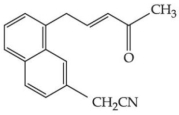
The number of electrophilic centers in the given compound is ...... .
A
$1$
B
$2$
C
$6$
D
$3$
Solution
(D) An electrophilic center is an atom that is electron-deficient and can accept an electron pair. In the given molecule,we identify the following electrophilic centers:
$1$. The carbonyl carbon $(C=O)$ is electrophilic due to the high electronegativity of oxygen,which creates a partial positive charge on the carbon.
$2$. The $\beta$-carbon of the $\alpha,\beta$-unsaturated carbonyl system is electrophilic due to resonance,which delocalizes the positive charge from the carbonyl carbon to the $\beta$-carbon.
$3$. The carbon atom of the nitrile group $(-CN)$ is electrophilic because the nitrogen atom is more electronegative than carbon,creating a partial positive charge on the carbon.
Thus,there are $3$ electrophilic centers in the molecule.
$1$. The carbonyl carbon $(C=O)$ is electrophilic due to the high electronegativity of oxygen,which creates a partial positive charge on the carbon.
$2$. The $\beta$-carbon of the $\alpha,\beta$-unsaturated carbonyl system is electrophilic due to resonance,which delocalizes the positive charge from the carbonyl carbon to the $\beta$-carbon.
$3$. The carbon atom of the nitrile group $(-CN)$ is electrophilic because the nitrogen atom is more electronegative than carbon,creating a partial positive charge on the carbon.
Thus,there are $3$ electrophilic centers in the molecule.
0 likes
View Solution52
MediumMCQ
Which of the following is an electrophilic reagent?
A
$RO^{-}$
B
$BF_{3}$
C
$NH_{3}$
D
$ROH$
Solution
(B) An electrophile is an electron-deficient species that accepts an electron pair to form a chemical bond.
$BF_{3}$ (Boron trifluoride) has an incomplete octet around the boron atom (only $6$ electrons),making it an electron-deficient molecule and thus an electrophile.
$RO^{-}$,$NH_{3}$,and $ROH$ all possess lone pairs of electrons,which makes them nucleophiles.
$BF_{3}$ (Boron trifluoride) has an incomplete octet around the boron atom (only $6$ electrons),making it an electron-deficient molecule and thus an electrophile.
$RO^{-}$,$NH_{3}$,and $ROH$ all possess lone pairs of electrons,which makes them nucleophiles.
0 likes
View Solution53
MediumMCQ
Which among the following is a set of nucleophiles?
A
$H^{+}, NH_{3}, Cl^{-}$
B
$BF_{3}, H_{2}O, NH_{3}$
C
$AlCl_{3}, BF_{3}, NH_{3}$
D
$CN^{-}, H_{2}O, ROH$
Solution
(D) nucleophile is a chemical species that donates an electron pair to form a chemical bond.
Species with at least one lone pair of electrons or a $\pi-$bond can act as nucleophiles.
In option $D$,$CN^{-}$ has a lone pair on carbon,$H_{2}O$ has two lone pairs on oxygen,and $ROH$ has two lone pairs on oxygen.
Therefore,$CN^{-}, H_{2}O, ROH$ are all nucleophiles.
Species with at least one lone pair of electrons or a $\pi-$bond can act as nucleophiles.
In option $D$,$CN^{-}$ has a lone pair on carbon,$H_{2}O$ has two lone pairs on oxygen,and $ROH$ has two lone pairs on oxygen.
Therefore,$CN^{-}, H_{2}O, ROH$ are all nucleophiles.
0 likes
View Solution54
MediumMCQ
Which of the following species is an electrophile?
A
$H_{2}O$
B
$NH_{3}$
C
$C_{2}H_{5}OH$
D
$SO_{3}$
Solution
(D) Electrophiles are electron-loving chemical species. These may be either positively charged or electrically neutral species with an incomplete octet or vacant orbitals.
$H_{2}O$,$NH_{3}$,and $C_{2}H_{5}OH$ are nucleophiles because they possess lone pairs of electrons.
$SO_{3}$ is an electrophile because the sulfur atom is bonded to three highly electronegative oxygen atoms,making it electron-deficient. It can be represented as a resonance hybrid of the following structures:
$O=S(=O)-O^{-} \leftrightarrow -O-S(=O)=O \leftrightarrow -O-S(=O)=O$ (with a positive charge on $S$ in each resonance structure).
Due to the partial positive charge on the $S$ atom,it acts as an electrophile.
$H_{2}O$,$NH_{3}$,and $C_{2}H_{5}OH$ are nucleophiles because they possess lone pairs of electrons.
$SO_{3}$ is an electrophile because the sulfur atom is bonded to three highly electronegative oxygen atoms,making it electron-deficient. It can be represented as a resonance hybrid of the following structures:
$O=S(=O)-O^{-} \leftrightarrow -O-S(=O)=O \leftrightarrow -O-S(=O)=O$ (with a positive charge on $S$ in each resonance structure).
Due to the partial positive charge on the $S$ atom,it acts as an electrophile.
0 likes
View Solution55
EasyMCQ
Which of the following is a nucleophile?
A
$BH_{3}$
B
$NH_{3}$
C
$AlCl_{3}$
D
All of these
Solution
(B) Nucleophiles (nucleus-loving species) are electron-rich species that possess at least one lone pair of electrons available for donation,acting as Lewis bases.
$BH_{3}$ and $AlCl_{3}$ are electron-deficient molecules (incomplete octet),which makes them electrophiles.
$NH_{3}$ contains a lone pair of electrons on the nitrogen atom,which it can donate,making it a nucleophile.
$BH_{3}$ and $AlCl_{3}$ are electron-deficient molecules (incomplete octet),which makes them electrophiles.
$NH_{3}$ contains a lone pair of electrons on the nitrogen atom,which it can donate,making it a nucleophile.
0 likes
View Solution56
MediumMCQ
The number of nucleophiles in the following list is $CH_3NH_2$,$CH_3CHO$,$C_2H_4$,$CH_3SH$.
A
$3$
B
$2$
C
$4$
D
$1$
Solution
(A) Nucleophiles are electron-rich species that can donate an electron pair to an electrophile.
$CH_3NH_2$ contains a nitrogen atom with a lone pair.
$CH_3SH$ contains a sulfur atom with a lone pair.
$CH_3CHO$ is an electrophile due to the polar $C=O$ bond.
$C_2H_4$ is a nucleophile due to the electron-rich $\pi$-bond.
Therefore,$CH_3NH_2$,$CH_3SH$,and $C_2H_4$ are nucleophiles.
The total number of nucleophiles is $3$.
$CH_3NH_2$ contains a nitrogen atom with a lone pair.
$CH_3SH$ contains a sulfur atom with a lone pair.
$CH_3CHO$ is an electrophile due to the polar $C=O$ bond.
$C_2H_4$ is a nucleophile due to the electron-rich $\pi$-bond.
Therefore,$CH_3NH_2$,$CH_3SH$,and $C_2H_4$ are nucleophiles.
The total number of nucleophiles is $3$.
0 likes
View Solution57
EasyMCQ
Which of the following is an ambident nucleophile?
A
Ammonia
B
Chloride ion
C
Water
D
Cyanide ion
Solution
(D) An ambident nucleophile is a species that has two or more nucleophilic sites through which it can attack an electrophile.
In the cyanide ion $(CN^-)$,both the carbon atom (which carries a negative charge) and the nitrogen atom (which has a lone pair of electrons) can act as nucleophilic sites.
Therefore,the cyanide ion is an example of an ambident nucleophile.
In the cyanide ion $(CN^-)$,both the carbon atom (which carries a negative charge) and the nitrogen atom (which has a lone pair of electrons) can act as nucleophilic sites.
Therefore,the cyanide ion is an example of an ambident nucleophile.
0 likes
View Solution58
EasyMCQ
Which of the following is not an electrophile?
A
$CN^{-}$
B
$BF_3$
C
$NO_2^{+}$
D
$AlCl_3$
Solution
(A) An electrophile is a species that accepts an electron pair to form a bond with a nucleophile. Since electrophiles accept electrons,they act as Lewis acids.
$CN^{-}$ is a nucleophile because it is electron-rich and carries a negative charge.
$BF_3$ is a neutral electrophile (Lewis acid) because it is electron-deficient.
$NO_2^{+}$ is a positively charged electrophile.
$AlCl_3$ is an electrophile because it is electron-deficient.
Therefore,$CN^{-}$ is the only species listed that is not an electrophile.
$CN^{-}$ is a nucleophile because it is electron-rich and carries a negative charge.
$BF_3$ is a neutral electrophile (Lewis acid) because it is electron-deficient.
$NO_2^{+}$ is a positively charged electrophile.
$AlCl_3$ is an electrophile because it is electron-deficient.
Therefore,$CN^{-}$ is the only species listed that is not an electrophile.
0 likes
View Solution59
EasyMCQ
The indicated atom is not a nucleophilic site in
A
$BH_{4}^{-}$ (atom = $B$)
B
$CH_{3}MgBr$ (atom = $C$)
C
$CH_{3}OH$ (atom = $O$)
D
$CH_{3}NH_{2}$ (atom = $N$)
Solution
(A) nucleophile is a species that can donate an electron pair to form a chemical bond.
In $BH_{4}^{-}$,the boron $(B)$ atom has a formal negative charge but it has no lone pair of electrons available for donation.
In $CH_{3}MgBr$,the carbon $(C)$ atom is nucleophilic due to the $C-Mg$ bond polarity.
In $CH_{3}OH$,the oxygen $(O)$ atom has two lone pairs.
In $CH_{3}NH_{2}$,the nitrogen $(N)$ atom has one lone pair.
Therefore,the $B$ atom in $BH_{4}^{-}$ is not a nucleophilic site.
Hence,the correct option is $A$.
In $BH_{4}^{-}$,the boron $(B)$ atom has a formal negative charge but it has no lone pair of electrons available for donation.
In $CH_{3}MgBr$,the carbon $(C)$ atom is nucleophilic due to the $C-Mg$ bond polarity.
In $CH_{3}OH$,the oxygen $(O)$ atom has two lone pairs.
In $CH_{3}NH_{2}$,the nitrogen $(N)$ atom has one lone pair.
Therefore,the $B$ atom in $BH_{4}^{-}$ is not a nucleophilic site.
Hence,the correct option is $A$.
0 likes
View Solution60
EasyMCQ
Which one of the following characteristics belongs to an electrophile?
A
It is any species having electron deficiency which reacts at an electron rich $C$-centre
B
It is any species having electron enrichment,that reacts at an electron deficient $C$-centre
C
It is cationic in nature
D
It is anionic in nature
Solution
(A) Electrophiles are electron-deficient species (neutral or cationic).
They attack electron-rich $C$-atoms.
They attack electron-rich $C$-atoms.
0 likes
View Solution8-4.Organic Chemistry : Reaction mechanism — Attacking reagents · Frequently Asked Questions
1Are these 8-4.Organic Chemistry : Reaction mechanism questions useful for JEE and NEET?
Yes. All questions in this section are mapped to JEE Main and NEET exam patterns. Previous year questions from JEE Main, NEET, GUJCET and state-level exams are included with full solutions.
2Can I switch to Hindi or Gujarati for these questions?
Yes. Use the language tabs in the hero section or the sidebar to view the same questions and solutions in English, Hindi or Gujarati.
3How do I generate a question paper from this subtopic?
Use the Vedclass Exam Paper Generator — select the chapter and subtopic, set difficulty, and generate Sets A, B, C, D automatically. First 3 chapters of every subject are free.
Vedclass Products
For Students
Vedclass Test Series
Mock tests in real JEE/NEET style with performance analysis. 5-day free trial.
Start Free TrialFor Teachers
Exam Paper Generator
Generate Set A/B/C/D papers from this chapter in 2 minutes. 3 chapters free.
Try FreeFor Institutes
Online Exam Module
Live online exams with unlimited students, 360° analytics & white-label branding.
See DemoFor Teachers & Institutes
Generate a 8-4.Organic Chemistry : Reaction mechanism Exam Paper in 2 Minutes
Select subtopic & difficulty — Sets A, B, C, D auto-generated with No Repeat logic.
First 3 chapters of every subject are free — no payment required.