
A English
Structural isomerism Questions in English
Class 11 Chemistry · 8-2.Organic Chemistry : Isomerism · Structural isomerism
271+
Questions
English
Language
100%
With Solutions
Showing 50 of 271 questions in English
51
MediumMCQ
How many possible structural isomers are there for the compound with the molecular formula $C_3H_7Cl$?
A
$2$
B
$5$
C
$7$
D
$9$
Solution
(A) The molecular formula $C_3H_7Cl$ corresponds to a propyl chloride derivative.
There are two possible structural isomers based on the position of the chlorine atom:
$1$. $CH_3-CH_2-CH_2-Cl$ ($1$-chloropropane)
$2$. $CH_3-CH(Cl)-CH_3$ ($2$-chloropropane)
Therefore,the total number of structural isomers is $2$.
There are two possible structural isomers based on the position of the chlorine atom:
$1$. $CH_3-CH_2-CH_2-Cl$ ($1$-chloropropane)
$2$. $CH_3-CH(Cl)-CH_3$ ($2$-chloropropane)
Therefore,the total number of structural isomers is $2$.
0 likes
View Solution52
MediumMCQ
Which of the following functional groups are functional isomers of esters?
A
$1, 4$
B
$1, 2$
C
$2, 3$
D
$3, 4$
Solution
(A) Esters have the general formula $R-COOR'$.
Functional isomers are compounds that have the same molecular formula but different functional groups.
Carboxylic acids (alkanoic acids) have the general formula $R-COOH$,which is a functional isomer of an ester.
For example,methyl methanoate ($HCOOCH_3$,$C_2H_4O_2$) and ethanoic acid ($CH_3COOH$,$C_2H_4O_2$) are functional isomers.
Therefore,alkanoic acids are functional isomers of esters.
Functional isomers are compounds that have the same molecular formula but different functional groups.
Carboxylic acids (alkanoic acids) have the general formula $R-COOH$,which is a functional isomer of an ester.
For example,methyl methanoate ($HCOOCH_3$,$C_2H_4O_2$) and ethanoic acid ($CH_3COOH$,$C_2H_4O_2$) are functional isomers.
Therefore,alkanoic acids are functional isomers of esters.
0 likes
View Solution53
MediumMCQ
How many isomers are possible for the formula $C_2BrClF_4$?
A
$3$
B
$4$
C
$5$
D
$6$
Solution
(A) The molecular formula $C_2BrClF_4$ represents a derivative of ethane where hydrogen atoms are replaced by halogens.
To find the isomers,we consider the arrangement of atoms around the $C-C$ bond.
For $C_2BrClF_4$,the possible structural isomers are based on the distribution of atoms on the two carbon atoms:
$1$. $CF_3-CFBrCl$ (one isomer)
$2$. $CF_2Cl-CF_2Br$ (one isomer)
For $CF_3-CFBrCl$,the carbon atom attached to $Br$ and $Cl$ is chiral,leading to $2$ enantiomers ($d$ and $l$ forms).
For $CF_2Cl-CF_2Br$,there are no chiral centers,but it can exhibit rotational isomerism (conformations),though typically in structural isomerism counting,we look for distinct connectivity.
However,considering stereoisomerism:
$CF_3-CFBrCl$ has $2$ enantiomers.
$CF_2Cl-CF_2Br$ has no stereoisomers.
Total isomers = $2$ (enantiomers) + $1$ (structural isomer) = $3$.
To find the isomers,we consider the arrangement of atoms around the $C-C$ bond.
For $C_2BrClF_4$,the possible structural isomers are based on the distribution of atoms on the two carbon atoms:
$1$. $CF_3-CFBrCl$ (one isomer)
$2$. $CF_2Cl-CF_2Br$ (one isomer)
For $CF_3-CFBrCl$,the carbon atom attached to $Br$ and $Cl$ is chiral,leading to $2$ enantiomers ($d$ and $l$ forms).
For $CF_2Cl-CF_2Br$,there are no chiral centers,but it can exhibit rotational isomerism (conformations),though typically in structural isomerism counting,we look for distinct connectivity.
However,considering stereoisomerism:
$CF_3-CFBrCl$ has $2$ enantiomers.
$CF_2Cl-CF_2Br$ has no stereoisomers.
Total isomers = $2$ (enantiomers) + $1$ (structural isomer) = $3$.
0 likes
View Solution54
EasyMCQ
Which compound exhibits tautomerism?
A
$(CH_3)_2NH$
B
$(CH_3)_3CNO_2$
C
$R_3CNO_2$
D
$RCH_2NO_2$
Solution
(D) Tautomerism requires the presence of at least one $\alpha$-hydrogen atom attached to an $sp^3$ hybridized carbon atom adjacent to a functional group like the nitro group $(-NO_2)$.
In $RCH_2NO_2$,the carbon atom attached to the $-NO_2$ group has two $\alpha$-hydrogen atoms,which are acidic due to the electron-withdrawing effect of the nitro group.
Therefore,$RCH_2NO_2$ can exhibit nitro-aci tautomerism.
In $RCH_2NO_2$,the carbon atom attached to the $-NO_2$ group has two $\alpha$-hydrogen atoms,which are acidic due to the electron-withdrawing effect of the nitro group.
Therefore,$RCH_2NO_2$ can exhibit nitro-aci tautomerism.
0 likes
View Solution55
EasyMCQ
What type of isomerism is observed between $n$-butyl alcohol and isobutyl alcohol?
A
Position
B
Chain
C
Optical
D
Geometrical
Solution
(B) $n$-butyl alcohol is $CH_3-CH_2-CH_2-CH_2-OH$ (a straight chain).
Isobutyl alcohol is $(CH_3)_2CH-CH_2-OH$ (a branched chain).
Since the carbon skeleton differs between the two isomers,they exhibit chain isomerism.
Isobutyl alcohol is $(CH_3)_2CH-CH_2-OH$ (a branched chain).
Since the carbon skeleton differs between the two isomers,they exhibit chain isomerism.
0 likes
View Solution56
MediumMCQ
Which of the following compounds contains a pseudo-asymmetric carbon atom?
A
$CH_3-CH(Br)-CH(Br)-CH_2Br$
B
$CH_3-CH(Br)-CH(OH)-CH(Br)-CH_3$
C
$CH_3-CH(OH)-CH(Br)-CH(Br)-CH_3$
D
$CH_3-CH(Br)-CH(OH)-CH(Cl)-CH_3$
Solution
(B) pseudo-asymmetric carbon atom is a carbon atom bonded to four groups,where two of the groups are enantiomeric (mirror images of each other) and the other two are different.
In the compound $CH_3-CH(Br)-CH(OH)-CH(Br)-CH_3$,the central carbon atom is bonded to $-H$,$-OH$,and two identical groups $-CH(Br)CH_3$.
However,if the two $-CH(Br)CH_3$ groups have different configurations (one $R$ and one $S$),the central carbon becomes a pseudo-asymmetric center.
In the compound $CH_3-CH(Br)-CH(OH)-CH(Br)-CH_3$,the central carbon atom is bonded to $-H$,$-OH$,and two identical groups $-CH(Br)CH_3$.
However,if the two $-CH(Br)CH_3$ groups have different configurations (one $R$ and one $S$),the central carbon becomes a pseudo-asymmetric center.
0 likes
View Solution57
EasyMCQ
What type of isomerism is exhibited by $CH_3-NH-C_2H_5$ and $(CH_3)_3N$?
A
Position
B
Functional
C
Metamerism
D
Chain
0 likes
View Solution58
MediumMCQ
Which isomerism is exhibited by the functional group diethylamine?
A
Propyl cyanide
B
Isopropyl isocyanide
C
$2-$Butanamine
D
Ethylamine
Solution
(C) Diethylamine is a secondary amine with the formula $(C_2H_5)_2NH$.
It is a functional isomer of primary amines like $n$-butylamine or $2$-butanamine,as they all share the same molecular formula $C_4H_{11}N$ but have different functional groups (secondary amine vs primary amine).
Therefore,diethylamine and $2$-butanamine are functional isomers.
It is a functional isomer of primary amines like $n$-butylamine or $2$-butanamine,as they all share the same molecular formula $C_4H_{11}N$ but have different functional groups (secondary amine vs primary amine).
Therefore,diethylamine and $2$-butanamine are functional isomers.
0 likes
View Solution59
MediumMCQ
Which of the following compounds exhibits tautomerism?
A
$2-$pentanone
B
Phenol
C
$2-$butene
D
Lactic acid
Solution
(A) Tautomerism is a special type of functional isomerism where a chemical compound exists in two or more interconvertible forms that differ in the position of at least one hydrogen atom.
For a compound to exhibit tautomerism,it must possess an $\alpha$-hydrogen atom adjacent to a polar group (like a carbonyl group,$C=O$).
In $2-$pentanone $(CH_3COCH_2CH_2CH_3)$,there are $\alpha$-hydrogen atoms present on the carbon adjacent to the carbonyl group.
Therefore,it can undergo keto-enol tautomerism.
Phenol,$2-$butene,and lactic acid do not exhibit this specific type of keto-enol tautomerism under standard conditions.
For a compound to exhibit tautomerism,it must possess an $\alpha$-hydrogen atom adjacent to a polar group (like a carbonyl group,$C=O$).
In $2-$pentanone $(CH_3COCH_2CH_2CH_3)$,there are $\alpha$-hydrogen atoms present on the carbon adjacent to the carbonyl group.
Therefore,it can undergo keto-enol tautomerism.
Phenol,$2-$butene,and lactic acid do not exhibit this specific type of keto-enol tautomerism under standard conditions.
0 likes
View Solution60
EasyMCQ
Which of the following exhibits metamerism?
A
Ether
B
Ketone
C
Tertiary amine
D
All of the above
Solution
(D) Metamerism is observed in polyvalent functional groups where the alkyl groups attached to the central atom differ.
Examples include ethers $(R-O-R')$,ketones $(R-CO-R')$,and tertiary amines $(R-N(R')-R'')$.
Since all the given options (ether,ketone,and tertiary amine) are polyvalent functional groups,they all exhibit metamerism.
Examples include ethers $(R-O-R')$,ketones $(R-CO-R')$,and tertiary amines $(R-N(R')-R'')$.
Since all the given options (ether,ketone,and tertiary amine) are polyvalent functional groups,they all exhibit metamerism.
0 likes
View Solution61
MediumMCQ
The two compounds $CH_3CH_2CH_2OCH_3$ and $CH_3CH_2OCH_2CH_3$ are examples of which type of isomerism?
A
Metamers
B
Tautomers
C
Functional isomers
D
Position isomers
Solution
(A) The given compounds are $CH_3CH_2CH_2OCH_3$ (methoxypropane) and $CH_3CH_2OCH_2CH_3$ (ethoxyethane).
Both are ethers with the same molecular formula $C_4H_{10}O$.
Metamerism arises due to the difference in the distribution of carbon atoms on either side of the functional group $(-O-)$.
In $CH_3CH_2CH_2OCH_3$,the alkyl groups attached to oxygen are methyl and propyl.
In $CH_3CH_2OCH_2CH_3$,the alkyl groups attached to oxygen are ethyl and ethyl.
Since the distribution of alkyl groups around the functional group is different,they are metamers.
Both are ethers with the same molecular formula $C_4H_{10}O$.
Metamerism arises due to the difference in the distribution of carbon atoms on either side of the functional group $(-O-)$.
In $CH_3CH_2CH_2OCH_3$,the alkyl groups attached to oxygen are methyl and propyl.
In $CH_3CH_2OCH_2CH_3$,the alkyl groups attached to oxygen are ethyl and ethyl.
Since the distribution of alkyl groups around the functional group is different,they are metamers.
0 likes
View Solution62
MediumMCQ
Which of the following substances exists in tautomeric form?
A
$p$-Nitrosophenol
B
$4$-Pyridone
C
$2$-Formylcyclohexanone
D
All of the above
0 likes
View Solution63
EasyMCQ
Methoxy methane $(CH_3-O-CH_3)$ and ethanol $(CH_3-CH_2-OH)$ are:
A
Chain isomers
B
Position isomers
C
Functional isomers
D
None of these
Solution
(C) Methoxy methane $(CH_3-O-CH_3)$ is an ether with the molecular formula $C_2H_6O$.
Ethanol $(CH_3-CH_2-OH)$ is an alcohol with the same molecular formula $C_2H_6O$.
Since both compounds have the same molecular formula but contain different functional groups (ether group $-O-$ and hydroxyl group $-OH$),they are classified as functional isomers.
Ethanol $(CH_3-CH_2-OH)$ is an alcohol with the same molecular formula $C_2H_6O$.
Since both compounds have the same molecular formula but contain different functional groups (ether group $-O-$ and hydroxyl group $-OH$),they are classified as functional isomers.
0 likes
View Solution64
EasyMCQ
What is the relationship between $Br-CH_2-CH_2-CHO$ and $CH_3-CH_2-CO-Br$?
A
Functional isomers
B
Positional isomers
C
Chain isomers
D
Metamers
0 likes
View Solution65
DifficultMCQ
What is the number of structural isomers of $C_6H_{14}$?
A
$3$
B
$4$
C
$5$
D
$6$
Solution
(C) The structural isomers of $C_6H_{14}$ (hexane) are as follows:
$1$. $CH_3-CH_2-CH_2-CH_2-CH_2-CH_3$ ($n$-hexane)
$2$. $CH_3-CH(CH_3)-CH_2-CH_2-CH_3$ ($2$-methylpentane)
$3$. $CH_3-CH_2-CH(CH_3)-CH_2-CH_3$ ($3$-methylpentane)
$4$. $CH_3-C(CH_3)_2-CH_2-CH_3$ ($2,2$-dimethylbutane)
$5$. $CH_3-CH(CH_3)-CH(CH_3)-CH_3$ ($2,3$-dimethylbutane)
Thus,there are $5$ structural isomers.
$1$. $CH_3-CH_2-CH_2-CH_2-CH_2-CH_3$ ($n$-hexane)
$2$. $CH_3-CH(CH_3)-CH_2-CH_2-CH_3$ ($2$-methylpentane)
$3$. $CH_3-CH_2-CH(CH_3)-CH_2-CH_3$ ($3$-methylpentane)
$4$. $CH_3-C(CH_3)_2-CH_2-CH_3$ ($2,2$-dimethylbutane)
$5$. $CH_3-CH(CH_3)-CH(CH_3)-CH_3$ ($2,3$-dimethylbutane)
Thus,there are $5$ structural isomers.
0 likes
View Solution66
EasyMCQ
Which type of isomerism is observed between $CH_3-CH_2-CH_2-CN$ and $CH_3-CH(CN)-CH_3$?
A
Chain isomerism
B
Position isomerism
C
Both of the above
D
None of these
Solution
(A) The first compound is $n$-butanenitrile $(CH_3-CH_2-CH_2-CN)$,which has a straight chain of $4$ carbon atoms.
The second compound is $2$-methylpropanenitrile $(CH_3-CH(CN)-CH_3)$,which has a branched chain of $3$ carbon atoms in the main chain.
Since the carbon skeleton (the arrangement of carbon atoms) is different in the two isomers,they exhibit chain isomerism.
The second compound is $2$-methylpropanenitrile $(CH_3-CH(CN)-CH_3)$,which has a branched chain of $3$ carbon atoms in the main chain.
Since the carbon skeleton (the arrangement of carbon atoms) is different in the two isomers,they exhibit chain isomerism.
0 likes
View Solution67
MediumMCQ
What is the minimum number of carbon atoms required to exhibit position isomerism in an organic compound?
A
$3$
B
$4$
C
$2$
D
$5$
Solution
(C) Position isomerism requires a minimum of $3$ carbon atoms in an alkane chain (e.g.,$1$-chloropropane and $2$-chloropropane). However,for simple substituted alkanes like dichloroethane,$2$ carbon atoms are sufficient to show position isomerism (e.g.,$1,1$-dichloroethane and $1,2$-dichloroethane).
0 likes
View Solution68
DifficultMCQ
What is the total number of cyclic isomers (excluding stereoisomers) for the molecular formula $C_5H_{10}$?
A
$4$
B
$5$
C
$6$
D
$7$
Solution
(B) The molecular formula $C_5H_{10}$ corresponds to a degree of unsaturation (double bond equivalent) of $1$.
For cyclic isomers,the possible structures are:
$1$. Cyclopentane
$2$. Methylcyclobutane
$3$. Ethylcyclopropane
$4$. $1,1$-Dimethylcyclopropane
$5$. $1,2$-Dimethylcyclopropane (cis and trans are stereoisomers,so we count this as one structural isomer)
Thus,there are $5$ structural cyclic isomers.
For cyclic isomers,the possible structures are:
$1$. Cyclopentane
$2$. Methylcyclobutane
$3$. Ethylcyclopropane
$4$. $1,1$-Dimethylcyclopropane
$5$. $1,2$-Dimethylcyclopropane (cis and trans are stereoisomers,so we count this as one structural isomer)
Thus,there are $5$ structural cyclic isomers.
0 likes
View Solution69
EasyMCQ
The two compounds $CH_3-CH_2-C(=O)-CH_2-CH_2-CH_3$ and $CH_3-C(=O)-C(CH_3)_2-CH_3$ can be classified as:
A
Position isomers
B
Metamers
C
Stereoisomers
D
Tautomers
Solution
(B) The first compound is $hexan-3-one$ $(CH_3-CH_2-CO-CH_2-CH_2-CH_3)$.
The second compound is $3,3-dimethylbutan-2-one$ $(CH_3-CO-C(CH_3)_3)$.
Both compounds have the same molecular formula $C_6H_{12}O$.
They differ in the position of the functional group (ketone) relative to the carbon chain and the branching of the alkyl chain.
Since they have the same functional group but different carbon skeleton structures,they are chain isomers. However,among the given options,they are best described as metamers because the alkyl groups attached to the carbonyl group are different ($ethyl/propyl$ vs $methyl/tert-butyl$).
Therefore,the correct classification is $Metamers$.
The second compound is $3,3-dimethylbutan-2-one$ $(CH_3-CO-C(CH_3)_3)$.
Both compounds have the same molecular formula $C_6H_{12}O$.
They differ in the position of the functional group (ketone) relative to the carbon chain and the branching of the alkyl chain.
Since they have the same functional group but different carbon skeleton structures,they are chain isomers. However,among the given options,they are best described as metamers because the alkyl groups attached to the carbonyl group are different ($ethyl/propyl$ vs $methyl/tert-butyl$).
Therefore,the correct classification is $Metamers$.
0 likes
View Solution70
MediumMCQ
For the following four structures $I$ to $IV$,which statement is correct?
$(I)$ $C_2H_5-CH(CH_3)-C_3H_7$
$(II)$ $C_2H_5-CO-CH(CH_3)-C_2H_5$
$(III)$ $CH_3^+$ (Methyl carbocation)
$(IV)$ $C_2H_5-CH(CH_3)-C_2H_5$
$(I)$ $C_2H_5-CH(CH_3)-C_3H_7$
$(II)$ $C_2H_5-CO-CH(CH_3)-C_2H_5$
$(III)$ $CH_3^+$ (Methyl carbocation)
$(IV)$ $C_2H_5-CH(CH_3)-C_2H_5$
A
All four are chiral compounds.
B
Only $I$ and $II$ are chiral compounds.
C
Only $III$ is a chiral compound.
D
Only $II$ and $IV$ are chiral compounds.
Solution
(B) carbon atom is chiral if it is bonded to four different groups or atoms.
Structure $(I)$: $C_2H_5-CH(CH_3)-C_3H_7$. The central carbon is bonded to $-H, -CH_3, -C_2H_5, -C_3H_7$. All four groups are different,so it is chiral.
Structure $(II)$: $C_2H_5-CO-CH(CH_3)-C_2H_5$. The carbon atom in the $CH(CH_3)$ group is bonded to $-H, -CH_3, -C_2H_5, -CO-C_2H_5$. All four groups are different,so it is chiral.
Structure $(III)$: $CH_3^+$. This is a planar carbocation with three hydrogens,not chiral.
Structure $(IV)$: $C_2H_5-CH(CH_3)-C_2H_5$. The central carbon is bonded to $-H, -CH_3, -C_2H_5, -C_2H_5$. Two groups are identical,so it is achiral.
Therefore,only $I$ and $II$ are chiral.
Structure $(I)$: $C_2H_5-CH(CH_3)-C_3H_7$. The central carbon is bonded to $-H, -CH_3, -C_2H_5, -C_3H_7$. All four groups are different,so it is chiral.
Structure $(II)$: $C_2H_5-CO-CH(CH_3)-C_2H_5$. The carbon atom in the $CH(CH_3)$ group is bonded to $-H, -CH_3, -C_2H_5, -CO-C_2H_5$. All four groups are different,so it is chiral.
Structure $(III)$: $CH_3^+$. This is a planar carbocation with three hydrogens,not chiral.
Structure $(IV)$: $C_2H_5-CH(CH_3)-C_2H_5$. The central carbon is bonded to $-H, -CH_3, -C_2H_5, -C_2H_5$. Two groups are identical,so it is achiral.
Therefore,only $I$ and $II$ are chiral.
0 likes
View Solution71
DifficultMCQ
How many structural isomers are possible for $C_4H_{10}O$?
A
$3$
B
$4$
C
$5$
D
$7$
Solution
(D) The molecular formula $C_4H_{10}O$ corresponds to alcohols and ethers. The structural isomers are as follows:
Alcohols:
$1$. $CH_3CH_2CH_2CH_2OH$ (Butan$-1-$ol)
$2$. $CH_3CH_2CH(OH)CH_3$ (Butan$-2-$ol)
$3$. $(CH_3)_2CHCH_2OH$ ($2$-Methylpropan$-1-$ol)
$4$. $(CH_3)_3COH$ ($2$-Methylpropan$-2-$ol)
Ethers:
$5$. $CH_3OCH_2CH_2CH_3$ ($1$-Methoxypropane)
$6$. $CH_3OCH(CH_3)_2$ ($2$-Methoxypropane)
$7$. $CH_3CH_2OCH_2CH_3$ (Ethoxyethane)
Total structural isomers = $4$ (alcohols) + $3$ (ethers) = $7$.
Alcohols:
$1$. $CH_3CH_2CH_2CH_2OH$ (Butan$-1-$ol)
$2$. $CH_3CH_2CH(OH)CH_3$ (Butan$-2-$ol)
$3$. $(CH_3)_2CHCH_2OH$ ($2$-Methylpropan$-1-$ol)
$4$. $(CH_3)_3COH$ ($2$-Methylpropan$-2-$ol)
Ethers:
$5$. $CH_3OCH_2CH_2CH_3$ ($1$-Methoxypropane)
$6$. $CH_3OCH(CH_3)_2$ ($2$-Methoxypropane)
$7$. $CH_3CH_2OCH_2CH_3$ (Ethoxyethane)
Total structural isomers = $4$ (alcohols) + $3$ (ethers) = $7$.
0 likes
View Solution72
MediumMCQ
In which of the following is functional group isomerism $NOT$ possible?
A
Alcohol
B
Aldehyde
C
Alkyl halide
D
Cyanide
Solution
(C) Functional group isomerism occurs when compounds have the same molecular formula but different functional groups.
$1$. Alcohols can show functional group isomerism with ethers (e.g.,$CH_3CH_2OH$ and $CH_3OCH_3$).
$2$. Aldehydes can show functional group isomerism with ketones (e.g.,$CH_3CH_2CHO$ and $CH_3COCH_3$).
$3$. Cyanides (nitriles) can show functional group isomerism with isocyanides (e.g.,$R-CN$ and $R-NC$).
$4$. Alkyl halides $(R-X)$ do not possess any other functional group isomer that can be formed with the same molecular formula,as they lack the structural diversity required for such isomerism.
Therefore,alkyl halides do not exhibit functional group isomerism.
$1$. Alcohols can show functional group isomerism with ethers (e.g.,$CH_3CH_2OH$ and $CH_3OCH_3$).
$2$. Aldehydes can show functional group isomerism with ketones (e.g.,$CH_3CH_2CHO$ and $CH_3COCH_3$).
$3$. Cyanides (nitriles) can show functional group isomerism with isocyanides (e.g.,$R-CN$ and $R-NC$).
$4$. Alkyl halides $(R-X)$ do not possess any other functional group isomer that can be formed with the same molecular formula,as they lack the structural diversity required for such isomerism.
Therefore,alkyl halides do not exhibit functional group isomerism.
0 likes
View Solution73
MediumMCQ
Which of the following is not a functional isomer of ethyl acetate $(CH_3COOCH_2CH_3)$?
A
$4$-hydroxybutanone
B
$3$-hydroxybutanal
C
Butane-$2,3$-diol
D
Isobutyric acid
Solution
(C) Ethyl acetate $(CH_3COOCH_2CH_3)$ has the molecular formula $C_4H_8O_2$.
Functional isomers must have the same molecular formula but different functional groups.
$4$-hydroxybutanone $(C_4H_8O_2)$,$3$-hydroxybutanal $(C_4H_8O_2)$,and isobutyric acid $(C_4H_8O_2)$ all have the same molecular formula $C_4H_8O_2$.
However,butane-$2,3$-diol has the molecular formula $C_4H_{10}O_2$,which is different from ethyl acetate.
Therefore,butane-$2,3$-diol is not an isomer of ethyl acetate.
Functional isomers must have the same molecular formula but different functional groups.
$4$-hydroxybutanone $(C_4H_8O_2)$,$3$-hydroxybutanal $(C_4H_8O_2)$,and isobutyric acid $(C_4H_8O_2)$ all have the same molecular formula $C_4H_8O_2$.
However,butane-$2,3$-diol has the molecular formula $C_4H_{10}O_2$,which is different from ethyl acetate.
Therefore,butane-$2,3$-diol is not an isomer of ethyl acetate.
0 likes
View Solution74
EasyMCQ
Identify the relationship between the following two compounds: $C_6H_5COOH$ and $o-HOC_6H_4CHO$.
A
Position isomers
B
Chain isomers
C
Functional isomers
D
Stereoisomers
Solution
(C) The first compound is benzoic acid $(C_6H_5COOH)$,which contains a carboxylic acid functional group.
The second compound is $2$-hydroxybenzaldehyde $(o-HOC_6H_4CHO)$,which contains both a hydroxyl $(-OH)$ and an aldehyde $(-CHO)$ functional group.
Since the two compounds have different functional groups,they are classified as functional isomers.
The second compound is $2$-hydroxybenzaldehyde $(o-HOC_6H_4CHO)$,which contains both a hydroxyl $(-OH)$ and an aldehyde $(-CHO)$ functional group.
Since the two compounds have different functional groups,they are classified as functional isomers.
0 likes
View Solution75
EasyMCQ
Which type of isomerism is observed in the given compounds: $C_6H_5COOH$ and $3-hydroxybenzaldehyde$?
A
Functional group isomerism
B
Positional isomerism
C
Chain isomerism
D
Configurational isomerism
Solution
(A) The first compound is benzoic acid $(C_6H_5COOH)$,which contains a carboxylic acid functional group $(-COOH)$.
The second compound is $3-hydroxybenzaldehyde$,which contains both an aldehyde $(-CHO)$ and a hydroxyl $(-OH)$ functional group.
Since the two compounds possess different functional groups,they exhibit functional group isomerism.
The second compound is $3-hydroxybenzaldehyde$,which contains both an aldehyde $(-CHO)$ and a hydroxyl $(-OH)$ functional group.
Since the two compounds possess different functional groups,they exhibit functional group isomerism.
0 likes
View Solution76
MediumMCQ
Which molecular formula does not exhibit chain isomerism?
A
$C_4H_{10}$
B
$C_4H_8$
C
$C_4H_6$
D
$C_4H_8O$
Solution
(C) Chain isomerism requires a minimum of $4$ carbon atoms for alkanes $(C_4H_{10})$,but for alkynes $(C_nH_{2n-2})$,a minimum of $5$ carbon atoms is required to show chain isomerism.
$C_4H_6$ corresponds to an alkyne $(C_4H_{2(4)-2} = C_4H_6)$,which cannot form a branched chain isomer with only $4$ carbon atoms.
$C_4H_6$ corresponds to an alkyne $(C_4H_{2(4)-2} = C_4H_6)$,which cannot form a branched chain isomer with only $4$ carbon atoms.
0 likes
View Solution77
DifficultMCQ
Which of the following pairs represents metamers?
A
$C_6H_5-CO-NH-CH_3$ and $CH_3-CO-NH-C_6H_5$
B
$C_2H_5-CO-O-CO-C_2H_5$ and $CH_3-CO-O-CO-C_3H_7$
C
Both of the above
D
None of these
Solution
(B) Metamerism arises due to the difference in the alkyl chains attached to the same polyvalent functional group.
In option $A$,the functional group is $-CO-NH-$. In the first compound,the groups attached are $C_6H_5$ and $CH_3$. In the second compound,the groups attached are $CH_3$ and $C_6H_5$. These are identical,not metamers.
In option $B$,the functional group is $-CO-O-CO-$. In the first compound,the groups attached are $C_2H_5$ and $C_2H_5$. In the second compound,the groups attached are $CH_3$ and $C_3H_7$. Since the alkyl groups attached to the central functional group differ,they are metamers.
Therefore,only option $B$ represents a pair of metamers.
In option $A$,the functional group is $-CO-NH-$. In the first compound,the groups attached are $C_6H_5$ and $CH_3$. In the second compound,the groups attached are $CH_3$ and $C_6H_5$. These are identical,not metamers.
In option $B$,the functional group is $-CO-O-CO-$. In the first compound,the groups attached are $C_2H_5$ and $C_2H_5$. In the second compound,the groups attached are $CH_3$ and $C_3H_7$. Since the alkyl groups attached to the central functional group differ,they are metamers.
Therefore,only option $B$ represents a pair of metamers.
0 likes
View Solution78
MediumMCQ
Which of the following compounds does not exhibit tautomerism?
A
$CH_3NO_2$
B
$CH_3CH_2NO_2$
C
$C_6H_5CH=CH-OH$
D
$CH_3CH_2OH$
Solution
(D) Tautomerism requires the presence of an $\alpha$-hydrogen atom adjacent to a polar group like $C=O$,$C=N$,or $N=O$ to allow for proton migration.
$CH_3NO_2$,$CH_3CH_2NO_2$,and $C_6H_5CH=CH-OH$ (an enol) can exhibit tautomerism.
$CH_3CH_2OH$ (ethanol) is a saturated alcohol and does not contain the necessary functional group or $\alpha$-hydrogen arrangement to exhibit tautomerism.
$CH_3NO_2$,$CH_3CH_2NO_2$,and $C_6H_5CH=CH-OH$ (an enol) can exhibit tautomerism.
$CH_3CH_2OH$ (ethanol) is a saturated alcohol and does not contain the necessary functional group or $\alpha$-hydrogen arrangement to exhibit tautomerism.
0 likes
View Solution79
MediumMCQ
Which of the following groups exhibit position isomerism?
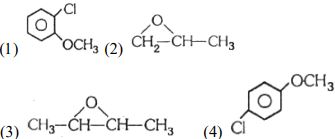
A
$2$ and $4$
B
$2$ and $3$
C
$1$ and $4$
D
$1, 2, 3$ and $4$
Solution
(C) Position isomerism occurs when the same functional group is attached to different positions on the same carbon skeleton.
Structure $(1)$ is $o$-chloroanisole (or $1$-chloro-$2$-methoxybenzene).
Structure $(4)$ is $p$-chloroanisole (or $1$-chloro-$4$-methoxybenzene).
Since both $(1)$ and $(4)$ have the same molecular formula and the same functional groups attached to different positions on the benzene ring,they are position isomers.
Structures $(2)$ and $(3)$ are epoxides with different carbon chain lengths,making them chain isomers,not position isomers.
Structure $(1)$ is $o$-chloroanisole (or $1$-chloro-$2$-methoxybenzene).
Structure $(4)$ is $p$-chloroanisole (or $1$-chloro-$4$-methoxybenzene).
Since both $(1)$ and $(4)$ have the same molecular formula and the same functional groups attached to different positions on the benzene ring,they are position isomers.
Structures $(2)$ and $(3)$ are epoxides with different carbon chain lengths,making them chain isomers,not position isomers.
0 likes
View Solution80
MediumMCQ
Which of the following substances is not an isomer of diethyl ether?
A
Butan$-1-$ol
B
Butanone
C
$2-$Methylpropan$-2-$ol
D
n-Propyl methyl ether
Solution
(B) The molecular formula of diethyl ether $(C_2H_5-O-C_2H_5)$ is $C_4H_{10}O$.
To be an isomer,a substance must have the same molecular formula $(C_4H_{10}O)$.
$1$. Butan$-1-$ol $(CH_3CH_2CH_2CH_2OH)$ has the formula $C_4H_{10}O$.
$2$. Butanone $(CH_3COCH_2CH_3)$ has the formula $C_4H_8O$.
$3$. $2-$Methylpropan$-2-$ol $((CH_3)_3COH)$ has the formula $C_4H_{10}O$.
$4$. n-Propyl methyl ether $(CH_3CH_2CH_2OCH_3)$ has the formula $C_4H_{10}O$.
Butanone has a different molecular formula,so it is not an isomer of diethyl ether.
To be an isomer,a substance must have the same molecular formula $(C_4H_{10}O)$.
$1$. Butan$-1-$ol $(CH_3CH_2CH_2CH_2OH)$ has the formula $C_4H_{10}O$.
$2$. Butanone $(CH_3COCH_2CH_3)$ has the formula $C_4H_8O$.
$3$. $2-$Methylpropan$-2-$ol $((CH_3)_3COH)$ has the formula $C_4H_{10}O$.
$4$. n-Propyl methyl ether $(CH_3CH_2CH_2OCH_3)$ has the formula $C_4H_{10}O$.
Butanone has a different molecular formula,so it is not an isomer of diethyl ether.
0 likes
View Solution81
MediumMCQ
Which statement is correct for compounds $A$ and $B$?
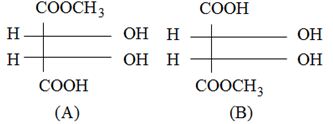
A
$A$ and $B$ are identical.
B
$A$ and $B$ are diastereomers.
C
$A$ and $B$ are enantiomers.
D
None of these.
Solution
(A) Compound $A$ is $CH_3OOC-CH(OH)-CH(OH)-COOH$.
Compound $B$ is $HOOC-CH(OH)-CH(OH)-COOCH_3$.
These two structures are identical because they represent the same molecule viewed from different orientations (rotating $B$ by $180^{\circ}$ in the plane of the paper gives $A$).
Therefore,$A$ and $B$ are identical.
Compound $B$ is $HOOC-CH(OH)-CH(OH)-COOCH_3$.
These two structures are identical because they represent the same molecule viewed from different orientations (rotating $B$ by $180^{\circ}$ in the plane of the paper gives $A$).
Therefore,$A$ and $B$ are identical.
0 likes
View Solution82
EasyMCQ
Which type of isomerism is exhibited by acetic acid $(CH_3COOH)$ and methyl formate $(HCOOCH_3)$?
A
Functional
B
Chain
C
Geometrical
D
Optical
Solution
(A) Acetic acid $(CH_3COOH)$ and methyl formate $(HCOOCH_3)$ have the same molecular formula,$C_2H_4O_2$.
Acetic acid contains a carboxylic acid functional group $(-COOH)$.
Methyl formate contains an ester functional group $(-COOCH_3)$.
Since they possess different functional groups,they exhibit functional isomerism.
Acetic acid contains a carboxylic acid functional group $(-COOH)$.
Methyl formate contains an ester functional group $(-COOCH_3)$.
Since they possess different functional groups,they exhibit functional isomerism.
0 likes
View Solution83
DifficultMCQ
Which of the following exhibits tautomerism?
A
Phenyl-$CH$=$CH$-$OH$
B
$1,4-$cyclohexanedione
C
$2-$cyclohexen$-1,4-$dione
D
$1,2-$cyclohexanedione
Solution
(D) Tautomerism requires the presence of an $\alpha$-hydrogen atom adjacent to a carbonyl group $(-C=O)$.
In $1,2$-cyclohexanedione,the carbon atoms adjacent to the carbonyl groups possess $\alpha$-hydrogen atoms,which can migrate to the oxygen atom to form an enol tautomer.
Structure $A$ is an enol itself,but it does not exhibit keto-enol tautomerism in the same way as the diones.
Structure $B$ ($1,4$-cyclohexanedione) has $\alpha$-hydrogens and can exhibit tautomerism.
Structure $D$ ($1,2$-cyclohexanedione) also has $\alpha$-hydrogens and is a classic example of a compound exhibiting tautomerism.
However,in the context of standard chemistry problems of this type,$1,2$-cyclohexanedione is the most commonly cited example for keto-enol tautomerism among these choices.
In $1,2$-cyclohexanedione,the carbon atoms adjacent to the carbonyl groups possess $\alpha$-hydrogen atoms,which can migrate to the oxygen atom to form an enol tautomer.
Structure $A$ is an enol itself,but it does not exhibit keto-enol tautomerism in the same way as the diones.
Structure $B$ ($1,4$-cyclohexanedione) has $\alpha$-hydrogens and can exhibit tautomerism.
Structure $D$ ($1,2$-cyclohexanedione) also has $\alpha$-hydrogens and is a classic example of a compound exhibiting tautomerism.
However,in the context of standard chemistry problems of this type,$1,2$-cyclohexanedione is the most commonly cited example for keto-enol tautomerism among these choices.
0 likes
View Solution84
MediumMCQ
$CH_3-CH_2-CH_2-COOH$ and $CH_3-CH(CH_3)-COOH$ are examples of:
A
Functional isomerism
B
Position isomerism
C
Geometrical isomerism
D
Chain isomerism
Solution
(D) The given compounds are $CH_3-CH_2-CH_2-COOH$ (butanoic acid) and $CH_3-CH(CH_3)-COOH$ ($2$-methylpropanoic acid).
Both compounds have the same molecular formula $(C_4H_8O_2)$ but differ in the arrangement of the carbon chain (straight chain vs. branched chain).
Therefore,they are examples of chain isomerism.
Both compounds have the same molecular formula $(C_4H_8O_2)$ but differ in the arrangement of the carbon chain (straight chain vs. branched chain).
Therefore,they are examples of chain isomerism.
0 likes
View Solution85
MediumMCQ
Which of the following compounds does not exhibit tautomerism?
A
$p$-Benzoquinone
B
Benzaldehyde oxime
C
Cyclohexane$-1,3,5-$trione
D
Cyclohexane$-1,4-$dione
Solution
(A) For a compound to exhibit keto-enol tautomerism,it must possess at least one $\alpha$-hydrogen atom adjacent to the carbonyl group.
$A$. $p$-Benzoquinone: It has no $\alpha$-hydrogen atoms available for tautomerization.
$B$. Benzaldehyde oxime: It can exhibit tautomerism (nitroso-oxime tautomerism).
$C$. Cyclohexane$-1,3,5-$trione: It has $\alpha$-hydrogen atoms and exhibits keto-enol tautomerism.
$D$. Cyclohexane$-1,4-$dione: It has $\alpha$-hydrogen atoms and can exhibit keto-enol tautomerism.
Therefore,$p$-Benzoquinone does not exhibit tautomerism.
$A$. $p$-Benzoquinone: It has no $\alpha$-hydrogen atoms available for tautomerization.
$B$. Benzaldehyde oxime: It can exhibit tautomerism (nitroso-oxime tautomerism).
$C$. Cyclohexane$-1,3,5-$trione: It has $\alpha$-hydrogen atoms and exhibits keto-enol tautomerism.
$D$. Cyclohexane$-1,4-$dione: It has $\alpha$-hydrogen atoms and can exhibit keto-enol tautomerism.
Therefore,$p$-Benzoquinone does not exhibit tautomerism.
0 likes
View Solution86
MediumMCQ
Which type of isomerism is shown by propanal and propanone?
A
Functional group isomerism
B
Metamerism
C
Tautomerism
D
Chain isomerism
Solution
(A) is the correct answer.
Propanal $(CH_3CH_2CHO)$ is an aldehyde,while propanone $(CH_3COCH_3)$ is a ketone.
Both compounds have the same molecular formula,$C_3H_6O$,but contain different functional groups (aldehyde and ketone).
Therefore,they exhibit functional group isomerism.
Propanal $(CH_3CH_2CHO)$ is an aldehyde,while propanone $(CH_3COCH_3)$ is a ketone.
Both compounds have the same molecular formula,$C_3H_6O$,but contain different functional groups (aldehyde and ketone).
Therefore,they exhibit functional group isomerism.
0 likes
View Solution87
MediumMCQ
An isomer of ethanol is
A
Methanol
B
Dimethyl ether
C
Diethyl ether
D
Ethylene glycol
Solution
(B) Ethanol $(C_2H_5OH)$ and dimethyl ether $(CH_3OCH_3)$ both have the same molecular formula,$C_2H_6O$.
Since they have the same molecular formula but different structural arrangements (functional groups),they are functional isomers of each other.
Therefore,the correct option is $(B)$.
Since they have the same molecular formula but different structural arrangements (functional groups),they are functional isomers of each other.
Therefore,the correct option is $(B)$.
0 likes
View Solution88
DifficultMCQ
Which among the given molecules can exhibit tautomerism?
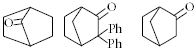
A
$III$ only
B
Both $I$ and $III$
C
Both $I$ and $II$
D
Both $II$ and $III$
Solution
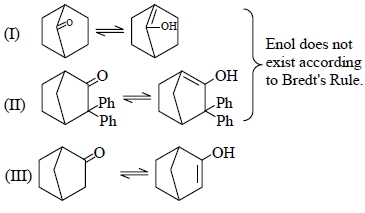
(A) Tautomerism in carbonyl compounds requires the presence of an $\alpha$-hydrogen atom to form an enol. Additionally,the formation of the enol must not violate $Bredt's$ $Rule$,which states that a double bond cannot be placed at the bridgehead of a bridged bicyclic system unless the ring is large enough.
$I$: This is bicyclo[$2.2$.$1$]heptan$-2-$one. The $\alpha$-hydrogen is present,but forming the enol would place a double bond at the bridgehead,violating $Bredt's$ $Rule$.
$II$: This is $3,3-$diphenylbicyclo[$2.2$.$1$]heptan$-2-$one. Similar to $I$,the enol form would violate $Bredt's$ $Rule$.
$III$: This is bicyclo[$2.2$.$1$]heptan$-2-$one (specifically the isomer where the carbonyl is at the $2-$position). The enol form can be formed by removing an $\alpha$-hydrogen from the $C_3$ position,which does not violate $Bredt's$ $Rule$ as the double bond is not at the bridgehead.
Therefore,only molecule $III$ can exhibit tautomerism.
$I$: This is bicyclo[$2.2$.$1$]heptan$-2-$one. The $\alpha$-hydrogen is present,but forming the enol would place a double bond at the bridgehead,violating $Bredt's$ $Rule$.
$II$: This is $3,3-$diphenylbicyclo[$2.2$.$1$]heptan$-2-$one. Similar to $I$,the enol form would violate $Bredt's$ $Rule$.
$III$: This is bicyclo[$2.2$.$1$]heptan$-2-$one (specifically the isomer where the carbonyl is at the $2-$position). The enol form can be formed by removing an $\alpha$-hydrogen from the $C_3$ position,which does not violate $Bredt's$ $Rule$ as the double bond is not at the bridgehead.
Therefore,only molecule $III$ can exhibit tautomerism.
0 likes
View Solution89
DifficultMCQ
Which of the given compounds can exhibit tautomerism?
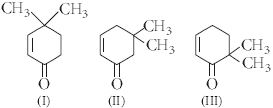
A
$II$ and $III$
B
$I$ and $II$
C
$I, II$ and $III$
D
$I$ and $III$
Solution
(C) Tautomerism in carbonyl compounds generally requires the presence of an $\alpha$-hydrogen atom.
$I$: This compound has an $\alpha$-hydrogen atom adjacent to the carbonyl group,so it can exhibit keto-enol tautomerism.
$II$: This compound also possesses an $\alpha$-hydrogen atom adjacent to the carbonyl group,allowing it to exhibit keto-enol tautomerism.
$III$: Although this compound lacks an $\alpha$-hydrogen,it can exhibit $\gamma$-tautomerism (also known as $p$-tautomerism) because it has a conjugated system where a $\gamma$-hydrogen can participate in the tautomeric shift.
Therefore,all three compounds ($I, II$,and $III$) can exhibit some form of tautomerism.
$I$: This compound has an $\alpha$-hydrogen atom adjacent to the carbonyl group,so it can exhibit keto-enol tautomerism.
$II$: This compound also possesses an $\alpha$-hydrogen atom adjacent to the carbonyl group,allowing it to exhibit keto-enol tautomerism.
$III$: Although this compound lacks an $\alpha$-hydrogen,it can exhibit $\gamma$-tautomerism (also known as $p$-tautomerism) because it has a conjugated system where a $\gamma$-hydrogen can participate in the tautomeric shift.
Therefore,all three compounds ($I, II$,and $III$) can exhibit some form of tautomerism.
0 likes
View Solution90
MediumMCQ
The order of stability of the following tautomeric compounds is:
$(I) CH_2=C(OH)-CH_2-C(=O)-CH_3$
$(II) CH_3-C(=O)-CH_2-C(=O)-CH_3$
$(III) CH_3-C(OH)=CH-C(=O)-CH_3$
$(I) CH_2=C(OH)-CH_2-C(=O)-CH_3$
$(II) CH_3-C(=O)-CH_2-C(=O)-CH_3$
$(III) CH_3-C(OH)=CH-C(=O)-CH_3$
A
$II > I > III$
B
$II > III > I$
C
$I > II > III$
D
$III > II > I$
Solution
(D) Compound $(III)$ is the most stable because it is a conjugated enol and is further stabilized by intramolecular hydrogen bonding,which forms a stable six-membered ring.
Compound $(II)$ is the keto form,which is generally more stable than a non-conjugated enol.
Compound $(I)$ is a non-conjugated enol,making it the least stable.
Therefore,the stability order is $III > II > I$.
Compound $(II)$ is the keto form,which is generally more stable than a non-conjugated enol.
Compound $(I)$ is a non-conjugated enol,making it the least stable.
Therefore,the stability order is $III > II > I$.
1 likes
View Solution91
DifficultMCQ
Which one of the following compounds is not an isomer of the others?
A
Cyclooctene
B
Bicyclobutyl
C
Bicyclo[$3.3.0$]octane
D
Tricyclo[$3.3.0.0^{2,6}$]octane
Solution
(D) To determine which compound is not an isomer,we calculate the Degree of Unsaturation $(DU)$ for each:
$1$. Cyclooctene: $C_8H_{14}$,$DU = 8 - 14/2 + 1 = 2$.
$2$. Bicyclobutyl: $C_8H_{14}$,$DU = 8 - 14/2 + 1 = 2$.
$3$. Bicyclo[$3.3.0$]octane: $C_8H_{14}$,$DU = 8 - 14/2 + 1 = 2$.
$4$. Tricyclo[$3.3.0.0^{2,6}$]octane: $C_8H_{12}$,$DU = 8 - 12/2 + 1 = 3$.
Since the fourth compound has a different molecular formula and a different $DU$ value,it is not an isomer of the others.
$1$. Cyclooctene: $C_8H_{14}$,$DU = 8 - 14/2 + 1 = 2$.
$2$. Bicyclobutyl: $C_8H_{14}$,$DU = 8 - 14/2 + 1 = 2$.
$3$. Bicyclo[$3.3.0$]octane: $C_8H_{14}$,$DU = 8 - 14/2 + 1 = 2$.
$4$. Tricyclo[$3.3.0.0^{2,6}$]octane: $C_8H_{12}$,$DU = 8 - 12/2 + 1 = 3$.
Since the fourth compound has a different molecular formula and a different $DU$ value,it is not an isomer of the others.
0 likes
View Solution92
DifficultMCQ
Identify the total number of structural isomers with the molecular formula $C_5H_{12}$.
A
$3$
B
$4$
C
$5$
D
$6$
Solution
(A) The molecular formula $C_5H_{12}$ corresponds to an alkane (pentane).
The possible structural isomers are:
$1.$ $CH_3-CH_2-CH_2-CH_2-CH_3$ ($n$-pentane)
$2.$ $CH_3-CH(CH_3)-CH_2-CH_3$ ($2$-methylbutane or isopentane)
$3.$ $CH_3-C(CH_3)_2-CH_3$ ($2,2$-dimethylpropane or neopentane)
Therefore,there are a total of $3$ structural isomers.
The possible structural isomers are:
$1.$ $CH_3-CH_2-CH_2-CH_2-CH_3$ ($n$-pentane)
$2.$ $CH_3-CH(CH_3)-CH_2-CH_3$ ($2$-methylbutane or isopentane)
$3.$ $CH_3-C(CH_3)_2-CH_3$ ($2,2$-dimethylpropane or neopentane)
Therefore,there are a total of $3$ structural isomers.
0 likes
View Solution93
DifficultMCQ
The two compounds given below are:
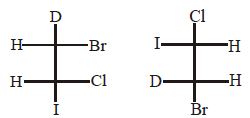
A
enantiomers
B
identical
C
optically inactive
D
diastereomers
Solution
(D) To determine the relationship between the two compounds,we assign the $R/S$ configuration to each chiral center.
For the first compound (left): The chiral centers are at the second and third carbons. Assigning priorities based on Cahn-Ingold-Prelog rules,the configuration is $(2S, 3S)$.
For the second compound (right): Assigning priorities,the configuration is $(2S, 3R)$.
Since the configurations are $(2S, 3S)$ and $(2S, 3R)$,they are non-mirror image stereoisomers.
Therefore,the two compounds are diastereomers.
For the first compound (left): The chiral centers are at the second and third carbons. Assigning priorities based on Cahn-Ingold-Prelog rules,the configuration is $(2S, 3S)$.
For the second compound (right): Assigning priorities,the configuration is $(2S, 3R)$.
Since the configurations are $(2S, 3S)$ and $(2S, 3R)$,they are non-mirror image stereoisomers.
Therefore,the two compounds are diastereomers.
0 likes
View Solution94
DifficultMCQ
In which structure is the central carbon $(C-3)$ not a chiral centre?
A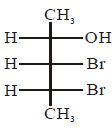
B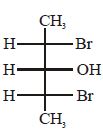
C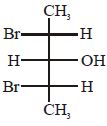
D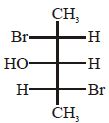
Solution
(B) chiral centre is a carbon atom bonded to four different groups. In a Fischer projection of a chain with three chiral carbons (like the ones shown,which are derivatives of pentane$-2,3,4-$triol or similar),the central carbon $(C-3)$ is the middle intersection point.
Looking at the structures:
- In structure $A$,$C-3$ is bonded to $H$,$Br$,the top group $(-CH(OH)CH_3)$,and the bottom group $(-CH(Br)CH_3)$. Since the top and bottom groups are different,$C-3$ is chiral.
- In structure $B$,$C-3$ is bonded to $H$,$OH$,the top group $(-CH(Br)CH_3)$,and the bottom group $(-CH(Br)CH_3)$. Here,the top and bottom groups are identical $(-CH(Br)CH_3)$. Therefore,the central carbon $C-3$ is bonded to two identical groups and is not a chiral centre.
- In structures $C$ and $D$,the groups attached to $C-3$ are different,making it chiral.
Thus,in structure $B$,the central carbon is not chiral.
Looking at the structures:
- In structure $A$,$C-3$ is bonded to $H$,$Br$,the top group $(-CH(OH)CH_3)$,and the bottom group $(-CH(Br)CH_3)$. Since the top and bottom groups are different,$C-3$ is chiral.
- In structure $B$,$C-3$ is bonded to $H$,$OH$,the top group $(-CH(Br)CH_3)$,and the bottom group $(-CH(Br)CH_3)$. Here,the top and bottom groups are identical $(-CH(Br)CH_3)$. Therefore,the central carbon $C-3$ is bonded to two identical groups and is not a chiral centre.
- In structures $C$ and $D$,the groups attached to $C-3$ are different,making it chiral.
Thus,in structure $B$,the central carbon is not chiral.
0 likes
View Solution95
DifficultMCQ
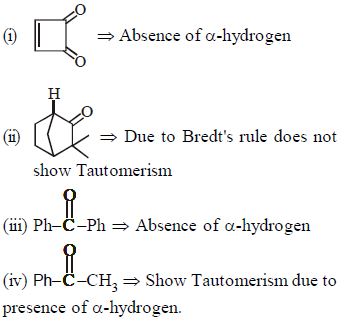
Which of the following compounds can show tautomerism?
A
B
C
$Ph-CO-Ph$
D
$Ph-CO-CH_3$
Solution
(D) For a compound to show keto-enol tautomerism,it must have at least one $\alpha$-hydrogen atom adjacent to the carbonyl group $(C=O)$.
$(A)$ The structure shown in the image (cyclobut$-2-$ene$-1,2-$dione) has no $\alpha$-hydrogen atoms.
$(B)$ The structure shown in the image (camphor derivative) does not show tautomerism due to Bredt's rule,which prevents the formation of a double bond at the bridgehead position.
$(C)$ $Ph-CO-Ph$ (Benzophenone): Both $\alpha$-carbons are part of benzene rings and have no hydrogens.
$(D)$ $Ph-CO-CH_3$ (Acetophenone): It has three $\alpha$-hydrogens on the methyl $(-CH_3)$ group. Therefore,it can show tautomerism.
$(A)$ The structure shown in the image (cyclobut$-2-$ene$-1,2-$dione) has no $\alpha$-hydrogen atoms.
$(B)$ The structure shown in the image (camphor derivative) does not show tautomerism due to Bredt's rule,which prevents the formation of a double bond at the bridgehead position.
$(C)$ $Ph-CO-Ph$ (Benzophenone): Both $\alpha$-carbons are part of benzene rings and have no hydrogens.
$(D)$ $Ph-CO-CH_3$ (Acetophenone): It has three $\alpha$-hydrogens on the methyl $(-CH_3)$ group. Therefore,it can show tautomerism.
0 likes
View Solution96
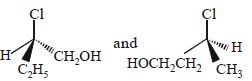
MediumMCQ
Identify the relationship between the given pair of compounds:
A
Enantiomers
B
Diastereomers
C
Homomers
D
Structural isomers
Solution
(D) The first compound is $2$-chlorobutan$-1$-ol $(CH_2(OH)-CHCl-CH_2-CH_3)$.
The second compound is $3$-chlorobutan$-1$-ol $(CH_2(OH)-CH_2-CHCl-CH_3)$.
Both compounds have the same molecular formula $(C_4H_9ClO)$ but differ in the position of the chlorine atom on the carbon chain.
Therefore,they are positional isomers,which is a type of structural isomerism.
The second compound is $3$-chlorobutan$-1$-ol $(CH_2(OH)-CH_2-CHCl-CH_3)$.
Both compounds have the same molecular formula $(C_4H_9ClO)$ but differ in the position of the chlorine atom on the carbon chain.
Therefore,they are positional isomers,which is a type of structural isomerism.
0 likes
View Solution97
DifficultMCQ
Select the correct pair.
A
$H_3C-CH_2-CH_2-NH-CH_3$ and $H_3C-CH(CH_3)-NH-CH_3$ are chain isomers.
B
$CH_3-CO-CH_2-CH_2-COCl$ and $CH_3-CO-CH(CH_3)-COCl$ are chain isomers.
C
$Br-C_6H_{10}-CO-C_6H_4-Cl$ and $Cl-C_6H_4-CO-C_6H_{10}-Br$ are metamers.
D
Anti form is the most stable form of ethane$-1,2-$diol (ethylene glycol).
Solution
(B) Let us analyze each option:
$A$. The given compounds are $N$-methylbutan$-1-$amine and $N$-methylpropan$-2-$amine. These are position isomers,not chain isomers.
$B$. The first compound is $5$-oxohexanoyl chloride and the second is $4$-methyl-$5$-oxopentanoyl chloride. These are chain isomers because the carbon skeleton of the main chain is different.
$C$. Metamers require the same functional group attached to different alkyl groups. Here,the groups attached to the carbonyl group are identical in both structures,just flipped,so they are the same compound,not metamers.
$D$. In ethane$-1,2-$diol,the gauche form is more stable than the anti form due to intramolecular hydrogen bonding.
Therefore,option $B$ is the correct pair.
$A$. The given compounds are $N$-methylbutan$-1-$amine and $N$-methylpropan$-2-$amine. These are position isomers,not chain isomers.
$B$. The first compound is $5$-oxohexanoyl chloride and the second is $4$-methyl-$5$-oxopentanoyl chloride. These are chain isomers because the carbon skeleton of the main chain is different.
$C$. Metamers require the same functional group attached to different alkyl groups. Here,the groups attached to the carbonyl group are identical in both structures,just flipped,so they are the same compound,not metamers.
$D$. In ethane$-1,2-$diol,the gauche form is more stable than the anti form due to intramolecular hydrogen bonding.
Therefore,option $B$ is the correct pair.
0 likes
View Solution98
DifficultMCQ
Cyanides exist in:
A
Tautomeric form
B
Geometrical form
C
In both forms
D
None
Solution
(A) Cyanides $(R-C \equiv N)$ and isocyanides $(R-N \equiv C)$ are functional isomers of each other.
They exhibit tautomerism,which is a special type of functional isomerism where the isomers exist in dynamic equilibrium with each other.
Therefore,cyanides exist in tautomeric form.
They exhibit tautomerism,which is a special type of functional isomerism where the isomers exist in dynamic equilibrium with each other.
Therefore,cyanides exist in tautomeric form.
0 likes
View Solution99
MediumMCQ
How many isomers can be produced from the molecular formula $C_4H_{10}O$?
A
$7$
B
$6$
C
$8$
D
$5$
Solution
(A) The molecular formula $C_4H_{10}O$ corresponds to the general formula $C_nH_{2n+2}O$,which indicates either an alcohol or an ether.
There are $4$ alcohols: $n$-butanol,butan-$2$-ol,$2$-methylpropan-$1$-ol,and $2$-methylpropan-$2$-ol.
There are $3$ ethers: diethyl ether,$1$-methoxypropane,and $2$-methoxypropane.
Thus,there are a total of $4 + 3 = 7$ structural isomers.
There are $4$ alcohols: $n$-butanol,butan-$2$-ol,$2$-methylpropan-$1$-ol,and $2$-methylpropan-$2$-ol.
There are $3$ ethers: diethyl ether,$1$-methoxypropane,and $2$-methoxypropane.
Thus,there are a total of $4 + 3 = 7$ structural isomers.
0 likes
View Solution100
MediumMCQ
Identify the type of isomerism shown by the following structures:
A
Chain
B
Position
C
Metamerism
D
Functional
Solution
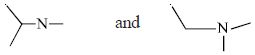
(C) The given structures are secondary amines with the same molecular formula but different alkyl groups attached to the nitrogen atom.
Structure $1$ has an isopropyl group attached to the nitrogen atom.
Structure $2$ has an ethyl group and a methyl group attached to the nitrogen atom.
Since the distribution of alkyl groups around the polyvalent functional group (nitrogen) is different,these are metamers.
Therefore,the correct type of isomerism is Metamerism.
Structure $1$ has an isopropyl group attached to the nitrogen atom.
Structure $2$ has an ethyl group and a methyl group attached to the nitrogen atom.
Since the distribution of alkyl groups around the polyvalent functional group (nitrogen) is different,these are metamers.
Therefore,the correct type of isomerism is Metamerism.
0 likes
View Solution8-2.Organic Chemistry : Isomerism — Structural isomerism · Frequently Asked Questions
1Are these 8-2.Organic Chemistry : Isomerism questions useful for JEE and NEET?
Yes. All questions in this section are mapped to JEE Main and NEET exam patterns. Previous year questions from JEE Main, NEET, GUJCET and state-level exams are included with full solutions.
2Can I switch to Hindi or Gujarati for these questions?
Yes. Use the language tabs in the hero section or the sidebar to view the same questions and solutions in English, Hindi or Gujarati.
3How do I generate a question paper from this subtopic?
Use the Vedclass Exam Paper Generator — select the chapter and subtopic, set difficulty, and generate Sets A, B, C, D automatically. First 3 chapters of every subject are free.
Vedclass Products
For Students
Vedclass Test Series
Mock tests in real JEE/NEET style with performance analysis. 5-day free trial.
Start Free TrialFor Teachers
Exam Paper Generator
Generate Set A/B/C/D papers from this chapter in 2 minutes. 3 chapters free.
Try FreeFor Institutes
Online Exam Module
Live online exams with unlimited students, 360° analytics & white-label branding.
See DemoFor Teachers & Institutes
Generate a 8-2.Organic Chemistry : Isomerism Exam Paper in 2 Minutes
Select subtopic & difficulty — Sets A, B, C, D auto-generated with No Repeat logic.
First 3 chapters of every subject are free — no payment required.