
A English
Mix Examples-General Organic Chemistry Questions in English
Class 11 Chemistry · 8-2.Organic Chemistry : Isomerism · Mix Examples-General Organic Chemistry
324+
Questions
English
Language
100%
With Solutions
Showing 50 of 324 questions in English
201
MediumMCQ
Which of the following compounds has a center of symmetry?
A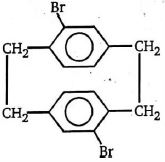
B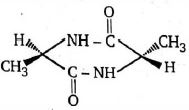
C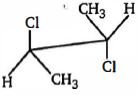
D
All of these
Solution
(D) center of symmetry is a point within a molecule such that any line drawn through it will encounter identical environments at equal distances in opposite directions.
$1$. The first compound (paracyclophane derivative) has a center of symmetry located at the midpoint of the central cavity.
$2$. The second compound (a cyclic dipeptide) has a center of symmetry at the center of the ring.
$3$. The third compound (a substituted butane) in its anti-conformation possesses a center of symmetry.
Since all three compounds possess a center of symmetry,the correct option is $D$.
$1$. The first compound (paracyclophane derivative) has a center of symmetry located at the midpoint of the central cavity.
$2$. The second compound (a cyclic dipeptide) has a center of symmetry at the center of the ring.
$3$. The third compound (a substituted butane) in its anti-conformation possesses a center of symmetry.
Since all three compounds possess a center of symmetry,the correct option is $D$.
0 likes
View Solution202
AdvancedMCQ
Which mixture of structures in each beaker would rotate plane polarized light?
A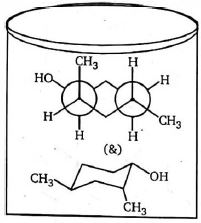
B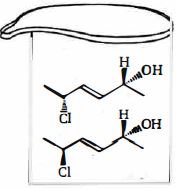
C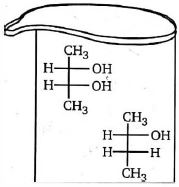
D
All of these
Solution
(D) mixture will rotate plane polarized light if it contains a non-zero concentration of a chiral compound that is not part of a racemic mixture.
In Beaker $A$,the structures are diastereomers,which are optically active.
In Beaker $B$,the structures are diastereomers,which are optically active.
In Beaker $C$,the structures are different chiral molecules,which are optically active.
Since all beakers contain chiral molecules that are not present as racemic mixtures,all of them will rotate plane polarized light.
In Beaker $A$,the structures are diastereomers,which are optically active.
In Beaker $B$,the structures are diastereomers,which are optically active.
In Beaker $C$,the structures are different chiral molecules,which are optically active.
Since all beakers contain chiral molecules that are not present as racemic mixtures,all of them will rotate plane polarized light.
0 likes
View Solution203
DifficultMCQ
Which of the following compounds will rotate the plane polarized light at room temperature?
A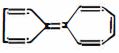
B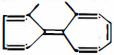
C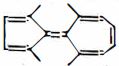
D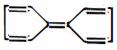
Solution
(C) compound will rotate plane polarized light if it is chiral (optically active).
For a molecule to be chiral,it must lack a plane of symmetry and a center of symmetry.
In the given options,the structure in option $C$ represents a substituted allene-like system where the two rings are perpendicular to each other due to the central double bond.
This perpendicular arrangement prevents the molecule from having a plane of symmetry or a center of symmetry,making it chiral and thus capable of rotating plane polarized light at room temperature.
For a molecule to be chiral,it must lack a plane of symmetry and a center of symmetry.
In the given options,the structure in option $C$ represents a substituted allene-like system where the two rings are perpendicular to each other due to the central double bond.
This perpendicular arrangement prevents the molecule from having a plane of symmetry or a center of symmetry,making it chiral and thus capable of rotating plane polarized light at room temperature.
0 likes
View Solution204
DifficultMCQ
Which of the following molecules has a plane of symmetry?
A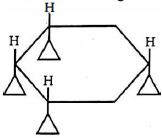
B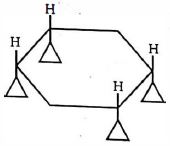
C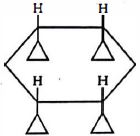
D
All of these
Solution
(D) plane of symmetry is an imaginary plane that bisects a molecule into two mirror-image halves.
In all three provided structures,the arrangement of the cyclopropyl groups on the cyclohexane ring allows for the existence of at least one plane of symmetry.
For instance,in structures where the substituents are placed symmetrically relative to the ring,a plane passing through the ring can reflect one half onto the other.
Therefore,all the given structures possess a plane of symmetry.
In all three provided structures,the arrangement of the cyclopropyl groups on the cyclohexane ring allows for the existence of at least one plane of symmetry.
For instance,in structures where the substituents are placed symmetrically relative to the ring,a plane passing through the ring can reflect one half onto the other.
Therefore,all the given structures possess a plane of symmetry.
0 likes
View Solution205
DifficultMCQ
Which of the following compounds is achiral?
A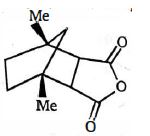
B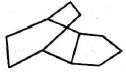
C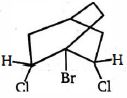
D
All of these
Solution
(D) molecule is achiral if it possesses a plane of symmetry,a center of inversion,or an improper axis of rotation.
$(A)$ The first compound (a bicyclic anhydride) has a plane of symmetry passing through the anhydride ring and bisecting the bicyclic system. Thus,it is achiral.
$(B)$ The second compound (a bicyclic hydrocarbon) also possesses a plane of symmetry,making it achiral.
$(C)$ The third compound (a substituted bicyclo[$2.2$.$1$]heptane) has a plane of symmetry passing through the $C-Br$ bond and the bridgehead carbon,making it achiral.
Since all the given compounds possess a plane of symmetry,they are all achiral.
Therefore,the correct option is $D$.
$(A)$ The first compound (a bicyclic anhydride) has a plane of symmetry passing through the anhydride ring and bisecting the bicyclic system. Thus,it is achiral.
$(B)$ The second compound (a bicyclic hydrocarbon) also possesses a plane of symmetry,making it achiral.
$(C)$ The third compound (a substituted bicyclo[$2.2$.$1$]heptane) has a plane of symmetry passing through the $C-Br$ bond and the bridgehead carbon,making it achiral.
Since all the given compounds possess a plane of symmetry,they are all achiral.
Therefore,the correct option is $D$.
0 likes
View Solution206
MediumMCQ
Which of the following compounds has a plane of symmetry?
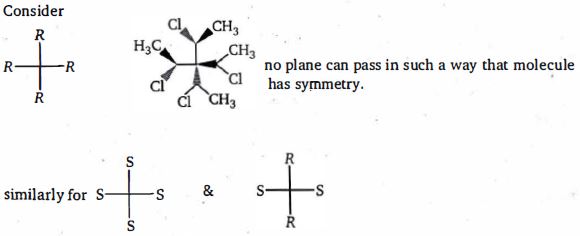
$R = -CH(Cl)-CH_3$
$S = -CH(Cl)-Br$
$R = -CH(Cl)-CH_3$
$S = -CH(Cl)-Br$
A
$R-R$
B
$S-S$
C
$R-S$
D
None of these
Solution
(D) plane of symmetry $(POS)$ is an imaginary plane that bisects a molecule into two halves that are mirror images of each other.
$1.$ In $R-R$ $(CH_3-CH(Cl)-CH(Cl)-CH_3)$ and $S-S$ $(Br-CH(Cl)-CH(Cl)-Br)$,these molecules can exist as meso forms (which have a $POS$) or as enantiomeric pairs (which do not). However,the structures provided represent specific chiral configurations that do not possess a plane of symmetry.
$2.$ In $R-S$ $(CH_3-CH(Cl)-CH(Cl)-Br)$,the two ends of the molecule are different ($CH_3$ and $Br$). Therefore,no plane can divide the molecule into two identical mirror-image halves,regardless of the configurations of the chiral centers.
Since none of the given specific configurations possess a plane of symmetry,the correct answer is $(d)$.
$1.$ In $R-R$ $(CH_3-CH(Cl)-CH(Cl)-CH_3)$ and $S-S$ $(Br-CH(Cl)-CH(Cl)-Br)$,these molecules can exist as meso forms (which have a $POS$) or as enantiomeric pairs (which do not). However,the structures provided represent specific chiral configurations that do not possess a plane of symmetry.
$2.$ In $R-S$ $(CH_3-CH(Cl)-CH(Cl)-Br)$,the two ends of the molecule are different ($CH_3$ and $Br$). Therefore,no plane can divide the molecule into two identical mirror-image halves,regardless of the configurations of the chiral centers.
Since none of the given specific configurations possess a plane of symmetry,the correct answer is $(d)$.
0 likes
View Solution207
AdvancedMCQ
Which of the following is an $E$ isomer?
A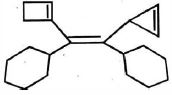
B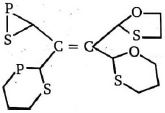
C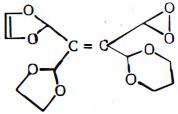
D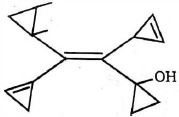
Solution
(B) The $E/Z$ system of nomenclature is used to describe the configuration of alkenes.
An isomer is $E$ (from the German 'entgegen',meaning opposite) if the high-priority groups are on opposite sides of the double bond.
An isomer is $Z$ (from the German 'zusammen',meaning together) if the high-priority groups are on the same side of the double bond.
By applying the Cahn-Ingold-Prelog $(CIP)$ priority rules to the substituents on the double-bonded carbons in the given structures,we determine the configuration.
In structure $B$,the high-priority groups attached to each carbon of the $C=C$ double bond are located on opposite sides,thus it represents the $E$ isomer.
An isomer is $E$ (from the German 'entgegen',meaning opposite) if the high-priority groups are on opposite sides of the double bond.
An isomer is $Z$ (from the German 'zusammen',meaning together) if the high-priority groups are on the same side of the double bond.
By applying the Cahn-Ingold-Prelog $(CIP)$ priority rules to the substituents on the double-bonded carbons in the given structures,we determine the configuration.
In structure $B$,the high-priority groups attached to each carbon of the $C=C$ double bond are located on opposite sides,thus it represents the $E$ isomer.
0 likes
View Solution208
MediumMCQ
Which of the following is an incorrect relation between the given pairs?
A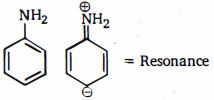
B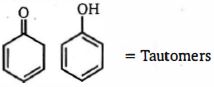
C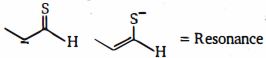
D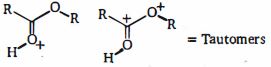
Solution
(D) In option $A$,the structures represent resonance forms of aniline.
In option $B$,cyclohexadienone and phenol are tautomers (keto-enol tautomerism).
In option $C$,the structures represent resonance forms of a thioaldehyde anion.
In option $D$,the structures shown are resonance structures of a protonated ester,not tautomers. Tautomerism involves the migration of an atom (usually hydrogen) between two polyatomic groups,whereas resonance involves only the movement of electrons. Therefore,the relation given in $D$ is incorrect.
In option $B$,cyclohexadienone and phenol are tautomers (keto-enol tautomerism).
In option $C$,the structures represent resonance forms of a thioaldehyde anion.
In option $D$,the structures shown are resonance structures of a protonated ester,not tautomers. Tautomerism involves the migration of an atom (usually hydrogen) between two polyatomic groups,whereas resonance involves only the movement of electrons. Therefore,the relation given in $D$ is incorrect.
0 likes
View Solution209
DifficultMCQ
Identify the most stable enol form of terric acid:
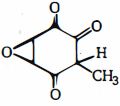
A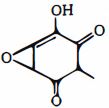
B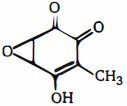
C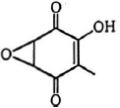
D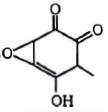
Solution
(C) The stability of an enol form is primarily determined by the extent of conjugation and resonance stabilization. In the case of terric acid,the keto-enol tautomerism leads to an enol form where the double bond is in conjugation with the carbonyl group and the epoxide ring system. The most stable enol form is the one that maximizes this resonance stabilization. Based on the provided structures,the form where the hydroxyl group is adjacent to the methyl group and the double bond is conjugated with the carbonyl group is the most stable.
0 likes
View Solution210
MediumMCQ
Which structure is most stable?
A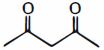
B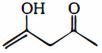
C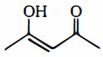
D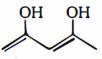
Solution
(C) The stability of the keto-enol tautomers of acetylacetone is determined by the presence of intramolecular hydrogen bonding.
In the enol form where the double bond is internal (option $C$),the structure forms a stable six-membered ring due to intramolecular hydrogen bonding between the hydroxyl group and the carbonyl oxygen.
This resonance-stabilized chelate ring makes this specific enol tautomer significantly more stable than the other enol forms or the non-chelated keto form.
In the enol form where the double bond is internal (option $C$),the structure forms a stable six-membered ring due to intramolecular hydrogen bonding between the hydroxyl group and the carbonyl oxygen.
This resonance-stabilized chelate ring makes this specific enol tautomer significantly more stable than the other enol forms or the non-chelated keto form.
0 likes
View Solution211
MediumMCQ
Identify the conformer of $2$-methylpentane.
A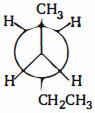
B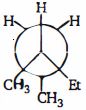
C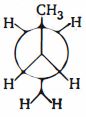
D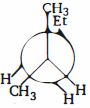
Solution
(D) $2$-methylpentane has the structure $CH_3-CH(CH_3)-CH_2-CH_2-CH_3$.
To represent its conformer in a Newman projection,we look along a $C-C$ bond.
Option $(d)$ correctly represents a conformation of $2$-methylpentane,where the front carbon is bonded to a $CH_3$ group and an ethyl $(Et)$ group,and the back carbon is bonded to a $CH_3$ group and $H$ atoms,consistent with the structure of $2$-methylpentane.
To represent its conformer in a Newman projection,we look along a $C-C$ bond.
Option $(d)$ correctly represents a conformation of $2$-methylpentane,where the front carbon is bonded to a $CH_3$ group and an ethyl $(Et)$ group,and the back carbon is bonded to a $CH_3$ group and $H$ atoms,consistent with the structure of $2$-methylpentane.
0 likes
View Solution212
MediumMCQ
Which of the following pairs of compounds are not positional isomers?
A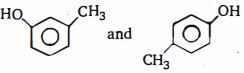
B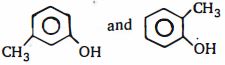
C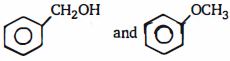
D
All of these
Solution
(C) Positional isomers are compounds that have the same molecular formula and the same functional group but differ in the position of the functional group or substituent on the carbon chain or ring.
$(A)$ $m$-cresol and $p$-cresol are positional isomers as the position of the $-CH_3$ group relative to the $-OH$ group changes.
$(B)$ $m$-cresol and $o$-cresol are positional isomers as the position of the $-CH_3$ group relative to the $-OH$ group changes.
$(C)$ Benzyl alcohol $(C_6H_5CH_2OH)$ and Anisole $(C_6H_5OCH_3)$ have the same molecular formula $(C_7H_8O)$ but different functional groups (alcohol and ether,respectively). Therefore,they are functional isomers,not positional isomers.
Thus,the correct option is $(C)$.
$(A)$ $m$-cresol and $p$-cresol are positional isomers as the position of the $-CH_3$ group relative to the $-OH$ group changes.
$(B)$ $m$-cresol and $o$-cresol are positional isomers as the position of the $-CH_3$ group relative to the $-OH$ group changes.
$(C)$ Benzyl alcohol $(C_6H_5CH_2OH)$ and Anisole $(C_6H_5OCH_3)$ have the same molecular formula $(C_7H_8O)$ but different functional groups (alcohol and ether,respectively). Therefore,they are functional isomers,not positional isomers.
Thus,the correct option is $(C)$.
0 likes
View Solution213
DifficultMCQ
The pair of enantiomers among the following compounds is:
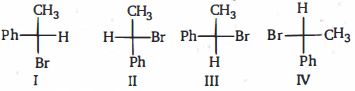
A
$I$ and $IV$
B
$II$ and $IV$
C
$II$ and $III$
D
$I$ and $II$
Solution
(C) To identify enantiomers,we determine the $(R/S)$ configuration of each chiral center:
$I$: Priority order is $-Br (1) > -Ph (2) > -CH_3 (3) > -H (4)$. With $-H$ on the horizontal line,the configuration is $(S)$.
$II$: Priority order is $-Br (1) > -Ph (2) > -CH_3 (3) > -H (4)$. With $-H$ on the horizontal line,the configuration is $(S)$.
$III$: Priority order is $-Br (1) > -Ph (2) > -CH_3 (3) > -H (4)$. With $-H$ on the vertical line,the configuration is $(R)$.
$IV$: Priority order is $-Br (1) > -Ph (2) > -CH_3 (3) > -H (4)$. With $-H$ on the vertical line,the configuration is $(S)$.
Enantiomers are non-superimposable mirror images,which correspond to opposite $(R/S)$ configurations at the chiral center.
Comparing the configurations,$II$ $(S)$ and $III$ $(R)$ are enantiomers.
$I$: Priority order is $-Br (1) > -Ph (2) > -CH_3 (3) > -H (4)$. With $-H$ on the horizontal line,the configuration is $(S)$.
$II$: Priority order is $-Br (1) > -Ph (2) > -CH_3 (3) > -H (4)$. With $-H$ on the horizontal line,the configuration is $(S)$.
$III$: Priority order is $-Br (1) > -Ph (2) > -CH_3 (3) > -H (4)$. With $-H$ on the vertical line,the configuration is $(R)$.
$IV$: Priority order is $-Br (1) > -Ph (2) > -CH_3 (3) > -H (4)$. With $-H$ on the vertical line,the configuration is $(S)$.
Enantiomers are non-superimposable mirror images,which correspond to opposite $(R/S)$ configurations at the chiral center.
Comparing the configurations,$II$ $(S)$ and $III$ $(R)$ are enantiomers.
0 likes
View Solution214
MediumMCQ
For the following Newman projection,identify the corresponding sawhorse projection.

A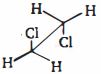
B
C
D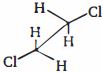
Solution
(D) To convert a Newman projection to a sawhorse projection,we look at the molecule from the side.
In the given Newman projection,the front carbon has a $Cl$ atom at the top,and the back carbon has a $Cl$ atom to the right.
By rotating the structure to a side view,we see that the $Cl$ on the front carbon and the $Cl$ on the back carbon are in a gauche position relative to each other.
The correct sawhorse representation corresponding to this Newman projection is shown in option $D$.
In the given Newman projection,the front carbon has a $Cl$ atom at the top,and the back carbon has a $Cl$ atom to the right.
By rotating the structure to a side view,we see that the $Cl$ on the front carbon and the $Cl$ on the back carbon are in a gauche position relative to each other.
The correct sawhorse representation corresponding to this Newman projection is shown in option $D$.
0 likes
View Solution215
AdvancedMCQ
Which of the following is correct for the given compound?
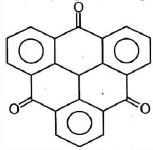
A
It possesses a centre of symmetry
B
It possesses a $C_4$ axis of symmetry
C
It possesses a plane of symmetry
D
The compound is chiral
Solution
(C) The given compound is $triangulene-trione$.
It has a planar structure.
Any planar molecule possesses at least one plane of symmetry (the molecular plane itself).
Therefore,it possesses a plane of symmetry.
It does not have a centre of symmetry,and it possesses a $C_3$ axis of symmetry,not a $C_4$ axis.
Since it has a plane of symmetry,it is achiral.
It has a planar structure.
Any planar molecule possesses at least one plane of symmetry (the molecular plane itself).
Therefore,it possesses a plane of symmetry.
It does not have a centre of symmetry,and it possesses a $C_3$ axis of symmetry,not a $C_4$ axis.
Since it has a plane of symmetry,it is achiral.
0 likes
View Solution216
DifficultMCQ
What is the number of diastereomers of the given compound?
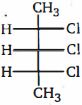
A
$2$
B
$3$
C
$4$
D
$6$
Solution
(B) The given compound is $2,3,4$-trichloropentane. It has $3$ chiral centers,so the total number of stereoisomers is $2^n = 2^3 = 8$.
However,due to symmetry,some are meso compounds.
The stereoisomers are:
$1$. $(2R, 3R, 4R)$
$2$. $(2S, 3S, 4S)$
$3$. $(2R, 3R, 4S)$
$4$. $(2S, 3S, 4R)$
$5$. $(2R, 3S, 4R)$ (Meso)
$6$. $(2S, 3R, 4S)$ (Meso)
$7$. $(2R, 3S, 4S)$
$8$. $(2S, 3R, 4R)$
Diastereomers are stereoisomers that are not mirror images of each other. For a given isomer,the number of diastereomers is (Total stereoisomers - $1$ (itself) - $1$ (its enantiomer)).
For the given compound (which is one of the $8$ isomers),there are $8 - 2 = 6$ other stereoisomers.
However,based on the provided solution image,it identifies $3$ specific diastereomers relative to the starting structure. Given the options,$3$ is the intended answer.
However,due to symmetry,some are meso compounds.
The stereoisomers are:
$1$. $(2R, 3R, 4R)$
$2$. $(2S, 3S, 4S)$
$3$. $(2R, 3R, 4S)$
$4$. $(2S, 3S, 4R)$
$5$. $(2R, 3S, 4R)$ (Meso)
$6$. $(2S, 3R, 4S)$ (Meso)
$7$. $(2R, 3S, 4S)$
$8$. $(2S, 3R, 4R)$
Diastereomers are stereoisomers that are not mirror images of each other. For a given isomer,the number of diastereomers is (Total stereoisomers - $1$ (itself) - $1$ (its enantiomer)).
For the given compound (which is one of the $8$ isomers),there are $8 - 2 = 6$ other stereoisomers.
However,based on the provided solution image,it identifies $3$ specific diastereomers relative to the starting structure. Given the options,$3$ is the intended answer.
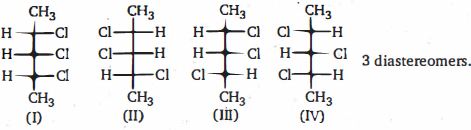
0 likes
View Solution217
DifficultMCQ
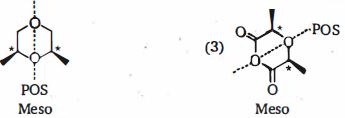
Identify which of the structures below are meso structures?
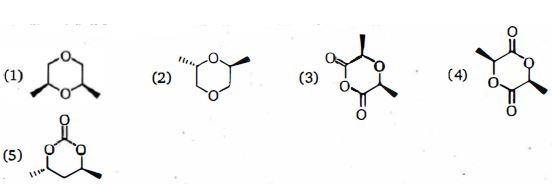
A
$1$ and $3$
B
$1, 3$ and $5$
C
$1, 3$ and $4$
D
$2$ and $5$
Solution
(B) meso compound is a molecule with multiple stereocenters that is achiral due to an internal plane of symmetry $(POS)$ or center of inversion.
Structure $(1)$ is cis-$2,6$-dimethyl-$1,4$-dioxane. It has two chiral centers and a plane of symmetry passing through the oxygen atoms,making it a meso compound.
Structure $(3)$ is a cyclic diester with two chiral centers. It possesses a plane of symmetry,making it a meso compound.
Structure $(2)$ is trans-$2,6$-dimethyl-$1,4$-dioxane,which is chiral (it exists as a pair of enantiomers).
Structure $(4)$ is trans-$3,6$-dimethyl-$1,4$-dioxane-$2,5$-dione,which is chiral.
Structure $(5)$ is a cyclic carbonate with two chiral centers. It has a plane of symmetry,making it a meso compound.
Therefore,structures $(1), (3),$ and $(5)$ are meso structures.
Structure $(1)$ is cis-$2,6$-dimethyl-$1,4$-dioxane. It has two chiral centers and a plane of symmetry passing through the oxygen atoms,making it a meso compound.
Structure $(3)$ is a cyclic diester with two chiral centers. It possesses a plane of symmetry,making it a meso compound.
Structure $(2)$ is trans-$2,6$-dimethyl-$1,4$-dioxane,which is chiral (it exists as a pair of enantiomers).
Structure $(4)$ is trans-$3,6$-dimethyl-$1,4$-dioxane-$2,5$-dione,which is chiral.
Structure $(5)$ is a cyclic carbonate with two chiral centers. It has a plane of symmetry,making it a meso compound.
Therefore,structures $(1), (3),$ and $(5)$ are meso structures.
0 likes
View Solution218
AdvancedMCQ
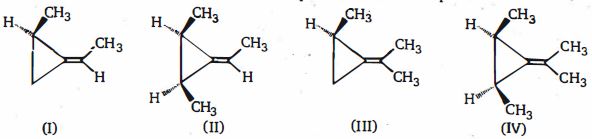
Find the sum of all the stereocenters that are present in the compounds shown below.
A
$8$
B
$9$
C
$10$
D
$11$
Solution
(C) stereocenter is an atom at which the interchange of two groups produces a stereoisomer. This includes chiral centers and atoms involved in geometric isomerism (like those in double bonds).
$(I)$ The compound has $3$ stereocenters: the chiral carbon in the ring and the two carbons of the double bond.
$(II)$ The compound has $4$ stereocenters: the two chiral carbons in the ring and the two carbons of the double bond.
$(III)$ The compound has $1$ stereocenter: the chiral carbon in the ring. The double bond carbons are not stereocenters because one carbon is attached to two identical $CH_3$ groups.
$(IV)$ The compound has $2$ stereocenters: the two chiral carbons in the ring. The double bond carbons are not stereocenters.
Total sum = $3 + 4 + 1 + 2 = 10$.
$(I)$ The compound has $3$ stereocenters: the chiral carbon in the ring and the two carbons of the double bond.
$(II)$ The compound has $4$ stereocenters: the two chiral carbons in the ring and the two carbons of the double bond.
$(III)$ The compound has $1$ stereocenter: the chiral carbon in the ring. The double bond carbons are not stereocenters because one carbon is attached to two identical $CH_3$ groups.
$(IV)$ The compound has $2$ stereocenters: the two chiral carbons in the ring. The double bond carbons are not stereocenters.
Total sum = $3 + 4 + 1 + 2 = 10$.
0 likes
View Solution219
DifficultMCQ
$A$ pair of stereoisomers might be classified in various ways. Which of the following statements are true with respect to pairs of stereoisomers?
$a$. They might be configurational isomers
$b$. They might be diastereomers
$c$. They might be constitutional isomers
$d$. They might be tautomers
$e$. They might be conformational isomers
$f$. They might be enantiomers
$g$. They might be positional isomers
$a$. They might be configurational isomers
$b$. They might be diastereomers
$c$. They might be constitutional isomers
$d$. They might be tautomers
$e$. They might be conformational isomers
$f$. They might be enantiomers
$g$. They might be positional isomers
A
$a, b, e, f$
B
$b, d, e, f, g$
C
$a, b, f$
D
$a, b, c, f$
Solution
(C) Stereoisomers are defined as isomers that have the same molecular formula and sequence of bonded atoms (constitution) but differ in the three-dimensional orientations of their atoms in space.
Stereoisomers are a subset of configurational isomers.
They are broadly classified into two types: $1$. Enantiomers (non-superimposable mirror images) and $2$. Diastereomers (stereoisomers that are not mirror images of each other).
Constitutional isomers (including tautomers and positional isomers) have different connectivity of atoms and are therefore not stereoisomers.
Conformational isomers are different spatial arrangements of the same molecule due to rotation about single bonds,which are distinct from configurational stereoisomers.
Therefore,the correct statements are $a$,$b$,and $f$.
Stereoisomers are a subset of configurational isomers.
They are broadly classified into two types: $1$. Enantiomers (non-superimposable mirror images) and $2$. Diastereomers (stereoisomers that are not mirror images of each other).
Constitutional isomers (including tautomers and positional isomers) have different connectivity of atoms and are therefore not stereoisomers.
Conformational isomers are different spatial arrangements of the same molecule due to rotation about single bonds,which are distinct from configurational stereoisomers.
Therefore,the correct statements are $a$,$b$,and $f$.
0 likes
View Solution220
MediumMCQ
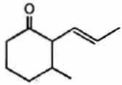
Calculate the total number of stereoisomers for the given molecule,considering the alkene configuration is fixed as trans.
A
$2$
B
$3$
C
$4$
D
$8$
Solution
(C) The molecule has $2$ chiral centers,marked with an asterisk $(*)$.
Since the configuration of the alkene is fixed as trans,it does not contribute to the number of stereoisomers.
The number of stereoisomers is determined by the $2$ chiral centers.
The formula for the number of stereoisomers is $2^n$,where $n$ is the number of chiral centers.
Here,$n = 2$,so the number of stereoisomers = $2^2 = 4$.
Since the configuration of the alkene is fixed as trans,it does not contribute to the number of stereoisomers.
The number of stereoisomers is determined by the $2$ chiral centers.
The formula for the number of stereoisomers is $2^n$,where $n$ is the number of chiral centers.
Here,$n = 2$,so the number of stereoisomers = $2^2 = 4$.
0 likes
View Solution221
MediumMCQ
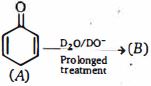
After prolonged treatment of $(A)$ by $D_2O/DO^-$, the difference in molecular weights of compounds $(A)$ and $(B)$ is:
A
$2$
B
$3$
C
$4$
D
$8$
Solution
(C) The compound $(A)$ is $2,5$-cyclohexadienone.
In the presence of $D_2O/DO^-$, the $\alpha$-hydrogens (hydrogens at the $2, 3, 5, 6$ positions relative to the carbonyl group) are acidic and undergo keto-enol tautomerism, leading to $H/D$ exchange.
In this specific molecule, there are $4$ such acidic hydrogen atoms at the positions adjacent to the double bonds and carbonyl group.
Upon prolonged treatment, all $4$ hydrogen atoms are replaced by deuterium atoms.
The mass difference is calculated as: $(4 \times \text{mass of } D) - (4 \times \text{mass of } H) = 4 \times (2 - 1) = 4 \ u$.
In the presence of $D_2O/DO^-$, the $\alpha$-hydrogens (hydrogens at the $2, 3, 5, 6$ positions relative to the carbonyl group) are acidic and undergo keto-enol tautomerism, leading to $H/D$ exchange.
In this specific molecule, there are $4$ such acidic hydrogen atoms at the positions adjacent to the double bonds and carbonyl group.
Upon prolonged treatment, all $4$ hydrogen atoms are replaced by deuterium atoms.
The mass difference is calculated as: $(4 \times \text{mass of } D) - (4 \times \text{mass of } H) = 4 \times (2 - 1) = 4 \ u$.
0 likes
View Solution222
MediumMCQ
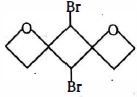
Determine the number of optically active isomers for the given structure.
A
$0$
B
$1$
C
$2$
D
$3$
Solution
(A) The given molecule is a derivative of a central cyclobutane ring substituted with two oxetane rings and two bromine atoms.
To determine optical activity,we must check for the presence of a plane of symmetry $(POS)$ or a center of inversion $(COS)$.
If we examine the structure,the two bromine atoms can be oriented in different spatial arrangements relative to the central cyclobutane ring (cis or trans).
However,in both the $cis$ and $trans$ configurations,the molecule possesses a plane of symmetry passing through the two carbon atoms bearing the bromine atoms or through the center of the cyclobutane ring.
Since the molecule has a plane of symmetry in all its possible stereoisomeric forms,it is achiral.
Therefore,the number of optically active isomers is $0$.
To determine optical activity,we must check for the presence of a plane of symmetry $(POS)$ or a center of inversion $(COS)$.
If we examine the structure,the two bromine atoms can be oriented in different spatial arrangements relative to the central cyclobutane ring (cis or trans).
However,in both the $cis$ and $trans$ configurations,the molecule possesses a plane of symmetry passing through the two carbon atoms bearing the bromine atoms or through the center of the cyclobutane ring.
Since the molecule has a plane of symmetry in all its possible stereoisomeric forms,it is achiral.
Therefore,the number of optically active isomers is $0$.
0 likes
View Solution223
MediumMCQ
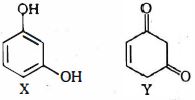
At normal temperature,$X$ and $Y$ are:
A
resonance structures
B
tautomers
C
functional isomers
D
positional isomers
Solution
(B) The structure $X$ represents resorcinol (a dihydroxybenzene derivative),which exists in equilibrium with its keto form $Y$ (cyclohex$-2-$ene$-1,4-$dione derivative).
These structures differ in the position of a proton and a double bond,which is the characteristic feature of tautomerism.
Therefore,$X$ and $Y$ are tautomers.
Hence,Option $B$ is the correct answer.
These structures differ in the position of a proton and a double bond,which is the characteristic feature of tautomerism.
Therefore,$X$ and $Y$ are tautomers.
Hence,Option $B$ is the correct answer.
0 likes
View Solution224
DifficultMCQ
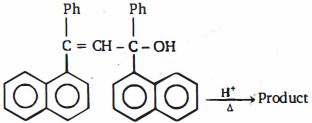
Stereochemistry of the product is
A
Meso compound
B
Racemic mixture
C
Diastereomer
D
Optically pure enantiomers
Solution
(B) The given reactant is an allylic alcohol. Upon treatment with $H^+$ and heat,it undergoes dehydration to form an allene derivative. The resulting allene has two chiral centers (or rather,axial chirality due to the allene structure). Since the starting material is not specified as a single enantiomer,the reaction produces a mixture of both enantiomers of the allene,which is a racemic mixture.
0 likes
View Solution225
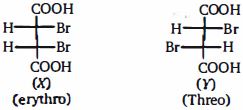
DifficultMCQ
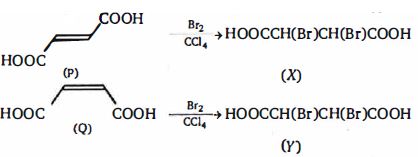
The correct statements with respect to the above pair of reactions are that:
$(I)$ The reactions are stereospecific.
$(II)$ $(X)$ is erythro and $(Y)$ is threo isomer.
$(III)$ $(X)$ is threo and $(Y)$ is erythro isomer.
$(IV)$ Each of $(P)$ and $(Q)$ gives a mixture of $(X)$ and $(Y)$.
$(I)$ The reactions are stereospecific.
$(II)$ $(X)$ is erythro and $(Y)$ is threo isomer.
$(III)$ $(X)$ is threo and $(Y)$ is erythro isomer.
$(IV)$ Each of $(P)$ and $(Q)$ gives a mixture of $(X)$ and $(Y)$.
A
$I$ and $II$
B
$I$ and $III$
C
$I$ and $IV$
D
$II$ and $IV$
Solution
(B) The reaction of alkenes with $Br_2$ in $CCl_4$ involves anti-addition of bromine atoms across the double bond.
This reaction is stereospecific.
For the cis-alkene $(P)$ (maleic acid),anti-addition yields the racemic mixture of the threo-isomer.
For the trans-alkene $(Q)$ (fumaric acid),anti-addition yields the meso-compound,which is the erythro-isomer.
Based on the provided structures:
$(X)$ is the product of $(P)$,which is the threo-isomer.
$(Y)$ is the product of $(Q)$,which is the erythro-isomer.
Therefore,statement $(I)$ is correct (stereospecific reaction) and statement $(III)$ is correct ($(X)$ is threo and $(Y)$ is erythro).
Thus,the correct option is $B$.
This reaction is stereospecific.
For the cis-alkene $(P)$ (maleic acid),anti-addition yields the racemic mixture of the threo-isomer.
For the trans-alkene $(Q)$ (fumaric acid),anti-addition yields the meso-compound,which is the erythro-isomer.
Based on the provided structures:
$(X)$ is the product of $(P)$,which is the threo-isomer.
$(Y)$ is the product of $(Q)$,which is the erythro-isomer.
Therefore,statement $(I)$ is correct (stereospecific reaction) and statement $(III)$ is correct ($(X)$ is threo and $(Y)$ is erythro).
Thus,the correct option is $B$.
0 likes
View Solution226
MediumMCQ
Which of the following statements is correct about $A$ and $B$?

A
$A$ and $B$ are a mixture of diastereomers
B
$A$ and $B$ are a mixture of enantiomers
C
$A$ and $B$ are optically active
D
$B$ is a racemic mixture
Solution
(A) The reaction involves the epoxidation of an alkene that already contains a chiral center (the epoxide ring).
Since the starting material is a single enantiomer,the new chiral center created at the double bond can have two different configurations relative to the existing chiral center.
These two products,$A$ and $B$,are stereoisomers that are not mirror images of each other,which defines them as diastereomers.
Since the starting material is a single enantiomer,the new chiral center created at the double bond can have two different configurations relative to the existing chiral center.
These two products,$A$ and $B$,are stereoisomers that are not mirror images of each other,which defines them as diastereomers.
0 likes
View Solution227
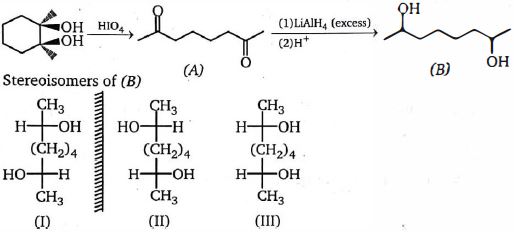
DifficultMCQ
Total number of stereoisomers of product $(B)$ will be

A
$2$
B
$3$
C
$4$
D
$5$
Solution
(B) The reaction of $1,2$-cyclohexanediol with $HIO_4$ gives $2,7$-octanedione $(A)$.
Reduction of $(A)$ with excess $LiAlH_4$ followed by acidic workup yields $2,7$-octanediol $(B)$,which is $CH_3CH(OH)(CH_2)_4CH(OH)CH_3$.
This molecule has $2$ identical chiral centers.
The number of stereoisomers for a molecule with $n$ identical chiral centers is given by:
If $n$ is even,total stereoisomers $= 2^{n-1} + 2^{(n/2)-1}$.
Here $n=2$,so total stereoisomers $= 2^{2-1} + 2^{(2/2)-1} = 2^1 + 2^0 = 2 + 1 = 3$.
The $3$ stereoisomers are $(I)$ and $(II)$ (a pair of enantiomers) and $(III)$ (a meso compound).
Reduction of $(A)$ with excess $LiAlH_4$ followed by acidic workup yields $2,7$-octanediol $(B)$,which is $CH_3CH(OH)(CH_2)_4CH(OH)CH_3$.
This molecule has $2$ identical chiral centers.
The number of stereoisomers for a molecule with $n$ identical chiral centers is given by:
If $n$ is even,total stereoisomers $= 2^{n-1} + 2^{(n/2)-1}$.
Here $n=2$,so total stereoisomers $= 2^{2-1} + 2^{(2/2)-1} = 2^1 + 2^0 = 2 + 1 = 3$.
The $3$ stereoisomers are $(I)$ and $(II)$ (a pair of enantiomers) and $(III)$ (a meso compound).
0 likes
View Solution228
DifficultMCQ
Which of the following acids on heating gives geometrical isomers as a product?
A
$CH_3-CH(OH)-CO_2H$
B
$3-$chlorocyclobutane$-1,1-$dicarboxylic acid
C
$CH_3-CH(OH)-CH_2-CO_2H$
D
All of these
Solution
(D) Heating these compounds leads to the formation of products that exhibit geometrical isomerism:
$(a)$ $CH_3-CH(OH)-CO_2H$ (lactic acid) on heating forms a lactide,which exists as cis and trans geometrical isomers.
$(b)$ $3-$chlorocyclobutane$-1,1-$dicarboxylic acid on heating undergoes decarboxylation to form $3-$chlorocyclobutanecarboxylic acid,which exists as cis and trans geometrical isomers.
$(c)$ $CH_3-CH(OH)-CH_2-CO_2H$ ($\beta$-hydroxybutyric acid) on heating undergoes dehydration to form crotonic acid $(CH_3-CH=CH-CO_2H)$,which exists as cis and trans geometrical isomers.
Therefore,all the given options produce geometrical isomers upon heating.
$(a)$ $CH_3-CH(OH)-CO_2H$ (lactic acid) on heating forms a lactide,which exists as cis and trans geometrical isomers.
$(b)$ $3-$chlorocyclobutane$-1,1-$dicarboxylic acid on heating undergoes decarboxylation to form $3-$chlorocyclobutanecarboxylic acid,which exists as cis and trans geometrical isomers.
$(c)$ $CH_3-CH(OH)-CH_2-CO_2H$ ($\beta$-hydroxybutyric acid) on heating undergoes dehydration to form crotonic acid $(CH_3-CH=CH-CO_2H)$,which exists as cis and trans geometrical isomers.
Therefore,all the given options produce geometrical isomers upon heating.
0 likes
View Solution229
DifficultMCQ
Identify $B$ in the following tautomerization reaction:
$4\text{-pyridone} \xrightarrow{KOH} B$
$4\text{-pyridone} \xrightarrow{KOH} B$
A
$4\text{-hydroxypyridine}$
B
$4\text{-pyridone}$
C
$3\text{-hydroxypyridine}$
D
$N\text{-hydroxypyridine}$
Solution
(A) The given reactant is $4\text{-pyridone}$,which exists in tautomeric equilibrium with $4\text{-hydroxypyridine}$.
$4\text{-pyridone}$ is the keto form,and $4\text{-hydroxypyridine}$ is the enol form.
The reaction with $KOH$ facilitates the establishment of this tautomeric equilibrium.
Therefore,$B$ is $4\text{-hydroxypyridine}$.
$4\text{-pyridone}$ is the keto form,and $4\text{-hydroxypyridine}$ is the enol form.
The reaction with $KOH$ facilitates the establishment of this tautomeric equilibrium.
Therefore,$B$ is $4\text{-hydroxypyridine}$.
0 likes
View Solution230
DifficultMCQ
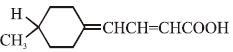
How many stereoisomers are possible for the following molecule?
A
$1$
B
$2$
C
$3$
D
$4$
Solution
(D) The given molecule is $4$-methylcyclohexylidene-but$-2-$enoic acid.
First,let us analyze the stereocenters and double bonds.
$1$. The double bond at the $C=CH$ position (exocyclic double bond) does not exhibit geometrical isomerism because the two groups on the cyclohexane ring carbon are different ($H$ and $CH_3$),but the other end of the double bond is a $CH$ group attached to a chain. However,looking at the structure,the exocyclic double bond is connected to a $CH$ group which is part of a conjugated system $CH=CH-COOH$.
$2$. The molecule has a chiral center at the $C-4$ position of the cyclohexane ring,where the $CH_3$ group is attached.
$3$. The double bond in the side chain $(CH=CH)$ can exhibit geometrical isomerism ($cis$ or $trans$).
$4$. Since there is one chiral center $(n=1)$ and one double bond capable of geometrical isomerism,the total number of stereoisomers is $2^n \times 2^m$ (where $n$ is the number of chiral centers and $m$ is the number of double bonds showing geometrical isomerism).
$5$. Here,$n=1$ and $m=1$,so the total number of stereoisomers is $2^1 \times 2^1 = 4$.
First,let us analyze the stereocenters and double bonds.
$1$. The double bond at the $C=CH$ position (exocyclic double bond) does not exhibit geometrical isomerism because the two groups on the cyclohexane ring carbon are different ($H$ and $CH_3$),but the other end of the double bond is a $CH$ group attached to a chain. However,looking at the structure,the exocyclic double bond is connected to a $CH$ group which is part of a conjugated system $CH=CH-COOH$.
$2$. The molecule has a chiral center at the $C-4$ position of the cyclohexane ring,where the $CH_3$ group is attached.
$3$. The double bond in the side chain $(CH=CH)$ can exhibit geometrical isomerism ($cis$ or $trans$).
$4$. Since there is one chiral center $(n=1)$ and one double bond capable of geometrical isomerism,the total number of stereoisomers is $2^n \times 2^m$ (where $n$ is the number of chiral centers and $m$ is the number of double bonds showing geometrical isomerism).
$5$. Here,$n=1$ and $m=1$,so the total number of stereoisomers is $2^1 \times 2^1 = 4$.
0 likes
View Solution231
MediumMCQ
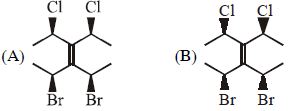
The relationship between the pair $(A)$ and $(B)$ is:
A
Enantiomer
B
Diastereomers
C
Identical
D
Structural isomer
Solution
(C) In structure $(A)$,both $Cl$ atoms are on the same side (wedge) and both $Br$ atoms are on the same side (wedge). This molecule has a plane of symmetry passing through the double bond,making it a meso compound (achiral).
In structure $(B)$,the $Cl$ atoms are on the same side (wedge) and the $Br$ atoms are on the same side (wedge). Upon closer inspection,structure $(B)$ is identical to structure $(A)$ because rotating the molecule or flipping it in space shows that they are the same configuration.
Both structures represent the same meso-isomer,therefore they are identical.
In structure $(B)$,the $Cl$ atoms are on the same side (wedge) and the $Br$ atoms are on the same side (wedge). Upon closer inspection,structure $(B)$ is identical to structure $(A)$ because rotating the molecule or flipping it in space shows that they are the same configuration.
Both structures represent the same meso-isomer,therefore they are identical.
0 likes
View Solution232
AdvancedMCQ
The possible number of stereoisomers of the product of the following reaction would be: $Ph - CH = CH - CH(CH_3) - CHO \xrightarrow[pH = 4.5]{H_2N - OH}$ ?
A
$2$
B
$6$
C
$8$
D
$4$
Solution
(C) The reaction of an aldehyde with hydroxylamine $(H_2N - OH)$ at $pH = 4.5$ produces an oxime.
The product is: $Ph - CH = CH - CH(CH_3) - CH = N - OH$.
To find the number of stereoisomers,we identify the stereogenic units in the product:
$1.$ The $C = C$ double bond (can exist as $E$ or $Z$ configurations).
$2.$ The chiral carbon atom $-CH(CH_3)-$ (can exist as $R$ or $S$ configurations).
$3.$ The $C = N$ double bond of the oxime (can exist as $syn$ or $anti$ configurations).
Since the molecule is unsymmetrical and has $n = 3$ stereogenic units,the total number of stereoisomers is $2^n = 2^3 = 8$.
The product is: $Ph - CH = CH - CH(CH_3) - CH = N - OH$.
To find the number of stereoisomers,we identify the stereogenic units in the product:
$1.$ The $C = C$ double bond (can exist as $E$ or $Z$ configurations).
$2.$ The chiral carbon atom $-CH(CH_3)-$ (can exist as $R$ or $S$ configurations).
$3.$ The $C = N$ double bond of the oxime (can exist as $syn$ or $anti$ configurations).
Since the molecule is unsymmetrical and has $n = 3$ stereogenic units,the total number of stereoisomers is $2^n = 2^3 = 8$.
0 likes
View Solution233
DifficultMCQ
Which of the following is not correctly matched?
A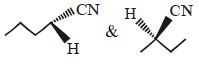
B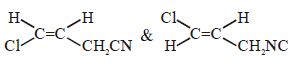
C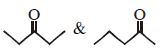
D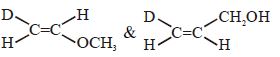
Solution
(D) Let us analyze each option:
$A$: The structures represent enantiomers (optical isomers) due to the presence of a chiral center,not chain isomers.
$B$: The structures show different functional groups ($-CN$ vs $-NC$),which are functional group isomers.
$C$: The structures are pentan$-2-$one and pentan$-3-$one,which are metamers.
$D$: The structures represent different compounds with different molecular formulas,not geometric isomers. The provided image for option $D$ shows two different molecules that are not even isomers of each other. Therefore,option $D$ is not correctly matched.
$A$: The structures represent enantiomers (optical isomers) due to the presence of a chiral center,not chain isomers.
$B$: The structures show different functional groups ($-CN$ vs $-NC$),which are functional group isomers.
$C$: The structures are pentan$-2-$one and pentan$-3-$one,which are metamers.
$D$: The structures represent different compounds with different molecular formulas,not geometric isomers. The provided image for option $D$ shows two different molecules that are not even isomers of each other. Therefore,option $D$ is not correctly matched.
0 likes
View Solution234
MediumMCQ
Which of the following is isomeric with methyl vinyl ether?
A
Allyl alcohol
B
Propanal
C
Acetone
D
All of these
Solution
(D) The molecular formula of methyl vinyl ether $(CH_3-O-CH=CH_2)$ is $C_3H_6O$.
Propanal $(CH_3-CH_2-CHO)$ has the molecular formula $C_3H_6O$.
Acetone $(CH_3-CO-CH_3)$ has the molecular formula $C_3H_6O$.
Allyl alcohol $(CH_2=CH-CH_2OH)$ has the molecular formula $C_3H_6O$.
Since all the given compounds have the same molecular formula $(C_3H_6O)$,they are all isomers of methyl vinyl ether.
Propanal $(CH_3-CH_2-CHO)$ has the molecular formula $C_3H_6O$.
Acetone $(CH_3-CO-CH_3)$ has the molecular formula $C_3H_6O$.
Allyl alcohol $(CH_2=CH-CH_2OH)$ has the molecular formula $C_3H_6O$.
Since all the given compounds have the same molecular formula $(C_3H_6O)$,they are all isomers of methyl vinyl ether.
0 likes
View Solution235
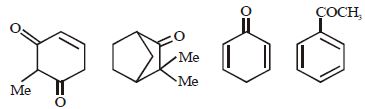
DifficultMCQ
How many of the given compounds show tautomerism?
A
$2$
B
$3$
C
$4$
D
$1$
Solution
(B) Tautomerism requires the presence of an $\alpha$-hydrogen atom adjacent to a carbonyl group (or similar electron-withdrawing group) that can migrate to the oxygen atom.
$1$. The first compound is a $1,3$-dicarbonyl derivative with an $\alpha$-hydrogen,so it shows tautomerism.
$2$. The second compound is a bicyclic ketone with no $\alpha$-hydrogen available for tautomerization (the $\alpha$-carbon is fully substituted with methyl groups and bridgehead constraints),so it does not show tautomerism.
$3$. The third compound is $p$-benzoquinone,which has $\alpha$-hydrogens and can undergo tautomerization to form hydroquinone,so it shows tautomerism.
$4$. The fourth compound is acetophenone,which has $\alpha$-hydrogens on the methyl group,so it shows tautomerism.
Thus,$3$ out of the $4$ compounds show tautomerism.
$1$. The first compound is a $1,3$-dicarbonyl derivative with an $\alpha$-hydrogen,so it shows tautomerism.
$2$. The second compound is a bicyclic ketone with no $\alpha$-hydrogen available for tautomerization (the $\alpha$-carbon is fully substituted with methyl groups and bridgehead constraints),so it does not show tautomerism.
$3$. The third compound is $p$-benzoquinone,which has $\alpha$-hydrogens and can undergo tautomerization to form hydroquinone,so it shows tautomerism.
$4$. The fourth compound is acetophenone,which has $\alpha$-hydrogens on the methyl group,so it shows tautomerism.
Thus,$3$ out of the $4$ compounds show tautomerism.
0 likes
View Solution236
MediumMCQ
Which of the following pairs are tautomers?
A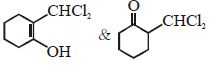
B
$CH_2=CH-CH_2-OH$ and $CH_3-CH_2-CHO$
C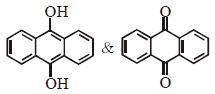
D
$CH_3-C(=O)-C(=O)-CH_3$ and $CH_3-C(OH)=C(OH)-CH_3$
Solution
(A, C) Tautomerism is a special type of functional isomerism where isomers exist in dynamic equilibrium due to the migration of a proton.
$(A)$ The structures shown in image $826-a716$ represent an enol and a keto form,which are tautomers.
$(B)$ $CH_2=CH-CH_2-OH$ (Allyl alcohol) and $CH_3-CH_2-CHO$ (Propanal) are functional isomers.
$(C)$ The structures shown in image $826-c716$ (Anthracene$-9,10-$diol and Anthracene$-9,10-$dione) are also tautomers.
$(D)$ $CH_3-C(=O)-C(=O)-CH_3$ and $CH_3-C(OH)=C(OH)-CH_3$ are not isomers because they have different molecular formulas ($C_4H_6O_2$ and $C_4H_8O_2$ respectively).
Note: Both $(A)$ and $(C)$ represent tautomeric pairs.
$(A)$ The structures shown in image $826-a716$ represent an enol and a keto form,which are tautomers.
$(B)$ $CH_2=CH-CH_2-OH$ (Allyl alcohol) and $CH_3-CH_2-CHO$ (Propanal) are functional isomers.
$(C)$ The structures shown in image $826-c716$ (Anthracene$-9,10-$diol and Anthracene$-9,10-$dione) are also tautomers.
$(D)$ $CH_3-C(=O)-C(=O)-CH_3$ and $CH_3-C(OH)=C(OH)-CH_3$ are not isomers because they have different molecular formulas ($C_4H_6O_2$ and $C_4H_8O_2$ respectively).
Note: Both $(A)$ and $(C)$ represent tautomeric pairs.
0 likes
View Solution237
MediumMCQ
Which of the following shows keto-enol isomerism?
A
B
C
D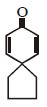
Solution
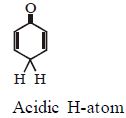
(B) For a compound to exhibit keto-enol isomerism,it must possess at least one $\alpha$-hydrogen atom adjacent to the carbonyl group $(C=O)$.
$1$. Option $A$ ($4$,$4$-dimethylcyclohexa$-2,5-$dien$-1-$one): The carbon adjacent to the carbonyl group is quaternary (bonded to two methyl groups),so it has no $\alpha$-hydrogen.
$2$. Option $B$ (cyclohexa$-2,5-$dien$-1-$one): The carbons adjacent to the carbonyl group are $CH$ groups,which possess $\alpha$-hydrogen atoms. These hydrogens are acidic and can participate in keto-enol tautomerism.
$3$. Option $C$ ($2$,$2$-dichlorocyclohex$-2-$en$-1-$one): The $\alpha$-carbon is bonded to two chlorine atoms,so it has no $\alpha$-hydrogen.
$4$. Option $D$ (spiro[$5.5$]undeca$-1,4-$dien$-3-$one): The $\alpha$-carbon is a quaternary spiro carbon,so it has no $\alpha$-hydrogen.
Therefore,only the compound in option $B$ shows keto-enol isomerism.
$1$. Option $A$ ($4$,$4$-dimethylcyclohexa$-2,5-$dien$-1-$one): The carbon adjacent to the carbonyl group is quaternary (bonded to two methyl groups),so it has no $\alpha$-hydrogen.
$2$. Option $B$ (cyclohexa$-2,5-$dien$-1-$one): The carbons adjacent to the carbonyl group are $CH$ groups,which possess $\alpha$-hydrogen atoms. These hydrogens are acidic and can participate in keto-enol tautomerism.
$3$. Option $C$ ($2$,$2$-dichlorocyclohex$-2-$en$-1-$one): The $\alpha$-carbon is bonded to two chlorine atoms,so it has no $\alpha$-hydrogen.
$4$. Option $D$ (spiro[$5.5$]undeca$-1,4-$dien$-3-$one): The $\alpha$-carbon is a quaternary spiro carbon,so it has no $\alpha$-hydrogen.
Therefore,only the compound in option $B$ shows keto-enol isomerism.
0 likes
View Solution238
MediumMCQ
Which of the following compounds is chiral?
A
B
C
D
Solution
(B) molecule is chiral if it lacks a plane of symmetry or a center of inversion,meaning it is not superimposable on its mirror image.
$A$: $2,3$-dichlorobutane (meso form) has a plane of symmetry and is achiral.
$B$: $2$-bromo-$3$-chlorobutane has two chiral centers ($C2$ and $C3$). Since the substituents on the two chiral carbons are different ($-Br$ vs $-Cl$),there is no internal plane of symmetry,making it a chiral molecule.
$C$: $2$-bromo-$3$-chloro-$2,3$-dimethylbutane has two chiral centers,but it is also chiral. However,$B$ is the standard example of a simple chiral alkane derivative with two distinct chiral centers.
$D$: $2,3$-dichloro-$2,3$-dimethylbutane has a plane of symmetry and is achiral.
Therefore,option $B$ is the correct answer.
$A$: $2,3$-dichlorobutane (meso form) has a plane of symmetry and is achiral.
$B$: $2$-bromo-$3$-chlorobutane has two chiral centers ($C2$ and $C3$). Since the substituents on the two chiral carbons are different ($-Br$ vs $-Cl$),there is no internal plane of symmetry,making it a chiral molecule.
$C$: $2$-bromo-$3$-chloro-$2,3$-dimethylbutane has two chiral centers,but it is also chiral. However,$B$ is the standard example of a simple chiral alkane derivative with two distinct chiral centers.
$D$: $2,3$-dichloro-$2,3$-dimethylbutane has a plane of symmetry and is achiral.
Therefore,option $B$ is the correct answer.
0 likes
View Solution239
DifficultMCQ
Which of the following optically active compounds has the maximum number of chiral carbons?
A
$CH_3-CH(Br)-CH(Cl)-CH_3$
B
$CH_3-CH(OH)-CH_2-CH_3$
C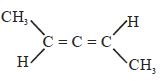
D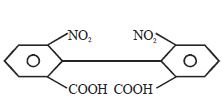
Solution
(A) Let us analyze each option for the number of chiral carbons and optical activity:
$A$. $CH_3-CH(Br)-CH(Cl)-CH_3$: This molecule has two chiral carbons (at $C2$ and $C3$). It is optically active.
$B$. $CH_3-CH(OH)-CH_2-CH_3$: This molecule has one chiral carbon (at $C2$). It is optically active.
$C$. $CH_3-CH=C=CH-CH_3$: This is an allene. It is optically active due to axial chirality,but it has zero chiral carbons.
$D$. $2,2'-dinitro-6,6'-biphenyldicarboxylic acid$: This molecule exhibits atropisomerism due to restricted rotation around the single bond connecting the two benzene rings. It is optically active,but it has zero chiral carbons.
Comparing the number of chiral carbons,option $A$ has the maximum number ($2$ chiral carbons).
$A$. $CH_3-CH(Br)-CH(Cl)-CH_3$: This molecule has two chiral carbons (at $C2$ and $C3$). It is optically active.
$B$. $CH_3-CH(OH)-CH_2-CH_3$: This molecule has one chiral carbon (at $C2$). It is optically active.
$C$. $CH_3-CH=C=CH-CH_3$: This is an allene. It is optically active due to axial chirality,but it has zero chiral carbons.
$D$. $2,2'-dinitro-6,6'-biphenyldicarboxylic acid$: This molecule exhibits atropisomerism due to restricted rotation around the single bond connecting the two benzene rings. It is optically active,but it has zero chiral carbons.
Comparing the number of chiral carbons,option $A$ has the maximum number ($2$ chiral carbons).
0 likes
View Solution240
DifficultMCQ
Which of the following is not correctly matched?
A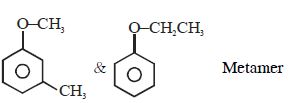
B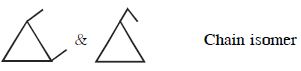
C
$CH_2=CH-CH_2-CH_3$ and $CH_3-CH=CH-CH_3$ (Geometrical isomer)
D
$CH_2=CH-CH_2-CH_3$ and $CH_2=C(CH_3)-CH_3$ (Chain isomer)
Solution
(C) In option $(A)$,$3$-methylanisole and ethoxybenzene are metamers because the alkyl group attached to the oxygen atom changes.
In option $(B)$,$1,1$-dimethylcyclopropane and $1,2$-dimethylcyclopropane are position isomers,not chain isomers.
In option $(C)$,$CH_2=CH-CH_2-CH_3$ (but-$1$-ene) and $CH_3-CH=CH-CH_3$ (but-$2$-ene) are position isomers,not geometrical isomers.
In option $(D)$,$CH_2=CH-CH_2-CH_3$ (but-$1$-ene) and $CH_2=C(CH_3)-CH_3$ ($2$-methylprop-$1$-ene) are chain isomers.
Since the question asks for the incorrect match and both $(B)$ and $(C)$ are technically incorrect,in standard competitive contexts,$(C)$ is often cited as the primary error regarding isomer classification. However,given the provided options,$(C)$ is the most clearly incorrect classification.
In option $(B)$,$1,1$-dimethylcyclopropane and $1,2$-dimethylcyclopropane are position isomers,not chain isomers.
In option $(C)$,$CH_2=CH-CH_2-CH_3$ (but-$1$-ene) and $CH_3-CH=CH-CH_3$ (but-$2$-ene) are position isomers,not geometrical isomers.
In option $(D)$,$CH_2=CH-CH_2-CH_3$ (but-$1$-ene) and $CH_2=C(CH_3)-CH_3$ ($2$-methylprop-$1$-ene) are chain isomers.
Since the question asks for the incorrect match and both $(B)$ and $(C)$ are technically incorrect,in standard competitive contexts,$(C)$ is often cited as the primary error regarding isomer classification. However,given the provided options,$(C)$ is the most clearly incorrect classification.
0 likes
View Solution241
DifficultMCQ
Which of the following is antiaromatic?
A
Cyclopropenyl cation
B
Cyclopentadienyl cation
C
Benzene
D
Cycloheptatrienyl cation
Solution
(B) To determine if a compound is antiaromatic,it must satisfy the following conditions:
$1$. It must be cyclic and planar.
$2$. It must be fully conjugated.
$3$. It must have $4n$ $\pi$ electrons (where $n = 1, 2, 3, ...$).
Let's analyze the options:
$A$: Cyclopropenyl cation has $2$ $\pi$ electrons ($4n+2$ with $n=0$),so it is aromatic.
$B$: Cyclopentadienyl cation has $4$ $\pi$ electrons ($4n$ with $n=1$),so it is antiaromatic.
$C$: Benzene has $6$ $\pi$ electrons ($4n+2$ with $n=1$),so it is aromatic.
$D$: Cycloheptatrienyl cation has $6$ $\pi$ electrons ($4n+2$ with $n=1$),so it is aromatic.
Therefore,the cyclopentadienyl cation is antiaromatic.
$1$. It must be cyclic and planar.
$2$. It must be fully conjugated.
$3$. It must have $4n$ $\pi$ electrons (where $n = 1, 2, 3, ...$).
Let's analyze the options:
$A$: Cyclopropenyl cation has $2$ $\pi$ electrons ($4n+2$ with $n=0$),so it is aromatic.
$B$: Cyclopentadienyl cation has $4$ $\pi$ electrons ($4n$ with $n=1$),so it is antiaromatic.
$C$: Benzene has $6$ $\pi$ electrons ($4n+2$ with $n=1$),so it is aromatic.
$D$: Cycloheptatrienyl cation has $6$ $\pi$ electrons ($4n+2$ with $n=1$),so it is aromatic.
Therefore,the cyclopentadienyl cation is antiaromatic.
0 likes
View Solution242
EasyMCQ
Isomers have the same ...........
A
Structural formula
B
Molecular formula
C
Chemical properties
D
Physical properties
Solution
(B) Isomers are compounds that have the same $Molecular \ formula$ but different structural arrangements or spatial orientations. Because their structures differ,they typically exhibit different physical and chemical properties.
0 likes
View Solution243
DifficultMCQ
Ethyl $3$-oxobutanoate and ethyl $3$-hydroxybut-$2$-enoate are ................... of each other.
A
Geometrical isomers
B
Tautomers
C
Diastereomers
D
Metamers
Solution
(B) The structure of ethyl $3$-oxobutanoate is $CH_3-CO-CH_2-COOC_2H_5$.
This compound exists in equilibrium with its enol form,ethyl $3$-hydroxybut-$2$-enoate,which has the structure $CH_3-C(OH)=CH-COOC_2H_5$.
This type of isomerism,where a compound exists in two readily interconvertible forms differing in the position of a proton and a double bond,is known as tautomerism.
Therefore,these two compounds are tautomers.
This compound exists in equilibrium with its enol form,ethyl $3$-hydroxybut-$2$-enoate,which has the structure $CH_3-C(OH)=CH-COOC_2H_5$.
This type of isomerism,where a compound exists in two readily interconvertible forms differing in the position of a proton and a double bond,is known as tautomerism.
Therefore,these two compounds are tautomers.
0 likes
View Solution244
DifficultMCQ
$A$ compound with the molecular formula $C_4H_{10}O$ exhibits which type of isomerism?
A
Metamerism
B
Functional isomerism
C
Positional isomerism
D
All of the above
Solution
(D) The molecular formula $C_4H_{10}O$ corresponds to both alcohols and ethers.
$1$. Functional isomerism: It can form alcohols (e.g.,$CH_3CH_2CH_2CH_2OH$) and ethers (e.g.,$CH_3CH_2OCH_2CH_3$).
$2$. Positional isomerism: Alcohols can show positional isomerism (e.g.,$butan-1-ol$ and $butan-2-ol$).
$3$. Metamerism: Ethers can show metamerism (e.g.,$CH_3-O-CH_2CH_2CH_3$ and $CH_3CH_2-O-CH_2CH_3$).
Therefore,the compound exhibits all of the above types of isomerism.
$1$. Functional isomerism: It can form alcohols (e.g.,$CH_3CH_2CH_2CH_2OH$) and ethers (e.g.,$CH_3CH_2OCH_2CH_3$).
$2$. Positional isomerism: Alcohols can show positional isomerism (e.g.,$butan-1-ol$ and $butan-2-ol$).
$3$. Metamerism: Ethers can show metamerism (e.g.,$CH_3-O-CH_2CH_2CH_3$ and $CH_3CH_2-O-CH_2CH_3$).
Therefore,the compound exhibits all of the above types of isomerism.
0 likes
View Solution245
MediumMCQ
Which of the following pairs does not exhibit isomerism?
A
$CH_3CH_2OCH_2CH_2CH_3$ and $CH_3CH(CH_3)OCH_2CH_3$
B
$CH_3CH_2COOH$ and $CH_3COOCH_3$
C
$CH_3CH_2NO_2$ and $NH_2CH_2COOH$
D
$C_6H_5COC(CH_3)_2C_6H_5$ and $(CH_3)_2C(C_6H_5)COC_6H_5$
Solution
(D) Isomerism is defined as the phenomenon where compounds have the same molecular formula but different structural arrangements or spatial orientations.
Option $A$: Both are ethers with the molecular formula $C_5H_{12}O$. They are chain isomers.
Option $B$: $CH_3CH_2COOH$ (propanoic acid) and $CH_3COOCH_3$ (methyl acetate) have the same molecular formula $C_3H_6O_2$. They are functional isomers.
Option $C$: $CH_3CH_2NO_2$ (nitroethane) has the molecular formula $C_2H_5NO_2$. $NH_2CH_2COOH$ (glycine) has the molecular formula $C_2H_5NO_2$. They are functional isomers.
Option $D$: Both structures represent the same molecule,$2,2-diphenyl-1-phenylpropan-1-one$ (or similar nomenclature depending on $IUPAC$ rules),written in different orientations. They are identical,not isomers.
Option $A$: Both are ethers with the molecular formula $C_5H_{12}O$. They are chain isomers.
Option $B$: $CH_3CH_2COOH$ (propanoic acid) and $CH_3COOCH_3$ (methyl acetate) have the same molecular formula $C_3H_6O_2$. They are functional isomers.
Option $C$: $CH_3CH_2NO_2$ (nitroethane) has the molecular formula $C_2H_5NO_2$. $NH_2CH_2COOH$ (glycine) has the molecular formula $C_2H_5NO_2$. They are functional isomers.
Option $D$: Both structures represent the same molecule,$2,2-diphenyl-1-phenylpropan-1-one$ (or similar nomenclature depending on $IUPAC$ rules),written in different orientations. They are identical,not isomers.
0 likes
View Solution246
DifficultMCQ
Which of the following statements is $NOT$ correct?
A
Alkynes do not show geometrical isomerism.
B
Propane shows conformational isomerism.
C
All alkanes show chain isomerism.
D
Meso-tartaric acid is optically inactive.
Solution
(C) $1$. Alkynes have a linear geometry around the triple bond,so they cannot show geometrical isomerism. This statement is correct.
$2$. Propane $(CH_3-CH_2-CH_3)$ can show conformational isomerism due to rotation around the $C-C$ single bonds. This statement is correct.
$3$. Chain isomerism is only possible for alkanes with $4$ or more carbon atoms (e.g.,$n$-butane and isobutane). Methane,ethane,and propane do not show chain isomerism. Therefore,the statement that 'all alkanes show chain isomerism' is incorrect.
$4$. Meso-tartaric acid has a plane of symmetry,making it optically inactive due to internal compensation. This statement is correct.
$2$. Propane $(CH_3-CH_2-CH_3)$ can show conformational isomerism due to rotation around the $C-C$ single bonds. This statement is correct.
$3$. Chain isomerism is only possible for alkanes with $4$ or more carbon atoms (e.g.,$n$-butane and isobutane). Methane,ethane,and propane do not show chain isomerism. Therefore,the statement that 'all alkanes show chain isomerism' is incorrect.
$4$. Meso-tartaric acid has a plane of symmetry,making it optically inactive due to internal compensation. This statement is correct.
0 likes
View Solution247
EasyMCQ
The less stable isomeric form is known as ...............
A
Anion form
B
Cation form
C
Labile form
D
All the above
Solution
(C) In chemistry,isomers that are less stable and can easily interconvert or change into a more stable form are referred to as $Labile$ forms. The term $Labile$ signifies a state of instability or susceptibility to change.
0 likes
View Solution248
MediumMCQ
The compound $(CH_3)_2C = CH - CH(CH_3)COOH$ exhibits:
A
Geometrical isomerism
B
Tautomerism
C
Optical isomerism
D
$(a)$ and $(c)$ both
0 likes
View Solution249
MediumMCQ
Which of the following exhibits geometrical isomerism?
A
$1,3-$dimethylcyclohexane
B
$C_6H_5CH = NOH$
C
$HOOC - CH = CH - COOH$
D
All of these
Solution
(D) Geometrical isomerism is exhibited by compounds that have restricted rotation and different groups attached to the atoms involved in the restricted rotation.
$1.$ $1,3$-dimethylcyclohexane exhibits geometrical isomerism due to the presence of two chiral centers and the ability to form $cis$ and $trans$ isomers in the ring structure.
$2.$ $C_6H_5CH = NOH$ (benzaldoxime) exhibits geometrical isomerism due to the $C=N$ double bond,which restricts rotation,allowing for $syn$ and $anti$ isomers.
$3.$ $HOOC - CH = CH - COOH$ (fumaric acid/maleic acid) exhibits geometrical isomerism due to the $C=C$ double bond,allowing for $cis$ and $trans$ isomers.
Since all the given compounds exhibit geometrical isomerism,the correct option is $D$.
$1.$ $1,3$-dimethylcyclohexane exhibits geometrical isomerism due to the presence of two chiral centers and the ability to form $cis$ and $trans$ isomers in the ring structure.
$2.$ $C_6H_5CH = NOH$ (benzaldoxime) exhibits geometrical isomerism due to the $C=N$ double bond,which restricts rotation,allowing for $syn$ and $anti$ isomers.
$3.$ $HOOC - CH = CH - COOH$ (fumaric acid/maleic acid) exhibits geometrical isomerism due to the $C=C$ double bond,allowing for $cis$ and $trans$ isomers.
Since all the given compounds exhibit geometrical isomerism,the correct option is $D$.
0 likes
View Solution250
MediumMCQ
Which of the following contains a plane of symmetry?
A
$2-$Methylbutane
B
Propanoic acid
C
$2-$Aminobutane
D
$3-$Methylpentane
Solution
(D) plane of symmetry is an imaginary plane that divides a molecule into two equal halves such that one half is the mirror image of the other.
$1.$ $2-$Methylbutane: It has a chiral center at $C-2$,so it is chiral and lacks a plane of symmetry.
$2.$ Propanoic acid $(CH_3CH_2COOH)$: It is an achiral molecule but does not possess a plane of symmetry due to the arrangement of atoms.
$3.$ $2-$Aminobutane: It has a chiral center at $C-2$,making it chiral.
$4.$ $3-$Methylpentane: The structure is $CH_3-CH_2-CH(CH_3)-CH_2-CH_3$. This molecule has a plane of symmetry passing through the $C-3$ atom and the methyl group attached to it,dividing the molecule into two identical halves ($CH_3-CH_2-$ groups on both sides). Thus,it is achiral.
$1.$ $2-$Methylbutane: It has a chiral center at $C-2$,so it is chiral and lacks a plane of symmetry.
$2.$ Propanoic acid $(CH_3CH_2COOH)$: It is an achiral molecule but does not possess a plane of symmetry due to the arrangement of atoms.
$3.$ $2-$Aminobutane: It has a chiral center at $C-2$,making it chiral.
$4.$ $3-$Methylpentane: The structure is $CH_3-CH_2-CH(CH_3)-CH_2-CH_3$. This molecule has a plane of symmetry passing through the $C-3$ atom and the methyl group attached to it,dividing the molecule into two identical halves ($CH_3-CH_2-$ groups on both sides). Thus,it is achiral.
0 likes
View Solution8-2.Organic Chemistry : Isomerism — Mix Examples-General Organic Chemistry · Frequently Asked Questions
1Are these 8-2.Organic Chemistry : Isomerism questions useful for JEE and NEET?
Yes. All questions in this section are mapped to JEE Main and NEET exam patterns. Previous year questions from JEE Main, NEET, GUJCET and state-level exams are included with full solutions.
2Can I switch to Hindi or Gujarati for these questions?
Yes. Use the language tabs in the hero section or the sidebar to view the same questions and solutions in English, Hindi or Gujarati.
3How do I generate a question paper from this subtopic?
Use the Vedclass Exam Paper Generator — select the chapter and subtopic, set difficulty, and generate Sets A, B, C, D automatically. First 3 chapters of every subject are free.
Vedclass Products
For Students
Vedclass Test Series
Mock tests in real JEE/NEET style with performance analysis. 5-day free trial.
Start Free TrialFor Teachers
Exam Paper Generator
Generate Set A/B/C/D papers from this chapter in 2 minutes. 3 chapters free.
Try FreeFor Institutes
Online Exam Module
Live online exams with unlimited students, 360° analytics & white-label branding.
See DemoFor Teachers & Institutes
Generate a 8-2.Organic Chemistry : Isomerism Exam Paper in 2 Minutes
Select subtopic & difficulty — Sets A, B, C, D auto-generated with No Repeat logic.
First 3 chapters of every subject are free — no payment required.