
A English
Mix Examples-General Organic Chemistry Questions in English
Class 11 Chemistry · 8-2.Organic Chemistry : Isomerism · Mix Examples-General Organic Chemistry
324+
Questions
English
Language
100%
With Solutions
Showing 21 of 324 questions in English
301
EasyMCQ
In assigning $R-S$ configuration,which among the following groups has the highest priority?
A
$-SO_3H$
B
$-COOH$
C
$-CHO$
D
$-C_6H_5$
Solution
(A) In assigning $R-S$ configuration,the priority is determined by the Cahn-Ingold-Prelog $(CIP)$ sequence rules.
According to these rules,the atom with the higher atomic number attached directly to the chiral center is given higher priority.
Comparing the atoms attached to the chiral center: $S$ (atomic number $16$) in $-SO_3H$ has a higher atomic number than $C$ (atomic number $6$) in $-COOH$,$-CHO$,and $-C_6H_5$.
Therefore,the $-SO_3H$ group has the highest priority.
The decreasing order of priority is $-SO_3H > -COOH > -CHO > -C_6H_5$.
According to these rules,the atom with the higher atomic number attached directly to the chiral center is given higher priority.
Comparing the atoms attached to the chiral center: $S$ (atomic number $16$) in $-SO_3H$ has a higher atomic number than $C$ (atomic number $6$) in $-COOH$,$-CHO$,and $-C_6H_5$.
Therefore,the $-SO_3H$ group has the highest priority.
The decreasing order of priority is $-SO_3H > -COOH > -CHO > -C_6H_5$.
0 likes
View Solution302
EasyMCQ
According to $Cahn-Ingold-Prelog$ sequence rules,the correct order of priority for the given groups is
A
$-OH > -COOH > -CHO > -CH_2OH$
B
$-OH > -CHO > -COOH > -CH_2OH$
C
$-COOH > -CHO > -CH_2OH > -OH$
D
$-COOH > -CH_2OH > -OH > -CHO$
Solution
(A) According to $Cahn-Ingold-Prelog$ sequence rules,the priority of groups is decided by the atomic number of the atoms directly attached to the chiral center.
$1$. The atom with the highest atomic number gets the highest priority. Here,$O$ (atomic number $8$) has higher priority than $C$ (atomic number $6$). Thus,$-OH$ is first.
$2$. For the remaining carbon-containing groups,we look at the atoms attached to the first carbon: $-COOH$ ($C$ bonded to $O, O, O$),$-CHO$ ($C$ bonded to $O, O, H$),and $-CH_2OH$ ($C$ bonded to $O, H, H$).
$3$. Comparing these,the priority order is $-COOH > -CHO > -CH_2OH$.
$4$. Therefore,the overall order is $-OH > -COOH > -CHO > -CH_2OH$.
$1$. The atom with the highest atomic number gets the highest priority. Here,$O$ (atomic number $8$) has higher priority than $C$ (atomic number $6$). Thus,$-OH$ is first.
$2$. For the remaining carbon-containing groups,we look at the atoms attached to the first carbon: $-COOH$ ($C$ bonded to $O, O, O$),$-CHO$ ($C$ bonded to $O, O, H$),and $-CH_2OH$ ($C$ bonded to $O, H, H$).
$3$. Comparing these,the priority order is $-COOH > -CHO > -CH_2OH$.
$4$. Therefore,the overall order is $-OH > -COOH > -CHO > -CH_2OH$.
0 likes
View Solution303
MediumMCQ
Consider the sets $I$,$II$,and $III$. Identify the set$(s)$ which is (are) correctly matched.
$I$. $\text{Staggered ethane} > \text{eclipsed ethane} \dots \dots \dots \text{torsional strain}$.
$II$. $2, 2-\text{Dimethylbutane} > 2-\text{methylpentane} \dots \dots \dots \text{boiling point}$.
$III$. $cis-\text{but}-2-\text{ene} > trans-\text{but}-2-\text{ene} \dots \dots \dots \text{dipole moment}$.
$I$. $\text{Staggered ethane} > \text{eclipsed ethane} \dots \dots \dots \text{torsional strain}$.
$II$. $2, 2-\text{Dimethylbutane} > 2-\text{methylpentane} \dots \dots \dots \text{boiling point}$.
$III$. $cis-\text{but}-2-\text{ene} > trans-\text{but}-2-\text{ene} \dots \dots \dots \text{dipole moment}$.
A
$I, II$ only
B
$II, III$ only
C
$III$ only
D
$I, II, III$
Solution
(C) $I$. Torsional strain is higher in eclipsed ethane due to repulsion between hydrogen atoms on adjacent carbons. Thus,$\text{staggered ethane} < \text{eclipsed ethane}$. This statement is incorrect.
$II$. $2, 2-\text{Dimethylbutane}$ is more branched than $2-\text{methylpentane}$. Increased branching decreases the surface area,leading to weaker van der Waals forces and a lower boiling point. Thus,$2, 2-\text{Dimethylbutane} < 2-\text{methylpentane}$. This statement is incorrect.
$III$. $cis-\text{but}-2-\text{ene}$ has a net dipole moment due to the same side orientation of methyl groups,whereas $trans-\text{but}-2-\text{ene}$ has a zero net dipole moment due to symmetry. Thus,$cis-\text{but}-2-\text{ene} > trans-\text{but}-2-\text{ene}$. This statement is correct.
$II$. $2, 2-\text{Dimethylbutane}$ is more branched than $2-\text{methylpentane}$. Increased branching decreases the surface area,leading to weaker van der Waals forces and a lower boiling point. Thus,$2, 2-\text{Dimethylbutane} < 2-\text{methylpentane}$. This statement is incorrect.
$III$. $cis-\text{but}-2-\text{ene}$ has a net dipole moment due to the same side orientation of methyl groups,whereas $trans-\text{but}-2-\text{ene}$ has a zero net dipole moment due to symmetry. Thus,$cis-\text{but}-2-\text{ene} > trans-\text{but}-2-\text{ene}$. This statement is correct.
0 likes
View Solution304
MediumMCQ
The number of isomers possible for a dibromo derivative (Molecular weight $= 186 \ u$) of an alkene is $(Br = 80 \ u)$.
A
$2$
B
$3$
C
$4$
D
$6$
Solution
(B) The molecular weight of the dibromo derivative is $186 \ u$. Given $Br = 80 \ u$,the mass of the alkene part is $186 - (2 \times 80) = 186 - 160 = 26 \ u$. The general formula for an alkene is $C_nH_{2n}$,so $12n + 2n = 26$,which gives $14n = 26$. Since $n$ must be an integer,we re-evaluate: the dibromo derivative of ethene $(C_2H_4)$ is $C_2H_2Br_2$. Its molecular weight is $(2 \times 12) + (2 \times 1) + (2 \times 80) = 24 + 2 + 160 = 186 \ u$. Thus,the compound is $C_2H_2Br_2$. The possible isomers for $C_2H_2Br_2$ are:
$1$. $1,1-dibromoethene$ $(CH_2=CBr_2)$
$2$. $cis-1,2-dibromoethene$
$3$. $trans-1,2-dibromoethene$
Therefore,there are $3$ possible isomers.
$1$. $1,1-dibromoethene$ $(CH_2=CBr_2)$
$2$. $cis-1,2-dibromoethene$
$3$. $trans-1,2-dibromoethene$
Therefore,there are $3$ possible isomers.
0 likes
View Solution305
MediumMCQ
How many isomers (cyclic and acyclic) are possible for a compound with molecular formula $C_3H_6O$?
A
$4$
B
$5$
C
$9$
D
$7$
Solution
(C) The degree of unsaturation $(DU)$ for $C_3H_6O$ is calculated as: $DU = C + 1 - \frac{H}{2} = 3 + 1 - \frac{6}{2} = 1$.
This indicates the presence of either one double bond or one ring.
Possible acyclic isomers:
$1$. Propanal $(CH_3CH_2CHO)$
$2$. Propanone $(CH_3COCH_3)$
$3$. Allyl alcohol $(CH_2=CH-CH_2OH)$
$4$. $1$-propen$-1-$ol $(CH_3-CH=CH-OH)$
$5$. $2$-propen$-1-$ol $(CH_2=C(OH)-CH_3)$
$6$. Methoxyethene $(CH_3-O-CH=CH_2)$
Possible cyclic isomers:
$7$. Cyclopropanol
$8$. Methoxycyclopropane (Oxetane is not possible as it has $4$ atoms in ring,but $C_3H_6O$ can form $2$-methyloxirane or oxetane)
$9$. $2$-methyloxirane (propylene oxide)
$10$. Oxetane
Wait,let us list them carefully:
$(1)$ Propanal,$(2)$ Propanone,$(3)$ Allyl alcohol $(CH_2=CHCH_2OH)$,$(4)$ $1$-propen$-1-$ol $(CH_3CH=CHOH)$,$(5)$ $2$-propen$-1-$ol $(CH_2=C(OH)CH_3)$,$(6)$ Methoxyethene $(CH_3OCH=CH_2)$,$(7)$ Cyclopropanol,$(8)$ $2$-methyloxirane,$(9)$ Oxetane.
Total isomers = $9$.
This indicates the presence of either one double bond or one ring.
Possible acyclic isomers:
$1$. Propanal $(CH_3CH_2CHO)$
$2$. Propanone $(CH_3COCH_3)$
$3$. Allyl alcohol $(CH_2=CH-CH_2OH)$
$4$. $1$-propen$-1-$ol $(CH_3-CH=CH-OH)$
$5$. $2$-propen$-1-$ol $(CH_2=C(OH)-CH_3)$
$6$. Methoxyethene $(CH_3-O-CH=CH_2)$
Possible cyclic isomers:
$7$. Cyclopropanol
$8$. Methoxycyclopropane (Oxetane is not possible as it has $4$ atoms in ring,but $C_3H_6O$ can form $2$-methyloxirane or oxetane)
$9$. $2$-methyloxirane (propylene oxide)
$10$. Oxetane
Wait,let us list them carefully:
$(1)$ Propanal,$(2)$ Propanone,$(3)$ Allyl alcohol $(CH_2=CHCH_2OH)$,$(4)$ $1$-propen$-1-$ol $(CH_3CH=CHOH)$,$(5)$ $2$-propen$-1-$ol $(CH_2=C(OH)CH_3)$,$(6)$ Methoxyethene $(CH_3OCH=CH_2)$,$(7)$ Cyclopropanol,$(8)$ $2$-methyloxirane,$(9)$ Oxetane.
Total isomers = $9$.
0 likes
View Solution306
MediumMCQ
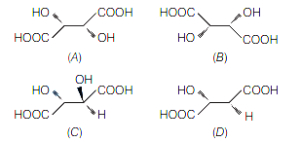
Which statement regarding the following structures is true?
A
$A$ and $B$ are diastereomers,$C$ and $D$ are enantiomers
B
$A$ and $B$ are enantiomers,$C$ and $D$ are enantiomers
C
$A$ and $B$ are enantiomers,$C$ and $D$ are diastereomers
D
$A$ and $B$ are diastereomers,$C$ and $D$ are diastereomers
Solution
(C) Structures $A$ and $B$ are mirror images of each other and are non-superimposable,therefore they are enantiomers.
Structures $C$ and $D$ have the same configuration at one chiral center but opposite configurations at the other,making them diastereomers.
Structures $C$ and $D$ have the same configuration at one chiral center but opposite configurations at the other,making them diastereomers.
0 likes
View Solution307
MediumMCQ
$X$ and $Y$ are optically active isomers having the molecular formula $C_5H_9Cl$. When treated with one mole of $H_2$,$X$ gets converted to an optically inactive compound $Z$,but $Y$ gives an optically active compound $P$. The structures of $X$ and $Y$ respectively are:
A
$3-$chloropent$-1-$ene and $1-$chloropent$-2-$ene
B
$3-$chloropent$-1-$ene and $4-$chloropent$-1-$ene
C
$3-$chloropent$-1-$ene and $3-$chloropent$-2-$ene
D
$3-$chloropent$-1-$ene and $2-$chloropent$-1-$ene
Solution
(B) The molecular formula $C_5H_9Cl$ indicates a degree of unsaturation of $2$.
$X$ is $3$-chloropent-$1$-ene $(CH_3CH_2CH(Cl)CH=CH_2)$,which is optically active due to the chiral center at $C_3$.
Upon hydrogenation with $1 \ mole$ of $H_2$,$X$ forms $3$-chloropentane $(CH_3CH_2CH(Cl)CH_2CH_3)$,which is optically inactive $(Z)$ due to the presence of a plane of symmetry.
$Y$ is $4$-chloropent-$1$-ene $(CH_2=CHCH_2CH(Cl)CH_3)$,which is also optically active due to the chiral center at $C_4$.
Upon hydrogenation with $1 \ mole$ of $H_2$,$Y$ forms $2$-chloropentane $(CH_3CH_2CH_2CH(Cl)CH_3)$,which is still optically active $(P)$ because the chiral center at $C_2$ remains intact.
Thus,$X$ is $3$-chloropent-$1$-ene and $Y$ is $4$-chloropent-$1$-ene.
$X$ is $3$-chloropent-$1$-ene $(CH_3CH_2CH(Cl)CH=CH_2)$,which is optically active due to the chiral center at $C_3$.
Upon hydrogenation with $1 \ mole$ of $H_2$,$X$ forms $3$-chloropentane $(CH_3CH_2CH(Cl)CH_2CH_3)$,which is optically inactive $(Z)$ due to the presence of a plane of symmetry.
$Y$ is $4$-chloropent-$1$-ene $(CH_2=CHCH_2CH(Cl)CH_3)$,which is also optically active due to the chiral center at $C_4$.
Upon hydrogenation with $1 \ mole$ of $H_2$,$Y$ forms $2$-chloropentane $(CH_3CH_2CH_2CH(Cl)CH_3)$,which is still optically active $(P)$ because the chiral center at $C_2$ remains intact.
Thus,$X$ is $3$-chloropent-$1$-ene and $Y$ is $4$-chloropent-$1$-ene.
0 likes
View Solution308
MediumMCQ
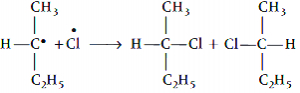
The products in the reaction given below are: ('$\bullet$' denotes a free radical.)
A
Meso forms
B
Racemic mixture
C
$d$- and $l$-forms
D
Cis-trans isomers
Solution
(B) The given reaction is the propagation step of a free radical substitution reaction.
Here,the trigonal planar free radical $(CH_3-\dot{C}H-C_2H_5)$ is attacked by $Cl^{\bullet}$ from either side with equal probability,leading to both retention and inversion of configuration.
This results in an equimolar mixture of $d$- and $l$-enantiomers,which is known as a racemic mixture.
Here,the trigonal planar free radical $(CH_3-\dot{C}H-C_2H_5)$ is attacked by $Cl^{\bullet}$ from either side with equal probability,leading to both retention and inversion of configuration.
This results in an equimolar mixture of $d$- and $l$-enantiomers,which is known as a racemic mixture.
0 likes
View Solution309
DifficultMCQ
The compound which exhibits both geometrical and optical isomerism is
A
$4-$Bromopent$-2-$ene
B
$3-$Bromo$-2-$methylbut$-1-$ene
C
$1-$Bromobut$-2-$ene
D
$3-$Bromo$-2-$methylpropene
Solution
(A) To exhibit geometrical isomerism,the molecule must have a double bond with different groups attached to each carbon atom of the double bond.
To exhibit optical isomerism,the molecule must contain at least one chiral center (a carbon atom bonded to four different groups).
In $4-$Bromopent$-2-$ene $(CH_3-CH(Br)-CH=CH-CH_3)$:
$1$. The double bond between $C_2$ and $C_3$ allows for geometrical isomerism ($cis$ and $trans$ forms).
$2$. The $C_4$ atom is a chiral center because it is bonded to a hydrogen atom,a methyl group,a bromine atom,and a propenyl group.
Therefore,$4-$Bromopent$-2-$ene exhibits both geometrical and optical isomerism.
To exhibit optical isomerism,the molecule must contain at least one chiral center (a carbon atom bonded to four different groups).
In $4-$Bromopent$-2-$ene $(CH_3-CH(Br)-CH=CH-CH_3)$:
$1$. The double bond between $C_2$ and $C_3$ allows for geometrical isomerism ($cis$ and $trans$ forms).
$2$. The $C_4$ atom is a chiral center because it is bonded to a hydrogen atom,a methyl group,a bromine atom,and a propenyl group.
Therefore,$4-$Bromopent$-2-$ene exhibits both geometrical and optical isomerism.
0 likes
View Solution310
MediumMCQ
Match the following:
| $A$. Acetaldehyde,vinyl alcohol | $1$. Enantiomers |
| $B$. Eclipsed and staggered ethane | $2$. Tautomers |
| $C$. $(+)2$-butanol,$(-)2$-butanol | $3$. Chain isomers |
| $D$. Methyl-$n$-propylamine and diethylamine | $4$. Conformational isomers |
| $5$. Metamers |
A
$A-4, B-1, C-3, D-5$
B
$A-2, B-4, C-1, D-5$
C
$A-5, B-1, C-4, D-2$
D
$A-5, B-1, C-3, D-2$
Solution
(B) The correct matches are as follows:
$A$. Acetaldehyde $(CH_3CHO)$ and vinyl alcohol $(CH_2=CH-OH)$ are tautomers.
$B$. Eclipsed and staggered ethane are two conformations of ethane,hence they are conformational isomers.
$C$. $(+)2$-butanol and $(-)2$-butanol are non-superimposable mirror images of each other,hence they are enantiomers.
$D$. Methyl-$n$-propylamine $(CH_3-NH-CH_2CH_2CH_3)$ and diethylamine $((C_2H_5)_2NH)$ have different alkyl groups attached to the same functional group $(-NH-)$,hence they are metamers.
Therefore,the correct matching is $A-2, B-4, C-1, D-5$.
$A$. Acetaldehyde $(CH_3CHO)$ and vinyl alcohol $(CH_2=CH-OH)$ are tautomers.
$B$. Eclipsed and staggered ethane are two conformations of ethane,hence they are conformational isomers.
$C$. $(+)2$-butanol and $(-)2$-butanol are non-superimposable mirror images of each other,hence they are enantiomers.
$D$. Methyl-$n$-propylamine $(CH_3-NH-CH_2CH_2CH_3)$ and diethylamine $((C_2H_5)_2NH)$ have different alkyl groups attached to the same functional group $(-NH-)$,hence they are metamers.
Therefore,the correct matching is $A-2, B-4, C-1, D-5$.
0 likes
View Solution311
DifficultMCQ
Total number of acyclic and cyclic isomers possible for molecular formula $C_4H_6$ is
A
$5$
B
$7$
C
$9$
D
$8$
Solution
(C) The degree of unsaturation for $C_4H_6$ is $4 - (6/2) + 1 = 2$. The possible isomers are:
$(i)$ $CH_3-CH_2-C \equiv CH$ (but-$1$-yne)
$(ii)$ $CH_3-C \equiv C-CH_3$ (but-$2$-yne)
$(iii)$ $CH_2=CH-CH=CH_2$ (buta-$1,3$-diene)
$(iv)$ $CH_3-CH=C=CH_2$ (buta-$1,2$-diene)
$(v)$ cyclobutene
$(vi)$ $1$-methylcyclopropene
$(vii)$ $3$-methylcyclopropene
$(viii)$ methylenecyclopropane
$(ix)$ bicyclo[$1.1.0$]butane
Thus,there are $9$ possible isomers. Hence,option $(C)$ is correct.
$(i)$ $CH_3-CH_2-C \equiv CH$ (but-$1$-yne)
$(ii)$ $CH_3-C \equiv C-CH_3$ (but-$2$-yne)
$(iii)$ $CH_2=CH-CH=CH_2$ (buta-$1,3$-diene)
$(iv)$ $CH_3-CH=C=CH_2$ (buta-$1,2$-diene)
$(v)$ cyclobutene
$(vi)$ $1$-methylcyclopropene
$(vii)$ $3$-methylcyclopropene
$(viii)$ methylenecyclopropane
$(ix)$ bicyclo[$1.1.0$]butane
Thus,there are $9$ possible isomers. Hence,option $(C)$ is correct.
0 likes
View Solution312
EasyMCQ
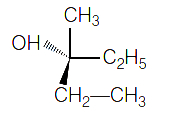
Which of the following molecules is not chiral?
A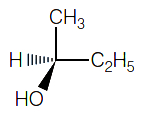
$2-$butanol
B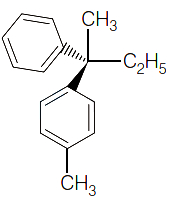
$2-$phenyl$-2-$methylbutane
C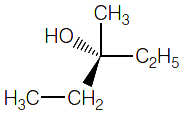
$3-$hexanol
D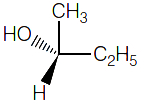
$2-$methyl$-2-$butanol
Solution
0 likes
View Solution313
MediumMCQ
Match the following pairs in Column-$I$ with their respective isomer types in Column-$II$.
| Column-$I$ | Column-$II$ |
|---|---|
| $A$. Acetaldehyde,vinyl alcohol | $1$. Enantiomers |
| $B$. Eclipsed and staggered ethane | $2$. Tautomers |
| $C$. $(+)$$2$-butanol,$(-)$$2$-butanol | $3$. Chain isomers |
| $D$. Methyl-$n$-propylamine and diethylamine | $4$. Conformational isomers |
| $5$. Metamers |
A
$A-2, B-4, C-1, D-5$
B
$A-2, B-4, C-1, D-3$
C
$A-1, B-4, C-2, D-5$
D
$A-1, B-4, C-2, D-3$
Solution
$(A)$. Acetaldehyde $(CH_3CHO)$ and vinyl alcohol $(CH_2=CH-OH)$ are tautomers,as they exist in dynamic equilibrium involving the migration of an $\alpha$-hydrogen atom.
$B$. Eclipsed and staggered ethane are different spatial arrangements of the same molecule,known as conformational isomers.
$C$. $(+)$$2$-butanol and $(-)$$2$-butanol are non-superimposable mirror images of each other,hence they are enantiomers.
$D$. Methyl-$n$-propylamine $(CH_3-NH-CH_2CH_2CH_3)$ and diethylamine $(CH_3CH_2-NH-CH_2CH_3)$ have different alkyl groups attached to the same nitrogen atom,which defines them as metamers.
$B$. Eclipsed and staggered ethane are different spatial arrangements of the same molecule,known as conformational isomers.
$C$. $(+)$$2$-butanol and $(-)$$2$-butanol are non-superimposable mirror images of each other,hence they are enantiomers.
$D$. Methyl-$n$-propylamine $(CH_3-NH-CH_2CH_2CH_3)$ and diethylamine $(CH_3CH_2-NH-CH_2CH_3)$ have different alkyl groups attached to the same nitrogen atom,which defines them as metamers.
0 likes
View Solution314
EasyMCQ
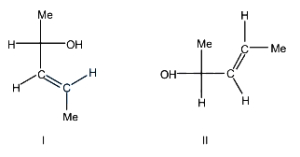
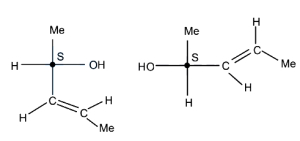
The correct relationship between molecules $I$ and $II$ is:
A
Enantiomer
B
Homomer
C
Diastereomer
D
Constitutional isomer
Solution
(B) To determine the relationship between the two molecules,we analyze their stereochemistry and connectivity.
Both molecules have the same connectivity and the same configuration at the chiral center (both are $S$-configuration).
By rotating the molecule $II$ in space,it can be superimposed on molecule $I$.
Since they are superimposable,they are identical molecules,which are known as homomers.
Both molecules have the same connectivity and the same configuration at the chiral center (both are $S$-configuration).
By rotating the molecule $II$ in space,it can be superimposed on molecule $I$.
Since they are superimposable,they are identical molecules,which are known as homomers.
0 likes
View Solution315
EasyMCQ
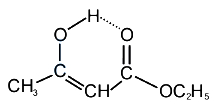
The enol form in which ethyl $3$-oxobutanoate exists is
A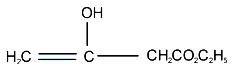
B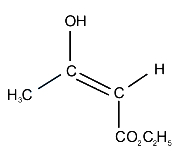
C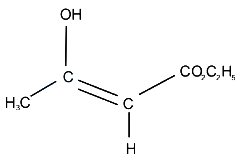
D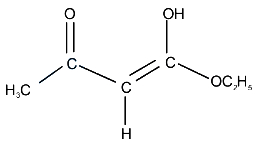
Solution
(D) Ethyl $3$-oxobutanoate (also known as ethyl acetoacetate) exists in keto-enol tautomerism. The enol form is stabilized by intramolecular hydrogen bonding between the hydroxyl group and the carbonyl oxygen of the ester group. The keto form is $CH_3COCH_2COOC_2H_5$. The enol form is $CH_3C(OH)=CHCOOC_2H_5$,which forms a stable six-membered ring due to hydrogen bonding.
0 likes
View Solution316
EasyMCQ
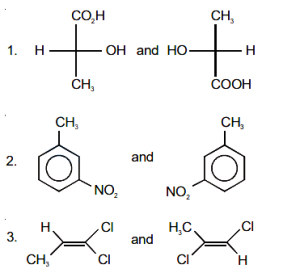
The relationships between the pairs of compounds shown below are respectively:
A
Homomer (identical),enantiomer and constitutional isomer
B
Enantiomer,enantiomer and diastereomer
C
Homomer (identical),homomer (identical) and constitutional isomer
D
Enantiomer,homomer (identical) and geometrical isomer
Solution
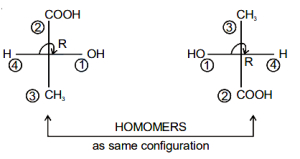
(C) Pair $1$: Both structures represent the same molecule. By rotating the second structure by $180^{\circ}$ in the plane,it superimposes on the first. Thus,they are homomers (identical).
Pair $2$: Both structures are $m$-nitrotoluene. They are identical (homomers).
Pair $3$: The first structure is $1,1$-dichloro-$2$-methylprop-$1$-ene and the second is $1,2$-dichloro-$2$-methylprop-$1$-ene. These are constitutional isomers (specifically,positional isomers).
Pair $2$: Both structures are $m$-nitrotoluene. They are identical (homomers).
Pair $3$: The first structure is $1,1$-dichloro-$2$-methylprop-$1$-ene and the second is $1,2$-dichloro-$2$-methylprop-$1$-ene. These are constitutional isomers (specifically,positional isomers).
0 likes
View Solution317
MediumMCQ
The compound$(s)$,capable of producing an achiral compound on heating at $100^{\circ} C$ is/are:
A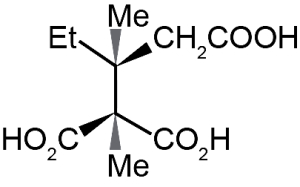
B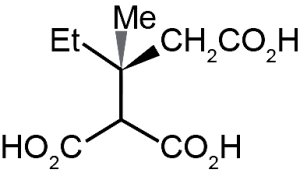
C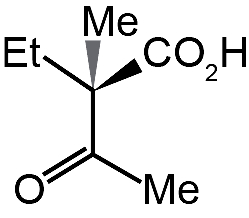
D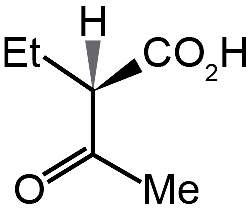
Solution
(D) Heating $\beta$-keto acids or substituted malonic acids leads to decarboxylation (loss of $CO_2$).
For a compound to become achiral after decarboxylation,the resulting product must have a plane of symmetry,a center of symmetry,or be a molecule where the chiral center is destroyed (i.e.,the carbon atom becomes bonded to two identical groups).
In option $(D)$,the starting material is $2$-ethyl-$3$-oxobutanoic acid derivative. Upon heating,it undergoes decarboxylation to form $2$-butanone (or a similar derivative depending on the specific structure). Specifically,the structure in $(D)$ is $2$-ethyl-$3$-oxobutanoic acid. Upon decarboxylation,the chiral center at the $\alpha$-carbon (which has $H$,$Et$,$CO_2H$,and $COCH_3$ groups) loses the $CO_2H$ group and gains an $H$ atom. If the resulting product has two identical groups attached to the central carbon (e.g.,two $H$ atoms or two $Et$ groups),it becomes achiral.
Looking at the provided solution image,the transformation in $(d)$ results in a molecule where the central carbon is bonded to $H$,$Et$,$Me$,and $H$ (if the $CO_2H$ is replaced by $H$). Wait,the image shows the product of $(d)$ as having $H$,$Et$,$Me$,and $H$ attached to the central carbon,making it achiral because it has two identical $H$ atoms.
For a compound to become achiral after decarboxylation,the resulting product must have a plane of symmetry,a center of symmetry,or be a molecule where the chiral center is destroyed (i.e.,the carbon atom becomes bonded to two identical groups).
In option $(D)$,the starting material is $2$-ethyl-$3$-oxobutanoic acid derivative. Upon heating,it undergoes decarboxylation to form $2$-butanone (or a similar derivative depending on the specific structure). Specifically,the structure in $(D)$ is $2$-ethyl-$3$-oxobutanoic acid. Upon decarboxylation,the chiral center at the $\alpha$-carbon (which has $H$,$Et$,$CO_2H$,and $COCH_3$ groups) loses the $CO_2H$ group and gains an $H$ atom. If the resulting product has two identical groups attached to the central carbon (e.g.,two $H$ atoms or two $Et$ groups),it becomes achiral.
Looking at the provided solution image,the transformation in $(d)$ results in a molecule where the central carbon is bonded to $H$,$Et$,$Me$,and $H$ (if the $CO_2H$ is replaced by $H$). Wait,the image shows the product of $(d)$ as having $H$,$Et$,$Me$,and $H$ attached to the central carbon,making it achiral because it has two identical $H$ atoms.
0 likes
View Solution318
MediumMCQ
Choose the correct statement$(s)$ among the following.
A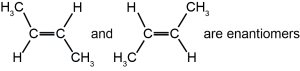
B
$CH_3CHO$ on reaction with $HCN$ gives a racemic mixture.
C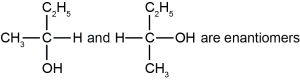
D
$CH_3-CH=NOH$ shows geometrical isomerism.
Solution
(B, D) Option $A$: The given structures are $cis$ and $trans$ isomers of $but-2-ene$,which are diastereomers,not enantiomers. Thus,this is false.
Option $B$: The reaction of $CH_3CHO$ with $HCN$ produces a cyanohydrin. Since the carbonyl carbon is $sp^2$ hybridized (planar),the cyanide ion can attack from either side with equal probability,resulting in a racemic mixture of the cyanohydrin. Thus,this is true.
Option $C$: By assigning $R/S$ configurations to the two Fischer projections of $butan-2-ol$,both are found to have the same configuration (e.g.,$R$). Therefore,they represent the same molecule and are not enantiomers. Thus,this is false.
Option $D$: $CH_3-CH=NOH$ (acetaldoxime) exhibits geometrical isomerism due to the restricted rotation around the $C=N$ bond and the presence of a lone pair on the nitrogen atom,leading to $syn$ and $anti$ (or $cis$ and $trans$) isomers. Thus,this is true.
Option $B$: The reaction of $CH_3CHO$ with $HCN$ produces a cyanohydrin. Since the carbonyl carbon is $sp^2$ hybridized (planar),the cyanide ion can attack from either side with equal probability,resulting in a racemic mixture of the cyanohydrin. Thus,this is true.
Option $C$: By assigning $R/S$ configurations to the two Fischer projections of $butan-2-ol$,both are found to have the same configuration (e.g.,$R$). Therefore,they represent the same molecule and are not enantiomers. Thus,this is false.
Option $D$: $CH_3-CH=NOH$ (acetaldoxime) exhibits geometrical isomerism due to the restricted rotation around the $C=N$ bond and the presence of a lone pair on the nitrogen atom,leading to $syn$ and $anti$ (or $cis$ and $trans$) isomers. Thus,this is true.
0 likes
View Solution319
MediumMCQ
Which of the following reaction$(s)$ give$(s)$ a meso-compound as the main product?
A
$trans-hex-3-ene + Br_2 \xrightarrow{CH_2Cl_2}$
B
$cis-hex-3-ene + H_2 \xrightarrow{Pd-C}$
C
$hex-3-yne + H_2 \xrightarrow{Lindlar's \ catalyst}$
D
$cyclohexene + Br_2 \xrightarrow{CCl_4}$
Solution
(B) meso-compound is an achiral molecule that contains stereocenters but is superimposable on its mirror image due to an internal plane of symmetry.
$1$. $trans-hex-3-ene + Br_2$ undergoes anti-addition to form a racemic mixture of $(3R, 4R)$ and $(3S, 4S)-3,4-dibromohexane$.
$2$. $cis-hex-3-ene + H_2 \xrightarrow{Pd-C}$ undergoes syn-addition to form a meso-compound,$(3R, 4S)-hexane-3,4-diol$ (if it were dihydroxylation) or in this case,the product of hydrogenation is $hexane$,which is achiral but not a meso-compound in the stereochemical sense. However,looking at the options provided,the question asks for the reaction that yields a meso-compound.
$3$. $hex-3-yne + H_2 \xrightarrow{Lindlar's \ catalyst}$ gives $cis-hex-3-ene$,which is not a meso-compound.
$4$. $cyclohexene + Br_2 \xrightarrow{CCl_4}$ gives $trans-1,2-dibromocyclohexane$,which is a racemic mixture,not a meso-compound.
Re-evaluating the options based on standard textbook examples: The hydrogenation of $cis-3,4-dimethylhex-3-ene$ (if that were the substrate) would yield a meso-compound. Given the provided image for option $B$ shows $cis-3,4-dimethylhex-3-ene$,the product of syn-addition is indeed a meso-compound.
$1$. $trans-hex-3-ene + Br_2$ undergoes anti-addition to form a racemic mixture of $(3R, 4R)$ and $(3S, 4S)-3,4-dibromohexane$.
$2$. $cis-hex-3-ene + H_2 \xrightarrow{Pd-C}$ undergoes syn-addition to form a meso-compound,$(3R, 4S)-hexane-3,4-diol$ (if it were dihydroxylation) or in this case,the product of hydrogenation is $hexane$,which is achiral but not a meso-compound in the stereochemical sense. However,looking at the options provided,the question asks for the reaction that yields a meso-compound.
$3$. $hex-3-yne + H_2 \xrightarrow{Lindlar's \ catalyst}$ gives $cis-hex-3-ene$,which is not a meso-compound.
$4$. $cyclohexene + Br_2 \xrightarrow{CCl_4}$ gives $trans-1,2-dibromocyclohexane$,which is a racemic mixture,not a meso-compound.
Re-evaluating the options based on standard textbook examples: The hydrogenation of $cis-3,4-dimethylhex-3-ene$ (if that were the substrate) would yield a meso-compound. Given the provided image for option $B$ shows $cis-3,4-dimethylhex-3-ene$,the product of syn-addition is indeed a meso-compound.
0 likes
View Solution320
DifficultMCQ
Find out the statements which are not true.
$A$. Resonating structure with more number of covalent bonds and lesser charge separation are more stable.
$B$. In electromeric effect,an unsaturated system shows $+E$ effect with nucleophile and $-E$ effect with electrophile.
$C$. Inductive effect is responsible for high melting point,boiling point and dipole moment of polar compounds.
$D$. The greater the number of alkyl groups attached to the doubly bonded carbon atoms,higher is the heat of hydrogenation.
$E$. Stability of carbanion increases with the increase in $s$-character of the carbon carrying the negative charge.
Choose the correct answer from the options given below.
$A$. Resonating structure with more number of covalent bonds and lesser charge separation are more stable.
$B$. In electromeric effect,an unsaturated system shows $+E$ effect with nucleophile and $-E$ effect with electrophile.
$C$. Inductive effect is responsible for high melting point,boiling point and dipole moment of polar compounds.
$D$. The greater the number of alkyl groups attached to the doubly bonded carbon atoms,higher is the heat of hydrogenation.
$E$. Stability of carbanion increases with the increase in $s$-character of the carbon carrying the negative charge.
Choose the correct answer from the options given below.
A
$A, D$ & $E$ only
B
$B, D$ & $E$ only
C
$A, C$ & $D$ only
D
$B$ & $D$ only
Solution
(D) Statement $A$ is true: Stability increases with more covalent bonds and less charge separation.
Statement $B$ is false: In electromeric effect,$+E$ effect occurs with electrophiles and $-E$ effect occurs with nucleophiles.
Statement $C$ is true: Inductive effect causes polarity,affecting physical properties like melting and boiling points.
Statement $D$ is false: The heat of hydrogenation decreases as the number of alkyl groups attached to the double bond increases (due to increased stability of the alkene).
Statement $E$ is true: Stability of carbanion increases with $s$-character (e.g.,$sp > sp^2 > sp^3$).
Therefore,statements $B$ and $D$ are not true.
Statement $B$ is false: In electromeric effect,$+E$ effect occurs with electrophiles and $-E$ effect occurs with nucleophiles.
Statement $C$ is true: Inductive effect causes polarity,affecting physical properties like melting and boiling points.
Statement $D$ is false: The heat of hydrogenation decreases as the number of alkyl groups attached to the double bond increases (due to increased stability of the alkene).
Statement $E$ is true: Stability of carbanion increases with $s$-character (e.g.,$sp > sp^2 > sp^3$).
Therefore,statements $B$ and $D$ are not true.
0 likes
View Solution321
DifficultMCQ
Match List-$I$ with List-$II$.
Choose the correct answer from the options given below:
| List-$I$ (Pair of Compounds) | List-$II$ (Type of Isomers) |
|---|---|
| $A$. $2-$Methylpropene and but$-1-$ene | $I$. Stereoisomers |
| $B$. $Cis-$but$-2-$ene and $trans-$but$-2-$ene | $II$. Position isomers |
| $C$. $2-$Butanol and diethyl ether | $III$. Chain isomers |
| $D$. But$-1-$ene and but$-2-$ene | $IV$. Functional group isomers |
Choose the correct answer from the options given below:
A
$A-III, B-I, C-IV, D-II$
B
$A-III, B-I, C-II, D-IV$
C
$A-I, B-IV, C-III, D-II$
D
$A-II, B-I, C-IV, D-III$
Solution
(A) . $2-$Methylpropene $(C_4H_8)$ and but$-1-$ene $(C_4H_8)$ differ in the carbon skeleton,so they are chain isomers $(III)$.
$B$. $Cis-$but$-2-$ene and $trans-$but$-2-$ene are geometric isomers,which are a type of stereoisomers $(I)$.
$C$. $2-$Butanol (alcohol) and diethyl ether (ether) have different functional groups,so they are functional group isomers $(IV)$.
$D$. But$-1-$ene and but$-2-$ene differ in the position of the double bond,so they are position isomers $(II)$.
Therefore,the correct matching is $A-III, B-I, C-IV, D-II$.
$B$. $Cis-$but$-2-$ene and $trans-$but$-2-$ene are geometric isomers,which are a type of stereoisomers $(I)$.
$C$. $2-$Butanol (alcohol) and diethyl ether (ether) have different functional groups,so they are functional group isomers $(IV)$.
$D$. But$-1-$ene and but$-2-$ene differ in the position of the double bond,so they are position isomers $(II)$.
Therefore,the correct matching is $A-III, B-I, C-IV, D-II$.
0 likes
View Solution8-2.Organic Chemistry : Isomerism — Mix Examples-General Organic Chemistry · Frequently Asked Questions
1Are these 8-2.Organic Chemistry : Isomerism questions useful for JEE and NEET?
Yes. All questions in this section are mapped to JEE Main and NEET exam patterns. Previous year questions from JEE Main, NEET, GUJCET and state-level exams are included with full solutions.
2Can I switch to Hindi or Gujarati for these questions?
Yes. Use the language tabs in the hero section or the sidebar to view the same questions and solutions in English, Hindi or Gujarati.
3How do I generate a question paper from this subtopic?
Use the Vedclass Exam Paper Generator — select the chapter and subtopic, set difficulty, and generate Sets A, B, C, D automatically. First 3 chapters of every subject are free.
Vedclass Products
For Students
Vedclass Test Series
Mock tests in real JEE/NEET style with performance analysis. 5-day free trial.
Start Free TrialFor Teachers
Exam Paper Generator
Generate Set A/B/C/D papers from this chapter in 2 minutes. 3 chapters free.
Try FreeFor Institutes
Online Exam Module
Live online exams with unlimited students, 360° analytics & white-label branding.
See DemoFor Teachers & Institutes
Generate a 8-2.Organic Chemistry : Isomerism Exam Paper in 2 Minutes
Select subtopic & difficulty — Sets A, B, C, D auto-generated with No Repeat logic.
First 3 chapters of every subject are free — no payment required.