
A English
Equilibrium state and Characteristics of K Questions in English
Class 11 Chemistry · 6-1.Equilibrium (Chemical Equilibrium) · Equilibrium state and Characteristics of K
111+
Questions
English
Language
100%
With Solutions
Showing 50 of 111 questions in English
51
EasyMCQ
When chemical equilibrium is established in a reaction...
A
Reactants are completely converted into products.
B
The rate of the forward reaction becomes equal to the rate of the backward reaction.
C
The formation of products decreases.
D
The concentration of reactants and products remains equal.
0 likes
View Solution52
MediumMCQ
For the following reaction,
$C_{12}H_{22}O_{11(aq)} + H_2O_{(l)} \rightleftharpoons C_6H_{12}O_{6(aq)} + C_6H_{12}O_{6(aq)}$
Which of the following characteristics is not affected by the addition of a catalyst?
$C_{12}H_{22}O_{11(aq)} + H_2O_{(l)} \rightleftharpoons C_6H_{12}O_{6(aq)} + C_6H_{12}O_{6(aq)}$
Which of the following characteristics is not affected by the addition of a catalyst?
A
Rate of forward reaction
B
Rate of backward reaction
C
Time taken to reach equilibrium
D
Equilibrium state
Solution
(D) catalyst increases the rate of both the forward and backward reactions by lowering the activation energy.
It helps the system reach equilibrium faster.
However,it does not alter the equilibrium constant or the equilibrium state of the reaction.
It helps the system reach equilibrium faster.
However,it does not alter the equilibrium constant or the equilibrium state of the reaction.
0 likes
View Solution53
EasyMCQ
If the concentration of reactants is increased by $x$,then the equilibrium constant $K$ becomes:
A
$ln(K/x)$
B
$K/x$
C
$K + x$
D
$K$
Solution
(D) The equilibrium constant $K$ is a characteristic property of a reaction at a given temperature.
It depends only on the temperature and is independent of the initial concentrations of reactants or products.
Therefore,changing the concentration of reactants does not change the value of $K$.
It depends only on the temperature and is independent of the initial concentrations of reactants or products.
Therefore,changing the concentration of reactants does not change the value of $K$.
0 likes
View Solution54
EasyMCQ
If the value of equilibrium constant for a particular reaction is $1.6 \times 10^{12}$,then at equilibrium the system will contain:
A
mostly products
B
similar amounts of reactants and products
C
all reactants
D
mostly reactants.
Solution
(A) The value of the equilibrium constant for the reaction is $K = 1.6 \times 10^{12}$.
Since the value of $K$ is very large $(K > 10^3)$,the equilibrium position lies far to the right,which means the system will contain mostly products at equilibrium.
Since the value of $K$ is very large $(K > 10^3)$,the equilibrium position lies far to the right,which means the system will contain mostly products at equilibrium.
0 likes
View Solution55
EasyMCQ
Select the incorrect statement $(s)$ regarding the state of equilibrium.
A
At equilibrium,pressure is constant.
B
At equilibrium,temperature is constant.
C
At equilibrium,${\left( \frac{\partial G}{\partial n} \right)_{P,T}}$ is constant.
D
At equilibrium,pressure and temperature are variable.
Solution
(D) For a system to be in a state of equilibrium,it must satisfy three conditions:
$(1)$ Mechanical Equilibrium: Pressure is constant throughout the system.
$(2)$ Thermal Equilibrium: Temperature is constant throughout the system.
$(3)$ Chemical Equilibrium: The chemical potential,defined as ${\left( \frac{\partial G}{\partial n} \right)_{P,T}}$,is constant for each component across all phases.
Therefore,the statement that pressure and temperature are variable at equilibrium is incorrect.
$(1)$ Mechanical Equilibrium: Pressure is constant throughout the system.
$(2)$ Thermal Equilibrium: Temperature is constant throughout the system.
$(3)$ Chemical Equilibrium: The chemical potential,defined as ${\left( \frac{\partial G}{\partial n} \right)_{P,T}}$,is constant for each component across all phases.
Therefore,the statement that pressure and temperature are variable at equilibrium is incorrect.
0 likes
View Solution56
MediumMCQ
In a reversible reaction $A \overset{k_1}{\underset{k_2}{\longleftrightarrow}} B$,the initial concentrations of $A$ and $B$ are $a$ and $b$,and the equilibrium concentrations are $(a - x)$ and $(b + x)$ respectively. Express $x$ in terms of $k_1, k_2, a$,and $b$.
A
$\frac{k_1 a - k_2 b}{k_1 + k_2}$
B
$\frac{k_1 a - k_2 b}{k_1 - k_2}$
C
$\frac{k_1 a - k_2 b}{k_1 k_2}$
D
$\frac{k_1 a + k_2 b}{k_1 + k_2}$
Solution
(A) At equilibrium,the rate of the forward reaction equals the rate of the backward reaction.
$k_1[A] = k_2[B]$
Given equilibrium concentrations are $[A] = (a - x)$ and $[B] = (b + x)$.
Substituting these values:
$k_1(a - x) = k_2(b + x)$
$k_1 a - k_1 x = k_2 b + k_2 x$
$k_1 a - k_2 b = k_1 x + k_2 x$
$k_1 a - k_2 b = x(k_1 + k_2)$
$x = \frac{k_1 a - k_2 b}{k_1 + k_2}$
$k_1[A] = k_2[B]$
Given equilibrium concentrations are $[A] = (a - x)$ and $[B] = (b + x)$.
Substituting these values:
$k_1(a - x) = k_2(b + x)$
$k_1 a - k_1 x = k_2 b + k_2 x$
$k_1 a - k_2 b = k_1 x + k_2 x$
$k_1 a - k_2 b = x(k_1 + k_2)$
$x = \frac{k_1 a - k_2 b}{k_1 + k_2}$
0 likes
View Solution57
MediumMCQ
The equilibrium constant for the reaction $N_{2(g)} + O_{2(g)} \rightleftharpoons 2NO_{(g)}$ is $4 \times 10^{-4}$ at $2000 \ K$. In the presence of a catalyst,equilibrium is attained ten times faster. Therefore,the equilibrium constant in the presence of the catalyst at $2000 \ K$ is:
A
$40 \times 10^{-4}$
B
$4 \times 10^{-4}$
C
$4 \times 10^{-3}$
D
Difficult to compute without more data
Solution
(B) The equilibrium constant $(K_c)$ depends only on temperature for a given reaction.
$A$ catalyst provides an alternative pathway with lower activation energy,which increases the rate of both the forward and backward reactions to the same extent.
Since the catalyst does not change the thermodynamic stability of reactants or products,it does not alter the value of the equilibrium constant.
Therefore,the equilibrium constant remains $4 \times 10^{-4}$ at $2000 \ K$.
$A$ catalyst provides an alternative pathway with lower activation energy,which increases the rate of both the forward and backward reactions to the same extent.
Since the catalyst does not change the thermodynamic stability of reactants or products,it does not alter the value of the equilibrium constant.
Therefore,the equilibrium constant remains $4 \times 10^{-4}$ at $2000 \ K$.
0 likes
View Solution58
MediumMCQ
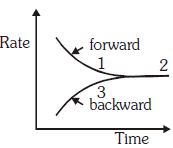
In the reaction $PCl_{5(g)} \rightleftharpoons PCl_{3(g)} + Cl_{2(g)}$,a graph is plotted to show the variation of the rate of forward and backward reactions against time. Which of the following is correct?
A
$Q > K_{eq} \to 3, Q = K_{eq} \to 2, Q < K_{eq} \to 1$
B
$Q > K_{eq} \to 1, Q = K_{eq} \to 2, Q < K_{eq} \to 3$
C
$Q > K_{eq} \to 2, Q = K_{eq} \to 3, Q < K_{eq} \to 1$
D
$Q > K_{eq} \to 2, Q = K_{eq} \to 1, Q < K_{eq} \to 3$
Solution
(A) At the start of the reaction,the concentration of reactants is high and products is zero,so the forward reaction rate is high and the backward reaction rate is zero.
As the reaction proceeds,the forward rate decreases and the backward rate increases until they become equal at equilibrium.
$1$. $Q < K_{eq}$: The reaction proceeds in the forward direction. This corresponds to the region where the forward rate is higher than the backward rate (labeled $1$ in the graph).
$2$. $Q = K_{eq}$: The system is at equilibrium. The rates of forward and backward reactions are equal (labeled $2$ in the graph).
$3$. $Q > K_{eq}$: The reaction proceeds in the backward direction. This corresponds to the region where the backward rate is higher than the forward rate (labeled $3$ in the graph).
Therefore,the correct mapping is $Q > K_{eq} \to 3, Q = K_{eq} \to 2, Q < K_{eq} \to 1$.
As the reaction proceeds,the forward rate decreases and the backward rate increases until they become equal at equilibrium.
$1$. $Q < K_{eq}$: The reaction proceeds in the forward direction. This corresponds to the region where the forward rate is higher than the backward rate (labeled $1$ in the graph).
$2$. $Q = K_{eq}$: The system is at equilibrium. The rates of forward and backward reactions are equal (labeled $2$ in the graph).
$3$. $Q > K_{eq}$: The reaction proceeds in the backward direction. This corresponds to the region where the backward rate is higher than the forward rate (labeled $3$ in the graph).
Therefore,the correct mapping is $Q > K_{eq} \to 3, Q = K_{eq} \to 2, Q < K_{eq} \to 1$.
0 likes
View Solution59
EasyMCQ
Which of the following statements is not correct about the equilibrium constant $K_c$?
A
Its value does not depend upon the initial concentration of the reactants.
B
Its value does not depend upon the initial concentration of the products.
C
Its value does not depend upon temperature.
D
Its value does not depend upon the presence of a catalyst.
Solution
(C) The equilibrium constant $K_c$ is a characteristic property of a reaction at a given temperature.
It is independent of the initial concentrations of reactants or products.
It is also independent of the presence of a catalyst,as a catalyst increases the rate of both forward and backward reactions equally.
However,the value of the equilibrium constant is highly dependent on temperature.
It is independent of the initial concentrations of reactants or products.
It is also independent of the presence of a catalyst,as a catalyst increases the rate of both forward and backward reactions equally.
However,the value of the equilibrium constant is highly dependent on temperature.
0 likes
View Solution60
MediumMCQ
Stability of reactant will be maximum for which value of $K$?
A
$3 \times 10^{-3}$
B
$2 \times 10^{-8}$
C
$4 \times 10^{-5}$
D
$4 \times 10^{-6}$
Solution
(B) The equilibrium constant $K$ is defined as the ratio of the concentration of products to the concentration of reactants at equilibrium,i.e.,$K = \frac{[Products]}{[Reactants]}$.
For a given reaction,a smaller value of $K$ indicates that the concentration of reactants is significantly higher than the concentration of products at equilibrium.
Therefore,the stability of the reactant is maximum when the value of $K$ is the smallest.
Comparing the given values: $3 \times 10^{-3}$,$2 \times 10^{-8}$,$4 \times 10^{-5}$,and $4 \times 10^{-6}$,the smallest value is $2 \times 10^{-8}$.
For a given reaction,a smaller value of $K$ indicates that the concentration of reactants is significantly higher than the concentration of products at equilibrium.
Therefore,the stability of the reactant is maximum when the value of $K$ is the smallest.
Comparing the given values: $3 \times 10^{-3}$,$2 \times 10^{-8}$,$4 \times 10^{-5}$,and $4 \times 10^{-6}$,the smallest value is $2 \times 10^{-8}$.
0 likes
View Solution61
EasyMCQ
Chemical equilibrium is dynamic in nature because
A
The equilibrium is maintained quickly
B
Concentration of reactants and products become same at equilibrium
C
Concentration of reactants and products are constant but different
D
Both forward and backward reactions occur at all times with same speed
Solution
(D) Chemical equilibrium is considered dynamic because,at equilibrium,the rate of the forward reaction equals the rate of the backward reaction $(r_f = r_b)$.
This means that the reactants are still being converted into products and products are being converted back into reactants at the same speed,even though the net concentrations of the species remain constant over time.
This means that the reactants are still being converted into products and products are being converted back into reactants at the same speed,even though the net concentrations of the species remain constant over time.
0 likes
View Solution62
MediumMCQ
$A$ chemical reaction $A \rightleftharpoons B$ is said to be in equilibrium when ........
A
Complete conversion of $A$ into $B$ takes place
B
$50\%$ conversion of $A$ into $B$ takes place
C
$10\%$ conversion of $A$ into $B$ takes place
D
The rate of conversion of $A$ to $B$ is equal to the rate of conversion of $B$ to $A$
Solution
(D) chemical reaction is said to be in equilibrium when the rate of the forward reaction becomes equal to the rate of the backward reaction.
For the reaction $A \rightleftharpoons B$,equilibrium is reached when:
Rate of forward reaction $(A \rightarrow B)$ = Rate of backward reaction $(B \rightarrow A)$.
For the reaction $A \rightleftharpoons B$,equilibrium is reached when:
Rate of forward reaction $(A \rightarrow B)$ = Rate of backward reaction $(B \rightarrow A)$.
0 likes
View Solution63
MediumMCQ
In the chemical reaction ${N_2} + 3{H_2} \rightleftharpoons 2N{H_3}$,at the equilibrium point ...............
A
Equal volumes of ${N_2}$ and ${H_2}$ react
B
Equal masses of ${N_2}$ and ${H_2}$ react
C
The reaction stops
D
The rate of formation of ${NH_3}$ is equal to the rate of its decomposition into ${N_2}$ and ${H_2}$
Solution
(D) At equilibrium,the rate of the forward reaction becomes equal to the rate of the backward reaction.
In the given reaction ${N_2} + 3{H_2} \rightleftharpoons 2N{H_3}$,this means the rate at which ${NH_3}$ is formed equals the rate at which it decomposes back into ${N_2}$ and ${H_2}$.
In the given reaction ${N_2} + 3{H_2} \rightleftharpoons 2N{H_3}$,this means the rate at which ${NH_3}$ is formed equals the rate at which it decomposes back into ${N_2}$ and ${H_2}$.
0 likes
View Solution64
EasyMCQ
The state of equilibrium represents a ..............
A
Closed state
B
Dynamic state
C
Static state
D
Inactive state
Solution
(B) Chemical equilibrium is a dynamic process. At equilibrium,the rate of the forward reaction is equal to the rate of the backward reaction. Therefore,the concentrations of reactants and products remain constant over time,but the reaction does not stop. This is why it is referred to as a $Dynamic \ state$.
0 likes
View Solution65
MediumMCQ
For the reaction $2HI_{(g)} \rightleftharpoons H_{2(g)} + I_{2(g)}$,the equilibrium constant $K$ at room temperature is $2.85$,and at $698 \ K$ it is $1.4 \times 10^{-2}$. This indicates that:
A
$HI$ is an acidic compound.
B
$HI$ is very stable at room temperature.
C
$HI$ is less stable relative to $H_2$ and $I_2$.
D
$HI$ possesses resonance stability.
Solution
(C) The equilibrium constant $K_c$ is defined as $K_c = \frac{[H_2][I_2]}{[HI]^2}$.
At room temperature,$K_c = 2.85$,which is greater than $1$.
This indicates that the concentration of products ($H_2$ and $I_2$) is higher than the concentration of the reactant $(HI)$ at equilibrium.
Therefore,$HI$ is less stable relative to $H_2$ and $I_2$ at room temperature.
At room temperature,$K_c = 2.85$,which is greater than $1$.
This indicates that the concentration of products ($H_2$ and $I_2$) is higher than the concentration of the reactant $(HI)$ at equilibrium.
Therefore,$HI$ is less stable relative to $H_2$ and $I_2$ at room temperature.
0 likes
View Solution66
MediumMCQ
In a reversible reaction at equilibrium between two reactants,if the concentration of the reactants is doubled,the equilibrium constant ..........
A
becomes double
B
becomes half
C
becomes one-fourth
D
remains constant
Solution
(D) The equilibrium constant $(K_c)$ for a reversible reaction is a function of temperature only.
It does not depend on the initial concentration of the reactants or products.
Therefore,if the concentration of the reactants is doubled at a constant temperature,the equilibrium constant $(K_c)$ remains constant.
It does not depend on the initial concentration of the reactants or products.
Therefore,if the concentration of the reactants is doubled at a constant temperature,the equilibrium constant $(K_c)$ remains constant.
0 likes
View Solution67
MediumMCQ
For the reaction ${H_2} + {I_2} \rightleftharpoons 2HI$ at $721 \ K$,the value of the equilibrium constant is $50$. If $0.5 \ mol$ of each of ${H_2}$ and ${I_2}$ are added to the system,the value of the equilibrium constant will be .............
A
$0.02$
B
$0.2$
C
$50$
D
$25$
Solution
(C) The equilibrium constant $(K_c)$ for a given reaction depends only on the temperature.
Since the temperature remains constant at $721 \ K$,the value of the equilibrium constant will not change regardless of the addition of reactants or products.
Therefore,the equilibrium constant remains $50$.
Since the temperature remains constant at $721 \ K$,the value of the equilibrium constant will not change regardless of the addition of reactants or products.
Therefore,the equilibrium constant remains $50$.
0 likes
View Solution68
EasyMCQ
If the concentration of reactants is increased by $x$ times,the equilibrium constant $K$ will become ................
A
$ln\, K/x$
B
$K/x$
C
$K + x$
D
$K$
Solution
(D) The equilibrium constant $K$ is a characteristic property of a reaction at a given temperature and is independent of the initial concentrations of the reactants or products.
0 likes
View Solution69
MediumMCQ
The equilibrium constant for the reaction ${N_{2(g)}} + {O_{2(g)}} \rightleftharpoons 2NO_{(g)}$ at $2000 \, K$ is $4 \times 10^{-4}$. If the equilibrium is attained $10$ times faster in the presence of a catalyst,the equilibrium constant at $2000 \, K$ in the presence of the catalyst will be .................
A
$40 \times 10^{-4}$
B
$4 \times 10^{-4}$
C
$4 \times 10^{-2}$
D
Cannot be determined.
Solution
(B) catalyst increases the rate of both the forward and backward reactions to the same extent.
It helps in attaining the equilibrium state faster but does not alter the position of the equilibrium.
Since the equilibrium constant $(K_c)$ depends only on temperature,it remains unchanged in the presence of a catalyst.
Therefore,the equilibrium constant remains $4 \times 10^{-4}$.
It helps in attaining the equilibrium state faster but does not alter the position of the equilibrium.
Since the equilibrium constant $(K_c)$ depends only on temperature,it remains unchanged in the presence of a catalyst.
Therefore,the equilibrium constant remains $4 \times 10^{-4}$.
0 likes
View Solution70
EasyMCQ
For the reaction ${H_{2(g)} + I_{2(g)} \rightleftharpoons 2HI_{(g)}}$,the equilibrium constant $K_p$ changes with the change in:
A
Total pressure
B
Catalyst
C
Amount of $H_2$ and $I_2$
D
Temperature
Solution
(D) The equilibrium constant $K_p$ (or $K_c$) is a function of temperature only for a given reaction.
It is independent of the initial concentrations of reactants,the presence of a catalyst,or the total pressure of the system.
According to the van't Hoff equation,the equilibrium constant varies with temperature as $\ln K = -\frac{\Delta H^\circ}{RT} + \frac{\Delta S^\circ}{R}$.
Therefore,the correct option is $D$.
It is independent of the initial concentrations of reactants,the presence of a catalyst,or the total pressure of the system.
According to the van't Hoff equation,the equilibrium constant varies with temperature as $\ln K = -\frac{\Delta H^\circ}{RT} + \frac{\Delta S^\circ}{R}$.
Therefore,the correct option is $D$.
0 likes
View Solution71
MediumMCQ
Assertion : The equilibrium constant is fixed and a characteristic for any given chemical reaction at a specified temperature.
Reason : The composition of the final equilibrium mixture at a particular temperature depends upon the starting amount of reactants.
Reason : The composition of the final equilibrium mixture at a particular temperature depends upon the starting amount of reactants.
A
If both Assertion and Reason are correct and the Reason is a correct explanation of the Assertion.
B
If both Assertion and Reason are correct but Reason is not a correct explanation of the Assertion.
C
If the Assertion is correct but Reason is incorrect.
D
If both the Assertion and Reason are incorrect.
Solution
(C) The equilibrium constant ($K_c$ or $K_p$) has a fixed value for a given chemical reaction at a specific temperature.
However,the composition of the final equilibrium mixture (the concentrations of reactants and products) at a particular temperature is independent of the initial amounts of reactants added.
Therefore,the Assertion is true,but the Reason is false.
However,the composition of the final equilibrium mixture (the concentrations of reactants and products) at a particular temperature is independent of the initial amounts of reactants added.
Therefore,the Assertion is true,but the Reason is false.
0 likes
View Solution72
Medium
Predict which of the following reactions will have an appreciable concentration of both reactants and products:
$(a)$ $Cl_{2(g)} \longleftrightarrow 2Cl_{(g)};$ $K_{c}=5 \times 10^{-39}$
$(b)$ $Cl_{2(g)}+2NO_{(g)} \longleftrightarrow 2NOCl_{(g)};$ $K_{c}=3.7 \times 10^{8}$
$(c)$ $Cl_{2(g)}+2NO_{2(g)} \longleftrightarrow 2NO_{2}Cl_{(g)};$ $K_{c}=1.8$
$(a)$ $Cl_{2(g)} \longleftrightarrow 2Cl_{(g)};$ $K_{c}=5 \times 10^{-39}$
$(b)$ $Cl_{2(g)}+2NO_{(g)} \longleftrightarrow 2NOCl_{(g)};$ $K_{c}=3.7 \times 10^{8}$
$(c)$ $Cl_{2(g)}+2NO_{2(g)} \longleftrightarrow 2NO_{2}Cl_{(g)};$ $K_{c}=1.8$
Solution
(C) For a chemical reaction to have an appreciable concentration of both reactants and products at equilibrium,the value of the equilibrium constant $K_{c}$ must lie in the range of $10^{-3}$ to $10^{3}$.
In reaction $(a)$,$K_{c} = 5 \times 10^{-39}$,which is much less than $10^{-3}$,indicating that the reaction barely proceeds.
In reaction $(b)$,$K_{c} = 3.7 \times 10^{8}$,which is much greater than $10^{3}$,indicating that the reaction proceeds almost to completion.
In reaction $(c)$,$K_{c} = 1.8$,which lies between $10^{-3}$ and $10^{3}$.
Therefore,the reaction given in $(c)$ will have an appreciable concentration of both reactants and products.
In reaction $(a)$,$K_{c} = 5 \times 10^{-39}$,which is much less than $10^{-3}$,indicating that the reaction barely proceeds.
In reaction $(b)$,$K_{c} = 3.7 \times 10^{8}$,which is much greater than $10^{3}$,indicating that the reaction proceeds almost to completion.
In reaction $(c)$,$K_{c} = 1.8$,which lies between $10^{-3}$ and $10^{3}$.
Therefore,the reaction given in $(c)$ will have an appreciable concentration of both reactants and products.
0 likes
View Solution73
Medium
How many types of equilibrium are there based on the proportion of reactant and product?
Solution
(N/A) There are $3$ types of equilibrium based on the proportion of reactant and product:
$(i)$ Reactant is negligible and product is maximum: Such reactions proceed towards completion. At equilibrium,the concentration of reactant is negligible. At equilibrium,nearly $100 \%$ product is present,where $K > 10^{3}$.
Example: $H_{2(g)} + \frac{1}{2} O_{2(g)} \xrightarrow{500 \ K} H_{2}O_{(g)}$; $K_{c} = 2.4 \times 10^{47}$.
$(ii)$ Reactant is more and product is less: In such reactions,at equilibrium,most of the reactant remains unreacted. The product concentration is very low. Its equilibrium constant is very small,i.e.,$K < 10^{-3}$. Such reactions hardly proceed in the forward direction.
Example: $H_{2}O_{(g)} \xrightarrow{500 \ K} H_{2(g)} + \frac{1}{2} O_{2(g)}$; $K_{c} = 4.1 \times 10^{-48}$.
$(iii)$ Reactant and products are comparable: In such reactions,both reactant and product are present in significant amounts at equilibrium. In such reactions,$K_{c}$ ranges from $10^{-3}$ to $10^{3}$.
Example: $H_{2(g)} + I_{2(g)} \xrightarrow{700 \ K} 2 HI_{(g)}$; $K_{c} = 57$.
$(i)$ Reactant is negligible and product is maximum: Such reactions proceed towards completion. At equilibrium,the concentration of reactant is negligible. At equilibrium,nearly $100 \%$ product is present,where $K > 10^{3}$.
Example: $H_{2(g)} + \frac{1}{2} O_{2(g)} \xrightarrow{500 \ K} H_{2}O_{(g)}$; $K_{c} = 2.4 \times 10^{47}$.
$(ii)$ Reactant is more and product is less: In such reactions,at equilibrium,most of the reactant remains unreacted. The product concentration is very low. Its equilibrium constant is very small,i.e.,$K < 10^{-3}$. Such reactions hardly proceed in the forward direction.
Example: $H_{2}O_{(g)} \xrightarrow{500 \ K} H_{2(g)} + \frac{1}{2} O_{2(g)}$; $K_{c} = 4.1 \times 10^{-48}$.
$(iii)$ Reactant and products are comparable: In such reactions,both reactant and product are present in significant amounts at equilibrium. In such reactions,$K_{c}$ ranges from $10^{-3}$ to $10^{3}$.
Example: $H_{2(g)} + I_{2(g)} \xrightarrow{700 \ K} 2 HI_{(g)}$; $K_{c} = 57$.
0 likes
View Solution74
Medium
Explain solid-liquid equilibrium by giving an example.
Solution
Ice and water kept in a perfectly insulated thermos flask at $273 \ K$ and $1 \ atm$ atmospheric pressure are in an equilibrium state,and the system shows the following:
$H_2O_{(s)} \overset{1 \ atm, 273 \ K}{\rightleftharpoons} H_2O_{(l)}$ (Eq.-$i$)
The mass of ice and water does not change with time,and the temperature remains constant. However,the equilibrium is not static. Intense activity can be noticed at the boundary between ice and water. Molecules from the liquid water collide against the ice and adhere to it,and some molecules of ice escape into the liquid phase. There is no change in the mass of ice and water,as the rates of transfer of molecules from ice into water and the reverse transfer from water into ice are equal at atmospheric pressure and $273 \ K$.
$(i)$ Both the opposing processes occur simultaneously: $(H_2O_{(s)} \rightarrow H_2O_{(l)}$ and $H_2O_{(l)} \rightarrow H_2O_{(s)})$.
$(ii)$ Both processes occur at the same rate so that the amount of ice and water remains constant. If the rate of $H_2O_{(s)} \rightarrow H_2O_{(l)}$ is $r_1$ and the rate of $H_2O_{(l)} \rightarrow H_2O_{(s)}$ is $r_2$,then $r_1 = r_2$ for $H_2O_{(s)} \rightleftharpoons H_2O_{(l)}$.
$H_2O_{(s)} \overset{1 \ atm, 273 \ K}{\rightleftharpoons} H_2O_{(l)}$ (Eq.-$i$)
The mass of ice and water does not change with time,and the temperature remains constant. However,the equilibrium is not static. Intense activity can be noticed at the boundary between ice and water. Molecules from the liquid water collide against the ice and adhere to it,and some molecules of ice escape into the liquid phase. There is no change in the mass of ice and water,as the rates of transfer of molecules from ice into water and the reverse transfer from water into ice are equal at atmospheric pressure and $273 \ K$.
$(i)$ Both the opposing processes occur simultaneously: $(H_2O_{(s)} \rightarrow H_2O_{(l)}$ and $H_2O_{(l)} \rightarrow H_2O_{(s)})$.
$(ii)$ Both processes occur at the same rate so that the amount of ice and water remains constant. If the rate of $H_2O_{(s)} \rightarrow H_2O_{(l)}$ is $r_1$ and the rate of $H_2O_{(l)} \rightarrow H_2O_{(s)}$ is $r_2$,then $r_1 = r_2$ for $H_2O_{(s)} \rightleftharpoons H_2O_{(l)}$.
0 likes
View Solution75
Difficult
Describe the method for measuring the equilibrium vapour pressure of water at a constant temperature.
Solution
(N/A) Process: Consider a transparent box equipped with a $U$-tube manometer containing mercury. $A$ drying agent,such as anhydrous calcium chloride $(CaCl_2)$ or phosphorus pentoxide $(P_4O_{10})$,is placed in the box for a few hours. This ensures the air inside the box is free from moisture (vapour).
After removing the drying agent by tilting the box,a watch glass (or petri dish) containing water is quickly placed inside the box.
Observation: The mercury level in the right limb of the manometer will be observed to increase slowly and eventually attain a constant value.
Conclusion: The observation indicates that:
$(i)$ Initially,the pressure inside the box increases due to the evaporation of water.
$(ii)$ After some time,the pressure inside the box becomes constant,indicating that the rate of evaporation equals the rate of condensation (equilibrium state).
$(iii)$ The volume of water in the watch glass decreases slightly until equilibrium is reached.
After removing the drying agent by tilting the box,a watch glass (or petri dish) containing water is quickly placed inside the box.
Observation: The mercury level in the right limb of the manometer will be observed to increase slowly and eventually attain a constant value.
Conclusion: The observation indicates that:
$(i)$ Initially,the pressure inside the box increases due to the evaporation of water.
$(ii)$ After some time,the pressure inside the box becomes constant,indicating that the rate of evaporation equals the rate of condensation (equilibrium state).
$(iii)$ The volume of water in the watch glass decreases slightly until equilibrium is reached.
0 likes
View Solution76
Difficult
Explain liquid-vapour equilibrium.
Solution
(N/A) Process: We consider the example of a transparent box carrying a $U$-tube with mercury (manometer). $A$ drying agent like anhydrous calcium chloride $(CaCl_2)$ or phosphorus penta-oxide $(P_4O_{10})$ is placed for a few hours in the box. By doing this,the air in the box becomes free from vapour (moisture).
Now,after removing the drying agent by tilting the box on one side,a watch glass (or petri dish) containing water is quickly placed inside the box.
Observation: It will be observed that the mercury level in the right limb of the manometer slowly increases and finally attains a constant value.
Conclusion: The observation shows that:
$(i)$ In the beginning,the pressure inside the box increases due to the evaporation of water.
$(ii)$ After some time,the pressure inside the box becomes constant,indicating that the rate of evaporation equals the rate of condensation.
$(iii)$ The volume of water in the watch glass decreases initially and then becomes constant,representing the liquid-vapour equilibrium state: $H_2O(l) \rightleftharpoons H_2O(vap)$.
Now,after removing the drying agent by tilting the box on one side,a watch glass (or petri dish) containing water is quickly placed inside the box.
Observation: It will be observed that the mercury level in the right limb of the manometer slowly increases and finally attains a constant value.
Conclusion: The observation shows that:
$(i)$ In the beginning,the pressure inside the box increases due to the evaporation of water.
$(ii)$ After some time,the pressure inside the box becomes constant,indicating that the rate of evaporation equals the rate of condensation.
$(iii)$ The volume of water in the watch glass decreases initially and then becomes constant,representing the liquid-vapour equilibrium state: $H_2O(l) \rightleftharpoons H_2O(vap)$.
0 likes
View Solution77
Medium
What is vapour pressure? Explain the statement: "In an open vessel,the rate of vaporization is constant,yet equilibrium is not established."
Solution
(N/A) Vapour pressure is the pressure exerted by the vapour of a liquid in equilibrium with the liquid at a given temperature in a closed vessel.
Equilibrium is only possible in a closed vessel where the rate of vaporization equals the rate of condensation.
In an open vessel,the vapour molecules escape into the surrounding atmosphere. Consequently,the rate of vaporization $(Liquid \rightarrow Gas)$ is greater than the rate of condensation $(Gas \rightarrow Liquid)$.
Since the vapour is continuously lost to the surroundings,the reverse process cannot occur at the same rate as the forward process,and thus,equilibrium is never established.
Even though the rate of vaporization remains constant at a fixed temperature,the system cannot reach equilibrium because the condensation process is effectively absent or negligible.
Equilibrium is only possible in a closed vessel where the rate of vaporization equals the rate of condensation.
In an open vessel,the vapour molecules escape into the surrounding atmosphere. Consequently,the rate of vaporization $(Liquid \rightarrow Gas)$ is greater than the rate of condensation $(Gas \rightarrow Liquid)$.
Since the vapour is continuously lost to the surroundings,the reverse process cannot occur at the same rate as the forward process,and thus,equilibrium is never established.
Even though the rate of vaporization remains constant at a fixed temperature,the system cannot reach equilibrium because the condensation process is effectively absent or negligible.
0 likes
View Solution78
Medium
Explain solid-vapour equilibrium by example.
Solution
(N/A) At constant temperature in a closed vessel,the system where a solid sublimes to the vapour phase is known as solid-vapour equilibrium.
$Ex.-1$: If we place solid iodine $(I_2)$ in a closed vessel,after some time the vessel gets filled with violet vapour and the intensity of the colour increases with time. After a certain time,the intensity of the colour becomes constant,and at this stage,equilibrium is attained. Hence,solid iodine sublimes to give iodine vapour,and the iodine vapour condenses to give solid iodine. Properties,colours,etc.,become constant. The equilibrium can be represented as:
$I_{2(s)} \rightleftharpoons I_{2(g)}$ (at constant $T$)
(violet solid) $\rightleftharpoons$ (violet vapour)
Other examples showing this kind of equilibrium are:
$(i)$ $\text{Camphor}_{(s)} \rightleftharpoons \text{Camphor}_{(g)}$ (at constant $T$)
$(ii)$ $NH_4Cl_{(s)} \rightleftharpoons NH_4Cl_{(g)}$ (at constant $T$)
$Ex.-1$: If we place solid iodine $(I_2)$ in a closed vessel,after some time the vessel gets filled with violet vapour and the intensity of the colour increases with time. After a certain time,the intensity of the colour becomes constant,and at this stage,equilibrium is attained. Hence,solid iodine sublimes to give iodine vapour,and the iodine vapour condenses to give solid iodine. Properties,colours,etc.,become constant. The equilibrium can be represented as:
$I_{2(s)} \rightleftharpoons I_{2(g)}$ (at constant $T$)
(violet solid) $\rightleftharpoons$ (violet vapour)
Other examples showing this kind of equilibrium are:
$(i)$ $\text{Camphor}_{(s)} \rightleftharpoons \text{Camphor}_{(g)}$ (at constant $T$)
$(ii)$ $NH_4Cl_{(s)} \rightleftharpoons NH_4Cl_{(g)}$ (at constant $T$)
0 likes
View Solution79
Medium
Explain the equilibrium when sublimation of solid takes place in a closed vessel.
Solution
(N/A) At a constant temperature in a closed vessel,the system where solids sublime to the vapour phase is known as solid-vapour equilibrium.
$Ex.-1$: If we place solid iodine $(I_2)$ in a closed vessel,after some time the vessel gets filled up with violet vapour and the intensity of the colour increases with time.
After a certain time,the intensity of the colour becomes constant and at this stage,equilibrium is attained.
Hence,solid iodine sublimes to give iodine vapour and the iodine vapour condenses to give solid iodine.
Properties,colours,etc.,become constant.
The equilibrium can be represented as: $I_{2(s)} \rightleftharpoons I_{2(g)}$ (constant $T$).
Other examples showing this kind of equilibrium are:
$(i)$ $Camphor_{(s)} \rightleftharpoons Camphor_{(g)}$ (constant $T$)
$(ii)$ $NH_4Cl_{(s)} \rightleftharpoons NH_4Cl_{(g)}$ (constant $T$)
$Ex.-1$: If we place solid iodine $(I_2)$ in a closed vessel,after some time the vessel gets filled up with violet vapour and the intensity of the colour increases with time.
After a certain time,the intensity of the colour becomes constant and at this stage,equilibrium is attained.
Hence,solid iodine sublimes to give iodine vapour and the iodine vapour condenses to give solid iodine.
Properties,colours,etc.,become constant.
The equilibrium can be represented as: $I_{2(s)} \rightleftharpoons I_{2(g)}$ (constant $T$).
Other examples showing this kind of equilibrium are:
$(i)$ $Camphor_{(s)} \rightleftharpoons Camphor_{(g)}$ (constant $T$)
$(ii)$ $NH_4Cl_{(s)} \rightleftharpoons NH_4Cl_{(g)}$ (constant $T$)
0 likes
View Solution80
Difficult
Explain equilibrium in a saturated solution and its dynamic nature.
Solution
(N/A) limited amount of salt or sugar dissolves in a given amount of water at room temperature. If a thick sugar syrup is prepared at a higher temperature and then cooled to room temperature,sugar crystals separate out. $A$ solution that contains sugar crystals in equilibrium with dissolved sugar is called a saturated solution. $A$ saturated solution is one in which no more solute can be dissolved at a given temperature.
In a saturated solution,a dynamic equilibrium exists between the solute molecules in the solid state and the solute molecules in the solution.
Example: $Sugar_{(solid)} \rightleftharpoons Sugar_{(solution)}$
At equilibrium: $\text{Rate of dissolution of sugar} = \text{Rate of crystallisation of sugar}$.
In the forward reaction,the dissolution of the solid into the solution occurs,and in the reverse reaction,the crystallisation of the solute occurs.
Dynamic nature: The dynamic nature of this equilibrium can be confirmed using radioactive sugar. If radioactive sugar is added to a saturated solution of non-radioactive sugar,after some time,radioactivity is observed in both the solution and the solid sugar. This indicates that there is a continuous exchange of molecules between the two phases,even though the net concentration remains constant.
In a saturated solution,a dynamic equilibrium exists between the solute molecules in the solid state and the solute molecules in the solution.
Example: $Sugar_{(solid)} \rightleftharpoons Sugar_{(solution)}$
At equilibrium: $\text{Rate of dissolution of sugar} = \text{Rate of crystallisation of sugar}$.
In the forward reaction,the dissolution of the solid into the solution occurs,and in the reverse reaction,the crystallisation of the solute occurs.
Dynamic nature: The dynamic nature of this equilibrium can be confirmed using radioactive sugar. If radioactive sugar is added to a saturated solution of non-radioactive sugar,after some time,radioactivity is observed in both the solution and the solid sugar. This indicates that there is a continuous exchange of molecules between the two phases,even though the net concentration remains constant.
0 likes
View Solution81
Difficult
Explain the types of physical equilibrium with examples.
Solution
(N/A) $(i)$ Solid-Liquid equilibrium: There is only one temperature (melting point) at $1 \ atm$ $(1.013 \ bar)$ at which the two phases can coexist. If there is no exchange of heat with the surroundings,the mass of the two phases remains constant.
$H_{2}O_{(s)} \rightleftharpoons H_{2}O_{(l)}$
Conclusion: Melting point is fixed at constant pressure.
$(ii)$ Liquid-Vapour equilibrium: At a given definite temperature,the vapour pressure is constant between liquid and its vapour in a closed vessel.
$H_{2}O_{(l)} \rightleftharpoons H_{2}O_{(g)}$
Conclusion: At constant temperature,$p_{H_{2}O}$ remains constant in a closed vessel.
$(iii)$ Solid-Gas equilibrium: In a closed vessel,at constant temperature,equilibrium occurs between solid and vapour. This process is known as sublimation.
$NH_{4}Cl_{(s)} \rightleftharpoons NH_{4}Cl_{(g)}$
Conclusion: At constant temperature in a closed vessel,the mass of solid and vapour remains constant.
$(iv)$ Equilibrium involving dissolution of solids in liquids: At constant temperature,a saturated solution of a solid represents a solid-liquid equilibrium where solubility remains constant.
$\text{Solute}_{(s)} \rightleftharpoons \text{Solute}_{(aq)}$ ; $\text{Sugar}_{(s)} \rightleftharpoons \text{Sugar}_{(aq)}$
Conclusion: Concentration of solute in the solution is constant at a given temperature.
$(v)$ Equilibrium involving dissolution of gases in liquids: At constant temperature in a closed vessel,in a saturated solution of gas in liquid,equilibrium is established between the dissolved gas and the free gas. The concentration of gas in the liquid is directly proportional to the pressure of the gas.
$\text{Gas}_{(g)} \rightleftharpoons \text{Gas}_{(aq)}$ ; $CO_{2(g)} \rightleftharpoons CO_{2(aq)}$
Conclusion: The ratio $\frac{[\text{Gas}_{(aq)}]}{[\text{Gas}_{(g)}]}$ is constant at a given temperature.
$H_{2}O_{(s)} \rightleftharpoons H_{2}O_{(l)}$
Conclusion: Melting point is fixed at constant pressure.
$(ii)$ Liquid-Vapour equilibrium: At a given definite temperature,the vapour pressure is constant between liquid and its vapour in a closed vessel.
$H_{2}O_{(l)} \rightleftharpoons H_{2}O_{(g)}$
Conclusion: At constant temperature,$p_{H_{2}O}$ remains constant in a closed vessel.
$(iii)$ Solid-Gas equilibrium: In a closed vessel,at constant temperature,equilibrium occurs between solid and vapour. This process is known as sublimation.
$NH_{4}Cl_{(s)} \rightleftharpoons NH_{4}Cl_{(g)}$
Conclusion: At constant temperature in a closed vessel,the mass of solid and vapour remains constant.
$(iv)$ Equilibrium involving dissolution of solids in liquids: At constant temperature,a saturated solution of a solid represents a solid-liquid equilibrium where solubility remains constant.
$\text{Solute}_{(s)} \rightleftharpoons \text{Solute}_{(aq)}$ ; $\text{Sugar}_{(s)} \rightleftharpoons \text{Sugar}_{(aq)}$
Conclusion: Concentration of solute in the solution is constant at a given temperature.
$(v)$ Equilibrium involving dissolution of gases in liquids: At constant temperature in a closed vessel,in a saturated solution of gas in liquid,equilibrium is established between the dissolved gas and the free gas. The concentration of gas in the liquid is directly proportional to the pressure of the gas.
$\text{Gas}_{(g)} \rightleftharpoons \text{Gas}_{(aq)}$ ; $CO_{2(g)} \rightleftharpoons CO_{2(aq)}$
Conclusion: The ratio $\frac{[\text{Gas}_{(aq)}]}{[\text{Gas}_{(g)}]}$ is constant at a given temperature.
0 likes
View Solution82
Medium
Write the general characteristics of equilibria involving physical processes.
Solution
(N/A) For physical processes,the following characteristics are common to the system at equilibrium:
$(i)$ Equilibrium is possible only in a closed system at a given temperature.
$(ii)$ Both the opposing processes occur at the same rate,resulting in a dynamic but stable condition.
$(iii)$ All measurable properties of the system remain constant over time.
$(iv)$ When equilibrium is attained for a physical process,it is characterized by a constant value of one of its parameters (e.g.,pressure,concentration) at a given temperature.
$(v)$ The magnitude of such quantities at any stage indicates the extent to which the physical process has proceeded before reaching equilibrium.
$(i)$ Equilibrium is possible only in a closed system at a given temperature.
$(ii)$ Both the opposing processes occur at the same rate,resulting in a dynamic but stable condition.
$(iii)$ All measurable properties of the system remain constant over time.
$(iv)$ When equilibrium is attained for a physical process,it is characterized by a constant value of one of its parameters (e.g.,pressure,concentration) at a given temperature.
$(v)$ The magnitude of such quantities at any stage indicates the extent to which the physical process has proceeded before reaching equilibrium.
0 likes
View Solution83
Medium
Explain chemical equilibrium by giving an example of a general reaction.
Solution
(N/A) Analogous to physical systems,chemical reactions also attain a state of equilibrium. These reactions can occur in both forward and backward directions. When the rates of the forward and reverse reactions become equal,the concentrations of the reactants and the products remain constant. This is the stage of chemical equilibrium.
Chemical equilibrium is 'dynamic' in nature; it consists of a forward reaction in which the reactants form products and a reverse reaction in which products form the original reactants.
Let us consider a general reversible reaction:
$A + B \rightleftharpoons C + D$ $(i)$
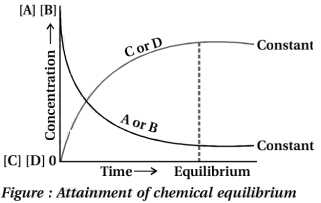
At the beginning,the concentration of $A$ and $B$ is high. With the passage of time,there is an accumulation of the products $C$ and $D$ and a depletion of the reactants $A$ and $B$. (See Figure)
This leads to a decrease in the rate of the forward reaction and an increase in the rate of the reverse reaction. After some time,the two reactions occur at the same rate,and the system reaches a state of equilibrium.
We can attain equilibrium starting the reaction from either direction. We can also reach equilibrium starting from $C$ and $D$.
Chemical equilibrium is 'dynamic' in nature; it consists of a forward reaction in which the reactants form products and a reverse reaction in which products form the original reactants.
Let us consider a general reversible reaction:
$A + B \rightleftharpoons C + D$ $(i)$
At the beginning,the concentration of $A$ and $B$ is high. With the passage of time,there is an accumulation of the products $C$ and $D$ and a depletion of the reactants $A$ and $B$. (See Figure)
This leads to a decrease in the rate of the forward reaction and an increase in the rate of the reverse reaction. After some time,the two reactions occur at the same rate,and the system reaches a state of equilibrium.
We can attain equilibrium starting the reaction from either direction. We can also reach equilibrium starting from $C$ and $D$.
0 likes
View Solution84
Difficult
Explain chemical equilibrium with an example of a chemical reaction.
Solution
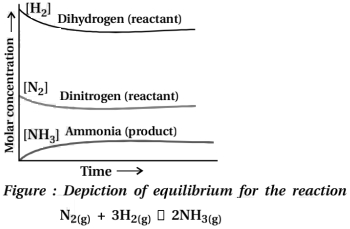
(N/A) Example of synthesis of ammonia: The chemical equilibrium can be demonstrated in the synthesis of ammonia by Haber's process. In a series of experiments,Haber started with known amounts of dinitrogen and dihydrogen maintained at high temperature and pressure and at regular intervals determined the amount of ammonia present. He was successful in determining the concentration of unreacted dihydrogen and dinitrogen as well. This is shown in the following figure.
After some time,the composition of the reactants and products in the mixture remains constant. The amount of product and reactant does not change,and this is the equilibrium state. Equilibrium can be attained from both sides,whether we start the reaction by taking $H_{2(g)}$ and $N_{2(g)}$ to get $NH_{3(g)}$ or by taking $NH_{3(g)}$ and decomposing it into $N_{2(g)}$ and $H_{2(g)}$. Starting from the forward reaction to reach equilibrium:
$N_{2(g)} + 3H_{2(g)} \rightleftharpoons 2NH_{3(g)} \dots (I)$
And starting from the reverse reaction to reach equilibrium:
$2NH_{3(g)} \rightleftharpoons N_{2(g)} + 3H_{2(g)} \dots (II)$
$(B)$ Example of decomposition of hydrogen iodide $(HI)$: If we start with equal initial concentrations of $H_{2}$ and $I_{2}$,the reaction proceeds in the forward direction,and the concentrations of $H_{2}$ and $I_{2}$ decrease while that of $HI$ increases. After some time,the concentrations of all species $(H_{2}, I_{2}, HI)$ become constant,and the system reaches equilibrium.
After some time,the composition of the reactants and products in the mixture remains constant. The amount of product and reactant does not change,and this is the equilibrium state. Equilibrium can be attained from both sides,whether we start the reaction by taking $H_{2(g)}$ and $N_{2(g)}$ to get $NH_{3(g)}$ or by taking $NH_{3(g)}$ and decomposing it into $N_{2(g)}$ and $H_{2(g)}$. Starting from the forward reaction to reach equilibrium:
$N_{2(g)} + 3H_{2(g)} \rightleftharpoons 2NH_{3(g)} \dots (I)$
And starting from the reverse reaction to reach equilibrium:
$2NH_{3(g)} \rightleftharpoons N_{2(g)} + 3H_{2(g)} \dots (II)$
$(B)$ Example of decomposition of hydrogen iodide $(HI)$: If we start with equal initial concentrations of $H_{2}$ and $I_{2}$,the reaction proceeds in the forward direction,and the concentrations of $H_{2}$ and $I_{2}$ decrease while that of $HI$ increases. After some time,the concentrations of all species $(H_{2}, I_{2}, HI)$ become constant,and the system reaches equilibrium.
0 likes
View Solution85
Difficult
Explain the dynamic nature of chemical equilibrium with a suitable reaction example.
Solution
(N/A) Chemical equilibrium is dynamic in nature. This fact is proven by the synthesis of ammonia using $H_{2}$ and $D_{2}$.
After equilibrium is attained,two mixtures: $(i)$ $H_{2}, N_{2}, NH_{3}$ and $(ii)$ $D_{2}, N_{2}, ND_{3}$ are mixed together and left for a while.
When this mixture is analyzed,it is found that the total concentration of ammonia remains the same as before.
However,when analyzed by a mass spectrometer,it is found that ammonia and all deuterium-containing forms of ammonia $(NH_{3}, NH_{2}D, NHD_{2}, ND_{3})$ as well as dihydrogen and its deuterated forms $(H_{2}, HD, D_{2})$ are present.
This indicates that the scrambling of $H$ and $D$ atoms in the molecules results from the continuation of both forward and reverse reactions.
Thus,the use of the isotope (deuterium) in the formation of ammonia clearly indicates that chemical reactions reach a state of dynamic equilibrium where the rates of forward and reverse reactions are equal,and there is no net change in composition.
After equilibrium is attained,two mixtures: $(i)$ $H_{2}, N_{2}, NH_{3}$ and $(ii)$ $D_{2}, N_{2}, ND_{3}$ are mixed together and left for a while.
When this mixture is analyzed,it is found that the total concentration of ammonia remains the same as before.
However,when analyzed by a mass spectrometer,it is found that ammonia and all deuterium-containing forms of ammonia $(NH_{3}, NH_{2}D, NHD_{2}, ND_{3})$ as well as dihydrogen and its deuterated forms $(H_{2}, HD, D_{2})$ are present.
This indicates that the scrambling of $H$ and $D$ atoms in the molecules results from the continuation of both forward and reverse reactions.
Thus,the use of the isotope (deuterium) in the formation of ammonia clearly indicates that chemical reactions reach a state of dynamic equilibrium where the rates of forward and reverse reactions are equal,and there is no net change in composition.
0 likes
View Solution86
Difficult
Explain the dynamic nature of a chemical system in the laboratory using an activity.
Solution
(N/A) Activity: Take two $100 \ mL$ measuring cylinders (marked as $1$ and $2$) and two glass tubes,each of $30 \ cm$ length and the same diameter,also marked $1$ and $2$. Fill cylinder-$1$ with coloured water,such as a $KMnO_4$ (potassium permanganate) solution,and keep the second cylinder (number-$2$) empty.
Place one tube in cylinder-$1$ and the second in cylinder-$2$. The initial stage is shown in the figure.
By placing hollow tube-$1$ in cylinder-$1$,the tube will fill with the coloured water. Close the upper tip,take it out of the cylinder,and transfer the coloured water into cylinder-$2$. Repeat the process similarly by placing the hollow tube in cylinder-$2$ and transferring the coloured water from it to cylinder-$1$. Continue transferring the coloured water between cylinder-$1$ and cylinder-$2$ until the level of coloured water in both cylinders becomes constant. This demonstrates that even when the levels appear constant (equilibrium),the process of transfer is still occurring,representing the dynamic nature of equilibrium.
Place one tube in cylinder-$1$ and the second in cylinder-$2$. The initial stage is shown in the figure.
By placing hollow tube-$1$ in cylinder-$1$,the tube will fill with the coloured water. Close the upper tip,take it out of the cylinder,and transfer the coloured water into cylinder-$2$. Repeat the process similarly by placing the hollow tube in cylinder-$2$ and transferring the coloured water from it to cylinder-$1$. Continue transferring the coloured water between cylinder-$1$ and cylinder-$2$ until the level of coloured water in both cylinders becomes constant. This demonstrates that even when the levels appear constant (equilibrium),the process of transfer is still occurring,representing the dynamic nature of equilibrium.
0 likes
View Solution87
MediumMCQ
Given the reactions at $500 \ K$:
$(i) \ H_{2(g)} + 1/2 O_{2(g)} \rightleftharpoons H_2O_{(g)}$,$K_c = 2.4 \times 10^{47}$
$(ii) \ H_2O_{(g)} \rightleftharpoons H_{2(g)} + 1/2 O_{2(g)}$,$K_c = 4.1 \times 10^{-48}$
What does the magnitude of $K_c$ indicate about the formation of the product in reaction $(i)$?
$(i) \ H_{2(g)} + 1/2 O_{2(g)} \rightleftharpoons H_2O_{(g)}$,$K_c = 2.4 \times 10^{47}$
$(ii) \ H_2O_{(g)} \rightleftharpoons H_{2(g)} + 1/2 O_{2(g)}$,$K_c = 4.1 \times 10^{-48}$
What does the magnitude of $K_c$ indicate about the formation of the product in reaction $(i)$?
A
The product is highly stable and formed in large amounts.
B
The product is unstable and decomposes rapidly.
C
The reaction does not proceed to form the product.
D
The reaction is at equilibrium with equal amounts of reactants and products.
Solution
(A) The equilibrium constant $K_c$ provides information about the extent of a reaction.
For reaction $(i)$,$K_c = 2.4 \times 10^{47}$.
$A$ very large value of $K_c$ $(K_c > 10^3)$ indicates that the reaction proceeds almost to completion.
This means that at equilibrium,the concentration of the product $(H_2O)$ is much higher than the concentration of the reactants ($H_2$ and $O_2$).
Therefore,the product is highly stable and formed in large amounts.
For reaction $(i)$,$K_c = 2.4 \times 10^{47}$.
$A$ very large value of $K_c$ $(K_c > 10^3)$ indicates that the reaction proceeds almost to completion.
This means that at equilibrium,the concentration of the product $(H_2O)$ is much higher than the concentration of the reactants ($H_2$ and $O_2$).
Therefore,the product is highly stable and formed in large amounts.
0 likes
View Solution88
MediumMCQ
Equilibrium is a steady state,but it is dynamic in nature. What is the meaning of this statement?
A
The concentrations of reactants and products remain constant over time.
B
The forward and backward reactions continue to occur at the same rate.
C
The system appears static at the macroscopic level but active at the microscopic level.
D
All of the above.
0 likes
View Solution89
Medium
What is homogeneous equilibrium? Give examples.
Solution
(N/A) Definition: In a homogeneous system,all the reactants and products are in the same phase.
Example $1$: $A$ reaction where all species are in the gaseous phase:
$N_{2(g)} + 3H_{2(g)} \rightleftharpoons 2NH_{3(g)}$
Example $2$: $A$ reaction where all reactants and products are in the aqueous solution phase:
$Fe^{3+}_{(aq)} + SCN^{-}_{(aq)} \rightleftharpoons [Fe(SCN)]^{2+}_{(aq)}$
Example $1$: $A$ reaction where all species are in the gaseous phase:
$N_{2(g)} + 3H_{2(g)} \rightleftharpoons 2NH_{3(g)}$
Example $2$: $A$ reaction where all reactants and products are in the aqueous solution phase:
$Fe^{3+}_{(aq)} + SCN^{-}_{(aq)} \rightleftharpoons [Fe(SCN)]^{2+}_{(aq)}$
0 likes
View Solution90
Medium
Identify which of the following reactions represent homogeneous and heterogeneous equilibria:
$(a)$ $H_{2(g)} + I_{2(g)} \rightleftharpoons 2HI_{(g)}$
$(b)$ $Ca(OH)_{2(s)} \rightleftharpoons Ca^{2+}_{(aq)} + 2OH^{-}_{(aq)}$
$(c)$ $CaCO_{3(s)} \rightleftharpoons CaO_{(s)} + CO_{2(g)}$
$(d)$ $Ag_{2}O_{(s)} + 2H^{+}_{(aq)} \rightleftharpoons H_{2}O_{(l)} + 2Ag^{+}_{(aq)}$
$(e)$ $NH_{3(g)} + H_{2}O_{(l)} \rightleftharpoons N{H_{4}}^{+}_{(aq)} + OH^{-}_{(aq)}$
$(f)$ $CH_{3}COOC_{2}H_{5(l)} + H_{2}O_{(l)} \rightleftharpoons CH_{3}COOH_{(l)} + C_{2}H_{5}OH_{(l)}$
$(a)$ $H_{2(g)} + I_{2(g)} \rightleftharpoons 2HI_{(g)}$
$(b)$ $Ca(OH)_{2(s)} \rightleftharpoons Ca^{2+}_{(aq)} + 2OH^{-}_{(aq)}$
$(c)$ $CaCO_{3(s)} \rightleftharpoons CaO_{(s)} + CO_{2(g)}$
$(d)$ $Ag_{2}O_{(s)} + 2H^{+}_{(aq)} \rightleftharpoons H_{2}O_{(l)} + 2Ag^{+}_{(aq)}$
$(e)$ $NH_{3(g)} + H_{2}O_{(l)} \rightleftharpoons N{H_{4}}^{+}_{(aq)} + OH^{-}_{(aq)}$
$(f)$ $CH_{3}COOC_{2}H_{5(l)} + H_{2}O_{(l)} \rightleftharpoons CH_{3}COOH_{(l)} + C_{2}H_{5}OH_{(l)}$
Solution
(N/A) homogeneous equilibrium is one in which all reactants and products are in the same phase.
$(a)$ All species are in the gas phase (homogeneous).
$(e)$ Reactants are gas and liquid,products are aqueous (heterogeneous).
$(f)$ All species are in the liquid phase (homogeneous).
$A$ heterogeneous equilibrium is one in which reactants and products are in different phases.
$(b)$ Solid reactant and aqueous products (heterogeneous).
$(c)$ Solid reactants and products with a gaseous product (heterogeneous).
$(d)$ Solid reactant and aqueous/liquid products (heterogeneous).
Summary:
Homogeneous: $(a), (f)$
Heterogeneous: $(b), (c), (d), (e)$
$(a)$ All species are in the gas phase (homogeneous).
$(e)$ Reactants are gas and liquid,products are aqueous (heterogeneous).
$(f)$ All species are in the liquid phase (homogeneous).
$A$ heterogeneous equilibrium is one in which reactants and products are in different phases.
$(b)$ Solid reactant and aqueous products (heterogeneous).
$(c)$ Solid reactants and products with a gaseous product (heterogeneous).
$(d)$ Solid reactant and aqueous/liquid products (heterogeneous).
Summary:
Homogeneous: $(a), (f)$
Heterogeneous: $(b), (c), (d), (e)$
0 likes
View Solution91
Difficult
$A$ liquid is in equilibrium with its vapour in a sealed container at a fixed temperature. The volume of the container is suddenly increased.
$(a)$ What is the initial effect of the change on vapour pressure?
$(b)$ How do rates of evaporation and condensation change initially?
$(c)$ What happens when equilibrium is restored finally and what will be the final vapour pressure?
$(a)$ What is the initial effect of the change on vapour pressure?
$(b)$ How do rates of evaporation and condensation change initially?
$(c)$ What happens when equilibrium is restored finally and what will be the final vapour pressure?
Solution
(N/A) Initially,the vapour pressure will decrease because the volume increases,which causes the concentration of vapour to decrease.
$(b)$ The rate of evaporation remains constant at a constant temperature. However,the rate of condensation decreases initially because there are fewer molecules per unit volume in the vapour phase to collide with the liquid surface.
$(c)$ When equilibrium is restored,the rate of evaporation becomes equal to the rate of condensation. The final vapour pressure will be the same as it was originally at that temperature.
$(b)$ The rate of evaporation remains constant at a constant temperature. However,the rate of condensation decreases initially because there are fewer molecules per unit volume in the vapour phase to collide with the liquid surface.
$(c)$ When equilibrium is restored,the rate of evaporation becomes equal to the rate of condensation. The final vapour pressure will be the same as it was originally at that temperature.
0 likes
View Solution92
MediumMCQ
If the equilibrium constant of a reaction is $K_c = 1.6 \times 10^{12}$,then at equilibrium,the system will contain:
A
Mostly reactants
B
Mostly products
C
Equal amounts of reactants and products
D
Only reactants
Solution
(B) The equilibrium constant $K_c$ is defined as the ratio of the concentration of products to the concentration of reactants at equilibrium.
If $K_c > 10^3$,the reaction proceeds almost to completion,meaning the system contains mostly products at equilibrium.
Since $1.6 \times 10^{12} > 10^3$,the system will contain mostly products.
If $K_c > 10^3$,the reaction proceeds almost to completion,meaning the system contains mostly products at equilibrium.
Since $1.6 \times 10^{12} > 10^3$,the system will contain mostly products.
0 likes
View Solution93
DifficultMCQ
For the equilibrium $A \rightleftharpoons B$,the variation of the rate of the forward $(a)$ and reverse $(b)$ reaction with time is given by:
A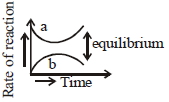
B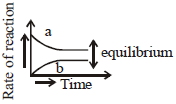
C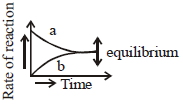
D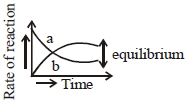
Solution
(C) At equilibrium,the rate of the forward reaction $(r_f)$ becomes equal to the rate of the reverse reaction $(r_b)$.
Initially,the rate of the forward reaction is maximum and decreases with time as the concentration of reactant $A$ decreases.
Conversely,the rate of the reverse reaction is zero initially and increases with time as the concentration of product $B$ increases.
At equilibrium,both rates become constant and equal to each other.
This is correctly represented by graph $C$.
Initially,the rate of the forward reaction is maximum and decreases with time as the concentration of reactant $A$ decreases.
Conversely,the rate of the reverse reaction is zero initially and increases with time as the concentration of product $B$ increases.
At equilibrium,both rates become constant and equal to each other.
This is correctly represented by graph $C$.
0 likes
View Solution94
MediumMCQ
Among the following,the correct statement about the chemical equilibrium is
A
equilibrium constant is independent of temperature.
B
equilibrium constant tells us how fast the reaction reaches equilibrium.
C
at equilibrium,the forward and the backward reactions stop so that the concentrations of reactants and products are constant.
D
equilibrium constant is independent of whether you start the reaction with reactants or products.
Solution
(D) is the correct statement.
Explanation of why others are incorrect:
$(a)$ The equilibrium constant is temperature-dependent and changes with temperature for a given reaction.
$(b)$ The equilibrium constant provides information about the extent of the reaction,not the rate at which equilibrium is reached.
$(c)$ At equilibrium,the forward and backward reactions do not stop; they continue at equal rates,making the process dynamic,not static.
Explanation of why others are incorrect:
$(a)$ The equilibrium constant is temperature-dependent and changes with temperature for a given reaction.
$(b)$ The equilibrium constant provides information about the extent of the reaction,not the rate at which equilibrium is reached.
$(c)$ At equilibrium,the forward and backward reactions do not stop; they continue at equal rates,making the process dynamic,not static.
0 likes
View Solution95
MediumMCQ
$2 \ HI_{(g)} \rightleftharpoons H_{2(g)} + I_{2(g)}$
The equilibrium constant of the above reaction is $6.4$ at $300 \ K$. If $0.25 \ mol$ each of $H_{2}$ and $I_{2}$ are added to the system,the equilibrium constant will be
The equilibrium constant of the above reaction is $6.4$ at $300 \ K$. If $0.25 \ mol$ each of $H_{2}$ and $I_{2}$ are added to the system,the equilibrium constant will be
A
$6.4$
B
$0.8$
C
$3.2$
D
$1.6$
Solution
(A) The equilibrium constant $(K_c)$ of a chemical reaction depends only on the temperature of the system. It remains unchanged by the addition or removal of reactants or products,provided the temperature remains constant at $300 \ K$. Therefore,the value of the equilibrium constant remains $6.4$.
0 likes
View Solution96
EasyMCQ
For the reaction $2 \ HI_{(g)} \rightleftharpoons H_{2(g)} + I_{2(g)} - Q \ kJ$,the equilibrium constant depends upon
A
temperature
B
pressure
C
catalyst
D
Volume
Solution
(A) The given reaction is $2 \ HI_{(g)} \rightleftharpoons H_{2(g)} + I_{2(g)} - Q \ kJ$.
For this reaction,the change in the number of moles of gaseous species is $\Delta n_g = n_p - n_R = 2 - 2 = 0$.
Since $\Delta n_g = 0$,the equilibrium constant is not affected by changes in pressure or volume.
$A$ catalyst only speeds up the attainment of equilibrium and does not alter the value of the equilibrium constant.
The equilibrium constant ($K_c$ or $K_p$) is a function of temperature only,as described by the van't Hoff equation. Therefore,for this reaction,the equilibrium constant depends only upon the temperature.
For this reaction,the change in the number of moles of gaseous species is $\Delta n_g = n_p - n_R = 2 - 2 = 0$.
Since $\Delta n_g = 0$,the equilibrium constant is not affected by changes in pressure or volume.
$A$ catalyst only speeds up the attainment of equilibrium and does not alter the value of the equilibrium constant.
The equilibrium constant ($K_c$ or $K_p$) is a function of temperature only,as described by the van't Hoff equation. Therefore,for this reaction,the equilibrium constant depends only upon the temperature.
0 likes
View Solution97
EasyMCQ
The equilibrium constant for the reaction $N_{2(g)} + O_{2(g)} \rightleftharpoons 2NO_{(g)}$ is $4 \times 10^{-4}$ at $2000 \ K$. In the presence of a catalyst,the equilibrium is attained ten times faster. Therefore,the equilibrium constant in the presence of a catalyst at $2000 \ K$ is:
A
$4 \times 10^{-3}$
B
$4 \times 10^{-2}$
C
$4 \times 10^{-3}$
D
$4 \times 10^{-4}$
Solution
(D) The equilibrium constant $(K_c)$ depends only on temperature and is independent of the presence of a catalyst. $A$ catalyst only increases the rate of both forward and backward reactions equally,allowing the system to reach equilibrium faster without changing the position of equilibrium or the value of the equilibrium constant. Therefore,the equilibrium constant remains $4 \times 10^{-4}$.
0 likes
View Solution98
EasyMCQ
For a reversible reaction,if the concentration of the reactants is reduced to half,the equilibrium constant will be.........
A
doubled
B
halved
C
reduced to one-fourth
D
remains same
Solution
(D) The value of the equilibrium constant $K_{eq}$ depends only on the temperature of the reaction.
It is independent of the initial concentrations of reactants and products.
Therefore,if the concentration of the reactants is reduced to half,the equilibrium constant remains the same.
It is independent of the initial concentrations of reactants and products.
Therefore,if the concentration of the reactants is reduced to half,the equilibrium constant remains the same.
0 likes
View Solution99
EasyMCQ
For a reversible reaction,if the concentration of reactants is increased,the equilibrium constant of the reaction
A
increases
B
remains constant
C
decreases
D
depends on amount of reactant
Solution
(B) The equilibrium constant ($K_c$ or $K_p$) is a characteristic value for a given reaction at a specific temperature.
It is independent of the initial concentrations of reactants or products.
It changes only when the temperature of the system is changed.
Therefore,if the concentration of reactants is increased,the equilibrium constant remains constant.
Hence,the correct option is $(B)$.
It is independent of the initial concentrations of reactants or products.
It changes only when the temperature of the system is changed.
Therefore,if the concentration of reactants is increased,the equilibrium constant remains constant.
Hence,the correct option is $(B)$.
0 likes
View Solution100
MediumMCQ
Which one of the following statements is correct?
A
The equilibrium constant $(K_c)$ is independent of temperature.
B
The value of $K_c$ is independent of initial concentrations of reactants and products.
C
At equilibrium,the rate of the forward reaction is twice the rate of the backward reaction.
D
The equilibrium constant $(K_c)$ for the reaction $Ni_{(s)} + 4CO_{(g)} \rightleftharpoons Ni(CO)_{4(g)}$ is $\frac{[Ni(CO)_4]}{[CO]^4}$.
Solution
(B) The correct option is $B$.
$(A)$ The equilibrium constant $(K_c)$ is temperature-dependent.
$(B)$ The value of $K_c$ is a constant at a given temperature and is independent of the initial concentrations of reactants and products.
$(C)$ At equilibrium,the rate of the forward reaction is equal to the rate of the backward reaction.
$(D)$ For the reaction $Ni_{(s)} + 4CO_{(g)} \rightleftharpoons Ni(CO)_{4(g)}$,the equilibrium constant expression is $K_c = \frac{[Ni(CO)_4]}{[CO]^4}$. Since the expression in the option omitted the $K_c$ definition or was potentially ambiguous,$B$ is the most fundamentally correct statement regarding the nature of $K_c$.
$(A)$ The equilibrium constant $(K_c)$ is temperature-dependent.
$(B)$ The value of $K_c$ is a constant at a given temperature and is independent of the initial concentrations of reactants and products.
$(C)$ At equilibrium,the rate of the forward reaction is equal to the rate of the backward reaction.
$(D)$ For the reaction $Ni_{(s)} + 4CO_{(g)} \rightleftharpoons Ni(CO)_{4(g)}$,the equilibrium constant expression is $K_c = \frac{[Ni(CO)_4]}{[CO]^4}$. Since the expression in the option omitted the $K_c$ definition or was potentially ambiguous,$B$ is the most fundamentally correct statement regarding the nature of $K_c$.
0 likes
View Solution6-1.Equilibrium (Chemical Equilibrium) — Equilibrium state and Characteristics of K · Frequently Asked Questions
1Are these 6-1.Equilibrium (Chemical Equilibrium) questions useful for JEE and NEET?
Yes. All questions in this section are mapped to JEE Main and NEET exam patterns. Previous year questions from JEE Main, NEET, GUJCET and state-level exams are included with full solutions.
2Can I switch to Hindi or Gujarati for these questions?
Yes. Use the language tabs in the hero section or the sidebar to view the same questions and solutions in English, Hindi or Gujarati.
3How do I generate a question paper from this subtopic?
Use the Vedclass Exam Paper Generator — select the chapter and subtopic, set difficulty, and generate Sets A, B, C, D automatically. First 3 chapters of every subject are free.
Vedclass Products
For Students
Vedclass Test Series
Mock tests in real JEE/NEET style with performance analysis. 5-day free trial.
Start Free TrialFor Teachers
Exam Paper Generator
Generate Set A/B/C/D papers from this chapter in 2 minutes. 3 chapters free.
Try FreeFor Institutes
Online Exam Module
Live online exams with unlimited students, 360° analytics & white-label branding.
See DemoFor Teachers & Institutes
Generate a 6-1.Equilibrium (Chemical Equilibrium) Exam Paper in 2 Minutes
Select subtopic & difficulty — Sets A, B, C, D auto-generated with No Repeat logic.
First 3 chapters of every subject are free — no payment required.