
A English
General Questions in English
Class 11 Biology · Transport in Plants · General
107+
Questions
English
Language
100%
With Solutions
Showing 50 of 107 questions in English
51
MediumMCQ
Choose the incorrect sentences:
$(1)$ Water provides the medium in which most substances are dissolved.
$(2)$ $A$ watermelon has $92\%$ water.
$(3)$ Terrestrial plants take up huge amounts of water daily,but most of it is used in photosynthesis by leaves.
$(4)$ $A$ mature corn plant absorbs almost $3$ liters of water in a day.
$(5)$ Distribution of water is similar in plants.
$(1)$ Water provides the medium in which most substances are dissolved.
$(2)$ $A$ watermelon has $92\%$ water.
$(3)$ Terrestrial plants take up huge amounts of water daily,but most of it is used in photosynthesis by leaves.
$(4)$ $A$ mature corn plant absorbs almost $3$ liters of water in a day.
$(5)$ Distribution of water is similar in plants.
A
$1, 2, 3$
B
$2, 3, 4$
C
$3, 4, 5$
D
$3, 5$
Solution
(D) Statement $(1)$ is correct: Water acts as an excellent solvent and provides the medium for metabolic reactions.
Statement $(2)$ is correct: Watermelon contains approximately $92\%$ water.
Statement $(3)$ is incorrect: While terrestrial plants absorb large amounts of water,most of it is lost through transpiration,not used in photosynthesis.
Statement $(4)$ is correct: $A$ mature corn plant absorbs nearly $3$ liters of water per day.
Statement $(5)$ is incorrect: The distribution of water varies significantly among different plant species and tissues.
Therefore,statements $(3)$ and $(5)$ are incorrect.
Statement $(2)$ is correct: Watermelon contains approximately $92\%$ water.
Statement $(3)$ is incorrect: While terrestrial plants absorb large amounts of water,most of it is lost through transpiration,not used in photosynthesis.
Statement $(4)$ is correct: $A$ mature corn plant absorbs nearly $3$ liters of water per day.
Statement $(5)$ is incorrect: The distribution of water varies significantly among different plant species and tissues.
Therefore,statements $(3)$ and $(5)$ are incorrect.
0 likes
View Solution52
EasyMCQ
Xylem is associated with translocation of mainly ... .
A
Mineral salts.
B
Water
C
Hormones
D
All above
Solution
(D) The $Xylem$ tissue in plants is primarily responsible for the conduction of water and dissolved mineral salts from the roots to the stems and leaves.
Additionally,$Xylem$ also transports certain plant hormones and organic nitrogenous compounds synthesized in the roots to the aerial parts of the plant.
Therefore,$Xylem$ is associated with the translocation of water,mineral salts,and hormones.
Additionally,$Xylem$ also transports certain plant hormones and organic nitrogenous compounds synthesized in the roots to the aerial parts of the plant.
Therefore,$Xylem$ is associated with the translocation of water,mineral salts,and hormones.
0 likes
View Solution53
MediumMCQ
Turgidity of cell helps in
A
Extension growth
B
Enzymatic activity
C
Synthesis of protoplasm
D
Excretion
Solution
(A) Turgidity refers to the state of a cell where the cell membrane pushes against the cell wall due to the pressure exerted by the internal fluid (turgor pressure).
This turgor pressure is essential for maintaining the structural integrity of plant cells.
It provides the mechanical force required for cell enlargement and extension growth,which is a fundamental process in plant development.
Therefore,turgidity of the cell directly facilitates extension growth.
This turgor pressure is essential for maintaining the structural integrity of plant cells.
It provides the mechanical force required for cell enlargement and extension growth,which is a fundamental process in plant development.
Therefore,turgidity of the cell directly facilitates extension growth.
0 likes
View Solution54
MediumMCQ
Xylem translocates
A
Water only
B
Water and mineral salts only
C
Water,mineral salts and some organic nitrogen only
D
Water,mineral salts,some organic nitrogen and hormones
Solution
(D) Xylem is a complex permanent tissue responsible for the conduction of water and dissolved minerals from the roots to the aerial parts of the plant.
In addition to water and mineral salts,xylem also transports some organic nitrogen (in the form of amino acids and related compounds) and plant hormones (such as cytokinins) from the roots to the shoot system.
Therefore,the most comprehensive description of xylem translocation is water,mineral salts,some organic nitrogen,and hormones.
In addition to water and mineral salts,xylem also transports some organic nitrogen (in the form of amino acids and related compounds) and plant hormones (such as cytokinins) from the roots to the shoot system.
Therefore,the most comprehensive description of xylem translocation is water,mineral salts,some organic nitrogen,and hormones.
0 likes
View Solution55
MediumMCQ
Which of the following statements is/are not incorrect?
$(i)$ Water and minerals,and food are generally moved by a mass or bulk flow system.
$(ii)$ Bulk flow can be achieved either through a positive hydrostatic pressure gradient or a negative hydrostatic pressure gradient.
$(iii)$ The bulk movement of substances through the conducting tissues of plants is called translocation.
$(iv)$ Xylem translocates organic and inorganic solutes,mainly from roots to the aerial parts of the plants.
$(v)$ Phloem translocates water,mineral salts,some organic nitrogen and hormones,from the leaves to other parts of the plants.
$(i)$ Water and minerals,and food are generally moved by a mass or bulk flow system.
$(ii)$ Bulk flow can be achieved either through a positive hydrostatic pressure gradient or a negative hydrostatic pressure gradient.
$(iii)$ The bulk movement of substances through the conducting tissues of plants is called translocation.
$(iv)$ Xylem translocates organic and inorganic solutes,mainly from roots to the aerial parts of the plants.
$(v)$ Phloem translocates water,mineral salts,some organic nitrogen and hormones,from the leaves to other parts of the plants.
A
$(ii), (iii)$ and $(v)$
B
$(ii), (iii)$ and $(iv)$
C
$(i), (ii), (iii), (iv)$
D
$(ii)$ and $(v)$
Solution
(NONE OF THE OPTIONS PROVIDED ARE FULLY CORRECT BASED ON THE ANALYSIS (CORRECT SET IS $(I), (II), (III)$).) Statement $(i)$ is correct: Water,minerals,and food are moved by a mass or bulk flow system.
Statement $(ii)$ is correct: Bulk flow is achieved through positive or negative hydrostatic pressure gradients.
Statement $(iii)$ is correct: The bulk movement of substances through conducting tissues is called translocation.
Statement $(iv)$ is incorrect: Xylem mainly translocates water,mineral salts,some organic nitrogen,and hormones from roots to aerial parts.
Statement $(v)$ is incorrect: Phloem mainly translocates organic solutes (food) from leaves to other parts of the plant.
Therefore,statements $(i), (ii),$ and $(iii)$ are correct (not incorrect).
Statement $(ii)$ is correct: Bulk flow is achieved through positive or negative hydrostatic pressure gradients.
Statement $(iii)$ is correct: The bulk movement of substances through conducting tissues is called translocation.
Statement $(iv)$ is incorrect: Xylem mainly translocates water,mineral salts,some organic nitrogen,and hormones from roots to aerial parts.
Statement $(v)$ is incorrect: Phloem mainly translocates organic solutes (food) from leaves to other parts of the plant.
Therefore,statements $(i), (ii),$ and $(iii)$ are correct (not incorrect).
0 likes
View Solution56
Medium
Differentiate between the following:
Apoplast and Symplast pathways of movement of water in plants.
Apoplast and Symplast pathways of movement of water in plants.
Solution
(N/A) Apoplast and Symplast pathways of movement of water in plants:
| Apoplast pathway | Symplast pathway |
| $(1)$ The apoplast pathway involves the movement of water through the adjacent cell walls of the epidermis and cortex. The movement of water is restricted at the Casparian strips of the root endodermis. | $(1)$ The symplast pathway involves the movement of water through the interconnected protoplasts of the epidermis,cortex,endodermis,and root pericycle. |
| $(2)$ It is a faster process of water movement and water moves through mass flow. | $(2)$ It is a slower process of water movement. |
0 likes
View Solution57
Medium
How can one explain the transport in plants?
Solution
(N/A) To explain transport in plants,we must consider the following questions:
$1$. How does water reach the top of tall trees?
$2$. Why do substances move from one cell to another?
$3$. Do all substances move in a similar way?
$4$. Is metabolic energy required for moving substances?
Plants need to transport molecules over very long distances,often much further than animals. Unlike animals,plants lack a circulatory system,yet water absorbed by the roots must reach all parts of the plant,including the very tips of growing stems. Similarly,food synthesized by leaves through photosynthesis must be transported to all parts of the plant,including root tips embedded deep in the soil. Additionally,movement over short distances—within cells,across membranes,and from cell to cell within tissues—is essential for plant survival.
$1$. How does water reach the top of tall trees?
$2$. Why do substances move from one cell to another?
$3$. Do all substances move in a similar way?
$4$. Is metabolic energy required for moving substances?
Plants need to transport molecules over very long distances,often much further than animals. Unlike animals,plants lack a circulatory system,yet water absorbed by the roots must reach all parts of the plant,including the very tips of growing stems. Similarly,food synthesized by leaves through photosynthesis must be transported to all parts of the plant,including root tips embedded deep in the soil. Additionally,movement over short distances—within cells,across membranes,and from cell to cell within tissues—is essential for plant survival.
0 likes
View Solution58
EasyMCQ
What should be remembered in the matter of transport/movement?
A
The type of movement
B
The substances being transported
C
Both $A$ and $B$
D
None of the above
Solution
(C) $\Rightarrow$ When we talk about the movement of substances,we first need to define what kind of movement we are referring to and also identify which specific substances are being transported.
0 likes
View Solution59
Medium
What is translocation? Explain.
Solution
(N/A) $\Rightarrow$ In a flowering plant,the substances that need to be transported include water,mineral nutrients,organic nutrients,and plant growth regulators.
$\Rightarrow$ Over small distances,substances move by diffusion and cytoplasmic streaming,supplemented by active transport.
$\Rightarrow$ Transport over longer distances proceeds through the vascular system,which consists of the xylem and the phloem.
$\Rightarrow$ This process of long-distance transport of substances through the vascular system is called translocation.
$\Rightarrow$ Over small distances,substances move by diffusion and cytoplasmic streaming,supplemented by active transport.
$\Rightarrow$ Transport over longer distances proceeds through the vascular system,which consists of the xylem and the phloem.
$\Rightarrow$ This process of long-distance transport of substances through the vascular system is called translocation.
0 likes
View Solution60
Medium
Explain: The direction of transport in plants.
Solution
(N/A) $\Rightarrow$ The direction of transport in plants is highly significant.
$\Rightarrow$ In rooted plants,the transport of water and minerals through the $Xylem$ is essentially unidirectional,moving from the roots to the stems.
$\Rightarrow$ Organic compounds synthesized in photosynthetic leaves are exported to all other parts of the plant,including storage organs. From these storage organs,they are later re-exported.
$\Rightarrow$ Mineral nutrients are absorbed by the roots and transported upwards into the stem,leaves,and growing regions.
$\Rightarrow$ When a plant part undergoes senescence,nutrients are often withdrawn from those regions and moved to the actively growing parts.
$\Rightarrow$ Hormones (plant growth regulators) and other chemical stimuli are also transported,typically in very small amounts.
$\Rightarrow$ This transport often occurs in a strictly polarized or unidirectional manner,moving from the site of synthesis to other target parts.
$\Rightarrow$ Consequently,in a flowering plant,there is a complex but highly orderly traffic of compounds moving in different directions,with each organ receiving specific substances and releasing others.
$\Rightarrow$ In rooted plants,the transport of water and minerals through the $Xylem$ is essentially unidirectional,moving from the roots to the stems.
$\Rightarrow$ Organic compounds synthesized in photosynthetic leaves are exported to all other parts of the plant,including storage organs. From these storage organs,they are later re-exported.
$\Rightarrow$ Mineral nutrients are absorbed by the roots and transported upwards into the stem,leaves,and growing regions.
$\Rightarrow$ When a plant part undergoes senescence,nutrients are often withdrawn from those regions and moved to the actively growing parts.
$\Rightarrow$ Hormones (plant growth regulators) and other chemical stimuli are also transported,typically in very small amounts.
$\Rightarrow$ This transport often occurs in a strictly polarized or unidirectional manner,moving from the site of synthesis to other target parts.
$\Rightarrow$ Consequently,in a flowering plant,there is a complex but highly orderly traffic of compounds moving in different directions,with each organ receiving specific substances and releasing others.
0 likes
View Solution61
MediumMCQ
Why is water essential for plants?
A
It acts as a solvent for nutrients.
B
It is a key component of protoplasm.
C
It is required for all physiological activities.
D
All of the above.
Solution
(D) $\Rightarrow$ Water is essential for all physiological activities of the plant.
$\Rightarrow$ Water plays a very important role in all living organisms.
$\Rightarrow$ It provides the medium in which most substances are dissolved.
$\Rightarrow$ The protoplasm of the cells is nothing but water in which different molecules are dissolved and suspended.
$\Rightarrow$ Water plays a very important role in all living organisms.
$\Rightarrow$ It provides the medium in which most substances are dissolved.
$\Rightarrow$ The protoplasm of the cells is nothing but water in which different molecules are dissolved and suspended.
0 likes
View Solution62
Medium
Explain: Apoplast pathway.
Solution
(N/A) The $Apoplast$ pathway is the system of adjacent cell walls that is continuous throughout the plant.
Except for the $Casparian$ strip in the endodermis of the roots,this pathway is present throughout the plant body.
Water movement through the $Apoplast$ pathway occurs exclusively through intercellular spaces and cell walls.
Except for the $Casparian$ strip in the endodermis of the roots,this pathway is present throughout the plant body.
Water movement through the $Apoplast$ pathway occurs exclusively through intercellular spaces and cell walls.
0 likes
View Solution63
Medium
Explain the terms cohesion force,adhesion force,and surface tension force.
Solution
(N/A) $\Rightarrow$ Cohesion Force: This refers to the mutual attraction between water molecules,which helps in maintaining a continuous water column in the xylem.
$\Rightarrow$ Adhesion Force: This is the attraction of water molecules to polar surfaces,such as the inner walls of tracheary elements (tracheids and vessels),which helps in resisting the pull of gravity.
$\Rightarrow$ Surface Tension: This occurs because water molecules are attracted to each other in the liquid phase more strongly than to water molecules in the gas phase,which explains the high tensile strength of water.
$\Rightarrow$ Adhesion Force: This is the attraction of water molecules to polar surfaces,such as the inner walls of tracheary elements (tracheids and vessels),which helps in resisting the pull of gravity.
$\Rightarrow$ Surface Tension: This occurs because water molecules are attracted to each other in the liquid phase more strongly than to water molecules in the gas phase,which explains the high tensile strength of water.
0 likes
View Solution64
Medium
Provide definitions/explanations for the following terms:
$(1)$ Symplast pathway
$(2)$ Root pressure
$(1)$ Symplast pathway
$(2)$ Root pressure
Solution
(N/A) $(1)$ The Symplast pathway is the system of interconnected protoplasts. In this pathway,water travels through the cytoplasm of cells and moves from one cell to another via plasmodesmata.
$(2)$ Root pressure is the positive pressure that develops in the xylem sap of roots of plants. It is a result of the active absorption of mineral ions from the soil by the root hairs,which lowers the water potential inside the roots,causing water to enter from the soil and move into the xylem.
$(2)$ Root pressure is the positive pressure that develops in the xylem sap of roots of plants. It is a result of the active absorption of mineral ions from the soil by the root hairs,which lowers the water potential inside the roots,causing water to enter from the soil and move into the xylem.
0 likes
View Solution65
Easy
Definitions / Explanation :
$(1)$ Cohesion force
$(2)$ Adhesion force
$(1)$ Cohesion force
$(2)$ Adhesion force
Solution
(N/A) $(1)$ Cohesion force: The mutual attraction between water molecules.
$(2)$ Adhesion force: The attraction of water molecules to polar surfaces (such as the surface of tracheary elements).
$(2)$ Adhesion force: The attraction of water molecules to polar surfaces (such as the surface of tracheary elements).
0 likes
View Solution66
Medium
Water is indispensable for life. What properties of water make it useful for all biological processes on the earth?
Solution
(N/A) Properties of water that make it essential for biological processes are:
$(1)$ Universal Solvent: Water acts as a primary solvent,allowing soluble salts and minerals to dissolve and enter plants through the soil solution.
$(2)$ Neutral $pH$: It is an ideal solvent with a neutral $pH$,which is crucial for maintaining the stability of biological molecules.
$(3)$ Protoplasm Component: Water is the main constituent of protoplasm,providing the necessary environment for metabolic reactions.
$(4)$ Medium for Transport: It serves as a medium for the transport of nutrients,minerals,and organic compounds like carbohydrates from one cell to another,tissue to tissue,and organ to organ.
$(5)$ Role in Photosynthesis: Water is a vital reactant in photosynthesis. It provides hydrogen ions for the synthesis of carbohydrates,and oxygen molecules are released as a byproduct.
$(6)$ Temperature Regulation: Water has a high specific heat capacity,which helps in maintaining the internal temperature of plants and organisms.
$(7)$ Role in Reproduction: In certain plants like Bryophytes and Pteridophytes,water is essential for the movement of male gametes to the female gametes,facilitating fertilization.
$(1)$ Universal Solvent: Water acts as a primary solvent,allowing soluble salts and minerals to dissolve and enter plants through the soil solution.
$(2)$ Neutral $pH$: It is an ideal solvent with a neutral $pH$,which is crucial for maintaining the stability of biological molecules.
$(3)$ Protoplasm Component: Water is the main constituent of protoplasm,providing the necessary environment for metabolic reactions.
$(4)$ Medium for Transport: It serves as a medium for the transport of nutrients,minerals,and organic compounds like carbohydrates from one cell to another,tissue to tissue,and organ to organ.
$(5)$ Role in Photosynthesis: Water is a vital reactant in photosynthesis. It provides hydrogen ions for the synthesis of carbohydrates,and oxygen molecules are released as a byproduct.
$(6)$ Temperature Regulation: Water has a high specific heat capacity,which helps in maintaining the internal temperature of plants and organisms.
$(7)$ Role in Reproduction: In certain plants like Bryophytes and Pteridophytes,water is essential for the movement of male gametes to the female gametes,facilitating fertilization.
0 likes
View Solution67
MediumMCQ
Various types of transport mechanisms are needed to fulfill the mineral requirements of a plant. Why are they not fulfilled by diffusion alone?
A
Diffusion is too fast.
B
Diffusion is a slow process and cannot cover long distances.
C
Diffusion is an active process.
D
Diffusion only occurs in gases.
Solution
(B) $\Rightarrow$ Plants require various transport mechanisms for the movement of ions,minerals,and organic substances because:
$(i)$ Diffusion is a slow process and is only effective for short-distance transport.
$(ii)$ Plants need to transport materials over long distances,such as from roots to leaves (upward) and from leaves to other parts (downward/lateral).
$(iii)$ Diffusion cannot account for the bulk movement of substances required to meet the metabolic demands of a growing plant.
$(iv)$ Therefore,specialized mechanisms like active transport and mass flow (translocation) are necessary to ensure the efficient distribution of nutrients and water throughout the plant body.
$(i)$ Diffusion is a slow process and is only effective for short-distance transport.
$(ii)$ Plants need to transport materials over long distances,such as from roots to leaves (upward) and from leaves to other parts (downward/lateral).
$(iii)$ Diffusion cannot account for the bulk movement of substances required to meet the metabolic demands of a growing plant.
$(iv)$ Therefore,specialized mechanisms like active transport and mass flow (translocation) are necessary to ensure the efficient distribution of nutrients and water throughout the plant body.
0 likes
View Solution68
Medium
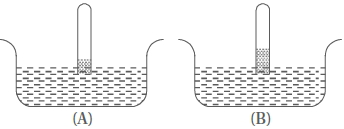
If you are provided with two tubes ($A$ and $B$),where one is narrow and the other is relatively wider,and if both are immersed in a beaker containing water as shown in the figure. Why does $B$ show higher water rise than $A$?
Solution
(N/A) The rise of water in a capillary tube is governed by the principle of capillarity.
According to the formula for capillary rise,$h = \frac{2T \cos \theta}{r \rho g}$,where $h$ is the height of the liquid column,$T$ is the surface tension,$\theta$ is the contact angle,$r$ is the radius of the tube,$\rho$ is the density of the liquid,and $g$ is the acceleration due to gravity.
From this relationship,it is clear that the height of the water column $(h)$ is inversely proportional to the radius of the tube $(r)$,i.e.,$h \propto \frac{1}{r}$.
Since tube $B$ is narrower (has a smaller radius) than tube $A$,the water rises to a greater height in tube $B$ compared to tube $A$ due to stronger capillary action.
According to the formula for capillary rise,$h = \frac{2T \cos \theta}{r \rho g}$,where $h$ is the height of the liquid column,$T$ is the surface tension,$\theta$ is the contact angle,$r$ is the radius of the tube,$\rho$ is the density of the liquid,and $g$ is the acceleration due to gravity.
From this relationship,it is clear that the height of the water column $(h)$ is inversely proportional to the radius of the tube $(r)$,i.e.,$h \propto \frac{1}{r}$.
Since tube $B$ is narrower (has a smaller radius) than tube $A$,the water rises to a greater height in tube $B$ compared to tube $A$ due to stronger capillary action.
0 likes
View Solution69
Easy
Describe the water content in various types of plants.
Solution
(N/A) $\Rightarrow$ $A$ watermelon has over $92$ percent water.
$\Rightarrow$ Most herbaceous plants have only about $10$ to $15$ percent of their fresh weight as dry matter,meaning the rest is water.
$\Rightarrow$ Woody plants have relatively very little water compared to herbaceous plants.
$\Rightarrow$ Soft parts of plants mostly contain water.
$\Rightarrow$ Most herbaceous plants have only about $10$ to $15$ percent of their fresh weight as dry matter,meaning the rest is water.
$\Rightarrow$ Woody plants have relatively very little water compared to herbaceous plants.
$\Rightarrow$ Soft parts of plants mostly contain water.
0 likes
View Solution70
EasyMCQ
Which of the following pathways occurs through the cell wall?
A
Apoplast pathway
B
Vascular pathway
C
Symplast pathway
D
Non-vacuolar pathway
Solution
(A) In the apoplast pathway,water moves from root hairs to the xylem exclusively through the cell wall and intercellular spaces,without crossing any plasma membranes.
The apoplast consists of the non-living parts of the plant,including cell walls and intercellular air spaces,providing a continuous path for water movement.
The apoplast consists of the non-living parts of the plant,including cell walls and intercellular air spaces,providing a continuous path for water movement.
0 likes
View Solution71
EasyMCQ
Which of the following is correct about symplast?
A
Living continuum
B
Cell wall and intercellular space
C
Non-Living continuum
D
None of these
Solution
(A) The symplast pathway is the system of interconnected protoplasts of plant cells.
These protoplasts are connected by cytoplasmic bridges called plasmodesmata.
Since the protoplast is the living part of the cell,the symplast is considered a living continuum.
In contrast,the apoplast consists of non-living parts like cell walls and intercellular spaces.
Therefore,option $(A)$ is correct.
These protoplasts are connected by cytoplasmic bridges called plasmodesmata.
Since the protoplast is the living part of the cell,the symplast is considered a living continuum.
In contrast,the apoplast consists of non-living parts like cell walls and intercellular spaces.
Therefore,option $(A)$ is correct.
0 likes
View Solution72
MediumMCQ
Select the correct statement.
A
Absorption of water by seeds and dry wood are examples of facilitated diffusion.
B
The apoplast is the system of interconnected protoplasts.
C
Pinus seeds cannot germinate and establish without the presence of mycorrhizae.
D
The translocation in phloem is unidirectional,whereas in the xylem it is bidirectional.
Solution
(C) Mycorrhiza is a symbiotic association of a fungus with a root system.
The fungus provides minerals and water to the roots,while the roots provide sugar and $N$-containing compounds to the mycorrhizae.
Some plants have an obligate association with mycorrhizae.
For example,$Pinus$ seeds cannot germinate and establish without the presence of mycorrhizae.
The fungus provides minerals and water to the roots,while the roots provide sugar and $N$-containing compounds to the mycorrhizae.
Some plants have an obligate association with mycorrhizae.
For example,$Pinus$ seeds cannot germinate and establish without the presence of mycorrhizae.
0 likes
View Solution73
EasyMCQ
Water occurring freely in pervious rocks and deep in the soil above the impermeable strata is known as:
A
Ground water
B
Soil water
C
Deep stratum water
D
Hygroscopic water
Solution
(A) The water that is found freely in pervious rocks and deep in the soil is called ground water.
It occurs above the impermeable stratum.
The upper layer of this water is known as the water table.
It occurs above the impermeable stratum.
The upper layer of this water is known as the water table.
0 likes
View Solution74
MediumMCQ
Which one of the following is part of the symplast?
A
Cytoplasm
B
Protoplast
C
Plasmodesmata
D
All of these
Solution
(D) The symplast system is the system of interconnected protoplasts.
Neighboring cells are connected through cytoplasmic strands that extend through the plasmodesmata.
Since the symplast includes the cytoplasm and is connected by plasmodesmata,all the given options are components of the symplastic pathway.
Neighboring cells are connected through cytoplasmic strands that extend through the plasmodesmata.
Since the symplast includes the cytoplasm and is connected by plasmodesmata,all the given options are components of the symplastic pathway.
0 likes
View Solution75
EasyMCQ
In the symplast pathway of water movement,water passes from cell to cell,whose cytoplasm are connected through:
A
Plasma membrane
B
Plasmodesmata
C
Transmembrane
D
Plasmalemma
Solution
(B) In the symplast pathway,the movement of water from soil to xylem channels takes place from cell to cell through the living parts of the plant body.
The cytoplasm of adjacent cells is connected through cytoplasmic bridges known as plasmodesmata.
Therefore,water moves from one cell to the next cell via these connections in the symplast pathway.
The cytoplasm of adjacent cells is connected through cytoplasmic bridges known as plasmodesmata.
Therefore,water moves from one cell to the next cell via these connections in the symplast pathway.
0 likes
View Solution76
MediumMCQ
Which one of the following is not a part of the symplast pathway?
A
Cell wall
B
Plasma membrane
C
Plasmodesmata
D
Cytoplasm
Solution
(A) The symplast pathway consists of the living parts of the plant body,which are connected by plasmodesmata.
It includes the cytoplasm,plasma membrane,and the cytoplasmic bridges known as plasmodesmata.
The cell wall is a non-living component and is part of the apoplast pathway,not the symplast pathway.
It includes the cytoplasm,plasma membrane,and the cytoplasmic bridges known as plasmodesmata.
The cell wall is a non-living component and is part of the apoplast pathway,not the symplast pathway.
0 likes
View Solution77
MediumMCQ
Which of the following affects the rate of diffusion?
A
Concentration gradient
B
Permeability of the membrane
C
Temperature and pressure
D
All of the above
Solution
(D) The process of diffusion is a passive movement of molecules from a region of higher concentration to a region of lower concentration.
Several factors influence the rate of diffusion:
$1$. Concentration gradient: $A$ steeper gradient increases the rate of diffusion.
$2$. Permeability of the membrane: The nature of the membrane separating the two regions determines how easily molecules can pass through.
$3$. Temperature and pressure: Higher temperature increases the kinetic energy of molecules,thereby increasing the rate of diffusion. Similarly,pressure gradients also influence the movement of substances.
Therefore,all the given factors affect the rate of diffusion.
Several factors influence the rate of diffusion:
$1$. Concentration gradient: $A$ steeper gradient increases the rate of diffusion.
$2$. Permeability of the membrane: The nature of the membrane separating the two regions determines how easily molecules can pass through.
$3$. Temperature and pressure: Higher temperature increases the kinetic energy of molecules,thereby increasing the rate of diffusion. Similarly,pressure gradients also influence the movement of substances.
Therefore,all the given factors affect the rate of diffusion.
0 likes
View Solution78
EasyMCQ
Adhesion is caused by
A
Formation of hydrogen bond between water molecules
B
Transpiration pull
C
Higher surface tension
D
Attraction of water molecule to polar surface
Solution
(D) Adhesion refers to the physical attraction between water molecules and the polar surfaces of the tracheary elements (like xylem vessels and tracheids).
This force allows water to stick to the walls of the xylem,preventing the water column from breaking due to gravity.
In contrast,cohesion is the attraction between water molecules themselves due to hydrogen bonding.
Therefore,the attraction of water molecules to polar surfaces is the definition of adhesion.
This force allows water to stick to the walls of the xylem,preventing the water column from breaking due to gravity.
In contrast,cohesion is the attraction between water molecules themselves due to hydrogen bonding.
Therefore,the attraction of water molecules to polar surfaces is the definition of adhesion.
0 likes
View Solution79
MediumMCQ
Choose the correct option regarding the process of diffusion.
A
Diffusion needs $ATP$.
B
Diffusion is an active and rapid process.
C
Diffusion is rapid over short distances but extremely slow over long-distance transport.
D
Diffusion is slow over short distances,but rapid over long-distance transport.
Solution
(C) Diffusion is a passive process,meaning it does not require the expenditure of $ATP$ energy.
It occurs along the concentration gradient,where molecules move randomly from a region of higher concentration to a region of lower concentration.
Diffusion is a slow process and is not dependent on a living system.
Because it relies on random molecular movement,it is effective only over short distances and becomes extremely slow and inefficient for long-distance transport in plants.
It occurs along the concentration gradient,where molecules move randomly from a region of higher concentration to a region of lower concentration.
Diffusion is a slow process and is not dependent on a living system.
Because it relies on random molecular movement,it is effective only over short distances and becomes extremely slow and inefficient for long-distance transport in plants.
0 likes
View Solution80
EasyMCQ
The term $apoplast$ signifies
A
Cell wall,intercellular space and water filled channel
B
Protoplasts interconnected by plasmodesmata
C
Cell wall,cytoplasm and central vacuole
D
None of the above
Solution
(A) The $apoplast$ pathway consists of the non-living parts of the plant body,which include the cell walls and the intercellular spaces.
Water moves through the $apoplast$ by mass flow,driven by the gradient of water potential.
In contrast,the $symplast$ pathway involves the living parts of the plant,such as the protoplasts connected by plasmodesmata.
Water moves through the $apoplast$ by mass flow,driven by the gradient of water potential.
In contrast,the $symplast$ pathway involves the living parts of the plant,such as the protoplasts connected by plasmodesmata.
0 likes
View Solution81
MediumMCQ
How would you differentiate between apoplast and symplast?
A
Apoplast relies on active transport
B
Symplast deals in non-living spaces and cell walls
C
Apoplast prevents passive diffusion
D
Apoplasts deals in non-living spaces and cell walls
Solution
(D) The $Apoplast$ pathway consists of interconnecting cell walls,intercellular spaces,and the cell walls of the endodermis (excluding the $Casparian$ strips),$xylem$,and tracheary elements. This system is considered non-living and is continuous throughout the plant.
The $Symplast$ pathway consists of the living parts of the plant,which are made up of interconnected protoplasts of adjacent cells connected via $plasmodesmata$.
The $Symplast$ pathway consists of the living parts of the plant,which are made up of interconnected protoplasts of adjacent cells connected via $plasmodesmata$.
0 likes
View Solution82
MediumMCQ
Consider the following statements and choose the correct answer from the options given below:
$I$. $A$ dry live seed still contains water.
$II$. $A$ mature maize plant absorbs about $3 \ L$ water per day.
$III$. $A$ mustard plant takes up water equal to its weight in about five hours.
$IV$. Water is not considered as the limiting factor for plant growth and productivity.
$I$. $A$ dry live seed still contains water.
$II$. $A$ mature maize plant absorbs about $3 \ L$ water per day.
$III$. $A$ mustard plant takes up water equal to its weight in about five hours.
$IV$. Water is not considered as the limiting factor for plant growth and productivity.
A
$I, II, III$ and $IV$
B
$IV$ and $II$
C
$I, II$ and $III$
D
Only $IV$
Solution
(C) Statement $I$ is correct: $A$ dry live seed still contains $10-15 \%$ water by weight.
Statement $II$ is correct: $A$ mature maize plant absorbs about $3 \ L$ of water in a day.
Statement $III$ is correct: $A$ mustard plant absorbs water equal to its own weight in about $5$ hours.
Statement $IV$ is incorrect: Water is a critical limiting factor for plant growth and productivity in both agricultural and natural environments.
Therefore,statements $I, II,$ and $III$ are correct.
Statement $II$ is correct: $A$ mature maize plant absorbs about $3 \ L$ of water in a day.
Statement $III$ is correct: $A$ mustard plant absorbs water equal to its own weight in about $5$ hours.
Statement $IV$ is incorrect: Water is a critical limiting factor for plant growth and productivity in both agricultural and natural environments.
Therefore,statements $I, II,$ and $III$ are correct.
0 likes
View Solution83
EasyMCQ
Short distance transport of substances like nutrients,water,etc.,in plants occurs through:
A
Diffusion
B
Cytoplasmic streaming supplemented by active transport
C
Both $(a)$ and $(b)$
D
Passive transport only
Solution
(C) In plants,the short-distance transport of substances such as gases,water,minerals,hormones,and nutrients occurs through two primary mechanisms:
$1$. Diffusion: This is a passive process where molecules move from a region of higher concentration to a region of lower concentration.
$2$. Cytoplasmic streaming: This is the movement of the fluid substance (cytoplasm) within a plant cell,which is often supplemented by active transport to move substances across membranes against the concentration gradient.
Therefore,both diffusion and cytoplasmic streaming (supplemented by active transport) are involved in short-distance transport.
$1$. Diffusion: This is a passive process where molecules move from a region of higher concentration to a region of lower concentration.
$2$. Cytoplasmic streaming: This is the movement of the fluid substance (cytoplasm) within a plant cell,which is often supplemented by active transport to move substances across membranes against the concentration gradient.
Therefore,both diffusion and cytoplasmic streaming (supplemented by active transport) are involved in short-distance transport.
0 likes
View Solution84
EasyMCQ
Diffusion is a ..................... process and is not dependent on .....................
A
Slow,gradient of concentration
B
Slow,living system
C
Rapid,temperature
D
Rapid,pressure
Solution
(B) Diffusion is a slow process because it involves the movement of particles from a region of higher concentration to a region of lower concentration without the expenditure of energy. It is a passive process and does not require any living system or carrier proteins to facilitate the movement of molecules.
0 likes
View Solution85
MediumMCQ
Diffusion rates are affected by
A
Pressure
B
Temperature
C
Concentration gradient
D
All of these
Solution
(D) Diffusion is a passive process of movement of molecules from a region of higher concentration to a region of lower concentration.
Factors affecting the rate of diffusion include:
$1$. Concentration gradient: $A$ steeper gradient increases the rate of diffusion.
$2$. Temperature: Higher temperature increases the kinetic energy of molecules,thereby increasing the rate of diffusion.
$3$. Pressure: Changes in pressure can influence the movement of particles.
$4$. Density of the diffusing substance: Diffusion is inversely proportional to the square root of the density of the gas.
Therefore,all the given factors affect the rate of diffusion.
Factors affecting the rate of diffusion include:
$1$. Concentration gradient: $A$ steeper gradient increases the rate of diffusion.
$2$. Temperature: Higher temperature increases the kinetic energy of molecules,thereby increasing the rate of diffusion.
$3$. Pressure: Changes in pressure can influence the movement of particles.
$4$. Density of the diffusing substance: Diffusion is inversely proportional to the square root of the density of the gas.
Therefore,all the given factors affect the rate of diffusion.
0 likes
View Solution86
MediumMCQ
Symplast pathway of water in plants is not related to
A
Vacuolar path
B
Cytoplasm
C
Plasmodesmata
D
Cell wall
Solution
(D) The $Symplast$ pathway is the system of interconnected protoplasts.
It involves the movement of water through the cytoplasm and plasmodesmata, which are living components of the cell.
The $Cell wall$ is a non-living component and is associated with the $Apoplast$ pathway, not the $Symplast$ pathway.
It involves the movement of water through the cytoplasm and plasmodesmata, which are living components of the cell.
The $Cell wall$ is a non-living component and is associated with the $Apoplast$ pathway, not the $Symplast$ pathway.
0 likes
View Solution87
MediumMCQ
The term 'outer space' represents ...$A$...,while 'inner space' represents ...$B$... with reference to absorption of minerals. Identify $A$ and $B$ to complete the given statement.
A
$A-$ cytoplasm and vacuole,$B-$ intercellular space and cell
B
$A-$ intercellular space and cell wall,$B-$ cytoplasm and vacuole
C
$A-$ cytoplasm,$B-$ vacuole
D
$A-$ intercellular space,$B-$ vacuole
Solution
(B) In the context of mineral absorption in plants,the pathway of water and minerals is divided into two spaces:
$1$. The 'outer space' or apoplast pathway consists of the non-living parts of the plant,specifically the intercellular spaces and the cell walls.
$2$. The 'inner space' or symplast pathway consists of the living parts of the plant,specifically the cytoplasm and the vacuole.
Therefore,$A$ represents the intercellular space and cell wall,and $B$ represents the cytoplasm and vacuole.
$1$. The 'outer space' or apoplast pathway consists of the non-living parts of the plant,specifically the intercellular spaces and the cell walls.
$2$. The 'inner space' or symplast pathway consists of the living parts of the plant,specifically the cytoplasm and the vacuole.
Therefore,$A$ represents the intercellular space and cell wall,and $B$ represents the cytoplasm and vacuole.
0 likes
View Solution88
MediumMCQ
Which of the following is not a function of water in plants?
A
It is responsible for cell elongation
B
It maintains the turgidity of cells
C
It acts as a source of energy
D
It provides medium for enzymatic activities
Solution
(C) Water is essential for plant life,but it does not act as a source of energy.
It is responsible for cell elongation by maintaining turgor pressure.
It maintains the turgidity of cells,which is necessary for the structural support of non-woody plants.
It provides an aqueous medium for various enzymatic and metabolic activities to occur within the cell.
It is responsible for cell elongation by maintaining turgor pressure.
It maintains the turgidity of cells,which is necessary for the structural support of non-woody plants.
It provides an aqueous medium for various enzymatic and metabolic activities to occur within the cell.
0 likes
View Solution89
Medium
What is the chemical composition of xylem and phloem sap?
Solution
(N/A) $\Rightarrow$ Xylem sap primarily consists of water and dissolved mineral nutrients absorbed from the soil.
$\Rightarrow$ Phloem sap primarily consists of sucrose,which is a disaccharide. Additionally,it contains various hormones,amino acids,and other organic solutes transported from source to sink.
$\Rightarrow$ Phloem sap primarily consists of sucrose,which is a disaccharide. Additionally,it contains various hormones,amino acids,and other organic solutes transported from source to sink.
0 likes
View Solution90
MediumMCQ
Which of the following statements regarding transport in plants is incorrect?
A
Plants need to move molecules over much longer distances than animals.
B
Plants possess a complex transport system.
C
Water absorbed by the roots reaches all parts of the plant,including the growing tips of the stem.
D
Products of photosynthesis produced by leaves reach all parts of the plant,including the root tips deep in the soil.
Solution
(B) The correct answer is $B$.
Plants do not possess a complex transport system like the circulatory system found in animals.
In plants,transport occurs through specialized tissues called $Xylem$ (for water and minerals) and $Phloem$ (for organic nutrients),but they lack a central pumping organ like a heart.
Statement $A$ is correct because plants often have to transport substances over very long distances (e.g.,from roots to the top of tall trees).
Statement $C$ is correct as water is transported from roots to all aerial parts.
Statement $D$ is correct as photosynthetic products are translocated from leaves to all parts,including roots.
Plants do not possess a complex transport system like the circulatory system found in animals.
In plants,transport occurs through specialized tissues called $Xylem$ (for water and minerals) and $Phloem$ (for organic nutrients),but they lack a central pumping organ like a heart.
Statement $A$ is correct because plants often have to transport substances over very long distances (e.g.,from roots to the top of tall trees).
Statement $C$ is correct as water is transported from roots to all aerial parts.
Statement $D$ is correct as photosynthetic products are translocated from leaves to all parts,including roots.
0 likes
View Solution91
MediumMCQ
Select the correct option for transport in plants regarding multidirectional and unidirectional transport.
A
Organic nutrients,mineral elements; Hormones,water
B
Organic nutrients,hormones; Water,mineral elements
C
Water,mineral elements; Organic nutrients,hormones
D
Water,hormones; Organic nutrients,mineral elements
Solution
(C) In plants,the transport of water and mineral elements from the roots to the aerial parts is primarily unidirectional (upward).
Conversely,the transport of organic nutrients (synthesized in leaves) and hormones is multidirectional,as they need to be distributed to various parts of the plant including roots,fruits,and developing buds.
Therefore,the correct sequence is: Water and mineral elements (unidirectional) and organic nutrients and hormones (multidirectional).
Conversely,the transport of organic nutrients (synthesized in leaves) and hormones is multidirectional,as they need to be distributed to various parts of the plant including roots,fruits,and developing buds.
Therefore,the correct sequence is: Water and mineral elements (unidirectional) and organic nutrients and hormones (multidirectional).
0 likes
View Solution92
MediumMCQ
Which of the following statements are true for diffusion?
$I-$ It is a short-distance or passive transport.
$II -$ It can occur in any direction from the intercellular space of leaves to the external environment.
$III -$ Energy is expended.
$IV -$ Molecules move from a region of lower concentration to a region of higher concentration.
$V -$ Diffusion is a slow process and is not dependent on a living system.
$VI -$ Diffusion is obvious in gases and liquids,but diffusion in solids is more likely rather than of solids.
$I-$ It is a short-distance or passive transport.
$II -$ It can occur in any direction from the intercellular space of leaves to the external environment.
$III -$ Energy is expended.
$IV -$ Molecules move from a region of lower concentration to a region of higher concentration.
$V -$ Diffusion is a slow process and is not dependent on a living system.
$VI -$ Diffusion is obvious in gases and liquids,but diffusion in solids is more likely rather than of solids.
A
$I, II, III, IV, V, VI$
B
$I, II, V, VI$
C
$I, II, IV, V, VI$
D
$I, II, III, IV$
Solution
(B) Diffusion is a passive process,meaning it does not require the expenditure of metabolic energy $(ATP)$.
Statement $I$ is true: It is a passive transport process typically occurring over short distances.
Statement $II$ is true: Diffusion is a random movement of molecules and can occur in any direction depending on the concentration gradient.
Statement $III$ is false: Diffusion is a passive process and does not require energy.
Statement $IV$ is false: Diffusion occurs from a region of higher concentration to a region of lower concentration.
Statement $V$ is true: It is a slow process and does not depend on a living system.
Statement $VI$ is true: Diffusion is very common in gases and liquids,while in solids,it is much slower and limited.
Therefore,the correct statements are $I, II, V,$ and $VI$.
Statement $I$ is true: It is a passive transport process typically occurring over short distances.
Statement $II$ is true: Diffusion is a random movement of molecules and can occur in any direction depending on the concentration gradient.
Statement $III$ is false: Diffusion is a passive process and does not require energy.
Statement $IV$ is false: Diffusion occurs from a region of higher concentration to a region of lower concentration.
Statement $V$ is true: It is a slow process and does not depend on a living system.
Statement $VI$ is true: Diffusion is very common in gases and liquids,while in solids,it is much slower and limited.
Therefore,the correct statements are $I, II, V,$ and $VI$.
0 likes
View Solution93
MediumMCQ
What are the types and functions of aquaporins?
A
Eight types,transport small-sized proteins.
B
Six types,transport water.
C
Eight types,transport water.
D
Six types,transport small-sized proteins.
Solution
(C) Aquaporins are integral membrane proteins that serve as channels in the transfer of water and,in some cases,small solutes across the membrane. They are known to exist in at least $8$ different types in plants. Their primary function is to facilitate the rapid transport of water molecules across the cell membrane,which is essential for maintaining cellular turgor and physiological processes. Therefore,the correct option is $C$.
0 likes
View Solution94
EasyMCQ
What is the water content in a watermelon?
A
$85-90\%$
B
$92\%$ or more
C
$98\%$
D
$65\%$ or less
Solution
(B) Water is essential for all physiological activities of plants and plays a very important role in all living organisms.
Most herbaceous plants have only about $10-15\%$ of their fresh weight as dry matter.
Of the remaining,most of the water is present.
$A$ watermelon has over $92\%$ water,while most herbaceous plants have only about $10-15\%$ of their fresh weight as dry matter.
Most herbaceous plants have only about $10-15\%$ of their fresh weight as dry matter.
Of the remaining,most of the water is present.
$A$ watermelon has over $92\%$ water,while most herbaceous plants have only about $10-15\%$ of their fresh weight as dry matter.
0 likes
View Solution95
EasyMCQ
Select the incorrect statement regarding water.
A
Dry seeds do not contain any water.
B
In protoplasm,thousands of molecules are dissolved and suspended in water.
C
Woody parts have less water content,while soft parts have higher water content.
D
Water is essential for all physiological activities and plays a crucial role for all living organisms.
Solution
(A) The correct answer is $A$. Dry seeds are not completely devoid of water; they contain a small amount of water,which is necessary to maintain the viability of the embryo. If they had zero water,the metabolic processes required for germination would not be possible upon rehydration. All other statements are biologically correct: protoplasm is an aqueous medium,woody tissues are dehydrated compared to succulent tissues,and water is the universal solvent essential for life.
0 likes
View Solution96
MediumMCQ
Select the incorrect option regarding diffusion.
A
Long-distance transport of substances occurs through diffusion.
B
Diffusion is a slow process.
C
Diffusion occurs along the concentration gradient.
D
Diffusion does not require energy expenditure.
Solution
$(A)$ Diffusion is a passive process where molecules move from a region of higher concentration to a region of lower concentration.
$1$. It is a slow process and is not dependent on a living system.
$2$. It occurs along the concentration gradient and does not require energy $(ATP)$.
$3$. However, diffusion is only effective for short distances. Long-distance transport of substances in plants is carried out by the vascular system $(xylem$ and $phloem)$ through mass flow or bulk flow, not by diffusion.
Therefore, the statement that long-distance transport occurs through diffusion is incorrect.
$1$. It is a slow process and is not dependent on a living system.
$2$. It occurs along the concentration gradient and does not require energy $(ATP)$.
$3$. However, diffusion is only effective for short distances. Long-distance transport of substances in plants is carried out by the vascular system $(xylem$ and $phloem)$ through mass flow or bulk flow, not by diffusion.
Therefore, the statement that long-distance transport occurs through diffusion is incorrect.
0 likes
View Solution97
MediumMCQ
Select the correct statement$(s)$ regarding bulk flow.
$I-$ In tall plants,water,minerals,and food are moved by a bulk flow system.
$II-$ This type of movement is achieved through a pressure difference between two points.
$III-$ In bulk flow,substances,whether in solution or suspension,move at the same pace as in a flowing river.
$IV-$ This process is similar to diffusion.
$I-$ In tall plants,water,minerals,and food are moved by a bulk flow system.
$II-$ This type of movement is achieved through a pressure difference between two points.
$III-$ In bulk flow,substances,whether in solution or suspension,move at the same pace as in a flowing river.
$IV-$ This process is similar to diffusion.
A
$I, II, III, IV$
B
$I, II, III$
C
$II, III, IV$
D
$II, III$
Solution
(B) Bulk flow (or mass flow) is the movement of substances in bulk from one point to another as a result of pressure differences between the two points.
It is a characteristic of long-distance transport in plants,such as the translocation of water,minerals,and food in tall plants.
In bulk flow,all substances (whether in solution or suspension) move at the same pace,similar to the flow of a river.
Bulk flow is different from diffusion; diffusion is a slow process and is not dependent on a pressure gradient,whereas bulk flow is a faster process driven by pressure differences.
Therefore,statements $I, II,$ and $III$ are correct,while statement $IV$ is incorrect.
It is a characteristic of long-distance transport in plants,such as the translocation of water,minerals,and food in tall plants.
In bulk flow,all substances (whether in solution or suspension) move at the same pace,similar to the flow of a river.
Bulk flow is different from diffusion; diffusion is a slow process and is not dependent on a pressure gradient,whereas bulk flow is a faster process driven by pressure differences.
Therefore,statements $I, II,$ and $III$ are correct,while statement $IV$ is incorrect.
0 likes
View Solution98
EasyMCQ
Which pathway involves the movement of water through the intercellular spaces?
A
Apoplast pathway
B
Symplast pathway
C
Vacuolar pathway
D
All of the above
Solution
(A) The $Apoplast$ pathway is the system of adjacent cell walls that is continuous throughout the plant,except at the $Casparian$ strips of the endodermis in the roots.
Water moves through the intercellular spaces and the walls of the cells in this pathway.
It does not involve crossing any cell membranes,allowing for passive and rapid movement of water.
Therefore,the correct option is $A$.
Water moves through the intercellular spaces and the walls of the cells in this pathway.
It does not involve crossing any cell membranes,allowing for passive and rapid movement of water.
Therefore,the correct option is $A$.
0 likes
View Solution99
MediumMCQ
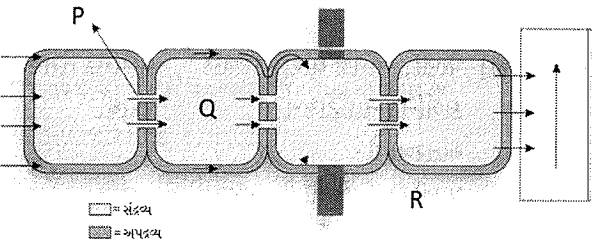
The following figure shows the pathway of transport in the root. What are $P, Q,$ and $R$?
A
Plasmodesmata,Pericycle,Casparian strip
B
Plasmodesmata,Cortex,Casparian strip
C
Middle lamella,Cortex,Xylem
D
Middle lamella,Pericycle,Xylem
Solution
(B) In the given diagram of the root pathway,the transport of water occurs through symplastic and apoplastic pathways.
$P$ represents the plasmodesmata,which are channels that traverse the cell walls of plant cells and some algal cells,allowing transport and communication between them.
$Q$ represents the cortex,which is the region between the epidermis and the vascular cylinder.
$R$ represents the Casparian strip,which is a band of cell wall material deposited in the radial and transverse walls of the endodermis,and is chemically different from the rest of the cell wall.
$P$ represents the plasmodesmata,which are channels that traverse the cell walls of plant cells and some algal cells,allowing transport and communication between them.
$Q$ represents the cortex,which is the region between the epidermis and the vascular cylinder.
$R$ represents the Casparian strip,which is a band of cell wall material deposited in the radial and transverse walls of the endodermis,and is chemically different from the rest of the cell wall.
0 likes
View Solution100
MediumMCQ
Read the following statements and identify the statements for Apoplast and Symplast pathways.
$I -$ Water movement occurs through plasmodesmata.
$II -$ Bulk flow of water occurs due to adhesive and cohesive forces.
$III -$ Water movement occurs through cell walls.
$IV -$ Transmembrane movement occurs near the Casparian strip.
$V -$ Water movement occurs through the cytoplasm.
$VI -$ Movement is relatively faster.
$VII -$ Water movement occurs through intercellular spaces.
Identify the Apoplast and Symplast pathways respectively.
$I -$ Water movement occurs through plasmodesmata.
$II -$ Bulk flow of water occurs due to adhesive and cohesive forces.
$III -$ Water movement occurs through cell walls.
$IV -$ Transmembrane movement occurs near the Casparian strip.
$V -$ Water movement occurs through the cytoplasm.
$VI -$ Movement is relatively faster.
$VII -$ Water movement occurs through intercellular spaces.
Identify the Apoplast and Symplast pathways respectively.
A
$II, III, IV, VI, VII$ and $I, V$
B
$I, V$ and $II, III, IV, VI, VII$
C
$III, VI, VII$ and $I, II, IV, V$
D
$I, II, IV, V$ and $III, VI, VII$
Solution
(C) The Apoplast pathway consists of the non-living parts of the plant,such as cell walls and intercellular spaces. It is continuous throughout the plant except at the Casparian strips of the endodermis in roots. It allows for relatively faster movement of water.
- Statement $III$ (Cell walls) belongs to Apoplast.
- Statement $VI$ (Faster movement) is a characteristic of Apoplast.
- Statement $VII$ (Intercellular spaces) belongs to Apoplast.
The Symplast pathway consists of the living parts of the plant,connected by plasmodesmata. Water moves through the cytoplasm.
- Statement $I$ (Plasmodesmata) belongs to Symplast.
- Statement $V$ (Cytoplasm) belongs to Symplast.
Statement $II$ (Adhesive and cohesive forces) and $IV$ (Transmembrane movement) are general features of water transport mechanisms. Based on the standard classification,the correct grouping is $III, VI, VII$ for Apoplast and $I, V$ for Symplast.
- Statement $III$ (Cell walls) belongs to Apoplast.
- Statement $VI$ (Faster movement) is a characteristic of Apoplast.
- Statement $VII$ (Intercellular spaces) belongs to Apoplast.
The Symplast pathway consists of the living parts of the plant,connected by plasmodesmata. Water moves through the cytoplasm.
- Statement $I$ (Plasmodesmata) belongs to Symplast.
- Statement $V$ (Cytoplasm) belongs to Symplast.
Statement $II$ (Adhesive and cohesive forces) and $IV$ (Transmembrane movement) are general features of water transport mechanisms. Based on the standard classification,the correct grouping is $III, VI, VII$ for Apoplast and $I, V$ for Symplast.
0 likes
View SolutionTransport in Plants — General · Frequently Asked Questions
1Are these Transport in Plants questions useful for JEE and NEET?
Yes. All questions in this section are mapped to JEE Main and NEET exam patterns. Previous year questions from JEE Main, NEET, GUJCET and state-level exams are included with full solutions.
2Can I switch to Hindi or Gujarati for these questions?
Yes. Use the language tabs in the hero section or the sidebar to view the same questions and solutions in English, Hindi or Gujarati.
3How do I generate a question paper from this subtopic?
Use the Vedclass Exam Paper Generator — select the chapter and subtopic, set difficulty, and generate Sets A, B, C, D automatically. First 3 chapters of every subject are free.
Vedclass Products
For Students
Vedclass Test Series
Mock tests in real JEE/NEET style with performance analysis. 5-day free trial.
Start Free TrialFor Teachers
Exam Paper Generator
Generate Set A/B/C/D papers from this chapter in 2 minutes. 3 chapters free.
Try FreeFor Institutes
Online Exam Module
Live online exams with unlimited students, 360° analytics & white-label branding.
See DemoFor Teachers & Institutes
Generate a Transport in Plants Exam Paper in 2 Minutes
Select subtopic & difficulty — Sets A, B, C, D auto-generated with No Repeat logic.
First 3 chapters of every subject are free — no payment required.