
A English
Mix Examples-The Living World Questions in English
Class 11 Biology · The Living World · Mix Examples-The Living World
88+
Questions
English
Language
100%
With Solutions
Showing 38 of 88 questions in English
51
MediumMCQ
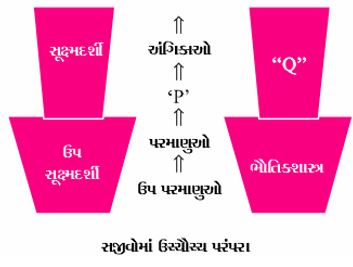
What do the parts labeled $P$ and $Q$ represent in the given figure?
A
Organism,Biochemistry
B
Vision,Biochemistry
C
Molecules,Biochemistry
D
Cell,Cell Biology
Solution
(C) The figure illustrates the hierarchy of biological organization in relation to scientific disciplines.
In the biological hierarchy,after atoms,the next level of organization is molecules.
Therefore,$P$ represents 'Molecules'.
The discipline that studies the chemical processes within and relating to living organisms is known as 'Biochemistry'.
Therefore,$Q$ represents 'Biochemistry'.
Thus,the correct answer is $C$.
In the biological hierarchy,after atoms,the next level of organization is molecules.
Therefore,$P$ represents 'Molecules'.
The discipline that studies the chemical processes within and relating to living organisms is known as 'Biochemistry'.
Therefore,$Q$ represents 'Biochemistry'.
Thus,the correct answer is $C$.
0 likes
View Solution52
MediumMCQ
Based on the levels of organization in biological sciences,what does the part marked '$P$' represent?

A
Physiology
B
Genetics
C
Cell Biology
D
Embryology
Solution
(C) The hierarchy of biological organization typically progresses from smaller,more fundamental units to larger,more complex systems.
In the provided diagram,the sequence represents: Physics $\rightarrow$ Biochemistry $\rightarrow$ Cell Biology ('$P$') $\rightarrow$ Biology (Organismal/General) $\rightarrow$ Ecology.
Cell Biology is the study of the cell as a complete unit,which bridges the gap between biochemical processes and the functioning of the whole organism. Therefore,'$P$' represents Cell Biology.
In the provided diagram,the sequence represents: Physics $\rightarrow$ Biochemistry $\rightarrow$ Cell Biology ('$P$') $\rightarrow$ Biology (Organismal/General) $\rightarrow$ Ecology.
Cell Biology is the study of the cell as a complete unit,which bridges the gap between biochemical processes and the functioning of the whole organism. Therefore,'$P$' represents Cell Biology.
0 likes
View Solution53
MediumMCQ
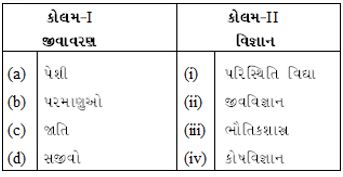
Match the items in Column-$I$ with those in Column-$II$:
| Column-$I$ (Subject) | Column-$II$ (Science) |
| :--- | :--- |
| $(a)$ Tissue | $(i)$ Ecology |
| $(b)$ Atoms | (ii) Biology |
| $(c)$ Species | (iii) Physics |
| $(d)$ Organisms | (iv) Cytology |
| Column-$I$ (Subject) | Column-$II$ (Science) |
| :--- | :--- |
| $(a)$ Tissue | $(i)$ Ecology |
| $(b)$ Atoms | (ii) Biology |
| $(c)$ Species | (iii) Physics |
| $(d)$ Organisms | (iv) Cytology |
A
$(a)-(iv); (b)-(iii); (c)-(i); (d)-(ii)$
B
$(a)-(iv); (b)-(iii); (c)-(ii); (d)-(i)$
C
$(a)-(iii); (b)-(iv); (c)-(i); (d)-(ii)$
D
$(a)-(ii); (b)-(i); (c)-(iii); (d)-(iv)$
Solution
(A) The correct matches are as follows:
$(a)$ Tissue is studied under Cytology/Histology (here,Cytology is the closest match among options,as it deals with cellular structures).
$(b)$ Atoms are the fundamental units studied in Physics (and Chemistry).
$(c)$ Species is a fundamental unit of classification studied in Biology (specifically Taxonomy/Ecology contexts).
$(d)$ Organisms are studied in Ecology (the study of organisms and their environment).
Matching:
$(a)$ Tissue $\rightarrow$ (iv) Cytology
$(b)$ Atoms $\rightarrow$ (iii) Physics
$(c)$ Species $\rightarrow$ $(i)$ Ecology
$(d)$ Organisms $\rightarrow$ (ii) Biology
Therefore,the correct sequence is $(a)-(iv); (b)-(iii); (c)-(i); (d)-(ii)$.
$(a)$ Tissue is studied under Cytology/Histology (here,Cytology is the closest match among options,as it deals with cellular structures).
$(b)$ Atoms are the fundamental units studied in Physics (and Chemistry).
$(c)$ Species is a fundamental unit of classification studied in Biology (specifically Taxonomy/Ecology contexts).
$(d)$ Organisms are studied in Ecology (the study of organisms and their environment).
Matching:
$(a)$ Tissue $\rightarrow$ (iv) Cytology
$(b)$ Atoms $\rightarrow$ (iii) Physics
$(c)$ Species $\rightarrow$ $(i)$ Ecology
$(d)$ Organisms $\rightarrow$ (ii) Biology
Therefore,the correct sequence is $(a)-(iv); (b)-(iii); (c)-(i); (d)-(ii)$.
0 likes
View Solution54
MediumMCQ
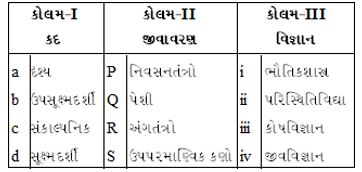
Match the following columns and select the correct option based on the levels of biological organization and their corresponding scientific fields:
| Column-$I$ (Scale) | Column-$II$ (Biological Level) | Column-$III$ (Science) |
|---|---|---|
| a. Macroscopic | $P$. Ecosystems | i. Physics |
| b. Submicroscopic | $Q$. Tissues | ii. Ecology |
| c. Conceptual | $R$. Organ systems | iii. Cytology |
| d. Microscopic | $S$. Subatomic particles | iv. Biology |
A
(a - $R$ - iv); (b - $P$ - i); (c - $S$ - ii); (d - $Q$ - iii)
B
(a - $R$ - iv); (b - $S$ - i); (c - $P$ - ii); (d - $Q$ - iii)
C
(a - $R$ - iv); (b - $S$ - i); (c - $P$ - iii); (d - $Q$ - ii)
D
(a - $Q$ - iv); (b - $P$ - iii); (c - $R$ - ii); (d - $S$ - i)
Solution
(B) The correct matching is as follows:
$1$. Macroscopic $(a)$ refers to the level of Organ systems $(R)$,which is studied under Biology (iv).
$2$. Submicroscopic $(b)$ refers to the level of Subatomic particles $(S)$,which is studied under Physics $(i)$.
$3$. Conceptual $(c)$ refers to the level of Ecosystems $(P)$,which is studied under Ecology (ii).
$4$. Microscopic $(d)$ refers to the level of Tissues $(Q)$,which is studied under Cytology (iii).
Therefore,the correct sequence is (a - $R$ - iv); (b - $S$ - i); (c - $P$ - ii); (d - $Q$ - iii).
$1$. Macroscopic $(a)$ refers to the level of Organ systems $(R)$,which is studied under Biology (iv).
$2$. Submicroscopic $(b)$ refers to the level of Subatomic particles $(S)$,which is studied under Physics $(i)$.
$3$. Conceptual $(c)$ refers to the level of Ecosystems $(P)$,which is studied under Ecology (ii).
$4$. Microscopic $(d)$ refers to the level of Tissues $(Q)$,which is studied under Cytology (iii).
Therefore,the correct sequence is (a - $R$ - iv); (b - $S$ - i); (c - $P$ - ii); (d - $Q$ - iii).
0 likes
View Solution55
MediumMCQ
Classification and identification of living organisms are not necessary for which of the following?
A
Agriculture
B
Forestry
C
Industries
D
Pollution
Solution
(D) Classification and identification of living organisms are essential for understanding biodiversity and utilizing resources effectively in fields like agriculture (for crop improvement),forestry (for timber and conservation),and industries (for raw materials like medicinal plants,fibers,etc.).
Pollution is an environmental phenomenon caused by the introduction of harmful materials into the environment. While identifying pollutants is important,the classification of living organisms themselves is not a prerequisite for the study or management of pollution in the same direct manner as it is for the biological resource-based sectors.
Pollution is an environmental phenomenon caused by the introduction of harmful materials into the environment. While identifying pollutants is important,the classification of living organisms themselves is not a prerequisite for the study or management of pollution in the same direct manner as it is for the biological resource-based sectors.
0 likes
View Solution56
MediumMCQ
Which of the following is required for both laboratory and field studies?
A
Isolation of the organism
B
Classification of the organism
C
Identification of the organism
D
Both $(B)$ and $(C)$
Solution
(D) For any scientific study,whether in the laboratory or in the field,it is essential to first identify the organism correctly to know what is being studied.
Once identified,the organism must be classified into its respective taxonomic group to understand its relationships with other organisms.
Therefore,both identification and classification are fundamental requirements for biological studies.
Once identified,the organism must be classified into its respective taxonomic group to understand its relationships with other organisms.
Therefore,both identification and classification are fundamental requirements for biological studies.
0 likes
View Solution57
EasyMCQ
Which city is home to the famous Indian Museum?
A
Mumbai
B
Chennai
C
Kolkata
D
Vadodara
Solution
(C) The Indian Museum is one of the oldest and largest museums in India,located in Kolkata,West Bengal. It was founded in $1814$ by the Asiatic Society of Bengal. It is a significant institution for the study of natural history and culture.
0 likes
View Solution58
MediumMCQ
Which statement is correct regarding the study of the classification of organisms?
A
It is necessary for laboratory and field studies.
B
It is necessary for agriculture and forestry.
C
It is necessary for understanding the diversity of organisms and biological resources.
D
All of the above $(A), (B),$ and $(C)$.
Solution
(D) The classification of organisms is a fundamental aspect of biology.
$1$. It is essential for laboratory and field studies to identify and categorize species correctly.
$2$. It is crucial for applied sciences like agriculture and forestry to manage crops and forest resources effectively.
$3$. It provides a systematic understanding of the vast diversity of organisms and helps in the conservation and utilization of biological resources.
Therefore,all the given statements are correct.
$1$. It is essential for laboratory and field studies to identify and categorize species correctly.
$2$. It is crucial for applied sciences like agriculture and forestry to manage crops and forest resources effectively.
$3$. It provides a systematic understanding of the vast diversity of organisms and helps in the conservation and utilization of biological resources.
Therefore,all the given statements are correct.
0 likes
View Solution59
MediumMCQ
Statement $X$: The study of classification is necessary for the identification and study of organisms.
Statement $Y$: Organisms exhibit diversity in terms of structure,function,and behavior.
Statement $Y$: Organisms exhibit diversity in terms of structure,function,and behavior.
A
Statement $-X$ is true,Statement $-Y$ is the correct reason for it.
B
Statement $-X$ is false,Statement $-Y$ is the correct reason for it.
C
Statement $-X$ is false,Statement $-Y$ is not the correct reason for it.
D
Statement $-X$ is true,but Statement $-Y$ is not the correct reason for it.
Solution
(A) Statement $X$ is true because classification provides a systematic way to identify and organize the vast diversity of life forms,making their study manageable.
Statement $Y$ is also true because organisms vary significantly in their morphology (structure),physiology (function),and behavioral patterns.
Since the immense diversity of organisms (Statement $Y$) makes it impossible to study each one individually,classification becomes essential to group them based on similarities and differences (Statement $X$).
Therefore,Statement $Y$ is the correct reason for Statement $X$.
Statement $Y$ is also true because organisms vary significantly in their morphology (structure),physiology (function),and behavioral patterns.
Since the immense diversity of organisms (Statement $Y$) makes it impossible to study each one individually,classification becomes essential to group them based on similarities and differences (Statement $X$).
Therefore,Statement $Y$ is the correct reason for Statement $X$.
0 likes
View Solution60
MediumMCQ
Why is the study of taxonomy performed?
A
For the classification and identification of organisms
B
To determine the interrelationships between organisms
C
For laboratory and field studies
D
All of the above
Solution
(D) Taxonomy is a branch of biology that deals with the characterization,identification,nomenclature,and classification of organisms.
$1$. Identification and classification are the primary goals of taxonomy to organize the vast diversity of life.
$2$. It helps in understanding the evolutionary and phylogenetic relationships between different organisms.
$3$. Taxonomic studies are essential for both laboratory research and field studies to document biodiversity.
Therefore,all the given options are correct reasons for performing taxonomic studies.
$1$. Identification and classification are the primary goals of taxonomy to organize the vast diversity of life.
$2$. It helps in understanding the evolutionary and phylogenetic relationships between different organisms.
$3$. Taxonomic studies are essential for both laboratory research and field studies to document biodiversity.
Therefore,all the given options are correct reasons for performing taxonomic studies.
0 likes
View Solution61
MediumMCQ
Classification helps in:
A
Conserving endangered organisms
B
Understanding the interrelationships between organisms
C
Studying biodiversity
D
All of the above
Solution
(D) Classification is the process of grouping organisms into categories based on their similarities and differences.
$1$. It helps in identifying and studying the vast diversity of life (biodiversity).
$2$. It reveals the evolutionary and ecological interrelationships between different groups of organisms.
$3$. By identifying and categorizing species,it provides a framework for conservation efforts,helping to protect endangered organisms.
Therefore,all the given options are correct.
$1$. It helps in identifying and studying the vast diversity of life (biodiversity).
$2$. It reveals the evolutionary and ecological interrelationships between different groups of organisms.
$3$. By identifying and categorizing species,it provides a framework for conservation efforts,helping to protect endangered organisms.
Therefore,all the given options are correct.
0 likes
View Solution62
MediumMCQ
The study of which of the following can be used for the conservation of endangered and extinct organisms?
A
Nomenclature
B
Identification
C
Taxonomy
D
All of the above
Solution
(D) Taxonomy is the branch of science that deals with the classification,identification,and nomenclature of organisms.
By studying taxonomy,scientists can categorize organisms,understand their evolutionary relationships,and identify their ecological roles.
This systematic knowledge is essential for identifying endangered species,understanding their habitat requirements,and implementing effective conservation strategies to prevent extinction.
By studying taxonomy,scientists can categorize organisms,understand their evolutionary relationships,and identify their ecological roles.
This systematic knowledge is essential for identifying endangered species,understanding their habitat requirements,and implementing effective conservation strategies to prevent extinction.
0 likes
View Solution63
MediumMCQ
Study the four statements $(A-D)$ given below and select the two correct ones out of them.
$A.$ Definition of biological species was given by Ernst Mayr.
$B.$ Photoperiod does not affect reproduction in plants.
$C.$ Binomial nomenclature system was given by $R$.$H$. Whittaker.
$D.$ In unicellular organisms,reproduction is synonymous with growth.
The two correct statements are:
$A.$ Definition of biological species was given by Ernst Mayr.
$B.$ Photoperiod does not affect reproduction in plants.
$C.$ Binomial nomenclature system was given by $R$.$H$. Whittaker.
$D.$ In unicellular organisms,reproduction is synonymous with growth.
The two correct statements are:
A
$B$ and $C$
B
$C$ and $D$
C
$A$ and $D$
D
$A$ and $B$
Solution
(C) Statement $A$ is correct: Ernst Mayr defined biological species.
Statement $B$ is incorrect: Photoperiod affects reproduction in seasonal breeders,both plants and animals.
Statement $C$ is incorrect: Binomial nomenclature was given by Carolus Linnaeus,not $R$.$H$. Whittaker.
Statement $D$ is correct: In unicellular organisms like bacteria,algae,and amoeba,reproduction is synonymous with growth as it involves an increase in the number of cells.
Therefore,statements $A$ and $D$ are correct.
Statement $B$ is incorrect: Photoperiod affects reproduction in seasonal breeders,both plants and animals.
Statement $C$ is incorrect: Binomial nomenclature was given by Carolus Linnaeus,not $R$.$H$. Whittaker.
Statement $D$ is correct: In unicellular organisms like bacteria,algae,and amoeba,reproduction is synonymous with growth as it involves an increase in the number of cells.
Therefore,statements $A$ and $D$ are correct.
0 likes
View Solution64
MediumMCQ
Which one of the following organisms is scientifically correctly named,correctly printed according to the International Rules of Nomenclature,and correctly described?
A
Musca domestica - the common house lizard,a reptile
B
Plasmodium falciparum - a protozoan pathogen causing the most serious type of malaria.
C
Felis tigris - the Indian tiger,well protected in Gir forests.
D
$E$.coli - full name Entamoeba coli,a commonly occurring bacterium in human intestine.
Solution
(B) is the correct answer. $Plasmodium$ $falciparum$ is a protozoan parasite and is one of the species of $Plasmodium$ that causes malaria in humans.
It is a digenetic parasite,meaning its life cycle is completed in two hosts: humans and the female $Anopheles$ mosquito.
The sexual cycle occurs in the female $Anopheles$ mosquito,where infective stages called sporozoites are formed.
These are transmitted to humans through the bite of an infected female $Anopheles$ mosquito.
The asexual cycle occurs in humans in two phases (liver and blood stages).
Malaria caused by $P. falciparum$ (also known as malignant tertian or pernicious malaria) is the most dangerous form of malaria,with the highest rate of complications and mortality.
Regarding other options: The scientific name of the common house lizard is $Hemidactylus$,while $Musca$ $domestica$ is the scientific name of the common housefly.
The scientific name of the Indian tiger is $Panthera$ $tigris$.
The full name of $E. coli$ is $Escherichia$ $coli$,which is a bacterium,not $Entamoeba$ $coli$ (which is a commensal amoeba).
It is a digenetic parasite,meaning its life cycle is completed in two hosts: humans and the female $Anopheles$ mosquito.
The sexual cycle occurs in the female $Anopheles$ mosquito,where infective stages called sporozoites are formed.
These are transmitted to humans through the bite of an infected female $Anopheles$ mosquito.
The asexual cycle occurs in humans in two phases (liver and blood stages).
Malaria caused by $P. falciparum$ (also known as malignant tertian or pernicious malaria) is the most dangerous form of malaria,with the highest rate of complications and mortality.
Regarding other options: The scientific name of the common house lizard is $Hemidactylus$,while $Musca$ $domestica$ is the scientific name of the common housefly.
The scientific name of the Indian tiger is $Panthera$ $tigris$.
The full name of $E. coli$ is $Escherichia$ $coli$,which is a bacterium,not $Entamoeba$ $coli$ (which is a commensal amoeba).
0 likes
View Solution65
MediumMCQ
Taxonomy is based on:
A
Characterization and identification
B
Identification and classification
C
Classification and nomenclature
D
All of the above
Solution
(D) Taxonomy is the branch of science that deals with the classification of organisms.
It involves several fundamental processes:
$1$. Characterization: Understanding the morphological and other characteristics of an organism.
$2$. Identification: Correctly identifying the organism based on its characteristics.
$3$. Classification: Grouping organisms into categories based on their similarities and differences.
$4$. Nomenclature: Providing a scientific name to the organism.
Since all these processes are essential components of taxonomy,the correct answer is $D$.
It involves several fundamental processes:
$1$. Characterization: Understanding the morphological and other characteristics of an organism.
$2$. Identification: Correctly identifying the organism based on its characteristics.
$3$. Classification: Grouping organisms into categories based on their similarities and differences.
$4$. Nomenclature: Providing a scientific name to the organism.
Since all these processes are essential components of taxonomy,the correct answer is $D$.
0 likes
View Solution66
MediumMCQ
Choose the correct sentences regarding biological nomenclature:
$(1)$ Biological names are generally in Latin and written in italics.
$(2)$ The first word in a biological name represents the genus while the second component denotes the specific epithet.
$(3)$ The genus name starts with a capital letter,while the specific epithet starts with a small letter.
$(4)$ The name of the author appears after the specific epithet in an abbreviated form.
$(1)$ Biological names are generally in Latin and written in italics.
$(2)$ The first word in a biological name represents the genus while the second component denotes the specific epithet.
$(3)$ The genus name starts with a capital letter,while the specific epithet starts with a small letter.
$(4)$ The name of the author appears after the specific epithet in an abbreviated form.
A
$(1), (2), (3)$
B
$(1), (2), (4)$
C
$(1), (2), (3), (4)$
D
$(2), (3), (4)$
Solution
(C) According to the rules of binomial nomenclature:
$(1)$ Biological names are generally in Latin and written in italics. This is correct.
$(2)$ The first word represents the genus and the second component is the specific epithet. This is correct.
$(3)$ The genus name starts with a capital letter,and the specific epithet starts with a small letter. This is correct.
$(4)$ The author's name appears after the specific epithet in an abbreviated form (e.g.,Mangifera indica Linn.). This is correct.
Therefore,all statements $(1), (2), (3),$ and $(4)$ are correct.
$(1)$ Biological names are generally in Latin and written in italics. This is correct.
$(2)$ The first word represents the genus and the second component is the specific epithet. This is correct.
$(3)$ The genus name starts with a capital letter,and the specific epithet starts with a small letter. This is correct.
$(4)$ The author's name appears after the specific epithet in an abbreviated form (e.g.,Mangifera indica Linn.). This is correct.
Therefore,all statements $(1), (2), (3),$ and $(4)$ are correct.
0 likes
View Solution67
MediumMCQ
Which of the following pairs is correctly matched?
A
Cuscuta - Parasite
B
Dionaea - Insectivorous
C
Opuntia - Predator
D
Capsella - Aquatic
Solution
(A) The correct pair is $A$ and $B$. However,in standard biological classification and ecological studies,$Cuscuta$ (Dodder) is a well-known parasitic plant that derives nutrients from the host plant. $Dionaea$ (Venus flytrap) is a classic example of an insectivorous plant. $Opuntia$ (Prickly pear) is a xerophyte,not a predator. $Capsella$ is a terrestrial plant,not an aquatic one. Since $Cuscuta$ is a classic example of a parasite,option $A$ is the most accurate match.
0 likes
View Solution68
MediumMCQ
Choose the correct statements:
$(i)$ Growth cannot be taken as a defining property of living organisms.
$(ii)$ Dead organisms do not grow.
$(iii)$ Reproduction cannot be an all-inclusive defining characteristic of living organisms.
$(iv)$ No non-living object is capable of replicating itself.
$(v)$ Metabolism in a test tube is non-living.
$(vi)$ Metabolism is a defining feature of all living organisms.
$(i)$ Growth cannot be taken as a defining property of living organisms.
$(ii)$ Dead organisms do not grow.
$(iii)$ Reproduction cannot be an all-inclusive defining characteristic of living organisms.
$(iv)$ No non-living object is capable of replicating itself.
$(v)$ Metabolism in a test tube is non-living.
$(vi)$ Metabolism is a defining feature of all living organisms.
A
$(i)$ and $(iii)$
B
All except $(v)$
C
All except $(iii)$
D
All of these
Solution
(D) $(i)$ Growth is observed in non-living objects (like mountains and boulders) by accumulation of material on the surface,so it is not a defining property.
$(ii)$ Dead organisms do not show growth.
$(iii)$ Reproduction is not a defining characteristic because many organisms like mules,worker bees,and infertile human couples do not reproduce.
$(iv)$ Self-replication is a unique property of living systems.
$(v)$ Metabolism in a test tube (in vitro) is a chemical reaction,not a living thing,but it is a living reaction.
$(vi)$ Metabolism is the sum total of all chemical reactions occurring in a living body and is a defining feature of all living organisms.
Since all statements are scientifically correct,the answer is $(D)$.
$(ii)$ Dead organisms do not show growth.
$(iii)$ Reproduction is not a defining characteristic because many organisms like mules,worker bees,and infertile human couples do not reproduce.
$(iv)$ Self-replication is a unique property of living systems.
$(v)$ Metabolism in a test tube (in vitro) is a chemical reaction,not a living thing,but it is a living reaction.
$(vi)$ Metabolism is the sum total of all chemical reactions occurring in a living body and is a defining feature of all living organisms.
Since all statements are scientifically correct,the answer is $(D)$.
0 likes
View Solution69
MediumMCQ
Assertion: Systematics is the branch of biology that deals with the classification of living organisms.
Reason: The aim of classification is to group the organisms.
Reason: The aim of classification is to group the organisms.
A
If both Assertion and Reason are correct and the Reason is a correct explanation of the Assertion.
B
If both Assertion and Reason are correct but Reason is not a correct explanation of the Assertion.
C
If the Assertion is correct but Reason is incorrect.
D
If both the Assertion and Reason are incorrect.
Solution
(B) Systematics is the branch of biology that deals with the diversity of organisms and their comparative and evolutionary relationships. It includes identification,nomenclature,and classification of organisms.
Classification is the process by which anything is grouped into convenient categories based on some easily observable characters.
Therefore,both the Assertion and the Reason are correct,but the Reason does not fully explain the definition of Systematics,as Systematics also includes identification and nomenclature.
Classification is the process by which anything is grouped into convenient categories based on some easily observable characters.
Therefore,both the Assertion and the Reason are correct,but the Reason does not fully explain the definition of Systematics,as Systematics also includes identification and nomenclature.
0 likes
View Solution70
EasyMCQ
Tectonic is the study of
A
volcanoes
B
earth's crust
C
sand dunes
D
Sun
Solution
(B) Tectonics is the study of the structure and evolution of the earth's crust. It is based on the theory that the earth's lithosphere is divided into several large and small tectonic plates that move over the underlying mantle.
0 likes
View Solution71
MediumMCQ
Identify the following analogy-based questions:
$(i)$ In Yeast and Hydra : Budding :: In Planaria : .....
$(ii)$ Method of naming : Nomenclature :: Organism associated with naming : .....
$(i)$ In Yeast and Hydra : Budding :: In Planaria : .....
$(ii)$ Method of naming : Nomenclature :: Organism associated with naming : .....
A
Regeneration,Identification
B
Fragmentation,Classification
C
Binary fission,Taxonomy
D
Spore formation,Systematics
Solution
(A) $(i)$ In Yeast and Hydra,reproduction occurs via budding. Similarly,in Planaria,reproduction occurs via regeneration.
$(ii)$ Nomenclature is the method of naming organisms. The process of identifying an organism to assign a name is called identification.
$(ii)$ Nomenclature is the method of naming organisms. The process of identifying an organism to assign a name is called identification.
0 likes
View Solution72
MediumMCQ
Choose the correct option for the following statements:
$(i)$ In $Homo$ $sapiens$,$Homo$ represents the genus/family.
$(ii)$ Museum/Zoological park is a place for living organisms.
$(i)$ In $Homo$ $sapiens$,$Homo$ represents the genus/family.
$(ii)$ Museum/Zoological park is a place for living organisms.
A
$(i)$ Genus,$(ii)$ Zoological park
B
$(i)$ Family,$(ii)$ Museum
C
$(i)$ Genus,$(ii)$ Museum
D
$(i)$ Family,$(ii)$ Zoological park
Solution
(A) $(i)$ In the scientific name $Homo$ $sapiens$,$Homo$ represents the genus,while $sapiens$ represents the specific epithet.
$(ii)$ Zoological parks are places where wild animals are kept in protected environments under human care,which enables us to learn about their food habits and behavior. Museums contain collections of preserved plants and animals for study and reference,but they do not contain living organisms.
Therefore,the correct choices are Genus and Zoological park.
$(ii)$ Zoological parks are places where wild animals are kept in protected environments under human care,which enables us to learn about their food habits and behavior. Museums contain collections of preserved plants and animals for study and reference,but they do not contain living organisms.
Therefore,the correct choices are Genus and Zoological park.
0 likes
View Solution73
MediumMCQ
Select the correct option for the following statements:
$(i)$ The basic unit of classification is species.
$(ii)$ Budding is observed in yeast and Hydra/Planaria.
$(i)$ The basic unit of classification is species.
$(ii)$ Budding is observed in yeast and Hydra/Planaria.
A
$(i)$ Species,$(ii)$ Yeast and Hydra
B
$(i)$ Genus,$(ii)$ Yeast and Planaria
C
$(i)$ Species,$(ii)$ Hydra and Planaria
D
$(i)$ Family,$(ii)$ Yeast and Hydra
Solution
(A) $(i)$ Species is the lowest taxonomic category and represents the basic unit of classification.
$(ii)$ Budding is a form of asexual reproduction. It is commonly observed in unicellular organisms like yeast and multicellular organisms like Hydra. Planaria typically reproduces through regeneration.
$(ii)$ Budding is a form of asexual reproduction. It is commonly observed in unicellular organisms like yeast and multicellular organisms like Hydra. Planaria typically reproduces through regeneration.
0 likes
View Solution74
EasyMCQ
Which of the following statements correctly describes the contribution of the scientist Talsne?
A
He proposed the five-kingdom classification system.
B
He discovered the structure of $DNA$.
C
He is associated with the study of viral diseases.
D
There is no significant scientific contribution attributed to a scientist named Talsne in standard biological literature.
Solution
(D) In the context of standard biological classification and history of science,there is no widely recognized scientist named 'Talsne' who has made a significant contribution to the field of biology or taxonomy. This name appears to be a typographical error or an irrelevant entry in the context of standard biological curricula.
0 likes
View Solution75
MediumMCQ
Which of the following are unique features of living organisms?
A
Growth and reproduction
B
Reproduction and ability to sense environment
C
Metabolism and interaction
D
All of the above
Solution
(D) All living organisms exhibit certain fundamental characteristics that define life. These include metabolism,cellular organization,consciousness (ability to sense the environment),growth,development,reproduction,and homeostasis. Since all the options listed represent processes that are characteristic of living systems,the correct answer is $D$.
0 likes
View Solution76
MediumMCQ
Which of the following statements regarding nomenclature is correct?
A
Generic name always begins with a capital letter,whereas the specific name begins with a small letter.
B
Scientific names should be printed in italics.
C
Scientific names,when typed or handwritten,should be underlined.
D
All of the above.
Solution
(D) All the statements regarding nomenclature are correct.
$1$. According to the rules of binomial nomenclature,the generic name (genus) starts with a capital letter,and the specific epithet (species) starts with a small letter.
$2$. Scientific names are printed in italics to indicate their Latin origin.
$3$. When handwritten,the generic and specific names must be underlined separately to indicate their scientific nature.
$1$. According to the rules of binomial nomenclature,the generic name (genus) starts with a capital letter,and the specific epithet (species) starts with a small letter.
$2$. Scientific names are printed in italics to indicate their Latin origin.
$3$. When handwritten,the generic and specific names must be underlined separately to indicate their scientific nature.
0 likes
View Solution77
MediumMCQ
Which of the following $statement(s)$ is/are correct?
$(i)$ Classification is providing standardized names to organisms such that a particular organism is known by the same name all over the world.
$(ii)$ Taxonomy is the correct description of an organism and its recognition in its scientific name.
$(iii)$ The system of naming with two components (binomial nomenclature) was proposed by Carolus Linnaeus.
$(iv)$ Zoological names are based on the International Code for Zoological Nomenclature $(ICZN)$.
$(i)$ Classification is providing standardized names to organisms such that a particular organism is known by the same name all over the world.
$(ii)$ Taxonomy is the correct description of an organism and its recognition in its scientific name.
$(iii)$ The system of naming with two components (binomial nomenclature) was proposed by Carolus Linnaeus.
$(iv)$ Zoological names are based on the International Code for Zoological Nomenclature $(ICZN)$.
A
Only $(i)$
B
Both $(iii)$ and $(iv)$
C
Only $(iv)$
D
All of these
Solution
(B) Statement $(i)$ is incorrect because the definition provided describes 'Nomenclature',not 'Classification'. Classification is the process by which anything is grouped into convenient categories based on some easily observable characters.
Statement $(ii)$ is incorrect because the definition provided describes 'Identification',not 'Taxonomy'. Taxonomy is the branch of science that deals with the characterization,identification,nomenclature,and classification of organisms.
Statement $(iii)$ is correct. Binomial nomenclature,the system of providing a name with two components,was proposed by Carolus Linnaeus.
Statement $(iv)$ is correct. Zoological names are based on the International Code for Zoological Nomenclature $(ICZN)$.
Statement $(ii)$ is incorrect because the definition provided describes 'Identification',not 'Taxonomy'. Taxonomy is the branch of science that deals with the characterization,identification,nomenclature,and classification of organisms.
Statement $(iii)$ is correct. Binomial nomenclature,the system of providing a name with two components,was proposed by Carolus Linnaeus.
Statement $(iv)$ is correct. Zoological names are based on the International Code for Zoological Nomenclature $(ICZN)$.
0 likes
View Solution78
EasyMCQ
In the given columns,column $I$ contains the terms and column $II$ contains their descriptions. Select the correct match from the options given below.
| Column $I$ | Column $II$ |
| $A$. Growth | $I$. Production of offspring |
| $B$. Reproduction | $II$. Composed of one or more cells |
| $C$. Metabolism | $III$. Increase in mass and increase in number |
| $D$. Cellular organization | $IV$. Sum total of all chemical reactions |
A
$A-I, B-II, C-III, D-IV$
B
$A-III, B-I, C-II, D-IV$
C
$A-III, B-I, C-IV, D-II$
D
$A-II, B-IV, C-III, D-I$
Solution
(C) The correct matches are as follows:
$A$. Growth: Increase in mass and increase in number $(III)$.
$B$. Reproduction: Production of offspring $(I)$.
$C$. Metabolism: Sum total of all chemical reactions occurring in the body $(IV)$.
$D$. Cellular organization: Composed of one or more cells $(II)$.
Therefore,the correct sequence is $A-III, B-I, C-IV, D-II$.
$A$. Growth: Increase in mass and increase in number $(III)$.
$B$. Reproduction: Production of offspring $(I)$.
$C$. Metabolism: Sum total of all chemical reactions occurring in the body $(IV)$.
$D$. Cellular organization: Composed of one or more cells $(II)$.
Therefore,the correct sequence is $A-III, B-I, C-IV, D-II$.
0 likes
View Solution79
EasyMCQ
Which of the following statements regarding nomenclature is correct?
A
Generic name always begins with a capital letter,whereas the specific name begins with a small letter.
B
Scientific name should be printed in italics.
C
Scientific name when typed or handwritten should be underlined.
D
All of the above.
Solution
(D) All the statements regarding nomenclature are correct.
$1$. The generic name starts with a capital letter,and the specific epithet starts with a small letter.
$2$. Scientific names are printed in italics to indicate their Latin origin.
$3$. When handwritten,the generic and specific names are underlined separately to indicate their scientific nature.
Nomenclature is the system of providing distinct scientific names to organisms for their identification based on a set of universal rules.
$1$. The generic name starts with a capital letter,and the specific epithet starts with a small letter.
$2$. Scientific names are printed in italics to indicate their Latin origin.
$3$. When handwritten,the generic and specific names are underlined separately to indicate their scientific nature.
Nomenclature is the system of providing distinct scientific names to organisms for their identification based on a set of universal rules.
0 likes
View Solution80
MediumMCQ
Which of the following statements are not correct?
$(i)$ The number of characteristics in common increases down the hierarchy.
$(ii)$ Order is the assemblage of genera which exhibit a few similar characters.
$(iii)$ Cat and dog are included in the same family Felidae.
$(iv)$ Binomial nomenclature was introduced by Carolus Linnaeus.
$(i)$ The number of characteristics in common increases down the hierarchy.
$(ii)$ Order is the assemblage of genera which exhibit a few similar characters.
$(iii)$ Cat and dog are included in the same family Felidae.
$(iv)$ Binomial nomenclature was introduced by Carolus Linnaeus.
A
$(i), (ii)$ and $(iii)$
B
$(ii), (iii)$ and $(iv)$
C
$(i)$ and $(iv)$
D
$(i)$ and $(iii)$
Solution
(A) $(i)$ Incorrect: As we go down the taxonomic hierarchy from Kingdom to Species,the number of common characteristics increases.
$(ii)$ Incorrect: Order is the assemblage of families,not genera,which exhibit a few similar characters.
$(iii)$ Incorrect: Cats belong to the family $Felidae$,while dogs belong to the family $Canidae$.
$(iv)$ Correct: Binomial nomenclature was indeed introduced by Carolus Linnaeus.
Therefore,statements $(i), (ii)$ and $(iii)$ are incorrect.
$(ii)$ Incorrect: Order is the assemblage of families,not genera,which exhibit a few similar characters.
$(iii)$ Incorrect: Cats belong to the family $Felidae$,while dogs belong to the family $Canidae$.
$(iv)$ Correct: Binomial nomenclature was indeed introduced by Carolus Linnaeus.
Therefore,statements $(i), (ii)$ and $(iii)$ are incorrect.
0 likes
View Solution81
MediumMCQ
Which of the following $statement(s)$ is/are not correct?
$(i)$ Reproduction is the production of progeny possessing features dissimilar to their parents.
$(ii)$ The fungi,the filamentous algae,the protonema of mosses,all multiply by budding.
$(iii)$ Many organisms like mules,sterile worker bees do not reproduce.
$(iv)$ Reproduction is not an all-inclusive defining characteristic of living organisms.
$(i)$ Reproduction is the production of progeny possessing features dissimilar to their parents.
$(ii)$ The fungi,the filamentous algae,the protonema of mosses,all multiply by budding.
$(iii)$ Many organisms like mules,sterile worker bees do not reproduce.
$(iv)$ Reproduction is not an all-inclusive defining characteristic of living organisms.
A
Only $(i)$
B
Both $(i)$ and $(ii)$
C
Both $(ii)$ and $(iv)$
D
All of these
Solution
(B) Statement $(i)$ is incorrect because reproduction is the production of progeny possessing features similar to those of parents,not dissimilar.
Statement $(ii)$ is incorrect because fungi,filamentous algae,and the protonema of mosses multiply by fragmentation,not budding.
Statement $(iii)$ is correct as mules and sterile worker bees are examples of living organisms that do not reproduce.
Statement $(iv)$ is correct because reproduction cannot be an all-inclusive defining characteristic of living organisms,as some organisms like mules and sterile worker bees do not reproduce.
Therefore,statements $(i)$ and $(ii)$ are not correct.
Statement $(ii)$ is incorrect because fungi,filamentous algae,and the protonema of mosses multiply by fragmentation,not budding.
Statement $(iii)$ is correct as mules and sterile worker bees are examples of living organisms that do not reproduce.
Statement $(iv)$ is correct because reproduction cannot be an all-inclusive defining characteristic of living organisms,as some organisms like mules and sterile worker bees do not reproduce.
Therefore,statements $(i)$ and $(ii)$ are not correct.
0 likes
View Solution82
MediumMCQ
Which of the following $statement(s)$ is/are incorrect?
$(i)$ Classification provides standardized names to organisms that are unique and universal.
$(ii)$ Taxonomy is the process of classification.
$(iii)$ The system of naming with two components (binomial nomenclature) was proposed by Carolus Linnaeus.
$(iv)$ Zoological names are based on International Code for Zoological Nomenclature $(ICZN)$.
$(i)$ Classification provides standardized names to organisms that are unique and universal.
$(ii)$ Taxonomy is the process of classification.
$(iii)$ The system of naming with two components (binomial nomenclature) was proposed by Carolus Linnaeus.
$(iv)$ Zoological names are based on International Code for Zoological Nomenclature $(ICZN)$.
A
Only $(i)$
B
Only $(ii)$
C
Only $(iii)$
D
Only $(iv)$
Solution
(B) Statement $(i)$ is incorrect because nomenclature,not classification,provides standardized names to organisms.
Classification is the process by which anything is grouped into convenient categories based on some easily observable characters.
Statement $(ii)$ is incorrect because taxonomy includes characterization,identification,nomenclature,and classification,whereas classification is just one step of taxonomy.
However,in the context of standard biology questions,statement $(ii)$ is often considered the most technically incorrect definition as taxonomy is a broader field.
Statement $(iii)$ is correct; Carolus Linnaeus proposed binomial nomenclature.
Statement $(iv)$ is correct; $ICZN$ governs zoological names.
Since the question asks for incorrect statements,and $(i)$ and $(ii)$ are both technically incorrect,but $(ii)$ is the most common answer in such multiple-choice formats regarding the definition of taxonomy,the best fit is $(ii)$.
Classification is the process by which anything is grouped into convenient categories based on some easily observable characters.
Statement $(ii)$ is incorrect because taxonomy includes characterization,identification,nomenclature,and classification,whereas classification is just one step of taxonomy.
However,in the context of standard biology questions,statement $(ii)$ is often considered the most technically incorrect definition as taxonomy is a broader field.
Statement $(iii)$ is correct; Carolus Linnaeus proposed binomial nomenclature.
Statement $(iv)$ is correct; $ICZN$ governs zoological names.
Since the question asks for incorrect statements,and $(i)$ and $(ii)$ are both technically incorrect,but $(ii)$ is the most common answer in such multiple-choice formats regarding the definition of taxonomy,the best fit is $(ii)$.
0 likes
View Solution83
EasyMCQ
Match the following columns:
| Column-$I$ | Column-$II$ |
| $a.$ Binomial nomenclature | $(i)$ Carolus Linnaeus |
| $b.$ Generic name | $(ii)$ Muscidae |
| $c.$ Family | $(iii)$ Panthera |
| $d.$ Systema naturae |
A
$(a)-(i), (b)-(iii), (c)-(iii), (d)-(ii)$
B
$(a)-(i), (b)-(iii), (c)-(ii), (d)-(i)$
C
$(a)-(ii), (b)-(i), (c)-(i), (d)-(iii)$
D
$(a)-(iii), (b)-(i), (c)-(ii), (d)-(i)$
Solution
(B) $a.$ Binomial nomenclature was proposed by Carolus Linnaeus $(a-i)$.
$b.$ Panthera is an example of a generic name $(b-iii)$.
$c.$ Muscidae is a family of insects $(c-ii)$.
$d.$ Systema Naturae is a famous book written by Carolus Linnaeus $(d-i)$.
Therefore,the correct matching is $(a-i), (b-iii), (c-ii), (d-i)$.
$b.$ Panthera is an example of a generic name $(b-iii)$.
$c.$ Muscidae is a family of insects $(c-ii)$.
$d.$ Systema Naturae is a famous book written by Carolus Linnaeus $(d-i)$.
Therefore,the correct matching is $(a-i), (b-iii), (c-ii), (d-i)$.
0 likes
View Solution84
MediumMCQ
Which one of the following criteria is/are essential and form the basis of modern taxonomic studies?
A
Ecological information of organisms
B
Development process
C
External and internal structure
D
All of these
Solution
(D) Modern taxonomic studies are based on several key criteria to accurately classify organisms:
$\bullet$ External and internal structure (Morphology and Anatomy).
$\bullet$ Development process (Embryology).
$\bullet$ Ecological information of organisms (Ecology).
Since all these factors are essential for modern taxonomy,the correct answer is $D$.
$\bullet$ External and internal structure (Morphology and Anatomy).
$\bullet$ Development process (Embryology).
$\bullet$ Ecological information of organisms (Ecology).
Since all these factors are essential for modern taxonomy,the correct answer is $D$.
0 likes
View Solution85
EasyMCQ
The scientific name $Rattus$ $rattus$ is an example of:
A
Binomial nomenclature
B
Tautonyms
C
Synonyms
D
Both $(A)$ and $(B)$
Solution
(D) The scientific name $Rattus$ $rattus$ follows the rules of binomial nomenclature,where the first word represents the genus and the second word represents the species.
$Rattus$ $rattus$ is also an example of a tautonym because the genus name and the specific epithet are identical.
Therefore,it is an example of both binomial nomenclature and tautonyms.
$Rattus$ $rattus$ is also an example of a tautonym because the genus name and the specific epithet are identical.
Therefore,it is an example of both binomial nomenclature and tautonyms.
0 likes
View Solution86
MediumMCQ
Which of the following is not a significance of scientific nomenclature?
A
It ensures that one organism is recognized by one scientific name only.
B
One scientific name is given to one organism only.
C
Description of one organism leads to two scientific names all around the world.
D
$1$ and $2$ both
Solution
(C) Scientific nomenclature is a standardized system of naming organisms.
Its primary significance includes:
$1$. Ensuring that each organism has only one unique scientific name globally.
$2$. Ensuring that one scientific name refers to only one specific organism.
Option $C$ states that the description of one organism leads to two scientific names,which contradicts the fundamental principle of nomenclature (uniqueness). Therefore,it is not a significance of scientific nomenclature.
Its primary significance includes:
$1$. Ensuring that each organism has only one unique scientific name globally.
$2$. Ensuring that one scientific name refers to only one specific organism.
Option $C$ states that the description of one organism leads to two scientific names,which contradicts the fundamental principle of nomenclature (uniqueness). Therefore,it is not a significance of scientific nomenclature.
0 likes
View Solution87
MediumMCQ
Which of the following statements are correct regarding biological names?
A
$(A), (B)$
B
$(B), (C)$
C
$(C), (D)$
D
$(A), (B), (C), (D)$
Solution
(D) According to the rules of binomial nomenclature:
$1$. The biological name consists of two components: the genus and the specific epithet.
$2$. The first word denoting the genus starts with a capital letter,while the specific epithet starts with a small letter.
$3$. Biological names are generally in Latin and written in italics. When handwritten,they are separately underlined to indicate their Latin origin.
$4$. Therefore,all the given statements $(A), (B), (C),$ and $(D)$ are correct.
$1$. The biological name consists of two components: the genus and the specific epithet.
$2$. The first word denoting the genus starts with a capital letter,while the specific epithet starts with a small letter.
$3$. Biological names are generally in Latin and written in italics. When handwritten,they are separately underlined to indicate their Latin origin.
$4$. Therefore,all the given statements $(A), (B), (C),$ and $(D)$ are correct.
0 likes
View Solution88
EasyMCQ
Read the statements given below and identify the incorrect statement.
A
Scientific names are used all over the world.
B
Scientific names are often descriptive and tell us some important character of an organism.
C
Scientific names indicate relationship between species.
D
Scientific names favour multiple naming for the same kind of an organism.
Solution
(D) is the incorrect statement because scientific names do not favor multiple naming for the same kind of organism.
Instead,they ensure that each organism has a unique and universally accepted name.
This system avoids confusion and maintains consistency in scientific communication globally.
Instead,they ensure that each organism has a unique and universally accepted name.
This system avoids confusion and maintains consistency in scientific communication globally.
0 likes
View SolutionThe Living World — Mix Examples-The Living World · Frequently Asked Questions
1Are these The Living World questions useful for JEE and NEET?
Yes. All questions in this section are mapped to JEE Main and NEET exam patterns. Previous year questions from JEE Main, NEET, GUJCET and state-level exams are included with full solutions.
2Can I switch to Hindi or Gujarati for these questions?
Yes. Use the language tabs in the hero section or the sidebar to view the same questions and solutions in English, Hindi or Gujarati.
3How do I generate a question paper from this subtopic?
Use the Vedclass Exam Paper Generator — select the chapter and subtopic, set difficulty, and generate Sets A, B, C, D automatically. First 3 chapters of every subject are free.
Vedclass Products
For Students
Vedclass Test Series
Mock tests in real JEE/NEET style with performance analysis. 5-day free trial.
Start Free TrialFor Teachers
Exam Paper Generator
Generate Set A/B/C/D papers from this chapter in 2 minutes. 3 chapters free.
Try FreeFor Institutes
Online Exam Module
Live online exams with unlimited students, 360° analytics & white-label branding.
See DemoFor Teachers & Institutes
Generate a The Living World Exam Paper in 2 Minutes
Select subtopic & difficulty — Sets A, B, C, D auto-generated with No Repeat logic.
First 3 chapters of every subject are free — no payment required.